
The epistle Dedicatory,
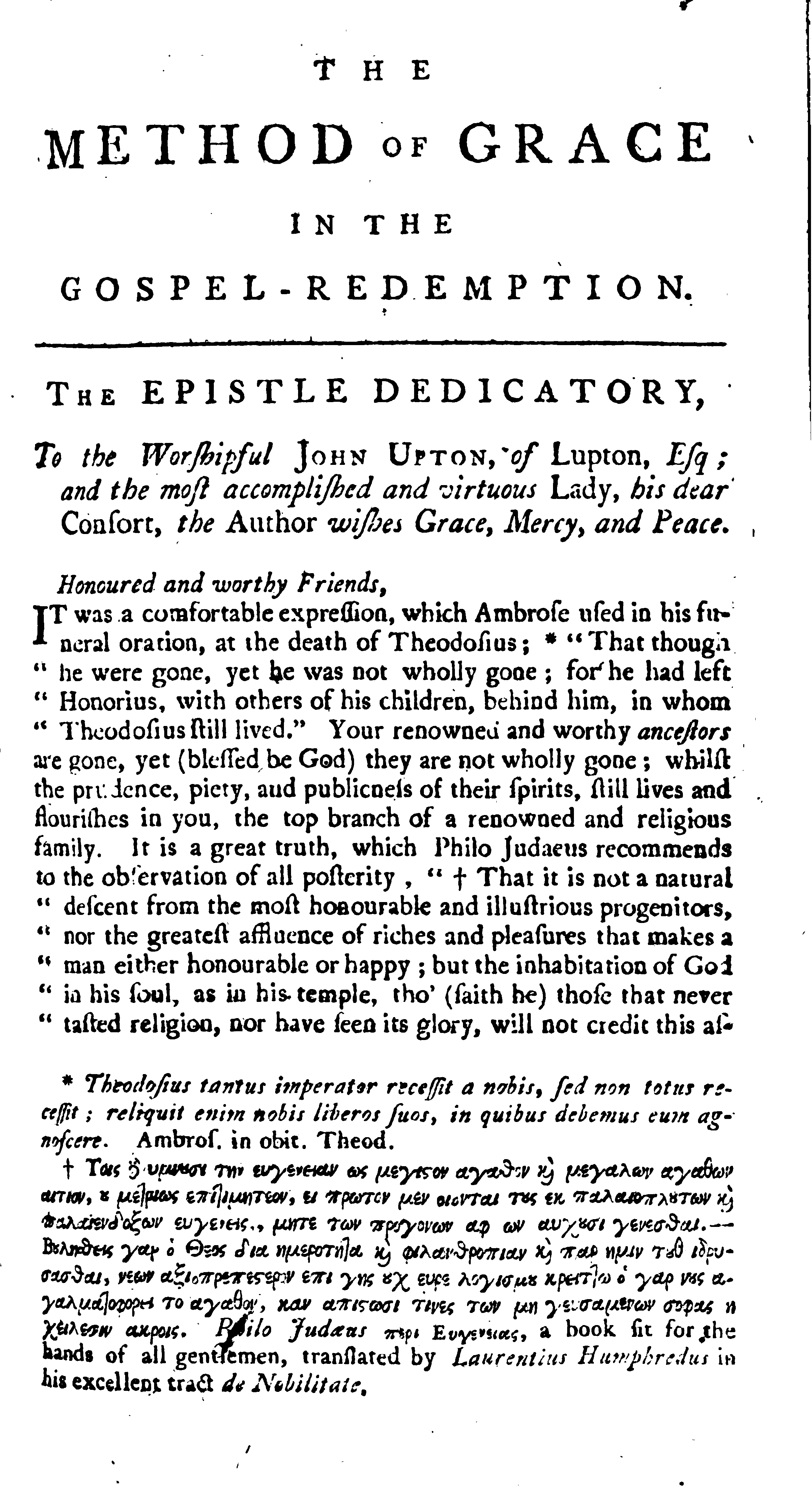
THE
METHOD OF GRACE
IN THE
GOSPEL - REDEMPTION .
THE EPISTLE DEDICATORY,
To the Worshipful JOHN UPTON, of Lupton, Esq ; and the most accomplished and virtuous Lady, bisdear
Consort, the Author wishes Grace, Mercy, and Peace.
Honoured and worthy Friends, ITTwas a comfortable expression, which Ambrose used in his funeral oration, at the death ofTheodosius ; * " That though
" he were gone, yet he was not wholly gone ; for he had left " Honor i us, with others of his children, behind him, in whom
" Theodofius still lived." Your renowned and worthy ancestors are gone, yet (bleffedbeGod) they are not wholly gone ; whilst the prudence, piety, and publicness of their spirits, still lives and flourishes in you, the top branch of a renowned and religious family.
It is a great truth, which Philo Judaeus recommends to the observation of all posterity , " + That it is not a natural
" descent from the most honourable and illustrious progenitors, 66 nor the greatest affluence of riches and pleasures that makes a man eitherhonourable or happy ;but the in habitation of God
" in his soul, as in his temple, tho' (faith he) those that never " tasted religion,nor have seen its glory, will not credit this af
* Theodosius tantus imperator recess it a nobis, fed non totus receffit ; reliquit enim nobis liberosfuos, in quibus debemus eum agnofcere. Ambrof, in obit. Theod.
+ Τους ήυμνασι την ευγένειαν ως μέγιςον αγαθεν ης μεγαλων αγαθων αιτιον, ο μέτριως επίζιμητεον, ει πρωτον μεν οιονται τος εκ παλαιοπλότων κι παλαίενδοξων ευγενείς , μητε των προγονων αρ ων αυχέσι γενέσθαι.
Βοληθειςγαρ ὁΘεος δια ημεροτητα κι φιλανθροπιαν κι παρ ημιν τεθ ιδρυ σασθαι , νεων αξιοπρεπεςερον επι γης εχ ευρε λογισμε κρείτίω ο γαρ ναςα γαλμάζοφορει το αγαθον, καν απισωσι τίνες των μη γευσαμένων σοφας n χείλεσιν ακροις.
Philo Judaas περι Ευγενειας, a book fit for the hands of all gentlemen, translated by Laurent i us Humphredus in hisexcellenttract de Nobilitate,
The Epistle DEDICATORY.
"" sertion." "The soul which is filled with God, (faith *Plotinus) and brings forth the beautiful fruits of righteousness, this
" is the truly noble foul :" Our new birth makes us more honourable than our natural birth, let our birthright dignities be what they will.
The children of nobles are,by nature, the children of wrath, even as others : Omnis Sanguis con color, all blood is of onecolour: it is all tainted in Adam, and mingled together in his posterity. "There is no king, faith † Seneca, which rose
" not from a servant; there is no servant which rose not from a king : these thingshavebeenblended, and tossed to and fro bya long variety."
But though the privileges of natural birth signify nothing as to eternal salvation, yet in civil and political respects and considerations, those that by birth, education, or estate, possess an higher station in the world, differ from the vulgar, as stars of greater magnitude and lustre: their interest and influence are great in these things, and the welfare of kingdoms † greatly depends upon them.
It is therefore a great design of the enemy of mankind, to corrupt persons of eminent rank and quality both in religion and morality ; and by their influence and example, to infect and poison the whole body politic; and his success herein, deserves to be greatly lamented and bewailed.
Persons of eminency are more especially || obliged toshun base and sordid actions.
Hierom professed § he saw nothing desirable in nobilirinus.
* Ψυχη πληρωθείσαθες γεννατο καλλος, γεννα τεν δικαιοσυνην. Plo- † Neminem regem non exfervis esseoriundum, neminemfervum non ex regibus : omnia ifta long a varietas mifcuit, etfurfum deorfumfortuna versavit .
Sen. Ep. 44.
Who manages the reins of government, who is present at, and presides over, both private and public matters, but persons of eminent rank and quality ? Who moderates in the senate, presides in courts, commands at home and abroad ? Chief men and nobles surely.
Who commands and countermands, acts and overacts, manages and canvasses all affairs, who makes laws and rescinds them, who governs the state in time of peace, and commands the forces in time of war, but greatmen and nobles ? No wonder that the management of public affairs be committed to him, who both by personal merit and renown of his ancestors hath recommended himself to the good report and esteein of mankind.
Laurent . Humphred. on Nobility .
In maximafortuna, minima eft licentia.
Saluft.
§ Nihil aliud video in nobilitate appetendum, nisi quod nobiles quadam
The Epistle DEDICATORY.
ty, except this, that such persons are bound by a certain kind of necessity, not to degenerate from the probity, or stain the glory of their ancestors.
But alas ! how many in our times, havenotonlyexposed Christianitytocontempt, but obscured * the glory of their own families, and the kingdom in which they had their birth and breeding; so that if you will take right marks of your way to heaven you will have little direction from those of your own rank, but as † mariners take their direction at sea,by looking up to the heavens, fo must you.
In this general corruption it is very hard toescapeinfection ; (many as Salvian complained) ‡ are compelled to be evil, lest they should be accounted vile, and incur the of fence of God, to avoid the flights andcensuresof men.
Although there is no more reason why theyshouldbe offended at the rational and religious pleasures, you, and other pious gentlemen take in the ways of godliness, than there is, that you should envy the sinful pleasures they take in the ways of wickedness.
It was an excellent apology, that Tertullian made for the Christians of his time, against theGentiles, " Wherein (faith ( he) do we offend you, if we believe
"there are other pleasures ? If we will not partake with you in your delights, it is only our own injury: we reject your plea- " fures, and you are not delighted with ours."
Butbyhowmuch the infection spreads and prevails among quadam necessitate conftringuntur, neab antiquorum probitate dés gene rent.
Hieron.
* God grant that the end proposed maybe obtained, that the ancient and truly venerable nobility may at length return, who by the honour of prudence and knowledge, and luftre of renowned deeds, may obscure the fame ofprogenitors, and quite remove and wipe off the stain brought on its august name. Humph. on Nobility .
† In the same manner, you ought to seek the path of life, that the mariners at sea seek the designed course for their ships, who, if they observe not some luminary in the heavens, steer but an uncertain course, but whosoever is resolved to keep in the right path of life, must not look down to the earth but to heaven; and (to speak more plainly) he ought not to follow men but God; therefore if thou wouldst always keep thine eyes fixed on heaven, and observe the fun whence he ariseth, and take him as thy guide, thy feet of themselves will keep straight in the way.
Lactant. lib. 1. c. 8.
†Malleffe countur ne viles habeantur.
Salv.deGubernat.
§ Quo vos offendimus fi alias præfumimus voluptates ?fi oblec tarinolumus, nostra injuria est : reprobamus quæ placent vobis,
Recvosnoftradelectant.
Tertul.Apolog. adv. Gent.
VOL. II.
The Epistle DEDICATORY. those of your order, by so much the more we have reason tova lue you, and all those that remain found and untainted, both in religion and morality, as persons worthy of singular respect and honour : and blessed be God there is yet a number of such left.
Sir, It was a special happiness, which Chryfoftom earnestly recommended to persons of quality, that they would fo order their conversations, that their parents, might rather glory in them, than they in their parents ; "Otherwise (faith * he) it is
" better to rife tohonour, from a contemptible parent, than to 66 be contemptible from an honourable parent ;" but blessed be
God, you and your worthy ancestors, mutually reflect honour uponeachother.
Had God fufferedyou to degenerate, as many do, it would have been but a poor consolation to havefaid, My progenitors were men of honour, the love and delight of their country.
This, as † one excellently expresseth it, would be the fame thing, as if one that is blind himself, should boast what a sharp and piercing fight his father had; or one that is lame himself, should glory in those feats of activity his grandfather performed; but God (to whose bounty therefore you are doubly obliged) hath made you the inheritor of their virtues, as well as of their lands, and therein fulfilled many thousand prayers, which have been poured out to God upon your account.
But I must forbear, lest I provoke others to envy, and draw upon myself the suspicion of flattery.
What hath been already said, may serve for a sufficient reason of this dedication.
I know the ‡ agreeableness of such difcourses, to the pious dispositions of your souls, is of itself sufficient to make it welcome to you.
It is a treatise of Christ, yea, of the method of grace, intheapplicati- * Melius eft de contemptibilifieri clarum, quam de clarogenere contemptibilem effe, Chryfoft. in Mat. 4. Necfieri poteft quin hunc comitetur ignobilitas etiamfi vel avis, velproavis natusfit vita in culpatis, qui ab eorumftudiis alien us est,sequelongissime tum dictis, tumfactis a nobilitate disjungit .
†What profit is the sharp-fightedness of ancestors to the offspring, which is deprived of fight ? What help can it give the man that is dumb, for attaining the power of speech, that his parents and grandfathers had the voice of orators ? In like manner,just parents cannot help their unjust children; nor the temperate, those who are luxurious : nor at any rate, canthegood communicate goodness to the bad.
‡ When the mind of the hearer is good and gracious, it easily allents to speeches of truth.
Chryfoft. Hom. 26. in Mat.
The Epistle DEDICATORY
on of Christ ; than which no subject can be more necessary to study, or sweet to experience.
* All goodness is attractive, how powerfully attractive then must Jesus Christ be, who is the ocean of all goodness, from whom all streams off goodness are derived, and into whom, they all empty themselves ? † If Pindarus could fay of the lovely Theoxenus, that whosoever fawthat august and comely face of his, and was not surprised with amazement, and inflamed with love, must have an heart of adamant or brass, what then shall we resemble that man's heart unto, that hath no ferverous affections kindled in it by the incomparable beauty of Christ ! a beauty, which excels in lustreand brightness, that visible light which sodazzles our eyes
‡, as that light doth darkness itself; as Plato speaks of the divine light Christ is υπερβαλλοντως καλος, an inexpressible beauty, and all other beauties are but εικον, και σκια an image, nay, a shadowofhisbeauty.
How was holy Ignatius ravished with desires after Christ, when § he cried out, O how I long to be thrown into the jaws of those lions, which I hear roaring for me ! and iftheywillnotdispatch me the sooner, και προσβιασομαι, I will enforce them to it by violence, that I may enjoy the fight of my blessed Jesus . O my heart, (faith || another) how is it thou art not drawn up by the very root, by thy desires after Christ ? The necessity, and the trial of our union with, and interest in, this lovely LORD JESUS, is the main subject of this discourse.
Without the personal application of Christ by faith, our hopes of heaven are but deluding dreams, Heb. iii. 11. " I sware in my
" wrath, ει εισελεύσονται, iftheyshallenter into my rest :" What then? Nay, there is all: but it is a dreadful Apofiopesis (as one calls it) such a pause, as may justly shake every vein of the unbeliever's heart : If they shall enter; as if he had said, If ever they come into my glory, then say, I am no God, for I have sworn the contrary.
02.
* Ουδεν αλλο εσιν & ερωσιν ανθρωποι η τε αγαθε ανελκει παντα κὶανασπαταις οικείαις ελαμψεσιν ωςηλιος.
Plato.
† Το νοητονφως, το αρχέτυπον σανζων τοσέτω το ορατό λαμπρότερον τε κή αυξοειδεςερον ωσπερ ηλιος σκοτες.
Plato.
§ Ο εμος έρως εσαυρωται κι γκ εςιν εν εμοι το πυρ το φιλούλον , αλλ υδωρ αλλομένον, &c. ωναιμην των θηριων, ινατο ΙησεΧρισ8 επιτυχω.
Ignatii Epift.
O cor meum quomodo non te evellis post tantum decorem ? Nieremberg.
Vivere renuo, ut Chrifto vivam.
$00 The Epistle DEDICATORY.
Iwillnotbe tiresome, but conclude all in a few requests to youandtoGodforyouboth. That which I request of you is,
(1.) That you will search and try your own hearts by these truths, especially now, when so great trials are like to be made ofeveryman's root and foundation in religion. Account that your first work, which Bellarmine calls the first error of " Protestants," to make sure your interest in Christ ; * every thing is as its foundation is : at rue diamond will endure the smartest stroke of the hammer,but a false one will fly.
(2.) That you be humble under all that dignity and honour, which God hath put upon you; beye cloathed with humility,
It was the gloryoftheprimitive Christians, that they +did not speakbuthvegreat things: humility will be the luftre of your
Other excellencies: eftatesand honours are but appendants and fine trappings, which add not any real worth, yet ‡ how are some vain minds puffed up with these things! Butyehave not fo learned Christ .
(3.) That you steadily persevere inthosegoodways of God,in which you have walked, and beware of heart, or life apostacy.
You expect happiness whilftGod is in heaven,and God expects holiness from you whilst you are one earth.
It was an excellent truth which Toffanus § recommended to his posterity in his last-will and testament, from his own experience : " I beseech
66 you (faith he) my dear children and kindred, that you never "be ashamed of the truths of the gospel, eitherbyreasons of " scandals in the church,or perfecutions upon it; truthmayla
" bour for a time, but cannot be conquered; and I have often " foundGodtobewonderfully present withthemthatwalk be- "fore him in truth, though for a time they maybe opposed
" with troubles and calumnies,"
* Primus Hæreticorum error eft, posse fideles eam notitiam ha. beredesua gratia, ut certa side statuant fibi remiss a essepeccata.
Bell arm. de Just. lib. 3. cap. 3 .
+ Non elaquimur magna, sed vivimus.
Tertul. Apolog.
† They report thatBucephalus without his furniture,wouldfufferagroomon his back, butwhendressed with royal trappings and studdedbridles, would suffer none to mount him but the king him self; so it istrulythecafe with these upstart noblesamongus, &c.
§ Obtefter etiamvosliberos, etgeneros carissimosne ill i us veritatis evangelicae unquam vospudeat : potest enim labor ate,fed non vinciveritas: etnonfemel expertusfum Dominum Deum mirabiliteradeffe iis qui coram ipfoambulunt, et infua vocationefeduloet integre verfantur; licet ad tempus, odiis, autfimultatibus, aut ca lumniis agitentur.
Melch. A dam us, invita Toffani,
The Epistle DEDICATORY.
(4.) Lastly, That you keep a strict and constant watch over your own hearts,left they be ensnared by the tempting, charming, and dangerous snares, attending a full and easy condition in the world.
There are temptations suited to all conditions.
Those that are poor and low inestateandreputation, are tempted tocozen, cheat, lie,and flatter, andalltogetup to the mount of riches and honours ; but those that were born upon that mount, tho' they be more free from those temptations, yet lie exposed to others no less dangerous, and therefore we find,"Not many mighty, not many noble are called," 1 Cor i. 26. Many great and stately ships, which spread much fail, and draw much water, perish in the storms, when small barks creep along the shore under the wind, and get safe into their port.
Never aim at an higher station in this world, than that you are in|| :
Somehavewished in their dying hour, they had been lower, but no wife manever wished himself at the top of honour, at the brinkofeternity.
I will conclude all with this hearty wish for you that as God hath set you in a capacity of much service for him in your generation, so your hearts maybe enlarged for God accordingly ; that you may be very instrumental for his glory on earth, and maygo safe, but late to heaven.
That the blessings of heaven maybe multiplied upon you both, and your hopeful springing branches; and that you may live to see your childrens children, and peace upon Israel.
In a word, that God will follow these truths in your hands with the blessing of his Spirit ; and that the manifold infirmities of him that ministers them, may be no prejudice or bar to their success with you, or any into whose hands they shall come; which is the heartydefire of Your most faithful Friend, and Servant in CHRIST,
JOHN FLAVEL.
* Her man us, when dying, bewailed, that he had bestowed more time and pains on his palace than on the temple of God, and encouraged the luxury and wickedness of the court, which he ought to have restrained : Thus, with much grief for fin, his hope of mercy from God greatly wavering, by-standers being filled with great horror, andhimselfdoubtful of his state, his soul entered into eternity. Hist.
Bohem. lib. II