
23 " I in them, and thou in me, that they may
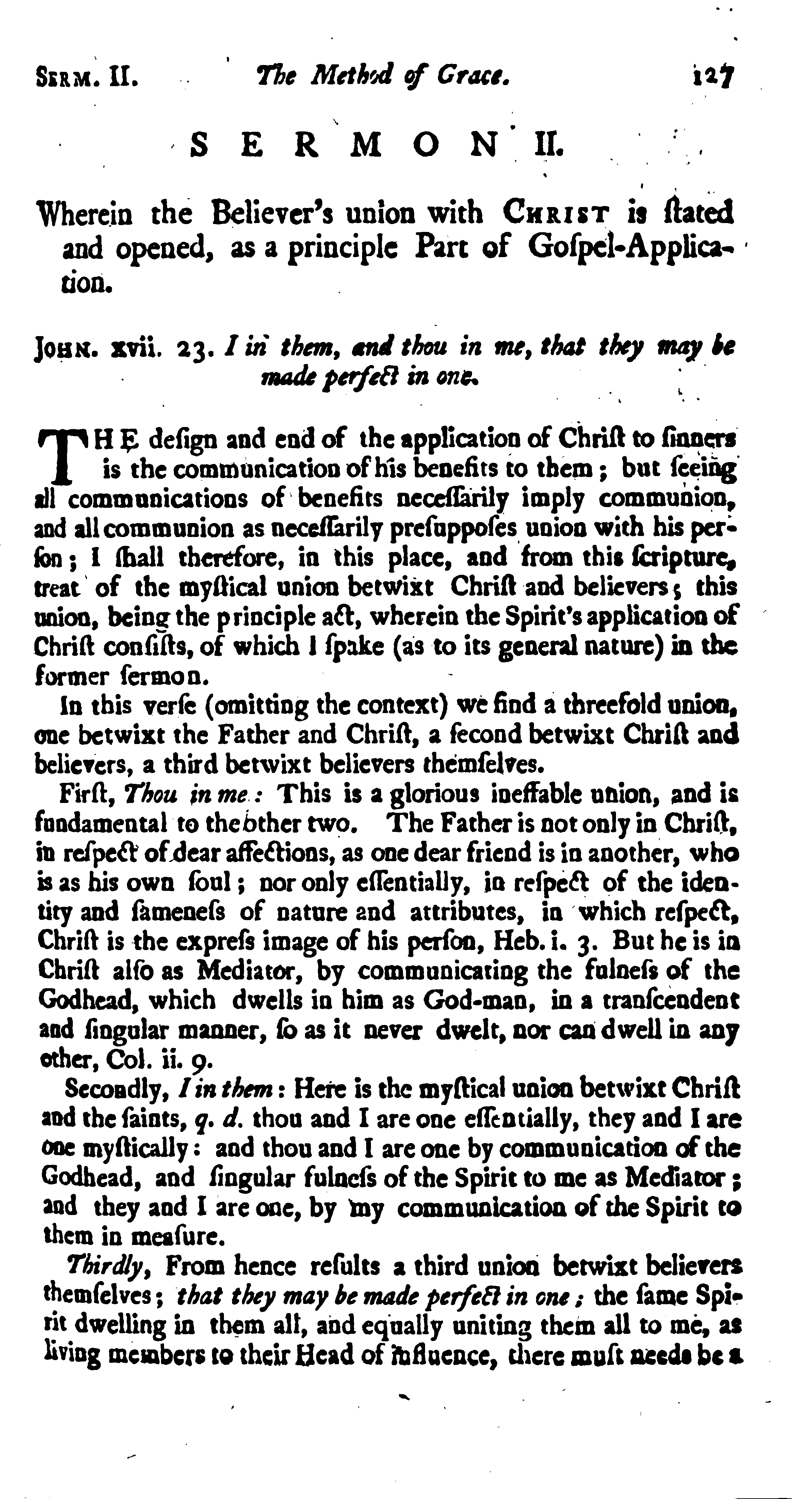
SERM . II .
The Method of Grace.
SERMON I I.
Wherein the Believer's union with CHRIST is stated and opened, as a principle Part of Gospel-Application.
JOHN. xvii. 23. I in them, and thou in me, that they may be made perfect in one.
THE design and end of theapplicationofChrist to sinners isthecommunicationofhis benefits to them; but seeing all communications of benefits necessarily imply communion, and all communion as necessarilypresupposes unionwithhisperfon ; I shall therefore, in this place, and from this scripture, treat of the mystical union betwixt Christ and believers ; this union, being the principle act, wherein the Spirit's application of Christ consists,of which Ispake (as to its general nature) in the former sermon.
In this verse (omittingthecontext)wefindathreefoldunion, onebetwixtthe Father and Christ, a fecondbetwixt Christ and believers, a third betwixt believers themselves.
First, Thou in me : This is a glorious ineffable union, and is fundamental to theothertwo.
The Fatherisnotonly in Christ, in respect of dear affections, as one dear friend is in another, who is as his own soul; nor only essentially, in respect of the identity and sameness of nature and attributes, in which respect,
Christ is the express image of his person,Heb.i. 3. But he is in Christ also as Mediator, by communicating the fulness of the Godhead, which dwells in him as God-man, in a transcendent and singular manner, so as it never dwelt,nor candwellinany other,Col. ii. 9.
Secondly, I in them: Here is the mystical unionbetwixtChrist and the faints, q. d. thou and I are one essentially, they and I are one mystically : and thou and I areone by communication of the
Godhead, and singular fulness of the Spirit to me as Mediator ; and they and I areone,by my communication of the Spirit to them in measure.
Thirdly, From hence results athirdunion betwixt believers themselves; that theymaybemadeperfectin one; the same Spirit dwelling in them all, andequallyuniting them all to me, as living members totheirHeadofinfluence,there mustneedebea
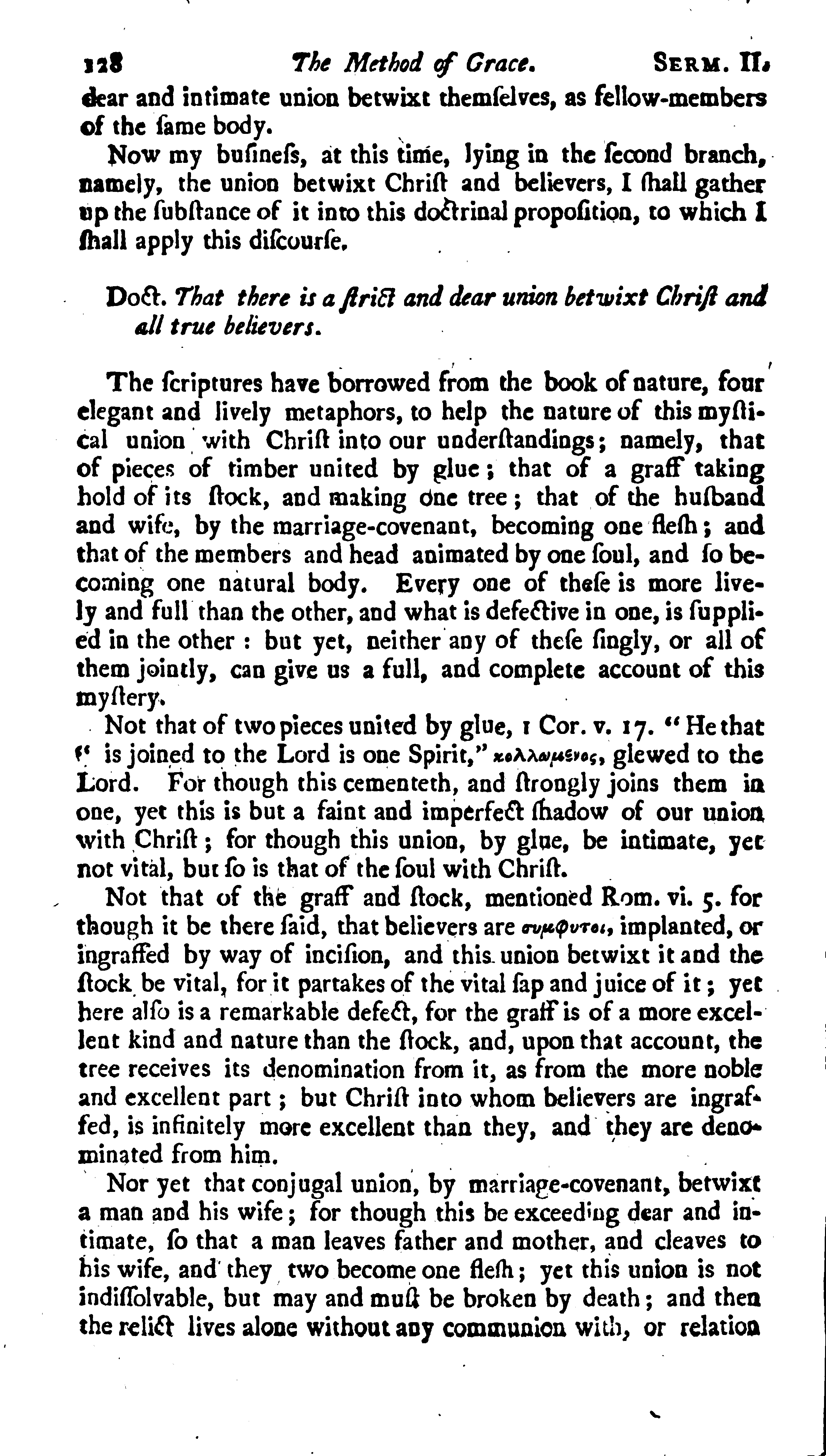
The Method of Grace.
SERM. II.
dear and intimate union betwixt themselves, as fellow-members of the famebody.
Now my business, at this time, lying in the second branch, namely, the union betwixt Christ and believers, I shall gather up the substance of it into this doctrinal proposition, to which I shall apply this discourse.
Doct. That there is a strict and dear union betwixt Christ and all true believers .
The scriptures have borrowed from the book of nature, four elegant and lively metaphors, to help the nature of this mystical union with Christ into our understandings; namely, that of pieces of timber united by glue ; that of a grass taking hold of its stock, and making one tree; that of the husband and wife, by the marriage-covenant, becoming one flesh; and thatofthemembers and head animated by one soul, and so becoming one natural body.
Every one of these is more lively and full than the other, and what is defective in one, is supplied in the other : but yet, neither any of these singly, or all of them jointly, can give us a full, and complete account of this mystery.
Not thatoftwopieces united by glue, 1 Cor. v. 17. "He that " is joined to the Lord is one Spirit," κολλωμένος, glewed to the Lord.
For though this cementeth, and strongly joins them in one, yet this is but a faint and imperfect shadow of our union with Christ ; for though this union, by glue, be intimate, yet not vital, but so is thatofthefoul with Christ.
Not that of the grass and stock, mentionedRom. vi. 5. for though it be there said, that believers are συμφυτοι, implanted, or ingraffed by way of incision, and this union betwixt it and the stock be vital, for it partakesof the vital sap and juice of it ; yet here also is a remarkable defect, for the grass is ofa more excellent kind and naturethanthe stock, and,upon that account, the tree receives its denomination from it, as from the more noble and excellent part ; but Christ into whom believers are ingraffed, is infinitely more excellent than they, and they are denominated from him .
Nor yet that conjugal union,by marriage-covenant, betwixt am an and his wife; for though this be exceeding dear and intimate, so that a man leaves father and mother, and cleaves to his wife, and they two becomeone flesh; yet this union is not indissolvable, but may and must be broken by death ; and then the relict lives alone without any communion with, or relation
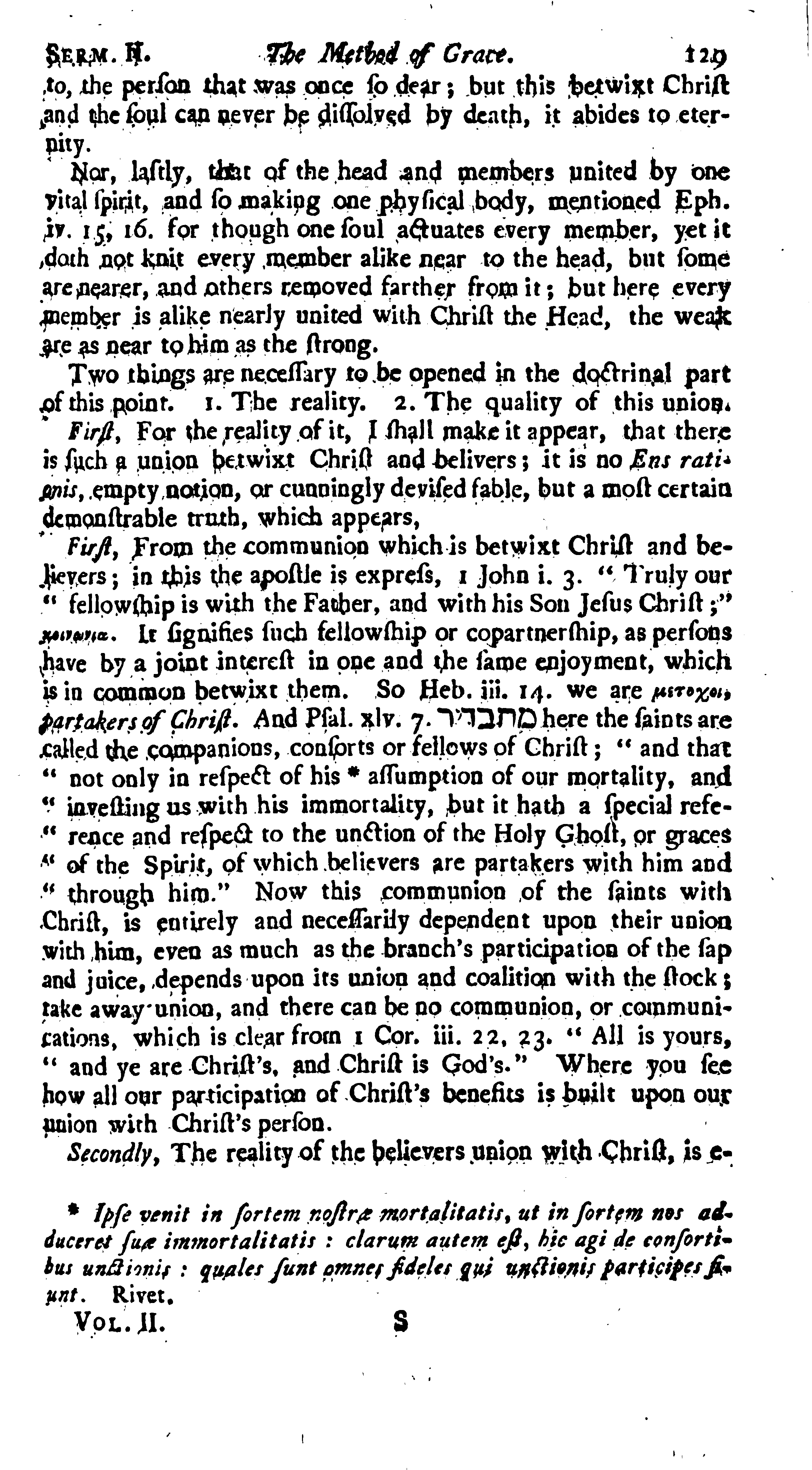
SERM. H.
The Method of Grace.
to, the person that was once so dear; but this betwixt Christ and the soul can never be dissolved by death, it abides to eternity.
Nor, lastly, that of the head and members united by one vital spirit, and so making one physical body, mentioned Eph . iv. 15, 16. for though one soul actuates every member, yet it doth notknit every member alike near to the head, but some are nearer, and others removed farther from it; but here every member is alike nearly united with Christ the Head, the weak are as near to him as the strong.
Two things are necessary to be opened in the doctrinal part of this point.
1. The reality.
2. The quality of this union.
First, For the reality of it, I shall make it appear, that there is such a union betwixt Christ and be livers; it is noEns rat i on is, empty notion, or cunninglydevisedfable, but a most certain demonftrable truth, which appears, First, From the communion which is betwixt Christ and believers ; in this the apostle is express, I John i. 3. " Truly our
" fellowship is with the Father, and with his Son Jesus Christ ;" κοινωνία.
It signifies such fellowship or copartnership, as persons have by a joint interest in one and the fame enjoyment, which isincommonbetwixt them.
So Heb. iii. 14. we are μετοχοι; partakers of Christ. And Psal. xlv. 7. here the saints are called the companions, conforts or fellows of Christ ; "and that 66 not only in respect of his * assumption of our mortality, and " investing us with his immortality, but it hath a special refe- " rence and respect to the unction oftheHolyGhost, or graces
" of the Spirit, of which believers are partakers with him and " through him." Now this communion of the saints with Christ, is entirely and necessarily dependent upon their union with him, even as much as the branch's participation of the sap and juice, depends upon its union and coalition with the stock ; take away union, and there can be no communion, or communications, which is clear from 1 Cor. iii. 22, 23. "All is yours,
" and ye are Christ's, and Christ is God's." Where you fee how all our participation of Christ's benefits is built upon our union with Christ's person .
Secondly, The reality of the believers union with Christ, is e- * Ipfe venit in fortem noftræ mortalitatis, ut infortemnos adduceretfue immortalitatis : clarum autem eft, hic agideconfortibus unctionis : qualesfunt omnes fideles qui unctionis participesfiunt.
Rivet.
VOL . II.
S :
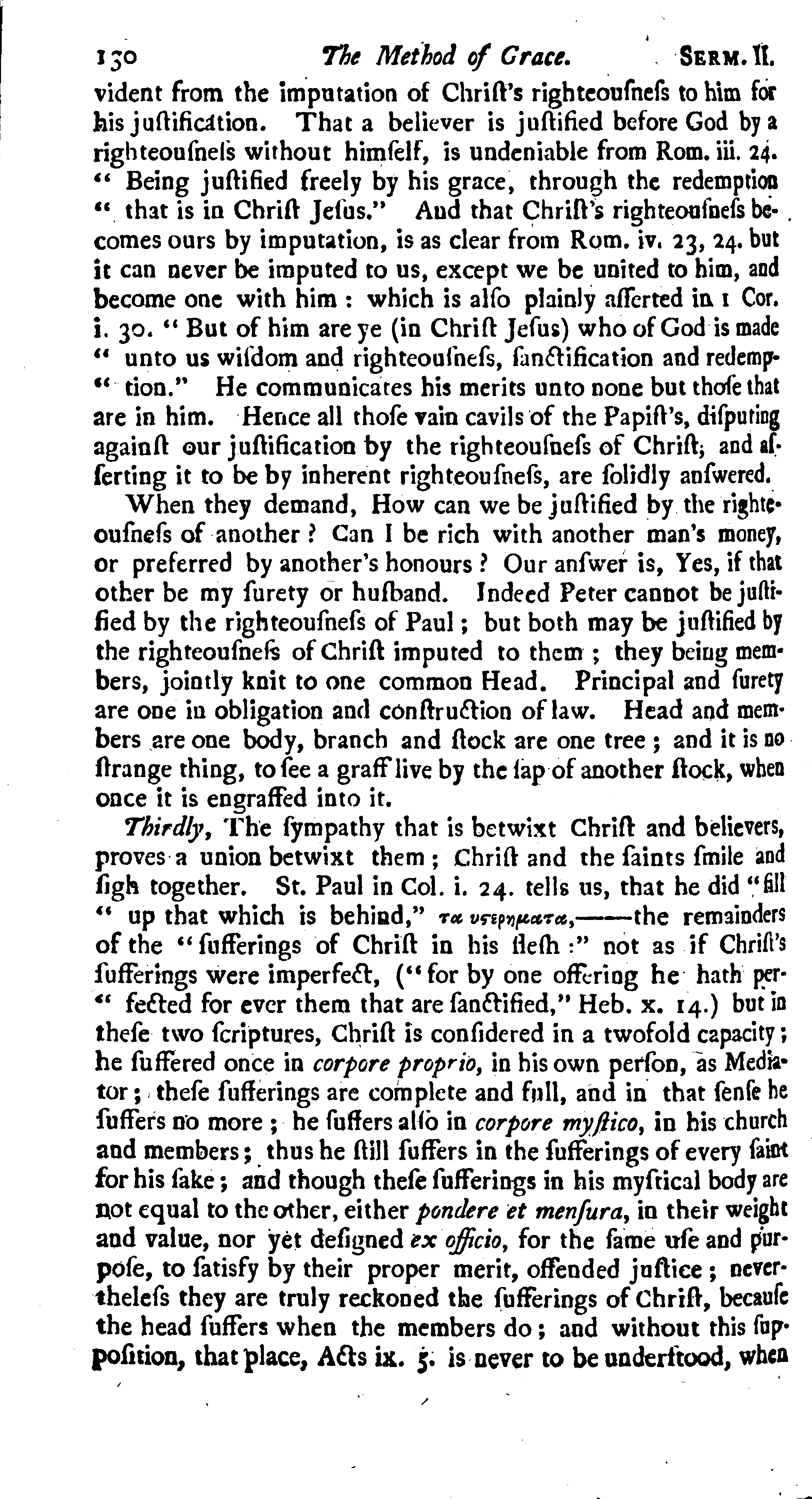
The Method of Grace.
SERM. II.
vident from the imputation of Christ's righteousness to him for his justification.
That a believer is justified before God by a righteousness without himself, is undeniable from Rom. iii. 24.
" Being justified freely by his grace, through the redemption " that is in Christ Jesus."
And that Christ's righteousness becomes ours by imputation, is as clear from Rom. iv. 23, 24. but it can never be imputed to us, except we be united to him, and become one with him : which is also plainly asserted in 1 Cor. i. 30. " But of him areye (in Christ Jesus) who of God is made
" unto us wisdom and righteousness, sanctification andredemp- " tion ."
He communicates his merits unto none but those that are in him.
Hence all those vain cavilsofthe Papift's, disputing against our justification by the righteousness of Christ, and af serting it to be by inherent righteousness, are solidly answered.
When they demand, How can webejustifiedby therighte oufness of another ? Can I be rich with another man's money, or preferred by another's honours ? Our answer is, Yes, if that other be my surety or husband.
Indeed Petercannot be justified by the righteousness of Paul; but both maybe justified by the righteousness of Christ imputed to them; they being members, jointly knit to one common Head.
Principal and surety are one in obligation and construction of law. Head and members areone body, branch and stock are one tree; and it is no strange thing, to see a grafflive by the sap of another stock, when once it is engraffed into it.
Thirdly, The sympathy that is betwixt Christ and believers, proves a union betwixt them ; Christ and the saints smile and sigh together.
St. Paul in Col. i. 24. tells us, that he did " fill up that which is behind," τα υςερηματα,--the remainders of the " sufferings of Christ in his flesh:" not as if Christ's sufferings were imperfect, (" for by one offering he hath per- " fected for ever them that are sanctified," Heb. x. 14.) but in these two scriptures, Christ is considered in a twofold capacity ; he suffered once in corpore proprio, in his own person, as Media tor; these sufferings are complete and full, and in that sense he suffers no more ; he suffers also in corpore mystico, in his church and members; thus he still suffers in the sufferings of every faint for his fake; and though these sufferings in his mystical body are not equal to the other, eitherpondere et menfura, in their weight and value, nor yet designed ex officio, for the fame use and purpose, to satisfy by their proper merit, offended justice; nevertheless they are truly reckoned the sufferings of Christ, because the head suffers when the members do; and without this sup. position, that place, Acts ix. 5. is never to beunderftood,when
SERM. II.
The Method of Grace.
Christ, the Head in heaven, cries out, " Saul, Saul, why perse- " cutest thou me ?" when the foot was trod upon on earth ;
How doth Christ sensibly feel our sufferings, or we his, if there be not a mystical union betwixt him and us ?
Fourthly, and lastly, The way and manner in which the saints shall be raised at the last day, proves this mystical union betwixt
Christ and them ; for they are not to be raised as others, by the naked power of God without them, but by the virtue of Christ's resurrection as their Head, sending forth vital quickening influences into their dead bodies, which are united to him as well as their souls .
For so we find it, Rom . viii. II .
"But if the " Spirit of him that raised up Jesus from the dead dwell in you, he that raised up Christ from the dead, shall also quicken your mortal bodies, by his Spirit thatdwelleth in you;" even as it is in our awaking out of natural sleep, first the animal-spirits in the head begin to rouze and play there, and then the senses and members are loosed throughout the whole body.
Now it is impossible the saints should be raised in the last resurrection, by the Spirit of Christ dwelling in them, if that Spirit did not knit and unite them to him, as members to their head. So then by all this, it is proved, that there is a real union of the saints with Christ .
Next, I shall endeavour to open the quality and nature of this union, and shew you what it is, according to the weak apprehenfions we have of so fublimea mystery ; and this I shall do in a general and particular account of it.
First, More generally, it is an intimate conjunction of believers to Christ, by the imparting of his Spirit to them, whereby they are enabled to believe and live in him.
All divine spiritual life is originally in the Father, andcomethnot to us, but by, and through the Son, John v. 26. to him hath the Father given to have an αυτοζωη,--a quickening, enlivening power in himself; but the Son communicates this life which is in him to none, but by, and through the Spirit, Rom. viii. 2. "The Spirit of life which is in Christ Jesus, hath made
66 me free from the law of fin and death ."
The Spirit must therefore first take hold of us, before we can live in Christ, and when he doth so, then we are enabled to exert that vital act of faith, whereby we receive Christ ; all this lies plain in that one Scripture, John vi. 57. " As the living Fa- " ther hath sent me, and I live by the Father, fo he that eat- " eth me (that is, by faith applies me) even he shall live by me."
So that these two, namely, the Spirit, on Christ's part, and faith, S2
SERM.If The Method of Grace. his work on our part, are the two ligaments by which we are knit to Christ.
So that the Spirit's work in uniting or engraffing a soul into Christ, is like the cutting off the grass from its native stock
(which he doth by his illuminations and convictions) and closing it with the living, when it is thus prepared, and fo enabling it(by the infusionoffaith) to fuck and draw the vital sap, and thus it becomes one with him.
Or as the many members in the natural body, being all quickened and animated by the fame vital spirit, become one body with the head, which is the principal member, Eph. iv. 4. " There is one body, and one spirit."
More particularly, we shall confider the properties of this union, that so we may the better understand the nature of it.
And here I shall open the nature of it both negatively and affirmatively.
First, Negatively, by removing all false notions and mifapprehenfions of it. And we say,
First, The saints union with Christ, is not a mere mental union, only in conceit and notion, but really exists extra mentem, whether we conceit it or not.
I know the atheisticalworld cenfures all these things as fancies and idle imaginations, but believers know the reality of them ; John xiv. 20. "At that day
" you shall know that I am in my Father, and you in me, and " I in you. "
This doctrine is not fantastical,but fcientifical.
Secondly, The saints unionwithChrist is not a physical union, such as is betwixt the members of a natural body and the head; our nature indeed is assumed into union with the person of Christ, but it is the singular honour of that blessed and holy flesh of Christ, to be fo united as to make one person with him ; that union is hypostatical, this only mystical.
Thirdly, Nor is it an essential union, or union with the divine nature, so as our beings are thereby swallowed up and lost in the
Divine Being.
Some there be indeed that talk at that wild rate, ofbeinggodded into God, and christed into Christ ; and those unwaryexpressions ofGreg. Naz. Θεοποιειν, andΧρισοποιειν, do but too much countenance those daring spirits; but oh, there is an infinite distance betwixt us and Christ, in respect of nature and excellency, notwithstanding this union.
Fourthly, The union I here speak of, is not a foederal union, or an union by covenant only; such an union indeed, there is betwixt Christ and believers, but that is consequential to, and wholly dependent upon, this.
Fifthly, and lastly, It is not a mere moral union by love and
SERM. II.
The Method of Grace.
affection ; thus we say, one soul is in two bodies, a friend is another self; the lover is in the person beloved; such an union of hearts and affections there is alto betwixtChrift and the saints, but this is of another nature; that we callamoral, this a mystical union ; that onlyknits our affections, but this our persons, to Christ.
Secondly, Positively. And first, Though this union neither makes us one person or essence with Christ, yet itknits our persons most intimately and nearly to the person of Christ.
The church is Christ's body, Coloff. i. 24. not his natural, but his mysticalbody ; that is to say, his body is a mystery, because it is to him as his natural body.
The saints stand to Christ in the fame relation that the natural members of the body stand to the head, and he stands in the fame relation to them, that the head stands in to the natural members ; and consequently they stand related to one another, as the members ofa natural body, do to each other.
Christ and the saints are not one, as the oak, and the ivy that clafps it are one, but as the graffand stock are one ; it is not an union by adhesion, but incorporation.
Husband and wife are not so near, foul and body are not so near, as Christ and thebelievingfoul are near to each other.
Secondly, The mystical union is wholly supernatural,wrought bythealonepower of God.
So it is said, 1 Cor. i. 30. " But of " him are ye in Christ Jesus." We can no more unite ourselves to Christ, than a branch can incorporate itselfintoanother stock ; it is of him, i. e. of God, his proper and alone work .
There are only two ligaments, or bands of union betwixt Christ and the soul, viz. the Spirit on his part, and faith on ours.
But when we fay faith is the band of union on our part, the meaning is not, that it is so our own act, as that it springs naturally from us, or is educed from the power of our own wills ; no, for the apostle exprefly contradicts it, Eph. ii. 8. " It is not " ofyourselves, it is the gift of God."
But we are the subjects of it, and though the act on that account be ours, yet the power enabling us to believe is God's, Eph . i. 19, 20.
Thirdly, The mystical union is animmediateunion; immedi ate I fay, not as excluding means and instruments, for several means andmanyinstruments, are employed for the effecting of it; but immediate, as excluding degrees ofnearness among the members of Christ's mystical body.
Every member in the natural body stands not as near to the head as another, but fo do all the mystical members of Christ's body to him : every member, the smallestaswell as the greatest,
The Method of Grace.
SERM . II .
hath an immediate coalition with Christ, 1 Cor. i. 2. " To the " church of God, which is at Corinth, to them that are fanc- " tified in Christ Jesus, called to be saints, with all that in every
" place call upon the name of Jesus Christ our Lord, both theirs " and ours."
Among the factions, in this church at Corinth, those that said, I am of Christ, as arrogating Christ to themselves, were as much a faction, as those that said, I am of Paul,
1 Cor. i. 30. To cure this he tells them, he is both theirs and ours .
Such inclofers are against law.
Fourthly, The saints mystical union with Christ is a fundamental union ; it is fundamental by way of fuftentation; all our fruits of obedience depend upon it, John xv. 4. " As the " branch cannot bear fruit except it abide in the vine, no more
" can ye, except ye abide in me."
It is fundamental to all our privileges and comfortable claims, 1 Cor. iii. 23. "All is yours,
" for ye are Christ's." And it is a fundamental to all our hopes andexpectattions of glory; for it is " Christ in you the hope of " glory," Col. i. 27.
Sothendeftroy this union, and with it you destroy all our fruits, privileges, and eternal hopes, at one stroke.
Fifthly, The mystical union is a most efficacious union, for through this union the divine power flows into our souls, both to quicken us with the life of Christ, and to conserve and secure that life in us, after it is so infused.
Without the union of the soul to Christ, which is to be conceived efficiently as the Spirit's act, there can be no union formally considered; and, without these, no communications of life from Christ to us, Eph. iv. 16. And as there is that ενεργεια, or effectual working of the spirit of life in every part, which he there speaks of, (as though you should say,the first appearances ofa new life, afpiritual vitality diffused through the soul, which ere while was dead in sin) yet still this union with Christ is as necessary to the maintaining, as before it was to the producing of it.
For why is it that this life is not again extinguished, and wholly suffocated in us, by so many deadly wounds as are given it by temptations and corruptions ? Surely no reason can be af. fignedmore fatisfyingthan that, which Christ himself gives us, in Johnxiv. 19. "Because I live, ye shall live also : " q. d. whilst there is vital sap in me the root, you that are branches in me cannot wither and die.
Sixthly, The mystical union is an indissoluble union; there is an everlasting tye betwixt Christ and the believer; and here
SERM . II .
The Method of Grace.
in also it is beyond all other unions in the world; death dissolves the dear union betwixt the husband and wife, friend and friend, yea, betwixt foul and body, but not betwixt Christ and the soul, the bands of this union rot not in the grave. " What
" shall separate us from the love of Christ ?" faith the apostle, Rom. viii. 35, 38, 39. He bidsdefiance to all his enemies, and triumphs in the firmness of this union over all hazards that seem to threaten it.
It is with Christ and us, in respect of the mystical union, as it was with Christ himself, in respect of the hypostatical union : That was not dissolved by his death, when the natural union betwixt his soul and body was, nor can this mystical union of our souls and bodies with Christ be dissolved, when the union betwixt us and our dearest relations, yea, betwixt the soul and body, are dissolved by death. God calls himself the God of Abraham, long after his body was turned into dust.
Seventhly, It is an honourable union*, yea, the highest honour that can be done unto men: The greatest honour that was ever done to our common nature, was by its assumption into union with the second personhypostatically, and the highest honour that was ever done to our single persons,was their union with Christ mystically.
To be a servant of Christ, is a dignity transcendent to the highest advancement among men ; but to be a member of Christ, how matchless and singular is the glory thereof ! And yet such honour have all the saints, Eph. v. 30. " We are members of his body, of his stesh, and of his
"bones."
Eightly, It is a most comfortable union : Yea, the ground of all solid comfort, both in life and death : Whatever troubles, wants, or distresses, befal such, in this is abundantreliefandfupport.
Christ is mine, and I am his; what may not a good foul make out of that ! If I am Christ's, then let him take care for me, and, indeed, in so doing, he doth but care for his own :
He is my head, and to him it belongs to consult the safety and welfare of his own members, Eph. i. 22, 23. He is not only an head to his own, by way of influence, but to all things else, byway of dominion, for their good. Howcomfortablymaywe
* Christ is the head, summit, and crown of all dignity, without whom there is nothing (truly) noble in all this sublunary world, who has heaven for his throne, and the earth for his footstool . The earth, I say, with all the persons of high rank and station in it are put under his feet.
Laur. Humphred. on Nobility.
SERM. II.
The Method of Grace. repose ourselves, under that cheering consideration, upon him at all times, and in all difficult cases!
Ninthly, It is a fruitful union : The immediate end of it is fruit, Rom. vii. 4. " We are married to Christ, that we should
" bring forth fruit to God :" All the fruit we bear before our ingrafture into Christ, is worse than none: Till the person be in Christ, the work cannot be evangelically good and acceptable to God:
We are made accepted in the Beloved," Eph. i. 6.
Christ is a fruitful root, and makes all the branches, that live ،، in him, so too, John xy. 8 .
Tenthly, and Lastly, It is an enriching union : For, by our union with his person, we are immediately interested in all his riches, 1 Cor. i. 30. How rich andgreataperson do the little arms of faith clasp and embrace ! "All is yours," 1 Cor. iii.
22.
All that Christ hath becomes ours, either by communication to us, or improvement for us : His father, John xx. 17.
His promises, 2 Cor. i. 20. His providences, Rom. viii. 28. His glory, John xvii. 24. It is all ours by virtue of our union with him.
Thus you fee, briefßy, what the mystical union is.
Next we shall improve it.
Infer.
1. If there be such an union betwixt Christ and be. lievers, Oh then what transcendent dignity hath God put upon believers !
Well might Constantine prefer the honour of being a member of the church, before that of being head of the empire †; for it is not only above all earthly dignities and honours, but, in some respect, above that honour which God hath put upon the angels of glory.
Great is the dignity of the angelical nature: The angels are the highest and most honourable species of creatures : They alfohave the honour continually to behold the face of God in heaven, and yet, in this one respect, the saints are preferred to them, they have a mystical union with Christ, as their head of influence, by whom they are quickned with spiritual life, which the angels have not.
It is true, there is an ανακεφαλαιώσις, or gathering together of all in heaven and earth under Christ as a common head, Eph. i.
10. He is the Head of angels, as well as faints, but indifferent + If thou would'it be called a man of power, put on Christ who is the power and wisdom of God, and in all things join thyself to the Lord, that thou mayeftbe one spirit with him, and then thou shalt become a man of power.
Orig. Hom. in Num. xxxi.
SERM. II.
The Method of Grace. respects. To angels he is an head of dominion and government, but to faints he is both an head of dominion, and vital influence too: They are his chief and most honourable subjects, but not his mystical members : They are as the Barons and Nobles in his kingdom, but the saints as the dear spouse and wife of his bosom.
This dignifies the believer above the greatest angel.
And as the nobles of the kingdom think it a preferment and honour to serve the queen, so the glorious angels think it no degradation or dish on our to them to serve the saints; for to thishonourable office they are appointed, Heb. i. 14. to be mini string, or serviceable spirits, for the good of them that shall beheirs of salvation.
The chiefest servantdisdains not to honourand serve the heir.
Some imperious grandees would frown, should fomeofthese persons but presume to approach their presence; but God sets them before his face with delight, and angels delight-to serve them.
Infer. 2. If there be such astrict and inseparable union betwixt Christ and believers, then the graces of believers can never totally fail: Immortality is the privilege of grace, because fanctifiedperfons are inseparably united to Christ the fountain of life :
" Your life is hid with Christ in God," Col. iii. 3. Whilst the fapof life is in the root, the branches live by it.
Thus it is betwixtChrift and believers, John xiv. 19. "Because I live, " ye shall live also."
See how Christ binds up their life in one bundle with his own, plainly intimating, it is as impossible for them to die, as it is for himself, he cannot live without them.
True it is, the spiritual life of believers is encountredbymany ftrongand fierce oppositions: It is also brought to a lowebb in some,but we are always to remember, there are some things which pertain to the essence of that life, inwhichtheverybeing of it lies, and some things that pertain only to its well-being.
All those things which belong to the well-being of the new creature, as manifestations, joys, spiritual comforts, &c. may, for a time, fail, yea, and grace itself may suffer great losses and remission sin its degrees, notwithstanding our union withChrift ; but still the essence of it is immortal, which is no small relief to gracious fouls : When the means of grace fall, as it is threatned,
Amos viii. 11. When temporary, formal professors drop away from Christ likewitheredleaves from the trees in awindy day,
2Tim. ii. 18.
And when the natural union of their souls and bodies is fufferingadiffolutionfromeach other by death, when
VOL. II.
The Method of Grace.
SERM. II.
thatfilvercord isloofed, this golden chain holds firm, 1 Cor. iii. 23.
Infer. 3. Is the union so intimate betwixt Christ and believers ?
How great and powerful a motive then is this, to make us openhandedand liberal in relieving the necessities and wants of every gracious person! For in relieving them we relieve Christ himJelf.
Christ personal is not the object of our pity and charity, he is at the fountain-head of all the riches in glory, Eph. iv. 10. but Christ mystical is exposed to necessities, and wants, he feels hunger and thirst,cold and pains, in his body the church * ; and he is refreshed, relieved, and comforted, in their refreshments and comforts.
Christ the Lord of heaven and earth, in this consideration, is sometimes in need of a penny; he tells us his wants and poverty, and how he is relieved, Mat. xxv. 35, 40.
A text believed and understood by very few. " I was an " hung red, an dye gave me meat: I was thirsty, andyegaveme
" drink : I was a stranger, an dye took me in. Then shall the " righteous answer, Lord, when fawwe thee anhungred, c.
" And the King shall answer, and sayuntothem, verily I fay " unto you, in as much as ye have done it untooneofthe least
" of these my brethren, yehavedone it unto me."
It was the saying ofagreatdivine, that he thought scarce any man on earth did fully understand, and believe this truth, and heconceives so much hinted in the very text, where the righteous themselves reply, " Lord, when fawwe thee sick," &c. intimating in the question, thattheydid not thoroughly understand the nearness, yea, oneness of those persons with Christ, for whomtheydid these things. And, indeed, it is incredible, that a Christian can be hard-hearted, and close-handed, to that necessitousChristian,in refreshing and relieving of whom,he verily believes, that he ministers refreshment to Christ himself.
Othink again and again, upon this scripture, consider what forcible and mighty arguments are here laid together, to engage relief to the wants of Christians.
Here you fee their near relation to Christ ; they are mysticallyone person ; what you did to them,you did tome. Here you fee alsohowkindly Christ takes it at our hands : acknow- * He who is not moved with the condition of a brother in the church, lethimbemoved with the contemplation of Christ: and he who does not regard his fellow servant in straits and want, let him regard the Lord, dwelling inthatmanwhomhe despises. Cyprian on Works and Charity.
SERM. II .
The Method of Grace.
ledgingall those kindnesses that were bestowed upon him, even toabitofbread : He is, you fee, content to take it as a courtesy, who might demand it by authority, and bereave you of all immediately upon refusal.
Yea, here you fee one single branch or act of obedience, (our charity to the saints)is singled out from among all the duties of obedience, and made the test and evidence of our sincerity in that great day, and men blessed or cursed according to the love they have manifestedthisway to the saints.
O then, henceforth, let none that understand the relation the saints have to Christ, as the members to the head, or the relationtheyhave to each other thereby, as fellow-members of the same body, from henceforth suffer Christ to hunger, if they have bread to relieve him, or Christ to be thirsty, if they have wherewith to refresh him: this union betwixt Christ and the saints, affords an argument beyond all other arguments in the world to prevail with us.
Methinks, a little rhetoric might persuade a Christian to part with any thing he hath for Christ who parted with the glory of heaven,yea, and his ownbloodfor his fake.
Infer. 4. Do Christ and believers make but one mysticalperfon?
How unnatural and absurd then are all those acts ofunkindness, whereby believers wound and grieve Jesus Christ ! This is as if thehandshouldwound his own head,from which it receives life,
Sense, motion, andstrengtb.
When satan smites Christ by awickedman, he then wounds himwiththehandofan enemy; but when his temptations prevail upon the faints to fin,he wounds him, as it were with his own hand: As the eagle and tree in the fable complained, the one that he was wounded by an arrowwingedwith his own feathers; the other, that it was cleaved asunder by awedge hewn out of its own limbs.
Now the evil anddisingenuity of such sins,are to be measured, not only by the near relation Christ sustains to believers as their Head; but more particularly, from the several benefits they receive from him as such; for in wounding Christ by their fins, First,They wound theirheadofinfluence, through whom they live, andwithoutwhom they had still remained in the state off in and death, Eph. iv. 16. Shall Christ send life to us, and we return that which is death to him ! O how absurd, how disigenuous is this ;
Secondly,They wound their head of government.
Christ is a T2
The Method of Grade.
SERM.II. guiding, aswellasa quickeninghead, Col. i. 18. He is yout wisdom, he guides you by his counsels to glory : but must he be thus requitedfor all his faithful conduct ! Whatdoyou, when you fin, but rebel against his government, refusing to follow his counsels, and obeying, in the meantime,adeceiver, rather than him.
Thirdly, They wound their consulting head,who cares, pró vides, and projects, for the welfare and fafetyofthebody. Chris tians, you know your affairs below have not been steered and managed by your own wisdom,but that orders have been given from heaven for your securityandfupply from day today. "I " know, O Lord,(faith the prophet) that the wayofman is not " in himself, neither is it in him that walks to direct his own
66 steps," Jer. x. 23.
It is true, Christ is out of your fight, and you see him not: but he fees you, and orders everything thatconcernsyou. And is this a due requital of all that care he hath taken for you ? Do you thus requite the Lord for all his benefits ? What, recom pense evil for good! O let shame cover you.
Fourthly, and lastly, They wound their head of honour.
Christ your Head, is the fountain ofhonour to you : This is your glory that you relate to him as your head : You are, on this account, (as before was noted) exalted above angels,
Now then confider, how vile a thing it is to reflect the least dish on our upon him, from whom you derive all your glory. O confider and bewail it.
Infer. 5. Is there so strict and intimate a relation and union betwixt Christ and the faints ? Thenfurely they can never want what is good for theirfouls or bodies.
Everyone naturally cares and provides for his own, especially for his own body ; yet we can more easily violate the law of nature, and be cruel to our own flesh, than Christ can be soto his mystical body *.
I know it is hard to rest upon, and rejoice in a promise, whennecessitiespinch,andwefeenot from whence relief should arise ; but O! what sweet fatisfactionand comfort, might a neceffitous believer find in these considerations, would he but keep them upon his heart in such a day of strait.
First, Whatever my distresses are for quality, number, or degree, they are all known even to the least circumstance, by Christ my Head: He looks down from heaven upon all myaf- *Qui mifit filium, immifitspiritum, prom if it vultum, quid tan dem denegabit ? i. e. He who hath sent his Son, put the Spirit with in us, andpromifedhis countenance, What will he deny us ?
SERM II.
The Method of Grace:
flictions, and understands them more fullythanIthat feel them, Psal. xxxviii 9. " Lord, all my desire is before thee, and my
" groaning is not hid from thee."
Secondly, He not only knows them, but feels them, as well as knows them ; " We have not an High-priest that cannot be
"touched with the feeling of our infirmities," Heb. iv. 15, In all your afflictions he is afflicted; tender sympathy cannot but flow from such intimate union ; therefore, in Matth. xXV,
35. he faith, I was an hung red, and I was a-thirst, and I was naked.
For indeed his sympathy, and tender compassion, gave himasquick a resentment, and as tender a sense of their wants, asiftheyhadbeenhisown.
Yea, Thirdly, He not only knows and feels my wants, but hath enough in his hand, and much more than enough to supply them all; for all things are delivered to him by the Father,
Luke x. 22.
All the storehouses in heaven and earth are his, Phil. iv. 19.
Fourthly, He bestows all earthly good things, even to superfluity and redundance, upon his very enemies,
They have " more than heart can wish," Psal. lxxiii. 7.
He is bountiful to strangers ; he loads very enemies with these things, and can it be supposed he will in the mean while frarve his own, and neglect those whom he loves as his own flesh? It cannot be,
Moreover, Fifthly, Hithertohehath not fufferedme to perish in any former straits ; when, and where was it, that he forsook me ?
This is not the first plunge of trouble I have been in; have I not found him a God at hand ! How ofthave I seen him in the mount of difficulties !
Sixthly, and Lastly, I have his promise and engagement that he will never leave me nor forsake me, Heb. xiii. 5. and John xiv. 18. a promise which hath never failed, since the hour it was first made.
If then the Lord Jesus knows and feels all my wants, hath enough, and more than enough to supply them, if hegiveseven to redundance untohisenemies, hath not hitherto forsaken me, and hath promised he never will ? Why then is my soul thus disquieted in me! Surely there is no cause it should be fo.
Infer. 6. If the saints are so nearly united to Christ, as the members to the head: O then how great afin, and full of danger is it for any to wrong and persecute the faints ! For info doing, they must needsperfecute Christ himself.
" Saul, Saul, (faith Christ)why perfecutestthou me ?" Acts
The Method of Grace.
SERM. II.
ix. 4.
+ The righteousGodholds himself obliged to vindicate oppressed innocency, though itbeinthe personsofwickedmen, how much more when it is in a member of Christ ? " He that *" touchethyou, toucheth the apple of mine eye," Zech. ii . 8.
And is it to be imagined, that Christ will fit still, and suffer his enemies to hurt or injure the very apples of his eyes : No, no,
" He hath ordained his arrows against the perfecutors," Psalm vii. 13.
O it were better thine hand should wither,and thine arm fall from thy shoulder, than ever it should be lifted up against Christ, in the poorest of his members.
Relieve it, firs, not only your violent actions, but your hard speeches, are all set down upon your doom's-day book ; and you shall be brought to an account for them in the great day, Jude 15. Beware what arrows you shoot, and be sure of your mark before you shoot them.
Inter. 7. Iftherebefuch a union betwixt Christandthefuints, as hath been described, upon what comfortable terms then, may believers part with their bodies at death?
Christ your head is risen, therefore you cannot be lost : nay, he is not only risen from the dead himself, but is also " become
** the first-fruits of them that lept," 1 Cor. xv. 20. Believers are his members, his fulness, he cannot therefore be complete without you : a part of Chrilt cannot perish in the grave †, much less burn in hell.
Remember, when you feel the natural union dissolving, that this mystical union can never be dissolv. ed: thepangs of death cannot break this tie. And as there is
a peculiar excellency in the believer's life, so there is a singular support, and peculiar comfort in his death;
To me to live is " Christ, and to die is gain," Phil. i. 21.
Infer. 8. If there be such a union betwixt Christ and believers, How doth it concern every man to try and examine his etate, whether he is really united with Christ or not, by the naturalandproper effects, which alwaysflowfrom this union? As,
† Agefilaus was wont to say,That he very much wondered, that thosewerenot reckoned up in the number offacrilegious persons,who injured those who made fupplication to God, or worshipped him : By which he signified,that not onlythoseshould be reckoned injurious, who robbed the Gods themselves, or their temples, but even these chiefly who affronted their servants or heralds.
Emyl. Prob.
† To say that the temple of God, in which the Spirit of the Father dwells, and the members of Christ, shall not partake offalvation, but be brought into perdition, what is it but the greatest blasphemy ?
Iren. lib. 5.
SERM II.
The Method of Grace.
First, The real communication of Christ's holiness to the soul. We cannot be united with this root, and not partake of the vital sap of sanctification from him; all that are planted into him, are planted into the likeness of his death, and of his resurrection, Rom. vi. 5, 6. viz.by mortification and vivification.
- Secondly, They that are sonearlyunited to him, as members to the head, cannot but love him and value him, above their own lives; as we fee in nature, the hand and arm will interpose tofavethe head.
The nearer the union, the stronger always is the affection.
Thirdly, The members are subject to the head. Dominion in the head must needs infer fubjection in the members, Eph. v. 24.
In vain do we claim union with Christ as our head, whilftwe are governed by our own wills, and our lusts give us law.
Fourthly, All that are united to Christ, de bear fruittoGod, Rom. vii. 4.
Fruitfulness is the next end of our union : there are no barren branches growing upon this fruitful root.
Infer. 9. Lastly, How much are believers engaged to walk as the members of Christ, in the visible exercises of all those graces and duties, which the consideration oftheirnearrelation to him exacts from them.
As, First, How contented and well pleasedshouldwebe with our outward lot, however providence hath cast it for us in this world.
Odonot repine, God hath dealt bountifully with you ; upon others he hath bestowed the good things of this world ; upon you, himself in Christ.
Secondly,How humble and lowly in spirit should you be under your great advancement ! It is true, God hath magnified you greatly by this union, but yet do not swell, "You bear not " the root, but the root you," Rom. xi. 18.
You shine, but it is as the stars, with a borrowed light.
Thirdly,How zealous shouldyoube tohonourChrist,who hath put so much honour upon you ! Be willing to give glory to Christ, though his glory should rise out of your shame.
Never reckon that glory that goes to Christ, to be loft to you : when you lie at his feet, in the most particular heart-breaking confessions off in, yetletthis please you,that therein you have given him glory.
Fourthly, How exact and circumspect should you be in all your ways, remembringwhoseyou are, and whom you represent! Shall it be said, that a memberofChristwas convicted of unrighteousness and unholy actions ! God forbid. " If we fay,
The Method of Grace.
SERM. II..
" we have fellowship with him, and walk in darkness, we lie,"
1John i. 6. "And he that faith he abideth in him, ought al- " so himself to walk even ashe also walked," 1 John ii. 6. i Fifthly, How studious should you be of peace, among yourfolves, who are all so nearly unitedtosuch aHead, and thereby are made fellow-members of the same body ! The Heathen world was never acquaintedwithsuchanargument as the apostleurges for unity, inEph . iv. 3, 4.
Sixthly, and lastly, How joyful and comfortable should you be, to whom Christ, with all his treasures and benefits, is effectually applied in this blessed union of your souls with him !
This brings him into your possession: Ohow great! how glorious a person do these little, weak arins of your faith embrace !
Thanks be to God for Jesus Christ.
SERMON III.
Opening the Nature and Use of the Gospel-ministry, as an external Means of applying CHRIST.
2 COR. V. 20. Now then, we are ambassadors for Christ, as though God did beseech you by us : we pray you in Christ's
Stead, beye reconciled to God.
THE effectual application of Christ, principally consists in our union with him, but, ordinarily, there can be no union without a gospel-tender, and overture of him to our souls; for, " How shall they believe in him, of whom they have not heard ? and how shall they hear without a preacher ?
" and how shall they preach, except they be sent ?" Rom. x.
1.4.
*If God be upon a design ofespoufing poor sinners to his Son, there must bea treaty in order to it; that treaty requires interlocution betwixt both the parties concerned in it; but such is our frailty, that, should God speak immediately to us himself, itwouldconfound and overwhelm us : God therefore graciously condescends, and accomodates himself to our infirmity, in treating with us in order to our union with Christ, by his ambafssadors, and these not angels,whose converseswe cannot bear, but men like ourselves, who are commissionated for the effecting of this great businels betwixt Christ and us. "Now then, we are ambassadors for God," &c.
In which words you have,
SERM. III.
The Method of Grace.
First, Christ's ambassadors commissionated.
Secondly, Their commission opened.
First, Christ's ambassadors commiffionated. "Now then,we " are ambassadors for Chist."
The Lord Jesus thought it not sufficient to print the law of grace, and blessed terms of our union with him in the scriptures, where men may read his willingness to receive them, and see the just and gracious terms and conditions upon which he offers to become theirs ; but hath also so set up and established a standing office in the church, to expound that law, inculcate the precepts, and urge the promises i thereof; to wooand espouse souls to Christ, " I have espoused you to one Husband, that I may present you as a chaste virgin
to Christ," 2Cor. xi. 20.; and this not simply from their own affections and compassious to miserable sinners, but also by virtue of their office and commission, whereby they are authorized and appointed to that work.
" We then are ambassadors for " Christ."
Secondly, Their commission opened: Wherein we find, 1. Their work appointed.
2. Their capacity described.
3. And the manner of their acting in that capacity prescribed.
First, The work whereuntothe ministers of the gospel are appointed, is to reconcile the world to God; to work these sinful, vain, rebellious hearts, which have a strong aversation from God naturally in them; to close with him according to the articles of peace contained in the gospel, that thereby they maybe capable to receive the mercies and benefits purchased by the death of Christ, which they cannot receive in the state of enmity and alienation.
Secondly, Their capacity described: They act in Christ'sstead, as his vicegerents. He is no more in this world to treat personally with sinners, as oncehedidin the days of his flesh ; but yet he still continues the treaty with this lower world, by his officers, requiringmen to look upon them, and obeythenasthey would himself, if he were corporally present, Luke x. 16. " He
" that heareth you,heareth me; and he that despisethyou,de spiseth me."
Thirdly, The manner of their acting in that capacity prescribed; and that is, by humble, sweet, and condescending entreaties and beseechings.
This best suits the meek and lamb-like Saviour whom they represent: thus he dealt with poor sinners himself, when he conversed among them; he " would not VOL. II.
The Method of Grace.
SERM . III,
" break a bruised reed, nor quench the smoaking flax," Ifa. xlii. 3.
This is the way to allure and win the souls of sinners to Christ.
From hence the note is,
Doct. That the preaching of the gospel by Christ's ambassadors, is the means appointed for the reconciling and bringing home offinners to Christ.
This is clear from Rom. x. 14., 1 Cor. i. 21. and many other scriptures .
Here we shall take into consideration these three things.
First, What is implied in Christ's treating with sinners by his ambassadors or ministers.
Secondly, What is the great concernment they are to treat with sinners about.
Thirdly, What, and when is the efficacy of preaching, to bring sinners to Christ.
First, We will open what is implied and imported in Christ's treaty with sinners, by his ambassadors or ministers.
And here we find these fix things implied.
1. It necessarily implies the defection and fall of man, from his estate of favour and friendship with God: If no war with heaven, what need of ambassadors of peace ? The very office of the ministry, is an argument of the fall.
Gospel-ordinances, and officers came in upon the fall, and expire with the Mediator'sdispensatory-kingdom, 1 Cor. xv. 2.4, 25. "Then shall he
" deliver up the kingdom to God, even the Father :" Thenceforth no more ordinances, no more ministers ; What use can therebeofthem, when the treaty is ended ? They have done and accomplished all they were ever intended and designed for, when they shall have reconciled to God all the number of his elect, that dispersed among the loft and miserable posterity of Adam, and have brought them home to Christ in a perfect state, Eph. iv. 12, &c.
2. It implies the singular grace and admirablecondefcenfion of God to sinful man. That God will admit any treaty with him at all, is wonderful mercy, it is more than he would do for the angels that fell, Jude 6.
They are reserved in everlasting " chains, under darkness, unto the judgment of the great day."
Christ took not on him their nature, but suffered myriads of them to perish, and fills up their vacant places in glory, with a number of sinful men and women, to whom the law awarded the fame punishment.
SERM. III.
The Method of Grace.
But that God will not only treat, but entreat and beseech sinful men to be reconciled, is yet more wonderful.
Barely to propound the terms of peace, had been an astonishing mercy ; but to woo and beseech stubborn enemies to be at peace, and accept their pardon, oh, how unparralleledwas this condescenfion!
3. It implies the great dignity and honour of the gospel-ministry. We are ambassadors for Christ *.
Ambassadors represent andperfonate the prince that sends them; and the honours or contemptsdone to them, reflect upon, and are reckoned to the person of their master, Luke x. 16. " He that heareth you,
"heareth me; and he that despisethyou, despiseth me."
Neither their persons, nor parts, are the proper ground and reason of our respects to them; but their office and commission from Jesus Christ .
We are fallen into the dregs of time,whereinavile contempt is poured, not onlyuponthepersons, but the very office of the ministry ; and I could heartily with that scripture, Mal. ii. 7,
8, 9., were thoroughly considered by us, possibly it might inform us of the true cause and reason of this fore judgment; but surely Christ's faithful ministers deserve a better entertainment than they ordinarily find in the world; and if we did but seriously bethink ourselves, in whose name they come, and in whose stead they stand, we should receive them as theGalatians did Paul, Gal. iv. 14., as angels of God, even as Christ
Jesus.
4. Christ's treating with finnersby his ministers, who are his ambassadors, implies the strict obligation they are under, to be faithful in their ministerial employment.
Christ counts upon their faithfulness, whom he puts into the ministry, 1 Tim. i.
12.
They are accountable to him for all acts of their office, Heb . xiii. 17.
If they be silent, they cannot be innocent :
Necessity is laid upon them, and woe to them, if they preach "
Yea, necessity is not only laid upon them to preach, but to keep close to their commission in preaching the gospel, I Thef. not the gospel," 1 Cor. ix. 16.
) ii . 3, 4, 5. " Our exhortation was not of deceit, norofunclean- " ness, nor in guile, but as we were allowed of God to be put
U 2 * We are ambassadors among those who serve the King of kings ; we represent the person of God and Christ : never any yet despised us with impunity, nay, without being injurious to God and Christ.
Bowles, Præfat, ad Past. Evan.
SERM. III.
The Method of Grace.
" in trust with the gospel, even so we speak, not as pleasing " men, but God who trieth our hearts :" the word is not to be corrupted to pleasemen, 2Cor. ii. 17. their business is not to make them their disciples, but Chrifl's; not to seek theirs, but them, 2 Cor. xii. 14. to keep close to their instructions, both in the matter, manner, and end of their ministry.
So did Christ himself, the treasure of wisdom and knowledge, yet being fentbyGod, he faith, John vii. 16. " My doctrine is not " mine, but his that sent me."
And so he expects and requires that his ambassadors keep close to the commission he hath given them, and be (according to their measure) faithful to their trust, as he was to his.
Paul is to deliver to the people, that which he also received from the Lord, 1 Cor. xi. And Timothy must keep that which was committed to him, 2 Tim, i. 14.
5. It implies the removal of the gospel-ministry to be a very great judgment to the people.
The remanding of ambassadors, prefages an ensuing war.
If the reconcilingoffouls to God be the greatest work, then the removal of the means and instruments thereof, must be the forest judgment. Some account
" the falling of the salt upon the table" ominous, but surely the fallingofthem, whom Christ calls the salt of the earth, is fo indeed.
What now are those,once famous and renowned places, from whence Christ, (as he threatned),hath removed the candlestick, butmagna latrocinia, dens of robbers, and mountains of prey !
6. And lastly, It implies both the wisdom and condescension of God to sinful men,in carrying on a treaty of peace with them byfuchambassadors,negociatingbetwixthim and them : Without a treaty, there would be no reconciliation ; and no method to carry on such a treaty like this: for had the Lord treated with sinners personally, and immediately, they had been overwhelmed with his awful majesty. The appearances of God confound the creature, " Let me not hear again the voice of the Lord my
" God, (faith Israel) neitherletme fee this great fire any more, " that I die not: Yea, so terrible was that fight, that Moses
" said, I exceedingly fear and quake," Deut. xviii. 16. Heb. xii.21 .
Or had he commissionated angels for this employment, though they stand not at fuchan infinite distance from us as God doth, yet such is the excellence of their glory (being the highest species and order of creatures) that their appearances would be more apt toaftonish than persuade us: besides, they being creatures of another rank and kind, and not partaking with us, ei-
SERM. III .
The Method of Grace.
ther in the misery of the fall, or benefit of the recovery by Christ; it is not to be supposed, they should speak to us fo feelingly and experimentally, as these his ministers do ; they can open to you the mysteries of fin, feeling the workings thereof daily in their own hearts; they can discover to you the conflicts of the flesh and Spirit, as being daily exercised in that warfare ; andthenbeing men of the fame mouldandtemper, theycanfay
to you as Elihu did to Job, Chap. xxxiii. 6, 7. " Behold, I am " according to thy wish, in God's stead, I also am formed out
" of the clay; behold, my terror shall not make thee afraid, " neither shall my hand be heavy upon thee."
So that in this appointment, much of the divine wisdom and condefcenfion to sinners is manifested : " We have this treasure
" inearthen vessels, that the excellency of the power may be of "God, and not of us," 2 Cor. iv. 7. God's glory and man's advantage are both promoted by this dispensation.
Secondly, Next we are to confider that great concernment, about which these ambassadors of Christ are to treat with sinners ; and that (as the text informs us) is their reconciliation to God..
Now reconciliationwithGod, is the restoring of men to that former friendship they had with God, which was broken by the fall , and is stillcontinuedby our enmity and aversation whilst we continue in our natural and unregenerate estate. Now this isthegreatestand mostblesseddesign that everGodhad in the world; anaftonishingand invaluablemercytomen, as will clearly appear, by considering these particulars following.
First, That God should be reconciled after such a dreadful breach as the fall of man made,is wonderful ; no fin, all things considered,was ever like to this sin : other fins, like a single bullet, kill particular persons, but this, like a chain-shot, cuts off multitudes as the sand upon the sea-shore, which no man can number.
If all the posterity of Adam in their several generations, should do nothing else but bewail and lament this fin of his, whilst this world continues, yet would it not be enough lamented; for a man so newly created out of nothing, and admitted the first moment into the highest order, crowned a king over the works of God's hands, Psal. viii. 5. am an perfect and upright,without the least inordinate motion, or sinful inclination : amanwhosemindwas most clear, bright, and apprehensive of * To reconcile is nothing else, than to make up that friendship, which was broke by some grievous offence, and thus to bring ene. mies back into their former state ofconcord. Dav. on Col. i. 20.
The Method of Grace.
SERM . III.
the will of God, whose will was free, and able to have easily put by the strongest temptation: a man in a paradise of delights,where nothing was left to desire for the advancing happiness of foul or body: a man understanding himself to be a public, complexive person, carrying not only his own, but the happiness of the whole world in,his hand: fo soon, upon fo light a temptation, to violate the law of his God, and involve himself and all his posterity with him, in such a gulph of guilt and misery; all which he might so easily have prevented ! O wonderful amazing mercy, that ever God should think of being reconciled, or have any purposes of peace towards so vile an apostate creature as man .
Secondly, That God should be reconciled to men, and not to angels, a more high and excellent order of creatures, is yet more astonishing : when the angels fell they were loft irrecoverably; no hand of mercy was stretched out to save one of those myriads of excellent beings, but chains of darkness were immediately clappedonthem, to reserve them to the judgment of the great day, Jude6.
That the milder attribute should be exercised to the inferior, and the feverer attribute to the more excellent creature, is just matter for eternal admiration.
Who would cast away vessels of gold, and save earthen potsherds ! Some indeed undertake to shewus the reasons, why the wisdom of God made no provision for the recovery of angels by a Mediator of reconciliation ; partly from the high degree of the malignity of their fin, who finned in the light of heaven, partly because it was decent, that the first breach of the divine law should be punished, to secure obedience for the future. And besides, the angelical nature was not entirely lost, myriads of angels still continuing in their innocency and glory; when as all mankind was lost in Adam.
But we must remember fill the law made no distinction, but awarded the fame punishment, and therefore it was mercy alone thatmadethedifference, and mercy for ever to be admired by men; how astonishing is the grace of God, that moves in away of reconciliation to us, out of design to fill up the vacant places in heaven, from which angels fell, with such poor worms as we are! Angels excluded, and men received. O stupendous mercy !.
Thirdly, That God should be whollyandthoroughlyreconciled to man, so that no fury remains in him against us; according to that scripture, Isa. xxvii. 4. is still matter of farther won. der.
SERM. III.
The Method of Grace.
Thedcfignhesends his ambassador to you about, is not the allayingand mitigating of his wrath, (which yet would be matter of great joy to the damned) but thoroughly to quench all his wrath, so that no degree thereof shall ever be felt by you. Ο blessed embassy ! "Beautiful upon the mountains are the feet of " them that bring such tidings." God offers you afullreconciliation, aplenary remission.
Fourthly, That God shouldbefreely reconciled to sinners, and discharge them without any the least satisfaction to his justice from them, is, and for ever will be, marvellous in their eyes.
Ohwhat mercy would thedamnedaccount it, if after athoufandyears torments in hell, God would at last be reconciled to them, and put an end to their misery ! But believers are discharged without bearing any part of the curse, not one farthing of that debt is levied upon them.
Object. If you fay,how can this be,when God stands upon full satisfaction to hisjusticebefore any foul be discharged and restored tofavour ? freely reconciled,and yet fully satisfied, how can this be?
Solut. Very well, for this mercy comes freely to your hands, how costly soever it proved to Christ; and that free remission, and full satisfaction, are not contradictory and inconsistent things, is plain enough from that scripture,Rom. iii. 24. "Being
" justified freely by his grace, through the redemption that is " in Christ Jesus :" freely, and yet in the way of redemption.
For though Christ, your surety, hath made satisfaction in your name and stead, yet it was his life, his blood, and not yours, that went for it, and this surety was of God's own appointment, and providing, withoutyourthoughts or contrivance.
Oblessed reconciliation, happy is the people that hear the joyful found of it.
Fifthly and lastly, That God should be finally reconciled to sinners, so that never any new breach shall happen betwixt him and them anymore, so as to dissolve the league of friendship, is a most ravishing andtransportingmessage.
Two things give confirmation and full security to reconciled ones, viz. the terms of the covenant, and the interceffion of the Mediator.
The covenant of grace gives great security to believers, against new breaches betwixt God and them.
It is said, Jer. xxxii. 40. "And I will make an everlasting covenantwiththem, " that I will not turn away from them to do them good, but I "will put my fear in their hearts, that they shall not depart
The Method of Grace.
SERM. III .
" from me."
The fear of the Lord, is a choice preservative against second revolts, and therefore taken into the covenant.
It is no hindrance, but a special guard to assurance.
There is no doubt of God's faithfulness: that part of the promite is easily believed, that he will not turn away from us to do us good: all the doubt is of the inconstancy of our hearts with God, and against that danger, this promise makes provision.
Moreover the interceffion of Christ in heaven secures the saints in their reconciled state, 1 John ii. 1, 2. " If anyman fin,
" we have an Advocate with the Father, Jesus Christ the righ- " teous, and he is the propitiawon." He continually appears in heaven before the Father, " as a lamb that had been slain,"
Rev. v. 6. And as the bow in the clouds, Rev. iv. 3. So that as long as Christ thus appears in the presence of God for us, it is not possible our state of justification, and reconciliation can be againdiffolved.
And this is that blessed embassy gospel-ministers are employ. ed about; he hath committed to them the word of this reconciliation.
In the last place, we are to enquire what, and whence, is this efficacy of preaching, to reconcile and bring home sinners to Christ.
"The That its efficacy is greatinconvincing, humbling, and changing the hearts of men, is past all debate and question. weapons of our warfare (faith the apostle) are not carnal, but " mighty through God, to the pulling down of strong holds, caftingdown imaginations, and every high thing that exalt- " eth itself against the knowledge of God, and bringing into
captivity every thought to the obedience of Christ," 2 Cor. x. 4, 5. No heart so hard, no conscience so stupid, but this sword can pierce and wound ; in an instant, it can cast down all those vain reasonings and fond imaginations, which the carnal heart hath been building all its life long, and open a fair passage for convictions off in, and the fears and terrors of wrath to come into that heart that never was afraidofthese things before.
So Acts ii. 37. " When they heard this, they were pricked to the 65 heart, and said unto Peter, and to the rest of the apofiles,
" men and brethren, what shall we do?"
What shall we do ? is the doleful cryofmenattheirwits end ; the voice of one in deepest distress : and such outcries have been no rarities under the preaching of the word ; its power hath been felt by persons of all orders and conditions ; the great andhonourable of the earth, as well as the poor andde-
SERM . III.
The Method of Grace.
spicable.
The learned and the ignorant, the civil and profane, the young and the old, all have felt the heart-piercing efficacy of the gospel.
If you ask, whence hath the word, preached, this mighty power ? The answer must be, neither from itself, nor him that preaches it, but from the Spirit of God, whose instrument it is, by whose blessing and concurrence with it, it produceth its blessed effects upon the hearts of men .
First, This efficacy, and wonderful power, is not from the word itself; take it in an abstract notion, separated from the spirit, it can do nothing: it is called " the foolishness of preaching,"
1 Cor. i. 21.
Foolisiness, not only because the world so accounts it, but because in itself it is a weak and unsuitable, and therefore a very improbable way to reconcile the world to
God; that the stony heart of one man should be broken by the words of another man ; that one poor sinful creature should be used to breathe spiritual life into another; this could never be, if this fwordwere not managed by an omnipotent hand.
And besides , we know what works naturally, works necessarily; if this efficacy were inherent in the word, so that we should suppose it to work as other natural agents do, then it must needs convert all to whom it is at any time preached, except its effect were miraculously hindered, as the fire when it could not burn the three children ; but alas, thousands hear it, that never feel the saving power of it, Ifa. liii. i. and 2 Cor. iv. 3, 4.
Secondly, It derives not this efficacy from the instrument by which it is ministred; let their gifts and abilities be what they will, it is impossible that ever such effects should be produced from the strength of their natural or gracious abilities, 2 Cor. iv. 7. "We have this treasure(faith the apostle) inearthen vef- " fels, that the excellency of the power may be of God, and " not of us."
The treasure of the gospel-light is carried εν οςρακινοις σκευεσιν, in earthen vessels, as Gideon and his men had their lamps in earthen pitchers, or in oyster-shells, for so the word also signifies ; the oysterfhellis a base and worthless thing in itself; however, there lies the rich and precious pearl ofsogreatvalue. And why is this precious treasure lodged in fuchweak,worthless vessels ? Surely, it is upon no other design, but to convince us of the truth I am here to prove, that the excellency of the power is of God, and not of us ; as it follows in the next words. To the fame purpose speaks the fame apostle, 1Cor. iii. 7. " So then, neither is he that VOL. II.
The Method of Grace.
SERM . III.
" planteth anything, neither he that watereth; but God that " giveth the increase."
Not any thing ! What can be more diminutively spoken of the golpel-preachers ? But we must not understand these words in a simple and absolute, but in a comparative and relative sense ; not as if they were not necessary and useful in their place, but that how necessary soever they be, and what excellent gifts foeverGod hath furnished them with ; yet it is neither in their power nor choice, to make the word they preach effectual to men : if it were, then the damnation of all that hear us must needs lie at our door : then also, many thousands would have been reconciled to God, which are yet in the slate of enmity, but the effect of the gospel is not in our power.
Thirdly, But whatever efficacy it hath to reconcile men to God, it derives from the Spirit of God, whose co-operation and blessing (which is arbitrarilydifpenfed) gives it all the fruit it hath.
Ministers, faith one *, are like trumpets which make nо found, if breath be not breathed into them.
Or like Ezekiel's wheels, which move not unless the Spirit move them; or Elitha's servant, whose presence doth no good except Elisha's spirit be there also.
For want of the Spirit of God, how many thousands of fouls do find the ministry to be nothing to them ?
If it be something to the purpose to any foul, it is the Lord that makes it fo.
This Spirit is not limited by mens gifts or parts ; heconcurs not only with theirlabours who have excellent gifts, but oftentimes blesses mean, despicable gifts : with far greater success.
Suppose faith + Austin, there be two conduits in a town, one very plain and homely, the other built of polished marble, and adorned with excellent images, as eagles, lions, angels ; the water refreshes as it is water , and not as it comes from such or such a conduit.
It is the Spirit that gives the word all that virtue it hath : he is the Lord of all saving influences : he hath dominion over the word, over ourfouls, over the times and seasons of conversion ; and if any poor creature attends the ministry without benefit, if he go away ashe came, without fruit, surely we may
* Mr. Anthony Burgess .
† What is the reason why of two adult ungodly persons, the one is so called as to follow him who calls, the other not ? Do not thou judge, if thou wouldst not err : the judgments of God are unsearchable, and he hath mercy on whom he will. Aug. de bono perfeca cap. 8.
SERM . III.
The Method of Grace. say in this case, as Martha said to Christ, in reference to her bro ther Lazarus, Lord, if thou hadst been here, my brother had not died; fo, Lord, if thou had it been in this prayer, in this sermon, this poor soul had not gone dead and carnal from under it.
And now what remains, but that we apply this truth in those uses that it gives us.
First use of information.
Is the preaching ofthegospelby Christ's ambassadors, the way which God takes to reconcile sinners tohimfelt ? Then how inexcusable are all those that continue in their state of enmity, though the ambassadors of peace have been with them all their lives long, wooing and beseeching them to be reconciled to God?
Oinvincible, obstinate, incurable disease, which is aggravated by the only proper remedy ! Hath God been wooing andbeseeching you by his ambassadors so many years to be reconciled to him, and will you not yield to any in treaties ? Must he be made to speak in vain, to charm the deaf adder ? Well, when the milder attribute hath done with you, the feverer attribute will take you in hand.
The Lord hath kept an account ofeveryyear and day of his patience towards you, Luke xiii. 7. " These three years I came seeking fruit on this fig-tree, and find none;" and Jer. xxv.
3. " These three and twentyyearshave I spoken unto you, rising early and speaking, but you have not hearkened."
Well be you assured, that God hath both the glass of your time, and the vials of his wrath, by him; and so much of his abused patience as runs out of one, so much of his incensed wrath runs into the other.
There is a time when this treaty of peace will end, when the Master of the house will rife up, and the doors be shut, Luke xiii. 25.
Then will you be left without hope, and without apology.
We read, indeed, offome poor and ineffectual pleas that will be made by some at the last day ; so Mat. vii. 22. " We have
" prophesied in thy name," &c.
These pleas will not avail ; but as for you, what will you plead? Possibly many thousand ideots , or poor weak-headed persons, may perish; many young ones that had little or no time in the world to acquaint themselves with matters of religion, or understand the way of salvation. Many millions of Heathens that never heard the name of Christ, nor came within the found offalvation,who will yet perism, and that justly.
Now whatsoever apologies any of these will make for themselves in the last day, to be sure you can make none. God hath
X 2
The Method of Grace.
SERM. III .
given you a capacity, and competent understanding ; many of you are wife and subtle in all your other concernments, and only shew your folly in the great concernments of your salvation.
You cannot plead want of time, some of you are grown gray. headed under the gospel; you cannot plead want of means and opportunities, the ordinances and ministers of Christ have been with you all your life long to this day; sure, if you be Chriftless now, you must also be speechless then.
Infer. 2. Hence it also follows,That the world owes better entertainment, than it gives, to the ministers of Christ : Christ's am baffadors deserve a better welcome than they find among men.
Your respects to them is founded upon their office and em. ployment for you, Heb. xiii. 17. and 1 Theff. v. 12. They watch for your souls, dare any of you watch for their ruin ?
They bring glad tidings, shall they return with sad tidings to him that sent them ? They publish peace, shall they be reward. edwith trouble ? O ungrateful world ! We readinEph. vi. 20. of an ambassador in bonds, and he no ordinary one neither. We read also a strange challenge, made by another at his own death,
Acts vii. 52. "Which of all the prophets have not your fathers " persecuted ? And they have flainthemwhich shewed before " the coming of the just One."
Some that brake the bread of life to you, might want bread to eat, for any regard you have to them.
The office of the ministry speaks the abundant love of God to you ; your contemptandabuse of it, speaks the abundant stupidity or malignity of your hearts towards God.
What afadprotestation doth Jeremy make against his ungrateful people, Jer. xviii. 20. " Shall evil (faith he) be recompensed for good ? for they have digged a pit for my soul; remember
" that I stood before thee to speak good for them, and to turn away thy wrath from them."
God's mercy is eminently discovered in the institution of, and Satan's malice is eminently discovered in the opposition to, the ministerial office.
Satan is a great and jealous prince, and it is no wonder he should raise all the forces he can to oppose the ambassadors of Christ; when, faith *one, the gospel comes into his dominions, it doth, as it were, by found of trumpet, and beat of drum, proclaim liberty to all his slaves and vassals, if they will quit that tyrant that hath so long held their souls in bondage,and come under the sweet and easy governmentofChrift,
And can the devil endure this, think you ? If Christ fends forth ambassadors, no wonder if Sat an sends forth oppofers; he-certain
* Mr. Gurnal's Christian Armour,
SERM . III.
The Method of Grace. lyowes them a spite, that undermine his government in the world.
Infer. 3.Hence it follows, That it nearly concerns all Christ's ambassadors, to fee that they be in a state of reconciliation with God themselves.
Shall we stand in Christ's steadby office, and yet not be in Chriftbyunion ? Shall we entreatmen to be reconciled to God, and yet be at enmity with him ourselves ? O let us take heed,
" Lest after we have preached to others, we ourselves should be 66 cast-a-ways,"
1. Cor. ix. 27.
Of all men living we are the most miserable, if we be Christless and graceless : our consciences will make more terrible applications of our doctrine to us in hell, than ever we made to the vilest of sinners on earth.
Ο it is far easier to study and press a thousand truths upon others, than to feel the power of one truth upon our own hearts ; to teach others facienda quam faciendo : duties to be done, than dutiesbydoing them .
They are fad dilemma's with which a learned † writer poses suchgraceless ministers ; If sin be evil, why do ye live in it ? If it be not, whydoyoudiffuade men from it ? Ifitbedangerous, how dare you venture on it? If it be not, why do you tell men fo? If God's threatningsbe true why do you not fear them ? If they be false, why do you trouble men needlesslywiththem, and put them into such frights without a cause ?
- Take heed to yourselves, left you should cry down fin, and not overcome it ; lest while you seek to bring it down in others, you bow to it, and become its slaves yourselves : it is easier to chideat fin than to overcome it.
That is a smart questionRom. ii . 21. " Thou that teacheth another, tea chest thou not thyself?"
A profane minister was converted by reading that text once, but how many have read it as well he, who never trembled at the confiderationofit ashe did!
2. Use for Conviction.
Is this the method God uses to reconcile men to himsfelf ? O then examine yourselves, whether yet the preaching of the gospel hath reconciled you to God.
It is too manifest that many among us are in the state of enmity unto this day. We may fay with the prophet, Ifa. liii. r. " Who hath believed our re66 port? and to whom is the arm of the Lord revealed ?" We offer you peace upon gospel-terms and articles, but our peace returns to us again; enemies you were to God, and enemies you fstill continue.
The evidence is undeniable ; for, † Gildas Salv. p . 15, 16,
The Method of Grace.
SERM. III.
1. Evidence. Many of you were never convinced,to this day, of your state of enmity against God; and without conviction of this, reconciliation is impossible ; without repentance, there can be no reconciliation, and without conviction, there can be no repentance.
When we repent, we lay down our weapons, Ifa. xxvii. 4, 5. But how few have been brought to this? Alas ! if a few poor, cold, heartless, ineffectual confessions of fin, may pass for a due conviction, and serious repentance, then have we been convinced, then have we repented; but you will find, if ever the Lord intend to reconcile you to himself, your convictions andhumiliations for fin, will be other manner of things; and will cost you more than a few cheap words against fin,
2 Cor . vii. 11. " In that ye forrowed after a godly fort, what " carefulness it wrought in you, yea, what clearing of your- " selves, yea, what indignation, yea, what fear, yea, whatve- " hement desire, yea, what zeal, yea, what revenge ?"
2. Evidence. Many of us never treated seriously with the Lord about peace, and how then are we reconciled to him ?
What, a peace without a treaty? Reconciliation without any consideration about it? It can never be.
When was the time, and where was the place,that you were found in secret upon your knees, mourning over the fin of your nature, and the evils of your ways ? Certainly you must be brought to this ; you must, with a broken heart, bewail your fin and unifery.
Friend, That stony heartofthine must feel remorse and anguish for fin, it will cost thee some sad days, and sorrowful nights, or ever thou canst have peace with God: it willcoft thee many a groan, many a tear, many a hearty cry to heaven :
I fever peace be made betwixt God and thee, thou must "take " with thee words,and turn to the Lord,saying,Takeaway all
" iniquity, and receive me graciously." O for one smile, one token of love, one hint of favour ! The child of peace is not born withoutpangs, and agonies of foul .
3. Evidence. Many of us are not reconciled to the duties of religion, and ways of holiness, and how then is it possible we should be reconciled to God ? What, reconciled to God, and unreconciled to the ways of God ? By reconciliation we are made nigh : in duties of communion we draw nigh, and can we be made nigh to God, and have no heart to draw nigh to God? it can never be.
Examine your hearts, and say, Is not the way of ftrictness a bondage to you ? Had you not rather be at liberty to fulfil the desires of the flesh, and of the mind? Could you not with that the scriptureshadnotmade somethings elfeyour fins, and
SERM . III .
The Method of Grace. other things your duties : do you delight in the law of God after the inner man, and esteem his judgments, concerning all things to be right ? Do you love secret prayer, and delight in duties of communion with God; or rather, are they not an ungrateful burden, and irksom imposition ? Give conscience leavetospeak plain.
4. Evidence. Many of us are not enemies to fin, and how then are we reconciled to God ? What, friends with God, and our lusts too ? It cannot be.
Psal. xcvii . 10. " Ye that love the " Lord hate evil:" The fame hour our reconciliation is made with God, there is an everlasting breach made with fin : this is one of the articles or conditions of our peace with God, Ifa. lv.
Let the wicked forsake his ways, and the unrighteous man his thoughts, and let him turn to the Lord, and he will
" have mercy on him; and to our God, and he will abundantly " pardon."
But it is manifest in many of us, that we are no enemies to fin, we secretly indulge it, what bad names soever we call it :
We will commit ten fins to cover one : we cannot lendure the most serious, faithful, seasonable, private, tender, and necessary reproofs for fin, but our hearts swell and rife at it; sure we are not reconciled to God, whilst we embrace his enemy in our bosoms .
5. Evidence.
We love not the children of God, nor are reconciled to them that bear his image, and how then can we be reconciled to God ? 1 John v. 1. " He that loveth him that " begat, loveth them also that are begotten: What, at peace with the Father, and at war with the children: it cannot be :
Do not some that hope they have made their peace with God, hate, revile, and persecute the children of God ? Surely, in that day we are reconciled to the Lord, we are reconciled to all his
people : we shall then love a Christian, as a Christian, and by this we know that we are passed from death to life.
6. Evidence. Lastly, How can anyman think himself to be reconciled to God, who never ciofed heartily with Jesus Christ by faith, who is the only days-man, and peace-maker: the alone Mediator of reconciliation betwixt God and man.
This is a sure truth, that all whom God accepts into favour, are " made accepted in the beloved," Eph. i. 6.
If any man will make peace with God, he must take hold of his strength, accept and close with Christ, who is the power of God, or he cannevermake peace, Ifa. xxvii.
He must be made " nigh by " the blood of Christ," Eph. ii. 13. But alas, both Christ
The Method of Grace.
SERM . III.
and faith are strangers to many fouls, who yet persuade themselves they are at peacewithGod : O fatal mistake !
3. Use of Exhortation.
Lastly, This point deserves a close, vigorous application in athreefold exhortation .
First, To Christ's ambassadors, who treat with fouls in order to their reconciliation with God.
Secondly, To those that are yet in their enmity, and unreconciled state.
Thirdly, To those that have embraced the terms of peace, and submitted to the gospel-overtures.
First, To the ambassaders of reconciliation. God hath put a great deal of honour upon you in this high and noble employment: great is the dignity of your office, to some you are"the " favourofdeath unto death, and to others a savour of life unto life; and who is sufficient for these things ?" 2 Cor. ii.
16.
But yet the duty is no less than the dignity.
O what manner ofmenshould we be for judgment, seriousness, affections, patience, and exemplary holiness, to whom the management of so great a concern betwixt God and man is committed!
First, For judgment and prudence, how necessary are these in so weighty and difficult a business as this ! He had need be a man of wisdom, that is to inform the ignorant of the nature and necessity of this great work, and win over their hearts to consenttothearticles of peace propounded in the gospel ; that hath so many subtle temptations to answer, and so many intricate cases of conscience to resolve: there are many strong holds of Sat an to be battered,and many stout and obstinate resistances made by the hearts of sinners, which must be overcome ; and hehadneedbenonoviceinreligion, to whom so difficult a province is committed.
Secondly, Let us be serious in our work as well as judicious.
Remember, O ye ambassadors of Christ, you bring a message from the God of heaven, of everlasting consequence to the souls of men.
The eternal decrees are executed upon them in your ministry: to some you are " the favour of life unto life, and to " some the favour of death unto death," 2 Cor. ii. 16.
Heaven and hell are matters of most awful and solemn consideration..
Owhat an account have we also shortly to give unto him that fentus!
These are matters offuch deepconcernment, as should swallow up our very spirits; the least they can do, is to compose our hearts unto seriousness in the management of them.
SERM . III.
The Method of Grace.
Thirdly, Be filled with tender affections toward the souls of men, with whom you treat for reconciliation: you had need be men of bowels, as well as men of brains * : you fee a multitude of poor souls upon the brink of eternal misery, and they know it not, but promise themselves peace, and fill themselves with vain hopes of heaven: and is there a more moving, melting spectacle in the world, than this ! O think with what bowels of commiferation Moses and Paul were filled, when the one desired rather to be blotted out of God's book, and the other to be accursed from Christ, than that Israel should not be saved,
Exod. xxxii. 33. andRom. ix. 3.
Think how the bowels of Christ yearned over Jerusalem, Mat. xxiii. 37.
And over the multitude, Mat. ix. 36." Let the samemindbe in you, which " also was in Christ Jesus."
Fourthly, Be patient and long-suffering toward sinners : such is the value of one soul, that it is worth waiting all our days to save it at last : " The servant of the Lord must not strive, but " be gentle unto all men, apt to teach, patient, in meekness instructing them that oppose themselves, if God peradventure will give them repentance," 2 Tim. ii. 24, 25.
The Lord waits with patience upon sinners, and well may you.
Confider yourselves, how long was God treating with you, ere you were won to him ? Be not discouraged, if your success presently an- " fwer not your expectation.
Fifthly, and lastly, Be sure to back your exhortations with drawing examples ; else you may preach out your last breath before you gain one soul to God.
The devil, and the carnal hearts of your hearers, will put hinderances enough in the way of your labours ; do not you put the greatest of all yourselves.
O study not only to preach exactly, but to live exactly ; let the mifplacing of one action in your lives, trouble you more than the misplacing of words in your discourses : this is the way to succeed in your embassy, and give up your account with joy.
Secondly, The exhortation speaks to all those that are yet in a state of enmity, and unreconciled to God unto this day. O that my words might prevail, and that you would now be entreated to be reconciled to God! The ambassadors of peace are yetwithyou, the treaty is not yet ended, the Master of the house is not yet risen up, nor the door of mercy and hope finally shut: hitherto God hath waited to be gracious ; O that the long-suffering of God might be your salvation : a day is hafting when
* See Bowle's Pastor. Evang. p. 136.
VOL . II.
SERM. III.
The Method of Grace.
Godwilltreatwithyou no more, when a gulphshall be fix ed betwixt him and you for ever, Luke xvi. 26. O what will you do when the season of mercy, and all hopes of mercy, shall end together ! When God thall become in accessible, inexorable, and unreconcilable to you for evermore.
Owhat wilt thou do, when thou shalt find thyself shut up under eternal wrath 1 when thou shalt feel that misery thou art warned of ! Is this the place where I must be ! Are these the torments I must endure ! What, for ever ! yea, for ever : Will potGodbe satisfied with the sufferings ofa thousand years ? no, nor millions of years ! Ah sinners, did you but clearly fee the present and future misery ofunreconciled ones, and what that wrath of the great and terrible God is, which is coming as salt as the wings of time can bring it upon you, it would certainly drive you to Christ, or drive you out of your wits. O it is a dreadtul thing to have God for your eternal enemy : to have the great and terrible God causing his infinite power to avenge the abuse of his graceandmercy.
Believe it, friends, it is a fearfulthing to fall into the hands of the living God : knowing the terrors of the Lord we persuade men: an eternal weight hangs upon an inch of time. O that youdidbut know the time of your visitation ! That you would not dare to adventure, and run the hazard of one day more in an unreconciled state.
Thirdly, and lastly, This point speaks to those who have be lievedour report, who have taken hold of God's strength, and made peace with him : who had not obtained mercy, but now have obtained mercy : who once were afar off, but now are made nigh by the blood of Christ : with you I would leave a few words ofexhortation, and I have done.
Firlt, Admire and stand amazed at this mercy. " I will " praise thee, O Lord, (faith the church, Ifa. xii. 1.) Though
" thou wast angry with me, thine anger is turned away, and "thoucomfortest me." Ohow overwhelming a mercy is here before you ! God is at peace, at peace with you that were
" enemies in your minds by wicked works," Col. i. 21 .
At peace with you, and at enmity with millions as good by nature as you : at peace with you that fought it not: at peace for ever; no dissolving this friendship for evermore. O let this consideration melt your hearts before the Lord, and make you cry,
What amI, Lord, that mercy should take in me, and shut out fallen angels, and millions of men and women as capable of mercy as myself ! O the riches ! O the depths of the mercy and goodness of God!