
Explaining the Work of the Spirit, as the internal,
SERM. IV.
The Method of Grace.
Secondly, Beware of new breaches with God: God will speak peace to his people, and to his saints: butletthem not turn again tofolly," Psal. lxxxv. 8. What tho' this stateoffriendshipcanneverbe dissolved, yet it is a dreadful thing to have it clouded: you may lose the sense of peace, and with it all the joy of your hearts, and comforts of your lives, in this world.
Thirdly, Labour to reconcile others to God: especially those that are endeared to you by the bonds of natural relation :
When Paul was reconciled to God himself, his heart was full of heaviness for others that were not reconciled; for his " bre- "thren and kinsmen according to the flesh," Rom. ix. 2, 3.
When Abraham was become God's friend himself, then, "
" that Ihmael might live before thee!" Gen. xvii. 18.
Fourthly and lastly, " Let your reconciliation with God re- " lieve you under all burdens of affliction you shall meet with " in your way to heaven :" Let them that are at enmity with Goddroopunder crosses and afflictions; but do not you do so.
Tranquillus Deus tranquillat omnia, Rom. v. 1, 2, 3. Let the peace of God keep your hearts and minds. As nothing can comfortamanthat must gotohell at last, so nothing should dejectaman that shall, through many troubles, at last, reach heaven.
SERMONIV.
Explaining the Work of the Spirit, as the internal, and most effectual Means of the Application of CHRIST.
JOHN Vi. 44. Noman can come to me, except the Father which hathfent me, draw him.
ΟUR last discourse informed you of the usefulness and influence of the preaching of the gospel, in order to the ape plication of Christ to the souls of men. There must be (in God's ordinary way) the external ministerial offer of Christ, before men can have union with him .
But yet, all the preaching in the world can never effect this union with Christ in itself, and in its own virtue, except a supernatural, and mighty power, goforth with it, forthatendand purpose.
LetBoanerges and Barnabas try their strength, let Ya
The Method of Grace.
SERM. IV the angels of heaven be the preachers ; till God draw, the soul cannot come to Christ.
No saving benefit is to be had by Christ, without union with his person, no union with his person without faith, no faith, ordinarily wrought, without the preaching of the gospel by Christ's ambassadors, their preaching hath no saving efficacy, without God'sdrawings, as will evidently appear, by considering these words, and the occasion of them.
The occasion of these words is found (as learned * Cameron well observes) in the 42dverse. "And they said, is not this Jesus
" thefonofJofeph,whose fatherandmotherwe know ? " Christ had been pressing upon them in his ministry, the great andne. cessary duty of faith; but notwithstanding the authority of the preacher ; the holiness of his life ; the miracles by which he confirmed his doctrine ; they still objected against him, " is not this
" the carpenter's Son ?" From whence Christ takes occasion for these words ; " No man can come unto me, except my Father
" which hath sent me, draw him," q. d. In vain is the authority of my perfonurged; in vain are all the miracles wrought in your fight, to confirm the doctrine preached to you; till that secret, almighty power of the Spirit be put forth upon your hearts, you will not, you cannot, come unto me .
The words are a negative proposition.
In which the author, and powerful manner of divine operati ⚫on in working faith, are contained : there must be drawing before believing, and that drawing must be the drawing of God: everywordhath its weight: we willconfider them in the order they lie in the text.
Ουδεις--ΝοMan] not one, let his natural qualifications be what they will, let his external advantages, in respect of means and helps, be never so great : it is not in the power ofanyman: all persons, in all ages, need the same power of God, one as well as another; every man is alike dead, impotent, and averse to faith in his natural capacity. No man, or not one, among all the sons of men .
Δυναται ,--Can] or is able :he speaks ofimpotency to special and saving actions, such as believing in Christ is: no act that is saving, can be done without the concurrence of special grace.
Other acts that have a remote tendency to it, are performed by a more general concourse and common assistance; so men may come to the word, and attend to what is spoken, remember, and confider what the word tells them; but as to believing or com t * Cameron is Myrothec. p. 139.
SERM. IV.
The Method of Grace. ing to Christ, thatnomancandoofhimself, or by a general and common assistance.
No man can.
Εγθείν προς με,--Come unto me] (i. e.) believe in me unto salvation.
Coming to Christ, and believing in him, are terms aequipollent, and are indifferently used to express the nature of saving faith, as is plain ver. 35. "He that cometh tome, shall
" never hunger, and he that believeth on me thall never thirst: " it notes the terms from which, and to which the soul moves, and the voluntarinessofthe motion, notwithstanding that divine power, by which the will is drawn to Christ.
يف Εαν μηο Πατηρ,---Except my Father] not excluding the other. two persons ; for every work of God relating to the creatures, is common to all the three persons : nor only to note that the
Father is the first in order of working: but the reason is hinted in the next words.
Ο πεμψας με,--who hath sent me,] God hath entered into covenant with the Son, and sent him, stands obliged thereby, to bring the promised feed to him, and that he doth by drawing them to Christ by faith : so the next words tells us the Father doth.
Ελκυση αυτον .--Draw him.] That is powerfully and effectually incline his will to come to Christ : " † Not by a violent :
" coaction, but by a benevolent bending of the will which was " averse;" and as it is not in the way of force and compulsion, so neither is it by afimple moralfuafion, by the bare proposal of an object to the will, and so leaving the sinner to his own election; but it is such aperfuafion, as hath a mighty overcoming efficacy accompanying it : of which more anon ,
The words thus opened, the observation will be this :
Doct. That it is utterly impossible for any man to come to Jesus Christ, unless he be drawn unto him by the special and mighty power of God, Noman is compelled to come to Christ against his will, he that cometh, comes willingly, but even that will, and desire to come, is the effect of grace, Phil, ii. 13. " It is God that work- " eth in you, both to will, and to do, of his own good pleasure."
" If we desire the help and assistance of grace, (faith | Ful- † Non violent a coactio immediata, fed voluntatis a Deo averse benevolaflectio .
Glaf. Rhet. Sacra p . 236 .
‡ Ut ergo defideremus adjutorium, hoc quoque eft gratiæ ; ipfa namque incipit effundi, ut incipiat pofci. Fulgen. Epift. 6. adTheod.
The Method of Grace.
SERM. IV.
" gentius) eventhedefire is of grace; grace must firstbeshed " forthuponus, before we can begin to desire it:" " By grace
" are ye saved through faith, and that not ofyourselves, it is " the gift of God," Eph. ii. 8. suppose the utmost degree of natural ability ; leta man be asmuchdisposedand prepared, as naturecandispose or prepare him, and to all this, add the proposal of the greatest arguments, and motives, to induce him to come; let all these have the advantage of the fittest season to work upon his heart; yet no mancancometillGoddraw him: we move as we are moved; as Christ's coming to us, foour comingtohim are the pure effects of grace.
Three things require explication in this point before us.
First, What the drawing of the Father imports.
Secondly, InwhatmannerhedrawsmentoChrist.
Thirdly, How it appears that none can come till they be fo drawn.
First, What the drawing of the Father imports.
To open this, let it beconfidered, that drawing is usually distinguished into physical and moral. The former is, either by co-action, force, and compulsion: or, by a sweet, congruous efficacy upon the will. As to violence and compulsion, it is none of God's way and method, itbeingboth against the nature of the will of man, which cannot be forced, and against the will of Jesus Christ, who loves to reign over a free and willing people, Psal. cx. 5. "Thy people shall be willing in " the day of thy power."
Or, as that word may be rendered, they shall be voluntarinesses, as willingaswillingnessitfelf.
It is not then by a forcible co-action, but in a moral way of persuasion, that God the Father draws men to Jesus Christ : He draws with the bands ofa man, as they are called, Hos. xi. 14.
(i. e.) in away of rational conviction of the mind and conscience, and effectual perfuafionofthe will.
But yet by moral persuasion, we must not understand a simple and bare proposal, or tender of Christ and grace, leaving it still at the sinner's choice,whether he will comply with it or no.
For though God does not force the will contrary to its nature, yet there is a real internal efficacy implied in this draw- #We do not fee God preaching, writing, and teaching, yet we believe as if we saw thus; for all truth hath a power of inclining the mind to affent; the greater truth , the greater power, and the greatest truth, the greatest power of all; But why then do not all believe the gospel ? I answer, because all are are not drawnbyGod, Bape tist Mantuanus depatientia, lib. 3. cap.2,
SERM. IV.
The Method of Grace.
ing, or an immediate operation of the Spirit upon the heart and will, which, in a way congruous and suitable to its nature, takes away the rebellion and reluctance of it, and of unwilling, makes it willing to come to Christ.
And, in this respect, we own a physical, as well as moral influence of the Spirit in this work; and to the scripture,expresses it, Eph. i. 19, 20. "That " we mayknowwhat is the exceeding greatness of his power to- " ward us who believe, according to the working of his mighty
" power, which he wrought in Christ,whenheraised him from " the dead."
Here is much more than a naked proposal made to the will; there isa power as well asa tender; greatness of power; and yet more, the exceeding greatness of his power ; and this power hath an actual efficacy ascribed to it, he works upon our hearts and wills, according to the working of his mighty power, which he wrought in Christ, when he raised him from the dead.
Thus he fulfils in us all the good pleasure of his will, and the work of faith with power, 2 Theff. i. 11.
And this is that which the schools callgratia efficax, effectu al grace; and others victrix delectatio, an overcoming,conquering delight † : Thus the work is carried on with a most efficacious sweetness.
So that the liberty of the will is not infringed, whilst the obstinacy of the will is effectually subdued and overruled.
For want of this, there are so many almost Christians int the world ; hence are all those vanishing and imperfect works which cometonothing, called in scripture, a morning cloud, an early dew.
Had this mighty power gone forthwith the word, they had never vanished or perished like embryo's as they do. So then,God draws not only ina moral way,by proposing a suitable object to the will, but also in a physical way, or by immediate powerful influence upon the will; not infringing the liber. tyof it, but yet infallibly and effectually persuading it to come to Christ.
Secondly, Next let us confider the marvellous way and man her, in which the Lord draws the souls of poor sinners to Jesus
Christ, and you willfindhedoth it, 4. Effectually, and 5. Finally.
First, This blessed work is carried on by theSpiritgradually ; bringing the soul step by step, in the due method and order of the gospel to Christ; illumination, conviction, compunction, prepare thewaytoChrift ; and then faith unites the soul to him :
1. Gradually, 2. Congruously, 3. Powerfully, †Acertainheavenlysweetness.
Jansenius Aug. lib. cap.
The Method of Grace.
SERM. IVA
Without humiliation, there can be no faith, Matth. xxi. 32.
" Ye repented not, that ye might believe."
It is the burdensome sense of fin, that brings the soul to Christ for rest, Matth. xi. 28. " Come unto me, allye that are weary and heavy laden."
But without conviction there can be no compunction ; no humiliation ; he that is not convinced of his fin and misery, never bewails it, nor mourns for it : Never was there one tear of true repentance seen to drop from the eye of an unconvinced sinner.
And without illumination, there can be no conviction ; for what is conviction, but the application of the light which is in the understanding, or mind of a man, to his heart and conscience ? Acts, ii. 37.
In this order therefore, the Spirit (ordinarily) draws fouls to Christ, he shines into their minds by illumination ; applies that light to their consciences by effectual conviction ; breaks and wounds their hearts for fin in compunction; and then moves the will to embrace and close with Christ, in the way of faith, for life and salvation.
These several steps are more distinctly discerned in some Christians than in others ; they are more clearly to be seen in the adult convert, than in those that were drawn to Christ in their youth ; in such as were drawn to him out of a state of prophaneness, than in those that had the advantage of a pious education ; but in this order, the work is carried on, ordinarily, in all; however it differ in point ofclearnessin the one, and in the other.
Secondly, He draws sinners to Christ congruously, and very agreeably to the nature and way of man, fo he speaks, Hos. xi.
" I drew them with the * cords ofa man, with bands of " love:" Not as beasts are drawn ; but as men are inclined, and wroughttocompliance,by rational conviction of their judgments, and powerful persuasion of their wills; the minds of sinners are naturally blinded by ignorance, 2 Cor. iv. 3, 4. And their affections bewitched to their lusts, Gal. iii. 4. and whilst it is thus, no arguments or entreaties can possibly prevail, to bring them off from the ways off in to Christ.
The way therefore which the Lord takes to win and draw them to Christ, is by rectifying their false apprehenfions, and shewing them infinitely more good in Christ, than in the creature, and in their lusts ; yea, by satisfying their understandings, that there is goodness enough in Jesus Christ, to whom he is drawing them.
* Funibus hominum (ie.) human is : non quibus trahi ac de ducifolent boves.
SERM. IV.
The Method of Grace.
First, Enough to out-bid all temporal-good, which is to be denied for his sake.
Secondly, Enough to preponderate all temporal-evils, which are to be suffered for his sake.
First, That there is more good in Christ than in all temporal good things, which we are to deny, or forsake, upon his account.
This being once clearly, and convincingly discovered to the understanding, the will is, thereby, prepared to quit all that whichentangles, and with-holds it from coming to Christ : there isnoman that loves money so much, but he will willingly part with it, for that which is more worth to him, than the sum he parts with to purchase it : Matth. xiii . 45, 46. " The kingdom
" of heaven is like to a merchant-man, seeking goodly pearls, " who when he hath found one pearl of great price, goeth and " felleth all that he hath andbuyeth it."
Such an invaluable pearl is Jesus Christ ; infinitely more worth than all that a poor sinner hath to part with for him ; and is a more real good than the creature.
These are but vain shadows ; Prov. xxiii. 5. Christ is a solid, substantial good : yea, he is, and by conviction appears to be a more suitable good than the creature : The world cannot justify, and save, but Christ can .
Christ is a more necessary good than the creature, which is only for our temporal conveniency, but he is of eternal necessity. He is a more durable good than any creature-comfort is, or can be: " The fashion of this world passeth away,"
1 Cor. vii. 13. But durable riches and righteousness are in him, Prov. viii. 17. Thus Christ appears in the day of conviction, infinitely more excellent than the world ; he out-bids all the offers that the world can make; and this greatly forwards the work of drawing a soul to Jesus Christ .
Secondly, And (then to remove every thing out of the way to Christ)God discovers to the foulenoughinhimtopreponderate, and much more than will recompense all the evils and sufferings it can endure for his sake.
It is true, they that close with Chrst, close with his cross also: they must expect to save no more but theirfouls by him.
He tells us what we must trust to, Luke xiv. 26, 27. " If any " man come to me, and hate not his Father and mother, and " wife and children, and brethren and sisters ; yea, and his own life also, he cannot be my disciple: And whosoever
" doth not bear his cross, and come after me, cannot be mydif- " ciple."
To readfuch a text as this, with such a comment upon it,as VOL. II.
The Method of Grace.
SERM. IV.
sat an and our flesh can make; is enough to fright aM an from Christ for ever : Nor is it possible, by all the arguments in the world, to draw any foul to Christ upon such terms as these, till the Lord convince it, that there is enough, and much more than enough in Jesus Chritt to recompense all these sufferings, and losses, we endure for him.
But when the soul is satisfied, that these sufferings are but external, upon the vile body, but that the benefit which comes by Christ is internal, in a man's own soul; these afflictions are but temporal, Rom. viii. 18. But Christ and his benefits are eter
nal: This must needs prevail with the will to come over to Christ; notwithstanding all the evils of suffering that accompany him, when the reality of all this is discovered by the Lord, and the power of God goes along with these discoveries.
Thus the Lord draws us in our own way, by rational convict i on soft he understanding, andallurementsof the will.
And it is possible this maybe the reason why some poor souls mif-judge the workings of the Spirit of God upon themselves, thinking they never had that wonderful and mighty power of Godinconverfion, acting upon their hearts, because they find all that isdoneupon their hearts that way, is done in the ordinary course and method of nature : Theyconfider, compare, are con vinced, and then resolve to choose Christ and his ways ; whereas they expect to feel some strange operations, that thall have the visible characters of the immediate power of God upon them, and such a power they might discern, if they would confider it as working in this way and method: But they cannotdiftinguishGod's acts from their own, and that puzzles them.
Thirdly, The drawings of the Father are very powerful.
" The arın of the Lord is revealed in this work," Ifa. liii. 1.
It was a powerful word indeed, that made the light at first thine out of darkness, and noless power is required to make it thine into our hearts, 2 Cor. v. 14. That day in which the soul is made willing to come to Christ, is called " the day of " his power," Psal. cx. 3.
The scripture expresseth the work of conversion, by a threefold metaphor, viz.
That of a resurrection from the dead, Rom. vi. 4.
That of creation, Eph. ii. 10. And That of victory or conquest, 2 Cor.x. 4, 5. All these set forth the infinite power of God in this work ; for no less than almighty Power is required to each of them; and if you strictly examine the distinct notions, you shall find the power of God more and more illustriously displayed in each of them.
To raise the dead, is the effect ofalmightyPower; but then
SERM. IV.
The Method of Grace.
the resurrection supposeth pre exiftent matter.
In the work of creation, there is no pre-existent matter; butthenthere is no opposition : That which is not, rebels not against the power which gives it being. But victory and conquest supposes oppofi tion, all the power of corrupt nature arming itself, and fighting against God; but yet not able to frustrate his design.
Letthefoulwhom the Father draws, struggle, and reluctate as much as it can, it shall come, yea, and come willingly too, when the drawing power of God is upon it †. O the self-conAicts, the contrary resolves, with which the soul finds itselfdiftracted, and rent asunder ! The hopes, and fears; the encouragements, anddiscouragements; they will, and they will not: but victorious grace conquers all opposition at last. We find
L an excellent example of this in blessed +August in, who speaks of this very work, the drawing of his soul to Christ, and how he felt in that day two wills in himself, " one old, the other
" new; one carnal, the other spiritual; and how in these their contrary motions, and conflicts, he was torn asunder in his
" own thoughts and resolutions, suffering that unwillingly, " which he did willingly." And certainly, if we consider how deep the soul is rooted, by natural inclination, and long continued custom, in fin, how extremely averse it is to the ways of trict godliness, and mortification ; how Satan, that invidious enemy, that strong man armed, fortifies the soul to defend his possession, against Christ, and intrenches himself in the understanding, will, and affections, by deep-rooted prejudices against Christ and holiness, it is a wonder of wonders, to see a soul quitting all its beloved lusts, and Aeshly interests and endearments, and coming willingly under Christ's yoke.
Fourthly, The drawings of God are very effectual : Thereisindeedacommon and ineffectual work upon hypocrites, and apostates, called in scripture a " morning cloud, an earlydew,"
Hos. vi. 4.
These may believe for a time, and fall away ar last, Luke viii. 13.
Their wills may be half won, they may †A sweet moving from the word, and a powerful drawing on God's part.
For there is a certain kind of voluntary necessity.
Moulin Amut . Arm in .
$ Ita duae voluntates meae, una vet us, alia vet us, alia nova, ill a carnal is illafpiritualis confligebant interfe, atque difcordando dissipabant animam me am----ibi enim magisjam non ego, quia, ex magna parteidpatiebar invitus, quodfaciebam volens. Aug. confef. lib. 8. sap. 5.
The Method of Grace.
SERM. IV.
bedrawnhalfway to Christ, and return again. So it was with Agrippa, Acts xxvi. 28. εν ολιγω με πειθεις , within a very little, thou perfuadest me to be a Christian: But in God's elected ones, it is effectual : * Their wills are not only almost, but altogether persuaded to embrace Christ, and quit the ways of fin, how pleasant, gainful, and dear soever they have been to them.
The Lordnotonlydraws, but draws home those souls to Christ, John vi . 37." All that the Father hath given me, shall come
" to me."
It is confessed, that in drawing home of the very elect to Christ, there maybe, and frequently are, many pauses, stands, and demurs ; they have convictions, affections, and resolutions stirring in them, which, like early blossoms, seem to be nipt anddieawayagain.
There is frequently, (inyoungones especially), an hopeful appearance of grace; they make conscience of avoiding fins, and performing duties : they have sometimes great awakenings under the word, they are observed to retire for meditation and prayer; and delight tobeinthe company of Christians: and after all this, youthful lusts and vanities are found to stifle and choak these hopeful beginnings, and the work seems to stand, (it maybe some years), ata pause; however, at last, the Lord makes it victorious over all opposition, and sets it home with power upon their hearts.
Fifthly, To conclude, those whom the Father draws to Christ, he draws them finally and for ever. " The gifts and calling of God are without repentance," Rom. xi. 29.: they are fo, as to God the giver; he never repents that he hath called his people into the fellowship of his Son Christ Jesus : and they are so on the believer's part; he is never sorry, whatever he afterwards meets with, that he is come to Christ.
There is a time when Christians are drawn to Christ, but there shall never be a time in which they shall be drawn away from Christ, John x. 29. There is no plucking them out of the Father's hand.
It was common to a proverb, in the primitive times, when they would express an impossibility, to say,
" You may as soon draw a Christian from Christ, as do it."
When Christ asked that question of the disciples, " Will ye " also go away ? Lord, (said Peter, in the name of them all),
" to whom shall we go ? Thou hast the words of eternal life,"
* Suafion is the act of one using endeavours; persuasion the act of an efficient cause. He uses fuafion, who gives advice; persuasion is the deed of him who determines am an to what he pleases. Eras mus.
SERM. IV.
The Method of Grace.
John vi. 68.
They are thus drawn, do with full-purpose of heart, cleave unto the Lord. And thus of the manner and quality of effectual drawing.
Thirdly, In the last place, I am to evince the impossibility of coming to Christ without the Father's drawings : and this will evidently appear upon the consideration of these two particulars.
First, The difficulty of this work is above all the power of nature to overcome .
Secondly, That little power and ability that nature hath, it will never employ to such a purpose as this ; till the drawing power of God be upon the will of a sinner.
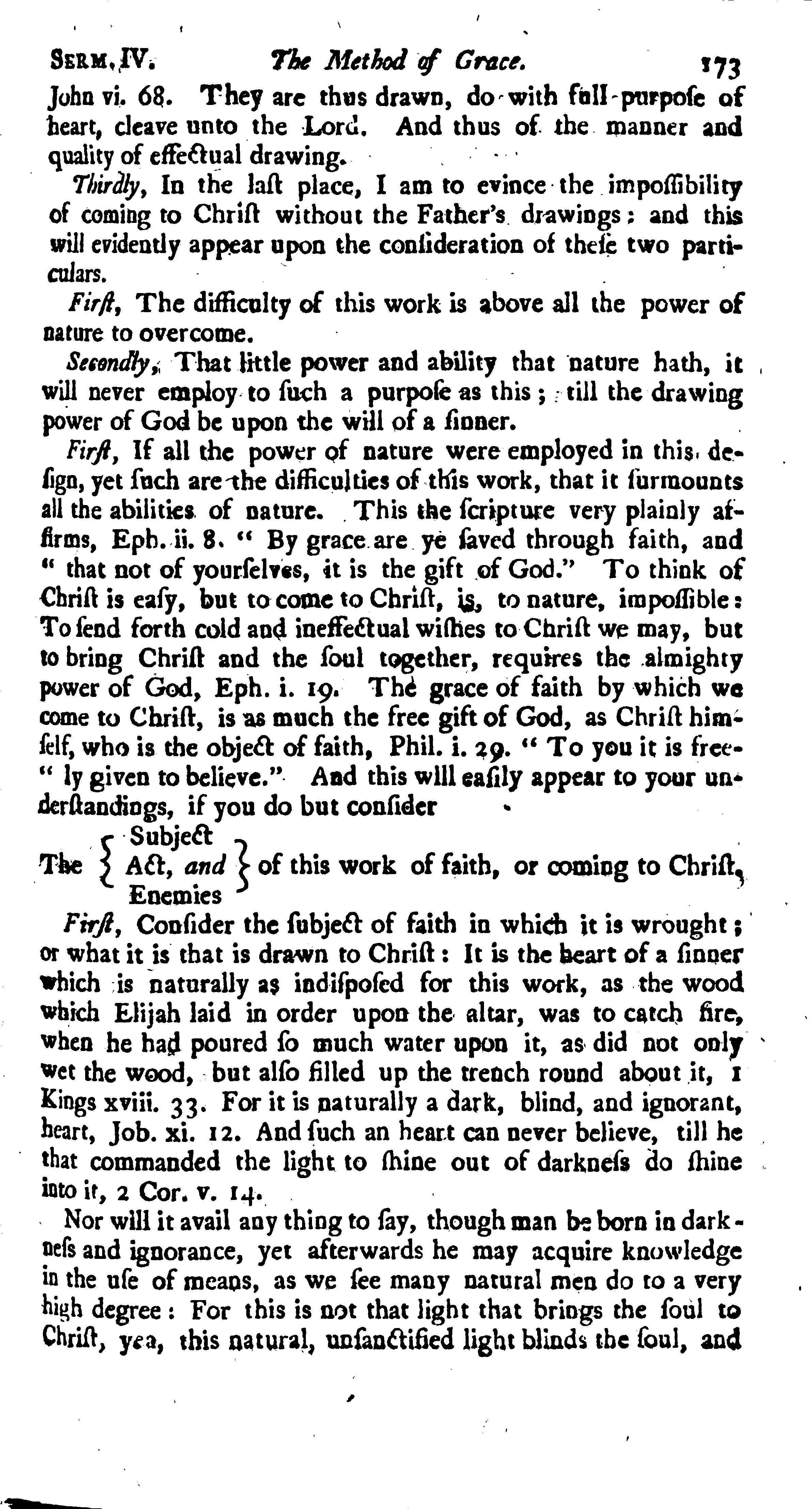
First, If all the power of nature were employed in this design, yet such are the difficulties of this work, that it fur mounts all the abilities of nature.
This the scripture very plainly affirms, Eph. ii. 8. " By grace are ye saved through faith, and " that not of yourselves, it is the gift of God." To think of Christ is easy, but to come to Christ, is, to nature, impossible :
To fend forth cold and ineffectual wishes to Christ we may, but to bring Christ and the soul together, requires the almighty
-power of God, Eph. i. 19.
The grace of faith by which we come to Christ, is as much the free gift of God, as Christ himself,who is the object of faith, Phil. i. 29. " To you it is free- " lygiven to believe." And this will easily appear to your understandings, ifyoudobut consider
The {Act, and of this work of faith, or coming to Christ, Enemies } First, Confider the subject of faith in which it is wrought ; or what it is that is drawn to Christ : It is the heart ofa sinner which is naturally as indisposed for this work, as the wood which Elijah laid in order upon the altar, was to catch fire, when he had poured so much water upon it, as did not only wet the wood, but also filled up the trench round about it, I Kings xviii. 33. For it is naturally a dark, blind, and ignorant, heart, Job. xi . 12. And such an heart can never believe, till he that commanded the light to shine out of darkness do shine into it, 2 Cor. v. 14.
Nor will it avail anything to say, though man be born in dark nessand ignorance, yet afterwards he may acquire knowledge in the use of means, as we see many natural men do to a very high degree: For this is not that light that brings the soul to Christ, yea, this natural, unsanctified lightblindsthe foul, and !
SERM. IV.
The Method of Grace. prejudices it more against Christ than ever it was before, 1 Cor, i. 21, 26.
As it isa blind ignorant heart, so it is a selfish heart by na ture: Allitsdesigns and aims terminate in self: this is the cen ter and weight of the soul; no righteousness but its own is fought after, that, or none, Rom. x. 3. Now, for a soul to renounce and deny self, in all its forms, modes, and interesls, as every one doth thatcometh to Christ; to disclaim and deny natural, moral, and religious self, and come to Christ, as a poor, miserable,wretched,empty creature; to live upon hisrighteoufness forever, is as supernatural and wonderful, as to fee thethills and mountains start from their bases and centres, and fly like wandering atoms in the air.
Nay, this heart which is to come to Christ, isnotonlydark and selfish, but full of pride. O it is a desperate proud heart by nature, it cannot submit to come to Christ, as Benhadad's servants came tothekingof Israel, withsackcloth on their loins, andropesupon their heads. To take guilt, shame, and confufionof face to ourselves, and acknowledge the righteoufnels of God in our eternal damnation ; to come to Christ naked, and empty, as one that justifies the ungodly : I say, nature left to itself, would asfoonbedamnedas do this: the proud heart can never come to this, till the Lord have humbled and broken it by his power.
Secondly, Let us take the act of faith intoconfideration also, as it is here described by the soul's coming to Jesus Christ ; and you will find a necessity of the Father's drawings; for this evi dentlyimplies, that which is against the stream and current of & corrupt nature, and that which is above the sphere and capacity of the most refined and accomplimed nature.
First, It is against the stream and current of our corrupt nature to come to Christ.
For let us but confider the term from which the soul departs, when it comes to Christ.
In that day it leaves all its lusts, and ways off in, how pleasant, sweet, and profitable soever they have been unto it, Isa. Iv. 7. "Let the " wicked forsake his way, and the unrighteousmanhis thoughts,
" and let him return unto the Lord:" Way and thoughts, i. e. both the practice ofanddelighthe had in sin, must be forsaken, and the outward and inward man must be cleansed from it.
Now there are in the bosoms ofunregenerate men such darling Justs, that have given them so much practical and speculative pleasure, which have brought so much profit to them ; which havebeenbornandbred up with them; and which, upon all these accounts, are endeared to their souls to that degree, that
SERM. IV.
The Method of Grace. it is easier for them to die, than to forsake them: yea, nothing ismorecommon among such men,than to venture eternal damnation, rather than suffer a separation from their fins.
And which is yet more difficult incoming to Christ, the soul forsakes not only its sinful self, but its righteous sfelf: i. e. not only its worst sins, butitsbestperformances, accomplishments, and excellencies. Now this is one of the greatest straits that nature can be put to: Righteousness,by works,was the drft liquorthatever was put into the vessel, and it still retains the tangand favour of it, and will totheendoftheworld, Rom. x.
3. "For they being ignorant of God's righteousness, and going " about to establish their own righteousness,have not submit- " ted themselves unto the righteoudness of God." εκ υπετάγησαν, they have not submitted: To come naked and empty to Christ, and receive all from him as a free-gift, is, to proud corruptna. ture, the greatest abasement and submission in the world.
Let the gospel furnish it stable with the richest and costhest dainties that ever the blood of Christ purchased,suchisthepride of nature, that itdisdains to taste them, except it may also pay for the fame.
If the old hivebe removed from theplacewhere it was wont to stand, the bees will come home to the old place, yea, and many ofthemyou shall find will die there, rather than goto the hive, though it stand ina farbetterplace than it did before.
Just so stands the case with men.
The hive is removed, i. e. we are no more to expect righteousness as Adam did, by obeying and working, but by believing and coming to Christ ; butnaturehadas lievebe damnedasdothis: Itstillgoes about to establish its own rigteousness.
Virtues, duties, and moral excellencies, these are the ornaments of nature; here is nature set off in its sumptuous attire, and rich embellishments, and now to renounce it, disclaim and contemn it, as dross and dung, in comparison of Christ, as be. lieversdo, Phil. iii. 8. This, I say, is against the grain of nature.
We reckon it the strange effect offelf-denial inMahomet the Great *, who being fo enamoured with his beautiful Irene, would be persuaded, upon reasons of state, with his own hand to strike off her head; and that, even when the appeared in all herrichornaments before him, rather like such a goddess, as the poets intheirextasies use tofeign, thanamortalcreature. And yet certainly this is nothing to that self-denial which is exercised in our coming to Christ.
Secondly,Aud if we look to the other term to which the soul i * Knolles History of the Turks.
The Method of Grace.
SERM. IV.
moves, we shall find it acting as much above the sphere and ability of improved nature, as here it acts and moves against the stream and current of corrupted nature : for how wonderful and supernatural an adventure is that, which the soul makes in the day that it comes to Jesus Christ .
Surely, foranypoor foul to venture itself for ever upon Jesus Christ, whom it never saw, nay, upon Christ, whose very existence, its own unbelief calls in question whether he be or no : and thatwhenitis evenweigheddown to the dust, with theburdensome sense of its own vileness and total unworthiness, feeling nothing in itself but finand misery, the workings of death and fears of wrath : to go to Christ, of whose pardoning grace and mercy itneverhadany the least experience,nor can find any groundofhope in itself that it shall be accepted; this is as much above the power of nature, as it is for a stone to rife from the earth, and fix itself among the stars.
Well might the apostle a. scribe it to that almighty Power which raised up Christ from the dead, Eph. i. 19, 20.
If the Lord draw not the soul, and that omnipotently, it can never come from itself to Christ.
And yet farther, Thirdly, The natural impossibility of coming to Christ, will more clearly appear, if we consider the enemies to faith ; or what blocks are rolled by Satan and his instruments, into the way to Christ : to mention, in this place,no more but our own carnal reason, as it is armed and managed by thefubtilty of Satan, what a wonder is it that any foul should come to Christ ?
These are the strongholds,(mentioned 2 Cor.x. 4 ) out of which those objections, fears, and discouragements sally, by which the soul is fiercely assaulted in the way to Christ.
Wiltthou forsake all thy pleasures, merry company, and sensible comforts, to live a sad, retired, pensive life ? Wilt thou beggar and undo thyself, letgo allthycomforts in hand, for an hope of that which thine eyes never saw, nor haft thou any certainty that it is any more than a fancy ? Wilt thou that haft lived in reputation and credit all thy life, now become the scorn and contempt of the world ? Thinkest thou thyself able to livefuch a strict, severe, mortified, and self-denying a life, as the word of God requires ? And what if persecution should arise, (as thou mayest expect it will),canstthou forsake father and mother, wifeandchildren,yea, and give up thine own life too, toa cruel and bloody death ! be advised better, before thou resolve in so. important a matter. What thinkest thou of thy forefathers, that livedanddied in that way thou art now living? Art thou wiser than they ? Do not the generalityofmenwalk in the fame
SERM. IV.
The Method of Grace. paths thou hast hitherto walked in ? If this way lead to hell, as thou feareft it may, think then how many millions of men must perish as well as thyself; and is such a supposition consistent with the gracious and merciful nature of God ? Besides, think what fort of people those are, unto whom thou art about to join thyself in this new way ? Are there not to be found among them many things todiscouragethee, and cool thy zeal ? They are generally of the lower andbaser fort of men, poor and despicable :
Seeft thou not, though their profession be holy, how earthly, carnal, proud, factious, and hypocritical, manyofthem are found to be! And doubtless, the rest are like them, though their hypocrisy be not yet discovered.
Owhat stands anddemurs ? what hesitations and doubts, is the soul clogged with in its way to Christ ! But yet none of these can withhold and detain the soul, when the Father draws ;
Greater, then, is he that is in us, than he that is in the world.
And thus you fee the nature, manner, and efficacy of divine drawings, and how impossible it is for any foul to come to Christ without them.
The inferences and improvements of the point follow.
Infer. 1. How deeply and thoroughly is the nature of man corrupted, and what an enemy is every man to his own happiness, that he must be drawn to it ? John v . 40. " You will not come unto me, that ye might have life."
Life is defireable in every man's eyes, and eternal is the most excellent life; yet, in this, the world is rather agreed to die and perish for ever, than come to Christ for life. Had Christ told us of fields and vineyards, sheep and oxen, gold and silver, honours and sensual pleasures, who would not have come to him for these ? But to tell of mortification, self-denial, strictness of life, andfufferings for his fake, and all this for an happiness to be enjoyed in the world to come, nature will never like such a propofitionas this.
You fee where it sticks, not in a simple inability to believe, but in an inability complicated with enmity; they neither can come, nor will come to Christ : It is true, all that do come to Christ, come willingly; but thanks be to the grace of God, that hath freed and persuaded the will, else they had never been willing to come : Who ever found his own heart first stir and move towards Christ ? How long may we wait and expect, before we shall feel our hearts naturally burn with desires after, and love to Jesus Christ ?
This aversion of the will and affections from God, is one of VOL. II.
The Method of Grace.
SERM. IV.
the main roots of original fin. No argument can prevail to bring the soul to Christ, till this be mattered and overpowered by the Father's drawing. In our motions to fin, we need re training, but in all our motions to Christ, we as much need drawing.
He that comes to heaven may fay, Lord, if I had had my own way and will, I had never come here; if thou hadst not drawn me, I should never have come to thee. O the riches of the grace of God! Oh unparalleled mercy and goodness ! not only to prepare prep such a glory as this for an unworthy foul, but to put forth the exceeding greatness of thy power, afterwards / to draw an unwilling foul to the enjoyment of it.
Infer. 2. What enemies are they to God, and the souls of men, that do all they can to discourage and hinder the conversion of men to Christ ? God draws forward, and these do all that in them lies to draw backward, (i. e.) to prejudice and discourage them from coming to Jesus Christ in the way of faith : this isa direct opposition to God, and a plain confederacy with the devil.
O, how many have been thus discouraged in their way to Christ, by their carnal relations, I cannot say friends ! Their greatest enemies have been the men of their own house.
These have pleaded (as if the devil had hired and fee'd them) against : the everlasting welfare of their own flesh. O cruel parents, brethren, and sisters, thatjeer, frown, and threaten, where they should encourage, assist, and rejoice ! Such parents are the devil's children.
Satan chuses such instruments as you are, above all others, for this work : he knows what influence and autho- 'rity you have upon them, and over them ; and what fear, love, and dependance, they have for you, and upon you; so that none in all the world are like to manage the design of their damnation fo effectually, as you are like to do.
Will you neither come to Christ yourselves, nor suffer your dear relations that would? Had you rather find them in the alehoufe, than in the closet ? Did you inftrumentally give them their being, and will you be the instruments of ruining for ever those beings they had from you ? Did you so earnestly desire children, fo tenderly nurse and provide for them; take such delight in them ; and, after all this, do what in you lies to damn and destroy them; If these lines shall fall into any such hands,
O that God would set home the conviction, and ferfe of this horrid evil upon their hearts.
And no less guilty of this fin are scandalous and loose professors, who serve to furnish the devil with the greatest arguments he hath to dissuade men from coming to Christ : it is your loofunefs, andhypocrify,by which he hopes to scare others
SERM. IV.
The Method of Grace. from Christ.
It is said, Cant. ii. 7. " I charge you by the rots " and hinds of the field, that ye stir not up, nor awake my be .
" loved till he please."
Roes and hinds, like young converts and comers towards Christ, are shy and timerous creatures, that start at the least found, or yelp of a dog, and fly away.
Take heed what you do in this case, left you go down to hell under the guilt of damning more fouls than your own .
Infer. 3. Learn hence, the true ground and reason of those trange, amazing, and supernatural effects, that you behold, and fo admire in the world, as often as youfeefinnersforfaking their pleasant, profitable corruptions, and companions, and embracing the ways of Christ, godliness, and mortification .
It is said, 1 Pet. iv. 4.
They think it strange, that you run not with them into the same excess of riot ;" The word is, εν ὦξενίζονται ,they stand at a gaze, as the hen that hath hatch partridge eggs doth, when the fees them take the wing and fly away from her.
Beloved, it is the world's wonder to see their companions in fin forsake them; those that were once as prophane, and vain as themselves, it may be more, to forsake their society, retire into their closets, mourn for fin, spend their time in meditation and prayer, embrace the severest duties, and content to run the greatest hazard in the world for Christ; but they fee not that almighty power that draws them, which is too strong for all the sinful ties and engagements in the world to withhold and detain them.
A man would have wondered to see Elisha leave the oxen, and run after Elijah, saying, Let me go, I pray thee, and kiís my father and mother, and then I will follow thee ;" when
Elijah had said nothing to persuade him to follow him, only, as he passed by him, he cast his mantle on him,
1 Kings x. 19, 20.
Surely that foul whom God draws, must needs leave all and follow Christ, for the power of God resteth on it. All carnal ties and engagements to fin, break and give way, when the Father draws the soul to Christ in the day of his power.
Infer. 4. Is this thefirstspring ofspiritualmotion after Christ ?
Learn then from bence, how it comes to pass that fomany excellentfermons, andpowerfulperfuafions are ineffectual, and cannot draw and win one foul to Christ.
Surely it is because ministers drawatone ; and the specialfavingpower ofGodgues not forth, at all times alike, with their endeavours .
Paul was a chosen vessel, filled with a greater measure of gifts Aaz
The Method of Grace.
SERM . IV.
and graces by the Spirit, than any that wentbeforehim, or followed after him; and, as his talents, so his diligence in improving them, was beyond any recorded example we read of a. mongst men ; " He rather flew like a seraphim, than travelled
" upon his master's errand about the world*."
Apollos was an eloquent preacher, and mighty in the scriptures, yet Paul is nothing, and Apollos nothng ; but God that gives the increase,"
I Cor. iii . 7. We are too apt to admire men, yea, and the best are but too apt to go forth in the strength of their own parts and preparations; but God secures his own glory, andmagnifies his own power, frequently, in giving success to weaker endeavours, and men of lower abilities, when he withholds it from men of more raised, refined, and excellent gifts and abilities.
It is our great honour, who are the ministers of the gospel, that we are συνέγροι, workers together with God, I Cor. iii. 9. in his strength we can prevail ; "the weapons of our warfare are
" mighty through God," 2 Cor. x. 4.
But if his presence, blessing, and assistance, be not with us, we are nothing, we can do nothing.
If we prepare diligently, pray heartily, preach zealoufly, and our hearers go as they came, without any spiritual effects and fruits of our labours, what shall we say, but as Martha said to Christ, " Lord, if thou hadst been here, my brother had not " died :" Had the Spirit of God gone forth with his especial efficacy and blessing, with this prayer, or that sermon, these fouls had not departed dead, and senseless from under it.
Infer. 5. Doth all success and efficacy depend upon the Father's drawings ?
Let none then despair of their unregenerate, and carnal relations, over whose obstinacy they do, and have cause to mourn .
What, if they have been as many years under the preaching of the gospel, as the poor man lay at the pool ofBethesda, and hitherto to no purpose ? A time may come at last, (as it did for him) when the Spirit of God may move upon the waters ; I mean put a quickening and converting power into the means, and then the desire of your souls for them shall be fulfilled.
It may be, you have poured out many prayers, and tears to the Lord for them ; you have cried for them as Abraham for hisfon, " O that lihmael might live before thee ! " O that this poor husband, wife, child, brother, or sister, might live in thy fight ; and still you fee them continue carnal, dead, and sense
Chryfoft.
SERM . IV.
The Method of Grace.
less : Well, but yet give not up your hopes, nor cease your pious endeavours, the time may come when the Father may draw as well as you, and then you shall see them quit all, and come to Christ ; and nothing shall binder them. They are now drawn away of their own lusts ; they are easily drawn away by their sinful companions ; but when God draws, none of these shall withdraw them from the Lord Jesus, What is their ignorance, obstinacy, and hardness of heart, before that mighty power that subdues all things to itself ? Go therefore to the Lord, by prayer, for them, and say, Lord, I have laboured for my poor relations in vain, I have spent my exhortations to little purpose ; the work is too difficult for me, can I carry it no farther, but thou canst: O let thy power go forth ; they shall be willing day of thy power.
Infer 6. If none can come to Christ, except the Father draw them, then surely none can be drawn from Christ except the Father leave them : That power which at first drew them to Christ, can secure and establish them in Christ to the end, John
Χ. 20. " My Father which gave them me is greater than " all, andnoman is able to pluck them out of my Father's
"hand."
When the power of God at first draws us out of our natural state to Christ, it finds us not only impotent, but obstinate, not only unable, but unwilling to come; and yet this powerofGod prevails against all opposition : How much more is it able to preserve and secure us, when his fear is put into our inward parts, sothatwedare not depart, we have no will to depart from him ?
Well then, if the world fay, I will ensnare thee; If the devil say, I will destroy thee; if the flesh say I will betray thee ; yet thou art secure and safe, as long asGodhath said," I will never leave
" thee nor forsake thee," Heb. xiii. 5 .
Infer. 7. Let this engage you to a constant attendance upon the ordinances of God, in which this drawing power ofGodisfometimes put forth upon the hearts of men.
Beloved, there are certain seasons in which the Lord comes nigh to men in the ordinances and duties of his worship ; and we know not at what time the Lord cometh forth by his Spirit upon this design: he many times comes in an hour when we think not of him ; " I am found of them that fought me not, "
Isa. lxv. 1. It is good therefore, to be found in the way of the Spirit: Had that poor man, that lay so long at the pool of Bethesda, reasoned thus with himself,So long have I lain here invainexpecting a cure, it is to no purpose to wait longer, and so had been absent at that very timewhenthe angel came down,
The Method of Grace.
SERM .V. he had, in all likelihood,carried his disease to the grave with him.
How dost thou know but this veryfabbath, this sermon, this prayer, which thou hast no heart to attend, and are tempted to neglect, may be the season, and instrument wherein, and by which, the Lord may do that for thy soul, which was never done before ?
Infer. 8. To conclude, How are all the faints engagedtoputforth all the power and ability they haveforGad, who hathputforth his infinite almighty power to draw them to Christ !
God hath done great things for your souls; he hath drawn you out of the miserable state of fin and wrath ; and that when he let others go, by nature as good as you, he hath drawn you into union with Christ, and communion with his glorious privi vileges.
Othatyou would henceforth employ all the power you have, for God, in the duties of obedience, and in drawing others to Christ, as much as in you lies, and say continually with the Church, "Draw me, we will run after thee," Cant. i. 4.
Thanks be to God for Jesus Christ .
5995959
SERMON V.
Opening the Work of the Spirit more particularly, by which the Soul is enabled to apply CHRIST.
Eph. ii. 1. And you hath he quickened who were dead in trespasses andfins.
IN the former sermons we have feenourunionwithChrist in the general nature of it, and the means by which it is effected, both external, by the preaching of the gospel, and internal, by the drawing of the Father.
We are now to bring our thoughts yet closer to this great mystery, and confider the bands, by which Christ and believers are knit together in a blessed union .
And if we heedfully observe the scripture-expressions, and ponder the nature of this union, we shall find there are two bands whichknit Christ and the soul together, viz.
1. The Spirit on Christ's part.
2. Faith on our part.
The Spirit on Christ's part, quickening us with spiritual life, whereby Christ first takes hold of us, and faith on our part, when thus quickened, whereby we take holdofChrift : Accor
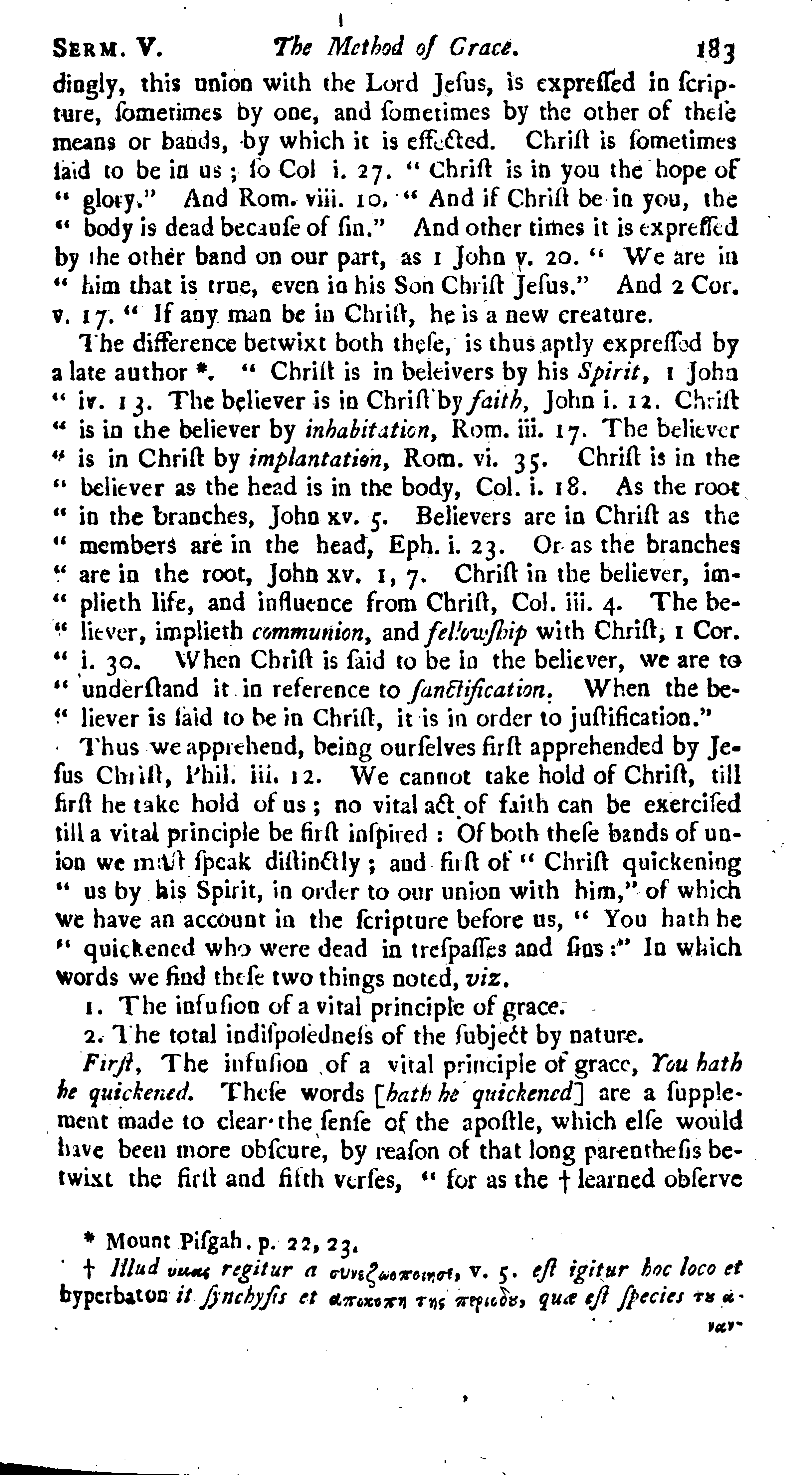
SERM . V.
The Method of Grace. dingly, this union with the Lord Jesus, is expressed in scripture, sometimes by one, and sometimes by the other of these means or bands, by which it is effected.
Christ is sometimes said to be in us ; fo Col i. 27. " Christ is in you the hope of glory."
And Rom. viii. 10, " And if Christ be in you, the body is dead because of fin."
And other times it is expressed by the other band on our part, as 1 John v. 20. " We are in " him that is true, even in his Son Christ Jesus."
And 2 Cor. v. 17. " If any man be in Christ, he is a new creature.
The differencebetwixtboth these, is thus aptly expressed by alate author *.
" Christ is in beleivers by his Spirit, 1 John " iv. 13. The believer is in Christ by faith, John i. 12. Christ
" is in the believer by in habitation, Rom. iii. 17. The believer " is in Christ by implantation, Rom. vi. 35.
Christ is in the " believer as the head is in the body, Col. i. 18.
As the root " in the branches, John xv. 5.
Believers are in Christ as the " members are in the head, Eph. i. 23.
Or as the branches " are in the root, John xv. 1, 7.
Christ in the believer, implieth life, and influence from Christ, Col. iii. 4.
The be- " liever, implieth communion, and fellowship with Christ, 1 Cor.
" i. 30.
When Christ is said to be in the believer, we are to " understand it in reference to fanctification.
When thebe- " liever is said to be in Christ, it is in order to justification ."
Thus we apprehend,being ourselves first apprehended by Jesus Christ, Phil. iii. 12.
We cannot take hold of Christ, till first he take hold of us ; no vital act of faith can be exercised till a vital principle be first inspired: Of both these bands of union we maut speak distinctly ; and first of " Christ quickening
" us by his Spirit, in order to our union with him," of which we have an account in the scripture before us,
You hath he " quickenedwho were dead in trespasses and fius:" In which words we find these two things noted, viz .
1. The in fusion ofa vital principle of grace.
2.The total indifpotedness of the subject by nature.
First, The in fusion of a vital principle of grace, You hath he quickened.
These words [hath he quickened] are a supplement made to clear the sense of the apostle, which else would have been more obscure, by reason of that long parenthesis betwixt the first and fifth verses, " for as the + learned observe
* Mount Pisgah . p. 22, 23.
+ Illudvuas regitur a συνεζωοποιησε, ν. 5. eft igitur hoc loco et byperbaton itfynchysis et αποκοπη της περιοδε, que est species τοά
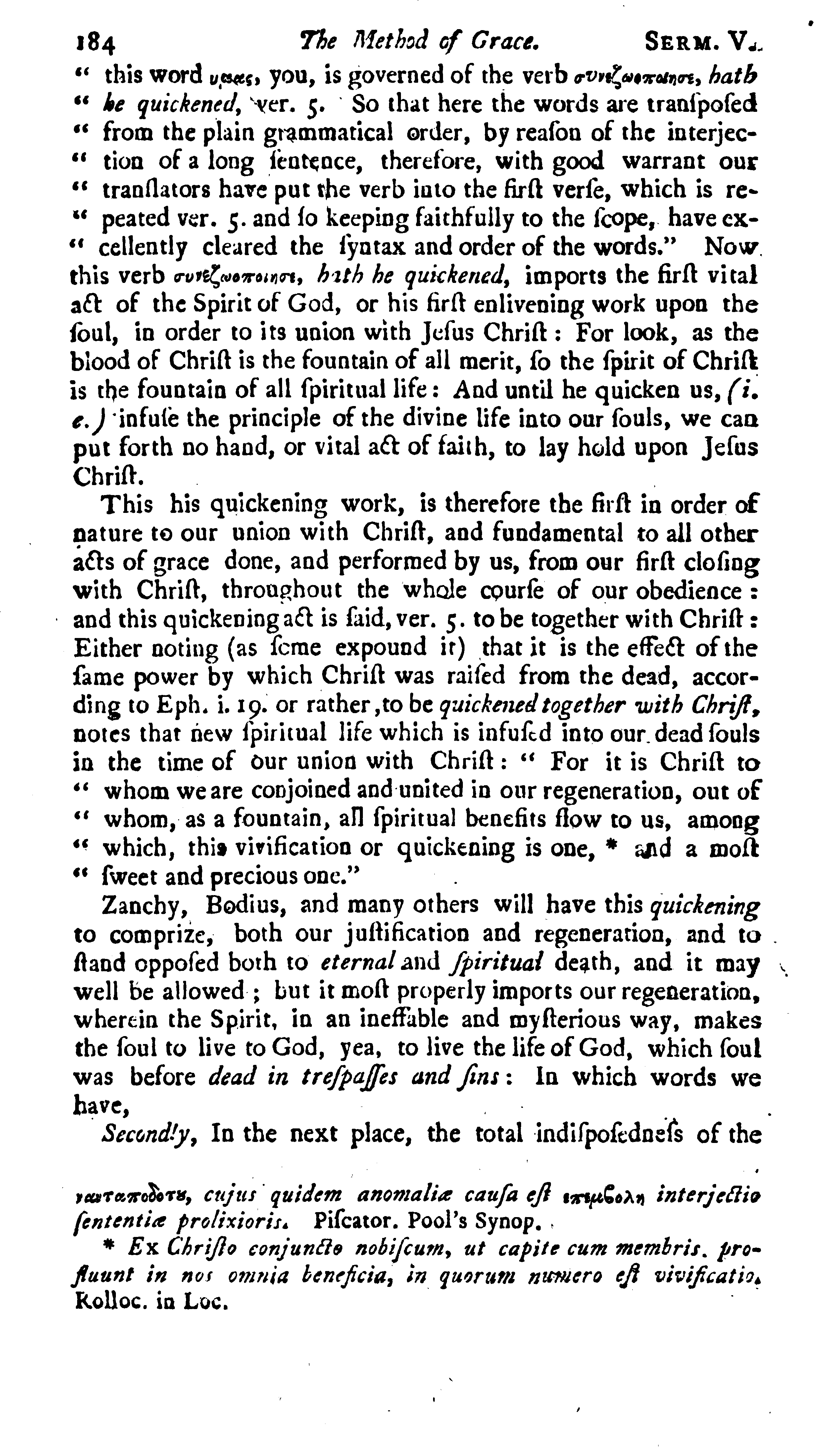
SERM . V.
The Method of Grace.
" this word uses, you, is governed of the verb συνεζωοποιησε, hath " be quickened, ver. 5.
So that here the words are transposed " from the plain grammatical order, by reason of the interjec-
tion ofa long sentence, therefore, with good warrant our " translators have put the verb into the first verse, which is re-
peated ver. 5. and fokeeping faithfully to the scope, have ex- " cellently cleared the syntax and order of the words." Now this verb συνεζωοποιησε, hath he quickened, imports the first vital act of the SpiritofGod, or his first enlivening work upon the soul, in order to its union with Jesus Christ: For look, as the blood of Christ is the fountain of all merit, so the spirit of Christ is the fountain of all spiritual life: And until he quicken us,(i. e.) infuse the principle of the divine life into our souls, we can put forth no hand, or vital act of faith, to lay hold upon Jesus
Christ.
This his quickening work, is therefore the first in order of nature to our union with Christ, and fundamental to all other acts of grace done, and performed by us, from our first closing with Christ, throughout the whole course of our obedience : and this quickeningact is said,ver. 5. to be together with Christ :
Either noting (as some expound it) that it is the effect of the fame power by which Christ was raised from the dead, according to Eph . i. 19. or rather ,to be quickened together with Christ, notes that new spiritual life which is infused into our deadfouls in the time of our union with Christ : " For it is Christ to " whom we are conjoined and united in our regeneration, out of " whom, as a fountain, all spiritual benefits flow to us, among " which, this vivification or quickening is one, * and a most
" sweet and precious one."
Zanchy, Bodius, and many others will have this quickening to comprize, both our justification and regeneration, and to stand oppofedboth to eternal and spiritual death, and it may well be allowed ; but it most properly imports our regeneration, wherein the Spirit, in an ineffable and mysterious way, makes the soul to live to God, yea, to live the life of God, which foul was before dead in trespasses andfins : In which words we have, Secondly, In the next place, the total indisposedness of the νανταποδοτε, cujus quidem anomalie caufa eft επεμβολη interjectio fententiæ prolixioris.
Pifcator. Pool's Synop .
* Ex Christo conjuncto nobifcum, ut capite cum membris. profluunt in nos omnia beneficia, in quorum numero eft vivificatio
Kolloc. in Loc.
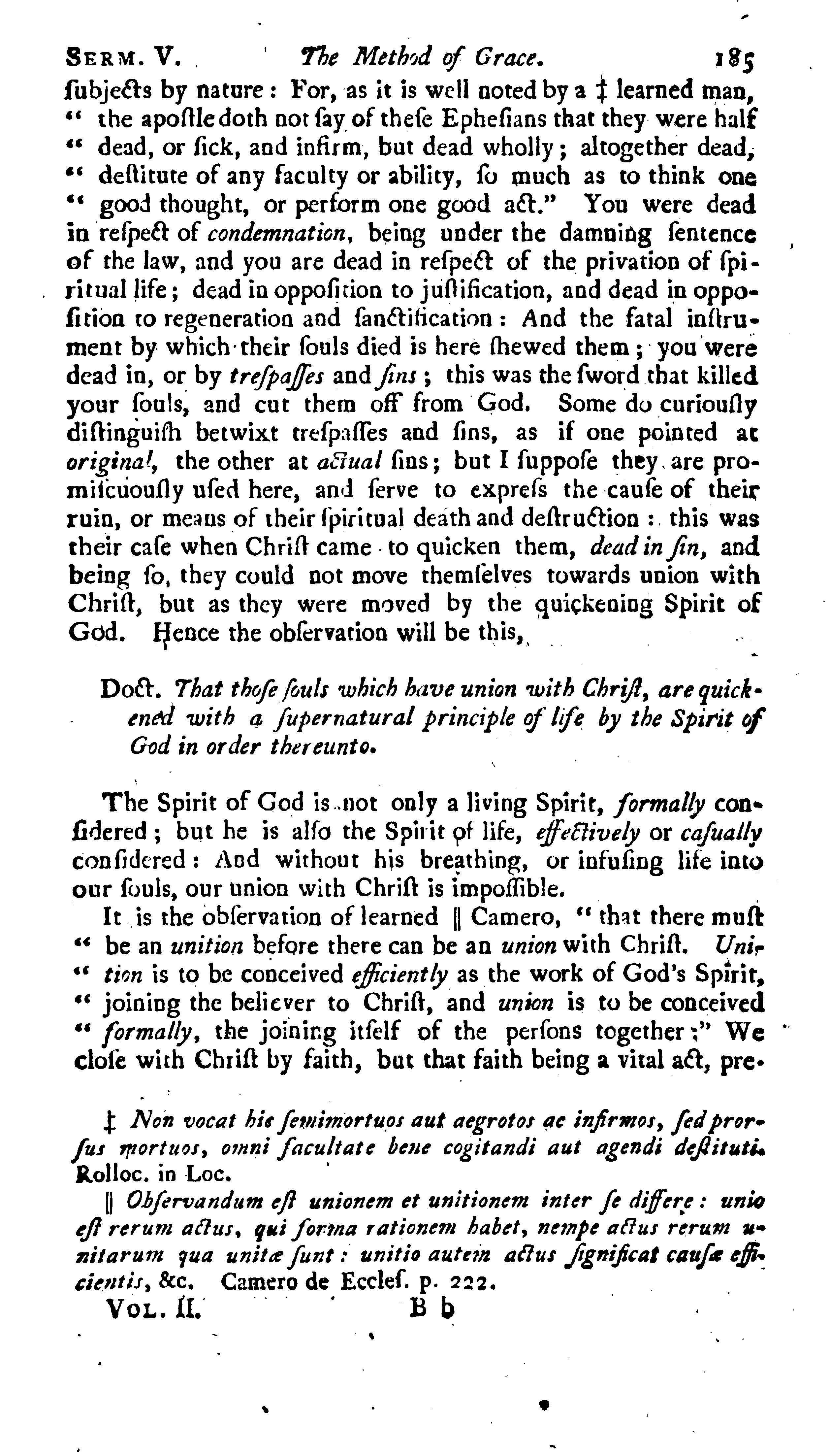
SERM . V.
The Method of Grace. subjects by nature : For, as it is well noted by a † learnedman,
" the apostle doth not say of these Ephesians that they were half " dead, or sick, and infirm, but dead wholly; altogether dead,
" destitute of any faculty or ability, fo much as to think one " good thought, or perform one good act."
You were dead in respect of condemnation, being under the damning sentence of the law, and you are dead in respect of the privation of spiritual life; dead in opposition to justification, and dead in opposition to regeneration and sanctification : And the fatal instrument by which their souls died is here shewed them ; you were dead in, or by trespasses andfins ; this was the sword that killed your souls, and cut them off from God.
Some do curiously distinguish betwixt trespasses and sins, as if one pointed at original, the other at actual fins; but I suppose they are promifcuously used here, and serve to express the cause of their ruin, or means of their spiritual death and destruction : this was their case when Christ came to quicken them, deadinfin, and being fo, they could not move themselves towards union with Christ, but as they were moved by the quickening Spirit of God. Hence the observation will be this, Doct. That those fouls which have union with Christ, arequickened with a supernatural principle of life by the Spirit of God in order thereunto.
The Spirit of God is not only a living Spirit, formally considered; but he is also the Spirit of life, effectively or casually considered : And without his breathing, or infusing life into our souls, our union with Christ is impossible.
It is the observation of learned || Camero, " that there must " be an unit i on before there can be an union with Christ.
Uni- " tion is to be conceived efficiently as the work of God's Spirit, " joining the believer to Christ, and union is to be conceived
" formally, the joining itself of the persons together ;" We close with Christ by faith, but that faith being a vital act, pre-
Non vocat hiefemimortuosaut aegrotos ac infirmos, fedprorfus mortuos, omni facultate bene cogitandi aut agendi deftituti.
Rolloc. in Loc.
|| Obfervandum est unionem et unitionem inter sediffere : unio est rerum act us, quiforma rationem habet, nempe act us rerum unitarum qua unitæfunt : unitio autein act us fignificat caufæ efficient is, &c.
Camero de Ecclef. p. 222 .
VOL . II.
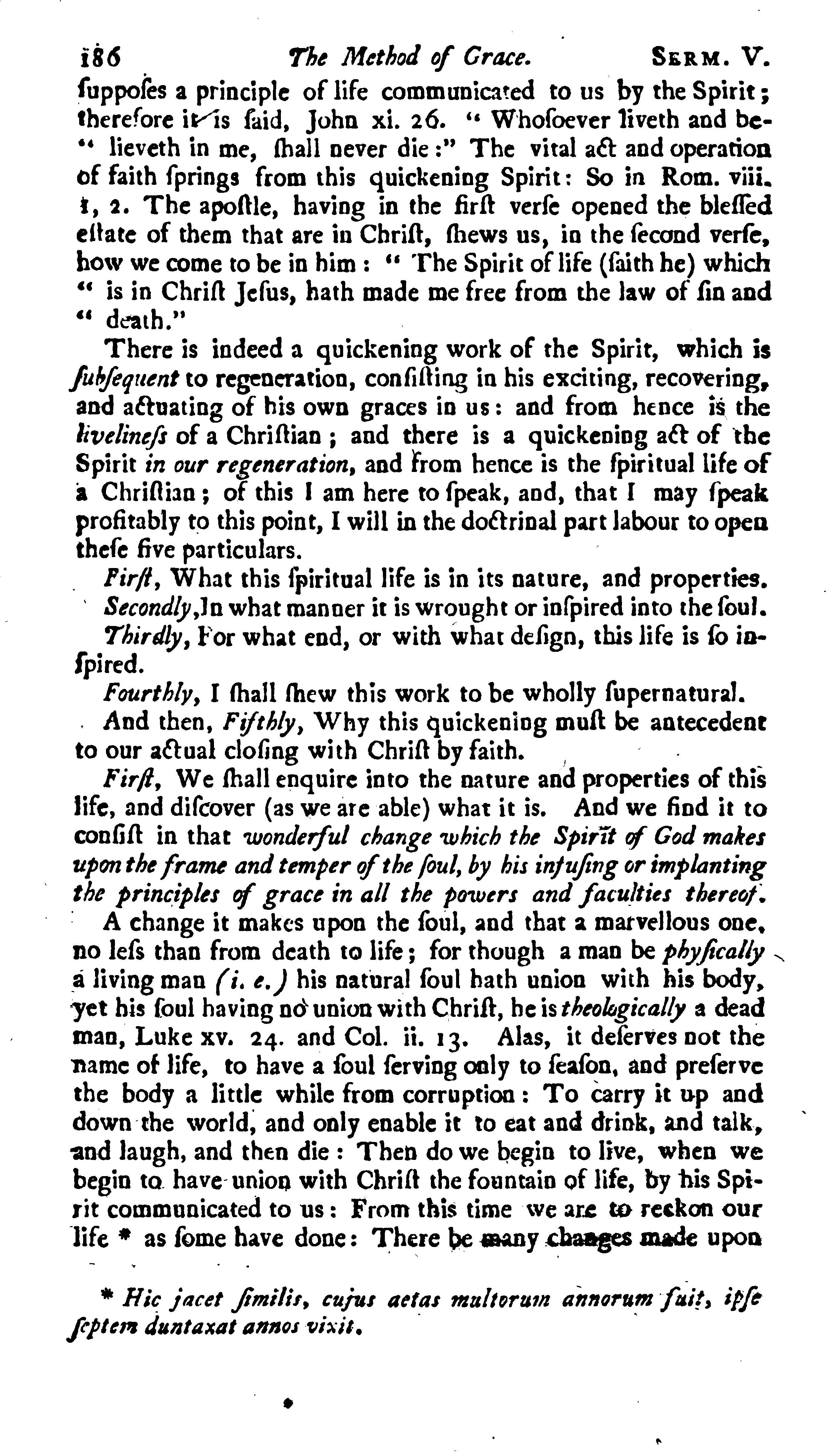
The Method of Grace.
SERM. V. supposes a principle of life communicated to us by the Spirit ; therefore it is said, John xi. 26. " Whosoever liveth and believeth in me, shall never die :" The vital act and operation of faith springs from this quickening Spirit: So in Rom. viii.
1, 2. The apostle, having in the first verse opened the blessed estate of them that are in Christ, shews us, in the second verse, how we come to be in him : " The Spirit of life (faith he) which " is in Christ Jesus, hath made me free from the law of fin and " death ."
There is indeed a quickening work of the Spirit, which is fubfequenttoregeneration,consisting in his exciting, recovering, and actuating of his own graces in us: and from hence is the liveliness of a Christian ; and there is a quickening act of the Spirit in our regeneration, and from hence is the spiritual life of a Christian ; of this I am here to speak, and, that I may speak profitably to this point, I will in the doctrinal part labour to open these five particulars.
First, What this spiritual life is in its nature, and properties.
Secondly,In what manner it is wrought or inspired into the soul.
Thirdly, For what end, or with what design, this life is so inspired.
Fourthly, I shall shew this work to be wholly supernatural.
And then, Fifthly, Why this quickening must be antecedent to our actual closing with Christ by faith.
First, We shall enquire into the nature and properties of this life, and discover (as we are able) what it is. And we find it to consist in that wonderful change which the Spirit of God makes upontheframe and temper of the foul,by his infusing or implanting the principles of grace in all the powers and faculties thereof.
: A change it makes upon the soul, and that amarvellous one, no less than from death to life; for though a man be physically a livingman (i. e.) his natural foul hath union with hisbody, yet his foul having no union with Christ, heistheologically a dead man, Luke xv. 24. and Col. ii. 13.
Alas, it deserves not the name of life, to have a soul serving only to season, and preserve the body a little while from corruption : To carry it up and down the world, and only enable it to eat and drink, and talk, and laugh, and then die : Then do we begin to live, when we begin to have union with Christ the fountain of life, by his Spirit communicated to us : From this time we are to reckon our life * as some have done: There be many changes made upon * Hic jacet fimilis, cujus aetas multorum annorumfuit, ipfe feptem duntaxat annos vixit.
SERM. V.
The Method of Grace. men besides this, many are changed from prophaneness to civility, and from mere civility to formality, and a shadow of religion,who still remain in the state, and power ofspiritualdeath, notwithstanding ; but when the Spirit of the Lord is poured out upon us, to quicken us with the new spiritual life, this is a wonderful change indeed: It gives us an effefupernaturale, a new supernatural being, which is therefore called anew creature, the new man, the hidden man of the heart : The natural essence and faculties of the soul remain still, but it is divested of the old qualities, and endued with new ones, 2 Cor. v. 17. "Old
"things are passed away,behold, all things arebecomenew."
And this change is not made by altering and rectifying the disorders of the life only, leaving the temper and frame of the heart still carnal; but by the infusion ofa supernatural permanent principle into the soul, John iv. 14. " It shall be in him a " well of water :" principles are to a course of actions, as fountains or springs are to the streams and riversthatflow from them, and are maintained by them : and hence is the evenness, and constancy ofrenewedfouls in the course ofGodliness.
Nor is this principle or habit acquired by accustoming ourselves to holy actions, as natural habits are acquired by frequent acts, which be get a disposition, and thence grow up to an habit or second nature, but it is infused, or implanted in the foul by the Spirit of God.
So we read, Ezek. xxxvi. 25, 26. " A new " heart also will I give you, and anew spirit will I put within
66 you :" It grows not up out of our natures, butisputor infused into us : as it is said of the two witnesses, Rev. xi. 11. who lay dead in a civil sense, three days and a half, that the spirit of life from God entered into them ; so it is here in a spiritual sense, the spirit of life from God enters into the dead, carnal heart: it is all by way offupernatural infusion.
Nor is it limited to this, or that faculty of the soul, but grace or life is poured into all the faculties: " Behold all things
66 are become new," 2 Cor. v. 17. The understanding, will, thoughts, and affections, are all renewed by it: the whole inner man is changed; yea, the tongue and hand, the discourses and actions, even all the ways and courses of the outward man are renewed by it.
But more particularly, we shall discern the nature of this Spiritual life, by considering the properties of it ; among which, these are very remarkable.
First, The soul that is joined to Christ, is quickened with a divine life, so we read in 2 Pet. i. 4. Where believers are said
Bb 2 !
The Method of Grace.
SERM . V.
to be partakers of the divine nature : averyhigh expression, and warily to be understood.
Partakers of the divine nature, not essentially ; so, it is wholly incommunicable to the creature, nor yet hypostatically, and personally ; so, Christ only was a partaker of it ; but our participation of the divine nature, must be understood in away proper to believers ; that is to fay, we partake of it by the in habitation of the Spirit of God in us, according to 1 Cor. iii. 16, 17. " Know ye not that ye are the " temple of God, and that the SpiritofGod dwelleth in you ?"
The Spirit, who is God by nature, dwells in, and actuates the soul whom he regenerates, and by sanctifying causes it to live a divine life: from this life of God, the unfsanctified are said to be alienated, Eph. iv. 18. but believers are partakers of it.
Secondly, And being divine, it must needs bethe most excellent, and transcendent life that any creature doth, or can live in this world: it fur mounts the natural, rational, and moral life of the unsanctified, as much as the angelical life excels the life of flies, and worms of the earth .
Some think it a rare life to live in sensual pleasures; but the scripture will not allow so much as the name of life to them; but tells us, " they are dead whilst they live," 1 Tim. v. 6.
い certainly it is a wonderful elevation of the nature of man, to be quickened with such a life as this.
There are two ways wherein the blessed God hath honoured poor man above the very an gels of heaven.
One was by the hypostatical union of our nature in Christ, with the divine nature; the other is by uniting our persons mystically to Christ, and thereby communicating spiritual life to us : this latter is a most glorious privilege, and in one respect a more singular mercy than the former ; for that honour which is done to our nature by the hypostatical union, is common to all, good and bad, even they that perish have yet that honour; but to be implanted into Christ by regeneration, and live upon him as the branch doth upon the vine, this is a peculiar privilege, a mercy kept from the world that is to perish, and only communicated to God's elect, who are to live eternally with him in heaven.
Thirdly, This life infused by the regenerating spirit, is a most pleasant life.
All delights, all pleasures, all joys, which are not phantastic and delusive, have their spring and origin
" here, Rom. viii. 6. " To be spiritually minded is life and peace,'
(i. e.) a most serene, placid life; such a soul becomes, fo far as it is influenced and sanctified by the Spirit, the very region of life and peace : when one thing is thus predicatedofanother, in cafu recto, (faith a learned man) it speaks their intimate
SERM . V.
The Method of Grace.
connexion: peace is so connatural to this life, that you may either call it a life that hath peace in it, or a peace that hath life in it : yea, it hath its enclosed pleasures in it, " Such as a " stranger intermeddles not with," Prov. xiv. 10.
Regeneration is the term from which all true pleasure commences ; you never live a chearful day, till you begin to live to God : therefore it is said, Luke xv. 24. When the prodigalfon was returned to his father, and reconciled, then they began to be merry.
Nonecanmake another, by any words, to understand what that pleasure is which the renewed foul feels diffused through all its faculties, and affections, in its communion with the Lord, and in the sealings and witnessings of his Spirit.
That is a very apt and well known fimilitude which Peter Martyr used, and the Lord blessed to the conversion of that noble marquis Galeacus : if, said he, a man should fee a company of people dancing upon the top of a remote hill, he would be apt to conclude they were a company of wild distracted people; but if he draw nearer, and behold the excellent order, and hear the ravishing sweet music that are among them, he will quick-
lyalter his opinion of them, and be for dancing him felt with them.
All the delights in the sensual life, all the pleasure that ever your lusts gave you, are but as the putrid, stinking waters of a corrupt pond, where toads lie croaking and spawning, compared to the crystal streams of the most pure and pleasant fountain.
Fourthly, This life of God, with which the regenerate are quickened in their union with Christ, as it is a pleasant, fo it is also a growing increasing life, John iv. 14. "It shall be in him a well of water springing up into everlasting life."
It is not in our sanctification, as it is in our justification ; our justification is complete and perfect, no defect is found there ; but the new creature labours under many defects : all believers are equally justified,but not equally sanctified : Therefore you read, 2 Cor. iv. 16. that " the inward man is renewed day by 46 day:" And 2 Pet. iii. 18. Christians are exhorted " to grow
" in grace, and in the knowledge of our Lord and Saviour : " if this work were perfect, and finished at once, as justification is, there could be no renewing day by day, nor growth in grace.
Perfectum eft cui nihil deeft, & cui nihil add i potest : i. e. that is perfect which wants nothing, and to which nothing can be added. The apostle indeed prays for the Theffalonians, "that " God would sanctify them," ολοέλας, -wholly, perfectly,
1Theff. v. 23. And this is matter of prayer and hope; for, at
The Method of Grace.
SERM . V.
last, it will grow up to perfection; but this perfect holiness is reserved for the perfect state in the world to come, and none but * deluded, proud spirits boast of it here: but when " that " which is perfect is come, then that which is in part shall be
" done away," 1 Cor. xiii. 9, 10. And upon the imperfection of the new creature in every faculty,that warfare and daily con. flict spoken of, Gal. v. 17. and experienced by every Christian, is grounded: grace rises gradually in the soul, as the sun doth in the heavens, "which shinethmore and more unto a perfect day,"
Prov. iv. 18.
Fifthly, to conclude; This life with which the regenerate are quickened, is an everlasting life. "This is the record, that God
" hath given us eternal life, and this life is in his Son," I John V. 11. This principle of life is the feed of God; and that remains in the foul for ever, I John iii. 9.
It is no transient, vanishing thing,but a fixed, permanent principle, which abides in the soul for ever ; am an may lose his gifts, but grace abides ; the soul may, and must be, separated from the body, but grace cannot be separated from the soul: when all forsake us, this will not leave us .
This infused principle is therefore vastly different, both from the extraordinary gifts of prophecy, wherein the Spirit sometimes was said tocomeupon men, under the Old Testament, I Sam. x. 6, 10. and from the common vanishing effects he somer times produceth in the unregenerate, of which we have frequent accounts in the New Testament, Heb. vi. 4. and John v. 35.
It is one thing for the Spirit to come upon am an in the way of present influence,and assistance, and another thing to dwell in a manas in his temple.
And thus of the nature, and quality of this blessed work of the Spirit in quickening us.
Secondly, Having seen the nature and properties of the spiritual life, we are concerned in the next place to enquire into the way and manner in which it is wrought, and infused by the Spirit: and here we must say,
First of all, that the work is wrought in the soul very mysteriously; fo Christ tellsNicodemus, John iii. 8. "Thewindblow.
" eth where it listeth, and thou he a rest the found thereof, but " canst not tell whence it cometh, or whither it goeth, fo is everyone that isbornofthe Spirit : " There be many opinions amongphilofophers about the original of wind; but we have no * Perfection of sanctification is not found in this life, unless in the dreams offomephanatics. Ames.
SERM . V.
The Method of Grace.
certain knowledge of it : we describe it by its effects and properties, but know little of its original : and if the works of God in nature be so abstrufe, and unsearchable, how much more so are these sublime, and supernatural works of the Spirit ?
We are not able to solve the Phaenomena of nature, we can givenoaccountofour own formation inthewomb, Ecclef. xi. 5.
Who can exactly describe how the parts of the body are formed, and the soul infused ? " It is curiously wrought in the low- " est parts of the earth," as the Pfalmist speaks, Psal. cxxxix.
16. but how, we know not.
Basil faith, divers questions may bemovedaboutafly, which may puzzle the greatest philosopher : we know little of the forms, and essences of natural things, much less of these profound, and abstruse spiritual things.
Secondly, But though we cannot pry into these secrets by the eye of reason , yet God hath revealed this to us in his word, that it is wrought by his own almighty power, Eph. i. 19.
The apostle ascribes this work to the exceeding greatness of the power of God: and this must needs be, if we confider, how the Spirit of God expresses it in scripture by a new creation : (i. e.)a giving being to something out of nothing, Eph. ii. 10. In this it differs from all the effects of human power : for man always works upon some pre-existent matter, but here is no such matter: all that is in man,the subject of this work, is only apaffive capacity, or receptivity,but nothing is foundinhim to contribute towards this work: this supernatural life is not, nor can it be educed out of natural principles : this wholly transcends the sphere of all natural power: but of this more anon.
Thirdly, This also we may affirm of it; that this divine life is infused into all the natural faculties and powers of the soul, not one exempted, 1 Thef. v. 23. The whole foul and spirit is the recipient subject of it: and with respect to this general infusion into all the faculties and powers of the soul, it is called anew creature ; a new man; having an integral perfection, and fulness of all its parts and members: it becomes light in the mind; John xvii. 3. Obedience in the will ; 1 Pet. i. 2. In the affections an heavenly temper and tenderness, Col. iii. 1, 2.
And so is variously denominated, even as the sea is from the several hores it washes, though it be one and thesamesea.
And here, we must observe, lies one main difference betwixt are regenerate foul, and an hypocrite ; * the one is all of a piece, as * Ab uno defuperprincipio quodconvenienter voluntati operatur dependent prima, fecunda et tertia.
Quemadmodumminimapars ferri
The Method of Grace.
SERM. V.
I may say, the principle of spiritual life runs into all, and e very faculty and affection, and sanctifies, or renews the whole man; whereas the change upon hypocrites is but partial and particular ; he may have new light, but no new love; a new tongue, but not a new heart; this or that vice may be reformed, but the whole course of his life is not altered.
Fourthly and lastly, This infusion of spiritual life is done instantaneously ; as all creation-work is : hence it is resembled to that plastic power, which, in a moment, made the light to shine out of darkness ; just so God shines into our hearts, 2 Cor. iv. 6.
It is true, a soul may be a long time under the preparatory works of the Spirit, he may be under convictions and humilia. tions, purposes and resolutions a long time ; he may be waiting at the pool of. Bethesda, attending the means and ordinances, but when the Spirit comes once to quicken the soul, it is done in a moment : even as it is in the infusion of the rational foul, the body is long ere it be prepared and moulded, but when once the embryo or matter is ready, it is quickened with the spirit of life in an instant : so it is here : but O what a blessed moment is this ! Upon which the whole weight of our eternal happiness depends; for it is Christ in us, (i. e.) Christ formed in us, who is the hope of glory, Col. i. 27.
And our Lord expresly tells us, John iii. 3. That except we be regenerate and born again, we cannot fee the kingdom of God. And thus of the way, and manner of its in fusion.
Thirdly, Let the design and end of God, in this his quickening work, be next considered; for what end, and with what design and aim this work is wrought. And if we consult the
scriptures in this matter, we shall find this principle of life is infused,in order to our glorifyingGod, in this world, by a life of obedience, and our enjoying of God in the world to come.
First, Spiritual life is infused in order to a course of obedience in this world, whereby God is glorified: So we read in Eph. ii, 10.
Created in Christ Jesus unto good works, which God " hath before ordained that we should walk in them ;" habits are to actions, as the root is to the fruit, it is for fruit sake
that we plant the root, and ingraffthe branches.
So in Ezek. xxxvi. 26, 27.
Anew spirit will I also put within you, and "
م ferri lapidis magnet is fpiritu movetur, per multos annulosferreos extent a : ita etiam qui funt virtute præditi, divino spiritu attract i, cum prima manfione, conjungantur, deinceps autem alii ufque adpoftremam.
Clem, Alexand. Strom. hb. 7.
SERM. V.
The Method of Grace.
" cause you to walk in my statutes, an dye shall keep myjudg- " ments and do them."
This is the next, or immediate design and end, not only of the first infusion of the principle of life into the soul, but of all the exciting, actuating, and assisting works of the Spirit afterwards. Now this principle of spiritual life infused, hath a twofold influence into obedience.
First, This makes it sincere and true obedience, when it flows from an inward vital principle of Grace. The hypocrite is moved by something ab extra, from without, as the applause of men, the accommodation of fleshly interests, the force of education; or if there be anythingfromwithinthatmoveshim, it is but self-interest, to quiet a disturbing conscience, and support his vain hopes of heaven : but he never acts from anew principle, anew nature, inclining him to holy actions.
Sincerity mainly lies in the harmony and correfpondency of actions to their principles : from this infused principle it is, that men hunger and thirst for God, and go to their duties, as men do to their meals, when they find an empty, craving stomach.
Oreader, pause a little upon this ere thou pass on, ask thy heart whether it be so with thee : are holy duties connatural to thee? Doth thy soul move and work after God by a kind of supernatural instinct ? This then will be totheeagood evidence of thy integrity.
Secondly, From this infused principle of life, results the ex cellency of our obedience, as well as the fincerityof it: forby virtue and reason thereof, it becomes free and voluntary, not forced and constrained, it drops like honey, and of its own accord, out of the comb, Cant. iv. 11.
Or as waters from the fountain, without forcing, John iv. 14. An unprincipled professor must be pressed hard by some weight of affliction, erehe will yield one tear, or pour out a prayer, Psal. lxxviii. 34.
" When he flew them, then they fought him."
Now the freedom of obedience is theexcellencyofit, God's eye is much upon that, I Cor. ix. 17. Yea, and the uniformity of our obedience, which is also a special part of the beauty of it, results from hence : he that acts from a principle, acts fluentlyanduniformly, and there is a proportion betwixt the parts of his conversation : this is it which makes us holy, εν παση ανατροφης in all manner of conversation, or in every point, and turning of our conversations, as the word imports, 1 Pet. i. 15. Where ashe that is moved by this, or that external accidental motive, must needs be very uneven, " like the legs ofa lame man," as the expression is, Prov. xxvi. 7."which are not equal:" Now a
VOL . II.
The Method of Grace.
SERM . V.
word of God and then the discourse runs muddyand prophane, or carnal again : allthatevenness, anduniformity that are in the several parts of a Christian's life, are the effect of this infuled principle of spiritual life.
Thirdly, Another aim and design of God in the in fusion of this principle of life, is thereby to prepare and qualify the soul for the enjoyment of himself in heaven' : " Except a man be born
" again he cannot fee the kingdom of God," John iii. 3.
All that thall possess that inheritance must be begotten again to it, as the apostle speaks, 1 Pet. i. 3, 4. This principle of grace is theveryfeedof that glory; it is éternal life in the root and principle, John xvii. 2. by this the soul is attempered and qualified for that state and employment.
What is the life of glory, but the vision of God, and the soul's assimilation to God by that vi fion ? From both which results that unspeakable joy and delight which passeth understanding : but what vision of God, assimilation to God, or delight in God, can that foul have,which was neverquickenedwith the supernatural principleofgrace ? The temper of such fouls is expressed in that fad character, Zech. xi. 8.
"My soul loathed them, and their soul also abhorred me."
For want of this vital principle it is, that the very fame duties andordinances, which are the delights and highest pleasures of the saints, are no better than a mere drudgery and bondage to o thers, Mal. i. 13.
Heaven would be no heaven to a dead foul; this principleoflife, in its daily growth and improvement, is our meetness, as well as our evidence, for heaven: these are the main ends of its in fusion.
Fourthly, In the next place, according to the method propo fed, I am obliged to thew you, that this quickeningwork is wholly supernatural; it is the sole and proper work of the Spirit of God.
So Christ himself exprefly afsserts it, in John iii. 6,8.
" That which is born of the flesh is flesh, and that which is born " of the Spirit is Spirit: the windbloweth where it lifteth, and " thou he a rest the found thereof, but canst not tell whence it
" cometh, nor whither itgoeth ; so is every one that is born of " the Spirit."
Believers are the birth or offspring of the Spirit, who produceth the new creature in them in an unintelligible manner, even to themselves.
So far it is above their own ability to pro duce, that it is above their capacity to understand the way of its production : as if you shouldafk, Do you know from whence the wind comes ? No: Do you know whither it goes ? No :
But you hear and feel it when it blows ? Yes : Why, fo is eve ty one that is born of the Spirit: he feels the efficacy, and dis-
SERM . V.
The Method of Grace.
cerns the effects of the Spirit on his own foul, but cannot understand, or describe the manner of its production : This is not only above the carnal, but above the renewed mind to comprehend; we can contribute nothing, I mean actively, to the production of this principle of life : we may indeed be said to concur passively, with the spirit in it; that is, there is found in us a capacity, aptness, or receptiveness of this principle of life: our nature is endowed with such faculties and powers as are meet subjects to receive, and instruments to act this spiritual life: God only quickens the rational nature with spiritual life.
It is true also, that in the progress offanctification, a man doth actively concur with the Spirit, but in the first production of this spiritual principle he can do nothing : he can indeed perform those external duties that have a remote tendency to it, but he cannot by the power of nature perform any saving act, or contribute any thing more than a passive capacity to the im plantation of anew principle : as will appear by the following arguments.
Arg. 1. He that actively concurs to his own regeneration, makes himself to differ ; but this is denied to all regenerate men,
1 Cor . iv. 7. " Who maketh thee to differ from another ? And " what haft thou that thou didst not receive ?"
Arg. 2. That to which the scripture ascribes both impotency and enmity, with respect to grace, cannot actively, and of itself, concur to the production of it: but the scripture afcribes both impotency and enmity to nature, with respect to grace.
It denies to it a power to do any thing of itself, John xv. 5.
And, which is less, it denies to ita power to speak a good word, Mat. xii. 34.
And, which is least of all, it denies it power to think a good thought, 2 Cor. iii. 5.
This impotency, if there were no more, cuts off all pretence of our active concurrence; but then if we confider that it ascribes enmity to our natures, as well as impotency, how clear is the case ! See
Rom. viii. 7. "The carnal mind is enmity against God." And Col. i. 21. " And you that were enemies in your minds by " wicked works."
So then nature is fo far productive of this principle, as impotency and enmity can enable it to be fo.
Arg. 3. That which is of natural production, must needs be subject to natural dissolution ; that which is born of the flesh is flesh, a perishing thing, for every thing is as its principle is, and there can be no more in the effect, than there is in the cause : but this principle of spiritual life is not subject to dissolution, it is the water that springs up into everlasting life, John iv. 14,
CC 2
The Method of Grace.
SERM.V.
ThefeedofGod,which remainethinthe regenerate foul, 1John iii. 9. And all this,because it is " born not ofcorruptible, but " of incorruptible, feed," I Pet. i. 23.
Arg. 4 I four new birth be our resurrection, a new creation, yea, a victory over nature, then we cannot, actively, contribute to its production; but under all these notions it is represented to us in the scriptures ; it is our resurrection from the dead,
Eph. v. 14. And you know the body is wholly passive in itsre furrection: but though it concurs not, yet it gives pre-exiftent matter : therefore the metaphor isdesignedly varied, Eph. iv.
24. where it is called a creation : in which there is neither active concurrence, nor pre-existent matter; but though creation excludes pre-exiftent matter, yet in producing something out of nothing, there is noreluctancynor opposition; therefore to shew how purely supernatural this principle of life is, it is cloathed and presented to us in the notion ofa victory, 2Cor. x. 4. And so leaves all to grace.
Arg. 5. If nature could produce, or but actively concur to theproductionofthis spiritual life, then the best natures would be soonest quickened with it; and the worst natures not at all, or at last, and least of all: but contrarily,we find the worst natures often regenerated, and the best left in the state of spiritual death: withhowmany sweet homiliticalvirtues was the young man adorned ? Mark x. 21. yet graceless : and what a sink of finwas
Mary Magdalen, Luke vii. 37. yet sanctified.
Thus beautiful Rachel is barren, while Leah bears children.
And there is scarce any thing that affects and melts the hearts of Christians more than this comparative consideration doth, when they confider vessels of gold cast away, and leadenones chosen for such noble uses.
So that itisplainenough to all wife, and humble fouls, that this new life is wholly of supernatural production.
Fifthly, and lastly, I shall briefly represent the necessaryante. cedency of this quickeningwork of the Spirit, to our first clof ingwith Christ,by faith and this will easily let itself into your understandings, if you but consider the nature of the vital act of faith; which is the soul's receiving of Christ, andrestingupon himforpardonandsalvation: in which two things are neceffariJy included,viz.
1. The renouncing of all otherhopesanddependencies.
2.TheopeningoftheheartfullytoJesus Christ.
First, The renouncing of all other hopes and dependencies whatsoever.
Self in all its acceptations, natural, sinful, and moral, is now to be denied, and renounced for ever, else Christ can neverbereceived,Rom.x. 3. not onlyfelfin its vilest pol
SERM. V.
The Method of Grace.
lutions, but self in its richest ornaments, and endowments : but this is as impossible to theunrenewed and natural man, as it is for rocks or mountains to start from their centre, and Ay like wandering atoms in the air : nature will rather chuse to run the hazard of everlasting damnation, than escape it bya total renunciation of its beloved lusts, or self-righteousness: this supernatural work necessarily requires a supernatural principle,
Rom. viii. 2.
Secondly, The opening the heart fully to Jesus Christ, without which Christ can never be received, Rev. iii. 20. but this also is the effect of the quickening Spirit, the Spirit of life which is in Christ Jesus : sooner may we expect to see the flowers and blossoms openwithoutthe influence of the fun, than the heart andwillofa sinner opentoreceive Christ without a principle of spiritual life first derived from him: and this will be past doubt to all that confider, not only the impotence of nature, but the ignorance, prejudice, and aversations of nature, by which the door of the heart is barred, and chained against Christ, John v.
40.
So that nature hath neither ability, nor will, power, or desire, to come to Christ: if any have an heart opened to receive him, it is the Lord that opens it by his Almighty Power, and that in the way of an infused principle of life supernatural.
Quest. But here itmaybedoubted and objected, against this position. If we cannot believe till we are quickened with spiritual life, as you say, and cannot be justified till we believe, as all say, then it will follow, that are generate foul maybe in the state of condemnation for a time, and consequently perish, if death shouldbefal him in that juncture.
Sol. To this I return, That when we speak of the priority of this quickening work of the Spirit to our actual believing, we rather understand it of the priority of nature, than of time, the natureandorder of the work requiring it to be so: a vital principle must, in order of nature, be infused before a vital act can be exerted.
First, Make the tree good, and then the fruit good: and admit we should grant some priority in time also to this quickeningprinciple, before actual faith, yet the absurdity mentioned would be no wayconsequent upon that concession: for as the vital act of faith quickly follows the regenerating principle, so the foul is abundantly secured against the danger objected; God never beginning any special work of grace upon the soul, and then leaving it, and the soul with it, in hazard, butprefervesboth to the finishing and compleatingofhis gracious design, Phil. i. 6.
SERM.V The Method of Grace.
First Use of Information.
Infer. 1. If such be the nature and necessity of this principle of divine life, as you have heard it opened in the foregoing discourse, then hence it follows, That unregenerate men are no betterthandead men.
So the text represents them. " You hath " he quickened who were dead in trespasses and fins:" (i. e.) spiritually dead, though naturally alive; yea, and lively too as any other persons in the world.
There is a threefold consideration of objects, viz .
J. Naturally.
2. Politically.
3. Theologically.
First Naturally, To all those things that are natural, they are alive: they can understand, reason, discourse, project, and contrive, as well as others ; they can eat, drink, and build, plant, and fuck out the naturalcomfortof these things, as much as any others.
So their life is described, Job xxi. 12. " They " take the timbrel and harp, and rejoice at the found of the organ; they spend their days in wealth," &c.
And James V. 5. " Ye have lived in pleasure upon earth," as the fish lives in the water its natural element, and yet this natural sensual life is not allowed the name of life, 1 Tim. v. 9. such persons are dead whilst they live ; it is a base, and ignoble life, to have a soul only to salt the body, or to enable a man for a few years to eat, and drink, and talk, and laugh, and then die.
Secondly, Objects may be considered politically, and with respect to such things, they are alive also : they can buy and fell, and manage all their worldly affairs with as much dexterity, skill, and policy, as other men ; yea, " the children of this
" world are wiser in their generation than the children of light,"
Luke xvi. 8.
The entire * stream of their thoughts, projects, and studies, running in that one channel ; having but onedefign to manage, they must needs excel in worldly wisdom: But then,
Thirdly, Theologically considered, they are dead ; without life, sense, or motion, towards God, and the things that are above: their understandings are dead, 1 Cor. ii. 14. and cannot receive the things that are of God: their wills are dead, and cannot move towards Jesus Christ, John vi, 65.
Their affections are dead, even to the most excellent and spiritual objects ; and all their duties are dead duties, without life or spirit.
This is the fad case of the unregenerate world.
*May God free me from him who is a man only of one business.
Bern.
SERM. V.
The Method of Grace.
Infer. 2. This speaks encouragement to ministers and parents, to wait in hopes offuccefs at last, even upon those that yet give them little hope of conversion at the present.
The work you fee is the Lord's, when the Spirit of life comes upon their dead fouls, they shall believe, and be made willing;
till then, we do but plough upon the rocks : yet let not our hand flack in duty, pray for them, and plead with them ; you know not in which prayer, or exhortation, the Spirit of life may breathe upon them: Can these dry bones live ? Yes, if the Spirit of life from God breathe upon them, they can, and thall live: what though their dispositions be averse to all things that are spiritual and serious, yet even such have been regenerated, when more sweet and promising natures have been passed by, and left under spiritual death .
It was the observation of Mr. Ward, upon his brother Mr.
Daniel Rogers, (who was a man of great gifts and eminent graces, yet of a very bad temper and constitution,) Though my brother Rogers, faith he, hath grace enough for two men, yet nothalfenough for himself.
It may be you have prayed, and striven long with your relations and to little purpose, yet be not discouraged. How often was Mr. John Rogers, that famous successful divine, a grief of heart to his relations in his younger years, proving a wild and lewd young man, to the great difcouragement of his pious friends; yet, at last, the Lord graciously changed him, so that Mr. Richard Rogers would say, when he could exercise the utmost degree of charity or hope, for any that at present were vile and naught, I will never despair of any man for John Roger's
Jake.
" Infer. 3. How honourable are Christians by their new birth!
They are born not of blood, nor of the will of the flesh, nor " of the will of man, but of God," John i. 13. (i. e.) not in an impure, or mere natural way, but in a most spiritual and supernatural manner : they are the offspring of God, the children of the Most High, as well by regeneration as by adoption ; which is thegreatestadvancement of the human nature, next to its hypoftatical union with the second person. Oh what honour is this for a poor sinful creature, to have the very life of God breathed into his foul! All other dignities of nature are trifles compared with this ; this makes a Christian a sacred hallowed thing, the living temple of God, 1 Cor. vi. 19. The special object of his delight.
Infer. 4. How deplorable is the condition of the unregenerate world, in no better cafethan dead men ! Now to affect our
SERM.V.
The Method of Grace. hearts with the miferyoffuch conditions, let us confiderand compare it in the following particulars.
First, There is no beauty in the dead, all their loveliness goes away at death ; there is no spiritual beauty or loveliness in any that are unregenerate: It is true, many of them have excellent moral homilitical virtues, which adorn their conversations in the eyes of men ; but what are all these, but so many sweet flowers strewed over a dead corps ?
Secondly, The dead have no pleasure nor delight; even so the unregenerate are incapable of the delights of the Christian life: " To be spiritually minded is life and peace," Rom. viii.
6 (i. e.) thisistheonly serene,placid, and pleasant life : when the prodigal, who was once dead, was alive, then he began to be merry, Luke xv. 24.
They live in sensual pleasures, but this is tobedeadwhilealive, in scripture-reckoning.
Thirdly, the dead have no heat, they are as cold as clay : fo are all the unregenerate towards God and things above: their huts are bot, but their affections to God cold and frozen : that which makes a gracious heart melt, will not make anunregene rate heart move.
Fourthly, Thedeadmustbeburied,Gen. xxiii.4. "Bury my " dead out of my fight :" So must the unregeneratebeburied out of God's fight for ever : buried in the lowest hell, in the place of darkness, for ever, John iii. 3. Wo to theunregene rate, good had it been for themtheyhadnever been born.
Infer. 5. How greatly are allmen concerned to examine their condition, with respect to spiritual life and death ! It is very com mon for men to * presume upon their union with, and interest in Christ : This privilege is,by common mistake,extendedgemerally to all that profess the Christian religion,and practise the external duties of it, when, in truth, no more are, or can be, united to Christ, than are quickenedby the Spirit of life which is in Christ Jesus, Rom. viii. 1, 2. O try your interest in Christ by this rule, if I am quickenedby Christ, I have union with Christ.
And, First, If there be spiritual sense in your fouis, there is fpiri. tual life in them: there are αισθητηρια, senses belonging to the spiritual, as well as to the animal life, Heb. v. 14.
They can feel, and sensiblygroan, under foul pressures and burdens of fin, Rom. vii. 24.
The dead feel not, moannot, under the burdens of fin, but the living do: they may be sensible, indeed, of the evil off in,with respect to themselves, but not asagainstGod; dam- !
* Byprefuming they hope, and by hoping they perish. Ames.
SERM. V.
The Method of Grace. nationmayscarethem,butpollutiondoth not; hell may frigh them, but not the offending of God.
Secondly, If there be spiritual hunger and thirst, it is a sweet sign of spiritual life; this sign agrees to Christians ofadayold,
1 Pet. ii. 2 .
Even" new born babes desire the sincere milk of " the word:" If spiritual life be in you, you know how to expound that scripture, Psal. xlii. 1. without any other interpreterthanyour own experience: you will feelfomewhat like the gnawing of an empty stomach, making you restless during the interruption of your daily communion with the Lord.
Thirdly, If there be spiritual conflicts with fin, there is spiritual life in your soul, Gal. v. 17.
Not only a combat betwixt light in the higher, and lust in the lower faculties ; not only opposition tomoregross external corruptions, that carry more infamy and horror with them, than other fins do : but the same faculty will be the feat of war ; and the more inward, and secret any lust is, by so much the more will it be opposed, andmournedover.
In a word the weakest Christian may,upon impartial observation, find such signs of spiritual life in himself (if he will allow himself time to reflect upon the bent and frame ofhisownheart) as desires after God, conscience of duties, fears, cares, and sorrows, about fin; delight in the societyofheavenly and spiritual men, a loathing andburdeninthe company of vain and carnal persons.
Object. O ! but I have a verydeadheart to spiritual things.
Sol. It is a sign of life that you feel, and are sensible of that deadness; and besides, there is a great deal ofdifferencebetwixt
Spiritual deadness and death : the one is the state of the unregenerate, the other is the disease of regenerate imen.
Object. Some signs of spiritual life are clear tome, but I cannot close with others.
Sol. If you can really close with any, it may satisfy you, though you be dark in others : for ifa child cannot go, yet if it can fuck; but if it cannot fuck, yet if it can cry ; yea, if it cannot cry, yet if it breathe, it is alive.
VOL. II.
SERM . VI.
The Method of Grace.
VI.
SERMON Describing that Act on our Part, by which we do actually and effectually apply CHRIST to our own Souls.
JOHN i. 12. But as many as received him, to them gave he power to become the sons of God ; even to them that believe on his name.
NOfooner is the soul quickened by the Spirit of God, but it answers, in some measure, the end of God in that work, by its active reception of Jesus Christ, in the way of believing : What this vital act of faith is, upon which so great a weight depends, as our interest in Christ, and everlasting blefsedness, this scripture before us will give you the best account of; wherein, (omitting the consideration of the coherence and context of the words) we have three things to ponder.
First, The high and glorious privilege conferred, viz . " Pow- " er to become the sons of God."
Secondly, The subject of this privilege described, " As many " as received him ."
Thirdly, The description explained, by way of opposition, " even as many as believe on his name."
First, The privilege conferred is a very high and glorious one, than which no created being is capable of greater ; " power
" to become the sons of God:" This word εξασιαν is of large extent and signification, and is,by some, rendered " this right, 66 by others this dignity, by others this prerogative, this pri- " vilege or bonour:" It implies a title or right to adoption, not only with respect to the present benefits of it in this life, but also to that blessed inheritance which is laid up in heaven for the sons of God. And foGrotius rightly expounds it of our consummate sons hip, consisting in the actual enjoyment ofblessedness, as well as that which is inchoate : not only a right to pardon, favour and acceptance now, but to heaven, and the full enjoyment of God hereafter. O what an honour, dignity, and privilege is this !
* Beza, hoc jus: Piscator, hanc dignitatem.
Light foot, prærogativam.
Heinsius, privilegium ; nec multo aliter voce εξεσίας Hellenista ufi videntur cum Chaldeorum ןטלש exprefferunt.
Heinf.
SERM. VI.
The Method of Grace.
66 Secondly, The subjects of this privilege are described: " As many as received him."
This text describes them by that very grace,faith, which gives them their title and right to Christ and his benefits ; and by that very act of faith, which primarily confers their right to his person, and secondarily to his benefits, viz. receiving him : there be many graces besides faith, but faith only is the grace that gives us right to Christ ; and there be many acts of faith besides receiving, but this receiving or embracing of Christ, is the justifying and saving act: " As many as " received him," [οσοι δε ελαβον αυτον,] as many, be they of any nation, sex, age, or condition.
For " there is neither Greek, " norJew, circumcision, nor uncircumcifion, Barbarian, Scy- " thian, bond or free: but Christ is all, and in all," Col.
Ⅲ. II .
Nothing but unbelief bars men from Christ and his benefits.
As many as [received + him ; the word signifies " to accept, " take," or, (as we fitly render), to receive, assume, or take to us, a word most aptly expressing the nature and office of faith, yea, the very justifying and saving act : and we are also heedfully to note its special object, ελαβον αυτον : The text faith not αυτα, his, but αυτον, him, i. e. his person, as he is clothed with his offices, and not only his benefits and privileges.
These are secondary, and confequential things to our receving him ‡.
So that it is a receiving, assuming, or accepting the Lord Jesus Christ, which must have respect to the tenders and proposals of the gospel, " for therein is the righteousness of God revealed
" from faith to faith," Rom. i. 17. therein is Jesus Christ revealed, proposed, and offered unto sinners, as the only way of justification and salvation; which gospel-offer, as before was opened, is therefore ordinarily necessary to believing, Rom. x.
11, 12, 13, &c.
Thirdly, This description is yet further explained, by this additional exegetical clause, [even to them that believe in his name] ; here the terms are varied, though the things expressed in both be the fame ; what he called receiving there, is called believing on his name here, to shew us that the very essence of ) saving faith, consists in our receiving of Christ. By his name,
Dd 2 † Λαμβανειν and παραλαμβανειν, both signify to receive.
‡ The gospel offer is God's act, made by means of the word : ac ceptance is man's act ; yet so, as it is also the gift of God; for a man cannot receive the Mediator, unless faith, which is the instrument of this acceptance, be given him by God. t
The Method of Grace.
SERM . VI.
we are to understand Christ himself: it is usual to take these two, believing in him, and believing in his name, as terms convertible, and of the same importance,
ומשו ומש אוה אוח Ipse est nomen fuum, et nomen ejus ipfe eft * : His name is Himself, and himself is his name .
So that here we have the true nature, and precious benefits, of saving faith, excellently expressed in this scripture; the sum of which take in this proposition:
Doct. That the receiving of the Lord Jesus Christ, is thatfavingand vital act of faith, which gives the soul right both to his perfonand benefits.
We cannot act spiritually, till we begin to live spiritually :
Therefore the spirit of life must first join himself to us, in his quickening work, (as was shewn you in the last sermon), which being done, we begin to act spiritually, by taking hold upon, or receiving Jesus Christ, which is the thing designed to be opened in this sermon.
The soul is the life of the body, faith is the life of the soul, and Christ is the life of faith, There are several forts of faith, besides saving faith, and in saving faith there are several acts, besides the justifying or saving act; but this receiving act,which is to be our subject this day, is that upon which both our righteousness and eternal happiness do depend.
" This, as a form, " differences saving faith from all other kinds or forts of " faith †;" by this it is that we are justified and saved.
" as many as received him, to them gave he power to become " the sons of God :" yet it dothnotjustify and save us by rea
"To fonofany proper dignity that is found in this act, but by reason of the object it receives or apprehends. The same thing is often expressed in scripture by other terms, as " Coming to
Christ," John vi . 35. Trusting or staying upon Christ, Ifa. 1.
10.
But whatever is found in those expressions, it is all comprehended in this, as will appear hereafter. Now, the method into which I shall cast my discourse on this subject, that I may handle it with as much perfpicuity and profit as I can, shall be,
First, To explain and open the nature of this receiving of Christ, and shewyou what it includes.
Secondly, To prove, that this is the justifying and saving act of faith .
*Drufius .
† Form a vel aliquidformae analogumponitur differentiae laco.
SERM. VI.
The Method of Grace.
Thirdly, To shew you the excellency of this act of faith.
Fourthly. To remove some mistakes, and give you the true account of the dignity and excellency of this act .
Fifthly, And then bring home all, in a proper and close application.
First, In the first place then, I will endeavour to explain and openthenature of this receiving of Christ, and thew you what is implied in it.
And, indeed, it involves many deep mysteries, and things of greatest weight.
People are generally very ignorant and unacquainted with the importance of this expression, they have very flight thoughts of faith, who never passed under the illuminating, convincing, and humbling work of the Spirit : but we shall find, that saving faith is quite another thing, and differs in its whole kind and nature from that traditional faith, and common afssent, which is so fatally mistaken for it in the world‡.
For, First, It is evident, that no man can receive Jesus Christ in the darkness of natural ignorance : we must understand and difcernwho and what he is, whom we receive to be the Lord our righteousness.
If we know not his person, and his offices, we do not take, but mistake Christ.
It is a good rule in the civil law, Non consent it qui nonfentit : A mistake of the person invalidates the match. He that takes Christ for a mere man, or denies the satisfaction of his blood, or divests him of his human nature, ordeniesanyofhis most glorious and necessary of- ‡ There are divers other expressions by which the nature of saving faith is expressed in scripture, viz . Eating Christ's flesh, and drinking his blood, John vi. 40.
Coming to Christ, Mat. xi. 28.
Having the Son, 1 John v. 12.
Trusting or depending upon him, for which the Hebrew uses three emphaticalwords חטב זא and non.
The first signifies a firm and stable trust.
The second, to lean or depend with security.
The third, to betake one's self to a sanctuary for a protection.
All which is supposed or included in our receiving of the Lord Jesus Christ : in eating and drinking we must receive meat and drink ; coming to Christ is necessarily supposed in receiving him, for there is no receiving at a distance. Having the Son, and receiving him, are notions of the same importance ; and for trusting, relying with security, and betaking ourselves to Christ for refuge, they are all involved in the receiving act ; for as God offers him to us as the only prop of our hearts and hopes, fo we receive him to rely upon him : And as he is held forth in the gospel as the only Asylum, or city of refuge, so we take or receive him, and accordingly betake our souls to him for refuge.
The Method of Grace.
SERM . VI.
fices, let them cry up as high as they will his spirituality, glory, and exemplary life and death, they can never receive Jesus
Christ aright : This is such a crack, such a flaw, in the very foundation of faith, as undoes and destroys all.
Ignorant is non eft consensus : All saving faith is founded in light and knowledge, and therefore it is called knowledge, Ifa. liii. 11.; and seeing is inseparablyconnectedwith believing, John vi. 40. Men must hear and learn of the Father, before they can come to Christ,
John vi. 45.
The receiving act of faith is directed and guided by knowledge. I will not presume to state the degree of knowledge, which is absolutely necessary to the reception of Christ ;
I know the first actings of faith are, in most Christians, accompanied with much darkness and confusion of understanding : but yet we must say in the general, that wherever faith is, there is so much light as is sufficient to discover to the soul, its own sins, dangers and wants; and the all-fufficiency, suitableness, and necessity of Christ, for the supply and remedy of all; and without this , Christ cannot be received. "Come unto me, all ye that labour, and areheavyladen, and I will give you rest,"
Mat. xi. 28 .
Secondly, The receiving Christ necessarily implies the affentofthe understanding of the truths of Christ revealed in the gospel, viz. his person, natures, offices, his incarnation, death, and satisfaction ; which affent, though it be not in itself saving faith, yet is it the foundation and ground-work of it ; it being impossible the soul should receive and fiduciallyembrace, what the mind doth not affent unto as true and infallibly certain || .
Now, there are three degrees ofaffent; conjecture, opinion, and belief.
Conjecture is but a flight and weak inclination to afsent to the thing propounded, by reason of the weighty objections that lie against it.
Opinion is a more steady and fixed affent, when am an is almost certain, though yet some fear of the contrary remains with him, Belief is a more full and assured affent to the truth; to which the mind maybe brought four ways.
First, By the perfect intelligence of sense, not hindered or deceived.
So I believe the truth of these propositions, Fire is hot, water moist, honey is sweet, gall is bitter.
Secondly, By the native clearness offelf-evidencing principles.
So I believe the truth of these propositions, The whole is more than a part ; the cause is before the effect.
Thirdly, By dilcourse, and rational deduction.
So I believe
[ See Dr. Sclater, onRom. iv. 3.
SERM. VI.
The Method of Grace. the truth of this proposition, Where all the partsofathing are, there is the whole.
Fourthly, By infallible testimony, when any thing is witnessed or asserted, by one whose truth is unquestionable *.
And of this fort is the affent of faith ; which is therefore called our receiving the witness of God, 1 John v. 9. our setting to our feal that God is true, John iii. 33.
This prima veritas, divine verity, is the very formal object of faith: into this we resolve our faith.
Thus faith the Lord, is that firm foundation upon which our affent is built. And thus we see good reason to believe those profound mysteries of the incarnation of Christ ; the hypostatical union of the two natures in his wonderful person ; the mystical union of Christ and believers; though we cannot understand these things,by reason of the darkness of our minds.
Itfatisfies the soul to find these mysteries in the written word ; upon that foundation it firmly builds its affent; and without such an assent of faith, there can be no embracingofChrist : all acts of faith and religion, without affent, are but as so many arrows shot at random into the open air, they signify nothing for want ofa fixed determinate object.
It is therefore the policy of Sat an, by injecting or fomenting atheistical thoughts, (with which young converts use to find themselves greatly infested)to undermine and destroy the whole work of faith . But God makes his people victorious over them : yea, and even at that time they do affent to the truths of the word, when they think they do not : As appears by their tenderness and fear of fin, their diligence and care of duty.
If I discern these things ina Christian's life, he must excuse me if I believe him not, when he faith he doth not affent to the truths of the gospel.
Thirdly, Our receiving Christ necessarily implies our hearty approbation, liking, and estimation; yea, the acquiefcence of our very fouls in Jesus Christ, as the most excellent, suitable, and complete remedy for all our wants, fins and dangers, that ever could be prepared by the wisdom and love of God for us:
We must receive him with such a frame of heart as rests upon, * It is not becoming, that God, when he would speak to men, should confirm his words with arguments, as if otherwise he was not to be believed ; but, as becomes himself, he speaks as the supreme
Judge of all things, whose (prerogative) it is, not to argue, but to pronounce what is truth, &c. Lactan. defalfa religione, p. (mihi)
179.
Faith fails, where the divine authority of the scripture is wanting..
SERM . VI.
The Method of Grace.
" and trusts in him, if ever we receive him aright; To them " that believe he is precious," 1 Pet. ii. 7.
This is the only sovereign plaister in all the world that is large enough, and efficacious enough, to cure our wounds: And therefore as Christ is most highly esteemed, and heartily approved, as the only remedy for our souls; so the sovereign grace and wisdom of God are admired, and the way and method he hath taken to save poor souls, by Jesus Christ, most heartily approved, as the most apt and excellent method, both for his glory, and our good, that ever could be taken : For it is a plain case,that none will espouse themselves with conjugal affections, to that person whom they efsteem not as the best for them that can be chosen :
None will forsake and quit all for his sake, except they account him as the spouse did,
The chiefest of ten thousand."
There are two things in Christ, which must gain the greatest approbation in the soul ofa poor, convinced sinner, and bring
it to rest upon Jesus Christ.
First, That it can find nothing in Christ that is distaftful, or unsuitable to it, as it doth experimentally find in the best creatures.
In him is no weakness, but a fulness of all saving abilities; "Able to save to the uttermoft :" No pride, causing him toscorn andcontemn the most wretched fool that comes to him :
No inconftancy or levity, to cause him to cast off the foul, whom : he hath once received: No passion but a Lamb for meekness and patience: There is no spot to be found in him, but " He is alto- " get her lovely," Cant. v. 16.
Secondly, As the believer can find nothing in Christ that is distastful, so it finds nothing wanting in Christ that is necessary, or desire able : Such is the fulness of wisdom, righteousness, sanctification, and redemption, that is in Christ, that nothing is left to desire, but the full enjoyment of him. O faith the soul, how completely happy shall I be, if I can but win Christ ! I would not envy the nobles of the earth, were I but in Christ.
I am hungry, and athirst, and Christ is meat indeed, and drink indeed ; this is the best thing in all the world for me, because so necessary, and so suitable, to the needs of a soul ready to perish.
I am a law-condemned, and a self-condemned sinner; trembling for fear of the execution of the curse upon me every moment; in Christ is complete righteousness tojuftifymyfoul ; O there is nothing better for me than Christ.
I fee myself plunged both in nature and practice, into the odious pollutionsof fin, and in Christ is a fountain opened for fin and for uncleanness : His blood is a fountain of merit, his spirit is a fountain of holiness and purity: None but Christ, none but
SERM . VI.
The Method of Grace.
Christ. O the manifold wisdom, and unsearchable love of God, to prepare, and furnish such a Christ, so fully answering all the needs, all the distresses, all the fears and burdens ofa poor sinner ! Thus the believing foul approves of Christ as best for it. And thus in believing, it gives glorytoGod, Rom. iv.
21.
Fourthly, Receiving Christ consists in the consent and choice of the will; and this is the opening of the heart and stretching forth of the soul to receive him : " Thy people shall be willing day of thy power," Psal . cx. 3.
It is the great design, and main scope of the gospel, to work over the wills of poor sinners to this : And this was the great complaint of Christ against the incredulous Jews, Johnv. 40.
" Ye will not come unto me that ye might have life."
It is disputed by some, whether faith can be seated in two distinct faculties, as we seem to place it, when we say it involves both the approbation of the judgment, and the consent of the will.
I will not here in tangle my discourse with that fruitless dispute.
I am of the fame judgment with those divines, that think faith cannot be expressed fully by any one single habit, or act of the mind or will distinctly, for that (as * one well notes) there are such descriptions given of it in scripture, such things are proposed as the object of it, and such is the experience of all that sincerely believe; as no one single act, either of the mind or will, can answer unto: Nor do I fee any thing repugnant tofcripture or philosophy if we place it in both faculties.
Consent (faith + Vasquez) seems to denote the concourse of the will with the understanding ; but to leave that, it is most certain the saving, justifying act of faith lies principally in the consent of the will, which consent is the effect of the Almighty Power of God, Eph. i. 19. He allures and draws the will to Christ, and he draws with the cords ofa man, (i. e.) he prevails with it by rational arguments : For the soul being preparedbyconvictions of its loft and miserable estate by fin, and that there is but one door of hope open to it for an escape from the wrath to come, and that is Christ; being also satisfied of the
* Dr. Owen in his doctrine of Justification, p. 135 .
+ Consent seems to denote the concurrence of the will with the understanding, by relishing the same thing which the understanding doth perceive. 12. 2. 15. a. 1.
Faith is not a simple act, but consists of diverse parts, knowledge, affent, and trust, which do not all belong to the same faculty.
Wendel. Theol. p. 450.
VOL . II .
The Method of Grace.
SERM. VI.
fulness,and completeness of his saving ability, and of his willingness to make it over for our salvation, upon such just and equal terms ; this cannot but prevail with the will of a poor distressed sinner, to consent, and choose him.
Fifthly and Lastly, The last, and principle thing included in our receiving of Christ, is the respect that this act of acceptance hath, unto the terms upon which Christ is tendered to us in the gospel †, to which it is most agreeable, 1 Cor. xv. 11. " So we
" preach, and foye believed:" Faith answers the gospel-offer, as the impress upon thewaxdoth the engraving in thefeal; and this is of principal consideration, for there is no receiving Christ upon any other terms but his own, proposed in the gospel to us: He will never come lower, nor make them easier than they are, for any man's fake in the world; we must either receive him upon these, or part with him for ever as thousands do, who could be content to agree to some articles, but rather choose to be damned for ever, than submit to all: This is the great controversy betwixt Christ and sinners; upon this, many thousands break off the treaty, and part with Christ, because he will not come to their terms ; but every true believer receives him upon his own, (i. e.) their acceptanceofhim by faith, is in all things confentaneous to the overtures made of him in the written word.
So he tenders himself, and so they receive him; as will be evident in the following particulars.
First, The gospel offers Christ to usfincerely and really, and fo the true believer receives and accepts him ; even with a faith unfeigned : 1 Tim. i. 5.
If ever the soul be serious and in earneftin any thing, it is so in this: Can we suppose the heart of him that flies for his life to the refuge-city, to be serious and in carneft, to escape by flight the avenger of blood who pursues him ?
Then is the heart of a convinced sinner serious in this matter ; for under that notion is the work of faith presented to us,Heb. vi. 18.
Secondly, Christ is offered to us in the gospel entirely and undividedly, as cloathed with all his offices,priestly, prophetical, and regal ; as Christ Jesus the Lord, Acts xvi. 31. and so the true believer receives him : The hypocrite, like the harlot, is for divid. ing,but the sincere believer finds the need he hath of every office of Christ, and knows not how to want any thing that is in him.
The will like melted metal, is delivered into the gospel. mould, where it receives the same form and figure that the mould gives.
SERM. VI,
The Method of Grace.
His ignorance makes him necessary anddefireable to him as a prophet : His guilt makes him necessary as a priest : His strong and powerfullufts and corruptions make him necessary as a king, and in truth he sees not anything in Christ that he can spare ; he needs all that is in Christ, and admires infinite wisdom in nothing more, than the investing Christ with all these offices, which are fo suited to the poor sinner's wants and miseries.
Look, as the three offices are undivided in Christ, so they are in the believer's acceptance; and before this trial no hypocrite can stand; for all hypocrites reject and quarrel with something in Christ; they like his pardon better than his government.
Theycallhim, indeed, Lord and Master, but it is but an empty title they bestow upon him ; for let them ask their own hearts, if Christ be Lord over their thoughts, as well as words : over theirfecret, as well as open actions ; over their darling lusts, as well as others ; let them ask, who will appear to be Lord and Master over them, when Christ and the world come in competition ? When the pleasures of fin shallstanduponone side, and sufferings to death, and deepest points of self-denial,upon the other side ? Surely it is the greatest affront, that can be offered to the divine Wisdom and Goodness, to separate in our acceptance, what is so united in Christ, for our salvation and happiness. As without anyone of these offices, the work of our salvation could not be completed, fo without acceptance of Christ in them all, our union with them by faith cannot be completed.
The gospel-offer of Christ includes all his offices, and gospel faith just so receives him ; to submit to him, as well as to be redeemed by him; to imitate him in the holiness of his life, as well as to reap the purchases and fruits of his death.
Itmult be an entire receiving of the Lord Jesus Christ || .
Thirdly, Christ is offered to us in the gospel exclusively, as the alone and only Saviour of sinners ; with whose blood and intercession nothing is to be mixed; but the soul of afinner is singly to rely and depend on him, and no other, Acts iv. 2. 1 Cor. iii. 11. and fo faith receives him, Psal. Ixxi. 16. " I will make mention ofthyrighteousness, even of thine only." Phil. iii. 9.
And be found in him, not having mine own righteousness, which is of the law, but that which is through the faith of "
Ee 2 ||Am an may as lawfully join saints or angels in his mediation with Christ, as graces .
It is gross idolatry to make the works of God a God, and it is but a more subtle idolatry to make the works of Christ, a Christ.
Burgess de Lage.
The Method of Grace.
SERM. VI.
" Christ:" To depend partly upon Christ's righteousness, and partly upon our own, is to set one foot upon a rock, and the other in a quick-sand; either Christ will be to us all in all, or nothing at all, in point of righteousness and salvation; he affects not social honour; as he did the whole work, so he expects the sole praise; if he be not able to fave to the uttermoft, why do we depend upon him at all? and if he be, why do we lean upon any beside him ?
Fourthly, The gospel offers Christ freely to sinners as the gift, not the sale of God, John iv. 10. Ifa. Iv. 1. Rev. xxii. 17 . and even fo faith receives him .
The believer comes to Christ with an empty hand, not only as an undeserving, but as an hell-deserving sinner; he comes to Christ as to one that justifies the ungodly, Rom. iv. 5. " Unto him that worketh not, but " believeth in him thatjustifieth the ungodly, his faith is count- " ed for righteousness:" Whereby him that worketh not, he means a convinced, humbled sinner, who finds himself utterly unable to do the task the law sets him, (i. e.) perfectly to obey it; and ,therefore in a law sense is faidnot to work ; for it is all one as to the intent and purpose of the law, not to work, and not to work perfectly : This he is convinced of, and therefore comes to Christ as one that is in himself ungodly, acknowledging the righteousness, by which alone he can stand before God, is in Christ, and not in himself, in whole, or in part; and by the way, let this encourage poor souls that are scared and daunted for want of due qualifications, from closing with and embracing Christ : There is nothing qualifies any man for Christ morethana sense of his unworthiness of him, and the want of allexcellencies or ornaments, that may commend him to divine acceptance.
Fifthly, The gospel offers Christ orderly to sinners, first his person, then his privileges .
God first gives his Son, and then with him, or as aconsequent of that gift, he gives us all things,
Rom. viii . 32. In the same order must our faith receive him.
The believer doth not marry the portion first, and then the person,but to be found in him is the first and great care of a believer.
I deny not but it is lawful for any to have an eye to the benefits of Christ.
Salvation from wrath is, and lawfully may be intended and aimed at : " Look unto me, and be saved all ye
" ends of the earth," Ifa. xlv. 22. Nor do I deny but there are many poor souls, who being in deep distress and fear, may, and aften do, look mostly to their own safety at first ; and that there is much confusion, as well in the actings of their faith, as
SERM. VI .
The Method of Grace.
in their condition; but sure I am, it is the proper order in believing, first to accept the person of the Lord Jesus : Heaven is no doubt very defireable, but Christ is more : "Whom have I in
" heaven but thee ?" Pial. Ixxiii. 25.
Union with Christ is, in order of nature, antecedent to the communication of his privileges, therefore so it ought to be in the order and method of believing.
Sixthly, Christ is advisedly offered in the gospel to sinners, as the result of God's eternal counsel, a project ofgraceuponwhich his heart and thoughts have been much set, Zech. vi . 13. The couniel of peace was betwixt the Father and Son.
Andfo the believer receives him, mostdeliberatelyweighing the matter in his most deep and serious thoughts; for this is a time of much foli, citude and thoughtfulness. The soul's espousals are acts of judgment, Hos. ii. 19. on our part, as well as on God's : We are therefore bid to fit down and count the cost, Luke xiv. 28.
Faith, or the actual receiving of Christ, is the result of many previousdebatesinthe foul : The matter hath been pondered over and over :
The objections and discouragements, both from the self-denying terms of the gospel, and our own vileness and deep guilt, have been ruminated, and lain upon our hearts day and night, and after all things have been balanced in the most deep consideration, the soul is determined to this conclusion, I must have Christ, be the terms never so hard, be my fins never so great and many,
I will yetgo to him, and venture my soul upon him ; if I perith, I perish.
I have thought out all my thoughts, and this is the result, union with Christ here, or separation from God for ever must be my lot.
And thus doth the Lord open the hearts of his elect, and win the consent of their wills to receive Jesus Christ upon the deepest consideration, and debate of the matter in their own most solemn thoughts : They understand and know, that they must deeply deny themselves, take up his cross and follow him,
Matth. xvi. 24. renounce not onlyfinful, but religious self; these are hard and difficult things, but yet the necessity and excellency of Christ make them appear eligible, and rational ; by all which you fee faith is another thing than what the found of that word(as it is generally understood) signifies to the understandings ofmostmen. This is that fiducialreceiving of Christ hereto be opened.
Secondly, Our next work will be to evince this receiving of Christ as hath been opened, to be that special saving faith of God's elect : This is that faith of which such great and glorious things are spoken in the gospel, which, whosoever hath shall
The Method of Grace.
SERM. VI.
be saved, and be that hath it not shall be damned: and this I shall evidently prove by the following arguments or reasons .
Arg. 1. First, That faith which gives the soul right and title to spiritual adoption, with all the privileges and benefits thereof, is true and saving faith.
But such a receiving of Christ as hath been described, gives the soul right and title to spiritual adoption, with all the privileges and benefits thereof.
Therefore such a receiving of Christ as hath been described, is true and saving faith .
The major proposition is undeniable, for our right and title to spiritual adoption, and the privileges thereof arise from our union with Jesus Christ ; we being united to the Son of God, are, by virtue of that union, reckoned or accounted sons,Gal. iii. 26. " You are all the children ofGodbyfaith inJesusChrift :"
The effect of saving faith is union with Christ's person, the consequent of that union is adoption, or right to the inheritance.
The minor is most plain in the text : "To as many as re- " ceived him, to them gave he power or right to become the " sons of God:" A false faith hath no such privilege annexed to it; no unbeliever is thus dignified: No stranger entitled to this inheritance.
Arg. 2. Secondly, That only is saving and justifying faith, which is in all true believers, in none but true believers ; and in all true believers at all times .
But such a receiving of Christ as hath been described, is in all true believers, in none but true believers, and in all true believers at all times.
Therefore such a receiving of Christ as hath been described, is the onlyfaving and justifying faith.
The major is undeniable, that must needs contain the essence of saving faith, which is proper to every true believer, at all times, and to no other.
The minor will be as clear, for there is no other act of faith, but this offiducial receiving Christ as he is offered, that doth agree to all true believers, to none but true believers, and to all true be livers at all times.
There be three acts of faith, * affent, acceptance, and assurance: The Papifts generally give the essence of saving faith to * The act of faith con fits in affent, by which one afsents to any proposition revealed by God on the authority of the revealer.
Be can. Theol. Schol. Tom. 3. cap. 3. 2. 4.
SERM . VI.
The Method of Grace.
the first, viz affent.
The Lutherans, and some of our own, give it to the lait, viz. afsfurance : But it can be neither way fo.
Affentdothnot agree only to true believers, or justified persons.
Alfurance agrees tojustifiedpersons, and them only, but not to alljüftified persons, and that at all times.
Affent is too low to contain the essence of saving faith ; it is found in the unregenerate as well as the regenerate : Yea, in devils as well as men, James ii. 19. it is supposed and included injullifying faith, but it isnotthejustifying or saving act. Assurance is as much too high, being found only in some eminent believers : and in them too but at some times : There is many a true believer, to whom the joy and comfortofafsurance are denied : They may say of their union with Christ, as Paul said of his vision; whether in the body or out of the body, I cannot tell ; so they, whether in Christ or out of Christ, they cannot tell†.
A true believer may " walk in darkness, and fee no light,"
Ifa. 1. 10. Nay a man must be a believer, before he know himself to be fo; the direct act of faith is before the reflex act; fo that the justifying act of faith lies neither in affent, nor in assurance.
Affent faith, I believe that Christ is, and that he is the Saviour of the elect.
Affsurance faith, I believe, and am sure that Christ died for me, and that I shall be saved through him.
So that affent widens the nature of faith too much, and affuranceupon theotherhandtraitens it too much ; but acceptance, which faith, I take Christ in all his offices to be mine, this fits it exactly, and belongs to all true believers, and to none but true believers ; and to all true believers at all times:
This therefore must be the justifying and saving act of faith.
Arg. 3. Thirdly, That, and no other, is the justifying and saving act of faith, to which the properties and effects of saving faith do belong, or in which they are only found.
But in the fiducial receiving of Christ, are the properties and effects of saving faith only found.
This therefore must be the justifying and saving act of faith .
First, By saving faith, Christ is said to " dwell in our hearts,"
Eph. iii. 17. but it is neither by affent, nor assurance, but by acceptance; and receiving him that he dwells in our hearts; not by affent, for then he would dwell in the unregenerate ;
† Many new born Christians live like the new born babe, Vivit et eft vitae nescius ipfefuae: The whole stock of many a believer consists in the bare direct acts of faith,
The Method of Grace.
SERM . VI.
nor by assurance, for he must dwell in our hearts before we can be assured of it: Therefore it is by acceptance.
Secondly, By faith we are justified, Rom. v. 1.
But neither affent nor assurance, for the reasons above, do justify ; therefore it must be by the receiving act, and no other.
Thirdly, The scripture ascribes great difficulties to that faith by which we are saved, as being most cross and opposite to the corrupt nature of man; but of all the acts of faith, none is clogged with like difficulties, or conflicts with greater oppositions than the receiving act doth: this act is attended with the greatest difficulties, fears, and deepest self-denial.
In affent, a man's reason is convinced, and yields to the evidence of truth, fothathe can do no other but assent to the truth.
In assurance there is nothing against a man's will or comfort, but much for it; every one desires it: but it is not so in the acceptance of Christ, upon the self-denying terms of the gospel, as will hereafter be evinced.
We conclude therefore, that in this consists the nature and essence of saving faith.
Thirdly, Having seen what the receiving of Jesus Christ is, and that it is the faith by which we are justified and saved:
[ next come to open the dignity and excellency of this faith, whose praises and encomiums are in all the scriptures : there you find it renowned by the title of precious faith, 2 Pet. i. 7. en . riching faith, Jam. ii. 5. The work of God, John vi. 29. The great mystery of Godliness, 1 Tim. iii. 16. With many more rich epithets throughout the scriptures bestowed upon it.
Now faith maybe considered two ways, viz. either qualitatively, or relatively.
Considered qualitatively, as a saving grace, it hath the fame excellency that all other precious saving graces have: as it is the fruit of the Spirit, it is more precious than gold, Prov. viii. 11 ,
19.
And so are all other graces as well as faith : in this sense they all thine with equal glory, and that a glory, transcending all the glory of this world: but then confider faith relatively, as the instrument by which the righteousness of Christ is apprehended and made ours, and in that consideration it excels all other graces.
This is the grace that is singled out from among all other graces, to receive Christ, by which office it is dignified above all its fellows : as Moses was honoured above the many thousands of Israel, when God took him up into the mount, admitted him nearer to himself, than any other of all the tribes might come ; for they stood without the rail, while Moses was received into the special presence of God, and was admitted to such views as
SERM.VI.
The Method of Grace.
others must not have: fo faith is honoured above all its fellow graces, inbeing singled out, and solemnly anointed to this high office in our justification: this is that precious eye that looks unto Christ as the stung Ifraelites did to the brazen serpent, and deriveshealingvirtue from him to the soul.
It is the grace which instrumentally saves us, Eph. ii. 8.
As it is Christ's glory to be the door of salvation, so it is faith's glory to be the golden key that opens that door.
What shall I say of faith ? It is the bond of union ; the inArument ofjuftification ; the spring of spiritual peace and joy ; the means of spiritual life and subsistence: and therefore the great scope and drift of the gospel ; which aims at, and preffethnothing more,than to bringmenandwomentobelieve.
First, This is the bond of our union with Christ : that union is begun in our vivification, and completed in our actual receiv ing of Christ : the first is a bond of union on the Spirit's part, the second a bond of union on our part. " Christ dwelleth in " our hearts by faith," Eph. iii. 17. And therein it is a door opened to let in many rich blessings to the soul : for by uniting us to Christ, it brings us into special favour and acceptationwith
God, Eph. i. 6.
Makes us the special objects of Christ's conjugal love and delight, Eph. v. 29.
Draws from his heart sympathy, and a tender sense of all our miseries and burdens, Heb . iv. 15.
Secondly, It is the instrument of our justification, Rom. v. 1.
Till Christ be received (thus received by us) we are in our fins; under guilt and condemnation; but when faith comes, then comes freedom: " By him all that believe are justified from all things, " * Acts xiii. 38 Rom. viii. 1. For it apprehends or receives the pure and perfect righteousness of the Lord Jesus, wherein the soul, how guilty and sinful soever it be in itself, stands faultless , and spotless, before the presence of God: all obligations to punishment, are, upon believing, immediately dissolved: a full and final pardon sealed. Oprecious faith ! Who can sufficiently value it.
What respect, reader, wouldst thou have to that hand that should bring thee a pardon when on the ladder, or block ! Why,
*The being found in Christ has a tacit reference to the judgment of God; to us there is no condemnation, because he finds uscloath. edwith a righteousness, such ashe requires, i. e. compleatlyperfect, eventherighteousness of Christ, by faith, imputed to us. Bern on the place.
VOL. II.
The Method of Grace.
SERM. VI .
such a pardon, which thou canst not read without tears of joy, is brought thee by the hand of faith. O inestimable grace !
This cloaths the pure righteousness of Jesus upon our defiled fouls, and so causes us to become the " righteousness of God in " him ; " or as it is 1 John iii. 7. " Righteous as he is righte66 ous : " Non formal i & intrinsic a juftitia, fed relativa : Not with a formal inherent righteousness of our own, but with a relative imputed righteousness from another.
I know this most excellent and most comfortable doctrine of imputed righteousness, is not only denied, but derided by Papifts.
Staple ton calls it spectrum cerebri Luther an i : The monstrous birth of Luther's brain ! But, blessed be God, this comfortable truthiswell secured against all attempts of its adversaries.
Let their blasphemous mouths call it in derision, as they doputative righteousness, (i. e.) a mere fancied or conceited righteousness : Yet we know assuredly, Christ's righteousness is imputed to us, and that in the way of faith.
If A dam's finbecame ours by imputation, then so doth Christ's righteousness also become ours by imputation, Rom. v. 17. If Christ were made a sinner by the imputation of our fins to him, who had no fin of his own, then we are made righteous by the imputation of Christ's righteousness to us, who have no righteousness of our own, according to 1 Cor. v. 21.
This was the way in which Abraham, the Father of them that believe, was justified, and therefore this is the way in which all believers, the children of Abraham, must, in the like manner, be juttified, Rom. iv. 22, 23, 2.4. Who can express the worth of faith in this one respect, were this all it did for our souls ?
But, Thirdly, It is the spring of our spiritual peace and joy ; and that as it is the instrument ofourjuftification.
If it be an instrument ofourjuftification, it cannot but be the spring of our consolation, Rom. v. 1. " Being justified by faith, we have peace with God:" In uniting us with Christ, and apprehending and applying his righteousness to us, it becomes the feed, or root of all the peace and joy of a Christian's life.
Joy, the child of faith, therefore bears its name, Phil. i. 25. " The joy of " faith," So 1 Pet. i. 8 , 9.
Believing we rejoice with joy " unspeakable: " We cannot forbear rejoicing when, by faith, we are brought to the fight, and knowledge offuch a privileged
" slate: when faith hath first given, and then cleared our title to Christ , joy is no more under the soul's command : we cannot but rejoice, and that with joy unspeakable.
Fourthly, It is the means of our spiritual livelihood and subfifience: all other graces, like birds in the nest, depend upon
SERM . VI .
The Method of Grace. what faith brings in to them: take away faith, and all the graces languish and die: joy, peace, hope, patience, and all the rest, depend upon faith, as the members of the natural body do upon the vessels by which blood and spirits are conveyed to them.
" The life which I now live (faith the apostle) is by the faith of the Son of God," Gal. ii. 20.
It provides our ordinary food, and extraordinary cordials, Psal. xxvii. 13 .
" had fainted unless I had believed."
And seeing it is all this to our souls, "
" I Fifthly, In the last place, it is no wonder that it is the main scope and drift of the gospel, to press and bring fouls to believing: it is the gospel's grand design to bring up the hearts of men and women to faith.
The urgent commands of the gospel aim at this, I John iii. 23. Mark i. 14, 15. John xii . 36.
Hither also look the great promises and encouragements of the gospel, John vi. 35, and 37.
So Mark xvi. 16. And the opposite sin of unbelief is every where fearfully aggravated, and threatned, John xvi. 3, 9. John iii. 18, 35. And this was the third thing promised, namely, a discovery of the transcendent worth and excellency of saving faith .
Fourthly, But lest we commit a mistake here, to the prejudice of Christ's honour and glory, which must not be given to another, no not to faith itself; I promised you in the fourth place, to shew you upon what account faith is thus dignified and honoured : that so we may give unto faith, the things that are faith's ; and to Christ the things that are Christ's .
And I find four opinions about the interest of faith in our justification : some will have it to justify us formally, not relatively; i. e. upon the account of its own intrinsical value and worth; and this is the popish sense of justification by faith.
Some affirm, that though faith be not our perfect legal righteousness, considered as a work of ours, yet the act of believing is imputed to us for righteousness, i. e. God graciously accepts it instead of perfect legal righteousness, and so, in his esteem, it is our evangelical righteousness. And this is the Arminian sense of Justification by faith.
Some there are also, even among our reformed divines, that contend that faith justifies and saves us, as it is the condition of the new covenant. And lastly, others will have it to justify us as an instrument apprehending or receiving the righteousness of Christ : with which opinion I must join: when Iconfider my text calls it a receiving of Christ : most certain it is,
Ff2 :
SERM. VI.
The Method of Grace.
That, First, it doth not justify in the popish sense, upon the account of its own proper worth and dignity: for then,
First, Justification should be of debt, not of grace ; contrary toRom. iii. 23, 24.
Secondly, This would frustrate the very scope and end of the death of Christ ; for if righteousness come by the law, i. e by the way of works and desert, then is Christ dead in vain, Gal. ii. 21 .
Thirdly, Then the way of our justification by faithwouldbe fo far from excluding, that it would establish boasting, expreflycontrary to the apostle, Rom. iii, 26, 27 .
Fourthly, Then there should be no defects or imperfections in faith, for a defective and imperfect thing can never be the matter ofourjuftification before God: ifitjustifyupon the account ofitsownworth, and proper dignity, it can have noflaw nor imperfection in it, contrary to the common sense of all believers.
Nay, Fifthly, Then it is the fame thing to be justified by faith, and to be justified by works, which the apostle so carefully diftinguisheth and oppofeth, Phil. iii. 9. andRom. iv. 6.
So that we conclude it doth not justify in the Popish sense, for any worth or proper excellency that is in itself.
Secondly, And it is as evident, itdothnotjustify us in theArminian sense, viz, as the to credere, the act of believing is imputed, or accepted by God, as our evangelical righteousness, instead of perfect legal righteousness. In the former opinion you have the dregs of Popery, and here you have refined Popery.
Let all Arminians know, we have as high esteem for faith, as any men in the world, but yet we will not robChrift tocloath faith. We cannot embrace their opinion, because,
First, We must then dethrone Christ to exalt faith : we are willing to give it all that is due to it, but we dare not defpoil
Christ of his glory, for faith's fake : " He is the Lord our " righteousness," Jer. xxiii .
We dare not set the fervantabove the master.
We acknowledge no righteousness but what the obedience and satisfaction of Christ yields us . His blood, not our faith ; his satisfaction, not our believing it, is the matter ofourjuftification before God.
Secondly, We dare not yield this point, lest we undermine all the comfort of Christians, by setting their pardon and peace upon a weak, imperfect work of their own. Oh how tottering and unstable must their station be, that stand upon such a bottom as this ! What alterations are there in our faith, whatmixtures of unbelief at all times, and prevalency of unbelief at
SERM. VI.
The Method of Grace. some times; and is this a foundation to build our justification and hope upon? Debilefundamentum fall it opus : If we lay the stress here, we build upon verylooseground, and must be at a continual loss, both as to safety and comfort.
Thirdly, We dare not wrong the justice and truth of God at that rate, as to affirm that he esteems and imputes our poor weak faith for perfect legal righteousness *.
We know that the judgment of God is always according to truth : if the justice of God requires full payment, sure it will not say, it is fully satisfied by any acts of ours, when all that we can do, amounts pottoone mite of the vast sum we owe to God.
So that we deservedly reject this opinion also.
Thirdly, And for the third opinion, That it justifies as the condition of the new covenant, though some of great name and worth among our Protestant divines seem to go that way, yet I cannot fee, according to this opinion, any reason why repentance may not as properly be said to justify us as faith, for it is a condition of the new covenant as much as faith ; and if faith justify as a condition, then every other grace that is a condition, must justify as well as faith.
I acknowledge faith to be a condition of the covenant, but cannot allow that it justifies as a condition. And therefore must profess myself best satisfied in the last opinion, which speaks itaninftrument in our justification: it is the hand which receives the righteousness of Christ that justifies us, and that gives it its value above all other graces : as when we say a diamond ring is worth one hundred pounds, we mean not the gold that receives, but the stone that is set ia it, is worth so much.
Faith considered as an habit, is no more precious than other gracious habits are, but considered as an instrument to receive Christ and his righteousness, so it excels them all ; and his instrumentality of faith is noted in these phrases, επι τη πισει, Rom. iii. 28. and δια της πισεως, Rom. iii.
22. By faith, andthroughfaith. And thus much of the nature and excellency of saving faith, * Because faith receives Christ our righteousness, and ascribes all to the grace of God in him, therefore we are said to be justified by it, only on account of Christ, and not as it is our work.
Confef.
Helv,
SERM . VII.
The Method of Grace.
SERMON VII.
JOHN i. 12. But as many as received him, to them gave he power to become the sons of God ; even to them that believe on his name.
THE nature and excellency of saving faith, together with its relation to justification, as an instrument in receiving
Christ and his righteousness, having beendiscoursed doctrinally already, I now come to make application of it, according to the nature of this weighty and fruitful point.
And the uses I shall make of it, will be for our, 1. Information, 2. Examination, 3. Exhortation, And 4. Direction.
First Use of Information.
Use 1. And in the first, this point yields us many, and great, and useful truths, for our information : As,
Infer.
1. Is the receiving of Christ, the vital and saving act of faith, which gives the soul right to the person and privileges of Christ ? Then it follows, That the rejecting of Christ by unbe-lief, must needs be the damning and foul-destroyingfin, which cuts am an off from Christ, and all the benefits purchased by his blood.
If there be life in receiving,there must needs be death in rejectingChrift.
There is no grace more excellent than faith ; no fin more execrable, and abominable, than unbelief.
Faith is the saving grace, and unbelief the damning fin, Mark xvi. 16. " He that " believeth not, shall be damned."
See John iii. 18, 36. and John viii. 24.
And the reason why this fin ofunbeliefis the damning fin is this, Because, in the justification ofa sinner, there must be a cooperation of all the con-causes that have a joint-influence on that blessed effect: As there must be free-grace for an impulsive cause, the blood of Christ as the meritorious cause, so, of necessity, there must be faith, the instrumental cause, to receive and apply what the free-grace of God designed, and the blood of Christ purchased for us.
For where there are many social causes or con-causes, to produce one effect, there the ef sect is not produced till the last cause be in act.
" To him give all the prophets witness, that through his " name, whosoever believeth in him shall receive remission of " sins," Acts x. 43.
Faith in its place, is as necessary as the blood of Christ in its place: " It is Christ in you the hope of
SERM . VII.
The Method of Grace.
66 glory," Col. i . 27.
Not Christ in the womb, not Christ in the grave, nor Christ in heaven, except he be also Christ in you .
Though Christ be come in the flesh; though he died and rose again from the dead; yet if you believe not, you must for all that die in your fins, John viii. 24. And what a dreadful thing is this ! better die any death whatever, than die in your sins.
If you die in your fins, you will also rife in your fins, and stand at the bar of Christ in your fins : you can never receive remission, till first you have received Christ. O cursed unbelief, which damns the soul : dishonours God, I John v. 10.flights
Jesus Christ, the wisdom of God, as if that glorious design of redemption by his blood, the triumph and master-piece ofdivinewisdom, were mere foolishness, 1 Cor. i. 23, 24. frustrates thegreatdesign of the gospel, Gal. iv. 11. and consequently it must be the fin of fins ; the worst and most dangerous of all sias; leaving am an under the guilt of all his other fins.
Infer. 2. Iffuch a receiving of Christ, as hath been described, be saving and justifying faith, then faith is a work of greater difficulty than most men understand it to be, and there are but few found believers in the world.
Before Christ can be received, the heart must be emptied, and opened: but most mens hearts are full of self-righteousness and vain-confidence: this was the case of the Jews, Rom.x. 3. " Being ignorant of God's righteousness, and going about to esta- " blish their own righteousness, have not submitted themselves
" to the righteousness of God."
Man's righteousness was once in himself, and what liquor is first put into the vessel, it ever afterwards savours of it: It is with A dam's posterity as with bees, which have been accustomed togo to their own hive, and carry all thither ; if the hivebe removed to another place, they will still Ay to the old place, hover up and down about it, and rather die there, than go to a new place.
So it is with most men. God hath removed their righteousness from doing, to believing ; from themselves to Christ ; but who shall prevail with them to forsake self? Nature will venture to be damned rather than do it : there is much fubmif fion in believing, and great self-denial : a proud self-conceited heart, will never stoop to live upon the stock of another's righteousness .
Besides, it is no easythingtoperfuademen to receive Christ as their Lord in all things, and submit their necks to his strict and holy precepts, though itbeagreat truth that " * Christ's yoke
* Fugum Chrifti non deteritfed honeftat colla.
Bern.
The Method of Grace.
SERM. VII.
"doth not gall, but grace and adorn the neck that bears it;" that the truest and sweetest liberty is in our freedom from our lasts, not in our fulfilling them; 'yet who can persuade the car. nal heart to believe this ? And much less will men ever be prevailed withal, to forsake father, mother, wife, children, in her i. tance, and life itself, to follow Christ : and all this upon the account of spiritual and invisible things: and yet this must be done by all that receive the Lord Jesus Christ upon gospel-terms; yea, and before the soul hath any encouraging experience of its own, to balance the manifold discouragements of sense, and carnal reason, improved by the utmost craft of Satan to dismay it; for experience is the fruit and confequentofbelieving.
So that it may well be placed among the great mysteries ofgodliness, that Christ is believed on in the world, I Tim, iii.
16.
Infer. 3. Hence it will follow,That there may be more true andfoundbelievers in the world, than know, or dare conclude themselves tobefuch.
For, as many run their own fouls by placing the essence of saving faith in naked affent, so some rob themselves of their own comfort, by placing it in full assurance.
Faith, and sense of faith, are two distinct and separable mercies : you may have truly received Christ, and not receive the knowledge or assurance of it, Ifa. 1. 10.
Some there be that fay, Thou art our God, ofwhomGod never said, You are my people: these have noau thority to be called the sons of God: others there are, of whom
God taith, These are my people, yet dare not call God their God : these have authority to be called the sons of God, but know it not.
They have received Christ, that is theirfafety ; but they have not yet received the knowledge and assurance of it; that is their trouble : the Father owns his child in the cradle, who yet knows him not to be his father.
Now there are two reasons why many believers, who might argue themselves into peace,do yet live without the comforts of their faith: andthismaycome to pass, either from,
First, The in evidence of the premises.
Secondly, Or the weighty importance of the conclusion.
First, Itmaycome to pass from the in evidence of the premises.
Assurance is a practical fyllogifm, and it proceeds thus :
All that truly have received ChriftJesus, they are the children of God.
I have truly received Jesus Christ, Therefore I am the child of God.
The major proposition is found in the scripture, and there can
SERM. VII.
The Method of Grace.
be no doubt of that.
The affumptiondepends upon experience, or internal sense ; I have truly received Jesus Christ : Here usually is the stumble; many great objections lie against it, which they cannot clearly answer : As, Obj. 1. Light and knowledge are necessarily required to the right receiving of Christ, but I am dark and ignorant, many carnal unregenerate persons know more than I do, and are more able todifcourse of the mysteries of religion than I am.
Sol. But you ought to distinguish of the kinds and degrees of knowledge, and then you would fee that your bewailed ignorance is no bar to your interest in Christ.
There are two kinds of knowledge :
1. Natural .
2. Spiritual.
There is a natural knowledge, even of spiritual objects, a spark of nature blown up by an advantageous education ; and though the objects of this knowledge be spiritual things,yet the light in which they are discerned, is but a mere natural light.
And there is a spiritual knowledge of spiritual things, the teaching of the anointing, as it is called, I John ii. 27. (i. e.) the effect and fruit of the Spirit's fanctifying work upon our souls, when the experience of a man's own heart informs, and teacheth his understanding, when by feeling the workings of grace in our own souls, we come to understand its nature : this is spiritual knowledge. Now, a little of this knowledge is a better evidence of a man's interest in Christ, than the most raised and excellent degree of natural knowledge : As the philosopher truly observes ; Praeftat paucula de meliori fcientia degustasse, quam de ignobiliori multa : One dram of knowledge of the best and most excellent things, is better than much knowledge of Jesus Christ, that hath life and favour in it, is more than all the common things.
So it is here, a little spiritual knowledge of natural, fapless knowledge of the unregenerate,which leaves the heart dead, carnal, and barren : it is not the quantity, but the kind, not the measure, but thefavour : If you know so much of the eviloffin, as renders it the most bitter and burdensome thing in the world to you, and so much of the necessity and excellency of Christ, as renders him the most sweet and desirable thing in the world to you, though you maybe defective in many degrees of knowledge, yet this is enough to prove yours to be the fruit of the Spirit : you may have afanctified heart, though you have an irregular or weak head : many that knew more than you, are in hell; and some that once knew as little as you, are now in heaven : In abfoluto etfacili stat aeternitas : God hath not VOL. II.
The Method of Crace.
SERM. VII,
prepared heaven only for clear and subtle heads. A little fanc tified, and effectual knowledge of Christ's person, offices, fui tableness, and necessity, may bring thee thither, when others with all their curious fpeculationsandnotions,may perish for ever
Ohj. 2. But you tell me, that affent to the truths of the gospel is necessarily included in saving faith, which, though it be not the juflifying and saving act, yet it is pre-supposed and required to it. Now I have many staggerings and doubtings a. bout the certainty and reality of these things; many horrid atheistical thoughts,which snake the affenting act of faith in the very foundation, and hence I doubt Ido not believe.
Sol. There may be, and often is, a true and sincere affent found in the soul, that is assaulted with violent atheistical suggestions from Satan; and thereupon questions the truth of it.
And this is a very clear evidence of the reality of our affent, that whatever doubts, or contrary suggestions there be, yet we dare not in our practice, contradict or flight those truths or duties which we are tempted to disbelieve, ex. gr.
We are assaulted with atheistical thoughts, and tempted to flight and cast off all fears of fin, and practice of religious duties, yet when it comes to the point of practice, we dare not commit a known fin, the awe of God is upon us ; we dare notomita known duty, the tie of conscience is found strong enough to hold us close to it: in this case, it is plain we do really affent, when we think we do not. Am an thinks he doth not love his child, yet carefully provides for him in health, and is full of grief and fears about him in sickness : why now, fo long as I fee all fatherly duties performed, and affections to his child's welfare manifested, let him faywhat he will as to the want of love to him, whilst I fee this, he must excuse me if Ido not believe him, when he faith he hath no love for him.
Just so is it in this case, am an faith Ido not affent to the being, necessity, or excellency of Jet us
Christ; yet, in the mean time, his soul is filled with cares and fears about fecuringhis interest in him, he is found panting and thirsting for him with vehement desires, there is nothing in all the world would give him such joy, as to be well assured of an interest in him ; while it is thus with anyman, let him fay or think what he will of his affent, it is manifest by this he doth truly, and heartily affent, and there can be no better proof of it than these real effects produced by it.
Secondly, But if these, and other objections were never fo fullyantwered for the clearing of the assumption, yet it often falls out, that believers are afraid to draw the conclusion, and that fear partly arises from,
SERM. VII.
The Method of Grace.
First, The weighty importance of this matter.
Secondly, The sense of the deceitfulness of their own hearts.
First, The conclusion is of infinite importance to them, it is the everlasting happiness of their souls, than which nothing is, or can be, of greater weight upon their spirits : things in which we are most deeply concerned, are not lightly and hastily received by us: it seems so great and so good, that we are
1tillapt (if there be any room for it) to suspect the truth and certainty thereof, as never being sure enough.
Thus when the women that were the first messengers and witnesses of Christ's resurrection, Luke xxiv. 10, 11. came and told the disciples those wonderful and comfortable tidings, it is said, " That their words seemed to them as idle tales, and they
" believed them not :" They thought it was too good to be true; too great to be hastily received; so it is in this case.
Secondly, The sense they have of the deceitfulness of their own hearts, and the daily workings of hypocrisy there, makes them afraid to conclude in so great a point as this is .
They know that very many daily cozen and cheat themselves in this matter ; they know also that their own hearts are full of falsenessanddeceit; they find them so in their daily observations of them; and what if they should prove so in this ? Why then they are loft for ever ! They also know there is not the like danger in their fears and jealoufies, that would be in their vain confidences and prefumptions: by the one, they are only deprived of their present comfort, but by the other, they would be ruined for ever: and therefore chuse rather to dwell with their own fears (though they be uncomfortable companions) than run the danger of fo great a mistake, which would be infinitely more fatal. And this being the common case of most
Christians, it follows that there must be many more believers in the world than do think, or dare conclude, themselves to be such.
Infer. 4. If the right receiving of Jesus Christ, be true, saving,and justifying faith, then those that have the least, andlowestdegree and measure ofsavingfaith, have cause for ever to admire the bounty and riches of the grace of God to them therein.
If you have received never solittleofhisbountyby the hand of providence, in the good things of this life, yet if he have given you any measure of true saving faith, he hath dealtbountifully indeed with you : this mercy alone is enough to balance all other wants and inconveniencies of this life, poor in the "
Gg2
The Method of Grace.
SERM. VII.
" world, rich in faith," James ii. 5. O let your hearts take in the full sense of this bounty of God to you ; say with the apostle, Eph . i. 3. " Blessed be the God and Father of our Lord Je- " sus Christ, who hath blessed us with all spiritual blessings in " heavenly places in Christ Jesus :" and you will in this one mercy, find matter enoughofpraise and thanksgiving, wonder and admiration to your dying day, yea, to all eternity : for, do but confider, First, The smallest measure of saving faith which is found in any of the people of God, receives Jesus Christ : and in receiving him, what mercy is there which the believing foul doth not receive in him, and with him ? Rom. viii. 32.
Obeliever, though the arms of thy faith be small and weak, yet they embrace a great Christ, and receive the richest gift that ever God bestowed upon the world: no sooner art thou become a believer, but Christ is in thee the hope of glory ; and thou hast authority to become a son or daughter of God ? thou haft the broad seal of heaven to confirm thy title and claim to the
) privileges of adoption, for " to as many as received him, to them " gave he power to become the sons of God. "
[To as many,] be they strong, or be they weak, provided they really receive Christ by faith; there is authority or power given, so that it is no act of presumption in them to say, God is our Father, heaven is our inheritance. O precious faith! the treasures of ten thousand worlds cannot purchase such privileges as these : all the crowns and scepters of the earth, fold at their full value, are no price for such mercies.
Secondly, The least degree of saving faith, brings the soul into a state of perfect and full justification.
For if it receives Jesus Christ, it must therefore needs in him, and with him, receive a free, full, and final pardon of fin : the least measure of faith receives remission for the greatest sins. "By him all that " believe are justified from all things," Acts xiii. 39. it unites thy soul with Christ, and then as the necessary consequent of that union, there is no condemnation, Rom. viii. 1. 8δεν καλακριμα, no tone condemnation, how many soever our finshave been.
Thirdly, The least measure, or degree of saving faith, is a greater mercy than God hath bestowed, or ever will bestow upon many that are far above you in outward respects : All men have not faith : nay, it is but a remnant amongmen that believe.
Few of the nobles andpotentates of the world, have such a gift as this: they have houses and lands, yea, crowns and fceptres, but no faith, no Christ, no pardon ; they have autho
SERM. VII.
The Method of Grace. rity to rule over men, but no authority to become the sons of God, 1Cor. i. 26, 27.
Say therefore in thy most debased, straitned, afflicted condition, " Return to thy rest, O my foul, for the Lord hath dealt
" bountifully with thee."
Fourthly, The least degree of saving faith is more than all the power of nature can produce: There must be a special revelation of the arm of the Lord in that work, Ifa. lii. 1.
Believers are not " born of the fleth, nor of blood, nor of the " will of man, but of God," John i. 12, 13. all believing motions towards Christ, are the effects of the Father's drawing,
John vi. 44. a glorious and irresistable power goes forth from God to produce it, whence it is called" the faith of the opera- " tion of God," Col. ii. 12 .
So then, let not believers despise the day of small things, or overlook that great and infinite mercy which is wrapt up in the leaftdegree of saving faith.
Infer. 5. Learn hence the impossibility of theirfalvation, who neither know the nature, nor enjoy the means of saving faith.
My foul pities and mourns over the infidel world. Ah ! what will become of the millions of poor unbelievers ! there is but one door of salvation, viz. Christ ; and but one key of faith to openthatdoor : and as that keywasnevergiven to the Heathen world; so it is laid aside, or taken away from the people by their cruel guides, all over the Popish world; were you among them, you should hear nothing else pressed as necessary to your salvation but a blind, implicit faith, to believe as the church believes ; that is, to believe they know not what.
To believe as thepopebelieves ; that is, as an infidel believes, for so they confess he may be, * and though there be such a thing, as an explicit faith sometimes spokenofamongthem, yet it is very sparingly discoursed, very falsely described, and exceedingly flightedbythem, as the meerest trifle in the world.
First, It is but sparinglydiscoursed of: they love not to accustom the peoples ears to such a doctrine; one of themselves confesses that there is so deep a silence of explicit, particular faith in the Romish church, that you may find many everywhere, that believe no more of these things than Heathen philosophers t.
Secondly, When it is preached or written of, it is falfelyde- * For the Pope's internal faith is not necessary to the church.
Can us in loc. Theol.p. 344.
† Navarr, cap. 11, P. 142.
The Method of Grace.
SERM . VII.
scribed: for theyplacethewhole nature and essence of justifying and saving faith in a naked assent: which the devils have as well as men, James ii. 19. no more than this is pressed upon the peo ple at any time, as necessary to their salvation.
Thirdly, And even this particular explicit faith,when it is spoken or written of, is exceedingly slighted.
I think if the devil himself were in the pulpit, he could hardly tell how to bring men to a more low and flight esteem of faith; to represent it more as a very trifle, or a quite needless thing, than these his agents have done.
Some ‡ say, if a man believe with a particular explicit faith,(i. e.) if he actually affent to the scripture truths once in a year, it is enough.
Yea, and others|| think it too much to oblige people to believe once in twelve months; and, for their ease, tell them, if they believe once in twelve years it is sufficient: and, left this should be too great a talk, others * affirm, that if it be donebutonce in their whole life, and that at the pointofdeath too, it is enough, especially for the rude and common people. Good God! what a doctrine is here ! It was a saying long ago of Gregory (as I remember)
Malusminister eft nifus diaboli : A wicked minister is the devil's goofshawk, that goes abirdingfor hell; and O what game have these hawks ofhellamong such numerous flocks of peo ple ! O bless God, while you live, for your deliverance from Popery; and fee that you prize the gospel, and means of grace, you enjoy at an higher rate, lest God bring you once more under that yoke, which neither you nor your fathers could bear.
Second use for examination.
Doth saving faith consist inadueandright receiving of the Lord Jesus Christ? then let me perfuadeyou to examine yourfelves in this great point of faith. Reflect solemnly upon the transactions that have been betwixt Christ and your souls : think close on this subject of meditation.
If all you were worth in the world lay in one precious stone, and that stone were to be tried by the skilful Lapidary, whether it were true or false, whether it would fly, or endure under the smart stroke of his hammer, sure your thoughts couldnotbeunconcerned about the issue : Why all that you are worth in both worlds depends upon the truth of your faith, which is now to be tried, Otherefore read not these lines with a running careless eye,
Petr . a S. Joseph. sum. Art. 1. p. 6.
Bonacina. Tom. 2. in i precept.
*Jo. San. Difp. 41. D. 324
SERM. VII.
The Method of Grace. butferiouslyponder the matter before you : You would be loth to put to lea, though it were but to cross the channel, in a rottenleaky bottom : And will you dare to venture into the ocean of eternity in a false rotten faith! God forbid : You know the Lord is coming to try every man's faith as by fire, and that we must stand or fall for ever with the sincerity orhypocrify of our faith.
Surely, you can never be too exact and careful about. that, on which your whole estate depends, and that for ever.
Now there are three thingsuponwhich we thouldhave a very tender and watchful eye, for the discovery of the sincerity of our faith, and they are, Antecedents The Concoinitants Confequents } of Faith .
{ As these are, so we must judge and reckon our faith to be.
And, accordingly, they furnithus with three general marks or = trials of faith.
First, If you woulddifcern the sincerity of your faith, examine whether those antecedents, and preparative works of the spirit, were ever found in your souls, which use to introduce and uther it into the souls of God's elect : Such are illumination, conviction, self-despair, and earnest cries to God.
First, Illumination is a necessary antecedent to faith : You cannot believe till God hath opened your eyes to see your fin, your misery by fin, and your remedy in Jesus Christ alone: You find this act of the Spirit to be the first, in order both of nature and time, and introductive to all the rest, Acts xxvi. 18. " Το
" turn them from darkness to light, and from the power ofSa- " tan to God."
As faith without works (which must be a consequent to it) is dead, so faith without light, which must be an antecedent to it, is blind : Faith is the hand by which Christ is received, but knowledge is the eye by which that hand is directed.
Well then, hath God opened your eyes to see fin, and mifety in another manner than ever you saw them before ? For certainly, if God have opened your eyes by saving illumination, you will find as great a difference betwixt your former and present apprehenfions of fin and danger, as betwixt the painted lion upon the wall or sign-post, and the real living lion that meets you roaring in the way.
Secondly, Conviction is an antecedent to believing : Where this goes not before, no faith can follow after : The Spirit first convinces of fin, then of righteousness,John xvi. 8.
So Mark i. 15. "Repentye, and believe the gospel :" Believe it, Oman,
The Method of Grace.
SERM . VII.
that breast of thine must be wounded, that vain and frothy heart ofthinemust be pierced and stung with conviction, sense, and sorrow for fin : Thou must have some sick days, and restless nights for fin, i fever thou rightly close with Christ by faith.
It is true, there is much difference found in the strength, depth, and continuance of conviction, and spiritual troubles in converts ; for sure it is, the child of faith is not ordinarily born without some pangs.
Conviction is the application of that light which God makes to shine in our minds, to our particular case and condition, by the conscience ; and sure, when men come to see their miserable, and sad estate by a true light, it cannot but wound them, and that to the very heart.
Thirdly, Self-despair, or a total and absolute loss in our selves about deliverance, and the way of escape, either by our selves, or any other mere creature, doth, and mustgo before faith.
So it was with those believers, Acts ii. 37. "Men and bre- " thren what shall we do ?" They are the words of men at a total loss: It is the voice of poor distressed souls, that saw themselves in misery, but knew not, saw not, nor could devise any way of escape from it, by any thing they could do for themselves, or any other creature for them: And hence the apostle uses that emphatical word, Gal. iii. 23. συγκεκλεισμενοι, (i. e.)
Shut up to the faith, (i. e.) as men besieged, and distressed in a garrifonintime of a storm, when the enemy pours in upon them through the breaches, and over-powers them : There is but onefally-port or gate, at which they can escape, and to that they all throng, as despairing of life, if they take any other course.
Just so do mens convictions besiege them, distress them, beat them off from all their holds andintrenchments, and bring them to a pinching distress in themselves, shutting them up to Christ as the only way to escape.
Duties cannot save me, reformation cannot fave me, nor angels, normencan save me; there is no way but one, Christ, or co lemnation for ever.
I thought once, that a little repentance, reformation, restitution, and a stricter life, might be a way to escape wrath to come, but I find the bed is too short, and the covering too narrow : All is but loss, dung, dross, in comparison with Jesus
Christ ; If I trust to those Egyptian reeds, they will not only fail me, but pierce and wound me too, I fee no hope within the whole Horizon of sense.
Fourthly, Hence come vehement and earnest cries to God for faith, for Christ, for help from heaven, to transport the soul out of this dangerous condition, to that strong rock of salvation; to bring it out of this furious, stormy sea of trouble,
SERM . VII.
The Method of Grace.
: where it is ready to wreck every moment, into that safe and quiet harbour, Christ, Owhen a man shall see his misery and danger, and no way of escape but Christ, and that he hath no ability in himself to come to Christ, to open his heart thus to receive him, but that this work of faith is wholly supernatural, the operation of God ; ' how will the soul return again, and again upon God, with such cries as in Mark ix. 24. " Lord, help my unbelief?" " Lord
" enable me to come to Christ ; give me Christ or I perish for 66 ever ; What profit is there in my blood ? Why should I die
" in the fight and presence of a Saviour ? O Lord, it is thine " own work, a most glorious work : Reveal thine Arm in this
" work upon my soul, I pray thee ; give me Christ, if thou
" deny me bread; give me faith, if thou deny me breath.
" It is more necessary that I believe, than that I live."
O Reader, reflect upon days and nights that are past, the places where thou hast been conversant : Where are the bedfides, or the secret corners where thou haft besieged heaven with such cries ? If God have thus enlightened, convinced, diftreffedthy foul, and thus set thee a mourning after Christ, it will be one good sign that faith is come into thy soul ; for here are certainly the harbingers and fore-runners of it, that ordinarily make way for faith into the souls of men .
Secondly, If you would be satisfied of the sincerity and truth of your faith, then examine what concomitants it is attended with in your souls.
I mean, what frames and tempers your souls were in, at that time when you think you received Christ . For certainly, in those that receive Christ, (excepting those into whose hearts, God hath in a more still and insensible way infused faith be time, by his blessing uponpious education) such concomitant frames ofspiritmaybe remarked, as these following.
First, The heart is deeplyferious, and as much in earnest in this matter, as ever it was, or can be, about any thing in the world.
This you fee in that example of the Jaylor, Acts xvi.:
29." He came in trembling and astonished :" It is the most solemn and important matter that ever the soul had before it, in this world, or ever shall, or can have : How much are the hearts of men affected in their outward straits and distresses, about the concernments of the body ? Their hearts are not a little concerned in such questions as these, " What shall I eat ?
" what shall I drink ?" wherewithal mall I and mine be fed and cloathed? but certainly the straits that fouls are in about salvaVOL. II.
Hh }
The Method of Grace.
SERM. VII.
tion, must be allowed to be greater than these; and such question as that of the Jaylor's, " Sirs ! What must Ido to be
" saved?" make deeper impressions upon the heart, than what shall I eat, or drink ? Some, indeed, have their thoughts finking deeper into these things than others: These thoughts lie with different degrees of weight upon men; but all are most solemnly and awfully concerned about their condition : All frothi ness and frolics are gone, and the heartfettles itself in the deepest earnest about its eternal slate.
Secondly, The heart that receives Jesus Christ, is in a frame of deep humiliation and self-abasement. O, when a man begins to apprehend the first approaches of grace, pardon, and mercy by Jesus Christ to his soul : When a soul is convinced of its utter unworthiness, and desert of hell; and can scarce expect any thing else from the just and holy God, but damnation, how do the first dawnings of mercy melt and humble them ! "0
" Lord, what am I that thou shouldest feed me and preserve " me! that thou shouldest but for a few years spare me, and " forbear me ! but that ever Jesus Christ should love me, and "give himself for me; that such a wretched sinner as 1, should
" obtain union with his person, pardon, peace and salvation " by his blood ! Lord, whence is this to such a worm as I ?
" and will Christ indeed bestow himself upon me ? shall fo great " a blessing as Christ ever come within the arms offuch a soul
as mine ? will God in very deed be reconciled tome in his " Son ? what, to me ! to such an enemy as I have been ! shall my fins which are so many, fo horrid, so much aggravated, beyond the fins of most men, be forgiven ? O what am I,
" vile dust ? base wretch, that ever God thould do this for "
" me !" And how is that scripture fulfilled and made good, Ezek. xvi. 63.
That thou mayest remember, and be con- " founded, and never open thy mouth anymore,becauseofthy
" shame, when I am pacifiedtowards thee for all that thou haft " done, faith the Lord God." Thus, that poor broken-hearted believer stood behind Christ weeping,and washinghisfeet with tears, asonequite melted down,andovercomewiththe sense of mercy to such a vile sinner, Luke vii. 38 .
Thirdly, The foul that receives Jesus Christ is in a weary condition, restless, and full ofdisquietness, neither able to bear the burden of fin, nor knowing how to be discharged from it, except
Christ will give it ease, Mat. xi. 28. " Come unto me," that is, believe in me, you that arewearyandheavyladen:" If they do not look into their own souls, they know there is nofafety, and if they do, there's no comfort. O! the burdensome fenfę
SERM. VII.
The Method of Grace.
offinoverweighs them; they are ready to fall, to finkunder it.
Fourthly, The soul that rightly receives Christ, is not only in a weary, but ina longing condition : never did the hart pant more earnestly for the water-brooks: never did the hirelingdefire the shadow : never did a condeinnedperfon long for apardonmore than the foul longs after Jesus Christ. O, taid David, that one would give me of the water of the well of Bethlehem to drink.
O, taith the poor humbled sinner, that one would give me of the opened fountain of the blood of Christ to drink ! O for one drop ofthatpreciousblood ! O for one encouragingsmilefrom Christ !
Onow were ten thousand worlds at my command, and Christ to be bought, how freely would I lay them all down to purchase him! but he is the gift of God. O that God would give me
Christ, if I should go in rags, and hunger and thirst all my days in this world !
Fifthly, The soul in the time of its closing with, or receiving Christ, is in a state of conflict : It hangs between hopes and fears, encouragements and discouragements,whichoccafions many afad stand and pause in the way to Christ; sometimes the number and nature of its finsdiscourage it, then the riches and freeness of the grace of Christ, erects his hopes again; there's little hope, faith unbelief; nay, it is utterly impossible, faith Satan, thatever such a wretch as thou shouldst find mercy ; now the hands hang down. O but then there's a necessity, an absolute necessity ; I have not the choice of two, but am shut up to one way of deliverance : others have found mercy, and the invitation is to all that are weary, and to all that are athift: he faith, he that cometh to him, he will in no wife cast out; now new hopes inspire the soul, and the hands that did hang down are again strengthened.
These are the concomitantframes that accompany faith.
3. Mark. Lastly, Examine the confequents and effects of faith, if you would be satisfied of the truth and sincerity of it: And such are, First, Evangelical meltings, and ingenuous thawings of the heart under the apprehenfions of grace and mercy : Zech. xii. 10.
" They thall look upon me whom they have pierced, and shall " mourn."
Secondly, Love to Christ, bis ways and people,Gal .v. 6 Faith worketh by love, (i. e.) it represents the love of God, and then makes use of the sweetness of it by way of argument, to constrainthe foul to all acts of obedience,whereinitmay testify the reality of its love to God and Christ.
Hh 2
The Method of Grace.
SERM . VII.
Thirdly, Heart purity, Acts xv. 9. " Purifying their hearts by " faith:" It doth not only cleanse the hands but the heart :
No principle in man, besides faith, can do this : Morality may hide corruption, but faith only purifies the heart from it.
Fourthly, Obedience to the commands of Chritt, Rom. xvi.
26. the very name of faith is calleduponobedience; for it accepts Christ as Lord, and urges upon the foul the most powerful arguments in the world to draw it to obedience.
In a word, let the poor doubting believer, that questions his faith, reflect upon those things that are unquestionable in his own experience, which being well considered, will greatly tend to his satisfaction in this point.
It is very doubtful to you whether you believe, but yet in the meanwhile, it may be past doubt, (being a matter ofclearexpe rience) that you have been deeply convinced of fin, struck of from all carnal props and refuges, made willing to accept Jesus
Christ upon whattermsfoever you might enjoy him ; you doubt whether Christ be yours, but it is past doubt that you have a most high and precious esteem of Christ, that you heartily long for him, that you prize and love all, whether persons or things, that bear his image, that nothing in the world would please your hearts like a transformation into his likeness ; that you had rather your souls should be filled with his spirit, than your houses with gold and silver.
Itisdoubtfulwhether Chriftbe yours, but it is past doubt that one smile from Christ, one token of his love would do you more good than all the honours and smiles of the world ; and nothing so grieves you, as your grieving him by fin doth : You dare not say that you have received him, nor can you deny but that you have had many sick days and nights for him ; that you have gone into many secret places with earn ing bowels after him ; whether he be yours or not, you cannot tell; but that you are resolved to be his, that you can tell; whe ther he will fave you is but a doubt, but that you resolve to lie at his feet, and wait only on him, and never look to another for salvation, is no doubt.
Well, well ; poor pensive foul, if it be so, arise, lift up thy dejected head, take thine own Christ into thy arms.
These are undoubted signs ofa real closure with Christ ; thou makestthyfelf poor, and yet haft great riches : Such things as thefeare not found in them that despise and reject Christ by unbelief.
3. Use of exhortation.
3. Use. This point is likewise very improve able by way of exhortation, and that both to Unbelievers and Believers.
SERM. VII.
The Method of Grace.
First, To unbelievers,who from hence must be pressed, as ever they expect to fee the face of God in peace, to receive Jesus
Christ, as he is now offered to them in the gospel.
This is the very scope of the gospel, I shall therefore press it by three great considerations, viz.
A First, What is in Christ whom you are to receive.
Secondly, What is in the offer of Christ by the gospel.
Thirdly, What is in the rejecting of that offer.
First motive.
First, Confider well what is in Christ, whom I persuade you this day to receive : Did you know what is in Christ, you would never neglect or reject him as you do : For,
First,"God is in Christ," 2 Cor. v. 19. the Deity hath chosen to dwell in his flesh ; he is "God manifest in flesh," I Tim iii.
16. a Godhead dwelling in flesh, is the world's wonder : fo that in receiving Christ, you receive God himself.
" Secondly, The authority of God is in Christ, Exod. xxiii. 21 .
My name is in him: Him hath God the Father sealed," John vi. 27. he hath the commission, the great feal of heaven to redeem and save you : All power in heaven and earth is given to him, Matth. xxviii. 18. he comes in his Father's name to you, as well as in his own name.
Thirdly, The wisdom of God is in Christ, 1 Cor. i. 24.
" Christ the wisdom of God:" yea, " in him are hid all the " treasures of wisdom and knowledge," Col. ii. 3. Never did the wisdom ofGoddisplay itself before the eyes of angels and men, as it hath done in Christ. The " angels desire to look in66 to it," 1 Pet. 1. 12. yet yettheyarenotfo much concerned in the project and design of this wisdom in redemption, as you are.
Fourthly,The fulness of the Spirit is in Christ ; yea, it fills him so as it never did, nor will fill any creature, John iii. 34.
" God giveth not the Spirit by measure to him : " all others have their limits, stints, and measures; some more, some less ; but the Spirit is in Christ without measure.
O how lovely and desirable are those men that have a large measure of the Spirit in them ! but he is anointed with the Spirit of holiness, above all his fellows, Psal. xiv. 2, 7.
Whatever grace is found in all the saints, which makes them desirable and lovely, wisdom in one, faith in another, patience in a third ; they all centre in Christ as the rivers do in the sea, que faciunt divifa beatum, in hocmixtafluunt.
Fifthly, The righteousness of God is in Christ, by which only a poor guilty finnercanbejustified before God, 2 Cor. v. 21. we are" madetherighteousnessofGod in him:" he is
The Method of Grace.
SERM. VII.
"the Lord our righteousness," Jer. xxiii. 6. i. e. " * the author " of our righteouiness," or the Lord who justifies us ; by that name he will be known, and called by his people, than which nonecanbe sweeter.
Sixthly,The love of God is in Christ ; yea, the very yearning bowels of divine love are in him : What is Christ, but the love ofGodwraptup in flesh and blood ? 1John iv. 9, ro. " In this
" was manifested the love of God towards us;" and herein is love, that God sent his Son: this is the highest flight that ever divine love made; and higher than this it cannot mount. O love, unparalleled and admirable !
Seventhly , The mercies and compaffions of God are all in Christ, Jude ver. 21. Mercy is the thing that poor finnerswant, it is that they cry for at the last gasp; it is the only thing that can do them good. O what would they give to findmercyin that great day ? Why, if you receive Christ, you shall with him receive mercy; butoutofhim, there is no mercy to be expected from the hands of God ; for God will never exercise mercy to the prejudice of his justice; and it is in Christ that justice and mercy meet and embrace each other.
Eightly, To conclude, The salvations of God are in Christ, Acts iv. 12. " Neither is there salvation in any other."
Christ is the door of salvation, and faith is the key that opens that door to men.
If you therefore believe not, i. e. if you so receive not Jesus Christ, as God hath offered him, you exclude yourselves from all hopes offalvation.
The devils have as much ground to expect salvation as you: you fee what is in Christ to induce you to receive him.
Motive 2 .
Next, I beseech you, confider what there is in the offer of Christ to sinners, to induce you to receive him.
Confider well to whom, and how Christ is offered in the gospel.
First, To whom he is offered ; not to the fallen angels, but to you; they lie in chains of darkness, Jude 6. as he took not their nature, so he designs not their recovery ; and therefore will have no treaty at all with them: but he is offered to you, creatures of an inferior rank and order by nature; nor is he of fered to the damned, the treaty of peace is ended with them :
Chriftwill never make them another tender of salvation ; nor is he offered to millions of millions as good as you, now living in the world.
The found of Christ, and salvation is not come to their ears, but he is offered to you by the special favour and * Autorem juftitiæ noftra.
Calv. in loc.
SERM. VII.
The Method of Grace. bounty of heaven; and will you not receive him ? O! then how will the devils, the damned, and the Heathens, upbraid yourfolly! and say, had we had one such tender of mercy, of which you have had thousands, we would never havebeennow in this place of torments.
Secondly, Confider how Christ is offered to you, and you shall find that he is offered, 1. Freely, as the gift of God, to your souls ; you are not to purchase him, but only to receive him.
Ifa Iv. 1. "Ho, every " one that thirsteth, come ye to the waters, and he that hath
" no money, let him come," &c.
2. Christ is offered importunately, by repeated in treaties.
2 Cor. v. 20 .
As though God did beseech you, we pray you " in Christ's stead, be ye reconciled to God." O! what amazing condefcenfion is here in the God of mercy ! God now beseeches you, will you not yield to the in treaties of your God?
Othen what wilt thou fay for thyself, when God will not hear thee,when thou shalt in treat and cry for mercy ? Which brings us to Motive 3. Confider the finand danger that there is in refusing, or neglecting the present offers of Christ in the gospel, and surely there is much fin in it; the verymalignity off in, and the sum of all misery, lies here ; for in refusing Christ,
1. You put the greatest contempt and flight upon all the attributes of God that it is possible for a creature to do; God hath made his justice, his mercy, his wisdom, and all his attributes, to thine in their brightest glory in Christ.
Never was there such a display of the glory of God made to the world in any other way.
O then, what is it to reject and despise Jesus Christ, but to offer the greatest affront to the gloryofGod, that it is possible for men to put upon it?
2. You hereby frustrate and evacuate the very design, and importance of the gospel to yourselves ; you " receive the grace
" of God in vain," 2 Cor. vi . I.
As good, yea, better had it been for you, that Christ had never come into the world, or, if he had, that your lot had fallen in the dark places of the earth, where you had never heard his name; yea, good had it been for that man if he had never been born .
" 3. Hereby a man murthers his own soul. " I faidtherefore unto you, that you shall die in your fins; for if ye believe not that I am he, ye shall die in your fins," John viii. 24..
Unbelief is self-murder; you are guilty of the blood of your
SERM. VII.
The Method of Grace. own souls: life and salvation was offered you, and you rejected it.
Yea, 4. The refusing of Christ by unbelief, will aggravate your damnation, above all others that perish in ignorance of Christ.
O 'twill be more tolerable for Heathens, than for you ; the greatest measures of wrath are reserved to punish the worst of sinners, and among sinners, none will be found worse than unbelievers.
Seeondly, To believers, this point is very useful to persuade them to divers excellent duties; among which, I shall single out two principal ones, viz.
1. To bring up their faith of acceptance, to the faith ofaf furance .
2. To bring up their conversations to the principles and rules of faith.
1. You that have received Jesus Christ truly, giveyourselves no rest till you are fully satisfied that you have done fo ; accep tance brings you to heaven hereafter, but assurance will bring heaven into your foul snow, O what a life of delight and pleasure doth the assured believer live ! What pleasure is it to him to look back and confider where once he was,and where he now is ? To look forward, and confider where he now is, and where shortly he shall be ! I was in my fins, I am now in Christ : I am in Christ now, I shall be with Christ, and that for ever, after a few days.
I was upon the brink of hell, I am now upon the very borders of heaven ; I shall be, in a little while, among the innumerable company of angels and glorified saints, bearing part with them inthefong of Moses, and of the Lamb, forevermore.
Andwhymay not you, that have received Christ, receive the comfort of your union with him ? There be all the grounds and helps of assurance furnished to your hand ; there is a real union betwixt Christ and your souls, which is the very ground-work of assurance.
+ You have the scriptures before you which contain the signs of faith, and the very things within you that answer those signs in the word.
So you read, and so, just so, you might feel it in your own hearts, would you attend to your own experience.
The Spirit of God is ready to fealyou, it is his office and his delight so to do. O therefore give diligence to this work, attend the study of the scriptures, and of your own hearts more, and grieve not the holy Spirit of God, and you may ar rive to the very desire of your hearts.
+ The power and constancy ofa firm hope reigns in us.
Serm. de patient is.
Cypr
SERM. VII.
The Method of Grace.
2. Bring up your conversations to the excellent principles and rules of faith ; As you have received Christ Jesus the " Lord, so walk in him," Col. ii. 6. Live as you believe ; you received Christ sincerely in your first close with him, Omainin the like seriousness and sincerity in all your ways, to the end of your lives: you received him intirely and undividedly at first, let there be no exceptions against any of his commands afterward. You received him exclusively to all others, see that you watch against all self-righteousness, and self-conceitednefs now, andminglenothing of your own with his blood, whatever giftsorenlargements in duty God shall give you afterwards.
You received him advisedlyat first, weighing and considering the self-denying terms upon which he was offered to you ; O shew that it was real,and that you see no cause to repent the bargain, whatever you shall meet within the ways of Christ, and duty afterwards: convince the world of your constancy and chearfulness in all your sufferings for Christ, that you are still of the fame mind you were, and that Christ, with his cross,
Christ, with a prison, Christ, with the greatest afflictions, is worthy of all acceptation : "Asyehavereceivedhim, so walk yë
" in him."
Let him be as sweet, as lovely, as precious to you now, as he was the first momentyoureceivedhim ; yea, let your
love to him,delights in him, and self-denial for him, increase with your acquaintance with him,day by day.
Use of direction.
Use. Lastly, I will close all with a few words of directions to all that are made willing to receive the Lord Jesus Christ ; and fore it is but need that help were given to poor Christians ; in this matter, it is a time of trouble, fear, and great temptation; mislakes are easily made, and of dangerous consequence ; attend heedfully, therefore, toa few directions .
Direction 1. First, In your receiving Christ, bewareyoudonot mistake the means, for the end. Many do so,but seeyoudo not.
Prayer, sermons, reformations, are means tobringyou to Christ, but they are not Christ; to close with those duties isone thing, and to close with Christ is another thing.
If I go intoaboat, my design is not to dwell there, but to be carried to the place whereon I desire to be landed: so it must be in this case, all your duties must land you upon Christ ; they are means to bring you to Christ:
Direct. 2. Secondly, See that you receive not ChristforapreJent help, but for your everlasting portion. Manydofo; they will enquire after Christ, pray for Christ, cast themselves (in VOL. II. li
The Method of Grace.
SERM. VII.
their way) upon Christ, and the satisfaction of his blood, when the efficacy and terror of conscience is upon them, and they feel the fling of guilt within them; but as soon as the storm is over, and the rod that conscience shaked over them laid by, there'sno more talk of Christ then : alas ! it was not Christ, but quietness, that they fought; beware of mistaking peace for Christ.
Direct. 3. Thirdly, In receiving Christ come empty handeduntohim : " believing on him who justifies the ungodly," Rom. iv. 5. and know that the deepest sense of your own vileness, emptiness, andunworthiness, is the best frame of heart that can accompany you to Christ.
Many persons stand off from Christ for want of fit qualifications; they are not prepared for Christ as they should be, i. e. they would not come naked and empty, but have something to commend them to the Lord Jesus for acceptance. O ! this is the pride of mens hearts, and the snare of the Devil.
Let him that hath no money come : You are not to come to Christ because you are qualified, but that you may be qualified with whatever you want; and the best qualification you can bring with you, is a deep sense that you have no worth nor excellency at all in you.
Direct. 4. Fourthly, In receiving Christ, beware of dangerous delays .
O follow on that work till it be finished.
You read offome that are almost persuaded, and others not far from the kingdom of God ; O take heed of what the prophet says, Hofea xiii. 13.
Delays here are full of danger, life is uncertain, fo are means of grace too. The man-flayer needed no motives to quicken his flight to the city of refuge.
Direct. 5. Fifthly, See that you receive all Christ, with all your heart. To receive all Christ, is to receive his person cloathedwith all his offices; and to receive him with all your heart, is to receive him into your understanding, will, and affections,
Acts viii . 37.
As there is nothing in Christ that maybe refused, so there is nothing in you from which he must be excluded.
Direct. 6. Lastly, Understand that the opening of your hearts to receive the Lord Jesus Christ, is not a work done by any power of your own, but the arm of the Lord is revealed there in, Ifa, liii. 1.
It is therefore your duty and interest to be daily at the feet of God, pouring out your souls to him in secret, for abilities to believe. And so much, as to our actual reception of Christ.
Thanks be to God for Jesus Christ.