
SERMON XIV
SERM. XIV.
The Method of Grace.
shed not foul-blood,by stifting the hopeful desires of any after Christ.
Blessed be God for Jesus Christ, the desire of all nations.
* SERMON XIV.
Containing the fifth Motive to apply CHRIST, drawn from another excellent Title of CHRIST .
1 COR. ii. 8. Which none of the princes of this world have known, forbad they known him, they would not have crucified the Lord of glory.
IN this chapter, the apostle discourses to the Corinthians, of the excellency of his ministry, bothtoobviate the contempt which some caftupon it for wantofhumanornaments,and to give the greater authority unto it among all : and whereas the spiritual simplicity of his ministry laiditunderthe contempt offome, he removes that several ways, by shewing them,
First, That it was not suitable to the design and end of his ministry, his aim being " to know nothing among them, faveJe- " fus Christ, and him crucified, " ver. 1 , 2 .
Secondly, Neither was it for the advantage of their souls : it might indeed tickle their fancies,but could be no solid foundation to their faith and comfort, ver. 4, 5 .
Thirdly, Though his discourses seemed jejune and dry to carnal hearers, yet they had a depth and excellency in them, which spiritual and judicious Christians saw and acknowledged, ver. 6, 7.
Fourthly, Therefore this excellent wisdom which he preached far transcended all the natural wisdom of this world ; yea, the most raised and improved understandings of those that were most renowned and admired in that age for wisdom, ver. 8. " which none of the princes of this world knew."
In which words we have, 1.A negative proposition.
2. The proof of the proposition.
First, A negative proposition : None of the princes of this worldknewthat spiritual wisdom which he taught. By princes of this world, or rather, principes feculi, the princes of that age, he means, as Cameron well notes, the learned Rabbi's,
Scribes, and Pharifees, renowned for wisdom and learning a
The Method of Grace.
SERM . XIV.
mong them; and honoured, upon that account, as so many princes: but he adds a diminutive term, which darkens all glo. ry.
They are but the princes of this world, utterly unacquaintedwith the wisdom of the other world.
To which he adds, " Secondly, A clear and full proof; " For had they known it, they would not have crucified the Lord of glory."
In which words we find one of Christ's glorious and royal titles, The Lord of glory : upon which title will be my present discourse.
The words being fitly rendered, and nothing of ambiguity in them, they give us this observation.
Doct. That Christ crucified is the Lordofglory.
Great and excellent is the glory of Jesus Christ, the scriptures every where proclaim his glory; yea, we may observe a notable climax, or gradation, in those scriptures that speak of his glory.
The prophet Haiah, speaking of him, calls him glorious ; lla. iv. 2. " In that day shall the branch of the Lord be beautiful and glorious."
John, speaking of his glory, rises a step higher, andascribeth to him a " glory, as oftheonlybegottenSon of the
" Father," John i. 14. i. e. a glory meet for, and becoming the Son of God: proper to him, and incommunicable to any other.
The apostle James rises yet higher, and doth not only call him glorious, or glorious as the only begottenoftheFather ; but the glory, James ii . 1. glory in the abstract; " My brethren, (faith
" he), have not the faith of our Lord Jesus Christ, the glory, " with respect of persons ;" For the word Lord, which is in our translation, is a supplement; Christ is glory itself, yea, the glory emphatically so stiled; the glory of heaven; the glory of Sion ; the glory of our souls for ever. The author to the Hebrews goes yet higher, and calls him not simply the glory, but " the " brightness of the Father's glory, " * Heb. i. 3. as though he should say, the radiancy, sparkling, or beaming forth of his Father's glory; the very splendor, or refulgency of divine glory.
O what a glorious Lord is our Lord Jesus Chrft ! the bright, sparkling diamond of heaven ; who shines inglorythere, above the glory of angels and faints, as the glory of the fun excels the lesser, twinkling stars. When he appeared to Paul, Acts xxvi.
13. " I saw, faith he, a light from heaven above the bright- " ness of the fun, shining round about me:" Needs must the glory of Christ be unspeakable, who reflects glory upon all that are with him, John xvii. 24. and stamps glory upon all that belong to him.
His works on earth were glorious works, Luke xiii . 17. the purchased liberty of his people, a glorious liberty,
SERM . XIV.
The Method of Grace.
Rom. viii. 21. the church his mystical body, a glorious church, Eph . v. 27. the gospel which reveals him, is a glorious gospel,
1Tim. i. 11.
But, more particularly, let us consider the glory of Christ, as it is distinguished into his, either,
1. Essential , or, 2. Mediatorial glory.
First, The essential glory of Christ, which he hath as God from everlasting ; which is unspeakable and unconceivable glory: For (faith the apostle, Phil. ii. 6.) " He being in the form
" of God, thought it no robbery to be equal with God," (i. e.) he had a peerage or equality with his Father in glory ; John *.
30. " I and my Father are one." And again, John xvi. 15.
" All things that the Father hath, are mine:" the fame name, the fame nattire, the same essential properties, the fame will, and the fame glory.
Secondly, The mediatorial glory of Christ is exceeding great, This is proper to him, as the head of the church, which he hath purchased with his own blood. Of this glory the apostle speaks,
Phil. ii. 9, 10. " Wherefore God also hath exalted him, and 66 given him a name, which is above every name," σι. υπερυψωσέ, exalted above all exaltation. Now the mediatorial glory of our
Lord Jesus Christ consisteth either, 1. In the fulness of grace inherent in him : or,
2. In the dignity and authority put upon him.
First, In the fulness of grace inherent in him : The humanity of Christ is filled with grace, as the fun with light : John
1. 14. " Full of grace and truth." Never any creature was filled by the Spirit of grace, as the man Christ Jesus is filled; for " God gives not the Spirit to him by measure," John iii. 34.
By reason of this fulness of grace inherent in him, he is " fairer " than the children of men," Psal. xlv. 2. excelling all the saints in spiritual luftre and gracious excellencies.
Secondly, In the dignity and authority put upon him. He is crowned King in Sion; all power in heaven and earth is given unto him, Mat. xxviii. 18. he is a law-giver to the church,
James iv. 12. all acts of worship are to be performed in his name ; prayer, preaching, cenfures, sacraments, all to be adminiftred in his name.
Church-officers are commissioned by him, Eph. iv. II .
The judgment of the world in the great day will be administred by him ; Mat. xxv. 31. "Then shall
" he fit upon the throne of his glory."
To conclude, Jesus Christ shall have glory and honour a VOL. II.
The Method of Grace.
SERM . XIV.
scribedtohim for evermore, by angels and saints, upon the account of his mediatorial work : this some divines call his passive glory, the glory which he is said to receive from his redeemed ones.
Rev. v. 8, 9, 10. " And when he had taken the book, " the four beasts, and the four and twenty elders, fell down be- " fore the Lamb, having every one of them harps, and golden
" vials full ofodours, which are the prayers of the saints ; and " they sung a new song, saying, Thou art worthy to take the book, and to open the seals thereof: for thou wast slain, and " haft redeemed us to God by thy blood, out of every kindred,
" and tongue, and people, and nation," &c.
And thus you fee, that our Lord Jesus Christ is, upon all accounts, the Lord of glory.
The uses follow.
Inference 1.
How wonderful was the love of Christ, the Lordofglory, to befo abusedandhumbled, ashe was for us , vile andfinfulduft? It is astonithing to conceive, that ever Jesus Christ should strip himself of his robes of glory, to clothe himself with the mean garment of our flesh : O what a stoop did he make, in his incarnation, for us! If the most magnificent monarch upon earth had been degraded into a toad; if the fun in the heavens had been turned into a wandering atom; if the most glorious angel in heaven had been transformed even into a fly; it had been nothing to the abasement of the Lord of glory.
This act is every where celebrated in scripture, as the great mystery, the astonishing wonder of the whole world, 2 Tim. iii. 16. Phil. ii. 8. Rom . viii. 3.
The Lord of glory looked not like himself, when he came in the habit of a man ; Ifa. liii. 3.
We hid, as it were, " our faces from him : " Nay, rather like a worm, than a man ;
Psal. xxii. 6. " A reproach of men,and despised of the people."
The birds of the air, and beasts of the earth were here provided of better accomodations than the Lord of glory, Mat. viii.
Ostupendous abasement ! Olove unspeakable !
Though " he was rich, yet for our fakes he became poor, that we through " his poverty might be rich," 2 Cor. viii. 9.
He put off the crown of glory, to put on the crown of thorns: Quanto pro me vilior, tanto mihi charior, said Bernard ; The lower he humbled bimself for me, the dearer he shall be to me.
20.
Infer. 2. How transcendently glorious is the advancement of believers, by their union with the Lord of glory! This, also, is an admirable and astonishing mystery; it is the highest dignity of which our nature is capable, to be hypostatically united; and the greatest glory of which our persons are capable, to be myfiically united to this Lord of glory; to be bone of his
SERM . XIV .
The Method of Grace. bone, and flesh of his flesh. O what is this ! Christian dost thou know and believe all this, and thy heart not burn, within \ thee, in love to Christ ? O ! then, what a heart haft thou ?
What art thou, by nature, but finfuldust, a loathsome sinner, viler than the vilest creature, cast out to the loathing of thy person in the day of thy nativity ! O that ever the Lord of glory should unite himself to such a lump ofvileness ! take such a wretch into his very bosom ! Be astonished, O heavens and earth, at this ! this is the great mystery which the angels stooped down to look into: Such an honour as this, could never have entered into the heart of man .
It would have seemed a rude blasphemy in us, to once have thought, or spoken of such a thing, had not Christ made first the motion thereof:
Yet how long didst thou make this Lord of glory wait upon thy undetermined will, before he gained thy consent ? Might he not justly have spurned thee into hell, upon thy first refusal , and never have made thee such another offer ? Wilt thou not fay, Lord, what am I, and what is my father's house, that fo great a King should stoopso far beneath himself, to such a worm as I am ! That strength should unite itself to weakness, infinite glory to such baseness ! O grace, grace, for ever to be admired !
Infer. 3. Is Jesus Christ the Lord of glory ? Then let noman count himself dishonoured by suffering the vilest indignities for his fake : The Lord of glory putsgloryupon the very suffering you undergo in this world for him. " Moses esteemed the re66 proaches of Christ greater riches than the treasures ofEgypt,"
Heb. xi. 26. he cast a kingdom at his heels, to be crowned with reproaches, for the name of Christ.
The diadem of Egypt was nøt half so glorious, as self-denial for Christ.
This Lord of glory freely degraded himself for thee, wilt thou stand hefitatingwith him upon terms ? It is certainly your honour to be difhonoured for Christ, Acts v. 41. to you it is given, in behalf of
Christ, not only to believe, but also to suffer for his sake, Phil. i. 29.
The gift of suffering is there matched with the gift of faith; it is given as an honorarium, a badge ofhonour to suffer for the Lord of glory.
As all have not the honour to wear the crown of glory in heaven, so few have thehonour to wear the chain of Christ upon earth.
* Thuanus reports of LodovicusMarsacus, a knight of France, that, being led to suffer with other martyrs, who were bound, and he unbound, because a Yy 2 * Curme non quoque torque donas, et infignis bujus ordinis militem creas ?
Thuanus.
The Method of Grace.
SERM. XIV.
person of honour ; he cried out, " Why don't you honour " me with a chain, too, and create me a knight of that no- " ble order ?" My brethren, count it all joy when ye fall into divers temptations, James i. 2. (i. e.) trials by sufferings. David thought it an honour to be vile for God, and that is a true observation, that disgrace itself is glorious when endured for the
Lordofglory.
Infer. 4. Is Christ the Lord of glory ? How glorious, then, Shall the faints one day be, when they shall be made like this glori ous Lord, and partake of his glory in heaven ? John xvii. 22,
" The glory which thou gavest me, I have given them :" Yea, thevilebodies of believers shall be made like to the glorious body of Christ, Phil. iii. 21.
What glory, then, will be communicated to their souls ? True, his essential glory is incommu. nicable ; but there is a glory which Christ will communicate to his people. "When he comes to judge the world, he will come
66 to be glorified in his saints, and to be admired in all them " that believe," 2 Thef. i. 10.
Thus he seemeth to account his social glory, which shall result from his faints, a great part of his own glory : As we have now fellowship with him in his sufferings, so we shall have a fellowship, or communion with him, in his glory : When he shall appear, then shall we, also, appear with him in glory ; then the poorest believer shall be more glorious than Solomon, in all his royalty.
It was a pious saying of Luther, that he had rather be Chriftianus rufticus, quam Ethnic us Alexander ; a Christian clown, than a Pagan em. per or.
The righteous is more excellent than his neighbour, though he live nextdoor to a graceless nobleman : But it doth not yet appear what they shall be.
The day will come, it certainly will come, for the Lord hath spoken it, when they shall shine forth as the fun in the kingdom of their Father,
Infer. 5. How haththedevil blindfolded, and deluded them that arefrighted off from Christ, by the fears of being dishonoured by him? Many persons have halfamind to religion, but when they consider the generalityof its professors to be persons of the lowest, and meanest rank in the world, andthatreproaches and sufferings attend that way; they shrink back as men athamed, and as Salvian faith, Mali effe coguntur, neviles habeantur ; they chuse rather to remain wicked, than to become vile : But to them that believe, Christ is an honour ; as the word, which we translate precious, might be rendered, 1 Pet. ii. 7.
Till God opensmens eyes thus, they will put evil for good, and good for evil. ButOdearbought honours, for which men stake their souls, and everlasting happiness ! Paul was not of your mind,
SERM . XIV.
The Method of Grace. yet for birth he was an Hebrew of the Hebrews; for dignity, and esteem, a Pharisee ; for moral accomplishments, touching the law, blameless : Yet all this he trampled under his feet, counting it all but dross, and dung, in comparison of Jesus
Christ. Moses had morehonour, to lay down for Christ, than you; yet it was no temptation to him, to conceal or deny the faith of Christ .
Noble Galeacius would not be with-held from Christ by the splendor and glory of Italy ; but O how doth the glory of this world dazzle, and blind the eyes of many : "How
" can'ye believe (faith Christ) who receive honour one of ano- " ther ?" John v. 44. Saints and sinners, upon this account, are wonders one to the other, It is the wonder of the world, to see Christians glorying in reproaches ; they wonder that the saints run not with them into the fame excess of riot; and it is a wonder to believers, how such poor toys, and empty titles (rather than titles of honour) should keep the world, as it doth, from Jesus Christ, and their everlasting happiness in him.
Infer. 6. If Christ be the Lord of glory, how careful Should all be who profess him, that they do not dish on our Jesus Christ, whose name is called upon by them ? Christ is a glory to you, be not you a shame and dishononr to him. How careful had
Christians need be, to draw every line, and action of their lives exactly : The more glorious Christ is, the more circumspect and watchful ye had need to be. How lovely would
Jesus Christ appear to the world, if the lives of Christians did adorn the doctrine of God their Saviour, in all things ! Remember you represent the Lord of glory to the world ; it is not your honour only, but the honour of Christ which is engaged, and concerned in your actions. O let not the carelessness, or scandals of your life, make Jesus Christ ashamed to be called your Lord.
When Israel had grievously revolted from God, he bids Moses rise and get down from thence; for(faith he) thy people, which thou hast brought forth out of Egypt, have corrupted themselves, Deut. ix. 12. as the Lord were ashamed to own them for his people any longer.
It was a cutting question, James ii. 7. apt to startle the consciences of those loose professors; " Dotheynotblafpheme that worthynamebywhich
" ye are called ? " Your duty is, to adorn the gospel by your conversations, Titus ii. 10. The words signify to deck, trim, or adorn the gospel, make it trim, neat, and lovely, to the eyes of beholders.
When there is such a beautiful harmony, and lovely proportion betwixt Christ's doctrine and your practices, as there is in the works of creation, wherein the comeliness andelegancy of the world much consists, (for to this the
The Method of Grace.
SERM. XIV.
apostle's word here alludes) then do we walk suitably to the Lordofglory.
Infer. 7. What delight should Christians take in their daily converse with Jesus Christ in the way of duty ? * Your converses in prayer, hearing, and meditation, are with the Lord of glory :
The greatest peers in the kingdom, account it more honour to be in the presence of a king, bare-headed, or upon the knee at court, than to have thousands standing bare to them in the country.
When you are called to the duties of communion with Christ, you are called to the greatest honour, dignified with the noblest privilege creatures are capable of in this world : Had you but a sense of that honourGod puts upon you by this means, you would not need so much pressing and striving, to bring a deadandbackward heart into the specialprefenceofJesusChrist.
When he faith, Seek ye my face, your hearts should echo to his calls; Thy face, Lord, will we seek.
But, alas ! the glory of Christ is much hid, and veiled, by ignorance, and unbelief, from the eyes of his own people; it is but seldom the best of faints, by the eye of faith, do fee the king in his glory.
Infer. 8. If Christ be so glorious, how should believers long to be with him, and behold him in his glory above ? Most men need patience to die, a believer should need patience to live.
Paul thought it well worth enduring the pangs of death, to get a fightofJesusChrist in his glory, Phil. i.23. " The Lord direct
66 your hearts into the love of God, and patient waiting for " Christ," (faith the apostle) 2 Theff. iii.5. intimating, that the faintshavegreat need of patience,to enable them to endure the stateofdistanceand separation from Christ, so long as they must endure it in this world.
The Spirit and the bride fay, come, and let him that heareth, fay, come, and let him that is a thirst come : even fo, come Lord Jesus, and be thou as a swift roe upon the mountains of separation.
Bleffedbe God for Jesus Christ, the Lord of glory.
* Suppose (faith Mr. Rutherford) there were no letter of command, yet there is a suitableness betwixt the law engraven on the heart, and the spiritual matter commanded.
There is an heaven in the bosom of prayer, though there were not a granting of the suit.
Rutherford's Treatise of the Covenant, p
SERM. XV.
The Method of Grace.
SERMON XV.
Opening the sixth Motive to come to CHRIST, contained in the sixth and last Title of CHRIST.
LUKE ii . 25.--Waiting for the [Consolation] of Israel.
Several glorious titles of Christ have been already spoken to, out of each of which, much comfort flows to believers : It is comfortable to a wounded foul, to eye him as a physician ; comfortable to a condemned and unworthy foul, to look upon him under the notion of mercy : The loveliness, the defirableness, and the glory of Christ, are all fo many springs of consolation.
But now I am to shew you, from this scripture, that the saints havenotonlymuch consolation from Christ, but thatChrift himself is the very consolation of believers : He is pure comfort wrapped up in flesh and blood.
In this context, you have an account of Simeon's prophecy concerning Christ ; and in this text, a description of the person, and quality of Simeon himself, who is described two ways..
1. By his practice.
2. By his principle.
His practice was heavenly, and holy ; he was a just and devout man : The principle from which his righteousness and holiness did flow, was his faith in Christ ; " he waited for the consolation
" of Israel."
In which words by way of periphrafis, we have, 1. A description of Christ, the consolation ofIfrael .
2. The description of a believer, one that waited for Christ.
First, That the consolation of Israel is a phrase descriptive of Jesus Christ, is beyond all doubt, if you consult ver. 26. where he, (i. e.) Simeon is fatisfiedby receiving Christ into his arms, the consolation for which he had folongwaited.
Secondly, * And that waiting for Christ is a phrase describing the believers of those times that preceded the incarnation of Christ, is past doubt; they all waited for that blessed day: But it was Simeon's lot to fall just upon that happy point of time, wherein the prophecies and promises of his incarnation were fulfilled.
Simeon, and others that waited with him, were sensible, that the time of the promise was come, which could not but * It is a phrase, common and well known among the Jews at that time, by which the coming of Christ was signified.
Ludov.
Capell.
The Method of Grace.
SERM . XV.
raise (as indeed it did) a general expectation of him, John ix.
19.
But Simeon's faith was confirmed, by a particular revelation, ver. 26.
That he should fee Christ before he saw death, which could not but greatly encourage and raise his expectation to look out for him, whose coming would be the greatest consolation to the whole Israel of God.
The consolation παρακλησις.
The Spirit is frequently called in scripture, παρακλητης; the Comforter: But Christ, in this place, is called παρακληςι , comfort, or consolation itself: The reason of both is given in John xvi. 14.
" He shall take of mine and (hew it unto you : " Where Christ is said to be the matter, and the Spirit, the applier of true comfort to the people of God. Now this consolation is here expressedbothwith a singular emphasis [the consolation] intimating that there is nothing of consolation in any thing besides him; all other comforts compared with this, are not worth naming.
And as it is emphatically expressed, so it is also limited and bounded within the compass of God's Israel, (i. e.) true believers, stiled the Israel of God, whether Jews orGentiles, Gal. vi.
16.
From whence the point of doctrine is, Doct. That Jesus Christ is the only consolation of believers, and of none besides them.
So speaks the apostle, Phil. iii. 3. "For we are the circum- " cifion, which worship God in the Spirit, and rejoice in Christ
Jesus, and have no confidence in the slesh."
Those that worShip God in the Spirit are sincere believers ; to such fincerebe- " lievers, Christ is consolation, our rejoicing is in Christ Jesus :
And they have no consolation in any thing beside him ; nothing in the world cangivethem comfort without Christ, We have no confidence in the flesh.
The gospel is glad tidings of great joy ; but that which makes it to be so, is Jesus Christ, whom it impart sand reveals to us, Luke ii. 10, 11.
In the opening of this comfortable point, four things must be spoken to, for the right stating the method of our discourse, viz.
1. What is meant by consolation.
2. That Christ, and he only, is consolationtobelievers.
3. That believers only have consolation in Christ .
4. How it comes to pass, that any believer should be dejected, since Christ is consolation to all believers .
The first thing to be opened, is the nature of consolation, which is nothing else but the cheariness ofa man's spirit, whereby he is upheld, and fortified against all evils felt, or feared.
Consolation is to the soul, what health is tothebody after wafting sickness ; or the reviving spring, to the earth, after a long and hard winter.
And there are three forts of consolation, or
SERM . XV.
The Method of Grace. comfort, suitable to the disposition and temper of the mind, viz.
Natural, Sinful, and Spiritual .
Natural comfort is the refreshment of our natural spirits by the good creatures of God, Acts xiv. 17. " Filling their hearts
66 with food and gladness."
Sinful comfort is the satisfaction and pleasure men take in the fulfilling of their lusts, by the abuse of the creatures of God, James v. 5. " Ye have lived in pleasure upon earth," (i. e.)your life hath been a life of sensuality and fin.
Spiritual comfort is the refreshment, peace,and joy, gracious souls have in Christ, by the exercise of faith, hope, and other graces, Rom. v. 2. And this only deserves the name of true folidconfolation : To which four things are required. i First, That the matter thereof be some spiritual, eminent, and durable good; else our consolation in it will be but as the crackling of thorns under a pot, a sudden blaze, quickly extinct with the failing matter of it.
Christ only gives the matter of solid durable consolation ; the righteousness of Christ, the pardon of fin, the favour of God, the hopes of glory, are the sub-
stantial materials ofa believer's consolation, Rom. v. 2. Matth. ix. 2. Plal. iv. 6, 7. 2 Pet. i. 8.
Things are as their foundations be.
Secondly, Interest and propriety in these comfortable things, are requisite to our consolation by them ; Luke i. 47. " My spi- " rit rejoiceth in God my Saviour."
It is no consolation to him that is hungry, to fee a feast ; to him that is poor to feeatreafure; if the one may not taste, or the other partake thereof.
Thirdly, Knowledge, and evidence of interest, in some degree, is requifice, to actual consolation,though without it a man may be in the stateofconfolation ; for that which appears not, is (in point of actual comfort) as if it were not.
Fourthly, In order hereunto, the work of the Spirit upon our hearts is requisite, both to give, and clear our interest in Christ, and the promises : And both these ways he is the Comforter,
" The fruit of the Spirit is joy," Gal. v. 22. And thus briefly of the natureofconfolation.
Secondly, Next I will shew you that Christ, and he only, is matter of consolation to believers : which will demonstratively appear by this argument.
Arg. Hethatbringstotheir fouls all that is comfortable, and
VOL . II.
The Method of Grace.
SERM. XV removes from their fouls all that is uncomfortable, must needs be the only consolation of believers .
But Jesus Christ brings to their souls all that is comfortable, and removes from their souls all that is uncomfortable.
Therefore Christ only is the consolation of believers.
First, Jesus Christ brings whatsoever is comfortable to the souls of believers.
Is pardon comfortable to a person condem ned? Nothing can be matter of greater comfort in this world,
Why, this Christ brings to all believers, Jer. xxiii. 6. "And this " is the name whereby he shall be called, the Lord our righte
" ousness."
This cannot but give strong consolation ; righte ousness is the foundation of peace, and joy in the Holy Ghost,
Rom. xiv. 17. " The work of righteousness shall be peace ; and " the effect of righteousness,quietness, and assurance for ever,"
Ifa. xxxii. 17.
Come to a dejected foul, labouring under the burden of guilt, and say, cheer up, I bring you good tidings, there is such an estate befallen you, or such a troublesome business comfort a by ended for you; alas ! this will not reach the heart: If you can bring me (faith he) good news from heaven, that my fius are forgiven, and God reconciled, how soon should
I be comforted! And therefore (as one well observes) this was the usual receipt with which Christ cured the souls of men and women, when he was here on earth ; Son or daughter, " be
" of good cheer, thy fins be forgiven thee." And, indeed, it is as easy to separate light and warmth from the beams of the fun, as cheeriness and comfort from the voice of pardon.
Are the hopes and expectations of heaven and glory comfort able ! Yes sure, nothing is comfortable if this be not ; Rom. y.
2. " We rejoice in hope of the glory of God." Now, Chrill brings to the souls of men all the solid grounds, and foundations upon which they build their expectations of glory, Col. i. 27.
" Which is Christ, in you, the hope of glory."
Name any thing else that is solid matter of comfort to the souls of men, and the grounds thereof will be found in Christ, and in none but Christ: as might easily bedemonftratedbythe enumeration of multitudes of particular instances, which I cannot now insist upon.
Secondly, Jesus Christ removes from believers whatever is up comfortable; therein relieving them against all the matters of their affliction and sorrow....As namely,
First, Is fin a burden and matter of trouble, to believers !
Chritt, and none but Christ, removes that burden, Rom . vii. 24
O-wretched man that I am! (faith fin-burdened Paul) who will deliver me from the body of this death ? I thank
25.
SERM . XV.
The Method of Grace.
"God through Jesus Christ our Lord." The satisfaction of his blood, Eph. v. 2. The sanctification of his Spirit, John i. 5. 6.
His perfect deliverance of his people from the very being of fin at last, Eph . v. 26, 27. This relieves at présent, and removes at last the inatter and ground of all their troubles and sorrows for fin.
Secondly, Do the temptations of satan burden believers ? Oyes by reason of temptations ; they go in trouble and heaviness of spirit.
Temptation is an enemy under the walls ; temptation greatly endangers, and therefore cannot but greatly afflict the souls of believers ; but Christ brings the only matter of relief against temptations. The interceffion of Christ is a singular relief at present, Luke xxii. 32. " But I have prayed for thee, that thy
" faith fail not."
And the promises of Christ are a full relief for the future ; " The God of peace shall shortly tread satan
" under your feet," Rom. xvi . 20.
Thirdly, Is spiritual desertion, and the hiding of God's face, matter of affliction and caftingdown to believers ? Yes, yes, it distresses their hearts ; nothingcancomfort them ; "Thou hideft
" thy face, and I was troubled," Psal. xxx. 7. Outward afflictions do but break the skin, this touches the quick ; they like rain fall only upon the tiles, this soaks into the house ; but Christ brings to believers substantial matter of consolation against the troubles ofdefertion : He himself was deserted of God for a time, that they might not be deserted for ever.
In him also the relieving promises are made to believers, that notwithstanding God maydefert them for a time, yet the unionbetwixthimand them shall never be dissolved, Heb. xiii. 4. Jer. xxxii. 40. Though he forsake them for a moment, in respect of evidenced favour, yet he will return again and comfort them, Ifa. liv. 7. Though fa tan pull hard, yet he will never be " able to pluck them out of "his Father's hand," John x. 20. Oh whatreliefis this ! What consolation is Christ to a deserted believer.
Fourthly, Are outward afflictions matter of dejection and trouble ? Alas, who finds them not to be fo ? How do our hearts fail and our spirits fink under the many finarting rods of God upon us ? But our relief and consolation under them all is in Christ Jesus; for the rod that afflicts us is in the hand of Christ that loveth us, Rev. iii, 29, "Whom I love, I rebuke
" and chaften."
His design in affliction is our profit, Heb. xii, 10. That design of his for our good shall certainly be accomplished, Rom. viii . 28. And after that no more afflictions for ever,
Rev. xxi. 3, 4."God shall wipe away all tears from their eyes."
So that upon the whole, two things are most evident.
Zz2
The Method of Grace.
SERM . XV,
First, Nothingcancomfort the soul without Christ! he is the soul thatanimates all comforts, they would be dead things with out him.
Temporal enjoyments, riches, honours, health, relations, yield not a drop of true comfort without Christ.
Spiritual enjoyments, ministers, ordinances, promises, are fountains sealed and springs shut up; till Christ open them, am an may go comfortless in the midst of them all.
Secondly, No troubles, sorrows, or afflictions candeject or fink the soul that Christ comforteth, 2Cor. vi. 20. "As sorrow.
" ful, yet always rejoicing." A believer may walk with a heart fullofcomfortamidit all the troubles of this world : Christ makes the darkness of troubles to be light round about his people. So that the conclusion stands firm, and never to be shaken, that Christ, and Christ only, is the consolation of believers ; which was the thing to be proved.
In the third place, I am to shewyou that believers, and none but believers, can have consolation in Christ ; which will con. vincingly appear from the consideration of those things which we laiddownbefore as the requisites to all true spiritual confola tion.
For, First, No unbeliever hath the materials, out of which spiritual comfort is made, which (as I there told you) must be some solid, spiritual and eternal good, as Christ and the covenant are : what do unregenerate men rejoice in, but trifles and mere vanities, in athing of nought ? Amos vi. 13. See how their mirth isdefcrib ed in Job xxi. 12, " They take their timbrel and harp, and re
" joice at the found of the organ." He doth not say, they take the Bible, turn to the promises, and rejoice in Christ and the Covenant; 'tis not the melody ofa good conscience, the joy of theholyGhost ; no, no, they have no acquaintance with such music as that; but the rejoicing of believers is in those things,
2Cor. i. 12. and this is well-built consolation, which reaches the heart.
Secondly, I told you, that propriety and interest in Christ and the promises, are required to all spiritual consolation : but no un believer hath any title or interest in Christ and the promises, and sotheycan fignifynothing to him in pointofcomfort. 'Tis not another man's money, but my own, that must feed, cloth and comfort me; nor is it another man's Christ, but my own
Christ, that must justify, save and comfort my foul.
Thirdly, You were told, that evidence of a man's peace and reconciliation with God, is necessary to his actual consolation, which no unbeliever can possibly have ; he hath neither grace
Within him to make him a qualified subject of any special pro
SERM . XV.
The Method of Grace. mise, nor any witness or feal of the Spirit, t his propriety in Christ; for he never seals,
brift, the. next .Thin fixed and Selves sanctifies. So that it is beyond all contradict i and none but believers, are partakers of the are in Christ Jesus. a xe
of CTS, Fourthly, and lastly, There is one inquiry r tisfied; namely, seeing Jesus Christ is confolati how it comes to pass, that so many believers in the world should walk so dejectedly as they do, without any spiritual consolation?
First, This need not be wonder'd at, if we consider, that the confolations of Christ are of two forts ;seminal and in preparation, or actual in present possession. Every believer in the world hath the root and feed of comfort planted and sown for him, Psal . xcvii. 11. " Light is sown for the righteous, and " gladness for the upright in heart."
They have Christ and the promises, which are the feeds of consolation, and will bring forth joy at last, though at present they have have no actualconfolation; the feed of all joy is sown, and in due time they shall reap the full ripe fruit thereof, Secondly, It must be remembered, that interest and evidence are distinct blessings, every believer hath interest in Christ ; but very believer hath not the evidence thereof, Ifa. 1. 10. " Who " is among you, that feareththe Lord, and obeyeth the voice
" of his servant; that walketh in darkness, and hath no light?"
Every child of God is not of sufficient age to know his father, or take comfort in that blessed inheritance whereunto he is begotten again, I Pet, i. 3, 4.
Thirdly, Every believer doth not walk with like strictness, and exact holiness: all do not exercise faith in a like degree.
Among Christians some are strong in grace, rich in faith, strict in obedience, tender off in to an eminent degree ; these usually are owners of much consolation : but others are weak in grace, poor in faith, comparatively careless of their hearts and ways, frequently grieving the good spirit of God, and wounding their own consciences (the vessel into which spiritual consolation is poured) ; and these are usually denied the joy and comfort which others abound withal .
Fourthly, The confolations of Christ are arbitrarily dispensed by the Spirit, who is the Comforter, and giveth to every man in such proportions, and at such seasons, as pleaseth him : whence it comes to pass, that he that is rich in comfort today, maybe poor to morrow ; and, contrarily, the heart that is quite full of sorrow one hour, is filled with peace and joy in believing the
SERM. XV.
The Method of Grace.
First, gs that are necessary to the being of a Christian, are, foul to stable ; but things belonging only to the well-being puhristian, come and go, according to the good pleasure and pointment of the Spirit.
The use of all follows .
Infer. 1. Hence it follows, That the state of unbelivers is the mostfad and uncomfortable state in the world, having no interest in Christ, the consolation of Israel.
It is true, they abound in creature-comforts ; they live in pleasure upon earth: joydif plays its colours in their faces; but for all this, there is not the least drop of true consolation in any of their hearts ; they have some comfort in the creature, but none in Christ: that little they gather from the creature now, is all their portion of joy,
Luke vi. 24. " Ye have received your consolation :" as this is all they have, so they shall enjoy it but a little while, Job xxi . 13,
17. And while they do enjoy it, it is mixed with manygripes of conscience, Job xiv. 13. " Even in laughter the heart is for- " rowful, and the end of that mirth is heaviness."
Whatever consolation any unbeliever speaks of besides this, is but by rote; for when the day of his distress cometh, and the terrors of conscience thall awake him out of his pleasant dreams, all his sensual joys willvanith from him, and the doors of true con folation will be shut against him. Let him go to Jesus Christ, knock at that door, and say, Lord Jesus, thy name is consolation: my heart is ready to burst within me ; haft thou no consolation for me ? O Lord, for one drop of spiritual comfort now; but alas there is none, no not in Christ himself, for any unbeliever.
It is childrens bread, the saints privilege ; comfort and grace are undivided.
Let him return into hiinself, search his own conscience for comfort, and say, O conscience ! thou art more thana thousand witnesses, and thousands have been
'comforted by thee; where thou speakest comfort, none can speak trouble; haft thou no consolation for me in my deepelt distress ? Alas, no; if God condemn thee, wherewithal shall I comfort thee ? I can speak neither more nor less than the scrip tures put into my mouth, and I find no tone word in all the book of God, warranting me to be thy comforter.
Believe it as an undoubted truth (though the sense of the bewitched world o ver-rules it) that the state ofunbelievers, even at the best, is a fad and dismal state.
Iufer. 2. Let all believers fetch all their comfort out of Christ, who is the consolation of his people : "We rejoice (faith the apofile) in Christ Jesus, and have no confidence in the flesh."
That is the true temper ofa believing foul : take heed you live not partly upon Christ, and partly upon the creature for your
SERM. XV.
The Method of Grace.
comfort; much rather beware, that you forsake not Christ, the. fountain of living waters, and hew out cifterns for yourselves which can hold no water, Jer. ii. 13.
If you make any creature the spring and fountain of your comfort, assuredly God will dry up that spring.
If your souls draw their comfort from any creature, you know they must out-live that creature, and what then will you do for comfort ? Besides, as your comforts are, so are you .
The food of every creature is suitable to its nature.
You see divers creatures feeding upon several parts of the fame herb, the bee upon the flower, the bird upon the feeds, the theep upon the stalk,and the swine upon the root, according to their nature so is their food.
Sensual men feed upon sensual things, spiritual men upon spiritual things; as your food is, fo are you.
If carnal comforts can content thy heart, sure thy heart must then be a very carnal heart.
Yea, and let Christians themselves take heed, that they fetch not their confolations out of themselves instead of Christ.
Your graces and duties are excellent means and instruments, but not the ground-work and foundation of your comfort, they are useful buckets to draw, but not the well itself in which the springs of consolation rife.
If you put your duties in the room of Christ, Christ will pat your comforts out ofthereachofyourduties.
Infer. 3.
If Christ be the consolation of believers, what a comfortable life should all believers live in the world ? Certainly, if the fault be not your own, you might live the happiest and comfortablest lives of all men in the world.
If you would not bea discomfort to Christ, he would be a comfort to you every day, and in every condition, to the end of your lives.
Your condition abounds with all the helps and advantages of consolation. You have the command of Christ to warrant your comforts, Phil. iv. 4. You have the Spirit of Christ for a spring of comfort ; you have the scriptures of Christ for the rules of comfort; you have the duties of religion for the means of comfort : Why is it then that you go comfortless ? If your afflictions be many in the world, yet your encouragements be more in Christ.
Your troubles in the world may be turned into joy, but your comforts in Christ can never be turned into trouble.
Why should troubles obstruct your comfort, when the blessing of Christ upon your troubles makes them subservient to promote your happiness ? Rom. viii. 28.
Shake off the despondency then, and live up to the principles of religion.
Your dejected life is uncomfortable to yourselves, and of very ill use to others..
Infer. 4. If Christ be the consolation of believers, then let all
The Method of Grace.
SERM. XVI.
thatdefire comfort in this world, or in that to come, embrace JefusChrift, and get real union with him.
The fame hour you shall be in Christ, you shall also be at the fountain-head of all confolations : thy soul shall be then a pardoned foul, and a pardoned foul hath all reason in the world to be a joyful foul : in that day the conscience shall be sprinkled with the blood of Christ; and a sprinkled conscience hath all the reason in the world to be a comforting conscience: in that day you become the children of your Father in heaven, and he that hath a Father in heaven, hath all reason to be the joyfullest man upon earth; in that day you are delivered from the sting and hurt of death; and he that is delivered from the sting of death, hath the best reason to take in the comfort of life.
O come to Christ! come to Christ! till you come to Christ, no true comfortcancome to you.
** SERMON XVI.
Enforcing the general Exhortation, bya seventh Motive drawn from the first Benefit purchased by CHRIST.
EPH. i. 7. In whom we have redemption through his blood, the forgiveness offins, according to the riches of his grace.
SIX great motives have been presented already from theti tles of Christ, to draw the hearts offinners to him ; more are now to be offered from the benefits redounding to believers by Christ ; essaying, by all means, to win the hearts of men to
Christ.
To this end I shall, in the first place,open that glorious privilege of gospel-remission, freely and fully conferred upon all that come to Christ by faith, "in whom we have-redemption by
" faith," &c.
In which words we have, first, a singular benefit, or choice mercy bestowed, viz. redemption, interpretedbyway ofappofition, the remission offins : this is a privilege of the first rank, a mercy by itself; none sweeter, none more desirable among all the benefits that come by Christ.
And therefore, Secondly, You have the price of this mercy, an account what it cost, even the blood of Christ, in whom we have redemption
[through his blood : precious things are of great price; the blood of Christ is the meritorious cause of remission.
Thirdly, You have here also the impulsive cause, moving God
SERM . XVI.
The Method of Grace. to grant pardons at this rate to sinners, and that is said to be the riches of his grace : where, by the way, you fee, that the freeness of the grace of God, and the fulness of the satisfaction of Christ, meet together without the least jar in the remission of fin, contrary to the vain cavilof the Socinian adversaries : "In " whom we have redemption, even the remission of fins, ac- " cording to the riches of his grace."
-Fourthly, You have the qualifiedfubjects of this blessed privi- - lege, viz . Believers, in whose name he here speaks, [we] have remission, (i. e.) We the saints and faithful in Christ Jesus, ver. 1. We whom he hath chosen in Christ before the foundation of the world, and predestinated unto the adoption of children, ver. 4, 5.
We that are made accepted in the beloved, ver. 6.
It is we, and we only, who have redemption through his blood.
Hence observe, Doct. That all believers, and none but believers, receive the remission of their fins, through the riches of grace, by the blood of Jesus Christ.
In the explication of this point, three things must be spoken Y to.
1. That all that are in Christ, are in a pardoned state.
2. That their pardon is the purchase of the blood of Christ.
3. That the riches of grace are manifested in remission.
First, That all that are in Christ, are in a pardoned state : where I will first shewyou what pardon or remission of fin is.
Secondly, That this is the privilege of none but believers.
First, Now remission of fin is the gracious act of God, in and through Christ, discharging a believing sinner from all the guilt and punishment of his fin,both temporal and eternal.
It is the act of God; he is the author of remission; none can forgive finsbutGod only,Mark ii. 7.
Against him only, (i. e.) principally and especially, the offence is committed, Psal. li. 4.
To his judgment guilt binds over the soul ; and who can remit the debt, but the creditor ? Mat. vi. 12 .
It is an act of God, discharging the sinner; it is God's loofingofone that stood bound,the cancelling of his bond or obligation, called therefore remission, or releasing in the text; the blotting out of our iniquities, or the removing of our fins from us, as it is called in other scriptures ; see Psal. ciii. 11. Micah vii. 18, 19.
It is a gracious act of God, the effect of pure grace, done for his own name's fake, Isa. xliii. 25. discharging us without any satisfaction at all by us : there is much grace in that; and proVOL. II.
Aaa
The Method of Grace.
SERM . XVI,
viding a surety for us every way able to pay our debt, there is more grace in that.
It is the gracious act of God in and through Christ : the satisfaction of Christ is the procuring cause of our remission, and fo God declares himself just in the remission of our fin, Rom. iii. 25. "Gracious is the Lord and righteous," Psal. cxvi . 5.
Justice and mercy meet here, and embrace each other ; "in "whom (faith the text) we have remission:" no other price could purchase this privilege, Micah vi. 6, 7. not rivers of oil, or of human blood.
And this gracious act of God discharges the pardoned fout both from guilt and punishment. Guilt is nothing else but the force and power that is in fin, to oblige the sinner to undergo the penalty due to fin; therefore sinners are said to be guilty of hell-fire, Mat. v. 22. Guilty of eternal judgment, Mark iii. 29.
To be under the judgment of God, Rom. iii. 19.
Remission takes away both guilt and punishment together ; it takes away all guilt, Acts xiii. 38, 39. and all punishment. And so much of the first thing to be opened, namely, what the remission of finis.
Secondly, Now that this remission of finis the privilege of believers, is most apparent; for all the causes ofremiffion are in conjunction to procure it for them: the love of God, which is the impulsive cause of pardon; the blood of Christ, which is the meritorious cause of pardon; and saving faith, which is the instrumental cause of pardon, do all co-operate for their remission, as is plain in the text.
Besides, all the promises of pardon are made to them, Jer. xxxi. 34. Micah vii. 18. And, lastly, all the signs of pardon are found in them, and in them only, that love God, Luke vii.
47.
Mercifulness to others, Mat. vi. 14. A blessed calmness and peace in the conscience, Rom. v. 1.
So that it is a truth beyond controversy, that all that are in Christ are in a pardoned state.
Secondly, Next I will shewyou, that the pardon of believers is the purchase of the blood of Christ : nothing but the blood of Christ is a price equivalent to the remission of fin, for this blood was innocent and untainted blood, 1Pet. i. 19. the blood ofa Lamb without spot: this blood was precious blood, blood of infinite worth and value, the blood of God, Acts xx. 28. It was prepared blood for this very purpose, Heb. x. 5. Prepared by God's eternal appointment; prepared by Christ's miraculous and extraordinary production by the operation of the Spirit,
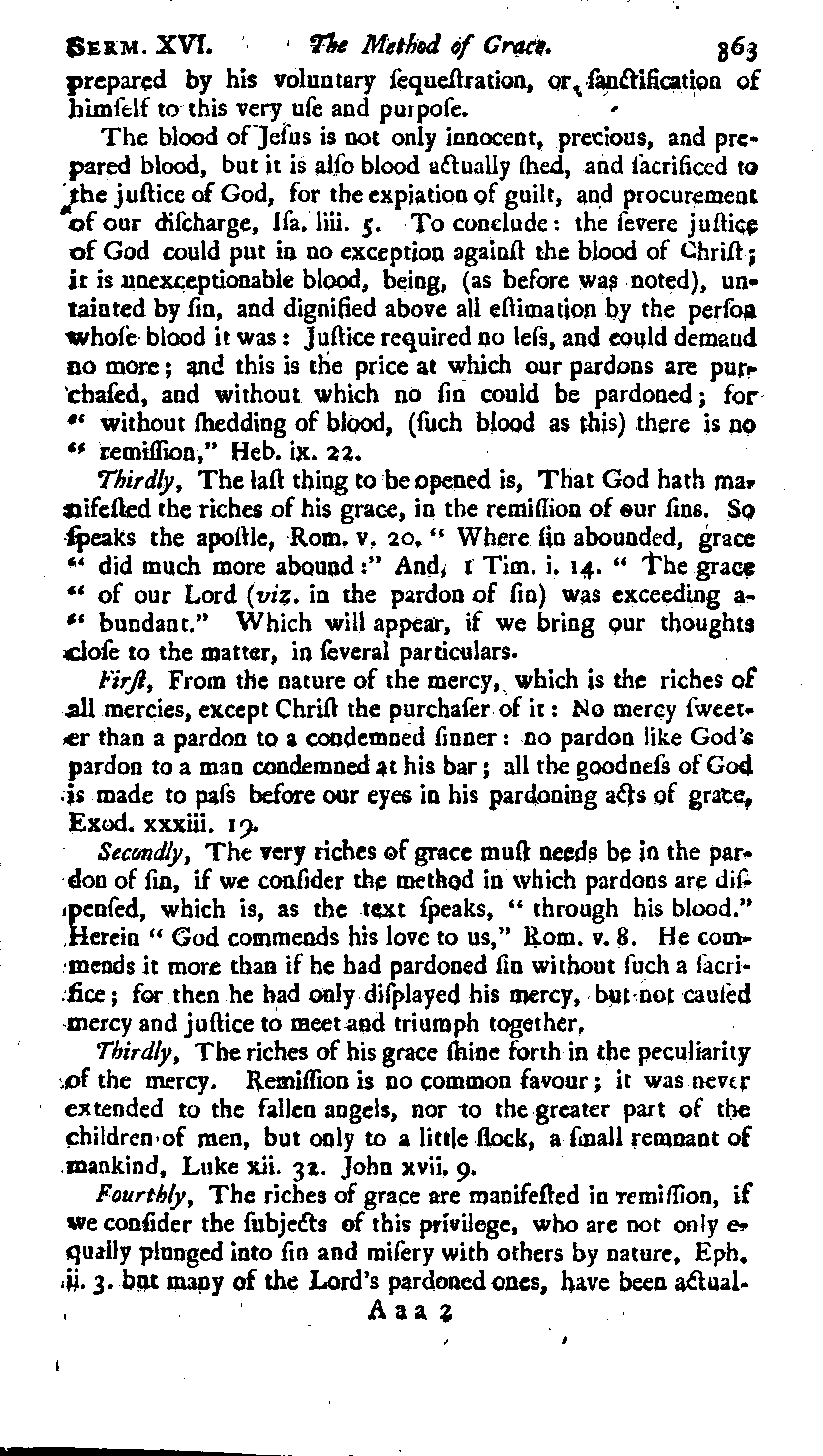
SERM . XVI.
The Method of Grace.
prepared by his voluntary sequestration, or sanctification of himself to this very use and purpose.
The blood of Jesus is not only innocent, precious, andpreparedblood, but it is also blood actually shed, and sacrificed to the justice of God, for the expiation of guilt, and procurement of our discharge, Ifa. liii. 5. To conclude: the severe justice of God could put in no exception against the blood of Christ ; itisunexceptionable blood, being, (as before was noted), untainted by fin, and dignified above all estimation by the person whose blood it was : Justice required no less, and could demand no more; and this is the price at which our pardons are purchased, and without which no sin could be pardoned; for " without shedding of blood, (such blood as this) there is no " remission," Heb. ix. 22.
Thirdly, The last thing to be opened is, ThatGodhath ma nifested the riches of his grace,in the remission of our fins. So speaks the apostle, Rom. v. 20. " Where fin abounded, grace
" did much more abound:" And, I Tim. i. 14. " The grace " of our Lord (viz. in the pardon of fin) was exceeding a- " bundant."
Which will appear, if we bring our thoughts close to the matter, in several particulars.
First, From the nature of the mercy, which is the riches of all mercies, except Christ the purchaser of it : No mercy sweeterthanapardontoacondemned sinner: no pardon like God's pardon to am an condemned a this bar; all the goodness of God is made to pass before our eyes in his pardoning acts of grace,
Exod. xxxiii . 19.
Secondly, The very riches of grace must needs be in the pardon of fin, if we consider the method in which pardons are dis pensed, which is, as the text speaks, " through his blood."
Herein"God commends his love to us," Rom. v. 8. He commends it more than if he had pardoned sin without fucha sacrifice; for then he had only displayed his mercy, but notcaufed mercyandjustice to meet and triumph together,
Thirdly, The riches of his grace snine forth in the peculiarity of the mercy.
Remission is no common favour ; it was never extended to the fallen angels, nor to the greater part of the children of men, but only to a little flock, a small remnant of mankind, Luke xii. 32. John xvii. 9.
Fourthly, The riches of grace are manifested in remission, if we consider the subjects of this privilege, who are not only equallyplungedinto fin and misery with others by nature, Eph, ii. 3. but many of the Lord's pardonedones, have been actualAaa 2
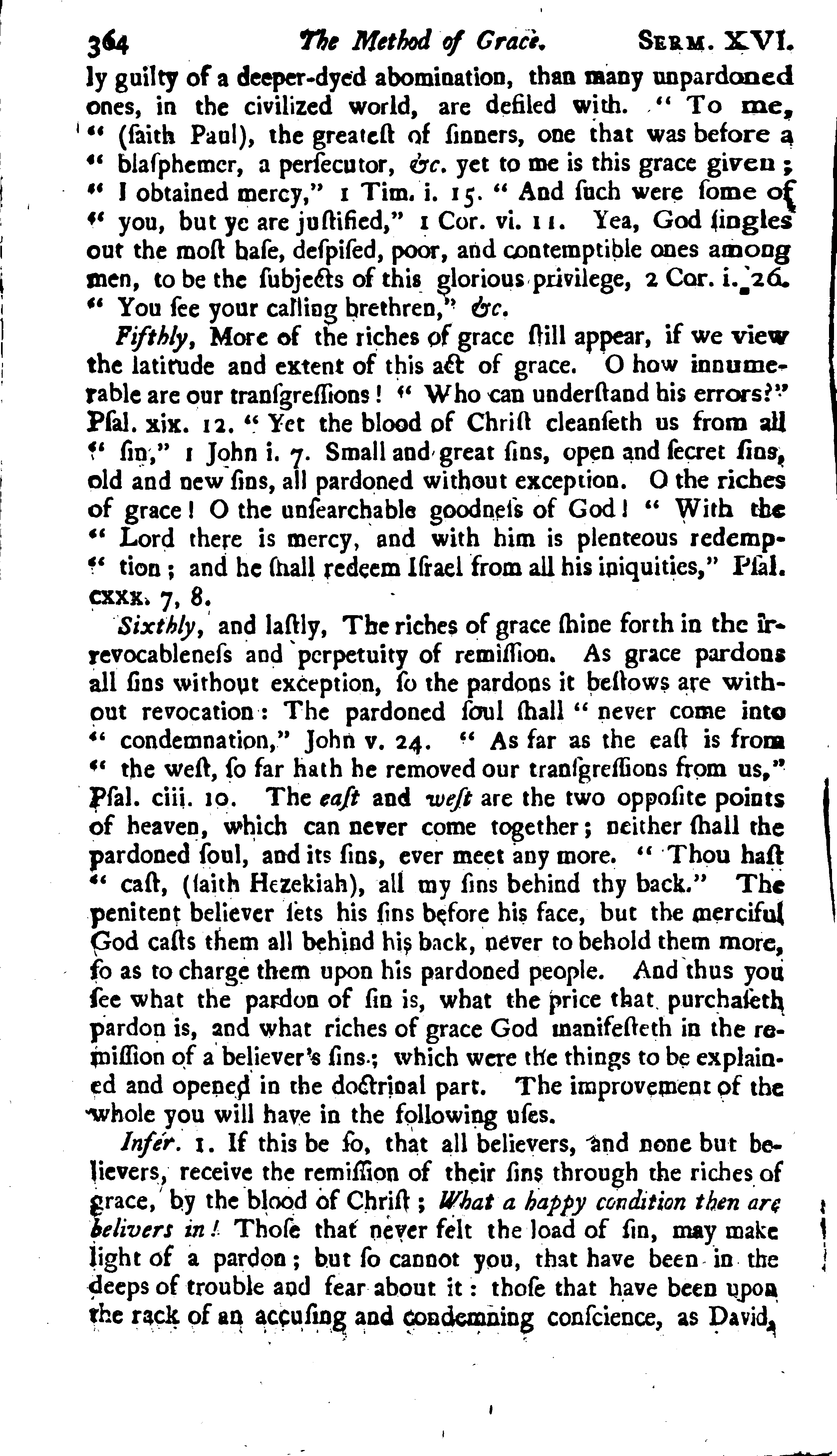
The Method of Grace.
SERM . XVI.
lyguilty of a deeper-dyed abomination, than many unpardoned ones, in the civilized world, are defiled with.
" To me, (faith Paul), the greatest of sinners, one that was before a " blafphemer, a perfecutor, &c. yet to me is this grace given ;
" I obtained mercy," I Tim. i. 15. "And such were some of " you, but ye are justified," I Cor. vi. 11.
Yea, God singles out the most base, despised, poor, and contemptible ones among men, to be the subjects of this glorious privilege, 2 Cor. i. 26.
" You fee your calling brethren," &c.
Fifthly, More of the riches of grace still appear, if we view the latitude and extent of this act of grace. Ohow innumerable are our transgressions ! " Who can understand his errors?"
Psal . xix . 12. " Yet the blood of Christ cleanseth us from all " fin," 1 John i. 7. Small and great fins, open and secret sins, old and new fins, all pardoned without exception. O the riches of grace ! O the unsearchable goodness of God !
With the " Lord there is mercy, and with him is plenteous redemp-
" tion; and he shall redeem Israel from all his iniquities," Plal .
CXXX. 7, 8.
Sixthly, and lastly, The riches of grace shine forth in the irrevocableness and perpetuity of remission. As grace pardons all fins without exception, so the pardons it bestows are without revocation : The pardoned foul shall " never come into " condemnation," John v. 24.
" As far as the east is from " the west, so far hath he removed our transgressions from us,"
Psal. ciii. 10.
The east and west are the two opposite points of heaven, which can never come together; neither shall the pardoned soul, and its fins, ever meet anymore. " Thou haft
" cast, (faith Hezekiah), all my fins behind thy back."
The penitent believer sets his fins before his face, but the merciful God casts them all behind his back, never to behold them more, fo as to charge them upon his pardoned people. And thus you see what the pardon of fin is, what the price that purchaseth pardon is, and what riches ofgraceGod inanifesteth in the remission of a believer's fins ; which were the things to be explained and opened in the doctrinal part. The improvement of the whole you will have in the following uses.
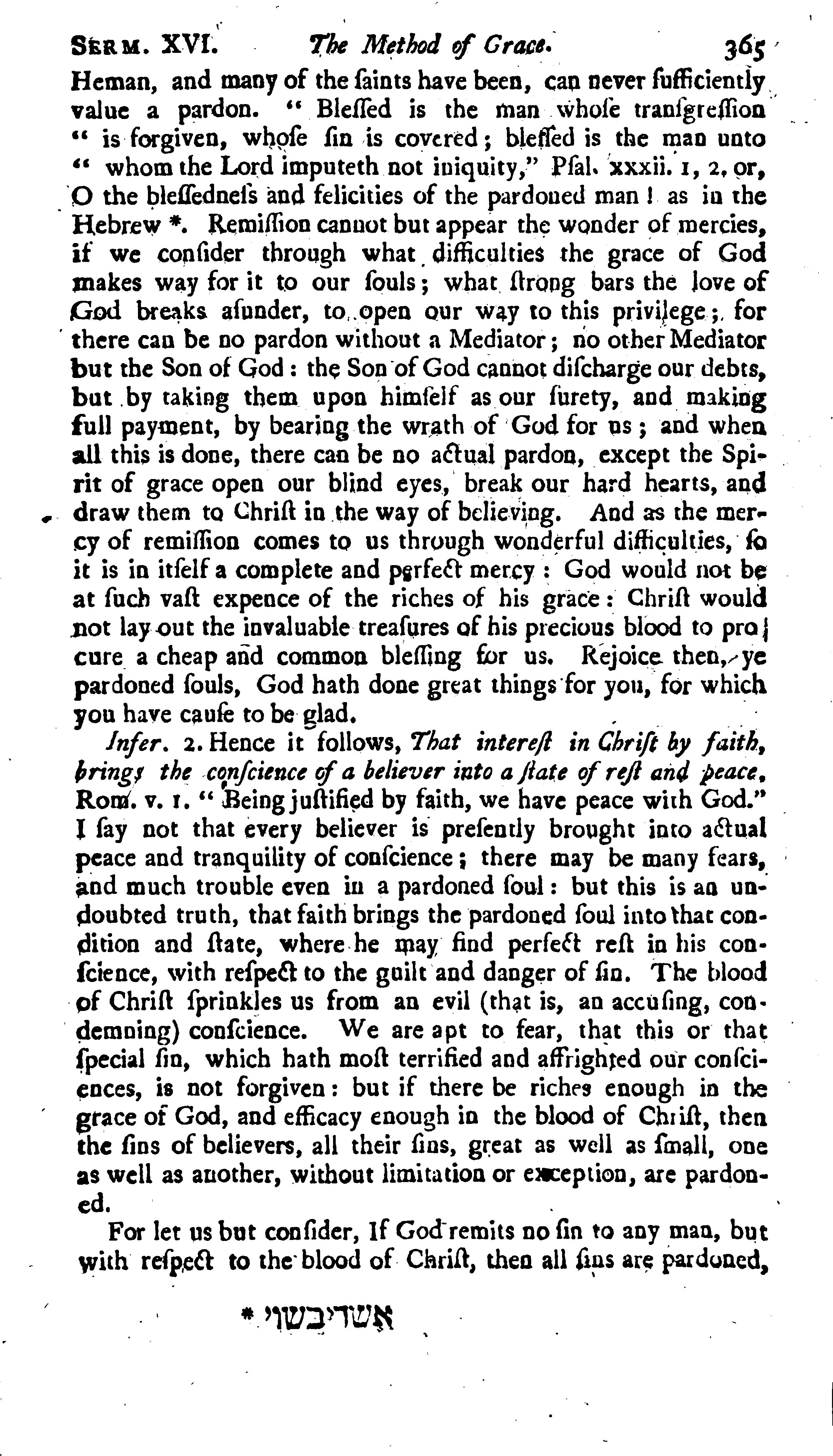
Infer. 1. If this be fo, that all believers, and none but believers, receive the remission of their fins through the riches of grace, by the blood of Christ ; What a happy condition then are be livers in ! Those that never felt the load of fin, may make light of a pardon; but so cannot you, that have been in the deeps of trouble and fear about it: those that have been upon the rack of an accusing and condemning conscience, as David,
SERM . XVI.
The Method of Grace.
Heman, andmanyofthe faints have been,can never sufficiently value a pardon. " Blessed is the man whose transgression
" is forgiven, whose sin is covered; blessed is the man unto " whom the Lord imputeth not iniquity," Psal. xxxii. 1 , 2, or,
Othe blessedness and felicities of the pardoned man ! as in the Hebrew *. Remission cannot but appear the wonder of mercies, if we consider through what difficulties the grace of God makes way for it to our souls ; what strong bars the love of God breaks asunder, to open our way to this privilege ; for there can be no pardon without a Mediator; no other Mediator but the Son of God: the Son ofGodcannotdischarge our debts, but by taking them upon himself as our surety, and making full payment, by bearing the wrath of God for us ; and when all this is done, there can be no actual pardon, except the Spirit of grace open our blind eyes, break our hard hearts, and draw them to Christ in the way of believing. And as the mercy of remission comes to us through wonderful difficulties, so it is in itself a complete and perfect mercy: God would not be at such vast expence of the riches of his grace : Christ would not layout the invaluable treasures of his precious blood to pro cure a cheap and common blessing for us.
Rejoice then, ye pardoned fouls, God hath done great things for you, for which you have cause to be glad.
Infer. 2.Hence it follows, That interest in Christ by faith, brings the conscience ofa believer into a state of rest and peace,
Rom. v. 1. " Being justified by faith, we have peace with God."
I say not that every believer is presently brought into actual peace and tranquility of conscience ; there may be many fears, and much trouble even in a pardoned foul: but this is an undoubted truth, that faith brings the pardoned foul into that condition and state, where he may find perfect rest in his conscience, with respect to the guilt and danger of fin. The blood of Christ sprinkles us from an evil (that is, an accusing, condemning) conscience. We are apt to fear, that this or that special fin, which hath most terrified and affrighted our consciences, is not forgiven: but if there be riches enough in the grace of God, and efficacy enough in the blood of Christ, then the fins of believers, all their sins, great as well as small, one as well as another, without limitation or exception, are pardoned.
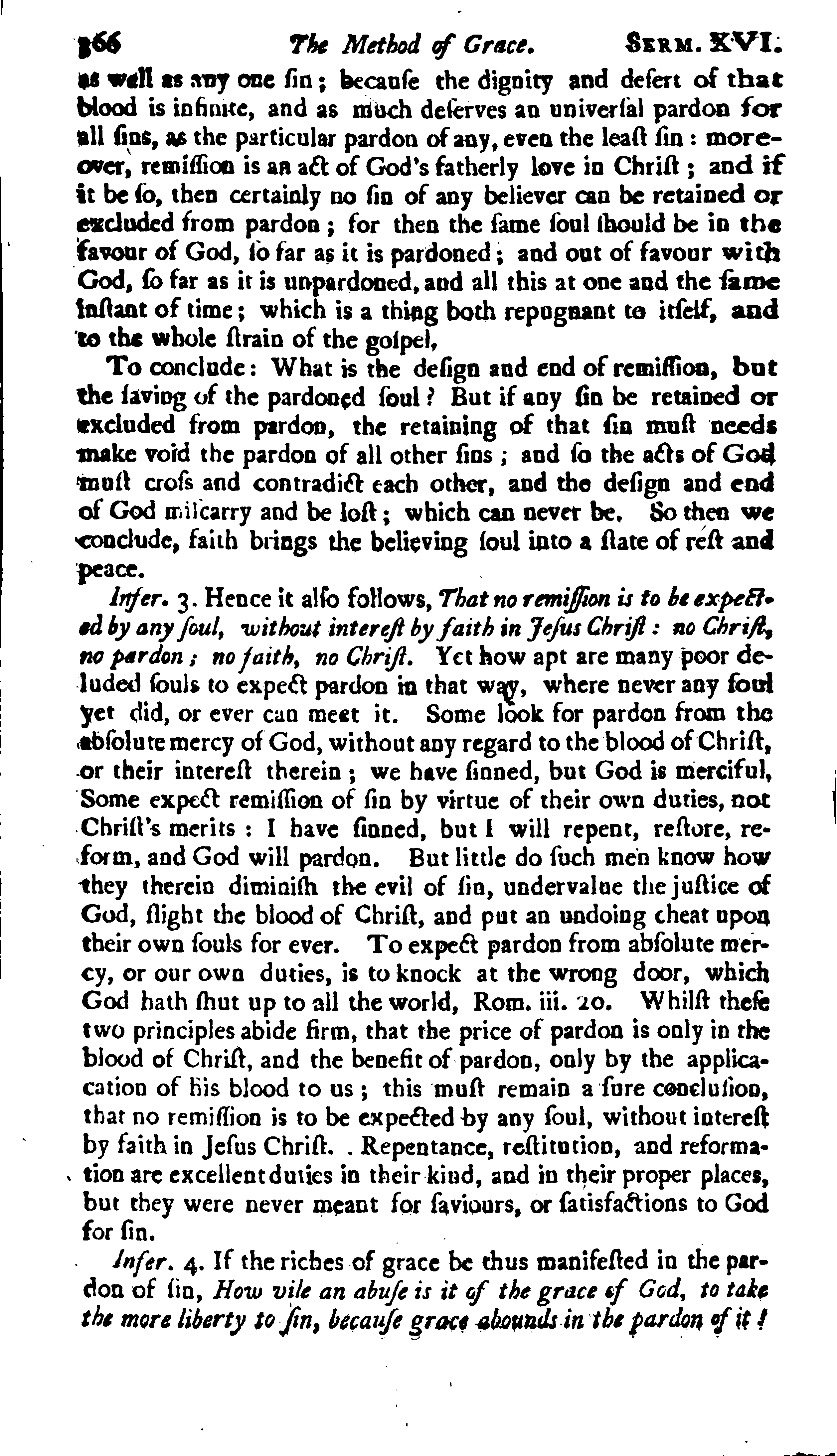
For let us but confider, If God remits no fin to any man, but with respect to the blood of Christ, then all fins are pardoned,
The Method of Grace.
SERM. XVI.
as well as anyone fin; because the dignity and desert of that blood is infinite, and as much deserves an universal pardon for all sins, as the particular pardon of any,even the least sin: moreover, remission is an act of God's fatherly love in Christ; and if it be so, then certainly no fin of any believercanbe retained or excluded from pardon; for then the fame foul should be in the favour of God, fofar as it is pardoned; and out of favour with God, so far as it is unpardoned,and all this at one and the fame instant of time; which is a thing both repugnant to itself, and to the whole strain of the gospel, To conclude: What is the design and end ofremiffion, but the saving of the pardoned foul ? But if any sin be retained or excluded from pardon, the retaining of that sin must needs make void the pardon of all other fins ; and so the acts of God must cross and contradict each other, and the design and end of God milcarry and be lost ; which can never be.
So then we conclude, faith brings the believing foul into a state of rest and peace.
Infer. 3.Hence it also follows,That no remiffionis to beexpectedbyanyfoul, without interest by faith in Jesus Christ : no Christ, no pardon; no faith, no Christ. Yet how apt are many poor deluded fouls to expect pardon in that way, where never any foul yet did, or ever can meet it.
Some look for pardon from the absolute mercy of God,without any regard tothebloodofChrift, or their interest therein; we have finned,but God is merciful,
Some expect remission of finby virtue of their own duties,not Christ's merits : I have sinned, but I will repent, restore, reform, and God will pardon.
Buthttledosuch men know how they therein diminish the evil of fin, undervalue the justice of God, flight the blood of Christ, and put an undoing cheat upon their own souls for ever. To expect pardon from abfolutemercy, or our own duties, is to knock at the wrong door, which God hath shut up to all the world, Rom. iii. 20.
Whilst these two principles abide firm, that the price of pardon is only in the blood of Christ, and the benefit of pardon, only by the applicacation of his blood to us ; this must remain a sure conclusion, that no remission is to be expected by any foul, without interest by faith in Jesus Christ. Repentance, restitution, and reformation are excellent duties in their kind, and in their proper places, but they were never meant for saviours, or fatisfactions to God for fin.
Infer. 4. If the riches ofgracebethus manifested in the pardon of lin, How vile an abuse is it of the grace of God, to take the more liberty to fin, because grace abounds in the pardon of it !
SERM . XVI.
The Method of Grace.
"Shall we continue in fin,thatgracemayabound? God for- " bid!" Rom. vi. 1, 2.
Will nothing cheaper than the grace of God serve to make a cloak for fin ? O vile abuse of the most excellent thing in the whole world ? Did Christ shed his blood toexpiate our guilt, and dare we make a plea to extenuate our guilt ? God forbid !
If it be intolerable ingratitude, among men, to requite good with evil, sure that fin must want a name bad enough to express it, which puts the-greatest dishonouruponGod, for the greatest mercy that ever was given by God to the world.
"There is 66 mercy with thee,(faith the Pfalmist), thatthoumayest be fear- " ed," not that thou mayest be the more abused, Psal. cxxx. 4.
Nay, let me say, the devils never finned at this rate; theycannotabuse the pardoning grace of God, because such grace was never offered unto them. And certainly,if the abuse ofthecommonmercies of God, as meat and drink, by gluttony and drunkenness, be anhenious fin,and highly provoking to God; then the abuse of the riches of his grace, and the precious blood of his Son, must be out of measure sinful, and the greatest affront we can putupontheGod of mercy.
Infer. 5. To conclude : If this befo, as ever you expect pardon and mercy from God, to come Christ in the way of faith; receive and embrace him now in the tenders of the gospel.
To drive home this great exhortation, I beseech you, as in the bowels of Christ Jesus, and by all the regard and value you have for your own souls, let these following considerations fink down into your hearts.
First, That all christless persons are actually underthecondemnation of God, John iii. 18. " He that believeth not, is condem.
" ned already: " and it must needs be so, for every soul is concludedunderthe curse of the law, till Christ make him free,John viii. 36.
Till we are in Christ, we are dead by law ; and when we believe unto justification, then we pass from death to life.
A blind mistakenconfcience may possibly acquit you,but assure yourselves,God condemns you.
Secondly, Confider whataterrible thing it is to lie under the condemnationofGod; the most terrible things in nature cannot shadow forth the misery offuch a state: put all ficknesses, all poverty, all reproaches, the torments invented by all tyrants into one scale, and the condemnatiou of God into the other, and they will be all found lighter than a feather.
Condemnation is the sentence of God, the great and terrible God ; it is a sentence huttingyou up to everlasting wrath; it is a sentence never to
The Method of Grace.
SERM . XVI.
be reversed, but by the application of Christ in the season thereof.
O fouls ! you cannot bear the wrath of God ; you do not understand it, if you think it tolerable : One drop of it upon your consciences now, is enough to distract you in the midst of all the pleasures and comforts of this world : yet all that are out of Christ, are sentenced to the fulness of God's wrath for ever.
Thirdly, There is yet a possibility of escaping the wrath to come ; a door of hope opened to the worst offinners; a day of grace is offered to the children of men, Heb. iii. 15. Goddeclareshimself unwilling that any should perish, 2 Pet. iii. 9. O what a mercy is this ! Who, that is on this side heaven or hell, fully understands the worth of it ?
Fourthly, The door of mercy will be shortly shut, Luke xii.
25. God hath many ways to shut it: he sometimes shuts it by withdrawing the means of grace, and removing the candleSticks ; a judgment at this time to be greatly feared.
Sometimes he shuts it, by withdrawing his Spirit and blessing from the means, whereby all ordinances lose their efficacy, 1 Cor. iii.
7. But if he shut it not by removing the means of grace from you, certain it is, it will be shortly shut by your removal from all the means and opportunities of falvationby death .
Fifthly, When once the door of mercy is shut, you are gone beyond all the possibilities of pardon and salvation forevermore.
The night is then come, in which no man can work, John ix. 4.
All the golden seasons,you now enjoy, will be irrecoverably gone out of your reach.
Sixthly, Pardons are now daily granted to others : some (and they once as far from mercy as you now are), are at this day reading their pardons with tears of joy dropping from them.
The world is full of the examples and instances of the riches of pardoning grace. And whatever is needful for you to do in the way of repentance and faith to obtain your pardon, how easily shall it be done, if once the day of God's power come upon you ?
Psal. cx. 3. O therefore, lift up your cries to heaven, give the Lord no rest, takenodenial till he open theblindeye, break the stonyheart, open and bow the stubborn will, effectually draw thy soul to Christ, and deliverthypardon signed in his blood.