
2 St. Jerome
ST. JEROME
CVI. PACIAN THE BISHOP
ACIAN, BISHOP of Barcelona! in the Pyrenean mountains, a man of sober eloquence, and distinguished both for his mode of conduct and for his speech, wrote various works, including Cervus? and Against the Novatians? and died in extreme old age in the reign of the emperor Theodosius.* NOTES 1. See FOTC g9, trans. C. Hanson (1998), 1—94.
2. Cervus (or Cervulus): written to dissuade the faithful from participating in pagan New Year celebrations.
3. Against the Novatians: CPL 561, Epistulae iii ad Sympronianum; see EECh 2, 604, art., "Novatianists," R. ]. De Simone.
4Theodosius reigned, 379-395.
REFERENCES
Q 4,135—38 — CPL 561-563 — Cath 10, 37677, ]. Liebaert —DSp 12, 1, 17—20, A. Solignac — EEC 22, 846, M. P. McHugh — EECh 2, 628, M. Simonetti — LThK 77, 1332—33, K. Baus — NCE 10, 854, S. J. McKenna — J.
Matthews, Western Aristocracies (1995), 133
CVII. PHOTINUS THE HERESIARCH
HOTINUS, a native of Galatia,! a disciple of Marcellus? and ordained bishop of Sirmium,® endeavored to revive the Ebionite* heresy and, after he was expelled from his church by the emperor Valentinianus, wrote numerous volumes, among which the most significant are his books,
Against the Pagans and To Valentinianus.
ON ILLUSTRIOUS MEN
NOTES 1. Chron., ed. Helm, 248d. On Galatia see DHGE 19, 71431, R. Janin (+) and D. Stiernon.
2. Cf.
DVI 86.
3. See art., "Sirmium," NCE 13, 260, P. Joannou.
4. On the Ebionite heresy, f. DVT 9.1 (John the Evangelist) and 34.6
(Origen). In the Arian controversy he championed Eunomius.
REFERENCES
Cath 11, 229, P-Th. Camelot — EEC 22, 919—20, F. W. Norris — EECh 2, 685-86, M. Simonetti — LThK 8, 483, B. Koiter
CVIII. PHOEBADIUS THE BISHOP
Sj HOEBADIUS, BISHOP of Agen in Gaul,! published a volume, Against the Arians.? Other works of his are said to exist which I have not read.
2. He survives in extreme old age to the present day.® NOTES 1. P. P. Glasser, Phoebadius von Agen (Ph.D. diss., Augsburg, 19%8). See also Cath 1, 203-8, art., "Agen," E. Jarry; 11, 139—41, art., "Phébad," R.
Darricau.
2. Contra Arianos, ed. A. Durengues (Agen, 1927); CCL 64 (1985), 5—52, R. Demeulenaere; CPL 473.
3. usque hodie: i.e., until 393.
REFERENCES
Q 4, 8384 — CPL 473 — EECh 2, 685, M. Simonetti — LThK 8, 480, ]. A.
Fischer — NCE 1, 200201, E. P. Colbert
ST. JEROME
CIX. DIDYMUS THE BLIND
IDYMUS OF ALEXANDRIA,! while still quite young, became blind? and as a result never learned the alpha-
) bet. He presented to all an extraordinary proof of his talent by acquiring complete mastery of dialectic and geometry, which particularly needs?® the sense of sight.
2. He wrote very many distinguished works:
Commentaries on all the Psalms* Commentaries on the Gospels of Matthew and John? two books, On Dogma and Against the Arians® one book, On the Holy Spirit," which I have translated into Latin; eighteen books, On Isaiah? three books of Commentaries on Hosea,® dedicated to me;? five books, On Zechariah,"! at my request;
Commentaries on _Job,'? and numerous other works,® to give an account of which would be a work in itself.
8. He is still living and is already over eighty-three years old.
NOTES 1. Didymus of Alexandria, the Blind (+ c. 398).
2. a parva aetate: Chron., A.D. 372 (ed. Helm, 246e; trans. Donalson, 54) specifies that because he lost his eyesight in the fifth year after his birth, he was wholly illiterate and therefore used secretaries; cf. Palladius, Hist. Laus.
3. Following the reading of Cer.-Gast.
4. Commentarii in psalmos: CPG 2550, 2551; A. Kehl, "Der Psalmenkommentar von Tura," Quaternio IX (Cologne, 1964); (i) on Ps. 20—21: Didymus der Blinde Psalmenkommentar, 1. Ps. 2021, ed. L. Doutreleau, A. Gesche, and M.Gronewald, PTA % (1969); (ii) on Ps. 22—26.10, ed. M. Gronewald, PTA
4 (1968); (iii) on Ps. 29-34, ed. A. Gesche, M. Gronewald, PTA 8 (1969); (iv) on Ps. g5—309, ed. idem, PTA 6 (1969); (v) on Ps. 40—44.4, ed. idem, PTA
12 (1970). See also E. Muhlenberg, Psalmenkommentare aus der Kateneniberlieferung, Bd.
1 (Berlin, 1975); A. Gesche, "L'ame humaine de Jesus dans la christologie du IVe siécle. Le témoignage du Comm. sur les Psaumes découvert 3 Toura," RHE 54 (1959): 385—425.; P. Photiades, "Notes sur un
ON ILLUSTRIOUS MEN
commentaire paleochrétien [pap. In Psalmos]," NDid 12 (1962): 40-53; reprint, Otkoumene (1964), 55-59; E. Prinzivalli, "Didimo il Cieco e I'interpretazione dei Salmi," (Rome: L'Aquila, 1988); T. W. Mackay, "Didymos the Blind on Psalm 28 (LXX): Text from Unpublished Leaves of the Tura
Commentary," StudPat 20 (1987), 40—48; J. M. Olivier, RHT 18 (1988):
283—41.
5. CPG 255%; cf. D. Lihrmann, "Das Bruchstiick aus dem Hebraer-Evangelium bei Didymus von Alexandrien," NovTest 29 (1987): 265—79.
6. CPG 2571; on Against Funomius see Q §, 88, and A. Dihle, Greck and Latin, 502, 549-50. For the lost dogmatic work, Dialexis Montanistae et orthodoxt, see CPG 2572; G. Ficker, ZKG 26 (1905): 44'7-68.
7. CPG 2544; see DVI 135.4 and n. 28; L. Doutreleau, "Vie et survie de De spiritu sancio, du [Ve siécle d nos jours," Les mardis de Dar-Fl-Salam 46-4'7
(10509): 35-92; idem, "Le De spiritu sancto de Didyme et ses éditeurs," RechSR 51 (1963): 383—406; idem, "Etude d'une tradition manuscrite: Le De
Spirdu Sancie de Didyme," in Kyrigkon, FS J. Quasten, Vol.
1, 352-8g; C.
Noce, ed., Didimo ¢ Cieco, Lo Spirite Santo, CTP 89 (Rome, 1990); E.
Staimer, Die Schrift 'De Spiritu Sando" von Didymus dem Blinden von Alexandrien. Eine Untersuchung zur alichristlichen Lueraturund Dogmengeschichie
{Munich, 1g60).
8. Fragmenta in Isaiam: CPG 2547; see SC 83, 122ff.
9CPG 2564.
10. In ¢p. 3o, To Domnio, Jerome claims him as his teacher: "having Gregory of Nazianzus and Didymus as my catechists in the Holy Scriptures"
(NPNF 6, ser. 2, 80). See also Jerome, ¢b. 84: "I went on to Alexandria and heard Didymus. And I have much to thank him for: for what I did not know
Ilearned from him, and what I knew already I did not forget. So excellent was his teaching . .. Does a certain person dare to bring forward against :me the letter I wrote to Didymus calling him my master? It is a great crime, it would seem, for me a disciple to give to one both old and learned the name of master" (NPNF 6, ser. 2, 176).
11. CPG 2549; L. Doutreleau, Didyme UAveugle. Sur Zacharie, SC 83-8y (Paris, 1g62).
12. CPG 2553; Komm. zu Hiob. I. Kap. 1—4, ed. A. Henrichs (1968); II.
Kap. 5,1-6,28 (1968); II. Kap. 7,20¢-11, ed. U. Hagedorn and L. Koenen (1968).
13. infinita alia: Contra Manichaeos, CPG 254%; On the Trinity, CPG 2570; Commentari in Octateuchum e Reges, CPG 2546; Fragmenta in Ieremiam in cate nts, CPG 2548; Commentari in Ecclesiasten, CPG 25585; Kemmentar zum Ecclestastes.
1/1. Kap. 1,1—2,14, ed. G. Binder and L. Liesenborghs, PTA 25 (1979); 1/2 En., ed. G. Binder, PTA 26 (1980); II. Kap. 3—4,12, ed. M.
Gronewald, PTA 22 (1977); II. Kap. § u. 6, ed. L. Koenen and J. Kramer, PTA 13 (1970); IV. Kap. 7-8,18, ed. ]J. Kramer and B. Krebber, PTA 16
(1972); V. Kap. 9,8-10,20, ed. G. Binder and M. Gronewald, PTA 24 {1979); VI. Kap. 11-12, ed. L. Koenen, G. Binder, and L. Liesenborghs,
PTA g (1969). See also M. Simonetti, "Lettera e allegoria nell'esegesi veterotestamentaria di Didimo," V&Chr
20 (1983): 341-89; M. Diego Sanchez, "El Commentario al Ecclesiastes de Didimo Alejandrino," Taresianum 41
ST. JEROME
(1990): 231—42; A. L. C. Heron, Studies in the Trindarian writings of Didymus the Blind; his quthorship of the "Adversus Eunomium IV-V" and the "De Trinitate" (Ph.D. diss.,, Tabingen University, 1972); L. Béranger, "Sur deux énigmes du De Trinitate de Didyme 1'Aveugle," RechSR 51 (1963): 255-67;
A. Heron, "Some sources used in the De Tiznsiate ascribed to Didymus the Blind," in The Making of Orthodoxy, FS H. Chadwick, ed. R. Williams (Cambridge, 1989). 173—81; M. Bogaert, "Fragment inédit de Didyme 1'Aveugle en traduction latine ancienne," RBén 473 (1963): g—16; F. Dolbeau, "Deux opuscules latines relatifs aux personnages de la Bible et anterieurs 3
Isidore de Seville," RHT 16 (1986): 83-139.
REFERENCES
Q 3, 85-100 — Dr, 2590 — TLG 2102 — CPG 2, 254472 — Cath g, 759-60, G. Bardy — CW 476, 316-14, T. Halton — DHGE
14, 416-27%, A. Van Roey — DSp 3, 8681, G. Bardy — EEC 12, 32030, A.
Heron — EECh 1, 235-36, P. Nautin — LThK 3, §73—74. A. Van Roey — LThK g%, 212-18, B. Kramer — NCE 4, 861, P. Roche
— TRE
8, 741—46, B.
Kramer
CX. OPTATUS THE BISHOP
JIPTATUS,
AN AFRICAN, bishop of Milevis,! on the Catholic side,? under the emperors Valentinianus and 2l Valens,® wrote six books against the calumny of the Donatist party,* in which he asserted that the accusation against the Donatists had been falsely turned against our side.®
NOTES 1. Milevis is in the highlands of Numidia.
2. Cf. J. E. Merdinger, "Optatus Reconsidered," StudPat 22 (198g), 294-99; eadem, Rome and the African Church, yo-60.
8. Valentinianus was Emperor in the West, 364~3%75, while his brother, the Arian Valens, 364-3%78, was Emperorin the East.
4. "adversus Donatianae partis calumniam": not an exact title; cf.
Q 4, 122; CPL 244; Optat. De schismate Donatistarum, ed. C. Ziwsa, CSEL 26 (Vienna, 1893); The Work of St. Optatus, Bishop of Milevis, Against the Donatists, trans. with notes by O. R. Vassall-Phillips (London, 191%); Otiato di Milewi,
La vera Chiesa, (Libri VII), ed. L. Dattrino (Rome, 1988). Number of books:
ON ILLUSTRIOUS MEN
septem, not sex, pace Jeromel Cf. A. C. De Veer, "A propos de I'authenticité du livre VII d'Optat di Miléve," REAug'7 (1961): 389-91.
5. Jerome chooses to ignore the main thrust of Optatus's work: Peter is principium nostrum, and the cathedra Petriis the premier see of the West. Also there is no mention of Optatus's On the origin of human souls; see ep. 144 of Jerome (= Augustine, ¢p. 202A).
REFERENCES
Q 4, 122-2%7 — CPL 244—49 — Cath 10, 103-5, P-Th. Camelot — EEC 22, 830-31, F. W. Norris — EECh 2, 612-13, F. Scorza Barcellona — LThK 4,
1180-81, A. Stuiber — NCE 10, 706—7, A. Stuiber — TRE 23, goo—g02, B.
Kriegbaum — Dihle, Greek and Latin, 542—43 — SC 412 — PLS 1: 28%7-302
CXI. ACILIUS SEVERUS THE SENATOR
= CILIUS SEVERUS, OF SPANISH origin, and from the g well-known family of Severus to whom Lactantius di- =i rected two books of letters, wrote compositions in prose and verse, a sort of 'O3oLmopLkoV, an itinerary,1 a work containing the whole course of his life which he called KataoTpodrv or Ieipay 2
He died in the reign of the emperor Valentinianus.® NOTES 1. Cf.
DVI 80.2 for the same term.
2. Not extant. See HLL 8, 5, 211.
3. Emperor in the West, 364-375.
REFERENCES
EECh 1, 8, V. Saxer — PWK 2, 2003
ST. JEROME
CXII. CYRIL THE BISHOP
YRIL, BISHOP of Jerusalem,' many times excommunicated from his church? but finally reinstated under the ) emperor Theodosius,® held the episcopacy uninterruptedly for eight years.*
2. His Kamnxnioeis, Catecheses® which he composed in his youth, are still extant.
NOTES 1.
F. Cardman, "Fourth-Century Jerusalem: Religious Geography and Christian Tradition," in Schools of Thought in the Christian Tradition, ed. P.
Henry (Philadelphia, 1984).
2. "many times": the details are spelled outin Chron., A.D. 348, ed. Helm, 2g%7a, trans. Donalson, 45. And Q 3, 362, relates: "He was expelled three times from his see. He was first deposed at a council in Jerusalem in 357 and took refuge in Tarsus. After he was restored by the council at Seleucia in the next year, Acacius banished him again in 360, but he was allowed to return to his see in 362 on Julian's accession. Though Acacius died in 366,
Cyril's longest exile was yet to come. In 3647 the emperor Valens deprived him once more of his diocese, which he did not regain until eleven years later (g%8) after the ruler's death."
3. Theodosius reigned, 379-395.
4. "eight years": see P. Nautin, "La date du De viris illustribus de Jérome de la mort de Cyrille de Jérusalem et de celle de Grégoire de Nazianze,"
RHE 56 (1961): 33-35.
5. Katnyfoers: see most recendy G. Maestri and V. Saxer, Cirillo ¢ Giovanni di Gerusalemme, Catechesi prebattesimali e mistagogiche (Milan, 1994);
Eng. trans. by Leo P. McCauley and Anthony A. Stephenson, FOTC 61 and 64; A. Pauli, Saint Cynille de Jérusalem catéchese, Lex orandi 29 (Paris, 1959); C.
Renoux, "La lecture biblique dans la liturgie de Jérusalem," in Le monde gvec & la Biblg, ed. C. Mondésert, 171—93; A. A. Stephenson, "The Lenten
Catechetical Syllabus in Fourth-Century Jerusalem," 7S 15 (1954): 103~ 16; R. Gregg, "Cyril of Jerusalem and the Arians," in Arianism (Cambridge,
Mass., 1985), 85-105.
REFERENCES
Q 3, 362476 — Dr, 24750 — TLG 2110 — CPG 35853588 — Cath 3, 412-14, G. Bardy — DHGE 13, 1181-85, G. Bardy — DSp 2, 2, 2683-87,
G. Bardy — EEC 12, g12-13, F. W. Norris — EECh 1, 215, M. Simonettd —
ON ILLUSTRIOUS MEN
LThK 6, 709-10, O. Perler — LThK 2%, 1370, S. Heid — NCE 5, 57678, A.
A. Stephenson — TRE 8, 261-66, E. J. Yarnold
CXIII. EUZOIUS THE BISHOP
uzo1us! As A YOUNG man was educated at Caesarea at the school of the rhetor Thespesius,? and had Gregory of Nazianzus, a bishop,® as a fellow student. He later became bishop of the same city of Caesarea, after great endeavors to preserve the holdings of the library of Origen and Pamphilus* which had greatly deteriorated. Finally he was excommunicated from the church in the reign of the emperor Theodosius.® 2. Diverse and numerous works of his® are in circulation and it is very easy to get to know them.
NOTES 1. Euzoius was a moderate Arian who baptized Constantius on his deathbed.
2. For the rhetor Thespesius, cf. "Thespesius 2," PLRE 1, g10.
3. See F. W. Norris, Faith Gives Fullness to Reasoning: The Five Theological Orations of Gregory of Nazianzen (Leiden, 1991), g and n. 18. Gregory wrote
Epitaph 4 for Thespesius.
4. bibliotheca: Courcelle, LLW, 104; H. Y. Gamble, Books, 154—-60 (DVI 113, not 1121); and on the phrase in membranis instaurare, Gamble, op. cit.,
150, where it is explained as a conversion from papyrus to parchment; cf.
Barnes, C. and E., 347 n. 21.
5. For his earlier associations with Arius, see Barnes, C. and E., 229, 238.
6. Cf. Q 3, 348: "all [his works] have disappeared, and even their titles are unknown." Jerome had easy access to his works in the library of Caesarea.
REFERENCES
Q 3, 348 — EECh 1, 305, M. Simonetti — Kelly, Jerome, 135
ST. JEROME
CXIV. EPIPHANIUS THE BISHOP
PIPHANIUS,
BISHOP of Salamis in Cyprus, wrote Against All Heresies' and many other works? which are eagerly read by the more learned for their content and by the less sophisticated for their literary form.®
2. He is alive at the present day and even in extreme old age is still publishing various works.* NOTES 1. Against all Heresies: a generic title embracing the Panarion, or Medicine
Chest (CPG 3745); The Panarion of St. Epiphanius, Bishop of Salamis: Selected Passages, trans. P. R. Amidon (New York: Oxford University Press, 1990)
[Omits the Refutations]; also The Panarion of Epiphanius of Salamis, Book
[Sections 1—46] and Books 2—3 [Sections 47-80; De fide], trans. F. Williams (Leiden and NXY: E. J. Brill, 1987-1994). See also Su Cristo, ed. Bellini,
193—265; R. M. Hiibner, "Die Hauptquelle des Epiphanius (Panarion haer 65) tiber Paulus v. Samosata," ZKG go (1979): 201-20; G. Vallée, A Study in Anti-Gnostic Polemics. Irenaeus, Hippolytus and Epiphanius (Waterloo, Ontario,
1981); A. Pourkier, Lhérésiologie chez Epiphane de Salamineg, CAnt 4 (1992).
2. Ancoratus: CPG 3744; Epistula ad Hieronymum [Latin]: CPG 3755 (ep.
91 in Jerome's correspondence; trans. in NPNF 6, ser. 2, 184-85). See J. F.
Dechow, Dogma and Mysticism in Early Christianity. Epiphanius of Cyprus and the Legacy of Origen, PatMS 13 (1988); E. A. Clark, The Origenist Controversy.
The Cultural Construction of an Early Christian Debate (Princeton, 1992); P.
Devos, "Mega Sabbaton chez saint Epiphane," AnBoll 108 (1990): 293-306.
3. Jerome was especially impressed by Epiphanius's erudition, asking, "Must he be charged with a crime for knowing Greek, Syriac, Hebrew,
Egyptian, and, in part measure, also Latin?" in Adv. Rufinum 2.22 (trans.
Hritzu, FOTC 53, 141).
4. Jerome translated into Latin a letter of his addressed to John of Jerusalem, contained in Jerome's correspondence as ¢p. 51, trans. in NPNF
6, ser. 2, 83-89.
REFERENCES
Q 3, 384-96 — Dr, 253-56 — TLG 2021 — CPG 2, 37443807 — Cath 4, 320-21, G. Bardy — DHGE 15, 617-31, P. Nautin — DSp 4, 1, 854-61 —
EEC 12, 380-81, F. W. Norris — EECh 1, 281-82, C. Riggi — LThK 3, 944—46, R. Gogler — LThK g%, 72325, W. A. Bienert — NCE 5, 478-79, P.
Canivet — RAC g, gog—27, W. Schneemelcher — Dihle, Gresk and Latin,
ON ILLUSTRIOUS MEN
CXV. EPHREM THE DEACON
| PHREM, DEACON of the church of Edessa,! composed many works in Syriac? and came to enjoy such prestige that his works are read publicly after the Scripture readings in some churches.® 2, I read in Greek his work, On the Holy S]n'rit," which he had translated from the Syriac, and even in translation® I could recognize the acuteness of his sublime genius.
3. He died in the reign of the emperor Valens.® NOTES 1. 8. Brock, "Syriac Studies 19%71~1980, a Classified Bibliography," P40
10 (1081-82): 291—412; S. Brock, The Harp of the Spirit, Studies Supplementary to Sobornost, no. 4, 224 ed. (St. Alban and St. Sergius, 1985).
2. Ephrem the Syrian Hymns, trans. K. E. McVey, Classics of Western Spirituality (New York, 1989); St. Ephrem the Syrian: Selected Prose Werks, trans. Edward G. Mathews, Jr., and Joseph P. Amar, ed. Kathleen McVey, FOTC g1
(1904).
3. Jerome does not seem to be aware of Ephrem's hymns, which were used in the liturgy.
4No longer extant.
5. For translations of Ephrem, cf. DSp 4, 1, 800-822 ("Les versions"), D.
HemmerdingerIliadou and J. Kirchmeyer.
6. Valens, Emperor in the East, §64—378.
REFERENCES
DSp 4, 1, 788822, E. Beck, J. Kirchmeyer, and D. Hemmerdingerliadou — EEC 12, 3464, K. McVey — EECh 1, 26—, F. Rilliet — LThK g, 926-29, E. Beck — LThK 32, 708-10, W. Cramer — NCE §, 46364, £. des Places— TRE g, 75 5-62 — Dihle, Gresk and Latin, 5'74
ST. JEROME
CXVI. BASIL, ANOTHER BISHOP
ASIL, BISHOP of Caesarea in Cappadocia,! which was formerly called Mazaca, composed excellent works:
Against Eunomius? a work, On the Holy Spirit? nine Homilies on the Hexameron? an AoknTwév;? and other various short works.®
2. He died in the reign of the emperor Gratian.'
NOTES 1. A rather curt entry; in the Chron. under A.p. 376 (ed. Helm, 248e¢), we read what may be the reason for his antipathy: "Basil of Caesarea the bishop of Cappadocia was a famous man. By the one fault of pride he ruined his many good qualities of chastity and talent" (trans. Donalson, 55-56).
2. Q 3, 209-210; D1, 229; text in SC 299; for Agasnst Eunomsus cf. Dihle, Greek and Latin, 549, who dates it to 364; the work contains five books, the last two of which belong to Didymus.
3. Q 3, 210-11; D, 230-3
1. Text: SC 17, 1968% ed. B. Pruche.
4.Q 8§, 210-11.
5. "an Aoknruov": PG §1; Q 8, 210-11; LThK 2%, 41~2, K. S. Frank. See also K. Suso Frank, "Monastische Reform im Altertum. Eustathius von Sebaste und Basilius von Caesarea," Reformatio ecclesiae (19'79). 3350
6. For listing see CPG 2835-3005.
4. Gratian reigned, 375—383. Basil died on January 1, §%79. The 1600th anniversary in 19779 was the occasion of two meortant Congresses: Bastlio di Cesarea: la sua aa, la sua opera e il Basilianesimo in Sicilia. Atti del Congresso nternazionale I ¢ I (Messina, 1979 and 1983); P.J. Fedwick, ed., Basil of Cassarea: Christian, Humanist, Ascetic, 2 vols. (Toronto, 1981). See also J. Gribomont, Szint Basile, E'wmgzle a Eglise. Mélanges, 2 vols. (Abbaye de Bellefontaine, 1984); Mémorial Dom Jean Gribomort = SEAug 27 (1988).
REFERENCES
Q 3, 204-36 — D1, 22531 — TLG 2040 — CPG 2835-3005 — DSp 1,
1273-83, G. Bardy — EEC 1% 16g—72, F. W. Norris — EECh 1, 114-15, ].
Gribomont — LThK 2%, 647-69, C. Kannengiesser — NCE 2, 14346, 148-49, ]J. Gribomont — TRE §, go1-18, W.-D. Hauschild — Dihle, Gresk and Latin, 11, 549 — Gestalten 11, '7-19, W.-D. Hauschild
ON ILLUSTRIOUS MEN
CXVII. GREGORY, ANOTHER BISHOP
S|REGORY OF Nazianzus, a bishop, a man of outstanding eloquence,! was my teacher, and I learned the Scrip-
S tures at his school.?2 He composed all his works in about thirty thousand verses® and they include the following:
2. On the death of his brother, Caesarius;* Iepl pLromToxias, On the Love of Poverty?
In Praise of the Maccabees® In Praise of Cyprian,"
The Praises of Athanasius?® The Praises of Maximus the Philosopher upon his return from exile, to whom some gave the pseudonym Hero,® because there is another satirical book by the same Maximus, as if it were not permissible to praise and criticize the same person, depending on the circumstances;
3. and a book in hexameter verse, On Virginity and Marriage, in which the pair debate each other; two books, Against Eunomius;' one book, On the Holy Spirit,"* one book, Against fulian the Emperor.*?
4. He followed the oratorical style of Polemon' and ordained another bishop in his own place while he was stll alive.
He embarked on the monastic life and died almost three years ago, in the reign of the emperor Theodosius.!
NOTES 1. P. Gallay, Grégoire de Nazianz (Paris, 1993); F. Trisoglio, "San Gregorio di Nazianzo scrittore e teologo in quaranta anni di ricerche (1925-1965),"
RSLR 8 (1972): 341-"74; idem, San Gregorio di Nazianzo in un quaraniennio di studi (1925-1965), Rivista Lasalliana 40 (Turin, 1974); ¢dem, San Gregorio di
Nazianzo, U'uomo atiraverso all oratore (Genoa, 1987); A. Benoit, Saint Grégoire de Nazianze,archévéque de Constantinople & docteur de
UEglise. Sa vie, ses oeuvres a son épogque (Marseille and Paris, 18/76; reprint, Hildesheim, 1973).
2. praeceptor meus: Jerome declares, "Could I not have mentioned in that
ST. JEROME
letter [gp. 83] Gregory, a very eloquent man? Who among the Latins is his equal? I glory and exult in him as my master" (Adv. Rufinum 1.13, trans.
Hritzu, FOTC g3, 76). Jerome was in Constantinople from 3779 to 381. He gives a good example of Gregory's style as praecgptorin ¢p. y2 (CSEL 54,
420): the elegantly playful reply (edsganter lusit) Gregory gave him when he too eagerly asked for an explanation of Sevrepdmpuwrov in Luke (Lk 6.1).
See C. Moreschini, "Prasceptor meus: Tracce del'insegnamento di Gregorio di Nazianzo in Gerolamo," Jéréme entre I'Occident
& 1'Orient, ed. Duval, 129-38. On Gregory and Scripture, see P. Gallay, "La Bible dans 1'ceuvwre de Grégoire de Nazianz le Théologien," Le monde grec ancien & la Bible, ed.
Mondésert, 313—34; for Philo's influence, F. Trisoglio, ANRW II, 21, 1, 588-730.
3. iriginta milia versuum: see Saint Gregory of Nazianzus: Three Poems, trans.
D. Mechan, with notes by T. Halton, FOTC 75 (198%7); on his poetry, see Dihle, Greek and Latin, 572; RAC 12 (1983), 793f.;
Q 3, 244—46.
4. On the death of his brother, Caesarius = or. 77. Text: SC 405, 180-245, ed.
M.-A. Calvet-Sebasti. Trans.: Leo P. McCauley, FOTC 22, 5-25. And, in the same volume, On S¢. Basil the Grem, 2'7—90; On his sister, St. Gorgonia, 101-18;
On his Father, 119-56. See also C. Nardi, "Echi dell' Orazione funebre su Basilio di Gregorio Nazianzo nel De Sacerdsiie di Giov. Crisostomo,"
Prometheus 2 (1976): 1975-84.
5. Ilepl dpromrwylas, On the Love of Poverty = or.
14. Text: PG g5 857-900.
6. The Praises of the Maccabees = or. 15. Text: PG 35: g11-934.
7. The Praises of Cyprian = or. 24. Text: SC 284, 40-85.
8. The Pratses of Athanasius = or. 21. Text: SC 2770, 86-193.
9. The Praises of Maximus the Philosopher = or. 2. Text: SC 284, 156-205.
See Norris, Faith Gives Fullness, 8 and n. 42, and 10 n. §1, citing J. Mossay, "Note sur Héron-Maxime, écrivain ecclesmsthue, AnBoll
(1982):
229-36. The pseudonym, Hero, occurs in or 2§; see D. R. Dudley, A History of Cynicism (London, 1937). See also DV 127.
10. "two books, Against Eunomius" = or. 28—29; Norris, Faith Géves Fullness, 224-61.
11. "one book, On the Holy Spirit" = or. 31; Norris, Faith Gives Fullness, 279-99. See also Grégoire de Nazianze, Les 5 Discours sur Dieu, trans. and notes by P. Gallay, intro. and comm. by A.-G. Hamman, Les Péres dans la foi
61 (Paris, 1995).
12. "one book, Against fulian the Emperor" = or. 4—5: SC 309, ed. J. Bernardi (Paris, 1983); Gregorie di Nazianze Contro Giuliano UAposta@a. Orazione
IV, ed. L. Lugaresi, Bibliotheca patristica 23 (Florence, 1993); A. Kurmann, Gregor von Nazianz. Oratie IV gegen fulian; C. Moreschini, "L'opera e la personalitd dell' imperatore Giuliano nelle due 'Invectivae' di Gregorio Nazianzo," Forma futuri, FS M. Pellegrino (Turin, 1973), 416-30.
1. "the oratorical style of Polemon" (Polemonis dicendi xapaxtiipa): On Polemon, a celebrated Greek, see Polemonis Declamationes quac exstant duae, ed. H. Hinck (Leipzig, 1873). Polemon is also mentioned in Eus., Chron.,
A.D. 132, ed. Helm, 200, where he is linked with Favorinus. Socrates, A.e.
ON ILLUSTRIOUS MEN
4.26 (NPNF 2, ser. 2., 110), names Himerius and Prohaeresius as Gregory's teachers at Athens, 14. "another bishop™: i.e., Nectarius, Bishop of Constantinople, 381—
397; cf. EECh 2, 584, D. Stiernon.
15. Gregory died three years before DVI was written. His retirement in Arianzum (383-389g) produced most of his 244 extant letters and much of his poetry. On the poetry cf. Dihle, Greek and Latin, 604. For the final phase of his life, see ]. Plagnieux, "Saint Grégoire de Nazianze," Théologie de la vie monastique (Paris, 1061), 115—130. On Jerome's dating of his death, see P.
Nautin, "La date du De viris dlustribus de Jérome, de la mort de Cyrille de Jérusalem et de celle de Grégoire de Nazianze," RHE 56 (1961): 33-35.
REFERENCES
Q 3, 286-54 — TLG 2022 — CPG goro-3125 — DHGE 22, 15-18, J.
Mossay — DSp 6, gg2—#71, J. Rousse — EEC 1% 491-g5, F. W. Norris — EECh 1, 361-62, J. Gribomont — LCI 6, 444-%0, U. Knoben — LThK 4°,
1004—7, B. Coulie —NCE 6, 79194, ]. T. Cummings
— RAC 12, 793863,
B. Wyss — TRE 14, 164-73, ]. Mossay — Dihle, Gresk and Latin, 486-87, 510-11, §19-20, 551-52
CXVIII. LUCIUS THE BISHOP
Blucius, A BisHOP of the Arian party, governed the church of Alexandria after Athanasius,! until Theodosius, after he became emperor, expelled him.?
2. His annual letters, On the Pasch.? survive, and a few treatises of Umobéocwv,* various subjects.
NOTES 1. Athanasius died, May 2, 373.
2.Q g, 162, noting that Macarius, the Egyptian monk, was in turn exiled by Lucius.
8. solemnis = annual; CPG 2535, Sermo in pascha (fragmentum).
4. Courcelle, LLW, 123 n. 288, cites Epiphanius, Adv. haer. 3.2.68 (PG 42: 201A) as the probable source of Jerome's information.
ST. JEROME
REFERENCES
Q 3, 162 — EECh 1, 509, E. Prinzivalli
CXIX. DIODORE THE BISHOP
N IODORE, BISHOP of Tarsus,! while still a priest at Antioch achieved great fame. Works of his that are extant
| include his Commentaries on the Apostle Paul? and many others,® which reflect the method of Eusebius of Emesa,* for, while he followed his meaning, he could not imitate his style because he had no knowledge of secular literature.'
NOTES 1. L. Abramowski, "Le prétendue condemnation de Diodore de Tarsé en 440, RHE 60 (1965): 64ff; J. R. Pouchet,
" Les rapports de Basile de Césarée avec Diodore de Tarse," BLE 8% (1986): 243—72.
2. CPG 3819.
8. His works included the following:
Fragmenta in Octateuch, CPG 3815; Fragmenta in Reges, I, I, CPG 3816; Fragmenta in Exodum (Latin), CPG 381%; Fragmenta in Psalmos, CPG 3818, for the text of which see CCG 6 (Ps.
1-50), ed.
J. M. Olivier (Turnholt, 1980); Biblical Interpraation n the Early Chureh, ed. K. Froehlich, Sources of Early Christian Thought 5 (Philadelphia: Fortress Press, 1985), 82—94; J. M. Olivier, "Un fragment palimpseste du Commentaire de Diodore de Tarse sur les Psaumes (Vindob. Theol. Gr.
X)," RHT 18 (1988): 233—41.
4. Eusebius of Emesa: DVI g1.
5. Jerome criticizes Marius Victorinus for the opposite reason. Courcelle, LLW, 119, has a more personal explanation.
REFERENCES
Q 3, 399—401 — D1, 2690 — TLG 4134 — DHGE
14, 496-504, L.
Abramowski — DSp 8, g86-g3, G. Bardy — EEC 1%, 331-32, R. Greer — EECh 1, 236-37, M. Simonetti — LThK 33, 238, C. Kannengiesser — NCE
4, 845, F. A. Sullivan — TRE 8, 4763-6#, C. Schiublin — Rebenich, 104
ON ILLUSTRIOUS MEN
CXX. EUNOMIUS THE HERESIARCH
UNOMIUS, BISHOP of the Arian faction in Cyzcus,!
lapsed into such open blasphemy in his own heresy as to proclaim in public what the others were covering up. He is said to live siill? in Cappadocia and to write many works® against the Church.
2. Responses to him have been produced by Apollinaris, Didymus, Basil of Caesarea, Gregory Nazianzus, and Gregory of Nyssa.* NOTES 1. Ghron., A.D. 373, trans. Donalson, 54: "Eunomius, a disciple of Aetius of Constantinople, won notoriety." Cyzicus: on the Sea of Marmara.
2. Q 3, 307: "He lived until 394 in Halmyris in Moesia, Caesarea in Cappadocia and in near-by Dacora."
3. R. P. Vaggione, Bunomius. The Extant Works, OECT (Oxford, 198%); L.
R. Wickham, "The Date of Eunomius' Apology," JThS 20 (1969): 231—40; M. van Esbroeck, "Amphiloque d'Iconium et Eunome: 'homelie CPG 3238,"
AugR 21 (1981): 517-39; M. Wiles, "Eunomius: Hair-Splitting Dialectician or Defender of the Accessibility of Salvation?" in The Making of Orthodoxy,
FS H. Chadwick (1989), 157-72.
4. Responses: for that of Basil of Caesarea, see B. Sesboué, L' "Apologie" dFunome de Cyzique a le "Contre Eunome" de Basile (Rome, 1980); for that of Gregory of Nyssa, see Gregorii Nysseni Opera, ed. W. Jaeger, Contra Eunomium
Libri, 2 vols. (Leiden, 1960); M. van Esbroeck, "L'aspect cosmologique de la philosophie d'Eunome pour la réprise de I' Hexaemeron basilien par Grégoire de Nysse," in El "Contra Eunomium 1" en la produccion literaria de Gregorio de Nisa. VI Cologquio Internacional sobre Gregorio de Nisa, ed. L. F. MateoSeco and J. L Bastero (1988), 203-16; M. S. Troiano, "Cappadoci e la questione dell'origine dei nomi nella polemica contro Eunomio," VetChr
17 (1980): 313—46.
REFERENCES
Q 3, 306-309 — Dr, 228-30 — TLG 2017.030 — CPG 2, 3455-60 —
DHGE 15, 1399-1405, M. Spanneut — EEC 12, 399, R. P. Vaggione — EECh 1, 297, M. Simonetti — LThK 3%, 98g—90, F. X. Risch — NCE 5, 631,
V. C. de Clerq — RAC 6, 936-47, L. Abramowski — TRE 10, 525-28, A. M.
Ritter — Dihle, Greek and Laiin, 548-50
ST. JEROME
CXXI. PRISCILLIAN THE BISHOP
SIRISCILLIAN, BISHOP of Avila,! who, at the instigation of the faction of Hydatius and Ithacius, was killed at d Trier by Maximus? the tyrant, published many works, some of which survive to the present day.?
2. To this day he is accused by some of being a follower of the heresy of Gnosticism, that is, of Basilides and Marcion, about whom Irenaeus wrote,* although others defend him as not sharing the views that are ascribed to him.®
NOTES 1. Sulpicius Severus, Chron. 2.46-51; H. Chadwick, Priscillian of Avila {Oxford, 1976); J. E. Merdinger, Rome and the African Church, 14546,
174~76; J. Matthews, Western Aristocracies, 134 0. 1, 166f.
2. Hydatius was bishop of Merida; Ithacius, bishop of Ossonuba. Priscillian was condemned by the Emperor Magnus Maximus, usurper of Gaul, in A.D. 385 for allegedly practicing magic and fornicating with some of his followers; cf. Dihle, Greek and Latin, 436, 540; H. Chadwick, "Magnus Maximus and the Persecution of Heresy," Bull. J. Rylands Lib. 66,
1 (Manchester, 1983): 13—48. On Hydatius: C. Molg, "Uno Storico del V secolo, il
Vescovo Idazio," Siculorum Gymnasium 27,
(1974):
279-351; 28,
(1975): 58-139. See also V. C. de Clerg, "Ossius of Cordova and the Origins of Priscillianism," StudPat 1 (= TU 63 [Berlin, 1957]), 601-6.
8. CPL #85—796.
4. Irenaeus, Adv. haer 1.24 (Basilides), 1.2%7 (Marcion); cf. ACW 55, 84-87, 91—92.
5. Jerome is much more negative about him in gp. 133: "Then there is Priscillian in Spain, whose infamy makes him as bad as Manichaeus
But why do I speak of Priscillian who has been condemned by the whole world?" (NPNF 6, ser.
2, 273-74). Cf. A. Ferreiro, "Jerome's Polemic against Priscillian in his Letter to Ctesiphon (133, 2)," REA 39 (1993):
800-3 2. Priscillian's defenders included St. Martin of Tours.
REFERENCES
Q 4, 126-130 — CPL #8587 — Cath 11, 1089-41, P-Th. Camelot — DSp 12, 2, 2853-69, H. Chadwick — EEC 27 g4g-50, P. M. Bassett —
EECh 2, #11-12, M. Simonetti
— NCE 11, 790-91,
J. N. Hillgarth — Dihle, Greek and Latin, 540-41 — Rebenich, 209, 213, 214, 217
ON ILLUSTRIOUS MEN
CXXII. LATRONIANUS
ATRONIANUS, WHO ORIGINATED from the province of Spain,! was a man of great learning and worthy to be
I compared with the ancients as a composer in verse. He, too, was put to death at Trier, along with Priscillian, Felicissimus, Julian, and Euchrotia, authors of the same faction.
2. Works of this talented man survive, published in a variety of meters.?
NOTES 1. Hispania, the peninsula of Spain, was divided into the two Roman provinces of Hispania Citerior (later Tarraconensis) and Hispania Ulterior
(later Baetica); cf. J. Matthews, Western Aristocracies, 14950, 166.
2. Nothing survives.
REFERENCES
Q 4, 142 — Rebenich, 213, 215, 2770
CXXIII. TIBERIANUS
IBERIANUS FROM BAETICA
[in Spain],! to dispel a suspicion which associated him with the heresy of Ml Priscillian,? wrote an Apology in a turgid and well-ordered style;® but, after the murder of his followers, he got tired of his life in exile, weakened in his resolution and, to use the words of Holy Scripture, "like a dog, returned to his vomit," and entered into a matrimonial union with his daughter, who was a virgin consecrated to Christ.
NOTES 1. The province of Baetica in southern Spain now comprises Andalusia and part of Granada; Tacitus, Hisi. 1.53.
ST. JEROME
2. Cf. DVI'121.
8. The Apologeticum is lost.
4. Prv 26.11; 2 Pt 2.22. The phrase was also applied by Jerome to Jovinianus; cf. Adv. Jovinianum 1.39, NPNF 6, ser. 2, 378.
REFERENCES
CPL 470
CXXIV. AMBROSE THE BISHOP
JMBROSE, BISHOP of Milan,! continues writing down to the present day.2 Concerning him I postpone judgment in that he is still alive® lest I get blamed for flattery, on the one hand, or, on the other, for telling the truth.t
NOTES 1. See N. B. McLynn, Ambrose of Milan: Church and Court in a Christian Capital (Berkeley, 1994).
2. "usque in praesentem diem scribit": cf. Prol. (to DVI) 5: "qui usque hodie scriptitant." Is he already thinking of Ambrose and sharpening his rapier? For Ambrose's writings, see F. Braschi and A. Zani, "Guida ai testi di
Sant'Ambrogio," Theologia 22, 3 (1997): 201-315.
3. "de quo quia superest": Withholding judgment because the person is still alive, while understandable as a principle of literary criticism, is conveniently forgotten elsewhere, as, for example, in regard to the other Ambrose (DVI 126): "usque hodie superest," and Epiphanius (DVI 114):
"scripsit Adversus omnes haereses .
. Superest usque hodie." This wait-andsee principle of literary criticism can also be glimpsed in ¢p. 58, to Paulinus of Nola, where, after a series of thumb-nail cameos on Tertullian, Cyprian,
Victorinus, Lactantius, Arnobius, and Hilary, he concludes: "taceo de ceteris vel defunctis vel adhuc viventibus, super quibus in utramque partem post nos alii judicabunt" (CSEL 54, 539). If only he had been magnanimous enough to repeat the advice he had given to Eustochium in ¢p. 22, where he shows perfect familiarity with at least De virginibus, libri tres, dedicated by Ambrose to his sister, Marcellina, in A.D. 377: "Lege ... et Ambrosii nostri quae nuper ad sororem scripsit opuscula, in quibus tanto se fudit eloquio ut, quidquid ad laudem virginum pertinet, exquisierit, ordinarit, expresserit" (CSEL 54, 174-75).
ON ILLUSTRIOUS MEN
4. G. Nauroy, "Jérome lecteur et censeur de I'exégése d'Ambroise,"
Jérome enire UOccident et I'Orient, ed. Duval, 173—203; S. M. Oberhelman, "Jerome's earliest attack on Ambrose," TAPA 121 (1991): 377—401.
REFERENCES
Q 4, 144-80, M. G. Mara — Dr, 3940 — CPL 123-165 — DHGE 2, 1091-1108, P. de Labriolle — DSp 1, 425-28, G. Bardy — EEC 12, 41—44,
L. J. Swift — LThK 13, 495-97, C. Jacob — NCE 1, g72-75, M. R P.
McGuire — TRE 2, 362-86, E. Dassmann
CXXV. EVAGRIUS THE BISHOP
VAGRIUS, BISHOP of Antioch,! a man of keen and ex-
traordinary intelligence, while still a priest read to me : tractates on diverse Umobécewy, subjects, which he had not yet published,? and he translated, from Greek to Latin,
Athanasius's Life of Blessed Antony.® NOTES 1. Evagrius of Antioch, c. 320-c. 394; not to be confused with Evagrius
Ponticus (c. 345—c. 399), excluded probably because of his Origenist leanings and because Rufinus was his pupil.
2. Jerome had enjoyed the hospitality and encouragement of Evagrius during a period of illness prior to his departure to the desert in Chalcis, and used him as a conduit for his mail after arriving there. Writing to Damasus in Rome in 3476 (¢p. 15.5), Jerome requests, "and, lest the obscurity of the place in which I dwell should baffle the letter carriers, deign to direct your epistle to the priest Evagrius whom you know very well" (ACW
33, 73). See also ¢p. 1.15: "our friend Evagrius" (ACW 33, 27 and 189 n.
22); ¢p. 7.2: "the letter was brought to me through the instrumentality of the holy Evagrius in that part of the desert which draws a vast line of demarcation between the Syrians and the Saracens" (ACW 33, 41).
3. Evagrius replaced an earlier (c. 365), crudely literal Latin translation with his own newer (c. 370) version following classical principles; cf. W.
Berschin, Greek Letters (1988), 48—49 [see also, loc. cit., 5'7—-58], quoting the interesting Prolog in which Evagrius defends his procedures, later reproduced by Jerome in his ¢p. 57, ad Pammachium de optimo genere interpretandi.
For the Life of Aniony: PG 26, 835—976; PL %73, 125-170; on which see R. T.
ST. JEROME
Meyer, ACW 10, 14 and 104 nn. 45—49. St. Augustine, Conf. 8.6, was told about this work by the African Ponticianus.
REFERENCES
Q 3, 40 —Q
4, 2067, 214 — Dr, 317-19 — Cath 4, 74 — EECh 1, 305, J.
Gribomont — LThK 3, 1140, A. Van Roey — LThK 3%, 1027, M. Fiedrowicz — Rebenich, 52-75 — Cer-Gast., 10
CXXVI. AMBROSE, THE DISCIPLE OF DIDYMUS
MBROSE OF ALEXANDRIA,! a disciple of Didymus,? wrote a long, drawn-out work against Apollinaris, On Dogmas, and also Commentaries on Job, as someone told me lately. He is still alive.
NOTES 1. Jerome here is our only source of information.
2. Didymus: see DVl 109.
REFERENCES
DHGE 2, 1108, S. Salaville — EECh 1, 28, E. Prinzivalli — LThK 1°, 493-94, W. A. Bienert
CXXVII. MAXIMUS, AT FIRST PHILOSOPHER,
THEN BISHOP
AXIMUS THE PHILOSOPHER, born in Alexandria,! was ordained bishop of Constantinople,? and then exiled.® He wrote a distinguished volume against the Arians, entitled De fide* which he presented to the emperor Gratian in Milan.'
ON ILLUSTRIOUS MEN
NOTES 1. Cf. DVI'11%. Maximus claimed to be a Cynic philosopher converted to Christianity.
2. He beguiled Gregory Nazianzus (Orationes 25 and 26).
3. He had been secretly ordained by night in the Anastasia. The Council of Constantinople (381) declared (Canon 4) that he had never been a bishop. Cf. Theodoret, k.e. 5.8.4, NPNF 3, ser. 2, 136.
4. He was congratulated for so doing in Athanasius, Episiula ad Maximum Philosophum. His work is lost. See J. Mossay, "Note sur Héron-Maxime, écrivain ecclésiastique," AnBoll 100 (1982): 229—236.
5. Gratian, Emperor of the West, 375-383, had his court at Milan.
REFERENCES
Q 8, 61 — EECh 1, 549, C. Gianotto — Dihle, Gresk and Latin, 486-87
CXXVIII. GREGORY, ANOTHER BISHOP
EGORY, BISHOP of Nyssa,! brother of Basil of Caesarea, a few years ago read to me and to Gregory of Nazianzus® his books, Against Eunomius,* and he is said
to have written and to continue writing many other works.?
NOTES 1. On Nyssa cf. EECh 2, 608, M. Forlin Patrucco.
2. On Macrina, their sister, see LThK 6%, 1230, O. Volk.
3. At Constantinople.
4. Conira Eunomium, CPG 3135; text: Gregorii Nysseni Opers | and 11, ed.
W. Jaeger. See also Gregorio di Nissa Teologia Trinitaria Contro Eunomio Confutazione della Professione di Fede di Eunomio, ed. C. Moreschini (Milan, 1994),
5-588; Gregor von Nyssa. Conira Eunomium, 1—146, trans. with intro. and comm. by J.-A. Roder (Frankfurt and New York, 1993); L. F. Mateo-Seco and J. L. Bastero, El "Conira Eunomium I" en la produccion literaria de Gregorio de Nisa (Pamplona, 1988); S. G. Hall, "Translator's Introduction. Gregory
Bishop of Nyssa. A refutation of the first book of the two published by Eunomius after the decease of holy Basil," in El "Contra Eunomium I" (1988),
21-135; B. Pottier, Dieu et le Christ selon Grégoire de Nysse (Turnhout, 1994) [a study of C. Fun. and trans. of excerpts from Eunomius]; H. R. Drobner,
"Die biblische Argumentation Gregors von Nyssa im ersten Buch 'Contra Eunomium,'" in E! "Conira Eunomium I" (1988), 285-g301; R. Winling,
ST. JEROME
"Mort et Résurrection du Christ dans les traités Contre Eunome de Grégoire de Nysse," RSR 64 (1990): 127—40; ]J. L. Bastero, "Los titulos cristologicos en el Contra Eunomium 1 de San Gregorio de Nisa," in El "Contra Eunomium
I" (1988), 407-19; M. R. Barnes, "The Polemical Context and Content of Gregory of Nyssa's Psychology," Medieval Philosophy and Theology 4 (1994):
1-24.
5. alia multa: one would have expected at least a nod in the direction of his extensive exegetical work; f. Q 3, 263—-269. See C. Fabricius and D.
Riddings, "A computer-made concordance to the works of Gregory," in El "Contrg Eunomium I" (1988), 431-33; R. E. Heine, trans., Gregory of Nyssa''s
Treatise on the Inscriptions of the Psalms (Oxford); S. Hall, ed., Gregory of Nyssa,
Homdlies on Ecclesiastes (Berlin and New York, 1993); P. Huybrechts, "Le 'Traité de la virginité' de Grégoire de Nysse. Idéal de vie monastique ou idéal de vie chrétienne?" NRTh 115 (1993): 22'7—42; Gregorio de Nisa. Sobre la vida de Moisés, trans. with intro. and notes by L. F. Mateo-Seco (Madrid,
1993); Gregorio de Nisa. Commentario al Cantar de los Cantares, ed.
T. H.
Martin (Salamanca, 1993); E. Peroli, Il Platonismo ¢ Uantropologia filosofica di
Gregorio de Nisa (Milan, 1993).
REFERENCES
Q 3, 254096 — Dr, 231-36 — TLG 2017 — CPG 2, 3135—3226 — DHGE
22, 20-24, P. Maraval — DSp 6, 971-1011, M. Canévet — EEC 12, 49598, D. L. Balas — EECh 1, 363-65, J. Gribomont — LThK 45, 1007-8, W. D.
Hauschild — NCE 6, 794—96, R. F. Harvanek — RAC 12, 863—95, H. Dorrie — TRE 14, 193-81, D. L. Balas — Dihle, Gresk and Latin, 550-51 —
Gestalten 2, 37—474, art., "Makrina," F. van der Meer — Gestalten 2, 4962, E.
Mihlenberg For bibliography see M. Altenberger and F. Mann, Bibliographie zu. Gregor von Nyssa. Editionen, Ubersetzungen, Literatur (Leiden, 1988); E. Moutsoula,
(bibl. to 1968); M. M. Bergada (Buenos Aires, 1970).
CXXIX. JOHN THE PRESBYTER
OHN, A PRIEST of the church of Antioch,! a disciple of Eusebius of Emesa? and of Diodore,? is said to have composed many works; the only one of which I have read is Iepl iepwoivms, On the Priesthood.*
ON ILLUSTRIOUS MEN
NOTES 1. John [Chrysostom]: As Quasten points out (Q 1, 2): "the whole work [DVI] betrays the sympathies and antipathies of Jerome, as, for instance, the sections dealing with St. John Chrysostom and St. Ambrose indicate."
See also J. N. D. Kelly, Goldern Mouth. The Story of Jokn Chrysostom. Ascetic, Preacher, Bishop (Ithaca, N.Y,, and London,
1995); D. Attwater, St John Chrysostom, Pastor and Preacher (London, 1959); Chr. Baur, john Chrysostom and His Time, 2 vols.: Vol. 1, Antioch, and Vol. 2, Constantinople, trans. from German by M. Gonzaga (Westminster, Md., 1961); A.-J. Festugiére, Antioche paienne & chrétienne: Libanius, Chrysostome et les moines de Syrie (Paris, 1959);
Liebeschuetz, Antioch: City and Imperial Administration in the Later Roman Empire (Oxford, 1972); F. W. Norris, "Antioch-on-the-Orontes as a Religious
Center. [. Paganism before Constantine," ANRW II, 18, 4 (Berlin, 1990), 2322-70; H. Tardif, Jean Chrysostome, Eglise d'Hier &t d'Aujourd'hui (Paris,
1963); R. L. Wilken, Jokn Chrysostom and the Jews: Rhetoric and Reality in the Late Fourth Century (Berkeley, CA, 1983).
2. Eusebius of Emesa: see DVIg1.
8. Diodore: see DVI 119.
4. De sacerdotio libri VII (CPG 4503).
REFERENCES
Q 3, 424-82 — Dr, 274-83 — CPG 4305-5197 — TLG 2062 — Cath 6, 498-511, D. Sdernon — DHGE 15, 1336-1337, G. Garitte — EEC
1%, 622-24, R. Wilken — EECh 1, g40-42, A. M. Malingrey — LThK 3?, 889-92, P. Klasvogt — RAC 6, 844—47, H. G. Beck — RAC Lief. 139/140
(199%), 426503, R. Brindle — TRE 17, 118-2%, ]-M. Leroux — Gaestalien 2, 125—44, P. Stockmeier — K. H. Uthemann, BBKL 3, 3o5—26
CXXX. GELASIUS THE BISHOP
ELASIUS,! WHO SUCCEEDED Euzoius as bishop of Caesarea in Palestine,? is said to have composed certain
Y| works in an accurate and precise style,® but refrained from publishing them.*
NOTES 1. Gelasius succeeded Acacius; cf. DVI ¢8.
2. See EECh 1, gos, M. Simonetti; DHGE 12, 2069, art., "Césarée."
ST. JEROME
3. For his works, cf. CPG g520-3521.
4. Gelasius is nowadays credited with several works seemingly unknown to Jerome: see Fragmenta Dogmatica: Expositio Symboli, CPG g520; and Historia Ecclesiastica, for which see CPG g521; Photius, Bébl. cod. 89; J. Schamp,
"The Lost Ecclesiastical History of Gelasius of Caesarea: Towards a Reconsideration," PBR 6 (1987): 146-52; idem, "Gélase ou Rufin. Un fait nouveau sur des fragments oubliés de Gélase de Césarée (CPG g521)," Byzantion 57 (19847): 360—go, which reexamines the problem of the relationship betweeen the History of Gelasius and that of Rufinus, on the basis of the testimony of Photius (15, 88, 89, 102).
REFERENCES
Q 3. 347—48 — Cath, 300-301, P. Nautin — CPG g520-3521
— DHGE 20,
29g9-301, C. Curti — EEC 12 455, F. W. Norris — EECh 1, 379, C. Curti — LThK 4%, 401, K-H. Uthemann — NCE 6, 314, V. C. de Clerq
CXXXI. THEOTIMUS THE BISHOP
T HEOTIMUS,
BISHOP of Tomi in Scythia, has pub- | lished short treatises in the form of dialogues! and in the old style of incisi.?
I hear that he has composed other works besides.
NOTES 1. "breves commaticosque tractatus": TLL g8, 1822, s.v. commaticus, gives Jerome the lion's share of references, including ep. 112.4 and Praef. in Vulg.
XIT Prophetae ("Osee commaticus est et quasi per sententias loquens"). See also Liddell, Scott, Jones, s.v., kopparikds, "consisting of short clauses"
[i.e., cola], citing Lucian, Bis Acc. 28 (jupd xol k., as here) and Hermogenes, Id. 1.9; Philostratos, V5 2.29, has the substantive, kopparias, "one who speaks in short clauses." See also M. Guignet, St. Grégoire de Nazianze & la rhétorique (Paris), 82f., and his distinction between "style périodique and style kommatique," quoted in C. Milovanic-Barham, "Three Levels of Style in Augustine of Hippo and Gregory of Nazianzus," Rheorica 11 (1993):
1-26; also D. A. Russell, Criticism in Antiquity (Berkeley, 1981), 129—47.
2. Cf. Ceresa-Gastaldo, who translates per incisi, dting E. Ams, La technique du livre d'aprés saint Jérome (Paris, 1953), 115.
ON ILLUSTRIOUS MEN
REFERENCES
EECh 2, 833, G. Ladocsi
CXXXII. DEXTER, SON OF PACIAN,
NOW PRAETORIAN PREFECT
S Christian faith,? is said to have composed a Universal History® dedicated to me, which I have not yet read.
9 EXTER, SON OF PACIAN,' of whom we have already spoken, a man of social distinction and a devotee of the NOTES 1. Pacian: see DVI Preface and 106.
2. In Adv. Rufinum 23 we are told that Dexter was in charge of the praetorian guard.
3. No trace left.
REFERENCES
Q 4, 135 — EECh 1, 232-33, U. Dionisi — LThK g, 316, H. Rahner — LThK g% 175, C. Brever-Winkler — PLRE 1, 251 — Rebenich, 214
CXXXIII. AMPHILOCHIUS THE BISHOP
MPHILOCHIUS,
BISHOP of Iconium, lately read to me a book, On the Holy Spirit} arguing that He is God and that He is to be worshipped, and that He is omnipotent.?
NOTES 1. The reading occurred at the Council of Constantinople in 381; f.
Courcelle, LLW, 121. Nothing of it survives.
ST. JEROME
2. Basil dedicated his own On the Holy Spirit to him. Amphilochius is sometimes described as the fourth great Cappadocian.
REFERENCES
Q 3, 206-300 — Dr, 224-25, 230 — TLG 2112 — CPG 32303254 — EEC
12, 46, M. P. McHugh — EECh 1, 32, S. ]. Voicu — LThK 13, 54041, H.-C.
Brennecke — Rebenich, 121 For the works of Amphilochius, see Amphilochii Iconiensis Opera, C. Datema, ed., CCG g (Turnhout-Leuven, 1978).
CXXXIV. SOPHRONIUS
OPHRONIUS, an extremely learned man while still a youth, composed Praises of Bethlehem' and, more recently, a distinguished volume, On the Destruction. of Serapis.
2. Besides, he has translated into most elegant Greek a work of my own, To Eustochium, On Virginity,? and the Life of Hilarion, the monk,? also, the Psalter and the Prophets, which have been translated by me from the Hebrew into Latin.
NOTES 1. Cf. A, Pollastri, EECh 2, 787: "juvenile works in Greek, now lost."
2. = ¢p. 22 of Jerome.
3. See CPG 3630 and DVI 135 n. 32 (infra); trans. of Life of Hilarion in NPNF 6, ser. 2, 303—15. The Greek version of DVI was not his; cf. CeresaGastaldo, 44—45.
REFERENCES
CPG 363036
ON ILLUSTRIOUS MEN
CXXXYV. JEROME THE PRESBYTER
TEROME, SON OF EUSEBIUS,! born in the town of StriI don which, overrun by the Goths, was once a border town between Dalmatia and Pannonia,? up to the pres- (71
ent year, that is, the fourteenth year of the reign of Theodosius,® has written the following works:*
2. The Life of Paul the Monk,?
Letters to Various Recipients, one book;® A Letter of consolation to Heliodorus,"
The Disputation between a follower of Lucifer and an Orthodox?
The Chronicle of Universal History,? twenty-eight Homilies of Origen on Jeremiah and Fxekiel,'° which I have translated from Greek into Latin; On the Seraphim,** On the Hosanna,'?
On the two sons, the frugal and the prodigal;'® On Three Questions of the Old Law;'* two Homilies on the Canticle of Canticles;'
3. Against Helvidius, on the Perpetual Virginity of Mary,*® Tb Eustochium, on the Preservation of Virginity,\"
To Marcella, one book of letters;*® A Letter of Consolation to Paula on the death of her daughter;'®
Commentary on Paul's epistle, To the Galatians® three books; Commentary on Paul's gpistle, To the Ephesians," three books;
On the Epistle to Titus, one book;?
On the Epistle to Philemon, one book;?
Commentaries on Ecclesiastes?* 4. Hebrew Questions on Genests, one book;?
On Places, one book;2® On Hebrew Names, one book;¥"
On the Holy Sperit by Didymus, one book,? which I have translated into Latin; thirty-nine Homilies on Luke®
ST. JEROME
On the Psalms, from the Tenth to the Sixteenth, seven treatises;> On a Captive Monk®' [Malchus]; The Life of blessed Hilarion.*2 5.
I have translated the New Testament, faithful to the Greek;* I have translated the Old Testament in accordance with the Hebrew: however, the number of letters to Paula and Eustochium, because they are written daily, is uncertain.®
6. I have written, besides, Explanations of Micah, two books;®® On Nahum, one book;* On Habakkuk, two books;3® On Zephaniah, one book;* On Haggai, one book;* and many others on the work of the Prophets which I have on hand, and are not yet finished.*!
NOTES '1. Sophronius Eusebius Hieronymus: Iepivupos, "having a holy name."
2. Stridon = Emona and present-day Ljubljana/Laibach in Slovenia.
Pannonia belongs to modern Hungary. See 1. Fodor, "Le lieu d'origéne de S. Jéréme," RHE 81 (1986): 498-500; A. D. Booth, "The date of Jerome's birth," Phoenix 33 (1979): 346—52; A. Grilli, "San Gerolamo. Un dalmata e i suoi correspondenti," Antichita alioadriatiche 26 (1985): 297-314; R. Bratok, "Die Geschichte des frihen Christentums im Gebiet zwischen Sirmium und Aquileia im Licht der neueren Forschungen," Ko 72 (1990):
508-g0. On Goths, see P. J. Heather, Goths and Romans 332—489 (Oxford, 1991).
8. See P. Nautin, "La date du De usris inlustribus de Jéréme, de la mort de Cyrille de Jérusalem, et de celle de Grégoire de Nazianze," RHE 56 (1961):
33-354. Opera omnia: PL. 22-30; PLS 2, 18-328; P. Nautin, "La liste des oeuvres de Jéréme dans le De viris inlustribus," Orpheus, n.s., § (19084): 810-84. The text of DVT used here is the recent Gerdlamo Gl Uomine Ilustr, ed. Aldo
Ceresa-Gastaldo, Biblioteca Patristica
(Florence:
Nardini Editore, 1988), 230-33.
5. CPL 614. A. Dihle, Greek and Latin, 415-16, observes, "The hermit Paul seems to be Hieronymus's invention: the author describes him as the teacher of the monastic father Antonius, and this is an altogether blatant give-away of Hieronymus's attempt to outdo the famous life of Antonius written by the great Athanasius." See Saint Jirome, Vivre au désers: Paulus,
Malchus, Hilarion, trans. ]. Miniac (Grenoble, 1992); Vitz Pauli eremitze, R.
ON ILLUSTRIOUS MEN
Degérski (Rome, 1987); M. S. Gonzdles, "Anilisis literario de tres Vitae de san Jerénimo," EClds 28 (1986): 105—20; E. Coleiro, "St. Jerome's Lives of the Hermits," VigChr 11 (195%7): 161—48.
6. Probably epp. 1~1%. For text of his Leters, see L. Hilberg, ed., CSEL 5456 (1910-1918), and the recently issued Index volume; ACW 33 (epp.
1-22), trans, C. C. Mierow. Still useful is J. Duff, The Latars of St. Jerome. A selection to illustrate Roman Christian Life in the 4th Century (Dublin, 1942).
7. = ep. 14; for trans. see ACW 33, 59-69, and Notes, 205—9. On ¢p. 60, also addressed to Heliodorus, see ]. H. D. Scourfield, Consoling Helsodorus.
A Commentary on Jerome, Leiter 60 (Oxford, 1993), and J. Duff, The Letters, 136—46 and gog—¥.
8. Abiercatio: CPL 608; PL 23: 155-182; Q 4, 238-30; ALGP 14-16 (21977-79), 217-44.
9. CPL 615C; Q 4, 227. Based on Eusebius, Chronicle (ed. Helm, GCS 24; Eng. rans., M. D. Donalson), on which see Q 8, §11-13. See also G. Brugnoli, "Curiosissimus excerptor," in Gerolamo ¢ la biografia letteraria (Genoa,
1989), 23—43; G. Brugnoli, "Questioni biografiche, 1: le De véris dlusiribus di Girolamo," GiornltalFil 40 (1988): 279~82.
10. In all, as Jerome tells us in his Adv. Rufinum 1.8, "I had translated into Latin seventy of Origen's books .
. and many of his commentaries,"
{trans. J. N. Hritzu, FOTC g3, 68); see also Hritzu, op. c&., 48 n. 4: "About the year 380, St. Jerome translated at Constantinople nine of Omgen's homilies on Isaia, fourteen on Jeremia, thirty-nine homilies on St. Luke."
Text of In Hieremiam in CSEL g9, ed. 8. Reiter (1918), and CCL 74, ed. M.
Adriaen and F. Glorie (1g60). Text of In Fzechidlem: CCL 43, ed. F. Glorie (1964).
11. On the Seraphim [Is 6.1—9] = gp. 18A, To Damasus; see ACW 33, 7006, and notes, 214~21. This appears to be the earliest of Jerome's Biblical works. In ¢p. 84 (NPNF 6, ser. 2, 176), he writes: "In the portion of Isaiah which describes the crying of the two seraphim, [ Origen] explains these to be the Son and the Holy Ghost; but have not I altered this hateful explanation into a reference to the two testaments?" See P. Nautin, "Le De Seraphem de Jéréme et son appendice Ad Damasum," in Roma renascens, FS 1. Opelt
(Frankfurt, Berne, and New York, 1988), 257—93.
12. = ¢p. 20, to Pope Damasus.
18. On the Prodigal Son (Lk 15.11-82) = gb. 21, To Damasus; see ACW 33, 109-3 3, and Notes, 224-32.
14. = ¢b. 36. The three passages are Gn 4.1§, 15.16, and 27.21.
15. Q 4, 229-30. For the two homilies on Canticles, see Origéne: Homélies sur le Cantique des Cantiques, SC g4 (Paris, 1953). For Origen's commentaries on the Canticles, see Origéne: Commentasres sur le Cantique des Cantigues, ed. L. Breesard, H. Crouzel, and M. Borret, SC 875/876 (Paris, 1992).
16. See "On the Perpetual Virginity of the Blessed Mary against Helvidius," in Saint Jerome: Dogmatic and Polemical Works, trans.
]. N. Hritzu, FOTC 53, 3—-48; D. G. Hunter, "Helvidius, Jovinian and the Virginity of Mary in late fourth-century Rome," JECS 1 (1998): 47-71. For a novel, more benign than usual, interpretation of Ady. Jovinianum, cf. J. Oppel, "Saint
Jerome and the history of sex," Viator 24 (1993): 1-22.
ST. JEROME
14. To Bustochium = gp. 22; see ACW 33, 134479, and notes, 232—48. Ep.
22 has been the subject of much recent work, especially by N. Adkin in RSLR 28 (1992): 461—71; VigChr 46 (1902): 141-}0; Hermes 121 (1993):
100-108; and Symbolae Osloenses 68 (19gg). For psychoanalytical probings see B. Feichtinger, "Der Traum des Hieronymus—ein Psycho-gramm,"
VigChr 45 (1991): 54—77; P. Cox Miller, "The blazing body: ascetic desire in Jerome'sletter to Eustochium," JECS 1 (1998): 21—45.
18. To Marcdla: 19 letters; Labourt, II, puts the number at 22; see also Cer-Gast., 342. On ¢p. 46 see ACW 33, 185 n. 2.
19. Consolatoriam ad Paulam = ¢p. 39.
20. Commentar in tv epistulas Paulinas: CPL 591; PL 26: go7-618.
21. ad Ephesios: About this work he tells us, in Adv. Rufinum 1.16: "In my Commentary to the Ephesians, I followed as my models, to be sure, Origen and Didymus and Apollinaris (who hold doctrines that are certainly contradictory) in such a way that I did not lose sight of the truth of my faith. What is the function of commentators?" (trans. Hritzu, FOTC g3, 79). On the answer to this, see J. T. Cummings, "St. Jerome as translator and as exegete,"
StudPat 12 (= TU 115), 279-82. See also E. A. Clark, "The Place of Jerome's Commentary on Ephesians in the Origenist Controversy: the Apokatastasis and Ascetic Ideals," VigChr 41 (1987): 154~71; eadem, The Origenist Controversy.
22. Ad Titum: CPL y91.
23. Ad Philemonem: CPL 501.
24. In Ecclesiasten: CPL 583:
Q 4. 232-33; CCL %2, ed. M. Adriaen {1959), 147-361. See S. Leanza, "Sul Commentario all'Ecdesiaste di Girolamo. 1 problema esegetico," Jéréme entre I'Occident & I'Orient, ed. Duval,
267-82.
2y. Quaestiones in Genesim: CPL 580; CCL 42, ed. P. de Lagarde, G.
Morin, and M. Adriaen (1959); A. Kamesar, Jerome, Greek Scholarshup and the Hebrew Bible: a Study of the "Quaestiones in Genesim," (Oxford, 1993); C. T.R.
Hayward, "Some observations on St. Jerome's Hebrew Questions on Genesis and the Rabbinic Tradition," Proc. Ir Bib. Assec. 13 (1990): 58-46; Saint
Jerome's Hebrew Questions on Genests, trans. with intro. and comm. by C. T. R.
Hayward (Oxford: Clarendon Press, 1995).
26. De locis: CPL 5813; Q 4, 228.
24. Hebraica nomina: CPL 581; CCL %2, ed. P. de Lagarde, G. Morin, and M. Adriaen (1959).
28. Cf. DVI 109: "[Didymus] conscripsit .
. et De Spiritu Sancto librum unum quem ego in Latinam vert." In Adv. Rufinum 3.28 Jerome says, "My master and yours [i.e., Didymus] dictated for me at my request three books of commentaries on the Prophet Osee" (trans. Hritzu, FOTC 58, 199).
29. CPG 14§1; text: GCS, Origenes Warke 9, ed. Max Rauer (Berlin, 1959); SC 87, Rauer's text with French trans., intro., and notes by Crouzel,
Fournier, and Périchon (Paris, 1962); Eng. trans. by J. T. Lienhard, Origen:
Homalies on Luke, Fragments on Luks, FOTC g4 (Washington, D.C., 1996).
80. On the Psalms: CCL 72, 163—245, ed. P. de Lagarde, G. Morin, and M.
Adriaen (19%9); Origene-Girolamo, 74 omdie sul Libro dei salmi, ed. G. Coppa {1992); H. de Sainte-Marie, Collectanes Biblica Lating 11 (Rome, 1954); G.
ON ILLUSTRIOUS MEN
Q. A. Meershoek, "Le latin biblique d'aprés saint Jérdme," Latinias Christianorum Primaeva 20 (Nijmegen, 1966); V. Peri, Omélie origeniane sui Salm.
Contributs all'identificazione del testo latine = StT 289 (1980); C. Estin, "Les psautiers de Jérdme 4 la lumiére des traductions juives antérieures," Collectanea Biblica Lating 15 (Rome, 1084); P. Jay, "Jéréme i Bethléem. Les
Tractatus in Psalmos," féréme entre I'Occident & U'Orient, ed. Duval, §67-80.
81. De captivo menacho: i.e., Malchus; see Ceresa-Gastaldo, 232, app. oit.,; C. C. Mierow, "Sancti Eusebii Hieronymi Vita Malchi Monachi captivi," in Classical Essays Presented to J. A. Kleist (St. Louis, 1946), § 1-60. Malchus was a monk captured by the Saracens.
82. Vita Hilarionis/Epitaphium sanctae Paulae: see Ch. Mohrmann, A. A. R.
Bastiaensen, J. W. Smit, L. Canali, and C, Moreschini, edd., Vite dei Santi 4 (Verona, 1975), 60-237, 291-§69; S. Gonzilez Marin, "Analisis literario de tres 'Vitae,'" EClds 28 (1986): 105—20.
88. Nova Vulgata Bibliorum Sacrorum editio (Vatican City, 1979); H. E. D.
Sparks, "Jerome as Biblical Scholar," Cambridge History of the Bible
(1979), 510-41; T. Stramare, ed., La Bibbia "Vulgata" dalle origini ai nostri giorni, Collectanea Biblica Latina 16 (Rome, 1987); G. Q. A. Meershoek, Le latin biblique d''apres saint Jerome, Latinias Christianorum Primaeva (Ngmegen,
1966); C. Nardi, Vivens homo 4 (1998): 127-61.
84. On iuxte Hebraicum see S. Rebenich, "Jerome: the v trilinguis and the Hebrasea veritas," VigChr 47 (1908): 50-749.
35. Actually only three letters to Paula are published (gpp. 30, 33, 39) and two to Eustochium (gpp. 22, §1); cotidée seribuntur probably explains incertus numerus.
36. Q 4. 234-35; In Prophetas minores: CCL 76—76A, ed. M. Adriaen (1969-70); In Michaeam: CCL 76, 421-524.
847. In Naum: CCL 76A, 525-78.
88. In Abacuc: CCL 76A, 579-654.
80. In Sophoniam: CCL 76A, 655—711.
40. In Aggaeum: CCL. 764, 713—46.
41. "Many others" would include In Zachariam, CCL 464, 74'7—goo; In Malachiam, CCL 76A, go1-94 2; In Danielem, CCL 975A, ed. F. Glorie (1964);
Comm. On Prophet Osee, CCL 46, 1-158; cf. DVI 109: "[Didymus] In Osezad me scribens commentariorum libros tres." See also Adv. Rufinum, ed. P.
Lardet, CCL %79 (1982), and ed. idem, SC gog (1983); also, Homiliae: G.
Morin, CCL %8 (1958); Eng. rans. M. L. Ewald, FOTC 48 and 3% (1964, 1966).
REFERENCES
Q 4, 195247 — Dr, 285—95 — CPL 580623 — DSp 8, go1-18, |. Gribomont — Cath 6, 702-6, P. Antin — EEC 1%, 606—-g, M. P. McHugh —
EECh 1, 4830-81, J. Gribomont — LThK j, 326—2g, P-Th. Camelot — LThK 5% 91—93. M. Durst — NCE 7, 872-74, F. X. Murphy — RAC 15,
117-39, H. Hagendahl and ]J. H. Waszink — TRE 15, 30415, P. Nautin


APPENDICES & INDICES

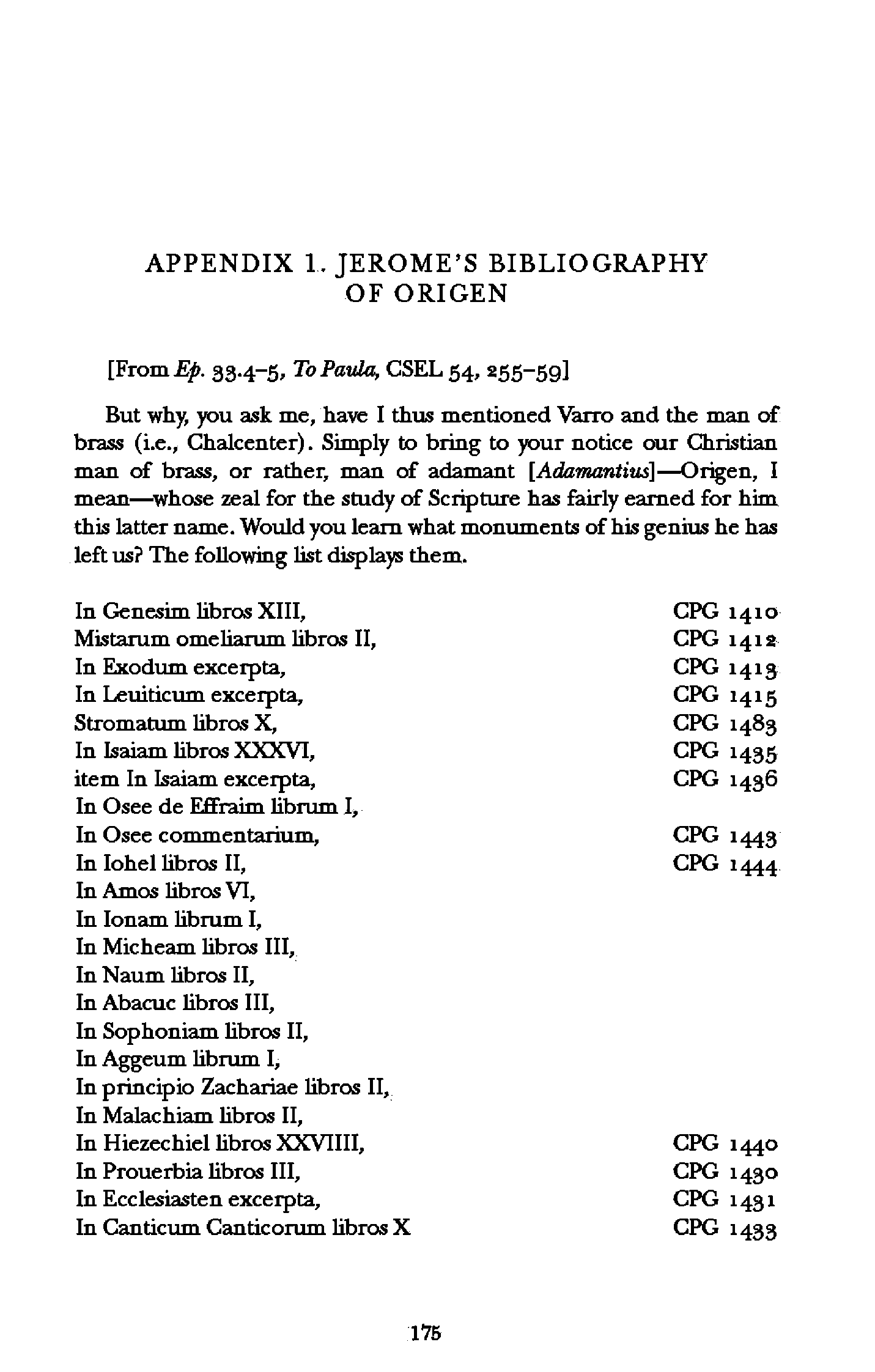
APPENDIX 1. JEROME'S BIBLIOGRAPHY
OF ORIGEN
[From Ep. 33.4~85, To Paula, CSEL 54, 255-59] But why, you ask me, have I thus mentioned Varro and the man of brass (i.e., Chalcenter). Simply to bring to your notice our Christian man of brass, or rather, man of adamant [Adamantius]—Origen,
I mean—whose zeal for the study of Scripture has fairly earned for him this latter name. Would you learn what monuments of his genius he has left us? The following list displays them.
In Genesim libros XIII, CPG 1410 Mistarum omeliarum libros II, CPG 1412 In Exodum excerpta, CPG 1413 In Leuiticum excerpta, CPG 1415 Stromatum libros X, CPG 1483 In Isaiam libros XXXVI, CPG 1435 item In [saiam excerpta, CPG 1486 In Osee de Effraim librum I, In Osee commentarium, CPG 1443 In Iohel libros II, CPG 1444 In Amos libros VI, In Ionam librum I, In Micheam libros III, In Naum libros II, In Abacuc libros III, In Sophoniam libros II, In Aggeum librum I, In principio Zachariae libros II, In Malachiam libros II, In Hiezechiel libros XXVIIII, CPG 1440 In Prouerbia libros III, CPG 1430 In Ecclesiasten excerpta, CPG 1431 In Canticum Canticorum libros X CPG 1433
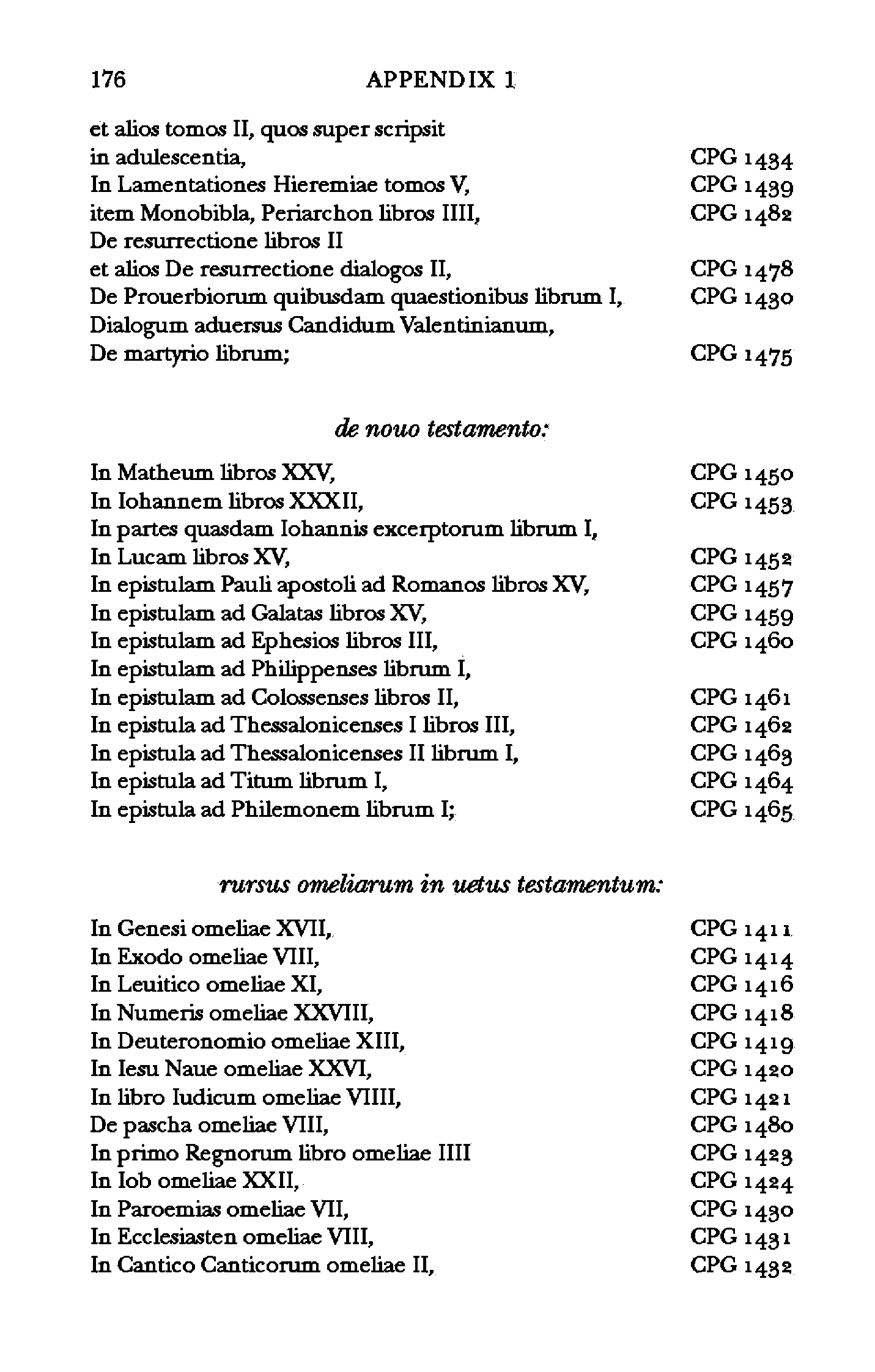
APPENDIX 1
et alios tomos II, quos super scripsit CPG 1434 CPG 1489 CPG 1482 in adulescentia, In Lamentationes Hieremiae tomos V, item Monobibla, Periarchon libros IIII, De resurrectione libros II CPG 1448 CPG 1430 et alios De resurrectione dialogos II, De Prouerbiorum quibusdam quaestionibus librum I,
Dialogum aduersus Candidum Valentinianum, De martyrio librum; CPG 1475 de nouo testamento.
CPG 1450 CPG 1458 In Matheum libros XXV, In Iohannem libros XXXII, In partes quasdam Iohannis excerptorum librum I,
CPG 1452 CPG 1457 CPG 1459 CPG 1460 In Lucam libros XV, In epistulam Pauli apostoli ad Romanos libros XV,
In epistulam ad Galatas libros XV, In epistulam ad Ephesios libros III, In epistulam ad Philippenses librum I, In epistulam ad Colossenses libros II, CPG 1461 CPG 1462 CPG 1463 CPG 1464 CPG 1465 In epistula ad Thessalonicenses I libros III,
In epistula ad Thessalonicenses II librum I, In epistula ad Titum librum I, In epistula ad Philemonem librum [; rursus omeliarum in uetis testamentum:
CPG 1411 CPG 1414 CPG 1416 CPG 1418 CPG 1419 CPG 1420 CPG 1421 CPG 1480 CPG 1423 CPG 1424 CPG 1480 CPG 1431 CPG 1432 In Genesi omeliae XVII, In Exodo omeliae VIII, In Leuitico omeliae XI, In Numeris omeliae XXVIII, In Deuteronomio omeliae XIII, In Iesu Naue omeliae XXVI, In libro Iudicum omeliae VIIII, De pascha omeliae VIII, In primo Regnorum libro omeliae IIII In Iob omeliae XXII, In Paroemias omeliae VII, In Ecclesiasten omeliae VIII, In Cantico Canticorum omeliae II,
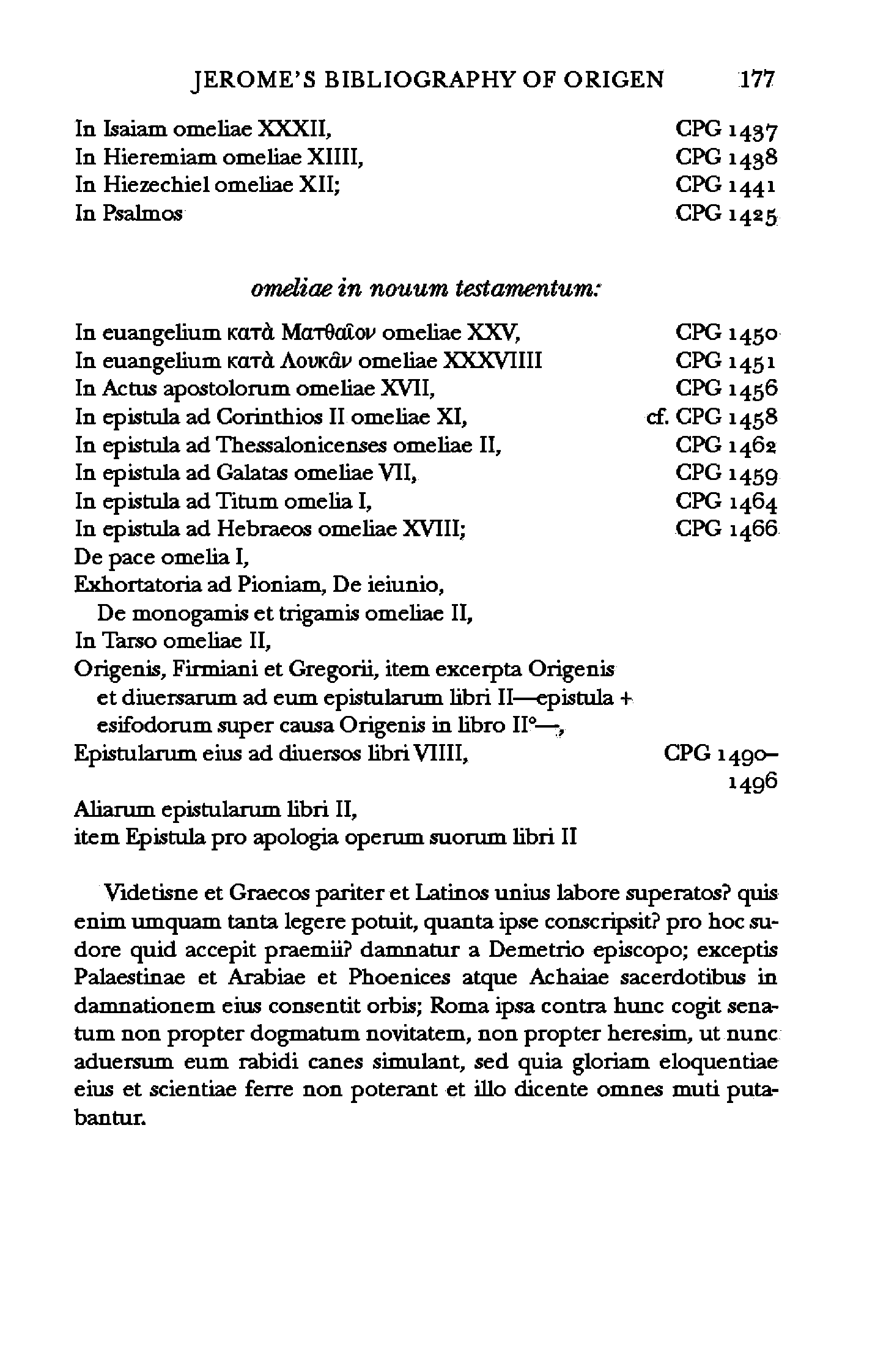
JEROME'S BIBLIOGRAPHY OF ORIGEN
In Isaiam omeliae XXXII, CPG 1437 In Hieremiam omeliae XIIII, CPG 1488 In Hiezechiel omeliae XII; CPG 1441 In Psalmos CPG 1425 omeliae in nouum testamentum:
In euangelium kard MaTdalov omeliac XXV, CPG 1450 In euangelium kavd Aovkdy omeliae XXXVIIII
CPG 1451 In Actus apostolorum omeliae XVII, CPG 1456 In epistula ad Corinthios II omeliae XI, cf. CPG 1458 In epistula ad Thessalonicenses omeliae II,
CPG 1462 In epistula ad Galatas omeliae VII, CPG 1459 In epistula ad Titum omelia I, CPG 1464 In epistula ad Hebracos omeliac XVIII; CPG 1466 De pace omelia ], Exhortatoria ad Pioniam, De ieiunio, De monogamis et trigamis omeliae II, In Tarso omeliae II, Origenis, Firmiani et Gregorii, item excerpta Origenis ct diuersarum ad eum epistularum libri I[I—epistula + esifodorum super causa Origenis in libro II°—,
Epistularum eius ad diuersos libri VIIII,
CPG 1490-
Aliarum epistularum libri II, item Epistula pro apologia operum suorum libri II Videtisne et Graecos pariter et Latinos unius labore superatos? quis enim umquam tanta legere potuit, quanta ipse conscripsit? pro hoc sudore quid accepit praemii? damnatur a Demetrio episcopo; exceptis
Palaestinae et Arabiae et Phoenices atque Achaiae sacerdotibus in damnationem cius consentit orbis; Roma ipsa contra hunc cogit senatum non propter dogmatum novitatem, non propter heresim, ut nunc: aduersum eum rabidi canes simulant, sed quia gloriam eloquentiae eius et scientiae ferre non poterant et illo dicente omnes muti putabantur.
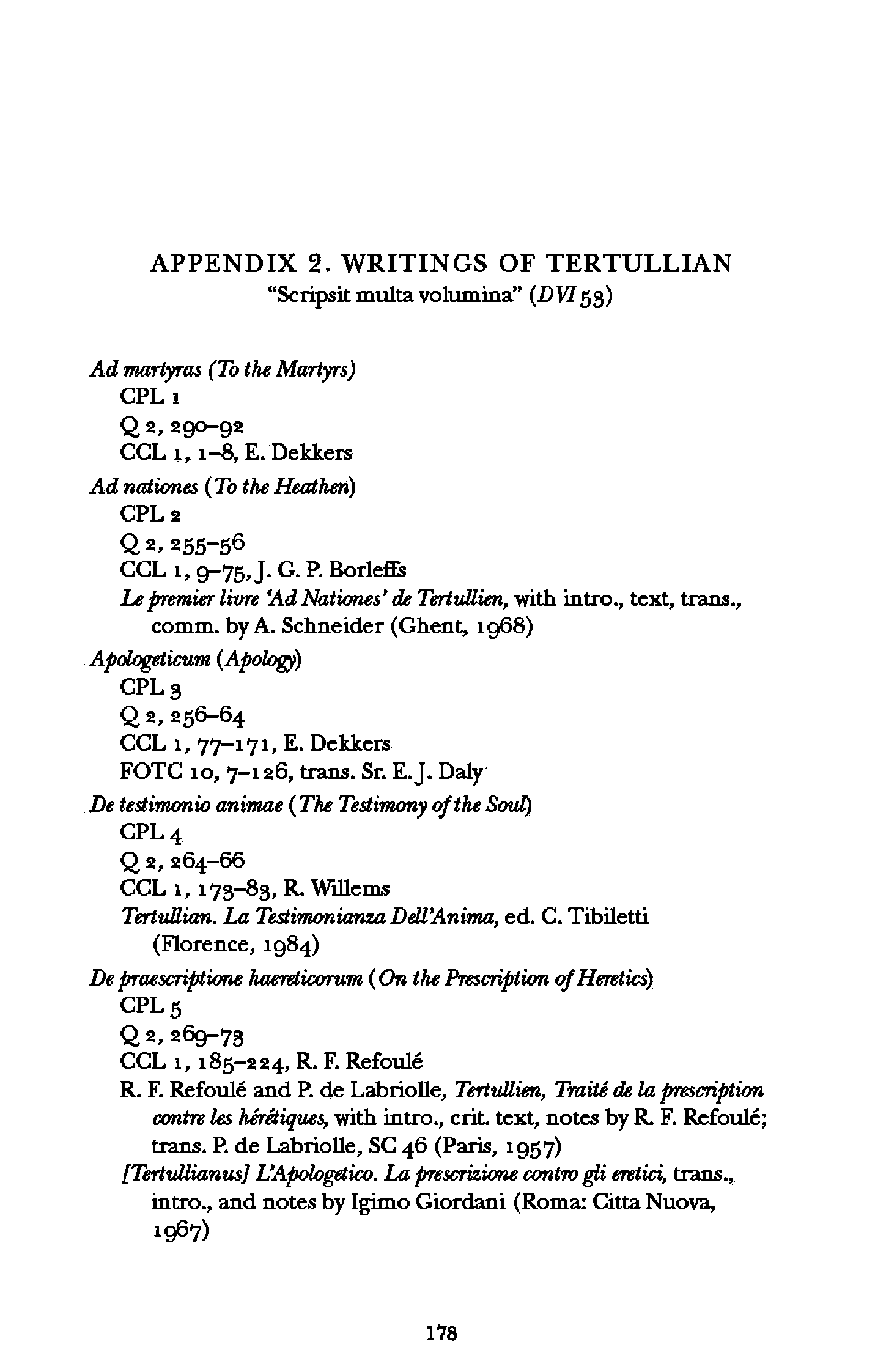
APPENDIX 2. WRITINGS OF TERTULLIAN
"Scripsit multa volumina" (DVI 58) Ad martyras (1o the Martyrs) CPL 1
Q 2, 200-92
CCL 1, 1-8, E. Dekkers Ad nationes (To the Heathen) CPL 2
Q 2, 255-56
CCL 1, g-75,]. G. P. Borleffs Le premier livre 'Ad Nationes' de Tertullien, with intro., text, trans., comm. by A. Schneider (Ghent, 1968) Apologeticum (Apology) CPL g
Q 2, 256-64
CCL 1, 79-171, E. Dekkers FOTC 10, 7-126, trans. Sr. E. ]. Daly'
De testimonio animae ( The Testimony of the Soul) CPL 4
Q 2, 264-66
CCL 1, 173-83, R. Willems Tertullian. La Testimonianza Dedl'Anima, ed. C. Tibiletti
(Florence, 1g84) De praescriptione haersticorum (On the Prescription of Herstics)
CPL g
Q 2, 260-73
CCL 1, 185-224, R. F. Refoulé R. F. Refoul€ and P. de Labriolle, Tertullien, Traité de la prescription contre les hérétiques, with intro.,, crit. text, notes by R. F. Refoul¢; trans. P. de Labriolle, SC 46 (Paris, 1957)
[Tertullianus] L'Apologetico. La prescrizione contro gii eretici, trans., intro., and notes by Igimo Giordani (Roma: Citta Nuova,
196%)
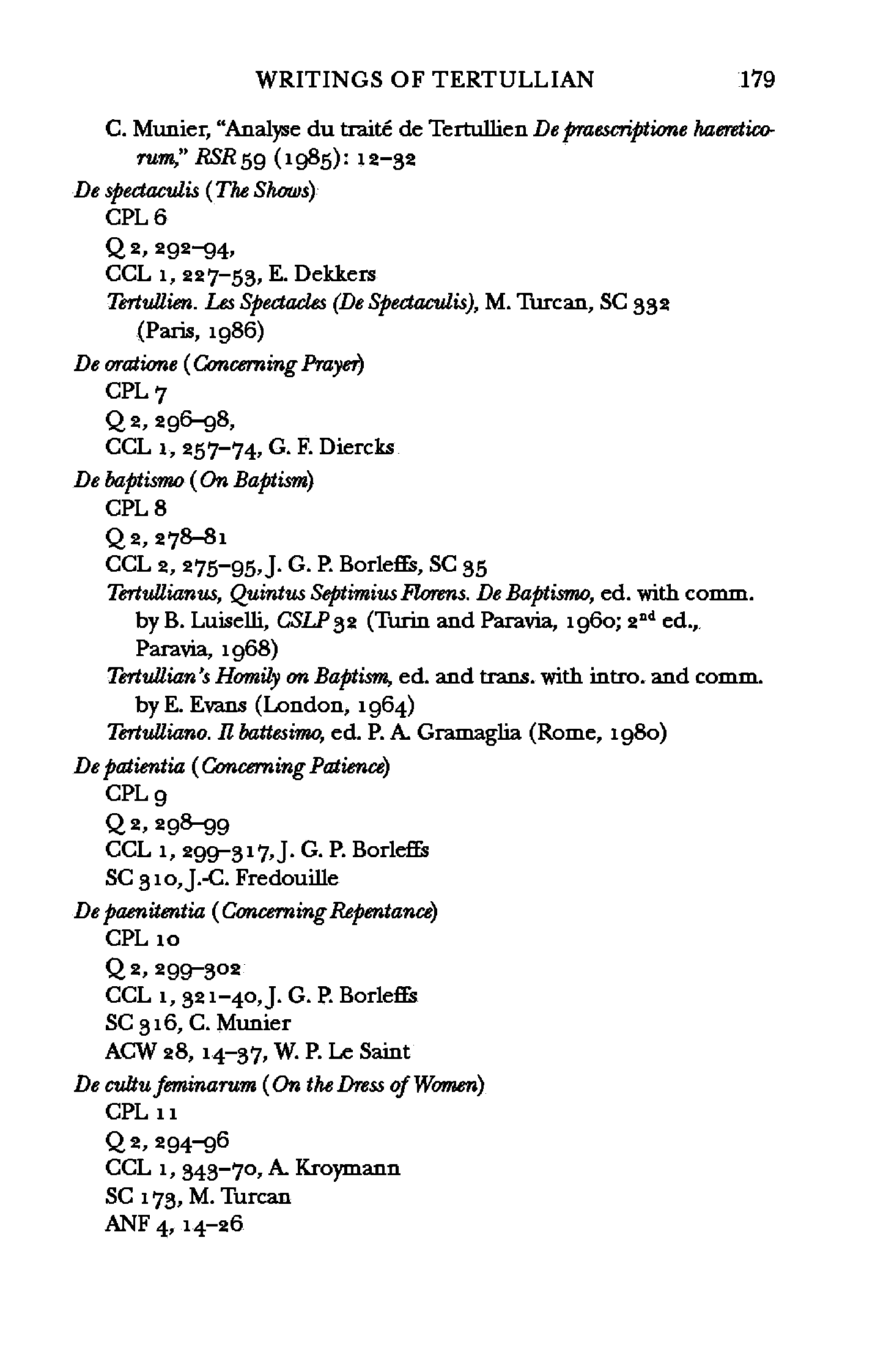
WRITINGS OF TERTULLIAN
C. Munier, "Analyse du traité de Tertullien De praeseriptione haereticorum" RSR 59 (1985): 12-32
De spectaculis (The Shows):
CPL 6
Q+2, 292-04,
CCL 1, 227-53, E. Dekkers Tertullien. Les Spectacles (De Spectaculis), M. Turcan, SC gg=
(Paris, 1986) De oratione (Concerning Prayer) CPL 4
Q 2, 29608,
CCL 1, 25%7-%74, G. F. Diercks De baptismo (On Baptism) CPL 8
Q=2,278-81
CCL 2, 275-95,
]. G. P. Borleffs, SC g5 Tertullianus, Quintus Septimius Florens. De Baptismo, ed. with comm. by B. Luiselli, GSLP g2 (Turin and Paravia, 1g60; 224 ed.,.
Paravia, 1968) Tertullian's Homily on Baptism, ed. and trans. with intro. and comm. by E. Evans (London, 1g64) Tertulliano. Il battesimo, ed. P. A. Gramaglia (Rome, 1980)
De patientia (Concerning Patience) CPLg
Q2, 20899
CCL 1, 2g9-31%, ]. G. P. Borleffs SC g10, ].-C. Fredouille De paenitentia (Concerning Repentance) CPL 10 Q 2, 209-g02
CCL 1, 321-40,
]. G. P. Borleffs SC g16, C. Munier ACW 28, 14-3%, W. P. Le Saint De cultu feminarum (On the Dress of Women)
CPL 11
Q 2, 20406
CCL 1, 343-70, A. Kroymann SC 13, M. Turcan ANF 4, 1426
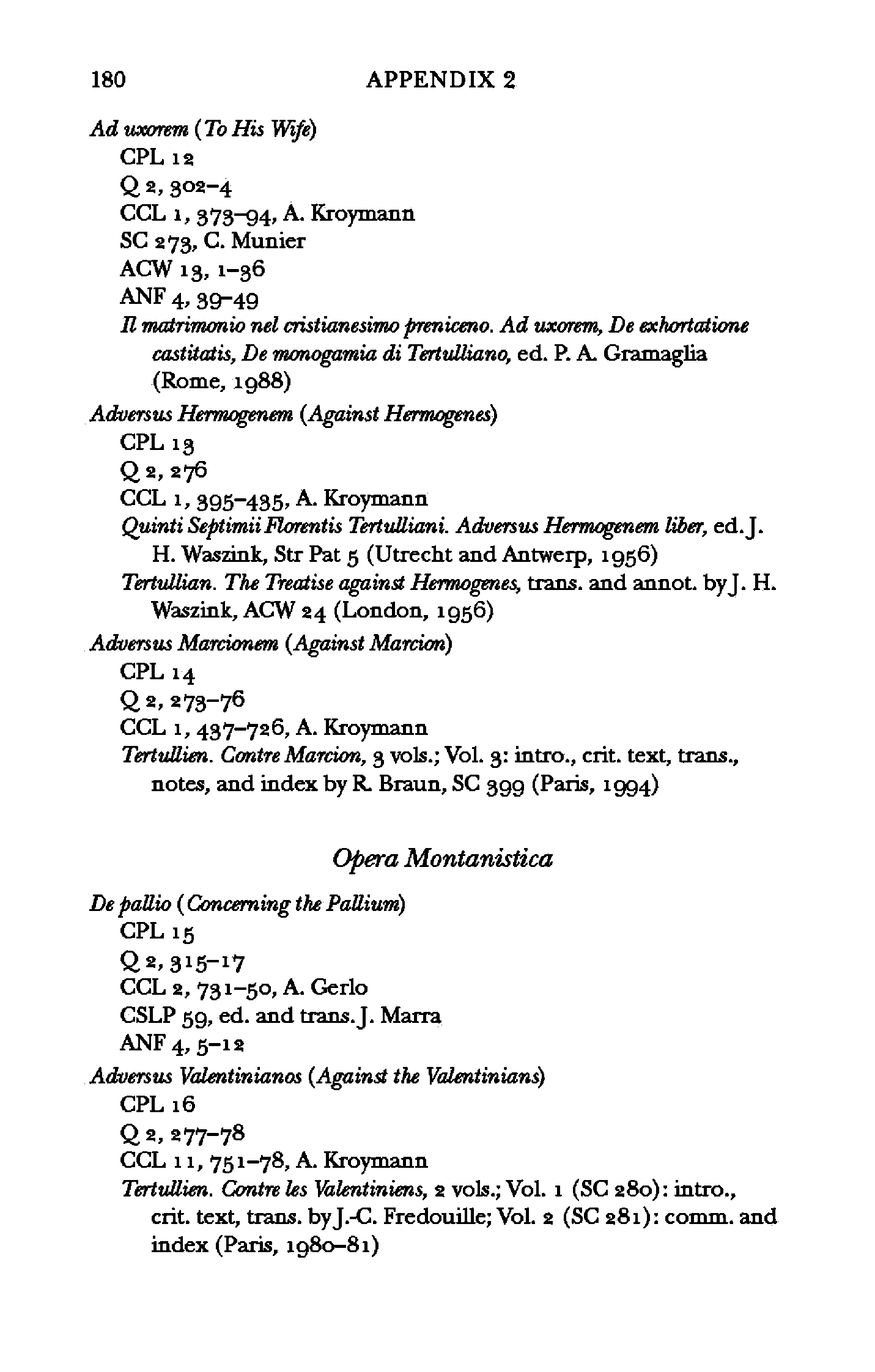
APPENDIX 2
Ad uxorem (To His Wife) CPL 12
Q 2, 3024
CCL 1, 37394, A. Kroymann SC 243, C. Munier ACW g, 1-36
ANF 4, 30-49
Il matrimonio nel cristianesimo frreniceno. Ad uxorem, De exhortatione castitatis, De monogamia di Tertulliano, ed. P. A. Gramaglia
(Rome, 1988) Adversus Hermogenem (Against Hermogenes) CPL 13 Q2,276 CCL 1, 395-4385, A. Kroymann Quinti Septimii Florentis Tertulliani. Adversus Hermogenem liber, ed.
H. Waszink, Str Pat 5 (Utrecht and Antwerp, 1956) Tertullian. The Treatise against Hermogenes, trans. and annot. by J. H.
Waszink, ACW 24 (London, 1g56) Adversus Marcionem (Against Marcion) CPL 14
Q¢, 27376
CCL 1, 487-726, A. Kroymann Tertullien. Contre Marcion, g vols.; Vol. g: intro., crit. text, trans., notes, and index by R. Braun, SC ggg (Paris, 1994)
Opera Montanistica De pallio (Concerning the Pallium) CPL 15 Qs 315-17 CCL 2, v31-50, A. Gerlo CSLP 59, ed. and trans. J. Marra
ANF 4, 512
Adversus Valentinianos (Against the Valentinians) CPL 16
Q2, 277-78
CCL 11, 751-78, A. Kroymann Tertullien. Contre les Valentiniens, 2 vols.; Vol.
1 (SC 280): intro., crit. text, trans. by J.-C. Fredouille; Vol. 2 (SC 281): comm. and index (Paris, 1980-81)
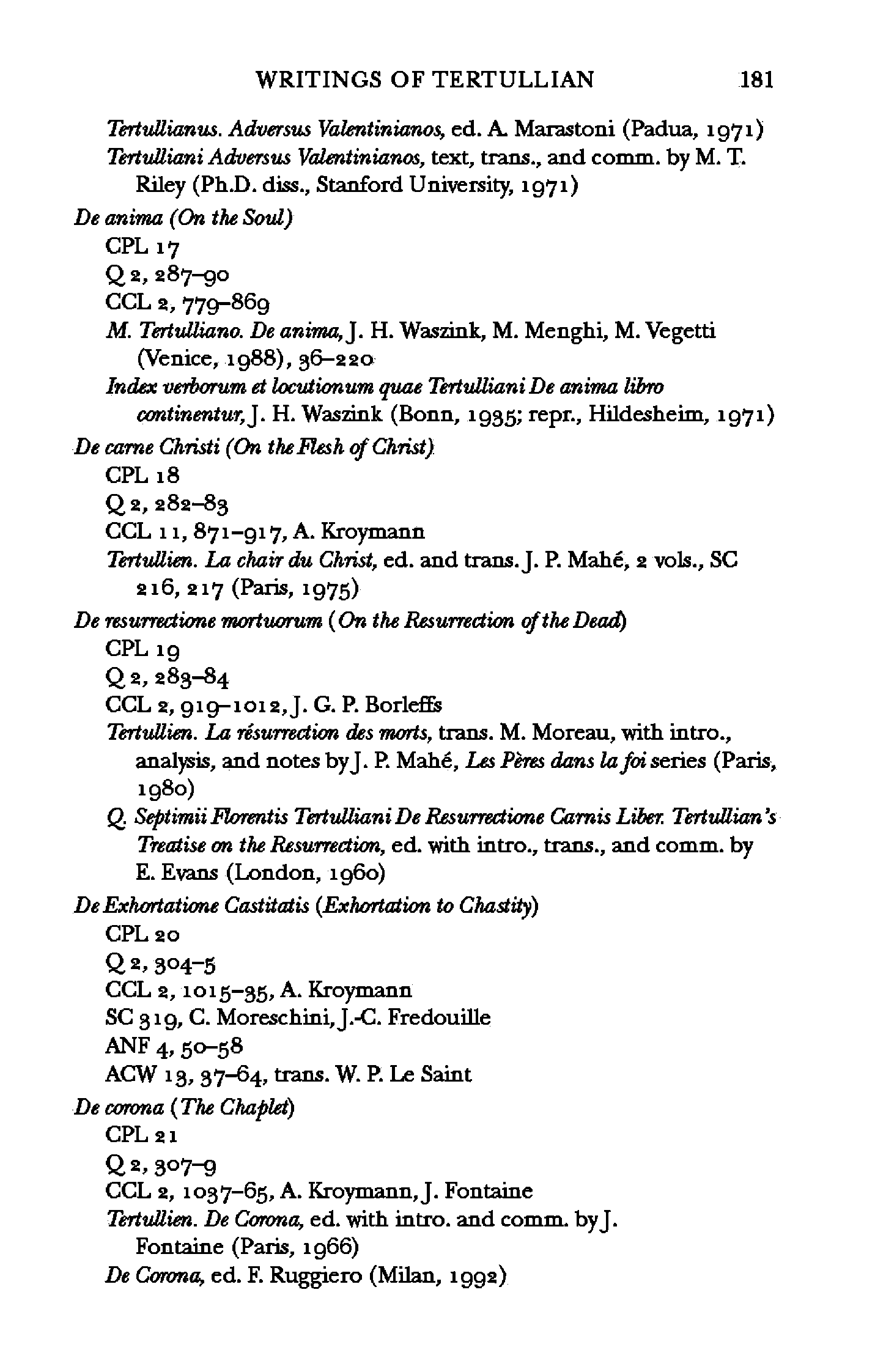
WRITINGS OF TERTULLIAN
Tertullianus. Adversus Valentinianos, ed. A. Marastoni (Padua, 1g71) Tertulliani Adversus Valentinianos, text, trans., and comm. by M. T.
Riley (Ph.D. diss., Stanford University, 1g%71) De arima (On the Soul) CPL 1y Q2,284y—go CCL 2, 779-86g M. Tertulliano. De anima, ]. H. Waszink, M. Menghi, M. Vegetti
(Venice, 1g88), 36-220 Index verborum et locutionum quae Tertulliani De anima libro continentur, |. H. Waszink (Bonn, 1g35; repr., Hildesheim, 1g71)
De carne Christi (On the Flesh of Christ) CPL 18
Q 2, 282-83
CCL 11, 871-g17, A. Kroymann Tertullien. La chair du Christ, ed. and trans.
J. P. Mahé, 2 vols., SC 216, 217 (Paris, 1g75) De resurrectione mortuorum (On the Resurrection of the Dead)
CPL 19
Q2, 283-84
CCL 2, g1g-1012, ]. G. P. Borleffs Tertullien. La résurrection des morts, trans. M. Moreau, with intro., analysis, and notes by ]. P. Mahé, Les Péres dans la foi series (Paris,
1g80) Q. Septimii Florentis Tertulliani De Resurrectione Carnis Liber. Tertullian's
Treatise on the Resurrection, ed. with intro., trans., and comm. by E. Evans (London, 1960) De Exhortatione Castitatis (Exhortation. to Chastity)
CPL 20 Q2, 3045 CCL 2, 1015~-35, A. Kroymann SC g19, C. Moreschini, J.-C. Fredouille ANF 4, go-58 ACW 13, g97-64, trans. W. P. Le Saint De corona ( The Chaplet) CPL 21 Qz, 3079 CCL ¢, 108'7-65, A. Kroymann, J. Fontaine Tertullien. De Corona, ed. with intro. and comm. by J.
Fontaine (Paris, 1966) De Corona, ed. F. Ruggiero (Milan, 1g9g2)