
Abbreviations
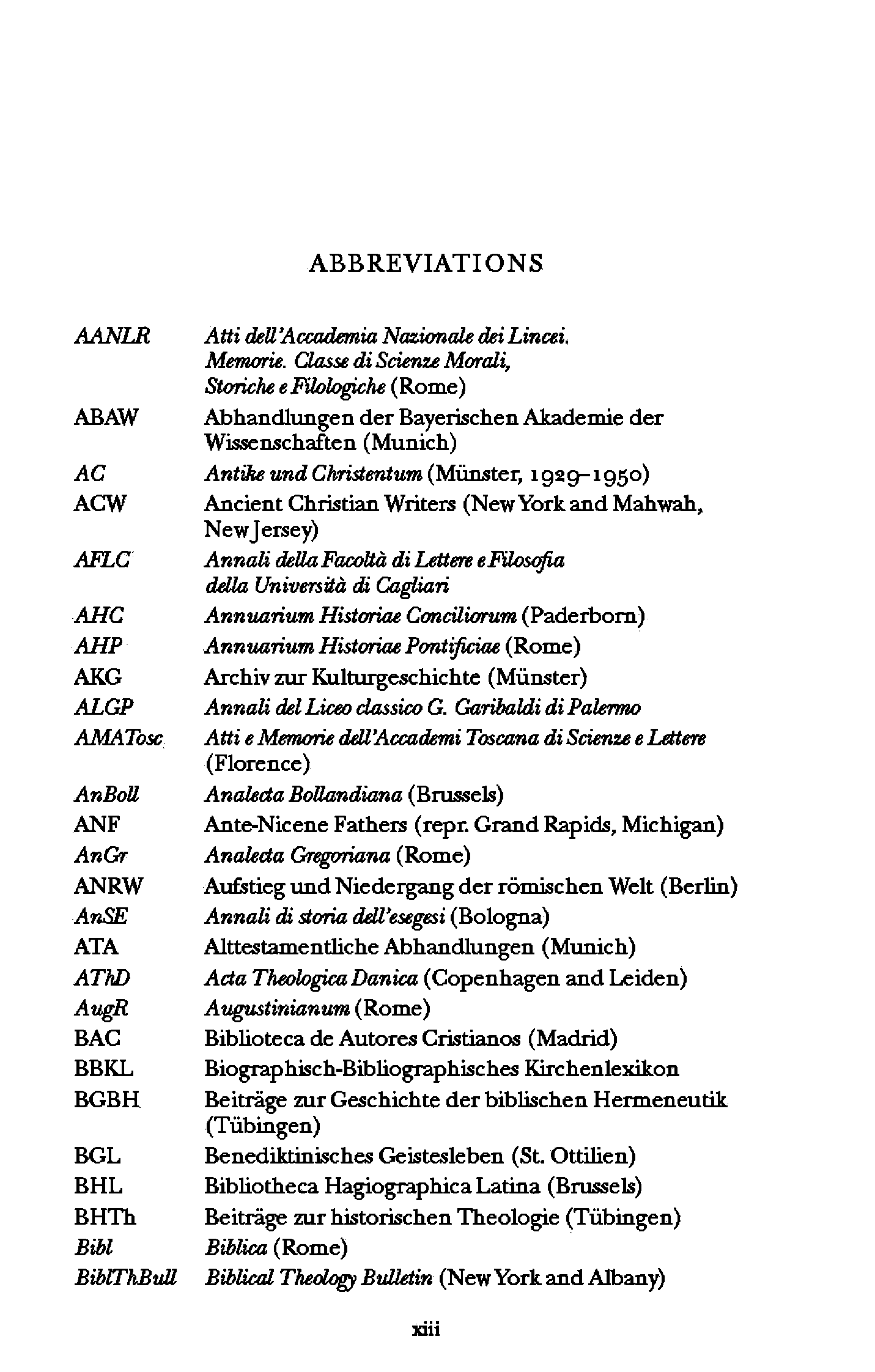
ABBREVIATIONS
Atti dell'Accademia Nazionale dei Linces, Memorie. Classe di Scienze Morali, Storiche e Filologiche (Rome) Abhandlungen der Bayerischen Akademie der
Wissenschaften (Munich) ABAW Antike und Christentum (Miinster, 192g-1950) Ancient Christian Writers (New York and Mahwah,
New Jersey) Annali della Facolta di Lettere ¢ Filosofia della Universita di Cagliari Annuarium Historiae Conciliorum (Paderborn)
Annuarium Historiae Pontificige (Rome) Archiv zur Kulturgeschichte (Miinster) Annali del Liceo classico G. Garibaldi di Palermo
Atti e Memorie dell'Accadem: Toscana di Scienze e Leltere (Florence) Analeda Bollandiana (Brussels) Ante-Nicene Fathers (repr. Grand Rapids, Michigan)
Analecta Gregoriana (Rome) Aufstieg und Niedergang der rémischen Welt (Berlin) Annali di storia dell'esegesi (Bologna) Alttestamentliche Abhandlungen (Munich) Acta Theologica Danica (Copenhagen and Leiden)
Augustinianum (Rome) Biblioteca de Autores Cristianos (Madrid) Biographisch-Bibliographisches Kirchenlexikon
Beitrage zur Geschichte der biblischen Hermeneutik (Tiibingen) Benediktinisches Geistesleben (St. Ottilien)
Bibliotheca Hagiographica Latina (Brussels) Beitrige zur historischen Theologie (Tiibingen)
Biblica (Rome) '
Biblical Theology Bulletin (New York and Albany) xiii
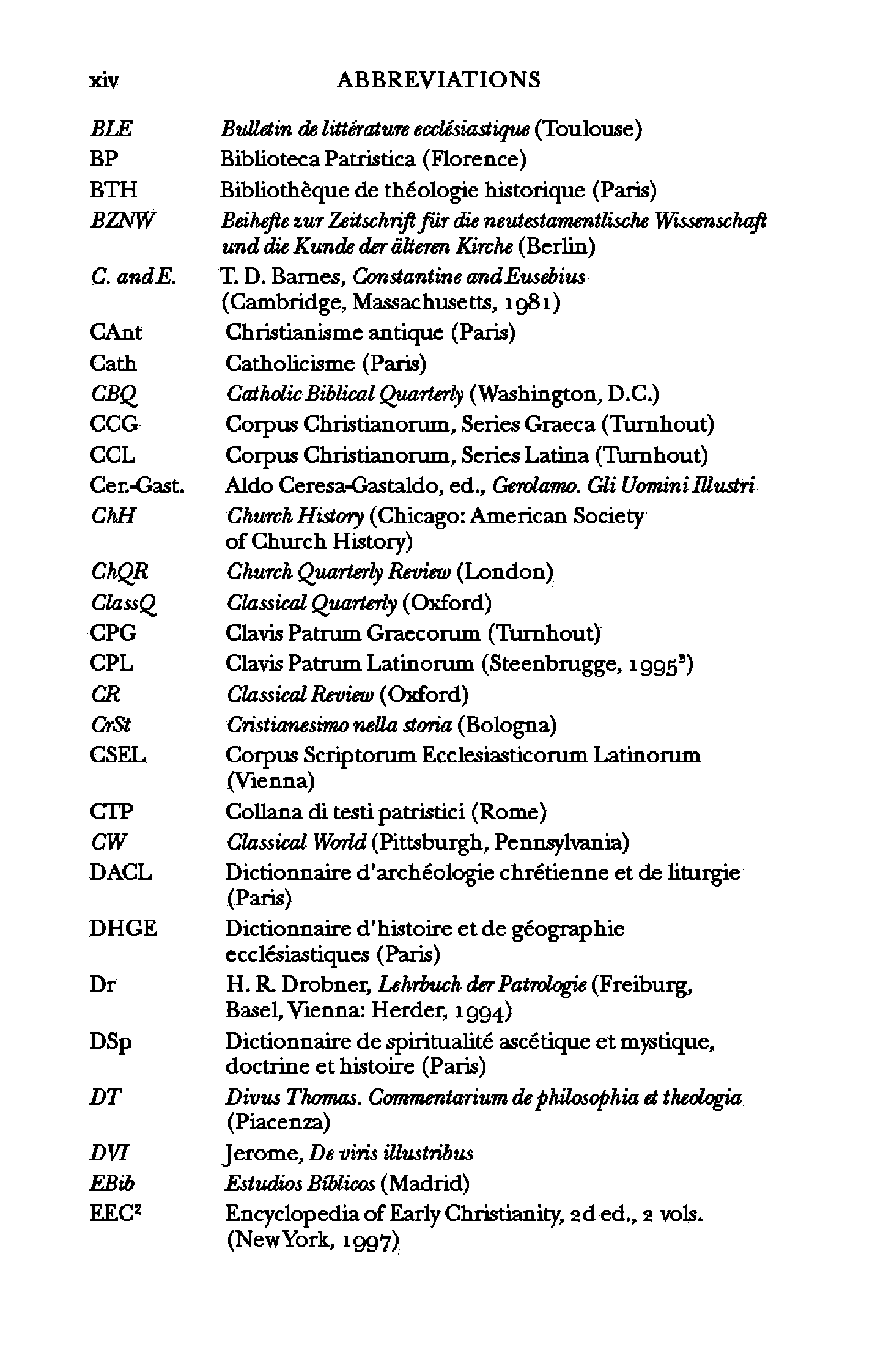
ABBREVIATIONS
Bullatin de littérature ecclésiastique (Toulouse) Biblioteca Patristica (Florence} Bibliothéque de théologie historique (Paris)
Beihefte zur Zeitschrift fiir die neutestamentlische Wissenschaft und die Kunde der délteren Kirche (Berlin)
T. D. Barnes, Constantine and Eusebius {Cambridge, Massachusetts, 1981) Christianisme antique (Paris) Catholicisme (Paris) Catholic Biblical Quarterly (Washington, D.C.)
Corpus Christianorum, Series Gracca (Turnhout) Corpus Christianorum, Series Latina (Turnhout)
Aldo Ceresa-Gastaldo, ed., Gerolamo. Gli Uomini Illustri Church History (Chicago: American Society of Church History) Church Quarterly Review (London) Classical Quarterly (Oxford) Clavis Patrum Graecorum (Turnhout) Clavis Patrum Latinorum (Steenbrugge, 1995°)
Classical Review (Oxford) Cristianesimo nella storia (Bologna) Corpus Scriptorum Ecclesiasticorum Latinorum
(Vienna) Collana di testi patristici (Rome) Classical World (Pittsburgh, Pennsylvania)
Dictionnaire d'archéologie chrétienne et de liturgie (Paris) Dictionnaire d'histoire et de géographie ecclésiastiques (Paris) DHGE H. R. Drobner, Lehrbuch der Patrologie (Freiburg,
Basel, Vienna: Herder, 1gg4) Dictionnaire de spiritualité ascétique et mystique, doctrine et histoire (Paris) Divus Thomas. Commentarium de philosophia e thedogia
(Piacenza) Jerome, De viris illustribus Estudios Biblicos (Madrid) EEC?
Encyclopedia of Early Christianity, 2d ed., 2 vols.
(NewYork, 1997)
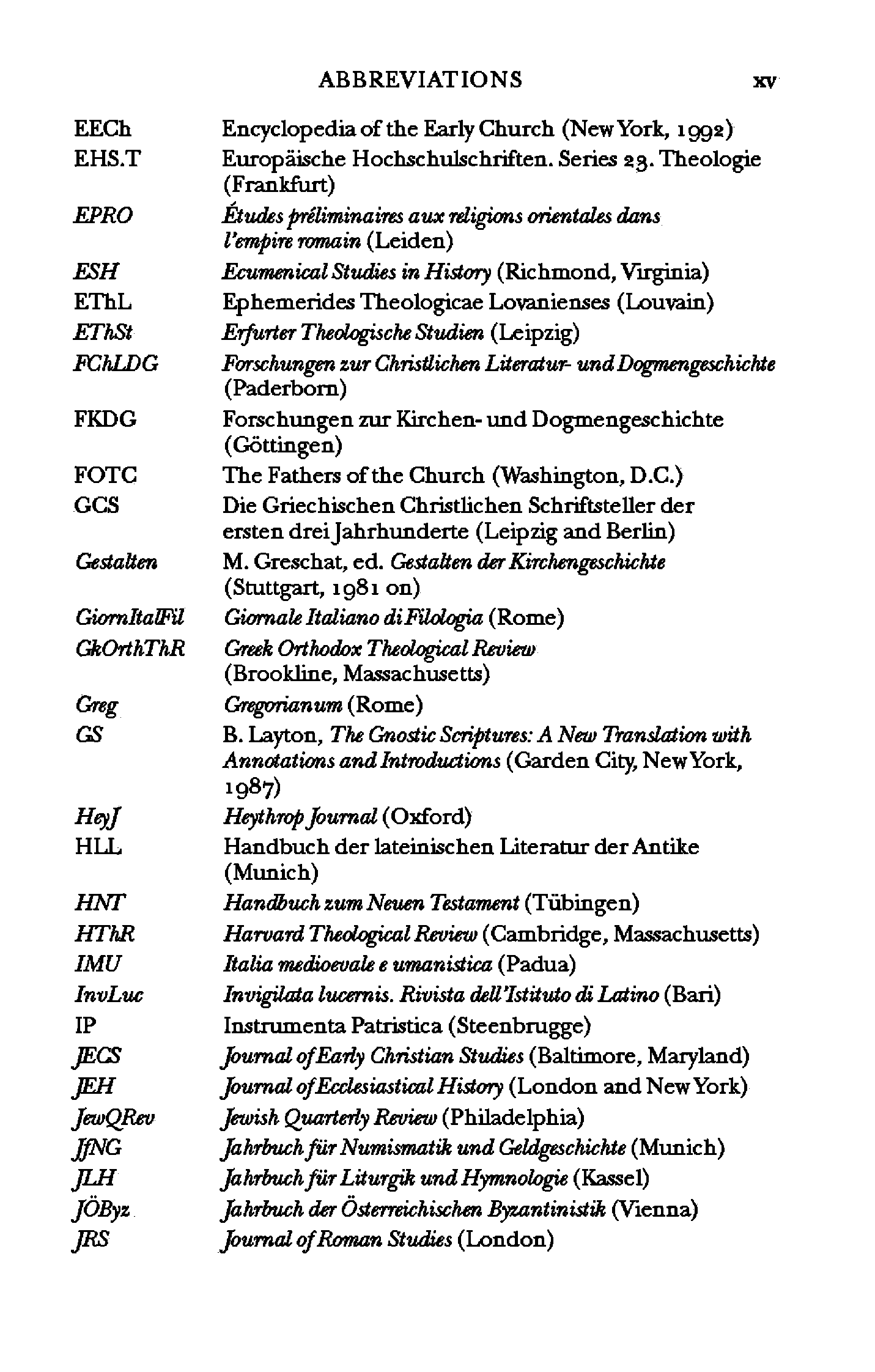
ABBREVIATIONS
xv Encyclopedia of the Early Church (New York, 1gg92) Europiische Hochschulschriften. Series 23. Theologie
EECh EHS.T (Frankfurt) Etudes préliminaires au religions ovientales dans EPRO Vempire romain (Leiden) Ecumenical Studies in History (Richmond, Virginia)
ESH EThL EThSt FCRLDG Ephemerides Theologicae Lovanienses (Louvain) Erfurter Theologische Studien (Leipzig) Forschungen zur Ghristlichen Literaturund Dogmengeschichte
(Paderborn) Forschungen zur Kirchenund Dogmengeschichte FKDG (Gottingen) The Fathers of the Church (Washington, D.C.)
FOTC GCS Die Griechischen Christlichen Schriftsteller der ersten drei Jahrhunderte (Leipzig and Berlin)
Gestalten M. Greschat, ed. Gestalten der Kirchengeschichie (Stuttgart, 1981 on) Giornale Italiano di Filologia (Rome) GiornltalFil GkOrthThR Greek Orthodox Theological Review (Brookline, Massachusetts) Gregorianum (Rome) B. Layton, The Grostic Scriptures: A New Translation with Annotations and Introductions (Garden City, New York,
1987) Heythrop Journal (Oxford) Handbuch der lateinischen Literatur der Antike (Munich) Handbuch zum Neusn Testament (Tubingen) Harvard Theological Review (Cambridge, Massachusetts)
Ralia medioevale ¢ umanistica (Padua) Invigilata lucernis. Rivista dell Istituto di Latino (Bari)
Instrumenta Patristica (Steenbrugge) Journal of Early Christian Studies (Baltimore, Maryland)
Journal of Ecclesiastical History (London and New York) Jewish Quarterly Review (Philadelphia) Jahrbuch fiir Numismatik und Geldgeschichte (Munich)
Jahrbuch fiir Liturgik und Hymnologie (Kassel) Jahrbuch der Osterreichischen Byzantinistik (Vienna)
Journal of Roman Studies (London)
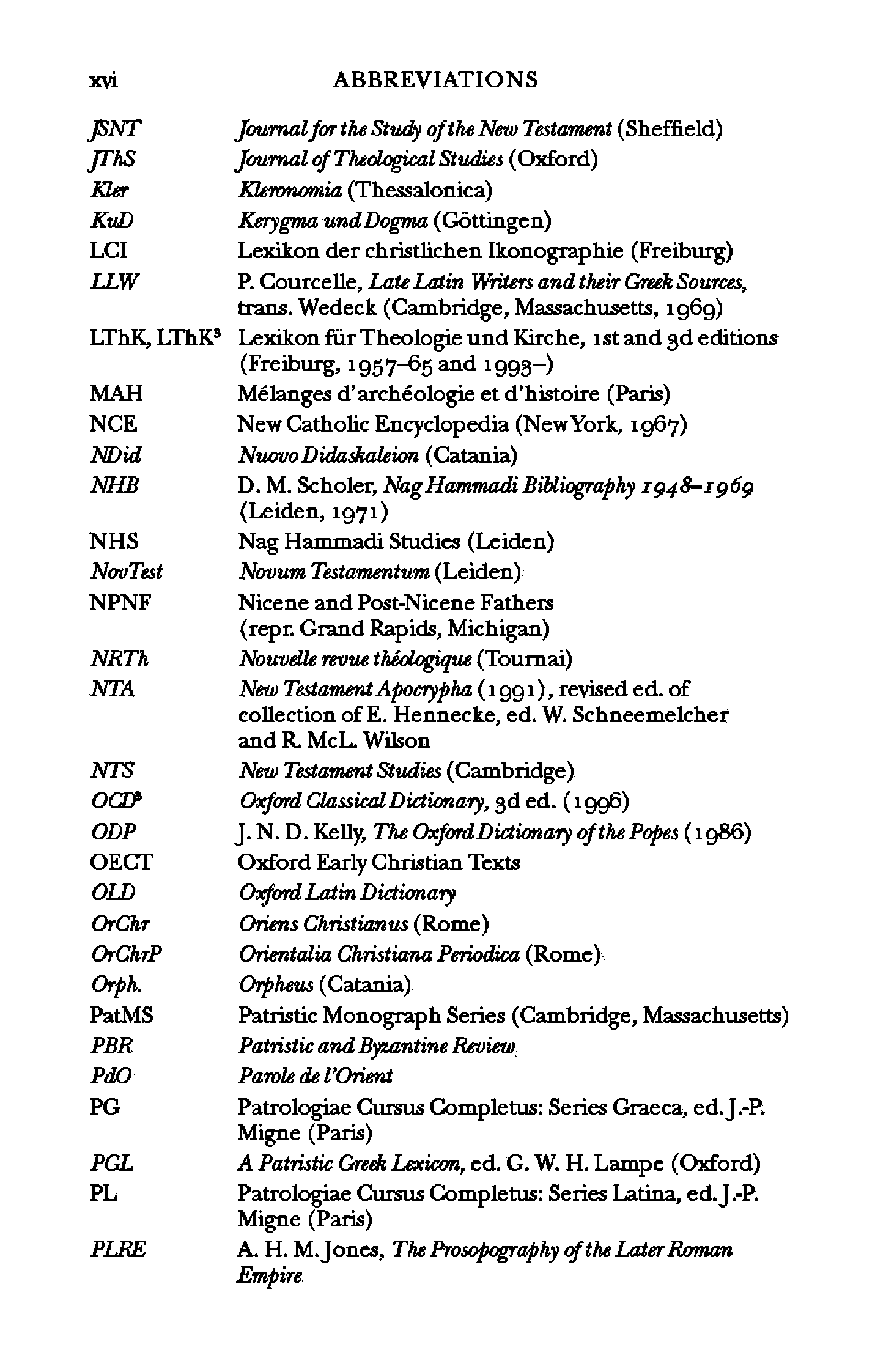
xvi
ABBREVIATIONS
SNT Journal for the Study of the New Testament (Sheffield) JThS Journal of Theological Studies (Oxford) Kler Kleronomia (Thessalonica) KuD Kerygma und Dogma (Gottingen) LCI Lexikon der christlichen Ikonographie (Freiburg)
LIW P. Courcelle, Late Latin Writers and their Gresk Sources, trans. Wedeck (Cambridge, Massachusetts, 1g6g)
LThK, LThK® Lexikon fiir Theologic und Kirche, 1st and gd editions (Freiburg, 19547-65 and 1993-) MAH Mélanges d'archéologie et d'histoire (Paris)
NCE New Catholic Encyclopedia (New York, 196%) NDid Nuovo Didaskaleion (Catania) NHB D. M. Scholer, Nag Hammad: Bibliography 1948-1969
(Leiden, 1971) NHS Nag Hammadi Studies (Leiden) NovTest Novum Testamentum (Leiden) NPNF Nicene and Post-Nicene Fathers (repr. Grand Rapids, Michigan) NRTh Nouvelle revue théologique (Tournai) NTA New Testament Apocrypha (1991), revised ed. of collection of E. Hennecke, ed. W. Schneemelcher and R. McL. Wilson NTS New Testament Studies (Cambridge) ocr Oxford Classical Dictionary, 3d ed. (1996) oDP J. N. D. Kelly, The Oxford Dictionary of the Popes (1986)
OECT Oxford Early Christian Texts OLD Ouford Latin Dictionary OrChr Oriens Christianus (Rome) OrChrP Orientalia Christiana Periodica (Rome) Orph.
Orpheus (Catania) PatM Patristic Monograph Series (Cambridge, Massachusetts) PBR Patristic and Byzantine Review Pdo Parole de U'Orient PG Patrologiae Cursus Completus: Series Graeca, ed. J.-P.
Migne (Paris) PGL A Patristic Greek Lexicon, ed. G. W. H. Lampe (Oxford) PL Patrologiae Cursus Completus: Series Latina, ed.
] -P.
Migne (Paris) PLRE A. H. M. Jones, The Prosopography of the Later Roman Empire
ABBREVIATIONS
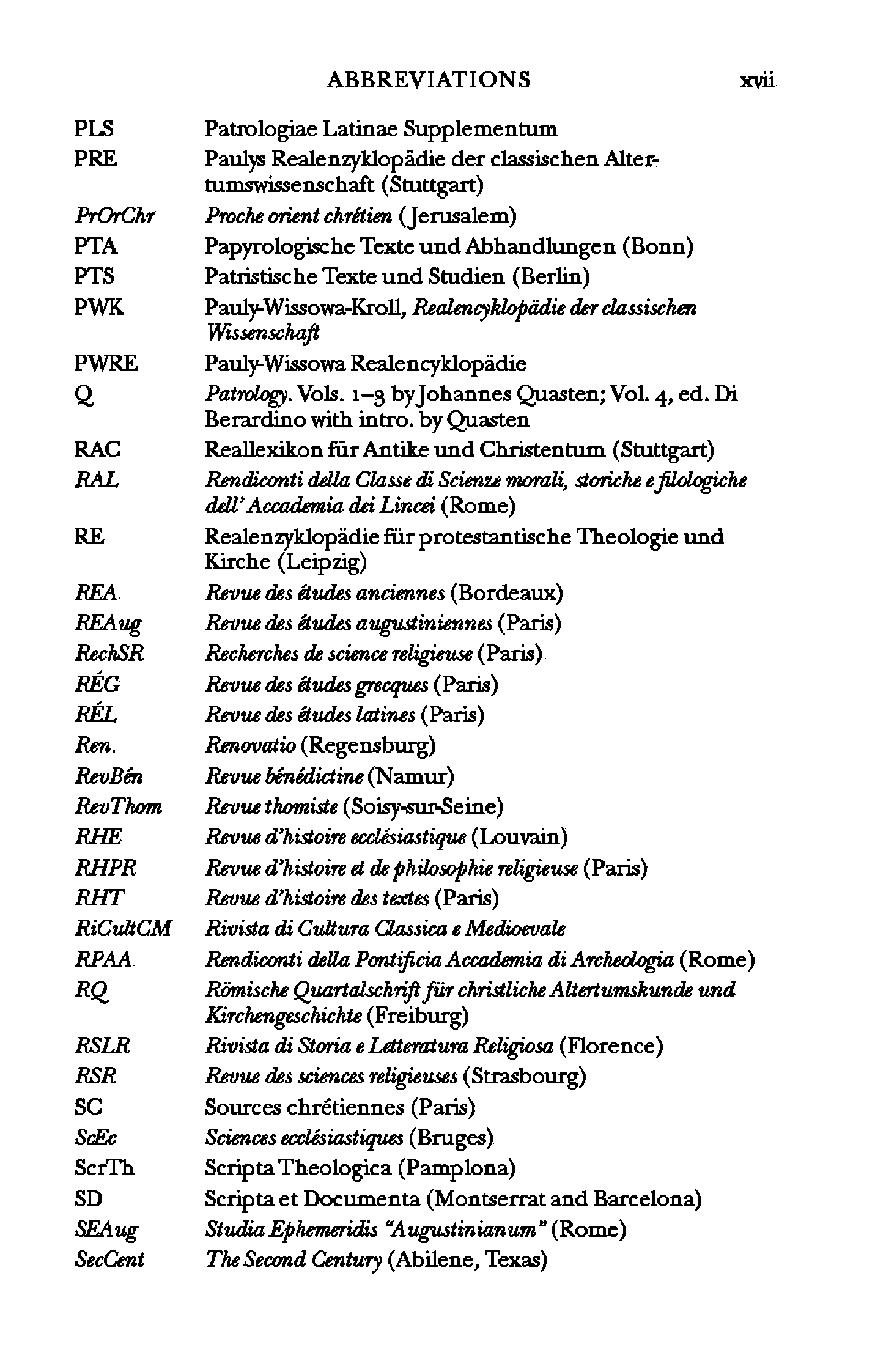
Xvii Patrologiac Latinac Supplementum Paulys Realenzyklopadie der classischen Altertumswissenschaft (Stuttgart)
Proche orient chrétien (Jerusalem) Papyrologische Texte und Abhandlungen (Bonn) Patristische Texte und Studien (Berlin) Pauly-Wissowa-Kroll, Realencyklopddie der classischen
Wissenschaft Pauly-Wissowa Realencyklopadie Patrology. Vols. 1~3 by Johannes Quasten; Vol. 4, ed. Di
Berardino with intro. by Quasten Reallexikon fiir Antike und Christentum (Stuttgart)
Rendicont della Classe di Scienze morali, storiche e filologiche dell' Accademia dei Lincei (Rome) Realenzyklopadie fiir protestantische Theologie und
Kirche (Leipzg) Revue des &udes anciennes (Bordeaux) Revue des dtudes augustiniennes (Paris) Recherches de science religieuse (Paris)
Rsuvue des éudes grecques (Paris) Revue des études latines (Paris) Renovatio (Regensburg) Revue bénédictine (Namur) Revue thomiste (Soisy-sur-Seine) Revue d'histoire ecclésiastique (Louvain)
Rsvue d'histoire & de philosophie religisuse (Paris) Revue d'histoire des textes (Paris) Rivista di Gultura Classica e Medioevale Rendiconti della Pontificia Accademia di Archeologia (Rome)
Rémische Quartalschnift fiir christliche Altertumskunde und Kirchengeschichte (Freiburg) Rivista di Storia e Latteratura Religiosa (Florence)
Revue des sciences religieuses (Strasbourg) Sources chrétiennes (Paris}) Sciences ecclésiastiques (Bruges) Scripta Theologica (Pamplona) Scripta et Documenta (Montserrat and Barcelona)
Studia Ephemeridis "Augustinianum" (Rome) The Second Century (Abilene, Texas)
ABBREVIATIONS
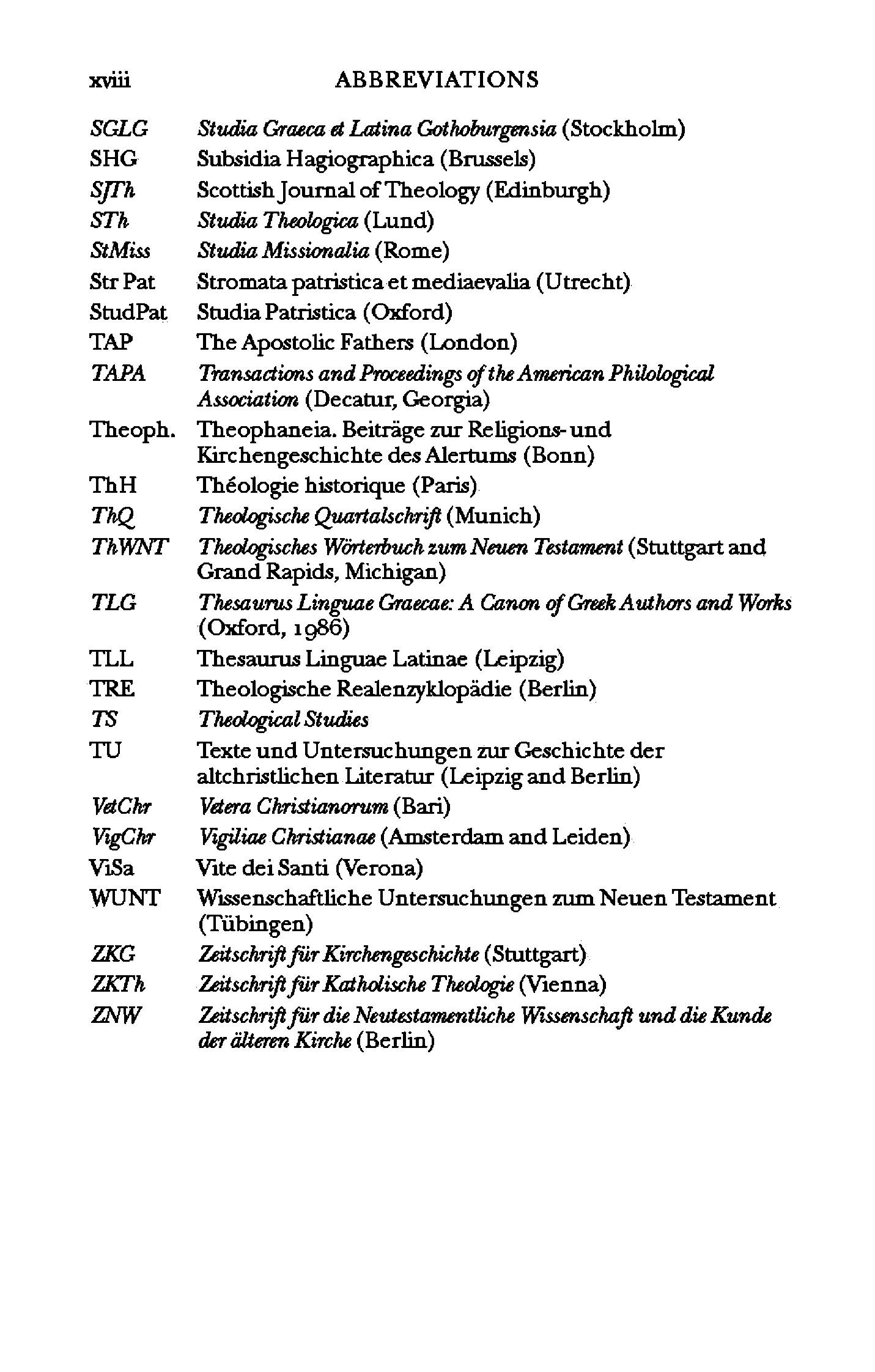
Studia Graeca & Latina Gothoburgensia (Stockholm) Subsidia Hagiographica (Brussels) Scottish Journal of Theology (Edinburgh)
Studia Theologica (Lund) Studia Missionalia (Rome) Stromata patristica et mediaevalia (Utrecht)
Studia Patristica (Oxford) The Apostolic Fathers (London) Transactions and Proceedings of the American Philological
Association (Decatur, Georgia) Theophaneia. Beitrage zur Religions-und Kirchengeschichte des Alertums (Bonn) Théologie historique (Paris) Theologische Quartalschrift (Munich) Theologisches Worterbuch zum Neuen Testament (Stuttgart and Grand Rapids, Michigan) Thesaurus Linguae Graecae:
A Canon of Gresk Authors and Works {Oxford, 1986) Thesaurus Linguae Latinae (Leipzig) Theologische Realenzyklopadie (Berlin) Theological Studies Texte und Untersuchungen zur Geschichte der altchristlichen Literatur (Leipzig and Berlin)
Vetera Christianorum (Bari) Vigiliae Christianae (Amsterdam and Leiden) Vite deiSanti (Verona) Wissenschaftliche Untersuchungen zum Neuen Testament
(Tubingen) Zeitschrift fiir Kirchengeschichte (Stuttgart) Zeitschrift fiir Katholische Theologie (Vienna)
Zeitschrift fiir die Newtestamentliche Wissenschaft und die Kunde der dlteren Kirche (Berlin)
SELECT BIBLIOGRAPHY
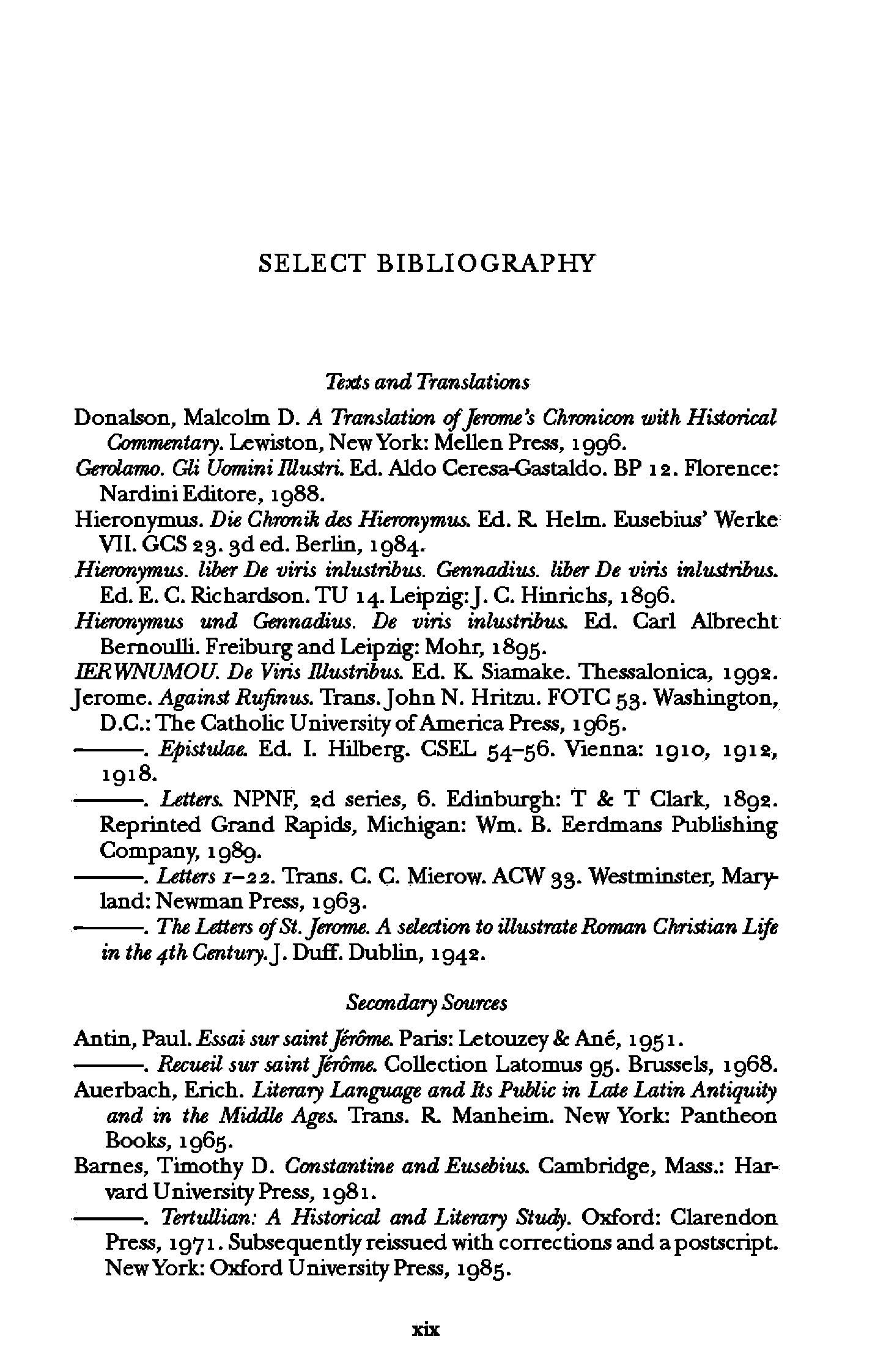
Texts and Translations Donalson, Malcolm D. A Translation of Jerome's Chronicon with Historical
Commentary. Lewiston, New York: Mellen Press, 1996.
Gerolamo. Gli Uomini IQustri. Ed. Aldo Ceresa-Gastaldo. BP 12. Florence:
Nardini Editore, 1988.
Hieronymus. Die Chronik des Hieronymus. Ed. R. Helm. Eusebius' Werke VIL GCS 23. gd ed. Berlin, 1984.
Hieronymus. liber De viris inlustribus. Gennadius. liber De viris inlustribus.
Ed. E. C. Richardson. TU 14. Leipzg: . C. Hinrichs, 1896.
Hieronymus und Gennadius.
De viris inlustnbus.
Ed.
Carl Albrecht Bernoulli. Freiburg and Leipzig: Mohr, 18g5.
IERWNUMOU. De Viris lustrnibus. Ed. K. Siamake. Thessalonica, 1gge.
Jerome. Against Rufinus. Trans. John N. Hritzu. FOTC 53. Washington, D.C.: The Catholic University of America Press, 1g65.
. Epistulae. Ed.
1. Hilberg. CSEL g4-56. Vienna: 1910, 1012, 10918.
. Letters. NPNF, 2d series, 6. Edinburgh: T & T Clark, 18g2.
Reprinted Grand Rapids, Michigan: Wm. B. Eerdmans Publishing Company, 1989.
. Letters 1-22. Trans. C. C. Mierow. ACW gg. Westminster, Maryland: Newman Press, 1963.
. The Letters of St. Jerome. A selection to illustrate Roman Christian Life
in the 4th Gentury. ]. Duff. Dublin, 194e2.
Secondary Sources Antin, Paul. Essai sur saint Jérome. Paris: Letouzey & Ané, 1g51.
. Recueil sur saint Jérome. Collection Latomus gg. Brussels, 1968.
Auerbach, Erich. Literary Language and Is Public in Late Latin Antiquity
and in the Middle Ages. Trans. R. Manheim. New York: Pantheon Books, 1965.
Barnes, Timothy D. Constantine and Eusebius. Cambridge, Mass.: Harvard University Press, 1981.
. Tertullian: A Historical and Literary Study. Oxford: Clarendon Press, 19771. Subsequently reissued with corrections and a postscript.
New York: Oxford University Press, 1985.
SELECT BIBLIOGRAPHY
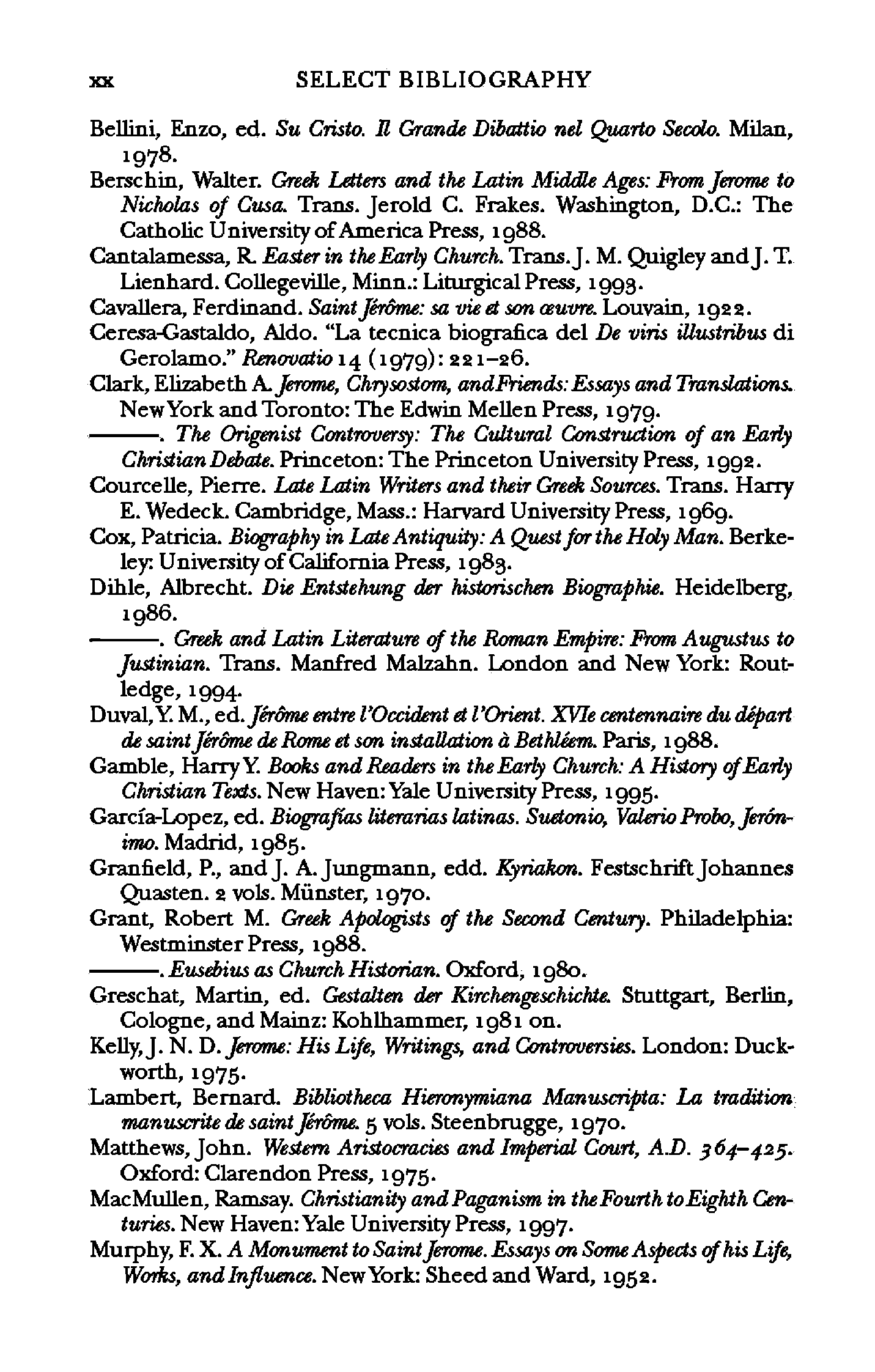
Bellini, Enzo, ed. Su Cristo. Il Grande Dibattio nel Quarto Secolo. Milan, 1g948.
Berschin, Walter. Greek Letters and the Latin Middle Ages: From Jerome to Nicholas of Cusa. Trans. Jerold C. Frakes. Washington, D.C.: The Catholic University of America Press, 1988.
Cantalamessa, R. Easter in the Early Ghurch. Trans. J. M. Quigley and J. T.
Lienhard. Collegeville, Minn.: Liturgical Press, 1993.
Cavallera, Ferdinand. Saint Jérome: sa vie & son ceuvre. Louvain, 1g922.
Ceresa-Gastaldo, Aldo. "La tecnica biografica del De wvins illusinbus di Gerolamo." Renovatio 14 (1g%79): 221-26.
Clark, Elizabeth A. Jerome, Chrysostom, and Friends: Essays and Translations.
New York and Toronto: The Edwin Mellen Press, 19%g.
. The Origenist Controversy: The Cultural Construction of an Early Christian Debate. Princeton: The Princeton University Press, 1gg2.
Courcelle, Pierre. Late Latin Writers and their Greek Sources. Trans. Harry
E. Wedeck. Cambridge, Mass.: Harvard University Press, 1969.
Cox, Patricia. Biography in Late Antiquity: A Quest for the Holy Man. Berkeley: University of California Press, 1983.
Dihle, Albrecht. Die Entstehung der historischer Biographie. Heidelberg, 1986.
. Greek and Latin Literature of the Roman Empire: From Augustus to Justiniar. Trans. Manfred Malzahn. London and New York: Rout-
ledge, 1994.
Duval, Y. M., ed. Jérome entre 'Occident et U'Orient. XVIe centennaire du départ de saint Jérome de Rome et son installation 4 Bethléem. Paris, 1988.
Gamble, HarryY. Books and Readers in the Early Church: A History of Early Christian Texds. New Haven: Yale University Press, 1995.
Garcia-Lopez, ed. Biografias literarias latinas. Suetonio, Valerio Probo, Jerontmo. Madrid, 1g8s.
Granfield, P, and |. A. Jungmann, edd. Kyriakon. Festschrift Johannes Quasten. 2 vols. Miinster, 1970.
Grant, Robert M. Greek Apologists of the Second Century. Philadelphia:
Westminster Press, 1988.
. Eusebius as Church Historian. Oxford, 1g8o.
Greschat, Martin, ed. Gestalten der Kirchengeschichte. Stuttgart, Berlin,
Cologne, and Mainz: Kohlhammer, 1981 on.
Kelly, J. N. D. Jerome: His Life, Writings, and Controversies. London: Duckworth, 1995.
Lambert, Bernard. Bibliotheca Hieronymiana Manuscripta: La tradition: manuscrite de saint Jérome. 5 vols. Steenbrugge, 1g+70.
Matthews, John. Western Aristocracies and Imperial Court, A.D. 364-425.
Oxford: Clarendon Press, 1975.
MacMullen, Ramsay. Christianity and Paganism in the Fourth to Eighth Centuries. New Haven: Yale University Press, 1997.
Murphy, F. X. A Monument to Saint Jerome. Essays on Some Aspects of his Life, Works, and Influence. New York: Sheed and Ward, 1g52.
SELECT BIBLIOGRAPHY
xxi Nautin, Pierre. Latres et écrivains chrétiens des Ie a Ille siécles. Paris, 1g61.
. "La date du 'De Viris Inlustribus' de Jérdme, de la mort de Cyrille de Jérusalem, et de celle de Grégoire de Nazianze." Revue.
d'histoire ecclésiastique 56 (1961): 33-35.
. "Etudes de chronologie hiéronymienne (393-39%)." Revue des dudes augustiniennes 18 (1972): 20g-18.
. Ongéne: sa vie et son auvre. Paris: Beauchesne, 1977.
. "La liste des ceuvres de Jéréme dans le De viris inlustribus." Or pheus, n.s., 5 (1984): 319-34.
Ollivier, Claude. Jéréme. Paris: Editions Ouvriéres, 1g63.
Opelt, I. "Hicronymus' Leistung als Literarhistoriker in der Schrift De
viris dlustribus." Orpheus, n.s., 1 (1980): 2—17s.
. "Origene visto da san Girolamo." Augustinianum 26 (1985):
217-22.
Rebenich, Stefan. Hieronymus und sein Kreis: prosopographische und sozialgeschichtliche Untersuchungen. Stuttgart: F. Steiner, 1992.
Rousseau, Philip. Ascetics, Authority, and the Church in the Age of Jerome and
Cassian. Oxford: Oxford University Press, 1978.
Steinmann, J. Hieronymus, Ausleger der Bibel. Weg und Werk eines Kirchen-vaders. Cologne, 1961.
Vielhauer, Philipp. Geschiche der urchristlichen Literaiur: Einleitung in das Neue Testament, die Apokryphen und die Apostolischen Viter. Berlin and New York: Walter de Gruyter, 1975.

INTRODUCTION
A. EARLY LIFE
Born in 347 or 348 into a prosperous Christian family of the propertied class in Stridon near Emona,! Jerome went in 360 to Rome to undertake studies in grammar and rhetoric, where he had Rufinus as his friend and Aelius Donatus, the famous grammarian, as his teacher. During his student days he acquired not Jjusta notable knowledge of Latin literature, but also an extraordinary competence in the Latin language.
An anecdote that he himself relates? gives an interesting insight into his mode of life at that time, although he had not yet received baptism:
When I was a boy during my studies in the liberal arts at Rome, a group of us of the same age and interests used on Sundays to go around the tombs which were dug in the depths of the earth, and as we walked along the dark passages, the bodies of the martyrs lay on shelves along the walls .
. It was so dark down there that we seemed to be fulfilling the word of the prophet: "Let the living go down to hell" [Ps. 54:16].
Characteristically, as they return to ierma firma, Jerome is reminded of a line from Virgil: "Fear and the very silence itself struck terror into our souls."® One of the best-known episodes in the life of Jerome is the personal crisis he experienced over his love of the classics, precipitating his famous dream.
"I dreamed, I stood before the judgment seat of God and heard His verdict: 'you are a Ciceronian, not a Christian; where your treasure is, there is your heart also'
[Mt 6:21]." However, throughout his life the classics never lost their influence on him, as the analysis of his work indicates, even if they took second place to Scripture and Christdan doctrine.
Together with Rufinus he frequented the monastic community in Rome and became enthusiastic about the monastic life. xxiii
xxiv
INTRODUCTION
After he was baptized in Rome in 36+ or 368 (perhaps by Pope Liberius), he seems to have tried a career in the state administration in Trier, then the imperial residence of Gaul. In his Confessions Augustine gives an account® of two imperial functionaries in Trier, who during a walk came to a house of monks, and there happened upon the Vita of the Egyptian monk Antony (composed by Athanasius soon after Antony's death in g55/356 or 357/958, and translated into Latin by Evagrius of Antioch before g75), and, spontaneously filled with enthusiasm for the monastic life, gave up their careers at court. Even if we do not agree with Pierre Courcelle's identification of the two of them with Jerome and Bonosus,® the scene in any event describes the atmosphere in which Jerome's decision (c. 3'70) soon matured to terminate his secular career, in order to lead a life of asceticism and leisurely erudition in his homestead in Aquileia in communion with his friend Rufinus—comparable, doubtless,
'with that of the circle around Augustine in Cassiciacum and Thagaste a little later.
The community in Aquileia became unravelled, and both Jerome and Rufinus betook themselves to the Eastern fountains of monasticism—Rufinus in 879 to Egypt, Jerome around 371 via Constantinople to Antioch, where he was received by Evagrius, who later became bishop of the old Nicene community of Antioch. He spenta brief period as a recluse in the desert in East
Syria in Chalcis, but soon returned to Antioch. In this Antiochene period, which lasted down to 3779/380, he acquired a good knowledge of both Greek and Hebrew, which laid the foundations for his later activities in translation. He began intensive study of the Bible, toward which, because of its unpolished style—just like Augustine—he had earlier been lukewarm, and attended (in perhaps 3777) the exegetical lectures of Apollinaris of Lacdicea, which provided the basis for his later works on the text and interpretation of the Bible.
No doubt Jerome, in the library bequeathed by Eustathius, studied the writings of Origen, many of whose works he translated into Latin. He entered, as a guest of Evagrius, the old Nicene community and was ordained by Paulinus to the priesthood, under the stipulation that he would not have to give up his
INTRODUCTION
XKV monastic way of life; then he got started with his literary activity.
In this period he definitely composed the first monastic legend of Christian literature, the Via of the Egyptian recluse Paul, and possibly (according to Nautin) even that early also the first translations of Origen (the Homilies on Isaiah, On Jeremiah, and On Ezekiel)." Other scholars, however, date these first translations to his next period in Constantinople, as done at the instigation of Gregory Nazianzus. In 379 or 380 he departed for Constantinople, together with Bishop Paulinus, who wanted to obtain recognition as legitimate Bishop of Antioch from the new "Nicene" emperor, Theodosius. This undertaking, however, proved fruitless, since both Emperor and Council (§81) recognized Meletius.
However, in this period Jerome made contact with Gregory of Nazianzus, Patriarch of Constantinople, and two other Cappadocians, Gregory of Nyssa and Amphilochius of Iconium, and began or continued his translation activity. In any case it was in Constantinople that the translation of the Chronicle of Eusebius was done, as well as its continuation down to the year 378, both of which would exercise such widespread influence throughout the Middle Ages. From Eusebius's Onomasticon, Jerome composed his Léber locorum and Liber nominum.
After Gregory Nazianzus retired from the bishopric of Constantinople, Paulinus and Jerome returned to Antioch without receiving the desired reward for their efforts: the recognition of the old Nicene community. In spring of 382 they journeyed to Rome with Epiphanius of Constantia (Salamis), Jerome having assumed the role of guide.
A Roman synod in 382, in which Ambrose of Milan also participated, recognized Paulinus as the sole legitimate Bishop of Antioch; but in the East its decision remained without effect. Epiphanius and Jerome were guests of the widow Paula (with her daughter Eustochium) and Marcella; they—as had previously the mother and sister of the great Cappadocians, Basil and Gregory of Nyssa—had converted their houses into monasteries: this was for Jerome a return to those contacts with the ascetical circles already established during his student days, which now enabled him to pursue his own inclinations. His hosts were distinguished, well-off, and cultured persons; Marcella even learned Hebrew in order to study the Bible
XXVi
INTRODUCTION
in the original. When, in the summer of 383, Paulinus and Epiphanius returned to the East, Jerome stayed on in Rome, where, as he himself recounts,® he became secretary to Bishop
Damasus. Here he asked Damasus to excuse him, because of constraints of time and expense, if he only translated Origen's two homilies on the Can#icle of Canticles, while readily acknowledging that, "in his other works Origen surpassed others, but in his Canticle of Canticles he surpassed himself." A Vitaof the twelfth century reports that Jerome, because of his Roman activity, was named a cardinal, and later iconography portrays him frequently in such a garb.
After the death of his patron and protector Damasus (on December 11, 384), Jerome entertained hopes of becoming his successor.? Siricius was chosen, however,
In his stead, since Jerome, in his ascetical zeal, had made numerous enemies for himself in the city, by sharply denouncing the deplorable ecclesiastical and moral conditions there. On this occasion Jerome's peculiar characteristics emerged for the first time, which later, in the controversies with Rufinus, Augustine, and others, became even more pronounced: the attacks directed by him were sharp, but he himself was emotional and an easy target. Such a hostile climate arose around him in Rome that he had to abandon the city; improper relations with the women of his ascetical circle were maliciously hinted at, or at least the charge of being responsible for the death of one of them because of the extremes of his ascetical injunctions. In August 385 he embarked at Ostia for Jerusalem. A letter to Asella, written on board ship at Ostia, is very enlightening on the poisoned climate that he left behind in Rome:
I am said to be an infamous turncoat, a slippery knave, one who lies and deceives others by satanic arts .
. Some kissed my hands, yet attacked me with the tongues of vipers .
. One would attack my gait or my way of laughing; another would suspect the simplicity of my manner. Such is the company in which I have lived for almost three years .
. Before I became acquainted with the family of the saintly Paula, all Rome resounded with my praises. Almost everyone concurred in judging me worthy of the episcopate. Damasus, of blessed memory, spoke no words but mine. Men called me holy, humble, eloquent.1°
INTRODUCTION
XKVl Paula, the alleged femme fatalg and her daughter Eustochium, did indeed with other companions follow him, joining him in Reggio di Calabria. From there they journeyed #a Cyprus and Antioch to Jerusalem, where they arrived at the end of 385, only to set off soon after for Egypt; here they visited various monastic settlements and in Alexandria came in contact with the great connoisseur of Origen, Didymus,
B. THE BETHELEHEM YEARS (386—420)
In spring of 386 they returned again to Palestine, settling finally in Bethlehem, and founding one male and three female monasteries. The following years, during which Jerome made frequent use of the library of Origen and Eusebius in Palestinian
Caesarea, were dedicated to intense literary activity. His publications included translations of the Bible; commentaries on the Pauline Epistles to Philemon, the Galatians, the Ephesians, and.
Titus; commentaries on Ecclesiastes, Micah, Zephaniah, Nahum, Habakkuk, Haggai, Jonah, and Obadiah; translations of Didymus's De Spiritu Sancto, Origen's Homilies on Lukeg and his catalogue of authors, De vires illustribus.
With respect to this early work of patrology, Johannnes Quasten has identified Jerome as "the first to compose a history of Christian theological literature" and credits the work as the basic source for the history of ancient Christian literature
Through more than a thousand years all historians of ancient Christian literature regarded De viris tllustribus as the basis of all their studies, and their sole endeavor was to write continuations of this great work.!!
The idea of such a history, however, is rightly attributed by Quasten to Eusebius of Caesarea, who stated as one of his goals in the introduction to his Ecclesiastical History: to report on the number of those who in each generation were ambassadors of the divine word orally or through written compositions; who and how many and when they were who, driving on to the extreme of error because of yearning for innovation, proclaimed themselves authors of "knowledge falsely so-called."?
xxviii
INTRODUCTION
In pursuing this, Eusebius does not draw a tight line between orthodox and heretical writers; nor does Jerome, who interestingly would draw a mild rebuke from Augustine, in his gp. g0:
"It would be more useful, I think, if, when you have named those 'whom you know to be heretical .
. you would indicate also wherein they are not to be followed."'® Indeed, conflict was to be a hallmark of Jerome's career. In September 493, after the feast of the consecration of a churchin
Jerusalem, Jerome intervened in the discussion between Epiphanius of Constantia (Salamis) and John of Jerusalem on the theology of Origen. He sided with Epiphanius, to whom he already had been close for years, while his friend Rufinus took the side of John. A polemic began with Rufinus, destined to last for years, but Jerome also found himself involved in a difficult situation, from a churchly point of view. His brother, Paulinianus, in fact, was ordained a deacon by Epiphanius, without the permission of John, under whose jurisdiction the monastery at Bethlehem was situated, whereupon John excommunicated the monastery.
Jerome defended Epiphanius in the work Contra Ioannem Hiarosolymitanum, and sought the support of Theophilus of Alex-andria. After repeated attempts John and Jerome were finally reconciled on Holy Thursday 397, and likewise Jerome and Rufinus.
It is not quite certain that the position of Jerome toward Origen changed substantially because of the polarization over the Origenist quarrel. He valued and translated Origen's works both before it and after. The fact that in the controversy he took the side of Epiphanius could be imputed in the beginning to purely personal motives, just as the polemic against Rufinus arose, not from a difference in evaluating the theology of Origen, but from ajudgment on the correctness of Rufinus's translation of Deprincipess, and this was the starting point of other controversies, beginning in 397.
Jerome's relations with other prominent bishops of his era likewise underwent tensions. Since Ambrose in his work De Spurttu Sencto had made use of Didymus's work bearing the same name, and, in his Commentary on Luke, of the homilies of Origen,
Jerome translated both works into Latin, to expose the plagia-
INTRODUCTION
XRIX risms of Ambrose. It is not, however, certain whether the true motive of such behavior was the result of philological rigorism on Jerome's part, or of his wish to avenge the lack of support from Ambrose for himself and Paulinus at the Synod of Rome in 382, The years 403—405 were unproductive for Jerome because of Paula's long illness and subsequent death on January 26, 404. In.
406 he resumed his composition of Biblical commentaries: On Zechariah, Malachi, Hosea, Joel, and Ames, in 406; Danid in 407;
Isaiah in 408/ 400; Ezekiel in 411—414 or 412—41%; and Jeremiah (from 415). Even in this new period of time there was a pause in publishing activity, occasioned by the conquest of Rome by Alaric on August 24, 410, and the subsequent flow of refugees into Palestine. In the winter of 415/416 the Dialogus contra Pelagianos appeared, aimed against those, that is, who found refuge with John of Jerusalem.
Jerome died on September 30, 419 or 420. His reputation in antiquity was legendary. For Sulpicius Severus "he was constantly immersed in study and in books; continually occupied in reading and writing, he permitted himself no rest day or night."** For Cassiodorus he was "Latinae linguae dilatator eximius, qui nobis in translatione divinae Scripturae tantum praestitit .
. plurimos libros, copiosas epistolas fecit."'* The western church has since 1295 venerated him, together with Ambrose, Augustine, and Gregory the Great, as one of the four "great Church teachers of the West." Iconography has frequently portrayed him as "Jerome in a cave," with a lion at his feet; best known is the engraving of Albrecht Durer. More frequently he has been depicted within his monastic study; the legend of the lion from whose paw he had extracted a thorn, and who in gratitude never abandoned him subsequently, is found for the first time in a ninthcentury
Vata1® The last word can be left to Dom P. Antin:
Fin psychologue, moraliste pénétrant, rigide en théorie, prudent en pratique, peu théologien, Jérdme est plein de contrastes. Il est colere, vindicatif, rancunier, flatteur. Mais quel travailleur! Souvent, quel ami fidele! ... Il ne goiite pleinement que la vie monastique, car i seulement on est tout i [ésus. Sa vie mystique tend au Christ qui vit pour nous dans I'Ecriture, autre Eucharistie.!?
KKK
INTRODUCTION
NOTES 1. Present-day Ljubljana/Laibach in Slovenia; the precise location of Stridon is unknown.
2.Jerome, Comm. on Ezechiel 12.40, CCL 75, 5578. Virgil, Aen. 2.755.
4.Jerome, gb. 22.80.
5. Augustine, Conf. 8.6.15.
6. P. Courcelle, Recherches sur les Confessions de saint Augustin (Paris, 1g50),
181-8y, refuted by J. N. D. Kelly, Jerome: His Life, Wiitings, and Controversies,
80.
7.Johannes Quasten, Patrology, Vol. 4, 215.
8. Jerome, gp. 123.9.
9-Bp. 45.3.
10. Ep. 45, NPNF 6, ser. 2, 59.
11.]. Quasten, Patrology, Vol. 1, 1-2.
12. Eusebius, Historia ecclestastics 1.1.1; see also R. M. Grant, Eusebius as Church Historian, (Oxford: Clarendon Press, 1980), 36.
18. Augustine, gb. 40, trans. W. Parsons, FOTC 12, 198.
14. Sulpicius Severus, Dial. 1.9, PL 20: 1g0.
15. Cassiodorus, Inst. 1.21, PL#70: 1185.
16. PL 22: 209—212.
1%7. P. Antin, art., "Jéréme," Catholicisme 6, 704.

ON ILLUSTRIOUS MEN
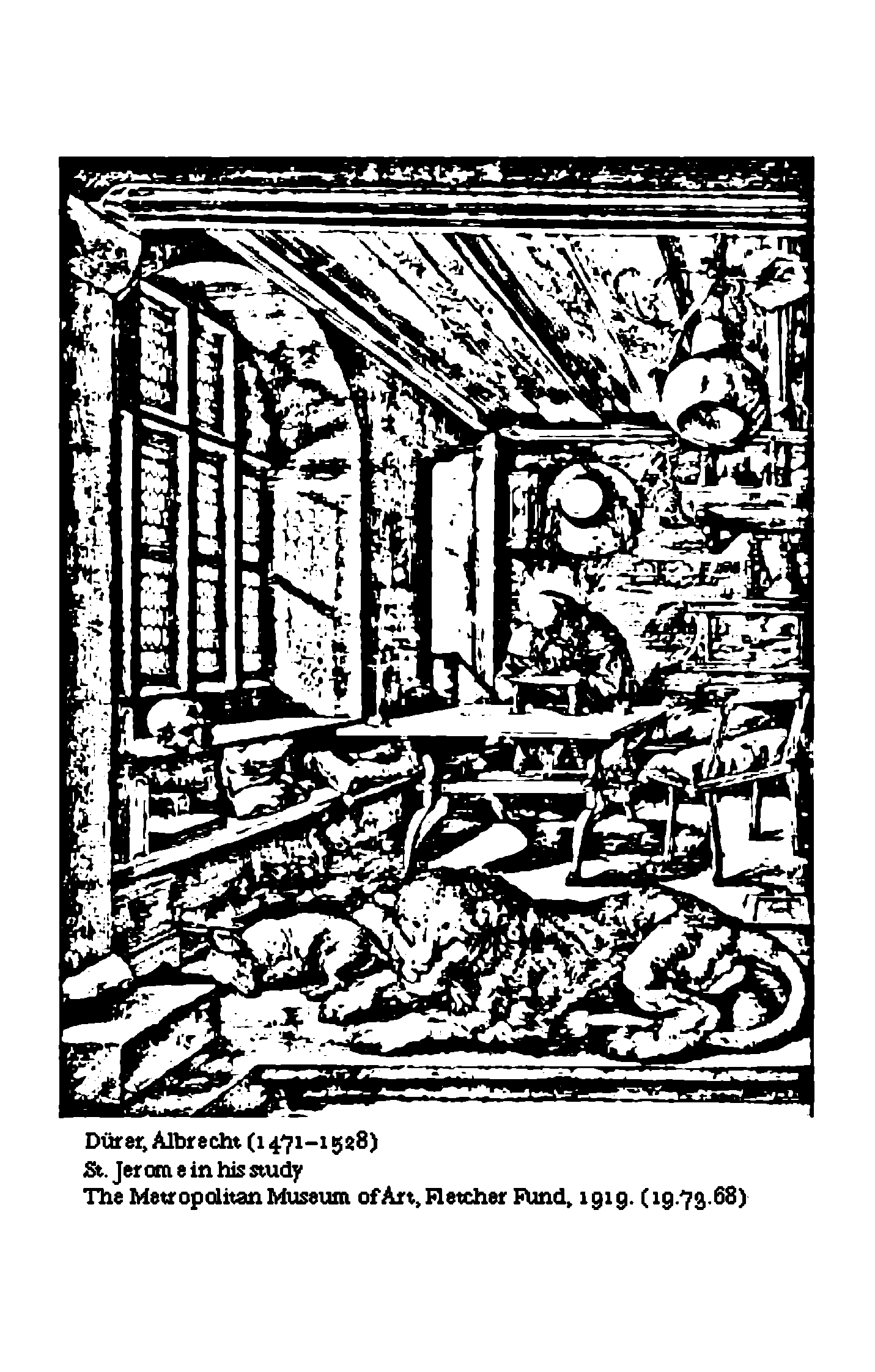
Direr, Albreche (1471-1528) &¢. Jerom ¢ in his ssady The Mett opdlitan Mussum of Are, Flewcher Fund, 1919. (19.79.68)
PREFACE
EXTER,! you urge me that I, following the example of Tranquillus,? prepare an orderly presentation of the ecclesiastical writers, and do for our writers what he did in chronicling eminent secular authors, that is, that I set forth for you a brief treatment of all those who have published anything memorable on the Holy Scriptures from the time of Christ's passion down to the fourteenth year of the emperor Theodosius.?
2. Among the Greeks this same sort of enterprise has been carried out by Hermippus the Peripatetic, Antigonus Carystius, the learned Satyrus, and Aristoxenus the musician, by far the most learned of them all* Among the Latins were Varro,'
Santra,® Nepos," Hyginus,® and the one whom you would like me to emulate, Tranquillus.
3. But their working conditions and mine are not quite the same, for they had at their disposal ancient histories and chronicles, and could, as if [gathering] from a great meadow,® weave a small crown for their task. As for me, what am I to do, in that I have no predecessor'® and follow the worst teacher possible, as the saying goes, my own poor self? Still, Eusebius Pamphilus, in the ten books of his Ecclesiastical History, has been of the greatest help to me, and the volumes of the individuals about whom I propose to write often provide insights into the lives of their authors.
4. Therefore I invoke the Lord Jesus that by listing the writers of his church I may satisfy your exhortation in a fashion worthy of what your Cicero, who stood at the pinnacle of Roman eloquence, did not disdain to do when weaving a catalogue of Latin writers in his Brutus."
5. If, however, some of those who down to the present continue to write have been passed over by me'? in the present volume, they should blame themselves rather than me.