
Conclusions To Part One: The Gospel Of Ignatius
CONCLUSIONS TO PART ONE
THE GOSPEL OF IGNATIUS
The constant task throughout Part One has been to isolate the gospel of Ignatius-its particular motifs and themes-and to examine Ignatius' idea of TOEUayyEALov through the lens of its environment not only within the specific
Ignatian context, but also its place among the gospels of early Christianity.
Principally, we have established that for Ignatius the gospel is an oral, preached message which is centered on the salvific naeo~ and dvcioTaOL~ of Jesus.
Therefore, the EUayyEALov to which Ignatius appeals is not a written, authoritative text.
Documents referred to as y€ypanTaL (i.e., Phld. 8.2), presumably the OT Prophets (and the Law of Moses [Smyrn. 5.1]), may well witness to the gospel in advance but there is no indication that Ignatius is appealing to a written text that he refers to as To EUayyEALOV.
Therefore, it is vital to recognize how the y€ypanTaL relates to Ignatius' EUaYYEALOV.
The OT Prophets function in the Ignatian corpus as authoritative figures and not as texts (Magn. 8.2, 9.2; Phld. 5.2, 9.1-2; Smyrn. 5.1, 7.2), figures which announce the gospel in advance.
This
witnessing function extends also to the Apostles (e.g., Eph.
11.2; Magn. 6.1, 13.1; Trall. 2.2, 3.1, 3.3).
Moreover, Ignatius occasionally appeals to other historical figures (David: Rom 1:3, 2 Tim 2:8; Mary: Eph. 7.2, 18.2, Magn.
11.1, Trall. 9.1; Pilate: Magn. 11; Herod: Smyrn. 1.2); all serve a related purpose: to underscore the reality of the EUa'Y'YEALOV events.
Also with respect to the written/oral question, we have noted that apparently there are expressions in Ignatius which can be related to various passages in the Gospels of the NT, most especially in Matthew.
However, it is clear that, while we may presume that Ignatius knows Matthean material, there is no indication that he considers this material to be TO EOOY'YEALov.
Moreover, the instances in which Ignatius appears to be working with pre-formed traditional confessional formulae
(e.g., Trall. 9.1-2, Smyrn. 1.1-2) or hymns (e.g., Eph. 19) show that the bishop is concerned with presenting the message rather than authoritative formulae; those presumed formulae are redacted to serve Ignatius• particular purposes.
He employs them to articulate the preached EooyyEALOV • The oral nature of Ignatius' gospel is supported not only by specific uses of the word EOOY'YEALov, but also by the overall matrix within which Ignatius presents his position.
Indeed, the oral gospel environment is so pervasive that
Ignatius often simply assumes its existence.
Thus, the verbs of transmission and acceptance (KaTayEAAw: Phld. 9.2, E:nayyEAAoµm : Eph . 14 : 2 I TT ATjpo<f>opEW : Magn. 11 . 1, oµoAoyEw : smyrn. 5.2) strongly suggest a preached gospel message.
Most telling in this regard, however, is Ignatius' use of the phrase AaA.ECv 'Iricrouv XpwT6v (Eph. 6.2, Magn. 10.3,
Trall. 9.1, Rom. 7.1, Phld. 6.1).
In the Ignatian context this phrase is best translated as "to preach Jesus Christ"; it refers to preaching the EooyyEA.tov.
This Ignatian usage is supported by such texts as Paul's exposition in Phil 1:1418.
What is more, Ignatius' use of A.aA.ELV 'Iriaouv XpLaTov also suggests a charismatic context linked with proclaiming the gospel.
This charismatic quality, in turn, is supported by various similar usages in Paul (1 Car 14:2-5) and Luke
(e.g., Acts 4:24-31).
Hence, within Ignatius• view of ministry to the gospel, a charismatic or prophetic quality is an integral component of the Ignatian architecture of authority. we see this "preaching in the Spirit" present in such passages as Eph.
20, Trall. 4-5, Rom. 7.2, and Phld. 6.1-7.2.
Ignatius, as well, recognizes that this authority from the Sprit is not his alone.
So, in Phld. 1.1 and Pol. 2.2 he encourages a charismatic ministry (and authority) for other leaders also.
Ignatius is a bishop (Rom. 2.2; cf., Magn. 2.1); yet, the ministry of ETTLOKono~, at least for Ignatius, appears tp include preaching with the authority of the Spirit.
This ministry of preaching is still further suggested by Ignatius' single use of ~ 6µLA.(a in Pol. 1. 2.
While the e:\Jayy€A.LoV is not specifically present in this passage, the usage at least indicates an official, authoritative ministry of preaching.
Preaching ministry is also suggested by the rgnatian theme of silence/speaking {e.g., Eph. 15, Phld.
1.1).
This theme, along with the concomitant theme of deeds from words (Eph. 14), ultimately refers to the proclamation of the message about Jesus.
With respect to the motifs that make up the Ignatian Eooyy€A.Lov, we have seen that the passion and resurrection of Jesus, as salvific events, are the central facts of Ignatius' preached gospel.
Early in Part One we observed that these salvation events are the core of the Eooyy€A.Lov in much the same way that we find them in Paul.
However, for Ignatius, the nci0osand dvcioTamsof Jesus appear to be somewhat more invariable and distinct Eooyy€A.wv motifs than in Paul.
Finally, the gospel of Ignatius serves to set the perimeters of proper belief and practice in the life of the church.
In Part One I specifically highlighted this boundary-setting function in early Christianity through the use of terms and phrases which are in-house abbreviations for the whole of the gospel message.
They are intended for those within the boundaries.
Along with the common simple use of the substantive TO Eooyy€A.Lov in many of our documents,
prime examples of these sorts of intramural phrases are paul 1 s To EooyyEALov Tou 0EOu, o Eooyy€Awv Tou XpLoTou, AaAEL'v Tov Aoyov and KTJpOOOELV TOV XpLoTov; we have as wel 1 Mat thew' s TO EooyyEALOV
TIJS' ~aOLAELUS' I and Luke I s TO EOOYYEALOV TilS' xapL TOS' TOU 0EOU and AUAELV
TOVA6yov.
With respect to Ignatius we have seen a similar function in his use of the substantive To EooyyEALOV; however the boundarysetting function is clearest with AUAELV 'Irioouv
XpLoT6v in which 11 Jesus Christ 11 stands for the gospel message.
Another Ignatian intramural phrase for the gospel message is 11 the gospel of the connnon hope (To EooyyEALov TTtS'
KOLvTtS' EAlTlBOS') 11 (Phld. 5.2; cf., Eph. 21.2, Magn. 11.1, Trall. insc, Phld. 11.2).
This particular phrase will come to the fore as we proceed through Part Two.
Therefore, it is from the preached gospel that Ignatius' Christianity gains its identity.
This Christian identity results from being united not only with correct belief in Jesus' passion and resurrection and but also with correct practice founded on that belief.
Indeed, as we have occasionally seen in Part One, the boundarysetting function of the Ignatian EooyyEALov extends far beyond the use of these intramural abbreviations.
Thus, the goal in Part Two is to examine this function through a treatment of two facets of Ignatius' theology:
Christology and opposition to the EooyyEALov.

PART TWO
THE FUNCTION OF THE IGNATIAN GOSPEL
INTRODUCTION TO PART TWO
In Part One, my goals were to establish the content and to examine the environment of Ignatius' gospel.
Having accomplished these tasks, we may now utilize the insights so gained to consider more specifically how the Eooyy€A.Lov functions within Ignatius' theological world.
Among the general conclusions suggested-and occasionally highlighted-in Part One is that Ignatius presents the Eooyy€A.Lov motifs and themes in order to delineate what are for him the acceptable boundaries of belief and practice.
Hence, it is no surprise to observe this function most clearly as Ignatius confronts those who are outside the acceptable boundaries. 1
Indeed, I have noted in passing how the bishop of ten pointedly structures expressions of the gospel motifs and themes in response to the error he is countering.
This boundary-setting function, therefore, is the overarching issue for consideration in Part Two.
Part Two is divided into two chapters.
In Chapter IV, I will consider what is for Ignatius the faith which delineates the 1With respect to this boundary-setting function see especially
Maier, "Charismatic Authority," 194; Ibid, Social Setting, 175-181; Schoedel, "Theological Norms," 31-36.
true boundaries of Christianity.
Because this faith is centered on correct belief about Jesus, I will approach it through an examination of Ignatius' Christology as it is expressed through the EUaYYEALov.
Here I will treat a series of Ignatian Christological themes and especially titles in order to highlight their relationship to Ignatius' gospel.
With Ignatius' Christology as the starting point, chapter V then will be a treatment of how Ignatius' gospel functions in response to error in the various communities.
Thus, Chapter V will involve not only delineating the nature and identity of the error evident in the letters, but it will also involve more importantly an examination of the way in which Ignatius expresses the EUaYYEALOV in his polemics against the error.
As is already evident from the conclusions of Part One, Ignatius' EUaYYEALOV is the source of Christian identity;
Chapters IV and v, therefore, will show how the gospel message is the unifying principle in Ignatius' world view.
CHAPTER IV
WITHIN THE BOUNDARIES:
THE GOSPEL OF IGNATIUS AND CHRISTOLOGY
In the following pages I will consider Ignatius' christology by paying attention primarily to the titles or epithets which are used by Ignatius to refer to Jesus, and which have direct linkages with Ignatius' EooyyEALov.
These include Jesus as:
"son of God" (e.g., Eph. 20.2, Smyrn.
1.1}, "the savior" (Eph. 1.1, Magn. insc., Phld. 9. 2, Smyrn.
7.1}, "the common hope" (Eph. 21.2, Magn. 11.1, Trall. insc., Phld. 11. 2} , "the only teacher" (Magn. 9. 1; cf.,
Phld. 8.2), and "the one physician" (Eph. 7.2}.
However, before turning to these particular titles, it is necessary to ground this examination with a more general treatment of Ignatius' expressions of the incarnation-as always, through the lens of Ignatius' Eooyy€A.wv. 1
Finally, as we proceed through this chapter, it is vital to notice that, along with the boundary-setting function of Ignatius' Christology, there are particular
Ignatian shifts with respect to various NT Christological 1Helpful in this entire treatment of Ignatius' Christology is a list compiled by D. Aune.
D. Aune, "Divine Names and Epithets in Ignatius," (Unpublished Paper, n.d.).
categories.
As we will observe, these shifts arise not only from Ignatius' 'boundary-setting' or polemical activity, but also from his own world-view and that of the churches he addresses.
THE INCARNATION
The most simple of Ignatius' expressions of the incarnation is the reference to Jesus as "our [or "my" in Rom. 6.3] God" (Eph. insc., 15.3, 18.2, Rom. insc., 3.3,
6.3, Pol. 8.3; cf., Eph. 7.2, Smyrn. 1.1) . 2
It is clear that, while he distinguishes between the Father and the Son (and the Spirit) (e.g, Eph. 9.1, Magn. 13.1), Ignatius speaks of Jesus as divine.
On a more immediate level, it is also significant that Jesus is "our" God.
This suggests that Ignatius is appealing to a common faith experience of Christians within his circle of influence.
Jesus is God, "our God," for those with correct belief. 3
2In Trall. 7.1 there is in some texts (e.g., the Latin witness to the Greek) a reference to those who are "inseparable from God, Jesus
Christ (ovcnv cixwp(ITTms 9Eou 'l11crou XpLOTou) . "
118rnu," however, is not found in an important witness, the Armenian version from the Greek.
This, together with the fact of the awkwardness of the phrase, as well as the absence of any qualifying modifiers (such as the usual Ignatian µou or ~µwv in such statements) leads Lightfoot to conclude reasonably that the 9Eov is not original.
Lightfoot, 168-169.
3We will see as we proceed through this chapter that this same sort of appeal to a common faith experience to delineate the "in" group is operative with "Jesus, the common hope" (Eph. 21.2; Phld. 11.2), "the gospel of the common hope" (Phld. 5.2), not to mention "the only teacher" (Magn. 9 .1; cf., Phld. 8. 2) and the "one physician (Eph. 7. 2).
This being said, it is necessary to recognize that Ignatius is still early in Christological debates:
"the use of technical language to describe Ignatius' theology runs the risk of falsifying the picture." 4
This refers to rgnatian passages which at first glance may suggest subordinationist (e.g., Eph. 3.2) or adoptionist (e.g.,
Magn. 8.2) tendencies.
However, these technical terms (which do not necessarily exclude one another) are inappropriate in an Ignatian context.
The Ignatian passages which ostensibly suggest these categories must be read in light of the unambiguous references which refer to Jesus as "our [or "my"] God."
These references are further supported by "the blood of God (E:v ai.'µaTL ernu)" in Eph. 1.1, as well as the phrase we have seen with respect to the mieos-:
"allow me to be an imitator of the passion of my God (E:mTpElpaTE µm µLµT"JT~V dvm Tou mieousTou 9Eou µou)"
(Rom. 6. 3) . 5
In his frequent and unambiguous references to Jesus as God, Ignatius clearly moves beyond the NT.
We may find references to Jesus' identification as God in the NT designation of Christ as 6 KUpLOS', thus suggesting the attributes which the OT applies to God. 6
In this regard one 4Schoedel, Ignatius of Antioch, 20.
Schoedel, however, states that "from the view of later trinitarian developments, Ignatius tends to a 'monarchian' position."
Cf., Corwin, St. Ignatius, 140-141; Elze, Untersuchungen, 23-26.
5Schoedel, Ignatius of Antioch, 39.
6Dunn, 180.
Also, o. Cullmann, The Christology of the New Testament, S. C. Guthrie, C. A. M. Hall, trans. (Philadelphia:
Westminster, 1963) 234-237, 307-308.
thinks irmnediately, for example, of Thomas' confession in John 20: 28:
"My Lord and my God (6 KUpLOS' µou KaL 6 9E6<; µou) . " 7 we may look as well to Phil 2:6-11 where Jesus "was in the form of God (Ev µop<f>'fl 9Eou)" and is exalted as KUpLo<;.
However, in general, the NT is far from direct in assigning divine qualities to Jesus. 8
Ignatius, on the other hand, is clear in his expressions of Jesus' divinity.
As we will see, the contrast between Ignatius' unambiguous 'IriaoU<; XpwTo<; 6 9Eo<;
(i.e., Smyrn. 1.1) and the NT expressions largely arises from Ignatius' own polemical activity in addressing error.
Indeed, rather than looking back to the NT, Ignatius' expressions of Jesus' divinity point to the later
Christological debates. 9
Ignatius is a witness to an early stage in the controversies.
Yet, our present task has Ignatius' Eooyy€A.Lov as its controlling constant.
There are two areas in which the Eooyy€A.Lov and expressions of the incarnation are especially intertwined in the Ignatian corpus: the Christological polarity "flesh and spirit" (e.g., Eph. 7.2: aapKLKo<; TE KaL
Ignatius often uses the title 6 Kvpt6S" to refer to Jesus (but never to God): Eph. 7.2; Magn. 7.1, 13.1; Trall. 8.1; Phld. 3.1, 4.1, 9.2,
11.2; Smyrn. insc., 1.1, 4.2, 5.2; Pol. B.3.
7R. Brown points out that this phrase is a "cross between a vocative and a proclamation of faith ("you are my Lord and my God")."
He states that no modern scholarship considers this as an exclamation in honor of the Father.
R. Brown, The Gospel According to John, AB 29-29A (Garden City: Doubleday, 1970) 1026-1027.
8See Dunn, 60-64.
9Cullmann, Christology, 314.
nvEuµaTLKOS'), and the motifs and themes which surround the coming, or manifestation, of Jesus. out of the several polarities in Ignatius' rhetoric,
"flesh and spirit" is a particular theme that describes the incarnation and, at the same time, points to the Eooyy€A.wv . 10
This polarity for Ignatius is both Christological (Eph. 7.2; smyrn. 3.2) and anthropological (Trall. 12.1; Pol. 1.2, 2.2,
5.1); the former is my primary concern.
Ephesians 7.2 is the presumed hymn we have seen in Part one.
The first of the seven antitheses which describe the 11 one physician (ELS' iaTposEGTtv}" is the phrase "both fleshly and spiritual (aapKLKOS' TE KaL nvEuµanKos-) . "
This theme is reiterated in the third antithesis: "born in flesh, God (Ev aapKi yEvoµEvos0Eos-) . " 11
Moreover, in the resurrection appearance story related in Smyrn. 3.1-3 the disciples touched Jesus and believed, "being intermingled with his flesh and Spirit (Kpa0EVTES' TjJ aapKL alITOU Kai T4> TTVEUµaTL) 11
( 3. 2} ; and, in 3.1, Ignatius concludes the scene with "And after the resurrection he ate and drank with them as a being of flesh, although spiritually united with the Father (µETa 8E
1011 Polarities" is Schoedel' s term (Ignatius of Antioch, 23).
11These are references to the rrapovofo, which is the primary EooyyE-1..Lov motif in the hymn.
Most likely because of later Christological controversies, this third antithesis has been altered in some texts to read E:v civOpu'.rrr4) 9E6s-.
Citing patristic quotations, Lightfoot (49) accepts E:v civOpwTI41 9E6sas the correct reading, while more recent authors agree that E:v aapKi yEvoµEvos9E6sof the best Greek texts is the proper reading.
Schoedel, Ignatius of Antioch, 61; A. Lindemann, H. Paulsen, eds., Die Apostolischen Vater
(Tiibingen: J. C. B. Mohr [Paul Siebeck, 1992) 182.
TTW dvaoTaaw avvE-<f>ayEv auTol's KaL auvE-mEv ws aapKLKOS, Ka(nEp nvEUµaTLKWS iJvwµE-vos TQ naTp() . "
Thus, it is clear that Ignatius presents Jesus as God (ie., 'spiritual') in flesh both before and after the resurrection: he links both the birth (Eph. 7.2:
E:v aapKL yEvoµEvos 0Eo<;) and the resurrection (Smyrn. 3 .1-3) with this theme to underscore the reality of the entirety of Jesus' earthly existence as God in human flesh.
This 'flesh and spirit' description of Jesus as Godhuman has its origins in the two-step movement from "born .
. . according to flesh," to "recognized as son of God ... according to the spirit of holiness from the resurrection" that we have highlighted as Paul's EooyyD .. Lov in Rom 1: 3-4 . 12
Yet, when we turn to Ignatius' more direct uses of the formula behind Rom 1:3-4 (i.e., Eph. 20.2; Trall. 9.1;
Smyrn. 1.1), we will see that, consistently, Ignatius' idea of the incarnation has one step:
Ignatius describes Jesus, the God-human, as from the start a union of flesh and spirit
( cf . I Eph . 18 . 2 ) .
The union is vital for Ignatius; for, not only does this expression of the incarnation counter the docetic error
(and, thus, argues for church unity; i.e., Smyrn. 2), but Jesus' unity of flesh and spirit in the incarnation also defines the individual Christian's union with Jesus (or 12With respect to this two-stage Christological movement in Rom
1:3-4, see Dunn, 33-35.
Cf., Rathke, 48; Schoedel, Ignatius of Antioch, 20.
God) .
Hence, just after responding to the docetists with the incarnation sequence in Eph. 7.2, Ignatius writes the Ephesians that they are "completely of God (OAOL OVTES' ernu) II and then tells them "what you do according to the flesh is spiritual, for you do everything in Jesus Christ (Ci. OE KaL
KaTa acipKa npciaaETE, TaiJTa nvEuµaTtKci E:aTLv· E:v 'Iriaou yap XpLaT0 nciVTa npciaaETE) "
( Eph. 8 . 1 - 2) . 13
What is more, we have seen that in Phld. 5.1 the flesh of Jesus is compared to the EooyyEALov:
Ignatius speaks about "taking refuge in the gospel as in the flesh of Jesus (npomf>uywv Tii) EooyyEA(c.p WS' aapKL 'Iriaou) . "
This refers to the reality of the flesh of Jesus "which suffered for our sins, [flesh] which the Father raised in his goodness ( ... T~vunEp
Twv dµapnwv ~µwv naeouaav, ~v TU XPTlGTOTTlTL 6 naT~p ~yELpEv) "
( Smyrn.
7.1) . 14
Thus, through the physical flesh of the God-human Jesus, the Father accomplished his purpose (e.g., Eph. 3.2,
Smyrn. 6. 2) in the events of the EooyyEALov.
Ignatius, therefore, takes refuge in the Eooyy€Awv because in it he finds the events of salvation accomplished by Jesus, "our
God" in the flesh. 15
13Cf., Rom. insc.: "to those who are united in flesh and spirit in every one of [Jesus'] commandments, filled with the grace of God .. .
(KaTa acipm Kal 1TVEuµa ~vwµEVOLS' 1Tcl01J EVTOAfj airrov, 1TE1TAT]pWµEVOlS' xcipt TOS' 9Eov ... ) . II 14Here Ignatius is referring to the eucharist as the flesh of Jesus in the church (cf., Phld. 4 .1).
· 15H. E. Lona, "Der Sprachgebrauch von acipe, acipKLKOS bei Ignatius von Antiochien," ZKT 108 (1986) 395-396.
we may now turn to the 'coming' or 'manifestation' of Jesus, another EUa)"yEA.Lov motif which functions as a defining feature in Ignatius' idea of the incarnation.
We have seen in Part One how the napooo(a motif-as contained in the EUaY"YEALOV ( Phld. 9. 2 )-is expressed through recourse to several themes: ncipELµL (Magn. 9. 2) , <f>a[vw (Magn. 6. 1) and ¢avEpow ( Eph. 19. 2 -3; Magn. 8. 2) , and yEVlJTlOLS' (Magn. 11. 1; cf., Eph. 7.2, 18.2; Trall. 9.1; Smyrn. 1.1).
Having recognized this nexus with the EuayyEA.Lov, we may review the •coming/manifestation' motif specifically as an expression of Ignatius• concept of the incarnation.
Ignatius' letter to the Magnesians contains several passages which merit consideration in this regard.
In Magn.
6.1 Ignatius sets up a chain of church authority which is in service to Jesus "who before the ages was with the Father and appeared at the end ( osnpo atwvwv napa naTpL ~v KaL E:v TEAEL
E:<f>civri) . "
This use of <f>a(vw, as we have seen, refers to the napooo(a of Jesus in the EooyyEA.Lov.
Moreover, this passage clearly speaks of Jesus' pre-existence with the Father.
Thus, while Jesus' divinity is described somewhat indirectly as being "with the Father" (cf., John 1:2, 17:5, 24), we have in one sentence a summary of the existence of Jesus with his appearance (presumably, from the Father) as the pivotal end-time event.
we find the same juxtaposition of Jesus' pre-existence with the incarnation more clearly expressed in Magn. 7.2 where Ignatius exhorts the Magnesians: nciVTES' W<; ELS' Eva vaov CTUVTPEXETE 8rnu, w<; E1TL EV 8uataaTtjpLOV, E1TL EVa
'Inaouv XpLaT6v, Tov d.<f>' E:vo<; naTpo<; npoEA.86vTa Kai dsEva oVTa Kai x wptjaa vTa.
All of you together run as to one temple of God, as to one altar, to one Jesus Christ who came forth from the one Father, was with the one, and returned.
In this passage-which has a typical multi-layered Ignatian emphasis on unity (cf., Magn. 1.2, Phld. 8.1)-Ignatius uses the verb npoEpxoµaL to describe not only Jesus' origins with the Father, but also his manifestation in the world.
Jesus' own unity ("one Jesus Christ": of flesh and spirit [e.g., Eph. 7.2]}, along with his being united with the Father (as in Magn. 6.1) are unities which serve as models for the church unity which Ignatius is encouraging for the Magnesians.
Therefore, in Magn. 7.2 we have an expression of the incarnation which is grounded in the manifestation motif, and which, in turn, itself functions as an image and exhortation to church unity.
In another Magnesian text, 8.2, the OT Prophets "lived according to Jesus Christ (ot ... npo<f>f)Tm KaTa XpLaTov 'Inaouv
E(naav} ."
They were persecuted because of their living in this way.
In their persecution they were "inspired by [Christ's] grace to convince the disobedient (E:vrrvE6µEvoL uno
TTJS' xcipL TOS' mrrou, ELS' TO 1TA'flpO<f>opn8fJvm TOD<; a1TEL80uVTa<;} II :
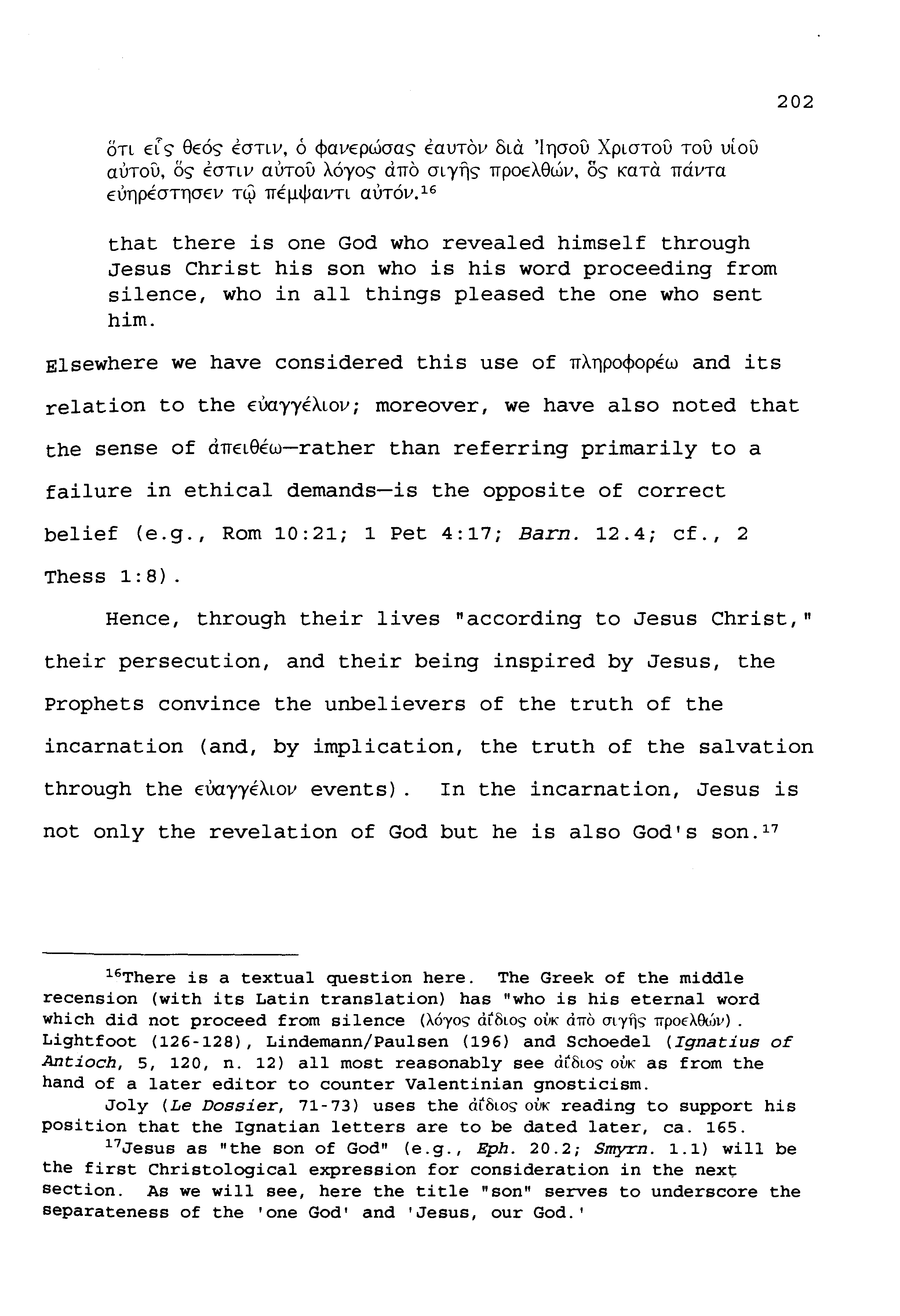
oTL d s 9Eos EOTLV, 6 ¢avEpwaas EauTov 8La 'Irpou XpwTou Tou u[ou mhou, os EOTLV mhou A6yos dno aLyf]s npoEA.9wv, os rnTa ncivTa
EUT}pEOTTJOEV Tc{) 1TEµ~aVTL aUTOV. 16 that there is one God who revealed himself through Jesus Christ his son who is his word proceeding from silence, who in all things pleased the one who sent him.
Elsewhere we have considered this use of nA.ripo¢opEw and its relation to the EooyyEALov; moreover, we have also noted that the sense of dnEL9Ew-rather than ref erring primarily to a failure in ethical demands-is the opposite of correct belief (e.g., Rom 10:21; 1 Pet 4:17; Barn. 12.4; cf., 2
Thess 1: 8) .
Hence, through their lives "according to Jesus Christ," their persecution, and their being inspired by Jesus, the Prophets convince the unbelievers of the truth of the incarnation (and, by implication, the truth of the salvation through the EooyyEALov events) .
In the incarnation, Jesus is not only the revelation of God but he is also God's son. 17
16There is a textual question here.
The Greek of the middle recension (with its Latin translation) has "who is his eternal word which did not proceed from silence (A6yoscii'8wsouK dTio Ol)'TlS' TipoEA9Wv) .
Lightfoot (126-128), Lindemann/Paulsen (196) and Schoedel (Ignatius of Antioch, 5, 120, n. 12) all most reasonably see dt8wsouK as from the hand of a later editor to counter Valentinian gnosticism.
Joly (Le Dossier, 71-73) uses the cii'8wsouK reading to support his position that the Ignatian letters are to be dated later, ca. 165.
17Jesus as "the son of God" (e.g., Eph. 20.2; Smyrn. 1.1) will be the first Christological expression for consideration in the next section.
As we will see, here the title "son" serves to underscore the separateness of the 'one God' and 'Jesus, our God.'
Again we find the use of npoEpxoµaL (cf., Magn. 7.2) to describe Jesus' coming as God.
However, here, with the reference to "silence" as Jesus' origin, the situation seems more complex.
There is a fair amount of scholarship which sees behind this phrase various gnostic formulations about a silent supreme deity revealed through divine speech (Aoyo~) in the world. 18
Yet, to attribute to this silence of God a fully gnostic background places an unwarranted template on Ignatius' expression.
We have seen how the silence/words/deeds theme functions for Ignatius with respect to the EUaYYEALOV.
More telling, however, is the fact that elsewhere Ignatius never clearly identifies God with silence.
There is no such identification, for example, with the "three mysteries of a cry which were done in the stillness of God (Tp(a µooTtjpw Kpauyfi~. chwa EV ~aux(q emu
Enpcix811)" of the star-hymn (Eph. 19.1) . 19
Moreover, Rom. 8.2
(Jesus is the "unlying mouth through which the Father spoke truly [To d~EuOE~ aToµa, Ev 4) 6 naTi)p EAciAllGEV dA118w~] ") is best seen within the context of Jesus' silence/speaking/deeds of 18See, for example, L. w. Barnard, "The Background of St. Ignatius of Antioch," VC 17 (1963} 193-206; H. -w. Bartsch, Gnostisches Gut, 5761; Paulsen, Studien, 110-114.
19Schoedel sees this stillness (~avx[a} as describing God's silence while the divine plan is revealed in the historical events of the birth and passion of Jesus.
In other words, God did not openly intervene in these events.
Schoedel, Ignatius of Antioch, 91.
Eph. 15.1-2 in which Jesus is the "one teacher" who is 11worthy of the Father."
Therefore, it seems most accurate to see these silence and/or speaking passages-including Magn. 8.2-in light of the revelation-schema which we highlighted with respect to the EooyyEALOV in Part One. 20
The hidden mystery that is now revealed as part of the plan of God is the operative theme here. 21
While there may well be a gnostic mythological quality to these expressions, that quality is hardly recognizable as dominant for Ignatius.
Ignatius, rather, is working with the relatively cormnon early Christian theme of God's plan being revealed in Jesus at the intended time. 22
The same context is operative with respect to Eph. 19, the star-hymn.
The hymn is presented as an answer to the question, "How then was he revealed to the aeons? (TIWS" ouv
€<f>avEpw011 TOLS" alw<JLv;) . "
In Eph. 19. 3b the answer is surmnarized with, ... emu dv0pwnLVWS" <f>avEpouµEVOU ELS KaLVOTllTa dLO(ou Cwf]s· dpx~v OE
€A.ciµ~avEv To napa 0E4> dn11pTLoµEvov. Ev0Ev Ta ncivTa ouvEKLVELTo 8La TO µEAETuaem eavciTOU KaTciAOOLV.
. . God being revealed as human to bring newness of eternal life, and what had been prepared by God had its beginning; hence all things were disturbed because the destruction of death was being worked out.
20cf., Luhrmann, 129-130.
21E.g., Rom 16:25-26; Col 1:26; 1 Pet 1:20; 2 Clem. 14:2.
22Schoedel, Ignatius of Antioch, 120-121.
Again, we find the plan of God in conjunction with Jesus as the manifestation of God.
Here, as well, the ultimate purpose of God is to bring the "newness of eternal life."
Therefore, Jesus as the God-human, through his birth {manifestation), passion (19.1:
"the death of the Lord') and resurrection completes the plan of God in history. 23
To conclude this discussion of the incarnation in the Ignatian letters we turn to two Ignatian titles which refer to Jesus as God in human flesh:
"the new human { Kmvosc'.iv0pwTTOS") II (Eph. 20 .1) I "the perfect human {TEAELOS' av0pwnoc;-) II (Smyrn. 4.2).
These titles are closely related and appear to be versions of similar titles in the NT, specifically in the Pauline tradition.
Thus, we find "perfect [or "complete"] man { dvfip TEAELOS') " at Eph 4 : 13 , and "new human
( KaLVOS' av0pwnoc;-) II at Eph 2 : 15 and 4 : 24 . 24
These NT usages I however, do not refer to Christ himself; rather they are used to describe the person who accepts Christ and thus becomes "new" or "perfect" ("complete") . 25
In Eph. 20, Ignatius is concluding his letter and promises another "little book (~L~A.(faov)" in which he will present the "plan concerning the new human Jesus Christ,
23Ibid. I 94.
24See, as well, vfos dv9pwnos at Col 3:10.
25So, for example, in Eph 4:24, the "new human" is in contrast to the "old human (naA.mos dvepwnos)" of lust and corruption of 4: 22.
The new human is the result of God's new creation; thus the new human lives "according to the likeness of God in true righteousness and holiness
(Kai E:v8ooacrem Tov Kmvov dvepwnov Tov KaTa 9E:ov KTLcr0EvTa E:v 8tKmom1vl.l wi ocrlOTf1TL Tf\S' dA.rt9das)."
Schnackenburg, Ephesians, 201.
faith in him and love of him, in his passion and resurrection (oLKOvoµ(osELS' Tov Kmvov dv0pwnov 'I11aouv XpLaTov, EV TlJ m'.rrou n(aTEL KOL Ev TlJ mhou dycinlJ, EV nci9EL mhou KOL dvoaTciaEL) "
( Eph.
20 .1) .
As we have seen, by "plan (tj olKOvoµ(o} , " Ignatius is speaking of God's intentions for the history of the world
(cf., Eph. 18.2, etc. ) . 26
Because of his identity with God as well as with humanity (i.e., "the son of humanity and the son of God": Eph. 20.2), Jesus' role in this OLKovoµ(aespecially through the EooyyD .. wv events of the passion and resurrection-is to become a human being who is God, a new human being in the course of human history. 27
As the new human being Jesus fulfills God's plan of salvation through his passion and resurrection.
This salvation is the "newness of eternal life (. .. ELS' KatVOTT)TO dl8(ou (wfls-) " of Eph.
19.3.
We may view the title "the perfect human (TEAELOS' av0pwnos-) II of Smyrn. 4.2 in the same light .
Ignatius, after speaking dramatically of his own sufferings in defense of proper belief in Christ, states, 26In the above paragraphs we have recognized the "plan of God" theme in relation to the manifestation motif.
Other Ignatian expressions of this OLKovoµ(a are: God's "will" (TO eD.T]µa: Rom. insc.;
Smyrn. 6 . 2) , and "purpose" ( ~ 'Yvwµ Tl : Eph. 3 . 2 ; Smyrn. 6 . 2 ; Pol . 8 . 1) .
27Cf., Schlier, Untersuchungen, 88-89, n. 2 who sees the Kmvos av9pwrros in a gnostic context, as the redeemer from the light who gathers his scattered members and thus becomes new.
Schoedel, however, · demonstrates that this image has "a variety of possible roots."
Ignatius of Antioch, 96.
µovov EV T4i ovoµaTL 'I11oou XpLOTOU ELS' TO ouµna8ELV m'.m+i ncivTa {moµE:vw, m'nou µE Ev8uvaµouVTosTou TEA.E(ou dv8pwnou. only in the name of Jesus Christ am I enduring all things to suffer with him: he, the perfect human, empowers me. w. schoedel sees both this title and Kmvosav0pwnosas expressions of an idea that makes Christ a "Representive
Human Being" who, as the ultimate type, is the object of unity for Christians in the one body of Christ, the church
(see Smyrn. 1.2).
Thus, the Ignatian TEAELOS' av0pwnosmarks the transcendent nature of the Representative
Human Being, yet finds its actualization only in Christ as a historical figure-perhaps especially in Christ as the crucified one . . . 2s This means that for Ignatius only Jesus, "our God" in human flesh, through his historical passion and resurrection, can bring human beings to their proper identity:
"newness of eternal life," or salvation. 29
Christians are to be united through their "faith in him and love of him in his passion and resurrection" (Eph. 20.1).
IGNATIAN TITLES FOR JESUS
With the above general discussion concerning Ignatian expressions of the incarnation before us, a more specific discussion of Ignatius' Christology is in order.
In the following pages, I will consider several other Ignatian 2 8Ibid., 232-233.
29Cf., Ibid., 233.
titles or descriptions for Jesus.
These include "Son of God," "Savior," "the cormnon hope," "the only teacher," and "the one physician."
My primary concern here centers on how these titles serve as expressions of Eooyy€A.Lov motifs and themes.
THE SON OF GOD
Ignatius refers to Jesus as God's son six times (Eph.
4.2, 20.2; Magn. 8.2, 13.1; Rom. insc.; Smyrn. 1.1); however, only once, at Eph. 20.2, do we find the apparently more formal title 6 ULOS' TOU ernu. 30
In Eph. 4.2, within a metaphorical passage centered once again on church unity, Ignatius speaks of Jesus as God's son in conjunction with the fatherhood of God toward
Christians in general.
The Ephesians are urged to join together as in a choir to "sing with one voice through Jesus
Christ to the Father ({i8TlTE E:v <f>wvfl µLQ. 8La 'ITlaou XpLCJTou T4> naTp() . "
This, so that God may recognize them as being "members of his son ( ... µ€A.Tl oVTasTou u[ou m'.rrou) . "
There are no Eooyy€A.Lov motifs or images here.
The most we can point to is the centrality of Jesus, the son, as the way to Father.
30At the same time, of the forty-four times Ignatius refers to God as "Father," Ignatius directly calls God the Father of Jesus six times
(Eph. 2.1; Magn. 3.1; Trall. insc, 9.2; Rom. insc; Phld. 7.2).
The other references to God as Father involve either God as Father of Christians {ie., Eph. insc; Magn. 3.1; Trall. 11.1; Rom. 7.2; Phld. 3.1;
Smyrn. 13.1) or God's fatherhood with some mention of Jesus {ie., Magn. insc, 5.2; Trall. 13.3; Rom. 2.2).
Hence, we may think of Phld. 9.1-another 'unity' text-where Jesus, through the events of the EooyyEALov (in Phld. 9. 2) , is the way to the Father: mhos wv eupa Tou naTpos, BL' ~s ELoEpxoVTm 'A~paaµ Kat 'IoaaK KaL
'laKw~ Kat o[ npoqrflTm Kat dnooToAoL Kat ~ EKKAT)O(a. ndVTa TauTa ELS E:v6TT)Ta 9rnu.
He is the door of the Father through which enter Abraham and Isaac and Jacob and the Prophets and the Apostles and the church: all these into the unity of God.
Thus viewing Eph. 4.2 in light of Phld. 9.1-2, we find ourselves not far from Ignatius' EooyyEALov.
Jesus, God's son, through his coming, passion and resurrection, is the way to the Father. 31
In Eph. 20.2 we find a stronger tie between Jesus as God's son and the EUayyEALov.
After promising to write more about the "new human Jesus Christ . . . in his passion and resurrection (oLKovoµ(as ELS Tov Kmvov dv9pwnov 'IT)oouv XpLoTov ... E:v mieEL auTOU Kat dvaoTciOEL) (20 .1) I II Ignatius speaks of Jesus as "according to the flesh of the family of David, son of a human and son of God (Ka Ta ocipKa EK 'YEVOUS' Aaudo, T4> ul4> av9pwnou KaL ulQ Brnu) 11 (20. 2) .
Here again Ignatius is working with the formulation of Paul's EooyyEALov in Rom 1: 13 (cf. , Trall. 9. 1; Smyrn.
1.1) . 32
Yet, in place of Paul's reference to Jesus being 31Cf., the only "archives" of Phld. 8. 2.
32Rathke, 48; Schoedel, Ignatius of Antioch, 97.
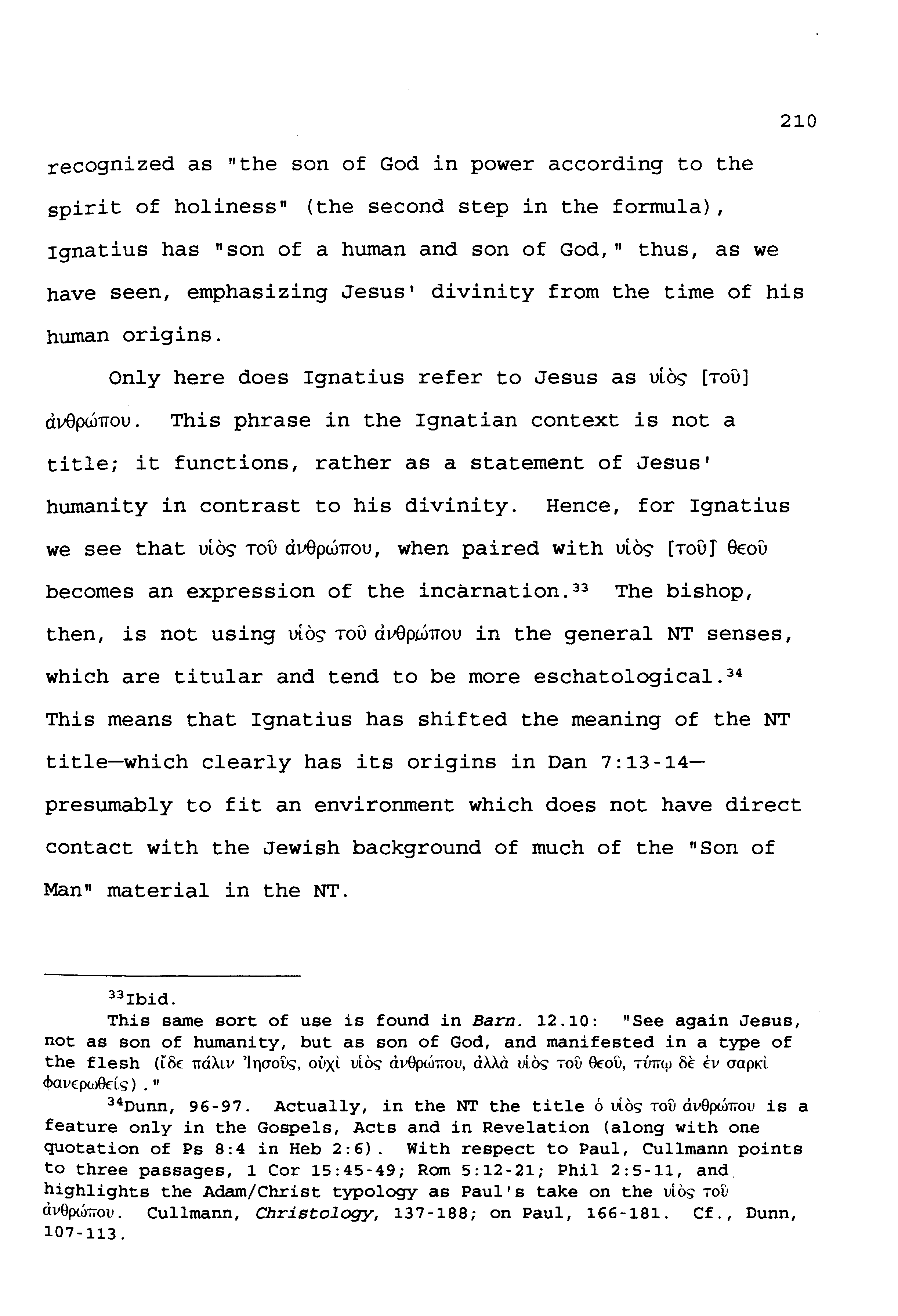
recognized as "the son of God in power according to the spirit of holiness" (the second step in the formula),
Ignatius has "son of a human and son of God," thus, as we have seen, emphasizing Jesus' divinity from the time of his human origins.
Only here does Ignatius refer to Jesus as u[os- [Tou] dv0pwnou.
This phrase in the Ignatian context is not a title; it functions, rather as a statement of Jesus' humanity in contrast to his divinity.
Hence, for Ignatius we see that u[osTou dvOpwnou, when paired with u[os- [TofJJ 9EOu becomes an expression of the incarnation. 33
The bishop, then, is not using u[osTou dvOpwnou in the general NT senses, which are titular and tend to be more eschatological. 34
This means that Ignatius has shifted the meaning of the NT title-which clearly has its origins in Dan 7:13-14presumably to fit an environment which does not have direct contact with the Jewish background of much of the "Son of Man" material in the NT.
33Ibid.
This same sort of use is found in Barn. 12.10:
"See again Jesus, not as son of humanity, but as son of God, and manifested in a type of the flesh (i'.OE rrci/.w 'ITJcrolis, ovxt vloscivepwrrov, ci/.A<l vlosTou 9Eou, Tum.µ 8E E:v aapKL
4>avEpw9E(s-) . "
34Dunn, 96-97.
Actually, in the NT the title 6 vtosTou civ9pwrrov is a feature only in the Gospels, Acts and in Revelation (along with one quotation of Ps 8:4 in Heb 2:6).
With respect to Paul, Cullmann points to three passages, 1 Cor 15:45-49; Rom 5:12-21; Phil 2:5-11, and. highlights the Adam/Christ typology as Paul's take on the viosTou civ9pwrrov.
Cullmann, Christology, 137-188; on Paul, 166-181.
Cf., Dunn, 107-113.
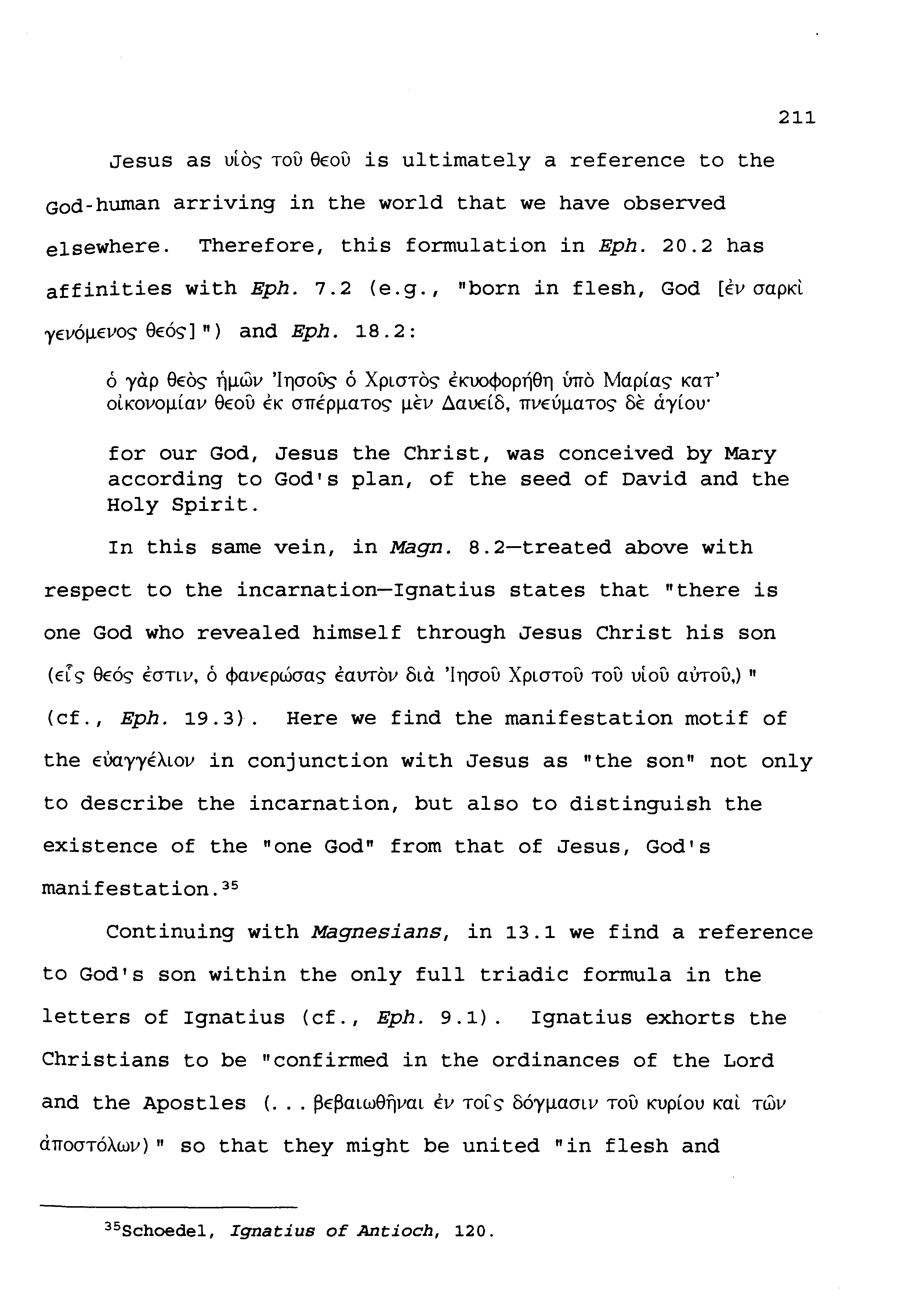
Jesus as ULOS' TOU ernu is ultimately a reference to the God-human arriving in the world that we have observed elsewhere.
Therefore, this formulation in Eph. 20.2 has affinities with Eph. 7.2 (e.g., "born in flesh, God [EvaapKL yEv6µEvoc; 9E6c;] " ) and Eph . 18 . 2 :
6 yap 9Eoc; -rlµwv 'IT}aoUc; 6 XpLaToc; EKUO<f>optj9T} &rro Map(ac; KaT'
OlKOVoµ(av ernu EK CJTTEpµaTOS' µ€v ~au€L8, TTVEUµaTOS' OE ciy(ou· for our God, Jesus the Christ, was conceived by Mary according to God's plan, of the seed of David and the Holy Spirit.
In this same vein, in Magn. 8.2-treated above with respect to the incarnation-Ignatius states that "there is one God who revealed himself through Jesus Christ his son
(de; 9E6c; ECJTLV, 6 <f>avEpwaac; EaUTov faa 'IT}aou XpLaTou Tou u[ou m'.rrou,) 11
(cf., Eph. 19.3).
Here we find the manifestation motif of the EooyyEA.Lov in conjunction with Jesus as "the son" not only to describe the incarnation, but also to distinguish the existence of the "one God" from that of Jesus, God's manifestation. 35
Continuing with Magnesians, in 13.1 we find a reference to God's son within the only full triadic formula in the letters of Ignatius (cf., Eph. 9.1).
Ignatius exhorts the Christians to be "confirmed in the ordinances of the Lord and the Apostles ( ... ~E~mw9flvm EV Tol'c; 86yµaCJLv Tou KUp(ou KaL TWV d.noaT6A.wv)" so that they might be united "in flesh and 35Schoedel, Ignatius of Antioch, 120.
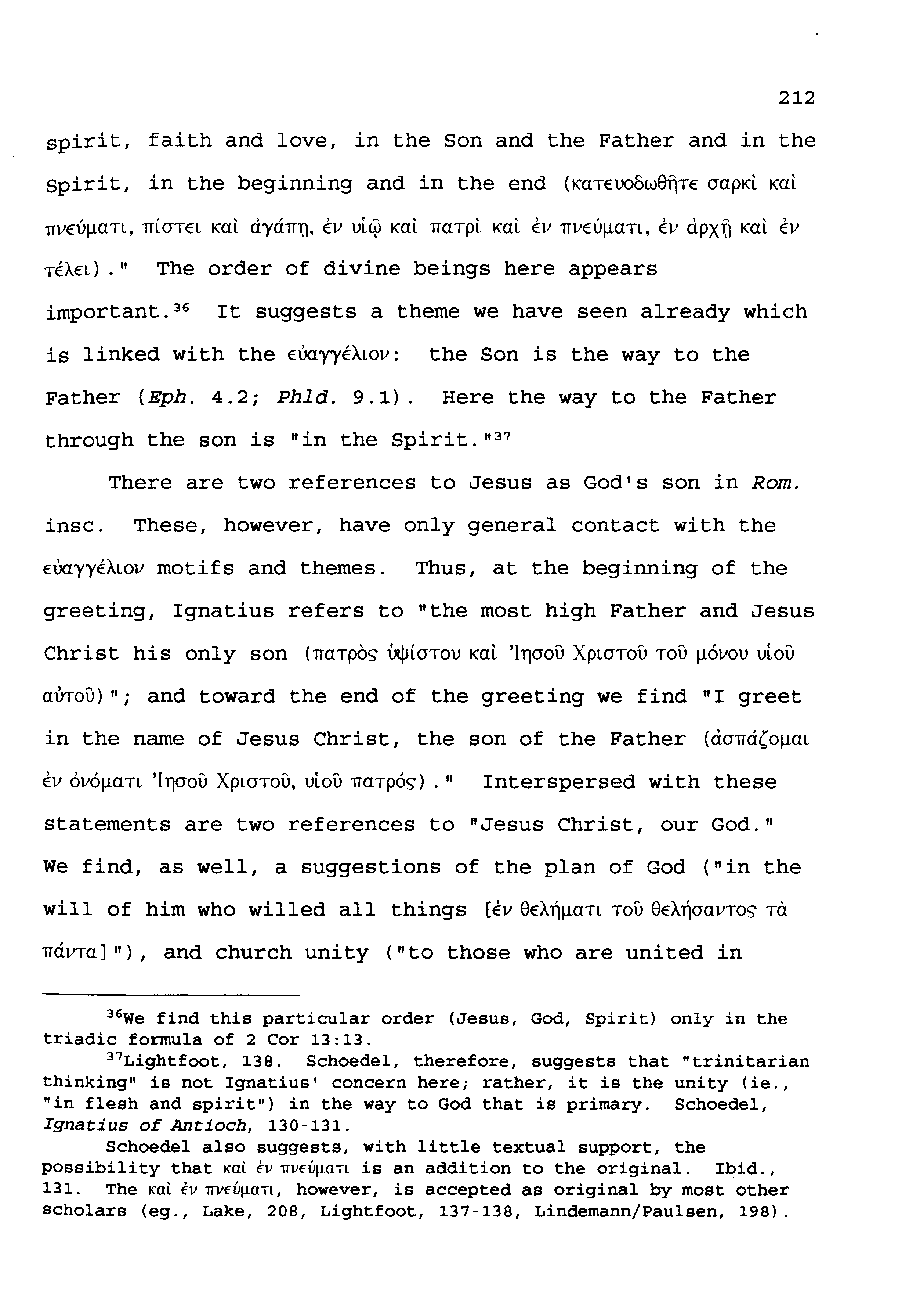
spirit, faith and love, in the Son and the Father and in the spirit, in the beginning and in the end ( KaTEuoow9f]TE aapKt Kat nvEuµaTL, TTLGTEL Kat dyciTTlJ, EV ut4> Kat TTaTpt Kat Ev TTVEuµaTL, Ev dpxiJ Kat Ev
TEA.EL) . "
The order of di vine beings here appears important. 36
It suggests a theme we have seen already which is 1 inked with the Eooyy€A.tov : the Son is the way to the Father (Eph. 4.2; Phld. 9.1).
Here the way to the Father through the son is "in the Spirit. 1137
There are two references to Jesus as God's son in Rom. insc.
These, however, have only general contact with the Eooyy€A.tov motifs and themes.
Thus, at the beginning of the greeting, Ignatius refers to "the most high Father and Jesus
Christ his only son (TTaTposixµ(aTou KaL Tr1aou XptaTou Tou µ6vou utou m'.rrou)"; and toward the end of the greeting we find "I greet in the name of Jesus Christ, the son of the Father (daTTci(oµaL
Ev 6v6µaTL 'I11aou XpLaTou, utou TTaTpos-) . "
Interspersed with these statements are two references to "Jesus Christ, our God."
We find, as well, a suggestions of the plan of God ("in the will of him who willed all things [Ev 9EA.tjµan Tou 9EA.tjaavTosTa
TTciVTa] ") , and church unity ("to those who are united in 36We find this particular order (Jesus, God, Spirit) only in the triadic formula of 2 Cor 13:13.
37Lightfoot, 138.
Schoedel, therefore, suggests that "trinitarian thinking" is not Ignatius' concern here; rather, it is the unity (ie.,
"in flesh and spirit") in the way to God that is primary.
Schoedel, Ignatius of Antioch, 130-131.
Schoedel also suggests, with little textual support, the possibility that Kai EV TrvEvµaTL is an addition to the original.
Ibid., 131.
The Kai EV TrVEvµan, however, is accepted as original by most other scholars (eg., Lake, 208, Lightfoot, 137-138, Lindemann/Paulsen, 198).
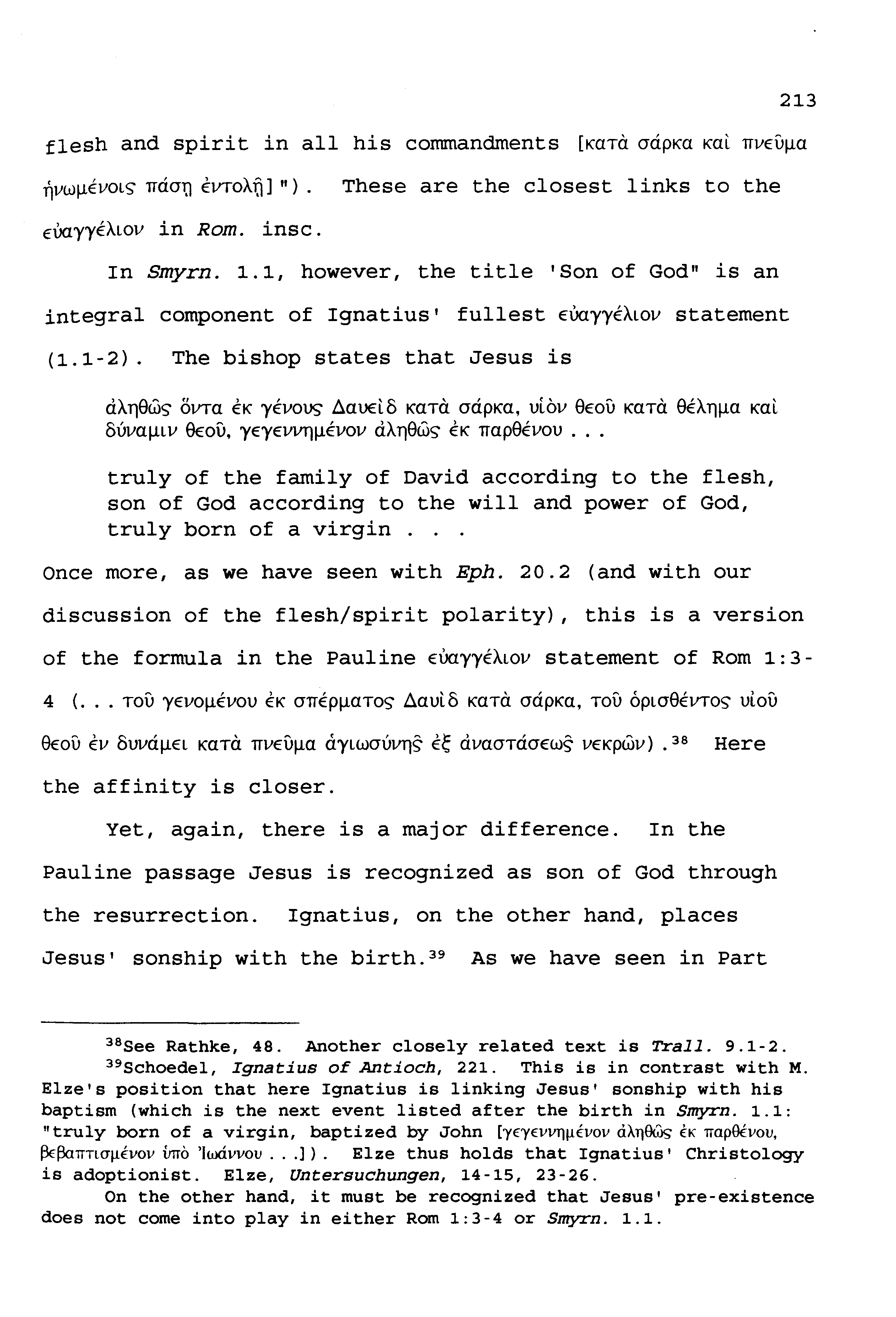
flesh and spirit in all his commandments [KaTa acipKa KaL TTVEuµa ~vwµEvmsTTcIGlJ EVTOAlJ] ") .
These are the closest links to the EUa'YYEALOV in Rom. insc.
In Smyrn. 1.1, however, the title 'Son of God" is an integral component of Ignatius' fullest EooyyEALov statement
(1.1-2).
The bishop states that Jesus is dA.ri9wsoVTa EK yEvousLiaUEi B Ka Ta acipKa, u[ov 9rnu Ka Ta 9EAYJµa Kai ouvaµLV 9Eou, YEYEVVTJµEVOV dA.ri9wsEK TTap9EVOU ... truly of the family of David according to the flesh, son of God according to the will and power of God, truly born of a virgin . once more, as we have seen with Eph. 20.2 (and with our discussion of the flesh/spirit polarity), this is a version of the formula in the Pauline EooyyEALOv statement of Rom 1: 3 - 4 ( ... Tou yEvoµEvou EK aTT€pµaTosLiauio KaTa acipKa, Tou 6pLa9€VTosutou
9rnu EV ouvciµEL Ka Tel TTVEUµa d.yLWGUVTJS' Ee dvaaTciGEWS' VEKpwv) • 38 Here the affinity is closer.
Yet, again, there is a major difference.
In the Pauline passage Jesus is recognized as son of God through the resurrection.
Ignatius, on the other hand, places Jesus• sonship with the birth. 39
As we have seen in Part 38See Rathke, 48.
Another closely related text is Trall. 9.1-2.
39Schoedel, Ignatius of Antioch, 221.
This is in contrast with M.
Elze's position that here Ignatius is linking Jesus' sonship with his baptism (which is the next event listed after the birth in Smyrn. 1.1:
"truly born of a virgin, baptized by John [yeyEVVTJµEvov ciA.TJfMsfr TiapeEvov, f3El3cmnaµ€vov imo 'lwcivvov ... ] ) .
Elze thus holds that Ignatius' Christology is adoptionist.
Elze, Untersuchungen, 14-15, 23-26.
On the other hand, it must be recognized that Jesus' pre-existence does not come into play in either Rom 1:3-4 or Smyrn. 1.1.
one, the birth of Jesus itself is a statement of the napoua(a in the EooyyD .. Lov (ie., Phld. 9 .1).
Thus, again, the title 'Son of God' for Ignatius is an assertion of the napoua(a, which is the beginning of the gospel events.
Moreover, the incarnation took place through the "will and power of God."
This is a different emphasis from the Pauline "in power according to the spirit of holiness."
Ignatius is emphasizing a favorite theme we have highlighted often: the purpose or will of God in history fulfilled in the person of Jesus (e.g., Eph. 3.2, 18.1; Rom. insc.).
Also, it is notable that both Ignatius and Paul refer to God's 8uvaµL~.
Jesus, born in the flesh as God's son, is the manifestation of God's power so that God's will may be fulfilled. 40
The phrase "according to the spirit of holiness" of the Pauline formula does not appear to interest
Ignatius (cf., Eph. 7.2, 18.2; Smyrn. 3.2).
Therefore, to conclude this discussion of the title 'Son of God• in Ignatius' letters, it is most clear that this is an expression of the incarnation, the earthly life of the God-human from his birth in the world and continuing in his union with his Father.
This identity as Godprimarily expressed through conjunction with 6 uto~ Tou dv9pwnou
(Eph. 20.2), and often through the flesh/spririt polarity40w. Grundmann, "owaµm, K.T.A.," TDNT II, 306.
Ignatius uses ouvaµLS in this way three other times:
In Magn. 3.1 and Smyrn. 13.1 it is the "power of God"; in Eph. 11.2, it is the "power of Jesus Christ."
is the foundation for the EuayyEALov:
God's plan is begun in the birth (the napouo(a) of God's son Jesus, and is fulfilled through the sal vif ic events of the EooyyEALov, the passion and resurrection.
Ignatius' emphasis on the incarnation in all of this is a departure from the NT.
Most clearly in this respect, we have observed that Ignatius has taken the tradition found in Rom 1:3-4 and expressed Paul's formula for the needs of his own situation.
THE SAVIOR
In the following pages, I will examine not only the specific Ignatian references to Jesus as Savior, but I will also broaden my treatment to consider the theme of salvation in general and how this theme is played out with reference to the EuayyEALov (i.e., Rom. 6 .1; Phld. 9. 2; Smyrn. s. 3) .
First, then, I will begin with the four Ignatian references to Jesus as "Savior (6 owTI]p) . "
Second, I will consider the way the bishop speaks of salvation (~ OWTT}p(a) through the phrase "for us (fa' ~µcis /imE:p ~µwv) , " and through the more general themes centered on "life" and "resurrection."
As always, Ignatius' EooyyE'ALov is our watchword.
As in the NT, with respect to Jesus as "Savior," one is irrunediately struck by the relatively few instances in which Ignatius directly refers to Jesus with this title (i.e.,
Eph. 1.1; Magn. insc.; Phld. 9.2; Smyrn. 7.1) . 41
Of these, two have a formulaic quality: blessings are received "in Christ Jesus, our Savior (Ev XpLCJTW 'I11aou T4> CJWTTJPL iiµwv)" (Eph.
1.1; Magn. insc.).
Aside from being part of opening greetings, this usage tells us little else.
Other references to Jesus the Savior, though, tell us more.
In one of our EUa)')'EALov-defining passages, Phld. 9. 2, Ignatius states Eea(pETov OE TL EXEL To EooyyEALov, Tiiv napoua(av Tou awTfjpo<;, KUp(ou iiµwv 'I11aou XpLaTou, To nci0o<; auTou, Kai TTJV dvciaTaaw. oi yap dyaTITJTOi npo<f>fjTm KaTtjyyELA.av ELS' aiJTov· To oE: EUa)')'EALov dmipnaµci
ECJTL v d<f>Oapa(a<;.
But the gospel has something remarkable, the coming of the Savior, our lord Jesus Christ, his passion and resurrection.
For the beloved Prophets directed their announcement toward him; but the gospel is the completion of inunortality.
In this passage-centered on the advent, passion and resurrection of the awTtjp-Ignatius defines the EOO)')'EALOV as 41Regarding the NT, Cullmann explains the relative absence of the title awTtjp for Jesus by appealing to the much greater importance of the designation Kvpws as the central name in all early expressions of faith in Jesus.
Cullmann, Christology, 238.
It is not until the Pastoral Epistles (Titus 1:3,4, 2:10, 13, 3:4,6; 1 Tim 1:1, 2:3, 4:10; 2 Tim
1:10) and 2 Peter (1:1, 11, 2:20, 3:2,18) that the title awTtjp comes into more common usage.
In the Pastorals it is used in reference to God (e.g., Titus 1:1; 1 Tim 2:3) as well as to Jesus; in 2 Peter it always refers to Jesus.
Thus, by the period of 2 Peter, the title was established as a common title for Jesus. w. Foerster, "at\i(w, K.T.A.," TDNT
VII, 1018.
Ignatius is thirty-two times. titles juxtaposed lord Jesus Christ no different.
He refers to Jesus as Kvpws some In the EooyyEALov passage of Phld. 9. 2 we find both as if in explanation:
"the coming of the savior, our ( ... Tilv Tiapooofov Tov awTflpos, Kvp(ou ~µCw 'Iriaov XpLITTov ... ) .
"the completion of irrunortality."
Thus, the announcement given in advance by the OT Prophets is completed through the events of the Savior's life.
The completed announcement is the Eooyy€A.Lov message of irrunortality (d<f>0apa(a) .
Ignatius mentions d<f>0apa(a several times (Eph. 17.1; Magn. 6.2.; Trall. 11.2; Rom. 7.3; Pol. 2.3).
We will soon observe that this irrunortality is the key to Ignatius' concept of the salvation accomplished by Christ.
Most significant at this point, though, is the expression at Pol. 2.3.
Ignatius admonishes Polycarp to remember that in everything "the prize is irrunortality and eternal life about which you also are persuaded (TO 0€µa d<f>0apa(a Kai Cwii aLWVLOS', lTEpi iisKai au lTElTELOaL ) . "
However, there is another less apparent facet to Ignatius• idea of salvation.
In the •confessing' passage of Smyrn. 7.1, Ignatius complains that the schismatics
EuxapwT(asKai npoaEUxflsdn€xoVTm. faa To µTi 6µoA.oyEL'v Tiiv EuxapLaT(av acipKa dvm Tou awTfjpos- ~µwv 'IT)aousXpLaTou Tiiv unEp Twv aµapTLWV ~µwv naeoooav, ~v TlJ XPT)OTOTT)TL 6 lTaTiiP ~'YELPEV. avoid the eucharist and prayer, because they do not confess that the eucharist is the flesh of our Savior
Jesus Christ [flesh] which suffered for our sins, which the Father raised by his goodness.
The flesh of Jesus the Savior "suffered for our sins" and was raised by God.
This is one of only two direct references to sin (~ dµapT(a) in the Ignatian letters (cf.,
Eph. 14.2) . 42
Ignatius, it seems, is dependent here on the traditional formulation represented by Paul's EooyyEALov statement in 1 Car 15:3:
"that Christ died for our sins .
( oTL XpLOTOS' dn€9avEv tmEp Twv dµapnwv ~µwv ... ) . "
The apparent emphasis on atonement for human sin is the issue here.
Ignatius, in his own use of this formula, suggests that the suffering of the Savior was indeed to atone for human sin.
Yet, with only this single reference, it seems evident that atonement for sin is not at all a significant feature in Ignatius' concept of the salvation accomplished by Jesus. 43
Ignatius' idea of salvation through Jesus appears to be more broadly governed by the theme of immortality. 44
Therefore, it is not as if atonement for sin is absent from Ignatius' Christological world; rather, this concept seems to be folded into-as a secondary component of-the more broadly expressed
'salvation as immortality.'
In this regard, one notices that in lieu of unEp Twv dµapnwv ~µwv Ignatius most frequently employs two related expressions for Jesus' work of salvation (the first of which is found in the NT) :
Jesus suffered "for us" (unEp ~µwv:
42There is also an indirect reference to sin in Phld. 8.1:
"The Lord then forgives all who repent, if their repentance leads to the unity of God (1Tucnv ovv µETavoovcnv ci<j>(n 6 KVpLos, fov µETavotjcrwcnv ds h6T11rn
9rnu) . "
This, however is more specifically a reference to the activity of the schismatics.
43Cf., Cullmann, Christology, 243.
44Schoedel, Ignatius of Antioch, 182, n. 3.
Rom. 6. la; Smyrn. 1. 2) 45 or "for our sake" (fa' ~µas-:
Trall.
2.1; Rom. 6.lb; Pol. 3.2).
The fullest example of this usage is found in Rom. 6.1.
In his plea to the Roman Christians to be allowed to suffer and undergo martyrdom,
Ignatius states: "I seek him who died for us; I desire him who rose for our sake (EKEL'vov (11Tw, Tov mrEp ~µwv dno0av6VTa· EKEfvov
0€A.w, Tov fa' i)µosdvacrTciVTa) . " 46
Ignatius next states that the result of his seeking will be a birth to new life:
"the pains of birth are upon me (6 OE TOKETOS' µOL ElTLKELTm) " (Rom.
6.1).
The Ignatian salvation "for us," therefore, is not concentrated on atonement from sin; rather, it involves the gaining of 11 irmnortality" (e.g. Eph. 17.1; Smyrn. 2.3) or "eternal life" (e.g. Eph. 18.1, 19.3; Magn. 1.1; Pol. 2.3) through the salvific deeds of the Savior in the Eooyy€A.wv.
In Trall. 2.1, another "for our sake" passage, this salvation to eternal life comes to the fore:
Ignatius tells the Trallians, <f>a(vEcr0€ µm ou KaTa dv0pwnov (wVTES', dAA.a KaTa 'I11crouv XpLcrTov Tov
8L' ~µosdno0av6VTa, i' va mcrTEOOaVTES' ELsTOV 0civaTov auTou TO dno0avEL'v EK<f>UrllTE. it is clear to me that you are living not according to humanity but according to Jesus Christ who died for our
45cf., Rom 5:8, 14:15; 2 Cor 5:14; 1 Cor 15:3.
Ignatius speaks of the resurection "for our sake (Bt'i)µCis)" only once, in Rom. 6.lb.
The other citations (Trall. 2.1; Rom. 6.la; Smyrn.
1.2; Pol. 3.2) refer only to Jesus' suffering or death.
46Cf., Pol. Phil. 9.2:
"For [the Apostles] did not love this world but him who died for us and who was raised by God for our .sake (ou yap TOV vw i]ycim1crav mwva, ciA..Acl TOV mrE:p i)µwv ci'rro9av6vrn Kai 8L' i)µCis WO TOU 9rnv civacncivTa) . "
sake, that by believing in his death you may escape death.
Here, within the context of an exhortation to subjection to the bishop, the salvific death of Jesus is presented as the source of eternal life.
Belief in Jesus' death "for our sake" indicates one is "living according to Jesus Christ" and thus escaping death.
The "for our sake" passages in Smyrn. 1.2 and 2.1 are, therefore, best seen as statements of Jesus' salvific passion which leads to eternal life for the believer.
So, within the expanded faith statement of Smyrn. 1.2, Ignatius says that Jesus was "truly nailed in the flesh [to the cross] for our sake (dA:r10ws- ... Ka011A.wµ€vov &rr€p ~µwv E:v crapK() "; and Smyrn. 2.1 sums up the entire message with, "for he suffered all these things for us so that we might be saved
(Tafrra yap nciVTa €na0Ev BL' ~µas-, l'va crw0wµEv·) . "
In his suffering Jesus is "true life (TodA.110Lvov~µwvCflv)" (Smyrn. 4.1) for believers.
Finally, in Pol. 3.2, within an exhortation to perseverance in correct belief, Ignatius provides a series of Christological antitheses with "for our sake" as the central feature:
TOUs KmpoUsKaTaµciv0avE.
Tov &rr€p KaLpov npocro6Ka, TOV axpovov.
Tov dopaTov, Tov BL' ~µas6paT6v Tov dtl;11A.ci<f>11Tov, Tov dna0fl,
Tov BL' ~µas1Ta8TJT6v, Tov KaTa TiciVTa TpoTiov fa' ~µasimoµE(vaVTa.
Observe the times.
Look for him who is above timenontemporal, invisible, for our sakes visible, intangible, impassable, for our sakes passible, one who endured in every way for our sakes. 47
Jesus, who has the supernatural attributes of God, endured incarnation in the world "for our sake."
Ignatius presents Jesus' endurance of the incarnation events to Polycarp as the model of perseverance.
Indeed, we are not far from the Tiapooo(a ("invisible, for our sakes visible") and Tia86s- (impassable, for our sakes passible") motifs of the EooyyEALOV.
Jesus' coming into the world and his passion were for the salvation of those who believe.
While neither atonement nor immortality themes are immediately evident here, we have already observed the phrase in the passage just preceding 3.1-2: in endurance "the prize is immortality and eternal life about which you also are persuaded (TO 8Eµa d<f>8apa(a KaL (w'fi ULWVLOS', 1TEpl ~S' KUL au 1TE1TELCJULJ "
(Pol. 2. 3) .
To conclude this discussion of the Ignatian themes surrounding the title "Christ Jesus, our Savior," we may briefly highlight other Ignatian expressions of the 47Translation, Schoedel, Ignatius of Antioch, 266.
salvation gained through the events of the EooyyEALov, but in which "savior" or "salvation" are not directly mentioned. 48 so, turning again to the star-hymn, we find the salvation accomplished by Jesus suggested by the summary passage (Eph.
19. 3) :
... 9Eou dv9pum(vws- <f>avEpouµEvou ELS' KaLVOT'flTa di"O(ou (wfis-· dpxiiv OE E:A.ciµ~avEv To TTapa 9E~ dTT'flpTtcrµEvov. E:v9Ev Ta TTciVTa cruvEKLVEL To faa
TO µEAETcrcr9m eavciTOU KOTclAOOLV.
. God being revealed as human to bring newness of eternal life, and what had been prepared by God had its beginning; hence all things were disturbed because the destruction of death was being worked out.
The destruction of death (cf., 1 Cor 15:26) through the TTapooo(a of God in Jesus brings about the "newness of eternal life" in the plan of God.
Lesser references to the eternal life gained through Jesus the Savior are found in such expressions as Magn. 1.1 where Ignatius prays that in the churches "there might be a union of the flesh and spirit of Jesus Christ, our everlasting life .
( E:v a[ sEvwaw Euxoµm crapKosKaL TTVEuµaTos- 'I11crou XpLaTou, Tou 8ta TTavTos- ~µwv (fiv . .. ) . "
Likewise, Ignatius, referring to the repentence of schismatics, states in Smyrn.
4.1:
"Jesus Christ, our true life, has power over this ( TouTou oE EXEL E:eooo(av 'I 1100\Js' XptcrTos-, To dA.'fl9tvov ~µwv (fiv) . 11
Finally, we find in Smyrn. 5.3 that the schismatics are to 48Related to the complex of 'salvation' language is Ignatius' fairly extensive use of EmTvxavw, most often in the phrase "to attain
God" (e.g., Eph. 12. 2; Magn. 14; Rom. 1. 2; Smyrn. 11.1) .
be shunned "until they repent concerning the passion, which is our resurrection (µEXPLS' ou µETavoi)owoLv ELS' To mieoS', o EOTLV iJµwv dvcioTaOLS') . "49
Also directly related to Ignatius' theology of salvation is the complex of themes which refer to the resurrection of Christ as the image of the resurrection of the believer.
A prime example of this is the conclusion of the credal summary in Trall. 9.2:
... OS' Kat dA.riewS' iJyEp0ri dTio vEKpwv, E:yE(paVToS' m'rrov Tou 1TaTpOS' m'rrou, KaTa To 6µo(wµa OS' Kai iJµCiS' To\Js' moTEooVTaS' m'.m~ OITTWS'
E:yEpEf 6 Tian1p m'rrou E:v XptoT(i) 'Irioou, ou xwpiS' To dA.riewov (fiv ouK EXOµEv.
[Jesus] who was also truly raised from the dead, his Father having raised him, in whose likeness his
Father will also so raise us up who believe in him through Jesus Christ, apart from whom we do not have true life. 50
Here Ignatius is working with the Pauline fundamental that through the resurrection of Jesus, God has provided those who believe in Jesus resurrection to new life.
Thus, we find in 1 Cor 6:14 the succinct statement, "and God raised the Lord and will also raise us by his power (6 8E: 9EOS' Kai Tov
KUpLOV ll'YElpEV Kai iJµCiS' e:eEyEpEL Bla TllS' ouvciµEWS' m'rrou) . II This is a short allusion to what occurs in much fuller form later, in 1 Car 15:12-22. 51
For Ignatius, as for Paul, the 49There are, as well, medical expressions which refer to eternal life (Eph. 7.2, 20.2).
These will be treated further along when I turn to the Christology of the "one physician" (Eph. 7.2).
50Translation, Schoedel, Ignatius of Antioch, 152.
51See also 2 Cor 4:14, 1 Thess 4:14; cf., Pol. Phil. 2.2.
resurrection of Jesus is the image of the resurrection of the believer ( Trall. 9. 2:
KaTa To 6µo(wµa ... ) ; through that resurrection, the believer receives "true life."
Finally, we have Magn. 5.2 where, in response to unbelievers, Ignatius sets up an opposition between the "imprint (~ xapaKTtjp)" of this world and the "imprint of God the Father (OL OE lTLCJTOL EV dycilTTJ xapaKTftpa 0EOU lTaTposfaa 'lT)CJOU
XpwTou) . "
To clinch his point he states, "unless we freely choose to die in [Jesus'] passion, his life is not in us (fa' ou Eav µ'fl aU0mpETWSEXWµEv TO dTio0avEL'v ELSTO m'.rrou Tici0os-, TO Cftv m'.rrou ouK ECJTLV EV ~µL'v) . "
Paul, who obviously influences Ignatius here, fully develops this theme in Rom 6:5-11.
While Ignatius' concern is not baptism-as is Paul's in Romans-but Christian life in the world, the message is the same: being united with Jesus in his death assures union with his resurrection.
Therefore, for Ignatius, the salvation accomplished by Jesus through the historical events of the EooyyD .. Lov is a salvation which brings "eternal life," "immortality,"
"resurrection."
While •salvation by Jesus' as atonement for human sin is not entirely absent from Ignatius' concept of this salvation (i.e., Smyrn. 7.1), it is clear that such atonement is not the dominant feature.
Ignatius, rather, emphasizes immortality and includes atonement within the larger theme.
This salvation as eternal life is the ultimate message of the EooyyD .. Lov.
3 .
THE COMMON HOPE
Another Ignatian title for Jesus is "the common hope"
(Eph. 21.2; Phld. 11.2).
This title, as well as other theological uses of "hope," are centered on the salvation we discussed in the previous section.
Ignatius speaks of "hope (E:A.n(s-)" in a theological sense nine times (Eph. 1.2, 5.2, 21.2; Magn. 7.1; Trall. insc.,
2.2; Phld. 5.2, 11.2; Smyrn. 10.2).
As we will see in discussing these citations, this concept for Ignatius is often in line with much of early Christian expression.
Thus, for example, we have Paul's assertion in Rom 8:24:
TiJ yap E:A.nlBL E:aweriµEv· E:A.nts8E ~A.EnoµEvri ouK €aTw E:A.n(s-· 8 yap ~AElTEL TLS' E:A.n((EL; EL 8E 8 ou ~AEnoµEv E:A.n((oµEv, BL' imoµovf]sdnEK8EXOµE0a.
For in hope we were saved.
Now hope that is seen in not hope.
For who hopes for what is seen?
But if we hope for what we do not see, we wait for it with patience.
Along with Col 1:5, 23, which I will review further along, we have as well in 1 Pet 1:3, "[God] has given us a new birth into a living hope through the resurrection of Jesus
Christ from the dead ( [6 0Eos-] 6 dvayEvvtjaasi}µasEisE:>..nLBa (waav 8L' dvaaTciaEws- 'Iriaou XpwTou EK VEKpwv) . "
Christian hope is
centered on the salvation accomplished by Jesus in the events encompassed by the gospel. 52
In this regard, we may turn to Ignatius.
The exposition in Phld. 5.2 bears repeating:
KaL ToUsnpo<f>tjTas8€ dyanwµEv, 8La To KaL m'.rroUsELS' To EooyyEALov KaTTl'Y'YEAKEVm KaL ELS' m'.rrov EA1TL(Ew KaL m'.rrov dvaµ€vELV, Ev 4) Kat maTEOOaVTES' Eawe11aav, Ev E:v6TT}TL 'I11aou XpLaTou oVTES' d~LaycinT}TOL
KaL d~Lo0auµaaTOL nyLOL, U1TO 'I11aou XpLOTOU µEµapTUpT}µEVOL Kat auVT}pL0µ11µ€vm EV T4> EooyyEALc.p TilsKOLvflS' EAnlBos-.
And we also love the prophets because they also made their proclamation with the gospel in view and set their hope on him and waited for him, in whom by believing they were also saved, being in the unity of Jesus Christ saints worthy of love and worthy of admiration, attested by Jesus Christ and numbered together in the gospel of the common hope. 53
Ignatius is presenting the OT Prophets as the model of Christian hope.
We have seen in Magn. 8.2 that the Prophets 11 lived according to Jesus Christ (ol yap 0EL6TaToL npo<f>f)Tm KaTa
XpLaTov 'I11aouv E(11aav). 11
In Magn. 9 .1, the Prophets "who lived in ancient ways came to a new hope (ol EV naA.moL'snpciyµamv dvaaTpa<f>EVTES' EtS' Kmv6TT}Ta EAnlBos- ~A.eov) • 11
Also, they were disciples of Jesus "to whom they looked forward as their teacher (ws8L8ciaKaA.ov m'.rrov npoaE86Kwv) " and Jesus, upon his napoua(a in the world, raised them from the dead (Magn. 9.2).
The Prophets' proclamation, therefore, pointed in advance to the salvific message of the Eooyy€A.Lov.
Their hopeful waiting 52R. Bultmann,
11EA1TtS', K.T.A.," TDNT II, 532.
53Translation, Schoedel, Ignatius of Antioch, 200.
-expressed through their proclamation-was fulfilled only in the coming of Jesus and the salvation he brought:
"by believing [in Jesus] they were also saved" (Phld. 5.2) . 54
The Prophets are "numbered together in the gospel of the corrunon hope. "
This means that the Eooyy€A.Lov message of salvation unites the Prophets, as believers before Christ, 55 with believers of Ignatius' Christianity.
As I pointed out in Part One, when Ignatius refers to the Prophets, it is not as prophetic sacred texts; rather, the Prophets are figures of faith united with believers in history: 56 mrroS' wv Supa Tou naTp6S', 8L' ~S' Elcr€pxoVTm 'A~paaµ Kat 'IcraaK Kat
'laKw~ Kat o[ npo<f>f]Tm Kat dnooToA.m Kat ~ EKKATJGLq. nciVTa Toma ELS'
EVOTTJTa 0Eou.
[Jesus] is the door of the Father, through which enter Abraham and Isaac and Jacob and the Prophets and the Apostles and the Church, all these into the unity of God.
(Phld. 9.lb) The hope for salvation through Jesus in the Eooyy€A.Lov events unites believers past and present.
It is, thus, a common (KOL VOS') hope .
11Eooyy€A.wv Tf]sKOLvTJS' E:A.nlBoS', " therefore, serves as an Ignatian intramural phrase to refer to the salvation gained through the events of the gospel.
Thus, it is no surprise to find the term "Eooyy€A.Lov" in this phrase replaced by 54This waiting in hope, as we have seen, is a feature in Col 1:23.
See, as well, Heb 6:18-20, 10:23; 2 Clem. 11.5.
55Again, Phld. 5. 2:
EV EVOTTJTL 'ITJO'OV XpLOTOV OVTES aelG'YcliTTJTOL Kal aeL09avµaO'TOL G'YLOL, imo 'll]O'OV XptO'TOV µEµapTVpT]µEvot ...
56Koester, Synoptische Uberlieferung, 7.
n'Inao\Js' XpLCYTOS'."
Two of the Ignatian letters conclude with what is obviously a catch-phrase which refers to the central message of the EooyyEA.Lov:
"Farewell {in God our Father and} in Jesus Christ, our common hope (€ppwa0E {EV 0E0 naTpi Kai} EV
'Inaou XpLaT<{l, TlJ KOLvlJ EA.nl8L ~µwv.) (Eph. 21.2; Phld. 11.2) . 57
Jesus, who accomplished the salvific events of the EOOY'YEALOV, is understood as the common hope.
Hence, in his lengthy concluding remarks to the Magnesians, Ignatius exhorts the Christians to avoid "the fishhooks of vain doctrine (µT) EµlTECYELV ELS' Tel ayKLCYTpa TilS' KEvo&oetaS') I " dAA.a nEnA.npo<f>opfla0m Ev Ti;) yEvvtjaEL Kai T<{l mi0EL Kai T1J avaaTciaEL TlJ yEvoµEVTJ Ev KmpQ TTlS' ~yEµovtaS' Tiovr(ou TILAciTou· npax0Evra dA.110wS'
Kai ~E~a(wS' imo 'Inaou XptaTou, TTlS' EAnl8oS' ~µwv, ~S' EKTpanflvm µ118Evi uµwv YEVOL TO. but be convinced of the birth and passion and resurrection which took place in the time of the leadership of Pontius Pilate: things truly and certainly done by Jesus Christ, our hope, from which may none of you be led. (Magn. 11) 58 Here, the EooyyEA.tov motifs take center stage as the boundary of proper belief (cf., Trall. 9; Smyrn. 1).
The events of those motifs, "truly and certainly done," are encapsulated 57The material in braces in found only in the Phld. 11.2 version.
In 1 Tim 1:1 "Jesus our hope" is found in the opening greeting:
"Paul, an apostle of Christ Jesus by the conunand of God our Savior and of Christ Jesus our hope (TlavAos cim:XnoAos XpLaTou 'l11c10v KaT' E-mrny~v 9rnv awTf)pos ~~twv Kai XpLITTov 'l11aov Tfls E-Arrl8os ~µwv} . "
58We are reminded here of the Ignatian use of rrA11po<!>opE:w in conjuction with the EooyyE:Awv motifs in Magn. 8.2; Phld. insc; Smyrn. 1.1
(cf., Rom 4:21; Col 4:12; 1 Clem. 42:3}.
We have noted, as well, the close proximity-textual and rhetorical-of this passage to the AaAEfv 'l11aow XpLITTov passage of Magn.
10.3.
by the epithet "Jesus Christ, our hope."
It is the hope gained through the EOO'Y'YEALOV which Ignatius reminds the Magnesians not to be led from by the preachers of vain doctrine. 59
Instead, they are to be convinced (nA11po<f>op€w) of the EOO'Y'YEALov message enacted by Jesus.
This hope in Christ, therefore, defines proper belief.
Likewise, in Trall. insc., Ignatius presents the EUa'Y'YEALov motifs as the reason for the peace that the Church of Tralles enjoys:
II . . having peace in flesh and spirit by the passion of Jesus Christ, our hope, in resurrection through him ( ... ELPT}VEUOOOlJ EV oapKi Kai nvEuµaTL Tc.i) mieEL 'I11oou
XpLoTou, TT)<; EAn(oosilµwv Ev TiJ ELS' m'.rrov dvaoTcioEL) . "
The EOO'Y'YEALov motif of the nci9osis the foundation for the Trallians' peace. 60
Jesus is hope through the resurrection.
This suggests not only Jesus' own rising from the dead but also the salvation or "eternal life" (ie., Eph. 19.3) gained through his resurrection.
Unity in this hope has brought peace to the church and thereby makes it "elect and worthy of God (EKAEKTlJ KaL aewe€4>) II ( Trall. insc.) .
The theme of hope surf aces again shortly into Trallians.
In Trall. 2.1 Ignatius makes the statement we have considered elsewhere:
Jesus Christ who died for 59I.e., Magn. 10.3:
"It is absurd to preach Jesus Christ and to Judaize (<honov fonv, 'ITJcrovv XpLO'TOV >.a>.dv Kai toooai'.(nl.1 . "
60schoedel, Ignatius of Antioch, 137.
The use of the Eooyy€>.wv motifs with respect to church identity will be treated in the next chapter.
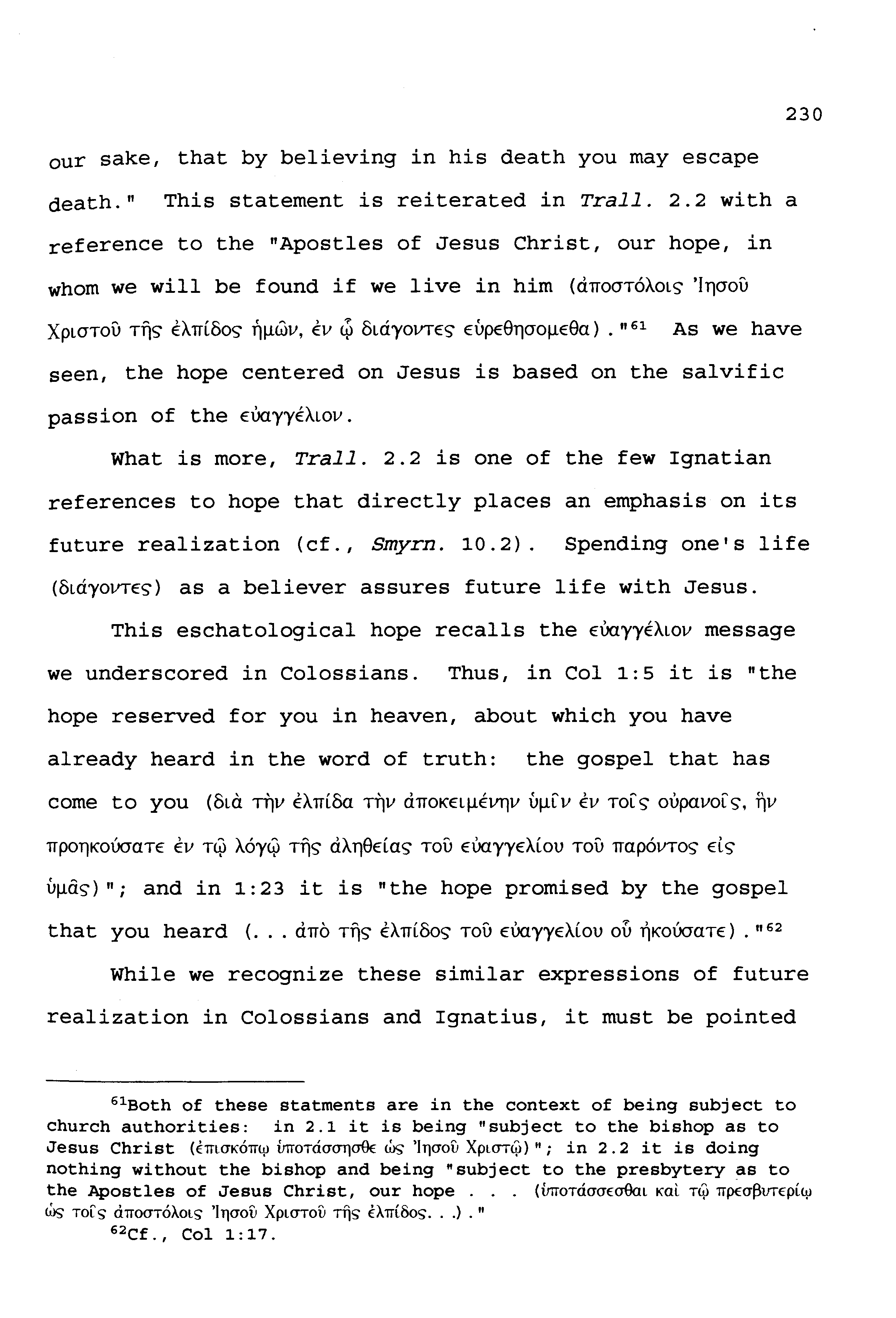
our sake, that by believing in his death you may escape death."
This statement is reiterated in Trall. 2.2 with a reference to the "Apostles of Jesus Christ, our hope, in whom we will be found if we live in him (dnooTOAOLS' 'Iriaou
XptaTou TTJS' EATTlBos- ~µwv, EV 4> 8LciyoVTES' EUpE8T)aoµE8a) . " 61
As we have seen, the hope centered on Jesus is based on the salvific passion of the Eooyy€A.tov.
What is more, Trall. 2.2 is one of the few Ignatian references to hope that directly places an emphasis on its future realization (cf., Smyrn. 10.2).
Spending one's life (otciyoVTES') as a believer assures future life with Jesus.
This eschatological hope recalls the EUa'Y'YEALov message we underscored in Colossians.
Thus, in Col 1:5 it is "the hope reserved for you in heaven, about which you have already heard in the word of truth: the gospel that has come to you (Ota Tfiv EATT(oa Tfiv clTTOKELµEVTjV uµl'v EV TOLS' oupaVOLS', ~v nporiKoooaTE Ev Tei> A6y4> TTJS' dA.riedasTou EooyyEA.(ou Tou napoVTOS' ELS' uµns-) "; and in 1:23 it is "the hope promised by the gospel that you heard ( ... cino TTJS' EATTLOOS' Tou EOO'Y'YEA(ou ou tjKoooaTE) . " 62
While we recognize these similar expressions of future realization in Colossians and Ignatius, it must be pointed
61Both of these statments are in the context of being subject to church authorities: in 2.1 it is being "subject to the bishop as to Jesus Christ (EmcrK61r41 mroTcicrOT]aGE Ws 'l11crou XptOT<{>) "; in 2. 2 it is doing nothing without the bishop and being "subject to the presbytery as to the Apostles of Jesus Christ, our hope . . . (mroTcicrcrEafuL Kai Tc{> 1rprn~vrEpt41
Ws To[ s ci1rocrT6A.ots 'I11crou XptOTou Tfjs tA.1rl8os ... ) . "
62cf . , Col 1 : 1 7 .
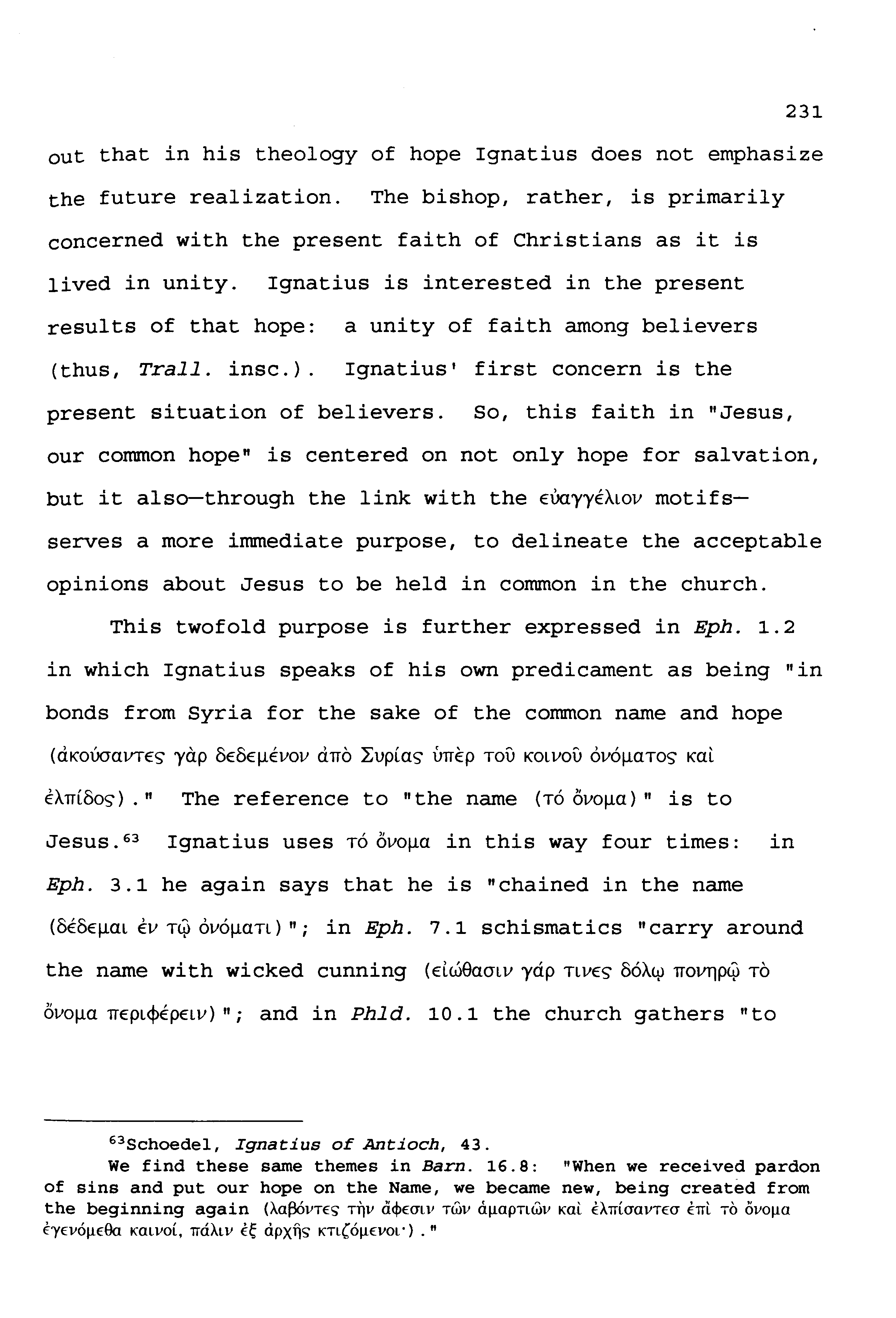
out that in his theology of hope Ignatius does not emphasize the future realization.
The bishop, rather, is primarily concerned with the present faith of Christians as it is lived in unity.
Ignatius is interested in the present results of that hope: a unity of faith among believers (thus, Trall. insc.).
Ignatius' first concern is the present situation of believers.
So, this faith in "Jesus, our common hope" is centered on not only hope for salvation, but it also-through the link with the EooyyE:A.wv motifsserves a more immediate purpose, to delineate the acceptable opinions about Jesus to be held in common in the church.
This twofold purpose is further expressed in Eph. 1.2 in which Ignatius speaks of his own predicament as being "in bonds from Syria for the sake of the common name and hope
(dKoooaVTES' yap OEOEµEvov dno ~up(asUirE:p TOU KOLVOU ovoµaTOS' Kai
EA1TLOOS') • "
The reference to II the name (TO ovoµa) " is to Jesus. 63
Ignatius uses TO ovoµa in this way four times: in Eph. 3.1 he again says that he is "chained in the name
(OEOEµm EV Ti;> ovoµaTL) "; in Eph. 7. 1 schismatics "carry around the name with wi eked cunning ( Etw6am v ycip TL VES' 8oA.c.p 1TOVTJP0 To ovoµa 1TEpL<f>EpELV) "; and in Phld. 10. 1 the church gathers "to 63Schoedel, Ignatius of Antioch, 43.
We find these same themes in Barn. 16.8:
"When we received pardon of sins and put our hope on the Name, we became new, being created from the beginning again (A.ar:x>vTES' TlJV ci<j>EO'LV TWV ciµapnwv Kai EArrt<JaVTE<J E1Tl TO ovoµa
E)'Ev6µdk1 Kat vol, nciA.tv E:~ cipxflsKTL(oµEvm ·) . "
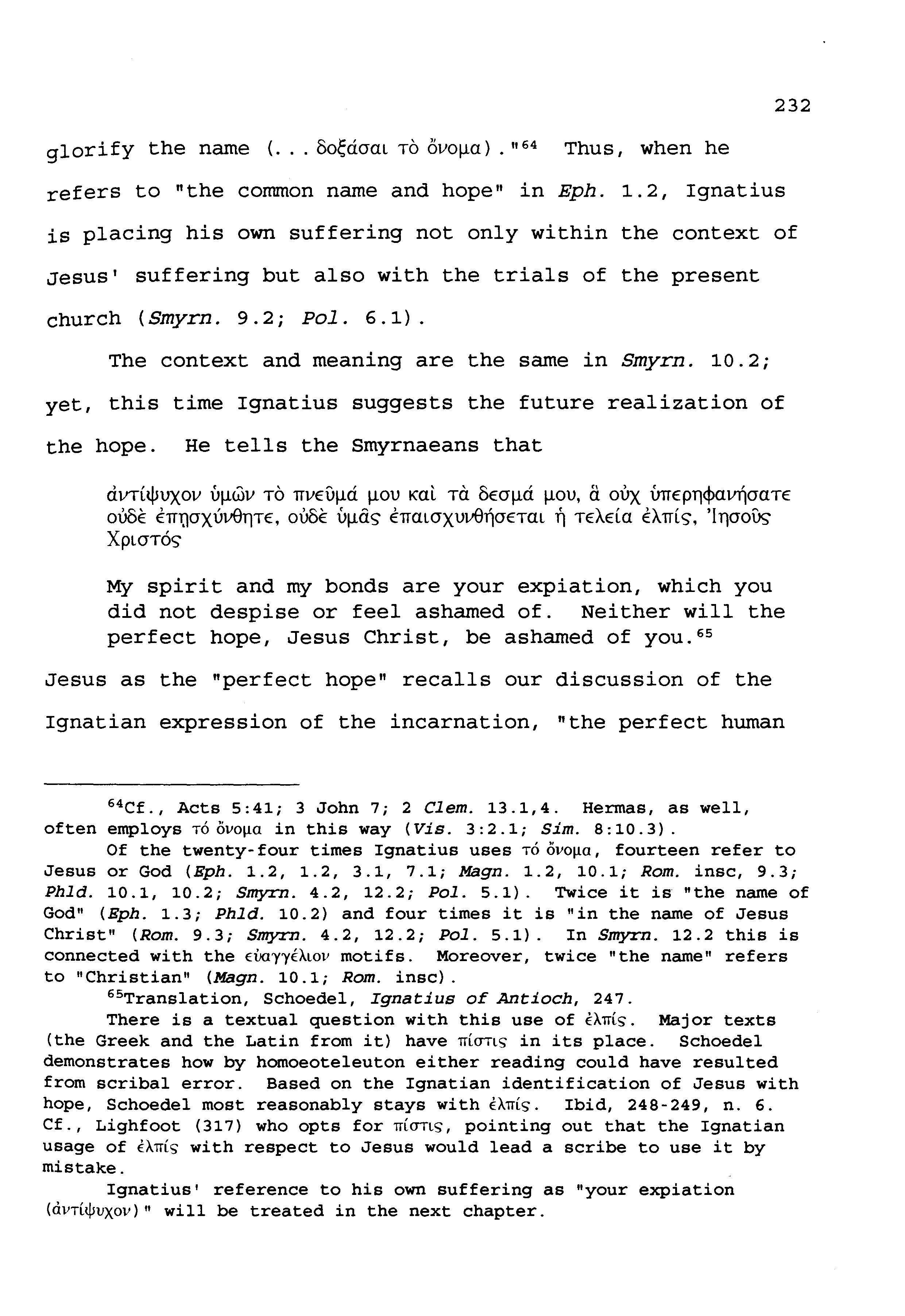
glorify the name ( ... 8o~ciom TO ovoµa) II 64 Thus, when he refers to "the conunon name and hope" in Eph. 1.2, Ignatius is placing his own suffering not only within the context of Jesus' suffering but also with the trials of the present church (Smyrn. 9.2; Pol. 6.1).
The context and meaning are the same in Smyrn. 10.2; yet, this time Ignatius suggests the future realization of the hope.
He tells the Smyrnaeans that dVT(t{Juxov uµwv TO lTVEuµci µou KaL Ta OEoµci µou, a oux UnEPTl<f>avfioaTE
OOOE E1TTJOXUv9TlTE, OOOE uµasE:nmoxuvetjoETaL ~ TEAELU EATILS', 'ITlOOf)sXpLOTOS'
My spirit and my bonds are your expiation, which you did not despise or feel ashamed of.
Neither will the perfect hope, Jesus Christ, be ashamed of you. 65
Jesus as the "perfect hope" recalls our discussion of the Ignatian expression of the incarnation, "the perfect human
64Cf., Acts 5:41; 3 John 7; 2 Clem. 13.1,4.
Hennas, as well, often employs TO ovoµa in this way (Vis. 3:2.1; Sim. 8:10.3).
Of the twenty-four times Ignatius uses Toovoµa, fourteen refer to Jesus or God (Eph. 1.2, 1.2, 3.1, 7.1; Magn. 1.2, 10.1; Rom. insc, 9.3;
Phld. 10.1, 10.2; Smyrn. 4.2, 12.2; Pol. 5.1).
Twice it is "the name of God" (Eph. 1.3; Phld. 10.2) and four times it is "in the name of Jesus
Christ" (Rom. 9.3; Smyrn. 4.2, 12.2; Pol. 5.1).
In Smyrn. 12.2 this is connected with the EooyyEAtov motifs.
Moreover, twice "the name" refers to "Christian" (Magn. 10 .1; Rom. insc) .
65Translation, Schoedel, Ignatius of Antioch, 247.
There is a textual question with this use of EATitS.
Major texts (the Greek and the Latin from it) have TILOTtS in its place.
Schoedel demonstrates how by homoeoteleuton either reading could have resulted from scribal error.
Based on the Ignatian identification of Jesus with hope, Schoedel most reasonably stays with EATI(s.
Ibid, 248-249, n. 6.
Cf., Lighfoot (317) who opts for TILOTLS', pointing out that the Ignatian usage of EATILS' with respect to Jesus would lead a scribe to use it by mistake.
Ignatius' reference to his own suffering as "your expiation (civT[~vxov)" will be treated in the next chapter.
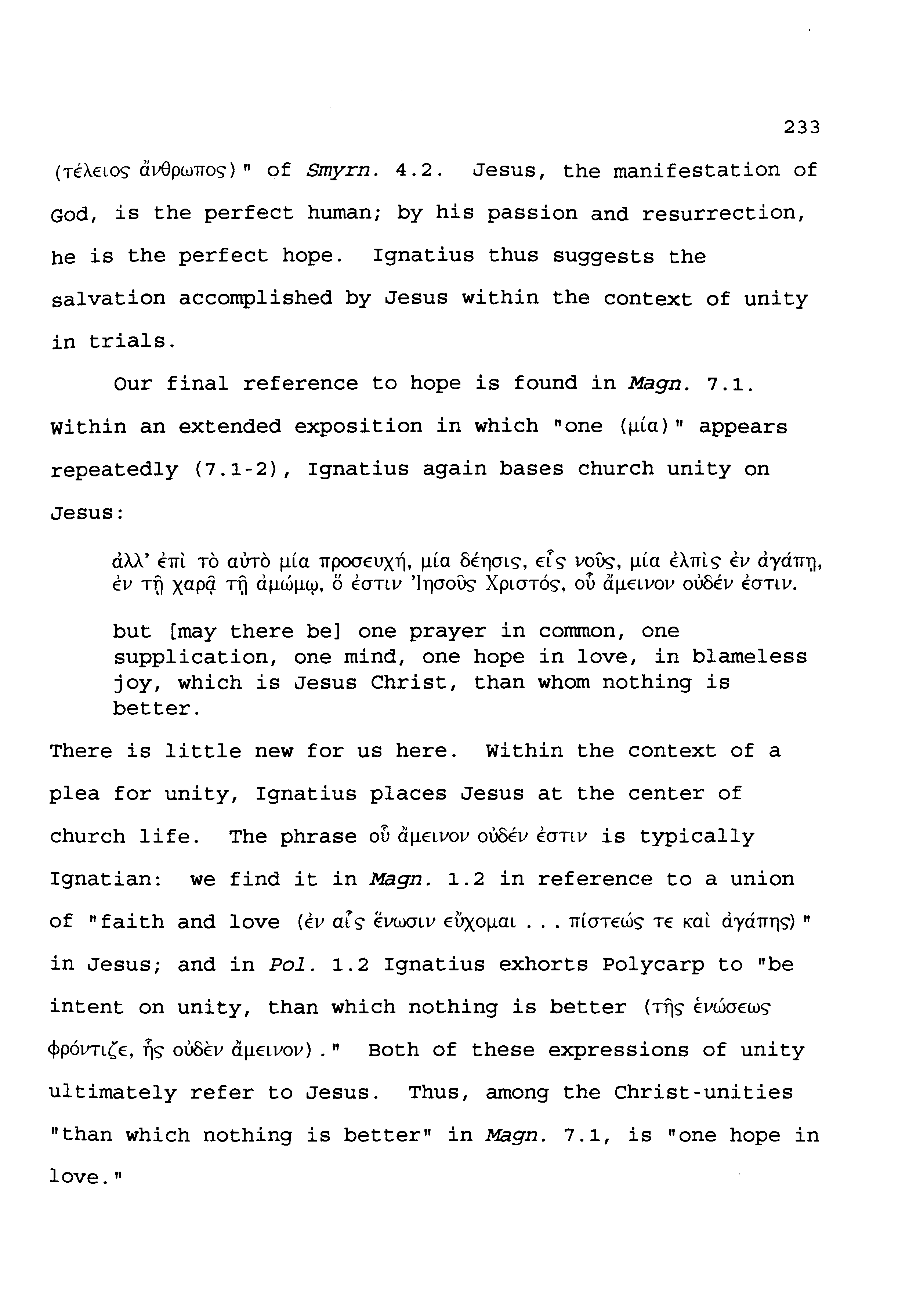
(TEAELOS' avepwnos-) II of Smyrn. 4. 2.
Jesus I the manifestation of God, is the perfect human; by his passion and resurrection, he is the perfect hope.
Ignatius thus suggests the salvation accomplished by Jesus within the context of unity in trials. our final reference to hope is found in Magn. 7.1. within an extended exposition in which "one (µ(a) " appears repeatedly (7.1-2), Ignatius again bases church unity on Jesus: d;\;\' Eni To m'.rro µfa npooEuxiJ, µ(a 8€110Ls-, d'svoUs-, µ(a EAnisEV dycinlJ,
EV TlJ xapq TlJ dµwµ41, 0 EOTLV 'I1100UsXpLOTOS-, OU aµELVOV OOOEV EOTLV. but [may there be] one prayer in common, one supplication, one mind, one hope in love, in blameless joy, which is Jesus Christ, than whom nothing is better.
There is little new for us here.
Within the context of a plea for unity, Ignatius places Jesus at the center of church life.
The phrase OU aµELVOV OUOEv EOTLV is typically Ignatian: we find it in Magn. 1.2 in reference to a union of "faith and love (E:v al'sEvwaLv Euxoµm ... n(oTEWSTE Kai dycinris-)" in Jesus; and in Pol. 1.2 Ignatius exhorts Polycarp to "be intent on unity, than which nothing is better
(T~S' EVWOEWS'
<f>poVTL(E, ~S' OUOEV aµELVOV) . II Both of these expressions of unity ultimately refer to Jesus.
Thus, among the Christ-unities "than which nothing is better" in Magn. 7.1, is "one hope in love. 11
For Ignatius, therefore, 'hope' is a prime expression of the salvation brought by Jesus.
It is the indication, throughout history, of the Eooyy€A.Lov message (e.g., Phld.
5.2).
The theme of hope thus becomes not only an epithet for Jesus (Eph. 21.2; Phld. 11.2), but it also surfaces as an Ignatian intramural phrase which refers to the message held in common: it is the Eooyy€A.Lov TilsKOLVTJS' EATTL8os-.
THE ONLY TEACHER
Ignatius calls Jesus "teacher (8LociaKaA.os-) " in three passages:
Eph. 15.1, Magn. 9.1, and Magn. 9.2.
In the first two of these citations, Jesus is presented as the only true teacher for Christians ( Eph. 15. 1:
El' S' ouv 8L8ciaKaA.os-, Magn. 9. 1: ... 'Irpou XpwTou Tou µ6vou 8LoaaKciA.ou ~µwv) .
Ignatius' emphasis on Jesus as the sole acceptable teacher is paralleled by the logion in Matt 23:8 in which Jesus states
"But you are not to be called rabbi, for you have one teacher, and you are all students (uµELS' OE µi) KAfl9flTE, •pa~~(· d S' ycip EGTLV uµwv 6 8LociaKaAOS'' TTciVTES' OE uµEL S' d8EA.<f>o( EGTE) . II 66
Mat thew 23:8 is in the context of Jesus' criticism of the scribes and Pharisees for not practicing what they teach (thus,
23:2).
The same general theme centered on deeds and teaching is the context with Ignatius in Eph. 15.1; yet, for 66Cf., Matt 23: 10 in which, in the place of 6 BtociaKaA.os we find a synonym, 6 Ka9Ji'YTlTilS: µ'fl8E KA'fl0flTE KaO'flY'flTaL, oTt KaO'fl'YTlTiis iiµwv EO'Ttv ds 6 XptITT6s.
Matt 23:6-10 contains material found only in Matthew.
Ignatius, it is Jesus whose silent actions are "worthy of the Father ( oE nEno( llKEv dew Tou naTposEaTt v) . 11
This parallel raises once again the question of Ignatius' knowledge of Matthew.
I have recognized that Ignatius may well have had contact with Matthean material.
This being said, no matter the contact, it seems most probable that both Matthew and Ignatius are using a standard type of argument by church leaders against teaching that is outside the boundaries of acceptable belief.
Thus, for the Matthean and Ignatian cormnunities, in response to teachers from the outside, Jesus is the only teacher one must follow. 67
Turning our attention directly to Eph. 15.1, therefore, we find that the title 6 8LocicrKaAosis applied to Jesus within the context of Ignatius' own take on the theme of silence and speech in Christian life: dµEwov ECTTLV mwnav KaL dvm, ~ AaAouvra µii dvm. KaAov To 8LocicrKELV,
ECLV 6 AEywv 1TOLlJ. ELS' ouv 8LocicrKaAOS', OS' EL1TEV, Kal EYEVETO" KaL a CTLYWV oE nEno(11KEv dew Tou naTposEaTw.
It is better to be silent and to be, than speaking and not to be. 68
To teach is good if the speaker acts.
67Schoedel, "Ignatius and the Reception of Matthew," 171-172; idem, Ignatius of Antioch, 77, n. 12.
For Matthew, teachers who are unacceptable are represented by the "scribes and Pharisees" of 23:2; these presumably would be members of "the Jewish magisterium which regrouped and led Judaism after A. D. 70."
J. P. Meier, The Vision of Matthew: Christ, Church and Morality in the First Gospel (New York:
Paulist, 1979) 162-163, n. 176.
As for Ignatius Eph. 16.2 and Magn.
10.3, 11.1 are indications of unacceptable teaching.
68We have already seen that Schoedel links this statement with Magn. 4, thus suggesting as the meaning, "It is better to be silent and
There is, then, one teacher who spoke and it came to pass, and what he has done in silence is worthy of the Father.
This passage opens with a AUAEW phrase, perhaps suggesting that the teaching in question involves the proclamation of the EUa'}''}'EALov and its fulfillment in action. 69
Then, using an allusion to Psalm 33:9, 70 Ignatius presents Jesus as the one teacher who put his teachings into practice. 71
The actions which flow from Jesus' teaching-"what he has done in silence"-appear to be the saving events of the EUa'}''}'EAtov.
Hence, the teaching and saving actions of Jesus are the only answer to outsiders bringing an "evil teaching <€xovrac; KUKTW
8toaxr1v)" (Eph. 9.1) and corrupting "the faith of God by evil teaching (Eav lTLOTLV 9rnu Ev Katc1J 8toaaKaAL<;L <f>9E(p1J)"
(Eph. 16. 2) .
As Ignatius remarks still earlier, the Ephesians have rightly refused to "listen to anyone except one who preaches in truth about Jesus Christ (dAA• ouoE: dKoUETE Ttvoc; lTAEov, ~ lTEpL
'I11aou XptaTou AaAouvroc; Ev dATJ9dc;i) 11 ( Eph. 6. 2) . to be in reality Christians, than to speak and only be called
Christian."
Ibid.
69Cf., Phld. 1.lb: the Philadelphian bishop can "do more in silence than those proclaiming vain words (os cnywv nA.dova BvvaTm Twv µciTata
A.aA.owTwv ) . "
70"For he spoke, and it came to be; he commanded, and it stood firm (on airros ELTrE Kat E:yEvtj9rjcmv, airros E:vETELAaTo Kat EKTtcr9Tjcra0 . "
Cf., Schoedel, Ignatius of Antioch, 77-78 who looks rather to the first chapter of Genesis as the allusion here:
Jesus is "regarded as speaking the creative words."
71While Jesus is not named until the next sentence, there is little chance that this "one teacher" refers to God the Father; the connection between crtywv in 15 .1 and <Jt'YQ in 15. 2 makes it clear that Jesus is intended.
Therefore, in Eph. 15.2 Ignatius continues building on the image of Jesus, the one teacher:
6 AO)'OV 'Iriaou KEKTTWEVOS' ciAT}0WS' ouvaTm KaL TTlS' ~aux(asm'.n-ou ciKOUELV' r va TEAELOS' ~' r va fa. WV AaAEL npciaOTJ KaL fa. WV UL yq
)'LVWOKT}TaLL.
The one who truly possesses the word of Jesus is also able to hear his [Jesus'] silence, so that he may be perfect, so that through that which he says he may act, and through his silence he may understand. (Eph. 15.2)
Anyone who has the word (or teaching, 6 AO)'OS') of Jesus also "hears his silence."
This can only refer to "what [Jesus] has done in silence" of 15.1.
Therefore, "hearing" the silence of Jesus means to have faith in ("possess") the salvific deeds of Jesus that are linked with his words.
So, in turn, the believer who professes to be "of Christ" with words will be identifiable by his or her deeds (oi
ElTa)')'EAAOµEVOL XpLOTOU El vm fa. WV npciaaouaLV a<f>0tjaoVTm [ Eph. 14 • 2] ) .
Uniting words with action makes one perfect (Lva TEAELOS' iJ> like Jesus, the "perfect human (TEAELOS' d.v0pwnos-) " of Smyrn.
4.2.
The two references to Jesus as faociaKaAOS' in Mag. 9 are part of Ignatius' polemic activity against what appears to be judiazing practices.
Therefore, the OT Prophets take center stage in 9.1: 72
72Cf., Ibid., 123.
Schoedel sees the people referred to in Magn.
9.1 as "the early Christians who abandoned their allegiance to Judaism."
For this same opinion, see Lightfoot, 128 and Zahn, 354.
However, it appears that 9.1 continues Ignatius' train of thought begun in 8.2 where
"the divine prophets lived according to Christ Jesus (ot yap 0E:L6TaToL
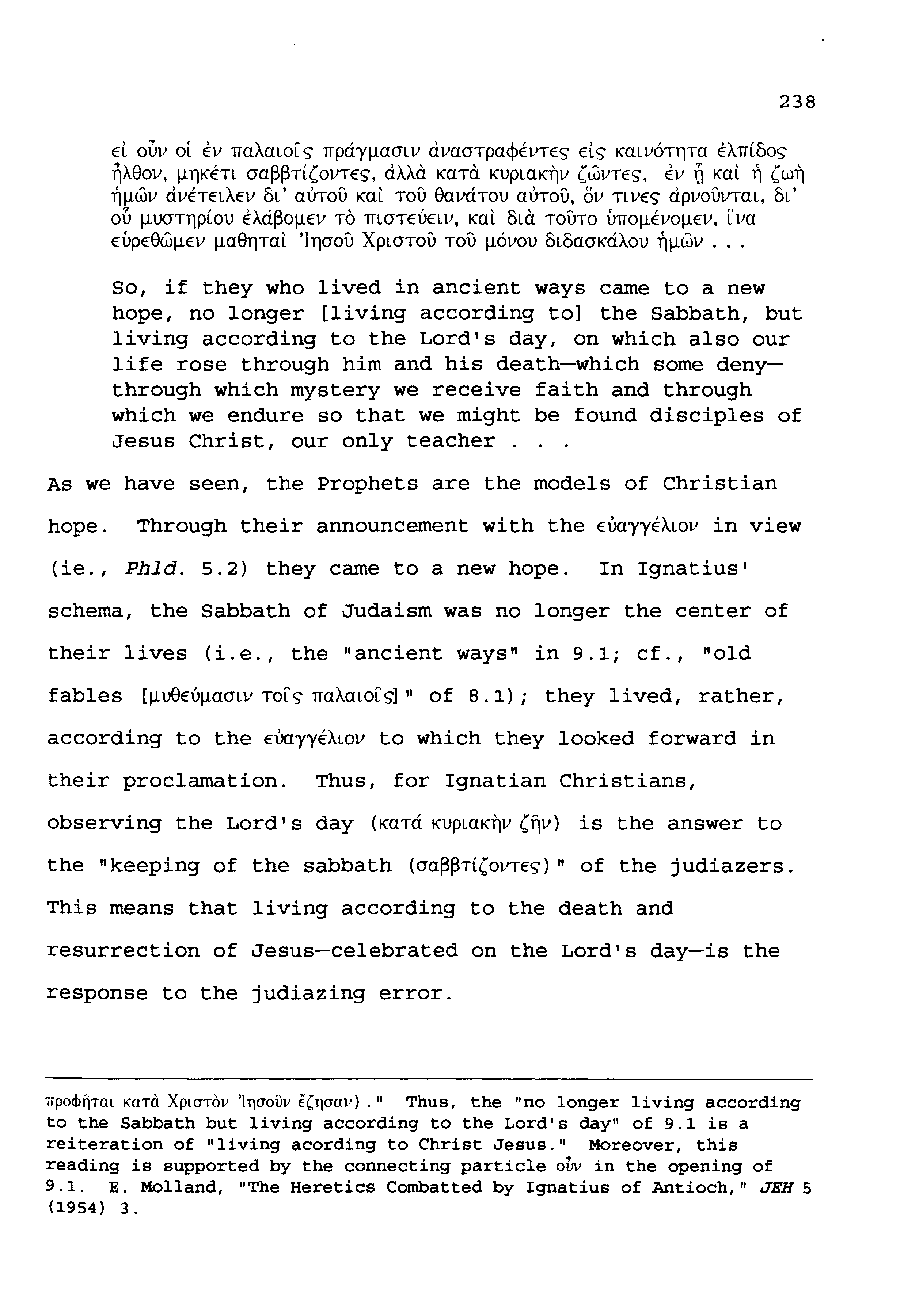
EL ouv oi Ev naA.moi'snpciyµacnv dvacnpacf)E:VTES' ELS' Kmv6T11Ta EA.n(8os- ~A.9ov, µllKETL aa~~T((ovTES', dAA.a KaTa KupwKiW (wVTES',
E:v iJ KaL ~ (w-fi ~µwv dvETELAEV 8L' UlrrOU KUL TOU eavciTOU UUTOU, OV TLVES' dpvouVTm, 8L' ou µooTT}p(ou E:A.ci~oµEv To maTEUELV, KaL 8La TOuTo {moµ€voµEv, i.'va
EUpE9wµEv µa911TaL 'I 11aou XpLaTou Tou µ6vou 8L8aaKciA.ou ~µwv . . .
So, if they who lived in ancient ways came to a new hope, no longer [living according to] the Sabbath, but living according to the Lord's day, on which also our life rose through him and his death-which some denythrough which mystery we receive faith and through which we endure so that we might be found disciples of Jesus Christ, our only teacher .
As we have seen, the Prophets are the models of Christian hope.
Through their announcement with the EooyyEA.Lov in view (ie., Phld. 5.2) they came to a new hope.
In Ignatius' schema, the Sabbath of Judaism was no longer the center of their lives (i.e., the "ancient ways" in 9.1; cf., "old fables [µu6Euµaaw Toi'snaA.moi's-]" of 8 .1); they lived, rather, according to the Eooyy€A.wv to which they looked forward in their proclamation.
Thus, for Ignatian Christians, observing the Lord's day (KaTci KUpLUK-fiv (flv) is the answer to the "keeping of the sabbath (aa~~T((oVTES')" of the judiazers.
This means that living according to the death and resurrection of Jesus-celebrated on the Lord's day-is the response to the judiazing error. rrpo<!>f)Tat KaTa Xpt<nov 'IT)aovv E(T)aav) . "
Thus, the "no longer living according to the Sabbath but living according to the Lord's day" of 9.1 is a reiteration of "living acording to Christ Jesus."
Moreover, this reading is supported by the connecting particle ouv in the opening of 9.1.
E. Molland, "The Heretics Combatted by Ignatius of Antioch," JEH s (1954) 3.
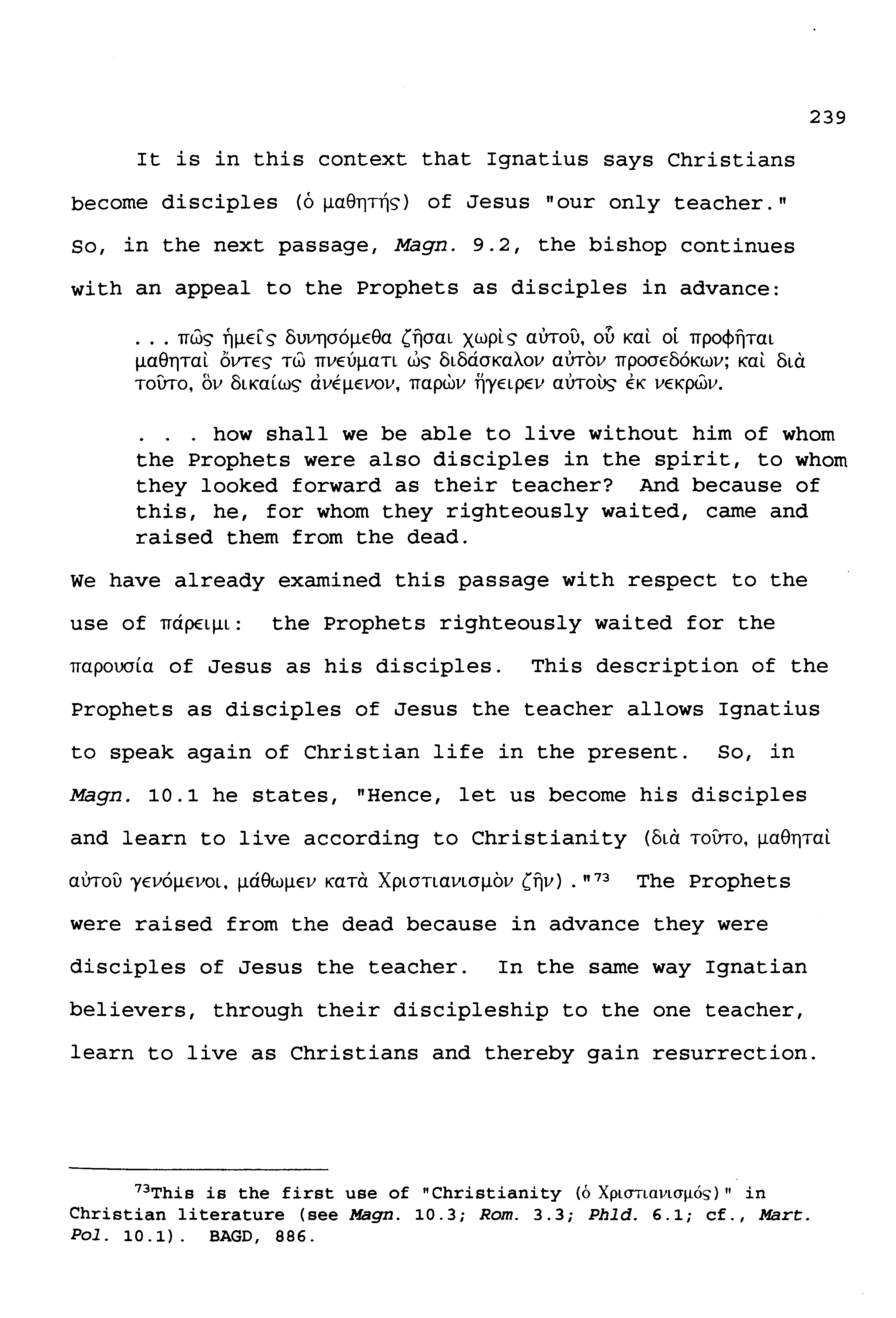
It is in this context that Ignatius says Christians become disciples (6 µa811Ti}S') of Jesus "our only teacher." so, in the next passage, Magn. 9.2, the bishop continues with an appeal to the Prophets as disciples in advance:
... nws- ~µEl' S' 8uVT)o6µE8a (fjom xwpi S' m'.rrou, ou Kai oi npocf>fjTm µa811Tai oVTES' Tw nvEuµaTL ws8L8cioKaA.ov m'.rrov npooE86Kwv; Kai 8La
ToU-ro, ov 8LKa(wsdvEµEvov, napwv ~'YELpEv m'.rroU<; EK VEKpwv.
. . . how shall we be able to live without him of whom the Prophets were also disciples in the spirit, to whom they looked forward as their teacher?
And because of this, he, for whom they righteously waited, came and raised them from the dead. we have already examined this passage with respect to the use of ncipELµL: the Prophets righteously waited for the napouo(a of Jesus as his disciples.
This description of the Prophets as disciples of Jesus the teacher allows Ignatius to speak again of Christian life in the present.
So, in Magn. 10.1 he states, "Hence, let us become his disciples and learn to live according to Christianity (8La ToU-ro, µa811Tai m'.rrou yEv6µEvm, µci8wµEv KaTa XpLOTLavLoµov (fjv) . " 73
The Prophets were raised from the dead because in advance they were disciples of Jesus the teacher.
In the same way Ignatian believers, through their discipleship to the one teacher, learn to live as Christians and thereby gain resurrection.
73This is the first use of "Christianity (6 XptITTwvtcrµos)" in Christian literature (see Magn. 10.3; Rom. 3.3; Phld. 6.1; cf., Mart.
Pol. 10.1).
BAGD, 886.
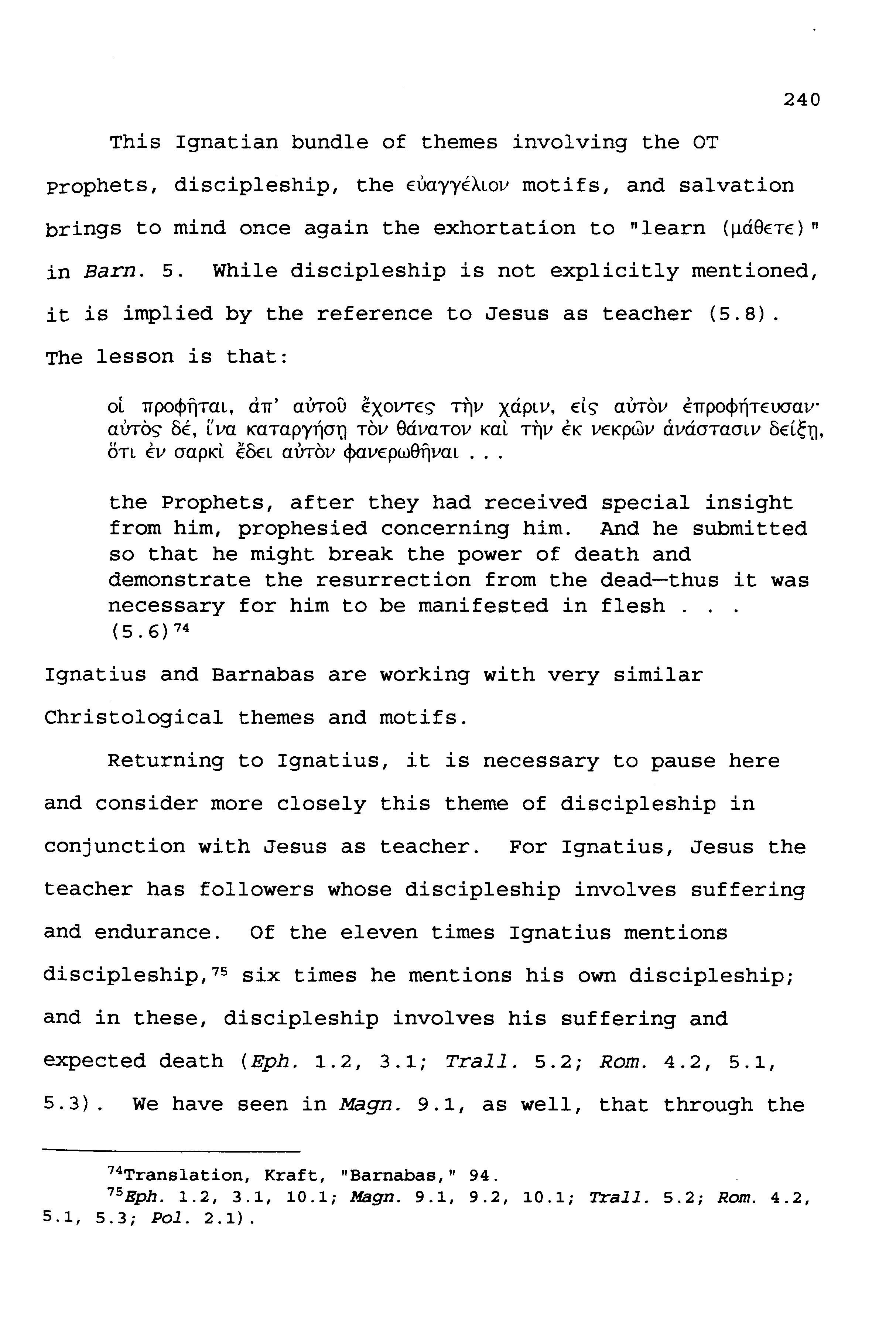
This Ignatian bundle of themes involving the OT prophets, discipleship, the EUa'Y'YEALov motifs, and salvation brings to mind once again the exhortation to "learn ( µci9ETE) " in Barn. 5.
While discipleship is not explicitly mentioned, it is implied by the reference to Jesus as teacher (5.8).
The lesson is that:
OL npo<f>f)TaL, dn' m'.rrou EXOVTES n,v xcipLV, ELS aUTOV ElTpo<f>i]TEOOav· m'.rros OE, [va KaTapyiJCJTJ TOV eavaTOV Kai TllV EK VEKpwv civciCJTOCJLV OELCTJ, oTL EV aapKi EOEL m'.rrov <f>avEpw9fivm ... the Prophets, after they had received special insight from him, prophesied concerning him.
And he submitted so that he might break the power of death and demonstrate the resurrection from the dead-thus it was necessary for him to be manifested in flesh . .
( 5. 6) 74 Ignatius and Barnabas are working with very similar Christological themes and motifs.
Returning to Ignatius, it is necessary to pause here and consider more closely this theme of discipleship in conjunction with Jesus as teacher.
For Ignatius, Jesus the teacher has followers whose discipleship involves suffering and endurance.
Of the eleven times Ignatius mentions discipleship, 75 six times he mentions his own discipleship; and in these, discipleship involves his suffering and expected death (Eph. 1.2, 3.1; Trall. 5.2; Rom. 4.2, 5.1,
5.3).
We have seen in Magn. 9.1, as well, that through the 74Translation, Kraft, "Barnabas," 94.
75Eph. 1.2, 3.1, 10.1; Magn. 9.1, 9.2, 10.1; Trall. 5.2; Rom. 4.2, 5 . 1 , 5 . 3 ; Pol . 2 . 1 ) .
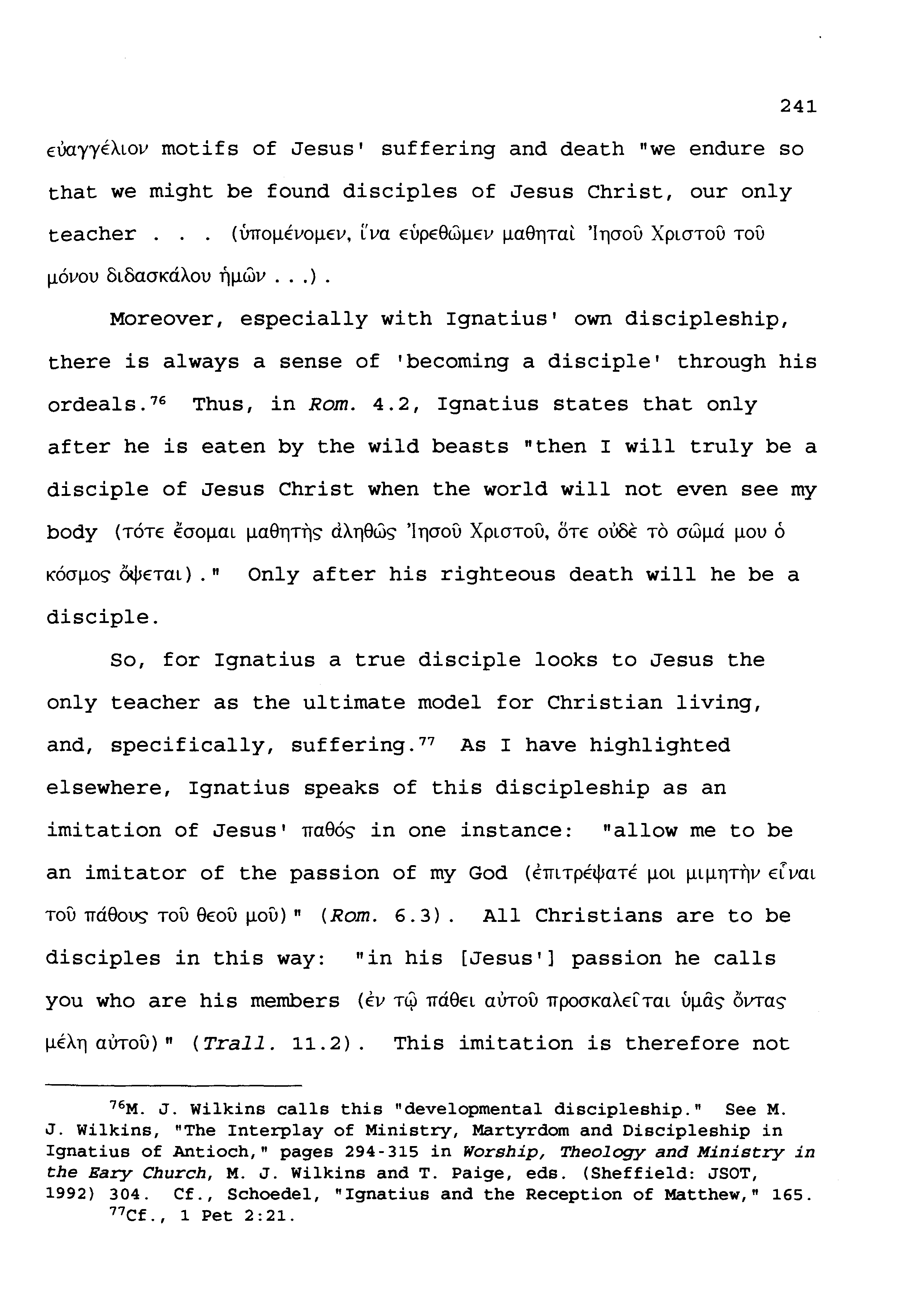
EUayyE:A.wv motifs of Jesus' suffering and death "we endure so that we might be found disciples of Jesus Christ, our only teacher .
( irrroµE:voµEv, L' va EupE8wµEv µa811TaL 'I riaou XpLaTou Tou µovou 8L8aaKciA.ou ilµwv . . . ) .
Moreover, especially with Ignatius' own discipleship, there is always a sense of 'becoming a disciple' through his ordeals. 76
Thus, in Rom. 4.2, Ignatius states that only after he is eaten by the wild beasts "then I will truly be a disciple of Jesus Christ when the world will not even see my body (TOTE Eaoµm µa8riTiis dA.ri8ws 'I11aou XpLGTOU, OTE OOOE TO awµci µou 6
Koaµos &j;ETm) . "
Only after his righteous death will he be a disciple. so, for Ignatius a true disciple looks to Jesus the only teacher as the ultimate model for Christian living, and, specifically, suffering. 77
As I have highlighted elsewhere, Ignatius speaks of this discipleship as an imitation of Jesus' 1Ta86s in one instance:
"allow me to be an imitator of the passion of my God (EmTpE:lf>aTE µm µLµ'flTllV dvm
Tou 1Tci8ous Tou 8Eou µou)" (Rom. 6. 3) .
All Christians are to be disciples in this way:
11 in his [Jesus'] passion he calls you who are his members (EV T4> 1Tel8EL m'rrou lTpoGKUAELTm uµds ovras µE:A.11m'rrou)
(Trall. 11.2).
This imitation is therefore not 76M. J. Wilkins calls this "developmental discipleship."
See M.
J. Wilkins, "The Interplay of Ministry, Martyrdom and Discipleship in Ignatius of Antioch," pages 294315 in Worship, Theology and Ministry in the Eary Church, M. J. Wilkins and T. Paige, eds. (Sheffield: JSOT,
1992) 304.
Cf., Schoedel, "Ignatius and the Reception of Matthew," 165.
77cf., 1 Pet 2:21.
only for a few; rather, it is "the calling of Christians in general." 78
Through his endurance in suffering, Ignatius is becoming a disciple in a church of disciples.
With Ignatius' concept of discipleship before us, therefore, we may once more return specifically to Jesus as teacher in the letters.
It is necessary to recognize that there are passages in which Ignatius assigns Jesus a teaching role without explicitly calling him 6 BLocioKaAos-.
As we have seen elsewhere, Ignatius presents Jesus as teaching a specific way of life based on the will of God (e.g., Eph.
3. 2 [Tou TTaTposTi yvwµril) .
So, for example, we find passages which refer to Jesus• commandments (EVToAtj) (Eph. 9.2, Magn.
4 .1, Rom. insc., Phld. 1. 2), 79 Jesus' law (voµos-) (Magn.
2) , 80 Jesus' ordinances (86yµa) (Magn. 13. 1) , and-an hapax legomenon in early Christianity-"instructions of Christ"
(XPLOToµa9(a) ( Phld. 8. 2) .
It is significant that, with the exception of voµosin Magn. 2 and 86yµa in Magn. 13.1 (both of which refer to proper church order), in each of the above citations Jesus'
78Wilkins, 308; Schoedel, Ignatius of Antioch, 30, 183-184.
79In Mag. 4.1 and Phd. 1.2, however, there is no possessive genitive; so, it is unclear to whose EVToAtj Ignatius is referring.
Both passages concern church order; at the very least, we may presume that Ignatius is speaking of divine commandments in general.
It seems accurate, however, in the context of Ignatius' view of church life, as well as his Christology, to consider these Jesus' EVToAtj.
80With respect to voµos, there is also a variant reading in the inscription of Romans:
Ignatius, in a chain of epithets, refers to the Roman Christians as either "XPLOTwvuµos" ("named for Christ") or "XPLOTovoµos" ("following the law of Christ") .
Lightfoot accepts the latter.
See Lightfoot, 193.
teaching is presented in direct opposition to some form of wrong teaching or action.
Thus, in Eph. 9.2 the EVTOAtj of Jesus is in answer to those having evil teaching (EXOVTas
KaKiiv 8L8axtjv); in Magn. 4 .1 it is the difference between proper and inproper meetings (To µii ~E~a(ws KaT' EVToATiv auva0po((Ea0m) ; in Rom. insc. the EVToAtj opposes the "foreign stain (dAAOTpLOS xpwµaTOS) "; in Phld. 1.2 it describes the bishop of Philadelphia who represents the opposite of the division (µEpLaµos) and evil teaching (Kmco8L8aaKaA(a) described in Phld. 2.1; and, finally, in Phld. 8.2 the teaching of Christ (XPLOToµa0(a) is the answer to actions of selfserving ambition (EpL0Eta) .
Of these, Phld. 8.2-the "archives" passage-is the most significant for our purposes.
Elsewhere, we have viewed Phld. 8.2 as one of the defining passages for Ignatius'
EooyyEALov; at this point, the introductory phrase demands attention.
Ignatius has been encouraging unity among the Christians, placing his faith in "the grace of Jesus Christ
(1TLOTEUw TQ xcipLTL 'I11aou XpLOTOU) II ( 8. lb) .
He then introduces the discussion about the archives and the EooyyEALov with, "But I exhort you to do nothing from selfish ambition but according to the teaching of Christ (napaKaAw 8E uµc'is µ118EV KaT' EpL0dav npciaaELv, dA.A.a KaTa XPLaToµa0(av) " ( 8. 2a) .
<H XPLaToµa0(a-a particular Ignatian term-is the counterpoint to the divisive teaching (or preaching) of some within the community (i.e., Phld. 7.2) who are acting out of EpL0Eta.
Both the divisive teaching and the teaching of Christ are exemplified in the dpxd'a/Eooyy€A.wv sequence which follows.
So, the E:pt9da of the trouble-makers is expressed through their dependence on the wrong archives, the OT.
The XPLOToµa9(a is expressed through the EooyyEA.tov.
Thus, the preached Eooyy€A.tov as the true archives is tied with the teaching of Christ:
E:µot oE dpxECci E:oTLV 'IriaoUsXptaT6s-, Ta d9urra dpxd'a 6 aTaup0sm'.rrou Kat 6 9civaTosKaL ~ dvciaTamsm'.rrou Kat ~ 1TLGTLS' ~ 8L • m'.rrou ...
But to me the archives are Jesus Christ, the sacrosanct archives are his cross and death, his resurrection, and faith through him ... (Phld. 8.2c).
This brings to the fore a significant fact: in all of Ignatius' presentations of Jesus as teacher, the bishop never explicitly presents any specific teachings as those of Jesus.
As we have noted in passing early on, there are indeed Ignatian passages which contain material we know from elsewhere as logia from Jesus' teachings.
These, however, have no indication of a connection to Jesus in their Ignatian context.
Thus, for example, in Pol. 2.2 Ignatius exhorts Polycarp to "Be prudent as the serpent in all things and pure as the dove for ever (cf>povLµosy(vou WS' 6 ocf>LS' EV cI1TaGLV
Kai dK€pmosELS' dEi ws- ~ 1TEpLaTEpci) " (cf., Matt 10: 16; Gos. Thom.
39:2) . 81
Ignatius treats this saying like an ordinary 81See also, for example, Pol. 2:1a (cf., Matt 5:46; Luke 6:32; 2
Clem, 13. 4; Did. 1. 3b) .
maxim, without the persuasive authority it would carry if it were a specific teaching from Jesus. 82
All of this suggests that 'Jesus the only teacher' exists in the world of Ignatius' letters to serve a specific purpose: to counter erroneous teachers.
To serve this purpose, specific teachings of Jesus are not necessary; rather, Jesus as a teacher with ultimate authority (i.e., the only one needed) is sufficient to counter the erroneous teachers and their teachings.
So-as I have suggested with respect to the OT Prophets-it is the figure of Jesus the teacher and not the content of his teaching that Ignatius is primarily interested in.
Ignatius aligns his position with the figure of the only true teacher from God, thereby gaining ultimate validity.
However, at the same time it must be recognized that the closest we get to the content of Jesus• teaching is the EooyyEALov message itself.
Here we are reminded of the Ignatian concept of discipleship as imitation of the na86~ of Jesus.
We are also reminded once again of Phld. 8.2c.
Because the particular error Ignatius is countering in Philadelphia has to do with the historical supports for Christian belief, Ignatius states that the only support (or "archive") needed for Christian faith is Jesus himself: the salvation he accomplished through the EUa)')'EALov events.
82See Koester, Synoptische Uberlieferung, 43; Schoedel, "Ignatius and the Reception of Matthew," 168; cf., Kohler, 86.
Therefore, in Ignatius' world view, 'Jesus the one teacher' does not function as a source for specific guidelines for Christian living; rather, 'Jesus the one teacher' serves as an unimpeachable figure of authority supporting Ignatius' position vis-a-vis the error he wishes to counter in the various communities.
In Ignatius' concern for unity through right belief, the events of the EooyyEALov message themselves are the only teaching necessary.
THE ONE PHYSICIAN
Our final Ignatian Christological title, the "one physician (dstaTpos-) , " occurs a single time within the context of the hymn in Eph. 7.2: 83 d staTposEanv, aapKLKOS' TE Kai TTVEUµaTLKOS''
'YEVVTlTOS' Kai dyEVVllTOS', E:v aapKi yEvoµEvos9E6s-, EV eavciT<p (wii dATJ9Lvfi, Kai EK Map(asKai EK ernu, npwTov na9TJTOS' Kai TOTE dna9tjs-, 'IYJaoUsXptaTos6 KuptosTiµwv.
There is one physician, both fleshly and spiritual begotten and unbegotten, 83For Eph. 7.2 as a hymn, see Deichgraber, 155-156; Schoedel,
Ignatius of Antioch, 61; G. Dumeige calls it "un debut de confession de foi."
G. Dumeige, "Le Christ medecin dans la litterature chretienne des premiers siecles," Rivista di archeologia cristiana 48 (1972) 118.
With respect to the word iaTpos Deichgraber states it is possible that iaTpos was added to the hymn to replace the orginal Kvpws.
However, he concludes:
"Aber genausogut m0glich ist es, daB iaTpos zum ursprU.nglichen Text gehOrt und das Stichwort fur die Zitierung des
Hymnus abgab.
Deichgraber, 155.
come in flesh, God, in death, true life, both of Mary and of God, first passible and then impassible, Jesus Christ our lord. 84 we saw in Part One how this passage is within the context of the A.aA.El'v 'Iriaouv XpLaT6v expression in 6. 2.
The Ephesians refuse to listen to the wrong preaching about Jesus.
In Eph. 7.1 Ignatius continues with a strongly worded warning to the Ephesians about the unacceptable individuals who are
"difficult to cure (8oo0EpchrEUTOS') . "
This reference to curing allows Ignatius to launch into the 'one physician' hymn as a response to the wrong opinions.
As we have seen elsewhere, all but two of the antithetical statements in the hymn ultimately refer to the EooyyEtA.wv motif of the lTapooo(a.
The two exceptions speak of the sal vif ic lTa06sand dvdaTaCJLS" ("in death, true 1 if e, "
"first passible and then impassible").
Thus, Jesus the one physician, through his coming, death and resurrection is the answer to human mortality, as well as to the illness of disunity caused by wrong preaching.
Ignatius is the first to use the title "physician" for Christ. 85
Such NT expressions as Matt 9:12 (cf., Mark 2:17; Luke 5:31) and Luke 4:23 come to mind here; yet, it is difficult to think that Ignatius has these in mind.
What is more-as with 'Jesus the teacher'-there is something missing 84Translation, Schoedel, Ignatius of Antioch, 59.
85Dumeige, 118.
here:
Ignatius ~ives no indication that he is aware of Jesus' historical reputation as a healer (e.g., Acts 10:38}, much less that hE: has a Jesus-the-healer tradition in mind as a metaphor.
~t the very least, Ignatius does not appeal to this tradition..
It seems, once again, that 'Jesus the one physician 1-w-hether the title is an Ignatian invention or a received tradition-serves as a metaphorical figure to express the Eooyy€A.tov message of salvation in response to unacceptable preaching by outsiders.
Later, in IE_ph. 20.2, Ignatius uses another medical image to speak of the EUa'Y'YEAtov message.
Ignatius describes the eucharist as "breaking one bread, which is the medicine of immortality, the antidote for not dying but living forever in Jesus Christ (Eva apTOV KAWVTES', OS' EoTLV <f>cipµaKOV d0avao(as-, ciVTL8oTos Tou µii chro9avECv, ciUa (fiv E:v 'Irioou XptoT4> 8ta rraVTos-}. " 86 we have highlighted the EUa'Y'YEAtov motifs and themes in Eph. 2 o .1-2.
The "one bread" recalls not only the "one physician,,. to which it is linked through medical imagery, but also the "one teacher" and the various 'ones' in Magn. 7.1.
Thus, the eucharist, because it is the "flesh of Jesus which suffered for our sins" (Smyrn. 7 .1), is the 86Cf., Pol. 2 .1:
"Not all wounds are healed by the same poultice (ou nav npauµa TU airru €µnAcicnp41 9EpanEiiEmt) . 11
Compare, as well, Pol. 1. 3 in which Ignatius telJl.s Polycarp to "bear the illness of all as a perfect athlete (mivTwv Tas ~6aous f3ciam(E W.;;; TEAELos ci9A.rin1s> ."
On the latter, see Schoedel, "IgnatiuE3 and the Reception of Matthew," 166.
medicine of immortality. 87
The eucharist is the medicine given by the one physician in his passion: through Jesus'
Tia06c; in the flesh, the EooyyEA.Lov is the "completion of immortality (To 8E: EooyyEALOV dmipTLcrµci EGTLV d<f>0apcr(ac;) "
( Phl d.
9. 2) .
SUMMARY:
THE GOSPEL OF IGNATIUS AND CHRISTOLOGY
In the introduction to Part Two, I stated that the overarching issue in this part is the boundary-setting function of the Ignatian EooyyEALov.
In this chapter we have viewed Ignatius' Christology as it is expressed through the EooyyEALOV, and have observed that the EooyyEALov boundarysetting function is often displayed through an interaction between proper belief and church unity, both centered on Jesus.
By way of conclusion, therefore, in the following paragraphs I will recapitulate the major examples of this interaction.
With respect to our more general look at the incarnation, the most immediate fact is Ignatius' use of "Jesus our God."
Of the seven times Ignatius refers to Jesus as "God," only once does Ignatius speak of "Jesus, my
God" (in Rom. 6.3, when he is very much concerned with his 87T. Schermann has pointed out that 11ci9avaa(a" was the name of a widely known drug of the time.
Schoedel, however, rightly says that Schermann goes too far in seeing the Ignatian use as an answer to a specific pagan cult.
T. Schermann, "Zur Erklarung der Stelle epist. ad.
Ephes. 20, 2 des Ignatius von Antiochien: <t>cipµaKov ci9avaa(as K.T.A..," TQ 92
(1910) 6-19; Schoedel, Ignatius of Antioch, 97-98.
own situation) .
Ignatius is appealing to a common faith experience of those within his circle of influence.
Moreover, Ignatius speaks about Jesus' unity of flesh and spirit (e.g., Eph. 7.2; Smyrn. 3.2) as a particular way of describing the incarnation.
This unity of the person of Jesus, in turn, becomes a model for the Christian living in the world (Eph. 8.2), as well as the image of Church unity
(Smyrn. 3.1-4.1).
These same issues also surface as the incarnation theme and the gospel motif of the napoua(a are juxtaposed.
Thus, for example, in Magn. 7.2, the goal of the united faith is the "one Jesus Christ, who came forth from the one Father ... "
Finally in regard to Ignatius' concept of the incarnation, "the new human" (Eph. 20.1) and "the perfect human" (Smyrn. 4.2) are Ignatian titles for Jesus as the ultimate, or model human.
Within the same meaning context as the incarnation is the Ignatian use of "son of God."
We have seen in Eph. 4.2 how Christians, united in correct belief about Jesus are in turn recognized by God as members of his son.
Yet, it is primarily through the napoua(a motif of the EOO'Y'YEALov that Ignatius' use of "son of God" surfaces.
So, we find in Magn. 8.2 the one God revealed through Jesus Christ, his son.
Significant too is Ignatius' particular take on the Pauline formula of Rom 1:1-3 in Eph. 20.2:
"according to the flesh of the family of David, son of a human and son of God."
Jesus in the incarnation is God's son.
However, it is with the bundle of expressions referring to the EOO'Y'YEALov message of salvation that we find the boundaries of acceptable faith in Jesus most clearly drawn.
The Eooyy€A.Lov is "remarkable <E:ea(pETos-)" or unique in its excellence because in it are the coming of the Savior and his salvific deeds; the EooyyEALov is, therefore, "the completion of immortality" (Phld. 9.2).
This 'settingapart' function of the Savior's deeds in the Eooyy€Awv is seen as well in Magn. 5.2.
Here, those who choose to live by the gospel are set apart by the "imprint (~ xapaintjp)" of God (cf. , Smyrn. 5. 3; Trall. 9. 2) .
The EooyyEALov message of salvation has no equal: without Jesus the Savior there is no "true life" ( Trall. 9. 2) .
Jesus' suffering and resurrection "for us/our sake" refers as well to those within the Ignatian faith community.
Those within the boundaries of true belief are those who live "not according to humanity but according to Jesus
Christ who died for our sake" (Trall. 2.1).
Also, this salvation "for our sake" is not so much a salvation from sin; rather, it is salvation from death (Trall. 2.1), it is
"immortality" (Eph. 17 .1; Smyrn. 2. 3), "eternal life" (Eph.
18 .1; Magn. 1.1; Pol. 2. 3) and "resurrection" ( Trall. 9. 2; Smyrn. 5. 3).
The theme of hope (~ EA1TLS') is central to Ignatius' description of the salvation accomplished by Jesus through the EooyyEALOv events.
For Ignatius, this hope distinguishes
the in-group of believers.
Out of the nine theological uses of hope in Ignatius' letters, six refer to "our" hope (Eph.
1.2, 21.2; Magn. 11.1; Trall. insc., 2.2; Phld. 11.2}, thus delineating the faith community.
This is further confirmed by the four uses of "common (Kmvos-}" (Eph. 1.2, 21.2; Phld.
5.2, 11.2} to describe the hope.
The phrase "one hope in love" of Magn. 7.1 may be included here also.
Moreover, we have seen that Ignatius' use of ~EATILS' in conjunction with the Eooyy€At0v message does not place emphasis on the future fulfillment of that hope; rather,
Christian hope in salvation serves as a frame which defines proper belief within the boundaries of the church of the present.
Finally, as we have often observed, this hope also includes past figures of faith, the OT prophets who pointed to the Eooyy€ALov in advance ( Phl d. 5 . 2} .
Regarding our final two Christological titles, "the one teacher" and "the one physician," perhaps our most significant observation recognizes that Jesus in the guise of these titles functions as a figure of authority without appeal to either specific historical teachings or healings of Jesus.
This means that, in the Ignatian corpus, the sole true teacher and the sole true physician are Christological figures which in themselves present acceptable belief in the gospel.
Thus, for example, "Christ's instructions (XPLGToµa9(a}" in Phld. 8.2 are directly tied with the person of Jesus through the salvific actions of the EooyyEALov.
Likewise, in Eph. 7.2 it is the one physician who is God manifested in flesh, who is "in death, true life."
In this chapter I have concentrated on Ignatius'
Christology and its boundary-setting relationship to the EUa'Y'YEALov.
Unavoidably I have touched on issues surrounding those who for Ignatius are outside the boundaries.
In the following chapter these come to the fore as we turn to consider the gospel and error in the Ignatian letters.
CHAPTER V
OUTSIDE THE BOUNDARIES:
OPPOSITION TO THE GOSPEL OF IGNATIUS
In the previous chapter, the first of Part Two, my concern was the Ignatian gospel and its relationship to various Christological expressions in the letters.
Particularly important is the way in which the Christology of Ignatius• gospel functions in setting the boundaries of acceptable belief.
This chapter continues within the same context by considering those outside the gospel boundaries. so, at the center of this discussion is error in the Ignatian letters.
This chapter is in two sections.
First, in Section A, I will treat the nature and identity of those whom Ignatius places outside the perimeters of the EUaYYEALov message.
Then, in Section B, Ignatius' response to his opponents will come to the fore as I turn to the letters themselves and examine the role of the gospel in that response.
Thus, as always in Part Two, the boundary-setting function of Ignatius' EUayyEALOV is the primary concern in this chapter.
ERROR AND THE IGNATIAN LETTERS
In the following pages the task is to address not only the identity (that is, the number of groups involved), but also to highlight the nature of the erroneous belief and practice.
The program in this section is twofold.
First, by way of entry, I will consider in a general way various terms which Ignatius uses to ref er to the opponents and their theology.
Second, I will survey the scholarship with respect to the identity and number of the particular error(s); I will as well present my own position.
This program accomplished, I will be able to, in Section B, turn to the Ignatian corpus itself and examine the role of the EooyyE:A.Lov motifs and themes in separating the error from what
Ignatius considers to be correct belief and practice.
TERMS OF SEPARATION
we have seen the frequently expressed Ignatian concept of unity.
Directly opposed to this multi-faceted unity is the error which the bishop often describes in very strong terms.
Thus, for example, those in error are "wild beasts" and "ravening dogs" (Eph. 7.1), "specious wolves" (Phld.
2.1), and "advocates of death" (Smyrn. 5.1) whose names Ignatius cannot bring himself even to write (Smyrn. 5.3).
Such language itself serves to lay clear lines separating the true believers from unbelievers (i.e., Magn. 5.2) ._
The same function can be seen with Ignatius' use of ~ KEvo8oe(a ("vain opinion"} (Magn. 11; cf., Phld. 1.1}.
In Magn. 11 Ignatius warns aginst the "fishhooks of vain opinion" (µT] EµlTEGELV ELS' Tel ayKLGTpa TllS' KEVo8oe(as-} •
The limited NT use of ~ KEvoooe(a denotes "conceit" (Phil 2: 3; cf. , Gal 5:26}.
We find this sense as well in 1 Clem. 35.3, Did. 3.5
Henn. Man. 8.5, Henn. Sim. 8.9.3, and indeed in Phld. 1.1.
Ignatius' use at Magn. 11, however, is more specifically in reference to the error about which he is warning.
Thus, more than simply conceit or boasting, ~ KEvo8oe(a in Magn. 11 is a conceited or vain opinion which is to be avoided by those who are believers. 1
What is more, there are two terms which Ignatius uses in reference to the error that have "at least a quasitechnical sense": 2
"heresy (~ af pEGLS'}" (Eph. 6. 2; Trall.
6 . 1} and "heterodoxy ( ~ ETEpo8oe(a} "
(Magn. 8 . 1; Smyrn. 6 . 2} .
A technical use of these terms refers to Christian usage 1BAGD, 427 i A. Oepke, "KE:vooo~[a," TDNT III, 662.
2Schoedel, Ignatius of Antioch, 12, n. 65.
See H. Schlier, 11atpE01s 11
TDNT I, 183.
See also H. von Staden, "Hairesis and Heresy: The Case of the haireseis iatrikai," pages 76-100 in B. F. Meyer, E. P.
Sanders, eds, Jewish and Christian Self-Definition, vol. 3: SelfDefinition in the Greco-Roman World (Philadelphia: Fortress, 1982) 9697.
For a treatment of the history of the scholarship on atpEm.s, see M.
Desjardins, "Bauer and Beyond: On Recent Scholarly Discussions of AtpECns in the Early Chrstian Era," SecCent 8 (1991) 65-82.
Ignatius also uses <JXL(u) ("cause a division") once at Phld. 3. 3 to refer to those who "walk in a strange doctrine (ns E:v dl..A.oTpLQ yvwµl)
1TEpLTTaTEL)."
In this, the bishop is most akin to Acts 14 :4 and 23: 7 where Paul's preaching of the gospel leads to divisions in the community.
There is, however, no indication that, for Luke or Ignatius, these are techincal usages to refer to error.
C. Maurer, "ax[(w, ax[aµa"
TDNTVII, 960, 963.
intended by the church to define its own doctrine and practice as correct in opposition to coherent groups which it sees as hostile to that doctrine. 3
This presupposes some degree of institutionalized orthodoxy.
As we will soon see, with Ignatius, these terms are best described as "quasitechnical" because Ignatius stands at the beginning of the technical Christian use which first occurs further into the second century. 4
With respect to al'pEatS', the usual NT sense ranges from neutral (Acts 5:17) to somewhat ambivalent (Acts 24:5), denoting "a school of thought" or "a sect."
Also, in a clearly negative context, Paul 1 is ts al' pEaLS' as one of the works of the flesh (Gal 5:20; cf., 1 car 11:19).
Yet Paul's negative use here is best translated as "faction. 115
Ignatius' more technical, pejorative use is perhaps already found in the later NT: in 2 Pet 2:1 false prophets and false teachers secretly brought al'pEatS' into the community. 6
With the possible exception of 2 Pet 2:1, however, none of the NT usages may be regarded as having the technical sense of "heresy" we find in the second century.
3M. Simon, "From Greek Haeresis to Christian Heresy," pages 101116 in w. Schoedel and R. L. Wilken, eds., Early Christian Literature and the Classical Intellectual Tradition (Theologie historique 53;
Paris: Beauchesne, 1979) 109.
4Thus, Justin Apol. 1.26.8; Dial. 17.1; 35.3; 51.2.
5Desjardins, 74.
Cf., Schlier, "aLpEO'LS'," 182-183.
6The same sense can perhaps be found in Titus 3:10: "After a first and second admonition, have nothing more to do with anyone who causes di vision (alpETlKOV avepwiTOV µna µ[av KUL OEVTEpav vov9Ea[av iTGpl TOll) • "
Returning I then, to Ignatius: in Eph. 6. 2 ar pEOLS' is the opposite of the "good order in God." for which Ignatius praises the Ephesians.
More specifically, through parallel oTL clauses, the atpEGLS' is syntactically in opposition to living "according to truth" (oTL nciVTES' KaTa ciA.tj0Ewv (flTE Kai OTL
EV uµl'v OOOEµ(a ar pEOLS' KaTOLKEL) .
Yet I Ignatius does not provide any clues in Ephesians with respect to the ideas which make up this at pEOLS'.
The only information about the error is suggested through a AaA€w phrase: the Ephesians "do not listen to anyone except one who proclaims in truth about Jesus Christ (ciAA.' oooE: ciKoUETE TwosnA.fov, ~ nEpi 'Iriaou XpwTou
AaAoUVTOS' Ev ciA.ri0E£q) " ( Eph. 6 . 2 c) . 7
As we will soon see, however, the particular error-the al pEOL<;--Ignatius is confronting in Tralles is clearly docetic.
In Trall. 6.1 Ignatius exhorts the Christians with a mixed metaphor: to "make use of only Christian food; avoid any strange plant which is heresy (µ6VTJ TQ XPLGTwviJ Tpo<f>iJ xpfla0E, ciAAoTp(asOE ~OTclVT!S' ciTIEXEG0E, ~TLS' EGTL v ar pEOLS') . II Ignatius is thus opposing those who "preach to you apart from Jesus
Christ (uµl'v xwpis- 'Iriaou XpLaTou A.aA.iJ TLS') " ( Trall. 9 .1) , who say that Jesus' "suffering was only in appearance (To ooKELV nEnov0€vm m'.rrov) " ( Trall. 10. 1) .
Preaching apart from Jesus Christ is preaching atpEOLS'.
7Cf., the A.aA.Eu) phrase in Trall. 9 .1, where Ignatius provides the content of the wrong preaching in 9.2.
In early Christian literature, ~ ETEpo8oe(a occurs only in Ignatius' letters.
In Magn. 8.1 it refers to the "strange opinions" of those who live according to Judaism and its "old fables {µu0EuµaTa Ta naA.mci)." we find the participial form ETEpo8oeouVTa<; in Smyrn. 6. 2 to ref er to those who have "strange opinions about the grace of Jesus
Christ {KaTaµci0ETE 8E: ToiJs' ETEpo8oeouVTa<; EL<; Tfiv xcipw 'Iriaou XpLGTOU ..
• ) 11 ; they are "against the purpose of God { nw<; €vaVT[m EtaL v TD yvwµu Tou 0Eou) . "
Then follows the practical results of their ETEpo8oe(a: they have no care for the needy.
Therefore, ~ ETEpo8oe(a in the Ignatian corpus signifies both belief and practice which is unacceptable in Ignatius' system.
While to translate it here as "heterodoxy" is an anachronism, Ignatius stands at the beginning of a more fully technical Christian sense of the word which sets the boundaries around an increasingly institutionalized orthodoxy. 8
The use of ETEpo8oeouVTa<; in Smyrn. 6. 2 brings us to a related Ignatian problem of terminology:
Ignatius use of 1<a80A.LKT1 in Smyrn. 8. 2.
Those with strange opinions at Smyrna have separated themselves from the church and its leader, the bishop.
Thus, Ignatius tells the Christians:
01TOU av <f>avfj E1TLGK01TO<; EKEL TO nA.ft8o<; ~TW, WG1TEp 01TOU av fl 'IriaoU<;
XpwTo<;, EKEL ~ Ka8oA.LK~ EKKAflGLa.
8Simon, 111-112.
Wherever the bishop appears, there let the congregation be; just as wherever Jesus Christ is, there is the entire church.
A complete treatment of the problem is not possible here; however, it is apparent that Ignatius uses the phrase ~
Ka8oALKll EKKATja(a with a general sense of a cormnon unity among local churches centered on proper faith in Jesus.
The presence of the theme of unity in true faith suggests that Ka8oAtKtj functions on a secondary level as a boundarydefining term between acceptable and unacceptable belief and practice.
Yet, the primary function of Ka8oAtKtj for Ignatius is simply to speak of the supralocal church as distinguished from the local gathering which he refers to as "To 1TAil8os- (the congregation)" (cf., Magn. 6 .1; Trall. 1.1, 8 .2).
Only in this sense does Ignatius' single use of Ka8oAtKtj carry the meaning "universal" or "catholic." 9 we cannot, therefore, see ~ Ka8oAtK'f1 EKKATja(a in Smyrn. 8. 2 as a technical term which separates an orthodox church from a heretical church; rather, ~ Ka8oA.tK'f1 EKKATja(a is the church which is not divided even though it is composed of individual local churches.
Thus, while it is necessary to be cautious with respect to our reading of ~ al'. pEGLS' and ~ ETEpoooe(a in the first half of the second century, the above citations demonstrate that 9Schoedel, Ignatius of Antioch, 243-244; idem,, "Ignatius and the Reception of Matthew," 139.
For various nuances on this same conclusion see A. Garciadiego, Katholike Ekklesia: El significado del epiteto
"Cat6lica" aplicado a "Iglesia" desde San Ignacio de Antioquia hasta Origenes," (Mexico City: Editorial Jus., 1953) 117-127; Lightfoot, 310312, Zahn, 428-429.
the Ignatian usage of these terms is located at the beginnings of a technical Christian sense.
This technical sense involves establishing the lines of demarcation between that which is considered true Christian belief and practice, and that which is not.
The same, however, cannot be said of ~ Ka0oALKll EKKAT}a(a.
While there is indeed a sense of belief united against error with this phrase, it more accurately denotes a unity among local churches.
THE NATURE AND IDENTITY OF IGNATIUS' OPPONENTS
There has been a fair amount of scholarly concern regarding the nature and identity of the error Ignatius is countering.
Scholars generally agree that in the Ignatian corpus the opponents exhibit two broad characteristics, judaizing and docetic.
So far in this study I have referred to these on several occasions; here I may restate what they involve.
By judaizing tendencies, I refer to those Christians who, more or less, accept Jewish practices while at the same time see Jesus as the messiah, all within the context of devotion to the Jewish Scriptures.
With respect to Ignatius-aside from observance of the Sabbath (i.e., Magn. 9.1) and a "Jewish" reading of the OT-specific Jewish practices such as dietary observances are absent from the bishop's descriptions.
As we will see, in his polemics against judaizers, it is most likely that Ignatius is confronting uncircumcised Gentile Christians "who have
developed an interest in things Jewish. 1110
These judaizers, therefore, are not Jewish Christians.
Docetic opinions, as we have seen, refer directly to the person of Jesus.
Simply put, docetic Christology states that Jesus only "appeared" or "seemed" to be human (hence,
8oKELV ["to seem"] in Trall. 10. 1); therefore, docetism not only denies the reality of the incarnation but it also holds that Jesus• suffering and death only appeared to happen. 11
While there is evidence of docetic tendencies in the NT (e.g., 1 John 4:2), it is not until the later second century that we find docetism as part of a clearly discrete gnostic system, that of Cerinthus as reported by Irenaeus. 12
So, with respect to Ignatius, scholars generally agree that on the one hand judaizing convictions and practices are the issue in, for example, Phld. 6.1; and, on the other hand, ideas which are usually described as docetic are
10Schoedel, "Ignatius and the Reception of Matthew," 145; idem, Ignatius of Antioch, 16.
For this same approach, see C. K. Barrett, "Jews and Judaizers in the Epistles of Ignatius," pages 220-244 in R.
Hamerton-Kelly, R. Scroggs, Jews, Greeks and Christians: Religious Cultures in Late Antiquity (Leiden: E. J. Brill, 1976) 235; and S. G.
Wilson, "Gentile Judaizers," N'I'S 38 ( 1992) 605-616, 606-609.
Cf., P.
J. Donahue, "Jewish Christianity in Ignatius' Letters," vc 32 (1978) 8093, 89.
11See J. G. Davies, "The Origins of Docetism," pages 13-35 in Studia Patristica VI (TU 81; Berlin: Akademie-Verlag, 1962) 17; H. F.
Wickings, "The Nativity Stories and Docetism," NTS 23 (1977) 457-460; E.
M. Yamauchi, "The Crucifixion and Docetic Christology," Concordia.
Theological Quarterly 46 (1982) 1-20, 5.
12Adv. haer. 1. 26 .1.
evident in such texts as Trall. 10.1.
Beyond this general agreement, however, there is little consensus. 13
Therefore, much of the scholarly energy has been centered on whether Ignatius is confronting one or two errors.
Representative among those scholars who posit a single error, with both judaizing and docetic characteristics, is E. Mollard. 14
Mallard bases his argument on two passages-Magn. 8-11 and the 'archives' passage of Phld. 8.2-in each of which he sees both judaizing and docetic tendencies combined in one system.
Thus, he points to the clear references to Jewish practices in Magn. 8.1 and 10.3, combined with the suggestion of docetism in Magn. 11 (i.e., Ignatius' insistence that the Eooyy€A.wv events were "truly and certainly done by Jesus
Likewise, in regard to Phld. 8.2, Mallard states that Ignatius' interlocutor represents a group of docetists that 13Even with this general agreement, there is dissent: C. Trevett has proposed a third characteristic to the error (and indeed, three errors).
This third error was an anti-episcopal movement on the part of a group of charismatics who did not accept Ignatius' prophetic ministry.
C. Trevett, "Prophecy and Anti-Episcopal Activity: a Third Error Combatted by Ignatius," JEH 34 (1983) 1-18.
14E. Mellard, "The Heretics Combatted by Ignatius of Antioch," JEH 5 (1954) 1-6.
Mollard's essay is not only the classic statement in this regard, it also presents the best case.
See also Zahn, 56.
Aside from Mellard, other recent scholars who see a single error include P.
Prigent, "L'Heresie Asiate et l'eglise confessante de l'Apocalypse a Ignace," VC 31 (1977) 1-7; I. A. Saliba, "The Bishop of Antioch and the Heretics: A Study of a Primitive Christology," EvQ 54 (1982) 65-76, see
66, n 4; J. Speigl, "Ignatius in Philadelphia: Ereignisse und Anliegen in den Ignatiusbriefen, VC 41 (1987) 360-376; and S. Wilson, "Gentile
Judaizers," NTS 38 (1992) 605-616, especially 607-609.
"required proofs from the Old Testament for believing in the proclamation of a suffering Messiah. "15
Thus, they have docetic opinions about Jesus and find support for their position in the Hebrew scriptures; yet they are not judaizers in any other sense.
For Mellard, this use of the OT explains why Ignatius refers to their docetism as Judaism and why Ignatius responds to it with the EooyyEALOv events.
Among the scholars who see two separate errors in the Ignatian corpus, judaizers and docetists, is J. Sumney. 16
Sumney finds no indication of opponents in Magnesia at all; he posits docetism in Smyrna and judaizing practices in Philadelphia. 17
Moreover, Sumney recognizes that Ignatius' own situation influences the way he views the problems of the various churches.
This means that Ignatius, not having first-hand experience of the local situations in all of the churches, treats specific erroneous opinions with reference to others he is familiar with. 18
Hence, Sumney suggests that Ignatius knew first-hand of the judaizers' activity in Philadelphia and the docetic believers in Smyrna, and has only a general knowledge of the situation in Magnesia
15Mollard, 6.
Mollard links this with the Jews in Justin's Dialogue with Trypho 90.1.
16J. L. Sumney, "Those Who 'Ignorantly Deny Him' : The Opponents of Ignatius of Antioch," Journal of Early Christian Studies 1 (1993) 345365.
Others who see two separate errors include Donahue, "Jewish Christianity"; J. Rohde, "Haresie und Schisma im ersten Clemensbrief und in den Ignatius-Briefen," NovT 10 (1968) 217-233, especially 229-232;
Schoedel, Ignatius of Antioch, 12, n. 66.
17Sumney, 364-365.
18See also Schoedel, Ibid., 125.
(through its bishop [Magn. 2.1]).
Ignatius' polemical activity in Magn. 8-11, therefore, is more accurately seen as a reflection of his own experience elsewhere than what is actually the case in Magnesia.
Hence, for Sumney there is no discernable error in Magnesia.
Ignatius' own experience also accounts for the suggestion of a two-sided polemical activity in Magn. 8-11.
Also, concerning the 'archives' passage of Phld. 8.2
(and Philadelpians as a whole), Sumney views the situation not as involving Christians who want to adopt specific
Jewish practices, but rather it is a situation of those who "see different ties between Judaism and Christianity than
Ignatius does. "19
This is expressed through their exegesis of the Hebrew scriptures.
Therefore, the error does not involve the incarnation or Christology per se, but rather the judaizers' sole reliance on Scripture to understand
Christianity.
With these two general scholarly approaches before us, it is clear that Magn. 8.1-11.1 and Phld. 8.2 are the problematical passages.
With respect to these passages, and thus the identity of the opponents in the Ignatian corpus, my view is as follows: the letters of Ignatius show that there are two distinct groups of opponents, one with judaizing tendencies and and the other with docetic.
19Sumney, 365.
Therefore, in Magn. 8-11, the basic situation which precipitates Ignatius' polemics involves Christians who emphasize Jewish practices. 20
Likewise, in Phld. 8.2 the tension involves use of the Hebrew scriptures in ways which Ignatius does not approve of, presumably by Gentile
Christians.
As for the remainder of the letters, based on Trall. 10.1, the atpEoL~ (Trall. 6.1) at Tralles is docetic.
Docetism is also the error which engenders the credal summary and the following arguments in Smyrn. 1.1-5.3. 21
Further along in this chapter, when I turn specifically to the judaizing error evident in Magnesians and Philadelphians, and the docetic error in Trallians and Smyrnaeans, I will elaborate on my reasons for seeing two separate errors.
20Schoedel, Ignatius of Antioch, 118.
This is in contrast to Sumney who contends that "explicit statements yield no clear evidence that there are opponents or even divisions in Magnesia."
Thus, for Sumney, Ignatius is concerned that false teachings from elsewhere might threaten Magnesia and so he argues against both errors in Magn. 8.111.1.
Sumney, 361.
21Those with a "strange teaching (hEpoot8aaKaA.€w) " (Pol. 3 . 1) are the docetics of Smyrna.
With respect to Ephesians we encounter a problem in identifying the error or errors.
In this letter Ignatius does not provide clues to his opponents' theological ideas.
He only generally describes the false teachers themselves: in 9. 1 they have an "evil doctrine (KaKi)v 8toaetjv) , " and in 16 .1 they "corrupt the faith of God by evil teaching (€av iTLCJTLV emu EV KaKfj btOQCJ'KQALQ <!>9dp1J) . II Especially in Eph. 6. 2 I 7. 2 I and 18. 2 I however, we find Eooyy€A.tov themes and motifs directed against this generalized error.
Moreover, Romans is the only Ignatian letter which has no ostensible evidence of theological error.
In the discussion to follow, therefore, I will concentrate my energies on those letters in which there are clear indications of what
Ignatius considers the divisive ideas of his opponents.
This being said, it is also vital to recognize, along with Schoedel and Sumney, that all we have to work with are these letters; thus, especially with respect to the somewhat ambivalent evidence in Magnesians, Ignatius' own experience and world-view colors the evidence we have before us.
As we will see, while presumably Ignatius knows of judaizing tendencies at Magnesia (through his meeting with the Magnesian leaders [Magn. 2, 6.1]), he shapes the polemic by intensifying the situation with his own experience of the Philadelphians (Phld. 7.1} . 22
This is true with the docetists as well.
Thus, with respect to both errors, in his overriding concern to promote unity of faith and practice (e.g., Phld. 8.1), Ignatius himself exaggerates and thereby polarizes either judaizing or docetic tendencies in the churches into discrete groups.
He is thereby able to isolate these groups and place them outside the limits of proper belief and practice. 23
This is perhaps most evident in Phld. 8.2 where Ignatius reports the 'archives' conversation he had had with someone (presumably in Philadelphia) which then becomes the centerpiece of his argument aginst judaizing activity.
Here we are brought back to the EooyyE:A.Lov.
In his polemics against both the judaizing and docetic errors which 22Speigl, 369.
23Schoedel, Ignatius of Antioch, 12.
"Polarized" is Schoedel' s well chosen word to describe the situation.
he has seemingly largely polarized, Ignatius constantly appeals to his Christology.
In other words, Ignatius• polemical activity is defined by his Christology, and, therefore, ult ima tel y, by his Eooyy€A.tov .
Hence, even though there is no evidence in Ignatius' letters that the judaizing error questioned the incarnation or the reality of the suffering of Jesus (as with the docetists), Ignatius grounds his polemics against the j udaizers in the Eooyy€Atov events of the passion and resurrection of Jesus. 24
This accounts for the tension scholars have observed in Magn. 8.1-11.1 where we find what are ostensibly anti-docetic statements (Magn.
11.1) within an argument against judaizing practices.
The same is true for Phld. 8.2: as we have seen, Ignatius finishes his argument by appealing to the Eooyy€A.tov eventsin lieu of the Hebrew Scriptures-as the only "archives" required.
For Ignatius, belief in the events of the Eooyy€A.wv are the central facts which determine Christian identity. 25
THE TWO ERRORS AND THE GOSPEL OF IGNATIUS
In this section, my goal is to discuss those passages in which Ignatius is combating the judaizing and docetic errors.
We will, of course, encounter familiar passages; however, the specific vantage point will be how the motifs
24Ibid.
25Maier, Social Setting, 164.
and themes of Ignatius' EooyyEALov function in his polemical efforts.
Thus, first I will treat the judaizing error in Magnesians and Philadelphians, and second I will consider the docetic activity in Trallians and Smyrnaeans.
THE GOSPEL OF IGNATIUS AND JUDAIZING ACTIVITY
We return, then, to Magn. 8.1-11.1.
Up to Magn. 8.1
Ignatius has been encouraging unity by upholding the authority of Damas, the Magnesian bishop, with whom he has been permitted to meet (i.e., Magn. 2).
This exhortation to unity culminates in the passage centered on the repeated use of "one" (µ(a [Magn. 7 . lb] and Eva [Magn. 7 . 2] ) .
With this exhortation accomplished, Ignatius turns pointedly to the error he wishes to confront.
That it has to do (at least for Ignatius) with judaizing practices, there can be no doubt.
First, in Magn. 8.1, Ignatius suggests indirectly-through a warning about being deceivedthat those who are living by "strange opinions (ETEpo8oe(m)" and "old fables (µu0EuµaTa Ta naAmci)" are living "according to Judaism (KaTa 'Iou8al"aµov (fJv) . 1126
This is living in an old way 26Cf. , hEpooo~owTas in Smyrn. 6 . 2 .
There is a textual difficulty with this KaTa phrase.
The major Greek text of the middle recension has "KaTa v6µ011 'loooataµov (wµEv {we live
Judaism according to the law)."
This, Schoedel points out, is "unlikely Greek" which is corrected in the Greek text of the long recension:
"KaTa v6µov 'loooai:Kov ((';)µEv {we live according to the Jewish law) . "
The Latin witness has "KaTa 'loooai:aµov (fjv {living according to Judaism) . "
This is the most acceptable reading for two reasons: it is paralleled with "KaTa XptOTtavtaµov (fjv {living according to Christianity)" in Magn.
10.1; and, taking into account Ignatius' few uses of v6µos, it is likely
that is past and therefore of no value (i.e., Magn. 9.1, 10.2; cf., Eph. 19.3 27 ); indeed, it is the opposite of "living according to Christianity (KaTa XpLaTwvwµov (flv) " in Magn. 10.1.
As we will soon observe, this contrast with the old ways defines Ignatius' approach to the judaizing error in Magnesians.
Moreover, Ignatius states that living according to Judaism is the same as confessing that one has not "received grace" (oµoAoyouµEv xcipLv µ-fi ELATl<f>Evm) .
This confessing may be seen in light of the other Ignatian uses of 6µoAoyEw which we have noted elsewhere are directly linked with the EooyyEALov motifs and themes (i.e., Smyrn. 5.2, 7.1).
Of greater significance, however, is Ignatius' use of "grace (Xci~s) ."
While it is without doubt too facile to parallel Ignatius' opposition between grace and "Judaism" with Paul's opposition between grace and the Law (as in Rom 6:14; cf.,
Gal 2:21, 5:4), there is still a Pauline side to Ignatius' use of xcipLS . 28
For Paul, the concept of xcipLS includes "the that the issue of the law was added through a later Pauline influence.
Schoedel, Ignatius of Antioch, 119, n. 7.
27Here, in the star-hymn, the result of the coming of Jesus and his passion is that "the old kingdom perished, God being revealed as human to bring newness of eternal life (rral..ma f3acnl..da 0tE4>9E(pno 9Eov civ9pwrr(vos 4>avEpovµEvov EistmtVOTTJTa ciU>(ov (wfls-) . "
In this regard one thinks as well of the Ignatian title, Jesus, "the new human (KaLVOS av9pwrrws-)" at Eph. 21.1 (Jesus, "the perfect human [TEAELOS' av9pwrros] at Smyrn. 4.-2 may be seen in the same light) .
28Cf., Schoedel, Ignatius of Antioch, 119.
entire process of salvation in Christ." 29
Thus, this grace is given through the crucifixion of Christ (Gal 2:15-21) and is therefore central to the gospel message (Gal 1:6) . 30
For Ignatius, as well, Eooyy€A.Lov motifs and themes are clearly linked with his concept of xapL~: in Eph. 20.2, for example, Ignatius encourages the Ephesians to "come together in grace .
. in one faith and in Jesus Christ (navrE~Ev xapLTL ... EV µui TILO"TEL KaL EV 'Iricrou XpLO"Tc.i)) . II Ignatius then describes this one faith by means of the manifestation of Jesus and the everlasting life of the Eooyy€A.wv message (Eph.
20. 2c) . 31
Thus I for Ignatius xapl~ refers to God Is favor granted to believers, most specifically through the salvation accomplished by Jesus. 32
Returning to Magn. 8, in response to the judaizing error Ignatius carries the xapL~ theme forward as he makes reference to the OT Prophets in 8.2.
They did not live 29H. D. Betz, Galatians, 126.
Betz is referring specifically to~ xcipLS' Toil OE:ov in Gal 2: 21.
See, as well, H. Conzelmann, 11 xcipLS', K.T.A."
TDNT
IX, 393, 394.
30Also, we cannot overlook the Lukan intramural phrases To EOO)''YEALOV Tfls xciptTOS' TOV OE:ov (Acts 20: 24) and 6 A6yos Tfjs xciptTOS' QVTOU (Acts 14: 3,
20:32) that we highlighted earlier.
In fact, Luke is alone among the Synoptic tradition to use xcipts.
In John, by the way, xcipts is only found in the prologue (1:14, 16, 17).
31Ignatius speaks of XcIPLS' fifteen times:
Eph. 11.1, 20.2; Magn. insc, 2.1, 8.1; Rom. insc, 1.2; Phld. 8.1, 11.1; Smyrn. 6.2, 9.2, 11.1,
13.2; Pol. 1.2, 7.3.
It is significant to note here that Ignatius also employs the xcipts theme in Smyrn. 6.2 to counter the docetics: they have "strange opinions about the grace of Jesus Christ (Karnµci9E:TE OE TOVs ETEpOOo~OWTaS' ELS' Tijv xcipLV
'lricrol'1 XptITTol'i ... ) . "
Thus, xcipts figures in Ignatius' arguments against both errors.
32Cf ., Schoedel, Ignatius of Antioch, 239.
according to Judaism but "lived according to Jesus Christ (KaTa XpLaTov 'Iriaouv E(T)aav) " through whose xcipLS" they were able to persuade the disobedient of the manifestation of the one
God in Jesus.
The xcipLS" of God (Rom. insc. ) comes into the world through Jesus.
XcipLS", therefore, is the indicator of living "according to Christianity," in contrast to living
"according to Judaism."
This contrast next comes to the fore in the guise of "old" and "new" ways.
Thus, as he continues his argument against judaizing in Magn. 9.1 (through recourse to the OT
Prophets), Ignatius reiterates the "old fables" of 8.1 with 1 i ving in "old ways ( €v naAmol' S" npciyµaaw dvaaTpa<f>EVTES") "
( 9 . 1) which, in turn, is contrasted with the "newness of hope" (.
. ELS" KaLVOTT)Ta EATILOOS" ~;\0ov) of no longer living for the Sabbath but observing the Lord's Day (~ KUpLaKOS") . 33
For Ignatius, the new hope is centered on the salvific death of Jesus which is observed (or celebrated) on that day.
It is this hope in the gospel message which makes the old ways passe.
Moreover, as with the Prophets who were persecuted for "living according to Jesus Christ" (Magn. 8.2), this hope is in the context of endurance (Kai 8La ToliTo imoµtvoµEv) .
Then, Ignatius concludes Magn. 9 by pointing out that the Prophets 33For a similar use of ~ KvpwKos to refer to Sunday, or the "Lord's
Day" see Rev 1: 10 (EyEv6µ11v Ev rrvEl'.1µaTL Ev TiJ KvpwKfj ~µEpQ ... } ; Ignatius in Magn. 9 . 1, however, does not use ~µEpa ("day"} .
For ~ KvptaKos as the "Lord's Day" without ~µEpa see Did. 15.1 (with Kvp(ov) and the title for Melito' s work On the Lord's Day (TlEpi KvpLaKfls Myos) as listed by Eusebius
(Hist. eccl. 4.26.2).
ultimately shared in this salvation at the coming (mipELµL) of Jesus, "their teacher."
Ignatius continues this contrast between the old and new ways in Magn. 10.1-2.
From his exhortation to the Magnesians in 10.1, it appears that for Ignatius the judaizers, with their emphasis on the "old ways," ignore
Christ's "goodness (~ XPllOTOTllS')" (10. la).
This "goodness" can only be the salvific events Ignatius has mentioned in 9.1-2.
Then, taking his cue from the reference to Jesus as the only teacher and being his disciples (Magn. 9.1, 2),
Ignatius says, "In this, let us be his disciples and let us learn to live according to Christianity (8La TouTo, µa811Tai mhou yEv6µEvoL, µci8wµEv Ka Ta XpLaTLavaµov Cflv) • "
Again, we have the new life as Christians in contrast to one that, in its reliance on the old ways, is insensible toward the "goodness" of the the Eooyy€A.Lov message.
Next, using the Pauline image of leaven (1 Cor 5:7-8; cf., Gal 5:9), Ignatius sets up an opposition between "evil leaven" which is "old and sour" and the "new leaven which is
Jesus Christ" (irrr€p8Ea8E ouv TTW KaKiW ('uµ11v. TiW TiaA.mw8El'aav Kai E:voe(aaaav, Kai µETa~ciA.Ea8E ELS' v€av ('uµ11v, o E:aTLv 'I1100UsXpwTOS')
(Magn.
10.1).
Then, shifting to the metaphor of salt (cf., Matt 5:13; Mark 14:34-35; Luke 9:49-50), Ignatius urges the Magnesians to be "salted in him (ciA(a811TE E:v m'.rr(}>) " to avoid
being revealed as "spoiled (8La<f>8dpw) "-again suggesting something which is old and "useless (dvw<f>EA.tjs-) 11
(8.1) . 34
Thus far in this treatment of Magn. 8.1-11.1 we have observed how Ignatius structures his argument against judaizing activity around a constant contrast between the old and the new ways. 35
For Ignatius, the old, useless way is clearly a life which emphasizes Jewish practices (9.1) and looks to the Hebrew Scriptures (the "old fables" of 8.1) for its foundation.
The new way, on the other hand, is characterized by grace (8.1, 2) and hope (9.1) centered on Jesus, the manifestation of God (8.2) whose death gives life
(9.1).
Therefore, behind this pervasive contrast between the old and new lies Ignatius' EooyyEALov.
This is confirmed in Magn. 10.3.
Hence, we have one of the AaAEW phrases which, as we have seen, refers to preaching the EooyyEALov:
"It is absurd to preach Jesus Christ and to judaize (chmrov Eanv, 'I11aouv Xptcnov AaAEi'v rni
Lou8al"(ELV) • "
Here again we find, with the opposing infinitives AaAELV and Lou8al"(ELV, the contrast between the new and the old ways.
Preaching the EooyyEALOV is absurd if one is at the same time practicing the old ways of the judaizers.
34It is significant in this regard that 8ta<j>9E(pw is also used to refer to the destruction of the "old kingdom" in the star-hymn at Eph.
19.3.
This, to make way for the "newness of eternal life" through the manifestation of God as human (9Eov dv9pwn(vws <j>avEpovµivov Eis Kmv6TT]rn· dt8(ov
(wfls) .
35Cf., Matt 9:16-17; Mark 2:21-22; Luke 5:36-39.
Ignatius follows the AaAEW phrase with a further statement of the relationship between Christianity and Judaism:
6 yap XpLaTwvLaµosouK ELS' 'Iou8ataµov ETitaTEooEv, dAA' 'Iou8ataµosELS'
XpLaTwvLaµov, 4> miaa yAwaaa maTEooaaa ELS' 8Eov auvtjx8ri.
For Christianity did not believe in Judaism, but Judaism in Christianity, into which every tongue believing in God has been brought together. (Magn.
10.3b) Presumably, here Ignatius is referring to the forward looking activity of the OT Prophets in living "according to Jesus Christ" (Magn. 8.1; Phld. 5.2; cf., Smyrn. 7.2) . 36
This reading is supported by the last phrase in Magn. 10.3b.
Christianity is the universal way of belief: everyone who believes in God is brought together.
We are reminded here once more of the equally inclusive statement in Phld. 9.l in which Jesus is the "door to the Father (auToc;- wv 8upa Tou naTpoc;-,)" through which enter all those in the history of faith including the Prophets, Apostles and the church, all into the unity of God.
Significantly, as we will soon see, this passage is within the context of Ignatius' argument against judaizing at Philadelphia.
36Cf., Schoedel (Ignatius of Antioch, 126) who sees this as a reference to the "first generation of Jewish Christians referred to in Magn. 9.1" who left Judaism to become Christian.
As I stated above in my discussion of Magn. 9.1, it seems best to see that passage as a reference to the OT Prophets Ignatius mentions in Magn. 8.2.
Hence, my reading of Magn. 10.3b.
Ignatius concludes his argument against judaizing activity in Magn. 11.1 first by recognizing his lack of first-hand knowledge of such activity at Magnesia (although we may presume from Magn. 2 and 6.1 that Ignatius has some knowledge of judaizing tendencies from the Magnesian leaders) .
He wants to warn the Magnesian Christians about judaizing tendencies so that they might not fall on the "fishhooks of vain opinion."
So, in opposition to this KEvoooe(a, Ignatius exhorts the Magnesians lTElTATJpcxf>opficr0m EV TlJ yEwtjcrEL KaL Tc{) mi0EL Kai TiJ dvacrTdcrEL TlJ yEvoµEV11 Ev Kmp<{) TTJS' ~yEµov(ac; TloVT(ou TltA.dTou· npax0EVTa dA.TJ0ws
Kai ~E~a(wsuno 'Iricrou XptcrTou, TTJS' EAnl8os- ~µwv, .. to be fully convinced of the birth and passion and resurrection which took place at the time of the procuratorship of Pontius Pilate: things truly and certainly done by Jesus Christ, our hope .
This, of course, is one of Ignatius' pivotal expressions of the EUa'Y'YEALov (cf. , Trail. 9; Smyrn. 1) .
Elsewhere I have highlighted the various components of this passage.
Thus, we recognize the prime EooyyEALOV motifs-the napoucr(a (here, in the guise of the 'YEVVTJcrLS'), the nd0os, and the dvdcrTacrLs--in the context of the acceptance term lTATJpo<f>opE:w. 37
Moreover, for Ignatius the historical reference to Pilate serves to underscore the reality of the EUa'Y'YEALov
37It is notable that, as we have seen, Ignatius uses 1TATJp0<popE:w also in conjunction with the parallel Christological summary of Smyrn.
1.1 in his polemic against the docetists.
This is an indication that Ignatius sees the EooyyE:A.wv motifs as the answer to both judaizing and docetic errors.
events; on another level, this historical reference is an indication that Ignatius is working with material from a traditional faith statement. 38 we have also examined the EOO')'')'EALov theme of hope and how Ignatius' Christology is expressed through the title "Jesus the cormnon hope."
With respect to the phrase "things truly and certainly done by Jesus Christ," we have what is ostensibly an antidocetic statement. 39
For, to emphasize the reality of the salvific events is to counter the docetic denial of the reality of the incarnation.
We have seen that the scholarly discussion concerning the number of errors behind this
Magnesians text arises largely from this statement.
Yet, from the above discussion of Magn. 8.1-11.1, we have recognized that there are strong indications of a judaizing error behind Ignatius' arguments in this passage.
What is more, we have also have taken into account Ignatius' own world-view and understood that he is defining the situation at Magnesia himself.
He treats the judaizing error in Magnesia-as with the docetic error elsewhere-as a cause of disunity and thus responds to it with the message of the EUa')'')'EALov motifs at the foundation of his argument.
38Schoedel, Ignatius of Antioch, 129.
For other expressions of such faith summaries which appeal to the historical involvement of Pilate in Jesus' death, see Justin, Apol. 1.13.3; 1.61.13; Dial. 30.3; and Irenaeus, Adv. haer. 2.32.4; 3.4.2.
390nly here does Ignatius link f3Ef3a(ws- ("certainly") with ciA119Ws in emphasizing the reality the gospel motifs.
Otherwise, it is always simply ciA119Ws (Trall. 9.1 [three times], 9.2; Smyrn. 1.1 [bis], 1.2, 2.1
[bis]; cf., Eph. 17.2) and always within an anti-docetic context.
Ignatius' answer to church disunity, no matter the cause, is the EooyyEALOV. 40
Having so examined the judaizing error in Magn. 8.111.1, we may now consider the other Ignatian letter which carries evidence of judaizing activity, Philadelphians.
There are three passages which draw one's attention in this regard, Phld. 6.1, 8.2, and 9.1-2.
Turning to Phld. 6.1, we find Ignatius delineating the boundaries between Judaism (6 'Iou8atoµ6s-) and Christianity (6
XpLOTLavwµos-) • Yet, it is clear that by "Judaism" Ignatius is referring to interpreting (Epµ~vEUw) the Hebrew scriptures
-specifically the OT Prophets of Phld. 5.2-in contrast to preaching the Eooyy€A.wv message (which Ignatius connects with both himself and the Prophets in Phld. 5.1-2).
Therefore, the next statement indicates that the conflict arises from the oral proclamation of opposing positions:
"it is better to hear Christianity from a man who is circumcised than Judaism from one who is uncircumcised (aµEwov ycip EOTLV TTapa dvoposTTEPL Toµ~v EXOVTosXPLOTwvLoµov dKot'.1Ew, fl TTapa <lKpo~ooTou lou8ai"oµ6v) "
( Phld. 6. la) .
With respect to this sentence, in the first clause (aµELvov ycip ... <lKot'.1Ew,) Ignatius looks back not only to the witness of the OT Prophets he has discussed in 5.2 (cf.,
40E.g., Phld. 3.3: "if anyone walks about in strange doctrine, that one has no part in the passion (d nsEV ci/,A.oTp(q yvw~LTJ nEprnaTEL, ol1TosTt\) mieEL ov cnry1mrnT(9ETm) . "
Cf., Magn. 5. 2; Trall. 11. 2; Smyrn. 1. 2; Rom.
6.3.
Magn. 9.1), but he is also evidently referring to the witness of (circumcised) Jewish Christians. 41
Thus, while he may be alluding to the early witness by the first Jews who became Christian, it is also possible that Ignatius is referring to a group of Jewish Christians at Philadelphia.
However, from this rather cryptic passage certainty in this regard is not possible. 42
In any case, it is the second group ( ... ~ napa dKpo~ooTou (ou8aLcrµ6v) which Ignatius wants to address.
These are uncircumcised Gentile Christians who are involved in judaizing activity. 43
Hence, they are the ones in 6.la who interpret "Judaism."
This judaizing activity specifically involves an emphasis on supporting Christian belief through an interpretation of the OT.
The implication here is that to come from Judaism to Christianity is acceptable; but, turning to "Judaism" by basing one's Christianity on Jewish practices (as in Magn.
9.1) and interpretation of the OT (Phld. 8.2), places one outside Christianity.
This is the same point Ignatius has made with respect to the OT Prophets in Magn. 10.3,
"Christianity did not believe in Judaism, but Judaism in Christianity (6 yap XpLcrTwvLcrµoS' ouK ELS' 'Iou8aLcrµov E:n(crTEuaEv, dA.A.'
41Speigl, 369-370.
42Cf., Barrett, 234.
43Schoedel, Ignatius of Antioch, 202.
Furthermore, recognizing the emphasis on €pµ~vEiiw, Schoedel states that these Gentile Christians at Philadelphia are "more interested in the idea of Judaism than the practice of it."
Ibid., 203.
'Iou8aLaµosdsXpLaTwvtaµov) . "
Thus, the Prophets, who are included in "the gospel of the conunon hope" (Phld. 5.2), demonstrate that it is better to come from Judaism and preach Christianity than be a Gentile (or anyone, for that matter) who looks to Judaism to support Christianity.
Next, in Phld. 6.lb, Ignatius reiterates his position that whether one comes to Christianity from Judaism, or if one is a Gentile Christian, it is the Eooyy€Awv which determines a person's Christianity.
Thus, with a negative version of the AaAEw intramural phrase, Ignatius states, €av 8E <lµ<t>oTEpm TIEPL 'Irpou XpLaTou µfi AaAwaw, ofum E:µot aTfiAa( daw Kat Tci<t>m VEKpwv, E:<t>' ol' sy€ypaTITm µovov 6v6µaTa civ0pwnwv.
But if either of them [circumcised or not] do not preach about Jesus Christ, they are to me tombstones and sepulchres of the dead on which are written only the names of people. (Phld. 6.lb) To preach the Eooyy€Awv message is the sole determining factor in Christianity.
Without the message of the Eooyy€ALov, the church is divided; therefore, in 6. 2 Ignatius exhorts the Philadelphians to avoid the divisive activity expressed through the erroneous interpretation and to "come together with undivided hearts (ciAAa TiciVTE<; ETIL To mho y(vEa0E E:v ciµEptaTcp Kapo(q) . 11
The issues are the same in Phld. 8.2 and 9.1-2.
Elsewhere I have fully treated these passages; here we may briefly revisit them by recognizing that (as in 6.1) it is the judaizing interpretation of the OT as a foundation for
Christianity that Ignatius is working against.
Thus, in the •archive' passage of 8.2, the "teaching of Christ (KaTa xptaToµa8(av} ( 8. 2a} "-which, as I have suggested, is identified with the Eooyy€A.tov-is Ignatius' answer to basing
Christianity on the OT.
Jesus himself, with the Eooyy€A.tov events of his "cross, and death and resurrection," is the only acceptable archive upon which to base Christianity.
Likewise, as Ignatius continues in Phld. 9.1-2, the problem of judaizing interpretation of the OT is behind
Ignatius' exposition.
First, in 9.1, in contrast to the priests of Israel, Jesus is the greater "high priest" because through him (as the "door of the Father [8upa Tou
1TaTpos-J "} all the figures of faith from Abraham to the church have access to unity with God.
Those include primarily the foundational figures of Judaism in the OT:
"Abraham and Isaac and Jacob and the Prophets."
Again, as in Magn. 10.3, "Judaism" depends on Christ, not the other way around.
Then, in Phld. 9.2, Ignatius concludes his response to the judaizers of Philadelphia by summarizing his position with a Eooyy€A.wv statement:
E-ea(pETov of: TL EXEL To EooyyE:A.wv, TTiv 1Tapoua[av Tou awTftpos-, Kup(ou ~µwv 'I11aou XptaTou, TO mieosm'.rrou, Kai TTlV dvciaTaaw. o[ yap dya1TTJTOL 1Tp0<f>f]Tm rnTtjyyELA.av ELsal'.rrov· To 0€ Eooyy€A.tov d1TcipTLaµci
E-aTw d<f>Oapa(as-.
But the gospel has something distinctive, the coming of the savior, our lord Jesus Christ, his passion and
resurrection.
For the beloved Prophets directed their announcement toward him; but the gospel is the completion of incorruption.
Ignatius• summation thus includes expressions of not only the prime EooyyEALov motifs. but also the relationship between the EooyyEALov and Jewish traditions.
In contrast to judaizing interpretations of scripture, the Eooyy€A.wv is unique because it contains the salvific events of Jesus, it is "the completion of incorruption."
Basing Christianity on a judaizing interpretation of the Hebrew scriptures, therefore, misses the mark by looking elswhere.
The proof of this is that-as in Magn. 8.1; Phld. 5.2; Smyrn. 7.2-the Jewish Prophets themselves looked ahead to Jesus.
Thus, in his polemics against the judaizing error in Magnesians and Philadelphians, Ignatius is upholding church unity by pointing out that the message of the EooyyEALov is the only acceptable ground of faith.
Turning to Jewish practices (Magn. 9.1) or interpretations of the OT (Magn.
8.1; Phld. 6.1, 8.2) as the ground of faith is "absurd"
(Magn. 10.3) because such judaizing activity relies on supports that are old and therefore "useless" (Magn. 8.1).
Such activity is opposed to the "new hope" of "living according to Christianity" (Magn. 10 .1) .
THE GOSPEL OF IGNATIUS AND DOCETIC ACTIVITY
With respect to indications of docetic activity in the Ignatian letters, we find clear references to such activity in Trallians and Smyrnaeans.
In the following discussion I will consider two major blocks of material from these letters:
Trall. 9.1-11.2 and Smyrn. 1.1-7.2.
In keeping with my program, I will treat these pericopae with Ignatius' EUa')'')'EALov in mind.
In Trall. 6.1-2 Ignatius warns the Trallians about atpEOlS'.
Using a mixture of metaphors involving "weed" and "deadly drug," he states that those in error "mingle Jesus
Christ with themselves, in a show of integrity (ol' EaUTOLS' rrapEµrrAEKoooLv 'Irpouv XptaTov KaTaetomaTEu6µEvOL) . " 44
This most likely refers to erroneous ideas being mixed with the truth of the gospel message.
Yet, it is not until 10.1 that Ignatius provides us with the divisive position of his opponents.
He begins in 9.1-2 by presenting the opposite of their position, the EUa')'')'EALOv.
So, in 9. la, in one of his intramural A.aA.Ew phrases, Ignatius exhorts the Trallians:
"Be deaf then when anyone preaches to you apart from Jesus Christ . . .
(Kw<f>w0TjTE ouv, chav uµCv XWPLS' 'Iriaou XpLOTOU A.aA.lj TLS' ... ) . "
This phrase leads into one of Ignatius' fullest Christological statements:
44Translation, Schoedel, Ignatius of Antioch, 146.
. Tou EK yfrous LlauEL8, Tou EK Map( as-, osdA:r19wsEyEvvtj9ri, E'<f>ayEv TE
Kai EmEv, dAri9wsE8twxeri Eni TiovT(ou TILAchou. dAri9wsEaTaupweri Kai dnE9avEv, ~AETIOVTWV Twv Enoupav(wv Kai Em ydwv Kai i.moxeov(wv. OS'
Kai dAri9wstjyE9Tl dno VEKpwv, EydpaVTOS' aUTOV TOU naTpOS' aITTOU, KaTa To 6µo(wµa osKai ~µasToiJS' maTEUoVTaS' aw<.~ ouTWS' EYEPEL 6 naTT]p awou EV XpLOT4} 'Iriaou, OU xwpi S' TO dAri9wov (flv OUK EXOµEv.
(9.1] ... of the family of David, of Mary, who was truly born, both ate and drank, was truly persecuted under Pontius Pilate, was truly crucified and died, as heavenly, earthly, and subearthly things looked on,
(9.2] who was also truly raised from the dead, his Father having raised him, in whose likeness his Father will also so raise us up who believe in him through Jesus Christ, apart from whom we do not have true life. 45
Elsewhere we have observed the various EuayyEALOv themes and motifs which make up this Christological summary.
I have also noted that it is evident that here Ignatius employs traditional expressions from various sources and not a fixed credal text.
This means that, while traditional expressions are present, Ignatius uses this material in such a way that it serves his particular purpose:
"Ignatius' formulation is designed to answer docetism. 1146
This is most obviously seen in the repeated use of the adverb "truly (dAri9ws-)" to describe the gospel events.
Ignatius emphasizes the reality of those events in answer to docetic Christology which, as we will soon see in Trall. 10, holds that Jesus "suffered in appearance" only.
The 45Translation, Ibid., 152.
46Ibid., 153 (the emphasis is mine}; see also von Campenhausen, "Das Bekenntnis," 245-246.
inclusion of the historical figures of David, Mary and Pilate certainly serves this same function.
Moreover, Ignatius' statement that Jesus "ate and drank" (cf., Smyrn.
3.3; Luke 24:42-43; Acts 10:41) further underscores the anti-docetic nature of the passage. 47
Especially striking in this regard, however, is the fact that in this particular expression of his Christology
Ignatius pointedly shifts the tradition.
Thus, apparently basing his formula on a tradition arising from Paul's twostep formula in Rom 1:1-3 ("born .
. according to flesh .
. recognized as son of God .
. according to the spirit of holiness"), Ignatius omits indication of Jesus' divine origins as son of God.
Jesus' relationship with God is indeed suggested by the reference to the Father at the end of the formula; yet, this is not, as one might expect, presented directly in conjunction with Jesus' fleshly existence. 48
In Trall. 9.1-2 Ignatius is not concerned with presenting Jesus' origins from God; he is, rather, primarily intent on presenting the reality of the human history of Jesus.
47Ignatius, in Smyrn. 3.3, however takes another tack with this phrase.
While in Trall. 9.1 Jesus "ate and drank" in the ordinary course of life, in Smyrn. 3.3 Ignatius emphasizes that after the resurrection Jesus ate and drank.
48We have observed annother sort of a shift in Eph. 20.2.
There, while both Jesus' origins in the flesh and in the "spirit" are present, the two step movement of the Pauline formula is absent:
Jesus is from the start a union of flesh and spirit.
This is also the case with Eph.
18.2 and, as we will soon see, Smyrn. 1.1.
In short, therefore, Ignatius' shift to an emphasis on the earthly (fleshly) origins of Jesus, in conjunction with the references to historical figures, as well as his repeated use of dA~8w~, all coalesce into a strongly antidocetic Christological statement of the gospel message.
Ignatius ends the Christological summary with a reference to the Eooyy€Awv message of salvation.
Thus, because Jesus' resurrection those "who believe in him" will be raised by the Father.
This human resurrection is in continuity with such Pauline expressions as those found in Rom 8:11, 1 Cor 6:14, 15:12-22 and 1 Thess 4:14 (cf., Pol.
Phil.2.2).
For Ignatius, this is the message of salvation as eternal life we have discussed elsewhere.
Thus, in a reiteration of the opening AaA€w phrase, Ignatius concludes the Christological formula by referring to "Jesus Christ, apart from whom we do not have true life. 1149
Next, in Trall. 10, Ignatius provides us with the teaching of the docetists.
They are "without God (a8EOL)"
(cf., Trall. 3.2) and, in direct opposition to those "who believe in him" (9. 2), they are "unbelievers (dmaTOL)."
They are dmaTOL because they hold that Jesus only "suffered in appearance (To 8oKEi'v 1TE1Tov8€vm) . "
This key phrase as it stands suggests an aboslute docetism which denied that Jesus
49Moreover, perhaps we may see a further suggestion of Ignatius' anti-docetic purpose in his use of the adjective dAfl9tv6s.
This is an Ignatian way of referring to Jesus (i.e., Eph. 7.2, 11.1; Smyrn. 4.1).
had flesh as a human being. 50
As we will soon see, Ignatius mentions only the suffering of Jesus here because he wants to link Jesus' suffering with his own.
We may presume, however, that-at least for Ignatius-the docetists deny not only the fleshly na06~ of Jesus, but also the fleshly reality of all of the events of the historical Jesus.
This means that while the fleshly na06~ of Jesus is apparently the central problem for the docetists, Ignatius sees that denial as necessarily extended to the entire life of Jesus. 51
This is confirmed not only by the full Christological summary of Trall. 9.1-2 but also the parallel summary of Smyrn. 1.1-2.
Ignatius then uses the false teaching to describe the false teachers themselves:
"it is they who are [only] an appearance (m'.rroL ovTE~ To 8oKELV) . "
Presumably this is to say that while they may seem (or claim) to be Christian, in reality they are not true Christians because of their false teaching (thus, Trall. 3.2).
As we will see, Ignatius uses this same tactic more forcefully against the docetists of Smryna.
50we may compare this with the docetism evident in 1 John 4:2-3.
In 1 John "the issue is not that the sucessionists are denying the incarnation or the physical reality of Jesus' humanity; they are denying that what Jesus was or did in the flesh was related to his being the Christ, i.e., was salvific."
R. Brown, The Epistles of John (AB 30; Garden City: Doubleday, 1985) 505.
51Schoedel, Ignatius of Antioch, 155.
See also, Zahn, 384-385.
Continuing in Trall. 10 Ignatius personalizes his argument by referring to his own situation.
The idea is that if the docetists are right, then Ignatius' present suffering and expected death are in vain.
Again, this same argument is more developed in Smyrn. 4.2.
Here, the reality of the EUa')'')'EALOv events expressed in 9. 1-2 provides a framework of meaning for Ignatius' situation.
Because Jesus' suffering, death and resurrection were real, Ignatius -one of those "who believe in him" (9.2)-can align his own sufferings with Christ's and thus depend on the hope of salvation through Christ's resurrection (cf., 9.2).
The final passage of Ignatius' polemics against the Trallian docetists, Trall. 11.1-2, contains further warnings.
Speaking of the false teachers, the bishop exhorts the Christians to "Flee, therefore, from these wicked offshoots, which bear deadly fruit that if someone tastes, he immediately dies (<f>EUyETE ouv Tas KaKas napmf>ucioas Tas yEvvwaas Kapnov 0avaTr1<f>opov, ou €av ')'EUOTJTa( TLS, nap' m'.rra dno0vr1aKEL) . "
The docetists have sprung like a branch from the church, but they are death-dealing because they "are not the planting of the Father" (11.lb; cf., Matt 15:13, Gos. Thom. 40). 52
Because their teaching about Jesus denies the reality of the EUa')'')'EALov events, they have no access to the resurrection.
520n the relationship of this phrase with Matthean traditions, see Schoedel, "Ignatius and the Reception of Matthew," 172-173.
Thus, anyone who partakes of their teaching (their "deadly fruit") dies.
The contrast to this evil offshoot is the subject of 11.2.
Rather than being death-giving offshoots, if they were "the planting of the Father ( ... <f>UTda1raTp6S')" (11.1), they would be "branches of the cross . . . their fruit would be incorruptable (E<f>atVOVTO av KAcl80L TOU OTaupou, KaL ~v av 6 Kap1TOS' mhwv d¢9apTOS') . "
Branching from the cross-as from a treeimplies a recognition of the truth of the passion and suggests the salvation gained through the resurrection. 53
Ignatius then moves from the cross to the passion of Jesus: through his passion, Jesus calls those who are "his members
(oVTasµEATJ mhou)" into the unity which God promises (cf., Eph. 14 .1).
Thus, for Ignatius the answer to the docetic error at Tralles lies with the acceptance that Jesus' earthly existence and salvific deeds as historical events which have ultimate repercussions for Christian living in Ignatius' world.
If the deeds of Jesus contained in the Eooyy€A.wv only "appeared" to happen, then for Ignatius the entire system of Christianity, including Ignatius' own hopes, falls apart.
It is all "in vain (8wpEciv) "
( 10. le) .
As we consider Smyrn.
1.1-7.2 in the following paragraphs, it will soon become 53Schoedel, Ignatius of Antioch, 157; Dani~lou, Primitive
Christian Symbols, 36-37.
evident that Ignatius uses essentially the same tack in countering the docetists at Smyrna.
Turning then to Smyrn. 1.1-7.2, we see that Ignatius begins the body of the letter in 1.1 by praising the true faith of the Smyrnaeans.
Anticipating his eventual warnings against the docetic error, he describes the correct faith of the Smyrneans as "immovable (Ev dKLvrlT4> n(aTEL)" as if it were
"nailed to the cross of the Lord Jesus Christ . . . (wanEp Ka811A.wµ€vol}S' Ev TQ aTaupQ Tou Kup(ou 'Iriaou XpwTou ... ) "
( Smyrn.
1.la).
Thus, fixed in their correct faith, the Smyrneans cannot be budged by erroneous teachings about Jesus.
What is more, in 1.la Ignatius further sets the stage for his anti-docetic arguments by recognizing that the Smyrneans are
"established in love by the blood of Christ (~8paaµ€vol}S' EV dycim3 EV TQ al'µaTL XpwTou) . "
So, Ignatius suggests that true belief in the fleshly passion of Jesus has brought about the unity of .Christian love in Smyrna.
Next,-as we saw in Trall. 9.1-2-before directly addressing the error at hand, Ignatius lays out the content of the correct faith in the Eooyy€A.tov in summary form.
Hence, the Smyrneans are fully "convinced (nA.11po<f>op€w)" (cf., Magn. 8.2, 11.1; Phld. insc.; 1 Clem. 42.3) that Jesus is dA.riews ovTa EK y€voUS' ~aUEio KaTa acipKa, uUw 8EOu KaTa 9€A.11µa Kai ouvaµtv 9EOU, yEyEvv11µ€vov dA.11ews EK nap9€vou, ~E~aTITLGµEVOV imo
'Iwcivvou, l'va nA.11pweu miaa OtKatoauvri tm' auTou· dA.11ews ETTL TIOVTLOU ITtA.ciTou Kai <Hpwoou TIETcipxou Ka811A.wµEvov imEp ~µwv €v aapK(, d<f>' ou
Kapnou ~µEt s dno TOU 9EOµaKap(aTOU aITTOU nci9ol}S' r va dp1J aooariµov Els
TO\Js' atwvasfaa TilS' dvacnciaEWS' ELS' TO\Js' ay(ousKaL maTo\Js' auTOU, EL TE
EV 'Iou8a(msELTE EV E8VEGLV, EV EVL awµaTL Ti)S' EKKAT)GLaS' al'.JTou.
[1.lb] truly of the family of David according to the flesh, Son of God according to the will and power of God, truly born of a virgin, baptized by John that all righteousness might be fulfilled by him, [1.2] truly nailed for us in the flesh under Pontius Pilate and Herod the tetrarch-from the fruit of which are we, from his divinely blessed passion-that he might raise an ensign to the ages through his resurrection to his saints and believers whether among the Jews or among the Gentiles in the one body of his church. 54
With respect to this Christological statement, we have elsewhere treated all of the Eooyy€A.Lov motifs and themes.
Here we may briefly revisit the shift Ignatius makes with the tradition found in Rom 1:3-4.
While in Trall. 9.1 we observed that Ignatius omits any direct mention of Jesus as son of God (he refers to the Father only in passing), here in Smyrn. 1.1-2, the title "son of God" is given its meaning by the two expressions of Jesus' human origins which surround it.
So, rather than the link we find in Rom 1:3-4 between "son of God" and the resurrection (thus emphasizing the relationship between the Father and son) , Ignatius uses
"son of God" to express the divine origin of the fleshly Christ in the world. 55
Noteworthy too is the particular expression of the resurrection in the final sequence (Smyrn. 1.2c).
Whereas 54Translation, Schoedel, Ignatius of Antioch, 220; I have, however, altered Schoedel's sense lines.
55Ibid., 222.
in Trall. 9.2 Ignatius makes the direct connection between the resurrection of Jesus and that of believers, in Smyrn.
1.2 the bishop refers to Jesus' resurrection to underscore the universality of the EooyyEALov message.
The cross of Jesus is the "ensign (aooa11µov) " of salvation through the passion and resurrection.
Because of this salvific message, believers of all times ("for all ages [ELS' ToiJs' atwvas-] ") , 56 among both Jews and Gentiles, are included "in the one body of [Christ's] church."
Overall, this Christological summary is somewhat more complex than its parallel in Trall. 9.1-2.
Yet, in regard to the docetic error, we see that Ignatius employs the same sorts of countering measures.
Again, we notice immediately Ignatius' use of "truly (ciA.110ws-) " to punctuate the formula, specifically the lineage, birth, crucifixion of Jesus.
Again, as well, we find references to historical figures, namely David, Pilate and Herod.
These, along with the leadin reference to the Smyrnaeans being "established in love by the blood of Christ (~8paaµ€vousEV ciycinD Ev T4> af µan XpwTou) , " all work together to answer any docetic denial of the physical reality of the EooyyEALov events.
As in Trall. 9 .156Schoedel points out that the phrase Eis TOiJS aiwvas here primarily has a "temporal significance," while the use of the dative in Eph. 8.1
("church famous to the ages [EKKATJO'tas Tfls Btaf3otjTov Tof s aiwcnv] ") has a spatial sense and "refers to the world."
Ignatius of Antioch, 223, n.
17.
2 , therefore, the EooyyE-A.Lov events in Smyrn. 1 . 1 - 2 are presented within an anti-docetic frame of meaning.
In the next sequence of passages-Smyrn. 2.1-7.2Ignatius turns to the docetists themselves, presents the specifics of their error from his point of view, and describes correct belief which flows from the Christological summary with which he began.
First, Ignatius emphasizes the reality of Jesus' nci0oS' and the EooyyE-A.Lov message of salvation arising from it:
Jesus' nci00S' was "for us, that we might be saved (8L'~µciS', rva owewµEv·) II (Smyrn. 2. la).
The docetists (again, as in Trall.
10. 1, they are 110[ dmoTm") , on the other hand, destroy the meaning of this tva clause by denying the reality of its antecedent: they say that Jesus "suffered in appearance (To OOKELV nEnov6E-vm) . "
For Ignatius, to deny the reality of the passion automatically precludes the resurrection and the salvation gained from it. 57
So, in a reversal paralleled by Trall. 10.la (and more developed here), Ignatius turns their belief back on them and says that it is they who are only an appearance:
"and as they think, so it will happen to them, being without bodies and like demons (KaL Ka0wS' <f>povoumv, Kai ouµ~tjoETm m'.rrol'S', oumv dowµciTOLS' Kai 8mµovLKol'9 "
( Smyrn. 2. lb) .
To say that Jesus, in his suffering and resurrection, did not really have flesh (i.e., Smyrn. 5.2) deprives one of the 57Ibid., 225.
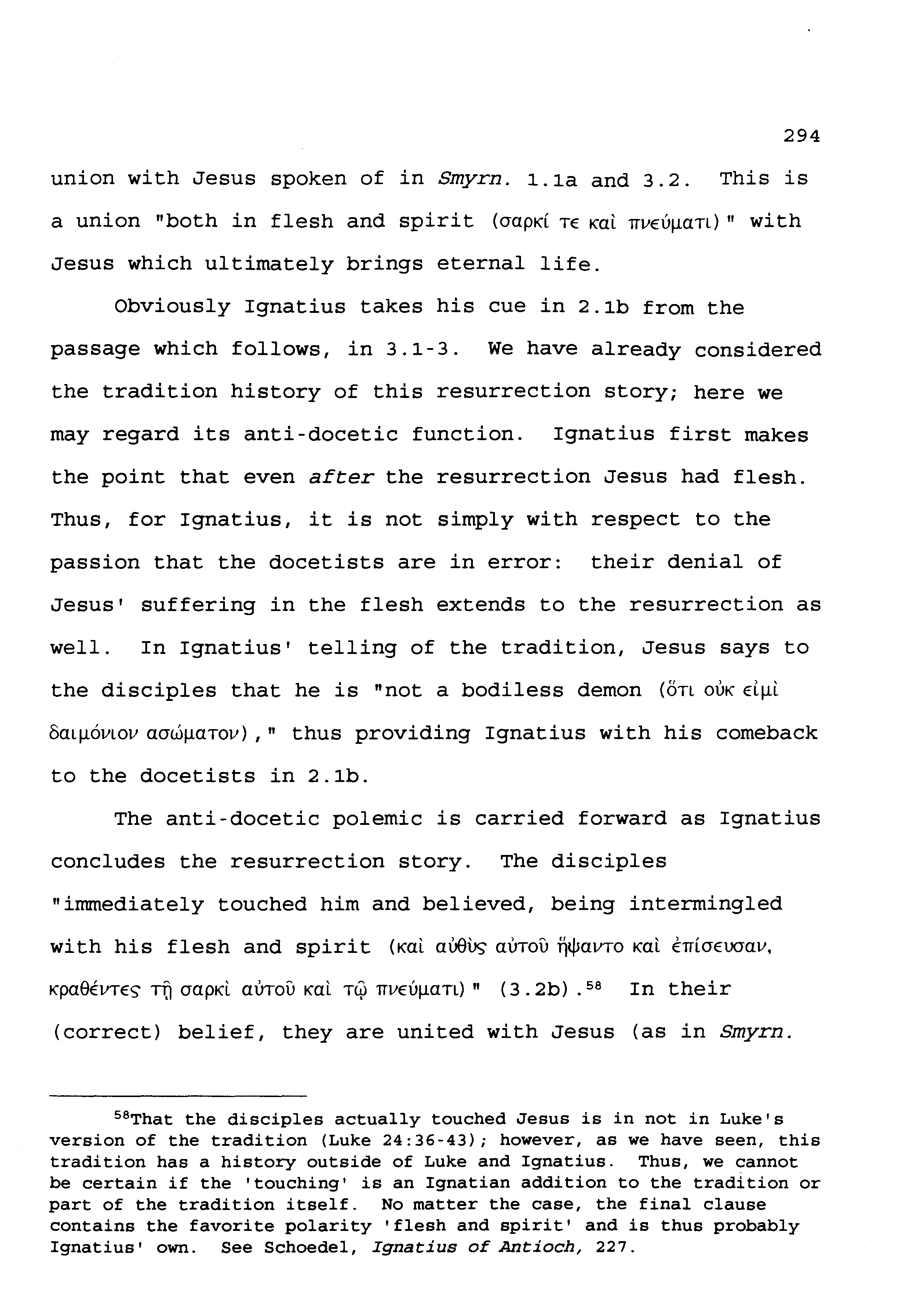
union with Jesus spoken of in Smyrn. l.la and 3.2.
This is a union "both in flesh and spirit (aapK( TE Kai nvEuµaTL)" with Jesus which ultimately brings eternal life.
Obviously Ignatius takes his cue in 2.1b from the passage which follows, in 3.1-3.
We have already considered the tradition history of this resurrection story; here we may regard its anti-docetic function.
Ignatius first makes the point that even after the resurrection Jesus had flesh.
Thus, for Ignatius, it is not simply with respect to the passion that the docetists are in error: their denial of Jesus' suffering in the flesh extends to the resurrection as well.
In Ignatius' telling of the tradition, Jesus says to the disciples that he is "not a bodiless demon (oTL ouK ELµt omµovwv aawµaTOV) I II thus providing Ignatius with his comeback to the docetists in 2.1b.
The anti-docetic polemic is carried forward as Ignatius concludes the resurrection story.
The disciples "immediately touched him and believed, being intermingled with his flesh and spirit (Kai aOOUsauTou ~tµaVTo Kai E:n(aEooav,
Kpa0EVTES' nJ aapKL m'.n-ou Kai TQ nvEuµaTL) "
( 3. 2b) . 58
In their (correct) belief, they are united with Jesus (as in Smyrn.
58That the disciples actually touched Jesus is in not in Luke's version of the tradition (Luke 24:36-43); however, as we have seen, this tradition has a history outside of Luke and Ignatius.
Thus, we cannot be certain if the 'touching' is an Ignatian addition to the tradition or part of the tradition itself.
No matter the case, the final clause contains the favorite polarity 'flesh and spirit' and is thus probably
Ignatius' own.
See Schoedel, Ignatius of Antioch, 227.
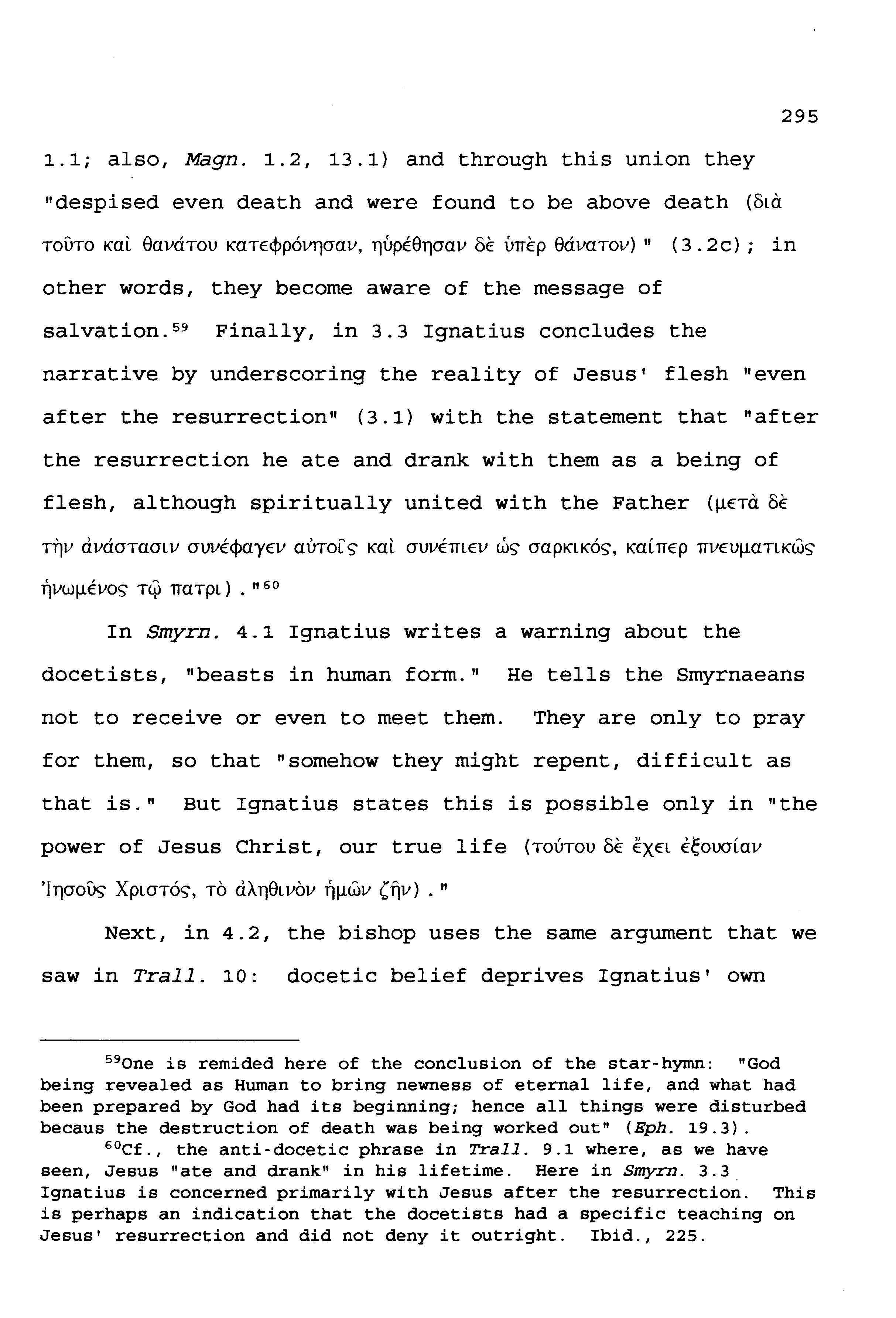
1.1; also, Magn. 1.2, 13.1) and through this union they "despised even death and were found to be above death (8La
TOUTO Kai eavchou KaTE<f>povricrav, 11up€611crav OE UlTEp 0civaTOV) II ( 3. 2c) ; in other words, they become aware of the message of salvation. 59
Finally, in 3.3 Ignatius concludes the narrative by underscoring the reality of Jesus' flesh "even after the resurrection" (3.1) with the statement that "after the resurrection he ate and drank with them as a being of flesh, although spiritually united with the Father (µETa OE
TTW dvcicrTaGLV cruv€<f>ayEv auTOL S' Kai GUVElTLEV WS' crapKLKOS'' Ka( lTEp lTVEUµaTLKWS'
~vwµEvoS' Tii) naTpL) • 11 Go In Smyrn. 4.1 Ignatius writes a warning about the docetists, "beasts in human form."
He tells the Smyrnaeans not to receive or even to meet them.
They are only to pray for them, so that "somehow they might repent, difficult as that is."
But Ignatius states this is possible only in "the power of Jesus Christ, our true life (Toifrou OE EXEL E~ooo(av
'I11cr0Us' XpLcrT6S', To dA.110wov ~µwv Cftv) . "
Next, in 4.2, the bishop uses the same argument that we saw in Trall. 10: docetic belief deprives Ignatius' own 590ne is remided here of the conclusion of the star-hymn:
"God being revealed as Human to bring newness of eternal life, and what had been prepared by God had its beginning; hence all things were disturbed becaus the destruction of death was being worked out" (Eph. 19.3).
60cf., the anti-docetic phrase in Trall. 9.1 where, as we have seen, Jesus "ate and drank" in his lifetime.
Here in Srnyrn. 3.3.
Ignatius is concerned primarily with Jesus after the resurrection.
This is perhaps an indication that the docetists had a specific teaching on Jesus' resurrection and did not deny it outright.
Ibid., 225.
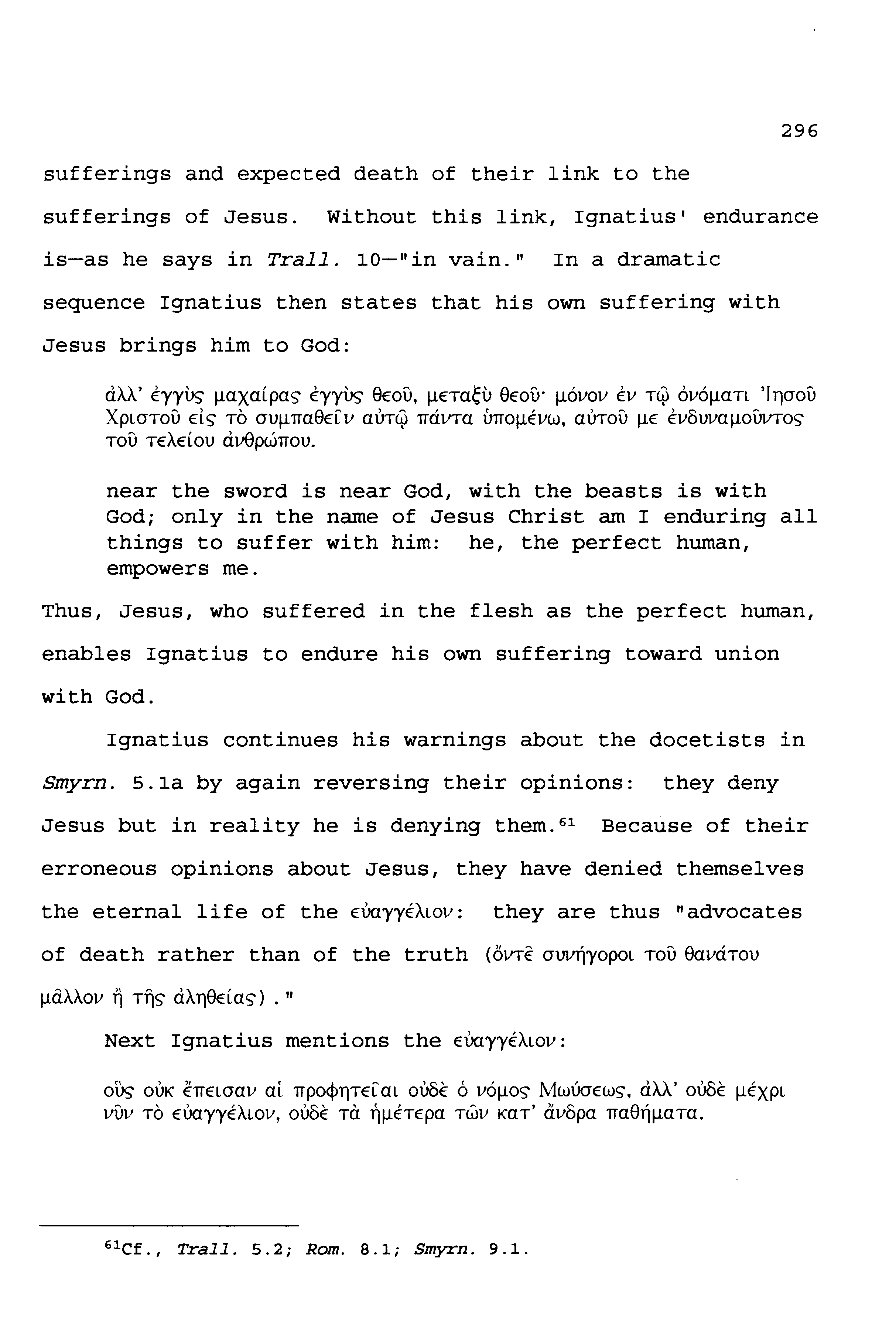
sufferings and expected death of their link to the sufferings of Jesus.
Without this link, Ignatius' endurance is-as he says in Trall. 1011 in vain. "
In a dramatic sequence Ignatius then states that his own suffering with Jesus brings him to God: dAA.' E-yyiJs' µaxa(pasE-yyUs8rnu, µETaeu 8rnu· µovov E-v T4> ovoµaTL 'I11aou
XpwTou ELS' TO auµTTa8E[v aim~ TiciVTa imoµfrw, m'.rrou µE E-vouvaµofJVTosTofJ TEAdou dv8pu'.mou. near the sword is near God, with the beasts is with God; only in the name of Jesus Christ am I enduring all things to suffer with him: he, the perfect human, empowers me.
Thus, Jesus, who suffered in the flesh as the perfect human, enables Ignatius to endure his own suffering toward union with God.
Ignatius continues his warnings about the docetists in Smyrn. 5.la by again reversing their opinions: they deny Jesus but in reality he is denying them. 61
Because of their erroneous opinions about Jesus, they have denied themselves the eternal life of the EooyyEALov: they are thus "advocates of death rather than of the truth (OVTE auvtjyopm TOU 8avciTou µdAA.ov 11 TTJS' dATJ8E(as-) . 11
Next Ignatius mentions the Eooyy€Awv: o\Jc; ouK ETIELaav ai TipO~TJTELm oooE: 6 v6µosMwooEws-, dAA.' oooE: µEXPL vfJv TO Eooyy€Awv, ou8E: Ta ~µETEpa Twv KaT' dvopa Tia8tjµaTa.
61Cf., Trall. 5.2; Rom. 8.1; Smyrn. 9.1.
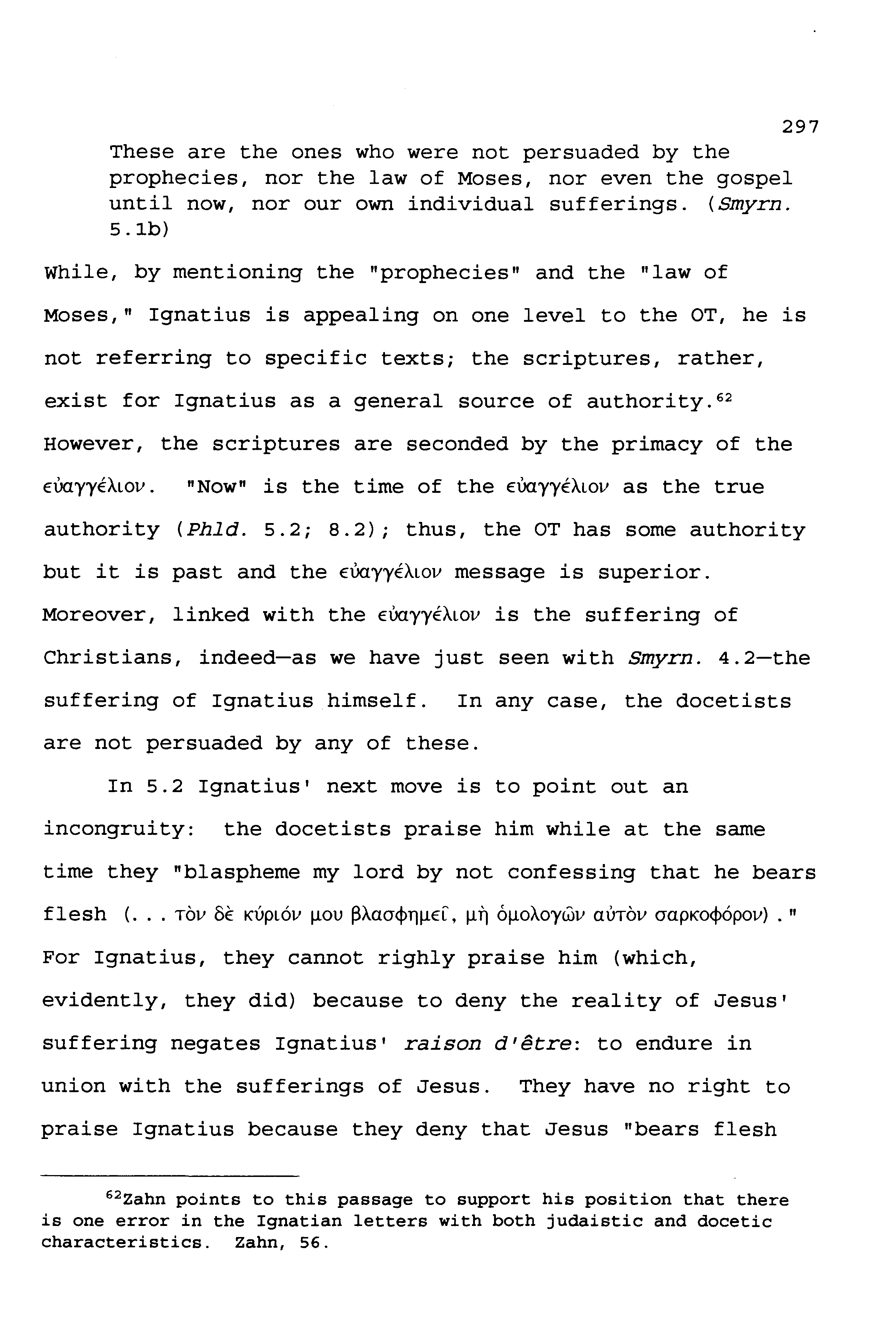
These are the ones who were not persuaded by the prophecies, nor the law of Moses, nor even the gospel until now, nor our own individual sufferings. (Smyrn.
5. lb) While, by mentioning the "prophecies" and the "law of Moses," Ignatius is appealing on one level to the OT, he is not referring to specific texts; the scriptures, rather, exist for Ignatius as a general source of authority. 62
However, the scriptures are seconded by the primacy of the EooyyEALOV .
"Now" is the time of the EooyyEALov as the true authority (Phld. 5.2; 8.2); thus, the OT has some authority but it is past and the EooyyEALov message is superior.
Moreover, linked with the EooyyEALov is the suffering of Christians, indeed-as we have just seen with Smyrn. 4.2-the suffering of Ignatius himself.
In any case, the docetists are not persuaded by any of these.
In 5.2 Ignatius' next move is to point out an incongruity: the docetists praise him while at the same time they "blaspheme my lord by not confessing that he bears flesh ( ... Tov 8E KupL6v µou ~Aaa<frr1µEC, µ~ 6µoA.oywv mhov aapKo<f>opov) . 11
For Ignatius, they cannot righly praise him (which, evidently, they did) because to deny the reality of Jesus• suffering negates Ignatius• raison d'etre: to endure in union with the sufferings of Jesus.
They have no right to praise Ignatius because they deny that Jesus "bears flesh 62Zahn points to this passage to support his position that there is one error in the Ignatian letters with both judaistic and docetic characteristics.
Zahn, 56.
(aapK0¢6pos-)" and are thus "bearer[s] of a corpse (VEKpo¢6pos-)"
(cf., Smyrn. 2).
This suggests once again that through their opinions the docetists deprive themselves of eternal life. 63
Ignatius does not give their "unbelieving names (Ta 8E ov6µaTa m'.m.0v, OVTa amaTa) II; he does not even want to remember them "until they repent about the passion, which is our resurrection (µEXPLS' ou µETavoftawmv EisTO mi0os-, o EGTLV iiµwv dvciaTaGLS') "
( s. 3) .
The docetists' failure is with the EooyyEALOV • With respect to Smyrn. 6.1, there is little direct reference to the EooyyEALov motifs and themes.
The closest we have is the docetists' incurring judgment by their failure "to believe in the blood of Christ (€av µi} maTEoowaw ELS' TO al' µa
XpL<!Tou) • "
In other words, they are not "established in love by the blood of Christ" (Smyrn. 1.la); by their failure to believe they are a source of disunity.
In 6.2, however, Ignatius turns directly once more to the error itself and warns the Smyrnaeans to observe how those holding "strange opinions about the grace of Jesus
Christ which came to us (KaTaµci0ETE BE ToiJ<; ETEpoooeouVTaS' ELS' Ti}v xcipw 'I11aou XptaTou Ti}v Eisiiµcis- €A0oooav) " are "against the purpose of God (1TWS' EVaVTLOL ELGLV T'fl yvwµ1J TOU emu) . II Thus, as with the judaizers in Magn. 8.1, we find "strange opinions" (in 63Schoedel, Ignatius of Antioch, 235.
Smyrn. 6. 2 with ETEpo8o~ouvTas-) defined by a failure in regard to grace.
We have observed that Ignatius' notion of XUPLS" owes much to the Pauline notion of the gospel message (cf.,
Gal 2:15-21).
Here the "grace of Jesus Christ which came to us" suggests the napooo(a of Jesus, the inaugural event of the EooyyEALov (cf., Eph. 20.2).
The strange opinions about Jesus' grace therefore means that the docetists are "against the purpose of God": in their strange opinions about God's xapLS-, they deny the reality of God's intentions expressed in the salvific events accomplished by Jesus (cf., Eph. 20.2;
Magn. 8.2; Rom. insc.).
The practical results of the docetists' failure are Ignatius' next topic.
God' s purpose is seen in the EooyyEALov events; for Ignatius, correct belief in the EooyyEALov is the foundation for church unity (i.e., Smyrn. 7.2).
As we have seen, one of the expressions of this unity is Christian love (Smyrn. 1.la).
Ignatius states in Smyrn. 6.2b that the docetists fail in this love:
TTEPL dyam1sOU µ0 .. EL aITTOL S". OU TTEpl xr)pas-' OU TTEpl 6p¢avou, OU TTEpl
9A.(oµEvou, ou TTEpL 8E8EµEvou fl AEAuµfou, ou TTEpL TTELvWVTOSfl 8Ltf;wVTos-.
They have no concern for love, none for the widow, none for the orphan, none for the distressed, none for the imprisoned or released, none for the hungry or thirsty.
Perhaps because of their denial of the fleshly existence of Jesus, the docetists saw no need in care for the earthly concerns of others.
Yet, it seems more accurate to see this as Ignatius' own extension of their beliefs.
For Ignatius
docetic beliefs destroy the unity of the church, a unity that is lived out through love for the needy.
Again, because of their position, they are not "established in love by the blood of Christ" (Smyrn. 1.la; cf., 6.1).
Therefore, to separate clearly the docetists from proper Christians, Ignatius accuses them of disunity through a failure in the fundamental Christian tenet, love for one another. 64
Next, in Smyrn. 7.1, Ignatius continues discussing the practical results of docetic belief, here with direct reference to the EooyyEA.tov.
Thus, in a passage we have discussed elsewhere, Ignatius states that the docetists do not partake in the eucharist because they
To µT) 6µoA.oyEL'v Ti)v EuxaptaT(av acip1m d vm Tou awTfjpos- ~µwv 'IT)aou XpLCJTOU Ti)v &rrE:p TWV aµapTLWV ~µwv naeoooav, ~v TTJ XPT)CJTOTT)TL 6 naTT)p ~'YELPEV. do not confess that the eucharist is the flesh of our savior Jesus Christ which suffered for our sins,
[flesh] which the Father raised by his goodness.
Here, Ignatius is bringing the EooyyEALOV events into the present by linking the passion and resurrection with the eucharist.
Thus, as we have seen in Phld. 5.1, the historical flesh of Jesus is tied with the EooyyEA.tov events and message in the present church (thus, the EooyyEALov "until now" in Smyrn. 5.lb).
The docetists, who deny the reality of Jesus' suffering in the flesh, do not confess that the 64Ibid. I 240.
eucharist is that same flesh and thus doubly fail with respect to the EooyyEALov.
In Smyrn. 7.lb Ignatius then alludes to Christian love once more.
In their failure with respect to the historical and eucharistic flesh of Jesus, the docetists are those who,
"speaking against the gift of God, die in their arguing (o[ ouv aVTLAEyOVTES' TlJ 8wpEQ. TOU 0EOU GU(TJTOUVTES' dno0vtjaKOOOLV) . II The answer to this loss of eternal life is "to have love so that they might also rise (auvE<f>EpEv & mhol'sdyanav, L'va Kat dvaaTwow) . "
For Ignatius, 11 faith and love are everything, to which nothing can be preferred (To yap oAov EGTL v n(aTLS' Kat dyciTTTJ, wv ouoEv npoKEKpL Tm) "
( Smyrn. 6 . 1) .
Ignatius concludes his polemic against the docetists by turning directly to the EooyyEALOv.
The Smyrnaeans are to avoid the docetists (as Ignatius himself does [Smyrn. 5.3]) and "to heed the Prophets, and especially the gospel, in which the passion has been made clear to us and the resurrection accomplished (npoaEXELV OE Tol'snpo<f>tjTms-, EcmpETWS' OE
Tw EooyyEAL4>, E:v ~ To nci0osilµl'v OEOTJAWTm Kat T1 civciaTamsTETEAELwTm) "
(Smyrn. 7.2).
In this, Ignatius is suggesting that the EooyyEALov (toward which the Prophets pointed) shows how wrong the docetists are; it separates believers from the unbelievers (i.e., Trall. 10).
Ignatius, therefore, provides the Smyrnaeans with the source for correct belief.
To complete his argument, Ignatius concludes with his underlying concern, church unity:
"And flee from divisions
as the beginning of evils (Toi>s' 8E µEpLCJµoU5 <f>EVyETE WS' dpxT)v KaKwv)" (Smyrn. 7. 2c).
Thus, the EooyyEALov plays a central role in Ignatius' polemics against the docetics.
Docetic error, for Ignatius, cuts to the heart of Christianity.
In Ignatius' view, the docetic denial of the incarnation-and the events of Jesus' life, death and resurrection which flow from it-negates the salvation which Jesus accomplished through these events.
Therefore, for Ignatius, not only does docetic error deprive the docetists themselves of salvation, but it destroys the unity of the church by denying that salvation to Christians in general.
To reject the reality of Jesus' suffering, death and resurrection in the flesh, therefore, places one outside the boundaries of the Ka0oALKTj EKKAT)cr(a ( Smyrn. 8. 2) .
SUMMARY:
ERROR AND THE IGNATIAN GOSPEL
With respect to the error evident in the Ignatian letters, we have seen that there are two discrete errors: judaizing in Magnesians and Philadelphians, and docetic in Trallians and Smyrnaeans.
Ignatius' use of specific terms of separation to ref er to the opponents-most notably ~ al' pEGLS' ( Eph. 6. 2; Trall. 6 .1) and ~ ETEpo8oe(a (Magn. 8. 1; cf.,
Smyrn. 6.2), as well as various execrative epithets (e.g., "advocates of death" [Smyrn. 5.1])-all serve to set the boundaries around proper belief.
Moreover, Ignatius himself
evidently is often responsible for polarizing the situation by pointing out what are for him the implications of the error.
Thus, he is able to separate clearly those who are within the boundaries of correct belief from those who are outside the boundaries.
We have observed as well that for Ignatius the fundamental difficulty with both of these errors is the same: they destroy the unity of the church.
Thus, because the ground of church unity is common belief in the salvif ic message of the gospel, Ignatius is able to confront both errors by upholding for the church the centrality of the
EUaYYEALOV.
Any deviation from unity in faith and practice ultimately challenges the message of the EUaYYEALov.
Therefore, the salvific events of the EUayyEALov function as the boundary lines Ignatius has drawn around the church.
In this sense, the EUaYYEALov motifs become group-defining symbols. 65
Hence, true believers become "branches of the cross" (Trall. 11.2) and true faith is as if it were "nailed to the cross of the Lord Jesus Christ . .
" (Smyrn. 1.la).
65Maier, Social Setting, 164.
CONCLUSIONS
THE GOSPEL AND IGNATIUS OF ANTIOCH
In the introduction to this dissertation, I recognized Ignatius' pivotal place in the history of early
Christianity.
We have seen throughout this study that Ignatius' articulation and use of traditions about Jesus not only looks back to previous gospel expressions, but also sets the stage for what follows.
Ignatius stands at the beginnings of Christianity's efforts toward consolidation of belief and practice.
My stated task was to isolate and examine the Ignatian concept of the Eooyy€A.tov within its environment.
This task was to include as well a treatment of how Ignatius uses the Eooyy€A.tov to delineate the boundaries of Christian belief and practice.
Therefore, in Part One we observed first the use of the term To Eooyy€A.wv in the Ignatian corpus.
Early in that discussion, the oral, preached nature of Ignatius' Eooyy€A.tov came to the surface.
This means that, for example, the y€ypanTaL of Phld. 8.2 certainly does not refer to a written text of authoritative Christian scripture or To Eooyy€A.tov.
Indeed, even as a reference to the OT, y€ypanTaL in Phld. 8.2
suggests a favorite Ignatian theme connected with the
EOOYYEALOV:
the oral witness to Jesus by the Prophets in advance.
Thus, Ignatius is primarily interested in the OT Prophets as witnessing figures and not as texts.
Otherwise, Ignatius shows little interest in any sacred text as a foundation of faith. we have examined as well the lineaments of Ignatius'
EooyyEALov.
The motifs of napooo(a, aTaupos-, eavaTOS', nci0os-, and dvciaTamsemerged as the content of the Ignatian EooyyEALov message.
Within this content, the particular use of napooo(a and nci0osreveal Ignatius' position as pointing forward in the history of the Christian articulation of the gospel.
Thus, Ignatius' use of napooo(a (Phld. 9.1) as Jesus' first coming-as well as the manifestation themes which he links with it-is a departure from the end-time concept of Jesus' napooo(a in the NT.
Likewise, Ignatius is the first to speak of the nci0osof Jesus to refer to the suffering and death.
We have seen, in fact, that for Ignatius the aTauposand ecivaTOS' motifs collapse into a single primary motif: the nci0os-.
Therefore, at the heart of Ignatius' preached gospel is Jesus' nci0osand dvciaTaOLS'. our survey of To EooyyEALov in early Christianity has revealed Ignatius' pivotal position as well.
Overall, in his emphasis on an oral, preached EooyyEALov message, Ignatius follows virtually all of the gospel expressions which came before him in the NT and the Apostolic Fathers.
Of all of
these, however, Ignatius appeals most strongly to the Pauline idea of the gospel.
Thus, not only is the Ignatian Eooyy€A.Lov a preached message as in Paul, but it also owes much to the content and specific expressions directly associated with Paul's gospel.
Yet, again, Ignatius moves beyond Paul.
First, while the content of Paul' s Eooyy€A.Lov expressions vary considerably (i.e., Rom 1:2-4; 1 Cor 15:1-5), Ignatius exhibits a tendency to fix the content of the message.
The Eooyy€A.Lov motifs for Ignatius are more starkly distinct when compared to Paul.
Hence, Ignatius' Eooyy€A.Lov is specifically defined by the salvific mieo<; and dvciaTaOL<;.
Moreover, we have observed that in his use of the traditions behind Rom 1:2-4, Ignatius has shifted the Christological category centered on Jesus' status as son of God: for Ignatius, Jesus is God's son from the outset (cf., "declared to be son of God by resurrection from the dead" [Rom 1.4]).
With respect to the gospels of early Christianity before Ignatius, aside from corrunon motifs of death and resurrection and themes such as Jesus' manifestation and Christian hope, there are few direct contact points.
The situation with Matthew, however, is unique because of the often discussed Matthew-like passages in Ignatius' letters.
I have recognized that, while Ignatius evidently knows Matthean material, he does not directly link this material either with Jesus or the Eooyy€A.Lov message.
The closest
Ignatius comes to Matthew's idea of gospel is with the suffering/resurrection sequence, and with the general emphasis on Jesus as teacher.
However, we have seen that both of these complexes of motifs and themes are common threads with other gospel expressions.
Returning to the orality of Ignatius' EooyyEALov, we have seen that an examination of the environment within the Ignatian letters provides a confirmation of that oral nature.
Thus, the verbs of transmission and acceptance (KaTayy€A.A.w: Phld. 9. 2, E:nayy€A.A.oµm: Eph. 14: 2, 1TATJpcxf>op€w:
Magn. 11.1, 6µoA.oy€w: Smyrn. 5.2) strongly suggest a preached gospel message.
More significant in this respect, though, is Ignatius' use of intramural phrases which encapsulate the EooyyEALov message for those within his circle of influence.
We have observed these same sorts of phrases not only in the Pauline corpus, but also in the Synoptic Gospels.
Most telling for my purposes is Ignatius' use of AaAELV 'IYJaouv XpLaTov ("to preach Jesus Christ":
Eph. 6.2, Magn. 10.3, Trall. 9.1, Rom. 7 .1, Phld. 6 .1) to refer to preaching the Eooyy€A.wv.
"Jesus Christ" and the salvation he accomplished is the content of the preached Eooyy€A.wv message.
In the same way, the use of To Eooyy€A.Lov TI]sKowfjsE:A.n(8os- ("the gospel of the common hope":
Eph. 21.2; Phld. 11.2) refers to the salvation gained through Jesus at the center of the Eooyy€A.Lov message.
This is further confirmed by phrases in which
11 'IrpoUsXpLaTos11 replaces 11EooyyEALOv 11 as the antecedent of 11 the common hope" ( i . e . , Eph . 21 . 2 ; Phl d. 11 . 2 ; cf . , Magn. 11 ;
Trall. insc., 2.1).
Within their Ignatian context, these intramural phrases function as abbreviations for the preached message of the EooyyEALov.
They are in-house summary phrases of the message.
What is more, we have observed how the phrase A.aA.Efv 'IT)aouv XpLaTov carries at least a suggestion of preaching with prophetic or charismatic characteristics.
Building on this suggestion, I have highlighted several Ignatian passages in which such a prophetic or charismatic preaching ministry is evident.
Thus, for example, we have the prophetic event Ignatius describes three times in Phld. 7.1-7.2.
That the charismatic or prophetic preaching is at least in part ministry to the EooyyEALov message is confirmed not only here, but also in Eph. 20.1-2 where the prime EooyyEALov motifs and themes figure in an expected revelation.
With this prophetic character of Ignatius• ministry to the EooyyEALov, we have what is evidently the source of authority upon which Ignatius bases his Christianity.
As we have seen, Ignatius avoids direct reference to the authority of OT (or any other) texts as a foundation for Christian belief and practice.
It appears, rather, that Ignatius considers his preaching to carry an ultimate, unimpeachable authority: the authority of the "voice of God" (Phld.
7.2b).
Ignatius' leadership as €u(aKonos-, therefore,
includes this 'preaching in the Spirit' within its architecture of authority.
Throughout the progress of Part One, the function of Ignatius' EUayyEALov occasionally came to the surface.
In Part Two the function became my central concern. we have seen that the overarching function of the Ignatian EUaYYEALov is to set down the boundaries of what is for Ignatius correct belief and practice.
Because, in Ignatius' view, Jesus and the central motifs of the EUayyEALov are the defining features of Christian life, Ignatius' Christology provides the greatest insight to the theological world within the boundaries.
As an approach to Ignatius' Christology I have first highlighted expressions of the incarnation.
In general, we have observed that Ignatius' expressions of the incarnation are both a departure from previous expressions and, in their own context, unambiguous in speaking of Jesus as God.
This being said, most vital for my purposes is the fact that Ignatius' expressions of the incarnation-in conjunction with the EUaYYEALov-serve a group-defining function in Ignatian Christianity.
Thus, Jesus is "our God"
(i.e., Eph. 18.2; Rom. insc.).
This group-defining function is also behind Ignatius' references to Jesus' unity of flesh and spirit (e.g., Eph. 7.2; Smyrn. 3.2) as a particular way of describing the incarnation.
This unity is a model for the Christian living in the world (Eph. 8.2), as well as the
image of church unity (Smyrn. 3.1-4.1).
Finally, the Christological epithets "the new human" (Eph. 20.1) and "the perfect human" (Smyrn. 4.2) ultimately refer to the incarnation as the exemplar of Christian unity.
These latter epithets provide an entry into our more specific treatment of a series of titles for Jesus as further expressions of the Eooyy€A.wv boundarysetting function.
Thus, the Ignatian use of "son of God," linked with the EooyyEALov motif of the TTapooo(a ( i. e. , Magn. 8 . 2) , is a vehicle for Ignatius' insistence on the preservation of unity:
Christians, united in correct belief about Jesus, are recognized by God as "members of his son" (Eph. 4.2).
However, it is with the complex of expressions surrounding "Jesus the Savior" that we find the boundaries of acceptable faith in Jesus most clearly drawn.
The coming of the Savior and his salvific deeds are what makes the EooyyEALov "remarkable" or unique in its excellence; the Eooyy€A.Lov is the "completion of immortality" (Phld. 9.2).
Indeed, those who live by the EooyyEALov are set apart by the "imprint of God" (Magn. 5.2).
Jesus' salvation "for us/for our sake" is the impetus for living within the boundaries of true faith (Trall. 2.1).
I have spoken of the intramural phrase To Eooyy€A.wv TfisKmvfisEATT(oos-.
This common hope distinguishes the in-group of believers: it is "our" hope (Eph. 1.2, 21.2; Magn. 11.1;
Trall. insc., 2.2; Phld. 11.2) held in common (Eph. 1.2,
21.2; Phld. 5.2, 11.2; cf., Magn. 7.1).
While this unifying hope ultimately points to eventual eternal life-that is, salvation grounded in the EUa')'')'EALOv-Ignatius' concept of hope serves primarily in the present, as a frame which defines true belief within Ignatius' circle of influence.
Regarding our last two Ignatian Christological titles, "the one teacher" and "the one physician," we have seen that Jesus in guise of these titles functions as a figure of authority, without appeal to specific historical teachings or healings of Jesus.
Again, Jesus is the only reference for Christian life.
Thus, in this light, "Christ's instructions" (Phld. 8.2) are the salvific deeds of the
EUa')'')'EALOV.
Likewise, Jesus is the one physician who is God manifested in flesh, who is "in death, true life" (Eph.
7. 2) .
Finally, we turn outside the boundaries of Ignatian Christianity.
It is evident from the letters that Ignatius is confronting two discrete errors: judaizing in Magnesians and Philadelphians, and docetic in Trallians and Smyrnaeans.
We have observed the of ten strident use of terms of separation in Ignatius' letters.
Not only does this language clearly delineate the boundaries, but it enables us to recognize Ignatius' own activity in polarizing the situation in the various churches.
For Ignatius the problem with both errors is the same: they destroy the unity of the church.
Because church unity
is founded on a common belief in the salvific message of the gospel, for Ignatius the answer to both errors is to uphold the centrality of the EUayy€ALov.
Thus, we have seen how Ignatius has specifically structured the received material containing the EUayyEALov motifs and themes to answer his opponents.
This is most evident in the Christological summaries embedded in Trall. 9.1-2 and Smyrn. 1.1-2.
The EUayyEALov motifs are group-defining symbols.
Therefore, Ignatius' EUayyEALov is a preached message of salvation.
It stands alone and unique with no need for support from texts.
The content of the EUayy€ALov message is the salvific advent, passion, and resurrection of Jesus, the son of God.
For Ignatius, correct belief in this message is the central feature of Christian life.
The thread that runs throughout the Ignatian letters is the concern for Christian unity.
This unity is defined by "the gospel of the common hope."
BIBLIOGRAPHY
Texts Aland, K., et al. The Greek New Testament. United Bible Societies, 1983.
Charlesworth, J. H., ed. The Old Testament Pseudepigrapha. 2 vols. Garden City: Doubleday, 1985.
Grant, R. M., ed. The Apostolic Fathers: A New Translation and Commentary. 5 vols. New York: Thomas Nelson, 1965.
Lake, K. The Apostolic Fathers. 2 vols. LCL. Cambridge:
Harvard, 1935.
~~~~· Eusebius: The Ecclesiastical History. 2 vols. LCL.
Cambridge: Harvard, 1992.
Lattke, M. Die Oden Salomos in ihrer Bedeutung fur Neues Testament und Gnosis. OBO 25/1. Fribourg: Editions
Universitaires; Gottingen: vandenhoeck und Ruprecht, 1979.
Lightfoot, J. The Apostolic Fathers. 5 vols. Peabody:
Hendrickson, 1989.
Lindemann, A. and H. Paulsen. Die Apostolischen Vater.
Tiibingen: J.C.B. Mohr (Paul Siebeck), 1992.
Metzger, B. M. and R. E. Murphy, eds. The New Oxford Annotated Bible. New York: Oxford, 1991.
Migne, J. P. Patrologiae Cursus Completus. Series Graeca.
161 vols. Paris: Garnier et Migne, 1894.
Schneemelcher, W., ed. New Testament Apocrypha. Rev. Ed. R.
McL. Wilson, trans. 2 vols. Louisville: Westminster/ John Knox, 1991-1992. septuaginta. 2 vols. Stuttgart: Wurttembergische
Bibelanstalt, 1965.
Stroker, w. D. Extracanonical Sayings of Jesus. Atlanta:
Scholars, 1989.
Reference Works Bauer, W. A Greek-English Lexicon of the New Testament and Other Early Christian Literature. w. F. Arndt, F. w.
Gingrich, trans. Revised and augmented by F. w.
Gingrich, F. D. Danker. Second edition. Chicago:
University of Chicago Press, 1979.
Blass, F. and A. Debrunner. A Greek Grammar of the New Testament and Other Early Christian Literature. F. w.
Funk, trans. Chicago: University of Chicago Press, 1961.
Goodspeed, E. J. Index Patristicus sive Clavis Patrum Apostolicorum Operum. Peabody: Hendrickson, 1993.
The Institute for New Testament Textual Research and the Computer Center of Miinster University, eds. Concordance to the Novum Testamentum Graece. In collaboration with H. Bachmann and w. A. Slaby. Third edition. Berlin:
De Gruyter, 1987.
Kittel, G., ed. Theological Dictionary of the New Testament.
G. w. Bromiley, trans. and ed. 10 vols. Grand Rapids:
Eerdmans, 1964.
Lampe, G. W. H., ed. A Patristic Greek Lexicon. Oxford:
Clarendon, 1961.
Liddell, H. G. and R. Scott. A Greek-English Lexicon.
Oxford: Clarendon, 1968.
Studies Ash, J. L. "The Decline of Ecstatic Prophecy in the Early Church," TS 37 (1976) 227-252.
Aune, D. E. "Divine Names and Epithets in Ignatius."
Unpublished Paper, n.d.
____ . The New Testament in Its Literary Environment.
Philadelphia: Wesminster, 1987.
_____ . "The Odes of Solomon and Early Christian Prophecy," NTS 28 (1982) 435-460.
_____ . "The Phenomenon of Early Christian 'AntiSacramentalism. '" In Studies in New Testament and Early Christian Literature, ed. D. Aune, 194-214.
Leiden: Brill, 1972.
____ . Prophecy in Early Christianity and the Ancient Mediterranean World. Grand Rapids: Eerdmans, 1983.
____ . "The Social Matrix of the Apocalypse of John," BR 26 (1981) 27-28.
Bardsley, H. J. "The Testamony of Ignatius and Polycarp to the Writings of St. John." JTS 14 (1913) 207-220.
Barnard, L. w. "Is the Epistle of Barnabas a Paschal Homily?" In Studies in the Apostolic Fathers and Their
Background, ed. L. w. Barnard, 73-85. New York:
Schocken, 1966.
Barrett, c. K. "Jews and Judaizers in the Epistles of Ignatius." In Jews, Greeks and Christians: Religious
Cultures in Late Antiquity, ed. R. Hamerton-Kelly and R. Scroggs, 220-244. Leiden: E. J. Brill, 1976.
Bauckham, R. "The Study of Gospel Traditions Outside the Canonical Gospels: Problems and Prospects." In Gospel
Perspectives: The Jesus Tradition Outside the Gospels, ed. D. Wenham, 369-403. Sheffield: JSOT, 1984.
Bauer, W. and H. Paulsen. Die Briefe des Ignatius von Antiochia und der Polykarpbrief. TU.bingen: J.C.B. Mohr
(Paul Siebeck), 1985.
~~~~· Orthodoxy and Heresy in Earliest Christianity. R.
Kraft, G. Kradel, et al., trans. Philadelphia:
Fortress, 1971.
Best E. Disciples and Discipleship. Edinburgh: T. & T.
Clark, 1986.
Betz, H. D. Galatians. Hermeneia. Philadelphia: Fortress, 1979.
Betz, o. "Jesus' Gospel of the Kingdom." In The Gospel and the Gospels, ed. P. Stuhlmacher, 53-74. Grand Rapids:
Eerdmans, 1991. den Boer, w. "Some Remarks on the Beginnings of Christian Historiography." In Studia Patristica, ed. F. L. Cross,
348-362. Vol. IV, part II. Berlin: AkademieVerlag, 1961.
Borgen, P. "Ignatius and the Traditions on the Birth of Jesus." In Paul Preaches Circumcision and Pleases Men and Other Essays on Christian Origins.
Trondheim:
Tapir, 1983.
Bornkanun, G. Paul. D. M. G. Stalker, trans. New York Harper & Row, 1971.
Braun, F.-M. Jean le theologien et son evangile dans l'eglise ancienne. 3 vols. Paris: J. Gabalda, 1959.
Brent, A. "History and Eschatological Mysticism in Ignatius of Antioch." ETL 65 (1989) 309-329.
~~~~-· The Ignatian Epistles and the Threefold Ecclesiastical Order." JRH 17 (1972) 18-32.
Brown, M. P. The Authentic Writings of Ignatius. Durham:
Duke University, 1963.
Brown, R. The Birth of the Messiah. Garden City: Doubleday, 1977.
~~~~· The Epistles of John. AB 30. Garden City:
Doubleday, 1985.
~~~~· The Gospel According to John. AB 29-29A. Garden City: Doubleday, 1970.
Bruce, F. F. The Acts of the Apostles. Grand Rapids:
Eerdmans, 1990.
Bultmann, R. "Ignatius and Paul." In Existence and Faith, trans. s. M. Ogden. London: Collins, 1961.
Bunge, w. F. The Christology of Ignatius of Antioch.
ThD Thesis. Cambridge: Harvard University, 1966.
Burghardt, W. "Did Saint Ignatius of Antioch Know the Fourth Gospel?" TS 1 (1940) 1-26.
Burke, P. "The Monarchiacal Episcopate at the End of the First Century." JES 7 (1970) 499-518.
Byrne, B. Romans. SP 6. Collegeville: Liturgical, 1996. van Campenhausen, H. "Das Bekenntnis im Urchristentum." ZNW
63 (1972) 210-253.
~~~~-· Ecclesiastical Authority and Spiritual Power in the Church of the First Three Centuries. J. A.
Baker, trans. Stanford: Stanford university Press, 1969.
~~~~· Die Idee des martyriums in der alten Kirche.
Gottingen: vandenhoeck & Ruprecht, 1964.
Cerf aux, L. "IL I :Evangile eternel I (Apoc. I
XIV I 6) . " ETL 39
(1963) 672-681.
Chadwick, H. "The Silence of the Bishops in Ignatius." HTR 43 (1950) 169-172.
Collins, R. F. "'The Gospel of our Lord Jesus' (2 Thes 1,8) A Symbolic Shift of Paradigm." In The Thessalonian
Correspondence, ed. R. F. Collins, 426-440. Leuven:
University Press, 1990.
Committee of the Oxford Society of Historical Theology. The New Testament in the Apostolic Fathers. Oxford:
Clarendon, 1905.
Connolly, R. H. "The Didache in Relation to the Epistle of Barnabas." JTS 33 (1932) 237-253.
Conzelmann, H. Acts of the Apostles. Hermeneia.
Philadelphia: Fortress, 1987.
~~~~-· 1 Corinthians. Hermeneia. Philadelphia:
Fortress, 1975.
~~~~-· The Theology of St. Luke. G. Buswell, trans. New York: Harper & Row, 1961 Corwin, V. St. Ignatius and Christianity in Antioch. New
Haven: Yale University Press, 1960.
Crehan, J. Early Christian Baptism and the Creed. London:
Burns, Oates and Washbourne, 1950.
Cullmann, o. Baptism in the New Testament. J. K. s. Reid, trans.
London: SCM, 1961.
____ . Christ and Time. F. Filson, trans. Philadelphia: westminister, 1964.
____ . The Christology of the New Testament. s. c.
Guthrie, C. A. M. Hall, trans. Philadelphia:
Westminster, 1963 .
. Les Premieres Confessions de foi Chretiennes.
---Paris: Presses Universitaires de France, 1948.
Danielou, J. Primitive Christian Symbols. Baltimore:
Helicon, 1964.
~~~~-· The Theology of Jewish Christianity.
J. A.
Baker, trans. Chicago: Henry Regnery, 1964.
Daube, D.
11Tp(a µooTtjpw Kpm.ryfls-: Ignatius, Ephesians, XIX. 1. "
JTS 16 (1965) 128-129.
Davies, J. G. "The Origins of Docetism." In Studia Patristica VI, ed. F. L. Cross, 13-35. TU 81. Berlin:
Akademie-verlag, 1962.
Davids, A. "Irrtum und Heresie: 1 Clem.-Ignatius von Antiochien-Justinus." Kairos 15 (1973) 165-187. Also in Wahrheit und Tradition: Festschrift fur Endre
Inank.a, ed. w. Beierwaltes, et al., 165-187. Salzburg:
Muller, 1974.
Deichgraber, R. Gotteshymnus und Christushymnus in der friihen Christenheit. Gottingen: Vandenhoeck & Ruprecht,
1987.
Desjardins, M. "Bauer and Beyond: On Recent Scholarly Discussions of A[~OLS' in the Early Christian Era."
SecCent 8 (1991) 65-82.
Dibelius, M. and H. Conzelmann. The Pastoral Epistles.
Hermeneia. P. Buttolph and A. Yarbro, trans.
Philadelphia: Fortress, 1972.
Donahue, P. J. "Jewish Christianity in Ignatius' Letters." vc 32 (1978) 80-93.
Donfried, K. P. The Setting of Second Clement in Early Christianity. Leiden Brill, 1974.
Drage, A. J. and J. D. Tabor. A Noble Death: Suicide and Martyrdom Among Christians and Jews in Antiquity. San
Francisco: Harper, 1992.
Dumeige, G. "Le Christ medecin dans la litterature chretienne des premiers siecles." Rivista di archeologia cristiana 48 (1972) 115-141.
Dunn, J. D. G. Christology in the Making. 2nd edition. Grand Rapids: Eerdmanns, 1996.
Elze, M. Uberlieferungsgeschichtliche Untersuchungen zur Christologie der Ignatiusbriefe. Tubingen: Univ. Bibl.,
1963.
Fee, G. Paul's Letter to the Philippians. Grand Rapids:
Eerdmans, 1995.
Fitzmyer, J. "The Gospel in the Theology of Paul." Int 33 (1979) 339-375.
_____ . Romans: A New Translation with Introduction and Commentary. AB 33. New York: Doubleday, 1993.
Ford, J. M. Revelation. AB 38. Garden City: Doubleday, 1975.
Garciadiego, A. Katholike Ekklesia: El significado del epiteto "Cat6lica" aplicado a "Iglesia" desde San
Ignacio de Antioquia hasta Origenes." Mexico City:
Editorial Jus., 1953.
Gillespie, T. The First Theologians: A Study in Early Christian Prophecy. Grand Rapids: Eerdmans, 1994.
Grant, R. M. "Hermeneutics and Tradition in Ignatius of Antioch." Archivio di Filosofia 1-2 (1963) 183-201.
____ . "Jewish Christianity at Antioch in the Second Century." RSR 60 (1972) 97-108 .
. "The Odes of Solomon and the Church of Antioch."
----
JBL 63 (1944) 363-77.
_____ . "Scripture and Tradition in St. Ignatius of Antioch" CBQ 25 (1963) 322-35.
Goppelt, L. A Commentary on I Peter. F. Hahn, ed. J. E.
Alsup, trans. Grand Rapids: Eerdmans, 1993.
Guelich, R. "The Gospel Genre." In The Gospel and the Gospels, ed. P. Stuhlmacher, 173-208. Grand
Rapids:
Eerdmans, 1991.
Gundry, R.
11EYArrEAION: How Soon a Book?" JBL 115 (1996) 321-325.
Hadidian, D. Y. "Tous de euangelistas in Eph. IV.11." CBQ 28 (1966) 317-321.
Hagner, D. A. "The Sayings of Jesus in the Apostolic Fathers and Justin Martyr." In Gospel Perspectives: The Jesus Tradition Outside the Gospels, ed. D. Wenham,
233-268. Vol. 5. Sheffield: JSOT, 1984.
Hanson, A. T. "The Theology of Suffering in the Pastoral Epistles and Ignatius of Antioch." In Studia Patristica
XVII.2, ed. E. A. Livingstone, 694-696. Oxford:
Pergamon, 1982.
Harrison, P. N. Polycarp's Two Epistles to the Philippians.
Cambridge: University Press, 1936.
Hengel, M. Studies in the Gospel of Mark. J. Bowden, trans.
Philadelphia: Fortress, 1985.
Hoffman, D. "The Authority of Scripture and Apostolic Doctrine in Ignatius of Antioch."
JETS 28 (1985) 71-
79.
Jay, E. "From Presbyter-Bishops to Bishops and Presbyters:
Christian Ministry in the Second Century: A Survey."
SecCent 1 (1981) 125-162.
Jaschke, H. "«A.aA.ELV» bei Lukas: Ein Beitrag sur lukanischen Theologie." BZ 15 (1971) 109-114.
Jefford, c. N. "Did Ignatius of Antioch Know the Didache?"
In The Didache in Context, ed. C. N. Jefford, 330-351.
New York: Brill, 1995.
~~~~· The Sayings of Jesus in the Teaching of the Twelve Apostles. Leiden: Brill, 1989.
Jervis, A. and P. Richardson, eds. Gospel in Paul: Studies on Corithians, Galatians and Romans for Richard N.
Longenecker. Sheffield: J.S.N.T.; Supplement Series 108, 1994.
Jewett, R. "The Redaction and Use of an Early Christian Confession in Romans 1:3-4." In The Living Text, ed. D.
Groh and R. Jewett, 99-122. Lanham: University Press of America, 1985.
Johnson, s. "Parallels Between the Letters of Ignatius and the Johannine Epistles." In Perspectives on Language and Text, ed. E. Conrad and E. Newing, 327338. Winona Lake, IN: Eisenbrauns, 1987.
Joly, R. Le Dossier d'Ignace d'Antioche. Bruxelles: Editions de l'Universite de Bruxelles, 1979.
Kasemann, E. Commentary on Romans. G. E. Bromiley, trans.
Grand Rapids: Eerdmans, 1980.
Kelly, J. N. D. Early Christian Creeds. London: Longman, 1972.
Kertelge, K. "The Epiphany of Jesus in the Gospel (Mark)."
In The Interpretation of Mark, ed. w. Telford, 78-94.
Philadelphia: Fortress, 1985.
Kingsbury, J. D. Matthew: Structure, Christology, Kingdom.
Minneapolis: Fortress, 1975.
Kloppenborg, J. "An Analysis of the Pre-Pauline Formula 1 Cor 15:3b-5 In Light of Some Recent Literature." CBQ 40
(1978) 351-367.
~~~~· The Formation of Q. Philadelphia: Fortress, 1987.
~~~~· Q Parallels: Synopsis, Critical Notes & Concordance. Sonoma: Polebridge, 1988.
Koester [Koster], H. Ancient Christian Gospels.
Philadelphia: Trinity, 1990.
_____ . "From the Kerygma-Gospel to Written Gospels."
NTS 35, (1989) 361-381.
____ . "History and Cult in the Gospel of John and in Ignatius of Antioch." JTC 1 (1965) 111-125.
____ . Synoptische fiberlieferung bei den apostolischen Vatern. Berlin: Akademie-Verlag, 1957.
____ . "Writings and the Spirit: Authority and Politics in Ancient Christianity." HTR 84:4 (1991) 353-372.
Kohler, w.-D. Die Rezeption des Matthausevangeliums in der Zeit vor Irenaus. TU.bingen: J. c. B. Mohr (Paul siebeck), 1987.
Kraft, R. A. "Barnabas and the Didache." In The Apostolic Fathers: A New Translation and Commentary, ed. R. M.
Grant, vol. 3. New York: Thomas Nelson, 1965.
Lambrecht, J. "Line of Thought in 1 Cor 15, 1-11." Greg 72, 4 (1991) 655-670.
Laeuchli, s. "The Drama of Replay." In Searching in the Syntax of Things, ed. M. Friedman, et al., 69-126.
Philadelphia: Fortress, 1972.
Lindemann, A. "Paul in the Writings of the Apostolic Fathers." In Paul and Legacies of Paul, ed. w. s.
Babcock, 25-45. Dallas: Southern Methodist University Press, 1990.
Lohmeyer, E. Das Evangelium des Markus. Gottingen:
Vandenhoeck & Ruprecht, 1967.
Lohse, E. Colossians and Philemon. w. R. Poehlmann and R. J.
Karris, trans. Philadelphia: Fortress, 1971.
____ . "Die Entstehung des Bischofsamtes in der fruhen Christenheit." ZNW 71 (1980) 58-73.
Lona, H. E. "Der Sprachgebrauch van crape I crcipKLKOS' bei Ignatius van Antiochien.
11 ZKT 108 (1986) 383-408.
Luhrmann D. Das Offenbarungsverstandinis bei Paulus und in den paulinischen Gemeinden. Neukirchen-Vluyn:
Neukirchener, 1965.
Massaux, E. The Influence of the Gospel of Saint Matthew on Christian Literature Before Saint Irenaeus. Bk. 1, The First Ecclesiastical Writers, ed. N. Belval and s.
Hecht. Macon: Mercer, 1990.
Maier, H. o. "The Charismatic Authority of Ignatius of Antioch." SR 18 (1989) 185-199.
____ . The Social Setting of the Ministry as Reflected in the Writings of Herrnas, Clement and Ignatius. Waterloo:
Wilfrid Laurier Univ., 1991.
Marxsen, w. Mark the Evangelist. J Boyce, D. Juel, et al., trans. Nashville: Abingdon, 1969.
Maurer, c. Ignatius von Antiochien und das Johannesevangelium. Zurich: Zwingli, 1949.
Meier, J. P. The Vision of Matthew: Christ, Church and Morality in the First Gospel. New York: Paulist, 1979.
_____ . "Matthew and Ignatius: A Response to William R.
Schoedel." In Social History of the Matthean Corrununity, ed. D. Balch, 178-186. Minneapolis: Fortress, 1991.
Meinhold, P. "Die geschichtstheologischen Konzeptionen des Ignatius van Antiochien.
11 In Kyriakon: Feschrift Johannes Quasten, ed. P. Granfield and J. Jungmann, 182-191. Vol. 1. Munster: Aschendorff, 1970.
____ . Studien zu Ignatius von Antiochien. Wiesbaden:
Steiner, 1979.
Moffat, J. "An Approach to Ignatius." HTR 29 (1936) 1-38.
Mallard, E. "The Heretics Cornbatted by Ignatius of Antioch." JEH s (1954) 1-6.
Morris, L. The Cross in The New Testament. Grand Rapids:
Eerdmans, 1965.
~~~~-· The Gospel According to Matthew. Grand Rapids:
Eerdmans, 1992.
Murphy-O'Connor, J. "Tradition and Redaction in 1 Car 15:37 . II
CBQ 4 3 ( 19 81 ) 5 8 2 - 5 8 9 .
Neufeld, v. The Earliest Christian Confessions. Leiden:
Brill, 1963.
Niederwirmner, K. Die Didache. Gottingen: vandenhoeck & Ruprecht, 1988.
Norden, E. Agnostos Theos. Darmstadt: Wissenschaftliche Buchgesellschaft, 1956.
Paulsen, H. Studien zur Theologie des Ignatius von Antiochien. Gottingen: Vandenhoeck & Ruprecht, 1978.
Preiss, T. "La mystique de 1 1 imitation du Christ et de l'unite chez Ignace d'Antioche." RHPR 17 (1938) 197241.
Prigent, P. "L'Heresie Asiate et l'eglise confessante de l'Apocalypse a Ignace." VC 31 (1977) 1-7.
Rathke, H. Ignatius von Antiochien und die Paulusbriefe.
Berlin: Akademie-Verlag, 1967.
Reinach, S. "Ignatius, Bishop of Antioch, and the ARXEIA."
In Anatolian Studies Presented to Sir William Mitchell Ramsay, ed. w. Buckler and w. Calder, 330-340.
Manchester: University Press, 1923.
Rohde, J. "Haresie und Schisma im Ersten Clemensbrief und in den Ignatius-Briefen." NovT 10 (1968) 217-233.
Rius-Camps, J. The Four Authentic letters of Ignatius the Martyr. Rome: Pontificium Institutum Orientalium
Studiorum, 1980.
_____ . "Ignacio de Antioquia, <.testigo ocular de la muerte y resurrecci6n de Jesus?" Bib 10 (1989) 449-473.
Saliba, I. "The Bishop of Antioch and the Heretics: A Study of a Primitive Christology." EvQ 54 (1982) 24-37.
Schaff, P. The Creeds of Christendom. Vol I. Grand Rapids:
Baker, 1877.
Schenk, w. Die Philipperbrief des Paulus. Stuttgart: w.
Kohlhammer, 1984.
Schermann, T. "Zur Erklarung der Stelle epist. ad. Ephes.
2 o, 2 des Ignatius von Antiochien: <f>apµaKov d0avaa(asK.T.A."
TQ 92 (1910) 6-19.
Schlier, H. Religionsgeschichtliche Untersuchungen zu den Ignatiusbriefen. GieBen: Topelmann, 1929.
Schnackenburg, R. Ephesians. H. Heron, trans. Edinburgh: T.
& T. Clark, 1991.
Schniewind, J. Das Evangelium nach Matthaus. Gottingen:
Vandenhoeck & Ruprecht, 1936.
Schoedel, w. Ignatius of Antioch. Hermeneia. Philadelphia:
Fortress, 1985.
_____ . "Ignatius and the Archives." HTR 71 (1978) 97-106.
_____ . "Ignatius and the Reception of the Gospel of Matthew in Antioch." In Social History of the Matthean
Community, ed. D. Balch, 29-186. Minneapolis: Fortress, 1991.
____ . "Theological Norms and Social Perspectives in Ignatius of Antioch." In Jewish and Christian SelfDefinition: The Shaping of Christianity in the Second and Third Centuries, ed. E. P. Sanders, 30-56.
Philadelphia: Fortress, 1980.
Scholligen, G. "Monepiskopat und monarchischer Episkopat:
Eine Bemerkung zur Terminologie." ZNW 77 (1986) 146151.
Schutz, J. H. "Charisma and social Reality in Primitive Christianity." JR 54 (1974) 51-70.
~~~~-· Paul and the Anatomy of Apostolic Authority.
London/New York: Cambridge, 1975.
Schweizer, E. "Concerning the Speeches in Acts." In Studies in Luke-Acts, ed. L. E. Keck and J. L. Martyn, 208-216.
Nashville: Abingdon, 1966.
Sibinga, J. S. "Ignatius and Matthew." NovTest 8 (1966) 263283.
Simon, M. "From Greek Hairesis to Christian Heresy." In Early Christian Literature and the Classical
Intellectual Tradition in Honorem Robert M. Grant, ed. w. Schoedel and R. L. Wilken, 101-106. Paris:
Beauchesne, 1979.
Snyder, G. F. "The Historical Jesus in the Letters of Ignatius of Antioch."
BR 8 (1963) 3-12.
Soards, M. L. The Speeches in Acts: Their Content, context, and Concerns. Louisville: Westminster/John Knox, 1994.
Speigl, J. "Ignatius in Philadelphia: Ereignisse und Anliegen in den Ignatiusbriefen. vc 41 (1987) 360-376. von Staden, H. "Hairesis and Heresy: The Case of the haireseis iatrikai." In Jewish and Christian SelfDefinition, vol. 3: Self-Definition in the Greco-Roman
World, ed. B. F. Meyer, E. P. Sanders, 76-100.
Philadelphia: Fortress, 1982.
Stander, H. F. "The Starhymn in the Epistle of Ignatius to the Ephesians (19:2-3) ." vc 43 (1989) 209-214.
Stauffer, E. New Testament Theology. J. Marsh, trans.
London: SCM, 1955.
Stoops, R. F. "If I Suffer . Epistolary Authority in Ignatius of Antioch." HTR 80:2 (1987) 161-78.
Streeter, B. H. The Primitive Church. London: Macmillan, 1930.
Stuhlrnacher, P. Das paulinische Evangelium. Gottingen:
Vandenhoeck & Ruprecht, 1968.
____ . "The Pauline Gospel." In The Gospel and the Gospels, ed. P. Stuhlrnacher, 149-172. Grand
Rapids:
Eerdrnans, 1991.
Sumney, J. "Those who 'Ignorantly Deny Hirn': The Opponents of Ignatius of Antioch." Journal of Early Christian
Studies 4 (1993) 345-365.
Swartley, w. M. "The Irnitatio Christi in the Ignatian Letters." vc 27 (1973) 81-103.
Trevett, C. "Approaching Matthew From the Second Century: the Under-Used Ignatian Correspondence." JSNT 20 (1984)
59-67.
~~~~-· Ignatius and His Opponents in the Divided Church of Antioch in Relation to Some Aspects of the Early
Syrian Cpristian Tradition. Sheffield: University of Sheffield, 1980.
____ . "Ignatius and the Monstrous Regiment of women."
Studia Patristica 21 (1989) 202-214.
____ . "Ignatius 'To the Romans' and I Clement LIV-LVI." vc 43 (1989) 35-52.
____ . "Prophecy and Anti-Episcopal Activity: a Third Error Combatted by Ignatius?" JEH 34 (1983) 1-18.
Wetter, G. P. Altchristliche Liturgien: Das christliche Mysterium. Gottingen: vandenhoeck & Ruprecht, 1921.
Weber, M. Economy and Society. G. Roth, C. Wittich, et al., trans. New York: Bedminster, 1968.
____ . The Sociology of Religion. E. Fischoff, trans.
Boston: Beacon, 1964.
Wickings, H. F. "The Nativity Stories and Docetism." NTS 23 (1977) 457-460.
Wifstrand, A. "The Homily of Melito on the Passion," vc 2 (1948) 201-223.
Wilder, A. N. Early Christian Rhetoric: The Language of the Gospel. Cambridge: Harvard, 1971.
Wilkins, M. J. "The Interplay of Ministry, Martyrdom and Discipleship in Ignatius of Antioch." In Worship,
Theology and Ministry in the Eary Church, ed. M.
Wilkins and T. Paige, 294-315. Sheffield: JSOT, 1992.
Wilson, s. "Gentile Judaizers." NTS 38 ( 1992) 605-616.
Yamauchi, E. M. "The Crucifixion and Docetic Christology.
Concordia Theological Quarterly 46 (1982) 1-20.
Yarbro Collins, A. Crisis and Catharsis: The Power of the Apocalypse. Philadelphia: Westminster, 1984.
Zahn, T. Ignatius von Antiochien. Gotha: Friedrich Andreas Perthes, 1873.
VITA Charles Thomas Brown was born on March 19, 1954.
In 1976 he professed vows in the Congregation of the Priests of the Sacred Heart; he was ordained to the priesthood in 1984.
Brown received a B.A. degree from Loyola University Chicago in 1979.
In 1984 Brown received an M.Div. degree from the Catholic Theological Union at Chicago; in 1991 he received an M.A. degree from the same institution.
Between 1984 and 1987, Brown ministered in Zaire, central Africa.
DISSERTATION APPROVAL SHEET
The dissertation submitted by Charles T. Brown, s.c.J. has been read and approved by the following committee:
Thomas H. Tobin, S.J., Ph.D.
Associate Professor, Theology Loyola University Chicago Urban C. von Wahlde, Ph.D Professor, Theology Loyola University Chicago Jon Nilson, Ph.D.
Associate Professor, Theology Loyola University Chicago The final copies have been examined by the director of the dissertation and the signature which appears below verifies the fact that any necessary changes have been incorporated and that the dissertation is now given final approval by the committee with reference to content and form.
The dissertation is, therefore, accepted in partial fulfillment of the requirements for the degree of Doctor of Philosophy. frP°"'• \ :}, I~'\,~ Date