
D. The Apostolic Fathers
. . (CL\AOV ayyEAOV 1TETOµEVOV EV µEooupavtjµaTL, EXOVTa EUaYYEALOV aLWVLOV EUa'YYEALOat E:ni ToU<; KaHr1µEVOUS" E:ni Tf)S' yfis- ... ) "
( 14: 6) .
Then there follows the warning to fear God's judgement (v. 7).
This "eternal gospel" is to be distinguished from the gospel of the Pauline and Synoptic traditions.
It is clearly not centered on the person of Jesus and his deeds; rather, the EooyyEA.Lov in Revelation refers to the message about the end of the world with its concomitant, the fulfillment of God's justice.
This justice means good news to the faithful and punishment to the nations.
Thus, the EooyyEALov in Rev 14: 6 (as well as in 10: 7) is the message of the ultimate triumph of the authority of God. 88
Despite the proximity of time and locale to Ignatius, there seems to be little in common between Ignatius and Revelation with respect to the idea of the EooyyEA.LOv.
THE APOSTOLIC FATHERS
We now turn outside the NT and regard the final group of witnesses to the idea of an EooyyEA.wv before Ignatius.
In these final paragraphs I will consider several documents from the Apostolic Fathers. 89
As with the above discussion 88J. M. Ford, Revelation AB 38 (Garden City: Doubleday, 1975) 236; and L. Cerfaux, "'L'Evangile ~ternel' (Apoc., XIV,6) ." ETL 39 (1963)
672-681, 680.
89In this discussion I will treat the following documents:
Clement, the Epistle of Barnabas, and the Didache.
I have excluded Hennas simply because the terms EooyyiA.wv and EooyyEAt(rnfu1 are not used in that document.
This is also true of Polycarp's letter to the Philippians, which, in any case, is much later than Ignatius:
P. N.
of the NT, I will concentrate my energies on the use of TO EOO'YYEALOV in these documents.
1 CLEMENT
Generally accepted as the earliest document among the Apostolic Fathers is 1 Clement, written ca. 96 C.E. 90
In this lengthy epistle, the word EooyyEALOV is used once, referring to Paul's message:
Clement tells the Corinthians to pick up Paul's epistle (47.1) and then asks them, "What did he first write to you in the early days of [preaching] the gospel? (TL 1TpWTOV uµ['v EV dpx6 TOU EooyyEALOU Eypatj;Ev;) II ( 4 7 . 2) .
This phrase can only refer to the beginning of Paul's preaching ministry in Corinth. 91
We find the same usage in Paul's own epistles: in Phil 4:15 Paul speaks about leaving Macedonia "in the early days of the gospel (E:v dpxiJ Tou
EooyyEA(ou) . "
Therefore, in his epistle Clement is asking the Harrison has shown it to be two letters combined, the larger portion being a letter written by Polycarp just before his death in the 150's.
P. N. Harrison, Polycarp's Two Epistles to the Philippians (Cambridge:
University Press, 1936) 16.
As for the Martyrdom of Polycarp, not only is it late, but also the usages in 1.1, 4.4, 19.1, 22.1 are all seen as still later interpolations (see Koester, Ancient Christian Gospels, 20).
2 Clement and Diognetus are generally held to be later, well into the period when the authority of the NT gospels comes to the fore.
[Yet, in the case of 2 Clement, there is a dissenting voice in K. P. Donfried who holds that 2 Clement was written between 98-100 C.E.
K. P. Donfried, The Setting of Second Clement in Early Christianity (Leiden: E. J.
Brill, 1974) 1.
This position is not generally accepted.] 9°Koester, Ancient Christian Gospels, 15.
91See G. D. Fee, Paul's Letter to the Philippians (Grand Rapids:
Eerdmans, 1995) 439-441.
As for 1 Clem 47.2, Lightfoot (Apostolic Fathers, I.2, 143) suggests " . . . in the first days of the Gospel, soon after your conversion. "
Corinthians to return to the origins of their faith as found in the preaching by Paul.
The use of the verb EooyyEAt(Ea9m in 1 Clem. 42 .1 and 3 provides us with little more information:
Jesus preached to the Apostles who, in turn, "went out with the assurance of the holy Spirit proclaiming that the kingdom of God is coming ( ... µETcl TTATJpO<f>op(asTTVEUµaTOS' ay(ou ECTJA9ov EooyyEAL(OµEVOL, Tfiv
~aOLAE(av Tou 9Eou µ€AAELV EPXEa9m) "
( 42 . 3) .
Thus, as in the . synoptic tradition, especially Luke (8:1; cf., Matt 9:35; Mark 6:6), the kingdom of God is part of the message preached.
Yet, the emphasis in 1 Clement is on the chain of preaching from Jesus through the Apostles "for us
(~µ[v) "
(42.1) and not on the message or its content.
Moreover, there is no connection between the reference to Paul's ministry in 47.2-or the reference to the kingdom in 42.3-with what ostensibly are Synoptic Jesus-sayings earlier in 1 Clem. 13.2 and 46.8.
Even if it were certain that Clement used written documents (i.e., the Synoptic Gospels) as a source for these sayings, there is no indication that he thinks of them as, in any way, "gospel."
Those "words of the Lord Jesus" (µvt1a9riTE Twv A.Oywv Tou KUp(ou 'Iriaou [46. 7; cf., 13 .1]) are commandment (E:VToAtj) and precepts (napciyyEAµa) (13.3). 92
Clement gives us no other clues with respect to his concept of gospel.
92Koester gives two reasons for considering these sayings to be from "the oral tradition": {a) the fact that there is no redactional
THE EPISTLE OF BARNABAS
Another epistle from approximately the same time, that of Barnabas, 93 refers to the EooyyEALov twice (Barn. 5. 9,
8 • 3) . 94
Both EooyyEALov passages. concern a message to be proclaimed (KT)pOOOELV TO EOO'Y'YEALOV mrrou (5. 9] ) .
It is significant that the reference to the EOO'Y'YEALov in 5. 9 is part of an extended discourse on the passion of Jesus which encompasses the whole of chapter five.
The passion of Jesus is one of atonement:
6 KUpLOc; napa8ouvm TTW ocipKa ELS' KaTa<f>9opciv, [va TlJ d<f>EoEL Twv dµapTLWV ciyvLo9wµEv, 8 E:anv E:v T~ a[µaTL Tou paVT(aµaToc; a\rrou (5.1; cf., 6.7, 7.2, 14.4-5).
What is more, embedded in chapter five, we have at least the echoes of a confessional forrnula. 95
After posing a rhetorical question as to how Jesus came to suffer at the hands of humanity, the evidence to link these sayings with the NT gospels, and (b) the quotation formula (EtTIEV) occurs in the past tense.
Koester, Ancient Christian Gospels, 15.
93L. w. Barnard, for example, dates Barnabas between 117-138 C.E.
L. W. Barnard, "Is the Epistle of Barnabas a Paschal Homily?" pages 7385 in L. w. Barnard, Studies in the Apostolic Fathers and Their
Background (New York: Schocken, 1966) 74; R. A. Kraft holds that it is not possible to fix a date more precise than between 70 C.E. and 135.
The problem is the generally recognized composite nature of the text.
R. A. Kraft, "Barnabas and the Didache" vol 3 in R. M. Grant, ed. The Apostolic Fathers: A New Translation and Commentary (New York: Thomas
Nelson, 1965) 42.
94Barnabas uses the verb EooyyEA.lE0"9aL in 14. 9 in what is virtually a direct quote from Is. 61:1-2; there is, as well, a use of the participle
6 EooyyEAL(oµEvos in 8. 3.
Both ref er to preaching; the 8. 3 usage is tied with the use of EooyyEALov in 8 . 3 .
95Barnard (Studies, 82) states that "traces of credal formulae are perhaps to be found in the Epistle; cf., v. 6-7, vii.2 and xv.9."
In my opinion, the strongest case can be made for 5.6-7.
author responds with an imperative "Learn: (µci8ETE) . 1196
Then follows the content of what is to be learned: ot np0<f>f)Tm, dn' m'.rrou EXOVTES' TTlV xcipw, ELS' m'.rrov Enpo<f>tjTEooav· aUTOS' OE, L'va KaTapytjai;i TOV ecivaTOV KaL TllV EK VEKpwv civciaTaaLV 8dei;i, oTL EV aapKL EOEL m'.rrov ¢avEpw8fivm, irrrE-µELVEV, L'va TOLS' naTpciOlv TTW
EnayyEA.(av dno84>, Kat m'.rrosE:auT4> Tov A.aov Tov Kmvov ETmµci(wv Em8dei;i ETTL Tf)syf)swv, oTL Tilv civciaTaOlv m'.rrosnm tjaasKpLVEl.
The prophets, after they had received special insight [XciPLS'] from him, prophesied concerning him.
And he submitted so that he might break the power of Death and demonstrate the resurrection from the dead-thus it·was necessary for him to be manifested in flesh.
Also (he submitted) so that he might fulfill the promise to the fathers and, while he was preparing the new people for himself and while he was still on earth, to prove that after he has brought about the resurrection he will judge.
( 5. 6 - 7) 97 This fascinating pericope cannot be discussed in detail here.
What is necessary for my present purposes, however, is to regard the apparent close proximity of themes in this confessional summary to gospel motifs that we have already seen.
The motifs of Jesus' coming in the flesh, salvific suffering (unoµE-vw) , and resurrection are indeed common
96Barnabas is a witness to a thread of early Christianity that was centered on conveying perfect knowledge (. .. i'.va µETa Tfls 1TLCJTEWS vµwv TEA.dav
EXTJTE T~v yvWo'Lv [1. 5] ) .
This is to be distinguished from later, more fully formed gnosticisms with which the developing structure of Christianity eventually clashed.
This use of µavecivw is characteristic of the author's rhetoric (e.g. 5.5, 6.9, 9.7, 14.4, 16.2, 16.7) which serves to call attention to a particular bit of knowledge or insight into God's will.
R. Kraft lists twenty-six such terms which he calls "Gnostic-Parenetic Terminology."
R. Kraft, "Barnabas and the Didache"
24-26.
97Translation, Ibid. 94.
threads.
We also have another take on the revelation schema that we have encountered elsewhere; here the Prophets receive the grace to prophesy about Jesus in advance and Jesus demonstrates (8€LKvuµL) the resurrection through being nmanifested in the flesh (E:v aapKL ... <f>avEpw0flvm) . "
With these gospel motifs before us, there is a slight link with the Eooyy€A.Lov: inunediately after this sununary, the author speaks of Jesus as teaching and preaching to Israel
(S.8) and then choosing "his own apostles to preach his gospel (oTE 8E Toi.is' lB(ousdnoaT6AousToi.is' µ€AA.oVTasKllPOOOELV TO Eooyy€A.Lov aITT-ou E:eEA.teaTo)" and manifesting himself as God's son
(E:<f>av€pwaEv E:aUTov dvm ulov 0Eou) ( 5. 9) .
This allows the author to speak of Jesus' coming in the flesh and suffering (vv.
10-14).
Moreover, within this same context there appears to be a quotation of a Jesus-saying from the Synoptic tradition:
Jesus chose the apostles who were sinners to demonstrate 11 that he came not to call the righteous but sinners (oTL ouK
~A0Ev KUAEOaL OLKULOU<;', dAA.a aµapTwAol'.Js') II ( 5. 9; cf. I Matt 9: 13, Mark 2:17, Luke 5:32, 2 Clem. 2.4) . 98
While clearly presented as corning from Jesus, this logion in Barnabas is not presented as a quotation from a written text, gospel or otherwise.
As 98Except for the first person singular in the opening verb, the logion is identical in Matthew and Mark.
Luke has a variant: ouK EAtjAvOa KaAfom OtKaLOV ciAA.a aµapTWAOVs ELS' µETdvotav.
Koester I recognizing the wide usage of this logion (with another variant in 1 Tim 1:15) states that it is from the oral free tradtion of the community.
Koester, Synoptische Uberleiferung, 144-145.
a saying of Jesus, however, it does seem to be included in Barnabas' idea of gospel.
This is probable when we observe this saying in its setting of the teaching and preaching of Jesus and the apostles. so, with respect to the epistle of Barnabas, we can be certain that Jesus' "gospel" refers to a preached message; 99 and we can be reasonably certain that that message contains not only the salvific suffering/death/resurrection sequence, but also the motif of Jesus' manifestation.
It seems, as well, that we must include teachings of Jesus in Barnabas' idea of gospel.
Overall, though, we have no indication that the author of Barnabas knows the gospels of the NT (or any other written text) as EOO'YYEALOV.
THE DIDACHE
Even more than Barnabas, the Didache or "Teaching of the Twelve Apostles" is a complex document.
It is generally recognized to be a composite of several sources, some dating 99It is clearly a preached message in B. 3 as well (ol' EBwKEV mu
EooyyEA.(ov Ti)v E~ooo(av ... ds; To KT]pooanv) .
This use of EooyyiA.wv tells us little more; it is also within an exposition on the passion of Jesus, this time how Num. 19 "typifies" the passion of Jesus.
to before or near the time of Ignatius. 100
The dating of its final redaction, however, is still not agreed upon. 101
The Didache has four references to Eooyy€A.Lov ( 8. 2, 11. 3, 15.3, 15.4).
The first of these (8.2) has attracted the most attention because it introduces a version of the Lord's
Prayer.
After the instruction on baptism in chapter seven, the author, in chapter eight, provides an exhortation on fasting (v. 1) and prayer (vv. 2-3).
On prayer the author states, "Neither pray like the hypocrites, but as the Lord commanded in his gospel (µ118€ npoaEUXE00E WS' ot irrroKpLTa(, dA.A.' we;
EKEAEOOEV 6 ICUpLOS' e:v TQ EooyyEA.(<.p m'.rrou) " (v. 2a) .
Then, introduced with "pray like this: (oihw npoaEUXE00E)," the author provides a version of the Lord's prayer that is much the same as in Matt 6:9-13.
The second use of TO Eooyy€A.Lov occurs in 11. 3.
In this section on church order, the author states, "and concerning apostles and prophets do the following according to the rule of the gospel (nEpL 8€ Twv dnoaT6A.wv KaL np0<f>flTWV, KaTa TO 86yµa Tou
EooyyEA.(ou oihw nmtjaaTE) . "
Immediately after we find a twopart instruction, first on apostles (vv. 4-6), followed by a more lengthy section on prophets (vv. 7-12).
The 100In a recent essay C. N. Jefford has suggested that Ignatius used "traditions which have been preserved in the text of the Didache."
C. N. Jefford, "Did Ignatius of Antioch know the Didache?" pp 330-351 in C. N. Jefford, ed. The Didache in Context (New York: E. J. Brill, 1995)
349.
Jefford's conclusions are reasonable.
101As we shall see, the dates one assigns the Didache and its redactions are the crux of the problem in its relationship to the gospel traditions.
instruction on apostles opens with a phrase that can be understood in light of Matt 10: 40 (6 OEXOµEVOS' uµaS' EµE OEXETm
• ) : 102
11 Let every apostle who comes to you be received as the Lord ( lTOS' 8€ dnoOTOAOS' EpxoµEVOS' TIPOS' uµaS' OEXeiJTw WS' KUpLOS') II (11.4).
The instruction on prophets opens with another Matthean-sounding phrase: "Do not test or judge any prophet speaking in a spirit, for every sin will be forgiven but this sin will not be forgiven (KaL nciVTa npcxf>tjnw A.aA.ouVTa Ev nvEuµan ou TIELpciaETE 000€ 8LaKpLVELTE" naaa yap ciµapT(a d<f>E0tjaETm, aiJTTJ 8E
~ ciµapT(a ouK d<f>E0tjaETm) ( 11. 7) . 103
The final two occurrences of To EUa'Y'YEALov in the Didache are found within an exhortation on community rules:
EAE'YXETE 8€ dA.A.tjAOUS' µ"fi EV 6pyfl, dA.A.' EV ELPrllJ WS' EXETE EV TW EUa'Y'YEA(tp· KaL naVTL daToxouvn KaTa Tou ETEpou µT}OELS' A.aA.dTw µT}8E nap' uµwv dKOuETW, EWS' OU µETavotjau. TclS' 8€ EUXclS' uµwv Kai TclS'
EAET}µoauvaS' KaL nciaaS' TcIS' npcicELS' ouTw nm tjaaTE, WS' EXETE Ev TQ EUa'Y'YEALLp TOU KUp(ou ~µwv.
And admonish one another not in anger but in peace as you have it in the gospel; and let no one speak who has done wrong against another, nor let that one hear from you until he repents.
And your prayers and alms and all your acts do them as you have it in the gospel of our Lord. ( 15 . 3) What are we to make of all of this?
The problem becomes more complex when we consider the string of teaching-sayings in 1.3-6, most of which are elsewhere
(i.e., in Matthew or Luke) attributed to Jesus.
So, we have 102cf., Luke 10:16, John 13:20.
103Cf., Matt 12: 31.
our usual two-edged question before us: is the author of the Didache referring to a written document-a gospel-when speaking of the EooyyEA.Lov? and, whether the author is or is not referring to a written text of a gospel, what is the content of that EooyyEA.Lov? with respect to the first edge of the question, one is confronted with the perennial difficulty of dating the various redactions of the Didache.
A fully argued answer to that question is not possible here.
It seems reasonable, however, that the usages of To EooyyEA.LOv are from the final author of the Didache. 104
This means that at least the idea of a gospel as an authoritative text was added to a document which originally witnessed to oral traditions.
Thus, the final redactor wished to support the oral traditions in the Didache with the authority carried by a (by then recognized) gospel text.
Hence, the usage in 8.2 that introduces the Lord's prayer need not refer to a gospel text.
Indeed, as Koester points out, the past tense of the verb (wsEKEAEUCJEV 6 icUpLos-) makes it highly unlikely that this refers to a written gospel (not to mention the fact that this prayer would
104see K. Niederwinuner, Die Didache (KEK, KAV 1; Gottingen:
Vandenhoeck & Ruprecht, 1988) 168-69.
Koester states that "there is no external evidence which would force a date of the final composition of the Didache before the end of the 2nd century . . . "
H. Koester, Ancient Christian Gospels, 17, n. 2.
certainly be commonly memorized among Christians of the time) . ios what is more, the rather distant affinity between the exhortations (on the treatment of apostles and prophets) and Mat thean sayings after the 11. 3 EooyyD.wv passage ( 11. 3 -12) presents a strong case for early contact with oral traditions which were later incorporated into written gospel texts (and given their authority by the later redactor:
"do the following according to the rule of the gospel" [KaTa To 86yµa Tou EooyyEA.(ou oU..w lTOLtjcmTE] 11. 3) .
Likewise, it seems most probable that the references to To Eooyy€A.Lov in chapter
15 stem from the late redaction. 106
Lastly, all of this is further confirmed by presence of the disparate collection of teachings in 1.3-6.
As for the content of this Eooyy€A.Lov in the Didache, the above approach makes this question less crucial for my present study.
What is clear, however, is the fact that the passion and resurrection of Jesus are never mentioned in the Didache.
Thus, no matter the origin of the usage of the word in the Didache, the content the Eooyy€A.Lov as presented
105Ibid., 16.
Jefford states that because of the prayer's stylized and relatively fixed form, "one can hardly determine the source behind the Didache's versions of the 'Lord's Prayer.'"
C. N. Jefford, The Sayings of Jesus in the Teaching of the Twelve Apostles (Leiden:
Brill, 1989) 138.
106For Jefford the last redaction of the Didache occured as early as soon after the final version of Matthew.
Ibid., 145.
It seems a date after 150, however, would best fit the idea of a gospel as an authoritative text.
there is composed of teachings of "the Lord."
This fact alone argues strongly for the use of EooyyEA.LOv in the Didache as a later addition; for, even in the foregoing survey, we have seen the close connection between the passion and resurrection of Jesus with the earliest articulations of the gospel message.
SUMMARY:
THE GOSPEL OF IGNATIUS AMONG THE GOSPELS
Having highlighted the content of Ignatius' gospel and surveyed the idea of To EooyyEA.Lov in the broader world of early Christianity, it is now valuable to draw conclusions with respect to Ignatius' gospel within its early Christian matrix.
At this point in this study these conclusions are meant not only to collate information gained so far, but they also serve to introduce a closer treatment of many of the same issues in the following chapters.
In this sense, therefore, these conclusions are preliminary.
In general, the most obvious common ground in virtually all of the documents we have considered is the preached nature of the EooyyEA.Lov.
This quality is most dominant in the Pauline corpus.
We find the same quality (albeit in various contexts) in the Synoptic Gospels, especially strong in Acts, and the remainder of the NT.
Finally, in the Apostolic Fathers, the oral nature is also dominant: it is not until the later redactions in the Apostolic Fathers
(ie., the Didache) that we begin to see the idea of a gospel
text.
Ignatius' gospel is no exception in this emphasis on oral, preached message.
This oral, preached characteristic means that expressions of the gospel message encompasses various nuances with particular motifs and themes being emphasized or not depending on the author's purpose.
The clearest example of this is seen in the variations of the two Pauline statements of Rom 1:2-4 and 1 Cor 15:1-5.
Yet, the presumably formulaic nature of those Pauline texts-not to mention formulae and schemata we have seen elsewhere-at the same time strongly suggests a tendency to fix the message.
This tendency is evident in Ignatius.
Even through our initial approach to the Ignatian Eooyy€A.Lov, we have observed that while for the bishop the Eooyy€A.Lov appears to be an oral message, the specific motifs that make up that message seem to be more invariable than in Paul:
Ignatius' Eooyy€A.Lov is specifically defined by the salvific na06sand dvciaTaOLS' of Jesus.
For Ignatius, Jesus is the content of the Eooyy€A.Lov:
Jesus' sal vif ic passion and resurrection (along with his coming/manifestation) are the furthest outlines of that content.
Hence, what I have referred to as "traditional" or "pre-formed" material in the Ignatian letters appears to have been more directly subordinated to Ignatius' central message of the na06sand dvciaTaaLS'.
As we will observe more fully in the following chapters, Ignatius structures the material he has received
to serve his often polemical purpose, as well as to serve his idea of the EooyyEA.Lov.
Thus, we can say that in general Ignatius' idea of the gospel is most like Paul in that the EooyyEA.Lov is preached.
Paul's basic message of the salvation through the events of Jesus' life is the same as well; but for Ignatius those events are more starkly distinct.
We will continue to observe, however, that Ignatius' strongest affinity (linked to the EooyyEA.LOv or not) with Paul is rhetorical.
By rhetorical I refer to Pauline expressions and occasional all-but-direct quotations which are a feature in the Ignatian corpus (e.g., Eph. 18.1 [cf., 1 Cor 1:19-23]).
With respect to the idea of To EooyyEA.LOv in the Synoptic tradition, we are confronted with the uniqueness of each of the three (or four, to include Acts) documents.
We have seen how, even though Mark is in clear continuity with Paul' s concept of the EooyyEA.Lov as centered on Jesus and the salvific events of his death and resurrection, Mark's idea of the EooyyEA.LOv is broadened to include the events of the narrative that encompasses the message by and about Jesus.
The situation with Matthew is more pressing because of the often discussed Matthean-sounding passages in Ignatius
(e.g., Eph. 14.2 [Matt 12:33], Smyrn. 1.1 [Matt 3:15], Pol.
2.2 [Matt 10:16]).
While it is probable that Ignatius is dependent on written (or oral) Matthean traditions
(especially with respect to the Matthew-like Jesus logia),
it is just as clear that Ignatius does not consider this presumed source as, in any way, gospel.
Moreover, while the salvific suffering, death and resurrection of Jesus are portrayed in Matthew's Gospel, the idea of the Matthean
EUaYYEALOV Tf]S' ~aoLAE(asmore specifically includes the teachings of Jesus.
In this, Matthew's idea of the EooyyEALov is in clear distinction from that of Ignatius.
Indeed, as we will observe, even though Ignatius presents Jesus as the "only teacher" (Magn. 9.1; cf., Matt 23:8} he does not provide any teachings that are linked with Jesus (much less the Eooyy€A.Lov} • Again, the strongest connection between the Matthean and Ignatian ideas of gospel is that both see it as a preached message of salvation.
Turning to Luke-Acts, we find the same preached characteristic, especially in Acts.
There are as well links with Ignatian motifs and themes in the kerygmatic outlines embedded in the the speeches of Acts; these, however, are primarily the death/resurrection motifs that are cormnon in most of our documents.
More than this, we cannot draw other clear affinities between the Lukan and Ignatian concepts of the EooyyEALov.
In the deutero-Pauline letters (Ephesians, Colossians, 2 Thessalonians, 1 and 2 Timothy}, perhaps because of their ultimate connection with Paul, we begin once more to find
Ignatian Eooyy€A.Lov themes.
While the salvific suffering/ death/resurrection sequence of motifs is often not
explicitly present in these letters, the complex of surrounding themes at least suggest these motifs. so, for example, in Colossians we find such Ignatian themes as hope centered on the EUa')'')'EALov { 1: 5, 1: 2 3; cf. , Eph. 21. 2, Magn.
11.1, Phld. 5.2, etc.); we see as well the attending themes of obedience to the EUa')'')'EALov { 2 Thess 1. 8; cf. , 1 Pet 4: 1 7, Magn. 8.2), suffering for the gospel (2 Tim 1:9, 2:8-9; cf.,
Mark 8:35, 10:29, Eph. insc, Magn. 5.2, 9.2, Smyrn. 5.1).
Again, to reiterate, in all of these documents, we have noted the oral, preached nature of the EUa')'')'EALov.
With the Apostolic Fathers we have encountered further shifts in the idea of TO EUa')'')'EALOV.
Aside from observing the presence of a preached gospel, we gained little additional insight from considering 1 Clement.
Barnabas, on the other hand, presents a more nuanced idea of the preached EUa')'')'EALov.
That gospel encompasses not only the salvific suffering/death/resurrection sequence, but it also includes
-like Matthew-the teachings of Jesus {not to mention the manifestation schema which I will highlight below) .
Finally, the Didache, in its present state, exhibits the first indications we have encountered of a gospel text invested with normative authority.
It is notable, as well, that the Didache does not mention the suffering/death/resurrection of Jesus.
Taking into consideration all the documents we have discussed, there are several other contact points with
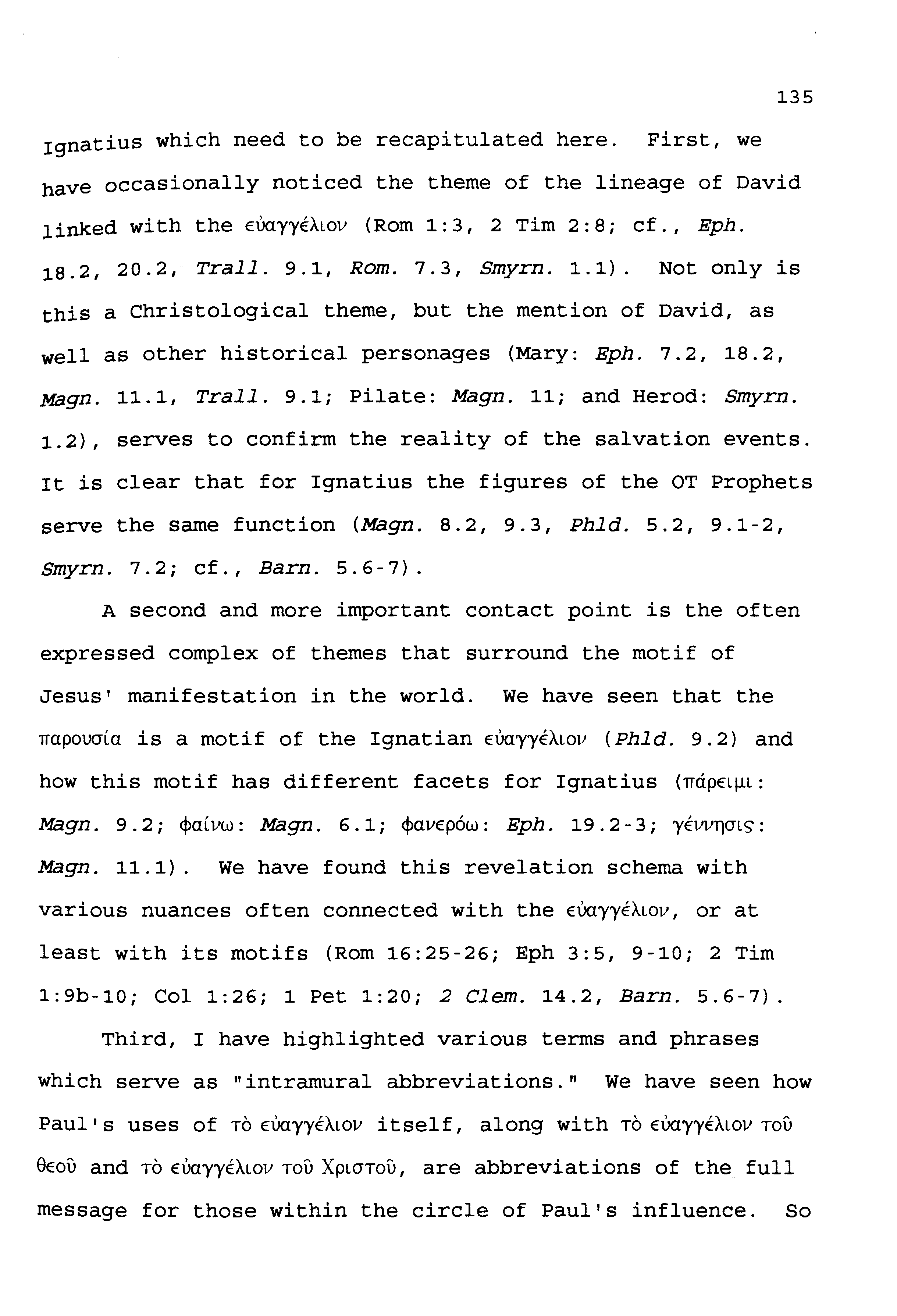
Ignatius which need to be recapitulated here.
First, we have occasionally noticed the theme of the lineage of David linked with the EooyyEA.tov (Rom 1: 3, 2 Tim 2: 8; cf., Eph.
1s.2, 20.2, Trall. 9.1, Rom. 7.3, Smyrn. 1.1).
Not only is this a Christological theme, but the mention of David, as well as other historical personages (Mary: Eph. 7.2, 18.2,
Magn. 11.1, Trall. 9.1; Pilate: Magn. 11; and Herod: Smyrn.
1.2), serves to confirm the reality of the salvation events.
It is clear that for Ignatius the figures of the OT Prophets serve the same function (Magn. 8.2, 9.3, Phld. 5.2, 9.1-2, smyrn. 7.2; cf., Barn. 5.6-7).
A second and more important contact point is the often expressed complex of themes that surround the motif of Jesus' manifestation in the world.
We have seen that the 1Tapooo(a is a motif of the Ignatian EooyyEA.tov ( Phld. 9. 2) and how this motif has different facets for Ignatius (mipELµL:
Magn. 9.2; ¢a(vw: Magn. 6.1; ¢avEp6w: Eph. 19.2-3; yEVVTlGLS':
Magn. 11.1).
We have found this revelation schema with various nuances often connected with the EooyyEA.tov, or at least with its motifs (Rom 16:25-26; Eph 3:5, 9-10; 2 Tim
1:9b-10; Col 1:26; 1 Pet 1:20; 2 Clem. 14.2, Barn. 5.6-7).
Third, I have highlighted various terms and phrases which serve as "intramural abbreviations."
We have seen how Paul's uses of To EooyyEA.tov itself, along with To EooyyEA.tov Tou
8EOu and To EooyyEA.tov Tou XptaTou, are abbreviations of the full message for those within the circle of Paul's influence.
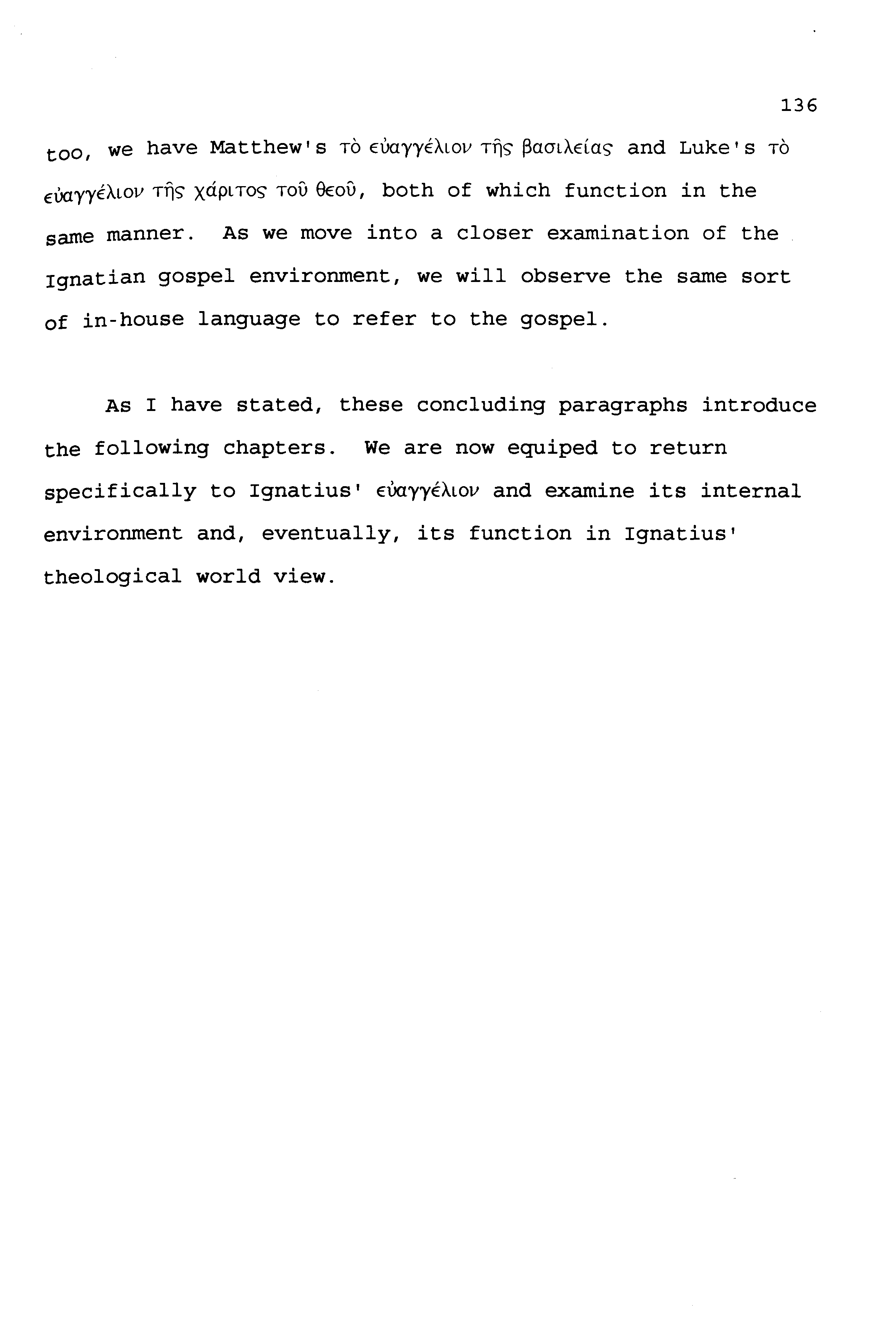
too, we have Mat thew' s To EooyyEA.Lov TTJS' ~amA.dasand Luke' s TO EUaYYEALOV TTJS' xcipLTOS' TOU 8E:ou I both of which function in the same manner.
As we move into a closer examination of the rgnatian gospel environment, we will observe the same sort of in-house language to refer to the gospel.
As I have stated, these concluding paragraphs introduce the following chapters.
We are now equiped to return specifically to Ignatius' Eooyy€A.wv and examine its internal environment and, eventually, its function in Ignatius' theological world view.
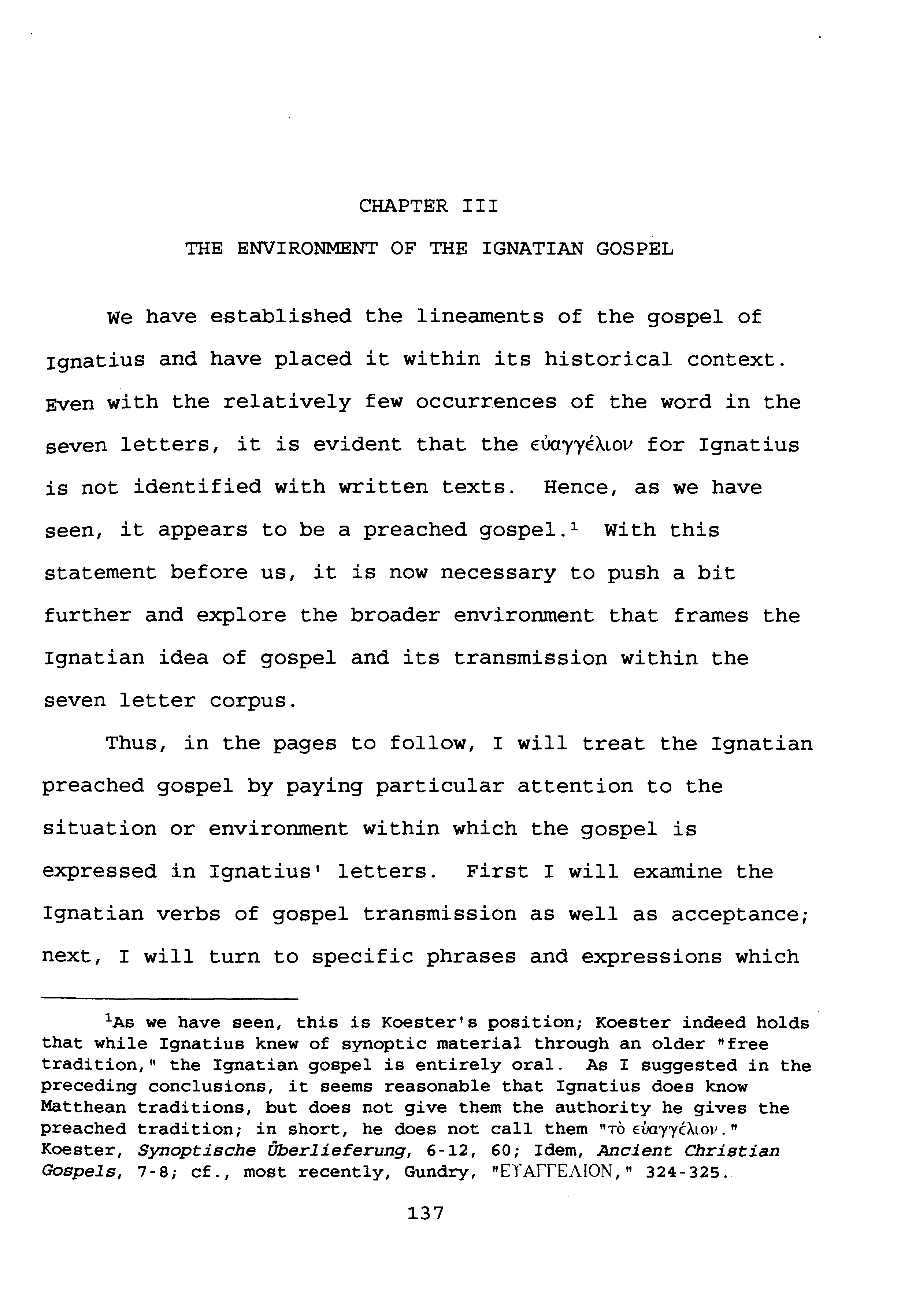
CHAPTER III
THE ENVIRONMENT OF THE IGNATIAN GOSPEL
we have established the lineaments of the gospel of Ignatius and have placed it within its historical context.
Even with the relatively few occurrences of the word in the seven letters, it is evident that the Eooyy€A.Lov for Ignatius is not identified with written texts.
Hence, as we have seen, it appears to be a preached gospel. 1
With this statement before us, it is now necessary to push a bit further and explore the broader environment that frames the Ignatian idea of gospel and its transmission within the seven letter corpus.
Thus, in the pages to follow, I will treat the Ignatian preached gospel by paying particular attention to the situation or environment within which the gospel is expressed in Ignatius• letters.
First I will examine the Ignatian verbs of gospel transmission as well as acceptance; next, I will turn to specific phrases and expressions which 1As we have seen, this is Koester's position; Koester indeed holds that while Ignatius knew of synoptic material through an older "free tradition," the Ignatian gospel is entirely oral.
As I suggested in the preceding conclusions, it seems reasonable that Ignatius does know
Matthean traditions, but does not give them the authority he gives the preached tradition; in short, he does not call them "To EooyyEAlOv."
Koester, Synoptische Uberlieferung, 6-12, 60; Idem, Ancient Christian Gospels, 7-8; cf., most recently, Gundry,
11EIArrEAION, 11 324-325 ..