
Introduction: The Gospel And Ignatius Of Antioch
INTRODUCTION
THE GOSPEL AND IGNATIUS OF ANTIOCH
The seven letters of Ignatius of Antioch, written in Asia Minor between 110-118 C.E., stand as a primary witness to the beginnings of Christianity's movement toward the consolidation of local varieties of church structure and belief into a larger, more institutionalized, form. 1
Because of Ignatius' pivotal place in the history of the early church, modern scholarly discussion of Ignatius has often focused on the nature of the traditions about Jesus in the Ignatian corpus.
Hence, the relationship between the letters of Ignatius and the canon of the NT has been a major scholarly concern.
This dissertation addresses the question of Ignatius and the NT Jesus traditions by focusing on a 1Concerning the date of the Ignatian corpus, see w. Schoedel,
Ignatius of Antioch (Hermeneia; Philadelphia: Fortress, 1985) 5.
In this study I assume the authenticity-generally recognized since the late nineteenth century work of Zahn and Lightfoot-of the seven letters in the middle recension.
J. B. Lightfoot, The Apostolic Fathers, part two, vols. 1-3, Ignatius and Polycarp (London: Macmillan,
1889-90; reprint: Peabody: Hendrickson, 1989); T. Zahn, Ignatius von Antiochien (Gotha: Perthes, 1873).
For a presentation on the textual history of the Ignatian corpus, see Schoedel, Ignatius of Antioch, 3-7.
In this dissertation I will use the following abbreviations for the letters of Ignatius:
Eph. [Ephesians], Magn.
[Magnesians], Trall.
[Trallians], Rom.
[Romans], Phld. [Philadelphians], Smyrn. [Smyrnaeans], Pol. [Polycarp].
Unless otherwise noted, translations of Ignatius' letters are my own.
Translations from the Bible are from B. Metzger and R. Murphy, eds., The New Oxford Annotated Bible (New York: Oxford,
1991) .
specific aspect of the Ignatian theological world: the gospel. with respect to the gospel and Ignatius, much of the scholarly discussion has been centered on the question of literary contact between Ignatius and various gospel texts.
While, as I will point out, my present concern is only one facet of this larger question, it is necessary to regard this scholarship as an entry to my specific concern.
Because of several Ignatian passages which appear related to the Synoptic tradition, most notably the Gospel of Matthew (e.g., Eph. 6.1, 14.2; Trall. 11.1; Smyrn. 1.2;
Pol. 2.2), literary contact between Ignatius and Matthew has been proposed by several scholars. 2
Thus, in 1905, w. R.
Inge of the Oxford Society of Historical Theology examined some twenty proposed allusions to Matthew and determined that Ignatius was certainly acquainted either with our Matthew, or with the source of our Matthew, or with a Gospel very closely akin to it .
. the indications on the whole 2These include: A Committee of the Oxford Society of Historical
Theology, The New Testament in the Apostolic Fathers (Oxford: Clarendon, 1905); W.-D. Kohler, Die Rezeption des Matthausevangeliums in der Zeit vor Iren~us (TU.bingen: J. C. B. Mohr [Paul Siebeck], 1987); Edouard
Massaux, The Influence of the Gospel of Saint Matthew on Christian Literature Before Saint Irenaeus, bk. 1, The First Ecclesiastical
Writers, N. J. Belval, S. Hecht, trans. (Macon: Mercer University, 1986); and J. P. Meier, "Matthew and Ignatius: A Response to William R.
Schoedel," pages 178-186 in D. Balch, ed., Social History of the Matthean Community (Minneapolis: Fortress, 1991).
favour the hypothesis that he used our Greek Matthew in something like its present shape. 3
Two later studies by E. Massaux (1950) and w.-D. Kohler (1987) propose the same basic approach with variations concerning the degree of probable dependence involving specific passages.
Thus, for example, Massaux finds that literary contact with Matthew is "certain" in seven Ignatian passages. 4
Kohler speaks of two Ignatian texts in which direct dependence on Matthew is clearly evident:
Smyrn. 1.1
(=Matt 3:15) and Phld. 3.1 (=Matt 15:13).
Kohler also considers literary dependence on Matthew highly probable in nine Ignatian passages. 5
Still in regard to the Synoptic tradition, there is one Ignatian passage that ostensibly has affinity with the Gospel of Luke: the resurrection narrative Ignatius reports in Smyrn. 3.1-3 is paralleled by Luke 24:36-43.
Recognizing that this narrative has a tradition history outside of Luke and Ignatius-as well as the fact that there are no other indications of Ignatian contact with Luke-, it is often held that in Smyrn. 3 Ignatius is dependent on a 3The Oxford Society, 79.
4Eph. 5.2 (=Matt 18:19-20}, 14.2 (=Matt 12:33}; Trall. 11.1 (=Matt 15:13}; Phld. 3.1 (=Matt 15:13}; Smyrn. 1.1 (=Matt 3:15}; Pol. 1.2
(=Matt 8:17}, 2.2 (=Matt 10:16}.
Massaux, 87-91.
5 Eph. 5.2 (=Matt 18:19-20), 15.1 (=Matt 23:8}, 17.1 (=Matt 26:613}, 19.1-3 (=Matt 2:2, 9}; Phld. 2.2 (=Matt 7:15}, 6.1 (=Matt 23:27};
Smyrn. 6.1 (=Matt 19:12}; Pol. 1.2-3 (=Matt 8:17}, 2.2 (=Matt 10:16}.
Kohler, 73-96.
resurrection tradition outside of Luke. 6
However, R. M.
Grant believes that Ignatius is "paraphrasing" Luke, and Paulsen (who tends to the solution that Ignatius is not dependent on Luke) admits that a direct link with Luke cannot be completely discounted. 7
With respect to the Synoptic tradition in general, a major study which takes another tack is that of H. Koester
(1957) . 8
For Koester, there is no evidence that Ignatius has any literary dependence on any of the Synoptic Gospels.
Ostensible allusions to Matthew are best explained as Ignatius' use of the older "free tradition" which the Gospel of Matthew shares with Ignatius.
The single possible contact with Luke (Smyrn. 3.1-3) is to be understood in the same way.
Koester recognizes the Matthew-like quality of various passages but states that this is because of the ecclesial ( 11 kirchlichste 11 ) content of Matthew (i.e., community rules and parenetical formulae) .
The older traditions behind this material in Matthew are interesting to Ignatius as well. 9
This explains, for example, the 6Thus, Schoedel, Ignatius of Antioch, 226-229; P. Vielhauer and G.
Strecker, "Jewish-Christian Gospels," pages 134-152 in w. Schneemelcher, ed. New Testament Apocrypha, R. Mel. Wilson, trans. vol. 1 (Louisville:
Westminster/John Knox, 1991) 143-145.
7R. M. Grant, "Scripture and Tradition in St. Ignatius of Antioch," CBQ 25 (1963) 322-335, 327; Paulsen, Studien, 41.
8H. Koester, Synoptische Uberlieferung bei den Apostolischen Vatern (Berlin: Akademie-Verlag, 1957) .
9Ibid., 60-61.
seeming Matthean allusion at Eph. 6.1 on the "master of the house" (cf., Matt 10:40) . 10
In general agreement with Koester is J. s. Sibinga (1966) . 11
Sibinga, through an analysis of thirteen supposed literary connections with Matthew, concludes that the evidence indicates Ignatius did not "quote Matthew. 1112
What is more, turning to the Synoptic source theory, Sibinga suggests that Ignatius "knew the M-material or part of it in its pre-Matthean form."
He calls this material 11Mign. 1113
Thus, for Sibinga as for Koester, Ignatius is likely using traditions older than Matthew.
With a more recent study, Schoedel (1991) continues in this same vein. 14
While he recognizes the "almost certain" possibility that Ignatius uses Matthew "in one or two passages" (e.g., Pol. 1.3), Schoedel also recognizes-with an equal level of certainty-that in other passages (e.g.,
Eph. 19) Ignatius is using "gospel material of a Matthean type not derived from the Gospel. 1115
Moreover, Schoedel underscores the telling lack of certainty that Ignatius knew both the Matthean Gospel and traditions behind it. lOibid., 39-42.
11J. S. Sibinga, "Ignatius and Matthew," NovT 8 (1966) 263-283.
12Ibid. I 281.
13Ibid. I 282.
14W. Schoedel, "Ignatius and the Reception of the Gospel of Matthew in Antioch," pages 129-177 in D. Balch, ed., Social History of the Matthean Community (Minneapolis: Fortress, 1991).
15Ibid., 175; on Pol. 1.3, 166; on Eph. 19, 156.
Therefore, with the either/or choice before him, Schoedel follows Koester in positing a "free tradition" behind the Matthew-like material in the Ignatian letters. 16
Turning away from the Synoptic tradition, Ignatian texts such as Phld. 7.1, 9.1; Rom. 7.2 have raised the question of the relationship between Ignatius and the Gospel of John (and, to a lesser extent, the Johannine letters} . 17
Earlier scholarship, such as H. J. Bardsley (1913) and c.
Maurer (1949), finds direct dependence of Ignatius on the Gospel of John.
So Maurer, for example, bases his argument on the way John is quoted elsewhere in the second century in comparison with how Ignatius cites other authors.
This comparison for Maurer points to Ignatius' use of John. 18
However, later scholars such as H. Paulsen (1978) and w.
16Ibid., 176; idem, Ignatius of Antioch, 9.
17Studies on this question include F. M. Braun, Jean le theologien et son evangile dans l'eglise ancienne, 3 vols (Paris: Gabalda, 1959);
H. J. Bardsley, "The Testamony of Ignatius and Polycarp to the Writings of St. John," JTS 14 (1913) 207-220; R. Bauckham "The Study of Gospel
Traditions Outside the Canonical Gospels: Problems and Prospects," pages 369-403 in D. Wenham, ed. Gospel Perspectives: The Jesus Tradition
Outside the Gospels (Sheffield: JSOT, 1984); F.-M. Braun, Jean le theologien et son evangile dans l'eglise ancienne, vol. 1 (Paris: J.
Gabalda, 1959) 270-282; W. Burghardt, "Did Saint Ignatius of Antioch Know the Fourth Gospel?" TS 1 (1940) 1-26; S. Johnson, "Parallels
Between The Letters of Ignatius and the Johannine Epistles," pages 327338 in E. W. Conrad, E. G. Newing, eds. Perspectives on Language and Text (Winona Lake: Eisenbrauns, 1987); C. Maurer, Ignatius von
Antiochien und das Johannesevangelium (Zurich: Zwingli, 1949); H.
Paulsen, Studien zur Theologie des Ignatius von Antiochien, (Gottingen:
Vandenhoeck & Ruprecht, 1978) 36-37.
1aMaurer, 100-102.
schoedel (1985, 1991) hold that the evidence does not warrant any certainty in this regard. 19
As we will see, in this study I favor Koester's position with respect to the relationship between Ignatius and the Synoptic tradition.
So also regarding the Gospel of John, along with Paulsen and Schoedel, it is best to see no direct link between Ignatius and John.
Yet, as I have already suggested, the literary relationship between Ignatius and the NT Gospels is not the main concern of the study to follow.
The focus of this study, rather, is the Ignatian idea of gospel.
Therefore, the cynosure of this study is the use of the term "gospel (To EooyyEA.tov)" in the Ignatian corpus.
In my view, therefore, the analysis of literary parallels between Ignatius and proposed written sources often ignores the Ignatian concept of the gospel itself.
To isolate and examine this EooyyEA.Lov in its matrix is the task I wish to attempt.
With this task in mind, a beginning point is to recognize that the Ignatian passages which are most of ten examined in regard to Ignatius and the NT Gospels are logia.
It is striking that Ignatius never introduces these with a citation formula-as in Magn. 12.lc where "as it is written
(ws yEypaTTTm) " introduces a quotation from Prov 18: 1 7 (cf. , 19Paulsen, Studien, 36-37; Schoedel, Ignatius of Antioch, 9, 206; idem, "Ignatius and the Reception of the Gospel of Matthew," 165.
Eph. 5.3)-; moreover, Ignatius never associates these sayings with Jesus or his authority. 20
Most significant for my concern, however, is the fact that Ignatius never links this material with the term To Eooyy€A.tov. 21
However, Ignatius uses TO Eooyy€A.tov eight times in five passages (Phld. 5.1, 5.2 [bis], 8.2, 9.2 [bis]; Smyrn. 5.1,
7.2).
The scholarly discussion concerning this usage falls into two broad categories: those, on the one hand, who hold that TO Eooyy€A.tov for Ignatius refers to a written document of traditions about Jesus; and those, on the other hand, who opt for an oral or preached concept of gospel in the Ignatian letters. 22
With respect to the first of these categories, we begin with the early work of T. Zahn (1873).
For Zahn, three of the eight Ignatian occurrences of To Eooyy€A.tov-Phld. s .1, 8.2; Smyrn. 7.2-refer to a written text of Christian tradition; the other occurrences (Phld. 5.2 [bis], 9.2
[bis]; Smyrn. 5.1) refer to a message about the salvific events, presumably based on the text. 23
Thus, while Zahn 2°Koester, Synoptische Uberlieferung, 60.
21As, for example, in Did. 8. 2: "Neither pray like the hypocrites, but as the Lord commanded in his gospel (µl)OE 1TpooEvxrn9E: Ws oi mroKpLrn(, ciA.A' ws EKEAEooEv 6 Kvptos E:v 14> EOO'Y'YEAL4J airrov) • "
22we will soon see, however, that K6hler fits in between these categories.
K6hler, 74-77.
23zahn, 430-434.
does recognize the preached gospel message, the EooyyO,Lov is fundamentally a written document.
There is also a series of studies which sees the EooyyEALov of Ignatius in light of the celebration of the Christian cult, the eucharist. 24
Thus, for G. P. Wetter (1921) and H. Schlier (1929) the study of Hellenistic mystery religions provides an approach to Ignatius.
In this regard, the celebration of the eucharist for Ignatius is a reenactment of Jesus' passion.
For Wetter, therefore, the EooyyEALov is a text containing the Christian salvation myth which is read in conjunction with the ritual action to reenact the salvation events. 25
Schlier, on the other hand, distinguishes a 11mystagogical 11 reading of the text containing the passion and death of Christ in which the listener shares in the sufferings ("Mitleiden") of Christ.
This Schlier links with the suffering of Christian martyrs . 26
In line with this is the work of H.-w. Bartsch (1940).
Bartsch suggests that Ignatius does not always use TO EooyyEALov in the same way.
Thus, in the pivotal passage of 24Studies in this vein are H. Schlier, Religionsgeschichtliche
Untersuchungen zu den Ignatiusbriefen {GieSen: T5pelmann, 1929); H.-w.
Bartsch, Gnostisches Gut und Gemeindetradition bei Ignatius von Antiochien {Gutersloh: C. Bertelsmann, 1940); G. P. Wetter,
Altchristliche Liturgien {Gottingen: Vandenhoeck & Ruprecht, 1921).
25Wetter, 121-122.
Cf., Schoedel, Ignatius of Antioch, 110-111.
26schlier, 166-167.
Phld. 8.2, TO EooyyEALOv "perhaps" refers to a fixed text of early traditions to be read, much like for Wetter, within the context of ritual reenactment of the salvation events as in a mystery religion.
However, Bartsch holds that Wetter has inaccurately combined two separate senses.
Thus, while in Phld. 8.2 the text would be read to relive the events of Jesus, Bartsch finds another, "sacramental," meaning of To EooyyEALOv in Phl d. 5 . 1 where he sees the EooyyEALov as a text which accompanied and interpreted the sacramental act, the eucharist. 27
In Phld. 5. 1, then, the use of TO EooyyEALov is much more than reliving the salvation events; it refers to the eucharistic presence of Jesus.
More recently, R. Joly (1979) and J. Rius-Camps (1980) find that Ignatius is using TO EooyyEALov to refer to a text. 28
Both of these authors, however, are primarily interested in challenging the almost unanimous scholarly acceptance of the middle recension of Ignatius' letters.
Thus, the use of the term TO EooyyEALov for Joly is included in his argument for a date of 160-170 for the middle recension.
In Rius-Camps' study, To EooyyEALov only occurs in two of the letters which are inauthentic. 29
27Bartsch, 99-101, especially, 100.
28R. Joly, Le Dossier d'Ignace d'Antioche (Bruxelles: Editions de l'Universite de Bruxelles, 1979); J. Rius-Camps, The Four Authentic
Letters of Ignatius, the Martyr (Rome: Pontificium Institutum Orientalium Studiorum, 1980) .
29Joly, 65-67; Rius-Camps, 48-50.
Among those who see Ignatius' EooyyD .. Lov as an oral, preached message and not a fixed text, Koester's work is the most complete. 3° Koester holds that To EooyyD.Lov for Ignatius designates "the oral message of the facts of salvation (die mundliche Botschaft der Heilstatsachen) ." 31
Pointing to the links Ignatius makes with the OT Prophets as figures and not as texts in the Eooyy€A.wv passages (all, except for Phld. a. 2) , Koester states that Ignatius' Eooyy€A.wv is therefore not a text; the EooyyEALov, rather, refers to Jesus himself through the preached message of the salvation he accomplished. 32
This is further confirmed for Koester by the fact that in Phld. 5 .1 the Eooyy€A.Lov is directly linked with the flesh of Jesus, and that in Smyrn. 5.1 the link is with the individual suffering of Christians.
The preached gospel message, thus, is where the passion is revealed and the resurrection is completed (Smyrn. 7.2).
Therefore, Koester suggests that with these links between To Eooyy€A.Lov and non-textual witnesses, Ignatius is referring to the 3 °Koester, Synoptische Uberlieferung, 6-10; idem, Ancient
Christian Gospels (Philadelphia: Trinity, 1990) 7-8.
For others who hold this position, see R. H. Gundry, 11EYArrEAION: How Soon a Book?"
JBL 115 (1996) 321-325; Schoedel, Ignatius of Antioch, 9, 222; H.
Paulsen. Die Briefe des Ignatius von Antiochia und der Polykarpbrief.
(TU.bingen: J.C.B. Mohr [Paul Siebeck], 1985) 83.
31Koester, Synoptische Uberlieferung, 6.
32cf., Kohler, 76-77.
preached message of salvation in which Christ is present as
EUaYYEALOV . 33
What is more, Koester reads the pivotal text in Phld. s. 2 in light of the other Ignatian uses of To EUayyEA.Lov. 34
Thus, in contrast to the appeal to the written documents of the OT (the "archives [cipXELa]") to which the opponents appeal with respect to the EooyyEALov, Ignatius presents the only true archives as the preached message of the Eooyy€A.Lov:
Jesus and the salvation events.
Most recently, in a brief article R. Gundry (1996) has followed Koester by underscoring not only Ignatius' distancing the Eooyy€A.wv from the OT but also the close parallels Ignatius makes with the Eooyy€A.wv and unwritten witnesses to the message. 35 w.-D. Kohler takes a different tack.
In a brief discussion which in part responds to Koester, Kohler attempts a delicate distinction with respect to Ignatius' use of To Eooyy€A.Lov. 36
As we have seen, Kohler argues for Ignatius' direct use of the Gospel of Matthew.
However, for Kohler this does not mean that To Eooyy€A.Lov refers to the Matthean Gospel; indeed, Kohler states that the question of a written or unwritten Eooyy€A.Lov is not a proper question in 33Koester, Synoptische Uberlieferung, 7.
34 Ibid. I 8.
35Gundry, 324-325.
36K()hler, 74 - 77.
the Ignatian context.
Hence, Kohler holds that To EooyyD .. Lov for Ignatius refers neither to a preached message nor to a fixed gospel text of that message; it refers, rather, to the content of that message, which is Jesus Christ (". sondern den Inhalt dieser Botschaft selbst:
Jesus Christus") . 37
This distinction between the preached message and the content of the message allows Kohler to separate the Ignatian use of TO EooyyEAtov from the posited use of a written Matthew.
The implication here is that Ignatius does not invest any written Christian source, including Matthew, with the authority that is given the OT, or 11ypa<f>tj.
The preached message for Kohler, therefore, includes Matthean material; however, this is to be distinguished from the content of that message-the EooyyD .. tov-which is Jesus Christ.
Finally, we may return briefly to Schoedel.
As we have seen, Schoedel is in basic agreement with Koester regarding Ignatius and Matthew.
While Schoedel does not treat the term EooyyEALov per se, in his discussion on the relationship between Matthew and Ignatius he approaches the gospel of Ignatius by suggesting "what a gospel written by Ignatius himself would have looked like if he had chosen to write one. 1138
Hence, with this exercise as a frame, Schoedel is able not only to address supposed contacts with Matthew, but 37Ibid., 76-77.
38Schoedel, "Ignatius and the Reception of Matthew," 154.
he is also able to highlight the content of the various traditions about Jesus to which Ignatius has access.
Yet, as we have seen, with respect to the use of the term TO EUayyEALOV itself, Schoedel follows Koester.
So, to return to the study which follows, the task of this dissertation is centered on the concept of the gospel in the letters of Ignatius.
As I have suggested, in my view the proposed direct literary contacts between Ignatius and the NT Gospels are unconvincing.
Koester's position (as well as Schoedel's) that Ignatius appeals to free traditions of various characteristics is the most plausible.
Yet, the question of Ignatius' use of To EUaYYEALOV itself remains to be fully explored.
In this regard, the proposed approaches from Hellenistic mystery religions in the studies of Wetter,
Schlier, and Bartsch depend on Ignatius' use of a cultic text; this sort of usage, in my opinion, is not supported by the evidence in the letters.
Koester's examination of To EUayyEALov in Ignatius (as well as in the other Apostolic
Fathers), however, is not only the most complete, but it also presents the most logical solution.
Thus, Koester 1 s view of the Ignatian EUayyEALov in light of the non-written witnesses with which it is directly linked, provides a viable approach to the question.
On the other hand,
Kohler's attempted distinction between the preached message and the content of that message seems forced and therefore untenable.
Finally, Schoedel's latest article (1991) provides valuable insights into the nature and content of the Jesus traditions in the Ignatian corpus
Hence, we are left with Koester's basic approach to Ignatius' use of TO EooyyEALov.
With Koester' s study as a starting place, therefore, I propose to treat fully the concept of To EooyyEALOv in the letters of Ignatius.
Along with Koester's work, Schoedel's imagined written 'Gospel According to Ignatius' will provide a frame for considering the motifs and themes that make up the Ignatian idea of
EUa'Y'YEALOV .
I will attempt this study in two parts.
In Part One, I will examine the gospel of Ignatius first through a consideration of the eight Ignatian uses of the term To EooyyE:A.Lov.
Part One will include as well a discussion of the motifs and themes which are the content of Ignatius' gospel.
The final task of Part One will be to examine the environment of the Ignatian gospel.
This will involve first a treatment of the concept of To EooyyE:A.wv in the broader environment of early Christianity; and second, an examination of TO EooyyEALOV and the internal environment of the Ignatian corpus.
Thus, Part One will establish the nature and content of the EooyyEALOV for Ignatius.
Part Two will be a treatment of the function of the Ignatian gospel.
In this part I will focus specifically on the boundaryset ting function of the EooyyD .. Lov.
Thus, I will treat first the Eooyy€A.Lov and Christology in the Ignatian letters.
In this I will consider how the Ignatian gospel serves to delineate belief within the boundaries of what is for Ignatius proper Christianity.
Second, I will discuss how the Ignatian EooyyEALov serves to isolate the belief which for Ignatius is outside the boundaries of Christianity.
Thus, this final discussion will treat error in the letters in relation to the EooyyEALov.
INTRODUCTION TO PART ONE
In Part One my goal is to isolate the Ignatian gospel and examine it in its environment.
Thus, the task here is to pay particular attention to the actual use of the term To EooyyE:A.wv not only with respect to Ignatius, but also as its use elsewhere relates to Ignatius.
The program in Part One, therefore, is threefold.
In Chapter I, first I will introduce Ignatius' gospel through a treatment of the use of To EooyyEALov in the Ignatian corpus.
The second section of Chapter I will be an examination of the leitmotifs in the 'defining passsages' which identify the content of the EooyyE:A.Lov for Ignatius.
Chapters II and III will be a consideration of what I refer to as the environment of the EooyyE:A.Lov.
Thus, Chapter II will be an examination-with Ignatius as the lens-of the broader environment of early Christianity's efforts to articulate its message as To EooyyE:A.Lov.
This discussion will center on not only the use of the term TO EooyyE:A.Lov in the NT and the Apostolic Fathers, but it will also involve the motifs and themes which constitute the content of the various gospel expressions.
Next, in Chapter III, with the broader early Christian environment before us, I will examine the internal environment of the Ignatian letters
themselves to discover how that specific environment relates to Ignatius' idea of the EooyyEA.LOv.
With these three chapters completed, I will then, in Part Two, consider how this gospel functions in Ignatius' particular view of Christianity.
CHAPTER I
THE GOSPEL OF IGNATIUS
IGNATIAN USE OF EY ArrEAION
In his seven letters Ignatius refers to the "gospel"
(Eooyy€A.wv) eight times: all are found in either the letter to the Philadelphians or to the Smyrnaeans (Phld. 5.1, 5.2
[bis], 8.2, 9.2 [bis]; Smyrn. 5.1, 7.2).
Ignatius never uses the verb EooyyEA.((Ecr0m. 1
In this section I will examine each of these occurrences within the Ignatian context by considering them in their immediate settings in the two letters.
PHILADELPHIANS 5.1-2
In Phld. 5.1 Ignatius commends the Philadelphians by telling them that their prayer will enable him to be made perfect ELS' 0E6v.
He thus attains the lot of mercy by "taking refuge in the gospel as in the flesh of Jesus" (1Tpocr<f>uywv Tii)
EooyyEA.(c.p we;- crapKL 'Iricrou) . 2
According to Smyrn. 7. 1, "the flesh 1I will, however, return to this term and discuss its equivalents.
2Ignatius speaks of this as attaining the "lot in which I was granted mercy" (i'.va E:v 4' KArJP<v i]A.Etj9rw E:mTvxw . . . ) .
'EmTvyxcivw is one of the characteristic expressions in Ignatius' rhetoric.
Here, as in Trall. 12.3 and Rom. 1.2, the object is Ignatius' "lot" or destiny (KA.flpos) ; other occurrences are: Eph. 12 . 2; Magn. 14; Tral 1. 12. 2, 13 . 3;
Rom. 2.1, 4.1, 9.2; Pol. 2.3, 7.1 all of which have the genitive 9Eov as
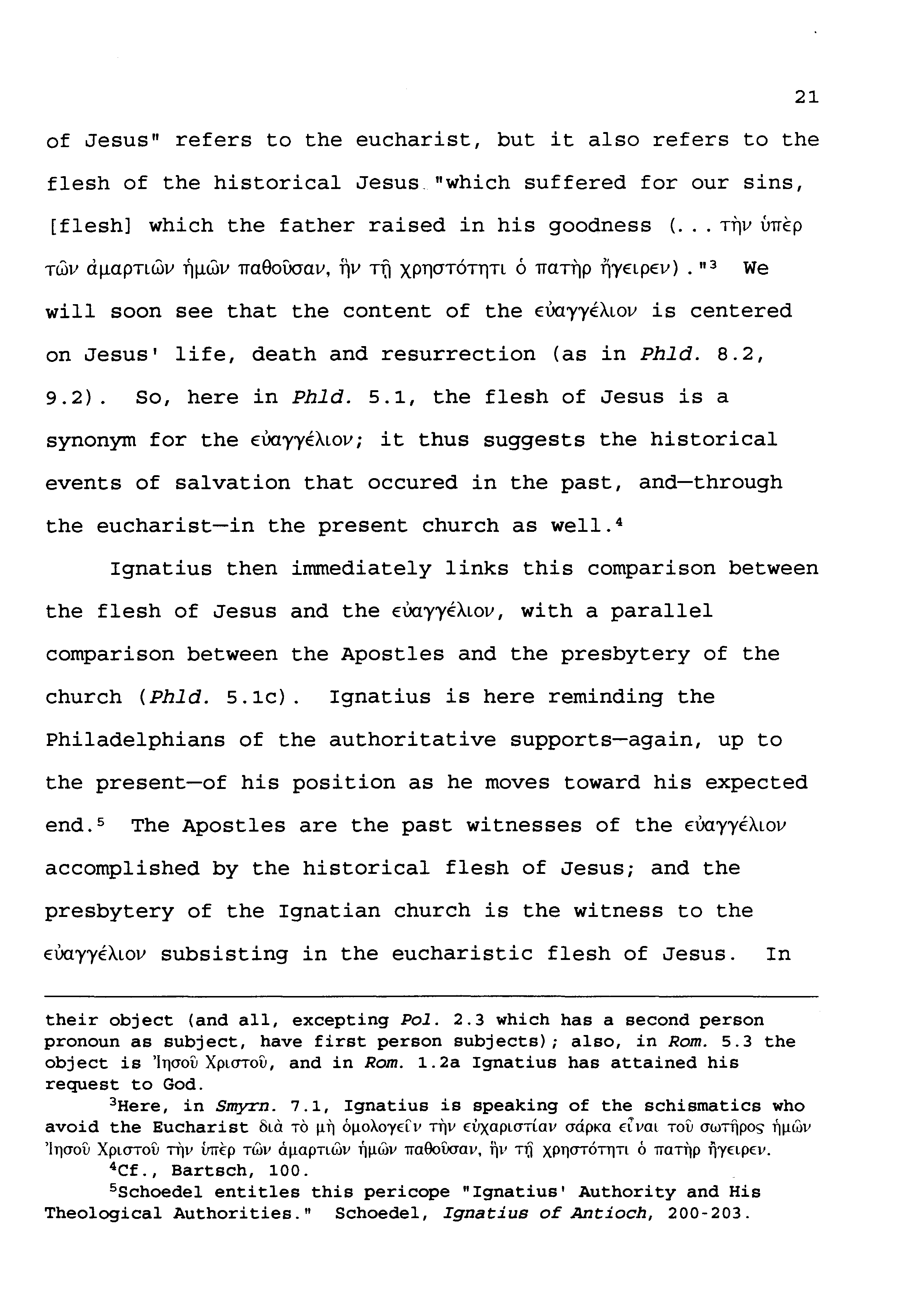
of Jesus" refers to the eucharist, but it also refers to the flesh of the historical Jesus, "which suffered for our sins,
[flesh] which the father raised in his goodness ( ... T~vun€p Twv dµapTLwv ~µwv na0oooav, ilv Tfl XPllOTOTllTL 6 na~p ~ynpEv) • " 3
We will soon see that the content of the EooyyEALov is centered on Jesus' life, death and resurrection (as in Phld. 8.2,
9.2).
So, here in Phld. 5.1, the flesh of Jesus is a synonym for the EooyyEALOV; it thus suggests the historical events of salvation that occured in the past, and-through the eucharist-in the present church as well. 4
Ignatius then irmnediately links this comparison between the flesh of Jesus and the EooyyEALov, with a parallel comparison between the Apostles and the presbytery of the church (Phld. 5.lc).
Ignatius is here reminding the Philadelphians of the authoritative supports-again, up to the present-of his position as he moves toward his expected end. 5
The Apostles are the past witnesses of the EOOY'YEALOV accomplished by the historical flesh of Jesus; and the presbytery of the Ignatian church is the witness to the EOO'Y'YEALOV subsisting in the eucharistic flesh of Jesus.
In their object (and all, excepting Pol. 2.3 which has a second person pronoun as subject, have first person subjects); also, in Rom. 5.3 the object is 'I11crov Xpt<JTou, and in Rom. 1. 2a Ignatius has attained his request to God.
3Here, in Smyrn. 7.1, Ignatius is speaking of the schismatics who avoid the Eucharist Bta TO µ~ 6µoA.oyEl'v ~v EiJxaptcrT(av crcipKa dvm Tov <JWTllPOS' ~µwv
'I11crov Xpt<JTov ~v irrrE:p Twv ciµapTtwv ~µwv iTa9oooav, ~v TU XPllITTOTllTL 6 iTaT'ilP ~ynpEv.
4Cf., Bartsch, 100.
5Schoedel entitles this pericope "Ignatius' Authority and His Theological Authorities."
Schoedel, Ignatius of Antioch, 200-203.
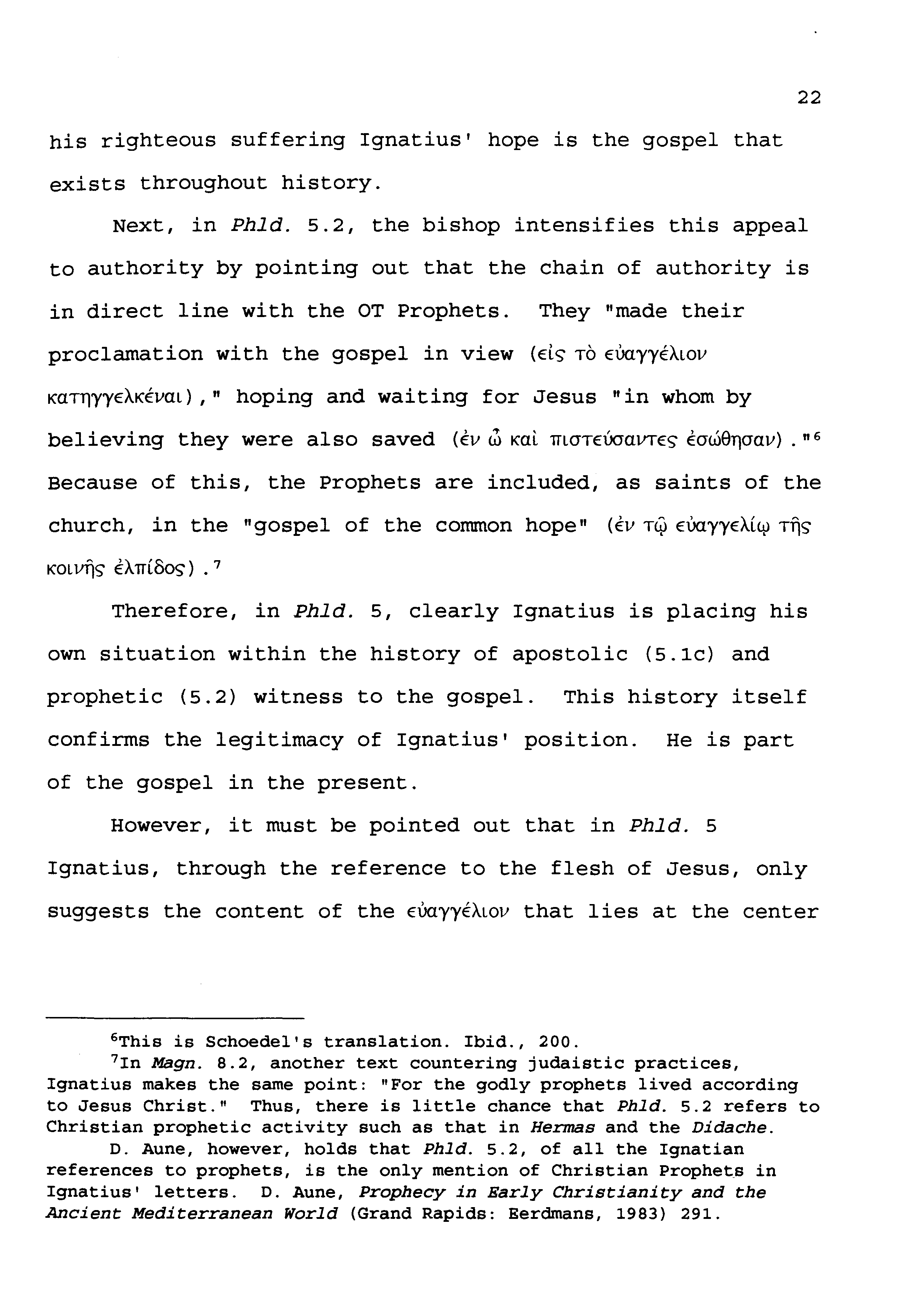
his righteous suffering Ignatius' hope is the gospel that exists throughout history.
Next, in Phld. 5.2, the bishop intensifies this appeal to authority by pointing out that the chain of authority is in direct line with the OT Prophets.
They "made their proclamation with the gospel in view (ELS' To EUa'Y'YEALOV tcaTll'Y'YEAKEvm) , " hoping and waiting for Jesus "in whom by believing they were al so saved (EV w tcaL mcrTEOOaVTES' Ecrw0ricrav) . " 6
Because of this, the Prophets are included, as saints of the church, in the "gospel of the common hope"
(EV TQ EooyyEA.(<.p TTJS'
KOLvTJS' EATTLOOS') • 7
Therefore, in Phld. 5, clearly Ignatius is placing his own situation within the history of apostolic (5.lc) and prophetic (5.2) witness to the gospel.
This history itself confirms the legitimacy of Ignatius' position.
He is part of the gospel in the present.
However, it must be pointed out that in Phld. 5
Ignatius, through the reference to the flesh of Jesus, only suggests the content of the EooyyEA.tov that lies at the center
6This is Schoedel's translation. Ibid., 200.
7In Magn. 8.2, another text countering judaistic practices, Ignatius makes the same point: "For the godly prophets lived according to Jesus Christ."
Thus, there is little chance that Phld. 5. 2 refers to Christian prophetic activity such as that in Herrnas and the Didache.
D. Aune, however, holds that Phld. 5.2, of all the Ignatian references to prophets, is the only mention of Christian Prophets in Ignatius' letters.
D. Aune, Prophecy in Early Christianity and the Ancient Mediterranean World (Grand Rapids: Eerdmans, 1983) 291.
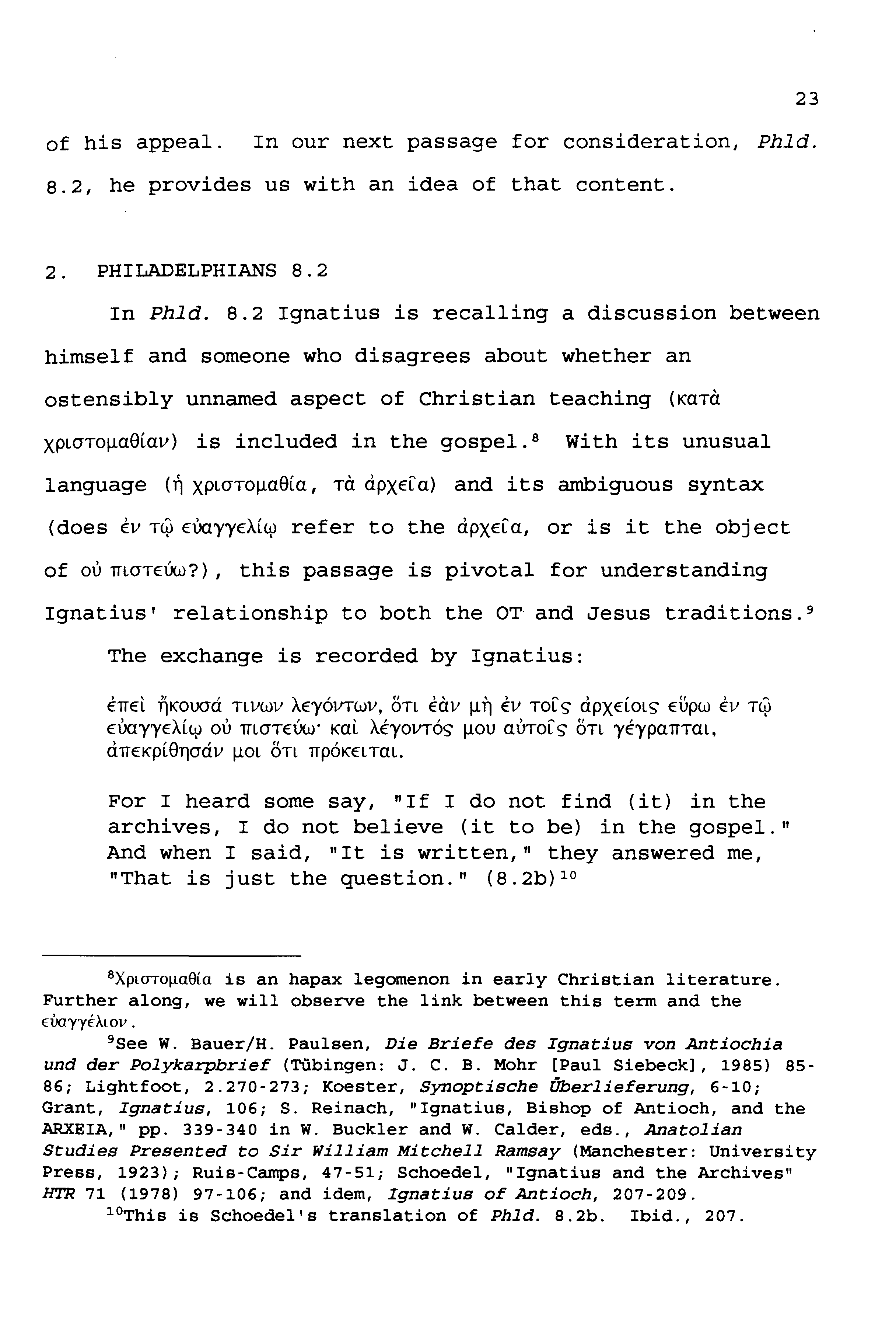
of his appeal.
In our next passage for consideration, Phld.
8.2, he provides us with an idea of that content.
PHILADELPHIANS 8.2
In Phld. 8.2 Ignatius is recalling a discussion between himself and someone who disagrees about whether an ostensibly unnamed aspect of Christian teaching (KaTa xptcnoµa0(av) is included in the gospel. 8
With its unusual language (~ XPLOToµa0(a, Ta dpxEl'a) and its ambiguous syntax (does EV T4> EooyyEAL4> refer to the dpxEl'a, or is it the object of ou maTEUw?), this passage is pivotal for understanding
Ignatius' relationship to both the OT and Jesus traditions. 9
The exchange is recorded by Ignatius:
EnEi ~Kouaci TLVwv AEyoVTwv, oTL Eav µii Ev Tol'sdpxdmsEupw Ev T4> EUaYYEALtp ou maTEUw. KaL AEYOVTOS' µou al>Tol'sOTL yEypanTm, dnEKpLerpciv µm OTL npoKEL Tm.
For I heard some say, "If I do not find (it) in the archives, I do not believe (it to be) in the gospel."
And when I said, "It is written," they answered me, "That is just the question." (8.2b) 10 8XpLCrroµa9(a is an hapax legomenon in early Christian literature.
Further along, we will observe the link between this term and the
EOO'Y'YEALOV •
9See W. Bauer/H. Paulsen, Die Briefe des Ignatius von Antiochia und der Polykarpbrief (Tubingen: J. C. B. Mohr [Paul Siebeck], 1985) 8586; Lightfoot, 2.270-273; Koester, Synoptische iiberlieferung, 6-10;
Grant, Ignatius, 106; S. Reinach, "Ignatius, Bishop of Antioch, and the ARXEIA," pp. 339-340 in W. Buckler and W. Calder, eds., Anatolian
Studies Presented to Sir William Mitchell Ramsay (Manchester: University Press, 1923); Ruis-Camps, 47-51; Schoedel, "Ignatius and the Archives"
HTR 71 (1978) 97-106; and idem, Ignatius of Antioch, 207-209.
10This is Schoedel's translation of Phld. 8.2b.
Ibid., 207.
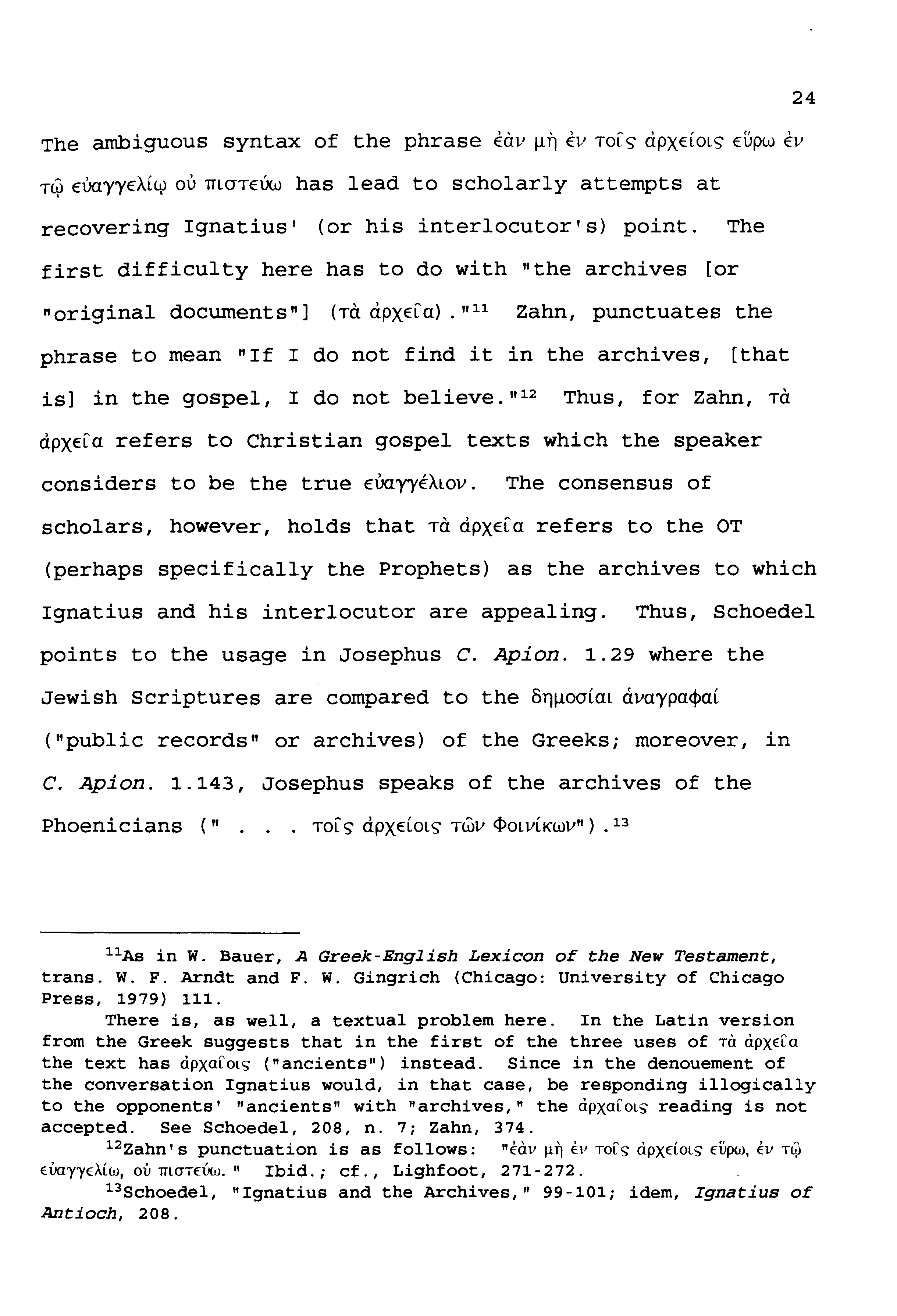
The ambiguous syntax of the phrase Eelv µ~ EV TOLS' dpXELOLS' Evpw Ev TQ EUa'Y'YEALl\> ou maTEUw has lead to scholarly attempts at recovering Ignatius' (or his interlocutor's) point.
The first difficulty here has to do with "the archives [or "original documents"] (Tel dpxEL'a) • " 11
Zahn, punctuates the phrase to mean "If I do not find it in the archives, [that is] in the gospel, I do not believe." 12
Thus, for Zahn, Tel dpxEL'a refers to Christian gospel texts which the speaker considers to be the true ElxI'Y'YEALov.
The consensus of scholars, however, holds that Tel dpxEL'a refers to the OT {perhaps specifically the Prophets) as the archives to which Ignatius and his interlocutor are appealing.
Thus, Schoedel points to the usage in Josephus C. Apion. 1.29 where the Jewish Scriptures are compared to the Briµoa(m civaypa<1>a(
("public records" or archives) of the Greeks; moreover, in c. Apion. 1.143, Josephus speaks of the archives of the Phoenicians {" .
. ToL' sdpxdmsTwv <l>mv[Kwv") . 13
11As in w. Bauer, A Greek-English Lexicon of the New Testament, trans. W. F. Arndt and F. W. Gingrich (Chicago: University of Chicago
Press, 1979) 111.
There is, as well, a textual problem here.
In the Latin version from the Greek suggests that in the first of the three uses of Ta cipXEta the text has cipxa[ms ("ancients") instead.
Since in the denouement of the conversation Ignatius would, in that case, be responding illogically to the opponents' "ancients" with "archives," the cipxa[ms reading is not accepted.
See Schoedel, 208, n. 7; Zahn, 374.
12Zahn' s punctuation is as follows:
"Eav µi] Ev Tots cipxdoLs Evpw, EV T0 EooyyEA.fw, ov maTEVw."
Ibid.; cf., Lighfoot, 211-212.
13Schoedel, "Ignatius and the Archives," 99-101; idem, Ignatius of Antioch, 208.
This brings to the fore another difficulty with this passage.
Ignatius responds to his opponents with the statement, "it is written (yE:ypmnm) . "
Lightfoot considers it "not impossible that Ignatius might have applied yE:ypalTTm to some Evangelical or Apostolical writings. 1114
Rius-Camps is more certain: just as the speaker refers to the OT as written dpXELa, so in response, Ignatius refers to a written
Christian text with yE:ypalTTaL . 15
However, elsewhere Ignatius only uses yE:ypalTTaL in the standard way to ref er to the OT scriptures (Eph. 5.3; Magn. 12).
This, along with the fact that there is no other indication of an authoritative Christian text for Ignatius, points to the solution that yE:ypalTTm here refers to the OT. 16
Hence, the exchange between Ignatius and his opponents begins with opposing interpretations of the OT scriptures.
It is clear, however, that the discussion-at least for Ignatius-could go no further: each side could support its position with texts.
So, Ignatius bypasses this hermeneutic ambiguity by distancing himself from the written "archives" of the OT.
In their place, he provides his own authoritative dpXELa and, by extension, the outlines of the EooyyD .. Lov itself:
"But to me the archives are Jesus Christ, the sacrosanct archives 14Lightfoot, 272.
15Rius-Carnps, 49.
16Schoedel, 208; Koester, Synoptische Uberlieferung, 8.
are his cross and death, his resurrection, and faith through him . . . ( Eµoi OE dpXEL ci EO"TLV 'IriaoUsXpLOTOS', Tel a8LKTa dpXEL a 6 aTauposm'.rrou Kai 6 8civaTosKai ~ dvciaTaaLsm'.rrou Kai ~ n(aTLS' ~ 8L' m'.rrou ..
. )" (8.2c).
For Ignatius, then, the only archives necessary, as the foundational information for the church, are not found in written documents but are the historical facts of the life, death, and resurrection of Jesus.
What is more, appended to the list of events in the story of Jesus is the phrase Kai ~ n(aTLS' ~ fa' m'.rrou.
The Ignatian archives are not texts; they exist in the present faith of the connnunity, faith centered on Jesus and the salvation he accomplished in the past.
The present faith thus has as its content the message of the EUa'Y'YEALov events.
Finally, in Phld. 8.2 as in Phld. 5.1, Ignatius connects his own ultimate goal (in 8.2 to be justified, and in 5 .1 the "lot in which I attain mercy") with the EUa'Y'YEALOV
(as well as the prayer of the Philadelphian church) .
It is the present faith in the past events of Jesus' life, death and resurrection that is the locus of justification for Ignatius (EV OLS' 8EAW EV TlJ npoarnxiJ uµwv OLKmw8f)VaL) .
The EUa'Y'YEALov, in the guise of the "sacrosanct archives, " is therefore provided with at least an outline of content.
Hence, Ignatius makes no appeal to written Christian documents for this vital information.
As we have seen, both 5.1 and 8.2 recognize the witness of the Scriptures.
While those written archives-which Ignatius himself recognizes as
y€ypmnm-may well point to the EooyyEALov (i.e. , the OT Prophets' announcement in advance), the EooyyEALov, past and present, is archive enough.
Because of its importance for the whole of my thesis, we will have occasion to return to this intriguing pericope.
PHILADELPHIANS 9.2
Ignatius continues the same themes in Phld. 9.1-2.
In 9 .1 the bishop juxtaposes the priests of Israel (ot LEpELS) with the greater high priest (6 cipXLEpEi'S') who must be understood as Jesus. 17
It is Jesus alone who is entrusted with the secrets of God (Ta KpUlTTa Tou 9Eou) and, therefore, mhos WV 9upo TOU TTOTpos, BL' ~s ELGEPXOVTaL 'A~poaµ KOL 'IaoaK KOL
'loKw~ KOL ot TTp0<f>f]Tm Kot ciTToaToAm mi ~ EKKA.ria(o. TTciVTo TouTo ELS E:voTriTo 9rnu.
He is the door of the Father through which enter Abraham and Isaac and Jacob and the Prophets and the Apostles and the church: all these into the unity of God. (Phld. 9.lb) Here, again, we have the Ignatian lineup of authority: an inclusive structuring of the faith lineage up to the present church.
This faith structure is divided into two groups of three: the first group is composed of the classic scriptural individuals who are the authoritative supports
17This theme is a feature in Hebrews 6:20, 9:1-12.
See, as well, 1 Clem. 36.1, 61.3, 64.1; in Pol.Phil. 12.2 Jesus is called "sempiternus pontifex."
for the Jewish people; 18 the second group is composed of three authoritative bodies (Prophets, Apostles, the believing church) all of which, as we have seen, are directly linked with the Ignatian Eooyy€A.Lov.
There is no indication here-of a direct appeal to the scriptures.
Despite the reference to the Hebrew ancestors, Prophets, and Apostles (all, broadly speaking, scriptural figures), the final reference to the church governs the entire list in this regard: it is the figures or groups themselves and not writings by or about them that are at issue. 19
Because of Jesus, they have access to "the Father. 1120
Jesus is at the center; everything is understood through him.
Having so presented this lineage of authority and its single hermeneutical center, Ignatius, in Phld. 9.2, turns specifically to the Eooyy€A.Lov and further explains how Jesus is the referent:
E:ea(pETov 8€ n EXEL To Eooyy€A.Lov, Tiiv napooo(av Tou owTf}poS', Kup(ou i}µowv 'lrpou XpLCJTou, To mieoS' m'.n-ou, Kai TTW dvciaTaaw.
But the gospel has something remarkable, the coming of the Savior, our lord Jesus Christ, his passion and resurrection.
18This particular three-part listing of ancestors finds its orgins in the call of Moses, Exod 3:5.
It is found in the synoptic tradition (Matt 8:11, 22:32; Mark 12:26; Luke 13:28, 20:37; Acts 3:13, 7:32) but is not found in either the Johaninne or Pauline texts nor the remainder of the NT.
In the Apostolic Fathers it is found in an expanded form in 1 Clem. 31.2-4 and as a list in Barn. 6.8 and 8.4.
19Koester, Synoptische Uberlieferung, 7.
20The fact that the image of a door to God has a slight affinity to Ps 117: 20 (AVn) ~ 1TVATJ Tov Kvp(ov, OLKatOL Ei<TEAEOOOVTat €v aimj.) plays no part here as well.
(auvrl'YopmTou0avchou) and not of the truth" (Smyrn. 5.la). 22 so, in Smyrn. 5.lb Ignatius, in a polemical move, presents the authority behind his argument against his opponents: o\Js' OUK ETTELaav a[ TTpO<f>TJTELaL OUOE 6 voµosMwooEWS", dAA.' OUOE µEXPL vuv TO EOO'Y'YEALOV, OUOE Tel ~µETEpa TWV KaT' av8pa TTa0i}µaTa.
These are the ones who were not persuaded by the prophecies, nor the law of Moses, nor even the gospel until now, nor our own individual sufferings.
With respect to this sentence, there are several significant points to notice.
First, we see the usual Ignatian appeal to the OT prophets, here with a suggestion of 'the Law and the Prophets.' 23
Also, Ignatius states that the gospel "until now (µEXPL vuv)" has not persuaded the opponents.
This µEXPL vl.iv first brings to mind Ignatius' exhortation in Eph. 11.1:
"These are the last times (€axaTOL Kmpo() • "
The present-that is, since the advent (TTapooo(a 24 ) of Jesus-for Ignatius is the urgent time that the witnesses of history (especially the prophets) looked toward, the time of the gospel events of Jesus.
Even this urgency has had no effect on the opponents.
Indeed, we find the same usage of µEXPL vuv in 22As we read in Smyrn. 5.2, these are the main opponents for Ignatius, who "do not confess him [Jesus] as bearing flesh (oµo.\oywv airrov cmpKo<f>6pov) . "
This seems to be the same error that Ignatius calls ai.'prnls (Eph. 6.2; Trall. 6.1) and counters directly in Trall. 10.1, Smyrn. 2.1 and 4.2.
23This is the only Ignatian reference to Moses.
24See Phld. 9.2. Schoedel, Ignatius of Antioch, 234.
This rrapovofo is one of the motifs of the Ignatian Eooyyi.\wv; it will therefore figure in the discussion in the next section.
Magn. 8.1:
"For if we are living even until now according to Judaism, we confess have not received grace (EL yap µ€xpt vuv KUTcl 'Iou8ai:aµov (wµEv, 6µoA.oyouµEv xciptv µii ELAll<f>Evm) . "
To live in the time characterized by the Eooyy€A.wv is to live "according to Jesus Christ ((flv KaTa 'Irpouv XptaTov)" (Magn.
8.2; Trall. 2.1). what is more, Ignatius closely connects the historical witness and present Eooyy€A.wv with "our own individual sufferings (Ta ~µETEpa TWV KaT' dv8pa lTa0ftµaTa)" thus assuring that his own present sufferings, in his progress to Rome and martyrdom, are one with the righteous sufferings of history.
The final explicit mention of the Eooyy€A.tov is in Smyrn.
7.2.
As noted before, Ignatius is here engaged in the polemic against his opponents.
The advice to the Smyrnaeans is stronger: it is proper to refrain from contact with such people; one is not even to speak about them.
The Smyrnaeans are told that instead of dealing with people in error, they are "to heed the Prophets, and especially the gospel, in which the passion has been made clear to us and the resurrection accomplished (npoaEXELV OE TOLS' lTpo<f>i}Tmc;-, E-~mpETWS' OE
TW EooyyEALtp, E:v 4> To nci0os- ~µ['v oEotjA.wTm Kai ~ civciaTaatc;- TETEAELWTat) . " 25
Again, here there is an innnediate, present sense to the idea 25Ignatius uses both the adverb E:ea(pnws and the adjective E:ea(pnos.
Neither word is found in the NT.
We find the adverb here {as in Trall.
12:2) with the meaning "especially"; as we have seen, the adjective is found in Phld. 9. 2 with reference to the EOO')'')'EALOV: the gospel is something unique, distinctive or remarkable because its content is the coming, the passion, and the resurrection of Jesus.
of gospel for Ignatius: through the preaching of the gospel {already announced by the Prophets [Phld. 5.2]) to present believers, the saving events of Jesus have been made clear
{8E8i]A.wTm) and accomplished {TETEAELWTm) in the present church.
The Prophets are thus held in esteem, but pride of place is reserved for the Eooyy€A.tov, for it is there that the saving events of Jesus are made present. So, this Ignatian conununity boundary setting is supported by the ultimate authority grounded in the history of faith: the faith of the Prophets (Phld. 5.2), and faith in the gospel of Jesus. 26
Here again, we find no suggestion that the salvation events are made evident through written documents.
The OT Prophets, ostensibly a set of texts, here function not as writings, but authoritative past figures.
It is to their relationship with the Eooyy€A.tov (i.e., Phld. 5.2) that Ignatius is appealing.
Thus, it is through the church's present faith in the proclaimed events of salvation that the gospel is made evident and accomplished.
26For a thorough discussion of boundary setting in the letters of Ignatius see W. Schoedel "Theological Norms and Social Perspectives in Ignatius of Antioch," pages 30-56 in E. P. Sanders, ed. Jewish and Christian Self-Definition, vol. 1 (Philadelphia: Fortress, 1980).
This prime function of Ignatius' EOO)')'EALOV will be the overarching subject in Part Two of this study.