
B. The Content Of The Ignatian Gospel
THE CONTENT OF THE IGNATIAN GOSPEL
In the preceding section, I have discussed each occurrence of EooyyEA.Lov in its context.
At this point it is necessary to delineate further the content and nature of Ignatius' gospel.
In this section I will concentrate on the content.
The procedure here has two tasks: first, in order to highlight the gospel motifs, I will briefly revisit the defining passages (Phld. 8.2, 9.2; Smyrn. 7.2); second, I will analyze those Ignatian motifs with an eye to other early Christian uses of the individual motifs (including specific traditions that parallel Ignatius').
The insights so gained will enable us, in Chapter II, to locate Ignatius' gospel within the broader world of early Christianity.
THE DEFINING PASSAGES
we have seen that, of the eight occurrences of EooyyEA.wv in Ignatius, three provide some indication of the content of the EooyyEA.Lov.
These pericopae, which I ref er to as "defining passages," are Phld. 8.2, 9.2 and Smyrn. 7.2.
In each of the three Ignatius lists events that evidently he sees as central to the EooyyEA.Lov.
Thus, in my attempt to delineate the contours of Ignatius' gospel, it is to these texts and the motifs they contain that we now turn.
As we will see, when brought together, these expressions of the EooyyEA.Lov bring to the surf ace a series of issues surrounding
Ignatius' idea of the gospel content.
Therefore, we return to the exposition in Phld. 8.2.
Here Ignatius suggests the content of the EooyyD .. Lov indirectly by identifying the dpxECa as the culminating events of Jesus' life, indeed, as Jesus himself:
€µoi 8E: dpxECci €anv 'ITJaoUsXpLaTo~. Tel d9LKTa dpxECa 6 aTaupo~ m'.rrou Kal 0 9civaTO~ KaL it avciaTaaL~ m'.rrou Kai it lTLGTL~ it 8L' m'.rrou ...
But to me the archives are Jesus Christ, the sacrosanct archives are his cross and death, his resurrection, and faith through him ... (Phld. 8.2c) As we have seen, the problem that precipitates the discussion which Ignatius reports in Phld. 8 is centered on the authority necessary to uphold an unidentified Christian teaching.
We have seen, as well, that the most viable reading here is to understand Tel dpxECa of the opponents as the OT and not a Christian text, Gospel or otherwise.
Thus, Ignatius' opponents have been appealing to the OT (the "archives") for their source of faith; that is, they want to support Christian teaching through an interpretation involving the OT.
It reasonable to assume that these opponents are those to whom Ignatius refers in Magn. 9.1,
10.3, and especially in Phld. 6.1-2 as favoring judaizing interpretations and practices over the faith in the gospel. 27
For Ignatius, this judaizing activity is wrong because it looks elsewhere and not to the true source or 27Both Magn. 10. 3 and Phld. 6 .1-2 contain the phrase
11;\a;\Efv 'l'flaovv XptaTov."
As we will see further along, this phrase is important in understanding Ignatius' EUa)')'EAtov.
"archive," Jesus Christ.
Therefore, Ignatius conflates the dpxECa and the EUaYYEALov into one entity.
Thus, Ignatius' point in Phld. 8.2c is that while one may find supporting texts that refer to Jesus (the scripture of 8.2b, perhaps suggestive of the Prophets [i.e., Phld.
9.2]), faith in Jesus centered on the gospel events needs nothing more to prove its validity.
In Phld. 9.2 Ignatius continues the connection between the Jesus events and the Eooyy€A.Lov.
With a slight variation from the gospel content in 8.2, Ignatius states that "the Eooyy€A.wv has something distinctive, the coming of the savior, our Lord Jesus Christ, his passion and resurrection
<E:ea(pETov 8€ TL EXEL To EooyyEALov, Ti)v rrapouo(av Tou awTf]poS', Kup(ou ~µwv
'I11aou XpLCJTou, TO mieoS' m'.rrou, Kai Ti)v dvaaTaaw) . "
Here again, in response to the judaizers, Ignatius distinguishes the EUaYYEALov from any other ground of faith.
With the adjective E:ea(pETOS' he identifies the events of the EooyyEALov as something singular or unique; the gospel does not depend on any other source.
The final defining passage is Smyrn. 7.2.
As with the Philadelphian texts above, Ignatius is countering error; here it appears to be the docetic error.
In response to the failure to confess (6µoA.oy€w) that the eucharist is the flesh of Jesus which suffered (7.1), Ignatius exhorts the Smyrnaeans to consider the Prophets and to concentrate especially on "the gospel in which the passion is made clear
to us and the resurrection accomplished (E:empETWS' 8E T0 EOOYYEAL4l, E:v 0 TO mi8os- ~µl'v OEOtjAwTm Kai ~ dvcioTaOLS' TETEAELWTaL)
( 7. 2) . "
With the use of the adverb E:empETws- (cf. , Trall.
12. 2) Ignatius again distinguishes the EooyyEALov, here it is more vital than the Prophets.
The Prophets are mentioned because they looked forward to what was revealed and accomplished through the Eooyy€A.wv (cf. , Magn. 8. 2; Phld.
5. 2) .
Thus, in these three texts, the presentation of the Eooyy€A.Lov through its specific events is in direct response to the error Ignatius is countering.
As I will highlight in Part Two, this polemical matrix is a constant feature in the background of much of Ignatius' appeal to the Eooyy€A.wv.
Ignatius carefully formulates the gospel with the errors in mind because, for him, the errors attack the foundational truth of the gospel message.
THE GOSPEL MOTIFS
Yet it is the 'events' themselves that are my present concern.
In Phld. 8. 2 we have oTaupos-, 0civaTosand dvciaTams-; in Phl d. 9 . 2 it is napooo(a, nci0osand dvciaTams-; in Smyrn. 7 . 2 it is nci0osand dvciaTaOLS'.
With respect to these three outlines of the Eooyy€A.Lov, several issues come to the fore:
(a) the specific events listed vary from text to text; (b) the resurrection (dvciaTams-) is found in all three and therefore appears to be a primary motif;
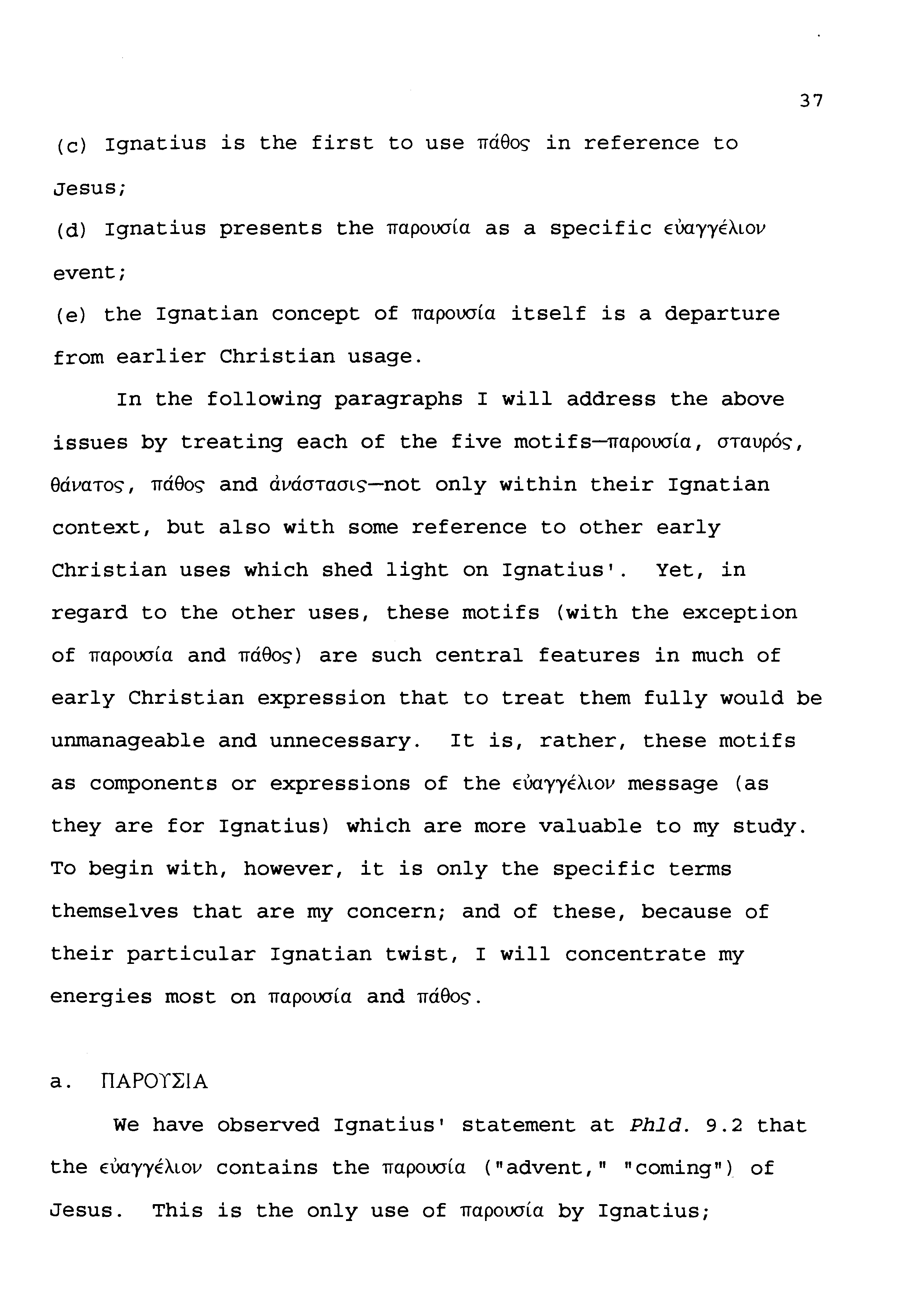
(c} Ignatius is the first to use ncieo~ in reference to Jesus; (d} Ignatius presents the napooo(a as a specific EooyyEA.Lov event; (e} the Ignatian concept of napooo(a itself is a departure from earlier Christian usage.
In the following paragraphs I will address the above issues by treating each of the five motifs-napooo(a, aTaup6~, eavaTo~, ncieo~ and civcicnam~-not only within their Ignatian context, but also with some reference to other early
Christian uses which shed light on Ignatius'.
Yet, in regard to the other uses, these motifs (with the exception of napooo(a and ncieo~) are such central features in much of early Christian expression that to treat them fully would be unmanageable and unnecessary.
It is, rather, these motifs as components or expressions of the EooyyEA.Lov message (as they are for Ignatius) which are more valuable to my study.
To begin with, however, it is only the specific terms themselves that are my concern; and of these, because of their particular Ignatian twist, I will concentrate my energies most on napooo(a and ncieo~. a.
TIAPOY:LIA
We have observed Ignatius' statement at Phld. 9.2 that the EooyyEA.Lov contains the napooo(a ("advent, " "coming") of Jesus.
This is the only use of napooo(a by Ignatius;
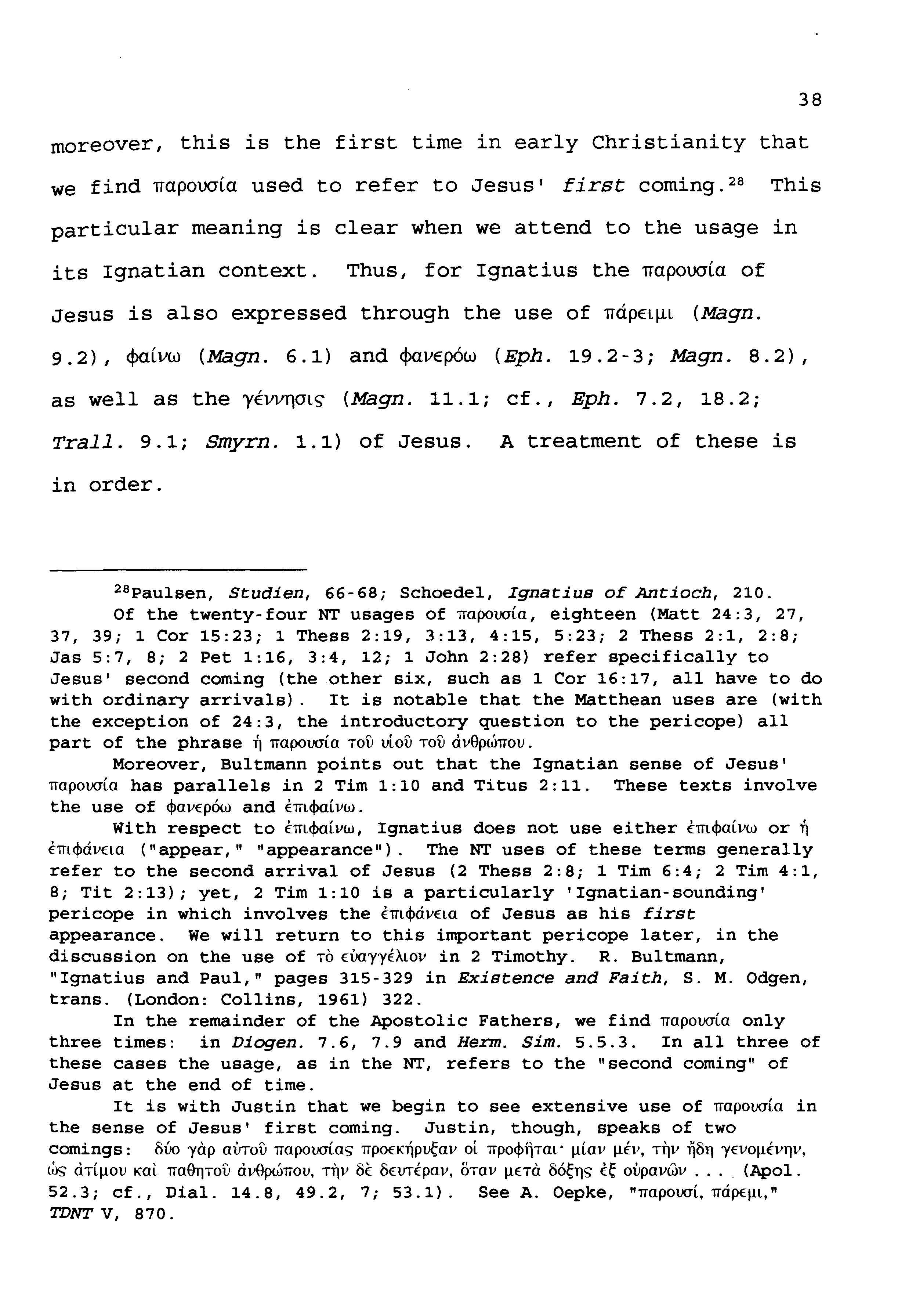
moreover, this is the first time in early Christianity that we find napooo(a used to refer to Jesus' first coming. 28
This particular meaning is clear when we attend to the usage in its Ignatian context.
Thus, for Ignatius the napooo(a of Jesus is also expressed through the use of ncipELµL
(Magn.
9. 2) , <f>a(vw (Magn. 6. 1) and <f>avEpow ( Eph. 19. 2 - 3; Magn. 8. 2) , as well as the 'YEVVTICJLS'
(Magn. 11. 1; cf., Eph. 7. 2, 18. 2; Trall. 9.1; Smyrn. 1.1) of Jesus.
A treatment of these is in order.
28Paulsen, Studien, 66-68; Schoedel, Ignatius of Antioch, 210.
Of the twentyfour NT usages of napooofo, eighteen (Matt 24: 3, 27, 37, 39; 1 Cor 15:23; 1 Thess 2:19, 3:13, 4:15, 5:23; 2 Thess 2:1, 2:8;
Jas 5:7, 8; 2 Pet 1:16, 3:4, 12; 1 John 2:28) refer specifically to Jesus' second coming (the other six, such as 1 Cor 16:17, all have to do with ordinary arrivals) .
It is notable that the Matthean uses are (with the exception of 24:3, the introductory question to the pericope) all part of the phrase ii napovofo Tov vlov Tov civ9pwnov.
Moreover, Bultmann points out that the Ignatian sense of Jesus' napooo{a has parallels in 2 Tim 1:10 and Titus 2:11.
These texts involve the use of <f>avEp6w and E:m<f>a(vw.
With respect to E:m<f>a(vw, Ignatius does not use either E:m<f>a(vw or ii E:m<!>civna ("appear, " "appearance") .
The NT uses of these terms generally refer to the second arrival of Jesus (2 Thess 2:8; 1 Tim 6:4; 2 Tim 4:1,
8; Tit 2:13); yet, 2 Tim 1:10 is a particularly 'Ignatian-sounding' pericope in which involves the E:m<f>civna of Jesus as his first appearance.
We will return to this important pericope later, in the discussion on the use of TO EooyyE:Awv in 2 Timothy.
R. Bultmann, "Ignatius and Paul," pages 315-329 in Existence and Faith, S. M. Odgen, trans. (London: Collins, 1961) 322.
In the remainder of the Apostolic Fathers, we find napooofo only three times: in Diogen. 7.6, 7.9 and Herrn. Sim. 5.5.3.
In all three of these cases the usage, as in the NT, refers to the "second coming" of Jesus at the end of time.
It is with Justin that we begin to see extensive use of napooo(a in the sense of Jesus' first coming.
Justin, though, speaks of two comings:
800 yap airrov napooo(asnpoEKtjpvfov ol npo<f>nrnv µ(av µE:v, Titv ~811 yEvoµE:v11v,
WsciT(µov KQL na9T]TOV civ9pwnov, T~l' 8€: 8EvTE:pav, ornv µETa 86~T]S' E~ oupavwv . . .
(Apel .
52. 3; cf., Dial. 14. 8, 49. 2, 7; 53. 1) .
See A. Oepke, "napooo(, ncipEµt,"
TDNT V, 870.
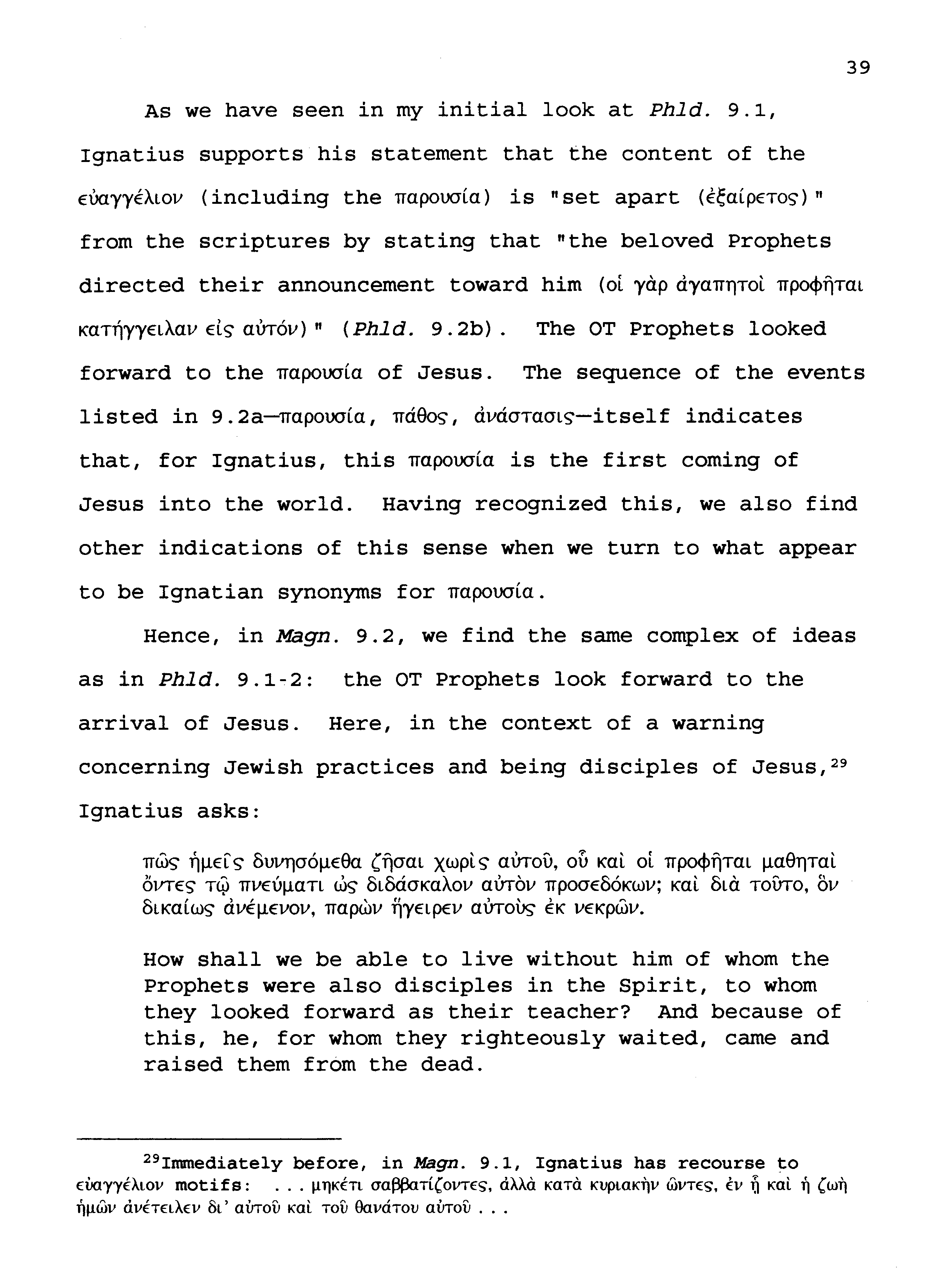
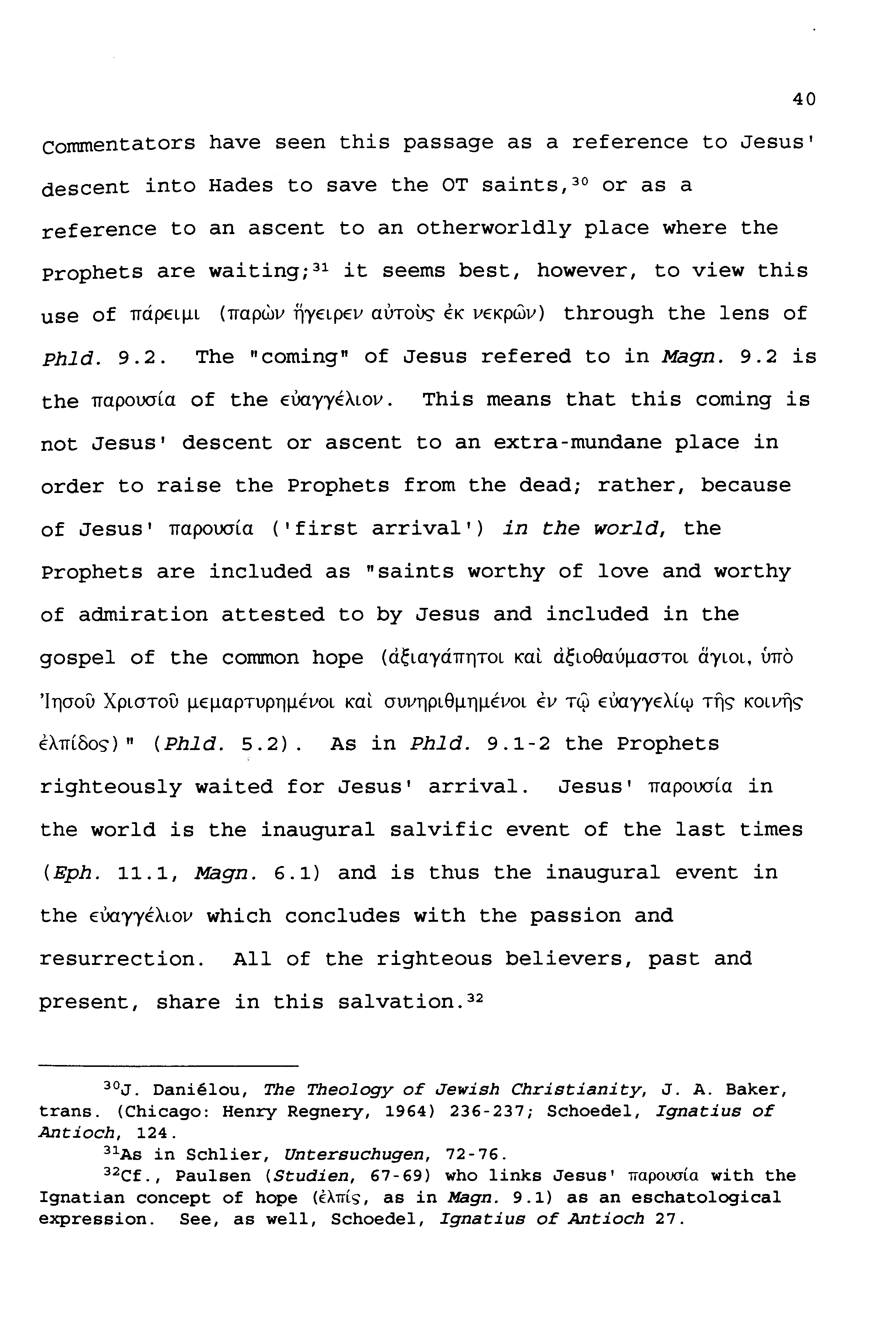
commentators have seen this passage as a reference to Jesus' descent into Hades to save the OT saints, 30 or as a reference to an ascent to an otherworldly place where the Prophets are waiting; 31 it seems best, however, to view this use of TTcipELµL (TTapwv ~'YELpEv auToU<; EK vEKpwv) through the lens of Phld. 9.2.
The "coming" of Jesus refered to in Magn. 9.2 is the TTapooo(a of the Eooyy€A.wv.
This means that this coming is not Jesus' descent or ascent to an extra-mundane place in order to raise the Prophets from the dead; rather, because of Jesus' TTapooo(a ('first arrival') in the world, the Prophets are included as "saints worthy of love and worthy of admiration attested to by Jesus and included in the gospel of the common hope (aewyciTTTlTOL KUL aeweauµaaTOL ayLOL, UTTO
'Iriaou XpLaTou µEµapTupriµ€vm Kai auvripL9µriµ€vm EV Tc.i) EooyyEA.(c.p T~S' KOLV~S'
EATTLoos-) "
( Phld. s. 2) .
As in Phld. 9. 1-2 the Prophets righteously waited for Jesus' arrival.
Jesus' TTapooo(a in the world is the inaugural salvific event of the last times (Eph. 11.1, Magn. 6.1) and is thus the inaugural event in the Eooyy€A.wv which concludes with the passion and resurrection.
All of the righteous believers, past and present, share in this salvation. 32
30J. Danielou, The Theology of Jewish Christianity, J. A. Baker, trans. (Chicago: Henry Regnery, 1964) 236-237; Schoedel, Ignatius of Antioch, 124.
31As in Schlier, Untersuchugen, 72-76.
32Cf., Paulsen (Studien, 67-69) who links Jesus' 1Tapouofo with the Ignatian concept of hope (EA1TtS, as in Magn. 9.1) as an eschatological expression.
See, as well, Schoedel, Ignatius of Antioch 27.
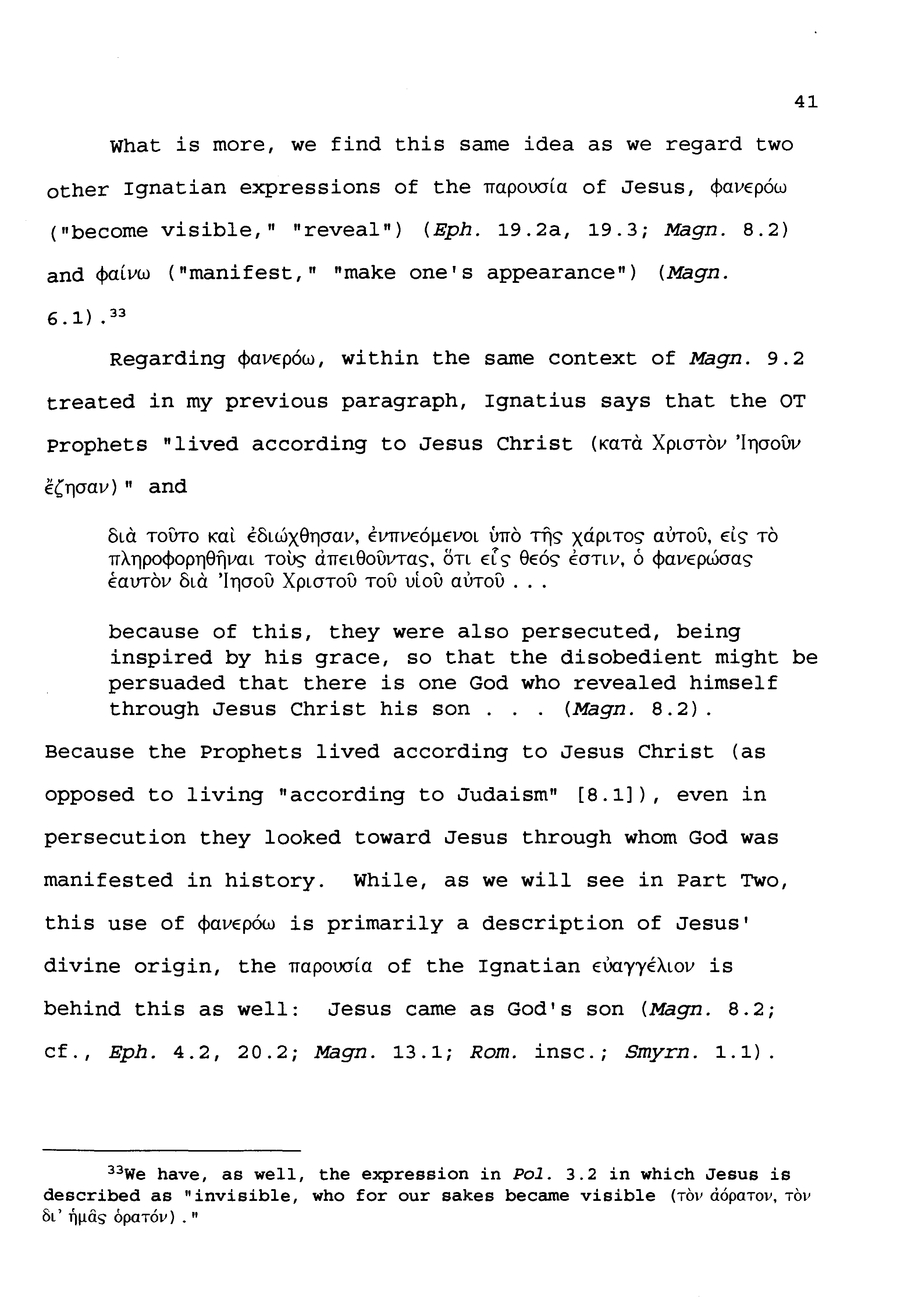
what is more, we find this same idea as we regard two other rgnatian expressions of the napoua(a of Jesus, ¢avEpow
("become visible," "reveal") (Eph. 19.2a, 19.3; Magn. 8.2) and <f>a(vw ("manifest," "make one's appearance") (Magn.
6. 1) . 33
Regarding ¢avEpow, within the same context of Magn. 9.2 treated in my previous paragraph, Ignatius says that the OT
Prophets "lived according to Jesus Christ (KaTa XptaTov 'IT)aouv €(11aav) " and 8La TOITTO Kai E:8Lwxe11aav, EVlTVEOµEVOL UlTO TilsxcipL TOS' m'.rrou, ELS' TO TIAT)po<f>op119fwm ToU<; dnEt9ouvTas-, on El's9EosE:aTLV, 6 ¢avEpwaas- €aUTov 8La 'I11aou XpwTou Tou utou auTou ... because of this, they were also persecuted, being inspired by his grace, so that the disobedient might be persuaded that there is one God who revealed himself through Jesus Christ his son .
(Magn. 8.2).
Because the Prophets lived according to Jesus Christ (as opposed to living "according to Judaism" [8.1]), even in persecution they looked toward Jesus through whom God was manifested in history.
While, as we will see in Part Two, this use of ¢avEp6w is primarily a description of Jesus' di vine origin, the napoua(a of the Ignatian Eooyy€A.tov is behind this as well:
Jesus came as God's son (Magn. 8.2; cf., Eph. 4.2, 20.2; Magn. 13.1; Rom. insc.; Smyrn. 1.1).
33We have, as well, the expression in Pol. 3.2 in which Jesus is described as "invisible, who for our sakes became visible (Tov ci6parnv, Tov
8L' ~µns opaTov) . "
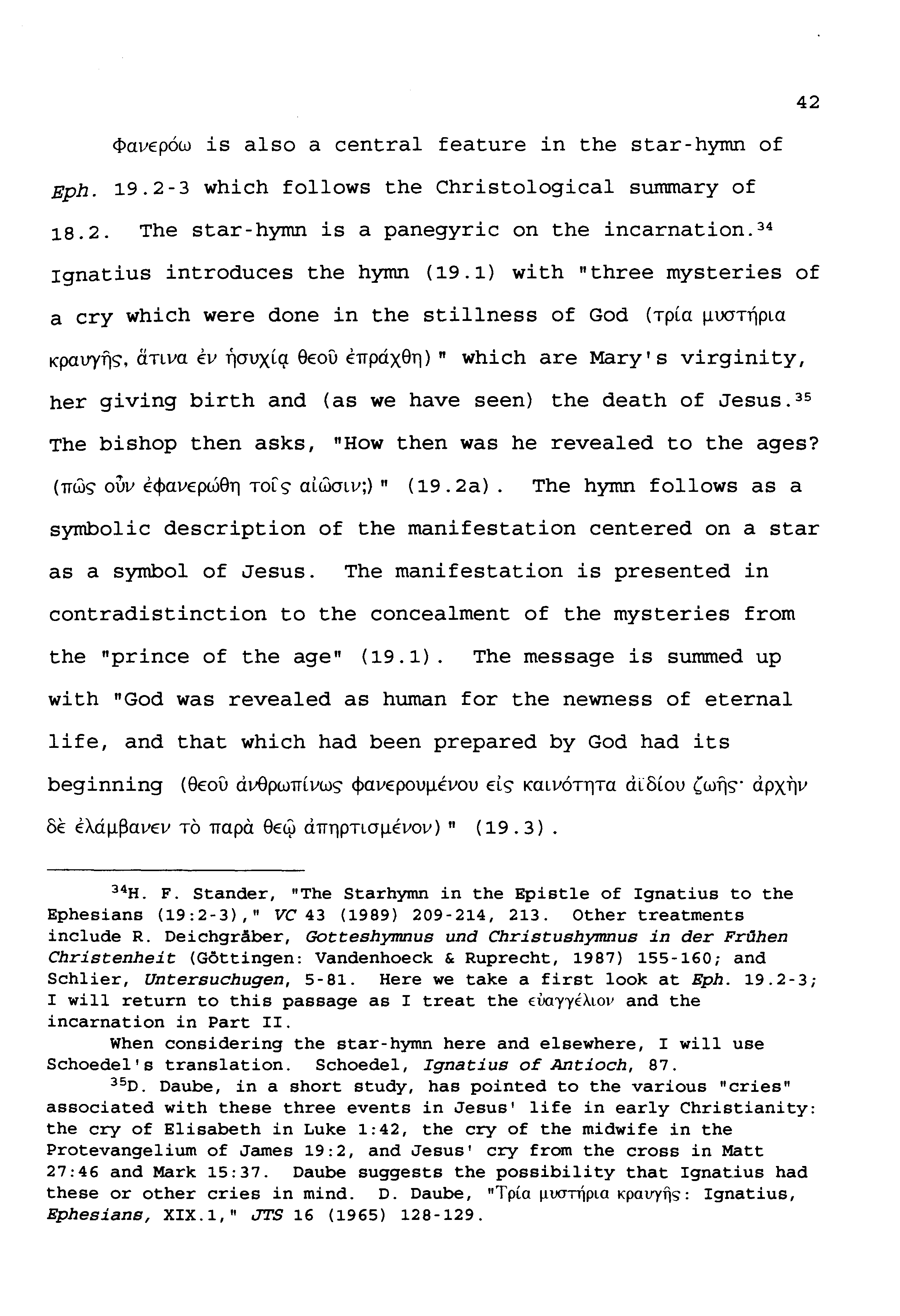
¢avEpow is also a central feature in the star-hymn of Eph. 19.2-3 which follows the Christological summary of 1s.2.
The star-hymn is a panegyric on the incarnation. 34
Ignatius introduces the hymn (19.1) with "three mysteries of a cry which were done in the stillness of God (Tp(a µucntjpw
Kpavyfls-, Cinva E:v ilaux(q. 0Eou E:npcix011) " which are Mary's virginity, her giving birth and (as we have seen) the death of Jesus. 35
The bishop then asks, "How then was he revealed to the ages?
(nwsouv E:<f>avEpu)011 TOLS' atwaw;) " ( 19. 2a) .
The hymn follows as a symbolic description of the manifestation centered on a star as a symbol of Jesus.
The manifestation is presented in contradistinction to the concealment of the mysteries from the "prince of the age" (19.1).
The message is summed up with "God was revealed as human for the newness of eternal life, and that which had been prepared by God had its beginning (0Eou dv0pwn(vws- <f>avEpouµE:vou ELS' KaLVOTllTa dl8(ou (wflc;· dpx-fiv oE: E:J.ciµ~avEv To napa 0E4> dn11pTLaµE:vov) " ( 19. 3) .
34H. F. Stander, "The Starhymn in the Epistle of Ignatius to the Ephesians (19:2-3)," VC 43 (1989) 209-214, 213.
Other treatments include R. Deichgraber, Gotteshymnus und Christushymnus in der Fruhen
Christenheit (Gottingen: Vandenhoeck & Ruprecht, 1987) 155-160; and Schlier, Untersuchugen, 5-81.
Here we take a first look at Eph. 19.2-3; I will return to this passage as I treat the EooyyEAtov and the incarnation in Part II.
When considering the star-hymn here and elsewhere, I will use Schoedel's translation.
Schoedel, Ignatius of Antioch, 87.
350. Daube, in a short study, has pointed to the various "cries" associated with these three events in Jesus' life in early Christianity: the cry of Elisabeth in Luke 1:42, the cry of the midwife in the Protevangeliurn of James 19:2, and Jesus' cry from the cross in Matt
27:46 and Mark 15:37.
Daube suggests the possibility that Ignatius had these or other cries in mind.
D. Daube, 11Tp(a µlXrrtjpta Kpavyfls: Ignatius, Ephesians, XIX.1," JTS 16 (1965) 128-129.
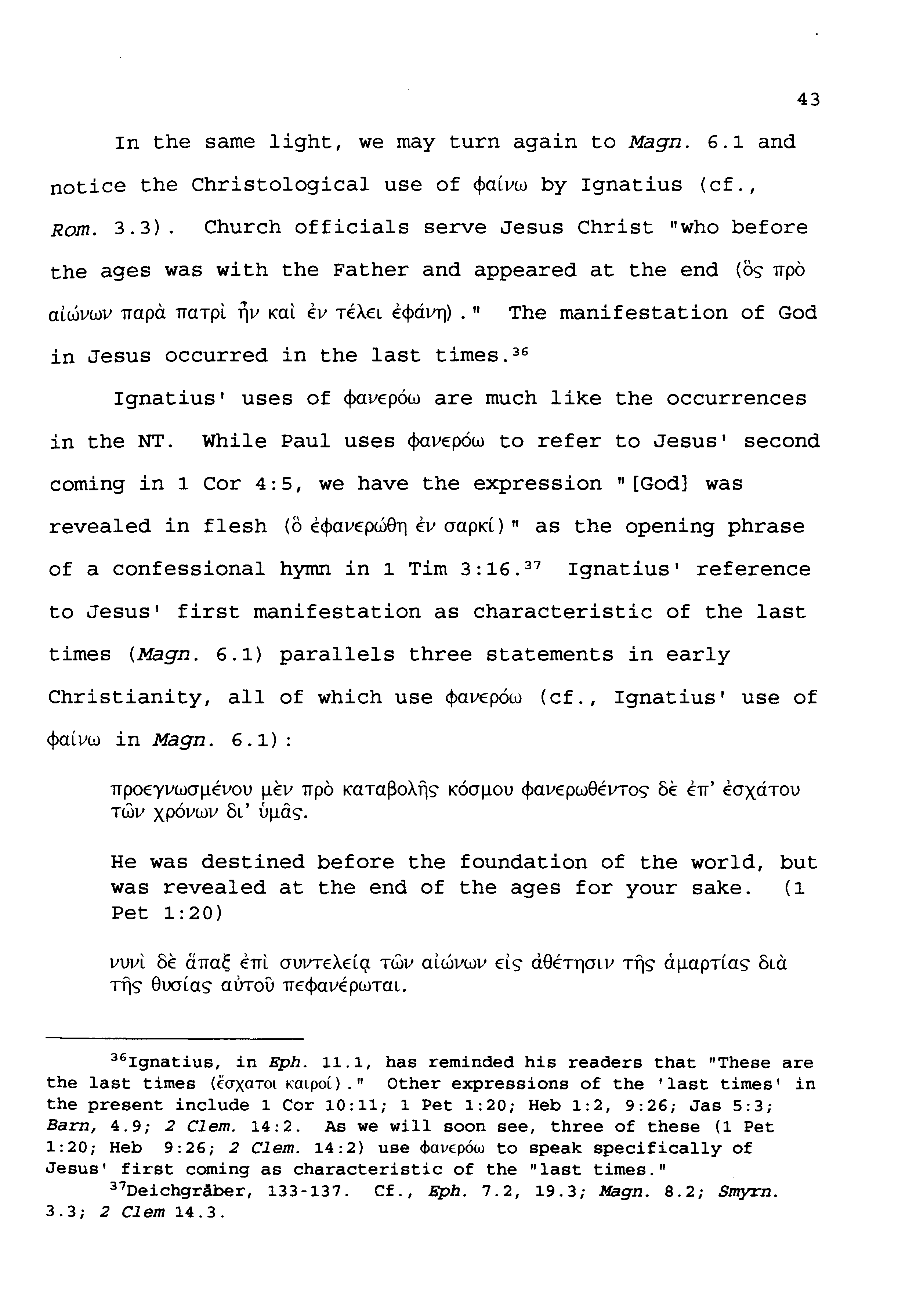
In the same light, we may turn again to Magn. 6.1 and notice the Christological use of ¢a(vw by Ignatius (cf.,
Rom. 3.3).
Church officials serve Jesus Christ "who before the ages was with the Father and appeared at the end (os npo alwvwv napa naTpL ~v Kai Ev TEAEL E¢civTJ) . "
The manifestation of God in Jesus occurred in the last times. 36
Ignatius' uses of ¢avEp6w are much like the occurrences in the NT.
While Paul uses ¢avEp6w to refer to Jesus' second coming in 1 Cor 4:5, we have the expression "[God] was revealed in flesh (o E¢avEpw0TJ EV aapK() " as the opening phrase of a confessional hymn in 1 Tim 3:16. 37
Ignatius' reference to Jesus' first manifestation as characteristic of the last times (Magn. 6.1) parallels three statements in early
Christianity, all of which use ¢avEp6w (cf., Ignatius' use of ¢a(vw in Magn. 6 .1) : npoEyvwaµEvou µEv npo KaTa~oA.fjs Koaµou ¢avEpw0EVTos OE En' E:axciTou
TWV xpovwv 8L' uµcis.
He was destined before the foundation of the world, but was revealed at the end of the ages for your sake.
(1 Pet 1: 20) VUVL OE anae ETIL GUVTEAELc;l TWV alwvwv ELS d0ETTJGLV TTJS dµapT(as 8La
TTJS Ooo(as m'.rrou nE¢avEpwTm.
36Ignatius, in Eph. 11.1, has reminded his readers that "These are the last times CfoxaToL Katpo[) . "
Other expressions of the 'last times' in the present include 1 Cor 10:11; 1 Pet 1:20; Heb 1:2, 9:26; Jas 5:3;
Barn, 4.9; 2 Clem. 14:2.
As we will soon see, three of these (1 Pet 1:20; Heb 9:26; 2 Clem. 14:2) use ~avEp6w to speak specifically of Jesus' first coming as characteristic of the "last times."
37Deichgraber, 133-137.
Cf., Eph. 7.2, 19.3; Magn. 8.2; Smyrn.
3.3; 2 Clem 14.3.
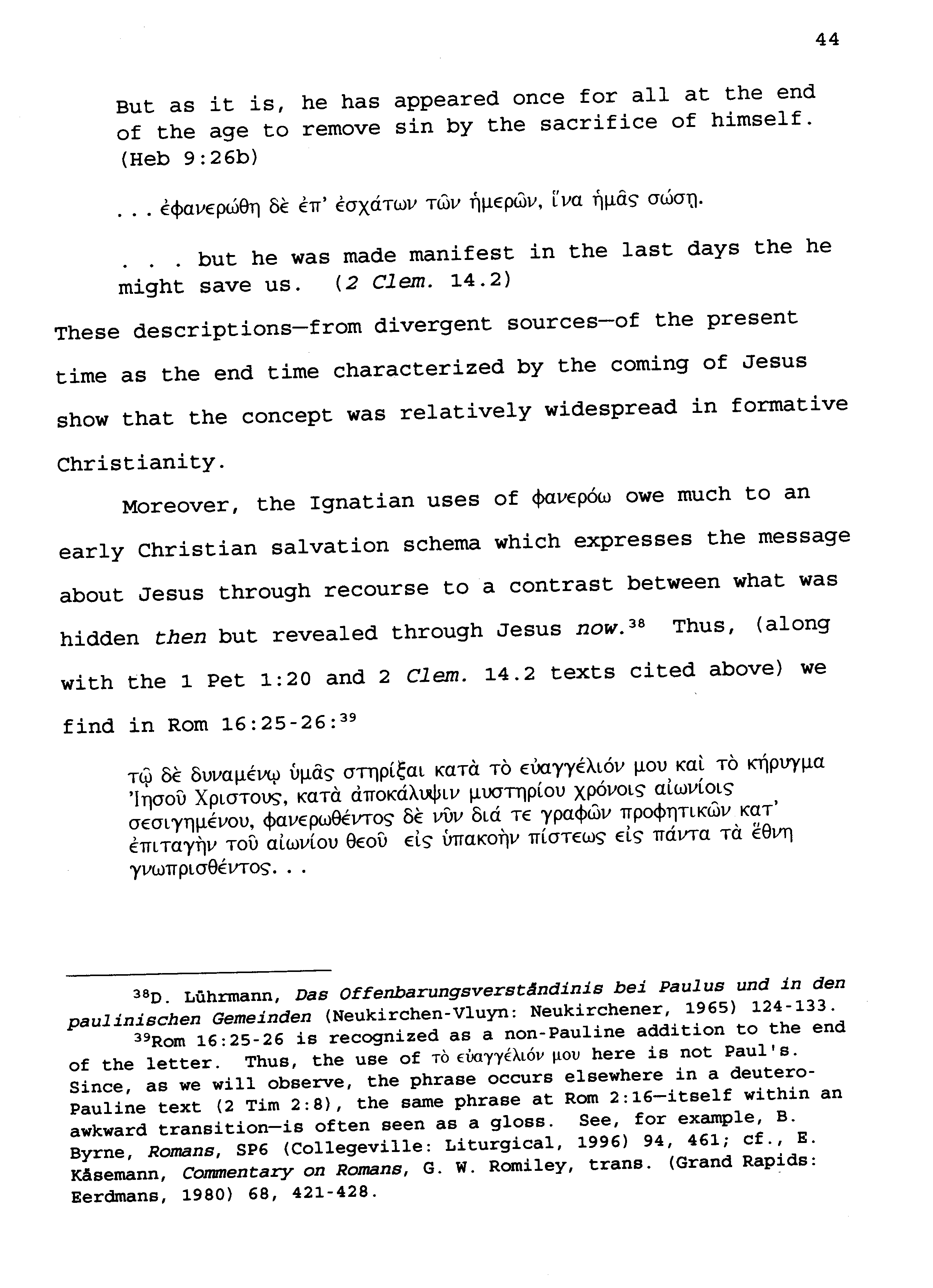
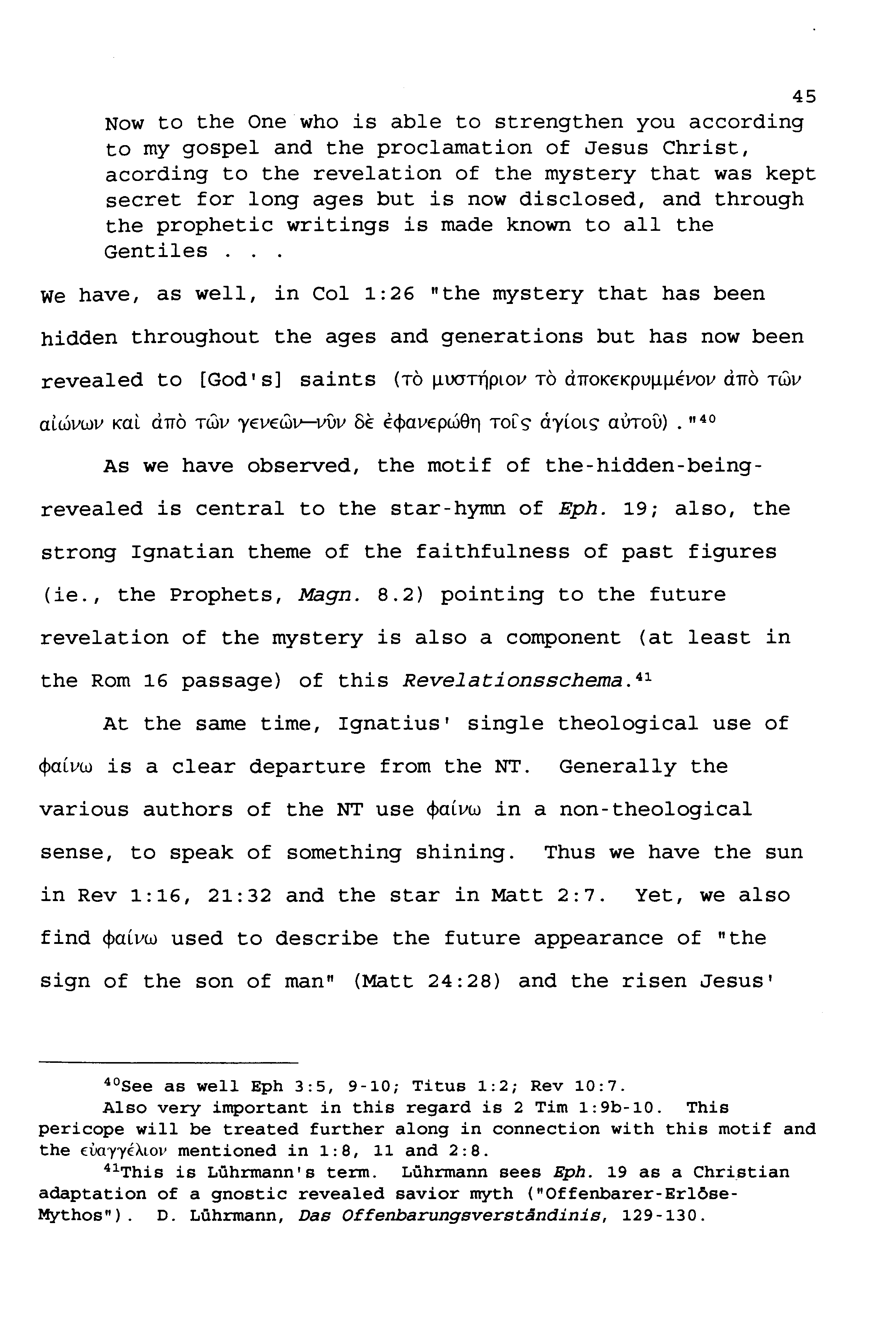
Now to the One who is able to strengthen you according to my gospel and the proclamation of Jesus Christ, acording to the revelation of the mystery that was kept secret for long ages but is now disclosed, and through the prophetic writings is made known to all the Gentiles . . we have, as well, in Col 1:26 "the mystery that has been hidden throughout the ages and generations but has now been revealed to [God's] saints (To µucnTjpLov To dnoKEKpuµµEvov dno Twv atwvwv KaL dno TWV YEVEW'l--vUV OE E:<f>avEpW9T) TOL<; ciy(m<; mrrou). 1140
As we have observed, the motif of the-hidden-beingrevealed is central to the star-hymn of Eph. 19; also, the strong Ignatian theme of the faithfulness of past figures
(ie., the Prophets, Magn. 8.2) pointing to the future revelation of the mystery is also a component (at least in the Rom 16 passage) of this Revelationsschema. 41
At the same time, Ignatius' single theological use of <f>a(vw is a clear departure from the NT.
Generally the various authors of the NT use <f>a(vw in a non-theological sense, to speak of something shining.
Thus we have the sun in Rev 1:16, 21:32 and the star in Matt 2:7.
Yet, we also find <f>a(vw used to describe the future appearance of "the sign of the son of man" (Matt 24:28) and the risen Jesus'
40see as well Eph 3:5, 9-10; Titus 1:2; Rev 10:7.
Also very important in this regard is 2 Tim 1:9b-10.
This pericope will be treated further along in connection with this motif and the EOO')'')'EAtov mentioned in 1: 8, 11 and 2: 8.
41Thi s is Liihrmann' s term.
Liihrmann sees Eph. 19 as a Chri.stian adaptation of a gnostic revealed savior myth ("Offenbarer-ErloseMythos").
D. Liihrmann, Das Offenbarungsverstandinis, 129-130.
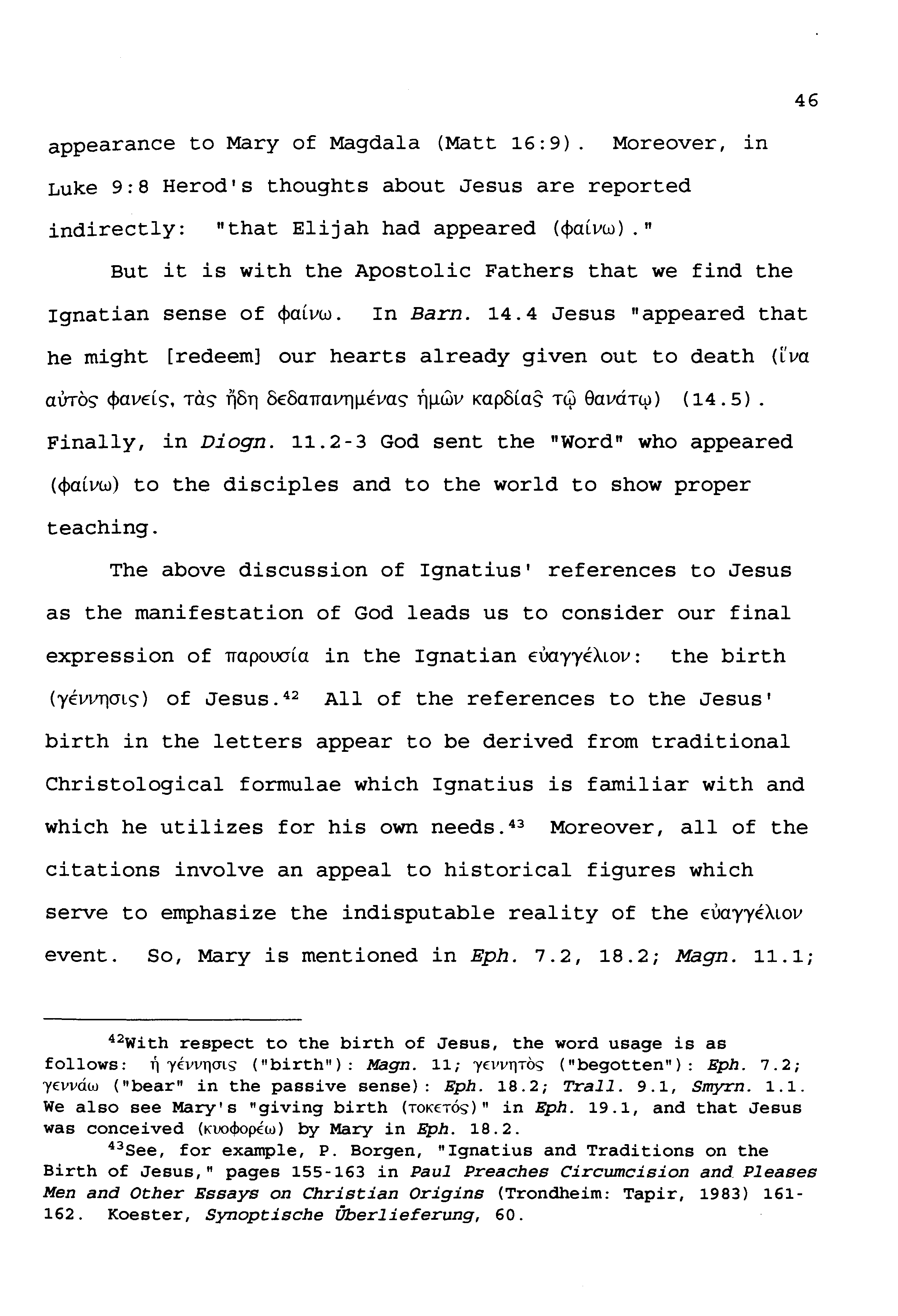
appearance to Mary of Magdala (Matt 16:9).
Moreover, in Luke 9:8 Herod's thoughts about Jesus are reported indirectly:
"that Elijah had appeared (<f>a(vw)."
But it is with the Apostolic Fathers that we find the Ignatian sense of <f>a(vw.
In Barn. 14. 4 Jesus "appeared that he might [redeem] our hearts already given out to death (Lva m'.rros <f>avELS, TclS ~OT) OEOanaVT)µEvas ~µwv Kapo(a~ T4) eavchc.p)
( 14. 5) .
Finally, in Diogn. 11.2-3 God sent the "Word" who appeared (<f>a(vw) to the disciples and to the world to show proper teaching.
The above discussion of Ignatius' references to Jesus as the manifestation of God leads us to consider our final expression of napooo(a in the Ignatian Eooyy€A.Lov: the birth (yEvVT)CJLS) of Jesus. 42
All of the references to the Jesus' birth in the letters appear to be derived from traditional
Christological f orrnulae which Ignatius is familiar with and which he utilizes for his own needs. 43
Moreover, all of the citations involve an appeal to historical figures which serve to emphasize the indisputable reality of the Euayy€A.wv event.
So, Mary is mentioned in Eph. 7.2, 18.2; Magn. 11.1; 42With respect to the birth of Jesus, the word usage is as follows:
~ yEVVTJOlS' ("birth"): Magn. 11; yEVVTJTOS' ("begotten"): Eph. 7.2; yEvvciw ("bear" in the passive sense): Eph. 18.2; Trall. 9.1, Smyrn. 1.1.
We also see Mary's "giving birth (TOKETOS)" in Eph. 19 .1, and that Jesus was conceived (Kvo<f>op€w) by Mary in Eph. 18. 2.
43See, for example, P. Borgen, "Ignatius and Traditions on the Birth of Jesus," pages 155-163 in Paul Preaches Circumcision and Pleases
Men and Other Essays on Christian Origins (Trondheim: Tapir, 1983) 161162.
Koester, Synoptische Uberlieferung, 60.
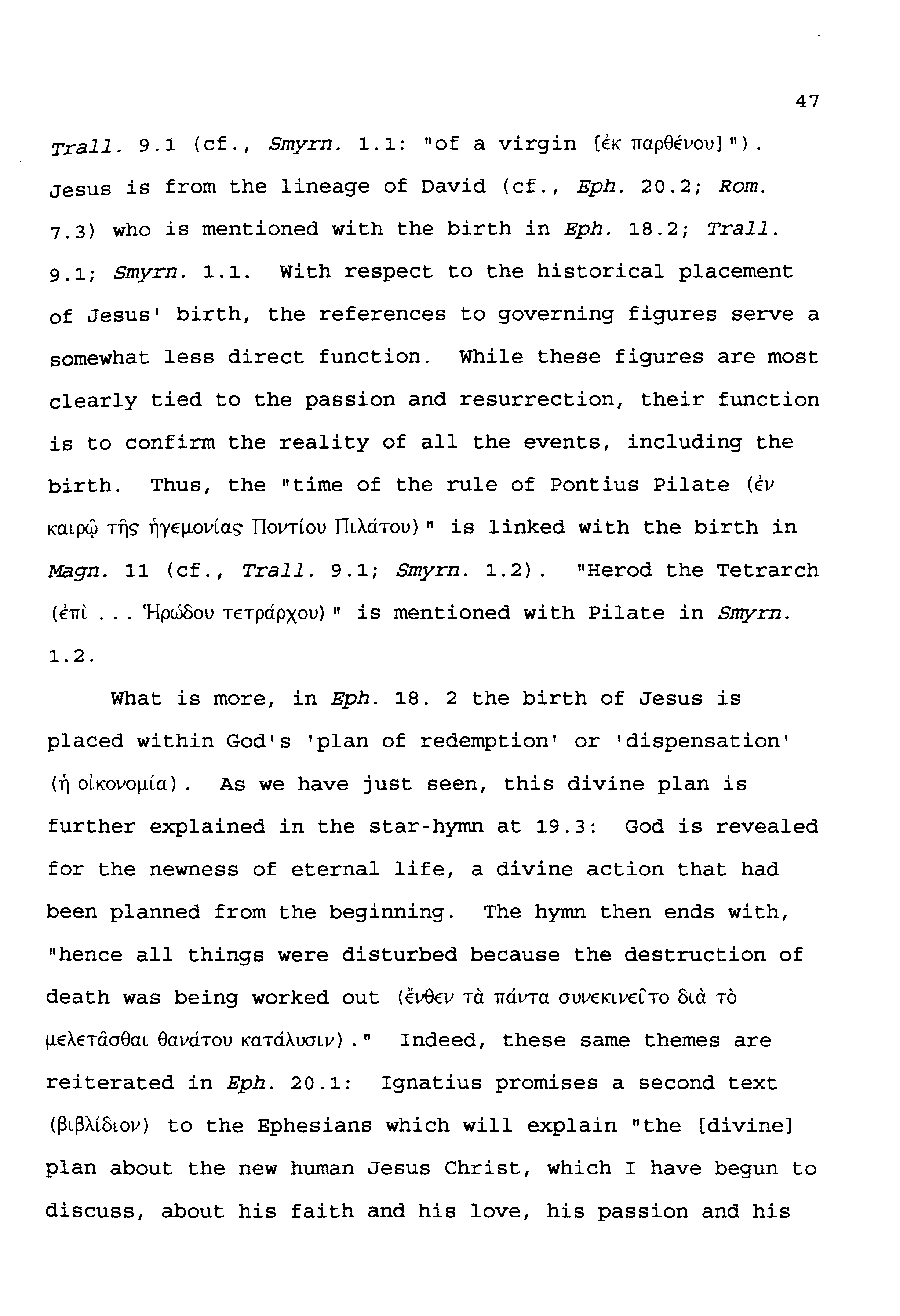
Trall. 9 .1 (cf., Smyrn. 1. 1: "of a virgin [EK nap8Evou] ") .
Jesus is from the lineage of David (cf., Eph. 20.2; Rom.
7.3) who is mentioned with the birth in Eph. 18.2; Trall.
9.1; smyrn. 1.1.
With respect to the historical placement of Jesus' birth, the references to governing figures serve a somewhat less direct function.
While these figures are most clearly tied to the passion and resurrection, their function is to confirm the reality of all the events, including the birth.
Thus, the "time of the rule of Pontius Pilate (Ev Kmp<{) TllS' ~yEµov(aS' TioVT(ou TILA.chou)" is linked with the birth in Magn. 11 (cf., Trall. 9 .1; Smyrn. 1. 2).
"Herod the Tetrarch (E:ni ... 'Hpu)oou TETpcipxou) " is mentioned with Pilate in Smyrn.
1. 2.
What is more, in Eph. 18. 2 the birth of Jesus is placed within God's 'plan of redemption' or 'dispensation'
(~ otKovoµ(a) .
As we have just seen, this divine plan is further explained in the star-hymn at 19.3:
God is revealed for the newness of eternal life, a divine action that had been planned from the beginning.
The hymn then ends with, "hence all things were disturbed because the destruction of death was being worked out (Ev8Ev Ta nciVTa cruvEKLVELTo 8La To µEAETcrcr8m eavciTou KaTciA.oow) . "
Indeed, these same themes are reiterated in Eph. 20.1:
Ignatius promises a second text (~L~A(8Lov) to the Ephesians which will explain "the [di vine] plan about the new human Jesus Christ, which I have begun to discuss, about his faith and his love, his passion and his
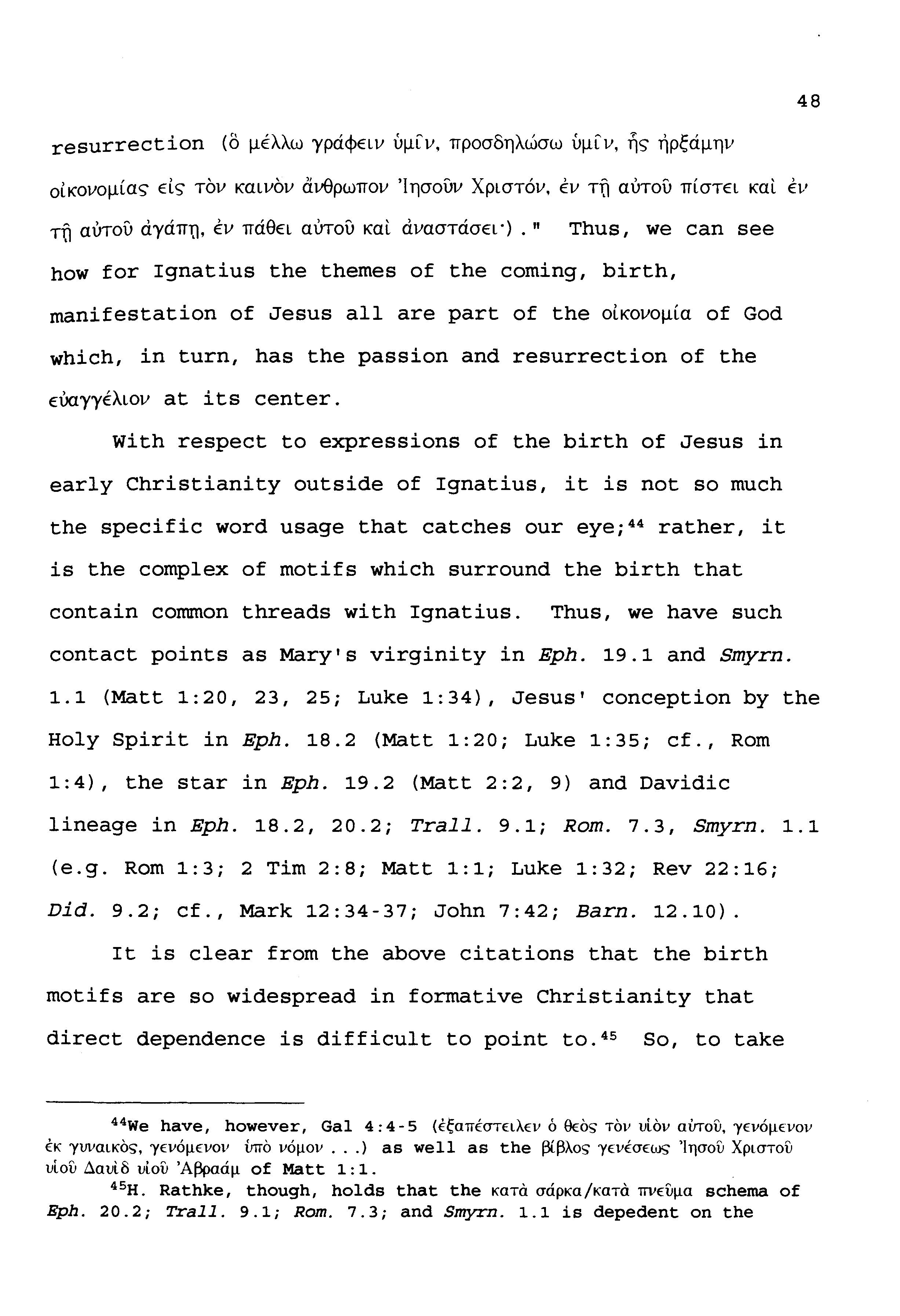
resurrection (o µE/,A.w ypci<f>ELV uµL'v, npoa811A.waw uµCv, ~S' tjpeaµ11v o(Kovoµ(asELS' Tov Kmvov c'iv0pwnov 'I11aouv XpLaT6v, Ev TlJ auTou n(aTEL Kai Ev
TTI auTou dycim;i, Ev nci6EL a1JTou Kai dvaaTciaEL ·) . "
Thus, we can see how for Ignatius the themes of the coming, birth, manifestation of Jesus all are part of the o(KOvoµ(a of God which, in turn, has the passion and resurrection of the EUa'YYEALov at its center.
With respect to expressions of the birth of Jesus in early Christianity outside of Ignatius, it is not so much the specific word usage that catches our eye; 44 rather, it is the complex of motifs which surround the birth that contain common threads with Ignatius.
Thus, we have such contact points as Mary's virginity in Eph. 19.1 and Smyrn.
1.1 (Matt 1:20, 23, 25; Luke 1:34), Jesus' conception by the Holy Spirit in Eph. 18.2 (Matt 1:20; Luke 1:35; cf., Rom
1:4), the star in Eph. 19.2 (Matt 2:2, 9) and Davidic lineage in Eph. 18.2, 20.2; Trall. 9.1; Rom. 7.3, Smyrn. 1.1
(e.g. Rom 1:3; 2 Tim 2:8; Matt 1:1; Luke 1:32; Rev 22:16; Did. 9.2; cf., Mark 12:34-37; John 7:42; Barn. 12.10).
It is clear from the above citations that the birth motifs are so widespread in formative Christianity that direct dependence is difficult to point to. 45
So, to take 44We have, however, Gal 4: 4s <E-emrE:aTELAEv 6 9Eos Tov ulov airrov, yEvoµEvov
EK )'UVatKOS, )'EVOµEVOV irrro voµov ... ) as well as the ~f31..os )'EVECJEWS 'Iriaov Xpt<JTOV ulov Liaui8 uiov 'Af3paciµ of Matt 1: 1.
45H. Rathke, though, holds that the KaTa acipKa/KaTa rrvEvµa schema of Eph. 20.2; Trall. 9.1; Rom. 7.3; and Smyrn. 1.1 is depedent on the
an obvious example, the star of Eph. 19.2, which initially seems to be derived from the "star in the east" of Matt 2, does not retain its affinity with Matthew when we realize the divergent characteristics which lie just below the superficial affinity.
P. Borgen has pointed to three factors that contradict the thesis that Ignatius' star is
Matthew's:
1. There are few linguistic similarities between Ignatius and Matthew 2, apart from the word "star."
It is not the case in Ignatius, as it is in Matthew, that a king's star appears in the sky, but the King/the Messiah is himself described as a star.
3. The kingship motif is common to both, but its development is quite different in the two cases.
In Matthew, king Herod and the Christ Child are contrasted with each other, whereas Ignatius depicts the old monarchy and the new kingdom in a mythological framework. 46
These, combined with such possible other original sources such as Num 24:17 which promises "a star shall come out of Jacob" demonstrate that Matt 2 and Eph. 19 "are two different interpretations of the motif of the star of the messiah. 1147
EOO')'')'EAtov sununary in Rom 1: 3.
H. Rathke, Ignatius von Antiochien und die Paulusbriefe, (Berlin: Akademie-Verlag, 1967) 48.
46Borgen, 160.
47Ibid., 161.
See as well Bartsch, 151; Koester believes that the myth of the star in Ignatius is in a much more original form than in Matt 2 and is in no way dependent on Matthew.
Koester, Synoptische Uberlieferung, 31-32.
For the origins of the star tradition in the Balaam story of Num 22-24, see R. Brown, The Birth of the Messiah (Garden City: Doubleday,
1977) 90-196.
overall, as I have already suggested, it seems most probable that Ignatius is working with pre-formed traditional material when speaking of the birth of Jesus.
Thus, to return to the expression in Eph. 18.2, (which we will look at later with respect to the nci0o~) Ignatius states, 6 yap 9Eo~ Tiµwv ·111a0Us6 XpLaT~ EKUO<f>opft611 imo Map(a~ KaT'
OLKOVoµ(av 0EOU EK am~pµaTo~ µE-v AaUEL8, lTVEUµaTO~ BEciy(ou· o~ EyEvvi}611 Kai E~anT(a011 . . .
For our God, Jesus the Christ, was conceived by Mary according to the dispensation of God: of the seed of David and of the Holy Spirit.
He was born and was baptized . . .
The unusual (for Ignatius) form of the name 'I11aol)s6 XpLaTo~, as well as the twofold EK OlTEpµaTO~ µE-v AaUELB. lTVEuµaTO~ BEay(ou mark this as traditional "quasi-credal material" of the type found in Rom 1:3-4.48
Therefore, we see that for Ignatius the napoua(a of Jesus, explicitly mentioned in Phld. 9.2, refers to the first corning of Jesus into the world.
Tiapoua(a thus includes the bundle of manifestation themes expressed with recourse to mipELµL, <t>avEp6w, and <f>a(vw.
It includes, as well, the various expressions surrounding the birth (yEVVllOL~) of Jesus.
With respect to these manifestation and birth themes, Ignatius has taken traditional material and 48Schoedel, Ignatius of Antioch, 84.
Paulsen, Studien, 48-54, especially, 51-52.
expressed that material through the EooyyE> .. Lov motif of the napoua(a .
While Ignatius makes use of the image of the cross (oTaup6~) in relatively few instances, those usages indicate that Ignatius is working with a developed theology of the cross.
Aside from the uses directly linked with the Eooyy€A.Lov, perhaps the most striking occurence is Eph. 9. 1: the cross is the "crane of Jesus Christ (~ µrixavfi 'Irioou XpLoTou) " which hoists Christians as stones for the building of God.
In the same letter, Ignatius states that his "spirit is a lowly servant of the cross, which is a scandal to unbelievers, but to us salvation and eternal life
(nEp(t/Jriµa To E:µov nvEuµa Tou oTaupou o E:onv oKcivBaA.ov Tol'~ dmoTooow, ~µl'v OE OWT'flp(a Kat (wfi atwvLo~) ( Eph. 18. 1) ; 49 and in Rom. 5. 3
49This is one of two Ignatian uses of TO 1TEp(¢11µa, the other being found in Eph. 8.1 where Ignatius states that he is dedicated to the Ephesians.
The meaning of this word is bound up with the context in which it is used.
The literal definition is "that which is removed by the process of cleansing"; thus, by extention we have "ransom" (BAGD,
563) and in Eph. 18. 1 "lowly servant."
In the NT we find 1TEpfa!;11µa only in 1 Cor 4:13 where Paul characterizes the ministry of apostles as being
"like the rubbish of the world, the dregs of all things to this very day (Ws 1TEptKa9cipµaTa TOV Kocrµov E:yEvy9r]µEv, 1TclVTWV 1TEpt¢11µa EWS apTl) . II At issue is to what degree are Paul and Ignatius using TO 1TEp(¢11µa as a form of humility, of self-depreciation.
It seems clear Ignatius is using this word, more so than Paul, not so much as a statement of modesty or humility but as an expression of his own sense of being truly an expiation for the church (e.g. Smyrn. 10.2; Pol. 2.3; cf., Trall. 10,
12; Rom. 6).
We find 1TEpt¢11µa also in Barn. 4.9 and 6.5; here in both cases the sense is much more an expression of humility.
See G. Stahlin "1TEp(tfJ11µa,"
TDNT VI, 90-92.
Ignatius invites the cross as part of his expected suffering in Rome.
We see as well, in Trall. 11.2, the cross with branches which bear incorruptible fruit in response to the "evil offshoots which bear deadly fruit ( ... Ta<; KaKa<;
TTapa<f>ucioa<; Ta<; yEvvwaa<; KapTTOV eavan1<f>opov) . II Finally I the smyrnaean Christians are "set in an irrunovable faith, as if nailed to the cross of the lord Jesus Christ . . .
(Ev aKLvYT4> TTLOTEL, waTTEp Ka0T)AwµE:vousEV T4> aTaup4> Tou KUp(ou 'IT)aou XptaTou ... ) "
(Smyrn. 1.1).
Along with his use of crTaupositself, Ignatius suggests the cross in several other instances.
In Eph. 16.2 he speaks of false teaching that corrupts the "faith of God for the sake of which Jesus Christ was crucified (Eav TTLOTLV ernu EV rnKiJ faoaaKaA.(q. <f>0dp1J, im€p ~S' 'IT)croU<; XptaTo<; EaTaupwST)) . "
The significance of the reality of Jesus' crucifixion as a necessary component of faith is also stressed in the belief statement in Trall. 9.1:
Jesus was "truly crucified and died (dAT)0wsEaTaupw0T) Kai dTTE:0avEv) " (cf., Smyrn. 1.1) .
Finally, in another, more personal, use of crucifixion Ignatius states that his "lust has been crucified (6 Eµos- €pwsEOTaupwTm)"
(Rom. 7. 2) • There is no indication that Ignatius is working directly with Synoptic or Johannine images of the cross.
Thus, the Synoptic image of taking up one's cross and
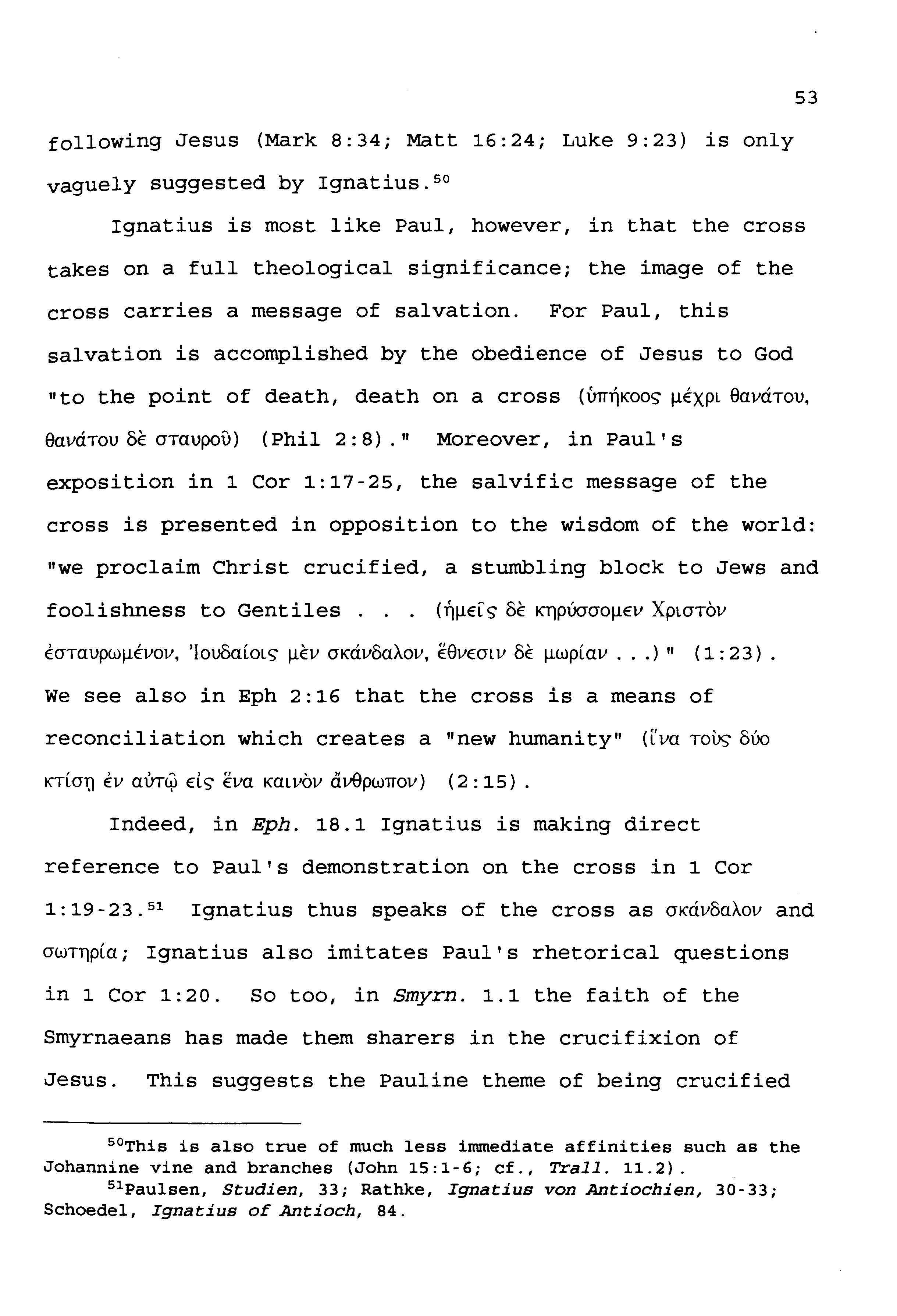
following Jesus (Mark 8:34; Matt 16:24; Luke 9:23) is only vaguely suggested by Ignatius. 50
Ignatius is most like Paul, however, in that the cross takes on a full theological significance; the image of the cross carries a message of salvation.
For Paul, this salvation is accomplished by the obedience of Jesus to God 11 to the point of death, death on a cross (irrrt1KoosµEXPL 0avciTou, eavciTou 8E OTaupou) (Phil 2 : 8) . II Moreover I in Paul I s exposition in 1 Cor 1:17-25, the salvific message of the cross is presented in opposition to the wisdom of the world:
"we proclaim Christ crucified, a stumbling block to Jews and foolishness to Gentiles . . .
(~µEl's8E KllPUacroµEv XpLcrTov EOTaupwµ€vov, 'Iou8a(msµEv crKciv8aA.ov, E0VEOLV 8E µwp(av ... ) " (1:23). we see also in Eph 2:16 that the cross is a means of reconciliation which creates a "new humanity" (Lva ToiJs8fo
KTLOTJ EV m'.rr<{> ELSEva KULVOV avepwnov) (2: 15) .
Indeed, in Eph. 18.1 Ignatius is making direct reference to Paul's demonstration on the cross in 1 Cor
1:19-23. 51
Ignatius thus speaks of the cross as crKciv8aA.ov and crwT~p(a; Ignatius also imitates Paul's rhetorical questions in 1 Cor 1:20.
So too, in Smyrn. 1.1 the faith of the Smyrnaeans has made them sharers in the crucifixion of Jesus.
This suggests the Pauline theme of being crucified 50This is also true of much less immediate affinities such as the Johannine vine and branches (John 15:1-6; cf., Trall. 11.2).
51Paulsen, Studien, 33; Rathke, Ignatius von Antiochien, 30-33; Schoedel, Ignatius of Antioch, 84.
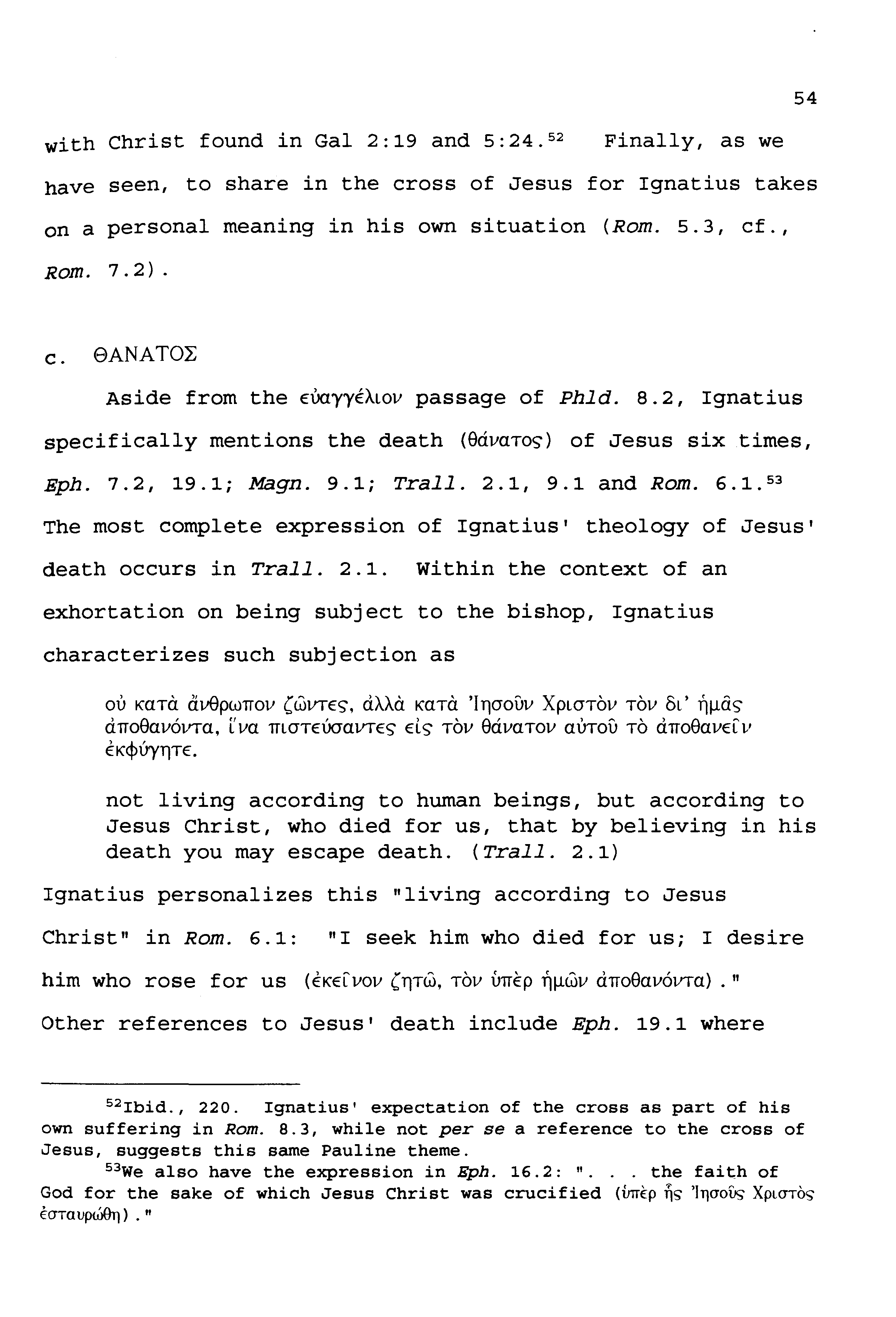
with Christ found in Gal 2:19 and 5:24. 52
Finally, as we have seen, to share in the cross of Jesus for Ignatius takes on a personal meaning in his own situation (Rom. 5.3, cf.,
Rom. 7. 2). c.
8ANAT0h Aside from the EooyyEALov passage of Phld. 8. 2, Ignatius specifically mentions the death (9civaTo~) of Jesus six times, Eph. 7.2, 19.1; Magn. 9.1; Trall. 2.1, 9.1 and Rom. 6.1. 53
The most complete expression of Ignatius' theology of Jesus' death occurs in Trall. 2.1.
Within the context of an exhortation on being subject to the bishop, Ignatius characterizes such subjection as OU Ka Ta av9pwnov (wVTE~' dA.A.a Ka Ta 'I f!OOUV XpLOTOV TOV 8L. ~µa~ dnoeavoVTa, rva 1TLOTEUaaVTE~ EL~ TOV eavaTOV al'.JTou TO dno9aVELV
EK<!>lry'flTE. not living according to human beings, but according to Jesus Christ, who died for us, that by believing in his death you may escape death. (Trall. 2.1)
Ignatius personalizes this "living according to Jesus Christ" in Rom. 6.1:
"I seek him who died for us; I desire him who rose for us (EKE L'vov CriTw, Tov unE:p ~µwv dno9avoVTa) . "
Other references to Jesus' death include Eph. 19.1 where 52Ibid., 220.
Ignatius' expectation of the cross as part of his own suffering in Rom. 8.3, while not per sea reference to the cross of Jesus, suggests this same Pauline theme.
53We also have the expression in Eph. 16. 2: ". . . the faith of God for the sake of which Jesus Christ was crucified (inrE:p ~s 'ITJao\Js XptCJTos
E-arn vpW9Tj ) . "
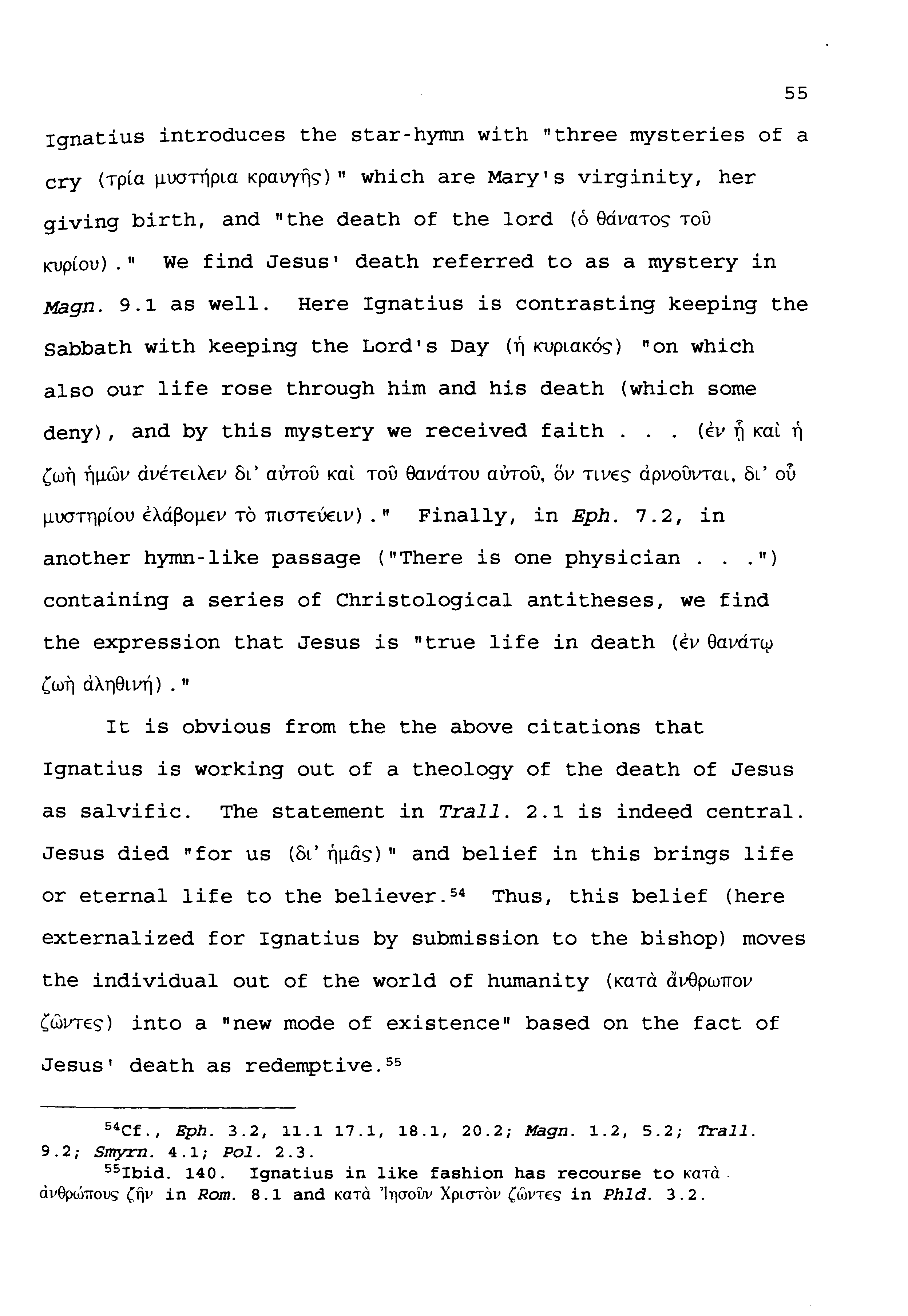
Ignatius introduces the star-hymn with "three mysteries of a cry (Tp(a µucntjpw Kpavyf)s-)" which are Mary's virginity, her giving birth, and "the death of the lord (6 8civaToS' Tou
KUp(ou) . " we find Jesus' death referred to as a mystery in Magn. 9.1 as well.
Here Ignatius is contrasting keeping the sabbath with keeping the Lord's Day <il KUpwKQs-) "on which also our life rose through him and his death (which some deny), and by this mystery we received faith . . .
(EV D KaL n (wi) i}µwv dvETELAEv fa' m'.rrou Kai Tou 8avciTou m'.rrou, ov TLVES' dpvouvTm, fa' ou µU<JTTJp(ou EAci~oµEv To maTEUELV) • "
Finally, in Eph. 7. 2, in another hymn-like passage ("There is one physician • • II ) containing a series of Christological antitheses, we find the expression that Jesus is "true life in death (EV 8avciTc.p
It is obvious from the the above citations that Ignatius is working out of a theology of the death of Jesus as salvific.
The statement in Trall. 2.1 is indeed central.
Jesus died "for us (fa'i}µcrs-)" and belief in this brings life or eternal life to the believer.s4 Thus, this belief (here externalized for Ignatius by submission to the bishop) moves the individual out of the world of humanity (KaTa dv8pwnov
(wVTES') into a "new mode of existence" based on the fact of Jesus' death as redemptive.ss s4cf., Eph. 3.2, 11.1 11.1, 10.1, 20.2; Magn. 1.2, 5.2; Trall.
9.2; Smyrn. 4.1; Pol. 2.3. ssrbid. 140.
Ignatius in like fashion has recourse to KaTa dvepwrrous (flv in Rom. a .1 and KaTa 'l11aow XpLCTTov (wvTES' in Phld. 3. 2.
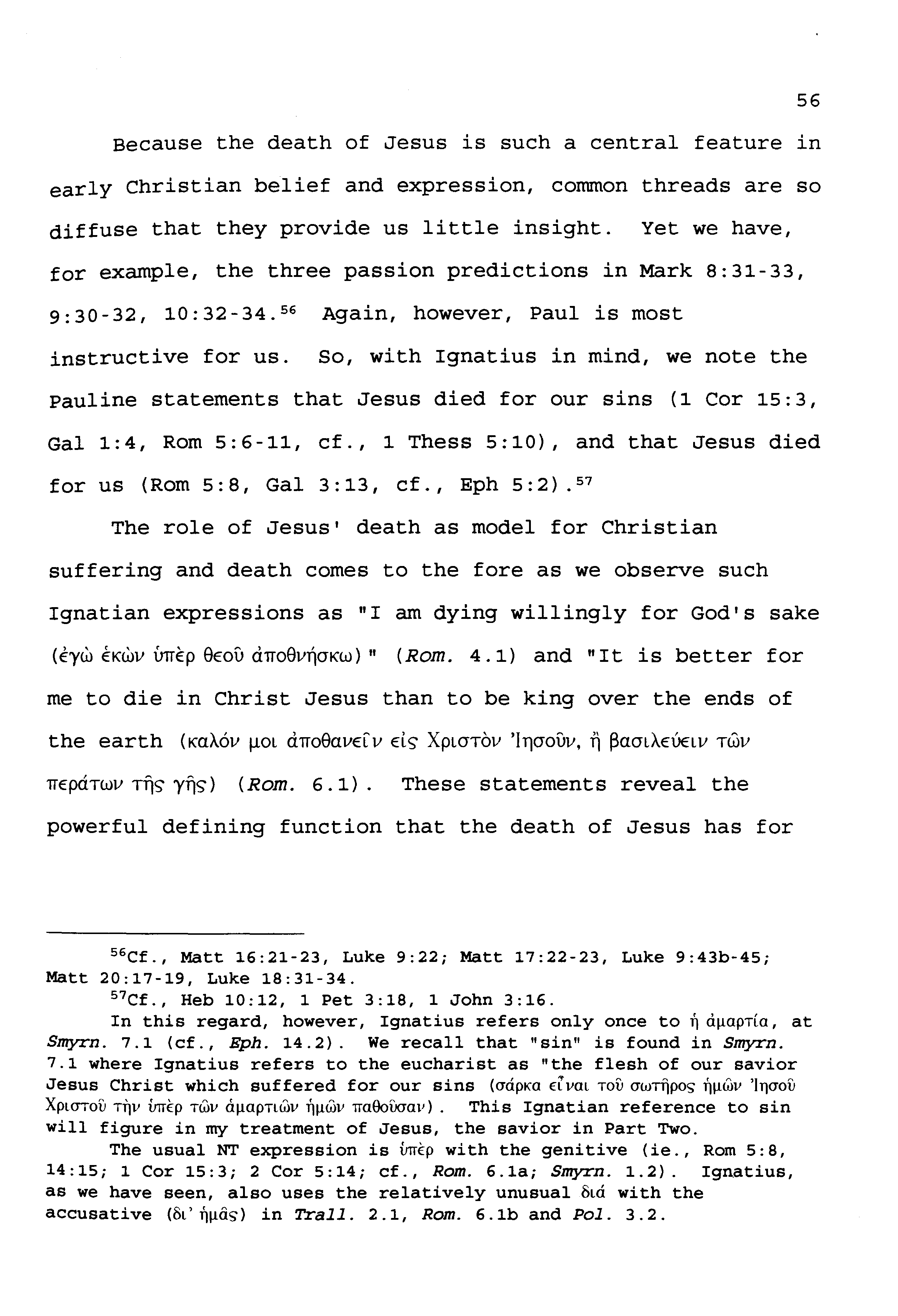
Because the death of Jesus is such a central feature in early Christian belief and expression, common threads are so diffuse that they provide us little insight.
Yet we have, for example, the three passion predictions in Mark 8:31-33, 9:30-32, 10:32-34. 56
Again, however, Paul is most instructive for us.
So, with Ignatius in mind, we note the Pauline statements that Jesus died for our sins (1 Cor 15:3,
Gal 1:4, Rom 5:6-11, cf., 1 Thess 5:10), and that Jesus died for us (Rom 5:8, Gal 3:13, cf., Eph 5:2) . 57
The role of Jesus' death as model for Christian suffering and death comes to the fore as we observe such
11 I am dying willingly for God's sake Ignatian expressions as (E:yw EKwv mr€p 9Eou dno9vl)oKw) 11 (Rom. 4 .1) and 11 It is better for me to die in Christ Jesus than to be king over the ends of the earth (KaAov µm dno9avEfv ELS' XpwTov 'IT)oouv, fl ~aoLAEUELV TWV
TIEpchwv Tf]S' yf]s-) (Rom. 6 .1) .
These statements reveal the powerful defining function that the death of Jesus has for 56Cf., Matt 16:21-23, Luke 9:22; Matt 17:22-23, Luke 9:43b-45;
Matt 20:17-19, Luke 18:31-34.
57Cf., Heb 10:12, 1 Pet 3:18, 1 John 3:16.
In this regard, however, Ignatius refers only once to ~ ciµapT(a, at Smyrn. 7.1 (cf., Eph. 14.2).
We recall that "sin" is found in Smyrn.
7.1 where Ignatius refers to the eucharist as "the flesh of our savior Jesus Christ which suffered for our sins (aciprn dvm TOV awTflpos ~µwv 'Inaov
XpLO'TOV T~V inrE:p TWV aµapnwv ~µwv Tia9oooav) .
This Ignatian reference to sin will figure in my treatment of Jesus, the savior in Part Two.
The usual NT expression is inrE:p with the genitive (ie., Rom 5:8, 14:15; 1 Cor 15:3; 2 Cor 5:14; cf., Rom. 6.la; Smyrn. 1.2).
Ignatius, as we have seen, also uses the relatively unusual 8tci with the accusative (ot'~µns) in Trall. 2.1, Rom. 6.lb and Pol. 3.2.
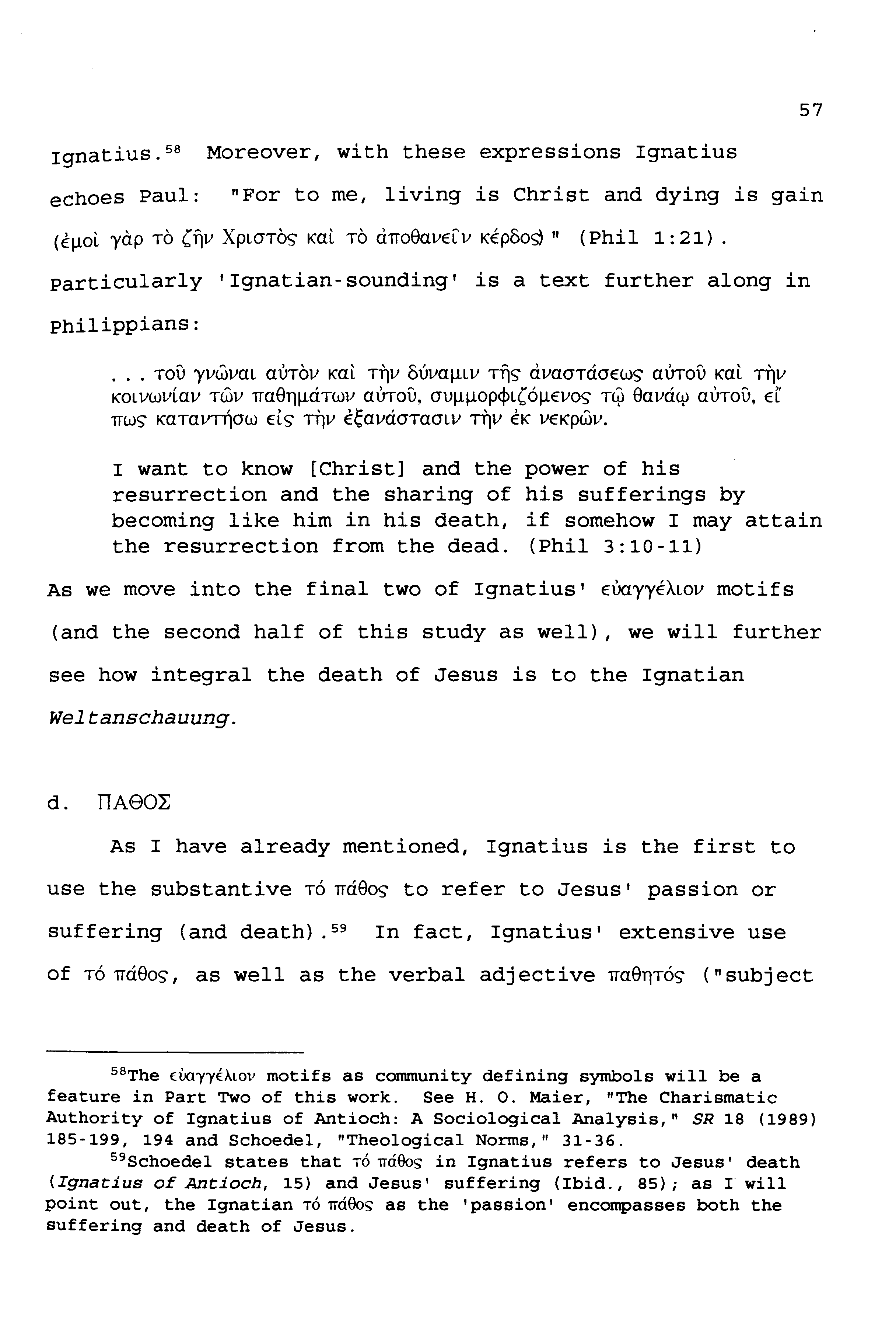
rgnatius. 58
Moreover, with these expressions Ignatius echoes Paul:
"For to me, living is Christ and dying is gain (€µoL yap To (fiv XptaTosKat To dnoeavECv KEpoog " (Phil 1: 21) .
Particularly 'Ignatian-sounding' is a text further along in Philippians:
... TOU yvwvm aUTOV Kat TTW ouvaµtv Tf]sdvaCJTclCJEWS' alii-ou Kat Tiiv KOtvwv(av TWV na811µciTWV alii-ou, auµµop<f>t(oµEVOS' Tc{} eavcic.p aUTOU, El nwsrnTavn1aw ELS' Tiiv €eavciaTaaw Tiiv EK VEKpWv.
I want to know [Christ] and the resurrection and the sharing of becoming like him in his death, power of his his sufferings by if somehow I may attain the resurrection from the dead.
(Phil 3:10-11) As we move into the final two of Ignatius' EOO')'')'EAtov motifs (and the second half of this study as well), we will further see how integral the death of Jesus is to the Ignatian
Wel tanschauung. d.
TIA80~ As I have already mentioned, Ignatius is the first to use the substantive To nci9osto refer to Jesus' passion or suffering (and death) . 59
In fact, Ignatius' extensive use of To nci9os-, as well as the verbal adjective na811Tos- ("subject
58The EOO)')'EALOV motifs as conununi ty defining symbols will be a feature in Part Two of this work.
See H. 0. Maier, "The Charismatic Authority of Ignatius of Antioch: A Sociological Analysis," SR 18 (1989)
185-199, 194 and Schoedel, "Theological Norms," 31-36.
59Schoedel states that To mi9os in Ignatius refers to Jesus' death (Ignatius of Antioch, 15) and Jesus' suffering (Ibid., 85); as I will point out, the Ignatian To mi9os as the 'passion' encompasses both the suffering and death of Jesus.
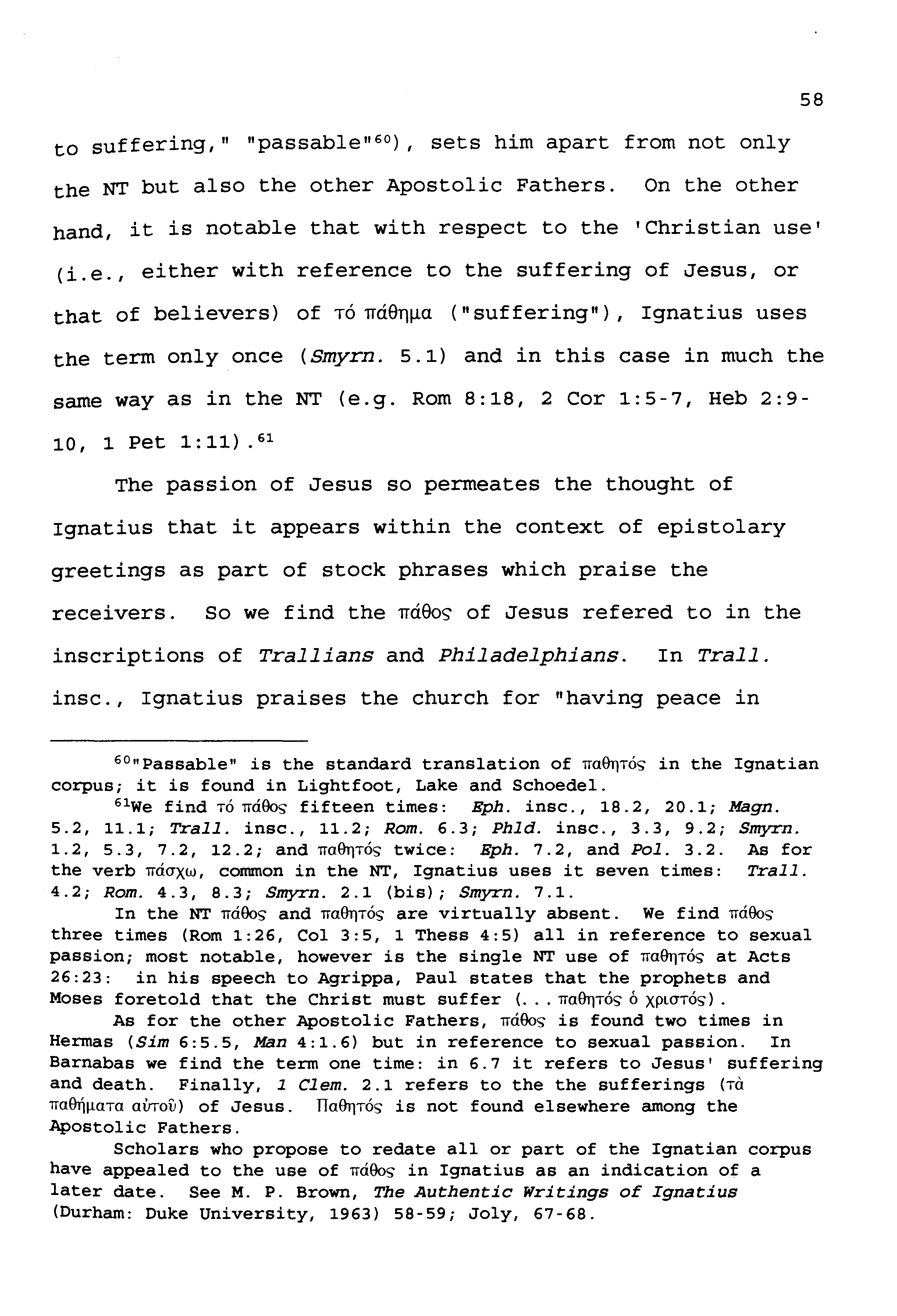
to suffering,"
11 passable 1160 ) , sets him apart from not only the NT but also the other Apostolic Fathers.
On the other hand, it is notable that with respect to the 'Christian use'
{i.e., either with reference to the suffering of Jesus, or that of believers) of To Tici0riµa {"suffering") , Ignatius uses the term only once (Smyrn. 5.1) and in this case in much the same way as in the NT {e.g. Rom 8:18, 2 Cor 1:5-7, Heb 2:910, 1 Pet 1: 11) . 61
The passion of Jesus so permeates the thought of Ignatius that it appears within the context of epistolary greetings as part of stock phrases which praise the receivers.
So we find the Tici0o~ of Jesus refered to in the inscriptions of Trallians and Philadelphians.
In Trall. insc., Ignatius praises the church for "having peace in 6011 Passable" is the standard translation of na&JiTos in the Ignatian corpus; it is found in Lightfoot, Lake and Schoedel.
61We find To mi9os fifteen times:
Eph. insc., 18.2, 20.1; Magn.
5.2, 11.1; Trall. insc., 11.2; Rom. 6.3; Phld. insc., 3.3, 9.2; Smyrn.
1.2, 5.3, 7.2, 12.2; and na&JiTos twice:
Eph. 7.2, and Pol. 3.2.
As for the verb nacrxw, common in the NT, Ignatius uses it seven times:
Trall.
4.2; Rom. 4.3, 8.3; Smyrn. 2.1 (bis); Smyrn. 7.1.
In the NT na9os and na&JiTos are virtually absent.
We find mi9os three times (Rom 1:26, Col 3:5, 1 Thess 4:5) all in reference to sexual passion; most notable, however is the single NT use of rra&JiTos at Acts
26:23: in his speech to Agrippa, Paul states that the prophets and Moses foretold that the Christ must suffer ( ... rra&JiTos 6 xptcrTos) .
As for the other Apostolic Fathers, rrci9os is found two times in Hermas (Sim 6:5.5, Man 4:1.6) but in reference to sexual passion.
In Barnabas we find the term one time: in 6.7 it refers to Jesus' suffering and death.
Finally, 1 Clem. 2.1 refers to the the sufferings (Ta rraetjµaTa airrov) of Jesus.
ITa&JiT6s is not found elsewhere among the Apostolic Fathers.
Scholars who propose to redate all or part of the Ignatian corpus have appealed to the use of rra9os in Ignatius as an indication of a later date.
See M. P. Brown, The Authentic Writings of Ignatius (Durham: Duke University, 1963) 58-59; Joly, 67-68.
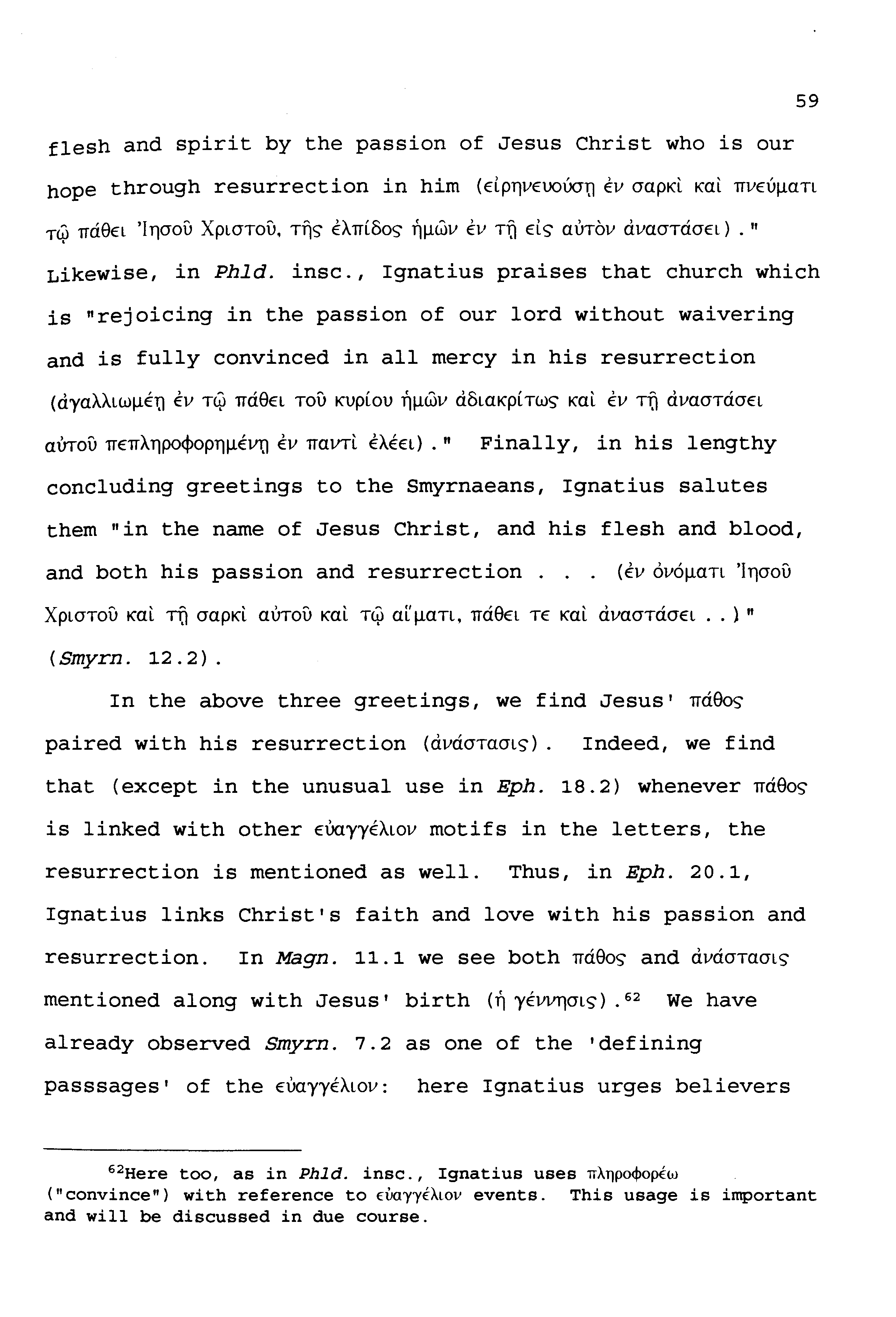
flesh and spirit by the passion of Jesus Christ who is our hope through resurrection in him (ELpT)VEUOOOlJ Ev aapKi Kai nvEuµaTL
T0 mi0EL 'IT)aou XpLaTou, T~S' EAnlBos- ~µwv Ev TlJ ELS' mhov dvaaTciaEL) . "
Likewise, in Phld. insc., Ignatius praises that church which is "rejoicing in the passion of our lord without waivering and is fully convinced in all mercy in his resurrection
(dyaAALwµElJ EV T0 nci0EL Tou Kup(ou ~µwv d8LaKp( TWS' Kai EV TiJ dvaaTciCJEL m'.rrou lTElTAflpo<f>opT)µEV1J Ev naVTi EAEEL) • "
Finally, in his lengthy concluding greetings to the Smyrnaeans, Ignatius salutes them 11 in the name of Jesus Christ, and his flesh and blood, and both his passion and resurrection . . .
(Ev ovcSµaTL 'IT)aou XpwTou Kai TiJ aapKi m'.rrou Kai Tc.i) al' µan, nci0EL TE Kai dvaaTciCJEL . . ) "
(Smyrn. 12. 2).
In the above three greetings, we find Jesus' nci0ospaired with his resurrection (dvciaTaCJLS') .
Indeed, we find that (except in the unusual use in Eph. 18.2) whenever nci0osis linked with other EooyyEALov motifs in the letters, the resurrection is mentioned as well.
Thus, in Eph. 20.1, Ignatius links Christ's faith and love with his passion and resurrection.
In Magn. 11. 1 we see both nci0osand dvciaTaCJLS' mentioned along with Jesus' birth (~ 'YEVVT)CJLS') . 62 we have already observed Smyrn. 7.2 as one of the 'defining passsages' of the EuayyEALov: here Ignatius urges believers 62Here too, as in Phld. insc., Ignatius uses TIAT)po<f>0pE:w
("convince") with reference to Eiiayyi.\wv events.
This usage is important and will be discussed in due course.
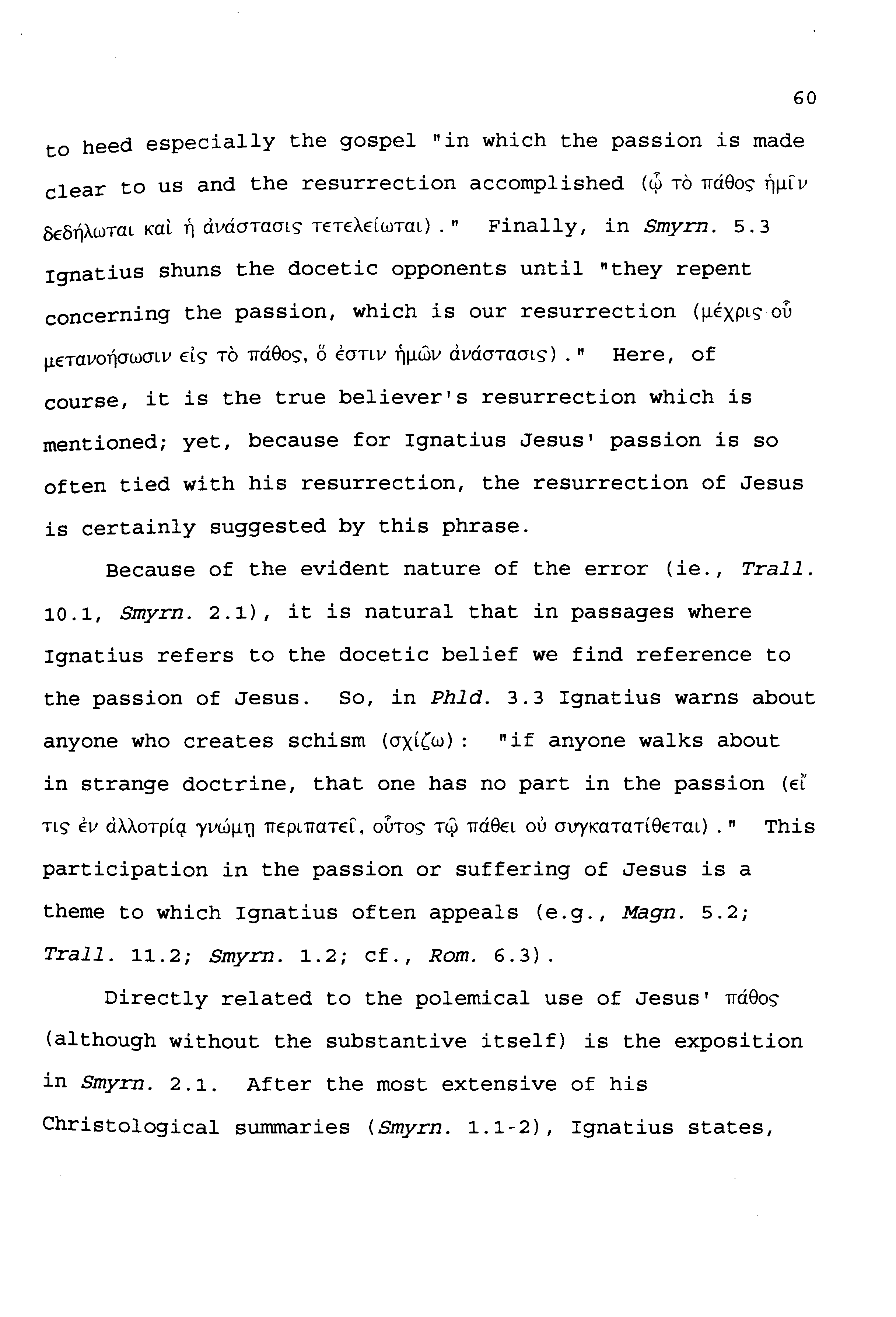
to heed especially the gospel "in which the passion is made clear to us and the resurrection accomplished (4) TO mi0osilµfv
8E8{JA.wTm KaL il dvciaTaOlS' TETEAELwTm) . "
Finally, in Smyrn. 5. 3
Ignatius shuns the docetic opponents until "they repent concerning the passion, which is our resurrection (µEXPLS' ou µETavo{Jowotv ELS' TO ncieos-, o EOTLV ilµwv dvcioTaOLS") . "
Here, of course, it is the true believer's resurrection which is mentioned; yet, because for Ignatius Jesus' passion is so often tied with his resurrection, the resurrection of Jesus is certainly suggested by this phrase.
Because of the evident nature of the error (ie., Trall.
10.1, Smyrn. 2.1), it is natural that in passages where Ignatius refers to the docetic belief we find reference to the passion of Jesus.
So, in Phld. 3.3 Ignatius warns about anyone who creates schism (ox(Cw) :
11 if anyone walks about in strange doctrine, that one has no part in the passion (EL
TLS' Ev dA.A.oTp(~ yvwµ1J nEpL naTEf, ouToS" T4> nci6EL ou ouyKaTaTleETm) . 11
This participation in the passion or suffering of Jesus is a theme to which Ignatius often appeals (e.g., Magn. 5.2;
Trall. 11.2; Smyrn. 1.2; cf., Rom. 6.3).
Directly related to the polemical use of Jesus' nci8os- (although without the substantive itself) is the exposition in Smyrn. 2.1.
After the most extensive of his Christological sununaries (Smyrn. 1.1-2), Ignatius states,
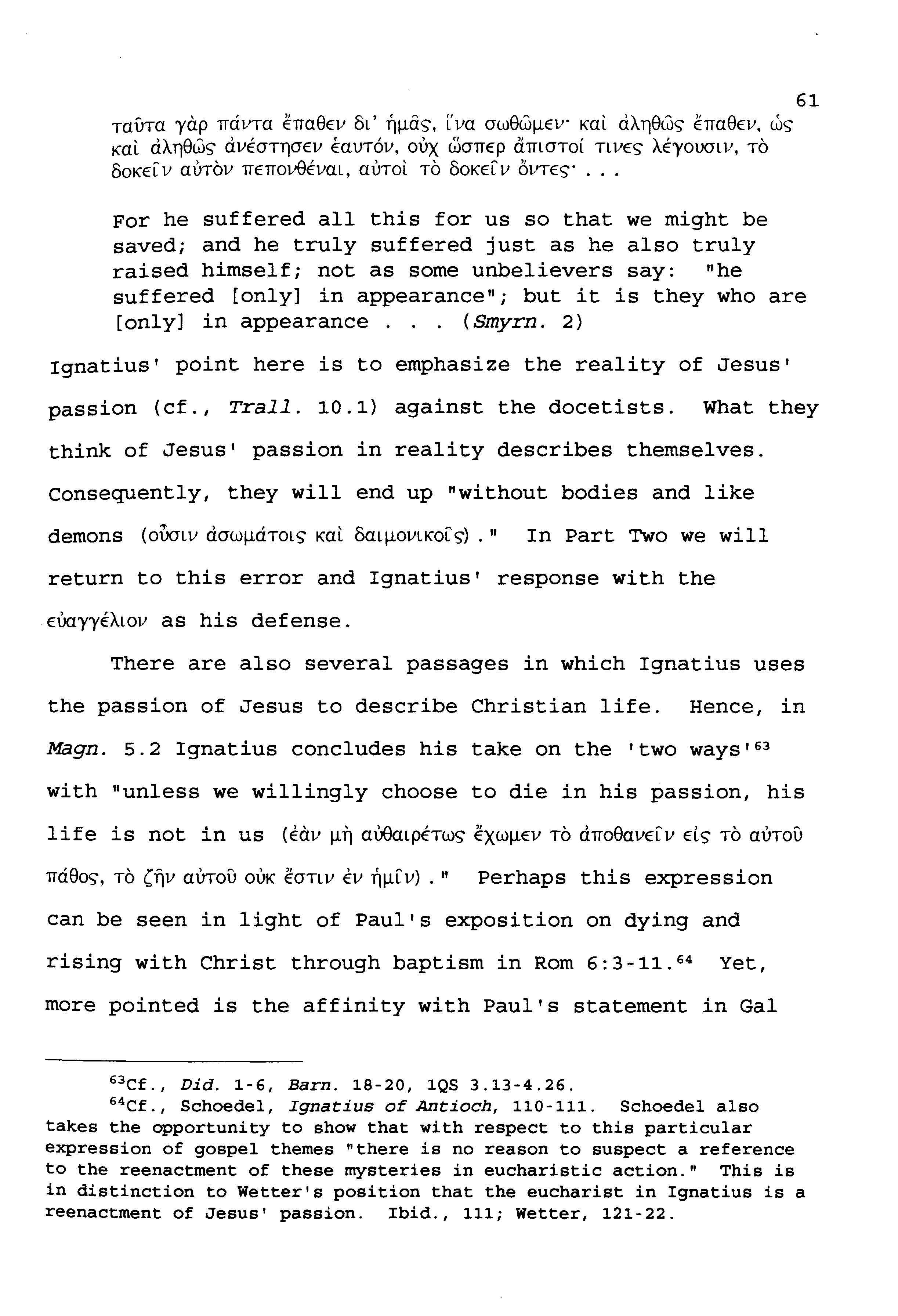
Taiha yap ncivTa Ena8Ev fa' ~µas-, i'.va aw8wµEv· KaL dA.118wsEna8Ev, t0sKaL dA.118wsdvEGTTJGEv E-auTov, oux wanEp amaTo( TLVES' A.EyoooLv, To
OOKELV auTOV TTETTOv9EvaL, OUTOL TO OOKELV OVTES'
••• For he suffered all this for us so that we might be saved; and he truly suffered just as he also truly raised himself; not as some unbelievers say:
"he suffered [only] in appearance"; but it is they who are [only] in appearance .
(Smyrn. 2) Ignatius' point here is to emphasize the reality of Jesus' passion (cf., Trall. 10.1) against the docetists.
What they think of Jesus' passion in reality describes themselves. consequently, they will end up "without bodies and like demons (OOOLV dawµciTOLS' KaL omµovLKOLS') . II In Part Two we will return to this error and Ignatius' response with the EooyyEA.Lov as his defense.
There are also several passages in which Ignatius uses the passion of Jesus to describe Christian life.
Hence, in Magn. 5.2 Ignatius concludes his take on the 'two ways 163 with "unless we willingly choose to die in his passion, his life is not in us (E:av µf) aU0mpETWS' EXWµEv To dno8avEL'v ELS' TO a1JTou nci8os-, To Cilv auTou OUK EGTLv E:v ~µCv) . "
Perhaps this expression can be seen in light of Paul's exposition on dying and rising with Christ through baptism in Rom 6:3-11. 64
Yet, more pointed is the affinity with Paul's statement in Gal 63Cf., Did. 1-6, Barn. 18-20, lQS 3.13-4.26.
64Cf., Schoedel, Ignatius of Antioch, 110-111.
Schoedel also takes the opportunity to show that with respect to this particular expression of gospel themes "there is no reason to suspect a reference to the reenactment of these mysteries in eucharistic action."
Tnis is in distinction to Wetter's position that the eucharist in Ignatius is a reenactment of Jesus' passion.
Ibid., 111; Wetter, 121-22.
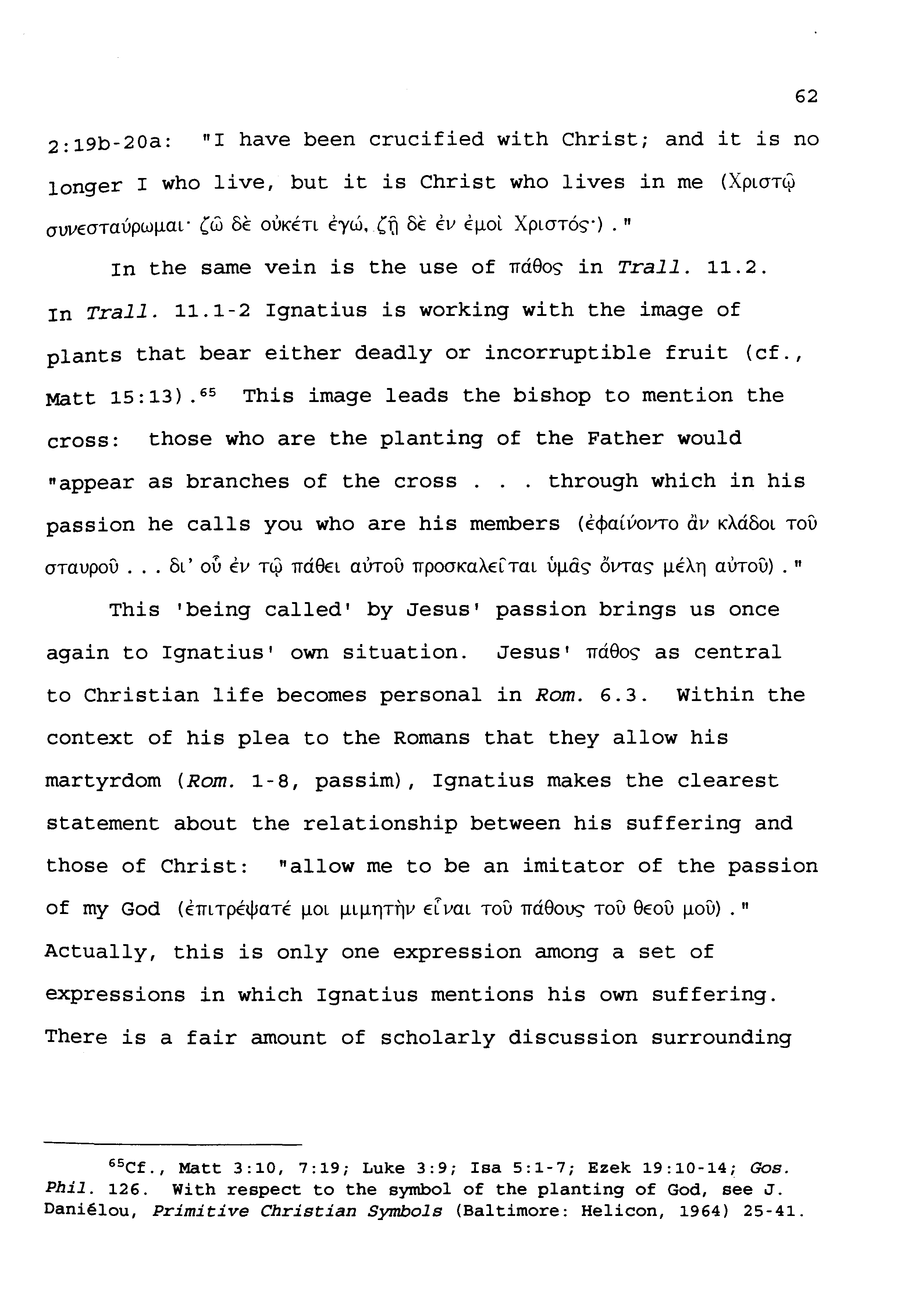
2 :19b-20a:
11 I have been crucified with Christ; and it is no longer I who live, but it is Christ who lives in me
(XpLcrT~ auvEcrTaupwµm · Cw 8E: ouKETL €yw, CiJ 8E: €v €µoL XpwT6s--) .
In the same vein is the use of nci0o~ in Trall. 11.2.
In Trall. 11.1-2 Ignatius is working with the image of plants that bear either deadly or incorruptible fruit (cf.,
Matt 15:13) . 65
This image leads the bishop to mention the cross: those who are the planting of the Father would
"appear as branches of the cross . . . through which in his passion he calls you who are his members (€cpa(voVTo av KAci8m Tou crTaupoD ... 8L, OU EV T~ nci0EL aUTOU npocrKaAELTaL uµci~ OVTa~ µEA11 aUTOU) . II This 'being called' by Jesus' passion brings us once again to Ignatius' own situation.
Jesus' nci0o~ as central to Christian life becomes personal in Rom. 6.3.
Within the context of his plea to the Romans that they allow his martyrdom (Rom. 1-8, passim), Ignatius makes the clearest statement about the relationship between his suffering and those of Christ:
"allow me to be an imitator of the passion of my God (EmTpEtjmTE µm µLµT)T~V ELVaL TOU naeo~ TOU ernu µou) . II Actually, this is only one expression among a set of expressions in which Ignatius mentions his own suffering.
There is a fair amount of scholarly discussion surrounding 65Cf., Matt 3:10, 7:19; Luke 3:9; Isa 5:1-7; Ezek 19:10-14; Gos.
Phil. 126.
With respect to the symbol of the planting of God, see J.
Dani~lou, Primitive Christian Symbols (Baltimore: Helicon, 1964) 25-41.
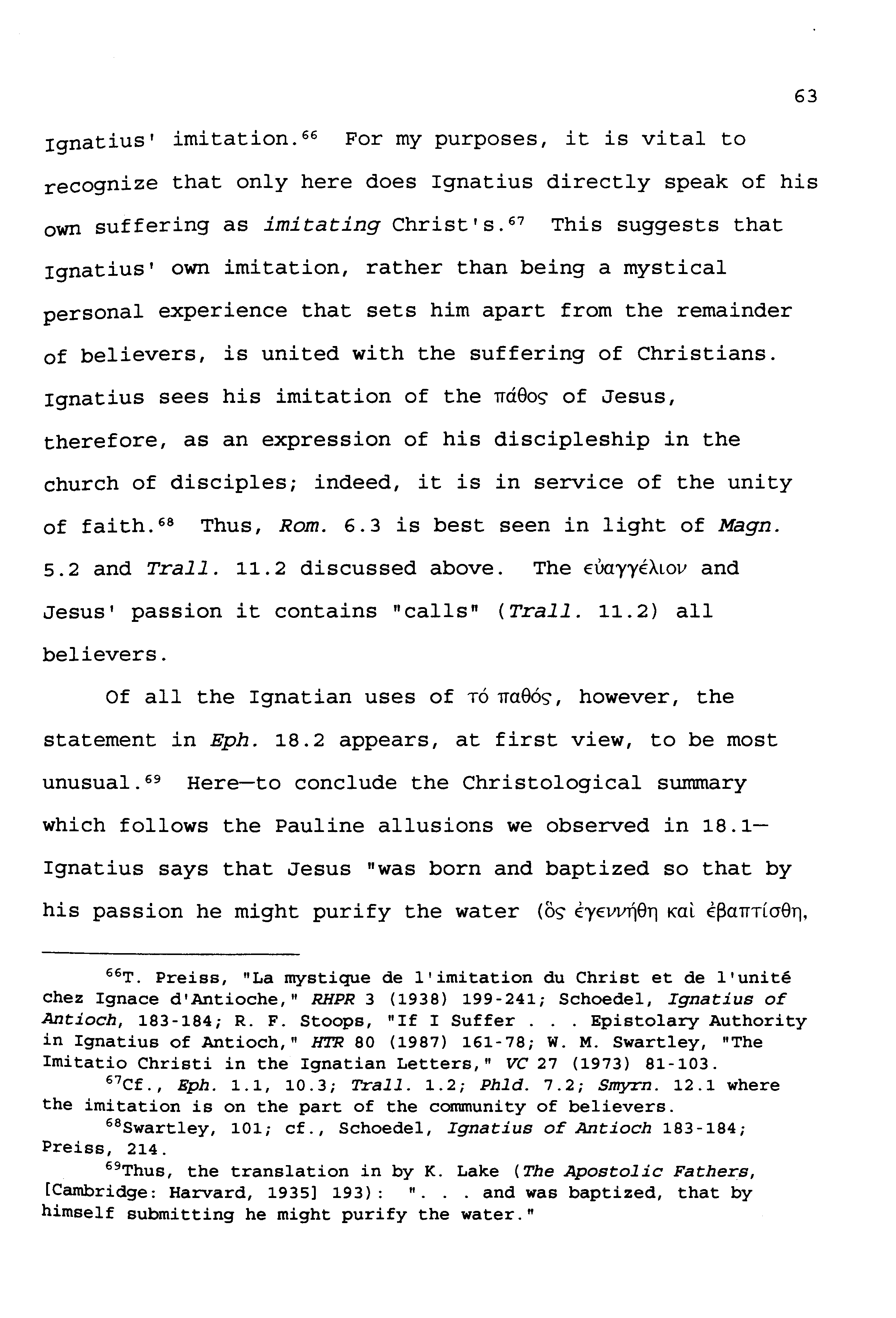
Ignatius' imitation. 66
For my purposes, it is vital to recognize that only here does Ignatius directly speak of his own suffering as imitating Christ's. 67
This suggests that Ignatius' own imitation, rather than being a mystical personal experience that sets him apart from the remainder of believers, is united with the suffering of Christians.
Ignatius sees his imitation of the nci0oS' of Jesus, therefore, as an expression of his discipleship in the church of disciples; indeed, it is in service of the unity of faith. 68
Thus, Rom. 6.3 is best seen in light of Magn. s. 2 and Trall. 11. 2 discussed above.
The EooyyEALov and Jesus' passion it contains "calls" (Trall. 11.2) all believers.
Of all the Ignatian uses of To na06S', however, the statement in Eph. 18.2 appears, at first view, to be most unusual. 69
Here-to conclude the Christological sununary which follows the Pauline allusions we observed in 18.1Ignatius says that Jesus "was born and baptized so that by his passion he might purify the water (OS' E:yEvvtj811 Kai E:~anT(CY0TJ,
66T. Preiss, "La mystique de l'imitation du Christ et de l'unite chez Ignace d'Antioche," RHPR 3 (1938) 199-241; Schoedel, Ignatius of Antioch, 183-184; R. F. Stoops, "If I Suffer ... Epistolary Authority in Ignatius of Antioch," HTR 80 (1987) 161-78; w. M. Swartley, "The Imitatio Christi in the Ignatian Letters," VC 27 (1973) 81-103.
67Cf., Eph. 1.1, 10.3; Trall. 1.2; Phld. 7.2; Smyrn. 12.1 where the imitation is on the part of the cormnunity of believers.
68Swartley, 101; cf., Schoedel, Ignatius of Antioch 183-184; Preiss, 214.
69Thus, the translation in by K. Lake (The Apostolic Fathers, [Cambridge: Harvard, 1935] 193):
. and was baptized, that by himself submitting he might purify the water."
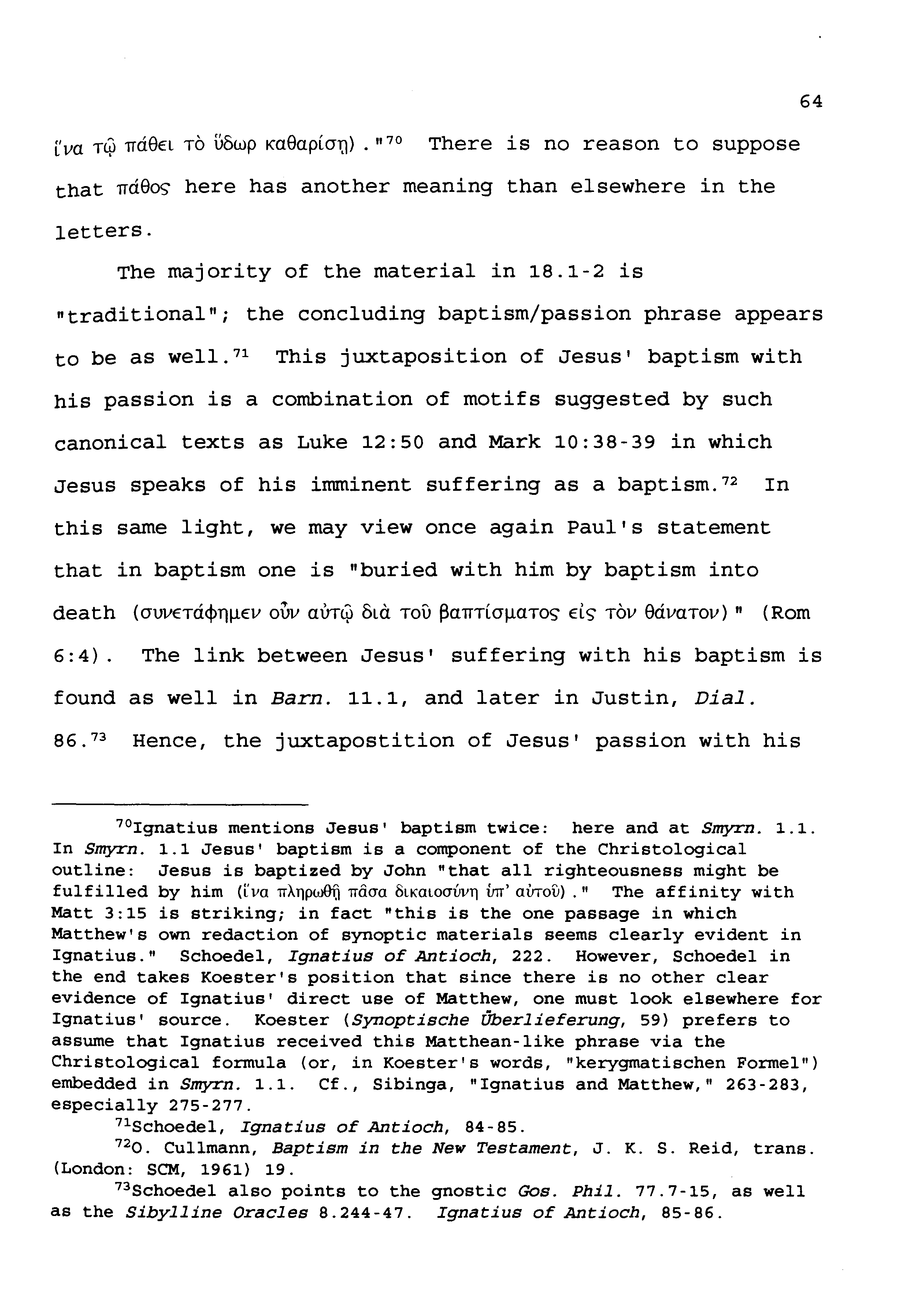
rva T4> mieEL TO u8wp Ka9ap(ai;i) II 70 There is no reason to suppose that nd9os here has another meaning than elsewhere in the letters.
The majority of the material in 18.1-2 is "traditional"; the concluding baptism/passion phrase appears to be as well. 71
This juxtaposition of Jesus' baptism with his passion is a combination of motifs suggested by such canonical texts as Luke 12:50 and Mark 10:38-39 in which Jesus speaks of his imminent suffering as a baptism. 72
In this same light, we may view once again Paul's statement that in baptism one is "buried with him by baptism into death (OUVETU<f>T)µEV ouv atrr4> 8La TOU ~anT(aµaTOS ELS TOV eavaTOV) II (Rom
6:4).
The link between Jesus' suffering with his baptism is found as well in Barn. 11.1, and later in Justin, Dial.
86. 73
Hence, the juxtapostition of Jesus' passion with his 70Ignatius mentions Jesus' baptism twice: here and at Smyrn. 1.1.
In Smyrn. 1.1 Jesus' baptism is a component of the Christological outline:
Jesus is baptized by John "that all righteousness might be fulfilled by him (tva iTAT)pwefj iTOO"a 0tKmocrw11 im' amov) . "
The affinity with Matt 3:15 is striking; in fact "this is the one passage in which Matthew's own redaction of synoptic materials seems clearly evident in Ignatius."
Schoedel, Ignatius of Antioch, 222.
However, Schoedel in the end takes Koester's position that since there is no other clear evidence of Ignatius' direct use of Matthew, one must look elsewhere for Ignatius' source.
Koester (Synoptische iiberlieferung, 59) prefers to assume that Ignatius received this Matthean-like phrase via the Christological formula (or, in Koester's words, "kerygmatischen Formel") embedded in Smyrn. 1. 1.
Cf., Sibinga, "Ignatius and Matthew," 263-283, especially 275-277.
71Schoedel, Ignatius of Antioch, 84-85.
720. Cullmann, Baptism in the New Testament, J. K. S. Reid, trans.
(London: SCM, 1961) 19.
73Schoedel also points to the gnostic Gos. Phil. 77.7-15, as well as the Sibylline Oracles 8.244-47.
Ignatius of Antioch, 85-86.
baptism in Ignatius does have a discernable context in early Christianity.
Still with the Ignatian na96s of Jesus in mind, we turn to Ignatius' use of the verbal adjective na9~T6s (Eph. 7.2,
Pol. 3.2) . 74
Among the series of Christological antitheses in Eph. 7.2 we find that the "one physician (ds LaTpos ECJTLV)"
Jesus was "first passable and then impassable (npGnov na9~Tos Kai TOTE dna9tjs) . "
In Pol. 3. 2 the same paradox is expressed in another set of antitheses:
Jesus is "impassable, for our sakes passable (Tov dnaefj, Tov fa' ~µas na9~Tov) . "
I have already noted the only usage of na9~T6s in the NT at Acts 26:23: while there is no antithesis in Acts 26:23, Paul states in his speech to Agrippa that Moses and the Prophets said that "the Messiah must suffer (El na9~Tos 6 XpLCJTos) . " 75
When brought together, Eph. 7.2 and Pol. 3.2 are remarkable in that they speak of the same qualities of Jesus, but with a difference.
In Eph. 7.2 Jesus is "first passable"; ie., Jesus was able to suffer in his life.
With the resurrection, he suffers no more, he is impassable (cf., Rom 6:9).
This emphasis on the movement from the·historical Jesus to Jesus who is beyond history seems to be another
74For the grammatical development of this form, see F. Blass and A. Debrunner, A Greek Grarrunar of the New Testament, R. w. Funk, trans.
(Chicago: University of Chicago, 1961) 36.
75A similar series of antithetical statements may be found in the Paschal Homily of Melito of Sardis (died, 190 C.E.); Tia9rjT6s, however, is not a feature here.
A. Wifstrand, "The Homily of Melito on the Passion," VC 2 (1948) 201-223.
expression of the same Christology we find in Phld. 9.1-2 where Jesus the high priest (6 dpXLEpEiJs') is the door to God for people of all times.
On the other hand, in Pol. 3.2, the order is reversed.
Jesus as impassable is mentioned first.
This brings to mind the pre-existence of Jesus which Ignatius refers to in Magn. 6.1: the deacons of Magnesia serve Jesus "who before the ages was with the Father and appeared at the end ( os1Tpo a(wvwv 1Tapa 1TaTpL ~v Kat €v TEAEL
E:<f>ciV11) ."
The impassable Jesus became passable for us in the last times (cf., Eph. 11.1).
To conclude my discussion on Jesus' 1Tci0osin Ignatius, it is necessary to be still more precise about to what the bishop is referring with this term.
We have seen that often Ignatius links the 1Tci0oswith the resurrection (Eph. 20.1;
Magn. 11.1; Phld. insc., 9.2; Smyrn. 5.3, 7.2, 12.2; cf., Magn. 5.2; Trall. insc.).
Excepting the link with Jesus' baptism in Eph. 18.2, any time a single event from the life of Jesus is mentioned in conjunction with the 1Tci0os-, it is the dvciaTaats-.
Together with the fact that-as I will soon underscore-the resurrection of Jesus is the defining constant in Ignatius' Eooyy€A.wv, this suggests that when the bishop refers to Jesus' 1Tci0os-, he has in mind the other two
'suffering motifs' of the EUa'Y'YEALOV: the aTaup6sand 8civaTos-.
So, for Ignatius, the cross and death coalesce into the passion, which in turn is closely linked with the resurrection.
For Ignatius, therefore, the '1Tci0osKaL
dvciaTOOlS'' of Jesus is "the heart of the Christian gospel and the ground of faith. 1176 e.
Ignatius speaks of the resurrection (dvciaTaats-) of Jesus in thirteen passages (Eph. 20.1; Magn. 11.1; Phld. insc., a.2 (bis); Smyrn. 1.2, 3.1, 7.2, 12.2; cf., Trall. 9.2; Rom.
6.1; Smyrn. 2.1, 7.1).
The resurrection of the believer (or Ignatius' own resurrection) is a subject that is found repeatedly throughout the seven letters.
This EooyyEALOv message of resurrection through Jesus will be addressed fully in Part Two; in the following paragraphs, I will concentrate on Jesus' dvciaTa<JLS' itself as a component of the
EUa'YYEALOV •
At this point in my study of the gospel motifs, we have already seen most of the passages in which the dvciaTa<JLS' of Jesus is mentioned.
Thus, the dvciaTa<JLS' is tied only with nci8osin Eph. 20.1; Phld. insc.; Smyrn. 7.2, 12.2; (cf.,
Phld. 8. 2) ; it is joined with yEVVTJ<YLS' and nci8osin Magn.
11.1, and napooo(a and nci8osin Phld. 9. 2.
Moreover, referring to Jesus' resurrection with the participle dvaaTciS', in Rom. 6.lb Ignatius joins it with Jesus' death in a statement that underscores the centrality of the resurrection as the primary meaning-giving motif. 77
With 76Schoedel, Ignatius of Antioch, 27.
77Ibid. I 182 •
these linkages before us, other more specific issues concerning Jesus' resurrection in the letters come to the surface.
The complex in Smyrn. 1.1-2 is instructive.
As we have seen, Ignatius opens the letter with an expanded "semicredal statement." 78
This Christological outline serves as an introduction to his warnings about the docetic error that forms the backbone of the letter (2.1-7.2); indeed, it is structured with the error in mind. 79
The bishop concludes this statement by referring to the passion (see above).
He then leads into the phrase, i'va clplJ aoomiµov ElS' TOUs' aLWVUS' faa TilS' dvaaTciGEWS' ELS' TOUs' ay(o\JS'
KaL lTLGTOUs' aUTOU, ELTE EV 'Ioooa(OLS' ELTE EV E8VEGLV, EV EVL awµaTL TflS'
EKKATJGLaS' auTou. so that he might raise a sign for the ages, through the resurrection, to his saints and believers, whether among the Jews or among the Gentiles, in the one body of his church.
(Smyrn. 1.2b) Ignatius is working with the image of the aooaT]µov ("sign") found in Isa 5:26, 49:22, and 62:10. 80
Moreover, it has been plausably suggested that here the dvciaTaGLS' is Ignatius' own addition to a formula which had originally ended with 78Ibid. I 220.
79The anti-docetic "truly (ci.\ri9Ws->" (cf., Trall. 9.1) is the clearest indication of this.
Ibid., 153, 220.
80E.g. Isa 5:26: "[The Lord] will raise a signal for a nation far away, and whistle for a people at the ends of the earth (LXX: Tol'yapovv cipE[ croocnuwv €v TOtS' {9vEO'L Tots µaKpav, Kai crvpLEt airroV; cin' aKpov Tf)s yfls) . "
Schoedel (Ibid., 223) also points to Eph 2:16 as suggesting the same idea of the cross as gathering Jews and Gentiles into one body.
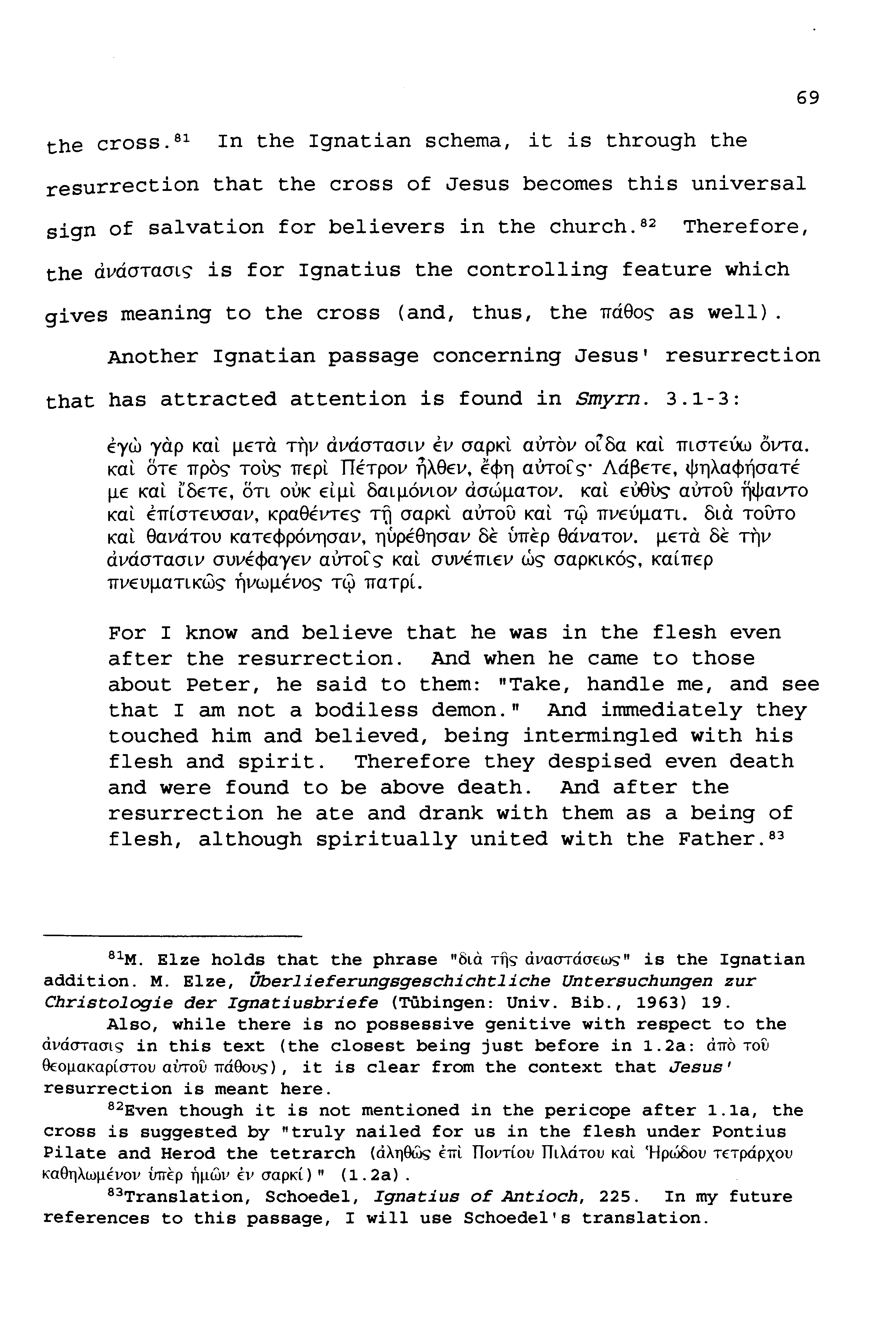
the cross. 81
In the Ignatian schema, it is through the resurrection that the cross of Jesus becomes this universal sign of salvation for believers in the church. 82
Therefore, the dvcicrTacrL~ is for Ignatius the controlling feature which gives meaning to the cross (and, thus, the nci0o~ as well) .
Another Ignatian passage concerning Jesus' resurrection that has attracted attention is found in Smyrn. 3.1-3:
E-yw yap Kai µETa Tr1v dvaaTaaw E-v crapKi m'.rrov ol' oa Kai mcrTEUw oVTa.
Kai OTE npo~ To\Js' TIEpi TIETpov ~A0Ev, €<f>11 m'.rrol'~· Aci~ETE, t/J11A.mf>tjcraTE µE Kai LOETE, oTL ouK dµi omµ6vwv dcrwµaTov. Kai EU0\Js' al'.JTou ~t/JaVTo
Kai E-n(crTEooav, Kpa0EVTE~ tj crapKi al'.JTou Kai T4) nvEuµaTL. faa Tofuo Kai 0avaTOU KaTE<f>povricrav, 11upE811crav OE UTIEP eavaTOV. µETa OE n)v dvaaTaaLV cruv€<f>ayEv aUTOL~ Kai OUVETILEV w~ crapKLKO~. KaLTIEp
TIVEuµaTLKW~ iJvwµEvo~ T4) naTpL.
For I know and believe that he was in the flesh even after the resurrection.
And when he came to those about Peter, he said to them: "Take, handle me, and see that I am not a bodiless demon."
And immediately they touched him and believed, being intermingled with his flesh and spirit.
Therefore they despised even death and were found to be above death.
And after the resurrection he ate and drank with them as a being of flesh, although spiritually united with the Father. 83
81M. Elze holds that the phrase 11Bla Tf\S' civao-rciaEws" is the Ignatian addition. M. Elze, Uberlieferungsgeschichtliche Untersuchungen zur
Christologie der Ignatiusbriefe (TU.bingen: Univ. Bib., 1963} 19.
Also, while there is no possessive genitive with respect to the civcio-raatS' in this text (the closest being just before in 1. 2a: cirro Tou
9EoµaKap(o-rov airrou rrci9oVS'} , it is clear from the context that Jesus' resurrection is meant here.
82Even though it is not mentioned in the pericope after 1.la, the cross is suggested by "truly nailed for us in the flesh under Pontius
Pilate and Herod the tetrarch (ciATJehls E:rri ITovT[ov ITLA.ciTov Kai 'Hpwoov TETpcipxov
Ka9T)Awµfoov imf.:p ~µwv E:v aapK(} "
( 1. 2a} .
83Translation, Schoedel, Ignatius of Antioch, 225.
In my future references to this passage, I will use Schoedel's translation.
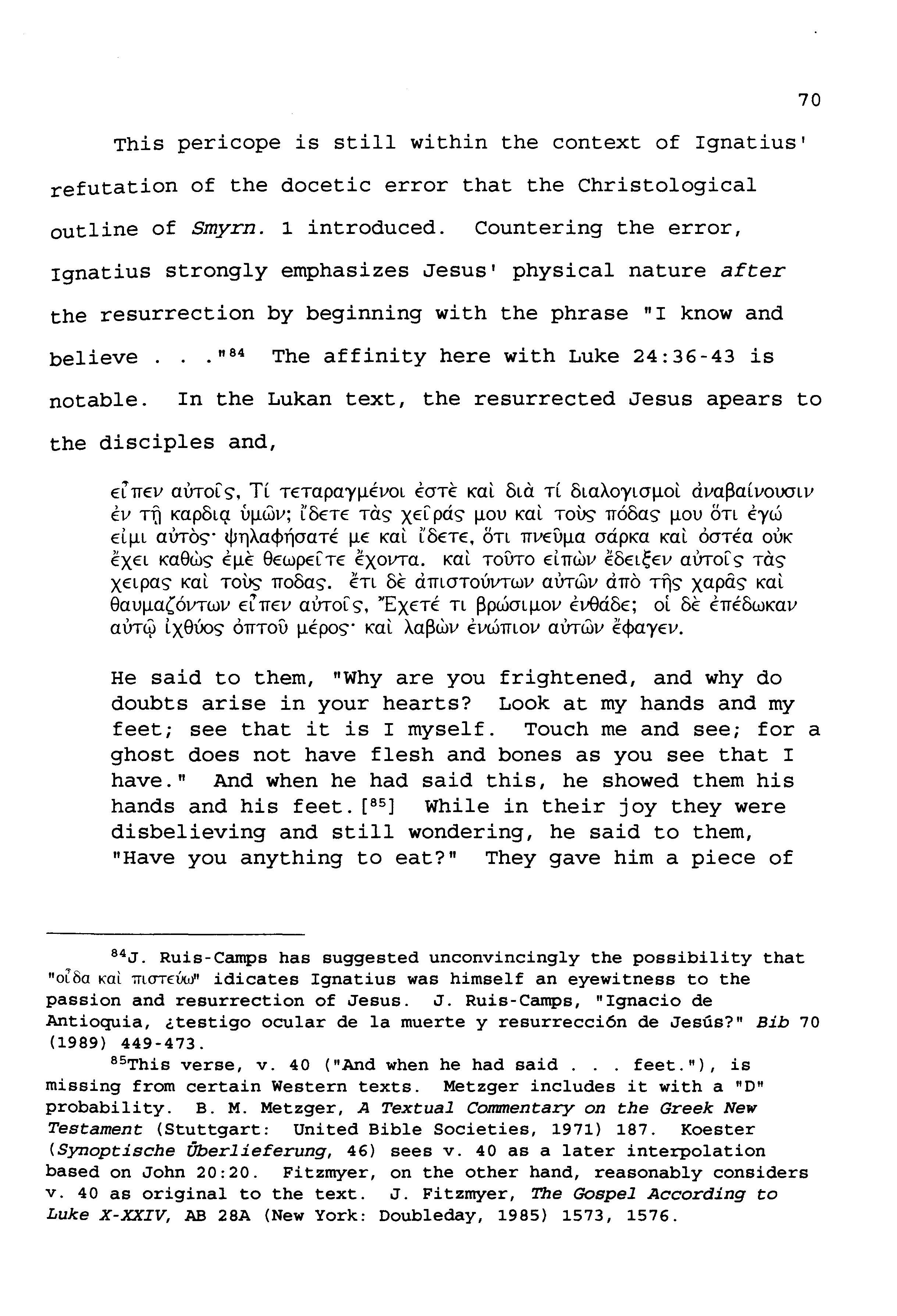
This pericope is still within the context of Ignatius' refutation of the docetic error that the Christological outline of Smyrn. 1 introduced.
Countering the error, Ignatius strongly emphasizes Jesus• physical nature after the resurrection by beginning with the phrase "I know and believe .
II 84 The affinity here with Luke 24:36-43 is notable.
In the Lukan text, the resurrected Jesus apears to the disciples and, dnEv oU-rol's-, T( TETopoyµEvm EOTE KOL Bla TL 8toA.oyLcrµoL dvo~o(vouaw
EV TlJ KOpOLQ uµwv; lBETE TUS' XEL pciS' µou KOL ToiJS' 1TOOOS' µou OTL E'YW ELµL oITToS'· qrr1A.o<f>tjcroTE µE KOL lBETE, OTL nvEuµo crcipKo KOL ocrTEo ouK
EXEL Ko9wS' EµE: 9EwpEL'TE EXoVTo.
KOL TouTo Einwv EoELeEv oU-rol'S' TaS'
XELPOS' KoL ToiJS' noooS'. ETL oEdmcrTouVTwv oU-rwv dno Tf)S' xopasKOL eouµo(OVTWV El1TEV OITTOLS', "EXETE TL ~pwcrLµov Ev9cioE; Ol OE E1TEOWKOV
OUT4) LxeooS' 01TTOU µEpOS'" KOL AO~WV EVW1TLOV OITTWV E<f>O'YEV.
He said to them, "Why are you frightened, and why do doubts arise in your hearts?
Look at my hands and my feet; see that it is I myself.
Touch me and see; for a ghost does not have flesh and bones as you see that I have."
And when he had said this, he showed them his hands and his feet. [85 ] While in their joy they were disbelieving and still wondering, he said to them,
"Have you anything to eat?"
They gave him a piece of 84J. Ruis-Camps has suggested unconvincingly the possibility that 11ol'8a KaL 1TlCTTEW' idicates Ignatius was himself an eyewitness to the passion and resurrection of Jesus.
J. Ruis-Camps, "Ignacio de Antioquia, (.testigo ocular de la muerte y resurrecci6n de Jesus?" Bib 70
(1989) 449-473.
85This verse, v. 40 ("And when he had said . . . feet."), is missing from certain Western texts.
Metzger includes it with a "D" probability.
B. M. Metzger, A Textual Commentary on the Greek New Testament (Stuttgart:
United Bible Societies, 1971) 187.
Koester (Synoptische Uberlieferung, 46) sees v. 40 as a later interpolation based on John 20:20.
Fitzmyer, on the other hand, reasonably considers v. 40 as original to the text.
J. Fitzmyer, The Gospel According to Luke X-XXIV, AB 28A (New York: Doubleday, 1985) 1573, 1576.
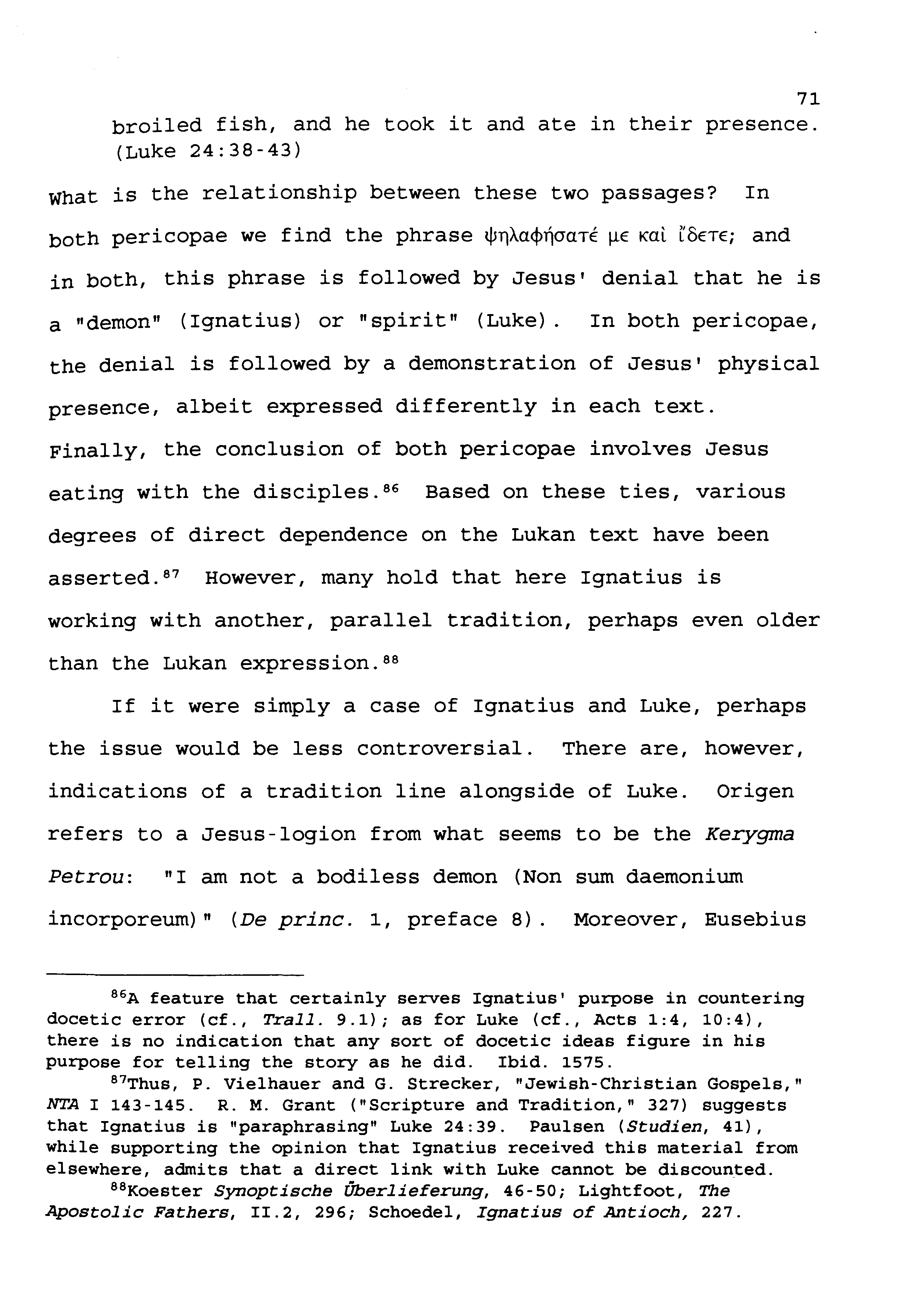
broiled fish, and he took it and ate in their presence.
(Luke 24:38-43) what is the relationship between these two passages?
In both pericopae we find the phrase tl;T)A.a<f>tjaaTE µE KaL lBETE; and in both, this phrase is followed by Jesus' denial that he is a "demon" (Ignatius) or "spirit" (Luke) .
In both pericopae, the denial is followed by a demonstration of Jesus' physical presence, albeit expressed differently in each text.
Finally, the conclusion of both pericopae involves Jesus eating with the disciples.s6 Based on these ties, various degrees of direct dependence on the Lukan text have been asserted.s 7 However, many hold that here Ignatius is working with another, parallel tradition, perhaps even older than the Lukan expression.ss If it were simply a case of Ignatius and Luke, perhaps the issue would be less controversial.
There are, however, indications of a tradition line alongside of Luke.
Origen refers to a Jesus-logion from what seems to be the Kerygma Petrou:
"I am not a bodiless demon (Non sum daemonium incorporeum)" (De princ. 1, preface 8).
Moreover, Eusebius s6A feature that certainly serves Ignatius' purpose in countering docetic error (cf., Trall. 9.1}; as for Luke (cf., Acts 1:4, 10:4), there is no indication that any sort of docetic ideas figure in his purpose for telling the story as he did.
Ibid. 1575. s 7Thus, P. Vielhauer and G. Strecker, "Jewish-Christian Gospels,"
NTA I 143-145.
R. M. Grant ("Scripture and Tradition," 327} suggests that Ignatius is "paraphrasing" Luke 24:39.
Paulsen (Studien, 41), while supporting the opinion that Ignatius received this material from elsewhere, admits that a direct link with Luke cannot be discounted. ssKoester Synoptische Uberlieferung, 46-50; Lightfoot, The Apostolic Fathers, II.2, 296; Schoedel, Ignatius of Antioch, 227.
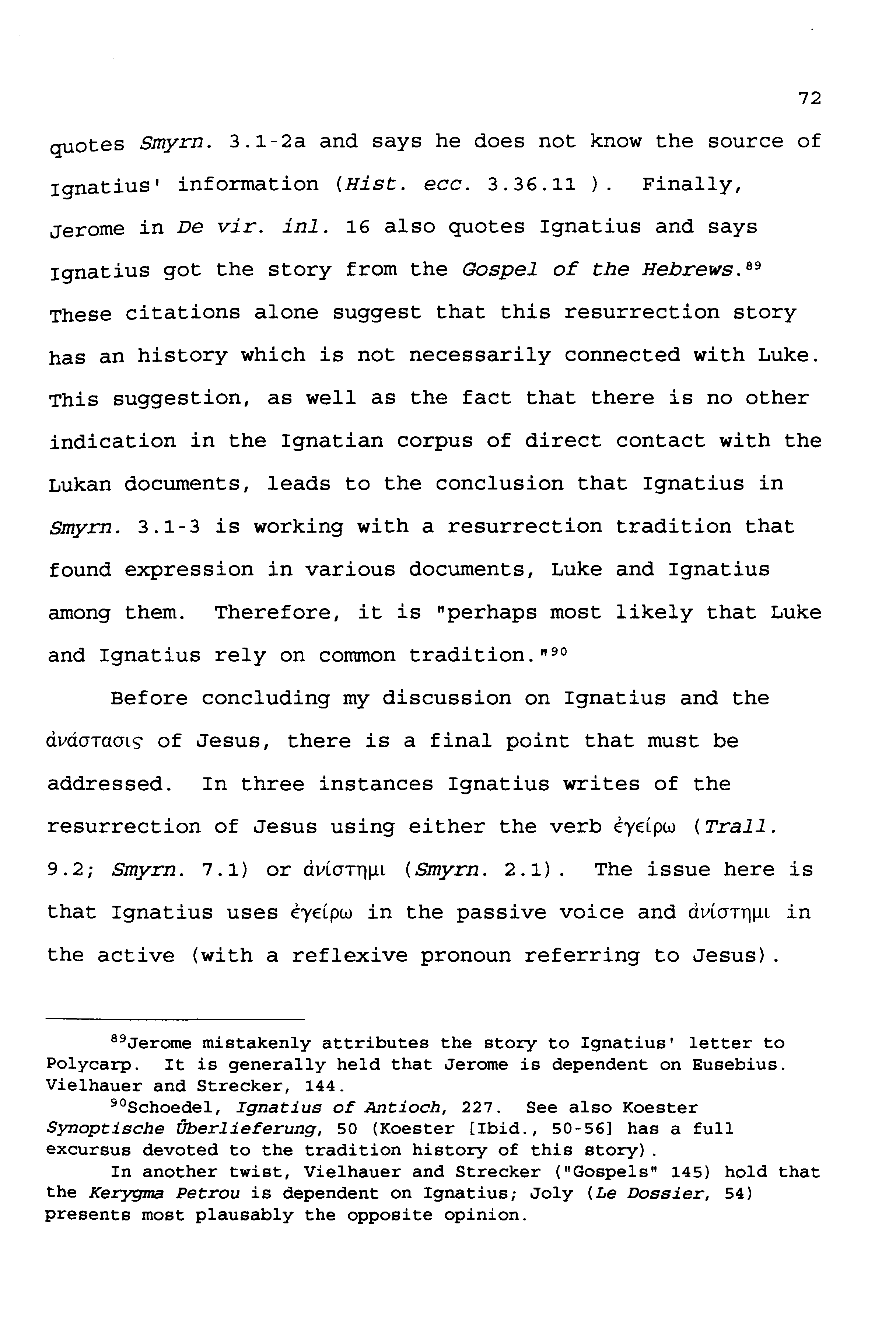
quotes Smyrn. 3.1-2a and says he does not know the source of Ignatius' information (Hist. ecc. 3.36.11 ) .
Finally, Jerome in De vir. inl. 16 also quotes Ignatius and says Ignatius got the story from the Gospel of the Hebrews. 89
These citations alone suggest that this resurrection story has an history which is not necessarily connected with Luke.
This suggestion, as well as the fact that there is no other indication in the Ignatian corpus of direct contact with the Lukan documents, leads to the conclusion that Ignatius in Smyrn. 3.1-3 is working with a resurrection tradition that found expression in various documents, Luke and Ignatius among them.
Therefore, it is "perhaps most likely that Luke and Ignatius rely on common tradition. "90
Before concluding my discussion on Ignatius and the dvaaTaaL~ of Jesus, there is a final point that must be addressed.
In three instances Ignatius writes of the resurrection of Jesus using either the verb E)'Etpw ( Trall.
9 . 2 ; Smyrn. 7 . 1) or dv(anJµL ( Smyrn. 2 . 1) .
The is sue here is that Ignatius uses E)'Etpw in the passive voice and dv(aTT)µL in the active (with a reflexive pronoun referring to Jesus) .
89Jerome mistakenly attributes the story to Ignatius' letter to Polycarp.
It is generally held that Jerome is dependent on Eusebius.
Vielhauer and Strecker, 144.
90Schoedel, Ignatius of Antioch, 227.
See also Koester Synoptische iiberlieferung, 50 (Koester [Ibid., 50-56] has a full excursus devoted to the tradition history of this story) .
In another twist, Vielhauer and Strecker ("Gospels" 145) hold that the Kerygma Petrou is dependent on Ignatius; Joly (Le Dossier, 54) presents most plausably the opposite opinion.
so, in Trall. 9.2, in the Christological outline Jesus "was also truly raised from the dead, his Father having raised him (Kai dA118wstjyEp811 dno vEKpwv, E:ydpavTosmhov Tou naTposmhou) 11 ; and in Smyrn. 7.1, the docetists "do not confess that the eucharist is the flesh of our savior Jesus Christ which suffered for our sins, [flesh] which the father raised up by his goodness (µi} 6µoAoyEL'v Ti}v EuxapLcrT(av crcipKa dvm Tou crwTT]pos- ~µwv
'IT)OOU XpLOTOU Ti}v UnEp TWV dµapTLWV ~µwv naeoooav, iiv TD XPT)OTOTT)TL 6 naTiiP ~'YELpEv) . "
On the other hand, as Ignatius moves into the resurrecton story in Smyrn. 3.1-3, the bishop writes that Jesus "truly suffered just as he truly raised himself
(KaL dA118ws- €na0Ev, wsKaL dA118wsdvEOTT)OEV E:aUTov) " ( Smyrn. 2. 1) .
Turning to the NT, we usually find that Jesus was raised or, God raised Jesus. 91
However, there are Johannine statements-albeit, somewhat elliptical-of Jesus raising himself (2:19, 10:18).
With Ignatius, the passive expressions of Jesus' resurrection are found in contexts where, in response to the docetic error, Ignatius seems to have recourse to traditional expressions.
Thus in Trall.
9.1-2, we have before osKaL dA118wstjyEp8T) (who was also truly raised) , the phrases osdA118wsEyEvvr)811 (who was truly born) , dA118wsE:BLwxe11 (was truly persecuted) , and dA118wsEcrTaupw811 (was truly crucified) .
The traditional confessional material is 91I.e., E:ydpw:
Matt 16:21, 17:23, 26:32, 27:64, 28:7; Mark 14:28; Luke 9:22, 24:6; John 2:22, 21:14; Acts 4:10, 10:40; Rom 6:4, 9:8, 34; 1
Cor 15: 4, 12, 20.
We find civ(aTllµt used the same way in Acts: 2: 24, 32, 3:26, 13:33, 17:31.
structured in parallel passive relative clauses. 92
So too, in smyrn. 7.1 the declaration appears to be within the guise of a confessional statement based on a traditional expression.
Therefore, the opening 6µoAoyEw (here negated) introduces a short faith statement from the tradition which Ignatius adapted to his present needs. 93
By pointing to this particular passive/active tension in Ignatius, I want to suggest that the expression in Smyrn.
2.1 (Jesus truly raised himself) is entirely Ignatius' own.
Here, we may point to the presence of the Ignatian dA~9w~ to support this suggestion.
Moreover, when we consider the phrase 8ta Til~ dvaaTciaEw~ in Smyrn. 1. 2 as an Ignatian addition
(where Jesus is the one acting, raising a sign through the resurrection), it seems reasonable to consider the Smyrn.
2.1 expression of Jesus' action in raising himself to be Ignatian as well.
Thus, with Smyrn. 2.1 Ignatius provides a short statement that serves as an emphatic recapitulation of the traditional material he has structured into Smyrn. 1, all of which addresses the docetic error.
92This in particular is an identifying characteristic of preformed "creedal formulae" in the NT as proposed in E. Stauffer, New
Testament Theology' J. Marsh, trans. (London: SCM, 1963) 339.
Having recognized this, Ignatius' hand is nevertheless clearly present with the anti-docetic dA~9Ws'.
93Cf., I John 4:2,3; 2 John 7; Pol. Phil. 7.1.
The mention of the eucharist is from Ignatius' hand for this particular situation; the confessional statement is centered on the person of Christ.
For the characteristics of such statements see V. H. Neufeld, The Earlest Christian Confessions (Leiden: E. J. Brill, 1963) 13-33.
I will return to oµoAoyiw and other commitment verbs with respect to the EVa)')'EALov motifs further along.
so far in this study I have introduced the gospel of Ignatius, its components and their meanings.
It is necessary at this point that-with respect to the EUaYYEALovwe recognize Ignatius' place within early Christianity.
The next chapter, then, will attempt to locate Ignatius' gospel within early Christianity's efforts to articulate the gospel message.
CHAPTER II
THE EARLY CHRISTIAN GOSPEL ENVIRONMENT
so far in Part One of this study, I have presented the Ignatian use of ToEUc:tyyEALov, and established the key motifs of Ignatius' idea of the EUaYYEALov.
Part One is concerned as well with the environment of Ignatius' gospel.
By environment I refer not only to the situation of Ignatius'
Christianity as reflected in his letters, but also to the broader world of early Christianity up to the time of Ignatius.
Therefore, before continuing with Ignatius' gospel per se, it is necessary to address other expressions of the gospel in early Christianity.
My goal here is to understand more clearly the place of Ignatius' EUaYYEALov within early
Christianity's efforts to articulate its central message.
This, in turn, will provide a context through which we may view Ignatius' gospel in its own environment.
As we proceed through the following survey, Ignatius will be the limiting factor.
Not only is Ignatius the terminus ad quem in this survey, but also the Ignatian gospel motifs we have highlighted will be the lens through which we will view the various gospels.
so, my concern is the use of the term TO EooyyEA.LOv in early Christianity.
Paul naturally takes center stage here.
This is not only because of his central role in the earliest Christian use of EooyyEA.Lov, but also because of his evident influence on Ignatius (i.e., Eph. 12.2) . 1
At the same time, with the past scholarship surrounding Ignatius and the NT in mind, it is vital to examine other articulations of the gospel from the NT, especially the Synoptic Gospels.
The final section of this survey will treat TO EooyyEA.Lov in the Apostolic Fathers, outside of Ignatius.
A. PAUL While there are indeed occurrences of To EooyyEA.LOv and its cognates in Greek literature (and inscriptions) before Paul, it is only with the first Christian assemblies that we find its usage in the specific theological sense of a salvific "good news," a gospel. 2
1Thus, for example, R. Bultmann, "Ignatius and Paul," H. Rathke, Ignatius von Antiochien und die Paulusbrief, Schoedel, Ignatius of Antioch, 9-10.
When treating Paul's letters in the following survey, I will consider Romans, 1-2 Corinthians, Galatians, Philippians, 1
Thessalonians, and Philemon as authentic.
Ephesians, Colossians, 2 Thessalonians and 1 and 2 Timothy will be addressed further along.
2Bultmann emphasizes that by the time of the LXX (which uses only the verb} and Philo "the entymological meaning 'good news' or 'to proclaim good news' had already worn off."
He points, for example, to the addition of dyaeci in 1 Kings 1:42 and Is. 52:7 to support this.
Bultmann Theology of the New Testament, trans. K. Groebel (Scribner's:
New York, 1951, 1955} 87.
An exposition of the pre-Christian usage in both Jewish (LXX} and gentile contexts can be found in H. Koester,
Ancient Christian Gospels, 2-4.
Paul uses the substantive EooyyEALov forty-eight times in the seven genuine letters. 3
The EooyyEALov no doubt is at the heart of Paul's theology. 4
Of the forty-eight times, twenty-five are absolute, that is, without a genitive of object or subject. 5
Linked with a genitive or not, by the time of Paul, the noun EooyyEALov-as well as the verb
EOOYYEAL(EaOm-"are already well-established technical terms for the Christian message and its proclamation. 116
It is clear that for Paul the EooyyEALov is preached; it is a message to be proclaimed or declared (EooyyEAL(EaOm: 1
Car 15: 1; 2 Car 11: 7; Gal 1: 11; KaTayyEAAELV: 1 Car 9: 14; KT)pOOOELV: Gal 2: 2; 1 Thess 2: 9; AaAELV:
1 Thess 2: 2) .
It is made known or revealed (yvwp((ELV: 1 Car 15: 1) , taught (&8daKELV: Gal 1:12), and presented for discussion
(dvaTLeEaOm: Gal 2: 2) .
Moreover, the EooyyEALov is taken on or In all of the NT, the substantive EooyyiA.wv is used almost exclusively with the article (To EooyyiA.wv); the only exceptions are two instances in the Pauline corpus (Rom 1:1 and Gal. 1:6, both with the preposition ELS) and one time in Rev 14:6 (which, from the context, is indefinite: "a gospel" or "a message").
Three occurrences in such a large and disparate body of works as the NT have little to tell us; it is best to see the Pauline occurrences as examples of the relative ease with which the article drops out in the NT when there is a preposition involved.
See BDF, §255, 133.
Thus, in the NT, EooyyiA.tov is virtually always an entity that is sui generis, it is the gospel.
3This includes the doubted usages at Rom 2:16 and 16:25, the latter being universally recognized as part of a non-Pauline addition to the letter.
4See J. Fitzmyer, "The Gospel in the Theology of Paul," Int. 33
(1979) 341, 348.
5For a full examination of the occurrences in Paul see P.
Stuhlmacher, Das paulinische Evangelium (Gottingen: Vandenhoeck & Ruprecht, 1968) 56-60.
6H. Koester, Ancient Christian Gospels, 4.
received (napaA.aµ~civELv: 1 Cor 15:1; Gal 1:12; OEXECY8m: 2 Cor 11:4). 7
This preached message that Paul calls "EooyyEA.wv" concerns what God has done in the life, death, and resurrection of Jesus.
It is "the message about God's new mode of salvific activity on behalf of human beings made present in Jesus Christ, his Son. 118
In the paragraphs to follow, my goal is to show how Paul uses the term EooyyEA.Lov to refer to the Christian message.
I will approach Paul's gospel from two directions.
First, I will treat the two primary expressions that outline the content of the Pauline gospel, Rom 1:1-3 and 1 Cor 15:14.
Second, I will discuss how Paul often uses To EUaYYEALov as an "intramural abbreviation" for the message.
This twopart discussion will provide a foundation not only for my treatment of the relationship between Paul's gospel and various other early uses of To EooyyEA.Lov, but it will also have direct bearing on my continued examination of the gospel of Ignatius.
7All of these have To EOO)')'EALov as their object.
Outside of the seven genuine letters of Paul, we have some of the same usages:
KT)pwouv (Col 1:23), yvwp((nv (Eph 6:19), as well as ciKOVELV (Col 1;23) and rrpoaKOVELV (Col 1: 5) .
See G. Friedrich, 11EOO)')'EAt(oµm, K.T.A.' " TDNT II' 73 0.
8Fitzmyer, "Theology of Paul," 340.
1. THE CONTENT OF PAUL'S GOSPEL
In the Pauline corpus the most extensive statements which express the EooyyEALov are Rom 1: 2 -4 and 1 Cor 15: 15.
These passages are explicitly presented by Paul as To EUaYYEALOV (Rom 1: 1, 3; 1 Cor 15: 1) .
Moreover, they are often held to be pre-Pauline compositions which express the "kerygmatic traditions of the church before him and of his own day." 9
There is a formulaic quality to them that is clearly present whether Paul wrote them or not. 10
A brief look at these pericopae is in order. a.
ROMANS 1:1-4
Paul opens his letter to the Romans with a description of his ministry:
"Paul, a slave of Jesus Christ, called to 9G. Bornkanun, Paul, D. M. G. Stalker, trans. (New York: Harper &
Row, 1971) 113.
10Bornkanun considers Rom 1:3f a "pre-Pauline credo" and provides four reasons for this assumption:
"(a) the use of participles, characteristic of propositions in primitive Christian confessions, and the (synthetic) parallelism; (b) the Christological scheme: according to the flesh-according to the Spirit ... ; (c) the motif of Jesus as son of David, found nowhere else in Paul; (d) un-Pauline turns of phrase
('designated as .. '; 'Son of God in power'; 'Spirit of holiness'; 'since [his] resurrection from the dead')."
Ibid. 248.
These (most especially 'c') remain convincing reasons.
R. Jewett has a listing of twelve reasons in "The Redaction and Use of an Early Christian
Confession in Romans 1:3-4," pages 99-122 in D. Groh, R. Jewett, eds., The Living Text (Lanham: University Press of America, 1985) 100-102.
See also J. N. D. Kelly, Early Christian Creeds (London: Longman, 1972) 16-17.
Less willing to see this as a pre-Pauline credal statement are, for example, K. Snodgrass "The Gospel in Romans: A Theology of Revelation," pages 288-314 in L.A. Jervis and P. Richardson, eds.
Gospel in Paul: Studies on Corinthians, Galatians and Romans for Richard N. Longenecker (Sheffield: J.S.N.T., Supplement Series 108, 1994) 300; and S. Mason, "'For I am not Ashamed of the Gospel' (Rom. 1.16): The Gospel and the First Readers of Romans," Ibid., 281, n 100.
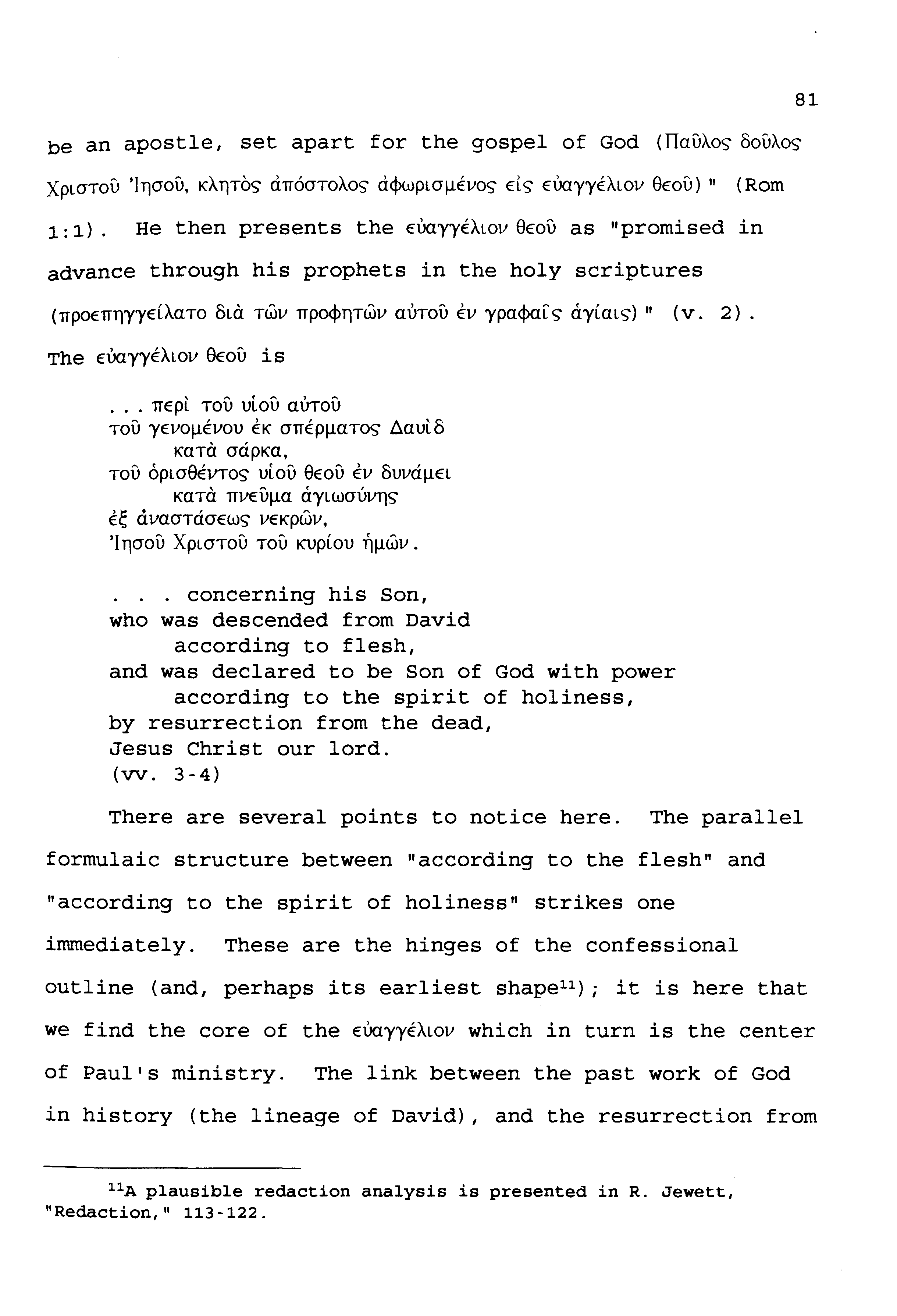
be an apostle, set apart for the gospel of God (TiauA.oc; 8ouA.oc; XpwTou 'Irioou, KA'flTOS' dn6oToAoc; d~wpwµE:voc; ELS' EooyyE:A.Lov 8rnu) " (Rom
1 : 1) .
He then presents the EooyyE:A.Lov 8rnu as "promised in advance through his prophets in the holy scriptures
(npoETI'fl'YYELAaTo 8La Twv np~flTWV auTou Ev ypa~a[c; ciy(mc;)" (v. 2) .
The EooyyE:A.Lov Ornu is ... lTEpi TOU ULOU awou TOU yEvoµE:vou EK onE:pµaToc; ~aui 8 KaTa ocipKa, TOU 6pL08EVTOS' ULOU 8rnu EV ouvciµEL KOTcl lTVEUµa ayLWOUV'flS'
EC civaoTcioEwc; VEKpwv, 'Irioou XpLoTou Tou KUp(ou ~µwv.
. concerning his Son, who was descended from David according to flesh, and was declared to be Son of God with power according to the spirit of holiness, by resurrection from the dead, Jesus Christ our lord.
(vv. 3-4) There are several points to notice here.
The parallel formulaic structure between "according to the flesh" and "according to the spirit of holiness" strikes one irmnediately.
These are the hinges of the confessional outline (and, perhaps its earliest shape11 ); it is here that we find the core of the EooyyE:A.wv which in turn is the center of Paul's ministry.
The link between the past work of God in history (the lineage of David), and the resurrection from 11A plausible redaction analysis is presented in R. Jewett,
"Redaction," 113-122.
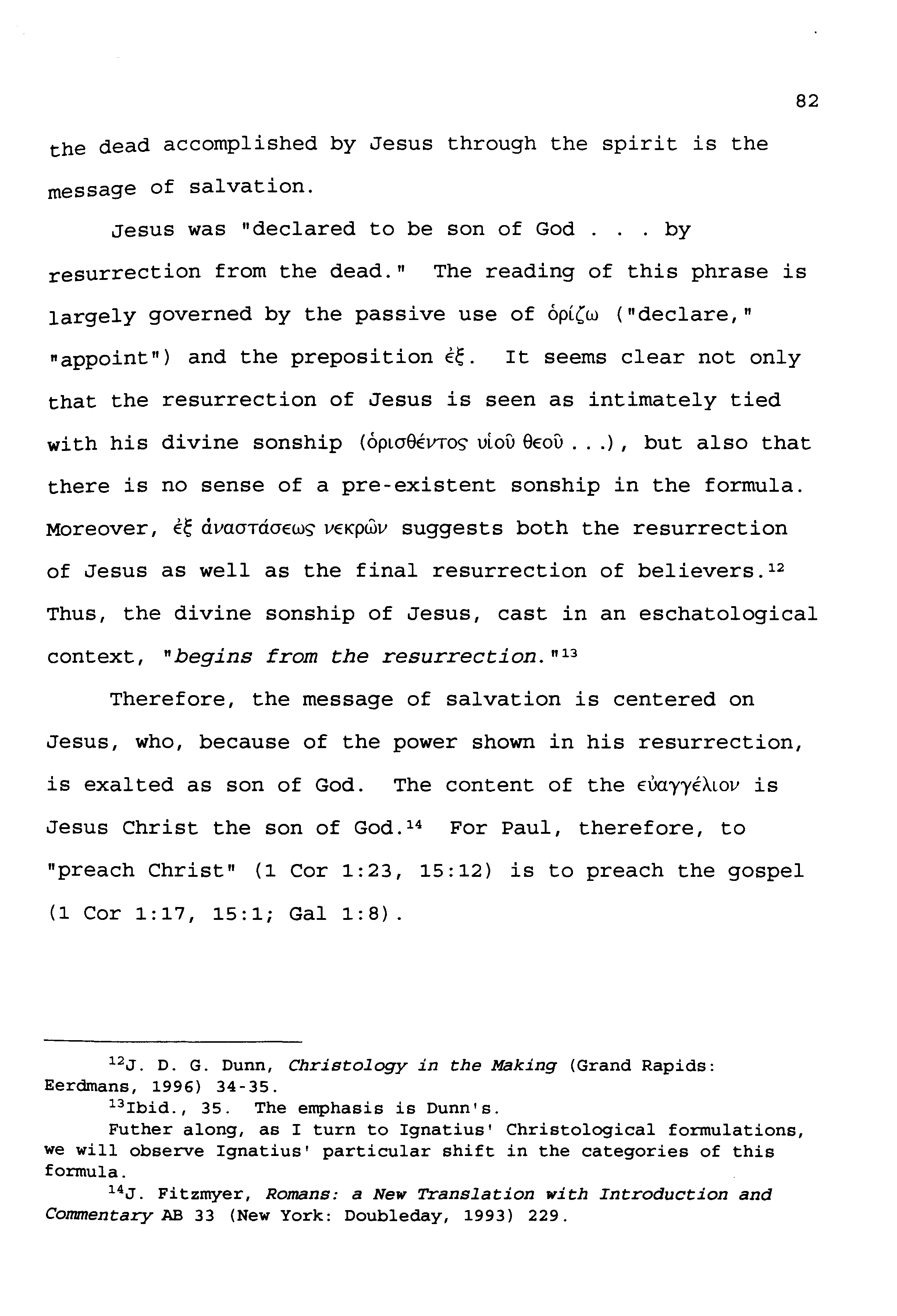
the dead accomplished by Jesus through the spirit is the message of salvation.
Jesus was "declared to be son of God . by resurrection from the dead."
The reading of this phrase is largely governed by the passi Ve use Of 0pl(W (II declare I tt "appoint") and the preposition Ee.
It seems clear not only that the resurrection of Jesus is seen as intimately tied with his divine sonship (6pta8EVTOS' ULOU ernu ... ) I but also that there is no sense of a pre-existent sonship in the formula.
Moreover, Ee civaaTciaEwS' vEKpwv suggests both the resurrection of Jesus as well as the final resurrection of believers. 12
Thus, the divine sonship of Jesus, cast in an eschatological context, "begins from the resurrection. 1113
Therefore, the message of salvation is centered on Jesus, who, because of the power shown in his resurrection, is exalted as son of God.
The content of the Eooyy€;\tov is Jesus Christ the son of God. 14
For Paul, therefore, to "preach Christ" (1 Cor 1:23, 15:12) is to preach the gospel
(1 Cor 1:17, 15:1; Gal 1:8).
12J. D. G. Dunn, Christology in the Making (Grand Rapids:
Eerdmans, 1996) 34-35.
13Ibid., 35.
The emphasis is Dunn's.
Futher along, as I turn to Ignatius' Christological formulations, we will observe Ignatius' particular shift in the categories of this formula.
14J. Fitzmyer, Romans: a New Translation with Introduction and Commentary AB 33 (New York: Doubleday, 1993) 229.
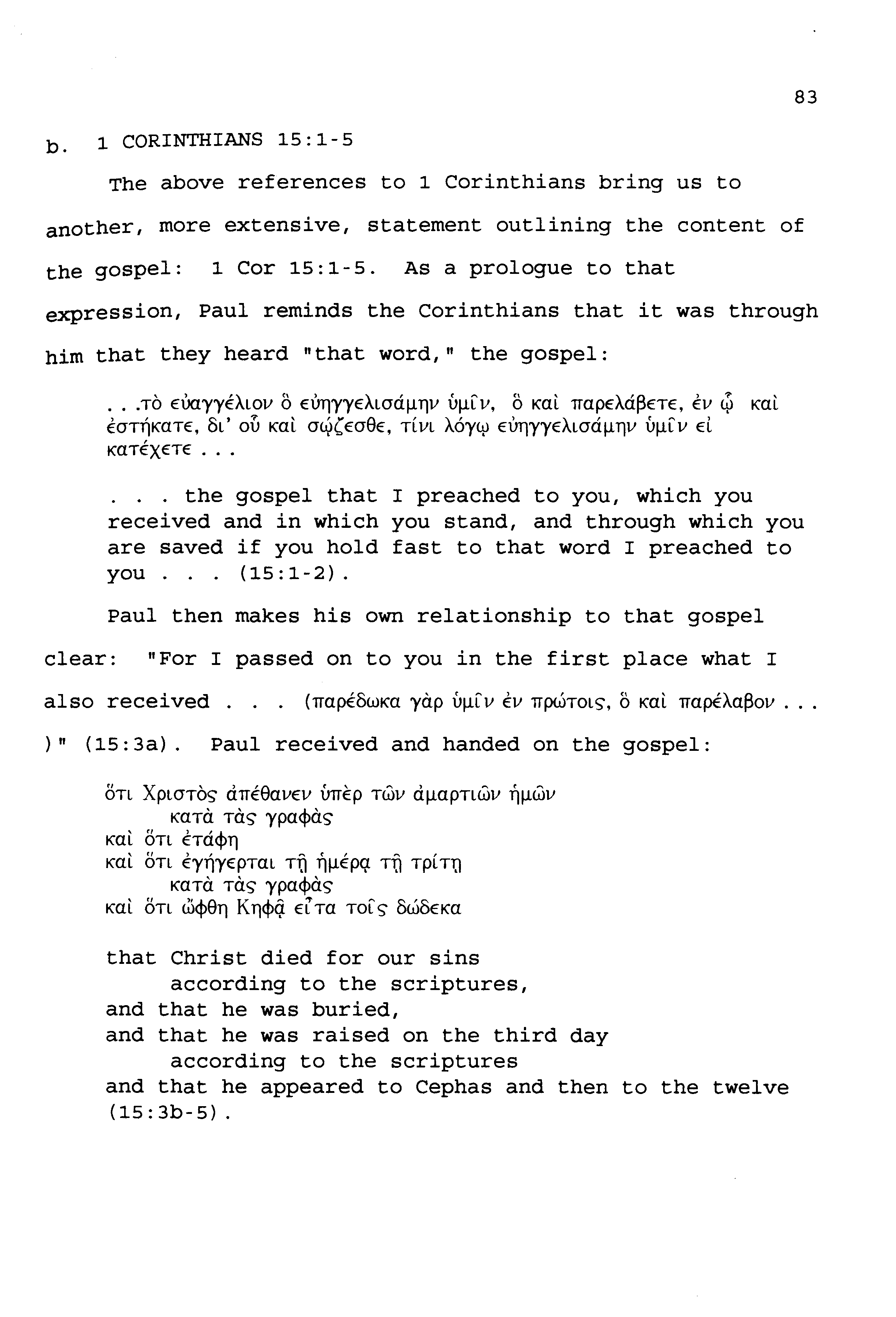
1 CORINTHIANS 15:1-5
The above references to 1 Corinthians bring us to another, more extensive, statement outlining the content of the gospel:
1 Car 15:1-5.
As a prologue to that expression, Paul reminds the Corinthians that it was through him that they heard "that word," the gospel:
... TO EOO'Y'YEALOV 0 EUll'Y'YEALCJciµriv uµL'v, 0 Kai napEAci~ETE, EV ~ Kai ECJTi]KaTE, BL' OU Kai crc\>(ECJ0E, TLVL A6yc.p Ei1ll'Y'YEALCJciµ11v uµL'v El
KaTEXETE ...
. . . the gospel that I preached to you, which you received and in which you stand, and through which you are saved if you hold fast to that word I preached to you ... (15:1-2).
Paul then makes his own relationship to that gospel clear:
"For I passed on to you in the first place what I also received . . .
(napEOWKa yap uµL'v EV npuhms, 0 Kai nap€Aa~ov ...
)" (15:3a).
Paul received and handed on the gospel:
OTL XpLCJTOS dn€0avEv un€p Twv dµapTLwv ~µwv KaTa Tas ypa<f>as Kai OTL ETci<f>11 Kai OTL EytjyEpTm TD ~µ€pq TD Tp( TlJ KaTa Tas ypa<f>as Kai OTL w<f>811 K 11<f>q EL Ta TOL s OWOEKa that Christ died for our sins according to the scriptures, and that he was buried, and that he was raised on the third day according to the scriptures and that he appeared to Cephas and then to the twelve
(15:3b-5).
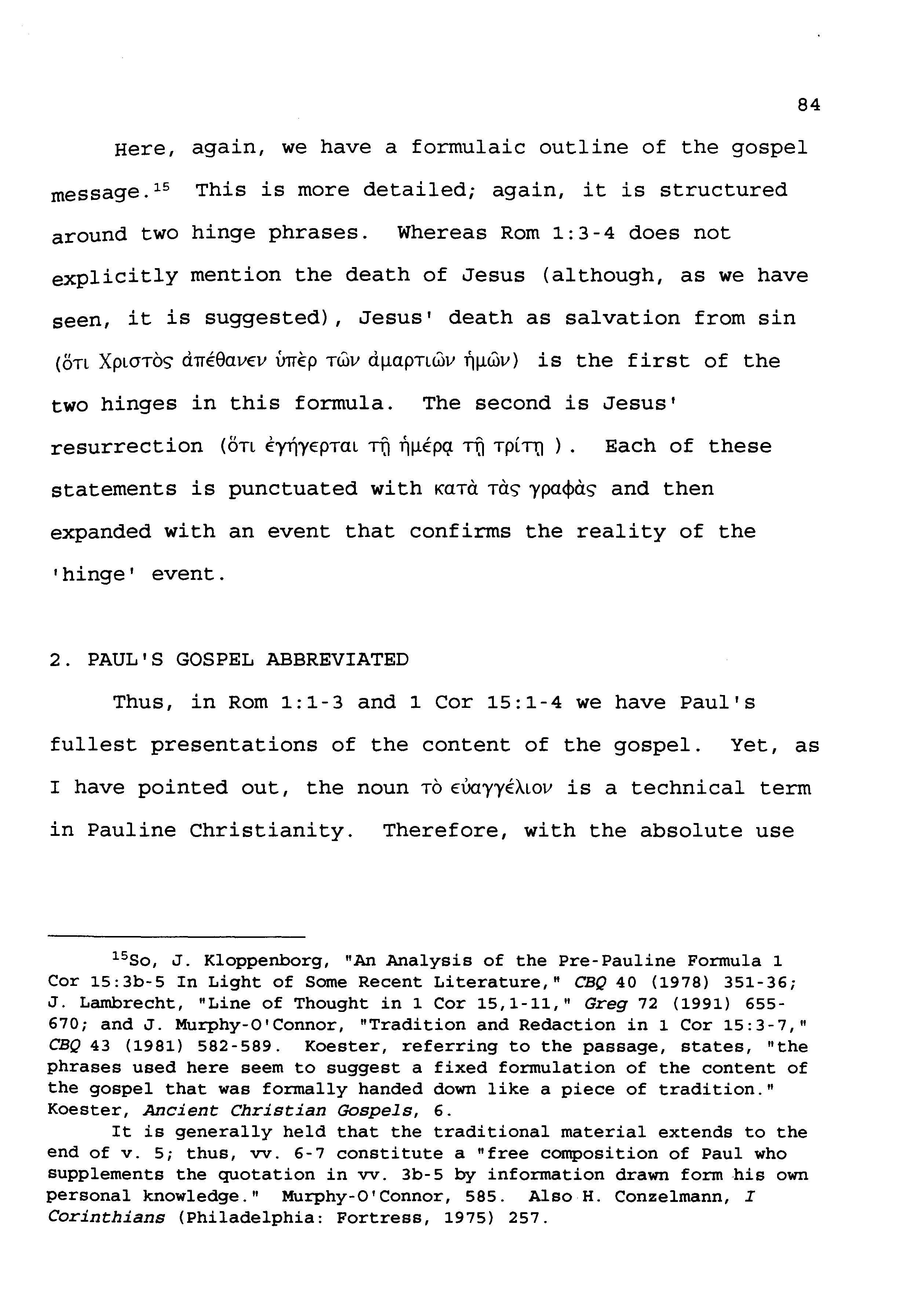
Here, again, we have a formulaic outline of the gospel message. 15
This is more detailed; again, it is structured around two hinge phrases.
Whereas Rom 1:3-4 does not explicitly mention the death of Jesus (although, as we have seen, it is suggested}, Jesus' death as salvation from sin
(oTL XpLCJTOSdn€9avEv mr€p Twv dµapTLwv 'fiµwv} is the first of the two hinges in this formula.
The second is Jesus' resurrection (on Eyf)yEpTm TiJ Tjµ€pq. TiJ TPLTIJ } • Each of these statements is punctuated with KaTa Tasypm.f>asand then expanded with an event that confirms the reality of the 1 hinge 1 event.
2. PAUL'S GOSPEL ABBREVIATED
Thus, in Rom 1:1-3 and 1 Cor 15:1-4 we have Paul's fullest presentations of the content of the gospel.
Yet, as I have pointed out, the noun TO EOO'Y'YEALOV is a technical term in Pauline Christianity.
Therefore, with the absolute use 15So, J. Kloppenborg, "An Analysis of the Pre-Pauline Formula 1
Cor 15:3b-5 In Light of Some Recent Literature," CBQ 40 (1978) 351-36; J. Lambrecht, "Line of Thought in 1 Cor 15,1-11," Greg 72 (1991) 655670; and J. Murphy-O'Connor, "Tradition and Redaction in 1 Cor 15:3-7,"
CBQ 43 (1981) 582-589.
Koester, referring to the passage, states, "the phrases used here seem to suggest a fixed formulation of the content of the gospel that was formally handed down like a piece of tradition."
Koester, Ancient Christian Gospels, 6.
It is generally held that the traditional material extends to the end of v. 5; thus, vv. 6-7 constitute a "free composition of Paul who supplements the quotation in vv. 3b-5 by information drawn form his own personal knowledge."
Murphy-O'Connor, 585.
Also H. Conzelmann, I Corinthians (Philadelphia: Fortress, 1975) 257.
of TO EUayyD .. Lov ( e . g. Rom 1 : 16, 1 Cor 9 : 18, Gal 2 : 2) , 16 Paul assumes that his readers know the content of the gospel message.
This usage of TO EUaYYEALov thus functions as an intramural abbreviation which connotes the full message for those within the boundaries of Paul's Christianity. 17
Likewise, in cases where a genitive construction modifies EooyyEALov, the phrases stand in for the entire content of the gospel and are directed to those who are within Paul's circle of influence.
Examples of the Pauline use of EUa'YYEALov with a modifying genitive include TO EUa'YYEALov Tou 9rnu/EooyyEALov 9rnu (Rom 1: 1, 2 cor 11: 7, 1 Thess
2 : 2) , and To EooyyEALov Tou XpwTou (Rom 15: 19; 1 Cor 9 : 12; 2 Cor 2:12, 9:13, 10:14; Gal 1:7; etc.).
The first two types of genitive phrases, which can be either subjective or objective, emphasize at once both the source and the content of the message to which Paul is alluding. 18
16W. Marxsen notes the "striking" fact that Mark (except only 1:1 and 1: 14) and Paul (half of the time) use the noun To EOO)''YEAtov in the absolute, while Matthew never does in the absolute, and Luke avoids the term altogether (only two times in Acts).
W. Marxsen, Mark the Evangelist, J. Boyce, D. Juel, w. Poehlmann, and R. Harrisville, trans.
(Nashville: Abingdon, 1969) 118, 129, 142.
1711The gospel of the NT is the witness of those who know to those who know."
E. Stauffer, New Testament Theology, J. Marsh, trans.
(London: SCM, 1963) 158.
18The distiction between objective and subjective genitive is not strong in the Pauline use of the phrases To EOO)')'EAtov Tov XpLOTov and To EooyyiA.tov Tov 9Eov.
Jesus (or God) is both the content and the source of the EOO)')'EALov in these.
See G. Friedrich, "EOO)''YEAt(oµm, K.T.A., " 731; and Marxsen, Mark, 118.
Also, as we have see, To EOO)')'EAL6v µov occurs at Rom 2: 16 and 16: 25
(cf., 2 Tim 2:8).
The latter is recognized as part of a non-Pauline addition (16:25-27); as for 2:16 the non-Pauline character is not as widely recognized.
See Kasemann, Co11U11entary, 67-68, 421-428.
There is also a series of other types of phrases in the Pauline letters which function in the same way as abbreviations for the content of the gospel. 19
Among these is Paul's use of the verb EooyyEAL(Ea9m. 20
Three times Paul uses EUaYYEAt(Ea9m with EooyyEALov itself as the object and content of the action (1 Cor 15:1, 2 Cor 11:7, Gal 11:1). we find, as well, "proclaim him as the gospel (EooyyEAt(Ea9m m'.rr6v)" in Gal 1: 8. 21
Galatians also contains "proclaims the gospel faith (EooyyEAL(ETm TTW TTLCJTLV)" in 1: 23.
All of these are examples of Paul's use of EooyyEAt(Ea9m in the context of preaching or proclaiming a specific message.
The gospel referred to in the verbal forms of these passages designates a specific content alluded to by descriptive phrases to suggest further that content.
Thus, again, they function as abbreviations of the entire message intended for the ingroup.
While I am concentrating on Paul' s use of EooyyEALOv and EooyyEAL(Ea9m, it is necessary to recognize that there are as well other short phrases and terms which function in the In any case, for Paul it is always the same gospel: the gospel for which he was set apart by God (Rom 1:1, cf., Gal 1:1).
Thus, the source of the gospel is always the same.
19Betz calls attention to several of these.
H. D. Betz, Galatians Hermeneia (Philadelphia: Fortress, 1979) 72.
20The usage in early Christianity is virtually always in the middle/passive voice.
The only exceptions to this are the active voice usages in Rev 10:7, 14:6; I will turn to these in due course.
21Betz (Galatians, 72) suggests this translation.
We find the same phrase in Gal. 1:16.
This sort of usage has direct bearing on the gospel expressions in the Ignatian corpus.
same way, as abbreviations of the gospel message for Paul and his communities.
The most obvious of these involve some form of the name of Jesus Christ (or a pronoun with "Jesus" the antecedent) as the direct object of a proclaiming verb.22
This particular type of phrase will figure in my discussion of Ignatius' Eooyy€A.wv.
With Paul, we are reminded of the above citation from Gal 1: 8 EooyyEAL(Eo8m al'.rr6v; the same phrase is a feature of Gal 1:16.
This construction-with the name of Jesus stated-is found, for example, in 1 Car 1:23 where Paul writes "we proclaim Christ crucified (KripooooµEv XpLoTov EOTaupwµ€vov) . "
And, in 2 Car 4: 5, as part of a defence of the "gospel of the glory of Christ (Eooyy€ALov TTJS86erisTou XpLoTou)" (4: 4) Paul states, "For we do not proclaim ourselves; we proclaim Jesus Christ the Lord
(ou yap E:aUTo\J<; KllPOOooµEv dAAa 'Irioouv XpLoTov Kupwv) . "
Moreover, Paul complains to the Corinthians in 2 Car 11:4, EL µE:v yap 6 EpxoµEvosaAA.ov 'Ioouv KripoooEL ov ouK EK11pueaµEv, f1 nvEuµa ETEpov Aaµ~ciVETE o OUK EAci~ETE, f1 EooyyEALov ETEpov 8 OUK
E8€eao8E, KaAwsdv€xEo8E.
For if someone comes and proclaims another Jesus that the one we proclaimed, or if you receive a different spirit from the one you received, or a different gospel from the one you accepted, you submit to it readily enough.
Despite his negative description here-and the parallel mention of receiving the spirit-, it is clear that for Paul
22There is, as well, To Ktjpvyµa 'lriaov XpLaTovs in the non-Pauline doxology of Rom 16:25.
the act of "proclaiming Jesus" brings about accepting the gospel in response. 23
SUMMARY ON PAUL'S GOSPEL
At this point, the Pauline corpus merits a few preliminary conclusions.
Rom 1:3-4 arnd 1 Cor 15:3b-5 are the pericopae most often cited from the Pauline corpus as pre-Pauline confessional outlines.
They are at the same time declarations in outline f orrn of the gospel message at the center of Paul's ministry.
Most striking is the fact that the details of the outlines vary.
The content of that Eooyy€A.Lov, centered on Jesus and the salvation he accomplished, is encompassed by both statements despite their variations.
These confessional statements, as we will see, share motifs and structural characteristics with several passages which express the EooyyEALov in the letters of Ignatius.
2311 If we were to sum up the content of the gospel in a single word, it would be Jesus the Christ."
Friedrich, "EOO)')'EAL(oµm, K.T.A.,"
731.
This type of phrase-a proclaiming verb with an "accusative of a person"-will be important to my discussion of Ignatius' EOO)')'EALOV.
Also very important in this same light is Paul's exposition in Phil 1:15-18.
Here, 'proclaiming Christ' and 'proclaiming the gospel'
(1:12) are interchangable.
This pericope will become central to my argument further along when I turn to expressions of the gospel in Ignatius.
Finally, we cannot overlook Phlm 9 where Paul speaks of himself as "a prisoner of Christ Jesus (oiaµOLS XpLaTov 'ITJaou)" and see this at least as a parallel statement to Phlm 13 where he states that Onesimus, if he were to remain, would minister to him in his "imprisonment of the gospel
(Ev Tofs &aµofs Tov EOO)')'EALO~ . 11