
B. The Synoptic Gospels
In this discussion of Paul I have also highlighted several abbreviations for the message of the gospel.
As we have seen, these terms and phrases function as shorthand which refers to the entire message about Jesus that Paul preached when founding or later visiting the various communities within his circle of influence.
For Paul these abbreviations are intramural: they serve to define the boundaries of faith in Jesus.
Again, we will observe the same sort of shorthand phrases as we return to Ignatius and his gospel.
Without doubt, then, the Pauline EUa'Y'YEALov is centered on a preached message and not a fixed text.
The content of that message is:
Jesus, both the son of God and of human lineage, died for human salvation, and was raised from the dead.
The intramural abbreviations (To Eooyy€A.wv, TO Eooyy€A.Lov Tou 8rnu, To EooyyEALov Tou XpLoTou) and the confession outlines
(Rom 1:1-3, 1 Cor 15:1-5) of the gospel all function as portrayals of the one message.
THE SYNOPTIC GOSPELS
With the above conclusions regarding the Pauline gospel before us, we now turn to the problem of TO EUa'Y'YEALOV in the Synoptic Gospels of the NT. 24
To begin with, To EUa'Y'YEALov is 24Especially striking is the fact that neither the noun EOO)"yE.\tov nor the verb EooyyE.\((Ecrtkit are found in the Johannine literature (i.e., both Gospel and Epistles) .
This intriguing Johannine characteristic,
not found in the reconstructed Q source; as for EUa')'')'EAL(Ea8m, the verb is found once, at Q 7: 22. 25
This is the logion in which Jesus, with recourse to Second Isaiah, provides his credentials. 26
The most we can say about this occurrence of the verb in Q is that it indicates an early link between this action and the ministry of Jesus.
Turning to the Synoptic Gospels themselves, we find the noun seven times but never the verb in Mark; in Matthew the noun occurs four times, and the verb once.
As for LukeActs, the verb occurs in both volumes (ten times in Luke, fifteen in Acts), but the substantive only in Acts (two times) .
As we will observe, the above list alone provides an entry into the particular vision each of the three authors has with respect to the EUa')'')'EALov.
Therefore, in what follows I will treat each of the Synoptic Gospels by paying attention to contextual indications that suggest the idea of "gospel" for each author.
This discussion will be centered primarily on the while engaging, will not detain us here; my task is better served by concentrating on the usage of these terms in the synoptic tradition.
25In the following paragraphs, I am presuming the validity of the two-source hypothesis with respect to the relationship among the synoptic Gospels.
Concerning Q, a reconstruction of the Greek text may be found in J. Kloppenborg, Q Parallels: Synopsis, Critical Notes & Concordance
(Sonoma: Polebridge, 1988).
For a discussion of the various positions on Q and its relationship to "gospel" as a genre and as a message see idem, The Formation of Q (Philadelphia: Fortress, 1987) 8-39.
26Cf., Isaiah 26:19; 29:18-19; 35:5-6; 42:6-7; 61:1.
As for the "good news to the poor, " both Matt 11 : 5 and Luke 7 : 2 2 have iTTwxoi
EooyyE;\((ovTm.
Isaiah 61: 1 is as follows: iTVEliµa Kvp(ov Eir' E:µE, ov ELVEKEV EXptcrt µE, EOO'Y'YEAtcracr9at iTTwxof s aiTEO'TOAKE µE ...
uses of EOOYYEALOV.
Concerning EuayyEAL(Eaem, except for LukeActs, the usage outside of Paul will become less important for our purposes. 27
THE GOSPEL ACCORDING TO MARK
Aside from the opening reference to "the beginning of the gospel of Jesus Christ ('Apxfi Tou EooyyEA(ou' Iriaou XpLaTou)
( 1: 1) 11 and TO EooyyEALov Tou 6Eou ( 1: 14) , all of the occurrences of EooyyEALov in Mark are absolute ( 1: 15, 8: 35, 10: 29, 13: 10,
14: 9) .
Thus, 11Eooyy€Awv 11 functions as an abbreviation within the Markan community just as we have seen in Paul. 28
The use of EooyyEALov at 8: 35 and 10: 29 (EvEKEv E:µou icat [EVEKEV] Tou EooyyEA(ou) attracts our attention for several reasons.
First, neither are found in the parallel texts of Matthew (16:26, 19:29) and Luke (9:25, 18:2929 ); also, they are located within the narrative context of the three suffering/death/resurrection predictions (8:31, 9:31, 10:3334).
These facts reveal not only Mark's particular idea of To EooyyEALov, but also that that EooyyEALov appears intimately linked in Mark with the death and resurrection of Jesus.
Indeed, it is significant that both 8:35 and 10:29 are 27Also, as I have noted, EooyyEAL(Ea9aL does not exist in the Ignatian corpus.
28Marxsen (Mark, 136) notes "great similarity with Paul's use of the term. 11
29Luke has changed the phrase entirely here: in the place of EVEKEV E:µov Kai EVEKEl' Tov EOO)')'EA(ov of Mark 10: 29, Luke 18: 29 has EVEKEV Tfjs f3aaLAE(as TOV emu.
located within pericopae which speak of discipleship as imitation of the suffering of Jesus:
"for my sake and the gospel" is the single (they are the same) impetus for discipleship in Mark.
Hence, in the phrase EVEKEV E:µoD Kat [EVEKEV] ToD EooyyEA(ou of 8:35 and 10:29, the Kat is epexegtical. 30
Just as Jesus was for his disciples in the past, the EooyyEALov is the reason for discipleship in Mark's community: the EooyyEALov is the "form in which Jesus is made present" to the Markan
Christians.
In short, Jesus in Mark is the content of the
EUaYYEALOV. 31
This same connection between Jesus and the EooyyEALov also undergirds the expression in Mark 13:9-10.
Here, Jesus tells Peter, James, John and Andrew that they will be arrested and suffer "because of me, as a testimony to them
[i.e., their persecutors] (EVEKEV E:µou EL<; µapTupLov auTOL<;) " (v.
9).
This prediction is broadened in v. 10:
"And the gospel must first be proclaimed to all nations (KaL EL<; nciVTa Ta E0Vfl
30The second EVEKEV of 10: 29 is not found in 8: 35.
It is generally held that the last half of this phrase ( [EVEKEV] Tov EooyyEA.tou) is Mark's addition to the tradition.
See E. Best, Disciples and Discipleship (Edinburgh: T. & T. Clark, 1986) 9; E. Lohmeyer, Das
Evangelium des Markus (Gottingen: Vandenhoeck & Ruprecht, 1967) 216; Marxsen, Mark, 120.
31M. Hengel, Studies in the Gospel of Mark, J. Bowden, trans.
(Philadelphia: Fortress, 1985) 53; Marxsen, 129.
Marxsen goes on to say, "the (proclaimed) gospel is Jesus' representative.
It thus reflects a feature which all but eliminates historical distance, but by emphasizing and retaining the historical reference.
Not only in Jesus' lifetime could a person undertake something for his sake.
He can do so today as well, and in fact when he undertakes it for the gospel's sake."
Ibid.
npwTov 8EL' KT)pux8flvm To EuayyEALov) . " 32
Again, the testimony EVEKEV E:µou is reiterated as TO EooyyD .. wv that is proclaimed.
Jesus is proclaimed as gospel.
Moreover, in Mark 14:8, Jesus directly links the woman's action of anointing his head to his passion ("she has anointed my body beforehand for its burial").
Jesus then carries the link further, to the EUa)')'EALov:
"wherever the gospel is proclaimed in the whole world, what she has done will be told in remembrance of her (olTou E:av KT)puxeiJ ELS' oA.ov Tov 1<6aµov, KaL 8 ElTOL T)OEv auTT) A.aA.rier)aETm ELS' µVT)µ6auvov al>Tfls-) "
(v. 9) . 33
It is not the woman herself or her action that is the message; it is, rather, what her action signifies that is the message.
"What she has done will be told in remembrance of her" because her action proclaims the EUa)')'EALov of the death (and by implication) the resurrection of Jesus. 34
There has been much scholarly discussion on the word EUa)')'EALov in Mark because, unlike Paul, we get no Markan expression that states, "the gospel is this .
The closest we have is Mark 1: 1
('Apx~ Tou EUa)')'EA(ou' Iriaou XpLaTou) .
The EUa)')'EALov in 1: 1 refers to the narrative in which Mark has embedded the Christian message (the woman's action in 32The NRSV has "And the good news must first be proclaimed
Marxsen (Ibid., 129} calls v. 10 a "parallel" to v. 9; it "interprets" v. 9.
33NRSV:
" wherever the good news is proclaimed .
34Cf., Marxsen, 130.
14 :8 is part of that narrative which contains the
EUaYYEALOV) . 35
Hence, 1: 1 refers to how the saving events of the EUayyEALOV began. we can therefore see To EooyyEA.Lov in Mark as signifying the message of salvation both by (1:14-15) and about Jesus
(1:1).
That message is embedded within a narrative which conveys the import of the message for believers.
The heart of Mark' s narrative presentation of TO EooyyEALov-as in Paul's EooyyEA.Lov-is the culminating events of the passion and resurrection in the history of Jesus.
At the same time, by presenting it as a narrative, the idea of EooyyEALov has been broadened by Mark; the Markan EooyyEA.wv refers as well to the many events that make up the narrative and relate the message.
In this way, therefore, the discipleship motif presents the EooyyEA.Lov as it exists in the faith of the Markan community.
The "content of the Gospel is Jesus, and admittedly paradoxically, the earthly Jesus as the Risen
One. n36 35Hengel, 53; R.H. Gundry, 11EYArrEAION, 11 321; cf., K. Kertelge, "The Epiphany of Jesus in the Gospel (Mark)" pages 78-94 in w. Telford, ed., The Interpretation of Mark {Philadelphia: Fortress, 1985) 79;
Marxen, 132.
36Kertelge, "Epiphany," 92.
THE GOSPEL ACCORDING TO MATTHEW
Matthew uses the noun EUaJ'J'EALOV four times ( 4: 23, 9: 35, 24:14, 26:13).
All of these are in the context of preaching (all with the verb KTJpU<Jaw) : preaching by Jesus in the summary statements about his ministry (4:23 and 9:35); and, in a passive sense, in logia concerning future preaching by disciples (24:14, 26:13).
Moreover, in the first three occurrences (all with an objective genitive), Matthew provides an abbreviation for the content of the gospel; it is 11 the gospel of the kingdom (To EUaJ'J'EALOv TTJS' ~amA.E(as-) • 11 3 7
Thus, the EUaJ'J'EALOV for Matthew is intimately linked with the pervasive Matthean motif, the "kingdom of heaven. "38
The EUaJ'J'EALOV TTJS' ~amA.dasis uniquely Matthean; as we have seen, it does not exist in Matthew's known sources, Mark and Q.
It is evident that Matthew created the gospel abbreviation, TO EUaJ'J'EALOV Tfis- ~amA.E(asfor his own purposes. 39
37J. D. Kingsbury speaks of the phrase "gospel of the kingdom" as "Mathew's capsule-summary of his document."
It is thus an abbreviation for the message of both the earthly and risen Jesus in Matthew's narrative.
J. D. Kingsbury, Matthew: Structure, Christology, Kingdom (Minneapolis: Fortress, 1989) 129.
In the same way we may point to the expression 6 AO)'OS' Tfls f3cio'LA.das in Matt 13: 19 (which replaces simply 6 AO)'OS' in Mark 4: 13) .
This is another way of expressing TO EOO)')'EAtov TllS'
IXicnA.das.
Ibid., 131.
38The phrase ~ f3cicnA.da TWV ovpavwv occurs twenty-seven times throughout Matthew.
Variants to this phrase are~ f3cicn.\da Tov9Eov (6:33, 12:28, 19:24, 21:31, 21:43), ~ f3cicn.\da Tov rraTp6s µov (26:29).
39Stuhlmacher (Das paulinische Evangelium, 238-243), however, unconvincingly sees this phrase as an indication of a particularily
Jewish-Christian Palestinian background, perhaps even of Jesus himself.
With respect to the striking differences between the Markan and Matthean usages, see the chart in Koester, Ancient Christian Gospels, 11.
Thus, the EUaYYEALOV Tf]S- ~aaLA.E(a<; is the message which Jesus himself, in continuity with the Baptist (3:1-2), is preaching: the kingdom of heaven is "near" (Eyy((w)
( 3: 2, 4 :17, 10:7).
This kingdom is the direct salvific involvement of God in human affairs.
So, the kingdom is "gospel" or good news for the world (10:7).
Moreover, it is signified by Jesus' actions (12:28).
Therefore, because of the link between the EooyyEA.t0v and the ~amA.da, the salvation brought by Jesus is the dominant component of the Matthean EooyyEA.Lov Tf]S- ~amA.E(as-.
Early on, in 1:21, Matthew calls attention to the name of Jesus as an indication of Jesus' role in salvation.
More to the point, though, within the commonly called Eschatological Discourse of 24:13-14, Jesus describes the trials of the end time and says, 6 OE imoµE(vasElS' TEAOS' ouTo<; aw8ipETm. Kai KT)puxOtjaETm Tomo To EooyyEA.Lov Tf]S- ~amA.dasEV OATJ TlJ OLKOUµEVTJ ELsµapTupwv nciaLv TOL sE8vEaLV, Kai TOTE ~eEL To TEA.os-.
But the one who endures to the end will be saved.
And this gospel of the kingdom will be proclaimed throughout the world, as a testimony to all the nations; and then the end will come.
It is difficult to read Tofrro To EooyyEA.Lov Tf]s- ~aaLA.dasas referring to anything but the salvation achieved through endurance. 4o 40Matthew has thus taken Mark's version of the same logion and made it his own: instead of To EOO'Y'YEALOV of Mark, Matthew has Tol!To To
In the fourth occurrence of EooyyEALov (26: 13), it is simply "this gospel"
(TO EUaYYEALOV TOtrrO).
This is Matthew's telling of the anointing scene in Mark 14:3-9. 41
It is difficult to be as certain about the meaning "this gospel" as we were above with 24:14 (not to mention "the gospel" in the parallel Mark 14:9). It seems, though, that the antecedent of Totrro still refers in some way to Jesus'
11 she has prepared me for burial (np<>s To EVTa<!>Lcicrm µE death:
It is E:no( 11crEv) "
( 2 6 : 12)
However, it goes beyond that . most accurate to say that Matthew's To EooyyEALov rofrro encompasses the entire message taught by Jesus; it refers to the message of TO EooyyEALov TTJS' ~acrLAELaS' that is at the heart of Matthew's book.
Therefore, "this" EooyyEALov in 26: 13 is the salvation brought by God in the actions and especially the teachings of Jesus. 43
Eooyyi>..wv Tf}s f3cia1A.das; moreover Matthew expands the Markan "must first be proclaimed" into "and then the end will come (Kai TOTE ~~EL TO TEAOS') . "
The motif of endurance in persecution is found in 10:22 which is verbatim from Mark 13: 13.
Here, the disciples suffer Sta TO ovoµci µou; "the one who endures this suffering to the end will be saved (o OE irrroµEtvas ds TEAos oilTos awetjaETm) . 11
41This story is not found in Luke.
42Those with this position include Marxsen, Mark, 124; L. Morris, The Gospel According to Matthew (Grand Rapids: Eerdmans, 1992) 651; J.
Schniewind, Das Evangelium nach Matthaus (Gottingen: Vandenhoeck & Ruprecht, 1936) 258; Stuhlmacher, Das paulinische Evangelium, 242.
43In this regard, Kingsbury (Matthew, 130-131) states, "in 26:13 we have evidence that in Matthew's community the term "gospel" embraces not merely traditions of logia of Jesus but traditions of narratives about him as well."
so, it is primarily the words-the teachings-of Jesus that Matthew presents as the gospel. 44
This is clear when we observe the EooyyEALov passages at 4: 23 and 9: 35.
These two are are virtually identical summary statements:
KaL nEpLfjyEv EV OAlJ 1iJ faALAa(q. 8L8ciaKwv EV Tal'sauvaywyal'sm'.rrwv KaL
K'flpOO-awv TO EooyyEALOv TTJS' ~aaLAdasKaL 0EpanEl1wv naaav v6aov Kai naaav µaAaK(av EV TQ AaQ.
Then Jesus went about all the cities and villages, teaching in their synagogues, and proclaiming the gospel of the kingdom, and curing every disease and every sickness. ( 4: 23) 45 These summary statements function as transitions in the narrative that set up the scene for the next episode.
They encapsulate what is to follow.
Thus, Jesus is presented as teacher, herald and healer, all attributes of Jesus in Matthew's presentation.
Yet, with the first two attributes, the point is not so much to emphasize two separate actions; rather, the emphasis is on locale: it is "in their synagogues (Ev Tal'sauvaywyal'sm'.rrw0 . "
This is the place that, for Matthew's conununity, stands for rejection and persecution (ie. 10:17, 23:34; cf., 5:10, 12, 44; 13:21).
44As we shall see, Ignatius speaks of Jesus as "our only teacher"
<i'va EVpE9WµEv µa{hirni 'h1crnv XpLCJTov Tov µ6vou BLoaaKciA.ou ~µwv) in Magn. 9 . 1 (cf. ,
Matt 23:8).
It is striking that Ignatius never presents any teachings as those of Jesus.
45Cf., 9: 35:
Kai TIEPLll')'EV 6 'Iriaolis Tas n6A.ns nciaas Kai Tas Kwµas BLociaKwv E:v Tal's crwa')'W')'al's aiJTwv Kai KT)pooawv TO EOO')'')'EALOV TllS' (3aaLA.das Kai 9EpanEilwv ml.aav v6aov
Kai nuaav µaA.aK(av.
Matthew 4: 23 and 9: 35 are related to Mark 1: 14 where To EOO')'')'EAtov TllS' f3aatA.das replaces the Markan To EOO')'')'EAtov Tov 9Eou.
Related too is Mark 1:39; here Mark simply refers to unspecified preaching by Jesus.
A related summary is found at Matt 11:1.
Jesus' teaching in their synagogues has been rejected. 46 so, to return to these sununary statements in general, both
4 :23 and 9:35 introduce major blocks of teaching material.
This material includes as well proclaiming the EUa'}''}'EALOV TllS'
~aOLAELOS' .
Hence, 4:23 introduces the sermon on the mount (5:17:28).
This is presented as Jesus' teaching about the kingdom of heaven (5:3, 10, 19 [bis], 20; 6:10, 33; 7:21).
It is, therefore, proclaiming the EooyyEA.LOv TllS' ~aaLA.E(as-.
Likewise, 9:35 introduces Jesus' teaching on discipleship and mission. 47
The mission is centered on the EooyyEA.Lov Tflc;- ~aOLAELaS' : n And as you go I preach I saying I I The kingdom of heaven has come near' ( TTopEooµEvOL OE KllPU<JaETE AE'YOVTES' oTL ~'Y'YLKEV ~
~aaLA.da Twv oupavwv) "
( 10: 7) . 48
The EooyyEA.Lov is not mentioned; but the kingdom is intimately connected with the EooyyEA.Lov.
It is the EooyyEA.Lov Tfls- ~aaLAE(asthat is preached by the disciples. 4 9 To conclude with Matthew, we have seen that Paul and Mark (and Ignatius as well) make Jesus-especially his suffering, death and resurrection-the content of the EooyyEA.LOv, while placing little emphasis on the content of Jesus' teachings.
Matthew, on the other hand, provides us 46Kingsbury, 154.
479:35 is preceded by a series of healings, and other works of authority by Jesus 8:1-9:34.
Matthew, by the way, never has Jesus actually teaching in a synagogue.
48The NRSV has, "As you go, proclaim the good news . .
49Kingsbury, 129.
with discourses that present the EUa')'')'EALov Tf)s- ~acnA.dasthrough its implications for Jesus' followers.
In this way, Matthew emphasizes that Jesus' teachings are included in the content of the EUa')'')'EALov • This uniquely Matthean perspective explains why Matthew omits "To Eooyy€A.Lov" from and adds it to his Markan source.
In Matt 4:17 (cf., Mark 1:14-15) Matthew emphasizes the all important kingdom as the content of Jesus' preaching and thus drops Mark's Eooyy€A.Lov.
Yet, in the first use of EUa')'')'EALov Tf)s- ~aolAE(ac; (Matt 4: 23), Matthew adds EUa')'')'EALov to Mark's summary of Jesus' ministry (Mark 1:39); this is because, as we have seen, Matthew is leading into the first major block of Jesus' teachings, the sermon on the mount
( 5: 17: 2 8) . so Therefore, the defining nexus between the kingdom of heaven and the Matthean Eooyy€A.Lov distinguishes it from the Eooyy€A.Lov of Paul and of Mark.
The Pauline and Markan (and Ignatian) priority of the cross and resurrection is not denied.
Yet the content of the Matthew's Eooyy€A.Lov Tf)S ~acnAE(ac; is centered on the salvation taught by Jesus, and eventually enacted on the cross by Jesus.
It is the message of the Immanuel ("God-is-with-us") of 1:23 who is named savior from sins (1:21) . 51
This is the message that Jesus'
5°Koester, Ancient Christian Gospels, 12.
510. Betz, "Jesus' Gospel of the Kingdom" pages 53-74 in P.
Stuhlmacher, The Gospel and the Gospels (Grand Rapids: Eerdmans, 1991) 63-67.
disciples are to spread to "all nations" (27:18-20; cf., 10: 7) .
3. THE GOSPEL ACCORDING TO LUKE AND THE ACTS OF THE APOSTLES
With respect to Luke-Acts, we are irmnediately confronted with the relative absence of the noun EUa'Y'YEALov.
To EUa'Y'YEALOV is not used at all in the Gospel of Luke; it is, however, found twice in Acts (15:7, 20:24).
Actually, the occurrences in Acts-both in the context of speeches-provide few clues about what exactly is being proclaimed to the Gentiles in 15:7, and to "both Jews and Greeks" in 20:21.
When we observe how, in the Gospel, Luke has worked with his Markan source, it becomes clear that he has made a point of avoiding TO EOO'Y'YEALOV. 52
Thus, for example, we find in Luke's version of Mark 8:35, he does not use the Markan
EVEKEV .•• rov d;ayyiA.wv (Luke 9: 25) ; and in the place of the same phrase in Mark 10:29, Luke 18:29 has "for the sake of the kingdom of God (EVE KEV TilS' ~aOLAELaS' TOU ernu) . "
As we have seen, Matthew has avoided both these usages of To EOO'Y'YEALOV as well; but, again,-unlike Matthew-Luke does not use the term in any other way in his Gospel.
Missing too are the Markan usages at 1:1 and 1:14-15.
In the prologue, Luke refers to his work as "an orderly 52H. Conzelmann, The Theology of St. Luke, G. Buswell, trans. (New
York: Harper & Row, 1961) 221; J. Fitzmyer, The Gospel According to Luke, AB 28 (Garden City: Doubleday, 1981) 148.
account" based on his own investigation into the beginnings (1TapTJA.oA.ou0TJKOTL dvw8Ev 1Tnaw dKpL~wsKa8Ecf]s-)
< 1: 3) . so, Mark' s dpxn Tou ElxiyyEA.(ou' I11oou XpLoTou (Mark 1: 1) is transformed into Luke's concern with presenting an accurate account based on what was handed on (1Tapa8L8wµL) by those who were there at the beginning (ot d1T' dpxfisaITT-61TTm)
( 1: 2) .
Moreover, in his telling of the start of Jesus' ministry, Luke presents Jesus as teaching in synagogues (4:15, 31) but does not give the content of that teaching until 4:43 where it is identified within a logion:
"I must proclaim the kingdom of God .
(EooyyEA.(oao8a( µE OEL Tfiv ~a<JLAE(av Tou 8Eou ••. ) . 11 sJ This use of Eooyyd((Eo8m brings to the fore the question of Luke's sense of this verb.
The verb occurs frequently in Luke-Acts.s4 Taking into account the evident avoidance of the noun in the light of Luke's overall theology, Fitzmyer suggests that-except for the references to Isaiah (4:16-21 and 7:22)-Luke does not mean for the verb to be understood 11 in the etymological sense of announcing/preaching good news" in either document.ss
So, s3The NRSV has "the good news of the kingdom of God."
This is the reading in the JB and NAB as well.
This common translation is striking; as we shall see in my next step, the commentators generally refrain from reading EOO)"YEA(craafu( here and elsewhere as suggesting the specific meaning of "good" news. s4Ten times in the Gospel (1:19, 2:10, 3:18, 4:18, 43, 7:22, 8:1,
9:6, 16:16, 20:1) and fifteen times in Acts (5:42, 8:4, 12, 25, 35, 40, 10:36, 11:20, 13:32, 14:7, 15; 14:21, 15:35, 16:10, 17:18).
As we have seen, it occurs only once in Matthew (11:5 [the Q 7:22 logion]) and not at all in Mark. ssFitzmyer, Luke, 148.
The emphasis is mine.
See Bultmann, New Testament, 87; Conzelmann (Theology, 222), in treating this issue,
the Lukan meaning of EooyyEAL(Ea8m becomes simply "to preach" or "proclaim."
Therefore, it is not until Acts that we have the Christian message ostensibly referred to as "good news" or ngospel."
Because the Eooyy€ALov is the message of salvation proclaimed by the Church, 11 Luke cannot use the term EooyyEALov in the first part of his dual work, though indeed in the second. 1156
Thus, in Acts 15: 7 Peter is speaking in Jerusalem and states it was God's choice that through him
"the Gentiles would hear the message of the gospel and become believers ( Bla Tou aToµaTosµou dKOoom Ta €8VT) Tov A6yov Tou
EUayyEALOUKai 1TLGTEOOaL)."
Also, in 20:24 Paul, speaking at Miletus, describes his ministry received from Jesus Christ as, 11 to testify to the gospel of God's grace (8LaµapTupaaem To EooyyEALOV TTJS' xcipL TOS' TOU ernu) . II 57
As we have seen especially with Paul and Mat thew, these uses of EooyyEALov in Acts, especially 20:24, are abbreviations of the message intended for the Lukan community.
Moreover, EooyyEALov with the genitive phrase in 20: 24
(TO EooyyEALOV TTJS' xcipLTOS' TOU ernu) provides clues to Luke Is idea speaks of John's preaching in 3:18 as simply a message and not 'gospel.'
Friedrich (TDNT II, 718) suggests the same understanding; however, Friedrich is speaking of the historical ministry of Jesus in general and relates it to Luke's accuracy in reporting that ministry as preaching the kingdom of God.
Friedrich concludes his remarks in this regard by stating, "the presence of the kingdom of God means joy."
Marxsen (Mark, 143) has the same general position with respect to EOO)')'EA((rn9m in Luke.
56Marxsen, Mark, 143.
57In both 15: 7 and 20: 24 the NRSV has "good news" for To EOO)')'EALov.
of gospel.
This phrase is clearly paralleled by the phrase 0 A.6yosTflsxcipL TOS' m'.n-ou in 14: 3, 2 o: 32 (cf. , 13: 42) .
Hence, as we have seen with Mat thew's EUa'Y')'EALOV TTJS' ~aCJLAELaS', the Lukan
EUa')'')'EALOV TflsxcipLTOS' Tou 9Eou is a message that is announced and preached (it certainly does not refer to either of the documents Luke has written) .
This means that the speeches woven through Acts are the natural loci for the content of the EooyyEALov message.
Thus, for example, Peter's Pentecost sermon contains in 2:22-24 an outline of the salvation events of Jesus' life:
'Irpouv TOV Na(wpa[ov, dvopa cllTOOEOEL'YµEVOV dno TOU 9EOU ELS' uµasouvciµECJL Kal TEpaCJL KaL CJl'"}µELOLS' OL S' ElTOL 11CJEV 8L' m'.n-ou 6 9EOS' EV µECJ4> uµwv Ka9wsaITTOL OLOaTE, TOVTOV TD wpLCJµEV1J ~ouA.'fl KaL npoyvwCJEL TOU emu EKOOTOV 8La XELPOS' dvoµwv npoanT]eavTES' dvdAaTE, ov 6 8EOS' clVECJTllCJEV AooasTclS' wo[vasTOU eavciTOU, Ka90TL OUK ~v ouvaTOV
KpaTELCJ8m auTOV w' auTOU.
Jesus of Nazareth, a man attested to you by God with deeds of power, wonders, and signs that God did through him among you, as you your~elves know-this man, handed over to you according to the definite plan and foreknowledge of God, you crucified and killed by the hands of those outside the law.
But God raised him up, having freed him from death, because it was impossible for him to be held in its power.
This type of statement about the salvific events centered on Jesus is a connnon feature in the six main mission speeches in Acts. 58
With variations in details, these confessional 58Acts 2:22-24, 3:13-15, 4:10, 5:30-31, 10:39-41, 13:27-31.
Schweizer notes that the two later speeches of Paul to Gentiles (14:1517, 17:22-31) do not contain the Christ statement; they are replaced by statements about God.
E. Schweizer, "Concerning the Speeches in Acts," pages 208-216 in L. E. Keck and J. L. Martyn, eds., Studies in Luke-Acts
statements all present Jesus' suffering, death and resurrection as events in which God was intimately involved
-despite the actions of humanity in killing Jesus-for human salvation.
This salvation is the core of Luke's EooyyEALov Tf}s xcipL TOS TOU 0EOU.
Indeed, the Lukan use of 8Laµaprupoµm ("testify, " "bear witness to"} and 6 µcipTUS' ("witness"} ties the salvation message with the EooyyEALov Tils xcipLTos Tou 9rnu. 59
We have already noted the usage in Acts 20:24 in which Paul identifies his ministry as "to testify to the gospel of God Is grace (8LaµapTupaa9m TO EooyyEALOV Tf]S xcipLTOS TOU 9EOU}
II We see, as well, in 23:11 Jesus appears to Paul and says, "just as you have testified for me in Jerusalem, so you must bear witness also in Rome (ws yap 8LEµapTupw Ta nEpi €µou Els 'IEpouaaAtjµ, oITT-w aE 8El' Kai ELS (Pwµ11v µaprupf]am} . " 60
Other uses of 8LaµapTupoµm (Nashville: Abingdon, 1966) 213.
For a recent full treatment of the speeches see M. L. Soards, The Speeches in Acts: Their Content, Context, and Concerns (Louisville: Westminster/John Knox, 1994).
59Because of their multiple use in Acts, I am concentrating my energies here on 8wµapTvpoµm and 6 µcipTvs.
Other related terms are µapTiipwv (Luke 5: 14, 9: 5, 21: 13, Acts 4: 33, 7: 44) , µaprup[a (Luke 22: 71,
Acts 22:18); both terms refer to the testimony given by a witness or witnesses. For µaprup€w see below, n. 58.
On these usages, see Ibid, 198.
60This use of µaprup€w is one of the few Lukan uses of this verb in reference to the ministry; except for two instances, all of the other uses (Luke 4:22; Acts 6:3, 10:22, 13:22, 16:2, 22:5, 12, 26:5) refer to various individuals (including Jesus in Luke 4:22) simply being well spoken of by others.
In 14:3 and 15:8, however, it is the Lord or God who testifies to the divine activity; significantly, in 14:3 the Lord
"testified to the word of his grace by granting signs and wonders to be done through them (µapTVpOVVTL Eiri T<f> AO'YCJ,l TllS xcipLTOS airrov, 8L86vTL OTJµe:l'a KOL
TEpaTa ytvE<rlkIL Bi Twv XEtpwv airrwv) • "
This seems a pointed reference to Luke I s TO EOO'Y'YEALOV TllS' xcipL TOS TOV 9Eov.
See F. F. Bruce I The Acts of the Apostles (Grand Rapids: Eerdmans, 1990) 318.
(S:25, 10:42, 18:5, 20:21; cf., 2:40), within narrative transition summaries, are all linked directly with the ministry of proclaiming the message.
TUrning to 6 µcipnJ<; in Luke-Acts, we see how it further provides us a context for this ministry.
At the end of the Gospel, in Luke 24:48, the risen Jesus gives the Apostles their commission:
"You are witnesses of these things (uµELS' µcipTUpES' Tol'.JTwv) . "
The antecedent of "these things" is the salvific dying and rising of the Christ (24:46).
This commission is carried forward in the opening scene in Acts with Jesus' final words before being taken up:
"you will be my witnesses in Jerusalem, in all Judea and Samaria, and to the ends of the earth (EaEa9€ µou µcipTUPES' €v TE 'IEpoooaA.fiµ Kai 1Tcl01J
'Ioooa(q Kat :LaµapE(q Kai EWS' €axciTou TTtS' yf}s-) " ( 1: 8) .
In his turn, during his conversion experience, Paul receives the same commission from Jesus (26:16) . 61
With these texts in mind, most telling for my purposes are the obvious links between 6 µcipTusand five of the six summaries of the Eooyy€A.wv within the speeches discussed above.
Thus, in 3:13, 5:32, 10:39, 41, and 13:31 the 61Soards points out the vague identity of the witnesses in LukeActs.
As the Gospel ends, the Apostles are present, but we find others present as well.
Acts begins with the Apostles clearly referred as the witnesses; as the narrative progresses, "witness" takes on a meaning that included others besides the twelve.
Soards, Speeches, 197-198.
Apostles, in their proclamation, are witnesses to the Jesusevents of the EUayyEALOV Tflc; XctPL TO<; TOU 9rnu. 62
Before leaving owµapTupoµm and 0 µcipTUS' it is vital to point out that for Luke these terms-when ref erring to the ministry-carry a twofold connotation. 63
On the one hand, these terms refer to activity and people centered on the historical facts of Jesus' life, death and resurrection.
This involves the Jesus-events having been "seen and heard" in history (Acts 22:15).
Hence, for example, it is important that the one to replace Judas among the twelve be someone who had been with Jesus and the Apostles from the beginning:
"one of these must become a witness with us to his resurrection (µcipTupa Tflc; dvacrTctCJEW<; m'.rrou CJUV uµtv YEVECJ9m Eva
Tol'.JTwv)" (Acts 1: 22b) .
The role of the testimony of an eyewitness to the historical events is at issue.
On the other hand, there is at the same time a 'confessional' connotation to Luke's uses of 8LaµapTupoµm and 6 µcipTuc;.
Thus, in the case of 1:22b, the testimony of the eye-witness to the historical facts of Jesus also involves acceptance and proclamation in faith the historical facts of the EooyyEA.Lov.
62Peter's speech in 2:14-36 is the only one of the six speeches that does not link 6 µcipTVS directly to the summary of the EooyyO.tov message (2:22-24}.
Moreover, in 10:41 we find a fragment of Luke 24:36-43 (cf., Trall. 9.1, Smyrn. 3.1-3}: those who are witnesses are those who "ate and drank with him after he rose from the dead."
63See H. Strathman, "µcipTVS, K.T.A.," TDNT IV, 492-494.
The Lukan EUaYYEALOV Tf)S' xcipl TOS' TOU emu I therefore I is the message of salvation proclaimed by the Church as it fulfills
Jesus' last words before leaving them (Luke 24:47, Acts l:B).
This message of salvation is both confirmed by and proclaimed by the testimony of the witnesses.
THE REMAINDER OF THE NEW TESTATMENT
we find TO EooyyEA.Lov fourteen additional times in the remainder of the NT. 64
A brief look at each of these is necessary to complete this survey.
EPHESIANS
In his own letter to Ephesus, Ignatius tells the Ephesians that "in every letter [Paul] makes mention of you in Christ Jesus (EV 1TclCY1J E1TLCJTOATJ µ1111µ0VEUEL uµwv EV XpLCJT<{j 'Iriaou) II (12.2; cf., Eph 1:16).
While, based on this reference, we cannot say for certain that Ignatius knew the NT letter, it is at least an indication that Ignatius was aware of the Pauline tradition at Ephesus. 65
The author of the NT Ephesians uses TO EooyyEA.Lov four times (1:13, 3:6, 6:15, 6:19) . 66
For my purposes, the usage 64Eph 1:13, 3:6, 6:15, 6:19; Col 1:5, 1:23; 2 Thess 1:8, 2:14; 1
Tim 1:11; 2 Tim 1:8, 1:10, 2:8; 1 Pet 4:17; Rev 14:6.
65Schoedel, Ignatius of Antioch, 73. Cf., R. Schnackenburg, Ephesians, H. Heron, trans. (Edinburgh: T. & T. Clark, 1991) 33.
66With respect to 6:19, the textual support is somewhat uncertain for the genitive phrase Tov EOO'Y'YEAfov.
Metzger (Textual Commentary, 610), however, assigns it a "B" probability.
at 3:6 is the most significant; I will turn to it last.
In 1 : 13 the "gospel of your salvation (EooyyEA.Lov TfjsawTT)p(asvµwv)" has been heard proclaimed as "the word of truth
(dKoUaaVTES' Tov A.6yov TfjsdA.ri0das-) . "
Then, while continuing a military equipment metaphor begun in 6:11, the author alludes to Isa 52:7 and thus is able to refer to the "gospel of peace (Ev ETOLµaa(q. Tou EooyyEA.(ou Tfjsdptjvris-)" in 6: 15. 67
It is Christ who is at the center of this gospel of peace (2:14, 17) .
Elsewhere, we have already observed in passing the 'revelation of the mystery' schema expressed in 3:5-6. 68
Here, the author employs the schema specifically to present Paul's mission to the Gentiles: the "mystery of Christ (µuaTtjpwv Tou XpwTou)" has been made known, "that is, the Gentiles have become fellow heirs, members of the same body, and sharers in the promise in Christ Jesus through the gospel (dvm Ta €0vri auyKA.ripov6µa Kat aooawµa Kat auµµEToxa TllS'
EnayyEA.(asEv XptaT4> 'Iriaou Bta Tou Eooyyd(ou) . "
The schema functions theologically.
Through the Eooyy€A.wv, "the plan of We also find EOO)''}'EA((rnfut in Eph 3: 8: the author writes that he went to the gentiles "to proclaim the unsearchable riches of Christ
(EooyyEA.(aaa9at To civE~txv(aCJTov nA.oiJTos Tov XptITTou} . "
There is also a participial usage at Eph 2: 17:
Jesus "came proclaiming peace (E:A.9Wv EiJTiyyEA.(aaTo EiptjvT]V) . 11
(my translation) .
67Cf., Rom 10: 15; Isa 52: 7: "How beautiful upon the mountains are the feet of the messenger who announces peace, who brings good news . .
. (rrcipnµt Ws wpa E:rri TWV opiwv, Ws 'ITOOES' EOO)"YEAt(oµivov dKoi)v EiptjVT]S', Ws
EOO)')'EAt(6µEVos ciyaecl ... } . 11
68Here, as Luhrmann points out, we find the verb cirroKaAirrrrw 11 reveal, " v. 5) ; the vw of v. 5 represents the present time as end time. Luhrmann, 124.
the mystery hidden for ages in God (~ OLKOvoµ(a Tou µuaT11p(ou Tou dlTOKEKpuµµ€vou dlTo Twv aLwvwv Ev Tei> 8E4)) " is made available to the Gentiles ( 3: 9) . 69
COLOSSIANS
In the letter to the Colossians, the Eooyy€A.Lov ( 1: 5, 1:23) is a message of hope.
Thus, in 1:5 it is "the hope reserved for you in heaven, about which you have already heard in the word of truth: the gospel that has come to you (8La Tiiv EAlTlBa Tiiv dnoKELµ€v11v uµL'v EV TOLS' oupavors. ~v 1TpOTJKOlXJaTE EV T4)
A.6y4) TllS" dA.118E(as TOU EOO'YYEALOU TOU napoVTOS" ELS uµCis) . II 70 Then I in 1:23, the author encourages the Christians to persevere in the faith, "without shifting from the hope promised by the gospel that you heard (µii µETaKLvouµEvm dno Tfls E:A.nl8os Tou
EooyyEA(ou ou TjKoooaTE) . "
This hope (EAn(s) is the content of the Eooyy€A.Lov:
Christ is the "hope of glory (EA.nis Tfls 86e11s-) "
(1:27) for those who have faith. 71
It is obvious that this 69R. Schnackenburg, Ephesians, A Commentary. H. Heron, trans.
Edinburgh: T. & T. Clark, 1991.
The theme of the plan (~ oiKovoµ(a) of God is an Ignatian theme as well.
We find it at Eph. 18.1, 20.1; it is also found under the guise of the "will" of God (To eEA.µa: Rom. insc., Trall. 1.1, Pol. 8.1) and the "purpose" of God (~ 'YVWµl): Eph. 3.2, Smyrn. 6.2, Pol. 8.1).
70The translation is mine.
This is a clear parallel to Eph 1:13.
71E. Lohse, Colossians and Philemon, w. R. Poehlmann and R. J.
Karris, trans. (Philadelphia: Fortress, 1971) 66.
While there are gospel themes in the Christ-hymn of 1:15-20 such as redemption through the cross (vv. 14, 20) the uses of EOO'Y'YEAtov do not seem to be directly linked with this hymn.
With respect to Ignatius, "the gospel of the common hope (E:v Tl.\J e:ooyye:A(4J TllS' KotvflS' E:Airl8os-)"
( Phld. 5. 2) is a favorite Ignatian theme.
This hope is centered on Jesus (Eph. 21.2; Magn. 11.1; Trall. insc.; Phld. 11. 2).
is a preached EooyyEALOv: in both uses, it is "the gospel you heard."
2 THESSALONIANS
TUrning to 2 Thess, TO EooyyEALov occurs twice, 1: 8 and 2:14.
In 1:8 the author is speaking of the vengeance God will inflict "on those who do not obey the gospel of our
Lord Jesus (TOLS' µii unaKooooow Tl\> EooyyEA(41 Tou Kup(ou ~µwv 'Iriaou) . 1172
This use of unaKOUw ("obey") with the dative suggests a total surrender to the EooyyEALov. 73
Then, in 2: 14, the author refers to his ministry as the way in which God chose the Thessalonians for salvation and sanctification "to which he called you through our gospel (ELS' 8 EKclAEOEV uµcis8La TOU
EooyyEA(ou ~µwv) . "14
We can safely assume that this EooyyEALov is the preached message of salvation through Jesus.
Because the passion and resurrection of Jesus are never mentioned in this letter, the salvation message presumably rests on the gospel that Paul originally preached in Thessalonica (1 Thess 1:5, 2:272R. Collins contrasts this To EooyyiA.tov Tov Kvp[ov ~µwv 'IT)aov with Paul's phrase To EooyyiA.tov Tov XpLO"Tov and points out that it is a new phrase that represents a conscious shift on the part of the author from the more personal rememberences of the past by Paul in 1 Thees to an emphasis on the furture coming of Jesus.
It is, as well, an hapax legomenon in the NT.
R. F. Collins, "'The Gospel of Our Lord Jesus' (2 Thees 1,8) A Symbolic Shift of Paradigm," pages 426-440 in R. R.
Collins, ed., The Thessalonian Correspondence (Leuven: University Press, 1990) 439-440.
73BAGD I 83 7.
74The translation is mine.
) Moreover, it appears that in 2: 15 the EooyyD .. Lov is 9 . ref erred to as at least part of "the traditions
(~ napciooov;) " that the writer (as Paul) preached (cf., 3:6).
Yet, it is not the past that is important; rather, the message of the EUayy€A.wv directs the Thessalonians to the future coming of Jesus and the ultimate salvation he brings (2:1-17).
1 & 2 TIMOTHY
With 2 Timothy we have the most unambiguous presentation of the content of the EooyyEALov outside of Paul and Ignatius in early Christianity. we may regard first, however, the single use of EooyyEALov in 1 Timothy 1: 11.
Here the writer lists lawless actions, those "contrary to the sound teaching that conforms to the glorious gospel of the blessed God, which he entrusted to me ( . . . TiJ irywwooolJ
BLoammA(q dVTLKEL Tm Ka Ta TO EooyyEALOV TTlS' ooerisTOU µaKap(ou 9rnu, 0 E:moTEU911v E:yw)" (1:10-11).
The gospel sets the boundaries of correct teaching.
Again, the author is referring to the gospel originally preached by Paul.
That gospel comes to the fore in 2 Timothy.
The exhortation of 1:8-11 merits a closer look: µii ouv E:nmoxuv9'flsTo µapTupwv Tou KUp(ou ~µwv µ110E E:µE Tov o€aµwv m'.rrou, dAA.a ouyrnKOnci811oov TQ EooyyEALlp KaTa ouvaµw 9rnu, TOU awaaVTOS' ~µasKOL KaAEOaVTOS' KATJOEL ciy(q, OU KaTa Ta Epya ~µwv dAA.a KaTa iO(av np69EOLV Kai xcipLV, Tiiv oo9EL'oav ~µL'v EV XpLaTQ 'I11oou npo xpovwv a[wv(wv, <f>avEpw9EL' aav OE vuv Bla TTlS' E:m<f>avE(asTou owTflpos- ~µwv XpLaTou 'Irioou, KaTapytjoaVTOS' µEv Tov 9civaTov <f>wT(oaVToS' OE
Cwiiv Kai d<f>9apo(av Bla Tou EooyyEA.(ou ELS' o E:T€811v E:yw Kflpue Kai dnoOTOAOS' Kai 8L8cioKaAOS' ...
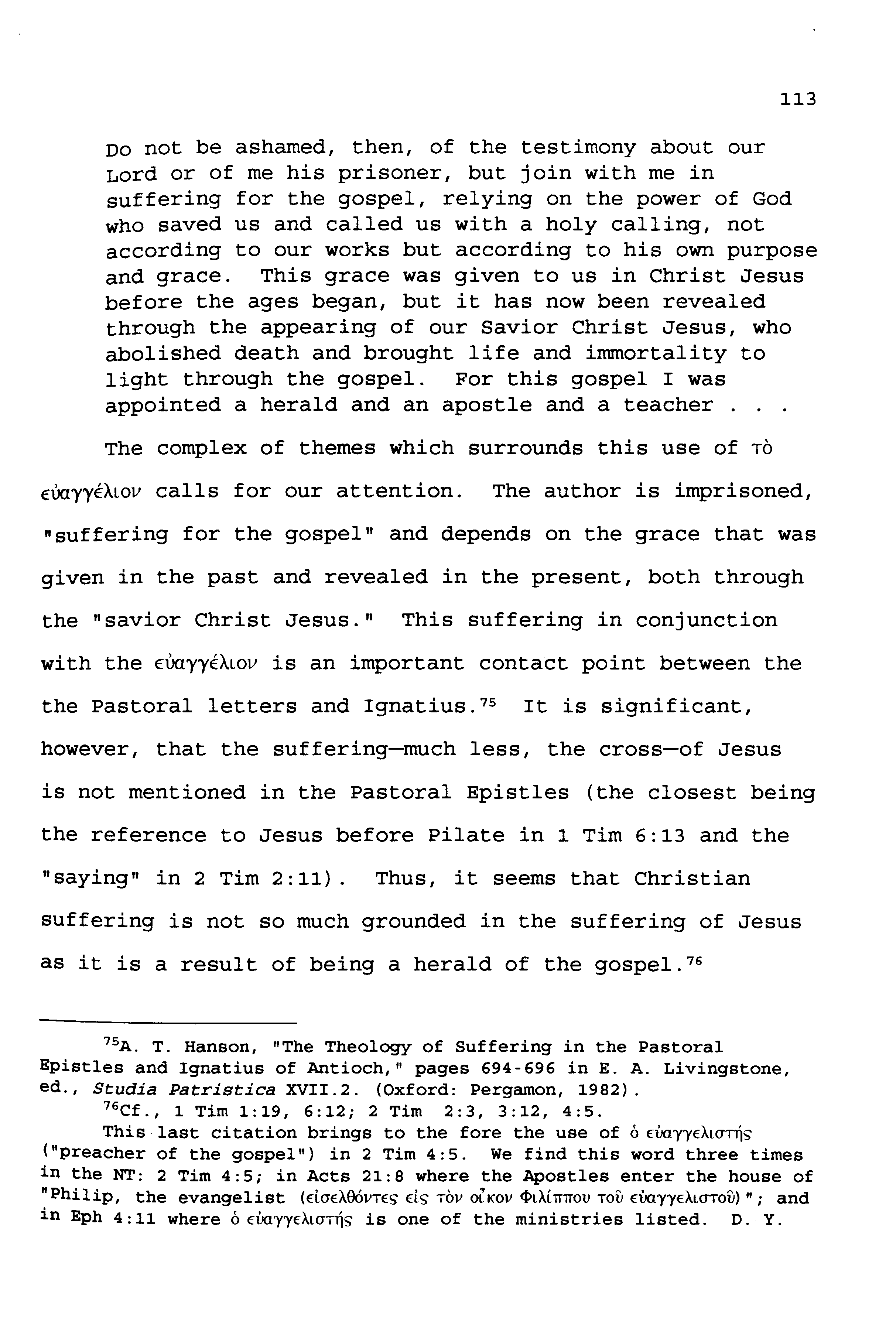
Do not be ashamed, then, of the testimony about our Lord or of me his prisoner, but join with me in suffering for the gospel, relying on the power of God who saved us and called us with a holy calling, not according to our works but according to his own purpose and grace.
This grace was given to us in Christ Jesus before the ages began, but it has now been revealed through the appearing of our Savior Christ Jesus, who abolished death and brought life and immortality to light through the gospel.
For this gospel I was appointed a herald and an apostle and a teacher .
The complex of themes which surrounds this use of To EooyyE:A.Lov calls for our attention.
The author is imprisoned, "suffering for the gospel" and depends on the grace that was given in the past and revealed in the present, both through the "savior Christ Jesus."
This suffering in conjunction with the EooyyE:A.Lov is an important contact point between the the Pastoral letters and Ignatius. 75
It is significant, however, that the suffering-much less, the cross-of Jesus is not mentioned in the Pastoral Epistles (the closest being the reference to Jesus before Pilate in 1 Tim 6:13 and the "saying" in 2 Tim 2:11).
Thus, it seems that Christian suffering is not so much grounded in the suffering of Jesus as it is a result of being a herald of the gospel. 76
75A. T. Hanson, "The Theology of Suffering in the Pastoral Epistles and Ignatius of Antioch," pages 694-696 in E. A. Livingstone, ed., Studia Patristica XVII.2. (Oxford: Pergamon, 1982).
76Cf., 1 Tim 1:19, 6:12; 2 Tim 2:3, 3:12, 4:5.
This last citation brings to the fore the use of 6 e:ooyyEAL<JTtjS'
("preacher of the gospel") in 2 Tim 4:5.
We find this word three times in the NT: 2 Tim 4:5; in Acts 21:8 where the Apostles enter the house of "Philip, the evangelist (Eiae:;\MvTES' e:is Tov otKov <l>t;\[mrov Tov e:ooyye:AtOTov) "; and in Eph 4:11 where 6 e:ooyye:;\t<J'Ttjs is one of the ministries listed.
D. Y.
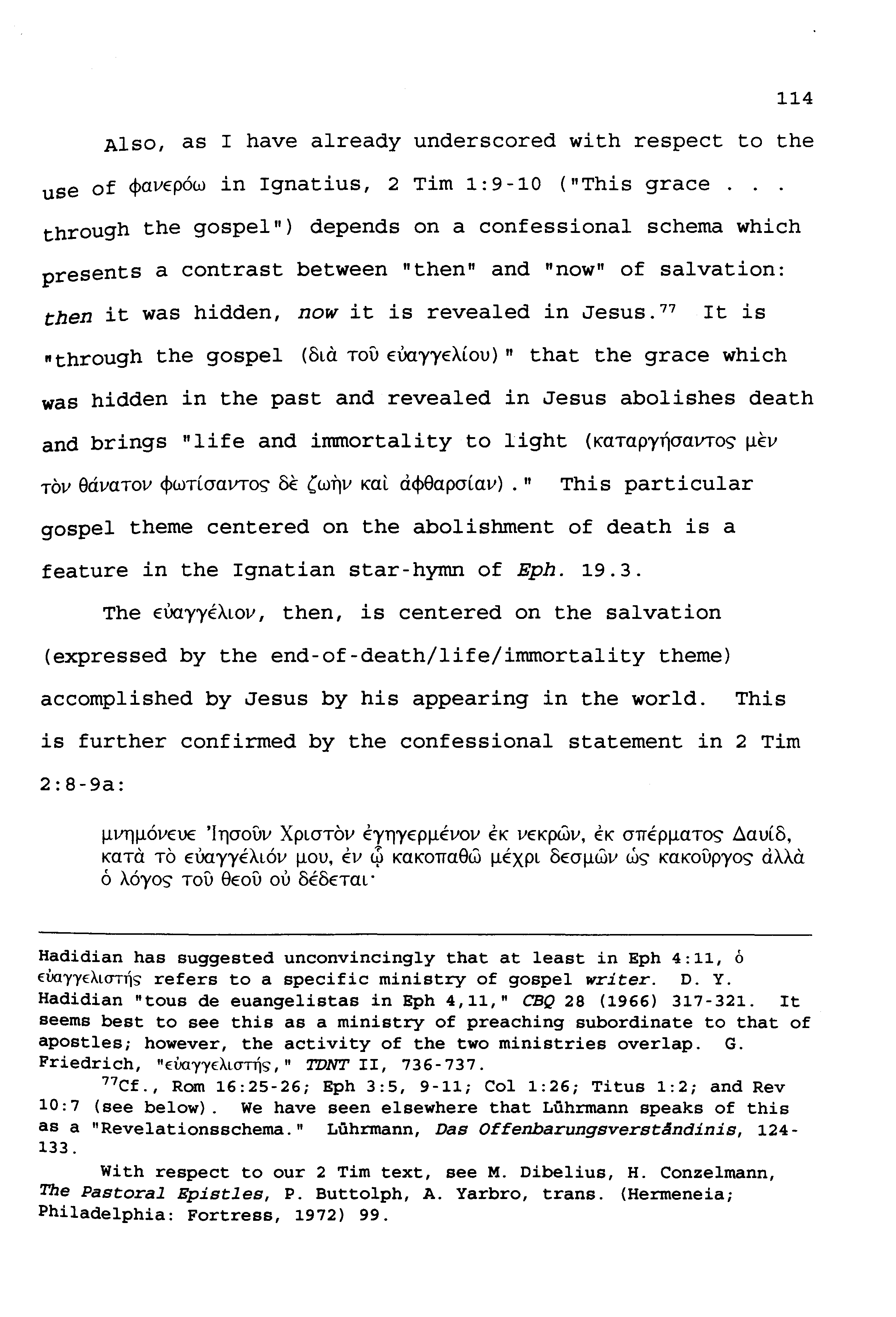
Also, as I have already underscored with respect to the use of <f>a~p6w in Ignatius, 2 Tim 1:9-10 ("This grace . through the gospel") depends on a confessional schema which presents a contrast between "then" and "now" of salvation: then it was hidden, now it is revealed in Jesus. 77
It is "through the gospel (faa Tou EooyyEAfou)" that the grace which was hidden in the past and revealed in Jesus abolishes death and brings "life and immortality to light (KaTapytjaaVTOS' µEv
TOV eavaTOV <f>wT(aaVTOS' 8E Cwtiv KQL d<f>0apa(av) • "
This particular gospel theme centered on the abolishment of death is a feature in the Ignatian star-hymn of Eph. 19.3.
The EooyyEA.Lov, then, is centered on the salvation (expressed by the end-of-death/life/immortality theme) accomplished by Jesus by his appearing in the world.
This is further confirmed by the confessional statement in 2 Tim 2:8-9a: µVllµovEUE 'Iriaouv XpwTov E'YTJ'YEpµ€vov EK VEKpwv, EK an€pµaTOS' ~aul8,
KaTa To Eooyy€A.L6v µou, EV 4> KaKonaew µEXPL 8Eaµwv WS' KaKOupyoS' dAA.a 6 AO'YOS' TOU emu OU 8EOETm.
Hadidian has suggested unconvincingly that at least in Eph 4:11, 6 EooyyEALOTtjs refers to a specific ministry of gospel writer.
D. Y.
Hadidian "tous de euangelistas in Eph 4,11," CBQ 28 (1966) 317-321.
It seems best to see this as a ministry of preaching subordinate to that of apostles; however, the activity of the two ministries overlap.
Friedrich, "EooyyEALCJ'nlS'," TDNT II, 736-737.
77Cf., Rom 16:25-26; Eph 3:5, 9-11; Col 1:26; Titus 1:2; and Rev 10:7 (see below).
We have seen elsewhere that Luhrmann speaks of this as a "Revelationsschema."
Luhrmann, Das Offenbarungsverstifndinis, 124133.
With respect to our 2 Tim text, see M. Dibelius, H. Conzelmann, The Pastoral Epistles, P. Buttolph, A. Yarbro, trans. (Hermeneia;
Philadelphia: Fortress, 1972) 99.
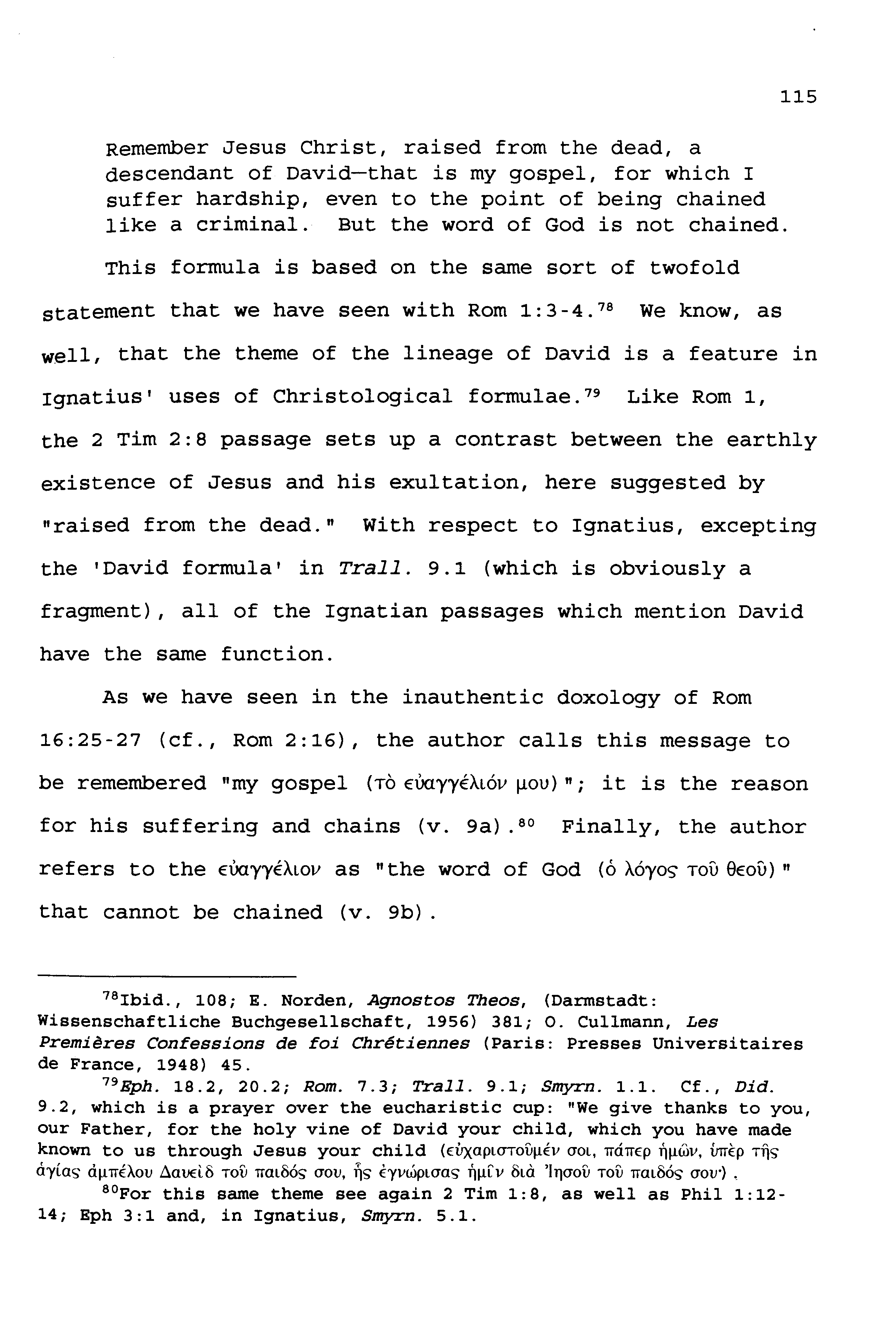
Remember Jesus Christ, raised from the dead, a descendant of David-that is my gospel, for which I suffer hardship, even to the point of being chained like a criminal.
But the word of God is not chained.
This formula is based on the same sort of twofold statement that we have seen with Rom 1:3-4. 78
We know, as well, that the theme of the lineage of David is a feature in Ignatius' uses of Christological formulae. 79
Like Rom 1, the 2 Tim 2:8 passage sets up a contrast between the earthly existence of Jesus and his exultation, here suggested by "raised from the dead."
With respect to Ignatius, excepting the 'David formula' in Trall. 9.1 (which is obviously a fragment}, all of the Ignatian passages which mention David have the same function.
As we have seen in the inauthentic doxology of Rom 16:25-27 (cf., Rom 2:16), the author calls this message to be remembered "my gospel (To EOO)')'EALov µou) "; it is the reason for his suffering and chains (v. 9a} . 8° Finally, the author refers to the EOO)')'EALOV as "the word of God (6 A6yosTou 0rnu) 11 that cannot be chained (v. 9b}.
78Ibid., 108; E. Norden, Agnostos Theos, (Darmstadt:
Wissenschaftliche Buchgesellschaft, 1956) 381; 0. Cullmann, Les Premieres Confessions de foi Chretiennes (Paris: Presses Universitaires de France, 1948) 45.
79 Eph. 18.2, 20.2; Rom. 7.3; Trall. 9.1; Smyrn. 1.1.
Cf., Did.
9.2, which is a prayer over the eucharistic cup: "We give thanks to you, our Father, for the holy vine of David your child, which you have made known to US through Jesus your child (EeyapLCJTOVµEv O'OL, 1Tcl1TEp ~µwv, mrE:p TllS' ay[as ciµ1TEAOV AavEiS TOV TraLOOS' O'OV, ~S' E:yvwpLO'US' ~µi'v OLQ 'l11aov TOV 1TaLOOS' aov-) •
8°For this same theme see again 2 Tim 1:8, as well as Phil 1:1214; Eph 3:1 and, in Ignatius, Smyrn. 5.1.
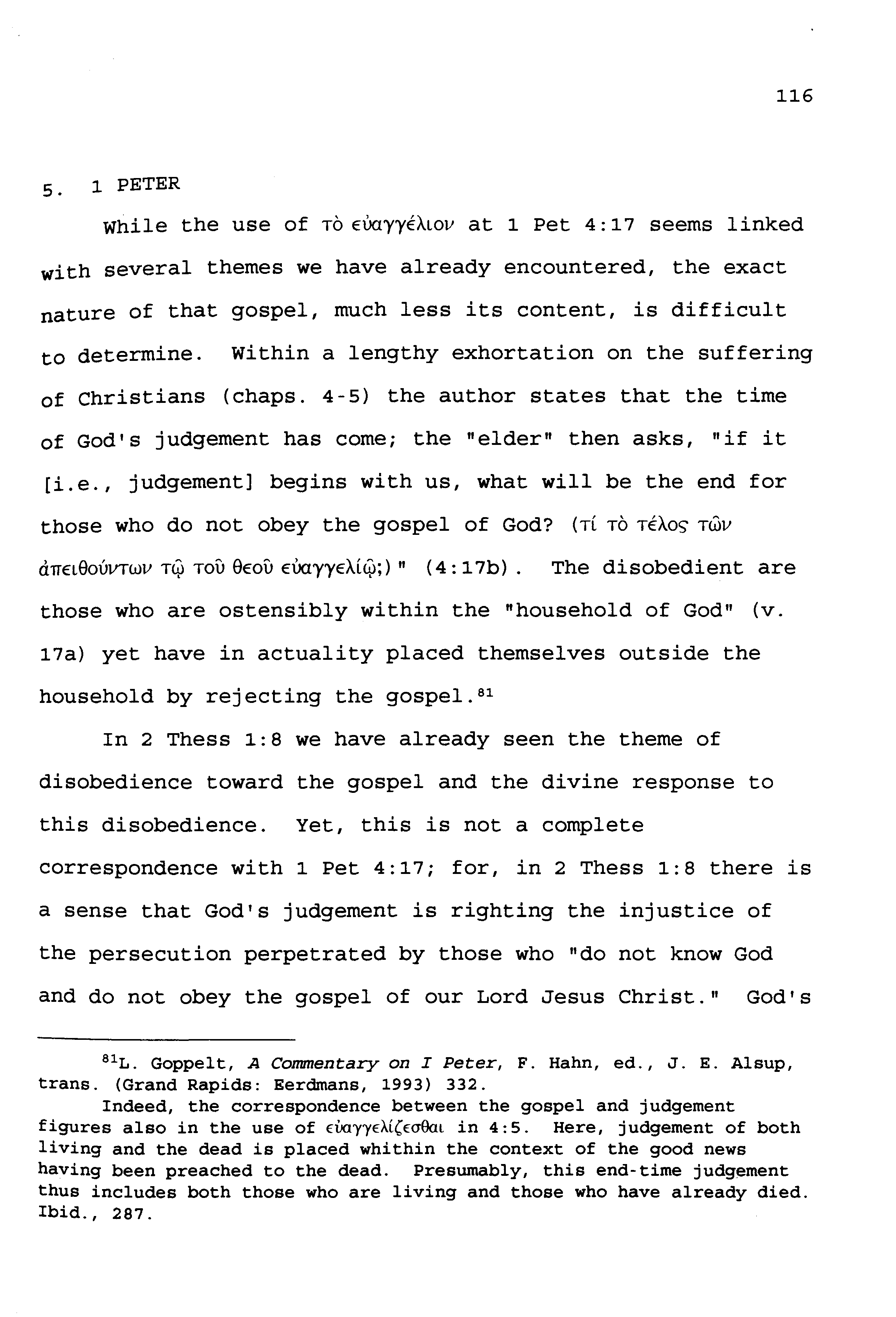
1 PETER while the use of To EUa'Y'YEALov at 1 Pet 4: 1 7 seems linked with several themes we have already encountered, the exact nature of that gospel, much less its content, is difficult to determine.
Within a lengthy exhortation on the suffering of Christians (chaps. 4-5) the author states that the time of God's judgement has come; the "elder" then asks, "if it
[i.e., judgement] begins with us, what will be the end for those who do not obey the gospel of God? (TL To TEA.os Twv clTTEL00UVTWV TQ TOU 0EOU EooyyEA.(Q;)" (4: 17b) .
The disobedient are those who are ostensibly within the "household of God" (v.
17a) yet have in actuality placed themselves outside the household by rejecting the gospel. 81
In 2 Thess 1:8 we have already seen the theme of disobedience toward the gospel and the divine response to this disobedience.
Yet, this is not a complete correspondence with 1 Pet 4:17; for, in 2 Thess 1:8 there is a sense that God's judgement is righting the injustice of the persecution perpetrated by those who "do not know God and do not obey the gospel of our Lord Jesus Christ."
God's 81L. Goppelt, A Commentary on I Peter, F. Hahn, ed., J. E. Alsup, trans. (Grand Rapids: Eerdrnans, 1993) 332.
Indeed, the correspondence between the gospel and judgement figures also in the use of EooyyEl..t(mOat in 4: 5.
Here, judgement of both living and the dead is placed whithin the context of the good news having been preached to the dead.
Presumably, this end-time judgement thus includes both those who are living and those who have already died.
Ibid., 287.
judgement in 1 Pet 4:17, on the other hand, functions simply to "induce fear before God's exercise of judgement" upon the church members who disobey the Gospel. 82
What is more, the use of dnEL0€w {"disobey"} is not so much a reference to ethical demands linked with the gospel; rather, to disobey the gospel is the opposite of to believe in the gospel. 83
It is significant that, as we have already noted in passing, Ignatius uses dTTEL0€w at Magn. 8. 2 within the context of his statement on the OT Prophets who, despite being persecuted, are inspired "to convince the disobedient that there is one God who manifested himself through Jesus
Christ, his son {ELS' To TTAT)po<f>opri0fwm ToiJ<; dTTEL0ouVTas-, oTL d s0E6sE:oTLv, 6 <f>avEpwaasE:aUTov faa 'Iriaou XpLaTou Tou u[ou mhou} . "
This belief statement has direct ties with Eooyy€A.Lov motifs; the "disobedient" for Ignatius, as for 1 Peter, are those who refuse to believe in the Eooyy€A.Lov.
THE BOOK OF REVELATION
We cannot leave the NT without pausing to consider the Revelation of John. written in 95 or 96 C.E., Revelation is 82Ibid., 332.
83BAGD, 82; R. Bultmann, 11chrn0Ew 11
TDNT VI 10-11.
Thus, the usage in Isa 65:2, which is taken up by Paul in Rom 10:21 and in Barn. 12.4.
See also 1 Pet 3:1 and John 3:36; Acts 14:2, 19:9; Rom 15:31.
In 2 Thess 1:8, discussed above, we find µiJ inraKoiiw instead of d1Tn0Ew.
The meaning is essentially the same.
thus proximate in time to Ignatius. 84
As for place, the messages to the seven churches of Asia in Rev 2:1-3:22 suggest the same general sphere of influence as that of Ignatius. 85
The substantive EooyyEALov occurs once in Revelation, in 14: 6; and the verb EUayyEAL(w (i.e. , in the active voice) twice, in 10:7 and in 14:6 as well. 86
It seems clear that the two uses of the verb EooyyEA.((w refer to the proclamation of a message with ultimate import. so, in 10:7 when the seventh angel blows his trumpet "the mystery of God will be fulfilled, as he announced to his servants the prophets (KaL ETEAEcr911 TO µooTtjpLOV TOU emu, W<;
EUT)yyEALcrEv ToU<; €aUTou 8ouA.ouc; ToU<; 1Tpcxf>tjTa<;) . 11 87 In Rev 14:6 we have both the verb and the substantive.
After the visions of the dragon and the woman, and the two beasts in chapters 12 and 13, the seer recounts the vision of the lamb on Zion with the 144,000 redeemed.
Then the seer describes "another angel flying in midheaven, with an eternal gospel to proclaim to those who live on the earth .
840n the dating of Revelation, see the discussion in A. Yarbro Collins, Crisis and Catharsis: The Power of the Apocalypse,
{Philadelphia: Westminster, 1984) 54-83.
85D. Aune holds that the author is writing from Ephesus.
D. Aune, "The Social Matrix of the Apocalypse of John," BR 26 {1981) 27-28.
86These are the only occurrences in early Christianity of this verb in the active voice.
Cf., BAGD, 317.
87This is yet another example of the revelation schema we have spoken of before {as in Luhrmann, Das Offenbarungsverstandinis, 124133); here, the schema involves the "mystery" and the witness of the prophets in advance.
For these themes in various configurations see Rom 16:25-26; Col 1:26; Barn. 5.6.
Cf., 1 Pet 1:20; Heb 9:26b; 2 Clem 14:2; and, in Ignatius, Magn. 8.2, 9.3; Phld. 5.2; Smyrn. 7.2.