
C. Other Indications Of An Oral Environment
philadelphians.
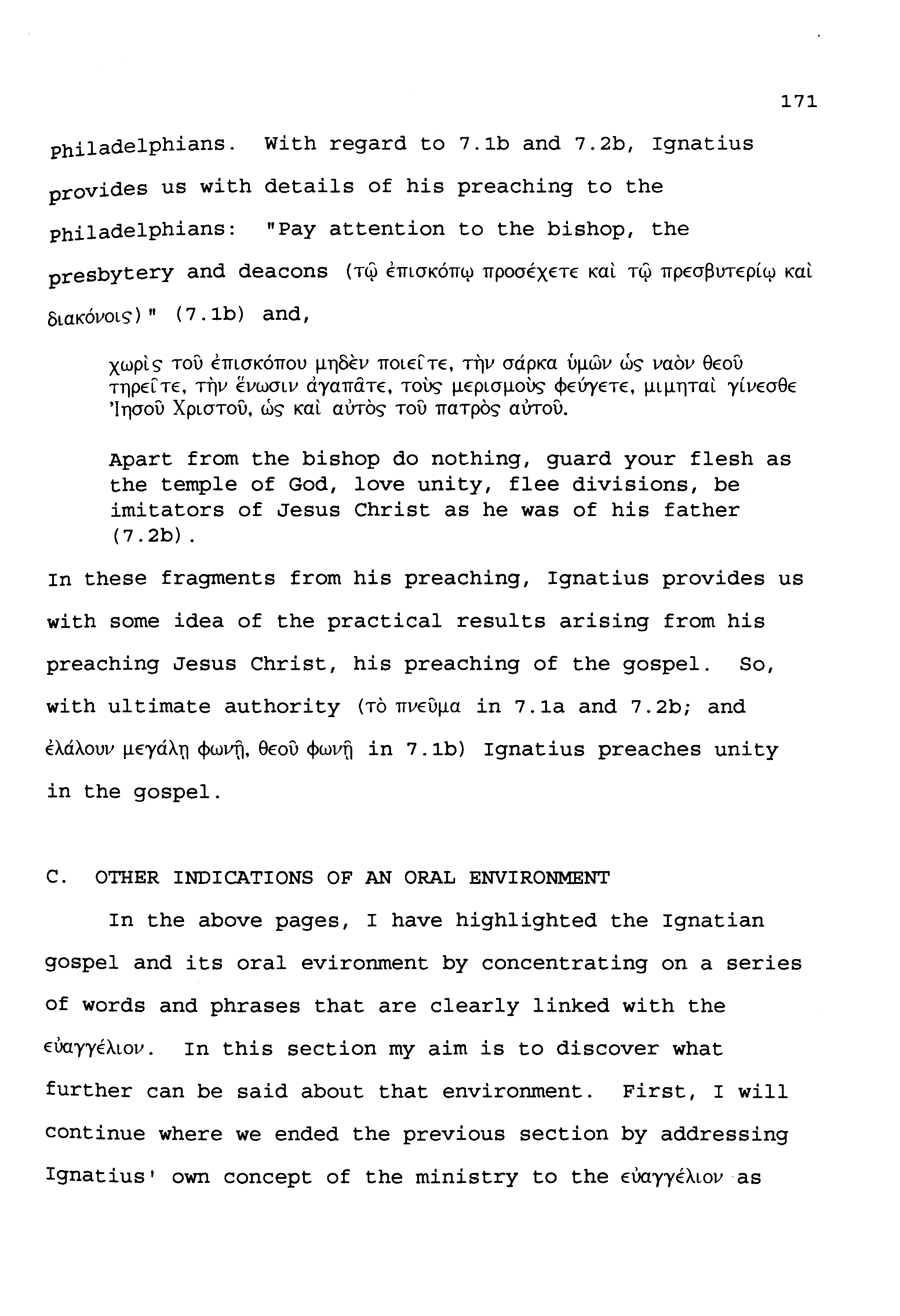
With regard to 7.lb and 7.2b, Ignatius provides us with details of his preaching to the philadelphians:
"Pay attention to the bishop, the presbytery and deacons ( T4) E:maKon<.p npoaEXETE Kat T4) npEa~UTEp(<.p Kat
8taK6vots-) "
( 7 . lb) and, xwpt S' TOU ETTLOKOTIOU µ T)OEV TIOLEL TE' Tfiv acipKa uµwv WS' vaov ernu
TT)pELTE, TTW €vwaw dyanaTE, ToUsµEptaµoUscf>EUyETE, µtµT)TaL y(vEa9E 'IT)aou XptaTou, wsKat m'.rrosTou naTposm'.rrou.
Apart from the bishop do nothing, guard your flesh as the temple of God, love unity, flee divisions, be imitators of Jesus Christ as he was of his father
(7.2b).
In these fragments from his preaching, Ignatius provides us with some idea of the practical results arising from his preaching Jesus Christ, his preaching of the gospel.
So, with ultimate authority (To nvEuµa in 7. la and 7. 2b; and E:AciA.ouv µEyciA.11 <f>wvfl, 9Eou <f>wvfl in 7. lb) Ignatius preaches unity in the gospel.
OTHER INDICATIONS OF AN ORAL ENVIRONMENT
In the above pages, I have highlighted the Ignatian gospel and its oral evironment by concentrating on a series of words and phrases that are clearly linked with the Eooyy€A.wv.
In this section my aim is to discover what further can be said about that environment.
First, I will continue where we ended the previous section by addressing Ignatius' own concept of the ministry to the Eooyy€A.tov as
having a prophetic or charismatic quality.
Following that discussion, I will examine the single use of ii oµLA(a I in pol. 5.1.
Finally, I will consider the setting of Eph. 9, as well as the theme of silence in Eph. 15 and Phld. l.
PREACHING IN THE SPIRIT
so far in this study, I have occasionally touched on Ignatius' own concept of his ministry and have suggested a prophetic or charismatic character for that ministry.
At this point, it is valuable to focus on this topic as a means not only of bringing those insights together, but also of further elucidating the environment of Ignatius' gospel that we have been examining.
Much has been made of the types of Christian ministry in the Ignatian corpus.
Because of its evident importance for Ignatius (not to mention, more modern, interconfessional reasons), the threefold schema of deacon, presbyter, and bishop has been a major flashpoint in Ignatian studies. 47
The apparent existence of such a fully developed structure of church order as early as Ignatius has
47See, for example, A. Brent, "The Ignatian Epistles and the Threefold Ecclesiastical Order, " JRH 17 (1972) 18-32; P. Burke, "The Monarchical Episcopate at the End of the First Century," JES 7 (1970)
499-518; E. Jay, "From Presbyter-Bishops to Bishops and Presbyters:
Christian Ministry in the Second Century: A Survey," SecCent 1 (1981) 125-162; E. Lohse, "Die Entstehung des Bischofsamtes in der friihen
Christenheit," ZNW 71 (1980) 58-73; G. Scholligen, "Monepiskopat.und monarchischer Episkopat. Eine Bemerkung zur Terminologie," ZNW 77 (1986)
146-151.
engaged many scholars.
While this is indeed a vital question, my present concern largely bypasses the main question of the definition of 8LciKovos-, npEa~UTEpos-, and €n(aKonosin Ignatius.
It centers, rather, on the authority with which Ignatius exercises his ministry to the EooyyEALov.
It is clear that Ignatius sees himself as a proclaimer inspired by the Spirit of God. 48
Ignatius' charismatic ministry has attracted attention at least since B. H. Streeter's recognition of the prophetic quality in Ignatius' ministry.
More recently we have the studies of P. Meinhold, D. Aune and H. O. Maier, all of which propose various approaches to the question. 49
Meinhold speaks of Ignatius' "pneumatic" character as one component of his (Meinhold's) own tripartite schema that describes Ignatius as bishop, pneumatic, and martyr. 50
Aune holds that Ignatius' letters preserve several prophetic oracles in Phld. 7.1-2, as well as other "indications of 48In this section I will use the terms 11 charismatic 11 and "prophetic" with respect to this aspect of Ignatius' ministry.
The term "prophetic," however, more specifically refers to activity in which speaking or proclamation through the Spirit {or God) is at issue.
49Aune, Prophecy in Early Christianity, 291-299; H. 0. Maier, The Social Setting of the Ministry as Reflected in the Writings of Hermas,
Clement and Ignatius {Waterloo: Wilfrid Laurier University, 1991) 147187; idem, "Charismatic Authority"; P. Meinhold, Studien zu Ignatius von
Antiochien {Wiesbaden: Steiner, 1979) 2-18; B. H. Streeter, The Primitive Church {London: Macmillan, 1930) 228-29.
See, as well, Paulsen, 122-129 and H. Schlier, Untersuchungen, 140-152.
50Meinhold, 8-10.
prophetic speech" and some nineteen examples of "pronouncements of sacral law. 11 51 Perhaps most valuable, however, is H. 0. Maier's approach to Ignatius as charismatic leader.
Maier appeals to the classic description of charismatic leadership by the early twentieth century sociologist Max Weber. 52
Weber describes the charismatic leader as one having exceptional qualities and powers to which the ordinary person has no access; moreover, charisma is self-determined and sets its own limits.
Its bearer seizes the task for which he is destined and demands that others obey and follow him by virtue of his mission. 5 3 Weber's concern is not the origin of the charisma; yet he points out that charismatic leadership is "regarded [by those under its authority] as of divine origin or as exemplary. "54
51Prophetic speech: Eph. 20; Trall. 4.1-5.2; Rom. 7.2; Pronouncements of Sacral Law: Eph. 2.1, 2.2, 21.2; Trall. 5.2; Rom. 8.1;
Phld. 10.1-2, 11.1; 11.2; Smyrn. 2.1, 5.1, 6.1, 9.1, 9.2, 10.2, 12.1; Pol. 1.2, 3.1, 6.1, 6.2.
Thus, for example, Rom. 7.2 exhibits a threepart structure of prophetic speech: narrative: "My lust has ben crucified, and there is in me no fire of love for material things;" revelation formula: "but only water living and speaking in me, and saying to me from within," admonition: "'Come to the Father.'"
As for 'pronouncements of sacral law' we have, for example, Trall. 5.2: "Much is lacking to us, that we might not lack God" and Pol. 6.1: "Give heed to the bishop, that God may do the same to you."
Aune, Prophecy in Early Christianity, 293-296.
52Maier, Social Setting, 158-160, 163; Idem, "Charismatic Authority," 188-192.
53M. Weber, Economy and Society, G. Roth, C. Wittich, et al., trans. (New York: Bedminster, 1968) 1112.
See also idem, The Sociology of Religion, E. Fischoff, trans. (Boston: Beacon, 1964) 46-59.
54Weber, Economy and Society, 241.
so, to return in this light to Ignatius, we have already examined not only the specific meaning as well as the probable prophetic nature of the bishop's use of AaAEW.
This charismatic quality is found not only with the phrase AaAELV 'Irioouv XpLoT6v itself, but we have also seen the suggestion-via the Odes of Solomon-of prophetic activity in Rom. 7. 2 ("water, living and speaking in me
[oowp OE Cwv Kat AaAouv EV Eµm] ") .
Moreover, we have observed the evidently prophetic event that Ignatius describes three times in Phld.
6.1-7.2, in which the bishop appeals directly to the Spirit.
Ignatius describes this event the second time by stating that the Spirit from God "exposes secret things (Ta KpunTa
EAE'YXEL)" (Phld. 7 .1). 55
Finally, it is necessary for our purposes to recognize that, as we have seen, ultimately these prophetic proclamations are centered on the EUa'Y'YEALov.
Further indications of Ignatius' prophetic ministry include the remark in Eph. 20 where Ignatius promises another letter about the divine plan <it oLKovoµ(a) about Jesus, regarding "faith in him and love of him, his passion and his resurrection; especially if the Lord reveals anything to me (mrrou lTLCJTEL KaL EV TQ mrrou dycilTTJ, EV nci0EL mrrou KaL
55Ignatius speaks of "secret things" two other times: in Eph.
15:3 secret things of people are near God; and in Phld. 9.1 Jesus the high priest is entrusted with the secret things of God.
As for Phld. 7.1, this action of the Spirit is akin to the.
Spirit's action through the prophet in 1 Cor 14:25.
Aune, Prophecy, 293.
dvaaTciOEL" µci/..LaTa Eav 6 KUpLOS' µm dnoKa/..1'.xj;lJ TL)" (20. l-2a) . 56
It is noteworthy here that not only is this remark made in the context of the two primary EooyyE/..Lov motifs (nci0os-, dvciaTams-) , but also that Ignatius continues in 20.2 by encouraging unity 11 in one faith and in one Jesus Christ who was of the family of David according to the flesh, the son of man and the son of God (Ev µL~ n(aTEL Kai Ev 'Iriaou XpLoTo\J, T4) KaTa aciprn EK yEVOUS' Aaudo, T4) ut4) dv0pwnou Kai ut4) 0EOu) , " 57 thereby further underscoring the link between the EooyyE/..LOv and the plan of God in history.
It is this message that Ignatius refers to as a possible revelation at the beginning of Eph. 20.2.
Not only does Ignatius suggest that his ministry is directed by the Spirit, but in Trall. 4-5 he also claims to have knowledge that sets him apart as one who can speak of the supernatural.
Thus Ignatius begins Trall. 4 with a Paul-like refusal to boast about his "many thoughts in God
(not..Aa <f>povw Ev 0E4}) . " 58
He then continues by pointing out that in the face of this unique knowledge, he must strive for humility (npa6TTJS') so that the "ruler of this age (6 dpxwv Tou a[wvosTol1Tou)" will be destroyed.
These "many thoughts in 56Here Schoedel follows both Lightfoot and Zahn in reading here 6
KVplOS' µoL Q1TOKaA.uJn:i Tl instead of 6 KVplOS' µOL Q1TOKaA.l.¢u OTl ol KaT' av8pa KOLVij ••• of the important Greek and Latin witnesses.
Thus, this phrase is a concluding statement tied with the mention of Jesus in 20.1 rather than an introductory statement leading into 20.2.
For the details of the convincing argument see Schoedel, Ignatius of Antioch, 96, n. 6;
Lightfoot, 86, n. 3; Zahn, 586.
57cf., Rom 1:3-4.
58Cf ., 2 Cor 10:12-18.
God" become more specific in Trall. 5.
Here-beginning with a rhetorical question that, again, takes its cue from Paul (cf., 1 Cor 3:1-2)-Ignatius again claims to have access to special knowledge that is too much for ordinary mortals:
Mii OU 8uvaµm uµL'v Tel E:noupcivw ypchµm; dAA.a <f>o~uµm, µii Vl11TLOLS' OUOlV uµL'v ~Aci~riv napaew· KUL auyyvwµovELTE µm, µTjnoTE OU 8uvrieEVTES' xwpflam CJTpayyaA.weflTE.
KUL yap E:yw, OU Kaeon 8E8Eµm KUL 8uvaµm voEL'v Ta E:noupcivw KaL TclS' TonoeEa(asTclS' dyyEALKclS' KaL TclS' aooTciCJELS'
TaS' dpxoVTLKciS', 6paTci TE Kat d6paTa, napa ToiJTo ~811 KaL µae11TTlS' ELµL.
1TOAAcl yap iiµL'v AEL1TEL, l'va emu µii AEL1TWµEea. surely I am not unable to write you of heavenly things?
No, but I fear inflicting harm on you who are infants, Bear with me, then, lest you be choked by what you cannot take in.
Even in my case, not because I am in bonds and am able to know heavenly things, both the angelic locations and the archontic formations, things both visible and invisible-not because of this am I already a disciple; for we need many things that we may not lack God. 5 9 we are immediately reminded of the language found in the star-hymn of Eph. 19.1-3, as well as the exposition in Smyrn. 6.1 (cf., Col 1:16).
While the Spirit is not mentioned in either Trall. 4 or 5, Ignatius is making it clear that he has access to extraordinary knowledge that can only have di vine origin (thus, "many thoughts in God [noAA.a <f>povw EV en~ 1 ) .
It is also noteworthy in this regard that Ignatius concerns himself with charismatic ministry in others.
This is most clearly seen in the bishop's exhortation to his 59Translation, Schoedel, Ignatius of Antioch, 143.
colleague Polycarp:
"pray that the invisible things may be revealed to you so that you might lack nothing and overflow in every gift (Ta BE dopaTa atTEL [va am <f>avEpw8iJ, onwsµT)&EvosA.dnTJ
Kai naVTOS' xap(aµaTOS' lTEpLGGEUTJS') " (Pol. 2. 2) .
Only a 1 it tle less clear in this respect is Ignatius' recognition that the bishop of Philadelphia's authority for the cormnon good comes
"neither from himself nor through human beings, nor for vainglory, but in the love of God the Father and the Lord
Jesus Christ . .
( ouK d<f E-aUTou oooE BL' dv8pwnwv . . . oooE Ka Ta KEvo&oe(av, dA.A.' €v dycinTJ 8EOu naTposKai trup(ou 'IT)aou XpLaTou·) "
( Phld.
1.1) . 60
Not only do these passages suggest that Ignatius recognizes that his own gift is from a divine source, but they also tell us that Ignatius recognizes and encourages charismatic ministry (and authority) on the part of others. 61
So, what are we to make of all this?
There are two issues that rise from this material.
First, we must realize that whatever the exact nature of Ignatius' charismatic ministry, it seems to be a source of authority for the bishop.
Second, Ignatius is a bishop (Rom. 2.2; cf., Magn.
2.1).
In this regard, Maier notes "it is not as a bishop or holder of some other official position that [Ignatius]
60cf., Gal 1:1, 1 Cor 14:2-5.
61With respect to Ignatius' own gift, see Maier, "The Charismatic Authority," 190.
Cf., Schoedel, Ignatius of Antioch, 263.
Phld. 1.1, according to Schoedel, is an indication of the "essentially charismatic" authority of the Philadelphian bishop.
Ibid., 196.
exhorts the Asia Minor communities to avoid schisms and unite with their bishops. "62
However, Maier is making an unwarranted distinction between Ignatius' office as En(aKono~ and his authority as a charismatic leader.
It appears most accurate to see them as one.
This means that no matter how one defines ETILaKono~ in the letters of Ignatius, one must include a prophetic or charismatic character when we speak about Ignatius' own episcopal ministry.
These issues easily take us beyond our immediate concerns; yet, as we have seen,
Ignatius' ministry to the Eooyy€A.tov clearly involves the action of the Spirit.
This is a preached, oral ministry based in the authority of the Spirit.
Ignatius "takes it for granted that the Spirit speaks through and on behalf of estabished authority. 1163
POLYCARP 5.1
In the brief letter to Polycarp, Ignatius provides the bishop of Smyrna an exhortation on Christian leadership
( "napaKaA.w aE ... "
[Pol. 1. 2]) .
We have already considered the charismatic nature (at least from Ignatius' perspective) of Polycarp's ministry.
The fifth chapter of that letter begins with Ignatius' only use of what appears to be a technical word for church preaching, ~ 6µtA.(a.
There is little Christian usage of this word before Justin, none in 62Maier, Social Setting, 157.
63Schoedel, Ignatius of Antioch, 206.
the NT; its classical sense includes "association,"
"assembly" and "instruction. "64
Ignatius exhorts Polycarp to "flee not only from evil arts, but also preach against them (TCtS' KUKOTEXVLUS' <f>EUyE, µaAA.ov OE lTEpl TOUTWV oµLl..(av lTOLOU) II (Pol. s.1a).
He then continues-with the verbs npoal..al..Ew ("address") and napayyEAA.w ("instruct") -by giving specific content of the message.
It is intended for married couples. 65
There is no reference to the Ignatian gospel or gospel themes linked with this preaching. 66
With respect to the content of the preaching, the most we can point to is that the women should be instructed to "love the Lord," and the men to "love their wives as the Lord loved the church."
I call attention to this single use of ~ oµLl..(a (along with npoal..al..Ew and napayyEA.l..w) to point out that this usage is indicative of an official ministry of preaching by a church
64Liddell and Scott, 1222.
As for Justin, we read in Dia. 2 8. 2, 'E1TEL8~ dm) TE Twv ypml>wv KOL Twv iTpoyµciTluV, TclS' TE a1To8EL~ELS' KOL TclS' oµtALOS' 1TOtovµm ...
The verb, oµtAEW ("speak," "address'), occurs rather more often in formative Christianity.
It occurs in the letter of Diognetus two times (11.1, 7), the second of which refers to the Word itself speaking through chosen agents.
In the Martyrdom of Polycarp it occurs once:
(2.2):
Christ stands by and speaks to the martyrs in their agony.
The NT occurences, all in the Lukan documents (Luke 24:14, 15; Acts 20:11), are in the context of conversations.
65The link between "evil arts" and marriage practices is uncertain.
Schoedel, however, sees it in the other direction, the "evil arts" are linked with the teaching on slavery immediately preceeding.
Schoedel, Ignatius of Antioch, 271.
Either way, the "evil arts" are an enigma.
66The EOO)')'EAtov is not explicitly mentioned in the letter.
Only general references to gospel motifs can be discerned.
For example, in this same passage Ignatius suggests celibacy for those who are able "in honor of the flesh of the Lord (Eis nµ~v Tf\S' aopKOS' TOV KUp(ov)"
(Pol. s. 2a) .
official which does not necessarily have the EmyyEALov as its content.
What is more, there is no indication here of any charismatic sense to this preaching; it appears to be simply instruction on Christian living.
PASSAGES ABOUT ORAL EXPOSITION
There is also a series of Ignatian passages in which some sort of oral exposition is presumed.
Beginning with Eph. 9, a brief look at the more noticeable of these is in order. a.
EPHESIANS 9
we have already encountered the taciturn bishop of the Ephesians, Onesimus, and the Ephesians' "good orderliness in God" (Eph. 6.1, 2) arising from their refusal to "listen to anyone except one who preaches in truth about Jesus Christ
(dAA.' 000€ dKoUETE TwosnAfov, fl TIEpL 'IT}crou XpLcrTou AaA.ouVTosEV dA.T}OE(q) "
(Eph. 6.2).
A bit later, in Eph. 9, Ignatius refers again to the preaching of error in Ephesus; outsiders have been there broadcasting an "evil teaching" (€xovTasKaKiiv 8Loaxtjv) .
Then, launching into a chain of mixed metaphors, Ignatius tells the Ephesians:
"but you did not allow them to sow it among you, stopping your ears, so as not to receive what they sow (ous OUK ELcicraTE GlTEL pm ELS' uµCis-, ~ooaVTES' Tel WTa, ELS' TO µ"fi napa8Ecacrem Tel crnELpoµEva iJTI' auTwv)" (Eph. 9 .1) .
Ignatius, for his part, is making his case against the nefarious teaching;
he is joyful because, as he writes, "I was made worthy to address you through what I write to you (dyaAALwµEvosTicLw8rJV 8L'
WV ypcicf>w npoaoµLAf}am uµL'v) II ( Eph. 9 . 2) .
The use of npoaoµLAEW at least suggests an oral connotation (cf., Pol. 5.2).
The letter is his preaching. 67 b.
EPHESIANS 15
Later in the same letter (Eph. 15), in response to this proselytizing by outsiders, 68 Ignatius furthers his position by apparently returning to the situation with the quiet bishop Onesimus. 69
Building on his defence of episcopal silence in 6 .1 (KaL oaov ~AE1TEL TLS' mywVTa E1TLGK01TOV, 1TAELOVWS° m'.rrov cf>o~E(a8w) , Ignatius sets up an oppositional sequence between silence accompanied by righteous deeds, and speech that is not fulfilled with deeds:
"AµEwov E-anv mwnciv Kai dvm, ~ AaAOUVTa µT) dvm.
Elsewhere we have already examined the 'professing/deeds' passage in Eph. 14 that leads into this passage ( 11000Ei S' n(aTLV E-nayyEAAOµEvosciµapTciVEL") .
To provide ultimate support for Onesimus and what he stands for, 6 7cf., 2 Cor 10:9-11.
68Schoedel calls them "itinerant teachers."
Schoedel, Ignatius of Antioch, 65.
69There is scholarly discussion concerning this episcopal silence.
Chadwick connects it with the silence of God in Eph. 19.1 and Magn. 8.2: since the bishop corresponds to God in Eph. 5.3, Magn. 6.1, Trall. 3.1, and Smyrn. 8.1-2, the bishop's silence corresponds to God's silence.
Moreover, Chadwick points to the silence of God as a theme in gnostic texts.
H. Chadwick, "The Silence of the Bishops in Ignatius," HTR 43 (1950} 169-72.
It seems, however, that Schoedel is correct in seeing this silence simply as referring to an "inarticulate bishop."
Schoedel, Ignatius of Antioch, 56-57.
Ignatius turns to Jesus who not only is the "one teacher who spoke and it came to pass, but also what he did in silence is worthy of the Father (ELS' ouv 8t8ciarnA.os-, OS' ELlTEV, Kai EYEVETo· 8E nElTOLTlKEV dew Tou naTposECJTLV) (Eph. 15. lb). 1110
In the next sentence, Ignatius clinches his argument:
6 A6yov 'Iriaou KEKT11µE:vosdA.riOws8uvaTm Kai TTJS' ~auxfasauTou dKOUELV, [va TEAELOS' ~. [va 8t' wv A.aAEL npciaalJ Kai 8t' w CJL yQ. yLVWCJKTlTaLL.
The one who truly possesses the word of Jesus is also able to hear his [Jesus'] silence, so that he may be perfect, so that through that which he says he may act, and through his silence he may understand. (Eph. 15.2)
The point of all of this, therefore, is twofold: to uphold the authority of the local bishop who, it seems, is not much of a preacher, and to counter improper teaching by preachers from the outside.
At the center is the "word of Jesus." c.
PHILADELPHIANS 1
Thus, in the Ephesian passages treated above the silence motif plays a specific role with respect to the local situation.
That same motif plays a part as well in 70while one may point, for example, to Jesus' silence before Pilate (Herod in Luke} (Matt 27:14, Mark 15:5, Luke 23:9, John 19:9), that here Ignatius has some specific episode or episodes of the life of Jesus in mind is improbable; Ignatius is more concerned with his present task than reporting the life of Jesus.
The figure of Jesus, then, serves simply to support Ignatius' view of the ministry of Onesimus.
Cf., Schoedel, "Ignatius and the Reception of Matthew," 160-161.
Ignatius' dealings with another bishop who apparently is a man of few words.
The unnamed gentle bishop in Philadelphia is praised early in Ignatius' Philadelphian letter because he is able to "do more in silence than those proclaiming vain words (osen ywv n A.dova 8uvaTm Twv µciTma A.aA.ouVTwv) " ( Phl d. 1 . lb) . 71
Ignatius recognizes that the bishop's ministry for the conunon good is from God (KEKTficr0m Tr1v BlaKov(av TTlV EisTO KOLVov .
EV dycinu emu naTpOS' KUL KUp(ou 'lrpou XpLOTOU) ( Phld. 1. la) and is therefore of unquestionable authority. 72
Here again, as with Onesimus of Ephesus, Ignatius is highlighting a bishop's silence and righteous actions by contrasting them with those who preach error.
As Ignatius has told the Ephesians, "it is better to be silent and to be, than speaking and not to be (aµELvov EcrTLV mwnav Kat d vm, fl A.aA.ouVTa µTi
ELvm) . 1173
71Again, here we may point to the figure of Jesus in Eph. 15.lb:
"what he did in silence is worthy of the Father (OE TTETTOLT)KEV aew TOV TTaTpos
EO'TLV) • "
72As I have suggested this authority is "essentially charismatic."
Ibid., 196.
73Schoedel suggests Magn. 4 (rrp€rrov ovv EO'TLV µ~ µ6vov KaA.d0"9aL XpLO"TLOvolis, ciAA.a Kai dvm) as a way of filling in the eliptical objects to the two uses of Etvat.
In this light, we may understand the Eph. 15.1 text as "It is better to be silent and to be in reality Christians, than to speak and only be called Christian." w. Schoedel, Ignatius of Antioch, 77.