
A. Verbs Of Transmission And Acceptance
give evidence as to how Ignatius presumes the history and teachings of Jesus are disseminated.
My goal is to gain a clearer sense of the environment in which the Ignatian gospel is transmitted.
This environment will tell us much about the contours of the Jesus traditions Ignatius is invoking as TO EOOYYEALOV .
VERBS OF TRANSMISSION AND ACCEPTANCE
one of the consistent characteristics that emerges from the Ignatian passages centered on EooyyEALov is the oralityimplied or expressed-of the gospel message.
It is a preached gospel.
In recognizing this, what is immediately striking is the fact that, while Ignatius appears to distance himself from written texts (thus suggesting an oral context), he never uses one of the verbs of oral proclamation, Eooyyd((Ea8m, that is such a strong feature in the earliest expressions of gospel activity, i.e., the Pauline tradition. 2
It is appropriate at this point, 2Thus far in this study we have observed the close affinity that Ignatius has with Paul.
In the genuine letters, Paul uses the verb EOO)')'EAL(EaO<lt some nineteen times.
While often having a more generic sense of "to inform," or to pass on information (as in 1 These 3:6),
EOO)')'EAL(EaO<lL is also used by Paul in the precise sense of preaching the gospel (as in Rom. 1:15, 15:20; 1 Cor 1:17; 2 Cor 10:16; Gal. 1:8-9).
What is more, in two instances, for emphasis, Paul links the action with the content in the phrase EOO)')'EAL(EaO<lt To EOO)')'EALOV ( 1 Cor 15: 1; 2 Cor
11:7).
See H. Friedrich, 11EOO)')'EAL(oµm, K.T.A. 11
TDNT II (1964) 707-737; on EOO'Y)'EAL(EaO<lt specifically, ibid. 720.
therefore, to pay attention to Ignatian verbs of proclamation, commitment, or preaching. 3
As we have seen, the EooyyEALov is for Ignatius intimately linked with the Prophets of the OT.
In all of the eight instances treated above, only the engaging passage in Phld. 8.2 does not explicitly mention the Prophets. 4
Moreover, in two of these instances, our eye is drawn to the verb which describes the prophetic action in relation to the gospel of Jesus.
We have already seen as well that in Phld. s.2 Ignatius states that the Prophets are held in esteem because they announced (KaTayy€AAw) and hoped in the gospel of Jesus.
Then, in Phld. 9.2., the Prophets made an announcement (KaTayy€AA.w) with Jesus in view.
KaTayy€AA.w for Ignatius thus refers to both a thing (the EooyyEALov in 5. 2) and a person (Jesus in 9.2); both referents are ultimately the same.
We see the same sort of usage in 1 Cor 2:1 in which Paul speaks about the way he came among the Corinthians
3Again, it is striking that Ignatius uses a NT term for preaching, K~pliaaw, only once, in Phld. 7.2.
Referring to the action of the Spirit in his own ministry Ignatius states, "but the spirit was preaching and saying this . . .
(To 8€ rrvEvµa EKtjpooaEv AE'YOV Tci8E) . "
This passage will be important to my discussion of Ignatius' own ministry to the gospel.
Moreover, Ignatius' use of µapTVpiw (Eph. 12.2; Trall. 12.3; Phld.
5.2, 6.3, 7.2, 11.1) has certainly not yet modulated into "martyr."
See H. F. von Campenhausen, Die Idee des Martyriwns in der alten Kirche (Gottingen: Vandenhoeck & Ruprecht, 1964) 68, 74; Strathmann,
11 µcipTlJS'
K.T.A."
TDNT, IV 504508.
4This is clear when one considers Phld. 5.1-2 and Phld. 9.2a-b as sense units.
As for Phld. 8.2, the prophets are included in the written archives, the scripture.
nannouncing to you the mystery of God (KaTayyEA.Awv uµCv TO µuon1pLOV TOD 0EoD) ; " this mystery is "Jesus Christ, and him crucified" (2:2).
We see as well the usage in 1 Cor 9:14:
Paul is ref erring to a Jesus logion about those who proclaim (KaTayyEA.A.w) the gospel should make their living by the gospel.
Yet in 9:16, Paul speaks of himself as preaching the gospel by using EooyyEA.((wµm rather than KaTayyEAA.w.
It seems safe to say that for Paul-whose Corinthian correspondence has greatly influenced Ignatius-the two words overlap.
Thus, for Ignatius, the OT Prophets announced the EooyyD.wv in the past.
But, as I have suggested, Ignatius' view of the EooyyEA.Lov includes the present church.
My next step, then, is to examine the transmission of the EooyyEA.Lov in the Ignatian corpus.
In short, my question is: how does Ignatius speak of gospel announcing and commitment by Christians within his circle of influence?
At first glance, it seems that paying attention to the use of TTLOTEUw ("believe") would provide insight into Ignatius' gospel. 5
Yet, one quickly discovers that the Ignatian use of TILGTEUw is so diffuse that few specifics can be observed with respect to its object and the EooyyEALOV. we have, though, the formula in Trall. 2.lb, "that by believing in his death, you might escape death (fva TTLGTEOOaVTES' ELS' Tov
5Magn. 6.1, 10.3; Trall. 2.1, 9.2; Rom. 8.2, 10.2; Phld. 5.2, 8.12, 9.1-2; Smyrn. 3.1-2, 6.1; Pol. 7.3.
eavaTOV mhou TO dno8avELV EK<fHJ'YT]TE) . II This statement-which describes the passion of Jesus as salvific (as in Rom. 6.1, smyrn. 2, Pol. 3.2)-is presented as the consequence of "living not according to humanity but according to Jesus
Christ, who died for our sake (OU KaTa crv9pwnov (WVTES, dA.Aa KaTa 'Inoouv XpLaTov Tov fa' Tiµas dno8avoVTa)" ( Trall. 2. la) . 6
Aside from Trall. 2.1, Ignatius states, "I believe in the grace of Jesus Christ (1TLOTEUw TiJ xcipLTL 'Iriaou XpLOTOU) II (Phld. 8 .1) . 7
Finally, we have two uses of TILOTEUw in the vicinity of important expressions of gospel content, Trall. 9.2 and Phld. 9.2.
These, however, are generalized corrnnents on faith with no specific content.
Somewhat more valuable for our purposes is the exhortation found in Eph. 14.2: oooELS n(aTLV EnayyEAAOµEvos ciµapTciVEL, 000€ dycinriv KEKTT]µEvos µLaEf.
<f>avEpov To 8Ev8pov dno Tou Kapnou a\JTou. ouTws ot EnayyEA.AoµEvm XpLaTou dvm fa' wv npciaaouCJLv 6<f>8tjaoVTm. ou yap vuv EnayyEA(as To Epyov, dA.A' EV 8uvciµEL n(aTEWS Eciv TLS EUpE8fj ELS TEAos.
No one who professes faith, sins; nor does the one who has obtained love, hate.
The tree is known by its fruits; so, those who profess to be of Christ will be seen through their deeds.
For the deed is not in 6These descriptions of the salvation brought by Jesus' suffering oL'~µas will be treated further along, in Part Two.
Another feature in Ignatius' gospel rehtoric is 11(ciw KaTa ... " phrases.
These will figure in my discussion of the EOO'Y'YEALOV and its opponents.
7As we have already seen, TILUTEVw in Phld. 8.1 does not have the EOO'Y'YEALOV as its object; rather, it is the inclusion in the archives or gospel of the unnamed subject of controversy that is the object of
TILUTEVw.
professing only now, but being found in the power of faith to the end.
This passage is centered on the word E:nayyDJ .. oµm ("profess") and is a continuation of 14.1 in which Ignatius is exhorting the Ephesians to have "perfect faith towards Jesus Christ
(E:av TEAELWS' Ets- 'lrpouv XpLoTov EX'flTE Tiiv n(crTLV) • "
With the object of E:nayyE:AA.oµm as "faith" or "being of Christ", the point of the argument here is to link an oral faith commitment with actions which are the fruit of that profession.
The faith profession is only genuine if it lasts "to the end."
Yet, this is not announcing or preaching per se; it is, rather, a personal faith commitment.
We see only a suggestion of specifically gospel commitment in this profession. 8
The most we may say here is to point out that the faith profession is clearly not simply a statement of belief; rather it involves a perservering way of life that has faith in the salvation by Jesus as its center.
In this sense, the profession is centered on the gospel; the gospel is announced through the actions of believers.
While there is only a suggestion of gospel commitment connected with mcrTEUw and E:nayyE:AA.oµm, gospel motifs are
8Still, in Phld. 5. 2 the OT Prophets, who announced the EOO'Y'YEALov in advance, are hoping and waiting for Christ "in whom by faith they also obtain salvation, being in union with Jesus Christ (Ev 4> Kat iTLOTEooavTES Ecru'.>ericrav, Ev EVOTTJTL 'l11crov XpLOTov ovTES) . "
Thus, we see the same themes of "faith" and "being of Christ" at work.
On an other level, it is noteworthy that the only other use of Enayy€Uoµm in the sense of "to profess" in early Christianity occurs in 1 Tim 2.10 in which women who profess reverence for God (E:nayyEAAoµ€vms 0Eocr€f3nav) are to put that reverence into good deeds (SL' €pywv dya9Wv) .
clearly connected with the Ignatian use of TIAT)po<f>op€w ("fully convince") . 9
In Magn. 8. 2 we see a lesser connection: the prophets are inspired by Jesus' grace "that the disobedient might be fully convinced that there is one God who manifested himself through Jesus Christ, his son (ELS' To nAT)po<f>opri9fivm ToUsdnEL9ouVTas-, oTL EL' s9E6sEOTLV, 6 <f>avEpwaasEaUTov 8La
'Iriaou XpLOTOU TOU ULOU mrrou) . "
As we have observed above, this statement is a repetition not only of the particular term found in Eph. 19. 3 ("God was manifested as human [. .. 9EOu dv9pwn(vws- <f>avEpouµ€vou ..• ] ") , but it also is a different formulation of a gospel motif, the napoua(a of Jesus which we saw the prophets announcing in Phld. 9.2.
It follows, as well, that Ignatius has in mind the same prophetic announcing of the EooyyEALOV in Phld. 5. 2.
In Magn. 11. 1, however, the link between TIAT)po<f>op€w and the EooyyEALov is clear.
Using the perfect passive infinitive, Ignatius exhorts the Magnesians "to be fully convinced of the birth and passion and resurrection which took place at the time of the procuratorship of Pontius
Pilate (nETIAT)po<f>opfia9aL EV TTJ yEvvtjaEL KaL T4l mi9EL KaL TiJ dvaaTciOEL TTJ yEvoµEVlJ EV Kmp4l Tf)s- ~yEµov(asTioVT(ou TILAciTou) . "
Here we have, with little elaboration, the three events that are a summary of the Ignatian Eooyy€Awv.
The motif of the napoua(a is presented under the guise of the yEVVT)OLS' of Jesus.
Ignatius 9Magn. 8.2, 11.l; Phld. insc.; Smyrn. 1.1.
is thus presenting the gospel in response to what he calls "vain teaching (KEvooo~(a) "; and to strengthen his argument, he presents an historical figure as the context for the gospel events.
So, in the following phrase he-using typical Ignatian terminology10-is able to name the events as "truly and certainly done by Jesus Christ, our hope
(npax9€VTa d>..11ewsKai ~E~a(wsimo 'I11oou XptoTou, TflsEAnl8os- ~µwv) . "
TIA.11po~op€w functions in the same way in Smyrn. 1. 1.
Here it is used to introduce another, more elaborate Christological sunnnary of faith that has gospel motifs at its core.
In a vivid phrase, Ignatius recognizes that the Smyrnaeans have an "inunovable faith as if nailed on the cross of the lord Jesus Christ (Ev dKLvrlT4> n(oTEL, wonEp rn811A.wµ€voUS' Ev Tc.I'> oTaupo\J Tou Kup(ou 'I11oou XpLoTou) "; they are fully
"convinced as to our Lord (that he is) truly of the family of David according to the flesh. .
(TTEnA11po~op11µ€voUS' ElS' Tov Kuptov ~µwv. dA.110wsoVTa EK yE:voUS' ~audo KaTa ocipKa ... ) . "11
Then follows the belief sunnnary, punctuated throughout with the adverb dA.110ws-, in which Ignatius develops the core gospel motifs of advent, passion, resurrection into a full faith statement.
We will have occasion to return to this important text (as well as to those above); here I simply
10As we have seen Ignatius consistently emphasizes the reality of the Jesus events with the word aAn9Ws (Eph. 17.2; Trall. 9.1
[thr~e times], 9.2; Rom. 8.2; Smyrn. 1.1 [bis], 1.2, 2.1 [bis]).
11Translation, Schoedel, Ignatius of Antioch, 220.
wish to highlight the conunitment to the EooyyEA.Lov that is signified by Ignatius' use of nA.ripo~opEw in these passages.
There is one remaining Ignatian use of nA.ripo~opEw to consider.
In the inscription of the Philadelphian letter, Ignatius addresses the church as . . . ~opaoµEVTJ EV 6µovo(q emu KUL dyaAA.LwµEVTJ EV TW mieEL TOU Kup(ou
~µwv dBLaKp( TwsKaL Ev TD dvaoTcioEL m'.rrou nEnA.11po~op11µ€VTJ Ev naVTL EAEEL.
. . . established in harmony of God, and rejoicing in the passion of our lord without wavering, and is fully convinced in the resurrection in all mercy.
Again, we see the familiar pivotal gospel events of passion and resurrection (here without the napouo(a) .
Especially noteworthy, however, is the affinity between this statement and 1 Clem. 42.3, a passage which presents the Apostles as foundation for church organization.
1 Clement 42 begins with a reference to the Apostles having received the gospel message from Jesus for the church (42.1); they were "fully convinced through the resurrection of our lord Jesus Christ
(nA.11po~op116EVTES' 8La TllS' dvaoTcioEwsTou Kup(ou ~µwv 'Irioou XpLoTou) " and went forth preaching the gospel of the kingdom of God
(42.3).
The conviction arising from witnessing the resurrection of Jesus is the impetus for the apostles' preaching.
This affinity is not granunatically exact, and there is no direct link between Ignatius and Clement; yet, on the strength of these two citations it seems valid to suggest that 'being convinced' of the Jesus events,
especially the resurrection, is a formula that expresses a foundational experience in the faith commitment of Christians at the turn of the second century. 12 we may return, as well, to Ignatius' use of 6µoAoy€w
(II confess II} • Of the three Ignatian usages of oµOAOYEW (Magn. a.1; Smyrn. 5.2, 7.1) two have as their object some reference to the content of faith and appear "to have a more technical significance. " 13
In Smyrn. 5.2 Ignatius states that his opponents are praising him while they "blaspheme my
Lord by not confessing him as bearing flesh (Tov 8E ICUpL6v µou ~Aaa<f>T}µEl', µ~ 6µoAoywv m'.rrov aapKo<f>6pov} . 14
What is especially noteworthy here is the close proximity of this 6µoAoy€w passage with the EooyyEALov in 5. 1: the schismatics are not persuaded by the gospel.
Moreover, in Smyrn. 5.3 the denial of Jesus as bearing flesh is only remedied through 12There is, however, limited NT use of nA.11po<f>opEw in the sense of 'fully convince.'
Out of the NT occurrences (Luke 1:1; Rom 4:21, 14:5; Col 4:12; 2 Tim 4:5, 4:17) the clearest example is found in Rom 4:21 where Paul presents Abraham's faith as a model.
Abraham is "fully convinced that God was able to do what he had promised (rrA.11po<f>op119E:is OTL o
E:m]yyEhm 8vvaT6s; EO'TlV Kai TTOl~crm)."
Otherwise, the use in Col 4: 12 ("that you may stand mature and fully assured in everything that God wills [Kai rrrnA.T]pocl>op11µEvol EV navTi OE:A.tjµan Tov OE:ov] ") is the only NT usage close in meaning to Ignatius.
G. Delling 11 nA.tjp11 K.T.A."
TDNT IV, 309-311.
13Schoedel, Ignatius of Antioch, 240, n 8.
Neufeld, Earliest Christian Confessions, 32, 84, 144.
14Here one is reminded of 1 John 4: 2 -3 : rrav nvEvµa o 6µoA.oyEi' 'IT]crow XplO'TOV EV crapKi EAT]Av06Ta EK TOV OE:ov EO'TlV, Kai 1TQV 1TVEvµa 0 µ~ oµoA.oyEi' TC)ll 'IT]O'OVV EK TOV
OE:ov ovK ECTTLV.
There is, however, no other indication that Ignatius is working from 1 John.
The affinity is evidence, rather, of a relatively widespread docetic tendency in many early Christologies.
See O.
Cullmann, Christ and Time, F. Filson, trans. (Philadelphia: Westminster, 1964) 125-130 and J. G. Davies, "The Origins of Docetism," pages 13-35 in Studia Patristica VI (TU 81; Berlin: Akademie-Verlag, 1962).
repentance "concerning the passion, which is our resurrection."
So, bracketing and informing the confessing passage of Smyrn. 5.2 we have not only an explicit mention of the Eooyy€A.Lov, but also fragments of what Ignatius elsewhere names as the content of the Eooyy€A.Lov.
By not confessing Jesus bearing flesh, the schismatics fail in confessing the gospel.
In Smyrn. 7.1 both the opponents and the object are the same as they are in Smyrn. 5.2:
EuxapLoT(asKai npoaEUXllS' dn€xovrm, 8La To µT) 6µoA.oyd'v Ti)v EuxapLaT(av acipKa Etvm Tou awTf}pos- ~µwv 'IriaoUS' XpLaTou Ti)v mrEp Twv ciµapTLwv ~µwv na9ofxmv, ~v Tfl XP'flOTOT'flTL 6 naTT)p ~yELpEv.
They avoid the eucharist and prayer, because they do not confess that the eucharist is the flesh of our savior Jesus Christ which suffered for our sins,
[flesh] which the Father raised by his goodness.
As we have seen in Phld. 5.1-2, the eucharistic flesh of Jesus is linked with the saving events of the gospel.
The schismatics who deny flesh to the historical Jesus (in 5.2) fail to confess as well the flesh of Jesus in the present.
Thus, they are failing to confess the gospel past and present.
Therefore, while we are unable to state that KaTayy€A.A.w, E:nayy€AA.oµm, 6µoA.oy€w and nA.ripo<f>op€w each have a single theologically precise sense for Ignatius, 15 we may safely conclude that these verbs refer in general to behavior
15The possible exception is oµoAoy€w.
See Neufeld, 13-33.
directly related to the EooyyEA.Lov and the motifs surrounding · This conclusion is obvious.
However, the fact that 1t. these three verbs refer to activity that is by nature oral has much to do with the environment of the Ignatian gospel witness that I am highlighting.
Also, at this point it should be clear from this study that the EooyyEA.Lov is a central feature of Ignatius' understanding of the Jesus traditions as a whole.
This being said, as I continue this study, it is well to keep in mind that a large percentage of the Jesus traditions in the letters of Ignatius lies outside of the lineaments so far presented as the center of the EooyyEA.Lov. 16
The interplay in the letters between the specific Ignatian gospel motifs we have so far discussed, and the broader complex of themes which appeal to traditions about Jesus will become increasingly important as I proceed.
AAAEIN IH~OYN XPI~TON
Still, while it is evident that Ignatius' use of KaTayyEA.A.w, EnayyEAA.oµm, 6µoA.oyEw and TTAT)po<f>opEw has the EooyyEA.Lov as its reference (albeit, at times, general), there is yet another verbal clue in the seven letters.
This construction is a specific Ignatian use of A.aA.€w:
A.aA.Ei'v 'Iriaouv XpLcrTov.
16v. Corwin lists some sixty instances in which Ignatius seems to be having recourse to traditions about the historical Jesus (St.
Ignatius and Christianity in Antioch [New Haven: Yale University, 1960] 94-95}.
Because of its centrality to this study, it is necessary to pause here and ground my analysis within the extra-Ignatian usages of this word.
AaAEW is, after all, a very common word in Greek literature.
In what follows, I will pay attention to several examples of uses of the word and its equivalents in earliest Christianity that mirror the usage in Ignatius.
My purpose is simply to highlight similar usages that, taken as a whole, suggest a connotative meaning for the Ignatian texts.
The basic denotation of AUAEW in classical Greek ranges from the neutral "talk" or "speak" to the more frivolous
"chatter."
There is no indication of a more formal or technical usage. 17
Yet, as I have suggested, it is not so much the meaning of the word that first draws our attention; we are drawn, rather, to the structure of the AUAEW phrase.
The most striking Ignatian usage is the verb AUAEW with what may be referred to as an accusative of a person (i.e., a person, often named, is the direct object of the action) .
In the case of speaking or proclaiming verbs with the accusative of a person, the individual referred to is the object (the content) of the speaking or proclaiming.
This construction is found in two of the five Ignatian occurrences of AUAEW 17H. G. Liddell, R. Scott, A Greek-English Lexicon (Oxford:
Clarendon, 1968) 1025-1026.
Cf., BAGD, 463-464; G. W. H. Lampe, A Patristic Greek Lexicon (Oxford: Clarendon, 1961) 790-791.
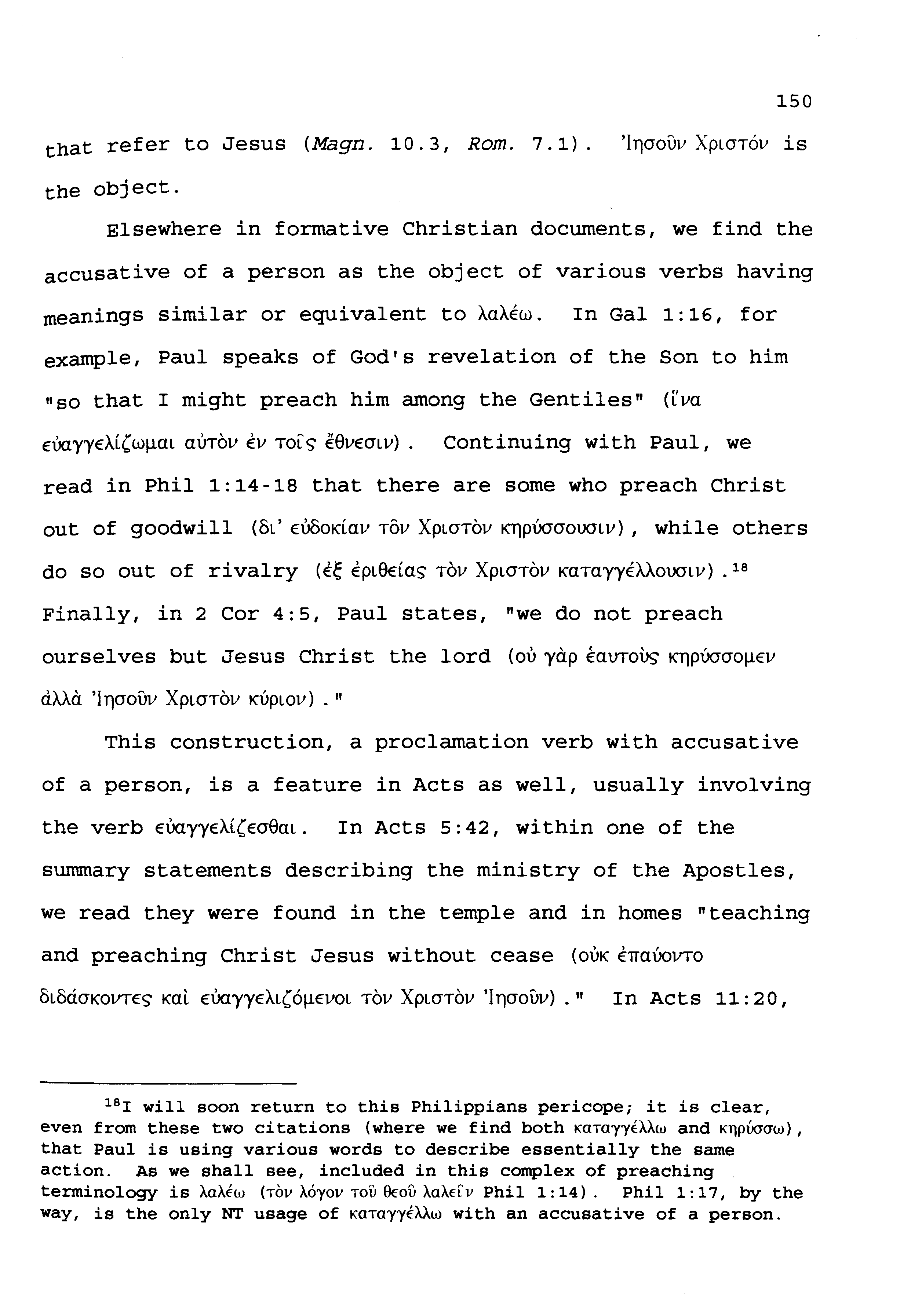
that refer to Jesus (Magn. 10.3, Rom. 7.1).
'IT)crouvXpLcrTov is the object.
Elsewhere in formative Christian documents, we find the accusative of a person as the object of various verbs having meanings similar or equivalent to AaAEw.
In Gal 1:16, for example, Paul speaks of God's revelation of the Son to him "so that I might preach him among the Gentiles" (Lva
Etxr'Y'YEA((wµm mhov E:v Tol's- €8vECJLV) .
Continuing with Paul, we read in Phil 1:14-18 that there are some who preach Christ out of goodwill (fa' EOOOK(av Tov XptcrTov KT)poocroumv) , while others do so out of rivalry (EC €pt8€lasTov XptcrTov KaTayy€AAoooLV) • 18
Finally, in 2 Cor 4:5, Paul states, "we do not preach ourselves but Jesus Christ the lord (ou yap E:aUToUsKT)poocroµEv aAAa ·1 T)crouv XptoTov KupLOv) . "
This construction, a proclamation verb with accusative of a person, is a feature in Acts as well, usually involving the verb EtxryyEAL(Ecr8m.
In Acts 5: 42, within one of the summary statements describing the ministry of the Apostles, we read they were found in the temple and in homes "teaching and preaching Christ Jesus without cease (ouK€naU0VTo
8L8cicrKoVTES' Kai EooyyEAt(oµEvOL Tov XptoTov 'IT)crouv) • "
In Acts 11: 20, 18I will soon return to this Philippians pericope; it is clear, even from these two citations (where we find both KaTG')'')'EAAW and KTJpoocrw), that Paul is using various words to describe essentially the same action.
As we shall see, included in this complex of preaching terminology is AGAEW (TOV AO')'OV TOV ernv AGAELV Phil 1: 14) .
Phil 1: 1 7, by the way, is the only NT usage of KaTa')'')'EAAW with an accusative of a person.
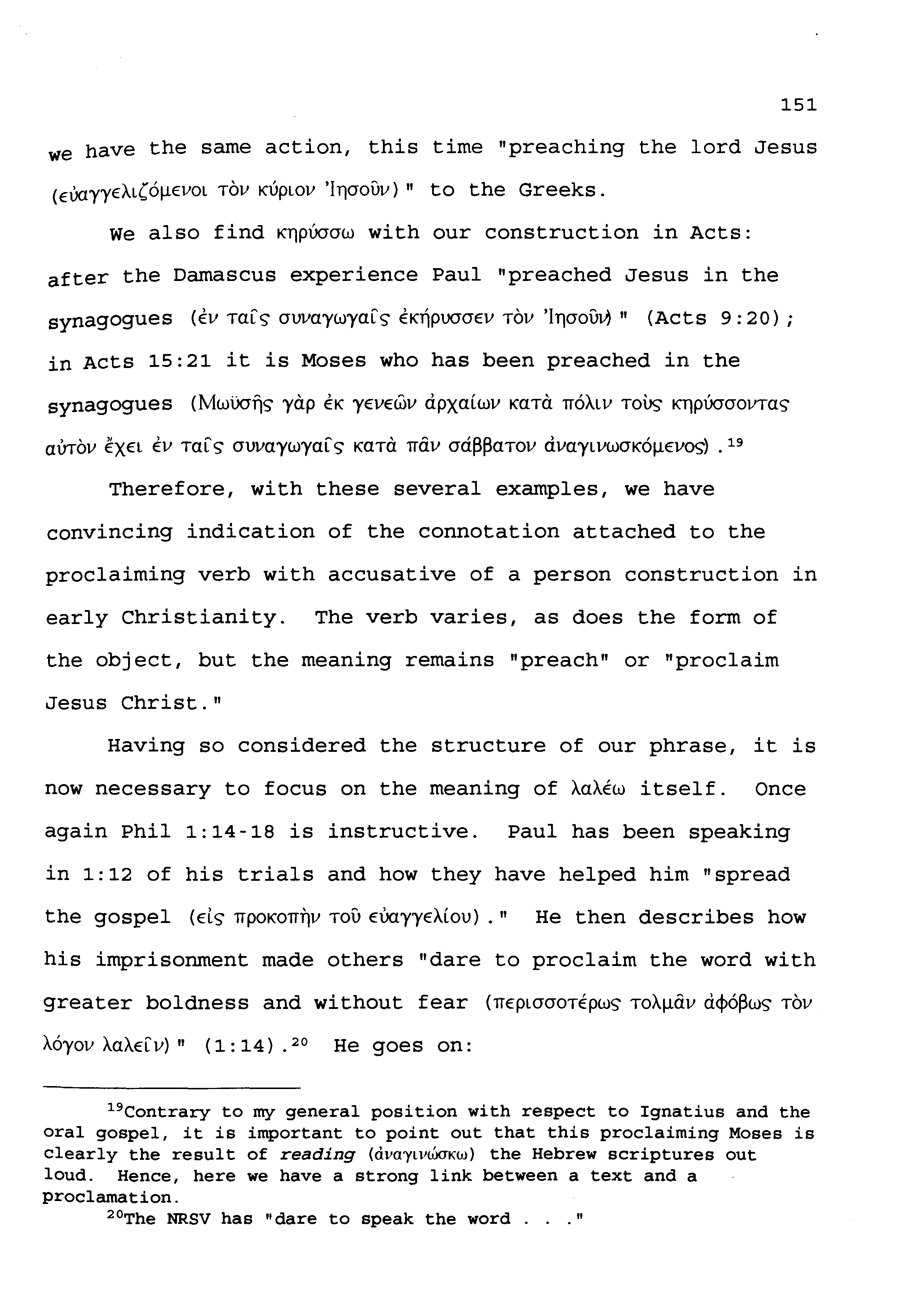
we have the same action, this time "preaching the lord Jesus (EUa'YYEAt(oµEvm Tov Kuptov 'Iriaouv) " to the Greeks. we also find KTJpliaaw with our construction in Acts: after the Damascus experience Paul "preached Jesus in the synagogues (Ev Ta[sauvaywyaCsEKtjpooaEv Tov 'Iriaou0 " (Acts 9: 20} ; in Acts 15:21 it is Moses who has been preached in the synagogues (Mwoofisyap EK yEvEwv dpxa(wv KaTa n6Atv ToiJsKTJpliaaovTasmrrov EXEL EV TaLS' auvaywya[sKQTcl lTQV ad~~aTOV dvaytvwaKoµEVOS'} . 19
Therefore, with these several examples, we have convincing indication of the connotation attached to the proclaiming verb with accusative of a person construction in early Christianity.
The verb varies, as does the form of the object, but the meaning remains "preach" or "proclaim
Jesus Christ."
Having so considered the structure of our phrase, it is now necessary to focus on the meaning of AaAEW itself.
Once again Phil 1:14-18 is instructive.
Paul has been speaking in 1:12 of his trials and how they have helped him "spread the gospel (ELS' npoKOnrw Tou EooyyEA(ou} • "
He then describes how his imprisonment made others "dare to proclaim the word with greater boldness and without fear (lTEptaaoTEpwsToAµnv d<f>6~wsTov
A6yov AaAELV} "
( 1: 14} . 20
He goes on:
19Contrary to my general position with respect to Ignatius and the oral gospel, it is important to point out that this proclaiming Moses is clearly the result of reading (civayLVwaKw) the Hebrew scriptures out loud.
Hence, here we have a strong link between a text and a proclamation.
20The NRSV has "dare to speak the word . . . "
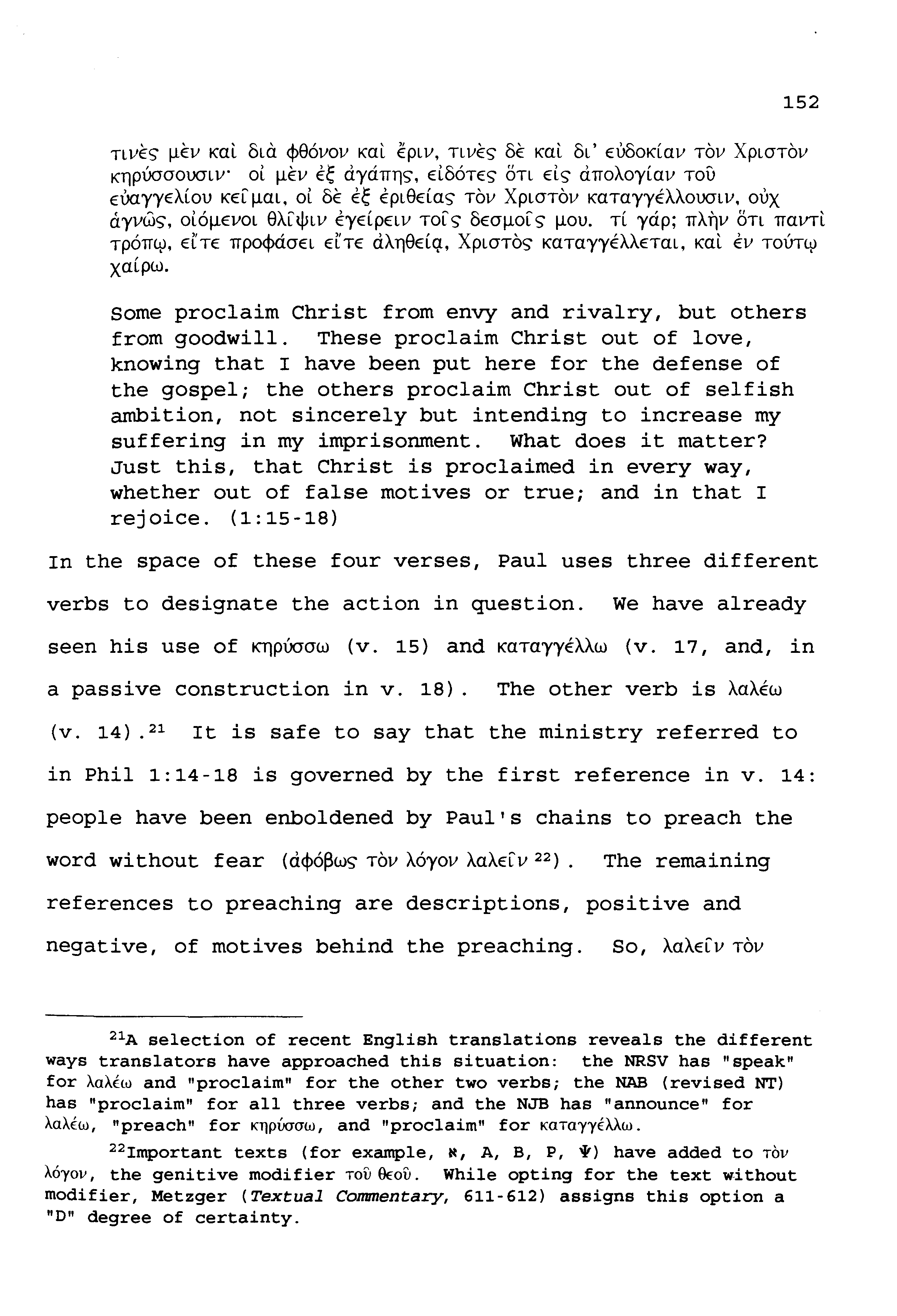
TLVES µEv KaL 8ta <f>06vov KaL €ptv, TLVES OE KaL 8t' EOOOK(av Tov XptaTov KTJpooaouatv· ot µEv E:e dycinris. ELOOTES oTL Etc; dnoAoy(av Tou
EUaYYEA(ou KEL'µm, ot oE E:e E:pt0das Tov XptaTov KaTayyEAAouaw. oux ayvwc;, otoµEVOL 0).Ctl;tv EYELpELV TOLS OEaµo[s µou.
TL ycip; 1TA~V OTL naVTL Tp6mt>, ELTE npo<f>ciaEL ELTE dAT]0ELQ., XptaToc; KaTayyEAAETm, KaL E:v TOUT<.t> xa(pw. some proclaim Christ from envy and rivalry, but others from goodwill.
These proclaim Christ out of love, knowing that I have been put here for the defense of the gospel; the others proclaim Christ out of selfish ambition, not sincerely but intending to increase my suffering in my imprisonment.
What does it matter?
Just this, that Christ is proclaimed in every way, whether out of false motives or true; and in that I rejoice. (1:15-18) In the space of these four verses, Paul uses three different verbs to designate the action in question.
We have already seen his use of KT]pooaw (v. 15) and KaTayyEAAW (v. 17, and, in a passive construction in v. 18).
The other verb is AUAEW (v. 14) . 21
It is safe to say that the ministry referred to in Phil 1:14-18 is governed by the first reference in v. 14: people have been enboldened by Paul's chains to preach the word without fear (d<f>6~ws Tov ).6yov AaAELV 22 ) • The remaining references to preaching are descriptions, positive and negative, of motives behind the preaching.
So, AaAELV Tov 21A selection of recent English translations reveals the different ways translators have approached this situation: the NRSV has "speak" for AaAElu and "proclaim" for the other two verbs; the NAB {revised NT) has "proclaim" for all three verbs; and the NJB has "announce" for A.aA.E.w, "preach" for KT)pooaw, and "proclaim" for KaTayyE.Uw.
22Important texts (for example, N, A, B, P, V) have added to Tov A.6yov, the genitive modifier Tov9Eov.
While opting for the text without modifier, Metzger (Textual Conunentary, 611-612) assigns this option a "D" degree of certainty.
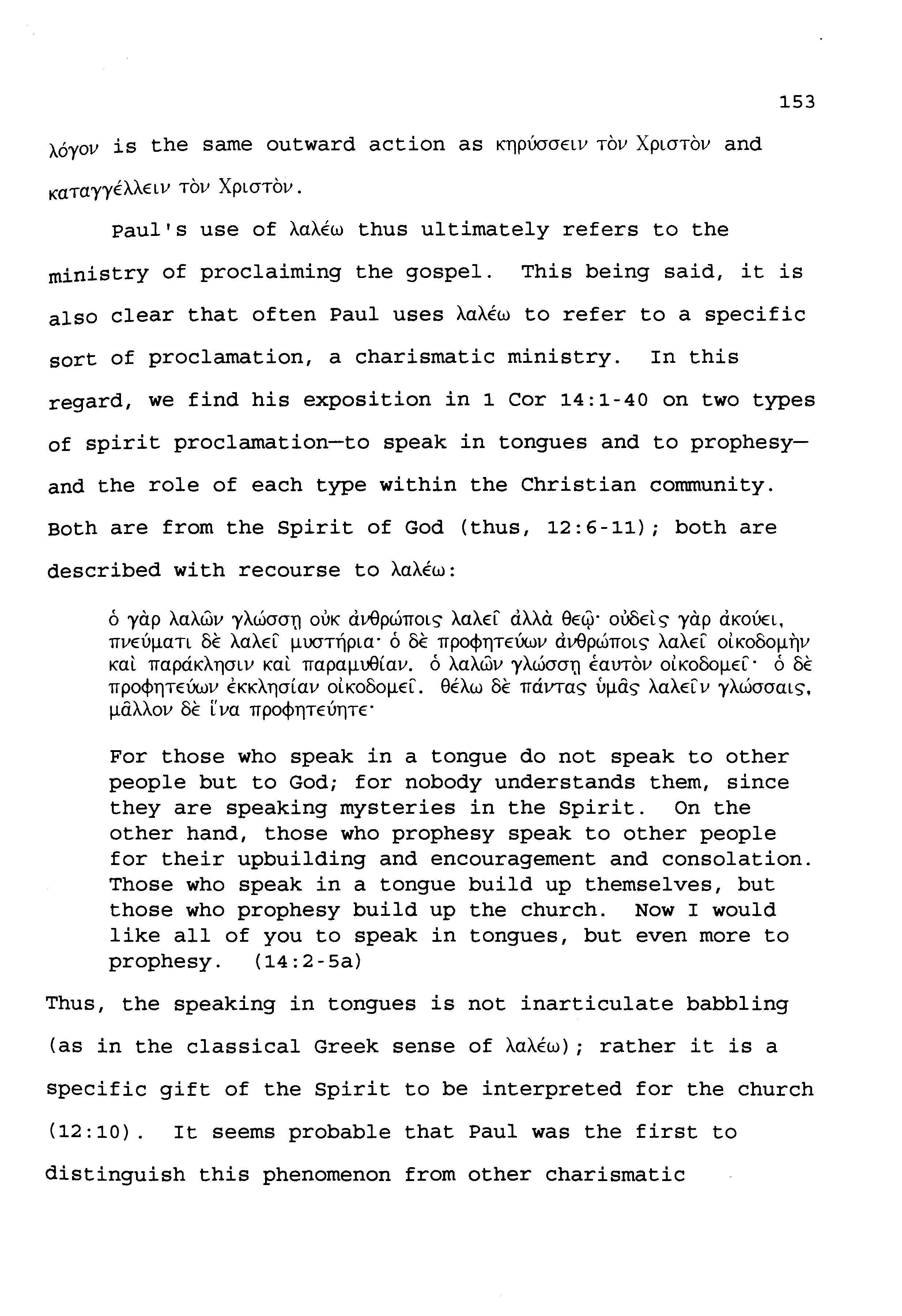
A.6yov is the same outward action as KllPOOOELV TOV XpLaTov and KaTayyD .. AELV Tov XptaTov.
Paul's use of A.aA.Ew thus ultimately refers to the ministry of proclaiming the gospel.
This being said, it is also clear that often Paul uses A.aA.€w to refer to a specific sort of proclamation, a charismatic ministry.
In this regard, we find his exposition in 1 Car 14:1-40 on two types of spirit proclamation-to speak in tongues and to prophesyand the role of each type within the Christian community.
Both are from the Spirit of God (thus, 12:6-11); both are described with recourse to A.aA.€w:
6 yap A.aA.wv yA.waa11 ouK civ0pwnmS' A.aA.EC ciA.A.a 0E4)· oooELS' yap ciKoUE:L, nvEuµaTL oE A.aA.Ef µucntjpw · 6 oE npo<f>llTEUwv civ0pwTTOLS' A.aA.Ef oLKOooµJiv
Kat napciKA.rimv Kat napaµu0(av. 6 A.aA.wv yA.waa11 E:auTov oLK08oµEf · 6 oE npo<f>llTEUwV EKKAllOLav OlKOooµEL.
9€A.w OE TTclVTGS' uµaS' AaAELV yA.waOaLS', µaA.A.ov OE i.'va npo<f>llTEUllTE"
For those who speak in a tongue do not speak to other people but to God; for nobody understands them, since they are speaking mysteries in the Spirit.
On the other hand, those who prophesy speak to other people for their upbuilding and encouragement and consolation.
Those who speak in a tongue build up themselves, but those who prophesy build up the church.
Now I would like all of you to speak in tongues, but even more to prophesy.
(14:2-Sa) Thus, the speaking in tongues is not inarticulate babbling (as in the classical Greek sense of A.aA.€w) ; rather it is a specific gift of the Spirit to be interpreted for the church
(12:10).
It seems probable that Paul was the first to distinguish this phenomenon from other charismatic
occurrence .
Prophecy, on the other hand, is the greater gift because it builds up (OLKo8oµEw) the church ( 14: 3) . 24 yet, both, as manifestations of the Spirit, are gifts from God for the common good (12:7).
Therefore, with these Philippians and Corinthians texts before us, we see that Paul's use of AaAEW involves not only the proclamation of the EooyyEALOV, but also the charismatic ministry that is among the gifts for the common good.
Paul is not alone in this particularly Christian use of AaAEW. we often find the same sort of charismatic or prophetic sense for AaAEw in Luke-Acts as well. 25
This is clearest in Acts.
Thus, at Pentecost, "all of them were filled with the Holy Spirit and began to speak in other languages, as the Spirit gave them ability (KaL EnAtjae~crav nciVTES' nvEuµaTOS' ciy(ou, KaL flpeaVTo AaAELV ETEpmS' yAwcramS' Ka8wS' To nvEuµa
E8L8ou dno<f>8EyyEcr8m m'.rroC S') " ( 2: 4) .
Peter's speech explains these astonishing events with a lengthly passage from the 23Aune, Prophecy in Early Christianity, 199; T. w. Gillespie, The First Theologians: A Study in Early Christian Prophecy (Grand Rapids:
Eerdmans, 1994) 139.
24For this 'building up the church' and its connection with the ministy of the EOO')'')'EAtol' in Paul see J. H. Schutz, Paul and the Anatomy of Apostolic Authority (London/New York: Cambridge University, 1975)
224-225.
25For a presentation of this Lukan use of A.aA.Ew see H. Jaschke, "«AGAELl'» bei Lukas: Ein Beitrag zur lukanischen Theologie," BZ 15 (1971)
109-114.
Before going any further, we must recognize (with Jaschke) the opening verses of Hebrews:
"Long ago God spoke to our ancestors in many and various ways by the prophets, but in these last days he has spoken to us by the Son (noA.vµEpWs Kai noA.VTp6m.1>S' nciA.m 6 9Eos A.aA.tjaas Tof s naTpciaLv E:v Tofs npo<!>tjTms E:n' E:axciTov Twv ~µEpwv ToiJTwv E:AciA.riaEv iJµfv E:v vi4l ) " (Heb 1: 12) .
prophet Joel (2:17-21; cf., Joel 3:1-5):
God says through the Prophet, "
. . I will pour out my Spirit upon all flesh and your sons your daughters shall prophesy
II (2:17).
This passage from Joel not only sets the context for the ministry of the Apostles throughout Acts, but it also introduces Peter's kerygmatic outline concerning Jesus• deeds, crucifixion and resurrection that immediately follows
(2:22-24).
The kerygma, in turn, is further confirmed by David ("since he was a prophet " [2:30]), who foretold and "spoke of the resurrection of the Christ (E:A.cD.:r10Ev 1TEpL TllS' dvaaTciaEWS' Tou XpLaTou) " (2: 31) .
Just as God spoke in the Prophets (2:31, 3:21, 3:22, 28:25), the message is continued in the church by the Apostles through the Spirit (ie., 4:8,
18:9) . 26 we see this unfolded throughout Acts 4-16 where the ministry of the Apostles is described as AaAELV Tov A6yov. 27
This phrase is technical language which refers to the ministry of preaching the Christian message. 28
What is more, in chapter 4 we find AaAELV Tov A6yov to be clearly a charismatic ministry of preaching.
In their united prayer (4:24-30), the Apostles refer of the guidance of the Holy
Spirit in the past (v. 25) and ask for the same guidance (v.
26Ibid., 113.
27Acts 4:29, 31, 11:19, 13:46, 14:25, 16:32.
Hence, AaA.Etv Tov A6yov functions as a Lukan abbreviation for preaching the message.
28H. Conzelmann, Acts of the Apostles (Philadelphia: Fortress, 1987) 35; Jaschke, 113; G. Kittle,
11 AEYW K.T.A. 11
TDNT IV, 114-119.
) verse 31b gives the answer to their prayer:
29 .
"and they were all filled with the Holy Spirit and spoke the word with boldness (KOL E:nA.tjaeriaov CinoVTES' TOU a:y(ou TIVEUµOTOS' KOL E:A.ciA.ouv TOV
A.6'Yov TOU 0Eou µETcl noppria(os-) .
11 29 I have emphasized both the 'proclaiming' as well as the charismatic character of A.oA.€w in the above discussion for a reason.
As we shall soon see, not only does the phrase AOAELV 'Iriaouv XpLaTov in Ignatius refer to the proclamation of the EUa'Y'YEALOv, but it also suggests that Ignatius' own sense of the ministry to the EOO'Y'YEALOv has a definite charismatic character.
While this usage is not the only indication of a charismatic ministry in Ignatius' letters, the above discussion of A.oA.€w provides a foundation for my eventual treatment of that Ignatian ministry.
With more confidence, therefore, we may now return to Ignatius.
Of the fourteen times Ignatius uses A.oA.€w, 30 five of those refer directly to Jesus, in some form of A.oA.EL'v 'Iriaouv XpwT6v (Eph. 6.2, Magn. 10.3, Trall. 9.1, Rom.
7.1, Phld. 6.1) . 31
This phrase carries a specific sense for 29The napp11ofo {"boldness") of 4: 29 and 4: 31 puts one in mind of Paul's ci<!>6f3ws Tov A6yov A.aA.Efv in Phil 1: 14 that we noted above.
What is more, as in Ignatius {Smyrn. 1.2; cf., Magn. 11.1; Trall.
9.1), this prayer contains an historical reference to Herod and Pontius Pilate which locates the death of Jesus in time and place {v. 27).
30Eph. 6.2, 15.1, 15.2; Magn. 10.3; Trall. 9.1; Rom. 7.1, 7.2, 8.2; Phld. 1.1, 6.1, 6.3, 7.1; Smyrn. 7.2; Pol. 1.3.
We also find the related npoaA.aA.Ew in Eph. 3 .1; Magn. 1. 3; and Pol. 5 .1.
31Actually, as we have seen, the accusative 'l11aow XpLaT6v is found in two of the instances {Magn. 10.3, Rom. 7.1); the genitive 'l11aovXptaTov is used with the preposition TTEpi in Eph. 6.2 and Phld. 6.1, and with the adverb xwp(s as an improper preposition in Trall. 9.1.
Thus we have
Ignatius: it is best translated in an Ignatian context as "to preach [or, "to proclaim"] Jesus Christ."
As we have already seen, throughout the seven letters Ignatius is concerned with presenting the correct way to believe in Jesus.
It is no surprise, then, to find that these AaAEW passages concerning Jesus have as their contexts polemical arguments against-what is for Ignatius-improper belief or action.
In the following paragraphs I will highlight these passages and give particular attention to indications of an oral environment for Ignatius' ministry, as well as how this usage relates to the Ignatian EUa'Y'YEALOV.
EPHESIANS 6.2
Ironically, our first AUAEW passage opens with Ignatius addressing the silence of the bishop of the Ephesians:
"And as much as anyone sees the bishop silent, all the more let that one fear him" (Eph. 6.1).
The taciturn bishop Onesimus however has spoken to Ignatius (see Eph. 5.1) in praise of the Ephesians because, as Ignatius states,
OTL TTclVTES' KUTcl dAtj9ELav (fjTE Kai OTL EV uµL'v OOOEµ(a ar pEOLS' KUTOLKEL. dAA' 000€ dKoUETE TwosTTAEov, fl TTEpi 'Irioou XpLoTou AaAouVTosEv dATJ9E(c;t. all of you [Ephesians] live according to truth and no error resides among you; for you do not listen to "preach Jesus Christ," "preach about Jesus Christ," and "preach apart from Jesus Christ."
I consider these to refer to essentially the same action {with the xwp(s phrase its negation) .
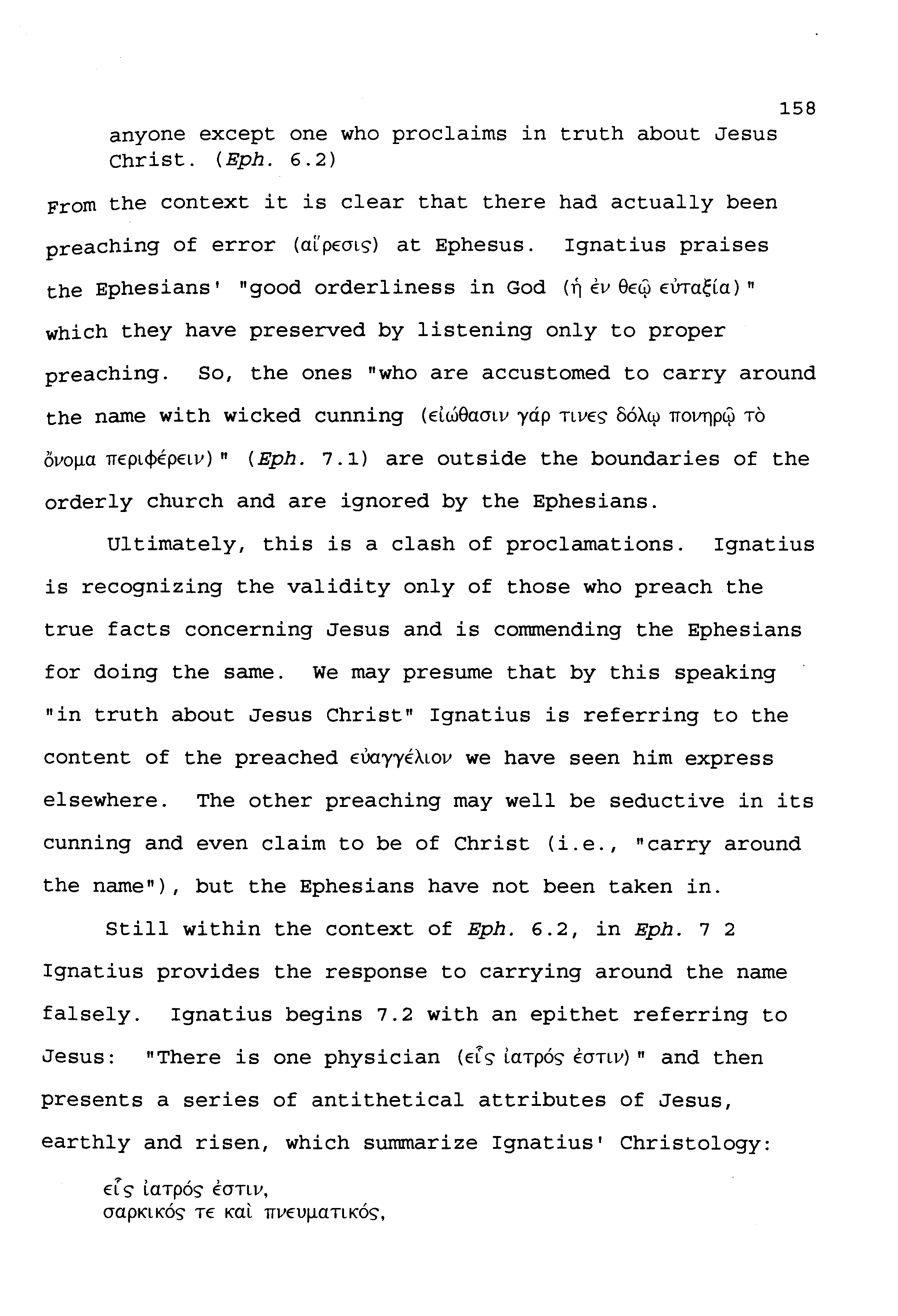
anyone except one who proclaims in truth about Jesus Christ. (Eph. 6.2) From the context it is clear that there had actually been preaching of error (atpECJLS) at Ephesus.
Ignatius praises the Ephesians' "good orderliness in God (~ E:v 0Ec{} Eifrae(a)" which they have preserved by listening only to proper preaching.
So, the ones "who are accustomed to carry around the name with wicked cunning (dweaaw ycip TLVES 86A.tp 1TOV11P4> To ovoµa nEpt<f>EpEtv)" (Eph. 7 .1) are outside the boundaries of the orderly church and are ignored by the Ephesians.
Ultimately, this is a clash of proclamations.
Ignatius is recognizing the validity only of those who preach the true facts concerning Jesus and is commending the Ephesians for doing the same.
We may presume that by this speaking "in truth about Jesus Christ" Ignatius is referring to the content of the preached Eooyy€A.tov we have seen him express elsewhere.
The other preaching may well be seductive in its cunning and even claim to be of Christ (i.e., "carry around the name"), but the Ephesians have not been taken in.
Still within the context of Eph. 6.2, in Eph. 7 2 Ignatius provides the response to carrying around the name falsely.
Ignatius begins 7.2 with an epithet referring to Jesus:
"There is one physician (ELS LaTpos E:anv)" and then presents a series of antithetical attributes of Jesus, earthly and risen, which summarize Ignatius' Christology:
) , ) Els taTpos ECJTLV, aapKlKOS TE KaL 1TVEUµaTLKOS,
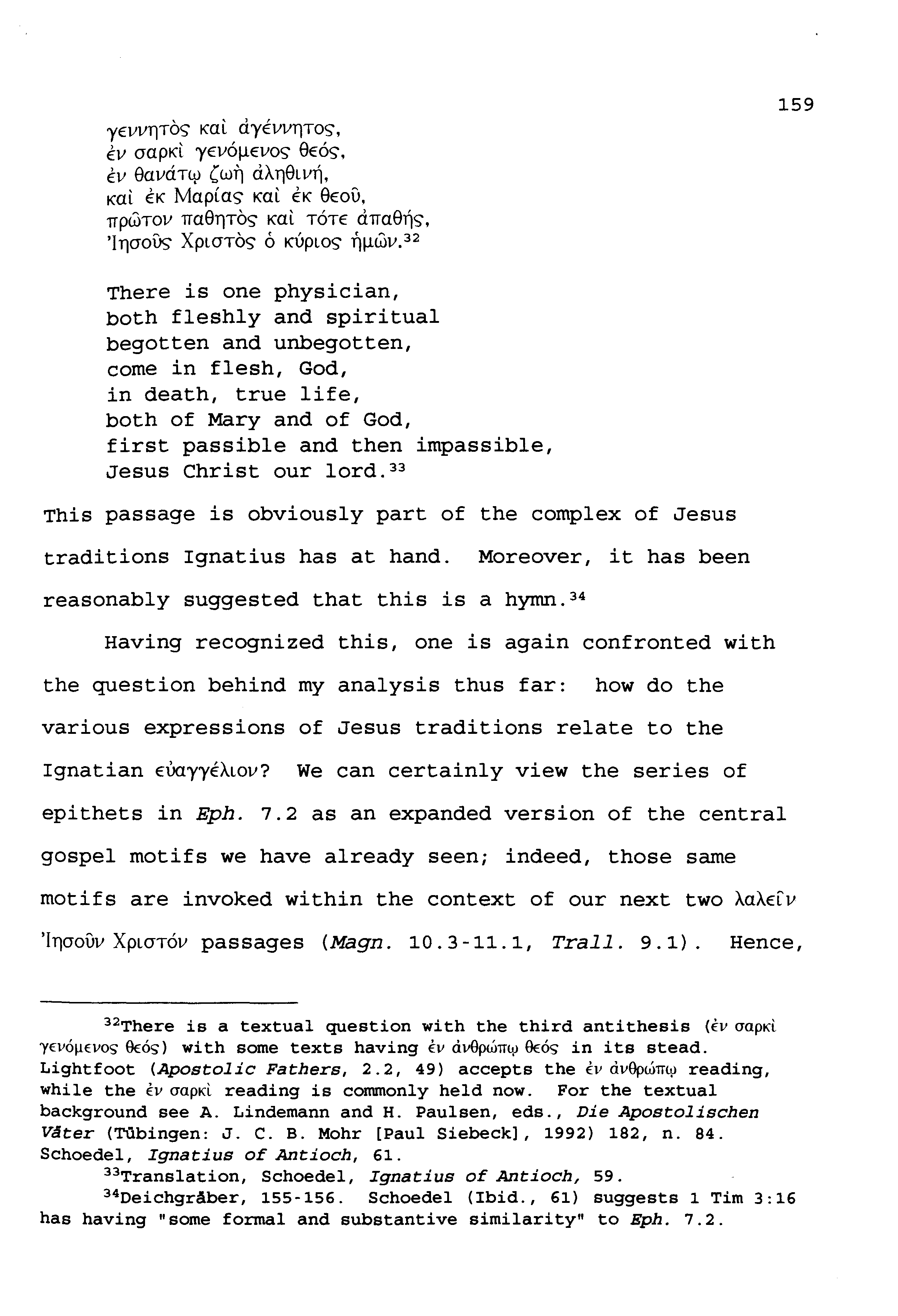
yEvV~To~ KaL dyEvv~To~.
EV aapKL yEvoµEvo~ 8E6~, EV eavciTc.p Cw~ dA.~8LVtj, Kai EK Map(a~ KaL EK 8Eou, npwTov na8~To~ Kai TOTE dnaetj~, 'I~ao~ XptaTo~ 6 icUpto~ i)µwv.32
There is one physician, both fleshly and spiritual begotten and unbegotten, come in flesh, God, in death, true life, both of Mary and of God, first passible and then impassible, Jesus Christ our lord. 33
This passage is obviously part of the complex of Jesus traditions Ignatius has at hand.
Moreover, it has been reasonably suggested that this is a hymn. 34
Having recognized this, one is again confronted with the question behind my analysis thus far: how do the various expressions of Jesus traditions relate to the Ignatian EooyyEAtov?
We can certainly view the series of epithets in Eph. 7.2 as an expanded version of the central gospel motifs we have already seen; indeed, those same motifs are invoked within the context of our next two A.aA.Etv
'l~aouv XptaTov passages (Magn. 10. 3-11. 1, Trall. 9. 1) .
Hence, 32There is a textual question with the third antithesis (Ev cmpKi )'EvoµEvos 9E6s) with some texts having Ev civ9pwntp 9E6s in its stead.
Lightfoot (Apostolic Fathers, 2. 2, 49) accepts the Ev dv9pwntp reading, while the EV aapKi reading is commonly held now.
For the textual background see A. Lindemann and H. Paulsen, eds., Die Apostolischen
Vater (TUbingen: J. c. B. Mohr [Paul Siebeck], 1992) 182, n. 84.
Schoedel, Ignatius of Antioch, 61.
33Translation, Schoedel, Ignatius of Antioch, 59.
34DeichgrAber, 155-156.
Schoedel (Ibid., 61) suggests 1 Tim 3:16 has having "some formal and substantive similarity" to Eph. 7.2.
1 suggest that this chain of epithets has at its heart the gospel of Ignatius.
MAGNESIANS 10.3
Turning, then, to the next usage of AaAEW, in Magn.
10.3 Ignatius states, "It is absurd to preach Jesus Christ and to j udaize (aToTTov EoTLV, 'Irioouv XpLoTov AaAELV KaL tou8at(EL~ . "
Again, here with the opposing infinitives AaAELV KaL toooaL(ELV, we have the juxtaposition of proper preaching with improper belief (or, perhaps, preaching).
Ignatius clinches his exposition on the relationship between Christianity and Judaism by stating that "every tongue believing in God was brought together (~ TTcroa yAwooa moTEucmoa ELS' 6Eov ouvr1x6ri) " in Christianity.
This brings to mind the EuayyEALOV passage in Phld. 9.1-2 which we have already examined:
Jesus is the door to the father through which the universal gospel is accomplished.
Next, in Magn. 11, Ignatius continues these same themes and gives content to the above suggestion of oral profession:
"be convinced of the birth and passion and resurrection which took place in the time of the leadership of Pontius Pilate (dna TTETTA'flp<Xf>opfloem Ev TTJ 'YEVVJlOEL Kat T4) TTci6EL
Kat TTJ dvaoTciOEL TTJ yEvoµEVIJ EV Kmpti) Tflsi)yEµov(asIToVT(ou ITLAciTou) "
(11.lb).
As noted before, this outline centered on Jesus presents at least the basic content of the gospel for .
Ignatius.
It functions here in the same way we have already
seen the traditional material Eph. 7.2 function: it serves as a response to those who preach Jesus while judaizing and thus are "caught on the fishooks of vain opinion (KEvoooe(a)."
What is more, the invoking of particular Jesus events, the reference to the historical rule of Pilate, as well as Ignatius' emphatic "truly and certainly (dA.116wsKaL ~E~a(ws-) "
(11.lc) all link this passage with other Christological outlines such as Trall. 9.1-2.
As I have already suggested, these belief statements are evidence that Ignatius has access to a particular type of traditional material.
It is necessary to recognize the direct link between the AaAELV 'I11aouv XpLcrTov statements, these Christological outlines or summaries, and the motifs and themes which we know constitute the Eooyy€A.wv.
TRALLIANS 9.1
In fact, the next Ignatian usage of A.aA.€w occurs in Trall. 9.1.
Here Ignatius counters the "unbelievers (amaTm) " who say Jesus' "suffering was only in appearance
(To 8oKELV nEnov6€vm m'.rrov) "
( Trall. 10) .
Trallians 9 begins with an exhortation:
"Be deaf then when anyone preaches to you apart from Jesus Christ (Kw<f>w611TE OUV, chav uµCv XWPLS" 'I11aou
XpLaTou A.aA.lj TLS") . "
It seems someone has; for Ignatius immediately provides one of his fullest Christological statements.
Just as we have seen in Magn. 11, this belief statement is presented in answer to improper preaching, it
appeals to people of history (here: David, Mary, Pilate), and is composed of traditional material redacted (again,
11dA.n8ws-") by Ignatius for the specific purpose at hand. 35
This, too, is a conflict of preaching.
Ignatius makes sure we know his side of the discussion.
In response to that which is "apart from Jesus Christ," Ignatius provides its opposite, the retelling in outline credal form of the historical events of Jesus' life, the EooyyO .. Lov.
ROMANS 7.1-3
In Rom. 7.1-2 we have two different uses of A.aA.€w.
First, we find the familiar A.aA.EL'v 'I11aouv XpwTov construction within the context of an intensely personal exhortation directed to the Romans, asking them not to assist the "ruler of this age (6 apxwv Tou atwvos-) " in corrupting his mind about God.
To this end he tells them, "do not preach Jesus Christ and desire the world (µii A.aA.EtTE 'I11aouv XpLaT6v, Koaµov 8€
Em8uµEt TE) • " 36
As we have already seen (e.g. , Magn. 1 o . 3) , Ignatius is concerned here with the relationship between words and action.
The things of the world only corrupt the 35Ibid., 152-153.
Schoedel (153) follows von Campenhausen in his discussion of Trall. 9.1-2:
"traditional materials from a variety of sources come and go within the framework
Moreover the framework itself seems directly determined by the use to which Ignatius put these themes."
See H. von Campenhausen, "Das Bekenntnis im Urchristentum,
ZNW 63 (1972) 234-253.
36It is notable that H. 0. Maier translates this as "Do not profess Jesus Christ, and desire the world" [emphasis mine].
Maier, "Charismatic Authority," 197.
proper knowledge of God and thus are not compatible with preaching Jesus.
Based on what we have observed so far, we may presume that 'preaching Jesus' includes the historical events of the EooyyEA.Lov embodied in the church of Ignatius' time.
While the second use of A.aA.Ew, in Rom. 7.2, is not a "AaAELV 'I11crouv XpLcrTov" passage and thus does not ref er to preaching Jesus per se, this particular usage is central to our understanding Ignatius' intention in Rom. 7 as a whole.
In Rom. 7.2 mistrust of the world is further expressed; this time, Ignatius refers to his own experience:
"my craving has been crucified and there is no matter-loving fire in me; but there is only water, living and speaking within me (U8wp
8E (wv Kai A.aA.ouv EV Eµo() , saying to me from within, 'Corne to the Father. '" 37
Later on, this intriguing text will be 37This use of AOAEw is contested.
Lightfoot states that the text here "has been much tumbled about in very early times" and somewhat cautiously considers ciAA6µEvov to be the correct reading in the place of KOL AoAow.
This would link the Ignatian text with John 4:14
(rr~y~ oooTos aAAoµfoou Eis (w~v oi.wvwv) .
'AU6µEvov is the reading from the long rescension of Romans which, while it has a separate pre-history from the other letters in that rescension, is heavily interpolated.
Lightfoot is alone in his decision.
Lightfoot, Apostolic Fathers, 2.2, 224-225.
Bauer/Paulsen (Briefe des Ignatius, 76), Grant (Apostolic Fathers, vol.
4, 94), Lindemann/Paulsen (Die Apostolischen Vater, 214), Schoedel (who makes no mention of the problem: Ignatius of Antioch, 184-185) and Zahn
(Ignatius von Antiochien, 563) all accept KOL AoAovv as the correct reading.
Aside from the textual considerations, it seems valid to stay with the KOL AoAow reading for several reasons:
(a) the water in the next phrase is indeed speaking; (b) there is little indication of Ignatius having contact with Johannine traditions; and, (c) as I will soon point out, there seems to be a stronger link with the living and speaking water in the Odes of Solomon.
important for my discussion of Ignatius' ministry to the tradition; at this point, we may briefly anticipate that treatment as well as elucidate our present concerns with a brief excursus concerning this "living and speaking water."
While we may inunediately think of John 4:14 or 7:38 for assistance in understanding this Ignatian pericope, perhaps closest in time and place to Ignatius is the usage in the odes of Solomon. 38
Ode XI begins with the author declaring his heart circumcised by the Most High with the Holy Spirit
(6 \XµLO"TOS' TTEpLETEµEv µE Tc.\) ciy(c.p TTVEuµan m'.rrou) (XI. 2) i in verses 59, the author continues:
EaTT)p(x0riv dTTo aTEpEc'iS' TTETpaS'
OTTOU µE O"U')'KEKcI9LKEV
Kai TO oowp TO AaAOUV ~'Y')'LO"E TTPOS' Tel XELAT) µou dTTo TTTl'YllS' (wflS' Kup(ou EV dcf>0ov(q m'.rrou
ETTLOV Kai EµE0oo011v oowp TO d0avaTOV Kai Ti µ€011 µou ouK E')'EVETO ELS' dA.oywT(av dAA.' ECETpciTTT)V Twv µaTa(wv ETTL Tov iJlµLaTov 0E6v µou . . .
And I was established on the firm rock, Where he set me; And speaking waters touched my lips From the Lord's spring [of life] without grudging;
And I drank, and was intoxicated By the {living,} inunortal, waters; And my intoxication was not without knowledge,
38The Odes of Solomon are usually dated around the year 100 C.E.
J. H. Charlesworth, ed. The Old Testament Pseudepigrapha vol. 2 (Garden City: Doubleday, 1985) 727.
Ignatius' literary dependence on the Odes has been suggested.
R. M. Grant points to the probability that Ignatius knew one or another of the Odes and concludes:
"In any event his letters and the Odes come from the same spiritual environment."
R. M.
Grant, "The Odes of Solomon and the Church of Antioch," JBL 63 (l,.944) 372; V. Corwin states that "the most probable conclusion is that he knew at least some of the Odes." v. Corwin, St. Ignatius, 72.
But I turned from vanities Towards the Most High, my God
clearly the living and speaking waters of Ode XI are directly linked with the Holy Spirit, they provide knowledge of truth, and lead to the abandonment of worldly vanities. of course, these are all Ignatian themes as well. 40
For Ignatius, the Spirit-living water in Rom. 7.2 has not only quenched the fire of his worldly longings, but through this quenching it has also exhorted the bishop to "Come to the Father."
While at first glance it may not seem that the speaking water is announcing the EooyyEA.Lov, in the next verse (Rom. 7.3) Ignatius-this time using food as metaphor-sets up a chain of linked statements which end with the themes surrounding the EooyyEA.Lov.
First, he provides a parallel to 7.2 by stating he has no desire for the food of corruption (oux ~ooµm npo<f>fl <f>0opo<;) but rather desires the bread of God (apTOV 0rnu 0EA.w) .
So, we have again the longings for this world contrasted with the longings for God.
Next, Ignatius tells us that the bread of God is "the 39I have added to the translation material found only in Greek, in brackets ([]), and only in Syriac, in braces <{}>.
For both Greek and Syriac texts see M. Lattke, Die Oden Salomos in ihrer Bedeutung fur
Neues Testament und Gnosis OBO 25/1 (Fribourg [Suisse] : Editions Universitaires; GOttingen: Vandenhoeck und Ruprecht, 1979) 106-113.
40While Ignatius in Rom. 7.2 does not explicitly link the living and speaking water with the Spirit, as I will soon point out, the action of the Spirit is suggested.
In fact, the living and speaking water in Ignatius can be associated with both the baptismal waters as well as the Spirit.
It seems best, however, to regard the two together:
"Both baptism and the Spirit are so intertwined in the thought of Ignatius . that the two conceptions should probably not be separated."
D. E.
Aune, Prophecy in Early Christianity, 294.
flesh of Jesus Christ who was of the seed of David (o EOTLV aape 'lT)OOU XpLOTOU, TOU EK anE:pµaTOS' ~aUEL8) . II Then, he tells us that for drink he desires the blood of Christ which "is incorruptible love (o EOTLV frycinT) d<t>8apTos-) • "
As we have seen in Phld. 5.1 and Phld. 9.2, the reference to the historical flesh of Jesus (that from David), as well as the reference to incorruption, suggest the EooyyE:A.Lov and its content. so here is my point: in Rom. 7.1-3 Ignatius is working within a general ambiance centered on what he has referred to as the EooyyE:A.Lov.
The spirit-proclamation of the quenching and living water exhorts Ignatius to "Come to the Father. "
The EooyyE:A.Lov in Phld. 9. 1-2 comes to mind:
Jesus is entrusted with the secrets of God and is thus the door to the Father; Jesus' coming, passion and resurrection (i.e., the content of the EooyyE:A.Lov) are the completion of incorruption.
All of this, coupled with the gospel themes of the historical flesh of Jesus (Phld. 5.1, 9.2, Rom. 7.3), place us squarely within the pervasive context of the Ignatian EooyyE:A.Lov.
The Spirit exhortation of the water within is calling Ignatius to a denial of worldly things and a faithfulness to the gospel.
Here, of course, we are brought full circle back to Ignatius' own exhortation to gospel faithfulness which first attracted us to this pericope: µit A.aAELTE 'IT)aouv XpLaTov, Koaµov BE: E-m8uµELTE (Rom.
7.1).
This is a reference to the oral gospel preached with authority.
Thus, these usages of AaAEW in the context of Rom. 7.13 are central for our consideration not only of the oral gospel environment of Ignatius' situation, but it will also become just as pivotal when we examine Ignatius' own position of authority vis-a-vis the Jesus traditions.
PHILADELPHIANS 6.1-7.2
we have seen the reference to the EooyyEALov Tf]stcOLvflS'
EA1TLOOS' at the end of Phld. s.
Philadelphians 6 opens by combining €av8E with an aorist subjunctive in the protasis of a conditional sentence:
"But if anyone intreprets Judaism to you .
( 'Eav OE TLS' LOuOal·aµov €pµ'flVEU1J uµCv ... ) . II The apodosis of the conditional sentence contains the verb dtcol1w in the present tense, thus setting up a present general condition:
" ... do not listen to him ( ... µ~ dtcoocTE m'.rrou) • 11 41 This use of the adversative conjunction with a present general condition expresses a contrast with what has been stated immediately before.
The contrast is between proclaiming the EooyyEALov (Phld. 5) and proclaiming an interpretation (€pµ'flVEUw) of Judaism. 42
After declaring this opposition to the EooyyEALov, Ignatius continues with the somewhat puzzling phrase, "for it is better to hear
41'AKOVETE is either indicative or imperative; it seems within the context that the imperative sense is meant here.
42See BAGD, 310.
Christianity from a man who is circumcised than Judaism from one who is uncircumcised (aµELvov ycip ECJTLV napa dvoposnEpL Toµiiv
€xoVTosxpwnavwµov dKol1ELv, ~ napa dKpo~ooTou [ou8ai:aµ6v) "
( Phld.
6.1a).
This obvious reference to oral exposition is centered on the same issues present in Magn. 10.3:
Ignatius is concerned with the boundaries between the church of Christ and Judaism, specifically, judaizing activity in Philadelphia. 43
This being said, my present interest lies not with the polemic of this passage (fascinating as it is), but with the oral nature of the environment presumed by Ignatius.
That oral environment is clearly present not only in the Phld.
6.la passages cited above, but is further confirmed as Ignatius continues in Phld. 6.
First, in Phld. 6.lb, Ignatius employs an echo of a Jesus logion (cf., Matt 23:27) to describe the preachers in error:
Eav oE dµ<f>oTEpm nEpL 'Iriaou XpLaTou µii A.aA.waw, ouTm Eµoi aTfiA.a( ELCJLV KUL Tci<f>m VEKpwv. €<f>' OL S' )'E)'palTTaL µovov ovoµaTa dv0pwnwv.
But if either of them [circumcised or not] do not preach about Jesus Christ, they are to me tombstones and sepulchres of the dead on which are written only the names of people.
Here, with a negative version of the A.aA.El'v hpouv XpwTov (infinitive with nEp( and genitive) construction, Ignatius is again setting the boundaries that define the true
43I will fully treat this sentence, Phld. 6.la, and the boundarysetting function of the EOO'Y'YEALOv in Part Two.
tradition.
Referring to a judaizing interpretation of (presumably) the gospel, he makes it clear that such interpretation is not the way to approach Christianity.
Thus, the oppositional nature of the text is extended from €pµnvEUw lou8al."oµ6v ( Phld. 6. la) -which has the Eooyy€A.Lov in Phld. 5 as its opposite-through to A.aA.€w 'Irioouv XpLoT6v (Phld.
6. lb).
That is not all.
Ignatius continues in Phld. 6.2 by exhorting the Philadelphians to gain church unity by fleeing from the evil arts, snares and purpose (~ yvwµri> of the "prince of this age (apxoVTosTou alwvosToU-rou) . 1144
This evil divisive activity, it seems, is expressed through the erroneous interpretations-alluded to in 6.1-that are not of Jesus Christ.
Ignatius next, in Pauline fashion, 45 claims not to have been a burden for those to whom he has ministered (Phld. 6.3a).
Most telling for my present concerns, however, is that in 6.3b Ignatius provides a clue to the nature of his ministry:
"And I pray for all among whom I spoke, so that it may not be a witness against them (Kai ncioL 8€, EV ol'sEAciA.rioa,
Euxoµm, l'va µi) ElsµapTupLov m'.rro KTfiowVTm) . "
Ignatius is recalling his preaching among the Philadelphians; it is a witness (µapTupLov) that he prays does not convict them of 44This appears to be in deliberate contrast to the yvwµ~ of God in, for example, Eph. 3.2 and Smyrn. 6.2.
Thus, we have a contrast to the saving events of the EixryyO .. wv suggested here.
45Cf., 1 Thess 2:7, 9; 2 Cor 11:9, 12:16.
disunity.
So, we may safely assume that the content of Ignatius' preaching to the Philadelphians is the EooyyEA.Lov of Phld. s.2: in contrast to those mentioned in 6.1, Ignatius has truly preached Jesus Christ.
His preaching is a witness to unity in the "gospel of the common hope."
This unity focused on the gospel comes to the fore in Phld. 7.1-2 as Ignatius further describes his preaching among the Philadelphians.
He begins by locating the source of his true preaching in the Spirit which is from God (tlA.A.a TO lTVEUµa OU lTAavaTm UlTO 0EOU ov) ( 7. la) .
Then, in an arresting passage (7.lb), Ignatius describes his preaching "I cried out among you, preaching in a great voice, the voice of God
(E:Kpa{ryaaa µETaeu wv, E:A.ciA.ouv µEyciA.lJ <t>wvfl, 0Eou <f>wvfl) . "
A bit later, in 7.2b, Ignatius gives another description of the same event:
"but the Spirit was preaching, saying .
lTVEuµa EKtjpuaaEv AEyov TcioE· ... ) . 11 46 So, Ignatius describes this event three times: first, in passing, in 6.3b ("that it not be a witness against them"); then in the two above citations of 7.lb and 7.2b.
I have already suggested that in 6.3b, while he gives us no clear indication, unity in the common gospel seems to have been the content of Ignatius' preaching to the 46There is a clear prophetic quality to this event.
The prophetic nature of Ignatius' leadership and ministry to the EOO)"YEALOV is a subject
I will treat further along.
Phld. 7.2b, by the way, is the only use of K~piKrcrw in the letters of Ignatius.
In this context, it carrys the same meaning as the Ignatian >.a>.Ew of Phld. 6.3b which is the first mention of the event.