
Part 36
Tyre consisted of two distinct parts, a rocky fortress on the mainland, called "Old Tyre," and the city, built on a small, rocky island about half-a-mile distant from the shore. It was a place of great strength. It was besieged by Shalmaneser, who was assisted by the Phoenicians of the mainland, for five years, and by Nebuchadnezzar (B.C. 586-573) for thirteen years, apparently without success. It afterwards fell under the power of Alexander the Great, after a siege of seven months, but continued to maintain much of its commercial importance till the Christian era. It is referred to in Matthew 11:21 and Acts 12:20. In A.D. 1291 it was taken by the Saracens, and has remained a desolate ruin ever since.
"The purple dye of Tyre had a worldwide celebrity on account of the durability of its beautiful tints, and its manufacture proved a source of abundant wealth to the inhabitants of that city."
Both Tyre and Sidon "were crowded with glass-shops, dyeing and weaving establishments; and among their cunning workmen not the least important class were those who were celebrated for the engraving of precious stones." (2 Chronicles 2:7,14).
The wickedness and idolatry of this city are frequently denounced by the prophets, and its final destruction predicted (Isaiah 23:1; Jeremiah 25:22; Ezekiel 26; 28:1-19; Amos 1:9, 10; Zechariah 9:2-4).
Here a church was founded soon after the death of Stephen, and Paul, on his return from his third missionary journey spent a week in intercourse with the disciples there (Acts 21:4). Here the scene at Miletus was repeated on his leaving them. They all, with their wives and children, accompanied him to the sea-shore. The sea-voyage of the apostle terminated at Ptolemais, about 38 miles from Tyre. Thence he proceeded to Caesarea (Acts 21:5-8).
"It is noticed on monuments as early as B.C. 1500, and claiming, according to Herodotus, to have been founded about B.C. 2700. It had two ports still existing, and was of commercial importance in all ages, with colonies at Carthage (about B.C. 850) and all over the Mediterranean. It was often attacked by Egypt and Assyria, and taken by Alexander the Great after a terrible siege in B.C. 332. It is now a town of 3,000 inhabitants, with ancient tombs and a ruined cathedral. A short Phoenician text of the fourth century B.C. is the only monument yet recovered."
VALLEY (i.e., "Valley of the Cheesemongers"), the name given by Josephus the historian to the valley or rugged ravine which in ancient times separated Mount Moriah from Mount Zion. This valley, now filled up with a vast accumulation of rubbish, and almost a plain, was spanned by bridges, the most noted of which was Zion Bridge, which was probably the ordinary means of communication between the royal palace on Zion and the temple. A fragment of the arch (q.v.) of this bridge (called "Robinson's Arch"), where it projects from the sanctuary wall, was discovered by Robinson in 1839. This arch was destroyed by the Romans when Jerusalem was taken.
The western wall of the temple area rose up from the bottom of this valley to the height of 84 feet, where it was on a level with the area, and above this, and as a continuance of it, the wall of Solomon's cloister rose to the height of about 50 feet, "so that this section of the wall would originally present to view a stupendous mass of masonry scarcely to be surpassed by any mural masonry in the world."
the name of a person to whom Agur's words are addressed (Proverbs 30:1).
the Eulaus of the Greeks; a river of Susiana. It was probably the eastern branch of the Choasper (Kerkhan), which divided into two branches some 20 miles above the city of Susa. Hence Daniel (8:2,16) speaks of standing "between the banks of Ulai", i.e., between the two streams of the divided river.
•UMMAH vicinity, a town of Asher (Joshua 19:30).
(1 John 2:20,27; R.V., "anointing"). Kings, prophets, and priests were anointed, in token of receiving divine grace. All believers are, in a secondary sense, what Christ was in a primary sense, "the Lord's anointed."
described as an animal of great ferocity and strength (Numbers 23:22, R.V., "wild ox," marg., "ox-antelope;" 24:8; Isaiah 34:7, R.V., "wild oxen"), and untamable (Job 39:9). It was in reality a two-horned animal; but the exact reference of the word so rendered (reem) is doubtful. Some have supposed it to be the buffalo; others, the white antelope, called by the Arabs rim. Most probably, however, the word denotes the Bos primigenius ("primitive ox"), which is now extinct all over the world. This was the auerochs of the Germans, and the urus described by Caesar (Galatians Bel., vi.28) as inhabiting the Hercynian forest. The word thus rendered has been found in an Assyrian inscription written over the wild ox or bison, which some also suppose to be the animal intended (comp. Deuteronomy 33:17; Psalm 22:21; 29:6; 92:10).
afficted. (1.) A Levite whom David appointed to take part in bringing the ark up to Jerusalem from the house of Obed-edom by playing the psaltery on that occasion (1 Chronicles 15:18, 20).
(2.) A Levite who returned with Zerubbabel from the Captivity (Nehemiah 12:9).
and they divide, one of the words written by the mysterious hand on the wall of Belshazzar's palace (Daniel 5:25). It is a pure Chaldean word. "Peres" is only a simple form of the same word.
probably another name for Ophir (Jeremiah 10:9). Some, however, regard it as the name of an Indian colony in Yemen, southern Arabia; others as a place on or near the river Hyphasis (now the Ghana), the south-eastern limit of the Punjaub.
light, or the moon city, a city "of the Chaldees," the birthplace of Haran (Genesis 11:28,31), the largest city of Shinar or northern Chaldea, and the principal commercial centre of the country as well as the centre of political power. It stood near the mouth of the Euphrates, on its western bank, and is represented by the mounds (of bricks cemented by bitumen) of el-Mugheir, i.e., "the bitumined," or "the town of bitumen," now 150 miles from the sea and some 6 miles from the Euphrates, a little above the point where it receives the Shat el-Hie, an affluent from the Tigris. It was formerly a maritime city, as the waters of the Persian Gulf reached thus far inland. Ur was the port of Babylonia, whence trade was carried on with the dwellers on the gulf, and with the distant countries of India, Ethiopia, and Egypt. It was abandoned about B.C. 500, but long continued, like Erech, to be a great sacred cemetery city, as is evident from the number of tombs found there. (See ABRAHAM.)
The oldest king of Ur known to us is Ur-Ba'u (servant of the goddess Ba'u), as Hommel reads the name, or Ur-Gur, as others read it. He lived some twenty-eight hundred years B.C., and took part in building the famous temple of the moon-God Sin in Ur itself. The illustration here given represents his cuneiform inscription, written in the Sumerian language, and stamped upon every brick of the temple in Ur. It reads: "Ur-Ba'u, king of Ur, who built the temple of the moon-God."
"Ur was consecrated to the worship of Sin, the Babylonian moon-God. It shared this honour, however, with another city, and this city was Haran, or Harran. Harran was in Mesopotamia, and took its name from the highroad which led through it from the east to the west. The name is Babylonian, and bears witness to its having been founded by a Babylonian king. The same witness is still more decisively borne by the worship paid in it to the Babylonian moon-God and by its ancient temple of Sin. Indeed, the temple of the moon-God at Harran was perhaps even more famous in the Assyrian and Babylonian world than the temple of the moon-God at Ur.
"Between Ur and Harran there must, consequently, have been a close connection in early times, the record of which has not yet been recovered. It may be that Harran owed its foundation to a king of Ur; at any rate the two cities were bound together by the worship of the same deity, the closest and most enduring bond of union that existed in the ancient world. That Terah should have migrated from Ur to Harran, therefore, ceases to be extraordinary. If he left Ur at all, it was the most natural place to which to go. It was like passing from one court of a temple into another.
"Such a remarkable coincidence between the Biblical narrative and the evidence of archaeological research cannot be the result of chance. The narrative must be historical; no writer of late date, even if he were a Babylonian, could have invented a story so exactly in accordance with what we now know to have been the truth. For a story of the kind to have been the invention of Palestinian tradition is equally impossible. To the unprejudiced mind there is no escape from the conclusion that the history of the migration of Terah from Ur to Harran is founded on fact" (Sayce).
the Lord is my light. (1.) A Hittite, the husband of Bathsheba, whom David first seduced, and then after Uriah's death married. He was one of the band of David's "mighty men." The sad story of the curel wrongs inflicted upon him by David and of his mournful death are simply told in the sacred record (2 Samuel 11:2-12:26). (See BATHSHEBA; DAVID.)
(2.) A priest of the house of Ahaz (Isaiah 8:2).
(3.) The father of Meremoth, mentioned in Ezra 8:33.
•URIEL God is my light. (1.) A Levite of the family of Kohath (1 Chronicles 6:24).
(2.) The chief of the Kohathites at the time when the ark was brought up to Jerusalem (1 Chronicles 15:5, 11).
(3.) The father of Michaiah, one of Rehoboam's wives, and mother of Abijah (2 Chronicles 13:2).
the Lord is my light. (1.) A high priest in the time of Ahaz (2 Kings 16:10-16), at whose bidding he constructed an idolatrous altar like one the king had seen at Damascus, to be set up instead of the brazen altar.
(2.) One of the priests who stood at the right hand of Ezra's pulpit when he read and expounded the law (Nehemiah 8:4).
(3.) A prophet of Kirjath-jearim in the reign of Jehoiakim, king of Judah (Jeremiah 26:20-23). He fled into Egypt from the cruelty of the king, but having been brought back he was beheaded and his body "cast into the graves of the common people."
•URIM lights (Vulg."doctrina;" LXX. "revelation"). See THUMMIM.
the sum paid for the use of money, hence interest; not, as in the modern sense, exorbitant interest. The Jews were forbidden to exact usury (Leviticus 25:36, 37), only, however, in their dealings with each other (Deuteronomy 23:19, 20). The violation of this law was viewed as a great crime (Psalm 15:5; Proverbs 28:8; Jeremiah 15:10). After the Return, and later, this law was much neglected (Nehemiah 5:7, 10).
fertile land. (1.) The son of Aram, and grandson of Shem (Genesis 10:23; 1 Chronicles 1:17).
(2.) One of the Horite "dukes" in the land of Edom (Genesis 36:28).
(3.) The eldest son of Nahor, Abraham's brother (Genesis 22:21, R.V.).
a wanderer, a descendant of Joktan (Genesis 10:27; 1 Chronicles 1:21), the founder apparently of one of the Arab tribes; the name also probably of the province they occupied and of their chief city.
THE LAND OF where Job lived (1:1; Jeremiah 25:20; Lamentations 4:21), probably somewhere to the east or south-east of Palestine and north of Edom. It is mentioned in Scripture only in these three passages.
strengh, a garden in which Manasseh and Amon were buried (2 Kings 21:18, 26). It was probably near the king's palace in Jerusalem, or may have formed part of the palace grounds. Manasseh may probably have acquired it from some one of this name.
strength, a son of Abinadab, in whose house the men of Kirjath-jearim placed the ark when it was brought back from the land of the Philistines (1 Samuel 7:1). He with his brother Ahio drove the cart on which the ark was placed when David sought to bring it up to Jerusalem. When the oxen stumbled, Uzzah, in direct violation of the divine law (Numbers 4:15), put forth his hand to steady the ark, and was immediately smitten unto death. The place where this occurred was henceforth called Perez-uzzah (1 Chronicles 13:11). David on this feared to proceed further, and placed the ark in the house of Obed-edom the Gittite (2 Samuel 6:2-11; 1 Chronicles 13:6-13).
a town probably near Beth-horon. It derived its name from the daughter of Ephraim (1 Chronicles 7:24).
the Lord is my strength. (1.) The son of Bukki, and a descendant of Aaron (1 Chronicles 6:5, 51; Ezra 7:4).
(2.) A grandson of Issachar (1 Chronicles 7:2, 3).
(3.) A son of Bela, and grandson of Benjamin (1 Chronicles 7:7).
(4.) A Benjamite, a chief in the tribe (1 Chronicles 9:8).
(5.) A son of Bani. He had the oversight of the Levites after the return from captivity (Nehemiah 11:22).
(6.) The head of the house of Jedaiah, one of "the chief of the priests" (Nehemiah 12:19).
(7.) A priest who assisted in the dedication of the walls of Jerusalem (Nehemiah 12:42).
a contracted form of Azari'ah the Lord is my strength. (1.) One of Amaziah's sons, whom the people made king of Judah in his father's stead (2 Kings 14:21; 2 Chronicles 26:1). His long reign of about fifty-two years was "the most prosperous excepting that of Jehosaphat since the time of Solomon." He was a vigorous and able ruler, and "his name spread abroad, even to the entering in of Egypt" (2 Chronicles 26:8, 14). In the earlier part of his reign, under the influence of Zechariah, he was faithful to Jehovah, and "did that which was right in the sight of the Lord" (2 Kings 15:3; 2 Chronicles 26:4, 5); but toward the close of his long life "his heart was lifted up to his destruction," and he wantonly invaded the priest's office (2 Chronicles 26:16), and entering the sanctuary proceeded to offer incense on the golden altar. Azariah the high priest saw the tendency of such a daring act on the part of the king, and with a band of eighty priests he withstood him (2 Chronicles 26:17), saying, "It appertaineth not unto thee, Uzziah, to burn incense." Uzziah was suddenly struck with leprosy while in the act of offering incense (26:19-21), and he was driven from the temple and compelled to reside in "a several house" to the day of his death (2 Kings 15:5, 27; 2 Chronicles 26:3). He was buried in a separate grave "in the field of the burial which belonged to the kings" (2 Kings 15:7; 2 Chronicles 26:23). "That lonely grave in the royal necropolis would eloquently testify to coming generations that all earthly monarchy must bow before the inviolable order of the divine will, and that no interference could be tolerated with that unfolding of the purposes of God, which, in the fulness of time, would reveal the Christ, the true High Priest and King for evermore" (Dr. Green's Kingdom of Israel, etc.).
(2.) The father of Jehonathan, one of David's overseers (1 Chronicles 27:25).
strength of God. (1.) One of the sons of Kohath, and uncle of Aaron (Exodus 6:18; Leviticus 10:4).
(2.) A Simeonite captain (1 Chronicles 4:39-43).
(3.) A son of Bela, and grandson of Benjamin (1 Chronicles 7:7).
(4.) One of the sons of Heman (1 Chronicles 25:4); called also Azareel (18).
(5.) A son of Jeduthan (2 Chronicles 29:14).
(6.) The son of Harhaiah (Nehemiah 3:8).
from Lat. vagabundus, "a wanderer," "a fugitive;" not used opprobriously (Genesis 4:12, R.V., "wanderer;" Psalm 109:10; Acts 19:13, R.V., "strolling").
purity; worthy of honour, one of Haman's sons, whom the Jews slew in the palace of Shushan (Esther 9:9).
(1.) Hebrews bik'ah, a "cleft" of the mountains (Deuteronomy 8:7; 11:11; Psalm 104:8; Isaiah 41:18); also a low plain bounded by mountains, as the plain of Lebanon at the foot of Hermon around the sources of the Jordan (Joshua 11:17; 12:7), and the valley of Megiddo (2 Chronicles 35:22).
(2.) 'Emek, "deep;" "a long, low plain" (Job 39:10, 21; Psalm 65:13; Cant. 2:1), such as the plain of Esdraelon; the "valley of giants" (Joshua 15:8), usually translated "valley of Rephaim" (2 Samuel 5:18); of Elah (1 Samuel 17:2), of Berachah (2 Chronicles 20:26); the king's "dale" (Genesis 14:17); of Jehoshaphat (Joel 3:2, 12), of Achor (Joshua 7:24; Isaiah 65:10), Succoth (Psalm 60:6), Ajalon (Joshua 10:12), Jezreel (Hos. 1:5).
(3.) Ge, "a bursting," a "flowing together," a narrow glen or ravine, such as the valley of the children of Hinnom (2 Kings 23:10); of Eshcol (Deuteronomy 1:24); of Sorek (Judges 16:4), etc.
The "valley of vision" (Isaiah 22:1) is usually regarded as denoting Jerusalem, which "may be so called," says Barnes (Com. on Isaiah ), "either (1) because there were several valleys within the city and adjacent to it, as the vale between Mount Zion and Moriah, the vale between Mount Moriah and Mount Ophel, between these and Mount Bezetha, and the valley of Jehoshaphat, the valley of the brook Kidron, etc., without the walls of the city; or (2) more probably it was called the valley in reference to its being compassed with hills rising to a considerable elevation above the city" (Psalm 125:2; comp. also Jeremiah 21:13, where Jerusalem is called a "valley").
(4.) Hebrews nahal, a wady or water-course (Genesis 26:19; Cant. 6:11).
beautiful, the queen of Ahasuerus, who was deposed from her royal dignity because she refused to obey the king when he desired her to appear in the banqueting hall of Shushan the palace (Esther 1:10-12). (See ESTHER.)
CODEX is said to be the oldest extant vellum manuscript. It and the Codex Sinaiticus are the two oldest uncial manuscripts. They were probably written in the fourth century. The Vaticanus was placed in the Vatican Library at Rome by Pope Nicolas V. in 1448, its previous history being unknown. It originally consisted in all probability of a complete copy of the Septuagint and of the New Testament. It is now imperfect, and consists of 759 thin, delicate leaves, of which the New Testament fills 142. Like the Sinaiticus, it is of the greatest value to Biblical scholars in aiding in the formation of a correct text of the New Testament. It is referred to by critics as Codex B.
VAIL (1.) Hebrews mitpahath (Ruth 3:15; marg., "sheet" or "apron;" R.V., "mantle"). In Isaiah 3:22 this word is plural, rendered "wimples;" R.V., "shawls" i.e., wraps.
(2.) Massekah (Isaiah 25:7; in Isaiah 28:20 rendered "covering"). The word denotes something spread out and covering or concealing something else (comp. 2 Corinthians 3:13-15).
(3.) Masveh (Exodus 34:33, 35), the veil on the face of Moses. This verse should be read, "And when Moses had done speaking with them, he put a veil on his face," as in the Revised Version. When Moses spoke to them he was without the veil; only when he ceased speaking he put on the veil (comp. 2 Corinthians 3:13, etc.).
(4.) Paroheth (Exodus 26:31-35), the veil of the tabernacle and the temple, which hung between the holy place and the most holy (2 Chronicles 3:14). In the temple a partition wall separated these two places. In it were two folding-doors, which are supposed to have been always open, the entrance being concealed by the veil which the high priest lifted when he entered into the sanctuary on the day of Atonement. This veil was rent when Christ died on the cross (Matthew 27:51; Mark 15:38; Luke 23:45).
(5.) Tza'iph (Genesis 24:65). Rebekah "took a vail and covered herself." (See also 38:14, 19.) Hebrew women generally appeared in public without veils (12:14; 24:16; 29:10; 1 Samuel 1:12).
(6.) Radhidh (Cant. 5:7, R.V. "mantle;" Isaiah 3:23). The word probably denotes some kind of cloak or wrapper.
(7.) Masak, the veil which hung before the entrance to the holy place (Exodus 26:36, 37).
a translation of the holy Scriptures. This word is not found in the Bible, nevertheless, as frequent references are made in this work to various ancient as well as modern versions, it is fitting that some brief account should be given of the most important of these. These versions are important helps to the right interpretation of the Word. (See SAMARITAN PENTATEUCH.)
1. The Targums. After the return from the Captivity, the Jews, no longer familiar with the old Hebrew, required that their Scriptures should be translated for them into the Chaldaic or Aramaic language and interpreted. These translations and paraphrases were at first oral, but they were afterwards reduced to writing, and thus targums, i.e., "versions" or "translations", have come down to us. The chief of these are, (1.) The Onkelos Targum, i.e., the targum of Akelas=Aquila, a targum so called to give it greater popularity by comparing it with the Greek translation of Aquila mentioned below. This targum originated about the second century after Christ. (2.) The targum of Jonathan ben Uzziel comes next to that of Onkelos in respect of age and value. It is more a paraphrase on the Prophets, however, than a translation. Both of these targums issued from the Jewish school which then flourished at Babylon. 2. The Greek Versions. (1.) The oldest of these is the Septuagint, usually quoted as the LXX. The origin of this the most important of all the versions is involved in much obscurity. It derives its name from the popular notion that seventy-two translators were employed on it by the direction of Ptolemy Philadelphus, king of Egypt, and that it was accomplished in seventy-two days, for the use of the Jews residing in that country. There is no historical warrant for this notion. It is, however, an established fact that this version was made at Alexandria; that it was begun about 280 B.C., and finished about 200 or 150 B.C.; that it was the work of a number of translators who differed greatly both in their knowledge of Hebrew and of Greek; and that from the earliest times it has borne the name of "The Septuagint", i.e., The Seventy.
THE PAGE BELOW CONTAINS SPECIMENS OF VARIOUS VERSIONS
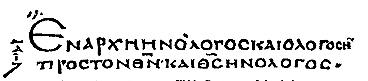
Codex ALEXANDRINUS: Fifth Century. — John 1:1.
Ev arch nv o logov kai o logov h~ prov tov Qªeoºn kai Qªeoºn hn o logov
Codex CLAROMONTANUS: Sixth Century; Greek Text. — 1 Cor. 13:8.
oJude'pote eJkpi>ptei
Codex LAUDIANUS: Sixth Century; Greek Text. — Acts 20:28.
thn ekklhsian tou kªurioºu
Codex PURPUREUS: Sixth Century, — John 15:20.
tou logou ou
Codex AMIATINUS, A.D. 541: the oldest known MS. of the Vulgate, —
Acts 7:6. Loctus est autem d[eu]s
Codex COLBERTINUS: Eleventh Century; the "Queen of the Cursives", — Luke 1:8, 9 xei thv eujsebe(?)i>av musth>rion? oJ Qªeo<ºv eJfanerw>qh ejn sar ki>?
w]fqh agge>loiv
Codex LEICESTRESIS: Fourteenth Century. — 1 Timothy 3:16 th~v eujsebe(?)i>av musth>rion? oJ Qªeo>ºv ejfanerw>qh ejn sar ki>?
ejn pneu>mati? w]fqh ajgge>loiv of a number of translators who differed greatly both in their knowledge of Hebrew and of Greek; and that from the earliest times it has borne the name of "The Septuagint", i.e., The Seventy.
"This version, with all its defects, must be of the greatest interest, (a) as preserving evidence for the text far more ancient than the oldest Hebrew manuscripts; (b) as the means by which the Greek Language was wedded to Hebrew thought; (c) as the source of the great majority of quotations from the Old Testament by writers of the New Testament.
(2.) The New Testament manuscripts fall into two divisions, Uncials, written in Greek capitals, with no distinction at all between the different words, and very little even between the different lines; and Cursives, in small Greek letters, and with divisions of words and lines. The change between the two kinds of Greek writing took place about the tenth century. Only five manuscripts of the New Testament approaching to completeness are more ancient than this dividing date. The first, numbered A, is the Alexandrian manuscript. Though brought to this country by Cyril Lucar, patriarch of Constantinople, as a present to Charles I., it is believed that it was written, not in that capital, but in Alexandria; whence its title. It is now dated in the fifth century A.D. The second, known as B, is the Vatican manuscript. (See VATICANUS.) The Third, C, or the Ephraem manuscript, was so called because it was written over the writings of Ephraem, a Syrian theological author, a practice very common in the days when writing materials were scarce and dear. It is believed that it belongs to the fifth century, and perhaps a slightly earlier period of it than the manuscript A. The fourth, D, or the manuscript of Beza, was so called because it belonged to the reformer Beza, who found it in the monastery of St. Irenaeus at Lyons in 1562 A.D. It is imperfect, and is dated in the sixth century. The fifth (called Aleph) is the Sinaitic manuscript. (See SINAITICUS.)
3. The Syriac Versions. (See SYRIAC.)
4. The Latin Versions. A Latin version of the Scriptures, called the "Old Latin," which originated in North Africa, was in common use in the time of Tertullian (A.D. 150). Of this there appear to have been various copies or recensions made. That made in Italy, and called the Itala, was reckoned the most accurate. This translation of the Old Testament seems to have been made not from the original Hebrew but from the LXX.
This version became greatly corrupted by repeated transcription, and to remedy the evil Jerome (A.D. 329-420) was requested by Damasus, the bishop of Rome, to undertake a complete revision of it. It met with opposition at first, but was at length, in the seventh century, recognized as the "Vulgate" version. It appeared in a printed from about A.D. 1455, the first book that ever issued from the press. The Council of Trent (1546) declared it "authentic." It subsequently underwent various revisions, but that which was executed (1592) under the sanction of Pope Clement VIII. was adopted as the basis of all subsequent editions. It is regarded as the sacred original in the Roman Catholic Church. All modern European versions have been more or less influenced by the Vulgate. This version reads ipsa instead of ipse in Genesis 3:15, "She shall bruise thy head."
5. There are several other ancient versions which are of importance for Biblical critics, but which we need not mention particularly, such as the Ethiopic, in the fourth century, from the LXX.; two Egyptian versions, about the fourth century, the Memphitic, circulated in Lower Egypt, and the Thebaic, designed for Upper Egypt, both from the Greek; the Gothic, written in the German language, but with the Greek alphabet, by Ulphilas (died A.D. 388), of which only fragments of the Old Testament remain; the Armenian, about A.D. 400; and the Slavonic, in the ninth century, for ancient Moravia. Other ancient versions, as the Arabic, the Persian, and the Anglo-Saxon, may be mentioned.
6. The history of the English versions begins properly with Wyckliffe. Portions, however, of the Scriptures were rendered into Saxon (as the Gospel according to John, by Bede, A.D. 735), and also into English (by Orme, called the "Ormulum," a portion of the Gospels and of the Acts in the form of a metrical paraphrase, toward the close of the seventh century), long before Wyckliffe; but it is to him that the honour belongs of having first rendered the whole Bible into English (A.D. 1380). This version was made from the Vulgate, and renders Genesis 3:15 after that Version, "She shall trede thy head."
This was followed by Tyndale's translation (1525-1531); Miles Coverdale's (1535-1553); Thomas Matthew's (1537), really, however, the work of John Rogers, the first martyr under the reign of Queen Mary. This was properly the first Authorized Version, Henry VIII. having ordered a copy of it to be got for every church. This took place in less than a year after Tyndale was martyred for the crime of translating the Scriptures. In 1539 Richard Taverner published a revised edition of Matthew's Bible. The Great Bible, so called from its great size, called also Cranmer's Bible, was published in 1539 and 1568. In the strict sense, the "Great Bible" is "the only authorized version; for the Bishops' Bible and the present Bible [the A.V.] never had the formal sanction of royal authority." Next in order was the Geneva version (1557-1560); the Bishops' Bible (1568); the Rheims and Douai versions, under Roman Catholic auspices (1582, 1609); the Authorized Version (1611); and the Revised Version of the New Testament in 1880 and of the Old Testament in 1884.
(Judges 5:7, 11). The Hebrew word thus rendered (perazon) means habitations in the open country, unwalled villages (Deuteronomy 3:5; 1 Samuel 6:18). Others, however, following the LXX. and the Vulgate versions, render the word "rulers."
one of the most important products of Palestine. The first mention of it is in the history of Noah (Genesis 9:20). It is afterwards frequently noticed both in the Old and New Testaments, and in the ruins of terraced vineyards there are evidences that it was extensively cultivated by the Jews. It was cultivated in Palestine before the Israelites took possession of it. The men sent out by Moses brought with them from the Valley of Eshcol a cluster of grapes so large that "they bare it between two upon a staff" (Numbers 13: 23). The vineyards of En-gedi (Cant. 1:14), Heshbon, Sibmah, Jazer, Elealeh (Isaiah 16:8-10; Jeremiah 48:32, 34), and Helbon (Ezekiel 27:18), as well as of Eshcol, were celebrated.
The Church is compared to a vine (Psalm 80:8), and Christ says of himself, "I am the vine" (John 15:1). In one of his parables also (Matthew 21:33) our Lord compares his Church to a vineyard which "a certain householder planted, and hedged round about," etc.
Hos. 10:1 is rendered in the Revised Version, "Israel is a luxuriant vine, which putteth forth his fruit," instead of "Israel is an empty vine, he bringeth forth fruit unto himself," of the Authorized Version.
Hebrews hometz, Gr. oxos, Fr. vin aigre; i.e., "sour wine." The Hebrew word is rendered vinegar in Psalm 69:21, a prophecy fulfilled in the history of the crucifixion (Matthew 27:34). This was the common sour wine (posea) daily made use of by the Roman soldiers. They gave it to Christ, not in derision, but from compassion, to assuage his thirst. Proverbs 10:26 shows that there was also a stronger vinegar, which was not fit for drinking. The comparison, "vinegar upon nitre," probably means "vinegar upon soda" (as in the marg. of the R.V.), which then effervesces.
OF SODOM referred to only in Deuteronomy 32:32. Among the many conjectures as to this tree, the most probable is that it is the 'osher of the Arabs, which abounds in the region of the Dead Sea. Its fruit are the so-called "apples of Sodom," which, though beautiful to the eye, are exceedingly bitter to the taste. (See EN-GEDI.) The people of Israel are referred to here by Moses as being utterly corrupt, bringing forth only bitter fruit.
Hebrews nebel (Isaiah 5:12, R.V., "lute;" 14:11), a musical instrument, usually rendered "psaltery" (q.v.)
In Job 20:16, Isaiah 30:6; 59:5, the Hebrews word eph'eh is thus rendered. The Hebrew word, however, probably denotes a species of poisonous serpents known by the Arabic name of 'el ephah. Tristram has identified it with the sand viper, a species of small size common in sandy regions, and frequently found under stones by the shores of the Dead Sea. It is rapid in its movements, and highly poisonous. In the New Testament echidne is used (Matthew 3:7; 12:34; 23:33) for any poisonous snake. The viper mentioned in Acts 28:3 was probably the vipera aspis, or the Mediterranean viper. (See ADDER.)
In a prophecy concerning our Lord, Isaiah (7:14) says, "A virgin [R.V. marg., 'the virgin'] shall conceive, and bear a son" (comp. Luke 1:31-35). The people of the land of Zidon are thus referred to by Isaiah (23:12), "O thou oppressed virgin, daughter of Zidon;" and of the people of Israel, Jeremiah (18:13) says, "The virgin of Israel hath done a very horrible thing."
(Luke 1:22), a vivid apparition, not a dream (comp. Luke 24:23; Acts 26:19; 2 Corinthians 12:1).
voluntary promises which, when once made, were to be kept if the thing vowed was right. They were made under a great variety of circumstances (Genesis 28: 18-22; Leviticus 7:16; Numbers 30:2-13;
Deuteronomy 23:18; Judges 11:30, 39; 1 Samuel 1:11; Jonah 1:16; Acts 18:18; 21:23).
(1.) Hebrews da'ah (Leviticus 11:14). In the parallel passage (Deuteronomy 14:13) the Hebrew word used is ra'ah, rendered "glede;" LXX., "gups;" Vulg., "milvus." A species of ravenous bird, distinguished for its rapid flight. "When used without the epithet 'red,' the name is commonly confined to the black kite. The habits of the bird bear out the allusion in Isaiah 34:15, for it is, excepting during the winter three months, so numerous everywhere in Palestine as to be almost gregarious." (See EAGLE.)
(2.) In Job 28:7 the Hebrews 'ayyah is thus rendered. The word denotes a clamorous and a keen-sighted bird of prey. In Leviticus 11:14 and Deuteronomy 14:13 it is rendered "kite" (q.v.).
thin cakes (Exodus 16:31; 29:2, 23; Leviticus 2:4; 7:12; 8:26; Numbers 6:15, 19) used in various offerings.
Rate of (mention only in Matthew 20:2); to be punctually paid (Leviticus 19:13; Deuteronomy 24:14, 15); judgements threatened against the withholding of (Jeremiah 22:13; Malachi 3:5; comp. James 5:4); paid in money (Matthew 20:1-14); to Jacob in kind (Genesis 29:15, 20; 30:28; 31:7, 8, 41).
Hebrews aghalah; so rendered in Genesis 45:19, 21, 27; 46:5; Numbers 7:3, 7,8, but elsewhere rendered "cart" (1 Samuel 6:7, etc.). This vehicle was used for peaceful purposes. In Ezekiel 23:24, however, it is the rendering of a different Hebrew word, and denotes a war-chariot.
JEWS' a section of the western wall of the temple area, where the Jews assemble every Friday afternoon to bewail their desolate condition (Psalm 79:1, 4, 5). The stones in this part of the wall are of great size, and were placed, as is generally believed, in the position in which they are now found in the time of Solomon. "The congregation at the wailing-place is one of the most solemn gatherings left to the Jewish Church, and as the writer gazed at the motley concourse he experienced a feeling of sorrow that the remnants of the chosen race should be heartlessly thrust outside the sacred enclosure of their fathers' holy temple by men of an alien race and an alien creed. Many of the elders, seated on the ground, with their backs against the wall, on the west side of the area, and with their faces turned toward the eternal house, read out of their well-thumbed Hebrew books passages from the prophetic writings, such as Isaiah 64:9-12" (King's Recent Discoveries, etc.). The wailing-place of the Jews, viewed in its past spiritual and historic relations, is indeed "the saddest nook in this vale of tears." (See LAMENTATIONS, BOOK OF.)
Cities were surrounded by walls, as distinguished from "unwalled villages" (Ezekiel 38:11; Leviticus 25:29-34). They were made thick and strong (Numbers 13:28; Deuteronomy 3:5). Among the Jews walls were built of stone, some of those in the temple being of great size (1 Kings 6:7;
7:9-12; 20:30; Mark 13:1, 2). The term is used metaphorically of security and safety (Isaiah 26:1; 60:18; Revelation 21:12-20). (See FENCE.)
of the Israelites in the wilderness in consequence of their rebellious fears to enter the Promised Land (Numbers 14:26-35). They wandered for forty years before they were permitted to cross the Jordan (Joshua 4:19; 5:6).
The record of these wanderings is given in Numbers 33:1-49. Many of the stations at which they camped cannot now be identified.
Questions of an intricate nature have been discussed regarding the "Wanderings," but it is enough for us to take the sacred narrative as it stands, and rest assured that "He led them forth by the right way" (Psalm 107:1-7, 33-35). (See WILDERNESS.)
The Israelites had to take possession of the Promised Land by conquest. They had to engage in a long and bloody war before the Canaanitish tribes were finally subdued. Except in the case of Jericho and Ai, the war did not become aggressive till after the death of Joshua. Till then the attack was always first made by the Canaanites. Now the measure of the iniquity of the Canaanites was full, and Israel was employed by God to sweep them away from off the face of the earth. In entering on this new stage of the war, the tribe of Judah, according to divine direction, took the lead.
In the days of Saul and David the people of Israel engaged in many wars with the nations around, and after the division of the kingdom into two they often warred with each other. They had to defend themselves also against the inroads of the Egyptians, the Assyrians, and the Babylonians. The whole history of Israel from first to last presents but few periods of peace.
The Christian life is represented as a warfare, and the Christian graces are also represented under the figure of pieces of armour (Ephesians 6:11-17; 1 Thessalonians 5:8; 2 Timothy 2:3, 4). The final blessedness of believers is attained as the fruit of victory (Revelation 3:21).
a prison (Genesis 40:3, 4); a watch-station (Isaiah 21:8); a guard (Nehemiah 13:30).
OF THE LORD, THE BOOK OF THE (Numbers 21:14, 15), some unknown book so called (comp. Genesis 14:14-16; Exodus 17:8-16; Numbers 14:40-45; 21:1-3, 21-25, 33-35; 31. The wars here recorded might be thus designated).
(Mark 7:1-9). The Jews, like other Orientals, used their fingers when taking food, and therefore washed their hands before doing so, for the sake of cleanliness. Here the reference is to the ablutions prescribed by tradition, according to which "the disciples ought to have gone down to the side of the lake, washed their hands thoroughly, 'rubbing the fist of one hand in the hollow of the other, then placed the ten finger-tips together, holding the hands up, so that any surplus water might flow down to the elbow, and thence to the ground.'" To neglect to do this had come to be regarded as a great sin, a sin equal to the breach of any of the ten commandments. Moses had commanded washings oft, but always for some definite cause; but the Jews multiplied the legal observance till they formed a large body of precepts. To such precepts about ceremonial washing Mark here refers. (See ABLUTION.)
the periods into which the time between sunset and sunrise was divided. They are so called because watchmen relieved each other at each of these periods. There are frequent references in Scripture to the duties of watchmen who were appointed to give notice of the approach of an enemy (2 Samuel 18:24-27; 2 Kings 9:17-20; Isaiah 21:5-9). They were sometimes placed for this purpose on watch-towers (2 Kings 17:9; 18:8). Ministers or teachers are also spoken of under this title (Jeremiah 6:17; Ezekiel 33:2-9; Hebrews 13:17).
The watches of the night were originally three in number, (1) "the beginning of the watches" (Lamentations 2:19); (2) "the middle watch" (Judges 7:19); and (3) "the morning watch" (Exodus 14:24; 1 Samuel 11:11), which extended from two o'clock to sunrise. But in the New Testament we read of four watches, a division probably introduced by the Romans (Matthew 14:25; Mark 6:48; Luke 12:38). (See DAY.)
(2 Corinthians 6:5), lit. "sleeplessnesses," the result of "manual labour, teaching, travelling, meditating, praying, cares, and the like" (Meyer's Com.).
OF JEALOUSY a phrase employed (not, however, in Scripture) to denote the water used in the solemn ordeal prescribed by the law of Moses (Numbers 5:11-31) in cases of "jealousy."
OF PURIFICATION used in cases of ceremonial cleansings at the consecration of the Levites (Numbers 8:7). It signified, figuratively, that purifying of the heart which must characterize the servants of God.
OF SEPARATION used along with the ashes of a red heifer for the ceremonial cleansing of persons defiled by contact with a dead body (Numbers 19).
(Psalm 42:7; marg. R.V., "cataracts"). If we regard this psalm as descriptive of David's feelings when banished from Jerusalem by the revolt of Absalom, this word may denote "waterfalls," inasmuch as Mahanaim, where he abode, was near the Jabbok, and the region abounded with rapids and falls.
OFFERINGS parts of peace-offerings were so called, because they were waved by the priests (Exodus 29:24, 26, 27; Leviticus 7:20-34; 8:27; 9:21; 10:14, 15, etc.), in token of a solemn special presentation to God. They then became the property of the priests. The first-fruits, a sheaf of barley, offered at the feast of Pentecost (Leviticus 23:17-20), and wheat-bread, the first-fruits of the second harvest, offered at the Passover (10-14), were wave-offerings.
Made by melting the combs of bees. Mentioned (Psalm 22:14; 68:2; 97:5; Micah 1:4) in illustration.
Among the Hebrews children (whom it was customary for the mothers to nurse, Exodus 2:7-9; 1 Samuel 1:23; Cant. 8:1) were not generally weaned till they were three or four years old.
(Hebrews holedh), enumerated among unclean animals (Leviticus 11:29). Some think that this Hebrew word rather denotes the mole (Spalax typhlus) common in Palestine. There is no sufficient reason, however, to depart from the usual translation. The weasel tribe are common also in Palestine.
WEAVERS Weaving was an art practised in very early times (Exodus 35:35). The Egyptians were specially skilled in it (Isaiah 19:9; Ezekiel 27:7), and some have regarded them as its inventors.
In the wilderness, the Hebrews practised it (Exodus 26:1, 8; 28:4, 39; Leviticus 13:47). It is referred to in subsequent times as specially the women's work (2 Kings 23:7; Proverbs 31:13, 24). No mention of the loom is found in Scripture, but we read of the "shuttle" (Job 7:6), "the pin" of the beam (Judges 16:14), "the web" (13, 14), and "the beam" (1 Samuel 17:7; 2 Samuel 21:19). The rendering, "with pining sickness," in Isaiah 38:12 (A.V.) should be, as in the Revised Version, "from the loom," or, as in the margin, "from the thrum." We read also of the "warp" and "woof" (Leviticus 13:48, 49, 51-53, 58, 59), but the Revised Version margin has, instead of "warp," "woven or knitted stuff."
From the beginning, time was divided into weeks, each consisting of six days of working and one of rest (Genesis 2:2, 3; 7:10; 8:10, 12; 29:28). The references to this division of days becomes afterwards more frequent (Exodus 34:22; Leviticus 12:5; Numbers 28:26; Deuteronomy 16:16; 2 Chronicles 8:13; Jeremiah 5:24; Daniel 9:24-27; 10:2, 3). It has been found to exist among almost all nations.
•WEEKS, FEAST OF See PENTECOST.
Reduced to English troy-weight, the Hebrew weights were: (1.) The gerah (Leviticus 27:25; Numbers 3:47), a Hebrew word, meaning a grain or kernel, and hence a small weight. It was the twentieth part of a shekel, and equal to 12 grains.
(2.) Bekah (Exodus 38:26), meaning "a half" i.e., "half a shekel," equal to 5 pennyweight.
(3.) Shekel, "a weight," only in the Old Testament, and frequently in its original form (Genesis 23:15, 16; Exodus 21:32; 30:13, 15; 38:24-29, etc.). It was equal to 10 pennyweight.
(4.) Ma'neh, "a part" or "portion" (Ezekiel 45:12), equal to 60 shekels, i.e., to 2 lbs. 6 oz.
(5.) Talent of silver (2 Kings 5:22), equal to 3,000 shekels, i.e., 125 lbs.
(6.) Talent of gold (Exodus 25:39), double the preceding, i.e., 250 lbs.
(Hebrews beer), to be distinguished from a fountain (Hebrews 'ain). A "beer" was a deep shaft, bored far under the rocky surface by the art of man, which contained water which percolated through the strata in its sides. Such wells were those of Jacob and Beersheba, etc. (see Genesis 21:19, 25, 30, 31; 24:11; 26:15, 18-25, 32, etc.). In the Pentateuch this word beer, so rendered, occurs twenty-five times.
•WESTWARD sea-ward, i.e., toward the Mediterranean (Deuteronomy 3:27).
The Hebrew word tan (plural, tannin) is so rendered in Job 7:12 (A.V.; but R.V., "sea-monster"). It is rendered by "dragons" in Deuteronomy 32:33; Psalm 91:13; Jeremiah 51:34; Psalm 74:13 (marg., "whales;" and marg. of R.V., "sea-monsters"); Isaiah 27:1; and "serpent" in Exodus 7:9 (R.V. marg., "any large reptile," and so in ver. 10, 12). The words of Job (7:12), uttered in bitter irony, where he asks, "Am I a sea or a whale?" simply mean, "Have I a wild, untamable nature, like the waves of the sea, which must be confined and held within bounds, that they cannot pass?" "The serpent of the sea, which was but the wild, stormy sea itself, wound itself around the land, and threatened to swallow it up...Job inquires if he must be watched and plagued like this monster, lest he throw the world into disorder" (Davidson's Job).
The whale tribe are included under the general Hebrew name tannin (Genesis 1:21; Lamentations 4:3). "Even the sea-monsters [tanninim] draw out the breast." The whale brings forth its young alive, and suckles them.
It is to be noticed of the story of Jonah's being "three days and three nights in the whale's belly," as recorded in Matthew 12:40, that here the Gr. ketos means properly any kind of sea-monster of the shark or the whale tribe, and that in the book of Jonah (1:17) it is only said that "a great fish" was prepared to swallow Jonah. This fish may have been, therefore, some great shark. The white shark is known to frequent the Mediterranean Sea, and is sometimes found 30 feet in length.
one of the earliest cultivated grains. It bore the Hebrew name hittah, and was extensively cultivated in Palestine. There are various species of wheat. That which Pharaoh saw in his dream was the Triticum compositum, which bears several ears upon one stalk (Genesis 41:5). The "fat of the kidneys of wheat" (Deuteronomy 32:14), and the "finest of the wheat" (Psalm 81:16; 147:14), denote the best of the kind. It was exported from Palestine in great quantities (1 Kings 5:11; Ezekiel 27:17; Acts 12:20).
Parched grains of wheat were used for food in Palestine (Ruth 2:14; 1 Samuel 17:17; 2 Samuel 17:28). The disciples, under the sanction of the Mosaic law (Deuteronomy 23:25), plucked ears of corn, and rubbing them in their hands, ate the grain unroasted (Matthew 12:1; Mark 2:23; Luke 6:1). Before any of the wheat-harvest, however, could be eaten, the first-fruits had to be presented before the Lord (Leviticus 23:14).
(Hebrews galgal; rendered "wheel" in Psalm 83:13, and "a rolling thing" in Isaiah 17:13; R.V. in both, "whirling dust"). This word has been supposed to mean the wild artichoke, which assumes the form of a globe, and in autumn breaks away from its roots, and is rolled about by the wind in some places in great numbers.
a symbol of purity (2 Chronicles 5:12; Psalm 51:7; Isaiah 1:18; Revelation 3:18; 7:14). Our Lord, at his transfiguration, appeared in raiment "white as the light" (Matthew 17:2, etc.).
to be treated with kindness (Exodus 22:22; Deuteronomy 14:29; 16:11, 14; 24:17, 19-21; 26:12; 27:19, etc.). In the New Testament the same tender regard for them is inculcated (Acts 6:1-6; 1 Timothy 5:3-16) and exhibited.
The ordinance of marriage was sanctioned in Paradise (Genesis 2:24; Matthew 19:4-6). Monogamy was the original law under which man lived, but polygamy early commenced (Genesis 4:19), and continued to prevail all down through Jewish history. The law of Moses regulated but did not prohibit polygamy. A man might have a plurality of wives, but a wife could have only one husband. A wife's legal rights (Exodus 21:10) and her duties (Proverbs 31:10-31; 1 Timothy 5:14) are specified. She could be divorced in special cases (Deuteronomy 22:13-21), but could not divorce her husband. Divorce was restricted by our Lord to the single case of adultery (Matthew 19:3-9). The duties of husbands and wives in their relations to each other are distinctly set forth in the New Testament (1 Corinthians 7:2-5; Ephesians 5:22-33; Colossians 3:18, 19; 1 Peter 3:1-7).
(1.) Hebrews midhbar, denoting not a barren desert but a district or region suitable for pasturing sheep and cattle (Psalm 65:12; Isaiah 42:11; Jeremiah 23:10; Joel 1:19; 2:22); an uncultivated place. This word is used of the wilderness of Beersheba (Genesis 21:14), on the southern border of Palestine; the wilderness of the Red Sea (Exodus 13:18); of Shur (15:22), a portion of the Sinaitic peninsula; of Sin (17:1), Sinai (Leviticus 7:38), Moab (Deuteronomy 2:8), Judah (Judges 1:16), Ziph, Maon, En-gedi (1 Samuel 23:14, 24; 24:1), Jeruel and Tekoa (2 Chronicles 20:16, 20), Kadesh (Psalm 29:8).
"The wilderness of the sea" (Isaiah 21:1). Principal Douglas, referring to this expression, says: "A mysterious name, which must be meant to describe Babylon (see especially ver. 9), perhaps because it became the place of discipline to God's people, as the wilderness of the Red Sea had been (comp. Ezekiel 20:35). Otherwise it is in contrast with the symbolic title in Isaiah 22:1. Jerusalem is the "valley of vision," rich in spiritual husbandry; whereas Babylon, the rival centre of influence, is spiritually barren and as restless as the sea (comp. 57:20)." A Short Analysis of the O.T.
(2.) Jeshimon, a desert waste (Deuteronomy 32:10; Psalm 68:7).
(3.) 'Arabah, the name given to the valley from the Dead Sea to the eastern branch of the Red Sea. In Deuteronomy 1:1; 2:8, it is rendered "plain" (R.V., "Arabah").
(4.) Tziyyah, a "dry place" (Psalm 78:17; 105:41).
(5.) Tohu, a "desolate" place, a place "waste" or "unoccupied" (Deuteronomy 32:10; Job 12:24; comp. Genesis 1:2, "without form"). The wilderness region in the Sinaitic peninsula through which for forty years the Hebrews wandered is generally styled "the wilderness of the wanderings." This entire region is in the form of a triangle, having its base toward the north and its apex toward the south. Its extent from north to south is about 250 miles, and at its widest point it is about 150 miles broad. Throughout this vast region of some 1,500 square miles there is not a single river. The northern part of this triangular peninsula is properly the "wilderness of the wanderings" (et-Tih). The western portion of it is called the "wilderness of Shur" (Exodus 15:22), and the eastern the "wilderness of Paran."
The "wilderness of Judea" (Matthew 3:1) is a wild, barren region, lying between the Dead Sea and the Hebron Mountains. It is the "Jeshimon" mentioned in 1 Samuel 23:19.
(1.) Hebrews 'arabim (Leviticus 23:40; Job 40:22; Isaiah 15:7; 44:3, 4; Psalm 137:1, 2). This was supposed to be the weeping willow, called by Linnaeus Salix Babylonica, from the reference in Psalm 137. This tree is frequently found "on the coast, overhanging wells and pools. There is a conspicuous tree of this species over a pond in the plain of Acre, and others on the Phoenician plain." There are several species of the salix in Palestine, but it is not indigenous to Babylonia, nor was it cultivated there. Some are of opinion that the tree intended is the tamarisk or poplar.
(2.) Hebrews tzaphtzaphah (Ezekiel 17:5), called by the Arabs the safsaf, the general name for the willow. This may be the Salix AEgyptica of naturalists.
Tristram thinks that by the "willow by the water-courses," the Nerium oleander, the rose-bay oleander, is meant. He says, "It fringes the Upper Jordan, dipping its wavy crown of red into the spray in the rapids under Hermon, and is nutured by the oozy marshes in the Lower Jordan nearly as far as to Jericho...On the Arnon, on the Jabbok, and the Yarmuk it forms a continuous fringe. In many of the streams of Moab it forms a complete screen, which the sun's rays can never penetrate to evaporate the precious moisture. The wild boar lies safely ensconced under its impervious cover."
Isaiah 3:22, (R.V., "shawls"), a wrap or veil. The same Hebrew word is rendered "vail" (R.V., "mantle") in Ruth 3:15.
properly only an opening in a house for the admission of light and air, covered with lattice-work, which might be opened or closed (2 Kings 1:2; Acts 20:9). The spies in Jericho and Paul at Damascus were let down from the windows of houses abutting on the town wall (Joshua 2:15; 2 Corinthians 11:33). The clouds are metaphorically called the "windows of heaven" (Genesis 7:11; Malachi 3:10). The word thus rendered in Isaiah 54:12 ought rather to be rendered "battlements" (LXX., "bulwarks;" R.V., "pinnacles"), or as Gesenius renders it, "notched battlements, i.e., suns or rays of the sun"= having a radiated appearance like the sun.
blowing from the four quarters of heaven (Jeremiah 49:36; Ezekiel 37:9; Daniel 8:8; Zechariah 2:6). The east wind was parching (Ezekiel 17:10; 19:12), and is sometimes mentioned as simply denoting a strong wind (Job 27:21; Isaiah 27:8). This wind prevails in Palestine from
February to June, as the west wind (Luke 12:54) does from November to February. The south was a hot wind (Job 37:17; Luke 12:55). It swept over the Arabian peninsula. The rush of invaders is figuratively spoken of as a whirlwind (Isaiah 21:1); a commotion among the nations of the world as a striving of the four winds (Daniel 7:2). The winds are subject to the divine power (Psalm 18:10; 135:7).
The common Hebrew word for wine is yayin, from a root meaning "to boil up," "to be in a ferment." Others derive it from a root meaning "to tread out," and hence the juice of the grape trodden out. The Greek word for wine is oinos, and the Latin vinun. But besides this common Hebrew word, there are several others which are thus rendered.
(1.) Ashishah (2 Samuel 6:19; 1 Chronicles 16:3; Cant. 2:5; Hos. 3:1), which, however, rather denotes a solid cake of pressed grapes, or, as in the Revised Version, a cake of raisins.
(2.) 'Asis, "sweet wine," or "new wine," the product of the same year (Cant. 8:2; Isaiah 49:26; Joel 1:5; 3:18; Amos 9:13), from a root meaning "to tread," hence juice trodden out or pressed out, thus referring to the method by which the juice is obtained. The power of intoxication is ascribed to it.
(3.) Hometz. See VINEGAR.
(4.) Hemer, Deuteronomy 32:14 (rendered "blood of the grape") Isaiah 27:2 ("red wine"), Ezra 6:9; 7:22; Daniel 5:1, 2, 4. This word conveys the idea of "foaming," as in the process of fermentation, or when poured out. It is derived from the root hamar, meaning "to boil up," and also "to be red," from the idea of boiling or becoming inflamed.
(5.) 'Enabh, a grape (Deuteronomy 32:14). The last clause of this verse should be rendered as in the Revised Version, "and of the blood of the grape ['enabh] thou drankest wine [hemer]." In Hos. 3:1 the phrase in Authorized Version, "flagons of wine," is in the Revised Version correctly "cakes of raisins." (Comp. Genesis 49:11; Numbers 6:3; Deuteronomy 23:24, etc., where this Hebrew word is rendered in the plural "grapes.")
(6.) Mesekh, properly a mixture of wine and water with spices that increase its stimulating properties (Isaiah 5:22). Psalm 75:8, "The wine [yayin] is red; it is full of mixture [mesekh];" Proverbs 23:30, "mixed wine;" Isaiah 65:11, "drink offering" (R.V., "mingled wine").
(7.) Tirosh, properly "must," translated "wine" (Deuteronomy 28:51); "new wine" (Proverbs 3:10); "sweet wine" (Micah 6:15; R.V., "vintage"). This Hebrew word has been traced to a root meaning "to take possession of" and hence it is supposed that tirosh is so designated because in intoxicating it takes possession of the brain. Among the blessings promised to Esau (Genesis 27:28) mention is made of "plenty of corn and tirosh." Palestine is called "a land of corn and tirosh" (Deuteronomy 33:28; comp. Isaiah 36:17). See also Deuteronomy 28:51; 2 Chronicles 32:28; Joel 2:19; Hos. 4:11, ("wine [yayin] and new wine [tirosh] take away the heart").
(8.) Sobhe (root meaning "to drink to excess," "to suck up," "absorb"), found only in Isaiah 1:22, Hos. 4:18 ("their drink;" Gesen. and marg. of R.V., "their carouse"), and Nah. 1:10 ("drunken as drunkards;" lit., "soaked according to their drink;" R.V., "drenched, as it were, in their drink", i.e., according to their sobhe).
(9.) Shekar, "strong drink," any intoxicating liquor; from a root meaning "to drink deeply," "to be drunken", a generic term applied to all fermented liquors, however obtained. Numbers 28:7, "strong wine" (R.V., "strong drink"). It is sometimes distinguished from wine, c.g., Leviticus 10:9, "Do not drink wine [yayin] nor strong drink [shekar];" Numbers 6:3; Judges 13:4, 7; Isaiah 28:7 (in all these places rendered "strong drink"). Translated "strong drink" also in Isaiah 5:11; 24:9; 29:9; 56:12; Proverbs 20:1; 31:6; Micah 2:11.
(10.) Yekebh (Deuteronomy 16:13, but in R.V. correctly "wine-press"), a vat into which the new wine flowed from the press. Joel 2:24, "their vats;" 3:13, "the fats;" Proverbs 3:10, "Thy presses shall burst out with new wine [tirosh];" Hag. 2:16; Jeremiah 48:33, "wine-presses;" 2 Kings 6:27; Job. 24:11.
(11.) Shemarim (only in plural), "lees" or "dregs" of wine. In Isaiah 25:6 it is rendered "wines on the lees", i.e., wine that has been kept on the lees, and therefore old wine.
(12.) Mesek, "a mixture," mixed or spiced wine, not diluted with water, but mixed with drugs and spices to increase its strength, or, as some think, mingled with the lees by being shaken (Psalm 75:8; Proverbs 23:30).
In Acts 2:13 the word gleukos, rendered "new wine," denotes properly "sweet wine." It must have been intoxicating.
In addition to wine the Hebrews also made use of what they called debash, which was obtained by boiling down must to one-half or one-third of its original bulk. In Genesis 43:11 this word is rendered "honey." It was a kind of syrup, and is called by the Arabs at the present day dibs. This word occurs in the phrase "a land flowing with milk and honey" (debash), Exodus 3:8, 17; 13:5; 33:3; Leviticus 20:24; Numbers 13: 27. (See HONEY.)
Our Lord miraculously supplied wine at the marriage feast in Cana of Galilee (John 2:1-11). The Rechabites were forbidden the use of wine (Jeremiah 35). The Nazarites also were to abstain from its use during the period of their vow (Numbers 6:1-4); and those who were dedicated as Nazarites from their birth were perpetually to abstain from it (Judges 13:4, 5; Luke 1:15; 7:33). The priests, too, were forbidden the use of wine and strong drink when engaged in their sacred functions (Leviticus 10:1, 9-11). "Wine is little used now in the East, from the fact that Mohammedans are not allowed to taste it, and very few of other creeds touch it. When it is drunk, water is generally mixed with it, and this was the custom in the days of Christ also. The people indeed are everywhere very sober in hot climates; a drunken person, in fact, is never seen", (Geikie's Life of Christ). The sin of drunkenness, however, must have been not uncommon in the olden times, for it is mentioned either metaphorically or literally more than seventy times in the Bible.
A drink-offering of wine was presented with the daily sacrifice (Exodus 29:40, 41), and also with the offering of the first-fruits (Leviticus 23:13), and with various other sacrifices (Numbers 15:5, 7, 10). Wine was used at the celebration of the Passover. And when the Lord's Supper was instituted, the wine and the unleavened bread then on the paschal table were by our Lord set apart as memorials of his body and blood.
Several emphatic warnings are given in the New Testament against excess in the use of wine (Luke 21:34; Romans 13:13; Ephesians 5:18; 1 Timothy 3:8; Titus 1:7).
(Mark 12:1). The original word (hypolenion) so rendered occurs only here in the New Testament. It properly denotes the trough or lake (lacus), as it was called by the Romans, into which the juice of the grapes ran from the trough above it. It is here used, however, of the whole apparatus. In the parallel passage in Matthew 21:33 the Greek word lenos is used. This properly denotes the upper one of the two vats. (See WINE-PRESS.)
Consisted of two vats or receptacles, (1) a trough (Hebrews gath, Gr. lenos) into which the grapes were thrown and where they were trodden upon and bruised (Isaiah 16:10; Lamentations 1:15; Joel 3:13); and (2) a trough or vat (Hebrews yekebh, Gr. hypolenion) into which the juice ran from the trough above, the gath (Nehemiah 13:15; Job 24:11; Isaiah 63:2, 3; Hag. 2:16; Joel 2:24). Wine-presses are found in almost every part of Palestine. They are "the only sure relics we have of the old days of Israel before the Captivity. Between Hebron and Beersheba they are found on all the hill slopes; they abound in southern Judea; they are no less common in the many valleys of Carmel; and they are numerous in Galilee." The "treading of the wine-press" is emblematic of divine judgment (Isaiah 63:2; Lamentations 1:15; Revelation 14:19, 20).
Corn was winnowed, (1.) By being thrown up by a shovel against the wind. As a rule this was done in the evening or during the night, when the west wind from the sea was blowing, which was a moderate breeze and fitted for the purpose. The north wind was too strong, and the east wind came in gusts. (2.) By the use of a fan or van, by which the chaff was blown away (Ruth 3:2; Isaiah 30:24; Jeremiah 4:11, 12; Matthew 3:12).
MEN mentioned in Daniel 2:12 included three classes, (1) astrologers, (2) Chaldeans, and (3) soothsayers. The word in the original (hakamim) probably means "medicine men. In Chaldea medicine was only a branch of magic. The "wise men" of Matthew 2:7, who came from the East to Jerusalem, were magi from Persia or Arabia.
WISDOM a moral rather than an intellectual quality. To be "foolish" is to be godless (Psalm 14:1; comp. Judges 19:23; 2 Samuel 13:13). True wisdom is a gift from God to those who ask it (Job 28:12-28; Proverbs 3:13-18; Romans 1:22; 16:27; 1 Corinthians 1:17-21; 2:6-8; James 1:5). "Wisdom" in Proverbs 1:20; 8:1; 9:1-5 may be regarded not as a mere personification of the attribute of wisdom, but as a divine person, "Christ the power of God and the wisdom of God" (1 Corinthians 1:24). In Matthew 11:19 it is the personified principle of wisdom that is meant.
Occurs only in Exodus 22:18, as the rendering of mekhashshepheh, the feminine form of the word, meaning "enchantress"
(R.V., "sorceress"), and in Deuteronomy 18:10, as the rendering of mekhashshepheth, the masculine form of the word, meaning "enchanter."
(1 Samuel 15:23; 2 Kings 9:22; 2 Chronicles 33:6; Micah 5:12; Nahum 3:4; Galatians 5:20). In the popular sense of the word no mention is made either of witches or of witchcraft in Scripture.
The "witch of En-dor" (1 Samuel 28) was a necromancer, i.e., one who feigned to hold converse with the dead. The damsel with "a spirit of divination" (Acts 16:16) was possessed by an evil spirit, or, as the words are literally rendered, "having a spirit, a pithon." The reference is to the heathen God Apollo, who was regarded as the God of prophecy.
More than one witness was required in criminal cases (Deuteronomy 17:6; 19:15). They were the first to execute the sentence on the condemned (Deuteronomy 13:9; 17:7; 1 Kings 21:13; Matthew 27:1; Acts 7:57, 58). False witnesses were liable to punishment (Deuteronomy 19:16-21). It was also an offence to refuse to bear witness (Leviticus 5:1).
OF THE SPIRIT (Romans 8:16), the consciousness of the gracious operation of the Spirit on the mind, "a certitude of the Spirit's presence and work continually asserted within us", manifested "in his comforting us, his stirring us up to prayer, his reproof of our sins, his drawing us to works of love, to bear testimony before the world," etc.
a pretender to supernatural knowledge and power, "a knowing one," as the original Hebrew word signifies. Such an one was forbidden on pain of death to practise his deceptions (Leviticus 19:31; 20:6, 27; 1 Samuel 28:3; Isaiah 8:19; 19:3).
Hebrews zeeb, frequently referred to in Scripture as an emblem of treachery and cruelty. Jacob's prophecy, "Benjamin shall ravin as a wolf" (Genesis 49:27), represents the warlike character of that tribe (see Judges 19-21). Isaiah represents the peace of Messiah's kingdom by the words, "The wolf also shall dwell with the lamb" (Isaiah 11:6). The habits of the wolf are described in Jeremiah 5:6; Habakkuk 1:8; Zephaniah 3:3; Ezekiel 22:27; Matthew 7:15; 10:16; Acts 20:29. Wolves are still sometimes found in Palestine, and are the dread of shepherds, as of old.
was "taken out of man" (Genesis 2:23), and therefore the man has the preeminence. "The head of the woman is the man;" but yet honour is to be shown to the wife, "as unto the weaker vessel" (1 Corinthians
11:3, 8, 9; 1 Peter 3:7). Several women are mentioned in Scripture as having been endowed with prophetic gifts, as Miriam (Exodus 15:20), Deborah (Judges 4:4, 5), Huldah (2 Kings 22:14), Noadiah (Nehemiah 6:14), Anna (Luke 2:36, 37), and the daughters of Philip the evangelist (Acts 21:8, 9). Women are forbidden to teach publicly (1 Corinthians 14:34, 35; 1 Timothy 2:11, 12). Among the Hebrews it devolved upon women to prepare the meals for the household (Genesis 18:6; 2 Samuel 13:8), to attend to the work of spinning (Exodus 35:26; Proverbs 31:19), and making clothes (1 Samuel 2:19; Proverbs 31:21), to bring water from the well (Genesis 24:15; 1 Samuel 9:11), and to care for the flocks (Genesis 29:6; Exodus 2:16).
The word "woman," as used in Matthew 15:28, John 2:4 and 20:13, 15, implies tenderness and courtesy and not disrespect. Only where revelation is known has woman her due place of honour assigned to her.
•WOOD See FOREST.
(Nehemiah 10:34; 13:31). It would seem that in the time of Nehemiah arrangements were made, probably on account of the comparative scarcity of wood, by which certain districts were required, as chosen by lot, to furnish wood to keep the altar fire perpetually burning (Leviticus 6:13).
one of the first material used for making woven cloth (Leviticus 13:47, 48, 52, 59; 19:19). The first-fruit of wool was to be offered to the priests (Deuteronomy 18:4). The law prohibiting the wearing of a garment "of divers sorts, as of woollen and linen together" (Deuteronomy 22:11) may, like some other laws of a similar character, have been intended to express symbolically the separateness and simplicity of God's covenant people. The wool of Damascus, famous for its whiteness, was of great repute in the Tyrian market (Ezekiel 27:18).
OF GOD (Hebrews 4:12, etc.). The Bible so called because the writers of its several books were God's organs in communicating his will to men. It is his "word," because he speaks to us in its sacred pages. Whatever the inspired writers here declare to be true and binding upon us, God declares to be true and binding. This word is infallible, because written under the guidance of the Holy Spirit, and therefore free from all error of fact or doctrine or precept. (See INSPIRATION; BIBLE.) All saving knowledge is obtained from the word of God. In the case of adults it is an indispensable means of salvation, and is efficacious thereunto by the gracious influence of the Holy Spirit (John 17:17; 2 Timothy 3:15, 16; 1 Peter 1:23).
THE (Gr. Logos), one of the titles of our Lord, found only in the writings of John (John 1:1-14; 1 John 1:1; Revelation 19:13). As such, Christ is the revealer of God. His office is to make God known. "No man hath seen God at any time; the only begotten Son, which is in the bosom of the Father, he hath declared him" (John 1:18). This title designates the divine nature of Christ. As the Word, he "was in the beginning" and "became flesh." "The Word was with God " and "was God," and was the Creator of all things (comp. Psalm 33: 6; 107:20; 119:89; 147:18; Isaiah 40:8).
COVENANT OF entered into by God with Adam as the representative of the human race (comp. Genesis 9:11, 12; 17:1-21), so styled because perfect obedience was its condition, thus distinguishing it from the covenant of grace. (See COVENANT OF WORKS.)
GOOD The old objection against the doctrine of salvation by grace, that it does away with the necessity of good works, and lowers the sense of their importance (Romans 6), although it has been answered a thousand times, is still alleged by many. They say if men are not saved by works, then works are not necessary. If the most moral of men are saved in the same way as the very chief of sinners, then good works are of no moment. And more than this, if the grace of God is most clearly displayed in the salvation of the vilest of men, then the worse men are the better.
The objection has no validity. The gospel of salvation by grace shows that good works are necessary. It is true, unchangeably true, that without holiness no man shall see the Lord. "Neither adulterers, nor thieves, nor covetous, nor drunkards" shall inherit the kingdom of God.
Works are "good" only when, (1) they spring from the principle of love to God. The moral character of an act is determined by the moral principle that prompts it. Faith and love in the heart are the essential elements of all true obedience. Hence good works only spring from a believing heart, can only be wrought by one reconciled to God (Ephesians 2:10; James 2:18:22). (2.) Good works have the glory of God as their object; and (3) they have the revealed will of God as their only rule (Deuteronomy 12:32; Revelation 22:18, 19).
Good works are an expression of gratitude in the believer's heart (John 14:15, 23; Galatians 5:6). They are the fruits of the Spirit (Titus 2:10-12), and thus spring from grace, which they illustrate and strengthen in the heart.
Good works of the most sincere believers are all imperfect, yet like their persons they are accepted through the mediation of Jesus Christ (Colossians 3:17), and so are rewarded; they have no merit intrinsically, but are rewarded wholly of grace.
(1.) Hebrews sas (Isaiah 51:8), denotes the caterpillar of the clothes-moth.
(2.) The manna bred worms (tola'im), but on the Sabbath there was not any worm (rimmah) therein (Exodus 16:20, 24). Here these words refer to caterpillars or larvae, which feed on corrupting matter.
These two Hebrew words appear to be interchangeable (Job 25:6; Isaiah 14:11). Tola'im in some places denotes the caterpillar (Deuteronomy 28:39; Jonah 4:7), and rimmah, the larvae, as bred from putridity (Job 17:14; 21:26; 24:20). In Micah 7:17, where it is said, "They shall move out of their holes like worms," perhaps serpents or "creeping things," or as in the Revised Version, "crawling things," are meant.
The word is used figuratively in Job 25:6; Psalm 22:6; Isaiah 41:14; Mark 9:44, 46, 48; Isaiah 66:24.
Hebrews la'anah, the Artemisia absinthium of botanists. It is noted for its intense bitterness (Deuteronomy 29:18; Proverbs 5:4; Jeremiah 9:15; Amos 5:7). It is a type of bitterness, affliction, remorse, punitive suffering. In Amos 6:12 this Hebrew word is rendered "hemlock" (R.V., "wormwood"). In the symbolical language of the Apocalypse (Revelation 8:10, 11) a star is represented as falling on the waters of the earth, causing the third part of the water to turn wormwood.