
Part 3
borne; a burden, one of the twelve minor prophets. He was a native of Tekota, the modern Tekua, a town about 12 miles south-east of Bethlehem. He was a man of humble birth, neither a "prophet nor a prophet's son," but "an herdman and a dresser of sycomore trees," R.V. He prophesied in the days of Uzziah, king of Judah, and was contemporary with Isaiah and Hosea (Amos 1:1; 7:14, 15; Zechariah 14:5), who survived him a few years. Under Jeroboam II. the kingdom of Israel rose to the zenith of its prosperity; but that was followed by the prevalence of luxury and vice and idolatry. At this period Amos was called from his obscurity to remind the people of the law of God's retributive justice, and to call them to repentance.
The Book of Amos consists of three parts:
(1.) The nations around are summoned to judgment because of their sins (1:1-2:3). He quotes Joel 3:16.
(2.) The spiritual condition of Judah, and especially of Israel, is described (2:4-6:14).
(3.) In 7:1-9:10 are recorded five prophetic visions. (a) The first two (7:1-6) refer to judgments against the guilty people. (b) The next two (7:7-9; 8:1-3) point out the ripeness of the people for the threatened judgements. 7:10-17 consists of a conversation between the prophet and the priest of Bethel. (c) The fifth describes the overthrow and ruin of Israel (9:1-10); to which is added the promise of the restoration of the kingdom and its final glory in the Messiah's kingdom.
The style is peculiar in the number of the allusions made to natural objects and to agricultural occupations. Other allusions show also that Amos was a student of the law as well as a "child of nature." These phrases are peculiar to him: "Cleanness of teeth" [i.e., want of bread] (4:6); "The excellency of Jacob" (6:8; 8:7); "The high places of Isaac" (7:9); "The house of Isaac" (7:16); "He that createth the wind" (4:13). Quoted, Acts 7:42.
strong, the father of the prophet Isaiah (2 Kings 19:2, 20; 20:1; Isaiah 1:1; 2:1). As to his personal history little is positively known. He is supposed by some to have been the "man of God" spoken of in 2 Chronicles 25:7, 8.
city on both sides, a Macedonian city, a great Roman military station, through which Paul and Silas passed on their way from Philippi to Thessalonica, a distance of 33 Roman miles from Philippi (Acts 17:1).
a Roman Christian saluted by Paul (Romans 16:8).
kindred of the High; i.e., "friend of Jehovah." (1.) The son of Kohath, the son of Levi. He married Jochebed, "his father's sister," and was the father of Aaron, Miriam, and Moses (Exodus 6:18, 20; Numbers 3:19). He died in Egypt at the age of 137 years (Exodus 6:20). His descendants were called Amramites (Numbers 3:27; 1 Chronicles 26:23). (2.) Ezra 10:34.
king of Shinar, southern Chaldea, one of the confederates of Chedorlaomer, king of Elam, in a war against Sodom and cities of the plain (Genesis 14:1, 4). It is now found that Amraphel (or Ammirapaltu) is the Khammu-rabi whose name appears on recently-discovered monuments. (See CHEDORLAOMER). After defeating Arioch (q.v.) he united Babylonia under one rule, and made Babylon his capital.
grape-town, one of the cities in the mountains of Judah, from which Joshua expelled the Anakim (Joshua 11:21; 15:50). It still retains its ancient name. It lies among the hills, 10 miles south-south-west of Hebron.
speech. (1.) One of the sons of Seir, and head of an Idumean tribe, called a Horite, as in course of time all the branches of this tribe were called from their dwelling in caves in Mount Seir (Genesis 36:20, 29; 1 Chronicles 1:38).
(2.) One of the two sons of Zibeon the Horite, and father of Esau's wife Aholibamah (Genesis 36:18, 24).
long-necked, the son of Arba, father of the Anakim (Joshua 15:13; 21:11, Hebrews Anok).
the descendants of Anak (Joshua 11:21; Numbers 13:33; Deuteronomy 9:2). They dwelt in the south of Palestine, in the neighbourhood of Hebron (Genesis 23:2; Joshua 15:13). In the days of Abraham (Genesis 14:5, 6) they inhabited the region afterwards known as Edom and Moab, east of the Jordan. They were probably a remnant of the original inhabitants of Palestine before the Canaanites, a Cushite tribe from Babel, and of the same race as the Phoenicians and the Egyptian shepherd kings. Their formidable warlike appearance, as described by the spies sent to search the land, filled the Israelites with terror. They seem to have identified them with the Nephilim, the "giants" (Genesis 6:4; Numbers 13:33) of the antediluvian age. There were various tribes of Anakim (Joshua 15:14). Joshua finally expelled them from the land, except a remnant that found a refuge in the cities of Gaza, Gath, and Ashdod (Joshua 11:22). The Philistine giants whom David encountered (2 Samuel 21:15-22) were descendants of the Anakim. (See GIANTS.)
the name of an Egyptian tribe descended from Mizraim (Genesis 10:13; 1 Chronicles 1:11).
one of the gods worshipped by the people of Sepharvaim, who colonized Samaria (2 Kings 17:31). The name means "Anu is king." It was a female deity representing the moon, as Adrammelech (q.v.) was the male representing the sun.
cloud, one of the Israelites who sealed the covenant after the return from Babylon (Nehemiah 10:26).
protected by Jehovah, the name of a town in the tribe of Benjamin between Nob and Hazor (Nehemiah 11:32). It is probably the modern Beit Hanina, a small village 3 miles north of Jerusalem.
a common Jewish name, the same as Hananiah. (1.) One of the members of the church at Jerusalem, who conspired with his wife Sapphira to deceive the brethren, and who fell down and immediately expired after he had uttered the falsehood (Acts 5:5). By common agreement the members of the early Christian community devoted their property to the work of furthering the gospel and of assisting the poor and needy. The proceeds of the possessions they sold were placed at the disposal of the apostles (Acts 4:36, 37). Ananias might have kept his property had he so chosen; but he professed agreement with the brethren in the common purpose, and had of his own accord devoted it all, as he said, to these sacred ends. Yet he retained a part of it for his own ends, and thus lied in declaring that he had given it all. "The offence of Ananias and Sapphira showed contempt of God, vanity and ambition in the offenders, and utter disregard of the corruption which they were bringing into the society. Such sin, committed in despite of the light which they possessed, called for a special mark of divine indignation."
(2.) A Christian at Damascus (Acts 9:10). He became Paul's instructor; but when or by what means he himself became a Christian we have no information. He was "a devout man according to the law, having a good report of all the Jews which dwelt" at Damascus (22:12).
(3.) The high priest before whom Paul was brought in the procuratorship of Felix (Acts 23:2, 5, 24). He was so enraged at Paul's noble declaration, "I have lived in all good conscience before God until this day," that he commanded one of his attendants to smite him on the mouth. Smarting under this unprovoked insult, Paul quickly replied, "God shall smite thee, thou whited wall." Being reminded that Ananias was the high priest, to whose office all respect was to be paid, he answered, "I wist not, brethren, that he was the high priest" (Acts 23:5). This expression has occasioned some difficulty, as it is scarcely probable that Paul should have been ignorant of so public a fact. The expression may mean (a) that Paul had at the moment overlooked the honour due to the high priest; or (b), as others think, that Paul spoke ironically, as if he had said, "The high priest breaking the law! God's high priest a tyrant and a lawbreaker! I see a man in white robes, and have heard his voice, but surely it cannot, it ought not to be, the voice of the high priest." (See Dr. Lindsay on Acts, in loco.) (c) Others think that from defect of sight Paul could not observe that the speaker was the high priest. In all this, however, it may be explained, Paul, with all his excellency, comes short of the example of his divine Master, who, when he was reviled, reviled not again.
an answer; i.e., to "prayer", the father of Shamgar, who was one of the judges of Israel (Judges 3:31).
anything laid up or suspended; hence anything laid up in a temple or set apart as sacred. In this sense the form of the word is anath(ee)ma, once in plural used in the Greek New Testament, in Luke 21:5, where it is rendered "gifts." In the LXX. the form anathema is generally used as the rendering of the Hebrew word herem, derived from a verb which means (1) to consecrate or devote; and (2) to exterminate. Any object so devoted to the Lord could not be redeemed (Numbers 18:14;
Leviticus 27:28, 29); and hence the idea of exterminating connected with the word. The Hebrew verb (haram) is frequently used of the extermination of idolatrous nations. It had a wide range of application. The anathema or herem was a person or thing irrevocably devoted to God (Leviticus 27:21, 28); and "none devoted shall be ransomed. He shall surely be put to death" (27:29). The word therefore carried the idea of devoted to destruction (Numbers 21:2, 3; Joshua 6:17); and hence generally it meant a thing accursed. In Deuteronomy 7:26 an idol is called a herem = anathema, a thing accursed.
In the New Testament this word always implies execration. In some cases an individual denounces an anathema on himself unless certain conditions are fulfilled (Acts 23:12, 14, 21). "To call Jesus accursed" [anathema] (1 Corinthians 12:3) is to pronounce him execrated or accursed. If any one preached another gospel, the apostle says, "let him be accursed" (Galatians 1:8, 9); i.e., let his conduct in so doing be accounted accursed.
In Romans 9:3, the expression "accursed" (anathema) from Christ, i.e., excluded from fellowship or alliance with Christ, has occasioned much difficulty. The apostle here does not speak of his wish as a possible thing. It is simply a vehement expression of feeling, showing how strong was his desire for the salvation of his people.
The anathema in 1 Corinthians 16:22 denotes simply that they who love not the Lord are rightly objects of loathing and execration to all holy beings; they are guilty of a crime that merits the severest condemnation; they are exposed to the just sentence of "everlasting destruction from the presence of the Lord."
the name of one of the cities of refuge, in the tribe of Benjamin (Joshua 21:18). The Jews, as a rule, did not change the names of the towns they found in Palestine; hence this town may be regarded as deriving its name from the goddess Anat. It was the native place of Abiezer, one of David's "thirty" (2 Samuel 23:27), and of Jehu, another of his mighty men (1 Chronicles 12:3). It is chiefly notable, however, as the birth-place and usual residence of Jeremiah (Jeremiah 1:1; 11:21-23; 29:27; 32:7-9). It suffered greatly from the army of Sennacherib, and only 128 men returned to it from the Exile (Nehemiah 7:27; Ezra 2:23). It lay about 3 miles north of Jerusalem. It has been identified with the small and poor village of 'Anata, containing about 100 inhabitants.
From Acts 27:29, 30, 40, it would appear that the Roman vessels carried several anchors, which were attached to the stern as well as to the prow. The Roman anchor, like the modern one, had two teeth or flukes. In Hebrews 6:19 the word is used metaphorically for that which supports or keeps one steadfast in the time of trial or of doubt. It is an emblem of hope.
"If you fear, Put all your trust in God: that anchor holds."
OF DAYS an expression applied to Jehovah three times in the vision of Daniel (7:9, 13, 22) in the sense of eternal. In contrast with all earthly kings, his days are past reckoning.
manliness, a Greek name; one of the apostles of our Lord. He was of Bethsaida in Galilee (John 1:44), and was the brother of Simon Peter (Matthew 4:18; 10:2). On one occasion John the Baptist, whose disciple he then was, pointing to Jesus, said, "Behold the Lamb of God" (John 1:40); and Andrew, hearing him, immediately became a follower of Jesus, the first of his disciples. After he had been led to recognize Jesus as the Messiah, his first care was to bring also his brother Simon to Jesus. The two brothers seem to have after this pursued for a while their usual calling as fishermen, and did not become the stated attendants of the Lord till after John's imprisonment (Matthew 4:18, 19; Mark 1:16, 17). Very little is related of Andrew. He was one of the confidential disciples (John 6:8; 12:22), and with Peter, James, and John inquired of our Lord privately regarding his future coming (Mark 13:3). He was present at the feeding of the five thousand (John 6:9), and he introduced the Greeks who desired to see Jesus (John 12:22); but of his subsequent history little is known. It is noteworthy that Andrew thrice brings others to Christ, (1) Peter; (2) the lad with the loaves; and (3) certain Greeks. These incidents may be regarded as a key to his character.
man-conquering, a Jewish Christian, the kinsman and fellowprisoner of Paul (Romans 16:7); "of note among the apostles."
two fountains, a Levitical city in the tribe of Issachar (1 Chronicles 6:73). It is also called En-gannim (q.v.) in Joshua 19:21; the modern Jenin.
a boy. (1.) A Canaanitish chief who joined his forces with those of Abraham in pursuit of Chedorlaomer (Genesis 14:13,24).
(2.) A city of Manasseh given to the Levites of Kohath's family (1 Chronicles 6:70).
a word signifying, both in the Hebrew and Greek, a "messenger," and hence employed to denote any agent God sends forth to execute his purposes. It is used of an ordinary messenger (Job 1:14: 1 Samuel 11:3; Luke 7:24; 9:52), of prophets (Isaiah 42:19; Hag. 1:13), of priests (Malachi 2:7), and ministers of the New Testament (Revelation 1:20).
It is also applied to such impersonal agents as the pestilence (2 Samuel 24:16, 17; 2 Kings 19:35), the wind (Psalm 104:4).
But its distinctive application is to certain heavenly intelligences whom God employs in carrying on his government of the world. The name does not denote their nature but their office as messengers. The appearances to Abraham at Mamre (Genesis 18:2, 22. Comp. 19:1), to Jacob at Peniel (Genesis 32:24, 30), to Joshua at Gilgal (Joshua 5:13, 15), of the Angel of the Lord, were doubtless manifestations of the Divine presence, "foreshadowings of the incarnation," revelations before the "fulness of the time" of the Son of God.
(1.) The existence and orders of angelic beings can only be discovered from the Scriptures. Although the Bible does not treat of this subject specially, yet there are numerous incidental details that furnish us with ample information. Their personal existence is plainly implied in such passages as Genesis 16:7, 10, 11; Judges 13:1-21; Matthew 28:2-5; Hebrews 1:4, etc.
These superior beings are very numerous. "Thousand thousands," etc. (Daniel 7:10; Matthew 26:53; Luke 2:13; Hebrews 12:22, 23). They are also spoken of as of different ranks in dignity and power (Zechariah 1:9, 11; Daniel 10:13; 12:1; 1 Thessalonians 4:16; Jude 1:9; Ephesians 1:21; Colossians 1:16).
(2.) As to their nature, they are spirits (Hebrews 1:14), like the soul of man, but not incorporeal. Such expressions as "like the angels" (Luke 20:36), and the fact that whenever angels appeared to man it was always in a human form (Genesis 18:2; 19:1, 10; Luke 24:4; Acts 1:10), and the titles that are applied to them ("sons of God," Job 1:6; 38:7; Daniel 3:25; comp. 28) and to men (Luke 3:38), seem all to indicate some resemblance between them and the human race. Imperfection is ascribed to them as creatures (Job 4:18; Matthew 24:36; 1 Peter 1:12). As finite creatures they may fall under temptation; and accordingly we read of "fallen angels." Of the cause and manner of their "fall" we are wholly ignorant. We know only that "they left their first estate" (Matthew 25:41; Revelation 12:7,9), and that they are "reserved unto judgement" (2 Peter 2:4). When the manna is called "angels' food," this is merely to denote its excellence (Psalm 78:25). Angels never die (Luke 20:36). They are possessed of superhuman intelligence and power (Mark 13:32; 2 Thessalonians 1:7; Psalm 103:20). They are called "holy" (Luke 9:26), "elect" (1 Timothy 5:21). The redeemed in glory are "like unto the angels" (Luke 20:36). They are not to be worshipped (Colossians 2:18; Revelation 19:10).
(3.) Their functions are manifold. (a) In the widest sense they are agents of God's providence (Exodus 12:23; Psalm 104:4; Hebrews 11:28; 1 Corinthians 10:10; 2 Samuel 24:16; 1 Chronicles 21:16; 2 Kings 19:35; Acts 12:23). (b) They are specially God's agents in carrying on his great work of redemption. There is no notice of angelic appearances to man till after the call of Abraham. From that time onward there are frequent references to their ministry on earth (Genesis 18; 19; 24:7, 40; 28:12; 32:1). They appear to rebuke idolatry (Judges 2:1-4), to call Gideon (Judges 6:11, 12), and to consecrate Samson (13:3). In the days of the prophets, from Samuel downward, the angels appear only in their behalf (1 Kings 19:5; 2 Kings 6:17; Zechariah 1-6; Daniel 4:13, 23; 10:10, 13, 20, 21).
The Incarnation introduces a new era in the ministrations of angels. They come with their Lord to earth to do him service while here. They predict his advent (Matthew 1:20; Luke 1:26-38), minister to him after his temptation and agony (Matthew 4:11; Luke 22:43), and declare his resurrection and ascension (Matthew 28:2-8; John 20:12, 13; Acts 1:10, 11). They are now ministering spirits to the people of God (Hebrews 1:14; Psalm 34:7; 91:11; Matthew 18:10; Acts 5:19; 8:26; 10:3; 12:7; 27:23). They rejoice over a penitent sinner (Luke 15:10). They bear the souls of the redeemed to paradise (Luke 16:22); and they will be the ministers of judgement hereafter on the great day (Matthew 13:39, 41, 49; 16:27; 24:31). The passages (Psalm 34:7, Matthew 18:10) usually referred to in support of the idea that every individual has a particular guardian angel have no such meaning. They merely indicate that God employs the ministry of angels to deliver his people from affliction and danger, and that the angels do not think it below their dignity to minister even to children and to the least among Christ's disciples.
The "angel of his presence" (Isaiah 63:9. Comp. Exodus 23:20, 21; 32:34; 33:2; Numbers 20:16) is probably rightly interpreted of the Messiah as the guide of his people. Others have supposed the expression to refer to Gabriel (Luke 1:19).
the emotion of instant displeasure on account of something evil that presents itself to our view. In itself it is an original susceptibility of our nature, just as love is, and is not necessarily sinful. It may, however, become sinful when causeless, or excessive, or protracted (Matthew 5:22; Ephesians 4:26; Colossians 3:8). As ascribed to God, it merely denotes his displeasure with sin and with sinners (Psalm 7:11).
fountains, a city in the mountains of Judah (Joshua 15:50), now el-Ghuwein, near Eshtemoh, about 10 miles south-west of Hebron.
an organized living creature endowed with sensation. The Levitical law divided animals into clean and unclean, although the distinction seems to have existed before the Flood (Genesis 7:2). The clean could be offered in sacrifice and eaten. All animals that had not cloven hoofs and did not chew the cud were unclean. The list of clean and unclean quadrupeds is set forth in the Levitical law (Deuteronomy 14:3-20; Leviticus 11).
This word is found only in Matthew 23:23. It is the plant commonly known by the name of dill, the Peucedanum graveolens of the botanist. This name dill is derived from a Norse word which means to soothe, the plant having the carminative property of allaying pain. The common dill, the Anethum graveolens, is an annual growing wild in the cornfields of Spain and Portugal and the south of Europe generally. There is also a species of dill cultivated in Eastern countries known by the name of shubit. It was this species of garden plant of which the Pharisees were in the habit of paying tithes. The Talmud requires that the seeds, leaves, and stem of dill shall pay tithes. It is an umbelliferous plant, very like the caraway, its leaves, which are aromatic, being used in soups and pickles. The proper anise is the Pimpinella anisum.
grace, an aged widow, the daughter of Phanuel. She was a "prophetess," like Miriam, Deborah, and Huldah (2 Chronicles 34:22). After seven years of married life her husband died, and during her long widowhood she daily attended the temple services. When she was eighty-four years old, she entered the temple at the moment when the aged Simeon uttered his memorable words of praise and thanks to God that he had fulfilled his ancient promise in sending his Son into the world (Luke 2:36, 37).
was high priest A.D. 7-14. In A.D. 25 Caiaphas, who had married the daughter of Annas (John 18:13), was raised to that office, and probably Annas was now made president of the Sanhedrim, or deputy or coadjutor of the high priest, and thus was also called high priest along with Caiaphas (Luke 3:2). By the Mosaic law the high-priesthood was held for life (Numbers 3:10); and although Annas had been deposed by the Roman procurator, the Jews may still have regarded him as legally the high priest. Our Lord was first brought before Annas, and after a brief questioning of him (John 18:19-23) was sent to Caiaphas, when some members of the Sanhedrim had met, and the first trial of Jesus took place (Matthew 26:57-68). This examination of our Lord before Annas is recorded only by John. Annas was president of the Sanhedrim before which Peter and John were brought (Acts 4:6).
The practice of anointing with perfumed oil was common among the Hebrews. (1.) The act of anointing was significant of consecration to a holy or sacred use; hence the anointing of the high priest (Exodus 29:29; Leviticus 4:3) and of the sacred vessels (Exodus 30:26). The high priest and the king are thus called "the anointed" (Leviticus 4:3, 5, 16; 6:20; Psalm 132:10). Anointing a king was equivalent to crowning him (1 Samuel 16:13; 2 Samuel 2:4, etc.). Prophets were also anointed (1 Kings 19:16; 1 Chronicles 16:22; Psalm 105:15). The expression, "anoint the shield" (Isaiah 21:5), refers to the custom of rubbing oil on the leather of the shield so as to make it supple and fit for use in war.
(2.) Anointing was also an act of hospitality (Luke 7:38, 46). It was the custom of the Jews in like manner to anoint themselves with oil, as a means of refreshing or invigorating their bodies (Deuteronomy 28:40; Ruth 3:3; 2 Samuel 14:2; Psalm 104:15, etc.). This custom is continued among the Arabians to the present day.
(3.) Oil was used also for medicinal purposes. It was applied to the sick, and also to wounds (Psalm 109:18; Isaiah 1:6; Mark 6:13; James 5:14).
(4.) The bodies of the dead were sometimes anointed (Mark 14:8; Luke 23:56).
(5.) The promised Deliverer is twice called the "Anointed" or Messiah (Psalm 2:2; Daniel 9:25, 26), because he was anointed with the Holy Ghost (Isaiah 61:1), figuratively styled the "oil of gladness" (Psalm 45:7; Hebrews 1:9). Jesus of Nazareth is this anointed One (John 1:41; Acts 9:22; 17:2, 3; 18:5, 28), the Messiah of the Old Testament.
(Hebrews nemalah, from a word meaning to creep, cut off, destroy), referred to in Proverbs 6:6; 30:25, as distinguished for its prudent habits. Many ants in Palestine feed on animal substances, but others draw their nourishment partly or exclusively from vegetables. To the latter class belongs the ant to which Solomon refers. This ant gathers the seeds in the season of ripening, and stores them for future use; a habit that has been observed in ants in Texas, India, and Italy.
against Christ, or an opposition Christ, a rival Christ. The word is used only by the apostle John. Referring to false teachers, he says (1 John 2:18, 22; 4:3; 2 John 1:7), "Even now are there many antichrists."
(1.) This name has been applied to the "little horn" of the "king of fierce countenance" (Daniel 7:24, 25; 8:23-25).
(2.) It has been applied also to the "false Christs" spoken of by our Lord (Matthew 24:5, 23, 24).
(3.) To the "man of sin" described by Paul (2 Thessalonians 2:3, 4, 8-10).
(4.) And to the "beast from the sea" (Revelation 13:1; 17:1-18).
(1.) In Syria, on the river Orontes, about 16 miles from the Mediterranean, and some 300 miles north of Jerusalem. It was the metropolis of Syria, and afterwards became the capital of the Roman province in Asia. It ranked third, after Rome and Alexandria, in point of importance, of the cities of the Roman empire. It was called the "first city of the East." Christianity was early introduced into it (Acts 11:19, 21, 24), and the name "Christian" was first applied here to its professors (Acts 11:26). It is intimately connected with the early history of the gospel (Acts 6:5; 11:19, 27, 28, 30; 12:25; 15:22-35; Galatians 2:11, 12). It was the great central point whence missionaries to the Gentiles were sent forth. It was the birth-place of the famous Christian father Chrysostom, who died A.D. 407. It bears the modern name of Antakia, and is now a miserable, decaying Turkish town. Like Philippi, it was raised to the rank of a Roman colony. Such colonies were ruled by "praetors" (R.V. marg., Acts 16:20, 21).
(2.) In the extreme north of Pisidia; was visited by Paul and Barnabas on the first missionary journey (Acts 13:14). Here they found a synagogue and many proselytes. They met with great success in preaching the gospel, but the Jews stirred up a violent opposition against them, and they were obliged to leave the place. On his return, Paul again visited Antioch for the purpose of confirming the disciples (Acts 14:21). It has been identified with the modern Yalobatch, lying to the east of Ephesus.
the name of several Syrian kings from B.C. 280 to B.C. 65. The most notable of these were, (1.) Antiochus the Great, who ascended the throne B.C. 223. He is regarded as the "king of the north" referred to in Daniel 11:13-19. He was succeeded (B.C. 187) by his son, Seleucus Philopater, spoken of by Daniel (11:20) as "a raiser of taxes", in the Revised Version, "one that shall cause an exactor to pass through the glory of the kingdom."
(2.) Antiochus IV., surnamed "Epiphanes" i.e., the Illustrious, succeeded his brother Seleucus (B.C. 175). His career and character are prophetically described by Daniel (11:21-32). He was a "vile person." In a spirit of revenge he organized an expedition against Jerusalem, which he destroyed, putting vast multitudes of its inhabitants to death in the most cruel manner. From this time the Jews began the great war of independence under their heroic Maccabean leaders with marked success, defeating the armies of Antiochus that were sent against them. Enraged at this,
Antiochus marched against them in person, threatening utterly to exterminate the nation; but on the way he was suddenly arrested by the hand of death (B.C. 164).
(1.) Herod Antipas, a son of Herod the Great by his Samaritan wife Malthace. He was tetrarch of Galilee and Peraea during the whole period of our Lord's life on earth (Luke 23:7). He was a frivolous and vain prince, and was chargeable with many infamous crimes (Mark 8:15; Luke 3:19; 13:31, 32). He beheaded John the Baptist (Matthew 14:1-12) at the instigation of Herodias, the wife of his half-brother Herod-Philip, whom he had married. Pilate sent Christ to him when he was at Jerusalem at the Passover (Luke 23:7). He asked some idle questions of him, and after causing him to be mocked, sent him back again to Pilate. The wife of Chuza, his house-steward, was one of our Lord's disciples (Luke 8:3).
(2.) A "faithful martyr" (Revelation 2:13), of whom nothing more is certainly known.
a city built by Herod the Great, and called by this name in honour of his father, Antipater. It lay between Caesarea and Lydda, two miles inland, on the great Roman road from Caesarea to Jerusalem. To this place Paul was brought by night (Acts 23:31) on his way to Caesarea, from which it was distant 28 miles. It is identified with the modern, Ras-el-Ain, where rise the springs of Aujeh, the largest springs in Palestine.
a fortress in Jerusalem, at the north-west corner of the temple area. It is called "the castle" (Acts 21:34, 37). From the stairs of this castle Paul delivered his famous speech to the multitude in the area below (Acts 22:1-21). It was originally a place in which were kept the vestments of the high priest. Herod fortified it, and called it Antonia in honour of his friend Mark Antony. It was of great size, and commanded the temple. It was built on a plateau of rock, separated on the north from the hill Bezetha by a ditch about 30 feet deep and 165 feet wide.
an inhabitant of Anathoth, found only in 1 Chronicles 11:28; 12:3. In 2 Samuel 23:27 it is Anethothite; in 1 Chronicles 27:12, Anetothite. (R.V., "Anathothite.")
the rendering of the Hebrew word, "beaten," found only in Isaiah 41:7.
an animal of the monkey tribe (1 Kings 10:22; 2 Chronicles 9:21). It was brought from India by the fleets of Solomon and Hiram, and was called by the Hebrews koph, and by the Greeks kepos, both words being just the Indian Tamil name of the monkey, kapi, i.e., swift, nimble, active. No species of ape has ever been found in Palestine or the adjacent regions.
a Christian at Rome whom Paul salutes (Romans 16:10), and styles "approved in Christ."
a company of the colonists whom the Assyrian king planted in Samaria (Ezra 5:6; 6:6).
another of the tribes removed to Samaria (Ezra 4:9), or perhaps the same as the preceding.
(Judges 1:31); Aphek (Joshua 13:4; 19:30), stronghold. (1.) A city of the tribe of Asher. It was the scene of the licentious worship of the Syrian Aphrodite. The ruins of the temple, "magnificent ruins" in a "spot of strange wildness and beauty", are still seen at Afka, on the north-west slopes of Lebanon, near the source of the river Adonis (now Nahr Ibrahim), 12 miles east of Gebal.
(2.) A city of the tribe of Issachar, near to Jezreel (1 Samuel 4:1; 29:1; comp. 28:4).
(3.) A town on the road from Damascus to Palestine, in the level plain east of Jordan, near which Benhadad was defeated by the Israelites (1 Kings 20:26, 30; 2 Kings 13:17). It has been identified with the modern Fik, 6 miles east of the Sea of Galilee, opposite Tiberias.
•APOCALYPSE the Greek name of the Book of Revelation (q.v.).
hidden, spurious, the name given to certain ancient books which found a place in the LXX. and Latin Vulgate versions of the Old Testament, and were appended to all the great translations made from them in the sixteenth century, but which have no claim to be regarded as in any sense parts of the inspired Word.
(1.) They are not once quoted by the New Testament writers, who frequently quote from the LXX. Our Lord and his apostles confirmed by their authority the ordinary Jewish canon, which was the same in all respects as we now have it.
(2.) These books were written not in Hebrew but in Greek, and during the "period of silence," from the time of Malachi, after which oracles and direct revelations from God ceased till the Christian era.
(3.) The contents of the books themselves show that they were no part of Scripture. The Old Testament Apocrypha consists of fourteen books, the chief of which are the Books of the Maccabees (q.v.), the Books of Esdras, the Book of Wisdom, the Book of Baruch, the Book of Esther, Ecclesiasticus, Tobit, Judith, etc.
The New Testament Apocrypha consists of a very extensive literature, which bears distinct evidences of its non-apostolic origin, and is utterly unworthy of regard.
a city of Macedonia between Amphipolis and Thessalonica, from which it was distant about 36 miles. Paul and Silas passed through it on their way to Thessalonica (Acts 17:1).
a Jew "born at Alexandria," a man well versed in the Scriptures and eloquent (Acts 18:24; R.V., "learned"). He came to Ephesus (about A.D. 49), where he spake "boldly" in the synagogue (18:26), although he did not know as yet that Jesus of Nazareth was the Messiah. Aquila and Priscilla instructed him more perfectly in "the way of God", i.e., in the knowledge of Christ. He then proceeded to Corinth, where he met Paul (Acts 18:27; 19:1). He was there very useful in watering the good seed Paul had sown (1 Corinthians 1:12), and in gaining many to Christ. His disciples were much attached to him (1 Corinthians 3:4-7, 22). He was with Paul at Ephesus when he wrote the First Epistle to the Corinthians; and Paul makes kindly reference to him in his letter to Titus (3:13). Some have supposed, although without sufficient ground, that he was the author of the Epistle to the Hebrews.
destroyer, the name given to the king of the hosts represented by the locusts (Revelation 9:11). It is the Greek translation of the Hebrew Abaddon (q.v.).
a person sent by another; a messenger; envoy. This word is once used as a descriptive designation of Jesus Christ, the Sent of the Father (Hebrews 3:1; John 20:21). It is, however, generally used as designating the body of disciples to whom he intrusted the organization of his church and the dissemination of his gospel, "the twelve," as they are called (Matthew 10:1-5; Mark 3:14; 6:7; Luke 6:13; 9:1). We have four lists of the apostles, one by each of the synoptic evangelists (Matthew 10:2-4; Mark 3:16; Luke 6:14), and one in the Acts (1:13). No two of these lists, however, perfectly coincide.
Our Lord gave them the "keys of the kingdom," and by the gift of his Spirit fitted them to be the founders and governors of his church (John 14:16, 17, 26; 15:26, 27; 16:7-15). To them, as representing his church, he gave the commission to "preach the gospel to every creature" (Matthew 28:18-20). After his ascension he communicated to them, according to his promise, supernatural gifts to qualify them for the discharge of their duties (Acts 2:4; 1 Corinthians 2:16; 2:7, 10, 13; 2 Corinthians 5:20; 1 Corinthians 11:2). Judas Iscariot, one of "the twelve," fell by transgression, and Matthias was substituted in his place (Acts 1:21). Saul of Tarsus was afterwards added to their number (Acts 9:3-20; 20:4; 26:15-18; 1 Timothy 1:12; 2:7; 2 Timothy 1:11).
Luke has given some account of Peter, John, and the two Jameses (Acts 12:2, 17; 15:13; 21:18), but beyond this we know nothing from authentic history of the rest of the original twelve. After the martyrdom of James the Greater (Acts 12:2), James the Less usually resided at Jerusalem, while Paul, "the apostle of the uncircumcision," usually travelled as a missionary among the Gentiles (Galatians 2:8). It was characteristic of the apostles and necessary (1) that they should have seen the Lord, and been able to testify of him and of his resurrection from personal knowledge (John 15:27; Acts 1:21, 22; 1 Corinthians 9:1; Acts 22:14, 15). (2.) They must have been immediately called to that office by Christ (Luke 6:13; Galatians 1:1). (3.) It was essential that they should be infallibly inspired, and thus secured against all error and mistake in their public teaching, whether by word or by writing (John 14:26; 16:13; 1 Thessalonians 2:13).
(4.) Another qualification was the power of working miracles (Mark 16:20; Acts 2:43; 1 Corinthians 12:8-11). The apostles therefore could have had no successors. They are the only authoritative teachers of the Christian doctrines. The office of an apostle ceased with its first holders.
In 2 Corinthians 8:23 and Phil. 2:25 the word "messenger" is the rendering of the same Greek word, elsewhere rendered "apostle."
rendered in the margin and the Revised Version "perfumer," in Exodus 30:25; 37:29; Ecclesiastes 10:1. The holy oils and ointments were prepared by priests properly qualified for this office. The feminine plural form of the Hebrew word is rendered "confectionaries" in 1 Samuel 8:13.
In Old Testament times the distinction between male and female attire was not very marked. The statute forbidding men to wear female apparel (Deuteronomy 22:5) referred especially to ornaments and head-dresses. Both men and women wore (1) an under garment or tunic, which was bound by a girdle. One who had only this tunic on was spoken of as "naked" (1 Samuel 19:24; Job 24:10; Isaiah 20:2). Those in high stations sometimes wore two tunics, the outer being called the "upper garment" (1 Samuel 15:27; 18:4; 24:5; Job 1:20). (2.) They wore in common an over-garment ("mantle," Isaiah 3:22; 1 Kings 19:13; 2 Kings
2:13), a loose and flowing robe. The folds of this upper garment could be formed into a lap (Ruth 3:15; Psalm 79:12; Proverbs 17:23; Luke 6:38). Generals of armies usually wore scarlet robes (Judges 8:26; Nah. 2:3). A form of conspicuous raiment is mentioned in Luke 20:46; comp. Matthew 23:5.
Priests alone wore trousers. Both men and women wore turbans. Kings and nobles usually had a store of costly garments for festive occasions (Isaiah 3:22; Zechariah 3:4) and for presents (Genesis 45:22; Esther 4:4; 6:8, 11; 1 Samuel 18:4; 2 Kings 5:5; 10:22). Prophets and ascetics wore coarse garments (Isaiah 20:2; Zechariah 13:4; Matthew 3:4).
a reference of any case from an inferior to a superior court. Moses established in the wilderness a series of judicatories such that appeals could be made from a lower to a higher (Exodus 18:13-26.)
Under the Roman law the most remarkable case of appeal is that of Paul from the tribunal of Festus at Caesarea to that of the emperor at Rome (Acts 25:11, 12, 21, 25). Paul availed himself of the privilege of a Roman citizen in this matter.
increasing, a female Christian at Colosse (Philemon 1:2), supposed by some to have been the wife of Philemon.
FORUM i.e., "the market of Appius" (Acts 28:15, R.V.), a town on the road, the "Appian Way," from Rome to Brundusium. It was 43 miles from Rome. Here Paul was met by some Roman Christians on his way to the capital. It was natural that they should halt here and wait for him, because from this place there were two ways by which travellers might journey to Rome.
(Hebrews tappuah, meaning "fragrance"). Probably the apricot or quince is intended by the word, as Palestine was too hot for the growth of apples proper. It is enumerated among the most valuable trees of Palestine (Joel 1:12), and frequently referred to in Canticles, and noted for its beauty (2:3, 5; 8:5). There is nothing to show that it was the "tree of the knowledge of good and evil." Dr. Tristram has suggested that the apricot has better claims than any other fruit-tree to be the apple of Scripture. It grows to a height of 30 feet, has a roundish mass of glossy leaves, and bears an orange coloured fruit that gives out a delicious perfume. The "apple of the eye" is the Hebrews ishon, meaning manikin, i.e., the pupil of the eye (Proverbs 7:2). (Comp. the promise, Zechariah 2:8; the prayer, Psalm 17:8; and its fulfilment, Deuteronomy 32:10.)
The so-called "apple of Sodom" some have supposed to be the Solanum sanctum (Hebrews hedek), rendered "brier" (q.v.) in Micah 7:4, a thorny plant bearing fruit like the potato-apple. This shrub abounds in the Jordan valley. (See ENGEDI.)
found in the Authorized Version in Genesis 3:7, of the bands of fig-leaves made by our first parents. In Acts 19:12, it denotes the belt or half-girdle worn by artisans and servants round the waist for the purpose of preserving the clothing from injury. In marg. of Authorized Version, Ruth 3:15, correctly rendered instead of "vail." (R.V., "mantle.")
eagle, a native of Pontus, by occupation a tent-maker, whom Paul met on his first visit to Corinth (Acts 18:2). Along with his wife Priscilla he had fled from Rome in consequence of a decree (A.D. 50) by Claudius commanding all Jews to leave the city. Paul sojourned with him at Corinth, and they wrought together at their common trade, making Cilician hair-cloth for tents. On Paul's departure from Corinth after eighteen months, Aquila and his wife accompanied him to Ephesus, where they remained, while he proceeded to Syria (Acts 18:18, 26). When they became Christians we are not informed, but in Ephesus they were (1 Corinthians 16:19) Paul's "helpers in Christ Jesus." We find them afterwards at Rome (Romans 16:3), interesting themselves still in the cause of Christ. They are referred to some years after this as being at Ephesus (2 Timothy 4:19). This is the last notice we have of them.
ambush, a city in the mountains of Judah (Joshua 15:52), now Er-Rabiyeh.
plain, in the Revised Version of 2 Kings 14:25; Joshua 3:16; 8:14; 2 Samuel 2:29; 4:7 (in all these passages the A.V. has "plain"); Amos 6:14 (A.V. "wilderness"). This word is found in the Authorized Version only in Joshua 18:18. It denotes the hollow depression through which the Jordan flows from the Lake of Galilee to the Dead Sea. It is now called by the Arabs el-Ghor. But the Ghor is sometimes spoken of as extending 10 miles south of the Dead Sea, and thence to the Gulf of Akabah on the Red Sea is called the Wady el-Arabah.
arid, an extensive region in the south-west of Asia. It is bounded on the west by the Isthmus of Suez and the Red Sea, on the south by the Indian Ocean, and on the east by the Persian Gulf and the Euphrates. It extends far into the north in barren deserts, meeting those of Syria and Mesopotamia. It is one of the few countries of the world from which the original inhabitants have never been expelled.
It was anciently divided into three parts:, (1.) Arabia Felix (Happy Arabia), so called from its fertility. It embraced a large portion of the country now known by the name of Arabia. The Arabs call it Yemen. It lies between the Red Sea and the Persian Gulf. (2.) Arabia Deserta, the el-Badieh or "Great Wilderness" of the Arabs. From this name is derived that which is usually given to the nomadic tribes which wander over this region, the "Bedaween," or, more generally, "Bedouin," (3.) Arabia Petraea, i.e., the Rocky Arabia, so called from its rocky mountains and stony plains. It comprehended all the north-west portion of the country, and is much better known to travellers than any other portion. This country is, however, divided by modern geographers into (1) Arabia Proper, or the Arabian Peninsula; (2) Northern Arabia, or the Arabian Desert; and (3) Western Arabia, which includes the peninsula of Sinai and the Desert of Petra, originally inhabited by the Horites (Genesis 14:6, etc.), but in later times by the descendants of Esau, and known as the Land of Edom or Idumea, also as the Desert of Seir or Mount Seir.
The whole land appears (Genesis 10) to have been inhabited by a variety of tribes of different lineage, Ishmaelites, Arabians, Idumeans, Horites, and Edomites; but at length becoming amalgamated, they came to be known by the general designation of Arabs. The modern nation of Arabs is predominantly Ishmaelite. Their language is the most developed and the richest of all the Semitic languages, and is of great value to the student of Hebrew.
The Israelites wandered for forty years in Arabia. In the days of Solomon, and subsequently, commercial intercourse was to a considerable extent kept up with this country (1 Kings 10:15; 2 Chronicles 9:14; 17:11). Arabians were present in Jerusalem at Pentecost (Acts 2:11). Paul retired for a season into Arabia after his conversion (Galatians 1:17). This country is frequently referred to by the prophets (Isaiah 21:11; 42:11; Jeremiah 25:24, etc.)
(1.) Now Tell Arad, a Canaanite city, about 20 miles south of Hebron. The king of Arad "fought against Israel and took of them prisoners" when they were retreating from the confines of Edom (Numbers 21:1; 33:40; Judges 1:16). It was finally subdued by Joshua (12:14).
(2.) One of the sons of Beriah (1 Chronicles 8:15).
the son of Shem (Genesis 10:22); according to Genesis 22:21, a grandson of Nahor. In Matthew 1:3, 4, and Luke 3:33, this word is the Greek form of Ram, the father of Amminadab (1 Chronicles 2:10).
The word means high, or highlands, and as the name of a country denotes that elevated region extending from the northeast of Palestine to the Euphrates. It corresponded generally with the Syria and Mesopotamia of the Greeks and Romans. In Genesis 25:20; 31:20, 24; Deuteronomy 26:5, the word "Syrian" is properly "Aramean" (R.V., marg.). Damascus became at length the capital of the several smaller kingdoms comprehended under the designation "Aram" or "Syria."
Aram of the two rivers, is Mesopotamia (as it is rendered in Genesis 24:10), the country enclosed between the Tigris on the east and the Euphrates on the west (Psalm 60, title); called also the "field of Aram" (Hos. 12:12, R.V.) i.e., the open country of Aram; in the Authorized Version, "country of Syria." Padan-aram (q.v.) was a portion of this country.
(Psalm 60, title), probably the region between the Euphrates and the Orontes.
wild goat, a descendant of Seir the Horite (Genesis 36:28).
sacred land or high land, the name of a country on one of the mountains of which the ark rested after the Flood subsided (Genesis 8:4). The "mountains" mentioned were probably the Kurdish range of South Armenia. In 2 Kings 19:37, Isaiah 37:38, the word is rendered "Armenia" in the Authorized Version, but in the Revised Version, "Land of Ararat." In Jeremiah 51:27, the name denotes the central or southern portion of Armenia. It is, however, generally applied to a high and almost inaccessible mountain which rises majestically from the plain of the Araxes. It has two conical peaks, about 7 miles apart, the one 14,300 feet and the other 10,300 feet above the level of the plain. Three thousand feet of the summit of the higher of these peaks is covered with perpetual snow. It is called Kuh-i-nuh, i.e., "Noah's mountain", by the Persians. This part of Armenia was inhabited by a people who spoke a language unlike any other now known, though it may have been related to the modern Georgian. About B.C. 900 they borrowed the cuneiform characters of Nineveh, and from this time we have inscriptions of a line of kings who at times contended with Assyria. At the close of the seventh century B.C. the kingdom of
Ararat came to an end, and the country was occupied by a people who are ancestors of the Armenians of the present day.
agile; also called Ornan 1 Chronicles 21:15, a Jebusite who dwelt in Jerusalem before it was taken by the Israelites. The destroying angel, sent to punish David for his vanity in taking a census of the people, was stayed in his work of destruction near a threshing-floor belonging to Araunah which was situated on Mount Moriah. Araunah offered it to David as a free gift, together with the oxen and the threshing instruments; but the king insisted on purchasing it at its full price (2 Samuel 24:24; 1 Chronicles 21:24, 25), for, according to the law of sacrifices, he could not offer to God what cost him nothing. On the same place Solomon afterwards erected the temple (2 Samuel 24:16; 2 Chronicles 3:1). (See ALTAR.)
four, a giant, father of Anak. From him the city of Hebron derived its name of Kirjath-arba, i.e., the city of Araba (Joshua 14:15; 15:13; 21:11; Genesis 13:18; 23:2). (See HEBRON.)
a name given to Abi-albon, or, as elsewhere called, Abiel, one of David's warriors (2 Samuel 23:31; 1 Chronicles 11:32), probably as being an inhabitant of Arabah (Joshua 15:61), a town in the wilderness of Judah.
an architectural term found only in Ezekiel 40:16, 21, 22, 26, 29. There is no absolute proof that the Israelites employed arches in their buildings. The arch was employed in the building of the pyramids of Egypt. The oldest existing arch is at Thebes, and bears the date B.C. 1350. There are also still found the remains of an arch, known as Robinson's Arch, of the bridge connecting Zion and Moriah. (See TYROPOEON VALLEY.)
•ARCHANGEL (1Thessalonians 4:16; Jude 1:9), the prince of the angels.
ruler of the people, son of Herod the Great, by Malthace, a Samaritan woman. He was educated along with his brother Antipas at Rome. He inherited from his father a third part of his kingdom viz., Idumea, Judea, and Samaria, and hence is called "king" (Matthew 2:22). It was for fear of him that Joseph and Mary turned aside on their way back from Egypt. Till a few days before his death Herod had named Antipas as his successor, but in his last moments he named Archelaus.
a shooter with the bow (1 Chronicles 10:3). This art was of high antiquity (Genesis 21:20; 27:3). Saul was wounded by the Philistine archers (1 Samuel 31:3). The phrase "breaking the bow" (Hos. 1:5; Jeremiah 49:35) is equivalent to taking away one's power, while "strengthening the bow" is a symbol of its increase (Genesis 49:24). The Persian archers were famous among the ancients (Isaiah 13:18; Jeremiah 49:35; 50:9, 14, 29, 42. (See BOW).
one of the nations planted by the Assyrians in Samaria (Ezra 4:9); the men of Erech.
a city on the boundary of Ephraim and Benjamin (Joshua 16:2), between Bethel and Beth-horon the nether.
master of the horse, a "fellow-soldier" of Paul's (Philemon 1:2), whom he exhorts to renewed activity (Colossians 4:17). He was a member of Philemon's family, probably his son.
the usual designation of Hushai (2 Samuel 15:32; 17:5, 14; 1 Chronicles 27:33), who was a native of Archi. He was "the king's friend", i.e., he held office under David similar to that of our modern privy councillor.
bear-keeper, the name given by the ancients to the brightest star in the constellation Bootes. In the Authorized Version (Job 9:9; 38:32) it is the rendering of the Hebrew word 'ash, which probably designates the constellation the Great Bear. This word ('ash) is supposed to be derived from an Arabic word meaning night-watcher, because the Great Bear always revolves about the pole, and to our nothern hemisphere never sets.
descent, a grandson of Benjamin (Numbers 26:38-40). In 1 Chronicles 8:3 he is called Addar. His descendants are mentioned in Numbers 26:40.
descendant, the last of the three sons of Caleb by his first wife Azubah (1 Chronicles 2:18).
•AREOPAGITE a member of the court of Areopagus (Acts 17:34).
the Latin form of the Greek word rendered "Mars' hill." But it denotes also the council or court of justice which met in the open air on the hill. It was a rocky height to the west of the Acropolis at Athens, on the south-east summit of which the council was held which was constituted by Solon, and consisted of nine archons or chief magistrates who were then in office, and the ex-archons of blameless life.
On this hill of Mars (Gr. Ares) Paul delivered his memorable address to the "men of Athens" (Acts 17:22-31).
the father-in-law of Herod Antipas, and king of Arabia Petraea. His daughter returned to him on the occasion of her husband's entering into an adulterous alliance with Herodias, the wife of Herod-Philip, his half-brother (Luke 3:19, 20; Mark 6:17; Matthew 14:3). This led to a war between Aretas and Herod Antipas. Herod's army was wholly destroyed (A.D. 36). Aretas, taking advantage of the complications of the times on account of the death of the Emperor Tiberius (A.D. 37), took possession of Damascus (2 Corinthians 11:32; comp. Acts 9:25). At this time Paul returned to Damascus from Arabia.
stony heap, an "island," as it has been called, of rock about 30 miles by 20, rising 20 or 30 feet above the table-land of Bashan; a region of crags and chasms wild and rugged in the extreme. On this "island" stood sixty walled cities, ruled over by Og. It is called Trachonitis ("the rugged region") in the New Testament (Luke 3:1). These cities were conquered by the Israelites (Deuteronomy 3:4; 1 Kings 4:13). It is now called the Lejah. Here "sixty walled cities are still traceable in a space of 308 square miles. The architecture is ponderous and massive. Solid walls 4 feet thick, and stones on one another without cement; the roofs enormous slabs of basaltic rock, like iron; the doors and gates are of stone 18 inches thick, secured by ponderous bars. The land bears still the appearance of having been called the 'land of giants' under the giant Og." "I have more than once entered a deserted city in the evening, taken possession of a comfortable house, and spent the night in peace. Many of the houses in the ancient cities of Bashan are perfect, as if only finished yesterday. The walls are sound, the roofs unbroken, and even the window-shutters in their places. These ancient cities of Bashan probably contain the very oldest specimens of domestic architecture in the world" (Porter's Giant Cities). (See BASHAN.)
the lion, the name of one of the body-guard slain with Pekahiah at Samaria (2 Kings 15:25) by the conspirator Pekah.
the lion of God. (1.) One of the chief men sent by Ezra to procure Levites for the sanctuary (Ezra 8:16).
(2.) A symbolic name for Jerusalem (Isaiah 29:1, 2, 7) as "victorious under God," and in Ezekiel 43:15, 16, for the altar (marg., Hebrews 'ariel) of burnt offerings, the secret of Israel's lion-like strength.
a "city of the Jews" (Luke 23:51), the birth-place of Joseph in whose sepulchre our Lord was laid (Matthew 27:57, 60; John 19:38). It is probably the same place as Ramathaim in Ephraim, and the birth-place of Samuel (1 Samuel 1:1, 19). Others identify it with Ramleh in Dan, or Rama (q.v.) in Benjamin (Matthew 2:18).
lion-like, venerable. (1.) A king of Ellasar who was confederate with Chedorlamer (Genesis 14:1,9). The tablets recently discovered by Mr. Pinches (see CHALDEA) show the true reading is Eri-Aku of Larsa. This Elamite name meant "servant of the moon-God." It was afterwards changed into Rimsin, "Have mercy, O moon-God." (2.) Daniel 2:14.
best ruler, native of Thessalonica (Acts 20:4), a companion of Paul (Acts 19:29; 27:2). He was Paul's "fellow-prisoner" at Rome (Colossians 4:10; Philemon 1:24).
a Roman mentioned in Paul's Epistle to the Romans (16:10), whose "household" is saluated.
Noah's ark, a building of gopher-wood, and covered with pitch, 300 cubits long, 50 cubits broad, and 30 cubits high (Genesis 6:14-16); an oblong floating house of three stories, with a door in the side and a window in the roof. It was 100 years in building (Genesis 5:32; 7:6). It was intended to preserve certain persons and animals from the deluge which God was about to bring over the earth. It contained eight persons (Genesis 7:13; 2 Peter 2:5), and of all "clean" animals seven pairs, and of "unclean" one pair, and of birds seven pairs of each sort (Genesis 7:2, 3). It was in the form of an oblong square, with flat bottom and sloping roof. Traditions of the Deluge, by which the race of man was swept from the earth, and of the ark of Noah have been found existing among all nations.
The ark of bulrushes in which the infant Moses was laid (Exodus 2:3) is called in the Hebrew teebah, a word derived from the Egyptian teb, meaning "a chest." It was daubed with slime and with pitch. The bulrushes of which it was made were the papyrus reed.
The sacred ark is designated by a different Hebrew word, 'aron', which is the common name for a chest or coffer used for any purpose (Genesis 50:26; 2 Kings 12:9, 10). It is distinguished from all others by such titles as the "ark of God" (1 Samuel 3:3), "ark of the covenant" (Joshua 3:6;
Hebrews 9:4), "ark of the testimony" (Exodus 25:22). It was made of acacia or shittim wood, a cubit and a half broad and high and two cubits long, and covered all over with the purest gold. Its upper surface or lid, the mercy-seat, was surrounded with a rim of gold; and on each of the ARK OF THE COVENANT two sides were two gold rings, in which were placed two gold-covered poles by which the ark could be carried (Numbers 7:9; 10:21; 4:5,19, 20; 1 Kings 8:3, 6). Over the ark, at the two extremities, were two cherubim, with their faces turned toward each other (Leviticus 16:2; Numbers 7:89). Their outspread wings over the top of the ark formed the throne of God, while the ark itself was his footstool (Exodus 25:10-22; 37:1-9). The ark was deposited in the "holy of holies," and was so placed that one end of the poles by which it was carried touched the veil which separated the two apartments of the tabernacle (1 Kings 8:8). The two tables of stone which constituted the "testimony" or evidence of God's covenant with the people (Deuteronomy 31:26), the "pot of manna" (Exodus 16:33), and "Aaron's rod that budded" (Numbers 17:10), were laid up in the ark (Hebrews 9:4). (See TABERNACLE) The ark and the sanctuary were "the beauty of Israel" (Lamentations 2:1). During the journeys of the Israelites the ark was carried by the priests in advance of the host (Numbers 4:5, 6; 10:33-36; Psalm 68:1; 132:8). It was borne by the priests into the bed of the Jordan, which separated, opening a pathway for the whole of the host to pass over (Joshua 3:15, 16; 4:7, 10, 11, 17, 18). It was borne in the
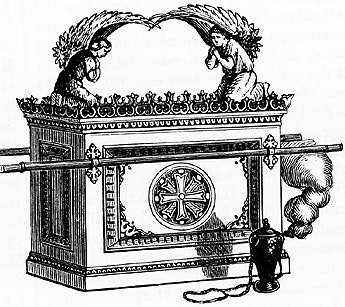
procession round Jericho (Joshua 6:4, 6, 8, 11, 12). When carried it was always wrapped in the veil, the badgers' skins, and blue cloth, and carefully concealed even from the eyes of the Levites who carried it. After the settlement of Israel in Palestine the ark remained in the tabernacle at Gilgal for a season, and was then removed to Shiloh till the time of Eli, between 300 and 400 years (Jeremiah 7:12), when it was carried into the field of battle so as to secure, as they supposed, victory to the Hebrews, and was taken by the Philistines (1 Samuel 4:3-11), who sent it back after retaining it seven months (1 Samuel 5:7, 8). It remained then at Kirjath-jearim (7:1,2) till the time of David (twenty years), who wished to remove it to Jerusalem; but the proper mode of removing it having been neglected, Uzzah was smitten with death for putting "forth his hand to the ark of God," and in consequence of this it was left in the house of Obed-edom in Gath-rimmon for three months (2 Samuel 6:1-11), at the end of which time David removed it in a grand procession to Jerusalem, where it was kept till a place was prepared for it (12-19). It was afterwards deposited by Solomon in the temple (1 Kings 8:6-9). When the Babylonians destroyed Jerusalem and plundered the temple, the ark was probably taken away by Nebuchadnezzar and destroyed, as no trace of it is afterwards to be found. The absence of the ark from the second temple was one of the points in which it was inferior to the first temple.
(Genesis 10:17; 1 Chronicles 1:15), a designation of certain descendants from the Phoenicians or Sidonians, the inhabitants of Arka, 12 miles north of Tripoli, opposite the northern extremity of Lebanon.
used to denote power (Psalm 10:15; Ezekiel 30:21; Jeremiah 48:25). It is also used of the omnipotence of God (Exodus 15:16; Psalm 89:13; 98:1; 77:15; Isaiah 53:1; John 12:38; Acts 13:17)
occurs only in Revelation 16:16 (R.V., "Har-Magedon"), as symbolically designating the place where the "battle of that great day of God Almighty" (ver. 14) shall be fought. The word properly means the "mount of Megiddo." It is the scene of the final conflict between Christ and Antichrist. The idea of such a scene was suggested by the Old Testament great battle-field, the plain of Esdraelon (q.v.).
high land, occurs only in Authorized Version, 2 Kings 19:37; in Revised Version, "Ararat," which is the Hebrew word. A country in western Asia lying between the Caspian and the Black Sea. Here the ark of Noah rested after the Deluge (Genesis 8:4). It is for the most part high table-land, and is watered by the Aras, the Kur, the Euphrates, and the Tigris. Ararat was properly the name of a part of ancient Armenia. Three provinces of Armenia are mentioned in Jeremiah 51:27, Ararat, Minni, and Ashchenaz. Some, however, think Minni a contraction for Armenia. (See ARARAT.)
inhabitant of a fortress, the first-named of the two sons of Saul and Rizpah. He was delivered up to the Gibeonites by David, and hanged by them (2 Samuel 21:8, 9).
is employed in the English Bible to denote military equipment, both offensive and defensive.
(1.) The offensive weapons were different at different periods of history. The "rod of iron" (Psalm 2:9) is supposed to mean a mace or crowbar, an instrument of great power when used by a strong arm. The "maul" (Proverbs 25:18; cognate Hebrew word rendered "battle-axe" in Jeremiah 51:20, and "slaughter weapon" in Ezekiel 9:2) was a war-hammer or martel. The "sword" is the usual translation of hereb, which properly means "poniard." The real sword, as well as the dirk-sword (which was always double-edged), was also used (1 Samuel 17:39; 2 Samuel 20:8; 1 Kings 20:11). The spear was another offensive weapon (Joshua 8:18; 1 Samuel 17:7). The javelin was used by light troops (Numbers 25:7, 8; 1 Samuel 13:22). Saul threw a javelin at David (1 Samuel 19:9, 10), and so virtually absolved him from his allegiance. The bow was, however, the chief weapon of offence. The arrows were carried in a quiver, the bow being always unbent till the moment of action (Genesis 27:3; 48:22; Psalm 18:34). The sling was a favourite weapon of the Benjamites (1 Samuel 17:40; 1 Chronicles 12:2. Comp. 1 Samuel 25:29).
(2.) Of the defensive armour a chief place is assigned to the shield or buckler. There were the great shield or target (the tzinnah), for the protection of the whole person (Genesis 15:1; Psalm 47:9; 1 Samuel 17:7; Proverbs 30:5), and the buckler (Hebrews mageen) or small shield (1 Kings 10:17; Ezekiel 26:8). In Psalm 91:4 "buckler" is properly a roundel appropriated to archers or slingers. The helmet (Ezekiel 27:10; 1 Samuel 17:38), a covering for the head; the coat of mail or corselet (1 Samuel 17:5), or habergeon (Nehemiah 4;16), harness or breat-plate (Revelation 9:9), for the covering of the back and breast and both upper arms (Isaiah 59:17; Ephesians 6:14). The cuirass and corselet, composed of leather or quilted cloth, were also for the covering of the body. Greaves, for the covering of the legs, were worn in the time of David (1 Samuel 17:6). Reference is made by Paul (Ephesians 6:14-17) to the panoply of a Roman soldier. The shield here is the thureon, a door-like oblong shield above all, i.e., covering the whole person, not the small round shield. There is no armour for the back, but only for the front.
an officer selected by kings and generals because of his bravery, not only to bear their armour, but also to stand by them in the time of danger. They were the adjutants of our modern armies (Judges 9:54; 1 Samuel 14:7; 16:21; 31:6).
the place in which armour was deposited when not used (Nehemiah 3:19; Jeremiah 50:25). At first each man of the Hebrews had his own arms, because all went to war. There were no arsenals or magazines for arms till the time of David, who had a large collection of arms, which he consecrated to the Lord in his tabernacle (1 Sa,. 21:9; 2 Samuel 8:7-12; 1 Chronicles 26:26, 27).
The Israelites marched out of Egypt in military order (Exodus 13:18, "harnessed;" marg., "five in a rank"). Each tribe formed a battalion, with its own banner and leader (Numbers 2:2; 10:14). In war the army was divided into thousands and hundreds under their several captains (Numbers 31:14), and also into families (Numbers 2:34; 2 Chronicles 25:5; 26:12). From the time of their entering the land of Canaan to the time of the kings, the Israelites made little progress in military affairs, although often engaged in warfare. The kings introduced the custom of maintaining a bodyguard (the Gibborim; i.e., "heroes"), and thus the nucleus of a standing army was formed. Saul had an army of 3,000 select warriors (1 Samuel 13:2; 14:52; 24:2). David also had a band of soldiers around him (1 Samuel 23:13; 25:13). To this band he afterwards added the Cherethites and the Pelethites (2 Samuel 15:18; 20:7). At first the army consisted only of infantry (1 Samuel 4:10; 15:4), as the use of horses was prohibited (Deuteronomy 17:16); but chariots and horses were afterwards added (2 Samuel 8:4; 1 Kings 10:26, 28, 29; 1 Kings 9:19). In 1 Kings 9:22 there is given a list of the various gradations of rank held by those who composed the army. The equipment and maintenance of the army were at the public expense (2 Samuel 17:28, 29; 1 Kings 4:27; 10:16, 17; Judges 20:10). At the Exodus the number of males above twenty years capable of bearing arms was 600,000 (Exodus 12:37). In David's time it mounted to the number of 1,300,000 (2 Samuel 24:9).
swift, the southern boundary of the territory of Israel beyond Jordan, separating it from the land of Moab (Deuteronomy 3:8, 16). This river (referred to twenty-four times in the Bible) rises in the mountains of Gilead, and after a circuitous course of about 80 miles through a deep ravine it falls into the Dead Sea nearly opposite Engedi. The stream is almost dry in summer. It is now called el-Mujeb. The territory of the Amorites extended from the Arnon to the Jabbok.
ruins. (1.) A town on the north bank of the Arnon (Deuteronomy 4:48; Judges 11:26; 2 Kings 10:33), the southern boundary of the kingdom of Sihon (Joshua 12:2). It is now called Arair, 13 miles west of the Dead Sea.
(2.) One of the towns built by the tribe of Gad (Numbers 32:34) "before Rabbah" (Joshua 13:25), the Ammonite capital. It was famous in the history of Jephthah (Judges 11:33) and of David (2 Samuel 24:5). (Comp. Isaiah 17:2; 2 Kings 15:29.)
(3.) A city in the south of Judah, 12 miles south-east of Beersheba, to which David sent presents after recovering the spoil from the Amalekites at Ziklag (1 Samuel 30:26, 28). It was the native city of two of David's warriors (1 Chronicles 11:44). It is now called Ar'arah.
(Isaiah 10:9; 36:19; 37:13), also Arphad, support, a Syrian city near Hamath, along with which it is invariably mentioned (2 Kings 19:13; 18:34; Isaiah 10:9), and Damascus (Jeremiah 49:23). After a siege of three years it fell (B.C. 742) before the Assyrian king Tiglath-pileser II. Now Tell Erfud.
son of Shem, born the year after the Deluge. He died at the age of 438 years (Genesis 11:10-13; 1 Chronicles 1:17, 18; Luke 3:36). He dwelt in Mesopotamia, and became, according to the Jewish historian Josephus, the progenitor of the Chaldeans. The tendency is to recognize in the word the name of the country nearest the ancient domain of the Chaldeans. Some regard the word as an Egypticized form of the territorial name of Ur Kasdim, or Ur of the Chaldees.
At first made of reeds, and then of wood tipped with iron. Arrows are sometimes figuratively put for lightning (Deuteronomy 32:23, 42; Psalm 7:13; 18:14; 144:6; Zechariah 9:14). They were used in war as well as in the chase (Genesis 27:3; 49:23). They were also used in divination (Ezekiel 21:21).
The word is frequently employed as a symbol of calamity or disease inflicted by God (Job 6:4; 34:6; Psalm 38:2; Deuteronomy 32:23. Comp. Ezekiel 5:16), or of some sudden danger (Psalm 91:5), or bitter words (Psalm 64:3), or false testimony (Proverbs 25:18).
the Greek form of the name of several Persian kings. (1.) The king who obstructed the rebuilding of the temple (Ezra 4:7). He was probably the Smerdis of profane history.
(2.) The king mentioned in Ezra 7:1, in the seventh year (B.C. 458) of whose reign Ezra led a second colony of Jews back to Jerusalem, was probably Longimanus, who reigned for forty years (B.C. 464-425); the grandson of Darius, who, fourteen years later, permitted Nehemiah to return and rebuild Jerusalem.
a person engaged in any kind of manual occupation (Genesis 4:22; Isaiah 3:3).
1 Samuel 20:40, (Hebrews keli, meaning "apparatus;" here meaning collectively any missile weapons, as arrows and lances. In Revised Version, "weapons"). This word is derived from the Latin artillaria = equipment of war.
wandering, (Ezekiel 27:8), a small island and city on the coast of Syria, mentioned as furnishing mariners and soldiers for Tyre. The inhabitants were called Arvadites. The name is written Aruada or Arada in the Tell-el-Amarna tablets.
physician, son of Abijah and grandson of Rehoboam, was the third king of Judah. He was zealous in maintaining the true worship of God, and in rooting all idolatry, with its accompanying immoralities, out of the land (1 Kings 15:8-14). The Lord gave him and his land rest and prosperity. It is recorded of him, however, that in his old age, when afflicted, he "sought not to the Lord, but to the physicians" (comp. Jeremiah 17:5). He died in the forty-first year of his reign, greatly honoured by his people (2 Chronicles 16:1-13), and was succeeded by his son Jehoshaphat.
made by God, the youngest son of Zeruiah, David's sister. He was celebrated for his swiftness of foot. When fighting against Ish-bosheth at Gibeon, in the army of his brother Joab, he was put to death by Abner, whom he pursued from the field of battle (2 Samuel 2:18, 19). He is mentioned among David's thirty mighty men (2 Samuel 23:24; 1 Chronicles 11:26). Others of the same name are mentioned (2 Chronicles 17:8; 31:13; Ezra 10:15).
convener, or collector. (1.) A Levite; one of the leaders of David's choir (1 Chronicles 6:39). Psalms 50 and 73-83 inclusive are attributed to him. He is mentioned along with David as skilled in music, and a "seer" (2 Chronicles 29:30). The "sons of Asaph," mentioned in 1 Chronicles 25:1, 2 Chronicles 20:14, and Ezra 2:41, were his descendants, or more probably a class of poets or singers who recognized him as their master.