
Part 32
(Revelation 21:20), a species of the carnelian combining the sard and the onyx, having three layers of opaque spots or stripes on a transparent red basis. Like the sardine, it is a variety of the chalcedony.
•SAREPTA (Luke 4:26). See ZAREPHATH.
(In the inscriptions, "Sarra-yukin" [the God] has appointed the king; also "Sarru-kinu," the legitimate king.) On the death of Shalmaneser (B.C. 723), one of the Assyrian generals established himself on the vacant throne, taking the name of "Sargon," after that of the famous monarch, the Sargon of Accad, founder of the first Semitic empire, as well as of one of the most famous libraries of Chaldea. He forthwith began a conquering career, and became one of the most powerful of the Assyrian monarchs. He is mentioned by name in the Bible only in connection with the siege of Ashdod (Isaiah 20:1).
At the very beginning of his reign he besieged and took the city of Samaria (2 Kings 17:6; 18:9-12). On an inscription found in the palace he built at Khorsabad, near Nieveh, he says, "The city of Samaria I besieged, I took; 27,280 of its inhabitants I carried away; fifty chariots that were among them I collected," etc. The northern kingdom he changed into an Assyrian satrapy. He afterwards drove Merodach-baladan (q.v.), who kept him at bay for twelve years, out of Babylon, which he entered in triumph. By a succession of victories he gradually enlarged and consolidated the empire, which now extended from the frontiers of Egypt in the west to the mountains of Elam in the east, and thus carried almost to completion the ambitious designs of Tiglath-pileser (q.v.). He was murdered by one of his own soldiers (B.C. 705) in his palace at Khorsabad, after a reign of sixteen years, and was succeeded by his son Sennacherib.
adversary; accuser. When used as a proper name, the Hebrew word so rendered has the article "the adversary" (Job 1:6-12; 2:1-7). In the New Testament it is used as interchangeable with Diabolos, or the devil, and is so used more than thirty times.
He is also called "the dragon," "the old serpent" (Revelation 12:9; 20:2); "the prince of this world" (John 12:31; 14:30); "the prince of the power of the air" (Ephesians 2:2); "the God of this world" (2 Corinthians 4:4); "the spirit that now worketh in the children of disobedience" (Ephesians 2:2). The distinct personality of Satan and his activity among men are thus obviously recognized. He tempted our Lord in the wilderness (Matthew 4:1-11). He is "Beelzebub, the prince of the devils" (12:24). He is "the constant enemy of God, of Christ, of the divine kingdom, of the followers of Christ, and of all truth; full of falsehood and all malice, and exciting and seducing to evil in every possible way." His power is very great in the world. He is a "roaring lion, seeking whom he may devour" (1 Peter 5:8). Men are said to be "taken captive by him" (2 Timothy 2:26). Christians are warned against his "devices" (2 Corinthians 2:11), and called on to "resist" him (James 4:7). Christ redeems his people from "him that had the power of death, that is, the devil" (Hebrews 2:14). Satan has the "power of death," not as Lord, but simply as executioner.
hairy one. Mentioned in Greek mythology as a creature composed of a man and a goat, supposed to inhabit wild and desolate regions. The Hebrew word is rendered also "goat" (Leviticus 4:24) and "devil", i.e., an idol in the form of a goat (17:7; 2 Chronicles 11:15). When it is said (Isaiah 13:21; comp. 34:14) "the satyrs shall dance there," the meaning is that the place referred to shall become a desolate waste. Some render the Hebrew word "baboon," a species of which is found in Babylonia.
asked for. (1.) A king of Edom (Genesis 36:37, 38); called Shaul in 1 Chronicles 1:48.
(2.) The son of Kish (probably his only son, and a child of prayer, "asked for"), of the tribe of Benjamin, the first king of the Jewish nation. The singular providential circumstances connected with his election as king are recorded in 1 Samuel 8-10. His father's she-asses had strayed, and Saul was sent with a servant to seek for them. Leaving his home at Gibeah (10:5, "the hill of God," A.V.; lit., as in R.V. marg., "Gibeah of God"), Saul and his servant went toward the north-west over Mount Ephraim, and then turning north-east they came to "the land of Shalisha," and thence eastward to the land of Shalim, and at length came to the district of Zuph, near Samuel's home at Ramah (9:5-10). At this point Saul proposed to return from the three days' fruitless search, but his servant suggested that they should first consult the "seer." Hearing that he was about to offer sacrifice, the two hastened into Ramah, and "behold, Samuel came out against them," on his way to the "bamah", i.e., the "height", where sacrifice was to be offered; and in answer to Saul's question, "Tell me, I pray thee, where the seer's house is," Samuel made himself known to him. Samuel had been divinely prepared for his coming (9:15-17), and received Saul as his guest. He took him with him to the sacrifice, and then after the feast "communed with Saul upon the top of the house" of all that was in his heart. On the morrow Samuel "took a vial of oil and poured it on his head," and anointed Saul as king over Israel (9:25-10:8), giving him three signs in confirmation of his call to be king. When Saul reached his home in Gibeah the last of these signs was fulfilled, and the Sprit of God came upon him, and "he was turned into another man." The simple countryman was transformed into the king of Israel, a remarkable change suddenly took place in his whole demeanour, and the people said in their astonishment, as they looked on the stalwart son of Kish, "Is Saul also among the prophets?", a saying which passed into a "proverb." (Comp. 19:24.)
The intercourse between Saul and Samuel was as yet unknown to the people. The "anointing" had been in secret. But now the time had come when the transaction must be confirmed by the nation. Samuel accordingly summoned the people to a solemn assembly "before the Lord" at Mizpeh. Here the lot was drawn (10:17-27), and it fell upon Saul, and when he was presented before them, the stateliest man in all Israel, the air was rent for the first time in Israel by the loud cry, "God save the king!" He now returned to his home in Gibeah, attended by a kind of bodyguard, "a band of men whose hearts God had touched." On reaching his home he dismissed them, and resumed the quiet toils of his former life.
Soon after this, on hearing of the conduct of Nahash the Ammonite at Jabeshgilead (q.v.), an army out of all the tribes of Israel rallied at his summons to the trysting-place at Bezek, and he led them forth a great army to battle, gaining a complete victory over the Ammonite invaders at Jabesh (11:1-11). Amid the universal joy occasioned by this victory he was now fully recognized as the king of Israel. At the invitation of Samuel "all the people went to Gilgal, and there they made Saul king before the Lord in Gilgal." Samuel now officially anointed him as king (11:15). Although Samuel never ceased to be a judge in Israel, yet now his work in that capacity practically came to an end.
Saul now undertook the great and difficult enterprise of freeing the land from its hereditary enemies the Philistines, and for this end he gathered together an army of 3,000 men (1 Samuel 13:1, 2). The Philistines were encamped at Geba. Saul, with 2,000 men, occupied Michmash and Mount Bethel; while his son Jonathan, with 1,000 men, occupied Gibeah, to the south of Geba, and seemingly without any direction from his father "smote" the Philistines in Geba. Thus roused, the Philistines, who gathered an army of 30,000 chariots and 6,000 horsemen, and "people as the sand which is on the sea-shore in multitude," encamped in Michmash, which Saul had evacuated for Gilgal. Saul now tarried for seven days in Gilgal before making any movement, as Samuel had appointed (10:8); but becoming impatient on the seventh day, as it was drawing to a close, when he had made an end of offering the burnt offering, Samuel appeared and warned him of the fatal consequences of his act of disobedience, for he had not waited long enough (13:13, 14).
When Saul, after Samuel's departure, went out from Gilgal with his 600 men, his followers having decreased to that number (13:15), against the Philistines at Michmash (q.v.), he had his head-quarters under a pomegrante tree at Migron, over against Michmash, the Wady es Suweinit alone intervening. Here at Gibeah-Geba Saul and his army rested, uncertain what to do. Jonathan became impatient, and with his armour-bearer planned an assault against the Philistines, unknown to Saul and the army (14:1-15). Jonathan and his armour-bearer went down into the wady, and on their hands and knees climbed to the top of the narrow rocky ridge called Bozez, where was the outpost of the Philistine army. They surprised and then slew twenty of the Philistines, and immediately the whole host of the Philistines was thrown into disorder and fled in great terror. "It was a very great trembling;" a supernatural panic seized the host. Saul and his 600 men, a band which speedily increased to 10,000, perceiving the confusion, pursued the army of the Philistines, and the tide of battle rolled on as far as to Bethaven, halfway between Michmash and Bethel. The Philistines were totally routed. "So the Lord saved Israel that day." While pursuing the Philistines, Saul rashly adjured the people, saying, "Cursed be the man that eateth any food until evening." But though faint and weary, the Israelites "smote the Philistines that day from Michmash to Aijalon" (a distance of from 15 to 20 miles). Jonathan had, while passing through the wood in pursuit of the Philistines, tasted a little of the honeycomb which was abundant there (14:27). This was afterwards discovered by Saul (ver. 42), and he threatened to put his son to death. The people, however, interposed, saying, "There shall not one hair of his head fall to the ground." He whom God had so signally owned, who had "wrought this great salvation in Israel," must not die. "Then Saul went up from following the Philistines: and the Philistines went to their own place" (1 Samuel 14:24-46); and thus the campaign against the Philistines came to an end. This was Saul's second great military success.
Saul's reign, however, continued to be one of almost constant war against his enemies round about (14:47, 48), in all of which he proved victorious. The war against the Amalekites is the only one which is recorded at length (1 Samuel 15). These oldest and hereditary (Exodus 17:8; Numbers 14:43-45) enemies of Israel occupied the territory to the south and south-west of Palestine. Samuel summoned Saul to execute the "ban" which God had pronounced (Deuteronomy 25:17-19) on this cruel and relentless foe of Israel. The cup of their iniquity was now full. This command was "the test of his moral qualification for being king." Saul proceeded to execute the divine command; and gathering the people together, marched from Telaim (1 Samuel 15:4) against the Amalekites, whom he smote "from Havilah until thou comest to Shur," utterly destroying "all the people with the edge of the sword", i.e., all that fell into his hands. He was, however, guilty of rebellion and disobedience in sparing Agag their king, and in conniving at his soldiers' sparing the best of the sheep and cattle; and Samuel, following Saul to Gilgal, in the Jordan valley, said unto him, "Because thou hast rejected the word of the Lord, he also hath rejected thee from being king" (15:23). The kingdom was rent from Saul and was given to another, even to David, whom the Lord chose to be Saul's successor, and whom Samuel anointed (16:1-13). From that day "the spirit of the Lord departed from Saul, and an evil spirit from the Lord troubled him." He and Samuel parted only to meet once again at one of the schools of the prophets.
David was now sent for as a "cunning player on an harp" (1 Samuel 16:16, 18), to play before Saul when the evil spirit troubled him, and thus was introduced to the court of Saul. He became a great favourite with the king. At length David returned to his father's house and to his wonted avocation as a shepherd for perhaps some three years. The Philistines once more invaded the land, and gathered their army between Shochoh and Azekah, in Ephes-dammim, on the southern slope of the valley of Elah. Saul and the men of Israel went forth to meet them, and encamped on the northern slope of the same valley which lay between the two armies. It was here that David slew Goliath of Gath, the champion of the Philistines (17:4-54), an exploit which led to the flight and utter defeat of the Philistine army. Saul now took David permanently into his service (18:2); but he became jealous of him (ver. 9), and on many occasions showed his enmity toward him (ver. 10, 11), his enmity ripening into a purpose of murder which at different times he tried in vain to carry out.
After some time the Philistines "gathered themselves together" in the plain of Esdraelon, and pitched their camp at Shunem, on the slope of Little Hermon; and Saul "gathered all Israel together," and "pitched in Gilboa" (1 Samuel 28:3-14). Being unable to discover the mind of the Lord, Saul, accompanied by two of his retinue, betook himself to the "witch of Endor," some 7 or 8 miles distant. Here he was overwhelmed by the startling communication that was mysteriously made to him by Samuel (ver. 16-19), who appeared to him. "He fell straightway all along on the earth, and was sore afraid, because of the words of Samuel" (ver. 20). The Philistine host "fought against Israel: and the men of Israel fled before the Philistines, and fell down slain in Mount Gilboa" (31:1). In his despair at the disaster that had befallen his army, Saul "took a sword and fell upon it." And the Philistines on the morrow "found Saul and his three sons fallen in Mount Gilboa." Having cut off his head, they sent it with his weapons to Philistia, and hung up the skull in the temple of Dagon at Ashdod. They suspended his headless body, with that of Jonathan, from the walls of Bethshan. The men of Jabesh-gilead afterwards removed the bodies from this position; and having burnt the flesh, they buried the bodies under a tree at Jabesh. The remains were, however, afterwards removed to the family sepulchre at Zelah (2 Samuel 21:13, 14). (See DAVID.)
(3.) "Who is also called Paul" (q.v.), the circumcision name of the apostle, given to him, perhaps, in memory of King Saul (Acts 7:58; 8:1; 9:1).
one who saves from any form or degree of evil. In its highest sense the word indicates the relation sustained by our Lord to his redeemed ones, he is their Saviour. The great message of the gospel is about salvation and the Saviour. It is the "gospel of salvation." Faith in the Lord Jesus Christ secures to the sinner a personal interest in the work of redemption. Salvation is redemption made effectual to the individual by the power of the Holy Spirit.
Leviticus 16:8-26; R.V., "the goat for Azazel" (q.v.), the name given to the goat which was taken away into the wilderness on the day of Atonement (16:20-22). The priest made atonement over the scapegoat, laying Israel's guilt upon it, and then sent it away, the goat bearing "upon him all their iniquities unto a land not inhabited."
At a later period an evasion or modification of the law of Moses was introduced by the Jews. "The goat was conducted to a mountain named Tzuk, situated at a distance of ten Sabbath days' journey, or about six and a half English miles, from Jerusalem. At this place the Judean desert was supposed to commence; and the man in whose charge the goat was sent out, while setting him free, was instructed to push the unhappy beast down the slope of the mountain side, which was so steep as to insure the death of the goat, whose bones were broken by the fall. The reason of this barbarous custom was that on one occasion the scapegoat returned to Jerusalem after being set free, which was considered such an evil omen that its recurrence was prevented for the future by the death of the goat" (Twenty-one Years' Work in the Holy Land). This mountain is now called el-Muntar.
This dye was obtained by the Egyptians from the shell-fish Carthamus tinctorius; and by the Hebrews from the Coccus ilicis, an insect which infests oak trees, called kermes by the Arabians.
This colour was early known (Genesis 38:28). It was one of the colours of the ephod (Exodus 28:6), the girdle (8), and the breastplate (15) of the high priest. It is also mentioned in various other connections (Joshua 2:18; 2 Samuel 1:24; Lamentations 4:5; Nahum 2:3). A scarlet robe was in mockery placed on our Lord (Matthew 27:28; Luke 23:11). "Sins as scarlet" (Isaiah 1:18), i.e., as scarlet robes "glaring and habitual." Scarlet and crimson were the firmest of dyes, and thus not easily washed out.
(Hebrews shebet = Gr. skeptron), properly a staff or rod. As a symbol of authority, the use of the sceptre originated in the idea that the ruler was as a shepherd of his people (Genesis 49:10; Numbers 24:17; Psalm 45:6; Isaiah 14:5). There is no example on record of a sceptre having ever been actually handled by a Jewish king.
an implement, a Jew, chief of the priests at Ephesus (Acts 19:13-16); i.e., the head of one of the twenty-four courses of the house of Levi. He had seven sons, who "took upon them to call over them which had evil spirits the name of the Lord Jesus," in imitation of Paul. They tried their method of exorcism on a fierce demoniac, and failed. His answer to them was to this effect (19:15): "The Jesus whom you invoke is One whose authority I acknowledge; and the Paul whom you name I recognize to be a servant or messenger of God; but what sort of men are ye who have been empowered to act as you do by neither?" (Lindsay on the Acts of the Apostles.)
a separation, an alienation causing divisions among Christians, who ought to be united (1 Corinthians 12:25).
the law so designated by Paul (Galatians 3:24, 25). As so used, the word does not mean teacher, but pedagogue (shortened into the modern page), i.e., one who was intrusted with the supervision of a family, taking them to and from the school, being responsible for their safety and manners. Hence the pedagogue was stern and severe in his discipline. Thus the law was a pedagogue to the Jews, with a view to Christ, i.e., to prepare for faith in Christ by producing convictions of guilt and helplessness. The office of the pedagogue ceased when "faith came", i.e., the object of that faith, the seed, which is Christ.
OF THE PROPHETS (1 Samuel 19:18-24; 2 Kings 2:3, 5, 7, 12, 15) were instituted for the purpose of training young men for the prophetical and priestly offices. (See PROPHET; SAMUEL.)
mentioned along with serpents (Deuteronomy 8:15). Used also figuratively to denote wicked persons (Ezekiel 2:6; Luke 10:19); also a particular kind of scourge or whip (1 Kings 12:11). Scorpions were a species of spider. They abounded in the Jordan valley.
(1 Kings 12:11). Variously administered. In no case were the stripes to exceed forty (Deuteronomy 25:3; comp. 2 Corinthians
11:24). In the time of the apostles, in consequence of the passing of what was called the Porcian law, no Roman citizen could be scourged in any case (Acts 16:22-37). (See BASTINADO.) In the scourging of our Lord (Matthew 27:26; Mark 15:15) the words of prophecy (Isaiah 53:5) were fulfilled.
anciently held various important offices in the public affairs of the nation. The Hebrew word so rendered (sopher) is first used to designate the holder of some military office (Judges 5:14; A.V., "pen of the writer;" R.V., "the marshal's staff;" marg., "the staff of the scribe"). The scribes acted as secretaries of state, whose business it was to prepare and issue decrees in the name of the king (2 Samuel 8:17; 20:25; 1 Chronicles 18:16; 24:6; 1 Kings 4:3; 2 Kings 12:9-11; 18:18-37, etc.). They discharged various other important public duties as men of high authority and influence in the affairs of state.
There was also a subordinate class of scribes, most of whom were Levites. They were engaged in various ways as writers. Such, for example, was Baruch, who "wrote from the mouth of Jeremiah all the words of the Lord" (Jeremiah 36:4, 32).
In later times, after the Captivity, when the nation lost its independence, the scribes turned their attention to the law, gaining for themselves distinction by their intimate acquaintance with its contents. On them devolved the duty of multiplying copies of the law and of teaching it to others (Ezra 7:6, 10-12; Nehemiah 8:1, 4, 9, 13). It is evident that in New Testament times the scribes belonged to the sect of the Pharisees, who supplemented the ancient written law by their traditions (Matthew 23), thereby obscuring it and rendering it of none effect. The titles "scribes" and "lawyers" (q.v.) are in the Gospels interchangeable (Matthew 22:35; Mark 12:28; Luke 20:39, etc.). They were in the time of our Lord the public teachers of the people, and frequently came into collision with him. They afterwards showed themselves greatly hostile to the apostles (Acts 4:5; 6:12).
Some of the scribes, however, were men of a different spirit, and showed themselves friendly to the gospel and its preachers. Thus Gamaliel advised the Sanhedrin, when the apostles were before them charged with "teaching in this name," to "refrain from these men and let them alone" (Acts 5:34-39; comp. 23:9).
a small bag or wallet usually fastened to the girdle (1 Samuel 17:40); "a shepherd's bag."
In the New Testament it is the rendering of Gr. pera, which was a bag carried by travellers and shepherds, generally made of skin (Matthew 10:10; Mark 6:8; Luke 9:3; 10:4). The name "scrip" is meant to denote that the bag was intended to hold scraps, fragments, as if scraped off from larger articles, trifles.
invariably in the New Testament denotes that definite collection of sacred books, regarded as given by inspiration of God, which we usually call the Old Testament (2 Timothy 3:15, 16; John 20:9; Galatians 3:22; 2 Peter 1:20). It was God's purpose thus to perpetuate his revealed will. From time to time he raised up men to commit to writing in an infallible record the revelation he gave. The "Scripture," or collection of sacred writings, was thus enlarged from time to time as God saw necessary. We have now a completed "Scripture," consisting of the Old and New Testaments. The Old Testament canon in the time of our Lord was precisely the same as that which we now possess under that name. He placed the seal of his own authority on this collection of writings, as all equally given by inspiration (Matthew 5:17; 7:12; 22:40; Luke 16:29, 31). (See BIBLE; CANON.)
The Scythians consisted of "all the pastoral tribes who dwelt to the north of the Black Sea and the Caspian, and were scattered far away toward the east. Of this vast country but little was anciently known. Its modern representative is Russia, which, to a great extent, includes the same territories." They were the descendants of Japheth (Genesis 9:27). It appears that in apostolic times there were some of this people that embraced Christianity (Colossians 3:11).
In land measure, a space of 50 cubits long by 50 broad. In measure of capacity, a seah was a little over one peck. (See MEASURE.)
commonly a ring engraved with some device (Genesis 38:18, 25). Jezebel "wrote letters in Ahab's name, and sealed them with his seal" (1 Kings 21:8). Seals are frequently mentioned in Jewish history (Deuteronomy 32:34; Nehemiah 9:38; 10:1; Esther 3:12; Cant. 8:6; Isaiah 8:16; Jeremiah 22:24; 32:44, etc.). Sealing a document was equivalent to the signature of the owner of the seal. "The use of a signet-ring by the
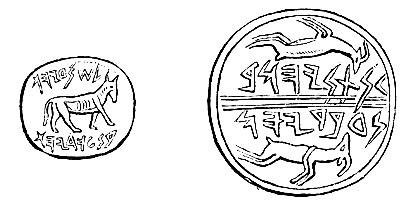
monarch has recently received a remarkable illustration by the discovery of an impression of such a signet on fine clay at Koyunjik, the site of the ancient Nineveh.
ANCIENT JEWISH SEALS This seal appears to have been impressed from the bezel of a metallic finger-ring. It is an oval, 2 inches in length by 1 inch wide, and bears the image, name, and titles of the Egyptian king Sabaco" (Rawlinson's Hist. Illus. of the O.T., p. 46). The actual signet-rings of two Egyptian kings (Cheops and Horus) have been discovered. (See SIGNET.)
The use of seals is mentioned in the New Testament only in connection with the record of our Lord's burial (Matthew 27:66). The tomb was sealed by the Pharisees and chief priests for the purpose of making sure that the disciples would not come and steal the body away (ver. 63, 64). The mode of doing this was probably by stretching a cord across the stone and sealing it at both ends with sealing-clay. When God is said to have sealed the Redeemer, the meaning is, that he has attested his divine mission (John 6:27). Circumcision is a seal, an attestation of the covenant (Romans 4:11). Believers are sealed with the Spirit, as God's mark put upon them (Ephesians 1:13; 4:30). Converts are by Paul styled the seal of his apostleship, i.e., they are its attestation (1 Corinthians 9:2). Seals and sealing are frequently mentioned in the book of Revelation (5:1; 6:1; 7:3; 10:4; 22:10).
OF GLASS a figurative expression used in Revelation 4:6 and 15:2. According to the interpretation of some, "this calm, glass-like sea, which is never in storm, but only interfused with flame, represents the counsels of God, those purposes of righteousness and love which are often fathomless but never obscure, always the same, though sometimes glowing with holy anger." (Comp. Psalm 36:6; 77:19; Romans 11:33-36.)
OF JAZER (Jeremiah 48:32), a lake, now represented by some ponds in the high valley in which the Ammonite city of Jazer lies, the ruins of which are called Sar.
•SEASONS (Genesis 8:22). See AGRICULTURE; MONTH.
THE (Hebrews yam), signifies (1) "the gathering together of the waters," the ocean (Genesis 1:10); (2) a river, as the Nile (Isaiah 19:5), the Euphrates (Isaiah 21:1; Jeremiah 51:36); (3) the Red Sea (Exodus 14:16, 27; 15:4, etc.); (4) the Mediterranean (Exodus 23:31; Numbers 34:6, 7; Joshua 15:47; Psalm 80:11, etc.); (5) the "sea of Galilee," an inland fresh-water lake, and (6) the Dead Sea or "salt sea" (Genesis 14:3; Numbers 34:3, 12, etc.). The word "sea" is used symbolically in Isaiah 60:5, where it probably means the nations around the Mediterranean. In Daniel 7:3, Revelation 13:1 it may mean the tumultuous changes among the nations of the earth. •SEA, THE MOLTEN the great laver made by Solomon for the use of the priests in the temple, described in 1 Kings 7:23-26; 2 Chronicles 4:2-5. It stood in the south-eastern corner of the inner court. It was 5 cubits high,
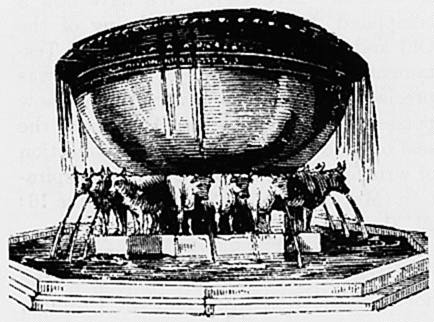
10 in diameter from brim to brim, and 30 in circumference. It was placed on the backs of twelve oxen, standing with their faces outward. It was capable of containing two or three thousand baths of water (comp. 2 Chronicles 4:5), which was originally supplied by the Gibeonites, but was afterwards brought by a conduit from the pools of Bethlehem. It was made of "brass" SUPPOSED FORM OF THE MOLTEN SEA (copper), which Solomon had taken from the captured cities of Hadarezer, the king of Zobah (1 Chronicles 18:8). Ahaz afterwards removed this laver from the oxen, and placed it on a stone pavement (2 Kings 16:17). It was destroyed by the Chaldeans (25:13).
•SEBA (1.) One of the sons of Cush (Genesis 10:7).
(2.) The name of a country and nation (Isaiah 43:3; 45:14) mentioned along with Egypt and Ethiopia, and therefore probably in north-eastern Africa. The ancient name of Meroe. The kings of Sheba and Seba are mentioned together in Psalm 72:10.
the eleventh month of the Hebrew year, extending from the new moon of February to that of March (Zechariah 1:7). Assyrian sabatu, "storm." (See MONTH.)
enclosure, one of the six cities in the wilderness of Judah, noted for its "great cistern" (Joshua 15:61). It has been identified with the ruin Sikkeh, east of Bethany.
a hill or watch-tower, a place between Gibeah and Ramah noted for its "great well" (1 Samuel 19:22); probably the modern Suweikeh, south of Beeroth.
(Gr. hairesis, usually rendered "heresy", Acts 24:14; 1 Chronicles 11:19; Galatians 5:20, etc.), meaning properly "a choice," then "a chosen manner of life," and then "a religious party," as the "sect" of the Sadducees (Acts 5:17), of the Pharisees (15:5), the Nazarenes, i.e., Christians (24:5). It afterwards came to be used in a bad sense, of those holding pernicious error, divergent forms of belief (2 Peter 2:1; Galatians 5:20).
second, a Christian of Thessalonica who accompanied Paul into Asia (Acts 20:4).
a name sometimes applied to the prophets because of the visions granted to them. It is first found in 1 Samuel 9:9. It is afterwards applied to Zadok, Gad, etc. (2 Samuel 15:27; 24:11; 1 Chronicles 9:22; 25:5; 2 Chronicles 9:29; Amos 7:12; Micah 3:7). The "sayings of the seers" (2 Chronicles 33:18, 19) is rendered in the Revised Version "the history of Hozai" (marg., the seers; so the LXX.), of whom, however, nothing is known. (See PROPHET.)
•SEETHE to boil (Exodus 16:23).
•SEETHING POT a vessel for boiling provisions in (Job 41:20; Jeremiah 1:13).
elevated. (1.) The youngest son of Hiel the Bethelite. His death is recorded in 1 Kings 16:34 (comp. Joshua 6:26).
(2.) A descendant of Judah (1 Chronicles 2:21, 22).
rough; hairy. (1.) A Horite; one of the "dukes" of Edom (Genesis 36:20-30).
(2.) The name of a mountainous region occupied by the Edomites, extending along the eastern side of the Arabah from the south-eastern extremity of the Dead Sea to near the Akabah, or the eastern branch of the Red Sea. It was originally occupied by the Horites (Genesis 14:6), who were afterwards driven out by the Edomites (Genesis 32:3; 33:14, 16). It was allotted to the descendants of Esau (Deuteronomy 2:4, 22; Joshua 24:4; 2 Chronicles 20:10; Isaiah 21:11; Exek. 25:8).
(3.) A mountain range (not the Edomite range, Genesis 32:3) lying between the Wady Aly and the Wady Ghurab (Joshua 15:10).
woody district; shaggy, a place among the mountains of Ephraim, bordering on Benjamin, to which Ehud fled after he had assassinated Eglon at Jericho (Judges 3:26, 27).
rock, the capital of Edom, situated in the great valley extending from the Dead Sea to the Red Sea (2 Kings 14:7). It was near Mount Hor, close by the desert of Zin. It is called "the rock" (Judges 1:36). When Amaziah took it he called it Joktheel (q.v.) It is mentioned by the prophets (Isaiah 16:1; Obad. 1:3) as doomed to destruction.
It appears in later history and in the Vulgate Version under the name of Petra. "The caravans from all ages, from the interior of Arabia and from the Gulf of Persia, from Hadramaut on the ocean, and even from Sabea or Yemen, appear to have pointed to Petra as a common centre; and from Petra the tide seems again to have branched out in every direction, to Egypt, Palestine, and Syria, through Arsinoe, Gaza, Tyre, Jerusalem, and Damascus, and by other routes, terminating at the Mediterranean." (See EDOM [2].)
a word frequently found in the Book of Psalms, and also in Habakkuk 3:9, 13, about seventy-four times in all in Scripture. Its meaning is doubtful. Some interpret it as meaning "silence" or "pause;" others, "end," "a louder strain," "piano," etc. The LXX. render the word by daplasma i.e., "a division."
cliff of divisions the name of the great gorge which lies between Hachilah and Maon, south-east of Hebron. This gorge is now called the Wady Malaky. This was the scene of the interview between David and Saul mentioned in 1 Samuel 26:13. Each stood on an opposing cliff, with this deep chasm between.
the sea-port of Antioch, near the mouth of the Orontes. Paul and his companions sailed from this port on their first missionary journey (Acts 13:4). This city was built by Seleucus Nicator, the "king of Syria." It is said of him that "few princes have ever lived with so great a passion for the building of cities. He is reputed to have built in all nine Seleucias, sixteen Antiochs, and six Laodiceas." Seleucia became a city of great importance, and was made a "free city" by Pompey. It is now a small village, called el-Kalusi.
•SEMEI mentioned in the genealogy of our Lord (Luke 3:26).
thorny, a place many of the inhabitants of which returned from Babylon with Zerubbabel (Ezra 2:35; Nehemiah 7:38).
(Acts 5:21), the "elders of Israel" who formed a component part of the Sanhedrin.
the acacia; rock-thorn, the southern cliff in the Wady es-Suweinit, a valley south of Michmash, which Jonathan climbed with his armour-bearer (1 Samuel 14:4, 5). The rock opposite, on the other side of the wady, was called Bozez.
the name given to Hermon by the Amorites (Deuteronomy 3:9). It means "coat of mail" or "breastplate," and is equivalent to "Sirion." Some interpret the word as meaning "the prominent" or "the snowy mountain." It is properly the name of the central of the three summits of Hermon (q.v.).
Sin (the God) sends many brothers, son of Sargon, whom he succeeded on the throne of Assyria (B.C. 705), in the 23rd year of Hezekiah. "Like the Persian Xerxes, he was weak and vainglorious, cowardly under reverse, and cruel and boastful in success." He first set himself to break up the powerful combination of princes who were in league against him. Among these was Hezekiah, who had entered into an alliance with Egypt against Assyria. He accordingly led a very powerful army of at least 200,000 men into Judea, and devastated the land on every side, taking and destroying many cities (2 Kings 18:13-16; comp. Isaiah 22, 24, 29, and 2 Chronicles 32:1-8). His own account of this invasion, as given in the Assyrian annals, is in these words: "Because Hezekiah, king of Judah, would not submit to my yoke, I came up against him, and by force of arms and by the might of my power I took forty-six of his strong fenced cities; and of the smaller towns which were scattered about, I took and plundered a countless number. From these places I took and carried off 200,156 persons, old and young, male and female, together with horses and mules, asses and camels, oxen and sheep, a countless multitude; and Hezekiah himself I shut up in Jerusalem, his capital city, like a bird in a cage, building towers round the city to hem him in, and raising banks of earth against the gates, so as to prevent escape...Then upon Hezekiah there fell the fear of the power of my arms, and he sent out to me the chiefs and the elders of Jerusalem with 30 talents of gold and 800 talents of silver, and divers treasures, a rich and immense booty...All these things were brought to me at Nineveh, the seat of my government." (Comp. Isaiah 22:1-13 for description of the feelings of the inhabitants of Jerusalem at such a crisis.)
Hezekiah was not disposed to become an Assyrian feudatory. He accordingly at once sought help from Egypt (2 Kings 18:20-24). Sennacherib, hearing of this, marched a second time into Palestine (2 Kings 18:17, 37; 19; 2 Chronicles 32:9-23; Isaiah 36:2-22. Isaiah 37:25 should be rendered "dried up all the Nile-arms of Matsor," i.e., of Egypt, so called from the "Matsor" or great fortification across the isthmus of Suez, which protected it from invasions from the east). Sennacherib sent envoys to try to persuade Hezekiah to surrender, but in vain. (See TIRHAKAH.) He next sent a threatening letter (2 Kings 19:10-14), which Hezekiah carried into the temple and spread before the Lord. Isaiah again brought an encouraging message to the pious king (2 Kings 19:20-34). "In that night" the angel of the Lord went forth and smote the camp of the Assyrians. In the morning, "behold, they were all dead corpses." The Assyrian army was annihilated.
This great disaster is not, as was to be expected, taken notice of in the Assyrian annals.
Though Sennacherib survived this disaster some twenty years, he never again renewed his attempt against Jerusalem. He was murdered by two of his own sons (Adrammelech and Sharezer), and was succeeded by another son, Esarhaddon (B.C. 681), after a reign of twenty-four years.
barley, the chief of the forth priestly course (1 Chronicles 24:8).
numbering, (Genesis 10:30), supposed by some to be the ancient Himyaritic capital, "Shaphar," Zaphar, on the Indian Ocean, between the Persian Gulf and the Red Sea.
(Obad. 1:20), some locality unknown. The modern Jews think that Spain is meant, and hence they designate the Spanish Jews "Sephardim," as they do the German Jews by the name "Ashkenazim," because the rabbis call Germany Ashkenaz. Others identify it with Sardis, the capital of Lydia. The Latin father Jerome regarded it as an Assyrian word, meaning "boundary," and interpreted the sentence, "which is in Sepharad," by "who are scattered abroad in all the boundaries and regions of the earth." Perowne says: "Whatever uncertainty attaches to the word Sepharad, the drift of the prophecy is clear, viz., that not only the exiles from Babylon, but Jewish captives from other and distant regions, shall be brought back to live prosperously within the enlarged borders of their own land."
taken by Sargon, king of Assyria (2 Kings 17:24; 18:34; 19:13; Isaiah 37:13). It was a double city, and received the common name Sepharvaim, i.e., "the two Sipparas," or "the two booktowns." The Sippara on the east bank of the Euphrates is now called Abu-Habba; that on the other bank was Accad, the old capital of Sargon I., where he established a great library. (See SARGON.) The recent discovery of cuneiform inscriptions at Tel el-Amarna in Egypt, consisting of official despatches to Pharaoh Amenophis IV. and his predecessor from their agents in Palestine, proves that in the century before the Exodus an active literary intercourse was carried on between these nations, and that the medium of the correspondence was the Babylonian language and script. (See KIRJATH-SEPHER.)
•SEPTUAGINT See VERSIONS.
first mentioned as purchased by Abraham for Sarah from Ephron the Hittite (Genesis 23:20). This was the "cave of the field of Machpelah," where also Abraham and Rebekah and Jacob and Leah were burried (79:29-32). In Acts 7:16 it is said that Jacob was "laid in the sepulchre that Abraham bought for a sum of money of the sons of Emmor the father of Sychem." It has been proposed, as a mode of reconciling the apparent discrepancy between this verse and Genesis 23:20, to read Acts 7:16 thus: "And they [i.e., our fathers] were carried over into Sychem, and laid in the sepulchre that Abraham bought for a sum of money of the sons of Emmor [the son] of Sychem." In this way the purchase made by Abraham is not to be confounded with the purchase made by Jacob subsequently in the same district. Of this purchase by Abraham there is no direct record in the Old Testament. (See TOMB.)
abundance; princess, the daughter of Asher and grand-daughter of Jacob (Genesis 46:17); called also Sarah (Numbers 26:46; R.V., "Serah").
soldier of Jehovah. (1.) The father of Joab (1 Chronicles 4:13, 14).
(2.) The grandfather of Jehu (1 Chronicles 4:35).
(3.) One of David's scribes or secretaries (2 Samuel 8:17).
(4.) A Netophathite (Jeremiah 40:8), a chief priest of the time of Zedekiah. He was carried captive by Nebuchadnezzar to Babylon, and there put to death (2 Kings 25:18, 23).
(6.) Father of Ezra the scribe (7:1).
(7.) A ruler of the temple (Nehemiah 11:11).
(8.) A priest of the days of Jehoiakim (Nehemiah 12:1, 12).
(9.) The son of Neriah. When Zedekiah made a journey to Babylon to do homage to Nebuchadnezzar, Seraiah had charge of the royal gifts to be presented on that occasion. Jeremiah took advantage of the occasion, and sent with Seraiah a word of cheer to the exiles in Babylon, and an announcement of the doom in store for that guilty city. The roll containing this message (Jeremiah 50:1-8) Seraiah was to read to the exiles, and then, after fixing a stone to it, was to throw it into the Euphrates, uttering, as it sank, the prayer recorded in Jeremiah 51:59-64. Babylon was at this time in the height of its glory, the greatest and most powerful monarchy in the world. Scarcely seventy years elapsed when the words of the prophet were all fulfilled. Jeremiah 51:59 is rendered in the Revised Version, "Now Seraiah was chief chamberlain," instead of "was a quiet prince," as in the Authorized Version.
mentioned in Isaiah 6:2, 3, 6, 7. This word means fiery ones, in allusion, as is supposed, to their burning love. They are represented as "standing" above the King as he sat upon his throne, ready at once to minister unto him. Their form appears to have been human, with the addition of wings. (See ANGELS.) This word, in the original, is used elsewhere only of the "fiery serpents" (Numbers 21:6, 8; Deuteronomy 8:15; comp. Isaiah 14:29; 30:6) sent by God as his instruments to inflict on the people the righteous penalty of sin.
•SERED fear, one of the sons of Zebulun (Genesis 46:14).
Acts 16:35, 38 (R.V., "lictors"), officers who attended the magistrates and assisted them in the execution of justice.
PAULUS a "prudent man" (R.V., "man of understanding"), the deputy (R.V., "proconsul") of Cyprus (Acts 13:6-13). He became a convert to Christianity under Paul, who visited this island on his first mission to the heathen.
A remarkable memorial of this proconsul was recently (1887) discovered at Rome. On a boundary stone of Claudius his name is found, among others, as having been appointed (A.D. 47) one of the curators of the banks and the channel of the river Tiber. After serving his three years as proconsul at Cyprus, he returned to Rome, where he held the office referred to. As he is not saluted in Paul's letter to the Romans, he probably died before it was written.
ON THE MOUNT After spending a night in solemn meditation and prayer in the lonely mountain-range to the west of the Lake of Galilee (Luke 6:12), on the following morning our Lord called to him his disciples, and from among them chose twelve, who were to be henceforth trained to be his apostles (Mark 3:14, 15). After this solemn consecration of the twelve, he descended from the mountain-peak to a more level spot (Luke 6:17), and there he sat down and delivered the "sermon on the mount" (Matthew 5-7; Luke 6:20-49) to the assembled multitude. The mountain here spoken of was probably that known by the name of the "Horns of Hattin" (Kurun Hattin), a ridge running east and west, not far from Capernaum. It was afterwards called the "Mount of Beatitudes."
(Hebrews nahash; Gr. ophis), frequently noticed in Scripture. More than forty species are found in Syria and Arabia. The poisonous character of the serpent is alluded to in Jacob's blessing on Dan (Genesis 49:17; see Proverbs 30:18, 19; James 3:7; Jeremiah 8:17). (See ADDER.)
This word is used symbolically of a deadly, subtle, malicious enemy (Luke 10:19).
The serpent is first mentioned in connection with the history of the temptation and fall of our first parents (Genesis 3). It has been well remarked regarding this temptation: "A real serpent was the agent of the temptation, as is plain from what is said of the natural characteristic of the serpent in the first verse of the chapter (3:1), and from the curse pronounced upon the animal itself. But that Satan was the actual tempter, and that he used the serpent merely as his instrument, is evident (1) from the nature of the transaction; for although the serpent may be the most subtle of all the beasts of the field, yet he has not the high intellectual faculties which the tempter here displayed. (2.) In the New Testament it is both directly asserted and in various forms assumed that Satan seduced our first parents into sin (John 8:44; Romans 16:20; 2 Corinthians 11:3, 14; Revelation 12:9; 20:2)." Hodge's System. Theol., ii. 127.
FIERY (LXX. "deadly," Vulg. "burning"), Numbers 21:6, probably the naja haje of Egypt; some swift-springing, deadly snake (Isaiah 14:29). After setting out from their encampment at Ezion-gaber, the Israelites entered on a wide sandy desert, which stretches from the mountains of Edom as far as the Persian Gulf. While traversing this region, the people began to murmur and utter loud complaints against Moses. As a punishment, the Lord sent serpents among them, and much people of Israel died. Moses interceded on their behalf, and by divine direction he made a "brazen serpent," and raised it on a pole in the midst of the camp, and all the wounded Israelites who looked on it were at once healed. (Comp. John 3:14, 15.) (See ASP.) This "brazen serpent" was preserved by the Israelites till the days of Hezekiah, when it was destroyed (2 Kings 18:4). (See BRASS.)
branch, the father of Nahor (Genesis 11:20-23); called Saruch in Luke 3:35.
occurs only in 2 Kings 4:43, Authorized Version (R.V., "servant"). The Hebrew word there rendered "servitor" is elsewhere rendered "minister," "servant" (Exodus 24:13; 33:11). Probably Gehazi, the personal attendant on Elisha, is here meant.
appointed; a substitute, the third son of Adam and Eve (Genesis 4:25; 5:3). His mother gave him this name, "for God," said she, "hath appointed me [i.e., compensated me with] another seed instead of Abel, whom Cain slew."
hidden, one of the spies sent to search the Promised Land. He was of the tribe of Asher (Numbers 13:13).
This number occurs frequently in Scripture, and in such connections as lead to the supposition that it has some typical meaning. On the seventh day God rested, and hallowed it (Genesis 2:2, 3). The division of time into weeks of seven days each accounts for many instances of the occurrence of this number. This number has been called the symbol of perfection, and also the symbol of rest. "Jacob's seven years' service to Laban; Pharaoh's seven fat oxen and seven lean ones; the seven branches of the golden candlestick; the seven trumpets and the seven priests who sounded them; the seven days' siege of Jericho; the seven churches, seven spirits, seven stars, seven seals, seven vials, and many others, sufficiently prove the importance of this sacred number" (see
Leviticus 25:4; 1 Samuel 2:5; Psalm 12:6; 79:12; Proverbs 26:16; Isaiah 4:1; Matthew 18:21, 22; Luke 17:4). The feast of Passover (Exodus 12:15, 16), the feast of Weeks (Deuteronomy 16:9), of Tabernacles (13:15), and the Jubilee (Leviticus 25:8), were all ordered by seven. Seven is the number of sacrifice (2 Chronicles 29:21; Job 42:8), of purification and consecration (Leviticus 42:6, 17; 8:11, 33; 14:9, 51), of forgiveness (Matthew 18:21, 22; Luke 17:4), of reward (Deuteronomy 28:7; 1 Samuel 2:5), and of punishment (Leviticus 26:21, 24, 28; Deuteronomy 28:25). It is used for any round number in such passages as Job 5:19; Proverbs 26:16, 25; Isaiah 4:1; Matthew 12:45. It is used also to mean "abundantly" (Genesis 4:15, 24; Leviticus 26:24; Psalm 79:12).
WEEKS a prophetic period mentioned in Daniel 9:24, and usually interpreted on the "year-day" theory, i.e., reckoning each day for a year. This period will thus represent 490 years. This is regarded as the period which would elapse till the time of the coming of the Messiah, dating "from the going forth of the commandment to restore and rebuild Jerusalem" i.e., from the close of the Captivity.
or Shaal'bim, a place of foxes, a town of the tribe of Dan (Joshua 19:42; Judges 1:35). It was one of the chief towns from which Solomon drew his supplies (1 Kings 4:9). It is probably the modern village of Selbit, 3 miles north of Ajalon.
two gates. (1.) A city in the plain of Judah (1 Samuel 17:52); called also Sharaim (Joshua 15:36).
(2.) A town in Simeon (1 Chronicles 4:31).
servant of the beautiful, a chief eunuch in the second house of the harem of king Ahasuerus (Esther 2:14).
Sabbath-born, a Levite who assisted in expounding the law and investigating into the illegal marriages of the Jews (Ezra 10:15; Nehemiah 8:7; 11:16).
the Omnipotent, the name of God in frequent use in the Hebrew Scriptures, generally translated "the Almighty."
used in Colossians 2:17; Hebrews 8:5; 10:1 to denote the typical relation of the Jewish to the Christian dispensation.
Aku's command, the Chaldean name given to Hananiah, one of the Hebrew youths whom Nebuchadnezzar carried captive to Babylon (Daniel 1:6, 7; 3:12-30). He and his two companions refused to bow down before the image which Nebuchadnezzar had set up on the plains of Dura. Their conduct filled the king with the greatest fury, and he commanded them to be cast into the burning fiery furnace. Here, amid the fiery flames, they were miraculously preserved from harm. Over them the fire had no power, "neither was a hair of their head singed, neither had the smell of fire passed on them." Thus Nebuchadnezzar learned the greatness of the God of Israel. (See ABEDNEGO.)
perfect, a place (probably the village of Salim) some 2 miles east of Jacob's well. There is an abundant supply of water, which may have been the reason for Jacob's settling at this place (Genesis 33:18-20). The Revised Version translates this word, and reads, "Jacob came in peace to the city of Shechem," thus not regarding it as a proper name at all.
LAND OF land of foxes, a place apparently to the north-west of Jerusalem (1 Samuel 9:4), perhaps in the neighbourhood of Shaalabbin in Dan (Joshua 19:42).
LAND OF probably the district of Baal-shalisha (2 Kings 4:42), lying about 12 miles north of Lydda (1 Samuel 9:4).
THE GATE OF i.e., "the gate of casting out," hence supposed to be the refuse gate; one of the gates of the house of the Lord, "by the causeway of the going up" i.e., the causeway rising up from the Tyropoeon valley = valley of the cheesemakers (1 Chronicles 26:16).
retribution. (1.) The son of Jabesh, otherwise unknown. He "conspired against Zachariah, and smote him before the people, and slew him, and reigned in his stead" (2 Kings 15:10). He reigned only "a month of days in Samaria" (15:13, marg.). Menahem rose up against Shallum and put him to death (2 Kings 15:14, 15, 17), and became king in his stead.
(2.) Keeper of the temple vestments in the reign of Josiah (2 Kings 22:14).
(3.) One of the posterity of Judah (1 Chronicles 2:40, 41).
(4.) A descendant of Simeon (1 Chronicles 4:25).
(5.) One of the line of the high priests (1 Chronicles 6:13).
(6.) 1 Chronicles 7:13.
(7.) A keeper of the gate in the reign of David (1 Chronicles 9:17).
(8.) A Levite porter (1 Chronicles 9:19, 31; Jeremiah 35:4).
(9.) An Ephraimite chief (2 Chronicles 28:12).
(10.) The uncle of the prophet Jeremiah (Jeremiah 32:7).
(11.) A son of king Josiah (1 Chronicles 3:15; Jeremiah 22:11), who was elected to succeed his father on the throne, although he was two years younger than his brother Eliakim. He assumed the crown under the name of Jehoahaz (q.v.). He did not imitate the example of his father (2 Kings 23:32), but was "a young lion, and it learned to catch the prey; it devoured men" (Ezekiel 19:3). His policy was anti-Egyptian therefore. Necho, at that time at Riblah, sent an army against Jerusalem, which at once yielded, and Jehoahaz was carried captive to the Egyptian camp, Eliakim being appointed king in his stead. He remained a captive in Egypt till his death, and was the first king of Judah that died in exile.
an Assyrian king (Hos. 10:14), identified with Shalmaneser II. (Sayce) or IV. (Lenormant), the successor of Pul on the throne of Assyria (B.C. 728). He made war against Hoshea, the king of Israel, whom he subdued and compelled to pay an annual tribute. Hoshea, however, soon after rebelled against his Assyrian conquerer. Shalmaneser again marched against Samaria, which, after a siege of three years, was taken (2 Kings 17:3-5; 18:9) by Sargon (q.v.). A revolution meantime had broken out in Assyria, and Shalmaneser was deposed. Sargon usurped the vacant throne. Schrader thinks that this is probably the name of a king of Moab mentioned on an inscription of Tiglath-pileser as Salamanu.
The Philistines from the maritime plain had made incursions into the Hebrew upland for the purposes of plunder, when one of this name, the son of Anath, otherwise unknown, headed a rising for the purpose of freeing the land from this oppression. He repelled the invasion, slaying 600 men with an "ox goad" (q.v.). The goad was a formidable sharpointed instrument, sometimes ten feet long. He was probably contemporary for a time with Deborah and Barak (Judges 3:31; 5:6).
•SHAMIR a sharp thorn. (1.) One of the sons of Michah (1 Chronicles 24:24).
(2.) A town among the mountains of Judah (Joshua 15:48); probably Somerah, 2 1/2 miles north-west of Debir.
(3.) The residence of Tola, one of the judges, on Mount Ephraim (Judges 10:1, 2).
•SHAMMAH desert. (1.) One of the "dukes" of Edom (Genesis 36:13, 17).
(2.) One of the sons of Jesse (1 Samuel 16:9). He is also called Shimeah (2 Samuel 13:3) and Shimma (1 Chronicles 2:13).
(3.) One of David's three mighty men (2 Samuel 23:11, 12).
(4.) One of David's mighties (2 Samuel 23:25); called also Shammoth (1 Chronicles 11:27) and Shamhuth (27:8).
heard. (1.) One of the spies sent out by Moses to search the land (Numbers 13:4). He represented the tribe of Reuben.
(2.) One of David's sons (1 Chronicles 14:4; 3:5, "Shimea;" 2 Samuel 5:14).
(3.) A Levite under Nehemiah (11:17).
a coney, a scribe or secretary of king Josiah (2 Kings 22:3-7). He consulted Huldah concerning the newly-discovered copy of the law which was delivered to him by Hilkiah the priest (8-14). His grandson Gedaliah was governor of Judea (25:22).
judge. (1.) One of the spies. He represented the tribe of Simeon (Numbers 13:5).
(2.) The father of Elisha (1 Kings 19:16-19).
(3.) One of David's chief herdsmen (1 Chronicles 27:29).
brightness, one of the stations where Israel encamped in the wilderness (Numbers 33:23, 24).
two gates (Joshua 15:36), more correctly Shaaraim (1 Samuel 17:52), probably Tell Zakariya and Kefr Zakariya, in the valley of Elah, 3 1/2 miles north-west of Socoh.
(God) protect the king!, a son of Sennacherib, king of Assyria. He and his brother Adrammelech murdered their father, and then fled into the land of Armenia (2 Kings 19:37).
SARON a plain, a level tract extending from the Mediterranean to the hill country to the west of Jerusalem, about 30 miles long and from 8 to 15 miles broad, celebrated for its beauty and fertility (1 Chronicles 27:29; Isaiah 33:9; 35:2; 65:10). The "rose of Sharon" is celebrated (Cant. 2:1). It is called Lasharon (the article la being here a part of the word) in Joshua 12:18.
plain of Kirja-thaim where Chedorlaomer defeated the Emims, the original inhabitants (Genesis 14:5). Now Kureiyat, north of Dibon, in the land of Moab.
VALLEY OF valley of the plain the ancient name of the "king's dale" (q.v.), or Kidron, on the north side of Jerusalem (Genesis 14:17).
("Seraiah," 2 Samuel 8:17; "Shisha," 1 Kings 4:3), one of David's secretaries (1 Chronicles 18:16).
asked for of God, father of Zerubbabel (Ezra 3:2, 8; Nehemiah 12:1).
(2 Kings 10:12, 14; marg., "house of shepherds binding sheep." R.V., "the shearing-house of the shepherds;" marg., "house of gathering"), some place between Samaria and Jezreel, where Jehu slew "two and forty men" of the royal family of Judah. The Hebrews word Beth-eked so rendered is supposed by some to be a proper name.
a remnant shall escape or return (i.e., to God), a symbolical name which the prophet Isaiah gave to his son (Isaiah 7:3), perhaps his eldest son.
an oath, seven. (1.) Hebrews shebha, the son of Raamah (Genesis 10:7), whose descendants settled with those of Dedan on the Persian Gulf.
(2.) Hebrews id. A son of Joktan (Genesis 10:28), probably the founder of the Sabeans.
(3.) Hebrews id. A son of Jokshan, who was a son of Abraham by Keturah (Genesis 25:3).
(4.) Hebrews id. A kingdom in Arabia Felix. Sheba, in fact, was Saba in Southern Arabia, the Sabaeans of classical geography, who carried on the trade in spices with the other peoples of the ancient world. They were Semites, speaking one of the two main dialects of Himyaritic or South Arabic. Sheba had become a monarchy before the days of Solomon. Its queen brought him gold, spices, and precious stones (1 Kings 10:1-13). She is called by our Lord the "queen of the south" (Matthew 12:42).
(5.) Hebrews shebha', "seven" or "an oak." A town of Simeon (Joshua 19:2).
(6.) Hebrews id. A "son of Bichri," of the family of Becher, the son of Benjamin, and thus of the stem from which Saul was descended (2 Samuel 20:1-22). When David was returning to Jerusalem after the defeat of Absalom, a strife arose between the ten tribes and the tribe of Judah, because the latter took the lead in bringing back the king. Sheba took advantage of this state of things, and raised the standard of revolt, proclaiming, "We have no part in David." With his followers he proceeded northward. David seeing it necessary to check this revolt, ordered Abishai to take the gibborim, "mighty men," and the body-guard and such troops as he could gather, and pursue Sheba. Joab joined the expedition, and having treacherously put Amasa to death, assumed the command of the army. Sheba took refuge in Abel-Bethmaachah, a fortified town some miles north of Lake Merom. While Joab was engaged in laying siege to this city, Sheba's head was, at the instigation of a "wise woman" who had held a parley with him from the city walls, thrown over the wall to the besiegers, and thus the revolt came to an end.
whom Jehovah hides, or has made grow up. (1.) A Levite appointed to blow the trumpet before the ark of God (1 Chronicles 15:24).
(2.) Another Levite (Nehemiah 9:4, 5).
(3.) A priest (Nehemiah 10:12).
(4.) A Levite (Nehemiah 10:4).
breaks; ruins, a place near Ai (Joshua 7:5; R.V. marg., "the quarries").
tender youth, "treasurer" over the house in the reign of Hezekiah, i.e., comptroller or governor of the palace. On account of his pride he was ejected from his office, and Eliakim was promoted to it (Isaiah 22:15-25). He appears to have been the leader of the party who favoured an alliance with Egypt against Assyria. It is conjectured that "Shebna the scribe," who was one of those whom the king sent to confer with the Assyrian ambassador (2 Kings 18:18, 26, 37; 19:2; Isaiah 36:3, 11, 22; 37:2), was a different person.
captive of God. (1.) One of the descendants of Gershom, who had charge of the temple treasures in the time of David (1 Chronicles 23:16; 26:24).
(2.) One of the sons of Heman; one of those whose duty it was to "lift up the horn" in the temple service (1 Chronicles 25:4, 5); called also Shubael (ver. 20).
one intimate with Jehovah. (1.) A priest to whom the tenth lot came forth when David divided the priests (1 Chronicles 24:11).
(2.) One of the priests who were set "to give to their brethren by courses" of the daily portion (2 Chronicles 31:15).
Shechani'ah, id. (1.) A priest whose sons are mentioned in 1 Chronicles 3:21, 22.
(4.) The father of Shemaiah, who repaired the wall of Jerusalem (Nehemiah 3:29).
(5.) The father-in-law of Tobiah (Nehemiah 6:18).
(6.) A priest who returned from the Captivity with Zerubbabel (Nehemiah 12:3; marg., or Shebaniah).
•SHECHEM shoulder. (1.) The son of Hamor the Hivite (Genesis 33:19; 34).
(2.) A descendant of Manasseh (Numbers 26:31; Joshua 17:2).
(3.) A city in Samaria (Genesis 33:18), called also Sichem (12:6), Sychem (Acts 7:16). It stood in the narrow sheltered valley between Ebal on the north and Gerizim on the south, these mountains at their base being only some 500 yards apart. Here Abraham pitched his tent and built his first altar in the Promised Land, and received the first divine promise (Genesis 12:6, 7). Here also Jacob "bought a parcel of a field at the hands of the children of Hamor" after his return from Mesopotamia, and settled with his household, which he purged from idolatry by burying the teraphim of his followers under an oak tree, which was afterwards called "the oak of the sorcerer" (Genesis 33:19; 35:4; Judges 9:37). (See MEONENIM.) Here too, after a while, he dug a well, which bears his name to this day (John 4:5, 39-42). To Shechem Joshua gathered all Israel "before God," and delivered to them his second parting address (Joshua 24:1-15). He "made a covenant with the people that day" at the very place where, on first entering the land, they had responded to the law from Ebal and Gerizim (Joshua 24:25), the terms of which were recorded "in the book of the law of God", i.e., in the roll of the law of Moses; and in memory of this solemn transaction a great stone was set up "under an oak" (comp. Genesis 28:18; 31:44-48; Exodus 24:4; Joshua 4:3, 8, 9), possibly the old "oak of Moreh," as a silent witness of the transaction to all coming time.
Shechem became one of the cities of refuge, the central city of refuge for Western Palestine (Joshua 20:7), and here the bones of Joseph were buried (24:32). Rehoboam was appointed king in Shechem (1 Kings 12:1, 19), but Jeroboam afterwards took up his residence here. This city is mentioned in connection with our Lord's conversation with the woman of Samaria (John 4:5); and thus, remaining as it does to the present day, it is one of the oldest cities of the world. It is the modern Nablus, a contraction for Neapolis, the name given to it by Vespasian. It lies about a mile and a half up the valley on its southern slope, and on the north of Gerizim, which rises about 1,100 feet above it, and is about 34 miles north of Jerusalem. It contains about 10,000 inhabitants, of whom about 160 are Samaritans and 100 Jews, the rest being Christians and Mohammedans.
The site of Shechem is said to be of unrivalled beauty. Stanley says it is "the most beautiful, perhaps the only very beautiful, spot in Central Palestine."
Gaza, near Shechem, only mentioned 1 Chronicles 7:28, has entirely disappeared. It was destroyed at the time of the Conquest, and its place was taken by Shechem. (See SYCHAR.)
a Chaldee word meaning resting-place, not found in Scripture, but used by the later Jews to designate the visible symbol of God's presence in the tabernacle, and afterwards in Solomon's temple. When the Lord led Israel out of Egypt, he went before them "in a pillar of a cloud." This was the symbol of his presence with his people. For references made to it during the wilderness wanderings, see Exodus 14:20; 40:34-38; Leviticus 9:23, 24; Numbers 14:10; 16:19, 42.
It is probable that after the entrance into Canaan this glory-cloud settled in the tabernacle upon the ark of the covenant in the most holy place. We have, however, no special reference to it till the consecration of the temple by Solomon, when it filled the whole house with its glory, so that the priests could not stand to minister (1 Kings 8:10-13; 2 Chronicles 5:13, 14; 7:1-3). Probably it remained in the first temple in the holy of holies as the symbol of Jehovah's presence so long as that temple stood. It afterwards disappeared. (See CLOUD.)
are of different varieties. Probably the flocks of Abraham and Isaac were of the wild species found still in the mountain regions of Persia and Kurdistan. After the Exodus, and as a result of intercourse with surrounding nations, other species were no doubt introduced into the herds of the people of Israel. They are frequently mentioned in Scripture. The care of a shepherd over his flock is referred to as illustrating God's care over his people (Psalm 23:1, 2; 74:1; 77:20; Isaiah 40:11; 53:6; John 10:1-5, 7-16).
"The sheep of Palestine are longer in the head than ours, and have tails from 5 inches broad at the narrowest part to 15 inches at the widest, the weight being in proportion, and ranging generally from 10 to 14 lbs., but sometimes extending to 30 lbs. The tails are indeed huge masses of fat" (Geikie's Holy Land, etc.). The tail was no doubt the "rump" so frequently referred to in the Levitical sacrifices (Exodus 29:22; Leviticus
3:9; 7:3; 9:19). Sheep-shearing was generally an occasion of great festivity (Genesis 31:19; 38:12, 13; 1 Samuel 25:4-8, 36; 2 Samuel 13:23-28).
a strong fenced enclosure for the protection of the sheep gathered within it (Numbers 32:24; 1 Chronicles 17:7; Psalm 50:9; 78:70). In John 10:16 the Authorized Version renders by "fold" two distinct Greek words, aule and poimne, the latter of which properly means a "flock," and is so rendered in the Revised Version. (See also Matthew 26:31; Luke 2:8; 1 Corinthians 9:7.) (See FOLD.)
one of the gates of Jerusalem mentioned by Nehemiah (3:1, 32; 12:39). It was in the eastern wall of the city.
occurs only in John 5:2 (marg., also R.V., "sheep-gate"). The word so rendered is an adjective, and it is uncertain whether the noun to be supplied should be "gate" or, following the Vulgate Version, "pool."
weight, the common standard both of weight and value among the Hebrews. It is estimated at 220 English grains, or a little more than half an ounce avoirdupois. The "shekel of the sanctuary" (Exodus 30:13; Numbers 3:47) was equal to twenty gerahs (Ezekiel 45:12). There were shekels of gold (1 Chronicles 21:25), of silver (1 Samuel 9:8), of brass (17:5), and of iron (7). When it became a coined piece of money, the shekel of gold was equivalent to about 2 pound of our money. Six gold shekels, according to the later Jewish system, were equal in value to fifty silver ones.
The temple contribution, with which the public sacrifices were bought (Exodus 30:13; 2 Chronicles 24:6), consisted of one common shekel, or a sanctuary half-shekel, equal to two Attic drachmas. The coin, a stater (q.v.), which Peter found in the fish's mouth paid this contribution for both him and Christ (Matthew 17:24, 27). A zuza, or quarter of a shekel, was given by Saul to Samuel (1 Samuel 9:8).
•SHELAH petition. (1.) Judah's third son (Genesis 38:2, 5, 11, 14).
(2.) A son of Arphaxad (1 Chronicles 1:18).
•SHELEMIAH whom Jehovah repays. (1.) Ezra 10:39.
(2.) The father of Hananiah (Nehemiah 3:30).
(3.) A priest in the time of Nehemiah (13:13).
(4.) Father of one of those who accused Jeremiah to Zedekiah (Jeremiah 37:3; 38:1).
(5.) Father of a captain of the ward (Jeremiah 37:13).
(6.) Jeremiah 36:14.
a name; renown, the first mentioned of the sons of Noah (Genesis 5:32; 6:10). He was probably the eldest of Noah's sons. The words "brother of Japheth the elder" in Genesis 10:21 are more correctly rendered "the elder brother of Japheth," as in the Revised Version. Shem's name is generally mentioned first in the list of Noah's sons. He and his wife were saved in the ark (7:13). Noah foretold his preeminence over Canaan (9:23-27). He died at the age of six hundred years, having been for many years contemporary with Abraham, according to the usual chronology. The Israelitish nation sprang from him (Genesis 11:10-26; 1 Chronicles 1:24-27).
•SHEMA rumour. (1.) A Reubenite (1 Chronicles 5:8).
(2.) A Benjamite (1 Chronicles 8:13).
(3.) One who stood by Ezra when he read the law (Nehemiah 8:4).
(4.) A town in the south of Judah (Joshua 15:26); the same as Sheba (ver. 5).
rumour, a Benjamite whose sons "came to David to Ziklag" (1 Chronicles 12:3).
whom Jehovah heard. (1.) A prophet in the reign of Rehoboam (1 Kings 12:22-24).
(2.) Nehemiah 3:29.
(3.) A Simeonite (1 Chronicles 4:37).
(4.) A priest (Nehemiah 12:42).
(5.) A Levite (1 Chronicles 9:16).
(6.) 1 Chronicles 9:14; Nehemiah 11:15.
(7.) A Levite in the time of David, who with 200 of his brethren took part in the bringing up of the ark from Obed-edom to Hebron (1 Chronicles 15:8).
(8.) A Levite (1 Chronicles 24:6).
(9.) The eldest son of Obed-edom (1 Chronicles 26:4-8).
(10.) A Levite (2 Chronicles 29:14).
(11.) A false prophet who hindered the rebuilding of Jerusalem (Nehemiah 6:10).
(12.) A prince of Judah who assisted at the dedication of the wall of Jerusalem (Nehemiah 12:34-36).
(13.) A false prophet who opposed Jeremiah (Jeremiah 29:24-32).
(14.) One of the Levites whom Jehoshaphat appointed to teach the law (2 Chronicles 17:8).
(15.) A Levite appointed to "distribute the oblations of the Lord" (2 Chronicles 31:15).
(16.) A Levite (2 Chronicles 35:9).
(17.) The father of Urijah the prophet (Jeremiah 26:20).
(18.) The father of a prince in the reign of Jehoiakim (Jeremiah 36:12).
whom Jehovah guards. (1.) One who joined David at Ziklag (1 Chronicles 12:5).
soaring on high, the king of Zeboiim, who joined with the other kings in casting off the yoke of Chedorlaomer. After having been reconquered by him, he was rescued by Abraham (Genesis 14:2).
eight; octave, a musical term, supposed to denote the lowest note sung by men's voices (1 Chronicles 15:21; Psalm 6; 12, title).
most high name. (1.) A Levite in the reign of Jehoshaphat (2 Chronicles 17:8).
(2.) A Levite in David's time (1 Chronicles 15:18, 20).
heard of God. (1.) The son of Ammihud. He represented Simeon in the division of the land (Numbers 34:20).
(2.) Used for "Samuel" (1 Chronicles 6:33, R.V.).
(3.) A prince of the tribe of Issachar (1 Chronicles 7:2).
a tooth, probably some conspicuous tooth-shaped rock or crag (1 Samuel 7:12), a place between which and Mizpeh Samuel set up his "Ebenezer." In the Hebrew the word has the article prefixed, "the Shen." The site is unknown.