
Part 14
The first mentioned in Scripture was so grievous as to compel Abraham to go down to the land of Egypt (Genesis 26:1). Another is mentioned as having occurred in the days of Isaac, causing him to go to Gerar (Genesis 26:1, 17). But the most remarkable of all was that which arose in Egypt in the days of Joseph, which lasted for seven years (Genesis 41-45).
Famines were sent as an effect of God's anger against a guilty people (2 Kings 8:1, 2; Amos 8:11; Deuteronomy 28:22-42; 2 Samuel 21:1; 2 Kings 6:25-28; 25:3; Jeremiah 14:15; 19:9; 42:17, etc.). A famine was predicted by Agabus (Acts 11:28). Josephus makes mention of the famine which occurred A.D. 45. Helena, queen of Adiabene, being at Jerusalem at that time, procured corn from Alexandria and figs from Cyprus for its poor inhabitants.
a winnowing shovel by which grain was thrown up against the wind that it might be cleansed from broken straw and chaff (Isaiah 30:24; Jeremiah 15:7; Matthew 3:12). (See AGRICULTURE.)
(Matthew 22:5). Every Hebrew had a certain portion of land assigned to him as a possession (Numbers 26:33-56). In Egypt the lands all belonged to the king, and the husbandmen were obliged to give him a fifth part of the produce; so in Palestine Jehovah was the sole possessor of the soil, and the people held it by direct tenure from him. By the enactment of Moses, the Hebrews paid a tithe of the produce to Jehovah, which was assigned to the priesthood. Military service when required was also to be rendered by every Hebrew at his own expense. The occuptaion of a husbandman was held in high honour (1 Samuel 11:5-7; 1 Kings 19:19; 2 Chronicles 26:10). (See LAND LAWS Ø(n/a); TITHE.)
(1.) Matthew 10:29; Luke 12:6. Greek assarion, i.e., a small as, which was a Roman coin equal to a tenth of a denarius or drachma, nearly equal to a halfpenny of our money.
(2.) Matthew 5:26; Mark 12:42 (Gr. kodrantes), the quadrant, the fourth of an as, equal to two lepta, mites. The lepton (mite) was the very smallest copper coin.
The sole fast required by the law of Moses was that of the great Day of Atonement (q.v.), Leviticus 23:26-32. It is called "the fast" (Acts 27:9).
The only other mention of a periodical fast in the Old Testament is in Zechariah 7:1-7; 8:19, from which it appears that during their captivity the Jews observed four annual fasts.
(1.) The fast of the fourth month, kept on the seventeenth day of Tammuz, the anniversary of the capture of Jerusalem by the Chaldeans; to commemorate also the incident recorded Exodus 32:19. (Comp. Jeremiah 52:6, 7.)
(2.) The fast of the fifth month, kept on the ninth of Ab (comp. Numbers 14:27), to commemorate the burning of the city and temple (Jeremiah 52:12, 13).
(3.) The fast of the seventh month, kept on the third of Tisri (comp. 2 Kings 25), the anniversary of the murder of Gedaliah (Jeremiah 41:1, 2).
(4.) The fast of the tenth month (comp. Jeremiah 52:4; Ezekiel 33:21; 2 Kings 25:1), to commemorate the beginning of the siege of the holy city by Nebuchadnezzar.
There was in addition to these the fast appointed by Esther (4:16).
Public national fasts on account of sin or to supplicate divine favour were sometimes held. (1.) 1 Samuel 7:6; (2.) 2 Chronicles 20:3; (3.) Jeremiah 36:6-10; (4.) Nehemiah 9:1.
There were also local fasts. (1.) Judges 20:26; (2.) 2 Samuel 1:12; (3.) 1 Samuel 31:13; (4.) 1 Kings 21:9-12; (5.) Ezra 8:21-23: (6.) Jonah 3:5-9.
There are many instances of private occasional fasting (1 Samuel 1:7: 20:34; 2 Samuel 3:35; 12:16; 1 Kings 21:27; Ezra 10:6; Nehemiah 1:4; Daniel 10:2,3). Moses fasted forty days (Exodus 24:18; 34:28), and so also did Elijah (1 Kings 19:8). Our Lord fasted forty days in the wilderness (Matthew 4:2).
In the lapse of time the practice of fasting was lamentably abused (Isaiah 58:4; Jeremiah 14:12; Zechariah 7:5). Our Lord rebuked the Pharisees for their hypocritical pretences in fasting (Matthew 6:16). He himself appointed no fast. The early Christians, however, observed the ordinary fasts according to the law of their fathers (Acts 13:3; 14:23; 2 Corinthians 6:5).
(Hebrews heleb) denotes the richest part of the animal, or the fattest of the flock, in the account of Abel's sacrifice (Genesis 4:4). It sometimes denotes the best of any production (Genesis 45:18; Numbers 18:12; Psalm 81:16; 147:47). The fat of sacrifices was to be burned (Leviticus 3:9-11; 4:8; 7:3; 8:25; Numbers 18:17. Comp. Exodus 29:13-22; Leviticus 3:3-5).
It is used figuratively for a dull, stupid state of mind (Ps 17:10).
In Joel 2:24 the word is equivalent to "vat," a vessel. The hebrew word here thus rendered is elsewhere rendered "wine-fat" and "press-fat" (Hag. 2:16; Isaiah 63:2).
a name applied (1) to any ancestor (Deuteronomy 1:11; 1 Kings 15:11; Matthew 3:9; 23:30, etc.); and (2) as a title of respect to a chief, ruler, or elder, etc. (Judges 17:10; 18:19; 1 Samuel 10:12; 2 Kings 2:12; Matthew 23:9, etc.). (3) The author or beginner of anything is also so called; e.g., Jabal and Jubal (Genesis 4:20, 21; comp. Job 38:28).
Applied to God (Exodus 4:22; Deuteronomy 32:6; 2 Samuel 7:14; Psalm 89:27, 28, etc.). (1.) As denoting his covenant relation to the Jews (Jeremiah 31:9; Isaiah 63:16; 64:8; John 8:41, etc.).
(2.) Believers are called God's "sons" (John 1:12; Romans 8:16; Matthew 6:4, 8, 15, 18; 10:20, 29). They also call him "Father" (Romans 1:7; 1 Corinthians 1:3; 2 Corinthians 1:2; Galatians 1:4)
(Old A.S. faethm, "bosom," or the outstretched arms), a span of six feet (Acts 27:28). Gr. orguia (from orego, "I stretch"), the distance between the extremities of both arms fully stretched out.
(1.) A fatted animal for slaughter (2 Samuel 6:13; Isaiah 11:6; Ezekiel 39:18. Comp. Matthew 22:4, where the word used in the original, sitistos, means literally "corn-fed;" i.e., installed, fat). (2.) Psalm 66:15 (Hebrews meah, meaning "marrowy," "fat," a species of sheep). (3.) 1 Samuel 15:9 (Hebrews mishneh, meaning "the second," and hence probably "cattle of a second quality," or lambs of the second birth, i.e., autmnal lambs, and therfore of less value).
OF THE LORD THE is in the Old Testament used as a designation of true piety (Proverbs 1:7; Job 28:28; Psalm 19:9). It is a fear conjoined with love and hope, and is therefore not a slavish dread, but rather filial reverence. (Comp. Deuteronomy 32:6; Hos. 11:1; Isaiah 1:2; 63:16; 64:8.) God is called "the Fear of Isaac" (Genesis 31:42, 53), i.e., the God whom Isaac feared.
A holy fear is enjoined also in the New Testament as a preventive of carelessness in religion, and as an incentive to penitence (Matthew 10:28; 2 Corinthians 5:11; 7:1; Phil. 2:12; Ephesians 5:21; Hebrews 12:28, 29).
as a mark of hospitality (Genesis 19:3; 2 Samuel 3:20; 2 Kings 6:23); on occasions of domestic joy (Luke 15:23; Genesis 21:8); on birthdays (Genesis 40:20; Job 1:4; Matthew 14:6); and on the occasion of a marriage (Judges 14:10; Genesis 29:22).
Feasting was a part of the observances connected with the offering up of sacrifices (Deuteronomy 12:6, 7; 1 Samuel 9:19; 16:3, 5), and with the annual festivals (Deuteronomy 16:11). "It was one of the designs of the greater solemnities, which required the attendance of the people at the sacred tent, that the oneness of the nation might be maintained and cemented together, by statedly congregating in one place, and with one soul taking part in the same religious services. But that oneness was primarily and chiefly a religious and not merely a political one; the people were not merely to meet as among themselves, but with Jehovah, and to present themselves before him as one body; the meeting was in its own nature a binding of themselves in fellowship with Jehovah; so that it was not politics and commerce that had here to do, but the soul of the Mosaic dispensation, the foundation of the religious and political existence of Israel, the covenant with Jehovah. To keep the people's consciousness alive to this, to revive, strengthen, and perpetuate it, nothing could be so well adapated as these annual feasts." (See FESTIVALS.)
happy, the Roman procurator of Judea before whom Paul "reasoned" (Acts 24:25). He appears to have expected a bribe from Paul, and therefore had several interviews with him. The "worthy deeds" referred to in 24:2 was his clearing the country of banditti and impostors.
At the end of a two years' term, Porcius Festus was appointed in the room of Felix (A.D. 60), who proceeded to Rome, and was there accused of cruelty and malversation of office by the Jews of Caesarea. The accusation was rendered nugatory by the influence of his brother Pallas with Nero. (See Josephus, Ant. xx. 8, 9.)
Drusilla, the daughter of Herod Agrippa, having been induced by Felix to desert her husband, the king of Emesa, became his adulterous companion. She was seated beside him when Paul "reasoned" before the judge. When Felix gave place to Festus, being "willing to do the Jews a pleasure," he left Paul bound.
(1.) With God, consisting in the knowledge of his will (Job 22:21; John 17:3); agreement with his designs (Amos 3:2); mutual affection (Romans 8: 38, 39); enjoyment of his presence (Psalm 4:6); conformity to his image (1 John 2:6; 1:6); and participation of his felicity (1 John 1:3, 4; Ephesians 3:14-21).
(2.) Of saints with one another, in duties (Romans 12:5; 1 Corinthians 12:1; 1 Thessalonians 5:17, 18); in ordinances (Hebrews 10:25; Acts 2:46); in grace, love, joy, etc. (Malachi 3:16; 2 Corinthians 8:4); mutual interest, spiritual and temporal (Romans 12:4, 13; Hebrews 13:16); in sufferings (Romans 15:1, 2; Galatians 6:1, 2; Romans 12:15; and in glory (Revelation 7:9).
(Hebrews gader), Numbers 22:24 (R.V.). Fences were constructions of unmortared stones, to protect gardens, vineyards, sheepfolds, etc. From various causes they were apt to bulge out and fall (Psalm 62:3). In Psalm 80:12, R.V. (see Isaiah 5:5), the psalmist says, "Why hast thou broken down her fences?" Serpents delight to lurk in the crevices of such fences (Ecclesiastes 10:8; comp. Amos 5:19).
CITIES There were in Palestine (1) cities, (2) unwalled villages, and (3) villages with castles or towers (1 Chronicles 27:25). Cities, so called, had walls, and were thus fenced. The fortifications consisted of one or two walls, on which were towers or parapets at regular intervals (2 Chronicles 32:5; Jeremiah 31:38). Around ancient Jerusalem were three walls, on one of which were ninety towers, on the second fourteen, and on the third sixty. The tower of Hananeel, near the north-east corner of the city wall, is frequently referred to (Nehemiah 3:1; 12:39; Zechariah 14:10). The gateways of such cities were also fortified (Nehemiah 2:8; 3:3, 6; Judges 16:2, 3; 1 Samuel 23:7).
The Hebrews found many fenced cities when they entered the Promised Land (Numbers 13:28; 32:17, 34-42; Joshua 11:12, 13; Judges 1:27-33), and we may estimate the strength of some of these cities from the fact that they were long held in possession by the Canaanites. The Jebusites, e.g., were enabled to hold possession of Jerusalem till the time of David (2 Samuel 5:6, 7; 1 Chronicles 11:5).
Several of the kings of Israel and Judah distinguished themselves as fortifiers or "builders" of cities.
Leviticus 11:30 (R.V., "gecko"), one of the unclean creeping things. It was perhaps the Lacerta gecko which was intended by the
Hebrew word (anakah, a cry, "mourning," the creature which groans) here used, i.e., the "fan-footed" lizard, the gecko which makes a mournful wail. The LXX. translate it by a word meaning "shrew-mouse," of which there are three species in Palestine. The Rabbinical writers regard it as the hedgehog. The translation of the Revised Version is to be preferred.
BOAT (2 Samuel 19:18), some kind of boat for crossing the river which the men of Judah placed at the service of the king. Floats or rafts for this purpose were in use from remote times (Isaiah 18:2).
RELIGIOUS There were daily (Leviticus 23), weekly, monthly, and yearly festivals, and great stress was laid on the regular observance of them in every particular (Numbers 28:1-8; Exodus 29:38-42; Leviticus 6:8-23; Exodus 30:7-9; 27:20).
(1.) The septenary festivals were,
(a) The weekly Sabbath (Leviticus 23:1-3; Exodus 19:3-30; 20:8-11; 31:12, etc.).
(b) The seventh new moon, or the feast of Trumpets (Numbers 28:11-15; 29:1-6).
(c) The Sabbatical year (Exodus 23:10, 11; Leviticus 25:2-7).
(d) The year of jubilee (Leviticus 23-35; 25: 8-16; 27:16-25).
(2.) The great feasts were,
(a) The Passover. (b) The feast of Pentecost, or of weeks. (c) The feast of Tabernacles, or of ingathering.
On each of these occasions every male Israelite was commanded "to appear before the Lord" (Deuteronomy 27:7; Nehemiah 8:9-12). The attendance of women was voluntary. (Comp. Luke 2:41; 1 Samuel 1:7; 2:19.) The promise that God would protect their homes (Exodus 34:23, 24) while all the males were absent in Jerusalem at these feasts was always fulfilled. "During the whole period between Moses and Christ we never read of an enemy invading the land at the time of the three festivals. The first instance on record is thirty-three years after they had withdrawn from themselves the divine protection by imbruing their hands in the Saviour's blood, when Cestius, the Roman general, slew fifty of the people of Lydda while all the rest had gone up to the feast of Tabernacles, A.D. 66."
These festivals, besides their religious purpose, had an important bearing on the maintenance among the people of the feeling of a national unity. The times fixed for their observance were arranged so as to interfere as little as possible with the industry of the people. The Passover was kept just before the harvest commenced, Pentecost at the conclusion of the corn harvest and before the vintage, the feast of Tabernacles after all the fruits of the ground had been gathered in.
(3.) The Day of Atonement, the tenth day of the seventh month (Leviticus 16:1, 34; 23:26-32; Numbers 29:7-11). (See ATONEMENT, DAY OF.)
Of the post-Exilian festivals reference is made to the feast of Dedication (John 10:22). This feast was appointed by Judas Maccabaeus in commemoration of the purification of the temple after it had been polluted by Antiochus Epiphanes. The "feast of Purim" (q.v.), Esther 9:24-32, was also instituted after the Exile. (Cf. John 5:1.)
PORCIUS the successor of Felix (A.D. 60) as procurator of Judea (Acts 24:27). A few weeks after he had entered on his office the case of Paul, then a prisoner at Caesarea, was reported to him. The "next day," after he had gone down to Caesarea, he heard Paul defend himself in the presence of Herod Agrippa II. and his sister Bernice, and not finding in him anything worthy of death or of bonds, would have set him free had he not appealed unto Caesar (Acts 25:11, 12). In consequence of this appeal Paul was sent to Rome. Festus, after being in office less than two years, died in Judea. (See AGRIPPA.)
(Deuteronomy 28:22; Matthew 8:14; Mark 1:30; John 4:52; Acts 28:8), a burning heat, as the word so rendered denotes, which attends all febrile attacks. In all Eastern countries such diseases are very common. Peter's wife's mother is said to have suffered from a "great fever" (Luke 4:38), an instance of Luke's professional exactitude in describing disease. He adopts here the technical medical distinction, as in those times fevers were divided into the "great" and the "less."
(Hebrews sadeh), a cultivated field, but unenclosed. It is applied to any cultivated ground or pasture (Genesis 29:2; 31:4; 34:7), or tillage (Genesis 37:7; 47:24). It is also applied to woodland (Psalm 132:6) or mountain top (Judges 9:32, 36; 2 Samuel 1:21). It denotes sometimes a cultivated region as opposed to the wilderness (Genesis 33:19; 36:35). Unwalled villages or scattered houses are spoken of as "in the fields"
(Deuteronomy 28:3, 16; Leviticus 25:31; Mark 6:36, 56). The "open field" is a place remote from a house (Genesis 4:8; Leviticus 14:7, 53; 17:5). Cultivated land of any extent was called a field (Genesis 23:13, 17; 41:8; Leviticus 27:16; Ruth 4:5; Nehemiah 12:29).
First mentioned in Genesis 3:7. The fig-tree is mentioned (Deuteronomy 8:8) as one of the valuable products of Palestine. It was a sign of peace and prosperity (1 Kings 4:25; Micah 4:4; Zechariah 3:10). Figs were used medicinally (2 Kings 20:7), and pressed together and formed into "cakes" as articles of diet (1 Samuel 30:12; Jeremiah 24:2).
Our Lord's cursing the fig-tree near Bethany (Mark 11:13) has occasioned much perplexity from the circumstance, as mentioned by the evangelist, that "the time of figs was not yet." The explanation of the words, however, lies in the simple fact that the fruit of the fig-tree appears before the leaves, and hence that if the tree produced leaves it ought also to have had fruit. It ought to have had fruit if it had been true to its "pretensions," in showing its leaves at this particular season. "This tree, so to speak, vaunted itself to be in advance of all the other trees, challenged the passer-by that he should come and refresh himself with its fruit. Yet when the Lord accepted its challenge and drew near, it proved to be but as the others, without fruit as they; for indeed, as the evangelist observes, the time of figs had not yet arrived. Its fault, if one may use the word, lay in its pretensions, in its making a show to run before the rest when it did not so indeed" (Trench, Miracles).
The fig-tree of Palestine (Ficus carica) produces two and sometimes three crops of figs in a year, (1) the bikkurah, or "early-ripe fig" (Micah 7:1; Isaiah 28:4; Hos. 9:10, R.V.), which is ripe about the end of June, dropping off as soon as it is ripe (Nah. 3:12); (2) the kermus, or "summer fig," then begins to be formed, and is ripe about August; and (3) the pag (plural "green figs," Cant. 2:13; Gr. olynthos, Revelation 6:13, "the untimely fig"), or "winter fig," which ripens in sheltered spots in spring.
Hebrews hashukum, plur., joinings (Exodus 27:17; 38:17, 28), the rods by which the tops of the columns around the tabernacle court were joined together, and from which the curtains were suspended (Exodus 27:10, 11; 36:38).
In Jeremiah 52:21 the rendering of a different word, hut, meaning a "thread," and designating a measuring-line of 12 cubits in length for the circumference of the copper pillars of Solomon's temple.
a worker in silver and gold (Proverbs 25:4). In Judges 17:4 the word (tsoreph) is rendered "founder," and in Isaiah 41:7 "goldsmith."
•FINING POT a crucible, melting-pot (Proverbs 17:3; 27:21).
the uniform rendering in the Authorized Version (marg. R.V., "cypress") of berosh (2 Samuel 6:5; 1 Kings 5:8, 10; 6:15, 34; 9:11, etc.), a lofty tree (Isaiah 55:13) growing on Lebanon (37:24). Its wood was used in making musical instruments and doors of houses, and for ceilings (2 Chronicles 3:5), the decks of ships (Ezekiel 27:5), floorings and spear-shafts (Nah. 2:3, R.V.). The true fir (abies) is not found in Palestine, but the pine tree, of which there are four species, is common.
The precise kind of tree meant by the "green fir tree" (Hos. 14:8) is uncertain. Some regard it as the sherbin tree, a cypress resembling the cedar; others, the Aleppo or maritime pine (Pinus halepensis), which resembles the Scotch fir; while others think that the "stone-pine" (Pinus pinea) is probably meant. (See PINE.)
(1.) For sacred purposes. The sacrifices were consumed by fire (Genesis 8:20). The ever-burning fire on the altar was first kindled from heaven (Leviticus 6:9, 13; 9:24), and afterwards rekindled at the dedication of Solomon's temple (2 Chronicles 7:1, 3). The expressions "fire from heaven" and "fire of the Lord" generally denote lightning, but sometimes also the fire of the altar was so called (Exodus 29:18; Leviticus 1:9; 2:3; 3:5, 9).
Fire for a sacred purpose obtained otherwise than from the altar was called "strange fire" (Leviticus 10:1, 2; Numbers 3:4).
The victims slain for sin offerings were afterwards consumed by fire outside the camp (Leviticus 4:12, 21; 6:30; 16:27; Hebrews 13:11).
(2.) For domestic purposes, such as baking, cooking, warmth, etc. (Jeremiah 36:22; Mark 14:54; John 18:18). But on Sabbath no fire for any domestic purpose was to be kindled (Exodus 35:3; Numbers 15:32-36).
(3.) Punishment of death by fire was inflicted on such as were guilty of certain forms of unchastity and incest (Leviticus 20:14; 21:9). The burning of captives in war was not unknown among the Jews (2 Samuel 12:31; Jeremiah 29:22). The bodies of infamous persons who were executed were also sometimes burned (Joshua 7:25; 2 Kings 23:16).
(4.) In war, fire was used in the destruction of cities, as Jericho (Joshua 6:24), Ai (8:19), Hazor (11:11), Laish (Judges 18:27), etc. The war-chariots of the Canaanites were burnt (Joshua 11:6, 9, 13). The Israelites burned the images (2 Kings 10:26; R.V., "pillars") of the house of Baal. These objects of worship seem to have been of the nature of obelisks, and were sometimes evidently made of wood.
Torches were sometimes carried by the soldiers in battle (Judges 7:16).
(5.) Figuratively, fire is a symbol of Jehovah's presence and the instrument of his power (Exodus 14:19; Numbers 11:1, 3; Judges 13:20; 1 Kings 18:38; 2 Kings 1:10, 12; 2:11; Isaiah 6:4; Ezekiel 1:4; Revelation 1:14, etc.).
God's word is also likened unto fire (Jeremiah 23:29). It is referred to as an emblem of severe trials or misfortunes (Zechariah 12:6; Luke 12:49; 1 Corinthians 3:13, 15; 1 Peter 1:7), and of eternal punishment (Matthew 5:22; Mark 9:44; Revelation 14:10; 21:8).
The influence of the Holy Ghost is likened unto fire (Matthew 3:11). His descent was denoted by the appearance of tongues as of fire (Acts 2:3).
Isaiah 7:4, Amos 4:11, Zechariah 3:2, denotes the burnt end of a stick (Hebrews 'ud); in Judges 15:4, a lamp or torch, a flambeau (Hebrews lappid); in Proverbs 26:18 (comp. Ephesians 6:16), burning darts or arrows (Hebrews zikkim).
(Exodus 27:3; 38:3), one of the vessels of the temple service (rendered "snuff-dish" Exodus 25:38; 37:23; and "censer" Leviticus 10:1; 16:12). It was probably a metallic cinder-basin used for the purpose of carrying live coal for burning incense, and of carrying away the snuff in trimming the lamps.
Used only in John 2:6; the Attic amphora, equivalent to the Hebrew bath (q.v.), a measure for liquids containing about 8 7/8 gallons.
from the Vulgate firmamentum, which is used as the translation of the Hebrew raki'a. This word means simply "expansion." It denotes the space or expanse like an arch appearing immediately above us. They who rendered raki'a by firmamentum regarded it as a solid body. The language of Scripture is not scientific but popular, and hence we read of the sun rising and setting, and also here the use of this particular word. It is plain that it was used to denote solidity as well as expansion. It formed a division between the waters above and the waters below (Genesis 1:7). The raki'a supported the upper reservoir (Psalm 148:4). It was the support also of the heavenly bodies (Genesis 1:14), and is spoken of as having "windows" and "doors" (Genesis 7:11; Isaiah 24:18; Malachi 3:10) through which the rain and snow might descend.
sons enjoyed certain special privileges (Deuteronomy 21:17; Genesis 25:23, 31, 34; 49:3; 1 Chronicles 5:1; Hebrews 12:16; Psalm 89:27). (See BIRTHRIGHT.)
The "first-born of the poor" signifies the most miserable of the poor (Isaiah 14:30). The "church of the first-born" signifies the church of the redeemed.
The destruction of the first-born was the last of the ten plagues inflicted on the Egyptians (Exodus 11:1-8; 12:29, 30).
Menephtah is probably the Pharaoh whose first-born was slain. His son did not succeed or survive his father, but died early. The son's tomb has been found at Thebes unfinished, showing it was needed earlier than was expected. Some of the records on the tomb are as follows: "The son whom
Menephtah loves; who draws towards him his father's heart, the singer, the prince of archers, who governed Egypt on behalf of his father. Dead."
REDEMPTION OF From the beginning the office of the priesthood in each family belonged to the eldest son. But when the extensive plan of sacrificial worship was introduced, requiring a company of men to be exclusively devoted to this ministry, the primitive office of the first-born was superseded by that of the Levites (Numbers 3:11-13), and it was ordained that the first-born of man and of unclean animals should henceforth be redeemed (18:15).
The laws concerning this redemption of the first-born of man are recorded in Exodus 13:12-15; 22:29; 34:20; Numbers 3:45; 8:17; 18:16; Leviticus 12:2, 4.
The first-born male of every clean animal was to be given up to the priest for sacrifice (Deuteronomy 12:6; Exodus 13:12; 34:20; Numbers 18:15-17).
But the first-born of unclean animals was either to be redeemed or sold and the price given to the priest (Leviticus 27:11-13, 27). The first-born of an ass, if not redeemed, was to be put to death (Exodus 13:13; 34:20).
SANCTIFICATION OF THE A peculiar sanctity was attached to the first-born both of man and of cattle. God claimed that the first-born males of man and of animals should be consecrated to him, the one as a priest (Exodus 19:22, 24), representing the family to which he belonged, and the other to be offered up in sacrifice (Genesis 4:4).
The first-fruits of the ground were offered unto God just as the first-born of man and animals.
The law required, (1.) That on the morrow after the Passover Sabbath a sheaf of new corn should be waved by the priest before the altar (Leviticus 23:5, 6, 10, 12; 2:12).
(2.) That at the feast of Pentecost two loaves of leavened bread, made from the new flour, were to be waved in like manner (Leviticus 23:15, 17; Numbers 28:26).
(3.) The feast of Tabernacles was an acknowledgement that the fruits of the harvest were from the Lord (Exodus 23:16; 34:22).
(4.) Every individual, besides, was required to consecrate to God a portion of the first-fruits of the land (Exodus 22:29; 23:19; 34:26; Numbers 15:20, 21).
(5.) The law enjoined that no fruit was to be gathered from newly-planted fruit-trees for the first three years, and that the first-fruits of the fourth year were to be consecrated to the Lord (Leviticus 19:23-25). Jeremiah (2:3) alludes to the ordinance of "first-fruits," and hence he must have been acquainted with the books of Exodus, Leviticus, and Numbers, where the laws regarding it are recorded.
called dag by the Hebrews, a word denoting great fecundity (Genesis 9:2; Numbers 11:22; Jonah 2:1, 10). No fish is mentioned by name either in the Old or in the New Testament. Fish abounded in the Mediterranean and in the lakes of the Jordan, so that the Hebrews were no doubt acquainted with many species. Two of the villages on the shores of
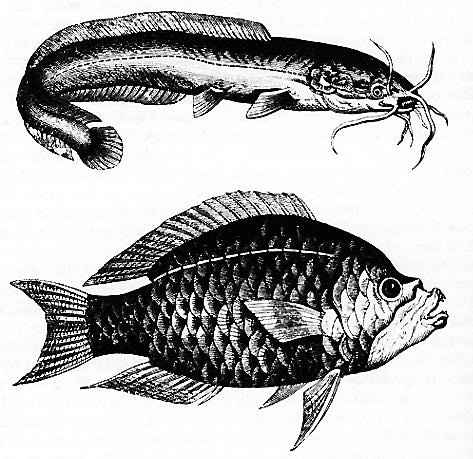
the Sea of Galilee derived their names from their fisheries, Bethsaida (the "house of fish") on the east and on the west. There is probably no other sheet of water in the world of equal dimensions that contains such a variety and profusion of fish. About thirty-seven different kinds have been found. Some of the
FISH FROM THE SEA OF GALILEE fishes are of a European type, such as the roach, the barbel, and the blenny; others are markedly African and tropical, such as the eel-like silurus. There was a regular fish-market apparently in Jerusalem (2 Chronicles 33:14; Nehemiah 3:3; 12:39;
Zephaniah 1:10), as there was a fish-gate which was probably contiguous to it.
Sidon is the oldest fishing establishment known in history.
Besides its literal sense (Luke 5:2), this word is also applied by our Lord to his disciples in a figurative sense (Matthew 4:19; Mark 1:17).
were used for catching fish (Amos 4:2; comp. Isaiah 37:29; Jeremiah 16:16; Ezekiel 29:4; Job. 41:1, 2; Matthew 17:27).
THE ART OF was prosecuted with great industry in the waters of Palestine. It was from the fishing-nets that Jesus called his disciples (Mark 1:16-20), and it was in a fishing-boat he rebuked the winds and the waves (Matthew 8:26) and delivered that remarkable series of prophecies recorded in Matthew 13. He twice miraculously fed multitudes with fish and bread (Matthew 14:19; 15:36). It was in the mouth of a fish that the tribute-money was found (Matthew 17:27). And he "ate a piece of broiled fish" with his disciples after his resurrection (Luke 24:42, 43; comp. Acts 1:3). At the Sea of Tiberias (John 21:1-14), in obedience to his direction, the disciples cast their net "on the right side of the ship," and enclosed so many that "they were not able to draw it for the multitude of fishes."
Two kinds of fishing-nets are mentioned in the New Testament:
(1.) The casting-net (Matthew 4:18; Mark 1:16).
(2.) The drag-net or seine (Matthew 13:48).
Fish were also caught by the fishing-hook (Matthew 17:27). (See NET.)
(Cant. 7:4) should be simply "pools," as in the Revised Version. The reservoirs near Heshbon (q.v.) were probably stocked with fish (2 Samuel 2:13; 4:12; Isaiah 7:3; 22:9, 11).
(Isaiah 28:25, 27), the rendering of the Hebrew ketsah, "without doubt the Nigella sativa, a small annual of the order Ranunculacece, which grows wild in the Mediterranean countries, and is cultivated in Egypt and Syria for its seed." It is rendered in margin of the Revised Version "black cummin." The seeds are used as a condiment.
In Ezekiel 4:9 this word is the rendering of the Hebrew kussemeth (incorrectly rendered "rye" in the Authorized Version of Exodus 9:32 and Isaiah 28:25, but "spelt" in the Revised Version). The reading "fitches" here is an error; it should be "spelt."
(Hebrews , or rather Egyptian, ahu, Job 8:11), rendered "meadow" in Genesis 41:2, 18; probably the Cyperus esculentus, a species of rush eaten by cattle, the Nile reed. It also grows in Palestine.
In Exodus 2:3, 5, Isaiah 19:6, it is the rendering of the Hebrew suph, a word which occurs frequently in connection with yam; as yam suph, to denote the "Red Sea" (q.v.) or the sea of weeds (as this word is rendered, Jonah 2:5). It denotes some kind of sedge or reed which grows in marshy places. (See PAPER, REED.)
Hebrews ashishah, (2 Samuel 6:19; 1 Chronicles 16:3; Cant. 2:5; Hos. 3:1), meaning properly "a cake of pressed raisins." "Flagons of wine" of the Authorized Version should be, as in the Revised Version, "cakes of raisins" in all these passages. In Isaiah 22:24 it is the rendering of the Hebrew nebel, which properly means a bottle or vessel of skin. (Comp. 1 Samuel 1:24; 10:3; 25:18; 2 Samuel 16:1, where the same Hebrew word is used.)
OF FIRE is the chosen symbol of the holiness of God (Exodus 3:2; Revelation 2:18), as indicating "the intense, all-consuming operation of his holiness in relation to sin."
(Hebrews pishtah, i.e., "peeled", in allusion to the fact that the stalks of flax when dried were first split or peeled before being steeped in water for the purpose of destroying the pulp). This plant was cultivated from earliest times. The flax of Egypt was destroyed by the plague of hail when it "was bolled", i.e., was forming pods for seed (Exodus 9:31). It was extensively cultivated both in Egypt and Palestine. Reference is made in Joshua 2:6 to the custom of drying flax-stalks by exposing them to the sun on the flat roofs of houses. It was much used in forming articles of clothing such as girdles, also cords and bands (Leviticus 13:48, 52, 59; Deuteronomy 22:11). (See LINEN.)
David at the cave of Adullam thus addressed his persecutor Saul (1 Samuel 24:14): "After whom is the king of Israel come out? after whom dost thou pursue? after a dead dog, after a flea?" He thus speaks of himself as the poor, contemptible object of the monarch's pursuit, a "worthy object truly for an expedition of the king of Israel with his picked troops!" This insect is in Eastern language the popular emblem of insignificance. In 1 Samuel 26:20 the LXX. read "come out to seek my life" instead of "to seek a flea."
the wool of a sheep, whether shorn off or still attached to the skin (Deuteronomy 18:4; Job 31:20). The miracle of Gideon's fleece (Judges 6:37-40) consisted in the dew having fallen at one time on the fleece without any on the floor, and at another time in the fleece remaining dry while the ground was wet with dew.
in the Old Testament denotes (1) a particular part of the body of man and animals (Genesis 2:21; 41:2; Psalm 102:5, marg.); (2) the whole body (Psalm 16:9); (3) all living things having flesh, and particularly humanity as a whole (Genesis 6:12, 13); (4) mutability and weakness (2 Chronicles 32:8; comp. Isaiah 31:3; Psalm 78:39). As suggesting the idea of softness it is used in the expression "heart of flesh" (Ezekiel 11:19). The expression "my flesh and bone" (Judges 9:2; Isaiah 58:7) denotes relationship.
In the New Testament, besides these it is also used to denote the sinful element of human nature as opposed to the "Spirit" (Romans 6:19; Matthew 16:17). Being "in the flesh" means being unrenewed (Romans 7:5; 8:8, 9), and to live "according to the flesh" is to live and act sinfully (Romans 8:4, 5, 7, 12).
This word also denotes the human nature of Christ (John 1:14, "The Word was made flesh." Comp. also 1 Timothy 3:16; Romans 1:3).
a many-pronged fork used in the sacrificial services (1 Samuel 2:13, 14; Exodus 27:3; 38:3) by the priest in drawing away the flesh. The fat of the sacrifice, together with the breast and shoulder (Leviticus 7:29-34), were presented by the worshipper to the priest. The fat was burned on the alter (3:3-5), and the breast and shoulder became the portion of the priests. But Hophni and Phinehas, not content with this, sent a servant to seize with a flesh-hook a further portion.
abounds in all the plains and valleys of the wilderness of the forty years' wanderings. In Isaiah 50:7 and Ezekiel 3:9 the expressions, where the word is used, means that the "Messiah would be firm and resolute amidst all contempt and scorn which he would meet; that he had made up his mind to endure it, and would not shrink from any kind or degree of suffering which would be necessary to accomplish the great work in which he was engaged." (Comp. Ezekiel 3:8, 9.) The words "like a flint" are used with reference to the hoofs of horses (Isaiah 5:28).
an event recorded in Genesis 7 and 8. (See DELUGE.) In Joshua 24:2, 3, 14, 15, the word "flood" (R.V., "river") means the river Euphrates. In Psalm 66:6, this word refers to the river Jordan.
Grain reduced to the form of meal is spoken of in the time of Abraham (Genesis 18:6). As baking was a daily necessity, grain was also ground daily at the mills (Jeremiah 25:10). The flour mingled with water was kneaded in kneading-troughs, and sometimes leaven (Exodus 12:34) was added and sometimes omitted (Genesis 19:3). The dough was then formed into thin cakes nine or ten inches in diameter and baked in the oven.
Fine flour was offered by the poor as a sin-offering (Leviticus 5:11-13), and also in connection with other sacrifices (Numbers 15:3-12; 28:7-29).
Very few species of flowers are mentioned in the Bible although they abounded in Palestine. It has been calculated that in Western Syria and Palestine from two thousand to two thousand five hundred plants are found, of which about five hundred probably are British wild-flowers. Their beauty is often alluded to (Cant. 2:12; Matthew 6:28). They are referred to as affording an emblem of the transitory nature of human life (Job 14:2; Psalm 103:15; Isaiah 28:1; 40:6; James 1:10). Gardens containing flowers and fragrant herbs are spoken of (Cant. 4:16; 6:2).
a musical instrument, probably composed of a number of pipes, mentioned Daniel 3:5, 7, 10, 15.
In Matthew 9:23, 24, notice is taken of players on the flute, here called "minstrels" (but in R.V. "flute-players").
Flutes were in common use among the ancient Egyptians.
Hebrews zebub, (Ecclesiastes 10:1; Isaiah 7:18). This fly was so grievous a pest that the Phoenicians invoked against it the aid of their God Baal-zebub (q.v.). The prophet Isaiah (7:18) alludes to some poisonous fly which was believed to be found on the confines of Egypt, and which would be called by the Lord. Poisonous flies exist in many parts of Africa, for instance, the different kinds of tsetse.
Hebrews 'arob, the name given to the insects sent as a plague on the land of Egypt (Exodus 8:21-31; Psalm 78:45; 105:31). The LXX. render this by a word which means the "dog-fly," the cynomuia. The Jewish commentators regarded the Hebrew word here as connected with the word 'arab, which means "mingled;" and they accordingly supposed the plague to consist of a mixed multitude of animals, beasts, reptiles, and insects. But there is no doubt that "the 'arab" denotes a single definite species. Some interpreters regard it as the Blatta orientalis, the cockroach, a species of beetle. These insects "inflict very painful bites with their jaws; gnaw and destroy clothes, household furniture, leather, and articles of every kind, and either consume or render unavailable all eatables."
(Hos. 10:7), the rendering of ketseph, which properly means twigs or splinters (as rendered in the LXX. and marg. R.V.). The expression in Hosea may therefore be read, "as a chip on the face of the water," denoting the helplessness of the piece of wood as compared with the irresistable current.
Hebrews belil, (Job 6:5), meaning properly a mixture or medley (Lat. farrago), "made up of various kinds of grain, as wheat, barley, vetches, and the like, all mixed together, and then sown or given to cattle" (Job 24:6, A.V. "corn," R.V. "provender;" Isaiah 30:24, provender").
an enclosure for flocks to rest together (Isaiah 13:20). Sheep-folds are mentioned Numbers 32:16, 24, 36; 2 Samuel 7:8; Zephaniah 2:6; John 10:1, etc. It was prophesied of the cities of Ammon (Ezekiel 25:5), Aroer (Isaiah 17:2), and Judaea, that they would be folds or couching-places for flocks. "Among the pots," of the Authorized Version (Psalm 68:13), is rightly in the Revised Version, "among the sheepfolds."
Originally the Creator granted the use of the vegetable world for food to man (Genesis 1:29), with the exception mentioned (2:17). The use of animal food was probably not unknown to the antediluvians. There is, however, a distinct law on the subject given to Noah after the Deluge (Genesis 9:2-5). Various articles of food used in the patriarchal age are mentioned in Genesis 18:6-8; 25:34; 27:3, 4; 43:11. Regarding the food of the Israelites in Egypt, see Exodus 16:3; Numbers 11:5. In the wilderness their ordinary food was miraculously supplied in the manna. They had also quails (Exodus 16:11-13; Numbers 11:31).
In the law of Moses there are special regulations as to the animals to be used for food (Leviticus 11; Deuteronomy 14:3-21). The Jews were also forbidden to use as food anything that had been consecrated to idols (Exodus 34:15), or animals that had died of disease or had been torn by wild beasts (Exodus 22:31; Leviticus 22:8). (See also for other restrictions Exodus 23:19; 29:13-22; Leviticus 3:4-9; 9:18, 19; 22:8; Deuteronomy 14:21.) But beyond these restrictions they had a large grant from God (Deuteronomy 14:26; 32:13, 14).
Food was prepared for use in various ways. The cereals were sometimes eaten without any preparation (Leviticus 23:14; Deuteronomy 23:25; 2 Kings 4:42). Vegetables were cooked by boiling (Genesis 25:30, 34; 2 Kings 4:38, 39), and thus also other articles of food were prepared for use (Genesis 27:4; Proverbs 23:3; Ezekiel 24:10; Luke 24:42; John 21:9). Food was also prepared by roasting (Exodus 12:8; Leviticus 2:14). (See COOK.)
connected with a throne (2 Chronicles 9:18). Jehovah symbolically dwelt in the holy place between the cherubim above the ark of the covenant. The ark was his footstool (1 Chronicles 28:2; Psalm 99:5; 132:7). And as heaven is God's throne, so the earth is his footstool (Psalm 110:1; Isaiah 66:1; Matthew 5:35).
of the Gentiles (Isaiah 60:5, 11; R.V., "the wealth of the nations") denotes the wealth of the heathen. The whole passage means that the wealth of the Gentile world should be consecrated to the service of the church.
Mention is frequently made of the fords of the Jordan (Joshua 2:7; Judges 3:28; 12:5, 6), which must have been very numerous; about fifty perhaps. The most notable was that of Bethabara. Mention is also made of the ford of the Jabbok (Genesis 32:22), and of the fords of Arnon (Isaiah 16:2) and of the Euphrates (Jeremiah 51:32).
The practice common among Oriental nations of colouring the forehead or impressing on it some distinctive mark as a sign of devotion to some deity is alluded to in Revelation 13:16, 17; 14:9; 17:5; 20:4.
The "jewel on thy forehead" mentioned in Ezekiel 16:12 (R.V., "a ring upon thy nose") was in all probability the "nose-ring" (Isaiah 3:21).
In Ezekiel 3:7 the word "impudent" is rightly rendered in the Revised Version "an hard forehead." (See also ver. 8, 9.)
a Gentile. Such as resided among the Hebrews were required by the law to be treated with kindness (Exodus 22:21; 23:9; Leviticus 19:33, 34; 23:22; Deuteronomy 14:28; 16:10, 11; 24:19). They enjoyed in many things equal rights with the native-born residents (Exodus 12:49; Leviticus 24:22; Numbers 15:15; 35:15), but were not allowed to do anything which was an abomination according to the Jewish law (Exodus 20:10; Leviticus 17:15,16; 18:26; 20:2; 24:16, etc.).
OF GOD Acts 2:23; Romans 8:29; 11:2; 1 Peter 1:2), one of those high attributes essentially appertaining to him the full import of which we cannot comprehend. In the most absolute sense his knowledge is infinite (1 Samuel 23:9-13; Jeremiah 38:17-23; 42:9-22, Matthew 11:21, 23; Acts 15:18).
John the Baptist went before our Lord in this character (Mark 1:2, 3). Christ so called (Hebrews 6:20) as entering before his people into the holy place as their head and guide.
Hebrews ya'ar, meaning a dense wood, from its luxuriance. Thus all the great primeval forests of Syria (Ecclesiastes 2:6; Isaiah 44:14; Jeremiah 5:6; Micah 5:8). The most extensive was the trans-Jordanic forest of Ephraim (2 Samuel 18:6, 8; Joshua 17:15, 18), which is probably the same as the wood of Ephratah (Psalm 132:6), some part of the great forest of Gilead. It was in this forest that Absalom was slain by Joab. David withdrew to the forest of Hareth in the mountains of Judah to avoid the fury of Saul (1 Samuel 22:5). We read also of the forest of Bethel (2 Kings 2:23, 24), and of that which the Israelites passed in their pursuit of the Philistines (1 Samuel 14:25), and of the forest of the cedars of Lebanon (1 Kings 4:33; 2 Kings 19:23; Hos. 14:5, 6).
"The house of the forest of Lebanon (1 Kings 7:2; 10:17; 2 Chronicles 9:16) was probably Solomon's armoury, and was so called because the wood of its many pillars came from Lebanon, and they had the appearance of a forest. (See BAALBEC.)
Hebrews horesh, denoting a thicket of trees, underwood, jungle, bushes, or trees entangled, and therefore affording a safe hiding-place. place. This word is rendered "forest" only in 2 Chronicles 27:4. It is also rendered "wood", the "wood" in the "wilderness of Ziph," in which david concealed himself (1 Samuel 23:15), which lay south-east of Hebron. In Isaiah 17:19 this word is in Authorized Version rendered incorrectly "bough."
Hebrews pardes, meaning an enclosed garden or plantation. Asaph is (Nehemiah 2:8) called the "keeper of the king's forest." The same Hebrew word is used Ecclesiastes 2:5, where it is rendered in the plural "orchards" (R.V., "parks"), and Cant. 4: 13, rendered "orchard" (R.V. marg., "a paradise").
"The forest of the vintage" (Zechariah 11:2, "inaccessible forest," or R.V. "strong forest") is probably a figurative allusion to Jerusalem, or the verse may simply point to the devastation of the region referred to.
The forest is an image of unfruitfulness as contrasted with a cultivated field (Isaiah 29:17; 32:15; Jeremiah 26:18; Hos. 2:12). Isaiah (10:19, 33, 34) likens the Assyrian host under Sennacherib (q.v.) to the trees of some huge forest, to be suddenly cut down by an unseen stroke.
OF SIN one of the constituent parts of justification. In pardoning sin, God absolves the sinner from the condemnation of the law, and that on account of the work of Christ, i.e., he removes the guilt of sin, or the sinner's actual liability to eternal wrath on account of it. All sins are forgiven freely (Acts 5:31; 13:38; 1 John 1:6-9). The sinner is by this act of grace for ever freed from the guilt and penalty of his sins. This is the peculiar prerogative of God (Psalm 130:4; Mark 2:5). It is offered to all in the gospel. (See JUSTIFICATION.)
in every form of it was sternly condemned by the Mosaic law (Leviticus 21:9; 19:29; Deuteronomy 22:20, 21, 23-29; 23:18; Exodus 22:16). (See ADULTERY.)
But this word is more frequently used in a symbolical than in its ordinary sense. It frequently means a forsaking of God or a following after idols (Isaiah 1:2; Jeremiah 2:20; Ezekiel 16; Hos. 1:2; 2:1-5; Jeremiah 3:8,9).
fortunate, a disciple of Corinth who visited Paul at Ephesus, and returned with Stephanas and Achaicus, the bearers of the apostle's first letter to the Corinthians (1 Corinthians 16:17).
(Hebrews 'ain; i.e., "eye" of the water desert), a natural source of living water. Palestine was a "land of brooks of water, of fountains, and depths that spring out of valleys and hills" (Deuteronomy 8:7; 11:11).
These fountains, bright sparkling "eyes" of the desert, are remarkable for their abundance and their beauty, especially on the west of Jordan. All the perennial rivers and streams of the country are supplied from fountains, and depend comparatively little on surface water. "Palestine is a country of mountains and hills, and it abounds in fountains of water. The murmur of these waters is heard in every dell, and the luxuriant foliage which surrounds them is seen in every plain." Besides its rain-water, its cisterns and fountains, Jerusalem had also an abundant supply of water in the magnificent reservoir called "Solomon's Pools" (q.v.), at the head of the Urtas valley, whence it was conveyed to the city by subterrean channels some 10 miles in length. These have all been long ago destroyed, so that no water from the "Pools" now reaches Jerusalem. Only one fountain has been discovered at Jerusalem, the so-called "Virgins's Fountains," in the valley of Kidron; and only one well (Hebrews beer), the Bir Eyub, also in the valley of Kidron, south of the King's Gardens, which has been dug through the solid rock. The inhabitants of Jerusalem are now mainly dependent on the winter rains, which they store in cisterns. (See WELL.)
OF THE VIRGIN the perennial source from which the Pool of Siloam (q.v.) is supplied, the waters flowing in a copious stream to it through a tunnel cut through the rock, the actual length of which is 1,750 feet. The spring rises in a cave 20 feet by 7. A serpentine tunnel 67 feet long runs from it toward the left, off which the tunnel to the Pool of Siloam branches. It is the only unfailing fountain in Jerusalem.
The fountain received its name from the "fantastic legend" that here the virgin washed the swaddling-clothes of our Lord.
This spring has the singular characteristic of being intermittent, flowing from three to five times daily in winter, twice daily in summer, and only once daily in autumn. This peculiarity is accounted for by the supposition that the outlet from the reservoir is by a passage in the form of a siphon.
the arts of, referred to Psalm 91:3; 124:7; Proverbs 6:5; Jeremiah 5:26; Hos. 9:8; Ezekiel 17:20; Ecclesiastes 9:12. Birds of all kinds abound in Palestine, and the capture of these for the table and for other uses formed the employment of many persons. The traps and snares used for this purpose are mentioned Hos. 5:1; Proverbs 7:23; 22:5; Amos 3:5; Psalm 69:22; comp. Deuteronomy 22:6, 7.
(Hebrews shu'al, a name derived from its digging or burrowing under ground), the Vulpes thaleb, or Syrian fox, the only species of this animal indigenous to Palestine. It burrows, is silent and solitary in its habits, is destructive to vineyards, being a plunderer of ripe grapes (Cant. 2:15). The Vulpes Niloticus, or Egyptian dog-fox, and the Vulpes vulgaris, or common fox, are also found in Palestine.
The proverbial cunning of the fox is alluded to in Ezekiel 13:4, and in Luke 13:32, where our Lord calls Herod "that fox." In Judges 15:4, 5, the reference is in all probability to the jackal. The Hebrew word shu'al through the Persian schagal becomes our jackal (Canis aureus), so that the word may bear that signification here. The reasons for preferring the rendering "jackal" are (1) that it is more easily caught than the fox; (2) that the fox is shy and suspicious, and flies mankind, while the jackal does not; and (3) that foxes are difficult, jackals comparatively easy, to treat in the way here described. Jackals hunt in large numbers, and are still very numerous in Southern Palestine.
(Hebrews lebonah; Gr. libanos, i.e., "white"), an odorous resin imported from Arabia (Isaiah 60:6; Jeremiah 6:20), yet also growing in Palestine (Cant. 4:14). It was one of the ingredients in the perfume of the sanctuary (Exodus 30:34), and was used as an accompaniment of the meat-offering (Leviticus 2:1, 16; 6:15; 24:7). When burnt it emitted a fragrant odour, and hence the incense became a symbol of the Divine name (Malachi 1:11; Cant. 1:3) and an emblem of prayer (Psalm 141:2; Luke 1:10; Revelation 5:8; 8:3).
This frankincense, or olibanum, used by the Jews in the temple services is not to be confounded with the frankincense of modern commerce, which is an exudation of the Norway spruce fir, the Pinus abies. It was probably a resin from the Indian tree known to botanists by the name of Boswellia serrata or thurifera, which grows to the height of forty feet.
The law of Moses pointed out the cases in which the servants of the Hebrews were to receive their freedom (Exodus 21:2-4, 7, 8; Leviticus 25:39-42, 47-55; Deuteronomy 15:12-18). Under the Roman law the "freeman" (ingenuus) was one born free; the "freedman" (libertinus) was a manumitted slave, and had not equal rights with the freeman (Acts 22:28; comp. Acts 16:37-39; 21:39; 22:25; 25:11, 12).
OFFERING a spontaneous gift (Exodus 35:29), a voluntary sacrifice (Leviticus 22:23; Ezra 3:5), as opposed to one in consequence of a vow, or in expiation of some offence.
(Hebrews tsepharde'a, meaning a "marsh-leaper"). This reptile is mentioned in the Old Testament only in connection with one of the plagues which fell on the land of Egypt (Exodus 8:2-14; Psalm 78:45; 105:30).
In the New Testament this word occurs only in Revelation 16:13, where it is referred to as a symbol of uncleanness. The only species of frog existing in Palestine is the green frog (Rana esculenta), the well-known edible frog of the Continent.
occurs only in Exodus 13:16; Deuteronomy 6:8, and 11:18. The meaning of the injunction to the Israelites, with regard to the statues and precepts given them, that they should "bind them for a sign upon their hand, and have them as frontlets between their eyes," was that they should keep them distinctly in view and carefully attend to them. But soon after their return from Babylon they began to interpret this injunction literally, and had accordingly portions of the law written out and worn about their person. These they called tephillin, i.e., "prayers." The passages so written out on strips of parchment were these, Exodus 12:2-10; 13:11-21; Deuteronomy 6:4-9; 11:18-21. They were then "rolled up in a case of black calfskin, which was attached to a stiffer piece of leather, having a thong one finger broad and one cubit and a half long. Those worn on the forehead were written on four strips of parchment, and put into four little cells within a square case, which had on it the Hebrew letter called shin, the three points of which were regarded as an emblem of God." This case tied around the forehead in a particular way was called "the tephillah on the head." (See PHYLACTERY.)
(Hebrews kerah, from its smoothness) Job 37:10 (R.V., "ice"); Genesis 31:40; Jeremiah 36:30; rendered "ice" in Job 6:16, 38:29; and
"crystal" in Ezekiel 1:22. "At the present day frost is entirely unknown in the lower portions of the valley of the Jordan, but slight frosts are sometimes felt on the sea-coast and near Lebanon." Throughout Western Asia cold frosty nights are frequently succeeded by warm days.
"Hoar frost" (Hebrews kephor, so called from its covering the ground) is mentioned in Exodus 16:14; Job 38:29; Psalm 147:16.
In Psalm 78:47 the word rendered "frost" (R.V. marg., "great hail-stones"), hanamal, occurs only there. It is rendered by Gesenius, the Hebrew lexicographer, "ant," and so also by others, but the usual interpretation derived from the ancient versions may be maintained.
a word as used in Scripture denoting produce in general, whether vegetable or animal. The Hebrews divided the fruits of the land into three classes:,
(1.) The fruit of the field, "corn-fruit" (Hebrews dagan); all kinds of grain and pulse.
(2.) The fruit of the vine, "vintage-fruit" (Hebrews tirosh); grapes, whether moist or dried.
(3.) "Orchard-fruits" (Hebrews yitshar), as dates, figs, citrons, etc.
Injunctions concerning offerings and tithes were expressed by these Hebrew terms alone (Numbers 18:12; Deuteronomy 14:23). This word "fruit" is also used of children or offspring (Genesis 30:2; Deuteronomy 7:13; Luke 1:42; Psalm 21:10; 132:11); also of the progeny of beasts (Deuteronomy 28:51; Isaiah 14:29).
It is used metaphorically in a variety of forms (Psalm 104:13; Proverbs 1:31; 11:30; 31:16; Isaiah 3:10; 10:12; Matthew 3:8; 21:41; 26:29; Hebrews 13:15; Romans 7:4, 5; 15:28).
The fruits of the Spirit (Galatians 5:22, 23; Ephesians 5:9; James 3:17, 18) are those gracious dispositions and habits which the Spirit produces in those in whom he dwells and works.
(Hebrews marhesheth, a "boiler"), a pot for boiling meat (Leviticus 2:7; 7:9).
Almost every kind of combustible matter was used for fuel, such as the withered stalks of herbs (Matthew 6:30), thorns (Psalm 58:9;
Ecclesiastes 7:6), animal excrements (Ezekiel 4:12-15; 15:4, 6; 21:32). Wood or charcoal is much used still in all the towns of Syria and Egypt. It is largely brought from the region of Hebron to Jerusalem. (See COAL.)
Genesis 4:12, 14, a rover or wanderer (Hebrews n'a); Judges 12:4, a refugee, one who has escaped (Hebrews palit); 2 Kings 25:11, a deserter, one who has fallen away to the enemy (Hebrews nophel); Ezekiel 17:21, one who has broken away in flight (Hebrews mibrah); Isaiah 15:5; 43:14, a breaker away, a fugitive (Hebrews beriah), one who flees away.
The word "full" is from the Anglo-Saxon fullian, meaning "to whiten." To full is to press or scour cloth in a mill. This art is one of great antiquity. Mention is made of "fuller's soap" (Malachi 3:2), and of "the fuller's field" (2 Kings 18:17). At his transfiguration our Lord's rainment is said to have been white "so as no fuller on earth could white them" (Mark 9:3). En-rogel (q.v.), meaning literally "foot-fountain," has been interpreted as the "fuller's fountain," because there the fullers trod the cloth with their feet.
FIELD a spot near Jerusalem (2 Kings 18:17; Isaiah 36:2; 7:3), on the side of the highway west of the city, not far distant from the "upper pool" at the head of the valley of Hinnom. Here the fullers pursued their occupation.
SOAP (Hebrews borith mekabbeshim, i.e., "alkali of those treading cloth"). Mention is made (Proverbs 25:20; Jeremiah 2:22) of nitre and also (Malachi 3:2) of soap (Hebrews borith) used by the fuller in his operations. Nitre is found in Syria, and vegetable alkali was obtained from the ashes of certain plants. (See SOAP.)
(1.) Of time (Galatians 4:4), the time appointed by God, and foretold by the prophets, when Messiah should appear. (2.) Of Christ (John 1:16), the superabundance of grace with which he was filled. (3.) Of the Godhead bodily dwelling in Christ (Colossians 2:9), i.e., the whole nature and attributes of God are in Christ. (4.) Ephesians 1:23, the church as the fulness of Christ, i.e., the church makes Christ a complete and perfect head.
Burying was among the Jews the only mode of disposing of corpses (Genesis 23:19; 25:9; 35:8, 9, etc.).
The first traces of burning the dead are found in 1 Samuel 31:12. The burning of the body was affixed by the law of Moses as a penalty to certain crimes (Leviticus 20:14; 21:9).
To leave the dead unburied was regarded with horror (1 Kings 13:22; 14:11; 16:4; 21:24, etc.).
In the earliest times of which we have record kinsmen carried their dead to the grave (Genesis 25:9; 35:29; Judges 16:31), but in later times this was done by others (Amos 6:16).
Immediately after decease the body was washed, and then wrapped in a large cloth (Acts 9:37; Matthew 27:59; Mark 15:46). In the case of persons of distinction, aromatics were laid on the folds of the cloth (John 19:39; comp. John 12:7).
As a rule the burial (q.v.) took place on the very day of the death (Acts 5:6, 10), and the body was removed to the grave in an open coffin or on a bier (Luke 7:14). After the burial a funeral meal was usually given (2 Samuel 3:35; Jeremiah 16:5, 7; Hos. 9:4).
a stadium, a Greek measure of distance equal to 606 feet and 9 inches (Luke 24:13; John 6:19; 11:18; Revelation 14:20; 21:16).
(1.) Chald. attun, a large furnace with a wide open mouth, at the top of which materials were cast in (Daniel 3:22, 23; comp. Jeremiah 29:22). This furnace would be in constant requisition, for the Babylonians disposed of their dead by cremation, as did also the Accadians who invaded Mesopotamia.
(2.) Hebrews kibshan, a smelting furnace (Genesis 19:28), also a lime-kiln (Isaiah 33:12; Amos 2:1).
(3.) Hebrews kur, a refining furnace (Proverbs 17:3; 27:21; Ezekiel 22:18).
(4.) Hebrews alil, a crucible; only used in Psalm 12:6.
(5.) Hebrews tannur, oven for baking bread (Genesis 15:17; Isaiah 31:9; Nehemiah 3:11). It was a large pot, narrowing towards the top. When it was heated by a fire made within, the dough was spread over the heated surface, and thus was baked. "A smoking furnace and a burning lamp" (Genesis 15:17), the symbol of the presence of the Almighty, passed between the divided pieces of Abraham's sacrifice in ratification of the covenant God made with him. (See OVEN.)
(6.) Gr. kamnos, a furnace, kiln, or oven (Matthew 13:42, 50; Revelation 1:15; 9:2).
•FURROW an opening in the ground made by the plough (Psalm 65:10; Hos. 10:4, 10).
as attributed to God, is a figurative expression for dispensing afflictive judgments (Leviticus 26:28; Job 20:23; Isaiah 63:3; Jeremiah 4:4; Ezekiel 5:13; Daniel 9:16; Zechariah 8:2).
loathing, the son of Ebed, in whom the Shechemites "placed their confidence" when they became discontented with Abimelech. He headed the revolution, and led out the men of Shechem against Abimelech; but was defeated, and fled to his own home (Judges 9:26-46). We hear no more of him after this battle.
a shaking, a hill, on the north side of which Joshua was buried (Joshua 24:30; Judges 2:9), in the territory of Ephraim. (See TIMNATH-SERAH.)
Gab Baitha, i.e., "the ridge of the house" = "the temple-mound," on a part of which the fortress of Antonia was built. This "temple-mound" was covered with a tesselated "pavement" (Gr. lithostroton, i.e., "stone-paved"). A judgement-seat (bema) was placed on this "pavement" outside the hall of the "praetorium" (q.v.), the judgment-hall (John 18:28; 19:13).
champion of God, used as a proper name to designate the angel who was sent to Daniel (8:16) to explain the vision of the ram and the he-goat, and to communicate the prediction of the seventy weeks (Daniel 9:21-27).
He announced also the birth of John the Baptist (Luke 1:11), and of the Messiah (26). He describes himself in the words, "I am Gabriel, who stand in the presence of God" (1:19).
fortune; luck. (1.) Jacob's seventh son, by Zilpah, Leah's handmaid, and the brother of Asher (Genesis 30:11-13; 46:16, 18). In the Authorized Version of 30:11 the words, "A troop cometh: and she called," etc., should rather be rendered, "In fortune [R.V., 'Fortunate']: and she called," etc., or "Fortune cometh," etc.
The tribe of Gad during the march through the wilderness had their place with Simeon and Reuben on the south side of the tabernacle (Numbers 2:14). The tribes of Reuben and Gad continued all through their history to follow the pastoral pursuits of the patriarchs (Numbers 32:1-5).
The portion allotted to the tribe of Gad was on the east of Jordan, and comprehended the half of Gilead, a region of great beauty and fertility (Deuteronomy 3:12), bounded on the east by the Arabian desert, on the west by the Jordan (Joshua 13:27), and on the north by the river Jabbok. It thus included the whole of the Jordan valley as far north as to the Sea of Galilee, where it narrowed almost to a point.
This tribe was fierce and warlike; they were "strong men of might, men of war for the battle, that could handle shield and buckler, their faces the faces of lions, and like roes upon the mountains for swiftness" (1 Chronicles 12:8; 5:19-22). Barzillai (2 Samuel 17:27) and Elijah (1 Kings 17:1) were of this tribe. It was carried into captivity at the same time as the other tribes of the northern kingdom by Tiglath-pileser (1 Chronicles 5:26), and in the time of Jeremiah (49:1) their cities were inhabited by the Ammonites.
(2.) A prophet who joined David in the "hold," and at whose advice he quitted it for the forest of Hareth (1 Chronicles 29:29; 2 Chronicles 29:25; 1 Samuel 22:5). Many years after we find mention made of him in connection with the punishment inflicted for numbering the people (2 Samuel 24:11-19; 1 Chronicles 21:9-19). He wrote a book called the "Acts of David" (1 Chronicles 29:29), and assisted in the arrangements for the musical services of the "house of God" (2 Chronicles 29:25). He bore the title of "the king's seer" (2 Samuel 24:11, 13; 1 Chronicles 21:9).
the capital of the Roman province of Peraea. It stood on the summit of a mountain about 6 miles south-east of the Sea of Galilee. Mark (5:1) and Luke (8:26-39) describe the miracle of the healing of the demoniac (Matthew [8:28-34] says two demoniacs) as having been wrought "in the country of the Gadarenes," thus describing the scene generally. The miracle could not have been wrought at Gadara itself, for between the lake and this town there is the deep, almost impassable ravine of the Hieromax (Jarmuk). It is identified with the modern village of Um-Keis, which is surrounded by very extensive ruins, all bearing testimony to the splendour of ancient Gadara.
"The most interesting remains of Gadara are its tombs, which dot the cliffs for a considerable distance round the city, chiefly on the north-east declivity; but many beautifully sculptured sarcophagi are scattered over the surrounding heights. They are excavated in the limestone rock, and consist of chambers of various dimensions, some more than 20 feet square, with recesses in the sides for bodies...The present inhabitants of Um-Keis are all troglodytes, 'dwelling in tombs,' like the poor maniacs of old, and occasionally they are almost as dangerous to unprotected travellers."
the inhabitants of Gadara, in Revised Version "Gerasenes" (Mark 5:1; Luke 8:26, 37). In Matthew 8:28 they are called Gergesenes, Revised Version "Gadarenes."
fortunate, the representative of the tribe of Manasseh among the twelve "spies" sent by Moses to spy the land (Numbers 13:11).
fortune (i.e., sent) of God, the representative of the tribe of Zebulum among the twelve spies (Numbers 13:10).
lurking-place, one of the chief of the Nethinim, whose descendants returned to Jerusalem under Zerubbabel (Ezra 2:47).
(1.) A Macedonian, Paul's fellow-traveller, and his host at Corinth when he wrote his Epistle to the Romans (16:23). He with his household were baptized by Paul (1 Corinthians 1:14). During a heathen outbreak against Paul at Ephesus the mob seized Gaius and Aristarchus because they could not find Paul, and rushed with them into the theatre. Some have identified this Gaius with No. (2).
(2.) A man of Derbe who accompanied Paul into Asia on his last journey to Jerusalem
(3.) A Christain of Asia Minor to whom John addressed his third epistle (3 John 1:1).
has been called the "Gallia" of the East, Roman writers calling its inhabitants Galli. They were an intermixture of Gauls and Greeks, and hence were called Gallo-Graeci, and the country Gallo-Graecia. The Galatians were in their origin a part of that great Celtic migration which invaded Macedonia about B.C. 280. They were invited by the king of Bithynia to cross over into Asia Minor to assist him in his wars. There they ultimately settled, and being strengthened by fresh accessions of the same clan from Europe, they overran Bithynia, and supported themselves by plundering neighbouring countries. They were great warriors, and hired themselves out as mercenary soldiers, sometimes fighting on both sides in the great battles of the times. They were at length brought under the power of Rome in B.C. 189, and Galatia became a Roman province B.C. 25.
This province of Galatia, within the limits of which these Celtic tribes were confined, was the central region of Asia Minor.
During his second missionary journey Paul, accompanied by Silas and Timothy (Acts 16:6), visited the "region of Galatia," where he was detained by sickness (Galatians 4:13), and had thus the longer opportunity of preaching to them the gospel. On his third journey he went over "all the country of Galatia and Phrygia in order" (Acts 18:23). Crescens was sent thither by Paul toward the close of his life (2 Timothy 4:10).
EPISTLE TO The genuineness of this epistle is not called in question. Its Pauline origin is universally acknowledged.
Occasion of. The churches of Galatia were founded by Paul himself (Acts 16:6; Galatians 1:8; 4:13, 19). They seem to have been composed mainly of converts from heathenism (4:8), but partly also of Jewish converts, who probably, under the influence of Judaizing teachers, sought to incorporate the rites of Judaism with Christianity, and by their active zeal had succeeded in inducing the majority of the churches to adopt their views (1:6; 3:1). This epistle was written for the purpose of counteracting this Judaizing tendency, and of recalling the Galatians to the simplicity of the gospel, and at the same time also of vindicating Paul's claim to be a divinely-commissioned apostle.
Time and place of writing. The epistle was probably written very soon after Paul's second visit to Galatia (Acts 18:23). The references of the epistle appear to agree with this conclusion. The visit to Jerusalem, mentioned in Galatians 2:1-10, was identical with that of Acts 15, and it is spoken of as a thing of the past, and consequently the epistle was written subsequently to the council of Jerusalem. The similarity between this epistle and that to the Romans has led to the conclusion that they were both written at the same time, namely, in the winter of A.D. 57-8, during Paul's stay in Corinth (Acts 20:2, 3). This to the Galatians is written on the urgency of the occasion, tidings having reached him of the state of matters; and that to the Romans in a more deliberate and systematic way, in exposition of the same great doctrines of the gospel.
Contents of. The great question discussed is, Was the Jewish law binding on Christians? The epistle is designed to prove against the Jews that men are justified by faith without the works of the law of Moses. After an introductory address (Galatians 1:1-10) the apostle discusses the subjects which had occasioned the epistle. (1) He defends his apostolic authority (1:11-19; 2:1-14); (2) shows the evil influence of the Judaizers in destroying the very essence of the gospel (3 and 4); (3) exhorts the Galatian believers to stand fast in the faith as it is in Jesus, and to abound in the fruits of the Spirit, and in a right use of their Christian freedom (5-6:1-10); (4) and then concludes with a summary of the topics discussed, and with the benediction.
The Epistle to the Galatians and that to the Romans taken together "form a complete proof that justification is not to be obtained meritoriously either by works of morality or by rites and ceremonies, though of divine appointment; but that it is a free gift, proceeding entirely from the mercy of God, to those who receive it by faith in Jesus our Lord."
In the conclusion of the epistle (6:11) Paul says, "Ye see how large a letter I have written with mine own hand." It is implied that this was different from his ordinary usage, which was simply to write the concluding salutation with his own hand, indicating that the rest of the epistle was written by another hand. Regarding this conclusion, Lightfoot, in his Commentary on the epistle, says: "At this point the apostle takes the pen from his amanuensis, and the concluding paragraph is written with his own hand. From the time when letters began to be forged in his name (2 Thessalonians 2:2; 3:17) it seems to have been his practice to close with a few words in his own handwriting, as a precaution against such forgeries...In the present case he writes a whole paragraph, summing up the main lessons of the epistle in terse, eager, disjointed sentences. He writes it, too, in large, bold characters (Gr. pelikois grammasin), that his hand-writing may reflect the energy and determination of his soul." (See JUSTIFICATION.)
Hebrews helbenah, (Exodus 30:34), one of the ingredients in the holy incense. It is a gum, probably from the Galbanum officinale.
heap of witness, the name of the pile of stones erected by Jacob and Laban to mark the league of friendship into which they entered with each other (Genesis 31:47, 48). This was the name given to the "heap" by Jacob. It is Hebrew, while the name Jegar-sahadutha, given to it by Laban, is Aramaic (Chaldee or Syriac). Probably Nahor's family originally spoke Aramaic, and Abraham and his descendants learned Hebrew, a kindred dialect, in the land of Canaan.
an inhabitant or native of Galilee. This word was used as a name of contempt as applied to our Lord's disciples (Luke 22:59; Acts 2:7). All the apostles, with the exception of Judas Iscariot (Acts 1:11), were Galileans. Peter was detected by his Galilean accent (Matthew 26:69; Mark 14:70).
This was also one of the names of reproach given to the early Christians. Julian the Apostate, as he is called, not only used the epithet himself when referring to Christ and his apostles, but he made it a law that no one should ever call the Christians by any other name.