
Part 34
one who pretends to prognosticate future events. Baalam is so called (Joshua 13:22; Hebrews kosem, a "diviner," as rendered 1 Samuel 6:2; rendered "prudent," Isaiah 3:2). In Isaiah 2:6 and Micah 5:12 (Hebrews yonenim, i.e., "diviners of the clouds") the word is used of the Chaldean diviners who studied the clouds. In Daniel 2:27; 5:7 the word is the rendering of the Chaldee gazrin, i.e., "deciders" or "determiners", here applied to Chaldean astrologers, "who, by casting nativities from the place of the stars at one's birth, and by various arts of computing and divining, foretold the fortunes and destinies of individuals.", Gesenius, Lex. Hebrews (See SORCERER.)
a morsel of bread (John 13:26; comp. Ruth 2:14). Our Lord took a piece of unleavened bread, and dipping it into the broth of bitter herbs at the Paschal meal, gave it to Judas. (Comp. Ruth 2:14.)
the father who saves, probably the same as Sosipater, a kinsman of Paul (Romans 16:21), a Christian of the city of Berea who accompanied Paul into Asia (Acts 20:4-6).
from the Latin sortiarius, one who casts lots, or one who tells the lot of others. (See DIVINATION.)
In Daniel 2:2 it is the rendering of the Hebrew mekhashphim, i.e., mutterers, men who professed to have power with evil spirits. The practice of sorcery exposed to severest punishment (Malachi 3:5; Revelation 21:8; 22:15).
choice vine, the name of a valley, i.e., a torrent-bed, now the Wady Surar, "valley of the fertile spot," which drains the western Judean hills, and flowing by Makkedah and Jabneel, falls into the sea some eight miles south of Joppa. This was the home of Deliah, whom Samson loved (Judges 16:4).
•SOSIPATER (See SOPATER.)
safe in strength, the chief ruler of the synagogue at Corinth, who was seized and beaten by the mob in the presence of Gallio, the Roman governor, when he refused to proceed against Paul at the instigation of the Jews (Acts 18:12-17). The motives of this assault against Sosthenes are not recorded, nor is it mentioned whether it was made by Greeks or Romans. Some identify him, but without sufficient grounds, with one whom Paul calls "Sosthenes our brother," a convert to the faith (1 Corinthians 1:1).
Hebrews Negeb, that arid district to the south of Palestine through which lay the caravan route from Central Palestine to Egypt (Genesis 12:9; 13:1, 3; 46:1-6). "The Negeb comprised a considerable but irregularly-shaped tract of country, its main portion stretching from the mountains and lowlands of Judah in the north to the mountains of Azazemeh in the south, and from the Dead Sea and southern Ghoron the east to the Mediterranean on the west." In Ezekiel 20:46 (21:1 in Hebrews ) three different Hebrew words are all rendered "south." (1) "Set thy face toward the south" (Teman, the region on the right, 1 Samuel 33:24); (2) "Drop thy word toward the south" (Negeb, the region of dryness, Joshua 15:4); (3) "Prophesy against the forest of the south field" (Darom, the region of brightness, Deuteronomy 33:23). In Job 37:9 the word "south" is literally "chamber," used here in the sense of treasury (comp. 38:22; Psalm 135:7). This verse is rendered in the Revised Version "out of the chamber of the south."
of God, his absolute right to do all things according to his own good pleasure (Daniel 4:25, 35; Romans 9:15-23; 1 Timothy 6:15; Revelation 4:11).
Paul expresses his intention (Romans 15:24, 28) to visit Spain. There is, however, no evidence that he ever carried it into effect, although some think that he probably did so between his first and second imprisonment. (See TARSHISH.)
Mentioned among the offerings made by the very poor. Two sparrows were sold for a farthing (Matthew 10:29), and five for two farthings (Luke 12:6). The Hebrew word thus rendered is tsippor, which properly denotes the whole family of small birds which feed on grain (Leviticus 14:4; Psalm 84:3; 102:7). The Greek word of the New Testament is strouthion (Matthew 10:29-31), which is thus correctly rendered.
Hebrews nechoth, identified with the Arabic naka'at, the gum tragacanth, obtained from the astralagus, of which there are about twenty species found in Palestine. The tragacanth of commerce is obtained from the A. tragacantha. "The gum exudes plentifully under the heat of the sun on the leaves, thorns, and exteremity of the twigs."
aromatic substances, of which several are named in Exodus 30. They were used in the sacred anointing oil (Exodus 25:6; 35:8; 1 Chronicles 9:29), and in embalming the dead (2 Chronicles 16:14; Luke 23:56; 24:1; John 19:39, 40). Spices were stored by Hezekiah in his treasure-house (2 Kings 20:13; Isaiah 39:2).
The trust of the hypocrite is compared to the spider's web or house (Job 8:14). It is said of the wicked by Isaiah that they "weave the spider's web" (59:5), i.e., their works and designs are, like the spider's web, vain and useless. The Hebrew word here used is 'akkabish, "a swift weaver."
In Proverbs 30:28 a different Hebrew word (semamith) is used. It is rendered in the Vulgate by stellio, and in the Revised Version by "lizard." It may, however, represent the spider, of which there are, it is said, about seven hundred species in Palestine.
When the Israelites reached Kadesh for the first time, and were encamped there, Moses selected twelve spies from among the chiefs of the divisions of the tribes, and sent them forth to spy the land of Canaan (Numbers 13), and to bring back to him a report of its actual condition. They at once proceeded on their important errand, and went through the land as far north as the district round Lake Merom. After about six weeks' absence they returned. Their report was very discouraging, and the people were greatly alarmed, and in a rebellious spirit proposed to elect a new leader and return to Egypt. Only two of the spies, Caleb and Joshua, showed themselves on this occasion stout-hearted and faithful. All their appeals and remonstrances were in vain. Moses announced that as a punishment for their rebellion they must now wander in the wilderness till a new generation should arise which would go up and posses the land. The spies had been forty days absent on their expedition, and for each day the Israelites were to be wanderers for a year in the desert. (See ESHCOL.)
Two spies were sent by Joshua "secretly" i.e., unknown to the people (Joshua 2:1), "to view the land and Jericho" after the death of Moses, and just before the tribes under his leadership were about to cross the Jordan. They learned from Rahab (q.v.), in whose house they found a hiding-place, that terror had fallen on all the inhabitants of the land because of the great things they had heard that Jehovah had done for them (Exodus 15:14-16; comp. 23:27; Deuteronomy 2:25; 11:25). As the result of their mission they reported: "Truly Jehovah hath delivered into our hands all the land; for even all the inhabitants of the country do faint because of us."
(Hebrews nerd), a much-valued perfume (Cant. 1:12; 4:13, 14). It was "very precious", i.e., very costly (Mark 14:3; John 12:3,5). It is the root of an Indian plant, the Nardostachys jatamansi, of the family of Valeriance, growing on the Himalaya mountains. It is distinguished by its having many hairy spikes shooting out from one root. It is called by the Arabs sunbul Hindi, "the Indian spike." In the New Testament this word is the rendering of the Greek nardos pistike. The margin of the Revised Version in these passages has "pistic nard," pistic being perhaps a local name. Some take it to mean genuine, and others liquid. The most probable opinion is that the word pistike designates the nard as genuine or faithfully prepared.
(Hebrews ruah; Gr. pneuma), properly wind or breath. In 2 Thessalonians 2:8 it means "breath," and in Ecclesiastes 8:8 the vital principle in man. It also denotes the rational, immortal soul by which man is distinguished (Acts 7:59; 1 Corinthians 5:5; 6:20; 7:34), and the soul in its separate state (Hebrews 12:23), and hence also an apparition (Job 4:15; Luke 24:37, 39), an angel (Hebrews 1:14), and a demon (Luke 4:36; 10:20). This word is used also metaphorically as denoting a tendency (Zechariah 12:10; Luke 13:11).
In Romans 1:4, 1 Timothy 3:16, 2 Corinthians 3:17, 1 Peter 3:18, it designates the divine nature.
•SPIRIT, HOLY See HOLY GHOST.
occurs only in the narrative of the crucifixion (Matthew 27:48; Mark 15:36; John 19:29). It is ranked as a zoophyte. It is found attached to rocks at the bottom of the sea.
(Cant. 4:8-12; Hos. 4:13, 14) may denote either husband or wife, but in the Scriptures it denotes only the latter.
(Hebrews 'ain, "the bright open source, the eye of the landscape"). To be carefully distinguished from "well" (q.v.). "Springs" mentioned in Joshua 10:40 (Hebrews 'ashdoth) should rather be "declivities" or "slopes" (R.V.), i.e., the undulating ground lying between the lowlands (the shephelah) and the central range of hills.
spike; an ear of corn, a convert at Rome whom Paul salutes (Romans 16:9).
(Hebrews nataph), one of the components of the perfume which was offered on the golden altar (Exodus 30:34; R.V. marg., "opobalsamum"). The Hebrew word is from a root meaning "to distil," and it has been by some interpreted as distilled myrrh. Others regard it as the gum of the storax tree, or rather shrub, the Styrax officinale. "The Syrians value this gum highly, and use it medicinally as an emulcent in pectoral complaints, and also in perfumery."
(Isaiah 47:13), those who pretend to tell what will occur by looking upon the stars. The Chaldean astrologers "divined by the rising and setting, the motions, aspects, colour, degree of light, etc., of the stars."
MORNING a name figuratively given to Christ (Revelation 22:16; comp. 2 Peter 1:19). When Christ promises that he will give the "morning star" to his faithful ones, he "promises that he will give to them himself, that he will give to them himself, that he will impart to them his own glory and a share in his own royal dominion; for the star is evermore the symbol of royalty (Matthew 2:2), being therefore linked with the sceptre (Numbers 24:17). All the glory of the world shall end in being the glory of the Church." Trench's Comm.
The eleven stars (Genesis 37:9); the seven (Amos 5:8); wandering (Jude 1:13); seen in the east at the birth of Christ, probably some luminous meteors miraculously formed for this specific purpose (Matthew 2:2-10); stars worshipped (Deuteronomy 4:19; 2 Kings 17:16; 21:3; Jeremiah 19:13); spoken of symbolically (Numbers 24:17; Revelation 1:16, 20; 12:1). (See ASTROLOGERS.)
Greek word rendered "piece of money" (Matthew 17:27, A.V.; and "shekel" in R.V.). It was equal to two didrachmas ("tribute money," 17:24), or four drachmas, and to about 2s. 6d. of our money. (See SHEKEL.)
•STEALING See THEFT.
The "bow of steel" in (A.V.) 2 Samuel 22:35; Job 20:24; Psalm 18:34 is in the Revised Version "bow of brass" (Hebrews kesheth-nehushah). In Jeremiah 15:12 the same word is used, and is also rendered in the Revised Version "brass." But more correctly it is copper (q.v.), as brass in the ordinary sense of the word (an alloy of copper and zinc) was not known to the ancients.
crown, a member of the church at Corinth, whose family were among those the apostle had baptized (1 Corinthians 1:16; 16:15, 17). He has been supposed by some to have been the "jailer of Philippi" (comp. Acts 16:33). The First Epistle to the Corinthians was written from Philippi some six years after the jailer's conversion, and he was with the apostle there at that time.
one of the seven deacons, who became a preacher of the gospel. He was the first Christian martyr. His personal character and history are recorded in Acts 6. "He fell asleep" with a prayer for his persecutors on his lips (7:60). Devout men carried him to his grave (8:2).
It was at the feet of the young Pharisee, Saul of Tarsus, that those who stoned him laid their clothes (comp. Deuteronomy 17:5-7) before they began their cruel work. The scene which Saul then witnessed and the words he heard appear to have made a deep and lasting impression on his mind (Acts 22:19, 20).
The speech of Stephen before the Jewish ruler is the first apology for the universalism of the gospel as a message to the Gentiles as well as the Jews. It is the longest speech contained in the Acts, a place of prominence being given to it as a defence.
a sect of Greek philosophers at Athens, so called from the Greek word stoa i.e., a "porch" or "portico," where they have been called "the Pharisees of Greek paganism." The founder of the Stoics was Zeno, who flourished about B.C. 300. He taught his disciples that a man's happiness consisted in bringing himself into harmony with the course of the universe. They were trained to bear evils with indifference, and so to be independent of externals. Materialism, pantheism, fatalism, and pride were the leading features of this philosophy.
(Isaiah 3:24), an article of female attire, probably some sort of girdle around the breast.
Stones were commonly used for buildings, also as memorials of important events (Genesis 28:18; Joshua 24:26, 27; 1 Samuel 7:12, etc.). They were gathered out of cultivated fields (Isaiah 5:2; comp. 2 Kings 3:19). This word is also used figuratively of believers (1 Peter 2:4, 5), and of the Messiah (Psalm 118:22; Isaiah 28:16; Matthew 21:42; Acts 4:11, etc.). In Daniel 2:45 it refers also to the Messiah. He is there described as "cut out of the mountain." (See ROCK.)
A "heart of stone" denotes great insensibility (1 Samuel 25:37).
Stones were set up to commemorate remarkable events, as by Jacob at Bethel (Genesis 28:18), at Padan-aram (35:4), and on the occasion of parting with Laban (31:45-47); by Joshua at the place on the banks of the Jordan where the people first "lodged" after crossing the river (Joshua 6:8), and also in "the midst of Jordan," where he erected another set of twelve stones (4:1-9); and by Samuel at "Ebenezer" (1 Samuel 7:12).
PRECIOUS Frequently referred to (1 Kings 10:2; 2 Chronicles 3:6; 9:10; Revelation 18:16; 21:19). There are about twenty different names of such stones in the Bible. They are figuratively introduced to denote value, beauty, durability (Cant. 5:14; Isa 54:11, 12; Lamentations 4:7).
a form of punishment (Leviticus 20:2; 24:14; Deuteronomy 13:10; 17:5; 22:21) prescribed for certain offences. Of Achan (Joshua 7:25), Naboth (1 Kings 21), Stephen (Acts 7:59), Paul (Acts 14:19; 2 Corinthians 11:25).
Hebrews hasidah, meaning "kindness," indicating thus the character of the bird, which is noted for its affection for its young. It is in the list of birds forbidden to be eaten by the Levitical law (Leviticus 11:19; Deuteronomy 14:18). It is like the crane, but larger in size. Two species are found in Palestine, the white, which are dispersed in pairs over the whole country; and the black, which live in marshy places and in great flocks. They migrate to Palestine periodically (about the 22nd of March). Jeremiah alludes to this (Jeremiah 8:7). At the appointed time they return with unerring sagacity to their old haunts, and re-occupy their old nests. "There is a well-authenticated account of the devotion of a stork which, at the burning of the town of Delft, after repeated and unsuccessful attempts to carry off her young, chose rather to remain and perish with them than leave them to their fate. Well might the Romans call it the pia avis!"
In Job 39:13 (A.V.), instead of the expression "or wings and feathers unto the ostrich" (marg., "the feathers of the stork and ostrich"), the Revised Version has "are her pinions and feathers kindly" (marg., instead of "kindly," reads "like the stork's"). The object of this somewhat obscure verse seems to be to point out a contrast between the stork, as distinguished for her affection for her young, and the ostrich, as distinguished for her indifference.
Zechariah (5:9) alludes to the beauty and power of the stork's wings.
•STRAIN AT Simply a misprint for "strain out" (Matthew 23:24).
This word generally denotes a person from a foreign land residing in Palestine. Such persons enjoyed many privileges in common with the Jews, but still were separate from them. The relation of the Jews to strangers was regulated by special laws (Deuteronomy 23:3; 24:14-21; 25:5; 26:10-13). A special signification is also sometimes attached to this word. In Genesis 23:4 it denotes one resident in a foreign land; Exodus 23:9, one who is not a Jew; Numbers 3:10, one who is not of the family of Aaron; Psalm 69:8, an alien or an unknown person. The Jews were allowed to purchase strangers as slaves (Leviticus 25:44, 45), and to take usury from them (Deuteronomy 23:20).
Used in brick-making (Exodus 5:7-18). Used figuratively in Job 41:27; Isaiah 11:7; 25:10; 65:25.
OF EGYPT (Isaiah 27:12), the Wady el-'Arish, called also "the river of Egypt," R.V., "brook of Egypt" (Numbers 34:5; Joshua 15:4; 2 Kings 24:7). It is the natural boundary of Egypt. Occasionally in winter, when heavy rains have fallen among the mountains inland, it becomes a turbulent rushing torrent. The present boundary between Egypt and Palestine is about midway between el-'Arish and Gaza.
The street called "Straight" at Damascus (Acts 9:11) is "a long broad street, running from east to west, about a mile in length, and forming the principal thoroughfare in the city." In Oriental towns streets are usually narrow and irregular and filthy (Psalm 18:42; Isaiah 10:6). "It is remarkable," says Porter, "that all the important cities of Palestine and Syria Samaria, Caesarea, Gerasa, Bozrah, Damascus, Palmyra, had their 'straight streets' running through the centre of the city, and lined with stately rows of columns. The most perfect now remaining are those of Palmyra and Gerasa, where long ranges of the columns still stand.", Through Samaria, etc.
as a punishment were not to exceed forty (Deuteronomy 25:1-3), and hence arose the custom of limiting them to thirty-nine (2 Corinthians 11:24). Paul claimed the privilege of a Roman citizen in regard to the infliction of stripes (Acts 16:37, 38; 22:25-29). Our Lord was beaten with stripes (Matthew 27:26).
The subscriptions to Paul's epistles are no part of the original. In their present form they are ascribed to Euthalius, a bishop of the fifth century. Some of them are obviously incorrect.
the immediate vicinity of a city or town (Numbers 35:3, 7; Ezekiel 45:2). In 2 Kings 23:11 the Hebrew word there used (parvarim) occurs nowhere else. The Revised Version renders it "precincts." The singular form of this Hebrew word (parvar) is supposed by some to be the same as Parbar (q.v.), which occurs twice in 1 Chronicles 26:18.
booths. (1.) The first encampment of the Israelites after leaving Ramesses (Exodus 12:37); the civil name of Pithom (q.v.).
(2.) A city on the east of Jordan, identified with Tell Dar'ala, a high mound, a mass of debris, in the plain north of Jabbok and about one mile from it (Joshua 13:27). Here Jacob (Genesis 32:17, 30; 33:17), on his return from Padan-aram after his interview with Esau, built a house for himself and made booths for his cattle. The princes of this city churlishly refused to afford help to Gideon and his 300 men when "faint yet pursuing" they followed one of the bands of the fugitive Midianites after the great victory at Gilboa. After overtaking and routing this band at Karkor, Gideon on his return visited the rulers of the city with severe punishment. "He took the elders of the city, and thorns of the wilderness and briers, and with them he taught the men of Succoth" (Judges 8:13-16). At this place were erected the foundries for casting the metal-work for the temple (1 Kings 7:46).
tents of daughters, supposed to be the name of a Babylonian deity, the goddess Zir-banit, the wife of Merodach, worshipped by the colonists in Samaria (2 Kings 17:30).
dwellers in tents, (Vulg. and LXX., "troglodites;" i.e., cave-dwellers in the hills along the Red Sea). Shiskak's army, with which he marched against Jerusalem, was composed partly of this tribe (2 Chronicles 12:3).
(Hebrews shemesh), first mentioned along with the moon as the two great luminaries of heaven (Genesis 1:14-18). By their motions and influence they were intended to mark and divide times and seasons. The worship of the sun was one of the oldest forms of false religion (Job 31:26,27), and was common among the Egyptians and Chaldeans and other pagan nations. The Jews were warned against this form of idolatry (Deuteronomy 4:19; 17:3; comp. 2 Kings 23:11; Jeremiah 19:13).
(Deuteronomy 1:1, R.V.; marg., "some ancient versions have the Red Sea," as in the A.V.). Some identify it with Suphah (Numbers 21:14, marg., A.V.) as probably the name of a place. Others identify it with es-Sufah = Maaleh-acrabbim (Joshua 15:3), and others again with Zuph (1 Samuel 9:5). It is most probable, however, that, in accordance with the ancient versions, this word is to be regarded as simply an abbreviation of Yam-suph, i.e., the "Red Sea."
(Numbers 21:14, marg.; also R.V.), a place at the south-eastern corner of the Dead Sea, the Ghor es-Safieh. This name is found in an ode quoted from the "Book of the Wars of the Lord," probably a collection of odes commemorating the triumphs of God's people (comp. 21:14, 17, 18, 27-30).
the principal meal of the day among the Jews. It was partaken of in the early part of the evening (Mark 6:21; John 12:2; 1 Corinthians 11:21). (See LORD'S SUPPER.)
one who becomes responsible for another. Christ is the surety of the better covenant (Hebrews 7:22). In him we have the assurance that all its provisions will be fully and faithfully carried out. Solomon warns against incautiously becoming security for another (Proverbs 6:1-5; 11:15; 17:18; 20:16).
the inhabitants of Shushan, who joined the other adversaries of the Jews in the attempt to prevent the rebuilding of the temple (Ezra 4:9).
lily, with other pious women, ministered to Jesus (Luke 8:3).
the father of Gaddi, who was one of the twelve spies (Numbers 13:11).
(1.) Hebrews sis (Isaiah 38:14; Jeremiah 8:7), the Arabic for the swift, which "is a regular migrant, returning in myriads every spring, and so suddenly that while one day not a swift can be seen in the country, on the next they have overspread the whole land, and fill the air with their shrill cry." The swift (cypselus) is ordinarily classed with the swallow, which it resembles in its flight, habits, and migration.
(2.) Hebrews deror, i.e., "the bird of freedom" (Psalm 84:3; Proverbs 26:2), properly rendered swallow, distinguished for its swiftness of flight, its love of freedom, and the impossibility of retaining it in captivity. In Isaiah 38:14 and Jeremiah 8:7 the word thus rendered ('augr) properly means "crane" (as in the R.V.).
mentioned in the list of unclean birds (Leviticus 11:18; Deuteronomy 14:16), is sometimes met with in the Jordan and the Sea of Galilee.
of Jordan (Jeremiah 12:5), literally the "pride" of Jordan (as in R.V.), i.e., the luxuriant thickets of tamarisks, poplars, reeds, etc., which were the lair of lions and other beasts of prey. The reference is not to the overflowing of the river banks. (Comp. 49:19; 50:44; Zechariah 11:3).
(Hebrews hazir), regarded as the most unclean and the most abhorred of all animals (Leviticus 11:7; Isaiah 65:4; 66:3, 17; Luke 15:15, 16). A herd of swine were drowned in the Sea of Galilee (Luke 8:32, 33). Spoken of figuratively in Matthew 7:6 (see Proverbs 11:22). It is frequently mentioned as a wild animal, and is evidently the wild boar (Arab. khanzir), which is common among the marshes of the Jordan valley (Psalm 80:13).
of the Hebrew was pointed, sometimes two-edged, was worn in a sheath, and suspended from the girdle (Exodus 32:27; 1 Samuel 31:4; 1 Chronicles 21:27; Psalm 149:6: Proverbs 5:4; Ezekiel 16:40; 21:3-5).
It is a symbol of divine chastisement (Deuteronomy 32:25; Psalm 7:12; 78:62), and of a slanderous tongue (Psalm 57:4; 64:3; Proverbs 12:18). The word of God is likened also to a sword (Hebrews 4:12; Ephesians 6:17; Revelation 1:16). Gideon's watchword was, "The sword of the Lord" (Judges 7:20).
TREE mentioned only in Luke 17:6. It is rendered by Luther "mulberry tree" (q.v.), which is most probably the correct rendering. It is found of two species, the black mulberry (Morus nigra) and the white mulberry (Mourea), which are common in Palestine. The silk-worm feeds on their leaves. The rearing of them is one of the chief industries of the peasantry of Lebanon and of other parts of the land. It is of the order of the fig-tree. Some contend, however, that this name denotes the sycamore-fig of Luke 19:4.
more properly sycomore (Hebrews shikmoth and shikmim, Gr. sycomoros), a tree which in its general character resembles the fig-tree, while its leaves resemble those of the mulberry; hence it is called the fig-mulberry (Ficus sycomorus). At Jericho, Zacchaeus climbed a sycomore-tree to see Jesus as he passed by (Luke 19:4). This tree was easily destroyed by frost (Psalm 78:47), and therefore it is found mostly in the "vale" (1 Kings 10:27; 2 Chronicles 1:15: in both passages the R.V. has properly "lowland"), i.e., the "low country," the shephelah, where the climate is mild. Amos (7:14) refers to its fruit, which is of an inferior character; so also probably Jeremiah (24:2). It is to be distinguished from our sycamore (the Acer pseudo-platanus), which is a species of maple often called a plane-tree.
liar or drunkard (see Isaiah 28:1, 7), has been from the time of the Crusaders usually identified with Sychem or Shechem (John 4:5). It has now, however, as the result of recent explorations, been identified with 'Askar, a small Samaritan town on the southern base of Ebal, about a mile to the north of Jacob's well.
•SYCHEM See SHECHEM.
opening (Ezekiel 29:10; 30:6), a town of Egypt, on the borders of Ethiopia, now called Assouan, on the right bank of the Nile, notable for its quarries of beautiful red granite called "syenite." It was the frontier town of Egypt in the south, as Migdol was in the north-east.
(Gr. sunagoge, i.e., "an assembly"), found only once in the Authorized Version of Psalm 74:8, where the margin of Revised Version has "places of assembly," which is probably correct; for while the origin of synagogues is unknown, it may well be supposed that buildings or tents for the accommodation of worshippers may have existed in the land from an early time, and thus the system of synagogues would be gradually developed.
Some, however, are of opinion that it was specially during the Babylonian captivity that the system of synagogue worship, if not actually introduced, was at least reorganized on a systematic plan (Ezekiel 8:1; 14:1). The exiles gathered together for the reading of the law and the prophets as they had opportunity, and after their return synagogues were established all over the land (Ezra 8:15; Nehemiah 8:2). In after years, when the Jews were dispersed abroad, wherever they went they erected synagogues and kept up the stated services of worship (Acts 9:20; 13:5; 17:1; 17:17; 18:4). The form and internal arrangements of the synagogue would greatly depend on the wealth of the Jews who erected it, and on the place where it was built. "Yet there are certain traditional pecularities which have doubtless united together by a common resemblance the
Jewish synagogues of all ages and countries. The arrangements for the women's place in a separate gallery or behind a partition of lattice-work; the desk in the centre, where the reader, like Ezra in ancient days, from his 'pulpit of wood,' may 'open the book in the sight of all of people and read in the book of the law of God distinctly, and give the sense, and cause them to understand the reading' (Nehemiah 8:4, 8); the carefully closed ark on the side of the building nearest to Jerusalem, for the preservation of the rolls or manuscripts of the law; the seats all round the building, whence 'the eyes of all them that are in the synagogue' may 'be fastened' on him who speaks (Luke 4:20); the 'chief seats' (Matthew 23:6) which were appropriated to the 'ruler' or 'rulers' of the synagogue, according as its organization may have been more or less complete;", these were features common to all the synagogues.
Where perfected into a system, the services of the synagogue, which were at the same hours as those of the temple, consisted, (1) of prayer, which formed a kind of liturgy, there were in all eighteen prayers; (2) the reading of the Scriptures in certain definite portions; and (3) the exposition of the portions read. (See Luke 4:15, 22; Acts 13:14.)
The synagogue was also sometimes used as a court of judicature, in which the rulers presided (Matthew 10:17; Mark 5:22; Luke 12:11; 21:12; Acts 13:15; 22:19); also as public schools.
The establishment of synagogues wherever the Jews were found in sufficient numbers helped greatly to keep alive Israel's hope of the coming of the Messiah, and to prepare the way for the spread of the gospel in other lands. The worship of the Christian Church was afterwards modelled after that of the synagogue.
Christ and his disciples frequently taught in the synagogues (Matthew 13:54; Mark 6:2; John 18:20; Acts 13:5, 15, 44; 14:1; 17:2-4, 10, 17; 18:4, 26; 19:8).
To be "put out of the synagogue," a phrase used by John (9:22; 12:42; 16:2), means to be excommunicated.
fortunate; affable, a female member of the church at Philippi, whom Paul beseeches to be of one mind with Euodias (Phil. 4:2,3).
a city on the south-east coast of Sicily, where Paul landed and remained three days when on his way to Rome (Acts 28:12). It was distinguished for its magnitude and splendour. It is now a small town of some 13,000 inhabitants.
(Hebrews Aram), the name in the Old Testament given to the whole country which lay to the north-east of Phoenicia, extending to beyond the Euphrates and the Tigris. Mesopotamia is called (Genesis 24:10; Deuteronomy 23:4) Aram-naharain (=Syria of the two rivers), also Padan-aram (Genesis 25:20). Other portions of Syria were also known by separate names, as Aram-maahah (1 Chronicles 19:6), Aram-beth-rehob (2 Samuel 10:6), Aram-zobah (2 Samuel 10:6, 8). All these separate little kingdoms afterwards became subject to Damascus. In the time of the Romans, Syria included also a part of Palestine and Asia Minor.
"From the historic annals now accessible to us, the history of Syria may be divided into three periods: The first, the period when the power of the Pharaohs was dominant over the fertile fields or plains of Syria and the merchant cities of Tyre and Sidon, and when such mighty conquerors as Thothmes III. and Rameses II. could claim dominion and levy tribute from the nations from the banks of the Euphrates to the borders of the Libyan desert. Second, this was followed by a short period of independence, when the Jewish nation in the south was growing in power, until it reached its early zenith in the golden days of Solomon; and when Tyre and Sidon were rich cities, sending their traders far and wide, over land and sea, as missionaries of civilization, while in the north the confederate tribes of the Hittites held back the armies of the kings of Assyria. The third, and to us most interesting, period is that during which the kings of Assyria were dominant over the plains of Syria; when Tyre, Sidon, Ashdod, and Jerusalem bowed beneath the conquering armies of Shalmaneser, Sargon, and Sennacherib; and when at last Memphis and Thebes yielded to the power of the rulers of Nineveh and Babylon, and the kings of Assyria completed with terrible fulness the bruising of the reed of Egypt so clearly foretold by the Hebrew prophets.", Boscawen.
(2 Kings 18:26; Ezra 4:7; Daniel 2:4), more correctly rendered "Aramaic," including both the Syriac and the Chaldee languages. In the New Testament there are several Syriac words, such as "Eloi, Eloi, lama sabachthani?" (Mark 15:34; Matthew 27:46 gives the Hebrews form, "Eli, Eli"), "Raca" (Matthew 5:22), "Ephphatha" (Mark 7:34), "Maran-atha" (1 Corinthians 16:22).
A Syriac version of the Old Testament, containing all the canonical books, along with some apocryphal books (called the Peshitto, i.e., simple translation, and not a paraphrase), was made early in the second century, and is therefore the first Christian translation of the Old Testament. It was made directly from the original, and not from the LXX. Version. The New Testament was also translated from Greek into Syriac about the same time. It is noticeable that this version does not contain the Second and Third Epistles of John, 2 Peter, Jude, and the Apocalypse. These were, however, translated subsequently and placed in the version. (See VERSION.)
"a Greek, a Syrophenician by nation" (Mark 7:26), i.e., a Gentile born in the Phoenician part of Syria. (See PHENICIA.)
When our Lord retired into the borderland of Tyre and Sidon (Matthew 15:21), a Syro-phoenician woman came to him, and earnestly besought him, in behalf of her daughter, who was grievously afflicted with a demon. Her faith in him was severely tested by his silence (Matthew 15:23), refusal (24), and seeming reproach that it was not meet to cast the children's bread to dogs (26). But it stood the test, and her petition was graciously granted, because of the greatness of her faith (28).
a sandy place, an ancient royal city of the Canaanites, on the south-western border of the plain of Esdraelon, 4 miles south of Megiddo. Its king was conquered by Joshua (12:21). It was assigned to the Levites of the family of Kohath (17:11-18; 21:25). It is mentioned in the song of Deborah (Judges 5:19). It is identified with the small modern village of Ta'annuk.
approach to Shiloh, a place on the border of Ephraim (Joshua 16:6), probably the modern T'ana, a ruin 7 miles south-east of Shechem, on the ridge east of the Mukhnah plain.
impressions; rings, "the children of," returned from the Captivity (Ezra 2:43).
famous, a town in the tribe of Ephraim (Judges 7:22), to the south of Bethshean, near the Jordan.
goodness of God, the father of one whom the kings of Syria and Samaria in vain attempted to place on the throne of Ahaz (Isaiah 7:6).
a Persian governor of Samaria, who joined others in the attempt to prevent the rebuilding of Jerusalem (Ezra 4:7).
burning, a place in the wilderness of Paran, where the "fire of the Lord" consumed the murmuring Israelites (Numbers 11:3; Deuteronomy 9:22). It was also called Kibroth-hattaavah (q.v.).
playing on a small drum or tabret. In Nahum 2:7, where alone it occurs, it means beating on the breast, as players beat on the tabret.
•TABERNACLE (1.) A house or dwelling-place (Job 5:24; 18:6, etc.).
(2.) A portable shrine (comp. Acts 19:24) containing the image of Moloch (Amos 5:26; marg. and R.V., "Siccuth").
(3.) The human body (2 Corinthians 5:1, 4); a tent, as opposed to a permanent dwelling.
(4.) The sacred tent (Hebrews mishkan, "the dwelling-place"); the movable tent-temple which Moses erected for the service of God, according to the "pattern" which God himself showed to him on the mount (Exodus 25:9; Hebrews 8:5). It is called "the tabernacle of the congregation," rather "of meeting", i.e., where God promised to meet with Israel (Exodus 29:42); the "tabernacle of the testimony" (Exodus 38:21; Numbers 1:50), which does not, however, designate the whole structure, but only the enclosure which contained the "ark of the testimony" (Exodus 25:16, 22; Numbers 9:15); the "tabernacle of witness" (Numbers 17:8); the "house of the Lord" (Deuteronomy 23:18); the "temple of the Lord" (Joshua 6:24); a "sanctuary" (Exodus 25:8).
A particular account of the materials which the people provided for the erection and of the building itself is recorded in Exodus 25-40. The execution of the plan mysteriously given to Moses was intrusted to Bezaleel and Aholiab, who were specially endowed with wisdom and artistic skill, probably gained in Egypt, for this purpose (Exodus 35:30-35). The people provided materials for the tabernacle so abundantly that Moses was under the necessity of restraining them (36:6). These stores, from which they so liberally contributed for this purpose, must have consisted in a great part of the gifts which the Egyptians so readily bestowed on them on the eve of the Exodus (12:35, 36).
The tabernacle was a rectangular enclosure, in length about 45 feet (i.e., reckoning a cubit at 18 inches) and in breadth and height about 15. Its two sides and its western end were made of boards of acacia wood, placed on end, resting in sockets of brass, the eastern end being left open (Exodus 26:22). This framework was covered with four coverings, the first of linen, in which figures of the symbolic cherubim were wrought with needlework in blue and purple and scarlet threads, and probably also with threads of gold (Exodus 26:1-6; 36:8-13). Above this was a second covering of twelve curtains of black goats'-hair cloth, reaching down on the outside almost to the ground (Exodus 26:7-11). The third covering was of rams' skins dyed red, and the fourth was of badgers' skins (Hebrews tahash, i.e., the dugong, a species of seal), Exodus 25:5; 26:14; 35:7, 23; 36:19; 39:34.
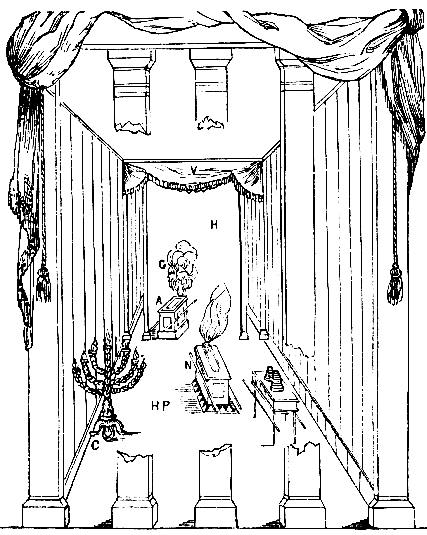
Internally it was divided by a veil into two chambers, the exterior of which was called the holy place, also "the sanctuary" (Hebrews 9:2) and the "first tabernacle" (6); and the interior, the holy of holies, "the holy place," "the Holiest," the "second tabernacle" (Exodus 28:29; Hebrews 9:3, 7). The veil separating these two chambers was a double curtain of the finest workmanship,
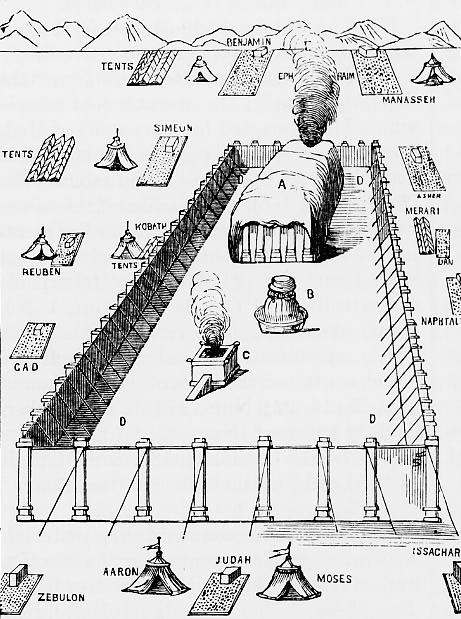
THE TABERNACLE IN THE WILDERNESS which was never A. The Tabernacle covered | C. Alter of Burnt-Offerings passed except by the B. Brazen Laver | D. Court of the Tabernacle high priest once a year, on the great Day of Atonement. The holy place was separated from the outer court which enclosed the tabernacle by a curtain, which hung over the six pillars which stood at the east end of the tabernacle, and by which it was entered.
The order as well as the typical character of the services of the tabernacle are recorded in Hebrews 9; 10:19-22.
The holy of holies, a cube of 10 cubits, contained the "ark of the testimony", i.e., the oblong chest containing the two tables of stone, the pot of manna, and Aaron's rod that budded.
The holy place was the western and larger chamber of the tabernacle. Here were placed the table for the shewbread, the golden candlestick, and the golden altar of incense.
Round about the tabernacle was a court, enclosed by curtains hung upon sixty pillars (Exodus 27:9-18). This court was 150 feet long and 75 feet broad. Within it were placed the altar of burnt offering, which measured 7 1/2 feet in length and breadth and 4 1/2 feet high, with horns at the four corners, and the laver of brass (Exodus 30:18), THE TABERNACLE UNVEILED which stood H. The Holy of Holies, containing the Ark (A) of the Covenant between the altar with the Shechinah (G) and the tabernacle. V. The Veil separating the Holy of Holies from the Holy Place. H.P. The Holy Place, containing the Golden Candlestick (C); the Table of Shewbread (T); and the Altar of the Incense.
The whole tabernacle was completed in seven months. On the first day of the first month of the second year after the Exodus, it was formally set up, and the cloud of the divine presence descended on it (Exodus 39:22-43; 40:1-38). It cost 29 talents 730 shekels of gold, 100 talents 1,775 shekels of silver, 70 talents 2,400 shekels of brass (Exodus 38:24-31).
The tabernacle was so constructed that it could easily be taken down and conveyed from place to place during the wanderings in the wilderness. The first encampment of the Israelites after crossing the Jordan was at Gilgal, and there the tabernacle remained for seven years (Joshua 4:19). It was afterwards removed to Shiloh (Joshua 18:1), where it remained during the time of the Judges, till the days of Eli, when the ark, having been carried out into the camp when the Israelites were at war with the Philistines, was taken by the enemy (1 Samuel 4), and was never afterwards restored to its place in the tabernacle. The old tabernacle erected by Moses in the wilderness was transferred to Nob (1 Samuel 21:1), and after the destruction of that city by Saul (22:9; 1 Chronicles 16:39, 40), to Gibeon. It is mentioned for the last time in 1 Chronicles 21:29. A new tabernacle was erected by David at Jerusalem (2 Samuel 6:17; 1 Chronicles 16:1), and the ark was brought from Perez-uzzah and deposited in it (2 Samuel 6:8-17; 2 Chronicles 1:4).
The word thus rendered ('ohel) in Exodus 33:7 denotes simply a tent, probably Moses' own tent, for the tabernacle was not yet erected.
FEAST OF the third of the great annual festivals of the Jews (Leviticus 23:33-43). It is also called the "feast of ingathering" (Exodus 23:16; Deuteronomy 16:13). It was celebrated immediately after the harvest, in the month Tisri, and the celebration lasted for eight days (Leviticus 23:33-43). During that period the people left their homes and lived in booths formed of the branches of trees. The sacrifices offered at this time are mentioned in Numbers 29:13-38. It was at the time of this feast that Solomon's temple was dedicated (1 Kings 8:2). Mention is made of it after the return from the Captivity. This feast was designed (1) to be a memorial of the wilderness wanderings, when the people dwelt in booths (Leviticus 23:43), and (2) to be a harvest thanksgiving (Nehemiah 8:9-18). The Jews, at a later time, introduced two appendages to the original festival, viz., (1) that of drawing water from the Pool of Siloam, and pouring it upon the altar (John 7:2, 37), as a memorial of the water from the rock in Horeb; and (2) of lighting the lamps at night, a memorial of the pillar of fire by night during their wanderings.
"The feast of Tabernacles, the harvest festival of the Jewish Church, was the most popular and important festival after the Captivity. At Jerusalem it was a gala day. It was to the autumn pilgrims, who arrived on the 14th (of the month Tisri, the feast beginning on the 15th) day, like entrance into a silvan city. Roofs and courtyards, streets and squares, roads and gardens, were green with boughs of citron and myrtle, palm and willow. The booths recalled the pilgrimage through the wilderness. The ingathering of fruits prophesied of the spiritual harvest.", Valling's Jesus Christ, p. 133.
(in Greek called Dorcas), gazelle, a disciple at Joppa. She was distinguished for her alms-deeds and good works. Peter, who was sent for from Lydda on the occasion of her death, prayed over the dead body, and said, "Tabitha, arise." And she opened her eyes and sat up; and Peter "gave her his hand, and raised her up; and calling the saints and widows, he presented her alive" (Acts 9:36-43).
(Mark 7:4) means banqueting-couches or benches, on which the Jews reclined when at meals. This custom, along with the use of raised tables like ours, was introduced among the Jews after the Captivity. Before this they had, properly speaking, no table. That which served the purpose was a skin or piece of leather spread out on the carpeted floor. Sometimes a stool was placed in the middle of this skin. (See ABRAHAM'S BOSOM; BANQUET; MEALS.)
probably a string of beads worn round the neck (Exodus 35:22; Numbers 31:50). In Isaiah 3:20 the Hebrew word means a perfume-box, as it is rendered in the Revised Version.
a height. (1.) Now Jebel et-Tur, a cone-like prominent mountain, 11 miles west of the Sea of Galilee. It is about 1,843 feet high. The view from the summit of it is said to be singularly extensive and grand. This is alluded to in Psalm 89:12; Jeremiah 46:18. It was here that Barak encamped before the battle with Sisera (q.v.) Judges 4:6-14. There is an old tradition, which, however, is unfounded, that it was the scene of the transfiguration of our Lord. (See HERMON.) "The prominence and isolation of Tabor, standing, as it does, on the border-land between the northern and southern tribes, between the mountains and the central plain, made it a place of note in all ages, and evidently led the psalmist to associate it with Hermon, the one emblematic of the south, the other of the north." There are some who still hold that this was the scene of the transfiguration (q.v.).
(2.) A town of Zebulum (1 Chronicles 6:77).
(3.) The "plain of Tabor" (1 Samuel 10:3) should be, as in the Revised Version, "the oak of Tabor." This was probably the Allon-bachuth of Genesis 35:8.
(Hebrews toph), a timbrel (q.v.) or tambourine, generally played by women (Genesis 31:27; 1 Samuel 10:5; 18:6). In Job 17:6 the word
(Hebrews topheth) "tabret" should be, as in the Revised Version, "an open abhorring" (marg., "one in whose face they spit;" lit., "a spitting in the face").
good is Rimmon, the father of Benhadad, king of Syria (1 Kings 15:18).
hooks or clasps by which the tabernacle curtains were connected (Exodus 26:6, 11, 33; 35:11).
a name given to Jashobeam (2 Samuel 23:8; comp. 1 Chronicles 11:11).
(Isaiah 33:23), the ropes attached to the mast of a ship. In Acts 27:19 this word means generally the furniture of the ship or the "gear" (27:17), all that could be removed from the ship.
palm, a city built by Solomon "in the wilderness" (2 Chronicles 8:4). In 1 Kings 9:18, where the word occurs in the Authorized Version, the Hebrew text and the Revised Version read "Tamar," which is properly a city on the southern border of Palestine and toward the wilderness (comp. Ezekiel 47:19; 48:28). In 2 Chronicles 8:14 Tadmor is mentioned in connection with Hamath-zobah. It is called Palmyra by the Greeks and Romans. It stood in the great Syrian wilderness, 176 miles from Damascus and 130 from the Mediterranean and was the centre of a vast commercial traffic with Western Asia. It was also an important military station. (See SOLOMON.) "Remains of ancient temples and palaces, surrounded by splendid colonnades of white marble, many of which are yet standing, and thousands of prostrate pillars, scattered over a large extent of space, attest the ancient magnificence of this city of palms, surpassing that of the renowned cities of Greece and Rome."
(called "Daphne" by the Greeks, now Tell Defenneh), an ancient Egyptian city, on the Tanitic branch of the Nile, about 16 miles from Pelusium. The Jews from Jerusalem fled to this place after the death of Gedaliah (q.v.), and settled there for a time (Jeremiah 2:16; 43:7; 44:1; 46:14). A platform of brick-work, which there is every reason to believe was the pavement at the entry of Pharaoh's palace, has been discovered at this place. "Here," says the discoverer, Mr. Petrie, "the ceremony described by Jeremiah [43:8-10; "brick-kiln", i.e., pavement of brick] took place before the chiefs of the fugitives assembled on the platform, and here Nebuchadnezzar spread his royal pavilion" (R.V., "brickwork").
the wife of Pharaoh, who gave her sister in marriage to Hadad the Edomite (1 Kings 11:19, 20).
the land of the newly inhabited, (2 Samuel 24:6). It is conjectured that, instead of this word, the reading should be, "the Hittites of Kadesh," the Hittite capital, on the Orontes. It was apparently some region east of the Jordan and north of Gilead.
(1.) Hebrews tokhen, "a task," as weighed and measured out = tally, i.e., the number told off; the full number (Exodus 5:18; see 1 Samuel 18:27; 1 Chronicles 9:28). In Ezekiel 45:11 rendered "measure."
(2.) Hebrews hegeh, "a thought;" "meditation" (Psalm 90:9); meaning properly "as a whisper of sadness," which is soon over, or "as a thought." The LXX. and Vulgate render it "spider;" the Authorized Version and Revised Version, "as a tale" that is told. In Job 37:2 this word is rendered "sound;" Revised Version margin, "muttering;" and in Ezekiel 2:10, "mourning."
of silver contained 3,000 shekels (Exodus 38:25, 26), and was equal to 94 3/7 lbs. avoirdupois. The Greek talent, however, as in the LXX., was only 82 1/4 lbs. It was in the form of a circular mass, as the Hebrew name kikkar denotes. A talent of gold was double the weight of a talent of silver (2 Samuel 12:30). Parable of the talents (Matthew 18:24; 25:15).
CUMI (Mark 5:41), a Syriac or Aramaic expression, meaning, "Little maid, arise." Peter, who was present when the miracle was wrought, recalled the actual words used by our Lord, and told them to Mark.
abounding in furrows. (1.) One of the Anakim of Hebron, who were slain by the men of Judah under Caleb (Numbers 13:22; Joshua 15:14; Judges 1:10).
(2.) A king of Geshur, to whom Absalom fled after he had put Amnon to death (2 Samuel 3:3; 13:37). His daughter, Maachah, was one of David's wives, and the mother of Absalom (1 Chronicles 3:2).
oppressed. (1.) A Levite porter (1 Chronicles 9:17; Nehemiah 11:19).
(2.) One whose descendants returned with Zerubbabel to Jerusalem (Ezra 2:42; Nehemiah 7:45); probably the same as (1).
palm. (1.) A place mentioned by Ezekiel (47:19; 48:28), on the southeastern border of Palestine. Some suppose this was "Tadmor" (q.v.).
(2.) The daughter-in-law of Judah, to whose eldest son, Er, she was married (Genesis 38:6). After her husband's death, she was married to Onan, his brother (8), and on his death, Judah promised to her that his third son, Shelah, would become her husband. This promise was not fulfilled, and hence Tamar's revenge and Judah's great guilt (38:12-30).
(3.) A daughter of David (2 Samuel 13:1-32; 1 Chronicles 3:9), whom Amnon shamefully outraged and afterwards "hated exceedingly," thereby illustrating the law of human nature noticed even by the heathen, "Proprium humani ingenii est odisse quem laeseris", i.e., "It is the property of human nature to hate one whom you have injured."
(4.) A daughter of Absalom (2 Samuel 14:27).
Hebrews 'eshel (Genesis 21:33; 1 Samuel 22:6; 31:13, in the R.V.; but in A.V., "grove," "tree"); Arab. asal. Seven species of this tree are found in Palestine. It is a "very graceful tree, with long feathery branches and tufts closely clad with the minutest of leaves, and surmounted in spring with spikes of beautiful pink blosoms, which seem to envelop the whole tree in one gauzy sheet of colour" (Tristram's Nat. Hist.).
a corruption of Dumuzi, the Accadian sun-God (the Adonis of the Greeks), the husband of the goddess Ishtar. In the Chaldean calendar there was a month set apart in honour of this God, the month of June to July, the beginning of the summer solstice. At this festival, which lasted six days, the worshippers, with loud lamentations, bewailed the funeral of the God, they sat "weeping for Tammuz" (Ezekiel 8:14).
The name, also borrowed from Chaldea, of one of the months of the Hebrew calendar.
consolation, a Netophathite; one of the captains who supported Gedaliah (2 Kings 25:23; Jeremiah 40:8).
•TANIS (Ezekiel 30:14, marg.). See ZOAN.
apple-region. (1.) A town in the valley or lowland of Judah; formerly a royal city of the Canaanites (Joshua 12:17; 15:34). It is now called Tuffuh, about 12 miles west of Jerusalem.
(2.) A town on the border of Ephraim (Joshua 16:8). The "land" of Tappuah fell to Manasseh, but the "city" to Ephraim (17:8).
(3.) En-tappuah, the well of the apple, probably one of the springs near Yassuf (Joshua 17:7).
stopping; station, an encampment of the Hebrews in the wilderness (Numbers 33:27, 28).
the bearded darnel, mentioned only in Matthew 13:25-30. It is the Lolium temulentum, a species of rye-grass, the seeds of which are a strong soporific poison. It bears the closest resemblance to wheat till the ear appears, and only then the difference is discovered. It grows plentifully in Syria and Palestine.
(1 Samuel 17:6, A.V., after the LXX. and Vulg.), a kind of small shield. The margin has "gorget," a piece of armour for the throat. The Revised Version more correctly renders the Hebrew word (kidon) by "javelin." The same Hebrew word is used in Joshua 8:18 (A.V., "spear;" R.V., "javelin"); Job 39:23 (A.V., "shield;" R.V., "javelin"); 41:29 (A.V., "spear;" R.V., "javelin").
a Sanscrit or Aryan word, meaning "the sea coast." (1.) One of the "sons" of Javan (Genesis 10:4; 1 Chronicles 1:7).
(2.) The name of a place which first comes into notice in the days of Solomon. The question as to the locality of Tarshish has given rise to not a little discussion. Some think there was a Tarshish in the East, on the Indian coast, seeing that "ships of Tarshish" sailed from Eziongeber, on the Red Sea (1 Kings 9:26; 22:48; 2 Chronicles 9:21). Some, again, argue that Carthage was the place so named. There can be little doubt, however, that this is the name of a Phoenician port in Spain, between the two mouths of the Guadalquivir (the name given to the river by the Arabs, and meaning "the great wady" or water-course). It was founded by a Carthaginian colony, and was the farthest western harbour of Tyrian sailors. It was to this port Jonah's ship was about to sail from Joppa. It has well been styled "the Peru of Tyrian adventure;" it abounded in gold and silver mines.
It appears that this name also is used without reference to any locality. "Ships of Tarshish" is an expression sometimes denoting simply ships intended for a long voyage (Isaiah 23:1, 14), ships of a large size (sea-going ships), whatever might be the port to which they sailed. Solomon's ships were so styled (1 Kings 10:22; 22:49).
the chief city of Cilicia. It was distinguished for its wealth and for its schools of learning, in which it rivalled, nay, excelled even Athens and Alexandria, and hence was spoken of as "no mean city." It was the native place of the Apostle Paul (Acts 21:39). It stood on the banks of the river Cydnus, about 12 miles north of the Mediterranean. It is said to have been founded by Sardanapalus, king of Assyria. It is now a filthy, ruinous Turkish town, called Tersous. (See PAUL.)
prince of darkness, one of the gods of the Arvites, who colonized part of Samaria after the deportation of Israel by Shalmaneser (2 Kings 17:31).
an Assyrian word, meaning "the commander-in-chief." (1.) One of Sennacherib's messengers to Hezekiah (2 Kings 18:17). (2.) One of Sargon's generals (Isaiah 20:1).
gift, a Persian governor (Hebrews pehah, i.e., "satrap;" modern "pasha") "on this side the river", i.e., of the whole tract on the west of the Euphrates. This Hebrew title pehah is given to governors of provinces generally. It is given to Nehemiah (5:14) and to Zerubbabel (Hag. 1:1). It is sometimes translated "captain" (1 Kings 20:24; Daniel 3:2, 3), sometimes also "deputy" (Esther 8:9; 9:3). With others, Tatnai opposed the rebuilding of the temple (Ezra 5:6); but at the command of Darius, he assisted the Jews (6:1-13).
THE THREE a place on the great "Appian Way," about 11 miles from Rome, designed for the reception of travellers, as the name indicates. Here Paul, on his way to Rome, was met by a band of Roman Christians (Acts 28:15). The "Tres Tabernae was the first mansio or mutatio, that is, halting-place for relays, from Rome, or the last on the way to the city. At this point three roads run into the Via Appia, that from Tusculum, that from Alba Longa, and that from Antium; so necessarily here would be a halting-place, which took its name from the three shops there, the general store, the blacksmith's, and the refreshment-house...Tres Tabernae is translated as Three Taverns, but it more correctly means three shops" (Forbes's Footsteps of St. Paul, p.20).
first mentioned in the command (Exodus 30:11-16) that every Jew from twenty years and upward should pay an annual tax of "half a shekel for an offering to the Lord." This enactment was faithfully observed for many generations (2 Chronicles 24:6; Matthew 17:24).
Afterwards, when the people had kings to reign over them, they began, as Samuel had warned them (1 Samuel 8:10-18), to pay taxes for civil purposes (1 Kings 4:7; 9:15; 12:4). Such taxes, in increased amount, were afterwards paid to the foreign princes that ruled over them.
In the New Testament the payment of taxes, imposed by lawful rulers, is enjoined as a duty (Romans 13:1-7; 1 Peter 2:13, 14). Mention is made of the tax (telos) on merchandise and travellers (Matthew 17:25); the annual tax (phoros) on property (Luke 20:22; 23:2); the poll-tax (kensos, "tribute," Matthew 17:25; 22:17; Mark 12:14); and the temple-tax ("tribute money" = two drachmas = half shekel, Matthew 17:24-27; comp. Exodus 30:13). (See TRIBUTE.)
(Luke 2:2; R.V., "enrolment"), "when Cyrenius was governor of Syria," is simply a census of the people, or an enrolment of them with a view to their taxation. The decree for the enrolment was the occasion of Joseph and Mary's going up to Bethlehem. It has been argued by some that Cyrenius (q.v.) was governor of Cilicia and Syria both at the time of our Lord's birth and some years afterwards. This decree for the taxing referred to the whole Roman world, and not to Judea alone. (See CENSUS.)
(Esther 2:16), a word probably of Persian origin, denoting the cold time of the year; used by the later Jews as denoting the tenth month of the year. Assyrian tebituv, "rain."
TREE (an old name for the lime-tree, the tilia), Isaiah 6:13, the terebinth, or turpentine-tree, the Pistacia terebinthus of botanists. The Hebrew word here used (elah) is rendered oak (q.v.) in Genesis 35:4;
Judges 6:11, 19; Isaiah 1:29, etc. In Isaiah 61:3 it is rendered in the plural "trees;" Hos. 4:13, "elm" (R.V., "terebinth"). Hos. 4:13, "elm" (R.V., "terebinth"). In 1 Samuel 17:2, 19 it is taken as a proper name, "Elah" (R.V. marg., "terebinth").
"The terebinth of Mamre, or its lineal successor, remained from the days of Abraham till the fourth century of the Christian era, and on its site Constantine erected a Christian church, the ruins of which still remain."
This tree "is seldom seen in clumps or groves, never in forests, but stands isolated and weird-like in some bare ravine or on a hill-side where nothing else towers above the low brushwood" (Tristram).
•TEKEL weighed (Daniel 5:27).
TEKOAH pitching of tents; fastening down, a town of Judah, about 12 miles south of Jerusalem, and visible from the city. From this place Joab procured a "wise woman," who pretended to be in great affliction, and skilfully made her case known to David. Her address to the king was in the form of an apologue, similar to that of Nathan (2 Samuel 12:1-6). The object of Joab was, by the intervention of this woman, to induce David to bring back Absalom to Jerusalem (2 Samuel 14:2, 4, 9).
This was also the birth-place of the prophet Amos (1:1).
It is now the village of Teku'a, on the top of a hill among ruins, 5 miles south of Bethlehem, and close to Beth-haccerem ("Herod's mountain").
hill of corn, a place on the river Chebar, the residence of Ezekiel (Ezekiel 3:15). The site is unknown.
young lambs, a place at which Saul gathered his army to fight against Amalek (1 Samuel 15:4); probably the same as Telem (2).
or Thelasar, (Isaiah 37:12; 2 Kings 19:12), a province in the south-east of Assyria, probably in Babylonia. Some have identified it with Tel Afer, a place in Mesopotamia, some 30 miles from Sinjar.
oppression. (1.) A porter of the temple in the time of Ezra (10:24).
(2.) A town in the southern border of Judah (Joshua 15:24); probably the same as Telaim.
hill of the wood, a place in Babylon from which some captive Jews returned to Jerusalem (Ezra 2:59; Nehemiah 7:61).
hill of salt, a place in Babylon from which the Jews returned (id.).
south; desert, one of the sons of Ishmael, and father of a tribe so called (Genesis 25:15; 1 Chronicles 1:30; Job 6:19; Isaiah 21:14; Jeremiah 25:23) which settled at a place to which he gave his name, some 250 miles south-east of Edom, on the route between Damascus and Mecca, in the northern part of the Arabian peninsula, toward the Syrian desert; the modern Teyma'.
id. (1.) A grandson of Esau, one of the "dukes of Edom" (Genesis 36:11, 15, 42).
(2.) A place in Southern Idumea, the land of "the sons of the east," frequently mentioned in the Old Testament. It was noted for the wisdom of its inhabitants (Amos 1:12; Obad. 1:8; Jeremiah 49:7; Ezekiel 25:13). It was divided from the hills of Paran by the low plain of Arabah (Habakkuk 3:3).
a man of Teman, the designation of Eliphaz, one of Job's three friends (Job 2:11; 22:1).
one of the sons of Ashur, the father of Tekoa (1 Chronicles 4:6).
first used of the tabernacle, which is called "the temple of the Lord" (1 Samuel 1:9). In the New Testament the word is used figuratively of Christ's human body (John 2:19, 21). Believers are called "the temple of God" (1 Corinthians 3:16, 17). The Church is designated "an holy temple in the Lord" (Ephesians 2:21). Heaven is also called a temple (Revelation 7:5). We read also of the heathen "temple of the great goddess Diana" (Acts 19:27).
This word is generally used in Scripture of the sacred house erected on the summit of Mount Moriah for the worship of God. It is called "the temple" (1 Kings 6:17); "the temple [R.V., 'house'] of the Lord" (2 Kings 11:10); "thy holy temple" (Psalm 79:1); "the house of the Lord" (2 Chronicles 23:5, 12); "the house of the God of Jacob" (Isaiah 2:3); "the house of my glory" (60:7); an "house of prayer" (56:7; Matthew 21:13); "an house of sacrifice" (2 Chronicles 7:12); "the house of their sanctuary" (2 Chronicles
36:17); "the mountain of the Lord's house" (Isaiah 2:2); "our holy and our beautiful house" (64:11); "the holy mount" (27:13); "the palace for the Lord God" (1 Chronicles 29:1); "the tabernacle of witness" (2 Chronicles 24:6); "Zion" (Psalm 74:2; 84:7). Christ calls it "my Father's house" (John 2:16).
HEROD'S The temple erected by the exiles on their return from Babylon had stood for about five hundred years, when Herod the Great became king of Judea. The building had suffered considerably from natural decay as well as from the assaults of hostile armies, and Herod, desirous of gaining the favour of the Jews, proposed to rebuild it. This offer was accepted, and the work was begun (B.C. 18), and carried out at great labour and expense, and on a scale of surpassing splendour. The main part of the building was completed in ten years, but the erection of the outer courts and the embellishment of the whole were carried on during the entire period of our Lord's life on earth (John 2:16, 19-21), and the temple was completed only A.D. 65. But it was not long permitted to exist. Within forty years after our Lord's crucifixion, his prediction of its overthrow was accomplished (Luke 19: 41-44). The Roman legions took the city of Jerusalem by storm, and notwithstanding the strenuous efforts Titus made to preserve the temple, his soldiers set fire to it in several places, and it was utterly destroyed (A.D. 70), and was never rebuilt.
Several remains of Herod's stately temple have by recent explorations been brought to light. It had two courts, one intended for the Israelites only, and the other, a large outer court, called "the court of the Gentiles," intended for the use of strangers of all nations. These two courts were separated by a low wall, as Josephus states, some 4 1/2 feet high, with thirteen openings. Along the top of this dividing wall, at regular intervals, were placed pillars bearing in Greek an inscription to the effect that no stranger was, on the pain of death, to pass from the court of the Gentiles into that of the Jews. At the entrance to a graveyard at the north-western angle of the Haram wall, a stone was discovered by M. Ganneau in 1871, built into the wall, bearing the following inscription in Greek capitals: "No stranger is to enter within the partition wall and enclosure around the sanctuary. Whoever is caught will be responsible to himself for his death, which will ensue."
There can be no doubt that the stone thus discovered was one of those originally placed on the boundary wall which separated the Jews from the Gentiles, of which Josephus speaks.
It is of importance to notice that the word rendered "sanctuary" in the inscription was used in a specific sense of the inner court, the court of the Israelites, and is the word rendered "temple" in John 2:15 and Acts 21:28, 29. When Paul speaks of the middle wall of partition (Ephesians 2:14), he probably makes allusion to this dividing wall. Within this partition wall stood the temple proper, consisting of, (1) the court of the women, 8 feet higher than the outer court; (2) 10 feet higher than this court was the court of Israel; (3) the court of the priests, again 3 feet higher; and lastly (4) the temple floor, 8 feet above that; thus in all 29 feet above the level of the outer court.
The summit of Mount Moriah, on which the temple stood, is now occupied by the Haram esh-Sherif, i.e., "the sacred enclosure." This enclosure is about 1,500 feet from north to south, with a breadth of about 1,000 feet, covering in all a space of about 35 acres. About the centre of the enclosure is a raised platform, 16 feet above the surrounding space, and paved with large stone slabs, on which stands the Mohammedan mosque called Kubbet es-Sahkra i.e., the "Dome of the Rock," or the Mosque of Omar. This mosque covers the site of Solomon's temple. In the centre of the dome there is a bare, projecting rock, the highest part of Moriah (q.v.), measuring 60 feet by 40, standing 6 feet above the floor of the mosque, called the sahkra, i.e., "rock." Over this rock the altar of burnt-offerings stood. It was the threshing-floor of Araunah the Jebusite. The exact position on this "sacred enclosure" which the temple occupied has not been yet definitely ascertained. Some affirm that Herod's temple covered the site of Solomon's temple and palace, and in addition enclosed a square of 300 feet at the south-western angle. The temple courts thus are supposed to have occupied the southern portion of the "enclosure," forming in all a square of more than 900 feet. It is argued by others that Herod's temple occupied a square of 600 feet at the south-west of the "enclosure."
SOLOMON'S Before his death David had "with all his might" provided materials in great abundance for the building of the temple on the summit of Mount Moriah (1 Chronicles 22:14; 29:4; 2 Chronicles 3:1), on the east of the city, on the spot where Abraham had offered up
Isaac (Genesis 22:1-14). In the beginning of his reign Solomon set about giving effect to the desire that had been so earnestly cherished by his father, and prepared additional materials for the building. From subterranean quarries at Jerusalem he obtained huge blocks of stone for the foundations and walls of the temple. These stones were prepared for their places in the building under the eye of Tyrian master-builders. He also entered into a compact with Hiram II., king of Tyre, for the supply of whatever else was needed for the work, particularly timber from the forests of Lebanon, which was brought in great rafts by the sea to Joppa, whence it was dragged to Jerusalem (1 Kings 5). As the hill on which the temple was to be built did not afford sufficient level space, a huge wall of solid masonry of great height, in some places more than 200 feet high, was raised across the south of the hill, and a similar wall on the eastern side, and in the spaces between were erected many arches and pillars, thus raising up the general surface to the required level. Solomon also provided for a sufficient water supply for the temple by hewing in the rocky hill vast cisterns, into which water was conveyed by channels from the "pools" near Bethlehem. One of these cisterns, the "great sea," was capable of containing three millions of gallons. The overflow was led off by a conduit to the Kidron.
In all these preparatory undertakings a space of about three years was occupied; and now the process of the erection of the great building began, under the direction of skilled Phoenician builders and workmen, in the fourth year of Solomon's reign, 480 years after the Exodus (1 Kings 6; 2 Chronicles 3). Many thousands of labourers and skilled artisans were employed in the work. Stones prepared in the quarries underneath the city (1 Kings 5:17, 18) of huge dimension (see QUARRIES) were gradually placed on the massive walls, and closely fitted together without any mortar between, till the whole structure was completed. No sound of hammer or axe or any tool of iron was heard as the structure arose (6:7). "Like some tall palm the noiseless fabric sprang." The building was 60 cubits long, 20 cubits wide, and 30 cubits high. The engineers of the Palestine Exploration Fund, in their explorations around the temple area, discovered what is believed to have been the "chief corner stone" of the temple, "the most interesting stone in the world." It lies at the bottom of the south-eastern angle, and is 3 feet 8 inches high by 14 feet long. It rests on the solid rock at a depth of 79 feet 3 inches below the present surface. (See PINNACLE.) In examining the walls the engineers were "struck with admiration at the vastness of the blocks and the general excellence of the workmanship."
At length, in the autumn of the eleventh year of his reign, seven and a half years after it had been begun, the temple was completed in all its architectural magnificence and beauty. For thirteen years there it stood, on the summit of Moriah, silent and unused. The reasons for this strange delay in its consecration are unknown. At the close of these thirteen years preparations for the dedication of the temple were made on a scale of the greatest magnificence. The ark was solemnly brought from the tent in which David had deposited it to the place prepared for it in the temple, and the glory-cloud, the symbol of the divine presence, filled the house. Then Solomon ascended a platform which had been erected for him, in the sight of all the people, and lifting up his hands to heaven poured out his heart to God in prayer (1 Kings 8; 2 Chronicles 6, 7). The feast of dedication, which lasted seven days, followed by the feast of tabernacles, marked a new era in the history of Israel. On the eighth day of the feast of tabernacles, Solomon dismissed the vast assemblage of the people, who returned to their homes filled with joy and gladness, "Had Solomon done no other service beyond the building of the temple, he would still have influenced the religious life of his people down to the latest days. It was to them a perpetual reminder and visible symbol of God's presence and protection, a strong bulwark of all the sacred traditions of the law, a witness to duty, an impulse to historic study, an inspiration of sacred song."