
The Eighth Sermon
THE THIRD DECADE.
[sERM.

the judicials he compelleth us to the keeping of the laws, and doth preserve the integrity of the same.
Now all these together do tend to thisend only, that man may be saved, that he worship God aright, and live according to the will of the Lord.
Thus much have I spoken hitherto,by the help of God, concerning his holy laws.
Now let us praise the goodness of the Lord, who doth not suffer his people to lack any thing that is necessary for their commodity ; and doth even at this day instruct us with these laws to the glory of his name and health of our souls.
OF THE USE OR EFFECT OF THE LAW OF GOD, AND OF THE
FULFILLING
AND
ABROGATING
OF THE SAME : OF THE LIKENESS AND
DIFFERENCE
OF BOTH THE
TESTAMENTS
AND PEOPLE, THE OLD AND THE NEW.
THE EIGHTH SERMON.
ALTHOUGH I have hitherto in large sermons laidforth1 the law of God by several parts, yet methinketh I have not said all that should be said,nor made an end as I should do, unless I add now a treatise of the use, effect,fulfilling, and abrogating of the law of God; albeitI have here and there in my sermons2 touched the same argument.
Now by this discourse or treatise,dearly beloved, ye shall understand, that the Testament of the old and new church of God is all one ; and that there is but one means of true salvation for all them that either have or else at this present are saved in the world : ye shall also perceive wherein the old Testament3 doth differ from the new.
Moreover this treatise will be necessary and very profitable both to the understanding of many places in the holy scripture,and also to the easy perceiving and most wholesome use of those things which I have said hitherto touching the law.
God, who is the author, the f1qua potui diligentia,Lat. ; with my best diligence.] [2in hisce nostris sermonibus, Lat.] [3 quid novum testamentum differat a veteri, Lat.]

USE,
FULFILLING,
AND
ABROGATION
OF THE LAW.
VIII.] wisdom, and the perfect fulnessof the law, give me grace to speak those things that are to the setting forth of his glory, and profitablefor the health of your* souls.
The use of God's law is manifold and of sundry sorts; or the use and yet it may be calledback to three especial points,and Gocrl^ of we may say that the use thereof is threefold or of three sorts.
For firstof all,the chief and proper officeof the law is, to convince all men to be guiltyof sin,and by their own fault to be the children of death.
For the law of God setteth forth to us the holy willof God ; and, in the settingforth thereof, requireth of us a most perfectand absolute kind of righteousness.
And for that cause the law is wont to be called the testimony of God's will,and the most perfect exemplar of his divine pureness.
And hereunto belong those words of the Lord in the gospel, where he, reciting shortly the sum of God's commandments, doth say: "The firstof all the comAbsolute mandments is:Hear, O Israel,the Lord our God is one Lord:
"" required of us in the law. and thou shalt love the Lord thy God with allthy heart, and ["ark xii-^ with all thy soul, and with all thy mind, and with all thy strength.
This is the firstcommandment.
And the second is like to this,Thou shaltlove thy neighbour as thyself.There is none other commandment greater than these."
Therefore to this doth also appertain that saying of the apostle Paul :
"The end of the commandment is charityout of a pure heart,[lTim. j.5-] and a good conscience,and faith unfeigned."
But since the law doth require at all our hands most absolute righteousness, charity,and5 a pure heart, it doth6 condemn allmen of sin, unrighteousness, and death.
For in the law of God it is expressly said: "Cursed is every one which abideth not in all[Deut Xxvil. that is written in the book of the law to do it."
But what m:]GaUi one of us fulfilleth allthe pointsof the law ?
What man, I n"i^*" pray, either heretofore hath had, or at this day 7 hath, a pure heart within him ?
What man hath ever loved, or doth now love, God with allhis heart, with allhis soul,and with allhis mind ?
What man ishe that did never lustafter evil?
Or who is it now that lustethnot every day ?
Therefore imperfection and sin is by the law, or by the bewraying of the ["*nostrarum, Lat. ; our.] [5adeoque, Lat. ; and so a.] [8certe, Lat. undoubtedly.] [7etiain hodie, Lat.]
THE THIRD DECADE.
[sERM.

law1, revealed in mankind2.
What shall we say to this?
Where, I pray you, doth there appear in any man that divine and most absolute righteousness,which the law requireth ?
Job crieth,"I know verily that a man, compared to God, " How shalla man be found rightcannot be justified3."
Or, [job a..
2, 3, eous, ifhe be compared to God ?
If he willargue with him, he shallnot be able to answer one for a thousand.
4If I have any righteousness in me, I will not answer him, but I will beseech my judge." Likewise, these5 are the words of the apostle John, who saith:
"If we say we have no sin, we [UohnL deceive ourselves,and the truth is not in us."
Again, "If we say we have not sinned, we make him a liar,and his word is not in us."
Therefore by this means the law is a certain The law doth looking-glass,wherein we behold our own corruption,frailness, "nas manifest, imbecility,imperfection,and our judgment, that is, our just rmhtery an(*Deserved damnation.
For the apostledoth expresslysay, that the law was given to the end that it might make manifest "o men's transgressions,and by that means drive them to the acknowledging of theirimperfectionand guiltin sinning. For none of us doth look into his own bosom, nor into the secrets of his own breast,but we do allflatterourselves,and willnot be persuaded that our thoughts and deeds6 are so corrupt as they be in very deed ; and therefore doth the law creep in, and lay open the secrets of our hearts,and bringeth to light our sin and corruption.
"Before the law," saith the apostle, " although sin were in the world, yet was it not imputed7."
[Rom.iv.15; The same apostle also saith : "The law worketh wrath; for where there is no law, there is no transgression."And again, "By the law cometh the knowledge of sin."
For in the seventh to the Romans the same apostle doth say more fully:
"I knew not sin,but by the law: for I had not known lust, except the law had said,Thou shalt not lust. But sin,taking [iindicio legis,Lat.] [2ut non dicam hie aliud gravius,Lat. omitted ; not to allege here any severer charge.] [3So the Vulgate; and Corerdale, 1535.] ["item, Lat. ; again.] [5succinit huic, Lat. ; like to these, ed. 1577.]
[6res nostras, Lat.] [7non imputabatur, yel reputabatur, Lat.; or not considered, Rom. v. 13.]
USE,
FULFILLING,
AND
ABROGATION
OF THE LAW.

VIII.] occasion8 by the commandment, wrought in me allmanner of concupiscence.
For without the law sin was dead.
I once lived without law; but when the commandment came, sin revived, and I was dead9.
And it was found, that the same commandment, which was ordained unto life,was unto me an occasion of death, "c."
For a good part of that chapter is spent in that matter.
Therefore the proper officeof Moses, and the principaluse and effectof the law, is to shew to man his sin and imperfection10.
As for those which stay here, and go no furtherto make any Moses doth "or t^iaw not onlv slav other use and effectof the law,but as though Moses did nothing ' but kill,and the law nothing but slay ; they are diversly, and that not lightly,deceived.
I do here again repeat it,and tell them, that the very proper officeof the law is,to make sin manifest ; and also that Moses his chief officeis,to teach us what we have to do, and with threatenings and cursings to urge it,especiallywhen the law is compared with the gospel.
For in the third chapter of the second epistleto the Corinthians Paul calleththe law the letter; and immediately after, the ministrationof death ; then again, he callethit a doctrine written in lettersand ink, and11 figured in tables of stone, which should not endure, but perish and decay.
The same apostle,on the other side again12,doth call the gospel the ministration or doctrine of the Spirit,which endureth and decayeth not, which iswritten in men's hearts,and giveth life to the believers13. Whereupon we do freely confess,that the law doth properly make manifest our infirmity14;but the gospel giveth a medicine, and a remedy to that which was almost past hope.
And now here we must think that our holy ancestors had not the law, alone to convince them of sin; nor Moses, to do nothing else but killand slay ; nor that Moses was given to wound them, but to heal them15: and that, not by his own power or virtue, but by the guiding of them to him that cherisheth the contrite in heart, and healeth all their sor- [8occasiono accepta, peccatum per prscccptum genuit, Lat. ; and Erasmus.] [9mortuus sum, Lat.] [10morbum, sive peccatum, Lat.] [u rursus, Lat.] [12protinus, Lat. ; and immediately.] [13to the believers,not in Lat.] [" morbum, Lat.] [16ut mederetur etiam, Lat. ; but to heal also.]
THE THIRD DECADE.

rows: that is Christ Jesus,-who also wrought by the ministeryof Moses.
For we must not think, from the beginning of the world, nor from Moses his time tillthe coming of Christ1, that the bare letterwas preached only, and that the grace and Spirit of God was idle and wrought not in the minds of the faithful: for in that the law doth shew us, and invinciblyprove to us, that in us, I mean, in our flesh,that perfectionis not, which the most holy and perfect God doth in his law require of us, it doth therein revoke and pull back mankind (notby the virtue of itself,but by the power of the quickening Spiritof Christ) from confidence of the flesh2,as that wherein there is no health nor jotof perfection; and so consequently doth give us occasion to turn ourselves to Christ our mediator, who is alone our sanctificationand perfection.
And so, for this occasion3,the law is a path and ready way, and, as it were, a schoolmaster4 given by God to us men, to draw us from all confidence in our own strengths,from all hope of our own merits5,and from the trust in any kind of creatures, and to lead us directlyby faithto Christ,who was " righteousness,sanctification, [icor. i.so.]made by God (asI said even now) our and redemption," without whom there is no salvation under the sun.
Therefore Moses did not only urge the law, but did also preach Christ and lifein Christ. For the Lord in " Think not that I will accuse also lead to Christ. you to my Father6 ; there is one that accuseth you, even [John v. 45, "
J "
Moses, in whom ye trust.
For if ye had believedMoses, Moses doth the gospel saith to the Jews : ye would undoubtedly have believed me : for he wrote of " If there had been roai.m. me."
And Paul to the Galatians saith: a law given which could have given life,then no doubt righteousness should have been by the law.
But the scripturehath concluded allunder sin,that the promise by the faithof Jesus
Christshould be given unto them that believe. But beforefaith came, we were kept under the law, and were shut up into the faith which should afterward be revealed.
Wherefore the law was our schoolmaster unto Christ,that we should be jusf1ad Christum usque, Lat.] [2ab orani carne, Lat.] [3juxtahanc concomitantiam vel occasionera, Lat.] [4adeoque et psedagogus, Lat.] [5ab omui operum nostrorum respectu, Lat. ; from all regard of our own works.] [6apud Patrem, Lat.]
USE,
FULFILLING,
AND
ABROGATION
OF THE LAW.

VIII.] tifiedby faith."
Lo, what could be said more plainly,than that the law hath concluded allunder sin?
But to what end ?
" That the promise by the faithof Christ Jesus should be given unto them that do believe." And again : "Before faithcame," that is, before he came to whom our faith is directed,and " we were kept under the law." upon whom itis grounded7, How ?
Forsooth, being shut up unto the faiththat was to be revealed.
Therefore our fathers were shut up in the law, that they should not break out at any time, and seek for life and salvationany where elsebut in Christ alone.
Wherefore the law did lead us8 by faithdirectlyunto Christ.
And yet " The law was our schoolmaster unto Christ."
Lo, here again the law doth bring us to Christ9. more plainlyhe saith:
And again he addeth; "That we should be justified by faith."
Therefore the law setteth forward the true doctrineof justification, teaching plainly that we are justified by faith in Christ, and not by the merits of our own works.
In which point it is openly like unto the gospel10,and taketh to itself the officeof the gospel : and no marvel, since to many men, through their own fault, the gospel11 doth become and is made the letter.
Furthermore, the same apostle doth in " in sacrificesthey called their sins[Heb.*.
2, another place say, that to remembrance," and we know that in them was prefigured12 the purging of sins.
Therefore even the ceremonial laws also led them to Christ, testifying and teaching them that he alone doth cleanse us from all our sins.
Whereupon I conclude that the officeof Moses and of the law both was and is,to open to us our sin and judgment; and yet not to condemn us only, but also by occasion to lead us to Christ.
By which we learn also, that the law doth not only The law teach us the firstprinciplesand rudiments of righteousness,^ e" but the very true and absolute righteousness.
For Moses doth expresslysay, that he taught a most perfect and absolutemeut. kind of doctrine, as that wherein both lifeand death doth wholly consist. And the apostle saith,that the law leadeth [f See Vol. i. Addend, in pag. 112, line 32.] [8 us, not in Lat.] [9En, ducit lex ad Christum etiam, Lat.] f10miscetur evangelio, Lat.] [n ipsum evangelium, Lat. ; the gospel itself.] [laalso prefigured, Lat.] i
[BULLINGER,ii.J
THE THIRD DECADE.

us by the hand to Christ,that we should be justified by faith.
Now the righteousness of faith is the most perfect rightprecepts eousness.
Therefore, whereas the precepts of the law are of the law * * 'llisome places called the rudiments of the world1, that is mlntseorfuthe for two especial causes : the firstwhereof is, because the law is,as it were, the firstinstructionsor elements, which, when the doctrine of the gospel cometh, is finished,and giveth place to it as to more absolute principles; the latter cause is,because ceremonies are taught under outward things or signs,when as in those outward things they do prefigure, and set forth to be seen, the inward things,even Christ himself and his holy mysteries.
And out of that which I have hithertosaid we may also learn, that the ancient saints,which lived under the old testament, did not seek for righteousness and salvation in the works of the law, but in him which is the perfectness and end of the law, even Christ Jesus ; and therefore that they used the law and the ceremonies as a guide and schoolmistress to lead them by the hand to Christ their Saviour.
For so often as they heard that the law required perfect righteousnessat their hands, they did by faiththrough grace2
The kind of understand, that in the law Christ was set forth to be the righteousness ii,"i, i
i, which was in most absolute righteousness, to whom all men ought to fly the people of ... ancient ^OT *^e "b^ammg "f righteousness.
So often as they met worw. together in the holy congregation3,to behold the holy ceremonies which God hath ordained, they did not look upon the bare figuresonly, nor think that they did please God, and were purged from their sins,by that external kind of worship4 ; but they did cast the eyes of their minds and of faith upon the Messiah to come, who was prefigured in all the ceremonies and ordinances of the law.
They therefore did abuse the law, who thought that they were acceptable to God, and that they served him as they should, because they were busy in those ceremonial works.
For those thoughts and persuasions the prophets in their sermons did A carnal sharply accuse, and evermore cry out upon.
And in that or fleshly i /.
, i /"
T i " people. sense, and for that cause, the people of Israel is many times called a carnal people : not that allthe patriarchs and fathers before the coming of Christ were carnal or fleshly; but for [lGal. iv.3. Marg.
Coloss.ii.8, 20.] [2donata ex gratia,Lat.] [3in loco sacro, Lat.] [4propter cultum ilium, Lat.]
USE,
FULFILLING,
AND
ABROGATION
OF THE LAW.

VIII.] because they did as yet live then under those external shadows and outward figures5; and for because there were peradventure among the people some that did not perceive the spiritualthings shadowed under those external figures, and did think perhaps that they were acceptable to God for the working and doing of that external work6.
The second use and another officeof the law is,to teach Theiaw them that are justified in faith by Christ what to follow and ufeTf man. what to eschew, and how the godly and faithfulsort should worship7 God.
For the law of God doth comprehend a most absolute doctrine both of faithin God, and also of all good works.
For in the firstuse of the law I declared how the moral and ceremonial law doth teach us faith in God and Christ his Son, and how it bringeth man to the knowledge of himself,that he may understand how that in himself, that is,in the nature of man, there is no good thing nor any life; but that allthe giftsof life,of virtues,and salvation,are of God the Father, the only well-spring of all goodness, through Christ his Son our Saviour8.
In this second argument of the end9, the use, or officeof the law of God, we must acknowledge allthe forms of virtues,and the treasure of allgoodness10, to be set forth unto us in the law of the Lord ; and that the apostle applieth the precepts of the law to exhortation and consolation.
The firstof the two tables of the moral law doth teach us what we owe to God, and how he will be worshipped of us : the second table frameth the officesof life,and teacheth us how to behave ourselves toward our neighbour.
The ceremonies also do belong to religion11; and the judicials teach the government of an house or a commonweal, so that by them we may live honestly among ourselves and holilyto God-wards.
Therefore the law doth teach all justice, temperance, fortitude,and wisdom, and instructeth a godly man in every good work [5 elementis et figuris,Lat.] [6propter opus externum operatum aut perfectum, Lat.
See also Bullinger, adv. Anabapt.
Lib. iv. cap. 3.] [7rite colant, Lat.] [8per Christum, sive Messiam, Lat.] [9In prscsenti,id est, in consideratione sccundi finis,"c. Lat.] [10omnium bonorum opcrum, Lat.] [u ad cultum, Lat. ; to the worship (ofGod).]
16"2
THE THIRD DECADE.
[sERM.
wherein it is necessary that an holy worshipper of God should be instructed.
Wherefore so often as the holy prophets of God would set up again and restore the worship of God and true religionthat was decayed ; so often as they would cry out upon and rebuke1 the faults and errors of men ; and lastly,when they would teach them to do those good works, which are good works indeed, they led them always2 unto the law, and citedalltheir testimonies out of the law.
Whereof we have evident examples in the fifteenth Psalm of David, and in the firstand thirty-thirdchapter of Esay's Prophecy, and in the eighteenth of Ezekiel also.
Paul in the thirteenth to the Romans referreth allthe offices of our lifeto the law of charity ; for the Lord himself, before Paul, had done the same in the gospel.
Moreover the prophet David in the ninety-fourth Psalm crieth, " Blessed is the man, O Lord, whom thou instructestin thy law ;" and in the seventy-eighth Psalm, " He made a covenant to Jacob, and gave a law in Israel,that the posterity might know it, and put their trust in the Lord, and not forget the works of God, but keep his commandments."
Again, in the nineteenth Psalm he saith:
" The law of the Lord is an undefiled law, converting the soul : the testimony of the Lord is sure, and giveth wisdom unto the simple : the statutes of the Lord are right, and rejoice the heart : the commandment of the Lord is pure, and giveth light unto the eyes.
The fear of the Lord is holy, and endureth for ever: the judgments of the Lord are true and righteous altogether3: more to be desired are they than gold and precious stone4 ; and sweeter than honey and the honeycomb."
And to this end tendeth the sense of allthe alphabeticalpsalm, which is in order of number the 119th.
The law The third use or officeof the law6 is to repress the unruly ; and those whom no reason can move to orderlinessthe law commandeth to constrain with punishment, that honesty, peace, and public tranquillity,may be maintained in Christian f1corrigere,Lat.] [2semper ac unice, Lat. ; always and alone.] [3justiflcata in semetipsa, Lat. and Vulg. ; justified in themselves, Douay.] ["*lapidem pretiosum, Lat. and Vulg.] [5divinaelegis,Lat]

USE,
FULFILLING,
AND
ABROGATION
OF THE LAW.
VIII.] commonweals6.
For some there are, and that no small number of people, which do refrainfrom doing evil,and live somewhat tolerably,not so much for the love of virtue, as for the fear of punishment that will ensue their inordinate living.
Therefore itpleased the goodness of God, by giving the law, to put in a caveat, and to make a proviso for the tranquillity of mankind.
And to this it seemeth that the apostle had " We know, that the law was not given I1Tim. i.9. an eye when he said : to the just, but to the unjust, to the lawless and disobedient, to the ungodly and to sinners, to unholy7 and unclean, to murderers of fathers and murderers of mothers, to manslayers, to whoremongers, to them that defile themselves with mankind, to man-stealers, to liars,to perjured ; and if there be any other thing that is contrary to wholesome doctrine,"
"c.
After the declarationof the use, the end, and the officeit " unpossif
b'6 ^"r US "^ ot the law, I have next to teach you how, and by what our "wn "
* strength to means, the law of God is fulfilled.It is impossible for any fulfillhe lawman, of his own strength,to fulfilthe law, and fullyto satisfy the willof God in all points.
For it is manifest that in the law there is not required the outward work only, but also the pureness of the inward affections,and, as it were, as I said even now, a certain heavenly 8 and absolute perfectness.
For " Be ye perfect,even as [Matt v. 48.] the Lord himselfin one place crieth, your Father which isin heaven is perfect."
But so absolute a perfectnessis not found in us so long as we livein thisflesh: for the flesh,even to the very lastend of our life,doth keep stillher corrupt disposition; and although it doth many times receive an overthrow by the spirit,that strivethagainst it, yet doth itstillrenew the fight9; so that in us there is not found, nor in our strength there doth remain10, that heavenly and most absolute perfectness8. But letus hear the testimony of the holy apostle Paul touching this matter, who saith:
We know that the law is spiritual: but I am carnal, sold fRom. vu.
*' 14" under sin.
For that which I do I allow not : for what I would, that do I not; but what I hate, that do I."
And [6in Christian commonweals, not in the original.] [7 irreverentibus, Lat.] [8divinam perfectioncm, Lat.] [9 usque tamen recurrit, Lat.
Cf. Herat.
Ep.
Lib. i. 10, 24.] [10ex nostris viribus derivetur, Lat.]
THE THIRD DECADE.
[SERM.
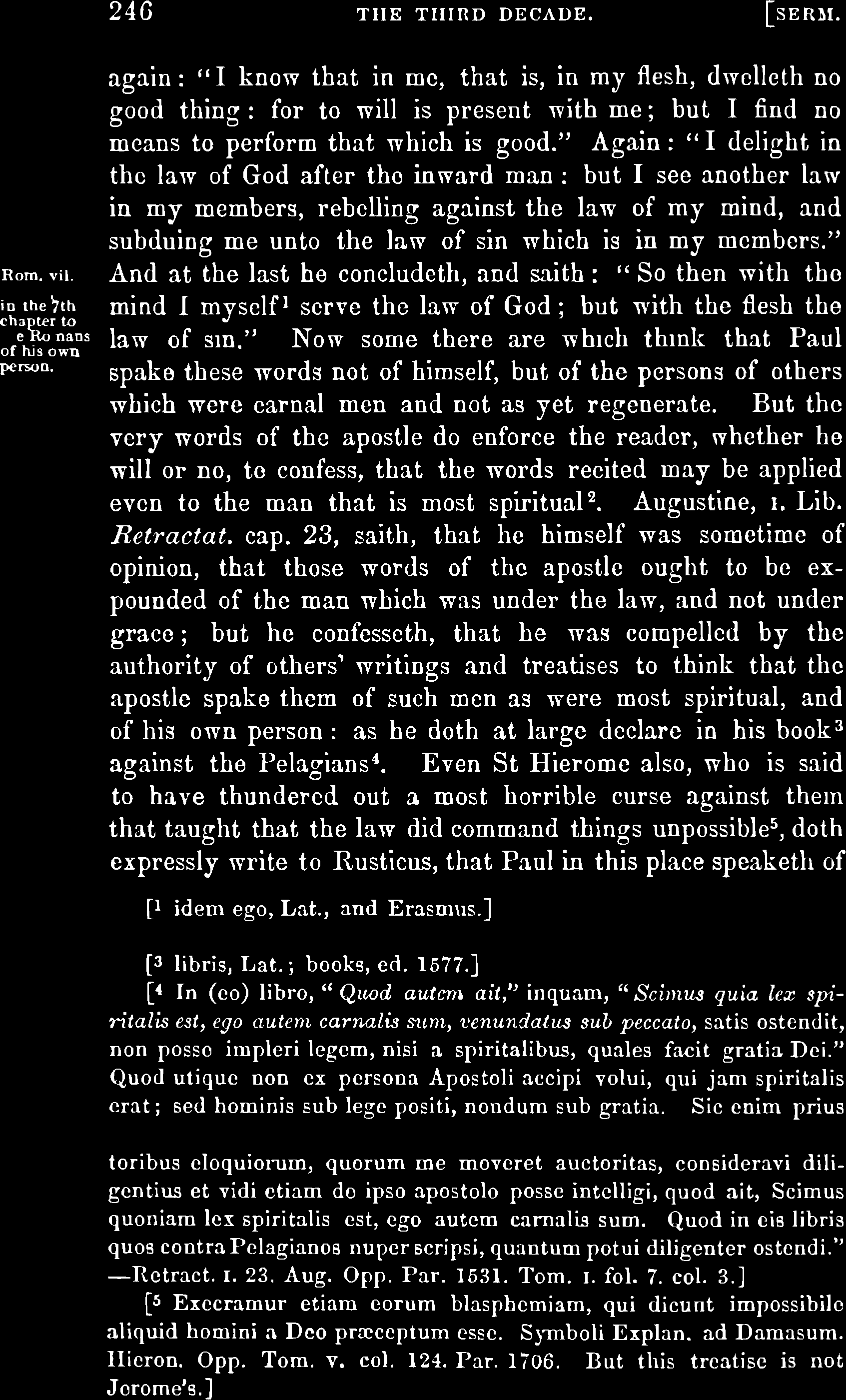
" I know that in me, that is,in my flesh,dwelleth no again : good thing : for to will is present with me ; but I find no " I delight in means to perform that which is good."
Again : the law of God after the inward man : but I see another law in my members, rebellingagainst the law of my mind, and subduing me unto the law of sin which is in my members."
" So then with the Rom. vii.
And at the lasthe concludeth,and saith: intheVth mind I myself1 serve the law of God; but with the fleshthe chapter to "
IEW "f sm-"
^OW some there are which think that Paul of^o1^15 person. spake these words not of himself,but of the persons of others which were carnal men and not as yet regenerate.
But the very words of the apostledo enforce the reader, whether he will or no, to confess,that the words recited may be applied even to the man that is most spiritual2. Augustine, i. Lib.
Retractat. cap. 23, saith, that he himself was sometime of opinion, that those words of the apostle ought to be expounded of the man which was under the law, and not under grace ; but he confesseth, that he was compelled by the authority of others' writings and treatisesto think that the apostle spake them of such men as were most spiritual,and of his own person : as he doth at large declare in his book3 against the Pelagians4.
Even St Hierome also,who is said to have thundered out a most horrible curse against them that taught that the law did command things unpossible5,doth expressly write to Rusticus,that Paul in thisplacespeaketh of P idem ego, Lat., and Erasmus.] [2maxime spiritualibuscompetere, Lat.] [3libris,Lat. ; books, ed. 1577.] [4In (eo)libro," Quod autem ait,"inquam, " Scimus quia lex spiritalisest, ego autem carnalis sum, venundatus sub peccato, satis ostendit, non posse impleri legem, nisi a spiritalibus,quales facit gratia Dei."
Quod utique non ex persona Apostoli accipi volui, qui jam spiritalis erat ; sed hominis sub lege positi,nondum sub gratia.
Sic enim prius hcec verba sapiebam, quae postea lectis quibusdam dmnorum tractatoribus eloquiorum, quorum me moveret auctoritas, consideravi diligentius et vidi etiam de ipso apostolo posse intelligi,quod ait, Scimus quoniam lex spiritalisest, ego autem carnalis sum.
Quod in eis libris quos contra Pelagianos nuper scripsi,quantum potui diligenter ostendi.''
"Retract.
I. 23. Aug.
Opp.
Par.
1531.
Tom. i. fol. 7. col. 3.] [*Execramur etiam eorum blasphemiam, qui dicunt impossible aliquid homini a Deo prseceptum esse.
Symboli Explan. ad Damasum.
Hieron.
Opp.
Tom. v. col. 124. Par. 1706.
But this treatise is not Jerome's.]

USE,
FULFILLING,
AND
ABROGATION
OF THE LAW.
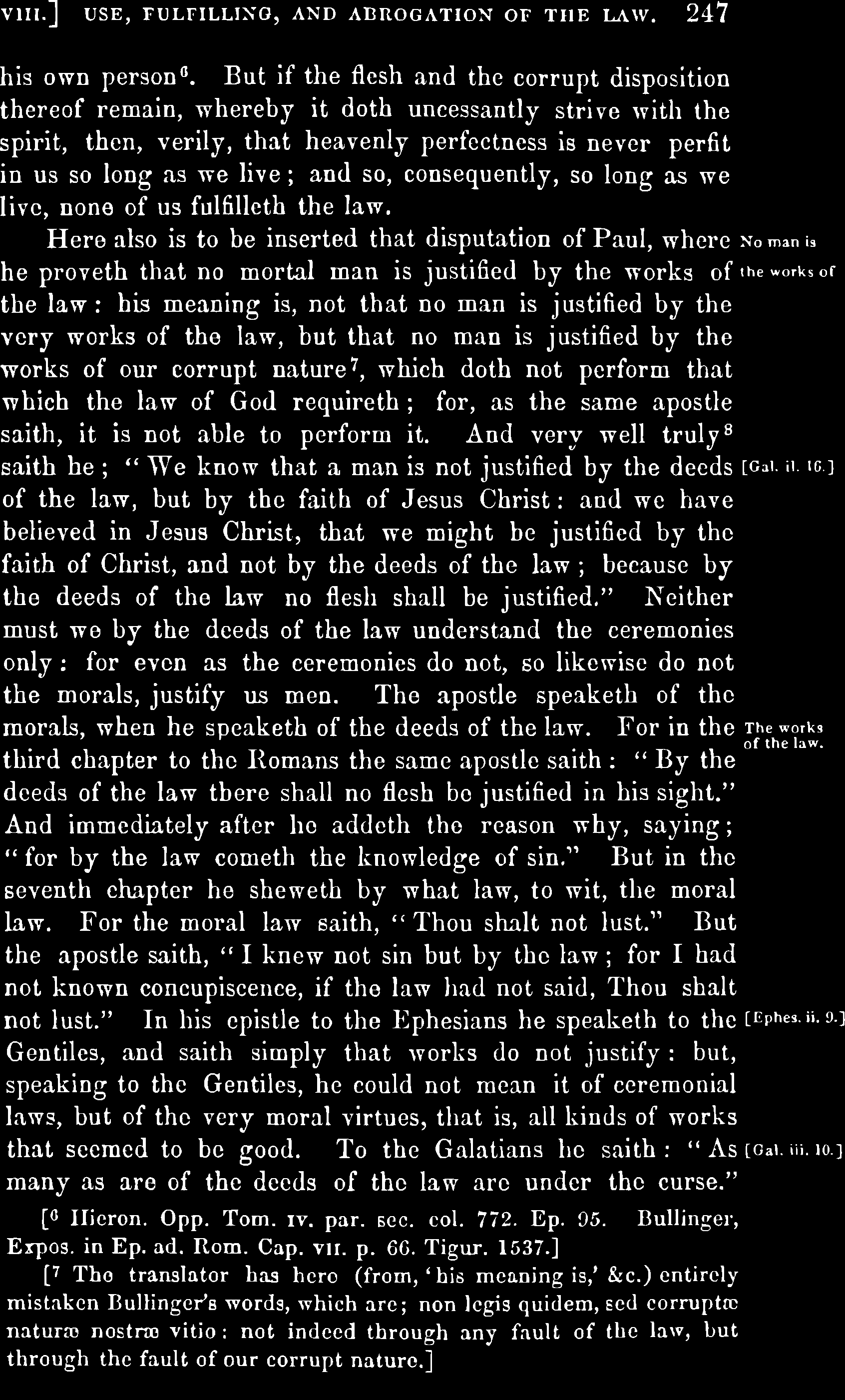
VIII.] his own person6.
But ifthe fleshand the corrupt disposition thereof remain, whereby it doth uncessantly strivewith the spirit,then, verily,that heavenly perfectnessis never perfit in us so long as we live; and so, consequently, so long as we live,none of us fulfilleth the law.
Here also is to be inserted that disputationof Paul, where NO man is he proveth that no mortal man is justified by the works of the works of the law : his meaning is,not that no man is justified by the very works of the law, but that no man is justified by the works of our corrupt nature7, which doth not perform that "which the law of God requireth ; for, as the same apostle saith, it is not able to perform it.
And very well truly8 " We know that a man is not justified by the deeds [Gai.u. ic.] saith he ; of the law, but by the faith of Jesus Christ : and we have believed in Jesus Christ, that we might be justified by the faithof Christ,and not by the deeds of the law ; because by the deeds of the law no flesh shall be justified."
Neither must we by the deeds of the law understand the ceremonies only : for even as the ceremonies do not, so likewise do not the morals, justify us men.
The apostle speaketh of the morals, when he speaketh of the deeds of the law.
For in the The works of the law. third chapter to the Romans the same apostlesaith:
" By the deeds of the law there shall no fleshbe justified in his sight."
And immediately after he addeth the reason why, saying ; " for by the law cometh the knowledge of sin."
But in the seventh chapter he sheweth by what law, to wit, the moral law.
For the moral law saith, " Thou shalt not lust.1' But " I knew not sin but by the law ; for I had the apostle saith, not known concupiscence,if the law had not said,Thou shalt not lust."
In his epistleto the Ephesians he speaketh to the [Ephes.H. 9.] Gentiles,and saith simply that works do not justify : but, speaking to the Gentiles,he could not mean it of ceremonial laws, but of the very moral virtues,that is,allkinds of works that seemed to be good.
To the Galatians he saith:
" As [oai.iu. 10.3 many as are of the deeds of the law are under the curse."
[6Hieron.
Opp.
Tom. iv. par. sec. col. 772. Ep.
95.
Bullinger, Expos, in Ep. ad. Rom.
Cap. vn. p. 66. Tigur. 1537.] [*The translator has hero (from, ' his meaning is,'"c.)entirely mistaken Bullinger's words, which are; non legisquidem, sed corruptac naturae nostrse vitio : not indeed through any fault of the law, but through the fault of our corrupt nature.] [8diserte quidem, Lat.]
THE THIRD DECADE.
[sERM.

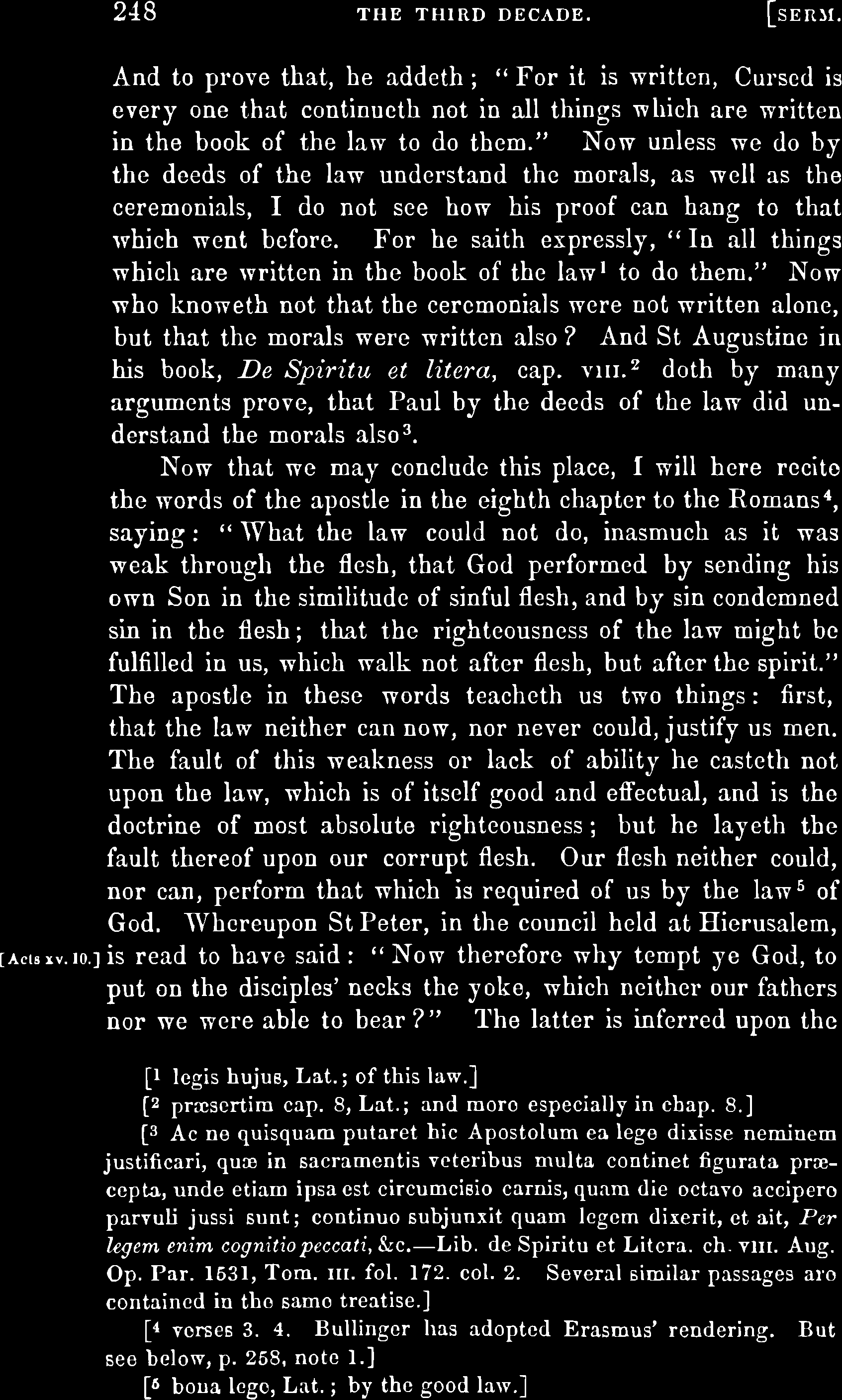
" For it is written, Cursed is And to prove that,he addeth ; every one that continueth not in allthings -which are written in the book of the law to do them."
Now unless we do by the deeds of the law understand the morals, as well as the ceremonials, I do not see how his proof can hang to that which went before.
For he saith expressly,"In all things which are written in the book of the law1 to do them."
Now who knoweth not that the ceremonials were not written alone, but that the morals were written also?
And St Augustine in his book, De Spiritu et litera, cap. vin.2 doth by many arguments prove, that Paul by the deeds of the law did understan the morals also3.
Now that we may conclude thisplace, I will here recite the words of the apostle in the eighth chapter to the Romans4,
" What the law could not do, inasmuch as it was saying : weak through the flesh,that God performed by sending his own Son in the similitudeof sinfulflesh,and by sincondemned sin in the flesh; that the righteousness of the law might be fulfilledin us, which walk not after flesh,but afterthe spirit."
The apostle in these words teacheth us two things : first, that the law neither can now, nor never could,justify us men.
The fault of this weakness or lack of abilityhe casteth not upon the law, which is of itselfgood and effectual,and is the doctrine of most absolute righteousness; but he layeth the faultthereof upon our corrupt flesh. Our fleshneither could, nor can, perform that which isrequired of us by the law5 of God.
Whereupon St Peter, in the council held at Hierusalem, " Now therefore why tempt ye God, to [Actsxv. 10.3is read to have said : put on the disciples' necks the yoke, which neither our fathers "
The latteris inferredupon the nor we were able to bear ?
[!legis hujus,Lat. ; of thislaw.] [2prsesertim cap. 8, Lat.; and more especially in chap. 8.] [8Ac ne quisquam putaret hie Apostolum ea lege dixisse neminem justificari, quse in sacramentis veteribus multa continet figurata prsecepta, unde etiam ipsa est circumcisio carnis, quam die octavo accipere parvuli jussisunt; continuo subjunxit quam legem dixerit,et ait,Per legem enim cognitiopeccati,"c.
Lib. de Spiritu et Litera. ch. vin.
Aug.
Op. Par.
1531, Tom. m. fol. 172. col. 2.
Several similar passages are contained in the same treatise.] [4verses 3.
Bullinger has adopted Erasmus' rendering.
But see below, p. 258, note 1.] [8boiia lege,Lat. ; by the good law.]
USE,
FULFILLING,
AND
ABROGATION
OF THE LAW.

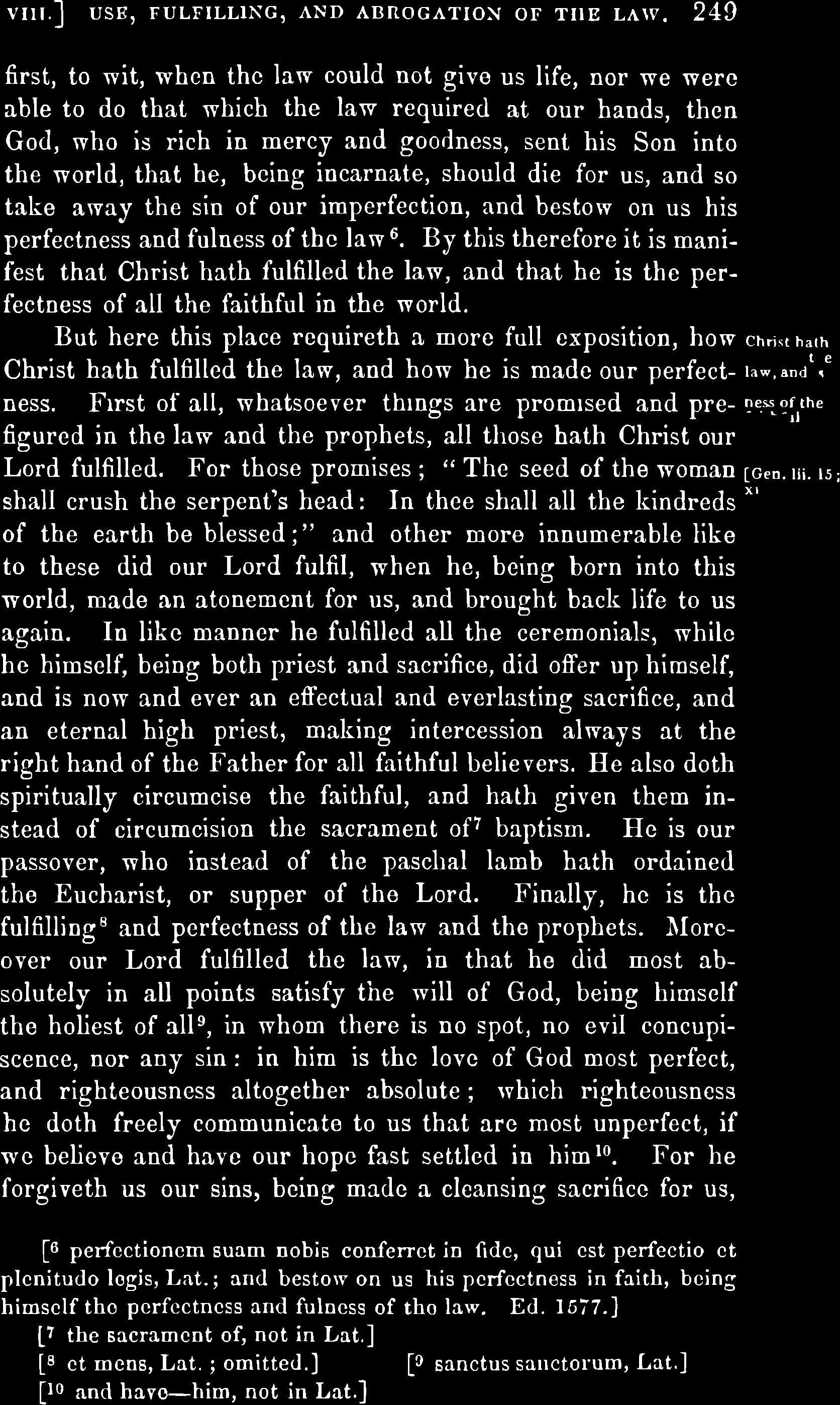
VIII.] first,to wit,when the law could not give us life,nor we were able to do that which the law required at our hands, then God, who is rich in mercy and goodness, sent his Son into the world, that he, being incarnate,should die for us, and so take away the sin of our imperfection,and bestow on us his perfectnessand fulnessof the law 6.
By thisthereforeitismanifest that Christ hath fulfilled the law, and that he is the perfectness of all the faithfulin the world.
But here this place requireth a more fullexposition,how Christ hath Christ hath fulfilledthe law, and how he is made our perfect-law, ana's6 .
/"iii i "
*ii *'ie l^rfectness.
First of all, whatsoever things are promised and pre- ?"?l9f1'he figured in the law and the prophets, allthose hath Christ our " The seed of the woman [Gen.m. is; Lord fulfilled.For those promises ; X1 shallcrush the serpent'shead :
In thee shallallthe kindreds of the earth be blessed;" and other more innumerable like to these did our Lord fulfil,when he, being born into this world, made an atonement for us, and brought back lifeto us again.
In like manner he fulfilledallthe ceremonials, while he himself,being both priestand sacrifice, did offerup himself, and is now and ever an effectualand everlastingsacrifice,and an eternal high priest, making intercessionalways at the right hand of the Father for allfaithfulbelievers.He alsodoth spirituallycircumcise the faithful,and hath given them instead of circumcision the sacrament of7 baptism.
He is our passover, who instead of the paschal lamb hath ordained the Eucharist, or supper of the Lord.
Finally, he is the fulfilling8 and perfectnessof the law and the prophets. Moreover our Lord fulfilledthe law, in that he did most absolutely in all points satisfythe will of God, being himself the holiestof all9,in whom there is no spot, no evil concupiscence, nor any sin : in him is the love of God most perfect, and righteousness altogether absolute ; which righteousness he doth freely communicate to us that are most unperfect,if we believeand have our hope fast settledin him10.
For he forgiveth us our sins,being made a cleansingsacrificefor us, [6perfectionem suam nobis conferret in fide, qui est perfectio et plenitude legis,Lat. ; and bestow on us his perfectness in faith, being himself the perfectness and fulness of the law.
Ed. 1577.] [*the sacrament of, not in Lat.] [8 et mens, Lat. ; omitted.] [9sanctus sanctorum, Lat.] [10and have " him, not in Lat.]
THE THIRD DECADE.
[SERM.
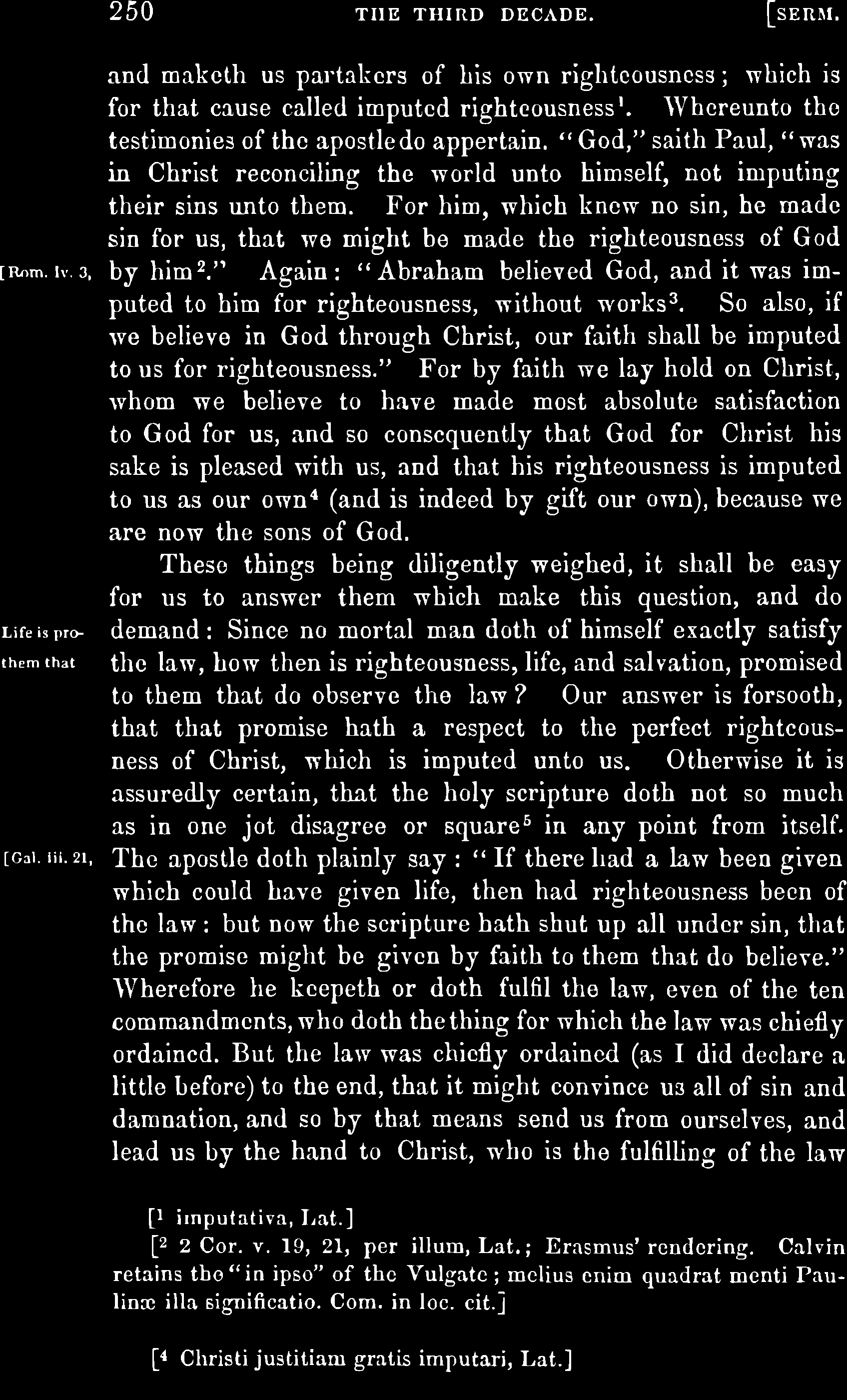
and maketh us partakers of his own righteousness; which is for that cause calledimputed righteousness1. Whereunto the " God," saithPaul, "was testimoniesof the apostledo appertain. in Christ reconcilingthe world unto himself, not imputing their sins unto them.
For him, which knew no sin,he made sin for us, that we might be made the righteousness of God [Rom. tv.3, by him2."
Again:
"Abraham believed God, and it was imputed to him for righteousness,without works3.
So also,if we believe in God through Christ, our faithshallbe imputed to us for righteousness."
For by faith we lay hold on Christ, whom we believe to have made most absolute satisfaction to God for us, and so consequently that God for Christ his sake is pleased with us, and that his righteousnessis imputed to us as our own4 (andis indeed by giftour own),because we are now the sons of God.
These things being diligentlyweighed, it shall be easy for us to answer them which make this question, and do Life is prodemand : Since no mortal man doth of himself exactly satisfy them that the law, how then isrighteousness,life,and salvation,promised to them that do observe the law ?
Our answer is forsooth, that that promise hath a respect to the perfect righteousness of Christ, which is imputed unto us.
Otherwise it is assuredly certain,that the holy scripture doth not so much as in one jotdisagree or square5 in any point from itself.
" If there had a law been given [Gai.iii.21, The apostledoth plainlysay : which could have given life,then had righteousnessbeen of the law : but now the scripturehath shut up allunder sin,that the promise might be given by faithto them that do believe."
Wherefore he keepeth or doth fulfilthe law, even of the ten commandments, who doth thething forwhich the law was chiefly ordained. But the law was chieflyordained (asI did declare a littlebefore) to the end, that itmight convince us allof sin and damnation, and so by that means send us from ourselves,and lead us by the hand to Christ,who is the fulfilling of the law f1 iinput at iva, Lat.] [22 Cor. v.
19, 21, per ilium, Lat. ; Erasmus' rendering.
Calvin " in ipso" of the Vulgate ; melius enim quadrat menti Pauretains the linse iliasignificatio.Com. in loc. cit.j [3certe absque operibus, Lat.] [4Christijustitiam gratis imputari, Lat.] [5discrepare,Lat.]
USE,
FULFILLING,
AND
ABROGATION
OF THE LAW.

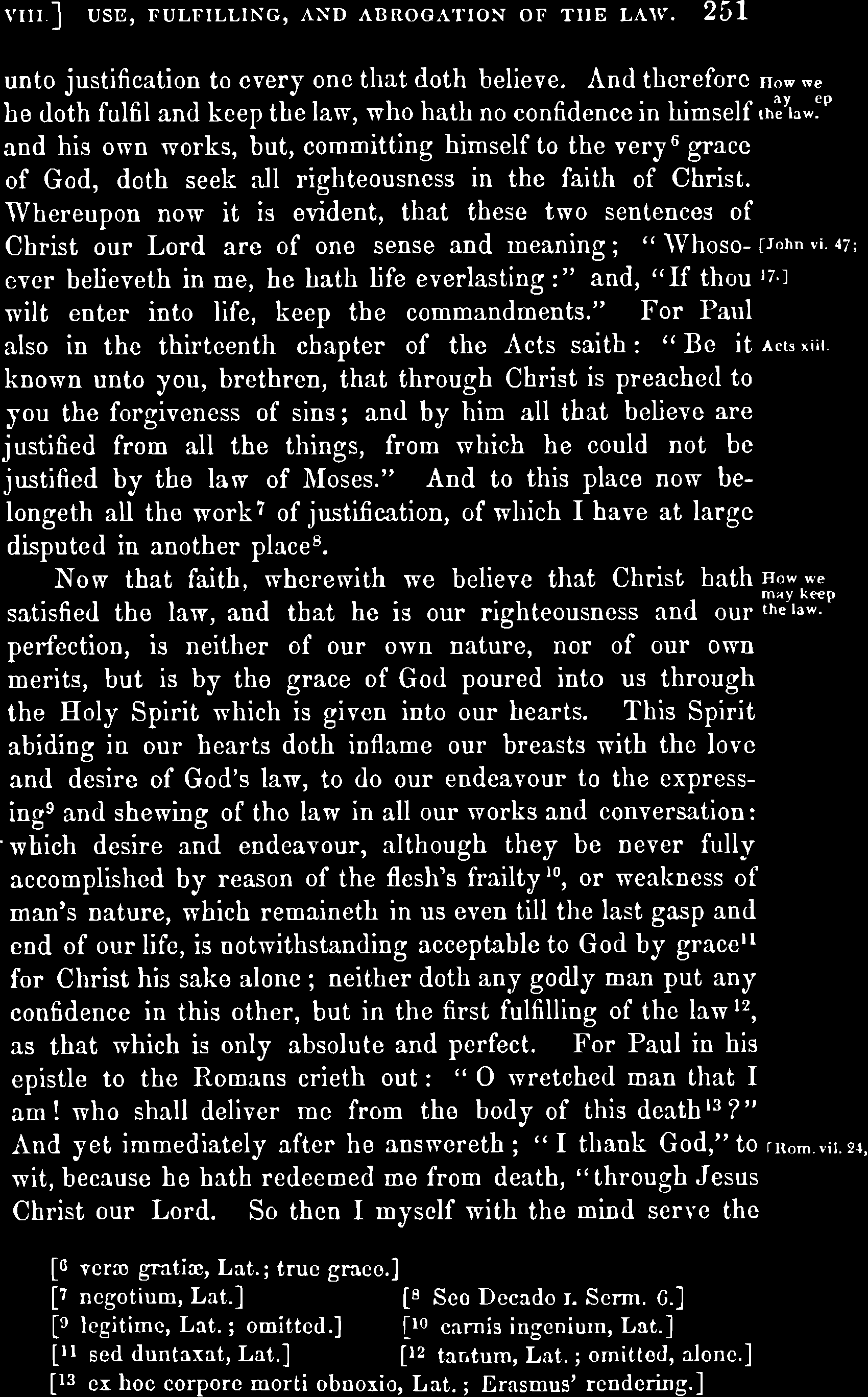
VIII.] unto justification to every one that doth believe. And therefore HOW we he doth fulfiland keep the law, who hath no confidencein himselfthtyiaw?p and his own works, but,committing himselfto the very6 grace of God, doth seek all righteousness in the faith of Christ.
Whereupon now it is evident, that these two sentences of Christ our Lord are of one sense and meaning ; " Whoso- [John vi. 47; ever believethin me, he hath lifeeverlasting:" and, "If thou ]70 wilt enter into life,keep the commandments."
For Paul " Be itActs XHI. known unto you, brethren, that through Christ is preached to also in the thirteenth chapter of the Acts saith: you the forgivenessof sins; and by him allthat believeare justified from all the things, from which he could not be justified by the law of Moses."
And to this place now belongeth allthe work7 ofjustification, of which I have at large disputed in another place8.
Now that faith,wherewith we believe that Christ hath HOW we mny keep satisfiedthe law, and that he is our righteousness and our the lawperfection,is neither of our own nature, nor of our own merits, but is by the grace of God poured into us through the Holy Spirit which is given into our hearts.
This Spirit abiding in our hearts doth inflame our breasts with the love and desire of God's law, to do our endeavour to the expressing9 and shewing of the law in allour works and conversation:
'which desire and endeavour, although they be never fully accomplished by reason of the flesh'sfrailty 10, or weakness of man's nature, which remaineth in us even tillthe lastgasp and end of our life,isnotwithstanding acceptableto God by grace11 for Christhis sake alone ; neitherdoth any godly man put any confidence in this other, but in the firstfulfilling of the law 12, as that which is only absolute and perfect.
For Paul in his " O wretched man that I epistleto the Romans crieth out : am! who shalldeliver me from the body of thisdeath13?"
" I thank God," to rRom.vii.24, And yet immediately after he answereth ; wit,because he hath redeemed me from death, "through Jesus Christ our Lord.
So then I myself with the mind serve the [6verse gratis, Lat.; true grace.] [7negotium, Lat.] [8See Decado I. Serm. 6.] [9legitime, Lat. ; omitted.] [10carnis ingenium, Lat.] [U sed duntaxat, Lat.] [12tantum, Lat. ; omitted, alone.] [13ex hoc corpore morti obnoxio, Lat. ; Erasmus* rendering.]
THE THIRD DECADE.
[SERM.

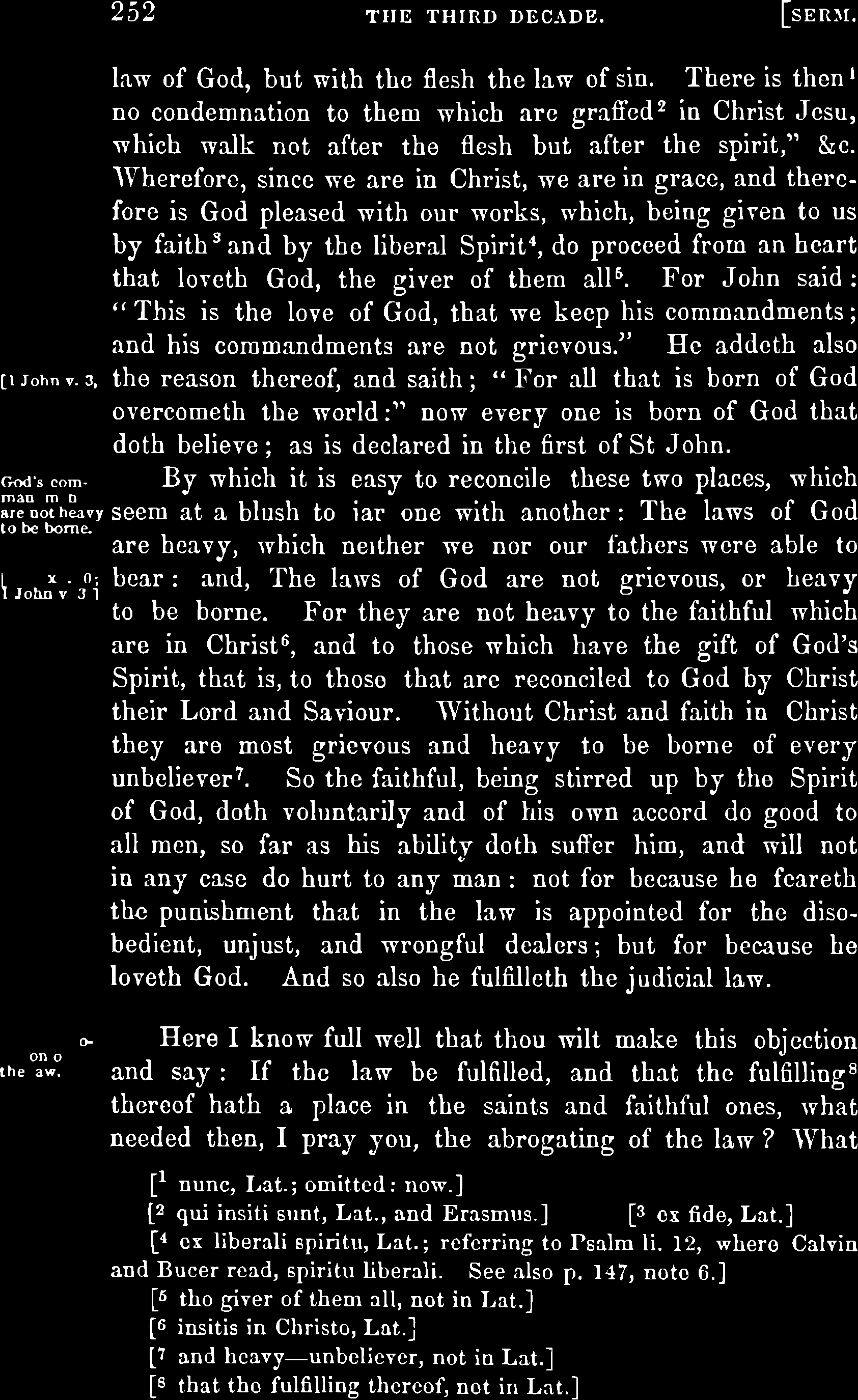
law of God, but with the fleshthe law of sin.
There isthen1 no condemnation to them which are graffed2 in Christ Jesu, which walk not after the flesh but after the spirit,""c.
Wherefore, since we are in Christ,we are in grace,and therefore is God pleased with our works, which, being given to us by faith3and by the liberalSpirit4,do proceed from an heart that loveth God, the giver of them all5. For John said :
" This is the love of God, that we keep his commandments ; and his commandments are not grievous/'
He addeth also "
For all that is born of God [iJohn v. 3, the reason thereof,and saith; overcometh the world:" now every one is born of God that doth believe; as is declared in the firstof St John.
God's comBy which itis easy to reconcile these two places, which ^rnoTh^avy seem at a blush to iar one with another : The laws of God to be borne.
" are heavy, which neither we nor our fathers were able to ^ear : anc^' ^^e ^aws "^ ^0(^ are no* gr^eyous" or heavy 'uohif v' 3"i to be borne.
For they are not heavy to the faithfulwhich are in Christ6, and to those which have the gift of God's Spirit,that is,to those that are reconciled to God by Christ their Lord and Saviour.
Without Christ and faithin Christ they are most grievous and heavy to be borne of every unbeliever*.
So the faithful,being stirred up by the Spirit of God, doth voluntarilyand of his own accord do good to all men, so far as his abilitydoth suffer him, and will not in any case do hurt to any man : not for because he feareth the punishment that in the law is appointed for the disobedient, unjust, and wrongful dealers; but for because he loveth God.
And so also he fulfilleth the judicial law. oHere I know fullwell that thou wilt make this objection the"anw?and say :
If the law be fulfilled,and that the fulfilling8 thereof hath a place in the saints and faithfulones, what needed then, I pray you, the abrogating of the law ? What
[*mine, Lat.; omitted: now.] [2qui insitisunt, Lat., and Erasmus.] [3ox fide,Lat.] [4ex liberal!spiritu,Lat. ; referring to Psalm li.12, where Calvin and Bucer read, spiritu liberali. See also p. 147, note 6.]
[6the giver of them all,not in Lat.] [6insitisin Christo, Lat.] [?and heavy " unbeliever, not in Lat.] [8that the fulfillingthereof, not in Lat.]

USE,
FULFILLING,
AND
ABROGATION
OF THE LAW.
VIII.] needed Paul, and all the best divines,to dispute so largely of the abrogation of the same?
I will therefore say somewhat of the abrogation of the law, firstgenerally, and then by parts peculiarly.
But first of all, these words of the Lord in the gospel must be beaten into the head of every godly hearer9 :
" that I am come to destroy [Matt v.
* 17"19
] the law or the prophets : yea, I came not to destroy, but to " Think not," saith he, fulfilthem.
Verily, I say unto you, heaven and earth shall pass10,but one jotor tittleof the law shall not pass,tillall be fulfilled.Whosoever therefore shall loose one of the smallest of these commandments, and shall teach men so, he shall be called the least in the kingdom of heaven : but whosoever shall do and teach them, he shall be called great in the kingdom of heaven."
Let every one therefore be assuredly persuaded that the law of God, which is the most excellent and perfect will of God, is for ever eternal, and cannot be at any time dissolved, either by men, or angels, or any other creatures.
Let every man think that the law, so far as it is the rule how to live well and happily, so far as it is the bridle wherewith we are kept in the fear of the Lord, so far as it is a prick to awake the dulness of our flesh,and so far as it is given to instruct,correct, and rebuke us men, that so far, I say, it doth remain unabrogated11, and hath even at this day her commodity in the church of God : and therefore the abrogating of the law consistethin this that followeth.
I told you that God's commandments require the whole man, and a very heavenly 12 kind of perfectness; which whosoever performeth not, he is accursed and condemned by the law.
Now no man doth fulfilthat righteousness: therefore are we all accursed by the law.
But this curse is taken away, and most absolute righteousness is freely bestowed on us, through Christ Jesus.
For Christ redeemed us from the curse of the law, being made the curse, righteousness, and sanctificationfor us men.
And so in this sense the law is i abrogated ; that is, the curse of the law is through Christ taken from the faithful,and true righteousness is bestowed upon us through grace by faith in the same Christ Jesus13.
[9insculpenda erunt animo pio, Lat.] [10donee prsetereat, Lat. ; as in Auth.
Ver.] [n intactam, Lat.] [12plane divinam, Lat.] [13through grace "
Jesus, not in Lat.]
THE THIRD DECADE.
[SERM.

For he is that blessed Seed in whom allthe kindreds of the earth are blessed.
He is our righteousness.
For Paul rAcuxiii. saith,"By him every one that believeth is justified from all things,from which ye could not be justified by the law of
Moses."
Therefore the law is put for the curse of the law : or elsethe law of God is taken for that which is bewrayed or made manifest by the law, that is to say, it is taken for sin; for by the law cometh the knowledge of sin.
Therefore the law is abrogated, that is,sin is taken away, not that itshould not be, or not shew itself1in us, but that it " for there should not be imputed unto us and condemn us ;
is no damnation to them that are in Christ Jesu2."
Moreover the law is taken for the vengeance or punishment which is by the law appointed for transgressors. Therefore the law is abrogated, because the punishment appointed by the law " for the law is not given to the righteous man."
For Christ delivered [iTim. i.9.] is taken from the necks of the faithfulbelievers; the faithfulfrom eternal punishments, whiles he being guiltlessdid sufferafflictions for wicked sinners. Furthermore, " The fleshlymind is enmity against God :
[Rom. viii. the apostle saith:
for it is not obedient to the law of God, neither can be."
But now this hatred or enmity of God's law is by faith pulled out of the hearts of the faithful;and instead of it is graffed in the love of God's most holy will: so that, in this sense also,the law is said to be abrogated, because the hatred of the law is taken away.
And therefore the apostle compareth them that are under the law to bond-slaves,and them that are free from the law to sons and children3: to whom also he attributeththe spirit,not of bondage, but " For because ye are sons4," saith he, " God oai. iv. of adoption. hath sent the Spiritof his Son into your hearts,which crieth,
Abba, Father, "c."
To these may be added, that the law of
God hath types and shadows, and that the ceremonies are very5 burdensome, even as also the whole law is called a yoke.
But now the Son of God came into this world, who, fulfilling the figures,shewed to us the very truth, and did abolish those types and shadows ; so that now no man can [!exserat suas vires,Lat.] [2Rom. viii.1, qui insitisunt in.] [3liberissive filiis,Lat.] [4ejusfilii,Lat. ; his sons.] [5satisalioqui,Lat. ; are otherwise sufficiently.]

USE,
FULFILLING,
AND
ABROGATION
OF THE LAW.
VIII.] condemn us6 for neglecting or passing over those ceremonies or figures: and so again in that sense the law of God is abrogated, that is to say, that kind of government which Moses ordained did come to nought, when Christ did come and his apostles began to teach.
For they, without regard of the ecclesiasticalregiment appointed by Moses, did congregate churches, to which they taught not that kind of regiment which Moses had ordained.
For they did constantly reject the priesthood of Aaron, the sacraments, the sacrifices,and choice of days, of meats, and of apparel, which Moses had taught their elders; and instead of allthose rites they preached Christ alone, and his two sacraments, "c.7
This have I said hitherto generally8 touching the abroThe moral gation of the law ; and now again I willmore largely expound the same by several parts.
The whole law9 is divided into the moral, the ceremonial, and the judicial laws.
The moral law now is contained in the ten commandments, the firstprecept whereof doth teach us to honour and worship one God alone, and not to match any strange gods with him.
This commandment did our Lord Jesus in the gospel so earnestly urge and diligentlyteach, that we may perceive very well that in it nothing is altered.
The second precept forbiddeth idolatry,that is,the worshipping and honouring of all manner images, whether they be the images of God himself,or of any of his creatures.
But it is known that the apostles,in the doctrine of the gospel, did use all means that they could to banish and drive away all kind of idolatry.
Paul and John cry, "Flee from idolatry."
And whereas Christ and his apostles do most diligentlyteach us to sanctify and glorify God's holy name, they do thereby give their consent to the establishingof the third10 commandment, which doth forbid to defileGod's name by taking it in vain.
The fourth alone of allthe commandments11, concerning the sanctifying of the sabbath-day, is of St Augustine called ceremonial12.
But it must not be simply understood to be [8nos judicarc, Lat.] [7et paucula sacramcnta, "c., Lat. ; and very few sacraments.] [8et breviter, Lat.; omitted, and in few words.] [9lex Dei, Lat.] [" the third, not in Lat.] [u in universe decalogo, Lat.; omitted, of all the ten.]
[12Inter omnia ilia decem prsecepta, solum ibi quod de Sabbato
THE THIRD DECADE.
[sERM.

ceremonial : for so far forth as the outward worship of God requireth a certain appointed time to be exercised in, and carrieth with it the1 sacrificesof the law, so far,I say, it is ceremonial ; but in respect that it teacheth to meet in holy assemblies to worship God, to pray, to preach, to be partakers of the sacraments, and to offer spiritualsacrifices,therein it is eternal and not ceremonial : as I have before declared in s the exposition of the sabbath2.
The fifthprecept, touching the honour due to parents,the Lord himself doth ratifyin the fifteenthchapter of Matthew's gospel ; even as he doth also
very diligentlyteach the sixth against murder, and the
seventh againstadultery,in the fifthchapter of the same gos-
pel.
The eighth, which isagainst theft, is renewed by the n Thess. iv. apostle,who giveth charge, that no man deceive3 his brother, 2i] p and that no man steal any more; but that every one should labour with his hands, that he may have things necessary for
himself,and be able to give to him that wanteth.
The ninth precept,which is for the bridling of the tongue, so that no lie be made nor falsewitness borne against our neighbour, is by Christ himself and his apostlesconfirmed so often as they give rules for the ordering of the tongue, and charge every
man to speak the truth to his neighbour.
And they also do condemn evil lusts and affections,whereby they do not abrogate but repairthe tenth4 commandment, which doth forbid all manner of concupiscence. Therefore the whole abrogation of the ten commandments, so far forth as they are abrogated, doth consistin those points whereof I spake even now : to wit, that Christ in faithis our perfect and absolute righteousness, "c. the apostle bearing witnessthereunto, and saying :
" What the law could not do, inasmuch as it was weak through the flesh,God, having sent his own Son in the similitudeof sinful flesh,even by sin condemned sin in the flesh;that the righteousness of the law might be fulfilledin us, which walk not after the flesh,but after the spirit:" as is to be seen in the eighth to the Romans5.
I have therefore discussed the "
Aug. Januario. Ep. 119. positum est,figurateobservandum praecipitur. c.
12. Op. Par.
1531.
Tom. ii. fol.110. col. 4.
In the Bened. ed. it stands ad Inquis. Jan. n.
55. c.
12. P.] [* externa, Lat. ; omitted.] [2See Decade n.
Serm. 4.] [3 fraudet in negotio, Lat.] [4tenth, not in Lat.] [sverses 3, 4.
Bullinger varies in this quotation from himself at

USE,
FULFILLING,
AND
ABROGATION
OF THE LAW.
VIII.] brieflierof this matter, in this place,because I have at the fullspoken of it in the treatiseof the ten commandments.
I am now come to speak of the ceremonials.
These cereH"w f"
. forth the monials were given and granted until the time of amendment, """""""
are abroto wit,untilMessiah should come.
Messiah is already come ; eatetL therefore all the ceremonies, even to the coming, death, resurrection, and ascension of Christ our Lord into the heavens, are come to an end, and have no place any longer in the church of the Christians.
And yet here we must and do make a difference6betwixt the writings concerning the ceremonies, and the very things of the ceremonies that are set down in writing; I mean, the very ceremonies themselves, or actions that were used.
For the writings concerning the ceremonies, which were set forth by the Spirit of God, are not taken away from Christians7,nor abrogated, so that they may not be read, retained,or used in the church
: as I declared in the second sermon of the firstdecade8.
For they are effectualto instruct us in Christ Jesu, while in them we do behold the manner how Christ was preached and prefiguredto the ancient church of the holy fathers.
Paul, verily, did most significantlypreach Christ out of the ceremonies ; which no man will deny that readeth diligentlyhis epistleto the Hebrews : for he doth wonderfully in that epistlelay Christ and all his giftsbefore the eyes of allthe church.
Therefore the ceremonials both may and ought to be read in the church; so yet that in them Christ be sought, and, when he is found, be aptly preached.
And for that cause, in the fifthand sixth sermons of this decade, where I handled the ceremonials,I annexed unto them certain notes of their significations, that I might open a way for the students of the scripturesand lovers of Christ to go forward and proceed in that kind of argument.
Now the ceremonial9 things,or stuff of the ceremonies, of which sort are the priesthood, the place, the time, the sacrifice,and whatsoever else is like to these, are utterly page 253, and from Erasmus' rendering, in these points: he reads eo quad (whichCalvin also prefers), instead of ea parte qua imbecillis " and sub specie carnis peccatricis,instead of carnis peccato oberat ; " and instead of de peccato, per peccalum condemnavit peccatum.] noxise ; [6necessario, Lat. omitted.] p from Christians, not in Lat.] [8Vol. i. p. 59.] ["res coremoniales, is Bullinger's own term.] r
LBULLINGER,n.J
THE THIRD DECADE.
[SERM.

abrogated, so that henceforth they are neither used, nor have any place in the church of Christ.
This did Jeremy foretell " In those days1 in the third chapter of his prophecy, saying : they shallmake no more boast of the ark of the Lord's covenant2: no man shallthink upon it,neither shallany man make mention of it; for from thenceforth it shallneither be visited, neither shall such things be done any more3."
By the ark the prophet meaneth those points of the law4 which are abolished by the coming of Christ.
St taul,in his epistleto the Hebrews, by the promise that God made to Jeremy5, saying, "that he would make a new covenant," doth gather " In that he saith,A new covenant, he hath Heb. viii. this observation: worn out the first;for6that which isworn out, and waxed old, is ready to vanish away."
The same apostleto the Ephesians saith: "Christ is our peace, which hath made both one, and broken down the middle wall,that was a stop between us ; taking away in his flesh7the hatred, even the law of commandment contained in ordinances, for to make of twain one new man in himself, so making peace." Ephes. ii. God verily severed the Jews from the Gentiles,while he chose and consecratedthem to be a peculiarpeople unto himself,not by the callingof the word only, but also by the sacraments.
For there were ceremonies prescribed and given, which, as a middle wall betwixt the Jews and the Gentiles,should compass in and contain8 the heritage of the Lord : so that in the ceremonies the note of difference9did consist,whereby the Jews were known to be the lawful heirs10of God's good promises, whereof the Gentiles had no part or portion.
But Christ came into the world, to the intentthat of two people, the Jews and the Gentiles,he might make one church ; and ceremonies therefore did he break down the middle wall that parted the middle * tiuon"rpar" them, that is,he did clean take away the ceremonial ordi- [!dicitDominus, Lat. omitted ; saith the Lord.] [2non dicant amplius, area foederisDomini, Lat.] [3neque fiet ultra, Lat. ; neither shall that be done any more.
Auth. Ver.] [4etiara alia legalia,Lat.] [5apud Jeremiam, Lat.] [6porro, Lat.] [7per carnem suam, Lat.] [8includerent, Lat. ; inclose.] [9discriminis professio,Lat.] [10ac (adeout)Judaeis,ceu justis hseredibus addiceretur hsereditas, Lat.]

USE,
FULFILLING,
AND
ABROGATION
OF THE LAW.
VIII.] nances which were a stop betwixt them11.
For Christ in that case did the same that princes are wont to do, who, when they go about to bring two nations,that are at variance, into one kingdom and under one authority,do firsttake away the diversityof arms13, which are the cognisances of their ancient hatred, that when the cause of the remembrance of the grudge is taken from their eyes, they may the better agree betwixt themselves in mind and behaviour.
For even so did Christ take away circumcision,the sacrifices, and allthe ceremonies13, to the end that of the Jews and Gentileshe might make one church and fellowship14. Paul, to the Colossians,compareth the ceremonies to an obligation, or handwriting15,whereby God ceremonies "
" hand-writing hath us bound, as it were, so that we cannot deny the guilt.
But he saiththat we were so delivered by Christ from the . guilt,that the obligationor hand-writing was cancelled or torn in pieces.
But by the cancellingof the hand-writing the debtor is acquitted and set at liberty.
And therefore we read, that at the death of our Lord the veilof the temple was torn in pieces from the bottom up to the very top ; that Tr* cuy and thereby allpeople might understand, both that sins were then J^I^J1 forgiven them, and that the people of God was set at liberty from allthe burden and yoke of the law.
Verily, when the wicked, stiff-necked,and disloyal16people of the Jews did,after the death of Christ,go on to exercise,prorogue17,and to obtrude18 to all men the ceremonies, which were finishedand abrogated at the coming ofMessiah19; then Christ,sittingat the right hand of the Father, did by the means of the Roman princes utterly deface their city,and overthrow20 the temple, wherein they boasted21: which thing the prophet Daniel, and Balaam many Num.1 x'xiv.
" them, not in Lat.] [12diversas tesseras, Lat. ; the variety of badges.] [13legalibus,Lat.] [14and fellowship, not in Lat.] [18Coloss. ii.14.
Calvin's words, in his Commentary on this passage, [n which are here again largely adopted by Bullinger.
See also Calfhill's Answer, p. 123.] [iaperfidus,Lat.] [17prorogare, Lat. ; to continue or prolong.] [18pietatisergo in templo, Lat. omitted ; as a matter of religionin the temple.] [!"at the coming of Messiah, not in Lat.] [20funditus, Lat. omitted ; to itsfoundations.]
[21wherein they boasted, not in Lat.] 17"2
THE THIRD DECADE.
[sERM.

hundred years before Daniel's time, foretold and said should come to pass. Neither hitherto yet,by the space of 1500 years and more, have they had any place to restore and set up again their city and temple.
In Theodoretus and Ruffinus we read that in the reign of Julian the emperor the Jews, with very great hope and presumption, went about to build a new temple ; and that they sought the foundation thereof in the place where that temple stood which was burnt by Titus, son and general1 to the emperor Vespasian: but Christ our Lord (who in the gospel foretold out of Daniel's prophecy the desolation thereof, and did among other speeches say, "And Hierusalem shallbe trodden under foot of the Gentiles, tillthe time of the Gentiles be fulfilled,") did mightily repress their wicked endeavours, and hinder their labour for going forward.
For when they had gathered and brought together many thousand bushels of lime and chalk, then suddenly came a whirlwind with a wonderful storm and blustering,which scattered abroad and carriedaway the store of stuff by them provided.
There happened also a terribleearthquake, by which allthe buildings almost of the whole place were swept away, and made even with the ground.
Finally, when a great company, which were busy in the work, did the same night remain, or take their rest, in a certain porch or gallery near to the new begun city and temple, the whole building and roof thereof, fallingdown on a sudden, slew all the number that were within the reach thereof.
In the morning they which remained alive ran together to seek every man for his friend among them that were slainby the ruinous building.
And when those terrors could do no good, nor turn them from their purpose, then suddenly out of the trenches, foundations, and storehouses hard by, where their tools and other necessaries lay, there sprang forth a fearfulfire,which burnt many that urged the work, and compelled the rest to take their heels. For in that one day it brake forth sundry times, and so at lastrepressed the stubborn rashness of that stiff-neckedpeople.
And for because these things should not be thought to have happened casually or at adventures, the night before and the night following there appeared in the sky a bright or glisteringsign of the cross, and the garments of the Jews were filledover [i and general, not in Lat.]
USE,
FULFILLING,
AND
ABROGATION
OF THE LAW.

VIII.] "with crosses, not bright but black, which could not be rid away or wiped out by any pains-taking or manner of means.
They therefore,in spite of their teeth and fullsore against their wills,being compelled with those horrible terrors, fearful judgments, and bitterplagues of Christ our Lord, forsook the place, and fledevery man to his house, leaving the work undone, and openly confessing,that Jesus Christ,whom their forefathers had crucified,is a most mighty God, howsoever Julian,with Pharao2, and the chief of the Jews, did persevere stillin their disloyaltyand despitefulblasphemy against him3 and his holy church4.
But howsoever the Jews do even at this day abide in their wilful stubbornness, the Lord did from heaven declare openly enough, that he is no longer delighted with the5 ceremonial rites, because he destroyed all the instruments belonging to that ancient kind of worship; and made the very shop of that old religion,I mean the temple and city of Hierusalem, levelwith the ground.
Touching the temple, the Lord in the gospel spake to his disciples,when they with wondering did behold it6, and said: "Do ye not see rMatt. *xiy.
" allthese things?
Verily I say unto you, there shall not be 44.] lefthere one stone standing upon another."
And again, weeping " They shall not leave over the unthankful city, he said : in thee one stone standing upon another, because thou knewest not the time of thy visitation." And now, that all this was word for word accomplished and fully finished, Josephus, an eye-witness of the same, doth largely testifyin the eighteenthchapter of his seventh book
De Bello Judaico'.
Even very now I told you, that from one thousand and five hundred years ago unto this present time the Jews never had any place given them to build their temple up in again : whereby, if they were not beside themselves, they might [2licetcum Pharaone, et Julianus etpotior Judceorum turba, Lat.] [3contra Christum, Lat.; and his holy church, not in Lat.] ["Vide Theodoret.
Eccl. Hist. in.
20. et Ruffin. Aquil. Hist. Eccles.
Lib.
I. cap. 37.
38. 39.] [6legalibus vel, Lat.] [6commonstrantibus, Lat. ; point itout.] [7 This reference is according to the Latin edition of Josephus, Basil, 1540.
In the more modern editions the account is contained in the chapters of the sixth,and the firstchapter of the seventh book, de Bell. Jud.]
THE THIRD DECADE.
[sERM.

easily gather, that the Messiah is already come into the world, and that he hath abrogated allthe ceremonial rites.
Kites or It is a very slender, or rather no defence at all for the are Jews to allegethe words in the law, which are many times perpetual or everlasting, rehearsed, where the ceremonies are described: hoTthey " Ye shall keep it for an everlasting ordinance."
For in this sense everlastingis taken for long lasting and unchangeable, so far forth as it hath respect unto the will or authority of mankind1.
For the Lord did with threatening of grievous punishments forbid that mankind's unadvisedness should change or abrogate the holy ceremonies.
And yet, since he did ordain those ceremonies untilthe time of amendment, he2 doth neither sin,nor yet incur the crime of unconstancy, when he doth change or take away the ceremonies according to the determinate purpose which he intended from the beginning Moreover, so long as the thing signified3doth not decay, and that the shadow only, or momentany figure4,doth vanish away, itis assuredly certain that the ceremony doth yet remain in full effectand substance5.
The whole man doth live for ever ; and yet the things that are temporal or corruptiblein him do perish in death, and are abolished in his clarification6.
But that all these things may appear as clear as the daylight,I will particularlyrun through and touch the more notable sort of ceremonies.
That the priesthood of Aaron is utterly abrogated, itis evident by the words which7 the 4; apostleciteth out of David, saying: "The Lord hath sworn, and will not repent, Thou art a priest for ever after the order of Melchisedech."
Christ,therefore, is the one and only high priest,and that too an everlastingpriest,having an immutable priesthood, which cannot by succession pass from him to any other man or angel.
For he now, standing at the right hand of the Father in heaven, the very true temple which was prefigured by the tabernacle and temple at Jerusalem, doth make intercessionfor us, and doth allthe officesof an high priest: of whom the apostle of Christ, St Paul, doth speak very largelyin his epistleunto the Hebrews.
[!quantum attinet homines, Lat.] [2Deus, Lat.] [3per ritum, Lat.; by the ceremony.] [4cadit et, Lat. ; falls,and.] [5in substantia sua, Lat.] [6i.e. glorification.] [7id maxim e arguit quod, Lat.]
USE,
FULFILLING,
AND
ABROGATION
OF THE LAW.

VIII.] This Christ Jesus, our high priest,hath consecrated all the faithfulto be kings and priestsunto himself.
And yet notwithstanding he doth ordain ministers of the church, by doctrine and examples to instructthe church, and to minister the sacraments ; I mean, not those old and ancient ones, but those which the Lord hath substitutedinstead of the old ones.
What doctrine they must teach, he doth expressly declare.
The mystical attireand garments of the priesthood he neither did commend to his apostles,nor leave to his church, but took them away with all the ceremonies8 that are called the middle wall betwixt the Jews and Gentiles.
The Lord himself and his apostlePaul will have the pastors of the people clad with righteousnessand honesty ; and do preciselyremove the ministersof the church from superiority and secular affairs. They do also appoint stipends for the ministersto liveupon ; yet not those which the law allowed Matt *. them, but such as were most tolerableand convenient for the state and conditionof every church.
The Lord leftthe place to serve and worship God in The place for f " i .
, .
MI to worship free, without exception or binding to any one prescribed or God in u "
* r free for every peculiar place,when in the gospel after John he said :
" The Sf0n04"whe hour shall come, and is already, when the true worshippers ^daie'lSon shall worship the Father neither in this mountain, nor at gkfSl!011
Jerusalem, but in the spiritand in truth : for such the Father 23"24.]v'
21* requireth to worship him.
God is a Spirit; and they that worship him must worship him in spiritand in truth."
The " I will[iTim. u. a.] apostlefollowed the Lord in this doctrine,and said; that men pray in every place,liftingup pure hands, without anger."
Neither did the Lord in vain, as I shewed you even now, sufferthe temple to be utterly overthrown, considering that at his death he had rent the veilthereof.
And yet, for all that, the ecclesiastical assemblies are not thereby condemned : of which I spake in the exposition of the fourth precept9, "Remember that thou keep holy the sabbath-day."
Verily, the tabernacle and the temple bare the type of the catholic church of God, out of which there are no prayers nor oblations acceptable to the Lord.
But the church is extended to the very ends of the world.
And yet itfolloweth not thereupon, that all are in the church which are in the world : they alone are in the church, which through the [8decretis,Lat.] p See Vol. I. page 265.]
THE THIRD DECADE.
[sERM.

catholicfaithare in the fellowshipof Christ Jesus, and by the agreement of doctrine,by charity,and by the participationof the sacraments (unless some great necessityhinder them),are TO sacrifice in the communion of the holy saints.
But they burn incense and sacrificein high places,whosoever seek afterany other sacrificethan the one and only oblation of Christ Jesus ; or look for any other to offertheir prayers to God the Father l, as they are taught by the mouth of the than Christalone pastor sincerely preaching the word of God.
Moreover the church of God hath no need now of any ark, any table,any shewbread, any golden candlestick,any altar eitherof incense or burnt-offerings,nor yet of any brasen laver : for Christ alone is allin all2to the catholicchurch ; which church hath allthese things spirituallyand effectuallyin Christ Jesus, and can seek for nothing in any other creatures ; insomuch that, if it perceive any man to bring in again eitherthese or such like ceremonial instruments, it doth sharply rebuke and bitterly curse3 him for his unwarrantable rashness and blasphemous presumption in the church of Christ.
For what need hath the church of shadows and figures,when it doth now enjoy4the thing itself,even Christ Jesus, whose shadow and figurethe ceremonies bare?
Moreover the church hath signs enough, in that it hath received of Christ two sacramental signs, wherein are contained all the things which the old church did comprehend5 in sundry and very many " figures.
The hoiy Furthermore, he hath leftthe holy time, to worship God [Mark ii.27, in,free to our choice,who in the gospel saith: "The sabbath was made for man, not man for the sabbath : therefore the Son of Man is Lord also of the sabbath."
And the apostle [coioss.ii. paul saith: "Let no man therefore judgeyou in meat, or drink, or in part of an holy day6, or of the new moon, or of the sabbaths : which are the shadows of things to come ; but the body is of Christ."
Of the Christiansabbath I spake in [!et alium in orando et sacrificando modum tenent, quam rerbo pastoris in ecclesia est traditum, Lat. ; and practise another method of prayer and sacrificethan, "c.] [2hsoc omnia, Lat. ; isall these things.] [3execretur, Lat. ; for his "
Christ,not in Lat.] [4per fidem, Lat. omitted ; by faith : whose " bare, not in Lat.] [5habuit, Lat] [6So Auth.
Ver. marg.]

USE,
FULFILLING,
AND
ABROGATION
OF THE LAW.
VIII.] the exposition of the fourth commandment 7.
As for the new moons, they are not solemnized by the church of Christ, insomuch as it is taught by Christ to attribute to God8, not the beginning of months only, but the whole year also,and the commodity9 thereof, with the light of the sun, the moon, and all the stars in heaven.
Moreover the Christians do celebrate their passover more spirituallythan bodily ; even as also they do solemnize their Pentecost, or Whitsuntide10. For as he sent his Spiritupon his disciples,so doth he daily send it upon all the faithful. And that is the cause that in the faithfulthe alarm is stricken up to encourage them as soldiersto skirmish with their enemies11.
For the flesh lusteth against the spirit,and the faithfulare daily assaulted,and provoked to battle,by the world, and by the devil the prince of the world12.
Furthermore, the feast of propitiation,being once finished upon the cross, endureth for ever : neither do the saints any more send out a scapegoat, to bear their sins into the desert13; for Christ our
Lord came once, and was offered up, and by his sacrificetook away the sins of allthe world.
Finally, since the faithfuldo daily consider and bear in their minds, that they have no abiding place in this transitoryworld, but that they look after a place to come ; they need not, as the Jews did,once a year to celebrate the feast of tabernacles. In like manner, the faithfuldo no more acknowledge any year of jubilee : for Christ came once, and preached unto us that acceptable year, even the gospel, whereby it is proclaimed that all our sins and iniquities are clearly forgiven us.
For so doth Christ himself interpret it14in the fourth of St Luke's gospel, taking occasion to speak of it out of the sixty-firstchapter of Esay's prophecy.
And thus the holy time and festival days are abrogated by Christ in his holy church ; which notwithstanding is not left destituteof any holy thing or necessary matter.
[?Decade n.
Serm. 4.] [8creatori, Lat. omitted; the maker of them.] [9proventum, Lat.] [10or Whitsuntide, added by the translator.] [n Semper autem hie classicum canunt ad pugnam, Lat.
See above, page 169.] [12hujusseculi,Lat.] [1Sto bear " desert, not in Lat.] [u hsec declarat, Lat. j
THE THIRD DECADE.
[sERM.

The Romwh But now because thispresent year, wherein this book is firstof allprinted,isthe year of grace 1550, and according to the Romish traditionis called the year of jubilee ; I am thereforecompelled, as it were of necessity,to make a little digression,and speak somewhat of the Romish jubilee.
I do therefore callit the Romish, and not the Christian, jubilee, because, as I shewed you even now, the church of Christ,afterour redemption wrought by Christ and preached by the gospel, doth neither acknowledge nor receive any other year of jubilee.
In the ancient Jewish year of jubilee there is to be considered the meaning of the letter,and of the
spirit1.According to the letter,bondmen were set at liberty, and lawful heirs did receive again their patrimony and possessions which either was changed away or otherwise gone from them.
The meaning2 of that order, as it could not be brought again into allkingdoms in these latterdays3 without the trouble of all estates, so itis littleset by and the care of the oppressed utterly neglected by the holy popes4, who now of late5 Broughtin the year of jubilee, and preached it unto the foolishworld, not for any zeal they had to help the oppressed, but for the desire they had, by robbing the
world, to augment their own treasures6.
The spiritualand hidden mystery of the jubilee did commend7 unto them of old the free remission of allsinsthrough Christby faithin Christ : which free grace cannot, without reproach to Christ,be otherwise preached than ithath been already taught by the holy gospel.
Therefore the church was without the observation of any year of jubilee by the space of 1300 years after Christ his incarnation.
At last,up start Bonifacius,the eighth of that name, bishop of Rome8, who firstof allinvented that wicked ordinance.
For Platina,in the lifeof that Bonifacius, " This is he that firstbrought in the jubilee, in the saith: year of Christ 1300, wherein he granted fullremission of all p consideratur literaet spiritus,Lat.] p Is ritus,Lat.] [3hodie, Lat.] [4non admodum curant beatissimi patres, Lat.] [6now of late, not in Lat.] [6ut opibus suis plurimum accedat, is the Lat., rendered by, not for any " own treasures.] p Christum et gratuitam ejus, Lat. ; Christ,and his free, "c.] [8cujusnomine et Sextus Decret. prodiit, Lat. omitted; under whose name the sixth book of Decretals also was put forth.]
USB,
FULFILLING,
AND
ABROGATION
OF THE LAW.

VIII.] their sins to as many as visitedthe see apostolical. And the same did he ordain to be observed every hundredth year."
So then the church of Christ was without this jubilee, without peril of salvation,by the space of 1300 years.
And therefore may we also be without it without all peril and damage, yea, to our great profit and commodity.
For if our Romanists go on to obtrude it to the world as a thing necessary to salvation, then shall they condemn the universal church which was before pope Boniface his time, who firstbrought in this unacquainted jubilee.Thus we are so far from not9 being able to be without it,that we ought by all means possible to detest and abhor it as a very wicked and blasphemous ordinance ; considering that we have to believe that the jubilee is utterly abrogated by Christ, and also that all sins are freelythrough Christ forgiven to all that believe,in what place of the world soever they live and are conversant in.
This pope Boniface doth to his falsepromise and unpure place annex the remission of sins. Now I doubt whether this blasphemous antichrist10could do any thing , more horrible, and more against the honour of the Saviour11.
For therein is defiledthe glory of the only-begotten Son of God, who is the only health12 of all the world.
Therein is defiled the salvation of many thousands, for which Christ died upon the cross.
And therein also is defiledthe glory of Christianfaith, by which alone we are made partakers of eternal salvation.
This ungracious and wicked pope was he of whom that common " He entered like a wolf, he reigned like a lion,and died like a dog13."
For verily so blasphemous proverb runneth : an ordinance was worthy of such an author; so foolish a people was worthy of such a pastor ; and so devilish a pope was worthy of such an end14.
Platina writeth, that in that ["non tantum illo carere possumus, Lat.] [10 " blasphemous antichrist" is not in the original.] p1 et execrandura, Lat. ; and to be abhorred.] [iaSalvatoris, Lat. ; Saviour.] [18See Homily for Whit-sunday, Part II. page 425.
Oxford, 1832.
" It is reported, that Celestine" (hispredecessor) " prophesied of him, Ascendisti ut vulpes, Regnabis ut leo, Morieris ut canis.
Of this Pope (Boniface) a certain versifier wrote thus :
Ingreditur vulpes, regnat leo, sed canis exit ; Re tandem vera, si sic fuit,ecce chimera."] [1*and so " end, not in the original.]
THE THIRD DECADE.
[SERM.
year of jubilee there came so great heaps of people to Rome, that although the city were indifferentlylarge enough, yet one man could not for throng pass by another1.
For the world will needs be deceived: ifitwere not so, they would give ear " 0 allye that thirst,come to the unto the Lord which crieth, waters, and ye that have no money, draw nigh. Why spend ye your money upon a thing of nought, Sec." Esay lv.,and John iv. vii. Now allthe while that the world was set thus on madding, the righteous Lord was not asleep,nor yet did dissemble how much they displeased him with that devilish2 invention.
For the very same year he stirredup Ottoman3, the patriarch and firstfounder of the Turkish empire, by whose means he did notably scourge the church of Rome and the corrupt manners that were crept into Christendom.
A few years after succeeded Clement the sixth4,Paul the second, and Sixtus the fourth5, as wicked men as he, as is to be found in the historiesof their lives; who changed the year of jubilee from every hundreth to every fiftiethyear, and so at last to every five and twentieth year, that so they might suck the more advantage out of men's foolishness.
But now to the matter again. f1Jubileum idem (BonifaciusVIII.)retulit anno millcsimo trecentesimo, quo plenam delictorum omnium remissionem his praestabat,qui limina apostolorum visitassent.
Idem etiaai centesimo quoque anno "
Ob hanc rem eo anno tanta undique hominum observari mandavit. multitudo Romam venit, ut vix incedere per urbem, amplam quidem et vastam, liceret.
Platin. de Vit. Pontif.
Rom. p. 245.
Colon. 1568.] [2 devilish, not in Lat.] [3 From that very year (viz.of the institution of the jubilee), as most stories do record, the Turks do begin the first count of their Turkish emperors, whereof the first was Ottoman.
Foxe's Acts and Monum.
Vol. n. p. 586. ed. Lond.
1837.
See also Bullinger in Apocalyps. Cone. xxx. on Rev. vi. 1 "
4, and XLI. on ix. 12-19.] [4Petentibus Romanis, ut quemadmodum Bonifacius octavus olim concesserat, ut centesimo quoque anno plenam peccatorum omnium remissionem visitantibus limina apostolorum Petri et Pauli, quinquagesimo quoque anno id facere libenter annuat (Clemens VI.)cum dicerent setatem hominum jubileum ilium centum annorum attingere non posse.
Platin. de Vit. Pontif.
Rom. p. 258.] [6 Quum vero annus Jubileus instaret, quern ex quinquagesimo ad xxv contraxit (Xystus IV.) primusque anno salutis MCCCCLXXV. celebravit, "c.
Platin. p. 350
This was in confirmation of the bull of his predecessor, Paul the Second.]

USE,
FULFILLING,
AND
ABROGATION
OF THE LAW.
VIII.] The sacraments also of the ancient Jews are flatlyabro- , i " i " i i " i gated, and m their places are substituted new sacraments, and sacrific .
, , are utterly which are given to the people of the new covenant. abrogated.
Instead of circumcisionis baptism appointed6.
The aposi ties,in the synod held at Hierusalem, did oppose themselves against those which were of opinion that circumcision was necessary unto salvation; and in that council they allowed of Paul's doctrine,who both thought and taught the contrary.
For Paul in one place saith; " Lo, I Paul say unto you, that [oai.v. ifyou be circumcised, Christ shall profityou nothing.
For I testifyto every man which is circumcised, that he is a debtor to the whole law to do it.
Christ is made of none effectto you : as many of you as are justified by the law, are fallen from grace."
Neither is it right or convenient that in the church of Christ there should remain so bloody a sacrament7 as circumcision was, when once that blood was shed upon the cross which stancheth and taketh away the blood8 of the old Testament.
Instead of the paschal Lamb is the Lord's supper or-
dained6, which by another name is called the eucharist, or a thanksgiving.
For so the Lord himself in Luke expoundeth it, saying, that he did then eat the last passover with his disciples; at the end whereof he did immediately ordain the sacrament of his body and blood, which he biddeth them to celebrate in remembrance of him 9, until he return to judgment again.
Therefore the Lord left10the supper to be an unchangeable sacrament untilthe end of the world.
Moreover, that allsorts of sacrificescontained in the law are utterly abrogated, no man, I suppose, will once deny, which doth but consider,that both the temple and the two altars,with all the holy instruments, are utterly overthrown and come to nothing.
I told you that those sacrificeswere remembrances of sins, and types or figures of the cleansing and atonement that was to be made by ChristJesus11. Therefore when Christ was come and offered up for the sins of all the world, then verilydid allthe sacrificesof the ancient Jews
come to their ending.
For where there is a fulland absolute [6subiit,Lat.] [7signum, Lat.] [8omnem sanguinem, Lat.] L9in remembrance of him, not in Lat.] [10ecclesise,Lat. ; to the church.] [n expiationis futurce,Lat.] [iaveterum, Lat. ; Jews, not in Lat.]
THE THIRD DECADE.
[sERM.

remission of sins,there is no longer any sacrificefor sin. But in the new Testament there is a fullremission of sins: therefore in the new Testament there is no longer any sacrifice offeredfor sins. For Christ is only and alone instead of all the sacrifices. For he was once offered up, and after that is offeredno more : who by the once offeringup of himself hath found eternalredemption ; so that all,which be sanctified, are sanctifiedby none other oblationbut that of Christupon the cross made once for all. Wherefore Christ,being once offered upon the cross forthe sinsofallthe world, isthe burnt-offering of the catholicchurch : he isalsothe meat-offering,which feedeth us with his fleshofferedupon the cross unto eternal life,if we receive and feed on him1 by faith. Moreover he is the drink-offeringof the church, which with hisblood doth quench the thirstof the faithfulunto lifeeverlasting. He is the purging and daily sacrificeof the church ; because he is " the Lamb of God that taketh away the sins of the world2."
His death and passion cleanseth all men from then* sins, their errors, and iniquities3.Finally, he is the church's sacrificeof thanksgiving ; because by Christ we offerpraise to God, and by Christ we render thanks unto the Lord4.
The euchaTo conclude : the only supper of the Lord, which we call the eucharist,containethin itallthe kinds of ancientsacrifices:
,s which are in effectbut of two sorts; to wit, of purging and of atonement, as those which were offered for sin; or else of thanksgiving, as those which rendered thanks and offered praise unto the Lord.
Now the supper is a testimony, a sacrament, and5 a remembrance of the body of Christ which was given for us, and of his blood that was shed for the remission of our sins.
For the body and blood of our Lord, which were but once offeredupon the cross6, and neither can nor ought to be offeredany more of men, are not sacrificed afreshin the celebrationof the supper : but in the celebrating of itthere is reiterateda remembrance of the thing,I mean, of the oblation,which was but once made, and in once offering [*si percipiatur, Lat. ; ifit(hisflesh) be received.] [2John i. 29, peccatum, Lat.] [3omnia yitia mortalium, omncs errores, omnia scelera,Lat.] [4Deo Patri, Lat. ; to God the Father.] [5adeoque, Lat. ; and so.] [6pro peccatis,Lat. ; for sins.]

USE,
FULFILLING,
AND
ABROGATION
OF THB LAW.
VIII.] was sufficient.Again, in the supper we render thanks to God for our redemption, for which also the universal church doth offer praise unto his name.
Wherefore the supper of the Lord doth comprehend the whole substance and matter, which was prefigured in those ancient sacrifices : so that, in that point, the church is not destitute of any good or necessary thing, although it doth no longer retain those sacrificesof the elder church.
Yea, they ought not any longer to be solemnized in the church, because they were nothing else but the figures,types, and sacraments of Christ to come.
But the church doth now believe,and that rightly too, that Christ is already come, and that he hath fulfilledand accomplished all things ; as we read that he himself did testify,when on the cross he cried,saying, "
It isfinished."
Moreover all vows are come to an end, because allsacri-vows fices,wherein7 the vows consisted, are vanished and gone. a Likewise the discipline of the Nazarites is now decayed, because the temple with all the ceremonies belonging thereunto is vaded away.
There remaineth stillin the church a Christian and moderate discipline,but not that which is described in the law : and the saints do perform to God the vows which they have made in the church, not contrary to faith and godliness; but they are sparing, wary, and very religious in making vows.
For what have we to give to God, which we have not firstreceived at his hands ; and to the performing of which we were not bound before in baptism?
Christ doth not so distinguishbetween clean and unclean The choice in the gospel, as Moses doth in the law.
" That," saith he, abrogated.
" which entereth into the mouth defilethnot the man ; but n J that which cometh out of the mouth."
And the apostle Paul doth'flatlysay, that "to the clean allthings are clean."
And [Titi.iB.] liketo this he speaketh much in the fourteenth to the Romans, and in other places moe.
In his epistleto the Colossians he " If ye be dead with Christ from the rudiments of the saith: world, why, as livingin the world, are ye led with traditions, (touchnot, taste not, handle not;)all which do perish in abusing8?"
And so forth.
To Peter also it is said : "What " consisted, not in Lat.] [8Coloss. ii.20-22, ipso pereant abusu, Lat. ; and Erasmus : whych [*wherein all peryshe thorow the very abuse.
Cranmer, 1539.]
THE THIRD DECADE.
[sERM.

and God hath sanctified,that call not thou unclean."
Therefore strangled o"frtheden whereas, in the synodal epistleset forth by the apostles in apostles. tke fifteenthof the Acts, both blood and strangledisforbidden and exempted from the meat of men, that commandment was not perpetual,but momentany, for a time only. For itpleased the apostles,for charity'ssake, to bear therein with the Jewish nation, who otherwise would have been too stubborn and self-willed. The Jews at that time did every day so rifelyhear the reading of the law, which did expressly forbid to eat blood and strangled, as ifthe preaching of the gospel had not begun to be sowed among them ; and therefore they could not but be greatly offended to see the Gentiles so lavishlyto use the things prohibited. Wherefore the apostles would have the Gentiles for a time to abstain from the things that otherwise were lawful enough, to see ifperadventure by that means they might win the Jews to the faith of Christ.
For the epistles,which Paul wrote a few years after the council at Hierusalem, do sufficientlyargue that the decree of the apostlesagainst blood and strangled was not perpetual.
But the commandments given against things offeredto idols, and againstfornication,(inusing whereof the Gentilesthought that they did not greatly offend,) are perpetual,because they be morals, and of the number1 of the ten commandments.
But of that matter I have spoken in another place.
And now, because I am come to make mention of the synodal decree ordained by the apostles and elders of the council at Hierusalem, I think it not amiss to reciteunto you, dearly beloved,as a conclusion to this place,the whole epistle
The decree of sent by the synod, because it doth bear an evident,full,and thesynod J J '
, ., ,"
Dne* testimony, that the law is abrogated after that manner .
. which I have declared.
Now thisis their epistle,or constitu- " The apostles,and elders,and brethren, send greetings rActs xv. tion : unto the brethren which are of the Gentiles, that are in Antiochia, Syria, and Cilicia. Forasmuch as we have heard, that certain which departed from us have troubled you 2 your minds, saying, Ye must be with words, and cumbered circumcised,and keep the law ; to whom we gave no such commandment : itseemed good therefore to us, when we were come together with one accord, to send chosen men unto you, [*legum primarum atque, Lat. ; of the firstlaws and, "c.]
[2 labcfactantcs,Lat.]

USE,
FULFILLING,
AND
ABROGATION
OF THE LAW.
VIH.] "with our beloved Paul and Barnabas, men that have jeoparded their livesfor the name of our Lord Jesus Christ. We have sent thereforeJudas and Silas,which shall also tellyou the same things by mouth.
For it seemed good to the Holy Ghost and to us, to charge you with no more than these necessary things; (thatis to say)that ye abstain from things offeredto idols,and from blood,and from strangled,and from fornication: from which if ye keep yourselves, ye shall do well.
So fare ye well."
This is word for word the catholic, the synodal, apostolic,and ecclesiasticalepistle of the councilheld at Hierusalem, both brief and easy : for as the speech of truth is simple, so also may true religion and Christianfaithbe easily laid down in very few and evident words.
Immediately, in the beginning, after their accustomed manner of subscribing and inscribingtheir epistle,they do J^1 out of hand fallto, and touch the falseapostleswith whom ^Jj^ Paul and Barnabas were in controversy,and do declare what Shenam kind of doctrine that of the false prophets was, which they whomTh had tillthen preached unto the churches as the catholic,true, senlUe * and apostolicdoctrine; to wit, that they which will be saved must be circumcised and keep the law of Moses.
For they thought not that faithin Christ,without the help of the law, was sufficientenough to fulland absolute justification.
They made their boasts,that they were sent from Hierusalem3 by the apostlesand disciplesof the Lord, who did allwith one consent teach the same doctrine that they did preach ; and they said that Paul with his companion Barnabas alone did, schismatic-like, sow in the churches a certaindoctrine,peculiar to himself,touching faithwhich justified without the works of the law.
Wherefore the apostles straightways, after the beginning of their epistle,do declare what they think of such falseteachers and theirunwarranted doctrine:
" We confess," say they, "that those falseteachers went from hence out of Hierusalem, but we deny that they were either sent or instructed by us.
For we gave no commandment to any such."
And so they do testifythat it is utterly false,which those, fellowstaught, to wit, that the apostles and disciplesof the Lord did preach that the law is requisiteto full justification.
Yea, they do yet go on more plainly to declare [3ex urbe sancta, Lat.] r -i
[BULLINGER,
ii.J
THE THIRD DECADE.
[SERM.

They trouble what the doctrineof those falseapostleswas :
" with words, and cumber your minds, commanding you," say they, you to be circumcised and to keep the law."
The sum therefore of their doctrine was, that, unless a man were circumcised and did keep the law, he could not be saved : whereby they did ascribesalvationto the keeping of the law, or to the merit of theirworks.
Unto thisdoctrine the apostles
do attributetwo perilouseffects. The firstis," They trouble you with words."
They be words, say they, which do rather amaze, than appease, comfort, or pacify your minds ; yea, they do trouble you so, that ye cannot tellwhat to believe, or whereto to trust : and do moreover stirup strifes,discords, and jarrings among you.
To these words of the apostlesdoth Paul seem to have alluded in his epistleto the Galatians, " I marvel that ye are so soon turned from Christ1,which [Gai.i.e, 70 saying : calledyou by grace,unto another gospel;which isnot another gospel indeed, but that there be some which trouble you, and intend to pervertthe gospel of Christ."
The lattereffectis,
"They cumber or weaken your minds." For they, which lean to the law and to works, have nothing stable or stedfastin their minds : for sincethe law requireth a most exact and absolute righteousness,and doth thereby kill,because such righteousness is not found in us; therefore those minds are weakened and subverted that are taught to lean to the works of the law, which law no man doth keep as of right he ought to do.
Therefore Paul to the Romans saith:
"If they that do belong unto the law are heirs, then is faith vain, and the [Rom. iv.
14"16.] promise made of none effect2." And immediately after again :
" Therefore the heritage is given by faith,as according to grace; that the promise may be sure to all the seed," "c.
The false apostles therefore did subvert and weaken minds, by teaching that salvation is gotten by the law : which, verily,is a grievous judgmentagainst those which with them do teach the like.
Then also they do with like liberty go on to the other Paul his doctrine is side,to shew their opinion of Paul and Barnabas; yea, they do adorn them, as their messengers, with a most holy tesallowed and commended to the churches.
[l a Christo qui vocavit vos per gratiam, Lat.; and Erasmus : from Christ which called you by grace.
Cranmer, 1539.] [2Nam lex iram operatur, Lat. omitted; for the law worketh wrath.]

VIII.] USE,
FULFILLING,
AND
ABROGATION
OF THE LAW.
timonial3,to the end that they may among allmen have the more authority, and that all men may understand that betwixt them twain and the other apostles there was a full " We being agreement and consent of doctrine and religion. gathered together with one accord," say they, "have sent messengers unto you."
Lo here, of the false apostles they testifiedthat they sent them not, nor gave them any commandment : but these men they send, and do with one accord give them a commandment.
But who be they whom they " Our beloved Paul and Barnabas, which have jeoparded their livesfor the name of Christ Jesus."
These twain are send ? most choice apostles,and holy, glorious martyrs, our dearlybeloved brethren, being of the same religion and doctrine with us, who have declared what their lives and doctrine is by their manifold virtues4and manful sufferingof peril and dangers.
But for because Paul and Barnabas were themselves no small doers in that controversy and disputation,there were joinedto them two other chosen men, Judas and Silas,to the end that they might indifferently,without suspicion,declare the things which in the council were alleged for both sides; as I mean to shew you in the expositionof the general decree.
For now they do in few words comprehend the very The exposi decree of the whole and universal synod ; in the laying down general1 e whereof they do firstof all name the author of the decree, the synod " held at saying :
" It seemed good to the Holy Ghost and to us."
Hi They firstset down the Holy Ghost, and then themselves ; making him to be the author of truth, and themselves to be the instruments by which he worketh : for he worketh in the church by the ministry of men.
But men's authority without the inspirationof the Holy Ghost is none at all.
Therefore do the apostlesvery significantly say :
" It seemed good to the Holy Ghost and to us:" that is,after that we were assembled in that synod to treat of the matter of justification and of the law, (aboutwhich things Paul and his adversariesdid stand in controversy,) we followed not our own judgments, neither did we use proofs of our own inventions ; but, searching out and hearing the doctrine of the Holy Ghost, we do upon his warrant write thisunto you.
[3et elogio,Lat, omitted; and encomium.] [4editis,Lat. ; displayed.] 18"2
THE THIRD DECADE.
[SEKM.

In the second place, they do set down the sum of the "
That we might not charge you with greater burdens than these necessary things, (thatis to say)that decree,saying: ye abstain from things offeredto idols,and from blood, and from strangled,and from fornication." Therefore, say they, the doctrine of the gospel which Paul hath hithertopreached with us, is sufficient to the obtaining of lifeand salvation.
We intend not to lay any greater burden upon you than the doctrine of the gospel and abstinence from those few things.
In which sentence they seem to have had an eye to the opinion of St Peter, who in the council said :
" Ye ACUX. know that I, being called by God, did go to the Gentiles, and did preach to them salvationthrough the gospel.
Ye know, that to the Gentiles, being neither circumcised, nor keeping the law, while I preached to them faith in Christ Jesus, the Holy Ghost was given from above, so that their hearts were purifiedof God himself by faith,not by the law, and that they were made heirs of eternal life." And upon [Actsxv. this he inferreth: "Now therefore why tempt ye God, to lay upon the disciples'necks a yoke, which neither we nor our fathers were able to bear ?
But we believe that through the grace of the Lord Jesus Christ we shall be saved, even as they."
See here, St Peter called the law a burden and a yoke : and therefore,where the apostles say that they will not lay upon the church any greater burden, they do thereby signifythat the law is flatlyabrogated.
They do therefore set the church free from the burden of the law, and do acquit itfrom allburdens like to the law.
Men have We now do gather by those words of the apostles,that thrusstupon those burdensome and innumerable ceremonies, which the the church of ,,,, " i i M i ",.
God many church hath received by councils and synods since the time ceremonies.
"/ of the apostles,were unjustly and against the apostolicspirit then laidupon the church, and at thisday wickedly retained and defended in the church.
For they in express words said : "It seemed good to the Holy Ghost and to us to burden you with no more than these things necessary."
But if any man objectand say, that those ceremonies "were for the rudeness of the people laid upon the churches' necks, as a rule or instruction1to guide or teach them by ; mine answer is, that that kind of instructionis clean t1psedagogiam, Lat.]

USE,
FULFILLING,
AND
ABROGATION
OF THE LAW.
VIII.] taken away, which whosoever goeth about to reduce, he desireth nothing else but to bring in Judaism again.
God knew very well what kind of church that would be, which he purposed to gather together of Jews and Gentiles; and yet he abolished those external ceremonies.
Now who doth better know than God what is expedient, or not expedient, for his church?
Therefore the things that be abolished were not expedient for the faithful: whereupon the apostles did rightly and very well pronounce ; "
It seemed good to the Holy Ghost and us not to lay upon you any greater burden."
Let them therefore be ashamed of their doings, which lay so great a burden upon the shoulders of the church, that otherwise ought to be most free.
Now also here is added the conclusion of the sentence : st James " Than these necessary things,(thatis to say)that ye abstain st Peter's"
"P from things offeredto idols,""c.
In these words they had an eye unto the sentence of St James, the apostle and brother of the Lord : for he, confirmingand allowing of St Peter's opinion touching justification by faithand the not laying of the law upon the Gentiles'necks, doth allege a testimony of scripture out of Amos ; who did foretellthat the Jews should be cut ^""*-.ixoff because of their sins,and that in their steads the Gentiles should be taken, among whom the true church of God should be ; which was prefigured by the ruin and reparation of David's tabernacle.
The same prophet did also foretella reason how, and a cause why, the Gentilesshould be received into the church; not for circumcision'ssake, nor yet by the help of the law, but by grace through faith.
For he saith:
" The remnant of the men shall seek after the Lord, and all[Act"xv.17 the heathen upon whom my name is called,saith the Lord, which doth allthis : allthese works of God are known to him from before the world began."
Lo here, they shall seek the Lord, and shallbe received intohis fellowship,upon whom his name shall be called.
This phrase of speech doth signify, that they which are elect shall be the sons of God ; for upon them the name of the Lord is called,which are named the sons of God, and are his elect.
Now the whole scripture attributeththat to faith.
By faith,therefore, we are made the members of the church, and sons and2 heirs to God our maker.
But if any man do murmur against the counsel of [2adcoque, Lat. ; and so.]
THE THIRD DECADE.
[sERM.

God, and say, Why doth God so ? lethim think,that this deed is the deed and work of God, whom itis not lawful for man to gainsay, and all whose works are known from the beginning of the world to have been done in judgmentand righteousness: whereupon it doth consequently follow,that thiscounsel of his is good and righteous,whereby he doth through faith in Christ jointo himself and sanctify1 the heathen nations2.
Now upon these words of the prophet St James (subscribin as it were to St Peter's opinion) doth gather and infer:
" Wherefore my sentence is,that we trouble not them which from among the Gentiles are turned to God :" that is to say, I think that they are not to be molested,or charged with the observationof the law.
But lestthe Gentiles,once hearing that the law was abolished,should thereby think that they might freely do whatsoever they would, and so by that means abuse their liberty; and also,against all charity, despise and give offenceunto the Jewish brethren ; therefore " But I think it best for us to write unto From some James addeth :
'ngs them, that they abstain from filthinessof idols."
For there saints . abstain. were at that time certain converts of the Gentiles,who thought itlawful for them to enter into idol-temples,and be must'uie partakers of things offeredto idols; because an idolis nothing, since there is but one only God alone : whereupon they gathered that those sacrifices were nothing,that they did neither good nor harm ; and therefore that Christians might with a safe conscience be partakers of them.
But St James and Paul also, 1 Cor. viii.ix.and x., willhave the heathen converts to abstain utterlyfrom the worship of idols,that is, from the idols themselves, and from those things which are in the idol-templesofferedto falseand feigned gods.
" Let them beware of fornication."
Moreover he addeth :
The Gentiles,verily, did by good laws forbid the adulteries and defilingsof virginsand matrons, with very sharp punishments suppressing the violentdeflowerers of honest women : but they thought it a very lightand in a manner no fault at all for such to commit whoredom as did of their own accords set their chastity to sale; or if an unwedded man [*beatificat,Lat.
See Vol. i. page 106, note 6.] [2citra legis obserrationem, Lat. omitted ; without keeping of the law.]

USE,
FULFILLING,
AND
ABROGATION
OF THE LAW.
VIII.] should have to do with a single woman : and therefore the apostle James, even as Paul also,1 Cor. vi. and
Thess. iv. doth very severely require the holy and pure use of the body, without all filthyand unclean beastliness.
Last of all3,he willeth the Gentiles to be restrained of eating blood and strangled.
He addeth the cause why, and " For Moses of old time hath in every city them that saith : preach him in the synagogues, where he is read every sabbathday."
Of which constitution (touching blood and strangled) I spake somewhat, before that I made this same digression.
Now therefore, since the matter is at that point, it is evident that they are without a cause offended with St James, st James which think that he did without all right and reason make and publish4 this decree ; and that the fruitof that synod was very perilous, nothing wholesome, and flatly contrary to Christian liberty.
For it is assuredly certain,that the meaning of James did in no point differfrom the mind of St Paul, who nevertheless did very well and praiseworthily
say:
Let us follow the things that make for peace, and things wherewith we may one edify another.
Destroy not the work of God for meat's sake.
All things are pure ; but it is evilfor that man that eateth with offence. It is good neither to eat flesh, nor to drink wine, nor any thing whereby thy brother stumbleth, or falleth,or is made weak,"
"c.
Romans xiv.
It is also most certain,that St Paul, who was so sharply set to defend the Christian liberty that he withstood Peter openly6 at Antioch, would not have been behindhand to resist St James, if ha had thought that this constitutioneither had been, or should be, prejudicial to Christian liberty.
Verily, he would neither have preached, nor yet commended, this tradition of the apostles to the churches of the Gentiles, if he had not thought that it had been both wholesome and profitablefor them all to embrace.
But he did preach and commend itunto the churches, as is to be seen in the sixteenth of the Acts : and therefore is St James without a cause murmured against of some, because he forbad to eat blood and strangled.
Finally, the conclusion of their epistleis:
From which p in tertio loco, Lat. ; in the third place.] [4aut proposuisse, Lat.] [6 cum laude omnium, Lat.] [6et in faciem, Lat.; and to the face.]
THE THIRD DECADE.
[sERM.

if ye keep your selves,ye do well ; so fare ye well."
They praise that abstinence,and teach it as a good work, because it is also commended to us in allthe scriptures.
Thus have I digressed,not far,I trust, from our purpose, to speak of the decree of the apostolicsynod held at Hierusalem : and thus much at thistime touching the abrogation of the ceremonial laws.
Taht?oai!"" the It remaineth here for me to say somewhat concerning the judicial laws, abrogation of the judicial laws.
Now therefore the judicial laws do seem to be abrogated in this sense, because no Christian commonweal, no city or kingdom, is compelled to be bound and to receive those very same laws, which were by Moses in that nation, according to the time, place,and state, published and set out of old.
Therefore every country hath free libertyto use such laws as are best and most requisitefor the estate and necessityof every place,and of every time and persons : so yet that the substance of God's laws be not rejecte trodden down, and utterly neglected.
For the things which are agreeable to the law of nature and the ten commandments and whatsoever else God hath commanded to be punished1, must not in any case be either clean forgotten,or lightlyregarded.
Now the end whereunto all these laws do tend is,that honesty may flourish,peace and public tranquillity be firmly maintained, and judgmentand justice be rightly executed.
Of which because I have at large disputed in the " Thou shalt do no murder,""I will here be content to be so much the briefer. expositionof the precept2, The holy apostlePaul commandeth to obey the magistrate: he alloweth of the authority of the sword, which he confesseth that the magistrate hath not in vain received at the hand of God.
And therefore he did not disallow or find faultwith the electionof the magistrate,the use of the sword, the execution of the judgmentand justice, nor with upright and civil laws.
Now whosoever doth confer the laws and constitutionsof princes,kings, emperors, or Christianmagistrates,which are to be found either in the Code, in the book of Digests or Pandects, in the volume of New Constitutions3,or elsein any [lquoe Deus semper et apud omnes gentes punire jussit, Lat.] [aDecade n.
Sermons 6, 7, 8.] [3The Code is the Codex Justinianeus, or collection of imperial

USE,
FULFILLING,
AND
ABROGATION
OF THE LAW.
VIII.] other books of good laws of sundry nations,with these judicial laws of God ; he must needs confess,that they draw very near in likeness,and do very well agree one with another4.
Justinian, the emperor, forbad by law either to sell or otherwise to make away the possessionsof the church5 and things consecrated unto God.
For the sincere confessing and pure maintaining of the catholicfaith the emperors, Gratian, Valentinian,and Theodosius, did make a most excellentand holy law6.
Constantine the great gave charge to Taurus, one of his lieutenants,to shut the idol temples, and with the sword to destroy such rebels as went about to set them open, and to sacrificein them7.
That laws were made for the reliefof the poor, and that kings and emperors had a care over them, it is to be seen in more places than one of the emperor's laws and constitutions. It is very certain, that whosoever readeth the Code, Lib. i. tit.2, he shallfind much matter belonging to this argument8.
For the honest trainingup of children, and the liberal sustaining of aged parents, there are very commendable laws in the books of the heathens9.
Concerning the authority that parents have over their children,there is much and many things to be found in writing : likewise of wedlock, of incest,and unmeet marriages, Honorius, Arcadius, and many other princes, have made very tolerable and laudable decrees : where they speak also very well and wisely of constitutions in twelve books, each of which is divided into titles, which was promulgated at Constantinople, under Justinian, Nov.
16, A.D.
634.
The Pandects, so called because of the comprehensiveness of the work, or Digests, so called because of the arrangement of its materials, was a compilation out of ancient juristical writings, which was ordered by Justinian, and finished in the close of A.D.
632.
It contained fiftybooks, which were divided into seven parts, and subdivided into titles. After the code was completed, Justinian supplied what was deficient in that work by a collection which he called Novelize Constitutiones.
Theodosius II. had published his code of laws, A.D.
; and his Novelise, or additions, about nine years later.
See Smith's Diet, of Greek and Roman Antiq., and Duck's Jur. Civil. Lib.
I. cap. 3. " 8. and cap. 4.] [4Vol.
I. pages 197"206.] [5Vol. I. page 331.] ["Vol.
I. pages 34, 35, 328, 331.] [7Vol.
I. page 359.] [sj)e " orphanotrophis, et xenotrophis, et brephotrophis, et ptochotrophis, "c.
In his omnibus locis piis aluntur seu recipiuntur pauperes, "c., "c.
Pacii Isagog. in Cod.
Lib.
I. 3. p. 460.] [" Vol.
I. pages 202, 273, 288"290.]
THE THIRD DECADE.
[SERM-

the law of divorcement1.
But if I go on to add or oppose to every several title of the judicial laws contained in this sermon sundry and peculiar laws out of the decrees of Christian princes,I shall,I know, be too tediousunto your patience; for then would this treatisepass the time of an ordinary sermon.
Let it therefore sufficeus at thistime, by the declaration of these notes2 to have opened and made a way to the diligentlovers of the truth to come to the understanding of other things,which we have here omitted ; and that they may believe3that the substance of God's judicial laws is not taken away or abolished,but that the ordering and limitation of them is placed in the will and arbitrement of good Christianprinces; so yet that they ordain and appoint that which is justand equal, as the estate of time, place, and persons shallbest require,that honesty and public peace may be thereby preserved4, and God the Father duly honoured through his only-begottenSon ChristJesus,to whom allpraise is due for ever.
For we do see that the apostlesof Christ did neither require nor command any nation,in the administration of politicaffairs, to bind themselves to the strictkeeping of Moses' law. This rule must always be kept and observed. riPet.ii.
13, St Peter doth simply command, and say: "Submit yourselves to allmanner ordinance of man5 forthe Lord's sake; whether it be unto the king, as having the preeminence, or unto rulers,as unto them that are sent of him for the punishment of evil-doers,but for the laud of them that do well."
And [Act*v. 29.] yet the same apostleaffirmeth that "we ought rather to obey God than men," so often as men do publish laws against true religion,justice and equity; concerning which I spake in the expositionof the common place of the magistrate6.
And so, thus much I thought good to say touching the abrogation of the judicial laws.
The likeness Now ifevery one of you do throughly ponder with himenceofthe selfthe thuigs that I have hitherto said touching the law of old and new testament and people.
[!Bingham, Orig.
Eccles. Book xvi. chap.
11.; and Book xxir, chap. 6.] [2et vestigiis,Lat. ; and traces.] [3tenereque in prsesentiarum, Lat.] [4in gente quavis,Lat. omitted ; in every nation.] [6cuivishuinanse creaturse, Lat.] [6Vol.
I. pages 269, 316.]

VIII.] USE,
FULFILLING,
AND
ABROGATION
OF THE LAW.
God, the parts of the law, the use or effect,the fulfilling and abrogating of the same ; it willbe a thing of no difficulty to determine what every one ought to think concerning that point or titleof this treatise,whereof I promised, in the beginning of thissermon, that I would speak somewhat toward the end; to wit,that the testament of the old and new church7 is allone, and that there is but one way of true salvation to all that either are, or have been, saved in thisworld : and also, wherein the new testament doth differfrom the old.
For since I have already shewed8 that allthe points of the law have a respect and a kind of relation unto Christ,and that he was in the law preached 9 to the fathers to be the only Saviour, in whom alone they were to be saved ; who is it which cannot perceive,that they had none other but the very same manner and way to be saved which we at this day do enjoyby Christ Jesus10?
And yet, that this may appear more evident,I willnot stickto bestow some pains to make this matter more manifest unto you with as plain a demonstration as possiblemay be, although a plainer cannot likelybe than that which I have already shewed you.
Verily, there is no differenceof the people, of the testaThe father* ment, of the church, or of the manner of salvation betwixt a'" "n"- ' church, and them, among whom there is found to be one and the same P^ doctrine,the same faith,the same Spirit,the same hope, the same inheritance,the same expectation, the same invocation, and the same sacraments.
If therefore I shall be able to prove that allthese things were indifferentlycommon to them of the old church as well as to us, then have I obtained that which I shot at; to wit, that in respect of the substance there neither was, nor is,any more than one testament ; that the old fathers are one and the same people that we are, living in the same church and communion, and saved not in any other but in Christ alone,the Son of God, in whom also we look for salvation.
That they and we have allone and the same doctrine, I That the fa- .
T" ttlerSalld WC prove thus.
Our doctrine is the doctrine of the gospel.
But have ?n one ... doctrine. that the fathers were not without the same doctrine, it is * "
God verilyr^^ K evident by St Paul, who testifieth,saying : promised the gospel of God afore by his prophets in the holy ~4'1
[?ecclesiseDei, Lat.] [8apertissime, Lat. ; most clearly.] [9propositum esse, Lat.] [*"by Christ Jesus, not in Lat.]
THE THIRD DECADE.
[sERM.

scriptures,of his Son, which was made of the seed of David after the flesh,and hath been declared to be the Son of God with power by the Spirit,""c.
What could be said more plainly?
The gospel,which is at this day preached *, was of old promised by the prophets in the holy scriptures; to wit, that the Son of God should come into the world to save all faithfulbelievers.
This gospel also teacheth, that the faithfulare not justified by the works of the law, but freely by grace through faith in Christ2.
St Paul saith:
" By the deeds of the law there shall no flesh be justified in rRom iii. his sight: for by the law cometh the knowledge of sin.
But now is the righteousness of God declared without the law, being witnessed by the testimony of the law and the prophets : the righteousness of God cometh3 by the faith of Christ Jesus unto alland upon allthem that believe."
With Paul St Peter also doth fullyagree, where, in the synod held rActsxv.
10, at Hierusalem, he saith: "Neither we nor our fathers were able to bear the yoke of the law, but do believe,even as they, to be saved through the grace of our Lord Christ Jesus."
And so, consequently4, in all other substantialand material points there is no differencein doctrinebetwixt us and them.
The fathers To proceed now: they, whose doctrine is all one, must Si^nlfauh. of necessityhave allone faith; " for faithcometh by hearing, and hearing by the word of God."
What doth that argue, that Abraham and the rest of the5 holy fathersare set before our eyes as examples of faith for us to follow?
We see that it is so in the holy gospel of the Lord, and the sacred writings6 of the apostles.
But who would give us such foreignexamples to imitate,as do not concern the thing for which they are given ?
Paul in many places,but especially in the fourth chapter to the Romans, sheweth that faith must be imputed to us for righteousness; as we read that it was imputed unto Abraham.
Now that faith of his was not another, but the very same faith with ours, which resteth upon the promise of God and the blessed Seed : for he calleth Abraham the father, not of those only which are born of the circumcision,but of those also which walk in the steps [lecclesise,Lat. ; to the church.] [2in Christ, not in Lat.] "
[scometh, not in Lat.] [4and so consequently, not in Lat.] [5patres nostri,Lat. ; our fathers.] [6litor is,Lat. ; epistles.]

USE,
FULFILLING,
AND
ABROGATION
OF THE LAW.
Till.] of the faith which was in Abraham before he was circum- [Rom.iv.i2.] cised.
Besides that also, the confirmation of the Christian rule, I mean7 the apostles'creed, or articlesof our belief,is fetched out of the scripturesof the fathers of the old Testament
; which is undoubtedly a most manifest argument that their faith and ours is the very same faith.
They did believe in the Messiah that was then to come ; and we believe that he is already come, and do more fully perceive and merely8 see allthat which was spoken of before in the prophets : as I will anon declare, when I come to shew the differencebetwixt the two Testaments.
That all one and the same Spirit did govern our fore-The fathers fathers and the people of the new covenant, who can doubt, !S"meespair considering that the Spiritof God is one alone ; and that St Peter doth in express words testify,that the Spiritof Christ C1 Pet-'- " -3
" Since we [2cor. iv. was in the prophets ?
And St Paul also saith: have the same spiritof faith,according to that which is "written,I believed, and therefore I spake ; and we believe, and thereforedo we speak."
Therefore, although the same apostle doth in another place say, that the faithful " have f*"*- viunot received again the spiritof bondage unto fear, but the spiritof adoption, whereby they cry, Abba, Father ;" yet doth he not deny but that the faithfulfathers had the same spiritthat we have.
For even they also cried to God as to their father,although they obtained it not by the law (which terrifieth), but by the grace of Messiah.
Again, the same " Whosoever are led by the Spirit of God, t""mviuapostle saith: they are the sons of God :" which sentence we may thus convert, and say, that the sons of God are led by the Spirit of God.
But there is none, unless it be such an one as never read the scriptures,which will deny that the ancient fathers were the sons of God, and were so called both by **"d *v.
* Deut. xiv. the Lord himself,and also by his servant Moses.
What may be thought of that moreover, that our forefathers were called kings and priests,and so, consequently, a royal priesthood and a priestly kingdom? which names St Peter applied to the faithful believers in Christ Jesus, Now such a kingdom and priesthood cannot be, or consist, without the unction of the Spirit.
[7quam alias appellamus, Lat.] [8merely, absolutely,Johnson ; exactius, Lat. but ed. 1577, nearly.]
THE THIRD DECADE.
[SERM-
The holy apostle John, I confess, in his gospel said :
The Holy Ghost was not yet, because Jesus was not yet glorified." But as he spake not of the substance of the Holy Ghost, which is coeternal with the substance l of the Father and of the Son ; so he doth not altogether deny that the fathers had the Holy Ghost.
For in that place he speaketh of the excellentgift,which after the ascension of the Lord was poured out upon the people that did believe.
For John himself, interpreting himself, doth immediately ' Whosoever believeth on me, out " These words, before say : of his belly shall flow rivers of water of life/spake he of the Holy Ghost2, which they that believe on him should receive."
The gift therefore of the Holy Ghost was not at that time, when the Lord spake those words, so commonly and plentifullypoured upon all men, as it was upon the faithfulafter the glorificationof the Lord
Jesus.
And verily our forefathersand the holy prophets could not have so precisely and expressly foretold allthe mysteries of Christ and the church, which the evangelists and apostles do testify to be now accomplished and fulfilled3,unless in their prophecies they had been governed by the very same Spirit wherewith the apostles were afterward instructed. For it is a wicked thing for us to think that the prophets and patriarchs4did, like madmen, babble they knew not what, and speak such words as they themselves understood not.
Abraham saw the day of Christ,and was glad of it: for by that spiritualsight of his, he had5 and felt within himself a certain kind of spiritualjoy. How many times doth David hi the Psalms testify,that the service of God and the holy congregation did delight him at the very heart !
Which words he uttered not so much for the joy that he had in the external ceremonies, but for that he did,by the Spiritand by faith, behold in these ceremonies6 the true Messiah and Saviour of the world7.
And since it is evident that our forefathers were justified by the grace of God, it is manifest that that justification was not wrought without the Spirit of t1essentise,Lat.] [2de Spiritu, Lat.] [3ad verbum, Lat. ; to the letter.] ["*patres nostros, Lat.]
[5 capiens, Lat.] [6 sire ritibus sacris,Lat. omitted ; or holy rites.] f Christum, Lat. ; the true " world, not in Lat.]
USE,
FULFILLING,
AND
ABROGATION
OF THE LAW.

VIII.] God ; through which Spirit even our justification at this day iswrought and finished. Therefore the fathers were governed by the very same Spirit that we of this age are directed by.
Of this opinion was St Augustine, whose words, dearly beloved, I mean to recite unto you word for word out of his second book, de Peccato Orig, contra Pelag., et Celest.Cap.
25.
" Things to come," saith he, " were foreseen of the prophets by the same spiritof faith,by which they are of us believed to be already finished. For they, which of very faithful love could prophesy these things unto us, could not choose but be themselves partakers of the same.
And whereupon isitthat ' Why tempt ye God, to lay upon the the apostle Peter saith, disciples'necks the yoke that neither our fathers nor we were able to bear ; but we believe that through the grace of the Lord Jesus Christ we shall be saved even as they :' whereupon is it, I say, that Peter saith this, but for because they are saved by the grace of the Lord Jesus Christ, and not by Moses' law, by which doth come, not the salving, but the knowledge of sin?
But now the righteousness of God is without the law made manifest, witnessed by the law and prophets.
Therefore if it be now at this time made manifest, then must it needs be that it was before, although as then it were hidden : the hiding whereof was prefigured by the veil of the temple, which, when Christ died, was rent in pieces, for a significationthat it was then revealed.
And therefore this grace of the only Mediator of God and man, the man Christ Jesus, was then in the people of God, but it was hidden in them, as it were rain in a fleece,which God doth separate unto his inheritance, not of duty, but of his own voluntary will: but now, that fleecebeing as it were wrung out, that is,the Jewish people being reprobated, it is openly seen in all nations, as it were upon the bare ground in an open place8."
This much out of Augustine.
[8Eodem Spiritu fidei ab illishaec futura videbantur, quo a nobis facta creduntur.
Neque enim, qui nobis ista fideli dilectione prophetare potuerunt, eorum ipsi participes non fuerunt.
Et undo est quod dicit Apostolus Petrus, Quid tentatis Deum imponero jugum supra collum discipulorum quod nequo patres nostri neque nos potuimus portare ; Bed per gratiam Domini Jesu credimus salvi fieri,quemadmodum et illi; nisi quia et illiper gratiam Domini Jesu Christi salyi
THE TH1IID DECADE.
[SERM.

Now also there was set before the eyes of Israel a carnal The fathers had the same hope and inheritance that we have. and temporal felicity,which yet was not all that they hoped upon ; for in that external and transitoryfelicitywas shadowed the heavenly and eternal happiness.
For the apostle,in the fourth and eleventh chapter to the Hebrews, saith that the fathers out of that visibleand temporal inheritan did hope for another invisibleand everlasting heritage. Neither was Christ to any other end so expressly promised them, nor the blessingand lifein Christ for any other purpose so plainly laid before them, nor Christ himself almost in all their ceremonies so often prefigured, for any other intent,but that they thereby might be put in hope of the very same lifeinto which we are received through Christ our Redeemer.
For the Lord in the gospel saith,that we shallbe gathered into the kingdom of heaven, into the same glory with Abraham, Isaac, and Jacob.
But here isan objection made, that lifeand salvationwas That salvation was not promised only, but also performed unto the fathers. promised only, and not performed, unto the fathers; but that they, being shut up in prison, did look for the coming of Messiah.
I, for my part, do not find any thing in the scriptures to be written of such a prison, whereinto the holy patriarchs were fastlocked up.
Peter, verily,maketh mention of a prison; but in that prison he willhave the disobedient, and not the obedient, spiritsto be.
But ifany man object, that Christ descended to them below, we verily do not deny Ad inferos. it: but yet we say withal,that he descended to the departed saints; that is,that he was gathered to the company of the blessed spirits,which were not in the place of punishment, that is,in torments, but in the joysof heaven ; as the Lord Ad inferos. himself confirmeth the same, when, being ready to descend to facti sunt, non per legem Moysi, per quam non sanatio, sed cognitio est facta peccati?
Nunc autem sine lege justitia Dei manifestata est, testificata per legem et prophetas.
Si ergo nunc manifestata est, ctiam tune erat, sed occulta.
Cujus occultationem significabattempli velum, quod est ad ejussigniflcandam revelationem Christo moriente conscissum.
Et tune ergo ista gratiaunius mediatoris Dei et hominum, hominis Christi Jesu, erat in populo Dei, sed tanquam in vellere pluvia, quam non debitam sed voluntariam segregat Deus hsereditati suee, inerat latens : nunc autem, velut siccato illovellere,hoc est, Judaico populo reprobate, in omnibus gentibus, tanquam in area, cernituf "
Aug.
Opp.
Par.
1531.
Do Peccat. Orig. cap. 25.
Tom. vn. patens. fol. 164. col. 3.]

USE,
FULFILLING,
AND
ABROGATION
OF THE LAW.
VIII.] " This day shaltthou be with me in Paradise."
It may also by many places of scripture be proved, that the ancient holy fathers, from Adam's time untilthe death of Christ,at their departure out them below, he did say unto the thief, of this lifedid presently for Christ his sake enter not into prison, but into eternal life. For our Lord in the gospel after St Mark doth say :
" God is not the God of the dead, but of the living."
But he isthe God of Abraham, of Isaac, and of Jacob : therefore,consequently, Abraham, Isaac, and Jacob, do live,or are now alive; and yet not in body, corporally : for their bodies, being buried, were rotten long since; therefore their souls do live in joy; and their very bodies shall rise to judgmentagain.
In the gospel afterSt Luke the Lord maketh mention of Abraham's bosom, into^2U^6] which are gathered allthe blessedspirits; and of it he testifieth,that itis placed aloft,and that itis not a place of pain and punishment, but of joyand refreshing.
And therefore we do often read in the scriptures of the holy fathers, that they were gathered unto their people ; that is to say, that they were received into the fellowshipof those fathers,with whom they had in this world remained in the same faithand same kind of religion. For the sequences and circumstances of those places do manifestly declare,that those words cannot be expounded corporallyof the burial of the body.
Again, in the " I say unto you, [Matt. gospel after St Matthew the Lord saith: that many shallcome out of the east and out of the west, and shallrest themselves with Abraham, Isaac, and Jacob, in the kingdom of heaven : but the childrenof the kingdom shallbe cast out into utter darkness ; there shall be weeping and gnashing of teeth."
Now if the Gentiles must be gathered into the kingdom of heaven, and that they must be placed in the fellowshipof the fathers; then must itneeds be that the fatherswere already in heaven, and feltthe joysthereof at that very time when the Lord spake these words : who also in the gospel after St John doth plainly say:
" Abraham was glad to see my day ; and he saw it, and rejoiced :" which saying although we understand to be spoken of the justification and joyof the conscience,yet do we not separate from itthe joyof eternallife;because the one doth of necessity depend upon and followthe other.
Moreover we must here consider the occasionupon which r -i
[BULLINGER,
n.J
THE THIRD DECADE.
[sERM.

these words of the Lord do seem to have been spoken1.
The " Verily,verily,I say unto you, ifa man keep Lord had said: my saying,he shall never taste of death :" which words the " Abraham is dead, and the prophets Jews took hold on, and said, are dead ; and yet sayest thou, If a man willkeep my saying,he shallnever see death ?
What, art thou greater than our fatherAbraham, which is dead ? and the prophets are dead also. Whom makest thou thyself?"
To this the Lord made answer, and shewed that Abraham is quickened, or else preserved in lifeand heavenly joy,through faith in the sayings of Christ Jesus ; and that, howsoever he is dead in body, yet notwithstanding his soul doth liveinjoyforever with God, in whom he did put his trust.
To thismay be added, that David in the sixteenthpsalm, callingGod his hope, his expectation, " The and his inheritance,doth among other things say :
Lord is always at my right hand.
Therefore my heart is glad, my glory rejoiceth, and my flesh shall rest in hope.
For thou wilt not leave my soul in hell,neither wilt thou sufferthine Holy One to see corruption.
Thou wiltmake me to know the path of life: in thy presence is the fulness of joy,and at thy right hand there be pleasuresfor evermore."
And although St Peter and St Paul do in the Acts of the Apostles apply this testimony of David, as a thing spoken prophetically,unto Christ Jesus ; yet notwithstanding,no man can deny but that the same may, after a certain manner, be referred unto David, who in that psalm maketh a profession of his faith,declareth his hope, and expresseth his Michtam, that is, his delight, or the arms or cognisance whereby he would be known2.
Those words therefore do firstappertain to Christ,and then to David and allthe faithful: for the lifeand resurrectionof Christ is the lifeand resurrection of the faithful. Again, in another place the same prophet " I believe verily to see the goodness of the Lord in rpwi.
"vii. saith: the land of the living."
Now in the land of the livingthere is neither death nor dolour, but fulnessofjoyand everlasting pleasures: these joysand delightsDavid by faithdid look to obtain at the hand of God through Christ his Saviour, and did indeed, according to his hope, possess the same im- [1petitum ac pronunciatum, Lat.] P insignia,aureolum, aut cleynodium, Lat.

USE,
FULFILLING,
AND
ABROGATION
OF THE LAW.
VIII.] mediately afterhe did depart out of thislife,although it were many years after his death or ever Christ did come inthe flesh; even as we also at this day are saved by him, although it be now one thousand fivehundred and odd years ago since he in his fleshdid depart from the earth3.
But whereas Paul in the eleventh to the Hebrews saith; " And all these holy fathers, having through faith obtained good report,received not the promise, because God had provided a better thing for us, that they without us should not be made perfect;" I think simply, that itmust be understood of the perfect4 or fullfelicity,in which the holy fathers without us are not consummated, or made perfect; because there is yet behind the general resurrectionof allflesh,which must firstcome : and when that is once finished,then is the felicity of allthe saintsconsummated or made perfect; which felicity shall then not be given to the soul alone,but to the body also.
St Peter also doth constantly affirm,that salvationis firstof allby Christ purchased for the souls of the holy saints; then that they by the same Christ5 are immediately upon their bodily death received to be partakers of the same salvation; and lastly,that in the end of the world the bodies of the saintsbeing raised from death, as the bodies of all men be, shallappear before Christ to be judgedby him.
"The Lord," i " shalljudgeboth the quick and the dead.
For to saith he, this end was the gospel preached to the dead, that in the flesh they should be judgedlike men6, but in the spiritthey should live with God7:" that is to say, the death of Christ is8 effectualto the fathers that died in the faith: so that now in soul they livewith God, and that they again are to be judged in their flesh9like to all other men, at what time the Lord shall come to judgethe quick and the dead.
Therefore our salvationis not as yet perfect nor consummated, but shall be made perfectin the end of the world.
Moreover, our forefathersdid not pray to any other but [3licet venerit ante annos mille quingentos quadraginta novem, Lat. ; one thousand fire hundred and forty-nine.] [4ut ipse Paulus dicit,Lat. omitted ; as Paul himself speaks.] [6by the same Christ, not in Lat.] ["secundum homines, Lat.] ['juxtaDeum, Lat.] [8fuit,Lat. ; was.] [9carne sive in corporibus suis,Lat.] 19"2
THE THIRD DECADE.
[sERM.

The fathers God alone,the only Creator of all things; and did believe verily that he would be merciful unto mankind for the invocation, blessed Seed's sake.
And although they did not so usually callupon God, as we at this day do, through the Mediator and intercessorChrist Jesus ; even as the Lord in the gospel " Hitherto have ye not asked rjohn xvi. did himself testify,and say, any thing in my name : ask, and ye shall receive; " yet were they not utterly ignorant of the Mediator, for whose sake they were heard of the Lord.
Daniel in the ninth chapter of his prophecy maketh his prayer, and desireth to be heard of God for the Lord's sake, that is,for the promised Christ his sake.
Finally, so often as the holy saints did in " Remember, Lord, thy servants, Abraham, their prayers say, Isaac, and Jacob," they did not look back to the persons or souls of the deceased patriarchs,but to the promise that was made to the patriarchs.
Now since that promise is,"In thy seed shallallthe kindreds of the earth be blessed;
" and since Paul doth testify,that Christ isthat blessedSeed ; itfolloweth consequently, that the holy fathers in their prayers had an eye to the blessed Seed, and that they did desireGod to hear them for Christ his sake.
For in one place also the Lord " I will defend this city for mine own sake, and for my servant David's sake."
But in the seventh and twenty-eighth [2 Kings xix. promiseth deliverance to king Ezechias, saying : chapter of Esay's prophecy it is manifest that the city was spared for Christ his sake, the son of the virgin,which is the foundation placed in Sion; whom Ezechiel in the thirty-fourth ywaun. xxii. chapter callethby the name of David, and the gospel calleth David's son.
The fathers Last of all,the apostlePaul doth shew that the ancient and we have ..,,, ,, i"i the very same fathers had amongst them the very same sacraments which we sacraments.
" now have ; as he doth in other places also make us partakers and apply to us both circumcisionand the passover,the sacraments which were given to them of old ; as doth appear in the second to the Colossians,and 1 Corinthians,the fifthchapter.
In the tenth chapter he threateneth grievous punishment to the Corinthiansat the hands of God, unless they abstain from things offered to idols,and from all heathenish sensuality.
And thereupon he bringeth in the example of the Israelites, which he doth after this manner apply to his purpose: "I would not, brethren, that ye should be ignorant, that our

USB,
FULFILLING,
AND
ABROGATION
OF THE LAW.
VIII.] fathers were the church of God, and that they had the same sacraments which we at this day have.
For they were all baptized unto Moses (thatis,by Moses, or by the ministery of Moses)in the cloud and in the sea.
(Forthe cloud and the sea were figuresof baptism.)And they did also1 eat of the same spiritualmeat, and did drink of the same spiritualdrink."
And immediately after he interpretethhis own meaning, and saith:
"For they drank of the spiritualrock that followed them ; which rock was Christ."
Manna verily,and the rock, did typically represent the spiritualfood wherewith Christ refresheth both us and them, who is himself the bread and drink of eternallife.But although they did bodily,outwardly, and visiblyreceivetheirsacraments; yet forbecause they were destituteof faithand the Holy Ghost, because they were defiled with the worshipping of idols,with surfeitingand fornication, they displeasedGod, and were by him destroyed in the desert.
And therefore,unless ye also abstain from those filthyvices,neither shall baptism nor the sacrament of the Lord's supper2 availyou, but ye shallundoubtedly be destroyed of the Lord.
Since therefore itis by3 most evident proofs of scripture declared,that the old fathers had the same sacraments, the same invocationof God, the same hope, expectation,and inheritance, the same Spirit,the same faith,and the same doctrine, which we at thisday have ; the mark, I hope, whereat I shot is fullyhit; and I have, I trust, sufficientlyproved, that the faithfulfathers of the old testament, and we the believersof the new covenant, are one church and one people,which are all saved under one congregation,under one only testament, and by one and the same manner of means, to wit, by faith in Christ Jesu.
Thus much have I hitherto said touching the likeness,the or the "nf- ,, ., .
, mm i ferenceofthe agreement, and the unity betwixt the old and new testament, ow and new
" t testament or people of God.
I will now add somewhat touching the an diversitybetwixt them, and the things wherein they differ.
In the very substance,truly,thou canst find no diversity: the differencewhich isbetwixt them doth consistin the manner of administration,in a few accidents,and certaincircumstances. f1omnes, Lat. omitted; all.] [2aut spiritualeepulum, Lat. ; or the spiritualbanquet.] [3his testimoniis,Lat. ; these proofs.]
THE THIRD DECADE.
[sERM.

For to the promise or doctrineof faith,and to the chief and principallaws,there were annexed certainexternalthings,which were added until the time of amendment ; so that the whole ecclesiastical regiment, the manner of teaching the doctrine of godliness,and the outward worshsip of God, was among the old fathersof one sort, and is among us of another.
But the especialthings wherein they differmay be rehearsed and set down in these few principalpoints.
AII things First and foremost, all things of the new covenant are "Theenewen more clear and manifest than those of the old testament, covenant The preaching1 of the old covenant had always in it,for the than were in . i "
MI the old. most part, some misty or cloudy thing, and was stillcovered and wrapped up in shadows and dim shews : but the publishing of the new testament is clear and manifest,so that it is called the light which is without all mists and darkness.
Moses did with a vail cover his face,neithercould the children of Israelbehold his countenance : but we, beholding not only the countenance of Moses which is now uncovered, but the pleasant and amiable2 face of Christhimself,do greatlyrejoice to see our salvationopenly revealed before our eyes.
In that sense did the Lord say that his discipleswere happy, where he brake out intothese words :
" Happy are the eyes which see the things that ye see.
For I say unto you, that many prophets and kings desired to see the things that ye see, and saw them not ; and to hear the things that ye hear, and heard them not."
The just man Simeon did in thissense callhimself as happy a man as lived,and did thereupon promise that rLukeiL"-he was willing to die,saying:
"Lord, now lettestthou thy servant depart in peace, according to thy word.
For mine eyes have seen thy salvation;which thou hast prepared before the face of allpeople; to be a lightto lightenthe Gentiles,and to be the glory of thy people Israel."
But although our forefathershad not so much light as doth shine to us in Christ since his coming in the flesh,yet was that littlelight which they had sufficient to the gettingof salvation by faithin Christ.
Even we ourselves,although we see him3 far more clearly than our forefathersdid, do notwithstanding behold him but in a mist4,in comparison of the bright- [!revelatio,Lat.] [2clarissimam et amcenissimam, Lat.] [3him, not in Lat.] [4in senigmate, Lat. ; 1 Cor. xiii.12.]
USE,
FULFILLING,
AND
ABROGATION
OF THE LAW.

VIII.] ness wherein he shall appear5.
For we shall hereafter see him3 face to face in the glory of his majesty6: and yet notwithstanding even thissight of him*, which now we have, is sufficientto salvation. Therefore it is a very finesimilitude, and prettilysaid of them which say, "Although at day-break the brightness of the sun is not so great as itis at noon-day, yet wayfarers or travellersdo not stay tillthe sun be at the highest,but take the morning before them to go theirjourney in, and have light enough to see the way."
For in like manner they think, that to our forefathers even that little portion of light,which was in the morning, was sufficientby the leading of faithto bring them through allimpediments to eternal felicity. In the mean time, we have great cause to rejoice8, that Christ,the very sun and lightof righteousness9, doth, after the misty lightof the day-star of the law 10, shine forth to us in the new testament.
Moreover the forefathersin the old testament had types, The new tes- * * lament hath shadows, and figuresof things to come, but we have now ro-"" *""""""[ , , , - .
, ceived the very thing itselfwhich was to them prefigured.
Therefore the thing which God did promise to them he hath performed and given to us.
They verily did believe that Christ should come and deliverallthe faithfulfrom theirsins; and we believe that he is already come, that he hath redeemed us, and hath fulfilledallthat the prophets foretoldof him.
Therefore the Lord in the gospel said: "The prophets rLukc xvt. and the law prophesied unto John; since that time the king- ^ of God is preached, and suffereth violence of every man.""
Whereupon it is gathered, when the thing prefigured is come and present, that then the figures and shadows, which did foreshew the things to come, do come to an end and vanish away.
Therefore the yoke and burden, which our fathersChrist hath did bear, is thereby taken from our necks.
The worshipping of God, which they did use externally,was very busy u and " appear, not in Lat.] [8The Latin is only, in gloria,in glory.] ['of him, not in Lat.] [8et propter quod seternas Deo nostro agamus gratias,Lat. omitted; [5in comparison and we should render to our God everlasting thanks for it.] [9clarissimus Sol, Lat.] [10post luciferum istum et Stellaslucidissimas,Lat. ; afterthat day- " of the law, not in Lat.] [u operosus, Lat.] star and the very bright stars.
THE THIRD DECADE.
[SERM.

burdensome ; as the Aaronical priesthood,the tabernacle or temple that was to be throughly furnished with most exquisite things and instruments, their sundry sorts of sacrifices, and many moe ceremonies like unto these.
Now from all this cost and businesswe, which be the people of the new covenant, are freely disburdened and set at liberty. And he by whom we are disburdened is Jesus Christ,in whom alone we have allthings necessary to lifeand salvation. For itpleased God the Father to recapitulatein him, and, as St Paul saith,to bring into a sum !, allthings requisiteto lifeand salvation; that the things which seemed before to be dispersed here and there should in Christ alone be fully exhibited and brought unto us.
For Christ isthe fulfilling of allthe types and ceremonies ; by whose Spirit since we do now possess the thing prefigured,we have no longer need of the representingtypes and shadows.
The external things that Christ hath ordained are very few, and of very small cost.
Therefore the people of the new testament doth enjoy a passing great and ample liberty.
To this, I suppose, doth belong that excellentplace of Gai.iv.
St Paul, which is to be seen in the fourth to the Galatians, where, inhandling thismatter diligently, he feigneththat there are two mothers, the one whereof doth gender to bondage, and the other unto liberty; and that he doth under the type of Agar and Sara : by which he noteth the two doctrines; that of the law, and that of the gospel.
That of the law gendereth to bondage, but that of the gospel doth gender The bondage unto liberty.
Therefore the law did gender the holy fathers and the prophets unto bondage, not that they should abide bond-slavesfor ever, but that it might keep them under discipline yea, that it might lead them unto Christ, the full perfectionof the law.
The libertyof the fatherswas by the weight and heap of ceremonies so oppressed and covered, that although they were free in spiritbefore the Lord, yet notwithstanding they did in outward shew differlittleor nothing from very bond-slaves,by reason of the burden of the law that lay upon their shoulders.
For insomuch as the law was not as yet abrogated, they were compelled precisely to observe it.
But when Christ was come and had fulfilled all things,then did the shadows vanish away, and that [iEph. i.10.
See Vol. i. page 156.]

USE,
FULFILLING,
AND
ABROGATION
OF THE LAW.
VIII.] heavy yoke was taken from the neck of us Christians.
So by this means our mother Sara gendereth us unto liberty.
She is the mother of us all.
Of that mother (whichis also called the holy mother church) we have the seed of life: she hath fashioned us, and brought us forth into the light; she colleth2us in her bosom, wherein she carrieth both milk and meat, (Imean the word of God,)to nourish, save, and bring us up.
Now the bonds being cancelled, and the middle wall,The people which was a stop, being broken down, God doth more libe-testament r ' are new and rally rule his church, and not retain itany longer under so n^^3'1 strait a custody.
For neither is the people of God contained within the bounds of the land of promise ; for they are dispersed to the ends of the world : neither are the circumcised, and those that keep the law, his people now, (althoughit is not to be doubted but that even then, when circumcisionwas of force3,he had some that were his people among the Gentiles,as Job, and other moe which he himself did know ;)but those are his people, which do acknowledge Christ, although they be neither circumcised nor busied with the law.
This is a new people, gathered together out of allthe world by faithand the Holy Ghost. To this new testaso that the """"'"
. people of this ment hath Christ given his own name: wherein the Jews ^^tare have none inheritance, unless they forsake their stubborn christened Chnsmnsopinion of the law, and cleave to Christ alone without affiancein the law.
All the books of the prophets are fully fraughted with testimoniestouching the callingof the Gentiles unto the communion and fellowshipof God, and also touching the reprobation of the Jews, who for their unreclaimable affiancein the law are utterly rejected.
Furthermore, the apostle Paul putteth another differenceThe giftsof .
1* i i ""
T thenewtesbetwixt the two testaments, alluding to the prophecy of Jetamem are "
.. most ample remy, as itis to be seen in the eighth chapter of his Epistle Irnanlfold. to the Hebrews.
For he attributethto the people of the new testament certainexcellentgifts,to wit,absolute and full
Because I will be remission of their sins: for he saith, merciful to their unrighteousnesses,and I will no more remember their sins and iniquities." He doth also attribute to the people of the new testament a most exquisiterefor- [2fovet, Lat.
To coll: to embrace.] [3when " of force, not in Lat.]
THE THIRD DECADK.
[SERM.

mation and absolute illumination of their minds: for he " I will plant my laws in their minds, and write them saith, in their hearts ; and then shall no man teach his neighbour, or his brother, saying, Know the Lord ; for they shall all know me, from the littleunto the great."
But of the law it is written,that it was graven in tables of stone.
Yet for all this let no man think that the fathers obtained no remission of their sins.
For as they by faith had free forgiveness of their sins, so did God1 both write his law and pour his Spiritinto their hearts.
For which of us at this day can say, that we excel in knowledge and in faith2 either Abraham, Moses, Samuel, David, Esay, Daniel, or Zacharias?
So then the differenceis not, in that the fathers of the old testament were without the remission of sins and the illumination of the Holy Ghost, and that we alone, which are the people of the new testament, have obtained them : but the difference doth consistin the greatness,ampleness, largeness,and plentifulnessof the gifts,to wit, because they are more liberally bestowed and more plentifullypoured out upon more now than they were of old.
For all nations,being called do not by dropmeal, but by whole handfuls, draw the water of life.
The Lord doth pour out his Spiritupon all flesh.
Of old God was known in Jury only ; but now, since Christ is come into the world, his disciplesare gone through allthe corners of the earth, and teach all kingdoms to know the Lord.
Of old the worthy men3 and prophets were not so many but that they might be numbered ; because the land of promise in a manner alone did breed such good and holy men ; but who is at this day able to reckon all the kings, princes, noblemen, prophets, bishops, doctors, martyrs, and excellent persons of every sex, estate, and age, which have been and are at this day bred, not only in Jurie, but also in Arabia, Idumea, Phoenicia,Mesopotamia, Persia, Asia, Egypt, Africa, Greece, Italy,the east, the south, the west, and the north?
Free remission of sins is preached to all countries and kingdoms.
All the faithfulin every nation under heaven are through Christ received into the grace and favour of God the Father.
All have received in great abundance the gift I1olim quoque, Lat. ; of old also.] [2illuminatione, Lat. omitted ; and in illumination.] [3heroes, Lat. omitted.]
USE,
FULFILLING,
AND
ABROGATION
OF THE LAW.

VIII.] of the Holy Ghost.
All have prophesied.
All have known the Lord.
Finally, the law maketh no man perfect4.
The gospel simply maketh perfect,and doth directly,without any stop, lead us to Christ,and causeth us to rest and to content ourselves in him alone.
Last of all,I willnot slipover thisdifference,although itThe ne be of littleweight, and such an one as other like unto itmay be easily observed ; that the law, appointing out a certain land, peculiarlyseparated from other nations,did promise to coun'nrthe old fathers the possessionof the same, so long as they did keep the law ; but ifthey did transgressthe law, then did it threaten that they should be rooted up and utterlycast out of that good land.
But to us no one limited land is expressly promised : "for the earth isthe Lord's,and the fulnessthereof; rp*n. the round world, and allthat thereinis." But although he doth not here assign to us, as he did to our forefathersof old,any certain or peculiarthing, yet doth he not at any time neglect us : for he feedeth, blesseth,and preserveth us in every land and nation.
Therefore the promises which were of old made to our forefathersconcerning the land of promise, being come to an end, are utterly vanished away; so that they, which foran age or two ago did incitemany nationsto arm themselves for the recovery of the holy land, do seem to have been besides their wits.
Christ by his coming into the world hath sanctified allthe earth : for there are in every nation of the world some sons and heirs of God and his kingdom.
Touching the likenessand agreement, the unlikeness and differenceof both, I mean, the old and new testaments or people, I have therefore spoken the more briefly,because I have in the firstsermon of the firstdecade, and in the sixth sermon of the third decade, already handled the selfsame matter.
Finally, I have but shortly touched the abrogation of the law, because I did a good while ago set forth two treatises;the one Of the ancient faith6,the other Of the only and eternal covenant of God6; which treatisesI know to be familiaramong you.
[4Sed ducebat ad spem potiorem, Lat. omitted ; but led to a better hope.] [6 See the Old Faith, in Bp. Coverdale's Works, Fruitful Lessons, Parker Soc. ed.
The Latin translation was published at Zurich, 1544.] [6This latter treatise, "
De Testamento seu Foadere Dei unico et