
The Sixth Sermon

THE
CEREMONIAL
LAWS OF GOD.
V.] of Christ our Lord, who declared to us the meaning of that ceremony out of the sixty-firstchapter of the prophecy of Esay, in St Luke's Gospel, chap, iv.,where he saith,that he is he that doth indeed proclaim the jubilee, the true freedom and acceptable year of the Lord.
Now he hath pronounced remission and freedom to all the faithful,not with a trumpet made of a ram's horn, but with the gospel.
For by the mercy of God in the merit of Jesus Christ, the Son of God, all debts or sins are forgiven to all the faithfulthat live upon the face of all the earth, upon condition that we, whose sins are forgiven, should likewise forgive the trespassesof them that offend us.
And in Christ,verily,we have3 the true and everlastingrest, that shall never failus.
By Christ we have return granted us to our possession or country4, from whence we were fallen,that is,to heaven, the place of the faithful.
Thus much have I said of the holy time or holy days, as brieflyas possibly I could.
The rest is at the fullto be seen in the twenty-third of Exodus, Levit. xxiii.,Numb, xxviii.and xxix., Deut. xvi.
That which is behind touching this argument (Imean, touching the Jewish ceremonies) I willby God's leave make an end of in the next sermon.
Now let us make our humble prayers and supplicationsunto God, "c.
OF THE
SACRAMENTS
OF THE JEWS ; OF THEIR SUNDRY SORTS OF
SACRIFICES,
AND CERTAIN OTHER THINGS
PERTAINING
TO THEIR
CEREMONIAL
LAW.
THE SIXTH SERMON.
IN my last sermon I spake of the holy persons, I mean, the ministers of God's religion,the Levitical priests; and the place and time assigned to God's service.
There remaineth now for us to consider the holy thing which those holy persons did exercise in the holy time and place; I mean, the very worship and holy rites so ordained, taught, and prescribed by God himself,that all men might easilyunderstand [8vocationem et, Lat., omitted ; our calling and.] [4veterem nimirum, ad terrain viventium, Lat. ; that is,the ancient country, to the land of the living:"
'that is" faithful,'isthe translator's addition.]
THE THIRD DECADE.
[SERM.

how to do service,and what honour to give unto the Lord.
In this treatise we have firstto consider the Jewish sacraments, and then their sacrifices.
TWO sacraThe ancient church of the saintshad two especialsacra- ', circumcision,and the paschal lamb.
Of both which I synagogue, ments will speak severally,and agreeably to the word of God, according to the grace which the Lord shallvouchsafe to give unto me. circumcision, Now circumcisionwas the holy action,whereby the flesh of the foreskin was cut away for a sign of the covenant that God made with men.
Or, to describe it more largely,circumcisi was a mark in the privy members of men, betokening the eternal covenant of God ; and was ordained by God himself, to testifyhis good-will toward them that were circumcise to warn them of regeneration and cleanness,and to make a differencebetwixt the confederatesof God and other people or nations.
The original The author, therefore,of circumcisionis God himself: the or beginning ^P^mbeginning of itis of great antiquity.
For the Lord himself " Circumcision began not at Moses, but iJohn vu. in the gospel saith: at the patriarchs."
Moses verily did renew, or repair,the law or custom of circumcision; but Abraham, the renowned friend of God, was the firstthat was circumcised,in the ninetieth year1 of his age, and in the very same day that God, making a covenant with him, did firstordain the use of circumcision.
For he added circumcisionas a seal to the league which he made with Abraham and with his seed for ever.
The place is extant in the seventeenth chapter of Genesis. It was firstordained in the 2046 year after the creation of the . world, 390 years after the deluge, when Sem, the son of Noah, was 487 years old.
So that Moses is found to have been born 320 years after the firstinstitutionof circumcision: whereby itappeareth, that circumcisionwas in use among the patriarchs 400 years before the law was given to the Israelites by the hand of Moses2.
[*Nonagesimum nonum, Lat. ; ninety years old and nine.
Gen. xvii.24.] [2According to Abp.
Usher, these dates are as follows: Circumcision was instituted A.M.
2107, after the deluge
years,when Shem was
years old, before Moses' birth 326 years, and before the giving of the law
years.
But see Vol. i. page 42, note ; and The Old Faith, in works of Coverdale, Parker Soc. ed. p. 36.]
THE
CEREMONIAL
LAWS OF GOD.

VI.] Now for because circumcision is added as a sign or sealor the league to the league that was made betwixt God and Abraham, I man?d and must briefly,and by a short digression,touch the manner or order of that covenant.
God, in making of leagues,as he doth in allthings else,appliethhimself to our capacities,and imitateth the order which men use in making confederacies.
Men do by leagues,as by most sure and stedfastbonds, bind themselves to the societyand fellowshipof one body or people ; in which society,to the end they may be the safer,and live more quietlyfrom the wrongs and injuries of allother nations, they do mutually hazard both lives and livings,the one in defence of the other's liberty.
In these leagues they do preciselyexpress what they be that make the confederacy, upon what conditions,and how far the covenant shallextend.
And therefore,when God's mind was to declare the favour and good-will that he bare to mankind, and to make us men partakers wholly of himself and his goodness, by pouring himself out upon us, to our great good and profit,itpleased him to make a league or covenant with mankind.
Now he did not firstbegin the league with Abraham, but did renew to him the covenant that he had made a great while before.
For he did firstof allmake it with Adam, the firstfather of us all,immediately upon his transgression,when he received him, sillywretch3, into his favour again, and promised his only-begotten Son, in whom . he would be reconciled to the world, and through whom he would wholly bestow himself upon us, by making us partakers of allhis good and heavenly blessings,and by binding us unto himself in faith and due obedience.
This ancient league, made firstwith Adam, he did afterward renew to Noah, and after that again with the blessed patriarch Abraham.
And again, after the space of four hundred years, it was renewed under Moses at the mount Sinai,where the conditionsof the league were at large written in the two tables,and many ceremonies added thereunto.
But most excellentlyof all,most clearlyand evidently, did our Lord and Saviour Jesus Christ himself4 shew forth *hat league ; who, wiping away all the ceremonies, types, figures,and shadows, brought in instead of them the very truth, and did most absolutely fulfiland finishthe old league, [3jam profugum, Lat. ; now become an outcast.] [4tandem, Lat. ; at length.]
THE THIRD DECADE.
[SERM.

bringing allthe principlesof our salvationand true godliness into a brief summary, which, for the renewing and fulfilling of all things,and for the abrogation of the old ceremonies, he calledthe new league,or new testament.
In that testament Christ alone is preached, the perfectness and fulness of all things; in it there is nothing more desired than faithand charity; and in it is granted holy and wonderful libertyunto the godly : of which I willspeak at another time.
But now I return to the league which was renewed with Abraham.
We are expressly taught in Genesis,who they were that Between whom the league was made the league ; that is,the living,eternal,and omnipotent God, who is the chiefmaker, preserver,and governor of all things; and Abraham with all his seed, that is,with allthe faithful,of what nation or country soever they be.
For so doth the Apostle expound the seed of Abraham, especiallyin made. his epistleto the Galatians,where he saith,"If ye be Christ's, LGal.iii.29.] then are ye the seed of Abraham, and heirs by promise."
The time, how long thisleague should endure, iseternal, The time, how long this league and without end or term of time.
For although, in the should last. renewings or declarationsof the league, many things were added which afterward did vanish away, especiallywhen Christ was come in the flesh; yet notwithstanding, in the substantialand chiefestpoints,ye can find nothing altered or changed.
For God is always the God of his people : he doth always demand and require of them faithfulobedience; as may most evidently be perceived in the new Testament.
For there are two points,or especialconditions,contained in this league : the firstwhereof declareth what God doth The conditions of the league or covenant. promise, and what he will do for his confederates; I mean, what we may look for at his hands : the second comprehendeth the duty of man, which he doth owe to God, his confederate and sovereign prince.
Therefore God for his "
I willbe thy God, and Saddai1, that is,thy fulness part saith, and sufficiency; I will,I say, be thy God, and the God of thy seed after thee."
God of himself is wholly sufficientto most absolute perfectness and blessedness; neither needeth he the help of any other, since whatsoever is in any place wheresoever, it is both of him, and hath abidingby him
; God God isall in all to his alone sufficethman, and he alone is the giver of allthat men confederates desire, or doth belong to perfect felicity. And therefore [iSee Vol. i. p. 216, note 6.]

THB
CEREMONIAL
LAWS OF GOD.
VI.] Saturnus (peradventure by occasion of the word Saddai)took his name among the heathen, and signifiethto suffice,or satisfy. For he alone is able to satisfyor sufficeall,who is himself very fulness and sufficiencyitself. But now God sheweth, by two arguments, that he willbe the sufficiency, or " To (""". xv. w, allin all,to the seed of Abraham.
For firsthe saith: at xvii.8-1 thy seed will I give the land of Canaan."
In which promise he comprehendeth all earthly and bodily benefits; to wit, great wealth, felicity,tranquillity,abundance of all things, health, glory, notable victories,and whatsoever else pertaineth to the preservation and temporal happiness of mankind.
Now how he did perform thispromise to the seed of Abraham, the holy scripture doth declare; by that means teaching,that the very true God was the God of Abraham's seed, as he had promised to their father Abraham.
Secondarily, he promiseth that Seed wherein allthe nations of the [GenxU earth were to be blessed; to wit, Christ the Saviour, whom he had promised to Adam many years before.
To blessis to enrich with allspiritualbenediction: wherein he comprehendeth allthe spiritualgiftsof God ; the forgivenessof sins, the reviving of life,and glory everlasting. To blessalso is to take away a curse ; so that this promise of God's to Abraham is all one with that which he made to Adam, saying ; " The seed of the woman shalltread down the serpent'shead." [Gen.""" ""!
For the head of the old dragon is nothing else but the power and kingdom of Satan.
His power is the curse, sin, and death.
Therefore, when his head is crushed or trodden down, the curse istaken away ; and insteadof the curse succeedeth a blessing.
By this,I say, he doth declare that he will be v v * the God of Abraham and of his seed.
The second conditionof the league betwixt God and man what u " 11 ti
required of prescribeth to man what he must do, and how he must behave men in the himself toward God, his confederate and sovereign prince.
"Walk before me," saith God to man, "and be upright."[Gen.xviu.] Now they walk before God, which do direct all their life, words, and works, according to the willof God.
His willis that we should be upright.
That uprightness is gotten by faith,hope, and charity ; in which three are contained all the officesof saints,which are the friendsand confederates of the Lord.
Therefore thislattercondition of the league doth teach the confederateswhat to do, and how to behave them-
THE THIRD DECADE.
[sERM.

selves before the Lord ; to wit, to take him for their God, to stick to him alone, who is their only all in all,to call upon him alone,to worship him alone, and, through the Messiah, to look for sanctificationand lifeeverlasting. These were the conditionsof the covenant ; to which the number of ceremonies were not added in Abraham's time, which afterward were given to the Israelitesunder the leading of their captain Moses, circumcision To this confederacy the Lord did add circumcisionas a was the sign e ~ or sea^'*" connrm ^ withal. Seals are put to writingsfor tonthe s^n wJ^d league. an effectualforce and confirmation's sake.
The tables, or writings,do contain and give evidence of allthe points of the whole league.
Circumcision,therefore,is added to the league l, and also of the seal ; and for that instead of the writing cause circumcision is called the league itself2 : even as the writingsor lettersof covenants among us are commonly called the very covenant3, when as in deed they are nothing else but the evidences of the league, which contain in writing all the order of the confederacy, and confirm itwith a seal.
It isvery usual that the signs do take the names of the things which they do signify; so that itis no marvel though circumcision be called the league, when as in deed the league is not the cutting of the skin, but the communion of fellowship Gen. xv". which we have with God.
In the seventeenth of Genesis thus saith the Lord touching this sign of outward circumcision " This is my covenant, which ye shall keep betwixt : me and you, and thy seed after thee ; every male shallbe circumcised among you.
Ye shall circumcise the fleshof your foreskin,and it shall be for a sign of the covenant betwixt me and you," "c.
Lo here circumcision,in these words of the Lord's, is firstnamed the covenant ; and afterwards,for exposition'ssake, itiscalledthe sign of the covenant.
In the same sense doth St Stephen callit a testament, in the seventh chapter of the Acts, when he meant that it was the sign or seal of the testament.
" Ye Moreover, the manner of circumcisionis declared:
[ltabularum, Lat.] [2Sec Gen. xvii.9, 13.
My covenant, that is,the sign of my covenant, or testament, as is explained in verse 11.
Ains worth on Gen. xvii.10.] [3der bund, ipsum inquam foedus,Lat.]

THE
CEREMONIAL
LAWS OF GOD.
VI.] shall,"saith God.
"circumcise the flesh of your foreskin4."Tn? manner
" and order of The cutting or taking away of this fleshwas called circumcircumcision.
[Gen.xvii. cision.
But now, whose office it was to cut that skm away, "" we find not expressed.
It appeareth that the most honourable in every house or family,I mean, the first-begotten, or ancient of every household, did circumcise,before the law ; which officewas turned to the priests,when once the law was given5.
It is a singular example, and no more to be found like unto it,that Zipporah, the wife of Moses, did circumcise her son.
Exodus, chap. iv.
Now also the time of circumcisionis set down, to wit,the eighth day, when the new-born child began to be of a little more strength. And we gather out of the fifthchapter of the book of Josue, that they did circumcise them not with knives of iron,but of stone : for in that chapter the Lord doth in express words command to circumcise the sons of Israel with knives of stone6.
But itis manifest by the ritesof the sacraments, that God doth alter nothing in the ceremonies of the sacraments : and therefore we conjecture and gather, that Abraham used none other but knives of stone, especially since we read that Zippora, Moses his wife, did circumcise her son with a stone.
The rest of the Jewish trifles,which they sow abroad touching the ceremonies of circumcision,I do of purpose here let pass : for they are utterly unworthy to be heard, and have no mystery contained in them.
But the knife of stone is of force in the exposition of the mystery of circumcision: for circumcision had a mystery and a most certain meaning hidden within it.
For, first,circumcisiondid signifythat the whole nature The mystery of man is unclean and corrupt; and therefore that allmen of circumcision. have need of cutting and regeneration.
And for that cause that cutting was made in the member wherewith man is begotten7.
For we are all begotten and born the sons of wrath in originalsin.
Neither doth any man deliver us from that damnation, but he alone that is without sin,to wit, the blessed Seed, Jesus Christ our Lord, who was conceived by [4A sentence of the originaland of the translationishere omitted.]
[5See above, p. 143.] [6verse 2, sharp knives, Auth. Ver. ; marg. knives of flints.] [7Cf. Augustin. Expos, in Evang.
Joan. Tract, xxx.]
THE THIRD DECADE.
[SERM.

the Holy Ghost, and born of the virgin Mary ; who with the shedding of his blood (whichwas prefiguredin the blood shed in circumcision) doth cleanse us from sin,and make us heirs of everlastinglife. And now thiscircumcisionmaketh sorely against them that deny original sin; and putteth them to their shifts,that attributejustification and salvation to our own strength and virtue.
For if we were clean,if we by our own power could get salvation,what needed our fathers to be cut in that sort?
The things that are cut off are either unpure, or else superfluous.
But God made nothing unpure or superfluous.
Now he made the flesh of the foreskin.
If the flesh of the foreskin had been evil,God had not made man with the flesh of the foreskin.
The skin, therefore,is not evil of itself, nor yet superfluous: but the cutting of the foreskin doth rather serve to teach us to understand, that by our birth and nature we are corrupt, and that we cannot be cleansed of that corruptionbut by the knife of stone.
And for that cause, verily,was circumcisiongiven in that member, and in none other.
I will anon add another cause out of Lactantius, why it was given in none other part of allthe body.
Moreover, circumcision did signifyand testifythat God Almighty, of his mere grace and goodness, isjoined with an indissolublebond of covenant unto us men, whom his willis firstto sanctify,then to justify1, and lastlyto enrich with all heavenly treasures through Christ,our Lord and reconciler.
For that was the meaning of the stony knife; because Christ, the blessed Seed, is the rock of stone out of which do flow most pure and cleansingwaters ; and he by his Spirit doth cut from us whatsoever things do hinder the mutual league and amity betwixt God and us : he also doth give and increasein us both hope and charity in faith,so that we may be knit and joinedto God in lifeeverlasting,which is the blessedand happy lifeindeed.
D*ut xjo.
Now here it is expedient to hear the testimoniesof the law and the apostles.
In the thirtiethof Deuteronomy " The Lord thy God shall circumcise thy heart, and the heart of thy seed,that thou mayest love the Lord thy God."
Now the outward and visiblecuttingwas a Moses saith: sign of thisinward circumcision. And Paul also,speaking of [lquos relitsanctificatosjustificare, Lat.]
THE
CEREMONIAL
LAWS OF GOD.

VI.] " And he received the sign of circumcision,rRom. iv.
Abraham, saith: as the seal of the righteousness of faith which he had being yet uncircumcised ; that he should be the father of allthem that believe,though they were not circumcised ; that righteousness might be imputed to them also," "c.
Lo here, Abraham's circumcision was a sign that God by his grace had justified Abraham ; which justification he received by faith before his circumcision: which is an argument, that they which believe,though they be not circumcised, are nevertheless justified with faithfulAbraham; and again, that the Jews, which are circumcised,are2 justified of God by faith.
And for that cause was circumcision given in the very body of man, that he might bear in his body the league of God, and be thereby admonished that he is justified by grace through faith.
Whereby we gather also,that the grace of God, and the The grace of justification of the godly, is not tied to the sign : for if itj^^' had, then had not Abraham been justified before his circumcision, but even in his circumcision.
Furthermore, if it had been so, then the Lord, whose will is to have mankind saved, would not have given commandment to have them circumcised upon the eighth day : for many children died before the eighth day, and never came to circumcision; and yet they were not damned.
To which we may add that Sara, Rebecca, Rahel, Jochabeth, and Mary, Moses' sister,with innumerable more matrons and holy virgins,could not be circumcised; and yet they were saved by the grace of God through faithin the Messiah that was to come.
The grace of God, therefore, was not tied to the sacrament of circumcision: but yet it was not despisedand neglected of the holy saintsof the old church, but used to the end for which it was ordained, that is,to be a testimony and a seal of free justification in Christ3,who coioss. u. circumciseth us spirituallywithout hands by the working of the Holy Ghost.
Furthermore, God by the outward and visiblesign did By circum-
1-1 "
" i e!sion the gather into one church them which were circumcised ; in circumcised O ... are gathered which number those which he had chosen before4 he did joinj""yone to himself with the bond of his Spirit.
For St Paul, for the [2sciant se, Lat. ; may know that they are.] [3venture, Lat. ; who was to come.] [4 ex quibus electos,Lat.]
THE THIRD DECADE.
[SERM.

very same cause, did callthe people of one religionthe circumcisio as isevident by the fifteenthchapter to the Romans, and the third to the Philippians.
Therefore by circumcision God did separate his people from the unbelieving nations.
Whereupon it came, that to be calleduncircumcised was as great reproach among them, as to be calleddog isnow-a-days among us : for an uncircumcised person was reputed for an i sam. xvii. unclean and profane man, and for such an one as had no Actsxi.
. n "
,. part in God nor his covenants, circumcision Finally,circumcisiondid put the circumcised in mind of putteth a "
"fahis"dJt ind their duty all their lifelong ; to wit, that every man should think that he had taken upon him to professGod, and to bear . in his body the sacrament of the Lord.
For that is the cause why the Israeliteswere named, or had their names given tnem" in their circumcision: for it is evident in Luke, that A^In59'
John Baptist and Jesus our Saviour had their names given [Gen.xvii. them at their circumcision; even as also the firstcircumcised at his circumcision was called Abraham, whose name before was said to be Abram.
It did admonish the circumcisedof his duty, forsomuch as he had given his name unto the Lord, hisconfederate,to be enrolledin the registerof God among the names of them that give themselves unto the Lord : wherefore he ought, by covenant and duty, to frame his life,not after his own lust and pleasure1,but according to the willof God, to whom he did betake himself.
For the conditionof the covenant was, that the circumcisedshould not defilethemselves with idolatryand strange religions; that they should not pollute with unclean livingthe bodies and minds that were hallowed to the Lord; but that they,persevering in true faith,should ensue godliness, shew the works of repentance,and be obedient to God in all things.
For thus saith Moses in the tenth of Deuteronomy :
" Circumcise the foreskin of your hearts,and harden not your necks any longer."
To which words the prophet Jeremy jer. iv. alludeth in his fourth chapter, saying: "Be ye circumcised to the Lord, and cut away the foreskinof your heart." And the [Actsvu. sio martyr St Stephen, rebuking the unbelievingJews, saith: "Ye stiff-necked,and of uncircumcised heart and ears, ye always resistthe Holy Ghost." Very rightly,therefore,doth the holy apostlePaul, in hisEpistleto the Romans, the second chapter, f1aut aliorum voluntate, Lat., omitted; or the will of others.]

THE
CEREMONIAL
LAWS OF GOD.
VI.] declare that there are two sorts of circumcision: the one of TWO drcumthe letter,in the flesh,the outward circumcision,that is made of the spirit, the other of with hands ; the other m the heart, of the Spirit,the inward "* letlercircumcision,which is made by the means of the Holy Ghost.
The circumcisionof the heart God doth well likeof in those that be his ; but that in the fleshhe doth utterly mislikeof,if, as the fleshis,the heart be not circumcised. The likingand misliking of these two circumcisionsis in that which went before so plainlyalready declared, that I need not to stick any longer upon it.
And here I think itnot amiss, before I make an end of Lacuntius touching circumcision,to rehearse unto you, dearly beloved, the words of the ancient writer Lactantius, Lib. Instit.iv. chap. 17, " The where he speak eth of circumcision in this manner : meaning of circumcisionwas, that we should make bare our breasts ; to wit, that we should livewith a simple and plain dealingheart ; because that part of the body, which iscircumcised, is partly like to a heart, and an object of shame2 : and the cause why God commanded to make it bare was, that by that sign he might admonish us not to have a covered heart, that is,that we should not cover within the secrets of our conscience any crime whereof we ought to be ashamed.
And this is the circumcision of the heart, whereof the prophets speak,which God hath translatedfrom the mortal fleshto the immortal soul.
For the Lord being wholly set and fully minded, according to his eternal goodness, to have a care for our lifeand safeguard,did set repentance before our eyes for us to follow,as a way to bring us thereunto : so that, if we make bare our hearts,that is, if by confession of our sins we satisfythe Lord, we should obtain pardon, which is denied to the proud and those that conceal their faultsby God, who beholdeth not the face as man doth, but searcheth the secrets of the breast3."
Thus much hitherto hath that ancientwriter [2substituted for another term; et pudenda, Lat.] [3Hujus secundso circumcisionis figura erat, (ilia carnis circumcisio) signiftcans,nudandum esse pectus, id est, aperto et simplici corde oportero nos vivere; quoniam pars ilia corporis, qusc circumciditur, habet quandam similitudinem cordis,et est pudenda.
Ob hanc causam Deus nudari earn jussit; ut hoc argumento nos admoneret, ne involutum pectus haberemus, id est, ne quod pudendum facinus intra conscientise secreta velemus.
Hsec est cordis circumcisio, do qua prophetse loquunturj quam Deus a carne mortali ad animam transtulit,
[BULLINGER,
n.]
THE THIRD DECADE.
[sERM.

of the church, LactantiusFirmianus, declaredunto us touching the mystery of circumcision.
The sum of Now all this, which hitherto I have said touching the ' circumcision. a "
, /"
,1 " meaning and mystery of circumcision, was set forth, as in " j a picture,to be seen of allmen's eyes, so often as circumcision was solemnized in the church.
There was the league, as it were, renewed, which God did make with men.
There was the grace of God, his sanctification, and our corruption,declared : therein did Christ,the rock of stone, appear, who with his Spirit doth cut and wash away all spots of the church.
Moreover, the worshippers of God did learn by that sign,and so by allthe holy ceremony, that they,being in one celestial l body, ought to do their endeavour by pureness of living to win the favour of God, their confederate; because by the visiblecircumcisionthere was, after a sort, an open confession made of the true religion,of free consent to the true religion, and of a binding by promise unto the same.
He therefore that did despise or unadvisedly neglect that holy ceremony was sharply punished, as may be gathered by the seventeenth of Genesis, and the fourth chapter of Exodus.
And so much hitherto concerning circumcision. or the pa"There followeth now the second sacrament of the ancient church, I mean, the paschal2 lamb.
Jt is an Hebrew word, not signifyinga passion,as it should seem if it were derived according to the Greek etymology3; but itsignifieth a skipping, a leaping, or a passing over : for the Hebrew sfgnifieth . to leap or pass over4.
The cause of thisword Moses sheweth in the law, where he saith:
" The Lord shall go over to strike the Egyptians ; and when he shall see the blood upon the upper post, and the two side posts of the door, the Lord will quae sola mansura est.
Volens enim vitseac salutinostrse pro seterna sua pietate consulere, poenitentiam nobis in iliacircuracisioneproposuit, ut si cor nudaverimus, id est, si peccata nostra confessi satis Deo fecerimus, veniam consequamur; quse contumacibus et admissa sua celantibus denegatur ab eo, qui non faciem, sicut homo, sed intinia et arcana pectoris intuetur. "
Lactant.
Instit. Lib. iv. cap. 17. Lugd.
Bat. 1660, p. 406.] f1ecclesiastico,Lat. ; ecclesiastical,ed. 1577.] [2Pascha, Lat.] [3Earn (i. e. vocem ird"rxa) quidam patrum a voce ircurxfiv pati derivarunt.
Schleusner. Lex. in voc.] [4riDS Passed, stood,over for defence.
Lee's Hebr.
Lex. in voc.]

THE
CEREMONIAL
LAWS OF GOD.
VI.] pass over that door, and willnot sufferthe destroyer to come within your houses."
This sacrament isknown alsoand called by other names.
For it is called a sign,a remembrance, a solemnity,an holy assembly5, the feastof the Lord, a worship, an observation, an oblation,and a sacrifice. But whereas that ceremony iscalleda passing over, that isnot done without a trope.
For the passing over was the very benefit,wherein the angel of the Lord did pass over the Jews, leave their houses untouched, and save their lives; but for because the paschal lamb was a memorial and a renewing of that benefit, therefore it took the name of the benefit: even as I admonished you before6,that itis usual in sacraments for the signs to be called by the names of the things that they signify, because of the likenessand mutual proportion that is betwixt them.
Let us see now what the passover was, and what kind of what the j.j , , ., ", , , ,. passover WM. ceremony did belong unto it. ihe passover was an holy action, ordained by God, in the killingand eating of a lamb ; partly to the end that the church might keep in memory the benefit which God did for them in the land of Egypt, 7 to be a testimony of God's good willtoward the faithful,to be a type8 of Christ,and partly9 also to gather all the partakers thereof into the fellowship of one body, and to put them in mind to be thankful and innocent.
This sacrament was firstordained by God himself,and not The first author of by man.
For Moses delivered to the children of Israel and^"Vme whatsoever he received at the Lord's hand
: as it is to be seen jj^,.'1 fint at large in the twelfth chapter of Exodus.
And he instituted that ceremony even at that very time when he brought the Israelitesfrom out of Egypt.
Now sincethisceremony came firstfrom God, itfollowethconsequently,that allthe passovers which followed,even untilthat passover which the Lord did hold with his disciplesa littlebefore his death,were holy and divine actions.
To fleshand worldly wisdom many points,I may say,allthe parts,of thissacrament do seem to be merely absurd and altogether needless ; but faith,which looketh up to God, the author of this sacrament, hath a great respect unto, and reverenceth greatly, all the mysteries contained
[5iravriyvpis,in Lat.] [8p. 176.] [*deinde, Lat. ; next.] [8typum quoque, Lat. ; to bo also a type.] [9denique, Lat.] 12"2
THE THIRD DECADE.
[SERM.

therein1.
For even as God is the chief and most absolute wisdom, so are all2 his ordinances most absolute and passing profitable.
Here now isnoted the time when thissacrament was first deliveredto the church of Israel; to wit,in the four hundreth and thirtiethyear (counting from the promise made to Abraham, or from the time that he departed from his country first), which was the 2447th year from the beginning of the world, 791 years after the general flood3.
The time is also appointed when the passover should be holden,to wit, every year,in the month Nisan, which taketh part of our March and The Equipart of April.
Moreover, the very day is named, that is,the when the' fourteenth of the month, beginning their account at spring night is both time's equinoctial. For on the tenth day they chose the lamb of one length, * * twteei"ath ^at should be eaten, and on the fourteenthday they killedit.
?nT8th0ofit'
There is also set down the hour of the day when itshould tne8thaofd be slaughtered:that was, about eventide4,to wit,betwixt three The"j^wsand fiveof the clock in the afternoon,according to the course reckon from of our dials;and. as the Jews were wont to reckon the hours onetotwelve, "
, "
11*1111 "
" as we begin of the day, it was to be killed betwixt nine and eleven o clock. to reckon t "" f^thelrlornAnd in that killingof the lamb at eventide did thismeaning lie hid, that Christ should be slainin the latter days of the a^gnt^and that ou3?'world ; yea, the very hour and moment, wherein Christ should "" die, was therein foretold: for he gave up the ghost about waTiiine them, and the ninth hour.
Whereupon St Peter saith,that the prophets our five, '
. eleven to did search at what moment, or minute of time, the Spirit of them.
...
. hourno? the Christ,which was in them, did signifythat Christ should come Jews is three
n r\ anffov
o'clock in the duu "Ulier . afternoon to us.
[!omnia, Lat. ; allthings in it.] [2 omnia et singula,Lat ; alland every one of.] [3According to Abp.
Usher the Passover was instituted,as Builinger also says,430 years after Abraham's call,Gen. xii.,but A.M.
2513, and 857 years after the deluge.
But see Bullinger's Treatise, The Old Faith, in Coverdale's Fruitful Lessons, "c. p. 36.]
[4inter vesperas, Lat. ; between the two evenings.
Marg.
Auth.
Ver. Exod. xii.6.] [5 1 Pet. i. 11.
Bullinger has adopted the translation,not of the Vulgate, but of Erasmus :" scrutantes ad quern aut cujusmoditemporis articulum signiflcaretqui in illiserat Spiritus Christi: where also Erasmus notes ; Nee est tempus, quod Grseci vocant xpovov, sed Katpbv, quod articulum vertimus: est enim certius quiddam quam tempus.
Calvin similarly understands the apostle'sphrase : prophetas scrutatos

THE
CEREMONIAL
LAWS OF GOD.
VI.] Furthermore, there was a certainappointed place assigned The puce " i a T -n 'i appointed to this sacrament6.
In Egypt, verily, they did eat it bv forthe ji "" x * * * eating of the companies here and there in several houses.
But when thev
P3*40***-
. were once come into the land of promise, itwas not lawful to hold passover in any place but at the tabernacle of appointment ; and afterthat, at the the temple in Hierusalem.
Being divided therefore into several houses at Hierusalem, they did eat it by companies, as is to be seen in the twenty-second chapter of St Luke's gospel.
And that was a type, that Luke xxit Christ,which was to be offeredbut once upon the mount of Calvary, should be effectualfor ever to cleanse the sinsof all his people.
There was also appointed,who they should be that should who were "LIJI " i 11- " i the guests "* hold the passover; to wit, the whole circumcised congrega- ^^",gof tion of Israel,being assembled by houses and familiesin so great companies as were sufficientto eat a lamb7.
For as Christ isthe Saviour of us all,so all sinners(for we all are sinners) are the cause why Christ our Lord was offeredupon the altar of the cross.
Moreover, there isgreat diligence8used in describingthe The manner " iii IT i or rite of manner of killingand eating the lamb.
First, they chose to eating the "i passover. themselves this lamb from among other lambs and kids : the fifthday after they cut the throat thereof,and saved9 the blood in a platter,which with a bush of hyssop, made like a holy-water stick10,they sprinkled upon the two sidesand upper posts of the door.
The lamb itselfthey did eat publicly,not boiledwith water, but roasted with fire; and that whole also,
I mean, both head and feet,and purtenance too ; and with it they did eat lettuce or sour herbs, and unleavened bread.
And while they were at it,they stood about it with their loinsgirded,with shoes on theirfeet,and staves in theirhands.
They did eat itin haste : they neither brake nor cast a bone esse quo temporis articulo advenerit Christ! regnum.
Comment, in loc. cit.J [6huic sacro, Lat.] [7Exod. xii. 43
49.
(pparpia irfp\ tKd"rrt)vyivtrat 6v"riav,(rov na"rxa)"VK eXatrerov av8p"v St'jca "
TroXXol 8f KOI "rlvfinocrivadpoi"ovrai.
Joseph, de Bell. Jud. Lib. vi. cap. 9. $ 3.J [8multa fide et diligentia,Lat. ; great faithfulnessand diligence.]
[9excipiebant, Lat. ; received .] [10aspergillo hysopi, Lat.]
THE THIRD DECADE.
[SERM.

of it unto the dogs, but burnt the bones with fire.
From evening untilmorning no man did set one foot out of doors.
All these ceremonies had theirends whereunto they tended, The end whereto this ceremony tended. contained great mysteries,and bare a very evident signification of things past,thingspresent,and things to come.
They did also jointhe whole congregation,or Jewish church, into one body and professionof one religion; and did also warn allthose that did eat of the lamb to be thankful to God, and zealous in religion: as I willby parts touch, and teach you as brieflyas I can.
For, firstof all,the Lord's willwas to keep in memory, The Lord's briii lit was kept in and as it were for ever to prolong the remembrance of that memory by the eating great benefit,which he did once for his people of Israel1,in of the passover. preserving marvellously his chosen flock,when he slew in one night all the first-bornof the Egyptians, and the next day after led his electfrom out of Egypt, where they had a long time sustained great misery in bondage.
This benefit he would not have only to be preached by word of mouth (forit is certainly sure, that in that feast were made most effectual sermons touching God's benefits and grace shewed to their fathers) ; but would have them also laidbefore their eyes by an holy action and ceremony, as it were by a looking-glassand livelypicture,even as though their deed were newly in doing again before their faces.
For the visibleactiondid,after a sort, make a sermon to their eyes and other senses.
Wherefore Moses, when he did interpretthe ceremony and holy " When your children shall say unto you, What meaneth this worship of yours ? ye shallsay unto them, This sacrificeisthe passing overof the Lord, who passed over action,did say :
[Exod. xii.
26,27.] the houses of the children of Israelin Egypt, when he slew the Egyptians, and delivered our houses."
But thisceremony was the signification of a thing already The testimony of God's good will towards his people. past : and therefore it should have littleavailed that age of man which followed,to celebrate a benefitwhich did nothing at all belong unto them, unless the Lord had applied it to every age and season.
God therefore would have this to be a testimony to the posterity of his favour, goodness, and perpetual assistance2;to put them in mind, that he was not only the God of their fathersand ancestors, but that he would bo f1in uEgypto, Lat. ; in Egypt.] [2liberationisperpetuae, Lat.]

THE
CEREMONIAL
LAWS OF GOD.
VI.] the God of allthe posterityof the Israelites;that he would bear with and spare them for the blood of Christ ; and finally, that he both would and could defend them from all evil,and bestow upon them all good and fatherlyblessings.
For in " O praise the Lord, for he is the 136th Psalm we read : good, because his mercy endureth for ever : which struck the first-born of the Egyptians; for his mercy endureth for ever : with a strong hand and a stretched out arm ; for his mercy endureth for ever3."
Besides the remembrance, therefore, of the benefit which God did for their fathers,the posteritydid by the use of that ceremony stirup their faith,to believethat God would have mercy on and do good for them according to his natural goodness, even as he did to their fathers before them.
And by that means this ceremony was no small exercise of faith in the children of Israel.
Furthermore, those ceremonies did contain the mysteries,The iamb that were to come, of Christ,the Saviour of us all. For otchtflFat " f i i /-NI "
i .his passion m them was prefigured what Christ should be, what he and redempshould do for the world, by what means the faithfulshould be partakers with him, and how they should behave themselves before him.
For among many other beasts there was none thought to be more fitfor this sacrament than a lamb ; not so much for the significationof simplicityand patience that was in Christ,like to the quietness of a lamb, as for because a lamb was the daily sacrificethat was offered to " Christ our paschal Lamb isLI cor. r. 7.] the Lord4.
For Paul saith: offeredup."
And a lamb by the law was every morning Efx"?-]xx and evening offeredup in sacrifice. For Christ is the Lamb [Rev.xia. 8.] that was killed since the beginning of the world ; of whom
John Baptist testified,saying, " Behold the Lamb of God, that taketh away the sins of the world5."
And for because we alldid go astray like sheep, every one after his own way, the Son of God came down unto us, and became a sheep, of our very substance and nature.
But yet he6 was sound and without spot,without sin and wickedness ; conceived by the Holy Ghost, and born of the virgin Mary.
He was a male, [3verses 1, 10, 12.
The eleventh verse is also quoted in the Latin.] [*quam quod victima est, Lat.] [5John i.29. peccatum mundi, Lat.] [6hie noster, Lat.]
THE THIRD DECADE.
[SERM.

and of a year old ; that is to say, strong, and all one, the same to-day that he was yesterday, and the same for ever, to wit, the Saviour of allthe world1.
The ceremonial lamb was chosen and taken from among other lambs and goats : for Christ descended lineallyof righteous men and sinners ; as is to be seen in the firstchapter of Matthew's Gospel.
Likewise, for the shedding of the lamb's blood God did bear with the whole church of the Israelites : for the blood of Christ (whereof2the lamb's blood was a type)was to be shed, that by it3allthe faithfulmight be cleansed, and that by the shedding of that the anger of God the Father might be appeased, and he reconciledagain unto the church4.
The blood was sprinkled upon the upper and two side-posts of the house with a bunch of hyssop.
Hyssop, verily, is a base herb and of small account ; and the preaching of the Gospel seemeth to be foolish,vile,and of no value : and yet by the preaching of the gospel the blood of Christ unto the remission of sins must be sprinkled5 on us which are the house of God.
Now we receive the Lamb to life,when we do eat, that is, when we believe that Christ did sufferfor us : for Christ iseaten by faith,as itis at large declared6 in the sixth chapter of St John.
The lamb is dressed with fire,and not with water : it is not eaten raw, but roasted.
For Christ was not man alone, but very God also, the true burnt-offering.
He is able fully to absolve us, so that there needs no addition of ours : all our additions are mere water, and altogether cold.
Moreover, the whole Lamb was to be eaten ; the head, the feet, and purtenance : for unless we believe that Christ is very God and very man, and that he is our wisdom and righteousness,we do not eat him wholly.
They eat not the head, which deny that Christ is God : they eat not the feet, which do deny that Christ is man : they eat not the purtenance, which do not acknowledge the giftsthat are in Christ,which he doth communicate unto the faithful, to wit, righteousness, wisdom, sanctification,redemption, and life.
The bones of the Lamb were neither broken nor thrown to the dogs, but burnt with fire: for in Christ there
" a type, not in Lat.] [3ejussanguine, Lat. ; by his blood.] [4toti ecclesiae,Lat.] [5aspergi sive prsedicari,Lat.] [6ipse fuse exponit, Lat. ; he himself at large declares.] t1 universi orbis, Lat.] [2whereof

THE
CEREMONIAL
LAWS OF GOD.
VI.] was not one bone broken ; as the apostle John beareth witness in the nineteenth chapter of his gospel.
Herein alsoliethJohn xi". hid another7 mystery.
For although the Son of God did suffer8 in his humanity, yet in his divinity he remained still without any passion.
Now the things in Christ,which we cannot attain unto by reason of the excellency of his Godhead, we do9 earnestly wish for and greatly desire.
Moreover, Christ is the meat of the reasonable and faithfulsoul, and is not to be cast to dogs and unbelieving miscreants10.
The Lamb was to be eaten in haste, without delay : for Christ must be eaten by faith,out of hand, without foading off11,and that too with a sharp desire and eager appetite.
With the lamb they were commanded to eat sour herbs and unleavened bread : for the faithfulmust repent them of their life12ill-spent,and wholly betake themselves to a purer trade of living. For here followeth13the manner how they ought to behave themselves toward their Redeemer.
They stood to eat the lamb, having their14loinsgirded, with shoes on their feet,and staves in their hands.
Such was the habit of wayfaring men, or pilgrims.
We therefore must so behave ourselves in this present world, as doth become pilgrims and strangers,which do contemn this world, and look for another country.
In their journey, therefore, let them give themselves to temperate modesty ; let their feet be shod with the preaching of15 the gospel of peace ; let them wholly lean upon the staffof God's aid and succour ; and let them depart with as much haste as may be from the bondage and 16. corruption of thisnaughty world This very same ceremony was, as itwere, a confessionof The badge "
11,1 i an'l confesthe true religion,and as a cognisance, whereby the people sion of faith, . i i* " i of God were known from other people and nations.
Therefore all the Israeliteswere gathered together into one church and society: wherein, by celebrating of the passover, they [7prseterea,Lat.] [8in eo quod pati potuit,Lat. omitted ; in that which could suffer.] [9merito, Lat. omitted ; we do justly.] [i"impiis,Lat.] [u See p. 38, note 3.] [12prseteritse,Lat. ; past.] [13copiosius,Lat. omitted ; more at length.] [14renibus vel, Lat. ; their reins or.] [15Eph. vi. 15.
" thepreaching of,not in the original.] [16hujusseculi,Lat.]
THE THIRD DECADE.
[sERM.

did profess that they were the redeemed, the libertines1, and the people of the livingGod.
For thereunto belongeth the commandment which charged them that no stranger should eat of the lamb, but that the circumcised alone should be partakers of it; that it should not be divided into many Atthetaberparts: that itshould be eaten nowhere but in one place alone. nacle first, r '
. twda"etheanc^*kat too by companies of all the Israelites2; and lastly, temple.
^hat no man shoui(ionce set a f00t out of doors until the next morning.
By which thing it is given us to understand, that neither Christ, nor our salvation,is to be found without the church, in the sects or schisms of wicked heretics.
Christ, the Lamb of God, doth gather allthe faithfulintoone church, wherein he keepeth them, and lastlydoth save them.
The paschai Last of all,this ceremony did put God's people in mind warn the of their duty, of thankfulness especially3,of the study of communi- "
* !uuies0f their godlinessand harmless innocence.
They therefore did give thanks to God for these and allother hisbenefits;they praised his name ; and did utterlyabstain from all leavened bread.
For ye shall find nothing so severely forbidden in this cere- " Whosoever eateth leavened bread," saith the Lord, FExod. XH. mony as the eating of leavened bread.
" his soul shall perish from among the congregation of Israel,whether he be a stranger, or an Israeliteborn."
The same saying is afterward oftentimes repeated, and throughly beaten intotheir brains. Now the apostle Paul, whose cunning and learning was much in the law of Moses, expounding what was meant by the leavened " Therefore let us keep the feast,not in the old leaven, nor in the leaven of malice and unrighteousness4, but in unleavened bread, that is,in sincerity and truth5."
Thus much hithertotouching the eating of the paschal lamb. bread, doth say : or sacrifices, To these sacraments were also added sacrificesof sundry firstbe#nsorts and many kinds: which were not firstinvented and flings. taught by Moses, but were taken up and used immediately after the world was created.
For Cain and Abel offered burnt sacrificesto God the maker of the world : the one, of [Jlibertos,Lat. ; freed men.] p ab universe Israele,Lat.] [3gratitudinis praesertim et, Lat. ; especially of thankfulness, and, "c.] [4versutise,Lat.] [61 Cor. v.
8, Erasmus' rendering.]

THE
CEREMONIAL
LAWS OF GOD.
VI.] the fruitsof the earth ; and the other, of the cattlethat was in his flock.
Likewise Seth, Noah, Sem, Abraham, Isaac, and Jacob, with allthe other patriarchs,are known6 to have sacrificedunto the Lord.
Now since the heathenish sacrifices of the Gentiles,as the very heathen writers themselves did testify,were partly likeunto, and in many points all one with, the Jewish sacrifices ; it is not unlikely but that the grand patriarchs7of the Gentilesdid teach every one his own nation the manner of sacrificing,which they had learned of their forefathers,Sem, Cham, Japhet, and of the holy patriarch Noah himself.
But it is undoubtedly certain,that the holy fathersdid bring in nothing of their own invention, nor add any thing to the sacrificesmore than they had received and learned of God, who is the author of allgoodness ; although Moses did more precisely distinguishand certainly order the sorts, the kinds, and differencesbetwixt sacrificeand sacrifice
: and yet whatsoever he did, that did he at the Lord's appointment.
God instructed Moses in all that he did.
For the book of Leviticus, wherein are speciallydescribed all the kinds of sacrifices,doth immediately after the very beginning testify,that Moses was calledby God, and that he learned of the Lord all the ceremonies of the sacrificeswhich he commanded the Israelitesto keep.
And in the seventh chapter of the book of Numbers we read:
"And when Moses Num. vu. came into the tabernacle of appointment, he heard the voice of God speaking unto him out of the mercy-seat."
Now, as I was about to say,there were diverssacrifices sunsacrifice* drilydifferinginmany pointsamong themselves,and yet having Mn^Lmany things common and general one with another.
It was somethings "
. peculiar. general to allsacrifices, not to be offeredin any other but one appointed place alone. It was general to allsacrifices, that they ought of duty to be offered by faith,according as they were taught by the word of God.
It was general to allsacrifices, to be made according to the Lord's commandment, with holy fire,and not with strange fire,or fireprofanely kindled.
Nadab and Abihu, the sons of Aaron, were slainfor nothing else but for because they used profane or strange firein sacrificingto the Lord.
For when the Israelites, or Levites,did firstof all sacri-[Lev.i*.24.] fice,as the Lord had commanded them, in the tabernacle of [8creduntur, Lat.] [?genearchas, Lat.]
THE THIRD DECADE.
[SERAI.

appointment, then did God, by sending firefrom heaven, give a token that he did like of that manner of sacrifice. Whereupon in the sixth of Leviticus the priests are charged to maintain or keep the holy firealways burning, firstin the tabernacle,and then in the temple : which thing itis manifest
The vestal that the heathen did imitate,in commanding the vestalvirgins virgins were "
" cruatede"toitheat R"me "Iwaya to keep the holy fire burning.
By this perpetual fire is meant the perpetual working of the Holy Ghost in the church of Christ; which must be kept quick and stirredup in the hearts of the faithfulwith fervent prayers, with the sincere doctrine of the Lord, and with the right use of the holy sacraments.
It was also general to allsacrifices, that in them neither wild nor unclean beasts were offered to the Lord.
Moreover, thisgeneral rule of sacrificesis given by Moses in the twenty-second chapter of Leviticus,saying :
Let no deformity be in the thing that thou shalt offer: if itbe blind,or lame, or maimed ; ifithave pushes l, or scabs, or tetter2,ye shallnot offeritunto the Lord, neither shallye put ought of it upon his altar."
Verily, if any man had brought a deformed oblationunto the Lord, he shewed himself plainlyto be a contemner, and utterlyunthankful toward his maker.
And therefore the Lord in Malachi crieth " When ye bring the blind for sacrifice,do [Mai.i.a] out, and saith : ye not sin? and when ye bring the lame and sick, do ye not sin?
Offer it now, I pray thee, to thy prince or captain ; will he be content with it? or will he accept thy person ? saiththe Lord of hosts.
And so I say, My name is in contempt and of no estimation among you."
The justand true God, therefore, doth at all times require truth, liberality, sincerity,and integrityin them that worship him ; and on the other side,he abhoreth and utterly detestethuncleanliness,lying,and hypocrisy.
There are certain other things also, which be generally common to all sorts of sacrifices : but I will not at this time make particularrehearsalof every severaljotor minute.
But what peculiaritiesevery sundry sacrificehath, it will evidently appear in the expositionof their sundry sorts : which I will now speak of in order as they lie.
[!push, a pimple, an eruption.
Johnson's Diet.] [2tetter, a scab ; a scurf; a ringworm.
Ibid.]

THE
CEREMONIAL
LAWS OF GOD.
VI.] First of all,I willexpound to you that kind of sacrifice Hoi which in the scriptureiscalled Holocaustum3.
That sacrificelu D| was wholly consumed with fire,so that nothing but the skin or hide of the beast was left for the priest.
The word is derived of the Greek : for it is called holocaustum, as one should say 6\ov Kavarov, that is,wholly burnt or consumed with fire4. This sacrificewas of three kinds : I mean, it was made after three sorts, to wit, with greater, with little,and with less,livingcreatures ; namely, with an ox, a bullock,or a calf; or, if any man's abilitywere not sufficientto stretch to that expense, then did he offera lamb, or a kid : and yet again, ifhe could not offer that by reason of his poverty, it was lawful for him to sacrificebirds, not geese, or cocks, or other unclean fowls,but turtles,and doves, and such kind of [Le clean birds.
Now the manner of making this burnt sacrifice was in this order.
The beast, that was to be offered,was placed at the one side of the altar; upon which the priestdid presently lay his hands, and cut the throat of it.
The blood was saved, to be sprinkled round about the altar; the skin was flayed from the slaughtered beast, and that alone was all the fees that fell to the portion or share of the priest: the legs were chopped off,and washed together with the purtenance.
Immediately after,a fire was made upon the altar, whereupon was laid the whole sacrifice,to wit, the head, the body, tho legs,and the purtenance, and were altogether burnt upon the altar before the Lord.
But if so be it happened that a turtle or a dove were offered for a sacrifice,then did tho priest with his finger wreath about and break the neck thereof,and the blood was let drop about the sides of the altar.
The feathers also were cast at the one side of the altar into a place where ashes lay ; the wings were jointed ; and last of all,the whole body was burnt upon the altar.
This was the manner of the sacrifice, or oblation,which they did commonly calla burnt-offering: the significationwhereof was most cheerful and pleasant to them which were persuaded, that by burnt-offeringwas prefigured the very Son of God, to be incarnate of the unspotted virgin,and to be C3rfriy.l [4The corresponding Hebrew name is W"3.
Dent, xxxiii.10.
Ps. 15.19.]
THE THIRD DECADE.
[sERM.

sacrificedonce for the cleasning of all the sins of the whole world.
For they in the glassof that sacrificedid behold the cross and passion of the Lord, which took our sins upon himself1, and, being slain,did shed his blood for the remission of sins,offeringhimself wholly to God the Father in the fireof charity and heavenly zeal.
The very same Christ is the turtle or pigeon.
Moreover, beside these ceremonies in the burnt sacrifice, it was required that no burnt sacrificeof beasts should at any time be made without that kind of offeringwhich they called minha*.
That oblationwas an handful of corn, or of meal, or else of crusty bread sodden in a caldron, or a bowed3 piece of bread (whichwe calla cracknel) baked in an oven or in a frying-pan,which was burnt with oiland frankincense upon the altar of burnt sacrifices.And Christ,verily,is the bread [Heb.ix. HO of life,who by the eternalSpirit,as saiththe apostle,did offer himselfto God the Father for us, to be the meat and preservation of our life.
The daily In the number of burnt sacrifices are reckoned the daily sacrificesthat were offered every morning and every evening, and the sacrificesof the anointing or consecrating of priests. Of the daily sacrificea large expositionis made in the twenty-ninth of Exodus and the sixth chapter of Leviticus.
It was called the daily offering,because every morning and evening two lambs were offered,to wit, one in the morning, and another at the evening.
In these lambs was Christ most manifestly prefigured; who is that Lamb of God that taketh away the sins of the world; whose virtue is always effectualand of power to take away the sinsof the faithful. For the Lamb4 was killed from the beginning of the world ; he was once slain upon the cross : but yet his merit and effectualpower endureth still,and doth absolve all them that are deliveredfrom theirsins.
[*Omitted:
"for to this pertaineth the laying on of hands, which was a sign of communion."
Hue enim pertinet maxime manuum impositio,quse communionis erat symbolum."
P.] [2nn^D, a gift to God in sacrifice, " generally unbloody, and consisting of various fruits,flour,oil,"c. opp.
TW fQT.
Leo's Heb.
Lex. in voc.] [3bowed: bent.] [4that Lamb, ed. 1677 ; agnus ille,Lat.]
VI ] THE
CEREMONIAL
LAWS OF GOD.

Now the sacrificesof consecrating,I mean, of the priests, of the tabernacle, and of all the vessels or instruments belonging to the holy ministery, are in many points all one with the burnt-offerings,and in some things differingfrom them: as is fullyto be seen in the twenty-ninth of Exodus and the eighth of Leviticus.
And Christ our Lord did first begin the priesthood by his passion,and afterthat hallowed allthe faithfulto be priestsunto himself.
The second kind of sacrificeswas the oblation,which they The meatcalledminha; a gift,reward, or sacrificeof a wheaten cake ; and by another name was calleda meat-offering5. This sacrifice was of the fruitsof the earth, and was not offeredalways after one sort: for there are reckoned three kinds of this sacrifice. For there was offeredeither parched wheat, sticking in the ears ; or wheat out of the ears, or else clean meal, unbaked ; or, at leastwise,meal made up into bread ; which bread again was made three sundry ways, and in three sundry fashions.
For either it was baked in an oven, or furnace ; or else sod in a pot, or a caldron ; or else fried in a fryingpan, like unto cakes.
To these there was added, as sauce to the sacrifice, salt,oil,and frankincense.
Honey and leaven "were by a general rule utterly barred from allsorts of sacrifices.
For cakes made with honey "were never allowed of,nor admitted in their offerings: yet in the feast of thanksgiving they did eat leavened bread.
Therefore, when any man did offerwheat, it was firstanointed by the priest with oil,then seasoned with salt,and lastof allhad frankincense put upon it: after that the priesttook one handful from out of all(but in the sacrificefor the priestallwas burnt), and burnt it upon the altar; the rest he did reserve, as a share to himself.[Lev.\-\.23.] And in allmeat-offeringsfrankincense was always used, except in the sacrificefor sin and in the sacrificeof jealousy ; as is to be seen in the fifthof Leviticus and the fifthof the book of Numbers.
The rest that belongeth to the fullritesand ceremonies of the meat-offerings whosoever is desirous to know, he shallfind them in the second chapter of Leviticus.
For I mean not here particularlyto repeat every jotand tittle of their accustomed ceremonies.
Now even as Christ was before prefiguredin beasts and birds,so also is he represented in thisbread or cakes.
For [6cibarium, Lat.j
THE THIRD DECADE.
[SERM.

he isthe bread of life,and hath sundry fashionsof infirmity and glory.
In Christ thou shalt not find any leaven, that is, sin,uncharitableness,hypocrisy, or pride.
There isin Christ no sweetness, nor honey-like taste, of worldly or wicked pleasures. But saltthou mayest findin him, a well seasoned temperature altogetherheavenly, and most absolute wisdom.
Because of Christ,and for his sake, all things of ours are acceptable unto God ; for Christ his sake our prayers are heard of God the Father : upon Christ,therefore,there is a sweet-smellingfrankincense in the nose of God the Father1.
And in these ceremonies are also shadowed the manner and matter of our sacrifices;to wit, that they should be without hypocrisy, bitterness,hatred, envy, and fleshly pleasure, and should be seasoned with godly and continual prayers.
The drinkWith the meat-offeringswe may place the drink-offerings also2.
For in those sacrificeswine was poured out unto the Lord, as is evident in the twenty-ninth of Exodus, the twenty-third of Leviticus,and the twenty-eighth chapter of the book of Numbers.
Now Christ is our wine, our drink, and joy unto eternal life. He poureth himself into the minds of the godly, that he may fillthem with joy,and live in them and they in him.
And therefore did he consecrate in wine the memory of his blood that was shed for us to the remission of our sins.
With these meat-offeringsmay be joined the sacrificesof the first-fruits,of the first-begotten,and of the tenths: touching all which there is much to be read in divers places of the law ; as in the thirteenth and twenty-third of Exodus, in the eighteenth of Deuteronomy, and the eighteenth of the book of Numbers.
Now Christ is the first-begottenand the first-fruits of allthe faithful,for whose worthiness and merit we are all spared, and by whom we, being sanctified, are made the sons and3 heirs of God.
To him, as to our Maker and Redeemer, we owe, as tenths, our very souls,and whatsoever else is dear unto (andgood in)us.
Moreover, itis a point of thankfulness frankly to bestow upon God part of our earthly riches,which we have at his hands, to the main- [iThe Latin is only, Est ergo thus super Christo.] t2m3 L3adeoque et, Lat. ; and so also.]
THE
CEREMONIAL
LAWS OF GOD.
VI.] tenance of his true worship, and the reliefof allthat be in poverty.
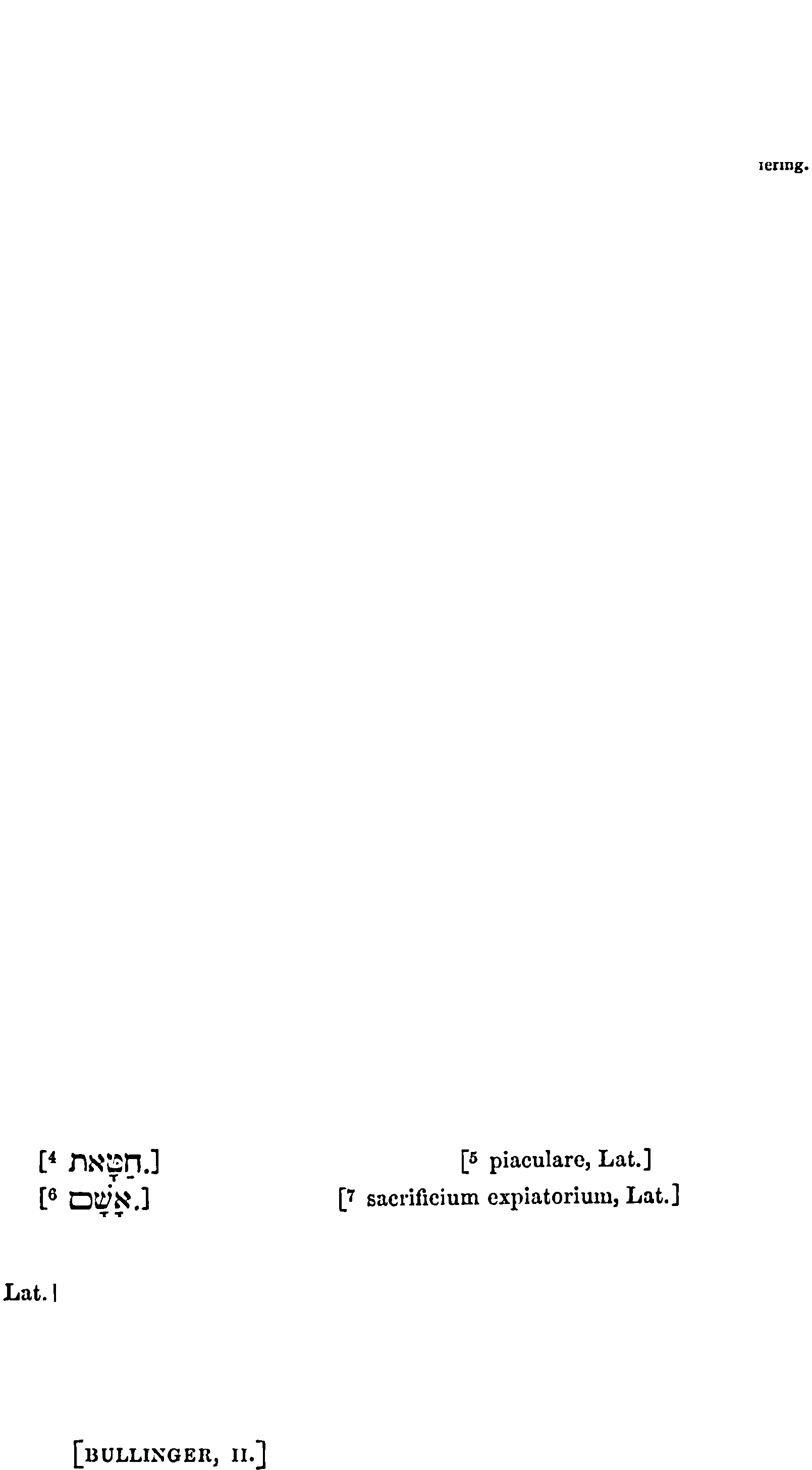
The third kind of sacrificeis that which is offered for The sin- " sin,and istherefore calledHattah*, a cleansing5,or Ascham6, a sacrificefor sin.
We in one word may callit a cleansing sacrifice7. For it was offeredfor sin committed unwittingly or by ignorance; (whichby the degrees of the sinners were divided into four sorts ; as, if the chief priestdid sin, if the whole church did sin,if the prince did sin, or if some man of the meaner sort did sin:) or else they did offerit for sin committed willingly,or of a set purpose, being yet a mean or excusable8 sin; or else for a great and heinous crime, which ignorance could by no means excuse.
The ceremony used in thissacrificeis very ample and large,so that I mean not presently once to touch it9.
It is most exquisitely set down in the fourth, fifth,sixth,and seventh chapters of Leviticus.
Neither is it to be doubted but that Christ was laid before theireyes, as well in that sacrifice, as in alltheir other oblations.
For Christ is the end of the law, (andthe mark whereto the ceremonial laws did tend10.)And Esay in " Whereas he isai.uu. the fifty-thirdchapter of his prophecy saith: never did unrighteousness,nor any deceitfulnesswas found in his mouth ; yet hath it pleased the Lord to smite him with infirmity; that when he had made his soul an offeringfor sin11,"(forhere isput DttfN Ascham,)"he might see seed, and might prolong his days, and that the advice of the Lord might prosper in his hand."
To thisbelongeth that whole disputation of the apostle Paul in his Epistle to the Hebrews, wherein he sheweth that Christ is the true sacrificefor sin, that cleanseth allthe church and the sins thereof12. In this ceremony l3 the disposition14 of sins13,the passionsof Christ,and the power and strength of death15. were shadowed [4fitfSn.] [6piaculare,Lat.] [6Dttftf.] [7sacrificium expiatoriuni,Lat.] [8mediocri is Bullinger's one word here.] [9adeo ut in prtcscutiper compendium commemoraro non placoat, Lat.] [10This sentence between brackets isan addition of the translator's.] [llhostiam delicti,vel victimam pro culpa, Lat.] [12et peccata omnia, Lat.] [w partim, Lat. omitted ; partly.] [n ingenia, Lat.] [i*passionisChristi et mortis virtus,Lat.]
[BULLINGER,
n.]
THE THIKD DECADE.
[SEUM.

The yearly Now these many and sundry sacrifices,appointed for sins, l, because they were wont to be offered were kept uncertainly of them that sinned at that very time when they did commit the sin : but the certain,the yearly, and universal sacrifice was that which is at large described in the sixteenth of Leviticus and may be referred in thisplace to the number of " cleansing sacrifices. For in the feast of atonement, upon the tenth day of the seventh month every year, was solemnized the sacrificeof cleansing,or atonement, for allthe sins universallyof all the people.
The manner of this general sacrificeI will not over-busily at this time describe,since it is as clearlyas the light set down in that place of Leviticus which even now I cited; and since I, in expounding the mystery thereof, do mean to shew, and make plain,so many shadows in it as are needful to be marked.
For I will say somewhat touching the meaning and mystery thereof.
In that most pleasantglass was figuredthe whole passion, and effectof the passion,of Jesus Christ, our
Lord and Saviour ; which by that sacrificewas every year laid before the eyes and renewed to the minds of allthe faithfulchurch of God.
For this manner of representing our redemption and salvationdid please God, by sacraments, rather than by pictures,colours, or by stage-plays; which are at this day greatly set by, although scarce godly, by no small number of triflingand fantasticalheads2.
Now mark, that the high priestonly did allthat was to be done in this solemn sacrifice; save only that two ministers were joinedunto him, the one to lead away the scape-goat, and the other to carry out of the host the bullock and hegoat that was to be offered.
Yea, charge is very precisely given, that no man should joinhimself to the high priest, when he entereth into the tabernacle,and maketh an atonerLcv. xvi. ment for the sins of the people.
Let no man," saith the " be in the tabernacle of appointment, when he goeth in to make sacrificein the sanctuary, until he do come out Lord, again."
For no man must be joinedto Christ in finishing the work of our salvationand redemption.
For he alone is [iconceptiva erant, Lat.] [2Viz. the Miracle Plays, or Mysteries " the Easter representations of our Lord's crucifixion and resurrection, "c.
Brand's Pop.
Antiq.
Vol. I.]
VI.] THB
CEREMONIAL
LAWS OF GOD.

the Saviour ; he alone hath trode the press, and he alone was crucifiedfor us.
The patriarchs,prophets, apostles,martyrs, and all other creatures, are utterly excluded from having any thanks for our redemption and salvation.
Christ alone remaineth the Saviour and Redeemer of the world.
To attribute our salvation to creatures, to our own works and our own merits, is to admit creatures with the high priest into the tabernacle,and to incur the indignation,that is, the terrible curse, of the almighty, true, and everliving God.
For by the Jewish high priestis prefigured to us Christ our Saviour, who, as the apostle Paul saith,hath a priesthood, which by successioncannot go from him to any other3.
Now Aaron did take a bullock for a sin-offering,and a ram for a burnt-offering,of his own ; and of the people he took two he-goats.
Therefore Christ our Lord, the true and only priestof his church, did offer for us the thing that he took of us, to wit, the substance of our flesh.
There is added also,that Aaron, (bywhich name we understand every one that was the high priestamong the people of God),when he went about to sacrifice,did clothe himself with the usual and common garments of the other priests(Imean, such as the other priestswere wont to wear),saving only that they were holy and without spot.
For, although Christ the Son of God did take our nature upon him, and did become like unto us, being clad, as it were, in the usual garment of us men ; yet, notwithstanding, his fleshlygarment
(Imean, his body that was like to ours)was altogether free from corruption4, and clean without allspots of sin.
Aaron did firstof all kill a steer for himself and his family : whereby he declared that he was not the very and true high priest,but the type of him that was the true priest.
For Paul saith: "Our high priest had no need, as those high rneb. v priestshad, firstto offersacrificesfor their own sins,and then for the sins of the people.
For he did that once, when he offeredup himself."
Afterwards Aaron drew lotsat the door of the tabernacle,to try betwixt the two goats,which should be slain for the sacrifice,and which should be sent away as [8Heb. viii.24, "hath an unchangeable priesthood;" airapafiarov "X" rrfv Ifpoxrvvrjv, one that cannot pass on to a successor.
See Schleusner.
P.] [4his fleshly " to ours, not in Lat. ; ho is altogether,"c.] 13"2
THE THIRD DECADE.
[sKRM.

the scape-goat into the desert.
The two goats do signify Christ our Lord, very God and very man, in two natures unseparated.
He is slain,and dieth1 in his humanity; but is not slain nor dieth in his divinity. Yet he, being one and the same Christ, unseparated, is the Saviour of the world, and doth work the redemption of us mortal men.
So in the [Prov. xvi. two goats was a mystery hidden.
And for because, as Solomon saith,the lots are guided by the Lord's will, it was not without the especialwillof the Father that the Son was sacrificed,and killedon the cross.
Moreover, the high priestdid take the blood, firstof the bullock,then of the slaingoat, and a censer in his hand, and went withinthe veil,where with the incensehe did make a cloud of smoke before the mercy-seat,and with his fingerdid sprinkle the blood seven times toward the mercy-seat.
All which the apostlePaul expounding in the ninth to the Hebrews saith, that " Christ entered not into the tabernaclemade with hands, but into the very heavens; not with the blood of a bullock,or a goat, but with his own blood, and found for us a perpetual [Uohnii.2.] cleansingand remissionof our sins."For "he isour propitiation; not for our sinsonly, but also for the sins of all the world."
And hereunto did the apostlesallude,as often as they called Christour propitiation; as St Paul in the third to the Romans, and St John in the second and fourth chapter of his first epistle!, Now the seven times sprinklingof the blood betokened the fullperfection,or perfect fulness,of the cleansing.
We have need also to be sprinkled with the finger,not of man, but of Christ2 Jesus, our Lord and Saviour, whose finger is the Holy Ghost, by whom our cleansingdoth come upon us.
To the sprinkling of the blood is also added sweet-smelling incense3: for,as the apostletestifieth, Christ,our high priest, did offer prayers for us with tears, and was heard in that which he feared4.
Whereupon, by the cloud of smoke, that is,by the great quantity of smoke, was noted the great eificaey of earnest prayers.
When that was done, the high priestwent again into the [*secundum id quod mori potuit, Lat.] [2 suinini nostri Pontiftcis,Lat. ; our High-priest.] [3incensum aromaticum contusum, Lat.; of beaten, pounded, aromatics.] [4Heb. v. 7, pro revereutia, Lat. ; for his piety. Auth. Ver. marg.]
THE
CEREMONIAL
LAWS OF GOD.
VI.] sanctum, and set the blood upon the golden altar of incense.
For in the work of our redemption both innocent blood and earnest prayer for us must be joinedtogether.
Out of the sanctum again he came to the altar of burnt-oiferings,which stood in the court (which was calledatrium),and there he gave the other goat to a convenient man to be carried away into the wilderness : but in the deliveringof the goat he used a precise manner and singularceremony.
For the high priest laid both his hands upon the goat, and over his head did confess the sins of the people, who also did themselves confess their sins,following the priest,clause by clause, in all the confession5which he rehearsed : and then, so soon as all the sins were laid upon the head of the goat, he was sent away, that by that means he might carry the sins of allthe people6 into the desert.
From this ceremony did the Gentiles undoubtedly borrow their kind of cleansingsor purgings of the and in Latin piamina.
For their manner was, in extreme perils,that one should give himself for all the rest,whom they took, and did eitherkilland burn upon the altar,or cast into the water ; praying therewithal, people, called in Greek KaddpiaaTa1 ', that alltheir evilluck might go with him, and that the gods being pacifiedwith the death of him8 might again be favourable to all the rest.
But the wretches erred as far as heaven is wide: for Christ the Son of God was made sin for us, that is,he was made a sacrificefor sin,yea, he became a curse for us, that we by him might receive a blessing. For to this had the prophet Esay an eye, when he said: "We all went astray like sheep ; every one turned after his own way : but the Lord hath thrown down upon him9 allour sins."Again:
"He was wounded for our offences,and smitten for our wickedness."
And again :
" The pains of our punishment were laid upon him, and he bare our griefs10."
[5See Lightfoot's Temple Service, chap.
15. Works, Vol. i. p. 963.
Lond.
1684.
See above, p. 169, note 8.] [6totius ecclesise,Lat.] [7 Kadapfiara " homines ignobiles et scelerati,qui publice alebantur et grassante peste aliove malo graviore immolabantur ad expiandum urbem aut civitatem Deorumque iram avertendam.
Schleusner, in voc.] [8unius, Lat.] [9effecit in ilium incurrere, Lat.] [10Isai. liii.6, 8, 6.
For the payne of oure punyshmet shal be layde upo him.
Coverdale, 1535.
But this last quotation in the Latin
THE THIRD DECADE.
[sERM.

Now the goat did carry the sins into the desert, not that the sins should not be, but that they should not be any more imputed unto them.
For in the church verily there is sin in the saints,but it is not imputed unto them.
Sin is imputed to allthem that are without the church, in the desolate wilderness.
The convenient man, that should carry away the scape-goat,can be none other than Christ himself,who in the days of his fleshdid observe the convenient time and fitoccasion, repeating oftentimes that his hour was not yet come; but at the last,when time convenient was come for him to die,he said that then his hour was come.
And by dying he carried away conveniently the scape-goat, I mean1, the sin of all the world.
When this also was thus accomplished,the high priest did again wash himself; and, putting offthe common garments of the inferiorpriests,did again put on his high priest'sattire.
Now this often and manifold washing in the holy ceremony is a shadow, or type, of the most absolute remission of sins; even as also the changing of a garment is a sign or figure of glorification; as is at the fullto be seen in the third chapter of Zachary's prophecy.
And Christ,being glorified,did enter into heaven, there to appear in the sight of God, the only and effectualsacrificefor us mortal men.
Therefore did Aaron sacrificea ram for a burnt-offering: for Christ is the sacrifice which endureth always, and purgeth all the faithful.
Moreover, Aaron sent the bullock and the other goat unto the holy place without the host, that there they might be " The burned.
Which thing Paul expoundeth thus, and saith : bodies of those beasts,whose blood is brought into the holy place by the high priestfor sin, was burnt without the tents : therefore Jesus also,that he might sanctify the people with his blood, did sufferwithout the gate."
Heb. xiii.
And although in this which I have hitherto alleged I have by fits2declared the end and fruit of this ceremony, yet will I not think it much here again particularlyto repeat the same again; since I see that the Holy Ghost in the scripture doth, as it were, take pains very busily to beat the same into our heads. is of verse 4 : Vere languores nostros ipse tulit,et dolores nostros ipse portavit.] [iadeoque, Lat.] [asparsim, Lat.]
THE
CEREMONIAL
LAWS OF GOD.

VI.] The end of allthis stirand solemnity is3,that allthe sins, I say, allthe sins of God's universal church, are by the one and only sacrifice,once only offered,most perfectly blotted out4 and absolutelypurged.
Let us, therefore,hear the very words of the Holy Ghost, which speaketh in the scripture most plainly and evidently,saying:
First, "And the high "e^*v'121priest shall confess over the goat all the iniquitiesof the children of Israel,and alltheir trespassesand alltheir sins."
Secondly, "And the goat shallbear upon him alltheirmisdeeds into the desert." Thirdly, "The same day shall the priest make an atonement for you, to cleanse you, that you may be " And clean from allyour sins before the Lord."
Fourthly, let this be an everlastingordinance unto you, to cleanse the children of Israelfrom alltheir sins once every year."
But "who is so very a sot or dull head as to think, that all the sins,of the people are washed away with the blood of beasts?
"If,"saiththe apostle,"they had once fullycleansed sins,then [Het".x. would they have ceased to offerany more."
By this cere- ' mony, therefore,the mystery of Christ to come was beaten into allmen's brains,and once every year laid forth to the eyes of allmen to behold.
For of thisceremony did Zachary borrow his prophecy of Christ, in his third chapter, where zecii.in.
" Behold, I bring forth the Branch, my servant.
For, lo,the stone that I lay before Josua, upon one stone he saith: shall be seven eyes : behold, I will cut the graving thereof, saith the Lord of hosts,and I willtake away the sin of this land in one day."
The Lord doth promise the Messiah, which was prefigured by the priests,and especiallyby 5 the high priest Josua.
Christ is the stone, upon which the eyes of all men are stedfastlyfixed,as upon their only Saviour.
He is digged in, and cut, in his passion; and by suffering and dying once he purgeth the sins of allthe earth.
Of this ceremony, and of thisplace of scripture,did Paul, the holy apostle of Christ,borrow his whole discourse almost in his epistleto the Hebrews, touching the sacrificeof Christ once offered for all the sins of the whole world : in which discourse he doth very often repeat out of the law the word "once," and that with a certainemphatical vehemency.
[3omnium, Lat. ; stirand solemnity, not in Lat.] [4e medio sublata, Lat.] [sof,ed. 1587.]
THE THIRD DECADE.
[SERM.

Now, to appoint other priests,to instituteanother time, The only sacrifice of and fo ordain another manner of sacrifice, is utterly to kick Christ is sufficient for all the world. at, and tread under foot, this heavenly and most evident truth.
But this doctrine of the only sacrificeof Christ is the true, ancient, sound, unreproveable, and everlasting doctrine : by which allthey are saved that are saved, and by which allthey have been saved, that have been saved since the beginning of the world.
The enemies or adversaries of this doctrine Paul, the apostleof Christ and the Gentiles,
(whoseskillin the law was inferiorto no man's,) doth call fools,mad, unconstant, light-headed,carriedwith every puff of [1Cor. xvi.
*2; 2 Cor. xi.
3, 13 ; Gal. i.
8, 9; iii.1, 3; wind, wicked, apostates,which have revolted from Christ,liars, falseprophets, falseapostles,deceivers,schismatics,dogs, enchanter v.
4 ; Eph. iv.
14 ; Phil. iii.
2-] witches,detestable,and cursed. Therefore,ifan angel from heaven teach us any otherwise,lethim be to us accursed.
Yet by the way this must not be concealed,that in that yearly sacrificeit was required and looked for at men's hands, first,that they should confess their sins; then, that they should be sorry in their minds, in good earnest and indeed,for their sins committed ; and lastly,that they should keep sabbath, "
I do not mean an idle resting from honest business,but a quietnessin the faithof Christ and a ceasing from illdeeds.
Whosoever doth so prepare himself in the feast of atonement, that is,in the time of the preaching of the grace of God through Christ, he is without doubt throughly cleansed by that only sacrificeof Christ Jesus : of which I have hitherto not without good cause spoken so largely as you perceive that I have.
For this one place doth give a wonderful light both to the understanding of many places in the scriptures,and also of the mystery of our redemptio and of Christ our Redeemer, so plainly,that no other place1 doth so clearlyexpound, set forth,and lay them open before our eyes to be seen and looked on : it doth also teach us to understand the words of Christ our Lord in the " There is one which gospel of St John, where he saith, [John v. 45, 46.] accuseth you, even Moses, in whom ye hope: for had ye believed Moses, ye would then have believed me; for he wrote of me."
Now with the sacrificeof atonement and the other cleansing This water was also called the water of sacrificeswe do advisedly number the sacrificeof the red [Jvix alius,Lat. ; scarce any other.]
THE
CEREMONIAL
LAWS OF GOD.

VI.] cow ; I mean, of the cleansing,or of the cleansing or holy ^ water, that was ordained against all sorts of defilingsand {^J^the"; uncleannesses. For there were sundry kinds of uncleannesses;K^"^". of which there isa large discourseto be seen in Moses his law: ^parateTV and by them is laid before us the type of our corrupt nature ?heretfo"fm and continual sins. There isfullydescribed,in the nineteenth w
^? e" tht?y were chapter of the book of Numbers, firstthe very ceremony and ci"mstd. sacred rite; then is declared the manner how to make the holy cleansing water against all defilings;lastly is added the use and effectof that holy water.
There was brought to Eleazar-the priesta red cow withThe sacrifice out spot, which never feltthe yoke, and that was out of""w.er" hand carried out and slain without the host.
Part of the blood was saved by the priest,and with his fingerhe sprinkled it seven times towards the tabernacle of appointment : but the whole cow he burnt with fire,so that no part of it was left; and into the fire he cast cedar-wood, hyssop, and a scarletlace. This being once done, the priestdid wash himself in water, and in his stead came another that was clean2,who, gathering the ashes, did lay them up in a clean place.
Therefore, so often as need required, they did put off those ashes into an earthen vessel, into which they poured running water3; and in that sort was the holy cleansingwater always prepared, which they did sprinkle with a sprinkler made of hyssop upon allsuch as were defiled. This was the manner and ceremony of the cleansing, the use and end whereof doth immediately follow.
The apostle Paul doth testify,that the circumstances of thisceremony did lay before us a most evident type of Jesus Christ : for in the ninth chapter to the Hebrews he saith:
" If the ashes of a young cow, sprinkled, doth sanctifythem Heb. ix. that are partakers of it to the purifying of the flesh, how much more the blood of Christ !
Therefore both the priest and the cow did bear the type of Christ.
The female kind in the cow doth note the infirmity of man's nature ; the red colour doth admonish us of the Lord his blood, by which we are washed from our uncleanness.
There was no spot to be found in Christ ; for he was the Holy of holies,and altogether free from and without allsin.
He was not brought to death by the yoke of necessity; for he offeredhimself unto it of [2vir mundus,Lat.] [3aqua viva, Lat.]
THE THIRD DECADE.
[sERM.

his own free will: yea, he offered himself willinglyto go to his death, and that too without the host or walls of the city, in the mount of Calvary : which thing the apostle Paul doth touch in the thirteenth to the Hebrews.
Christ, both God and man, was wholly offered in body and soul : whose blood is wholesome1 for us, if by the Holy Ghost it be sprinkled in our hearts.
The faithfulalso must die with Christ ; they must be humbled, and burn in love to Godward as red as scarlet2: and that was the meaning of the cedarwood, the hyssop, and the scarlet lace,which were cast into the fire.
Moreover, the ashes which came of the sacrificewere gathered up and preserved to purify and cleanse withal.
Those ashes were nothing else but the type or figure of the effectof Christ his death or sacrifice ; I mean, the very cleansing and remission of our sins.
For therefore did blood and water gush abundantly out of the pierced side of Christ3,that we might learn that out of the death of Christ doth flow our cleansing and our life: for in blood life doth consist,and water purgeth and is a sign of cleansing.
The ashes were gathered by a man that was clean, who nevertheless was made, and did remain, unclean until the evening.
Finally, the water was sprinkled with a sprinkler made of hyssop upon the defiled,to the end that thereby he might be sanctifiedor purged.
The water was kept in an holy place : for margarites4,and that which is holy, ought not to be cast to dogs and filthyswine.
The Lord also doth require preachers to teach the effectof Christ his passion,and in the contemptible and lowly5 preaching of the gospel to lay before the world our redemption and sanctificationin the death and blood of Christ : he doth require, I say, such holy teachers as are themselves faithfuland cleansed in the blood of Christ. And yet those teachers, with the whole church beside, do even till [lsalutaris,Lat.] [2 ardere amore divino et extolli, Lat.
'As red as scarlet,'is the translator's addition.] [3morientis et jam extincti Christi, Lat. ; of Christ, when dying, and now already dead.] [4margaritae, Lat. ; pearls, Matth. vii.6.] [5coram mundo, Lat. ; as the world esteems it.
The translator " to lay missed the meaning of these words, when he rendered them, before the world."
Bullinger had in his mind 1 Cor. i.20
29.]
THE
CEREMONIAL
LAWS OF GOD.

VI.] the evening, I mean, the ending of their lives,pray still, "Forgive us our trespasses."For the Lord himself said; "He
[Johnxui. that iswashed is clean,and hath no need but to wash his feet only."
To this do appertain the often washings used in this ceremony, which signifythat by the grace of God allsinsare purged ; that the saints have always an holy care to watch against the assaults of sin; and that those sins are cleansed none other ways but by the water of Christ his grace. Lastly, it is most often and earnestly repeated in the law, that they allremain unclean, how many soever, being once denied, are not again cleansed with the holy water of separation.
For the Lord said to Peter, "Unless I wash thee, thou shalthave [Johnxiii.a] no part with me."
My meaning is not to run through every particularpoint of this ceremony, but to touch the especial matters only.
Therefore now I proceed to that which reinaineth.
To these cleansingsacrificesmay also be added the sacri-sacrifice? for ficeswhereby the bodily defilings,which were figuresof the of the body, defilingsof sin,were purifiedand cleansed: of which sort were the defilingsof the seed, the eatingand touching of unclean creatures, the leprosy, and of the woman in child-bed: all which Moses doth largelyhandle from the twelfth of Leviticus unto the fifteenthof the same.
And in allthis there is nothing else prefigured to the church of God but our natural corruption and originalWickedness, with the free cleansing of the same by the grace of God in the blood of Christ our Saviour.
With these we may also number the sacrificeof jealousy ; The sacrifice " which is thoroughly treated of in the fifthchapter of Numbers
: although the manner and order thereof seemeth rather to belong unto the judicial laws of God.
The fourth kind of sacrifices was the sacrificeof thanksThe sacrifice ..
i i
H ofthanksgivgivmg6, which they called schelarmm, or scholomim1 , the """" sacrificeof health, or the peace-offering : for it was offered to give thanks withal, to wit, either for the recovery of health, or for felicityand prosperity; I mean, when they had received some good turn at the hands of God, or else by his aid had escaped the brunt of some mishap or evilfortune. In this sacrificethey used a beast either of the herd or of the [6sacrificium eucharistioc, gratiarum actionis, vel gratulatorium, Lat.]
THE THIRD DECADE.
[sERM.

fold: it was not lawful to offerbirds ; for it was done either with a bullock or an heifer,with a male or a female lamb, or with an he or she-goat.
It was slainbefore the atrium: the hide or skin thereof was the priest'sfee.
The blood was sprinkled about the altar.
The kidneys, the caul of the liver, the rump of the lamb, and all the fat,was burnt upon the altar of burnt-offerings. The right shoulder was heaved, the breast was waved toward the ends of the world1.
(For thruma and thnupho?, that is,the heaving and waving, were not kinds of sacrifices,but ceremonies only, which the priests did use in making their sacrificesand oblations.
By the heaving was signified,that Christ should be heaved or lifted up, and that he, being once lifted up, should draw all men unto him.
The waving of the breast toward every part of the world was a token, that the preaching of Christ should be spread in every corner of the world.) The breast and the shoulder were both the priest'sportion,together with the jawbone and the paunch or belly. The rest of the fleshreturned to him that made the oblation,and was eaten by him in an holy banquet.
The remnant of ceremonies belonging to this sacrificeare to be found in the third chapter of Leviticus.
For ifitwere thoda3, a confession,a praise,or a protestation, then was added to the sacrificea cake of pure wheat flour and salt steeped in oil, or sodden cracknels, or bread baken in pans : part whereof was heaved, and fellto the priest'sshare ; the rest returned to the offerer,even as also leavened bread was allowed to be eaten in the banquet.
Now in this kind of sacrificealso Christ was preached, with the effectand power of his death and passion ; and in it was shewed the whole manner and order of giving thanks to God for his good benefits. There are sundry sorts of benefits.
If a man received a good turn, if an illturn had not befallen him, if he had recovered his health or had escaped some misfortune, he offered a sacrificeto the Lord.
There are also other ancient benefitscommon to allmen4; as, that God [!in cardines mundi, Lat.] [2 nC'nrij "*" heave-ofering. nSJIJF),waving, shaking of sacrifices before Jehovah, a particular ritein offering. Gesenius, Ileb. and Eng.
Lex. in voc.] [3JTTiJ1) Heb. confession, praise.] T '
[4 common to all men, not in Lat.]
THE
CEREMONIAL
LAWS OF GOD.

VI.] hath made the world and all that istherein ; and that through Christ he hath redeemed all the faithful: there are daily benefits; yea finally,allthings are fullof God's good benefits.
For allwhich benefitswe must offerour sacrificeto God alone, and not to any creatures which he hath made : yea, we must offer to him with all our hearts; all our affections must be hallowed to the Lord.
For out of the beasts which were sacrificed to the Lord for thanksgiving, those parts were chosen and given to the Lord in which the especial power of lifeconsisteth. For in the kidneys isthe power of generation; in the blood the vital spirit; in the liverthe spring of allthe blood, "c.
Now we must give thanks by a sacrifice,that is, by Christ, for5 we are saved for Christ his sake; and allgood things are bestowed on us by God, not for our own sakes, nor for any creatures' sakes, butfor Christ his sake, our only Saviour and Redeemer.
To them which offered was allowed a sober and merry banquet, because the felicityof those that are not unthankful is for the most part augmented two-fold double.
And the knowledge of Christ is a delicate banquet and a continual feast.
With the sacrificesof thanksgiving those offerings do The freemuch agree which are called vows and free-will-offerings6.
The free-will-offering was that which proceeded of mere good willand devotion of the mind, without necessity or compulsion of any law or ordinance ; as when a servant giveth to his master the thing that he oweth him not, for a declaration only of the good will that he beareth unto him.
But herein the free-will-offeringsdo differfrom the sacrificeof thanksgiving ; because in the sacrificeof thanksgiving charge was given, that whatsoever was left,which was not spent the first day, should not be eaten on the morrow, but be burnt with fire: on the other side,in the free-will-offerings it was lawful for them to eat the remnant upon the second day, and7 to burn their leavings upon the third day.
Now the vowed sacrificeswere those which were offered by covenant to the Lord ; as for example, a man, being in peril,doth vow to make a sacrificeto God, if he be delivered out of that imminent danger: it fallethout that he is delivered,and he [sporro, Lat. ; further.] [6Tip, a vow, mip, a voluntary offering.] [7jubcbautur, Lat.j they were commanded.]
THE THIRD DECADE.
[SERM.

for his delivery doth offer up the sacrifice : the thing that is so offered is calleda vowed sacrifice. The ceremonies of the twain1 did wholly agree with the sacrificeof thanksgiving.
More of them is to be seen in the seventh chapter of Leviticus.
The meaning of these sacrifices was, that allgood benefits are bestowed upon us for Christ his sake ; and2 with those benefits we receive the very good will which we have to serve the Lord.
Thus much have I hitherto said touching the sacrifices of the people of God : not that I have touched every point, but so many only as are of most importance.
In these sacrifices, as in a lively action, were set forth Christ our Lord, his passion, and the effectualmerit of his death : so that we may call the holy actions of the sacrificessermons upon the passionof Christ,and instructions3of our redemption by our Lord and Saviour. or vows.
Now, for because we have already spoken hitherto of vowed sacrifices, we must here consequently borrow leave, for a digression,to say somewhat of their usual vows.
For vows belong to the Jewish ceremonies.
Of the making, performing, and redeeming of vows there is a large discourse in the law of God, but especiallyin the twenty-seventh of Leviticus. To vow is to promise any thing4 with an oath solemnly, either for our own or another's welfare.
And therefore a vow was an action referred to God alone, and that too in an holy and lawful thing.
But in vows there was a difference;because vowed things were divided into four kinds : for sometimes they vowed men, sometimes they vowed other livingthings,sometimes houses, and sometimes lands or other immoveable substance5.
Again, there was a differencein men according to their ages, and after6 their ages they might be redeemed.
For clean living creatures there was no redemption permitted at all.
It was free either to leave their houses to the use of the ministery, or else to redeem them with such a sum as the priestshould [*of the twain, not in Lat.] [2atque adeo, Lat.; and so too.] [3catecheses, Lat.] [4Deo, Lat.; unto God.] [6res inanimes, Lat.; lifelessthings.] [6juxta, Lat.; according to.]
THE
CEREMONIAL
LAWS OF GOD.

VI.] value them at7.
In lands, redemption was sometimes admitted, and sometimes not admitted.
And in the thirtieth chapter of the book of Numbers there is a precisecommandment given touching the votaries,when their vows are of force,and when of small effect; where itis diligentlybeaten into their heads, that vows lawfullymade to God are not to be called back again, but straitlykept and throughly performed.
Rash or unlawful vows the Lord did never like of nor receive.
Of the lawful vows, and such as are made to the true and only God, the prophet speaketh, where he saith,"Make [PS.ixxvi. vows, and pay them."
"We read not that any of the godly sort did make any vows to any saintsor any other creatures; neither that they vowed any thing that was not in their power to vow, nor that which was contrary to the will of God to whom they vowed it, nor that which was to their neighbour's hinderance, nor the thing that had not in it some evident commodity.
And verily,these kinds of vows were for none other cause permitted to the Israelitestillthe time of amendment, but that they should remain in the worship of one true God, and not make their vows to any other strange God.
To the treatise of vows belongeth the disciplineand The disd- " r pline of the order of the Nazarites ; of which there is a large discourseNazarite*. in the sixth chapter of the book of Numbers.
The Nazarites were those who, because they would the more freely,without let,attend upon God's service, or else because they had heretofore livedtoo licentiously,did of theirown accord and willtake upon them a more strictand severe trade of life than the common people used, and kept it for a discipline, to make other men to follow their example of virtue and honest living. Whereupon it cometh to pass, that some do take the Nazarites to have their name of separation, because Nazir among the Hebrews signifieth a separation; and that the Nazarites,separating themselves from the common trade of life that other men did lead, did give themselves to a peculiar form of living for God and godliness'sake.
That severe and strict disciplinedid continue in some by the length of alltheirlifetime,as in Samson and Samuel.
Km*"'u.;] Moreover, such as did wholly give themselves to the ['sestimatione sequa,Lat. ; fairvaluation.]
THE THIRD DECADE.
[SERM.

i 11 ; study of the scriptures were, by the prophets Amos and Jeremy, because of their most temperate life (which is required of students), and because they were wholly dedicated to the ministry of God, called Nazarites.
Sometimes also it did endure but for the space of certain days or months.
These Nazarites did abstain, according to the commandment of the law, from certain things,from which they were not barred by any other law, and which were not unlawful for other men to use which were without the necessity of that vow.
First of all they abstained from wine, from allthings that the vine brought forth, and whatsoever else did make men drunken.
But it is manifest, that as wine is the good creature of God, so no drink is forbidden by the law.
Yet for because the Nazarites were consecrated to the Lord, and sanctifiedby a certain peculiar kind of living; and for because wine is the means that leadeth to drunkenness, which is the gulf of allsin and filthiness ; therefore did the Nazarites not without a cause abstain from wine.
They did also take heed of idleness,the mother of mischief, and utterly despised all worldly pleasures.
Furthermore, so long as the time of their vow endured, they did not clip their hair, but let their locks grow out a length.
And thereupon, as some do think, they took their names, and were called Nazarites : for insomuch as Nazer signifiethhair, they suppose that they were called Nazarites, as who should say, long-locked or shaggy-haired people1 .
But the apostle Paul biddeth the woman to pray, or to come into the congregation to hear a sermon, with her head covered, for none other cause, but for that she is not in her own power, but subject to another, that is,to her husband.
And therefore the Nazarites did let their hair grow, because by the vow which they had made to God they were no longer in their own power, but were wholly yielded into the power of God.
And the head, which is the tower of the body and the most excellentpart thereof, being covered2 with a bush of hair, was a token that the whole man was by vow given to the Lord, to whom alone he ought to have an eye, and upon whom alone he ought wholly to depend.
Moreover it L1"113,consecration.
Hence meton. the consecrated head (ofa Naza- " and even (theprimary idea being neglected), the long, unslwrn hair (ofa woman).
Gesenius, Heb. and Eng.
Lex. in voc.] [2 veluti obvelata, Lat. ; covered as with a veil.] rite) ;

THE
CEREMONIAL
LAWS OF GOD.
VI.] was required at the hands of the Nazarite, that he should not defile himself with the contagious company of wicked and naughty persons.
Whereunto also belongeth the commandment, which charged the Nazarite not to be present at the death or burial of his parents, or children,or wife, or brethren, or sisters. For he ought to settlethe eyes of his mind upon God alone, and in comparison of him to set lightby and loathe the things which were most dear and preciousunto him.
But if it so fellout, that3 at unawares he were defiled by seeing of a dead body4, he was not thereforeacquitted of his vow, as one whose former lifehad been sufficientfor the performance of the same : for he was commanded to sanctify himself the seventh day, and then to undertake the keeping of his vow again.
By all this we may plainlyperceive what and how great sa mson a " the sin of Samson was, who was a Nazarite to the Lord. th For because he did not only lurk in the brothel-house with helmed! y the harlot,but did also bewray the secret of God unto her, and cast behind him the covenant made with God, whereof his hair was a sure testimony ; therefore did the Lord forsake him, and that wonderful strength which he had from heaven was clean taken from him.
For the strength of Samson lay not in his hair,so that by the cutting offhis hair his strength was cut away also; but itlay in the Spiritof the Lord, which was given him from God above.
And therefore do we find this sentence so often in the scripture, "And the Spiritof the rjudg. xm.
Lord came upon Samson."
Therefore when the Spirit ofujxr.'it] God departed, his strength departed also: but it departed from him, when he, being wholly joined unto the harlot, was made one soul with her, and did prefer her before God and his commandment, so that he suffered his hair to be polled, and utterly revolted from the ordinance of the Lord : for by that means did the Spirit of God forsake him.
Whereupon immediately after he was brought into the hands of his enemies the Philistines; where when he was miserably vexed, and when he heard the name of God evil spoken of5 and blasphemed because of his captivity,he repented heartily,and [8vel, Lat. ; even at.] [4super mortuo, Lat. ; by a dead body.
Seeing of,not in Lat.] [5Rather, and when on his account the name of God (maleaudiret, Lat.)was evil spoken of.]
[BULLINGER,
n.J
THE THIRD DECADE.
[SERM.

calledupon the name of the Lord : whereby it came to pass, that, when his hair grew forth again, his strength returned ; that is,the Spirit of the Lord came upon him again, being brought unto him, not by the growing of his hairs,but by his repentance and earnest callingupon the Lord.
Neither did Samson desire to revenge his own private injury so much as to suppress the blasphemous mouths, and to deliverthe people of God1 from fear and slavery. The strength of God, therefore, returned again, wherewith he bending the pillarsof the theatre was himself slainwith the fallof the palace, and at his death slew many mo than he had killed in all his life time before.
But now we return again to the purpose, to add the other ceremonies that do belong to the expositionof the vow of the Nazarites.
When the time was expired,therefore,which the Nazarite had taken upon him for to observe, he came to the tabernacle of the Lord, and offeredthe sacrificesthat are prescribed in the law : whereby he testifiedthat he was a sinner,and plainly confessed that allgoodness and virtue2,that was to be found in him, was given and bestowed from God above.
And therefore he polled his head, and cast his hair into the fire3, wherein the peace-offeringwas a burning.
At last,when all this was in this manner accomplished, it was lawful for the Nazarite, as one loosed of his bonds, to return unto his old lifeagain.
Thus much hithertotouching the disciplineof the Nazarites. or the dean Now touching the clean and unclean, there is a long:disand unclean " i i /"
-" r -r "
/" creatures, course in the law of Moses.
I in my former treatise did lightlytouch and pass over some certain things ; but now at the last(forhere I mean to make an end to speak of ceremonial laws)I willadd somewhat touching the choice of meats, I mean, of clean and unclean meats.
God, verily,in the beginning created allthings; and he so created them, that, as the Creator is good, even so allhis creatures even at this day are good also : neither doth he gainsay himself now, when he forbiddeth certain meats, as [!ad quos vocatus fuorat, Lat. omitted ; unto whom he had been called.] [2id est, si quid virtutis,Lat. ; that is,whatever virtue.]
[8craticulam, Lat. ; gridiron.]
THE
CEREMONIAL
LAWS OF GOD.

VI.] though somewhat of itselfwere unclean.
There are other mysteries, that liehidden under this doctrine of the choice of meats.
The laws, which are given touching meats and victuals, why God e seem to be small and of littlevalue ; but itpleased the Lord in eatinp Of Tiij " i i i -I " certain a small thing to admonish us what we have to do in a greater,meat*. and that even in the smallest things the authority of his Godhead ought to be regarded.
For the authority of the law dependeth upon God : God is the lawgiver, and the law is his invention.
This suppresseth the malapertness of mortal men, which maketh, undoeth, and every day deviseth new laws and ordinances.
Therefore God in these kind of laws doth commend to his people faithfulobedience to be shewed unto him : even as, in the beginning, he commanded Adam not to taste of the tree of knowledge of good and evil, requiring thereby faithfulobedience to be shewed unto him.
Verily, the obedience and faith,which was in the Maccabees, in old Eleazar, and in certain other godly men, that stood The constant " i "
" i t ii- /" i " i t i obedience of against king Antiochus, even to the shedding ot their blood certain holy men, who and sufferingof most bitter death, did please the Lord exJ^f^ s ceedingly.
Other more abstained from swine's flesh,where- [\nMaacn'ii by they obtained neither praise nor glory among wicked l^"va!i 18' men4.
When the word of God saith that a thing is holy, it isholy indeed ; and that,because he isholy that commandeth it.
When God saith that any thing is unclean, itis unclean indeed, so that to eat any thing against the word of God is " Ye now," saith the Lord in the Gospel, [John *v.
3.] to defilethe eater.
"are clean because of the word which I said unto you."
It is needful, therefore, that we believe the word of God, and that obedience go before faith5; and then it cannot be but that the deed or work that is of faith,as Eleazar's was, who would not taste the swine's flesh,must needs be acceptable unto God, with whom whatsoever is not of faith is sin^on". xiv. and wickedness.
Moreover, the Lord in6 these laws of his touching the abstaining from the flesh of certain living creatures had a great respect unto the health and soundness of mortal men's [4among wicked men, not in Lat.] [*et prsecedat obedientia fidei,Lat. ; the obedience of faith go before.] [6in quibusdam, Lat. ; in some of.]
THE THIRD DECADE.
[sEKM.

bodies.
For some of those which he forbiddeth to be eaten are by physicians1 scarcely thought to be -wholesome for our bodies.
And thereupon the saintsdo gather this syllogism:
If God hath care for the health of our bodies, he is far more carefulverily for the preservation of our souls.
What may be thought of this,that many nations have tempered2 themselves from the eating and touching of some living creatures?
Therefore, that the people of Israel,who of themselves were sufficientlysuperstitiousand curious enough, should not be their own carvers, and invent such toys as they thought best, God gave them such laws for choice of their meat as did contain hidden mysteries in them, thereby to draw them from their own devices, and to sever them from all other nations; as Moses testifiethin the fourteenth "
Thou art an holy people chapter of Deuteronomy, saying : unto the Lord thy God, and the Lord thy God hath chosen thee from among allthe nations upon the face of the whole earth, to be a peculiarpeople unto himself."
To St Peter3, in the Acts of the Apostles, a visionis shewed, wherein by the unclean beasts are meant the Gentiles.
Lastly, God would have the nature and dispositionof the beasts, that he forbad to be eaten, to be throughly scanned.
For in their diet at the table he did by figures lay before their eyes the heavenly philosophy, giving them occasion, even in their meat, to think and speak of the true holiness of the mind, to the end that men should not be filthy,impudent, foul, . and unclean.
And therefore is this clause so many times " I the Lord your God am holy ;" as if he should xx.
7,8;xxi.
.* (Lev.xix. 25 repeated, "
, e, "c.] gay : All these ceremonies tend to this end, that ye may give yourselves to holiness. Wherefore in those figureshe taught the godly what to follow,and what to fly from.
Now in the law of the clean and unclean he doth first of all put certain generalities; then he descendeth by specialitie and doth in a beadrow4 reckon up certainparticular things in a very natural course and order.
The place is at the fullset out in the eleventh chapter of Leviticus and the fourteenth of Deuteronomy.
Those beasts were allowed [let a mcdicis, Lat.] [2sibi temperarunt, Lat. ; have abstained.] [3ccrte, Lat.; without a doubt.] [4 per catalogum, Lat.]

THE
CEREMONIAL
LAWS Of GOD.
VI.] to be eaten, which cleave the hoof, and chaw the cud.
Here are two things set down, in which the duty of a good man is notably contained : for if we will be clean, we must divide the hoof, and also chaw the cud.
Our affection is the foot of our minds, which affection must not be followed.
We must have discretionin all things to judgebetwixt affections.
And as in a cleft there be two parts or sides, the right and the left; so a good man chooseth the good, and fliethfrom the evil.
Chawing of the cud is our judgment.
For we must not admit everything which we hear and see, but those things only which we have examined exactly, and found to be contrary neither to God nor to his law.
There are then repeated many livingthings particularly, which were not lawful to be eaten among the people of the Lord.
Those were either four-footed beasts upon the earth, or fishes,or birds, or such as creep upon the ground.
Of four-footed beasts four by name we are especiallyforbidden : the camel, whose long and lofty neck doth teach us, that pride and arrogancy must be eschewed5; the coney, or the mountain mouse6 ; for God doth utterly mislike the men that are altogether overwhelmed, like coneys, in the earth, and never liftup their minds unto heaven7 ; the hare, a fearful beast, which doth warn us to shake off all cowardly fearfulness; even as also the hog doth put us in mind to avoid all uncleanness ; for a hog is the very type and picture of nasty filthiness,and of it doth the byword rise,to call an uncleanly person a beastly swine8.
And of Circe the fable goeth, that she with her enchantments did turn Ulysses his men into a sort of loathly hogs9.
Furthermore of fishes,so much was allowed for meat, as was found to have fins and scales upon them : if they lacked either of them, they were forbidden ; as the eel, which though it hath fins yet lacketh it scales, and therefore was not to be eaten.
For as the bodies of fishesare ruled with the fins,so must the whole man be governed by hope10.
The scales are hard and cover the body :
[*modis omnibus, Lat. ; by all means.] [6tStt? the jerboa. The name is probably derived from the
T T
animal's burrowing.
Lee's Lex. in voc.] [7and never " heaven, not in Lat.] [8 qui et proverbiis locum dedit, is the Lat. of this sentence.] ["Horn.
Od.
Lib. x.] [10spe firma, Lat.]
THB THIRD DECADE.
[sERM.

and we, unless we be constant and patient in the Lord's work, are worthy to be abhorred of the Lord our Maker.
Of birds those are forbidden,which are the greatest raveners, devourers ; which love and liveby unclean meats ; which fly abroad at owl-light,at midnight, and in the dark ; and such as are crafty,unstable,and nothing cheerful1. Herein therefore iscommended unto us well-doing,abstinence,temperance, simplicity,light,constancy, cheerfulness,soundness and pureness of living.
Lastly, of such as creep by the ground no small number are noted : for men altogether wrapped in worldly muck do utterly displeasethe Lord.
I have of purpose not reckoned up allthe names of the forbidden creatures, partly because itwould have been too tedious unto you, and partly because the interpretersof the Bible do wonderfully stick2 in the interpretation of their names : so that I can never marvel enough at the extreme blind stubbornness of the Jewish people,in keeping so strictly the choice of their meats, when their own rabbins do stick, and cannot tellcertainlywhat creatures they be that the Lord did forbid them.
To this belongeth, that even before the law, in the time of Noah, God did forbid to eat the blood and the flesh with The eating of the blood of any thing torn by wild beasts, or strangled. strangled is Before the deluge the fathers did eat the herbs and fruitsof forbidden.
" the earth.
After the flood they had leave given to eat the fleshof livingcreatures ; but so yet, that they should cut the throat off,and drain the blood out of the body.
The placeis extant in the ninth chapter of Genesis.
Moreover, in the law Lev.xvii. the Lord with great severity saith: "Whatsoever man it be of the house of Israel,or of the strangers that sojourn among you, that eateth any manner of blood, I will set my face against that soul,and willcut him offfrom among his people."
Leviticus xvii.
And the same law is repeated in the nineteenth chapter of the same book, and in the twelfth and fifteenth chapter of Deuteronomy.
It isagain rehearsed in the third and seventh chapter of Leviticus.
Neither is it without very justand great causes, that he did so severely forbid the eating of blood.
For firstof all,after the words above rehearsed he addeth immediately : "For the lifeof the fleshis in the blood ; and I have given it unto you upon the altar,to f1alacres,Lat.] [2laborant ac variant, Lat.]
THE
CEREMONIAL
LAWS OF GOD.

VI.] make an atonement for your souls : for blood shallmake an atonement for the soul.
Therefore I said unto the children of Israel, Let no soul among you eat blood, "c."
Lo, in these words a most evident reason is given why it was not lawful to eat blood ; because blood was the most excellent and precious thing, as that which was ordained for the sanctification of mankind.
For God gave blood to be as the price, wherewith sins should be cleansed ; to be, I say, the price of redemption, whereby men should be absolved of their sins.
Blood also isthe life,that is,the nourishment of life.
The blood, therefore,was a sign of the blood of Christ, that was to be shed upon the cross : by which, as by a most full and absolute atonement, the faithful are cleansed and thoroughly sanctified; and in which is the nourishment of the soul to lifeeverlasting: and as itwas not lawful to eat the flesh of the sacrifices,whose blood was carried into the sanctum* for sin, but to burn it without the host; so it was unlawful to eat the4 blood, which6 was the cleansing for their sins.
He therefore did eat blood, which attributed to his own strength or works the atonement which was made by the blood of Christ,esteeming his blood to be profane, and not attributing unto it the full satisfactionfor all sins.
Again, he did not eat, but pour the blood down at the altar, who did ascribe the benefit of our redemption to the only merit of Christ, and did esteem it of so great value as it ought by right to be esteemed.
Lastly, God would have it deeply printed in the minds of men, that no man should shed another's blood, nor live of the blood and bowels of other men : as mercenary soldiers, covetous persons, usurers, and cozeners do, in sucking out and shedding the blood of sillypeople with subtle sleights and open injury.And God, talking with Noah, did with terrible " If j;oen. threats6 beat into all murderers an horrible fear,saying: men be slack, I will take vengeance upon the shedding of blood."
For man was made to the image and likeness of God : how can God choose then but take the reproach as done to himself, which is done unto his image?
For whosoever [3in sancta, Lat. ; into the holy places.] [4blood, not the blood.] [6utpote, Lat. ; inasmuch as it was.] [6et rationibus, Lat. ; and reasons.]
THE THIRD DECADE.
[sERM.

casteth down the image of the king, he offendeth against the king, and is accused of treason.
But now touching strangled,thislaw was given: "Eat not [Kxod. xxii. with blood."
And again, "Eat not of that which dieth of 24;xul'sR] itself, nor of that which is torn with wild beasts,"c."
But by strangled and carrion that dieth of itselfare signifiedthe dead works, from which he is bidden to purge himself 1, whosoever desireth to get God's favour.
He therefore did eat strangled,whosoever did livein wickedness,without repentance, not regarding2 the blood of Christ his Saviour.
The touching Now also the touching of unclean things is set down in the ea law by these three notes; as ifthou touchest an unclean thing, things0. or if thou bear it,or if itfallby chance into some vessel or garment of thine.
He verilyis defiled by the fallingof a thing, whosoever sinneth unwittingly.
But he sinneth more heinously,whosoever sinneth3 willinglyand of a set and pretended purpose4.
But he sinneth most grievously of all,that upholdeth5 wickedness, and compelleth other to commit the same.
But whereas in touching,and in other places,it is said that the uncleanness shallabide tillevening; that isan evident prophecy of Christ,to wit, that the Messiah should come at evening, that is,in the end of the world, to purge the sinsof allthe earth.
I have enough, and long enough, thus far by two whole sermons (Ipray God it may be to your profit,dearly beloved) stayed in and stuck upon the ceremonial laws : therefore,that I may now come to an end, I will bring the chief points whereof I have spoken into a brief sum.
I did divide the whole treatiseof the ceremonial laws into three especial branches : for I spake of the holy persons, of the holy time and place,and of the holy things which the holy persons did exercise in the sacred place; I mean, the sacraments, the sacrifices, and other holy ceremonies.
The holy persons are the priests: I shewed you theirfirstbeginning, their ordering, their mystical apparel, and theirsundry offices.When
I spake of the holy time and place,I did describeunto you the taber- [lper divinam gratiam, Lat. ; by the grace of God.] [2neque magnopere curabat, Lat.] [3sciens, Lat. omitted ; with knowledge.] [4dedita opera, Lat.] [" dcfendit, Lat.]