
ERRATA and ADDENDA
ERRATA AND ADDENDA.

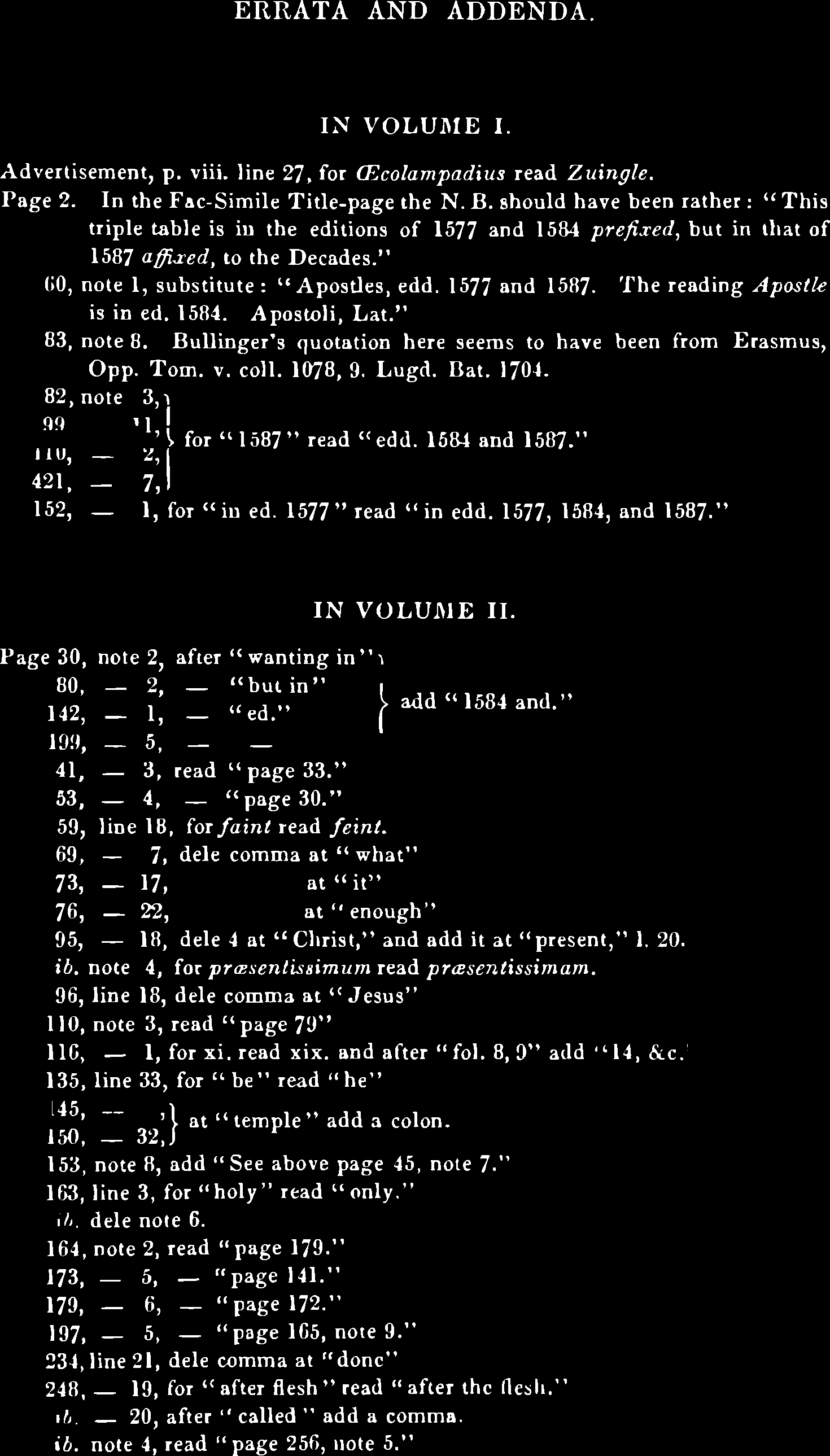
IN VOLUME I.
Advertisement, p. viii.line 27, for (Ecolampadius read Zuingle.
Page 2.
In the Fac-Simile Title-page the N. B. should have been rather :
This triple table is in the editions of
and
prefixed,but in that of 1587 affixed,to the Decades."
60, note 1, substitute : "Apostles, edd.
1577 and 1587.
The reading Apostle is in ed. 1584.
Apostoli, Lat."
83, note 8.
Bullinger's quotation here seems to have been from Erasmus, Opp.
Tom. v. coll. 1078, 9. Lugd.
Bat.
1704.
82, note 3,1 qq ill *' \ for "1587" read "edd.
and 1587."
Jiu, " j, | 421, - 7,!
152, _ 1, for " in ed. 1577
" in edd. 1577, 1584, and 1587."
" read IN VOLUME II.
Page 30, note 2, after "wanting in"\ 80, "
2, "
"but in"
142, _ 1, _ "ed."
[add "1584 and."
199, "
5, "
_ 41, "
3, read "page 33."
53, "
4, _ "page 30."
59, line 18, for faint read feint.
69, "
7, dele comma at " what"
73, _ 17, at "it"
76, "
22, at " enough"
95, "
18, dele 4 at "
Christ," and add it at "present,"
1. 20. ib. note 4, for preesentissimum read prasentissimam.
96, line 18, dele comma at "
Jesus"
110, note 3, read "page 79"
' ' 14, "c.!
" fol. 8, 9" add 116, "
1, for xi. read xix. and after 135, line 33, for " be" read "he"
[4f' at "temple" add a colon.
150, "
32, ) ~~ oo'l " See above page 45, note 7."
1 53, note 8, add 163, line 3, for "holy" read "only."
)'/*.dele note 6.
164, note 2, read "page 1J9."
173, _ 5, "
"page 141."
179, _ 6, "
"page 172."
197, "
5, "
"page 165, note 9."
234, line 21, dele comma at "done"
" after the flesh."
248, "
19, for " after flesh " read "l".
20, after "
" called add a comma.
" page 256, note 5." ib. note 4, read
Y1jj ERRATA AND ADDENDA.

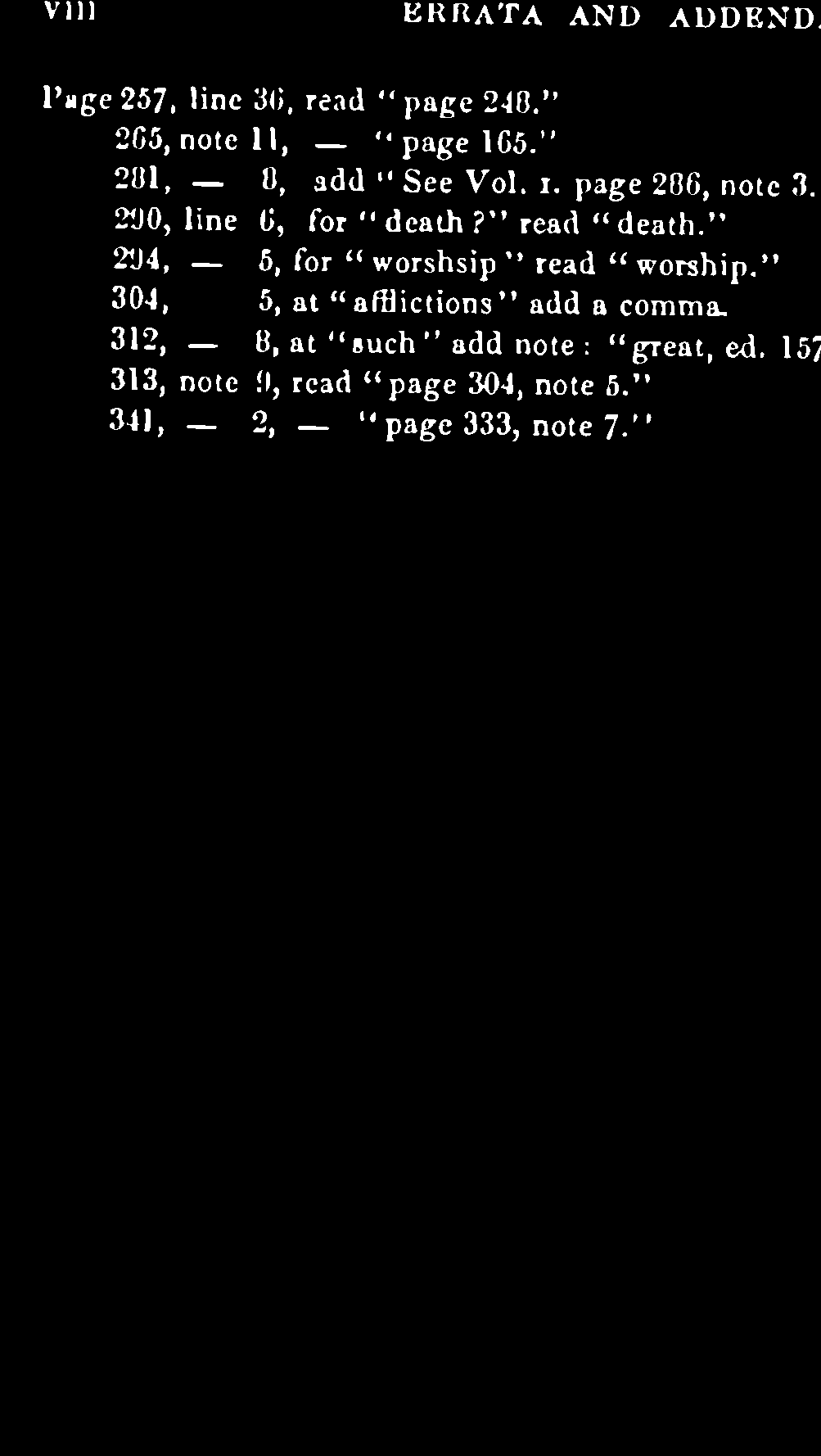
Page 257, line 86, read page 248."
265,notell, page 165."
281, "
8, add "
See Vol. i. page 286, note 3.
290^ line 6, for " death ?" read " death."
294, _ 5, for "
" worshsip read worship."
304( 5, at " afflictions" add a comma.
312,'
8, at "such "
" great, ed.
1577. add note :
313, note (", read " page 304, note 5."
341, _ 2, "
"page 333, note 7-"
FIFTY SERMONS


DIVIDED INTO FIVE DECADES.
[BULLINGER,
n.]
THE
THIRDEAND

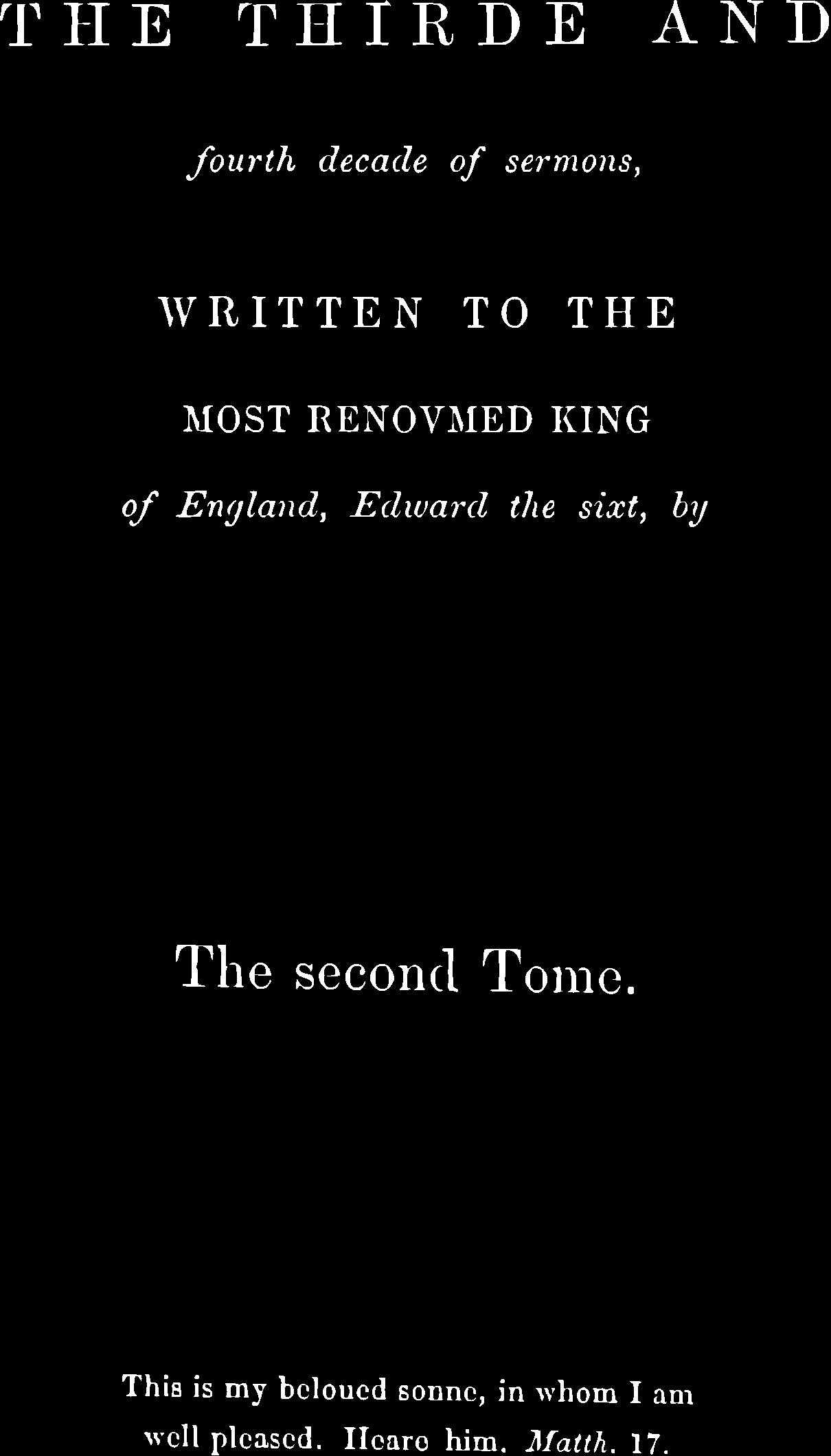
fourth decade of sermons, WRITTEN TO THE MOST RENOVMED KING of England, Edward the sixt, by Ilenrie Bullinger.
The second Tome.
IESVS.
This is my beloucd sonne, in whom I am well pleased.
Heare him.
Matth.
17.
TO THE MOST RENOWNED

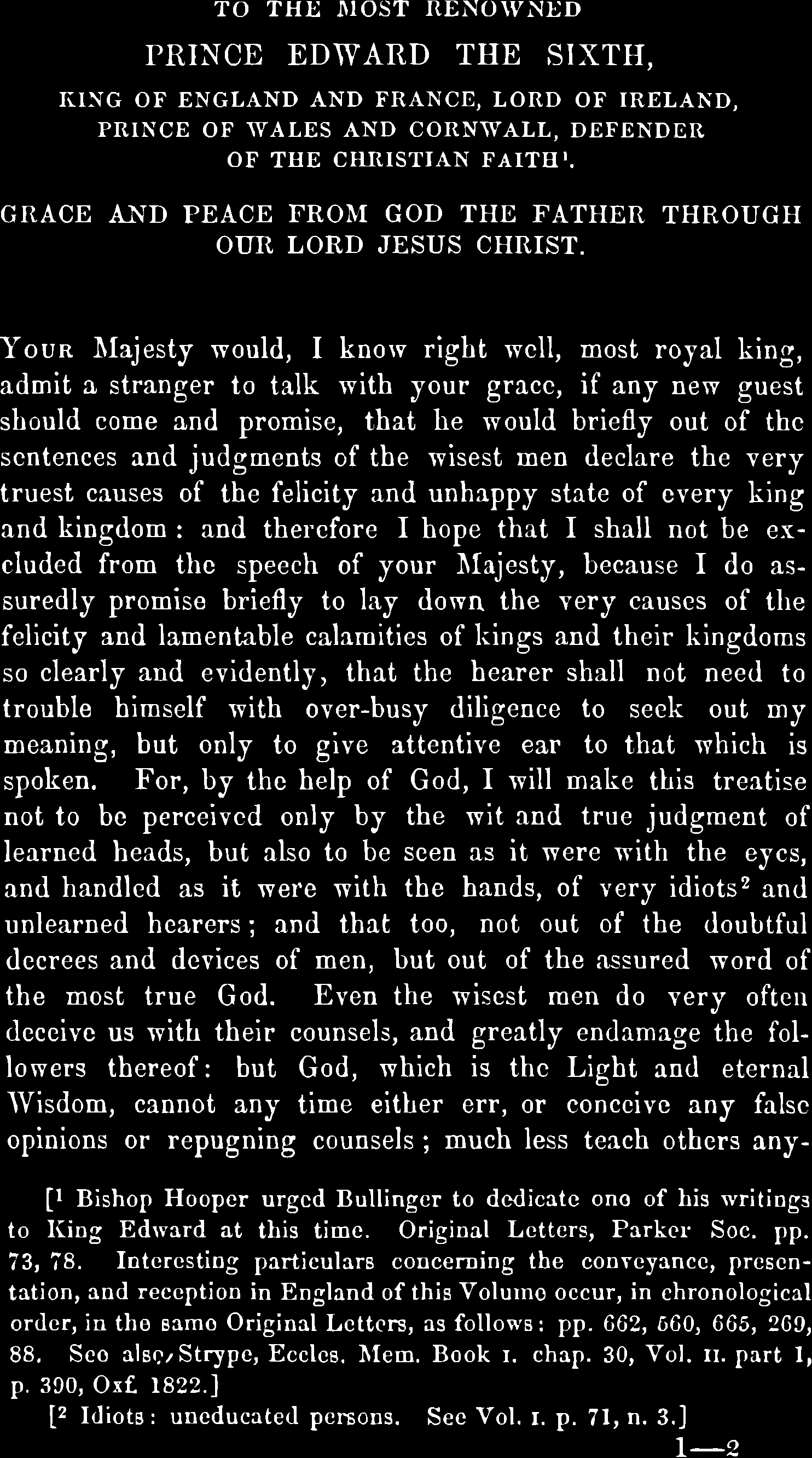
PRINCE EDWARD THE SIXTH, KING OF ENGLAND AND FRANCE, LORD OF IRELAND, PRINCE OF WALES AND
CORNWALL,
DEFENDER OF THE
CHRISTIAN
FAITH1.
GRACE AND PEACE FROM GOD THE FATHER THROUGH OUR LORD JESUS CHRIST.
YOUR Majestywould, I know right well, most royal king, admit a stranger to talk with your grace, if any new guest should come and promise, that he would briefly out of the sentences and judgmentsof the wisest men declare the very truest causes of the felicityand unhappy state of every king and kingdom : and therefore I hope that I shall not be excluded from the speech of your Majesty,because I do assuredly promise briefly to lay down the very causes of the felicityand lamentable calamities of kings and their kingdoms so clearly and evidently, that the hearer shall not need to trouble himself with over-busy diligence to seek out my meaning, but only to give attentive ear to that which is spoken.
For, by the help of God, I will make this treatise not to be perceived only by the wit and true judgment of learned heads, but also to be seen as it were with the eyes, and handled as it were with the hands, of very idiots2 and unlearned hearers; and that too, not out of the doubtful decrees and devices of men, but out of the assured word of the most true God.
Even the wisest men do very often deceive us with their counsels, and greatly endamage the followers thereof: but God, which is the Light and eternal Wisdom, cannot any time either err, or conceive any false opinions or repugning counsels ; much less teach others any- [*Bishop Hooper urged Bullinger to dedicate one of his writings to King Edward at this time.
Original Letters, Parker Soc. pp.
73, 78.
Interesting particulars concerning the conveyance, presentation, and reception in England of this Volume occur, in chronological order, in the same Original Letters, as follows : pp.
662, 660, 665, 269, 88.
See als"?/Strype, Eccles.
Mem.
Book i. chap.
30, Vol. n. part 1, p. 390, Oxf. 1822.] [2 Idiots : uneducated persons.
See Vol.
I. p. 71, n. 3.] 1"2
DEDICATION
TO KING EDWARD THE SIXTH.

thing but truth, or seduce any man out of the right way.
The Wisdom of the Father doth in the holy gospel cry out "
I am the lightof the world : he that followeth and say : me shall not walk in darkness, but shall fiavethe light of life." This eternalwisdom of God, as itdoth not disorderly wrap thingsup together and make them intricate,but layeth down in order and teacheth them plainly; so it doth not only minister wholesome counsels, but bringeth them to the effectwhich they wish that obey her.
Oftentimes, verily, men do give good counsels,that are not unwholesome ; but yet in their counsels that isaltogetheromitted, which should have been firstand especiallymentioned.
All the wise men almost of the world have been of opinion, that kings and kingdoms should be most happy, if the king of the country be a wise man ; if he have many wise, aged, faithful,and skilfulcounsellors; if his captains be valiant, warlike, and fortunatein battle; ifhe abound with substance; ifhis kingdom be on every side surely fortified ; and lastly, ifhis people be of one mind and obedient.
All this I confess is truly,rightly, and very wisely spoken : but yet there is another singularand most excellentthing, which is not here reckoned among these necessaries,without which no true felicity can be attained, nor, being once gotten, can safelybe kept ; when as contrarily,where that one thing is present,all those other necessariesdo of their own1 accord fallunto men, as they themselves can best wish or devise.
The Lord our God therefore, who is the only giver of wise and perfect counsels,doth far more brieflyand bettershut up allshortly, " But seek ye firstrather the kingdom M"tt TL and say in the gospel: of God, and the righteousness thereof, and all these Lukex. things shall easily be given2 unto you."
Again, "Blessed are the eyes which see that ye see: for I say unto you, that many kings and prophets have wished to see the things that ye see, and to hear the things that ye hear, and have Lukext neither heard nor seen them."
And again, "Nay rather, blessed are they that hear the word of God, and keep it,"
And this thing3 above all other is very necessary :
" Mary hath chosen the good part,which shallnot be taken from her."
Having my warrant thereforeout of the W9rd of God, I ["owA wanting in 1687.] [2adjicientur, Lat.] [8this one thing, 1677.]
OF THE
FELICITY,
"C.
KINGDOMS.

dare boldly avow, that those kings shall flourishand be in felicity or "
. calamity of happy case, which wholly give and submit themselves and theirJ"!nB* and fff " o kingdoms. kingdoms to Jesus Christ,the only-begotten Son of God, being King of kings, and Lord of lords; acknowledging him to be the mightiestprince and monarch of all,and themselves his vassals, subjects, and servants : which, finally,do not follow in all their affairstheir own mind and judgment,the laws of men that are contrary to God's commandments, or the good intents of mortal men ; but do both themselves follow the very laws of the mightiest king and monarch4, and also cause them to be followed throughout all their kingdom, reforming both themselves and all theirsat and by the rule of God's holy word.
For in so doing the kingdom shall flourishin peace and tranquillity,and the kings thereof shall be most wealthy, victorious,long-lived, and happy.
For thus speaketh the mouth of the Lord, which cannot possibly lie:
" When the king sitteth upon the seat of his kingdom, Deut. xvu. he shall take the book of the law of God, that he may read in it all the days of his life,that he may do it,and not decline from it either to the right hand or to the left; but that he may prolong the days in his kingdom both of his own life and of his children."
And again, "Let not thejosh-'book of this law depart out of thy mouth,"
(Josue, or thou, " but occupy thy whatsoever thou art that hast a kingdom), mind therein day and night, that thou maycst observe and do according to all that is written therein: for then shalt thou make thy way prosperous, and then shaltthou be happy."
It is assuredly true, therefore,confirmed by the testimony of the most true God, and in express words pronounced, that the prosperity of kings and kingdoms consistethin true faith, diligent hearing, and faithfulobeying the word or law of God : whereas their calamity and utter overthrow doth follow the contrary.
This will I make, as my promise is,in this annexed demonstration, both evident to the eyes,and as it were palpable to the very hands, by the examples of most mighty kings,not taken out of Herodotus or any profane author, but out of the infalliblehistory of the most sacred scriptures. Saul, the firsts"ulking of Israel,was both most fortunate and victorious,so long as he did in allthings follow the word of God : but when he [4seterni,Lat. eternal monarch, ed. 1577.]
DEDICATION
TO KING EDWARD THE SIXTH.

once gave place to his own good intents and meaning, being utterly forsaken of the Lord, he heareth Samuel say to his . face: "Thou hast refused and cast offthe word of the Lord ; therefore hath God also tast thee away, that thou shalt not be king of Israel."
I will not here stand over largely to declare the miseriesand calamities,wherein he was wrapped from that time forward.
For as he himself was horribly haunted and vexed with the evil spirit,so did he not cease to vex and torment his people and kingdom, untilhe had brought them allinto extreme danger, where he and some of his were slain and put to the worst by the heathen, their enemies, leaving nothing behind him but a perpetualshame and endless ignominy.
Next afterSaul doth David succeed in the seat and kingdom, who without all controversy was the most happiest of allother kings and princes.
But what store he did set by the word of the Lord, it is evident to be seen by many notable acts of his, and especially in that alphabeticalpsalm, which in order and number is the hundredth and nineteenth1: for therein he setteth forth the praise of God's word, the wholesome virtue whereof he doth at large wonderfully expound, in teaching what great desire and zeal we ought to have thereto.
For he was schooled and had learned before, by private mishaps and shameful deeds, and lastly,by the unhappy seditionof his gracelessson Absolon, what an evilitis Solomon, to declinefrom the word of the Lord.
Salomon, the son of David, the wisest and most commended king of allthe world, did so long enjoyprosperity and praise at the mouth of the Lord, as he did not neglect with reverence to obey his word.
But when once he had transgressedthe Lord's commandment, straightway the Lord did say unto him :
" Forasmuch as this is done of thee, and that thou hast not kept mine ordinances and my statutes, which I commanded thee, I will rend thy kingdom from thee, and willgive it to thy servant."
And now mark, that, according to that saying, immediately after Salomon's death the kingdom was rent into two parts, and [lThis Psalm isdivided (probably for the advantage of memory), according to the number of letterswhich compose the Hebrew Alphabet, into twenty. two portions, of eight verses each; and not only every portion, but every verse of that portion, begins with the letterappropriated to it.
See Bp Home, Comment, on Psalms, Argum. to Pealm cxix.]
OF THE
FELICITY,
"C.
KINGDOMS.

that ten tribesfollowed Jeroboam, the servant of Salomon ; Koboam.
2 Chron. xn. two tribes clave stillto Roboam, Salomon's son.
He, for neglecting the word of the Lord, and followingafterstrange gods, is overwhelmed with an infinitenumber of woful miseries: for the scripture testifieth,that the Egyptians came up againstHierusalem, and did destroy the city,palace, and temple of the Lord.
Abia, the son of Roboam, overcame the host of Israel,and Abia.
. ill! ijj2 Chron. xiii. bare away a triumphant victory,when he had wounded and slain five hundred thousand men of the ten tribesof Israel: and of this so great a victory no other cause is mentioned, but because he believed the word of the Lord.
Next after Abia did his son Asa, a renowned and most puissant king, reign in his stead ; of whom the holy scripture testifieth, that he abolished all superstition,and did restore sincere religionaccordingto the word of God : whereby he obtained a most flourishingkingdom in peace and quietnessby the space of forty years.
Again, of Josaphat, Asa his son, we read : josaphat 2Chron.xvii.
" The Lord was with Josaphat, because he walked in the ..
", T J "., T l. i I, v
J "
.lU former ways of his father David, and sought not Baalim, but sought the God of his father,and walked in his commandment."
And therefore for his prince-likewealth and famous victorieshe was renowned through all the world.
But to his son Joram, who forsook the word of God, Helias j0ram.
" Because thou hast not walked in the ways the prophet said: of Josaphat thy father,and in the ways of king Asa, but hast walked the ways of the kings of Israel; behold, with a great plague willthe Lord smite thy folk,thy children,thy wives, and all thy goods ; and thou shalt suffergreat pain, even a disease of the bowels, until thy bowels2 fall out."
And whatsoever the Lord threatened to bring upon him by the mouth ofthe prophet, that did the unhappy king feelwith unspeakable torments to his great reproaches : being made an example of wretchedness and misery, which doth lighton all the pates of them that do forsake the word of God.
Neither was the hap of Ochosias3,son to king Joram and Athalia,in oduwias. any point better: for at the commandment of Jehu he was stabbed in,and slainwretchedly ; because he chose rather to follow the laws and ritesof the kings of Israelthan the very
[2Substituted for another word used by the translator.] [3Ahaziah.]
DEDICATION
TO KING EDWARD THE SIXTH.

true laws of the Lord his God.
Moreover Joas, a child yet but seven years old, being by the labour, faith,and diligence of the faithfulpriestJoiada restoredto and settledin the place of his father,who was slain before him, reigned, after the wicked Athalia was put to death, most happily and in a prosperous state, so long as Joiada the priest did live1. But when the high priestwas once departed out of thisworld unto the Lord, the king, being immediately seduced by the malice and wilinessof his wicked counsellors, left off to follow the word of the Lord : and as he ceased to follow the Lord, so did felicityand glory forsake to followhim.
For the Syrians, coming on with a very small power of armed men, do destroy and put to flightan infinitehost of Jewish people ; they put to the sword all Joas his counsellors,and make a spoil of all hiskingdom.
And Joas, for rejecting the Lord, deserved with excessive grieffirstto behold this misery, then to pine away with a long consuming sickness,and lastly,upon his bed, to have his throat cruelly cut of his own household servants.
Amasias2, the son of Joas, isrenowned for a famous vicv' tory which he obtained upon the Idumites, for no other cause but for obeying the word of the Lord.
But afterward,when he began to rebel againstGod and his prophets, he isinbattle vanquished by Joas, king of Israel; by whom when he was spoiled,and compelled to see the overthrow of a great part ofthe wallsof Hierusalem, he was himself at the lastby conspirators entrapped, and miserably murdered.
Next after him suco"i"". ceeded his son Osias3, who also, as well as the father,enjoyed a singularfelicityand most happy life,so long as he gainsaid not the mouth of God : but when he would usurp and take upon him that office,which God had properly appointed to the Levites alone, directlyopposing himself against the word of the Lord, he was stricken with a leprosy, and for his uncleanness was compelled severally4to dwell aloofin banishment from the company of men, even untilhis lastand dying day. jooimm.
Jotham also, the son of Osias, is reported to have been 2 Chron ._ _.
""" wealthy and victorious in his wars : the cause of thisfelicity ['Hujus cnim suggestione et vigilantia ad normam verbi Domini in omnibus respexit rex, Lat. omitted by the translator.
For by his instructions and .watchful superintendence the king had regard in all things to the rule of the Lord's word.] ["Amaziah.] [aUzziah.] ["severally,apart.]
OF THE
FELICITY,
"C.
KINGDOMS.

" Jotham became the scripture doth briefly add, and say : mighty, because he directedhis ways before the Lord his God."
But contrarily,Achaz, the son of Jotham, as he was of allAchaz. the Jewish kings almost the wickedest, so was he in his life"vui. the most unfortunate.
For insomuch as he forsook the law of the Lord his God, the Lord delivered both him and his people firstinto the hands of the king of Syrians, and afterward into the hands of the Israelites,who in one day slew one hundred and twenty thousand Jews, and took captive away with them two hundred thousand women and children.
So Achaz himself, and all that were his, by feeling had proof of all kind of calamities,being made an example to terrify all other that do gainsay the word of God.
The good and godly king Ezechias succeeded hisungodly He father inthe seat and kingdom.
Of him we have thistestimony " He did that which was right in the sight in the scripture: of the Lord, according to allthat his fatherDavid did.
He put away the high places,and brake the images, and cut down the groves, and ail-to5brake the brasen serpent which Moses had made : for unto those days the children of Israelburnt sacrificeto it.
He trusted in the Lord God of Israel.
For he clave to the Lord, and departed not from him, but kept his commandments, which the Lord commanded Moses."
And now, let us hear what followed upon this obedience and faith of his.
The scripturegoeth forward, and saith:
" And the Lord was with him, so that he prospered in allthingsthat he took in hand."
While he did reign, the most ancient and puissant monarchy of the Assyrians was broken and diminished : for when Senacherib, king of Assyria, besieged the city of Jerusalem, the angel of the Lord in one night slew in the Assyrian camp one hundred fourscore and five thousand soldiers. And the king of Babylon also did very honourably by his ambassadors send prince-like gifts unto Ezechias, desiringearnestly his amity and friendship: for the glory of that most godly king was blown abroad, and known in allthe world. Again, when hisson Manasses, a very wicked man, did not "cjjtread the path and express the deeds of his most holy father, but, being made king in the twelfth year of his age, did of purpose cross the word of God, and brought in again all the superstition which his father had abolished, he was taken [5ail-to:entirely.]
DEDICATION
TO KING EDWARD THE SIXTH.

captive and carried away to Babylon : and although, by the goodness and mercy of God, he was restored to his seat again, yet,when he died,he lefta maimed and a troublesome kingdom Ammon. unto his son Ammon ; who also,for his rebellingagainst the word of God, as a most unfortunate man reigned but two years lglxxi' only, and was at the lastwretchedly slainby his own household servants. josiw.
In place of his murdered father was his son Josias settled '*'in the kingdom, being, when he was crowned, a child but eight years old.
Of allthe kings of Juda he was the flower and especial crown.
He reigned quietly and in all points most happily by the space of one and thirty years.
Now the scripture,which cannot lie,doth paint out to our eyes the faith and obedience which he did devoutly shew to the word of God, for which that felicitydid accompany his kingdom.
He was nothing moved with the admonitions of his father Ammon's counsellors; but so soon as he had heard the words of the law read out of the book, which Helkia the high priest found in the temple at Hierusalem, he straightway committed himself wholly to God and his word.
Neither stayed he to look for the minds and reformations of other kings and kingdoms
;but,quicklyforecastingthe best for hispeople,he began to reform the corrupted religion,which he did especiallyin the eighteenth year of his age.
And in that reformation he had a regard always to follow the meaning of the holy scripture alone,and not to give ear to the deeds of hispredecessors, to the prescribedorder of long continuance, nor to the common voicesof the greatestmultitude.
For he assembled his people together,before whom he laid open the book of God's law, and appointed allthings to be ordained according to the rule of his written word.
And thereupon it cometh which we find written,that he spared not the ancient temples and long accustome rites,which Solomon and Jeroboam had erected and ordained againstthe word of God.
To be short,this king Josias pulled down, and overthrew, whatsoever was set up in the church or kingdom of Juda against the word of God.
And lest,peradventure, any one should caviland say, that he was over hardy and too rough in his dealings,the scripturegiveth thistestimony of him, and saith: "Like unto him was there no king before him, which turned to the Lord with all his heart, with allhis soul,and allhis might, accordingto allthe
OF THE
FELICITY,
"C.
KINGDOMS.

law of Moses : neither afterhim arose there any such as he."
Whereas we read therefore,that this so commended and most fortunate king was overcome and slainin a foughten battle, that death of his isto be counted a part of his felicity, and not of his misery.
For the Lord himself said to Josias: "I willra * ["Kingsxxn. gather thee unto thy fathers,and in peace shaltthou be buried,ltt that thineeyes may not see allthe evilwhich I willbring upon this place."
For there is no greater argument, that the people and very princesof the kingdom under that most holy king were mere hypocritesand idolaters,than forbecause, next and immediately after his death, both his sons and peers, rejecting the word of God, did bring in again allsuperstition and blasphemous wickedness.
Whereupon we read that for the whole twenty-two years, wherein the kings of Juda did reign after the death of Josias,there was no peace or quietness in Hierusalem, but perpetual seditionsand most bloody murders.
Next after Josias reigned his son Joachas : but Joacha.".. within three months after he was taken, bound, and led capj^honTi " tiveaway into the land of Egypt.
After the leadingaway of 2 KingiKiH.
Joachas, his brother Joachim ware the crown : who in the eleventh year of hisreign,being bound in chains,was slainby Nabuchodonoser, and lastly(asJeremy saith) was buried in the rjer. xx".
8; sepulchreof an ass l.
In Joachim's stead was his son Jechonias set up; but,about three months after,he with his princesand substancewas taken captiveand led away to Babylon.
After him the kingdom was given to Zedechias, the son of Josias: but, because he would not obey the word of God preached by the prophet Jeremy, he loseth both his lifeand kingdom in the eleventh year of his reign : in whose time also the temple is set of fire,Hierusalem2 is sacked, and the people slain for the most part, or led away captive.
Thus much hitherto touching the kings of Juda.
For in Zedechias both the kingdom and majesty or dignitythereof did failand make an end.
To these if we add the ends and destiniesof the kings of The kings of Israel,we shallagain be compelled to confess,that allfelicity of kings and kingdoms do consistin hearing and followingthe word of God ; and that contrarily,calamitiesand miseriesdo rise by the contempt and neglectingof the same.
For Jero- [*sepultura asini,Lat.] [2sedes regni Tctustissima, Lat. omitted : the most ancient scat of the kingdom.]
DEDICATION
TO KING EDWARD THE SIXTH.

boam, the firstking of the separated Israelites,lettingpass the word of God, did ordain new rites to worship the Lord by, and erected new temples ; but by so doing he overthrew xii. himself, his house, and all his kingdom.
After him doth Baasa succeed both in the kingdom and idolatrousreligion, n King. xv. which was the cause why he and his were utterly destroyed.
""'-"o Then followethAmri, the fatherof Achab; who, foraugment- "-*"".) ing idolatrousimpiety,is horribly slainwith allhis family, so that not one of his escaped the revenging sword ofGod's anger and jealousy.
And for because Jehu was faithfuland valiant in killingthose tyrants, in dispatching Baal's priests,and rooting out of idolatroussuperstition,the Lord doth promise, rz King* x. and say unto him:
"Because thou hast zealouslydone that which thou hast done, according to all that is right in my sight1,therefore shallthy children,unto the fourth generation, siton the seat of Israel."
And we read verily,that his sons and nephews were notable princes, which succeeded in the kingdom, even Joachas, Joas, Jeroboam the second of that [2Kingsxu name, and Zacharias.
The other kings, as Sellum, Manahe2, Pekaiah, Peka, and Osee, had their kingdom altogetherliketo the kingdom of the son of Josias,to wit, in a seditious,troublesome, and a most miserable taking.
For they despisedthe [2 King* XT. mouth of the Lord : therefore were they utterly cut off,and for the most part either slain,or carried away captive,by theirenemies the Assyrians.
From the divisionof the people into two several kingdoms after the death of Solomon, there were innumber nineteen kings of Israel,and eighteen of Juda.
The kingsof Israelaltogetherreigned about two hundred and seventy-two years,and they of Juda about three hundred and ninety-three3. Now by the space of so many years, in the most renowned and peculiar people of God, which was as it were a glass set before the eyes of allnations to view and behold themselves in,there might the truest causes of felicity and calamitiesof allkings and kingdoms in the whole world be so lively represented and perfectly painted, that there f1juxtaomnia quse fucrunt in corde meo, Lat.] [2Manahem, Lat.] [3Strictlyspeaking, the number of the kings of Judah was 19," not including Atbaliah's usurpation.
According to Usher, the kingdom of Judah lasted 388 years; and the kingdom of Israel 254 years.
Annal.
Vet. Test.]
OF THE
FELICITY,
"C.
KINGDOMS.

should be no need to fetch from elsewhere a more plain and evident demonstration of the same.
And yet for all that, we are not without other foreignForeign k" examples, whereby to prove it. For the Pharaos of Egypt were the destruction both to themselves and also to their* kingdom, by5 their stubborn rebellionagainst God's word.
Again, Darius Priscus6 and the great Nabuchodonosor enjoyed no small felicity,because they despised not the counsels of Daniel.
Balthasar, king of Babylon, a despiteful contemner of God and his word, is in one night destroyed with all his power : Babylon, the most ancient and famous cityof the world, istaken, set on fire,sacked,and overthrown, and the kingdom translated to the Medes and Persians.[Dan.iv-vi ] Neither were the kings of Persia unfortunate at all,I mean,
Cyrus, and Darius, otherwise called Artaxerxes7; because Kings which they favoured the word of God, and did promote his people God*" word, and true religion.
But on the other side we read that Anwhich 4*secuted the tiochus, surnamed8 Epiphanes, was most unfortunate ; who, as it were, making war with God himself,did most wickedly burn and make away the books of holy scripture9. Furthermore, we have as great store of examples, also, even out of those historieswhich followed immediately the time of Christ his ascension.
For so many Roman emperors, kings, and princes as persecuted the preaching of the Gospel and Church of our Lord Jesus Christ, and advanced idolatryand superstitiousblasphemy, so many, I say, did die a foul and shameful death.
Of this are Eusebius and Orosius,renowned historiographers,assured witnesses10.
Again, St Augustine, Lib. v. de Civit.Dei, affirmeth,that incrediblevictories,very great glory, and most absolute felicityhath been given by God unto those kings, which have in faithsincerelyembraced
[4vetustissimum, Lat.; omitted by the translator:" most ancient.] [5sola, Lat. ; omitted by the translator : by nothing but by their rebellion.] [6i.e., Darius the Mede, or Cyaxares the second, uncle of Cyrus.
Bulling, in Apocalyps.
Serm.
LXXI.
See also Vol.
I. p. 51. n. 3.] [7 See Vol. i. p. 318, note 1.] [8licet cognominatus, Lat ; although surnamed.] ["iMaccab. i.20
57. Prideaux's Connection, Vol. n. pp. 172
188, ed. Me Caul. Lond.
1845.] [10Euseb, Hist. Eccles. Lib. vm. cap. 16.
Oros. adr. Pagan.
Hist.
Lib. VII. capp. 7, 22, "c.l
DEDICATION
TO KING EDWARD THE SIXTH.

Christ their Lord, and utterly subverted idolatry and superstitious blasphemy1.
It is evident therefore, that felicity cometh by good-will and obedience to the word of God, and that allkings and kingdoms shall be unhappy, which forsake the word of God, and turn themselves to men's inventions.
And this I have, I trust, declared hitherto so plainly, that the hearers may seem not only to understand, but also to see before their eyes, and as it were to feelwith their hands, the pith and material substance of thiswhole treatise.
But whereunto doth all this tend ?
That your royal Majesty, forsooth, may undoubtingly know, and be assuredly persuaded, that true felicityis gotten and retained by faithful study in the word of God : to wit, if you submit yourself altogether and your whole kingdom to Christ, the chief and highest prince ; if,throughout your whole realm, you dispose and order religion,and all matters of justice, according to the rule of God's holy word ; if you decline not one hair's breadth from that rule, but study to advance the kingdom of Christ, and go on (ashitherto you have happily begun) to subvert and tread under foot the usurped power of that tyrannical antichrist.
Not that your Majestyneedeth any whit at all mine admonitions or instructions: for you have undoubtedly that heavenly teacher in your mind (I mean, the Holy Ghost2),which inspireth you with the very true doctrine of sincere and true religion. Your Majestyhath the sacred Bible, the holiestbook of all books, wherein, as in a perfect rule, the whole matter of piety and our true salvation is absolutely contained and plainly set down3.
Your Majesty hath noble men, and many counsellors,belonging to your kingdom, faithful,valiant,and skilfulheads both in the law of God and men, who for their wisdom and love that they bear to the sincere truth are greatly commended among foreign nations.
And for that cause all the faithful do think and call your Majesty most happy.
But that happy king Ezechias, although [* Aug. de Civit. Dei, Lib. v. cap. 24.
Qua) sit Christianorum imperatorum, et quam vera felicitas. See also Vol.
I. p. 385, n. 3.] [aNot in the original Lat.] [3 Habet doctos, sapientes, pios, fidcles in regno doctores et pastores multos, Lat. omitted by the translator : (yourmajesty) hath in your kingdom many learned, wise, pious, and faithful teachers and pastors.]
OF THE
FELICITY,
"C.
KINGDOMS.

he did especially use the help of those excellent men Esay and Micheas, did not despise faithfuladmonishers, even among the meanest sort of Levites : neither thought they, that in [2 chron. xxx" a admonishing the king they lostand spent theirlabour in vain4.
I therefore, having good affiancein your Majesty's good and godly disposition,do verily hope, that this short discourse of mine, touching the true causes of the felicityand calamities of kings and kingdoms, shall have a profitingplace5 with you.
Even I, which twelve years since did dedicate unto your father of famous memory, Henry the Eighth, a book touching the authority of the holy scripture, and the institutionand function of bishops6, against the pontificalchuffs7 of the Romish superstitionand tyranny ; and now by experience know, that that labour of mine brought forth no small fruit within the realm of England ; am now so bold again as to dedicate these my sermons unto your royal Majesty.
In these sermons I handle not the leastand lowest points or places of Christian religion,the law, sin/grace, the Gospel, and repentance.
Neither do I, as I think, handle them irreligiously.
For I use to confer one scripture with another; than which there is no way better and safer to follow in the handling of matters touching our religion.
And for because you are the true defender of the Christian faith,it cannot be but well8 undoubtedly, to have Christian sermons come abroad under the defence of your Majesty's name.
My mind was, according to mine abilityand the measure of faith which is in me, to further the cause of true religion,which now beginneth to bud in England, to the great rejoicing of allgood people.
I have therefore written these sermons at large,and handled the matter so, that of one many more may be gotten: wherein the pastor's discretion shall easily [4oleum et operam perdere, Lat.] [5et locum et fructum habituram, Lat.] [6Interesting particulars of the reception of this book in England in
occur in Original Letters, Parker Soc. pp.
611, 618.
See also p. 313 for a testimony to the usefulness of Bullinger's writings in England.] [Tantistites,Lat. ; chuff, a word of no certain etymology, but signifying a rough uneducated clown of portly appearance.
Toone's Glossary, in voc.
Lond.
1834.
See Shakspeare's Henr.
IV.
Part i. Sc. 2, Act 2, "
" ye fat chuffs."] [8minime erit ingratum, Lat.]
DEDICATION
TO KING EDWARD THE SIXTH.

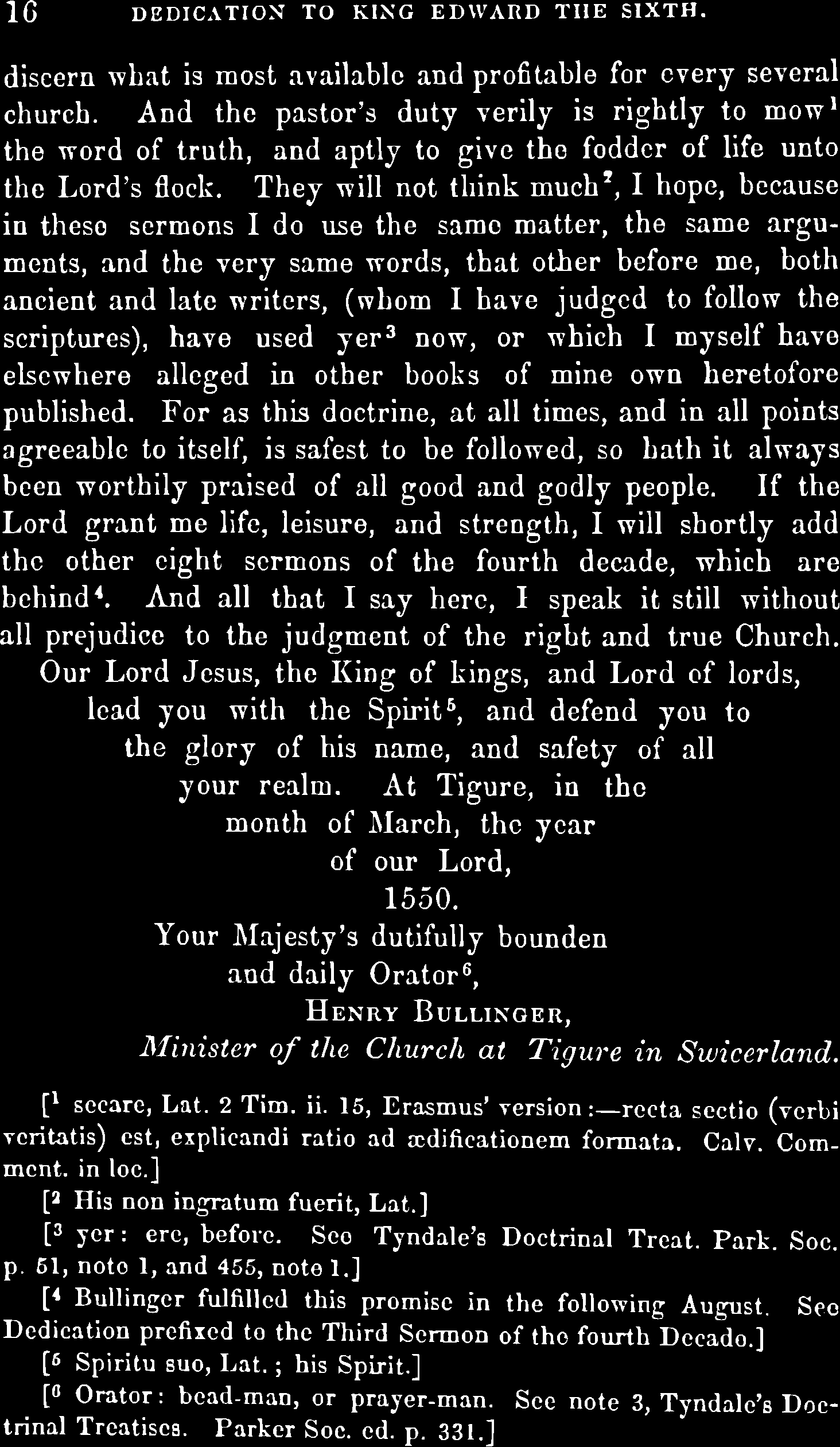
discern what is most available and profitable for every several church.
And the pastor's duty verily is rightly to mow1 the word of truth, and aptly to give the fodder of life unto the Lord's flock.
They will not think much2, I hope, because in these sermons I do use the same matter, the same arguments, and the very same words, that other before me, both ancient and late writers, (whom I have judged to follow the scriptures), have used yer3 now, or which I myself have elsewhere alleged in other books of mine own heretofore published.
For as this doctrine, at all times, and in all points agreeable to itself,is safest to be followed, so hath it always been worthily praised of all good and godly people.
If the Lord grant me life,leisure, and strength, I will shortly add the other eight sermons of the fourth decade, which are behind4.
And all that I say here, I speak it still without all prejudiceto the judgment of the right and true Church.
Our Lord Jesus, the King of kings, and Lord of lords, lead you with the Spirit6, and defend you to the glory of his name, and safety of all your realm.
At Tigure, in the month of March, the year of our Lord, 1550.
Your Majesty'sdutifully bounden and daily Orator6, HENRY
BULLINGKR,
Minister of the Church at Tigure in Swicerland. t1 secare, Lat.
2 Tim. ii.15, Erasmus' version :" recta sectio (verbi veritatis) est, explicandi ratio ad adificationem formata.
Calv.
Comment, in loc.] [2 His non ingratum fuerit, Lat.] [3 yer : ere, before.
See Tyndale's Doctrinal Treat.
Park.
Soc. p. 61, note 1, and 455, note 1.] [" Bullinger fulfilled this promise in the following August.
See Dedication prefixed to the Third Sermon of the fourth Decade.] [6 Spiritu BUO, Lat.
; his Spirit.] [6 Orator : bead-man, or prayer-man.
See note 3, Tyndale's Doctrinal Treatises.
Parker Soc. ed. p. 331.]
THE

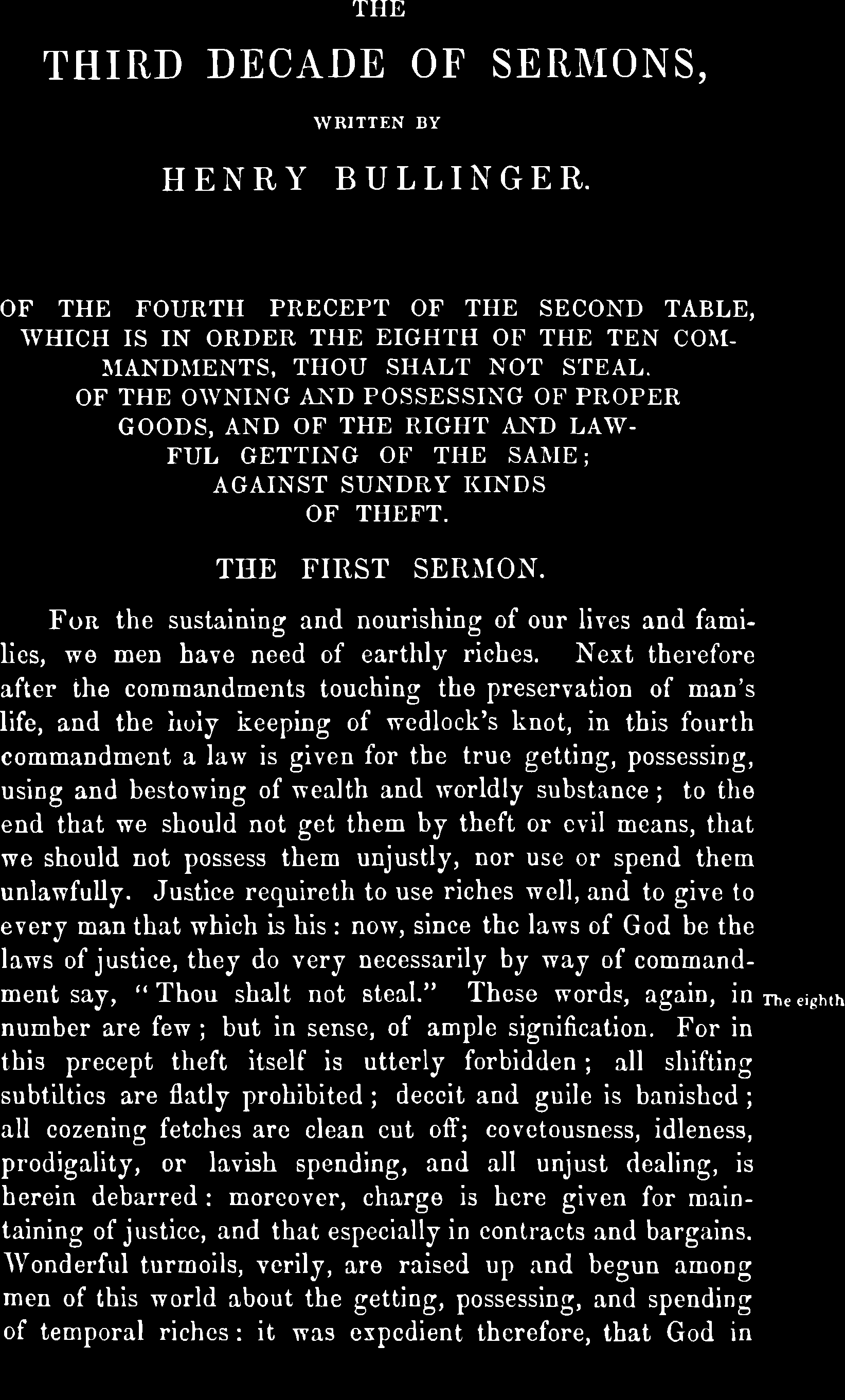
THIRD DECADE OF SERMONS, WRITTEN BY HENRY
BULLINGEB.
OF THE FOURTH PRECEPT OF THE SECOND TABLE, WHICH IS IN ORDER THE EIGHTH OF THE TEN COM-
MANDMENTS,
THOU SHALT NOT STEAL.
OF THE OWNING AND
POSSESSING
OF PROPER GOODS, AND OF THE RIGHT AND LAWFUL GETTING OF THE SAME; AGAINST SUNDRY KINDS OF THEFT.
THE FIRST SERMON.
FOR the sustainingand nourishing of our livesand families, we men have need of earthly riches.
Next therefore after the commandments touching the preservation of man's life,and the holy keeping of wedlock's knot, in this fourth commandment a law is given for the true getting,possessing, using and bestowing of wealth and worldly substance ; to the end that we should not get them by theft or evil means, that we should not possess them unjustly, nor use or spend them unlawfully. Justicerequireth to use riches well,and to give to every man that which ishis : now, since the laws of God be the laws of justice, they do very necessarily by way of commandment say, "Thou shalt not steal."
These words, again, in The eighth number are few ; but in sense, of ample signification.For in this precept theft itselfis utterly forbidden ; all shifting subtiltiesare flatlyprohibited; deceit and guile is banished ; all cozening fetches are clean cut off; covetousness, idleness, prodigality, or lavish spending, and all unjustdealing, is herein debarred : moreover, charge is here given for maintaining of justice, and that especiallyin contracts and bargains.
Wonderful turmoils, verily,are raised up and begun among men of this world about the getting,possessing,and spending of temporal riches : it was expedient therefore,that God in
[BULLINGER,
n.]