
The Tenth Sermon
THE THIRD DECADE.
[SERM.

OF SIN, AND OF THE KINDS THEREOF; TO WIT, OF ORIGINAL AND ACTUAL SIN, AND OF SIN AGAINST THE HOLY GHOST:
AND LASTLY, OF THE MOST SURE AND JUST PUNISHMENT OF SINS.
THE TENTH SERMON.
WE have lastlynow to discourse of sin, which, as I told you, is to be referred to the treatise of the law.
Of which that I may lawfully,religiously,rightly,and profitablyspeak to the edifying of you all,I shall desire you to make your humble prayers with me to God the Father, in the name of Christ his Son, our gracious Lord and Mediator1.
The name of Sin is of most men taken for error ; for that, I mean, u^"iTitere whereby we do not only err from the thing which is true, right,justand good, but do also follow and decline to that which is naught.
The Latins derive their word peccatum, sin,of pellicatus,whore-hunting ; which is a fault of wedded people that are corrupted with the spiritof fornication,as when men prefer harlots before their lawful wives.
And this definition,verily,doth wonderfully agree to this present treatise.For allwe that do believe are by faithhand-fasted to our God, as to our spouse and husband : if therefore we prefer other gods before him, or choose rather to serve them; if,I say, we let pass the true goods in deed, to follow the shadow of goods, vain hopes, and the pernicious pleasures of this world; then do we sin indeed, and commit fornication against our spouse and husband8.
But the learned sort do for the most part put a differencebetwixt peccatum and delictum, which both, in effect,do signify sins3: but they call that delictum, when the thing is not done that should be done ; and that they callpeccatum^ when that is done that should be leftundone.
St Hierome seemeth to have taken delictum for the firstfall to sin4. f1The Father "
Mediator, added by the translator.] [2and " husband, an addition of the translator's.] [3which " sins,the translator's.] [4 " quserimus quid significent(delicta), quove distent a peccatis..
Aiunt enim quod TrapaTmo/iiara (delicta) quasi initiapeccatorum sint : cum cogitatiotacita subrepit, et ex aliqua parte conniventibus nobis, necdum tamen nos impulit ad ruinam .
. Peccatum vero esse, quum
OF SIN, AND OF THE KINDS THEREOF.
IX.] St Augustine sayeth that peccatum is committed of him that sinneth wittingly,and delictum of him that sinnneth of ignorance5.
I see that those words are in some places confounded, and that the one is used for the other.
In some places the error, or delictum, is used as the milder term; peccatum, in a more grievous sense ; and an heinous crime, a mischief,a revolting or wickedness, for the greatestof all6.
For St Augustine saith: "Neither is every peccatum crimen1, because every crimen is peccatum."
Therefore we say, that the lifeof a man8 living in this transitory world may be found to be without that heinous offence,crimen, for which allthe world doth cry out upon and accuse him9: but "if we say we have nullum peccatum, no sin,"(asthe apostlesaith,) [iJohn i.so " we deceive ourselves,and the truth is not in us."
Among the Hebrews sin is calledby sundry names, which do import and signify overthwartness, perverseness, a fault,an error, a revolting,infirmity,vice, ignorance, and transgression.
For to transgress doth signify to depart from the truth10, from our duty or office,not to keep the right path, but to turn away from the prescriptrule of the law of God.
Now that rule, or law of God, is of the Hebrews called Thora, that is to say, a direction,or a leading by the hand11; for it doth direct a man in the ways that are acceptable to the Lord : and therefore the Greeks call sin by the names of di'0'j.ia Kal -n-apavofjiia.Again, in the Hebrew tongue, sin is as much to say as a turning away from good to evil; also a revolting,as when thou drawest thy neck from out of the yoke of his power to whom thou art a servant : finally, it signifieththe crime or guilt whereby we endanger ourselves to the rod of punishment. quid opere consummatum pervenit ad finem.
Hieron.
Comment, in Ep. ad Ephes. cap. 2, Tom. iv. col. 338, Par. 1706.] [6Potest etiam yideri illud esse delictum quod imprudenter, id est, ignoranter ; illud peccatum quod ab scicnte committitur.
Aug. Qusest. sup. Levit. cap. 20, Opp.
Tom. iv. fol. 43, col. 2, Par. 1631.] [6Crimen vero, scelus, defectionem et impietatem intiltogravisfiimam, Lat. ; but crimen for heinous wickedness, "c.] [7Neque enim quia peccatum est omne crimen, ideo crimen est "
Aug.
Enchir. ad Laurent, cap. 64, Opp.
Tom. etiam omne peccatum. in. fol.37, col.4.] [8sanctorum hominum, Lat. ; of saints.] [9for which " accuse him, added by the translator.] [10a recto, Lat.] [n See Decade i. Serm. i. p. 49.}
THE THIRD DECADE.
[sERM.

ihedefiniVerily St Augustine taketh much pains to find out a tionofsin.
* "
""-.
^ proper definitionof sin.
In his second book De Consensu " Sin is the transgressionof the law l."
Ad Simplicianum, Lib. i. :
Evangelistarum he saith:
" Sin is an inordinateness or perverseness of man ; that is, a turning from the more excellentCreator, and a turning to the inferiorcreatures2."
De fide contra Manichceos, cap. 8, he saith:
" What is itelse to sin, but to err in the precepts of truth, or in the truth itself3?" Again, Contra Faustum Manichceum, Lib.
Sin is a deed, a word, or a wish, against the law of God4."
The same Augustine, De duabus anixxn. cap. 27
: mabus contra Manichceos, cap. 11, saith:
Sin is a will to retain or obtain that which justice forbiddeth,and is not free to abstain5."
And In Retract.
Lib. i. cap. -15, he saith:
" That will is a motion of the mind, without compulsion, either not to lose or else to obtain some one thing or other6."
All which definitionsas I do not utterly reject, so do I wish this to be considered and thought of with the rest :
Sin is the natural corruption of mankind, and the action which ariseth of it contrary to the law of God, whose wrath, that is,both death and sundry punishments, it bringeth upon us.
Thou hearest how well this definitiondoth consist upon his parts.
Thou hearest in it of our natural corruption ; in the naming whereof appear eth, how this definition [!Porro peccatum est legistransgressio.
Aug. de Consens. Evang.
Lib.
II. cap. 4, Tom. iv. fol. 85, col. 4.] [2Est autem peccatum hominis inordinatio atque perrersitas; id est, a pracstantioreconditore aversio, et ad condita inferiora conversio.
"Id. ad Simplic. Lib. I. Tom. iv. fol.135, col. 3.] [3Peccare enim quid aliud est, nisi in veritatis prseceptis,vel in ipsa en-are veritate ?"
Id. de Fide con.
Manich. cap. 8, Tom. vi. fol.
117, col. 4.] [4Ergo peccatum est factum, vel dictum, vel concupitum aliquid contra seternam legem.
Id. cont.
Faust. Manich.
Lib. xxn. cap. 27, Tom. vi. fol. 84. col. 1.] [6Ergo peccatum est voluntas retinendi vel consequendi quod justitiavetat, et unde (Bullinger reads, et non, probably by mistaking the abbreviation in old copies et "n.)liberum est abstinere "
Id. de duab. anim. cont. Manich. cap. 11, Tom. vi. fol. 32, col. 2.] [6Ipsam voluntatem definivi dicens:
Voluntas est animi motus, "
Id. cogente nullo, ad aliquid vel non amittendum vel adipiscendum.
Retract. Lib. I. cap. 15, Tom.
I. fol.5, col. 3.]
OF SIN, AND OF THE KINDS THEREOF.

X.] doth not agree to the sin of our firstparents, in whom there was no natural corruption : of which I mean to speak in place convenient.
Thou hearest the action named, which ariseth of the natural corruption, and is repugnant to the law of God.
Thou hearest that sin doth bring upon us the wrath of God, that is, death and sundry sorts of punishments appointed by the mouth of God to plague us for our sins.
Of which I will speak in order as they lie,so far forth as the Lord shallgive me grace and ability.
Now therefore it seemeth that this treatisemay most The cause or aptly be begun at the discussing of the original cause and *". beginning7 of sin. Some there be that do derive the original cause of evil or sin from the influence of the planets,saying, "
I sinned, because I was born under an unlucky planet."
Other there are, which, when they sin and are " Not I, but the devil rebuked for it,do make this answer : is in fault,that I have committed thisgrievous crime."
And sometime, laying aside all excuses, they8 do directly cast the blame upon God, and say :
Why, God would that it should be so ; for if he would not have had it so, I had "
Since God could have letted not sinned."
Another saith: it,and would not, he is the cause and author of my sin."
But it is no new thing now that men do whet their blasphemous tongues against God, the maker and ruler of all things; for our first parents, when they had sinned and were accused of it by God himself, found a shift for to translatethe sin,which they committed, from themselves to other, and would not confess the truth as it was in very deed.
Such is the abominable wickedness of man.
For Adam, as itwere, answering God overthwartly, casteth the fault of his offence,not only9 upon his wife which God had coupled unto him, but alsoupon God himself.
" The woman,"
[oen.HI 123 saith he, "whom thou gavest to be with me, gave me of the tree10, and I did eat."
As if he should have said : If thou hadst not given me the woman, I had not sinned.
But the Lord coupled him to a wife, not to the end that she should be an occasion of evil,but that the man might be in p et auctore, Lat. omitted ; and author.] [8homines, Lat. ; men.] [9 non tarn " quam, Lat.; not so much upon his wife, as upon God.] [10dedit mihi poraum, Lat. ; gave me the apple.]
THE THIRD DECADE.
[sERM.

the better case and condition.
Again, the woman doth simply impute the cause of that evilunto the devil,saying :
" The serpent beguiled me, and I did eat."
Lo, these are most corrupt,false,wicked, and detestableopinions touching the originalcause of sin,wherewith the justice and truth of t God is mightily offended.
Neither is the nature of man ofesinause the cause of sin.
For God, which created all things, did also create the nature of man, and made it good, even as allthings else which he created were also good1.
Therefore the nature of man was good.
For it is an accidentalquality that happened to man either in, or immediately after, his fall,and not a substantialproperty, to have his nature so spotted with corruption as now it is8.
Now we, being born in sin of sinfulprogenitors, have sin by descent as our natural property ; for St Augustine, writing, De
Fide " And if we say that any contra Manichceos, cap. 9, saith: men are evil by nature, we mean, that they are so because of the originaldescent of our firstparents' sin,wherein we mortal men are wholly born3."
But this now requireth a more exact and ample declaration.
The devii That the devil alone is not the author of sin, so that, alone is not ^egi^use when we sin, the blame thereof should redound to him, and we that sinned escape without fault,this doth greatly argue ; because it is in his power to egg and persuade, but not to enforce a man to do evil. For God by his power restraineth the devilfrom being able to do the thing that he would do : he can do no more than God permitteth him to do.
For if he had no power over an herd of filthyswine, how much less authorityhath he over the excellentsouls of God's most excellent creatures !
He hath, I confess,great subtilties, and more than rhetoricalforce,wherewith to persuade us : but God is stronger, and never ceaseth to prompt good and wholesome counsels unto the souls of his faithfulservants.
Neither doth he permit more to Satan than is for our commodity : as is to be seen in the example of that holy man, the patientJob ; and [!valde bona, Lat. ; very good.] [2mox ab initio tails qualis mine est indita, Lat. ; which is even from the firstimparted so as it now is.] [3 Sed et si aliquos naturaliter dicimus malos, propter originem veteris peccati dicimus, in quo jam nostra mortalitas nascitur.
August. de Fide cont.
Manich. cap. 9, Opp.
Tom. n. fol.117, col.4.]
OF SIN, AND OF THE KINDS THEREOF.

X.] also in the example of Paul, 2 Cor. xii.,and in his words, saying, " God is faithful,which will not suffer us to be tempted above that we are able to bear4."
They therefore are vainly seduced, which cast the fault of their sin upon the devil's shoulders.
To proceed: if thou demandest of them which lay the That destiny blame of their sin upon their evildestiny, what destiny is? cause of "n. they will answer, either that it is a course knit together by eternity and linked to itself,as it were a certain chain and continual row of counsels and works necessarilyfollowing one upon another's neck according to the dispositionand ordinance of God ; or else that it is the evil stars or planets.
Now, ifthou demandest again, who made the stars ? they have none other answer but God : it followeth therefore, consequently, that they enforce the cause of their sin upon God himself.
But allthe ancient and best philosophers did never pretend or allege destiny, much less such Christiansas did freely confess the mighty power of their God and Maker6.
And even among our men, I mean, among them that would seem to be Christians,they which stood in the opinion of destiny and constellations,were such kind of fellows as wise men would be ashamed to follow them as authors.
Bardesanes6 imputed to destiny the conversations of mortal men.
And the Priscillianists, who were condemned in the firstcouncil held at Toledo, thought and taught that man is tied to fatal stars, and hath his body compact according to the twelve signs in heaven, placing Aries in the head, Taurus in the neck, and so consequently to every sign his several limbs7. St [4 1 Cor. x.
13, vos " potestis,Lat.] [5 as did " maker, not in Lat.] [6Bardesanes was a Syrian, of Edessa, and lived in the second century of the Christian era.
Euseb.
Hist. Eccles. Lib. iv. cap. 30.
Mosheim, Eccles. Hist. Book i. cent.
2, part 2, chap.
5, "8.] [7Astruunt etiam (Priscillianistse) fatalibus stellishomines colligatos, ipsumque corpus nostrum secundum duodecim Bigna coali esse compositum, sicut hi qui mathematici rulgo appellantur : constituentes in capite arietem, taurum in cervice, geminos in humeris, cancrum in pectore; et cetera nominatim signa percurrentes, ad plantas usquo perveniunt, "c.
August, de Hseres. cap. 70, Opp.
Tom. vi. fol. 6, col.
Priscillian lived in the middle of the fourth century, in Spain.
Mosheim, Eccles. Hist. Book n.
Cent.
4, part 2, chap. 5, ""21, 22. "
The firstcouncil of Toledo was held A.D.
405.]
THE THIRD DECADE.
[sERM.

Augustine, In opusculo LXXXIII. qucestionum, Qucest.
45, confuting soundly the destiniesof planets,among other his reasons " The conceivingof twins in the mother's womb, because destiny.
Against saith:
....
, it is made in one and the same act, as the physicians testify (whosedisciplineis far more certainand manifest than that of the astrologers), doth happen in so small a moment of time, that there is not so much time as two minutes of a minute betwixt the conceiving of the one and the other. How therefore cometh it,that in twins of one burden there is so great a diversityof deeds, wills,and chances, considering that they of necessity must needs have one and the same planet in their conception,aud that the mathematicals do give the constellation of them both as ifit were but of one man1 ?
To these words of St Augustine great lightmay be added, ifyou annex to them and examine narrowly the example of Esau and Jacob's birth and sundry dispositions. The same Augustine, writing to Boniface against two epistlesof the Pelagians,Lib.
" They which affirm that destiny doth rule, ii. cap. 6, saith: will have not only our deeds and events, but also our very wills,to depend upon the placing of the stars at the time wherein every man is either conceived or born, which placing they are wont to call constellations. But the grace of God doth not only go above all stars and heavens, but also above the very angels themselves.
Moreover these disputers for destiny do attributeto destiny both the good and evil that happen to men.
But God, in the evils that fallupon men, doth duly and worthily recompense them for theirilldeserts: but the good, which they have, he doth bestow upon them not for their merits, but of his own favour and merciful goodness through grace,that cannot be looked for of duty ; laying both good and evil upon us men not through the temporal course of planets,but by the deed and eternal counsel of his severity and goodness.
So then we see that neither the fallingout of [! Conceptus autem geminorum, quoniam uno concubitu efficitur attestantibus medicis, quorum disciplina multo est certior atque manifestior,tarn parvo puncto temporis contingit, ut in duas minutas minutarum non tendatur.
Unde ergo in geminis tanta diversitasactionum et eventuum et voluntatum, quos necesse est eandem constellationem conceptionalem habere, et amborum unam constellationem dare mathematicos, tanquam unius hominis?
Lib. do divers, qusest.83. quaest.
45, Tom. iv. fol.116, col. 4.]

X.] OF SIN, AND OF THE KINDS THEREOF.
good or evilhath any relationunto the planets2." Therefore this place may be concluded with the words of the Lord in " Thus saiththe Lord, Ye shall[J".x.s.3.] the prophet Jeremy, saying : not learn afterthe manner of the heathen, and ye shallnot be afraid for the tokens of heaven ; for the heathen are afraidof such.
Yea, all the observations of the Gentiles are vanity3."
For the planets have no force to do either good or evil.
And therefore the blame of sinsisnot to be imputed thereunto.
I have now to prove unto you, that God is not the cause " would have itoodisnot " God," say they, of sin,or the author of evil.
" the author so.
For ifhe would not have had itso, I had not sinned ; for of eviL . who may resisthis power?"
Again, "Since he could have letted it,and would not, he is the author of my sin and wickedness."
As though we knew not the crafty quarrels and subtle shiftsof mortal men.
Who, I pray you, knoweth not, that God doth not deal with us by his absolute power, but by an appointed law and ordinance ; I mean, by commodious means and a probable order4?
God could, I know, by his absolute power keep off allevil; but yet he neither can nor will either corrupt or mar his creature and excellent order.
He dealeth with us men therefore after the manner of men : he appointeth us laws, and layeth before us rewards and punishments : he commandeth to embrace the good and eschew the evil; to the performing whereof he doth neither deny us his grace, without which we can do nothing ; neither [2Fatum quippe qui affirmant, de siderum positione ad tempus quo concipitur quisque vel nascitur, quas constellationes vocant, non solum actus et eventa, verum etiam ipsas nostras voluntates, pendere contendunt.
Dei vero gratia non solum omnia sidera et omnes coelos, verum etiam omnes angelos supergreditur.
Deinde fati assertores et bona et mala hominum fato tribuunt :
Pens autem in malis hominum merita eorum debita retributione persequitur, bona vero per indebitam gratium misericordi voluntatc largitur; utrumque faciens non per stellarum temporale consortium, sed per suse severitatis et bonitatis seternum altumque consilium.
Neutrum ergo pertinere videmus ad fatum.
Id. cont. duas epist.Pelag. ad Bonifac. Lib. n. cap. 6, Tom.
VII. fol. 182, col. 2.] [3Ergo quod sidus Saturni inclemens et asperum vel crudele, Veneris benignum et mite ab astrologis appellatur, vanitas est yanitatum, omitted; therefore, that the star of Saturn is called by astrologers unkind and harsh or cruel, and the star of Venus kindly and mild, is vanity of vanities.] [4legitimo, Lat.]
THE THIRD DECADE.
[SERM.

doth he despise our diligentgood-will and earnest travail.
Herein if man be slack,the negligenceand faultis imputed to man himself,and not to God, although he could have kept off the sin1,and did not ; for it was not his duty to keep itoff, lest peradventure he should disturb the order and destroy the work which he himself had made and ordained.
Therefore God is not the author of sin or naughtiness.
Touching 2 testimonies of the holy which matter I will firstadd some scripture; then answer to sundry objections of the adversaries of this doctrine; and lastlydeclare the originalcause or headspring of sin and wickedness.
God being The testimonieswhich teach that God is not the author good himself .
" i i i created aii of sm or naughtiness are many in number : but among the things good ...
* "
"eaud res*' *his is an argument of greatest force and probability, because God is said to be good naturally; and that allwhich he created were made good3 in theircreation.
Whereupon it " God hath not made death ; neither hath he delightin the destructionof the living: for he created
[Wfcd.i. 13 is that Solomon4 saith: allthings,that they might have their being ; and the beginnings of the world were healthful; and there is no poison of destructionin them, nor the kingdom of hellupon the earth : for righteousnessis immortal, (butunrighteousness bringeth death5:) and the ungodly callit to them both with words and works, and thereby come to nought :" and so forth,as is to be seen in the firstchapter of the book of Wisdom
; which words do passinglyagree with the firstchapter6 of that most excellentprophet Moses.
Thou art the God that hast no pleasure in wickedness : neither shall any evil dwell
In the fifthpsalm David saith: with thee.
The unjust shallnot stand in thy sight: for thou hatest allthem that work iniquity. Thou shalt destroy them that speak leasing: the Lord doth abhor both the bloodthirsty and deceitfulman."
Lo, thou canst devise nothing more contrary to the nature of God than sin and naughtiness: as [lpotentia sua, Lat. omitted ; by his power.] [2clara,Lat. omitted; clear.] [3valde bona, Lat.] [4sapiens ille,Lat. ; the wise man.
Bullinger says not Solomon.
Cf. Vol. i. p. 225, note 12.] [5This parenthesis is not in Bullinger's Latin, nor in the Septuagint, nor Vulgate, nor Auth. Ver. ; but it is hi Corerdale's Bible,1535.]
[6cum primis capitibus,Lat.]

OF SIN, AND OF THE KINDS THEREOF.
X.] thou mayest more at large perceive in the thirty-fourthchapter of the book of Job.
" God created man good ; but they r.Eccie*. v The wise man saith: sought out many inventions of their own."
And therefore the apostle Paul7 deriveth sin, damnation, and death, not from God, but from Adam ; and from God he fetcheth grace, forgiveness, and life,through the mediator Jesus Christ.
That place of Paul is far more manifest than that it needeth any large exposition: let it not only be considered and8 diligently weighed of the readers and hearers; whom I would wish always to bear in mouth and mind the very words and " Even as by one man sin meaning of this notable sentence9 : entered into the world, and death by sin:" and so forth as followeth.
The same apostle in the seventh to the Romans doth evidently declare that the law is holy, the commandment good and just; and thereby he doth insinuate,that in God or in his will there is not, and in his law, which is the will of God, there springeth not, any spot or blur of sin or naughtiness.
In our flesh, saith he, the evil lurketh, and out of " that in me, that is " I know," saith he, us iniquityariseth. in my flesh,there is no good."
In that chapter there are many sentences to be found which do wonderfully confirm this argument.
Again, in the third to the Romans the same apostle saith:
" If our unrighteousness setteth forth the righteousness of Rom. iu.
God, what shall we say ?
Is God unrighteous which taketh vengeance?
(Ispeak after the manner of men;" that is,I " God forbid : for how then use the words of wicked people ;) shall God judgethe world?
For if the truth of God hath more abounded through my lieunto his glory ; why am I as yet judgedas a sinner ?" "c.
Verily,if God were the author of sin and allevil,and that he would have the wicked to be such as in very deed they are, then why, I pray you, should he judgeor punish them as transgressors, since they by sinning fulfilledhis will?
[7ad Roma.
5 cap.,Lat.] [8rather, but:
But cd. 1577 has, let it only be considered and diligently,"c.] [9The translator has hero paraphrased Bullinger's one word, JRecita.J
THE THIRD DECADE.
[SERM.

To this place also doth belong that testimony of the blessed evangelist and apostleJohn, in his canonical epistle, "
If any man love the world, the love of the Father is not in him.
For all that is in the world, as the lust of the flesh,and the lust of the eyes, and the pride n John ii. where he saith: of life,is not of the Father, but of the world.
And the world passeth away, and the lustthereof : but he that fulfilleth the will of the Father1 abideth for ever."
Lo here, God is utterly free from allevil: evil,saith he, is not of the Father, but of the world. And he which doeth the will of the Father l doeth not what the world will,but what God will.
Therefore these two, good and evil,sin and the will of God, are directly opposed and repugnant the one against the other.
These testimonies,though few in number, are notwithstanding,in my judgment,sufficientlysignificantand able to persuade a godly-disposedhearer.
Now upon this we do firstinfera conclusion,and boldly warrant that point of Catholic doctrine, which hath ever since the apostles'time always been defended with much diligence against the unpure philosophy of some, (although yet I do not utterly condemn all the parts of philosophy, knowing very well that some points thereof are very necessary and profitableto the zealous lovers of God and godliness,) that God is not the author of evil, or cause of sin.
The true Then out of the same testimonieswe gather, that the original cause of sin or evii. cause of sin or evil is derived of man himself,and his suggester and provoker, the devil: so yet that we say, that the devil,being firsthimself corrupted, did corrupt man, being nevertheless not able of himself to have done anything, had not man of his own accord consented unto evil.
And here we must set before our eyes the fallof our firstfather Adam, that by the considerationthereof we may be the better able to judgeof the original cause of sin and iniquity.
God created Adam, the firstfather of us all,according to his own similitudeand likeness; that is to say, he made him good, most pure, most holy, most just, and immortal, and adorned him with every excellent gift and faculty, so that there was nothing wanting to him in God, which was available to perfect felicity. Touching this similitude or t1Dei, Lat.]
OF SINj AND THE KINDS THEREOF.

X.] likenessto God I shalltake occasion upon the words of Paul to speak hereafter.
So then he was endued with a very divine,pure, and sharp understanding.
His will was free, without constraint,and absolutely holy : he had power to do either good or evil.
Moreover God gave him a law, which might instruct him what to do and what to leave undone.
For God in saying, "
Thou shalt not eat of the [Gen.in. a] fruitof the tree of knowledge of good and evil,"did simply require at his hands faithand obedience, and that he should wholly depend upon God : allwhich he had to do, not by compulsion or necessity, but of his own accord and free good-will.
For very truly and holilywrit the wise man in " God made man in the fifteenthof Ecclesiasticus2,saying : the beginning,and lefthim in the hand of his counsel.
He gave him his commandments and precepts : if thou wilt,thou shalt keep my commandments, and they shallpreserve thee."
Therefore, when the serpent tempted the mind of man, and did persuade him to taste of the forbidden tree, man knew well enough what peril was laid before him, and how the serpent'scounsel was flatlyrepugnant to the Lord's commandment.
In the mean time neither did God compel him, nor Satan in the serpent enforce him to sin,while he resisted and did withstand him.
For God had said : "Ye shall not eat of that tree, nor touch it: if ye do, ye shall die for it."
Therefore he was at his own free choice,and in the hand of his own counsel,either to eat or not to eat : yea, God declared his mind unto him in giving precise commandment, that he should not eat ; and to the commandment he annexed the danger of the breach thereof, withdrawing him thereby from the eating of the fruit, and saying, "
Lest perhaps thou die."
And as Satan could not, so also he did not, shew any violence,but used such probable words to counsel him as he could, and did indeed at length persuade him.
For when the woman's will gave ear to the word of the devil,her mind departed from the word of God; whereby she rejected the good law of God, did of her own perverse willcommit that sin, and drew her husband that yielded of his own accord into the fellowship of the same offence: as the scripture doth most significantlyexpress in these words :
[2 versos
16, according to the Vulgate.
Our Authorised Version is a littledifferent,following the Greek LXX.J r n
[BULLING ER, n.J
THE THIRD DECADE.
[SERM.
"And the woman, seeing that the tree was good to eat of, and pleasant to the eyes, and a tree to be desired to make one wise1, took of the fruitthereof, and did eat, and gave to her husband with her, and he did eat also."
Lo, here thou hast the beginning of evil,the devil: thou hast heard what it was that moved the mind or will of man unto that evil,to wit, the false persuasion of the devil,or his subtle praise of the fruitof the tree, and so consequently a mere lie; and the pleasant shew of the delicatetree.
But that which our firstparents did, they did of their own accord and free good will,being led by hope to obtain a more excellent life and profounder wisdom, which the seducer had falselypromised them.
We do therefore conclude, that sin doth spring not of God, which hateth and doth prohibit all evil,but of the devil; the2 free electionof our grand-parents and their corrupted will,which was depraved by the devil's lie,and the falseshew of feigned good.
So then the devil and the yielding or corrupted mind3 of man are the very causes of sin and naughtiness. proceed now : this evildoth by descent flow from our arents into all their posterity,so that at this day sin nipt win.
^^ noj. gpring from elsewhere but of ourselves, that is to say, of our corrupt judgment, depraved will,and the sug* gestionof the devil.
For the root of evilis yet remaining in our flesh by reason of that firstcorruption: which root bringeth forth a corrupt branch in nature like unto itself: which branch Satan even now, as he hath done always, doth by his sleights,subtilties,and lies,cherish,tend, and tender, as an imp of his own planting; and yet notwithstanding he laboureth in vain, unless we yield ourselves to his hands to be framed as he listeth.
Now therefore,that there may herein appear less doubt or darkness, I will,for confirmation's4sake, add two most evident testimonies; the one out of the writingsof the evangelists, the other out of the doctrineof the apostles.
John VM.
The Lord in the gospel saith:
" The devil was a murderer from the beginning, and stood not in the truth, because the truth is not hi him.
When he speaketh a lie, he speaketh of his own ; because he is a liar,and the father [* concupiscibile ad contemplandum, Lat.] [2and the, Lat.] [3voluntas, Lat.] [4et declarandi, Lat.]
OF SIN, AND THE KINDS THEREOF.

X.] of lies."
By these5 words of the Lord we gather, that evil is to be referred to the devil, who, being created in truth and goodness, did not stand fastin truth and goodness, but degenerated from his nature wherein he was made good, and fell6into another nature corrupt and wicked, and hath out of himself dispersed all evil (asit appeared by the history of our firstparents) into the world ; to wit, murder and lies (underwhich two are comprehended all other evils), of which he is expressly said to be the father, that is,the cause, the author, the well-spring,and beginning : not because he was made such an one of God, but because he stood not fastin the truth.
To them therefore that do demand7, of what beginning Satan came, and whether God made him or no ? our answer is,That God indeed made all the angels, and those also which afterward did become reprobates and wicked devils: but we do not therefore say that the cause of evil doth redound to God.
For we know that God in the beginning made all the angels good; for all things which he made were good.
Furthermore it is said that the devil stood not in the truth ; that is, that he revolted from the truth : from which he could not have revolted, if he had never stood in it.
Therefore God in the beginning did place allhis angels in the truth.
He required of them truth, faith or fidelity,and the duty that they ought8 him: which they were able to have done, if they themselves would.
But they did disloyallyfallfrom their allegiance,and sinned, as the apostlePeter testifieth, against [2pet. u. 4.] the Lord; and therefore the fault of their falsehood and of alltheir naughtiness was not in God, but in the rebellious and revoltingangel.
For since the time of his fall there is no truth, no fidelity,no integrity, no fear of God, no light or goodness to be found in him.
Therefore truly " He that committeth n J"hn Ui" said St John in the canonical epistle: sin isof the devil; for the devil sinneth from the beginning."
For he is the first sinner, and the beginning of sin.
To this also may this note be added9, that of Peter and John the devil is said to sin.
For sin is repugnant to the will of [*disertissimis,Lat. ; most express.] ["Bua culpa, Lat. omitted ; by his own fault.] [1objicientibus, Lat.] [8i.e. owed.] [9in his omnibus illud observabile,Lat.] 24"2
THE THIRD DECADE.
[sERM.

God: therefore God would not have had him perish: whereupon, since he perished, it folioweth that he perished, not by the faultof God, but by his own fault.
Let us now hear the other testimony concerning the corrupt will of man, which is in very deed the cause of sin.
[^"VSt James the apostle saith:
" Let no man say when he is tempted, I am tempted of God : for God cannot be tempted with evil,neither tempteth he any man.
But every man is tempted, when he is drawn away and enticed of his own concupiscence.
Then when lusthath conceived, it bringeth forth sin ; and sin,when itis finished,bringeth forth death."
In these words St James, I hope, doth evidently enough make God to be free from allfaultof sin,and doth derive it of us ourselves, shewing by the way the beginning and proceeding of sin.
Neither doth James in this place gainsay roen. xxu. the place in Genesis, where Moses said, "
God tempted Abraham."
For in Moses to tempt doth signify to make a trialor a proof: but in thisargument of ours itsignifieth to stir or draw to evil,and so to corrupt us.
Therefore God, as he cannot, saith he, be tempted of evil; that is to say, as God is by nature good and uncorrupt ; so doth he not corrupt, deprave, or defile1any man with evil; for that is contrary to the nature of God.
From whence then hath sin his beginning ?
The holy apostle answereth, saying :
" Yea, every one is tempted, corrupted, and drawn into evil, "while he is withdrawn and enticed with his own concupiscence."
Lo here, sin taketh beginning of our concupiscence, and is accomplished and finishedby our own work and labour.
Note here, by the way, what a weight and emphasis every one of the apostle'swords doth carry with it.
For first,he maketh concupiscence our own, or proper to us all, even as the Lord before did say of Satan, " When he speaketh a lie,he speaketh of his own."
Now because concupiscence is our own, therefore sin is our own also. For concupiscence doth withdraw us from that that is true, just, and good, to that which is false,unjust, and evil.
The same concupiscence enticeth us, that is,by making a shew of false hope it doth deceive us : as fowlers are wont with meat to entice birds intotheir nets, which, when they have deceived them, they catch up and kill. What, I pray you, could be t1immergit, Lat.]
X.] OF SIN, AND THE KINDS THEREOF.
spoken more plainly?
We are by our own concupiscence cast into evil: this concupiscence draweth us from God ; it doth entice, and utterly deceive us.
And then, having laid the foundation of sin and opened the well-spring from whence it floweth,he doth very properly allude and by an allegory shew us the genealogy, that is, the beginning and proceeding of sin.
That concupiscence, saith he, which is proper unto us all,doth, as it were a matrix, conceive sin in us ; and immediately afterdoth bring itforth; to wit,when our lust bursteth out into the act, when we do greedily prosecute that which we lusted after,and, being once obtained, we do enjoyit against the law of God : upon the " for neck whereof death doth follow without intermission; the reward of sin is death."
I have, I trust, by these evident proofs of scripture plainlydeclared that God is not the cause of evil; but our corruptible2willor concupiscence,and the devil,which stirreth, provoketh, and inflameth our depraved nature to sin and wickedness, as he which is the tempter and utter enemy to mankind and his salvation3.
It willnot be amiss here to hear the objections of certainobjections .
, , areanswered* cavillers against this doctrine, and to learn how to answer them according to the truth.
Some there are which, when they see that we derive sin not of the nature of God but of the corruptible will of man and false suggestion of the devil,do presently object, that God created Adam, and so consequently created sin in Adam4.
To this we answer ; that sin is the corruption of the good nature made by God, and not a creature created by God eitherin or with man.
God created man good : but man, being leftto his own counsel, did through the persuasion of Satan, by his own action and depraved will,corrupt the goodness that God created in him : so now that sin is proper to man6, I mean, man's corrupt action against the law of God, and not a creature created in him of God.
To this they reply : But the willand ability that was in Adam, was it from elsewhere than from God himself?
Undoubtedly, no ; it was from God.
Therefore, say they, sin is of God.
I deny it; for God gave not to Adam will and power of working, to the end that he [2corruptam, Lat.] [3omnis boni, Lat.] ["in Adam, not in Lat.] [sproprium hominis, Lat.]
THE THIRD DECADE.
[SERM.

should work evil; for by express commandment he forbad him to do wickedness.
Therefore Adam himself did naughtily apply the will and power, which he received of God, by using them untowardly.
The prodigal son received money at his father'shand ; whose meaning was, not that he should waste it prodigally with riotous living,but that he might have whereupon to live and supply the want of his necessities. Wherefore when he had lavishly lasht it out, and utterly undone himself, the fault was in himself for abusing it,and not in his father for giving itunto him1.
Furthermore, to have the power to do good and evil,as Adam had of God, is of itselfa thing without fault: even as also to have poison, to bear a weapon, or wear a sword, is a thing that no man can worthily blame.
They have in them a force to do good or harm ; they are not naught unless they be abused : and he that giveth thee them doth leave to thee the use thereof.
If he be a justman, he putteth them into thy hand not to abuse, but to use as equity and right requireth.
Wherefore, if thou abusest them, the fault is imputed to thyself,and not to him that gave thee them.
Now since God, which gave Adam that will and power, is of himself most absolutely just,it followeth consequently, that he gave them to Adam not to do evil but good : why then is the most justGod blamed in such a case as sinful man is without all blame in ?
We do therefore conclude : because affectionin Adam, being moved by sense and egged on by the serpent, did persuade him to eat of the forbidden fruit,when nevertheless his understanding did yet hold the word of God which forbad him to eat ; and that his will was at free choice and liberty to inclineto whether part it pleased him ; he did notwithstanding2 will and choose that which God had forbidden him ; we do therefore, I say, conclude, that sin is properly to be imputed to man which willinglytransgressed,and not to God3 which charged him that he should not sin.
Here again the adversaries ask this question,Why God [! sua, non patris,culpa perit, tametsi pecuniam acceperit a patre, Lat.] [2in pejoreminclinavit,Lat. omitted ; incline to the worse part, and.] [3legislatoris,Lat. ; not to the lawgiver.]

X.] OF SIN, AND THE KINDS THEREOF.
did create man so frail,that he of his own tTOTmight inclineto why God evil: why did he not rather confirm in him the goodness and SefiScie"t perfect soundness of nature, that he could not have fallen or Mfc sinned?
To thisthe scriptureanswereth, saying: "What art thou that disputestwith God ?
Woe to him that strivethwith hisMaker ! Woe to him that saithto the father,Why begottest thou ? and to the mother, Why broughtest thou forth4?"
Unless God had made man fallable5, there had been no praise of his works or virtue; for he could neither have willed nor choosed but of necessity have been good.
Yea, what if man ought altogether to be made fallable?
For so did the counsel of God require him to be.
God giveth not his own glory to any creature.
Adam was a man, and not a God.
But to be good of necessityis the proper glory of God, and of none but God6.
And as God is bountiful and liberal,so also is he just : he doth good to men ; but will therewithal that men acknowledge him and his benefits,and that they obey him, and be thankful for the same.
He had bestowed innumerable benefitsupon Adam : there lacked nothing therefore but to give him an occasion to declare and shew his thankfulness and obedience to his good God and benefactor; which occasion he offeredhim by the making of that law, or giving his commandment.
We see therefore that God ordained not that law to be a stumbling-block in Adam's way, but rather to be af staffto stay him from falling
: for in the law he declarethwhat he would have him to do.
He sheweth, that he wisheth not the death or destruction of Adam : he teacheth him what to do, that he may escape death and live in felicityand perfect happiness.
For which cause also he TtM"hat end provided that the law should be a plain and easy commandk* " Of the tree of knowledge of good and evil thou shalt ment :
" for ifthou doest,thou shalt die the not eat," saith the Lord ; death : but of any other tree in the garden thou shalt eat."
What elsewas this,than as ifhe should have said,Thou shalt in allthings have an eye to me ; thou shalt stickto me, obey me, be subject unto me, and serve me : neither shaltthou from elsewhere fetch the forms of good and evilthan of me ; and [4Rom. ix. 20.
Isai. xlv. 9, 10.
Coverdalo's Bible, 1535, also has Why.
Bullinger's Latin is Q,uid.~\ [5i.e. liableto fall; labilis,Lat .] [6But to be " but God, the translator'saddition.]
THE THIRD DECADE.
[SERM.

in so doing thou shalt shew thyself obedient and thankful unto me thy Maker?
Did God in this desire any unjust thing, or more than he should, at the hands of Adam ?
He shewed him the tree as a sacrament or1 sign of that which he enjoined him by the giving of the law ; to wit, that the tree might be a token to put him in memory that he ought to obey the Lord alone, as a wise, bountiful, excellent, and greatest God and Maker.
And what difficulty,I pray you, or darkness was there herein ?
St Augustine is of the same opinion with us, who in his book De Natura Boni adversus Manichceos, cap. 35, saith :
" He did therefore forbid it,that he might shew that the nature of the reasonable soul ought to be, not in man's own power, but in subjection unto God ; and that by obedience itkeepeth the order of her salvation, which by disobedience it doth corrupt and mar.
And hereupon it cometh, that he called the tree, which he forbad, by the name of the tree of knowledge of good and evil; because Adam, if he touched it against the Lord's commandment, should by trialfeel the punishment of his sin,and by that means know what differencethere was betwixt the good that followeth obedience and the evil which ensueth the sin of disobedience2."
Now therefore,when the serpent was crept in and began to tell man of other forms of good and evil directly contrary to the law of God, and that man had once received them as things both true and credible3,he did disloyally revolt from God, and by his own faultthrough disobedience he wrought his own destruction. Therefore God did always deal justly with him ; and man contrarily dealt too too unjustly, and was utterly unthankful, howsoever men will go about to cloak or not to hear of his unthankful stubbornness4. f1 a sacrament or, not in Lat.] [2 Ad hoc enim prohibuerat, ut ostenderct naturam animse rationalis, non in sua potestate, sed Deo subditam esse debere, et ordinem sueo salutis per obedientiam custodire, per inobedientiam corrumpere.
Hinc et arborem quam tangi vetuit sic appellavit, dignoscentise boni et mali : qui, cum earn contra vetitum tetigisset,experiretur poanam peccati, et eo modo dignosceret, quid interesset inter obedientise bonum et "
August, de Nat.
Boni adv. Manich.
Opp. inter inobedientiee malum.
Tom.
VI. fol.115, col. 4, Par. 1531.] [3 as " credible, not in Lat.] [4 hosvsoever-^stubbornness: utcunque rem cestimes, Lat ]

OF SIN, AND THE KINDS THEREOF.
X.] But whereas we say that man was made fallable, we willThere was no i " i i it i i i i " i corruption or not have it to be so understood, that any man should think infirmity in * Adam before that there was in Adam any one jot or prick of infirmitybew*faii. fore his fall; for as he was in all points most absolutely perfect,so was he in no point created so frailthat he should sin or perish by death.
For God, which is one in substance and three in persons, said: "Let us make man in our image, after our own likeness." Note here, that Zcelcem doth signify the picture or counterfeitof another thing,and that Demuth importeth the very pattern whereby any picture is drawn or image portrayed5.
Therefore in God is the example or pattern, to the resemblance whereof there was a picture or similitude framed : but that representing likenesscannot be thisThe image body of ours ; for God is a Spirit,in no point like to the nature of dust and ashes6 : we must of necessitytherefore resemble the image of God to spiritualthings,as to immortality, truth,justice, and holiness. For so hath the apostle Paul taught us, where he saith, " Be ye renewed in the spirit of your mind ; and put on that new man, which after God is shapen in righteousness and holiness of truthV Wherefore there was no want in our grandfather Adam of any thing that was availableto absolute perfectness: so that even a blind man may perceive, that man was not created to death and destruction,but unto life,felicity,and absolute blessedness.
But, say they, God did foreknow the fallof man, which, God did ifhe would, he could have withstood : now, since he could and the^fof would not, God is to be blamed because Adam sinned.
It is a goodly matter indeed8, when, all fear of God being laid aside, men will at their pleasure fallflatlyon railingagainst the majestyof God almighty.
I answered in the beginning of this discourse to this objection ; and yet this I add here moreover, that upon God's foreknowledge there followeth no necessity,so that Adam did of necessity sin because God did foreknow that he would sin.
A prudent father doth foresee,by some untoward tokens, that his son willone day is more than Q^ : this expresses the general form or delineation [5 .HID!
; that, the conformity or resemblance of theparts.
Parkhurst, Heb.
Lex. in voc.
HDl-] ["luti,is Bullinger's one word.] [7Eph. iv. 23, 24.
Marg.
Auth. Ver.] [8egregia censebitur disputatio,Lat]
THE THIRD DECADE.
[SERH.

* : neither is he deceived in his foresight come to an illending ; for he isslain,being taken in adultery. But he is not therefore slain,because his father foresaw that he would be slain; but because he was an adulterer.
And therefore St Ambrose, or whosoever itis that was author of the second book De Gentium Vocatione, cap. 4, speaking of the murder
" God verily did foreknow to which Cain committed, saith: what end the fury of the mad man would come.
And yet, because God's foreknowledge could not be deceived, it doth not thereupon follow, that necessityof sinning did urge the crime upon him2," "c.
And St Augustine,De Libero Arbitrio, " As thou by thy memory dost not Lib. xin. cap. 4, saith: compel those things to be done that are gone and past,so God by his foreknowledge doth not compel those things to be done which are to come.
And as thou rememberest some thingsthat thou hast done, and yet hast not done all things which thou rememberest ; so God foreknoweth allthings which he doth, and yet doth not allwhich he foreknoweth.
But God isa just revenger of that whereof he isno evilauthor3." And so forth.
An objection.
Like unto thisis another objection, which they make that say : God did before allbeginnings determine with himself to delivermankind from bondage : therefore it could not otherwise be, but that we should firstbe tangled in bondage : therefore it behoved us to be drowned in sin,that by that means the glory of God might shine more clearly; as the " Where sin was plenteous,there was grace more [Rom. v. so.]apostlesaid, plenteous." But itis marvel that these cavillersdo not better consider, that God of himself,without us, is sufficientto himself unto absolute blessednessand most perfect felicity; and that his glory could (asit doth)of itselfreach above all [*perimendum gladio,Lat.] [2Et utique prsesciebatDeus ad quern finem insanientis esset progressura conceptio.
Neque ex eo, quod falli scicntia divina non poterat, necessitate peccandi urgebatur facinus voluntatis.
De Vocat.
Gent. Lib. n. cap. 4, col. 640, Ambros.
Opp.
Tom. iv. Par. 1614.] [3Sicut enim tu in memoria tua non cogis facta esse, quse prseterierunt ; sic Deus prsescientiasua non cogit facienda quse futura sunt.
Et sicut tu qusedam qua? fecistimeministi, nee tamen quse meministi omnia fecisti; ita Deus omnia quorum ipse auctor est prsescit,nee tamen omnium quse prsescitipse auctor est.
Quorum autem non est "
August, de Lib. Arbit. Lib. ra. cap. 4, malus auctor, Justusest ultor.
Tom. i. fol.141, col.3, Par. 1531.]

OF SIN, AND THE KINDS THEREOF.
X.] heavens, although there had never been any creature brought into light.
Is not God without beginning?
But we his creatures had a beginning.
God is gloriousfrom before all beginnings: therefore he is glorious without us : and his glory would be as great as itis,though we were not4.
But what dullard is so foolishas to think, that that eternal light of God doth draw any brightness of glory at our darkness, or out of the stinkingdungeon5 of our sin and wickedness?
Should God's glory be no glory, ifit were not for our sins?
" Say not thou, It isrEccius.
The wise man in Ecclesiasticussaith: the Lord's faultthat I have sinned : for thou shalt not do the thing that God hateth.
Say not thou, He hath caused me to do wrong ; for he hath no need of the sinner :
" or, iforthe "
God hateth allabomination wicked are not needful unto him. of error ; and they that worship God will love none such."
Why therefore do we not change our manner of reasoning,and so consider of the matter as itishi very deed ?
God, of his eternal goodness and liberality,whereby he wisheth himself to be parted6 among us allto our felicity,did from everlastingdetermine to create man to his own similitude and likeness: but for because he did foresee that he would fallheadlong into a filthy and miserable bondage, he did therefore by the same his grace and goodness ordain a delivererto bring us out of thraldom ; to the end that so he might communicate himself unto us, that we might praise his graciousfavour, and render thanks to his fatherly7 goodness.
And so, whatsoever we men have sinned and turned to our own destruction,that same doth God convert again to our commodity and salvation: even as he is read to have done in the case of Joseph and his brethren ; which is, as it were, a certain type of spiritualthings8 and cases of salvation.
And we must wholly endeavour ourselves to do what we may in reasoning of thisargument so to turn it,that allglory may be given to God alone, and to us nothing else but silencein the sight of God9.
[4and his glory " were not, the translator'saddition.] [5a putore illo,Lat.] [6 distrain quasi, Lat. ; as it were parted.] \}fatherly, not in Lat.] [8harum rerum, Lat. ; of these things.
The rest isthe translator's paraphrase.] [9confusio faciei,Lat. Dan. ix. 8. in"
God, not in Lat.]
THE THIRD DECADE.
[sERM.

Now last of all,there are yet behind some places of scripture,which must by the way be run through and ex- " God gave them up to loT11 a rePr"bate sense."
But this kind of giving over is, as Augustine also saith2,a work of judgmentand justice ; for . i.^28.]pounded.
The apostle1,verily,saith: they were worthy to be given up unto a reprobate sense.
The cause isprefixedin the words of the apostle: for God had made himself manifest unto them ; but they were not only unthankful towards him, but waxed wise alsoin their own conceits, and went about to obtrude unto him I wot not what manner of religionand worship.
Therefore, that they might by proof see that they were fools and ungodly, God gave them up unto filthylusts. In likemanner king Amazias would not give ear and hearken to the Lord, because God had determine to punish his iniquities ; as is to be read in the fourth book of Kings, the fourteenth chapter, and second Paralipom. twenty-fifthchapter.
Likewise did the Lord put the spiritof error into the mouths of the falseprophets,and they seduced Egypt : Esay nineteen.
So also did a seducing spirit3go out from the Lord of judgment, and was a lying spiritin the mouth of allthe prophets : as is to be seen in the lastchapter of the third book of Kings.
Now the Lord doth allthese things with justand holy judgment, cod issaid Again, God is said to blind men's eves, so oftenas he doth to make men "
. wind. revoke, or take away, the contemned lightof his truth and sincerity,leaving them that delightin darkness to walk and stickin their darkness still. For then the Lord permitteth his words to be preached to the unthankful and ungodly receivers unto their judgmentor condemnation ; for so, verily,doth the evangelicaland apostolicaldoctrineteach us " is condemnation," or, this is judgment, "that" the Son of God, the very true "light, " This," saith the Lord, [John in. 19.]to think. came into the world, and the world loved darkness more tfcor.iv.3, than light." And Paul said: "If yet the gospel4 be hid, it is hid in them that perish : in whom the God of this world hath blinded the senses of the unbelievers,""c.
[!Paulus, Lat. omitted.] [2Augustine treats of these words of St Paul in Psalm Ivii.enarr.
Opp.
Tom. viii. fol. 121, col. 2, and argues that these sins of the heathen are justpunishments from God.] [3vel cacodsemon, Lat.] [*evangelium nostrum, Lat.]

OF SIN, AND THE KINDS THEREOF.
X.] In the same sense God is said to harden man.
For when TO harden, the Lord calleth man and he resisteth,making himself unworthy of the kingdom of heaven, he doth then permit him unto himself: that is,he leaveth man unto his own corrupt nature, according unto which the heart of man is stony, which is mollifiedand made tractable by the only grace of God : therefore the withdrawing of God's grace is the hardening of man's heart ; and when we are leftunto ourselves,then are we hardened.
Pharao, king of Egypt, did by his murdering of the Israelitishinfants,by his tyranny, and many other vices horribly committed against the law of nature, offend the eyes of God's most justand heavenly majesty
: therefore it is no marvel that he hardened his heart.
But if any man willnot admit or receivethis exposition,yet can he not deny that God in the scripturesdoth use our kinds of phrases and manner of speeches.
Now we are wont to say, This father doth by too much cockering or over gentle dealing mar or harden his son5, he maketh him stubborn and stiff-necked; and yet the father doth not tender6 him to destroy,but to save him: the son indeed by the abuse of his father's clemency doth both destroy and harden himself.
Therefore whereas the son is hardened, that cometh by his own and not his father's fault, although the father bear the name to have hardened him, or made him past grace7.
And verily,ifthou dost diligentlyconsider the history of Pharao8, thou shalt " And God harden. oftener than once find this sentence repeated there: n God hardened Pharao's heart," namely, when some benefitor heart. delivery from evil was wrought before : as though the scripture should have said,By this benefitof deliveringhim from evildid God harden the heart of Pharao, while he abused the goodness of God, and supposed that allthings would be afterwards out of periland danger, because God had taken away this present punishment and did begin to do him good.
And yet I confess,that God, before he had benefited,or laid any punishments upon, Egypt, did immediately upon the callingof
Moses say :
" I know that the king of Egypt willnot letyou rExod. w.
" See that thou do allthese signs and depart ;" and again :
[5 Mad it in halsztarck, omitted, but interpreted,by the translator.] [6non ideo indulget, Lat.] [? or " grace, the translator's addition.] [8in Exodo, Lat. omitted.]
THE THIRD DECADE.
[SERM.
wonders, which I have put in thy hand, before Pharao : but I willharden Pharao's heart, that he shallnot letthe people go."
But these sayings do not tend hereunto, that we should make God the author of all Pharao's falsehood, rebellion and stubborn dealing against the Lord ; but rather they were spoken to the comfort and confirmation of Moses, who is therefore so premonished, that, when he dealeth earnestly with the king and yet cannot obtain his suit,he should notwithstandingknow that he had God's business in hand, and that God by his long sufferanceis the cause of that delay1, when as notwithstanding at the last he would temper all things to his own honour and glory.
The case, by a similitude, is allone as if an householder should send his servant to his debtors,saying : Go thy way, and demand my debts ; but yet I know that thou shalt receive none of them ; for I by my sufferanceand gentledealing willcause them to be the slacker to pay it: but yet do thou thy duty ; and I in the meanwhile will see what is needful to be done.
"-"
To this may be added, that even in those very chapters " God hardened Pharao's heart, where it is so often said, " this also is afterward annexed, which layeth the hardening of Pharao's heart upon Pharao's own head, saying, " He hardened his heart, and hearkened not unto them."
In the ninth " I of Exodus, when Pharao was well whipped, he crieth: have now sinned ; the Lord isjust, but I and my people are " But when Pharao saw that it ceased raining, he sinned yet more, and hardened his heart, and it was hardened."
So then these and or wicked :" and immediately afteragain : unjust " I have such like places must be conferred with these words, hardened Pharao's heart ; " and out of them must be gathered a godly sense; such a sense, I mean, as maketh not God2 the author of eviL Now alsothe prophet Amos doth very plainlysay : "There is no evilin a city,but the Lord doth it."
But Augustine, contra Adimantum, cap. 26, did very religiously3write:
2idwto do u " Evil in this place is not to be taken for sin,but for punishment ; for the word (evil) isused in two significations : the one is the evil which a man doeth ; the other evil is the pain which he suffereth. Now the prophet in thisplace speaketh f1pertinaciseillius,Lat. ; of that stubborn dealing.]
[2Deum justissimum, Lat.] [3orthodoxe, Lat.]
OF SIN, AND THE KINDS THEREOF.

X.] of that evil which is the punishment that men do suffer. For by the providence of God, which ruleth and governeth all[^^; things, man doth so commit the evilwhich he will,that he mlnptuonf tfc may sufferthe evilwhich he would not.
Therefore the evil evl1 deed' that God doth is not evil in respect of God, but is evil to them upon whom his vengeance lighteth.
So then he, in respect of himself, doth good ; because every justthing is good : that vengeance of his is just, and so consequently itis good4."
The place of Esay also must be none otherwise understood hi his forty-fifthchapter, saying :
I am the Lord, and there is else none.
It is I that created lightand darkness : I make peace and evil: yea, I, even I the Lord, do all these things."
For here he taketh evilfor war, and maketh it the contrary to peace.
Again St Augustine, De Natura Boni contra Manichccos chap. 28, saith: "When we hear that all things are of him, AH things and by him, and in him, we must understand it to be spoken by6^0*1 of all the natures that are naturally.
For sins are not of *" him, because they do not keep, but defile,nature ; which sins the holy scriptures do diversly testifyto be of the will of them which commit them6."
Thus much St Augustine.
Neither is it a matter of any great difficultyto answer to " God created all things for his own sake; yea, the ungodly against the evil day."
Proverbs xvi.
For we believe that the most justGod that sentence of Salomon's, where he saith, hath appointed a day6 of affliction, judgment, or punishment7, which shall come upon them in due time and season.
[4Malum hoc loco non peccatum, sed poena intelligenda est.
Dupliciterenim appellatur malum ; unuin quod homo fad t, alterum quod patitur poena.
De pcenig ergo loquebatur Propheta, cum hoc diceret.
Divina cnim proridentia cuncta moderanto et gubernante, ita homo male fecit quod vult, ut male patiatur quod non vult.
Ita ergo Deua malum facit,quod non ipsiDeo malum est, sed eis in quos vindicat.
Itaque ipse,quantum ad se pertinet, bonum facit; quia omno just urn bonum est, et justaest iliayindicta.
August.
Opp.
Tom. vi. fol. 43, col. 3. Par. 1531.] ["Cum autem audimus, Omnia ex ipso, et per ipsum, et in ipso ; omnes utique naturas intelligeredebemus quae naturalitcr sunt.
Noque enim ex ipso sunt peccata, quse naturam non servant sed vitiant; qua? peccata ex voluntatc esse peccantium multis modis sancta scriptura testatur."
Id. Tom. vi. fol. 115, col. 2.] [8certum diem, Lat.] [1impiis,Lat. omitted; for the ungodly.]
THE THIUD DECADE.
[sERM.

tx.
But whereas the apostlesaith,"He hath mercy on whom he will, and whom he will he hardeneth ; ^Rom.
" we must not so wrest itto say, that God doth of necessitydrive any man to sin, and that therefore he is the cause of sin.
For the will of God is good and just, and willeth nothing but what is expedient, and not repugnant to nature and the word of God.
And therefore it is that the prophet crieth:
" The Lord isjustin allhis ways, and holy in allhis works."
Psal.cxlv.
Thus have I out of much that may be said picked out a little,and laid it before your eyes, dearly beloved, for you " to consider,of the cause of sin.
The differWe are now come to demonstrate the firstparts which encesofsin.
.,,..
".. i"i were set down in the descriptionof sin immediately upon the beginning of this sermon.
They are in number two : the first is, "Sin is the natural corruption of mankind;" the latter is, "And the action that riseth of it contrary to the law of God."
Some verily,in settingdown the kinds or differences of sins, do very well and advisedly say, "Of sins,one is original,and another actual."
I mean in order to speak of both, so far as God shall give me grace : and first,of the same natural corruptionin mankind ; that is,of originalsin. original sin. Now therefore it is called original sin, because it cometh from the firstbeginning, being derived from our firstparents intous allby linealdescent and continual course from one to another ; for we bring it with us in our nature from our mother's womb into this life.
Of this sin there are many definitionsmade, which as they do not disagree among themselves, so yet is one of them more fulland evident than another of them is.
Some say, Original sin is the corruption of nature from the firstperfectness.
Other some say, It is the corruption of man's nature, which maketh that we do not truly obey the law of God, and are not without sin.
Again ; some callit a want, or defect; other callitconcupiscence ; which might better seem to be the fruitof originalsin,that is,of our corruption.
Other call it an inordinateness of appetites,which is leftin nature1.
An- " Original sin is the want of selmus, a late writer,saith:
[lThe various definitions of original sin from the fathers and schoolmen, "c., are collected in Jod. Coccii Thesaur.
Cathol. p. 100, "c.
Colon. 1620.J

X.] OF SIN, AND THE KINDS THEREOF.
originalrighteousness2." But this is thought to have been spoken somewhat too briefly;for the force of sin seemeth to be not sufficiently expressed : for our nature is not only void and barren of goodness, but also most abundant and fruitful of allevilsand naughtiness. Therefore the definitionof Hugo is taken for the better,who saith:
" Original sin is ignorance in the mind, and concupiscence in the flesh3." But yet this " Original seemeth to be a far fuller and better definition : sin is the vice or depravation of the whole man, whereby he cannot understand4 God and his will; but of a perverse judgmentof things doth overthwartly,and perverteth all things5."
And now among allthese definitionsI wish you, dearly beloved,to consider of thisalso: Originalsin is the inheritably descending naughtiness or corruption of our nature, which doth firstmake us endangered to the wrath of God, and then bringeth forth in us those works which the scripture calleththe works of the flesh.
Therefore this originalsin is neither a deed, nor a word, nor a thought ; but a disease,a Tice6, a depravation,I say, ofjudgmentand concupiscence; or a corruption of the whole man7, that is,of the understanding, will,and allthe power of man ; out of which at last do flow allevilthoughts, naughty words, and wicked deeds.
This sin taketh beginning at and of Adam ; and for that The begincause it is calledthe inheritablydescending naughtiness and original un corruption of our nature.
Concerning the corruption and sin of Adam, out of whom we are allborn sinners,I have already sufficientlyspoken, where I treated of the cause of sin8; and by and by hereafter shallfollow somewhat more of the same [2Hoc peccatum, quod originate dico, aliud intelligerenequeo in eisdem (al.ipsis)infantibus,nisi ipsam, quam supra posui, fat-tainper inobedientiam Adse justitise nuditatem.
Anselmi Opp. de Concept.
Virg. et Orig. Pec. cap. 27. p. 106. Lutet. Par. 1675.] [3Hoc autem vitium originishumanse duplici corruptione naturam inficit: ignorantia scilicetmentem, et concupiscentia carnem.
Hugo de S. Victore de Sacr.
Fid. Lib.
I. par. 7. Tom. m. p. 397. col. 2.
Mogunt.
1617.] [4nee animo persequi, Lat. omitted; nor follow after with his mind.] ["Vid. Bucer. de Vera Eccles. "c. compos, p. 105. ed. 1543.] [6morbus sive yitium, Lat.] ['totius humanse naturse, Lat.] [8See above, page 371.]
[BULLINGER,
IL]
THE THIRD DECADE.
[SERM.
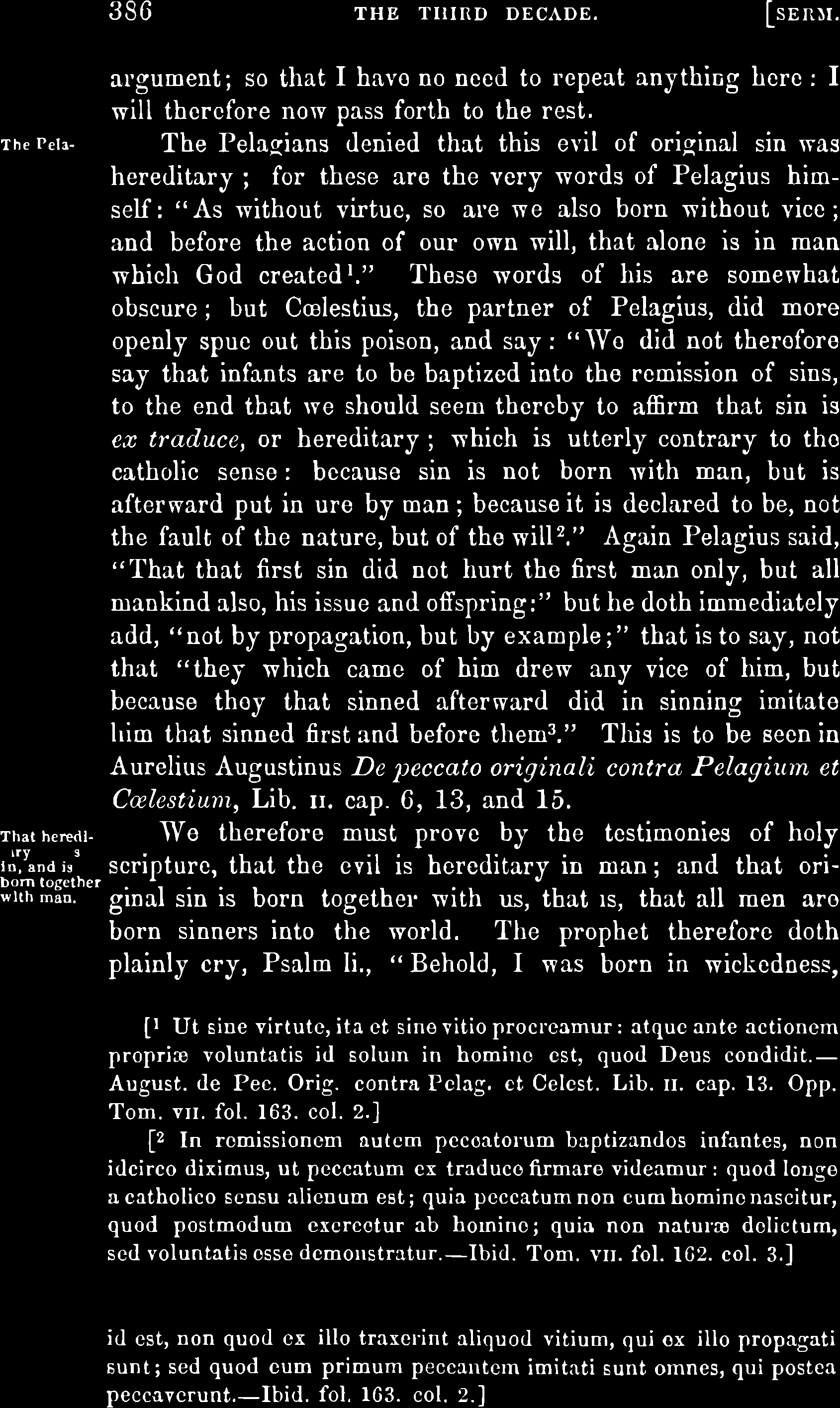
argument ; so that I have no need to repeat anything here : I willtherefore now pass forth to the rest.
ThePeiaThe Pelagians denied that this evil of original sin was gians.
" hereditary ; for these are the very words of Pelagius himself:
"As without virtue,so are we also born without vice; and before the action of our own will,that alone is in man which God created1."
These words of his are somewhat obscure ; but Ccalestius,the partner of Pelagius,did more openly spue out thispoison,and say: "We did not therefore say that infantsare to be baptized into the remission of sins, to the end that we should seem thereby to affirm that sin is ex traduce, or hereditary ; which is utterly contrary to the catholic sense : because sin is not born with man, but is afterward put in ure by man ; because itis declared to be, not the faultof the nature, but of the will2." Again Pelagiussaid,
"That that firstsin did not hurt the firstman only, but all mankind also,hisissueand offspring:"but he doth immediately add, "not by propagation,but by example;" that isto say, not that "they which came of him drew any vice of him, but because they that sinned afterward did in sinning imitate him that sinned firstand before them3."
This is to be seen in Aurelius Augustinus De peccato originali contra Pelagium et Ccelestium,Lib. n. cap. 6, 13, and 15.
ThatherediWe therefore must prove by the testimonies of holy h"yandiss scripture,that the evil is hereditary in man; and that oribom together * ."%.., . with man. gmal sin is born together with us, that is, that all men are . born sinners into the world.
The prophet therefore doth plainly cry, Psalm li.," Behold, I was born in wickedness, [*Ut sine virtute,ita et sine vitioprocreamur
: atquo ante actioncm proprise voluntatis id solum in homine est, quod Deus condidit.
August, de Pec.
Orig. contra Pelag. et Celest. Lib. n. cap. 13. Opp.
Tom. vn. fol. 163. col.2.] [2In remissionem autcm pecoatorum baptizandos infantes, non idcirco diximus, ut peccatum ex traduceftrmare videamur : quod longe a catholico sensu alienum est ; quia peccatum non cum homine nascitur, quod postmodum exercetur ab homine; quia non naturae delictum, sed voluntatis esse demonstratur.
Ibid. Tom. vn. fol.162. col. 3.] [3Dicit (Pelagius) non tantum primo homini, sed etiam humano generi primum illud obfuisse peccatum, non propagine sed exemplo s id est, non quod ex illotraxerint aliquod vitium, qui ex illopropagati sunt ; sed quod eum primum peccantcm imitati sunt omnes, qui postea peccarerunt "
Ibid. fol.163. col. 2.]

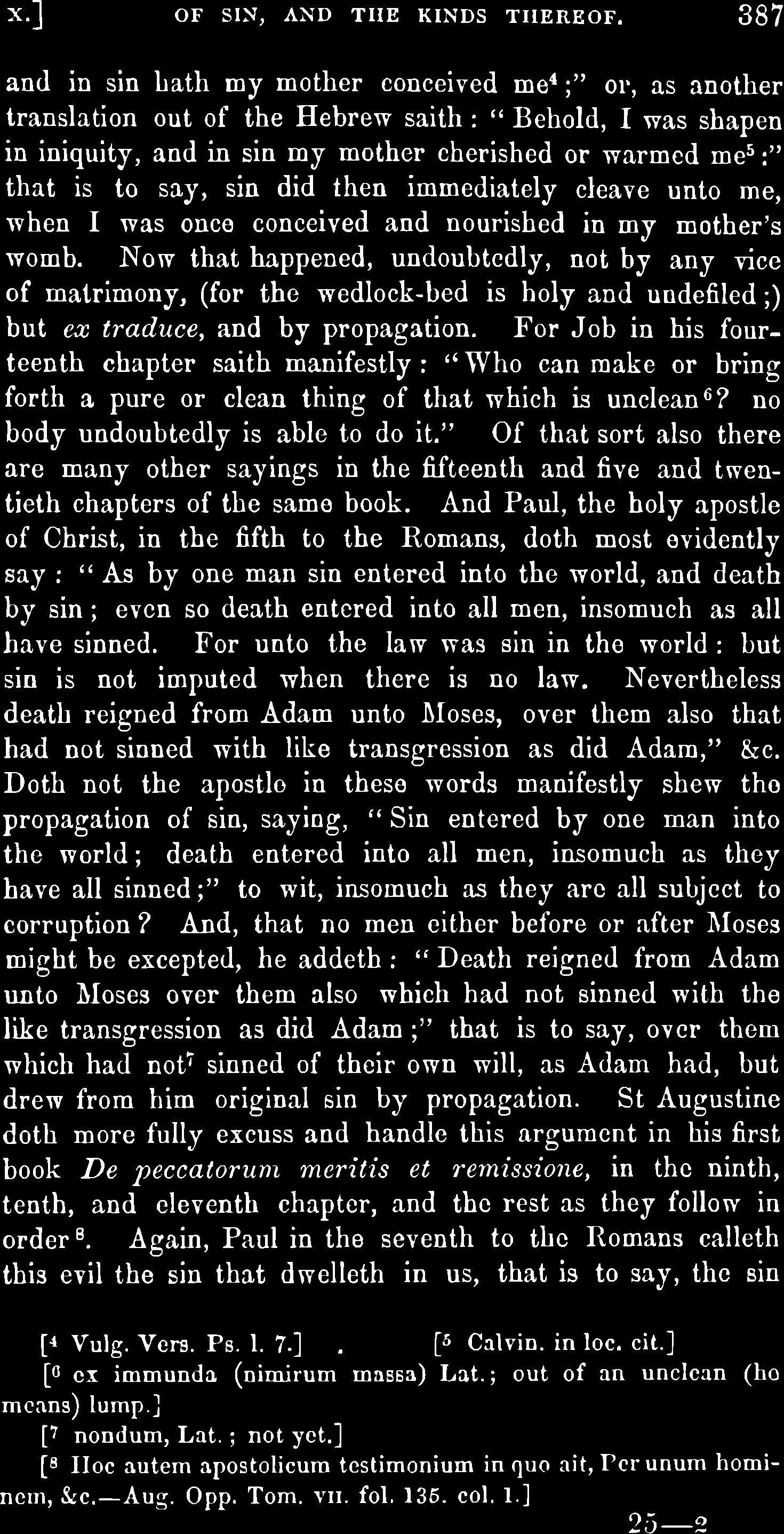
OF SIN, AND THE KINDS THEREOF.
X.] and in sin hath my mother conceived me4 ;" or, as another translationout of the Hebrew saith:
" Behold, I was shapen in iniquity,and in sin my mother cherished or warmed me5 :" that is to say, sin.did then immediately cleave unto me, when I was once conceived and nourished in my mother's womb.
Now that happened, undoubtedly, not by any vice of matrimony, (forthe wedlock-bed is holy and undefiled;) but ex traduce, and by propagation.
For Job in his fourteenth " Who can make or bring forth a pure or clean thing of that which is unclean6? no body undoubtedly is able to do it."
Of that sort also there chapter saith manifestly : are many other sayings in the fifteenthand five and twentieth chapters of the same book.
And Paul, the holy apostle of Christ,in the fifthto the Romans, doth most evidently " As by one man sin entered into the world, and death say : by sin; even so death entered into all men, insomuch as all have sinned.
For unto the law was sin in the world : but sin is not imputed when there is no law.
Nevertheless death reigned from Adam unto Moses, over them also that had not sinned with like transgression as did Adam,"
"c.
Doth not the apostle in these words manifestly shew the " Sin entered by one man into propagation of sin,saying, the world; death entered into all men, insomuch as they have allsinned ;" to wit, insomuch as they are allsubject to corruption?
And, that no men either before or after Moses " Death reigned from Adam might be excepted, he addeth : unto Moses over them also which had not sinned with the liketransgression as did Adam ;" that is to say, over them which had not7 sinned of their own will,as Adam had, but drew from him originalsin by propagation.
St Augustine doth more fully excuss and handle this argument in his first book De peccatorum meritis et remissione, in the ninth, tenth, and eleventh chapter, and the rest as they follow in order8.
Again, Paul in the seventh to the Romans calleth this evilthe sin that dwelleth in us, that is to say, the sin [4Vulg. Vers.
Ps. 1.7.] .
[5Calvin, in loc.cit.] ["ex immunda (nimirummassa) Lat. ; out of an unclean (ho means)lump.] [f nondum, Lat. ; not yet.] [8Hoc autem apostolicum testimonium in quo ait,Per unum hominem, "c. "
Aug.
Opp.
Tom. vn. fol.135. col.1.]
THE THIRD DECADE.
[sERM.

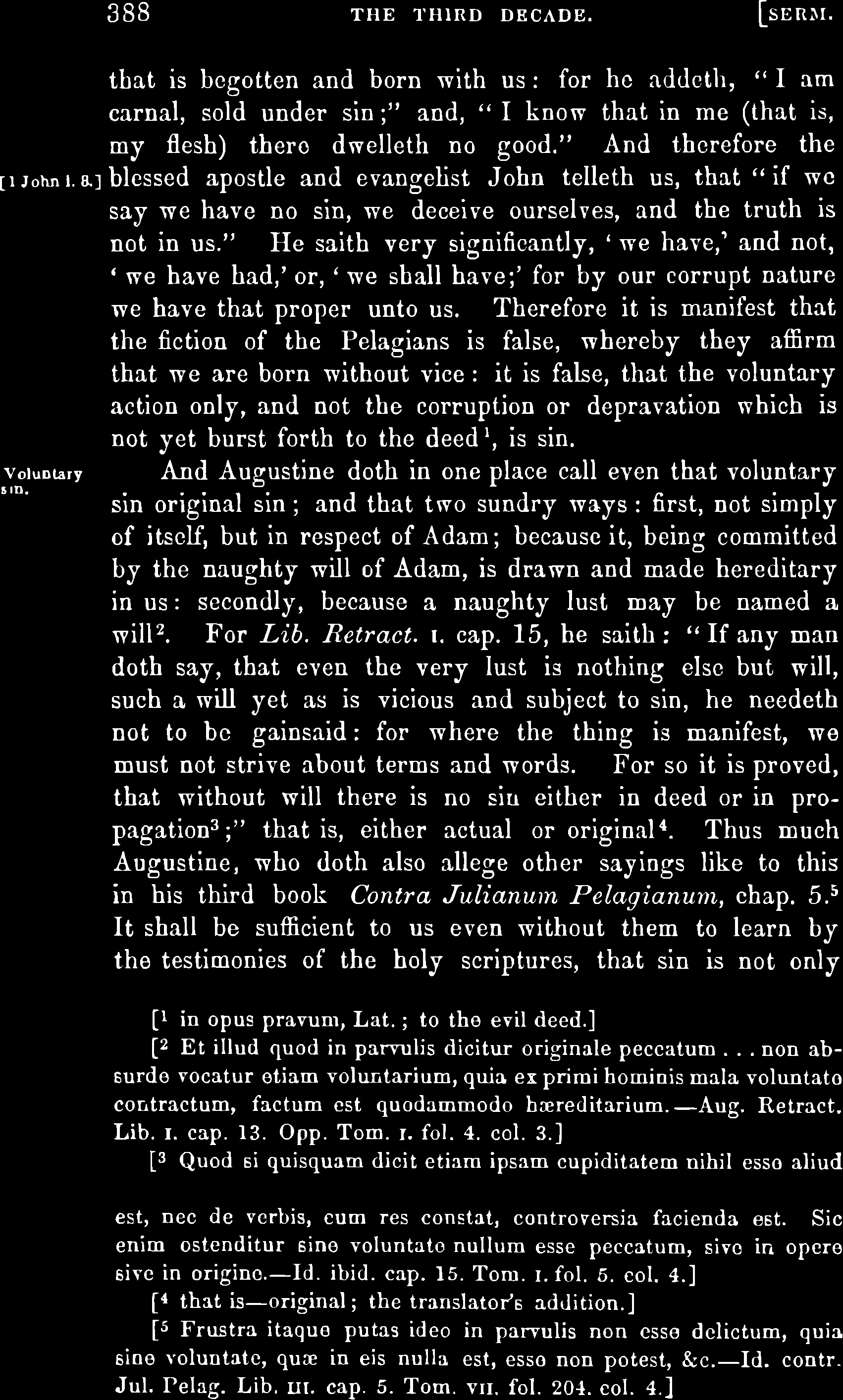
" I am that is begotten and born with us : for he addeth, "
I know that in me (thatis, carnal, sold under sin;" and, my flesh)there dwelleth no good."
And therefore the [i John i.a] blessed apostle and evangelistJohn tellethus, that "if we say we have no sin,we deceive ourselves,and the truth is ' we have/and not, not in us."
He saith very significantly, * we shallhave;' for by our corrupt nature * we have had,'or, we have that proper unto us.
Therefore itis manifest that the fictionof the Pelagians is false,whereby they affirm that we are born without vice : itis false,that the voluntary action only, and not the corruption or depravation which is not yet burst forth to the deed l, is sin. voluntary And Augustine doth in one place calleven that voluntary sin. sin originalsin; and that two sundry ways : first,not simply of itself,but in respect of Adam ; because it,being committed by the naughty willof Adam, is drawn and made hereditary in us: secondly, because a naughty lust may be named a " If any man will2.
For Lib. Retract, i. cap. 15, he saith: doth say, that even the very lust is nothing else but will, such a will yet as is vicious and subject to sin, he needeth not to be gainsaid: for where the thing is manifest, we must not striveabout terms and words.
For so it isproved, that without will there is no sin either in deed or in propagation ;" that is, either actual or original4. Thus much Augustine, who doth also allege other sayings like to this in his third book Contra Julianum Pelagianum, chap. 5.5
It shall be sufficientto us even without them to learn by the testimoniesof the holy scriptures,that sin is not only [!in opus pravum, Lat. ; to the evildeed.] [2Et illud quod in parvulis dicitur originate peccatum .
. non absurde vocatur etiam voluntarium, quia ex primi hominis mala voluntate contractum, factum est quodammodo hsereditarium. "
Aug.
Retract.
Lib. i. cap. 13. Opp.
Tom. i. fol.4. col. 3.] [3Quod si quisquam dicitetiam ipsam cupiditatem nihil esse aliud quam voluntatem, sed vitiosam peccatoque servientem, non resistendum est, nee de verbis, cum res constat, controrersia facienda est.
Sic enim ostenditur sine voluntate nullum esse peccatum, sive in opere sive in origine.
Id. ibid. cap. 15. Tom. i. fol.5. col. 4.] [4that is " original; the translator's addition.] [sFrustra itaque putas ideo in parvulis non esse delictum, quia sine voluntate, quae in eis nulla est, esse non potest, "c.
Id. contr.
Jul. Pelag. Lib. m. cap. 5. Tom. vir. fol.204. col. 4.]

OF SIN, AND THE KINDS THEREOF.
X.] a voluntary action,but also an hereditary corruption or depravation that cometh by inheritance.
Not unlike to allthis6isthat sentence in Ezechiel,where The*"n"haii " The son shallnot bear the iniquity of the **""* the Lord saith :
' the father. father, but every man shall die in his own sm."
For "***" xvliL Adam's fall should do us no harm, if it were not so that f i even from him there is sprung up in us such a perverseness as is worthy of God's justjudgment.But now, since allthe inclination,disposition,and desire of our nature, even in a child but one day old, is repugnant to the pureness and will of God, which is only good ; no man therefore is punished for his father, but every one for his own iniquity: and calamities falleven on the youngest babes, whom we see to be touched with many afflictionsby the holy and justjudgment of the most justGod.
Neither is their objection any whit stronger which say, TO be bom that the children of holy parents cannot draw or take any |"renu. spot of their parents ; for they have their linealdescent of the fleshly generation, and not of the spiritualregeneration.
And whereas the apostle said, " The unbelievingri cor. vu. husband is sanctifiedby the wife, and the unbelieving wife is sanctifiedby the husband : else were your children unclean ; but now are they clean :" itis not repugnant to our former allegations. For they are called holy, not by the prerogative of theirbirth or generation, as though children were born 7 holy without any spot or vice at all; but for because they, being born by nature corrupt, are by the virtue of the covenant and grace made pure, and uncleanness isnot imputed to them, for Christ his sake, or the remission " I will be thy God, and the God of thy seed after thee."
For of old, of sins which is pronounced in these words : even those children which of the seed of Abraham were holy and blessed received notwithstanding the sign of circumcision.
Now what need, I pray you, had they had of circumcision,or purging, if by their birth they had had no uncleanness in them ?
That therefore is utterly falsewhich ye heard even now TIM catholic * " doctrine of that Ccelestius,the Pelagian, did utter in these words
" We did not therefore say that infants are to be baptized into [8His omnibus nihil repugnat, Lat.] ['sic,Lat. omitted ; under these circumstances.]
THE THIRD DECADE.
[SERM.

the remissionof sins,to the end that we should thereby seem to affirmthat sin isex traduce, or hereditary ; which isutterlycontrary to the catholic sense."
For it is catholicand true doctrine,that the children of the Jews were circumcised,not so much only because they were partakers of the divine covenant, as for because that all the antiquityof holy fathers did so confess,that in infants there was somewhat which had need of cutting,that is,which had need to be remitted by the grace of God, and not be imputed to them unto death.
It is catholicand true doctrine,that the infants of Christians are baptized,not so much because they are the children of God and freelyreceived into the covenant j as for because there is in them, even from their birth,somewhat which the Lord by his grace doth wash away, lestit should bring upon them death and damnation.
Yea, that cannot be catholic,which doth so manifestlyrepugn so many evident placesof scripture, which prove that in infantsthere is sin by propagation.
To confirm this we may add, that St Augustine in his firstbook Contra Julianum Pelagianum, cap. 2, gathereth together the testimonies of the most excellent learned bishops and doctors in the primitive1church, by which he proveth that all the ministersof the churches, even from the apostles'time,did AH the anboth acknowledge and openly teach originalsin. In that place orefath?reo7 he citeththe testimoniesof Irenssus,Cyprian, Reticius,OlymronfeMwith pius,Hilary, and Ambrose, his father and master in Christian original sin. doctrine8,Innocent, Gregory,
Basil, and John Chrysostom; " Wilt thou now call so great a and at length he inferreth: consent of catholic priests a conspiracy of naughty men ?
Neither think thou that St Hierome is to be contemned, because he was but a priestonly, and no bishop ; who, being skilfulin the Greek, Latin, and Hebrew tongues,and passing from the west unto the east church, lived in holy places and the study of the sacred scripture,even to his crone3 and The east crooked age.
He read all,or in a manner all,the works of churchetthem which in both parts of the world did write of ecclesiastical doctrine; and yet he neither held nor taught any otherwise of thispointof doctrine4." And again the same Augustine, [lprimitive,not in Lat.] [2in Christo,Lat.] [3crones : old ewes who have lost their teeth.
Grose's Provincial Glossary, in voc.] [4An tantam consensionem sacerdotum catholicorum conspira-

X.] OF SIN, AND THE KINDS THEREOF.
in histhird book De Peccatorum Meritis et Memissione, cap. 6, " Hierome, expounding the prophecy of Jonas, when That is,he he came to that place where mention is made that even the he"Son^t littlechildren were chastened with fasting,saith: saith:
' It began *" with the eldest,and came even to the youngest.
For there is none without sin; no, not he which is but one day old, nor he whose grey head hath seen many years.
For ifthe stars are not clean in the sight of God, how much more unclean are dust6 and putrefying earth, and those which are in subjection to the sin of Adam's transgression!"' To these words of Hierome doth Augustine himself annex this that followeth:
"If it were so that we might easilyask it of thismost learned man, how many teachers of the holy scripturesin both the tongues, and how many writers of Christiantreatiseswould he reckon up, which, since the time that Christ his church was firstplanted, have themselves neither thought, of their predecessors learned, nor taught their successors, any other than this doctrine touching originalsin!
I verily,though I have read nothing so much as he, do not remember that I have read any other doctrine of Christians which admit or receive both the testaments, whether they were in the unity of the catholicchurch, or otherwise in schisms and heresies: I do not remember that I have reaol any other thing in them, whose writings touching this matter I could come by to read them, if either they did follow, or thought that they did follow,or would have men believe that they did follow, the canonical scriptures6." Thus far hath Augustine ; teaching,in tionom dicturus es perditorum?
Nee sanctum Hieronymum, quia presbyter fuit,contemnendum arbitreris; qui Grseco et Latino, insuper et Hebrseo eruditus eloquio, ex occidental! ad orientalem transiens ecclesiam, in locis sanctis atquo in literis sacris usque ad decrepitam visit setatem.
Hie omnos vel pene omnes, qui ante ilium ex utraquo parte orbis de doctrina ecclesiastica scripserant, legit,nee aliam do hac "
Aug.
Opp.
Tom. vn. fol. 197. re tenuit prompsitque sententiam. col. 1.] [5vermis, Lat. ; a worm.] [6Nam in eo quod in Jonam prophetam scripsit(Hieronymus), cum ad eum venisset locum, ubi commemorantur etiam parvuli jejunio castigati : Major,inquit, setas incipit,et usque ad minorem pervenit.
Nullus enim absque peccato, nee si unius quidem diei fuerit vita ejus, ot innumerabiles anni vitseillius. Si enim stellaemundre non sunt in conspectu Dei, quanto magis vermis et putredo, et ii qui peccato offendontis Adam tenentur obnoxii !
Hunc doctissimum virum si facilo
THE THIRD DECADE.
[SERM.

the very beginning, that all the saints did by a fullconsent and agreement in doctrine most expressly grant and confess, that original sin is even in new-born infants.
Methinketh that St Hierome did not only in Jonas, but also much more evidentlyin Ezechiel,confessand affirm originalsin. His words are to be seen, Comment, lib.xiv. in cap. 47, ad Ezechielem, " What man can make his and are verbatim as followeth : boast that he hath a chaste heart, or to whose mind by the windows of the eyes the death of concupiscence, or (touse a milder term)the ticklingof the mind, doth not enter in ?
For the world is set in wickedness ; and even from his childhood the heart of man is set to naughtiness ; so that not the very firstday of a man's nativity his nature is free from sin and * For naughtiness.
Whereupon David in the Psalm saith: behold I was conceived in iniquity,and in sin my mother conceived me.'
Not in the iniquitiesof my mother, or in mine own sins; but in the iniquitiesof our mortal state.
And ' Death reigned from Adam to therefore the apostle saith, Moses, over them also which had not sinned with the like transgression as did Adam1.'"
Thus much hath Hierome.
And we have hitherto alleged all these sayings, to the end interrogate possemus, quam mulfas utriusque linguae divinarum scripturarum tractatores et Christianarum disputationum scriptores commemoraret, qui non aliud ex quo Christ! ecclesia est constituta senserunt, non aliud a majoribusacceperunt, non aliud posteris tradiderunt !
Ego quidem, quam vis longe pauciora legerim, non memini me aliud audisse a Christianis, qui utrumque accipiunt testamentum. non solum in catholica ecclesia, verum etiam in qualibet hseresi vel schismate constitutes ; non memini me aliud legisse apud eos, quos de his rebus aliqxiid scribentes legere potui, qui scripturas canonicas "
August.
Opp. sequerentur, vel sequi se crederent credive voluissent.
Tom. vn. fol. 148. col. 4.] [*Quis enim hominum gloriari potest castum se habere cor ? vel ad cujusmentem per oculorum fenestras mors concupiscentise non introivit,et, ut parum dicam, animi titillatio? Mundus enim in maligno positus est ; et a pueritia appositum est cor hominis ad malum : ut ne unius quidem diei a nativitatis suse exordio sine peccato sit humana conditio.
Unde et David confltetur in Psalmo, Ecce enim in iniquitatibus conceptus sum, et in peccatis concepit me mater mea.
Non in iniquitatibus matris mesc, vel certe meis ; sed in iniquitatibus humanae conditionis. Unde et apostolus dicit,Regnavit mors ab Adam usque ad Moysen, etiam super eos qui non peccaverunt in similitudinem prsevaricationisAdae. "
Hieron.
Opp.
Tom. m. col. 1055.
Par. 1704.]

OF SIN, AND THE KINDS THEREOF.
X.] we might prove that originalsin is the natural or hereditarycorruption of man's nature.
Let us now see what and how great the hereditary what and * how great naughtiness or corruption of our nature is, and what power itthe ""J"P- " r tion of pur hath to work2 in man.
Our nature verily,as I shewed you nature u" above, was before the fall most excellent and pure in our father Adam : but after the fallit did by God's justjudgment become corrupt and utterly naught, which is in that naughtiness by propagation, or ex traduce, derived into all us which are the posterity and offspring of Adam ; as both experience and the thing itselfdo evidently declare,as well in sucklings or infants as those of riper years.
For even very babes give manifest tokens of evident depravation so soon as they once begin to be able to do anything; yea, before they can perfectly sound any one syllableof a whole word.
All our understanding is dull, blunt, gross, and altogether blind in heavenly things.
Our judgmentin divine matters isperverse and frivolous. For there arise in us most horrible and absurd thoughts and opinions touching God, his judgments, and wonderful works.
Yea, our whole mind is apt and ready to errors, to fables,and our own destruction : and when as our judgments are nothing but mere folly,yet do we prefer them far above God's wisdom, which we esteem but foolishnessin comparison of our own conceitsand corrupt imaginations; for " The natural man perceiveth not the [icor. n. he lied not which said : things of the Spirit of God ; for they are foolishnessunto him ; neither can he know them, because they are spiritually discerned."
Now Paul callethhim the natural man3, which liveth naturally by the vitalspirit,and is not regenerate by the Holy Ghost : and since we all are such, we are therefore wholly overcome and governed ofphilautia, that is,too great a self-loveand delight in ourselves,whereby all things that we ourselves do work do highly please us ; looking stillvery busily to our own selves and our commodity, when in tho meantime we neglect all others, yea, rather do afflictthem.
Neither did Plato unadvisedly esteem that vice of self-loveto be the very root of every evil4.Furthermore, our whole willis [2quid efficiat,Lat.] [3animalem hominem, Lat.] ["Stobaei Floril. Tit. xxiii. Tom. i. p. 427. ed. Gaisford.
Oxon.
1822.]
THE THIRD DECADE.
[sERM.

led captiveby concupiscence,which, as a root envenomed with poison,infectethallthat is in man, and doth incline,draw on, and drive men to things carnal, forbidden, and contrary to God, to the end that he may greedilypursue them, put all his delightin them, and content himself with them.
Moreover there is in us no power or abilityto do any good : for we are slow, sluggish,and heavy to goodness; but lively, quick, and ready enough to any evil or naughtiness.
And, that I may at last conclude,and brieflyexpress the whole force and signification of our hereditary depravation and corruption ; I say, that this depravation of our nature isnothing our depravaelsebut the blottingof God's image in us.
There was in our blotting out father Adam before his fallthe very image and likeness of of the image , , , . of God in us. GO(J j which image, as the apostleexpoundeth it,was a conformity and participationof God's wisdom, justice, holiness, truth,integrity,innocency, immortality, and eternalfelicity.
Therefore what else can the blottingor wiping out of this image be but originalsin; that is, the hatred of God, the ignorance of God, foolishness,distrustfulness, desperation,selflove, unrighteousness,uncleanness, lying, hypocrisy, vanity, corruption,violentinjury, wickedness, mortality,and eternal infelicity ?
This corrupt image and likenessis by propagation derived into us all,according to that saying in the fifth " Adam, begat a son in his own similitudeand likeness."
Therefore as our father Adam was himself corrupted, depraved, and fullof calamities,so hath he begotten of Genesis: us his sons corrupt, depraved, and fullof miseries1: so that all we which do descend of his unpure seed are born infected with the contagious poison of sin.
For of a rotten root do spring as rotten branches, which in like manner put over theirrottenness into the littletwigs that shoot out and grow upon them. original sin And this evilverily,this corruptionand thissin,although
' itlie hid in infants,and by reason of theirtender age doth not break forth into any deed-doing, yet notwithstanding it is a sin; and such a sin verily as maketh them endangered unto God's wrath, and separateth them from the fellowship " is a consuming fire,"no man can abide but he that is unspotted and clean of God.
For with the most holy God, who " All have sinned, 23.] f1corrupt [Rom. iu. from the filthiness of sins. And Paul saith:
" miseries,the translator'saddition.]

OF SIN, AND THE KINDS THEREOF.
X.] and are destitute,or have need, of the glory of God."
This glory of God is the very image of God : whereof because they are destitute,they being corrupted with originalsin are worthily excluded from the fellowshipof God.
To this place doth belong the whole treatiseof concupiscence in the fourth sermon of this third Decade : where I taught you, that bare concupiscence,which is not yet burst forth to the deed-doing, is a sin ; and that too such a sin as maketh all " Cursed [Deut xxyu. be every one which abideth not in allthings that are written 10-i in the book of this law."
Therefore the firsteffectof original sinis this,that it bringeth wrath, death, and damnation men subject to the curse of God.
For itis written: upon very infants,and so consequently upon all mankind: whereof, that it may the more firmly be settled in every man's mind without all scruple of doubting, I will by some store of testimoniesout of the scripturemake manifest proof unto you, not by repeating those places again which I have already citedin this sermon, and in the fourth sermon of this third Decade.
" Verily, The Lord in the gospel saith to Nicodemus :
I say unto thee, unless a man be born from above2, he cannot see the kingdom of God."
And again3: "Unless a man be [Johnm. 3, born of water and of the Holy Ghost4, he cannot enter into the kingdom of God.
That which is born of the flesh is flesh; and that which is born of the Spirit is spirit." In these words are comprehended two things worthy to be remembered, and very consonant to our present argument.
First,none enter into the kingdom of heaven but those that be regenerate from above6 by the Holy Ghost : therefore our firstbirth tendeth to death, and not to life; for in our first nativity we are born to death.
The latteris,"That which is born of flesh is flesh:" therefore in our firstnativitywe are all born flesh. But touching the dispositionof the flesh " The fleshlymind is[Bom.viu.70 and the force thereof,the apostle saith: enmity against God : for itis not obedient to the law of God, neither can be."
Therefore that fleshlybirth engendereth us, not the friends and sons, but the enemies, of God ; and so consequently doth make us endangered to the wrath of God.
[2So margin of Autb. Ver.] [3Amen dico tibi,Lat. omitted ; Verily, I say unto thee.] ["et spiritu,Lat.] [5 e coelo,Lat.]
THE THIRD DECADE.

Paul in his second chapter to the Ephesians saith:
" We were by nature the sons of wrath, even as other."
In which words he pronounceth that all men are damned.
For all those that are damned, or are worthy of eternal death, and all such with whom God hath good cause to be offended, he calleth the sons of wrath, after the proper phrase of the Hebrew speech.
For the wrath of God doth signifythe punishment which is by the justjudgmentof God laid upon us men.
And he is called the child of death, which is adjudged or appointed to be killed.
So is also the son of perdition,"c.
Now mark, that he callethus allthe sons of wrath, that is, the subjects of pain and damnation, even by nature, in birth, from our mother's womb.
But whatsoever is naturally in all men, that is original: therefore originalsin maketh us the sons of wrath ; that is,we are all for our originalcorruption made subject to death and utter damnation.
This place of Paul for the proof of this argument is worthy to be remembered1.
The same apostle in the firstto the Colossians saith:
" God hath delivered us from the power of darkness, and hath translated us into the kingdom of his dear Son."
Now if we be translated into the kingdom of the Son of God, then were we once in the kingdom of the devil.
And to this place belong very many testimoniesof the same apostle in the fifthchapter of his Epistleto the Romans
" By one " By one that sinned man's sin many are dead."
Again ; came death ; for judgmentcame by one unto condemnation."
Again ; " For the sin of one death reigned by the means of " By the sin of one sin came upon all one."
And again ; men2 unto condemnation."
Finally,original sin is by David and Paul expressly called sin : therefore death is due to " the reward of sin is death." originalsin; for original "n We do therefore conclude, that infants do bring damis proper to aii. nation with them into this world even from their mothers' wombs ; because they bring with them a corrupt nature : and therefore they perish not by any others',but by their own, faultand naughtiness.
For although St Augustine doth in one place seem to call this sin Peccatum alienum, that is,another's sin,(thatthereby he may shew how it is by f1valde est insignis,Lat.] [2propagatum est malum, Lat. and Erasmus.]
OF SIN, AND THE KINDS THEREOF.

X.] propagation derived from other into us,)yet doth he confess that itis in very deed and truly proper to all and every several one of us3.
And although it be so, that for lack of age in a new-born babe thisdiseasehath not already brought forth the fruitof his iniquity; yet notwithstanding the very whole nature of the babe is nothing but filthy corruption, and a certain seed of sin and wickedness, which cannot choose but be abominable unto the Lord : for God doth hate all manner of uncleanness4.
With thisagreeth5 that sentence of Paul, where he saith: where there " Where no law is,there isno transgression." For the aposthere if no . transgression. tie doth not absolutely say that the sm or transgressionlJR"miv- (whichis sin in very deed in the sight of God) is no sin; but he respecteth the estimation of men, how they do repute it.
For men, before sin doth appear and is opened unto them by the law, do not so repute or think of sin as it ought in very deed to be esteemed.
The same Paul in another " Sin without the law was once dead:" and, Rom. vii. place saith:
I once lived without law ; but when the law came, sin revived."
If so be now that sin revived, then did it live before the law, afore it was stirred up by the law, although it did not so rifelythen, as now, shew forth the strength and force of itself. To this also is to be added that saying of Paul :
" Sin was in the world even to the law ; but sin is not [Rom. v. 13} imputed when there is no law."
Lo here, sin was in the world before the law, but it was not imputed ; not because God did not impute it, but because men do not impute it to themselves.
Under cinders doth fireliehid ; which is very fire indeed, but, because it casteth out no flame or lightof itself,it is not thought to be fire.
And for that cause the learned and godly man of famous memory, Ulderick Zuinglius6,uwerick "
Zuinglius of original sin.
[3Nec sicdicuntur ista aliena peccata, tanquam omnino ad parvulos .
. Sed dicuntur aliena, quia nondum ipsiagebant vitas non pertineant proprias, sed quicquid erat in futura propagine vita unius hominis "
August.
Marcellino de Baptism.
Parv.
Epist. 16.
Opp. continebat.
Tom.
II. foL 180. col. 3.
Par. 1531.] [4This paragraph is borrowed almost literallyfrom Calvin, Instit.
Lib. H. cap. 1. " 8.] [5His nihil repugnat, Lat.] [6Peccatum bifariam in evangelica doctrina accipitur: primum, pro morbo isto,quern ex generis auctore contrahimus, quo amori nostri addictis suuin .
. Eum morbum intelligitPaulus Rom. vii.quum dicit,
THE THIRD DECADE.
[sERM.
did diligentlydistinguishbetwixt sin and disease or infirmity, when once he had occasion to dispute of originalsin,which he chose rather to calla diseasethan sin: because by the name of sin all men do understand the naughty act committed by our own consent and willagainst the law of God ; but by the name of diseaseor sicknessthey understand a certain corruption and depravation of the nature that was created good, and the miserable condition of bondage whereinto it is brought : even as also we read1 before, that Augustine did call this original sin peccatum alienum, another's sin, that thereby he might give us to understand that it is hereditary, and doth descend from others into us; and yet he denied not but it is proper to every several one of us.
In like manner Zuinglius denied not originalsin, as some did falselyslander him: he thought not that by itselfitis unhurtful to infants, but so far forth as it is by the grace of God, through the blood of Jesus Christ, in the virtue of God's promise and covenant, made harmless unto them2.
His mind was to make an exquisitedifferencebetwixt the actual and originalsins3. For in rendering an account of his faith in the council held at Jam non ego operor illud,sed inhabitans in me peccatum .
. Secundo loco accipitur peccatum pro eo quod contra legem fit; ut, per legem cognitio peccati. Rom. vii. Actio ergo qusecunque tandem, quse contra legem fit,peccatum appellatur.
Zuingl. de Vera et Falsa Relig. Comment, p. 116. Tiguri. 1525.] f1audivimus, Lat. ; heard, ed. 1577.] [2Vitium hoc et morbus homini, quoad bonum et malum non discernit,pro peccato et culpa imputari nequit, utcunque gravis sit et pestifer.
Unde colligimus peccatum originale morbum quidem esse, qui tamen per se culpabilisnon est, nee damnationis poenam inferre potest, .
. donee homo contagione hac corruptus legem Domini transgreditur ; quod turn demum fiericonsuevit, cum legem sibi positam videt et intelligit .
. Peccatum ergo originale damnationem non meretur, si modo quis parentes fideles nactus fuerit.
Qusecunque enim hoc loco de originali infantium vel parvulorum peccato loquimur, ad fidelium duntaxat infantes referri debent, et de solis illisintelligi.
Id. De Baptismo.
Tom. n. pp. 90, 89.] [3Diximus originalem contagionem morbum esse, non peccatum, quod peccatum cum culpa conjunctumest ; culpa vero ex commisso vel admisso ejusnascitur qui facinus designayit .
. Morbus ergo iste ac vitium, primi parentis culpa inflictus,infecit sobolem, non soboles seipsam.
Cum ergo peccatum appellatur in scripturis,per denominationem hoc fieri constare jam satis arbitror.
Id. De Pecc. Orig. ad Urban.
Rheg.
Tom. n. p. 116.]

X.] OF SIN, AND THE KINDS THEREOF.
Augusta4, the year of our Lord 1530, he said : "I acknowledge that originalsin isby conditionand contagion born in and with allthem that are begotten by the act of a man and a woman : and I know that we are the sons of wrath.
Neither am I anything against it,that thisdiseaseand conditionshould, as Paul termeth it,be calledsin : yea, it is such a sin,as that they, whosoever are born in it,are the enemies and adversaries of God Almighty.
For hither doth the conditionof their birth draw them, and not the committing of wickedness, except it be so far forth as our firstparent committed it.
The very true cause therefore of our disloyaltyand death is the crime and wickedness which Adam committed; and that in very deed is sin : and thissin which cleaveth to us isin very deed a disease and condition,yea, itis a necessityof dying5."
And so forth as followeth; for hitherto I have rehearsed his very words.
There is now remaining the other effectof originalsinfor original sin me to expound.
It breaketh out and bringeth forth in us foJSfuie those works that the scripturescall the works of the flesh; the flesh. even like as when an oven set on fire doth cast out flames and sparkles; or as a fountain that ever springeth doth pour out waternn great abundance6.
There is no quietness in the nature of man : for covetousness with filthylustariseth in it,ambition cleaveth to it,anger invadeth it,pride puffeth it up and causeth it to swell, drunkenness delightethit,and envy torments both thyselfand others.
Therefore the Lord " Out of the heart proceed evilthoughts, in the gospel saith: murders, adulteries,whoredoms, thefts,false-witness-bearings, and evilspeakings."
Again, Paul in the fifthchapter to the ["Augsburg.
See Sleidan. Comment, do Statu Relig. Lib. vn.] [5Originate pcccatum per conditionem et contagionem agnasci omnibus, qui ex adfectu maris et fceminse gignuntur, agnosco, et nos esse natura ftliosiroescio ....
Quanquam nihil moror hunc morbum ot conditionem, juxtaPauli morem, appellari peccatum.
Imo tale est pcccatum, ut quicunque in eo nascuntur hostes et adversarii Dei sunt.
Hue enim trahit illosnativitatis conditio, non scelcrisperpetratio,nisi quantum hoc semel perpetravit primus parens.
Vera igitur perducllionis et mortis causa est perpetratum ab Adam crimen ac nefas ; atque hoc vere est peccatum : at peccatum istud,quod nobis adhterescit, et vere morbus et conditio, imo nccessitas est moriendi.
Id. ad Carol.
Rom.
Imp.
Fidei ratio. Tom.
11. p. 639.] ["aut scaturigo aquam peronniter profundit, Lat.j
THE THIRD DECADE.
[sERM.

Galatians doth reckon up no small number of the works of the flesh; even as he doth the like also in the firstand third chapters of his epistleto the Romans.
In the fourth to the Ephesians he doth very properly l describethose works of the flesh,which spring out of the natural corruption of allthem2 " This I say," which are not regenerate by the Holy Ghost. saithhe, " and testifyunto you3, that ye henceforth walk not as other Gentiles walk, in vanity of their mind
; darkened in cogitation,being alienated from the lifeof God by the ignorance that isin them, by the blindnessof theirhearts : which being past feeling have given themselves over unto wantonness, to work alluncleanness with greediness." This, though it be but little,shall sufficefor this place ; for I will more largely prosecute it in the treatiseof actualsin : to the handling whereof I will presently pass, so soon as I have by the way admonished you, that I have not without good cause thus far in many words spoken of the cause of originalsin,that is,of man's depravation and the corruption of allhis strength, on these For as in these are opened the veins of pure doctrine,so foundations in them are placed the foundations of our faith and whole of our faith are laid. belief.For ifthere be no originalsin,then is there no grace : or if there be any, yet shallithave nothing to work in us.
If our own strength is whole and sound, then have we no need of any physician.
In vain therefore came the Son of God into the world4; for then shall men be saved by their own strength and ability: and so shallthe foundation of our faithbe quite turned upside down.
Therefore St Augustine is very vehement in this cause ; whose golden words I will recite unto you, dearly beloved, out of his second book De Originali Peccato contra Pelagium et Ccelestium.
In the twenty-third and twenty -fourth chapters I find written as followeth:
"There is great diversityin these questions,which are thought to be beside the articlesof faith, and those wherein (keeping sound the faithwhereby we are Christians) it is either not known what is true, and so the sentence definitive issuspended ; or else itis otherwise guessed at by human and unassured suspicionthan the thing itselfin very deed is: as for example, when itis demanded of what sort and where [igraphice, Lat.] [2in omnibus, Lat.] [3per Dominum, Lat. omitted ; by the Lord.] [4missus, Lat. omitted ; being sent.]

OF SIN, AND THE KINDS THEREOF.
X.] paradise is,where God placed man whom he had made of the dust of the earth,when as notwithstandingChristianfaith doubteth not but that there is a paradise."
And after the " Who recitalof a few more such questions,at lasthe saith: may not perceive in these and such like sundry and innumerable questions,appertaining either to the most secret works of God, or the most dark and intricateplaces of the holy scriptures,which itis hard to comprehend or define in any certain order, both that many things are unknown without the peril of Christianfaith,and also that in some points men do err without any crime of hereticaldoctrine?
But concerning the two men ; by the one of whom we are sold under sin, by the other redeemed from sin; by one we are cast headlong into death, by the other we are made free unto life; because that man did in himself destroy us by doing his own willand not the willof him that made him, but this man hath in himself saved us by doing not his own will but the will of him that sent him ; therefore,in the consideration of these two
Christian men Christianfaith doth properly consist.
For there is one etk in tb" f~" t -MM-1- "
M * " i i rm "
"* consideration God and one Mediator of God and man, the man ChristJesus ; of two men. because there is none other name under heaven given unto men in which they must be saved; and in him hath God appointed all men to trust, raising him up from death to life.
Therefore Christianverity doubteth not but that without this faith,that is,without the faith of the only Mediator of God and man, the man Christ Jesus ; without the belief,I say, of his resurrection,which God hath prescribed to men, which cannot be truly believed without the beliefof his incarnation and death ; without the faith therefore of the incarnation, death, and resurrectionof Christ,none of the ancientjust men could be cleansedand justified of God from theirsins: whether they were in the number of those justmen whom the holy scripture mentioneth ; or in the number of those justmen whom the scripturenameth [not], and yet are to be believedto have been either before the deluge,or betwixt the deluge and the law, or in the very time of the law ; not only among the children of Israel,as the prophets were, but also without that people,as Job was.
For even their hearts were cleansed by some were the same faith of the Mediator, and charity was poured intoisraei, but them by the same Holy Spirit,which breatheth where he listeth, chrut. not followingafter merits,but even working the very merits r i
[BULLINGER,
n.J
THE THIRD DECADE.
[sERM.

themselves. For God's grace will not be by any means, unless itbe free by allmeans.
Although thereforedeath reigned from Adam unto Moses, because the law given by Moses could not overcome it; for there was no such law given as could quicken, but such a law as whose officewas to shew, that the dead, to the quickening of whom grace was necessary, were not only overthrown by the propagation and dominion of sin,but were also condemned by the hidden l transgression of the very law itself; not that every one should perish that did then understand it in the mercy of God, but that every one, being through the dominion of death appointed unto punishment and detected to himself by the transgression of the law, should seek for the help of God; that where sin abounded, grace might more abound, which alone doth deliver from the body of this death.
Although therefore the law given by Moses could not rid any man from the kingdom of death, yet in the very time of the law were the men of God not under the terrifying,convincing,and punishing law, but under the delectable,saving, and deliveringgrace.
There were among them some which said, 'In iniquity was I conceived, and in sin hath my mother fed me in her womb 2.'
And so forth ; for hitherto I have citedthe very words of St Augustine.
[!The translator read abdita for addita.~\ [2Longe aliter se habent qusestiones istse,quas esse prseter fidem arbitrator, quam sunt illse,in quibus, salva fide qua Christiani sumus, aut ignoratur quid verum sit et sententia definitiva suspenditur, aut aliter quam est humana et infirma suspicione conjicitur : veluti cum quseritur qualis vel ubi sit paradisus, ubi constituit Deus hominem quern formavit ex pulvere, cum tamon esse ilium paradisum fides Christiana non dubitet Quis enim non sentiat in his atque liujusmodi variis et innumerabilibus qusestionibus, sive ad obscurissima opera Dei sive ad scripturarum abditissimas latebras pertinentibus, quas certo aliquo genere complecti ac definire difficileest, et multa ignorari salva Christiana fide, et alicubi errari sine aliquo hseretici dogmatis criraine ?
Sed in causa duorum hominum, quorum per unum venundati sumus sub peccato, per alterum redimimur a peccatis ; per unum prsecipitatisumus in mortem, per alterum liberamur ad vitam; quoniam ille nos in se perdidit faciendo voluntatem suani, non ejusa quo factus est, iste nos in se salvos fecit non faciendo voluntatem suam, sed ejusa quo missus est; in horum ergo duorum hominum causa proprie fides Christiana consistit.
Unus est enim Deus, et unus mediator Dei et hominum, homo Christus Jesus : quoniam non est aliud nomen sub coelo datum hominibus, in quo oporteat

OF SIN, AND THE KINDS THEREOF.
X.] I have thus far spoken of originalsin,of the native and hereditary corruption of our nature, which is the firstpart in the definitionof sin.Here folioweth now the latterpart;to wit, the very action which ariseth of that corruption,the actual sin,I say, which is so calledab actu, that is,an act or a deeddoing.
For insomuch as that corruption which is born together with and is hereditary hi us doth not always liehid, but worketh outwardly and sheweth forth itself,and doth at lastbring forth an imp of her own kind and nature, which imp is actual sin ; therefore we define actual sin to be an action,or work, or fruit,of our corrupt and naughty nature, expressing itselfin thoughts, words, and works against the law of God, and thereby deserving the wrath of God. nos salvos fieri,et in illodefinivitDeus fidem omnibus, suscitans ilium a mortuis.
Itaque sine ista fide, hoc est, sine fide unius mediatoris Dei et hominum, hominis Christ! Jesu ; sine fide,inquam, resurrectionis cjus,quam Deus hominibus definivit, qure utique sine incarnatione ejusac morte non potest veraciter credi; sine fide ergo incarnationis et mortis et resurrectionis Christi,nee antiques justos, ut justiessent a peccatis, potuisse mundari et Dei gratia justificari, veritas Christiana non dubitat; sive in eis justisquos sancta scriptura commemorat, give in eis justisquos quidem ilia non commemorat, sed tamen fuisse credendi sunt vel ante diluvium, vel inde usque ad datam legem, vel ipsius legis tempore, non solum in filiisIsrael,sicut fuerunt prophetae, sed etiain extra eundem populum, sicut fuit Job.
Et ipsorum enim corda eadem mundabantur mediatoris fide, et diffundebatur in eis caritas per Spiritum sanctum, qui ubi vult spirat,non merita sequens, sed etiain ipsa merita faciens.
Non enim Dei gratia gratia erit ullo modo, nisi gratuita fuerit omni modo.
Quamvis ergo mors regnaverit ab Adam usque ad Moysen, quia non earn potuit vincere nee lex data per Moysen, non enim data est qua) posset vivificare,sed quse mortuos, quibus vivificandis esset gratia necessaria, non solum peccati propagatione et dominatione prostrates,verum etiam ipsius legis addita praevaricatione convictos, deberet ostendere, non ut periret quisquis hoc in Dei misericordia etiam tune intelligeret,sed ut per regnum mortis ad supplicium destinatus etiam sibi ipsi per prsevaricationem legis manifestatus Dei qusereret adjutorium,ut ubi abundant peccatum superabundaret gratia,qua) sola liberat a corpore mortis hujus.Quamvis ergo nee lex per Moysen data potuerit a quoquam homine regnum mortis auferre, erant tamen et legis tempore homines Dei, non sub lege terrente, convincente, puniente, sed sub gratia delectante, sanante, liberante : erant qui dicerent, Ego in iniquitatibus conceptus sum, et in peccatis mater mea in utero me aluit.
August.
Opp.
Par.
1531.
Tom. vii. fol. 164. col. 2.
3. de Pecc. Orig. contra Pelag. et Celest.
Lib.
11. capp.
23, 24, 25.] 26"2
THE THIRD DECADE.
[sERM.
The cause of g0 then by thisthe cause of actual sin is known to be the actual sin.
J very corruptionof mankind, which sheweth forthitselfthrough concupiscenceand evilaffections : affectionsenticethe will;and will,being helped with the other facultiesin man that work together with it,doth finishactual sin.
And that ye may more clearlyperceive that which I say, I wish you to note, that our mind hath two parts : the understanding, or reason, or judgment ; and the will or appetite.
In the reason are the laws of nature, whereunto must be added the preaching, or reading, or knowledge of God's word.
And now, as of good works in man there are two especial causes, to wit, sound judgmentwell framed by the word of God, and a will consenting and obeying thereunto,(andyet notwithstanding there is principallyto be required the coining to of the Holy Ghost from heaven1, to illuminatethe mind and move forward the will;) even so we may most properly say that actualsin is finished,when any thing is of set purpose, with advised judgmentand the consent of our will, committed against the law of God.
And yet to these there do many times happen other outward causes both visibleand invisible; for evilspiritsmove men, and evilmen2 move men, and other infiniteexamples ofcorruptionthat are in the world. Hope, fear, and weakness, do alsomove men.
Augustine, Qucest.in Exodum xxix. saith: "The beginning of viceisin the willof man : but the hearts of men are moved by sundry accidentalcauses, now this,now that ; sometimes the causes are allone ; the difference is in the manner and order, according to every one's proper qualities,which do arise of every several will3."
Again in " Two things there are that the seventy-ninth psalm he saith: work allsins in mortal men, desire and fear.
Consider, examine, and ask your hearts, search your consciences,and see, ifany sins can be but by desiring,or else by fearing. Thou art promised, ifthou wilt sin, to have such a reward given thee as thou dost delight in; and for desire of the giftthou crackest thy conscience,and dost commit sin.
And again on f1extrinsecus aut ccelitusaccedens, Lat.] [2homines, Lat. ; -not evilmen.] [3In voluntate quippe hominis est origo vitiorum ; moventur autem causis corda hominum, alia sic,alia vero sic; etiam non dirersis causis, ssepe diverse modo secundum proprias qualitates quee ex voluntatibus veniunt.
August. Opp.
Tom. iv. fol.29. col. 2.]
OF SIN, AND THE KINDS THEREOF.
X.] the other side, though peradventure thou wilt not be seduced with gifts,yet being terrifiedwith threatenings thou dost, for dread of that which thou fearest,commit the iniquity that otherwise thou wouldest not.
As for example, some one man or other would with giftscorrupt thee to bear falsewitness.
Thou presently hast turned thyself to God, and hast said in thy heart, 'What doth it advantage a man, if he gain the whole world, and sufferthe loss of his own soul?'
I will not be hired with giftsto lose my soul for the gain of money.
Thereupon he, which before enticed thee, doth now turn himself to terrify thee ; and for because his giftsdid failto hire thee, he beginneth to threaten unto thee damage, banishment, wounds, and death.
In such a case now if greediness could not, yet fear perhaps might cause thee to sin4."
The same Augustine again, in his book De Sermone Domini in Monte, "
Three things there be by which sin isaccomplished, saith: suggestion,delectation,and consent.
Suggestion, whether it be wrought by the memory, or senses of the body ; as when we see, hear, smell, taste, or touch any thing.
Now if we be delighted to have it,that unlawful delight must be restrained: as for example, when we fast, if at the sight of meat our appetite do arise,it is not done without delectation: but we must not give our consent to that delectation,but suppress it with the power of reason ; for ifthe consent be given, then is the sin accomplished.
These three things are correspondent to the circumstances of the history that is written in Genesis : so that of the serpent was made that suggestion; in the carnal appetite,as in Eva, was the delectation; and in reason, as in Adam, did the fullconsent appear : which being finished, [4 Omnia peccata duse res faciunt in homine, cupiditas et timor.
Cogitate, discutite,interrogate corda vestra, perscrutamini conscientias ; videte utrum possint esse peccata, nisi aut cupiendo aut timendo.
Proponitur tibi prsemium, ut pecces ; id est, quod to delectet : facia propter quod cupis.
Sed forte non induceris donis, terreris minis : facis propter quod times.
Corrumpere te vult aliquis ut dicas, verbi gratia, falsum testimonium .
. Attendisti tu Deum, et dixistiin animo tuo, Quid prodest homini, si totum mundum lucretur, animse autem suse detrimentum patiatur ?
Non adducor praemio ut perdam animam meam pro lucro pecuniae.
Convertit ille se ad incutiendum metum, qui prsemio corrumpere non valuit; incipit minari damnum, et expulsionem, csedes, fortassis mortem.
Ibi jam si cupiditas non valuit, "
Id. Tom. vui. fol. 185. col. 4.] forte timor valebit ut pecces.
THE THIRD DECADE.
[sERM.

man is expelled as it were out of paradise, that is,out of the blessed light of righteousness into death and damnation1."
Thus much saithAugustine touching the cause of sin. sinisrepugBut here we must especiallynote in the definitionof nant to the .
, "!"/*" i i " jaw of God. actual sin the very property or difference, whereby this action is discerned from all other actions, and whereby the most proper note of sin is made manifest.
This actiontherefore, even as allsinselse do, doth directlytend against God's law.
But what the law of God is,I have in my former sermons at large declared.
Verily, it is none other but the very willof God.
Now the will of God is,that man should be like unto his2 image, that is,that he should be holy, innocent, and so consequently saved.
This will of his did God express, firstby the law of nature, then by the law which he writ in two tablesof stone, and lastlyby the preaching of the holy gospel.
Now those three tend all to one end, to wit, that man should be holy, innocent,and so consequently saved.
And whatsoever things are done of men, eitherin thought, word, or deed, againstthat holy law of God, they both are, and are called,actual sins.
Therefore in the judging or esteeming of men's sins,the law of God must be only looked unto ; for the things that are not contrary to God's law are not sins: neither hath any man authority to make new3 laws, for the transgressing whereof men should be counted sinners.
That glory belong- " To thee alone have I sinned,and against thee have I wrought wickedness."
Neither is itany part of our officeto take upon us by our own [Psai.H. 4.] eth to God alone, to whom David crieth: f1Nam tria sunt quibus impletur peccatum ; suggestione, delectatione, efc consensione.
Suggestio, sive per memoriam fit,sivo per corporis sensus, cum aliquid videmus aut audimus, vel olfacimus, vel gustamus, vel tangimus.
Quo si frui delectaverit,delectatio illicita refreenanda est : velut cum jejunamus,et, visis cibis,palati appetitus assurgit, non fit nisi delectatione ; sed huic tamen non consentimus, si earn dominantis rationisjurecohibemus.
Si autem consensio facta fuerit,plenum peccatum erit .
. Tria ergo hsec, ut dicere coeperam, similiasunt illigestse rei,quse in Genesi scripta est, ut quasi a serpente fiat suggestio et qusedam suasio ; in appetitu autem carnali,tanquam in Eva, delectatio ; in ratione vero, tanquam in viro,consensio : quibus peractis,tanquam de paradiso, hoc est, de beatissima luce justitise in "
Id. Tom. iv. fol. 248. col. 3, 4.] [2id est divinse,Lat. omitted ; that is,to the divine.]
[3new, not in Lat.] mortem homo expellitur.

OF SIN, AND THE KINDS THEREOF.
X.] judgments to determine which be the smallestand which the greatest sins.
For which of us would think, that it were sin to say to his brother, "Thou fool?"
And yet the Lord in the gospel pronounceth it to be sin : who in the same gospel also " shall give account for every idleword at the latter day of judgment."Very rightly therefore saith St Augustine in his second book De Bapt. contra Donatistas, affirmeth,that we capit.6 :
"In esteeming of sins let us not bring in deceitful balances,wherein to weigh both what we listand as we list, after our own mind and phantasy, saying, This isheavy, and that is light: but let us bring in the weights of God's holy scriptures,as out of the secret treasuries of the Lord, and thereby let us weigh what is heavy, and what is light; nay rather, letnot us weigh them, but acknowledge and so accept them as they are weighed by the Lord4."
And although this might seem to be sufficient, as that The which hath sufficientlydeclared the nature of actual sin ; yet 8inswill we more at large consider the sundry sorts or kinds and differencesof sins.
The Stoics were of opinion that allsins were equal : whom perhaps Jovinian following (asthe patriarchs of heresiesare by Tertullian said to be philosophers5) is written to have affirmed the very same with them, as is extant in St Augustine's catalogue of heretics6.
The holy That an sins ari scriptureteacheth us that God isjust : whereupon we do conelude, that all sins therefore are not equal ; for we see that God, as he is a justjudge,doth punish some sins more sharply than other some.
For in his gospel the Lord saith:
[4Non afferamus stateras dolosas, ubi appendamus quod volumus et quomodo volumus, pro arbitrio nostro dicentes, Hoc grave, hoc leve est : Bed afferamus stateram divinam de scripturissanctis, tanquam de thesauris Dominicis, et in ilia quid sit gravius appendamus; imo "
August. non appendamus, sed a Domino appensa recognoscamus Opp.
Tom. vii. fol. 80. col. 3. Par. 1531.] [6 Sane et sibi prcestititaliquid Materia, ut et ipsa cum Deo possit : nisi quod solus earn Heragnosci, cosequalis Deo, imo et adjutrix "
Tertull. mogenes cognovit, et hsereticorum patriarchse philosophi. adv. Hennog. cap. 8. Tom. n. p. 68. ed. Semler.
Hal. Mag.
1828.
Also de Anim. cap. 3. Tom. iv. p. 185.] [6A Joviniano quodam monacho ista hseresisorta est setato nostra, cum adhuc juvenesessemus.
Hie omnia peccata, sicut Stoici philosophi, "
Aug. de Hseres. No.
82. Tom. vi. fol.7. paria esse dicebat, "c. col. 1.]
THE THIRD DECADE.
[sERM.
" Woe to you, scribes and Pharisees, hypocrites! which devour widows' houses under the pretence of long prayer : rMatt xxiii. therefore shall you receive the greater damnation."
And " for the land of Sodom in the day ofjudgment, than for the city" that rejecteth the preaching of the gospel.
Likewise in the eleventh of Matthew he saith:
[Matt x. is.]again ; "It shallbe easier,"saith the Lord, " It shall be easier for Tyre and Sidon in the day of judgment, than for you."
To Pilate also he " The man that delivered me to thee hath the more [John xix. said :
" The servant that knew his master's will,and [Lukexii. sin."
Again : prepared not himself,neither did according to his will,shall be beaten with many stripes. But he that knew not, and did commit things worthy of stripes,shall be beaten with few stripes." sins increase To proceed now. sinsdo arise by steps, and increaseby by degrees .
.,.,,.
/ andcircumcircumstances.
For first,there is a hidden sm, contained in stances.
' the very affectionor desireof man.
But I have already told you, that affectionsand desires are of two sorts ; to wit, natural affections,which are not repugnant to the law of God ; of which sort are the love of children,parents, and wife,and the desire of meat, drink, and sleep: although I know and do not deny but that sometimes those affectionsare defiled with the originalspot.
Again, there are carnal desires or affectionsin men, directlycontrary to the willof God.
Those affectionsare nourished and do increase by vain thoughts and carnal delights increasing in thy bosom ; and at last they break out into the sin of the mouth, yea, after that, to the deed-doing, or actual sin itself.As for example : Thou lustest after another man's wife,and settlestthe lustin the bottom of thy heart, stilldelighting thyselfwith vain cogitations,while thou callestto mind her passing beauty and lineaments of body, and dost by thy often and vehement imagination both delightand set thyself on fire; and not being content herewithal alone, thou ceasest not to lieat1 her, whom thou lovest, with words and writingsto spot her chastity; and, ifoccasion serve thee, thou dost by thy deed-doing defileher, and also dost reiteratethe sin which thou hast once committed ; and lastly,laying aside the fear of God's plague and the shame of the world, thou dost daily frequent it,and openly use it.
Seest thou here, by this example, how one and the same sin [Jsolicitas,Lat.]
OF SIN, AND THE KINDS THEREOF.
X.] doth increaseby degrees,and doth stillrequire a sharper punishment, according to the greatness and enormity of the crime ?
Verily,the Lord in the gospelafterSt Matthew confirmeth this, " Ye have heard how it was said to them of old,[Matt v. 21, and saith:
Thou shalt not kill: Whosoever killethshallbe in danger of judgment.But I say unto you, That whoso is angry with his brother unadvisedly2 shallbe in danger ofjudgment:and whosoever shall say unto his brother, Racha, shall be in danger of a council: but whosoever shall say, Thou fool, shallbe in danger of hell-fire." In these words of the Lord's thou nearest firstthe differencesof sins,as anger, the tokens of angry minds, and open scoldings,which do for the most part end in open fightings; and then thou hearest that, as the sin increaseth,so the greatness and sharpness of the punishment is stillaugmented.
It was therefore no unapt or sillydistinction that they made in actual sin which said,that there is one sin of the thought, another of the mouth, and another of the deed ; which they did again divide into certainkinds and sorts : reducing them again partly into Sceiera* and partly sceiera and " r j v j ..",., into Dehcta.
Sceiera are those heinous crimes which are conceived and^ommittedofset purpose and pretendeoTmalice: of which sort arc those especiallywhich are calledthe crying sins,as Peccata murder, usury, oppression of the fatherless and widows, sodomy, and the withheld hire of the needy labourer.
For touching murder, the voice of the Lord in Genesis saith:
The voice of thy brother's blood crieth unto me."
And in [Gen.IT.10.] " If ye vex the fatherless the twenty-second of Exodus he saith: and widows, and they cry to me, I will hear them and slay you."
The word of God doth with bitter quips bate usury and ultOTlV condemn it.
Tile1ymruf the Quduwltes ascended up to Oflaren, MQttbnng vengeance to lightupon the " Behold, [James*" 4-l villanous beasts3.
And James the apostle saith: the hire of the labourers which have reaped down your fields, which hire of you is kept back by fraud,crieth; and the cries of them which have reaped are entered into the ears of the Lord of sabaoth."
To these sins other men do also annex The seven " principal tbote ietcn rinmM,' "fflfl,f'de or i ____ j __^_j^ ii i_ ._, __ sloth,covetousness, gluttony, and lechery.Yea, they make ^ these the seeds and firstbeginnings of all sins and wickedness,
[2 unadvisedly, not in Lat.] [3to light" beasts,not in Lat.]
THE THIRD DECADE.
[SERM.
and thereforedo they callthem the principalsins; as is to be seen in the Sentences of Peter Lombard l.
Moreover they call those sins delicta, which are committed of infirmityor unwittingly; to wit, when the good is forsaken, and duty to God or man neglected,by a certain alienum, "
* another's sin, km(j Of j^Jesluggishness; where perad venture are to be numbered tne sm of ignorance, the sin calledalienum, and the ' sin of unwillingness: although even they also are oftentimes made both heinous crimes and detestableoffences.
The sin of Ignorance is said to be of two sorts : the one is natural ignorance, and very ignorance, which springethof originalsin; the other is affectedor counterfeit,which riseth of a set purpose and pretended malice. The natural ignorance is a disease,a fault, and a sin;because itspringeth of a poisoned original,and is a work of darkness, as it appeared above by the testimony of the apostle St Paul2.
Verily St Augustine in his third book DeLibero Arbitrio, cap. 19, saith:"That which every one by ignorance doth not rightly, and that which he cannot do though he willethrightly,are therefore called sins,because they have their beginning of the sin of free-will. For that precedent did deserve to have such consequents.
For as we give the name of tongue, not to that member only which moveth in the mouth while we speak ; but even to that also which followethupon the moving of that member, to wit,the form and tenour of words which the tongue doth utter ; according to which phrase of speech we say, that in one man there are divers tongues, meaning the Greek and the Latin tongues ; even so we do not only callthat sin which is properly calledsin (foritis committed of a free willwittingly), but that also which followeth upon the punishment of the f1Praeterea sciendum est septem esse vitiacapitaliavel principalia, ut Greg, super Exod. ait : scilicet,Inanem gloriam, Iram, Invidiam, Acidiam vel Tristitiam, Araritiam, Gastrimargiam, Luxuriam.
Lombard, lib.Sent. Lib. n. distinct.42. fol. 221. Par. 1575.] [2See page 394.] [3Nam illud quod ignorans quisque non recte facit,et quod recte volens facere non potest, ideo dicuntur peccata, quia de peccato illo libersevoluntatis originem ducunt.
Illud enim prsecedens meruit ista sequentia.
Nam sicut linguam dicimus non solum membrum, quod movemus in ore dum loquimur, sed etiam illud quod hujusmembri motum consequitur, id est, formam tenoremque verborum, secundum

OF SIN, AND THE KINDS THEREOF.
X.] Other do cloak their ignorance with that saying of the Lord in the gospel :
" If I had not come and spoken unto [John xv them, they had wherewithal to cloak their sin,"or they should have had no sin.
For hereupon they infer: Therefore they to whom nothing hath been preached are free from blame and accusation of sin.
But the Lord said not so.
For first,he spake of their pretended colour4,and not of their innocency ; and every pretence is not justand lawful.
He said, I confess, "they should have had no sin:" but he addeth presently, " Now have they nothing to cloak their sin withal."
Secondarily, he doth not universally acquit the ignorant from all kind of sin, but from the sin of rebellion only : for " They have an excuse not for St Augustine upon John saith: every sin ; but for this only, that they believed not in Christ, because he came not unto them.
For all,which neither have heard nor do hear, may have this excuse, but they cannot escape condemnation.
For they that have sinned without law, shall perish without law5."
And Paul also,in the firstto Timothy, the firstchapter, saith: "I thank him because he hath counted me faithful,putting me into the ministery ; who was before a blasphemer, and a persecutor, and an oppressor : but yet I obtained mercy, because I did it ignorantly, in unbelief."
Lo, here the apostle saith that he obtained mercy because he sinned through ignorance : this ignorance he deriveth of unbelief,and attributethto it most filthyfruits.
Furthermore we callthat falseand counterfeit ignorance, which is of very malice feigned by obstinate and stubborn quern modum dicitur alia lingua Graeca, alia Latina ; sic non solum peccatum illud dicimus, quod proprie vocatur peccatum, libera enim voluntate ot ab sciente committitur ; sed etiam illud quod jam de "
August.
Opp.
Tom. i. fol. hujussupplicio consequatur necesse est.
145. col. 3. Par. 1631.] [4praetextu, Lat.] [5Domino donante respondeo, Habere illosexcusationem, non de omni peccato suo, sed de hoc peccato, quo in Christum non crediderunt, ad quos non venit, et quibus non est locutus .
. Restat inquirere, utrum hi qui priusquam Christus veniret in ecclesiam ad gentes, et priusquam evangelium ejusaudirent, vitse hujus fine praeventi sunt seu prceveniuntur, possunt habero hanc excusationem ?
Possunt plane, sed non ideo possunt effugere damnationem.
Quicunque enim sine "
Id. Expos, in Evang.
Joan. lege peccaverunt, sine lege peribunt.
Tract.
LXXXIX.
Tom.
IX. fol. 94. col. 3, 4.]
THE THIRD DECADE.
[sERM.

people : as if thou, when a thing displeaseththee *, shouldest say, that thou dost not understand it;or if,when thou mayest, thou wilt not understand it.
Such is the ignorance that was in the Jews, the professedenemies of God's grace in Christ2.
For Paul saith: "I bear them witness that they have a zeal [Bom. x. 2, of God, but not according to knowledge.
For being ignorant of God's righteousness,and seeking to set up their own, they were not subject to the righteousnessof God."
For the Lord in the gospel said to the Pharisees,when they demanded if " If ye were blind,ye should have they were blinded also; [Johnix. 40, no sin: but now ye say, We see ; therefore your sin abideth."
The sins calledaliena are not those which we ourselves aliena, other*- sins, "ii 1-11 -i "i commit, but those which other men do, yet not without us ; to wit, while we allow, help forward, persuade, command, wink at, give occasion,or do not resist or gainsay them, when we may.
The apostlePaul forbiddeth Timothy to lay hands on any man hastily,nor to communicate with other men's sins.
Therefore to give an unfit man orders,and to place him in the ecclesiasticalministery,is that kind of sin which we do call another's sin : for to thee is worthily imputed what unseemlin soever is committed againstGod and his church by the ignorance of the man whom thou hast so ordained.
They sin another's sin,which offerviolence,and do by torments and Both these J threatemngs compel men to deny the truth, or to commit . some heinous offence.For the denial of the truth ispeccatum alienum, another's sin,to him which compelleth the denier to renounce it; and therewithal to the same man his own sin,in respectof himself,is impiety, tyranny, sacrilege,and murder, for causing the other to renounce the truth.
Where, by the way, we are well admonished, that of sins some are wilful,and some un wilfulor enforced.
They callthat the unwilfulsin,which is committed either * i-i"liiiita"-iiim ttinvoiunt P "
" by another mans enforcing,or else by our own ignorance.
Therefore that which is done neither by compulsion, nor by ignorance, isconcluded to be the voluntary or wilfulsin.
Again, of enforced sin they make two sorts ; whereof they call one absolute, the other conditional. Now they think that the absolute violentsin is,when itliethnot in us either to do or not to do,but when itcometh from some other man, thee, not in Lat.] [2in Christ, not in Lat.]

OF SIN, AND THE KINDS THEREOF.
X.] without the consent of him to whom the violenceis offered: even as ifthe wind should drive us to any place unlocked for ; or ifthe king's officersdo perforce compel thy hands to offer incense to idols,while thou to thy power resistest,and dost deny it so far as thou canst.
In such a case they acquit the man, so compelled,from allblame, punishment, and reproach3.
Now touching the second kind of violentsin,which they call conditional,they think that it risethupon sundry causes.
But that we may not stick too long upon this point,we do simply say : the unwilful or violentsineitherhath, or hath not, the consent of him which is compelled.
Ifhe give his consent, as forexample, eitherto the renouncing of the evangelicaltruth which he hath hithertoprofessed,or to the committing of other grievous and horrible crimes, then is not the man compelled void of blame.
For neither can the fear of death, nor see Augustorments, be an excuse for him.
Choose death rather than to Mendacw ad Consentiimi, deny the truth, to commit any heinous crime, or to be compelled to consent to a wicked and horrible sin4.
If thou shalt rather choose to die than to do a filthydeed, the tyrant shall not enforce or compel thee against thy will.
He may indeed killthee : but to compel thee to do evilagainst thy willhe is not able ; for by dying thou confessest the truth, and by dying thou declarest that thou wilt not do that which, while thou livest,they do exact of thee.
And by that means they neither overcome nor compel thee ; but are themselves overcome and compelled to see and have trial of that which grieveth them full sore.
Antiochus Epiphanes did what he might to have polluted the holy bodies of the Maccabees with the use of unclean and forbidden meat : but they, choosing rather to die than by livingto be defiled,did by dying over- [2Mac. vii come the tyrant, and could not be compelled.
And verily it is a thing received and approved among allprofessorsof sound religion,that death and allextremitieswhatsoever must sooner be tasted than any thing committed which is by nature filthy and repugnant to religion.
To proceed now ; if consent be not given, but mere and unavoidable violenceis offered to a godly man, (forhere we make a differencebetwixt him that upon compulsion doth [8laude et vituperationc, Lat. ; praise and blame.]
["Aug. de Mend, ad Consentium, 9. and 10.
Tom. iv. fol. 3. col. 4. and fol.4. col. 1, 2.]
THE THIRD DECADE.
[sERM.

yield to do wickedness, and him which by compulsion cannot be brought unto it1;)that violence spotteth not his uncorrupt and holy mind.
As for example ; ifa godly man, having his feetbound and arms fast pinioned,be perforce brought into an idoltemple, and there compelled to be present at their detestable sacrifice ; or ifan unspotted virgin or honest matron be in the wars or barbarous broilsvillanouslyabused, without their consent to the deed-doing,and cannot have leave rather to die untouched than so to be undecently handled, she is, assure yourselves,unspotted before the face of God.
For very " Not to sufferunjustly, but to do wisely said St Augustine : unjustly, is sin before God2."
Lib. de Libero Arbitrio, in. cap. 16.
Again, De Mendacio ad Consentium, cap. 7, he " That which the body, where lust went not before, saith: doth violentlysufferought rather to be calledvexation than corruption.
Or if allvexation be corruption,yet allcorruption is not filthy; but that corruption only which lust hath procured, or whereunto lusthath consented3."Again, in hisfirst book De CivitateDei, capit.18, he saith: "Where the purpose of the mind remaineth constant, by which the body is sanctified, there the offeredviolence of another's lust taketh not from the body the purposed holiness,which the constant perseverance of the party's own chastitydoth stillretain4." Much more like to thishath he in the same place,and also in the sixteenth,nineteenth,and twenty-eighth chapters of the same book, "c.
So also we must think the best of the unwilful death of Madmen-* death is un- . men Desicletheir wits, that in their madness killthemselves. therefore to For otherwise it cannot be found in the canonical books of holy scripture,that God did either give leave or command- "
NO man must hasten his own ment to us mortal men to kill ourselves, thereby the sooner p discernimus hie inter cum qui coactus malum facit, et qui patitur,Lat.] [2Non enim injuste aliquid pati, sed injuste aliquid facere, peccatum est."
August.
Opp.
Tom. i. fol. 144. col. 4. Par. 1531.] [3Quod enim violenter non praecedente libidine patitur corpus, vexatio potius quam corruptio nominanda est.
Aut si oinnis vexatio corruptio est, non omnis corruptio turpis est, sed quam libido procu- "
Id. Tom. iv. fol. 3. col. 3.] [4Proposito animi permanente, per quod etiam corpus sanctificari raverit, aut cui libido consenserit. meruit, nee ipsi corpori aufert sanctitatem violentia libidinisalienee, "
Id. Tom. v. fol.8. col.4.] quam senrat persererantia continentiee suse.

OF SIN, AND THE KINDS THEREOF.
X.] to obtain immortality, or to avoid imminent evil. For it must be understood that we are forbidden so to do by the law which saith,"Thou shalt not kill:" namely since he addeth not, "thy neighbour;" as he did in another precept, where he forbiddeth to bear false witness. (Forbecause he nameth not thy neighbour, he doth in that precept include thyself also5.)Therefore is the doctrine of Seneca to be utterly condemned, which counselleth men in misery to despatch themselves, that by death their misery may be ended6.
And St Augustine, disputingagainst them that do therefore murder themselves because they will not be subject to other men's filthylusts*,doth say :
" If it be a detestable crime and a damnable sin for a man to murder himself, as the truth doth manifestly cry that it is; who is so mad to say, Let us sin now, lestperadventure hereafter we happen to sin ; let us now commit murder, lest hereafter perhaps we fallinto adultery ?
If iniquityhave so far the upper hand, that not innocency but mischief ismost set by, isit not better by livingto hazard the chance of an uncertain defloweration in time to come, than by dying to commit a certainmurder inthe time present ?
Is it not far better in such extreme times of calamity to commit such a fault as by repentance may be forgiven,than to do such a sin whereby no time is leftto repent in ?
This have I said because of those wilful men and women, which, to avoid not others' but their own sin, lest perhaps under another's lust they should consent to their own being stirred up, do think that they ought to rid themselves from it by shortening their lives. But far be it from a Christianmind, which trusteth in our God and with a settledhope doth stay on him as on his surest aid ; far be it,I say, from such a mind to yield to any pleasures of the fleshunto the consenting to filthiness.But if the concupiscential disobedience, which dwelleth yet in our mortal members, is against the law of our will stirred up or moved by a law of her own ; how much rather is it without blame in the body of him that consenteth not, ifitbe without blame in the body of him that [8This explanation is the translator's.] [6 Si pugnare non vultis, licet fugere.
Senec. do Provident, cap.
In his Comment, in Matth. chap. xvi. 25.
Lib. vii. p.
613, Bullinger'sreference on this topic is to Senec. ad Lucil. Ep. 71.] [7et peccent, Lat. omitted ; and commit sin.]
THE THIRD DECADE.
[sERM.
sleepeth1!"
Thus much out of Augustine : now do we return to our purpose again. sins hidden To proceed therefore: they divide actualsinsinto hidden or private, and into manifest or public sins.
Those hidden sins are not such as are hidden from men, being known to none but God alone; of which sort is hypocrisy and the depravation of man's disposition ; but such as are not utterly without witnesses,although they be not openly known and made manifest to all men.
For on the other side the manifest and public sins are committed with the knowledge and offence of the whole church.
And these verily are of both the greater,and those the lighter,because they touch the church and procure the offence of many men2 : touching which the apostlespeaketh in the fifthchapter of the firstepistleto
Timothy. sins mortal But the most vulgar and apt distinctionof actualsin,which doth in a manner contain in itselfall the other kinds and parts thereof,is that wherein it is called either mortal or venialsin3.
They think that mortal sin isevery sin which is committed of an unfaithfulperson; and that venial sin is [l Vcruntamen si detestabilefacinus et damnabile scelus est etiam seipsum hominem occidere, sicut veritas manifesta proclamat ; quis ita desipiat,ut dicat, Jam nunc peccemus ne postea forte peccemus ; jam nunc perpetremus homicidium, ne forte postea incidamus in adulterium?
Nonne, si tantum dominatur iniquitas, ut non innocentia sed potius peccata eligantur,satius est incertum de future adulterium quam certum de prsesenti homicidium?
Nonne satius est flagitium committere, quod poenitendo sanetur, quam tale facinus ubi locus salubris poanitentiee non relinquitur?
Hsec dixi propter eos vel eas, qua; non alieni sed proprii peccati devitandi causa, ne sub alterius libidineetiam excitatae suse forte consentiant, vim sibiqua moriantur inferendam putant.
Ceterum absit a mente Christiana, quse in Deo suo fidit,in eoque spe posita ejusadjutorio nititur; absit,inquam, ut mens talis quibuslibet carnis voluptatibus ad consensum turpitudinis cedat.
Quod si ilia concupiscentialis inobedientia, quse adhuc in membris moribundis habitat, prseter nostrse voluntatis legem, quasi lege sua, movetur ; quanto magis absque culpa est in corpore non consentientis, si absque culpa est in corpore dormientis !
August, de Civ. Dei, Lib. I. cap. 25.
Opp.
Tom. v. fol.ll.col. 2, 3.] [2Et hsec (i. e. publica)quidem sunt graviora, iliaautem (i. e. privata)leviora,quod videlicet attinet homines et multorum offensionem, Lat.] [3Aquinat. prim. sec. par. Summce. qusest.88. fol. 148, "c.
Par.
1615.]

X.] OF SIN, AND THE KINDS THEREOF.
every sin that is done of a faithfulman.
I do simply and according to the scripturessuppose, that all the sins of men are mortal ; for they are done againstthe law or willof God.
But death isdue to sins; forthe prophet crieth:
" The soulthat ^Ezek. xvui.
" The reward [Rom.vi.23.] of sin is death."
Yea, and deadly sins do take the name of death. To thisnow do belong these testimoniesof the apostle:
"This ye know, that every fornicator,or unclean person, orrEnh. v. s: sinneth shalldie itself;"and the apostlesaith: covetous person, which is a worshipper of idols,hath none 21* Ycor. v. inheritancein the kingdom of Christ and God."
The same " sentence, being again rehearsed4 in the fifthto the Ephesians, is again to be found in the fifthto the Galatians,and the fifthand sixth chapters of the firstto the Corinthians.
But the sins which are of their own nature mortal are through grace in the faithof Jesus Christmade venial; because they are through Christ forgiven by God's great favour and mercy.
And thereforethe apostlein the sixthchapter to the Romans did not say, " Let not sin be in your mortal body :"
[Rom.vi. 12-, ...
I* * viii.1, 12, 13.] but, " Let not sin reign in your mortal body, that ye should obey to it through the luststhereof." And again ; " There is therefore no condemnation to them that are in Christ Jesus, which walk not after the flesh,but after the spirit." And " Brethren, we are debtors,not to the flesh,to walk after the flesh.
For if ye liveafter the flesh,ye shalldie : but ifby the spiritye shallmortify the deeds of the flesh,ye shall live."
Therefore there is sin in our body always so long as we live; but by grace it is not imputed unto death : again ; and they to whom it is not imputed, do by all means endeavour to walk afterthe spirit,and not afterthe flesh: and yet they do very oftentimes slip and fall; which fallsand slippingsnevertheless,together with that infirmity
6 of mortal "
I mean sinspardonable and not to be men, are counted sins, punished eternally.
Now to mortal sins is that sin especiallyto be referred, which iscalledthe sin against the Holy Ghost ; which some do not without a cause suppose to be most properly called mortal sin: of which I willspeak, when firstI have somewhat brieflyanswered to certain questions that do depend upon thisargument.
First of all here is demanded, Whether that sin or dis-JJ^fJI1^ ease, which afterbaptism remaineth in infants,be sin in very
*""ining """
[4edita,Lat. ; being rehearsed.] [5cum morbo illosontico,Lat.]
[BULLINGER,
ir.]
THE THIRD DECADE.
[sERM.

infants after deed?
Now it is manifest,that concupiscence remaineth in a them that are baptized ; and that concupiscence is sin; and therefore that sin remaineth in them that are baptized : which affor^o* sin, notwithstanding, is through the grace of God in the merit of Jesus Christ not imputed unto them.
So did St Augustine resolvethisknot in the firstbook De Peccatorum " In infants Meritis et Remissione, cap. 39, where he saith: verily it is so wrought by the grace of God, through the baptism of him that came in the likeness of sinfulflesh,that the flesh of sin should be made void.
And yet it is made void so, not that the concupiscence which is spread and bred in the flesh,while itliveth,should of a sudden be consumed, vanish away, and not be; but that it should not hurt him now being dead, in whom it was even at his birth.
For itis not given in baptism to them of more years, that the law of sin which is in their members contrary to the law of their mind should utterly be extinguished and not be at all; but that allthe evil,whatsoever is said,done, or thought of man, when with his captive mind he served that concupiscence, should be utterly wiped out, and so reputed as though itnever had been done1."
Thus much hath Augustine, whether Another question is,Whether those works, that the Genthe virtuous . h"^rthenfaree *^es ^"" which have a shew of virtue and goodness, are sins, ? or e^se gOO(j WOrks ?
It is assuredly true, that God even among the Gentiles also had his elect.
Now so many such as were among them were not without the Holy Ghost and faith.
Therefore their works which were wrought by faith were good works, and not sins. For in the Acts of the AposCActs x. 2,4.]ties mention is made, that the prayers and alms-deeds of Cornelius the centurion were had in remembrance before God ; and the same Cornelius is said to have been a devout man and fearing God : whereupon I infer that he was faithful; whose faith afterward is made fullyperfect,and upon whom [!In parrulis certe, gratia Dei, per baptismum ejusqui venit in similitudine carnis peccati, id agitur, ut evacuetur caro peccati.
Eracuatur autem, non ut in ipsa rivente carne concupiscentia conspersa et innata repente absumatur et non sit; sed ne obsit mortuo quae inerat nato .
. Nam nee grandibus hoc prsestatur in baptismo .
. ut lex peccati quse inest in membris, repugnans legi mentis, penitus extinguatur et non sit; sed ut quicquid mali ab homine factum, dictum, cogitatum est, cum eidem concupiscentise subjectamente serviret, totum aboleatur, ac velut factum non fuerithabeatur.
August.
Opp.
Tom. vn. fol. 141. col. 3.]

OF SIN, AND THE KINDS THEREOF.
X.] the gift of the Holy Ghost is more plenteously bestowed.
Moreover the worthy deeds of the heathens are not to be despised nor utterly contemned ; for as they were not altogether done without God, so did they much avail to the preserving and restoringof the tranquillityof kingdoms and commonweals.
And thereforedid the most justLord enrich certainexcellentmen and commonweals with many and ample temporal gifts; for upon the Greeks and many Roman princes he bestowed riches,victories,and abundant glory : and verily,civiljustice and public tranquillitywas in great estimation among many of them.
Other received infinite rewards, because they did constantly and manfully execute the justjudgments of God^upon the wicked rebelsand enemies to God.
Neither is it to be doubted but that the Lord granted that invinciblepower to the Roman empire under Octavius Augustus and other Roman princes,to the end that by their strength he might break and bring down the invincible malice of the Jewish people, and so by the Romans revenge the blood of his Son, his holy prophets, and blessed apostles,which had been shed by those furious and blasphemous beasts.
Note here, that2 immediately afterthe subversion of Hierusalem the Roman empire began to decline. Now letus return to the matter again.
Lastly they do demand, Whether the good works of the ^* saints and faithfulones be sins or no ?
Verily,if thou re- $*** spectestour corruption and infirmity,then all our works are no? sins,because they be the works of us which are ourselves not without filthy spots ; and therefore the works which be wrought by us cannot be so perfect as otherwise they ought to be in the sight of God.
And yet the very same works, for the faith'ssake in us and because we are received into the grace of God, and that therefore they are wrought of us which are now by grace the sons of God, both are indeed and also calledgood3.
For to this end tendeth that saying " With the mind the same I,or even I,do serve rRom. of the apostle: the law of God ; but with the fleshthe law of sin."
Lo here, one and the same apostle,even being regenerate,doth retain in himself two sundry dispositions ; so that his very work, working in diversrespects,is both sin and a good work also.
For inasmuch as in mind he serveth God, so far forth he doth a good work ; but insomuch as he again did serve the law of [2Certe, Lat. ; unquestionably.][3and also called,not in Lat.] 27"2
THE THIRD DECADE.
[SERM.

the flesh,therein his work is not without a spot.
For he himselfa littlebeforein the same seventh chapter said: "I find, when I would do good, that evil(TrapdiceiTai, that is to say) is present with, by, and in me1:" which evil undoubtedly, making always a shew of itselfin all our words, works, and thoughts, doth cause that the work which is done of us, when we are regenerate, cannot be so pure as God's justice doth look that itshould be.
By the grace therefore and the mercy of God it is reputed and esteemed as pure.
Hereunto now doth that sentence of our Lord in the gos- " He that iswashed hath no need save to wash his feet,but he is clean every rjohn xiii. pel after St John belong,where he saith: whit."
For if he be clean every whit, what need hath the clean to wash his feet?
But ifhis feet must be washed, how then ishe clean every whit ?
And yet these sayings are not repugnant betwixt themselves ; even as alsothat saying is not, where we say that good works2 are sins.
For according to the plentifulnessand imputation of God's grace and mercy we are clean every whit, being throughly purged from all our sins,so that they shallnot condemn us ; and yet, for because there is always in us the law of sin which sheweth itselfin us3 so long as we live,therefore our feet,that is,those evil motions and naughty lusts of ours, must be resisted and to our power repressed.
Finally,we must acknowledge that we ourselves4and our very works are never without an imperfection ; and therefore consequently,that all our works and we do stand in need of the grace of God.
These questions being thus resolved, we are now come to expound the sin against the Holy Ghost. or the sin The sinagainst the Holy Ghost isa perpetual blaspheming against the . i i i i c , .
, .
Holy Ghost, oi the revealed and known5 truth ; to wit, when we against our conscience falselyrevolting from the known truth do without intermissionboth inveigh and rail against it.
For blasphemy is the evil speech or despiteful taunts wherewith we inveigh against or slander any man, by casting forth wicked and detestable speeches against him, whereby his credit and estimation is either cracked or utterly disgraced.
We do therefore blaspheme the magistrates,our elders6,and other good men, when we do not only withdraw our obedience f1insidcat, vel adjaceat, aut inhsereat ac insitum sit,Lat.] [2opera fidelium bona, Lat.] [3in membris nostris,Lat.] [4ex nobis ipsis,Lat.] [5agnitse,Lat.] [6parentes, Lat.]

OF SIN, AND THE KINDS THEREOF.
X.] and the honour due unto them, but do also with reproachful words bait them, not ceasing to call them tyrants, bloodsuckers, r: but we do especially blaspheme God, when we detract his glory, gainsay his grace, and of set purpose do stubbornly contemn and dispraise his wicked heads, and odible guides truth revealed unto us and his evident works declared to all the world.
Every sin verily is not blasphemy, but all blasphemy iswhat biassin ; for because it tendeth against God and his will,it is sin : but therewithal this property more and singularity it hath, that it doth also despise God and speak reproachfully against his works.
Many do sin against the doctrine of the truth, because they do either neglect and not receive the truth ; or else because, when they have received it,they do not reverence and set it forth8: but these kind of men, though they be sinners,do yet not deserve to be calledblasphemers.
But if they begin once with taunts and quips to mock the doctrine which they neglect,callingit heretical,schismatical, seditious,and devilish,then may they rightly be termed blasphemers.
Wherefore the property of the sin against the Holy Ghost is, not only to revolt from the truth, but also against all conscience to speak against the truth, and with flouts incessantly to overwhelm both the very work and most evident revelation of the Lord.
For the cojiscience,being by the evidence of the revelationor work of the Holy Ghost convinced, suggesteth or telleththem that they ought not only to temper themselves from reproachful speeches,but that they ought to do another thing too, that is,that they ought to yield to the truth and give to God his due honour and glory.
But now, to exclude this inspirationof the Holy Spirit,to reject and overwhelm itwith stubborn falsehood, flat apostasy, wicked contradiction,and perpetual contempt, is flatlyto commit sin against the Holy Ghost.
And this verily taketh beginning The "
, .
, , , "
.,. r ninKofthis of original sin, and is nourished and set forward by devilish sinacainst suggestions, our perverse affections,by indignations,envy, hope or fear,by stubborn and self-wilfulmalice, and lastly by contumacy and rebellion.
But now the course of the matter requireth to hear what the Lord said in the gospel concerning this sin. In the twelfth
[7execrandos, Lat. ; guides isthe translator'saddition.] [8ornant, Lat.]
THE THIRD DECADE.
[sERM.

of Matthew he saith: "Every sin and blasphemy shallbe forgiven unto men; but the blasphemy against the Holy Ghost shall not be forgiven unto men.
And whosoever speaketh a word againstthe Son of man, it shall be forgiven him ; but whosoever speaketh against the Holy Ghost, it shallnot be forgiven him, neither in thisworld, nor in the world to come."
The same sentence of our Saviour is thus expressed in the third chapter of St Mark's gospel:1"All sinsshallbe forgiven unto the children of men, and blasphemies wherewith soever they shallblaspheme : but he that speaketh blasphemy against the Holy Ghost hath never forgiveness,but is in danger of eternal damnation."
In the twelfth chapter after St Luke these words in a manner are uttered thus:
"Whosoever speaketh a word againstthe Son of man, it shallbe forgiven him ; but unto him that blasphemeth the Holy Ghost it shall not be forgiven."
In these words of the Lord we have here mention made of blasphemy against the Son of man, and of blasphemy against the Holy Ghost : of which that against the Holy Ghost is utterly unpardonable, but that against the Son
Blasphemy of man is altogether venial.
Blasphemy against the Son of against the .P . r "
" son of man. man is committed of the ignorant, which are not yet enlighten ; and doth tend againstChrist,whom the blasphemer doth think to be a seducer, because he knoweth him not.
Such blasphemers the word of the Lord doth manifestly testifythat Paul himsejfbefore his conversion and a great part of the Jews were ; for upon the cross the Lord prayed, rLukewiii. crying : "Father, forgive them ; for they wot not what they [t'cor.a. a] do;" and the apostlePaul saith: "If they had known the Lord of glory, they would not have crucifiedhim."
Whereupon St Peter in the Acts, speaking to the Jews, saith: "I know that ye did it through ignorance ; now therefore turn you, and repent, that your sins may be wiped out."
Acts iii. ihebiaspheBut the blasphemy against the Holy Ghost is said to be a my against * GhoSOIycontinual fault-finding or reproach againstthe Holy Spiritof God ; that is,against the inspiration,illumination,and works of the Spirit.
For when he doth so evidently work in the minds of men that they can neither gainsay it nor yet pretend ignorance, and that for all this they do resist,mock, despise,and continuallysnap at the truth2,which they in their
[*Amen, dico vobis,Lat. omitted.
Verily, I say unto you.] [2revelationem aut operationetn illam Spiritus,Lat. ; that revelation or working of the Spirit.]

OF SIN, AND THE KINDS THEREOF.
X.] consciencesdo know to be3 most wholesome and true4; in so doing they do blaspheme the Holy Spiritand power5 of God.
As for example: the Pharisees,being by most evident reasons and unreprovable miracles convinced in theirown minds, could not deny but that the doctrineand works of our Lord Jesus Christwere the truth and miracles of the very God6 ; and yet, against the testimony of their own consciences,they did of mere envy, rebellious doggedness, and false apostasy, continually cavilthat Christ did allby the means and inspiration of Beelzebub7, the devil.
And littleor nothing better than the Pharisees are those which, when they have in these days once understood8 that the very truth and assured salvation are most simply and purely set forth in Christ,do notwithstanding forsake it,and allow of the contrary doctrine, condemning and with mocks9 railingupon the sound and manifest truth ; yea, and that more is, they cease not to clap their hands and hiss at it,as a damnable heresy.
As this sin is of allother the filthiest, so is it not venial,sin but utterly unpardonable ; for in the gospel the Lord hath " It shall not be forgiven him, neither in this expressly said : world, nor in the world to come."
Which sentence in St " He hath never forgiveness,but is Mark is thus pronounced : in danger of eternal damnation."
The cause is manifest.
For it is unpossible without faithto pleaseGod ; without faiththere is no remission of sins; without faiththere is no entrance into the kingdom of God.
But the sin against the Holy Ghost is mere apostasy and flat10rebellionagainst the true faithwhich the Holy Ghost by his illuminationdoth pour into our hearts : which illuminationthese untoward apostates do incessantly call darkness ; they name it a mere seduction,and do with taunts blaspheme it openly.
Therefore this sin is never forgiven them ; for they tread under foot the grace of God, and do despise and make a mock of the way which feadeth to [3optimam, Lat. omitted ; the best.] [4contra conscientiam propriam, Lat. omitted ; against their own conscience.] [5and power, not in Latin.] [6divina esse, Lat. ; were divine.] [7Beelzebub, not in Latin.] [8evangelica doctrina, Lat. omitted ; by the preaching of the gospel.] [9contra animi sui scntcntiam, Lat. omitted ; against the judgment of their mind.] [10perstans, Lat. ; obstinate.]
THE THIRD DECADE.
[SERM.

salvation1.
Wherefore St Paul in the tenth to the Hebrews saith: "If we sin willinglyafter we have received the knowledge of the truth, there remaineth no more sacrificefor sins, but a fearfullooking for of judgmentand violent fire,which shalldevour the adversaries." Now, I pray you, what is it to sin willingly?
Forsooth, to sin willinglyis not to sin through infirmity,or oftentimes to fallinto one and the same sin : but to sin willinglyis with a most stubborn contempt to sin; as they are wont to do, which wittinglyand willinglydo reject and spurn at the grace of God, not ceasing to make a mock of the cross and death of Christ,as though itwere foolishand not sufficientlyeffectualto the purging of all our sins : for to such there is prepared none other sacrificefor sins.
And -suchthe apostlecalleththe adversaries,that is,the contemners and enemies of God.
And therefore the same apostle in the sixth chapter of the same epistlesaith: "It cannot be that they which were once lighted,and have tasted of the heavenly gift,and were become partakers of the Holy Ghost, and have tasted of the good word of God, and the powers of the world to come, and they fall away, should be renewed again into repentance ; crucifying to themselves the Son of God afresh, and making a mock of him."
He speaketh not here of every fallof the faithful; but of wilfuland stubborn apostasy.
For Peter felland was restored again through repentance : which happeneth to more than Peter alone ; for all sinners are through repentance daily restored. But unrepentant Judas is not restored,because he was a wilful2apostate. Mockers and blaspemers are not restored through repentance, because they do obstinatelystand againstthe known verity,and cease not to blaspheme the way by which alone they are to be led unto eternal life. Therefore those places of St Paul do make never a whit for the Novatians3, but do expound to us the nature and envenomed force of the sin against the Holy Ghost.
St John the apostle and evangelist,disputing of thissinin kis canonical epistle,saith: "If any man see his brother sin a sin which is not unto death, he shallask, and he shall give him lifefor them that sin not unto death.
There is a sin [!ad gratiam, Lat.] [2pertinax, Lat.] [3Their peculiarity was, that they would not receive into the church persons who after being baptized fell into the greater sins.
They did not, however, exclude them from all hopes of eternal salvation.
Mosheim, Eccles. Hist. Book i. Cent. 3. Part 2. ch. 6. " 18.]

OF SIN, AND THE KINDS THEREOF.
X.] unto death ; I say not that thou shouldest pray for it4.
All unrighteousness is sin : and there is a sin not unto death.
We know that whosoever is born of God sinneth not ; but he that is begotten of God keepeth himself,and that evil toucheth him not."
St John here maketh mention of two sorts of sins: the one unto death, that is,mortal and unpardonable, for which we must not pray, that is to say, prayers cannot obtain pardon for it.
That sin is contumelious reproach against the Holy Ghost, revolting apostasy, and incessant mocking of the gospel of Christ; for in the gospel after St " Verily, verily,I say unto you, if a man [John via. keep my sayings,he shallnot see death for ever ;" and again:
"If ye believe not that I am, ye shall die in your sins."
And John we read : apostasy in very deed is iniquity,and a purposed and perpetual sin; for what is more sinful or unjustthan to strive against5,and make a mock of6 the known verity ?
The other sin is venial,not unto death ; the which, of what sort itis,St John declareth when he addeth:
"We know that every one which is born of God sinneth not."
Now that saying must not be so absolutely taken, as though he sinned not at all: but we must understand, that he sinned not to death ; for otherwise the very saints are sinners, as it is evident by the firstchapter of this epistle.
Furthermore, that which doth immediately follow in John maketh manifest that which went before :
"He that is begotten of God," saith he, "keepeth himself;" that is,he standeth stedfastly in the known truth, and taketh heed to himself,that that evil7touch him not ; that is,that he entrap him not, stirhim up against God, nor retain him in rebellion. Thus much have I hitherto said touching the sin against the Holy Ghost8, which Augustine did in one place callfinalimpenitency, which doth follow or endies* i /"iTTi/~"i unrepentupon apostasy, blasphemy, and contempt of the Holy Ghost, """. or of the word of truth revealed by the Holy Ghost.
[4ut roges, Lat. ; and Erasmus.] [*indesinenter, Lat. omitted : without ceasing.] [6medium ostendere digitum, is the proverb which Bullinger uses.] [7malus ille,Lat.] [8Peccatum in Spiritum Sanctum est finalisimpcenitentia : do qua dicit Aug.
Gratian.
Decret.
Par. n. caus.
1. qusest. 1. cap. 81. p. f73.
Par.
1583.
The treatise De Ver. et Fals. Pcenitent. in which occur the "
Soli peccant in Spiritum Sanctum, qui impcenitentes existunt words, " is considered to be spurious.] usque ad mortem,
THE THIRD DECADE.
[sERM.

of the just And although I have already, in the handling of original and certain .
" i TT i /"* of Snnmnt sm an(* sm agamst ^e Holy Ghost, partlytouched the effectsof sin ; yet to conclude thistreatisewithal,I willbrieflyshew you somewhat touching the justand assured punishment that shall be laid upon sinners.
For in the definitionof sin I said,that sin brought upon us the wrath of God with death and sundry punishments : of which in this place I mean to speak.
It is as manifest,as what is most manifest,by the scriptures,that God doth punish the sins of men, yea, that he punisheth sinners for theirsins. For many places in the scripturesdeclare, that God is angry and grievously offended at the sins of [Psalm xi. mortal men.
David crieth: "The Lord loveth the just; as for the wicked and violent,his soul doth hate them.
Upon the ungodly he shall rain snares, fire and brimstone, storm and tempest ; thisshallbe their portion to drink.
For the righteous Lord loveth righteousness: with his countenance he doth behold the thing that isjust."In like mannner
Paul saith :
[Rom. Lie.] "The wrath of God is revealed from heaven against all ungodline and uncleanness of men, which withhold1 the truth in unrighteousness." And what may be thought of that moreover, that the wrath of God for the sins of us men would be by no means appeased2 but by the death of the Son of God ?
Wherein verily the excellency of the great price of our redemptio doth argue the greatness and filthinessof our sin.
To all which we may add, that the good Lord, who loveth mankind so well, would not have overwhelmed us3 with so many pains and exceeding calamities,had not our sin been passing horriblein the sight of his eyes.
For who4 can make The plague a full beadrow of all the calamitiesof miserable sinners5? of sins.
The Lord for our sinsabsenteth himself from us6.
But ifthe sun be out of the earth, how great are the mists and cloudy darkness in it?
If God be away from us, how great is the horror in minds of men ?
Here therefore,as punishments due to sinners,are reckoned the tyranny of Satan, a thousand torments of conscience,the death of the soul,dreadful fear, utter desperation7,innumerable calamitiesof body and of our f1detinent, Lat. ; withhold, Tyndale 1525, and Cramner 1539.] [2peccata mortalium non potuerunt expiari, Lat.] [*genus humanum, Lat.] [4paucis et in transcursu, Lat. omitted ; in few words and by the way.] [5 peccatorum poenas, Lat.] .
[6alienator, Lat.] [*ot infandi dolores, Lat. omitted; and griefs not to be described.]

OF SIN, AND THE KINDS THEREOF.
X.] other faculties,which Moses the servant of God doth at large rehearse in the twenty-sixth of Leviticus and the twentyeighth chapter of Deuteronomy.
And now, since new sins are daily scourged with new kinds of punishments, what end, I pray, is any man able to make, if he should go about to reckon them all8?
It is not to be doubted, verily,but that the Lord doth The Lord punish sinners justly ; for he is himself a most justJudge. sinnereunu And for because it isa mad man's part to doubt of the justice, omnipotency, and wisdom of God ; it followeththerefore consequently, that all religiousand godly men do hold for a certainty9 that the punishments, which God doth lay upon men, are laid upon them by most justjudgment.
But how great and what kind of punishment is due to every fault and several transgression,belongeth rather to God's judgmentto determine, than for mortal men too curiously to inquire.
Whereupon St Augustine, Tracta. in Joan.
89, saith:
" There is a great diversityof punishments, as of sins; which how it is ordained, the wisdom of God doth more deeply declare,than man's conjectures can possibly seek out, or utter in words10."
He verily which in his law given to men gave this for a rule, "According to the measure of the sin,so shallthe measure of the punishment be11;" being himself most equal and just,doth not in judgmentexceed measure.
Abraham, in the notable communication had with God which is reported in the eighteenth of Genesis, doth " Wilt thou destroy the justwith the wicked ?
That be far from thee, that thou shouldest do among other things say : such a thing, and slay the righteous with the wicked, and that the righteous should be as the wicked.
That is not thy part, that judgestall the earth : thou shalt not make such judgment12."Hereunto also belongeth that notable demonstration, which the Lord useth toward13 Jonas being angry [8quis,oro,poenarumfinis,autquisgeneraomniacoinmeinoret?
Lat.] [9imo compertissimo, Lat. omitted ; yea, for a most assured certainty.] [10Tanta est autem suppliciorum, quanta divcrsitas peccatorum ; quae quomodo seso habeat, altius indicat sapientia divina quam conjecturascrutatur aut effatur humana.
August.
Opp.
Tom. ix. fol. 94. col. 4. Par. 1531.] [iiDeut. xxv.
2. cf. Vol. i. page 356, note 4.J [12Gen. xviii.23, 25. Vulgat.] [13prophetam, Lat. omitted; the prophet.]
THE THIRD DECADE.
[sERM.

with the Lord because of his judgments:for he sheweth that he hath justly a care of the infants,yea, and of the cattlein Ninive.
The place is extant1 in the fourth chapter of the prophecy of Jonas.
Let us therefore stedfastlyhold, that the Lord, when he punisheth, doth injury to no creature which he hath made.
Here therefore the disputationsand questions come to an end, wherein men are wont to demand, Why the Lord doth sometimes use so sharp torments towards infantsor sucklings? or why he rewardeth temporal offences Ij psaim cxiv. with eternal punishments ?
" For the Lord is righteous in all his ways, and holy in allhis works."
As David did most truly witness,where as in another place he saith:
" Thou art rpsaim cxix. just, O Lord, and thy judgmentis right." Blessed ishe that stumbleth not here, and doth not murmur againstthe Lord.
God punishBut if it so happen that the Lord at any time do someethmost "
. j , ., sharply. what long defer the judgment and punishment, we must not therefore think that he is unjust, because he spareth the wicked, and sharply correcteth2 his friends and their vices.
Let us rather lay before our eyes the evangelicalparable of the rich glutton and poor sillyLazarus : for Lazarus, though he was the friend of God, did notwithstanding die for want of food : the other, though he was God's enemy, did spend his lifehi dainty fare and pleasures, and feltnone ill. But hearken after this lifewhat their judgment was.
Abraham [Lukexvi. saith to the rich glutton: "My son, remember that thou in thy lifetimereceivedst thy good, and Lazarus likewise received evil: but now he rejoiceth, and thou art tormented."11
Therefore if the godly be at any time afflictedin thispresent life,they shall be abundantly rewarded for it in the life to come : but if the wicked be spared in this world, they are more grievously punished in the world to come : for God is just, and3 rewardeth every man according to his merit.
If hereafter therefore thou shalt chance to see the wicked live in prosperity, think not thou by and by that God is unjust : suppose not that his power is abated4 ; and say not that he sleepeth,and seeth them not.
For that saying of the prophet, which is also used by the apostle Peter, [lnotus est, Lat. ; is well known.] [2interim, Lat. omitted ; in the mean season.] [3 ergo, Lat. ; and therefore.] [4Noli putare Deum esse ficulneum,Lat.
See Erasmi Adag.
Chiliad, p. 95. col. 2. auccilium infirmum.]
OF SIN, AND THE KINDS THEREOF.

X.] " The eyes of the Lord are upon the just, rpsai. xxxiv. and his ears open unto their prayers ;" again : is assuredly true :
" The eyes iu!iff} P of the Lord are upon them that do wickedness."
We must in such a case fortifyour minds with the justexamples of God's judgments, gathered together out of the holy scriptures.
Let us consider that the world was destroyed with the geExamples of neral deluge, when God had in vain a long time looked afterpunching. repentance.
Let us remember that Sodom, Gomorrha, and the citiesadjacent thereabout, were burnt with firesent down from heaven.
Let us think upon Egypt, how it was stricken with divers plagues5,and the inhabitantsdrowned in the Red sea.
Let us callto mind the things that happened by the holy and justjudgmentof God to the Amorhites, the Chanaanites,the Amalechites, and the very Israelites,firstunder theirjudges, then under their kings.
Their measure at last was fullyfilled.Neither did they at any time despiseGod and his word, but were at the lastpaid home for their labour.
They never sinned and went scot-freelong6.
The history of Paulus Orosius, yea, the universal history of all the world, do minister unto us innumerable examples like unto these, declaring the certaintyof God's judgment7.Let us think8 that God doth not therefore allow of sins, because he is slack in punishing them ; but let us persuade ourselves, that God's long he by the prolonging of punishment doth of his unmeasurable goodness both look and stay for the repentance and conversion of miserable sinners. For in the gospel the Lord biddeth [Luke XUL not to cut down the barren fig-tree,because he looked to see if it would bring any fruit the next year following.
The " Despisest thou the riches of his good- [Rom. u. 4" apostle Paul saith: ness and patience and long-sufferance; not knowing that the '' goodness of God leadeth thee to repentance ?
But thou, after thy stubbornness and heart that cannot repent, heapest unto thyself wrath against the day of wrath and declaration of the righteousjudgmentof God, which will reward every man according to his deeds: to them which by continuing in well-doing seek for glory, and honour, and immortality, eternal life; but unto them that are contentious, and do not obey the truth but obey unrighteousness,shall come indig- [5primum " deinde, Lat. omitted; first,and then.] [aCf. above, pages 6"13.] [7justijudicii, Lat. ; the justice of God's judgment.] [8 prseterea, Lat. omitted; besides.]
THE THIRD DECADE.
[sERM.

nation and wrath, tribulationand anguish, upon every soul of man that doth evil."
This, I say, let us firmly hold, and with this let us content ourselves,not grudging to see1 the wicked live long in prosperity without pain or punishment.
The holy,just, wise, and mighty God knoweth best what to do, how to do, why and when to do everything conveniently.
To him be glory for ever and ever.
Amen. why sins are To this belongeth also,that God doth as well afflictthe temporal good as the bad ; touching which I spake at large in the punishments, " considering third sermon of this third Decade2.
Now here therefore some that they are tneggraceof there are which demand, why God doth with divers punishments persecute those sins which he hath already forgiven to men ?
For he forgave Adam his sin,and yet he laid on him both death and innumerable calamities of this lifebeside.
" The
10.1
Lord hath taken thy sin away :
[2sam. xii.
To David we read that the prophet Nathan said, " and yet immediately after the same prophet addeth :
" The sword shallnot depart from thy house."
To thiswe answer simply, that these plagues, which are laid on us before the remission of our sins,are the punishments due to our sins; but that after the remission of our sinsthey are conflictsand exercises,wherewith the faithful do not make satisfactionfor their sins,which are already remitted by grace in the death of the Son of God; but wherewith they are humbled and kept in their duty, having an occasiongiven of the greater glory.
And here I willnot stickto reciteunto you, dearly beloved, St Augustine's judgmenttouching this matter in his second book De Peccatorum Meritis et Remissione, chap. 33, and 34, " Things, the guiltwhereof God absolveth or where he saith: remitteth,to the end thatafterthislifethey should do no harm, and yet he suffereththem to abide unto the conflictof faith, that by them men may be instructedand exercised,profiting in the conflictof righteousness,""c.
And presently after:
"Before forgiveness,they are the punishments of sinners; but after remission, they are the conflictsand exercises of just " The men."
And again, after a few words more he saith: flesh which was firstmade was not the fleshof sin,wherein man would not keep righteousness among the pleasures of paradise. Wherefore God ordained that,afterhis sin,the flesh of sin being increasedshould endeavour with pains and labours
[lBather, however the wicked may, "c. utcunque, Lat.] [2 See above, page 75.]

OF SIN, AND THE KINDS THEREOF.
X.] to recover righteousness again.
And for that cause Adam being cast out of paradise dwelt over against Eden, that is, against the place of pleasures; which was a sign that with labours, which are contrary to pleasure, the flesh of sin was then to be inured, which, being in pleasures,kept not obedience before it was the flesh of sin.
Therefore even as those our firstparents, by livingjustly afterward, whereby they are rightly thought to be by the blood of Christ delivered from utter punishment, deserved not yet in that lifeto be called back again into paradise ; so also the flesh of sin, although when sins are forgiven a man live righteously in it, doth not presently deserve not to sufferthat death which it drew from the propagation of sin.
Such a like thing is insinuated to us in the book of the Kings concerning the patriarch David ; to whom when the prophet was sent, and had threatened unto him the evils that should come upon him through the anger of God because of the sin which he had committed, by the confessionof the sinhe deserved forgiveness,according to the answer of the prophet who told him that that sin and r r . defiled his crime was forgiven unto him ; and yet those things betided^ereby'he him which God had threatened unto him, to wit, that he DavhidthwM humbledshould so be humbled by the incest of his son, "c.
And what is the cause that they demand not, If God for sin did threaten that scourge, why then, when he had pardoned the sin,did he fulfilthat which he threatened ? but for because they know (ifthey demand that question) that they shall rightlybe answered, That the remissionof the sin was granted to the end the man should not be by his sin hindered to obtain eternal life: but the effect of God's threatening did follow after the remission of the sin,to the end that the godlinessof the man might be tried and exercised in that humility.
In like manner God hath for sins laid bodily death as a punishment upon the body of man ; and after the forgivenessof sins hath not taken it away, but leftit in the body to be a mean to the exercise of righteousness3."
Thus far hath Augustine.
[3 " res" quarum reatum, no post hanc vitam obsint, Dcus solvit, tamen cas ad certamcn fidei sinit manerc, ut per illas erudiantur et exerceantur proficientes in agone justitioe .
. respondemus diccntes, ante remissionem esso ilia supplicia peccatorum ; post remissionem autem certamina exercitationesque justorum .
. Caro cnim, quce primo facta est, non erat caro peccati, etc.
August.
Opp.
Tom.
YII. fol.147. col. 1. 2. 3.]
THE THIRD DECADE.
[sERM.X.]

HOW the Now as concerning the punishments of the wicked, (ifthe punished"5 most justGod do in thisworld touch them with any,)let us know that they be the arguments1 of God's justjudgment, who in this world beginneth to punish them temporally,and in the world to come doth not cease to plague them everlastingly.
The wicked, verily,perish through their own default; for God beginneth to whip them in this life,to the end that they, being chastened,may begin to be wise, and turn to the Lord: but they2, by his chastisement,are the more indurate, and murmur at the judgments of God, converting that to their own destruction which was ordained to have been to .their health.
For as to them that love God allthings work to the best,so to them that hate the Lord allthingsdo work to their utter destruction.
This argument might be extended further yet ; but for because I have already spoken a great deal to thiseffectin the third sermon of thisthird Decade, that which ishere leftout may there be found ; and thereforeI referyou to the looking upon that3. And so now hithertotouching sin.
I have with somewhat too long a sermon, dearly beloved, by more than the space of two whole hours detained you here.
That therefore I may now make an end, let us humbly acknowledge our sins, and meekly cry with prayers unto the Lord, which sittethin the throne of grace, saying : Have mercy upon us, O Lord, for against thee have we sinned, and do confess our offences. Thy debtors are we ; forgivethou us our debts,as we forgive our debtors : and lead us not into temptation : but deliver us from evil.Amen.
The End of the Third Decade of Sermons.
[!i.e. proofs,evidences.] [2non convertuntur ad se percutientem, sed, Lat. omitted ; are not turned to him that smiteth them, but, "c.] [3See above, page 79.]








B813 v.2
Bullinger, Heinrich The decades of Henry Bullinger
UNIVERSITYOF TORONTO
LIBRARY