
The Fifth Sermon
THE
CEREMONIAL
LAWS OF GOD.

V.] OF THE
CEREMONIAL
LAW OF GOD, BUT
ESPECIALLY
OF THE
PRIESTHOOD,
TIME, AND PLACE, APPOINTED FOR THE
CEREMONIES.
THE FIFTH SERMON.
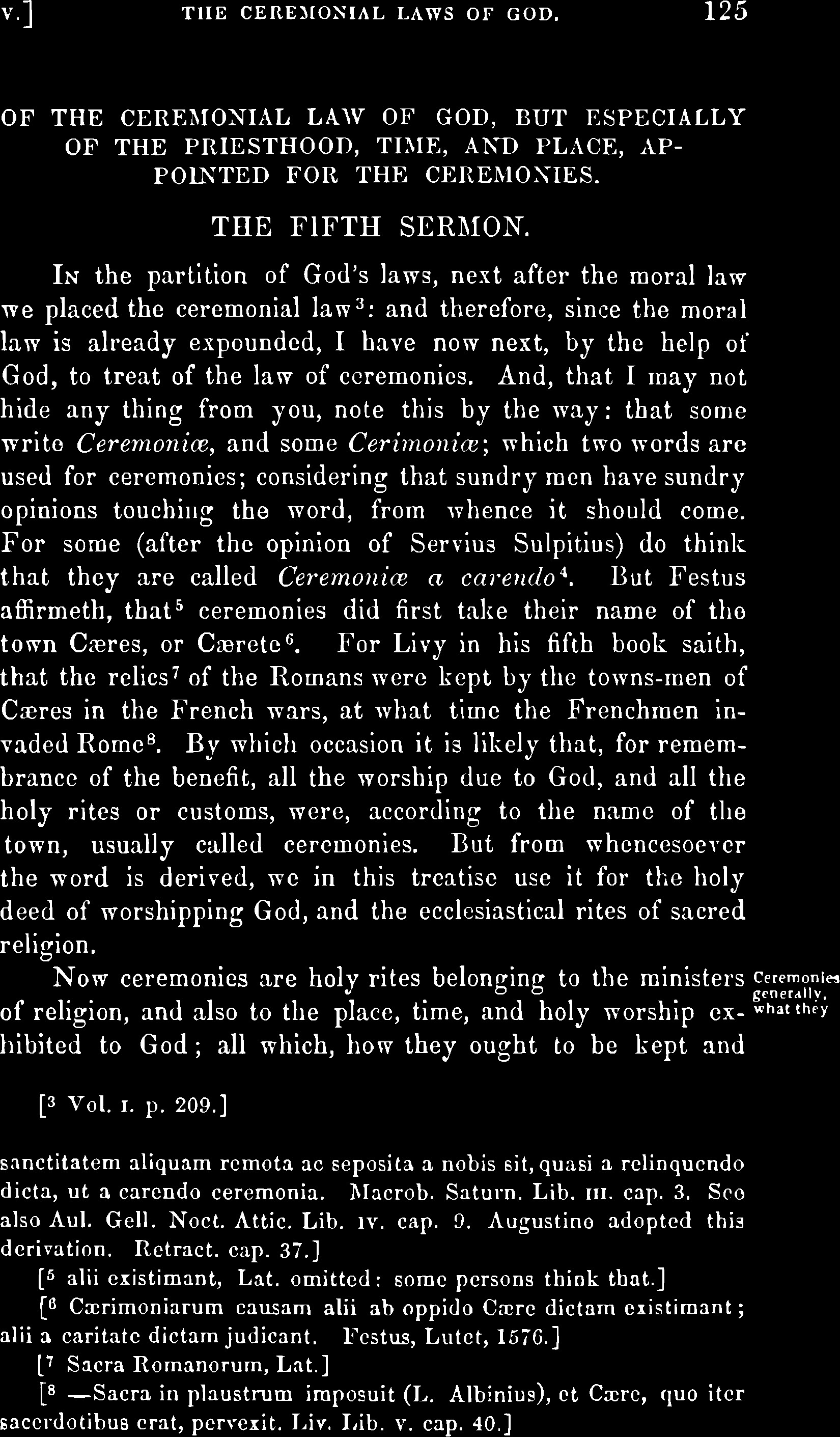
IN the partition of God's laws, next after the moral law we placed the ceremonial law3: and therefore,since the moral law is already expounded, I have now next, by the help of God, to treat of the law of ceremonies.
And, that I may not hide any thing from you, note this by the way: that some write Ceremonice, and some Cerimonice; which two words are used for ceremonies; considering that sundry men have sundry opinions touching the word, from whence it should come.
For some (afterthe opinion of Servius Sulpitius) do think that they are called Ceremonice a carendo*.
But Festus affirmeth,that5 ceremonies did firsttake their name of the town Caeres, or Caerete6.
For Livy in his fifthbook saith, that the relics7of the Romans were kept by the towns-men of Caeres in the French wars, at what time the Frenchmen invaded Rome8.
By which occasion it is likelythat, for remembrance of the benefit,all the worship due to God, and allthe holy rites or customs, were, according to the name of the town, usually called ceremonies.
But from whencesoever the word is derived, we in this treatise use it for the holy deed of worshipping God, and the ecclesiastical ritesof sacred religion.
Now ceremonies are holy ritesbelonging to the ministers ceremonies "
* . generally, of religion,and also to the place, time, and holy worship ex- "hat they . hibited to God ; all which, how they ought to be kept and p Vol. i. p. 209.] [4Servius Sulpicius religionem esse dictam tradidit,quse propter sanctitatem aliquam remota ac seposita a nobis sit,quasi a relinquendo dicta, ut a carendo ceremonia.
Macrob.
Saturn.
Lib. in. cap. 3.
See also Aul.
Gell. Noct.
Attic. Lib. iv. cap.
Augustine adopted this derivation.
Retract, cap. 37.] [saliiexistimant, Lat. omitted : some persons think that.] [6Cserimoniarum causam alii ab oppido Caere dictam existimant ; aliia caritate dictam judicant.Festus, Lutet, 1576.]
[7Sacra Romanorum, Lat.] [8 "
Sacra in plaustrum imposuit (L. Albinius), et Caere, quo iter sacerdotibus crat, pervexit. Lir. Lib. v. cap. 40.]
THE THIRD DECADE.
[sERM.

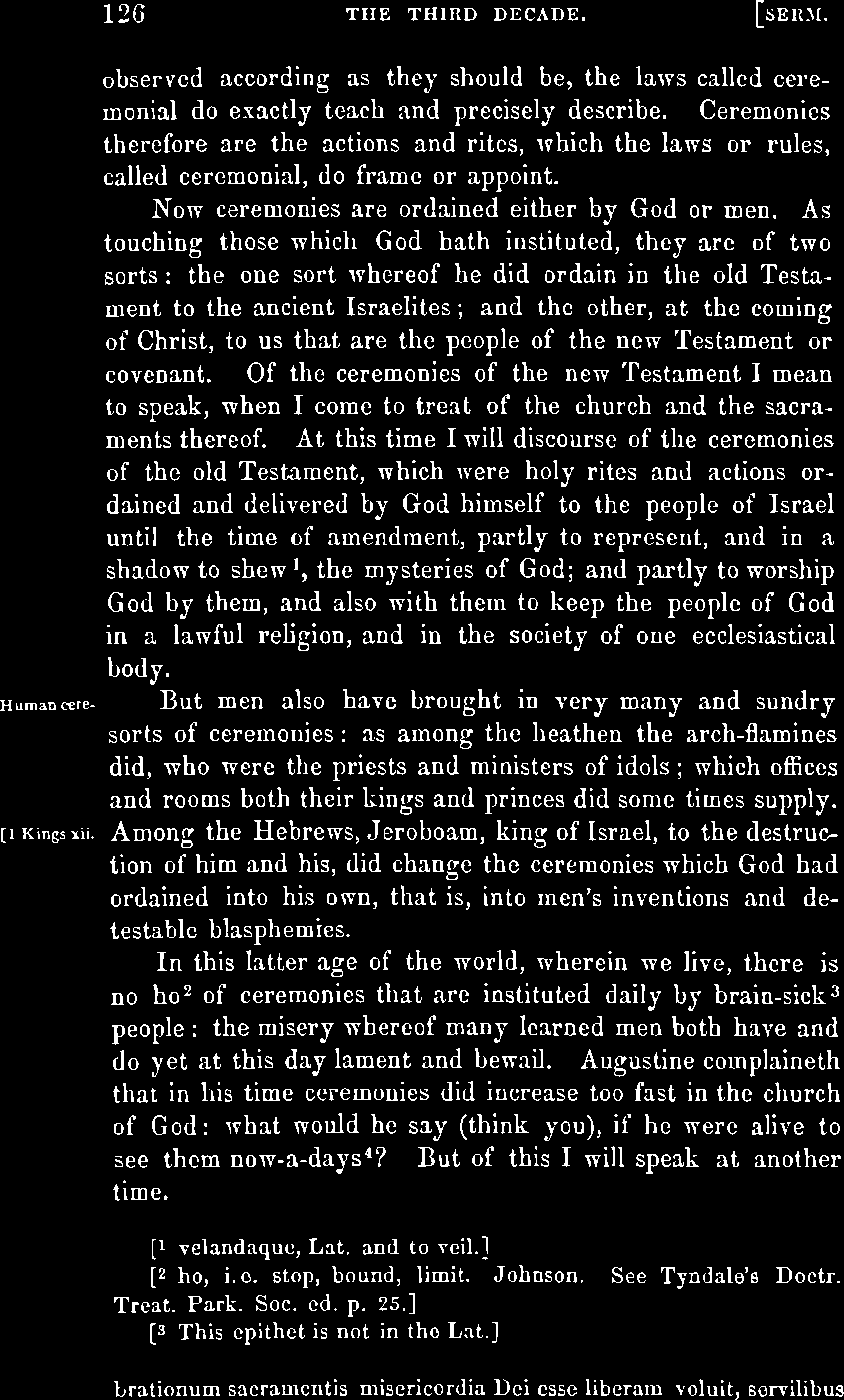
observed according as they should be, the laws calledceremonial do exactly teach and preciselydescribe.
Ceremonies therefore are the actions and rites,which the laws or rules, calledceremonial,do frame or appoint.
Now ceremonies are ordained either by God or men.
As touching those which God hath instituted,they are of two sorts : the one sort whereof he did ordain in the old Testament to the ancient Israelites ; and the other, at the coming of Christ,to us that are the people of the new Testament or covenant.
Of the ceremonies of the new Testament I mean to speak, when I come to treat of the church and the sacraments thereof.
At thistime I willdiscourseof the ceremonies of the old Testament, which were holy ritesand actions ordained and deliveredby God himself to the people of Israel until the time of amendment, partly to represent, and in a shadow to shew1, the mysteries of God; and partly to worship
God by them, and also with them to keep the people of God in a lawful religion,and in the societyof one ecclesiastical body.
Human cereBut men also have brought in very many and sundry sorts of ceremonies : as among the heathen the arch-flamines did, who were the priestsand ministers of idols; which offices and rooms both theirkings and princesdid some times supply.
[iKings xii. Among the Hebrews, Jeroboam, king of Israel,to the destruction of him and his,did change the ceremonies which God had ordained into his own, that is,into men's inventions and detestabl blasphemies.
In this latterage of the world, wherein we live,there is no ho2 of ceremonies that are instituteddaily by brain-sick3 people : the misery whereof many learned men both have and do yet at this day lament and bewail.
Augustine complaineth that in his time ceremonies did increasetoo fastin the church of God: what would he say (thinkyou),if he were alive to see them now-a-days4?
But of thisI willspeak at another time.
[ivelandaque, Lat. and to veil.] [2ho, i.e. stop, bound, limit.
Johnson.
See Tyndale's Doctr.
Treat. Park.
Soc. ed. p. 25.] [3This epithet is not in the Lat.] [4 .
. ipsam religionem, quam paucissimis et manifcstissimis celebrationum sacramentis misericordia Dei esse liberam voluit,serrilibus
THE
CEREMONIAL
LAWS OF GOD.

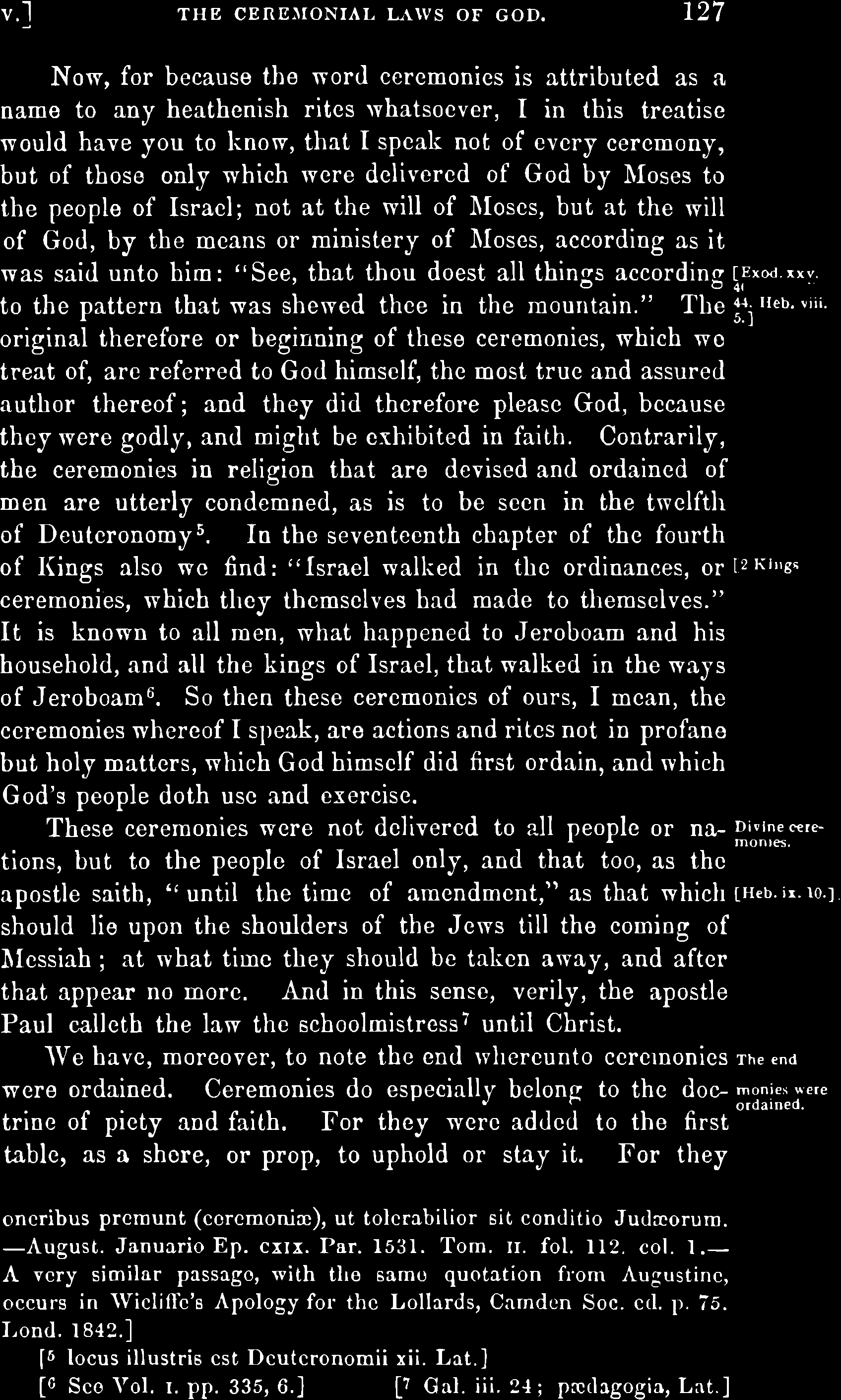
V.] Now, for because the word ceremonies is attributedas a name to any heathenish riteswhatsoever, I in this treatise would have you to know, that I speak not of every ceremony, but of those only which were delivered of God by Moses to the people of Israel;not at the willof Moses, but at the will of God, by the means or ministery of Moses, according as it was said unto him: "See, that thou doest allthings according^Exod.xxy. to the pattern that was shewed thee in the mountain."
The ^ Hebviiioriginaltherefore or beginning of these ceremonies, which we treat of,are referredto God himself,the most true and assured author thereof; and they did therefore please God, because they were godly,and might be exhibitedin faith. Contrarily, the ceremonies in religionthat are devised and ordained of men are utterlycondemned, as is to be seen in the twelfth of Deuteronomy5.
In the seventeenth chapter of the fourth of Kings also we find:"Israel walked in the ordinances, or t?Ring* ceremonies, which they themselves had made to themselves."
It is known to allmen, what happened to Jeroboam and his household,and allthe kings of Israel,that walked in the ways of Jeroboam6.
So then these ceremonies of ours, I mean, the ceremonies whereof I speak, are actionsand ritesnot in profane but holy matters, which God himself did firstordain,and which God's people doth use and exercise.
These ceremonies were not delivered to all people or naDivine cere- * * monies. tions,but to the people of Israel only, and that too, as the apostle saith,"until the time of amendment," as that which [Heb.ix.10.3. should lieupon the shoulders of the Jews tillthe coming of Messiah ; at what time they should be taken away, and after that appear no more.
And in this sense, verily,the apostle Paul calleththe law the schoolmistress7untilChrist.
We have, moreover, to note the end whereunto ceremonies The end were ordained.
Ceremonies do especiallybelong to the docmonies were "
* ordained. trine of piety and faith.
For they were added to the first table, as a shore, or prop, to uphold or stay it.
For they oneribus prcmunt (ceremonise), ut tolcrabiliorsitconditio Judseorum.
August.
Januario Ep. cxix.
Par.
1531.
Tom. ir. fol. 112. col. 1. "
A very similar passage, with the same quotation from Augustine, occurs in Wicliffc'sApology for the Lollards, Camden Soc. ed. p. 75.
Lond. 1842.] f5locus illustrisest Deuteronomii xii.Lat.] ["See Vol.
I. pp. 335, 6.] ['Gal. iii.24; pcedagogia,Lat.]
THE THIRD DECADE.
[SERM.

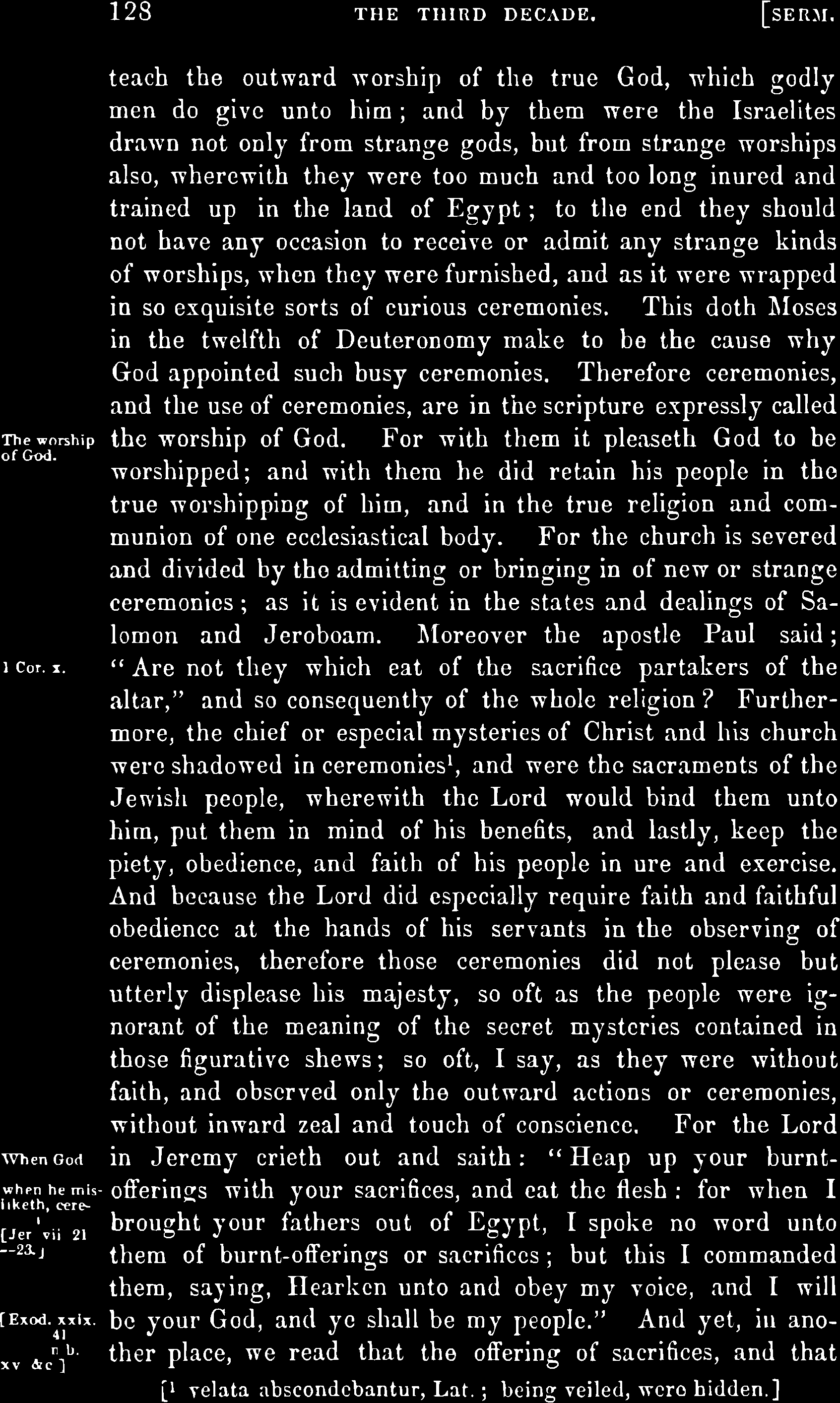
teach the outward worship of the true God, which godly men do give unto him ; and by them were the Israelites drawn not only from strange gods, but from strange worships also,wherewith they were too much and too long inured and trained up in the land of Egypt ; to the end they should not have any occasion to receive or admit any strange kinds of worships,when they were furnished,and as itwere wrapped in so exquisitesorts of curious ceremonies.
This doth Moses in the twelfth of Deuteronomy make to be the cause why God appointed such busy ceremonies.
Therefore ceremonies, and the use of ceremonies, are in the scriptureexpresslycalled The worship the worship of God.
For with them it pleaseth God to be of God.
, .
, -i-ii i "!"
" i " i " i worshipped; and with them he did retain his people m the true worshipping of him, and in the true religionand communion of one ecclesiastical body.
For the church issevered and divided by the admitting or bringing in of new or strange ceremonies ; as it isevident in the states and dealingsof Salomon and Jeroboam.
Moreover the apostle Paul said; i cor. Tt.
" Are not they which eat of the sacrificepartakers of the altar," and so consequently of the whole religion?
Furthermore, the chief or especialmysteriesof Christ and his church were shadowed in ceremonies1,and were the sacraments of the Jewish people, wherewith the Lord would bind them unto him, put them in mind of his benefits,and lastly,keep the piety, obedience,and faith of his people in ure and exercise.
And because the Lord did especiallyrequire faithand faithful obedience at the hands of his servants in the observing of ceremonies, therefore those ceremonies did not please but utterly displeasehis majesty, so oft as the people were ignorant of the meaning of the secret mysteries contained in those figurativeshews; so oft,I say, as they were without faith,and observed only the outward actions or ceremonies, without inward zeal and touch of conscience.
For the Lord when God in Jeremy crieth out and saith:
"Heap up your burntwhen he misofferingswith y our sacrifices, and eat the flesh: for when I liketh, cere- "
[JM'VH
brought your fathers out of Egypt, I spoke no word unto ""^J them of burnt-offeringsor sacrifices ; but this I commanded them, saying, Hearken unto and obey my voice, and I will [Exod.^xiix. be your God, and ye shallbe my people."
And yet, in anoxv "c"]b'
^er place" we rea^ that ti16offeringof sacrifices,and that [!velata abscondebantur, Lat. ; being veiled,were hidden.]

THE
CEREMONIAL
LAWS OF GOD.
V.] external action of the people in worshipping God, was acceptable and of a sweet-smelling savour in the nose of the Lord.
Now, whereupon riseth this diversity, I pray you, but upon the differenceof the minds of them that worship the Lord ?
For sacrificespleased him, and the honour that was done unto him in simple obedience and faithalone did please him too : but that religionhe did utterly mislike of, wherein he was worshipped with outward shews, and not with the faith and sincere obedience of the inward heart : in which sort we read that Cain did sin ; for God commanded not to sacrificein that manner that Cain did.
Again, he commanded to sacrificeand to worship him with external ceremonies2 in faiththat Christ should come to be the Saviour of the world3: not that they should hope to be justified by the external action,but by him that was prefigured in alltheir ceremonies, Christ Jesus, the sacrificeonce to bo offeredto save them all4;who was the lifeand meaning whereunto all those ceremonies did lead,that are expressed in the law.
But itis not amiss here particularlyto examine and look f 'he " iti i ".
" i into not all and every one, but the chiefest ceremonies, and ceremonies is not unpr those which are more significantthan the rest.
Let this la-fitoble ies probour of mine not seem to any man to be more curious than needeth, or lessprofitablethan it sheweth for.
For it is undoubtedly very availableto the sound understanding of the abrogation of the law5. All things,whatsoever
God hath laid down in the holy scriptures,are altogetherprofitableto our edification, and do carry with them a divineauthority,whereby we may confirm our minds : they therefore are very fools and godless people, or, to use a more gentle term, they are shuttle-witted6,and ignorant of allgood things, whose stomachs do rise at the ceremonies that God hath taught, and whose ears are offended to hear a sober and godly treatise upon the expositionof those divine ceremonies.
Some there are, and that no small number, who think it very profitable [2legitimo et, Lat. omitted : lawfully,and.] [3in fido Christiventuri Messise, Lat.] [4the sacrifice " all; not in the original.] [6rather, of the law that has been abrogated : legisabrogatsc,Lat.] [6temerarii, Lat. Shittle or shuttle; light,volatile,giddy. Richardson's
Diet, in voc.]
[BULLINGER,
u.]
THE THIRD DECADE.

and an excellentthing to construe Homer and Virgil allegorically;in divine ceremonies only foolishheads are persuaded that no profitor wisdom liethsecretlyhidden : when indeed, in allthe world again,there is nothing more profitable,more pleasant,more fine, more excellent,or more full of wisdom in allegoricaltypes, than the ceremonies are that God hath ordained.
For in them are the mysteries of Christ and his catholicchurch very finely,plainly,and notably described.
Now, in reckoning up and touching these several ceremonies, I will chiefly follow the very natural order.
Ceremonies The sum of the ceremonies. do appertain to the ecclesiasticalworship of God.
Therefore itisnecessary that there should be persons appointed in the church to be the masters, or rather public ministers,of those ceremonies, to exerciseand put them in practice,as the Lord ordained them.
It is necessary also,that there be a certain place and time appointed, wherein and when God should be especiallyworshipped rather than at another place or season.
Moreover, the holy rites,that is,the very ceremonies, must be appointed and certainlynumbered, that the worshippers of God may know what and how great the honour isthat they are bound to give unto him.
And firstof all,I The priesthood. mean to say somewhat of the persons, that is,the priestsor Levites; referringstillthe hearers to the reading of the holy
Bible,wherein the whole isfullycontained and largely described The beginning of priesthood among the old people is The beginning of priesthood. derived or brought from the creation almost1: for they say, that in every family the first-begotten were always the priests.
It is certain,that, when the firstbornof Egypt were slain, the Lord did by a law consecrate to himselfthe first-begotten [Exod.xiii.
8, 15.] of the Israelites. And the preeminence, or dignity,of the first-begottenhath always been very great by the civillaw2.
The first-begottendid always rule and bear the sway in his father's house, and was, as it were, a king among his brethren : to the first-begottenthe inheritance was due, to the other brethren were portions given: the first-begottendid excel the rest in the dignity of the priesthood.
Therefore I think his when Cain and Abel did strive about their birthright,they meaning was to have said [aIn his treatisede Episcop. instit.et funct. cap. i. Bullinger shews that he here follows the vetus Judaeorum traditio.] [2vel in legibus civilibus,Lat. : even in civillaws.]

THE
CEREMONIAL
LAWS OF GOD.
V.] contended not about a trifle,but about a matter of very great Esau and weight.
Whereupon, when the mother-virgin is said in Luke of*cain Ind to have borne the first-begotten son, let no man think that Christ the she was the mother of the second-begotten, or many sons tenmore.
For in that Luke calleth Christ her first-begotten [Luke u. TO son, therein is noted his dignity and excellency.
For to Christ our Lord doth belong the kingdom, priesthood,and inheritance: by whose bountiful liberalitywe are adopted to be his partners both in the kingdom, priesthood,and inheritance of lifeeverlasting and allheavenly things.
But to return to our purpose again. The dignityof priesthood, among the people of Israel, did of right belong to Reuben, because he was the first-begotten ; but he, by commitljG|nxUxting detestableincest,did lose his right.
Next to him, there1Chron-v-10 fore,was Levi4, who also lost that dignity for the sin which [Gen.xxxiv. he committed in killingthe men of Sychem traitorously, The Levites and profaning the sacrament of circumcision.
But because Prieststhe tribeof Levi did behave itselfmanfully, not only in the bringing of the children of Israel out of Egypt, but also in punishing idolaters,I mean, the men that worshipped the golden calf; therefore did they receive the officeor dignity of priesthood in reward of their virtue, and at that time were the Levites chosen to the place of the first-begottenof " And Moses said allthe seed of Israel. For thus we read :
E*""- "*uunto the Levites, Consecrate your hands unto the Lord this day, every man upon his son, and upon his brother; that there may a blessingbe given you this day."
And again :
" And the Lord spake unto Moses, saying, Behold, I have ^"KJ.]"' taken the Levites from among the children of Israel for all that firstopeneth the matrice among the children of Israel; and the Levites shallbe mine ; because all the firstborn are mine : for the same day that I smote all the firstbornin the land of Egypt, I hallowed to myself all the firstbornin Israel."
And so forth.
By thisitappeareth that the tribe of Levi was appointed to the priesthood in the church of Israel.
Moreover thisdignity,or ministry,was singularly confirmed to this tribe immediately upon the insurrectionof Korah, Dathan, and Abiron, by the wonderful miracle that the Lord p This correction of the translator is perhaps not necessary. Bui- "
Conf. Cahr. Comment, in loc.] [4successit ergo Levi, Lat.] linger probably took Calvin's view.
9"2
THE THIRD DECADE.
[SERM.

wrought upon Aaron's rod, which budded alone among the other eleven twigs, for a witness that God had appointed the tribeof Levi alone to the officeand functionof holy priesthood.
And for that cause was the same rod put into the ark, and kept in the tabernacle,to the end that none other tribeshould affect the priesthood at any time thereafter. All which is largely declared in the sixteenth and seventeenth chapters of the Book of Numbers. certain deNow there was among the Levites a certainorder; there " erees among .
. in* QIC priests, were degrees,and, as itwere, appointments unto sundry offices.
For the Levites were divided into three families,that is,into Cahatites1,Gersonites,and Merarites : and they again were parted intofour orders.
For firstof all,out of the family of Cahat were chosen princes,to bear the sway and rule the rest : to them the remnant of the Cahatites,and the other two orders,the Gersonitesand Merarites, were subject, and did obey the firstsort of Cahatites that were their governors.
For Aaron, the chief priest,with Ithamar and Eleazar his sons, had the preeminence among the rest.
For thus we read in the third of Numbers :
" And thou shaltgive the Levites unto Aaron and to his sons ; for they are given unto him of the children of Israel. And thou shalt appoint Aaron and his sons to wait on their priests'office; and the stranger that cometh nigh shall be slain."
Therein did Aaron, the chief priest,bear the type or figureof Christ,the true, the best,and greatest king and bishop, to whom all Christians as to their chief bishop and head, whose dwelling isin heaven2. are subject, Among the And here observe,that allthe Levites did not serve in the were chosen tabernacle, nor that they alldid everywhere through the land to the minis- "
"f Israelinstructand teach.
There were certain ordinances touching the choice and refusal of those among the Levites that were to be calledto the ministry or priesthood. Time will not serve me to reckon allthe laws appointed for that purpose ; the chief whereof are to be seen in the twenty-firstand twenty-second chapters of Leviticus. In the eighth chapter of the book of Numbers the age isappointed of them that should be thought fitfor the ministry; that is,from the twenty-fifthto the fiftiethyear of theirage.
The priests,that were called [lCahatites: Kohathites.] [2quorum ipse summus pontifex et caput in ccelisest,Lat.]

THE
CEREMONIAL
LAWS OF GOD.
V.] and chosen to the ministry, were also consecrated.
The manner of consecrating them is far more large and busy than that I can in few words declare it.
By their consecration was meant, that they ought to be adorned with sundry gifts,and endued with holy conversation,that serve the church in the officeof priesthood.
For to this doth especiallybelong the anointing of the priests,which is a type of the Holy Ghost, wherewithal unless an ecclesiastical ministerbe endued, i john u. he exerciseth the officeto his own destruction.
This ceremonial anointing of priestsis set down by Moses in the twentyninth of Exodus, the eighth of Leviticus, and the eighth chapter of the book of Numbers.
To this we must add also the habit or apparel that the priests did use.
The priests ware, when they did not minister in their charge or office, such kind of garments as laymen did, as we may gather out of Ezechiel3; but when they did serve in the ministry, then did they wear ceremonial raiment according to God's commandment.
A very large description whereof Moses doth very well set down in the twenty-eighth and thirty-ninth chapters of Exodus.
There are in number nine sorts of ceremonial garments4; yet some do reckon up but eight; Josephus maketh ten5.
First of all,the priests,before they went about their offices, did wash themselves in water6, and then put on their holy garments.
Among those garments, some there were indifferently used both of the inferiorand chief priests. And first, their privitiesare hidden with linen breeches coming down to their knees and hams ; the upper part whereof was tied above their hips with a gathering band, likethe upper part of our common slops7,to the end that, if they should chaoce to [3Ezek. xlii. 14.
" alienis, id est, vulgaribus restimentis amicti (sacerdotes) multitudini admiscebantur.
CEcolampadius, Comment, in loc. cit.fol. 264. Argent, 1634.] [4In the following account of the garments of the Jewish priests Bullinger has largely borrowed from Jerome's Epist. ad Fabiolam, do "
1706. Tom. n. col. 674, "c.] [6Joseph.
Antiq. Lib.
HI. cap. 7.] [6aqua munda, Lat. pure water.] [7caligarum nostrarum, Lat.
Slops : trowsers, Johnson.
Homily veste sacerdotali. Hieron.
Opp. Par. 1693
(Oxf. ed.
1832, p. 285) Against excess of Apparel.
But the corresponding word in the auth. ver. of Isai.iii.20, there quoted, is "the ornaments of the legs."]
THE THIRD DECADE.
[SKRII.

fall,while they were busy in killing their sacrifices, or in bearing of burdens to and fro, the parts should not appear which shame doth bid to cover.
Upon their linen breeches they had a closecoat, made of double linen, which (asJosephus saith) was made of silk1.
That was plain,or closeto the body, without plait or gathering2, The close fiock or cassock. and came down justto the calfof the leg.
Such3 were soldierswont to wear, and called them cassocks4; so fitfor their limbs and closeto theirbodies,that they were light,and without let either to run or fight. And therefore the priests, making themselves ready to the ministeryof God, put on such a cassock, that, being comely clad,they might, notwithstanding, with much expeditiondischarge their office,and exercise their ministery.
The third kind of raiment, that was a belt or girdle, did gird that cassock about the priest.
This girdle was The girdle woven of purple, scarlet,and blue silk6,like to an adder's skin, hanging down beneath the knee, but in the holy ministery tucked up again upon the leftshoulder6.
The fourth kind of ornament was a mitre, or a round little The cap or mitre. cap,which covered his head almost to the ears, in fashion like as ifa man should cut a bowl even in the midst, and set the upper part upon his head7.
Then was the ephod, (whereofmention is made, not in The Ephod.
Exodus, where the ceremonial garments are reckoned up as it were of purpose, but in other places of holy scripture,) which garment was indifferentlycommon to all the priests, [Judg. xvii.
6 ; xviii. 14. i sam. ii.ia] This ephod is thought to have been a linen cloak ; such an ^2 sam. vi.
One as David ware when he danced before the ark.
Of the priestswhich Saul slew by the hands of Doeg the Edomite, " And he killedthat same day eighty-fivemen thus we read : ri sam. that ware linen ephods."
His meaning is, not that they were slain while the ephods were on their backs ; but that they were killed,when they were of that age and order,that [* "
"nr\fjs pivbovosf3vo-"rivr)s.
Joseph, ibid." 2. Exod. xxviii.40.] [2Adlircret corpori plana, Lat.] [3lineas,Lat.] [4camisia, Lat. a linen coat, which soldiers wore close to their body.
Ainsworth.] [6bysso hyacinthoque.
Lat. and Joseph, ibid, pera vaK.iv6avKCU [6Joseph, ibid."2.] [7Joseph, ibid.$ 3. Exod. xxriii.40.]

THE
CEREMONIAL
LAWS OF GOD.
V.] they might wear an ephod ; that is,that they might minister in the priesthood of the Lord.
Therefore in Osee we read, [Ho".ui. 4.] "Thou shalt be without ephod, and teraphim;" that is,without priesthood and religion. For the ephod began to be used for the very priesthood; the garment, or the sign,for the thing signified.But ifany man willtake these words of Osee to be spoken of the more notable ephod (ofwhich I shall have cause to speak anon),I will not greatly gainsay him.
Now this linen ephod seemeth not to differmuch from that which the Papists do8 call a surplice9.
These five garments the chief priestand under priestsdid use alike.
The other four do properly belong to the high priestalone.
The firstof the four was called megil, and was a coat The megiu down to the ancles10; a garment of allblue silk,from the neck down to the sole of the foot,being close on every side,unless it were the places to put his head and arms out at : at the hems beneath did hang seventy-two bells,and as many pomegranates, so placed that stillbetween two bells there hung one pomegranate, and betwixt two pomegranates one bell: the cause thereof is made to be this, that, when the high priest went intothe holy of holies,the sound might be heard ; because he should by and by die the death unless he did so11.
Now followeth the ephod of the high priest,which differ-The breastlg eth much from that whereof I spake before.
For it was not pan"f-s of linen, but woven with weaver's work of divers colours of gold, purple,and silk; being unlike to the other in shape and making.
For itbelonged to the high priestsalone, and was a breast-lap,coming over the bulk from the neck to the hips : for, like a curet12, it covered the breast; it came over the hinder part of the shoulders,and about both the sidesunder the arm-holes: bearing the same fashion that at this day women's stomachers do, which we Switzers calllibli13. This ephod be ware upon the top of his megil, that came down to [8hodie, Lat. omitted : at this day.] [9pallium, camisiam, vel vestem chori, Lat.] [10vestis inquam sinuosa, Lat. omitted: a plaited garment.] [u Exod. xxviii.31-35.
Joseph, ibid. $4.] [12curet, or curiet, a breastplate or corslet, from cuir,leather ; breastplates being at first made of that material.
Toone's Glossary in voc.] [13The word which Luther's version has is leibrock.]
THE THIRD DECADE.
[SERM.

the ancles1.
Upon each shoulder he bare an onyx-stone, called schoham2; wherein were graven the names of the children of Israel: against the breast there was nothing woven in it,but a place was leftvoid for the breast-lap of The breastjudgment.For the breast-lapof judgment, which is called men"t.JUC hosen, was the eighth ornament of their attire; and it was a woven cloth made of gold, purple, and silk,about an handbreadth square, and double, and hemmed about on every side, because it should not ravel out.
In that there was woven precious stones of a wonderful greatness(forthe kind)and of a marvellous price; which were placed so in four sundry rows, that every rank contained three stones ; in which, as in the onyx-stones, were graven the names of the childrenof Israel3.
They glisteredwith a wonderful brightness; for no stones were set in the breast-lap but such as shone exceedingly.
[Exod.xxviii.Whereby it seemeth that Urim and Thummim was nothing Thu'Eimim e^se^u^ *nese rows "f precious stones : for Urim and Thummim signifylight and perfectness; for, as these stones did give great light,so were they pure without all manner of spots.
And they thought that the high priestdid never say right in a matter of weight, nor, when he was asked, did utter truly the answers and oracles of God, but when the breast-lapof judgmentdid hang on his breast.
Now this breast-lapof judgmentwas tied to the ephod, or the other breast-lap,by golden ringsbeneath ; and above, ithung down the shoulders by golden chains, that were fastenedunder the onyx-stones.
This was the most precious and excellentpart of the high priest'sapparel.
For it was the cofferof wisdom, and treasure of alllaw and knowledge, of equity and justice, from whence the Israelitesdid fetch,as it were, the determinate answers to such doubts as at any time they stuck upon : which is the cause (asit seemeth) that some have translated Urim and Thummim into the Greek ^Xwo-tsKctl aXrjOeia4 ; f1Joseph, ibid." 6. and de Boll. Jud. Lib. v. cap. 6. " 7.] [2gemma) pretiosse,Lat. omitted : precious stones.] [3Exod. xxviii.15-29.
Josephus, ib. " 5.] [4Levit. viii.8. LXX. tTTfdrjKev eVi ro Xoyeloi/TT/V 8q\to(riPicaiTTJV v.
Hoc vero quid significabatur aliud, quam quod in pectore sacerdotis debet esse verum judiciumde rebus divinis,quod deinde non sibi retineat, sed coram ecclesia proferat cum veritate?
Bullinger. de Epic, instit.et funct. Lib. n. fol.70.]
THE
CEREMONIAL
LAWS OF GOD.

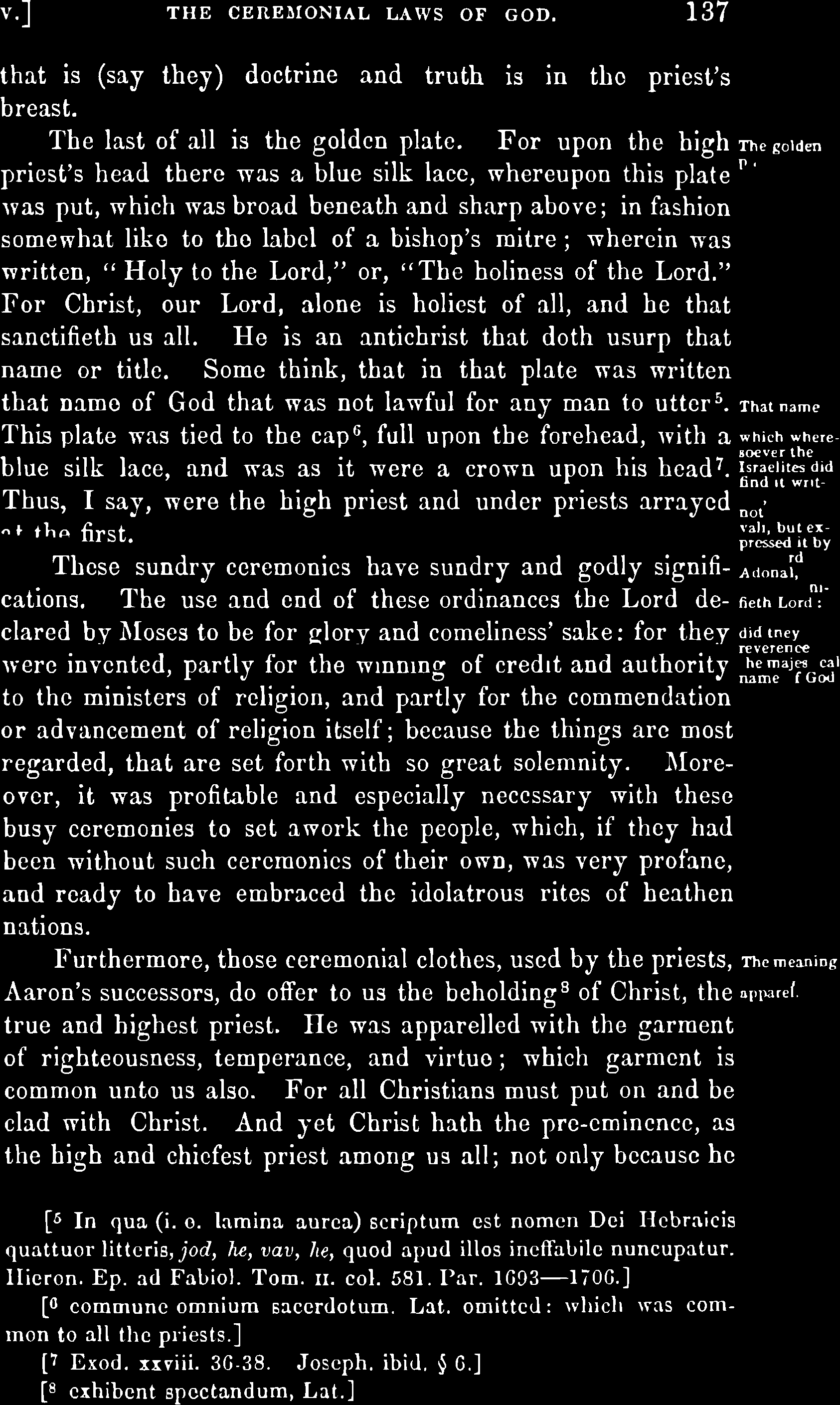
V.] that is (saythey)doctrine and truth is in tho priest's breast.
The lastof all is the golden plate.
For upon the high The golden P ' priest'shead there was a blue silklace,whereupon thisplate was put, which was broad beneath and sharp above ; in fashion somewhat like to the label of a bishop's mitre ; wherein was " Holy to the Lord," or, "The holinessof the Lord." written, For Christ, our Lord, alone is holiest of all,and he that sanctifiethus all.
He is an antichristthat doth usurp that name or title. Some think, that in that plate was written that name of God that was not lawful for any man to utter5. That name This plate was tiedto the cap6, fullupon the forehead, with a which wheresoever the blue silk lace, and was as it were a crown upon his head7. Israelitesdid r find it writThus, I say, were the high priestand under priestsarrayed not' of tViA flrct vah, butexnrSt. pressed itby These sundry ceremonies have sundry and godly signifi-Adonal? cations.
The use and end of these ordinances the Lord defiethLordT clared by Moses to be for glory and comeliness'sake: for they didtney .
, . reverence were invented, partly for the winning of credit and authorityn^aJfg^1 to the ministersof religion,and partly for the commendation or advancement of religionitself; because the things are most regarded, that are set forthwith so great solemnity.
Moreover, it was profitableand especially necessary with these busy ceremonies to set awork the people,which, if they had been without such ceremonies of their own, was very profane, and ready to have embraced the idolatrousritesof heathen nations.
Furthermore, those ceremonial clothes,used by the priests, The meaning Aaron's successors, do offerto us the beholding8 of Christ,the apparef. true and highest priest. He was apparelledwith the garment of righteousness,temperance, and virtue; which garment is common unto us also. For all Christiansmust put on and be clad with Christ.
And yet Christ hath the pre-eminence, as the high and chiefestpriestamong us all;not only because he [6In qua (i. o. lamina aurea)scriptum cst nomcn Dei Hebraicis quattuor litteris,jod,he, vav, he, quod apud illosineffabilenuncupatur.
Hieron.
Ep. ad Fabiol. Tom. n. col. 581. Par.
1706.] [fl commune omnium sacerdotum.
Lat. omitted : which was common to all the priests.] [?Exod. xxviii. 36-38.
Joseph, ibid." 6.] [8exhibent spectandum, Lat.]
THE THIRD DECADE.
[SERM.

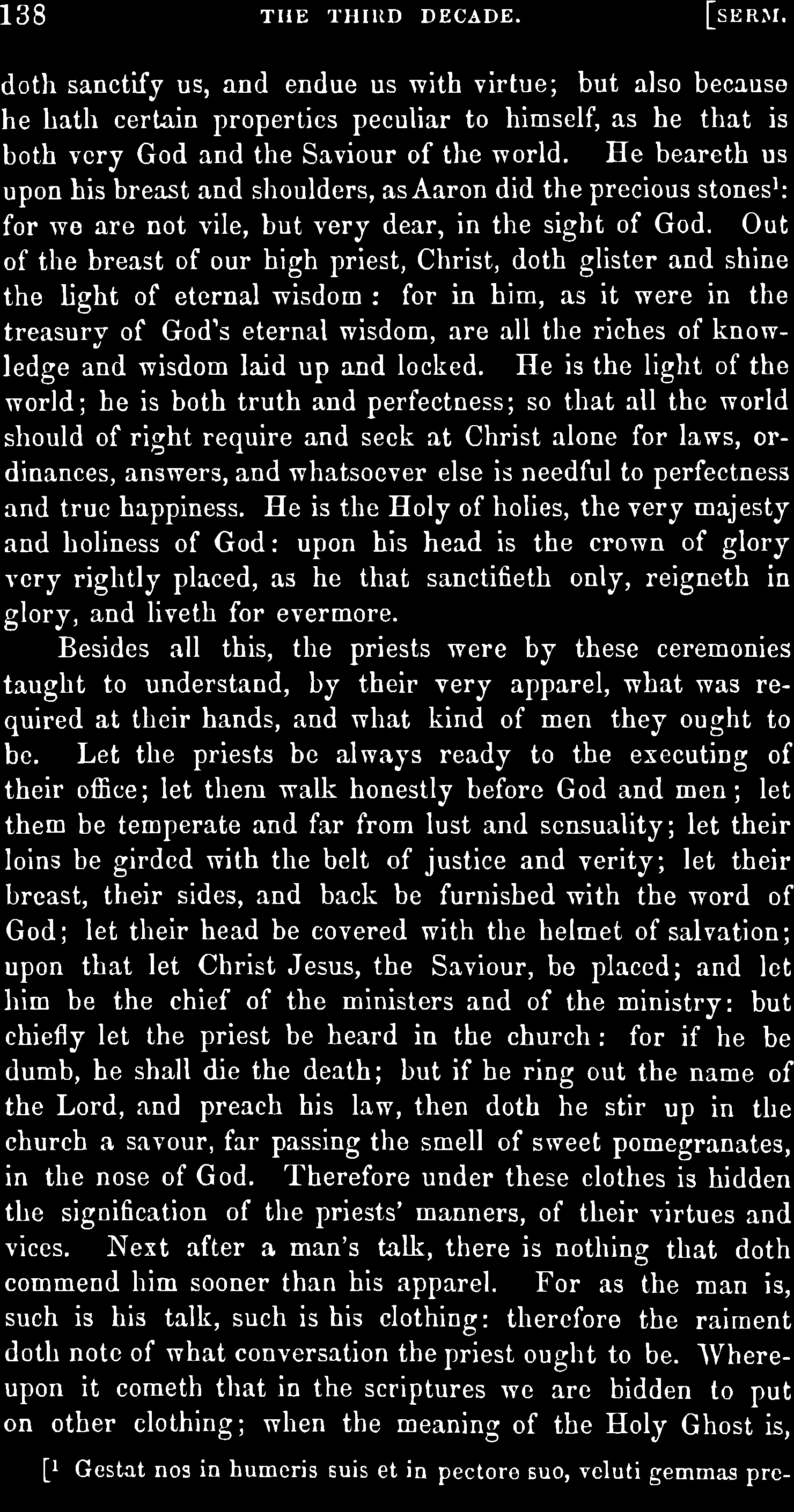
doth sanctify us, and endue us with virtue; but also because he hath certain properties peculiar to himself,as he that is both very God and the Saviour of the world.
He beareth us upon hisbreast and shoulders,as Aaron did the preciousstones1: for we are not vile,but very dear, in the sight of God.
Out of the breast of our high priest,Christ,doth glisterand shine the light of eternal wisdom : for in him, as it were in the treasury of God's eternal wisdom, are all the riches of knowledge and wisdom laid up and locked.
He isthe light of the world; he is both truth and perfectness; so that all the world should of right require and seek at Christ alone for laws, ordinances, answers, and whatsoever else isneedful to perfectness and true happiness. He isthe Holy of holies,the very majesty and holiness of God: upon his head is the crown of glory very rightly placed, as he that sanctifiethonly, reigneth in glory, and liveth for evermore.
Besides all this, the priests were by these ceremonies taught to understand, by their very apparel, what was required at their hands, and what kind of men they ought to be.
Let the priests be always ready to the executing of their office;let them walk honestly before God and men; let them be temperate and far from lust and sensuality;let their loins be girded with the belt of justice and verity; let their breast, their sides,and back be furnished with the word of God; let their head be covered with the helmet of salvation; upon that let Christ Jesus, the Saviour, be placed; and let him be the chief of the ministers and of the ministry: but chieflylet the priest be heard in the church : for if he be dumb, he shall die the death; but if he ring out the name of the Lord, and preach his law, then doth he stir up in the church a savour, far passing the smell of sweet pomegranates, in the nose of God.
Therefore under these clothes is hidden the significationof the priests'manners, of their virtues and vices.
Next after a man's talk, there is nothing that doth commend him sooner than his apparel.
For as the man is, such is his talk, such ishis clothing: therefore the raiment doth note of what conversation the priestought to be. Whereupon it cometh that in the scriptures we are bidden to put on other clothing; when the meaning of the Holy Ghost is, [lGestat nos in humeris suis et in pectore BUG, veluti gemmas pretiosas,Lat.J

THE
CEREMONIAL
LAWS OF GOD.
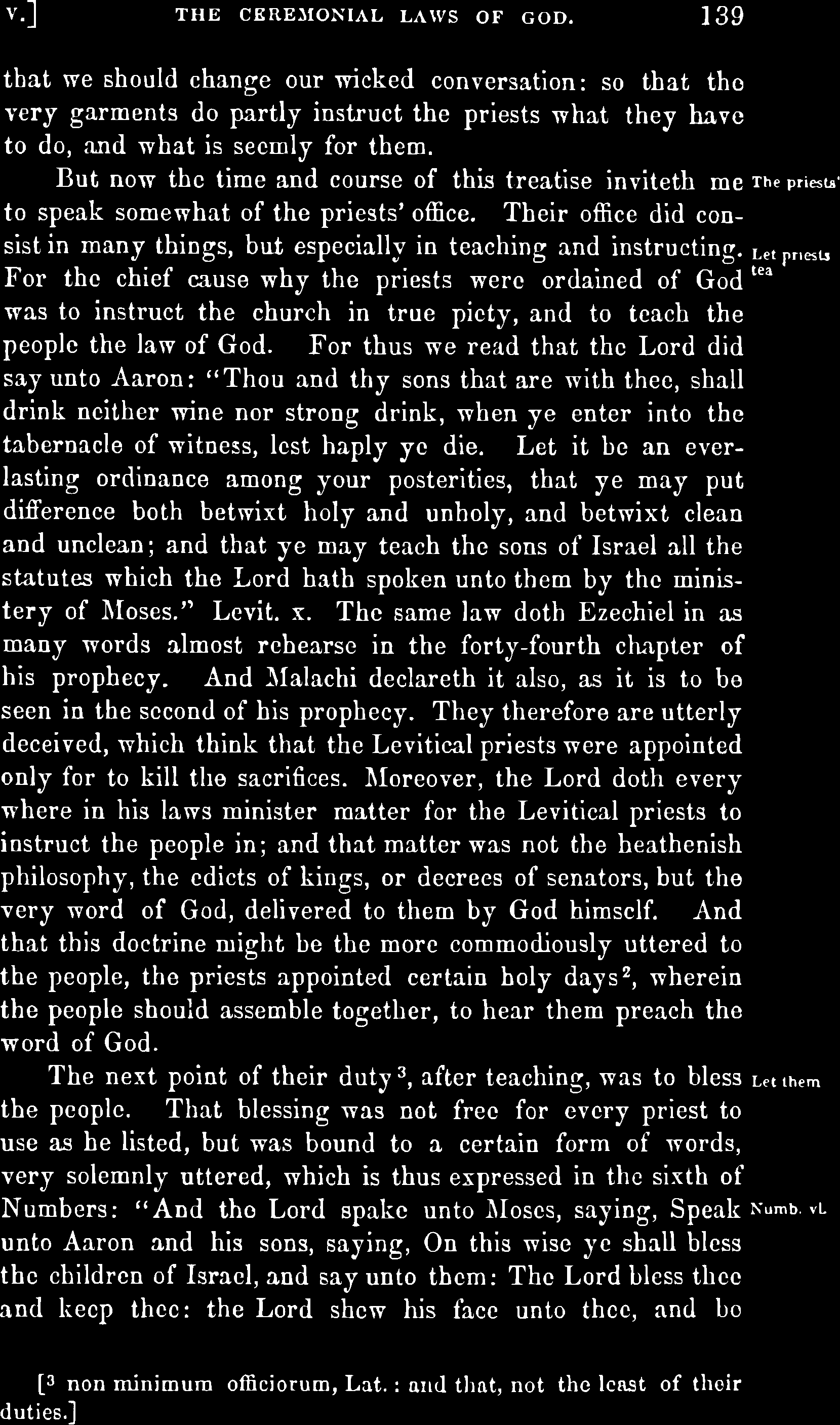
V.] that we should change our wicked conversation: so that the very garments do partly instructthe priestswhat they have to do, and what is seemly for them.
But now the time and course of thistreatise inviteth me The prieststo speak somewhat of the priests'office. Their officedid consist in many things,but especiallyin teaching and instructing.Let pnesu
For the chief cause why the priests were ordained of God "* was to instruct the church in true piety, and to teach the people the law of God.
For thus we read that the Lord did say unto Aaron:
"Thou and thy sons that are with thee, shall drink neither wine nor strong drink, when ye enter into the tabernacle of witness, lesthaply ye die.
Let it be an everlasting ordinance among your posterities,that ye may put difference both betwixt holy and unholy, and betwixt clean and unclean ; and that ye may teach the sons of Israelallthe statutes which the Lord hath spoken unto them by the ministery of Moses."
Levit. x.
The same law doth Ezechiel in as many words almost rehearse in the forty-fourth chapter of his prophecy.
And Malachi declareth it also, as it is to be seen in the second of his prophecy.
They therefore are utterly deceived, which think that the Leviticalpriestswere appointed only for to killthe sacrifices.Moreover, the Lord doth every where in his laws minister matter for the Leviticalpriests to instructthe people in; and that matter was not the heathenish philosophy, the edicts of kings, or decrees of senators, but the very word of God, delivered to them by God himself.
And that this doctrine might be the more commodiously uttered to the people, the priestsappointed certain holy days2, wherein the people should assemble together, to hear them preach the word of God.
The next point of their duty 3, afterteaching,was to bless Let them the people.
That blessingwas not free for every priest to use as he listed,but was bound to a certain form of words, very solemnly uttered,which is thus expressed in the sixth of Numbers:
"And the Lord spake unto Moses, saying, Speak Numb. vt. unto Aaron and his sons, saying, On this wise ye shallbless the children of Israel,and say unto them:
The Lord blessthee and keep thee: the Lord shew his face unto thee, and bo [2indicebant fastos,Lat.] [3 non minimum officiorum, Lat. : and that,not the least of their duties.]
THE THIRD DECADE.
[sERM.

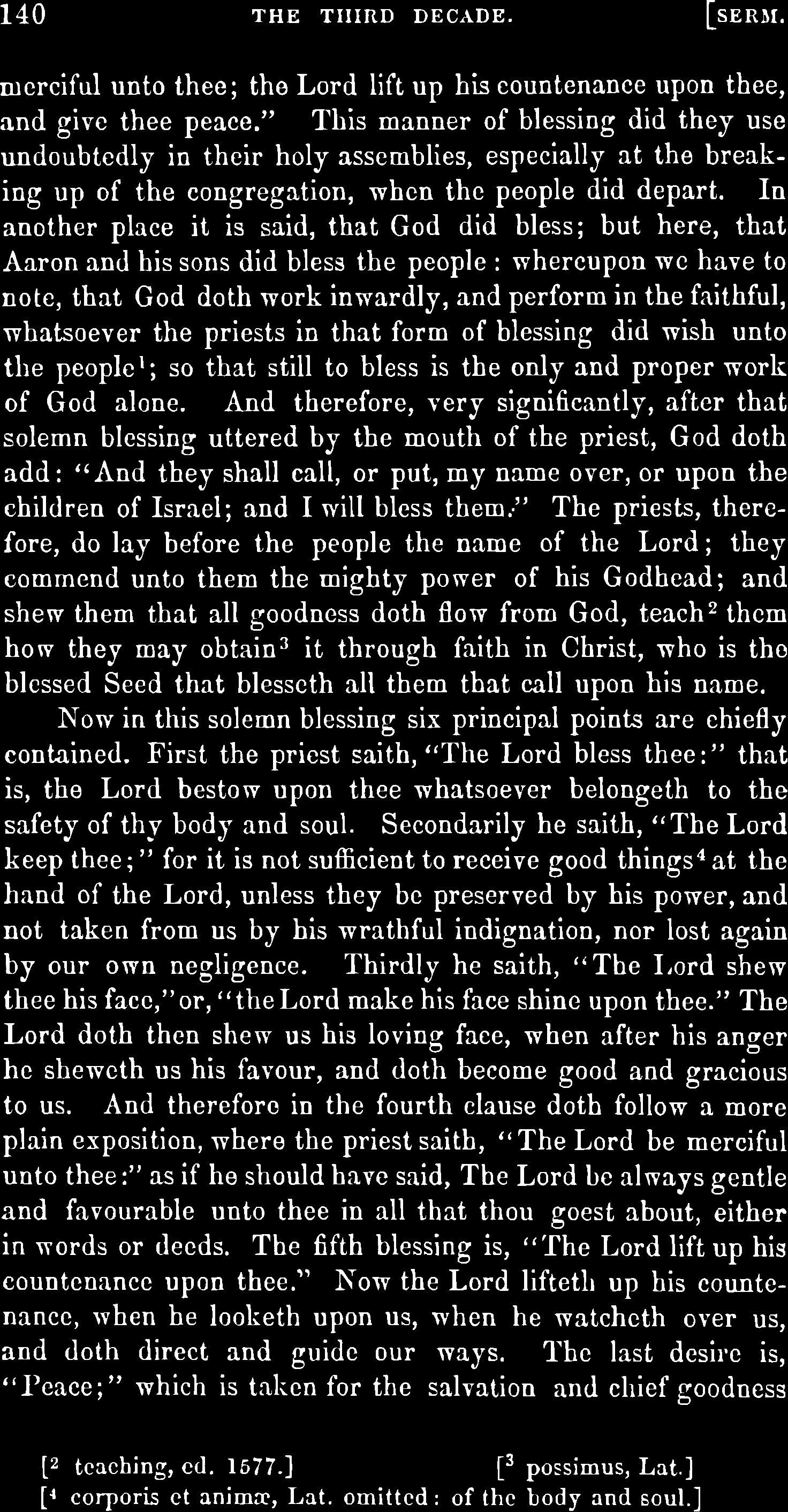
mercifulunto thee; the Lord liftup hiscountenance upon thee, and give thee peace."
This manner of blessingdid they use undoubtedly in their holy assemblies,especiallyat the breaking up of the congregation, when the people did depart.
In another place it is said,that God did bless; but here, that Aaron and his sons did bless the people : whereupon we have to note, that God doth work inwardly, and perform in the faithful, whatsoever the priestsin that form of blessing did wish unto the people1; so that stillto bless is the only and proper work of God alone.
And therefore,very significantly,after that solemn blessinguttered by the mouth of the priest,God doth add:
"And they shallcall,or put, my name over, or upon the children of Israel;and I willbless them.-"
The priests,therefore, do lay before the people the name of the Lord; they commend unto them the mighty power of his Godhead; and shew them that allgoodness doth flow from God, teach2 them how they may obtain3 it through faith in Christ,who is the blessed Seed that blesseth allthem that callupon his name.
Now in thissolemn blessingsix principalpoints are chiefly contained. First the priestsaith,"The Lord bless thee:" that is,the Lord bestow upon thee whatsoever belongeth to the safety of thy body and soul.
Secondarily he saith,"The Lord " for itisnot sufficientto receive good things4at the hand of the Lord, unless they be preserved by his power, and keep thee; not taken from us by his wrathful indignation,nor lostagain by our own negligence.
Thirdly he saith,"The Lord shew thee hisface,"or, "the Lord make his faceshine upon thee." The Lord doth then shew us his loving face,when after his anger he sheweth us his favour, and doth become good and gracious to us.
And therefore in the fourth clause doth follow a more plain exposition,where the priestsaith,"The Lord be merciful unto thee :" as ifhe should have said,The Lord be always gentle and favourable unto thee in allthat thou goest about, either in words or deeds. The fifthblessingis,"The Lord liftup his countenance upon thee."
Now the Lord liftethup his countenance, when he looketh upon us, when he watcheth over us, and doth direct and guide our ways.
The last desire is, "Peace;" which istaken for the salvation and chiefgoodness [lexternis sensibus ingcrunt sacerdotes, Lat.]
[2 teaching, ed. 1677.] [3possimus, Lat.] [4corporis et animse, Lat. omitted : of the body and soul.]
THE
CEREMONIAL
LAWS OF GOD.

V.] that happeneth unto mankind, although in another sense itis put forthe contrary to war or battle: and the peace of the conscience is no small felicityto mortal men5.
These were the good things that the priestsdid wish to lightupon the people, teaching them withal to beseech the Lord for those blessings with ardent prayers and earnest supplications.Even tillthis day there do remain the psalms that the priestsdid make for the people'ssake to sing.
For afterthat David had brought music into the temple, then did the playing upon musical instruments, with sweet melody and singingof psalms,begin to be taken for an officeamongst the priests. Touching this music used in the temple the firstbook of Chroniclesspeaketh very much, where ittreatethof David and hisdealings,how he distributed the singersinto twenty-four orders,and that by course.
Moreover, the priestswere commanded6 to ministerthe sasacrificesand "
* * ministering craments, and to sacrifice.For they did circumcise the infants7;of thesacra- * ments was their officewas to see the passover eaten, and to offersacrifices
^ of sundry sorts unto the Lord: of which I will speak hereafter "
" in place convenient.
And that they might more commodiously offertheir sacrifices,David, by the inspirationof the Holy Ghost, divided the two familiesof Eleazar and Ithamar into twenty-four orders : for they did minister by course, as is to be seen in the twenty-fourth chapter of the firstof Chronicles.
All the while that their turn to minister did lastthe priestsremained stillwithin,and never did set a foot out of the temple.
For there were houses builded within the temple for the prieststo dwell in,when their lot did come to serve the Lord; they never went unto their own houses until their course were expired, and their time to minister were fully finished. The priests also did keep the holy vessels and make them clean; they kept the candles burning, and the holy fire,that it should not go out : to be short, they had the charge of allthings which seemed to belong to the service of God, as oil,frankincense,and such like things.
Now before the temple was erected,and that the Israelites The priests had obtained a place where to settlethemselves in the land of ube'rnacie6
" i""/v" ii i " i j an"l ves**'* promise, the priests officewas to see the tabernacle pitched of the Lord.
[5jugoconvivium, Lat.: a continual feast.
Prov. xv. 15.] [6rem facero divinam, administraro inquam, Lat.
: to perform tho service of God, I mean "c.] [7The Mosaic Law did not require the prieststo be the operators.]
THE THIRD DECADE.
[SERM*

down, and taken up again,and carriedto and fro.For inthe third of Numbers thus we read: "The Levites shallkeep all the instrumen of the tabernacle of the congregation,and have the charge of the childrenof Israel,to do the serviceof the tabernacle."
For the tabernacle was so appointed, that when they journeyedit might be taken into many pieces1.
Therefore, when the Israeliteswere ready to remove their camp, Aaron and his sons came with the coveringsappointed forthe purpose, to wrap up and carry the holy vessels in. The Cahatitesbare the ark, the table,the altar2,and instruments belonging thereunto.
The Gersonites had charge over the cords, the coverings, the hangings,the curtains,the veils,and ropes,belonging to the tabernacle.
The Merarites did bear the harder stuff that was made of wood and brass,as the pillars,bars, stakes, and planks.
All which whosoever desireth to understand more nearly, let him read the third and fourth chapters of the book of Numbers.
When the temple was builded,there were porters and warders of the temple appointed among Doorkeepers, the Levites.
The trumpets also,wherewith the congregation was called together,were in the Levites' hands3; as we read in the tenth of Numbers.
The priestsalso were appointed to werepapp^int- ** m be ready and serve in the wars, as isto be seen in the twentieth war. of Deuteronomy.
For the Lord would not have the laws to be hushed where armour did clatter;for victoriesdo avail greatly to godlinessand the study of religion.
The priests Beside this also the priests had yet another office; that did judge be- .... cause was to iudge betwixt cause and cause, between clean and unuse.
** " tv and cause. clean : both which are more largely declared in the seventeenth of Deuteronomy, and in the thirteenth and fourteenth chapters of Leviticus.
For as often as any difficultmatter happened to riseamong them, the hearing of it was brought to the mother city Hierusalem4 : and ifany man were suspected to be a leper, the Leviticalpriestsdid judgeof his disease according to the laws that were prescribed them.
So hitherto I have summarily laid down the officesof priesthood among the old people, reckoning up only the especialparts belonging to their service. t1So ed. 1677: places,ed. 1587; partes,Lat.] [2aras, Lat. altars.] [3sacerdotum, Lat.
: in the priests'hands.] [4Hierusalem is not in the Latin.]

THE
CEREMONIAL
LAWS OF GOD.
V.] Now as those priestsdid serve the Israelitishchurch, so nu" stipend* did they live of the revenues of the church.
For the Lord p"a appointed them certain stipends and dwelling-placesin the land of promise.
For he assigned forty-eightcitiesfor them to inhabit in the land of Israel,six whereof were citiesof refuge for men to fly unto, as unto sanctuaries. Moreover he commanded to lay out and appoint, for the sustenance of the priests'cattleand families,the suburbs and ferms without the walls of the cities,within a thousand cubits1compass A thousand ..
, . cubits geomeon every side. In those cities were schools, so conveniently tncai make "
" one mile, placed throughout all the land, that all men might easilygo $"^1^" with very small pain from the places thereabout unto the ^k^g synagogues, to hear the word of God.
In those citiesthere ever^lS. was no sacrificemade : for they were commanded to sacrifice"assy"^ee in one place alone ; and thrice a year they went up to the ""Sele to temple to sacrificeunto the Lord : but every sabbath-day the lolethervf law was taught in every town where the synagogues were. wordaonaew * * of the Lord.
Moreover the rents belonging to the priestswere great and [Deut.xvi.
. ample ; as is to be seen in the eighteenth of the book of Numbers, and in the last of Leviticus. The wealth of the priests was enough and sufficient to maintain their families, and to livethemselves honestly.
And they with that stipend did not give themselves to riot and idleness; but, living moderately, did apply themselves to learning,and teaching of the people.
Thus much hitherto touching the persons belonging to the ministry of holy religion.
And for because by law they could not sacrificebut in one The hoi/ p ' place alone, there was a certain place appointed to the people, wherein, as in an holy shop, the priestsshould exercise their holy ministry in sacrificingto the Lord ; and therefore now the very order and course of this argument doth require,that I say somewhat touching that holy place.
That place in the beginning was the tabernacle built by Moses, and afterward the temple which Salomon did make.
The law, which forbad them to sacrificeany where but in that one place alone, unless it were by dispensation,is extant in the twelfthof Deuteronomy, and in the seventeenth chapter of Leviticus; and doth contain the mystery of Christ,who was offeredup but once, and in one place,to cleansethe sinsof the world.
Of whom I willspeak somewhat more hereafter.
Now that tabernacle, or tent, (beingcalledthe tabernacle
THE THIRD DECADE.

of appointment1, because the Lord appointed it both to give answers in,and to have his lawful worship duly accomplished in)was to the people instead of a temple, so long as they wandered and dwelt in the wilderness. For insomuch as they strayed forty years in the desert,it was not convenient for them to have a settledtemple, but such an one as in their journeys they might carry to and fro,so oftas they removed.
That tabernaclewas erected in thisorder, and was in a manThe fashion ner of this form and fashion.
First of all there were stuck ofthetaberm inf;othe earth, close by the ground, silversockets to fasten in and set boards upon, to make a wall withal : under every plank, or board, were two sockets. For every board had two tenons, likepikes, whereby they were stuck into the sockets.
The boards on either side of the tabernacle,north and south, were twenty in number : at the upper end, which was toward the west, were ten boards, or planks, all laid over with gold, and ten cubits high apiece.
These, when they were set up, were stuck or fastened into the sockets: upon the back sidesthose boards had golden rings,through which were bars of sittim wood (whichis thought to be white1f-29'jxxv1' thorn)thrust; partly,to jointhe boards closetogether,that they might be like a wall without chink or crevice; and partly,to make them stand stedfastwithout wagging to and [Exod.xxvi. fro.
The sanctum on the east side was shut up with a veil.
O] ""Q "I "!"
Moreover, there were made ten curtains, or hangings, of broidered work2, which were coupled together with loops or taches.
These curtains were laid upon the tops of the boards that were set upright,as ithad been the rafter or roof of an house : over which curtains were three coverings more, the uppermost whereof was of taxus leather3,well able in rain to keep water out.
[Exod.xxvi.
Now the tabernacle was in length thirty cubits,and in breadth ten cubits; as may be gathered by the measure of the boards.
It was divided also into three parts : the first was calledsanctum sanctorum, holy ofholies,and adytum cedis (thehouse4 intowhich no man came but the high priestalone), C1 TJflD^!?^*^ko tabernacle of the congregation.
Auth. ver.] [2opere Phrygio, Lat.
Pictas vestes.
. .acu facere Phryges invene- "
Plin. Hist. Nat. vra. 74.] [3 D*1IPrTfi. badgers' skins. Auth. ver.] "
T : runt, ideoque Phrygionise appellate sunt.
* [4the house " alone, not in the Lat.]
THE
CEREMONIAL
LAWS OF GOD.

V.] or the chancel of the temple5 the second was the saneturn, whose length was twenty cubits, as the length of the firstwas ten : the third part was called atrium, the court, which had in length an hundred cubits,and in breadth fifty.
This atrium was compassed about with fifty-threepillars, that were fastened down into brasen sockets,and were in height five cubits; upon which there hung hangings of network, through which a man might easily see: at the very entry was hanged a veiltwenty cubitslong upon four pillars.The sanctum sanctorum was divided from the sanctum by the most preciousveil,hanged upon four pillarsof silver: and the sanctum was severed from the atrium with the second veil, that was very precious,and hung upon five pillarslaid over with gold.
In the midst of the atrium did stand the inner house, I mean, the tabernacle,that is divided (asI said even now)into the sanctum and the sanctum sanctorum.
Into the sanctum sanctorum no man did enter but the high priestonly once in a year.
Therein was laidthe ark of \vnat things the covenant of our Lord betwixt the cherubin ; whereunto thertaber-m some (uponthe apostle'swords)do add the golden censer.
[Heb!ix. 4.] But other there be which think that by Ovfturnjptovis meant the incense altar,and not the censer.
It should seem thereby (ifthese fellows be not deceived), that at the time when the apostlewrit, the golden altar did stand within the veil in the sanctum sanctorum.
But it is manifest by the fortiethchapter of Exodus, (asI mean to shew you anon,) that the golden altar from the beginning was placed in the sanctum before the veil.
And thereunto agreeth that which may be gathered out of the firstchapter afterr|Xod. xi.
St Luke.
But howsoever it was, thisis sure, that the ark of t.9.^' the covenant was not seen of any mortal man, but of the high priest alone, when he offered incense in the sanctum sanctorum, once in a year.
For it was hid with the first veil,the staves wherewith itwas borne appearing a littlewithin the Sanctum, by the bearing up of the veilwhich was somewhat thrust out with the ends of the staves; so that he which stood any thing nigh in the sanctum might easilydiscern it, but of him that stood farther offitcould hardly be perceived.
For in the eighth chapter of the third book of Kings thou [l]Kingf vUL readest: "And they drew out the staves, that the ends of [5oraculum templi, Lat.] r -i
[BULLINGER,
n.J
THE THIRD DECADE.
[sERM.

them might appear out of the sanctum sanctorum into the sanctum, but they were not seen without."
The sanctum was open daily for the priests,that did by course supply the place The Latin of ministry before the Lord.
In the sanctum, before the veil, dS?hysejuaJre was placed the golden table furnished with shew-bread, upon words of the the north side1: right over againstit,upon the south side2,was twenty-sixth set the golden candlestick.Now in the midst, betwixt3 those . whfre^efind twain, before the veiland the ark, did stand the golden altar, calledthe altarofincense,which was consecrated to the burning '
's the of sweet perfumes. And in the atrium, not very far from the with, on the second veilof the sanctum, did appear the altarof burnt-offersouth side, .
-ii-ii ii'i and caiieth it mgs ; and betwixt the altar and the veil was put the laver, van auttraO ' part auttraout of which the priests did wash themselves, when they began to go about their ministry.
All the people, which came to the sacrifice,might easily on every side see to the altar. And of thissort was the holy tabernacle,which was to the Israelitesinstead of a temple : touching which he shall read more largely and fully, whosoever will look in the twenty-sixth,twenty-seventh, thirty-sixth,thirty-eighth,and fortiethchapters of Exodus.
The meaning Now so much as I have hitherto spoken touching the building of the tabernacle hath a very good end to be applied unto, and containeth and comprehendeth no obscure signification.
For firstof all, it was profitableto nourish and maintain the unity of the catholicfaith. For with that one tabernacle, as with a sure bond, they4 were tied,firstto God and his religion,and then among themselves one to another, as it were, sundry members compact and knit into one body.
For to that tabernacle the whole people was gathered, as to one parish-church, to worship and pray unto one God and Lord.
And for because the children of Israel did dwell in tabernacles, it pleased the Lord also to have a tabernacle builded for himself, and placed in the midst of them, that thereby he might testifythat he himself doth dwell in the midst of his people.
The tabernacle therefore being as it were the palace of God, the most high and mighty king, did stand in the midst of the people, as a testimony of his divine presence, to strike the fear and reverence of God into the [lin parte australi,Lat.] [2in latere meridional!, Lat.] [3Joseph.
Antiq. Lib. in. cap. vi. " 8.J [4Israelitso,Lat. ; the Israelites.]

THE
CEREMONIAL
LAWS OF GOD.
V.] hearts of allhissubjects.
We men lay up in our tabernacles, or houses, the things that we have ; and will be sought for and asked after at our houses.
And therefore the Lord did place in the tabernacle the holy things, as it were his treasure ; and would be inquired after in the tabernacle,promising that there he would hear the prayers and requests of all the faithfulthat calledupon his name.
Moreover in those ceremonies are contained the secret mysteries of Christ and his church.
For Paul callethus the temple of God, and our bodies the tabernacle of the Lord : for in us the Lord doth6 dwell. The boards of the tabernacle are, as it were, the rafters,beams, and pillarsof the church.
And the church hath her pillars,which are doctors and other excellentmen inspiredwith the Holy Ghost6: and every several faithfulman is a board laid over with gold, if he keep sincerity, and remain in the unity of the faith.
The boards of the tabernacle were joined together with bars : and so must sound doctrine keep all the faithful(whichare the boards of the mystical tabernacle) in their duty and quiet concord, without crack or crevice.
The curtains, though they were many, yet were they knit together with golden loops,as if they had been but all one piece : and therefore the sundry members of the church must be gathered together, and by charity be knit together in one, that they may be one among themselves, and, as it were, a roof of righteousness in the church of God.
The coverings of the church, to keep out storms, are faith,repentance, and7 desire to do good.
Christ [\^"rilj- " for none other foundation himself is the socket thereof ; can be laid than that is already laid, even Christ Jesus."
Moreover, the veilthat was spread before the sanctum saneHeb. u. torum doth signify,as the apostle8saith,that the way of the saints, which they had to go in, was not as then made manifest, so long as the firsttabernacle did stand.
Therefore, when Christ was come, and with his death had finishedall, then the veil that hung in the temple was rent from the top to the very ground : whereby all men might understand, that ["vult, Lat. ; will,ed. 1577.] [6heroico vel principal! spiritu praeditos,Lat. ; referring to Psalm li.14, which the Vulgate renders, spiritu principal! confinna me.]
(7vel, Lat. ; or.] [8did signify,as the holy apostle,ed. 1577.] 10"2
THE THIRD DECADE.
[sERM.

the way was opened intothe sanctum sanctorum, that is,into the very heavens ; and that satisfaction was made for all men in respectof the law l.
In the tabernacle also did hang other veils,which were as shadows of the flesh2of Christ.
Those veils did hang at the very entry into the sanctum and the atrium.
Now Christ, our Lord, is the way and the door, by whose incarnationand death we have an entry made into the kingdom of God.
Yea, Christ himself is our tabernacle,in whom we dwell and live,and in whom we worship and please our God : he is the curtain and ceiling,the rafterand ornament of his church : he isthe trusty and most assured covering, that doth defend us from the injuries of man and the devil: he isthe bar of the church, which joineth the members thereof together,and keepeth them in the unity of faith3: he is the pillarand socket of his church ; he is the head4, and only all-in-allboth of our lifeand true salvation. In those figures,therefore,they of old had the chief mysteries hidden of Christ and the church ; in which Christ is now no otherwise to be beheld, than he was in the beginning of the world beheld of the ancient patriarchs,to wit,very God and very man, the only and highest king and priest,the true Saviour of the world, in whom and by whom alone the faithfulhave theirwhole salvation.
The history To proceed now : thistabernacle,by the Lord's appointoftheaikof .
"., .
J God. ment, was erected m Silo,as soon as they came into the land of promise, and did continue there untilthe time of Heli; as is evident in the eighteenth of Josue, and firstof Samuel, first and third chapters.
Under Heli the ark was taken by the Philistines,and carried into Palestine9; from whence it was restored again, and placed in Bethsemes ; from thence again [isam. vii. itwas carried to Kirjath-jearim, intothe house of Abinadab in Gibea, that is,on the hill; for his house was set upon a high place.
For in the sixth of the second book of Samuel we " David went with allthe people to Baala Juda (which read : jcth. xv. in the fifteenthof Josue iscalledKirjath-jearim), to fetchfrom [*et omnibus in lege satisfaction,Lat.] [2purissimse carnis, Lat. ; of the most holy flesh.] [3ac omnis boni, Lat. ; omitted : and of every good thing.] ["* et virtus, Lat. ; omitted : and strength.] [5in urbes Palsestinorum, Lat.; among the citiesof the Philistines.
1 Sam. v.]

THE
CEREMONIAL
LAWS OF GOD.
V.] thence the ark of God."
And presently after; "And they fetched it out of the house of Abinadab that was in Gibea," that is,on the hill. For there was an high place in Kirjathjearim, wherein Abinadab dwelt.
Some other, which take Gabaa for the proper name of the town6, do say, that the ark was translated from Palestine into Gabaa.
But this is sure, the ark was conveyed from the house of Abinadab into the house of Obed-edom, and from thence into the city of David, that is,into Sion.
For so isthe city [of]David exn? sam. vi. pounded in the eighth chapter of the third book of Kings. i king*viii.
In Sion did David pitch a new tabernaclefor the ark of "
God, wherein he did place it,and appointed prieststo minister there before the Lord : as itis at large described in the sixteenth chapter of the firstbook of Chronicles.
And yet, by ^g hktory building that new tabernacle, David neglected not the. old "*""$"'* tabernacle of appointment.
For after the time of Heli, and the taking of the ark by the Philistines,itseemeth that it was translateddiversely from place to place.
Silo verily,wherein it was firstplaced, was desolate,as isto be seen in the seventyeighth Psalm and the seventh chapter of Jeremy.
Therefore, when Saul did reign, it appeareth to have been pitched hi Gilgal, where he offered peace-offeringsin sign of thanksgiving unto the Lord for victory against the Ammonites, as is to be seen in the eleventh chapter of the firstbook of Samuel.
In the twenty-firstchapter of the same book itis apparent, that the tabernacle was for a time in Nob (a town not very far from Hierusalem, Isaiah x.),where Ahimelech, isai.x. the priest,gave to David the freshshew-bread that was taken from the golden table.
In the time when David reigned it was erected in Gabaon, a city of the Benjamites : for in the " The twenty-first of the firstof Chronicles thus we read : tabernacle of the Lord, which Moses made in the wilderness, and the altar of burnt-offerings, was at that time (whenthe angel appeared to David with a sword ready drawn)in the hill of Gabaon7."
In that place was italsointhe reign of Salomon, and to that hilldid Salomon go to pray to the Lord before the temple was builded. For in the firstchapter of the second
[8Accordingly, the one and self-same Hebrew word isrendered in our authorised version, in 1 Sam. vii.1, in the hill,and in 2 Sam. vi.3, in Cfibeah.] [7vel excelso, Lat. ; or high place.]
THE THIRD DECADE.
[sERM.

" And Salomon, with allthe congregatio book of Chronicleswe find: went to the high place that was at Gabaon ; for there was the tabernacle of G-od'sappointment, which Moses the servant of the Lord made in the wilderness. But the ark of God had David brought from Kirjath-jearim into the place which David had prepared for it: for he had pitched a tent for it at Hierusalem.
Moreover the brasen altar,that Bezaleelthe son of Uri had made, was there before the tabernacle of the Lord : and Salomon and the congregation went to visit it."
Therefore, whereas we read in the third chapter of the [iKings m. third book of Kings, "Salomon loved the Lord, and walked in the ways of his father David ; only he sacrificedand burnt incense in the high places :" that is not spoken in the dispraise, but in the praise, of Salomon, as he that did not at adventures sacrificein every place,but in the high places,to wit, upon that consecrated altar which was appointed of the Lord, whereof I spake even now before.
Other there are which think that Salomon was not simply blamed in these words for offeringupon the altar of burnt-offerings(forthat was altogether lawful), but because he had tillthen deferred the buildingof the temple.
But that which goeth before and followethafter do make greatly that those words were spoken in that sense and signification which I did firstallege. The same Salomon, when the temple was builded,did command and see that the old ark, with allthe instruments belonging thereunto, should be brought by the priests as a precious treasure from Gabaon, and placed in the temple which he had caused to be built for that purpose : the holy scripturebearing
" And they brought the witness thereunto and saying ; ark of the Lord, and the tabernacle of appointment, and all the holy vesselsthat were in the tabernacle : the priestsand Levites, I say, brought them into the temple"
" the third [iKing.viii.of Kings, eighth chapter, and the second of Chronicles,fifth
*"! chapter.
And so was the tabernacle of the Lord, which stood four hundred and seventy eight1 years, abrogated at the last, and instead thereof the temple was erected. o^sOj'omcm'a Touching the temple of the Lord, which was prepared by David, but builded and made an end of by Salomon, I need not make many words in the descriptionthereof,because itis
[iKings vi. in the third of Kings and second of the Chronicles very busily iii.and iv.] [lAccording to Usher, 486 years,viz.from
A. 0. 1490
to A. c. 1004.]

THE
CEREMONIAL
LAWS OF GOD.
V.] set down, and painted out at the full.
The place, where the temple was afterward builded,is reported to have been shewed to David by the angel of the Lord ; and that David did first of all make sacrificethere unto the Lord ; and addeth these " This is the house of the Lord God, and this altar isn ci"""n.
"words: for the sacrificeof Israel.1' As if he should have said : This plat of ground is appointed for the temple ; in this piece shall be builtthe house of the Lord ; yea, here shallbe offeredthat only and effectual2sacrificefor all men, the very Son of God, Christ Jesus incarnate.
For all the interpreters of the holy scriptures agree that the place was at Jerusalem, upon the mountain Moria, where Abraham once would have offeredhis son Isaac ; and that in that appointed or fatalplace the temple was erected ; and that the hillGolgotha, or Calvary, was not far off,but in the very top of the mountain Moria, which was the place and the holy hill,wherein the holy gospel doth testifythat Christ was offered for the sins of allthe world ; which was prefigured in a type of the ancient sacrificesand other ceremonies belonging to the temple3.
The use and end of the temple was none other than the use and end of the tabernacle was before.
Jeroboam therefore and the kings of Israel did sin most xhesinor grievously, when they forsook the temple to make sacrifices^erifi^i in the high places,in their cathedral churches at Bethel and at Dan, and in other high and pleasant places.
The people of Juda with their kings did sin most grievously, either for sacrificingto God in the high places, or else because they did not utterly cut down those high places.
For the Lord would, and his will was to be worshipped hi one place, which he had chosen unto himself.
The plain law touching that matter is extant in the twelfth of Deuteronomy, and is very expressly set down in the seventeenth of Leviticus,in these words following " Whosoever of the house of Israel shall killan ox, : or a sheep, or a goat, within the host or without the host, (towit, for a sacrificeunto the Lord ; for otherwise they might lawfully kill a beast for their sustenance in any place wheresoever,) and shall not bring it to the door of the tabernacle of [2aternum efiicax,Lat. ; everlastingly effectual.]
[8 quern sacrificia et templi et veterum omnia pnefigurarunt, Lat.
: of whom all the sacrifices both of the temple and of the ancients were a type.]
THE THIRD DECADE.
[SEUM.

the congregation,to offerhis sacrificebefore the dwelling-place of the Lord ; blood shall be imputed to that man, as ifhe had shed blood.
Wherefore when the children of Israel bring their offerings,let them bring them to the Lord before the door of the tabernacle of appointment, unto the priest,that he may offer them.
And let them no more offertheir offerings to devils1,after whom they have gone a whoring.
This shall be an ordinance to them for ever in their generations.
And he that doth not this shall be rooted out from among his people."
There are in these words three things to be noted: first,that it was not lawful to sacrificebut in that one place only, that was, before the altar of burnt-offerings: secondarily we have to mark, that that commandment was given, to the end that all men should understand that the sacrifice was made to God, to whom the tabernacle did belong : thirdly,that to offer sacrificeout of the place, against God's commandment, was to make sacrificeunto the devil; that the offerer was to be judgedas a murderer; and that he was excommunicated by the Lord God, as he that was excluded from the company of God and his holy saints2.
But whereas Samuel, Helias, and certain other patriarchs,did, by God's sufferance, make sacrificesupon some especial causes in other places, and not before the altar in the tabernacle,they did it by dispensation.
They therefore that sacrificein high places, not to strange gods only, but even to the very true God, did sin firstof all by disobedience : for God doth mislike, yea, he curseth, allthe worship done unto him, which we ourselves do first invent without the warrantise of his word ; it is faithfulobedience that pleaseth him best.
Secondarily, they sinned by making a schism in the unity of the ecclesiastical body.
Thirdly, for despising the mystery of Christ, that was to be offered in the mount of Golgotha; and for not referring the meaning of their sacrificesto Christ,the only truth of all their typical ceremonies.
Lastly, they sinned by trusting in their sacrifices,as in well-wrought works, to justification, and by neglecting the worship of God, and changing it into triflesof their own inventions3.
The temple stood, from the time that Salomon did first build it until the firstdestruction of it under king
Zedekias, f1satyris vel dsemonibus, Lat.] p Isai.Ixvi.Lat.] [scultum peculiarem finxerunt, Lat.]
THE
CEREMONIAL
LAWS OF GOD.

V.] four hundred and forty years4.
And from the reparation of it unto the utter overthrow5 under Vespasian, it stood five hundred and eighty two years6.
Other there be that do account it otherwise.
Thus have I hitherto spoken a little of a great deal concerning the temple.
Now it remaineth for me to touch and lightly to pass **?
A cation and over 7 the holy instruments belonging to the tabernacle and ^^ of temple of the Lord : among which the ark of the covenant d"eut.j^. was the chief; which ark was so called,because of the tables of the covenant that were put within it.
It was also called the ark of the Lord God of hosts, which dwelleth upon it betwixt the cherubim ; and by that means the Lord himself was called by the name "of him that sittethbetwixt the cherubim," because he did from thence give answers unto his servants, and had placed it in the midst of his people to be a sign that his presence was always among them.
Touching the stuff whereof, and the form how, the ark was made, I will say nothing here.
For the matter and fashion are in their colours very lively painted out in the twenty -fifthchapter of Exodus.
Of the meaning, mystery, and use of the ark, I will speak somewhat now.
We men lay up in our coffersand chests the treasures that we most set by.
And therefore we understand, that in the ark was laidthe treasure Area u an of the church, and all the substance of which the faithfuland"ih"t made most account.
We must not therefore seek for them in therein. men, in Noah, Abraham, Isaac, Jacob, Moses, David, St Mary, John, Peter, or Paul ; much lessin the Romish indulgentiary8; but in him in whom all fulness dwelleth, and in whom all the treasures of God's wisdom and knowledge are heaped up in store ; who is not seen here on the earth, but in the sanctum sanctorum, in heaven, I say, above, and is called Jesus Christ ; whose divinity is figured by the most pure gold, and his humanity by the sittim-wood, that is,of [*According to Usher,
years ; viz.from A. c.
to A. c. 688.] [5ad secundum excidium, Lat.; until the second destruction.] [6According to Usher,
years; viz. from A.C.
to A.
D. 70.] [fper transennam inspiciamus, Lat.
" proverbialis locutio, qua signiflcatur, non propius, neque sigillatim,sed procul, obiter,et summatim inspicere.
Facciolati Tot. Lat. Lex. in TOC.
Erasmi Adag.
Chil. p. 364.
Hanov.
1617.] [8 in cista Chananaica ac Romanensi indulgentiaria,Lat. ; in the Canaanitish and Romish indulgence-chest.]
THE THIRD DECADE.
[sERM.

cedar, or rather white-thorn : for he took upon him flesh like to our sinfulflesh; even the very fleshthat we have in all points,saving that it was not sinful1. Out of thisark do the faithfulfetch all good and necessary things for the use of their lifeand eternal salvation. For in the ark we read that there was laid the tables of the covenant, the pot of manna, and Aaron's rod that budded.
For we heard that in Christ were hidden the jewelsof the church.
Christ is our wisdom, the word2 of the Father, the fulfilling of the law ; he is justhimself,and our righteousnessalso.
In Christ is the heavenly food : for he is the bread of lifethat came down from heaven, to the end that every one that eateth of it may t his live eternally.
In Christ did the priesthood bud again : it seemed verily,at the death of Christ upon the cross, to have been cut down for growing any more ; but at his resurrection it budded again, and he took the everlastingpriesthood,that never shall be ended : for even now, as he standeth at the right hand of the Father in heaven, he maketh intercession to him for us.
Moreover the ark was compassed with a crown, because Christ our Lord is a king, which delivereth us his faithfulservants from allevil,and maketh us the sons The mercyof God.
Upon the ark we read that there was placed the mercy-seat, which was either the cover of the ark, or else a [Rom. in. as. seat set upon the ark.
By it was figured,as the apostles John and Paul interpretit,Christ our Lord, who is the throne of grace, and the propitiationfor our sins; not only for ours, but also for the sins of all the world.
Out of the propitiatory, or mercy-seat,also were uttered the oraclesand answers [Exo"i.xxv. of God.
For the use of the mercy-seat is read in the holy scripture to have been this, that Moses, entering into the tabernacle,did at the mercy-seat receive the answers and commandments of God, which he declared unto the people.
And Christ is he by whom our heavenly Father declareth his will to us, and whom alone he hath given us to hear, " This is my beloved Son, in whom I am well pleased ; hear him."
Two cherubim have their faces turned toward saying, the mercy-seat, and do as it were look one to another :
[lnulla in eo peccati spina existente, Lat. omitted : there being in him no thorn of sin.
The allusion in this phrase is, of course, to the white-thorn, or sittim-wood, mentioned above.] [2lex et verbum, Lat. ; the law and word.]

THE
CEREMONIAL
LAWS OF GOD.
V.] " the angels do desire to a Pet. i.12.] behold" the Saviour of the world, which is declared in the "whereupon St Peter saith, that gospel. The same angels do always serve our Lord and Master, and are ready at his beck, as to him that is Lord over all.
Now none did carry the ark of the Lord but the priests alone3.
For they only which are anointed by the Holy Ghost, and endued with true faith, do receive Christ,and are made partakers of hisheavenly gifts. Neither must we wink at and let pass the note that is given in the fourth and fifthchapters of the firstbook of Samuel, where itis said,that the Israelites,for abusing the ark and turning The use and it to another use than that for which it was given, and for ark. attributingunto it more than the scripturewilled,were slain by the Philistines,and that the ark was carriedintocaptivity; to the end that allmen might learn thereby not to attribute more to the sacraments and mysteries of God than is convenient, and not to apply them to any other use than that for which the Lord hath ordained them.
For the ark was not ordained to the end it should be taken for God, although it bare the name of God4 ; neither was it made to the end that they should look for grace and help to proceed from it, as we read that they did : but it was given them as a token, that God, their confederate5,was in the midst of his people, so long as they did keep the tables of the covenant that were closed within the ark, and did cleave to God alone, at whose hands they should look for allgood things through Christ, his Son, which was prefigured by the ark.
Next to the adytum, or sanctum sanctorum, in the saneThe golden turn, did stand the golden table,the matter and fashionwhereof is declared in the twenty-fifthchapter of Exodus.
Upon the EX"*L xxv. table we men do set our meat and sustenance ; by the table we are refreshed; and at the table we forget our cares, and [3sacerdotes Domini, Lat. ; the priests of the Lord.] [4.
. disertisverbis appellatur (Area)Dominus exercituum.
Nam 2 Samuelis,
cap. scriptura testatur, et ait: Et surgens David abiit una cum toto populo, ut transferret arcam Dei, super quam invocatum est nomen, nomen Domini exercituum insidentis cherubim super earn.
Hoc enim Hebraico idiomate tantundem valet, ac si tu dicas: cui nomen inditum est ut appelletur, Jehovah, sive Deus exercituum, habi- "
Bulling, de Episcop. Instit.et funct. cap. 6. tans super cherubim. fol.88. Tig. 1538.] [5utpote confoederatum, Lat.]
THE THIRD DECADE.
[SERM.

are merry and jocund.Therefore the table can be none other but Christ our Lord, and Christiandoctrine: for Christ is the sustenance of our life; he is the joyand mirth of the faithful. The table was of gold without,and allwood within, because Christ,our table1,is both God and man.
The table (whichis the type of Christiandoctrine2) is set forth in the church: it is not therefore to be sought at Athens, among3 the sophisters,nor among the Gymnosophists of India4, nor in the Jewish synagogues.
Upon the table are set twelve new loaves, divided into two parts.
For the bread of life, which is new and sweet5, doth feed and fillboth the Jews and the Gentiles.
Moreover, that bread was holy and not [Lev.xxiv.
9. Matt. xii.
4-] profane, and none might eat it but the priestsalone.
In like manner the faithfulonly are worthy of Christ,the bread of life,and they that believe receive it only.
The loaves The shew. bread. were calledby the name of shew-bread, or the bread of sight6; whereby is meant, that the bread of life(whichis Christian doctrine7) should always be in sight before our eyes.
And as those loaves were to be set always before the Lord in the sightof allmen; so must not the doctrineof Christbe privily hidden, but openly shewed unto all people.
A vesselwith frankincense was set upon the shew-bread, because they that eat the heavenly bread do offerto God prayers and thanksgivings without intermission,which is to God as sweet as frankincense8.
In the twenty-fourth of Leviticus it is at large declared in what sort the shew-bread is prepared.
The golden candlestick is in the sanctum, and standeth before the veil on the one side,or over against the table.
The golden candlestick.
We have the descriptionof it in the twenty-fifthchapter of Exodus.
Candles are set up in our common houses to give light to all them that are in the house.
And Christ our Exod. xxv.
Lord is come9 a light into the world, that whosoever folio w- [Jcibus noster, Lat. ; our food.] [2which " doctrine, not in the original.] [3aut apud, Lat. ; or among.] p See Vol. i. p. 102. note 3.] p et exsaturans, Lat. omitted ; and satisfying.] [6panes propositionis,sive facierum, Lat.
In Hebr. called bread or ofpresence.
Ainsworth on Exod. xxv.
30.] [7which effaces, " doctrine, not in the original.] [8which " frankincense, not in the original.] [9datus est, Lat. ; has been given.
John viii.12.]

THE
CEREMONIAL
LAWS OF GOD.
V.] eth him should get the light of life. Out of Christ do proceed, and upon Christ do stick,other noses of candlesticks10, which have their light from Christ, the chief candlestick.
For the Lord did say unto the apostles, " Ye are the light of the world."
So then Christ isthe shank, or shaft, of the candlestick,upon which shank many snuffs or noses do stick, which hold the light up to the church11: for what light soever is in the ministers of the church, they have it all of Christ,who is the head of light,and very light itself. The candlestick is wholly all of gold.
And Christ is very God indeed, the light and wisdom of the Father : and the ministers of Christ must be sincere and throughly snuffed12from all affectionsof the flesh: and to that end belongeth the use of the snuffers that did pertain unto the candlestick.
In the midst, betwixt the table and the candlestick,before the veil,in the sanctum, did stand the golden altarof incense, The in"nse which is exactly painted out in the thirtiethchapter of Exodus. Ex"xL**x.
That altar was ordained for two uses.
For first,there was offered upon it every day incense or perfume, which it was not lawful to offer or prepare to any other God or creature.
That was done twice every day, at morning and at evening.
Zacharias, the father of John Baptist 13, was in that ministery, when he saw the angel, and for his unbelief'ssake was made ^"k"
'"*dumb for a season.
Secondarily, incense was offered upon that altar after a certain solemn manner once in a year, that was, at the feast of cleansing,as is declared in the sixteenthLev. xvi. chapter of Leviticus.
Now by incense, or perfume, is to be understood the prayers of the faithful; as David witnesseth where he saith:
Let my prayer be set forth in thy sight as the incense; [Pao. OIL and let the liftingup of my hands be an evening sacrifice."
Now there was but one incense altar alone.
Whosoever builded any more, he was condemned of blasphemous wickedness.
By that only altar is figured Christ our Lord, both God and man, the mediator and intercessorbetwixt God and man ; by whom all the saints do offer all their prayers to [1"canuse ct luminaria, Lat.] [n cannse in suprema parte habentes lumina, Lat. ; reed-like branches having lights at their extremities.] [iarepurgatos, Lat.] [isdivi Baptistse,Lat.]
THE THIRD DECADE.

God, their Lord and heavenly Father.
They therefore build many altars,which choose to themselves creatures to be their intercessors,by whose mediation they desire to obtain that which they lack at the hands of God.
In the end of the " Whosoever shallmake like incense to that, to smell thereto, shallperish from among his people."
Therefore through Christ alone the faithful thirtiethchapter itis expresslysaid: church of Christ doth offer her prayers to God the Father.
This altar,whereof we speak, was bound about with a crown of gold : for Christ,our Lord and altar,is a very king and priest,and weareth the crown of glory1.
Now we must pray at morning and evening, that is,continuallyand very earnestly2.
And we must always pray in and through the name of Christ.
And Christ is he alone,through whom God hath been pleased with the prayers of them that have prayed in the morning, that is,at the beginning of the world ; and is at thisday pleased with them that pray to him at evening, that is,in the end and these lastdays of the world.
They thereforesinned most grievouslyagainstthe Lord, that offered incense in the high places everywhere: for as they were rebelliousand disobedientto God, preferringtheir own inventions before the laws of God, which they neglected; so did they despise the mystery of Christ, the only mediator, in departing from that only altar.
^n *ke cour*;"or atrium, did stand another altar,which bJraf-Sre^ "ngs.
-was calledthe brasen altar,or the altar of burnt-offerings, which is finelydescribed in the twenty-seventh of Exodus.
Of this sort also there was but this one.
For it was not lawful for any religiousman to sacrificein any other place, saving in the holy place where thisaltar was, unless it were by some singulardispensation. Therefore, when the Reubenites with their confederates had builtan altarby the banks of Jordan, and the fame thereof was brought to the ears of the other tribesof Israel,they did allagree with one consent, [josh.xxii. that the crime was to be punished with open war.
Whereby we may again gather the greatness of their fault,which, neglectingthat altar,did offer sacrificein the high places: of which I also spake before.
Now that only and catholic [JNam Christus Dominus noster verus est rex et pontifex, Lat. ; " glory, not in the original.] [2perpctuo et jugiter, Lat.] and

THE
CEREMONIAL
LAWS OF GOD.
V.] altar of ours is Jesus Christ, who offered himself a living sacrificefor us to God.
Neither is there any sacrificein all the world that can cleanse sin, but that alone.
Neither do any sacrificesof the faithfulplease the Father, but those that are by faithofferedupon the altar,Jesus Christ.
For Christ doth sanctify us ; and, being sanctified,we do by him offer the sacrificethat he doth well accept of.
This have I taken out of the apostle'sdoctrine in the thirteenth to the Hebrews, and the twelfth to the Romans.
The last of the holy vessels was the brasen laver, which was placed in the atrium, betwixt the veilof the sanctum and the altar of burnt-offerings.
It is described in the thirtieth[EXOd. chapter of Exodus.
In it was contained the water where-30 with the priests,that ministered before the Lord, did wash themselves.
By that laver was Christ signified,which is the washing of the faithful.
And by it was meant, that holy things were not to be handled with unwashed hands and feet.
They wash themselves, that by the Holy Ghost are purified,and by the grace of God are made fitto the ministry of religion: but he is in danger of death, that is not a partaker of the grace of life.
Beside these, there are also reckoned other instruments belonging to the tabernacle : but these in a manner are the chief.
I thought not good, by beating out busily every particularity, to rehearse unto you every small thing, lestperadventure by too long a treatiseI should be too tedious unto your patience.
Now the same holy vessels,that were in the tabernacle, were in the temple also; saving that in Salomon's temple there was a far more goodly shew and pomp than in the tabernacle : for none other cause, undoubtedly, but that the mysteries of Christ and of the church should increase every day more and more to the sight of the world.
Christ,the true Salomon, and king of peace and tranquillity,the very eternal felicityitself,hath raised up in thisworld to himself a church, which stretcheth to the ends of the world ; of which the prophets have spoken very largely, Zachary especially,and the famous prophet Nathan, second of Samuel, chapter seven.
Thus much hitherto of the holy place.
After the holy place in the sacred ceremonies, the next to be handled is the holy time.
For as to the outward reli-ume!10
THE THIRD DECADE.
[SERM.

gion a certain place was given, so to the same also an appointed time was assigned.
And holy days are to be employed upon holy actions.
For actions are either those which we call handy works1, invented for to get victuals, clothing,and other things necessary for the use of our bodies; or else they are holy or religious,which are done for the exercise of outward religion. We must not consume allour time in handy works and profane business; neither can we bestow all times upon outward religion. But those actions are not without time : for every action is contained in time.
Therefore God hath divided the time into sundry parts for sundry actions: so that he will have some working days, to serve for handy actions; and other holy days, for the exercise of outward religion. Not that the working days are not holy and dedicated to the Lord, (forhe doth challenge all days and times to himself, and will at all seasons be worshipped in heart ;)but for because the holy days are singularly,and, as itwere, more precisely,consecrated to the outward worship of God, than the working days are. what an holy Therefore the festivalor holy day, which by God's appointment isholy to the Lord, was kept for the devout exercising of God's outward worship.
Therefore those days are not holy, nor those feasts lawful,which are not held to the one and only God, Jehovah : neither are those holy days lawful, in which the lawful service of God is not lawfully exercised.
And for those causes the sabbaths and festival-daysof the Israelitesare in the prophets many times rejected, because they were unlawfully solemnized, without pure faith and sincere affections.
TO what end Now all holy days had one common name, and were weere ordain-8 calledsabbaths, feasts2,holy days3, meetings and assemblies.
All holy days, what name soever they were called by, were ordained to God alone, not to creatures, not for surfeitingand wanton chambering.
All holy days were invented for the health, profit,and recreation of mankind : for holy days are no burden, but the easing of our burdens.
Profane works, I confess,are profitable,but ease is also necessary : for without rest labour cannot continue.
The Lord's will p et quasi prophanse, Lat. omitted : and, as it were, profane.] [2 item festa, Lat. ; also feasts.] [3dies stati et sancti, Lat. ; omitted.]

THE
CEREMONIAL
LAWS OF GOD.
V.] therefore is, to give man a time of recreation,and biddeth his servants to be merry on the holy days in holiness and modesty ; so that their ease may be an honest recreation,and not reproachful sensuality. Again, ease of itselfis not good, but in respect of another thing itis good.
God biddeth to cease from work, but yet he setteth us on work another way ; he willeth us to cease from bodily labour, and begin to work in heart and mind, and wholly apply ourselves to his holy service.
And therefore it is needful to have holy assemblies, the reading of the holy scriptures,public prayers, sacrifices
(forit is prescribed in the twenty-eighth and twenty-ninth chapters of the book of Numbers what they ought to offer at every feast and holy day),the celebrationof the sacraments, and whatsoever else the Lord hath commanded to be done at festival-daysand solemn seasons.
For that one thing is here required especially,which Mary found, as she sat at[Lukex.39, the feet of Jesus, and heard his word.
Moreover, allfeasts ^ generally do contain the memory, and put us in the remembrance, of notable things; every feastaccording to the name.
The sabbath did put them in mind of God's good benefit in The sabbath, creating the world for the behoof and profitof us men.
It was also, as Moses witnesseth,Exodus thirty-first, a sign of the true sanctification,which God alone bestoweth upon the people that call upon his name.
The other holy days did beat into them the memory of the other benefits that God had shewed them, and had (asI will anon declare) their several significations.
Now there was a measure and certain number of holy A measure , .
, ,...., - ., , and certain days, which were distinguished,and very wisely ordered : {^, firstinto seven-nights4,whereof every one had in it one sabbath, that was the seventh day : then into months ; for the firstday of every month was holy to the Lord, and was called the feast of the new moon5 : and lastly,they were divided into yearly feasts,which returned once every year at an appointed season : of that sort of feaststhere were three in number, the passover, pentecost,and the feastof tabernacles6.
Besides these, there were also other made holy days, which God had not commanded, but were received by the church [4septimanas, Lat.] [5vel calendas, Lat.] [6The Latin is,ct septimi mensis ; and (thefeast) of the seventh month.]
[BULLINGER,
n.J
THE THIRD DECADE.

to the glory of God and remembrance of his great benefits.
For the feastof lots,which they calledPurim, and was brought in by Mardocheus, was received of allthe church, as is to be seen in the ninth of Esther.
The feast of dedication was ordained by Judas Maccabeus, with the consent of all the church, in memory that the temple was restored and the people delivered from the tyranny of king Antiochus, as is to be read in the fourth chapter of the firstbook of Macrjohn x.
22, cabees : and Christ our Lord did honour that feastof dedisoiemnfastcati"n with an holy sermon.
Moreover, there were solemn ing8' fastingsappointed to be kept among the people of God : as in the fifthmonth, wherein the city was set on fire; in the seventh month, wherein Godolias was slain; and in the tenth month, wherein Hierusalem was besieged : of which fastings the prophet Zachary speaketh in his seventh and eighth [Esth.ix. 20 chapters : and in the tune of Esther a fast was ordained in the month Adar, for a remembrance of the calamity which was wrought, or rather purposed, against the Jews by the wicked Aman.
The sabbath.
Of the sabbath, and the signification thereof,I spake a little above, and in another place also,where I expounded the ten commandments1.
The sabbath was observed by a natural2 and divine law ever from the firstcreation of the world, and is the chief of allother holy days.
For it was not then first ordained by Moses, when the ten commandments were given by God from heaven : for the keeping of the sabbath was received of the saints3 immediately from the beginning of the world.
And therefore we read that the Lord in the commandments did say :
" Remember that thou keep holy the sabbath-day."
And before the law was given, there is evident mention made of the sabbath in the sixteenthof Exodus, and the second of Genesis.
The new The second kind of holy days was the new moons4, which moon. were solemnized in the beginning of every month.
Mention is made of them in the x. and xxviii.chapters of the book of Numbers,
Samuel xx., Psalm Ixxxi., Ezekiel xlvi.,and 2 Chroniclesii.
That solemnizationis reported to have been [lSee Vol.
I. Dec.
2. Serm. rv.] [2quasi natural!, Lat.] [3 a sanctis,Lat.] [4Secundum genus Sabbati sive feriarum sunt calendse vel neomenise, id est novilunia. Lat.]

THE
CEREMONIAL
LAWS OF GOD.
V.] ordained in remembrance of the light created ; to admonish the people not to ascribe the months to Janus or Mars, or any other5 planet, but to the one and holy6 God, the maker, governor, and ruler of all things and seasons.
Moreover, it was a sign of the reparation or renewing of faithful minds by the heavenly illumination: that we Christians may truly and in deed solemnize the new moon, when, being brought forth of darkness into light by the Son of God, we walk as becometh the children of light,and reject the works of the devil and darkness.
The third kind of holy days doth contain the feaststhat The three return once every year ; of which I find to be three : the mgsorasse "
* blies of the passover, the pentecost, and the feast of tabernacles7.
Now Jew"the Lord's will was, that in these three feasts there should be general assemblies and solemn meetings in the holy place, to wit, at the tabernacle,and, afterthe tabernacle,at Salomon's
" Thrice in cpeut.
XVL temple.
For thus saith Moses in Deuteronomy : the year shall every male appear before the Lord thy God in the place which he hath chosen ; that is,in the feast of sweet bread, in the feast of weeks, and in the feast of tabernacles : neither shall he appear empty in the sight of the Lord ; every one according to the gift of his hand8, and according to the blessing of the Lord thy God, which he hath given thee :" that is to say, every man shall offer to the Lord according as he can, and according to the measure of riches which the Lord hath given him.
Now those three solemn feasts were divided into three several months, most apt to journeyand to travel in.
In the spring time was the passover holden, when firstthe corn began to spindle9, or turn into ears.
About harvest, when the firstwork belonging to husbandry was done and finished,they kept the feast of pentecost.
And lastly,when all their fruitswere in,they went up to the feast of tabernacles.
And so many went to it as possibly could go.
Some are of opinion,that they, which had once in the year appeared before the Lord, were dispensed withal, and might lawfully tarry at home at the other two feast-times.
But I think verily that religiousmen did [" divo vel,Lat.; god or.] ["soli,Lat. ; only, ed. 1577.] [7festum mensis septimi, Lat.; the feast of the seventh month.] [8 So the marg. of Auth. Ver.] [9to shoot into a long small stalk.
Johnson's Diet.]
THE THIRD DECADE.

seldom times use such dispensations. The Lord in one place promiseth that he willdefend and keep the bounds and substance of them that travel to seek his name.
Howsoever those dispensationswere admitted, yet this is most sure, as appeareth by all histories,that at those feasts were very great assemblies1.
Passover.
Now the feast of passover was called by many names2, but especiallyitwas termed the feastof sweet, or unleavened, bread : for by the space of seven whole days they fed upon unleavened bread.
The ceremonies of that feast,with the sacrificesthat were to be offeredthereat,are at large described in the twelfth of Exodus, and twenty-third of Leviticus.
In that feast was eaten the paschal lamb, in no other place but at the tabernacle, or afterward at the temple, Deut. xvi., for a remembrance of that notable deliverance of Israeland all the faithfulout of the Egyptian servitude and slavery.
In that feast God would have the first-fruits of their land offeredunto him, in token of the manna wherewith he fed their fathers.
Moreover, that feast did signifythat passing over and deliveringof the faithful,which in the shedding of of blood was accomplished by Christ.
Whereupon the apostle " Christ our passover is offeredup." 1 Cor. v.
But said, of the passover I willspeak more in my next sermon.
Pentecost.
The pentccost was also calledthe feastof weeks, and new corn ; for at that feast was set forth shew-bread made of the new year's corn3.
They reckoned from the next day after the passover seven weeks, that is,fiftydays ; and upon the fiftiethday they did celebrate the memory of the law of God, revealedand given by God himself from heaven unto his '
22.] people Israel.
For the fiftiethday of their departure out of Egypt we read that the Lord himselfspake to them at the mount Sinai,and gave to them the law of the ten commandments : so that the pentecost was a memorial, that, as then, the church was illuminated with the very word of God.
And that old pentecost was a figureof the day wherein Christ the Lord, being the end of the law, did send the Holy Ghost upon his disciples,and did illuminatehis spouse the church4.
[*conciones fuisse longe frequentissimas,Lat.] [2See below, page 182.] [3two loaves, Levit. xxiii.16, 17.] L4uniyersam ecclesiam, Lat.
" his spouse, not in Lat.]

THE
CEREMONIAL
LAWS OF GOD.
V.] The ceremonies belonging to this feast are expressed by Moses in the twenty-third chapter of Leviticus.
They kept the feast of tabernacles in the seventh month, The feast of " When thou hast gathered in the crop of thy land and vineyards5, then na as Moses commanded in Deuteronomy, saying : shalt thou keep the feast of tabernaclesby the space of seven days : and thou shalt be merry in thy holy day, thou, and thy son, and thy daughter, thy manservant, and thy maidservant, the Levite, the stranger, the fatherless,and the widow, that are within thy gates.
Seven days shalt thou keep holy unto the Lord thy God, in the place which the Lord hath chosen to himself; because the Lord thy God hath given thee happy success in allthy fruits,and in allthe work of thy hands.
See therefore that thou rejoice."
Moreover, the manner of this feast,solemnly celebrated,is to be read in the eighth chapter of Nehemias, where, whosoever looketh, he shall find itdescribed at the full.
Now this feast of tabernacles of the seventh month was divided into four solemnities6.
For the first day of the The feast of month was the feast of trumpets, or sounding of trumpets ; which was a memorial of those troublesome wars, which the people did happily achieve, by the help and aid of God, againstthe Amalekites7, and8 all other their heathen enemies.
And by that feast was signified,that the whole lifeof man upon the earth is a continualwarfare.
Upon the tenth day of the same month was held the feastThe feast of c" of cleansing.
In that feast the priest,in a solemn form of words, began to confess aloud the people's sins; and every man, quietlyfollowingin the same words, did recitethem privately to himself,and in his mind did quietly speak unto the Lord9.
To those confessions was added the ceremony used with the scape-goat,and the sacrifice,which is at large set down in the sixteenth chapter of Leviticus.
And so were [sde area tua et de torculari tuo, Lat. and Marg. of Auth.
Ver. ; thy floor and thy winepress.] [6Bullinger here recounts the chief religious anniversaries of the seventh month, Tisri,in which also the feast of tabernacles occurred : cohserent enim inter se festa quatuor, as he says in his Comment, in Joan. Lib. iv. fol.78. Tigur. 1556.] [7primo qu.idem, Lat.; in the firstinstance.] [8deinde vero, Lat.; and afterwards.] p Levit. xvi. 21.
See Lightfoot's Temple Service, chap, xv.]
THE THIRD DECADE.
[SERM.

the sins of the people cleansed: which was a type of the cleansing that should be through Christ; who, being once offered,did with the only sacrificeof his body take away the sinsof allthe world.
It did also contain the doctrineof true repentance.
Upon the fifteenthday began the feast of tabernacles.
For by the space of seven whole days, that is, from the fifteenthto the twenty-second,the people dwelt intabernacles.
The end of this ceremony the scripture doth declare to be, that the posterityshould know that the Lord did place their forefathersin tabernacles: whereby they were put in mind of the good that he did to them while they were in the wilderness.
For they were kept forty years in the wilderness, [Lev."
42, 43. so that they lacked neither victuals nor clothing.
And by that feast we are warned that the lifeof this world is but as a stage,and that we have no abiding place to stay for ever, but are stilllooking for the world to come ; as the apostle Paul taught us, 2 Cor. v., Heb. xiii.
The fourth feastof this month was held upon the twentyThe congregation. second day, and was called the congregation, or assembly.
Upon that day was gathered the offeringand stipend given to the ministry,for reparationsof the temple, for the cost of sacrifices,and maintenance of the ministry1. It isthought " How that in that feastwas sung the eighty-fourthPsalm : pleasant are thy tabernacles,""c., and certain other Psalms called Torculares P salmi2, which they did use.
Thus much hitherto concerning the feaststhat fallout once in every year.
Here also I think it necessary to make mention of the The year of jubilee. year of jubilee.Now this year of jubilee was every fiftieth as it fellby course, which is at large described,with allthe ceremonies belonging thereunto, in the twenty-fifthof Leviticus.
It was declared to allthe people in the land of promise by the sound of a trumpet made of a ram's horn, with a proclamatio of freedom to all them that were wrapped in servitude or bondage.
In that jubilee was contained very evidentlythe mystery [*For this statement Bullinger refers,in his Comment, in Joan.
Lib. iv. fol.78, to Lev. xxiii.and Numb, xxix.] [2Psal. viii.,LXXX., and Lxxxiii , as they are numbered in the Vulgate, bear the title,Pro torcularibus,for the presses (Douay Bible)
: the titlein our Auth. Ver. is upon Oittith.}