
The Third Decade
THE THIRD DECADE.
[sERM.

his law, which he ordaineth for the health, commodity, and peace of us men, should appoint a state, and prescribe an order, for earthly goods : as in this law he hath most excellent done.
And that ye may the better understand it, I will at this present, by the help of God's Holy Spirit, discourse upon the proper owning and upright getting of worldly riches: in which treatisethe whole considerationof theftin allhis kinds shallbe plainlydeclared. or the proper For the proper owning and possessingof goods is not by substance, this precept prohibited; but we are forbidden to get them unjustly, to possess them unlawfully, and to spend them wickedly : yea, by this commandment the proper owning of peculiarsubstance islawfullyordained and firmly established.
The Lord forbiddeth theft; therefore he ordaineth and confirmeth the proper owning of worldly riches. For what canst thou steal,ifallthings be common to all men ?
For thou hast stolen thine own, and not another man's, if thou takest from another that which he hath.
But God forbiddeth theft; and therefore,by the making of thislaw,he confirmeththe proper possessionof peculiargoods.
But because there is no small number of that furious sect of Anabaptists,which deny this propriety of several1 possessions2,I will by some evident testimonies of scripture declare that it is both allowed and [Gen.xxiv. ratifiedof old.
Of Abraham, who in the scriptureis called
3G.1 the father of faith,Eliazer, his servant, saith:
" God hath blessed my master marvellously, that he is become great ; and hath given him sheep and oxen, silverand gold, menservants and maidservants, camels and asses3; and to his son hath he given allthat he hath."
Lo then, Abraham was wealthy, and did possess by the right of propriety allthose things which God had given him ; and he leftthem all,by the titleof inheritance,as peculiarand proper goods unto his son Isaac.
Isaac therefore and Jacob possessed their own and proper goods.
Moreover God, by the hand of Moses, brought the Israelites,his people,into the land of promise, the grounds whereof he did by lot divide unto the tribesof [lseveral: separate,particular.] [aSee Articles of Religion, Art. xixvin. and Bullinger adversus Anabaptistas. Lib. i. cap. 9, p. 22, and Lib. iv. cap. 9, p. 143, Tigur.
1560.] [scamels and asses, not in originalLat. of Bullinger.]
THE EIGHTH PRECEPT OF THE TEN
COMMANDMENTS.

I.] Josue4 his servant, appointing to every one a particular portion to possess; and did by laws provide that those in-[Levit MV. heritances should not be mingled and confounded together,xxvu.] In Salomon and the prophets there are very many precepts and sentences tending to thispurpose.
But I know very well that these troublesome wranglers do make thisobjection, and say :
That Christianmen are not bound to these proofs,that are fetched out of the old Testament5.
And although I could confute that objection, and prove that those places out of the old Testament do in this case bind us to mark and follow them ; yet willI rather, for shortness' sake, allege some proofs out of the scriptures of the new Testament, to stop their mouths withal.
Our Lord Jesus Christ doth greatly commend in his disciplesthe works of mercy, which do consistin feeding the hungry, in giving drink to the thirsty,in clothing the naked, in visiting prisoners and those that be sick,and in harbouring strangers and banished men.
He therefore granteth to his disciplesa propriety and possessionof peculiargoods,wherewith they may frankly do good unto other, and help the needy and the man in misery.
But, the proper owning of several goods being once taken away, good deeds and alms must of necessitybe utterly lacking : for if all things be common, then dost thou give nothing of that which is thine, but all that thou spendest is of the common riches. Yet Paul the apostle,in his epistle n cor. xvi. to the Corinthians,biddeth every one to lay up alms by himself, which he might receive when he came to Corinth.
He hath also commanded every one to bestow so much as he can r2 Cor. vm. find in his heart willinglyto give, and according to the e!?.]5'
* quantity that every one possesseth, not according to that which he possesseth not ; and yet not to bestow it so, that they to whom it is given should have more than enough, and they which give should be pinched with penury and lack of things necessary.
The same apostle saith:
We beseech you, brethren, that you study to be quiet,and to do your [4per Josue, Lat ; by Joshua.] [5 .
. inter abominandos Anabaptistas eos statuimus, qui vetus testamentum rejiciunt, qui testimonia quse ex illoadducuntur ad declaranda ct confirmanda dogmata Christianae fidei,aut ad errores et falsa dogmata refutanda, non recipiunt,"c.
Bullinger adv. Anabap.
Lib. n. cap. 15, p. 74.1
2"2
THE THIRD DECADE.
[SERM.

own business,and to work with your own hands, as we commanded you : that you may walk honestly to them that be withii The*. iv. out, and that ye may have lack of nothing."
I could, out of other his1 epistles, allegemany more proofs of thissame sort : but these are enough to declare sufficiently, that propriety of goods isin both the Testaments permitted to Christianmen.
HOW in the In the Acts of the Apostles we read2, that among them of aiithings the primitiveand apostolicchurch all things were common ; raon. but that which followeth in the same book doth declare what kind of communion that was which they had : for Luke " None of them saidthat any thing was hisof that which he possessed." Lo here, the firstChristianspossessedhouses,
[Actsiv.32.]saith, grounds, and other riches,by the right of propriety; and yet they possessedthem not as theirown goods, but as the goods of other men, and as it were in common, so notwithstanding that the right of propriety did stillremain in possessors'own hands : and if so be at any time necessityso required,they sold theirlands and houses, and helped the need of them that lacked.
If they sold,then that which they sold was undoubtedly their own : for no good man doth sellanother man's substance,but that which is his own, or that which he hath taken in hand to husband as his own.
Moreover, St Peter, [ACU v. 3, 4.]compounding all this controversy, saith to Ananias, " Whiles the land remained, was it not thine own ? and when it was sold, was itnot in thy power ?
How is it then, that thou liestto the Holy Ghost, and keepest back part of the price of the land,and makest, notwithstanding,as though thou hadst brought the whole price unto us?"
It was in Ananias his power not to have sold the land ; and, when it was sold,to have kept to himself the whole sum of money : and yet for that deed he should not have been excluded from the church of the faithful. It was free therefore at that time, even as at thisday also itis,eitherto sell,or not to sell,their3lands and possessions,and to bestow it commonly for the relieving of the poor.
Therefore that place in the Acts of the Apostles doth not take away the right of propriety,nor command such a communion of every man's goods as our mad-headed Anabaptists go about to ordain.
[lhis,not in original Lat.J [2sane, Lat. omitted: indeed.] [3their,not in originalLat.J

THE EIGHTH PRECEPT OF THE TEN
COMMANDMENTS.
I.] And for because I perceive that some do very stifflystick to the letter,and urge that communion of substance, it shall not be tedious to reciteunto you, dearly beloved, other men's judgments touching this point ; I mean, the opinions of them which by conference of scriptureshave made this matter most plain and manifest4.
Whereas we read in the second chapter of the Acts, that all which believed were joinedin one5, it must not so be understood as though they, like monks, forsakingevery one his proper house, did dwell together in common, all in one house ; but that they, as it is immediately afteradded, continued daily in the temple with one accord : not that they left off every man to eat in his own house and to provide things necessarily required of nature, or that every one sold the house that he had; since there is afterward added, "breaking bread from house to house."
If they brake bread from house to house, let these Anabaptists answer, in what houses the Christiansat Jerusalem did break their bread.
In the houses of unbelievers?
I think, nay.
Therefore they brake bread and ate meat in the houses of the faithful. How therefore did they allsellor forsake their lands and houses ?
How did they live together like cloisterers?
Whereas Luke saith therefore,that " so many as believed were joined in one," that is to be understood, that they did oftentimes assemble in the temple : so then that communicating of goods among the Christians was nothing else but a sale, which the wealthier sort made of their lands and houses, to the end that by bestowing that money the poor might be relieved,lest they, being compelled by penury and famine, should turn from Christianityto Judaism again.
Moreover, we read in many places of the Acts, that Christians kept to themselves the use of their houses and ordering of their substance; as in the ninth of the Acts we find of Tabitha, who was fullof good works, making coats and clothingfor widows and poor people.
In the twelfth of the Acts we read that Peter the apostle, being brought out of prison, " came to the house of Mary, the [4Most of the ensuing arguments from scripture occur in Melancthon's Epist. adv. Anabap.
Corp.
Ref. Tom. i. col. 970
3, and Calvin's Instruct, adv. Libertinos, cap. 21, p. 393, Tom. vni.
Amstel.
1667.
See also Bullinger, adv. Anabapt.
Lib. iv. cap. 9.] [6Acts ii.44, erant conjunct!, Erasmus' rendering.]
THE THIRD DECADE.
[sERM.

mother of John, whose surname was Mark, where many were gathered together to pray :" he saith not, to dwell, but to pray ; whereby thou mayest understand that the congregation was assembled in that house to pray.
Again, in the ninth chapter, Peter stayeth many days in the house of Simon the tanner, which was a Christian man, and dwelt in his own " the disciples,according house.
And in the eleventh chapter, to every one's ability,sent help to the brethren which dwelt in Jury."
Lo here, " as every one," saithhe, " was of ability." But what abilitycould any of them have had, unless they had somewhat of their own in possession?
In the sixteenth chapter, Lydia, the woman that sold purple, when she " If ye have judged me to be faithfulto was baptized,did say, the Lord, come into my house, and abide there."
Why said " come into my house :" but for she not, sellmy house ; but, because she did so possess her house after she believed,as that she made it common to the apostles?
In the twentieth chapter, Paul doth glory that he hath not desired any man's gold, silver,or precious clothes.
But what sense or reason could be in these words, unless it were lawful for Christian men to keep the possession of that which is theirs?
And in the twenty-firstchapter, Philip had at Caesarea a house and four daughters : why sold he not his house ?
Philemon aiSO) Paul's host, had both a house and a servant too.
It is therefore most plain and evident, that the Holy Ghost's meaning is not to have such an order of lifeobserved, as these people do devise ; but that every man should govern well his own house and family, and relieve the brethren's necessity,according as his abilitywill sufferand bear.
To this end also do other places belong ;
Timothy v., Titus ii.,1 Thess. iv.,2 Thess. iii.And when in allhisEpistles almost he prescribeth to parents and children,to husbands and wives, to masters and servants, their officeand duties; what doth he else,but teach how to order our houses and families?
Thus much thus far.
What may be said of that, moreover, that many wealthy men in the gospel are reported to have been worshippers of God ?
Joseph of Arimathea, which buried the Lord after he was crucified,is said to have been a wealthy man, and a discipleof Christ also.
The women were wealthy, which followed the Lord from Galilee, and ministered to him and
THE EIGHTH PRECEPT OF THE TEN
COMMANDMENTS.

I.] his disciples of their goods and substance.
The eunuch1 treasurer of Queen Candace was a wealthy man.
Tabitha of Joppa, whom Peter raised from death to life,was rich, and spent her substance freely upon poor and needy people.
Lydia, the sellerof purple, was wealthy too ; and innumerable more, who were both godly and faithfulpeople. Whereas " If thou rMatt xix. the Lord therefore did say to the young man, 1wilt be perfect, go, and sell that which thou hast, and give to the poor, and thou shalt have treasure in heaven ; and come and follow me;" that is no general law, or simple doctrine belonging to allmen ; but is a demonstration only, to shew that the young man to whom he spake had not yet so perfectlyfulfilledthe law, as he thought verily that he had done : for he thought he had done all,and that nothing was wanting.
For the young man set more by his goods than he did by God and the voice of God's commandment: for he departed sadly, and did not as the Lord had bidden him ; and thereby declared that he had not yet fulfilledthe law.
Moreover, we may out of other places gather that the Lord did not cast down his disciplesto misery and beggary.
Neither was Paul the apostle ashamed to make laws for rich men, and to prescribe an order how they ought to behave " To them that be rich," saith he, " in thisn Tim. v\. themselves. world, give charge that they be not high-minded, nor trust in uncertain riches, but in the living God, which giveth us abundantly all things to enjoy;that they do good, that they be rich in good works, that they be ready to give,glad to distribute,laying up in store for themselves a good foundation againstthe time to come, that they may lay hold upon eternal life." Hereunto belong the admonitions of our SaMatt vl viour, who saith:
" Ye cannot serve God and mammon at x " Riches are thorns that choke the seed of the word of God."
And again, once."
Again, " Verily, I say unto you, a rich man shall hardly enter into the kingdom of heaven.
It is easier for a camel to go through the eye of a needle, than for a rich man to enter into the kingdom of God."
And as the minds of wealthy men are not utterly to be discouraged and driven to desperation,as though it were impossible for them to be saved ; so are they to be admonished of the imminent perils,lestperadventure they sleep securely [!Substituted for another word used by the translator.]
THE THIRD DECADE.
[SERM.
over their riches,being seduced by Satan to abuse their wealth, when as indeed they ought rather to use it after the rule of the Apostle, which I did even now recite.
The Gangresian synod1, a very ancient council,verily condemned them which taught, "that faithfulrich men could have no "mein~n" hope to be saved by the Lord, unless they did renounce and forsake all the good that they did possess2."
St Augustine enrolleth and reckoneth the Apostolics in his catalogue, or " They, taking arrogantly this name bead-row, of heretics: to themselves, did not admit into their company any of them which used the fellowshipof their own wives, or had in possession any proper substance."
After that he addeth : "They thereforeare heretics,because, separatingthemselves from the church, they think that they have no hope to be saved which use and enjoythe things that they themselves lack.
They are like unto the Encratites,and are calledalso by the name of Apotactites3." Touching riches,they of themselves verily are not evil,but the good giftsof God ; it is the abuse that makes them evil.
But for the use of them, I willspeak hereafter. i Here followeth now the treatiseof the getting of wealth an(jriches,which be necessary for the maintenance of our livesand families. Touching the getting whereof there is a large discourseamong our lawyers : for they say, that goods are gotten by the law of nations,and by the peculiar law of every particularcountry : by the law of nations; as by prevention in possession,by captivity,by finding,by birth, by casting up of water, by changing the kind, by increase in bondage, by mixture, by building,planting,sowing, tillingin
[!The Synod of Gangra in Paphlagonia was held after that of Nice, but before that of Antioch, i.e. between A. D.
and
; but the exact year is not known.] [8 Ttov xprniara (\6vro)v, KO\ (JLTJava^apovvrmv avruiv, KOTfyiv"a"TKov (ofirt pi ritv Eiora"ov) "
KOTO TOVTW ovv Upol adpota-QfVTfSirartpts KOvovas t"idcvTo.Zonaras in Can. Apost. "c. Lutet. Paris. 1618. p. 310.]
[8Apostolici, qui ee iBto nomine arrogantissime yocaverunt, eo quod in suam communionem non reciperent utentes conjugibus et res proprias possidentes .
. Ideo istihscreticisunt, quoniara se ab ecclesia separantes nullam spem putant eos habere, qui utuntur his rebus quibus ipsi carent.
Encratitis isti similes sunt; nara et Apotactitse appellantur "
August.
Opp.
Par.
1531, Tom. vi. p. 4, col. 3
'Ey"parirai,continents; aTrorcurriKoi, separatists. See Vol.
I. p. 432, n. 3.]
THE EIGHTH PRECEPT OF THE TEN
COMMANDMENTS.

I.] a ground free from possession,and by delivery: by the peculiar law of every particularcountry ; as by continuance of possession,by prescription,by giving, by will,by legacy, by fiefment,by succession,by challenge,by purchase4.
Of all which particularlyto speak, it would be a labour too tedious,and for you to hear, dearly beloved,littleprofitable.
That therefore which we are to say we will frame to the manners and customs of our age ; and we will utter that which shall tend to our avail.
Principally,and before all things,we must close and shut up an evileye, lest we be " The [Matt.\i 22, carried away with too much concupiscence and desire. lightof the body," saith our Saviour Christ in the Gospel, " isthe eye : if therefore thine eye be single,thine whole body shall be lightened: but if thine eye be evil,thy body shall be all dark."
The mind of man, being endued with faith and not infectedwith concupiscences and naughty lusts, doth give light to all things that he shalltake in hand, go about, and do : but if his mind be corrupt and unclean, then shall his deeds savour also of corruption and uncleanness.
Wherefore faith and upright conscience must subdue and beat down too much concupiscence and covetousness, which take their originaland roots from distrust,making unholy and unclean allthe counsels of man, all his thoughts, all his words and deeds.
And that we may be able and of force sufficientto captivate and bring them into subjection, necessary it is,that the grace of Christ assistus; which every godly-minded man and woman doth ask of God with godly and faithfulprayers.
Behoveful itis that we always set before our eyes, and have deeply graven in our hearts, the doctrine of our Saviour Christ touching these, and the instructionalso of his holy apostles; which is not so much but it may be well borne away.
We will,therefore,rehearse unto you, dearly beloved, three severalplaces,two of them out of the Gospel, [4Jure gentium, et jurecivili.
. Occupatione, captivitate,inventione, nativitate,alluvione, specincatione, accessione, confusione, sedificatione, plantatione, satiune, cultura, traditione. .
Usucapione, prsescriptione, donatione, testamento, legato, fideicommisso, successione, "
Corp. Jur. Civil.Digest. Lib.
XLI.
Tit. i. col. arrogatione, adjectione.
1447, "c. Tom. i. Par. 1628.
All these terms of the civillaw are very fairlyexplained in the translation.]
THE THIRD DECADE.
[sERM.

and the third out of Saint Paul : in which places,as it were in a perfect abridgement, you may have comprised what things soever can be required of such as worship God in truth.
In the Gospel according to St Matthew thus saith "
Hoard not up for yourselves treasures our Lord and Saviour : in earth, where the rust and moth doth corrupt, and where thieves break through and steal: but lay up treasure for you in heaven, where neither moth nor rust doth corrupt, and where thieves do not break through and steal.
For where your treasure is,there will your hearts also be.
No man can serve two masters : for either he shall hate the one, and love the other ; or else he shalllean to the one, and despisethe other : ye cannot serve God and mammon.
Therefore I say unto you, be not careful for your life,what ye shall eat or drink ; nor yet for your body, what ye shallput on : is not the life more worthy than meat, and the body more worth than raiment?
Behold the fowls of the air, for they sow not, neither do they reap, nor carry into barns ; yet your heavenly Father feedeth them : are not ye much better than they ?
Which of you, by taking careful thought, can add one cubit to his stature?
And why care ye for raiment ?
Consider the liliesof the field,how they grow : they labour not, neither do they spin ; and yet I say unto you, that even Salomon in all his royalty was not arrayed like one of these.
Wherefore, if God so clothe the grass of the field,which, though it stand to day, is to-morrow cast into the furnace ; shall he not much more do the same for you, O ye of littlefaith?
Therefore take no thought, saying, What shall we eat, or, What shall we drink, or, Wherewith shallwe be clothed?
For after all these things do the Gentilesseek : for your heavenly Father knoweth that ye have need of allthese things. But seek ye firstthe kingdom of God1, and allthese things shall be added unto you.
Care not then for to-morrow ; for the morrow shall care for itself.
Sufficientunto the day is the evil thereof."
Thus saith the Lord in the sixth of Matthew's Gospel.
Again, in the twelfth chapter of St Luke's gospel he2 " Take heed, and beware of covetousness : for no man's saith:
C1et justitiam ejus,Lat.; omitted by the translator: and his righteousness.] [8idem Dominus noster, Lat.; the same our Lord.]
THE EIGHTH PRECEPT OF THE TEN
COMMANDMENTS.

I.J lifestandeth in the abundance of thingswhich he possesseth:" that is,the lifehath no need of superfluity, or, no man's life " And he put forth a similitude, hath need of more than enough. saying,The ground of a certainrich man brought forth fruits plentifully ; and he thought within himself,saying, What shall I do, because I have no room where to bestow my fruits? And he said,This willI do ; I willpull down my barns, and build greater,and therein willI gather allmy fruitsand my goods; and I willsay to my soul,Soul,thou hast much goods laidup in store for many years ; take thine ease, eat, drink, and be merry.
But God said unto him, Thou fool,this nightdo they require thy soulagain from thee3 : then whose shallthese things be which thou hast provided ?
So ishe that gathereth richesto himself,and is not rich to Godwards."
Paul, the vessel of election,followingin allthings his teacher and master, crieth
" Godliness is a great lucre,ifa man be content L'J^"vt out, and saith: with that he hath: for we brought nothing into the world, and itiscertainthat we may carry nought away ; but,having food and raiment, we must therewith be content.
For they that will be rich fallinto temptations and snares, and into many foolishand noisome lusts,which drown men in perdition and destruction. For covetousness, and the love of money, isthe root of all evil; which while some have lusted after, they erred from the faith,and wrapped themselves in many sorrows.
But thou, O man of God, fleethese things; and follow after righteousness,godliness,faith, love, patience, meekness, "c."
Whosoever, therefore,meaneth by bodily labour or any kind of trafficto get a livingand things necessary for himself and his family, let him take these godly preceptsinsteadof treacle4 and other wholesome medicines, to strengthen his mind againstthe envenomed forceofpoisoned greediness,and the infecting: plague of covetousness.
And when he hath with Labour u ....
" i i i* i i " f commended this medicine against poison, compounded of the doctrine ot ^j^^s the evangelists and apostles,fortifiedhis mind against the [3animam tuam repctunt abs te,Lat.
So the Vulgate and Erasmus.
The original is,TTJVtyv^riv a-ov dirairovtrivairb o-oC. See the marginal reading of our authorised version.] [4theriaca, Lat. ; a compound medicine against the bites of poisonous animals; treacle.
Facciolati Tot. Lat. Lex. in voc.]
THE THIRD DECADE.
[sERM.

plague, then lethim immediately bend himself to some labour and kind of occupation.
But let every one pick out and choose an honest and profitableoccupation,not a needless art, or a sciencehurtfulio any other man.
And finally,let all men fly idleness,as a plague or contagiousdisease. And now again let us in this case hear the heavenly words of that " We charge you, brethren,in the rs Thw".
"i. holy apostlePaul, who saith: name of our Lord Jesus Christ,that ye withdraw yourselves from every brother that livethinordinately,and not after the institution1which he received of us.
For when we were with you, thiswe warned you of,that if any would not work, the same should not eat.
For we hear say, that there are some which walk among you inordinately,working not at all,but be busy-bodies.
Them that are such we command and exhort, by our Lord Jesus Christ, that they^.working in quietness,eat their own bread."
In allages, and among allhonest men, both idlenessand needlessoccupationshave been always condemned.
Hesiodus said:
Both gods and men abhor The lazy hand-inbosom'd lout2, That works not in a common weal, But lurks, and lives without Pains-taking; like the idle drone, That lives upon the spoil Of that, for which the busy bees Do tire themselves with toil.
And Sophocles said:
Where idleness doth sit a-brood, There's never good egg hatch'd3.
For God doth not assist slothfulpersons and idle slowNcediewocbacks.
Now I call those needless occupations,which idle cii|iatioiu.
* and ill-disposedpeople do use, thereby to be troublesome to their neighbours, and to deceive other men; exercising, [linstitutionem, Lat. ; Erasmus' rendering.
See Fulke's Defence of Translations of the Bible, Parker Soc. ed. pp. 151, 166.] [2to bosom, to conceal in privacy.
Johnson's Diet. ; lout, to bow, bend, or do obeisance; and hence a clown or rustic was so called.
Toone's Glossary. Lond. 1834.] ["Hesiodi "Epy. Ka\ 'Hp.
301.
Sophocl. Iphig. apud StobseiFloril.
Tit. xxx. ed. Gaisford, Vol. n. p. 30.]
THE EIGHTH PRECEPT OF THE TEN
COMMANDMENTS.

I.J I confess,an occupation,but such an one as isutterlyunlawful and unprofitableto all men, themselves only excepted, to whom itbrings in excessivegains: of which sort are usurers, engrossers,hucksters4, and other moe, that have many arts to frank themselves with an idle shew of business,like a swine shut up to be fatted in a sty5.
As for them whose wealth by wealth is come to them, not by theirown labour, or theirown mbentanceindustry6,but by inheritanceof their ancestors1 leaving,let them consider with themselves by what means the riches were gotten, which now by inheritanceare fallen to their lot: and, ifthey perceivethat they be heirsof unjust-gotten goods, let them be liberal,and make amends for them7, not doubling the evilin possessingunjustly, and more wickedly digestingthe thing that before was naughtily come by.
Let them put no trust or confidencein their ill-gottenriches, neitherletthem give themselves to idleness,but stillbe busy in some honest thing.
But yet most commonly itcometh to pass,that ill-gotten goods are spent very lewdly8.
The best way thereforeis,either to be heir to a good, just, and liberalman; or else to seek means, by their own toiland travail9,to have of thine own wherewithal to sustain both thine own lifeand the livesof thy family.
But many men make a doubt here, and callitinto queswhether tion: first,whether bargaining, and buying and selling,be an"r buying "
"/ _ " t "
" andsellingbe lawful or no; and then, what one occupationit is, among all uwfuiomo. other, that doth best beseem a godly man.
Them which stick upon these doubts I wish to considerthese reasons that follow. First,it is manifest,that contracts are for the most part voluntary, and that bargains are made with the mutual consent of the buyer and seller; so that each one may take " deliberation,and make choice of that which he would have, to see whether itbe best for his purpose or no.
Of thissort are the exchange of things,suretyship,letting,hiring,mortgaging, borrowing, lending,covenanting,buying, selling,and [4monopolae et propolse,Lat.] [5negotioso otio se saginantes,Lat.] [6negotiatione sequa,Lat. ; by fairtrading.]
['and make amends for them; not in the originalLatin.] [8male partum male dilabatur, Lat.
See Erasmi Adag.
Chiliad, p. 727, Hanov.
1617.] [9negotiationejusta,Lat.]
THE THIRD DECADE.
[SERM.

other moe likeunto these.
These things,as experience doth prove, even the holiest men cannot be without, so long as they livein thisfrailworld.
Neither doth the Lord of the law in any place forbidthese kind of contracts, but planteth them rather in his commonweal of Israel,that the people might know and acknowledge them to be the ordinances of God : the abuse, deceit,guile,and confidencein them isflatly forbiddenby the word of the Lord.
If, therefore,any man do use them moderately, not staying himself upon them, nor reposing his trust in them, in so using them he sinneth not.
And here again let us hear the words of the apostle,who saith:
"Let them which have wives be as though they had none ; and them which weep, as though they wept not; and them as though they rejoiced not ; and them which buy, as though they possessednot ; and them which use this which rejoice, world, as though they used it not1: for the fashion of this world doth pass away."
In like manner, we do in no place read that justand lawful gains have been at any time forbidden : yea, the Lord doth bless the labour and travail of his servants, which love him, that even as in virtue, so also they may increase in richesand substance.
This do the examples of Abraham, Isaac, and Jacob evidently tes- [iTim. iii.3, tify.
And the very apostles bid us not2 to look after no II; Titugi. 7, ...
IT i /.
" gam, but charge us only to keep ourselves from gaping after filthygain. inds There are among men many and divers occupations; and the state and conditions,wherein men are, do stand in need of many and sundry things.
There is an occupation or grosser kind of labour,which is put in practiceby force of hand and strength of body rather than by art, although it wanteth not altogetherwit and discretion.
There is also a more fineand subtilelabour of the wit,which, although itbe not done without the body and strength of man, is yet, notwithstanding,accomplished by the wit rather than by the bodily force of him which laboureth.
Of the firstsort are allthose occupations or sciences which are commonly called handicrafts; and in that number we reckon also merchandising, husbandry, and [lSo Tyndale, 1634, and Cranmer, 1539; and the Vulgate and Erasmus agree with Bullinger's text, tanquam non utantur.] [2non jubent nos nullum sperare lucrum, Lat.
So 1577; not, is wanting in 1587.]
THE EIGHTH PRECEPT OF THE TEN
COMMANDMENTS.

I.] grazing of cattle.Of the lattersort are the study of tongues,of physic,of law, of divinityespecially,and of philosophy,and lastly,the governing of a commonweal.
The patriarchs,verily, who were most innocent and excellentmen, did,for the most part, either exercise husbandry, or else breed and feed up cattleto increase.
There are many examples, of Abel, Noe, Abraham, Isaac,Jacob, Job, and other more.
The Levites and prophets livedby theirstudy and ecclesiastical ministry.
The feat3of merchandising is nowhere condemned throughout the holy scriptures; but those merchants are condemned, which neitherfear nor seek afterGod, but use odd shiftsand subtile sleightsto deceive and cozen theirbrethren and neighbours.
For James, the apostle of Christ our Lord, saith:
" Go to [James iv. now, ye that say, To-day, and to-morrow, let us go into such a city,and continue there a year, and buy, and sell,and win: and yet cannot tell what shall happen on the morrow; for what is your life? it is even a vapour, that continueth for a littletime, and then vanisheth away.
For that ye ought to say, If the Lord will,and ifwe live4,letus do this or that."
Neither is Lydia, the sellerof purple, found faultwithal,in the Acts of the Apostles,for that she did sell purple : for PTOV. JU"L
Salomon, where he settethforth the praise of a good housewife, doth commend her greatly for exercisingmerchandise.
All notablekings have lived by governing of their commonwealths ; even as Joseph, the preserver of Egypt, and Daniel, the chief next to the king in Babylon and Media, did in like sort.
For as in man's body there are many members, and i cor. xu. sundry uses whereunto they are applied,when as notwithstanding they do allagree in one, and tend together to the preservationand safeguard of the body ; even so God hath "ordaineddiversarts and occupationsfor men to labour in, so yet nevertheless,that he would have them allto serve to the commonweal's commodity.
But now it is not for me definitively to pronounce which what occuof all these occupations a godly man ought chieflyfirstto gSaiTman , ,, L " v "u*ht chiefl* choose, and then to put in practice.
Let every man weigh " r T I to use. with himself the thingsthat hithertoI have alleged; then let him search and make trialof himself,to what kind of lifeand [3feat: employment.] [4So Tyndale, 1534, and Cramner, 1539; and tho Vulgato and Erasmus, as Bullinger,et sivixerimus.]
THE THIRD DECADE.
[SERM.

occupation his mind is most willing,and whereunto he himself is most fitand profitable: let him also have a diligentregard to consider,what arts they are that be most simple and agreeable to nature ; and what occupations have leastneed of craft and deceit; and lastly,what sciences do least of all draw us from God and just dealing. And when this isscanned, then let every man choose to himself that which he taketh to be best convenient, and most wholesome both for his soul and also his body.
We cannot all of us manure the ground, neither are allheads apt to take learning; a few among many do govern the common-weal ; and all are not fitto be handicrafts-men.
Every one hath his sundry disposition; every one is inspired by God ; every one hath the aid and counsel of his friendsand well-willers; every one hath sundry occasions; and every one hath the rule of God's word : let him be content with and stay himself upon them, so yet that God's commandments may still have the pre-eminence.
But for him that laboureth and taketh pains in his occupatiOI1)these rules of admonition which follow are as necessary as those which are already rehearsed.
For firstof all, every one must take heed of prodigality or riot,in meat, drink, apparel, nice pranking of the body, and gorgeous buildings; needless expenses must always be spared.
For the Lord's willis,that every man should keep, and not lash out, the wealth that he hath, where no need requireth it: for the Lord doth hate and detest riot and needless cost to maintain pride withal.
Moreover the man, that is prodigal of that which is his own, is for the most part desirous of other men's goods ; from whence arise innumerable mischiefs, threats, conspiracies,downright deceit,shameless shifts, murders, and seditions. Secondarily, let him which laboureth in his vocation be prompt and active; lethim be watchful and able to abide labour ; he must be no lither-backl, unapt, or slothfulfellow.
Whatsoever he doth, that let him do with faith2 and diligence.
Sloth and sluggishness do displease God utterly. The Lord mislikesthe yawning mouth and folded arms, the signs of sleep,which commonly follow the careless man, who doth neglect the state and condition of [ilither, lazy, idle, slothful. (North-country word.) Grose's Provincial Glossary.
Lond.
1787.] [2ftdeliter,Lat.]
THE EIGHTH PRECEPT OF THE TEN
COMMANDMENTS.

I.] his house and family5.
But on the other side,the scripture eommendeth highly faithfullabourers, and good and painful people in work.
Let us hear, I beseech you, the golden words of Solomon, the wisest among allmen ; who, where he " Go to the emmet, thou sluggard; [Prov. blameth sluggards,saith: consider her ways, and learn to be wise.
She hath no guide, ~~ nor overseer, nor ruler ; and yet in the summer she provideth her meat, and gathereth her food hi the harvest.
How long wiltthou sleep,thou sluggard? when wiltthou ariseout of thy sleep? Yea, sleepon still a little, slumber a little, foldthine hands together yet a little, and take thine ease : and in the meanwhile shallpoverty come upon thee like a traveller,and necessitylike a weaponed man."
Again, David in the psalms " The labours of thine hands shaltthou eat : crieth,saying4 :
O well is thee, and happy shalt thou be."
What may be thought of that moreover, that the Lord God would not have Adam to live idly hi paradise,that happy place for his state and condition? for he enjoined him the tending and dressingof that goodly garden.
Idle people, therefore,are the most unhappy of allmortal men ; and slothfuldrowsy-heads are nothing else but an unprofitablelump of unoccupied earth6. Lastly,let the artificerhave a regard, that he hurt no man by his art or occupation.
And letthisbe the rule for him to keep his eye " Whatsoever upon in allbusinessand affairsof his science: thou wouldest have done to thyself,the same do thou to another; and whatsoever thou wouldest not have done to thyself,that do not thou to another6."
Moreover, thou doest hurt to another man two sundry ways ; that is,by keeping back, and taking away : as for example, if thou withholdest that which thou owest and is not thine own; or if thou takest away that which is another man's, and that which he doth not owe unto thee.
But of the hurt done in withholding and taking away, I will at this present speak somewhat [3This whole sentence is a paraphrase of the Latin; displicet (Deo)supina rei familiarisnegligentia.] [4Beati omnes qui timent Dominum, qui ambulant in Yiisejus, Lat. omitted by the translator; Blessed are all they that fear the Lord, and walk in his ways.
Psal. cixviii. Prayer Book Version.] [6tellurisinutilepondus, Lat.
See Erasmi Adag.
Chiliad,p. 138, Hanov.
1617.] [" See Vol. i. p. 197.]
[BULLINGEII,
n.J
THE THIRD DECADE.
[sERM.

largely, that thereby ye may the better understand the Lord's commandment, "Thou shalt not steal,"and more perfectlyperceivewhat kinds and sorts of theftthere be.
Theft, they say, is a deceitfulfingeringof another man's goods,moveable and bodily,which isdone against the owner's will,to the intentto make gain either of the thing itself, or of the use of the thing, or of the possession of the same.
Therefore they say, that a mad man doth not commit theft ; because in him there can no endeavour of craft or deceit be possibly found.
Neither can, say they, that man be argued of1 theft,which by mistaking, and not of set malice,did take away another man's good instead of his own.
But he alone is not calleda deceitfulfingerer,which layeth hand upon the thing; but he who by any manner of means conveyeth it from the possessionof the true owner.
Now they say, that it is done against the owner's will,not only if it be perforce and violentlytaken from him : but also if he know not of the taking itaway ; or ifhe do know, yet ifhe cannot forbid them ; or, ifhe can forbid them, yet iffor some certain causes he will not.
Neither is it added without a cause, that theft is committed forgain and profit'sake.
For if one injest, or for some other honest cause, take any thing away, he doth not thereby deserve to be calleda thief. But of theftthey make two sorts : the manifest theft,as that wherewith the thiefis taken ; and the theft not manifest,as when, afterthe deed, one is convinced of theft.
Of these there is a large discourse,Digestorum Lib. XLVII. tit.22.
Let us return to the further opening of our present proposition, sundry sorts Thy withholding doth hurt another man, when thou in of damage * buying and sellingdost use false measure or falseweights.
To this rule is referred unjust and falseexchange3 ; I mean, . whhiioldin exchange of money in bank4.
Touching these points we will recite the commandments and sentences only of the " Ye (Lev.xix.35, Lord our God, who in Leviticus setteth this for a law : shalldo no unrighteousnessinjudgment, in meteyard, in weight, [!be argued of: be convicted of,found fault with for.] [2The foregoing definitions of the Civil Law are collected in Jul.
Pacii Isagog. in Instit."c. p. 395, Traject. ad Rhen.
1680.] [3 Collybus, Lat] [4Collybus autem, ait Pollux, est permutatio pecunise,Lat. omitted by the translator. Cf. Schleusneri Lex. N. T. sub voc.
KO\\V$HTTT)S.~]

THE EIGHTH PRECEPT OF THE TEN
COMMANDMENTS.
I.] or in measure : true balances, true weights, a true ephah,"
(thatis, a bushel, or a peck5 in measure, of dry things,) " and a true hin," (thatis,in measure of liquidthings a pint and an half,or the twelfthpart of a pint and an half,6) " shall ye have.
I am the Lord your God, which brought you out " Thou [Dem. xxv. of the land of Egypt."
In Deuteronomy we read: shaltnot have in thy bag two manner of weights,a great and small. Neither shaltthou have in thy house divers measures, a great and a small,"(tothe end, that in receivingor buying thou mayest use the greater,and in laying out or sellingthou " but thou shalthave a justand a right weight, and a justand right measure shalt thou have ; that mayest use the lesser,) thy days may be prolonged upon the land, which the Lord thy God giveth 'thee.
For all that do such things,and all that do unrightly,are abominable unto the Lord thy God."
Hereunto appertaineth that sentence of Salomon's in the Proverbs, where he saith: "Two manner of weights, and two ijProv. xx. manner of measures, both these are abominable unto the Lord."
But what can be heard, or thought of,more grievous and horrible,than a man to be abominable in the sightof his God ?
In the sixth chapter of Micheas also the Lord doth threaten divers and grievous punishments, which he mindeth to lay upon the necks of them that use not justice in weights and measures.
Why therefore do we not rather fly from doing wrong and unrighteousness,choosing sooner to be happy than unhappy ; and hearken unto the Lord, who saith, "Good measure, and pressed down, and shaken to- [Lukevi.as.] gether, and running over, shallthey give into your bosom ; for with the same measure that ye mete to other, shallother mete to you again?"
Let us be throughly persuaded therefore, that riches gotten by craft and theft can neither flourishlong, nor yet be for our health to enjoy.
Again, other men are endamaged by the withholding of them which possessinheritancesdue unto other : which break promise, and deceive men in contracts, bargains, and covenants : which make a face, as though they gave the thing, [6modium vel quartale,Lat.
The ephah is generally reckoned to have been nearly equal to 6^ gallons of our dry measure.
Home's Introd.Vol. in. p. 634, Lond. 1828.] [asextarium vel cyathus, Lat.
The hin was 1 gallon, 2 pints,English.
Ibid.]
THE THIRD DECADE.
[SERM.

which they do eitherchange, or retainto themselves by some coloured shift,or else do give it,when they themselves have marred, or utterly destroyed it. Both the one and the other, verily,is fraud and guileand flatdeceit.
But now, by the way, mark this manifest and usual point of God's justjudgment ; that wrongful possessorsof other men's heritagesare both short-lived,and the unfortunatestmen of allother people.
[Proy.x 2, " Touching these wrongful withholders Salomon pronounceth, that they shall find no gain.
For gain unjustly gotten, how great soever itbe, deserveth rather to be called a loss more truly than a gain.
Things To this precept do things that are found belong, which thou deniest to the demander, as though thou either hast not found them, or else dost challenge them to be thine own by law.
Hereunto appertaineth the pledge, or pawn, which thou withholdest. A man that taketh a journeyinto a far country hath put thee in trust with certain silverplate,and a pound weight of gold, to keep for him against his return, because he had hope that thou wouldest keep them safely; but at his coming back, when he demandeth them, thou deniest the thing : in so doing thou hast stolen it from him, and cracked the creditthat thy friend had in thee, and, last of all,thou hast doubled the sin.
A poor man hath guaged1 to thee some preciousthing,that he setteth much by ; which when he claimeth again, with ready money in hand to pay the sum which he borrowed upon it,thou deniest him the pledge, thou quarrellestwith him, and usest subtiltyto defraud him of his pawn : in so doing thou stealestit from him.
Moreover, the Lord gave to his people other laws to this end and effect,touching the taking of pledges or guages.
For in Deuteronomy he saith, " No man shall take the nether or the upper millstone to pledge : for he hath laid his lifeto pledge to thee."
For it is all one, as ifhe had said: Thou shaltnot take that at thy neighbour'shand instead of a pledge, wherewith he gettethhis livingand doth maintain his family : for thereby thou shouldest take from him both lifeand living. And immediately afterhe saith:
" When thou lendest thy brother any thing, thou shalt not go into his house to fetch a pledge from thence; but thou shalt stand without,that he which borrowed itof thee may bring it out t1gaged : impawned, Johnson.]
THE EIGHTH PRECEPT OF THE TEN
COMMANDMENTS.

I.] of doors to thee."
The Lord forbiddethcruelty,and would not have rich men to be too sharp in ransacking poor men's houses, nor over curious in taking of pledges at poor men's " And if it be a poor body, thou shalt not sleep with his pledge ; but deliver him hands.
For he addeth afterward : the pledge when as the sun goeth down, that he may sleep in his own raiment, and bless thee ; and that shallbe imputed for righteousnessunto thee before the Lord thy God.
Lastly, they do most of allendamage their neighbours, The which do withhold the labourer'swages.
The labourer'shire laV is withheld two sundry ways : for thou dost either never pay it; or else thou payest it with grudging and grunting, thou dost delay the payment too long, or otherwise diminishest some part of his hire.
But mark now, that the name of hirelingsis of ample signification, and is extended to all kinds of artificers. The common sort of wealthy men have a cast now-a-days to use the help of handicrafts-men, and bid them keep a reckoning of their hire and wages in books of accounts : in the mean while, though they perceive that these poor men lack money, yet will they not pay so much as one penny ; yea, when they require the debt that is due, they take them up with bitterwords, and send them empty away, tillthey themselves be disposed to pay.
And so these foolishand wicked wealthy men do not cease to lash out in riot prodigally the things that are not clearlytheir own, but which they withhold from other poor men.
Let us hear therefore the laws and judgmentsof the Lord our God touching thishorrible abuse and detestable fault.
In Deuteronomy " Thou shalt not deny, nor withhold, the Ij we read : wages of an hired servant, that is needy and poor, whether he be of thy brethren, or of the strangers that are in thy land and within thy gates ; but shalt give him his hire the same day, and let not the sun go down thereon, for he is needy, and by the hire he holdeth his life2,"(thatis,he layeth the hope of his lifetherein,as he that looks to live thereby,) " lesthe cry unto the Lord, and itbe turned unto sinto thee."
With this law of the Lord do the words of James the " Behold, the hire apostle most fitlyagree, where he saith: of labourers, which have reaped down your fields,which hire is of you kept back by fraud, crieth; and the cries of them [2et ad morcedem tollitanimum suum, Lat.]
THE THIRD DECADE.
[SERM.

which have reaped are entered into the ears of the Lord of SabbothV What can be more terrible to the hearer's ears ?
The labourer'shire,which is withheld, doth cry, and crieth even up into heaven ; and, that which is most of all, doth enter into the ears of the most just, severe, and mighty God.
What now may these defrauders look for at God's hand, but heavy punishment to lightupon their cursed heads?
Tobie therefore most rightlyand brieflyconcludeth thismatter, and giveth excellentcounsel to all sorts of people,saying:
"Whosoever worketh any thing for thee, give him his hire immediately, and let not thy hired servant's wages remain with thee at all.
For in so doing, and fearing God, thou shalthave thanks."
Damage that Now followeth the second member or part of detriment, is done by _ "
_ .
..,. taking away, which doth consist in taking away another man s goods.
And this taking away also is of sundry sorts.
Now, the first place of these sorts is attributed to theft itself(of which we have spoken somewhat before) ; which theftis committed, not in taking away of money only, but in wares also, and wrongful dealing in other men's grounds, in removing landmarks or mere-stones2 ; and whatsoever is translated,denied, or clean taken away, against all right; or is maliciously, against allconscience and consent of the other party, that is, of the true owner, delayed, or foaded off3,tilla longer time than itought to be.
For in the nineteenth of Leviticusthe Lord setteth this down for a law, and saith:
" Ye shall not steal,ye shall not lie; no man shalldeal with his neighbour yyi.iv.
25, deceitfully." And Paul to the Ephesians saith: "Laying liesaside,speak ye every one the truth to his brother ; for we are members one of another.
Let him which stolesteal no more; but rather labour with his hands in working the thing that is good, that he may give to him that hath need."
This may we extend almost to all the officesand duties of men.
For whosoever denieth the debt and duty which of right he oweth, the same doth sin againstthiscommandment : t1James v. 4, Sabaoth, Lat.
In Cranmer's Bible, 1539, it is Sabbaoth; and in the Geneva New Testament, 1557, "the Lord of Armies."] [2mere: a boundary, Johnson.] [3To fode out, or fode forth, with words : to keep in attention and expectation, to feed with words.
Nares'
Glossary in voc.]
THE EIGHTH PRECEPT OF THE TEN
COMMANDMENTS.

I.] as for example, if the householder deny the duty that he oweth to his family ; again,if the family consume the householder's substance, and do deceive the good man, whose care is bent to maintain his charge, and are set to undo him by prodigal spending his money and goods, which they filch from him privily. Again, if the lord, or master, (although this point may well be referred to the titleof damage that is done by withholding) be too rough to his hinds, or husbandmen4 : or ifthe ploughfolksdo idly waste theirmaster's substance, or slackly look to their tillageand business, or spend in riot his wealth and riches.
So then, the servant offendeth against this commandment, ifhe doth not seek all the means that he may to have a diligentcare for hismaster's affairs,and faithfullyaugment his wealth and possessions.
And in like manner do maidservants,in the duties which they owe, offend against their mistresses.
And therefore Paul, having an eye to this precept, giveth Titus in charge, and " Exhort servants to be obedient unto their own mas- [Titusa. 9, saith: ters, and to please them in allthings; not answering again, nor pickers,but shewing allgood faithfulness,that they may adorn the doctrine of God our Saviour in allthings.'1 And like unto this is that which the same apostle repeateth in the sixth chapter to the Ephesians, the third to the Colossians, and the firstto Timothy, the sixth chapter : for in this commandment his doctrine of the dutiesof masters and servants hath a fitplace (sofar as concerneth the householder'sriches), and whatsoever elseislike unto this.
To this precept also robbery and deceitdo fullybelong,Robbery and both which extend far, and contain many kinds.
Fraud is infinite : for the iniquity of men is bottomless, their crafts are diverse,and of so many sorts that no one man can number them all.
And robbery is not always armed with force and weapons, but is sometimes furnished with sleights and coloured words : neither do robbers lurk and lay wait in woods and wide open fieldsalone, but are conversant also in the thickest throngs of every good city.
Thou takest away thy neighbour'sgoods under the falsetitleand pretence of law ; thou robbest him, I say, while by thy suit,thy gifts, or other fetches,thou dost extort from the judgescorrupted [4hinds or husbandmen, colonis suis,Lat. ; hind, a servant, Johnson
; a peasant or rustic.
Toone's Glossary.]
THE THIRD DECADE.
[SERM.

sentence, to maintain thy wrongful claim.
Some there are which, under the titleof a deed of gift,stick not to wrest whole heritages from legitimate heirs.
These and other shifts,or cozeningslikeunto these, are contained partly under robbery, partly under deceit,but altogether and flatlyunder plain thievery.
Dicing ana Although at dice players do give their mutual consent to fallto gaming: yet,for because each one's desireis greedily set to get the other's money, and that they make blind fortune ([ mean, the dice or cards) to be the divider of their goods betwixt them ; therefore are the dice and cards worthily condemned of allgood divines.
And Justinianthe emperor, as itisextant, Cod. Lib. in. tit.ultimo,having a regard to his subjects'1 commodity, decreed, that it should be lawful for no man, either in public or in private houses, to play at dice.
For although dice-playhath been used of great antiquity, yet hath itended and burst out into tears.
For many, having lost allthe substance that they have, do at the last in play break forth to the cursingand blaspheming of God1.
Otherwise there isnone so ignorant but knoweth well enough, that such exercisesof the wit or body as are free from the poisoned desireof the filthygain, whereon neither the hurt of our neighbour nor ourself doth depend, are lawful enough to be used of Christians.
Usury2 is, when thou grantest to another the use of thy goods, as of land, houses, money, or any thing else, whereof thou receivest some yearly commodity.
For thou hast a manor, a farm, lands, meadows, pastures, vineyards, houses, and money, which thou dost let out to hire unto another man upon a certain covenant of gain to return to P Imp. Justinianus A. Joanni P. P. xv.
Alearum usus antiqua res est, et extra opera pugnatoria concessa : verum pro tempore prodiitin lacrymas, extranearum multa nationum suscipiens. Quidam enim ludentes, nee ludum Bcientes, sed numeratione tantum, proprias substantias perdiderunt, die noctuque ludendo argento, apparatu, lapidibus, ot auro : consequenter autem ex hac inordinatione blaspheraare Deum conantur, et instrumenta connciunt.
Commodis igitur subjectorum prospicientes,hac generali lege decernimus, ut nulli liceatin publicis vel priyatisdomibus ludere, neque inspicere,"c. "
Codex Justin.Lugd.
1551, Tom.
I. p. 516, Lib. in. tit.43.] [2See Jul. Pacii Isagog. in Digest. Lib. xxn. tit.1. pp. 189
200, Traject. ad Rhen. 1680.]
THE EIGHTH PRECEPT OF THE TEN
COMMANDMENTS.

I.] thee for the use thereof. This bargain,this covenant, isnot of itselfunlawful, nor yet condemned in the holy scriptures.
And the very name of usury is not unhonest of itself:the abuse thereofhath made it unhonest, so that not without . a cause itis at this day detestedof all men.
For usury is in the scripturecondemned, so far as itisjoined with iniquity and the destructionof our brother or neighbour.
For who willforbidto letout the use of our lands,houses, or money to hire,that thereby we may receivesome justand lawful commodity ?
For buying, settingto hire, and such like contracts are lawfullyallowed us.
And as the part of him that giveth is to do good; so is it the duty of him that taketh not to use a good turn without all manner of recompence,to the hurt and hinderanceof him that giveth it. In bestowing of mere benefitsthere is another consideration, whereof we read in the sixthof Luke :
" If ye lend to them, of whom ye hope to receive again,""c.
And the lawyers did discussthis matter thus : that itis no usury, when the debtor giveth a pension,and some yearly fee,in recompence of the money which he hath borrowed, saving the principal sum which he hath borrowed whole, by a covenant that was made before of sellingitbaek-again; because the tilingdoth cease to be lent,which Is so granted to another man's use, that, unless the debtor will,the creditorcannot claim the thing so long as the debtor payeth his pension; for the assured payment whereof he hath put himself in bond : for such a creditingis a flatcontract of buying.
They say therefore,that usury is committed in lending alone (which ought to be without hire), and not in other contracts or bargains. Let them therefore,which deal in these kind of trades,have this always before theireyes, as a rule to be led by :
" Whatsoever thou wouldest have done to thyself, that do thou to another : and whatsoever thou wouldest not have done to thyself,that do not thou to another3."
And "^*"*t letthem think of those words of the apostle:
" Let no man n'ttie".i". beguilehis brother in bargaining." I know very well,that touching money they are wont to allege,that it endureth not as lands and vineyards,but is consumed and made less with use and tossingfrom man to man ; and that therefore [sSee page 34.]
THE THIRD DECADE.
[SERM.

no commodity ought to be taken for the use thereof1.
But if a man put money into another man's hand, wherewith he buyeth himself a farm, a manor, lands, or vineyards, or otherwise occupieth it to his gain and profit,I see no cause why a good Christian and an honest man may not reap some lawful commodity of the hire of his money, as well as of the letting or leasing of his land.
It is in the power of him which so letteth out his money, with that money to buy a farm, and so to take the whole gain to himself; but now we see that, in lettingthe other have it,he granteth him the use of his money, whereby he is a very great gainer.
This fellow,to whom this sum is lent, or otherwise given upon covenants of contract, doth with the money get some stay of h'ving, with the revenue whereof he nourisheth all his family, paying to his creditor the portion agreed on ; of which when he hath once made a full restitution,he maketh the living his own for ever, and acquitteth himself from the yearly pension.
In this kind of covenanting no man, I think, will say, that the poor is oppressed, when the thing itselfdoth rather cry, that by such usury the poor isgreatly helped.
Usury therefore is forbidden in the word of God, so far forth as itbiteth (forhere I use the very term of the scriptures2) his neighbour-,Vnile it hindereth him, or otherwise undoeth him.
For thus saith the Lord in Leviticus :
" If thy brother be waxen poor, and fallenin decay3, whether he be a stranger or indweller, relievehim, that he may live with thee.
Thou shalt take no usury of him, or more than right; but fear the Lord, that thy brother may live with thee.
Thou shalt not give him thy money upon usury, nor lend him thy victuals for increase4.
I am the Lord your ['Nee vero arguta iliaratio Aristotelisconsistit,foenus esse prseter naturam, quia pecunia sterilis est, nee pecuniam parit, "c.
Calvin.
Comment, in quat. libr.Mosis. ed. Amstel.
1671, Tom. i. p. 528.] [27[t"0interest (from "^3 momordit)from its involving an inV V ~"
T jurious, biting,system.
Lee's Lexicon in voc. and Calvin. Comment.
Tom.
I. p. 527, col. 2.] [3nutaveritque manus ejustecum, Lat. (andhis hand faileth with thee. Auth.
Vers.
Marg. reading;)id est, si facultas ejusapud te deficere inceperit,Lat., omitted by the translator: that is,ifhis means with thee begin,to fail.] [4ad nimium, sive cxcessum, sive superabundantiam, Lat. ; for too large, or for excess and superabundance of, increase.]

THE EIGHTH PRECEPT OF THE TEN
COMMANDMENTS.
I.] God."
Therefore the Lord misliketh all arts of covetous and deceitfulmen, wherewith they do jiojLojiljzLeiceed measure in exacting usury, but do of purpose let out their money and substance to hire, that by that occasion they may wipe their debtors of allthat they have.'
No man, I think, can in few words express allthe wicked fetches of subtileusurers ; they invent such new ones every day.
I will therefore recite here the judgment of the Lord against a few wicked arts and detestable deeds of usurers, in lending,letting,and selling; to the end that,these being once considered, all men may judgeand take heed of the like.
The prophet Amos in the eighth chapter saith:
" Hear this, O ye that swallow up the poor, and make the needy of the land to fail,saying : After a month6 we willsellcorn, and at the week's end we will set forth wheat, we will make the ephah small, and the side6 great, and That is,the falsifythe weights by deceit; that we may buy ihe poor '{jy11^ for silver,and the needy for shoes, and sell the refuse of s16*1the wheat.
The Lord hath sworn by the excellency of Jacob, Surely I will never forget any of their works.
Shall not the land tremble for this? shall not every one mourn that dwelleth therein? and it shallrise up wholly as a flood,""c.
Wherefore, that the wrath of God may be turned away from falling upon commonweals and kingdoms for unjust^^ extortion in usury and detestableusurer^,it is the part of a holy magistrate to bridle usurers with upright laws; and, according to the qualityof times, places,states, and persons, to appoint a lawful,just,and honest lucre, that usurers may not, in lending,letting,buying, and selling,oppress the poor people, but that equity and justice may be kept in allthings.
Of this duty of his the magistrate hath a notable example in Nehemias, suppressing the covetousness, cruelty, and extreme injuryof usurers, and other oppressors of his Jewish commonalty.
It is at large set down in the fifthchapter of the history of Nehemias.
In this therefore, which I have hitherto alleged,I mean not to father or defend unjust occupiers, usurers, or their insatiablecovetousness ; but I affirm [5The authorised Version has "the new moon;" but in the margin "month."] [6So Coverdale's Bible, 1535, has " sycle," from the Latin, siclum, shekel.
See Becon's Works, Parker Soc. ed. Vol. n. p. 109.]
THE THIRD DECADE.
[sERM.

flatly,that they live of the blood and bowels of their brethren and countrymen, and that they shall be undoubtedly damned, unless they repent them of their sin and extortion.
The very law of nature doth make greatly against them, which I object here, and say unto them :
Whatsoever thou wouldest not have done to thyself,that do not thou to anorLukeiu.12, ther."
"The publicans also came to John, that they might be baptized of him, and said, Master, what shall we do ?
To whom he said : Exact no more than isappointedfor you."
These publicanswere such as lived upon the public tolland customs, which they had farmed at the Romans' hands for a certainsum of ready money.
Now, he bade not these publicans to leave off their toll-gathering,but willed them to be content with their appointed duty.
In like manner I urge the same sentence, and say to all usurers and occupiers:
" Exact no more than isappointed for you."
But ifye want a certain constitutionand ordinance,set down by the magistrate, for the gain of your money in every several trade ; then let equity,humanity, and charity prevailin your minds, and let the common law sink into your hearts, which saith:
"Whatsoever ye would that men should do to you, the same do ye to them."
"If thine eye,1'saith the Lord, "be single,allthy body is lightsome ; but ifthe light that is in thee be darkness, how great then isthat darkness !"
Sacrilege is the spoilingof holy things which are consecrated to God and the use of the church.
For the church of God hath hallowed goods and riches, wherewith itdoth partly maintain sincere doctrine and the holy ministry of ' the church ; and partly relievethe needy saintsand impotent brethren.
The church also hath goods and possessions,to keep the places of prayer, spiritualhouses1, and hospitals2 in due reparations;and lastly,for the public help of all people hi common calamitiesand grievous afflictions.They therefore are church-robbers,which do convert the churchgoods from the lawful and holy purpose, for which they were ordained, into a profane and godless use
; spending them prodigally in hunting, gay clothing,superstition,whorehunting, dicing, drinking, and excessive banqueting : in which thingsbishops and magistratesof these days do greatly
P tedium sacerdotalium, Lat.] [2xenodochiorura aut hospitalium, Lat.]
THE EIGHTH PRECEPT OF THE TEN
COMMANDMENTS.

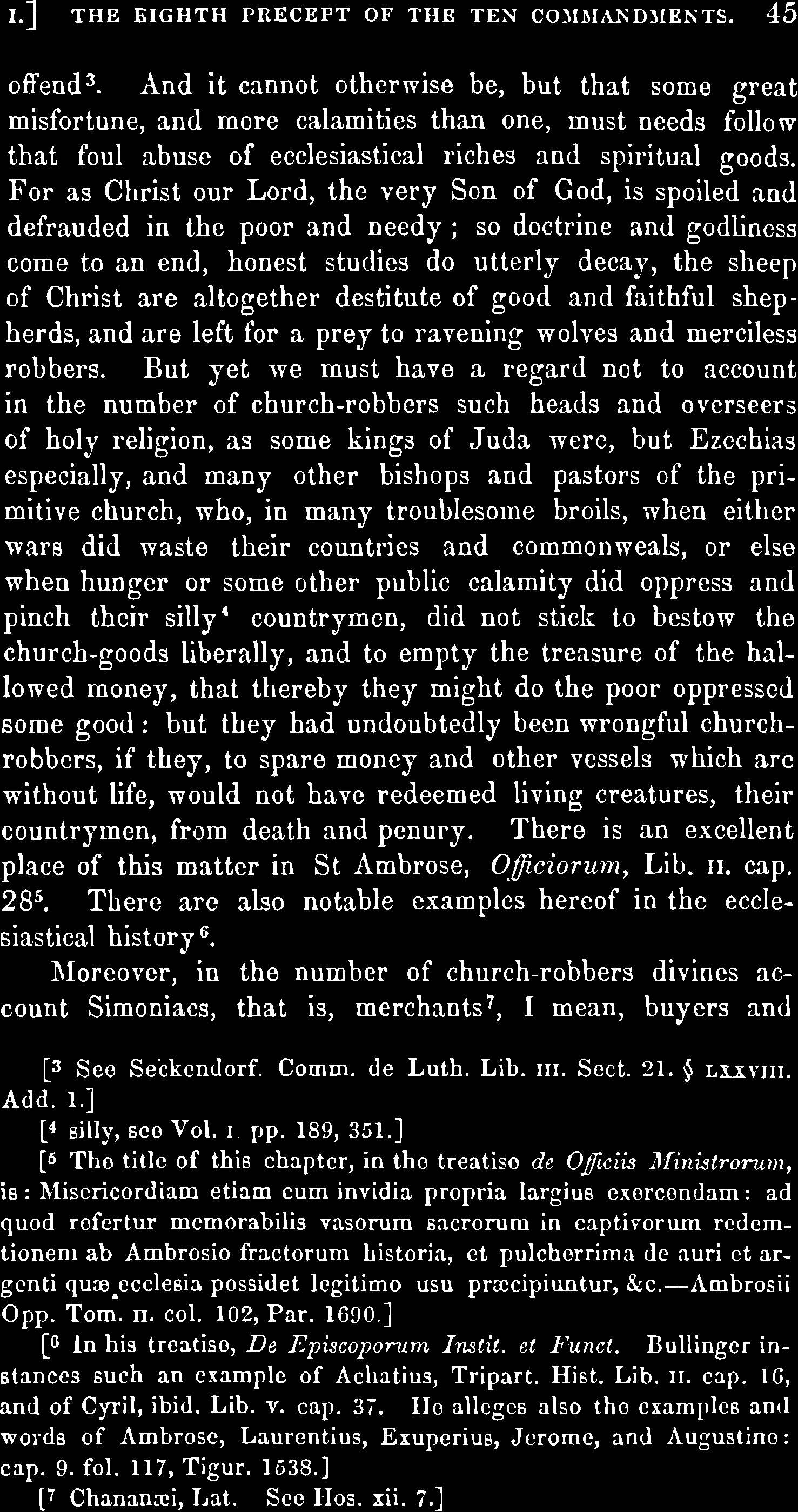
I.] offend3.
And it cannot otherwise be, but that some great misfortune, and more calamitiesthan one, must needs followthat foul abuse of ecclesiasticalriches and spiritualgoods.
For as Christ our Lord, the very Son of God, is spoiled and defrauded in the poor and needy ; so doctrine and godliness come to an end, honest studies do utterly decay, the sheep of Christ are altogether destituteof good and faithfulshepherds, and are leftfor a prey to ravening wolves and merciless robbers.
But yet we must have a regard not to account in the number of church-robbers such heads and overseers of holy religion,as some kings of Juda were, but Ezechias especially,and many other bishops and pastors of the primitive church, who, in many troublesome broils,when either wars did waste their countries and commonweals, or else when hunger or some other public calamity did oppress and pinch their silly4 countrymen, did not stick to bestow the church-goods liberally,and to empty the treasure of the hallowed money, that thereby they might do the poor oppressed some good : but they had undoubtedly been wrongful churchrobbers, if they, to spare money and other vessels which are without life,would not have redeemed livingcreatures, their countrymen, from death and penury.
There is an excellent place of this matter in St Ambrose, Ojficiorum, Lib. n. cap.
285.
There are also notable examples hereof in the ecclesiastical history6.
Moreover, in the number of church-robbers divines account Simoniacs, that is, merchants7, I mean, buyers and [3 See Seickendorf.
Comm. de Luth.
Lib. in.
Sect. 21. " LXXVIH.
Add.
1.] [4silly,see Vol. i. pp. 189, 351.] [fiThe titleof this chapter, in the treatise de Officiis
Ministrorum, is : Misericordiam etiam cum invidia propria largius exercendam : ad quod refertur memorabilis vasorum sacrorum in captivorum redemtionem ab Ambrosio fractorum historia, et pulcherrima de ami et argenti quse^ecclesia possidet legitimo usu prsecipiuntur,"c.
Ambrosii Opp.
Tom. n. col. 102, Par. 1690.] [6In his treatise,De Episcoporum Instit.et Funct.
Bullinger instances such an example of Achatius, Tripart. Hist. Lib. n. cap.
16, and of Cyril, ibid. Lib. v. cap. 37.
He alleges also the examples and words of Ambrose, Laurentius, Exuperius, Jerome, and Augustine: cap. 9. fol. 117, Tigur. 1538.] [7Chanansei, Lat.
See HOB. xii.7.]
THE THIRD DECADE.
[sERM.

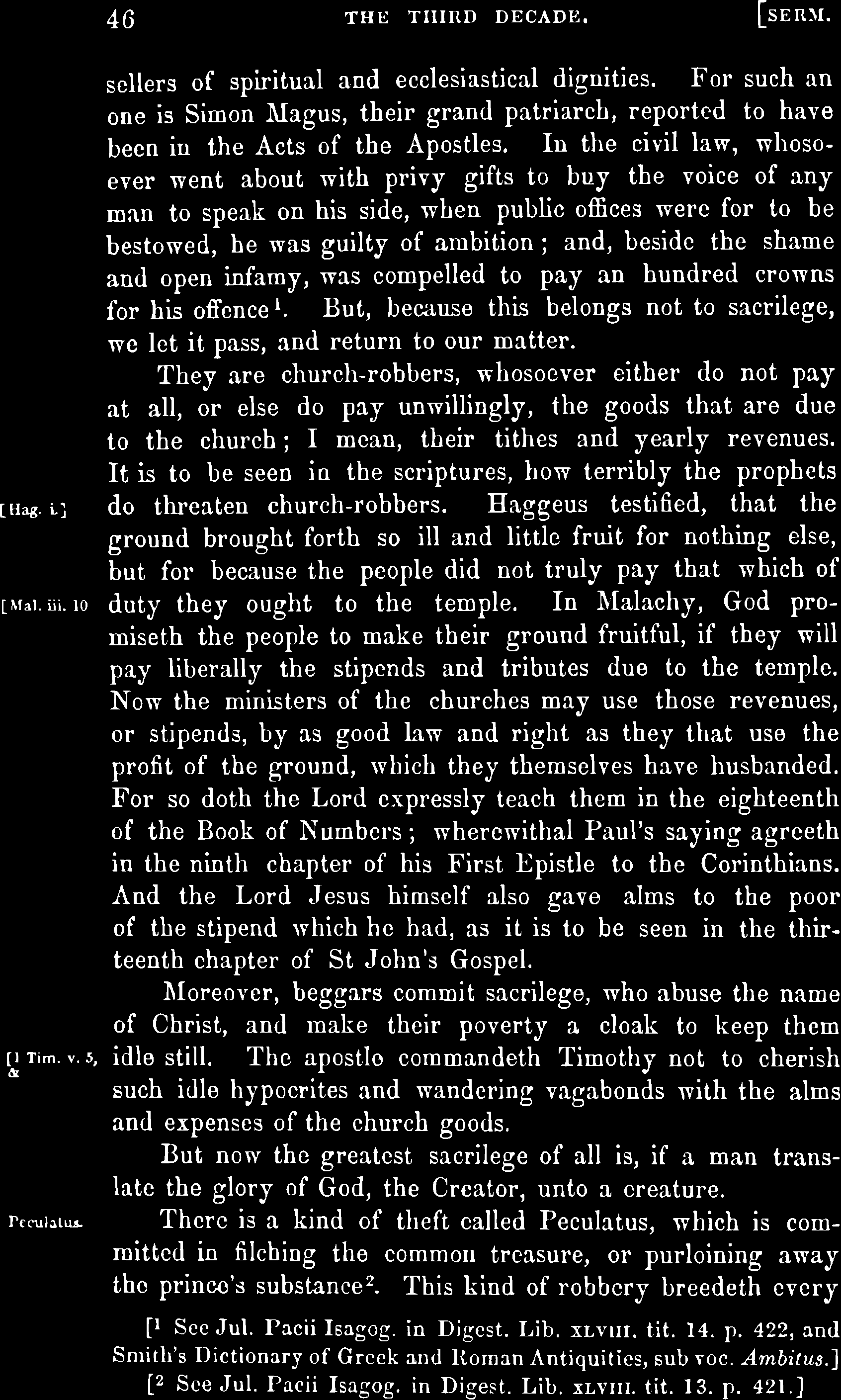
sellersof spiritualand ecclesiastical dignities. For such an one is Simon Magus, their grand patriarch,reported to have been in the Acts of the Apostles.
In the civillaw, whosoever went about with privy giftsto buy the voice of any man to speak on his side,when public officeswere for to be bestowed, he was guiltyof ambition ; and, beside the shame and open infamy, was compelled to pay an hundred crowns for his offence1.
But, because this belongs not to sacrilege, we letitpass, and return to our matter.
They are church-robbers, whosoever either do not pay at all,or else do pay unwillingly,the goods that are due to the church; I mean, their tithes and yearly revenues.
It is to be seen in the scriptures,how terriblythe prophets tHag. i.] do threaten church-robbers.
Haggeus testified,that the ground brought forth so illand littlefruitfor nothing else, but for because the people did not truly pay that which of [Mai.iu.10 duty they ought to the temple.
In Malachy, God promiseth the people to make their ground fruitful,if they will pay liberallythe stipends and tributes due to the temple.
Now the ministersof the churches may use those revenues, or stipends,by as good law and right as they that use the profitof the ground, which they themselves have husbanded.
For so doth the Lord expressly teach them in the eighteenth of the Book of Numbers ; wherewithal Paul's saying agreeth in the ninth chapter of his First Epistle to the Corinthians.
And the Lord Jesus himself also gave alms to the poor of the stipend which he had, as it is to be seen hi the thirteenth chapter of St John's Gospel.
Moreover, beggars commit sacrilege,who abuse the name of Christ, and make their poverty a cloak to keep them Tim. v. s, idlestill. The apostle commandeth Timothy not to cherish ^ such idlehypocritesand wandering vagabonds with the alms and expenses of the church goods.
But now the greatest sacrilegeof all is,if a man translate the glory of God, the Creator,unto a creature.
Fecuiatus.
There is a kind of theftcalledPeculatus, which is committed in filchingthe common treasure, or purloining away the prince'ssubstance2. This kind of robbery breedeth every
[lSee Jul. Pacii Isagog. in Digest. Lib. XLVIII. tit.14. p. 422, and Smith's Dictionary of Greek and Roman Antiquities,sub voc. Ambitus.] [2See Jul. Pacii Isagog. in Digest. Lib. XLVIII. tit.13. p. 421.]
THE EIGHTH PRECEPT OF THE TEN
COMMANDMENTS.
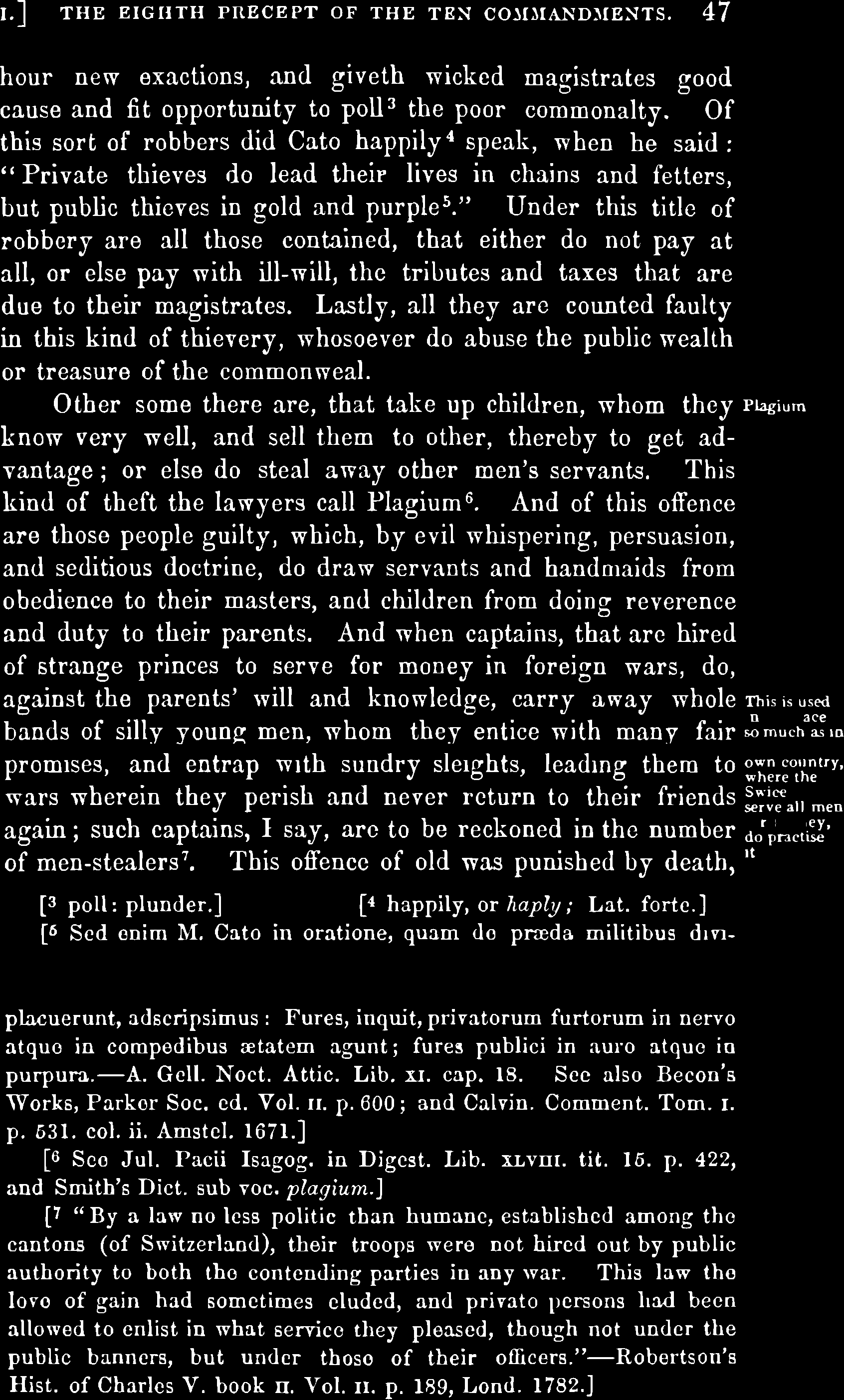
I.] hour new exactions,and giveth wicked magistrates good cause and fitopportunity to poll3 the poor commonalty.
Of this sort of robbers did Cato happily4 speak, when he said :
"Private thieves do lead their lives in chains and fetters, but public thieves in gold and purple5."
Under this titleof robbery are all those contained, that either do not pay at all,or elsepay with ill-will, the tributesand taxes that are due to their magistrates. Lastly, all they are counted faulty in thiskind of thievery,whosoever do abuse the publicwealth or treasure of the commonweal.
Other some there are, that take up children,whom they riagium know very well, and sellthem to other, thereby to get advantage ; or elsedo steal away other men's servants.
This kind of theft the lawyers callPlagium6.
And of this offence are those people guilty,which, by evilwhispering, persuasion, and seditiousdoctrine, do draw servants and handmaids from obedience to their masters, and childrenfrom doing reverence and duty to their parents. And when captains,that are hired of strange princes to serve for money in foreign wars, do, againstthe parents' will and knowledge, carry away whole This is used bands of sillyyoung men, whom they entice with many fairsSmucha^m *,*
., , .
, , ,.
, Bullinger-s promises, and entrap with sundry sleights,leading them to ^r^try" wars wherein they perish and never return to their friends%"%M ^en again ; such captains,I say, are to be reckoned in the number do^rartS' of men-stealers7. This offenceof old was punished by death, "
[3poll: plunder.] [4happily, or haply; Lat. forte.] [6Sed eniin M.
Cato in oratione, quam do prseda militibus dmdenda scripsit,vehementibus et illustribusverbis de impunitate peculatus atque licentia conqueritur.
Ea verba, quoniam nobis impense placuerunt, adscripsimus : Fures, inquit,privatorum furtorum in nervo atque in compedibus setatem agunt; fures publici in auro atque in "
A. Qell. Noct.
Attic. Lib. xr. cap. 18.
See also Becon's purpura.
Works, Parker Soc. ed. Vol. n. p. 600 ; and Calvin. Comment.
Tom.
I. p. 631. col.ii.Amstel. 1671.] [6See Jul. Pacii Isagog. in Digest. Lib.
XLVHI. tit. 16. p. 422, and Smith's Diet, sub voc. plagium.] [1 " By a law no less politic than humane, established among the cantons (ofSwitzerland), their troops were not hired out by public authority to both the contending parties in any war.
This law the love of gain had sometimes eluded, and private persons had been allowed to enlistin what service they pleased, though not under the public banners, but under those of their officers."
Robertson's Hist, of Charles V. book n. Vol. n. p. 189, Lond.
1782.]