
The Third Sermon
THE THIRD DECADE.
[sERM.

HOW we Now our duty is to aid, and stand them in stead, with j"oitto counsel,comfort,help,money, meat, drink, lodging,raiment, ' commendations, and with allthings else wherein we perceive that they lack our helping hand : touching which I spake somewhat in the tenth sermon of the firstDecade1.
We must also succour them readily,with a willingheart and a cheerful [2Cor.ix.r.jmind :
"for God requireth a cheerful giver."
And in help- " Be merciful How far we jng them let us do liberally: for Tobias saith, good. after thy power2: If thou have much, give plenteously;ifthou have little, do thy diligencegladly to give of that little.For in so doing the Lord shallblessboth thee and thine."
Thus much, my brethren, have I hithertosaid touching the lawful use of earthly goods.
God grant that every one of you may print these sayings in his heart, and put in practice this holy work.
Let us pray to the Lord that he will vouchsafe so to directus in his ways, that for the getting of those transitorygoods we lose not the everlastingtreasure of his heavenly kingdom.
OF THE PATIENT BEARING AND ABIDING OF SUNDRY
CALAMITIES
AND
MISERIES:
AND ALSO OF THE HOPE AND MANIFOLD
CONSOLATION
OF THE
FAITHFUL.
THE THIRD SERMON.
I SHALL not do amiss, I think,my reverend3 brethren, if to the treatisewhich I have already made of earthly riches, and of the use and abuse of the same, I do here alsoadd a discourseof the divers calamities,wherewith man, so long as he liveth in this frailflesh,is continuallyvexed and daily afilicted.For since that many men do either lose their temporal goods, or else can by no means get them, which are the causes why they be oppressed with penury and neediness; it cannot be but profitableand very necessary too for every good man to know out of the word of God the very reason ["Vol. i. p. 188.] [2quomodo potueris,ita esto misericors, Lat. and Vulgate.
This sentence, however, is omitted in the authorised Version, though retained in the service of the Offertory in the Book of Common Prayer, and given in Coverdale's Bible, 1535.] [3fratres honorandi, Lat.]

THE EIGHTH PRECEPT OF THE TEN
COMMANDMENTS.
II.] and ground of his consolationin hismiseries; lest,being swallowed up of too great sorrow, and entangled in utter desperation, he give himself over to be Satan's bond-slave.
Now this treatiseserveth for the whole lifeof man.
For I mean not to speak of any one calamity alone, as of poverty, or penury, but generally of allthe miseries that happen to man.
Verily, since man is born to griefand misery, as birds to flying4and fishesto swimming ; his lifecan never possiblybe eithersweet or quiet,unlesshe know the manner and reason of his calamity.
And if so be he know the reason thereof,religiouslytaken and derived out of the word of God ; then his lifecannot choose but be sweet1 and quiet,howsoever otherwise it seem to be most bitter and intolerable. The mind of man, verily,is sorely afflictedand grievously tormented with lamentable miseries; but the same, on the other side,is sweetly eased and mightily upholden by the true knowledge of those miseries, and holy consolations,derived and taken out of the word of God.
First of all,it is requisiteto lay before our eyes and The kinds of c reckon up the several kinds and especial sorts of mortal men's calamities. The evilsverily are innumerable, which daily fallupon our necks ; but those which do most usually happen are the plague or pestilence,sundry and infinitediseases, death itself, and the fear of death, whose terror to some isfar more grievous than death can be.
To these be added the death and destruction of most notable men, or such of whom we make most account; robberies,oppressions,endless illchances, poverty, beggary, lack of friends,infamy, banishment, persecution, imprisonment, enforced torments, and exquisite punishments of sundry sorts and terribleto think on, unseasonable and tempestuous weather, barrenness, dearth, frost,hail, deluges, earthquakes, the sinking of cities,the spoilingof fields,the burning of houses,the ruin of buildings, hatred, factions,privy grudges, treasons, rebellions,wars, slaughters,captivity,cruelty of enemies, and tyranny ; also the lack of children; or troubles,cares, and hellishlives6by the matching of unmeet mates in wedlock, by childrennaugh- [4Job v.
7: homo nascitur ad laborem, et avis ad volatum.
Vulgate.
" Man isborne unto mysery, like as the byrde for to fle."
Coverdale's Bible, 1535.] [6miserise,Lat. without any epithet.] r T
[BULI.INGER,
n.J
C6 THE THIRD DECADE.
[sERM.

tilydisposed,maliciouslybent, disobedient and unthankful to father and mother; and lastly,care and continual grief in sundry sorts for sundry things, which never cease to vex our minds.
For no man can in never so long a bead-row1 reckon up allthe evilswhereunto miserable mankind is woefully endangere and every moment tormented.
New miseriesrise up every day, of which our elders did never hear ; and they are appointed to be feltand sufferedof us, who with our new and never heard of sinsdo daily deserve new and never seen punishments, when as otherwise the miseries,which our forefathers felt,had been enough and sufficientto have plagued us all.
The good But now with these evils,as well the good and godly and evil are rt/-.i i " i i /" i " afflictedwith worshippers of God, as the wicked contemners of his name, calamities. are troubled and put in ure: yea, the saintsare through all2 their life time afflictedand vexed, when as contrarily the wicked abound with allkinds of joyand delightfulpleasures: whereupon it cometh, that great temptations and complaints arise in the minds of the godly.
The wicked do gather by their happy state and pleasant life,that God doth like their religion,and accept their manner of dealing,whereby they are confirmed and grounded in their errors.
And on the other side the godly, by reason of the miserieswhich they have long suffered,do revolt from godliness,and turn to the ungodly, because they think that the state of the wicked is far better than theirs. Now itis good to know, and severally to learn,allthis out of the scriptures. That the godly are and have been afflicted, as well as the wicked, since the beginning of the world, itismanifest to be seen in the example of Abel and Cain: for,as the one was pitifullyslain of the other for his sincereworshipping of God, so was the other for the murder made a vagabond, not daring for fear to abide in any place to take hisrest in.
Jacob, surnamed Israel,is read to have been vexed with many calamities. The same is reported also of the Egyptians, while they persecuted the Israelites. Saul was vexed, and David afflicted.The Lord our Saviour, with his disciples,bare the cross of grief and trouble: again, on the other side, the Jews, who cruelly persecutedChrist and his disciples, were horriblydestroyed, [!catalogo,Lat.] t2omnem prope, Lat. ; almost all.]
THE EIGHTH PRECEPT OF THE TEN
COMMANDMENTS.

III.] and that worthily too, for theirvillainousinjury.Unspeakable are the evilswhich the church of Christ did suffer in those ten most bloody persecutions3 before the reign of Constantine the great : but Orosius, the notable,diligent,and faithfulhistoriographer, maketh mention, that due and deserved punishments were out of hand laid upon the necks of those persecuting tyrants; of whom I willspeak somewhat in place convenient*.
And by the testimoniesboth of God and man, and also by manifold experience, we see itproved, that as well the godly as ungodly are touched with miseries.
Yea truly,the best The and holiest men for the most part are troubled and afflicted,wh"" the1 ......
/,/.
... wicked live when the wicked and worser sort are tree trom calamities, m pleasures. leading theirlivesin ease and pleasures.
And while the good do suffer persecution and injuries, the wicked rejoice thereat.
For the Lord in the gospel saith to his disciples :
" Verily,[John xvi. verily,I say unto you, ye shallweep and lament, the world shall be glad ; but ye shall be sorrowful."
But now, what kind of temptations those be, which arise inthe hearts of the godly through theirtribulations; and what those men, which are not altogether godless nor the enemies of God, do gather of the felicitywherein the wicked are, the scripture in many places teacheth us, and especially in that wonderful discourse of Job and his friends.
The prophet Abacuch complaineth, and saith: "O Lord, how long shall Inabak.1. cry, and thou not hear? how long shall I cry out to thee for the violence that I suffer,and thou not help? why am I compelled to see iniquity,spoiling,and unrighteousness against me? why dost th'ouregard them that despisethee, and boldest [3The persecutions of the Christians by the Romans have, for many ages, been accounted ten in number.
But the ancient history of the Church does not support precisely this number.
Some Christians of the fifth century were led into a belief by certain passages of scripture, especiallyby one in the Apocalypse, that the Christian body was fated to undergo ten calamities of the heavier kind ; to which opinion they then accommodated history,though against her will,not, however, all in the same way.
Mosheim Eccles. Hist, cent i. Book 1. part i.chap. 5. $4.ed. Soames, and note in loc.] [4See p. 109, "c.
Orosius frequently notices these punishments in the 7th book of his Histor. adv. paganos ; and the title of the 27th " Collatio populi Israeliticiet Christian!, chapter of the same book is, ^Egyptiaci item et Romani, quomodo illi pro Deo in adflictionibus,hi a Deo in plagis, similia fere passi sunt."] 5 "
THE THIRD DECADE.
[sERM.

thy tongue while the wicked treadeth down the man that is more righteous than himself?
The wicked doth circumvent O the righteous;and thereforewrong judgmentproceedeth." In Mai. iu.
Malachi the hypocrites do cry: "It is but vain to serve God : and what profitis it that we have kept his commandments, and that we have walked humbly beforethe face of the Lord1 ?
Now therefore we call the proud and arrogant blessed and happy : forthe workers of wickedness livehappily and are set up ; and they tempt God, go on in their wickedness, and are delivered2." The holy prophet Asaph containeth allthismost Psai. ixxiii. fullyand significantlyin the Psalm, where he saith: "My feet were almost gone, my treadingshad well nigh slipped: for I was grieved at the wicked, when I did see the ungodly in such prosperity. For they are in no peril of death3 ; they are, I say, troubled with no diseases,whereby they are drawn, as it were, to death, but are lusty and strong.
They come into no misfortune like other men; but are free from the evilswherewith other folk are plagued : and thisisthe cause that they are so holden with pride,and wrapped in violenceas in a garment.
Their eyes swell with fatness,and they do even what they lust4.
They stretch forth theirmouth unto heaven, and their tongue goeth through the world : yea, and they dare to say,
Tush, how should God perceiveit6? Lo, these are the ungodly, these prosper in the world, and these have richesin possession.
Then, said I, have I cleansed my heart in vain,and washed mine hands in innocency : and I bear punishment every day.
And while I thought thus to myself, I had almost departed from the generation of God's children."
Thecausesof Now since this is so, it folioweth consequently to beat out6 the causes of these calamities: for in so doing we shall p coram Deo exercituum, Lat. ; God of hosts.] [2qui Deum tentant, Lat. ; "for they tempte God, and yet escape."
Coverdale's Bible, 1535.] [3neque enim sunt illisnexus ad mortem, Lat. ; (eoquod non trahantur ad mortem quasi captivi"
Calvin, Comment, in loc.);for there are no bands in their death. "
Auth. Vers.] [4dum eis videlicet pro voto omnia succedunt, Lat. ; omitted," while, that is,allthings go according to their desire.] [5quomodo cognosceret omnia Deus ? estne cognitio apud Altissimum?
Lat.; How should God know all things? is there knowledge in the most High ?] [6ut diligentissime excutiamus, Lat.]

THE EIGHTH PRECEPT OF THE TEN
COMMANDMENTS.
III.] be the betterable to judgerightlyof the miseriesboth of the godly and wicked sort of people.
The causes of calamities are many, and of many sorts : but the general and especial cause is known to be sin.
For by disobedience sin entered into the world, and death by sin; and so, consequently, diseases, and allevilsin the world.
They are very light-headed and vain fellows,that referthese causes to I cannot tellwhat, blind constellations,and movings of planets. For7 we by our evillusts and corrupt affectionsdo heap up day by day one evilon another's neck.
And at our elbows standeth the devil, who roundeth8 us in the ears, and eggeth us forwards ; and, as helps to spur us on, there are a crew of naughty packs9, that never cease to train us in.
And daily there do rise up divers instruments of tribulation, wherewith the most wise and justGod doth suffer us men to be exercised and tormented.
But the same causes of affliction are not always found to The cause why the be in the holy worshippers of God, as are in the wicked despisers of his name.
The saints are often afflicted,that by their trouble the glory of God may be known to the world.
For when the disciplesof Christ did see the blind man in the gospel, which was blind from his mother's womb, they said to the Lord :
" Master, who sinned, this man, rJohn ix. 2, or his parents, that he was born blind?
Jesus answered, Neither did thisman sin,nor his parents ; but that the works of God might be made manifest in him."
Likewise, when the " This disease(saith John xi. he)is not to death, but to the glory of God, that by itthe Lord heard say that Lazarus was sick, Son of God may be glorified." And yet, if we touch this matter to the quick, there can none in the world be found without sin; so that, if the Lord willmark our iniquities,he shallalways find somewhat to be punished in us : as it is at large declared in the book of Job.
Furthermore, the Lord doth sufferhis spouse, the church, we are dewhich he loveth full dearly, to be troubled and afflictedto ihegoodne ' thisend and purpose : that he may openly declare,that the not by our , -, i 11. i i i j own means elect are defended, preserved, and delivered by the power and or ability. aid of God, and not by the policy or help of man.
For Paul (7ceterum, Lat. ; but.] [8to round, Johnson ; to roun, Toone : to whisper or speak in secrecy.] "
Johnson's Diet.] [9pack, a loose or lewd person.
THE THIRD DECADE.
[SERM.

" We have this treasure in earthen vessels,that the saith : excellency of the power may be God's, and not of us : while we are troubled on every side,but not made sorrowful ; we are in poverty, but not in extreme poverty ; we sufferpersecution, but are not forsaken therein ; we are cast down, but we perish not ; we always bear about in the body the dying of the Lord Jesus, that the lifeof Jesus might also be made manifest in our body.
For we which liveare always delivered unto death for Jesus' sake, that the lifealso of Jesus might be made manifest in our mortal flesh1." Also the same " Virtue ismade perfectin infirmityV apostlesaith:
Affliction* Again, as the afflictions of the holy martyrs and faithful monies of saintsof Christ are testimoniesof the doctrineof faith,as our the doctrine " They shall deliver you up to .
1111. pM^i.17
Saviour in the gospel saith, ' councils,and in their synagogues they shall scourge you; "O yea, ye shall be brought before kings and rulers for my sake, that this might be for a witness to them and the people:" even so, in like manner, are the saints, overladen with miseries,made examples for us to learn by how to overcome and despise3the world, and to aspire to heavenly things. we are wed Finally, the Lord doth try those that be his by laying by afflictions.,, ,, rf " the cross upon their necks, and purgeth them like gold in , .1.1 vi i j .
, the fire: he cutteth from us many occasions of evil,that he may bring us to the bearing of greater and more plentiful fruit. The wisdom of the Lord doth therein follow the manner of goldsmiths, who put their gold into the fire to purge, and not to mar it: and he imitateth also good husbandmen, who, when their corn is somewhat too rank, do mow itdown ; and prune their trees, not to destroy,but to make them bear more abundant fruit. And thisfleshof ours, verily, in peace and quietness is luskish4,lazy,drowsy, and slow to good and honest exercises; it is content, and seeketh no furtherthan earthly things;itiswholly given to pleasures; it doth utterlyforget God and godly things: now therefore itis not expedient only, but also very necessary,to have this dull and sluggish lump stirredup and exercisedwith troubles, afflictions, and sharp persecutions.
The saintsherein are like [l2 Cor. iv.7"
11. Bullingerhas adopted the translation of Erasmus.] [22 Cor. xii.9.
This is the Vulgate, and not Erasmus', version.] [3calcare, Lat. ; to tread under foot.] [4luskish,somewhat inclinable to lazinessor indolence."
Johnson.]
THE EIGHTH FRECEPT OF THE TEN
COMMANDMENTS.

III.] to iron,which by use is somewhat worn and diminished, but by lying stillunoccupied is eaten more with rust and canker.
Most truly therefore said St Peter :
" Dearly beloved, think i pet iv. it not strange, that ye are tried with fire, which thing is to try you, as though some strange thing happened unto you : but rejoice rather, in that ye are partakers of the afflictions of Christ ; that, when his glory isrevealed, ye may be merry "
Remember that 2 Tim. u.
5."
For Paul to Timothy saith : and glad Jesus Christ of the seed of David was raised from the dead according to my gospel ; for which I am afflicted, as an evil doer, even unto bonds: and yet I suffer all things for the elect's sakes, that they might also obtain the salvation which is in Christ Jesus with eternal glory.
It is a faithful saying : For if we be dead with him, we shall also live with him : if we be patient6,we shall reign with him : if we deny him, he shall also deny us7."
For in his epistle to the " Those which he knew before he did Rom. viii.
Romans he saith : also predestinate,that they should be like-fashionedunto the shape of8 his Son, that he might be the first-begotten among many brethren.
Moreover, whom he did predestinate, them also he called; and whom he called,them also he justified ; and whom he justified, them also shall he " We rejoice glorify9."
Again, in the same epistlehe saith :
Rom. v. alsoin tribulations; knowing that tribulationworketh patience ; patience proof ; proof hope : and hope maketh not ashamed 10, "c."
This do the private examples of the saints,and public examples of the whole church, very plainly declare. Abraham,
Isaac, and Jacob, had never known that God's helping hand had been so faithfuland always present with them ; they had never been grounded in so sure hope, nor shewed such especial fruitof their excellent patience ; ifthey had not been exercised with many perils,and, as it were, oppressed with infinite "
It is calamities.
Whereupon it cometh, that David cried : good for me, Lord, that thou hast troubled me."
The church PMI.
"i* of Israel was oppressed in Egypt; but to the end that it [81 Pet. iv. 12, 13; Erasmus' translation.] [flSo Tyndale's and Cranmer's translations.] [7Erasmus' translation chiefly.] [8 So Tyndale's and Cranmer's translations.] [9glorificabit,Lat. ; the Versions have glorificavit.] [10Erasmus' translation.]
THE THIRD DECADE.
[SERM.

might with the more glory be delivered,and pass into the land of promise.
The Jewish church was afflictedby them of Babylon and the Assyrians, so that their temple was overthrown, and the saintscarried captive with the worst of the people.
But the godly sort in their very captivitydo feel the wonderful help of God, and by that means are made the better1 by theirafflictions; so that the name of the Lord was known2 among the Assyrians, the Chaldees, the Medes and Persians, to his great glory and renown, as it is at large declared in the historiesof Daniel, Hester, and Esdras3. certain punHere also is to be noted, that certain punishments are ishmenls " i n ", -r i i /"
" appointed as appointed of the Lord as plagues for certain sins ; so that plagues to ** r o certain sins. most commonly a man is plagued by the very same things wherein he sinned against the Lord.
David offended God with murder and adultery ; and thereforeis he punished with the shame of his own house, with whoredom, incest,and detestablemurder of his own children; and lastly,driven out and banished his kingdom.
It was pride and arrogance, wherein Nabuchodonosor sinned ; and therefore,being distract of his wits and turned into a beastly madness, he led his life for a certaintime4 with beastsof the field.But as Nabuchodonosor was, when God thought good, restored to his kingdom ; so David did in time convenient feelthe mercy of the Lord in settlinghim in his seat again.
For this saying of the Lord isfirmly ratifiedfor ever, not only to David, but to every one that believeth,which is in these words set down in the scrip30- *ures "
"^ his children forsake my law, and keep not my
commandments, I will visit their sins with rods, and their iniquitieswith scourges: yet willI not utterlytake my goodness from him ; I willnot break my covenant, neither willI xl' change the thing that is once gone out of my mouth."
Therefore itis to our profitthat the Lord afflicteth us ; as he himself testifiethin the revelation of Christ5,uttered6 by John the " Them which I love I rebuke V. "i. apostleand evangelist,saying :
[!" puriores fiunt,Lat.] [2quam latissime, Lat. ; to the widest extent.] [3Ezra and Nehemiah.
See Sixth Art. of Religion; "First Book of Esdras, Second Book of Esdras."
So also Vulgate.] [4destinato tempore, Lat.] [5in theologia sua, Lat.
See Vol. i. p. 170. n. 6.] [6edita,Lat. ; put forth,published.]
THE EIGHTH PRECEPT OF THE TEN
COMMANDMENTS.

III.] and chasten."
And Salomon, long before that, did say : "My PTOV. uu son, refuse not the chastening of the Lord, neither faint when thou art corrected of him.
For whom the Lord loveth,him he chasteneth ; and yet delightethin him, as a fatherin his son7."
Now, touching the persecutions and terribleplagues laidsin u the upon the neck of the whole church of God, or several martyrs of the same ; as they were, for the most part, breathed out of worldly tyrants against the saints for their open confession and testimoniesof their faith,and truth of the gospel, so most commonly the causes of those broilswere the sins and offences of the saints,which the justice of God did visitin his holy ones, no doubt to the good and salvation of the faithful.
For of that bloody persecution under the emperors Diocletian and Maximinian, which caused many thousands, yea, many millions,of martyrs to come to their endings, we read this following in the history of Eusebius of Cesaria, who learned it, not by hear-say, but was himself an eye-witness of the " When as by too much liberty and wantonness the same : manners of the church were utterly marred, and the discipline thereof corrupted ; while among ourselves we envy one another, and diminish one another's estimation ; while among ourselves we snatch at and accuse ourselves, moving deadly war among ourselves ; while dissimulation sittethin the face, deceitlurketh in the heart, and falsehood is uttered in words, so that one evil is heaped stillon another's neck ; the Lord beginneth by littleand little,and with the bridleto check the mouth of his tripping church, and, reserving the congregations untouched, he beginneth firstto suffer them to feel persecution which served as soldiers in the camps of the Gentiles.
But when as by that means the people could not be made to remember themselves, insomuch that they ceased not to persistin their wickedness, and that the very guides of the people and chiefof the church, unmindful of God's commandment, were set on fire among themselves with strife,envy, hatred, and pride, so that they might think they rather exercised tyranny than the officeof ministers,because they had forgotten Christiansincerity and pureness of living; then at length the houses of prayer and churches of the living God [*Prov. iii.11, 12 ; et tanquam pater in filiodelectatur,Lat. ; "and "
Coverdale's yet delyteth in him even as a father in his owne sonne." translation, 1535.]
THE THIRD DECADE.
[SERM.

were thrown to the ground, and the holy scripturesset on firein the broad and open streets1."
Thus much, word for word, out of the eighth book of his ecclesiastical history, what kind And yet here I make differencebetwixt sin and sin. For Minu?sm" the saints sin, but yet they abstain commonly from heinous crimes ; although now and then too they fallinto them, as it is evident by the example of David : but yet, for the most part, they fly from theft, murder, whoredom, and other grievous2 sins like unto these.
And while the saints are afflictedby tyrants,it is not for the neglectingofjustice and true religion; but for the contemning of superstition,and stedfaststickingto Christ and his gospel.
The Lord therefore doth forgive,and in the blood of Christ wash away, the sins of the holy martyrs, reputing them to suffer death not for the sins which they have committed, but for the zeal and love of true religion. He also punisheth the tyrants for the death of his martyrs ; because, in putting them to death,they follow their own tyrannous affection,and not the justjudgment of the livingGod.
The Lord's mind, verily,was by tyrants to chasten his people Israel: but the tyrants (asEsay in his tenth chapter witnesseth) did not take itto be so ; but rather, followingtheirown affections,they passed allmeasure in afflicting them, and never sought afterjustice and equity : they therefore are punished of the Lord for killinghis p Bullinger has followed the Latin translation of Eusebius : Ubi ex multa libertatemultaque indulgentia vitiatisunt mores, et disciplina corrupta est, dum alter alteri invidemus, et alter alteri derogamus; dumque nos invicem mordemus et incusamus, et adversum nosmetipsos intestina prcelia commovemus : dum simulatio in vultu, dolus in corde, fallaciaprofertur in verbis, et malorum per singula cumulus intumescit ; aggreditur (Dominus)primo sensim refrsenare lapsantes, congregationibusque manentibus, indulget interim eos, qui erant in militia tantum gentilium, persecutione pulsari.
Sed cum nullus ex hoc clementise ejusintellectus populis redderetur, et persisterent in mails suis, atque ipsi qui duces populi videbantur et principes, divini mandati immemores effecti,adversum se invicem contentionibus, zelo, livore, superbia, inimicitiisatque odiis inflammarentur, ita ut tyrannidem potius quam sacerdotium tenere se crederent, christiansehumilitatis et sinceritatisobliti; tune demum.
. .domus orationis et ecclesise Dei vivi ad solum deductse sunt ; divinse vero scripturse in medio "
Euseb. Eccles. Hist. Ruffino Aquil. inplatearum igni crematse sunt. terprete, lib.vnr. cap. 1. p. 183. Basil. 1639.] [2morte expianda, Lat.]
THE EIGHTH PRECEPT OF THE TEN
COMMANDMENTS.

III.] innocent and guiltlessservants.
For the thing which the Lord did persecute in his people, (theirsins, I mean, and offences,) that do the tyrants neither punish nor persecute : but the thing that pleased God, (thelore, I mean, of true religion,and the utter detesting of idolatry,) that they are mad upon, and persecute it with sword and fireand unspeakable torments.
To this therefore doth that saying of St [iPet. iv.
" See that none of you be punished as a Peter belong : murderer, or as a thief,or as an evil-doer,or as a busy-body in other men's matters : but if any man suffer as a Christian man, let him not be ashamed, but rather glorifyGod on this behalf."
Yet, for allthis,I would not that heinous offendersshould any whit despair.
They have the example of the thief that was crucifiedwith Christ; that let them follow: let them, I say, confess their faults, believe in Christ, commit themselves wholly to his grace and mercy, and lastly, suffer patiently the pain of their punishment ; and, in so doing, there is no doubt but they shall be received of Christ into Paradise, and live there for ever, as the thief doth with Christ.
And although the godly be slainamong transgressors,yet why God is he no more defiledby sufferingwith them than Christ our Lord was, being hanged among thieves. For though the godly eviL and ungodly be wrapped and coupled together in one kind of punishment, yet are they severed by their unlike ending; while the wicked, after this bodily death, is carried to hell, there to burn without intermission; and the godly taken immediately into heaven, to live with Christ his Lord, to whom he committed and commended3 himself. Touching thismatter, and the causes of the afflictions of the holy men of God, I will not be aggrieved to recite unto you, dearly beloved, a notable place of St Augustine out of his firstbook De civitate Dei.
" Wheresoever (saith he)good men do sufferthe same and like punishment that the evil sort do, it is to be marked, that there isnot therefore no differencebetwixt them, because there is no diversity in the thing that they suffer.
For as in one and the same firegold doth shine,and chaff doth smoke ; and under one flailthe husk is broken, and the corn purged; and as the scummy froth is not mixed with the oil,although one weight of the same press doth crush both out at once: even [*obtulit,Lat. ; offered.]
THE THIRD DECADE.
[sERM.

so one and the self-same misery, fallingupon the good and the bad, doth try, fine,and melt the good ; and on the other side condemn, waste, and consume the evilsort.
Whereupon it cometh to pass, that in one and the same afflictionthe evil do detest and blaspheme the Lord, when contrarily the good do pray unto and praise his name for that he layeth upon them.
So much matter maketh it in afflictions to mark not what, but with what mind, every man doth suffer.
For stir up dirt and sweet ointments alike,and you shallhave the one stink filthily, and the other cast forth a sweet-smellingsavour.
Therefore in that hurly-burly, and irruption made by the barbarous people,what did the Christians suffer which was not rather to their profit,while they did faithfullyconsider those troubles? especiallybecause they, humbly considering the sins for which God, being wroth, did fillthe world with so many and great calamities,although they be far from committing heinous, grievous,and outrageous offences,do yet nevertheless not repute themselves so clear of allfaults,as that they judge not themselves worthy to suffer temporal calamity for the crimes they commit every hour and moment.
For over and besides that every man which liveth peradventure laudably enough, doth in some points yield a littleto carnal concupiscence, although not to the outrageousness of horrible sins,to the gulf of heinous offences and abominable iniquities,yet notwithstanding he yieldeth to some sins, which either he haunteth very seldomly, or else committeth so much the oftener as they are the lesser; over and besides this therefore I say, what man is there which, when he seeth and knoweth very well the men for whose pride, lasciviouslives,covetousness, and damnable iniquity,God (ashe hath threatened) doth plague the earth, doth so esteem them as they are to be thought of,and live so with them as he ought to livewith such kind of people ?
For oftentimesmany things are wickedly dissembled, while wicked doers are not taught, corrected, chidden, and admonished of their evil behaviours, either because we think the pain too much to tellthem theirfaults; or while we are afraid to have the heavy looks of them with whom we live;or elseavoid their displeasure,lestperadventure they should hinder or hurt us in temporal matters, when as either our greediness desireth to have somewhat more, or our infirmity feareth to lose the things which it hath already
111.] THE EIGHTH PRECEPT OF THE TEN
COMMANDMENTS.

in hold and possession: so that,although the lifeof the wicked displease the good, for which cause they fallnot into the same damnation, which is after this lifeprepared for the evil; yet, since they do therefore bear with, and forbear,their damnable sins, because they fear them in lighter and smaller trifles, they are justly scourged with them in this temporal life,albeit they be not punished with them eternally.
While they be punished by God with the wicked, they do justly feel the bitterness of this life,for the love of whose sweetness they would not be bitterin tellingthe wicked of theiroffences. This therefore seemeth to me to be no small cause why the good are whipped with the evil, when it pleaseth God to punish the naughty manners of men with the afflictionof temporal pains.
For they are scourged together, not for because they lead an evil lifetogether, but because they love this temporal life together.
I do not say alike,but together ; when the better sort ought to despise it,that the evil,being rebuked and corrected, might obtain the eternal life;to the getting whereof if they would not be our fellows and partners, they should be carried and lovingly drawn, even while they be our enemies; because, so long as they live,it is always uncertain whether their minds shall be changed to be better or no.
Wherefore they have not the like but a far greater cause to admonish men of their faults,to whom the Lord saith by the mouth of the prophet:
' He verily shall die in his sin,but his blood will I require at the hand of the watchman.'
For to this end are the watchmen, that is,the guides of the people, ordained in the churches, that they should not forbear to rebuke sin and wickedness.
And yet, for allthis,that man is not altogether excusable of this fault, which, although he be no guide or overseer ofthe people,doth, notwithstanding,know many things worthy controlment, and yet wink at them in those with whom he livethand is conversant, because he will give them none offence,for fear lesthe lose those things, which in this world he useth as he ought not, or is delighted in so as he should not V And so forth.
For allthis have I hithertorehearsed out of St Augustine.
[1Hsec cum ita sint, quicunque boni malique pariter afflict!sunt, non ideo ipsi distinct! non sunt, quia distinctum non est quod utrique "
Nam sicut sub uno igne aurum rutilat,palea fumat, et perpessi sunt. sub eadem tribula stipulse comminuuntur, frumenta purgantur; nee
THE THIRD DECADE.
[sERM.
The last and hindermost cause of the calamities which oppress the holy saints of God is,because the Lord, in afflictideo cum oleo amurca confunditur, quia eodom preli pondere exprimitur: ita una eademque vis irruens bonos probat, purificat, eliquat; malos damnat, vastat, exterminat.
Unde in eadem afflictione mail Deum detestantur atque blasphemant, boni autem precantur et laudant.
Tantum interest, non qualia, sed qualis quisque patiatur.
Nam pari motu exagitatum et exhalat horribiliterccenum, et suaviter fragrat igitur in ilia rerum Tastitate Christiani passi sunt, unguentum.
. .Quid quod eis non magis fideliterista considerantibus ad profectum valeret ?
Primo, quod ipsa peccata, quibus Deus indignatus implevit tantis calamitatibus mundum, humiliter cogitantes, quamvis longe absint a facinorosis,flagitiosis,atque impiis, tamen non usque adeo se a delictis deputant alienos, ut nee temporalia pro eis mala perpeti se judicent indignos.
(Bullinger's text has dignos.)Excepto enim quod unusquisque, quamlibet laudabiliter vivens, cedit in quibusdam carnali concupiscentise,etsi non ad facinorum immanitatem et gurgitem flagitiorum atque impietatis abominationem, ad aliqua tamen peccata vel rara vel tanto crebriora quanto minora :" hoc ergo excepto, quis tandem facile reperitur, qui eosdem ipsos, propter quorum horrendam superbiam, luxuriam, et avaritiam, atque execrabiles iniquitates et impietatcs Deus, sicut minando prsedixit,content terras, sic habeat ut habendi sunt; sic cum eis vivat, ut cum talibus vivendum est ?
Plerumque enim ab eis docendis, admonendis, aliquando etiam objurgandis et corripiendis male dissimulatur ; vel cum laboris piget, vel cum os eorum (coram) verecundamur offendere; vel cum eorum inimicitias devitamus, ne impediant et noceant in istis temporalibus rebus, sive quas adipisci adhuc appetit nostra cupiditas, sive quas amittere formidat infirmitas : ita ut quamvis bonis vita malorum displiceat,et ideo cum eis non incidant in ilium damnationem, quse post hanc vitam talibus prseparatur ; tamen quia propterea peccatis eorum damnabilibus parcunt, dum eos in suis licet levibus et venialibus metuunt, jurecum eis temporaliter flagellantur, quamvis in seternum minimc puniantur.
Jure istam vitam, quando divinitus affliguntur cum eis,amaram sentiunt, cujusamando dulcedinem peccantibus eis amari esse noluerunt.
. Non mini itaque videtur hsec parva esse causa, quare cum malis flagellentur et boni, quando Deo placet perditos mores etiam temporalium pcenarum afflictione punire.
Flagellantur enim simul, non quia simul agunt malam vitam, sed quia simul amant temporalem vitam : non quidem sequaliter, sed tamen simul ; quam boni contemnere deberent, ut illicorrepti atque correct! consequerentur seternam : ad quam consequendam, si nollent esse socii,ferrentur et diligerentur inimici ; quia donee vivunt, semper incertum est, utrum voluntatem sint in melius mutaturi.
Qua in re non utique parem, sed longe graviorem habent causam, quibus per Propbetam dicitur, * Ille quidem in suo peccato morietur, sanguinem autem ejusde manu speculatoris requiram.'
Ad hoc enim speculators,
THE EIGHTH PRECEPT OF THE TEN
COMMANDMENTS.

III.] ing his friends,doth thereby give a most evident testimony The affliction of his justjudgment, which shallfallupon his enemies for^t"/g^.g their contemning of his name and majesty.For St Peter Jm!nlu4fa saith: "The time is that judgment1 must begin at the house f1^^*17, of God: if itfirstbegin at us, what shallthe end be of those 8'3 which believe not the gospel of God?
And if the righteous scarcely be saved, where shah1the ungodly and sinner appear?"
And like to this is that notable sentence of the Lord's, which he spake, when he went to the place of execution, saying: "If they do this in a moist tree, what shallLukeMiu. be done in the dry?"
If the saints,by whom are meant the fruitful2 trees bringing forthmost preciousfruitsof good works, are, by the sufferance of God, in this world so miserably tormented and wrongfully vexed; what shall we say, I pray you, of the wicked, which are so far from virtue and good works?
They shall,undoubtedly, be plagued with unspeakable pains and punishments.
For touching the causes of those calamities wherewith Th? causes of ,
afflictionsin the wicked are tormented ; they can be none other than the **twicked heinous crimes which they commit from day to day ; and are thereforepunished by God's justjudgment, to the end that all men may perceive, that God hateth wicked men and wickedness alike.
So we read that Pharao was afflicted.
Saul fellupon his own sword, and was slain in the mount Gilboe,with many thousand Israelites,because he had sinned against the Lord, which purposed to destroy him for an example of his judgment,and a terror to them that should followafter.
Antiochus Epiphanes, Herod the Great, Herod Agrippa, and Galerius Maximianus, the emperor, were taken horriblywith grievous diseases,and died of the same3.
The hoc est, populorum prsepositi,constituti sunt in ecclesiis,ut non parcant objurgandopeccata.
Nee ideo tamen ab hujuscemodiculpa penitus alienus cst, qui, licet prapositus non sit,in eis tamen, quibus viteohujusnecessitate conjungitur, multa monenda vel arguenda novit, et negligit,devitans eorum offensiones propter ilia quibus in hac vita non indebitis utitur, sed plusquam debuit delectatur.
August.
Opp. de Civit.Dei. Lib. I. capp. 8, 9. Tom. v. p. 4, col. 4. p. 5, col. 1, 2, 3.
Par. 1531.] [!Afflictioinquam et tribulatio,Lat. ; omitted by the translator; I mean, afflictionand tribulation.] [2Si sanctae arbores frugifene, Lat. ; ifthe holy fruitfultrees.]
[3See Vol.
I. p. 318.
For the miserable end of Maximian see
THE THIRD DECADE.
[sERM.

reason was, because they sinned againstGod and his servants ; on whom he determined to take a vengeance, and to make them proofs of his justjudgment ;. so to be examples for tyrants to perceive what plagues remain for those which seek the blood of the godly and faithful. And although our good God doth ordain all things for the best to his creatures, and sendeth in a manner allcalamitiesand miseries to draw us from wickedness ; yet because hypocrites and wicked people despise the counsels and admonitions of God, and neither will acknowledge God when he striketh, nor turn to him when he calleththem, allthings do turn to their destruction(evenas to them which love the Lord all things work to the best),and therefore do they perish in their calamities: for in this world they feel1 the wrath of the almighty God in most horrible punishments; and in the world to come, when once they are parted out of this life, do for ever2 bear far greater3and bittererpains than any tongue can tell. ofhtehlnunicity -^ut ^ ** happen that the wicked and ungodly sort do not;jn this lifefeel any plague or grievous affliction,then shall they be punished so much the sorer in the world to come.
There is no man that knoweth not the evangelical parable of the rich unmerciful glutton,who, when as in this lifehe lived as he lusted,in passing delights,was notwithstanding in hell tormented with unquenchable thirst,and parched with fire4which never ceased burning.
The felicity therefore of the wicked in this life is nothing else but jamesv. extreme misery.
For St James the Apostle saith:
"Ye have lived in pleasure upon earth, and been wanton ; ye have nourished your hearts, as in a day of slaughter5;" which, I say, willturn to you, as to well-fed beasts, that are fatted jer.xii.
Up to be slainto make meat of6.
For Jeremy goeth a little Euseb.
Hist. Eccles. Lib. vin. cap. 16, and Lactantius de Mor.
Persecut. cap. 33, and Gibbon, chap. xiv. p. 213. Vol. n. ed. Lond. 1820.] [lpersentiscere incipiunt,Lat. ; they begin to feel.]
[2So 1577, but in 1587, therefore bear, seternum perferunt, Lat.] [3eadem, imo longe majora,Lat. ; the same, nay far greater.] [4ignibus infernalibus, Lat. ; fireof hell.]
[6James v.
Bullinger has adopted Erasmus' renderings.] [6In his Commentary Bullinger prefers the other explanation of this comparison: in deliciislascive pascitis cuticulam vestram, quotidiana agitantes convivia, non minus splendida quam aliisolent festo die mac tata victima.]
THE EIGHTH PRECEPT OF THE TEN
COMMANDMENTS.

HI.] "
O Lord, thou art more more plainly to work, and saith: righteous than that I should dispute with thee : yet notwithstanding I will talk with thee.
How happeneth it that the way of the ungodly doth prosper so well, and that it goeth so well with them which without shame offend in wickedness?
Thou hast planted them, they take root, they grow, and bring forth fruit." And immediately after: "But draw thou them out, O Lord, like a sheep7 to be slain,and ordain or appoint them8 against the day of slaughter."
With this also doth that agree, which the prophet Asaph, PMI. uxiiu after he had roundly and largely reckoned up the felicity "
Thou, verily,hast set them in slippery places; thou shalt cast them down headlong, of the wicked, addeth, saying : and utterly destroy them9.
O with how sudden calamities are they oppressed ; they are perished and swallowed up of terrors !
Even as a dream that vanisheth so soon as one awaketh; thou, Lord, shalt make their image contemptible in the city."
For David also before him did cry, saying :
" Yet a little,and the ungodly shall be nowhere ; and when Pad- "**". thou lookestin his place,he shall not10 appear.
I have seen the ungodly in great power, and flourishing11like a green bay-tree : and I went by, and, lo, he was gone ; I sought him, but he could not be found."
In like manner also doth Malachi the prophet witness, that there is great difference, in the day of judgment, betwixt the worshipper and despiser of God, and betwixt the justand unjust dealer :
"For the day [Mai.m.
IB, a" of the Lord shall come, in which the proud, and those that work wickedness, shall be burnt as stubble with firefrom heaven, so that there shall remain unto them neither root nor branch."
They that are wise, therefore, will never hereafter be offended at the felicityof the wicked
: they will never desire and long to be made partakers of theirunhappy prosperity: they will not grudge at all to bear the misery of the cross, which they do daily hear to be laidby God12 [7sicut pecudem e grege, Lat.] [8consecra sive destina,Lat. ; sanctify or set apart ; QttHpJT, Heb. sanctifica,Vulg.] [9ut prorsus dissiliant,Lat. ; that they may burst altogether.] [10nuspiam, Lat. ; nowhere.] [n et virentem ac sese diffundentem, Lat.] [l2a clementissimo Deo, Lat
r -i
[BULLINOER,n.J
THE THIRD DECADE.
[SERM.

upon his saints,to the end they may be triedand finedfrom the dross of the flesh and this unclean world.
Thus far have I sufficiently reasoned of the causes of calamities.
HOW the Let us now see, my reverend brethren1, how, and in eslves order, the godly and sincere worshipper of God doth their calamities, behave himself in allcalamitiesand worldly afflictions.His courage quailethnot, but kicketh rather alldesperationaside2, because he understandeth, that he must manfully in faith bear allsorts of evils.
Therefore doth he arm himself with hope, patience,and prayer.
There are, verily,among men some which, so soon as they feel any affliction, do presently cry, as the common voice is, That it had been best if they never had been born, or elsedestroyed as soon as they were born.
A very wicked saying is this,and not worthy to be heard in a Christianman's mouth.
But far more wicked are they which sticknot to destroy themselves3,rather than by livingthey would be compelled to suffer any longer some small calamity,or abide the taunts of the open world.
And The stoics yet on the other side again men must reject the unsavoury nion.thata opinion of the Stoics,touching their indolentia, or lack of valiantman r '
10 grie*: touching which I will recite unto you, dearly be- .
. caloved,a most excellent discourseof a notable doctor in the church of Christ,set down in these words following:
" We are too unthankful towards our God, unless we do Stoics* indoAgainst the willinglyand cheerfullysuffer calamitiesat his hand.
And yet such cheerfulness is not required of us, as should take away allsense and feelingof grief and bitterness: otherwise there should be no patience in the saints'*sufferingof the cross of Christ,unlessthey were both pinched by the heart with grief,and vexed in body with outward troubles. If in poverty there were no sharpness,if in diseases no pain, if in infamy no sting,and in death no horror, what fortitudeor temperancy were itto make small account of and set littleby them ?
But since every one of them doth naturally nip the minds of us all with a certain bitternessengraffed in them, the valiant stomach of a faithfulman doth therein shew itself, ifhe, being pricked with the feelingof thisbitterness,howsoever he is grievously pained therewith, doth notwithstanding
P honorandi fratres,Lat.] [2calcat,Lat.] [8sibi ipsisviolentam et armatam manum inferunt,Lat.]

THE EIGHTH PRECEPT OF THE TEN
COMMANDMENTS.
III.] by valiant resistingand continual struggling worthily vanquish and quite overcome it.
Therein doth patience make proof of itself,if,when a man is sharply pricked, it doth notwithstanding so bridle itselfwith the fear of God, that it never breaketh forth to immoderate unruliness. Therein doth cheerfulness clearly appear, if a man, once wounded with sorrow and sadness, doth quietly stay himself upon the spiritualconsolation of his God and creator.
This conflict, which the faithfulsustainagainst the natural feelingof sorrow and grief,while they study to exercise patience and temperance, the apostle Paul hath finely described hi words as followeth :
' We are troubled on every side, but not made [2cor.
' 9'^ sorrowful : we are in poverty, but not in extreme poverty : we suffer persecution,but are not forsaken therein : we are cast down, but we perish not.'
Thou seest here, that to bear the cross patientlyis not to be altogether senseless and utterly bereft of all kind of feeling: as the Stoicsof old did foolishly describe the valiant man to be such an one, as, laying aside the nature of man, should be affected alike in adversity and prosperity, in sorrowful matters and joyful things; yea, and such an one as should be moved with nothing whatsoever*.
And what did they, I pray you, with this exceeding great patience5?
Forsooth, they painted the image of patience,which neither ever was, nor possiblycan be, found among men.
Yea, while they went about to have patience over exquisite and too precise, they took away the force thereof out of the lifeof man.
At this day also there are among us Christianscertain new upstart Stoics,which think it a fault not only to sigh and weep, but also to be sad and sorrowful for any matter.
And these paradoxes, verily,do for the most part proceed from idle fellows,which, exercising themselves rather in contemplation6 than in working, can do nothing else but daily breed such novelties and paradoxes.
But we Christians have nothing to do with this iron-likeFerrea philosophy, since our Lord and master hath not in words50' only, but with his own example also, utterly condemned it. For he groaned at and wept over both his own and other men's calamities,and taught his disciplesto do the like.
['instar lapidis,Lat. ; like a stone.] [5Calvin's word is sapientia; but Bullinger reads patimtia.]
[6speculando, Lat.] 6"2
THE THIRD DECADE.
[sERM.

" The world (saith he)shallrejoice, but ye shall be sorrowful, [Johnxvt. ye shallweep.'
And lest any man should make that weeping to be their fault,he pronounceth openly, that they are [Matt v. 4.] happy which do mourn.
And no marvel : for if all tears be misliked of,what should we judgeof the Lord himself,out of whose body bloody tears did trill1?
Ifallfear be noted to proceed of unbelief, what shall we think of that horror, wherewith we read that the Lord himself was stricken2?
If we mislike all sorrow and sadness, how shall we like of that where the Lord confesseth that his soul is heavy unto the death?
" Thus much did I mind to say, to the intentthat I might revoke godly minds from desperation; lestperadventure they do therefore out of hand forsake to seek afterpatience,because they cannot utterly shake offthe natural motions of griefand heaviness: which can not choose but happen to them which of patience do make a kind of senselessness,and of a valiant and constant man a senselessblock, or a stone without passions3.
For the scripture doth praise the saints for their patience,while they are so afflictedwith the sharpness of calamities as that thereby their stomachs are not broken, nor theircourage is utterly quailed; while they are so stung with the prick of bitternessas that they are filledwith spiritual joy; while they are so oppressed with heaviness of mind as that yet they be cheerful4 in God's consolation.
And yet is that repugnancy stillin their hearts,because the naturalsense doth fly from and abhor the thing that it feeleth contrary to itself;when as, on the other side,the motions of godliness doth even through these difficulties, by striving,seek a way to the obedience of God.
This repugnancy did the Lord ex- ' When thou wast younger, thou girdedst thyself,and wentest whither thou wouldest : but when thou shalt be old, another shall gird thee, and lead john xxt press when he said to Peter : thee whither thou wouldest not.'
It is not unlike verily5, that Peter, when it was need to glorifyGod by his death, was [ltrill: trickle,fallin drops.
Johnson.] [2non leviterconsternatum, Lat.] [3 or a stone, "c. not in Lat.] [4ezhilaratirespirent,Lat.] [6This translation is wrong.
The Latin is,Non est sane verisimile; It isnot indeed likely.]

THE EIGHTH PRECEPT OF THE TEN
COMMANDMENTS.
III.] with much ado against his willdrawn unto it: for if ithad been so, his martyrdom had deserved littlepraise or none.
But howsoever he did with great cheerfulness of heart obey the ordinance of God ; yet because he had not laid aside the affections of his flesh6,his mind was drawn two sundry ways.
For while he saw before his eyes the bloody death which he had to suffer,he was undoubtedly struck through with the fear thereof, and would with allhisheart have escaped it: and on the other side,when he remembered that he was by God's commandment called thereunto, overcoming and treading down all fear,he did willinglyand cheerfullyyield himself unto it. If therefore we mean to be Christ hisdisciples, our chief and especialstudy must be, to have our minds endued with so great obedience and love7 of God as is able to tame and bring under all the ill8motions of our minds to the ordinance of his holy will.
And so it will come to pass,that, with what kind of cross soever we be vexed, we may, even in the greatesttroubles of our minds, constantly retain quiet sufferance and patience.
For adversity willhave a sharpness to nip us withal ; likewise,being afflictedwith sickness and diseases,we shallgroan and be disquieted and wish forhealth : being oppressed with poverty, we shall be pricked with the sting of care and heaviness : in like manner, we shall be stricken with the griefof infamy, contempt, and injury done unto us ; alsoat the death of our friends nature willmove us to shed tears fortheirsakes.
But thismust stillbe the end of our thoughts, Why, the Lord would have it so9; let us therefore follow his will."
Thus much hath he10.
Wherefore the faithful,being once over-taken and entangled or the"aint"f .. ii" a t i "
" i " patience. with calamities, do chieflyremedy their miseries with patience:
" isthe quietbearing,with an indifferent which (asLactantius saith) mind, of those evilswhich are either laid or do fall on our pates11."
For the faithfulman by patience,having his eyes throughly fastened upon the word of God, doth in faith [8humanitatem non exuerat, Lat.] [7observantia, Lat.] [8contrarias,Lat.] [9Atqui Dominua ita voluit; Well, but so is the will of the Lord!] [10Calvini Instit.Lib. in. cap. 8. " 8, 9, 10. ed. Amstel.
Tom. ix. p. 185.] [n Patientia est malorum, quse aut infenmtur, aut accidunt, cum "
Lactant.
Divin. Instit.Lib. v. cap. 22, p. 630. sequanimitate perlatio.
Lugd.
Bat. 1660.]
THB THIRD DECADE.
[sERM.

and hope stickfastto God and cleave to his word ; he suffereth alladversitieswhatsoever bechance him, moderating always the grief of his mind and pains of his body with wonderful1 wisdom, so that at no time, being overcome with the greatness of grief or sorrow, he doth,revolt from God and his word, to do the things that the Lord hath forbidden.
By patience therefore he vanquisheth himself and his affections,he overcometh allcalamities,and standeth stillstedfastwith a quiet mind and well-disposedheart to God-ward.
And although the faithfuldo with patience sufferallthings,yet doth he find faultwith the things that are wicked, and hardly bear with aught that is againstthe truth. For our Saviour,Christ Jesus, the only perfectexample of patience,did most patientlyyield his hands and his whole body to be bound of the wicked ; and yet nevertheless he reproveth theiriniquity,saying: "Ye are come forth as to a thiefwith swords and staves, although I was daily with you in the temple: but this is your hour and power of darkness2."
The image of To this now belongeth that excellentdescription, or lively image3, of patiencelaiddown by Tertullianinwords as follow- " Go to now, let us see the image and habit of patience.
Her countenance is calm and quiet; her forehead eth :
.smooth, without furrowed wrinkles, which are the signs of sorrow or anger ; her brows are never knit, but slack in cheerfulwise, with her eyes cast comely down to the ground, not for the sorrow of any calamities,but only for humility'ssake.
Upon her mouth she beareth the mark of honour, which silence bringeth to them that use it. Her colour is like to theirs that are nigh no danger, and are guiltlessof evil.
Her head is often shaken at of the devil4,and therewithal she hath a threateninglaughter. Moreover, the clothesabout her breasts are white,and close to her body, as that which waggeth not with every wind, nor tosseth up with every blast.
For she sittethin the throne of that most meek and quietspirit,which is not troubledwith any tempest,nor overcast with any clouds; [!ccelesti,Lat.] [2Luke xxii.62, 63.
Bullinger has adopted Erasmus' translation.
The Vulgato reads the former sentence interrogatively,as our English authorised version.] [3prosopopoeia, Lat.] [4Her head is often shaked at the devil,ed. 1577.]
THE EIGHTH PRECEPT OF THE TEN
COMMANDMENTS.

III.] but is plain,open, and of a goodly clearness,as Helias saw it the third time.
For where God is,there also is Patience,ii 12.1 his darling,which he nourisheth5."
Moreover, the blessed martyr Cyprian, in his sermon De The force if . and effectsof bono patientice,reckoneth up the force or works of patience,patience.
" Patienceisthat which commendeth us to God, and and saith: preserveth us.
Patience is that which mitigateth anger, which bridleththe tongue,governeth the mind, keepeth peace, ruleth discipline, breaketh the assaultsof lust,keepeth under the force of pride,quencheth the fire of hatred, restraineth the power of the rich,relieveththe need of the poor, maintaineth in maidens unspotted virginity,in widows chastity, in married people unseparable charity ; which maketh humble in prosperity, constant in adversity,meek in taking injury ; which teacheth thee to forgive quickly those that offendthee, and never cease to crave pardon when thou offendestothers ; which vanquisheth temptations,which suffereth persecutions, and finishethwith martyrdom6.
This is that which groundeth surely the foundations of our faith: this is that which doth augment the increase of our hope: this is that which guideth us, so that we may keep the way to Christ,while we do go by the sufferingthereof : thisis that which maketh us continue the sons of God, while we do imitate the patience of our Father7."
Thus much Cyprian.
[sAge jam, si et effigiem habitumque ejus(patientise) comprehendamus : vultus illitranquillus et placidus, frons pura, nulla moeroris aut irse rugositate contracta: remissa seque in lactum modum supercilia,oculis humilitate, non infelicitate,dejectis.
Os taciturnitatishonore signatum.
Color, qualis securis et innoxiis.
Motus frequens capitis in diabolum, et minax risus.
Ceterum amictus circum pectora candidus et corpori impressus ; ut qui nee inflatur nee inquinatur (Bullinger'stext is the various reading, inquietatur).
Sedet enim in throno spiritus ejusmitissimi et mansuetissimi, qui non turbine glomeratur, non nubilo livet,sed est tenerse serenitatis,apertus, et simplex, quern tertio vidit Helias.
Nam ubi Deus, ibidem et alumna ejus,patientia "
Tertull. de Patientia. ed.
Semler.
Tom. rv. p. 87. Hal. scilicet.
Mag.
1824.] [6Bullinger has, persecutions et martyria.] [7Patientia est, quse nos Deo commendat, et servat.
Ipsa est quse iram temperat; quse linguam frsenat; quae mentem gubernat, pacem custodit,disciplinam regit, libidinisimpetum frangit, tumoris violentiam comprimit, incendium simultatis extinguit; coercet potentiam divitum, inopiam pauperum refovet ; tuetur in virginibus beatam inte-
THE THIRD DECADE.
[sERM.

To this,if it please you, you may add, for a conclusion, that short but very evident sentence of the Lord in the gospel, "Through your patience possess your souls;" and these " Cast not away your confidence,which hath great recompence of reward.
For ye have need of Heb. x. words of the apostle, patience,that after ye have done the will of God ye might receive the promises.
For yet a very littlewhile, and he that shall come will come, and willnot tarry.
And the just shallliveby faith: and ifhe withdraw himself,my soul shall have no pleasure in him.
We are not of them which withdraw ourselves unto perdition:but we pertain to faith unto the 1." winning of the soul But since patience is not born in and together with us, but is bestowed of God from above, we must beseech our heavenly Father that he willvouchsafe to bestow it upon us, according to the doctrine of James the apostle,who saith2:
" If any of you lack wisdom, lethim ask of God, which giveth James i. to all men indifferently,and casteth no man in the teeth : and it shall be given him.
But let him ask in faith,nothing wavering."
^ow ^e sound hope of the faithfulupholdeth Christian th^fafiSfu/ patience.
Hope, as it is now-a-days used, is an opinion of things to come, referred commonly as well to good as evil things: but in very deed hope is an assured expectation or looking for of those thingswhich are truly and expressly promised of God, and believed of us by faith.
So then there is a certain relationof hope to faith,and a mutual knot betwixt them both.
Faith believeth that God said nothing but truth, gritatem, in viduis laboriosam castitatem, in conjunctis et maritatis individuam caritatem: facit humiles in prosperis, in adversis fortes, contra injurias et contumelias mites ; docet delinquentibus cito ignoscere ; si ipse delinquas, diu et multum rogare ; tentationes expugnat, persecutiones tolerat,passiones et martyria consummat.
Ipsa est quae fidei nostrse fundamenta firmiter munit (Bullinger's text has, ponit).
Ipsa est quae incrementa spei sublimiter provehit.
Ipsa actum dirigit, ut tenere possimus viam Christi,dum per ejustolerantiam gradimur.
Ipsa efficitut perseveremus ftliiDei, dum patientiam Patris imitainur.
Cypr. Opp. p. 219. Oxon. 1682.] [lHeb. x.
39.
Erasmus' version.
So also Tyndale's and Cranmer's translations.] [2Patientia perficit,Lat. ; omitted by the translator: Patience makes perfect ; opus perfectum habet. Vulg.]
THE EIGHTH PRECEPT OF THE TEN
COMMANDMENTS.

HI.] and liftethup our eyes to God ; and hope looketh for those things which faith hath believed.
But how shouldest thou look for aught, unlessthou knowest that the thing that thou lookest for is promised of God, and that thou shalt have it in time convenient ?
Faith believeth that our sins are forgiven us, and that eternal life is through Christ our Redeemer prepared for us: now hope looketh, and patientlywaiteth, to receive in due time the things that God hath promised us, howsoever in the mean time it be tossed with adversities.
For hope doth not languish nor vanish away, although it seeth not that which ithopeth: yea, it quaileth not, although that things fallout clean cross and contrary, as if the things,Hope u of which it doth hope, were nothing so.
And therefore Paul " We are saved by hope : but hope, that is seen, is no ^"-1vluhope.
For how can a man hope for that which he seeth?
But and if we hope for that we see not, then do we with said: patience abide for it."
Abraham hoped that he should receive the promised land, when as yet he possessed not one footofground in it,but saw itinhabited of most puissantnations.
Moses hoped that he should deliverthe people of Israelout of Egypt, and place them in the land of promise, when as yet he saw not the manner and means how he should do it.
David hoped that he should reign over Israel,and yet he felt the perilof Saul and his servants hanging over his head3, so that oftener than once he was in danger of his life. The apostles and holy martyrs of Christ did hope that they should have eternal life,and that God would never forsake them; and yet nevertheless they feltthe hatred of all sorts of people, they were banished their countries,and lastlywere slainby sundry torments.
So (Isay)hope is the hope and looking for of Hope is things not present,and things not seen ; yea, itis a sure and absent and most assured looking for of things to come4: and that, not of things whatsoever, but of those which we believe in faith5, and6 of those which are promised to us by the very true, living,and eternalGod.
For St Peter saith: "Hope perfectly in the grace which is brought unto you7."
Now they hope [3Saulinos potentissimos, Lat.; the partisans of Saul, who were most powerful.] [4Et expectatio quidem, sed expectatio certa, imo longe certissima, Lat.] [5vera fide,Lat.] [6adeoque, Lat. ; and so.] [7 1 Pet. i. 13, our Translation, hope "to tlieend:" in the margin,
THE THIRD DECADE.
[sERM.

perfectly,which do without doubting commit themselveswholly to the grace of God, and do assuredly look for to inheritlife everlasting.
Furthermore, the apostle Paul callethhope, as it were, [Heb.vt 19.]the safe and sure anchor of the soul.
And by how much the promise of God is the surer, by so much is hope the more firm and secure.
For hope is not the looking for of anything whatsoever, but of faith; that is,of the thing that faithhath believed,and which we know to be promised to us in the word of God.
And therefore doth Paul expound " Faith isthe ground of things hoped for,the evidence of things not seen."
Faith therefore is,as it were, the foundation whereupon hope doth rest ; and [Heb.xi. 10 faithby hope, where he saith: so God himself, and his infallibleword, is the object to our [iTim.
1.10 hope.
And for that cause Paul calleth God our hope, and so do the prophets also.
To this belongeth the ninety-first Psalm, where the faithfulcrieth:
" Thou art my hope, O Lord ; thou hast set thine house very high1."
Like to this thou shalt find an innumerable sort of places in the book of the Psalms.
But hope cannot be sure, where there is no sound faith and express promise of God.
Now, since God's promises are as well of things temporal as eternal,hope also is as well of thingstransitoryas everlasting.
Hope, the And as faith is the gift of God's grace, and not the giftofGod.
'. power or effectof our own nature ; so hope is given us from above, and confirmed in us by the Spiritof God.
For in our looking after things, there are both groanings and longings for them.
Temptations assailand urge us sorely, as though the thing were utterlydenied, which is for a season deferred; or as though God knew not our state and condition, because he seemeth somewhiles, and as it were for ever, to neglect and not set by our earnest expectation: wherefore our hope hath need of much consolationand confirmation of the Spirit of God ; which, if it be sound, sustaineth and upholdeth the mind of man2 overladen howsoever with very weak infirmities.And when the Lord deferreth his promises, : the originalisrf\ti"os .
Tyndale's, Cranmer*s, and the Geneva perfectly " trust perfectly on the grace that is brought Versions all render it, unto you."
Bullinger has adopted Erasmus' translation.] [xPsal. xci. 9, Prayer-book Version.] [2animum cupidum quidera boni,sed interim tamen, Lat. ; the mind of man, eagerly longing after good, howsoever in the mean time, "c.]

THE EIGHTH PRECEPT OF THE TEN
COMMANDMENTS.
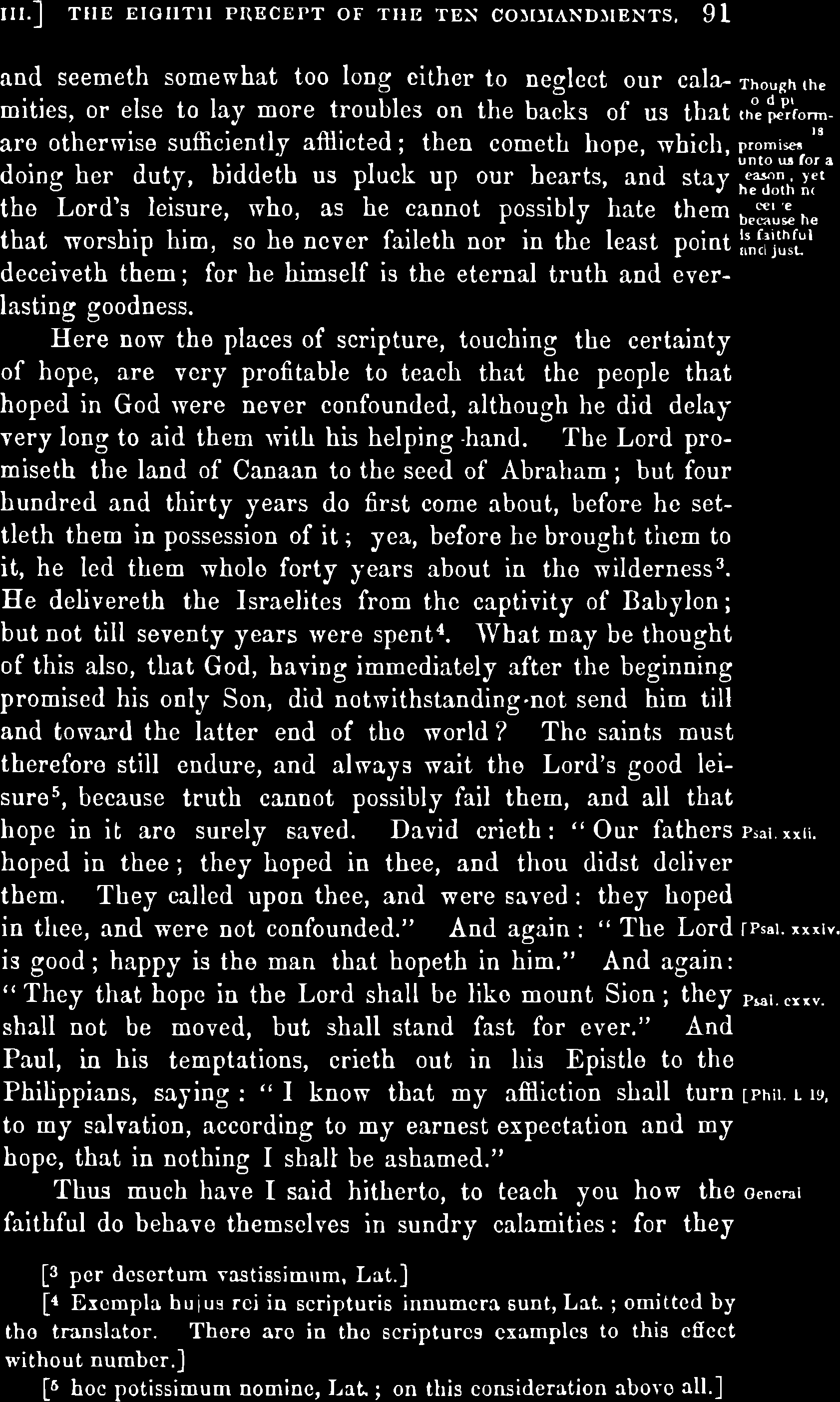
III.] and seemeth somewhat too long either to neglect our cala-Though the mities,or else to lay more troubles on the backs of us that u?e'$fom are otherwise sufficientlyafflicted ; then cometh hope, which, promt** ls i'ii I'lii i-i i unto "* for * doing her duty, biddeth us pluck up our hearts, and stay h^0"tl; "* the Lord's leisure, who, as he cannot possibly hate them beS'u^ he that worship him, so he never failethnor in the least point j^Hf^1 deceiveth them ; for he himself is the eternal truth and everlasting goodness.
Here now the placesof scripture,touching the certainty of hope, are very profitableto teach that the people that hoped in God were never confounded, although he did delay very long to aid them with his helping -hand.
The Lord promiseth the land of Canaan to the seed of Abraham ; but four hundred and thirty years do firstcome about, before he settleththem in possessionof it; yea, beforehe brought them to it,he led them whole forty years about in the wilderness3.
He delivereth the Israelitesfrom the captivityof Babylon; but not tillseventy years were spent4.
What may be thought of this also,that God, having immediately after the beginning promised his only Son, did not withstanding-not send him till and toward the latter end of the world ?
The saints must thereforestillendure, and always wait the Lord's good leisure5, because truth cannot possibly failthem, and all that hope in it are surely saved.
David crieth: "Our fathers Psai.xxu. hoped in thee ; they hoped in thee, and thou didst deliver them.
They called upon thee, and were saved : they hoped " The Lord [P"ai.xxxiv. isgood; happy isthe man that hopeth in him."
And again: in thee, and were not confounded."
And again :
" They that hope in the Lord shallbe like mount Sion ; they Psai.cxxv. shall not be moved, but shall stand fast for ever."
And Paul, hi his temptations, crieth out in his Epistle to the Philippians, saying :
I know that my afflictionshall turn [Phii.1 19, to my salvation,according to my earnest expectation and my hope, that in nothing I shallbe ashamed."
Thus much have I said hitherto,to teach you how the General faithfuldo behave themselves in sundry calamities: for they [3per desertum vastissimum, Lat.] [*Exempla hu jusrci in scripturis innumera sunt, Lat ; omitted by the translator.
There are in the scriptures examples to this effect without number.] [5hoc potissimum nomine, Lat ; on this consideration above all.]
THE THIRD DECADE.
[sERM.

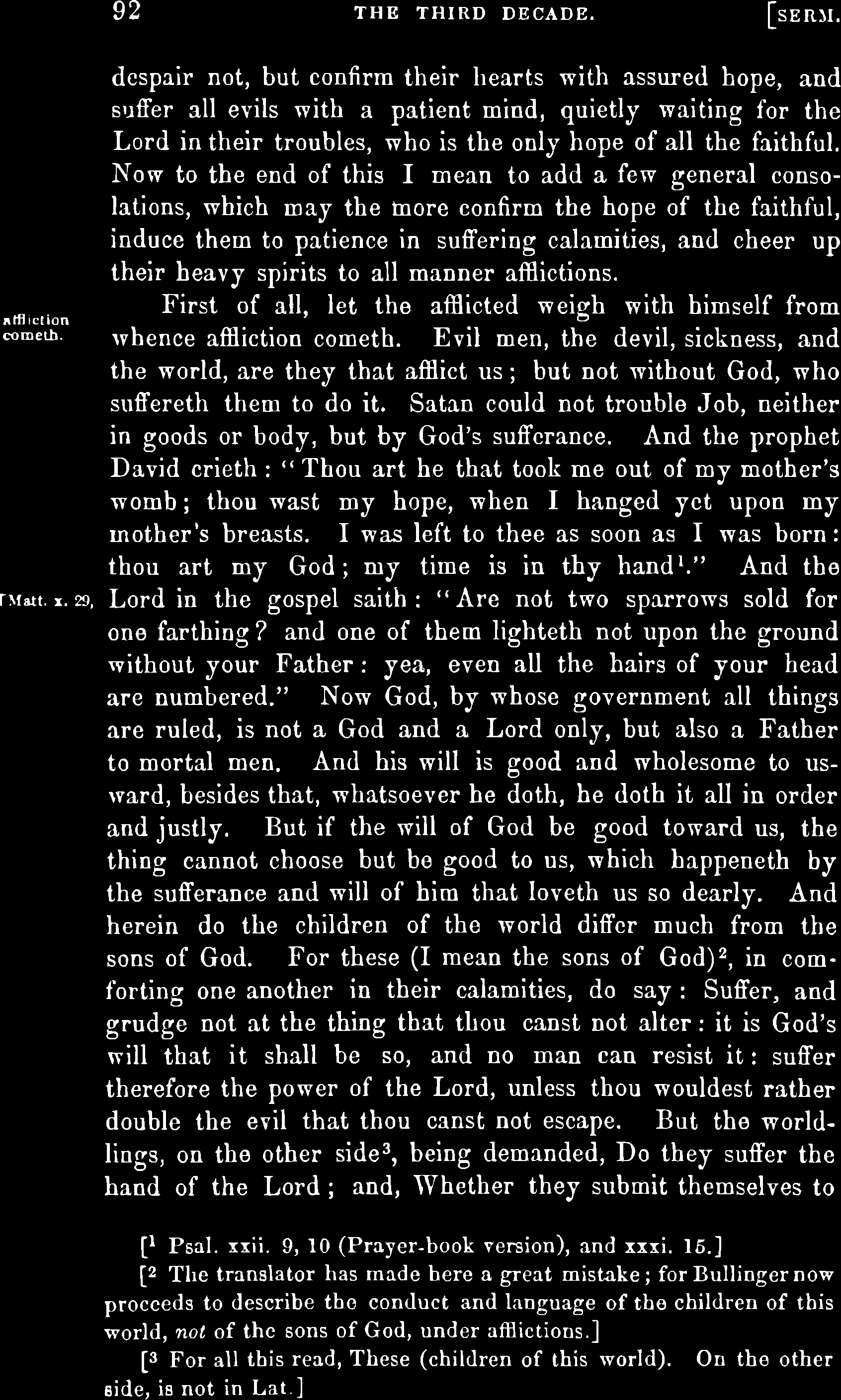
despair not, but confirm their hearts with assured hope, and suffer allevilswith a patient mind, quietly waiting for the Lord intheirtroubles,who isthe only hope of allthe faithful.
Now to the end of this I mean to add a few general consolations, which may the more confirm the hope of the faithful, induce them to patience in sufferingcalamities,and cheer up theirheavy spiritsto allmanner afflictions.
First of all, let the afflictedweigh with himself from affliction .
" cometh. whence afflictioncometh.
Evil men, the devil,sickness,and the world, are they that afflict us ; but not without God, who suffereth them to do it. Satan could not trouble Job, neither in goods or body, but by God's sufferance. And the prophet David crieth:
" Thou art he that took me out of my mother's womb ; thou wast my hope, when I hanged yet upon my mother's breasts. I was leftto thee as soon as I was born : thou art my God; my time is in thy hand1."
And the " Are not two sparrows sold for rMatt. x. 29, Lord in the gospel saith: one farthing? and one of them lightethnot upon the ground without your Father : yea, even all the hairs of your head are numbered."
Now God, by whose government all things are ruled, is not a God and a Lord only, but also a Father to mortal men.
And his will is good and wholesome to usward, besidesthat, whatsoever he doth, he doth itallin order and justly.But if the will of God be good toward us, the thing cannot choose but be good to us, which happeneth by the sufferanceand willof him that loveth us so dearly.
And herein do the children of the world differmuch from the sons of God.
For these (Imean the sons of God)2,in comforting one another in their calamities,do say : Suffer,and grudge not at the thing that thou canst not alter: itis God's will that it shall be so, and no man can resistit: suffer therefore the power of the Lord, unless thou wouldest rather double the evil that thou canst not escape.
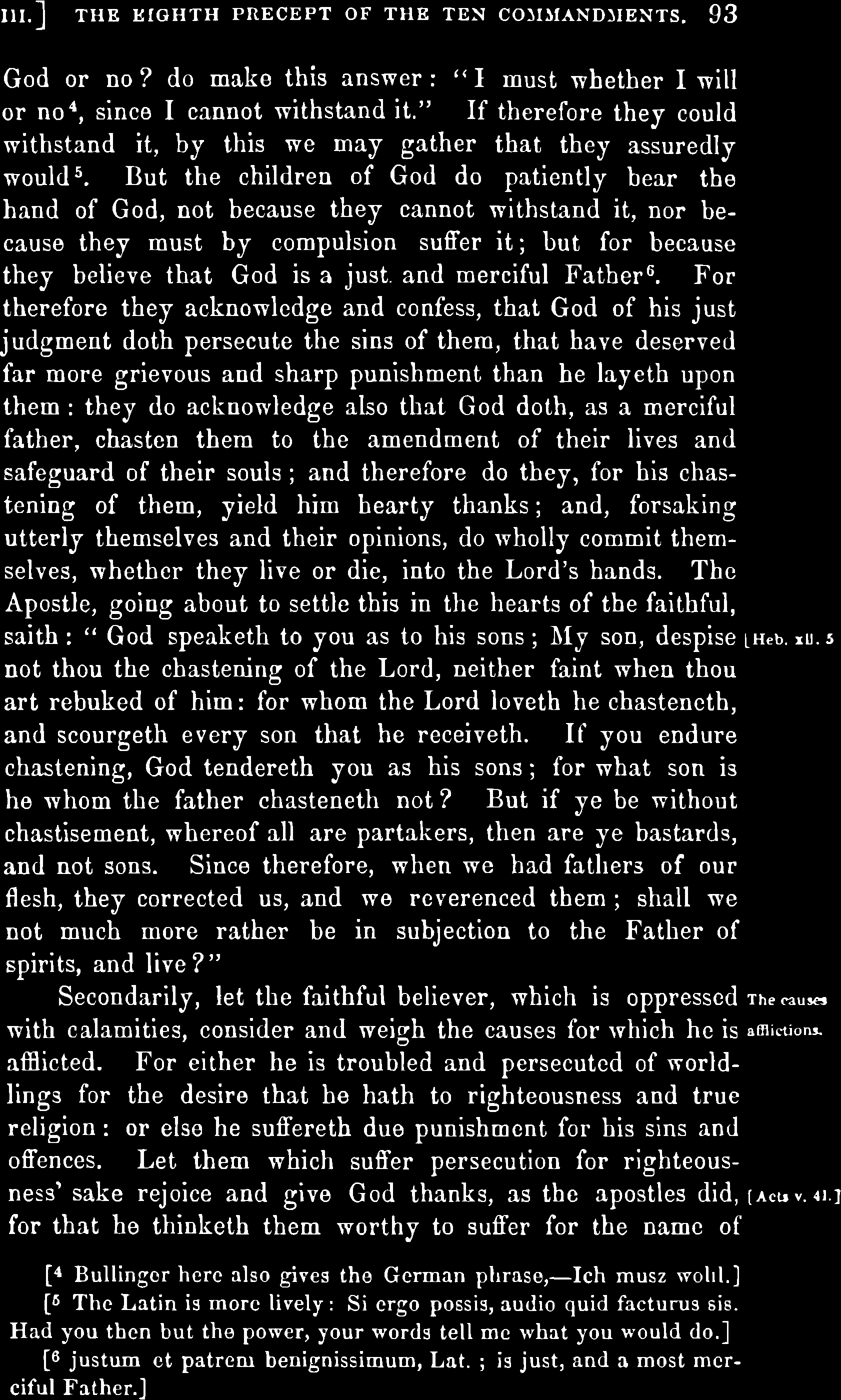
But the worldlings, on the other side3,being demanded, Do they sufferthe hand of the Lord ; and, Whether they submit themselves to [*Psal. xxii. 9, 10 (Prayer-bookversion), and xxxi. 15.] [2The translator has made here a great mistake; for Bullinger now proceeds to describe the conduct and language of the children of this world, not of the sons of God, under afflictions.] [8For allthis read, These (children of this world). On the other eide,is not in Lat.]

THE EIGHTH PRECEPT OF THE TEN
COMMANDMENTS.
III.] God or no ? do make this answer : "I must whether I will or no4, since I cannot withstand it."
If therefore they could withstand it,by this we may gather that they assuredly would5.
But the children of God do patiently bear the hand of God, not because they cannot withstand it,nor because they must by compulsion sufferit; but for because they believe that God is a just, and merciful Father6.
For therefore they acknowledge and confess,that God of his just judgmentdoth persecute the sins of them, that have deserved far more grievous and sharp punishment than he layeth upon them : they do acknowledge also that God doth, as a merciful father, chasten them to the amendment of their lives and safeguard of their souls; and therefore do they, for his chastening of them, yield him hearty thanks; and, forsaking utterlythemselves and their opinions,do wholly commit themselves, whether they live or die, into the Lord's hands.
The Apostle, going about to settlethis in the hearts of the faithful, " God speaketh to you as to his sons ; My son, despise[Heb. xii.* saith: not thou the chastening of the Lord, neither faintwhen thou art rebuked of him : for whom the Lord loveth he chasteneth, and scourgeth every son that he receiveth.
If you endure chastening,God tendereth you as his sons ; for what son is he whom the father chasteneth not ?
But if ye be without chastisement,whereof all are partakers, then are ye bastards, and not sons.
Since therefore,when we had fathers of our flesh,they corrected us, and we reverenced them ; shall we not much more rather be in subjection to the Father of spirits,and live?"
Secondarily,let the faithfulbeliever,which is oppressed The cau*" with calamities,consider and weigh the causes for which he isafflictions. afflicted. For either he is troubled and persecuted of worldlings for the desire that he hath to righteousnessand true religion: or elsehe sufferethdue punishment for his sins and offences.
Let them which suffer persecution for righteousness' sake rejoice and give God thanks, as the apostlesdid,(ACUV. 41.] for that he thinketh them worthy to suffer for the name of [4Bullinger here also gives the German phrase, "
Ich musz wohl.] [5The Latin is more lively: Si ergo possis,audio quid facturus sis.
Had you then but the power, your words tellme what you would do.] [6justum et patrem benign issimum, Lat. ; isjust, and a most merciful Father.]
THE THIRD DECADE.
[SERM.

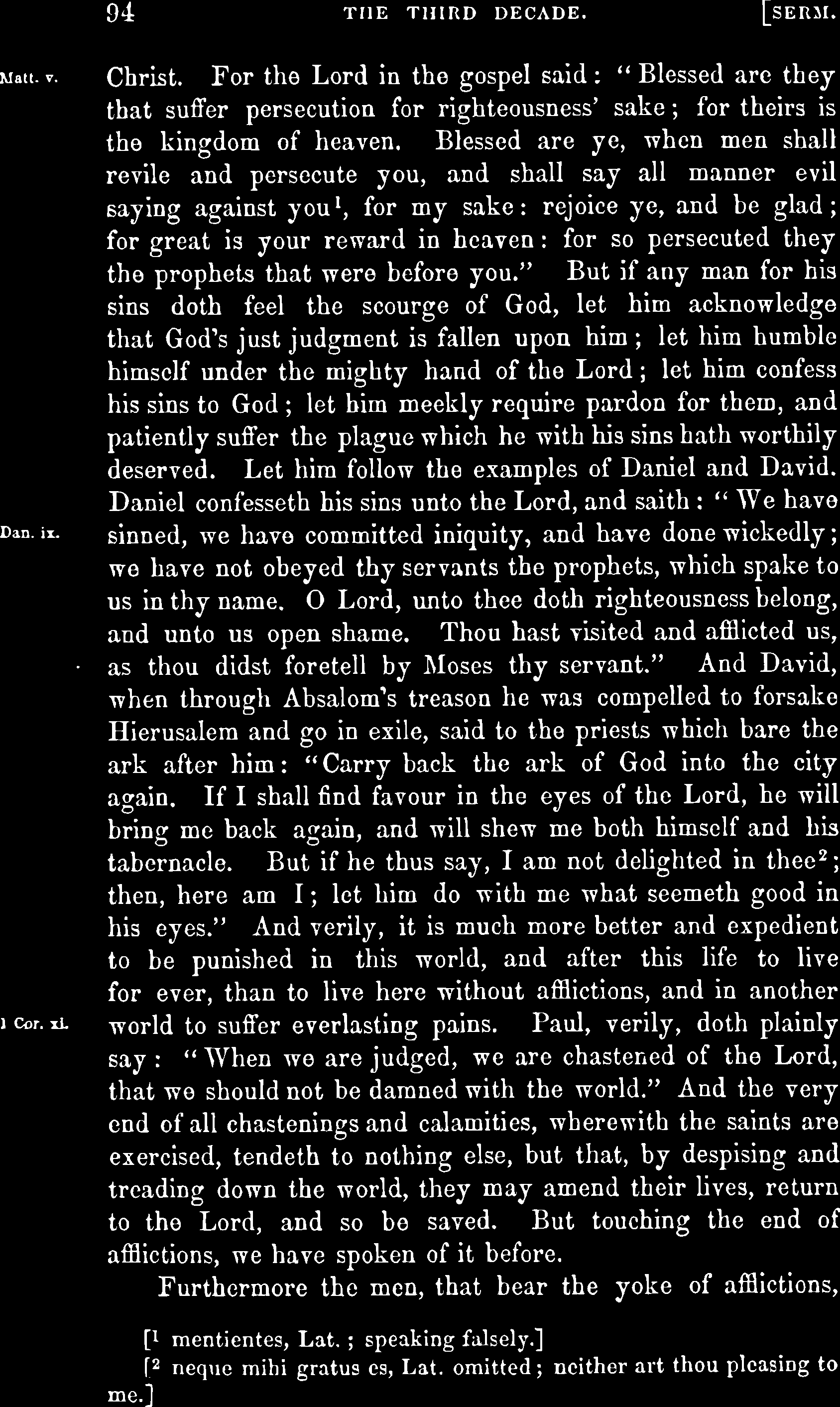
" Blessed are they Matt. v.
Christ. For the Lord in the gospel said : that suffer persecution for righteousness'sake ; for theirs is the kingdom of heaven.
Blessed are ye, when men shall revile and persecute you, and shall say all manner evil saying againstyou1, for my sake: rejoice ye, and be glad; for great is your reward in heaven : for so persecuted they the prophets that were before you."
But ifany man for his sins doth feel the scourge of God, let him acknowledge that God's justjudgmentis fallenupon him ; lethim humble himself under the mighty hand of the Lord ; lethim confess his sinsto God ; lethim meekly require pardon for them, and patientlysufferthe plague which he with hissinshath worthily deserved.
Let him follow the examples of Daniel and David.
" We have Daniel confessethhissinsunto the Lord, and saith:
Dan. ix. sinned, we have committed iniquity,and have done wickedly ; we have not obeyed thy servants the prophets,which spake to us inthy name.
O Lord, unto thee doth righteousnessbelong, and unto us open shame.
Thou hast visitedand afflicted us, . as ^hou didst foretellby Moses thy servant."
And David, when through Absalom's treason he was compelled to forsake Hierusalem and go in exile,said to the priestswhich bare the ark after him:
"Carry back the ark of God into the city again.
If I shallfindfavour in the eyes of the Lord, he will bring me back again, and willshew me both himself and his tabernacle.
But ifhe thus say, I am not delighted in thee2 ; then, here am I ; let him do with me what seemeth good in his eyes."
And verily,itis much more better and expedient to be punished in this world, and after this life to live for ever, than to livehere without afflictions, and in another i cor. XL world to suffereverlastingpains.
Paul, verily,doth plainly " When we are judged, we are chastened of the Lord, say : that we should not be damned with the world." And the very end of allchasteningsand calamities,wherewith the saintsare exercised,tendeth to nothing else,but that, by despisingand treading down the world, they may amend theirlives,return to the Lord, and so be saved.
But touching the end of afflictions, we have spoken of itbefore.
Furthermore the men, that bear the yoke of afflictions, [lmentientes, Lat. ; speaking falsely.] [2neque mihi gratus es, Lat. omitted ; neither art thou pleasing to me.]
THE EIGHTH PRECEPT OF THE TEN
COMMANDMENTS.

III.] do lay before themselves the plain and ample promises of God, The ,.,
,1 i /" i " ma from which, and from the examples of the saints, they never afflicted. turn their eyes.
There are innumerable examples of them which have feltGod's helping hand ready in all needs to aid and deliverthem.
Now our good God doth promise to help and deliver,not them only which are afflicted for righteousness* sake, but them also whom he doth visitfor their faultsand " The Lord doth heal the contrite[PMI. cxiv". offences. For David saith: of heart3 : The Lord doth loose them that are bound in chains : ?,'s^and cuL The Lord giveth sight unto the blind : The Lord settethup again them that do fall. He is not angry for ever ; neither doth he always chide.
He dealeth not with us after our sins, nor rewardeth us after our iniquities. And how wide the east is from the west, so far hath he set our sinsfrom us."
To this belongeth the whole thirtiethchapter of Jeremy's prophecy.
And Paul doth bear witness to this,and saith:
"As the afflictions of Christ are many in us, so is our comfort [2cor. i.5.3 great through Christ4."
Neither are we without examples enough to prove this same by, and to lay before our eyes the present delivery of the saints,and the repentance of sinnersin extreme calamities.
Our ancestors, the patriarchs,Noe and Lot, with theirfamilies, were by the mighty hand of God delivered from the deluge, that drowned all creatures under the heavens, and the horrible fire that fellupon Sodom.
Jacob and Joseph, being wrapped in sundry tribulations, were by their merciful God wound out5 and rid from all: even as also the children of Israel were brought forth and delivered from the servile bondage of Pharao in Egypt6.
The people of Israel did in the wilderness under their guides and judges7 sin often and grievously against the Lord, for which they were punished roundly, and sharply scourged ; but they were quickly delivered again by the Lord, so oft as they did acknowledge their sins,and turn themselves to him again.
There are also notable peculiar8 examples of God's deliverance of his people in David, Josaphat, Ezechias, Manasses, and many [8et obligat contritiones eorum, Lat. omitted ; and bindeth up their wounds.] [4prsesentissimum, Lat. ; most ready.] [6explicantur, Lat.] [6plane ferrea, Lat. omitted ; which was truly iron.] [7sub Judicibus et Regibus, Lat.] [8peculiaria sed egregia, Lat.]
THE THIRD DECADE.
[sERM.

.Examples of other. There are to be seen in the gospel innumerable places, God'" del from sm, from diseases, ...
. uverance. where Christ delivered his professors from perils,and from the devil.
In the Acts of the apostles there are found most excellentpatterns of present deliveryby the mighty hand of God.
The apostlesare imprisoned, and fastbound in fetters; but they are loosed and brought forth by the angel of God, and placed in the temple to preach the [Act* v. is" gospel openly.
Peter likewise is delivered out of prison, when Agrippa had determined the next day followingto make jAct* xii.ean end of and dispatch him.
The apostle Paul, being oppressed with an infinitesort of calamities,did always feelthe present hand of God at all times ready to rid him out of misery : and settingthis tribulationand delivery of his for " Thou rs nm. ui. an example to all the faithful,he saith to Timothy : koowest my persecution and afflictions2, which came to me at Antioch, at Iconium, at Lystra; which persecutionsI suffered patiently: but from them all the Lord delivered me.
Yea, and allthat willlivegodly in Christ Jesus, shallsufferpersecution."
Many more examples doth the same apostle reckon up together in the eleventh chapter to the Hebrews.
All this,I say, do the saintsconsider,and in time of temptation and affliction do comfort and strengthen themselves therewith.
[Bom. xv.
4.]For so doth Paul teach us, where he saith: "Whatsoever iswritten,for our learningisit written,that through patience and comfort of the scriptures we might have hope.
The Lord-* Beside this also,the faithfulsort callto their minds the commandbel"in"the commandments of Christ our Lord, wherewith he, commendcross. jng patience unto us, hath laid the cross upon us all.
For " If any man will go after me, let rMatt. xvt in the gospel he saith: him forsake himself,and take up his cross, and follow me.
For whosoever will save his lifeshalllose it; and whosoever shalllosehis lifefor my sake shallsave it.
For what doth it advantage a man, to win the whole world, and lose his own soul?
Or what shalla man give for a ransom of his soul?
For the Son of man shall come in the glory of his Father with his angels : and then shall he reward every man according to his work."
And again, in another place he saith:
" If any man come to me, and hate not his father, and mother, and wife,and children,and brethren, and sisters, f1his professors, not in the Latin.] [2patientiam afflictionesque,Lat. ; my patience and afflictions.]
THE EIGHTH PRECEPT OF THE TEN
COMMANDMENTS.

III.] yea, and his own lifealso, he cannot be my disciple. And [Luke xi. ze, whosoever doth not bear his cross, and come after me, he " cannot be my disciple."
After which words the Lord bringeth in certain parables, by which he teacheth us to make trialof our abilitybefore we receive the profession of the gospel.
To the precepts3 of their master Christ the faithfulapostles,Peter and Paul, had an especialeye, exhorting us to the patient bearing of the cross of Christ.
For Christ,"saithPeter, "was afflictedfor us, leavingto us iPet.u.2i.] an example, that we should follow4 his steps."
And Paul said: "Through many tribulationswe must enter into the [Actsxiv.22.] kingdom of God."
Another comfort that the faithfulhave in their afflictions The time of is this,that the time of affliction is short; that the joy and shortcut the reward in the world to come is unspeakably far more largeSSTpYe **"? and excellentthan the tribulationof thislifeis troublesome, so that there can be no comparison betwixt the joy of the one and grief of the other: and lastly,that our good God doth not lay such burdens on us as we are not able possibly to bear.
Touching all which points, I think it convenient here to rehearse proofs out of the scriptures,to prove them true.
St Peter calleththe time of affliction short, or momentary5.
And the prophet Esay, or the Lord rather in Esay's " Go, my people,[isai.Mvl. prophecy, long before Peter's time, did say :
enter into thy chambers, and shut the doors after thee ; hide .while6,until mine indignation be overpast."
Paul also saith: thyself a little " The fathers of your flesh did for a few [Heb.xii. days chasten you after their own pleasure; but the Father of Spiritsdoth (for a short time)correct you to your profit, that ye might be partakers of his holiness. But no chastising for the present seemeth to be joyous, but grievous: neverthelessafterward itbringeth the quiet fruitof righteousness to them that are exercised thereby."
Again he saith:
" We suffer with Christ,that with him we may be glorified.
For I am certainlypersuaded that the afflictions of this time are not comparable to the glory that shall be shewed upon us.
For the momentany lightnessof our afflictiondoth wonderfully, above all measure, bring forth to us an everlasting [3Ad prsccepta certa, Lat.] [4insequeremini, Lat.] [61 Pet. i.6. ad breve tempus, Erasmus' translation,which Builingeradopts.] ["paululum vel ad momentum, Lat.]
[BULLINGER,
n.]
THE THIRD DECADE.
[sERM.

weight of glory ; while we look not for the things that are seen, but the things that are not seen : for the things that are seen are temporal ; but the things that are not seen are eternal1."
Again, in his firstEpistle to the Corinthians the " God is faithful,which shall not suffer [icor. x. 13.]same Apostle saith: you to be tempted above that you are able ; but shall with the temptation make a way to escape, that ye may be able to bear it."
But if it so happen, that the Lord doth seem to us to extend our tribulationlonger than justice would seem to require,then must we by and by remember, that we may not prescribe to God any end of his will,but must permit him freelyto afflict us2 without all controlment, so much, so long, and by such means, as shall seem to be best to his godly wisdom.
He who is himself the eternal wisdom, and loveth us men entirelywell,doth know well enough his time and season, when to make an end of our miseries,and rid us from afflictions.There are in the scripturessundry examples to comfort the men whose afflictions endure for any [Mark v. 25, jong time.
The woman in the gospel was troubled with an issue of blood by the space of twelve years, which had almost driven her to utter desperation of her health's recovery.
Another lay beddred3 whole eighteen years.
By the pool [John v.
Bethesda4 lay the silly5creature, who had been diseasedeight and thirtyyears.
This space, surely,was very troublesome.
But yet at lastthey6 were restored to health again by God, who knoweth best at what time and season his help is most expedient and profitablefor mankind.
Let us therefore wholly submit ourselves to his good, just,and most wise will,to be delivered when and how he shall think best.
NO afflictions But the chiefestcomfort and greatest hope in tribulation do separate .
., .
...
1S) ak no^ ^J *orce or misery can possibly separate the Lord and faithfuland elect servants of God from God himself.
For " My sheep hear rjohn x. the Lord in the gospel criethout, and saith: p Eom. viii.17, 18.
2 Cor. iv.17, 18.
Erasmus' translation.] [2Suse manui subditos, Lat. omitted; who are subject to his hand.] [8Luke xiii.11.
Decubuit contracta, Lat.] [4Ad probaticam piscinam, Lat. ; so the Vulgate, est autem Jerosolymis probatica piscina: and the Douay Version; Now there is at Jerusalem a pond, called Probatica.
Bethesda is not in Bullinger's original.] [5silly,weak, poor, Lat. miser.] [comnibus, Lat.; all these were.]

THE EIGHTH PRECEPT OF THE TEN
COMMANDMENTS.
III.] my voice,and I know them, and they follow me ; and I give them eternal life,and they shall never perish, neither shall any man pluck them out of my hand.
My Father, which gave them me, is greater than all; and no man isable to take them out of my Father's hand.
I and my Father amr one."
Hereunto belongeth that outcry8 of St Paul, which he useth to the " Who shall encouragement of us Christians,where he saith: separate us from the love of Christ9?
Shall tribulation, or anguish, or persecution,or hunger, or nakedness, or peril,or sword ?
As itiswritten, For thy sake are we killedallday long,and are counted as sheep for the slaughter.Nevertheless, we overcome in all these things through him that loved us.
For I am sure, that neitherdeath, nor life,nor angels,nor rule, nor power, nor things present,nor things to come, nor height, nor depth, nor any other creature, shallbe able to separate us from the love of God, which is in Christ Jesu our Lord."
The saints,I confess,in their calamitiesdo feelgrief and ,.
, .
,. modules many discommodities ; but so yet that even in their discomthat the "
* " saints suffer modities they have far many more commodities : they are ^^j0^ therefore diminished one way, but augmented another way, moditieT1" so that the cross of theirs is not their destruction,but an exercise for them and a wholesome medicine.
And therefore I think that that same worthy and golden sentence of St Paul can never be too often beaten into our minds, where he saith:
"We are troubled on every side, yet are we not without ^g"Tivshift; we are in poverty, but not in extreme poverty ; we sufferpersecution,but are not forsaken therein; we are cast down, but we perish not."
The faithfultherefore do in thisworld lose these theirearthly riches; but do they thereby lose their faith?
Lose they their upright and holy life?
Or losethey their riches10of the inner man, which are the " God- [yjmtrue riches in the sight of God ?
The apostlecrieth: vi6 liness is a great lucre with a mind content with that that it hath.
For we brought nothing into the world, and it is certain that we may carry nought away : but having food and raiment we must therewith be content."
And the Lord, p sumus, Lat. ; are.] [8tripudium ac celeusma, Lat. ; triumph and encouragement.] [9a dilectione Dei, Lat. and Erasmus, from the love of God : but the Vulgate has, a charitate Christi.] [10bona, Lat. ; good things.] 7"2
THE THIRD DECADE.
[SERAI.

verily,whjD of his goodness hath created heaven and earth and allthat istherein for the use of men, which even feedeth the ravens' young ones, will not cause the justman to die with hunger and penury.
Moreover, that man doth not lose his treasure in this world, which gathereth treasure as the Lord hath commanded him ; with whom the faithfulknow that a most wealthy treasure is laidup in heaven for them, which are in this world spoiled of their terrestrialgoods for their
Lord and master's sake.
That worthy and notable servant " Naked I came out of my mother's [jobi.21.] of God, Job, doth cry : womb, and naked shallI turn to the earth again1: the Lord gave, and the Lord hath taken away ; as the Lord pleased,so isithappened 2.
Blessed be the name of the Lord."
TO deny the Last of all,itismanifest,that to deny the truth, thereby ISway to to escape persecution,is not the way to keep our wealth and goods. quiet state, but rather the means to lose them; yea, by so doing we are made infamous to all good men of every age and nation.
For we see that they which would not for Christ and the cause of his truth hazard their riches, but chose rather by dissimulationand renouncing of the truth to keep their worldly wealth3, did retain for ever infamous reproach, and daily augment most terribletorments, which vexed horribly their guilty conscience,losing nevertheless in the devil'sname the wealth which they would not once hazard in the cause of theirSaviour4. But they, on the other side,which jeoparded themselves and alltheir substance in the quarrel of Christ, despisingmanfully all dangers that could happen, did always find a sweet and pleasant comfort, which strengthened the minds of their afflictedbodies.
For they cry with the " We have learned, in whatsoever state we are, [Phn. iv. apostle: therewith to be content.
We know how to be low, we know also how to exceed: every where and in all things we are instructedboth to be fulland to be hungry, both to have plenty and to suffer need.
We can do all things through Christ who strengthened us."
They know that the same t1Heb. nSttf, thither, Auth. Ver.
Cyprian quotes it, " naked also shallI go under the earth.
Adv. Jud. Lib. m. cap. 6.] [2So the Vulgate and Coverdale, The Lord hath done hispleasure : and Cyprian.] [3vel retinere vel augere, Lat. ; either to keep, or to increase.] [4non jam in nomine Christi,sed in nomine diaboli,Lat.]

THE EIGHTH PRECEPT OF THE TEN
COMMANDMENTS.
HI.] " Ye have sufferedwith joythe spoilingof [Heb.x. 34.] your goods, knowing that ye have in heaven a far more apostle hath said: excellentsubstance, which will endure."
For the Lord in " Verily I say unto you, There is no the gospel also said: man that hath forsaken house, or brethren, or sisters,or father,or mother, or wife,or children,or lands,for my sake, and the gospel's,but he shallreceive an hundred fold now at this present, with persecutions; and in the world to come eternal life."Mark x.
So then the saintsand faithfulservants of God are oppressed with servitude in this present world: but therewithal they know and consider that the Lord himself became a servant for us men5; whereby6 they, that are servants in this world, are made free through Christ,and by terrestrialservitudea way is made to celestial liberty.
The faithfulare exiled,or banished their country : but Affliction in " A valiant-heartedman takes every ex the heathen poet saith, country for his own7."
Verily,in what place of the world soever we are, we are in exileas banished men.
Our Father is in heaven, and therefore heaven is our country.
Wherefore, when we die,we are deliveredfrom exile,and placed in the heavenly country and true felicity. In like manner, whom the tyrant killethwith hunger and famine, those doth Affliction in he 8 rid of innumerable evils. And again, whomsoever famine doth not utterly kill but only torment, them doth it teach to live more sparingly, and afterward to fast the longer and devoutly.
Now in thiscase the faithful,which sufferfamine, do callto remembrance the examples of the ancient saints,of " They wandered about [Heb. XL in sheep skins and goat skuas ; being destitute,afflicted, and tormented ; of whom the world was not worthy : they whom when Paul speaketh, he saith: wandered in wilderness,and in mountains, and in dens, and caves of the earth."
Christiansalso consider,that the state of famished Lazarus, who died among the tongues of the dogs that licked his blains,was far better than the surfeiting of the strut-belliedglutton,who being once dead was buried ["prius,Lat. ; before us.] [6adeoque, Lat. ; and that so.] ['Omne solum fortipatria est.
Ovid. Fast. Lib. I. 493.] [8ceu morbus aliquis,Lat. omitted ; like some disease.]
THE THIRD DECADE.
[sERM.

Affliction in in hell1.
Moreover, itisto be abhorred, detested,and (yet) wars by de- /" i_ i_ MI " flouring of lamented of all men, to see a crew ot barbarous villainsand women. unruly soldiersabuse perforce,not honest matrons only, but tender virginsalso,that are not fityet nor ripe for a man.
But the greatestcomfort that we have in so great a mischief and intolerableignominy is,that chastityis a virtue of the mind.
For ifit be a treasure of the mind, then is it not lost though the body be abused : even as in like sort the faithof a man is not thought to be overcome, although the whole body be consumed with fire. And chastityis not lost,verily, where the body is defloured; because the will of the abused body persevereth stillto use that chastity,and doth what itmay to keep it undefiled.
For the body is not holy therefore, because the members thereof are undefiled,or because the secret parts thereof are not undecently touched : considering that the body, being wounded by many casualties,may suffer filthyviolence; and since physiciansfor health'ssake may do to the members the thing that otherwise is unseemly to the eyes.
Wherefore so long as the purpose of the mind (by which the body must be sanctified) remaineth, the violentdeed of another's filthylusttaketh not from the body that chastity, which the perseveringcontinency of the defloured body doth seek to preserve.
And hi the meanwhile there is no doubt but the most justLord will sharply punish those shameless beasts and monsters of nature, which dare undertake to commit such wickedness.
The sainu in The saintsare confirmed in their tribulationby the innusuffering the merable examples of their fore-fathers;whereby they gather, *fc*8 no new tn'ng that happeneth unto them, since God from the beginning hath with many afflictions and tribulations exercised his servants and the church, his spouse, whom he loveth so dearly.
And here I think it to be very expedient, and availableto the comforting of afflictedminds, to reckon up the best and choicest examples that are in scriptures: of which there are many both private and public.
The chances and pilgrimagesof the latterpatriarchs (because I mean not to speak of them before the deluge2) are those, which I call p sepultiet demersi in inferos,Lat. ; who was buried, and plunged into hell.] [avetermn, Lat.]

THE EIGHTH PRECEPT OF THE TEN
COMMANDMENTS.
III.] private examples.
For our father Abraham is by the mouth Example* of God called from out of Ur of the Chaldeans to go into'Pn Palestine,from whence he is driven by a dearth into Egypt, "where again he is put to his shifts,and feeleth many pinches.
After that, when he came again into Palestine,even tillthe last hour of his life,he was never without some one mishap or other, to trouble and vex his mind.
His son Isaac feltfamine also, and had one misfortune3 upon another's neck to plague him withal. He sinneth not that callethJacob4 the wretchedest man that lived in that age, considering the infinitemiseries wherewith he was vexed.
While he was yet in his mother's womb and saw no h'ght,he began to strive with his brother Esau: afterwards, in his stripling'sage, he had much ado to escape his murdering hands by exilinghimself from his father's house into the land of Syria; where again he was kept in ure and exercised sharply in the school of afflictions5. At his back-return into his country he was wrapped in and beset with perilsenough, and endless evils. The detestablewickedness of his untoward children had been enough to have killed him in his age6.
In his latterdays, for lack of food, he goeth down as a stranger into the land of Egypt, where in true faith and patience he gave up the ghost7. Of Moses, the great and faithfulservant of God, the scripture testifieth,that in his youth he was brought up in the Egyptian court; but, when he came to age, he refused to be called the son of Pharao's daughter, choosing rather to be afflictedwith the people of God, than to enjoythe temporal commodities of this sinful world8, because he counted the rebuke of Christ greater riches^ than allthe treasures of the Egyptians.
The same Moses was grievously afflicted,firstby Pharao and his princes,and after that again by them of his own household, and his own country people whom he had brought out of the land of Egypt.
David also, the anointed of the Lord, was troubled a great while with his master Saul, that was mad upon him to have [3domestica infortunia, Lat. ; in his family.} [4a Domino Israclem cognominatum, Lat. omitted; whom God surnamed Israel.] ["'' in exquisitissima afflictionum palaestra sen offtcina,Lat.] [6 optimum senem tantum non enecant, Lat.] [7sanctum Deo tradit spiritum, Lat.] [8peccati, Lat. ; of sin.]
THE THIRD DECADE.
[SERM.

brought him to his end: but having at the last(forall that Saul could do)obtained the kingdom, afflictions ceased not to follow him still;for,after many troublesome broils,he was by Absalom thrust beside his kingdom, and very straitlydealt withal: and yet in the end God of his goodness did set him up again. chmt and jn the new Testament, Christ himself,our Lord and Saviour, and that electvessel,his apostle Paul, are excellent examples for us to take comfort by.
The Lord in his infancy was compelled to flythe treason and murdering hands of cruel tyrants; in all his lifetimehe was not free from calamities; and at his death he was hanged among thieves.
And Paul, speaking of himself,doth say: "If any other be the ministers of Christ,I am more ; in labours more abundantly, in stripes above measure, in imprisonments more plenteously,in death1 often.
Of the Jews five times received I forty stripessave one; thricewas I beaten with rods, once stoned; thriceI suffered shipwreck ; a day and a night have I been in the depth ; in journeying often ; in perilsof waters, in perilsof robbers, in perilsof mine own nation,in perilsamong the heathen, in perilsin the city,in perilsin the wilderness,in perilsin the sea, in perilsamong falsebrethren; in labour and travail,in watchings often,in hunger and thirst,in fastingsoften,in cold and nakedness.
Beside those things that outwardly come unto me, the trouble,which daily liethupon me, isthe care of allthe churches."
These, I say, are private examples.
Examples of We have a publicexample in the church of Israelafflicted afflictionsof ._, . i i i i i " i "
" i in "^SyP*'many times troubled under their kings and judges, chure'h and lastlyled captiveby the Assyrians and men of Babylon.
Afterward, being brought home again by the goodness of God, they pass many brunts, and are sharply afflictedunder the monarchies of the Persians, Greeks, and Romans.
What shall The ten horI say of the apostolicchurch of Christ,which, even when it secmimwof firstbegan, like an infant,to creep by the ground2, did preof chrut. sently feelthe cross, and yet flourishedstillin those afflictions, which even to this day it doth patientlysuffer?
Histories make mention of ten persecutions,wherewith the church of Christ(fromthe eighth year of Nero, tillthe reign of Constantino the great,by the space of three hundred and eighteen [!" in mortibus, Lat.] [2ab ipsisincunabulis, isBullingcr'sphrase.]
THE EIGHTH PRECEPT OF THE TKN
COMMANDMENTS.

III.] years3) was terriblyshaken and sharply afflicted, without intermission or respite of time for it to breathe in, and rest itself from troublesome broilsand merciless slaughters4.
The first persecution of those ten5 did Nero, that beast and lecherous monster, raise against the Christians, wherein, it is said, that Peter and Paul, the Apostles of Christ, were brought to their endings.
The second was moved by Flavius Domitianus, which banished the Apostle John into the Isle of Patmos.
The third persecutor after Nero was Trajanthe emperor, who published most terrible edicts against the Christians: under him was the notable martyr and preacher Ignatius,with many other excellent servants of Christ, cast to wild beasts, and cruelly torn in pieces.
The fourth persecution did the Emperor Verus most bloodily stir up through all France and Asia ; wherein the blessed Polycarpus was burnt in fire alive,and Irenseus, the bishop of Lyons, was headed with the sword6.
In the fifthpersecution of the church of Christ, Septimius Severus through many provinces did bloodily crown many a saint with the garland of martyrdom : among whom is reckoned Leonidas the father of Origenes.
Julius Maximinus was the sixth after Nero that played the tyrant against the church.
In that persecution the preachers and ministers of the churches were especially murdered : among whom, beside an innumerable sort of other excellent men, Pamphilus and Maximus, two notable lights, [3The persecution in Nero's reign began A.D.
64, (he became emperor A.D.
64),and Constantino succeeded Maxentius, A.D.
; so that the interval is 248 years.
See Burton's Hist, of Christ. Church, Chap. v. p. 128, and Chap. rra. p. 392. Lond.
1845.] [4Bullinger's words are : Concessis tamen nonnunquam intervallis quibusdam, satis quidem accisis, quibus respiraret ecclesia : although indeed occasionally some intervals were granted, short enough in good sooth, wherein the church might take breath.] [5Primam (persecutionem) quippe computant (nonnulli) a Nerone qurc facta cst, secundam a Domitiano, a Trajanotertiam, quartam ab Antonino, a Severo quintain, scxtam a Maximino, a Decio septimam, octavam a Valeriano, ab Aureliano nonam, decimam a Dioclctiano et Maximiano.
Aug. de Civ. Dei, Lib. xvm. cap. 62. Par.
1631.
Tom. v. fol. 251.
See Euseb.
Eccl. Hist. in.
18, 36; iv.
16; vi. 1, 41; vn.
11, 30, "c.] [6We have no account of the death of Irenoeus upon which wo can absolutely depend ; and there is a doubt whether he was martyred or not.]
THE THIRD DECADB.
[SERM.

wore especiallyslaughtered.
The seventh blood-sucker after beastly Nero was Decius the Emperor, who proclaimed most horrible edicts against the faithful. In his time was St Laurence, a deacon of the church, broiled upon a grate-iron; and the renowned Virgin Apollonia, for her profession,did leap into the fire alive.
Licinius Valerianus was as cruel as the rest in executing the eighth persecution against the faithfulprofessors of Christ and his gospel.
In that broil were slain many millions of Christians,and especially St Cornelius and Cyprian, the most excellentdoctors in all the world.
Valerius Aurelianus did rather purpose, than put in execution, the ninth persecution: for a thunder rushed before him to the great terror of them that were about him; and, shortlyafter,he was slainas he journeyed, and so his tyranny by his death was ended.
But Caius Aurelius Valerius Diocletianus, Maximinianus Maxentius, and Marcus Julius Licinius,being nothing terrifiedwith this horrible example, did raise the tenth persecution against the church of Christ,which, enduringby the space of ten whole years, brought to destruction an infinitenumber of Christians in every province and quarter of the world.
This broil doth Eusebius Csesariensispassingly1 paint to the eyes of the reader : for he himself was an eye-witness and looker-on of many a bloody pageant and triumphant victory of the martyrs, which he rehearseth in the eighth book of his ecclesiA.D. see. asticalhistory. In that slaughter were killedthe firstapostles of our Tigurine church, both martyrs of Christ and professors of his gospel,S. Fcelix and his sisterRegula2.
After those ten persecutionsthere followed many more and more terriblebutcheries,stirredup by many kings and barbarous men, in sundry quarters of the earth ; upon the neck whereof did follow the mercilessblood-sheddings committed by the Saracens, Turks, and Tartars3: moreover, the [xgraphice,Lat.] [2These martyrs (exThebcea Ugione) are thus mentioned in the Ephemeris, Bed. Opp.
Tom. i. p. 206. Col. Agrip. 1612.
Septemb, 3 Id.] Has simul et Felix felicimorte dicavit, Martyrio Regulse juncto,pariterque beavit.
They suffered September
11, A. D.
281.
See Hospinian. de festisChristian, p. 143. Genev. 1674.] [3Tartarorum, Turcarum denique, Lat. ; and lastlyof the Turks.]

THE EIGHTH PRECEPT OF THE TEN
COMMANDMENTS.
III.] butcherly bishops4 of Rome did annoy extremely the church of God, by shedding in civiland foreign wars more Christian blood than any tongue can possibly tell.
No new thing therefore doth at this day happen to us that in the church of Christ do suffer divers persecutionsand afflictions
; for we have examples of great efficacy,both new and old,to confirm our hearts, that they faintnot in calamities.
And therefore did the prophets and apostles,and their Their affiic- * * tions were Lord and master, Jesus Christ,foretelthese perils,calamities,
,*"
*""""*"" and allpersecutions; because they would have us to fortify our minds against these miseries at all times and seasons, lest, by being shaken with them at unawares, we should revolt from our faith,and forsake our profession.
"Because ""!"2ni* I have chosen you out of the world," saith the Lord to his l"*-l " therefore the world doth hate you.
Remember disciples, the words which I spake unto you, saying, The servant is not greater than his master.
If they have persecuted me, they will also persecute you ; if they have kept my words, they will also keep yours.
But all these things shall they do to you for my name's sake, because they know not him that sent me.
This have I said to you, that ye should not be offended.
They shall drive you from their synagogues : and the. time shall come, that whosoever killethyou shall think he doth God good service."
The rest that is like to thisI mean not at this time to recite out of the prophets and apostles,because it cannot be brieflyrehearsed5: let every one pick out, and apply to his own comfort, the plainestand most evident testimonies, that by reading he shall lightupon.
And although the saintsdo not rejoice at the destructionpersecutors of their persecuting enemies, whom they could wish rather ^nledTr i j i i i " i "
their perseto be converted, and so saved, than in this present world to cuting tyranny. be punished, and in the world to come to be damned for ever; yet they are glad, when they see the Lord punish their afflicters6, because thereby they perceive that God hath [4pseudo-pontifices, Lat. ; the false bishops: butcherly is not in the original.] [5The following texts are put in the margin of the Latin original of Bullinger ; Psal. xxii.Jxix. Isai.xlix.li.Dan. vii.viii.xi. Zech. xiii.] [6hoc potissimum nomine, Lat. ; for this reason specially.]
THE THIRD DECADE.
[SERM.

a care over those that be his servants.
They do gather also bj the present vengeance of God upon the wicked, that as afflictions are for the health and amendment of the faithful, so they are to the hurt and destruction of the unbelievers: for, while they persecute other, they themselves are destroyed ; and while they trouble the church of the living God, they kindle a fire of the wrath of God against themselves, that willnever be quenched.
For in the prophecy of Zacharias thus we read that the Lord speaketh touching " Behold, I make Jerusalem a cup1 of poison unto xu. his church : all the people that are round about her : yea, Juda himself shallbe in the siege against Jerusalem2.
And in that day I willmake Jerusalem a heavy stone for allpeople ; so that allsuch as liftitup shallbe torn and rent, and allthe people of the earth shall be gathered together against it." A like saying to this hath the Lord in Jeremy, where he speaketh " Take this [jcr.
KV. is, againstthe persecutors of his church, and saith: wine-cup of indignation from my hand, and make all the people, to whom I send thee, to drink of it; that when they have drunken thereof, they may be mad, and out of their wits,for fear of the sword which I will send among them.
For I begin to plague the city that is calledafter my name ; and think ye then that ye shall escape unpunished?
Ye shallnot go unpunished."
And thisis that whereto St Peter "iPet ir.17.]alludingsaith: "The time is that the judgmentof God beginneth at the house of God : if itfirstbegin with us, what shall the end of them be, that believe not the gospel?"
Vengeance I have a littleabove rehearsed in order the ten persecutions,which the Roman emperors stirredup againstthe church of Christ: now historiesmake mention, that there was not one of them but was requited with some notable calamity. And, beside the peculiarrevengements that followed every several persecution,itisto be noted, that the most justLord, after the space of three hundred and forty-two years (forso many years are reckoned from the last of Nero unto the second [lcalix soporis, Lat. ; a cup of trembling, Auth.
Ver. ; slumber, marg. reading.] [2So also Coverdale, 1535.
Calvin in loc. remarks:
Miror cur omittant quidam interpretes particulam ^y,et ita vertant, Erit etiam Jehudah in obsidione contra Jerusalem.]

III.] THE EIGHTH PRECEPT OF THE TEN
COMMANDMENTS.
year of the emperors Honorius and Theodosius3), did begin more abundantly to requite the death of his saints upon the necks of the blood-thirsty Rome.
For within the space of one hundred and nine and thirty years Rome was six times taken and brought into subjection to the barbarous nations4.
For in the four hundredth5 year of grace, which was the second of Honorius and Theodosius his reign, the Wisigothes, under their captain Alaricus, both took and sacked the city,using notwithstanding great mercy in then* victory.
After that again, the Vandals, under their guide Genserichus, brake into the city cruelly,and spoiled it very greedily6.
After them came the Herules, and the remnant of Atthilas his army, with their captain Odacer, who took the city,and got the kingdom to themselves, extinguishing utterly the rule of the Romans in the west part of the world7.
Then again, when about fourteen years were come and gone, in cometh Theodoricus Veronensis with his Ostrogothes, who slew the Herules, and o'btainedthe city8. But, it,being recovered by the faith and industry of the valiant captain Belisarius,and restored to Justinian the emperor of the east, was immediately again taken by Totylas9, a prince of the Goths; who with fireand sword did sack it,pulldown houses, and overthrew a great part of the walls thereof, whereby Rome was so defaced, that for the space of certain days there was no man that dwelt within it.
That spoil of the city happened about the five hundred and forty-eighth year after Christ his incarnation10. And thus did Christ, in revenging his church, lay deserved plagues upon the neck of bloody Rome ; beside other miseries (Ipass that over)
[3Nero destroyed himself A.D.
68, and the second year of Honorius and Theodosius was A.D.
410.
Usher's Annals, Vol. n. p. 694.
Lond.
1654.
Gibbon's Dec. and Fall, ch. 32, Vol. v. p. 411.
Lond.
1820.] [4Bullinger details more fully these invasions of Rome in his treatise on the Revelation.
Sermons LVII.
" LXXVI.]
[" 412, Lat. and ed. 1577.
The date in Gibbon is Aug.
24, 410.
Vol. v. p. 310, ch. 31.] [" A.D.
455, June 15"29.
Gibbon, ch. 36, Vol. vi. p. 151.] [7 A.D.
476, or 479.
Gibbon, Vol. vi. p. 226, "c.] [8 A.D.
493.
Gibbon, ch. 39, Vol. vn. p. 15.] [9 A.D.
536.
Gibbon, ch. 41, Vol. vn. p. 224.] [10A.D.
546.
Gibbon, chap.
43, Vol. vn. p. 366; and again, after a repulse, finallytaken A.D.
549. ibid. p. 375.]
THE THIRD DECADE.
[sERM.

which it did suffer by the Huns and Lombards1.
For this is enough to shew how miserably Rome was plagued for afflicting the church of Christ; which nevertheless,maugre the tyrants'heads, remained safe,and overcame those brunts,and shall reign with Christ for evermore.
In like manner were the Saracens extinguished and utterly destroyed, when first they had suffered many a great overthrow, and had been plagued throughout the world with sundry mishaps and overthwart calamities.
The Turks also do daily feeltheir woes and miseries,and are likelyhereafterto feel sharper punishments.
Moreover, the popes2 with poison are one slain by another, and are strangely vexed with wonderful terrors.
They are in no place sure of theirlives,but even in the midst of all their friends are beset with miseries; they live in fear continually,all the whole pack of them.
Furthermore, even they among them, that live most happily, do rot away with the disease that folioweth filthypleasures; than which there is no kind of death either sharper to the patient,or more detestedamong all men.
And their adherents,which by their settingon do persecute the church of Christ,do either They were drop away with the like disease that waiteth upon filthylust, eaten of iii"i i i" i T-T-I i " worms aiive, or do by littleand littleconsume away, as Herod and Antiand stank so * " that oc^us3 ^ " w^c^ death is long before it dispatch them, but . normany" them.abide doth torment them beyond allmeasure: yea, and besidesthese bitter plagues, they destroy one another with endless civil wars.
The Lord therefore is righteous, and his judgments are justand equal,who never forgettethto revenge his friends by finding out his own and his servants' enemies, to punish them for theirdeserts.
The conSince then, my brethren, that the case so standeth,let us. elusion.
I beseech you, patientlysufferthe hand of the Lord our God, as often as we are touched with any calamity, or tempted of the Lord our God; knowing this,that the Lord doth strike us that he may heal us, and trouble us that he may comfort us and receive us to himself intojoyseverlasting. And that we may so do, since we are otherwise too weak of ourselves,letus pray to our Father which is in heaven, through Jesus Christ our Lord, that he will vouchsafe to be present with us in our [1A.D.
668"570.
Gibbon, chap. 45, Vol. vm. p. 126, "c.] [2pseudo-pontifices,Lat.] [3See above, p. 80.]