
CHAP II
The reasonableness of Personal Reformation.
CHAP.
II.
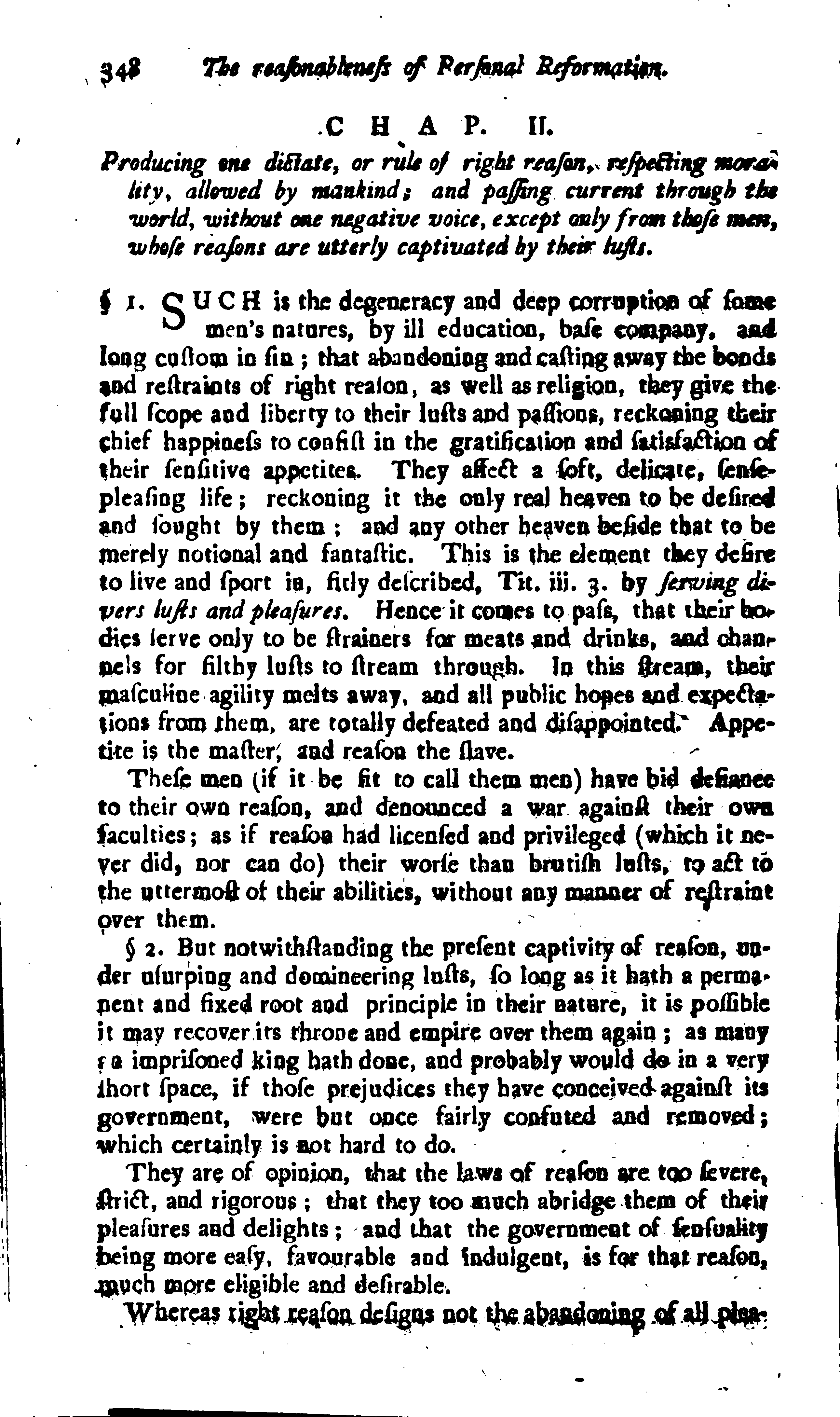
Producing one dictate, or rule of right reason, respectingmora lity, allowed by mankind; and passing current through the world, without one negative voice, except onlyfromthosemen, whose reasons are utterly captivated by their lusts.
§1 . SUCH is the degeneracy and deep corruption of some men's natures, by ill education, base company, and long custom in fin; that abandoning andcastingaway the bonds and restraints of right reason, as well as religion, theygivethe full scope and liberty to their lusts and passions, reckoning their chief happiness to consist in the gratification and satisfaction of their sensitive appetites.
They affect a soft, delicate, sense pleasing life; reckoning it the only real heaven to be desired and fought by them ; and any other heaven beside that to be merely notional and fantastic.
This is the element they desire to live and sport in, fitly described, Tit. iii. 3. by serving divers lusts and pleasures. Hence it comes to pass, that theirbo dies serve only to be strainers for meats and drinks, and channels for filthy lusts to stream through. In this stream, their masculine agility melts away, and all public hopes and expectations from them, are totallydefeatedanddisappointed. Appetite is the master, and reason the slave.
These men (if it be fit to callthemmen) have bid defiance to their own reason, and denounced a war against their own faculties; as if reason had licensed and privileged (which it never did, nor can do) their worse than brutish lusts, to act to the uttermostoftheir abilities, without any manner of restraint over them.
§ 2. But notwithstanding the present captivity of reason, underusurpinganddomineering lusts, so long as it hath a permanent and fixed root and principle in their nature, it is possible it may recover its throne and empire over them again; as many a imprisoned king hath done, and probablywoulddo in a very thort space, if those prejudices they have conceived against its government, were but once fairly confuted and removed; which certainly is not hard to do.
They are of opinion, that the laws of reason are too severe, Arict , and rigorous; that they too much abridge them of their pleasures and delights ; and that the government of sensuality being more easy, favourable and indulgent, is for that reason, much more eligible and desirable.
Whereas right reason designs not the abandoning of all plea
The reasonableness of Personal Redemption.
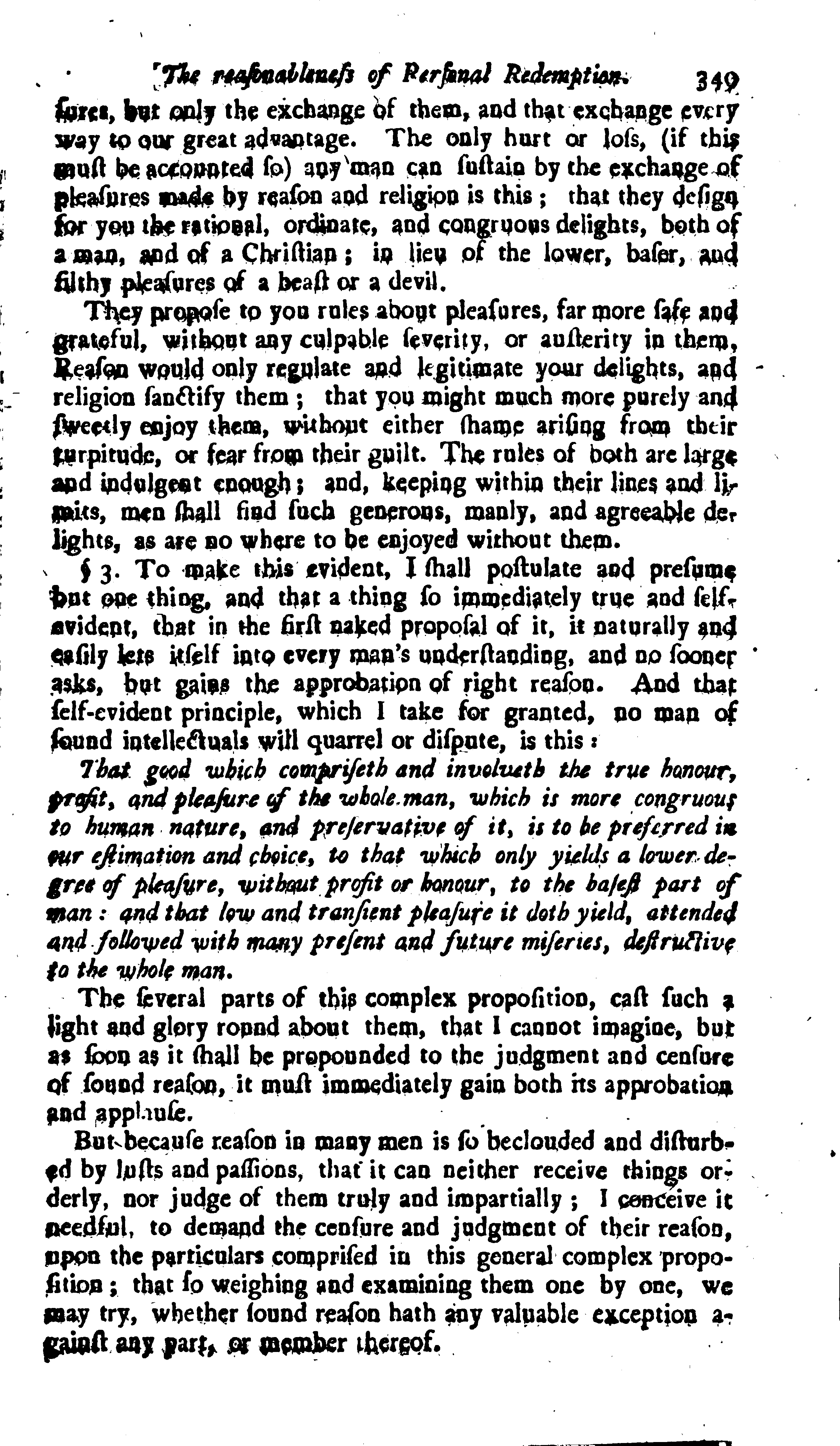
fores,but only the exchange of them, and that exchange every way to our great advantage.
The only hurt or loss, (if this mustbeaccounted fo) anyman can sustain by the exchange of لا pleasures made by reason and religion is this ; that they design for you the rational, ordinate, and congruous delights, both of am an, and of a Christian ; in lieu of the lower, baser, and filthy pleasures of a beast or a devil .
They propose to you rules about pleasures, far more safe and grateful, without any culpable severity, or austerity in them.
Reason would only regulate and legitimate your delights, and
religion sanctify them ; that you might much more purely and sweetly enjoy them, without either shame arising from their turpitude, or fear from their guilt. The rules of both are large and indulgent enough; and, keeping within their lines and limits, men shall find such generous, manly, and agreeable delights, as are nowhere to be enjoyed without them.
§3. To make this evident, I shall poftulate and presume but one thing, and that a thing so immediately true and self evident, that in the first naked proposal of it, it naturally and easily lets itself into everyman's understanding, andnofooner asks, but gains the approbation of right reason. And that self-evident principle, which I take for granted, no man of found intellectuals will quarrel or dispute, is this :
That good which comprisethand involveth the true honour, profit, and pleasure of the wholeman, which is more congruous to human nature, and preservative of it, is to be preferred in our estimation and choice, to that which only yields a lower degree of pleasure, without profit or bonour, to the basest part of man : and that low and transient pleasure it doth yield, attended and followed with many present and future miseries, destructive to the wholeman.
The several parts of this complex proposition, cast such a light and glory roundabout them, that I cannot imagine, but as foonas it shall be propounded to the judgment and censure of found reason, it must immediatelygainboth its approbation and applause.
But because reason in manymen is so beclouded and disturbed by lusts and passions, that it can neither receive things orderly, nor judge of them truly and impartially ;
I conceive it needful, to demand the censure and judgment of their reason, upon the particulars comprised in this general complex proposition; that so weighing and examining them one by one, we may try, whether found reason hath any valuable exception against any part, or member thereof.
The reasonableness of Personal Reformation.
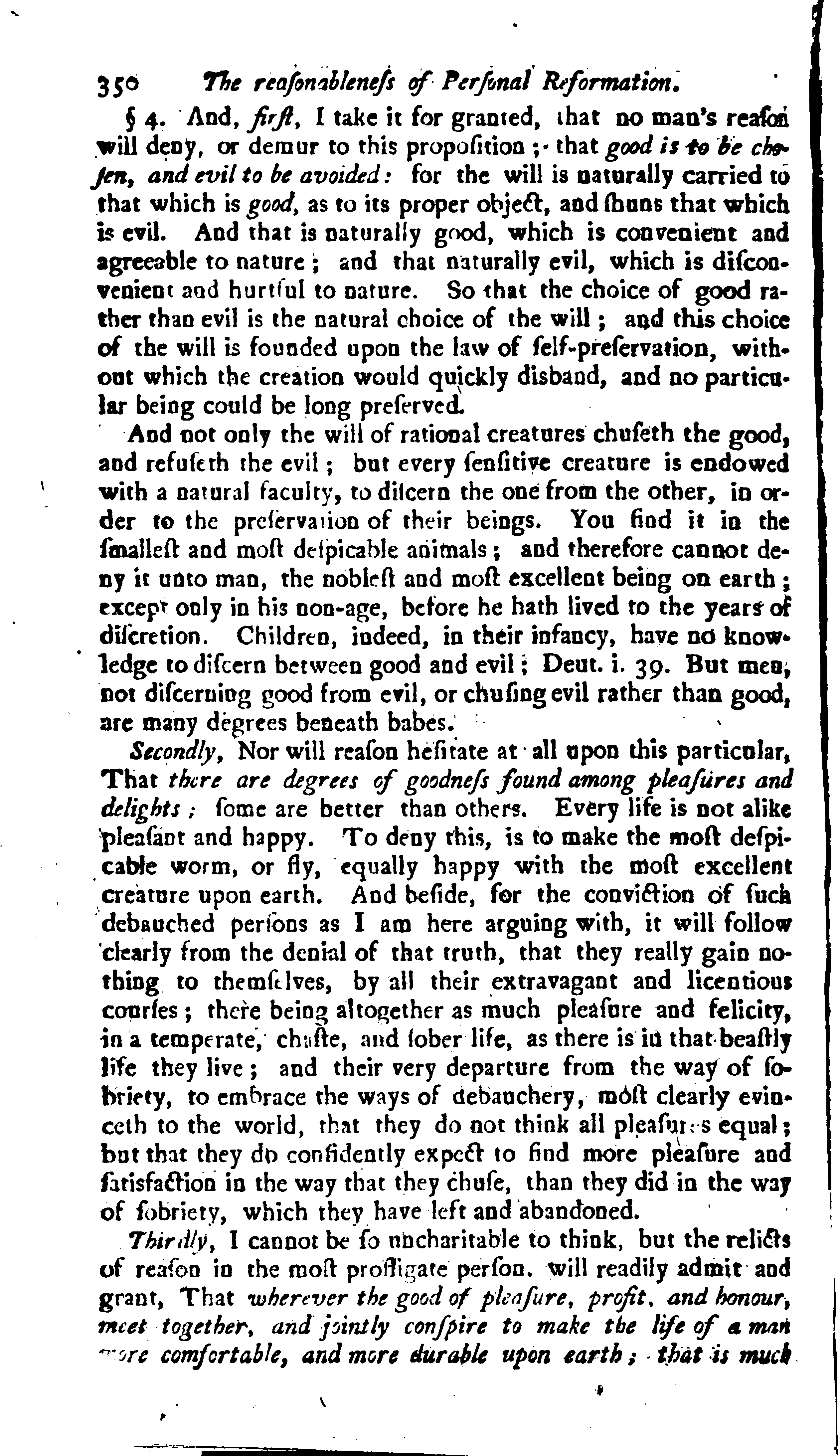
§ 4. And, first, I take it for granted, that no man's reason will deny, or demur to this proposition ; that good is to be choJen, and evil to be avoided : for the will is naturally carried to that which is good, as to its proper object, andshuns that which is evil. And that is naturally good, which is convenient and agreeable to nature; and that naturally evil, which is disconvenient and hurtful to nature. So that the choice of good ratherthanevil is the natural choice of the will ; and this choice of the will is founded upon the law of self-preservation, without which the creation would quickly disband, and no particular being could be long preserved.
And not only the will of rational creatures chuseth the good, andrefuseth the evil ; but every sensitive creature is endowed with a natural faculty, to discern the one from the other, in order to the preservation of their beings. You find it in the smallest and most despicable animals , and therefore cannot denyitunto man, the noblest and most excellent being on earth; except only in his non-age, before he hath lived to the years of discretion .
Children, indeed, in their infancy, have no knowledge todifcern between good and evil; Deut. i. 39. But men, notdifcerning good from evil, or chusingevil rather than good, aremanydegrees beneathbabes.
Secondly, Nor will reason hesitate at all upon this particular, That there are degrees of goodness found among pleasures and delights ; some are better than others. Every life is not alike pleasant and happy. To deny this, is to make the most despicable worm, or fly, equally happy with the most excellent creature upon earth. And beside, for the conviction of such debauched persons as I am here arguing with, it will follow clearly from the denial of that truth, that they really gain nothing to themselves, by all their extravagant and licentious courses ; there being altogether as much pleasure and felicity, ina temperate, chaste, and sober life, as there is in that beastly life they live; and their very departure from the way of sobriety, to embrace the ways of debauchery, most clearly evinceth to the world, that they do not think all pleasures equal; but that they do confidently expect to find more pleasure and satisfaction in the way that they chuse, than they did in the way of sobriety, which they have left and abandoned.
Thirdly, I cannot be so uncharitable to think, but the relicts of reason in the most profligate person. will readily admit and grant, That wherever the good of pleasure, profit, and honour, meet together, and jointly conspire to make the life of a man more comfortable, and more durable upon earth ; that is much
The reasonableness of Personal Reformation.
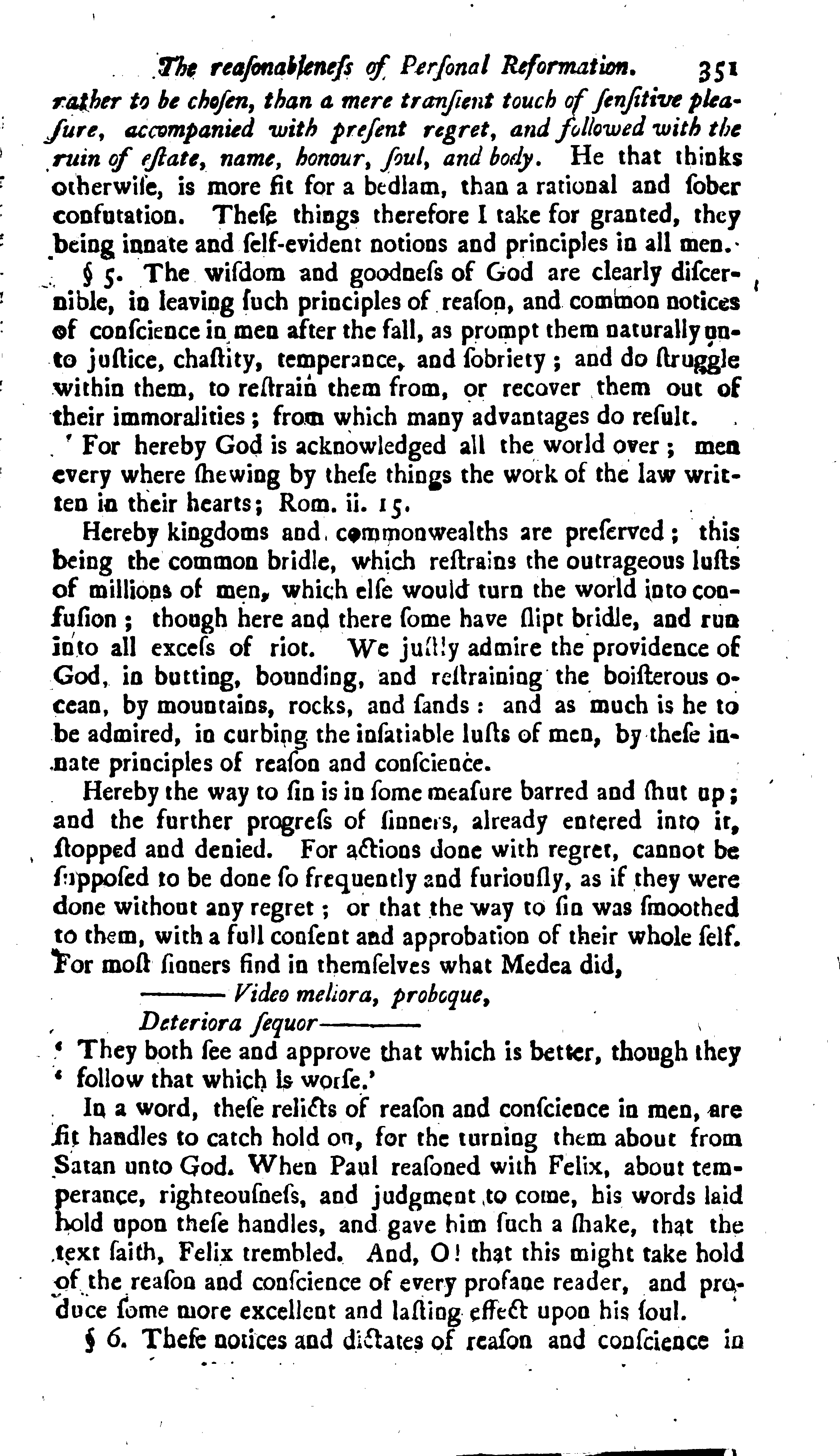
rather to be chosen, than a mere transient touch offenfitivepleafure, accompanied with present regret, and followed with the ruin of estate, name, honour, foul, and body.
He that thinks otherwise, is more fit for a bedlam, than a rational and sober confutation.
These things therefore I take for granted, they being innate and self-evident notions and principles in allmen.
§ 5. The wisdom and goodness of God are clearly discernible, in leaving such principles of reason, and common notices of confcienceinmen after the fall, as promptthemnaturallyunL to justice, chastity, temperance, andfobriety ; and do struggle within them, to restrain them from, or recover them out of their immoralities ; from which many advantages do result.
For hereby God is acknowledged all the world over ; men every where shewing by these things the work of the law written in their hearts ; Rom. ii. 15 .
Hereby kingdoms and commonwealths are preserved ; this being the common bridle, which restrains the outrageous lusts of millions of men, which else would turn the world into confusion ; though here and there some have fliptbridle, and run into all excess of riot.
We justly admire the providence of God, in butting, bounding, and restraining the boisterous ocean, by mountains, rocks, and sands : and as much is he to be admired, in curbing the insatiable lusts of men, by these innate principles of reason and conscience.
Hereby the way to fin is insomemeasure barred and shut up; and the further progress of sinners, already entered into it, stopped and denied.
For actions done with regret, cannot be supposed to be done so frequently and furiously, as if they were done without any regret ; or that the way to fin was smoothed to them, with a fullconfent and approbation of their whole self.
For most sinners find in themselves what Medea did, Video meliora, proboque, Deteriorafequor They both fee and approve that which is better,though they
• follow that which is worse.'
In a word, these relicts of reason and conscience in men, are fit handles to catch hold on, for the turning them about from Satan unto God. When Paul reasoned with Felix, about temperance, righteousness, and judgment to come, his words laid hold upon these handles, and gave him such a shake, that the text faith, Felix trembled. And, O! that this might take hold of the reason and conscience of every profane reader, and produce some more excellent and lasting effect upon his foul.
§ 6. These notices and dictates of reason and conscience in
The reasonableness of Personal Reformation. men,being so necessary, and many ways beneficial to themselves, as well as to the whole community; it must therefore be a horrid villainy to war against them ; and, by violence, to suppress and enslave them to their own lusts .
This is, as if a company of desperate ruffians, mould assault innocentandnoble travellers upon the lawful road, bind and gag their guides, whilst they rob and prostitute them.
Thus deal brutith lusts, (headed by the devil) with the affections of men, travelling along the lawful road of duty, under the conduct of reason and conscience. For this villainy it was, that the apostle tells us, " The wrath of God was revealed from " heaven against the Heathens, whoheldthetruth in unrighte- " ousness," Rom. i. 18.
They had the light of natural reason and conscience in them, the inbred notions of good and evil ; which raised their hopes or fears, according to the nature and quality of their actions.
* Confcia mens ut cuiquefua eft, ita concipit intra Pectorapro facto spemque metumquefuo.
Ovid.
But their headstrong boisterous lusts, rudely andviolentlybrake in upon reason and conscience,imprisoned and bound them ; as Zedekiah did the faithful prophetJeremiah, for the discharge of his duty to him.
For this, " the wrath of God was revealed " from heaven against them." And indeed, wecannotwonder it should be incensed against them, as it will against all that act like them.
For into such a sin as this, manydireful aggravations fall in together, to make ita monstrous and prodigious fin.
Here we find an high andcauseless abuse of thenobleft natural faculties and powers of a man's own soul. What harm have thy reason and conscience done thee, by stimulating and persuading thee to temperance, chastity, and sobriety ; or by struggling and Ariving with thee, to prevent both thy present and future ruin ? Do they lay their faithful and loving hands of restraint upon thee, when they see thee running headlong into destruction ? And do they deserve for this, and no worse than this, to be thus trampled under foot, and abused ?
Ask thyself, man, Whether thou thinkest thyverydog deserves to be hanged, for opening at midnight, and taking that thief by the throat, who came to cut thine ? Anddarest thou use those noble powers within thee, worse than thou wouldst useadog?
Humanity would blush at such an action.
These vile abuses of thy reason and conscience carry also in them an horrid contemptofGod; whose patent, officers, and * As each man's foul of good or ill is conscious,
So hope for good he feels, but fears for vice.
The reasonableness of Personal Reformation.
delegates, thy reason and conscience are. Those certainly fin with an high hand against the Lord,who make nothing to controul, kick, and lay in irons, his commission-officers,appointed for no other end, but their present and future felicity.
Nay, Suchmen as these are found in a plain confederacywiththe devil, and that in a most unnatural and horrid plot against their own souls and bodies. Their light and their lusts are struggling together.
Sin and conscience are combating one with another ; the one to deftrey, the other to fave the man. Dareft thoujoinwiththy lusts against thy light, and think not to be brought in as a party and confederate with the devil ? The stopping of the mouth of thy conscience,fully proves both thy consent and concealment : and if proved consent and concealment make thee not a party and acceffary, it will be very strange.
Plutarch, in his bookdeAmicitia, relates a story of aPerfian, who scuffling in the dark with a magician, againstwhomhehad a grudge; and not being able to conquer him himself, called upon his friend who stood by him with a naked sword ready to strike, but durst not, for fear of killing his friend: the Persian cries out,
Strike, strike, however thy stroke fall : thrust • at an adventure.
I care not, so thou kill the magician, • though thoukillhim through mine own body.'
Much so stands the case here, with a little variation. Thou art furiously set upon the enjoyment of thy lusts ; nothing will quiet thee, but their satisfaction. Thy reason and conscience will oppose it, and struggle hard with thee, to withhold thee from them. But thou carest not, in the rage of thine insatiable appetite, tho' thy reason and confcienceboth fall in the combat, rather than thy lusts should not be satisfied.
Oh, what brutes ! yea,what monsters,canfinturn men into!
§ 7. Ifmen have not quite extinguished both reason and confciencebydebauchery, and divefted themselves of humanity; one would think, no motion or address can possibly be . made to them more fair, rational, and inoffensive,than this, that they would be pleased but to consult themselves, and hearken to the native and unconstrained voice of their own reason and conscience, before they engage themselves in matters of great concernment,upon which both their present and eternalwelfaredo depend; or, if they are already engaged, yet at least to lend an ear to what they have to offer for their recovery, before it be too late.
You are not here urged and pressed, to hearken to the voices of your enemies that hate you, or to the counsel and ad-
VOL . VIII.
Y y
The reasonableness of Personal Reformation. vice of mere strangers, who know not your affairs ; but to hearken to yourselves, to be your own arbitrators and judges, to draw up the award with your own hand.
It is a strange and an hard case indeed, and scarce to be supposed, that men hould fall out with themselves at such a rate, that they had rather hear the voice of their mortal enemy the devil,and listen to his advice and counsel,than to the voice of their own reason and conscience .
We all account it madness inBalaam, to beat his innocent ass, and threaten to kill her for thunning the sword of the angel, that opposed his passage in a sinful and dangerous expedition; but how many use both their reason and conscience worse than asses, because they dare not go forward, and desperately carry them into the very midst of dangers and miseries, which they plainly foresee, andwarnthem of?
What injuries have thy reason or conscience done thee, man ? What affronts have they given thee ; that thou wilt not suffer them to speak, or offer one word, though never fo pertinent, feafonable and necessary ? There is a civility due from us to mere strangers ; yea, to strangers of an inferior rank and quality.
The least we can do, is to give them a patient hearing ; and not interrupt them, whilst they speak nothing but what is rational, pertinent, and necessary, especially if it be to their own good and advantage.
It is strange, men should not think themselves as much obliged to pay civility and respect to their own reasons and consciences, as they daily pay to mere strangers and inferiors. Give them but a patient hearL ing, and they will both tell thee ; We are thine appointed guardians, and have our com- •mission from God, to advise, direct, and counsel. We are thy faithful and inward friends ; yea, we are thine ownself, and the best and noblest part of thyself too. At our hands
•God will require thy blood, shouldst thou perish by our silence ⚫or treachery. We cannot be both silent and innocent, both
• are in such hazard. Do not abuse us, and stop our mouths ⚫for crying out, stop, stop; when we fee thee departing from ⚫the paths of honesty, honour, and safety, and taking the • direct road to that gulph of misery, in which few (if any) footsteps are found of such as return again, that are far en- ⚫gaged therein.
• Suffer us but fairly and friendly to expoftulate the matter with thee. What design can we have against thy true in- ' tereft; whilst thine, and ours, cannot possibly be opposite;
• or disjunct, butone and the fame interest?"
The reasonableness of Personal Reformation.
Well then, that which thy reason and conscience offers, being so weighty, fair, and just, and what thine own interest plainly lies in ; I will not be so uncharitable, as to suppose thou wilt either refuse to hear, or reject what they have to say, in the following cases and debates.
CHAP.
III .
Wherein the true censure and judgment of right reason and conScience, are given upon profane swearing, and blafpheming then me of God: As also their replies to feveralpleas offered in defence or excuse thereof.
G §1 .
OD bestowed on man the noble faculty of speech, (a peculiar favour and privilege) for two ends and uses.
(1.) That by the use of his tongue, he may glorify his Maker, and found forth the praises of his Redeemer.
(2.) That we might thereby be able to communicate our minds one to another, in all our necessary and convenient interests and concernments,whether civil or religious.
This member, (the tongue) tho' small in quantity, is found to be mighty in efficacy; and whilst it is kept under the rule and government of grace, the words that drop from it, are as apples of gold in pictures of silver.
Gracious words are bread to feed, and water to refresh the souls of others. A sanctified tongue is as a tree of life.
Conversion, edification,and consolation, are the delicious fruits of the lips.
But the tongues ofsomemenbreak loose from under all the laws and rules both of reason and religion, and serve only to vent the froth and filth, which abound in the heart, as in a fountain of pollution: For out of the abundance of the heart, the mouth Speaketh.
The tongue moves lightly, but falls heavily; it strikes soft, but wounds deep.
It would not spare men of the highest rank and eminence, did not the fear of capital punishments teach them so much wit, to keep their tongues in prison, that they may keep their bodies out of prison. And though, for this reason, they are afraid of making too bold with the names of men ; yet having no fear of God at all, they fall upon his great and dreadful name, tossing it to and fro, without any respect or reverence.
Augustus prohibited the common use of his name, lest it should grow too cheap and vile, by the common and needless using of it.
The name of Mercurius Trismegistus was very fparingly used, because of the great reverence the people had
Yy2
The reasonableness of Personal Reformation. for him.
The very Heathens were afraid to pronounce the name of their great God, Demogorgon, as fearing the earth would tremble, when his name was mentioned. How doth the reverence of Heathens to their false gods, expose and ag. gravate the impudence of professed Christians, in their vile in. dignities and abuses of the great and terrible name of the true
God! Yea, they not only take up his name vainly and rashly into their lips, but audaciously insert it by a profane oath into their common talk, as that which gives the grace, lepor, and ornament totheirdifcourses. Some have not been ashamed to say, what pity is it, thatfwearing should be a fin ;which gives so great a grace and ornament to language ?
§ 2. Swearing by the name of God in a righteous cause, when called thereto by due authority, is not only a lawful, but a religious act, founded upon, and directed to thehonour of God's omniscience ; whereunto there is a solemn appeal made, in every affertory and promiffsory oath, and a religious acknowledgment made him, of his infallible knowledge of the truth or falsehood of our hearts, and all the secrets of them,be they never so involved and inward things.
The lawful use and end of swearing, is to put an end to all strife, and to maintain both equity and charity among men; the two bonds and ligaments of human society. Now, it being the sovereign right and property of God alone, infallibly to fearchand try the hearts and reins of men, he thereby becomes the infallible witness to the truth or falsehood of what they speak ; so that in every such lawful oath, there is not only afolemn appeal, and in that appeal, an ascription of glory to his sovereign omniscience; but therein (implicitly at least) they put themselves under his wrath and curse, in case they swear falsely, which makes this action most sacred and solemn,
The deep corruption of human nature by the fall, makes these appeals to God under a curse necessary.
For it is supposed, though men be false and deceitful, yet there is some reverence of a Deity, and fear of his wrath and curse, left unextinguished in their fallen nature.
So that men will rather speak the truth (though to their own shame and loss) than by invocating so glorious a name in vain, put both foul and body under his wrath and curse.
By which it appears what an aw fuland solemn thing an oath is; and that every good man, not only takes a lawful oath with holy fear and trembling, because of the solemnity of the action ; but rather ought to chuse death, than to swearprofanely, because of the horrid maliguis tyof the action,
The reasonableness of Personal Reformation.
§3. Thecontumely and malignityfoundin profaneoaths, appears in that terrible threatening, " The Lord will not hold
" him guiltless that taketh his name in vain:" A threatening, altogether as just and righteous, as it is severe and terrible.
This fin admits of degrees of guilt. It is highly sinful to swear by the name of God lightly and vainly in our common discourses, though the oath be clipped, and halffuppressed, or disguised in the pronunciation of it; which argues some remains of fear and shame in the sinner.
• It is yet worse (and indeed notajotbelow blasphemy) to swear by any other name, than the name of God: For info doing, they attribute to a creature the sovereign and incommunicable property of God, set that creature in the very throne of God, and invest it with the regalities of his omniscience, to know our hearts, and almighty power, to avenge the wrong upon us, done to himself, as well as to men, by false-swearing.
But to break in rudely and blafphemously upon the sacred and tremendous name of God, with bold and full-mouthed oaths, striking through his sacred name with direct contumelious blafphemies ; this argues an heart, from which all fear of God is utterly expelled and banished.
Yetsomethere are, grown up to that prodigious height of impiety, that they dare afsfaultthe very heavens, and discharge whole vollies ofblafphemies against the gloriousMajestywhich dwells there. They are not afraid to bid defiance to him, and challengetheGod thatmadethem, to do his worst. They deck andadorn (as they account it) their common difcourses with. bloodyoaths, and horrid imprecations ; not reckoning them genteel and modish without them.
It consists not with the greatness of their spirits, to be wicked at the common rate.
'They are willing to let the world know, that they are none of thosepuny, filly fellows, that are afraid ofinvisiblepowers, or so much cowards, as to clip a full-mouthed oath, by suppressing, or whispering the emphatical founding syllable; but think an horrid blasphemy makes the most sweet and graceful cadency in their hellish rhetoric.
They glory, that they have fully conquered all those troublesome notions of good and evil, virtue and vice, heaven and hell, to that degree, that they can now affront the divineMa jesty to his very face, and not fear the worst he threatens in his word against their wickedness.
If there be a God, (which they scarce believe) they are resolved, audaciously to provoke him to give them a convincing evidenceofhisbeing. And if he be (as they are told he is)
The reasonableness of Personal Reformation. rich in patience and forbearance, they are resolved to try how far his patience will extend, and what load of wickedness it is capable to bear.
If their damnation be not yet sure enough, they will do their utmost to make it sure, by breaking down the only bridge wherebytheycanescapedamnation: I mean,bytramplingunder their feet the precious blood and wounds of the Son of God, and imprecating the damnation ofhellupon their own souls, as if it slumberedtoo long, andweretoo flow-paced in its motions towards them. I am of opinion,there are few Christians to be found on earth, crying so often, Lord, pardon ;
Lord, fave me ; as some wretches among us cry, (I tremble to Speak it!) Goddamn me ; the devil take me.
Herein they seem to envy the happiness of the devils, and damned wretches in hell, and endeavour (as one speaks) to fnatchdamnation out of God's hands before the time; as if theycouldnotbe soon enough among their roaring and howhng companions, in the midst of the everlasting burnings.
Eut, why such haste to be perfectly miserable ? The very devils themselves deprecate torments before their time, though you imprecatethem. Yourmiserymakes haste enough towards you; you neednotquicken it, or thus run to meet it.
I am persuaded, that if the bars of the bottomless pit were broken up, and devils should ascend inhuman shapes, none among them would be found haftening upon themselves the fulness and completeness of their misery, as you do.
It is a truth, though a strange one, that it is much easier to find, thanimaginemenupon earth professing Christian religion, yet in some respect funkbelow the wickedness of the diabolical nature, by making damnation boththesubject of their drollery, and the object of their very wishes and desires. Some greater masters of our language, may more lively andemphaticallyexpress the horrid nature of this fin ; but excuse me, reader, ifI believe, no words or thoughts can measure the height or depth of this monstrous abomination...
§ 4. Such contumelious language as this (especially when grown modish or common) cannot but be a most high and dreadful provocation of God, and such an one as will certainly bring down hisdesolating vengeance, not only upon the heads ofblafphemers themselves, but upon the states and kingdoms that connive at, or tolerate them.
We read, Zech. v. 2, 3, 4. ofa flying roll, full of curses, the length thereof twenty cubits, and the breadth there often cubits ; which shall enter into the house of the swearer, remain in the midst of his house,
The reasonableness of Personal Reformation.
and consume it with the timber and stones thereof. Blasphemy and profane swearing, are like barrels of gunpowder laid under the foundation of many great and noble familes, many of which are already blown up, and laid in ruins by this fin, and many more ready to follow, as soon as the justice of God shall give fire to it.
And (comparatively speaking) it were happy if the mischief ended here ; but, alas ! it causes God to commence a quarrel with the whole land ; Hos. iv. 2, 3. "And because of oaths,
"the land mourneth."
You find in Ifa. xxxviii. what it was that brought that unparalleled desolation upon that famous and flourishing city of Jerusalem, and the whole land of Judah; " forJerufalem is ruined, andJudah is fallen ; because
" their tongues and their doings are against the Lord, to pro- " voke the eyes of his glory."
But, alas ! scripture-threatnings signify scarce so much with these men, as the predictions of the weather in an almanack ; and, which is strange to confider, the very execution of scripture-threatnings before their eyes, will not terrify them from this inhuman wickedness ; even these also are laughed to scorn, or easily forgotten.
Oh! that God wouldfet it home with power,upon the spirits of all that are in power, to take some speedy and effectual course, to remove this accursedthing, this iniquity to be punished by the judge ; one (and a chief one too) of those direful provocations of heaven, to which we owe a special part of our national infelicity at this day. We all acknowledge, that all prosperity and success depends upon God; if fo, reason will readily own, that it must be therefore the interest of kingdoms and commonwealths, to prevent and restrain those impieties, which so audaciouslyprovoke and incense his wrath . As much is this their duty and interest, as it is the interest of a courtier to avoid offences of his royal master, the king, upon whose favour his honour andprefermentdepends : Or as it is the duty of the owner, to keep in that ox which is used to goring ; or cover that pit into which some have, and others of his family are like to fall : or carefully and speedily to remove that gunpowder, which his enemies have placed under the foundation of his house, to blow it up.
Both reason and experience will inform the rulers of this world, that professed rebels to the God of heaven, are never like to make useful subjects in the kingdoms of men .
§ 5. Until public justice lay hold upon such offenders, Iet us try what closereasoningmay effect, for their reformation.
The reasonableness of Personal Reformation.
It is hard to imagine that men of sense shouldsogenerally, and so far engage themselves in this course of profane swearing, and have nothing at alltosayfor themselves.
If they have no reason at all, to offer in justification or excuse of what they do, they act the brutes, not the men, and are self-condemned already.
It is a question with me, whether the soul of man, on this side hell, canfink so deep into the nature of a devil, as to fin because he will fin ; or to engage himself in a course off in, without any respect at all to some carnal interest, either of profit, pleasure, or honour ?
The thief hath a visible temptationofgaintoallure him, or pinching necessity, to induce him. The liar is drawn in, to commit that second sin, to cover the shame and turpitude ofa former.
The adulterer promiseth himself pleasure in the satisfaction of his lusts. And though men generally stand amazed to think, what that temptation should be, which prevails upon the swearer ; yet doubtless, something there is he hath to plead in excuse andextenuationofhis fault. Whatsoever it be, let it be produced, and weighed in the balance of right reason ;
Valeatquantum valerepoteft, Let it have its due value and consideration. And could I imagine any thing more likely to be theirinducements, than what I shall here mention, I would not conceal them .
There are only four things, thatcanfallwithinthe compass of my imagination, plead able by them, when seriously charged with the evil of the fact.
1. Some of them willhaply tell us, that they would not swear as they do, if they could gain credit to what they say without it , but the incredulity of others, provokes them to add somanyoaths to their single affirmations.
2. Others of them will tell us, they only swear in their passion, when provoked by injuries received from others ; and ifmendid not wrong them, they would not wrong God as they do.
3. Somewillplead, that swearing is become modish, the badge and character ofa gentleman ; that it gives them reputationamongmen of their own rank and quality; and that they shall be looked upon as sneaking fools, unfit for the company of gentlemen, if they could notdiscoursewiththem in this dialect.
4. Andfomewillconfess the practice is evil ; but that they have gotten such an ill habit, and the sin is become so customary with them, that many times they know not whether they swear or no.
The reasonableness of Personal Reformation.
I cannot imagine, nor (I think) they themselves, what else ispleadable in excuse, or extenuation of this horrid fin : Let these that are produced, have a fair trial at the bar of reason; and carryyourselves towards this fin for ever hereafter, according to that righteous verdict yourselves shall be forced to passuponit.
§6. To begin with the first plea. You say, you would not swear as you do, could you gain credit to your words without it. Weigh this question in the upright balance of thine own reason, whether anywifeor sober man in the world, will find himself ever the more obliged to believe what you say, by the addition of blasphemous oaths and imprecations, to your plain and simple affirmations or negations.
I cannot think, that you yourselves would give the more credit to any man, that should profess his sincerity to you, by finding him, in that his very profession, false and treacherous to his God.
Say, reason, dost not thou take this for a sure truth ; that he who makes no conscience of being trite to God, will never make much conscience of being false to men ? For what is thatwhichgivesany man's words reputation among wife and sober men, but the supposition of his integrity, and conscientious fear of his deceit and guile ? Take away that, and with it you take away the credibility of all his reports andaffirmations.
IfI look upon the person that speaks, asa man of integrity andconfcientious tenderness, I have a fufficientordinary fecufityof the truth of what he faith. But ifI look upon him as a man of a prostitute and feared conscience, that dares venture upon any fin ; a man, in whom there is no awe of God, to produce veracity in his words ; then my reafonpresentlyconcludes, that where there is no truth, there ought to be no trust: For truth is the very ground-work and foundation of trust. Now, what truth can we suppose to be left inthatman that sticks not, upon any trivial occasion, to break asunder all the obligations ofa creature to his Creator; together with all the bonds of kindness,his great and best benefactor hath bound himwithal ; and without any the least injury he can pretend his God hath done him, to fly in his very face with the most contumelious language ? Can we suppose any truth to be in, or any trust to be due to such a man as this ?
Goodmen and bad are thus contradistinguished,Eccl. ix. 2.
Him that sweareth, and he that feareth an oath." A confeentious man is so afraid of an oath, that he would rathet
VOL . VIII,
The reasonableness of Personal Reformation. chusetodie, than swear some kind ofoaths : And though he be satisfied of the lawfulness of an oath in general, and of the matter of that oath he sweareth in particular ; yet an holy awe and fear ofGodfills his heart, when he swears lawfully and necessarily, left he should fail in the manner of it, by not giving that due reverence to the name of God, which so sacred and solemn an action requires.
But from profane swearing, andblafpheming the name of God, everyman'sreason mayjustlyandplainly infer this conclusion; that the fear of God, isnotinthat man's heart. And where there is no fear of God, what truth can be supposed in him; or what trust can be due to his words or oaths ? But the more he swears, still the less reason all wife men have to believe him.
And I am sure, the credulity of fools adds little reputation to him.
This plea therefore, for profane swearing, is altogether shamed, baffled, and cashiered, by the common reason of mankind, § 7. Call therefore to the bar of reason thesecondplea, or apology, for profane swearing.
You say, you swear not, unless provoked by injuries men have done you.
This is so weak a plea for fo great a fin, that I wondermen are not ashamed to bring it into the court of reason.
This is thetruesense, and strength of it : My enemy hathabusedme; therefore I will avenge the wrong my enemy hath done me, uponmybest friend and benefactor.
I challenge you to give but the colour, or shadow of found reason, why, upon any abuse you have received frommen, you should fall so injuriouslyuponthe name of God, who never abused or injured you, since he gave you a being, but hath always done you good.
Tell me, man, (if thou have the reason of a man in thee) whatwronghathGoddone thee ? Wherein hath he injured thee, that thou thus wreakest thy revenge upon him ? If an enemy have affronted you, reason would tell you, you ought not to take revenge for it, upon your friend, and best benefactor.
Have you none but God to abuse, whenmen abufeand injure you ? Can your reason comprobate and allow such an action as this ? Satan instigates the corruptions of men to injure you ; and you fly in the face of God for it, whose laws severely prohibit such actions, and will avenge the injuries doneuntohim.
Speak no more therefore for ever, in the wayofexcusing the horrid finfulness of this fact against God, upon the account of injuries done thee by thy fellow-creature
The reasonableness of Personal Reformation.
The case isplainlydetermined, and cast over the bar of reafonwith contempt and abhorrence.
§ 8. Come we next to your third excuse, or plea ; That fwearingisbecome modifb, andgivesyouagreat reputation among men of your own rank and quality ; and that you shall be looked uponassneakingfellows, unfitfor the society of gentlemen, if you did not discourse with them in their own dialect.
This apology for fin is of no late date : Salvian mentions it as far back as his own time: Profane persons then * thus pleadedforthemselves, thattheywere compelled to be evil, lest they should be accounted vile.
Whether there be any weight in this apology for swearing, will quickly appear, now it is to be laid in the balance of true reason.
1. And first of all, let us confiderwhat makesatrue gentleman ; and whether profane swearing have any place in his true character and description. † A gentleman, is one that springs from famous and renowned ancestors, and degenerates not from their probity and honour.
This is the man, whom the Latins call generofus, and we, a gentleman : Because we suppose am an of such an extraction and education, more gentle, affable, and condescending to inferiors, and to keep a stricter government over his tongue and passions, than rude plebians are wont to do. Upon this account, the poet rightly observes, Quomajor est quisquis, magis eft placabilis ira,
Etfacilis motus mens generofa cap it.
Men of genteel extraction and education, are persons, whose passions are supposed to move more gently than other mens:
And if at any time they be moved disorderly, yet are they more placable, and sooner reduced, than those of sordid and baser spirits are.
It is virtue which raises and ennobles families at first ; for omnisfanguis con color, all human blood is derived from, and equallytaintedbyAdam.
Nobler, and baserblood, is an after-difference, made by virtue and vice among men. And as virtue first ennobled, and raised some families above others, so it will still continue the line ofhonour in their posterity :
And as their virtues shall increase, so will their honour proportionablydo.
Zz2 * Mali effe coguntur, neviles habeantur.
+ Generofus, nobilis, ex praeclaro genere ortus, qui a genere non deflect it.
The reasonableness of Personal Reformation.
The case trulyandplainly standing thus; it is morally im: possible, to make debauchery the proper badge and character ofgentility. Formenofeminency (abovethevulgar) are more obliged than they, to shun all base and fordidactions : And as their honour increaseth, so do their obligations to temperance and fobrietyincrease, andfstrengthen upon them prop orționably.
Itwasthereforea right and rationalobservationofHierome; I fee nothing desirable in nobility, (faith he) but this ; that fuck men are bound by a certain kind of necessity, not to degenerate from, or stain the glory and honour of their renowned ancestors. And the reason is strong and evident: For virtue being that which first differenced their blood from others, they are obliged, by all the value they have for the honourof their blood and families, to shun those vices which stain that honour and dignity. And whatvicecandishonour and debase them more, than profane swearing ? For if the arms of many noblefamilieshave been reversed, for treason againsttheking it is irrational to imagine, that treason against the King of kings, should add a new mark ofhonour: And what isblaft phemy, but treason against God ? It is plain then, from the trueriseandcharacter of a gentleman, profane swearing neither first raised, nor can preserve and continue, but ratherblots and exposes their reputation and honour.
2. Though I am most willing topayabecoming deference to all persons of noble and genteel extraction, yet, in faithfulness to their truehonour, I am here obliged to say, (and in saying it, I can offend no man that hath at rue sense ofhonour) that their natural descent can never give them so much honour, as the vices I am here cenfuring will reflect ignominy and dish on our upon them. To be a slave of Satan, and your own lusts, is such a mark of infamy, as allthehonourableand illustrious titles in the world can never cover. It is better to rife by virtue tohonour, from contemptible parents,than by vice andprofaneness, togrowcontemptible fromhonourable parents.
It is your honourtohave many servants at your command, obfequiouslyattending a nod of your head, or a beck of your finger: But ask your own reason, gentlemen, whether it be not a greaterdishonour, for you to attend as obsequiouslyyourselves upon every beck and nod of Satan, and your own lusts ?
Were your natural birth once ennobled by the new birth, you wouldbemorethanthrice honourable, gracewouldmake you more illustrious, than your natural extraction doth, or
The reasonableness of Personal Reformation.
can do. Or if morality(which is far inferior to thathonour, andforwhichHeathens themselveshavebeen renowned in the Paganworld)did but adornand beautify your conversations; though it cannot entitle you to heaven, or secure to you the gloryoftheworld to come; yet it would make you shine in the eyes of men in this world, and taking its advantage from yourhonourable extraction, make you differ from persons of an inferior rank, as stars of a greater magnitude and lustre.
I hope,gentlemen valuing themselves upon their honour, will not be offended ata sharper invective than this, against those vices that darken and eclipse theirhonour,both in the eyes of God, as well as inthejudgmentofallwife and good men.
3. Suppose what you say to be true, that some profane gentlemenshouldscoffandderideyou, for your fobercarriage, and decorus language, (things which ought to be inseparable from true gentility) I would in this case appeal to your own reason, why you should not enjoy your own pleasure in as full latitude and liberty, as they do theirs ? They delight in the dialect of devils; you, in pure and in offensive language.
If theywilldrink the puddled waters, and you refuse them for the pure chrystal streams ; you have, to be sure, as much reason(andathousandtimes more) to affertyour liberty to be virtuous, thantheyhave (or can pretend to have)a privilege to be vicious.
Andiftheywillbe offended with you for this,their offence is groundless in themselves, and will be greatly advantageous to you.
For you need not doubt but you may find better companythantheirs any whereon this side hell. I remember that rational and excellent apology, which Tertullian made for the
Christians in his time against the Gentiles :
Wherein (faith. he) do we offend you, if we will not partake with you in your delights ? If we sustain any damage by such our refusal,
⚫the injury can be only our own : We reject your pleasures, < and you are not delighted with ours.'
You will shew yourselves true and worthy gentlemen, in abandoning and rejecting (upon fo noble an account as this)all further unnecessary society with such gentile-men ; for so they deserve to be called, rather than gentlemen.
They boast, indeedthehonour of their blood, whilst they trample the precious and invaluable blood of Christ, under their feet : They boast their eminency above the vulgar,whilftmean time they labour vilely todebasehimthat set them there.
I am furethere is not a devil in hell, but isbynatureof a more honourableand illustrious house, than the proudest of
The reasonableness of Personal Reformation. blafphemers.
Theyareangelsbynature, thoughdevilsbypractice.
They have little reason to boast of their original excel. lency, which now aggravates their misery.
Sindarknedtheir luftre, degraded them from their natural dignity; and so it will do theirs also, that imitate devils in their blasphemy and malignity against God.
4. It may as easily be proved as asserted, that to make cursing, swearing,andblafpheming, the badges and characteristical marks of a true gentleman, is the foulest blot and mark of infamy, which the malice of their enemies can devise to put into their escutcheons ; and such an affront, as ought to be highly resented by all true gentlemen.
Should the most malicious enemy you have in the world, fe an herald to devise a mark of infamy for your coats of arms, to make you ridiculous, and a by-word among the people ; he could never dishonouryou at that rate,you this way dish on our yourselves.
For if debauchery be both asserted and allowed to be the true badge of gentility, then your own reason will infer, that all theancientepithets of gentility ought thereupon to be altered. Andwouldthose gentlemen, think you, take it well, to have the titles, and epithets of ingenious,worthy, honourable, and noble, changed into cursing, swearing, damning, blafpheming gentlemen ? You cannot but fee the inconsistency of both.
If, therefore, you will adopt and wear the latter, you must either cashier and renounce the former, or try to make the former consistent with the latter, which I am sure the most ingenious among you will find an hard task to do.
5. Ihumblybeg leave to propound one plain blunt questiontoyou, gentlemen. The matter of it is too rational to be rejected, and let that make atonement for the blunt manner of its proposal.
And the question is this :
Quest. Whether your reajon and conscience befullyfatisfied, that when you die (as you know you shortly must), youshallthen appear before the judgment-feat of God, in the quality and character of gentlemen ? Do you verily thinkyoushallfindthe more favour there, for the sake of your noble descent, andbonourable extraction, or that yourgentilityshallmake an atonement for all your impiety ?
I anı persuaded, gentlemen, you do not; you cannot think so.
You know you must appear before that God, with whom there is no respect of persons ; a God that will certainly damn the impenitent blafphemer.
The man must assuredlygo to
The reasonableness of Personal Reformation.
hell, 1 Cor. vi. 9, 10. And if the man be damned, certainly the gentleman is in a badcafe.
6. In a word, I am past all doubt, and fo may you too, that this genteel mode of swearing,drinking, and whoring,which hath spread fo far in this present infamous age, into Protestant states and kingdoms, is the very spirit and strength of a Popish plot, fubtlely projected, and industriously managed, for their effectual reduction to Popery.
For nothing in the world can reconcilemento Popery ; yea, and even endear them to it, like debauchery. Under Popery,gentlemen may come up to the rates of costly pardons and indulgences,for their greatest sins. Theymaygive themselves liberty to wallow in profaneness all the days of their life.
They may give theirlufts the utmost scope and liberty, and yet have a plenary pardon when they die. So that they need not abridge themselves of any sinful liberty,or boggle at the loudest blasphemy, whilst they have that in their pocket to still and quiet something that grumbles in their bosom.
Do you not fee, gentlemen,the natural tendencies of these things ? Does not debauchery look like a shoeing-horn toPopery.
Besides, gentlemen,the devil and the Pope are confederates ina farther design upon you ; and if their design hit,they hope to win by power, what they may miss by policy ; and that by the very fame method of corrupting and debauching persons of eminent rankandquality, in Protestant kingdoms andcommonwealths. For (as a * learnedman inqueenElizabeth's days rightly observed) these are the men especially interested in the public affairs of kingdoms.
These represent the people in parliaments.
These make their laws, administer the government in peace and war.
To their hands are committed the great concerns of nations.
These are they that fill the feats ofpublicjudicature.
* Who manages the reins of government, who is present at, and presides over, both private and public matters, but persons of eminent rank and quality ? Who moderates in the Senate, presides in courts, commands at home and abroad ? Chiefmen and nobles surely.
Who commands and countermands, acts and overacts, manages and canvasses all affairs, who makes lawsandrescindsthem, who governs the state in time of peace, and commands the forces in time of war ; but great men and nobles ? No wonder that the management of public affairs be committed to him, who by personal merit and renown of his ancestors hath recommended himself to the good report and esteem of mankind. Humphred on nobility.
The reasonableness of Personal Reformation.
If gentlemen, therefore, by this means be generally cor ruptedand infected by debauchery, their influence and example is likely to infect the greatest part of the body politic; and either make the people easily pliable to the charms and courtships of Popery, for the reason before-mentioned ; or sobesot their excellent parts, and enervate their masculine courage, that they shall fall an easy prey to their (otherwise) weak and despicable enemies.
And certainly, gentlemen, we have all cause to reckon this plot very far advanced, when we shall see debauchery every where made the badge of gentility; and chastity,temperance, and sobriety, become the marks and notes of infamy. When civility itself shall be hissed with derision out of somegentlemens company ; and the more temperate and sober any marni is,by so much the less fit to be a gentleman's companion.
By this time I hope you are convinced, that true gentility is no enemy to sobriety, nor debauchery the character of gentility; and will at last pardon, if not thank me, for endeavouring this way to secure the true honour of some, whilst I rationally argue down the vices and follies of others.
This plea for debauchery,you fee,haththefamefatethe former had, and deserves never to be mentioned more.
§ 9. There is but one plea more ; and that as fillyand irrational asanyofthe former and that is, The custom and habit of swearing, whichyousay is hard to be broken.
This fin is become so customary to you, that now you Scarce note or observe it in yourselves.
That there may be truth in the matter of this plea, I neither deny nor doubt; but that it is a rational and allowable plea,will never be granted by your own reason.
The thing you say maybe true; for we sometimes find,that when you are taxed for swearing, you will presently swear that you did not swear; and curse him to his face, that accuses you for cursing.
But pray, gentlemen, make your own reafonjudge,whether custom be a valid and allowed plea for profane swearing and cursing.
Say, reason, wilt thou allow thatone of the highest aggravations of fin, ispleadable in thy court for the excuse and extenuationofit ? Wilt thou give it under thy hand, that the man, is the less gilty,because the more wicked ? Darestthou to warrant it that God will take the less notice of the wrongs men do him, because they are used and accustomed so to wrong and abuse him every hour in the day? If your reason can allow
The reasonableness of Personal Reformation.
and warrant this, I must say it is different,yea,and opposite to the common reason of mankind.
Say not, I make my own reason the rule and standard of yours, or other mens.
For I argue here (as I have done all along before) upon the common topics and maxims of reason, generally allowed all the world overbymankind. If a practice be evil, the oftener it is repeated,the more still it is aggravatéd.
To be plain and faithful with you, gentlemen, if it be your customtoblafpheme, it is God's custom to damn blafphemers .
If you use to be drunk and unclean,God uses to punish drunkards and adulterers (if impenitent and unreformed) with his everlasting wrath.
And when you are cited (as shortly you must be) before the awful tribunal of the great, the just, and the terrible God, ask but yourselves,whether such a plea as this, be like to excuse
you in whole, or in part, and take off the heinousness of these horrid impieties ? Will your profane oaths, and direful execrationsand imprecations, be excused in the least degree, by telling him, Lord, I was so accustomed to blaspheme thy name ; cursing, fovearing, and damning, were fo familiar language in my lips from day to day, that I had quite loft the sense of the action, as well as of the evil thereof; and therefore, Lord, pity, spare and have mercy on me: O damn not my soul to thine everlasting wrath.
For though I have imprecated ituponmyself, yet frequent custom at length extinguished all my sense and conscience of the evil thereof, till at length I could play with a direful imprecation as an harmless thing ; nay, thought it an ornament and grace to my speech, a gallantexpreffion, alamode the times and places I lived in.
Is not this as good a plea, and not ajot better than that of amalefactor upon his trial for life and death, when theft or robbery have been evidently and substantiallyprovedupon him, and the judge demandeth, What he hath to fay for himself, whyfentence of death should not pass upon him ? Mercy, my
Lord, mercy cries he ! for I have been so used and accustomed to filching and thieving from my youth up, that for some years before I was apprehended, every one's goods and cattle seemed to me to look like my own ; so that I scarce knew when
I stole, and when I did not.
And thus, gentlemen, you have heard a fair trial of the fin of profane swearing, and imprecations of damnation ; and you have heard the verdict of your own reason and conscience
VOL . VIII.
Aaa
The reasonableness of Personal Reformation. upon the case.
The Lord help you to break off and reform that fin, for which there is not one word of apology or excuse now left in your mouths.
Let me close all I have to say upon this head, with one plain question : Do you think you must die, or live here for ever, as you now do ? If you are convinced (as all the living are supposed to be) that you must die, do you desire an easy and comfortable, or a painful and terrible death ? I presume there is no man living, that is convinced he must die, but desires naturally and rationally an 'Ευθανασίαν, as easy and comfortable a dissolution as maybe.
If so, I appeal to your reason, whether profane swearing and blafpheming the name of God, be a proper rational way to obtain peace and comfort at death ? With what hope or encouragement can those tongues of yours cry at death, Lord, have mercy upon me, which have profaned that name, andimprecated damnation from him, till you came into your last extremities, which convinced you, you could live no longer.
It is a serious question, and well worth a cool and solemn debate in your own reasons and consciences. Some of you are more immediately exposed to the dangers of death than others, readily to be disbanded by a bullet.
If you fall, you must either fall confiderately, or inconfiderately.
Ifinconfiderately, and without any sense or conscience of this horrid guilt, you die impenitently, and confequentlydefperately and miserably.
If confiderately,and with awakened consciences, I demand, whether such guilt as this will not roar louder than the peals and vollies of those great and small guns do which breathe destruction upon you, and round about you ? I have done my message plainly and faithfully to the very face or your reason and conscience; and if for my faithfulness and zeal, both for God's honour and yours, I am rewarded with your curses ; yet, if you wouldforbear to blaspheme andrendinpieces the name of God, I shall not much regard the obloquy and reproach my name shall undergo and suffer upon that ac count : But I expect from you better fruit than this.
The reasonableness of Personal Reformation.
CHAP.
IV.
Wherein reason and conscience are again consulted about the practice of drunkenness ; and their righteous and impartial cenfuregiven upon that case.
§ 1. THOUH our souls and bodies be of vastly different natures and originals, yet they do clasp and embrace each other with most dear and tender affection.
It is marvellous to behold such afpiritual and heavenly creature as the soul in all men, fervently loving, and in mostmen fondly doting upon a lump of clay, a clod of earth : it sympathizeth tenderly with it.
If the meanest member of the body be in pain, the soul is presently concerned for it, and evidences itself to be fo, by commanding the eyes both to watch and weep, the tongue to complain and moan, the hands to bind upitswounds with all imaginable tenderness, and carefully defend it from the least injurious touch. But if the whole be in danger, how do its nobler faculties of understanding, memory, and invention, awaken and beftirthemselves to the uttermost for its deliverance and safety.
Whilst the soul lives in union with the body, it is filled with assiduous (and too often with exorbitant and distracting) cares, for its necessary support and comfort. And when it must be separated from it by death, what strong aversations to death doth it ordinarily discover ? The strong ties and bonds betwixt it and the body, cannot be loosed without much conflict and struggling, evidenced by these emphatical groans it fends forth : groans which other men understand not, nor can be supposed to understand, till they themselves come to feel the parting pull.
The reason of all which lies in the intimate relation which is betwixt these different natures, which God hath married together in the womb, from which time they have been companions and partners in all the comforts and troubles of life.
The body is the soul's house in which it dwells, and still shall dwell, till death dissolve it. It is the soul's garment,that clothes and covers it.
It hath worn this garment of flesh from the beginning, and is to wear it still,till sickness hath brought it to sags, and death stript it from the foul.
It is the tool andinstrumentbywhich it doth all its works, Aaa2
The reasonableness of Personal Reformation. whilst it is in this state of composition ; and therefore the soul cannot but love it fervently. No man ever yet hated his own flesh, but nourisheth and cherisheth it.
§ 2. The case so standing betwixt the soul and body, the wisdom or follyofthe foul is plainly discovered in its way and manner of governing the body, as the love and prudence of an husband is in the government of his wife, or the master in ordering the affairs of his house; or the neat breeding of a man, in the comely wearing of his garments ; or the skill and care of an artificer, in the brightness,keeness, and sharpness of his tools.
Some husbands give evidence to the world of their governing prudence and ability, in such an allowance of liberty to their wives, as the laws of conjugal love require, andtheireftates and incomes will conveniently bear, and no more ; and in restraining theirextravagancies, as well as by encouraging their virtuous courses, in keeping back no due encouragement to virtue, nor giving the least encouragement unto vice.
A well-bred man, that carries with him abecomingsenseof his quality, and the decorum he ought accordingly to observe, will wear his garments decently, and becoming his rank ; they shall be sure to be neat and clean, and fit fit and comely upon his body.
He abhors to wear a garment tumbled in themire, and go like a beast, without regard to his reputation.
No prudent owner and governor of an house, will let the rain drop through the roof, nor choak up the passage to his door with anafty dunghill.
His house within shall be neat, and not nasty : the rooms clean and comely: and yet abhors to suffer superfluous ornaments, and costly vanities, to swallow up his estate that should maintain it, and bring bailiffs (more odious than adunghill) to his very doors .
The curious artificer, neither grinds away the substance of his instruments to make them bright and glittering, and set an hedge too fine to hold one minute's use; nor yet suffers them
i to be thrown aside in some neglected corner, where ruftand flaws shall render them utterly useless, or make him blush at thebotches such instruments will cause in his work.
The prudent husbandman will neither break the heart of his ground for want of reft and compost, nor yet overload it with dressings which brings forth nothing but rank_and uselefsweeds; he will in a fit season turn in a stream of water to his meadows, like a cordial-draught to fainting spirits ; but will not drown it, and rot the very roots of his grass, by letting in too much, or by suffering it to lie under water too long.
The reasonableness of Personal Reformation.
Hewillfeedhis horse high enough to perform his journey, and carry him through the mire; but will not feed him to such a height, that the rider shall neither be able to fit, nor command him.
Iu all these cases, the common prudence of every man directs him to that just mediocrity, wherein both his honour and profit do apparently lie. And what we say in such common cases and concerns as these, is as true, and much more excellent in the soul's prudent government of its own body, unto which it was espoused in the womb, and is its dear and constant partner, both in the present and future good or evil.
It is the garment it wears, the instrument it useth, and the field it cultivates.
It must neither deny the body those necessary supports and comforts which God and nature allow it, nor yet surfeit and overcharge it with more than it is able to bear.
In either of these extremes, the extreme folly of the soul is discovered.
§ 3. Now the dethroning of reason, and frequent opprefsions of nature, by the practice of drunkenness, is the highest, exaltation offolly in the soul of man ; plainly manifesting its ignorance and inability to order and govern the body, to which it is married by a vital union.
Here is a foolish foul by misgovernment, dishonouring and destroying its vigorous and comely body, under a pretence of love and kindness to it. We account it one of the greatest outward infelicities in this world, incident to a discreet and virtuous woman, to be headed and governed by a fottish fool, neither able to govern himself, or her, nor give a reason of his own actions or commands. A man whose folly shall make, her blush in all sober companies he comes into, and forces her. upon such a course of life as the perfectly abhors, and will bring speedy ruin upon her ; all men pity such a case as. this. And this is the very case of many a comely, vigorous. body.
Only such a woman hath two reliefs under her bondage, whichthebody of a drunkard wants .
She can sometimes withdraw and retire from his company, and enjoy the relief of her.. solitude, which the wretched body of a drunkard cannot do till death ; but is tied day and night to the company of its foolish foul, which is frequently abusing it, and imposing upon it.
Besides, such a woman may haply overlive her vicious abusive husband, and spend many a comfortable year in the world with a more discreet, sober and religious partner of her life, whose sobriety, discretion, piety, and love, shall make
The reasonableness of Personal Reformation. full compensation for all those years of misery and slavery she endured before.
But the case before us admits no such relief: foraslongas everthebody lives and breathes, the soul is, and must be with it, and in it. And though death will for a time separate and divorce them, yet the body's second marriage at the resurrection, can be with no other but the same foul which oppressed and ruined it in this world. And this second marriage will be far worse than the first ; for though it were the sottish soul's slave and drudge in this world, and fufferedmany a sickness, shame, and loss by its folly; yet in the world to come, it must be its partner and companion inhelltorments for evermore, inasmuch as it was the instrument the soul used inmost of those sins committed by it in this world.
And this is the case of all bodies married to, and governed by fouls that have neither reason nor religion enough prudently and soberly to order and govern their own bodies.
§ 4.
Sad and doleful, therefore, are the lamentations and complaints of the bodies of drunkards, against the folly and tyranny of their souls ; and as just as fad. Let me here therefore act the part of an advocate for your bodies, which is a part of yourselves, and to which, by the law of nature, you owe love, care, and honour; or, rather by a prosopopoeia, let me bring in the body sighing out its own complaints in the ears of its own soul, and thus bemoaning itself to it.
Oh, my soul! I have cause to lament the day that ever I was married to such asottish fool as thou art, who are destitute both of wisdom and love to rule and govern me.
I may justly refumeJob's lamentation upon thy account, and faywith him : " Let the day perith wherein I was born, and the night wherein it was said, there is a man-child coneeived.
Why died I not from the womb ? Why did I not give up the ghost when I came out of the belly
For now should • I have lien still, and been quiet, I should have slept ; then had I been at reft ."
' I have been a perfect slave anddrudge to thy unreasonable lusts and impofitions. I was once an active, vigorous, come- • ly body, and hadst thou been wife and sober, I had been happy. But thou hast been a cruel tyrant to me, oppressing and ⚫loading me with more than I was able to stand under. Thou
• hast plunged me many times into those puddles of excess, • wherein thou hast drowned thy own reason, and my health.
• My well-mixed beauty is now turned into the colourofflam- * ing fire ; my hands and legs shake, my tongue falters, my
•natural crafis and temperament is destroyed.
Thou haft
The reasonableness of Personal Reformation.
• made me miserable in this world, and intendest to make me more wretched in the world to come.
•Sober nature gave me my stint and measure. I knew when it was enough, and gave thee sufficient items and intimations
• (amidst thy foolish frolics), that I could neither with honour or safety bear one glass more. But thou wast deaf to all my moans, and shewedst more mercy to thy horse than me.
• Sick or well, able or unable, live or die, I must take in the • full number of cups and bottles thou enjoinedest me to take.
Like another Pharoah, thou hast required of me the full tale, • whether I had strength to perform it or no. Yea, like ano- ' ther devil, thou hast sometimes cast me into fiery fevers,
• and watery dropsies ; and will next caftme, if thou continue this course, into hell-fire itself.
• Other fouls have set thee a better pattern in their more • sober and prudent government of their bodies.
They give ⚫their bodies the true pleasure of the creature, by keeping ⚫them to that happy mediocrity in which it consists.
They • devote their bodies to the service of God; thou hast devoted • me to the immediate service of the devil. A majestic beau- ⚫ty sits upon their faces; sottishness and folly upon mine.
• Their knees are daily bowed in prayer to God; mine shake ⚫and tremble in the serviceofthedevil, They enjoy pure and • sanctified pleasures every day; but I am denied the sober
• pleasures of a beast. Their bodies will be happy with their • souls in the world to come; but I must suffer eternally with ⚫thee, and for thee. Thou hast both confumedme, and thy
• estate given to support me ; and now I am like to suffer as • much by want, as I have done by excess ; and all this thro
⚫thy misgovernment.
These feet (if thou hadst pleased to • command them) would as readily have carried thee to thy closet, or the assemblies of God's people, as to an ale-house or tavern. These fingers would have served to open and turn
• the blessed pages, which contain the oracles of God, as to 6 cog a dye, or have shuffled and dealt a pack of cards.
This ⚫tongue might have been melodiously employed in singing • the praises of God among his people, as well as in swearing,
• roaring, and singing among drunken fots and fools, if thou • hadst been endued with governing wisdom.
•Thou knowest I could do nothing without thee.
Thou •hast a despotical power over all my members.
They are at ⚫thy beck, and thou at the devil's. Better had it been for me, • had I been the body of a contemptible worm or fly, than a • body animated and governedbysuch asottish soul as thou art,
The reasonableness of Personal Reformation.
•And now, my soul, whathaft thou to fay for thyself?
• What tolerable account canst thou give to God or me, of ⚫these thy vile abuses of both ?'
§ 5. Now let us hear what the soul of thedrunkardhath to plead, in its own excuse and defence, for all his wrongs ågainftGod, mischief to itself, ruin to his health, name, and estate.
They have various excuses, though not one found or ration alone among them all.
Such as they are, let them be tried by the rule of reason, if any reason be yet left in them, who daily dethrone it by this worse than brutish practice.
That which they say for themselves, is this :
1. That their bodies are strongly constituted, more capacious to receive, and able to bear greater quantities of wine and strong-drink, than others are; and therefore,why should they not drink down, and glory over those that viewith them ?
2. Others say, they would not take the course they do, but that when they are sober and solitary, they are fo prefied with the thoughts of their debts and incumbrances in the world, that they are upon a perfect rack, and they find nothing like good-fellowship in a tavern or ale-house, so effectually relieving against the cares and anxieties of their minds .
3. Somewilltellus, they are drawn into it by the snare of pleasure; nothing being so grateful to their palate, as their full loadofgenerouswine, or strong drink. And seeing it is fopleasant and delight some to them, why shouldtheydeny and abridge themselves of their pleasures?
4. Others will profess, they had never taken this course, which they find upon many accounts pernicious to them ; but that they are notable in civilitytodeny their intimate friends and companions, especially such with whom they have concerns in trade and business; and they must drink as they do, or suffer loss in their trade; and beside that, be stigmatized for fanatics .
5. They will also say, they are obliged inpointofloyalty, topledgehin that confecrates (as they catechreftically call it) the first glass to the king, or persons of quality and honour.
6. And, fastly, Somewilltellus, they have plentiful estates, thatwillbearfuch expences ; and since their pockets are full, why should not their heads and stomachs be so too ?
Besides these fix apologies for drunkenness, nothing falls into my imagination, plead able for this fin. We will weigh these that are pleaded, in the common balance of the reason of mankind, and try the validityofthem one by one. And for
Excuse I. And, fifft, To what you say of the capacities of
The reasonableness of Personal Reformation.
your bodies, strength and ability of your conftitutions, to receiveandbear greaterquantitiesofwineandstrong drink,than others can; and therefore, why should you not give proof of it, when challenged, and get reputation to yourselves, by drinking down, andglorying over such as vie with you ?
To this I reply three things,which must be laid in the counter-balance ; and let the balance beheld in the upright hand of your own reason.
1. A strong and vigorous conftitutionwill be readily acknowledged to be so great an external blessing and mercy, that nomanoffound intellectuals ought todoanythingtodeftroy it; but is obliged to use all proper methods for the preservation of it. If therefore temperance shall be found to preserve it, and excess to impair and destroy it ; let your own reason judge, which of these two courses you are obliged to take.
Confulteitherthe best physicians, or your own and othermens / experience ; and they will tell you, That apoplexies, palfies, gout,and innumerable other diseases are bredbyfuch excesses, in the foundest and strongest constitutions, and death itself hastened by such intemperate courses ; whereas temperance and sobriety might have made your lives more comfortable and durable.
As strong as you are, frequent drunkenness will bringCain's curse upon your vigorous bodies, and make you go shaking and trembling (as he did) abouttheworld.
2. Let it be demanded of your own reason, whether it do really judge that God bestowed more strengthandvigour uponyourbodies, than he hath upon others, to arm a stronger enemy, than others are; to fight more vigorouflyagainst him, than others do, or can do ? Or, whether it were not designed by him for greater use and service to his glory in the world, thanothersof his people (how willing soever they be) can do, for want of that strength you have? I am confident, noman of found intellectuals will dare to assert the former, or deny the latter.
3. And, laftiy, For your glorying in drinking down, and conquering others ; you will certainly put your own reason toablush, by offering suchaplea as this to it. You are not yetarrivedto impudence enough, todenydrunkenness to be a fin; and your reason isyetfoundenough, easily and naturally to infer, that by how much the more anyman exceeds and goes beyond others in fin, bysomuchthe greater sinner that man is.
And as for thehonour and glory you talk of, in exceeding
VOL. VIII.
Bbb
The reasonableness of Personal Reformation. others in your abilities to drink; your reason will quickly make you ashamed of that glory ; and prove, as well as assert it to be a mark of basest infamy.
Do you think, that Lombard was really honoured, or stigmatized, whom Tiberius Caesar dubbed a knight, for drinking off three gallons of wine at one draught, and firnamed himTricongius, that is to say, the three gallon knight, which story * Pliny, in his Natural History, relates to the perpetual infamy ofthemboth ? Or think you, it added to the glory ofTiberius himself, who knighted this three gallon(not thrice gallant) knight, to have his name changed among the people, from Tiberius into Biberius ; as afterward they did the name of that monsterNero, into Mero ?
Gentlemen, I appeal to your own reason, ifthevaft continent you have within you for wine and strong drink, be really your honour ; whether the butt or hogshead, whence you have it, be not, for the fame reason, much more honourable than you ? Your reason will plainly give the conclusion.
But, oh ! confider not only what reason faith, but what God, the fountain of that reason, faith in Isa. v. 22. " Wo to " them that are mighty to drink wine, and men of strength to " mingle strong drink."
Methinks it should make you fit in as little easeuponthe tavern, or ale-house bench, as that courtparafite fat at a rich banquet furnished with variety of dainties, and all forts of generous wine ; over whose head,Dionyfius caused an heavy sword to be hanged, withthepointdownward, by a single hair every moment ready to drop perpendicularlyupon it.
Excuse II. As for those that throw themselves into these excesses, on purpose to delude those anxious cares and thoughts, which cruciateandoppress them, whenever they are sober and solitary : I shall only propound three plain questions to the small remainders of reason in them, which yet I presume sufficient to determine rightly upon them.
Quest. 1. Whether they think that which greatly increaseth want and poverty, be a rational cure and proper remedy of it ?
And whether a jar of oil be not as fit to quench a flame, as tavern and ale-house scores and reckonings are to buoy up a finking trade, and keep bailiffs from mens doors ? Certainly none butafottishfool can think it to be otherwise. Yourownimprovidence, or God's afflictive providence, have brought you into other mens books ; and certainly you cannot think, if you be
* Plin, Nat. Hist, I. 14. c. 22.
The reasonableness of Personal Reformation.
in your wits, that chamberlains bills for so many bottles of wine, and flaggons of beer, will be accepted by your creditors for good bills, to quit your scores with them.
Were you sober, frugal, and industrious, you would put yourselves thereby into a better way to obtain a blessing from God, and re- -spects and forbearance frommen, than in the course you now take.
Quest. 2. Nor can you, without manifest impudence, propoundsuch a question as this to your own reason, whether the addition of injustice to profaneness, be a rational plea or excuse for it ? And is not that the very case here ? Whose money is that you so lavishly and prodigally waste, out of your consuming estates ? It is either your creditors, or the small remains of your own. Whether the one or the other, methinks that wine and drink should not godown verypleafantly,which must be mingled with manifest injustice, or with the tears, and (in a sense) thebloodofyour wives and children.
If your reasons can allow these things for lawful excuses, then you are excused, else self-condemned.
Quest. 3. I shall trouble your reason with the decision but of one question more, and it is briefly and plainly this :
Whether the addition of far greater troubles, or causes of troubles to the innerman, be a proper expedient to alleviate and ease the loads and burdens of your outward troubles already grown almost too heavy for you to bear.
I dare venture all that I am worth, upon found reason's side, that it will never allow, or comprobate such an absurdity, as the affirmative part of this question draws along with it.
Believe it, firs, all the outward necessities, cares and fears, which now oppress you upon the score of worldly affairs,
(which frame not to your minds) are much more tolerable, and comparatively light and easy, to the stings, wounds, and lathes of a guilty conscience : But when all these inward troubles shall be fuperadded to your outward troubles, they will, in conjunction, make a burden too heavy for man to bear.
Whatever cares or troubles providence involves any good man in, in the honest and painful pursuit of his civil calling, he may in a great measure relieve his burdened spirit under them, by the comfortable testimony of his own conscience, and his free addresses to God in prayer.
These will sweetly support him under his other entanglements and perplexities in the world.
But the course you,take, does not only strike away these props from under your minds ; but doubles and
Bbb2
The reasonableness of Personal Reformation. trebles theburdenupon them. Were men but once acquaint edwith that relief and cheariness of spirit,which a good con science, and a spiritual address to Godinprayer, afford in the midst of troubles, they would run to their closets, rather than to taverns and ale-houses, to divert and cure their troubles.
I leave it therefore before your own reason to confider, what weight or validity there is in this second excuse for drunken. ness.
Excuse III. Others plead they are drawn into this on by pleasure and delight, whose charms are too strong for them to resist.
In this, as in all the former, I resolve to make you your own judges. Give me leave but to state the questions right, and let your own reason freely determine them. And what fairer dealing can men that exercise reason expect ? And let the first question be this :
Quest. 1. Whether the pleasures of temperance do not far excelthose of in temperance ? If they do, then this your plea is vain and irrational : For you foolishly chuse a lesser pleasure, and refufeagreater and sweeterone. And that you do so in this case, no wiseman can deny or doubt.
For temperate drinking refreshes the body, and no way burdens it, as excessive drinking doth: And that which burdens nature, can never be equally pleasant with that, which yields nothing but due refreshment.
Temperance doth not vitiate, but raiseththe pure and ordinate appetite of nature to its just pitch and height; in which temper, and at which height, it is most capable of the sweetest pleasure from the creature.
As the strings ofa lute give us the sweetest and most delicious notes, when they are not letdown too low, but are all fixed at their due height.
Temperance gives us the most pleasing enjoyment of the good things of this life, still leaving the mind free, and fit for the more spiritual and sweet enjoyments of abetter and more excellent life ; which excess never did nor can do.
Moreover, temperance maintains the manly grace and majestyofthecountenance,but excess totallydisguisesit. It draws the lines of drunkards faces into a form much like those ridiculous Dutch pictures, which some set upon their chimneypieces, tomovelaughter in those that behold the in.
Now, by the vote of universal reason, that pleasure which refresheth the body, but nowayburdens it, which raises the ordinateand unvitiated appetites of nature, to its just pitch and due height, which gives nature the sweetest refreshment,
The reasonableness of Personal Reformation.
leaving it always fitter and freerfor higher andbetterpleasures, which maintains the manlygraceand majesty of the counte nance, and makes not a wife man look like a fool or anantic, must needs be better than the lower and flatter pleasures of burdened body, and vitiated palate, which draw after them fo great a train of present mischiefs (which temperance avoids), besides far heavier, andmoredurable ones in the life to come.
Quest. 2. But if the present pleasures of temperance were in some respect inferior to those of excess, (which I have proved they neither are, nor can be); I demand, in the second place, whether the loss of your honour and health, your time and estate, your present peace and future hopes, do not make such sensitive pleasures base and inferior,compared with those of temperance and sobriety ? Do you, in good earnest, think a glass or two above what satisfies and refreshes nature, can recompence for all that shame, sickness, poverty, and guilt that follows it ? If you think fo, fin hath turned you into brutes, and made you utterly uncapable of all arguments and manly considerations, to reduce and recover you.
Excuse IV. You say, you would nothaunttaverns and alehouses as you do, but that you are drawn in by company and business, which youcannotwell resist or avoid,and should you do so, it it would be to your loss ; and besides that, you should be branded for fanatics.
I deny not, but there is asnare in vain company; yet give me leave topropounda few plain and easy questions to your reason.
Quest. 1. Why must the importunity ofgoodfellows (as youcallthem)be an irresistible temptation to you, and deprive you of all power todenythem, whilst you discern the suares and mischiefs they draw you into? This seems to be a thing unaccountable to reason.
Suppose you were allowed to spend the longest summer's day in the highest gratifications of all your senses together, or fucceffively one after another, upon condition that you would endure the torments of the rack till that day twelvemonth came about again; do you think the importunityofallyour intimates in the world, would prevail with you to accept the pleasures of a day under such a condition as this ? And yet what are the torments ofa year upon the rack, to the torments of hell for ever and ever ? Or to come lower : Suppose one of those lewdcompanions not worth agroat, ifeverymanhad his own, should request you to lend himanhundred pound upon his own security, could you find
The reasonableness of Personal Reformation. no power (think you) to deny him, especially if the loss of that hundred pound would certainly ruin you ? If you would deny him (as I doubt notbutinsuch a case you would) tell me then, why you should not findpowertodeny him, when he asks a far greater matter than an hundred pound, even the peace, purity, and safety of your souls, as well as the health of your bodies,andhonour of your names ? Why then should you be fo easy and flexible when they ask the latter, and so stiff and unperfuadable to the former ?
Quest. 2. You say,you have business, and concerns in trade, to dispatch in such places and companies, and this draws you into the snares of excess. Iwillnotdeny butmenmay lawfullytranfact their business in such places, and there may be a conveniency, and sometimes aneceffity for it: But that is not the case.
The question referred to the determination of your reason, is this, Why drunkenness must accompany business ?
And whether a man be not more fit to transact his business, and drive bargains of the greatest value, whilst his body, and mind are cool, sober, and temperate, than when his reason is beclouded anddeposedbydrunkenness ? How manymenhave undone themselves, their wives and children, by drunken bargains ?
Besides, I must tell you, that in all such drunken meetings, the devil comes to drive his bargain with you, as well as your other customers. He bids for your souls, and offers you such pleasures as you there find in exchange for them, and is content to make your dying day the time of your delivering them into his possession. How do you like such trading as this, gentlemen?
Quest. 3. You say, should you refuse to accompany them, and do as they do, you should be branded for fanatics.
I would fainknow, whether such a plea for drunkenness as this, doth not justly cast the greatest reproach offanaticism upon yourselves, and set a mark of true honour upon those men whom the world unjustly stigmatizes with that title ? Gentlemen, I do affureyou, the fanatics (as you call them)have reason to thank you for the honour and justice you have done them, in acknowledging them to be none of the members of your hellish society, but persons ofa more sober and honourable character.
And I appeal to your reason,whether it would not be more foryourhonour, to wear the unjust title ofa fanatic, than the just censure of a drunken fot.
ExcufeV. You say, you are obliged in point of loyalty
The reasonableness of Personal Reformation.
to pledge him that confecrates the first glass to the health of the king, or any person of eminency.
I leave it still to your reason to be judge, 1. Whether the king have cause to account the manifest breach of the laws by which he governs, to be a signal expression of his subjects loyalty to him ? Is not his royal authority, his honour and safety in his laws? And is he not finelyhonoured, think you, by such drunken loyalty as this ? Gentlemen, you have a king over you of founder intellectuals, and more exemplary temperance and sobriety than to be thus imposed upon.
2. Can you think he reckons his health in the least degree advanced or fecuredby the ruin and subversion of his subjects health ? No, no ; did the genteelest drunkards in England enquire, they would quickly find, itwouldmore please him if they would consult their own health better, and pray for his more sincerely and fervently than they do.
Excuse VI. Your last excuse is,that you have plentiful estates that will bear it; and since your pockets are full, why shouldyourheads or stomachs be empty.
Quest. The only question I would here state, and leave your own reason to determine, is this, whether you think the experience of the redundancy and over-plus of your estates in excess and drunkenness, be the very end and design God aimed at, in bestowing those things with such a bountiful hand upon you ? And whether the expence of it in this way, will please him as well, as ifyoucloathed the naked, and fed the hungry with it, and brought the blessings of them that are ready to perish, upon you and your families ? Ah, gentlemen, you must come to a day of reckoning. Your reasons and consciences can never tell you, you can make up as comfortable an account with God,by setting down so many hundred pounds in wine and strong drink, morethanwas necessary or beneficial : Item, So many thousand pounds lost in play: So much upon whores; as if you set down so much to feed and cloath the naked and hungry. So that all your excuses for this fin are baffled by your own reason ; and it was easy to conclude, that such a traitor to reason as drunkenness is, which hath so often dethroned it, could not possibly receive a more favourablejudgment and sentence than this now given upon it.
Let all drunkards henceforthconfider,what a voluntary madness the fin of drunkenness is, how it unmans them, and sets
The reasonableness of Personal Reformation. them below the very brutes. A grave * father calls rightly, "Adistemper of the head, a subversion of the senses, a tem
"pestin the tongue, the storm of the body, the shipwreck of "virtue, the loss of time, a wilful madness, a pleasant evil, a "sugared poison, a sweet sin, which he that hath, hath not "himself; andhethatcommits it, dothnotonly commit fin,
" but himself is altogether fin."
It isa fin at which the most sober Heathens blushed.
The policy of the Spartans was more commendable than the it piety in making men drunk, that their children might gaze upon them as a monster, and be scared for ever from such an horrid practice. He that is mastered by drunkenness, can never be master of his own counsels. Both reason and religion condemn this course. Make a pause therefore where you are, and rather throw that wine or beeruponthe ground, which else will cast thy body upon the ground, and thy soul and body into hell.
CHAP.
Containing the result and issue of the third confultationwith reaJon,upon the case of uncleanness ; and the true report of the determination of every man's reason, with respect there. unto .
T §1.
HE bountiful and indulgent God hath made more abundant provision for the pleasure and delight of rational, than of brutal beings : And his wife and righteous. laws order and limit their pleasures to their great advantage; his allowance under those restrictions being large and full enough.
Both reason and experience assure us, that the truest pleasures are most freely and honourably to be enjoyed within the pale and boundary of his laws ; and that there are none fit for the enjoyment of am an or Christian,to be found without, or beyond them .
That prudent owner provides best for his cattle, who puts * Turbatio cap it is,fubverfiofenfus, tempest as linguæ, procella corporis, naufragium virtutis, amiffio temporis, infania voluntaria, blandedaemon, dulce venenum,suave peccatum, quamqui habet,
Seipfamnon habet, quam quifacit,peccatumnon tantumfacit,fed ipfe totus eftpeccatum,
The reasonableness of Personal Reformation.
them into inclosed fragrant fields, where theyhaveplentyof proper and pleasant food, sweet and pure springs of water, the pleasant covert of shady trees, and all that is either necessary or convenient for them ; altho' those fields be so inclosed within pales or walls, that they cannot stray without those boundaries, into other mens grounds, to be by them impounded, and brought back lank tired, and dirty, to their owner ; or by straying into wastes and wildernesses, fall a prey (as stragglers use to do) to wolves and lions.
God envies not any true, rational, and proper pleasure to menorwomen ; when he bounds them in by his command, within the allowance whereof, sufficient provision is made for the benefit and delight of propagation. And though it be all men's duty to tremble at the awful solemnity, yet it would be anyman's fin tore pine and murmur at the strictness and severity of his command, delivered with thunder and lightning from mount Sinai, Thou shalt not commit adultery.
Man's honourable liberty, and God's wife and just restraint and limitation thereof, are both set together before our eyes, in that one scripture, Heb. xiii. 4. " Marriage is honourable in all,
" and the bed undefiled; but whoremongers and adulterers " Godwilljudge." Here is a liberal allowance granted, and a severe punishment threatned for the inordinacies and exorbitancies of boundless and ungovernable lusts. God will judge with temporal judgments in this world; and upon impenitent perfsistents, with eternal judgments in the world to come.
§ 2. Such is the corruption of man's nature by the fall, that it hates inclosures, restraints, and limitations.
These things which were intended to regulate, serve only to sharpen and enrage their sensual appetite. No fruit so sweet to corrupt nature, as forbidden fruit. Nitimur in vetitum femper, cupimusque negata.
The very restraint of evil, makes it look like a pleasant and desirable good.
Sons of Belial can endure no yoke of restraint.
There is a great truth in that observation of the divine Herbert, That if God had laid all common, man himself would have been the in closer.
For his reason and experience would have plainly informed him of the great and manifold advantages of distinction and propriety. How many quarrels and barbarous murders have been occasioned by whores!which by keeping within God's bounds and rules, had been both honestly and honourably prevented.
Weremen left to that liberty brutes are, to scatter their lusts promifcuoufly, fathers would not know their own children,
VOL . VIII.
Ccc F
The reasonableness of Personal Reformation.
: nor children their fathers; whereby both their duties and comforts would be prescinded together.
Such mischiefs as these, would make men glad of that inclosure, which the laws of God have made for them.
But behold with admiration the perverse wickedness of corrupt nature,manifested in this, that because God hath inclosed and secured their relations to them by his laws, (which inclosure is every way to their advantage) ; yet this makes their lusts the more head-strong and outrageous, and they cannot take that comfort in their own, because
'their own, thattheythinkto findinanother's,because another's.
Remarkable to this purpose is that * relation ofMr. Firm in's, which he received from his near relation, who was minister to the company of English merchants in Pruffia. The consul, or governor of that company, being a married man, and that to a very proper and comely woman, was yet enslaved to others, not to be compared with his own wife for comeliness.
This *minister dealt with him about it. One argument he urged, was this : That of all men he had the least temptation,havingawife focomely, that few women were like her. He answered, yea,
*werethenotmywife,I could love her. Hadshebeenhiswhore, he could have loved her; he thought none like her ; but because she was his wife, hedged in by God, he cared not for her. Owhat hearts have men, that they should ever think that to be best for them which is most cross to God ! Why should stolen waters be sweeter than those of our own fountains ?
§3 . God's choice must needs be far better for us, than our own.
Ordinate and lawful pleasures and enjoyments, are far better and sweeter, than exorbitant and forbidden ones.
And the reason is evident and undeniable : For amongst all the operations of the mind, its reflex acts are the acts that best relish pleasure. And indeed, without self-reflection, a man cannot tell whether he delights or no. All sense of pleasure implies some reflection of the mind : And those pleasures of a manmuft needs be the sweetest, which afford the sweetest reflections upon them afterward; and those the basest pleasures, which are accompanied and followed with present regret, or the stinging and cutting reflections of the conscience upon them afterwards .
1. Lawful and ordinateenjoyments, are as honey without the sting.
Forbidden pleasures,are embittered and extinguished by these regrets and reflections of the conscience.
They are like those pleasant fruits,which the Spainards found in * Real Christian, p. 60.
The reasonableness of Personal Reformation.
the Indies, which were sweet to the taste, but so environed, and armed on every side with dangerous briars and thorns, that they tore not only their cloaths off their backs, but the رف skin off their flesh, to come at them ; and therefore they called them comfits in hell. And such are all forbidden, and unlawful pleasures.
A merchant (faith the fore-named author †) dining with, the friars at Dantzick, his entertainment was very noble. Afterhehaddined, and seen all, the merchant fell to commendingtheir pleasant life.
Yea, said one of the friars to him, we ⚫live gallantly indeed, if we had any body to go to hell for us
'when we die.'
You see what mingles with mens sensual and sinful lusts .
2. Your honour is secured, by keeping within God's bounds and limits : Marriage is honourable in all. Here guilt can neither wrong your consciences, nor infamy your reputations.
Fornicators and adulterers go up and down the world, as men
burnt in the hand : Their conscience lashes them within ; and men point at them abroad.
They are a terror to themselves, and a scorn to men .
3. The health of the body is fecuredby chaste and regular enjoyments, but exposed to destruction the other way. God hath plagued the inordinacy of mens lusts, with most strange andhorriddiseases.
ThatMorbus Gallicus,SudorAnglicus, andPlica Polonica, were judgments sent immediatelybyGod's own hand, as the witnesses of his high displeasure, against the bold and daring contemners of his sacred and awful command.
Thus, as Prov. v. II . " They mourn at last, when their flesh " and body are consumed."
Other fins are committed in the body ; but this against it, as well as in it.
4. The blast and waste of our estates (which is the usual consequence of uncleanness) is prevented and avoided, by keeping within God's rules. The truth of what the scripture tells us, Prov. x. 5. is often exemplified before our eyes ; that,
" by reason of a whorish woman, a man is brought to a mor- " sel of bread." Adultery gives am an rags for his livery ; it lodgeth his substance in the house of strangers, and entails wants and curses on him and his .
5. Ina word, continence, or lawful marriage, exposes not the soul to the eternal wrath of God, as uncleanness doth ;
Cor. vi. 9, 10. This fin does not only shut a man out of his } + Real Chriflian p. 63.
Ccc2
The reasonableness of Personal Reformation. own house,and the hearts ofgoodmen, but outofheaven itself, without thorough repentance and reformation.
§ 4. The case standing thus ; it is matter of just admiration, how the fin ofuncleanness should grow so epidemical and common as it doth, seeing such as live in this filthy course, must needs counter-act and oppose their own reason and interest together.
For they forsake God's way, which gives them as much liberty as can be reasonably desired; and cast themselves into a course of life, clogged with all manner of temporal and eternal miseries, of foul and body, honourand estate.
The plain rule and dictate of common reason, which I laid down before, being applied to this particular case, manifeftly condemns it. For seeing honesty and chastity comprize the true pleasure, profit, and honour of the whole man ; are more congruous to human nature, andpreservative of it ; it ought, therefore, to be preferred in the estimation and choice of all men, to unlawful adulterous pleasures, which (for the reasons above) are inferior in themselves to chaste, conjugal enjoy. ments ; and besides that, are attended and followed with such at rain of present and future miseries, destructive to the whole man.
And yet for all this, to the amazement of all serious observers, never was any age more infamous for this fin, than the present age is ; and that under the clear shining light of the gospel.
What the special causes and inducements, to the overflowing and abounding of this fin, are in the present age, will be well worth the enquiring and sifting at this time,
§ 5. Inducement 1 .
It is highly probable, the influencing examples of great men, have had no small hand in the spreading of this abominable and crying fin, amongst all inferior ranks and orders of men.
Great mens ill examples, like a bag of poison in the fountain, corrupt and infect multitudes. The vulgar think they are privileged, or, at the least, very much excused, whentheydo but follow the precedents and examples of great and eminent persons.
But this will be found a weak and foolish plea, for uncleanness, which will never be able to endure the test of your own reason: For the inbred notions of a God, and ofa future life of retribution, being fo firmly sealed and engraven upon human nature, they can never be utterly eradicated; your own
The reasonableness of Personal Reformation .
reason will argue from those inbred notions in this manner, and how you will be able to refel the argument, and escape conviction and self-condemnation, quitesurmounts my imagination, whatever it do yours. And thus it willdifpute, and dilemma you, dowhatyou can.
That God, before whom greater and lesser,honourable and baser sinners shall appear in judgment, will be either partial or impartial, in his judgments upon them.
There is, or there is not respect of persons with him. If there be, (which both his nature andwordutterlydeny;) then those great and honourable adulterers, or fornicators, whose examples you follow, may haply be excused for their eminency and honour's fake, but you, that have no such eminency and honour in the world, as they have, must be condemned, though you thought to escape as well as they.
But if there benopartiality, or respect ofpersonswithGod, (as most assuredly there is none), then both greater and lesser, honourable and baser, adulterers, must be condemned together, to the fame common and intolerable misery.
So that to take any (though the least) encouragement to fin, from the precedents and examples of great ones, is a most senseless and irrational thing, utterlyunworthyof onethatbelieves there is a just and impartial God ; and he is worse than a devil, that believes it not: For the devils themselves believe and tremble.
§ 6. Inducement 2.
But others would persuade us, theyaredrawn into this fir by a kind of inevitable necessity; they being neither able to contain, nor marry.
They are not yet arrived to an estate sufficient to maintain a family with reputation: But when they have gotten enough by trade, or by the fall of their paternal estates, to live in equal reputation with their neighbours; then they design to alter their courseoflife, and abandon these follies.
But, reader, if this be thy plea for uncleanness, thou shalt have as fair atrial, for a soul fact, as thine own heart can desire : be still thine own judge ; and let thine own reason give a fair answer to these three pertinent questions.
Quest. 1. Whether whoredom be as likely and promising a way to engage God's blessing upon your trades and employ餐 ments, as continence or conjugal chastity are ? That is to fay plainly, Whether obedience and disobedience to the law of God, be all one, and please him alike ? You know, your success in business it is not in your own hand ; it is God
The reasonableness of Personal Reformation. that giveththee power to get wealth: His blessing maketh rich.
And is fin as likely away to engage his blessing, as duty and obedience is ? I am confident, your own reason will never give it.
Object. Ifyoufay,fuchperfons profperin the world as well as others,for ought you fee.
Sol. The contrary is evident in the common observation of mankind : By reason ofwhoredom, multitudes are brought to apieceofbread.
AndthoughGodsuffer some unclean persons toprofper in the world ; yet chastity with poverty, is infinitely. preferable to such accursed prosperity.
Quest. 2. Whether the course of fin you are now driving and accustoming yourselves to, will not, in all probability, so infatuate and bewitch you, that when you come into a married estate, you shall still be under the power of this fin ; and, so ruintheperfonyou marry, as well as yourself? If the word of God signify any thing with you, it signifieth this ; That there is a witchcraft inwhoredom ; and, comparatively speaking, " None that go to her return again, neither take they
"hold of the paths of life ;" Prov. ii. 18, 19 .
Object. If to invalidate this testimony, you shall say that he thatspake this, did himselfgo after strange womem.
Sol. It is true, he didfo.
But then withal, you must remember, that he hath warned you by his own sad experience, that you never follow him in those his footsteps : Ecclef. vii.
26. " I find (faith he)morebitterthandeath, the woman whose heart is snares and nets, and her hands as bands.
Whofo " pleaseth God, shall escape from her; but the sinner shall be " taken by her."
: Quest. 3. And, lastly, I demand of your reason, whether it can;or will, allow any place to this plea of necessity ; before you have tried and used all God's appointed remedies, which are sufficient to prevent that necessity you plead ?
There are lawful remedies enough, sufficient, with God'sbleffing, to keep you from such a necessity to fin ; such as temperance, andmoreabstemiousness in meats and drinks; avoiding lascivious books, play-houses, and filthy company ; laborious diligence in your lawful callings, and fervent prayer, for mortifying and preventing grace: And if temptations shall stir amidst all these preventives ; then casting yourselves upon the directions and supply of providence, in the honourable estate of marriage.
Never plead necessity, whilst all these preventives might, but have not been used.
The reasonableness of Personal Reformation.
§ 7. Inducement 3 .
Others plead the absence of their lawful remedies, andprefenceof tempting objects. This is the case of our soldiers
* and seamen.
But though this be the most colourable pretence of all the rest, yet your own reason and conscience will, even in this case, so dilemma and non-plus you, that if you will adventure upon the fin, you shall never have their leave and consent with you : For they have a special and peculiar consideration of you,as persons more eminently and immediately exposed to the dangers of death than other men. And thus
(would you but give them a fair hearing) they will expostulateand reason out the matter with you.
• Either thou shalt escape, or not escape, the hazard of this voyage, or battle.
If thou fall (as to be sure many will) will this be an honourable, safe, and comfortable close, and wind-
ing up of thy life ? What, from a whore to thy grave ! God ⚫forbid.
From burning lusts,to everlasting burnings ! Better thou hadst never been born.'
Or if thou do escape, and return again to thy family ; how ⚫canstthou look her in the face, with whom thou hast so basely broken thy marriage-vow and covenant ? Whatever else thou bring home with thee, to be sure thou shalt bring home guilt with thee, ablot never to be wiped away.
Object. If you fay, you are notfuch fools to publish your own shame ; you will follow Caesar's advice to the young adulterer, Si non caste, tamen caute, If I act not chastly, I will act cautiously.
Sol. Your reason and conscience will both deride the weakness and folly of this pretence : For they both very well know, no man sins so secretly, but he fins before two infallible witnesses, viz. God, and his own conscience ; and that the last, and least of these, is more than a thousand witnesses.
That *God usually detects it in this world, carry it as closely as you will; but to be sure, it shall be published as upon the housetop, before men and angels in the great day.
§ 8. Inducement 4.
Another inducementto this fin, (and the last I shall mention), is the commonness of it, which abates the shame of it.
What need they trouble thenselves so much, or be so shy of that which is practised by thousands, which is fo frequently acted in every place, and little made of it ?
But if either your reason or conscience will admit this plea •for good and lawful, the devil hath utterly blinded or infatua- *tedthe one or other ; as will evidently appear by the following reasons.
For,
The reasonableness of Personal Reformation.
Reason 1. Ifthething be evil, (as you cannotdenybut it is) then, byhowmuch the commoner, by so much the worse it must needs be.
Indeed, if a thing be good, by how much the commoner, so much the better: but to attribute this essential property of good unto evil, is to confound and destroy thedifferencebetweenthem, and makegoodand evil both alike.
Reason 2. If the commonness ofuncleanness will excuse you, it will more excuse all others that shall commit this sin after you and still by how much more the numbers of adulterers and fornicators are increased, still the less scruple men need make to commit it; and so the whole community shall in a little time be so infected and defiled, that christian kingdoms shall quickly become like Sodom, and God provoked to deal with them, as he did by that wretched city.
Reason 3. If the commonness of the finbe an excuse and plea for it; suppose the roads should be more infested than they are with highwaymen, so that every month you should see whole cart-loads of them drawn to Tyburn ; would your reason infer from thence, that because hanging is grown fo common, you need not scruple so much as you were wont to do, to take a purse, or pistol an honest innocent traveller upon the road?
Object. If you shallfay, uncleanness is not so costly a fin as robbery is : there is a great deal of difference between Tyburn, and a whore-houfepunishment.
Sol. There is a great difference indeed, even as much as is betwixt Tyburn and hell, or a small mulet in the courts of men, and the eternal wrath ofa fin-revengingGod: fogreatwill the difference betwixt the punishments of allfinsbyGod, and by men, be found.
Thus you fee, gentlemen, the commonpleas for uncleanness over-ruled by your own reason and consciences.
We live in a plentiful land,abounding with all the comforts of this life, and with thousands of full-fed wantons ; of whom the Lord complains this day, as he did of the Jews, whom that flowing land vomited out, Jer. v. 7. " When I had fed them
" to the full, they committed adultery, and assembled them- " selves by troops in theharlots houses. They were as fed
" horses in the morning ; every one neighed after his neigh- " bour's wife." How many such stallions are thus neighing in the fat pastures of this good land !
Nor do I wonder at all to seethe growth of Atheism, in a land swarmed and over-run with so many thousands ofblafphemers, drunkards, and adulterers.
Itwasagraveobservati-
The reasonableness of Personal Reformation.
IfEpicurus (faith he) onofthatgallant moralist, Plutarch:
•shouldbutgrantaGodin his fullperfections,he must change •his life presently, he must be a swine no longer.'
The Lordpurge out this crying abomination also, withAtheism and drunkenness,the inletsofit,which darken our glory, and threatentomake usdefolate.
CHAP.
VI.
Wherein reason and confcienceare once more consulted, about that bitter and implacable enmity found in thousands this day against allferious piety, and the strict professors thereof, wha differ from them in some external modes, and rites of worSoip; and their determinations, upon that case, impartiallyreported.
§1 .MAN is naturally afociable creature, delighting in company and converse. He that affects to live by, and to himself, must be (faith the philosopher) η θηρίον, η θεος ; either a God that is self sufficient, and stands in need of none ; or a wild beast, so savage and fierce, that it can endure nothing but itself.
This natural quality of sociableness is diverfly improved, Sometimes finfully, in wicked combinations to do mischief; like the herding together of wolves and tygers: fuchwas the confederationofSimeon and Levi,brethren in iniquity ; Gen. xlix. 56. Sometimes it is improved civilly, forthemoreorderly andprosperousmanagement of human affairs. Thus all civilized countries have improved it, for the common security and benefit. And sometimes religiously, for the betterpromotingof each other's spiritual and eternal good.
Now the more firmly any civil or religious societies are knit together by love, andcoalefce in unity, by so much the better they are secured against their common enemies and dangers, and become still the more prosperous and flourishing within and among themselves. For when every man finds his particular interest involved in the public safety and security, (as everyprivatecabbin and passenger is in the lafetyofthe ship), every particular person willthenstand ready to contribute his uttermost assistance, for the public interest, both in peace and war.
United force, we all know, is more than single; and,
VOL . VIII.
Ddd
The reasonableness of Perfonat Reformation. in this sense, we say, Unus homo, nullushomo ; oneman, is no mån, that is, considered disjunctively, and alone ; when yet that single person, standing in a proper place of service in the body, may, by his prudence and courage, signify very much to the public weal of his country ; as Fabius did to the Roman state, of whom the poet truly observed,
Unis homo nobis cunctando reftituit rem ; That one man, by his prudentdelayand conduct, hath saved the whole commonwealth.
§ 2. It is therefore the undoubted interest of Christian states and churches, to make every individual person as useful as maybe to the whole, and to enjoy the services of all their subjects and members, one way or other, according to their different capacities ; that it maybe faidof them, (as the historian speaks of the land of Canaan) that there was in it, Nibilinfructuofum, nibil sterile ; not a shrabbut bare some fruit.
No prudent kingdom, or church, will deprive themselves of the benefits they may enjoy by the services of any considerable number of men, (especially if they be able and good men) withoutaplain, inevitable necessity. No man, without such a necessity, will part with the use and service of the least finger or toe, much less with a leg or arm : but would reckon himself half undone, ifa paralyticdiseate should strike one half of the body, and render it utterly useless to defend and fuccour the other part in time of danger.
§3 . Muchsostands the case with churches and kingdoms, when the causelefs and sruck enmityofonepart prevails so far against the other, as to deprive that state, or church, of the use and ferviceof multitudes of good and faithful members.
It is folly, in its highest exaltation, for one part ofa nation, out of bitter enmity to the other, not only to seek all ways and means to suppress and ruin it, whilst a common danger hangs over the whole; but to rejoice in the miseries of their brethren, as the principalthing which they fancy wouldeontribute to the great advantage of their cause. What but a general punishment, (if that will do it) can work mens hearts into a more general compassion ?
The histories of those times sufficiently inform us, that the great feuds and factions in the western church, not only immediately preceded, but opened the way to the terrible inundations of the Goths and Vandals.
Whilst the suffering part cries out, cruelty, cruelty; those that inflict it, cry as loud, justice, justice. Whatever rational apologies, or methods of peace, come from the oppressed party, are censuredby the o
The reasonableness of Personal Reformation.
ther as murmur and mutiny.
All men commend unity, and assert it to be the interest of kingdoms and churches.
They wish all men were of one mind ; but what mind must that be?
To be sure, none but their own .
The more cool, prudent, and moderate spirits of each party, may strive to the uttermoft, to allaythese unnatural feuds and animosities.
The wisdown of the governing part, may take the instruments of cruelty out of their hand ; but it is
God alone, that can pluck up the roots of enmity out of their hearts.
And what is the matter, when all is sifted and examined ?
Why the matter is this : some will be more serious, strict, and conscientious, than others think fit or necessary for them to be.
They dare not curse, swear, whore, and be drunk, as others do.
They fcruple to comply with what God hath not commanded, and the very impofers confess to be indifferent, antecedently to their command. They reverently mention the name of God, without an oath, and the solemn matters of religion, without ajest in their company. They will assume as much liberty to reprove fin, as others do to commit it.
They take more pleasure in heavenly duties, and holy conferences, than in ranting and roaring in taverns and ale-houses.
That is, in a word, they live up to the principles of religion, which all pretend to; and this is their unpardonable crime, a fault never to be expiated by any less punishment than their destruction .
And are not people(think you) come to a fine pass ; when the strictest obedience to the laws of God, shall be accounted more criminal, than the most open and profane violation of them ? Nay, thoughtheyreprovethe other party's sin no other way, but by their most serious and religious lives; yet this alone shall be sufficient to make them culpable and obnoxious .
§ 4. If the party thus generally hated and maligned, be (for the generality of them) serious and godly Christians ; or if the strictness and holiness of their lives, and tenderness of their consciences, be the true ground and reafen of our hatred of them; such an hatred, when it becomes general, is a direful presage of some common calamity and misery haftening upon such a people : Hos. ix. 7. " The days of visitation are come ;
" the days of recompence are come; Israel shall know it. The " prophet is a fool; the spiritual man is mad ; for the mul- " titudeof thine iniquity, and the great hatred."
•And our own reason will give us this conclusion, as well as Ddd 2
The reasonableness of Personal Reformation. scripture : for whatsoever brings fin to its full maturity, must needs haftenjudgments. And what can heighten and accent the sins ofa people, more than such a cruel hatred of good men, upon the score and account before given ? All hatred of godliness hath atang ofdevilishness. It is a desperate flying in theveryface of God,whose image holiness is.
Sin can scarce be graduated apeg higher.
Reason tells the husbandman, it is time to mow and reap his corn, when it is full ripe. And itmayconvince you, that God'stime ofreapingdown a sinful people is near, when their fins are grown to such full maturity as this: " Put ye in the
" fickle, for the harvest is ripe; come, get ye down, for the " press is full, the fats overflow, for their wickedness is great,"
Joel iii. 13.
§ 5. The true cause and rise of this great and fixed hatred amongst professed Christians, (whatever may be pretended to salve reputation) is the contrariety and repugnancyofthe natures, and principles, by whichthegodlyandungodly are governed. There is an enmity betwixt the two feeds, Gen. iii.
25. And this enmityrunsdown in a blood, more or less, in all ages, and places; Gal. iv. 29. "As then, he that was
" born after the flesh, persecuted him that was born after the " Spirit ; even so it is now." So it was, and so it is, and so it will be, till conversion changeth the heart and principle. This enmity cannot die, whilst Satan lives, and rules in the hearts of children of disobedience.
And the enmity is mutual : "An unjustman is an abomina- " tion to the just ; and he that is upright in the way, is an a- " bominationto the wicked," Prov. xxix. 27. Only with this difference ; the good man hates, non virum, fed vitium ; not the person, but his fin. The wicked man hates both the person of the godly, and his godliness too; yea, the person for his godliness sake.
This hatred of the godly, secretly and habitually lurks in the nature of a wicked man ; as rapaciousness doth in a young wolf, that never saw a lamb. It extends itself universally to the whole kind, and reaches those, whose lives are mostobligingly sweet: yea, those that are bound to them in the strictest bonds of nature : as we may fee, in that most unnatural instance ofCain's murdering his own brotherAbel. It discovers itself, in seeking the destruction of them they hate upon a religious account, and in rejoicing at any evil that befals them.
Nothing is more grateful to them, than any occasion to disgrace, and expose them with contempttotheworld.
The reasonableness of Personal Reformation.
§6. But though the strictness and holiness of good men, causing the consciences of wicked,men privately to condemn, andinwardly to gauland grate them for their looseness, and profaneness, be the true and real ground and cause of the grudge and hatred; yet they think it fit, for reputation-fake, that this be wholly suppressed and silenced, and something else pretended for the cause and reason of it, else it would look too likethedevilhimself. And therefore, amongst other plausible pretensions, for their malignityto those that are better than themselves, these three are principally insisted on, and pleaded
1. That it is not their piety,but their hypocrisy, which they hate: not because they have indeed more piety than others, but because they make more vain shew and oftentation of it than themselves do ; who, setting aside their ridiculous grimaces, and affected fantastic words and actions, are every whit as good as themselves.
2. Because, under a pretence of greater strictness inreligi on,theydobuthatch and carry on sedition and rebellion ; and that the world will never be quiet,whilst such vipers are suffered in the bowels of it.
3. That both theformerhavebeenmade sufficiently evident and apparent, in several former, and more recent instances, of thehypocrifyandseditious designs of as high pretenders to religion and reformation, as those are, whom they truly hate, and would not fufferthemto live, if their power were answerable to their hatred.
As to this first plea, viz. their hypocrisy; it will quickly be found to be tooth in and weak to endure the teit of your own reasonandconfciences.
For how will you answer them, when they shall thus argue and expoftulate the matter with you?
You that thus censure, and those that are censured for hypocrisy by you,do both profess one and the fame religion.
• Your profane lives are notoriously contrary to all the prin- ' ciples of this religion. You swear, drink, whore, revile, and ⚫persecute the others, only because you fancy their tones, gestures, &c. to be some way or other indecent.
You cannot deny, but they live soberly and godly : they attend upon • all the duties of religion strictly and conscientiously.
Your ' malice against them can find nothing to carp at, but some ' little trifles, with which the essence of religion is not con- ' cerned.
Did they run into the same excess of riot with you, ' greater matters than these would be overlooked, yea, and ⚫applauded too.'
The reasonableness of Personal Reformation.
Now let reason and conscience say,Who is most likely to be the hypocrite ; the man that calls himself a Christian, and under that profession wallows in all profaneness, not once censuring himself for it; or he that lives soberly and godly, against whom malice itself can produce nothing but such in considerable trifles as these ? Is not this the very case, which Chrifthath determined to our hands, and made such cenfurers,the hypocrites ? Matth.vii. 3. "And why beholdest thou the mote
"that is in thy brother's eye, but confiderestnot the beam that " is inthineown eye ?" Is was butone blemish, and that a very small one too, but a mote; however this you can quickly spy, and as rashly censure. But mean while there is a beam, an horrid flagitious wickednets in yourselves ; but it is too near your own eyes, to bediscerned by you.
Which of these two (think you) is the hypocrite ?
2. But what if this mote that you discern, be but a fancy, a mere imagination of your own; how will that aggravate your fin, and evinceboth your malice and hypocrifytogether?
You say, their tones and gestures in religious duties, are ridiculous, and scenical.
This you take up lightly against fomefew of them, and as unjustly apply unto the afperfing of the whole party ; which your own reason must, and will immediately condemn.
For there are multitudes of that party, whose countenances,tones and gestures, are as decorous, grave, and becoming the presence of that God with whom they have to do, as any men in the world.
4. And as for those few whom you thus blemish for their indecenttones and gestures; what ifthosetones you speak of, amount to no more but natural defects, and unavoidable infirmities, which they would, but cannot help ? Do they for this,and no worse than this, deserve to be censured, and con. demned for hypocrites ? Or, what if they be insensible actions, occasioned by the greater intention of their spirits in the service of God ? May not these very things, which you profanely flout, censure, and scoff at, either not at all be noted as blemishes to their devotion by the eye of God, or noted with approbation and delight, as the effects of spiritual fervency in his service ? Certainly, gentlemen, you are no good marken, that neither draw the right arrow, nor level at the true mark .
4. and were not this a vain and empty pretence, to cover your own malice against godliness ; how comes it to pass, hat more scenical habits, words, and gestures, should pass as ornaments in others,whom you affect ? Whether this be not
The reasonableness of Personal Reformation.
partialityunworthy of am an, let reason and conscience freely judge.
In a word; What commission or authority canyouproduce, thus to ascend the throne of God, and draw your bitterest censures through the very hearts of God's people, for such pitiful trifles as these ; first condemning them as hypocrites, which is a most unwarrantable presumption ; and then persecute them as far as you can, for theirprefumed hypocrisy ? Have a care what you do ; be not mockers, leftyourbands be made strong.
This is a fin which hastens national desolation ; 2 Chron. xxxvi . 16, 17. " They mocked the messengers of God, and " despised his word,and misused his prophets ; untilthewrath
" of the Lord arose against his people,till there was no remedy.
" Therefore he brought upon them the king of the Chaldees, " who flew their young men with the sword," &c.
Plea 2. You say, It is not godliness you hate, and would persecute ; but they are a fort of persons, who under a pretence ofzeal for religion and reformation,design nothing else but sedition and rebellion, that the nation will never be quiet, whilst such vipers are suffered to live in it: And to fortify this
: plea, you add, that both their hypocrisy and sedition have been. made sufficiently evident to the world inmanyinstances.
Zeal for the laws, and security of the government, ifrightlytempered and qualified, is higly commendable ; and wherever sincerity animates, and prudence governs it, it ought by no means to be discouraged. But there are too many grounds and causes of suspicion, that both these will be found wholly wanting, or extremely defective, in inanyhigh pretenders to
it, when it comes to be sifted to its bottom principles, and weighed in the just balance of found reason.
For if you be inflamed with a pure zeal for the laws and government you live under; then you will find yourselves obliged, for your own vindication,tofatisfythejust expectation of your own, and other mens reasons and consciences, in the following particulars :
Expectation 1. First, Reason and conscience, in yourselves and others, will expect it from you, that you, of all men living, should be most precisely and punctually obedient to all those just and good laws you live under; since your zeal burns fo hot against those that comply not punctually with them.
For those that make so much conscience (as you seem to do, of other mens offences against the laws, must be presumed (if your profeffionbe sincere) to make at least as much conscience of breaking any of them in your own persons ; else neither
The reasonableness of Personal Reformation. reason nor conscience will ever admitthisplea of yours for found and good.
Now the laws sometimes appoint punishments for nonconformity to the rites and ceremonies, affixed to the public national worship ; and so they do always for convicted swearing, drunkenness, and adultery. All these laws have the very fame sanction, by the authority we live under.
They forbid, and punith, the one as well as the other. And if there be any difference, it lies in this, that these latter are exprefly for. bidden and threatnedbyGod, antecedentlytothe magistrate's prohibition of them, which hath no small weight in the matter under consideration.
Now, if any man shall pretend zeal and conscience, against dissent in judgment or practice, from the church,but makes no conscience at all to curse and swear, be drunk or unclean ; he will find it a difficult task toperfuadehis own, or other mens reasons or consciences, that this his zeal,for the laws and government, is sincere and pure.
For were it so,it could never allow him to live in the notoriousviolationofthelaws himself, which he is fo fierce and bitter against others for.
Expectation 2. Secondly, If your zeal be sincere, it will con . tain itself within the bounds and limits of the offence, and not lay hold upon the innocent, as well as upon the guilty ; andmakeyou hate andpersecutethem thatwerenever turbulent andfeditious,equally with the greatest criminals.
If you will hug this principle as things stand now,reasonwilltellyou, it is as just at all other times, as it is at this.
Would you not think it an unreasonable and most injuriousthing, to be plucked out of your shops, or houses, and -hurried away to the goal; because two or three dissolutefellows in the city or town where you live, have beenriotous or seditious, though you possibly know not the men, nor can be fo much as justly suspected of anyconfederacywith them ? True zeal for the laws and government, is content to wait, and suspend its revenge, till a fair conviction have passed upon the guilty. And when it falls upon them, it is careful that it touch nonebefides them: but suffers a man to retain, in the very height of it, due love and honour for all that are innocent.
If Christians be first denominatedbygeneral titles and terms of distinction,which theycannothelp,and then the crimes of any particular person,that the world pleases to denominateas one of the fame party, must be charged and imputed to the whole ; what must the consequence of this be, but that the
The reasonableness of Personal Reformation.
whole community become obnoxious to punishment, and the very government itself thereuponbe dissolved?
For I take it to be past denial or doubt, that some of each denomination have been, are, or may be guilty of seditious practices.
Some hypocrites willlurkamongthose vaftbodies of people, under the most strict and watchful government ; but God forbid their guilt should affect, the whole body, under whose names they shelter themselves. God, reason, and conscience, do all command the hottest zeal, to make its pauseandjustdistinction here.
Let the guilty be brought to condign punishment, upon fair trial and conviction .
This discourse designs no favour for such. But let not those who abhor their wickedness, and are as pure from their crimes as yourselves, suffer with them, or for them: For then your reason will tell you, yourselves are as liable to sufferings as they ; and that your zeal is notkindledbylovetojustice,but thehatredofaparty.
It is not in the body politic,as in thebodynatural: If the hand steal, the feet are justly laid in irons, and the neck put into an halter; because all the members of the body natural are animated, and governed but by one soul. But in the body politic, every individual hath a distinct foul of his own ; and therefore that member only that offends ought to be punished, and all the rest to enjoy their full liberty andhonour as before.
Away therefore forever with this church and state destroying synechdoche.
Expectation 3. Thirdly, If there be a change made upon the laws, and they shall at any time tolerate and protect that party and practice which once they made criminal; then your reason, and every man's else, will expect from you (if your zeal for the laws and government be sincere and unfeigned) that your countenance and carriage to that people be changed and altered, according to the different aspect of the laws and government upon them: That your envy and hatred cease with the offence; and that you be as ready to assist and encourage them, when they act according to law, as you formerly were to inflict and prosecute them for acting contrary to law:
Else, pretend what you will, it is plain enough, that it was not zeal for the laws and government, but somewhat else, (which every body may guess at) that inflamed your rage against them.
Forwhensoever the wisdom of the government finds it necessary, by toleration, to take away the crime and offence, it
VOL . VIII.
Eee
The reasonableness of Personal Reformation. must necessarily take away this very plea for hatred andperfecution with it: Otherwise it would be all one, to act for law, and against law; to punish them that are offenders, and them that offend no more thanyourselves ; to turn the edge of your rage and fury, against those that undermine the government, and those that are as zealous as yourselves, to support and defend it, by their persons and puries.
Expectation 4. Fourthly, Your reason will justly expect it from you, that when, or wheresoever you shall see eminent pietymeetingwithpunctual conformity in one man, thatman shall be your very darling; and that both these qualifications should recommend him to your dearest affection, the more strictly godly he is, the more conformablehe is to the laws of God; as well as by his punctal compliance withenjoined rules and rites of worship,to the laws of men.
If he be a man of catholic charity to all of every persuasion,whom he judges to fear God, and be truly conscientious; if he boldly and impartially reproves fin, wherever he finds it, though it be in his own patron, or men of his ownprofeffion; you will still love him the more for that. For if sincerity and conformity (as you pretend) be the very things which you make such a noise and bustle for in the world, here you have them both in conjunction.
This is the man you seem to seek (by these pleas of yours) for a pattern and standard to reduce other men to.
And is it really so, gentlemen, with you ? Do you heartily affect and prize a strict and serious conformist, that fears not to expose the odious shamefulness and wickedness of profane swearing, cursing, drunkenness and uncleanness, without respect of persons, both in his pulpit and private converses ? Do you love him the better,for his plain dealing with your consciences, in detecting the grand cheat of formality in religion ; for his close cutting convictions of the infufficiency of mere civility to your salvation, and the indifpenfible necessity of regeneration ? Do you heartily love and honour him, for thundering you out of ale-houses and taverns, unto your family and closet-duties ?
For telling you plainly, your • love must not be confined to your own party, but extended
⚫to all that fear God,however they be externally distinguish- 'edamongmen? Nay,for convincing you plainly,thatreligi- • on lies not in external modes and rites, in standing, kneeling, or responses ? That the name and cry of the church, the church, will as little avail to your salvation, as the cry of the •superstitious and profane Jews, The temple of the Lord,
The reasonableness of Personal Reformation.
" the temple of the Lord are these ? That true religion is an • inward, serious, spiritual thing, consisting in an evidencing
• itself by the mortification of your fins, and real devotedness ⚫of your hearts to the Lord ?'
* If such am an as this will please, and delight your very hearts; then my reason is bound to conclude, there maybe reality in what you pretend.
But if you shall hate and loath such am an as this equally with a professed diffenter ; you must excuse me, and all the rational world with me, if we shall conclude, that it is not true zeal for the laws, for the church, or for the fincerityand peaceable lives of its professors ; but an inward rootedenmityat religion itself, that sets you on work, under the feigned pretences of other things.
Expectation 5. Fifthly, Your reason will expect, and exact it from you, that whensoever you shall be convinced, that all these stirs and bustles that have been in the world, all this fining, imprisoning, and impoverishing your Protestant brethren and neighbours for their conscience sake, hath done the church no good, but given a great and real advantage to our common enemy, to ruin us together ; that we may distinguish ourselves how we please in our folly, but they will never distinguish us in their fury ; for we are all known to them, by one common name of Heretics .
In this case, your reason exacts it from you, and so doth the common reason of mankind, that a sense of common interest, and common danger, now quiet those feuds, and extinguish those fires, which our own lusts first kindled, and the devil and our common enemies have incensed, to the great damage and hazard of the whole Protestant cause.
Such a seasonable and becoming sense as this, were in itself sufficient to cool a wife man's heats, ifpenal laws were left standing in their full force and vigour: But when the wisdom and reason of the state shall plainly discern both the usefulness and necessity of liberty, andthereupontake away (as they have now most prudently and seasonably done) the further occasions ofmischiefs to the whole, by relaxing the yoke that bound some (and those a very great body of truly loyal and useful subjects) leaving the rest in the quiet possession of their own liberties and properties ; what shall we call that fire, which still continues burning and increasing, not only after, but by all this, but an unquenchable hell-fire.
Ifchimera's, and self-createdjealoufies, are indulged, that some carnal interests of ours are not fo well secured to us unEee 2
The reasonableness of Personal Reformation. der liberty, as theywereunderperfecutionand tyranny ; this will be the rightwayto perpetuatedissentions andpersecutions to the end of the world.
And now, gentlemen, I hope I may say, without being vain or opinionative, our reason hath fairly disarmed you of these pleas and excuses, by which you have hitherto defendedyourselves in your most sinful practices of profane curfingand swearing, drunkenness, uncleanness, and bitter enmity against your Protestant brethren, for things that touch not the essence of Christianity.
And believe it, firs, it is trulygenteelandglorious,to suffer yourselves to be fubduedand conquered by the plain convictions ofyourownreasonandconfcience. Itistenthousandtimes more honourable and glorious to lay down your arms at the feet of these, than to laydownboth reason and conscience at the feet of Satan and your lusts, and continue fighting obstinately against God, your own souls, bodies, estates, reputations ; yea, your very reasons and consciences, your innocent brethren, and the peace of church and state, under Satan's banner.
In all this discourse, I have not designed to exafperate, but assuage and restrain your lusts and passions, by laying the loving and gentle hands of your own reasons and confciencesupon them.
I have not given the least injurious touch to your honour, but all along pleaded for the recovery, or security of it.
I have exposed no man by any particular mark, or indignation.
But now I have done with you ; if your own consciences shallbegintomake a rounder and more particular application of these general reasonings and arguments, and say to you, as Nathan to David, thouartthe man ; I am not accountable to God for that.
But be confident of it, you are accountable to God for all those plain convictions, and faithful endeavours ufedwithyou, andtrieduponyou, tosaveyou from all those miseries your head-strong lusts, with furious precipitation, are manifestlyrunning you into.
If you can substantially and solidly refel those arguments against, and vindicate thosepleas for fin,which reason and conscience have urged and censured above; and can produce stronger and clearer arguments, to defend andjustifythecourfes here censured and condemned; or if you can obtainawrit of error, to remove these causestoanother lawful court ofjudicature, where you shall obtain a more favourable verdict, your complaintoffeveredealing withyouhere, willnotwantfome