
The Epistle to the Reader,
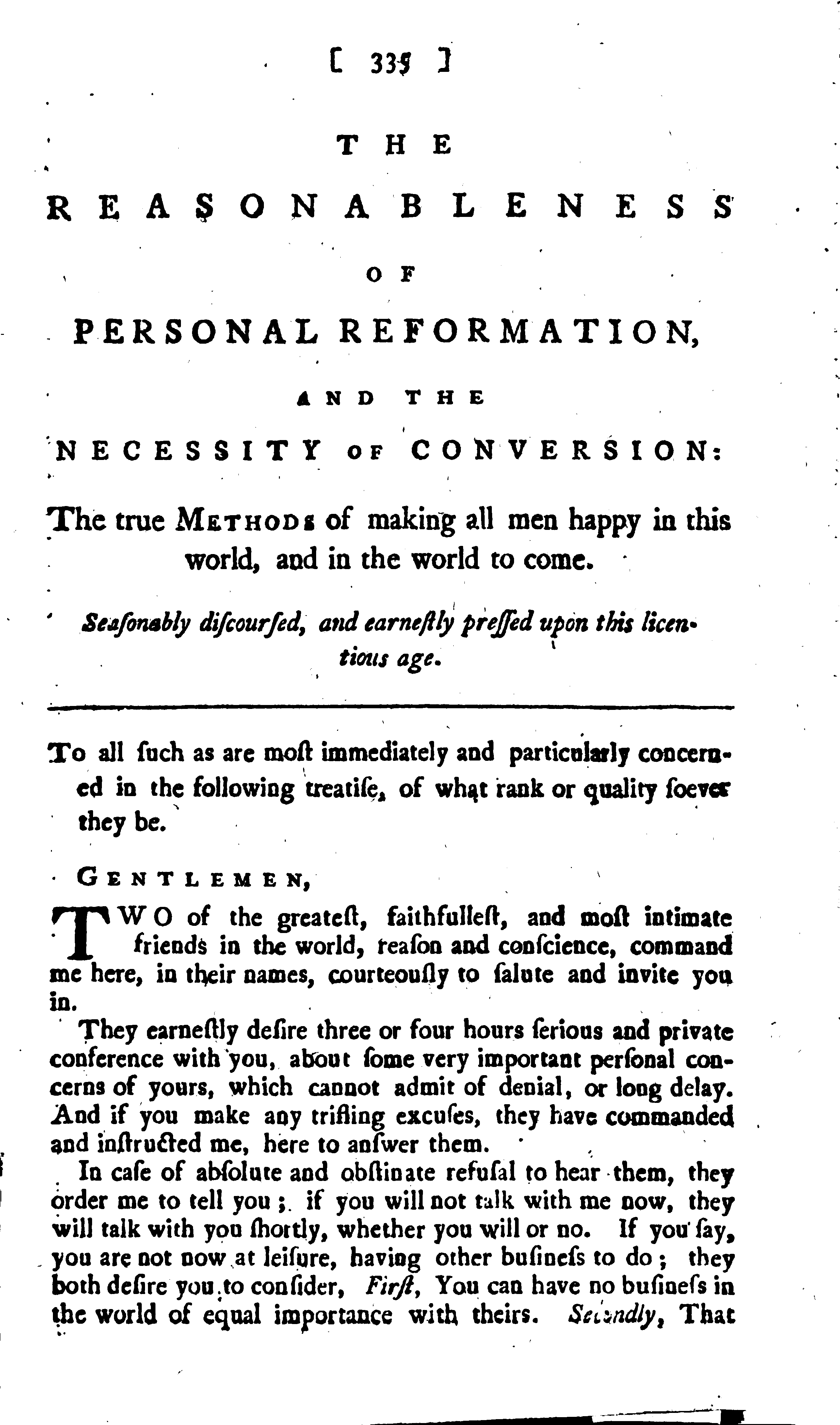
] THE
REASONABLENESS
A OF
PERSONAL REFORMATION,
AND THE
NECESSITY
OF CONVERSION :
The true METHODS of making all men happy in this world, and in the world to come.
Seasonably discoursed, andearnestlypressedupon this licentious age.
To all such as are most immediately and particularly concerned in the following treatise, of what rank or quality soever they be.
GENTLEMEN,
TWO of the greatest, faith fullest, and most intimate friends in the world, reason and conscience, command me here, in their names, courteously to salute and invite you in.
They earnestly desire three or four hours serious and private conference with you, about some very important personal concerns of yours, which cannot admit of denial, or long delay.
And if you make any trifling excuses, they have commanded and instructed me, here to answer them.
In case of absolute and obstinate refusal to hear them, they order me to tell you ; if you will not talk with me now, they will talk with you shortly, whether you will or no.
If you say, you are not now at leisure, having other business to do ; they both desire you to consider, First, You can have no business in the world of equal importance with theirs.
Secondly, That
The Epistle to the Reader. whatever other lawful affairs you are pursuing, their business with you will noway obstruct, but greatly promote it. And, lastly, That a greater person than any of you, lost his life, by pocketing up a letter at night, saying, To-morrow is a new day; and it proved to him indeed dies noviffima, his last day; he losing by that neglect the only opportunity of living longer.
If you demand, how your reason came to be bound up in this little book, and fay, that which is reason to this author, may be folly and nonsense to you :
I am bid to tell you, you are obliged first to read and compare; else your own reason will presently call it your own follyand nonsense, so to pronounce.
Sound reason is uniform, and like itself all the world over.
It is true, laws and dictates equally oblige one, as a not her, in like cases and circumstances.
If you fay,there have been fomejars anddisgufts betwixt you, and your reasons and consciences ; you and they have fallen out fo oft, that you have no great fancy to come near them in private, for you expect nothing but harsh and chiding language from them; and therefore are fain, by continual diversions, and quick fuccessions of business, to maintain your peace, by keeping at as great a distance from them as you can.
It is their desire you should here know, First, That their debateswithyou will be as calm and friendly, as they are feafonable and necessary.
Secondly, That they both profess (and you may believe them) they neither do, nor can design any thing but your good.
Thirdly, That that person is certainly in averybad case, that cannot endure to converse with himself.
Fourthly, That you herein deny a civility to your own reasons andconfciences, which you daily pay to strangers and inferiors.
And, ina word, that they desire a reconciliation with you up . on as fair and honourable terms as can well be desired : and that this being done, they will both stick faithfully by you in all the troubles and dangers of your lives, and follow you as your inseparable friends, into any thing but fin.
If you fay, this isbutawheedle, to draw you into a book, that will make you melancholy, and perhaps mad.
It is their sense and judgment, that of all men living, you have least reason to pretend the one or the other, in this case : for they are very confident, you are now in the most melancholy circumstances, men canordinarilybe in on this side hell.
And for madness theydefire to know, what you yourselves would call that man, that is running with such post-haste to
hell, as win not admit of two or three hours stop upon the
The reasonableness of Personal Reformation.
road, to prove himself tobenomadman, but in his right mind and wits ?
Moreover, they command me to inform you, it is theirdefire, that seeing their debates with you will neither be tiresome nor impertinent, you will please to hear them out what they have to say to you and then, if you shall find cause to complain, that your pleas and excuses are not fairly drawn, or that you have new matter to furnish a better apology ; they are both content you shall have your liberty to amend, or add what you please ; and if they be not able to refute them, they will give you no further trouble or interruption in your courie.
This, Gentlemen, is what I have in charge to say to you in the porch ; and now, if you please, the door is open ; you may be as private as you will.
Theywillattend you to your bed-chamber, or closet; and I heartily with an happy issue to this triendlydebate.
JOHN FLAVEL .
CHAP.
The introduction, and state of the case.
§1. R EASON exalts man above all earthly beings; it is his dignity and privilege, that God hath furnishedhimwith abilities of mind, to recollect, animadvert, compare, infer, ponder, and judge his own actions. Hereby he becomes not only capable of moral government by human laws, (which no creature beside him is) but also of spiritual government by divine laws, and the blessed fruition of God in glory, which no other species of creatures (angels only excepted) have a subjected capacity for .
Right reason, by the law of nature, (as an home-born judge) arbitrates and determines all things within its proper province ; which province is extended far and wide.
All actions, natural, moral, and civil, are weighed at this beam and standard ; none are exempted, but matters of supernatural revelation ; and yet even these are not wholly, and in every respect, exempt from right reason : for though there be some mysteries in religion above the sphere and flight of reason; yet nothing canbefound in religion, that is unreasonable.
VOL. VIII.
The reasonableness of Personal Reformation.
And though these mysteries be not of natural investigation, butoffupernatural revelation ; yet reason is convinced, nothing can be more reasonable, than that it takes its place at the feet of faith ; which is but to suffer itself to become pupil to an omniscient and infallible Instructor.
The resolution of our reason into faith, and of faith into God's veracity, are acts highly becoming reasonable beings in such cases as these.
It may not pry too nicely into unrevealed mysteries, demand the reasons, or examine the causes of them as bold and daring
Socinians do ; but it feels itself obliged to receive all those things, both as possible and true, which God hath revealed, counting his revelation alone to be reason sufficient.
For the veracity of God takes out of reason's mouth all objections against the truth of them; and his almighty power silences all its scruples against the possibility of them.
But in all matters properly under the jurisdiction of reason, everyman is obliged to account with himself, as well as others, for the reasonableness of his own actions ; and that act which will not endure the test of found reason, it judges not fit for the entertainment of a man.
If reason cannot justify it, it is beneath the rank and dignity of am an to do it.
§ 2. The light of reason was at first the bright lamp or candle of the Lord, till fin, like a thief, melted it down to snuff; whereby (comparatively speaking) it is becomes a poor glimmering light in the best of men, and almost quite extinguishedinsomemen.
Fallen man is become less than himself, and will never act like himself, till he be fully restored to himself.
Sanctification indeed souffs and trims the lamp of reason ; but there being few sanctified persons among men, a double misery consequently befals a very great partofmankind ; whose conversation speaks them not only destitute of religion, which bereaves themoftheblessedness of the world to come; butmen almost entirely despoiled of the benefits and blessings of their own reason, which makes them unhappy and miserable in this world: beasts, rather than men, as the sacred scripture stiles them : unreasonable men; men fallen out with their own faculties ; who after many a sharp battle with their reason, are now dragging it like a conquered captive, at the chariot wheels of their victorious and triumphant lusts.
§3. It is scarce imaginable, that ever sin should prevail so far as it doth, to the very uninanning of men, did they not first delude and bribe their own reason, by close and cunning applications to their bewitched affections; whereby, though
The reasonableness of Personal Reformation.
they cannot make it a party, yet they make it stand by as a silent spectator, or neuter, whilst they act the beast, yea, the devil, rather than the man.
We little know how far unsanctified reason may (this way) beprevailedupon to quit its throne, and resign its fceptre into the hands of lust and appetite ; yea, to engage in the defence of their most absurd laws and dictates.
It only serves in some men, to invent excuses, pleas, and specious pretences, to justify orextenuate their beast-like actions ; the basest servitude it can be condemned to.
If this will not do, sensual lusts have another way to obtain their satisfaction, in despite of reason and conscience; even by stopping their ears to the voices of both, and pushing on with a brutish impetus, they suffer neither to enjoy the opportunity of a calm debate of these matters with them.
§ 4. But let men do what they will, it is next to an impossibility, they shall so far fubdueanddestroy those inbred principles of reason and conscience, but that they will, atone time or other, give them some checks and oppositions in their profane courses ; especially when they shall get the advantage of some eminent distress, or special danger, which disposes them to lend an ear to their voices.
And there be few men in the world, but are sometimes providentially cast into such cases and conditions.
So that appeals to the reason of the most profligate wretches, are not altogether vain and useless : for if the case cannot be tried and decided at the bar of reason and conscience at one time, it may with more advantage at another and haply, appeals to reason may produce a reformation in some men, sooner than appeals to the scriptures, or principles of faith ; especially when the world is so notoriously drenched in practical atheism, that serious religion becomes the common subject of drollery amongst multitudes of men.
Yet it were hard and uncharitable, to imagine any man funk so deep into the mire of beastiality and profaneness, as not still to retain some value and veneration for his own reason, and as much as he abuses it, yet to refuse the whole world in exchange for it; and to account it a greater misery to be utterly deprived of it, than to have the hoofsof an horse given him in exchange for his hands and feet.
§ 5. The scriptures therefore do, in many cases, appeal to the reason of sinners, and design their reformation by such appeals: for it being a most shameful thing, for a man to be
Uu2
The reasonableness of Personal Reformation. convicted at the bar of his own reason, of acting like abeaft rather than am an, every man is presumed to be afraid, and ashamed of such an indictment. Such miscreants are the shame and reproach of humanity itself; they are branded for brutes throughout the sober world ; their company declined and thunnedby all wife and good men. He that hath no reason to jur stify his actions, may yet be supposed to be owner of some stock of natural shame; which cannot but afford ablush, upon such a plain conviction.
This therefore was the course which the prophet Ifaiah took, by divine direction, to reform the idolatrous Ifraelites ; Ifa. xlvi. 8. He states the case at the bar of their own reason, and calls for a verdict upon it.
The cafewasthis : Whether idols, having not power enough to Sherw themselves gods, those that worship them, must not want wisdom enough toshew themselves men ? " Remember this, and thew
" yourselves men; and bring it again to mind, Oye tranfgref- " fors!" q. d. For shame, let not men act like brutes, which have no animadversion.
§6. When things therefore are brought to such anexigence, that ruin or reformation is the only choice men have to make, and all religious impressions so obliterated and worn out, that menpayno reverence to them ; an appeal to the reason of men, seems then to be an hopeful method of prevailing with them, to suffer a reformation rather than a ruin. Not that I imagine the topics of reason able to afford more powerful arguments, than those of religion do; but that they, who by their igno rance and strong prejudices against religion, have made themselves more uncapable of conviction that way, may haply feel the force of reason prevailing so far at least, as to put their outrageous lusts under some restraints.
As for the scriptures, and serious religion begotten by them in the souls of men, they are perfect strangers to all, but the names of these things : And even their very names are grown almost ridiculous with them too. But reason mayconvinceand shame them.
What force the reason of man hath, even without saving grace, to produce civility, sobriety, andothermoral virtues, is abundantly evident in the very Heathens ; who, by the only light of reason, discovered so much odiousness in vice and immorality, and such an amiable beauty in justice, temperance, and the other moral virtues, that their praises for them are founded throughout the world.
Now, whatever unthinking men dream, tome it is evident, that when kingdoms and commonwealths are overflowed with unrestrained vice and immoralities; when cursing and swearing
The reafonableness of Personal Reformation.
becomesthecommon language, drunkenness and adultery the common practices of the inhabitants; God will either sweep away the filthof those nations, by the besom of a general re formation, or he will sweep away their inhabitants out of them, with the besom of destruction.
For if we have not excuffed the notionandbelief of a God, and that he animadverts the wickedness of men, (which the very Heathens, by the light of pature, saw and acknowledged), we may thereby easily be led to this conclusion, that such overflowings of abomination do, and must certainlypresage ourdefolation, except speedy and general reformation do prevent it.
§7. Now, the persons, whose reformation I particularlydefignbythis method, beingmen that exercise more reason than religion, might(methinks) be prevailed with to take up at last, and reform their unreasonable, as well as ungodly courses, could they be once prevailed with to debate these matters with cool, confiderative minds, becoming mengovernedby reason, not wholly swayed like brute-beasts, by lust and appetite.
And is it not highly reasonable, that men should weigh their own actions at the fame beam and standard where they weigh other men's actions ; and renounce all that with shame and detestation, which they themselves must censure as utterly beneath, and unworthy of a man ?
Wherefore hathGodplanted a principle of reason and conscience within us ?
Is it rational to think, it was planted there for no other end or use, but to scan and censure other mens words or actions by, but not our own ?
Or to be wholly useful to other mens interests, without any benefit to ourselves ? Ask thine own reason, filly man, why God placed it in thy soul ? and for what use it was intended? And it will tell thee, it was particularlydefigned and appointed, to regulate and orderthineownlife and actions ; and next, for the benefit and good of the community..
It will tell thee, there is not a single act thou dost, of any weight or moment, but thou oughtest to consult with it, and have its pass or licence before thou do it.
But when thou enterest into a serious course of actions, thy consultations with it ought to be very frequent and solemn,because these things are of great importancetothee.
Thy reason will tell thee, sinner, that it is a vile affront to it, to be thrust by thee from the council-table, unworthilydifmissed from its office, and discharged from any further attendance upon thy life, and concerns thereof, and brutish lust and appetite consulted in its room; and that it needed not at all to have beenimplantedin thy soul, if the same principles that
The reasonableness of Personal Reformation. govern the beasts of the field, must also be thy governing prin ciples.
It stands ready to offer its service to thee, to save thee from, or to receive thee out of those mischiefs thou hatt, or mayest run thyself into; if thou wilt but hear, and obeys its advice, it tells thee, it is thy privy-counsellor, by God's appointment; and if thouwilt not find leisure among the heats and hurries of thy lusts, to consult it, andhearken to its counsels now; if thou wilt not forsake the conduct of thine own reason and conscience, which have a right and authority togovernthywords and actions, and follow thy blind and headstrong lusts and passions, thou shalt hear other language from them, when thylusts have precipitated thee into thine own ruin and destruction; as they speedily and inevitably must, and will do, according tothecoursethey now steer for thee.
§ 8. And there is yet more ground to hope, that reason may prevail with men living under the gospel, to return to sobriety and temperance, when we consider their reason is assitted by some illuminations from the Christian religion. They live in a land of Bibles and ministers,where theycannotavoid the light; an advantage far beyond whatever the heathens enjoyed ; who yet by their single unassisted reason, arrived to an eminency in moral virtues.
Our reasons and consciences do not only convince us, (as theirs also did them) that there is a God, and a future life of retribution, wherein everyman shall be judged according to his works ; but also, that the scriptures are the very word of God, and rule of faith and manners. And if there be any among the debauched crew, that question or deny it ; we may be confident, none of them are able, by plain and found reason, to overthrow those mighty arguments pleaded for the confirmation of that truth: At least, they find in themselves a strong suspicion and fear, that they may prove to be true ; which jealousy and suspicion, working together with their own reasonandconfciences, are no contemptible helps toward their recovery.
For if what reason, conscience, and scripture, with one mouth, pronounce, be true and certain, (as undoubtedly it will be found to be) ; then it must be plain and obvious to them afo, that their brutish lusts have put them into the direct and ready way, both to ruin themselves, and also greatly to hazard the community to which they belong.
§ 9. As for themselves, if they will make a judgment upon their own condition, in the light of reason, conscience, or tipture, (and they very well know, they take their measures
The reasonableness of Personal Reformation.
in perfect darkness, if they take them not by this direction) ; then, continuing the same course they now do, they are a loft generation.
All their lawful and faithful guides tell them, with one mouth, they are certainly in the broad way to damnation ; and that, how irksome and terrible soever the thoughts and apprehensions of hell are to them, yet thither they must certainly come, iftheypursue this course. Their reason plainlytellsthem, he that chuseth the means, and engageth in the way leading to hell, must, and ought to make account, that hell is the place heispreparingfor.
Conscience is as plain and positive with them, that they must either return, or perish.
The scripture confirms the testimonies of both, by telling them plainly, That the end of these things is death ; Rom. vi. 21 .
It is downright folly and madness, by the vote of the whole rational and sober world, for anyman to conclude, or hope he shall be happy in the world to come, whose life is drawn through, and finished in all manner of obscenity, filthiness, and profaneness in the present world.
For let the cafebebrought into the light of your own reason, as dim as it is, and let it freely judge, when you are belching out your black and horrid blafphemies against God, imprecatingdamnation from him upon your own souls, wallowing in beastly lusts, vomiting and roaring intaverns and ale-houses : ask, I say, your own reason, conscience,or the scripture, whether all, or either of them, will allow you to say or think,
• Now we are in the right way to eternal blessedness! This is the very course thatwillbringus tohappinessintheworldto come: this pleasethGod better, and is a surer path to glory,
⚫than repentance or faith, mortification, prayer, or reform a- ' tion.' No, no, as blind as your reason is, and as feared as yourconfciences are, you will neverbringthemtocomprobate, or subscribe such absurd and horrid conclusions as these.
But, on the contrary, they will tell you, that if you will have the pleasure, you must have the pain and torment of fin.
That it is madness to say, you are afraid to burn, but not afraid to siu; that you are loth to be damned, and yet challenge the almighty God to hislace, to damn you : as much a folly, as to drink a baneful dose ofknownpoison, and think to feel no painful gripes afterwards.
As for the scriptures, they appeal to the reason of men in this case, as a most known and allowed thing, scarce imaginable to lie hid from any man. 1Cor. vi. 9,10. " Knowyenot, that
1 The reasonableness of Personal Reformation.
" theunrighteous shall not inherit the kingdom of God. Ee " not deceived ; neither fornicators, nor idolaters, nor adulterers, nor effeminate, nor abusfers of themselves with man
" kind; nor thieves, nor covetous, nor drunkards, nor revilers,
" nor extortioners, shall inherit the kingdom of God."
It would make the bowels of a compassionate Christian to roll and yern within him, to behold multitudes of fouls of invaluable worth, running greedily on to their eternal ruin, wilfully stopping their ears all the way, to the voices of their own reasonandconfcience, as well as to the voice of God in his word; not once making a pause, till they fall into that gulph of eternal and intolerable misery, into which, with great precipitation, they are casting themselves.
§ 10. And then, for the community to which they belong; how dangerous, yea, how destructive such persons are to it, cannot possibly be hid from any witeand serious observer. For ifone finnerdestroys much good; if one Achan trouble the whole camp of Israel; how much more will whole swarms and droves of drunkards, blafphemers, and adulterers, as now fill every place, pull down the judgments of God upon thole states and kingdoms wherein they breath ?
If our fears and dangers were greater than they are, yet reformation might save us, Jer. v. 1. " Run ye to and fro through the streets of Je- " rufalem, and fee now, and know, and seek in the broadpla
" ces thereof, if you can find a man, (i. e. a public man, a " man in authority,) if there be any that executethjudgment,
" that seeketh the truth, and I will pardon it." And if our hopes and confidences were much higher than they are, yet unrestrained fin would undo us.
Kingdoms and commonwealths are notfo much endangered by the powers and policies of their enemies without them, as they are by the unreformedness of profligate wretches within, and amongst them.
Reformation quickly recovers the antient glory of kingdoms, and makes them the terror of their enemies.
For though there will be still too much fin privatelycommittedunderthebest laws, and the most vigorous and impartial execution of them; yet abundance of fin would thereby be prevented, and the fins that are committed would not become national, but personal only ; and these would not so much concern and hazard the publicweal and tranquillity of the state.
Moreover, states and kingdoms are in no small hazard by the public debauchery, and common profaneness of their subjects; forafmuch as in this very fink and puddle of their lusts, themanlywisdom, sprightlycourage, andtruegallantry of their
The reasonableness of Personal Reformation.
subjects, are quenched and drowned, their spirits softened and effeminated.
It is hard to imagine those men will engage far in the cause of reformation, when reformation itselt is the only thing they hate and fear.
Nor need we wonder to find men intimidated, and low-spirited, in times and places of imminent danger, who not only carryaboutthem so much guilt, (which is the fountain of fear) but are wholly addicted to sensual pleasures, which they are loth to hazard upon public accounts and considerations, these being the only heaven they have, or hope for: " Whoredom,
" and wine, and new wine take away the heart," Hos. iv.
11.
It is in the very nature of these sins, to make men sottish, and in the very nature of guilt to make them pufillanimous.
Senecaobferves, (and his observation is true) * That the conscience of a wicked man is a terrible scourge and torment to him, perpetually lashing him with follicitous thoughts and fears; so that he distrusts all securities, and knows notwhere to be safe.'
Hence it comes to pass, thatmanymen of good extraction, liberal education, and excellent natural endowments, become so useless, yea, so pernicious as they are; who, couldtheybe recovered but to temperance and sobriety, would become both excellently useful, and ornamental to the nation where they had their birth, and to the safety and honour whereof they owe their service.
§ 11. This most desirable recovery and reformation of profane debauched persons, is not simply and absolutely impossible: And if magistrates and ministers were every where exemplary themselves for sobriety and piety, zealous and impartial in the discharge of their respective duties, a general reformation would not be difficult.
But when those, whose office it is to suppress wickedness, shall associate themselves with lewd and profligate persons, and vie with them in their profane courses, ordiscouragemore conscientious persons in the discharge of their duties; this makes reformation morally impossible.
If profaneness were once found the general odium of the people, and a bar to all preferments, it might be hoped, things wouldquicklyalter for the better.
It was an ancient custom among the Heathens, (as learned and excellent Mr. Hale of Eaton, out ofChryfoftom observes), That if a man offered himself tocontendinthe Olympic games, he was not permitted so to do, till proclamation had been first made, Whether any man knew him to be either a servant, or a man of infamous life?
VOL . VIII.
* Seneca, epist. 97.
The reasonableness of Personal Reformation.
And if anyfuch imputation were proved against him, it was sufficient to keep him back, let his skill be what it would.
What care was here taken, that their vanities should not be discredited ? And will neither reason nor religion convince us, that not only equal, but far greater care ought to be taken, to discourage profaneness among Christians, than the blind
Heathens ever took, to preserve the reputation of their vain exercises ?
Let all subordinate ministers of state, and officers in the church, confider how great a part of this blessed refor mation is demanded at their hands.
§ 12. Were kingdoms and commonwealths once purged from that spirit of profaneness and debauchery, which thusdefiles and overflows them, and the people generally reduced but to civility, sobriety, and temperance ; experience would quickly shewthem the comfortable effects, and happy fruits thereof.
For though this be much short of what Christianity exacts from all its professors, and insufficient to obtain the happiness of the world to come , yet it is greatly conducent to the civil happiness and flourishing of the kingdoms of this world ; and, therefore richly worthy the studies and endeavours of all men, to promote and obtain it.
There is no kingdom or commonwealth in the Christian world, which would not by this means breed and fend forth multitudes more than they do, with excellent abilities and qualifications, fitting them to fit at thehelm of government, and steer a more prosperous course than they do at present. A wife and steady direction of the arduous and important affairs of kingdoms, can only be expected from those that are able to govern themselves , and their own affairs, with fobrietyanddifcretion.
If the laws of nations take care for the preservation and growth of timber, fit for the building of houses and ships,and every one fees the usefulness and necessity of such acts ; much more ought they to take care for such an education of men, as may render them serviceable members to the state, both in camp and council .
Magistrates are (in a sense) the foundation of kingdoms ; the strong shoulders, that bear the burden of government : And reason will tell, that fo great a weight and stress, as the affairs and concerns of kingdoms, ought not to be laid on their shoulders, whose legs, through debauchery, are too weak to bear their own reeling and staggering bodies.
Scamenand soldiers are the walls of kingdoms, and (under God) their prudence and courage are the peoples defence and safeguard.
Plutarch tells us, there were two virtues inHanni
The reasonableness of Personal Reformation.
bal, which made him prosperous and successful : There was in him, Plurimum audacia adcapienda pericula, et plurimum confilii inter ipfa pericula : He was bold in attempting, and prudentinmanaging the most difficult services. The former had
: signified little without the latter.
Courage may throw men into the midst of difficulties; but counsel and wisdom helps them
: to emerge those difficulties ; and I am sure, that cannot be rationallyexpectedfrom men, that daily dethrone their own reason by debauchery.
But when men, not only sober, just, and temperate, but religiously good, are employed in public trusts and services ; we cannot but think, the security and prosperity of such a state, are abundantly provided for. And our confidence hereof is not only founded upon the maxims of human reason, but of scripture, wisdom, and authority also.
What a renowned, prosperous, and successful captain of the armies of Israel, was good Joshua ! No man was able to stand before him all the days of his life, Josh . i. 5.
But what bred those brave, gallant, and undaunted spirits in the breast of this hero, and crowned his noble designs with such admirable success ? If we look into ver. 8. we shall find it was religion, that gave both the edge and point to his natural courage ; " This
" book of the law shall not depart out of thy mouth, but thou " shalt meditate therein day and night, that thou mayest ob- " serve to do all that is written therein : for then thou shalt make
" thywayprofperous, and then thou shalt have good success."
Hezekiah, this way, became a nonsuch among the kings of Judah ; for " he clave to the Lord, and the Lord was with him;
" and he prospered whitherfoeverhe went forth," 2 Kings xviii.
5, 6, 7.
And dying David, from a whole life of experience, recommended this as the onlyinethod of prosperity, unto Solomon his son ;
Keep the charge of the Lord thy God, to "
walk in his ways ; that thou mayest prosper in all that thou " dost, andwhitherfoever thou turnest thyself," 1 Kings ii. 3, 4.
How great a lustre therefore doth this truth cast about it : that the restraint and reformation of vice, and the due encouragement of virtue and piety, becomes the very civil interest of kingdoms and nations, by the joint votes and fuffrages both of human and divine wisdom ?
Let any kingdom or state make trial of this method, and from that very time they shall date their prosperity.
This will make them become the terrors of their enemies round about them:
Peace and prosperity shall flourish in the midst of them ; which is the true level and design of this most necessary and seasonable attempt.
X x 2