
Concerning the doing of God's will,
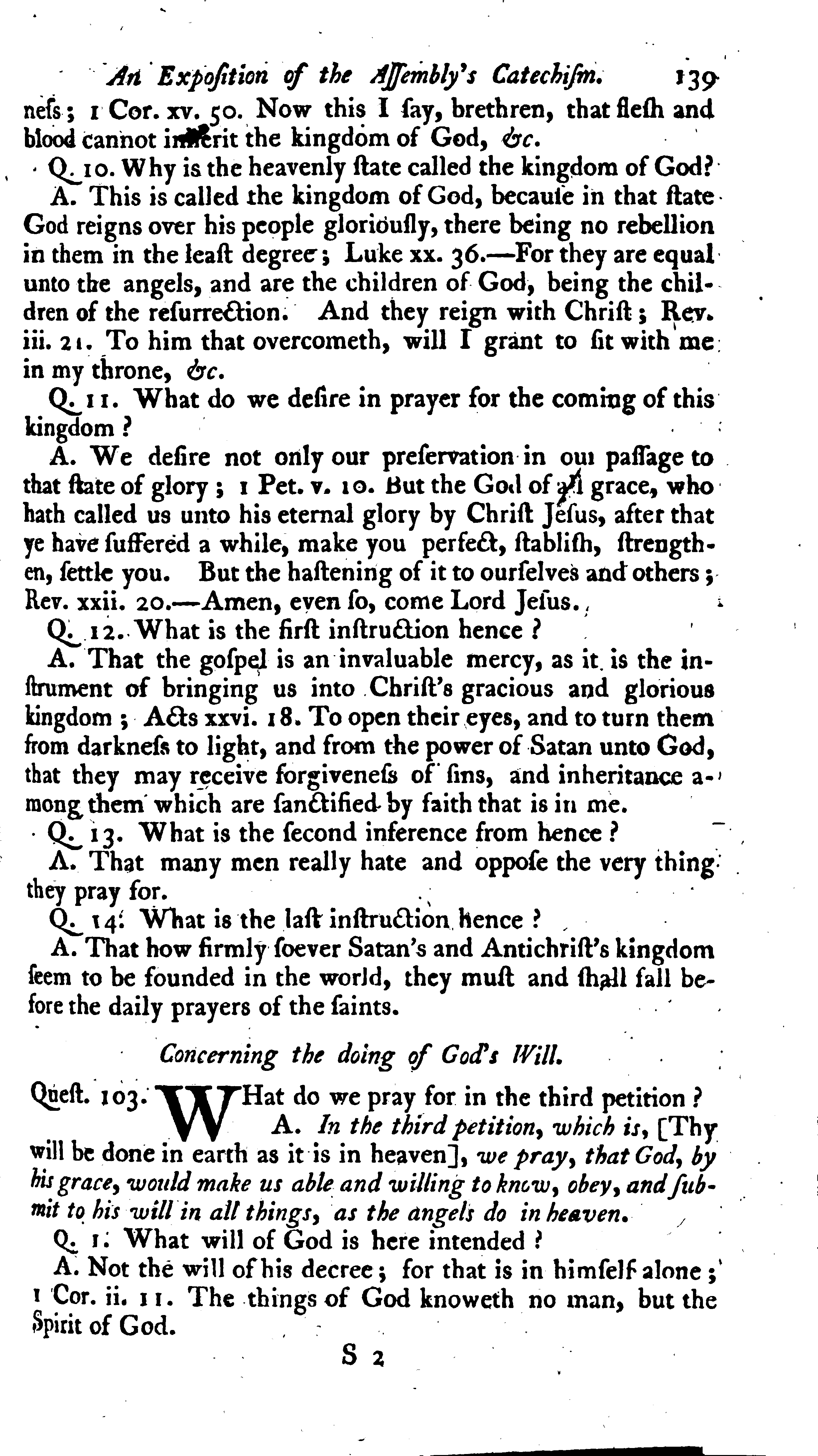
An Exposition of the Assembly's Catechism.
ness; 1 Cor. xv. 50. Now this I say, brethren, that flesh and blood cannot inferit the kingdom of God, &c.
Q.10. Why is the heavenly statecalledthekingdom of God?
A. This is called the kingdom of God, because in that state God reigns over his people gloriously,there being no rebellion in them in the least degree; Luke xx. 36. For they are equal unto the angels, and are the children of God, being the children of the resurrection. And they reign with Christ ; Rev. iii. 21. To him that overcometh, will I grant to fit with me in my throne, &c .
Q.11 . What do we desire in prayer for the coming of this kingdom?
A. We desire not only our preservation in our passage to that state of glory ; 1 Pet. v. 10. But the God of al grace,who hath called us unto his eternal glory by Christ Jesus, after that yehavefuffered a while, make you perfect, stablish, strengthen, settle you.
But the hastening of it to ourselves and others ; Rev. xxii. 20.-Amen, even fo, come Lord Jesus.
Q. 12. What is the first instruction hence ?
A. That the gospel is an invaluable mercy, as it is the instrument of bringing us into Christ's gracious and glorious kingdom ; Acts xxvi. 18. To open their eyes, and to turn them from darkness to light, and from the power of Satan unto God, that they may receive forgiveness of fins, and inheritance among them which are sanctified by faith that is in me.
Q. 13. What is the second inference from hence ?
A. That many men really hate and oppose the very thing they pray for.
Q. 14. What is the last instruction hence ?
A. That how firmly soever Satan's and Antichrist'skingdom seem to be founded in the world, they must and shall fallbeforethe daily prayers of the faints.
Quest. 103.W Concerning the doing of God's Will.
Hat do we pray for in the third petition?
A. In the third petition, which is, [Thy willbedonein earth as it is in heaven], we pray, that God, by his grace, would make us able and willing to know, obey, and submit to his will in all things, as the angels do in heaven.
Q. 1. What will of God is here intended ?
A. Not the will of his decree ; for that is in himself alone ;'
1 Cor. ii. 11. The things of Godknoweth no man, but the Spirit of God.
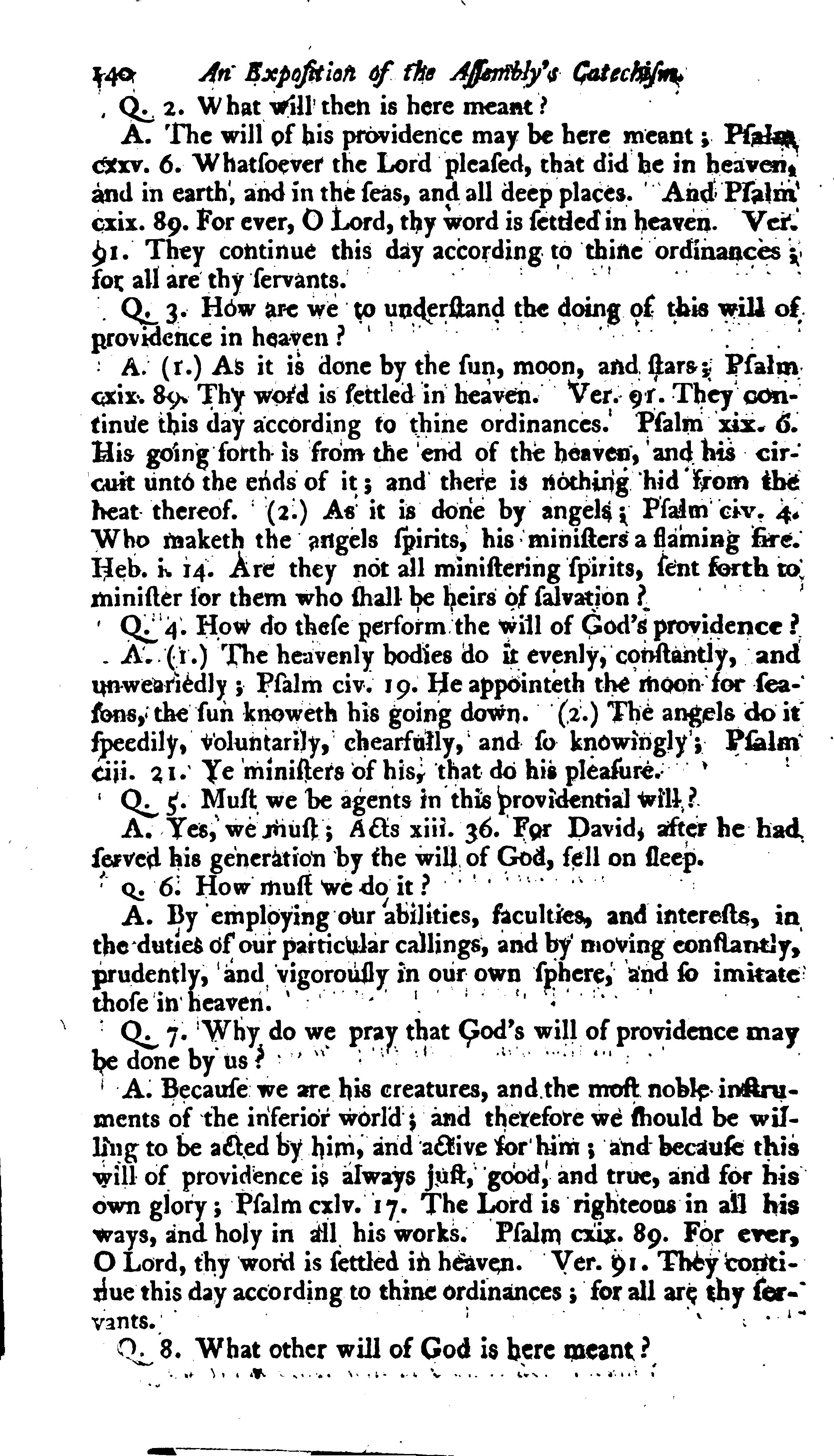
An Exposition of the Assembly's Catechism.
Q. 2. Whatwillthen is here meant ?
A. The will of his providence maybe here meant ; Psalm cxxv. 6. Whatsoever the Lord pleased, that did he in heaven, and in earth, and in the seas, and all deep places. And Psalm cxix. 89. For ever,O Lord, thy word is settled in heaven. Ver.
91. They continue this day according to thine ordinances ; for all are thy servants.
Q. 3. How are we to understand the doing of this will of providence in heaven ?
A. (r.) As it is done by the sun, moon, and stars ; Psalm cxix. 89. Thy word is settled in heaven.
Ver. 91. They continue this day according to thine ordinances.
Psalm xix. 6.
His going forth is from the end of the heaven, and his circuit unto the ends of it; and there is nothing hid from the heat thereof.
(2.) As it is done by angels ; Psalm civ. 4.
Who maketh the angels spirits, his ministers a flaming fire.
Heb. i. 14. Are they not all ministering spirits, sent forth to minister for them who shall be heirs of salvation ?
Q. 4. How do these perform the will of God's providence ?
A. (r . ) The heavenly bodies do it evenly, constantly, and unweariedly ; Psalm civ. 19. He appointeth the moon for seasons, the fun knoweth his going down.
(2.) The angels do it speedily, voluntarily, chearfully, and so knowingly'; Psalm ciii. 21. Ye ministers of his, that do his pleasuré.
Q. 5. Must we be agents in thisprovidentialwill ?
A. Yes, we must ; Acts xiii. 36. For David, after he had served his generation by the will of God, fell on sleep.
+ Q. 6. How must we do it?
A. By employing our abilities, faculties, and interests, in the duties of our particular callings, and by moving constantly, prudently, and vigorously in our own sphere, and so imitate those in heaven.
Q. 7. Why do we pray that God's will ofprovidencemay be done by us ? is A. Because we are his creatures, and the most noble instruments of the inferior world; and therefore we should be willing to be acted by him, and active for him ; and because this will of providence is always just, good, and true, and for his own glory ; Psalm cxlv. 17. The Lord is righteous in all his ways, and holy in all his works.
Psalm cxix. 89. For ever, OLord, thy word is settled in heaven.
Ver. 91. They contirnue thisdayaccording to thineordinances ; for all are thy servants.
; 0.8. What other will of God is here meant ?
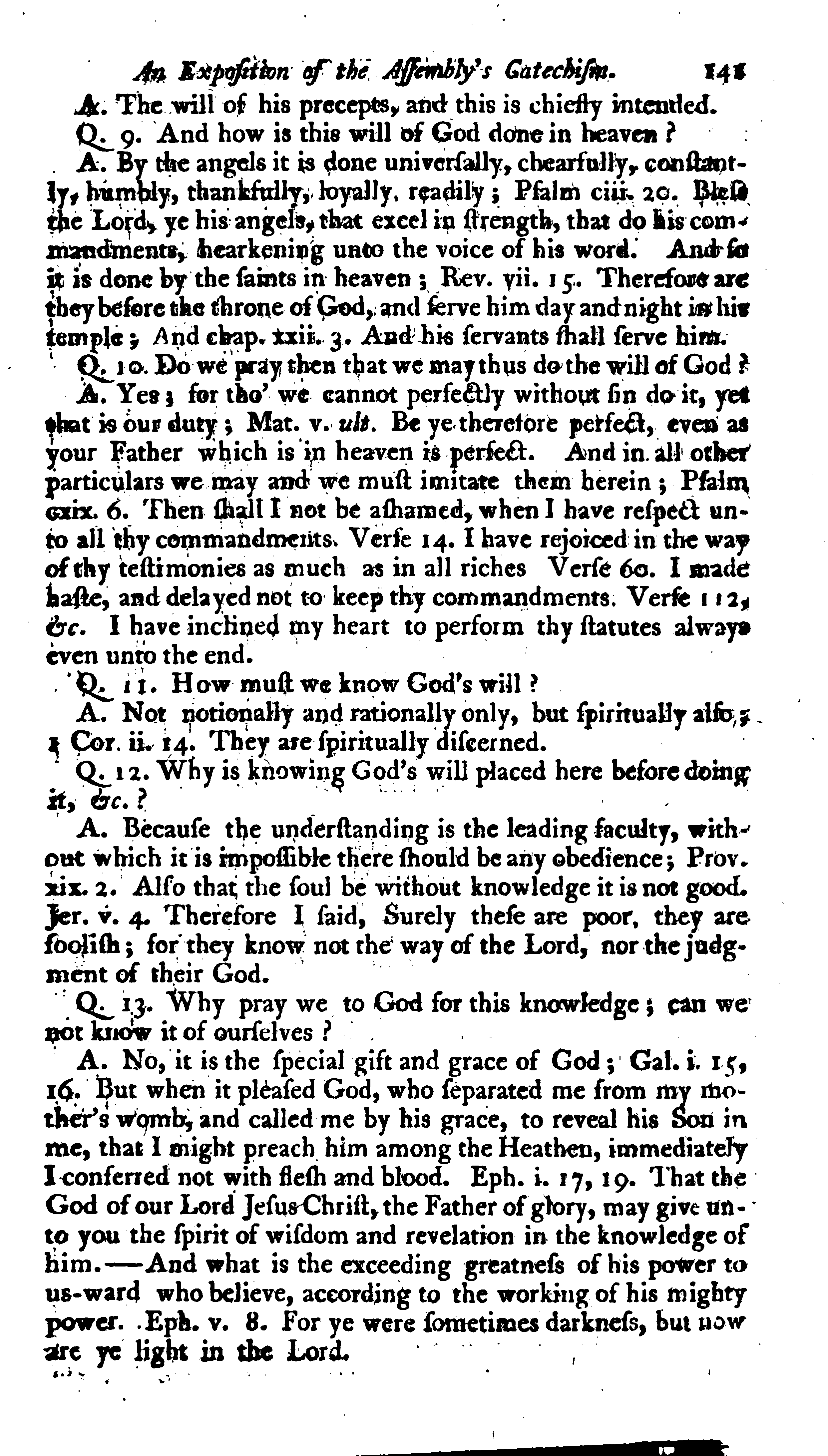
An Exposition of the Assembly's Gatechism.
A. The will of his precepts, and this is chiefly intended.
Q. 9. And how is this will ofGoddone in heaven ?
A. By the angels it is done universally, chearfully, constantly, humbly, thankfully, loyally, readily; Psalm ciii. 20. Blefo the Lord, ye his angels,that excel in strength,that do his commandments, hearkening unto the voice of his word. Andfo
: it is done by the faints in heaven ; Rev. vii. 15. Therefore are theybeforethethrone of God, and servehimdayandnight in his temple; And chap. xxii. 3. And his servants shall serve him.
Q. 10.Dowepraythen thatwemaythus do the will of God ?
A. Yes ; for tho' we cannot perfectly without fin do it, yet that is our duty ; Mat. v. ult. Beyetherefore perfect, even as your Father which is in heaven is perfect. And in all other particulars we may and we must imitate them herein ; Psalm cxix. 6. Then shall I not be ashamed,when I have respect untoallthycommandments. Verse 14. I have rejoiced in the way of thy testimonies as much as in all riches Verse 60. I made haste, and delayed not to keep thy commandments. Verse 112,
&c.
I have inclined my heart to perform thy statutes always evenuntothe end.
Q. 11. How mustweknowGod's will ?
A. Not notionally and rationally only, but spiritually also ; Cor. ii. 14. They are spirituallydifcerned.
Q. 12. Why is knowing God's will placed here before doing it, &c. ?
A. Because the understanding is the leading faculty, without which it is impossible thereshouldbe any obedience; Prov. xix. 2. Also that the soul be without knowledge it is not good.
Jer. v. 4. Therefore I said, Surely these are poor, they are foolish; for they know not the way of the Lord, northejudgment of their God.
Q. 13. Why pray we toGodforthis knowledge; can we not know it of ourselves ?
A. No, it is the special gift and grace of God ; Gal. i. 15, 16. But when itpleasedGod,who separated me from my mother'swomb, and called me by his grace, to reveal his Son in me, that I might preach him among the Heathen, immediately
I conferred not with flesh and blood. Eph. i. 17, 19. That the God of our LordJesusChrift,theFatherofglory, maygiveuntoyou the spirit of wisdom and revelation in the knowledge of him.-And what is the exceeding greatness of his power to us-ward who believe, according to the working of his mighty power. Eph. v. 8. Forye were sometimes darkness, but now are ye light in the Lord.
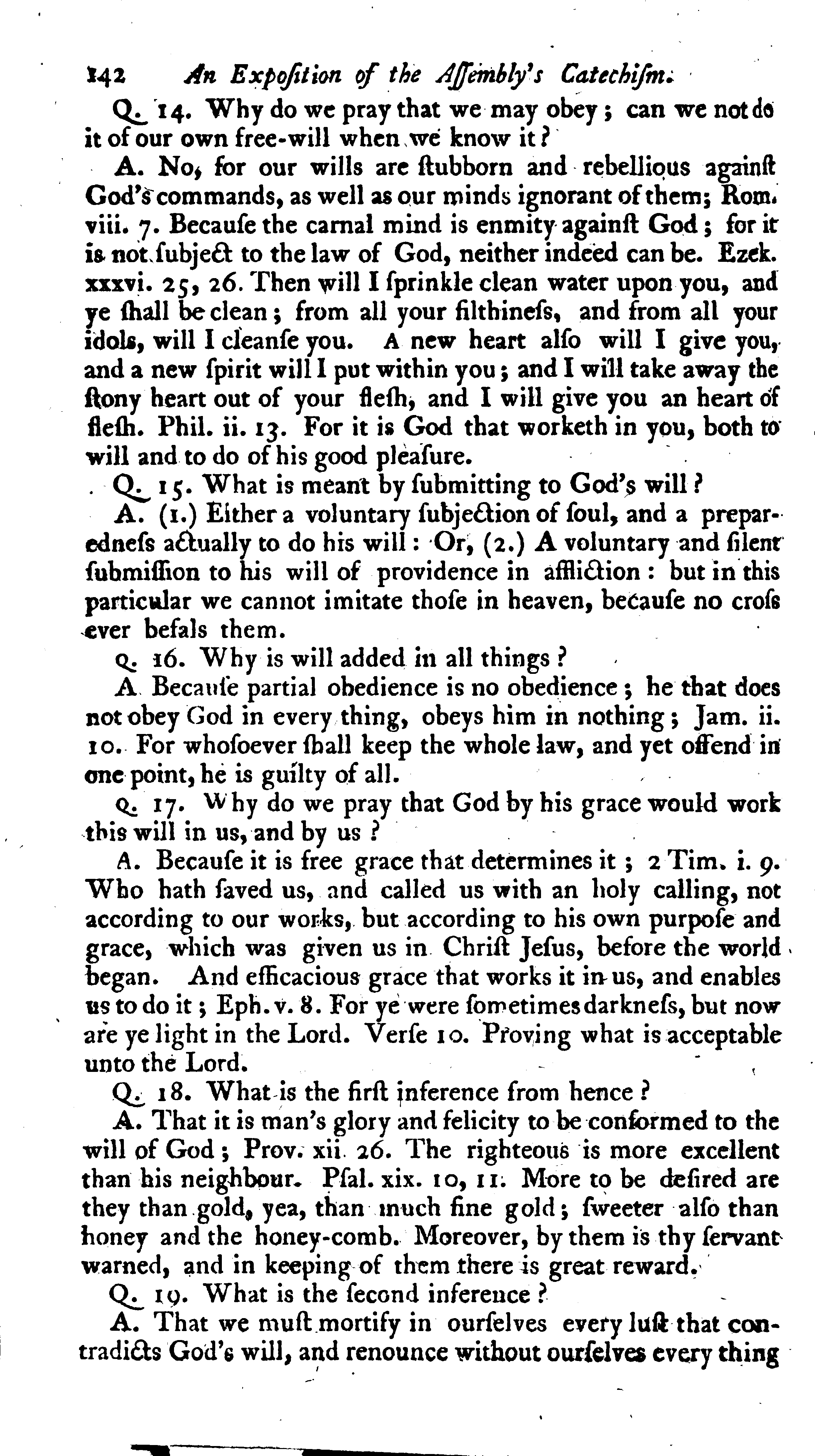
An Exposition of the Assembly's Catechism.
Q. 14. Why do we pray that we may obey; canwenotdo it of our own free-will when we know it ?
A. No, for our wills are stubborn and rebellious against God'scommands, as well as our minds ignorantofthem; Rom. viii. 7. Because the carnal mind is enmityagainstGod; for it is not subject to the law of God, neither indeedcanbe. Ezek. xxxvi . 25 , 26. Then will I sprinkle clean water upon you, and ye shall be clean; from all your filthiness, and from all your idols, will I cleanse you. Anew heart also will I give you, and a new spirit will I put within you ; and I will take away the stonyheart out of your flesh, and Iwillgiveyou an heart of flesh. Phil. ii. 13. For it is God that worketh in you, both to will and to do of his good pleasure.
Q. 15. What is meant by submitting to God's will ?
A. (1.) Either a voluntary subjection of foul, and a preparedness actually to do his will : Or, (2.)A voluntary and silent submission to his will of providence in affliction : but in this particular we cannot imitate those in heaven, because no cross ever befals them .
Q. 16. Why is will added in all things ?
A. Because partial obedience is no obedience ; he that does not obey God in every thing, obeys him in nothing ; Jam. ii.
10. For whosoever shall keep the whole law, and yet offend in one point,he is guilty of all.
Q. 17. Why do we pray that God by his grace would work this will in us, and by us ?
A. Because it is free gracethatdetermines it ; 2Tim. i. 9.
Who hath saved us, and called us with an holy calling, not according to our works, but according to his own purpose and grace, which was given us in Christ Jesus, before the world began. And efficacious grace that works it in us, and enables us to do it ; Eph. v. 8. Forye were sometimes darkness,but now areyelight in the Lord. Verse 10. Proving what is acceptable unto the Lord.
Q. 18. What is the first inference from hence ?
A. That it isman's glory and felicity to be conformed to the will of God ; Prov. xii. 26. The righteous is more excellent than his neighbour. Psal.xix. 10, 11. More to be desired are they than gold, yea, than inuch fine gold; sweeter also than honey and the honey-comb. Moreover, by them is thy servant warned, and in keeping of them there is great reward.
Q. 19. What is the second inference ?
A. That we must mortify in ourselves every lust that contradicts God's will, and renounce without ourselves everything