
Quest 40, 41 Of the moral law, 44
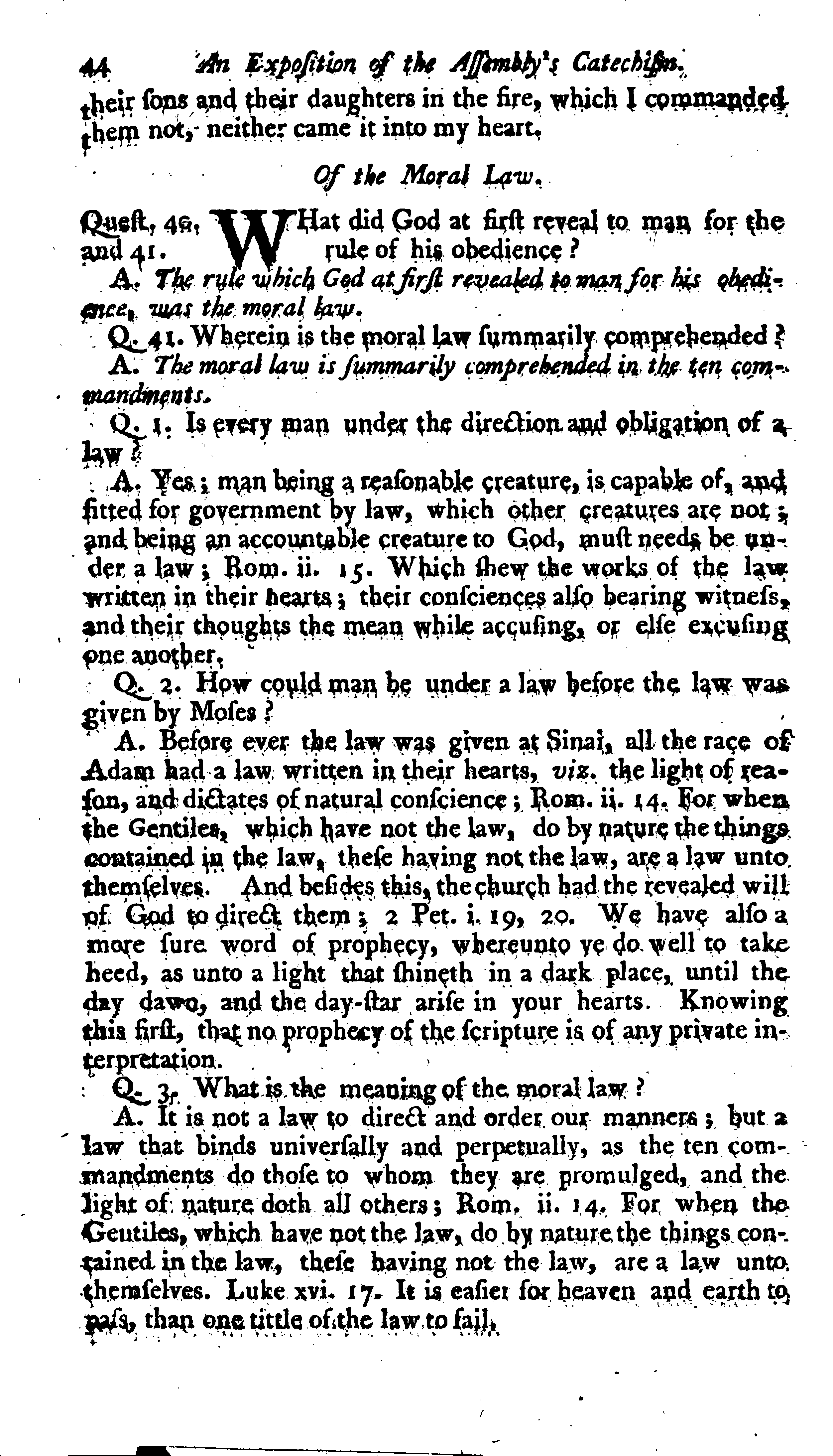
An Exposition of the Assembly's Catechism. theirfonsandtheirdaughters in the fire, which I commanded hem not, neither came it into my heart.
Of the Moral Law .
7Hat did God at first reveal to man for the rule of his obedience?
W A. The rule which God at first revealed to man for his obedience, was the moral law.
Quest, 40, and41.
Q.41.Wherein is the moral law summarily comprehended?
A. The moral law isfummarily comprebended in the ten commandments.
Q. 1. Is every man under the direction and obligation ofa law?
A. Yes ; man being a reasonable creature, is capable of, and fitted for government by law, which other creatures are not ; and being an accountable creature to God, must needs be under a law ; Rom. ii. 15. Which shew the works of the law written in their hearts ; their consciences also bearing witness, and their thoughts the mean while accusing, or else excusing one another, Q. 2. How couldmanbe under a law before the law was givenbyMofes?
A. Before ever the law was given at Sinai, all the race of Adam had a law written in their hearts, viz. the light of reason,and dictates of natural conscience ; Rom. ii. 44. For when the Gentiles, which have not the law, do by nature the things contained in the law, these having not the law, are a law unto themselves.
And besides this, the church had the revealed will of God to direct them ; 2 Pet. i. 19, 20. We have also a more sure word of prophecy, whereunto ye do well to take heed, as unto a light that shineth in a dark place, until the day dawa, and the day-star arise in your hearts.
Knowing this first, thatnoprophecyof the scripture is ofanyprivate interpretation.
Q.3. What is the meaning of the moral law ?
A. It is not a law to direct and order our manners ; but a law that binds universally and perpetually, as the ten commandments do those to whom they are promulged, and the light of nature doth all others ; Rom. ii. 14. For when the Gentiles,which have not the law, do by nature the things contained in the law, these having not the law, area law unto,
: themselves. Luke xvi. 17. It is easier for heaven and earth to pass, than onetittle of the law to fail.
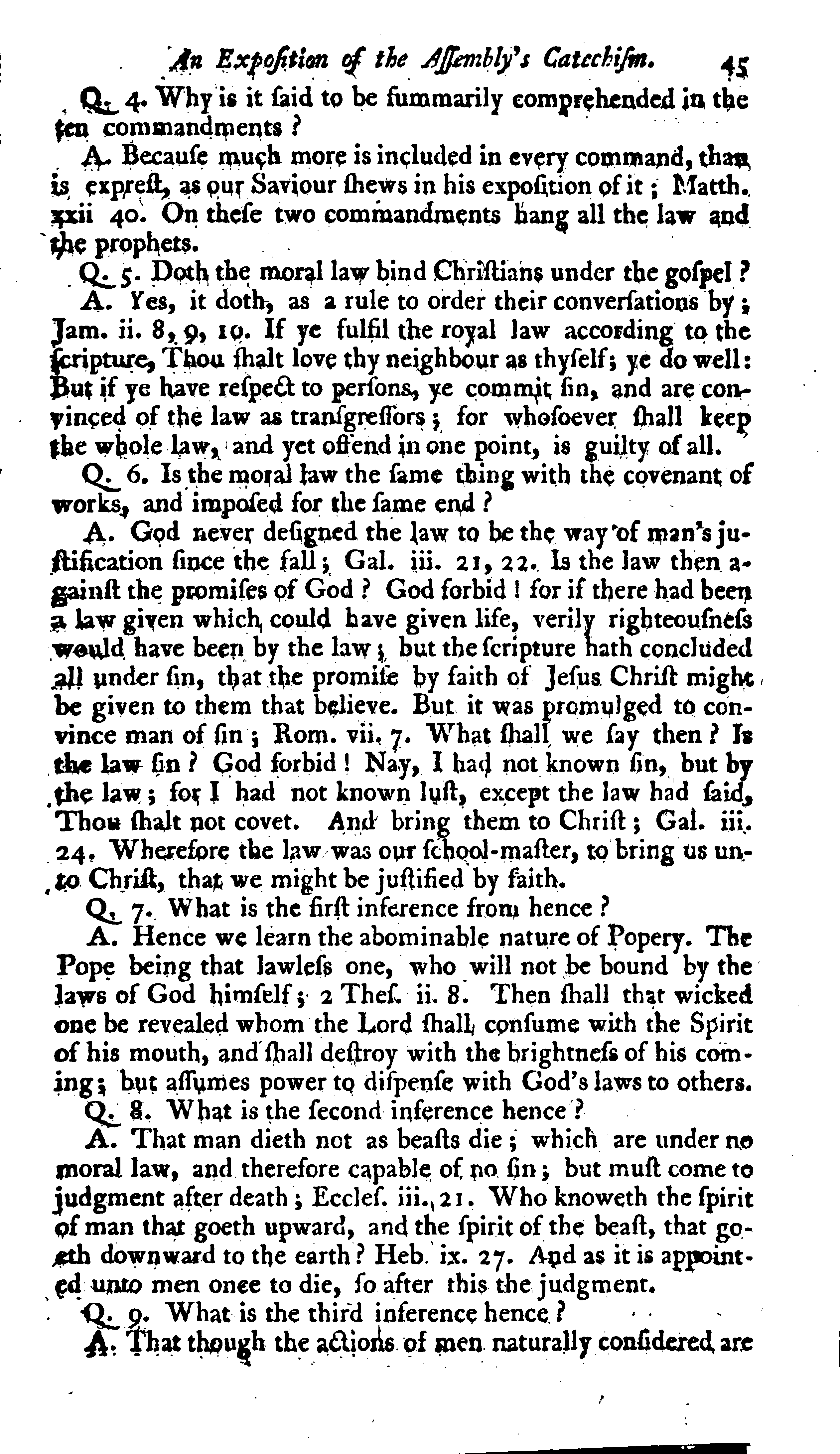
An Exposition of the Assembly's Catechism.
Q. 4.Why is it said to be summarily comprehendedinthe ten commandments ?
A.Because much more is included in every command, than is exprest, as our Saviour shews in his exposition of it ; Matth. xxii 40. On these two commandments hang all the law and the prophets.
Q. 5. Doth the moral law bind Christians under the gospel?
A. Yes, it doth, as a rule to order their conversations by ; Jam. ii. 8, 9, 10. If ye fulfil the royal law according to the scripture,Thou shalt love thy neighbour as thyself; ye do well:
But ifye have respect to persons, ye commit fin, and are convinced of the law as tranfgreffors; for whosoever shall keep the whole law, and yet offendinone point, is guilty of all.
Q. 6. Is the moral law the same thing with the covenant of works, and imposed for the same end ?
A. God never designed the law to be the way of man'sjustification since the fall; Gal. iii. 21, 22. Is the law then againstthepromises of God ? God forbid! for if there had been alawgivenwhich could have given life, verily righteousness would have been by the law; but the scripture hath concluded all under fin, that the promise by faith of Jesus Christ might be given to them that believe. But it was promulged to convince man of fin ; Rom. vii. 7. What shall we say then? Is the law fin ? God forbid ! Nay, I had not known fin, but by the law; for I had not known lust, except the law had said,
Thow shalt not covet. And bring them to Christ ; Gal. iii.
24. Wherefore the law was our school-master, to bring us unto Christ, that we mightbejustified by faith.
Q. 7. What is the first inference from hence ?
A. Hence we learn the abominable nature ofPopery. The Pope being that lawless one, who will not be bound by the laws of God himself; 2 Thef. ii. 8. Then shall that wicked one be revealed whom the Lord shall consume with the Spirit of his mouth, and shall destroy with the brightness of his coming; but assumes power to dispense with God's laws to others.
Q. 8. What is the second inference hence ?
A. Thatman dieth not as beasts die ; which are under no moral law, and therefore capable of no fin ; but must come to judgment after death ; Ecclef. iii. 21. Who knoweth the spirit of man that goeth upward, and the spirit of the beast, that goethdownward to the earth? Heb. ix. 27. And as it is appointed unto men once to die, fo after this the judgment.
Q. 9. What is the third inference hence ?
A. That though the actions of men naturallyconfidered are