
Concerning our daily bread,
An Exposition of the Assembly's Catechism.
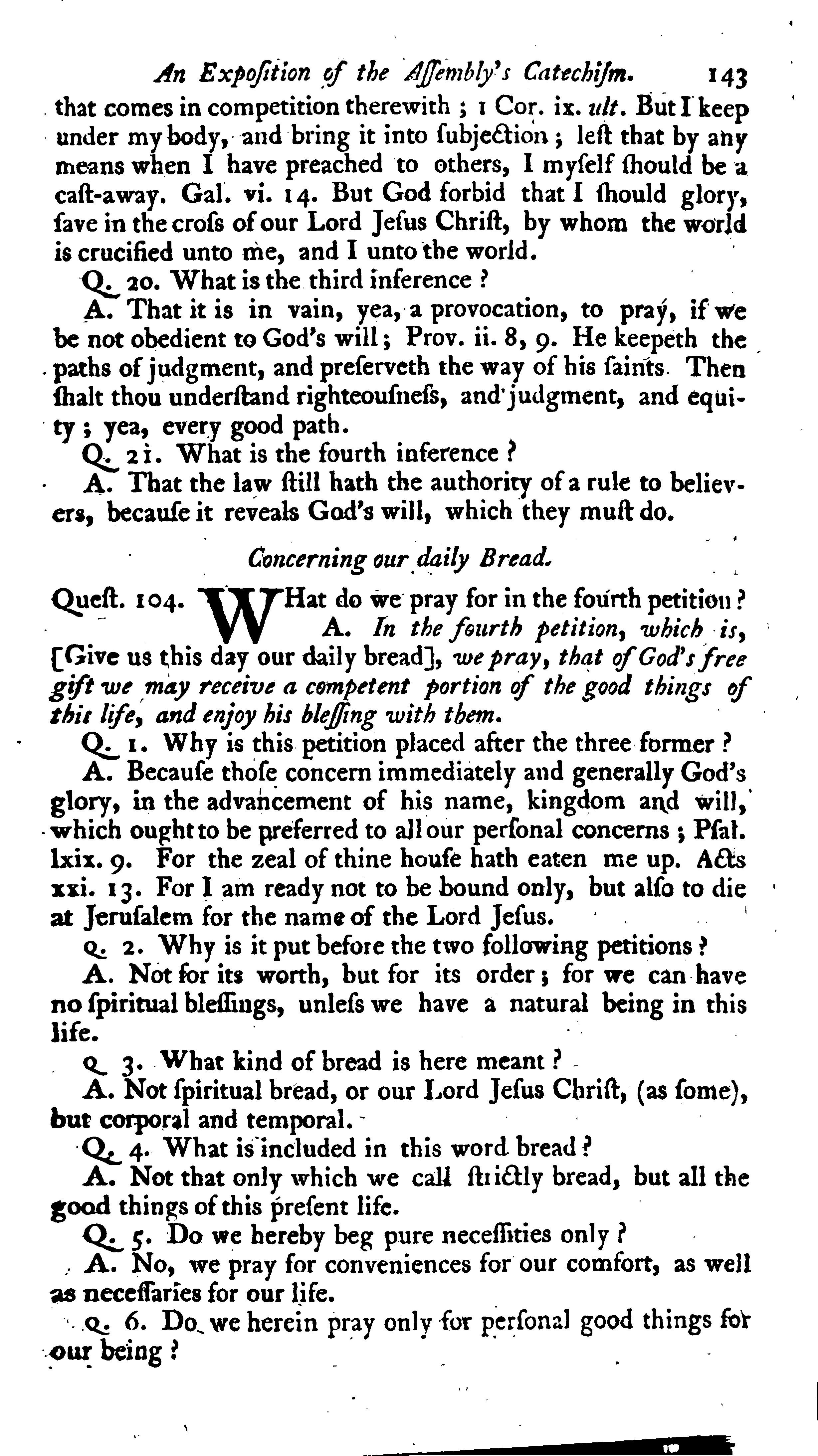
that comes in competitiontherewith ; 1 Cor. ix. ult. But I keep under mybody, and bring it into subjection ; left that by any means when I have preached to others, I myself should be a cast-away. Gal. vi. 14. But God forbid that I should glory, fave in the cross of our Lord Jesus Christ, by whom the world is crucified unto me, and I untotheworld.
Q. 20. What is the third inference ?
A. That it is in vain, yea, a provocation, to pray, if we be not obedient to God's will; Prov. ii. 8, 9. He keepeth the paths of judgment, andpreserveth the way of his saints . Then shalt thou understand righteousness, and judgment, and equity ; yea, every good path .
Q. 21. What is the fourth inference?
A. That the law still hath the authority ofa rule to believers, because it reveals God's will, which they must do.
Concerningourdaily Bread.
W Hat do we pray for in the fourth petition ?
Quest. 104.
A. In the fourth petition, which is, [Give us this day our daily bread], we pray, that of God'sfree gift we may receive a competent portion of the good things of this life, and enjoy his blessing with them.
Q. 1. Why is this petition placed after the three former ?
A. Because those concern immediately and generally God's glory, in the advancement of his name, kingdom and will, which ought to be preferred to all our personal concerns ;Psal. lxix. 9.
For the zeal of thine house hath eaten me up. Acts xxi . 13. For I am ready not to be bound only, but also to die at Jerusalem for the name of the Lord Jesus.
Q. 2. Why is it put before the two following petitions ?
A. Not for its worth, but for its order ; for we can have no spiritual blessings, unless we have a natural being in this life.
3. What kind of bread is here meant ?
A. Not spiritual bread, or our Lord Jesus Christ, (as some), but corporal and temporal.
Q. 4. What is included in this word bread ?
A. Not that only which we call strictly bread, but all the good things of this present life.
Q. 5. Do we hereby beg pure necessities only ?
A. No, we pray for conveniences for our comfort, as well asneceffaries for our life.
Q. 6. Do we herein pray only for personal good things for our being?
An Exposition of the Assembly's Catechism.
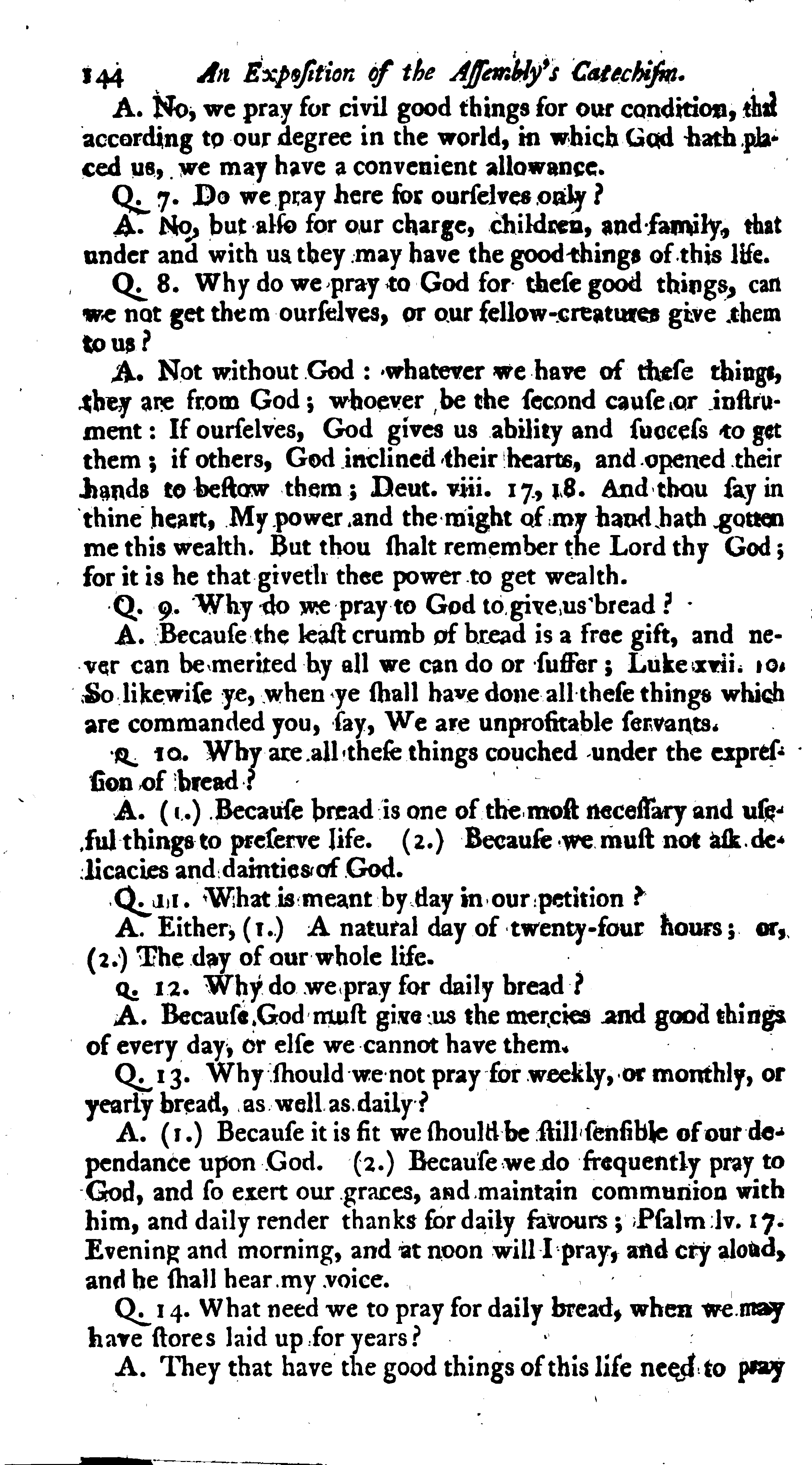
A.No,we pray for civil goodthingsfor our condition, that according to our degree in the world, in which God hathplacedus,we may have a convenient allowance.
Q. 7. Do we pray here for ourselves only ?
A. No, but also for our charge, children, and family, that under and with us they may have the good things of this life.
Q. 8. Why do we pray to God for these good things, can we not get them ourselves, or our fellow-creatures give them to us?
A. Not without God: whatever we have of these things, they are from God; whoever be the second cause or instrument: If ourselves, God gives us ability and success to get them ; if others, God inclined their hearts, and opened their hands to bestow them; Deut. viii. 17, 18. And thou say in thine heart, My power and the might of my hand hath gotten me this wealth . But thou shalt remember the Lord thy God; for it is he that giveth thee power to get wealth.
Q. 9. Why do we pray to God to give us bread ?
A. Because the least crumb of bread is a free gift, and never can bemerited by all we can do or suffer ; Lukexvii. 10.
So likewise ye, when ye shall have done allthesethings which are commanded you, say, We are unprofitable servants.
Q10. Why are all these things couched under the expref fion of bread ?
A. (1.) Because bread is one of the most necessaryandusefulthings to preserve life.
(2.) Because we must not ask delicacies and dainties of God.
Q.I. What is meant by day in our petition ?
A. Either, (1.) A natural day of twenty-four hours ; or, (2.) The day of our whole life.
Q. 12. Why do we pray for daily bread ?
A. Because God must give us the mercies and good things of every day, or else we cannot have them.
Q.13. Why should we not pray for weekly, or monthly, or yearly bread, as well as daily?
A. (1.) Because it is fit we should be still sensible ofourdependance upon God.
(2.) Because we do frequently pray to God, and so exert our graces, and maintain communion with him, and daily render thanks for daily favours ; Psalm.lv. 17.
Evening and morning, and at noon will I pray, andcryaloud, and he shall hear my voice.
Q. 14. Whatneedwe toprayfordailybread,whenwemay have stores laid up for years ?
A. They that have the good things of this life need to pray
An Exposition of the Assembly's Gatechism.
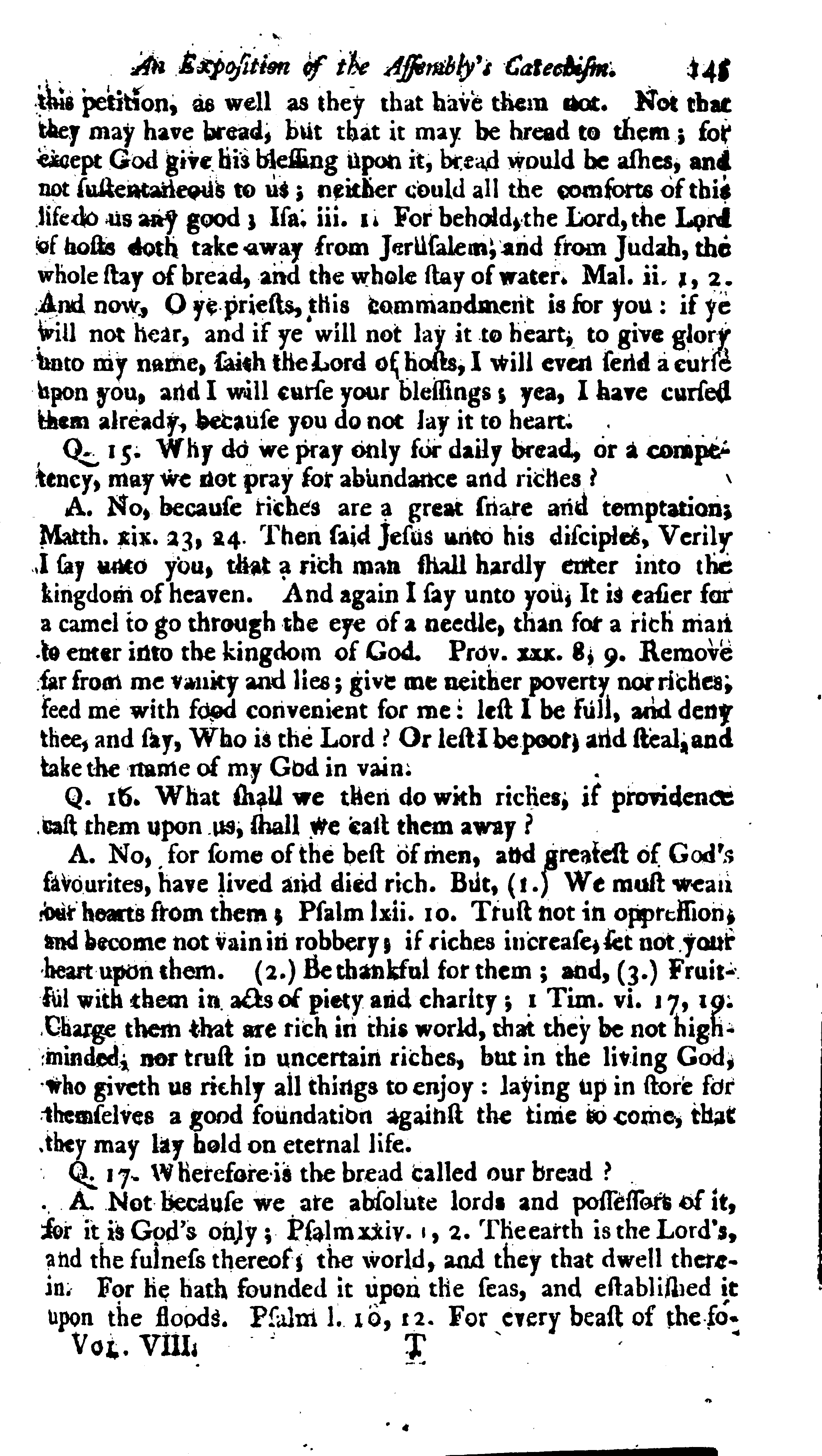
this petition, as wel well as they that have them not. Not that theymayhavebread, but that it may be bread to them; for except God give his blessing upon it,breadwouldbe ashes, and not sustentaneous to us ; neither could all the comforts of this life do us any good; Ifa. iii. 1. For behold,the Lord,the Lord of hosts doth take away from Jerüsalem,and from Judah, the wholestayofbread, and the whole stay of water. Mal. ii. 1, 2 .
And now, Oye priests, this commandment is for you: ifye will not hear, and ifye will not lay it to heart, to give glory untomyname, faith the Lord of hosts, I will even sendacurfe upon you, and I will curse your blessings ; yea, I have cursed them already, because you do not lay it to heart.
Q. 15. Why do we pray only for daily bread, or a competency,may we not pray for abundance and riches ?
A. No, because riches are a great snare and temptation; Matth. xix. 23, 24. Then said Jesus unto his disciples, Verily
I lay unto you, that a rich man shall hardly enter into the kingdom of heaven. And again I say unto you, It is easier for a camel togothroughthe eye ofa needle, than for a richman to enter intothekingdom of God.
Prov. xxx. 8, 9. Remove far from me vanity and lies;give me neither poverty nor riches, feed me with food convenient for me: lest I be full, and deny thee, and say,Who is the Lord ? Or lest I be poor, and steal,and takethenameofmyGodin vain.
Q. 16. What shall we then do with riches, if providence caftthem upon us, shall we cast them away ?
A. No, for some of the best of men, and greatest of God's favourites,have lived and died rich. But, (1.) We must we an our hearts from them; Pfalmlxii. 10. Trust not in oppression, andbecomenotvainin robbery; if riches increase, set not your heartuponthem.
(2.)Be thankful for them ; and, (3.) Fruitsülwith them in acts of piety and charity ; 1 Tim. vi. 17, 19.
Charge them that are rich in this world, that they be not high minded, nor trust in uncertain riches, but in the living God, who giveth us richly all things to enjoy: laying up in store for themselves a good foundation against the time to come, that they may lay hold on eternal life.
Q. 17. Wherefore is the bread called our bread ?
A. Not because we are absolute lords and possessors of it, for it is God's only ; Pfalmxxiv.1, 2. The earth is the Lord's, and the fulness thereof; the world, and they that dwell therein.
For he hath founded it upon the seas, and established it upon the floods. Psalm 1. 10, 12. For every beast of thefo
VOL . VIII.
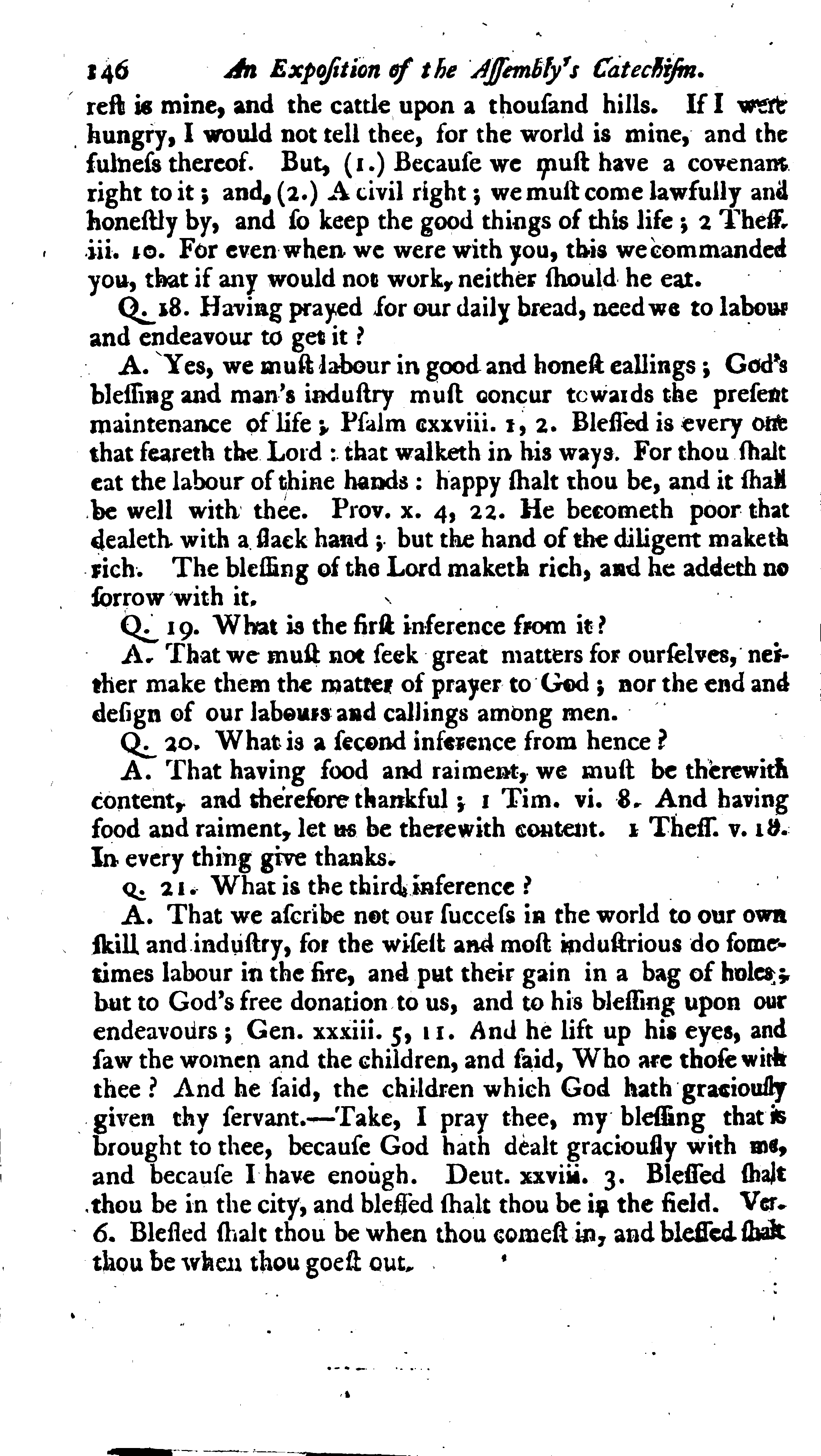
An Exposition of the Assembly's Catechism. reft is mine, and the cattle upon a thousand hills.
If I were hungry, I would nottellthee, for the world is mine, and the fulness thereof.
But, (1.) Because we must have a covenant right to it ; and,(2.)A civil right; wemustcome lawfully and honestly by, and so keep the good things of this life ; 2Theff. iii. 10. For even when we were with you, this we commanded you, that if any would not work, neither should he eat.
Q. 18. Having prayed for ourdailybread,need we to lab our and endeavour to get it ?
A. Yes, we must labour in good and honest callings ; God's bleffingand man's industry must concur towards the present maintenance of life ; Psalm cxxviii. 1, 2. Blessed is every one that feareth the Lord:thatwalketh in his ways. For thou shalt eat the lab our ofthinehands : happy shalt thou be, and it shall be well with thee. Prov. x. 4, 22. He becometh poor that dealeth with a flackhand; but the hand of the diligent maketh rich.
The blessing of the Lordmaketh rich, and he addeth no sorrow with it.
Q. 19. What is the first inference from it?
A. That we must not seek great matters for ourselves, neither make them the matter of prayer to God ; nor the end and design of our labours and callings among men.
Q. 20. What is a second inference from hence ?
A. That having food and raiment, we must be therewith content, andthereforethankful ; 1 Tim. vi. 8. And having food and raiment, let us be therewith content.
1 Theff. v. 18.
In every thing give thanks.
Q. 21. What is the third inference ?
A. That we ascribe not our success in the world to our own skill and industry, for the wisest and most industrious do sometimes labour in the fire, and put their gain in a bag of holes; but to God's free donation to us, and to his blessing upon our endeavours ; Gen. xxxiii. 5, 11. And he lift up his eyes, and saw the women and the children, and said, Who are those with thee ? And he said, the children which God hath graciously given thy servant.-Take, I pray thee, my blessing that is brought to thee, because God hath dealt graciously with me, and because I have enough.
Deut. xxviii. 3. Blessed shalt thou be in the city, and blessed shalt thou be in the field. Ver.
6. Blefled shalt thou be when thou comest in, and blessed shalt thoubewhen thou goeft out.