
Of perfection at death, 3
An Exposition of the Assembly's Catechism.
have wrought, but that we receive a full reward. 1 Cor. x. 12.
Wherefore let him that thinketh he standeth, take heed left he fall.
Q. 12. What is the last instruction ?
A. Let no true Christian be discouraged, how weak soever, for God is able to make him stand ; Rom. xv. 4. Who art thou that judgest another man's servant ? To his own master he standeth or falleth ; yea, he shall be holden up, for God is able to make him stand.
Of Perfection at Death .
W Hat benefits do believers receive from Christ Quest. 37. at their death ?
A. The souls of believers are at their death made perfect in holiness, and do immediately pass into glory ; and their bodies being still united to Christ, do rest in their graves till the resurrection .
Q. 1. What is the state of perfect holiness ?
A. It consists in a perfect freedom from fin, or the least inclinations to fin ; Eph. v. 27.
That he might present it to himself a glorious church, not having spot or wrinkle, or any such thing ; but that it should be holy and without blemish.
Q. 2. Wherein else doth perfection consist ?
A. It consists in the attainment of the highest measures and degrees of holiness the creature is capable of ; Eph. iv. 12, 13.
For the perfecting of the saints, Till we all come in the unity of the faith, and of the knowledge of the Son of God, unto aperfectman, unto the measure of the stature of the fulness of Christ.
Q. 3. Cannot this be attained whilst in the body?
A. No, for here all our graces are imperfect ; 2 Cor. xiii. 12 .
For now we fee through a glass darkly; but then face to face.
And we live at a distance from God ; 2 Cor. v. 6. Whilst we are at home in the body, we are absent from the Lord.
Q. 4. How is this attained at death ?
A. At death the roots of fin are pulled up out of the believer's nature ; Heb. xii. 23. And to the spirits of just men made perfect.
Q. 5. Why must the soul be made perfect at death ?
A. Because the purity of the heavenly state admits no fin or imperfection ; Rev. xxi. 27. And there shall in no wife enter into it any thing that defileth, neither whatsoever workethabomination, or maketh a lie, but they which are written in the Lamb's book of life.
An Exposition of the Assembly's Catechism.
Q. 6. What is the first inference from hence ?
A. That death should be lovelyanddefirable in the eyes of believers ; Phil . i. 23. Having a desire to depart, and to be with Christ ; which is far better.
Q. 7. What is the second inference ?
A. That God hath provided singular relief for his people that now groan under their sins, and many imperfections ;
Cor. xiii. 12. For now we fee through a glass darkly; but then face to face: Now I know in part ; but then shall I know, even as I am known .
Q. 8. What is the third inference ?
A. That the heavenly state is infinitely above and beyond whatever we enjoy here ; 1 Cor. ii. 9. But as it is written, eye hath not seen, nor ear heard, neither have entred into the heart of man, the things which God hath prepared for them
that love him .
Q. 9. What is the fourth inference ?
A.That believers are but at a small distance from the satisfaction of all their desires ; Rom. xiii. 11. For now is our salvation nearer than when we believed.
Q. 10. What is the fifth inference?
A. That the saints should earnestly pursue that perfection, even in this imperfect state ; Phil. iii. 13 , 14. Brethren, I count not myself to have apprehended ; but this one thing I do, forgetting those things which are behind, and reaching forth to those things which are before, I press towards the mark, for the prize of the high calling of God in Christ Jesus .
Q11 . What is the sixth inference?
A. That death to the saints is better than life ; Phil. i. 21 .
For to me to live is Christ, and to die is gain.
Q. 12. What is the last inference ?
A. That faith is absolutely necessary to entitle us to this perfect state.
Quest. 1 .D Of immediate Glorification.
Oallthat die in Christ immediately pass into glory ?
A. Yes, they do ; Luke xxiii. 43. Today shalt thou be with me in Paradise ; Phil. i. 23. Having a desire to depart, and to be with Christ.
Q. 2. What is the first reason for their immediate glorification?
A. Because heaven is prepared and ready for them ; Matth. xxv. 34. Come, ye blessed of my Father, inherit the kingdom prepared for you from the foundation of the world.
An Exposition of the Assembly's Catechism.
Q.3 . What is the second reason for it ?
A. Because at death they are as ready for heaven as ever they shall be; John ix. 4. I must work the work of him that sent me, while it is day; the nightcometh,when no man can work.
Q. 4.What is the third reason for it ?
A. Because death else could not be gain, as it is, Phil. i. 21 .
For to me to live is Christ ; and to die, is gain.
Q. 5. What is the fourth reason for it?
A. Because there is the same reason for all, as for any one :
But some are immediately glorified; Luke xxiii. 43. To day shalt thou be with me in Paradise.
Q. 6. What is the fifth reason for it ?
A. Because Christ longs for their coming to him, and they for his enjoyment; and these longings are in vain, if not satisfied; Rev. xxii. 17, 20. And the Spirit, and the bride say,
Come. And let him that heareth, say,Come. And let him that is athirst, come : And whosoever will, let him take the water of life freely. He which testifieth these things, faith,
Surely I come quickly. Amen, Evenfo so come, come,Lord Jesus.
Q. 7. What is the first instruction from hence ?
A. That the apparitions of departed saints ordinarily are but fables: They wander not ; Rev. iii. 12. Him that overcometh, will. I make a pillar in the temple of my God,and he shallgo no more out.
Q. 8. What is the second inference ?
A. That Purgatory is a groundless fable,and invention of men; and the scriptures alledged to countenance it, grofly a bused; 1 Pet. iii. 19. By which also he went and preached unto the spirits in prison.
Q. 9. What is the third inference ?
A. That heaven must needs be a marvellous surprize to believers, how long soever they have conversed with it here.
Q. 10. What is the fourth inference ?
A.The consideration of this should provoke saints to work hard to finish all they have to do on earth ; Ecclef. ix. 10.
Whatsoever thy hand findeth to do, do it with thy might; for there is no work,nor device, nor knowledge, nor wisdom, in the grave, whither thou goest.
Q. 11.What is the fifth inference ?
A. That there is no reason to grieve excessively for departed saints ; I Thes. iv. 14. Evensothem also whichfleep in Jesus, willGodbring with him.
VOL. VIII.
An Exposition of the Assembly's Catechism.
Q. 12. What is the last inference ?
A. That Christless ones are immediately in hell ; Luke xvi.
22, 23. The rich man also died, and was buried; andinhelf he lift up his eyes, being in torments .
Quest. 1 .W Of Rest in the Grave.
HY must believers come to the grave ?
۱ A. Because where sin has been, death by the law must follow ; Rom. v. 12. Wherefore, as by one man finentredinto the world, and death by fin ; and so death passed upon all men, for that all have finned. Rom. viii. 10. And if Christ be in you, the body is dead because off in; but the Spirit is life, because of righteousness .
Q. 2. What is the first privilege of their bodies there ?
A. It is the privilege of their bodies to be there in union with Christ; 1 Thes. iv. 14. Them also which sleep in Jesus, will God bring with him.
Q. 3. What is their second privilege ?
A. Their graves are places ofreft ; not prisons,but beds of reft; Ifa. lvii. 2. He shall enter into peace; they shall rest in their beds, each one walking in his uprightness.
Q. 4. What is the first evil they rest from ?
A. All the toils, and troubles, and afflictions, of this life ; Rev. xiv. 13. They may rest from their labours ; and their works do follow them.
Q. 5. What is the second evil theyrestfrom ?
A. They rest from all perfecutions from men; Job iii. 17.
There the wicked cease from troubling ; and there the weary beat reft.
Q. 6. What is the third evil they reft from ?
A. They reft from fin, never to feel temptation or inclination to fin ; Heb. xii. 23. And to the spirits of just men made perfect .
Q. 7. How long shall the bodies rest in the grave ?
A. Not for ever, but till the day of the resurrection ; Job xix. 26. And though after my skin, worms destroy this body, yet in my flesh shall I fee God.
Q. 8. What is the first inference from hence ?
A. That union with Christ redounds to the singular advantage of the body, as well as the soul ; Rom. viii. 11. But if the Spirit of him that raifedup Jesus from the dead, dwell in you ; he that raised up Christ from the dead, shall also quicken your mortal bodies, by his Spirit that dwelleth in you.
Q.9. What is the second inference ?
An Exposition of the Assembly's Catechisms
A. That death dissolves not the union betwixt Christ and the souls or bodies of his ; Matth. xxii. 32. I am the God of Abraham, and the God of Isaac, and the God ofJacob ; God is nottheGodofthe dead, but of the living.
Q. 10. What is the third inference ?
A. That seeing our bodies are to have so long and so sweet reft in the grave, we should not spare them in God's service now ; 2 Pet. i. 13, 14. Yea, I think it meet, as long as I am in this tabernacle, to stir you up, by putting you in remembrance : Knowing that shortly I must put off this my tabernacle, even as our Lord Jesus Christ hath shewedme.
Q. 11. What is the fourth inference ?
A. That Christians should neither too much fear their own, nor sorrow for others death ; Rom. viii. 38, 39. For I am persuaded, that neither death, nor life, nor angels, nor principalities, nor powers,------nor any other creature, shall be able to separate us from the love of God,which is in Christ Jesus our
Lord.
I Thes. iv. 13. But I would not have you to be ignorant, brethren, concerningthemwhich are asleep, thatye sorrow not, even as others which have no hope..
Of the Resurrection.
S the resurrection a credible doctrine ?
Quest. 1.I A. Yes, it is ; Acts xxvi. 8. Why should it bethought athing incredible with you, that God should raise the dead?
Q. 2. Whythendoth it seem incredible to man ?
A. Because they err, not knowing the scriptures and the power of God ; Markxii. 24. Do ye not therefore err, because yeknow notthefcriptures, nor the power of God ? The powerofGod assures us it maybe so, and the word of God tells it must be fo.
Q. 3. Is it finfulto doubt of the doctrine of the resurrection ?
A. It is not only a fin to doubt it, but an heresy to deny it, it being a fundamental article; Heb. vi. 2. And of the resurrection of the dead. 1 Cor. xv. 13, 14. But if there be no resurrection of the dead, then is Christ not risen ;and if Christ be not risen, then is our preaching vain, and your faith isalsovain.
Q.4. Who must rise again at the resurrection ?
A. All men, good and bad, must rise again ; Acts xxiv. 15.
AndhavehopetowardsGod,which they themselves also allow, that there shall be a resurrection of the dead, both of the just and the unjust. Rev. xx. 12, 13, 14. And I saw the dead, small and great, stand before God, &c.
E 2
An Exposition of the Assembly's Catechism.
Q. 5. What is the first difference betwixt the resurrection ofthejustand unjust ?
A. Saints risebyvirtue of their union with Christ ; Rom. viii. 11. But if the Spirit of him that raised up Jesus from the dead, dwell in you; he that raised up Christ from the dead, shall also quicken your mortal bodies,by his Spirit that dwelleth in you : But the wicked by his power.
Q. 6. What is the second difference?
A. The second and main difference will be in the contrary ends to which they rise , some to life, and some to condemnation; Dan. xii. 2. And many of them that sleep intheduft of the earth shall awake, some to everlasting life, and some to shame, and everlasting contempt.
Q.7. Whatistheglory to which saints bodies shall be raised?
A. In the likeness of Christ's glorious body; Phil. iii. 21.
Who shall change our vile body, that it maybe fashioned like tohisgloriousbody.
Q. 8. What is the first inference from hence ?
A. That everyman should strive to the uttermost to attain to the resurrection of the just ; Phil. iii. 10, 11. That I may know him, and the power of his resurrection, and the fellowship of his sufferings, being made conformableunto his death, ifbyanymeansI might attain to the refurrectionof the dead.
Q. 9. What is the second inference ?
A. Comfort to them that now groan under manifolddistempers, anddeformities of body ; they being made equal to angels ; Mark xii. 25. For when they shall rise from the dead, they neither marry, nor are given in marriage, but areas the angels which are in heaven.
Q. 10. What is the third inference?
A. Get union with Christ by faith, as you expect a joyful resurrection ; John xi. 25. Jesus said unto her, I am the resurrection, and the life ; he that believeth in me, though he were dead, yet shall he live.
Q. 11. What is the fourth inference ?
A. Saints should not fear death ; Gen. xlvi, 3. Fear not to godown intoEgypt.
Q. 12. What is the last inference ?
A. Employ your bodies forgoodnow.
Of Christ's acknowledging Believers.
Quest. 38.What ☑Hat benefit do believers receive from Christ at the resurrection ?
A.At the resurrection believers being raised up in glory,Shall
An Exposition of the Assembly's Catechism.
beopenlyacknowledged, and acquitted in the day of judgment,and made perfectly blessed in thefullenjoyment of God to all eternity.
Q. 1. What is it to be acknowledged by Christ ?
A. It is Christ's owning of the special relation betwixt him and them ; Mat. xxv. 34. Come, ye blessed of my Father, inheritthekingdom prepared for you from the foundation of the world.
Q. 2. Whom will Christ acknowlege for his ?
A. Such as confess Christ now ; Mat. x. 32. Whosoever therefore shall confess me before unen,him will I confess also before my Father which is in heaven.
Q. 3. Before whom will Christ confess them?
A. Before his Father,angelsandmen; Rev. iii.5. He that overcometh, the same shall be cloathed in white raiment, and I will not blot out his name out of the book of life, but I will confess his name before my Father, and before his angels.
Q. 4. Who shall be denied by Chriftin that day?
A. All that now deny Christ, shall be denied by him ; 2Tim. ii. 12. If we deny him, he also will deny us. Tit. i.
16. They profess thattheyknowGod; but in works they deny him, being abominable, and disobedient, and unto every good work reprobate.
Q. 5. Why will Christ openly acknowledge them?
A. To wipe off all aspersions andcensuresthatnoware cast upon them ; Ifaiah Ixvi. 5. Your brethren that hated you, thatcaftyou out for my name's fake, said, Let the Lord be glorified; but he shall appear to your joy, and they shall be ashamed.
Q. 6. What will be the effect of Christ's acknowledgment ?
A. It will put a full end to all doubts, fears, andjealoufies of themselves ; 1 Cor. iv. 3, 4. But with me it is avery small thing that I should be judged of you, or of man'sjudgment; yea, I judge not myownself; forIknownothingbymyself, yet amI notherebyjustified; but he thatjudgeth me, is the Lord.
Q. 7. What other effect will it produce in them ?
A. Joy unspeakable and transcendent : hence called time of refreshing ; Acts iii. 19. When the time of refreshing shall come from the presence of the Lord.
Q. 8. Is this the only time Christ acknowledgeth them ?
A.No ; heacknowledgeththemby his Spirit's testimony now, but that is private in their bosoms ; Rom. viii. 16. The Spirit itselfbearethwitness with our spirits,that we are the children of God.
Q.9. What is the first inferencefromhence ?
An Exposition of the Assembly's Catechism.
A. To warn all how they pass rash cenfures on Christ's servants ; Psal. Ixxiii. 15. IfI fay, I will speak this, behold I shall offend against the generation of thy children.
Q. 10. What is the second inference ?
A. Let none be afraid or ashamed to confess the person, office, or any truth of Christ, for any loss or danger that may threaten them ; Luke xii. 8, 9. Also Isayunto you,Whosoever shall confess me before men, him shall the Son of man also confess before the angels of God.
But he that deniethme before men, shall be denied before the angels of God.
Q. 11. What is the third inference ?
A. Let Christians abound in good works.
Every act of charity for Christ shall be acknowledged by him in the day of judgment ; Matth xxv. 35. For I was anhungred, and ye gave me meat ; I was thirsty, and yegave me drink ; I was a stranger, and ye took me in.
Q. 12. What is the last inference ?
A. Let all Christians love and long for the day of Christ's appearing ; 2 Tim. iv. 8. Henceforth there is laid up for me a crown of righteousness,which the Lord, the righteous Judge, shall give me at that day, and not to me only, but unto them also that love his appearing.
Of Christ's acquitting Believers.
Hat is it to be acquitted by Christ ?
What is A. It is tobedischargedand cleared from all the guilt off in, andpunishmentdue to it by the law, upon the account of Christ's righteousness imputed by God, and Quest. 1. received by faith ; Rom. v. 1. Therefore being justified by faith,we have peace with God through our Lord Jesus Christ.
Rom. viii. 1. There is therefore now no condemnation to them which are in Christ Jesus .
Q. 2. How many ways are believers acquitted ?
A. They are acquitted now in the courtofheaven ; Rom. viii. 33. Who shall lay any thing to the charge of God's elect ?
It is God thatjustifieth. In the court of their own consciences ; 1 John iii. 21. Beloved, if our hearts condemn us not, then have we confidence towards God. And in the day of judgment : both particular, Heb. ix. 27. As it is appointed unto men once to die, but after this the judgment.
And general ; Acts iii. 19. Repent ye therefore, and be converted, that your fins may be blotted out.
Their fins are then blotted out.
Q. 3. How doth Christ's acquittance now, differ from that at judgment ?
A. They differ in respect of publicness; this is secret in
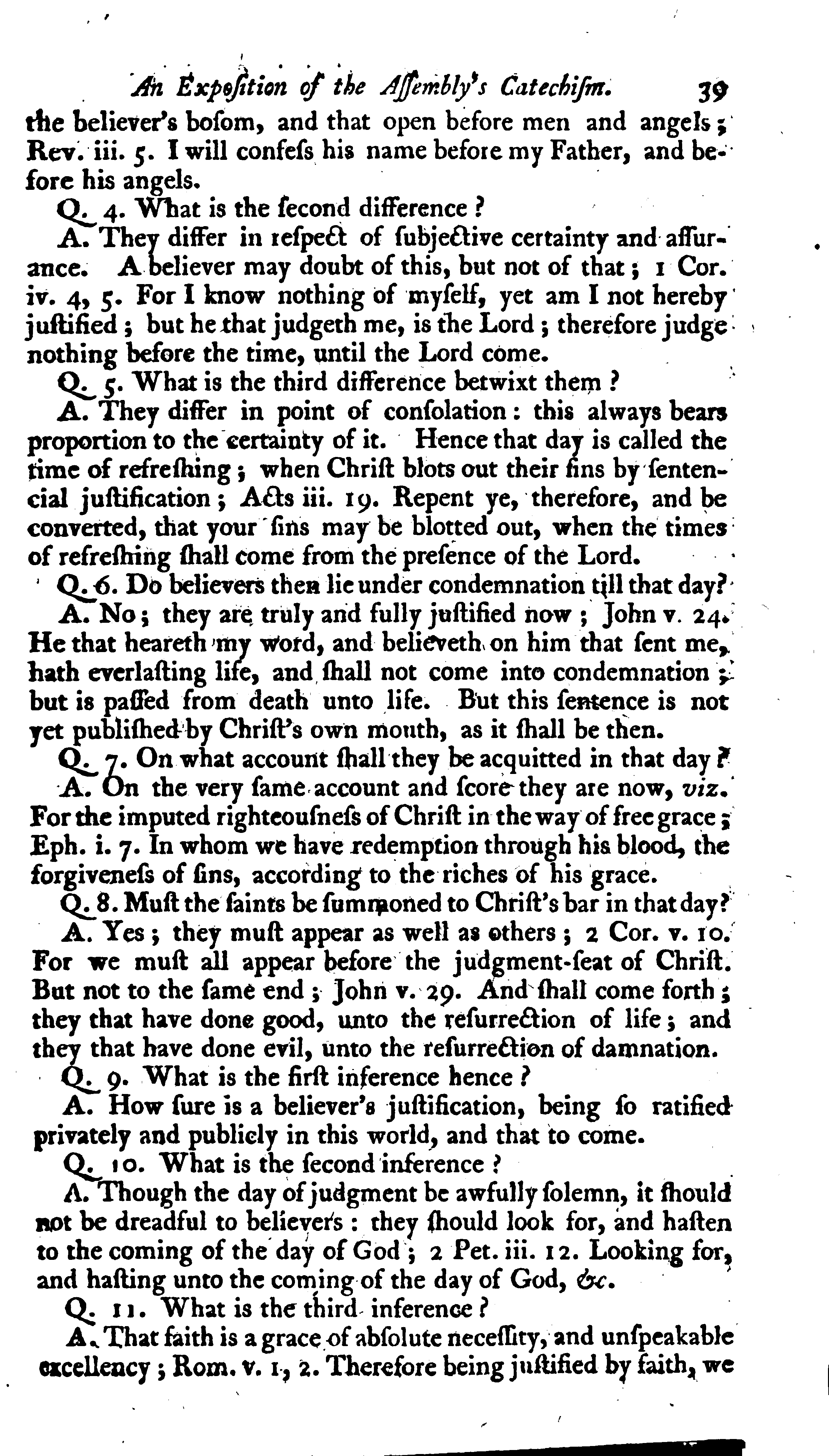
An Exposition of the Assembly's Catechism.
the believer's bosom, and that open before men and angels; Rev. iii. 5. I will confess his name before my Father, and before his angels.
Q. 4. What is the second difference ?
A. They differ in respect of subjective certainty and assurance. A believer may doubt of this, but not of that ; 1 Cor. iv. 4, 5. For I know nothing of myself, yet am I not hereby justified; buthethatjudgethme, is the Lord ; therefore judge nothing before the time, until the Lord come.
Q. 5. What is the third difference betwixt them ?
A. They differ in point of consolation : this always bears proportion to the certainty of it.
Hence that day is called the timeofrefreshing; when Christ blotsout their finsby sentencial justification ; Acts iii. 19. Repent ye, therefore, and be converted, that your fins may be blotted out, when the times of refreshing shall come from the presence of the Lord.
Q.6. Do believers then lie under condemnationtillthatday?
A. No; they are truly and fully justified now ; Johnv. 24.
He that heareth my word, and believeth on him that sent me, hath everlasting life, and shall not come into condemnation; but ispaffed from death unto life. But this sentence is not yet published by Christ's own mouth, as it shall be then.
Q. 7. On what account shall they be acquitted in that day?
A. On the very fame account and score they are now, viz.
Fortheimputedrighteousness of Christ in the way offreegrace ; Eph. i. 7. In whom we have redemption through his blood, the forgiveness of sins, according to the riches of his grace.
Q.8.Must the faintsbesummonedto Christ'sbar in that day?
A. Yes ; they must appear as well as others ; 2 Cor. v. 10.
For we must all appear before the judgment-feat of Christ.
But not to the same end; John v. 29. And shall come forth ; they that have done good, unto the resurrection of life ; and they that have done evil, unto the refurrectionofdamnation .
Q. 9. What is the first inference hence ?
A. How sure is a believer's justification, being so ratified privately and publicly in this world, and that to come.
Q. 10. What is the second inference ?
A. Though thedayofjudgmentbe awfullyfolemn, it should not be dreadful to believers : they should look for, andhaften tothecomingofthe day of God ; 2 Pet. iii. 12. Looking for, and hasting unto the coming of the day of God, &c.
Q. 11. What is the third inference ?
A. That faith is a grace of absolute necessity, and unspeakable excellency ;Rom.v. 1, 2.Therefore being justifiedbyfaith,we
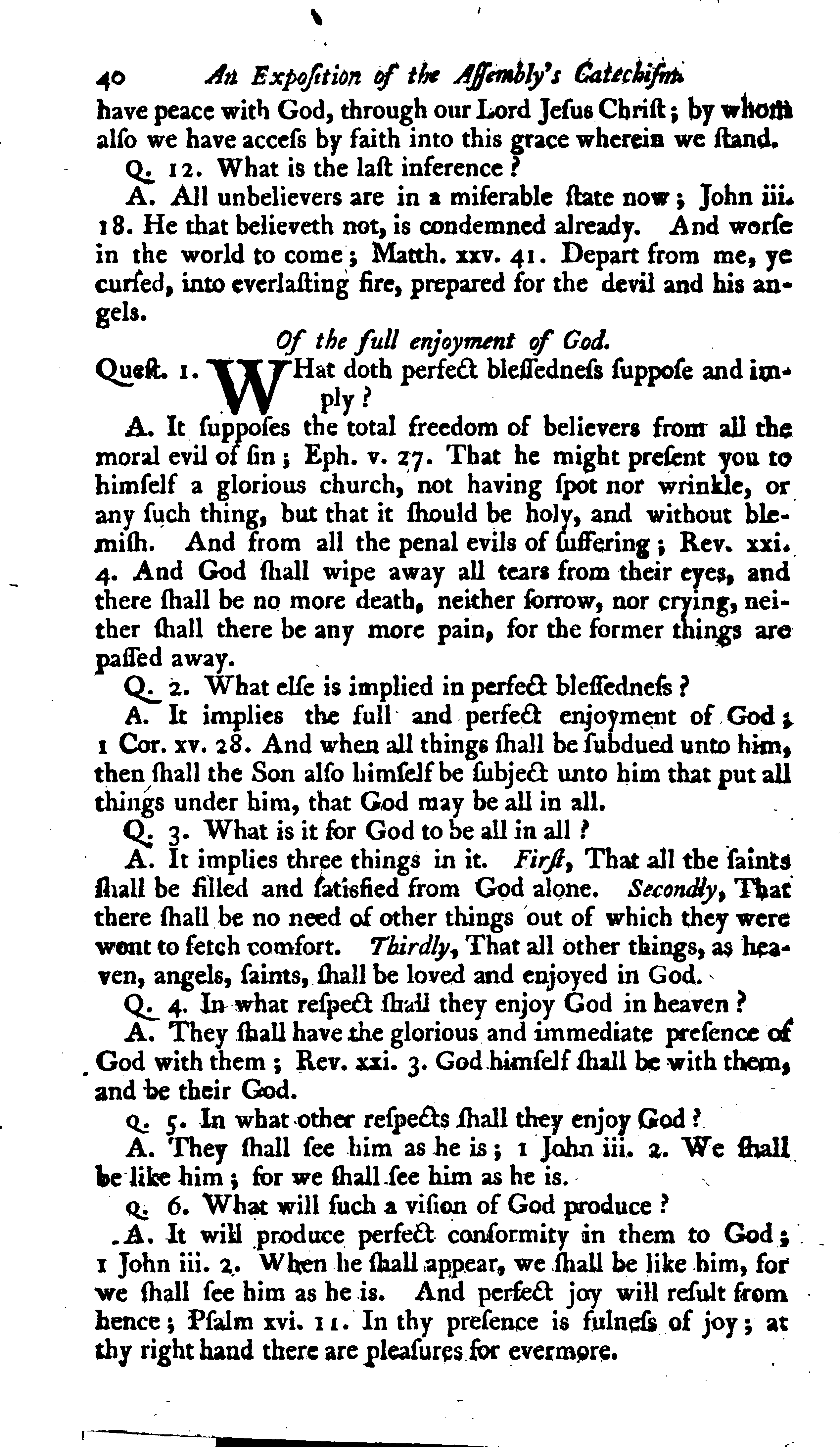
An Exposition of the Assembly's Catechism. havepeacewithGod, through our Lord Jesus Christ ; by whom also we have access by faith into this grace wherein we stand.
Q. 12. What is the last inference?
A. All unbelievers are in a miserable state now ; John iii.
18. He that believeth not,is condemned already. And worse in the world to come ; Matth. xxv. 41. Depart from me, ye cursed, into everlasting fire, prepared for the devil and his angels.
Of the full enjoyment of God.
Hat doth perfect blessedness suppose and imQuest. 1. What do?
A. It supposes the total freedom of believers from all the moral evil of fin ; Eph. v. 27. That he might present you to himself a glorious church, not having spot nor wrinkle, or any such thing, but that it should be holy, and without blemish. And from all the penal evils of suffering ; Rev. xxi.
4. And God shall wipe away all tears from their eyes, and there shall be no more death, neither sorrow, nor crying, neither shall there be any more pain, for the former things are passed away.
Q. 2. What else is implied in perfect blessedness ?
A. It implies the full and perfect enjoyment of God; 1 Cor. xv. 28. And when all things shall be fubdueduntohim, then shall the Son also himself be subject unto him that put all things under him, that God may be all in all.
Q. 3. What is it for God to be all in all ?
A. It implies three things in it.
First, That all the saints shall be filled and satisfied from God alone.
Secondly, That there shall be no need of other things out of which they were wonttofetch comfort.
Thirdly, That all other things, as heaven, angels, saints, shall be loved and enjoyed in God.
Q. 4. In what respect shall they enjoy God in heaven?
A. They shallhavetheglorious and immediate prefenceof God with them ; Rev. xxi. 3.God himself shall be with them, and be their God.
Q. 5. In what other respects shall they enjoy God ?
A. They shall see him as he is ; 1 John iii. 2. We shall be like him ; for we shall fee him as he is.
Q. 6. What will such a vision of God produce?
A. It will produce perfect conformity in them to God; I John iii. 2. When he shall appear, we shall be like him, for we shall see him as he is. And perfect joy will result from hence; Psalm xvi. 11. In thy presence is fulness of joy; at thyrighthand therearepleasures for evermore.