
HOMILY 51
HOMILY 51
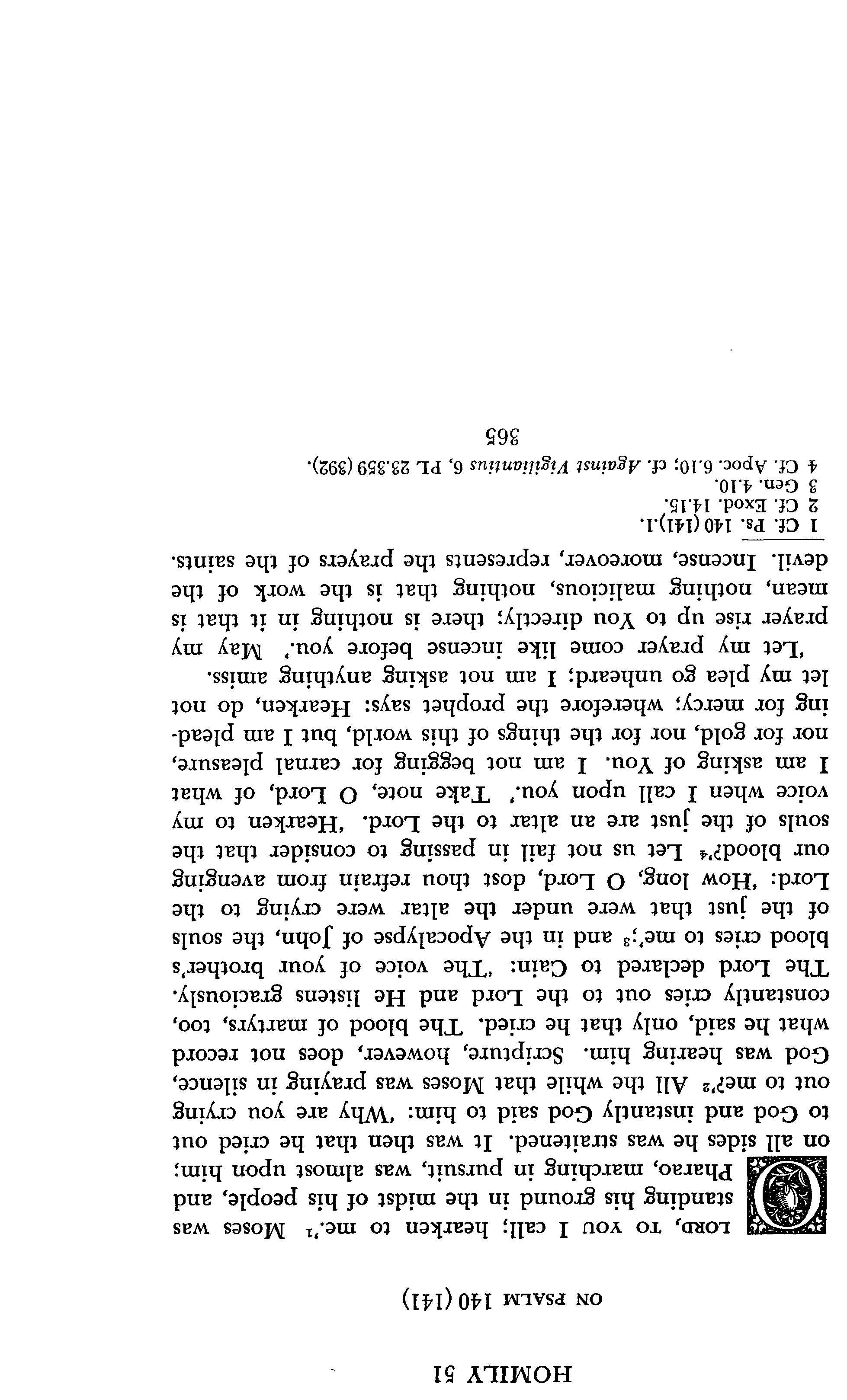
ON PSALM 140 (141)
LORD, TO YOU I call; hearken to me.'l Moses was standing his ground in the midst of his people, and Pharao, marching in pursuit, was almost upon him; on all sides he was straitened. It was then that he cried out to God and instantly God said to him: 'Why are you crying out to me?'2 All the while that Moses was praying in silence,
God was hearing him. Scripture, however, does not record what he said, only that he cried. The blood of martyrs, too, constantly cries out to the Lord and He listens graciously.
The Lord declared to Cain: 'The voice of your brother's blood cries to me';3 and in the Apocalypse of John, the souls of the just that were under the altar were crying to the Lord: 'How long, 0 Lord, dost thou refrain from avenging our blood?'4 Let us not fail in passing to consider that the souls of the just are an altar to the Lord. 'Hearken to my voice when I call upon you.' Take note, 0 Lord, of what
I am asking of You. I am not begging for carnal pleasure, nor for gold, nor for the things of this world, but I am pleading for mercy; wherefore the prophet says: Hearken, do not let my plea go unheard; I am not asking anything amiss.
'Let my prayer come like incense before you: May my prayer rise up to You directly; there is nothing in it that is mean, nothing malicious, nothing that is the work of the devil. Incense, moreover, represents the prayers of the saints.
I Cf. Ps. 140 (141 ).1.
2 Cf. Exod. 14.15.
3 Gen. 4.10.
4 Cf. Apoc. 6.10; d. Against Vigiliantius 6, PL 23.359 (392).
SAINT JEROME
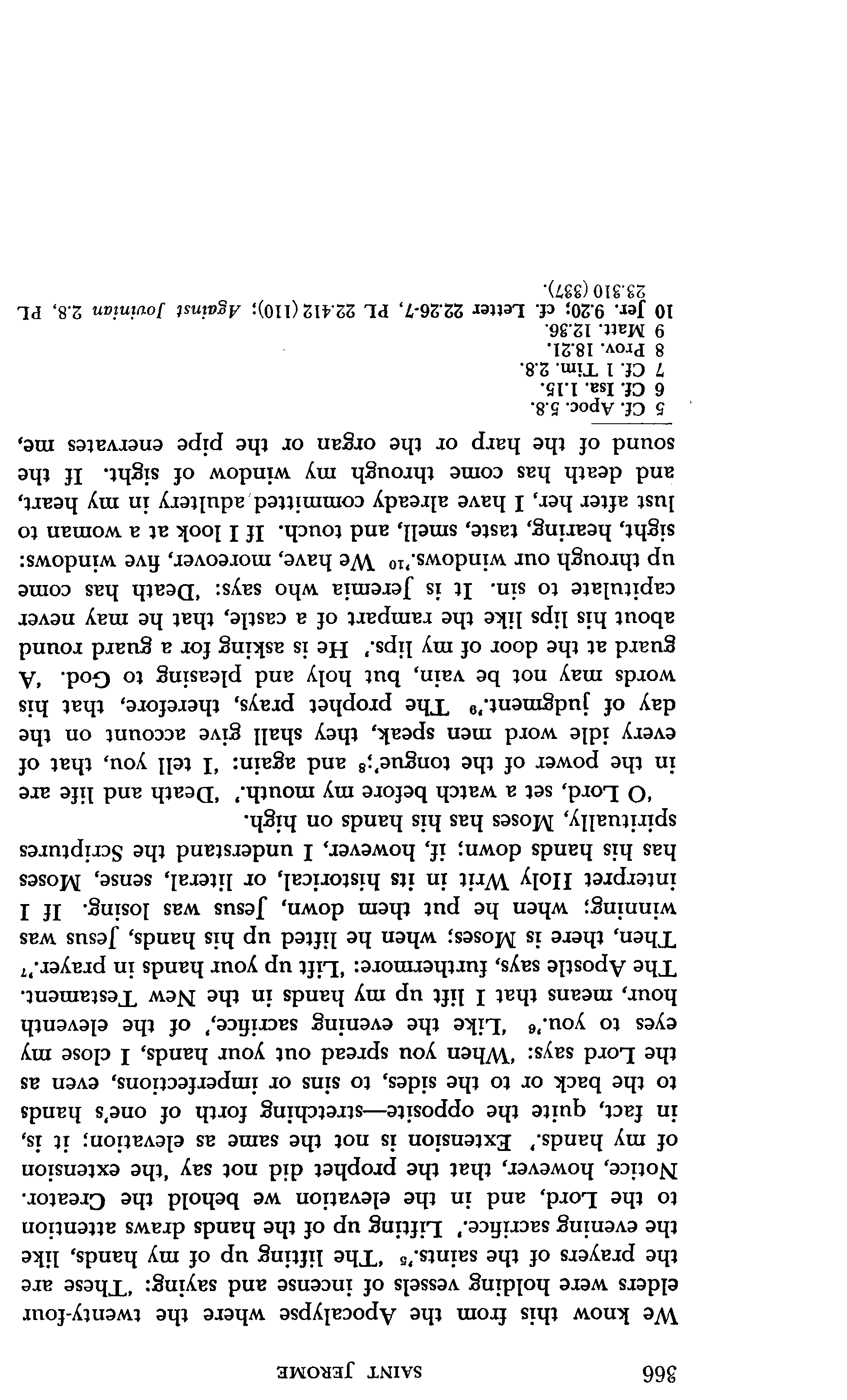
We know this from the Apocalypse where the twenty-four elders were holding vessels of incense and saying: 'These are the prayers of the saints.'5 'The lifting up of my hands, like the evening sacrifice.' Lifting up of the hands draws attention to the Lord, and in the elevation we behold the Creator.
Notice, however, that the prophet did not say 'the extension of my hands.' Extension is not the same as elevation; it is, in fact, quite the opposite-stretching forth of one's hands to the back or to the sides, to sins or imperfections, even as the Lord says: 'When you spread out your hands, I close my eyes to yoU.'6 'Like the evening sacrifice,' of the eleventh hour, means that I lift up my hands in the New Testament.
The Apostle says, furthermore: 'Lift up your hands in prayer.'7
Then, there is Moses; when he lifted up his hands, Jesus was winning; when he put them down, Jesus was losing. If I interpret Holy Writ in its historical, or literal, sense, Moses has his hands down; if, however, I understand the Scriptures spiritually, Moses has his hands on high.
'0 Lord, set a watch before my mouth.' 'Death and life are in the power of the tongue';8 and again: 'I tell you, that of every idle word men speak, they shall give account on the day of judgment.'9 The prophet prays, therefore, that his words may not be vain, but holy and pleasing to God. 'A guard at the door of my lips.' He is asking for a guard round about his lips like the rampart of a castle, that he may never capitulate to sin. It is Jeremia who says: 'Death has come up through our windows.'lo We have, moreover, five windows: sight, hearing, taste, smell, and touch. If I look at a woman to lust after her, I have already committed adultery in my heart, and death has come through my window of sight. If the sound of the harp or the organ or the pipe enervates me,
5 Cf. Apoc. 5.8.
6 Cf. Isa. 1.15.
7 Cf. 1 Tim. 2.8.
8 Provo 18.21.
9 Matt. 12.36.
10 Jer. 9.20; d. Letter 22.26-7. PL 22.412 (110); Against Jovinian 2.8, PL 23.310 (337).
HOMILY 51
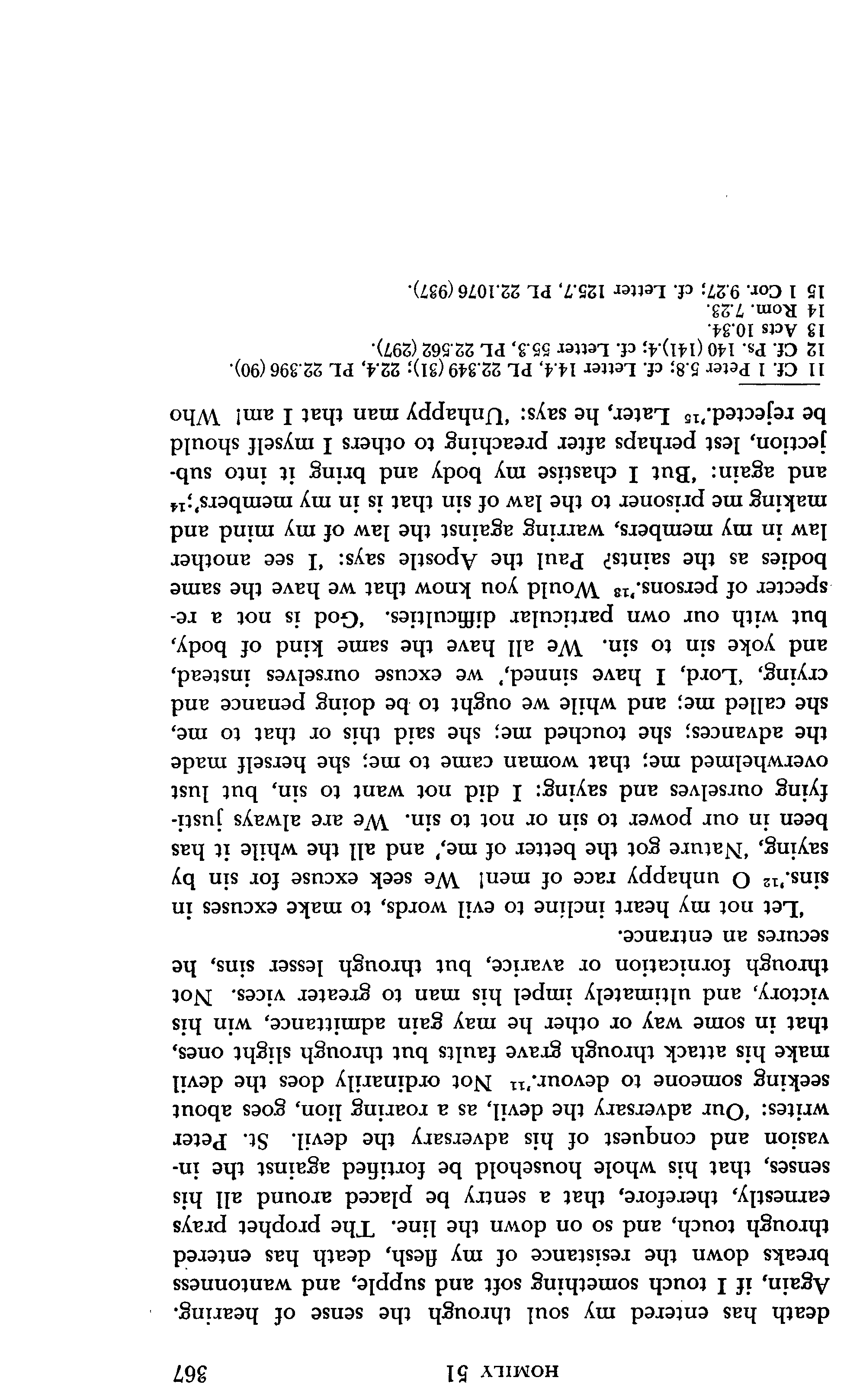
death has entered my soul through the sense of hearing.
Again, if I touch something soft and supple, and wantonness breaks down the resistance of my flesh, death has entere'd through touch, and so on down the line. The prophet prays earnestly, therefore, that a sentry be placed around all his senses, that his whole household be fortified against the invasion and conquest of his adversary the devil. St. Peter writes: 'Our adversary the devil, as a roaring lion, goes about seeking someone to devour.'ll Not ordinarily does the devil make his attack through grave faults but through slight ones, that in some way or other he may gain admittance, win his victory, and ultimately impel his man to greater vices. Not through fornication or avarice, but through lesser sins, he secures an entrance.
'Let not my heart incline to evil words, to make excuses in sins.'12 0 unhappy race of men! We seek excuse for sin by saying, 'Nature got the better of me,' and all the while it has been in our power to sin or not to sin. We are always justifying ourselves and saying: I did not want to sin, but lust overwhelmed me; that woman came to me; she herself made the advances; she touched me; she said this or that to me, she called me; and while we ought to be doing penance and crying, 'Lord, I have sinned,' we excuse ourselves instead, and yoke sin to sin. We all have the same kind of body, but with our own particular difficulties. 'God is not a respecter of persons.'18 Would you know that we have the same bodies as the saints? Paul the Apostle says: 'I see another law in my members, warring against the law of my mind and making me prisoner to the law of sin that is in my members';14 and again: 'But I chastise my body and bring it into subjection, lest perhaps after preaching to others I myself should be rejected.'15 Later, he says: 'Unhappy man that I am! Who II Cf. 1 Peter 5.8; cf. Letter 14.4, PL 22.349 (31); 22.4, PL 22.396 (90).
12 Cf. Ps. 140 (141).4; cf. Letter 55.3, PL 22.562 (297).
13 Acts 10.34.
14 Rom. 7.23.
15 1 Cor. 9.27; cf. Letter 125.7, PL 22.1076 (937).
SAINT JERO:\fE
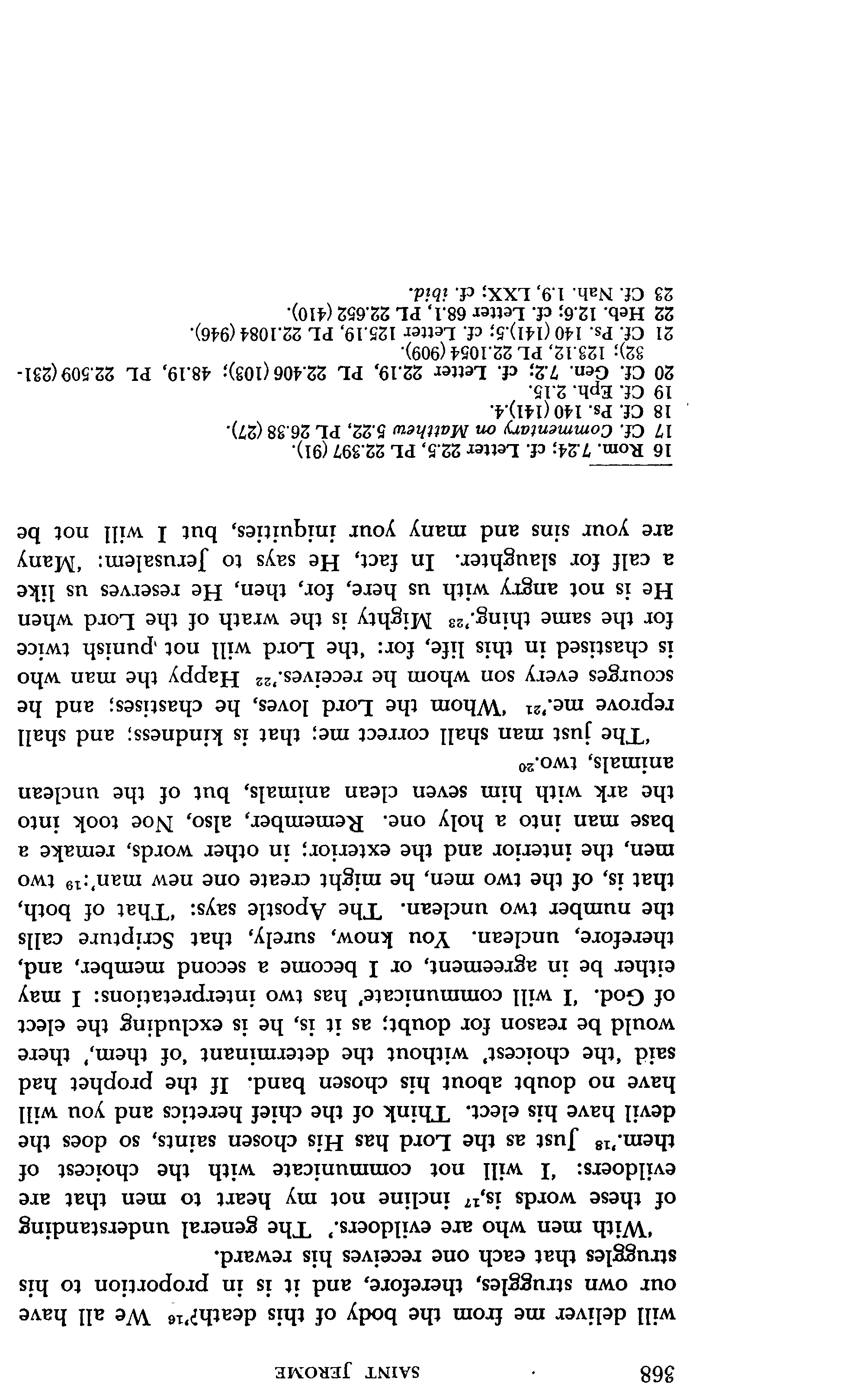
will deliver me from the body of this death?'16 We all have our own struggles, therefore, and it is in proportion to his struggles that each one receives his reward.
'With men who are evildoers.' The general understanding of these words is,11 incline not my heart to men that are evildoers: 'I will not communicate with the choicest of them.'18 Just as the Lord has His chosen saints, so does the devil have his elect. Think of the chief heretics and you will have no doubt about his chosen band. If the prophet had said 'the choicest' without the determinant 'of them,' there would be reason for doubt; as it is, he is excluding the elect of God. 'I will communicate' has two interpretations: I may either be in agreement, or I become a second member, and, therefore, unclean. You know, surely, that Scripture calls the number two unclean. The Apostle says: 'That of both, that is, of the two men, he might create one new man':19 two men, the interior and the exterior; in other words, remake a base man into a holy one. Remember, also, Noe took into the ark with him seven clean animals, but of the unclean animals, twO.2Q 'The just man shall correct me; that is kindness; and shall reprove me.'21 'Whom the Lord loves, he chastises; and he scourges every son whom he receives.'22 Happy the man who is chastised in this life, for: 'the Lord will not ,punish twice for the same thing.'23 Mighty is the wrath of the Lord when
He is not angry with us here, for, then, He reserves us like a calf for slaughter. In fact, He says to Jerusalem: 'Many are your sins and many your iniquities, but I will not be
16 Rom. 7.24; d. Letter 22.5, PL 22.397 (91).
17 Cf. Commentary on Matthew 5.22, PL 26.38 (27).
18 Cf. Ps. 140 (141).4.
19 Cf. Eph. 2.15.
20 Cf. Gen. 7.2; d. Letter 22.19, PL 22.406 (103); 48.19, PL 22.509 (231-
32); 123.12, PL 22.1054 (909).
21 Cf. Ps. 140 (141).5; cf. Letter 125.19, PL 22.1084 (946).
22 Heb. 12.6; d. Letter 68.1, PL 22.652 (410).
23 Cf. Nah. 1.9, LXX; cf. ibid.
HOMILY 51
vexed with YOU.'24 In other words, when you were only an adulteress, I loved you with a jealous love; but when you had many lovers, I despised you, and I will not be vexed with you. In this same way, a man is jealous of his wife when he loves her; but if he is not jealous, he hates her and does not imitate the words of Him who says: 'I will punish their crime with a rod,'25 but, 'I will not punish your daughters for their harlotry.'26
'The just man shall correct me; that is kindness; and shall reprove me.' Consider in this connection any teacher or father or doctor. If a physician should notice infected and decayed tissue in a body and say, 'What concern is that of mine?' you would conclude rightly that he is cruel; but if he should excise the infected tissues and cauterize the wound, he is compassionate, for he is saving the life of a man. Likewise, a teacher, if he dismisses a lad and does not exact obedience from him, hates him; if, on the other hand, he disciplines him and the remedy cures him, his apparent severity turns out to be clemency. Achab, too, was censured by the Lord when he killed N aboth and took his vineyard and spilled just blood. Elias, the prophet, was sent to him to say: 'Thou hast slain. Moreover also thou hast taken possession.'21 Immediately his conscience smote and tormented him; he bowed his head and walked with eyes downcast; and this is an impious king robed in purple. Afterwards, Scripture says, he went about wearing haircloth under his royal
. attire, and God seeing him said: 'Because Achab hath humbled himself for my sake, I will not bring evil against him.'28 Just realize the power of haircloth, and of fasting, and how much blood is washed away by humble tears! This, then, is the proper way to wear haircloth and the proper way to fast, that no one may observe it. 'Shall correct' may be under24 Cf. Ezech. 16.42; cf. ibid.
25 Ps. 88.33.
26 Osee 4.14.
27 3 Kings 21.19.
28 Cf. 3 Kings 21.29; cf. Letter 147.9, PL 22.1202 (1093).
SAINT JEROME
stood in two different ways: either he will rebuke or he will instruct.
'Let not the oil of the sinner fatten my head:29 '0 my people, they who call you blessed, mislead you:30 The praise of heretics, the balm with which they anoint the heads of men and promise them the kingdom of heaven,31 fattens the head with pride. In Scripture, moreover, anything fat is reprehensible, as it says: 'So Jacob ate his fill, the darling grew fat and frisky; he became fat and gross and gorged.'32 The manna of the angels, on the other hand, is refined and delicate.
'For my prayer will still be against the things with which they are well pleased:33 This means: They, indeed, raged in their madness; but I continued to pray for their conversion.
'Their judges driven against the rock were swallowed Up,'3! just as another passage in Scripture says: 'Happy the man who shall seize and smash your little ones against the rockl'35 'But the rock was Christ:36 'The little ones' are trifling thoughts before they grow into ones of serious consequences. Even heretics, although they seem to despise the simplicity of the Church, as compared to Aristotle and Plato; when they turn to the Scriptures, are swallowed up immediately by the Rock, that is, by Christ, and are converted to Him. 'Swallowed up' stands for victory, as the Apostle says: 'Death is swallowed up in victory! 0 death, where is thy victory? 0 death, where is thy sting?'37 He calls this swallowing up, victory, the victory that is his in engulfing death.
29 Cf. Ps. 140 (141).5.
30 Cf. Isa. 3.12; d. Letter 125.19, PL 22.1084 (947); Against the Pelagians
2.24, PL 23.589 (773); 3.16, PL 23.614 (801).
31 Cf. Commentary on Aggai 1.11, PL 25.1398 (749); on Ecclesiastes 9.8,
PL 23.1140 (463).
32 Cf. Deut. 32.15.
33 Cf. Ps. 140 (141).5.
34 Cf. Ps. 140 (141).6.
35 Ps. 136.9; d. Letter 22.6, PL 22.398 (92); 130.8, PL 22.1114 (985).
36 1 Cor. 10.4; d. Letter 22.6, PL 22.398 (92).
37 1 Cor. 15.54, 55; d. Against John at Jerusalem 36, PL 23.406 (446); Letter 124.5, PL 22.1064 (921).
HOMILY 51
'They heard how powerful were my words.'38 The Lord Himself says: They who came to Me were won over, and they delighted in My words and were converted to Me in My
Church. 'As when a clod of earth.'39 Anything thick and gross is but one degree from earth, and the soul that sins is clinging to earth. From the beginning, the Lord made everything fine and delicate; everyone is coarsened, therefore, by his own vice and is reduced to earth. A wound in the body, for example, is swollen and hard and full of pus, but when the doctor lances it, the swelling goes down, it heals, and the body is restored to its former condition, as it was when first created; hence, the prophet says: 'As when a clod of earth is broken up upon the ground.'
'So our bones are strewn by the edge of the nether world';40 and in the twenty-first psalm the Savior says: 'all my bones are scattered.'41 A literal explanation of this does not square with history since Christ wa.s crucified only, but when you see
Arius and Eunomius outside the Church, realize that the bones of the Lord are strewn by the edge of the nether world.
Bone, because it is strong, typifies the greater and promising men who are seduced by the loquacity, philosophy, and contentions of heretics.
'Keep me from the trap they have set for me.' Heretics or demons are forever setting traps for us. Vice is certainly the next door neighbor to virtue.12 A trap is set for me in almsgiving if I stretch out my hand in order to be seen by men and, while appearing to do a good work, I fall into imperfection and sin. 1£ I give away an undergarment to a brother for the benefit of those who are looking on, a demon has laid a snare for me. Nets are stretched and traps are set wherever the hunter discovers tracks of the deer. The deer, by the way,
:iH Cf. Ps. 140 (:41).6.
'i') Cf. Ps. 140 (141).7: cL C()I/IIIII'II/IlI;,,/i ill p.\'. 140.7.
40 Cf. Ps. 140 (141).7.
41 Cf. Ps. 21.15.
42 Cf. Against the Lucifer;ans If), PL 23.178 (188); Against the Pelagian.\'
3.1l, PL 23.608 (794).
SAINT JEROME
symbolizes the saints, for the deer is a noble animal, has great antlers and kills serpents; hence, another psalm says: 'Who made my feet swift as those of hinds.'48 They say that deer, by the breath of their nostrils, have the power to draw forth serpents from their coverts and feed upon them.44 These same serpents-I mean the demons-place snares for us, therefore, in the very path in which we are striving to walk, that is, in the virtues, in almsgiving, that we may perform these acts to be seen by men and win their vain applause, in fasts, in prayer, in haircloth that we may show off ourselves. The man who wears haircloth ought to be lamenting his sins and not pluming himself in the sight of others. 'From the snares of evildoers': that I may not commit offense.
'Let all the wicked fall into his net.'45 In the previous verse, the prophet said: 'Keep me from the trap they have set for me,' alluding to t!Ie snares of many; now, however, he is referring solely to the trap of one: 'Let all the wicked fall into his net.' Even as the Lord lets down the net and catches a great multitude of fish, and has His apostles as fishermen gather and bring to Him those who through them have faith in Him; so, too, the devil has demons who are subject to him, and who ensnare men and lead them to him. 'I am alone until I go over.'46 Jeremia says: 'I sat alone because you filled me with indignation,'47 meaning, I was full of contrition.
Alone: clean, not the unclean second number. Moses says:
'I must go over to look at this remarkable sight.'4S If he does not go over, that is, if he does not escape all vice, he cannot behold the great marvel. Remarkable, indeed, was that sight, for the bush was ablaze, yet did not burn; the thorns were
43 Ps. 17.34.
44 Cf. Commentary on Jeremia 14.5, PL 24.770 (938); Letter 130,8, PL 22.1114 (985).
45 Cf. Ps. 140 (141).10; cf. Commentarioli in ps. 140.10.
46 Cf. Ps, 140 (141).lO.
47 Cf. Jer. 15.17.
48 Cf. Exod. 3.3.

HOMILY 51
burning, but the thorns were sins. Isaia was cleansed at this fire, for that was the coal that was on the altar and that touched his lips. The prophet David, too, remembered this coal: 'Sharp arrows of the mighty, with fiery coals that lay waste.'49 This is the coal that lays waste; it desolates and purifies.
49 Cf. Ps. 119.4; cf. Against the Pelagians 3.14. PL 23.612 (799).