
HOMILY 19
HOMILY 19
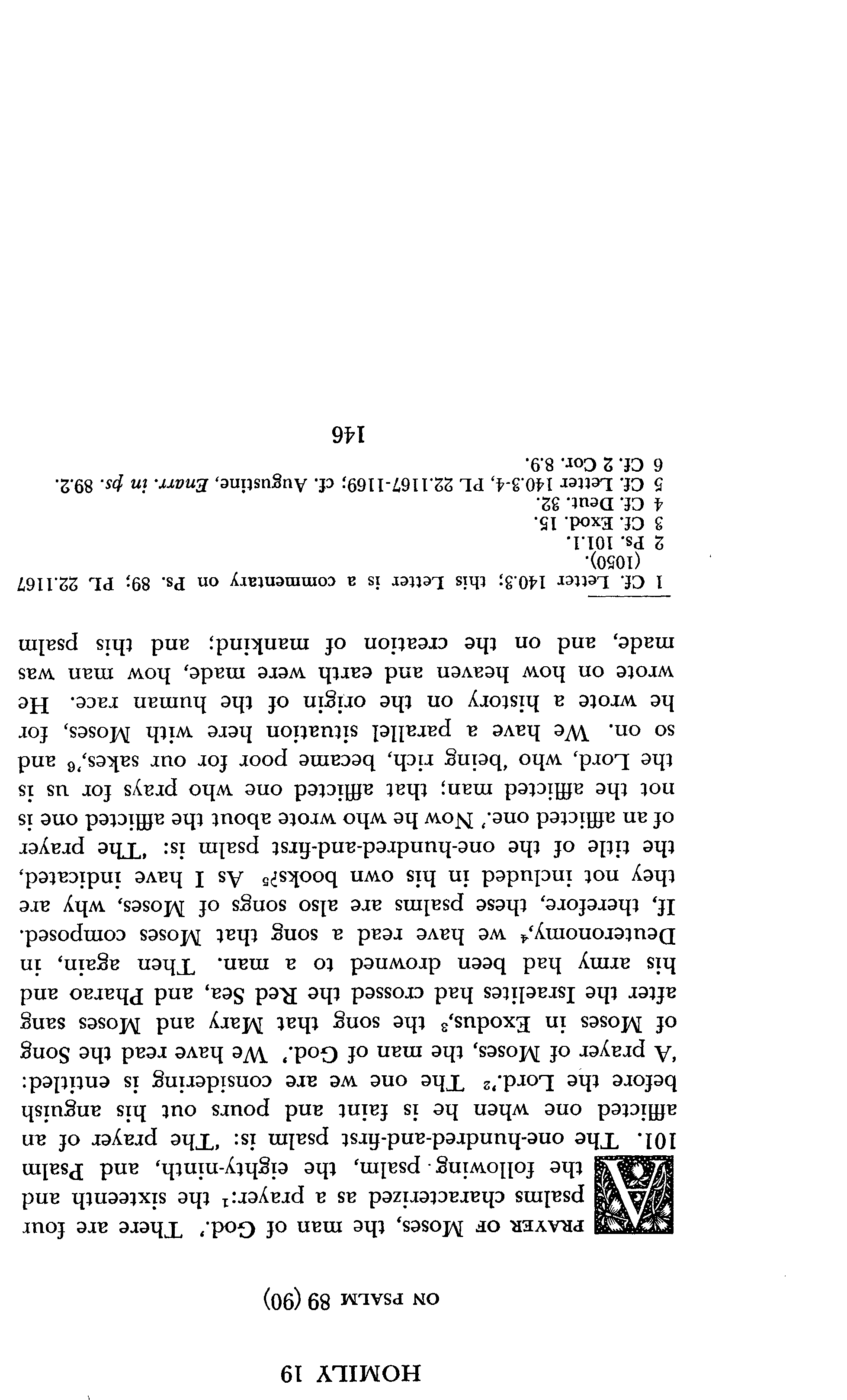
ON PSALM 89 (90)
PRAYER OF Moses, the man of God.' There are four psalms characterized as a prayer: 1 the sixteenth and the following. psalm, the eighty-ninth, and Psalm
101. The one-hundred-and-first psalm is: 'The prayer of an afflicted one when he is faint and pours out his anguish before the Lord.'2 The one we are considering is entitled:
'A prayer of Moses, the man of God.' We have read the Song of Moses in Exodus,s the song that Mary and Moses sang after the Israelites had crossed the Red Sea, and Pharao and his army had been drowned to a man. Then again, in Deuteronomy,4 we have read a song that Moses composed.
If, therefore, these psalms are also songs of Moses, why are they not included in his own books?5 As I have indicated, the title of the one-hundred-and-first psalm is: 'The prayer of an afflicted one.' Now he who wrote about the afflicted one is not the afflicted man; that afflicted one who prays for us is the Lord, who 'being rich, became poor for our sakes,'6 and so on. We have a parallel situation here with Moses, for he wrote a history on the origin of the human race. He wrote on how heaven and earth were made, how man was made, and on the creation of mankind; and this psalm
1 Cf. Letter 140.3; this Letter is a commentary on Ps. 89; PL 22.1167
(1050).
2 Ps. 101.1.
3 Cf. Exod. 15.
4 Cf. Deut. 32.
5 Cf. Letter 140.3-4, PL 22.1167-1169; cf. Augustine, Enarr. in ps. 89.2.
6 Cf. 2 Cor. 8.9.
HOMILY 19
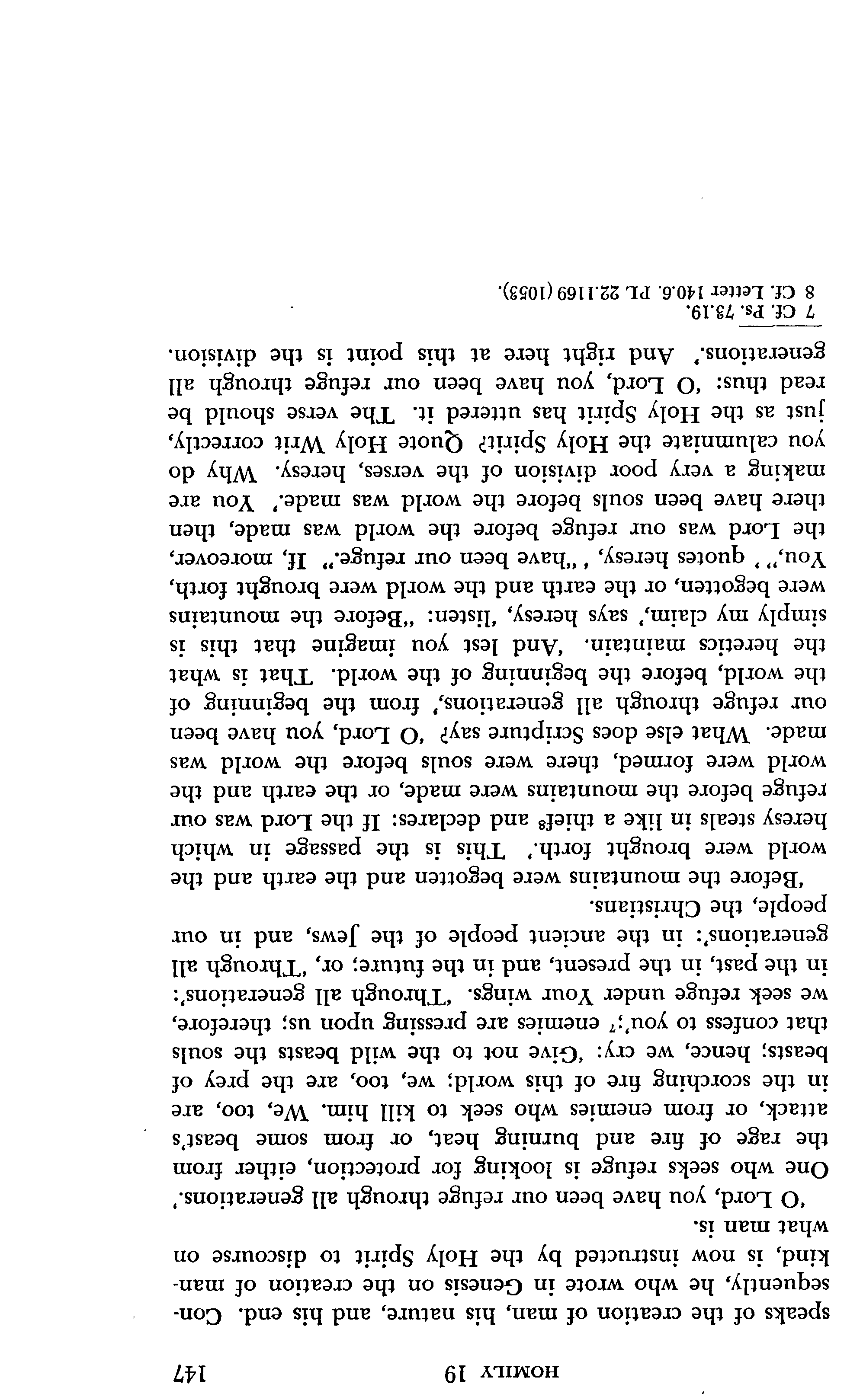
speaks of the creation of man, his nature, and his end. Consequently, he who wrote in Genesis on the creation of mankind, is now instructed by the Holy Spirit to discourse on what man is.
'0 Lord, you have been our refuge through all generations.'
One who seeks refuge is looking for protection, either from the rage of fire and burning heat, or from some beast's attack, or from enemies who seek to kill him. We, too, are in the scorching fire of this world; we, too, are the prey of beasts; hence, we cry: 'Give not to the wild beasts the souls that confess to you';7 enemies are pressing upon us; therefore, we seek refuge under Your wings. 'Through all generations': in the past, in the present, and in the future; or, 'Through all generations': in the ancient people of the Jews, and in our people, the Christians.
'Before the mountains were begotten and the earth and the world were brought forth.' This is the passage in which heresy steals in like a thief8 and declares: If the Lord was our refuge before the mountains were made, or the earth and the world were formed, there were souls before the world was made. What else does Scripture say? '0 Lord, you have been our refuge through all generations,' from the beginning of the world, before the beginning of the world. That is what the heretics maintain. 'And lest you imagine that this is simply my claim,' says heresy, 'listen: "Before the mountains were begotten, or the earth and the world were brought forth,
You," , quotes heresy, ' "have been our refuge." If, moreover, the Lord was our refuge before the world was made, then there have been souls before the world was made.' You are making a very poor division of the verses, heresy. Why do you calumniate the Holy Spirit? Quote Holy Writ correctly, just as the Holy Spirit has uttered it. The verse should be read thus: '0 Lord, you have been our refuge through all generations.' And right here at this point is the division.
7 Cf. Ps. 73.19.
8 Cf. Letter 140.6. PL 22.1 169 (1053).
SAINT JEROME
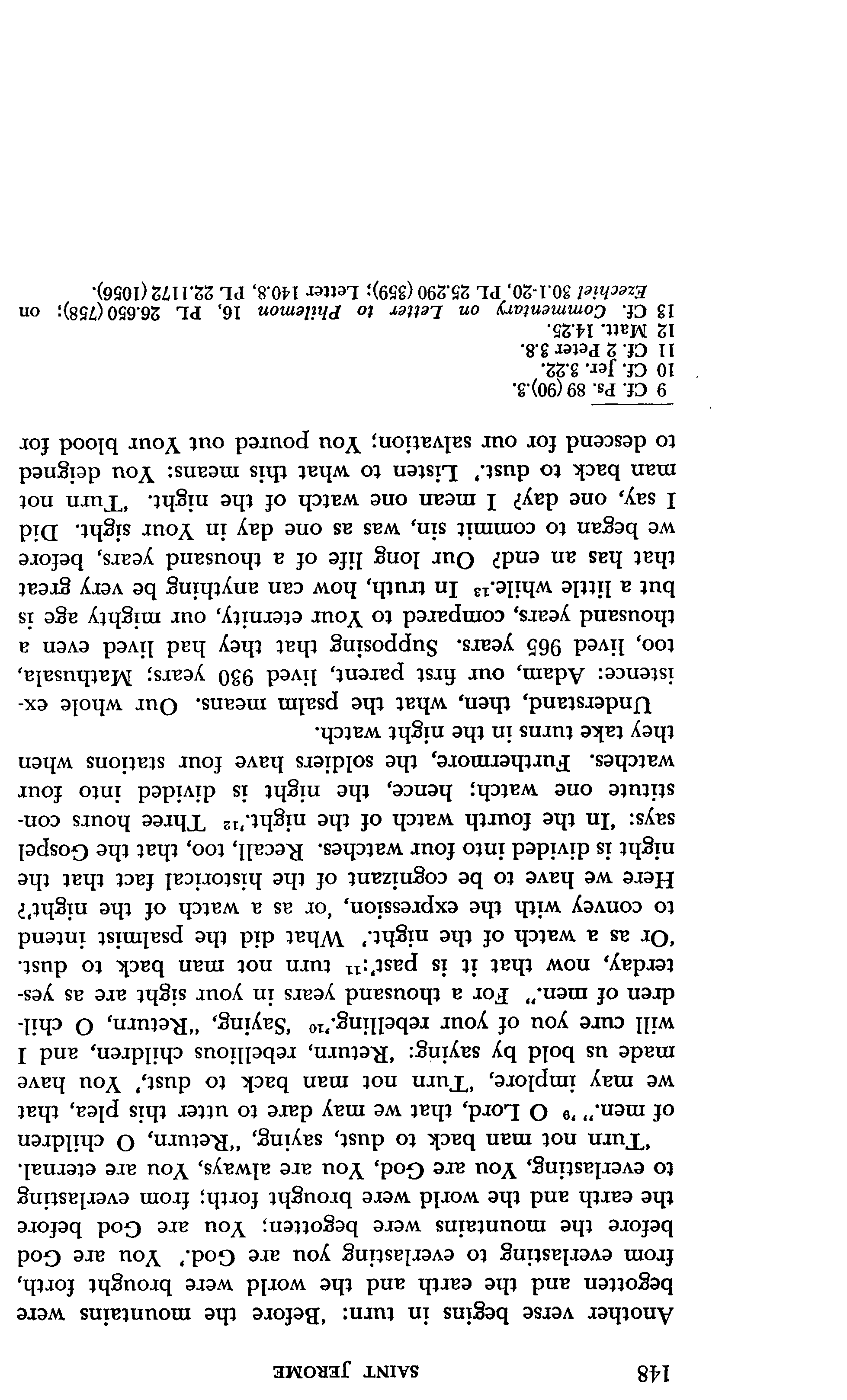
Another verse begins in turn: 'Before the mountains were begotten and the earth and the world were brought forth, from everlasting to everlasting you are God.' You are God before the mountains were begotten; You are God before the earth and the world were brought forth; from everlasting to everlasting, You are God, You are always, You are eternal.
'Turn not man back to dust, saying, "Return, 0 children of men." '9 0 Lord, that we may dare to utter this plea, that we may implore, 'Turn not man back to dust: You have made us bold by saying: 'Return, rebellious children, and I will cure you of your rebelling.'lO 'Saying, "Return, 0 children of men." For a thousand years in your sight are as yesterday, now that it is past':l1 turn not man back to dust.
'Or as a watch of the night.' What did the psalmist intend to convey with the expression, 'or as a watch of the night'?
Here we have to be cognizant of the historical fact that the night is divided into four watches. Recall, too, that the Gospel says: 'In the fourth watch of the night.'12 Three hours constitute one watch; hence, the night is divided into four watches. Furthermore, the soldiers have four stations when they take turns in the night watch.
Understand, then, what the psalm means. Our whole existence: Adam, our first parent, lived 930 years; Mathusala, too, lived 965 years. Supposing that they had lived even a thousand years, compared to Your eternity, our mighty age is but a little while.13 In truth, how can anything be very great that has an end? Our long life of a thousand years, before we began to commit sin, was as one day in Your sight. Did
I say, one day? I mean one watch of the night. 'Turn not man back to dust.' Listen to what this means: You deigned to descend for our salvation; You poured out Your blood for 9 Cf. Ps. 89 (90).3.
10 Cf. Jer. 3.22.
11 Cf. 2 Peter 3.8.
12 Matt. 14.25.
13 Cf. Commentary on Letter to Philemon 16, PL 26.650 (758); on Ezechiel 30.1-20, PL 25.290 (359); Letter 140.8, PL 22.1172 (1056).
HOMILY 19
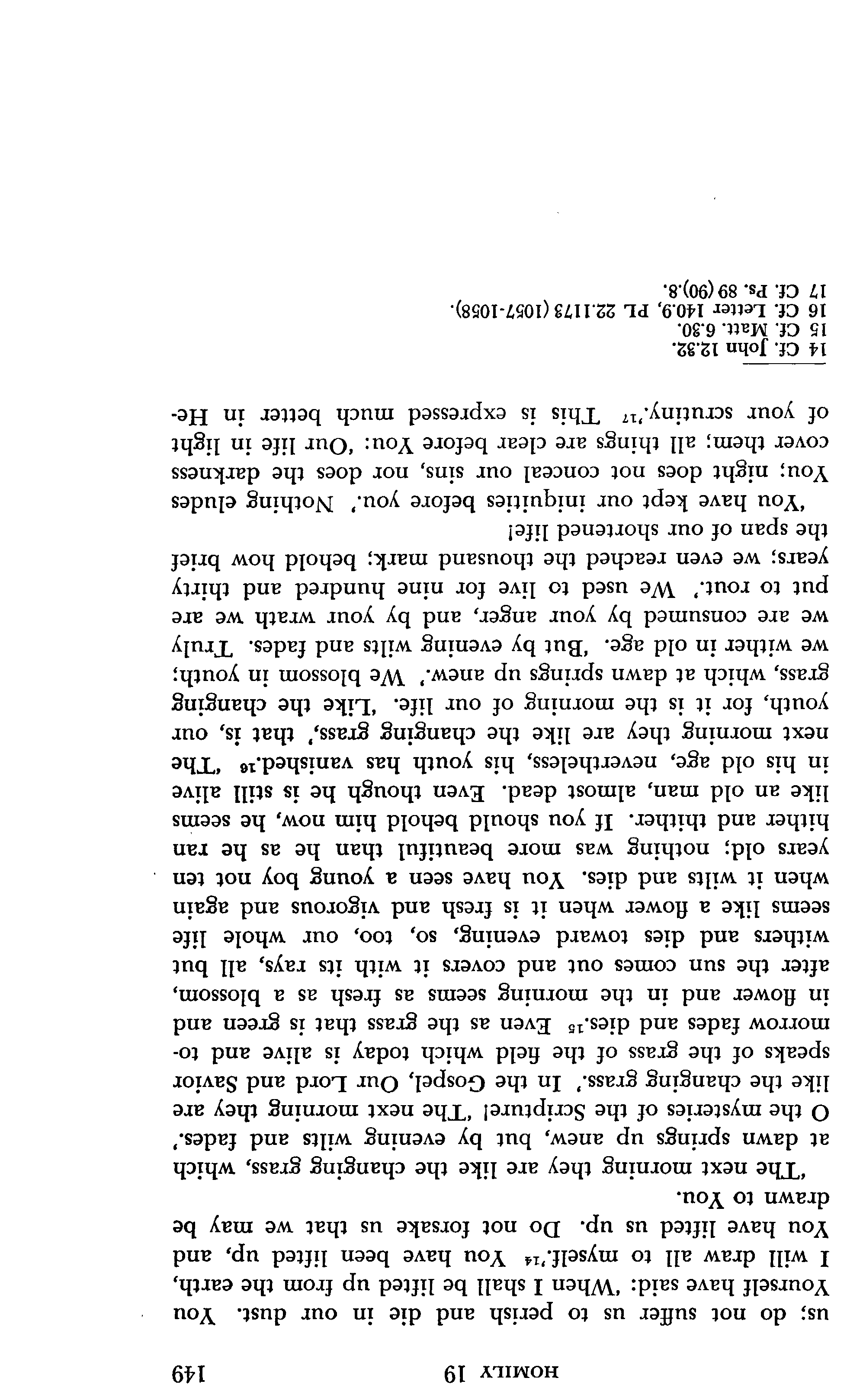
us; do not suffer us to perish and die in our dust. You Yourself have said: 'When I shall be lifted up from the earth,
I will draw all to myself.'14 You have been lifted up, and You have lifted us up. Do not forsake us that we may be drawn to You.
'The next morning they are like the changing grass, which at dawn springs up anew, but by evening wilts and fades.' o the mysteries of the Scripture! 'The next morning they are like the changing grass.' In the Gospel, Our Lord and Savior speaks of the grass of the field which today is alive and to· morrow fades and dies.15 Even as the grass that is green and in flower and in the morning seems as fresh as a blossom, after the sun comes out and covers it with its rays, all but withers and dies toward evening, SO, too, our whole life seems like a flower when it is fresh and vigorous and again when it wilts and dies. You have seen a young boy not ten years old; nothing was more beautiful than he as he ran hither and thither. If you should behold him now, he seems like an old man, almost dead. Even though he is still alive in his old age, nevertheless, his youth has vanished.16 'The next morning they are like the changing grass,' that is, our youth, for it is the morning of our life. 'Like the changing grass, which at dawn springs up anew.' We blossom in youth; we wither in old age. 'But by evening wilts and fades. Truly we are consumed by your anger, and by your wrath we are put to rout.' We used to live for nine hundred and thirty years; we even reached the thousand mark; behold how brief the span of our shortened life!
'You have kept our iniquities before you.' Nothing eludes You; night does not conceal our sins, nor does the darkness cover them; all things are clear before You: 'Our life in light of your scrutiny.'17 This is expressed much better in He14 Cf. John 12.32.
15 Cf. Matt. 6.30.
16 Cf. Letter 140.9, PL 22.1173 (1057·1058).
17 Cf. Ps. 89 (90).8.
SAINT JEROME
brew: 18 'our hidden sins in the light of your scrutiny: Whatever we do, whatever we think we are doing in secret, lies open before Your eyes. 'All our days have passed away: Our life hurries on at a great pace, and when we least expect it, it slips away, and we die. These very words we speak are of death and we do not take thought. 'We have spent our years like a spider.'19 Meditate on these words of the psalmist.
In the same way that the spider produces, as it were, a thread and runs to and fro, back and forth, and weaves the whole day long, and his labor, indeed, is great but the result is nil; so, too, the life of man runs about hither and thither. We search for possessions and we accumulate wealth; we procreate children; we labor and toil; we rise in power and authority; we do everything; and do not realize that we are spiders weaving a web.
'Seventy is the sum of our years.' Where are the thousand years for our lives? Our span is shortened to seventy years; if we live much longer, we reach eighty. If, moreover, we live beyond eighty, our existence is no longer life, but death.
'Or eighty, if we are strong.' Whom will you find strong and healthy as an octogenarian? There is a Greek saying: 'Old age itself is a disease_' 'And most of them are fruitless toil.'
Whatever more there is of life is not life, but toil and sorrow.
So far we have been considering the direct meaning of the psalm. It is time now to interpret it anagogically. Indeed, the entire psalm admits of tropology; I could run through the verses one by one, and draw forth from each its symbolism, but time prohibits. All I can do is to sample one versicle with you, merely give you a taste of its mysticism. Whatever
I pass over in silence, therefore, you may consider as having been said.
'Seventy is the sum of our years.' Three score and ten years make seven decades, and fourscore years are eight dec18 Cf. Letter 140.11, PL 22.1174 (1058).
19 Cf. Ps. 89 (90).9.
HOMILY 19
ades.20 Take note how the numbers seven and eight are emphasized. In the same sense that we said: 'You have been our refuge through all generations,' meaning both in the Old Testament and in the New Testament, the psalmist now employs the numbers seven and eight. Ecclesiastes, moreover, says this: 'Give a portion to seven and also to eight.'21 That is why, too, there are fifteen gradual psalms, seven and eight, that lead us up step by step to the kingdom of heaven.
Further, after the seventh step has been mounted, what is the title of the next psalm? 'A song of ascents, of Solomon'22 who had built the ancient house. And what does Solomon say? 'Unless the Lord build the house, they labor in vain who build it.' What, then, does he mean whose name is inscribed in the title itself? I have built a temple; but unless it is the eighth number that has built it, that house has been built in vain. We have read, too, in the Gospel according to Matthew: 23 Blessed are the poor; blessed are the meek; blessed the hungry and thirsty; and so on, through eight beatitudes. Our Lord, therefore, concluded His teachings with the number eight. I may say that nowhere do we find eight beatitudes all at the same time except in the Gospelwith the number eight, that is, on the day of Resurrection.
'Seventy is the sum of our years.' Would you have me digress a bit and show you the many mystical meanings hidden in the numbers seven and eight?24 Let us read Ezechiel in reference to a gate: 'And he shall enter by the east gate into the temple which is being built,'25 and later: 'And the priest goes up first by seven steps and then by eight steps.'26 Could it be possible that in that entrance there were both seven steps and eight? But just notice what he says: the east gate,
20 Cf. Letter 140.l3, PL 22.l175 (1059).
21 Eccles. 11.2; cf. Against the Luciferians 22, PL 23.185 (195).
22 Ps. 126.1.
23 Cf. Matt. 5.3-12.
24 Against Jovinian 2.34, PL 23.346 (377).
25 Cf. Ezech. 44.1; 46.8; 43.1, 2, 4; cf. Commentary on Michea 5.6, PL 25.1201 (494).
26 Cf. Ezech. 40.
SAINT JEROME
the gate from which the light enters-Our Lord and Savior.
There is, indeed, a gate, and no one enters it except the high priest. And what does Holy Writ say about it? This gate is to remain closed';21 it is not opened, moreover, except to the priest. Even so the Testament, both Old and New, has always been closed; it has not been opened except to the Savior. He it is who has the key; 'he who opens and no one shuts; who shuts and no one opens:28 One gate, then, has both seven steps and eight. In the Old Testament, for example, the divine mysteries point to the Gospels, and in the New
Testament back to the law.
Listen to even greater mysteries. At the time when Solomon built the temple, it was our Peacemaker who says: 'Peace I leave with you, my peace I give to you,'29 'for he himself is our peace/so 'the peace of God which surpasses all understanding,'31 who Himself built the temple for God. Observe what Scripture says about the building of the temple by Solomon: 'And there were seventy thousand quarrymen and eighty thousand carriers:s2 Mark the number. The masons who were cutting stones, who were preparing, as it were, the foundations of the buildings, who were taking up stones from the ground to build the temple of God, are reckoned in the number seven, in the prophets, in the patriarchs, for while they seemingly were driving the human race from off the earth, they were making preparations for the temple of the Lord. The latter, the eighty thousand, symbolize the apostolic preaching and the Gospels; these are they who with the Lord Savior, and Solomon himself, were carrying the heavy burden of the nations. This surely is the height of mystery, but hear of even deeper mysteries! 'And the overseers over the works and the temple, were three thou27 Cf. Ezech. 44.2; d. Letter 48.21, PL 22.510 (233).
28 Cf. Apoc. 3.7; d. Letter 53.5, PL 22.543 (274).
29 John 14.27.
30 Eph.2.14.
31 Phil. 4.7.
32 Cf. 3 Kings 5.15.
HOMILY 19
sand.'33 They cannot be greater, not even the overseers in charge of the work, except that they proclaim the Trinity.
'Seventy is the sum of our years.' There is so much more to say, but time prevents.
'So make your right hand known that fettered we may gain wisdom of heart.'34 Some codices say 'trained'; others 'fettered.' 'Trained' implies one thing; 'fettered: another. What, then, is the meaning of 'make your right hand know'? Why have You restrained Your right hand so long, God? 'Why draw back your hand and keep it idle beneath your garment?'35 says another psalm. Here is its meaning: we are lying prostrate in sickness; we are powerless in our sins; send forth
Your right hand and raise us up. Why do you keep Your right hand so long idle beneath Your cloak? Your heart overflows with a goodly theme;36 send forth Your right hand and set us free. Make known to us the mystery which has been hidden from generation to generation. 'Make your right hand known.' What are you pilfering, Arius? The psalmist did not say: 'Make Your right hand,' for God was never without His right hand. But what did he say? Your right hand, that You have always had and that has been in Your bosom, make it known to us. Because we are not able to know Him abiding in His Godhead, He assumes our humanity, and in that way we know Him.
'So make your right hand known that fettered we may gain wisdom of heart': those who are bound by the chains of wisdom, those whose hearts are shackled by Your wisdom. Do not let the obscurity of the passage disturb you. The prophets were in possession of wisdom, but \Visdom itself, as it were, fettered them; they could not fly without Christ. See, then, what it means: Send forth Your right hand, that is, Your Son, and make Him known to us; the prophets who have been
33 Ibid.
34 Cf. Ps. 89 (90).12; d. Commentarioli in ps. 89.11.
35 Cf. Ps. 73.11.
36 Cf. Ps. 44.2.
SAINT JEROME
prophesying in shadow, let them begin to herald the Lord in plain sight.
'Return, 0 Lord! How long?' We have sinned exceedingly; You are turning away Your face from us; it is not proper for Your eyes to look upon our sins; that is why we plead:
'Return, 0 Lord! How long?' Behold how many ages have already come and gone! The prophets have never ceased to proclaim Your coming to the nations, yet up to this time
You have not come. 'And direct the children of men.'S7 We who have been deflected by evil, may we be led back by You.
'And direct the children of men.' Well said, direct the children of men. For that very reason be their guide, because they are the children of men, for if they were Your children, they would have stayed straight. You have said Yourself: '1 said: "You are gods: all of you sons of the Most High; yet like men you shall die, and fall like any prince." '38 And in another place: 'Sons of men, how long will you be dull of heart?'39 Again: 'My spirit shall not remain in man forever, since he is flesh.'40
Because they are men, they are flesh.
Consequently, because we are the sons of man and have lost the right to be the sons of God and have been perverted; on that account guide us that once again we may become Your children.
'And may the brightness of the Lord our God be upon US.'41
The Apostle, likewise, tells the Hebrews4.2 that the Lord and Savior is the brightness of the glory of the Father. 'And may the brightness of the Lord our God be upon us.' Parallel to this, is another passage: '0 Lord, the light of your countenance is signed upon US!,43 The sign of the cross is our banner.
We have been discussing the psalter for some time now, and 1 think that we have delayed longer than we should.
37 Cf. Ps. 89 (90).16.
38 Ps. 81.6, 7.
39 Cf. Ps. 4.3.
40 Gen. 6.3.
41 Cf. Ps. 89 (90).17.
42 Reb. 1.3.
43 Cf. Ps. 4.7.

HOMILY 19
We realize that we have said much more than we ought, but we cannot keep secret the words of our Lord; we cannot leave the psalm half begun. Whatever is of profit to the soul is never too much; the good is never enough, if, indeed, it is good. Let us pray the Lord our Savior that His brightness illumine our hearts, that it banish all our darkness, that it ward off from our hearts all black and sinful thoughts, that it enlighten our darkness; that the shadows may scatter and brightness dwell within. The temple of the Lord, and the tabernacle, and the shrines of the saints always had a glowing lamp; the lamp in the temple of the Lord was always aglow. If the lamp should ever be extinguished, the Lord will not make His abode in darkness. Let us pray, therefore, with the psalmist: 'A lamp to my feet is your word, a light to my path.'44
44 Ps. 118.105.