
HOMILY 17
HOMILY 17
ON PSALM 84 (85)
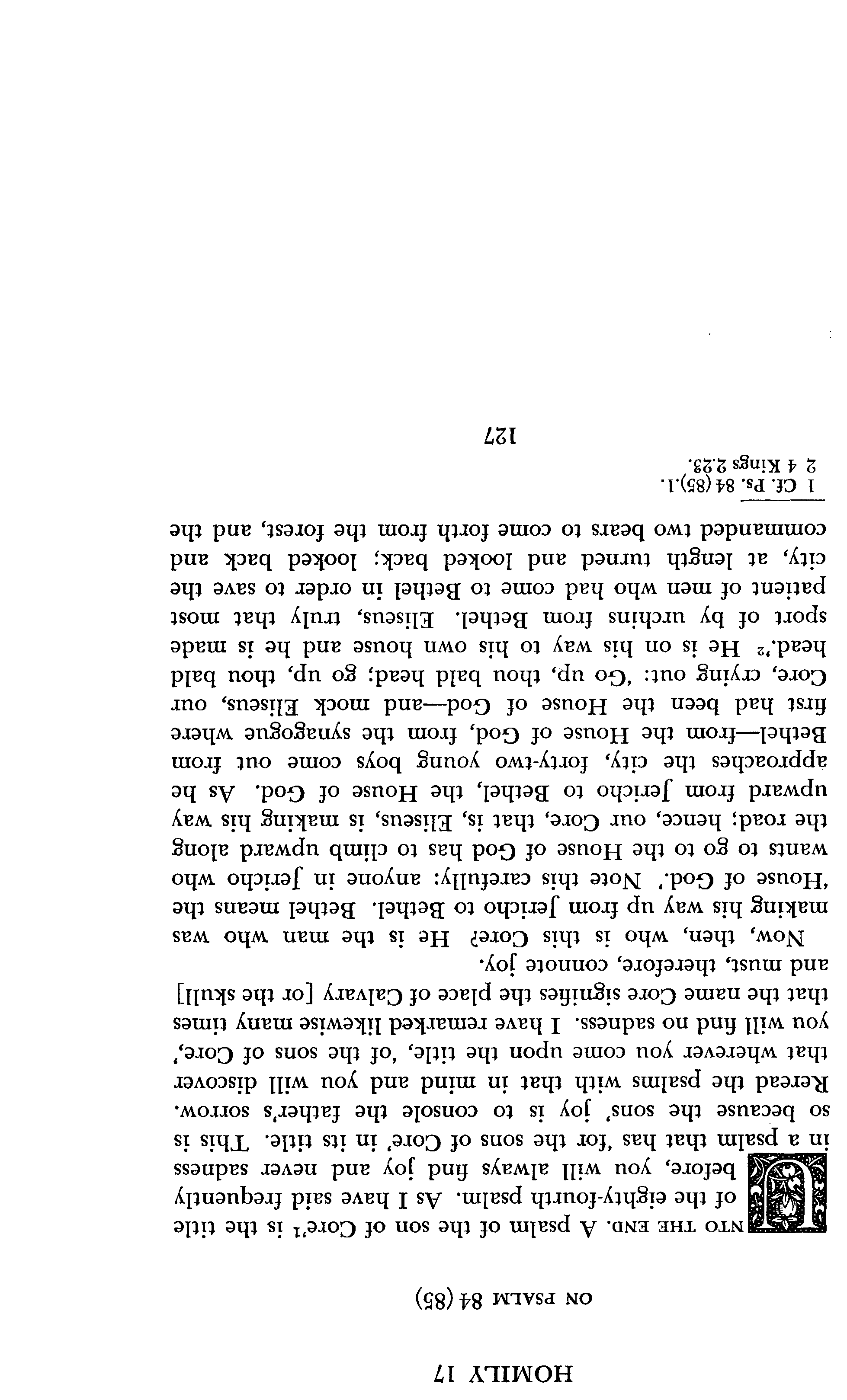
II NTO THE END. A psalm of the son of Core'l is the title of the eighty-fourth psalm. As I have said frequently before, you will always find joy and never sadness in a psalm that has 'for the sons of Core' in its title. This is so because the sons' joy is to console the father's sorrow.
Reread the psalms with that in mind and you will discover that wherever you come upon the title, 'of the sons of Core,' you will find no sadness. I have remarked likewise many times that the name Core signifies the place of Calvary [or the skull] and must, therefore, connote joy.
Now, then, who is this Core? He is the man who was making his way up from Jericho to Bethel. Bethel means the 'House of God.' Note this carefully: anyone in Jericho who wants to go to the House of God has to climb upward along the road; hence, our Core, that is, Eliseus, is making his way upward from Jericho to Bethel, the House of God. As he approaches the city, forty-two young boys come out from Bethel-from the House of God, from the synagogue where first had been the House of God-and mock Eliseus, our
Core, crying out: 'Go up, thou bald head; go up, thou bald head.'2 He is on his way to his own house and he is made sport of by urchins from Bethel. Eliseus, truly that most patient of men who had come to Bethel in order to save the city, at length turned and looked back; looked back and commanded two bears to come forth from the forest, and the 1 Cf. Ps. 84 (85).l.
2 4 Kings 2.23.
SAINT JEROME
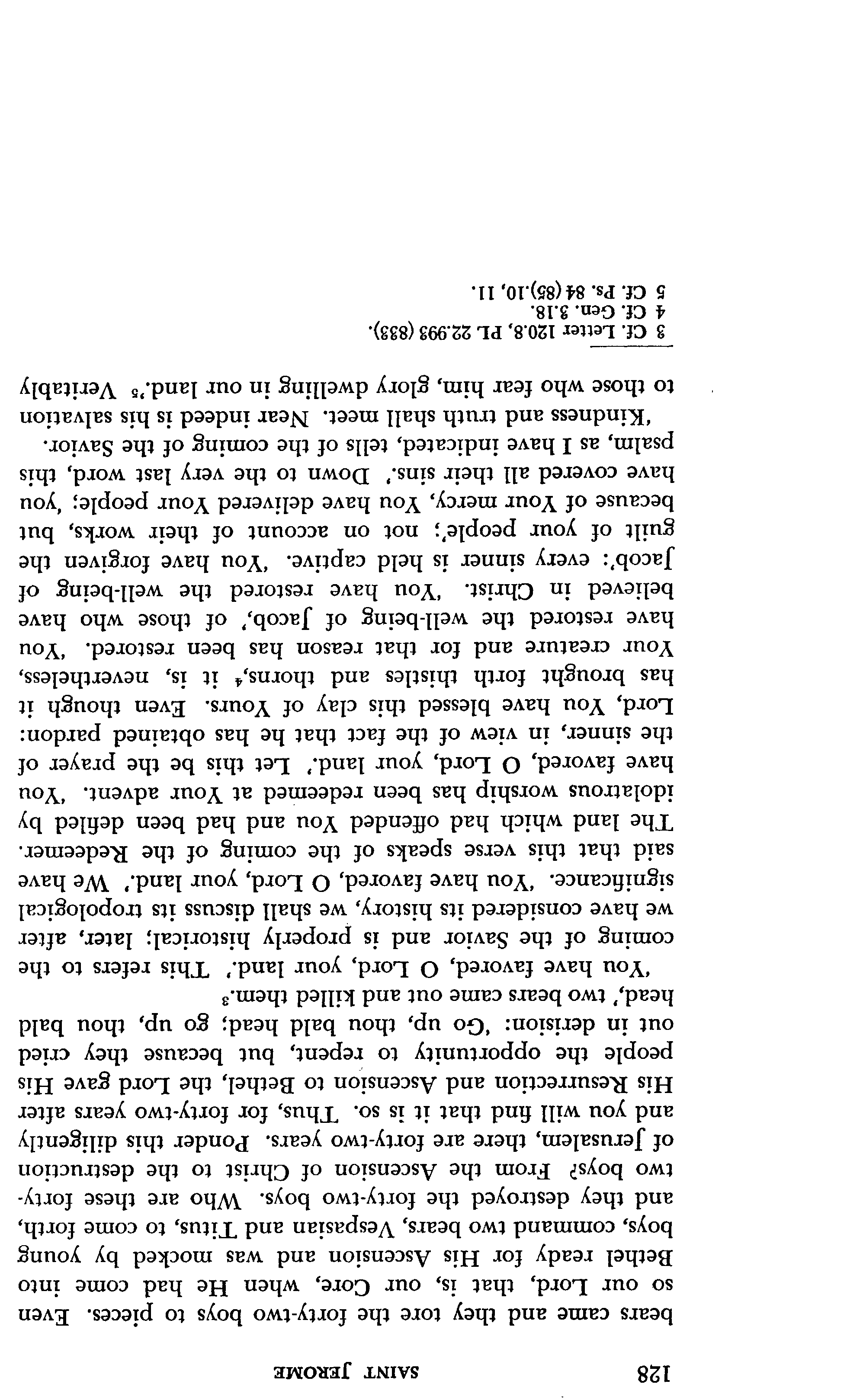
bears came and they tore the forty-two boys to pieces. Even so our Lord, that is, our Core, when He had come into Bethel ready for His Ascension and was mocked by young boys, command two bears, Vespasian and Titus, to come forth, and they destroyed the forty-two boys. Who are these fortytwo boys? From the Ascension of Christ to the destruction of Jerusalem, there are forty-two years. Ponder this diligently and you will find that it is so. Thus, for forty-two years after His Resurrection and Ascension to Bethel, the Lord gave His people the opportunity to repent, but because they cried out in derision: 'Go up, thou bald head; go up, thou bald head,' two bears came out and killed them.3
'You have favored, 0 Lord, your land: This refers to the coming of the Savior and is properly historical; later, after we have considered its history, we shall discuss its tropological significance. 'You have favored, 0 Lord, your land: We have said that this verse speaks of the coming of the Redeemer.
The land which had offended You and had been defiled by idolatrous worship has been redeemed at Your advent. 'You have favored, 0 Lord, your land: Let this be the prayer of the sinner, in view of the fact that he has obtained pardon:
Lord, You have blessed this clay of Yours. Even though it has brought forth thistles and thorns,4 it is, nevertheless,
Your creature and for that reason has been restored. 'You have restored the well-being of Jacob,' of those who have believed in Christ. 'You have restored the well-being of Jacob': every sinner is held captive. 'You have forgiven the guilt of your people'; not on account of their works, but because of Your mercy, You have delivered Your people; 'you have covered all their sins: Down to the very last word, this psalm, as I have indicated, tells of the coming of the Savior.
'Kindness and truth shall meet. Near indeed is his salvation to those who fear him, glory dwelling in our land.'5 Veritably
3 Cf. Letter 120.8, PL 22.993 (833).
4 Cf. Gen. 3.18.
5 Cf. Ps. 84 (85).10, 11.
HOMILY 17
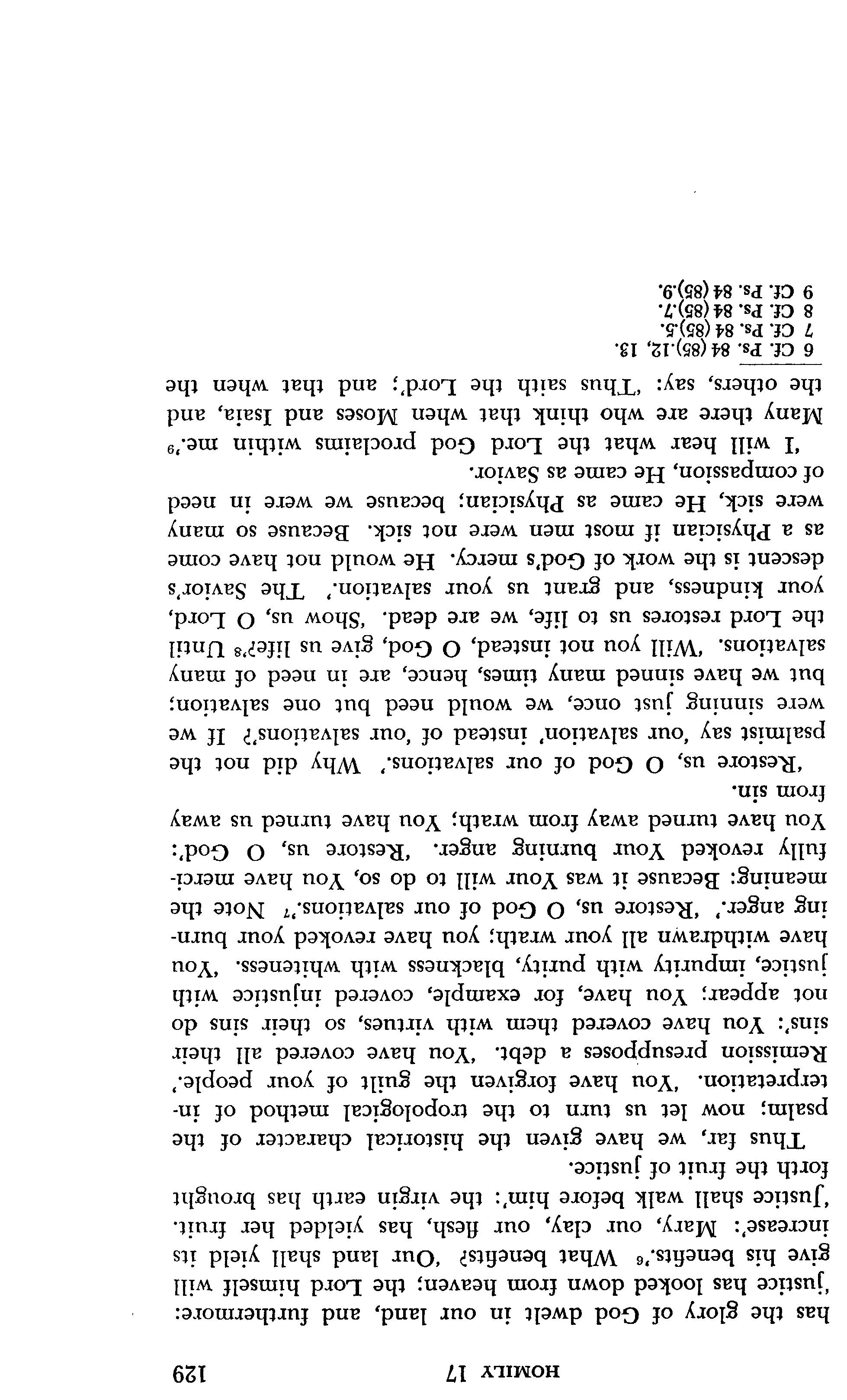
has the glory of God dwelt in our land, and furthermore:
'justice has looked down from heaven; the Lord himself will give his benefits:6 What benefits? 'Our land shall yield its increase': Mary, our clay, our flesh, has yielded her fruit.
'Justice shall walk before him': the virgin earth has brought forth the fruit of justice.
Thus far, we have given the historical character of the psalm; now let us turn to the tropological method of interpretation. 'You have forgiven the guilt of your people:
Remission presupposes a debt. 'You have covered all their sins': You have covered them with virtues, so their sins do not appear; You have, for example, covered injustice with justice, impurity with purity, blackness with whiteness. 'You have withdrawn all your wrath; you have revoked your burning anger: 'Restore us, 0 God of our salvations: 7 Note the meaning: Because it was Your will to do so, You have mercifully revoked Your burning anger. 'Restore us, 0 God':
You have turned away from wrath; You have turned us away from sin.
'Restore us, 0 God of our salvations: Why did not the psalmist say 'our salvation' instead of 'our salvations'? If we were sinning just once, we would need but one salvation; but we have sinned many times, hence, are in need of many salvations. 'Will you not instead, 0 God, give us life?'8 Until the Lord restores us to life, we are dead. 'Show us, 0 Lord, your kindness, and grant us your salvation: The Savior's descent is the work of God's mercy. He would not have come as a Physician if most men were not sick. Because so many were sick, He came as Physician; because we were in need of compassion, He came as Savior.
'I will hear what the Lord God proclaims within me:9
Many there are who think that when Moses and Isaia, and the others, say: 'Thus saith the Lord'; and that when the 6 Cf. Ps. 84 (85).12, 13.
7 Cf. Ps. 84 (85).5.
8 Cf. Ps. 84 (85).7.
9 Cf. Ps. 84 (85).9.
SAINT JEROME
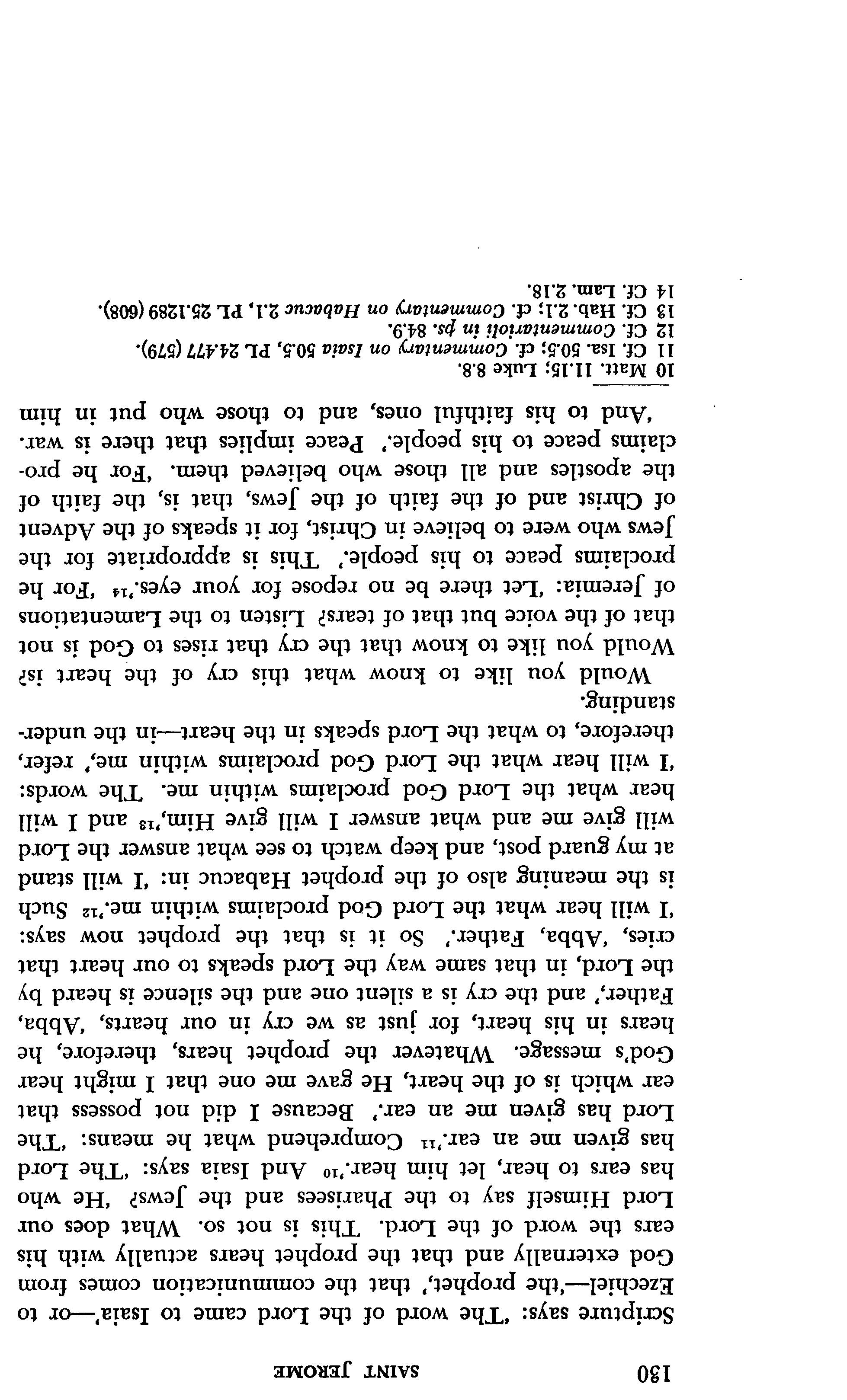
Scripture says: 'The word of the Lord came to Isaia'--or to Ezechiel-'the prophet,' that the communication comes from God externally and that the prophet hears actually with his ears the word of the Lord. This is not so. What does our
Lord Himself say to the Pharisees and the Jews? 'He who has ears to hear, let him hear.'lO And Isaia says: 'The Lord has given me an ear.'ll Comprehend what he means: 'The Lord has given me an ear: Because I did not possess that ear which is of the heart, He gave me one that I might hear
God's message. Whatever the prophet hears, therefore, he hears in his heart, for just as we cry in our hearts, 'Abba,
Father,' and the cry is a silent one and the silence is heard by the Lord, in that same way the Lord speaks to our heart that cries, 'Abba, Father: So it is that the prophet now says:
'I will hear what the Lord God proclaims within me.'12 Such is the meaning also of the prophet Habacuc in: 'I will stand at my guard post, and keep watch to see what answer the Lord will give me and what answer I will give Him,'13 and I will hear what the Lord God proclaims within me. The words:
'I will hear what the Lord God proclaims within me,' refer, therefore, to what the Lord speaks in the heart-in the understanding.
Would you like to know what this cry of the heart is?
Would you like to know that the cry that rises to God is not that of the voice but that of tears? Listen to the Lamentations of Jeremia: 'Let there be no repose for your eyes.'14 'For he proclaims peace to his people: This is appropriate for the Jews who were to believe in Christ, for it speaks of the Advent of Christ and of the faith of the Jews, that is, the faith of the apostles and all those who believed them. 'For he proclaims peace to his people: Peace implies that there is war.
'And to his faithful ones, and to those who put in him lO Matt. 11.15; Luke 8.8.
11 Cf. Isa. 50.5; cf. Commentary on lsaia 50.5, PL 24.477 (579).
12 Cf. Commentarioli in ps. 84.9.
13 Cf. Hab. 2.1; d. Commentary on Habacuc 2.1, PL 25.1289 (608).
14 Cf. Lam. 2.18.
HOMILY 17
their hope': this points to those who first obeyed the flesh, but afterwards came back to Him with all their heart. That you may be sure that this versicle is about the Jews-those of them who believed in the Savior-think over the examples we have considered. Suppose with me that a Jew is reading
Leviticus,15 about all the rites described there: 'under what conditions the leper enters the synagogue, how a hen is bled by having its neck wrenched, what it says about the sprinkling of blood, and about water and hyssop; how the leper's garments are torn away from him, and how, then, he enters the synagogue. If we were to take all of this literally, what benefits would we derive from such reading? If, however, our conversion has been genuinely wholehearted, if we have a spiritual hold on what we have read, we shall discern that it is not possible for the leper to go before the people of God without first having his garments rent, without first revealing what had been concealed.
In the second place, perceive that this leper does not gain entrance to the synagogue except through blood and water and hyssop; hence, you, too, who up to this very day have been a leper, were not conscious of your leprosy until you had come to the priest. But since you came to the priest, he tore open your garments, and what seemed to be sound while it was covered up, proved to be leprous when exposed. The priest made you see your sins and your leprosy, and led you back into God's assembly through blood and water: through blood, the Passion of Christ; through water, by baptism. After you have contracted the leprosy of corruption, you cannot be healed save through the Blood of Christ and through baptism. When you have been healed, then the following words are in order:
'Cleanse me of sin with hyssop, that I may be purified; wash me, and I shall be whiter than snow.'16
You are still in Egypt to this day; as long as you do not come to blood and water, you cannot be saved. Do you want
15 Cf. Lev. 13. 14.
16 Ps.50.9.
SAINT JEROME
to be spared the destroying angel of Egypt? Take some hyssop, dip it in blood, sprinkle your door posts, and when the destroyer sees the blood on your forehead, he will leave you untouched. Why have I dwelled so long on all this?
Because it is written: 'And to those who put in Him their hope.' God cannot speak peace to His people except to those who hope in Him with all their heart.
'Near indeed is his salvation to those who fear him': I have shown you the way of salvation; I am merciful to you. AI· though your conversion is not yet complete, nevertheless, I am waiting; I am giving you time for repentance. And all this, indeed, 'that glory may dwell in our land.'17 He calls you to repentance in order that you, who were a leper, may have Christ for your Guest.
'Kindness and truth shall meet; justice and peace shall kiss.' 0 what wonderful friendship! 'Kindness and truth shall meet.' Are you a sinner? Heed that it says 'Kindness.'
Are you a faithful servant? Hear that it says, 'and truth.' If you are a sinner, do not despair; if you are just, do not yield to complacency.
Let us state this in a different way. There are two peoples that believe: the Gentiles and the Jews. To the Jews was given the promise that the Savior would come, but the promise was not made to us who were outside the law of God. Kind· ness, therefore, is symbolic of the Gentiles; truth, of the Jews, for the promise has been fulfilled; the promise made to the fathers is fulfilled in the sons. 'Justice and peace shall kiss'; mark: 'Justice and peace shall kiss.' This is equivalent to what was said above: kindness and truth shall meet, kindness equates to peace, truth to justice. Whatever pertains to peace belongs, likewise, to kindness; whatever refers to truth applies also to justice. Realize to the full what the psalm says: 'Justice and peace shall kiss,' kindness and truth have embraced in friendship. In other words, the Gentiles and the Jews are under one Shepherd, Christ.
17 Cf. Ps. 84 (85).10.
HOMILY 17
'Truth shall spring out of the earth.'18 'I am the way, and the truth, and the life.'19 He who said: 'I am the truth,' has sprung out of the earth. What is this truth that has risen up out of the earth? 'But a shoot shall sprout from the stump of Jesse, and from his roots a bud shall blossom';2o and in another place: '0 God, you doer of saving deeds on earth.'21
What have you to say, Manichaeus, who deny that the Savior assumed a body? Behold Truth, the Savior, is born of earth, that is, of Mary. 'And justice shall look down from heaven,' for it was just that the Savior have mercy on His people.
Think what this means:-O, the just judgments of God, and how unsearchable his waysI22-'Truth shall spring out of the earth': that means the Savior. Again, 'justice shall look down from heaven': justice is the Savior. How has He sprung out of the earth? How has He looked down from heaven? He grew up out of the earth since He was born as man; He has looked down from heaven since God is always in heaven.
Assuredly, He is born of earth, but He who was born of earth is always in heaven, for God is everywhere. His appearance on earth was such that He never left heaven. He looked down; as long as we were given to sinning, He turned
His eyes away from us.
Now listen to what that means. It is right for the Potter to feel pity for His works, for the Shepherd to be compassionate of His flock. We are His people, we are His creatures. He sprang out of the earth and looked down from heaven to fulfill His justice and take pity on the work that He wrought.
That you may know, moreover, that justice bespeaks not cruelty, but mercy, the psalmist says: 'The Lord himself will give his benefits.' To be compassionately kind to all His works, He looked down from heaven. 'Our land shall yield its increase.' Truth has sprung out of the earth, indeed; that 18 Cf. Commentarioli in ps. 84.12.
19 John 14.6.
20 Isa. 11.1.
21 Cf. Ps. 73.12.
22 Cf. Rom. 11.33.
SAINT JEROME
refers to the past. Now the psalmist turns to the future: our land shall yield its harvest. Do not give up hope because He was born once of Mary; every day He is born in us. 'Our land shall yield its increase.' We, too, have the power to bring forth Christ if we so desire. 'Our land shall yield its increase.' These words refer to Him who became the Bread of Heaven, to Him who says: 'I am the bread that has come down from heaven.'23
We have stressed the mercy of the Lord because His whole purpose in coming was to redeem mankind. We ought, nevertheless, to know that He Himself is going to sit in judgment over the living and the dead; that He Himself will come to judge us. 'Justice shall walk before him.' Do not be heedless: justice will lead Him. 'And salvation, along the way of his steps.' Note the exact words: 'his steps'-where there are no rocks, where there are no thorns nor thistles, where the path is even, where He may walk, where He cannot stumble. Let us, therefore, make way for the Lord in our heart, that way for which John was giving his 1i£e'seffort, and for which he was crying in the desert that we should make ready the way of the Lord.24 That is why the psalmist says now: 'And salvation, along the way of his steps'; where He finds the way, there He will walk. Although formerly we had obstacles of thorns and thistles, although we had stones, He declares to us in Isaia: 'clear the highway of stones.'25 He proclaims this, furthermore, lest He stumble upon them when He is ready to walk in the way of our heart. Now the stones that He bids us throw out from our way are our sins. Christ does not walk in our heart if there is any sin there. He stumbles at once against these stones. 'And salvation, along the way of his steps.' Let us make ready the way, and Jesus will set His steps in it.
23 John 6.41.
24 Matt. 3.3.
25 Cf. Isa. 62.10.