
HOMILY 4
HOMILY 4
ON PSALM 9 (9A,9B)
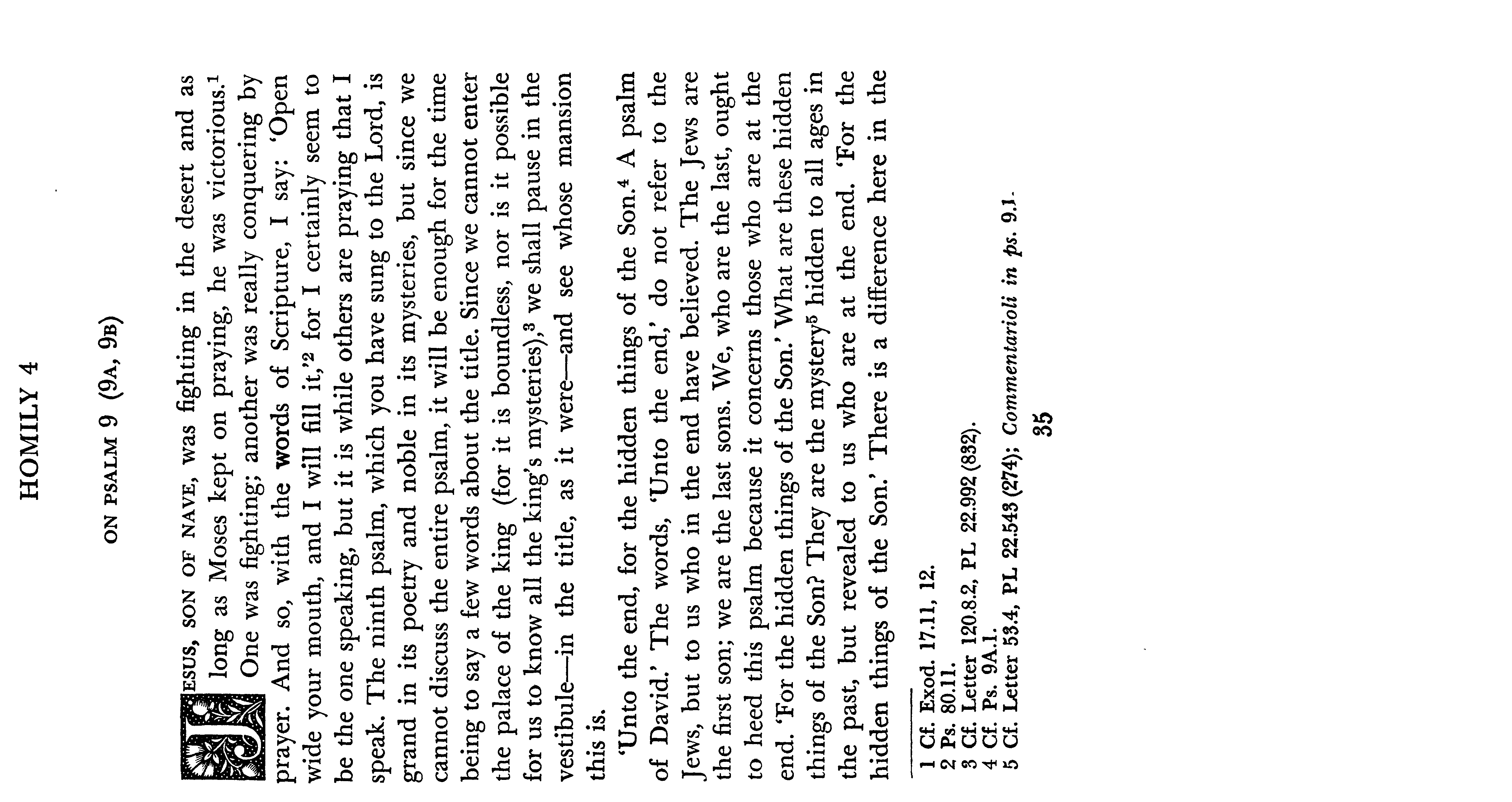
D ESUS, SON OF NAVE, was fighting in the desert and as long as Moses kept on praying, he was victorious.1
One was fighting; another was really conquering by prayer. And so, with the words of Scripture, I say: 'Open wide your mouth, and I will fill it,'2 for I certainly seem to be the one speaking, but it is while others are praying that I speak. The ninth psalm, which you have sung to the Lord, is grand in its poetry and noble in its mysteries, but since we cannot discuss the entire psalm, it will be enough for the time being to say a few words about the title. Since we cannot enter the palace of the king (for it is boundless, nor is it possible for us to know all the king's mysteries),3 we shall pause in the vestibule-in the title, as it were-and see whose mansion this is.
'Unto the end, for the hidden things of the Son.4 A psalm of David: The words, 'Unto the end,' do not refer to the Jews, but to us who in the end have believed. The Jews are the first son; we are the last sons. We, who are the last, ought to heed this psalm because it concerns those who are at the end. 'For the hidden things of the Son: What are these hidden things of the Son? They are the mystery5 hidden to all ages in the past, but revealed to us who are at the end. 'For the hidden things of the Son: There is a difference here in the 1 Cf. Exod. 17.11, 12.
2 Ps. 80.11.
3 Cf. Letter 120.8.2, PL 22.992 (832).
4 Cf. Ps. 9A.1.
5 Cf. Letter 53.4, PL 22.543 (274); Commentarioli in ps. 9.1.
SAINT JEROME
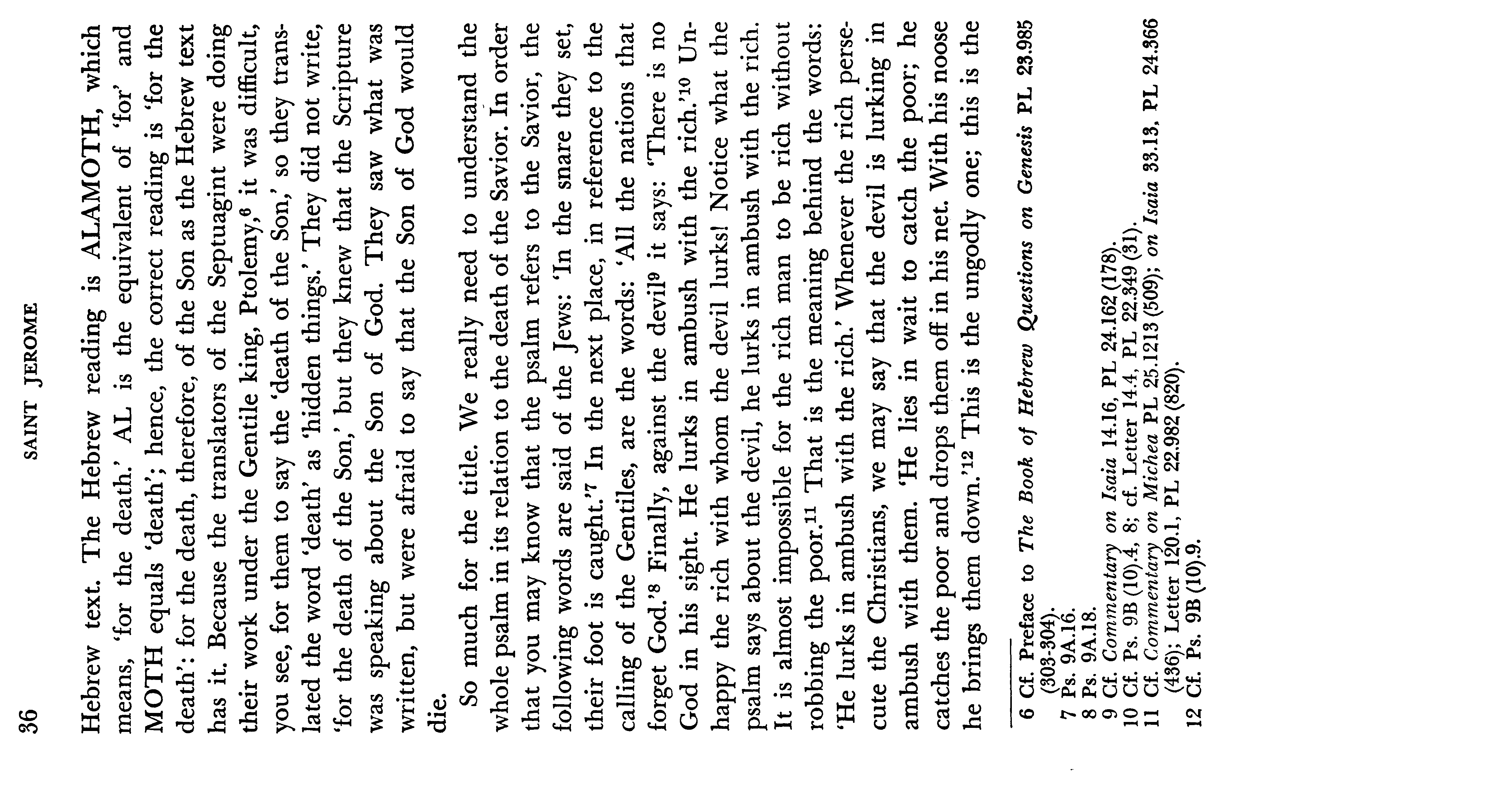
Hebrew text. The Hebrew reading is ALAMOTH, which means, 'for the death.' AL is the equivalent of 'for' and MOTH equals 'death'; hence, the correct reading is 'for the death': for the death, therefore, of the Son as the Hebrew text has it. Because the translators of the Septuagint were doing their work under the Gentile king, Ptolemy,6 it was difficult, you see, for them to say the 'death of the Son,' so they translated the word 'death' as 'hidden things.' They did not write,
'for the death of the Son,' but they knew that the Scripture was speaking about the Son of God. They saw what was written, but were afraid to say that the Son of God would die.
So much for the title. We really need to understand the whole psalm in its relation to the death of the Savior. In order that you may know that the psalm refers to the Savior, the following words are said of the Jews: 'In the snare they set, their foot is caught.'r In the next place, in reference to the calling of the Gentiles, are the words: 'All the nations that forget God.'s Finally, against the devil9 it says: 'There is no God in his sight. He lurks in ambush with the rich.'l0 Unhappy the rich with whom the devil lurks! Notice what the psalm says about the devil, he lurks in ambush with the rich.
It is almost impossible for the rich man to be rich without robbing the poorP That is the meaning behind the words:
'He lurks in ambush with the rich.' Whenever the rich persecute the Christians, we may say that the devil is lurking in ambush with them. 'He lies in wait to catch the poor; he catches the poor and drops them off in his net. With his noose he brings them down.'12 This is the ungodly one; this is the 6 Cf. Preface to The Book of Hebrew Questions on Genesis PL 23.985
(303-304).
7 Ps.9A.16.
8 Ps. 9A.18.
9 Cf. Commentary on Isaia 14.16, PL 24.162 (178).
10 Cf. Ps. 9B (10).4, 8; d. Letter 14.4, PL 22.349 (31).
11 Cf. Commentary on Michea PL 25.1213 (509); on Isaia 33.13. PL 24.366
(436); Letter 120.1, PL 22.982 (820).
12 Cf. Ps. 9B (10).9.
HOMILY 4
devil. 'The poor,' not only in riches, but also in spirit:
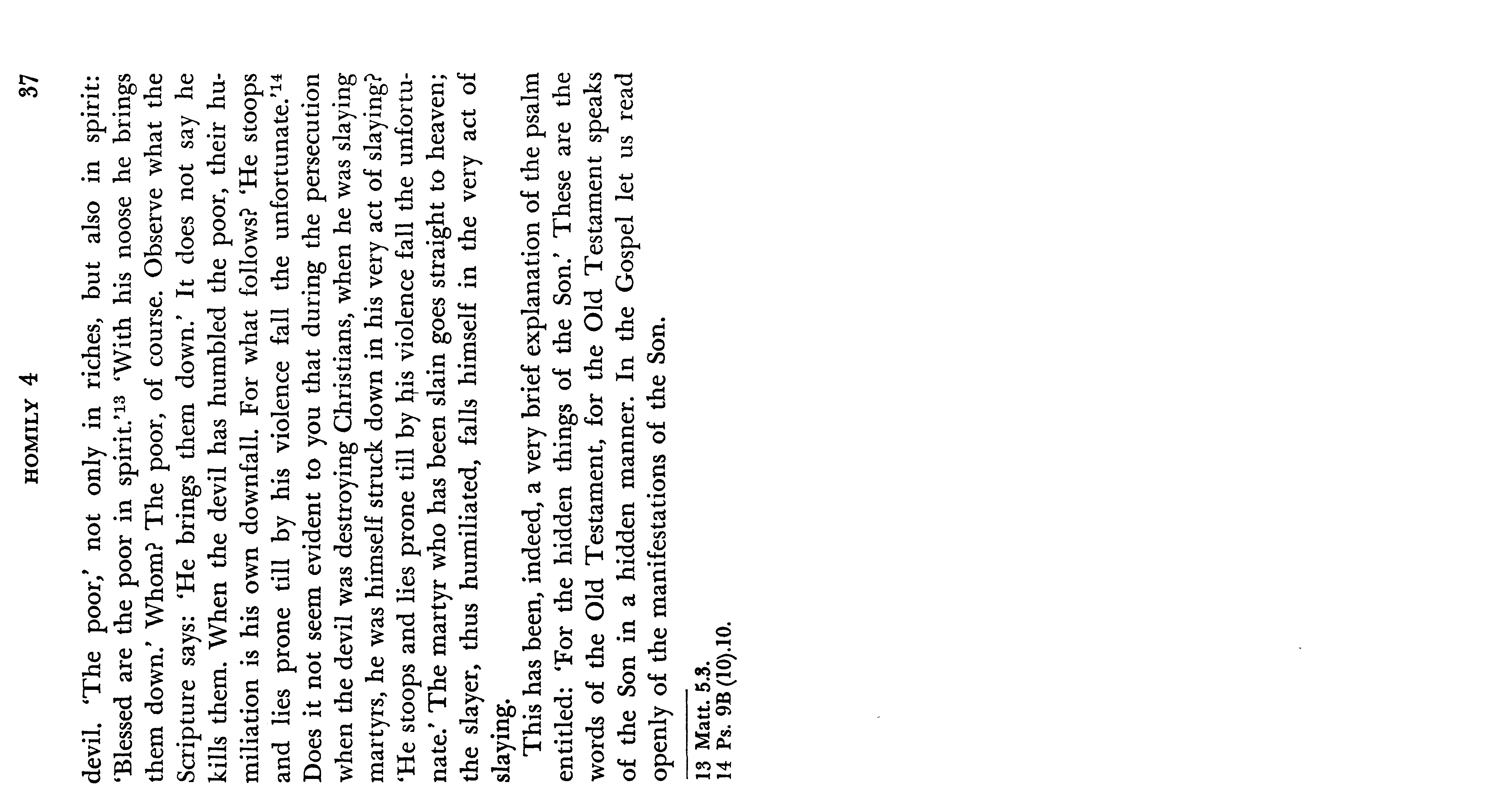
'Blessed are the poor in spirit.'13 'With his noose he brings them down.' Whom? The poor, of course. Observe what the Scripture says: 'He brings them down.' It does not say he kills them. When the devil has humbled the poor, their humiliation is his own downfall. For what follows? 'He stoops and lies prone till by his violence fall the unfortunate.'14
Does it not seem evident to you that during the persecution when the devil was destroying Christians, when he was slaying martyrs, he was himself struck down in his very act of slaying?
'He stoops and lies prone till by l).is violence fall the unfortunate.' The martyr who has been slain goes straight to heaven; the slayer, thus humiliated, falls himself in the very act of slaying.
This has been, indeed, a very brief explanation of the psalm entitled: 'For the hidden things of the Son.' These are the words of the Old Testament, for the Old Testament speaks of the Son in a hidden manner. In the Gospel let us read openly of the manifestations of the Son.
13 Matt. 5.3.
14 Ps. 9B (10).10.