
HOMILY 45
HOMILY 45
ON PSALM 132 (133)
IJ] EHOLD' HOW GOOD it is, and how pleasant, where brethren dwell at one!' The psalmist mentions two
D qualities of the common dwelling of brethren, good and pleasant. Martyrdom is good, but it is not pleasant, for it consists in suffering and sorrow; in torture there is always pain, and in pain there is certainly no pleasure. 'Behold, how good it is, and how pleasant.' On the other hand, sensuality is pleasant. Eating rich foods, for example, seems to be pleasant, for it may incite sensual desire. The prophet, then, has predicated two attributes, possibly contradictorygood and pJeasant-which he has reconciled into one characteristic: Behold how good and how pleasant. 'Pleasant where brethren dwell at one'-brothers in mind and heart, not in body. Esau and Jacob were brothers, and their living together was the cause of their discord; hence, 'brothers' here does not mean brothers in the flesh, but brothers in the spirit, brothers in the sense that the Savior implied when He said to the women: 'Go take word to my brethren.'!
'Behold, how good it is, and how pleasant, where brethren dwell at one!' This psalm is truly the psalm of convents and monasteries. It may even be applied to the churches, although, because of the great diversity in personal interests on the part of the members, there does not in the Christian assembly appear to be the same degree of harmony. Actually, what kind of fraternity do we find there? Usually, one mem1 John 20.17; cf. The Perpetual Virginity of Blessed Mary l5, PL 23.208
(222).
SAINT JEROME
ber is in a hurry to go home, another to the circus; another, all the while he is in church, is planning how he will invest his money. In the monastery, however, there is one aim and, as it were, one soul. 'Behold, how good it is, and how pleasant, where brethren dwell at one'-truly good, truly pleasant.
We have lost one brother, and behold how many we have gained! My brother, a layman, (I am not speaking of myself, but for each of you) does not love me as much as he loves my property. Spiritual brothers, on the other hand, who assuredly have no use for their own possessions, are not looking for another's. We read in the Acts of the Apostles that 'the multitude of the believers were of one heart and one soul. And they had all things in common.'Z In truth did they possess all things in common, for they had Christ in common. We have touched on many points, but we must hasten to the rest of the psalm.
'It is as when the precious ointment upon the head runs down over the beard,. the beard of Aaron.' Oh, if only there were time to explore together each verse; even a day would not suffice! We have read in ExodusS the account of how oil is prepared for the anointing of the priest; we have read, too, of the different kind of balm used to anoint kings. There was still another unguent for prophets. What more is there to say? All these oils of unction were different, each with its own spiritual symbolism. Do we have the proper reverence for sacramentals? After a leper has been cleansed-when he has been sprinkled with hyssop and the blood of a hen, and a hen has been set to wander in the desert-he also has his own proper ointment. Nothing is ever made sacred except by anointing. It is with this in view that young maidens say in the Canticle of Canticles: 'Your name is a spreading perfume: we will run after you in the odor of your ointments.'4
'It is as when the precious ointment upon the head runs 2 Cf. Acts 4.32.
3 Cf. Exod. 3.
4 Cf. Cant. 1.2, 3.
HOMILY 45
down over the beard, the beard of Aaron.' Aptly said: 'upon the head.' It 'runs down over the beard.' The beard is the sign of manhood, for by this sign nature has distinguished man from woman. It is, therefore, a token of virility.5 The head symbolizes divinity, that is, the Godhead; the beard designates man. 'Until,' Scripture says, 'we attain to perfect manhood,'6 that is, Christ. Now see what the prophet means when he says:
'It is as when the precious ointment.' Just as the blessing of precious ointment from the head-that is, from the Hermon of divinity-runs down over the beard, runs down upon the perfect man who is Christ, from that beard the same precious balm runs down afterwards to the collar of His robe; even so the blessing and the dew of Mount Hermon runs down over Mount Sion. 'Ointment' here, therefore, means the same as 'blessing.' 'You love justice and hate wickedness; therefore
God, your God, has anointed you with the oil of gladness above your fellow kings.'7 Attend closely to what it says: you love justice and hate wickedness. It is not enough to love justice, but you must hate wickedness. What is the reward of such virtue? God, your God, has anointed you with the oil of gladness above your fellow men. This is said to Christ: You have been anointed that You may anoint others. You have been anointed with the oil of gladness above Your fellow men, above Your apostles. You possess the font of unction; they, the drops.
'It is as when the precious ointment upon the head.' May the Lord give to us also this precious ointment of divinity that came down upon the beard, that is, upon the perfect man
Aaron, Aaron the priest. The name Aaron, moreover, means 'of the mountains';8 this priest is not of the valleys, but of the mountains. 'The beard,' the psalmist says, 'of Aaron.'
Because from the head the oil of unction came down upon 5 Cf. commentary on lsaia 7.20, PL 24.1I2 (1I4); on Ezechiel 5.1-4, PL
25.52 (49).
6 Eph. 4.18.
7 Ps.44.8.
8 Cf. Letter 78.11, PL 22.706 (477).
SAINT JEROME
the beard, from the Word of God it came down upon man whose human nature He deigned to assume.
What benefit to us is this beard that has been anointed and this perfect man? Let us look into their effects upon us.
'Till it runs down upon the collar of his robe.' If we are Christ's robe, we clothe His nakedness with our faith. Behold
Him hanging naked upon the cross, a stumbling-block to the Jews and to the Gentiles foolishness;9 nevertheless, He is robed in our faith, in our acknowledgment and praise. NoelO lay naked in his tent and his nakedness was exposed; the elder son laughed but the younger covered him. Why am
I saying all this? Just to teach you that we are the robe of Christ. I am going to tell you something new; really not new, but from Sacred Scripture. We are the robe of Christ; when we have clothed Him with our confession of faith, we, in turn, have put on Christ. It is the Apostlell who says that Christ is our robe, for when we are baptized we put on Christ. We both clothe and are clothed. Would you like to know in what manner we clothe the Lord? We read in Jeremia: 12
'Go buy yourself a linen loincloth; wear it on your loins, and go to the Pharat; there hide it in a cleft of the rock. Obedient to the Lord's command, I went to the Pharat and buried the loincloth. After a long interval, again I went to the Pharat, and the loincloth was rotted, good for nothing. Then the message came to me from the Lord.' Listen very carefully.
'As close as the loincloth,' Jeremia says, 'clings to your loins, so had I made this people cling to me, says the Lord.' Why have I drawn this out to such length? To prove to you that the faithful are the garment of Christ.
'Till it runs down upon the collar of his robe: it runs down over the beard, the beard of Aaron.'13 This is not the 9 Cf. I Cor. 1.23.
10 Cf. Gen. 9.2l-25.
II Cf. Gal. 3.27.
12 Cf. Jer. 13.1-9.
13 Cf. Ps. 132 (133).2.
HOMILY 45
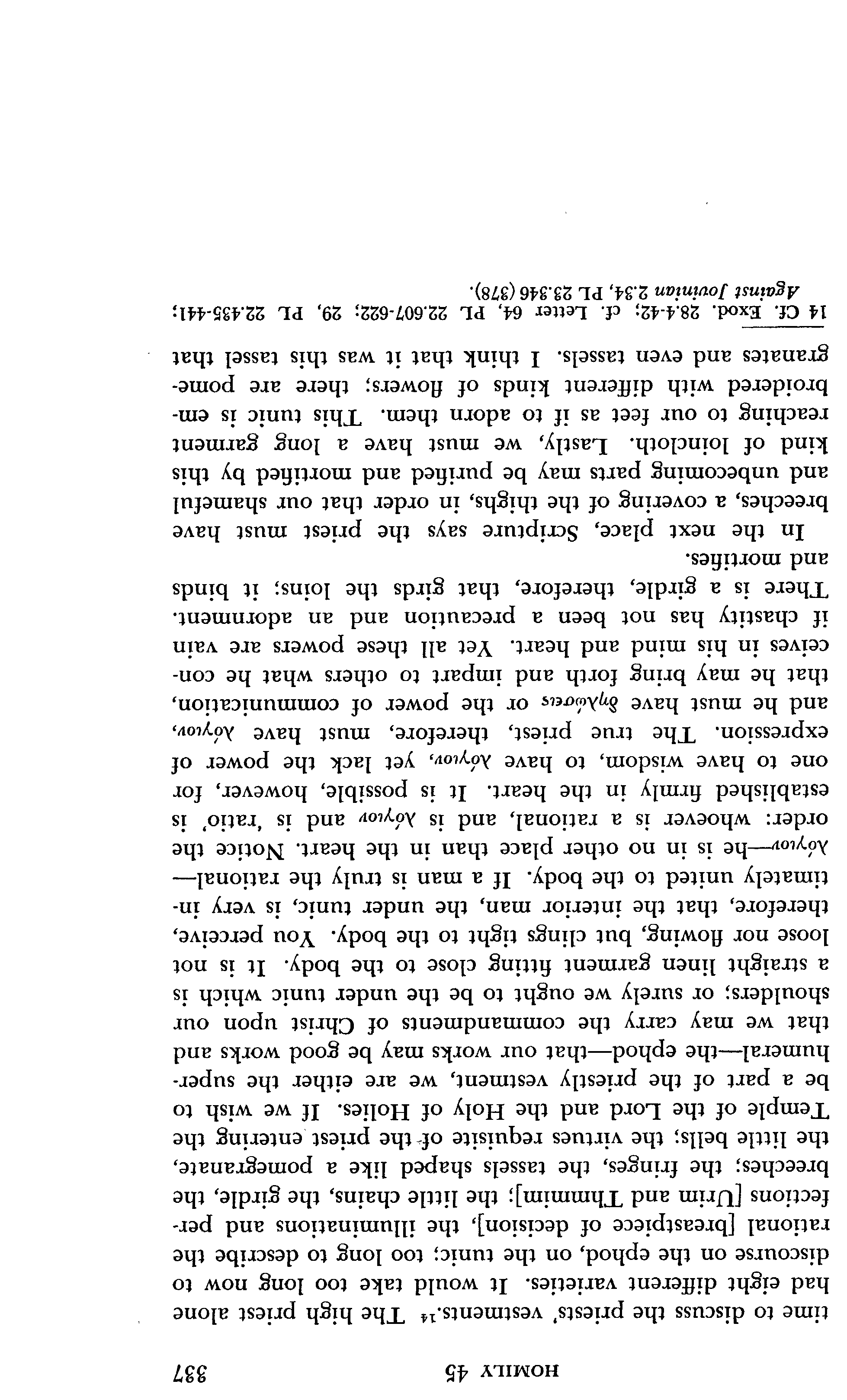
time to discuss the priests' vestments.14 The high priest alone had eight different varieties. It would take too long now to discourse on the ephod, on the tunic; too long to describe the rational [breastpiece of decision], the illuminations and perfections [Urim and Thmmim]; the little chains, the girdle, the breeches; the fringes, the tassels shaped like a pomegranate, the little bells; the virtues requisite of the priest entering the Temple of the Lord and the Holy of Holies. If we wish to be a part of the priestly vestment, we are either the superhumeral-the ephod-that our works may be good works and that we may carry the commandments of Christ upon our shoulders; or surely we ought to be the under tunic which is a straight linen garment fitting close to the body. It is not loose nor flowing, but clings tight to the body. You perceive, therefore, that the interior man, the under tunic, is very intimately united to the body. If a man is truly the rationalMy tor-he is in no other place than in the heart. Notice the order: whoever is a rational, and is A6ytov and is 'ratio' is established firmly in the heart. It is possible, however, for one to have wisdom, to have Mytov, yet lack the power of expression. The true priest, therefore, must have Mytov, and he must have 8"lAWCTW, or the power of communication, that he may bring forth and impart to others what he conceives in his mind and heart. Yet all these powers are vain if chastity has not been a precaution and an adornment.
There is a girdle, therefore, that girds the loins; it binds and mortifies.
In the next place, Scripture says the priest must have breeches, a covering of the thighs, in order that our shameful and unbecoming parts may be purified and mortified by this kind of loincloth. Lastly, we must have a long garment reaching to our feet as if to adorn them. This tunic is embroidered with different kinds of flowers; there are pomegranates and even tassels. I think that it was this tassel that 14 Cf. Exod. 28.4·42; cf. Letter 64, PL 22.607·622; 29, PL 22.435-441;
Against Jovinian 2.34, PL 23.346 (378).
SAINT JEROME
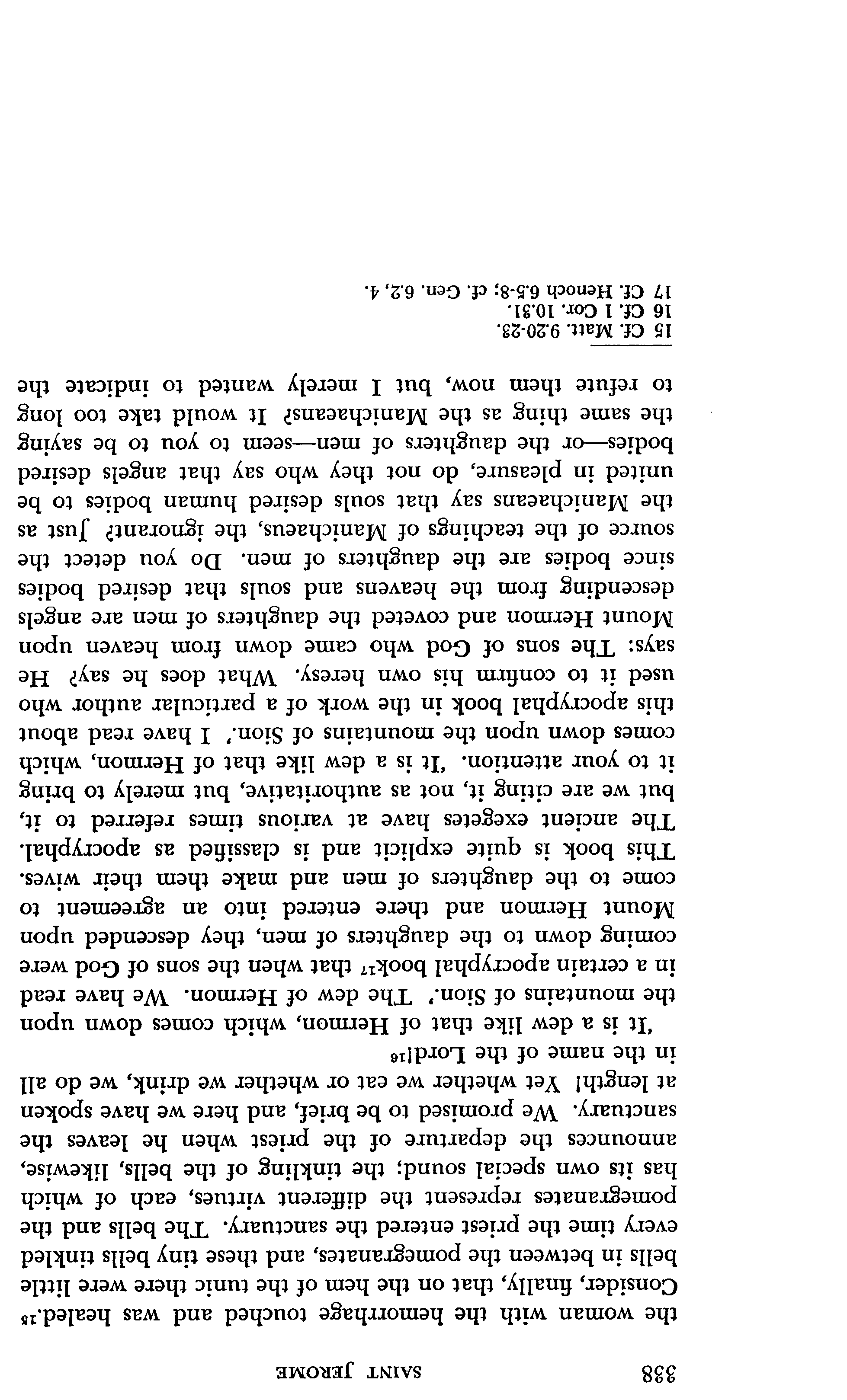
the woman with the hemorrhage touched and was healed.15
Consider, finally, that on the hem of the tunic there were little bells in between the pomegranates, and these tiny bells tinkled every time the priest entered the sanctuary. The bells and the pomegranates represent the different virtues, each of which has its own special sound; the tinkling of the bells, likewise, announces the departure of the priest when he leaves the sanctuary. We promised to be brief, and here we have spoken at lengthl Yet whether we eat or whether we drink, we do all in the name of the Lordl 16 'It is a dew like that of Hermon, which comes down upon the mountains of Sion.' The dew of Hermon. We have read in a certain apocryphal book17 that when the sons of God were coming down to the daughters of men, they descended upon Mount Hermon and there entered into an agreement to come to the daughters of men and make them their wives.
This book is quite explicit and is classified as apocryphal.
The ancient exegetes have at various times referred to it, but we are citing it, not as authoritative, but merely to bring it to your attention. 'It is a dew like that of Hermon, which comes down upon the mountains of Sion.' I have read about this apocryphal book in the work of a particular author who used it to confirm his own heresy. What does he say? He says: The sons of God who came down from heaven upon Mount Hermon and coveted the daughters of men are angels descending from the heavens and souls that desired bodies since bodies are the daughters of men. Do you detect the source of the teachings of Manichaeus, the ignorant? Just as the Manichaeans say that souls desired human bodies to be united in pleasure, do not they who say that angels desired bodies--or the daughters of men-seem to you to be saying the same thing as the Manichaeans? It would take too long to refute them now, but I merely wanted to indicate the 15 Cf. Matt. 9.20-23.
16 Cf. 1 Cor. 10.31.
17 Cf. Henoch 6.5-8; cf. Gen. 6.2,4.
HOMILY 45
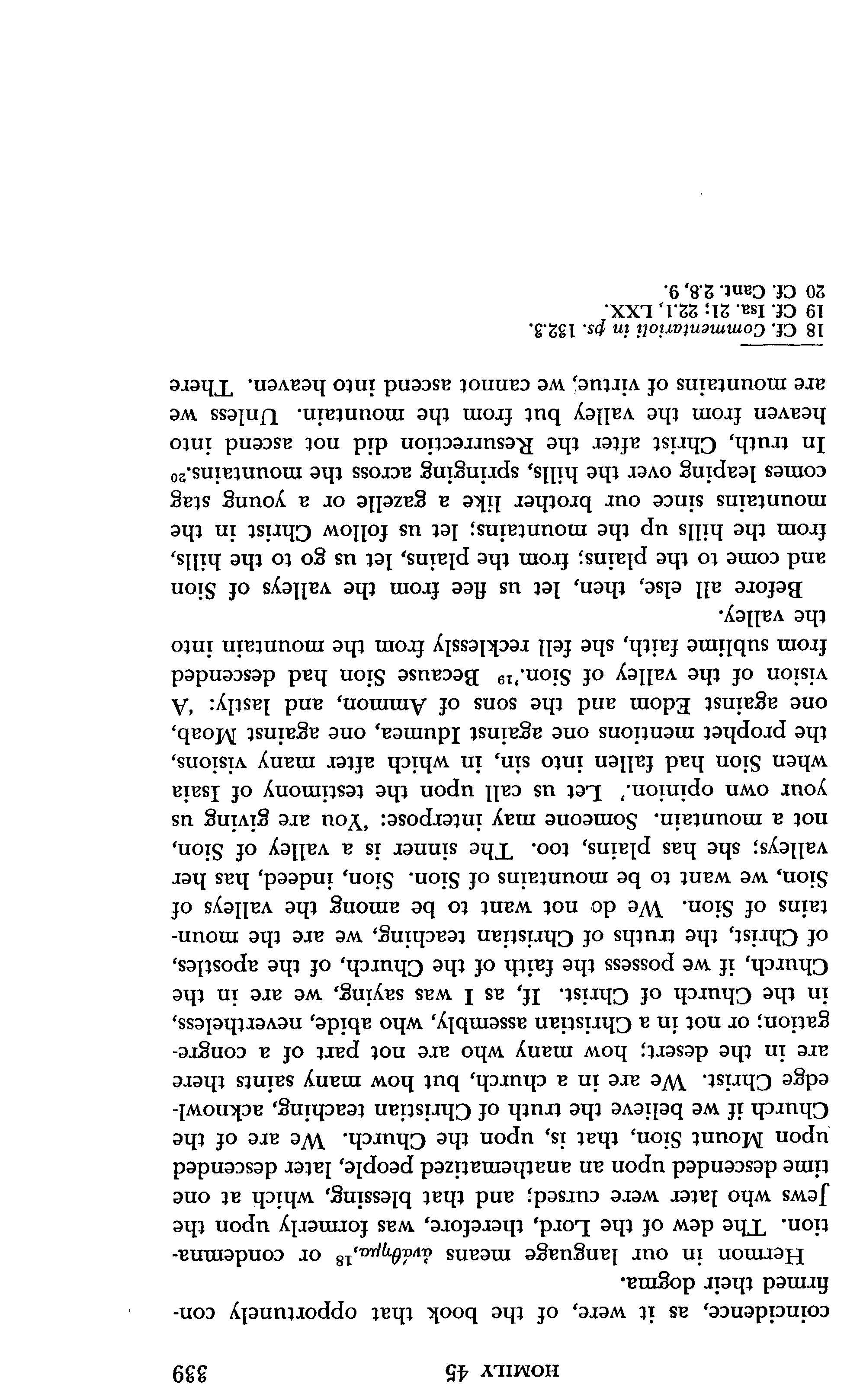
coincidence, as it were, of the book that opportunely confirmed their dogma.
Hermon in our language means ava01)}W-,18 or condemnation. The dew of the Lord, therefore, was formerly upon the Jews who later were cursed; and that blessing, which at one time descended upon an anathematized people, later descended upon Mount Sion, that is, upon the Church. We are of the Church if we believe the truth of Christian teaching, acknowledge Christ. We are in a church, but how many saints there are in the desert; how many who are not part of a congregation; or not in a Christian assembly, who abide, nevertheless, in the Church of Christ. If, as I was saying, we are in the Church, if we possess the faith of the Church, of the apostles, of Christ, the truths of Christian teaching, we are the mountains of Sion. We do not want to be among the valleys of Sion, we want to be mountains of Sion. Sion, indeed, has her valleys; she has plains, too. The sinner is a valley of Sion, not a mountain. Someone may interpose: 'You are giving us your own opinion.' Let us call upon the testimony of Isaia when Sion had fallen into sin, in which after many visions, the prophet mentions one against Idumea, one against Moab, one against Edom and the sons of Ammon, and lastly: 'A vision of the valley of Sion.'19 Because Sion had descended from sublime faith, she fell recklessly from the mountain into the valley.
Before all else, then, let us flee from the valleys of Sion and come to the plains; from the plains, let us go to the hills, from the hills up the mountains; let us follow Christ in the mountains since our brother like a gazelle or a young stag comes leaping over the hills, springing across the mountains.20
In truth, Christ after the Resurrection did not ascend into heaven from the valley but from the mountain. Unless we are mountains of virtue; we cannot ascend into heaven. There
18 Cf. Commentarioli in ps. 132.3.
19 Cf. Isa. 21; 22.1, LXX.
20 Cf. Cant. 2.8,9.

SAINT JEROME
assuredly-in the mountains of Sion, in the virtues, in the confession of faith, in the truth of the word of God-there is blessing and 'life forever.' Christ is our life. He' who confesses Christ receives life everlasting. Amen.