
HOMILY 30
HOMILY 30
ON PSALM 103 (104)
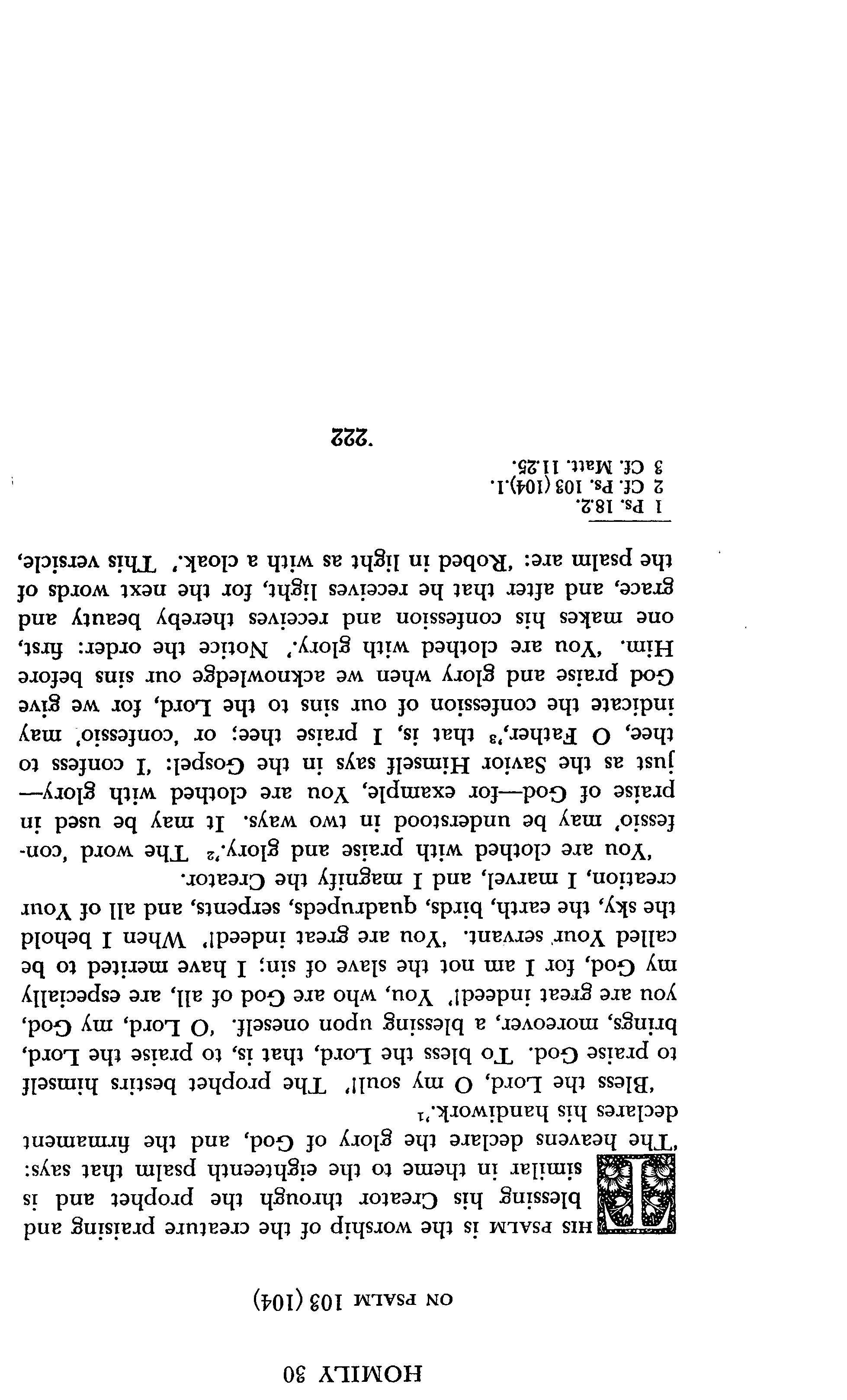
II HIS PSALM is the worship of the creature praising and blessing his Creator through the prophet and is similar in theme to the eighteenth psalm that says:
'The heavens declare the glory of God, and the firmament declares his handiwork.'!
'Bless the Lord, 0 my soul!' The prophet bestirs himself to praise God. To bless the Lord, that is, to praise the Lord, brings, moreover, a blessing upon oneself. '0 Lord, my God, you are great indeed!' You, who are God of all, are especially my God, for I am not the slave of sin; I have merited to be called Your'servant. 'You are great indeed!' When I behold the sky, the earth, birds, quadrupeds, serpents, and all of Your creation, I marvel, and I magnify the Creator.
'You are clothed with praise and glory.'2 The word 'confessio' may be understood in two ways. It may be used in praise of God-for example, You are clothed with gloryjust as the Savior Himself says in the Gospel: 'I confess to thee, 0 Father,'8 that is, I praise thee; or 'confessio' may indicate the confession of our sins to the Lord, for we give
God praise and glory when we acknowledge our sins before Him. 'You are clothed with glory.' Notice the order: first, one makes his confession and receives thereby beauty and grace, and after that he receives light, for the next words of the psalm are: 'Robed in light as with a cloak.' This versicle,
1 Ps. 18.2.
2 Cf, Ps. 103 (104).1.
3 Cf. Matt. 11.25.
·222
HOMILY 30
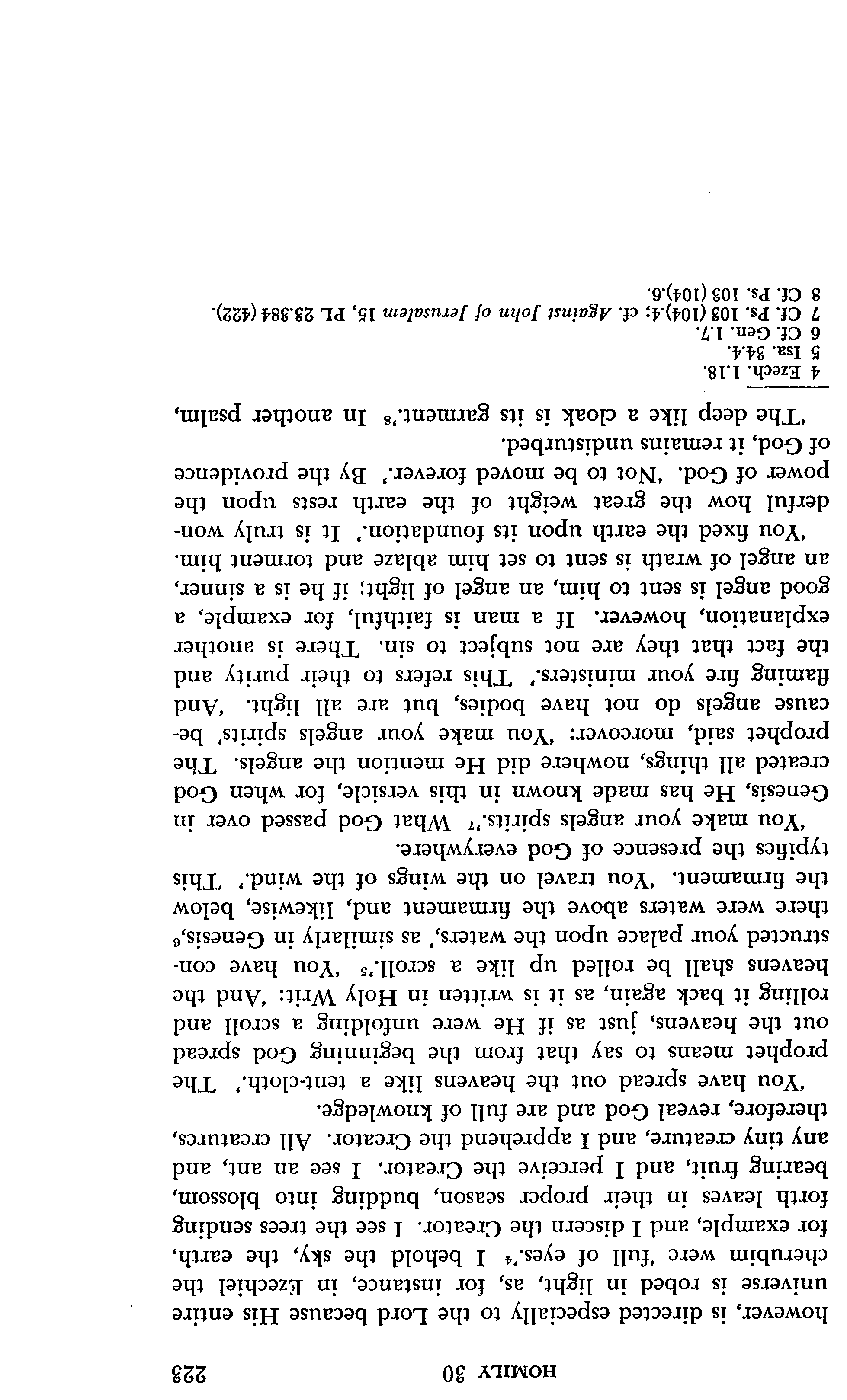
however, is directed especially to the Lord because His entire universe is robed in light, as, for instance, in Ezechiel the cherubim were 'full of eyes.'4 I behold the sky, the earth, for example, and I discern the Creator. I see the trees sending forth leaves in their proper season, budding into blossom, bearing fruit, and I perceive the Creator. I see an ant, and any tiny creature, and I apprehend the Creator. All creatures, therefore, reveal God and are full of knowledge.
'You have spread out the heavens like a tent-cloth.' The prophet means to say that from the beginning God spread out the heavens, just as if He were unfolding a scroll and rolling it back again, as it is written in Holy Writ: 'And the heavens shall be rolled up like a scroll.'5 'You have constructed your palace upon the waters,' as similarly in Genesis,6 there were waters above the firmament and, likewise, below the firmament. 'You travel on the wings of the wind.' This typifies the presence of God everywhere.
'You make your angels spirits.'7 What God passed over in Genesis, He has made known in this versicle, for when God created all things, nowhere did He mention the angels. The prophet said, moreover: 'You make your angels spirits' because angels do not have bodies, but are all light. 'And flaming fire your ministers.' This refers to their purity and the fact that they are not subject to sin. There is another explanation, however. If a man is faithful, for example, a good angel is sent to him, an angel of light; if he is a sinner, an angel of wrath is sent to set him ablaze and torment him.
'You fixed the earth upon its foundation.' It is truly wonderful how the great weight of the earth rests upon the power of God. 'Not to be moved forever.' By the providence of God, it remains undisturbed.
'The deep like a cloak is its garment.'8 In another psalm, 4 Ezech. 1.18.
5 Isa.34.4.
6 Cf. Gen. 1.7.
7 Cf. Ps. 103 (104).4; cf. Against John of Jerusalem 15, PL 23.384 (422).
8 Cf. Ps. 103 (104).6.
SAINT JEROME
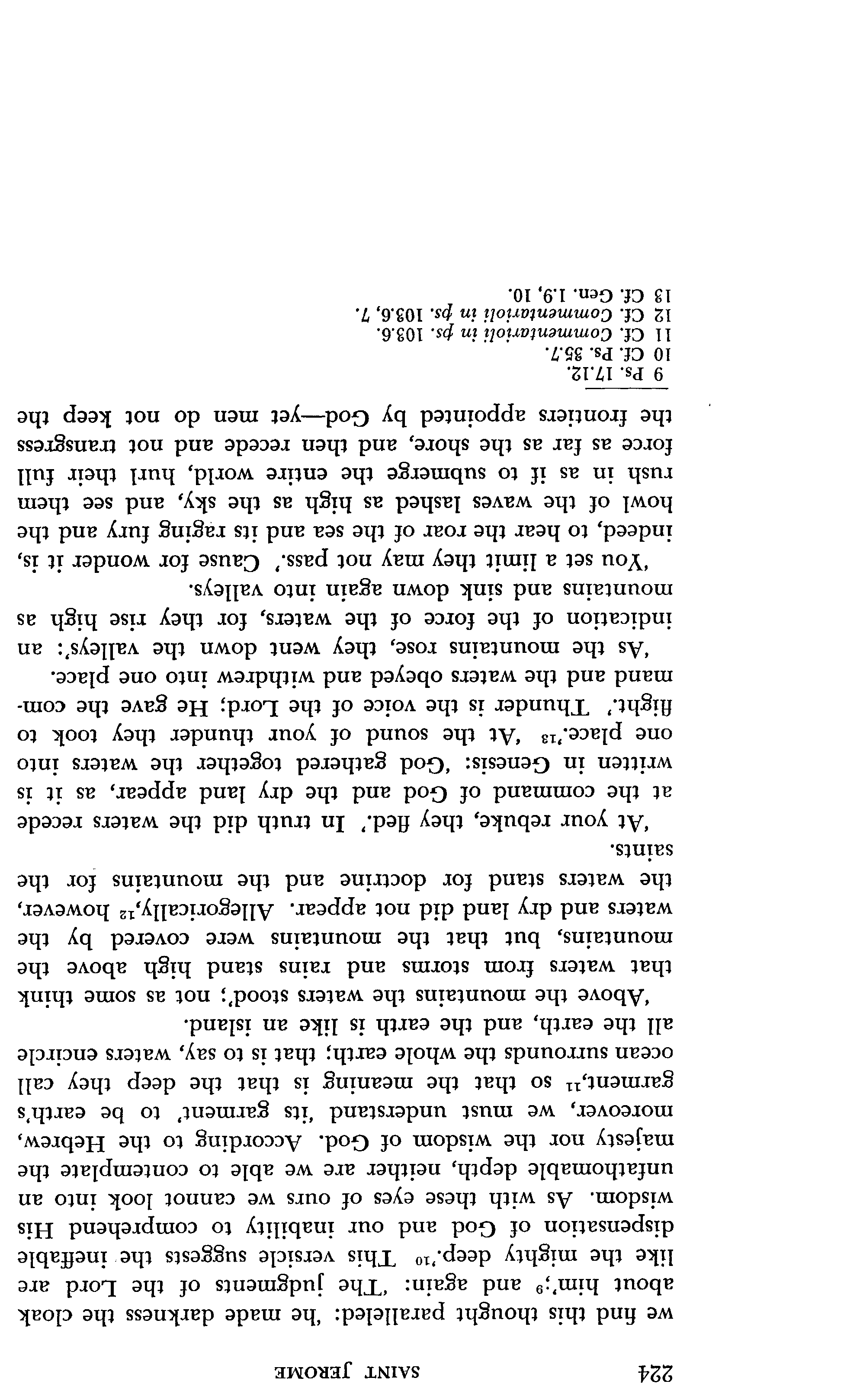
we find this thought paralleled: 'he made darkness the cloak about him';9 and again: The judgments of the Lord are like the mighty deep.'lO This versicle suggests the ineffable dispensation of God and our inability to comprehend His wisdom. As with these eyes of ours we cannot look into an unfathomable depth, neither are we able to contemplate the majesty nor the wisdom of God. According to the Hebrew, moreover, we must understand 'its garment' to be earth's garment,l1 so that the meaning is that the deep they call ocean surrounds the whole earth; that is to say, waters encircle all the earth, and the earth is like an island.
'Above the mountains the waters stood'; not as some think that waters from storms and rains stand high above the mountains, but that the mountains were covered by the waters and dry land did not appear. Allegorically,12 however, the waters stand for doctrine and the mountains for the saints.
'At your rebuke, they fled.' In truth did the waters recede at the command of God and the dry land appear, as it is written in Genesis: 'God gathered together the waters into one place.'13 'At the sound of your thunder they took to flight: Thunder is the voice of the Lord; He gave the command and the waters obeyed and withdrew into one place.
'As the mountains rose, they went down the valleys': an indication of the force of the waters, for they rise high as mountains and sink down again into valleys.
'You set a limit they may not pass.' Cause for wonder it is, indeed, to hear the roar of the sea and its raging fury and the howl of the waves lashed as high as the sky, and see them rush in as if to submerge the entire world, hurl their full force as far as the shore, and then recede and not transgress the frontiers appointed by God-yet men do not keep the 9 Ps. 17.12.
10 Cf. Ps. 35.7.
11 Cf. Commentarioli in ps. 103.6.
12 Cf. Commentarioli in ps. 103.6,7.
13 Cf. Gen. 1.9, 10.
HOMILY 30
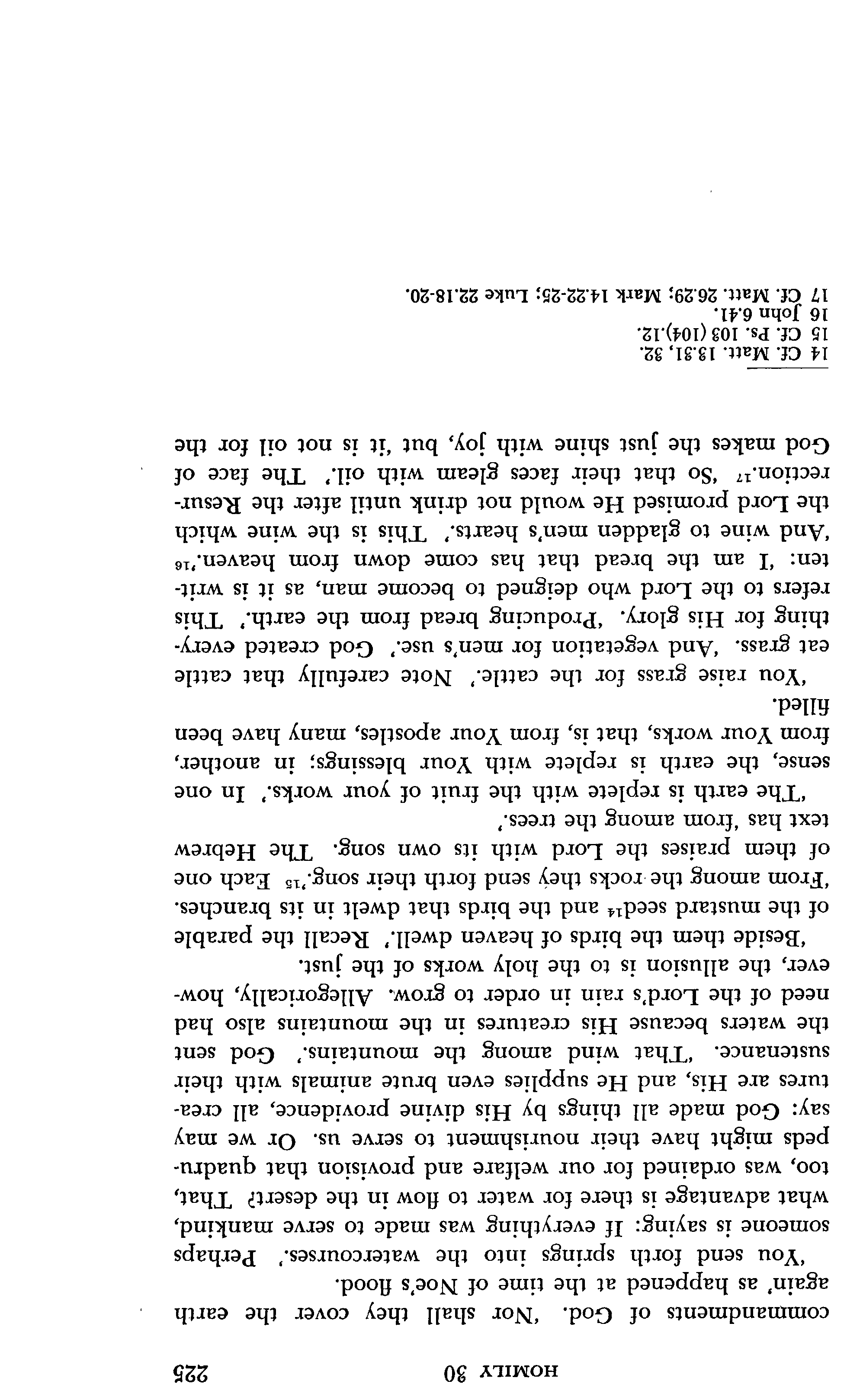
commandments of God. 'Nor shall they cover the earth again' as happened at the time of Noe's flood.
'You send forth springs into the watercourses.' Perhaps someone is saying: If everything was made to serve mankind, what advantage is there for water to flow in the desert? That, too, was ordained for our welfare and provision that quadrupeds might have their nourishment to serve us. Or we may say: God made all things by His divine providence, all creatures are His, and He supplies even brute animals with their sustenance. 'That wind among the mountains.' God sent the waters because His creatures in the mountains also had need of the Lord's rain in order to grow. Allegorically, however, the allusion is to the holy works of the just.
'Beside them the birds of heaven dwell.' Recall the parable of the mustard seed14 and the birds that dwelt in its branches.
'From among the rocks they send forth their song.'15 Each one of them praises the Lord with its own song. The Hebrew text has 'from among the trees.'
'The earth is replete with the fruit of your works.' In one sense, the earth is replete with Your blessings; in another, from Your works, that is, from Your apostles, many have been filled.
'You raise grass for the cattle.' Note carefully that cattle eat grass. 'And vegetation for men's use.' God created everything for His glory. 'Producing bread from the earth.' This refers to the Lord who deigned to become man, as it is written: 'I am the bread that has come down from heaven.'16
'And wine to gladden men's hearts.' This is the wine which the Lord promised He would not drink until after the Resurrection,11 'So that their faces gleam with oil.' The face of God makes the just shine with joy, but 'it is not oil for the 14 Cf. Matt. 13.31,32.
15 Cf. Ps. 103 (104).12.
16 John 6.41.
17 Cf. Matt. 26.29; Mark 14.22-25; Luke 22.18-20.
SAINT JEROME
head'18 of sinners. 'And bread fortifies the hearts of men': the bread which came down from heaven.
'Well watered are the trees of the Lord: The Lord refreshed the trees also, that they may give us their fruit. 'In them the sparrows19 build their nests.' By sparrows we are to understand all birds, the genus from the species.
'Fir trees are the home of the heron.'20 The heron is a mighty bird all right; they say, too, that it overpowers the eagle and feeds upon it. It is not like other birds that build their nests and fly to them in the evening; wherever darkness overtakes the heron, there it sleeps. Allegorically, on the other hand, the monk does not have a cell, but wherever he finds one, there, too, he stays. His battle is with the devil who reigns in this world; like the heron he prevails over the eagle, the king of the birds,21 just as it is written: 'though you go as high as the eagle, from there I will bring you down, says the Lord,'22 for, according to Ezechiel,23 the eagle is the devil.
'The high mountains are for the stags.'24 This animal kills serpents and eats them;25 therefore, the mountains are the right habitat for the slayer of the wise serpent, the serpent that, in the Garden of Paradise, was wiser than all the beasts, the serpent that deceived Eve. 'The cliffs are a refuge for rock-badgers: He who is fearful has a rock-fastness for his refuge; the rock, moreover, is Christ.26
'You made the moon to mark the seasons.' There is a saying that when the moon waxes, the yield of fruit increases; when it wanes, it decreases, hence: 'You made the moon to mark the seasons,' is well said. But let us interpret the moon in another way as the Church; for in propagating the Church,
18 Cf. Ps. 140.5.
19 Cf. Ps. 103 (104).17.
20 Ibid.
21 Cf. Commentary on Daniel 7.4, PL 25.528 (664); on Michea 1.16. PL 25.1164 (447).
22 Abd. 4; d. Jer. 49.16.
23 Ezech. 17; d. Commentary on Ezechiel 17. PL 25.164-165 (194-195).
24 Cf. Ps. 103 (104).18.
25 Cf. Letter 130.8. PL 22.1114 (985).
26 Cf. 1 Cor. 10.4.
HOMILY 30
we increase with her; when she suffers persecution and is decreased, we suffer persecution and decrease with her. 'The sun knows the hour of its setting: If the sun sets, do we think that we are going to be everlasting? It is certainly amazing how so much light and such brightness, that the whole world is illuminated, in the flash of a moment is gone. Let us pray, however, that the sun of justice may not set for us.
'You bring darkness, and it is night; then all the beasts of the forest roam about: Literally, this means that the nighttime was made for men to rest from their toil and for beasts to hunt for their food. Allegorically, when the sun of justice sets for us, we are in total darkness; then the beasts come after us, and the lion roars in its wild passion to snatch up and devour US.21
'Young lions roar for the prey and seek their food from God: Well put, 'from God,' since, indeed, the devil is always laying traps for the saints, for example, Judas, David, Solomon,
Peter, as it is written, 'his repast sumptuous:28
'When the sun rises, they withdraw: The man who has fallen into sin should not be downcast, but let him repent.
The sun of justice will rise again, and all the beasts will be put to flight and his sins with them, and he will be restored to his state before his fall. Once more for him the sun of justice shall rise. 'Man goes forth to his work and to his tillage till the evening: After the sun of justice has risen, moreover, we go back again to our work until evening, until death, of course. Very important it is, then, that we pursue the works of justice every minute of our lives.
'How magnificent are your works, 0 Lord!,29 The prophet's heart overflows with gratitude. When he could not find sufficient words with which to praise the Lord, he cried: 'How magnificent are your works, 0 Lord!' Your works surpass all human understanding. 'In wisdom you have wrought them
27 C£. Commentarioli in ps. 103.20.
28 Hab. 1.16; cf. Commentary on Habacuc 1.16, PL 25.1288 (606); cf.
Letter 22.4, PL 22.396 (90).
29 Cf. Ps. 103 (104).24.
SAINT JEROME
all'; in our Lord, Jesus Christ, for He is the wisdom of God, according to the saying of the Apostle, because through Him all things30 have been created. 'The earth is full of your creatures.' True, indeed, it is that all the works of the Lord abound in wisdom. When we perceive that the ant knows when winter is coming and stores away its food; that the mosquito, such a tiny creature, has eyes, a belly, and all the other members just as we have, and the flea, too, and all other creatures; and when we see also that the elephant, such a huge beast, likewise has eyes, a nose, feet, a belly, just as we have and in the same places; similarly, too, the bee, and that it makes honey and wax: are not all these wonders worthy of admiration and are they not full of wisdom?
'The sea also, great and wide.' Is it not of wondrous wisdom that in the sea there are reptiles, countless in number, and fish of all sorts, great and small; that they exist in the deep and there renew their life, whereas if man should fall into it, he would die, but, on the other hand, if they come forth unto land, they die? 'And where ships move about.'
Who of us is the strong ship that can escape shipwreck in this world and not be sunk or dashed against a rock, but has a conscience to steer him so that he may be safe?
'With the sea dragon, which you formed to make sport of ito'31 The Jews say that God has made a mighty dragon called Leviathan which lives in the sea; and when the ocean recedes, they say it is because this dragon is turning over.
But let us say that this is the dragon that was cast out of Paradise, that beguiled Eve, and is permitted in this world to make sport of us. How many monks and clerics has it dashed headlong! 'They all look to you to give them food in due time,' for all the creatures of God live at His bidding.
'If you take away their breath, they perish and return to their dust.' This prefigures the end of the world when, at the command of the Lord, all things will come to an end,
30 Cf. Col. 1.16.
31 Cf. Ps. 103 (104).26.
HOMILY 30
as it is written: 'Dust you are, and unto dust you shall return.'a2 'When you send forth your SpIrIt, they are created': on the day of creation. If the Spirit creates, He is, therefore,
God;33 that is to say, the Spirit creates even as the Father does.
'May the glory of the Lord endure forever.' If the glory of the Lord endures forever, we, too, who glorify Him will be everlasting. 'May the Lord be glad in his works!' Joy it is for the Lord when we, His creatures, greet Him on the day of resurrection. 'He who looks upon the earth, and it trembles.'
Our earth will, indeed, tremble on the day of judgment. The reference here is, of course, to worldly sinners. 'Who the mountains, and they smoke!' If the mountains smoke, how much more will earth? The saints smoke because all of us shall be saved through fire.
Naturally, there is no smoke without a fire. '1 will sing to the Lord all my life; I will give praise to my God while 1 live.' Another psalm says the same:
'Turn your gaze from me, that I may find respite ere 1 depart and be no more.'34 Grant me a little time that I may repent for my sins, for in hell no one has the power to confess his sins.
'Pleasing to him be my theme.' May it be pleasing to Him that anyone justly be able to praise and bless God. The prophet said this in the optative mode, not in the imperative.
'1 will be glad in the Lord.' Happy are they who utter these words after the judgment.
'May sinners cease from the earth.' The prophet did not pray that sinners might perish, but that sin itself might vanish. When sin no longer makes its appearance, no longer are there sinners, and all shall be found just. 'And may the wicked be no more';35 may they not be wicked, but just.
32 Gen. 3.l9.
33 Cf. Hebrew Questions on Genesis 1.2, PL 23.987 (306).
34 Ps. 38.14.
35 Cf. Against the Pelagians 1.28, PL 23.544 (724).