
23 Keep thy heart with all diligence, for out
[ 8] A
SAINT INDEED, &c.
PROV. iv. 23. Keep thy heart with all diligence, for out of it are the issues of life.
THE heart of man is his worst part before it be be regenerate, and the best afterwards: it is the feat of principles, and fountain of actions.
The eye of God is, and the eye of the Christian ought to be, principally fixed upon it.
The greatest difficulty in conversion, is, towintheheart to God; and the greatest difficulty after conversion, is to keep the heart with God.
Here lies the very pinch and stress of religion; here is that which makes the way to life a narrow way, and the gate to heaven a strait gate.
Direction and help inthisgreatwork, are the scope and sum of this text : where in we have, 1. Anexhortation, " Keep thy heart with all diligence."
2. The reason, or motive enforcing it, " For out of it are " the issues of life."
In the exhortation I shall consider, 1. The matter of the duty.
2. The manner of performing it.
1. The matter of the duty,keep thy heart.
Heart is not here taken properly for that noble part ofthebodywhich philosophers call the primum vivens, et ultimum moriens ; the first that lives, and the last that dies; but by heart, in a metaphor, the scripture sometimes understands some particular noble faculty of the soul: inRom. i. 21. it is put for the understanding part, their foolish heart, (i. e.) " their foolish under- " standing was darkened."
And Psalm cxix. 11. it is put for the memory, " Thy wordhaveIhidinmyheart;" and 1 John iii. 10. it is put for the conscience, which hath in it both the light of the understanding and the recognitions of the memory: if our heart condemn us, (i. c.) if our conscience, whose proper office it is to condemn.
But here we are to take it more generally for the whole foul, or inner man ; for look what the heart is to the body, that the foul is to the man ; and what health is to the heart,'that holiness is to the soul: Quod
What it is to keep the Heart. fan it as in corporeidfanctitas in corde.
The state of the whole body depends upon the foundness andvigour of the heart, and the everlasting state of the whole man upon the good or ill. condition of the soul.
And by keeping the heart, understand the diligent and conAantuse and improvement of all holy means and duties, to preserve the soul from fin, and maintain its sweet and free communionwithGod. * Lavater, on the place, will have the word taken fromabefieged garrison, begirt bymanyenemies without, and in danger of being betrayed by treacherous citi zens within, in which danger the soldiers,uponpainofdeath, are commanded to watch; and whereas the expression(keep thy heart seems to put it upon us as our work,yet it doth not implya sufficiency or ability in us to do it ; we are as able to stop the fun in its course, or make the rivers run backward, as by our own skill and power to rule and order our hearts : we may as well be our own faviours, as our own keepers; and yet Solomon speaks properly enough,when he faith, keep thy heart; because the duty is ours, though the power be God's.
A natural man hath no power, a gracious man hath some, though not sufficient ; and that power he hath,depends upon the exciting and assisting strength of Christ; Gratia gratiam poftulat, grace within us is beholden to grace without us,
John xv. 5. "Without me yecando nothing."
So much of thematterofthe duty.
2. The manner of performing it is, with all diligence; the Hebrew is very emphatical, † Cum omni cuftodia, keep with all keeping, q. d. keep, keep; set double guards, your hearts will be gone else. And this vehemency of expreffi on,with which the duty is urged, plainly implies how difficult it is to keep our hearts, andhowdangerous toletthem go.
3. The reason, or motivé quickeningto this duty, is very forcible and weighty: " For out of it are the issues of life.'
That is, it is the fourceand fountain of all vital actions an do perations ; Hincfons boni etpeccandi origo, faith Jerom ; it is the spring and original both of good and evil, as the spring in * I say constant, for the reason added in the text extends the duty to all the states and conditionsofaChristian's life, and makes itbindadfemper : If the heart must be kept because out of it are the issuesoflife; then as long as these issues of life do flow out of it, we are obliged to keep it.
* רמשכ לבכ B VOL VII.
What it is to keep the Heart. a watch that sets all the wheels in motion.
The heart is the treasury,the hand and tongue but the shops,what is in these, comes from thence ; the hand and tongue always beginwhere the heart ends.
The heart contrives, and the members execute; Luke vi. 45. "A good man out of the good treasure
"of his heartbringeth forth good things,and an evil man out " of the evil treasure of his heart bringeth forth evil things ;
" for out of the abundance of his hear this mouth speaketh." So then, if the heart err in its work, these must needs miscarry in theirs ; for heart-errors are like the errors of the first concoction, which cannot be rectified afterwards : Or like the misplacing, and inverting of the stamps and letters in the press,which must needs cause so many errata in all the copies that are printed off.
Othen,how important a duty is that which is contained in the following proposition ?
Doct. That the keeping, and right managing of the heart in every condition, is the great business ofa Christian's life.
What the philosopher faithofwaters, is as properly applicable to hearts ; Suis term in is difficile continentur, it is hard to keep them within any bounds: God hath set bounds and limits to them, yet how frequently do they transgress, not only the bounds of grace and religion, but even of reason and common honesty ? Hic labor hocopus est ; this is that which affords the Christian matter of lab our, fear and trembling tohisdyingday.
It is not the cleansing of the hand that makes the Christian, for many a hypocrite can shew as fair a hand ashe ; but the purifying, watching, and right ordering of the heart ; this is the thing that provokes so many fad complaints,and costs fo many deep groans and brinish tears.
It was the pride ofHezekiah's heart that made him lie in the dust mourning before the Lord, 2 Chron. xxxii. 26.
It was the fear ofhypocrify invading the heart, that made David cry, " Let my heart be
"found in thy statutes, that I be not ashamed," Psalm cxix. 80. It was the fad experience he had of the divisions and distractions of his own heart, in the service of God, that made himpourout that prayer, Psalm lxxxvi. 11. "Unite my heart
" to fear thy name."
The method in which I shall improve the point, shall be this, First, I shall enquire what the keeping of the heart supposes and imports.
Secondly, Affigndivers reasons, why Christians must make this the great work and business of their lives.
What it is to keep the Heart.
Thirdly, Point at those special seasons which especially call for this diligence in keeping the heart.
L Fourthly, and lastly,Apply the whole in several uses.
1. What the keeping of the heart supposes and imports.
To keep the heart, necessarily supposes a previous work of fanctification, which hath set the heart right,by giving it a new spiritual bent and inclination ; for as long as the heart is not set right by grace, as to its habitual frame, no duties or means can keep it right with God.
Self is the poise of the unfanctified heart, which biasses and moves it in all its designs and actions ; and as long as it is so, it is impossible that any external means should keep it with God.
Man, by creation, was of one constant, uniform frame and ten our of spirit, held one straight and even course; not one thought or faculty revelledordisordered;his mind had a perfect illumination to understand and know the will of God, his will a perfect compliance therewith ; his sensitive appetite, and other inferior powers,stood in a most obedient fubordination.
Man, by degeneration,is become a most disorderedand rebellious creature,contesting with, and opposing his Maker, as the first cause, by self-dependence ; as the chiefeft good, by self-love; as the highest Lord, by self-will, and as the last end, by self-seeking ; and so is quite disordered,and all his acts irregular: His illuminated understanding is clouded with ignorance, his complying will fullofrebellion and stubborness ; his subordinate powers,casting off the dominion and government of the superior faculties.
But by regeneration this disordered foul is set right again ; fanctificationbeing the rectifying and due framing, or, as the scripture phrases it,the renovation of the soul after the image of God, Eph . iv. 24. in which,self-dependence is removed by faith ; self-love, by the love of God ; self-will, by fubjection and obedience to the will of God; and self-feekingby self-denial.
The darkened understanding isagainilluminated,Eph. i. 18. the refractory will sweetly subdued, Psalm cx. 3. the rebellious appetite,orconcupifcence gradually conquered, Rom. vi. 7. per tot. And thus the soul which fin had universally depraved is again by grace restored and rectified.
This being pre-supposed, it will not be difficult to apprehend, what it is to keep the heart, which is nothing else but the constant careanddiligence offuch a renewed man, to preserve his foul in that holy frame to whichgracehath reduced it, and daily strives to hold it.
What it is to keep the Heart.
For,though grace hath, in a great measure, rectified the soul, andgivenitanhabitual and heavenly temper ; yet fin often ac tuallydifcomposes it again: so that even a gracious heart is like a musical instrument, which, though it be never it be neversoexactly tuned, a small matter brings it out of tune again; yea, hang it aside but a little, and it will need setting again, before you can play another lesson on it; even even so stands the case with gracious hearts ; if they are in frameinone duty, yethowdull, dead, anddisorderedwhen they come to another ? And there fore every duty needs a particular preparation of the heart,
Job xi. 13. " If thou prepare thine heart, and stretch out thine "hands towards him." Well then, to keep the heart, is care fullytopreserve it from fin, which disorders it; and maintain that spiritual and gracious frame, which fits it for a life of communion with God. And this includes these six acts in it :
1. Frequent observation of the frame of the hearts turning in and examining how the case stands with it, this is one part of the work.
Carnal and formal persons take no heed to this, they cannot be brought to confer with their own hearts; there are some men and women that have lived forty or fifty years in the world, and have scarce had one hour'sdiscourse with theirownhearts all that while : It is a hard thing to bring am an andhimselftogether upon such an account; but saints know those soliloquies and self-conferences to be of excellent use and advantage. The heathen could say, animafedendo et quiefcendofit sapiens, the soul is made wife by fitting still in quietness ; though bankrupts care not to look into their books ofaccompt, yet upright hearts willknowwhethertheygobackwardor forward, Psalm lxxvii. 6. " I commune with mine own
" heart." The heart can neverbekept, until its case be examinedandunderstood.
2. It includes deephumiliationfor heart-evils and disorders . thus Hezekiah humbled himself for the pride of his heart,
2 Chron. xxxii. 26. Thus the people were ordered to spread forth their hands to God in prayer, in a sense of the plague of their own hearts, 1 Kings viii. 38. Upon this account many an upright heart hath been laid low before God : O what an heart have I ? They have in their confessions pointed at the heart, the pained place ; Lord,here is the wound, here is the plague-fore.
It is with the heart well kept, as it is with the eye,which is a fit emblem of a small dust get into the eye, it will never leave twinklingandwateringtillithavewept it out: So the upright heart cannot be at rest till it have wept out its troubles, and poured out its complaints before the Lord.
What it is to keep the Heart.
3. It includes earnest supplications and instant prayer for heart-purifying and rectifyinggrace,whenfinhathdefiledand disordered it; fo Psalm xix. 12. " Cleanse thou me from secret
" faults;" andPfalm lxxxvi. 11. " Unite my heart to fear thy " name."
Saints have always many such petitions depending before the throne of God's grace; this is the thing which is most pleaded by them with God: When they are praying for outward mercies, haply their spirits maybe more remiss, but when it comes to the heart-case, then they extend their spirits to the utmost, fill their mouths with arguments,weep and make fupplication : Oh, for a better heart ! Oh for a heart to love
God more To hate finmore, to walk more evenlywithGod:
Lord, deny not to me such a heart, whatever thou deny me; give me an heart to fear thee, love and delight in thee, ifI begmybreadin desolate places.
It is observed of holy Mr.
Bradford, that when he was confessing fin, he would never give over confessing until he had felt some prokenness of heart for that fin; andwhenpraying for any spiritual mercy, would never give over that suit, until he had got some relith of that mercy; that is the third thing included in keeping the heart.
4. It includes the imposing of strong engagementsandbonds upon ourselves to walk more accurately with God, and avoid the occasions whereby the heart maybe induced to fin: Well composed, advised, and deliberate vows, are, in some cases, of excellent use to guard the heart against some special fin; so Job xxxi. 1. " I made a covenant with mine eyes ;" by this means, holyones have over-awed their souls, and preserved themselves fromdefilementby some special heart-corruptions.
5. It includes aconstantholyjealousy over our own hearts; quick-sighted self-jealousy is an excellent preservative from fin ; hethatwillkeep his heart, must have the eyes of his foul awake andopenupon all the disorderly and tumultuous stirrings of his affections ; if the affections break loose, and the passions be stirred, the soul must discover and suppress them before they get to an height: O, my soul, dostthou well in this ? My tumultuous thoughts and passions, where is your commission ?
State viri, quae caufa viae? quive eftis in arm is.
Virg.
Happy is the man that thus feareth always, Prov. xxviii.
14. By this fear of the Lord it is that men depart from evil, fbakeof security,and preserve themselves from iniquity; he that will keep his heart must feed with fear, rejoice with fear, and pass the whole time of his sojourning here in fear, and all little enough to keep the heart from fin.
6. And, lastly,To add no more, it includes the realisingof
Heart-work, difficult and important.
God's presence with us, and fettingthe Lord always before us :
This the people of God have found a singular means to keep their hearts upright, and awe them from sin ; when the eye of our faith is fixed upon the eye of God's omniscience, we dare not let out our thoughts and affections to vanity : Holy Job durst not fufferhis heart to yield to an impure, vain thought ; and what was it that moved him to so great acircumspection ?
Why, he tells you, Job xxxi . 4. "Doth he not see my ways, " and count all my steps ? Walk before me (faith God to " Abraham) and be thou perfect," Gen. xvii. 1.
Even as parents use to fettheirchildreninthe congregation before them, knowingthatelse they will be toying and playing ; so would the heart of the best in an too, were it not for the eye of God.
In these, and such like particulars, do gracious fouls express the care they have of their hearts ; they are as careful to prevent the breaking loose of their corruptions in times of temptation, as seamen are to bind fast the guns, that they break not loose ina storm ; as careful to preserve the sweetness and comforttheyhavegotfromGodin any duty, as onethatcomes outofanhot bath, or great sweat, is of taking cold, by going forth into the chill air.
This is the work, and of all works in religion it is the most difficult, constant, and important work.
1. It is the hardest work; heart-work is hard work indeed.
To shuffle over religious duties with a loose and heedless spirit, will cost no great pains; but to set thyself before the Lord,and tyeup thy loose and vain thoughts to a constant and serious attendanceuponhim ; this will cost thee something : To attain a facility and dexterity of language in prayer, and put thy meaning into apt and decent expressions, is easy; but to get thy heart broken for fin, whilst thou art confessing it; melted withfreegrace, whilst thou art blessingGodfor it; to be really ashamed and humbled through the apprehenfions of God's infinite holiness, and to keep thyheartin this frame,not only in, but after duty, will surely cost thee some groans and travailing pains of foul: To repress the outward acts of fin, and compose the external part of thy life in a laudable and comely manner, is no great matter ; even carnal persons by the force ofcommonprinciples can do this ; but to kill the root of corruption within, to set and keep up an holy government over thy thoughts, to have all things lie straight and orderly in the heart, this is not easy.
2. Itisaconstant work. The keeping of the heart is such a work, as is never done till life be done; this labour and our
Heart-work, difficult and important.
life, end together : It is with a Christian in this business, as it is with seamen that have sprung a leak at sea, if they tug not constantly at the pump, the water increases upon them, and will quickly finkthem. It is in vain for them to say the work is hard, and we are weary ; there is no time or condition in the life of a Christian, which will suffer an intermission of this work.
It is in the keeping watch over our hearts, as it was in the keeping up of Moses his hands, whilst Israel and Amalek were fighting below, Exod. xvii. 12. No sooner do Moses his hands grow heavy andsinkdown, but Amalekprevails.
You know it costDavid and Petermany a fad day and night for intermittingthe watch over their own hearts but afewminutes.
3. It is the most important business of a Christian's life.
Without this we are but formalifts in religion ; all our professions, gifts and duties signify nothing : " My son, give me
" thine heart," Prov. xxiii. 36. God is pleased to call that a gift,which is indeed a debt ; he will put this honour upon the creature to receive it from him in the way of a gift; but if this be not given him, he regards not whatever else you bring to him: There is so much only of worth and valueinwhatwedo, as there is of heart in it.
Concerning the heart,God seems to say, as Joseph of Benjamin, " Ifyoubring not Benjamin with
66 you, you shall not see my face." Among the heathens, when the beast was cutup for sacrifice, thefirstthing the priest lookeduponwas the heart, and if that was unsound and naught, the sacrifice was rejected. God rejects all duties (how glorious soever in other respects) offered him without a heart. He thatperformsduty without a heart, viz. heedlesly, is no more accepted with God, than he that performs it with a double heart, viz. hypocritically, Ifa. lxvi. 3. And thus I have briefly openedthenature of the duty, what is imported in this phrase,
" Keep thy heart."
2. Next, I shall give you some rational accountwhyChriftians should make this the great business of their lives, to keep their hearts.
The importance and necessity of making this our great and main business, will manifestlyappear in that, 1. The honour of God; 2. The sincerity ofourprofeffion ; 3. The beauty of our conversation; 4. The comfort of our souls; 5. The improvement of our graces ; and, 6. Our stability in the hour of temptation; are all wraptup in, and dependent on our fincerityandcare in the management of this work.
1. The gloryofGod is muchconcernedtherein; heart-evils areveryprovoking evils to the Lord. The schools dowellob
Heart-work, difficult and important. serve, that outward sins are major is infamia, fins of great infamy; but heart-fins are majorisreatus, sins of deeper guilt.
How severely hath the greatGoddeclaredhiswrath from heaven against heart-wickedness; the great crime for which the oldworldstands indicted,Gen. vi. 5,6,7. is heart-wickedness.
Godfaw that every imagination, (or fiction) of their heart "was only evil, and that continually;" for which hefentthe dreadfullestjudgment that was ever executed since the world began: "And the Lord said, I willdestroymanwhom I have
" created from the face of the earth, both man and beast, and " the creeping things, and the fowls of heaven, for it repent- " eth me that I have made man," verse 7. We find not their murders, adulteries,blafphemies, (thơ' they were defiled with these) particularly alledged against them;but theevils of their hearts: Yea, that whichGodwasso provoked by,as to give up his peculiar inheritance into the enemy's hand,was the evil of their hearts, Jer. iv. 14. " O Jerusalem,wash thine heart from "wickedness, that thou mayest be saved; how long shall vain
" thoughts lodge within thee ?" The wickedness and vanity of their thoughtsGodtook specialnoticeof;and because of this theChaldean must come upon them as a lion from his thicket, verse 7. and tear them to pieces.
For the very fin of thoughts it was thatGodthrewdown the fallen angels from heaven,and keeps them still in everlasting chains to the judgment of the great day; by which expression is notobscurely intimated some extraordinary judgment to which they are reserved, as prisoners that have most irons laid upon them,may be supposed to bethe greatest malefactors : And what was their fin ? Why only spiritual wickedness ? For they having no bodily organs, could act nothing externally against God. Yea, mere heartevils are so provoking,that for them he rejects with indignationalltheduties that some men perform unto him, Ifa. Ixvi.
3. "He that killeth anox, is as if he flew a man; he that facri- " ficeth a lamb, as if he cut offadog's neck; he thatoffereth
" an oblation, as if he offered swines blood; he thatburneth " incense, as if he blessed an idol." In what words could the abhorrence of a creature's actions be more fully expressed by the holy God ? Murder and idolatryare not more vile in his account, than their sacrifices, thoughmaterially such as himself appointed : And what made them so ? The following words inform us, " their foul delighteth in their abominations."
To conclude, such is the vileness of mere heart-fins, that the scriptures sometimes intimate the difficulty of pardon for
Sincerity and Joy depends upon keepingourHearts.
them.
So in the case of Simon Magus, Acts viii. 21. his heart was not right, he had vile thoughts of God, and the things of God; the apostle bids him " repent and pray, if " perhaps the thoughts of his heart might be forgiven him."
Othen, never flight heart-evils! for by these God is highly wronged and provoked; and forthisreasonletevery Christian make it his worktokeep his heart with all diligence.
2. The sincerity ofourprofessionmuchdepends upon the care and conscience we have in keeping our hearts ; for it is molt certain, that a man is but an hypocrite in his profession, how curious soever he be in the externals of religion, that is heedless and careless of the frame of his heart:You have a preg nant instance of this in the case ofJehu, 2Kings x. 31. "But "Jehu took no heed towalkintheways of the Lord God of " Ifraelwithhisheart." That context gives usanaccountofthe greatserviceperformedby Jehu against the house ofAhab and Baal,as also ofa great temporal rewardgivenhim by God før that service, even that his children, to the fourth generation, should fit upon the throne ofIfrael. And yet, inthesewords,
Jehu is censured for an hypocrite; thoughGodapproved, and rewarded the work, yet he abhorred and rejected theperfonthat did it as hypocritical :Andwhereinlayhishypocrisy ? but in this, that he took no heedtowalkinthewaysofthe Lord with his heart, (i.e.) he did all in sincerely,and for self-ends ; and though the work he did was materially good,yet he not purging his heart from those unworthy self-designs in doing it, was an hypocrite : And Simon, of whom we spakebefore,though heappearedfuch a person, that the apostle could not regularly refuse him; yet his hypocrisy was quickly discovered: And whatdiscovereditbutthis,that though heprofessedandaffoci ated himselfwiththefaints,yet he was a stranger to the mortification of heart-fins ? " Thy heart is not right with God,"
Acts viii. 21. It is true, there isagreatdifferenceamongChri stians themselves, in their diligence and dexterity aboutheartwork; fomeare more converfant and successful in it than others are ; but he that takes no heed to his heart, that is not careful to order it aright before God, is but a hypocrite, Ezek. xxxiii. 31, 32. " And theycomeunto thee as the people com- "eth, and fit before thee (as my people) and they hear thy
"words, but they will not do them; for with their mouths "they shewmuchlove, but theirheartgoeth after their cover- " ousness." Here were acompanyofformalhypocrites,as is evidentbythatexpression (as my people) like them,but not of
VOL. VII.
Sincerity and Joy depends uponkeepingour Heart. them. Andwhatmade them so ? Their outside was fair; here were reverend postures,high professions,muchseemingjoyand delight in ordinances, " Thou art to them as a lovely song;" yea, but for all that they kept not their hearts with God in those duties, their hearts were commanded by their lusts, they went after their covetousness ; hadtheykept their hearts with God, all had been well ; but not regarding which way their hearts went in duty, there lay the core of their hypocrisy.
Objection.
If any upright foul should hence infer, then I am an hypocrite too, for many times my heart departs from God in duty ; do what I can, yet I cannot hold it close with God.
Solution. To this I answer, The very objection carries in it its own solution. Thou sayest, do what I can, yet I cannot keep my heart with God. Soul, ifthoudost what thou canst,thou haft the blessing of an upright,though God fees good to exercifethee under the affliction ofadifcompofedheart. Their remains still some wildness in the thoughts and fancies of the besttohumble them; but if you find a care before to prevent them, and opposition againstthemwhenthey come, grief and sorrow afterwards ; you will find enough to clear you from reigning hypocrisy.
(1.) This fore-care is seen partly in laying up the word in thine heart to prevent them, Psal. exix. 11. " Thy word have
" I hid in mine heart, that I might not finagainst thee:" partly in our endeavours to engage our hearts to God, Jer. xxx.
21. and partly in begging preventing gracefromGod in our on sets upon duty, Psal. cxix. 36, 37. it is a good sign where this care goes before a duty.
And,(2.) It is a sweet sign ofuprightness toopposethem in their first rife, Psal. cxix. 113. " I hate vain thoughts," Gal. v.. 17. "The spirit lusteth against the flesh."
And, (3.) Thy after-grief discovers thy upright heart.
If, withHezekiah, thou art humbled for the evilsof thy heart, thou hast no reason, from those disorders, to question the integrity of it; but to suffer fin to lodge quietly in the heart, to let thy heart habitually and uncontrolledlywander from God, is a fad, and dangerous symptom indeed.
3. The beauty of our conversation arises from the heavenly frame, and holy order of our spirits ; there is a spiritualluftre and beauty in the conversation of saints; "The righteous is
"more excellent than his neighbour," they shine as the lights of the world; but whatever lustre and beauty is in their lives, comes from the excellency of their spirits ; as the candle within puts a luftre upon the lanthorn in which it shines. It is im-
Sincerity and Joy depends upon keeping our Heart.
possiblethatadifordered and neglected heart should everproducewell-ordered conversation;and since(as the text observes) the issues or streams of life flow outoftheheart as their fountain, it must needs follow, that such as the heart is, the life will be: hence Pet. ii. 11 , 12. " Abstain from fleshly lusts,---having yourconversationhonest," * or beautiful, as the Greek word imports. So Ifa. lv. 7." Letthewicked forsake his way, and the
"unrighteous man his thoughts." Hiswaynotes the course of his life, his thoughts the frame of his heart ; and therefore fincetheway and course of his life flows from his thoughts, or •the frame of his heart, both or neither will be forsaken: the heart is the womb of all actions, these actions are virtually and seminallycontained in our thoughts, these thoughts being once made up into affections, are quickly made out into suitable actions and practices. Iftheheartbewicked,then, as Christ faith,
Matth. xv. 19. "Out of the heart proceed evil thoughts, mur- " ders, adulteries," &c. Mark the order; first wanton, or revengeful thoughts, then unclean, or murderous practices.
Andiftheheart be holy and spiritual,then, asDavidspeaks, from sweet experience, Psal. xlv. 1. "My heart is (inditing)
" a good matter, I speak of things which (I have made), my " tongue is as the pen of a ready writer." Here is a life richly beautifiedwith good works, some ready made ; " I will speak
" of the things which I have made:" others upon the wheel making, my heart is inditing, but both proceeding from the heavenly frame of his heart.
Put but the heart in frame, and the life will quickly discover that it is so. I think it is not verydifficulttodifcern, by the duties and converses of Christians, what frames their spirits are under ; take a Christian in a good frame, and how serious, heavenly, and profitable, will his converses and duties be ! what a lovely companion is he during the continuance of it ! It would do anyone's heart good to be with him at such a time, Psal. xxxvii. 30, 31. " The mouth of the righteous speaketh wif- " dom, and his tongue talketh of judgment, the law of his
" God is in his heart."
When the heart is up with God,and fullofGod, how dexterously and ingeniouflywill he wind in spiritual discourse, improving every occasion and advantage tofomeheavenlypurpose? Few words runthenat the waste spout.
Andwhatelsecanbe the reason why the difcourses anddu.
20 Sincerity and Joy depends upon keeping our Heart. ties ofmanyChristians are become so frothy,andunprofitable, their communion both with God, and one another, become as a dry stalk, but because their hearts are neglected ? Surely this must be the reason of it, andverilyitis an evil greatly to bebewailed ; for want ofthisChriftian-fellowship, it is become a sapless thing ; so the attracting beauty thatwaswontto shine from the conversations of the saints upon the faces and consciences of the world, (which ifitdidnot allure, and bring them in love with the ways of God; yet at the least left a testimony in their consciences of the excellency of those men and their ways) this is in a great measure loft, to the unspeakable detriment of religion,
Time was,when Christians did carry it at such a rate, that the world stoodatagaze at them, as the word ξενίζονται, 1 Pet. iv. 4. imports.
Their life and language were of a different strain from others, their tongues discovered them to beGaliJeans, where-ever they came ; but now, since vain speculations, and fruitless controverfies have so much obtained, and heart-work, practical godliness, so much neglected among professors, the case is sadly altered ; their discourse is become like other men's : if they come among you now, they may (to allude to that, Acts ii. 6.) " hear heareveryman speak in his own <<language." And truly I have littlehopetosee this evil redressed, and the credit of religion again repaired, tillChriftians fall to their old work ; till they ply heart-work closer: when the salt of heavenly-mindedness is cast into the spring, the streams will run clearer, and sweeter.
4. The comfort of our foulsdoth much depend upon the keeping of our hearts;for he that is negligent in attending his own heart, is (ordinarily) a great stranger to assurance, and the sweet comforts flowing from it.
Indeed, iftheAntinomian doctrine were true, which teaches you to reject all marks and signs for the trial of your conditions, telling you it is only the Spirit that immediately affuresyou, by witnessing your adoption directly without them, then you might be careless of your hearts, yea, strangers to them,and yet no strangers to comfort : but since both scripture and experience do confute this dotage, I hope you will never look for comfort in that unfcriptural way. I deny not but it is the work and office of the Spirit, to assure you, and yet do f confidently affirm, that if ever you attain assurance, in the ordinarywaywhereinGod dispenses it, you must take pains with your own hearts ; you may expect your comforts upon @afier terms, but I am mistaken ifeveryou enjoy them upon
Assurance depends upon keeping the Heart.
any other: " Give all diligence,proveyourselves ;" this is the scripture way.
I rememberMr Roberts, in his Treatise of the covenant, tells us, that he knew a Christian, who, in the infancy of his Christianity, so vehementlypanted after the infallible affsuranceofGod's love, that for along timetogetherhe earnestlydefiredsomevoice from heaven,yea, sometimes walking in the solitary fields, earnestly desired some miraculous voice from the trees and stones there: this, aftermanydefires andlongings, was denied him , but in time a better was afforded in the ordinary way of searching the word,and his own heart. An instance of the like nature the learnedGersongives usofone that was driven by temptation upon the very borders of desperation ; at last being sweetly settled, and assured, one asked him how he attained it ? He answered, Nonexnovaaliqua revelatione, &c. Not by any extraordinary revelation,but by subjecting his understanding to the scriptures,and comparing his own heart with them. The Spirit, indeed, affuresby witnellingour adoption ; and he witnesseth two ways.
(1.) Objectively, (i. e.) by working those graces in our souls which are the conditions of the promise, and so the Spirit and his graces in us, are all one : the Spirit of God dwelling in us, is a mark of our adoption. Now the Spirit cannot bedifcerned in his essence, but in his operations ; and to discern these, is to discern the Spirit ; and how these shouldbedifcerned, without serious searching, and diligent watching of the heart, I cannot imagine.
(2.) The other way of the Spirit's witnessing is effectively, (ie.) by irradiating the soul with a grace-discovering light, shining upon his own work ; and this in order of nature follows the former work; he first infuses the grace, and thenopenstheeyeofthe foul to fee it. Now since the heart is the subjectofthatinfused grace, even this way of the Spirit'switneffing also includes the neceffityofkeeping carefully our own hearts: For, (1.) A neglected heart is so confused and dark, that the little grace which is in it, is not ordinarily difcernable: the most accurate and laborious Christians, that take most pains, andspendmosttime about their hearts,do yet find itverydifficult to discover the pure and genuine workings of the Spirit there: how then shall the Christian who is (comparatively) negligent and remiss about heart-work, be ever able to discover it ? Sincerity, which is the quaefitum, the thing fought for, lies in the heart like as mall piece of gold in the bottom ofa river, he that will find it, must staytillthe water is clear,and
Assurance depends upon keeping the Heart. iettled, and then he shall see it sparkling at the bottom. And that the heart may be clear, and settled, how much pains and watching, care and diligence, will it cost ?
(2.) Goddothnot usually indulge lazy and negligent fouls with the comforts of assurance; he will not so much as seem to patronize slot hand carlesiness ;he will give it, but it shall be inhisownway: his command hath unitedourcare and comfort together ; they are mistaken that think the beautiful child of assurance may be born without pangs: ah, how many folitaryhours have the people of God spent in heart-examination ! how many times have they looked into the word, and then into their hearts ? Sometimes they thought they discovered sincerity, and were even ready to draw forth the triumphant conclufionofafsurance; then comesadoubt they cannot resolve, and dashes all again: many hopes and fears, doubtings andreasonings, they have had in their own breasts, before they arrived at a comfortable settlement.
To conclude, suppose it possible for a careless Christian to attain assurance, yet it is impossible he should long retain it; for as for those whose hearts are filled with the joys of assurance ; if extraordinary care be not used, it is a thousand to one i fever they long enjoy it: for a little pride,vanity, carelessness, will dash to pieces all that for whichtheyhavebeen labouring along time, in many a weary duty.
Since, then, the joy of our life, the comfort of our souls, rises and falls with our dili gence in this work, keep your hearts with all diligence.
5. The improvementofourgraces depends upon the keeping our hearts; I never knew grace thrive inanegligentand careless soul : the habits and roots of grace are planted in the heart; and the deeper they are radicated there, the morethrivingand flourishing grace is. InEph. iii. 17. we read of " be- "ingrooted in grace;" grace in the heart is the root of every gracious word in the mouth, and of every holy work in the hand,Psal. cxvi. 10. 2Cor. iv. 13. It is true, Christ is the root ofaChriftian ; but Christ is origo originans, the originating root ; and grace, origo origin at a, a root originated, planted, and influenced by Christ ; according as this thrives under divine influences, so the acts of grace are more or less fruitful, or vigorous. Now in a heart not kept with care and diligence, these fructifying influences are stopt and cutoff, multitudes ofvanities break in upon it, and devour its strength ; the heart is, as it were,the pasture, in which multitudes of thoughts are fed every day ; a gracious heart diligently kept, feedsmanyprecious thoughts of God in a day, Psal. cxxxix. 17. " How precious are
Assurance depends upon keeping the Heart.
"thy thoughts tome,OGod! how great is thefumofthem ? If " I should count them, they are more in number than the " sand; and when I awake, I am still with thee." And as thegraciousheart feeds and nourishes them, sotheyrefreshand feast the heart, Psal. lxiii. 5, 6. " My soul is filled as withmar- " row and fatness whilst I think upon thee," &c. But in the disregarded heart, swarms of vain and foolish thoughts are perpetually working, and justle out those spiritual ideas, and thoughts of God,by which the soul should be refreshed.
Besides, the careless heart makes nothing out ofanyduty of ordinance it performs or attends on,and yet these are the conduits of heaven,fromwhencegrace is watered,andmadefruitful: amanmaygo with an heedless spirit from ordinancetoordinance, abide all his days under the choicest teaching, and yet never be improved by them ; for heart-neglect is a leak in the bottom, no heavenly influences, how rich soever, abide in that foul, Mat. xiii. 3, 4. The heart that lies open and common, likethehigh-way, free for all passengers ;when the feed fell on it, the fowls came and devoured it. Alas! it is not enough to hear,unless we take heed how we hear ; amanmaypray,and never be the better, unless he watch unto prayer. In a word, allordinances,means, and duties, are blessed unto the improvement of grace, according to the care and strictness we use in keeping our hearts in them.
6. Lastly, The stabilityofourfouls in the houroftemptation, will be much, according to the care and conscience we have of keeping our hearts ; the careless heart is an easy prey to Sat an in the hour of temptation, his main batteries ate raised against that fort-royal, the heart; if he wins that,he wins all ; for it commands the whole man: and, alas ! how easy a conquest is anglected heart ? It is nomoredifficultto surprizeit, than for an enemy to enter that city whose gates are open, and unguarded: it is the watchfulheartthat discovers and suppresses thetemptationbefore it comes to its strength. Divines observe this to be the method in which temptations are ripened, and brought to their full strength.
There is, (1.) The irritation of the object, or that power it hath to work upon, and provoke our corrupt Ορεξις. nature;which iseitherdonebythe real presence of the object, or else by speculation,when the object (though absent) is held out by the phantasy before the soul.
(2.) Then follows the motion of the sensitive appetite,which is stirred and provoked by
Ogun.
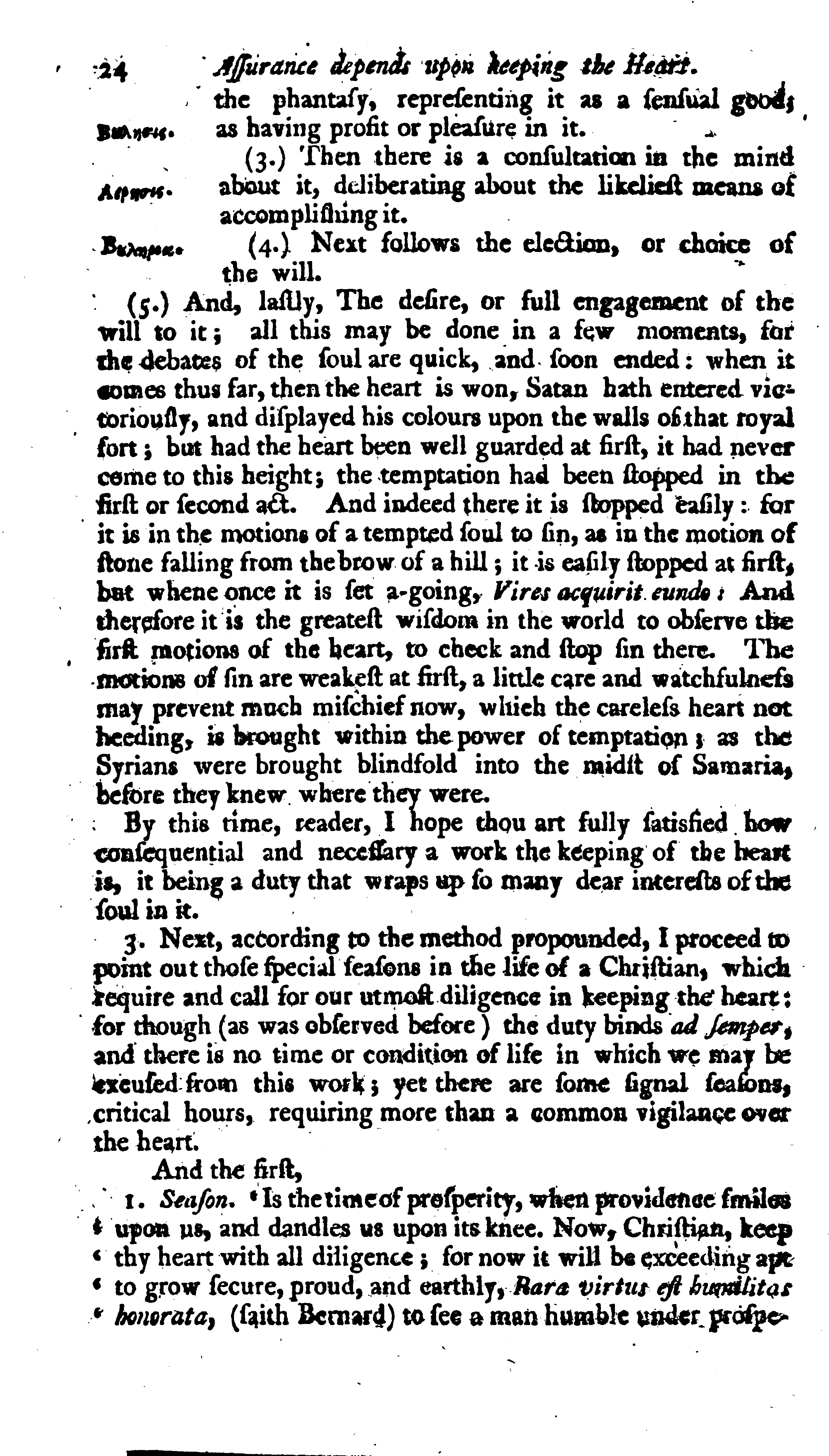
Assurance depends upon keeping the Heart. the phantafy, representing it as a fenfualgood; as having profit or pleasure in it.
(3.) 'Then there is a consultation in the mind about it, deliberating about the likeliest means of accomplishing it.
(4.) Next follows the election, or choice of the will.
(5.) And, lastly, The desire, or full engagement of the will to it; all this may be done in a few moments, far the debates of the soul are quick, and soon ended : when it comes thus far,then the heart is won,Satan hath entered victorioufly, and displayed his colours upon the walls of that royal
Βελημικο fort; but hadtheheartbeen well guarded at first, it had never come to this height; the temptation had been stopped in the first or second act. And indeed there it is stopped easily : for it is in the motionsofatemptedfoul to fin,as inthemotionof stone falling from the brow ofa hill; it is easily stopped at first, butwheneonce it is set a-going, Vires acquirit eundo : And therefore it is the greatest wisdom in the world to observe the first motions of the heart, to check and stop sin there.
The motions off in are weakest at first,a little care and watchfulness maypreventmuch mischief now, which the careless heart not heeding, is brought within the power of temptation , as the Syrians were brought blindfold into the midst of Samaria, before they knew where they were.
By this time, reader, I hope thou art fully satisfied how confequential and necessary a work the keeping of the heart is, itbeingadutythat wraps up fo many dear interests of the soul in it.
3. Next, according to the method propounded, I proceed to point out those fpecialseasons in the life ofa Christian, which require and call for our utmost diligence in keeping the heart: for though(as was observed before) thedutybinds adfemper, and there is no time or condition of life in which we may be excused from this work; yet there are some signal seasons, critical hours, requiring more than a common vigilance over the heart.
And the first, 1. Season.
Is thetimeofprofperity,whenprovidencesmiles •upon us, anddandles us upon its knee.Now, Christian, keep thyheartwith all diligence ; for now it will be exceedingapt
⚫to grow secure,proud,and earthly, Rara virtus eft humilitas honor at a, (faith Bernard)to see amanhumbleunderprofpe-
How to keep the Heart humble in Prosperity 25 . rity, is one of the greatest rarities in the world. Even a good
Hezekiah could not hide a vain-glorious temper under his ، temptation, and hence that caution to Israel, Deut. vi. 10,
* T1, 12. " And it shall be when the Lord thy God shall have •brought thee into the land which he sware to thy fathers, to Abraham, Isaac andJacob, togivethee great and goodly cities which thou buildedst not, and houses full of all good things which thou filledst not, &c. Then beware left thou
• forget the Lord:" and indeed so it fell out, " for Jefurun *waxed fat, and kicked," Deut. xxxii. 15.
Now, then, the first case will be this, viz.
Case 1. How à Christian may keep his heart from pride, and carnalfecurity, under the smiles of providence, and confluence of creature-comforts.
There are seven choice helps to secure the heart from the dangerous snares of prosperity ; the first is this,
1. To confider the dangerous ensnaring temptations attending a pleasant and prosperous condition ; few , yea, very few of those that live in the pleasures and prosperity of this world, escape everlasting perdition, Matth. xix. 24. " It is easier (faith
" Christ) for a camel to pass thro' the eye ofa needle, than for " a rich man to enter into the kingdom of heaven ;" and i Cor. i. 26. " Not many mighty, not many noble are called."
It might justly make us tremble when the scripture tells us in general, that few shall be saved; much more when it tells us, that of that rank and fort of which we are speaking, but few shall befaved. WhenJofhua called all the tribes of Israel to lot upon them for the discovery ofAchan, doubtless Achan feared ; when the tribe of Judah was taken, his fear increased ; but when the family of the Zarhites was taken, it was time then to tremble.
So when the feripture comes so near as to tell üs that offuch a fort of men very few shall escape, it is time to look about ; Mirorfipoteftfervari aliquis rectorum, faith Chryfoftom ; I should wonder if any of the rulers be saved. O how manyhavebeen coached to hell in the chariots of earthly pleasures,while others have been whipped to heaven by the rod of affliction ! how few, like the daughterofTyre, come to Christ with a gift ! how few among the rich intreat his favour !
2. It may keep us yet more humble and watchful in prosperity, if we consider, that among Christians many have been much the worse for it.
How good had it been for some of them, if they had never known prosperity ! When they were in a low condition,how humble,spiritual,and heavenly,were they ! but
VOL. VII.
How to keep the Heart humble in Prosperity. when advanced, what an apparent alteration hath been up or their spirits? It was fo with Israel, when they were in a low condition in the wilderness ; then Israel was holiness to the
Lord, Jer. ii. 23. but when they came into Canaan, and were fed in a fat pasture, then, "we are lords, we will come
" no more unto thee," ver. 31.
Outward gains are ordinarily attended with inward losses ; as in a low condition their civil employmentswere wont to have a tang and favour of their duties, so in an exalted conditiontheirduties commonly have a tang of the world. He, indeed, is rich in grace, whose graces are not hindered by his riches ; there are but few Jehofaphats in the world, of whom it is said, 2 Chron. xvii. 5, 6. " He had
" silver and gold in abundance, and his heart was lifted up in " the way of God's commands:" Will not this keep thy heart humble in prosperity, to think how dear many godlymen have paid for their riches, that through them they have lost that which all the world cannot purchase ? Then,in the next place,
1 3. Keep down thy vain heart by this consideration, that God values no manajot the more for these things.
God values noman by outward excellencies, but by inward graces : they are the internal ornaments of the Spirit, which are of great price in God's eyes, 1 Pet. iii. 4. He despises all worldly glory, and accepts no man's person ; " but in every nation, he that " fearethGod,and worketh righteousness,is accepted of him ,"
Acts x. 35. Indeed, if the judgment of God went by the fame rule that man's doth, we might value ourselvesbythefe things, and stand upon them: But as one said (when dying) I shall not appear before God as a doctor, but as a man ; tantusquifque est, quantus eft apud Deum.
So much everyman is, and no more, as he is in the judgment of God. Doth thy heart yet swell ? And will neither of the former considerations keep it humble?
4. Then, fourthly, Confider, how bitterly many persons have bewailed their folly when they came to die, that ever theyfet their hearts upon these things, and heartily wished that theyhadnever known them. What a sad story was that ofPius
Quintus,who dying, cried out desparingly, when I was in a low condition, I had some hopes of salvation ; but when
I was advanced to be a Cardinal, I greatly doubted it; but since I came to the Popedom, I have no hope at all.
Mr. Spencer also tells us a real,but fad story, of a rich oppressor, who had scraped up a great estate for his only son ; when he came to die, he called his son to him, and said, son,do you indeed love me ? The son answered, that nature besides his paternal in
How to keep the Heart humble in Prosperity.
dulgence, obliged him to that.
Then, said the father, express it by this; hold thy finger in the candle as long as I am saying apater nofter : The son attempted, but could not endure it.
Upon that, the father broke out into these expressions, thou canst not fufferthe burning ofthyfinger for me,but to get this wealth, I have hazarded my foul for thee, and must burn body and foul in hell for thy sake : Thy pain would have been but for a moment, but mine will be unquenchable fire.
5. Theheartmay be kept humble, by considering of what a clogging nature earthly things are to a soul heartily engaged in the way to heaven ; they shut out much of heaven from us at present, though they may not shut us out of heaven at last.
If thou confider thyself under the notion of a stranger in this world, travelling for heaven, and seeking a better country, thou haft then as much reason to be taken, and delighted with these things, as a weary horse hath with a heavy clog-bag :
There was a serious truth in that atheistical scoff of Julian, when he took away the Christians estates, and told them, it was to make them fitter for the kingdom of heaven.
6. Is thy spirit, for all this, flatulent and lofty ? Then urge upon it the consideration of that awful day of reckoning, wherein, according to our receipts of mercies, shall be our accompts for them : Andmethinksthisshouldawe, and humble thevaineft heart that ever was in the breast ofa faint.
Know for certain, that the Lord records all the mercies that ever he gave thee, from the beginning to the end of thy life. Mic. vi. 5.
" Remember,O my people, from Shittim unto Gilgal," &c. yea, they are exactly numbered, and recorded in order to an account ; and thy account will be suitable.
Luke xii. 48. "To "whomsoever much is given, of him much shall be required."
You are but stewards, and your Lord will come to take an account of you ; and what a great account have you to make, who have much of this world in your hand ? What swift witnesses willyourmerciesbe against you, ifthisbethe best fruits of them?
7. It is a very humbling consideration, that the mercies of GodShouldwork otherwise upon my spirit, than they use to do upon the spirits of others, to whom they come as fanctifiedmerciesfrom the love of God.
Ah Lord ! what a fad consideration is this ! enough to lay me in the dust; when Iconfider,
(1.) That their mercies have greatly humbled them ; the higherGodhas raised them, the lowertheyhave laid themselves before God.
Thus didJacob,when God hadgivenhimmuch substance. Gen.xxxii. 10. " And Jacob said,I'am not worthy
How to keep the Heart humble in Prosperity.
" of the least of all thy mercies, and of all the truth which " thou hast shewed unto thyfervant; for with my staff I passed
" over this Jordan, and now I am become two bands." And thus it was with holy David, 2 Sam. vii. 18. When God had confirmed the promise to him, to build him a house, and not reject him as he did Saul, he goes,in before the Lord, and faith, " Who am I ? and what is my father'shouse, that thou
" haft brought me hitherto ?" And so indeed God required, Deut. xxvi. 5. when Israel was to bring to God the first-fruits ofCanaan, they were to say, "A Syrian ready to perish was
" my father," &c. Do others raise God the higher for the raising them ? And the more God raises me, the more shall I abuse him, and exalt myself ? O what afad thing is this !
(2.) Others have freely ascribed the glory of all their enjoyments to God, andmagnifiednotthemselves, but him, for their mercies : So David, 2Sam. vii. 26. " Let thy name be mag- " nifi d, and the house of thy servant be established."
He doth not fly upon the mercy,and fuck out the sweetness of it, looking no fartherthanhis own comfort; no,he cares for no mercy except God be magnified in it.
So Psalm xviii. 2 . when God had delivered him from all his enemies, " The " Lord (faith he) is my strength, and my rock, he is become
" my salvation."
They did not put the crownupontheir own heads, as Ido.
(3.) The mercies of God have been melting mercies unto others,melting their souls in love to the God of their mercies.
So Hannah, I Sam. ii. 1. when the received the mercy ofa son, " My soul (faith she) rejoiceth in the Lord ;" not in the mercy, but in the God of the mercy. AndfoMary, Luke i. 46. "My
" foul doth magnify the Lord, my spirit rejoiceth in God my " Saviour."
The word signifies to make more room for God; their hearts were not contracted,but the moreenlargedtoGod.
(4.) The mercies of God have been mighty restraints to keep others from fin.
SoEzraix. 13. " Seeing thou, our God, haft given us such a deliverance as this, should we again break
" thy commandments ?" Ingenuous fouls have felt the force of the obligations of love and mercy upon them.
(5.) 'To conclude, The mercies of God to others have been as oil to the wheels of their obedience, and make them fitter for services, 2Chron. xvii. 5. Now if mercies work contrarilyuponmyheart,what cause have I to be afraid that they come not to me in love? I tell you,this is enough to damp the spirit of any faint, to fee what sweet effects they have had on others, and what fad effects on him.
How to keep the Heart from defponding, &c.
2. Season.
Thesecondspecialseason in the life ofa christian requiring more than a common diligence to keep his heart, is the time of adversity : When providence frowns upon you, and blasts your outward comforts, then look to your hearts, keep them with all diligence from repining against God, or fainting under his hand; for troubles, though sanctified, are troubles still ; even sweet-briar, and boly thistle, have their prickles.
Jonah was a good man, and yet how pettish was his heart under affliction ? Job was the mirror of patience,
• yethowwas his heartdiscomposedby trouble ?You will find it as hard to get a composed spirit under great afflictions, as it is to fix quick-silver. O the hurries and tumults which they occasion even in the best hearts ! Well, then, the fe- ، cond cafewill be this :'
Case 2. How a Christian under great afflictions may keep hisbeartfrom repining, or desponding under the hand of God ?
Now there are nine special helps, I shall here offer, to keep thy heart in this condition ; and the first shall be this, to work upon your hearts this great truth, 1. That by these cross providences, God is faithfully pursuing the great design of electing love upon thefouls of his people, and orders all these afflictions as means fanclified to that end.
Afflictions fall not out by casualty, but by counsel, Jobv.
6. Eph. i. 11 by this counsel of God they are ordained as means of much spiritual good to saints, Ifa. xxvii. 9. " By " this shall the iniquity of Jacob be purged," &c. Heb. xii .
10. " But he for our profit," &c. Rom. viii. 28. " All things " work together for good."
They are God's workmen upon our hearts, to pulldownthe pride and carnal security of them; and being fo, their nature is changed , they are turned into blessings and benefits, Psalm cxix. 71. " It is good for me that " I have been afflicted." And sure, then, thou hast no reason to quarrel with,but rather to admire that God should concern himselfsomuch in thy good, to use any means for the accomplishing of it. Philip. iii. 11. " Paulcouldbless God, if by any
" means he might attain the resurrection of the dead. My " brethren, (faith James) count it alljoywhen you fall into " divers temptations," Jam. i. 2, 3.
My father is about a design of love upon my soul, and do I well to be angry with him? All that he doth isinpursuance of, and in reference to some eternal glorious ends upon my soul. O it is my ignorance of God's design, that makes me quarrel with him! he faith to thee in this case, as to Peter, "What I do thou krow- " eftnotnow,but hereafter thou shalt know it."
How to keep the Heartfromdesponding Help. 2. Though God hath refervedto himself a liberty ofafflicting his people,yet he hath tied up his own hands by promise, never to take away his loving-kindness from them.
Can I look that scripture in the face with a repining,discontented spirit, 2 Sam. vii. 14. " I shall be his father,and he will be myfon ;
" if he commit iniquity,I will chaftenhim with the rod of " men, and with the stripes of the children of men : Never- " the less, my mercy shall not depart away from him." Omy heart ! my haughty heart! dost thou well to be discontented, whenGodhath given thee the whole tree, with all the clusters ofcomfortgrowing on it, because he suffers the wind to blowdownafew leaves ? Christians have two forts of goods, the goods of the throne, and the goods of the footstool ; moveables, and inmoveables : If God have fecuredthese, never let my heart be troubled at the loss of those ; indeed, if he had cut off his love, or discovenanted my soul, I had reason to be cast down ; but this he hath not,nor can he do it.
Help 3. It is ofmarvellous efficacy to keep the heart from sinking under affliction, to call to mind, that thine own father hath the ordering of them: Not a creature moves hand or tongue against thee,but by his permission. Suppose the cup be a bitter cup, yet it is the cup which thy father hath given thee to drink; and canst thou suspectpoifon to be in that cup which he delivers thee ? Foolish man, put home the case tothineown heart,consult with thine own bowels ; canst thou find in thy heart togivethy child that which would hurt, or undo him ?
No, thou wouldsst as soon hurt thyself as him ; " If thou then " being evil knowest how to give good gifts to thy children,'* how much more doth God ? Matth vii, 11. The very consideration of his nature, a God of love, pity, and tender mercies, or of his relation to thee as a Father, Husband, Friend, mightbesecurity enough, if he had not spoken a word, to'quiet thee in this case; andyetyouhavehis word too, Jer. xxv. 6. I will do you no hurt. You lie too near his heart to hurt you ; nothing grieves him more thanyourgroundless and unworthysuse picions of his designs do ; would it not grieve a faithfultenderheartedphysician when he hath studied the case of his patient, prepared the most excellent receipts to save his life, to hear him cry out,O he hath undone me! he hath poisoned me ; because it gripes and painshimin the operation ? O when will you be ingenuous !
Help 4. God respects you as much in a low, as in a high condition; and therefore it need not so much trouble you to be made low : nay, to speak home,he manifests more of his love, grace, and tenderness, in the time of affliction, thanprofperity. As
in Times of Adversity.
Goddidnot at first chuseyou because you were high, so he will not forsake you because you are low : Menmaylookthy upon you, and alter their respects, as your condition is alter. ed : When providence hath blasted your estates, your summer friends may grow strange, as fearing you may be troublesome to them ; but will God do so ? No, no, " I will never leave
" thee, nor forsake thee," Heb. xiii. 5.
Indeed if adversity andpovertycouldbaryou from access to God, it were a fad condition ; but you may go to God as freely as ever. "My
"God (faith the church) will hear me," Mic. vii. 7. Poor David, when stripped of all earthly comforts, could yet encourage himself in the Lord his God ; andwhycannot you ? Suppose your husband or child had lost all at sea, and should come to you in rags ; could you deny the relation, or refuse to entertain him ? If you would not, much less will God : Why then areye so troubled ? Though your condition be changed, your father's love and respects are not changed.
Help 5. And what if by the loss of outward comforts, God willpreferveyour fouls from the ruining power of temptation ?
Sure then, you have little cause tofinkyour hearts byfuchfad thoughts about them.
Are not these earthly enjoyments the things that make men shrink and warp in times of trial ? For the love of these many have forsaken Christ in such an hour,
Matth. xix. 22. " He went away sorrowful, for he had great "possessions." And if this be God'sdesign, what have I done in quarreling with him about it ? We see mariners in a storm can throw over-board rich bales offilk, and precious things, to preserve the vessel and their lives with it, and everyone faith they act prudently ; we know it is usual for soldiers ina city besieged, to batter down, or burn the fairest buildings without the walls, in which the enemy may shelter in the siege ; and no mandoubtsbut it is wifely done : Such as havegangrenedlegs or arms, can willingly stretch them out to be cut off, and not only thank, but pay the chirurgeon for his pains : And must
Godonlybe repinedat, for casting overwhatwill fink you in a storm ? For pulling down that which would advantage your enemy in the siege of temptation ? For cutting off what would endanger your everlasting life ? O inconsiderate, in grateful man! are not these things, for which thou grievest, the very things that have ruined thousands offouls ? Well, what Christ doth in this, thouknowest not now, but hereafter thou mayest,
Help 6. It would much stay the heart under adversity, to confider, That God, by such humbling providences, may be accomplishing that for which you have long prayed and waited :
How to keep the Heart from desponding Andthouldyoube troubled at that ? Say, Christian, haft thou not many prayers depending before God upon such accounts as these; that he would keep thee from fin, discover to thee the emptiness and infufficiency of the creature; that he would kill andmortify thy lusts, that thy heart may never find rest in any enjoyment but Christ ? Why now, by such humbling and impoverishing strokes,God may be fulfilling thy desire : Woudlft thou be kept from fin ? Lo, he hath hedgedup thy way with thorns. Wouldst thou see the creatures vanity ? Thy affliction is a fair glass to discover it ; for the vanity of the creature is never fo effectually and fenfiblydiscovered, as in our own experience of it. Wouldst thou have thy corruptions mortified ?
This is the way ; now God takes away the food and fewel thatmaintainedthem; for as prosperity beg at and fed them, fo adversity, when sanctified, is a means to kill them. Wouldst thouhavethyheart to reftno where but in the bosom of God?
What better way canftthou imagine providence should take to
accomplish thy desire, than by pulling from under thy head, that soft pillow of creature-delights on which thou restedstbefore? And yet you fretat this, peevish child,how dost thou exercise thy Father's patience ? If he delay to answer thy prayers, thou art ready to say he regards thee not; if he do that which really answers the scope and main endofthem, but not in the way thou expectedst, thou quarrellest with him for that ; as if instead of answering, he were crossing all thy hopes and aims ; is this ingenuous ? Is it not enough that God is so gracious todowhatthou defireft, but thou must be so impudent to expect he should do it in the way which thou prescribest.
Help 7. Again, It may stay thy heart, if thou confider, That in these troubles, God is about that work, which if thou didst
See the design of, thy foul would rejoice. We, poor creatures, are bemisted with much ignorance, and are not able to discern how particular providences work towards God's end; and therefore, like Israel in the wilderness, are often murmuring,
Because Providence leads us about inahowhngdefart, where we are exposed to straits ; though yet, then he led them, and is now leading us, by the right way, to a city of habitations.
If you could but feehowGod,in his secret counsel,hath exactly laid the whole plot and design ofthyfalvation, even to the fmallestmeans and circumstances; this way, and by these means such a one shall be saved, and by no other; such a number of afflictions I appoint for this man, at this time, and in this order; they shall befal him thus, and thus they shall work for hiu : Could you, I say, butdifcern the admirable harmony of
The Heart kept from desponding in Times of Adversity. 33 divinedispensations, their mutual relations to each other, togetherwiththegeneralrefpect and influence they all have unto the last end; of all the conditions in the world, you would chuse that you are now in, had you liberty to make your own choice.
Providence is like a curious piece of arras, made up of athoufand threds, which single we know not what to make of, but put together, and stitched up orderly, they represent abeautifulhistory to the eye. As God works all things according to the counsel of his own will, so that the counsel of God hath ordained this as the best way to bring about thy salvation : Such aonehath a proud heart, so many humbling providences I appoint for him ; such a one an earthly heart, so many impoveriching providences for him : Did you but see this, I needfay no more to support the most dejected heart.
: Help 8.
Farther, It would much conduce to the settlement of your hearts, to consider, That by fretting and discontent, you do yourselves more injury than all the afflictions you lie under could do; your own discontent is that which arms your troubles with a sting ; it is you that make your burden heavy, by struggling under it.
Could you but lie quiet under thehandofGod, your condition would be much easier and sweeter than it is ; Impatiens aegrotus crudelem facit medicum.
This makes God lay on more strokes , as a father will upon a stubborn child that receives not correction .
Besides, it unfits the soul to pray over its troubles, or take in the sense of that good which God intends by them : Afflic tion is a pill, which being wraptup in patience and quiet submission, may be easily swallowed; but discontent chews the pill, and so imbitters the soul: God throws away some comfort which he saw would hurt you, and you will throw away your peace after it; he shoots an arrow which sticks in your cloaths, and was never intended to hurt, but only to fright you from fin; and you will thrust it onward to the piercing of your very hearts, bydespondencyanddiscontent.
Help 9. Lastly, If all this will not do, but thy heart, like Rachel, still refuses to be comforted, or quieted, then confiderone thing more, which, if seriously pondered, will doubtless do the work ; and that is this, Compare the condition thou art now in, and art so much dissatisfied with, with that condition others are, and thyself deferveft to be in: Others are roaring
in flames, howhng under the scourge of vengeance,and amongst them I deserve to be. O my soul! is this hell ?
Is my coudition as bad as the damned ? Owhat would thousands now in
VOL . VII.
34 The Heart kept fromdesponding in Times ofAdverfity. hell give, to change conditions with me !
It is a famous in stance which * Dr Taylor gives us of the duke of Conde; I • have read (faith he) that when the duke of Conde had enter- ⚫ed voluntarily into the in commodities of a religious poverty,
•he was one day espied and pitied by a lord of Italy, who out ✔of tenderness, wished him to be more careful and nutritive of • his person.
The good duke answered, Sir, be not troubled, • and think not that I am ill provided of conveniencies, for I • send an harbinger before me, who makes ready my lodgings,
•and takes care that I be royally entertained.
The lord asked •him, who was his harbinger ? he answered, The knowledge of •myself, and the consideration of what I deserve for my fins,
• which is eternal torments ; and when with this knowledge I • arrive at my lodging, how unprovided soever I find it, me- ⚫thinks it is ever better than I deserve. Whydoththe living man complain ? And thus the heart may bekeptfromdesponding, or repining under adversity.
Season 3. • The third season calling for more than ordinary •diligence to keep the heart, is the time of Zion's troubles :
• When the church, like the ship in which Christ and his disciples were, is oppressed, and ready to perish, in the waves of •persecution ; then good fouls are ready to fink, and be ship- •wrecked too, upon thebillows of their own fears.
I confess •most inenrather need the spur, than the reins in this case, and yet some fit down as over-weighed with the sense of the • church's troubles.
The loss of the Ark cost old Eli his life ; • the sad posture Jerusalem lay in, made good Nehemiah's
•countenance change in the midst of all the pleasures and ac- ⚫commodations of the court, Neh. ii. 2. Ah ! this goes close
• to honest hearts .'
• But though God allow, yea, command the most awakened • apprehenfionsof these calamities, and in" such a day calls to mourning, weeping, andgirding with sackcloth," Ifa. xxii.
12. and severely threatens the insensible, Amos vi. 1. yet it will not please him to fee you sit like pensive Elijah under the <juniper-tree.
1 Kings xix. 4. " Ah Lord God! it is enough, " take away my life also." No, mourners in Zion you may,
⚫and ought to be ; but self-tormentors you must not be ; •complain to God you may, but to complain of God, though
•but by an unsuitable carriage, and the language of your ac- • tions, you must not.'
Case 3. The third cafethat comes next to be spoken to, is this; How public and tenderbearts may be relieved, andfup
* Great Exemp. p. 310.
How toJupportthe HeartunderZion's Troubles.
ported, when they are even over-weighed with the burdensome , sense of Zion's troubles?
' I grant, it is hard for him that pre- • ferreth Zion to his chief joy, to keep his heart that it fink not •below the due sense of its troubles ; and yet this ought, and •maybe done by the use of such heart-establishing directions
• as these.'
Direction 1.
Settle this great truth in your hearts, that no trouble befals Zion, but by the permission of Zion'sGod; and he permits nothing out of which he will not bring muchgoodat last to his people.
There is truly a principle of quietness in the permitting, as in the commanding will of God. See it in David, 2 Sam. xvi.
10. " Let him alone, it maybeGodhathbiddenhim :" And in Christ, Joha xix. 11. " Thou couldest have no power against
" me, except it weregiventhee from above;" it should much calm our spirits that it is the will of God to suffer it; and had he not suffered it, itcouldnever have been as it is.
This very consideration quieted Job, Eli, David, andHezekiah; that the Lord did it, was enough to them, and why should it not be so to us ?
If the Lord will have Zion plowed as a field, and her goodly stones lie in the dust; if it be his pleasure that Antichrist shall rage yet longer, and wear out the faints of the Most High ; if it be his will that adayoftrouble, and of treading down, and of perplexity by the Lord God of hosts shall be upon the valley of vision, that the wicked shall devour the man that is more righteous than he, what are we that we should contest with God ? Fit it is that we should be refignedupto thatwillwhencewe proceeded, and that he that made us should dispose of us as he pleaseth : he may do what feemeth him good without our consent: doth poor man stand upon equal ground, that he should capitulate with his Creator, or that God should renderhiman accountofanyof his matters ?
It iseveryway as reasonablewebecontent,howeverGoddispose of us, as that we be obedient to whatever he commands us.
But then, if we pursue this argument further by considering that God's permissions do all meet at last in the real good of his people, this will much more quiet our spirits. Do the enemies carryawaythegood figs, even the best among the people, into captivity ? This looks like a sad providence, but yet God sends them thither for their good, Jer. xxiv. 5.
Doth God take the Assyrian as a staff in his hand, to beat his people with ? Those blows are smart, and make them cry ; but the end of his fo doing is, "That he may accomplish his whole work upon E2
HowtofupporttheHeartunder Zion's Troubles.
" mount Zion," Ifa. x. 12.
IfGodcan bring much good ou of the worst, and greatest evil of fin, much more out of temporal afflictions ; and it is as evident that he will, as that he can do fo.
For it is inconsistent with the wisdom of a common agent topermitany thing, which he might prevent if he pleased, to cross his great design and end ; and can it be imagined that the most wife God should do so ?
Well then, as Luther told Melandthon, Definat Philippus efferectormundi;so say I to you ; Let infinite wisdom, power, and love, alone ; forby these all creatures are swayed, and actions guided, in reference to the church: it is none of our work to rule the world, but to submit to him that doth; Non caeco impetuvolvuntur rotar, the motions of providence are all judicious, the wheels are full of eyes; it is enough that the affairs of Zion are in a good hand.
Direction 2. Ponder this heart-supporting truth, in reference to Zion's trouble: That how many troubles soever are upon her, yet her King is in her.
What ! hath the Lord forsaken his churches ? Hath he fold them into the enemy's hand ? doth he not regard what evil befals them? that our hearts fink at this rate ?
Is it not too snameful an undervaluing of thegreatGod, and too much magnifying of poor, impotent men, to fear and tremble at creatures, whilst God is in the midst of us ? The church's enemies are many and mighty; let that be granted, yet that argument with which Caleb and Joshua strove to raise their own hearts, is of as much force now, as it was then : " The Lord is with us,
" fear them not," Num.xiv. 9.
The historian tells us that whenAntigonus over heard his soldiers reckoning how many their enemies were, and so discouraging one another ; he suddenly steps in among them with this question, 'And how many
• (laid he) do you reckon me for ?"
Discouraged fouls, how manydoyou reckon the Lord for ? Is he not an over-match for all his enemies ?
Is not one Almighty more than many mighties? Doth his presence stand for nothing with us ? " If God
" be for us, who can be against us ?" Rom.viii. 31.
Wha think you, was the reason of that great exploration Gideon made in Judges vi.? He questions, ver. 12, 13. he desires a sign, ver 17. and after that another, ver. 36. and what was the end of all this, but that he might be sure the Lord was with him, and that he might but write this mottoupon his ensign ? " The sword of the Lord, and of Gideon."
So then, if you can be well assured the Lord is with his people, you will get thereby above all your difcouragements and that he is fo,
How to support the HeartunderZion's Troubles.
you need not, with him, desire a sign from heaven; lo, you have a sign before you, even their marvellous preservation a midst all their enemies. IfGodbenotwith his people, how is it they are not swallowed up quick?
Do their enemies want malice, power, or opportunity ? No, but there is an invisible handuponthem.
Well then, as it is, Exod. xxxiii. 14. let his prefencegive us rest; and though the mountains be hurled into the sea, though heaven and earth mingle together, fear not,
God is in the midst of her, she shall not be moved.
Direction 3.
Ponder the great advantages attending the people of God in an afflicted condition.
If a low and an afflicted state in the world be really best for the church, then yourdejections are not only irrational, but ungrateful ; indeed, if you estimate the happiness of the church by its worldly ease, splendor, and prosperity, then such times will feembad for it; but if you reckon its glory to consist in its humility, faith, patience, and heavenly-mindedness, no condition in the world abounds with advantages for these, as an afflictedconditiondoth.
It was notpersecutions and prisons, bue worldlinefs and wan tonness, that was the poifonof the church: neither was it the earthly glory of its professors, but the blood of its martyrs, that was the feed of the church.
The power of godliness did never thrive better than in affliction, and never ran lower than in times of greatest prosperity : when " we are leftapoorand
" an afflicted people, then we learn to trust in the name of the " Lord," Zeph. iii. 12.
What fayye, firs ? Is it indeed for the saints advantage to be weaned from the love of, and delight in, ensnaringworldly vanities ?
To be quickened, and prick ed forward with more haste to heaven, to have clearer diícove ries of their own hearts, to be taught to pray more fervently, frequently, spiritually; to look and long for the rest to come, more ardently ?
If these be for their advantage, experience teaches us, that no condition is ordinarily blessed with such fruits as these, like an afflicted condition.
And isitwelldone, then, to repine and droop,because your fatherconfults more the advantage of your souls, than the plea sing of your humours ? Because he will bring you a nearer way to heaven than you are willing togo? Is this a due requital of his love, who is pleased so muchtoconcernhimself in your welfare which is morethanhe will do for thousands in the world, upon whom he will not lay a rod, or spend an affliction for their good, Hos. iv. 17. Matth. xv. 14. But alas ! we judge by sense, and reckon things good or evil, according to what we, for the present, cantasteand feel in them,
Howtofupport theHeartunderZion'sTroubles.
Direction 4. Take heed that you overlosk not themanyprecious mercies which the people of God enjoy amidst all their troubles.
It is a pity that our tears, upon the account of our troubles, should toblear and blind our eyes, that we should not fee our mercies and grounds of comfort.
I will not insist upon the mercy of having your lives given you for a prey, nor yet upon the many outward comforts, temporal conveniencies and accommodations, which you enjoy even above what Christ and his precious servants, of whom the world was not worthy, ever had.
But what say you to pardon of fin? interest in Christ ? the covenant of promise ? and an eternity of happiness, in the prefenceofGod after a few days are over ? O that ever a people entitled to such mercies as these, shoulddroop under any temporal affliction, or be so much concerned for the frowns of men, and loss of trifles ! you have not the smiles of great men, but you have the favour of the great God; you are, it maybe, cast back in your estates, but thereby furthered in spirituals.
You cannot live so bravely, plentifully, and easily, as before; but still you may live as holy and heavenly as ever : will you then grieve so much for these circumstantials, as to forget your substantials ?
Shall light troubles make you forget weighty mercies ?
Remember the church's true riches are laid out of the reach of all its enemies: theymaymake you poor, but not miserable. What thoughGoddonot diftinguith, in his outwarddispensations,betwixt his own and others ? Yea, what though his judgments single out the best, and spare the worst ?
What though an Abel be killed in love, and aCain survive in hatred ; a bloody Dionyfius die in his bed, and a good Jofiah fail in battle ?
What though the belly of the wicked be filled with hidden treasures, and the teeth of the saints broken with gravel-stones; yet still here is much matter of praise; for electing love has distinguished, though common providence did not; and whilst prosperity and impunity lay the wicked, even slaying and adversity shall benefit and save the righteous.
Direction 5. Believe, that how low soever the church be plunged under the waters of adversity, it shall assuredly rife again.
Fear not, for as sure as Christ arose the third day, notwithstanding the seal and watch that was upon him ; so sure the church shall arise out of all her troubles, and lift up its victorious head over all its enemies : there is no fear of ruining that people who thrive by their losses, and multiply by being,
HowtofupporttheHeartunder Zion'sTroubles.
diminished. Obe not too quick to bury the church before the is dead! stay till Christ hath tried his skill, before you give it up for loft .
The bush may be all in a flame, but shall never beconsuned, and that because of the good will of him that dwelleth in it.
Direction 6. Record the famous instances of God's care and tenderness over bis people in former straits.
Christ hath not suffered it to be devoured yet; for above these 1700 years the Christian church hath lived in affliction, and yet it is not consumed: manyawave of persecution hathgoneover it, and yet itisnotdrowned: many designs to ruin it, and hitherto none hath prospered; this is not the first time that Hamans and Achithophelshave plotted its ruin ; that an Herodhath stretched out his hand to vex it: still ithathbeen preserved from, supported under, or delivered out of all its troubles; and is it not as dear to God as ever ? Is he not as able to save it now, as formerly? Though we know notwhencedeliverance shouldarife,
" Yet the Lord knoweth how to deliver the godly out of temptations," 2 Pet. ii . 9.
Direction 7. If you can fetch no comfort from any of the former arguments, then, in the last place, Try whether you cannot draw some comfort out of your very troubles.
Surely this trouble of yours is a good argument of your integrity ; union is the ground of sympathy ; if you had not some rich adventure in that ship, you would not tremble as you do, when itisindanger : besides, this frame of spirit may afford you this argument, that if you are sensible of the church'stroubles, JefusChrift is much more sensible of, andsollicitous about it, than youcanbe; and he will have an eye of favour uponthemthat mourn for it, Isa. lvii. 18.
Season4.
The fourth special seasonofexpressing our utmost 'diligence in keeping our hearts, is the time of danger, and public distraction ; in such times the best hearts are but too apt to be fur prized by slavish fear; it is not eafytosecure the * heart against distractions in times of common distraction.
If • Syriabe confederate with Ephraim, how do the hearts of the *house of Davidshake, even as the trees of the wood, which are thaken with the wind ? Ifa. vii. 2. When there are ominous signs in the heaven; on the earth distress of nations,
'with perplexity; the sea and waves roaring, then the hearts ' of men fail for fear, and for looking after those things which are coming on the earth, Luke xxi . 25, 26.
Even aPaul *himself may "sometimes complain offightings within, when *" there are fears without," 2 Cor. vii. 5.
How to keep the Heart from Fears.
But, my brethren, these things ought not to be so, faints should be of a more raised spirit :
So was David, when his heart was kept in a good frame, Psal. xxvii. 1. " The Lord is
" my light, and my salvation; whom shall I fear ?
The Lord " is the strength of my life, of whom shall I be afraid ?" Let none but the servants of finbe the slaves of fear, let them that have delighted in evil, fear evil; impius tantum metuit, quantum nocuit.
O let not that which God hath threatened as a Judgmentuponthe wicked, ever seize upon the breasts of the " righteous.
I will fend (faith God) faintness into their hearts " in the land of their enemies, and the found of a shaking leaf
" shallchacethem," Lev. xxvi. 36.Owhat poor-spirited men are these, to fly at a shaking leaf! which makes a pleasant, and not a terrible noise; and is in itself a kind of natural music :
But to a guilty conscience the whisthng leaves are drums and trumpets.
" But God hath notgivenusthe spirit of fear, bot " of love, and of a found mind," 2 Tim. i. 7. A found mind as it stands there in opposition to the spirit of fear, is anunwounded conscience, pot infirmed by guilt: And this should make a man as bold as a lion.
I know it cannot be said of a faint, what God spake of Leviathan, that he is made without fear: There is a natural fear in everyman, and it as impossible to bewhollyput off, as the body itself is: It is a perturbation of the mind, arising from the apprehension of approaching danger; and as long as dangers can approach us, we shall find some perturbations within us.
It is not my purpose to commend to you a stoical apathy, nor yet to take you off from such a degree of cautional preventive fear as may fit you for trouble, and be serviceable to your souls; there isa provident fear that opens our eyes to foresee danger, and quickens toa prudentandlawfuluse of means to prevent it: Such was Jacob's fear, Gen. xxxii. 7, 9, 10. &c. But it is the fear of diffidence
Iperfuade you to keep your hearts from, that tyrannical passion which invades the heart in times of danger, distracts, weakens, and unfits the heart for duty ; drivesmenuponunlawful means, and brings a snare with it.
Well, then, the fourth cafewill bè this :
Case 4. How a Christian may keep his heart from distracting and tormenting fears, in times of great and threatening dangers.
Now there are fourteen excellent rules, or helps, for the keepingtheheart from sinful fear, whenimminentdangers threaten us: And the first is this,
How to keep the Heart from Fears.
Rule 1. Look upon all the creatures as in thehandofGod,who manages them in all their motions, limiting, restraining, and determining them all at his pleasure.
Get this truth well settled by faith in your hearts, it will marvelloufly guard them against slavish fears. The first chapter of Ezekiel contains an admirable scheme, or draught of providence; there you may fee the living creatures who move the wheels, viz. the great affairs and turnings of things here below, coming unto Christ, who fits upon the throne, to receive new orders and instructions from him, ver. 24, 25, 26.
And in Rev. vi . you read of white, black, and red horses, which are nothing else but the instruments which God employs in executing his judgments in the world, as wars, pestilence, and death: But when these horses are prancing, and trampling up and down the world, here is that may quiet our hearts, that God hath the reins in his hand.
Wicked men are sometimes Jike mad horles, they would stamp the people of God under their feet, but that the bridle of providence is in their lips,
Job i. 11, 12. A lion at liberty is terrible to meet, but who is afraid of the lion in the keeper's hand ?
Rule 2. Remember that this God, in whose hand all the creatures are, is your Father, and is much more tender over you, than you are, or can be, over yourselves : " He that " toucheth you, toucheth the apple of mine eye," Zech. ii. 8.
Let me ask the most timorous woman, whether there be not a vast difference between the fight of a drawn sword in the hand of a bloody ruffian, and thesamesword in the hand of her own tender husband ? As great a difference there is in looking upon creatures by an eye of sense, and looking on them as in the hand of your God by an eye of faith ; that is a sweet scripture to this purpose, Ifa. liv. 5. " Thy Maker is thy Husband, the " Lord of Hosts is his name:" he is Lord of all the hosts of creatures in the world : Who would be afraid to pass through an army, though all the soldiers should turn their swords and guns towards him, if the general of that armywerehis friend, or father ?
I have met with an excellent story of a religious youngman, who being at sea, with many other passengers, in a great storm, andtheybeinghalf dead with fear, he only was observed to be very cheerful, as if he had been but little concernedinthatdanger: One of them demanding the reason of his chearfulness, O, (said he) it is because the pilot of the • ship is my father.'
Confider Christ, first as the King, and supreme Lord over the providential kingdom, and then as your
VOL. VII.
How tokeeptheHeart from Fears.
Head, Husband, and Friend, and thou wilt quickly say, " Return unto thy rest, O my soul."
This truth will make you cease trembling, and cause you to sing in the midst of dangers.
Psalm xlvii. 7.
The Lord is King of all the earth, sing ye
praise with understanding ;" (or, as the Hebrew word is,) " Everyone that hath understanding," viz. of this heart-reviving and establishing doctrine of the dominion of our Father over all the creatures.
Rule 3. Urge uponyourhearts the express prohibitions of Christ in this case : and let your hearts stand in awe of the violations of them.
He hath charged you not to fear, Luke xxi. 9. "Whenye " shall hear of wars and commotions, see that ye be not terri- " fied." And Phil. i. 28. " In nothingbeterrified by your ad- " versaries,"
Yea, in Matth. x. 26, 28, 31. and within the compass of fix verses, our Saviour commands us thrice, not to fearman. Doth every big word of proud dust and ashes make thee afraid ? Doth the voice of am an make thee tremble ? and shall not the voice of God ?
If thou art of such a fearful and timorous spirit, how is it that thou fearest not to disobey the flat commands of Jesus Christ ?
Methinks the command of Christ should have as much power to calm, as the voice of a poor worm to terrify thy heart.
Ifa. li. 12, 13. " I, even I, am he " that comforteth you : Who art thou, that thou shouldestbe
" afraid of a man that shall die, and of the son of man that " shall be made as the grass,andforgettest the Lord thy Maker ? "
We cannot fear creatures sinfully, till we have forgotten God ; did we remember what he is, and what he hath said, we should not be of such feeble spirits : Bring thy heart, then, to this dilemma in times of danger ; if I let into my heart the slavish fear of man, I must let out the reverentialawe and fear of God; and dare I cast off the fear of the Almighty for the frowns of a man ? Shall I lift up proud dust above the great God ? Shall
I run upon a certain fin, to shunaprobable danger ? Okeep thy heart by this consideration !
Rule 4. Remember how much needless trouble your vain fears have brought upon you formerly, and how you have disquieted yourselves to no purpose.
Ifa. li. 13. "And haft feared continually because of the op- " preffor, as if he were ready to devour ; and where is the fu- " ry of the oppressor ?"
He seemedreadytodevour, but yet you are not devoured : I have not brought upon you the thing that ye feared ; you have wasted your spirits, disordered your souls, and weakened your hands, and all this to no purpose :
Howtokeep the Heart from Fears.
Youmighthaveallthis while enjoyedyourpeace, and possessed your souls in patience. And here I cannot but observe a very deep policy of Satan, managing a design against the soul by these vain fears :
I call them vain, in regard of the frustration of them by Providence ; but certainly they are not in vain, as to the end Satan aims at in raising them ; for herein he acts as soldiers use to do in the siege of agarrifon, who on purpose to wear out the besieged by constant watchings, and thereby unfit them to make resistance when they storin it in car nest, do every night give them false alarms, which though they come to nothing, yet doth notably serve this furtherdesignoftheenemy. O when will you beware of Satan's devices ?
Rule 5. Confider solemnly, That though the things you fear Shouldreallyfall out, yet there is more evil in yourownfear, than in the thing feared.
And that not only as the least evil of sin is worse than the greatest evil of suffering; but as this sinful fear hath really more torment and trouble in it, than is in that condition you are so much afraid of; fear is both a multiplying, and a tormenting passion; it represents troubles much greater than they are, and so tortures and wrecks the soul much worse than when the suffering itself comes. So it was with Israel at the Red sea, they cried out, and were fore afraid, till they put foot into the water, and then a passage was opened through those waters, which they thought wouldhavedrowned them. Thus it is with us; we looking through the glass of carnal fear, upon the waters of trouble, the swellings of Jordan, cry out, O they are unfordable ! we must needs perish in them : But when we come into the midst of those floods, indeed, we find the promisemadegood; "God will make awaytoescape," 1 Cor. x. 13.
Thus it was with blessed Biiney,when he would make atrial, by putting his finger to the candle, and not able to endure that, he cried out, •What, cannot I bear the burning of 6 a finger ? how then shall I be able to bear the burning of my
• whole body to-morrow ?"
And yet when that morrow came, he could go chearfully into the flames, with that scripture in his mouth, Ifa. xliii. 1, 2, 3. " Fear not, for I have redeem- " ed thee :
I have called thee by thy name, thou art mine; " when thou passest through the waters, I will be with " thee ; when thou walkest through the fire, thou shalt not " be burnt."
Rule 6. Consult the many precious promises which are written for your support and comfort in all dangers.
How to keep the Heart from Fears.
These are your refuges, to which you may Ayandbe safe; " When the arrows of danger flyby night, and destruction
" wasteth at noon-day." There are particular promises suited to particular cases and exigencies; and there are general promises, reaching all cases and conditions: Such are these, Rom. viii. 28.
" All things shall work together for good," &c. And Ecclef. viii. 12. "Though a finnerdo evil an hundred times, and his
" days be prolonged, yet it shall be well with them that fear " the Lord," &c. " Could you but believe the promises,
" your hearts should be established," 2 Chron. xx. 29. Could you but plead them with God, as Jacobdid. Gen. xxxii. 12.
" Thou faidst, I will surely do thee good," &c. they would relieve you in every distress.
Objection. But that promise was madeperfonally, and by name to him, fo are not these tome.
Answer. If Jacob'sGodbe your God, you have as good an interest in them as he had.
The church, a thousand years after that transaction betwixt God and Jacob, applied that which God spake to him, as if it had been spoken to themselves, Hos. xii. 4. " He found him in Bethel, and there he
" spake with us."
Rule 7. Quiet your trembling hearts by recording and consulting your past experiences of the care and faithfulness of God in former distresses.
These experiences are food for your faith inawildernesscondition, Psal. lxxiv. 14. By this David kept his heart in time of danger, 1 Sam. xvii. 37. and Paul his, 2 Cor. i. 10. was sweetly answered by Silentiarius, whenone told him that It his enemies way-laid him to take away his life, Si Deusmei curam non habet, quid vivo ?
IfGodtake no care of me, how have I escaped hitherto ? You may plead with God old expe. riences to procure new ones; for it is in pleading with God for new deliverances, as it is in pleading for new pardons. Now mark how Moses pleads on that account with God, Num. xiv.
19. " Pardon, I beseech thee, the iniquity of this people, as " thou hast forgiven them from Egypt until now." He doth not say as men do, Lord, this is the first fault, thou hast not been troubled before to sign their pardon : But, Lord, because thou hast pardoned them so often, I beseech thee pardon them once again. So in new straits, Lord, thou hast often heard, helped, and saved in former fears ; therefore now help again, for with thee there is plenteous redemption, and thine arm is not shortened.
How to keep the Heart from Fears.
Rule 8. Bewellfatisfiedthat you are in the way of your duty , and that will be get holy courage in times of danger.
" Who will harm you, it you be followers of that which is "good ?"
1 Pet. iii . 13.
Or, if any dare attempt it, you " may boldly commit yourselves to God in well-doing,"
I Pet. iv. 19.
It was this consideration that raised Luther's spirit above all fear : • In the cause of God (said he) I ever am, and ever shall be stout;' herein I assume this title, Gedo nulli, a good cause will bear up a man's spirit bravely. Hear the saying of a heathen, to the shame of cowardly Christians :
When the emperor VespasianhadcommandedFluidius Priscas 'not to come to the senate; or if he did, to speak nothing but
' what he would have him ; the senatorreturnedthis noble an- ' swer, That as he was a senator, it was fit he should be at ' the senate ; and if being there he were required to give his
'advice, he would speak freely that which his conscience com- ' mandedhim ; the emperor threatening, that then he should
' die; he answered, Did I ever tell you that I was immortal ?
'Do you what you will, and I will do what I ought ; it is in ' your power to put me to death unjustly, and in me to die
' constantly.'
Righteousness is a breast plate, the cause of God will pay all your expences ; let them tremblewhomdanger findsoutofthe wayofduty.
Rule 9. Get your consciences sprinkled with the blood of Christ from all guilt, and that willfet your hearts aboveallfear.
It is guilt upon the conscience that softens and cowardizes our spirits : "The righteous are bold as a lion," Prov. xxviii.
It was guilt in Cain's conscience that made him cry, "Everyone that meets me shall lay me," Gen. iv. 14. A guilty conscience is more terrified with conceited dangers, than a pure conscience is with real ones. A guilty sinner carries a witness against himself in his ownbofom.
It was guiltyHerod cried out, " John Baptist is risen from the dead."
Such a conscience is the devil's anvil, on which he fabricates all those swords and spears, with which the guilty sinner pierces and wounds himself; guilt is to danger, what fire is to gun-powder ; am an need not fear to walk among many barrels of powder, if he have no fire about him .
Rule 10. Exercise holytruft in times of great distress.
Make it your business totrustGod with your lives and comforts, and then your hearts will be at rest about them.
So did * Char. of Wisdom, p. 358.
Howtokeep the Heart from Fears.
David, Psal.lvii. 3. " At what time I am afraid, I will trust in " thee;" q d. Lord, if at any time a storm rise, I will make bold to shelter me from it under the covert of thy wings . Go to God by acts of faith and trust, and never doubt but he will secure you.
Ifa. lxii. 3. " Thou wilt keep him in perfect peace, whose mind is stayed on thee, because he trusteth in " thee." God takes it well when thou comest to him thus ;
Father, my life, my liberty, or estate, are hunted after, and I cannot secure them ; O let me leave them in thy hand : "The poorleavethhimself with thee;" and doth his God fail him ?
No, " thou art the helper of the fatherless," Plal. x. 14. that is, thou art the helper of the destitute one, that hath none to gotobutGod. And that is a sweet scripture, Psal. cxii. 7.
"He shall not be afraid of evil tidings, his heart is fixed, " trusting in the Lord;" he doth not say, his ear shall be privileged from the report of evil tidings he may hear as fad tidings as other men, but his heart shall be privileged from the terror of those tidings, " his heart is fixed."
Rule 11. Consult thehonour of religion more, and your perfonalfafetyless.
Is it for the honour of religion, think you, that Christians should be as timorous as hares, to start at every found ?
Will not this tempt the world to think, that whatever you talk, yet your principles are no better than other mens ? Owhat mischief may the discoveries of your fears before them do!
It was a noble saying of Nehemiah, chap. vi. 11. "Should such am an " as I flee? And who, being as I am, would fee ?" Were it not better you should die, than that the world should be prejudiced against Christ by your example ?
For, alas! how apt is the world, who judge more by what they fee in your practices, than by what they understand of your principles, to conclude from your timorousness, that how much soever you commend faith, and talk of assurance, yet you dare trust to these things no more than they, when it comes to the trial. O let not your fears lay such a stumbling-block before the blind world.
Rule 12. He that will secure his heart from fear, must first fecurethe eternal interest of his foul in the hands of Jesus Christ.
When this is done, then you may say, Now world, do thy qworst.
You will not be very follicitous about a vile body, when you are once assured it shall be well to all eternity with your precious souls.
" Fear not them (faith Christ) that can " kill the body, and after that, have no more that theycando."
The assured Christian may smile with contempt upon all his
How to keep the Heart from Fears.
enemies, and say, Is this the worst that you can do?
What say you, Christians ? Are you assured that your souls are safe, that within a few moments of your dissolution they shall be receivedbyChrist into an everlasting habitation ?
Well, if you be sure of that, never trouble yourselves about the instrumeats and means of yourdiffolution.
Objection . O, but a violent death is terrible to nature!
Answer. But what matter is it, when thy soul is in heaven, whether it were let out at thy mouth, or at thy throat ? Whether thy familiar friends, or barbarous enemies, standaboutthy deadbody, and close thine eyes ?
Alas ! it is not worth the making so much ado about ; Nihil corpus fentit in nervo cum animafit in coelo, thy soul shall not be sensible in heaven how thybody is used on earth; no, it shall be swallowed up in life.
Rule 13. Learn to quench allflavish creature-fears, in the reverentialfear of God.
This is a cure by diversion : It is a rare piece of Christian wisdom to turn those passions of the soul which most predominate into spiritual channels ; to turn natural anger into spiritual zeal, natural mirth into holy cheerfulness, and natural fear into an holy dread and awe of God. This method of cureChrift prescribes in that forementioned place, Matth. x. like to which is that in Isa. viii. 12, 13. fear not their fear ; but how shall we help it ? Why, " sanctify the Lord of Hosts himself, and let
" him be your fear, and yourdread."
Natural fear maybeallayed for the present by natural reason, or the removal of the occasion, but then it is but like a candle blown out with a puff of breath, which is easily blown in again ; but if the fear of God extinguish it, then it is like a candle quenched in water, which cannot easily be rekindled.
Rule 14. Lastly, Pour out those fears to God in prayer, which the devil and your own unbelief pour in upon you in times of danger.
Prayer is the best out-let to fear; where is the Christian that cannotfet hisprobatum eft to this direction ? Iwillgiveyou the greatest example in the world toencourageyou in the use of it, even the example of Jesus Christ, Markxiv. 32. When the hourofhisdanger anddeathdrewnigh, he gets into the garden, separates from the disciples, and there wrestles mightily with God in prayer, even unto an agony: in reference to which the apottle faith, Heb. v. 7.
Who in in the days of his flesh, when "he had offered up prayers and supplications, with strong cries
"and tears, to him that was able to save him from death, and **was heard in that he feared."
He was heard as to strength "
HowtokeeptheHeartfromFears. and support to carry him through it, though not as to deliver ance, or exemption from it.
Now, O that these things might abide with you, and be reduced to practice in these evil days, that many trembling fouls may be established by them.
Season 5.
The fifth season to excite this diligence inkeepingtheheart, is a time of straits and outward pinching wants; although at such times we should complain to God, and not ' of God, (the throne ofgracebeing erected for atimeofneed,
Heb. iv. 16.) yet when the waters of relief run low, and want •begins to pinch hard,howprone are the best hearts to distrust the fountain! when the meal in the barrel, and the oil in the * cruise are almost spent, our faith and patience are almost spent
* too. Now it is difficult tokeepdown the proud and unbeliev ingheart in an holy quietude and sweet submission at the foot
• of God.
It is an eaty thing to talk of trusting God for daily bread, while we have a full barn or purse; but to say, as the prophet, Hab. iii. 17. " Though the fig tree should not blof- " som, neither fruit be in the vine, &c. yet will I rejoice in *" the Lord:" surely this is not easy.'
The fifth case there fore shall be this :
Case 5. How a Christian may keep his heart from distrusting God, or repining against him, when outward wants are either feltorfeared.
This case deserves to be seriously pondered, and especially to be studied now, since it seems to be the design of providence to empty the people ofGodoftheir creature-fulness, and acquaint themwiththose straits which hitherto they have been altogether trangers to.
Now, to secure the heart from the afore-mentioned dangers attending this condition, these following considerations, through the blessings of the Spirit, may prove effectual. And the first is this :
Consideration 1. That if God reduce you to traits andneceffities, yethedeals no otherwise therein with you, thanhebathdone with some of the choicest and holiest men that ever lived.
Your condition is not singular; though you have hitherto been strangers to wants, other saints have daily conversed, and been familiarly acquainted with them.
Hear what blessed Paul speaks, not of himself only, but in the name of other saints reduced to like exigencies, 1Cor. iv. 11. " Even to this present
" hour we both hunger and thirst, and are naked and buffeted, " and have no certain dwelling-place." To see such a man as Paulgoingup and down the world with a naked back, and
How to keep the Heart from repining, &c.
empty belly, and not a house to put his head in, one that was fo far above thee in grace and holiness, one that did more service for God in a day, than perhaps thou haft done in all thy days, and yet you repine as if hardly dealt with !
Have you forgot what necessities and straits even aDavid hath suffered?
How great were his straits and necessities ?
I Sam. xxv. 8.
"Give, I pray thee (faith he to Nabal) whatsoever cometh to " thy hand, to thy servants, and to thy son David."
RenownedMusculus was forced to dig in the town-ditch for a maintenance. FamousAintworth (as I have been credibly informed) was forced to fell the bed he lay on to buy bread.
But what speak I of, these ? Behold a greater thananyof them, even the SonofGod, "who is the heir of all things, and by whom the "worlds were made;" yet sometimes would have been glad of any thing, having nothing to eat, Mark xi. 12, 13."And on the
" morrow, when they were come from Bethany, he was hungry; and seeing a fig tree afar off, having leaves, he came,
"ifhaply he might find [any thing) thereon."
Well then, hereby God hath set no mark of hatred upon you, neither can you infer the want of love from the want of bread. When thy repiningheart puts the question, Was there everanyforrow like unto mine? Ask these worthies, and they will tell thee, though they did not complain and fret as thou dost, yet they were driven to as great straits as thou art.
Confid. 2.
If God leave you not in this necessitous condition without a promise, you have no reason to repineordefpondunder it.
Thatisafadcondition indeed, to which no promise belongs.
I remember Mr Calvin, upon these words, Ifa. ix. 1. " Never the- " less thedimness thall not be such as was in her vexation,"
. folvesthedoubt, in what sense the darkness of the captivity was not so great, as the lesser incursions made byTiglath Pelefer.
In the captivity the city was destroyed, and the temple burnt with fire, there was no comparison in the affliction; but yet the darkness should not be such, and the reason (faith he) is this,
Huic certam promiffionem esse add it am, cum in prioribus nulle effet; (i. e.) therewasacertain promise made to this, but none to the other.
It is better be as low as hell withapromife, than in paradise without one. Even the darkness of hell itself would be comparatively no darkness at all, were there but a promise to enlighten it. Now God hath left many fsweet promises for the faith of his poor people to feed on in this condition : such are these
VOL. VII.
How to keep the Heart from repining, &c.
Psal.xxxiv. y, ro. " O fear the Lord, ye his saints, for there " is no want to them that fear him ; the lions do lack and sos- " fer hunger, but they that fear the Lord shall want nothing
" that is good."
Psal. xxxiii. 18, 19. " The eye of the Lord " is upon the righteous, to keep them alive in famine."
Psal.
Ixxxiv. 11. "No good thing will he with-hold from them that " walkuprightly." Rom. viii. 32. "He that spared not his own
Son, but delivered him up for us all, how shall he not with " him also freely give us all things ?"
Ha. xli . 17. "When the poor and the needy seek water, and there is none, and their tongue faileth for thirst, I the Lord will hear them, I the "God of Israel will not forsake them."
Here you fee, first, their extreme wants, water being put even for the necessaries of life. ( 2. ) Their certain relief, I the Lord will hear them ; in which it is supposed that they cry unto him in their straits; and " he hears their cry, Having therefore these promises, why should not your distrustful hearts conclude like David's, Psal. xxiii. 1. "The Lord
" is my Shepherd, I shall not want."
Objection. But these promises imply conditions ; if they were absolute, they would afford more satisfaction.
Solution. What are those tacit conditions you speak of, but these: ( 1.) That either he will supply or sanctify your wants :
(2.) That you shall have so much as God fees fit for you. And doth this trouble you ?
Would you have the mercy whether sanctified or no ? Whether God fees it fit for you or no ? Methinks the appetites of saints after earthly things mould not be so ravenous, to seize greedilyuponanyenjoyment, not caring how they have it.
But oh, whenwantspinch, and we fee not whence supplies fhouldcome, then our faith in the promise shakes, and we, like murmuring Israel, cry, " He gave bread, can he give water al- " fo?" O unbelieving hearts ! When did his promise fail ?
Who ever trusted them, and was ashamed ? May not God upbraid thee with thine unreasonable infidelity ; as Jer. ii. 31 .
"Have I been a wilderness unto you ?" &c.
Or as Christ said to the disciples, " Since I was with you, lacked ye any thing ?"
Yea, may you not upbraid yourselves, may you not say with
good old Polycarp, These many years I have served Christ, and toundhim a good master.
Indeed he may deny what your wantonness, but not what your real wants call for. He will not regard the cry ofyourlufts, nor yet despise the cry of your faith; though he will not indulge andhumour your wanton appetites, yethewillnot violate his own faithful promises. These promises
How to keep the Heart from repining, &c.
are your best security for eternal life ; and it is strange if they should not fatisfyyoufor daily bread : remember ye the words of the Lord, and solace your hearts with them amidst all your wants.
It is said of Epicurus, that in the dreadful fits of the cholic, he often refreshed himself, Ob memoriam inventorum, bycallingtomind his inventions in philosophy : and of Poffidonius the philosopher, that in a great fit of the sione he solacedhimself with difcourses of moral virtue : and when the pain twinged him, he would say, Nihil agis, dolor; quamvisfismoleftus, nunquamconfitebor te effemalum : O pain, thoudostnothing ; though thou art a little troublesome, I will never confess theetobeevil.
If upon such grounds as these they could support themselves under such grinding and racking pains, and even delude their diseases by them, how much rather should the precious promises of God, and the sweet experiences which have gone along step by step with them, make you to forget all your wants, and comfort you in every strait.
Confid. 3. If it be bad now, it might have been worse ; hath God denied theethecomforts of this life? He might have denied thee Christ, peace, andpardonalfo, and then thy case had been woful indeed.
You know God hath done to to millions in the world : how many such wretched objects may your eyes behold every day, that have no comfort in hand, nor yet in hope, are miserable here, and will be so to eternity; that have a bitter cup, and nothing to sweeten it; no, not so much as any hope that it will be better.
But it is not so with you, though you be poor in this world, " yet rich in faith, and heirs of the king.
" domwhich God hath promised," Jam. ii. 5. O learn to set spiritual riches over against temporal poverty. Balance all your present troubles with your spiritual privileges. Indeed if God had denied your souls the robes of righteousness tocloath them, the hidden manna to feed them, the heavenly mansions to receive them ; if your souls were left destitute as well as your bodies, you might well be pensive; but this consideration hath enough to bring the considering soul to rest under any outward strait.
It was bravely said by Luther, when want began to pinch him, Let us be contented with our hard fare (said he), fordonotwe feast with angels upon Christ, the bread of life?"
AndblessedbeGod(faithPaul) who hath abounded to us in " all spiritual blessings," Eph. i. 3 .
Confid. 4. This affliction, though great, is not such an efflic-. tion, but God hath far greater, with which he chastises the dearly beloved of his foul in this world; and should he remove this,
How tokeeptheHeartfrom repining, &e, and inflict those, you would account your present state avery comfortable state, andblessGod to be as now you are.
What think ye, firs ? Should God remove your present troubles, supply all your outward wants, give you the desire of your hearts in creature-comforts, but hide his face from you, shoot his arrows into your souls, and cause the venom of them to drink up your spirits ?
Should he leave you but afewdays to the buffeting of Satan, and his blasphemous injection; shouldhehold your eyes but a few nights walking with horrors of conscience, tossing to and fro till the dawning of the day: should he lead you through the chambers of death, thew you the visions of darkness ; and make his terrors set themselves in array against you: Then tell me if you would not count ita choice mercytobeback again in your former necessitous condi tion, with peace of conscience; and count bread and water, with God's favour, a happy state ? O then, take heed of repining. SaynotGoddeals hardly with you, lest you provoke him to convince you, by your own sense and feeling, that he hath worse rods than these for unsubmissiveand froward children.
Consid. 5. If it be bad now, it will be better shortly.
Okeep thy heart by that consideration : the meal in the bar rel is almost spent; well, be it so, why should that trouble me, if I am almost beyond the need and use of all these things.
The traveller hath spent almost all his money, butathilling of two left : well, faith he, though my money be almost spent, yet my journey is almost finished too ; I am near home, and then I shall be fully supplied.
If there be no candles in the house, yet it is a comfort to think that it is almost day, and then there will be no need of candles.
I am afraid, Christian, thou misreckonest thyself, when thou thinkest thy provision is almost spent, and you have agreatway to travel ; many years to live, and nothing to live upon ; it maybe not half so many as thou suppoteft; in this be confident, if thy provision be spent, either fresh supplies are coming, though thon seest not from whence, or thou art nearer thy journey's end than thou reckonest thyself to be.
Desponding soul, doth it become am an or woman travelling upon the road to that heavenly city, and almost arrived
L there, within afewdays journey of his Father's house, where all his wants shall be supplied, to take on thus about a little meat, drink, or cloaths, which he fears he hall want by the way?
It was a noble saying of the forty Manters, famous in theEcclefiaftical tory,when turned out naked in, a frosty night to be starvedtodeath, with these words they comforted one another, δριμμυς ο χειμων, &c. The winter indeed is sharp and
How to keep the Heartfromrepining, &c.
cold, but heaven is warm and comfortable ; here we shiver for cold, but Abraham's bosom will make amends for all.
Objection 1. But I may die for want.
Solution. ( 1.) Whoever did so ? When were the righteous forsaken? (2.) If so, yourjourneyisended,and you fully supplied.
Object . 2. But I am not sure of that; were Ifure of heaven, it were another matter.
Sal. Are you not sure of that?
Then you have other matters to trouble yourselves about than these: methinks these should be the least of all your cares : I do not find that souls perplexed and troubled about the want of Christ, pardon of fin, &c. are usually very anxious, or follicitous about these things. He that seriously puts such questions as these, What shall I do to be saved ? How shall I know my fin is pardoned ? doth notusuallytrouble himself with, " What shall I eat, what
" shall I drink, or wherewith shall I be cloathed ?"
Confid. 6. Doth it become the children of such a Father todiftruft his all-fufficiency, orrepine at any ofbis difpenfations?
Do you well to question his care and love upon every new exigence ? Say, have you not beenashamedof this formerly ?
Hath not your Father's seasonable provisions for you in former straits, put you to the blush, and made you resolve never ta question his love and care any more? and yet will you renew your unworthy suspicions of him again?
Disingenuous child! reason thus with thyself; If I perish for want of what is good andneedful for me, it must either be because myFatherknows not my wants, or hath not wherewith to supply them: or clse regards not what becomes of me. Which of these shall I charge upon him? Not the first; for, Mark vi. 32.
My Father " knows what I have need of;" my condition is not hid from him: nor the second, " For the earth is the Lord's, and the " fulness of it, Psal. xxiv. 1. His name is God all-sufficient,
Gen. xvii 1. Not the last, for, asa father pitieth his chil- " drea, so the Lord pities them that fear him," Psal: ciii. 13.
" The Lord is exceeding pitiful, and of tender mercy," Jam.v.
II. " He hears the young ravenswhenthey cry," Job xxxviii.
41. and will he not hear me ? " Confider (faith Christ) the " fowls of the air," Matth . vi. 26.
Not the fowls at the door, that are everyday fed by hand, but the fowls of the air, that have none to provide for them. Doth he feed and cloath his
" enemies, and will he forget his children? He heard the very cry of Whmael in distress, Gen. xxi. 17. O my unbelieving heart ! dost thou yet doubt ? RememberHagar and the child.
Confid. 7. Your poverty is notyourfin, but your affliction on-
How to keep the Heart from repining, &c. ly! if by sinful means you have not brought it uponyourselves? and if it be but an affliction, it may be borne the easier for that.
It is hard indeed to bear an affliction coming upon us as the fruit and punishment of fin; when men are under trouble upon that account, they use to say, O ! if it were but a single afflictioncomingfrom the hand of God by way of trial, I could bear it, but I have brought it upon myself by fin, it comes as the pu nishment of fin; the marks of God's displeasure are upon it; it is the guilt within that troubles and galls more, than the want without.
But it is not so here, and therefore you have no reason to be cast down under it.
Objection. But though there be no fling of guilt, yet this condition wants not other stings : As first, the discredit of religion ;
I cannot comply with mine engagements in the world, and thereby religion is hke to suffer.
Solution. It is well you have an heart to discharge every duty, yet if God disable you by providence, it is no discredit to your profession, because you do not that which you cannot do, so long as it is your desire and endeavour to do what you can and ought to do ; and in this case God's will is, that lenity and forbearance be exercised towards you, Deut. xxiv. 12, 13 .
Object. 2. But it grieves me to behold the necessities of others whom I was wont to relieve and refresh, but now cannot.
Sol. If you cannot, it ceases to be your duty, and God accepts the drawing out of your soul to the hungry in compassion and desire to help them, though you cannot draw forth a full purse to relieve and supply them .
Object. 3. But Ifindfuch a condition full of temptations, a foreclog in the way to heaven.
Sol. Every condition in the world hath itsclogs and attending temptations ; and were you in a prosperous condition, you might there meet with more temptations and fewer,advantages than now you have: For though I confess poverty hath its temptations as well as prosperity, yetI am confident prosperity hath not those excellent advantages that poverty hath: For here you have an opportunity to discover the sincerity of your love to God, when you can live upon him, and find enough in him, and constantly follow hin, even when all external inducements and motives fail.
And thus I have shewed you how to keep your hearts from the temptations and dangers attending a poor and low condition in the world, when want pinches, and the heart begins to fink, then improve andblessGod for these helps to keep it.
How to keep the Heart from wandering in Duty
Season 6.
The sixth season of expressing this diligence in keeping the hourt, is the season of duty ; when we draw nigh
: to God in public, private, or secret duties, then it is time to look to the heart ; for the vanityoftheheartseldomdiscovers
•itself more than at such times. How oftdoth the poor soul ary out, O Lord! how fain would I serve thee, but vain
⚫thoughts will not let me; I came toopenmyheart to thee, to 'delight my foul in communion with thee, but my corruptions
، 6 have set upon me: Lord, call off these vain thoughts, and • suffer them not to prostitute the foul which isespouledtothee,
' before thy face.'
The sixth case then is this, Case6. How the heart maybe kept from distractions by vain thoughts, in the time of duty.
There isa twofolddistraction or wandering of the heart in duty :
(r.) Voluntary and habitual, Pfilm lxxviii. 8. " They " set not their hearts aright, and their spirit was not stedfait
" with God."
Tais is the case of formalifts, and it proceeds from the want of an holy bent and inclination of the heart to God; their hearts are under the power of their lust, and therefore it is no wonder they go after their lust, even when they are about holy things, Ezek. xxxiii. 31.
(2.) Involuntary and la mented distractions, Rom. vii. 21-24 . " I find then a law,
" that when I woulddogood, evil is present with me ;Owretch- " ed man that I am," &c.
This proceeds not from the wans of aholybent and aim, but from the weakness and imperfection of grace. And in this case the soul may make the like com-, plaintagainst its own corruptions that Abijah did against Jeroboam, 2 Chron. xiii. 6, 7. " Yet Jeroboam the son of Nebat
" is risen up against his lord, when Rehoboam was young and " tender-hearted, and could not withstand him, and there are
" gathered unto him vain men, the children of Belial." Grace hath dominion, but lusts are mutinous and seditious, during the infancy thereof. But it is not my business to thew you how these distractions come into the heart, but rather how to getandkeep them out of the heart : in order whereunto take thesetenfollowinghelps.
Help 1. Sequester yourselves from all earthly employments, and set apart some time for solemn preparation to meet God in duty: You cannot come reeking hot out of the world into God's presence, but you will find a tang of it in your duties : It is withtheheartafew minutes since plunged in the world, now at the feet of God, just as with the sea after a storm, which still continues working, muddy, and disquiet, thought he wind be laid, and storm over : Thy heart must have some time to fettle.
How to keep theHeartfromwanderinginDuty.
There are few musicians that can takedowna lute or viol, and playpresentlyupon it, without some time to tune it; there are few Christians can presently fay, as Psalm lvii. 7. "OGod, my
" heart is fixed, it is fixed." O when thou goest to God in any duty, take thy heart aside, and say, O my soul, I am now addressing myself to the greatest work that ever a creature was employed about : I am going into the awfulprefenceofGod aboutbufiness of everlasting moment.
Oh my soul, leave trifing now, be composed, watchful, serious, this is no common-work ; it is God-work, foul-work, eternity-work.
I am now going forth bearing feed, which will bring forth fruit to life or death in the world to come; pause awhileuponthy sins,wants, troubles; keep thy thoughts awhile on these before thou address thyself to duty.
David first mused, and then spake with his tongue, Psal. xxxix. 3, 4.
SoPfal. xlv. 1. " My heart is inditing," &c.
Help 2. Having composed thy heart by previous meditation, presently feta guard upon thy senses: Howoftenare poor Christians in danger of losing the eyes of their mind by those of theirbody; for this Job covenanted with his senses, chap. xxxi .
1. for thisDavid prayed, Psal. cxix. 37. "Turn away mine "eyes frombeholdingvanity, and quicken thou me in thy way."
This may serve to expound that mystical Arabian proverb, which advises to ' thut the windows that the house maybe
⚫light :
It were excellent if you could fay in your on sets upon duty, as an holy man once did, when he came off from duty:
Claudimini, oculimei, claudimini, &c. ' Be shut, O mine eyes, * be shut: for it is impossible you should ever fee such beauty
* and glory in any creature, as I have now seen in God.
You had need avoid all occasions of distraction from without, for be sure you will meet enough from within.
Intention of spirit in the work of God, locks up the eye and ear against vanity.
WhenMarcellus entered the gates ofSyracufe, Archimedes was fo intent about his mathematical scheme, that he took no notice of the soldiers when they entered his very study with drawn swords ; a fervent cannot be a vagrant heart.
Help 3. Beg of God a mortified fancy. A working fancy, faithone, how much soever it be extolledamong men, is a great snare to the soul ; except it work in fellowship with rightreafon, and a sanctified heart : The phantasy is a power of the soul placed between the senses and the understanding, it is that which first stirs itself in the soul, and by its motions the other powers are stirred ; it is the common shop where thoughts are first forgedandframed, and as this is, so are they; if imaginations
How to keep the Heart from wandering in Duty.
be not first caftdown, it is impoffiblethat every thought of the heart should be brought into obedience to Christ, 2 Cor. x. 5.
This fancy is naturally the wildestandmost untameable power in the soul.
Some Christians, especially such as are of hot and dry constitutions, have much to do with it.
And truly, the more spiritual the heart is, the more it is troubled about the vanity and wildness of it. Owhat a fad thing it is! that thy nobler foul must lackey up and down after a vain and roving fancy, that such a beggar should rideou horseback, and such a prince run after on foot; that it should call off the foul from attendance upon God, when it is most sweetly engaged in communion with him, to prosecute such vanities as it will start at such times before it ! beg earnestly of God that the power of sanctification may once come upon it.
Some Cariftians have at rained such a degree of sanctification of their م fancies, that they have hadfuch sweetness leftupontheir hearts by the spiritual workings of it in the night-season : When thy fancy is more mortified, thy thoughts will be more orderly and Fixed.
Help 4. If thou wouldst keep thy heart from those vain excursions, realize to thyself by faith, the holy and awful presence of God in duties.
If the presence ofagraveman will compose us to seriousness, how much more the presence of an holy God ? Thinkest thou thy soul durst be so gay and light, if the sense of a divine eye were upon it ? Remember the place where thou art is the place of his feet, Ifa. Ix. 13. act faith upon the omnisciency of God.
" All the churches shall know that I am he that searcheth the " heart, trieth the reins, and I will give to every one of you
" according to your works," Rev. ii. 23. "All things are na- "kedandopen to the eyes of him with whom we have tode,"
Heb. iv. 12.
Realize his infinite holiness ; into what a serious, composed framedidthe fight of God, in his holiness, put the Spirit of the prophet ? If. vi. 5. Labour also to get upon thy heart due apprehenfions of the greatness of God, such as Abraham had, Gen. xviii. 27. " I thatambutdust and ashes have taken upon me to speak to God." And lastly, remember the jealousy of God, howtenderhe is over his worship, Lev.
Χ. 3. "And Moses said to Aaron, This is that the Lord spake, " saying, I will be sanctified in them that come nigh me, and " before all the people I will be glorified."
Am an that is praying (faith Bernard) should behave him- ' self as if he were entering into the courtofheaven, where he
VOL . VII .
How to keep the Heart from wandering in Duty.
• fees the Lord upon his throne, surrounded with ten thousand * of his angels and faints mini string unto him.'
When thou comest from a duty in which thy heart hath been toying and wandering, thou mayest say, Verily,God was in this place, and I knew it not.
Suppose all the impertinencies and vanities which have past through thine heart in duty were written out, and interlinedwith thy petitions, couldeft thou have the face to present it to God ? Should thy tongue but utter all the thoughts of thy heart in prayer, would not menabhor thee ? Why, thy thoughts are vocal to God, Psal. cxxxix. 2.
If thou wert petitioning the king for thy life, would it not provoke him to fee thee playing with thybandstrings, or catching at every fly that lights upon thy cloaths, whilst thou art speaking to him about such serious matters ? O think sadly upon that scripture, Psal.
Ixxxvii. 7. " God is greatly to be feared in the assemblies of his " saints, and to be had in reverence of all them that are round
" about him." Why did God descend in thunderings and lightnings, and dark clouds upon Sinai? Exod. xix. 16-18. Why did the mountains smoke under him ?
The people quake and tremble round about him, yea, Moses himself not exempted ? but to teach the people that great truth, Heb . xii. 28, 29.
" Let us have grace whereby we may serve him acceptably, " with reverence and godlyfear, for our God is aconfuming
" fire!"
Present God thus before thee, and thy vain heart will quickly be reduced to a more serious frame..
Help 5. Maintain a praying frame of heart in the intervals of duty.
What is the reason our hearts are so dull, careless, and wandering, whenwecome to hear or pray, but because there have been fuchlong intermissions in our communion with
God; byreasonwhereof the heart is out of a praying frame ?
If that spiritual warmth, those holy impressions we carry from God in one duty, were but preserved to kindle another duty, it would be of marvellous advantage to keep the heart intent and serious with God.
To this purpose those intermediate ejaculations,betwixt stated and solemn duties, are of most sweet and excellent use ; by these one duty is, as it were, linked to another, and so the foul, as it were, wraps up itself in a chain of duties.
That Christian seldom misses his mark in solemn duty, that shoots up many of these darts in the intervals of duty.
It is an excellent commendation Christ bestows upon the spouse, Cant. iv. 11. "Thy
" lips, O my spouse, drop as the honey-comb." Upon which textone gives this sweet note ; The honey-comb drops actually but sometimes, but it always hangs full of fwect drops ready
How to keep the Heart from wandering in Duty.
59. to fall : If our ejaculations were more, our lamentations upon. this account would be fewer Help 6. Endeavour to engage and raise thy affections to God in duty, if thou wouldst have thy distractions cured.
A drooping eye, and a melting heart, are seldom troubled as others are upon this account : When the soul is intent upon any work, it gathers in its strength, and bends all the thoughts about it ; and when it is deeply affected, it will be intent: the affections command the thoughts to go after them ; deadness causes distraction, and distraction increases deadness : Could you but look upon duties as the galleries of communion in which you walk with God, where your souls maybe filled with those ravishing and matchless delights that are in his presence, your soul would not offer to stir from thence.
It is with the heart in duty, as it is with those that dig for golden ore ; they try here, and finding none, try there ; and so go from place to place, till at last they hit upon the rich vein, and there they fit down.
If thy heart could but once hit the rich vein in duty, it would dwell and abide there with delight andconftancy.
" O how I love thy law, it is iny meditation "day and night ! " Psal. cxix. 97. The soul could dwell day andnightuponits knees,when once its delights, loves, and desires are engaged. What is the reason your hearts are so shuffling, especially in secret duties ? Why are you ready to be gone, almost as soon as you are come into the presence of God, but because your affections are not engaged?
Help 7. Mourn over the matter to God, and call in assistance from heaven, when vain thoughts assault thy heart in duty.
When the messenger of Satan buffeted Paul by wicked injections, as is supposed, he goes to God, and mourns over it before him, 2Cor. xii. 8, never, flight wandering thoughts in duty as small matters : follow every vain thought with a deep. sigh, turn thee to God, with such words as these ; Lord, I came hither to speak with thee, and here abutydevil and a vain heart conspiringtogetherhave set upon me. OmyGad ! what an heart have I ? Shall Ineverwaitupon thee without distraction ! whea shall I enjoy an hour of free communion with thee ?
Help me, my God, this once; do but display thyglorybefore mine eyes, and my heart shall quickly be recovered : Thou knowest I came hither to enjoy thee, and shall I go away without thee ?
See, how the heart of thy poor child works towards thee ! strives to get near thee, but cannot : My heart is a-ground, " come thou
專 north-wind, blow south-wind; " O for a fresh galenowfrom H 2
How to keep the Heart from wandering in Duty. thy Spirit, to set my affections a-float ! Couldst thou but thus affectionately bewail thy distractions to God, thou mightest obtain help and deliverance from them : He would say to Satan, and thine imperious lusts, as Ahafuerus said of Haman, What, wil he force the queen before my face ?
Who are these, that set upon my child in my work and presence ?"
Help 8. Look upon the success and sweetness of thy duties, as very much depending upon the keeping of thy heart close with God in them These two things, the success and sweetness of duty, are as dear to a Christian as his two eyes; and both of these must necessarily be loft, if the heart be loft in duty.
Job xxxv. 13.
Surely, God heareth not vanity, neither doth the Almighty regard it."
The promise is made to an heart engaged, Jer. xxix. 13. " Then thall ye seck me, and find me, when yes hall
" search for me with all your hearts. "
Well, then, when thou findest thy heart under the power of deadness and distraction, say to thy soul, O what do I lose by a careless heart now! my praying times are the choicest parts, the golden spots of all my time: Could I but get up this heart with God, I might now obtain such mercies as would be matter for a song to all eternity.
Help 9. Look upon it as a great discovery of the sincerity or hypocrisy of your hearts, according as you find them careful, or careless, in this matter .
Nothing will fstartle an upright heart more than this : What, shall I give way to a customary wandering of heart from God!
Shall the spot of the hypocrite appear upon my soul ? They indeedcandrudge on in the round of duty, never regarding the frames of their hearts, Ezek xxxiii. 31, 32. but shall Ido fo ?
Whenmencome into the presence chamber, and the king is not there, they bow to the empty chair. O never let me be satisfied with empty duties ! never let me takemyleave of a duty,
" until mine eyes have seen the king, the Lord of hosts."
Help 10. Lastly, It will be of special use to keep thine be art with God in duties, to confider what influence all thy duties have into thy eternity.
These are your feed-times, and what you fowin your duties in this world, you must look to reap the fruits of it in another world, Gal. vi. 7, 8.
If you sow to the flesh, of that you shall reap corruption; but if to the Spirit, life everlasting. O my soul, answer seriously, wouldst thou be willing to reap the fruit of vanity, in the world to come ?
Darast thou say, when thy thoughts are roving to the ends of the earth in dury, when
How to keep the Heart from revengefulMotions .
thou scarce mindest what thou sayest orheareft; now, Lord, I am sowing to the Spirit ; now I am providing, and laying up for eternity ; now I am seeking for glory, honour, and'immortality ; now I am striving to enter in at the strait gate; now I am taking the kingdom of heaven by an holy violence ? O such aconfideration as this should make the multitudes of vain thoughts that press in upon the heartinduty, to flysevenways before it. And thus I have shewn you how to keep your hearts in the times of duty.
Season 7.
The seventh season calling for more than common diligence to keep the heart, is, when we receive injuries, and ' abuses from men.
Such is the depravedness and corruption ' of man in his collapsed state, that homo homini lupus, oneman
' is become a wolf, a tyger, to another : They are, as the prophet complains, Hab. i. 14. " As the fishes of the sea, and as " the creeping things, that have no ruler over them;" and as
•wicked men are cruel and oppressive one to another, so they ' conspire together to abuse and wrong the people of God, as 'the same prophet complains, ver. 13. "The wicked devour-
" eththe man that is more righteous than he." Now when • we are thus abused and wronged, it is hard to keep the heart
* from revengeful motions ; to make it meekly and quietly to commit the cause tohimthatjudgeth righteously ; to exercise no other affection butpitytowards them that abuse us. Surely the spirit that is in us lusteth to revenge, but it must not be
' fo; you have choice helps in the gospel to keep down your * hearts from such sinful motions against your enemies, and to sweeten your imbittered spirits.'
The seventh case, then, shall be this,
Case 7. How a Christian may keephisheart from revengeful motions, under the greatest injuries and abuses from men.
The gospel, indeed, allows a liberty to vindicate our intocency, and assert our rights, but not to vent our corruptions, and invade God's right.
When, therefore, thou findest thy heartbegintobe inflamed by revengeful motions, presentlyapplythe following remedies; and the first is this,
Remedy 1. Urge upon thy heart the severe prohibitions of revenge by the law of God. Remember that this is forbidden fruit, how pleasant and luscious soever it be to our vitiated appetites.
O, faith nature, revenge is sweet : O but, faith God, the effects thereof shall be bitter. How plainly hath God interdicted this flesh-pleasing sin, Prov. xx. 22. " Say not, I will recom- " pence evil." Prov. xxiv. 29. " Say not I will do to to him as " he hath done to me." Rom.xii. 17. "Recompence to no
How to keep the Heart from revengeful Motions.
" man evil for evil. "
And ver. 19. "Avenge not yourselves, "but rather give place to wrath."
Nay, that is not all; but Prov. xxv. 21. " If thine enemy hunger, feed him ; if he
" thirst, give him drink."
The word feed him, as critics observe, signifies tofeedchearfully, and tenderly, as birds do their young ones : The scripture is a great friend to the peace and tranquillity of human society, which can never be preserved, if revenge be not deposed.
It was wont to be an argument urged by the Christians to prove their religion to be supernatuaraland pure, that forbids revenge, which is so sweet to nature; and verily it is a thousand pities such an argument should be loft.
Well, then, awe your hearts with the authority of God in these scriptures, and when carnal reason faith, mine enemy deserves to be hated, let conscience reply, but doth God deserve to be disobeyed ?
Thus, and thus, hath he done, and so he hath wronged me; but what hath God done, that I should wrong him ? If he dare be fo bold to break the peace, shall I be fo wicked to break the precept ?
If he fears not to wrong me, shall not I fear to wrong God ? O let the fear of God's threatnings repress such sinful motions.
Remedy 2. Set before your eyes the most eminent patterns of meekness and forgiveness, that your jouls may fall in love with them.
This is the way to cut off those common pleas of the flesh for revenge: As thus, no man would bear such an affront :
Yes, such and such have borne as bad and worse.
I shall be reckoned a coward, a fool, if I pass by this : No matter, as long as I follow the examples of the wisest, and holiest of men; never did any suffer more, and greater abuses from men, than
Christ did, and never did any carry it more peaceably, and forgivingly, Ifa. liii. 7. "He was oppressed, and he was afflicted, yet " he opened not his mouth; he was brought as a lamb to the laughter," &c.
This pattern of our Lord the apostle sets before you for your imitation, 1 Pet. ii. 21, 22, 23.
For even hereunto are you called, because Christ also suffered for us, leaving us an example that we should follow his steps : Who when he was reviled, reviled not again ; when he suffered,
*" he threatened not, but committed himself to him thatjudg- " eth righteously."
To be of a meek, forgiving spirit, is Christ-like, God-like; "then shall you be the children of
" your Father, which is in heaven ; for he maketh his fun to " rise upon the evil and upon the good, and sendeth rain on " the just and unjust," Matth. v. 45
How eminently, also, did this Spirit of Christ rest upon his apostles ?
Never were.
How to keep the Heart from revengefulMotions.
there such men upon earth for true excellency of spirit.
None were ever abused more, or suffered their abuses better. " Being " reviled(fay they) we bless ; being persecuted, we suffer it;
" being defamed, we intreat," I Cor iv. 12, 13 Mr Calvin, though a man of a quick spirit, yet had attained such a degree of this Christ-like forgiveness, that when Luther had used some opprobrious language of him, the good man said no more but this, ' Although he should call me devil, yet I will
*acknowledge him to be an eminent servant of Jesus Christ. '
I have often heard it reported of holy Mr. Dod, that when one, enraged at his ciose, convincing doctrine, picked a quarrel with him, smote him on the face, and dashed out two of his teeth; this meek servant of Christ spit out the teeth and blood into his hand, and said, See, here,you have knocked out two of my teeth, and that without any just provocation ; but on condition I might do your soul good, I would give you leave to dash out all the rest.
Here is the excellency of a Christian's spirit, above all theattainments of moral heathens : Though they were excellent at many other things, yet they could never attain this forgiving spirit.
It is the first office of justice, faidTully, to hurt no body, unless first provoked by an injury ; whereupon Lactantius, O'quam fimplicem veramquefententiam, duorum verboram adjectione, corrupit ! What a daintyfentence spoiled theorator, by adding those two last words ! Strive then for this excellency of spirit, which is the proper excellency of Christians; do some singular thing that others cannot do, and then you will have a testimony in their consciences.
When Moses out-did the magicians, they were forced to confess the finger ofGodinthat business.
Remedy 3.
Confider well the quality of the person that hath wronged thee ; either he is a good man, or a wicked man, that hath done thee the injury : If he be a good man, there is light and tenderness in his conscience, and that will bring him at last toa fenfeof the evil he hath done; however, Christ hath forgiven him greater injuries than these, and why shouldst not thou ?
Will not Christ upbraid him, with any of those wrongs done to him, but frankly forgive him all ; and wilt thou take him by the throat for some petty abuse that he hath done to thee ?
Or is he a wicked man ? If so, truly you have more need to exercise pity, than revenge towards him, and that upon a double account : For, (1.) He is beside himself, so indeed is everyunconverted sinner, Luke xv. 17.
Should you go into Bedlam, and there hear one rail at you, another mock you, and a third
How to keep the Heart from revengefulMotions. threaten you ; would you say, I will be revengeduponthem?
No, you would rather go away pitying them. Alas, poor creatures! they are out of theirwits, and know not what they do.
Besides, (2.) There is a day coming, if they repent not, when they will have more misery than you can find in your hearts to with them; you need not study to revenge,God's vengeancesleepeth
`not, and will shortly take place upon them, and is not that enough ? Have they not an eternity of misery coming ? If they repent not, this must bethe portion of their cup ; and if ever they do repent, they will be ready to make you reparation.
Remedy 4. Keep down thy heart by this consideration, that by revenge thou canst butfatisfy a lust, but by forgiveness thou
Shalt conquer a lust.
Suppose byrevengethou shouldst destroyoneenemy, I will shew thee how, by forgiving, thou shalt conquer three, thine own lust, the devil's temptation, and thine enemy's heart ; and is not this a more glorious conquest ?
If by revenge thou overcome thine enemy, yet (as Bernard (aith) Infelix victoria, ubi fuperans virum fuccumbit vitio : Unhappy victory, when, by overcoming another man, thou art overcome by thine own corruption. But this way you may obtain a glorious conquest indeed.
What an honourable, and dry victory, did David this way obtain over Saul, 1 Sam. xxiv. 16, 17. " And it came to " pass, whenDavid had made an end of speaking these words,
" that Saul lifted up his voice, and wept; and he said toDa- " vid, thou art more righteous than I."
It must be a verydilingenuous nature indeed, upon which meekness and forgiveness will not work ; a stony heart, which this fire will not melt.
To this sense is that, Prov. xXV. 21 .
" If thine enemy hunger, feed him; if he thirst, give him " drink ; for in so doing thou shalt heap coals of fire upon his
" head."
Some will have it a fin-punishing fire, but others a heart-melting fire. To be sure it will either melt his heart, or aggravate his misery.
Augustine thinks that Stephen's prayer for his enemies was the great means of Paul's conversion.
Remedy 5. Seriously propound this question to thy own heart, baveIgotany goodby the wrongs and injuries received, or have
I not ?
If they have done you no good, turn the revenge upon yourselves : O that I should have such a bad heart, that can get no good out of such troubles ! O that my spirit should be so unlike to Christ's!
The patience and meekness of other Christians, have turned all the injuries thrown at them into precious stones ; the spirits of others have been raised in blessing
How to keep the Heart from revengeful Motions.
God, when they have been loaded with reproaches from the world, they have bound them as an ornament to their necks.
Superb us fio (said Luther) quodvideo nomen pessimum mihi crefcere.
I could even be proud upon it, that I have a bad name among wicked men.
To the same purpose Jerom said sweetly, Gratias ago Deomeo quod dignus sum quem mundus oderit ; I thank my God that I am worthy to be hated of the world.
Thus their hearts were provoked by injuries to magnify God, and bless him for them; if it work contrary with me, I have cause enough to be filled with self-difplicency.
If you have got any goodby them ; if the reproaches and wrongs you have received, have made you search your hearts the more, watch your ways the more narrowly ; if theirwrongingyou, has made you fee how you have wronged God, then let me say for them, as Pauldidhimself, Pray forgive them this wrong.
What, can you not find an heart to forgive one that hath been instrumental of fomuchgoodto you ? That is strange ! what though they meant it for evil ? yet if God hath turned it to good, you have no more reason to rage against the instrument than he had who received a wound from his enemy which only brake, and let outthatimposthume which otherwise had been his death.
Remedy 6.
It is of excellent use to keep the heart from revenge, to look up, and eye the first cause by which all our troubles are ordered.
This will calm and meekenour spirits quickly : never did a wicked tongue try the patience of a faint, more than David's was triedbythatrailing Shimei ; yet the spirit of this goodman was not at all poisoned with revenge, though he goes along cursing, and casting stones at him, all the way.
Yea, though Abishai offeredDavid, if he pleased, the head of that enemy ; yettheking said, " What have I to do with you, ye sons of " Zureiah ?
So let him curse, because the Lord hath faidun४८to him, curse David: who then shall say, Wherefore haft
" thou done fo?"
It maybe,God uses him as his rod, to lam me, because I, by my fin, madehisenemies toblafpheme him ; and shall I be angry with the rod ? How irrational were that ?
This also was it that quieted Job; he doth not rail, and vow revenge upon the Chaldeans and Sabeans, but eyes God as the orderer of those troubles, and is quiet; " The Lord hath ta- " ken away, blessed be his name, Job i. 21 .
Objection, But you will say, To turn aside the right of am an,
VOL. VII.
How to keep the Heart from revengefulMotions. tofubvert am an in his cause, the Lordapproveth not, Lam. ii.
36.
Answer. True : but though it fall not under his approving, yet it doth under his permitting will, and there is a great argument for quiet submission in that ; nay, he hath not only the permitting, but the ordering of all those troubles. Did we fee more of an holy God, we shouldshew less of a corrupt nature in such trials.
Remedy 7. Confiderhow you dailywrongGod, and you will not be so easily inflamed with revenge against others that have wronged you.
You are daily grieving, andwrongingGod, and yet he bears, forgives, and will not take vengeanceuponyou; and will you be so quick in avenging yourselves upon others ? O what a sharp and terrible rebuke is that ! Mat. xviii. 32, 33. " O thou
" wicked and flothful servant ; I forgave thee all that debt be- " cause thou defirest me, shouldst not thou also have had com- " passion on thy fellow servant, even as I had pity on thee ?"
None should be so filled with bowels of pity, forbearance, and mercy, to such as wrong them, as those should be that have experienced the riches of mercy themselves : methinks the mercy of God to us should melt our very bowels into mercy over others; it is impossible we can be cruel to others, except we forget how kind Christ hath been to us.
Those that have found mercy, should shew mercy : if kindness cannot work, methinks fear should. " If ye forgive notmen their trespasses,
" neither will your Father forgive you your trespasses," Matth. vi. 15.
Remedy 8. Lastly, Let the consideration of the day of the Lord, whichdraweth nigh, with-hold your hearts from anticipating it by acts of revenge.
Why are you so quick ? Is not the Lord at hand, to avenge all his abused servants ? "Be patient, therefore, my brethren,
" unto the coming of the Lord.
Behold the husbandman " waiteth, &c.
Be je also patient, for the coming of the " Lord draws nigh: Grudge no tone against another, brethren,
" left ye be condemned.
Behold the Judge standeth at the " door," Jam. v. 7, 8, 9.
This text affords three arguments against revenge :
(1.) The Lord's near approach.
(2.) The example of the husbandman's patience.
(3.) The danger we draw upon ourselves by anticipating God's judgment ; Vengeance is mine, faith the Lord; he will distribute justice more equally, and impartially, than you can : they who believe they have a -
How to keep the Heart from revengefulMotions.
God to right them, will not somuchwrongthemselves, as avenge their own wrongs .
Objection 1. But flesh and blood are not able to bearfuchabuses.
Solution. If you resolve to consult flesh and blood in such cases, and do no more but what that will enable you to do; never pretend to religion: Christians must do singular, and supernatural things.
Object. 2. But if I put up such abuses, I shall be reckoned a fool, and every one will trample upon me.
Sol. (1.) You maybe reckoned so among fools, but God and good men, will account it your wisdom, and the excellency of your spirits.
(2 ) It must be abase spirit indeed, that will trampleuponameek, and forgiving Christian : and thus learn to keep your hearts from revenge under all provocations.
Season 8.
The next season in which we are in danger of • losing our hearts, is, when we meet with great crosses, and provocations; then sinful passion is apt to transport the heart.
• It is the fault of many good men to be of hasty and quick • spirits, when provoked, though they dare not concoct anger
' into malice; for that would be a note of wickedness : yet are ' they very incident to sudden anger, which is a sign of weak- * ness.' * Beza, in the life of Calvin, observes, ' that he was of 6 a keen and hasty spirit; and he that writes the life of the great Cameron †, saith, that his anger was soon Air red towards ' his near and familiar friends, but then he would easily depose
، it, and acknowlege his weakness.'
Alas ! when provocations and trials of our patience come, we know not what spirit we are of.
The eight case, therefore, is this, Cale 8. How the heart maybe kept meek and patient under great crosses andprovocations.
There are three forts of anger, natural, holy, and sinful anger.
(1.) Natural, which is nothing else but the motion of the irafcible appetite towards an offensive object ; and this in itself is no fin, they are pro passions, rather than passions; the infelicities, rather than the sins of nature, asJerom calls them.
Reason, faith Plutarch, is the driver, the soul is the chariot, and the two horses that draw it on in all its motions, are the concupifcibleandirascible appetites; whilst these are rightly managed by reason, they are not only lawful, butveryuseful to the soul. God would not haveustobe stupid and insensate, though
} *Bez. in Vit. Cal. p. 100.
† Icon Cameron is, !
How to keep the Heart from revengefulMotions. he would have us to be meek, and patient. In Eph. iv. 26. he allows the natural motion, but forbids the sinful exorbitancy.
(2.) Holy anger, which is a pure flame, kindled by an heavenly spark of love to God, and in scripture is called zeal, which is, as one faith, the dagger which love draws in God's quarrel.
Such was Lot's against the Sodomites, and that of Moses against the idolatrous Ifraelites.
When Servetus con. demned Zuinglius for his harshness, his answer was, In aliis manfuetus ero, in blafphemiis in Chriftum, non ita ; In other cases I will be mild, but in the cause of Christ, not fo.
That which the world calls moderation and mildness here, is in God's account stupidity and cowardliness ; neither of these are that which I am now persuading you to keep your hearts against.
But, (3.) There is a sinful passion, that is the thing which endangers you. Now anger becomes sinful when it is either causeless, Matth. v. 22. or excessive ; and that either in measure, or time, exceeding the value of the impulsive cause, be it more transient, or abiding; yet it is a sin, and it is matter of humiliation before God. Now the means to keep the heart from it under provocations, are these:
Means 1. Get low and humble thoughts of yourselves, and then you will have meek spirits, and peaceable deportments towards others.
The humble, is ever the patientman ; pride is the root of passion; a lofty will be a surly spirit : bladdersblown up with wind, will not lie close together; but prick them, and you may pack a thousand in a little room : "Only by pride cometh con- " tent i on," Prov. xiii. 10. When we over rate ourselves, then we think we are unworthily treated by others, and that provokes ; and here, by the way, take notice of one great benefit of acquaintance with your own hearts, even the meekening and calming of your spirits Christian, methinks,thou wouldst know
so much of thyself, that it is impossible any should lay thee lower, or have baser thoughts of thee, than thou hast of thyself.
Some render the original of that text, Hab. ii. 5. thus :
" The proud man is as he that tranfgreffeth by wine ;" and drunkards, you know, are quarrelsome. Oget more humility, and that will bring you more peace.
Means 2. Be often fweetening your spirits in communion with God, and they will not safily be intermitted with wrath towards men.A quiet conscience never produced an unquiet conversation : the peace ofGoddoth βραζευειν, rule in the heart, as an umpire,
How to keep the Heart from revengefulMotions.
in appeasing strifes ; for so much that word, Col. iii. 15. imports, Wrath and strife are hugely opposite to the frame and temper of a spiritual heart, because inconsistent with the delight and contentment of thatdove-like spirit which loves asedateandquiet breast. O ! faith the soul that feeds upon the sweet communion of the spirit, shall the sparks of provocations now catch in my passions, and raise such a smoke in my soul, as will
: offend, and drive away the Comforter from me ?
This is fo effectual a remedy against passion, that I durst almost venture, in a Christian of a hastynature, to make long suffering a sign of communion with God.
Seest thou such a Christian quiet and calm under provocations, it is very like his soul feeds upon such sweetness in God as he is loath to leave; and on the other side, seest thou a Christian turbulent and clamourous, doubtless, all is not well within ; his spirit is like a bone out of joint, which cannot move without pain and trouble.
Means 3. Get due apprehenfions of the evil nature and effects offinful anger :
Ira furor brevis; anger is a short madness, (faith one ;) Ira animae febris, (faith another;) anger is the fever of the soul; It is the interregnumand eclipse of reason,
(faithathird).
The effects of it are also very fad.
(1.) " It grieves the Spirit of God," Eph. iv. 30. banishes him from that breast in which itrages, andtumultuates : God is the God of peace; the presence and comforts of God are only enjoyed in a calm .
It is a golden note one gives upon the forecitedtext,God doth notusuallybless with peace of conscience, such as make no conscience of peace. (2.) It gives advantage to the devil, Eph. iv. 26, 27.
Satan is an angry anddiscontented spirit, and finds no rest but in restless hearts ; he lives like the salamander, in fires of contention ; he bestirs himself when the spirits are in a commotion; sometimes he fills the heart with revengeful thoughts, sometimes he fills the lips, and inflames the tongue with indecent language ; even a meek Moses sometimes speaks unadvisedly with his lips.
(3.) Itdif-tunesthe spirit for duty ; upon this account the apostle diffuades husbands and wives from jarring carriages and contentions, that their prayers be not hindered, 1 Pet. iii. 7.
All acts of worship must be suitable to the object of worship ; but God is the God of peace, the God of love.
(4.) To mention no more, itdifparages the Christian religion.
How wouldPlato andPythagoras shame us, if they were now living ?
Christ was a lamb for meekness, and doth it become his followers to be like prayers
How to keep the Heart from revengefulMotions. lions ? O keep your hearts, or you will at once lose not only your own peace, but the credit of religion .
Means 4. Confider how sweet a thing it is to a Christian to conquer his corrupcions, and carry away the spoils of them.
" He that is flow to anger is betterthanthe mighty ; and he " that ruleth his spirit, than he that taketh a city," Prov. xvi.
32.
Is there any content in venting a passion ? How much more in mortifying it ? When thou comest, ina calm mood, or upon a death-bed to review thy life, how comfortable then will it be, to reflect upon the conqests thou hast got by the fear of God, over the evil propenfions of thineownheart ! It was a memorable saying of Valentinian the emperor, when he came to die: •Amongst all my conquests (said he) there is but one that now comforts me; and being asked what that was, he
• answered, I have overcome my worst enemy, mine own • naughty heart.'
Means 5. Shame yourselves by setting before you those eminent patterns that have been most excellent for meekness.
Above all, compare your spirits with the Spirit of Christ ; " Learn of me (faith he), for I am meek and lowly," Matth. xi. 29.
Christ was meek and lowly, but I am proud and passionate; it was the high commendation of Moses, Numb. xii.
3. "Now the man Moses was meek above all the men of the " earth : and this was the man that knew God to face."
It is faidof Calvin and Urfin, that they both were of choleric natures, but yet hadfo learned the meekness of Christ, as not to utter one word, under the greatest provocation, unbeseeming religion. When I read the pretty stories of the very heathens, that never had the advantages that we have, how the Pythagoreans, whatever feuds had been among them in the day, would huth all, by sending to each other this message, The fun is almostfet ; and that of Plato to his scholar, I would beat thee, if I were not angry.
When I read what lenity and tenderness Lycurgus shewed to an insolent fellow that had struck out one of his eyes ; I am ashamed to see how much Christians are out-shot by heathens ; who, by meer moral arguments and precepts, had thus meekened their spirits, and conquered their passions.
The dim light of nature could teach Seneca to say, That anger will hurt amanmorethan the offence; for there is a certain bound in the offence, but I know not how far mine anger will carry me. is a shame that these men who come so far behind us in means and advantages, should so far out-ftripusinmeekness and patience.
It Means 6. Lally, Avoid all irritating occasions.
How to keep the Heartfromyielding to Sin.
He that will not hear the clapper, must not pull the rope :
" Grievous words stir up anger," faith Solomon, Prov. xv. 1.
Do not only pray, and resolve against it, but get as far as you can out of the way of it; it is true spiritual valour, to run as fast, and far as we can, out of fin's way: If you can but avoid anger in its first rise, there is no great fear of it afterwards; for it is not with this fin as it is with other fins ; other fins grow to their full strength by degrees, their first motions are the weakest ; but this sin is born in its full strength, it is strongest at first ; withstand it then, and it falls before you.
Thus learn to keep your hearts when provocations arise.
Seafony. The ninth season of exerting our greatest diligence, • Is, the critical hour of temptation, wherein Satan lays close siege to the fort-royal of a Christian's heart, and often fur prizes it for want of watchfulness : to keep the heart now, is
⚫no less a mercy thanaduty; few Christians are so well skilled .
' in detecting fallacies, and retorting the arguments by which • Satanuses to draw them to fin, as to come off safe in those
' encounters. " Watch and pray (faith our Lord) lest ye enter • into temptation," Mark xiv. 38.
Even an eminent David, and awise Solomon, havesmarted for their carelessness, at such a time as this . The ninth case therefore shall be this,
Case 9. How a Christian, when strongly follicited by the devil to fin, may keep his heart from yielding to the temptation.
Now there are fix special arguments by which Satanfubtilly infinuates and winds in the temptation ; in all which I shall offer thee some help for the keeping of thy heart; and the first is this:
Argument 1. The first argument is drawn from the pleasure of fin: O (faith Satan) here is pleasure to be enjoyed : the temptation comes with a smiling countenance, and charming voice : what, art thou so phlegmatic and dull a soul, as not to feel the powerful charms of pleasure ? Who can with-hold himself from such delights ?
Now thine heart maybekeptfrom the danger of this temptation, by retorting this argument of pleasure upon the tempter; which is done two ways.
1. Thou tellest me, Satan, that sin is pleasant; be it so :
But are the gripes of conscience, and the flames of hell so too ?
Is it pleasant to feel the wounds and throbs of conscience ?
If fo, why didPeter weep so bitterly ? Matth. xxvi. 75. Why did David cry out of broken bones ? Psal. li.
I hear what thou fayeft of the pleasure of fin, and I have read what David hath
1 72 How to keep the Heart from yielding to Sin. faidof the terrible effects of sin in his Psal. to bring to remembrance, Psal . xxxviii. ver. 2. " Thine arrows stick fast in me,
" and thy hand presseth me fore:" ver. 3. " There is no " soundness in my flesh because ofthineanger; neither is there
"For any rest in my bones,because of my fin:" ver.4.
" mine iniquities are gone over mine head as an heavy burden; " they are too heavy for me :" ver. 5. " My wounds stink,
" and are corrupt, because of my foolishness :" ver. 6.
" I am troubled, I amboweddown greatly, I go mourning all " the day long :" ver. 7. " My loins are filled with a loath- " some disease, and there is no foundness in my flesh " ver. 8.
" I am feeble and fore broken, I have roared by reafonof the " disquietness of my heart.
Here I see the true face of sin; if I yield to thy temptation, I must either feel thesepangs of conscience, or the flames of hell.
2. What talkest thou of the pleasure of fin, when, by experience, I know there is more true pleasure in the mortification, than can be in the commission of fin ? O how sweet is it topleaseGod, to obey conscience, to preserve inward peace !
To be able to say, in this trial, I have discovered the sincerity of my heart ; now I know I fear the Lord, now I fee that I truly hate fin.
Hath fin any such delight as this? This will choak that temptation.
Arg. 2. The second argument is drawn from the secrefyof fin: O (faith Satan) this fin will never disgrace thee abroad, none shall know it.
This argument may be retorted, and the heart secured thus : thou fayeft, none shall know it; but, Satan, canst thou find a place void of the divine presence for me to fin in ?
Thus Job secured his heart from this temptation, Job xiii. 4. " Doth he " not see my ways, and count all my steps ?"
Therefore he makes a covenant with his eyes, ver. 1.
After the same manner Solomon teacheth us to retort this temptation, Prov. v. 20,
21. " And why my son wilt thou be ravished with a strange " woman, and embrace the bosom of a stranger ?
For the ways of man are before the eyes of the Lord, and he ponder- " eth all his goings." What if I hide it from the eyes of all the world for the present ? I cannot hide it from God; and the time is at hand, when all the world shall know it too; for the word assures me, Luke viii. 17. "That what nowisdone in secret, shall
" be proclaimed as upon the house-top." Besides, is not my conscience as a thousand witnesses ? Do I owe no reverence to myself?
Could the heathen man say, Turpe quid aufurus, tefine teste time ; When thou art temptedtocommit fin, fear thyself
How to keep the Heart from revengefulMotions.
withoutanyother witness : And shall not I be afraid to finbeforemineownconfcience, which always hath are proof in its mouth, or a pen in its hand, to record my most secret actions?
Arg. 3. The third argument by which Satan temptethto inistakenfrom the gain and profit arising out of it: whyfo nice and scrupulous? it is but to stretch conscience a little, and thou mayest make thyself: now is thy opportunity !
The heart may be kept from falling into this dangerous snare, by retortingthe temptation thus : But what profit will it be, if am an should gain thewholeworld, and lose his own soul ? Or what shall am an give in exchange for his soul ? Shall
I hazard thee for all the good that is in this world ? There is an immortal spirit dwelling in this fleshly tabernacle, of more value than all earthly things, which must live to all eternity, when this world shall lie in white ashes. Afoul for which Jesus Christ shed his precious and invaluable blood. I was sent into this world to provide for this foul; indeed God hath also committed tome the care of mybody, but, (as * one happily expresses it) with this difference;am after commits two things to a servant, the child and the child's cloaths; will the master thank the servant, if he plead, I have kept the cloaths, but I have neglected the life of the child?
Arg. 4. The fourth argument is drawn from the smallness of the fin; it is but a little one, a small matter, a triffe ; who wouldstandupon such niceties ?
This argument maybe retorted three ways.
1. But is the majesty of heaven a little one too? If I commit this fin, Imustoffend and wrong agreatGod, Ifa. xl. 15,
16, 17,22.
2. Is there any littlehellto torment littlefinners in? Are not the least sin hers there filled with the fulness of wrath ? O there isgreatwrath treasured up for such as the world counts little sinners.
3. The less the fin, the less theinducement to commit it :
What, shall I break with God for a trifle ? Destroy my peace, woundmyconfcience, grieve the Spirit, and all this for nothing ? Owhat madness is this !
Arg. 5. A fifth argument is drawn from the grace of God, and hopes of pardon: Come,God will pass by this as an infirmity, he will not be extreme to mark it.
But stay, my heart;
VOL. VII.
K *Gospel-Glass, P. 3.
74 How to keep the Heart from revengeful Motions.
1. Where do I find a promise of mercy to presumptuous fin ners ? Indeed for involuntary surprisals, unavoidable and lamented infirmities, there is a pardon of course; but where is the promise to a daring sinner, that fins upon presumption of pardon ? Pause awhile, my soul, upon that scripture, Numb. xv. 27,---30. " And ifa foul sin through ignorance, then he
" shall bring a she-goat, of the first year for a fin offering, &c.
" But the soul that doth oughtpresumptuously, the fame re- " proacheth the Lord, and that foul shall be cut off from a- " monghis people."
2. If God be a God offomuch mercy, how can I abuse so good a God ? shall I take so glorious an attribute as the mercy of God is, and abuse it unto fin ? Shall I wrong him because he is good ? Or should not rather the goodness of God lead me to repentance ? Rom. ii. 3. "There is mercy with " thee that thou mayest be feared," Psal. cxxx. 4.
Arg. 6. Lastly, Sometimes Satan encourages to fin from the examples ofgoodandholy men;thus, and thus they have finned and been restored, therefore this may consist with grace, and thou be saved nevertheless. The danger of this temptation is avoided, and the heart secured,by retortingthe argument these three ways :
1. Though goodmenmaycommitthe same sin materially, which I am tempted to, yet did ever any good man venture to fin, upon such a ground and encouragement as this ?
2. Did God record these examples for my imitation, or for my warning ? Are they not set up as sea-marks, that I might avoid the rocks upon which they split ? 1 Cor. x. 6. " Now
" these were our examples, to the intent that we should not " lust after evil things, as they also lusted ."
3. Am I willing to feelwhatthey felt for fin ? O, I dare not follow them in the ways off in ! quia meveftigia terrent ; Left
God should plunge me into the deeps of horror, into which he caftthem .
Thus learn to keep your hearts, in the hour of temptation, from fin.
Season 10.
The tenth special season to keep the heart with all diligence, is the timeofspiritual darkness and doubting, when it is with the soul, as it was with Paul in his dangerous voyage, neither fun, nor moon, nor star appears for ma- ' ny days : When by reason of the hidings of God's face, the • prevalency of corruption, and the in evidence of grace, the • foul is even ready to give up all its hopes and comforts for * loft; to draw fadanddefperate conclusions upon itself; to
How to keep the Heart from yielding to Sin.
call its former comforts vain delusions ; its grace hypocrisy.
When the serene and clear heavens are overcast with dark clouds, yea, filled with thunders, and horribletempefts, when
* the poor pensive foul fits down andweeps forth this fad la- ' mentation, " My hope is perished from the Lord !" Now to • keep the heart from sinking in such a day as this, to enable
* it to maintain its own sincerity, is a matter of great difficul 6 ty.
The tenth case then will be this :'
Case 10. How the people of God, in dark anddoubtingfeafons, may keep their hearts from entertaining such fad conclusions about their estates, as destroy their peace, and unfit them for their duty.
There are two general heads, to which the groundsofdoubting our finceritymay be reduced. (1.) God'scarriage towards the soul, either in the time offome extraordinary affliction, or of some long and sad desertion. Or, (2.) The soul's carrriage towards God : And here it usually argues against the truth of its own graces, either (1.) From its relapses into the fame sins, from which, it hath formerly risen with shame and sorrow. Or, (2.) From the sensible declining of its affections from God. Or, (3.) From the excess of the affections towards creature-comforts and enjoyments. Or, (4.) From its enlargements in public, and often straitnings in private duties.
Or, (5.) From some horrid injections of Sat an, with which the soul is greatly perplexed. Or, lastly, From God'sfilence, and seeming denial of its long depending suits and prayers.
These are the common grounds of those sad conclusions :
Now in order to the establishment and support of the heart in this condition, it will be necessary, 1. That you be acquainted with somegeneraltruths, which have a tendency to the settlement ofa trembling and doubting foul.
2. That you be rightly instructed about the forementioned, particulars, which are the grounds of your doubting.
The general truths requisite for poor doubting fouls to be acquainted with, are these :
1. That every working and appearance of hypocrisy doth not presently prove the person in whom it is, to bean hypocrite. You must carefully distinguish between the presence and predominancy ofhypocrify : There are remains ofdeceitfulness in the best hearts ; David and Peter had fadexperience of it ; yet the + standing frame andgeneralbentof the heart being upright, it didnotdenominate them hypocrites.
How to keep the Heart from yielding to Sin.
2. That we ought as well tohearwhat can befaidforus as against us . It is the fin of upright hearts sometimes to use an over-rigid, and merciless severity against themselves : They do not indifferently confider the case of their own fouls : It is in this case, as Solomon speaks in another, Prov. xiii. 7.
" There is that maketh himself rich, and yet hath nothing ; " and there is that maketh himself poor, and yet hath great
" riches."
It is the damning fin of the self-flattering bypocrite, to make his condition better than it is: And it is the fin and folly offome uprightones, to make their conditionworfe thanindeedit is. Why shouldyoube such enemies to your own peace ? To read over the evidences of God's love to your fouls, as am an doth a book which he has a mind toconfute ?
Why do you study to find evasions, to turn off those comforts which areduetoyou ? It is said of Joseph, that he was minded to put away his espoused Mary, not knowing that that holy thing which was conceived in her, was by the Holy Ghost:
And this maybe your case. And a third truth is this :
3. That many a faint hath charged and condemned himself for that, which God will never charge him with, narcondemn bimfor. "Whyhaft thou hardenedourheartsfromthyfear,"
(faith the church) Ifa. Ixiii. 17. and yet the versebeforema nifests, that their hearts were not so hardened: GodlyBrad. ford wrote himself an hypocrite, a painted sepulchre; yet doubtless God acquitted him of that charge.
4. Every thing which is aground of grief to the people of God, is notafufficient ground of questioning their sincerity.
There aremanymore things to trouble you, than there is to stumble you : If upon every flip and failing through infirmity, you should question all that everwaswroughtuponyou, your life must be made up of doubtings and fears : You can never attain a settled peace, nor live that life of praise and thankfulness, the gospel calls for.
5. The soul is not at all times fit to pass judgment upon its own condition . To be sure in the dark day of desertion,when the soul is benighted ; and in the stormy day of temptation, when the soul is ina hurry, it is utterly unfit to judge its estate; " Examine your hearts upon your beds, and be still,"
Psal. iv. This is rather a season for watching and resisting, than for judging and determining.
6. That every breach of peace with God, is not a breach of covenant with God. The wife hath many weaknesses and failings, often grieves and displeases her husband; yet in the main is faithful, andtrulyloveshim: These failings may cause
How to keep the Heart from yielding to Sin.
kim to alter his carriage, but not to withdraw his love, or deny his relation. " Return, O backfliding Israel, for I am
"married unto you."
7. Lastly, Whatever yourfin, or trouble be, it should rather drive us to God, than from God. " Pardon my fin, for it is
" great," Psal. xxv. 11. Suppose it be true, that thou hast so and so sinned, that thou art thus long and sadly deserted :
Yet it is a false inference, that therefore thou shouldst be discouraged,as if there were no help for thee inthyGod. When you havewelldigested these seven establishing truths, if still the doubt remain, then confider, what may be replied to the particular grounds of these doubts. As, 1. You doubt, and are ready to conclude, the Lord hath no regard or love for your souls, because of some extraordinary affliction which is come upon you : But I would not have thy soul so to conclude, till thou be able fatisfactorily to an swerthese three questions.
Question 1. If great troubles and afflictions be marks of God'shatred, why should not impunity and constant prosperity be tokens of his love ? For contrariorum contraria eft ra tis& confequentia ? of contrary things, there is a contraryrea fonandconfequence: But is this so indeed ? or faith not the scripture quite otherwise ? Prov. i. 32. " The prosperity of " fools destroys them." So Psal. xxxvii. 5.
Quest. 2. Dare I draw the fame conclusion upon all others that have been as much, yea more afflicted than myself? If this argument conclude against thee, then so it doth against every one in thy condition ; yea, the greater the affliction of any child of God hath been, the more strongly the argument still concludes : And then woe to David, Job, Heman,Paul, and all that have been afflicted as they were.
Quest. 3. Had God exempted you only from those troubles, which all other his people feel, would not that have been a greatergroundofdoubting to you than this ? Especially since the scripture faith, Heb. xii. 8. " Ifyebe without chaftenings,
"whereof all are partakers, then are ye bastards, and not "sons."
Ohhow is our Father putto it by froward children ! If he afflicts, then one cries, he loves me not: If he exempt from afflictions, others question his love upon that ground.
Surely you have otherworkto do, under the rod, than this.
2. Or do you rashly infer, the Lord hath no love for you, because he hides his face from you ; that your condition is miserable, because dark and uncomfortable ? Before you draw
How to keep the Heart from yielding to Sin. such rash conclusions, see what answer you can give to these four following queries .
Query 1. If any action of God towards his people will bear afavourable, as well as a harsh and severe construction, wby fhouldnot his people interpret it in the best sense ? And is not this such ? May he not have a design of love, as well as of hatred, in this dispensation ? May he not depart for a season, and not for ever; yea, that he might not depart for ever ? You are not the first that have mistaken God's ends in desertion.
Ifa.xlix. 14. " Sion said, the Lord hath forsaken me, my God " hath forgotten me:" Was it so, indeed ? Nothing less.
Ver. 15. " Can a mother forget," &c.
Query 2. Doyoufind the marks of an absolute, total, and final desertion upon your own spirits, that you are so apt to conclude yours to befuch? Do you find your hearts inclined to forsake God ? Have you lost your conscientious tenderness in point of fin ? If so, sad characters appear upon you indeed; but if in this dark hour you are as tender of fin as ever, as much resolved to cleave to God as ever ; I cannot, I will not forsake God, let him do what he will with me : O no, I cannot.
If your hearts work thus, it can be but a partial, limited, and temporary desertion ; by this he still keeps his interest in your hearts, a sure sign he will return, and visit you again.
Query 3. Is sense and feeling a competent judge of God's actions and designs ? Or may am an safely rely upon its testimony, after so many discoveries of the fallibilityofit ? Is this afoundargument ? If God had any love for my soul, if it were notquitegone, Ishouldfeel it now, as well as informer times ; but I cannot feel it, therefore it is quite gone. Do you not know the fun still keeps on his course in the heavens, even in dull and close weather, when you cannot see it ? And may it not be fo with the love of God ? Read Ifa. 1. 10. May not I as well conclude in winter, when the flowers have hid their beautiful heads under ground, they are quite dead, and gone, because I cannot find them in December, where I saw them in May?
Query 4. Think you the Lord cares not to break his children'she arts, and his own promise too ? Hath he no more regard to either ? If he return no more, these must be the confequents,
Ifa. Ivii. 16, 17. Heb . xiii. 5 .
Well, then, from God's carriage towards you, either in af fliction, or desertion, no such discouraging,heart-sinking conclusions can be inferred. Next, let us fee whether they may
How to keep the Heart from desperate Conclusions.
not be inferred from our carriage towards God ; and here the principal grounds of doubting are such as these :
1. I have fallen again into the same sin from which I have formerly risen with repentance and resolution ; therefore my sinning is customary sinning ; a spot that is not the spot of God's children.
Hence the upright foul trembles ; upon this it is ready to affirm, that all its former humiliations for, and oppositions unto fin, were but acts ofhypocrify. But stay, poor trembling heart.
Query 1. If this be so, how comes it to pass that Christ put such a favourable construction upon the disciplesfleeping the third time, when he had as often reproved them for it ?
Matth. xxvi. 40,41. and how is it that we find in scripture somanypromises made to God's people, not only upon their first sins, but upon their backflidings also ? Jer. iii. 22. Hos. xiv. 4
Query 2. Is not your repentance and care renewed as often as your guilt is renewed ? Yea, the oftener you fin, the more you are troubled; it is not so in customary sinning, the rise whereof * Bernard excellently discovers.
1. (Saith he) When am an accustomed to good, finneth grievously, it seems insupportable, yea, he seems to descend alive into hell.
In process of time it seems notinsupportable, but heavy ; and betwixt insupportable and heavy, there is no small descent.
3.Next it becomes light, his consciencesmitesbut faintly, and he feels not the fstripes of it.
4. Then there is not only a total insensibleness of it,but that which was bitter anddifpleafing, is now become sweet, and pleasing, in some degree.
Then it is turned into custom, and not only pleases, but daily pleases.
Lastly, Custom is turned into nature ; he cannot be pulled away from it, but defends and pleads for it : This is customary sinning,this is the wayofthewicked; but the quite contrary is your condition.
Query 3. Are youfure, fromfcripture grounds, that good men may not rel pse again, and again, into the famefin ? It is true, as for gross sins, they do not use to relapse into them :
David committed adultery no more : Paul persecuted the church no more : Peter denied Christ no more : But I speak of ordinary infirmities.
Job's friends were good men, yet (faith he) chap. xix. 3. "These ten times have ye reproach- " ed me." So, then, no such conclusions follow from this first ground of doubting.
* Lib. de Confc. p. 109.
80 How to keep the Heart from desperate Conclusions.
2. The second ground is the declining and withering of our affections to spiritual things. O! (faith the upright foul) ifeverIhadbeenplanted arightfeed,I should have been as a green olive-tree in the house of my God ; but my branches wither, thereforemyroot is naught.
But stay, Query 1. May you not be mistaken about the decay. of grace, and fading of your affections ? What if they are not : to quick and ravishing as at first, maynotthatbe recompenfed in the spirituality and solidity of them now? Phil. i. 9. "I "prayGodyour love may abound more and more in alljudg- " ment:" It maybe morefolid, though not foferverous ; or do you not mistake,by looking forward towhatyou would be, rather than backward to what once you were? It is a good noteofAmes, wedifcern the growth of grace, as the growth of plants, which we perceive rather Grevissequam crefcere, to have. grown, than to grow.
Query 2. But grant it befo indeed, as you affirm, must it needs follow, that the root of the matter is not in you ? David's last ways are distinguished from his first, 2 Chron. xvii. 3. andyetboth first and lastaholyman. The church ofEphefus is charged by Christ for leaving her first love, and yet a golden candlestick, many precious faints in that church, Rev. ii. 2,
3,4.
3.A third ground ofthesefad conclusions, is,the excess of your affections to some creature-enjoyments. I fear, I love thecreaturemorethanGod; and iffo, myloveisbut hypocritical: I sometimes feel stronger, and more sensible motions of my heart to earthly comforts, than I do to heavenly objects, therefore my foul is not upright in me. But stay, foul, Query 1. May notamanloveGod morefolidly, and strongly, than the creature, and yet his affections to the creature be sometimes moved more violently, and sensibly, than towards God ? As rooted malice argues a stronger hatred, than a sudden, though more violent passion : So we must measure our love, notbyaviolent motion of it,now and then, but by the depth of the root, and constancy of its actings.
Because Davidwas so passionately moved forAbfalom, Joab concludes,
that if he had lived, and all the people died, " it would have " pleased him well," 2 Sam. xix. 7. But that was argued more like a soldier,than a logician.
Query 2. If you indeed love the creature for itself, if you make it your end, and religion but a means, then the conclusion is rightly drawn upon you.
But if you love the creature J
How to keep the Heart from desperate Conclusions. 81 in reference to God, and fee nothing in it feparatedfromhim, though sometimes your affections offend in the excess ; this is confiftentwith sincere love to God.
To love the creature inordinately,(..)to put it in God's room, and make it am an's end; this is the love ofa carnal heart; to love it immoderately,that is, to let out more affection to it than we ought, is sometimes the fin of the best hearts.
Query3. Have not manyfoulsfeared, as you do, that when Chriftandcreaturesshallstand as competitors in some eminent trial, they should forsake Christ rather than the creature; and yet when brought to that dilemma, have been able to cast all the world at their heels for Christ ? Many of the martyrs had such fears, and they were satisfied; the prevalencyoflove is best seen at parting; there maybe more love to Christ in thy soul, than thou art now aware of; and if God bring thee to such a pinch, thou mayest see it.
4.A fourth ground of these sad conclusions, is from hence, that we find our hearts sometimes more straitned in private, than in public duties. Of if my soul werefincere, its actings indutywouldbe uniform. I fear I am but a Pharisee upon this ground. It is sad, indeed,we shouldatanytime find our hearts straiternedin private. But, Query 1. Do not all thine enlargements in duty, whether public, or private, depend upon the Spirit, who is the Lord of influences ; and according as he gives out, or helds back those influences, so art thou enlarged, or traitened? And what iffometimes he pleasestogive that in a public, which he with-holds in a private duty, as long as thy soul is satisfied in neither,without communion with God, and the straitness of thy heart is indeed its burden ? Deth that argue theetobean hypocrite?
Query 2. Dost thou not make conscience of private duties, and jet thyself as before the Lord in them ? Indeed, if thou live in the coustant neglect, or c.reless performance of them ; if thou art curious about public, and careless about private duties,that would be afad sign: butwhenyou have confcientiouflyperformed,and oftenmetwithGod in them, it will not followthatyou are in sincere,because that communion is some times interrupted.
Besides, Query 3. May there not be something, at sometimes, in a public, which is wanting in a private duty, to raise and advantage thine affections ? God may sometimes make use of themeltingaffectionsofthemwithwhomthou he a rest, or pray-
VOL. VII.
82 How to keep the Heart from desperate Conclusions. eft, as petty instruments to move thy affections ; this advantage is wanting in private; therefore from hence(the case so standing) no such inference can be drawn.
5. Anothergroundisfrom those horrid injections of Sat an with which the foul is greatly perplexed ; by these I may fee what an heart I have : Can grace be where those are ?
Yes,grace may be where such thoughts are, though not where they are lodged,and consented to. Dostthou cry out under the burden ? Enter thy protest in heaven against them, strive to keep up holy and reverend thoughts of God; then it is violence, not avoluntaryprostitution.
6. The last ground of these sad conclusions, is,the Lord's long silence, and seeming denial of our long depending suits, and prayers. O if God had any regard to my foul,he would have heard my cries before now ! But I have no answer from him, therefore no interest in him. But stay,doubting foul,
Query 1. Have not manyfaintsstumbledupon this stone, before thee ? Psal. xxxi. 22. "I said in my haste, I am cut off
" from beforethineeyes : nevertheless thou heardest the voice " of my supplication." So the church, Lam. iii. 44. "Thou
" coverest thyself with a cloud, that our prayers should not " pass through." Jonah ii. 4. "Then said I, I am castoutof thy fight." And may notyoubemistaken in this matter, as :well as they ?
Query 2. Though God's abhorring, and final rejecting prayer, bean argument ofbis abhorring the person that prays ;yet dare we conclude fo from a mere suspension of the answer ? God may bear long with his own elect, that cry unto him day and night, Luke xviii. 7.
Query 3. Can you deny but that there aresomefigns appearing in yourfouls, even whilst Godfufpends his answer, that argue your prayers are not rejected by him ? As, (1.) Though no an1wer come, yet you are still resolved to wait : You dare not say as that profane wretch did, 2 Kings vi. 33. " This evil is
" of the Lord, why should I wait for him any longer ?" (2.) You can clear and justify God still,and lay the reason and cause of his silence uponyourselves. So didDavid, Psal. xxii.
" O my God, I cry in the day time, and thou he a rest " not; andinthenight, and am not silent,but thou art holy,"
&c.
(3.) The suspension of God's answer makes you inquisitive intoyourownhearts, what evils are there that obstruct your
2, 3 prayers. So the church, Lam. iii. 8. " He shutteth out my " prayer :" And how doth this work ? You may fee,ver. 40.
" Let us search and try our ways."
Well, then, neither
How to keep the Heart from Backfliding.
from hence may you conclude that God hath no love for your souls.
And thus I have shewn you how to keep your hearts, in a dark and doubting season,from those desperate conclusions of unbelief. Godforbidany false heart should encourage itself from these things ; it is our unhappiness
Caution. that when we give faints and sinners their proper portions, that each of them are so prone to take up the other's part.
Season11.The eleventh special seasoncallingforthisdiligence to keep your hearts, is, when sufferings for religion come to 'an height, then look to your hearts, Matth. xxiv. 8, 9, 10.
" All these arethebeginningofforrows, and they shall deliver you up to be afflicted, and shall kill you ; and ye shall be hated of all nations for my name's fake ; and then shall manybeoffended." When sufferings for religion grow hot, then blessed i she that is not offended in Christ, troubles are
*then at an height. (1.) When a man's nearest friends and ' relations forsake and leave him, Mic. vii. 5,6. 2Tim. iv. 16.
When a man is engaged alone. (2.) When it comes to resisting to blood, Heb. xii. 4. (3.) When temptations are presented to us in our sufferings, Heb, xi. 37. (4.) When eminent persons forprofessionturn aside, anddefertthecause
' of Christ, 2 Tim. ii. 19.
(5.) When God hides his face in asufferinghour, Jer. xvii. 17. (C.) When Satan falls upon ' us with strong temptations, to question the grounds of our
' sufferings, or the soul's interest in Christ : Now it is hard to keep the heart from turning back, and the steps from declining God's ways." The eleventh question,then, shall be this :
Case 11. How the heart may be kept from relapsing under the greatest sufferings for religion? If the bitterness of sufferings at any time cause thy soul to distaste the way of God, and take up thoughts of forsaking it; staythineheart under that temptation, bypropounding these eight questions solemnly to it, Question 1. What reproach and dishonourshall I pour up on Christ, and religion, by deserting him at such a time as this ? This will proclaim to all the world, that how much soever I have boasted of the promises, yet, when it comes to the trial, I dare hazard nothing upon the credit of them: And how will this open the mouths of Christ's enemies to blaspheme ? O better had I never been born, than that worthy name shouldbeblafphemed thro' me ! Shall I furnish the thi
How to keep the Heart from Backfliding. umphsofthe uncircumcised? Shall I make mirth in hell!Q ifIdidbut value the name of Christ, as much as many awick edmanvalues his own name,I could never endure to fee itexposedtofuch contempt ! Willproudduft and ashes venture death, yea, hell, rather than ablot upon their names ? And shall I venture nothing to salvethe honourand reputation of Christ?
Quest. 2. Dare I violate my conscience to fave my flesh?
Who Shall comfort me when conscience wounds me ? What comfort is there in life, liberty, or friends, whenpeaceis takenawayfromthe inner man ? When Conftantius threatened to cutoffSamofatenus'sright-hand, if he would not subscribe somewhat that was against his conscience, heheldupbothhis hands to the messenger that was sent, saying, he shall cut off both, rather thanIwilldo it: Farewel all peace, joy, and comfort, from that day forward. " Had Zimripeace, that flew his
"master?" saidJezebel. So say I here, had Judaspeace ?Had Spira peace? And shall you have peace, ifyoutread in their steps ? O consider what you do!
Quest. 3. Is not the public interest of Christ and religion, infinitely more than any private interest of my own? It is a famous passage,'that ofTerentius,captaintoAdrian the emperor, he presentedapetitionto Adrian, thattheChriftians might have a temple by themselves, to worship God apart from the Arians : The emperor tore his petition, and threw it away, bidding him to ask something for himself, and it should be granted. But he modestly gathered up the pieces of his petition again, and told him, If he couldnotbeheard in God's cause, he would never ask anything for himself."
Yea, evenTully, though an heathen, couldfay, Ne immortalitatemquidem contra rempublicam ; he would not accept even of immortality itself, against the commonwealth. O if we had more public, we should not have such cowardly spirits !
Quest. 4. Did Jesus Chriftferve mesa, when,for my sake, he exposed himself to far greater sufferings than can be, before me? His sufferings were great indeed, he suffered from all hands, in all his offices, in every member, notonlyinhis body, but in his soul ; yea, the sufferings of his soul were the very foul of his sufferings : Witness the bloody sweat in the garden; witness that heart-melting, and heaven-rending outeryupon the cross, " My God, my God, why hast thou forsaken me?" And yet he flinched not, "he endured the "cross, despising the shame." Alas! what are my sufferings, compared with Christ's ? He hath drank up all that vinegar
How to keep the Heart from Backsliding.
andgallthatwould makemyfufferings bitter. When one of the martyrs was asked why he was so merry at his death ? O, faidhe, it is because the soul of Christ was soheavyathisdeath.
Did Christ bear such a burden for me, with unbroken patience, andconftancy ; and shall I shrink back from momentary, and lightafflictions, for him ?
Quest. 5. Is not eternal life worth the suffering of a moment's pain ? If I suffer with him, I shall reign with him.
Ohow will men venture life and limb for a fading crown, swim through seas of blood to a throne! and will I venture nothing ? suffer nothing for the crown ofglorythatfadethnot away? Mydogwillfollow my horse'sheels from morning to night, takemanyaweary step through mireanddirt, rather than leave me, though at night all he gets by it is but bones, and blows: If my foul had any true greatness, any sparks of generofityinit, how would itdespisethefufferingsoftheway, for the glory of the end? how would it breakdown all difficulties before it? whilst, by an eye of faith, it fees the forerunner, who is already entered, standing, as it were, upon the walls of heaven, with the crown in his hand, saying, "He that overcometh shall inherit all things." Come on, then, my foul, come on, there is eternal life laid up for them that, bypatientcontinuance in well-doing, seek for glory, honour, and immortality, Rom. ii. 7.
Question6. Can I so easily cast offthefocietyand company of the saints, and give the right-hand of fellowship to the wicked?
How can I part with such lovely companions as these have been? How often have I been benefited by their counsels ?
Ezrax. 3. how often refreshed, warmed, and quickened by their company ? Eccl. iv. 10, 11. how often have I fasted and prayed with them ? What sweet counsel have I taken with
them, and gone to thehouseofGodincompany ? And shall I now shake hands with them, and say, Farewel all ye faints, for ever; I shall never be among you more: Come drunkards, swearers, blafphemers, perfecutors, you shall be my everlasting companions ? Or at her let mybody and foul be rent asunder, than that ever I should say thus to the excellent of the earth, in whom is all my delight.
Quest. 7. Have Iferiously considered the terriblefcripturecomminations against backsliders ? O my heart ! darest thou turn thy back upon the very point of such threatenings as these? Jer. xvii. 5, 6. " Thus faith the Lord, cursed be the " man that trusteth in man, and maketh flesh his arm ; and "whose heartdeparteth from the Lord; for he shall be like
How to keep the Heart from Backsliding.
*" theheathinthedefart, and shall not fee whengoodcometh,"
(i. e.) The curse of God shall wither him root and branch.
And Heb. x. 26, 27. " If we sin wilfully, after we have received the knowledge of the truth, there remaineth no more
" sacrificeforfins,but a certain fearful looking for of judgment, " and fiery indignation, which shall devour the adversaries."
And again, ver. 38. " If any man drawback, my soul shall " have no pleasure in him:" As if he should say,
Take him world, take him, devil, for your own, I have no delight in • him .' O who dare drawback,whenGodhas hedgedup the way with such terrible threats as these !
، Quest. 8. Can I look Christ in the face, at the day ofjudg ment, if Idefert him now ?
" He that is ashamed of me and of my words, in this adul- "terous and sinful generation, of him shall the Son of man
" be ashamed when he cometh in the glory of his Father, with " theholyangels," Mark viii. 38. Yet a little while, and you shall fee the sign of the Son of man coming in the clouds of heaven, with power and great glory; the last trumpshallfound, the dead, both small and great, even all that sleep in the dust shall awake, andcomebeforethatgreatwhite throne, on which
Christ shall fit in that day. And now do but imagine thou fawest the trembling knees, and quivering lips of guilty sinners ; imagine thou heardest the dreadful sentence of the
Judge upon them, " Go, ye cursed," &c. and then a cry. Oh! the weeping, wailing, and wringing of hands, that there shall be. Wouldst thou desert Christ now, toprotract a poor, mise. rable life on earth? If the word of God be true, if the sayings of Christ be sealed and faithful, this shall be the portion of the apostate.
It is an easy thing to stop the mouth of conscience now, but will it be easy to stop the mouth of the Judge then ? Thus keep thy heart, that it depart not from the living God.
Season 12. The twelfth season of looking diligently to our hearts, andkeepingthem with greatest care, is the timeoffickness :
When a child of God draws nigh to eternity, when ⚫there are but a few sands more in the upper part of his glass to run down ; now Satan busily bestirs himself; of him it may be said, as of the natural serpent, nunquam nifi mori- < ensproducitur in longum ; he is never seen at his full length
•till dying : And now his great design, since he cannot win the soul from God, is to discourage, and make it unwilling to go to God, though the gracious foul, with Jacob, should
< thenrouseup itself upon a dying bed, and rejoice that the
How to encourage the Heart against Death.
marriage-day of the Lamb is now almost come ; though it •should then say, with dying Austin, vivererenuo ut Chrifto
*vivam ; I despise life to be with Christ. Or as dying Milius, 'when one asked him, whether hewerewillingto die ?Of aid
• he, ill us eft nolle mori, qui no lit ire ad Chriftum ; let him be unwilling to die, who is unwilling to go to Christ.
ButO!
•what shrinking from death ? What loathness to depart, may •sometimes (indeed too frequently) be observed in the people
•of God? How loath are some of them to take death by the •cold hand? Iffuch a liberty were indulged to us, not to be
• dissolved till we dissolve ourselves; when should we say with St. Paul, " I desire to be dissolved ?" Well then,the lastcafe shall be this .
Case 12. How the people of God, in times offickness, may get their hearts loose from all earthly engagements, and persuade them into a willingness to die.
And there are seven arguments, which I shall urge upon the people of God at such a time as this, to make them chearfully entertain the messengers of death, and die, as well as live, like saints . And the first is this :
Argument 1. First, The harmlesness of death to the people of God. Though it keeps its dart, it hath lost its sting : A faint
(to allude to that, Ifa. xi. 8.) " May play upon the hole of the "afp, and put his hand into the cockatrice's den." Death is the cockatrice, or asp,the grave is his hole or den;afaintneed not fear to put his hand boldly into it : It hath left and loft its sting in the sides of Christ, 1 Cor. xv. 55. "O death! where
" is thy sting ?" Why art thou afraid, O faint, that this ficknessmaybe thy death, as long as thou knowest that the death of Christ is the death of death ? Indeed, ifthoudidstdie in thy fins,as John viii. 21. if death, as a king, did reign over thee,
Rom. v. 14. Ifitcouldfeedupon thee, as the lion doth upon the prey he hath taken, as Psalm xlix. 14. If" hell followed
" thepalehorse," as it is, Rev. vi. 8. then thou mightest well startle and shrink baekfrom it ;butwhenGodhath put away thy fins from thee, " as far as the east is from the west," Psal. ciii. 12. as long as there is no other evil left in death, for thee to encounter with, but bodily pain ; as long as the scriptures represent it to thee undersuchharmless and easy notions, as the putting offthycloaths, 2 Cor. v. 2." And lying down to sleep
"uponthybed," Ifa. Ivii. 2. Why shouldst thou be afraid?
There is as much difference betwixt death to the people of God, and others, as betwixt the unicorn's horn, when it is up-
How to encourage the Heart against Death. on the head of that fierce beast, and when it is in the a pot he cary's shops, where it is made falubrious and medicinal.
Ang. 2. Thy heart may be kept from shrinking back at such a time as this,by considering the necessity of death, in order to the fullfruition of God.
Whether thou art willing todieorno, Iaffure thee there is nootherway toobtainthefull satisfaction of thy soul, and complete its happiness; tillthehand of death do thee the kind officetodraw aside the curtain of the flesh, thy soul cannot fee
God: This animal life stands betwixt him and thee, 2 Cor.v.
6. " Whilst we are athomeinthe body, we are absent from " the Lord."
Thybody must be refined and cast into anew mould, else that new wine of heavenly glor, would break it.
Paul in his highest rapture, 2Cor.xii. 4. whenheheard things unutterable, was then but as a stander-by, a looker on, notad mitted into the company as one of them ; but as the angels are in our assemblies, so was Paul in that glorious assembly above, and no otherwise ; and yet even for this he must, as it were,betakenoutofthebody, uncloathed for a little time, to have a glimpse of that glory, andthenput on his cloaths again.
Othen ! who would not be willing to die for a full fight and enjoyment of God? Methinks thy soul should look and sigh like a prisoner, through thegrates of this mortality ; " O that " I had wings like adove, then would I fly away, and be at " reft:" Most men need patience to die, but a saint that understands what death admits him to,should ratherneedpatience to live; methinks he should often look out, and listen ona death-bed for his Lord's coming ; and when he receives the news of his approaching change, should say, " The voice
" of my beloved! behold,he cometh leaping over the moun " tains, skipping over the hills," Cant. ii. 8.
Arg. 3. Another argument persuading to this willingness, is the immediate succession of a more excellent and glorious life.
It is but awink, and you shall fee God: Your happiness shall not be deferred till the resurrection; but as soon as the body is dead, the gracious foul is fwallowedup in life, Rom. viii. 10, 11. When once you have loofedfrom this shore, in a few moments, your souls will be wafted over upon the wings ofangelstothe other shore ofa glorious eternity. Phil. i. 23.
" I desire to be dissolved, and to be with Christ."
Did the foul and body die together, as Berilius taught; or did they fleeptill the resurrection, as others have groundleflyfancied; it had been a madness for Paul to desire a dissolution for the
How to encourage the Heart against Death.
enjoymentofChrift : For if this were so,he enjoyed more of Chriftwhilst his fouldwelt in its fleshly tabernacle, than he should out of it.
There are but two ways of the soul's living, known in scrip ture, viz. the life of faith, and the life of vision, 1 Cor. v.
5. Those two divide all time;both present and future; betwixt them, 1 Cor. xiii. 12. If when faith fails, fight should not im-' mediately succeed, what would become of the unbodiedfoul ?
But blessed be God this great heart-establishing truth is evidently revealed in scripture, Lukexxiii. 43. You have Christ's promise, John xiv. 3. "I will come and receive you to myself."
Owhat a change will a few moments make upon your condition? Rouse up, dying faint; when thy soul is come out à little further ; when it shall stand like Abraham at its tent door, the angels of God shall soon be with it: thefouls of the elect are, as it were, put out to the angels to nurse, and when they die, these angels carry them home again to their Father's house: if an angel were caused to fly swiftly to bring a faint the answer of his prayer, Dan. ix. 22. how much more will the angels come poftfromheavento receive and transfer the prayingfoulitself?
Arg. 4. Farther, It may much conduce to thy willingness to die, to confider, that by death,God oftentimes hides his people out of the way of all temptations and troubles upon earth,Rev. xiv. 13.
Write,from henceforth,Blessed are the dead which die in the Lord."
It is God's usual way, when some extraordinary calamities are coming upon the world, to set his peopleoutofharms way before-hand, Ifa. lvii. 1. "Merciful
"men are taken away from the evil to come:", So Mic. vii. 2. when such an evil time comes as is there described, " That theyallly inwaitforblood,andeveryman hunts his brother with a net:" God,by an act offavour; houses his people before-hand.
Dost thou know what evil maybe in the earth, which thou art so loath to leave ? Thy God removes thee for thy great advantage ; thou artdisbandedbydeath,andcalledoff the field; other poor faints must stand to it, and endure a great fightofafflictions.
It is observed thatMethuselahdiedthe very year before the flood; Augustine, a little before thesackingofHippo ; Pareus, juftbefore the taking ofHeidelburgh : Luther observes, that all the apostles died before the destruction ofJerufalem : and Lutherhimselfdied before the wars broke out in Germany. It maybe the Lord fees the tender heart cannot endure to seethe
VOL. VII.
How to encourage the Heart against Death. misery, or bear the temptations that are coming, and therefore will now gather thee to thy grave in peace; and yet wilt thou
وم cry, O spare me a little longer ?
Arg. 5. If yet thy heart hang back, consider the great advantage you will have by death, above all that ever you enjoyed on earth ; and that, (1.) As to your communion with God :
(2.) As to your communion with saints.
1. For your communion with God: the time of perfecting that is now come:thy soul shall shortly stand before the face of God, and have the immediate emanations andbeamings forth of his glory upon it; here thy soul is remote from God, the beams of his glory strike it but obliquely andfeebly, but shortly it will be under the line, and there the fun shall stand still, as it did inGibeon; there shall be no cloudings, nor declinings of it. O how should this fill thy foul with desires of being uncloathed !
2. As for the enjoyment of saints, here indeed we have fellowship with them of the lower form; but that fellowship is sodissweetenedby remaining corruptions, that there is no satisfaction in it: as it is the greatest plague that canbefal an hypocrite to live in a pure church, so it is the greatestvexation to the spirit of a faint, to live in a corrupt and diforderedchurch; but when death hath admitted you into that glorious assembly of the spirits of just men made perfect, you shall have the desire of your hearts; here you cannot fully close with one another ; yea, you cannot fully close with your own souls. O what difcords, jar rings, censurings are here ? What perfect, blessed harmony there ! In heaven each faint loves another as himself, they are altogether lovely. O my soul, haste thee away from the lion'sdens, from the mountains of Bet her, from divided faints, to those mountains ofmyrrh,and hills offrankincense : thou art now going unto thine own people, as the apostle's phrase imports, 2 Cor. v. 8.
Arg. 6. I fall this will not do, Confider what heavy burdens death will ease thy shoulders of.
In this tabernacle we groan, being burdened, (1.) With bodily distempers ; how true do we find that of Theophraftus,
The soul pays a dear rent for the tenement it now lives in ?
But glorified bodies are clogged with no indifpofitions ; death is thebestphysician ; it will cure thee of all diseases at once.
(2.) With the indwelling of fin; this makes us groan from the very bowels, Rom. vii. 24. "But he that is dead, is free
" from fin," Rom. vi. 7.
Hathjuftification destroyed its damningfower, andsanctification its reigning power ? Soglorifi-
How to encourage the Heart against Death.
cation destroys its very being and existence.
(3.) We groan under temptations here, but as soon as we are out ofthebody, we are out of the reach of temptation : when once thou art got into heaven, thou mayest say, Now Satan, I am there where thou canst not come ; for as the damned in hell are malo obformati, so fixed in fin and misery, that their condition cannot be altered ; fo glorified saints are bono confirm at i, so fixed in holiness and glory, that theycannotbe shaken.
(4.) Here we groan under various troubles, and afflictions, but thenthedays of our mourning are are ended. God shall wipe away all tears from our eyes. O then let us haste away, that we may be at rest.
Argument 7. If still thou linger, like Lot in Sodom, then, lastly, examine all the pleas and pretences for a longer time on earth. Why art thou unwilling to die?
Objection 1. OIhavemanyrelations in the world, I know notwhatwillbecomeofthem when I am gone.
Solution. If thou art troubled about their bodies, and outward condition, why should not that word fatisfythee,Jer, xlix. 11. Leave thy fatherless children to me, I will keep them
" alive, and let thy widows trust in me."
Luther, in his last will and testament, hath this expression, Lord, thou haft givenmewife and children, I have nothing to leave them,but ' I commit them unto thee. O Father of the fatherless, and 'judge of widows,Nutri,ferva, doce ; nourish, keep, and teach
' them.'
Or, art thou troubled for their souls ? Thou canst not convert them, if thou shouldst live, and God can make thy prayers and counsels to live, and take place upon them when thou art dead.
Objection 2. I would fain live to do God more service in the world.
Solution , Well, but if he have no more service for thee to do here, why shouldst thou not say with David, " If he have
" no delight to use me any farther, here am I, lethimdowhat " seemeth him good." In this world thou hast no more to do, but he is calling thee to an higher service and employment in heaven; andwhatthou wouldst do for him here, he can do that byotherhands.
Objection 3. I am not yet fully ready, I am not as a bride, completely adorned for the bridegroom.
Solution . Thy justification is complete already, though thy fanctificationbe not so ; and the way to make it so, is to die ; fortillthen it will have its defects, and wants.
M 2
Why Saints walk so unfruitfully.
Objection 4. Obut I want assurance; if I had that, I could die presently.
Solution. Yea, there it sticks, indeed; but then confider, that an hearty willingness to leave all the world to be freed from fin, and be with God, is the next way to that desired assurance; no carnal person was ever willing to die upon this ground.
And thus I have finished those cases which so nearly con cernthepeopleofGod, in the several conditions of their life, and taught them how to keep their hearts in all.
I shall next applythewhole.
I. Use, of information.
FOU have heard, that the keeping of the heart is the Y great work of a Christian, in which the very foul and lite of religion consists, and without which all other duties are of no value with God: hence, then, I shall infer, to the consternation of hypocrites, and formal professors,
1. That the pains and labours which many persons have taken in religion, are but lost labour and pains, to no purpose,
Juch as will never turn to account.
Many great services have been performed, many glorious works are wrought by men, which yet are utterly rejected by God,and shall never stand upon record, in order to an eternal acceptation,because they tooknoheed tokeepthei hearts with Godinthoseduties : this is that fatal rock, upon which thousands of vain professors have split themselves eternally : they are curious about the externals of religion, but regardless of their hearts . O how many hours have some professors spent in hearing, praying, reading, conferring ! and yet, as to the main endofreligion, as good they had fat still, anddonenothing; for all this signifies nothing, the great work, I mean heart-work, being all the while neglected.
Tell me, thou vainprofeffor,when did it thou shed a tear for the deadness, hardness, unbelief, or earthliness of thy heart ? Thinkest thou such an easy religion can fave thee ? If so, we may invert
Christ'swords, and say, " Wide is the gate, and broad is the "way, that leadeth to life, and many there be that go in " thereat." Hear me, thou self-deluding hypocrite, thou that haft put off God with heartless duties, thou that hast, acted in religion as ifthouhadstbeenblessingan idol, thatcouldstnot search and discover thy heart; thou that hast offered to God but the skin of the sacrifice,not the marrow, fatandinwards of
Why Saints walk so uncomfortably.
it; howwiltthou abide the coming of the Lord ? How wilt thou holdup thy head before him, when he shall fay, O thou
I dissembling, false-hearted man ! how couldst thou profess religion? With what face couldst thou fo often tell me that thou lovedft me,when thou knewest all the while, in thine own conscience, that thine heart was not with me ? O tremble to thinkwhata fearful judgment it is to be given over toa heedless, and careless heart ; and then to have religious duties, instead of a rattle, to quiet and still the conscience !
2. Hence, also infer, for the humiliation, even of upright hearts, That unless the people of GodSpendmore time and pains about their hearts, than generally and ordinarily they do, they are never like to do God muchfervice, or be owners of much comfort in this world.
ImaysayofthatChristianthat is remiss and careless in keeping his heart,asJacobfaidofReuben, " Thou shaltnotexcel."
It grieves me to see how many Christians there are that go up anddowndejected, and complaining, that live at a poor, low rate, both of service and comfort ; and how can they expect it should be otherwise, as long as they live at such a careless rate?
Ohow little of their time is spent in the closet,in searching, humbling, andquickening their hearts ?
You say your hearts are dead, anddoyouwonder they are so, as long as you keep them not with the fountain of life ? If your bodies had been dieted as your souls have been, they wouldhavebeendead too ; never expect better hearts, till you takemorepains with them: Quifugit molam,fugitfarinam; he that will not have the sweat, must not expect the sweet of religion.
O Christians ! I fear your zeal and strength have run in the wrong channel ; I fear most of us may take up the Church's complaint, Cant. i. 6. " They have made me the keeper of the
"vineyards, but mine own vineyard have I not kept." Two things haveeatenupthetime and strength of the professors of this generation, and sadly diverted them from heart-work:
(1.) Fruitless controverfies started by Satan, I doubt not, to this very purpose, to take us off from practical godliness, to make us puzzle our heads, when we should be searching our hearts. Ohow little have we minded that of the apostle, Heb. xiii. 9. " It is a good thing that the heart be established with grace, and not with meats ;" (i. e.) with disputes and con. troverfies about meats, " which have not profited them that have been occupied therein." how much better is it to fee men live exactly, than to
Why Saints walk Jo uncomfortably. hear them dispute fubtlely ! These unfruitful questions, how have they rended the churches, wasted time and spirits, and called Christians off from their main business, from looking to their own vineyard ? What think ye, firs ? Had it not been better if the questions agitated among the people of God, of late days, had been such as these ? How shall a mandifcern the special,from thecommonoperations of the Spirit ? How may a soul discern its firstdeclinings from God ? How may a backsliding Christian recover his first love ? How may the heart be preserved from unseasonable thoughts in duty ? How may a bosom fin be discovered,and mortified, &c. Would not this have tendedmoreto the creditofreligion, and comfort of your souls ?O it is timetorepentandbeashamedofthis folly !When
I read what Suarez, a Papist, said, who wrote many tomes of difputations, that he prizedthetime hefetapart for the fearchingand examining of his heart, in reference to God, above all the time that ever he spent in other studies ; I am ashamed to find the professors of this age yet yet infen insensible of their folly.
Shall the conscience of a Suarez relenting pang for strength and time so ill employed, and shall not yours ? This is it your ministers long since warned you of; your spiritual nurses were afraid of the rickets, when they saw your heads only to grow, and your hearts to wither. O when will God beat our swords into plow-shares ! I mean, our disputes and contentions into practical godliness.
(2.) Another cause of neglecting our hearts, hath been earthly incumbrances ; the heads and hearts of many have been filled with such a crowd and noise of worldly business, that they have sadly and sensibly declined and withered in their zeal, love, and delight in God; in their heavenly, serious, and profitable way ofconverfingwith man.
Ohowhath this wilderness entangled us ! ourdiscoursesand conferences, nay, our very prayers and duties, have a tang of it : we have had so much work without doors, that we have been able to do but little within.
It was the fad complaint of an holy one *, O (faith he) it is sad to think how manypre- • cious opportunities I have loft ; how many sweet motions
⚫andadmonitions of the Spirit I have paffedover unfruitfully, and made the Lord to speak in vain: in the secret illapses of • his Spirit the Lord hath called upon me, but my worldly thoughts did still lodge within me, and there was noplace
*within my heart for such calls of God."
Surely, there is a wayofenjoyingGod, even in our worldly employments ;God * Mr. Strong.
Why Saints walk so uncomfortably.
would never have put us upon them to our loss; " Enoch " walked with God, and beg at sons and daughters," Gen. v.
19. He walked with God, but did not retire and separate him- •self from the things of this life : and the angels, that are employed by Christ in the things of this world, (for the spirit of the living creatures is in the wheels) they are finite creatures, and cannot be in a twofold ubi at onetime ; yet they lose nothing of the beatifical vision, all the time of their administrati. on; for Matth. xviii. 10. " Their angels (even whilst they
" are employed for them) behold the face of their Father which " is in heaven." We need not lose our visions by our employments, if the fault were not our own. Alas! that ever
Christians, who stand at the door of eternity, and have more work upon their hands than this poor moment of interpofing time is sufficient for, should yet be filling both their heads and hearts with trifles.
3. Hence also I infer, for the awakening of all, That if the keeping of the heart be the great work ofa Christian, then there are but few real Christiaus in the world.
Indeed if everyone that hath learned the dialect of Christianity, and can talk like a faint; if every one that hath gifts and parts, and by the common assisting presence of the Spirit can preach, pray, or discourse like a Christian ; in a word, if such as associate themselves with the people of God, and delight inordinances, may pass for Christians, the number then is great.
But, alas ! to what a small number will they shrink, if you judge them by this rule ! how few are there that make conscience of keeping their hearts, watching their thoughts, judging their ends, &c. O there be but few closet men among professors ! It is far easier for men to be reconciled to any duties in religion than to these : The profane part of the world will not so much as touch with the outside of religious duties, much less with this ; and for the hypocrite, though he be polite and curious about those externals, yet you can never persuade him to this inward work, this difficult work, to which there is no inducement by human applause ; this work, that would quickly discover what the hypocrite cares not to know; so that by a general consent, this heart-work is left to the hands of a few secret ones, and I tremble to think in how few hands it is.
II. Use, for exhortation.
If the keeping of the heart be so important a business ; iffuch choice advantages accrue to you thereby if so many dear and
Why Saints walk fo uncomfortably 1 . precious interests be wrapt up in it, then let me call upon the people of God every where to fall close to this work.
Ostudyyourhearts,watch your hearts, keep your hearts away with fruitless controverfies, and all idle questions ; away withemptynames and vain shews ; awaywithunprofitable difcourseandbold censures of others; turn in upon yourselves; get into your closets, and now resolve to dwell there.
You havebeenstrangersto this work too long; youhavekept others vineyards too long; you have trified abouttheborders ofreligiontoo long; this worldhathdetainedyou from your great work too long; will you now resolve to look better to your hearts? Willyouhafte and come out of the crowds of business, and clamours of the world, and retireyourselves more than you have done ? Othat this day youwouldrefolve upon it !
Reader, methinks I should prevail with thee: All that I beg for is but this, that thou wouldst step aside a little oftener to talkwithGod, and thine own heart; that thou wouldst not suffer every trifle to divert thee; that thou wouldst keepamore true and faithful accountofthy thoughts and affections ; that thouwouldstbut seriouflydemandof this thy own heart, at leasteveryevening,Omy heart,where haftthoubeento-day?
Whither haft thou made a road to-day ? If all that hath been faidbyway ofinducement be not enough,I have yet more motives to offer you. And the first is this :
1. Motive. The studying, observing, anddiligentkeepingof your own hearts, will marvellously help your understanding in the deep mysteries of religion.
Anhonestwell-experienced heart, is a singular help to a weak head; such a heart will serve you instead ofa comment a ryuponagreat part of the scriptures: By this means you shall far better understand the things of God, thanthelearnedRabbiesandprofounddoctors (ifgraceless and unexperienced) ever did; you shall not only haveamoreclear,but a more sweet precept i on and gustofthem : Am an may discourse orthodoxlyandprofoundlyofthe nature and effects of faith, the troubles and comforts of conscience, the sweetness of communion with God, that never felt the efficacy and sweet impressions of these things upon his own spirit : but O how dark and dry are these notions, compared with his upon whose heart they have been acted! When such am an reads David's Psalms, or Paul's epistles, there he finds his own objections made and answered. O, faith he, theseholymen speak my very heart :
Their doubts were mine, their troubles mine, and their experiences mine. I remember Chryfoftome,fpeakingto his peo
Why Saints walk fo unfruitfully.
pleofAntioch about some choice experiences, used this expression: Sciunt initiatiquid dico : Those that are initiated, know what I say: Experience is the bestschooimaster. Othen, study your hearts, keep your hearts!
2 Motive. The study and observation of your own hearts will antidote you against the dangerous and infecting errors of the timesandplacesyou live in.
Forwhatthinkyou is the reason, that so many professors in England have departed from the faith,giving heed to fables ; that so manythousandshave been ledawayby the error of the wicked; that Jesuits and Quakers, who have sown corrupt doctrine, have had such plentiful harvests among us, but because they have met with a company of empty notional professors, that never knew what belongs to practical godliness, and the study of their own hearts...
Ifprofeffors did but give diligence to study, search,and watch theirownhearts,they would have that ιδιον περιγμον, that steadfastnessoftheirown, that Peter speaks of, 1 Pet. iii. 17. and this would ballast and settle them, Heb. xiii. 9. Suppose a fubtlePapist should talk to such, of the dignity and meritof good works; could he ever work the persuasion of it into that heart, thatisconfcious to itself of so much darkness, deadness , distraction, and unbelief, attending its best duties? It is a good rule,
Non est disputandum de gustu : There is no disputing against taste.
What a man hath felt and tasted, one cannot beat him off from that by argument.
3 Motive. Your care and diligence in keeping your hearts, will prove one of the best evidences of yourfincerity.
I know no external act of religion that differences the found Fromtheunfound professor : It is wonderful toconfider how far hypocrites go in all external duties ; how plausibly they canorderthe outward man, hiding all their indecenciesfrom the observations of the world.
But then, theytakenoheed to their hearts ; they are not in Tecretwhatthey appear to be in public : And before this trial no hypocrite can stand.
It is confessed, theymayin a fit, un der a pang upon a death-bed, cry out of the wickedness of their hearts ; but alas ! there is no heed to be taken to these extorted complaints. In our law, no credit is to be given to the teftimonyofone upon the rack, because itmaybefuppofedthat the extremity of the torture may make him say any thing to be eased. But ifself-jealousy, care, and watchfulness, be the daily workings and frames ofthyheart, it strongly argues
VOL . VII.
Why Saints walk so unfruitfully. the fincerityof it: For what but the sense of a divine eye; what but the real hatred of fin as fin, could put thee upon those secret duties, which lie out of the observation of allcreaturės?
If then it be adesireable thing in thine eyes, to have a fair testimonyofthine integrity, and to know of a truth, that thou feareftGod; then study thine heart, watch thy heart, keep thy heart.
4 Motive. How fruitful, sweet, and comfortable would all ordinances and duties be to us, if our hearts were better kept?
Owhat precious communion might you have with God, e very time you approach him, if your hearts were but in frame!
You might then say with David,Psal. civ. 35. "My medita- "tionofhim shall be sweet."
That which loses all our com forts in ordinances and more secret duties,is the indisposedness of the heart : A Christian whose heart is in a good frame, gets the start of all others that come with him in that duty : They strive hard to get up their hearts to God, now trying this argument upon them, and then that, to quicken and affect them, and sometimes go away as bad as they came : Sometimes the duty is almost ended before their hearts begin to stir or feel any warmth,quickening, or power from it : But all this while thepreparedheart is at its work ;this is he that ordinarily gets the first fight of Christ in a sermon, the first seal from Christ in a sacrament, the first kiss from Christ in secret prayer.
I tell you, and I tellyoubut what I llave felt, that prayers and sermons would appear to you other manner of things than they do, did you but bring better ordered hearts unto them; youwouldnotgo away dejected and drooping. O this hath been a loft day, a loft duty to me ! if you had not lost your hearts, it had not been so.
If then the comfort of ordinances be sweet, look to your hearts, keep your hearts.
5 Motive. Acquaintance with your own hearts would be a fountain of matter to you in prayer.
Am an, that is diligent in heart-work, and knows the state of his own soul, will have a fountain-fulness of matter tofupplyhim richly in all his addresses to God ;his tongue shall not faulter and makepaufeforwantof matter ; Psal. xlv. 1. " My
" heart is inditing a good matter:" Or, as Montanus renders the original, my heart is boiling up good matter, like a living spring, that is ftillbubbling up fresh water ; and then my tongue is as the pen ofa ready writer: Others muftpumptheir memories, rack their inventions, and are often at a loss, when theyhavedone all;but ifthouhavekept,and faithfully studied
A good Heart the best Mark of Sincerity.
thine own heart, it will be with thee (as Job speaks in another case) like bottles full of new wine,that want vent, which are ready to burst: As holy matter flows plentifully, so more feelingly and sweetly from such a heart. When a heart-experienced Christian is mourning before God over some special heart-corruption, wresthng with God for the supply of some secialp inward want, he speaks not as other men do, that have learned to pray by rote ; their confessions and petitions are squeezed out ; his drop freely, like pure honey from the comb:
It is a happiness then to be with or near such a Christian.
I remember Bernard, havinggivenrules to prepare the heart for prayer, concludes them thus, Et cum talis fueris, momento mei; and (faith he) When thy heart is in this frame, then remember me.
6Motive. By this thedecayedpower of religion will be recovered again among professors, which is the most defireable fight in this world.
Othat I might live to see that day, when professors shall not walk in a yain shew, when they shall please themselves no more with a name to live, being spiritually dead ! When they shall be no more (as many of them now are) a company offrothy, vain, and unferious persons, but the majestic beams of holiness shining from their heavenly and serious conversations, shall awe the world, and command reverence from all that are about them ; when they shall warm the hearts of those that come nighthem, so that men shall say,God is in these men of a truth .
Well, such a time mayagainbeexpected,according to that promise, Ifa. lx. 21. " The people shall be all righteous."
But till we pursue closer to this great work of keeping our hearts, I am out of hopes to fee those blessed days ; I cannot expect better times, till God gives better hearts.
Doth it not grieve you to fee what aseorn religion is made in the world ? what objects of contempt and scorn the professors of it are made in the world?
Professors, Would you recover your credit ? Would you againobtainanhonourable teftimonyinthe consciences of your very enemies ? Then, keep your hearts, watch your hearts : it is the looseness, frothiness, and earthliness of your hearts that hath made your lives fo; and this hathbroughtyou underthecontempt of the world ; you first lost your fights of God, and communion with him, then your heavenly and feriousdeportmentamongmen,and by that, your interest in their
A good Heart the best Mark of Sincerity. consciences : O then, for the credit of religion,forthehonour of your profession keep your hearts !
7 Motive. By diligence in keeping our hearts, weshouldpre vent, and remove the fatal scandals and stumbling-blocks out of the way of the world.
" Woe to the world (faith Christ) because of offences !"
Matth. xviii. 7. Doth not shame cover your faces ? Do not your hearts bleed within you, to hear of the scandalous miscarriages ofmanyloose professors ? Could you not, like Shem and Japhet, gobackward with a garment to cover the shame ofmanyprofeffors ? How is that worthy name blafphemed !
Jam. ii. 7. 2 Sam. xii. 13, 14. the hearts of the righteous fadened, Psal xxv. 3. Ezek. xxxvi. 20. bythistheworldis fear fully prejudiced against Christ and religion, the bonds of death made fast upon their souls ; those that have a general love and liking to the ways of God, startled and quite driven back, and thus foul-blood is shed : woe to the world!
Yea, how are the consciences of fallen professors plunged, andevenoverwhelmedinthe deeps of trouble ?God inwardly excommunicating their souls from all comfortable fellowship with himself, and the joys of his salvation; infinite are the mischiefs that come by the scandalous lives of professors.
And what is the true cause and reason of all this, but the neglecting of their hearts ? Were our hearts better kept, all this would be prevented.
Had David kept his heart,he had not broken his bones : a negligent and careless heart mustofnecessity produce a disorderly and scandalous life.
I thank God for the freedom and faithfulness of a * reverend brother, in shewing professors their manifold miscarriages ; and from my heart do wish, that when their wounds have been thoroughly searched by that probe,God would be pleafedtoheal them by this plaister. O professors ! i fever you will keep religion sweet; i fever you hope to recover the credit of it in the world,keep your hearts ; either keep your hearts, or lose your credit ; keep your hearts, or lose your comforts : keep your hearts,left yeshedfoul-blood. What words can express the deep concernments, the wonderful consequences of this work! Every thing puts a necessity, a solemnity, abeautyupon it.
8 Motive. An heart well kept will fityouforany condition God casts you into, or anyferuice he hath to use you in.
He that hath learnt how to keep his heart lowly, is fit for prosperity;andhethatknowshowtouseandapply it to scrip- *Gospel-Glass.
AgoodHeart the best Mark of Sincerity
ture-promises, and supports, is fit to pass through any adversity: he thatcandeny the pride and selfishness of his heart,is fit to be employed in any service for God. Suchamanwas
Paul,he did not only spend his time in preaching to others, in keeping others vineyards, but he looked to himself, kept his own vineyard ; 1 Cor. ix. 27. " Lest when I have preached to "others, I myselfshouldbe a cast-away." And what an eminent instrument was he for God ? He could turn his hand to any work; he could dexterously manage both an adverse and
prosperous condition : " I know how to abound, and how to " fufferwant. Let the people deifyhim it moves him not, un- "less to indignation.
Let them stone him,hecanbear it; If "am an purge himself from these(faith he," 2Tim. ii. 21.)
" he shall be a vessel unto honour, sanctified and meet for the "master's use,andpreparedunto every good work."
First, The heart must be purgedandthen it is prepared for any service of God. When the heart ofIfaiah was purified, which was the thing signified by the touching of his lips with a coal from the altar, Ifa. vi. 7. then he was fit for God'swork:
"Here am I, send me," ver. 8. A man that hath not learned to keep his heart, put him upon any service for God, and if it be attended with honour, it shall swell up and over-top his spirit; if with suffering, it will exanimate and finkhim .
Jesus Christ had an instrumental fitness for his Father's work above all the servants that everGodemployed: he was zealous in public work for God; so zealous, that sometimes he forgot to eat bread,yea, that his friends thought he had been befideshimself: but yet he so carried on his public work, as not to forget his own private communionwithGod: and therefore you read, Matth. xiii. 23. that when he had been labouring all day, yet, after that he went up to a mountain apart to pray, andwastherealone. O let the keepers of the vineyards look to their own vineyard: We shall never be so instrumental to the good of others,as when we are most diligent about our own souls.
9Motive. If the people of God would more diligently keep their hearts, how exceedingly would the communion of faints be thereby sweetened.
How goodly thenwouldbethytents,O Jacob! andthytabernacles,O Israel ! Then it isprophefied of the Jews, Zech . viii.23. "Menwouldsay, wewillgo with you ; for we have
"heardthatGodisamong you." It is the fellowship your souls have with the Father, and with the Son, that draws outthedefires of others afterfellowshipwith you, I John i. 3. I tell you,
AgoodHeart the best Mark of Sincerity if faints would be persuaded to take more pains, and spend more time abouttheirhearts, there would quickly be such a divine luftre upon the face of their conversations,thatmen would account it no small privilege to be with or near them.
It is the pride, passion, and earthliness of our hearts that have spoiled Christian fellowship.
Whence is it, that when Christians meet,they are often jarring and contending ? but onlyfromtheirunmortifiedpaffions:whence aretheiruncharitable censures of their brethren ? but only from self-ignorance :
Why are they sorigidand unmercifultowards those that are fallen? butbecausethey confider not themselves, as the apostle speaks, Gal. vi. 1. Why is their discourse sofrothy andunprofitablewhentheymeet? is not this fromtheearthliness and vanity of their hearts ?
My brethren,these be the things that have spoiled Christian fellowship, and made it become a dry and sapless thing ; so that many Christians are even weary of it, and are ready to say with the prophet, Jer. ix. 2. "O that I had a cottage in the
" wilderness, &c. that I might leave my people and go from " them!" And with David, Psalm cxx. 6. " My soul hath
" long dweltwith them thathatepeace."
This hath made them long for the grave that they mightgofromthem that are not their own people, to them that are their own people, as the original of that text imports, 2 Cor. v. 8.
But now if profestors would study their own hearts more, watch andkeepthem better, all this would be prevented ; and the beauty and glory of communion again restored : they would divide no more, contend no more, censure rashly no more ; when their hearts are in tune, their tongues will not jar; how charitable, pitiful and tender will they be of one another, when every one is daily humbled under the evils of his own heart.
Lord, hasten those much-desired days, and bless these counsels in order to them !
10 Motive, Lastly,By this the comforts of the Spirit, and precious influence ofallordinances, wouldbefixed, and much longer prefervedinyourfouls than now they are.
Ah! what would I give, that my soul might be preserved in that frame I sometimes find it after an ordinance ? Aliquando intromittis me, Do mine, in affectum multum inusitatum, introrfus adquam nefcio dulcadinem, &c. Sometimes, O Lord,
(faithoneofthe Fathers sweetly)thou admit test me into the most inward, unusual and sweet delights, to I know-not-what
Sweetness, which were it perfected in me, I know not what it
AgoodHeart is the best Mark of Sincerity would be, or rather, what it would not be.
But, alas ! the heart grows careless again, and quickly returns, like water removed from the fire, to its native coldness. Could you but keep those things for ever in your hearts, what Christians would you be, what lives would you live ? and how is it that these things remainnolongerwith us? Doubtless it is because we suffer our hearts to take cold again; we should be as careful after an ordinance or duty, to prevent this, as one that comes out of ahotbath, or great sweat, is of going out into the chill air. We have our hot and cold fits by turns ; and what is the reason, but our unskilfulness and carelessness in keeping the heart ?
It is a thousand pities,that the ordinances of God, as to their quickeningandcomforting effects, should be like those humanordinancesthe apostlespeaksof, that perish in the using.
Othen, let me say to you,as Job xv. 11. " Do the confolati- " ons of God seem smalltoyou ?" Look over these ten special benefits ; weighthemin ajustbalance;are they small matters ?
Is it a small matter to have thy weak understanding assisted ?
Thy endangered foul antidoted, thy sincerity cleared, thy communionwithGodsweetened, thy fails filled in prayer ? Is it as mall thing to have the decayed power of godliness again recovered, all fatal scandals removed, an instrumental fitness to serve Christ obtained, the communion of faints restored to its primitive glory, and the influences of ordinances abiding in the souls of faints ? Ifthesebenocommonblessings, no small benefits, then, surely, it is a great dutytokeepthe heart with all diligence.
The III. Use for direction .
The next use shall be for direction to some special means for the keeping of the heart . And here, besides what hath beenhintedinthe explication of the duty at the beginning of this discourse, to which I refer the reader, and all those directions throughout the whole, appropriated to particular cases and seasons; I shall farther add several other general means of excellent use to this end.
And the first is this :
I Means. Would you thus keep your hearts as hathbeenperfuaded? Thenfurnishyour hearts richly with the word of God, which is their bestpreservative against fin.
Keep the word, and the word will keep you: as the first receiving of the word regenerated your hearts, so the keeping of the word within you will preserve your hearts : Col. iii.
16. " LetthewordofChriftdwell richly in you:" let it dwell, nottarrywithyou for a night, and let it dwell richlyorplen
Choice Means to keep the Heart. tifully; in all that is of it, initscommands,promises, threats; in all that is in you, in your understanding, memories, consciences, affections, and then it will preserve your hearts ;
Psalm cxix. 11. " Thy word have I hid in mine heart, that I might not fin against thee."
It is the flipperiness of our hearts in reference to the word,that causes so many flips in our lives. Conscience cannot be urged or awedwith forgotten truths ; but keep it in the heart, and it will keep both heart and lifeuprght; Psalm xxxvii. 31. " The law of his God is
"in his heart: none of his steps shall slide;" or if he do, the word will recover the straying heart again; Matth. xxvi. 57.
" Then Peter remembered the words of Jesus, and wept " bitterly." We never lose our hearts, till they have first loft the efficaciousand powerful impression of the word.
2 Means. Call your hearts frequently to an account, i fever you mean to keep them with God.
Those that put a stock into the hands of unfaithful or fufpiciousservants,will be sure to make short reckonings with them;
" The heart is deceitful, above all things,anddefperatelywick- " ed," Jer. xvii. 9. O it is as necessary as sweer, that we and our reins, that is,we and our secret thoughts, should confer together every night,Plalm xvi. 7. We should call our hearts to account every evening, and say, O my heart! Where haft thoubeentoday ? Where have thy thoughts been wandering today? What an account canstthougiveofthem ? O naughty heart! vain heart! couldst thou not abide by the fountain of delights? Is there better entertainment with the creature than with God ? The oftner the heart meets with rebukes and checks for wandering, the less it will wander: If every vain thought were retracted with a sigh, every excursion of the heart from God with a severe check, it would not dare fo boldly and frequently to digress and step aside; those actions which are committed with reluctancy, are not committed with frequency.
3 Means. He that will keep his heart, must take heed of plunging himself intofuch a multiplicity of earthly business, as he cannot manage without neglecting his main business.
It cannot be imagined he should keep his heart with God, that hath loft himself in a wood ofearthlybusiness : Take heed you do not pinch your souls, by gratifying the immoderate desires of your flesh. I wish many Christians could trulyfay what an*heathenoncedid!
Ido not give,but onlylendmy- :
* Seneca.
Choice Means to keep the Heart. selftobusiness.' It is faidGermanicusreignedintheRomans hearts ; Tiberius only in their provinces.
Though the world beinyourhands, let it notjustle Christ out of your hearts...
Take heed, Christian, lestthy shop steal away thy heart from thy closet ; God never intended earthly employments for a stop,but rather for a step to heavenly ones. Olet not Aristippus the heathen, arise in judgment against thee, who said,
He would rather neglect his means, than his mind , his farm, than his soul.
If thy ship be overladen, thou must caftfome over-board : More business than thou canst well manage, is like more meat than thou canst well digest, which will quickly make a fickly foul.
4Means. He that means to keep his heart, must carefully observe itsfirstdecliningsfromGod, and stop it there.
He that will find his house ingoodrepair, must stop every chinkas soon as discoverd ; and he that will keep his heart, must not let a vain thought be long neglected ; the serpent of heart-apoftacy is best killed in the egg ofa small remission.
Oh! ifmanypoor decayed Christians had looked to their hearts in time, theyhadnever come to that sad pass they now are ?
We may say of heart-neglects, as the apostle doth ofvainbablings; that they increase to more and more ungodliness.
Nemo repentefit turpissimus ; little fins neglected, will quickly become great and masterless : The greatest crocodile once lay in an egg ; the greatest oak was once but an acorn. The firing of a small train ofpowdermay blow up all, by leading to a greater quantity.
Men little think what a proud, vain wanton, or worldly thought may grow to : Behold how great a matter a little fire kindles !
5Means. Take heed of losing the liveliness and sweetness of your communion with God, left thereby your hearts be loosed off from God.
The heart is an hungry and restlessthing; it will have something to feed upon; if it enjoy nothing from God, it will hunt for something among the creatures, and there it often loses it self, as well as its end.
There is nothing more engages the heart to aconftancyandevenness in walking with God, than the sweetness which it tastes therein : As the Gauls, when once they tasted the sweet wine ofItaly, could never be fatiffiedtilltheyconquered the country where it grew.
It is true, conscience of duty may keep the heart from neglecting it, but when there is no higher motive, it drives on deadly, and is filled with distractions ; that which we delight
VOL . VII,
-гоб Choice Means to keep the Heart. in, we are never weary of, as is evident in the motions of the heart to earthly things,where the wheels beingoiled with delight, run nimbly, and have often need oftrigging; the motions oftheheartupwardwouldbe as free, if its delight inheavenlythings were as great.
6 Means. Habituate thy heart to spiritual meditations, if thou wouldst have it free from those burdensome diversions.
By this means you will get a facility and dexterity in he artwork : It is pity those smaller portions of our time betwixt solemn duties should lie upon our hands, and be rendered useless to us. O learn to fave, and be good husbands upon your thoughts .
To this purpose a neat author * speaks ; These parentheses, which happen tocomebetweenthe morefolemn passages (whether business or recreations) of human life, are wont to be lost by most men for want ofa due value for them, and even by good men, for want of skill to preserve them ; for though they do not properly despise them, yet they neglect, or lose them, for want ofknowinghowto rescue them, or what to do with them : But although grains
•off and and askes be, apart, but of a despicable smallness, and liable to be scattered and blown away, yet the skilful artificer, by a vehement fire, brings numbers of those to afford
⚫him that noble substance, glass, by whose help we may both * see ourselves, and our blemishes lively represented (as in • looking-glasses) and discern celestial objects (as with the telescopes) and with the fun beams kindle disposed materials (as ⚫with burning-glasses) : So when these little fragments, or parcels of time,which if not carefully looked to, would be
•dissipated and Ioft, come to be managed by a skilful con- •templator, and to be improved by the celestial fire of deve- '' tion, they may be so ordered as to afford us both looking
• glasses to dress our souls by, and prospectives to discover heavenlywondersand incentives to inflame our hearts with zeal:
Thus far he, Something of that nature I have under hand, for a pub lie benefit, if God give life to finish, and opportunity to produce it: Certainly this is a great advantage for the keeping of the heart with God.
IV. Use of consolation.
I shall now close the whole with a word or two of con folation to all diligent and serious Christians, that faithfully and closelyplyheart-work ; that are groaning and weeping in secret
* Boyle's occasional reflect. p. 9. 10.
Choice Means to keep the Heart.
over the hardness, pride, earthliness, and vanity of their hearts; that are fearing and trembling over the experienced deceitfulnefs and falseness of them, whilst other vain professors eyes are abroad, their time and strength eaten up by fruitless diputes and earthly employments, or, at best, by a cold and formal performance of some heartless andemptyduties.
Poor Christian! I have three things to offer thee, in order to thy support and comfort; and, doubtless, either of them alone, mixed with faith, is sufficient to comfort thee over all the trouble thou hast with thine own heart .
I Comfort. This argues thy heart to be upright and honest, whatever thy gifts and abilites are.
It is uprightness of heart will comfort thee upon a deathbed; 2Kings xx. 2, 3. " Then he turned his face to the wall,
" and prayed to the Lord, saying, remember now, O Lord, " how I have walked before thee in truth, and with a perfect
" heart," &c.
I am really of his mind, who said,fi mihi daretur optio, eligerem Chriftiani ruftici fordidissimum & max i me agreste opusprae omnibus victor i is & triumph is Alexandri aut Caefaris ; might I have my wish, I would prefer the most despicable and sordid work of a rustic Christian, before all the victories and triumphs of Alexander or Caesar ; yea, let me add, before alltheelaboratedduties and excellent gifts of vain professors; before the tongues of men and angels.
It will signify more to my comfort, to spend onesolitaryhour in mourning before the Lord over heart-corruption, than many hours in a seeming zealous, but really dead performance of common duties with the greatest enlargements and richest embellishments of parts and gifts.
By this verythingChristdistinguishesthe formal and serious Christian,Matth. vi. 5. The one is for the street and synagogue, for the observation and applause of men,but the other is a closet-man . he drives on a home-trade a heart-trade.
Never be troubled then for the want of those things that am an mayhaveandbe eternally damned; but rather bless God for that which none but the favourites and darlings of heaven have.
Manyaone isnowinhell that had a better head than thine ; and manyaonenow in heaven that complained of as bad a heart as thine.
2 Comfort. Know further for thy comfort, thatGodwould never leave thee under so many heart-troubles and burdens if he intend not thyrealbenefit thereby.
108.
Choice Means to keep the Heart.
Thou artoftencrying out, Lord! why is it thus ? Why go I mourning all the day, having sorrow in my heart? Thus long have I been exercised with hardness of heart, and to this day have not obtained a broken heart. Many years have I been praying and striving against vain thoughts, yet am still infested and perplexed with them. O when shall I get abetter heart ! I have been intravail, and brought forthbutwind; I have obtained, no deliverance, neither have the corruptions of my heart fallen.
I have brought this heart many times to prayers, sermons and sacraments, expecting and hoping for a cure from them, and still my fore runneth, and ceaseth not.
Pensive foul! Let this comfort thee; thy God designs thy benefit, even by these occasions of thy fad complaints.
For (1.) Hereby he would let thee feewhatthy heartbynature is and was, and therein take notice how much thou artbeholding to free grace.
He leaves thee under these exercises of spirit, that thou mayst lie, as with thy face, upon the ground, admiring that ever the Lord of glory should take so vile a creature into his bosom. Thy base heart, if it be good for nothing else, yet serves to commend and set off the unsearchable riches of free grace, (2.) This serves to beat thee off continually from resting, yea, or but glancing upon thine own righteousness or excellency.
The corruption of thy heart, working in all thy duties, makes thee sensibly to feel that the bed is too short, and the covering too narrow.
Were it not for those reflections thou hast after duties, upon the dulness and distractions of thine heart in them ; how apt wouldst thou be to fall in love with, and admire thine own performances and enlarge ments ? For if notwithstanding these, thou hast much to do with the pride of thy heart, how much more ; if such humbl ing and self-abafsing considerations were wanting. And, lastly, this tends to make thee the more compassionate and tender towards others: Perhaps thou wouldst have little pity for the distresses and foul-troubles of others, ifthouhadst less experience of thine own.
3 Comfort. To conclude ; God will shortly put a blessed end to all these troubles, cares andwatchings.
The time is coming, when thy heart shall be asthouwouldst have it ; when thou shalt be discharged of all these cares, fears, and sorrows, and never cry out, O my hard, my proud, my vain, my earthly heart any more ! When all darkness shall be banished from thine understanding ; and thou shalt clearlydif coverall truths in God, that crystal ocean of truth : When