
Of man's misery,
An Exposition of the Assembly's Catechism. that had not finned after the fimilitude of Adam's transgression.
Q. 9. What is the second instruction ?
A. It teaches us humility, and should be matter ofconfef fionandhumiliation,when we fin actually; Psal. li. 5. Behold
I was shapen in iniquity, and in findidmymother conceive me.
Q. 10. What is the third instruction ?
A. It should provoke parents to use their utmost diligence for the conversion of their children who draw fin from them.
Q. 11. What is the last iustruction ?
•A. It teaches us the necessity of regeneration, and should provokeusgreatly to desire it.
Of Man's Misery.
Quest. 19. What isthemiseryofthatestatewhereintoman fell?
A. All mankind by their fall lost communion with God, are under his wrath aud curse; andfo made liable to all the miseries in this life, to death itself, and to the pains of hell forever.
Q1 . What communionhadGod withmanbefore the fall?
A.Manthenenjoyed the gracious presence and favour of Godwithhim, which was better than life.
Q. 2. How doth it appear this was lost by the fall?
A. It appears by scripture-testimony,that Adam loftit as to himself ; Gen. iii. 8. And Adam and his wife hid them. selves from the presence of the Lord God, among the trees of the garden. And we in him; Eph. ii. 12. At that time ye were without Christ, being aliens from the commonwealth of Israel, and strangers from the covenants of promise,having no hope, andwithoutGod in the world.
Q. 3. Was this the only misery that came by the fall.
A. No; mandidnotonly lose communion with God, but fell under his wrath and curse; Eph. ii. 3. And were by nature children of wrath, even as others.
Q.4. Doth the wrath and curseofGodthenlieon all men ?
A. It lies on all the unregenerate in the world ; Gal. iii. 10.
Cursed is everyone thatcontinueth not in all things which are written in the book of the law,to do them : But believers are delivered from it by Christ ; 1 Thes. i. 10. Even Jesus, which delivered us from the wrath to come.
Q. 5.How are the miseriesofmanby the fall divided ?
A. They are divided into the miseries of this world, and of the world to come.
Q.6.What are the miseries that comeonthem in this world!
A. The miseries of life; as sickness, pain, poverty on the
An Exposition of the Assembly's Catechism.
bodys fear, trouble, sorrow on the mind, and at last death itself; Rom. vi. ult. The wages off in is death.
Q. 7. What are the miseries after this life ?
A. The pains and torments of hell for ever; Psal. ix. 17.
The wicked shall be turned into hell.
Q. 8. What are the tormentsofhell?
A.Painoflofs, and pain of sense; Matth. xxv. 41. Depart from me, ye cursed, into everlasting fire.
Q. 9. What learn you from hence?
A. Thewoful state of the unconverted; miferablehere, and miserable to eternity.
Q. 10. What else learn we hence?
A. The great salvation believers have by Christ from all this misery; Heb. ii. 3. How shall we escape, if we neglect fo great salvation, which at the first began to be spoken by the Lord,and was confirmed unto us by them thatheardhim.
Of the Salvation of God's Elect, and of the Covenant of Grace.
Quest. 20.
IDGod leave all mankind to perish in the estate of fin and misery?
D A. God having out of his mere good pleasure,from all eternity, elected some to everlasting life, did enter into a covenant of grace, to deliver them out of the estate off in and misery ; and to bring them into an estate offalvation by a Redeemer.
Q. 1. Are some persons chosen to salvation and others left ?
A. Yes: God hath chosen some to salvation, and passed by others; as the Scriptures speak ; SeeRom. viii. 30. Moreover, whom he did predestinate,them he also called. And Jude 4.
For there are certain men crept in unawares, who were before of old ordained to this condemnation,ungodly men, &c.
Q. 2. DidGodchuse some,because he foresaw they would be better than others ?
A. No : God's choice was not on foreseen works, but merely of his grace, and goodpleafure of his will ; Eph. i. 5,
6. Havingpredeftinated us unto the adoption of children by Jesus Christ to himself, acccording to the good pleasure of his will, to the praise of the glory of his grace.
Q. 3. Is this election ofGodmade in time,and that according as men use their free-will, or from eternity ?
A.Election is an eternal act of God before the world was, and depends not on man's using his free-will ; as appears from Eph i. 4. According as he hath chosen us in him,before the
VOL. VII.
Rrr
An Exposition of the Assembly's Catechism. foundation of the world, that we should be holy,and without blame before him in love.
Q. 4. Shall all that are elected,be called and saved ?
A.Yes, the scripture is full and plain for it; Acts xiii. 48.
And when theGentiles heard this, theywereglad, andglorifiedthewordofthe Lord ; and as many as were ordained to eternal life believed. Rom. viii. 30. Moreover, whom he did predeftinate, them he also called, &c.
Q. 5. By whom are the elect saved ?
A. By Christ, the only Redeemer ; Titus iii. 4, 5, 6. But after that the kindness and love of God our Saviour towards man appeared not by works of righteousness which we have done,but according to his mercy, he saved us, by the washing of regeneration, and renewing of the holy Ghost, which he shed on us abundantly through Jesus Christ our Saviour.
Q. 6. Is there no other way offalvation but by Christ ?
A. No, no other way is revealed in scripture ; Acts iv. 12.
Neither is there salvation in any other; for there is none other name under heaven given among men, whereby we must be saved.
Q.7. What learn you from God's election?
A. What cause we have to admire free-grace in our choice, who were no better than others ; Eph. ii. 3. Andwerebynature children of wrath even as others.
Q. 8. What is the second instruction ?
A. It teaches us humility ; we made not ourselves to differ, but the free-grace of God made the difference ; 1 Cor. iv.
7. For who makeththee to differ from another?
Q. 9. What is the third instruction ?
A. It teaches us diligence to make our election fureto our selves, by our calling ; 2Pet. i. 10. Wherefore the rather, brethren,give diligence to make your calling and election sure.
Q. 10. What is the fourth instruction ?
A. It is matter of comfort to God's elect, amidst all dangers in the world; 2 Tim. ii. 19. Nevertheless,the foundation of God standeth sure, having this feal, The Lord knoweth them that are his.
Quest. 1.W Of the Covenant of Grace.
Hat is the covenantofgrace?
A. It is a new compact,or agreement, made with sinners, out of mere grace, wherein Godpromiseth to be our God, and that we shall be his people, and to give everlasting life to all that believe in Christ; Jer. xxxi. 33. But
An Exposition of the Assembly's Catechism.
this shall be the covenant that I will make with the house of Israel, after those days, faith the Lord, I will put my law in their inward parts, and write it in their hearts, and will be their God, and they shall be my people.
Q2. How doth this covenant differ from the covenant of works?
A. They differ many ways ; but principallyinthreethings.
First, The covenant of works had no Mediator; the covenant of grace hath a Mediator ; Heb. xii. 24. And to Jesus the Mediator of the new covenant. Secondly, In the former, no place was found for repentance ; in the second, God admits it;
Heb. viii. 10. For this is the covenant that I will make with the house of Israel, after those days, faith the Lord, I will put my laws in their minds, and write them in their hearts, and I will be tothemaGod, and they shall be tome a people ; v. 12.
For I will be merciful to their unrighteousness, and their fins will I remember no more. Thirdly, In their condition, the former requires exact obedience ; the latter faith and sincere obedience ; Mark. xvi. 16. He that believeth, and is baptized, shall be saved.
Q. 3. Maya sinner thathathnoworthinessat all of his own, be taken into the covenant of grace?
A. Yes, he may ; Ifa. xliii. 25. I, even I, am he, thatblotteth out thy transgressions for mine own sake, and will not remember thy fins.
This covenant is not of works, but of grace,Rom.xi. 6. And if by grace, then it is no more of works, otherwise grace is no more grace.
But if it be of works, then it is no more grace, otherwise work is no more work.
Q. 4. Is this covenant changeable, or an unchangeablecovenant ?
A. No, it is not changeable, but everlastingandunchangeable for ever ; Ifa. liv. 10. For the mountains shall depart, and the hills be removed, but my kindness shall not depart from thee, neither shall the covenant of my peace be removed, faith the Lord, that hath mercy on thee.
Q. 5. What are the principal things bestowed in this covenant?
A. God himself,andinandwith him pardonandfalvation ; Jer. xxxi. 33. I will be their God, and they shall be my people.
Q. 6. Can no fin be forgiven out of this covenant?
A. No, God pardons none out of this covenant ; John iii..
18. But he thatbelieveth not iscondemnedalready.
Q.7. What is is the first instruction hence ?
Brr2
An Exposition of the Assembly's Catechism.
A. Humbled and believing sinners have singular fuppert from this new covenant, 1 John ii. 12. Iwriteuntoyou, little children,because your finsare forgivenyoufor his name'sfake.
Q. 8. What is the second instruction from hence ?
A. That it is the great concern of allmen to examine whether they be in this covenant, or no ; 2 Cor. xiii. 5. Examine yourselves, whether yebeinthe faith; proveyourownselves; know ye not your ownselves, how that Jesus Christ is in you, except ye be reprobates ?
Q. 9. What is the third instruction ?
A. See here the miserable state of the wicked, which have no interest in it ; Psalm 1. 16. But unto the wicked God faith,
What hast thou to declare my statutes, or that thou shouldst take my covenant in thy mouth ?
Q. 10. What is the last instruction ?
A. That Christians are obliged towalkaspeople in covenant with God ; 1 Pet. ii. 9. But ye are a chosen generation, a royal priesthood, an holy nation, a peculiar people, that ye shouldthew forth the praises of him who hath calledyouout of darkness into his marvellous light.
Quest. 21.W Of the only Redeemer.
HO is the Redeemer of God's elect?
A. The only Redeemer of God's elect, is the Lord Jesus Christ, who, being the eternal Son of God,became man, and so was, and continueth to be God and man, in two distinct natures, and onepersonforever.
Q. 1. What doth the name Redeemer signify ?
A. It signifies one that frees another out of captivity and bondage, as Christ did us ; Matth. xx. 28. And to give his life aranfom for many.
Q. 2 What was the miferyfrom which Christdeliveredus?
A. Atwofold misery, viz . Sin and hell. First, Sin ;Matth. i. 21. Thou shalt call his name JESUS, for he shall fave his people from their sins.
Secondly, Hell ; 1 Thes. i. 10. Even Jesus, who delivered us from the wrath to come.
Q. 3. How did Christ deliver us from this misery?
A First, By price. Secondly, By power. By price ; 1 Pet. i. 18, 19. Ye are not redeemed with filverand gold from your. vain conversation, received by tradition from your fathers ; but with the precious blood of Christ, as of a lamb without blemish, and without spot. By power; Col. i. 13. Who hath delivered us from the power of darkness, and hath translated us intothekingdom of his dear Son.
An Exposition of the Assembly's Catechism.
4. When was the redemption wrought by Christ?
A It was decreed from eternity ; it was actually wrought on the cross ; Col. i. 20. And (having made peace through the blood of his cross) by him to reconcile all things unto himself, by him, I say, whether they be things inearth, or things in heaven.
Q5. How then could they be redeemed that died before ?
A. Though Christ's blood was actually shed after the Old Testament believers died ; yet the virtue of Christ's death extends to them, as well as us ; Heb. xi. 39,40. And these all, havingobtainedagood report through faith, received not the promise, God having provided some better things for us, that they without us should not be made perfect.
Q. 6. Why would not God deliver us without such a Redeemer?
A. Because it was not so much for the honour of his justice; Rom. iii. 25, 26. Whom God hath set forth to be a propitiationthrough faith in his blood,to declare his righteousness for the remission of fins that are past, through the forbearance of God. To declare, Ifay, at this time his righteousness, that he mightbejust, and the juftifier of him that believeth in Jesus.
Q7. What is the first instruction from hence?
A. That all that are out of Christ are inamiferablebondage and captivity ; John viii. 36. If the Son therefore shall make you free, ye shall be free indeed.
Q. 8. What is the second instruction?
A. Hence seethe heinous natureoffin,which required such a price to satisfy for it ; 1 Pet. i. 18, 19. We were not redeemed with corruptible things, as silver and gold, but with the precious blood of Christ, as ofa lamb without blemish, and without spot.
Q. 9. What is the third instruction from hence ?
A. The wonderful love of Christ in redeeming us at such a rate ; Rev. i. 5. Who loved us, andwashedusfrom our fins in his own blood.
Q. 10. What is the last instruction ?
A. This strongly obligeth us to an universal holiness ; Cor. vi. 20. Forye are bought with a price; therefore glorify
Godinyourbody, and in your spirit, which are God's.
Of Christ's Incarnation.
OW did Christ,being the SonofGod,becomeman?
Quest. 22.H° :
A. Christ,the Son of God,became man, by taking to himself a
An Exposition of the Assembly's Catechism. true body, and a reasonable foul, being conceived by the power of theHolyGhost in the womb of the virgin Mary, and born of her, yet withoutfin.
Q. 1. Who is the only Redeemer of God's elect ?
A. The Lord Jesus Christ is their only Redeemer, and there is no other Redeemer besides him; Acts iv. 12. Neither is their salvation in any other; for there is none other name under heaven given among men, whereby we must be saved.
Q. 2. How is he the Son of God, or can be, as no other is fo?
A. He is the Son of God by nature, from all eternity, and so no angel or faint is ; Heb. i. 5. For unto which of the angels faidhe at any time, Thou art my Son, this day have Ibegottenthee?
Q. 3. Why was it necessary he should become man ?
A. That he might be capable to suffer death in our room ; Heb. ii. 15, 16, 17. For verilyhetook not on him the nature of angels, but he took on him the feed of Abraham ; wherefore in all things it behovedhim to be made like unto his brethren, that he might be a merciful and faithful high priest, in things pertaining to God, to make reconciliation for the fins of the people.
Q. 4. Why must the Redeemer be God as well as man ?
A. Because the blood of a mereman could not satisfy and redeem us ; Acts xx. 28. Feed the church of God, which he hath purchased with his own blood.
Q. 5. Do these two natures make two persons ?
A. No, the human nature is united to the second person, and subsists in union with it ; John i. 14. And the word was made flesh , and dwelt among us, and we beheld his glory, the glory as of the only begotten of the Father, full of grace and truth.
Q. 6. Was the union only for a time ?
A. No, it continues and abides for ever; Heb. vii. 24.
But this man, because he continueth ever, hath an unchangeable priesthood.
Q. 7. What is the first instruction from hence ?
A. Hence we learn the transcendent love of God to poor sinners ; John iii. 16. God so loved the world, that he gave his only begotten Son, that whosoeverbelieveth on him should not perish, but have everlasting life.
Q.8 What is the second instruction ?
A. Hence we learn the matchless love of Christ, that he should stoop to such a condition for us; 2Cor. viii. 9. For ye
An Exposition of the Assembly's Catechism.
knowthegrace of our Lord Jesus Christ, that though he was rich, yet for yoursakes he became poor, that ye through his povertymightbemade rich.
Q.9. What is the third instruction ?
A. That the greatest sins are capable of remission to believers ; John i. 29. Behold the Lamb of God which taketh away the sins of the world.
Q. 10. What is the fourth instruction ?
A. That those that be in Christ need not fear the denial or want of any other mercy ; Rom. viii. 32. He that spared not his own Son, but delivered him up for us all; how shall he not with him also freely give us all things ?
Q. 11. What is the fifth instruction ?
A. Hence we learn how impious it is to ascribe any part of the glory of redemption to any other besides Christ.
Q. 12. What is the sixth instruction ?
A. This teaches us the miserable condition of all that are out of Christ, and the necessity of their damnation, he being the only Redeemer.
AS Christ's incarnation a Quest. 1.Whim? voluntary act in Of the Manner of Christ's Incarnation.
A. Yes, it was; for though he had a command to die for us, John x. 18. No man taketh it from me, but I lay it down of myself; I have power to lay it down, and I have power to take it again.
Yet he came willingly; Psalm xl.6, 7. Sacrifice and offering thou didst not desire, mine ears haftthou opened; burnt-offerings, and fin-offerings hast thou not required; lo, I come; in the volume of thy book, it is written of me.
Ver. 8. I delight to do thy will, O my God, yea, thy law is withinmyheart.
Q. 2. Was the body of Christ areal andtruehumanbody ?
A. Yes, it was a true and real body, not the appearance and shape of a body only ; Luke xxiv. 38. And he said unto them,
Whyareyetroubled, andwhydothoughts arise in your hearts ?
Ver. 39. Behold my hands, and my feet,that it is I myself ; handle me, and fee, for a spirit hath not flesh and bones as you fee me have.
Q.3 . Had he a true human foul as well as a body ?
A. Yes, he had a real human foul also, and all the natural faculties and powers thereof; Matth. xxvi. 38. Then faith he unto them, My soul is exceeding sorrowful, even unto death.
Q. 4. Was he then in all respects like to othermen ?
A.No, his conception was not like others ; Ifa. vii. 14. Be
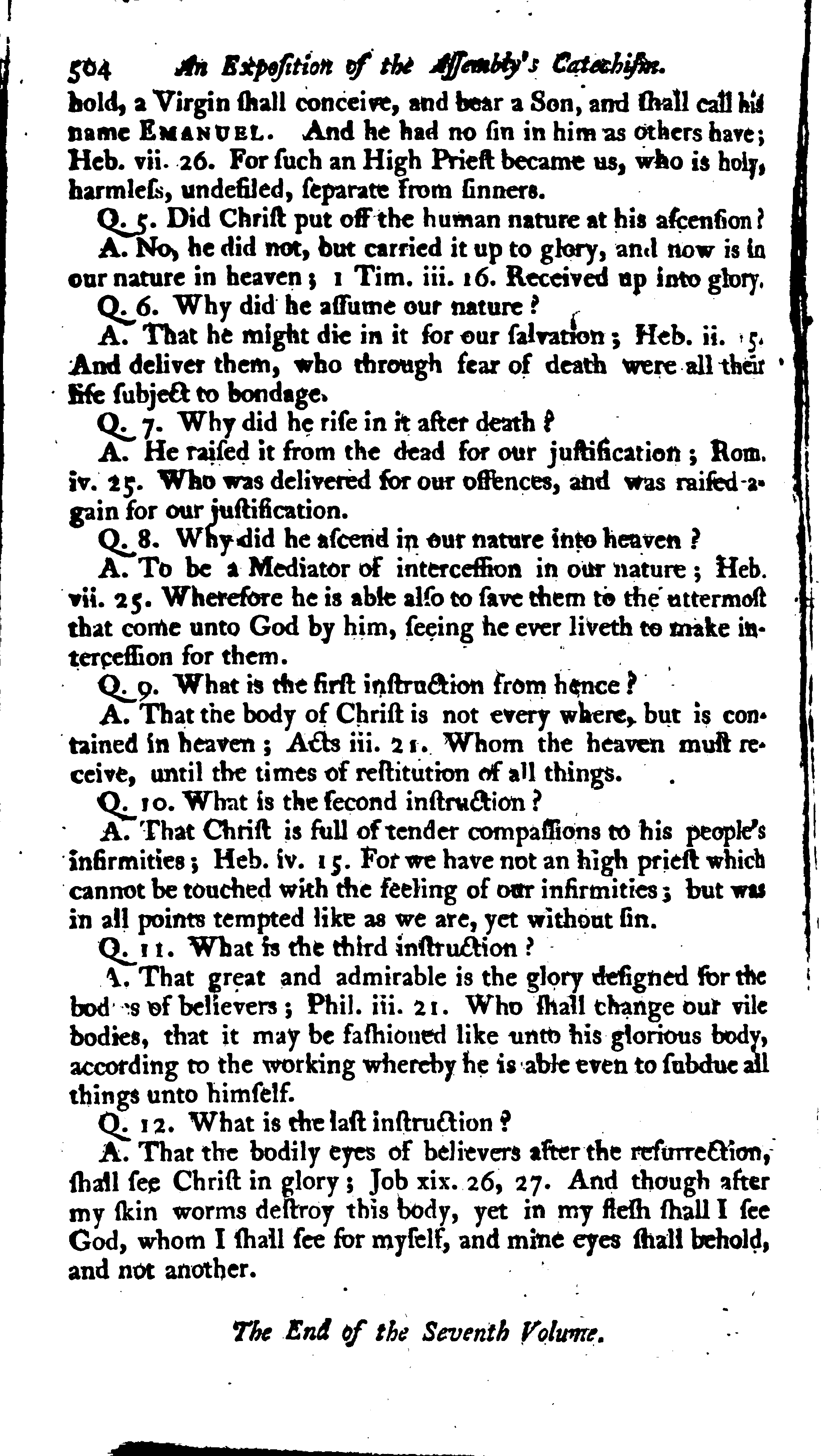
An Exposition of the Assembly's Catechism. hold, a Virgin shall conceive,and bear aS on,and shall call his name EMANUEL. And he had no fin in him as others have;
Heb. vii. 26. For such an High Priestbecameus,who is holy, harmless, undefiled, separate from sinners.
Q.5. Did Christ put offthehuman nature at his ascension?
A. No, he did not,but carried ituptoglory, and now is in our nature in heaven; 1 Tim. iii. 16. Received up into glory.
Q.6. Why did he assume our nature ?
A. That he mightdiein it for our salvation ; Heb. ii.15.
And deliver them, who through fear of death were all their lifefubject to bondage.
Q. 7. Why did herife in itafterdeath?
A. He raised it from the dead for our justification; Rom. iv. 25. Who was delivered for our offences, and was raised-2gain for ourjuftification.
Q. 8. Whydidhe afcendin our nature into heaven?
A. To be a Mediator of interceffion in our nature ; Heb. vii. 25. Wherefore he is able also tosavethemto theuttermost thatcomeuntoGodbyhim, seeing he ever liveth to make interceffion for them .
Q. 9. What is the first instruction from hence ?
A. Thatthebody of Christ is not everywhere,but is con tained in heaven ; Acts iii. 21. Whom the heaven must receive, untilthetimes of restitution of all things.
Q. 10.What is the second instruction ?
A. That Christ is full of tender compassions to his people's infirmities; Heb. iv. 15. For we have not an high priest which cannot be touched with the feeling of our infirmities; but was in all points tempted like as we are, yet without fin.
Q. 11. What is the third instruction ?
4. That great and admirable is the glorydefigned for the bodesofbelievers ; Phil. iii. 21. Who shall change our vile bodies, that it maybe fashioned like unto his glorious body, according to the working whereby he is ableevento fubdueall things unto himself.
Q. 12. What is the last instruction ?
A. That the bodily eyes of believers after the resurrection, shall fee Christ in glory ; Job xix. 26, 27. And though after my skin worms destroy this body, yet in my flesh shall I fee
God, whom I shall fee for myself,andmineeyes shall behold, and not another.
The End of the Seventh Volume.



UNIVERSITY OF MICHIGAN
3 9015 06534 4544