
Of fin,
An Exposition of the Assembly's Catechism.
Q. 3. How did God leave him to abuse the freedom of his will?
A. Not by inclining him to abuse it; but by with-holding that further grace which he was nowayobliged to continue to him.
Q. 4. Did the will of man lose its liberty to good, by the fall?
A. Yes, it did, and is so wounded, that it cannot, without thy preventing andregenerating grace, putforthone spiritual and
saving act ; Eph. ii. 8, 9, 10. For by grace are ye saved, through faith, and that not ofyourselves ; it is the gift of God, not of works, least any man shouldboast; for we are his workmanship, created in Christ Jesus unto good works, &c.
Q. 5. What was the aggravation of Adam's fin ?
A. It was aggravated in his being a public innocent person, so newly placed in a state of happiness and liberty.
Q. 6. What is the first inference from the fall ?
A. That the best creature left to himself, cannot be long safe ; as the angels, and Adam; Psal. xlix. 12. Nevertheless, man being in honour abideth not; he is like the beasts that perish.
Q. 7. What is the second inference ?
A. That since man could not be his own keeper, he can be much less his own saviour ; 2 Cor. iii. 5. Not that we are sufficient of ourselves to think any thing as of ourselves ; but our fufficiency is of God.
Q. 8 What is the third inference ?
A. That it is impossible for the covenant of works to justify any one ; Rom. iii. 20. Therefore by the deeds of the law there shall no flesh be justified in his fight ; Rom. viii. 3. For what the law could not do, in that it was weak, through the flesh ; God fending his own Son, in the likeness offinful flesh, and for fin condemned fin in the flesh .
Q. 9. What is the last inference ?
A. What cause have we to bless God for Christ, who re.. covered us when the fall left us helpless ? Rom. v. 6. For when we were yet without strength, indue time Christ died for the ungodly.
Quest. 14.W Of Sin.
Hat is fin ?
A. Sin is any want of conformity unto, or transgression of the law of God.
Q. 1. What is meant by the law ?
A. The commands and rules flowingfromGod'sfovereignty, :
An Exposition of the Assembly's Catechism.
whereby his will is manifested, and the creature bound to obedience.
Q. 2. Where is this law written ?
A. It is written either in the heart ; Rom. ii. 15. Which shews the work of the law written in their hearts, (which we call the law of nature) ; or in the Bible, which we call the written moral law.
Q. 3. What conformityisdue to this law of God?
A. A twofold conformity is due to it : First, Internal, in our hearts. Secondly, External, in our lives ; and the want of either is fin ; 1 John iii. 4.
Whosoever committeth fin, tranfgreffeth also the law ; for fin is the transgression of the law.
Q4. How doth it appear that the want of internal conformity is fin?
A. Because thelawrequiresit ; Mark xii. 30. And thou shalt love the Lord thy God with all thine heart, and with all thy soul, and with all thy mind, and with all thy strength ; for this is the first commandment : And condemns the want of it ?
Rom . vii. 7. What shall we say then ? Is the law fin ? God forbid ! nay, I had not known fin but by the law ; for I had not known lust, except the law had said, Thou shalt not covet.
Q. 5. Is nothing a finbutwhat is against God's law ?
A. No, nothing can be a fin but what God hath either exprefly, or by consequence forbidden in his word.
Q. 6. Wherein lies the evil oftranfgreffing God's law ?
A. The evil of fin principally lies in the offence and wrong done to God, whose sovereignty it labours to shake off, and despises his will ; Psal. li. 4. Against thee, thee only have I finned, and done this evil in thy fight .
Q. 7. What further evil is in fin ?
A. It highly wrongs the sinner's foul, by defacing, defiling, and damning it ; Prov. viii. 36. But he that finneth against me, wrongeth his own soul : all they that hate me, love death.
Q. 8. Wherein is the evil of fin manifested ?
A. It is manifested in the death of Christ, the terrors of conscience, and torments of hell.
Q. 9. What course must the sinner take to recover himself out of his misery?
A. Repentance towards God, faith towards Christ, and both evidenced by new obedience ; Acts xx. 21. Testifying both to the Jews, and also to the Greeks, repentance towards God, and faith towards our Lord Jesus Christ .
Q.ro. What may we infer from hence ?
An Exposition of the Assembly's Catechism.
A. That we have infinite cause to bless God for Christ's satisfaction of the law for our fins.
Of the Tree of Knowledge.
W Hat was the sinwherebyourfirst parents fell Quest. 15. from the estate wherein they were created?
A. The fin whereby our first parents fell from the estate wherein they were created,was their eating theforbiddenfruit.
Q. 1. Why was this tree calledthetree of knowledge ?
A. Not from any natural efficacy it had to give knowledge, but the knowledge he should have by eating, or not eating, was experimental knowledge. i. e. Knowledge to his for row.
Q.2 WhydidGod forbid him this tree?
SeA. First, For the discovery of his dominion over man . condly, For the trial of his subjection and obedience.
Thirdly, For the aggravation of his fin, if he should eat.
Q. 3. What evil was there in eating of it?
A. There was a twofold evil, the evil of fin, and the evil of punishment, both very great.'
Q. 4. What was the evil of fin ?
A. Athreefold evil of fin.
First, Against God, calleddifobedience'; Rom. v. 19. For as by one man's disobedience many were made sinners.
Secondly, Against himself, soul, body, and estate.
Thirdly, Against his posterity ; Rom.v.
12. Wherefore as by one man fin entered into the world, and death by fin ; and so death passed upon all men, for that all have sinned.; Q.5. What was the evil of punishment ?
A. First, Loss of God's image.
Secondly, Horror of conscience.
Thirdly, Sorrow on the female sex.
Fourthly, Curle on the creature.
Fifthly, Expulsion from paradise.
Sixthly, Death both of body and foul.
Q. 6. What is the first instruction from it ?
A. To take heed of small beginnings of temptations, and to resist it in the first motions ; James iii. 5. Behold how great a matter a little fire kindleth.
Q. 7. What is the second inference ?
A. Not to hold a parlywith the tempter; see2Cor. xi. 3.
But I fear left by any means, as the sepent beguiled Eve, through his fubtilty, so your minds should be corrupted from the fimplicitythat is in Christ.
Q. 8. What is the third inference?
A. That Satan's policy lies much in the choice of his tempting instruments; as Eve and Peter, &c.
An Exposition of the Assembly's Catechism.
Q. 9. What is the fourth inference ?
A.Aneceffity of keeping strong guards on our senses ; Ifa. xxxiii. 15. That stoppeth his ears from hearing of blood, and shutteth his eyes from seeing evil, he shall dwellonhigh, his place ofdefence shall be themunition of rocks.
Q. 10. What is the fifth inference ?
A. That covenant-breaking is a heinous sin, which God will punish ; Hofea viii. 1. He shall come as an eagle against the house of the Lord, because they havetranfgreffedmyco. venant, and transgressed againstmylaws.
Q. 11. What is the last inference ?
A. That the corruption of our nature is much seen indefiring forbidden things ; Rom. vii. 7. What shall we say then?
Is the law fin ? God forbid: Nay, I had not known fin, but by the law ; for I had not known lust, except the lawhadfaid,
Thou shalt not covet.
Of the Fall of Adam, and ours in him.
D ID all mankind fall in Adam's first tranfQuest. 16. greffion ?
A.The covenant being madewithAdam, not only for himself, but for his posterity, all mankind descending from him by ordinary generation,finned in him, and fell with him in his first transgression.
Q. 1. Didnoman everescapethe fin of Adam ?
A. Yes, the man Christ Jesus did, and he only; Heb. vii.
26. For such an High Priest became us,who is holy, harmless, undefiled, separate from sinners.
Q. 2. Why was not Christ tainted with it ?
A. Because he came into the world in an extraordinary way; Matth. i. 18. Now the birth of Jesus Christ was on this wife :
When as his Mother Mary was espousedtoJoseph,before they came together, she was found with child of the holyGhoft.
Q. 3. How doth it appear all others are tainted with it ?
A. It appears by scripture-testimony, Rom. v. 12. Wherefore as by one man finentered into the world, and death by fin, and fo death passed upon all men, for that all have finned ; and experience of the best men, Rom. vii. 21. I find thenalaw, that when I would do good, evil is present with me.
Q. 4. How came allmen to fall with Adam ?
A. Because all were included in Adam's covenant, asa man's covenant includes his children before they be born, or the freason of the father affects his posterity.
Q. 5. What inferyou from hence ?
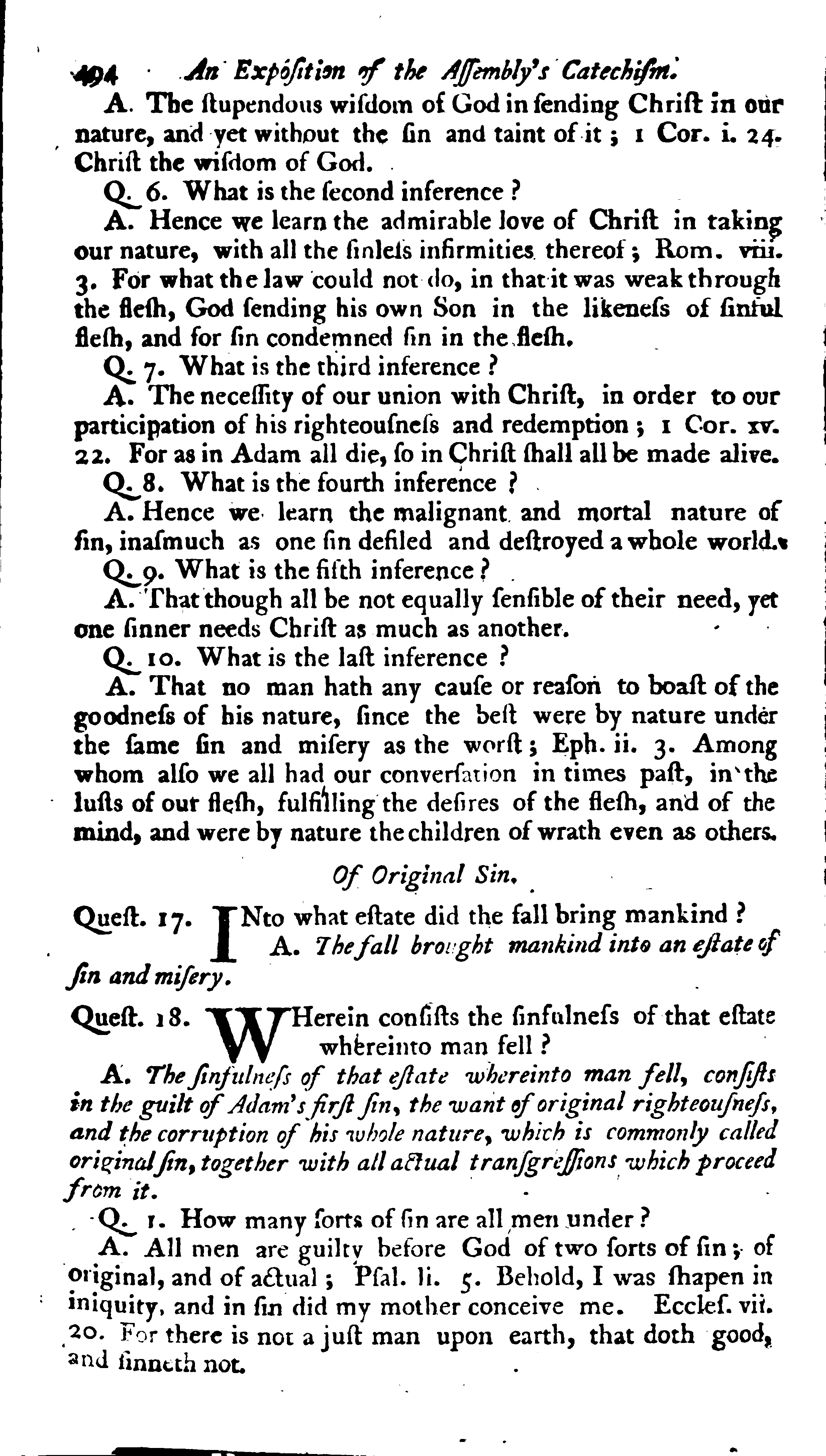
An Exposition of the Assembly's Catechism.
A. The stupendous wisdom ofGodinfending Christ in our nature, and yet without the sin and taint of it ; 1 Cor. i. 24.
Christ the wisdom of God.
Q. 6. What is the second inference ?
A. Hence we learn the admirable love of Christ in taking our nature, with all the finless infirmities thereof; Rom . viii.
3. For what the law could not do, in that it was weak through the flesh, God fending his own Son in the likeness offinful flesh, and for fin condemned fin in the flesh .
Q. 7. What is the third inference ?
A. The necessity of our union with Christ, in order to our participation of his righteousness and redemption ; 1 Cor. xv.
22. For as in Adam all die, so in Christ shall all be made alive.
Q. 8. What is the fourth inference ?
A. Hence we learn the malignant and mortal nature of fin, inasmuch as one findefiled and destroyed a whole world.
Q. 9. What is the fifth inference ?
A. That though all be not equally sensible of their need, yet one sinner needs Christ as much as another.
Q. 10. What is the last inference ?
A. That no man hath any cause or reason to boast of the goodness of his nature, since the best were by nature under the fame fin and misery as the worst ; Eph. ii. 3. Among whom also we all had our conversation in times past, in the lusts of our flesh, fulfilling the desires of the flesh, and of the mind, and were by nature the children of wrath even as others.
Of Original Sin.
Nto what estate did the fall bring mankind ?
Quest. 17. I finandmisery.
A. The fall brought mankind into an W estate of Herein consists the finfulness of that estate
Quest. 18 . whereinto man fell ?
A. Thefinfulness of that estate whereinto man fell, consists in the guilt of Adam'sfirstfin, the want of original righteousness, and the corruption of his whole nature, which is commonly called originalfin,together with all actual transgressions which proceed from it.
Q. 1. How many forts of fin are allmenunder ?
A. Allmen are guilty before God of two forts of fin ; of original, and of actual ; Psal. li. 5. Behold, I was shapen in iniquity, and in fin did my mother conceive me. Ecclef. vii.
20. For there is not ajustman upon earth, that doth good, and finnethnot.
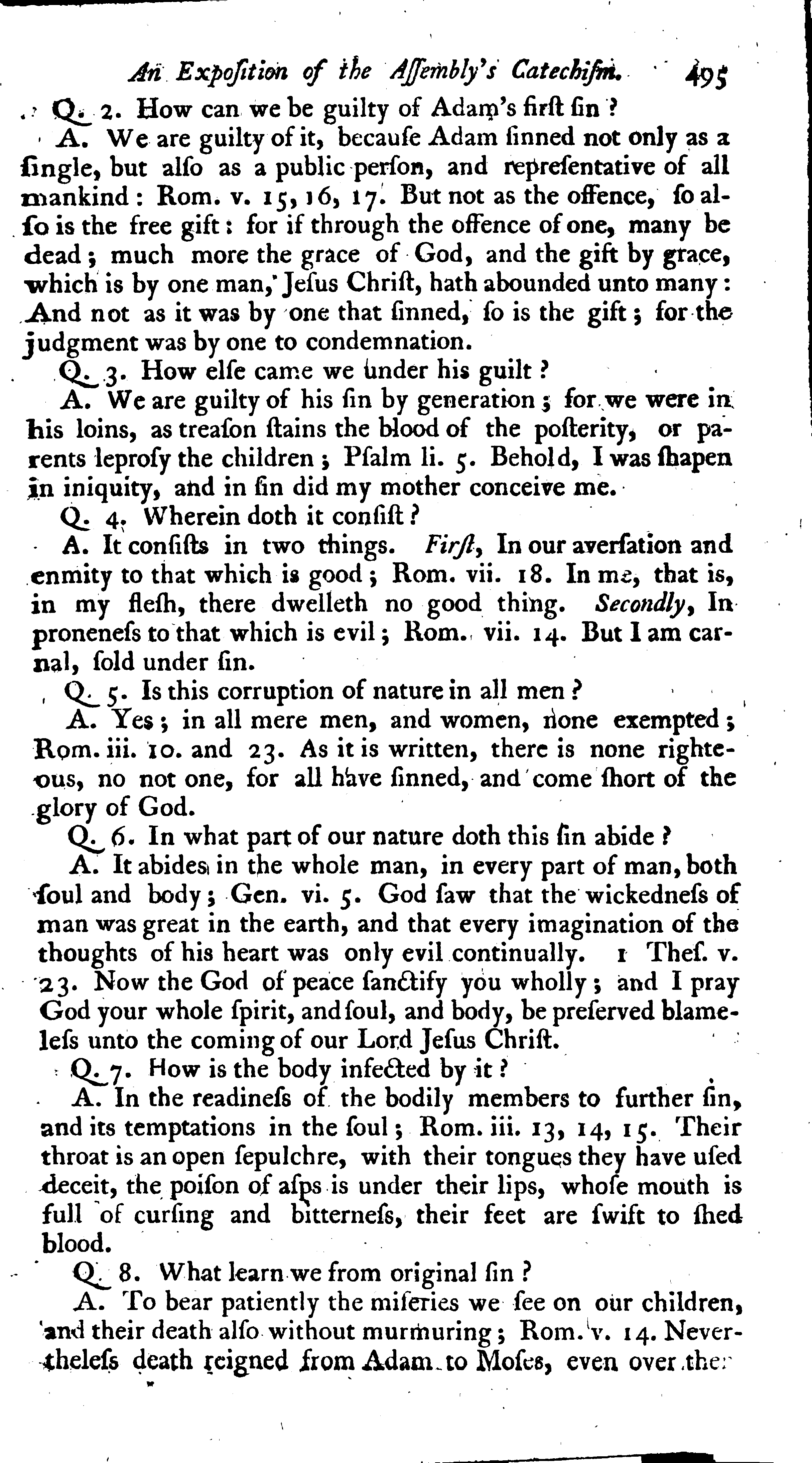
An Exposition of the Assembly's Catechism.
Q. 2. How can we be guilty of Adam's first fin ?
A. We are guilty of it, becauseAdam finned not only as a single, but also as a public person, and representative of all mankind : Rom. v. 15, 16, 17. But not as the offence, so also is the free gift : for if through the offence of one, many be dead; much more the grace of God, and the gift by grace, which is by oneman, Jesus Christ, hath abounded unto many :
And not as it was by one that finned, so is the gift ; for the judgment was by one to condemnation.
Q. 3. How else came we under his guilt ?
A. We are guilty of his fin by generation ; for we were in his loins, as treason stains the blood of the posterity, or parents leprosy the children ; Psalm li. 5. Behold, I was shapen in iniquity, and in fin did my mother conceive me.
Q. 4. Wherein doth it consist ?
A. It consists in two things.
First, In our aversation and enmity to that which is good ; Rom. vii. 18. In me, that is, in my flesh, there dwelleth no good thing.
Secondly, In proneness to that which is evil ; Rom. vii. 14. But I am carnal, fold under fin.
Q. 5. Is this corruption of nature in allmen ?
A. Yes ; in all mere men, and women, none exempted; Rom. iii. 10. and 23. As it is written, there is none righteous, no not one, for all have finned, and come short of the glory of God.
Q. 6. In what part of our nature doth this fin abide ?
A. Itabides in the whole man, in every part of man,both foul and body ; Gen. vi. 5. God saw that the wickedness of man was great in the earth, and that every imagination of the thoughts of his heart was only evil continually.
1 Thef. v.
23. Now the God of peace sanctify you wholly ; and I pray God your whole spirit, and foul, and body, be preserved blameless unto the coming of our Lord Jesus Christ.
Q. 7. How is the body infected by it ?
A. In the readiness of the bodily members to further fin, and its temptations in the soul ; Rom. iii. 13, 14, 15. Their throat is an open fepulchre, with their tongues they have used deceit,the poison ofafps is under their lips, whose mouth is full of cursing and bitterness, their feet are swift to shed blood.
Q8 . What learn we from original fin ?
A. To bear patiently the miseries we fee on our children, and their death also without murmuring ; Rom. v. 14. Nevertheless death reigned from A dam to Moses, even over ther