
An EXPOSITION of the Assembly's SHORTER
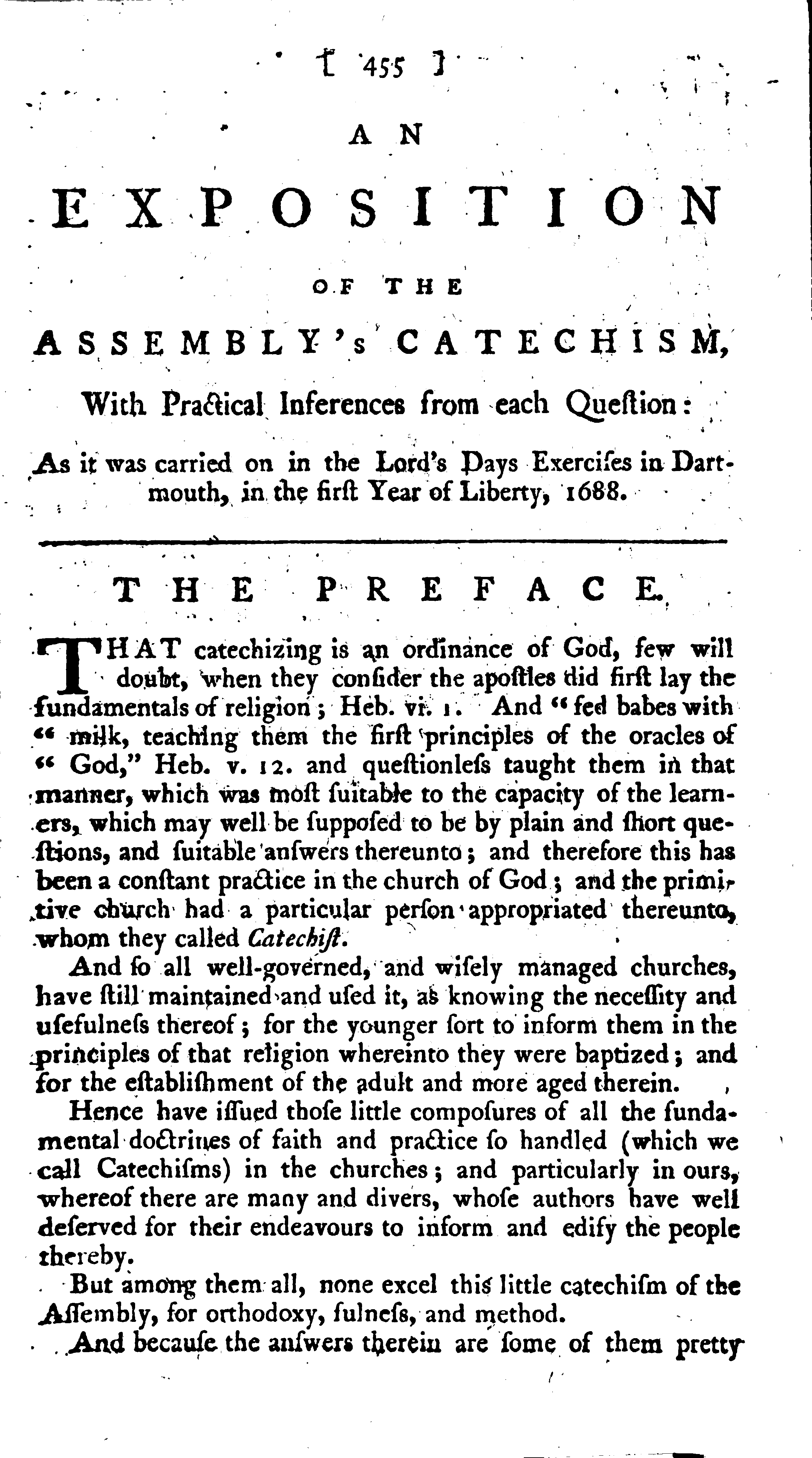
[ 455 ] AN
ΕΧΡOSITION
OF THE
ASSEMBLY's CATECHISM,
With Practical Inferences from each Question :
As it was carried on in the Lord's Days Exercises inDartmouth, in the first Year of Liberty, 1688.
THE PREFACE.
T HAT catechizing is an ordinance of God, few will doubt, when they confider the apostles did first lay the fundamentalsofreligion ; Heb. vi. 1. And" fed babes with "milk, teaching them the first principles of the oracles of " God," Heb. v. 12. and questionless taught them in that manner, which was most suitable to the capacity of the learners, which may well be supposed to be by plain and short questions, and suitable answers thereunto ; and therefore this has been a constant practice in the church of God ; and the primitive church had a particular person appropriated thereunto, whom they called Catechist.
Andfo all well-governed, and wifely managed churches, have still maintained and used it, as knowing the necessity and usefulness thereof; for the younger fort to inform them in the principles of that religionwhereinto they were baptized ; and for the establishment of the adult and more aged therein.
Hence have issued those little composures of all the fundamental doctrines of faith and practice so handled (which we call Catechisms) in the churches ; and particularly in ours, whereof there are many and divers, whose authors have well deserved for their endeavours to inform and edify the people thereby.
But among them all, none excel this little catechism of the Assembly, for orthodoxy, fulness, and method.
And because the answers therein are some of them pretty
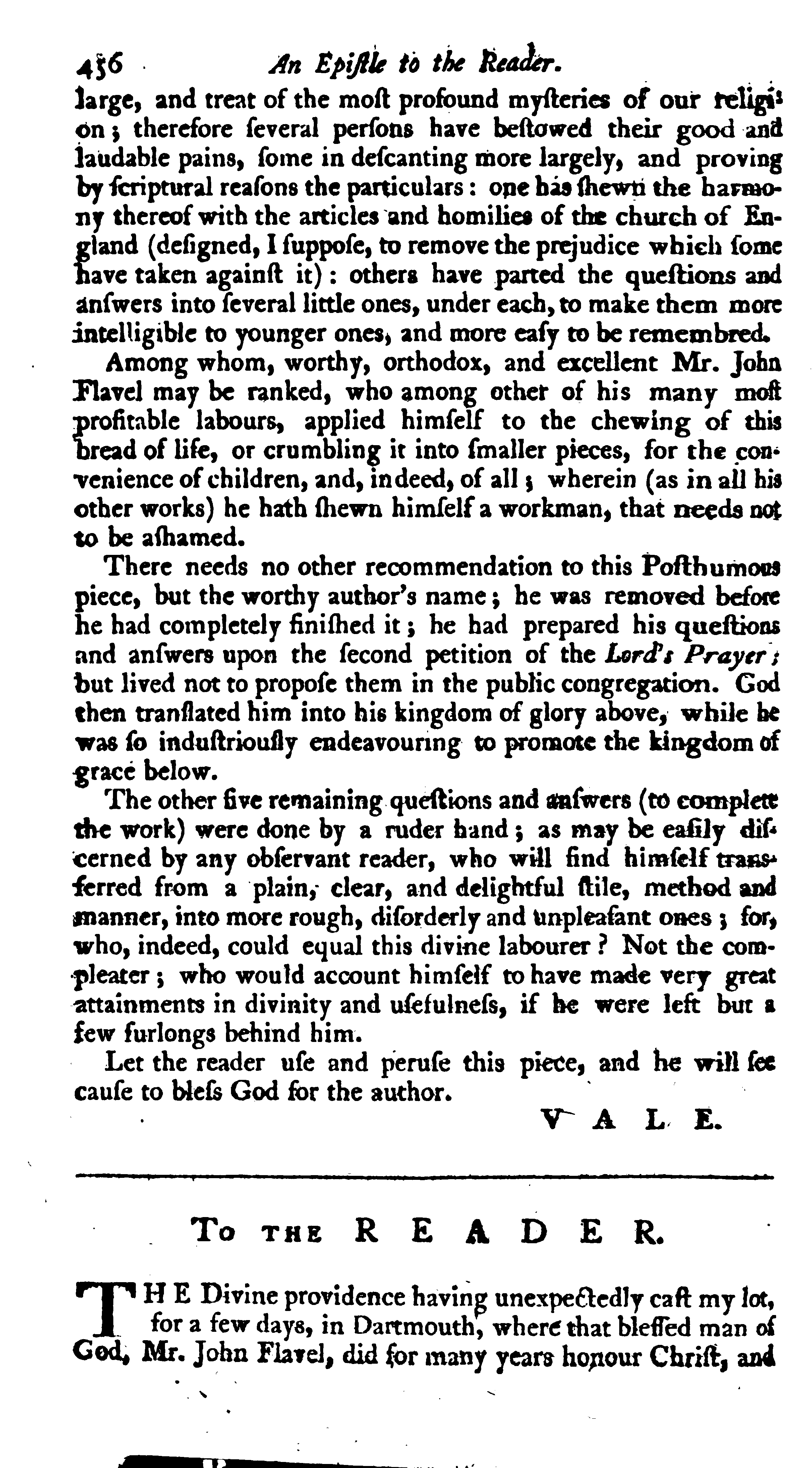
An Epistle to the Reader. large, andtreatofthe most profound mysteries of our religi on; therefore several persons have bestowed their good and laudable pains, some indescanting more largely, and proving byscripturalreasons the particulars: onehasshewn the harmony thereof with the articles andhomilies of the church of England(designed, I suppose, to remove the prejudice which some have taken against it) : others have parted the questions and answers into several littleones, under each,to make them more intelligible to younger ones, andmoreeasytoberemembred.
Among whom, worthy, orthodox, and excellent Mr. John Flavel may be ranked, who among other of his many most profitable labours, applied himself to the chewing of this bread of life, or crumbling it into smaller pieces, for the con venience of children, and, indeed, of all ; wherein(as in all his other works) he hath shewn himself a workman, that needs not to be ashamed.
There needs no other recommendation to this Posthumous piece, but the worthy author's name ; he was removed before he had completely finished it; he had prepared his questions and answers upon the second petition of the Lord'sPrayer; but lived not toproposethem in the public congregation. God thentranslatedhim into his kingdom of glory above, while he was so industriously endeavouring to promote the kingdom of grace below.
The other five remaining questionsandanswers(to complete the work) were done by a ruder hand; as maybe easily dis cernedby any observant reader, who will find himself transferred from a plain, clear, and delightful stile, method and manner, into more rough, disorderly and unpleasfant ones ; for, who, indeed, could equal this divine labourer ? Not the compleater; who would account himself to have made very great attainments in divinity and usefulness, if he were left but a few furlongs behind him.
Let the reader use and peruse this piece, and he will fee cause to bless God for the author.
ALE.
TO THE READER.
THE Divineprovidencehavingunexpectedlycaftmylot, for a few days, inDartmouth,wherethatblessedman of God, Mr. John Flavel,did formanyyears honour Christ, and
An Epislle to the Reader.
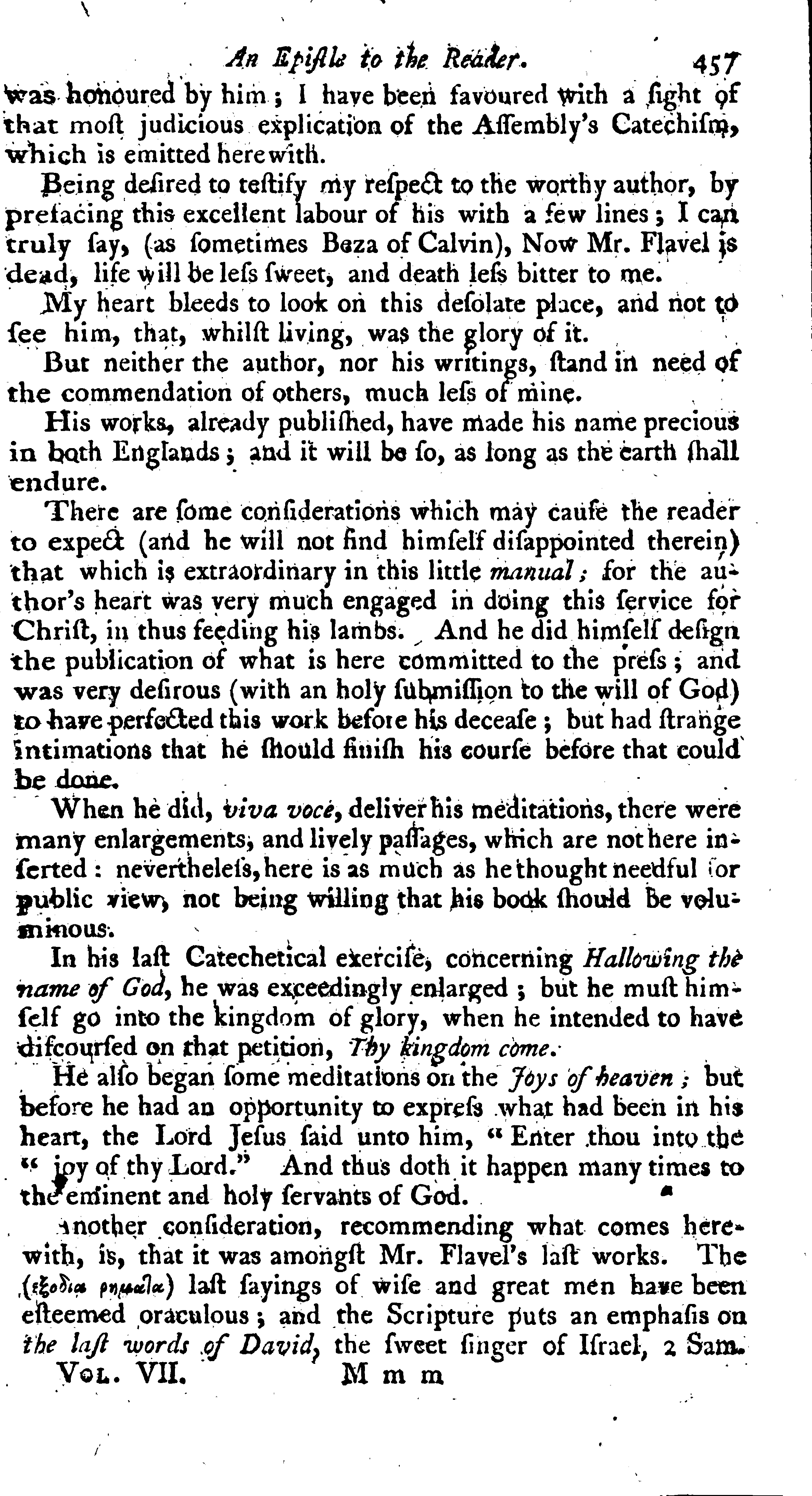
was honouredbyhim ; I have been favoured with a fight of that most judicious explication of the Assembly's Catechism, which is emitted herewith.
Being desired to testify my respect to the worthy author, by prefacing this excellent labour of his with a few lines ; I can truly say, (as sometimes Beza of Calvin), Now Mr. Flavel is dead, life will be less sweet, and death less bitter to me.
My heart bleeds to look on this desolate place, and not to fee him, that, whilst living, was the glory of it.
But neither the author, nor his writings, stand in need of the commendation of others, much less of mine.
His works, already published,have made his name precious in both Englands; and it will be so, as long as the earth shall endure.
There are some considerations which may cause the reader to expect (and he will not find himself disappointed therein) that which is extraordinary in this little manual; for the author's heart was very much engaged in doing this service for Christ, in thus feeding his lambs. And he did himselsdesign the publication of what is here committed to the press ; and was very desirous (with an holy submission to the will of God) to have perfected this work before his decease ; but had strange intimations that he should finish his course before that could be done.
Whenhedid, viva voce, deliver his meditations, there were many enlargements, and lively passages,which are not here inserted : nevertheless,here is as much as hethoughtneedful for public view, not being willing that his book should be voluminous.
In his last Catechetical exercise, concerning Hallowing the name of God, he was exceedingly enlarged; but he musthimfelfgo into the kingdom of glory, when he intended to have difcoursed on that petition, Thy kingdom come.
He also began somemeditationson the Joys of heaven ; but before he had an opportunity to express what had been in his heart, the Lord Jesus said unto him, " Enter thou into the " joy of thy Lord." And thus doth it happen many times to the eminent and holy servants of God.
Another consideration, recommending what comes herewith, is, that it was amongst Mr. Flavel's last works.
The (εξοδια ρημαία) last sayings of wife and great men have been esteemed oraculous ; and the Scripture puts an emphasis on the last words of David, the sweet finger of Israel, 2Sam.
VOL . VII.
Mmm
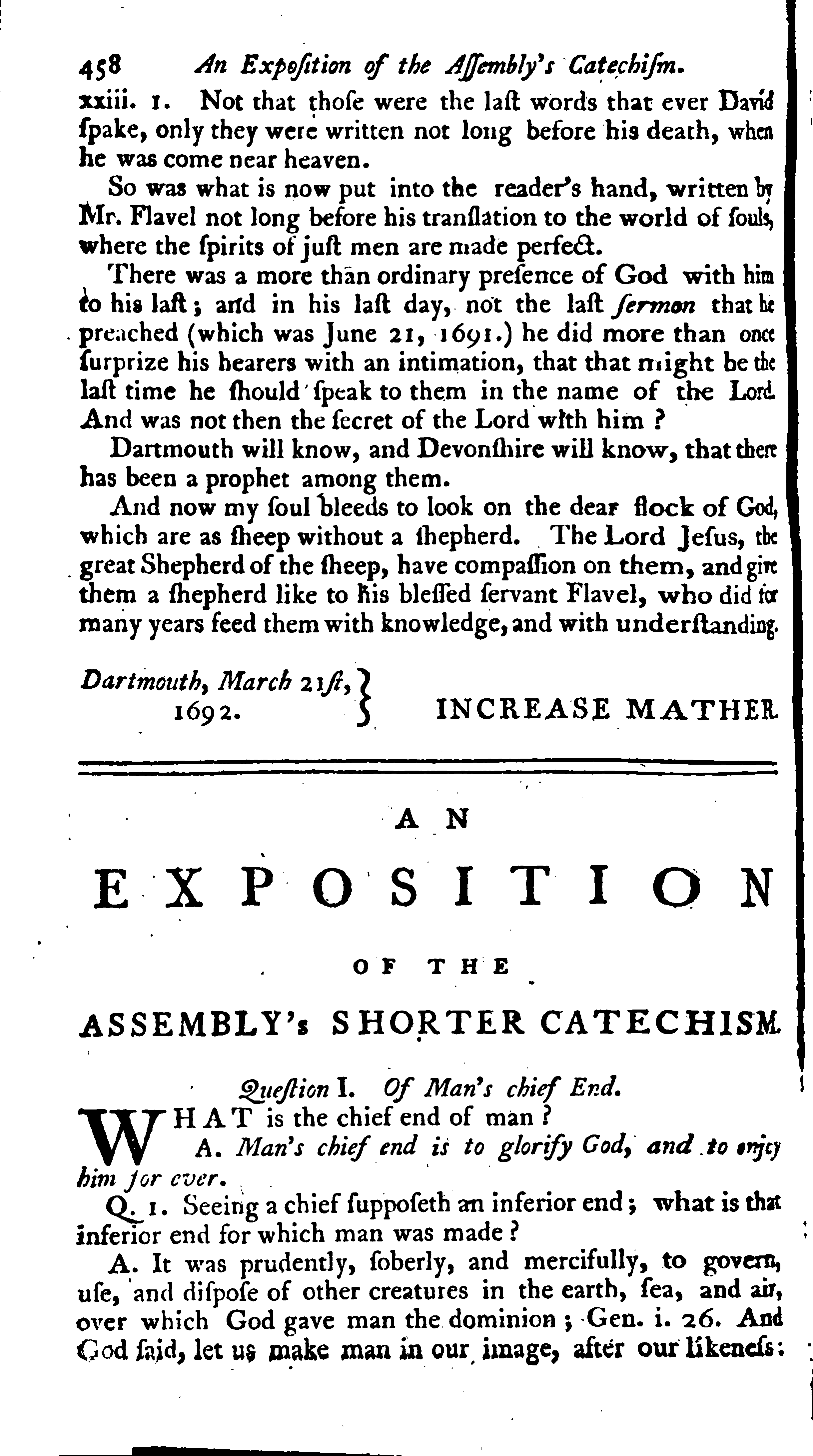
An Exposition of the Assembly's Catechism. xxiii. 1.
Not that those were the last words that ever David spake, only theywerewritten not long before his death, when he was come near heaven .
So was what is now put into the reader's hand, written by Mr. Flavel not longbeforehis translation to the world offouls, where the spirits of just men are made perfect.
There was a more than ordinary presence of God with him to his last ; and in his last day, not the lastfermon that he preached (which was June 21, 1691.) he did more than once fur prize his hearers with an intimation, that that might be the last time he should speak to them in the name of the Lord.
And was not then the secret of the Lord with him ?
Dartmouth will know, and Devonshire will know, that there has been a prophet among them.
And now my soul bleeds to look on the dear flock of God, which are as theep without a shepherd.
The Lord Jesus, the great Shepherd of the sheep, have compassion on them, and give them a shepherd like to his blessed servant Flavel, who did for many years feedthemwith knowledge,and with understanding.
Dartmouth, March 21st, 1692.
INCREASE MATHER.
EXPOSITION
OF THE
ASSEMBLY's SHORTER CATECHISM
W Question I.
Of Man's chief End.
HAT is the chief end of man ?
A. Man's chief end is to glorify God, and to enjoy him for ever.
Q. 1. Seeing a chiefsupposeth an inferior end; what is that inferior end for which man was made ?
A. It was prudently, soberly, and mercifully, to govern, use, and dispose of other creatures in the earth, sea, and air, over which God gave man the dominion ; Gen. i. 26. And God said, let us make man in our image, after our likeness:
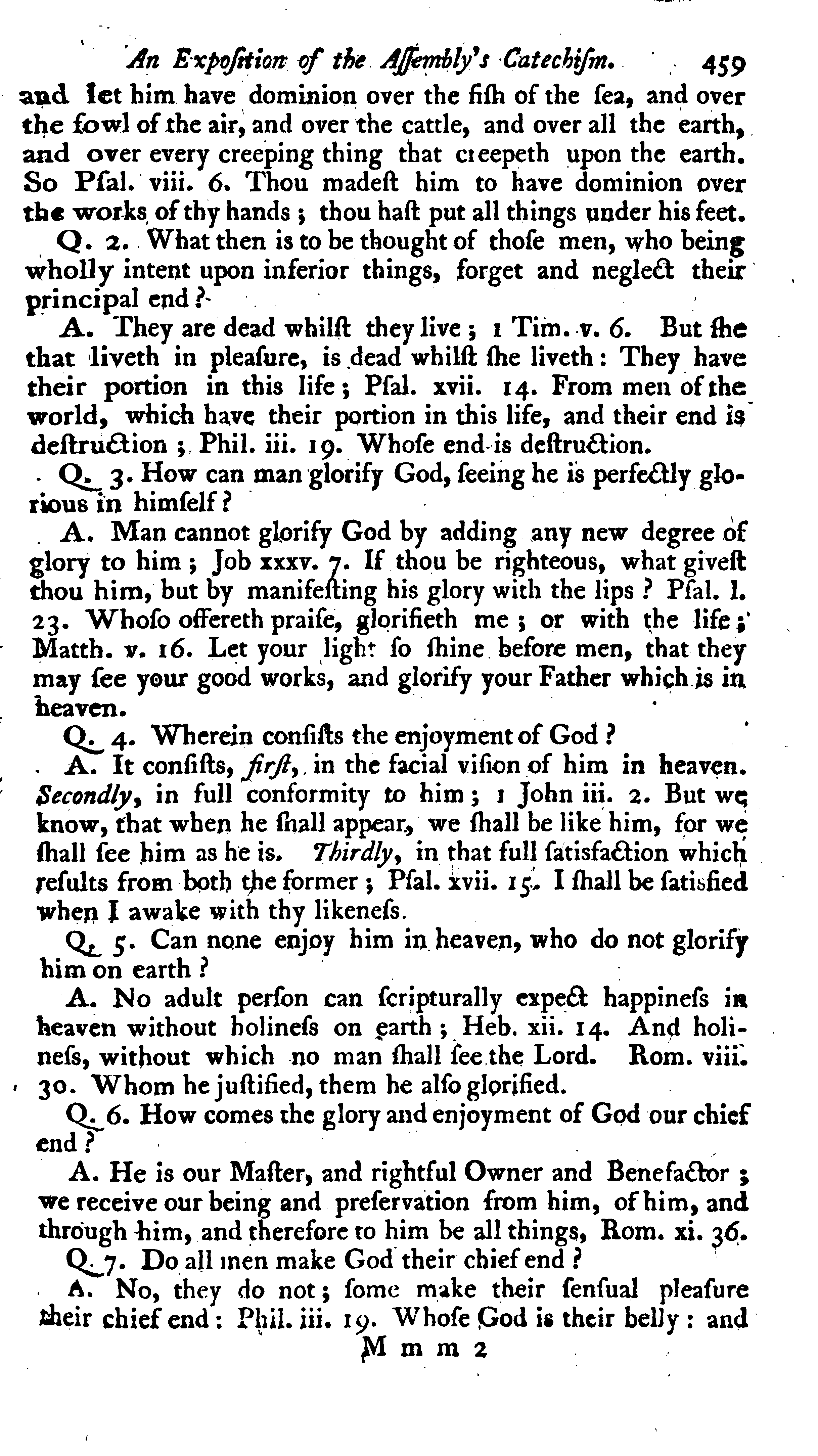
An Exposition of the Assembly's Catechism.
: 459 and let him have dominion over the fish of the sea, and over the fowl of the air, and over the cattle, and over all the earth, and over every creeping thing that creepeth upon the earth.
So Psal . viii. 6. Thou madest him to have dominion over the works ofthyhands ; thou hast put all things under his feet.
Q. 2. What then is to be thought of those men,who being wholly intent upon inferior things, forget and neglect their principal end?
A. They are dead whilst they live ; 1 Tim. v. 6.
But she that liveth in pleasure, is dead whilst she liveth : They have their portion in this life ; Psal. xvii. 14. From men of the world, which have their portion in this life, and their end is destruction ; Phil. iii. 19. Whose end is destruction.
Q. 3.How can man glorify God,feeinghe is perfectly glorious in himself?
A. Man cannot glorifyGodby adding any new degree of glory to him ; Job xxxv. 7. If thou be righteous, what givest thou him, but by manifesting his glory with the lips ? Psal. 1.
23. Whoso offereth praise, glorifieth me ; or with the life; Matth. v. 16. Let your light so shine before men, that they may fee your good works, and glorify your Father which is in heaven.
Q. 4. Wherein consists the enjoymentofGod ?
A. It consists, first, in the facial vision of him in heaven.
Secondly, in full conformity to him ; 1 John iii. 2. But we know, that when he snall appear, we shall be like him, for we shall see him as he is.
Thirdly, in that full satisfaction which results from both the former ; Psal. xvii. 15. I shall be satisfied when I awake with thy likeness .
Q. 5. Can none enjoy him in heaven,who do not glorify him on earth ?
A. No adult person can scripturally expect happiness in heaven without holiness on earth ; Heb. xii. 14. And holiness, without which no man shall fee the Lord.
Rom. viii.
30. Whom he justified, them he also glorified.
Q.6. How comes the glory and enjoyment of God our chief end?
A. He is our Master, and rightful Owner and Benefactor ; we receiveourbeing and preservation from him, of him, and through him, and therefore to him be all things, Rom. xi. 36.
Q.7. Do all inen make God their chief end ?
A. No, they do not; some make their sensual pleasure their chief end: Phil. iii. 19. Whose God is their belly : and Mmm 2
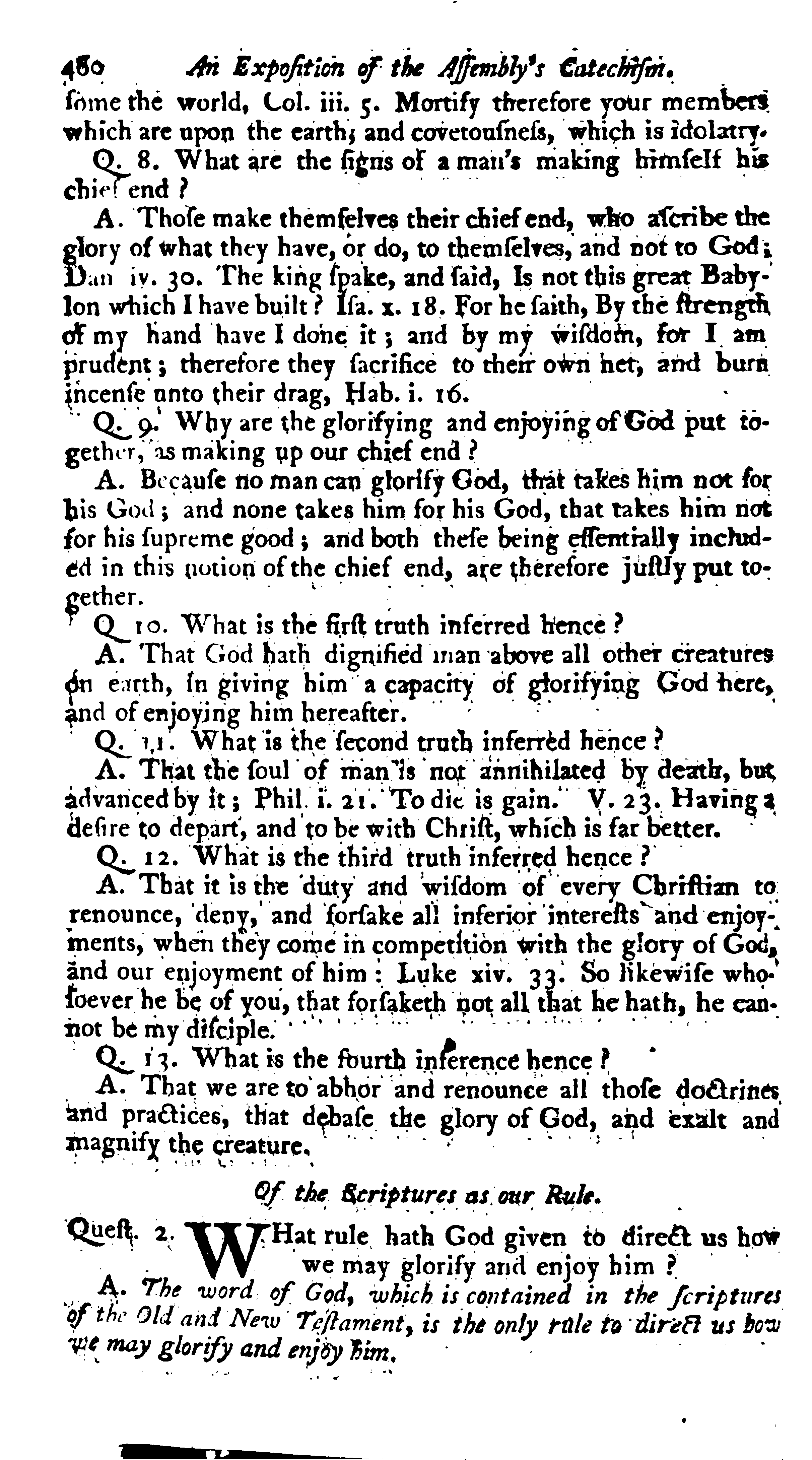
An Exposition of the Assembly's Catechism. some the world, Col. iii. 5. Mortify therefore your members which are upon the earth, and covetousness, which is idolatry.
Q. 8. What are the signs of am an's making himself his chief end?
A. Those make themselves theirchiefend, who ascribe the glory of what they have, or do, to themselves, and not to God;
Dan iv. 30. The king spake, and said, Is not this greatBabylonwhich I have built? Ifa. x. 18. For he faith,By the strength of my hand have I done it ; and by my wisdom, for I am prudent; therefore they sacrifice to their own net, and burn incense unto their drag, Hab. i. 16.
Q. 9. Why are theglorifying andenjoyingofGodput together, as making up our chief end ?
A. Because nomancanglorifyGod, that takes him not for his God ; and none takes him for his God,that takes him not for his fupremegood ; and both these being effsentially included in this notion of the chief end, are therefore juftlyputtogether.
Q10. What is the first truth inferred hence?
A. ThatGodhath dignified in an above all other creatures on earth, in giving him a capacity of glorifying God here, and of enjoying him hereafter .
Q. 11. What is the second truth inferred hence ?
A. That the soul of man is not annihilated by death, but advanced by it ; Phil i. 21. To die is gain.
V. 23. Having a desire to depart, and to be with Christ, which is far better.
Q. 12. What is the third truth inferred hence ?
A. That it is the duty and wisdom of every Christian to renounce, deny, and forsake all inferior interests and enjoyments, whentheycome in competition with the glory of God, and our enjoyment of him: Luke xiv. 33. So likewise who. foeverhe be of you, that forsaketh not all that he hath, he cannotbemydisciple.
Q. 13. What is the fourth inference hence?
A. That we are to abhor and renounce all those doctrines and practices, that debase the glory of God, and exalt and magnify the creature.
Of the Scriptures as our Rule.
WHat ☑Hat rule hath God given to direct us how Quest. 2. we may glorify and enjoy him ?
A. The word of God, which is contained in the scriptures of the OldandNew Testament, is the only rule to direct us botu wemayglorify and enjoy him.
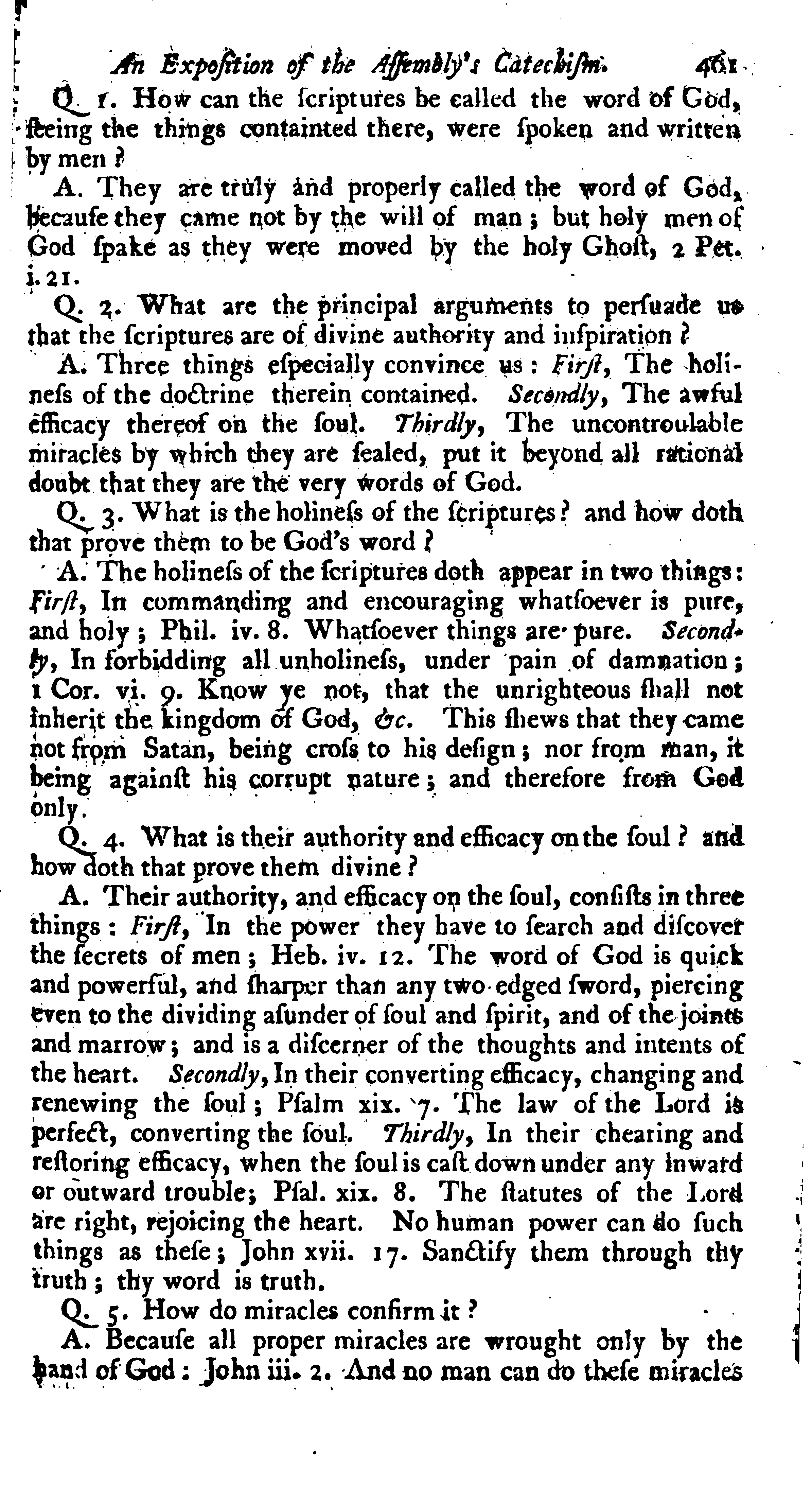
An Exposition of the Assembly's Catechism.
Q1. How can the scriptures be called the word of God, seeing the things containtedthere, were spoken and written by men?
A. They are truly and properlycalledthe word of God, because they came not by the will of man ; but holy men of God spake as they were moved by the holy Ghost, 2 Pet. i.21 .
Q. 2. What are the principal arguments to persuade us that the scriptures are of divine authority and inspiration ?
A. Three things especially convince us : First, The holiness of the doctrine therein contained.
Secondly, The awful efficacy thereof on the soul.
Thirdly, The uncontroulable miracles by which they are sealed, put it beyond all rational doubt that they are the very words of God.
Q. 3. What is the holiness of the scriptures? and how doth thatprovethem to be God's word ?
A. The holiness of the scriptures doth appear in two things:
First, In commanding and encouraging whatsoever is pure, and holy ; Phil. iv. 8. Whatsoever things are pure.
Secondly, In forbidding all unholiness, under pain of damnation ; 1 Cor. vi. 9. Know ye not, that the unrighteous shall not inherit the kingdom of God, &c.
This shews that they came not from Satan, being cross to his design ; nor from man, it being against his corrupt nature ; and therefore from God only.
Q. 4. What is their authority and efficacy on the foul ? and how doth that prove them divine ?
A. Their authority, and efficacyonthesoul,consists in three things : First, In the power they have to search and discover the secrets of men; Heb. iv. 12. The word of God is quick and powerful, and sharper than any two edgedsword, piercing even to the dividing asunder of foul and spirit, and of the joints and marrow; and is a difcerner of the thoughts and intents of the heart.
Secondly, In their converting efficacy, changing and renewing the soul ; Psalm xix. 7. The law of the Lord is perfect, converting the soul.
Thirdly, In their chearing and restoring efficacy,when the soul is castdownunder any inward or outward trouble; Psal. xix. 8. The statutes of the Lord are right, rejoicing the heart.
No human power can do such things as these ; John xvii. 17. Sanctify them through thy truth ; thy word is truth.
Q. 5. How do miracles confirm it ?
A. Because all proper miracles are wrought only by the band of God: John iii. 2. Andnomancandothese miracles