
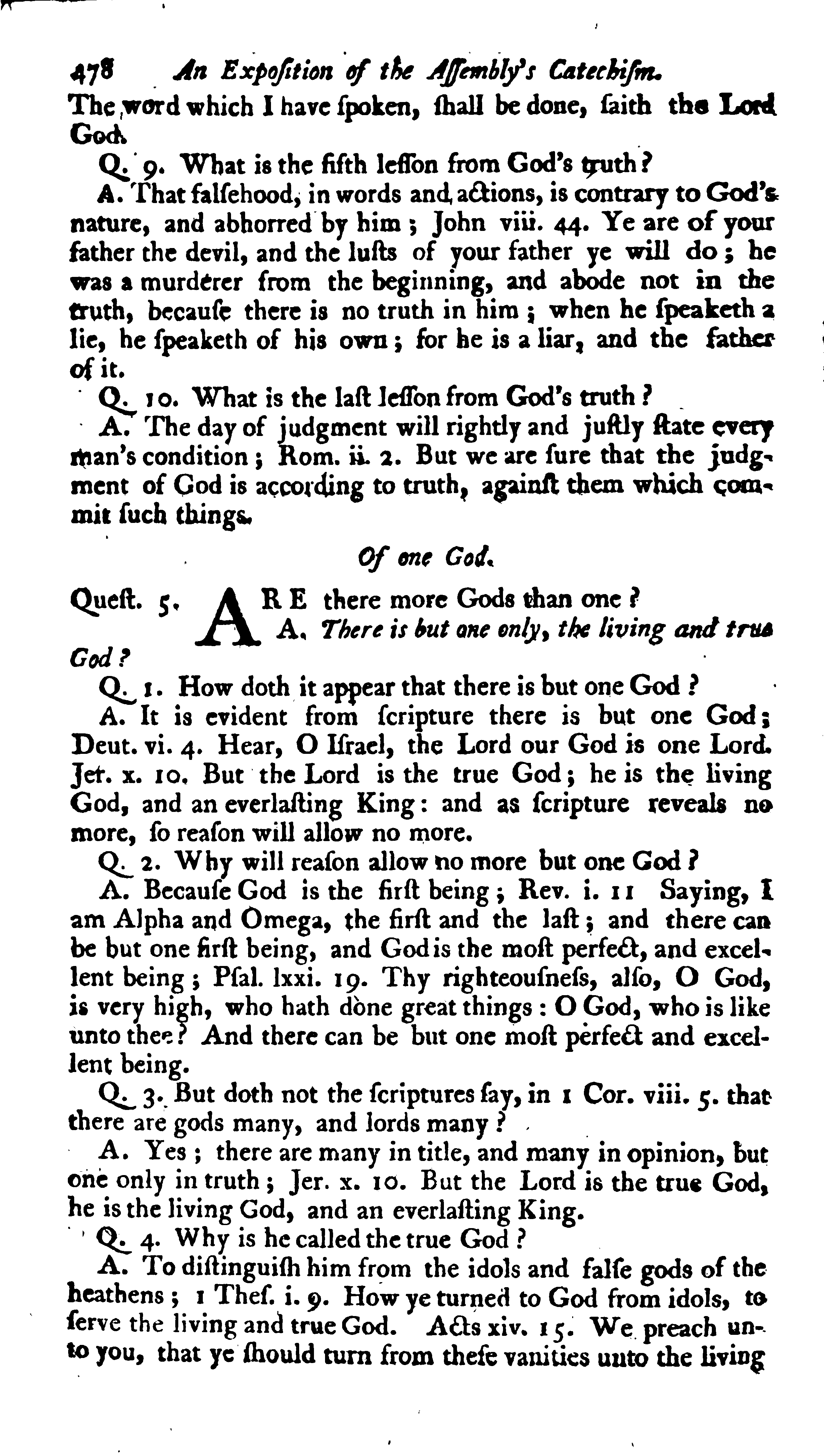
Of one God,
An Exposition of the Assembly's Catechism.
The word which I have spoken, shall be done, faith the Lord God.
Q. 9. What is the fifth lesson from God's truth?
A. That falsehood, in words and actions, is contrary to God's nature, and abhorred by him ; John viii. 44. Ye are of your father the devil, and the lusts of your father ye will do; he was a murderer from the beginning, and abode not in the truth, because there is no truth in him ; when he speaketh a lie, he speaketh of his own ; for he is a liar, and the father of it.
Q. 10. What is the last lessonfromGod's truth ?
A. The day of judgment will rightly and justly state every man's condition; Rom. ii. 2. But we are sure that the judgment of God is according to truth, againstthemwhich commit such things.
OfoneGod.
RE there more Gods than one ?
God? A Quest. 5 .
A. There is but one only, the livingandtrue Q. 1. How doth it appear that there is but one God ?
A. It is evident from scripture there is but one God; Deut. vi. 4. Hear, O Israel, the Lord our God is one Lord.
Jer. x. 10. But the Lord is the true God; he is the living God, and an everlasting King: and as scripture reveals no more, so reason will allow no more.
Q. 2. Why will reason allow no more but one God ?
A. Because God is the first being ; Rev. i. 11
Saying, I am Alpha and Omega, the first and the last ; and there can be but one first being, and God is the most perfect, and excellent being ; Psal. lxxi. 19. Thy righteousness, also, O God, is very high, who hath done great things : OGod, who is like unto thee? And there can be but one most perfect and excellent being.
Q. 3. But doth not the scriptures say, in 1 Cor. viii. 5. that there are gods many, and lords many?
A. Yes ; there are many in title, and many in opinion, but one only in truth ; Jer. x. 10. But the Lord is the true God, he is the living God, and an everlasting King.
Q. 4. Why is he called the true God ?
A. Todistinguishhimfrom the idols and false gods of the heathens ; 1 Thef. i. 9. Howyeturned to God from idols, to serve the living and true God.
Acts xiv. 15. We preach unto you, that ye should turn fromthefevanitiesunto the living
An Exposition of the Assembly's Catechism,
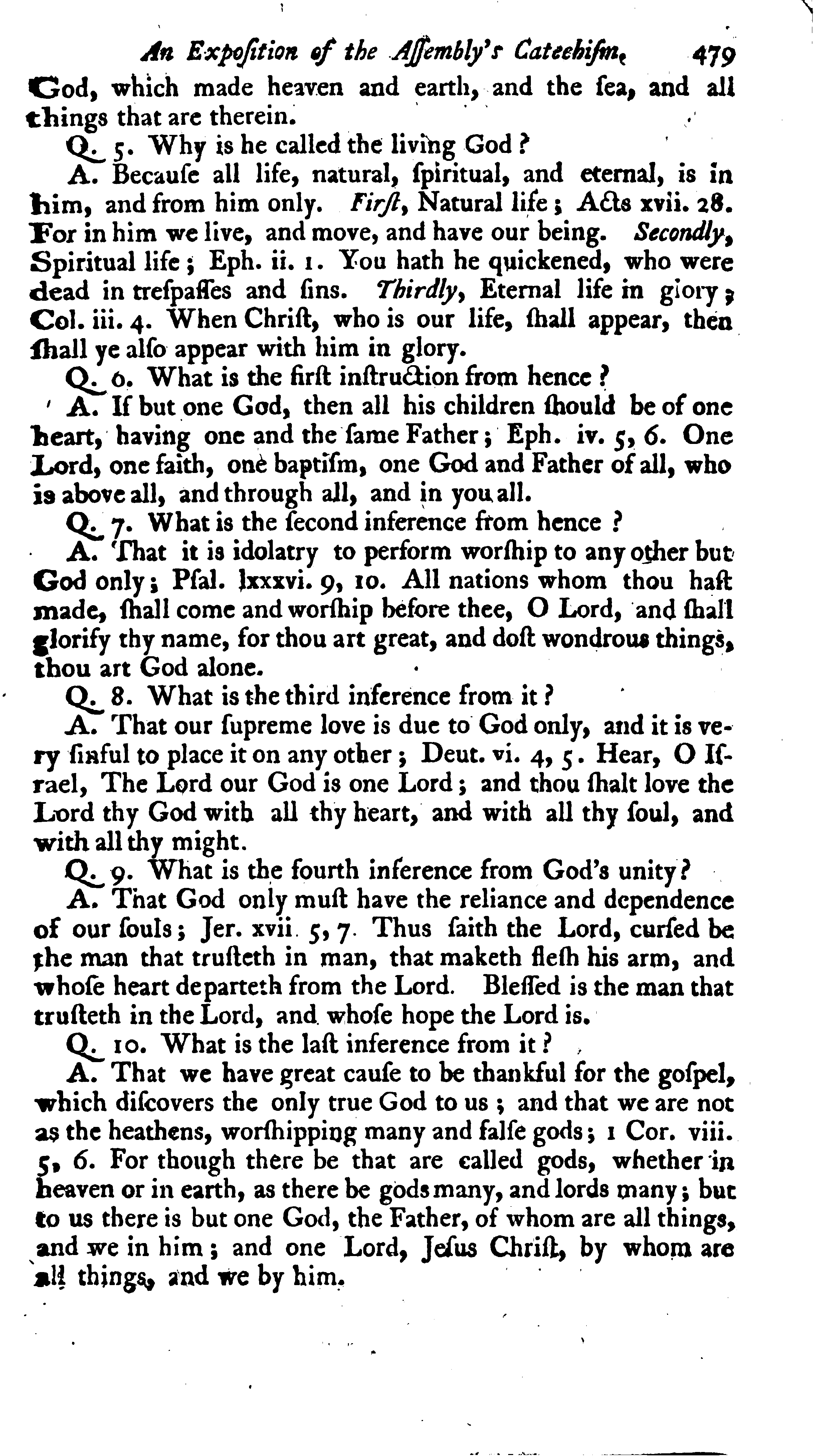
God, which made heaven and earth, and the sea, and all things that are therein.
Q. 5. Why is he called the living God?
A. Because all life, natural, spiritual, and eternal, is in him, and from him only.
First, Natural life ; Acts xvii. 28.
For in him we live, and move, and have our being.
Secondly, Spiritual life ; Eph. ii. 1. You hath he quickened, who were dead in trespasses and fins.
Thirdly, Eternal life in glory , Col. iii. 4. When Christ, who is our life, shall appear, then shall ye also appear with him in glory.
Q. 6. What is the first instruction from hence ?
A. If but one God, then all his children should be of one heart, having one and the fame Father ; Eph. iv. 5, 6. One
Lord, one faith, one baptism, one God and Father of all, who is above all, and through all, and in you all.
Q. 7. What is the second inference from hence ?
A. That it is idolatry to perform worship to anyotherbut God only; Psal. lxxxvi. 9, 10. All nations whom thou haft made, shall come and worship before thee, O Lord, and shall glorifythyname, for thou art great, and dost wondrous things, thou art God alone.
Q. 8. What is the third inference from it ?
A. That our supreme love is due to God only, and it is very fiaful to place it on any other ; Deut. vi. 4, 5. Hear, OIfrael, The Lord our God is one Lord; and thou shalt love the Lord thy God with all thy heart, and with all thy foul, and withallthymight.
Q. 9. What is the fourth inference from God's unity?
A. That God only must have the reliance and dependence of our souls ; Jer. xvii. 5, 7. Thus faith the Lord, cursed be the man that trusteth in man, that maketh flesh his arm, and whose heart departeth from the Lord.
Blessed is the man that trusteth in the Lord, and whose hope the Lord is.
Q. 10. What is the last inference from it ?
A. That we have great cause to be thankful for the gospel, which discovers the only true God to us ; and that we are not as the heathens, worshipping many and false gods ; 1 Cor. viii.
5, 6. For though there be that are called gods, whether in heaven or in earth, as there be gods many, and lords many; but to us there is but one God, the Father, of whom are all things, and we in him ; and one Lord, Jesus Christ, by whom are all things, andwebyhim.
An Exposition of the Assembly's Catechism.
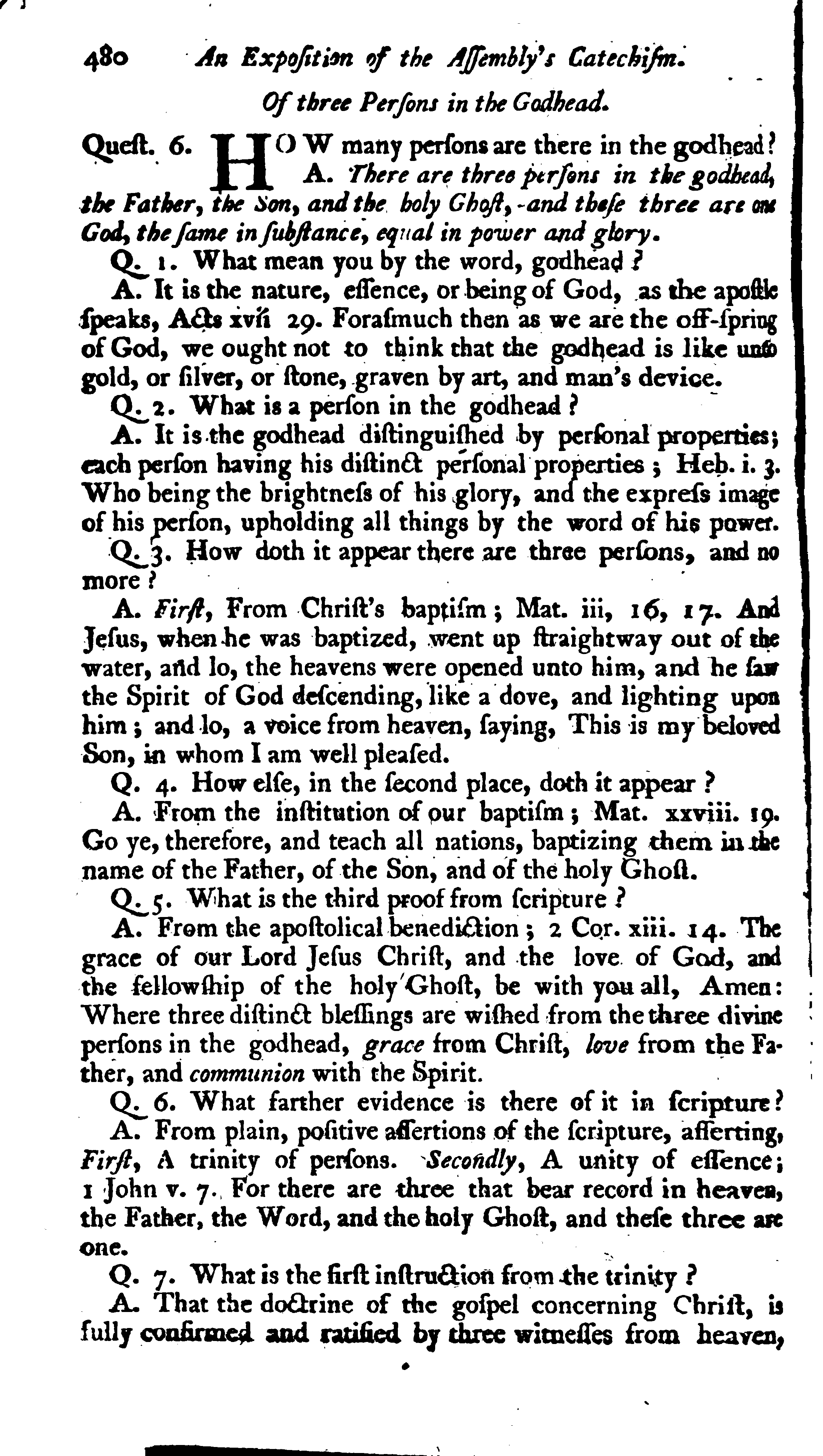
Of three Persons in theGodhead.
HOW many persons are there inthegodhead?
Quest. 6.
A. There are three persons in thegodhead, the Father, the Son,and the holy Ghost, and these three are one
God, the fame in substance, equal in power and glory.
Q. 1. What mean you by the word, godhead ?
A. It is the nature, essence, or being of God, as the apostle speaks, Acts xvi 29. Forasmuch then as we are the off-spring of God, we ought not to think that the godhead is like unto gold, or silver, or stone, graven by art, and man's device.
Q. 2. What isa person in the godhead ?
A. It is the godhead distinguished by personal properties; eachpersonhaving his distinct personal properties ; Heb. i. 3.
Who being the brightness of his glory, and the express image of his person, upholding all things by the word of his power.
Q.3. How doth itappearthere are three persons, and no more ?
A. First, From Christ's baptism ; Mat. iii, 16, 17. And Jesus, when he was baptized, went up straightway out of the water, and lo, the heavens were opened unto him, and he saw the Spirit of God descending, like a dove, and lighting upon him ; and lo, a voice from heaven,saying, This is my beloved
Son, in whom I am well pleased.
Q. 4. How else,in the second place, doth it appear ?
A. From the institution of our baptism ; Mat. xxviii. 19.
Go ye, therefore, and teach all nations,baptizing them in the name of the Father, of the Son, and of the holy Ghost.
Q.5. What is the thirdprooffrom scripture ?
A. From the apoftolicalbenediction ; 2 Cor. xiii. 14. The grace of our Lord Jesus Christ, and the love of God, and the fellowship of the holy Ghost, be with you all, Amen:
Where three distinct blessings are wished from the three divine persons in the godhead, grace from Christ, love from the Father, and communion with the Spirit.
Q. 6. What farther evidence is there of it in scripture?
A. From plain, positive assertions of the scripture, asserting, First, A trinity of persons.
Secondly, A unity of essence; 1 John v. 7. For there are three that bear record in heaven, the Father, the Word,and the holy Ghost, and these three are one.
Q. 7. What is the first instruction from the trinity ?
A. That the doctrine of the gospel concerning Christ, is fully confirmed and ratified by three witnesses from heaven,
An Exposition of the Assembly's Catechism.
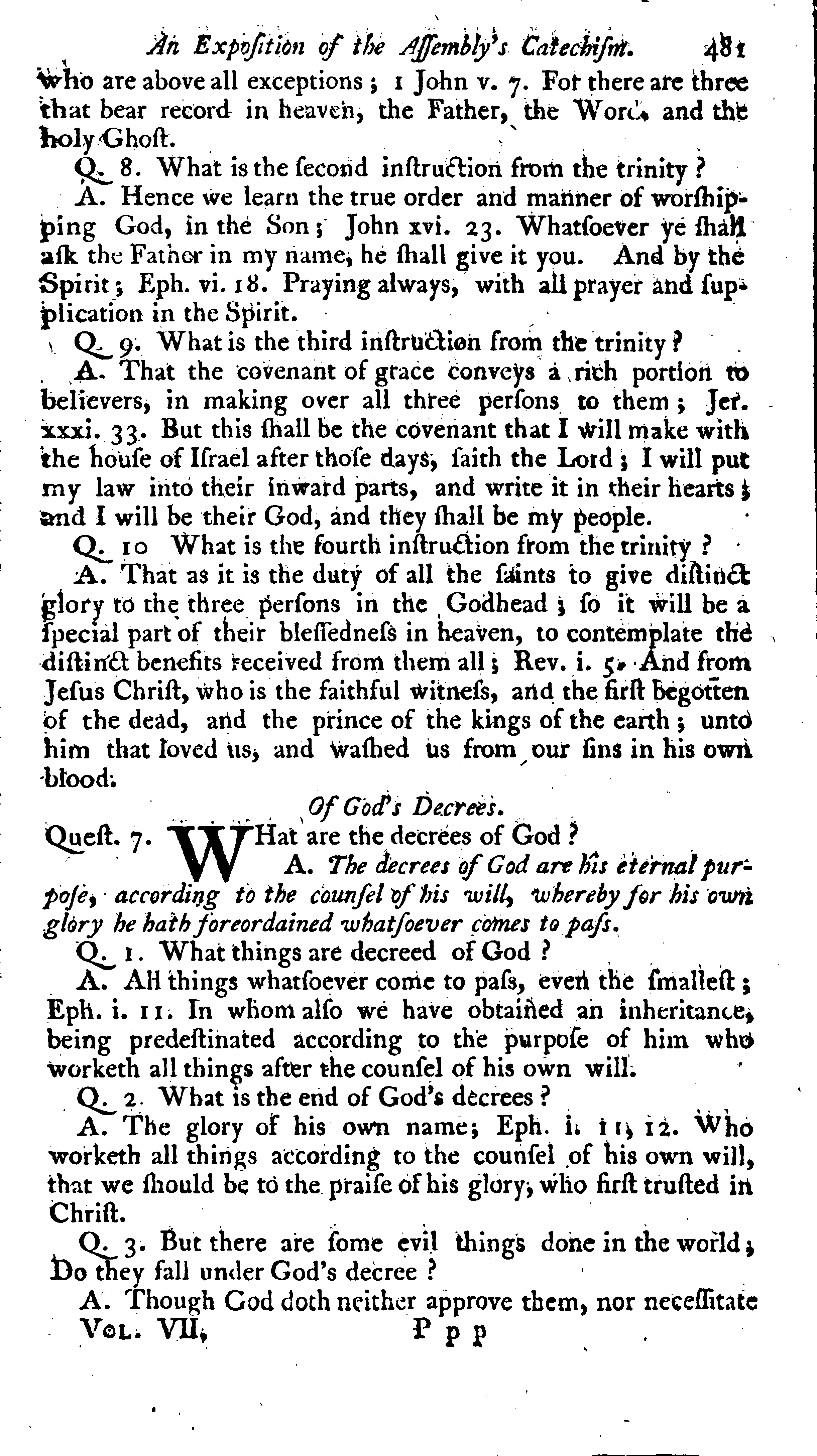
who are above all exceptions ; 1 John v. 7. For there are three that bear record in heaven, the Father, the Word, and the holyGhoft.
Q. 8. What is the second instruction from the trinity ?
A. Hence we learn the true order and manner of worshipping God, in the Son ; John xvi. 23. Whatsoever ye shall ask the Father in my name,he shall give it you. And by the Spirit ; Eph. vi. 18. Praying always, with all prayer and supplication in the Spirit .
Q9 . What is the third instruction from the trinity?
A. That the covenant of grace conveys a rich portion to believers, in making over all three persons to them ; Jer. xxxi. 33. But this shall be the covenant that I will make with the house of Israel after those days, faith the Lord; I will put my law into their inward parts, and write it in their hearts and I will be their God, and they shall be my people.
Q. 10 What is the fourth instruction from the trinity ?
A. That as it is the duty of all the saints to give distinct glory to the three persons in the Godhead ; so it will be a special part of their blessedness in heaven, to contemplate the distinct benefits received from them all; Rev. i. 5. And from Jesus Christ, who is the faithful witness, and the first begotten of the dead, and the prince of the kings of the earth ; unto him that loved us, and washed us from our fins in his own blood.
Of God's Decrees.
Hat are the decrees of God ?
Quest . 7. What A. The decrees of God are his eternalpurpofe, according to the counsel of his will, whereby for his own glory hehathforeordained whatsoever comes to pass.
Q. 1. What things are decreed of God ?
A. All things whatsoever come to pass, even the smallest ; Eph. i. 11. In whom also we have obtained an inheritance, being predeftinated according to the purpose of him who worketh all things after the counsel of his own will.
Q. 2. What is the end of God's decrees ?
A. The glory of his own name; Eph. i. 11, 12. Who worketh all things according to the counsel of his own will, that we should be to the praise of his glory, who first trusted in Christ.
Q. 3. But there are some evil things done in the world ; Do they fall under God's decree ?
A. Though God doth neither approve them, nor necessitate
VOL. VII,
Ppp
An Exposition of the Assembly's Catechism. men to commit them, yet he doth permit and fufferthem to be done, and will turn them to his own glory; Acts iv. 27, 28.
For of a truth, against thy holy child Jesus, whom thou hast anointed, both Herod, and Pontius Pilate, with the Gentiles, and the people of Israel are gathered together, for todowhatsoeverthyhand, and thy counsel determined before to be done.
Q. 4. Who are the objects of God's special decrees ?
A.Angels and men are the objects of God's special decrees ; 1 Tim. v. 21. I charge thee before God, and the Lord Jesus
Christ, and the elect angels, that thouobfervethesethings, &c.
Rom . viii. 33. Who shall lay anything to the charge of God's elect?
Q.5 . What is the first property of God's decrees ?
A. That they are most wife acts of God, laid in the depth of wisdom and counsel ; Rom.xi. 33. O the depth of the riches both of the wisdom and knowledge of God! How unsearchable are his judgments, and his ways are past finding out !
Q. 6. What is the second property of God's decrees ?
A. The decrees of God are most free, all flowing from the mere pleasure of his will ; Rom. ix. 18. Therefore hath he
•mercy on whom he will have mercy, and whom he will he hardeneth .
Q. 7. What is the third property of God's decrees ?
A. They are most firm and stable ; 2Tim. ii. 19. Nevertheless, the foundation of God standeth sure ; having this seal,
The Lord knoweth them that are his, Zech . vi . 1 .
Q. 8. What is the fourth property of God's decrees ?
A They are eternal, and before all time ; Acts xv. 18 .
Known unto God are all his works, from the beginning of the world.
Q9. What is the fifth property of God's decrees ?
A. They are most pure, and altogether unspotted of fin; 1 John i. 5. This is the message which we have heard of him, and declare unto you, That God is light, and in him is no darkness at all .
Q. 10. What is the first instruction from God's decrees ?
A. That we ought to ascribe nothing to chance, but to the appointment or providence of God ; Prov. xvi. 33.
The lot is cast into the lap; but the whole disposing thereof is of the Lord.
Q. 11. What is the second instruction from God's decrees ?
A. That God's hand is to be acknowledged in the greatest afflictions that befal us ; 2 Sam xvi. 11. And David said to Abishai, and to all his servants, behold, my son, which came
An Exposition of the Assembly's Catechism.
forth of my bowels, seeketh my life; how much more now may this Benjamite do it ? Let him alone, and let him curse, for the Lord hath bidden him .
Q. 12. What is the last instruction from God's decrees ?
A. That we ought to be thankful to God for all the good, and patient under all the evils that befal us ; Job ii. 10. Shall we receive good at the hand of God, and shall we not receive evil?
Quest. 8. H OW doth God execute his decrees ?
A. God executeth his decrees in the works of creation and providence.
Quest. 9 .W Of the Creation.
HAT are the works of creation?
A. The work of creation is, God's making all things of nothing, by the word of his power, in the space of fix days, and all very good.
Q. 1. What is it to create ?
A. To create, is to give a being to that which had no being ; or to bring something out of nothing ; Heb. xi. 3. Through faith we understand that the worlds were framed by the word of God ; so that things which are seen were not made of things that do appear.
Q. 2. How did God create the world ?
A. By his infinite power, executed in his word of command; Psal. xxxiii . 6, 9. By the word of the Lord were the heavens made, and all the host of them by the breath of his mouth ; for he spake, and it was done; he commanded, and it stood fast.
Q. 3. What attributes of God shine forth in the creation ?
A. The wisdom of God shines forth gloriously, not only in their formation, but dependance one upon another ; Psal. civ.
24. O Lord, how manifold are thy works! In wisdom haft thou made them all : The earth is full of thy riches .
Q. 4. What may we learn from the creation ?
A. That God perfectly knows all that is in the creature, be it never so secret ; Psal. xciv. 8, 9. Understand, O ye brutish among the people; an dye fools, when will ye be wife ? He that planted the ear, shall he not hear ? He that formed the eye, shall he not fee ?
Q. 5. What is the second instruction from the creation?
A. That God is the rightful owner of us all, and may do what he will with us ; Rom. ix. 20. Nay but, Oman, who artthouthat repliest against God! shall the thing formed say
Ppp2