
Part 1
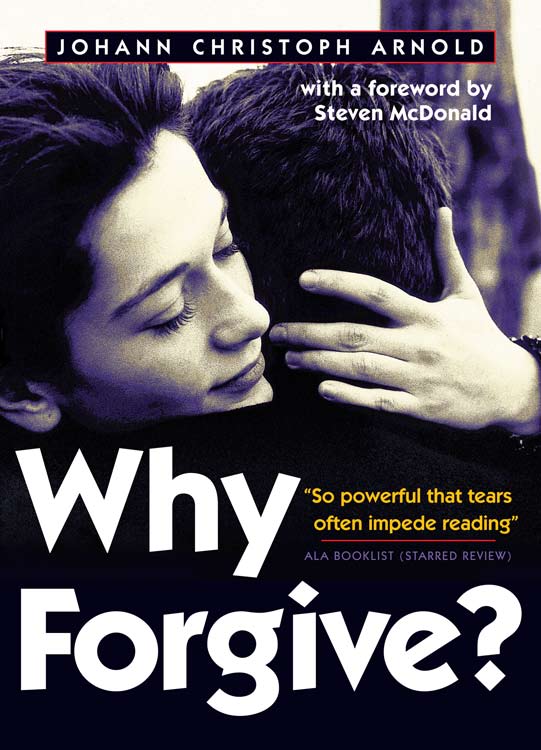
While the process of forgiveness may seem Herculean to the person who holds grudges, Arnold leaves one feeling that if the remarkable people in these stories can forgive, anyone can.
Noteworthy…profound and always timely…Not one to engage in long theological explorations, Arnold instead allows many of his subjects to speak for themselves…In all cases, he reminds us that to forgive is neither to excuse nor to anesthetize ourselves from the pain that attends life and love, but rather to enter again into life's fray.
Why Forgive? shows humanity at its gut-churning worst and ennobling best through the experience of people who have endured unthinkable losses and struggled to make peace with their perpetrators.
S a n A n t o n i o E x p r e s s - N e w s
Arnold's exploration is free of platitudes, moralizing, and psycho babble. These stories of real people, told in their own words, offer a glimpse into the process of reclaiming personal power through the ongoing art of forgiveness. If we fail to accept the wisdom in these stories, we participate in our own incarceration.
I n d e p e n d e n t P u b l i s h e r
Whether relating incidents from another century or yesterday's news, Arnold swiftly transforms the reader from objective observer to intimate confidant. In his quest to discover which acts are beyond the capacity of the human spirit to forgive, he draws from the experiences of celebrities, heroes, legends, and just plain ordinary folks.
Gut-wrenching, real-life sagas…
Why Forgive?
J o h a n n C h r i s t o p h A r n o l d
O R B I S B O O K S Maryknoll, New York 10545 www.orbisbooks.com
Founded in 1970, Orbis Books endeavors to publish works that enlighten the mind, nourish the spirit, and challenge the conscience. The publishing arm of the Maryknoll Fathers and Brothers, Orbis seeks to explore the global dimensions of the Christian faith and mission, to invite dialogue with diverse cultures and religious traditions, and to serve the cause of reconciliation and peace. The books published reflect the views of their authors and do not represent the official position of the Maryknoll Society. To learn more about Maryknoll and Orbis Books, please visit our website at www.maryknollsociety.org.
Copyright © 2010 by The Plough Publishing House of Church Communities International, Rifton, NY 12471
ISBN 978-1-57075-876-8
Originally published by Plough as Seventy Times Seven, this revised and expanded edition is published by Orbis Books, P.O. Box 302, Maryknoll, NY 10545-0302. All rights reserved.
To protect the privacy of individuals who contributed to this book, several names have been changed. Where a name appears without a surname, it is a pseudonym. Other names are real.
No part of this publication may be reproduced or transmitted in any form or by any means, electronic or mechanical, including photocopying, recording, or any information storage or retrieval system, without prior permission in writing from the publisher.
Queries regarding rights and permissions should be addressed to: Orbis Books, P.O. Box 302, Maryknoll, NY 10545-0302.
To obtain multiple copies for use in school assemblies and similar events, contact www.breakingthe cycle.com
Library of Congress Cataloging-in-Publication Data
Arnold, Johann Christoph, 1940Why forgive? / Johann Christoph Arnold. -- [Rev. and expanded ed.]. p. cm. ISBN 978-1-57075-876-8 (pbk.) 1. Forgiveness--Religious aspects--Christianity. I. Title. BV4647.F55A76 2009 234'.5--dc22 2009041005
Manufactured in the United States of America
There is a hard law…
When an injury is done to us,
we never recover until we forgive.
T h e C a n c e r o f B i t t e r n e s s 1
Jane, Brenda, Glenn Fielder, Charles Williams, Anne and Daniel Coleman
B e l i e v e i n M i r a c l e s 1 6 Gordon Wilson, Piri Thomas, Hashim Garrett, Ghaidaa
E n d i n g t h e C y c l e o f H a t r e d 3 2 Jared, Hela Ehrlich, Josef Ben-Eliezer, Bishara Awad, Naim Ateek
B l e s s y o u r P e r s e c u t o r s 4 5 Death row inmate, Gladys Staines, Martin Luther King, Ruby Bridges, Christian de Cherge
F o r g i v e n e s s a n d J u s t i c e 6 1 David, Roberto Rodriguez, Bill Chadwick, Kip Kinkel, Mary Foley
T h e D e e d s o f M e r c y 7 9 Chris Carrier and David McAllister, Ron Carlson and Karla Faye Tucker
W h e n R e c o n c i l i n g I s I m p o s s i b l e 9 2 Marietta Jaeger, Kelly, Julie, Anne Coleman, Brad and Misty Bernall vii vii
F o r g i v i n g i n E v e r y d a y L i f e 1 0 2 William Blake's "poison tree," Johann Christoph Arnold, Clare Stober, Heinrich and Annemarie Arnold
F o r g i v e n e s s a n d M a r r i a g e 1 1 7 Johann Christoph and Verena Arnold, Hans and Margrit Meier, Ed and Carol
F o r g i v i n g a P a r e n t 1 2 8 Don, Karl Keiderling, Maria, Kate, Susan
B l a m i n g G o d 1 4 2 Johann Christoph Arnold, Andrea, Jon and Gretchen Rhoads
F o r g i v i n g O u r s e l v e s 1 5 2 Delf Fransham, David Harvey, John Plummer and Kim Phuc, Pat
A c c e p t i n g R e s p o n s i b i l i t y 1 6 3 Mark and Debbie, Steve, Michael Ross, the Möttlingen awakening
N o t a S t e p, b u t a J o u r n e y 1 7 2 Steven McDonald, Alice Calonga and Saira Sher, Terry, Bud Welch
M a k i n g R i p p l e s 1 9 3 Jean-Paul Samputu, Rwanda's Reconciliation Village, the Amish School Massacre, Michael Lapsley
Twenty years ago, while on duty as a plainclothes police officer in New York City, I was shot multiple times. I'm not going to tell you the details here – you'll have to read this book if you want the whole story. But I will tell you this: I spent the next year and a half in a hospital bed, and for most of that period my situation was touch and go. I came very close to dying, and when I'd pull out of those patches, I wasn't always sure I even wanted to live. Fortunately I received a great deal of love from family, friends, and supporters, which helped pull me through those difficult days. And six months after I was shot, something gave me a new focus and strengthened my will to live: my wife, Patti Ann, gave birth to our first child.
Shortly after Conor was born we had a press conference. I still could not talk because of my gunshot wounds, so Patti Ann spoke for both of us. She told everyone how grateful I was to be alive; and how proud I was to be a member of the NYPD. She said that as a police officer I had always wanted to help others, and that being paralyzed hadn't changed that desire. Then she announced that I had forgiven the young man who had tried to murder me.
ixix
Everyone seemed astounded, and ever since that day I've had people ask me, "Why? Why did you forgive him?" They say, "I can't even get along with my sister" (or their brother, or mother or dad) "and they haven't really done anything to hurt me. They're just mean. So how on earth could you do such a thing?"
Again, I'm not going to get into the details here, except to say that I needed healing – badly – and found out that the only way forward was with love. And I learned that one of the most beautiful expressions of love is forgiving. I know that will sound illogical or impossible to some. Others will find it downright ridiculous. But I'm talking as one who has lived through this.
That's my story, but there are many more in this book. In fact, the author, who happens to be a good friend of mine, has collected about fifty. Some are about crimes like the one that changed my life; others have to do with very different forms of violence, from backbiting, to cheating on someone who trusts you, to dealing with a racial slur. (As you'll see by the time you're done reading, a nasty word can be just as deadly as a bullet, and the hurt can take a lifetime to get over.) There's even a chapter on forgiving yourself – a huge hurdle for many people.
How should you forgive, and why? I can't tell you. It's probably the hardest thing you'll ever attempt to do. But I can tell you what I've seen and experienced personally: once
F O R E W O R D you are able to let go of wrongs that have been done to you, it changes everything. It will change your relationships, your attitudes, your emotional make-up – your whole approach to living. It will give you a better life. Plus, you'll find that when you forgive, you're always a winner. You don't lose a thing. Because it's not a sign of weakness to love somebody who hurts you. It's a sign of strength.
Read this book. It deals with some hard issues, head-on. It might give you more than you wanted to think about. But I think it will also help you see, as it helped me to see, that there are more stories of love and forgiveness in the world than there are of hatred and revenge. Yours could become one of them.
Steven D. McDonald
One morning in September 1995, as I sat drinking coffee and reading the paper, I was horrified to see headlines reporting the abduction, in broad daylight, of a local sevenyear-old girl. Within a week the primary suspect – a trusted acquaintance of the child's family – confessed to the crime. After luring her into a wooded area near her home, he had raped her, beaten her to death, and hidden her.
The public's reaction was predictable: this man deserved to die. Under the state's new capital punishment statute, he was regarded as a prime candidate. Initially the District Attorney promised to seek a maximum of twenty years in exchange for information leading to the recovery of the girl's body, but he went back on his word after it was found, saying he would have made a pact with the devil to find the child. He also said that he hoped to become the first DA in recent New York history to send a murderer to the death chamber. Residents interviewed by the local news media even suggested that the authorities release him so they could "take care of him."
While this rage was understandable, I wondered how it could possibly bring solace to the victim's grieving family.
xii xii
As a pastor, I felt fairly certain what my response should be: I arranged for someone from my congregation to go to the funeral, and I sent flowers to the child's parents. I tried (unsuccessfully) to visit the family. But my heart was still heavy. Somehow, I felt I had to visit the murderer – at this point still a faceless monster – and confront him with the horror of his actions. I wanted to help him see that if he was ever going to find peace with himself after committing such a heinous crime, it could only be through lifelong remorse.
I knew people would look askance at such a visit, if not entirely misinterpret it, but I was convinced it was my duty. So it was that a few months later I found myself sitting alone in the county jail, face to face with the uncuffed killer. The hours I spent in that cell shook me deeply and left many unresolved questions – questions, in fact, that eventually led me to write this book.
Less than three months after my visit, the murderer faced his victim's family in court. The room was packed, and entering it, one could feel a wave of hostility. First the sentence – life imprisonment without parole – was read out, and then the judge added: "I hope that the hell you now face in prison is only a foretaste of the hell you will face in eternity."
The defendant was then allowed a few words. In a loud, wavering voice, he told the girl's parents that he was "truly sorry" for the pain he had caused – and that he was praying xiii
daily for forgiveness. As a ripple of angry whispers spread through the audience, I asked myself, How can such a man ever be forgiven?
xiv
The Cancer of Bitterness
Resentment is like drinking poison and then hoping it will kill your enemies.
Forgiveness is a door to peace and happiness. It is a small, narrow door, and cannot be entered without stooping. It is also hard to find. But no matter how long the search, it can be found. At least that is what the men and women in this book have discovered. By reading their stories, perhaps you, too, will be led to the door of forgiveness. Just remember that once there, only you can open it.
What does forgiving really mean? Clearly it has little to do with human fairness, which demands an eye for an eye, or with excusing, which means brushing something aside. Life is never fair, and it is full of things that can never be excused.
When we forgive someone for a mistake or a deliberate hurt, we still recognize it as such, but instead of lashing out or biting back, we attempt to see beyond it, so as to restore our relationship with the person responsible for it. Our forgiveness may not take away our pain – it may not even be acknowledged or accepted – yet the act of offering it will keep us from being sucked into the downward spiral of resentment. It will also guard us against the temptation of taking out our anger or hurt on someone else.
It is only natural, when we are hurt, to want to revisit the source of that hurt. There is nothing wrong with that. Whenever we do this in the sense of chalking up another person's guilt, however, our pain will soon turn into resentment. It doesn't matter if the cause of our pain is real or imagined: the effect is the same. Once there, it will slowly eat away at us until it spills out and corrodes everything around us.
We all know bitter people. They have an amazing memory for the tiniest detail, and they wallow in self-pity and resentment. They catalogue every offence and are always ready to show others how much they have been hurt. On the outside they may appear to be calm and composed, but inside they are about to burst with pent-up feelings.
Bitter people defend their grudges constantly: they feel that they have been hurt too deeply and too often, and that this exempts them from the need to forgive. But it is just
T H E C A N C E R O F B I T T E R N E S S these people who need to forgive most of all. Their hearts are sometimes so full of rancor that they no longer have the capacity to love.
Almost twenty years ago my father and I were asked by a colleague to visit an acquaintance who claimed she could no longer love. Jane's husband lay dying, and she longed to comfort him, yet something seemed to hold her back from within. Jane was by all accounts a blameless person: she was neat, meticulous, capable, hard-working, and honest – yet in talking with her it became clear that she was as unfeeling as a rock. She really could not love.
After months of counseling, the cause of Jane's coldness finally became clear: she was unable to forgive. She couldn't point to a single large hurt, but emotionally she was tied down – in fact, almost completely incapacitated – by the collective weight of a thousand small grudges.
Thankfully Jane was later able to overcome herself and rediscover the joy of living. That was not the case with Brenda, another embittered woman I attempted to counsel. Sexually abused by her uncle for years and silenced by her alcoholism, which her tormentor supported with daily gifts of vodka, she had finally escaped from him, but she was still under his thrall.
When I met Brenda she had been offered intensive psychiatric counseling. She also had a good job and an extensive network of supportive friends, who had made every effort
to get her back on her feet. In spite of this she seemed to make no progress. Her emotions swung widely, from excited laughter to inconsolable weeping. She binged on food one day and fasted and purged the next. And she drank – bottle after bottle.
Brenda was without question the innocent victim of a horribly depraved man, yet the better I got to know her the more it seemed that she was perpetuating her own misery. In refusing to lay aside her hatred for her uncle, she was continuing to let him exert his influence over her.
Brenda was one of the most difficult people I have ever tried to help. Again and again I tried to get her to see that until she could forgive her uncle – or at least see beyond the fact that he had abused her – she would in effect remain his victim. But my efforts were in vain. Increasingly angry and confused, she drove herself deeper and deeper into a jungle of despair. Finally she attempted to strangle herself and had to be hospitalized.
The wounds left by sexual abuse take years to heal. Often they leave permanent scars. Yet they need not result in lifelong torment or in suicide. For every case like Brenda's there are others where, through forgiving, the victim is able to find happiness and a new lease on life.
T H E C A N C E R O F B I T T E R N E S S
By the time Glenn Fielder was sixteen, the East London teen was both a record-holding track champion, and an aspiring soccer player with Leyton Orient FC – the same club where David Beckham started out before signing for Manchester United. But while Beckham went on to enjoy international fame, Fielder, who grew up on the same street and has close ties with the superstar to this day, woke up one day to find out that he had been paralyzed for life.
It was January 1987, and I'd been invited to a party at a community hall in Chingford. I'd been looking forward to it, and had a great time. Shortly before midnight I left with a friend and walked into a fracas involving seven or eight guys. We turned aside and kept walking – we didn't want to get involved, but a hundred yards or so down the road we came across a young man lying in the gutter, so we stopped. He'd been badly beaten. I bent down to put my coat under his head, and my friend ran into a nearby building to call an ambulance.
While we were waiting for help to come, the fight grew louder and louder behind us. As it grew nearer, I got a little nervous, and stood up. As I did, I felt this short, sharp punch in my back, and fell unconscious. It was actually a knife, plunged right between my shoulder blades. I'm told that after I was stabbed, I was savagely beaten and stomped by three or four guys. But I don't remember any of that. I only know that when I woke up, I was lying in a hospital with a severed spinal cord. I'd been there two or
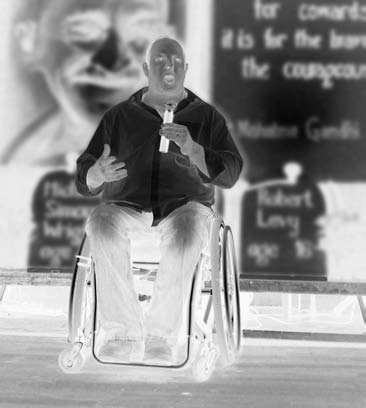
Glenn Fielder three weeks, under sedation, when I started coming to, and that's when my father broke the news to me that I was going to spend the rest of my life in a wheelchair.
My world ended at that point: I felt as though my heart had been ripped from inside of me. Soccer was my life, and now I'd never be able to play again. I couldn't imagine anything worse. When I came out of the hospital eleven months later, I was still in a state. Even thinking about
T H E C A N C E R O F B I T T E R N E S S soccer was devastating. I ripped up old team photos and threw away medals. I couldn't bear to watch games on TV.
Six young men were arrested in connection with Glenn's assault. One of them, an 18-year-old, was given a six-year sentence, though he only did four years behind bars. Not surprisingly, Glenn was enraged. "Six years for an unprovoked attack? Where was the justice in that? I'd just been sentenced for life – to lifetime disability. I wanted revenge, and that desire embittered me and filled me."
After almost a year, Glenn was finally able to move home and embark on the long journey of trying to put back together some semblance of a normal life:
It was a good hospital – Stokes Mandeville – with one of the best rehab units in England. They did their best to prepare me for life as a paraplegic. But to be honest, I felt my life was finished. In the end, my better nature prevailed. I went after various jobs. At first I worked in the civil service, which I didn't enjoy. I was an outdoor person. But what choice did I have? I then moved on to a stationery company, where I did sales. During that time I met my wife, Julie, and settled down.
Through it all, I had to deal with what was going on inside me. You see, people who'd see me knew right away that I was disabled, and if they asked, I'd tell them it was due to a knife attack. But what I could never tell them about – what they could never see – was the anger that burned inside of me. I stewed for years. I'd lie in bed
plotting my attacker's death, fantasizing about what I was going to do.
Meanwhile, people were always saying things like, "It's so unjust. If I were you, I'd have had that bloke's legs blown off, blah, blah, blah." These people thought they were helping me by saying this, but in fact, all they were doing was making things worse, fueling my anger and stressing me even more.
Luckily, something held me back from taking revenge. I don't know what it was, but thank God it held me back. And eventually I found myself getting to where I could tell myself, "Hold on a minute. At least you're still alive. You're married to a beautiful woman; you've got two beautiful children. You have your own job (I drive a hand- controlled taxi for a living), and your own house, and you manage to pay all your bills."
I guess I saw that I was actually leading a better life than my attacker was. You see, I had been told quite a bit about him: he'd been in and out of prison all his life and was a drug user with psychiatric problems. His family was ashamed of him. And look at me! I found myself thinking, "If you can't get rid of your anger from the inside out, you're never going to be able to really move on." So I decided to try to forgive. Now, don't get me wrong. It's not something that happened overnight. I'm a very proud man. I could never have walked up to this guy in the street and say, "I forgive you." But I began to forgive him, over a period of time. And gradually – it wasn't an instant reaction – I felt better. You could say I was slowly healed.
T H E C A N C E R O F B I T T E R N E S S
Not long ago my younger brother Danny called me and said, "Glenn, I've got news for you. That guy that attacked you? He's been found dead. I reckon what goes around comes around, eh?" I said, "You know what, Danny? I feel nothing. I feel empty. I'm actually sorry for his family. There's no bitterness anymore – I've moved on with my life."
As Glenn's life (and countless others) shows, forgiving always involves the conscious decision to stop hating, because hating can never help. Contrary to the simplistic proverb "forgive and forget," however, it does not necessarily require forgetting. Who can cast off the memories of childhood marked by abuse; and how can someone in a wheelchair possibly forget that he or she will never walk again? Nor does it need to involve confronting the perpetrator. In the case of sexual trauma, this is probably not even advisable. Still, for some people, a face-to-face reckoning may prove to be the only way forward. And it may yield a life-changing surprise, as illustrated by the next story.
"Life is ten percent what happens to you, and ninety percent what you do with it." The speaker was my friend Charles Williams, a retired police chief (and teacher of criminal justice studies) from a small Hudson Valley town, and he was addressing a panel of educators from the local
school district. As I listened, I remembered the first time I met him. It was at a high school assembly on the topic of nonviolent conflict resolution, and Chief Williams, as he is known, had been dumbfounded by the story of the featured speaker – a victim of violent crime who had forgiven his assailant. In his own words:
I thought, "Wow what a great message – teaching kids how to deal with conflict in a nonviolent manner. I was mesmerized." On the other hand, I was saying to myself, "There's no way, no freaking way I ever could forgive something like that. It's not possible; I'd be too angry about it, too mad." Later I was telling someone about the assembly, and I said, "Explain this forgiveness thing to me. I just don't understand it." We talked, and it suddenly hit me that the reason I couldn't see someone else forgiving a violent crime was that I myself had someone I needed to forgive, but couldn't. That person was my mother.
You see, I grew up in an alcoholic household. My mother was a raging alcoholic, and when I say raging, I mean pots and pans being thrown. I can remember her throwing chairs, and saying, "Stop the world! I want to get off!" One time she wrenched herself out of her coat as my father tried to stop her. He didn't manage, and she was gone for two days. We didn't know whether she was dead or alive.
By the time I was an adult I was angry. I was angry at her for years. And I'll be the first to tell you that I enjoyed being angry at her. And even after I finally realized
T H E C A N C E R O F B I T T E R N E S S that I needed to forgive my mother, it took me five years. But I finally did. It was a Tuesday, and I drove down to Long Island, back to my hometown, and called my mother when I was about fifteen minutes away. I got her answering machine. I thought, "Perfect – now I have an excuse not to do this." I almost turned around. But something deep inside told me, "No – now is the time." So I left her a message. Before I knew it, she called back.
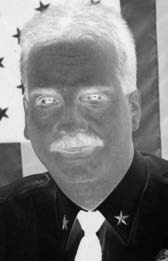
Charles Williams
To make a long story short, I went into the house and sat down, and forgave the woman who made my childhood a nightmare. I can tell you one thing: it wasn't easy. On the other hand, this person in front of me – this person who was, in my mind's eye, a crazed monster with a wild look in her eyes – instantaneously changed into a frail, sickly, old woman on oxygen, dying of emphysema. She became the mother I had never had.
Again, it wasn't easy to forgive her. Because when I say I hated her, I hated her. It affected me as an individual; it affected my marriage to the point that my wife and I separated. It affected my ability to be a good father. It tainted everything.
Shortly after this, Chief Williams's mother was diagnosed with a brain tumor, and metastatic lung cancer. She was ready for a fight, as her son tells it, and part of it was her determination to have a second chance at her relationship with her son.
She said, "I want to make it right." I told her, "Mom, I forgive you. You don't have to make anything right." Anyway, she went through radiation, and then one day I got a call from my sister. She said, "You better come. Mom's not doing well." So I flew down and walked into the hospice where she was staying. When I walked into the room I could hardly recognize her. It wasn't her, really. She had lost her teeth, and had barely any hair left. Worse, she was blind, and could hardly speak or move.
I walked over and said, "I forgive you, Mom, and I love you," and she smiled. Then I added in my best Long Island accent, "Ma, I love what you done wit' your hair." Next thing I know, she's cursing me out from head to toe! Now, no words came out of her mouth, but she did this – believe me – so I knew she was really still there.
Then I sat down next to her and I told her again how much I loved her. Who knew – it might be the last time I'd see her, and as much as I had hated her in the past, I now loved her just as much. If that's hard to understand, it's because there is sometimes a fine line between love and hate.
I was crying by then, like a baby – like a son who's about to lose his mother. Meanwhile, Mom, who hadn't moved the whole time I was there, suddenly lifted her arm and
T H E C A N C E R O F B I T T E R N E S S stroked my hand three times. Twenty-four hours before her death, and she is consoling me.
That's what I choose to remember about my mother. But understand this: had I not forgiven her beforehand and worked to repair the damage that had been done, I never would have had that moment.
Bitterness, as the previous story shows, is more than a negative outlook on life. It is a power – and a destructive and self-destructive one at that. Like a cancerous cell, a dangerous mold, or a spore, it thrives in the dark recesses of the heart and feeds on every new thought of spite or hatred that comes our way. And like an ulcer aggravated by worry or a heart condition made worse by stress, it can be physically as well as emotionally debilitating. In fact, if not addressed and taken care of, bitterness can lead to death. Hence the ancient Chinese proverb attributed to Confucius, "Who opts for revenge should dig two graves." Tragically, that is what Anne Coleman, a Delaware woman I have known for years, experienced firsthand:
One day in 1985 I picked up the phone to hear my niece in Los Angeles say, "Anne, Frances has been shot. She's dead."
I can't remember screaming, but I did. I made plans to fly out to California immediately, and on the plane I really thought I could kill someone. If I'd had a weapon and the murderer, I probably would have done just that.
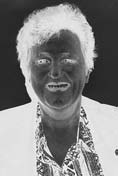

Daniel, Anne, and Frances Coleman
By the time I got off the plane I was getting concerned about how I was going to greet my son Daniel, who was flying in from Hawaii. Daniel was an army sergeant, and he had been trained to kill.
When we got to the police station the next morning, the only thing they told us was that my daughter was dead, and that everything else was none of our business. Sadly, this remained the case throughout the days we stayed in Los Angeles. The violent crimes coordinator told me that if they hadn't arrested someone in four days, I shouldn't expect an arrest: "We just have too many homicides in this precinct – we spend only four days on homicides."
This enraged my son Daniel. When he found out that the police department was really not interested in finding his sister's killer, he said he was going to go out and buy an Uzi and mow people down.
They hadn't really prepared us for what we would see when we picked up her car from the pound. Frances had bled to death in her car. The bullets had passed through
T H E C A N C E R O F B I T T E R N E S S her aorta, her heart, both lungs. She had choked on her own blood. She died early on a Sunday morning, and we picked up the car late Tuesday afternoon. It stank. That smell never left Daniel's mind, and he wanted vengeance in the worst way. He really wanted someone to do something – some kind of justice for his sister.
Over the next two-and-a-half years I saw Daniel go downhill, and then I stood alongside his sister's grave to watch him being lowered into the ground. He had finally taken revenge – on himself. I saw what hatred does: it takes the ultimate toll on one's mind and body.
Believe in Miracles
Hope for a great sea-change
on the far side of revenge.
Believe that a further shore
is reachable from here.
Believe in miracles
and cures and healing wells.
Gordon Wilson held his daughter's hand as they lay trapped beneath a mountain of rubble. It was 1987, and he and Marie had been attending a peaceful memorial service in Enniskillen, Northern Ireland, when a terrorist bomb went off. By the end of the day Marie and nine other civilians were dead, and sixty-three had been hospitalized for injuries.
Amazingly, Gordon refused to retaliate, saying that angry words could neither restore his daughter nor bring
16 16
B E L I E V E I N M I R A C L E S peace to Belfast. Only hours after the bombing, he told BBC reporters:
I have lost my daughter, and we shall miss her. But I bear no ill will. I bear no grudge…That will not bring her back… Don't ask me, please, for a purpose…I don't have an answer. But I know there has to be a plan. If I didn't think that, I would commit suicide. It's part of a greater plan… and we shall meet again.
Later Gordon said that his words were not intended as a theological response to his daughter's murder. He had simply blurted them out from the depth of his heart. In the days and weeks that followed the bombing, he struggled to live up to his words. It wasn't easy, but they were something to hang on to, something to keep him afloat in the dark hours when grief overwhelmed him.
He knew that the people who took his daughter's life were anything but remorseful, and he maintained that they should be punished and imprisoned. Even so, he refused to seek revenge.
Those who have to account for this deed will have to face a judgment of God, which is way beyond my forgiveness… It would be wrong for me to give any impression that gunmen and bombers should be allowed to walk the streets freely. But…whether or not they are judged here on earth by a court of law…I do my very best in human terms to show forgiveness…The last word rests with God.
Gordon was misunderstood and ridiculed by many because of his stand, but he says that without having made a decision to forgive, he never could have accepted the fact that his daughter was never coming back. Nor could he have found the freedom to move on. Forgiving also had a positive effect that reached beyond his personal life. At least temporarily, his words broke the cycle of killing and revenge: the local Protestant paramilitary leadership felt so convicted by his courage that they did not retaliate.
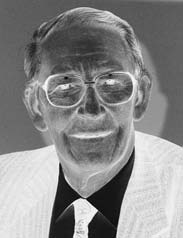
Gordon Wilson
If Gordon's ability to forgive as quickly as he did seems admirable, it is also unusual. For most of us – as for Piri Thomas, a writer known for his memoir, Down These Mean Streets – forgiveness does not come so easily:
Whenever I hear the phrase "forgive and forget," my thoughts flow back to the forties and fifties, to the ghettoes of New York. There, where violence was and still is a part of life, so many times I heard people who had been
B E L I E V E I N M I R A C L E S wronged refuse when they were asked for forgiveness. Or, they would compromise with "OK, OK, I'll forgive you, but I sure won't forget."
I have been among the countless who have made that same angry promise. I remember the painful trauma I suffered when my mother Dolores passed away. She was thirty-four, I was seventeen. I got very angry at God for not letting my mother live, and refused to forgive God for being so inconsiderate. As time went by, I forgave God, but for a very long time I couldn't forget because of the great pain alive in my heart.
At the age of twenty-two, I became involved in a series of armed robberies with three other men. In the commission of the last armed robbery, there was a shoot-out with the police. I was shot by one of the officers, whom I shot in return. The policeman recovered. Otherwise I would not be writing this article, for I would have been put to death in the electric chair at Sing Sing.
While I was recovering in the prison ward of Bellevue Hospital, one of the three gunmen, a man named Angelo, turned state's evidence against me. Angelo was like a brother to me. We had both grown up on the same block of 104th Street. Angelo ratted on me about some past unarmed robberies because detectives at the 23rd Precinct threatened to beat him up so badly that even his own mother would not be able to recognize him. Angelo held up for as long as he could and then spilled out to the detectives what was and never was. When I was released from Bellevue Hospital, I was incarcerated
in the Manhattan Tombs to await trial, where I found out that all that Angelo had confessed to had been dumped on me…
To make a long story short, I was sentenced to five to ten and five to fifteen years to run concurrently, at hard labor, first at Sing Sing and then at Comstock.
From time to time over the years, I would steam with anger over Angelo's betrayal, which had led to two armed robbery warrants hanging over me in the South Bronx. In my cell at night I would find myself fantasizing on ways to kill him or at least hurt him so bad he would beg for death. Angelo and I had been tight brothers from the streets. I loved him as such, but now in prison I hated him and only wanted to get even with him in the worst way. To tell the truth, I fought against these murderous feelings over the years and even prayed to get those violent thoughts out of my mind. Sometimes for long periods of time, I would forget all about Angelo, but when least expected, thought of his betrayal would pop up inside of me.
I was finally released in 1957 and was ordered to report to both a parole officer and a probation officer each week. Back out in the streets, I couldn't help thinking what would happen if I ran into Angelo. I never went looking for him because I really didn't want to find him.
I was attending a small church on 118th Street, utilizing it as a half-way house to keep me free from the gravity of those mean streets. I would think about Angelo from time to time and feel the anger still alive in my heart. I never met up with him and found better things to occupy
B E L I E V E I N M I R A C L E S my mind, like working on the book I started in prison, meeting a young woman named Nelin, and feeling the joy of falling in love with Nelin and sharing the same warm feelings. Angelo began to diminish and slowly fade away from my mind.
One balmy summer evening we were walking on Third Avenue. Nelin and I were happily checking out jewelry stores, pricing engagement and wedding rings. As we left one jewelry store for another, I heard someone softly call out my name: "Oye, Piri." I knew without a doubt that the voice belonged to Angelo. I turned to look. His once young face now showed deep lines of stress, caused perhaps by having to look so often over his shoulder. I felt the rumbling of some long ago anger trying to rise like bile out of my guts. I suppressed the urge and waited patiently to listen to whatever Angelo had to say.
Nelin pulled at my arm to get my attention and then asked me with her eyes if this was the man I had mentioned with so much anger. She whispered, "Por favor, Piri, don't forget what we have talked about."
I nodded and turned back to Angelo, who swallowed hard, not so much out of fear but rather as if he badly needed to get something out that he had been waiting to say for a very long time. His voice was soft.
"Piri, I have hurt everybody I loved, and that sure includes you. In the police station they began to beat me so bad, I couldn't take it. Could you please forgive me for ratting, bro?"
I stared at him, wondering how he could have the nerve to be calling me bro after ratting on me, but at the same time happy to be called bro by him once again.
"I will understand if you don't, but it took this long for me to build up my nerve. And even if you don't, I still had to try, so por favor, what do you say, Piri?"
I stared at Angelo and only answered when I felt Nelin squeeze my hand. The words that came from my heart lifted a great weight from my soul, and I felt my spirit soar free.
"Sure bro, I forgive you. They say everybody's got a breaking point, and that includes me. So on God's truth, Angelo, I not only forgive you, bro, it's also forgotten and to that I swear on Mom's grave."
The tears that exploded from Angelo's eyes matched my own.
"Gracias, Piri. For years I've hated my guts for not having the heart to keep from ratting on you. If I could live that all over again, I would let them beat me to death rather than turn on you. Gracias, bro, for your forgiving and forgetting, and I mean that from my heart."
Angelo put his hand out and then started to draw it back, as if not wanting to push his luck. My right hand reached out quickly and shook his hand with great sincerity and I felt Angelo squeeze my own. We hugged briefly, and then with a smile he nodded to me and Nelin, and said "See you around, bro" and then walked away. I put my arm around Nelin's shoulders, she slipped her arm around my waist, and we both watched Angelo as he dis-
B E L I E V E I N M I R A C L E S appeared around the corner. I couldn't help thinking about something Nelin once told me she had read: "To err is human, to forgive divine."
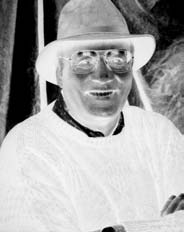
It sure is hard to forgive, but as my father Juan often said, "Everything is hard until you learn it, and then it becomes easy." I had learned. I had not only forgiven my street brother Angelo, but I had also learned to forgive myself for having carried a thirst for revenge for so many years. I felt like the morning sunrise was coming up in my heart. I took Nelin's hand in my own and with smiles we headed towards the next jewelry store. Love in me was at last free from the weight of hate.
Piri Thomas
I never saw my bro Angelo again, for he moved to another city, and it was with sorrow that I learned some years later that he had been murdered because of money he owed a loan shark.
But I will always be glad that I forgave Angelo. I have learned that the cruelest prison of all is the prison of an unforgiving mind and spirit.
Sometimes, even when we recognize the need to forgive, we are tempted to claim that we cannot. It is simply too
hard, too difficult – something for saints, maybe, but not the rest of us. We have been hurt just one time too many, we think, or misunderstood. Our side of the story has not been adequately heard.
To me, the amazing thing about Gordon and Piri's stories is that they did not weigh their options, but decided to forgive on the spur of a moment, and did so from the bottom of their hearts. If they hadn't, they might never have been able to forgive at all. Of course, not everyone is able to forgive with such decisiveness or speed. But as the next story shows, that does not detract from the power of the act.
Hashim Garrett once roamed the streets of Brooklyn with a gang – and a loaded gun. Today he is a well-known motivational speaker at schools across the country, and the owner of his own consulting firm, Wisdom and Understanding. As a result of a shooting when he was fifteen, he is almost completely paralyzed from the waist down, and walks only with great effort, and a pair of crutches. Strangely, he says he's come to see that incident not as a bad day, but as "one of the best days of my life, because it helped me to see things clearly, and gave me a new lease on life." To some, such an attitude may seem nearly impossible to understand. To Hashim however, it has a simple explanation – one that has everything to do with forgiveness.
Growing up in Brooklyn, I spent a lot of time hanging out. My friends were mostly older kids who didn't think learning was cool, and before long I was making bad decisions. I wouldn't have called them "bad" at the time, because at that stage I was fascinated by all the things these older guys were about. They didn't go to school. They had a lot of girls. It seemed they always called their own shots. I liked that. My mother always told me that I shouldn't hang around these guys, but I was fifteen. I didn't need her guidance anymore; I knew it all. I'd say, "I hear you, Ma." But I still didn't care.
Next thing you know, my "friends" and I are getting into arguments. You see, when I first started hanging out with them, I'd do whatever they told me to do. If they'd said to go beat somebody up, I'd go do it. I wanted to show them how much heart I had. I was doing a lot of other bad stuff too. Then, as time went on, they'd tell me to do even worse things, and I'd say, "I'm not gonna do it." So we started bumping heads. Some "friends" will love you only as long as you do what they want you to do.
They always told me we should carry guns, "just in case." The idea was that if you ran into trouble, you'd have protection. One day – it was May 7, 1990 – we were out walking to the corner store, and I had this odd feeling, and then all of a sudden the guy walking next to me shouted, "Look out! Run!" I ran, and I kept running, but then I turned, and I saw this kid with a submachine gun (it turned out to be a Tech 9). Then my pants made a funny movement, and something hit me hard, in my back.
I didn't realize it at the time, but the movement my pants made was a bullet going through my leg, and the pain in my back was another bullet.
I fell down to the ground, and when I tried to move, I couldn't. I couldn't even feel my legs. I was totally alone. My friends had all run for their lives. I closed my eyes. I was scared out of my mind. I was sure the kid with the gun was going to come up close and kill me. Then I opened my eyes, and he was gone.
Aside from the two bullets Hashim felt, there were four more: all in all, six bullets passed through him, leaving a total of twelve entry and exit wounds.
While I lay on the ground, bleeding to death and looking up at the sky, I called out, "God, please don't let me die." I could feel in my heart that he would hear my prayer; I was full of conviction. As the words left my tongue, it was as if the world had blinked. By "blinked" I mean that up to that moment, I was so frightened that my heart was pounding. As soon as I uttered those words, though, I couldn't even remember my fear. Everything changed. I was suddenly calm. As a believer, I now know why: when you call out to the Creator, peace and tranquility come over you.
Then all of a sudden, somebody was putting a jacket under my head, and two of my friends were there, arguing about whether to try and move me. I told them to try moving me, and they began pulling me up. As soon as they did, something popped, so they let me back down again…
What Hashim felt was presumably something in his lower spine. In any event, he was left paralyzed from the waist down. He spent much of the next year in a New York City hospital, thinking about how to get even with his assailant, and twisting his hair (he has not cut his hair since the day of his shooting, and keeps it in dreads as a reminder of that time):
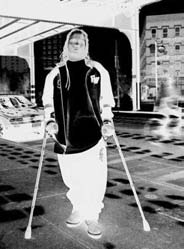
Hashim Garrett
Revenge consumed me. All I could think about was, "Just wait till I get better; just wait till I see this kid." When the investigators came to my bedside and told me they knew who had shot me, I said, "That's not him; let him go," because I wanted to exact revenge myself. They said, "What do you mean? We know it's him." They didn't want me going and taking things into my own hands. I tried to reassure them. I lied, "Don't worry, I'm not going to do anything."
As days turned into weeks, I got angrier and angrier. I cried. I couldn't sleep. I didn't feel like eating. I refused my medication. All I wanted was to get well enough to go kill this kid for shooting me. I didn't even know him, but I was consumed by wanting to know what he had shot
me for. (Eventually I found out: he'd shot me because my friends had set me up. You see, we weren't getting along anymore. They'd loved me as long as I was willing to do stupid things with them.)
Then, as time went on, I began to think differently. I said to myself, "If I take revenge on him, I can only imagine what God is going to put me through." I'd started feeling that God was trying to teach me a very important lesson, and that I'd better take it seriously. I also reasoned that if I harmed this young man, something bad would come back to me. You see, six months before this happened, I had shot a kid, for no reason except that a friend told me to do it and I wanted to prove how tough I was. Six months later, I am shot by somebody because his friend told him to do it. Whatever you put out in this world – whatever you do – will always come back to you. It must. It's just a matter of time.
My journey through all this is still hard for me to describe. How do you tell someone what it feels like to be totally helpless? What it's like to need help going to the bathroom when you're fifteen? That you're never going to be able to walk on your own again, no matter how many times you tell everyone you're sorry for the bad decisions you made? It's almost impossible to convey the pain I was in at the time, and I'm not just talking about the physical pain. That was off the hook. But the confusion, the mental agony, the inner pain – nothing could have prepared me for it. I ached inside. It was hell on earth, and there was
B E L I E V E I N M I R A C L E S no appealing it; no way around it. I was going to be stuck with the consequences of my choices forever.
In the end, though, I decided to forgive. I felt God had saved my life for a reason, and that I had better fulfill that purpose. I didn't know what it was, but I sensed God had something special in mind for me. And I knew that I could never go back out there and harm someone. I was done with that mindset, and the lifestyle that goes with it: an eye for an eye, and the continual little (and big) beefs.
I came to see that I had to let go and stop hating. I began to realize that the time we have with each other on this earth is borrowed time, and made up my mind that when my soul leaves this shell, my good deeds are going to outweigh my evil ones. I also learned that if you have forgiveness in your heart, bad things may still happen, but a bad thing can be a blessing in disguise.
I didn't just have to work on forgiving the kid who shot me. There were also my "friends" – those kids who had set me up, who felt my life was expendable. I had to forgive them as well. And then I had to forgive myself, and the Creator, because at one point I felt, "God, I was terrible – why didn't you just let me die instead of putting me through all this."
It was like I had an epiphany: something came to me as I was lying there in the hospital and told me I should forgive. If I hadn't, I'm not sure I'd be here today. I definitely wouldn't be traveling the globe, speaking to teens about making the world a better place.
Hashim's story reminds us that forgiveness can break the cycle of violence in the most unlikely places, like the destitute inner-city neighborhood where he grew up. So does the next one. In opening a window on two lives touched by the deadliest conflict of our time – the war in Iraq – it offers hope that even a battleground can yield seeds of peace and lead us, as the verse that opens this chapter puts it, to "the far side of revenge."
In spring 1998, Carroll and Doris King – old family friends – traveled to Iraq with a human rights delegation to examine the effects of the UN sanctions there. While in Baghdad they met Ghaidaa, a woman who had suffered more than any mother I had ever heard of, but was still ready to forgive.
Ghaidaa lost nine children in the destruction of Al Amariyah, a massive, reinforced concrete shelter in Baghdad that was penetrated by American "smart bombs" during the Gulf War. More than one thousand Iraqi civilians were incinerated in the bombing, most of them women and children.
Today, Ghaidaa leads tourists among the shelter ruins, hoping that those who see its horrors – among other things, ghostly silhouettes were left wherever human bodies shielded the walls from the extreme heat – will speak out against future bombings. After taking one of Ghaidaa's tours, Carroll and Doris, stunned, asked her to forgive them
B E L I E V E I N M I R A C L E S for what America had done to her family and people. A former Air Force officer who had flown bombing sorties over Europe in World War II, Carroll especially felt he bore a share of the guilt. Shaking his hand, then hugging Doris and bursting into tears, Ghaidaa cried, "I forgive you."
Ghaidaa will never find "justice" on human terms. How can one ever replace nine dead children? She will certainly never be able to forget them. But in finding the hearts of two people who asked her to forgive them, she has found peace – something that no one can put a price on.
Ending the Cycle
of Hatred
If only there were evil people somewhere insidiously committing evil deeds, and it were necessary only to separate them from the rest of us and destroy them!
But the line dividing good and evil cuts through the heart of every human being. And who is willing to destroy a piece of his own heart?
A l e k s a n d r S o l z h e n i t s y n
Recited by millions from childhood on, the Lord's Prayer includes the plea, "Forgive us our debts, as we forgive our debtors." Familiar as it is, I often wonder whether we really mean what we say when we repeat these words, and whether we sufficiently consider their meaning. To me, at least, they imply that once we recognize our own need for forgiveness, we will be able to forgive. This recognition does not come to most of us easily, because it demands humility. But isn't humility the essence of forgiveness?
32 32
E N D I N G T H E C Y C L E O F H A T R E D
In a chapter of the Gospel of Matthew known as the Beatitudes, we are told that the meek will be blessed and inherit the earth. And in the parable of the unmerciful servant, he warns us not to treat others any more harshly than we would want to be treated:
A rich man wanted to settle accounts with his servants. One of them, who owed him several thousand pounds, was brought in front of him, unable to pay. Because he was defaulting on the loan, the rich man ordered that the servant should be sold into slavery, together with his wife and children, to repay the debt. Although the rich man was within his legal rights to demand this, the servant begged him for patience. So the rich man took pity on him. He cancelled the debt and let him go. But the experience left the servant badly shaken, worried about the state of his finances, and no sooner had he returned home than he went to a friend, who still owed him a small amount of money, and demanded repayment. His friend was also unable to pay, and begged the servant for mercy, but he refused. Instead, he had his friend thrown into prison.
When the other servants saw what he had done, they were very upset and told the rich man everything. The rich man was furious, and called him in to answer for his actions: "You begged me to cancel your debt, so I did. Why didn't you show the same level of mercy to your friend as I showed to you?" In his anger, the rich man turned him over to the jailers to be tortured, until he could pay back all he owed.
In my experience, the strongest motivation for forgiveness is always the sense of having received forgiveness ourselves, or – if we do not have that – an awareness that, like everyone else in the human race, we are imperfect and have done things we need to be forgiven for.
Jared, an African-American student from Boston, says that was definitely the case with him:
I was six years old when I awoke to the reality of racism: from the sheltered environment of my home, I was pushed out into the world – a local primary school just down the road from our house. I went there for only a month before city law mandated that I be bussed across town to another school. My parents were not happy with this; they wanted me to go to a school where I was known and loved. They owned a farm out in the country, and so we moved there…
My father, a veteran of the civil rights movement, taught me love and respect for everyone – white or black. They tried to teach me not to see everything in life along racial lines. All the same, I was the only black child in my new school, and many of the other children had obviously been taught to hate.
Children can be brutal about each other's differences. They may begin with an innocent question – "Why is your skin brown?" – but then they start to laugh at you and mock you, because somewhere along the line they have been taught that if you're different – not "normal" – there's something wrong with you.
E N D I N G T H E C Y C L E O F H A T R E D
I was a fish out of water, and these kids didn't make it easy for me. I'll never forget one especially painful incident: I introduced one of my white friends to another white kid on the bus one day, and from then on they always sat together but left me out.
Later I moved to a different school, and by the time I was twelve, the tables had turned completely. Our class was now all black, except for one white guy in my class, Shawn, who was the only white in the whole school. We treated him as an outcast and taunted him with racial epithets and physically abused him. We took out our hatred of white people on him even though he hadn't done anything to harm any of us. We were angry.
Shawn symbolized everything that we knew about whites and their history: the humiliation of our people, the lynchings, the mobs, and the slave trade. We took out all our bitterness and anger on him.
I was never able to apologize to Shawn. By the time I saw my racism for what it was, we had parted ways. But I did ask God to forgive me for the harm I caused Shawn, and I resolved to forgive the guys who didn't have a heart for me when I was the only black kid in their midst.
Hela Ehrlich, a Jewish friend, has a similar story. Hela grew up in Nazi Germany, and though her immediate family escaped the death camps by emigrating just before the
outbreak of World War II, her grandparents on both sides and all her childhood friends lost their lives in the Holocaust.
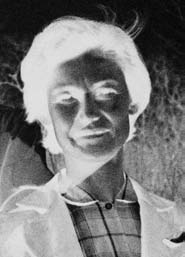
For many people, the passage of time softens heartache; for Hela, the opposite occurred. Slowly, almost imperceptibly, her hurt turned into bitterness, and her pain into anger. Hela did not want to be bitter; she wanted to be free to live and love. In fact, she struggled constantly to keep from hardening her heart. But she could not forgive.
Hela Ehrlich
Then one day it dawned on her: she would never be able to forgive her family's executioners until she was able to see that despite their guilt, they were still fellow human beings.
Trembling, I realized that if I looked into my own heart I could find seeds of hatred there, too. Arrogant thoughts, feelings of irritation toward others, coldness, anger, envy, and indifference – these are the roots of what happened in Nazi Germany. And they are there in every human being.
As I recognized – more clearly than ever before – that I myself stood in desperate need of forgiveness, I was able to forgive, and finally I felt completely free.
E N D I N G T H E C Y C L E O F H A T R E D
Josef Ben-Eliezer, another friend, had a similar journey. Born in Frankfurt, Germany, in 1929, he is the son of Polish Jews who fled their homeland to escape persecution and poverty, but found little respite from either:
My first memory of anti-Semitism is from when I was three years old. I was standing at the window of our house on the Ostendstrasse when a formation of Hitler Youth marched past, singing Wenn Judenblut vom Messer spritzt ("When Jewish blood runs from our knives"). I still remember the horror on my parents' faces.
Our family soon decided to leave the country, and by the end of 1933 we had moved back to Rozwadow, Poland. Most of its inhabitants were Jews: artisans, tailors, carpenters, and merchants. There was a great deal of poverty, but under the circumstances we were considered middle-class. We lived in Rozwadow for the next six years.
In 1939 the war started, and within weeks the Germans entered our town. My father and older brother hid in the attic, and whenever someone knocked at our door and asked for them, we said they were not at home.
Then came the dreaded public announcement: all Jews had to gather in the town square. We were given only a few hours. We took whatever we could carry in bundles on our backs. From the square, the SS forced us to march toward a river several miles from the village. Uniformed men rode alongside us on motorcycles. One of them stopped and shouted at us to hurry up, then came up to my father and struck him.
At the riverbank other uniformed men were waiting for us. They searched us for money, jewelry, and watches – they did not find the sum of money my parents had hidden in my little sister's clothing – and then ordered us to cross the river, into a no-man's-land. They did not instruct us what to do after that, so we found lodging in a nearby village.
A few days later we suddenly heard that the far side of the river was also going to be occupied by the Germans. We panicked, and with the money we had hidden, my parents – together with two or three other families – bought a horse and wagon to carry the younger children and what little we had managed to bring along on our backs.
We travelled east toward Russia, hoping to reach the border before dark, but found ourselves in a large forest when night fell. During the night we were attacked by armed thugs who demanded we hand over everything we had. It was a frightening moment, but luckily the men in our caravan had the courage to resist them, and in the end our attackers left, taking only a bicycle and a few other small items.
Josef spent the next years in Siberia, from where he escaped to Palestine in 1943. After the war he met Jews who had survived the concentration camps:
When the first children freed from Bergen-Belsen and Buchenwald began to arrive in Palestine in 1945, I was horrified to hear what they had gone through. They were young boys – twelve, thirteen, and fourteen years old – but
E N D I N G T H E C Y C L E O F H A T R E D they looked like old men. I was devastated, and filled with hatred for the Nazis…
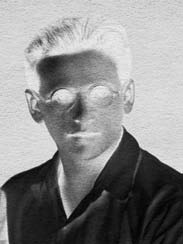
Then the British began to restrict the immigration of Holocaust survivors to Palestine, and I was filled with hatred for them too. Like other Jews, I promised myself that I would never again go like a sheep to slaughter, at least not without putting up a good fight. We felt we were living in a world of wild beasts, and we couldn't see how we would survive unless we became like them.
Josef Ben-Eliezer
When the British mandate in Palestine came to an end, we no longer had them to fight, but we did have the Arabs, who wanted "our" land. That was when I joined the army. I could no longer allow myself to be trampled on…
During one campaign, my unit forced a group of Palestinians to leave their village within hours. We didn't allow them to leave in peace, but turned on them out of sheer hatred. While interrogating them, we beat them brutally and even murdered some of them. We had not been ordered to do this but acted on our own initiative. Our lowest instincts had been released.
Suddenly, my childhood in wartime Poland flashed before my eyes. In my mind I relived my own experience
as a ten-year-old, driven from my home. Here, too, were people – men, women, and children – fleeing with whatever they could carry. And there was fear in their eyes, a fear that I myself knew all too well. I was terribly distressed, but I was under orders, and I continued to search them for valuables…
Josef was no longer a victim, but his new position on the side of power brought him no peace. In fact, it did the opposite. Again and again, the memory of his own suffering ate at him and brought new waves of guilt.
Josef left the army, but he still wasn't happy. He abandoned Judaism, and then religion as a whole. He tried to make sense of the world by rationalizing its evils. But even that didn't seem to work. It was only through his discovery of the "real" Jesus, he says – "someone who has very little to do with all the violence that is carried out in his name" – that he realized the freedom of a life lived without hatred.