
Commandments 3 8 (Viii)
COMMANDMENTS
3 8 (VIII)
you will do it. And so, the fear of the Lord is strong, great, and glorious. Thus, fear the Lord and you will live in him.
And all who fear him and keep his commandments will live to God." 5. "Why Lord," I asked, "did you say that those who keep his commandments will live to God?" "Because," he said, "the entire creation fears the Lord, but it does not guard his commandments. And so, those who fear him and guard his commandments are the ones who live before God. But there is no life among those who do not guard his commandments."
Eighth Commandment
38 (VIII)
"I have told you," he said, "that the creations of God are twofold. And self-restraint is twofold as well. For you must refrain from some things but not others." 2. "Show me,
Lord," I said, "which things I must refrain from and which things not." "Listen," he said. "Refrain from evil and do not do it. But do not refrain from good, but do it. For if you re frain from doing good, you commit a great sin. But if you refrain from evil, you perform a great act of righteousness.
And so, refrain from all evil by doing what is good." 3.1 re plied, "What sorts of evil things, Lord, must we refrain from doing?" "Listen," he said: "from adultery and sexual immorality, from lawless drunkenness, from evil luxury, from an abundance of foods, extravagant wealth, boasting,
S H E P H E R D OF HERMAS
λείας πλούτον καϊ κανχήσεως καϊ ύψηλοφροσύνης καϊ ύπερηφανίας, καϊ άπο ψεύσρατος καϊ καταλαλιάς καϊ ύποκρίσεως, μνησικακίας καϊ πάσης βλασφηρίας.
4. ταύτα τά έργα πάντων πονηρότατα είσιν εν τή ζωή τών ανθρώπων, άπο τούτων ονν τών έργων Set εγκρατεύεσθαι τον δούλον τού θεού. ό γάρ μή έγκρατενόρενος άπο τούτων ού δύναται ζήσαι τώ θεώ. άκονε ονν καί τά άκόλονθα τούτων.
5. ετι γάρ, φημί, κύριε, πονηρά έργα εστί; καί γε πολλά, φησίν, εστίν άφ' ών δεϊ τον δούλον τού θεού εγκρατεύεσθαικλέμμα, ψεύ δος, άποστερησις, ψενδομαρτνρία, πλεονεξία, έπιθν ρία πονηρά, άπατη, κενοδοξία, αλαζονεία, καί Οσα τούτοις όροιά είσιν.
τοις δούλοις τού θεού. τούτων πάντων δεϊ εγκρατεύεσθαι τον δονλεύοντα τώ θεώ. έγκράτενσαι ούν άπο πάντων τούτων, ΐνα ζήση τώ θεώ καί εγγραφήση ρετά τών εγκρατενορενων αυτά. ών μέν ονν δει σε εγκρατεύεσθαι, ταύτα έστιν.
7. ά δέ δεΐ σε μή εγκρατεύεσθαι, φησίν, άλλά ποιεΐν, άκονε. τό αγαθόν ρή έγκρατεύον, άλλά ποίει αυτό.
8. καί τών αγαθών μοι, φημί, κύριε, δήλωσον τήν δύναριν, ΐνα πορενθώ έν αύτοΐς καί δονλεύσω αύτοϊς, ΐνα έργασάρενος αυτά δννηθώ σωθήναι. άκονε, φησί, καί τών αγαθών τά έργα, ά σε δεΐ έργάζεσθαι καί ρή εγκρατεύεσθαι.
αγάπη, όρόνοια, ρήρατα δικαιοσύνης, αλή θεια, ύπορονήτούτων άγαθώτερον ουδέν έστιν έν τή ζωή τών ανθρώπων, ταύτα έάν τις φνλάσση καί ρή
COMMANDMENTS
3 8 (VIII)
pride, and haughtiness, from lying, slander, and hypoc risy, from bearing a grudge and speaking any blasphemy.
4. These are the most wicked of all the deeds of human life.
And so, the slave of God must refrain from doing them.
For the one who does not refrain from these cannot live to God. Hear now as well about the things that follow these."
5. "Are there yet other wicked deeds, Lord?" I asked. "Yes indeed," he said, "there are many from which the slave of God must refrain: robbery, lying, fraud, bearing false wit ness, greed, evil desire, deception, vanity, arrogance, and as many things as are similar to these. 6. Do these things not seem wicked to you?" "Yes indeed," I said, "very wicked for the slaves of God." "And so it is necessary for the one enslaved to God to refrain from these things. Re frain from all of them, that you may live to God and be en rolled with those who refrain from them. These, then, are the things from which you must refrain. 7. And listen now," he said, "to the things that you must not refrain from, but do. Do not refrain from the good, but do it." 8. "Show me, Lord," I said, "the power /Or: character] of the good things, that I may proceed in them and serve as their slave, that by doing them I can be saved." "Listen also to the works of the good," he said, "which you must do and not refrain from. 9. First of all: faith, fear of the Lord, love, harmony, words of righteousness, truth, and endurance.
Nothing in human life is better than these. Anyone who 5 3 φημί Α: φησί L 2: om. L 1 Ε 54 κνρίον L 1: θβον A L
S H E P H E R D OF HERMAS
10. είτα τούτων τά άκόλονθα άκονσον χήραις ύπηρετεΐν, ορφανούς καί ύστερονρενονς επισκεπτεσθαι, εξ αναγκών λντρούσθαι τούς δούλονς τού θβού, φιλόζενον βίναι (βν γάρ τή φιλοξενία ευρίσκεται άγαθοποίησίς ποτε), ρηδενϊ άντιτάσσεσθαι, ήσύχιον είναι, ενδεεστερον γίνεσθαι πάντων ανθρώπων, πρεσβύτας σεβεσθαι, δικαιοσύνην άσκείν, αδελφότη τα
σνντηρείν, ύβριν ύποφερειν, ρακρόθνρον είναι, μνησικακίαν μή εχειν, κάμνοντας τή φνχή παρακαλεΐν, εσκανδαλισμενονς άπο τής πίστεως μή άποβάλλεσθαι, άλλ' επιστρεφειν καί εύθύρονς ποιείν, άμαρτάνοντας νονθετείν, χρεωστάς ρή θλίβειν καί ενδεείς,
καί εΐ τινα τούτοις όροιά εστι. 11. δοκεΐ σοι, φησί, ταύτα αγαθά είναι; τί γάρ, φηρί, κύριε, τούτων άγαθώτερον; πορεύον ούν, φησίν, εν αύτοΐς καί ρή εγκρατεύον άπ' αυτών, καί ζήση τώ θεώ. 12. φύλασσε ονν τήν έντολήν ταύτην
εάν τό αγαθόν ποιής καί ρή εγκρατεύση άπ' αυτού, ζήση τώ θεώ, καί πάντες ζήσονται τώ θεώ οί ούτω ποιούντες. καί πάλιν εάν τό πονηρον ρή ποιής καί εγκρατεύση άπ' αυτού,
ζήση τώ θεώ, καί πάντες ζήσονται τώ θεώ, όσοι εάν ταύτας τάς εντολάς φνλάξωσι καί πορενθώσιν εν αύταΐς.
5 5 αδελφότητα L L: αγαθότητα Α 5 6 καϊ ενδεείς Α: ενδεείς μή λνπεΐν (Ε): om. L L
5 8 εάν τό αγαθόν . . . αντον A L 2 Ε: si enim custodieris haec omnia mandata L
COMMANDMENTS
3 8 (VIII)
guards them and does not refrain from doing them is happy in his life. 10. Listen then to what follows from these: ministering to widows, visiting orphans and those in need, redeeming the slaves of God from their calamities, being hospitable (for doing good is sometimes found in hospitality), opposing no one, being kind, becoming more lowly than all, respecting elders, training in righteousness, protecting the brotherhood, submitting to mistreatment, being patient, not holding a grudge, comforting those who are weary, not casting out those who have stumbled from the faith, but turning them around and encouraging them, admonishing those who have sinned, not oppressing those who are in debt or needy—and other things similar to these. 11. Do these things seem to be good to you?" he asked. "And what could be better than these?" I replied.
"Then proceed in them," he said, "and do not refrain from doing them, and you will live to God. 12. And so, guard this commandment. If you do good and do not refrain from it, you will live to God, and everyone who acts in this way will live to God. And again, if you do not do evil but refrain from it, you will live to God; and everyone who guards these commandments and proceeds in them will live to God."
S H E P H E R D OF HERMAS
39 (IX) Αβγβι μοιάρον άπο σβαντού τήν διφνχίαν καί μηδβν όλως διφνχήσης αίτήσασθαί τι 5 9 παρά τον θβον, λβγων βν σβαντώ οτι πώς δνναραι αίτήσ-ασ-θαί παρά τον κνρίον καί λαββΐν, ήραρτηκώς τοσαύτα βίς αντόν; 2. ρή διαλογίζον ταντα, άλλ' βζ όλης τής καρδίας σον βπίστρβφον βπϊ τον κνρίον, καί αϊτού παρ αντον άδιστάκτως, καί γνώση τήν πολνσπλαγχνίαν αντον, ότι ον ρη σβ βγκαταλίπη, άλλά τό αίτηρα τής φνχής σον πληροφορήσει.
ώς οί άνθρωποι ρνησικακούντβς, άλλ' αυτός άρνησίκακός βστιν καί σπλαγχνίζβται βπϊ τήν ποίησιν αντον. 4. σν ονν καθάρισαν σον τήν καρδίαν άπο πάντων τών ματαιωμάτων τον αιώνος τούτον καί τών προβιρηρβνων σοι ρηράτων, καί αϊτού παρά τού κνρίον, καί άπολήφη πάντα, καί άπο πάντων τών αίτηράτων σον άννστβρητος β ση, βάν άδιστάκτως αίτηση παρά τού κνρίον. 5. βάν δβ διστάσης βν τή καρδία σον, ούδβν ού μή λήφη τών αιτημάτων σον. οί γάρ διστάζοντβς βίς τον θβον, ούτοι βίσιν οί δίφνχοι, καί ούδβν όλως βπιτνγχάνονσι τών αίτηράτων αυτών.
6. οί δβ όλοτβλβΐς όντβς βν τή πίστβι πάντα αιτούνται πβποιθότβς βπϊ τον κύριον,
και λαρβάνονσιν, ότι άδιστάκτως αιτούνται, ρηδβν διφνχούντβς. πάς γάρ δίφνχος άνήρ, βάν ρή ρβτανοήση, δνσκόλως σωθήσβται.
C O M M A N D M E N T S
3 9 ( I X )
Ninth Commandment 39 (IX) He said to me, "Get rid of your doublemindedness, and do not be at all of two minds about whether to ask for some thing from God, saying to yourself, 'How can I ask anything from the Lord and receive it, after committing so many sins against him?' 2. Do not debate these matters back and forth, but turn to the Lord with all your heart, and ask him without doubting, and you will know his great compassion; for he will never forsake you but will fulfill the request of your soul. 3. For God is not like those who hold grudges: he holds no grudge and shows compassion to his creation.
4. You, therefore, cleanse your heart from all the vanities of this age and from all the matters I mentioned before. Ask from the Lord, and you will receive everything. You will lack nothing you have requested, if you ask the Lord with out doubting. 5. But if you doubt in your heart, you will never receive anything you have requested. Those who doubt God are of two minds, and they obtain none of their requests. 6. But those who are mature in faith ask all things, confident in the Lord; and they receive them be cause they have asked without doubting, never being of two minds. For any man who is of two minds and does not repent will be saved only with difficulty. 7. And so cleanse your heart from doublemindedness and clothe yourself
59 τι U E : om. A 60 6 0609 ΡΟχ L L E : om. A 61 κύριον A L 1 : θβον L
S H E P H E R D OF HERMAS
8e τήν πίστιν, οτι ισχυρά έστι, καϊ πίστευε τώ θεώ οτι πάντα τά αϊτήρατά σου ά αιτείς λήψη. καϊ εάν αίτησάρενός ποτε παρά τον κυρίου αΐτηρά τι βραδύτερον λαρβάνης, ρή διψυχήσης οτι ταχύ ούκ έλαβες το αΐτηρα τής ψυχής σουπάντως γάρ διά πειρασρόν τινα ή παράπτωρά τι, δ σύ αγνοείς, βραδύτερον λαμβάνεις το αΐτηρά σου.
8. σύ ούν ρή διαλίπης αϊτούρενος τό αίτημα τής ψυχής σον, καϊ λήψη αυτό. εάν δε έκκακήσης καϊ διψνχήσης αιτούμενος, σεαντόν αίτιώ καϊ μή τον 62 δίδοντα σοι. 9. βλέπε τήν διψνχίαν ταύτην πονηρά γάρ εστι καϊ ασύνετος, καϊ πολλούς έκριζοί άπο τής πίστεως, καί γε λίαν πιστούς καϊ ισχυρούς.
10. καταφρόνησον ονν τής διψνχίας καί κατακνρίενσον αυτής εν παντϊ πράγρατι, ένδυσάρενος τήν πίστιν τήν ίσχνράν καί δυνατήν. ή γάρ πίστις πάντα επαγγέλλεται, πάντα τέλειοι, ή δέ διψυχία μή καταπιστεύουσα εαυτή πάντων αποτυγχάνει τών έρ γων αυτής ών πράσσει.
11. βλέπεις ούν, φησίν, ότι ή πίστις άνωθεν έστι παρά τού κυρίου, καϊ έχει δύναμιν μεγάλην ή δέ διψυχία έπίγειον πνεύμα έστι παρά τού διαβόλου, δύναριν μή έχουσα.
12. σύ ούν δούλευε τή έχούση δύναμιν τή πίστει, καί άπο τής διψυχίας άπόσχου τής μή έχούσης δύναμιν, καί ζήση τώ θεώ,
COMMANDMENTS
39 (IX) with faith, because it is strong, and trust God that you will receive all the requests you have made. And if you ever ask for something from the Lord, but receive it only after a long delay, do not begin to doubt, simply because you did not receive your innermost request quickly. For you probably received your request slowly because of some temptation [Or: test] or transgression that you did not know about. 8. And so, do not stop making your innermost request, for you will receive it. But if you become disheart ened and doubleminded while making your request, blame yourself and not the one who gives to you. 9. Be on the alert against this doublemindedness; for it is evil and senseless, and it uproots many from the faith, even those who are very faithful and strong. For this doubleminded ness is the daughter of the devil, and it works great evil against the slaves of God. 10. And so, despise double mindedness and rule over it in your every deed, clothing yourself with the strong and powerful faith. For faith promises all things and perfects all things, but the double mindedness that lacks confidence in itself fails in every thing that it does. 11. And so you see," he said, "that faith comes from above, from the Lord, and is very powerful.
But doublemindedness is an earthly spirit from the devil and is powerless. 12. You, therefore, should serve the faith that has power and abstain from the doublemindedness that has none, and you will live to God. And everyone who thinks these things will live to God."
Μ τον A L 2 E : a d d μή U 6 3 καί ye . . . ισχυρούς L L: και λίαν ισχυρούς A 6 4 θνγάτηρ L L Ε: αδελφή A
S H E P H E R D OF HERMAS
( X . l ) ^Apov άπο σβαυτον, φησί, τήν λύπην καϊ γάρ αύτη αδελφή έστι τής διφνχίας καϊ τής όξνχολίας.
2. πώς, φηρί, κνριβ, αδελφή έστι τούτων; άλλο γάρ ροι δοκεΐ βΐναι όξνχολία, καϊ άλλο διψυχία, καϊ άλλο λύπη. άσύνβτος βϊ, άνθρωπβ. ού νοβΐς οτι ή λύπη πάντων τών πνβνράτων πονηρότερα εστί καϊ δεινότατη τοΐς δούλοις τού θεού, καϊ παρά πάντα τά πνεύρατα καταφθείρει τον άνθρωπον, καϊ εκτρίβει τό πνεύρα τό άγιον, καϊ πάλιν σώζει; 3. εγώ, φηρί, κύριε, ασύνετος είρι, και ού σννίω τάς παραβολάς ταύταςπώς γάρ δύναται εκτρίβειν καϊ πάλιν σώζειν, ού νοώ. 4. άκονε, φησίν οί ρηδεποτε ερεννήσαντες περί τής αληθείας ρηδέ επιζητήσαντες περί τής θεότητος, πιστεύσαντες δέ μόνον, έρπεφνρρένοι δέ πραγματείαις καί πλούτω καί φιλίαις έθνικαΐς καί άλλαις πολλαΐς πραγρατείαις τού αιώνος τούτον Οσοι ονν τούτοις πρόσ κεινται,
ού νοούσι τάς παραβολάς τής θεότητος· έπισκοτούνται γάρ ύπό τούτων τών πράξεων καϊ καταφθείρονται καϊ γίνονται κεχερσωρένοι.
5. καθώς οί αμπελώνες οί καλοί, όταν άρελείας τύχωσι, χερσούνται άπο τών ακανθών καϊ βοτάνων ποικίλων, ούτως οί άνθρωποι οί πιστεύσαντες
καϊ εις ταύτας τάς πρά ξεις τάς πολλάς εμπίπτοντες τάς προειρημένας, άποπλανώνται άπο τής διανοίας αυτών και ουδέν όλως νοούσι περί δικαιοσύνης, άλλά καί όταν άκούσωσι
COMMANDMENTS
40 ( X . l ) Tenth Commandment 40 (X.1) "Remove grief [Or: sorrow; and through chap. 42] from yourself," he said, "for this is the sister of both double mindedness and irascibility." 2. "How, Lord, is it their sister?" I asked. "For it seems to me that irascibility is one thing, doublemindedness another, and grief another."
"You are senseless, Ο man. Do you not understand that grief is the worst spirit of all and most to be dreaded by the slaves of God? That it corrupts a person more than any other spirit? That it both wears out the holy spirit and then again saves it?" 3. "Yes, I am senseless, Lord," I replied,
"and do not understand these parables. I do not see how it is able to wear the spirit out and then save it again." 4. "Lis ten," he said. "These who have never made careful inquiry into the truth or investigated divine matters, but merely believe, and then become mixed up with business affairs and wealth and friendships with outsiders and many other matters that pertain to this age—everyone who becomes involved with these things fails to understand the divine parables. For they are overshadowed by these other mat ters and are corrupted and become barren in spirit. 5. Just as good vineyards that are not tended become barren be cause of thorns and various weeds, so too with the people who believe but fall into these sundry activities I have mentioned. They are led astray from their understanding and perceive nothing at all about righteousness; and even
S H E P H E R D OF HERMAS
καϊ αληθείας, καϊ τήν καρδίαν έχοντες προς τον κύριον, πάντα τά λεγόρενα αύτοΐς τάχιον νοούσι καί σννίονσιν, ότι εχονσι τον φόβον τού κνρίον εν έαντοΐς. όπου γάρ ό κύριος κατοικεί, εκεί καϊ σύνεσις πολλή, κολλήθητι ονν τώ κνρίω, καϊ πάντα σννήσεις και νοήσεις.
41 (Χ.2) "Ακονε ονν, φησίν, ανόητε, πώς ή λύπη εκτρίβει τό πνεύρα τό άγιον καϊ πάλιν σώζει.
2. όταν ό δίφνχος επιβάληται πράζιν τινα, καϊ ταύτης άποτύχη διά τήν διφνχίαν αυτού, ή λύπη αύτη είσπορεύεται εις τον άνθρωπον, καϊ λνπεΐ τό πνεύρα τό άγιον
καϊ εκτρί βει αυτό. 3. βιτα πάλιν ή όζνχολία όταν κολληθή τώ άνθρώπω περϊ πράγρατός τίνος, καϊ λίαν πικρανθή, πάλιν ή λύπη είσπορεύεται εις τήν καρδίαν τού άνθρωπον τού όξνχολήσαντος, καί λνπείται επί τή πράξει αυτού ή έπραξε, καί ρετανοεί οτι πονηρον είργάσατο.
4. αύτη ούν ή λύπη δοκεΐ σωτηρίαν εχειν, ότι τό πονηρον πράζας ρετενόησεν. άρφότεραι ονν αί πράζεις λνπούσι τό πνεύρα·
ή ρέν διφνχία, ότι ούκ έπέτνχε τής πράξεως αυτής, ή δέ όζνχολία λνπεΐ τό πνεύρα, ότι επραζε τό πονηρον. αμφότερα ούν λνπηρά έστι τώ πνεύρατι τώ άγίω, ή διφνχία καί ή όχνζολία.
COMMANDMENTS
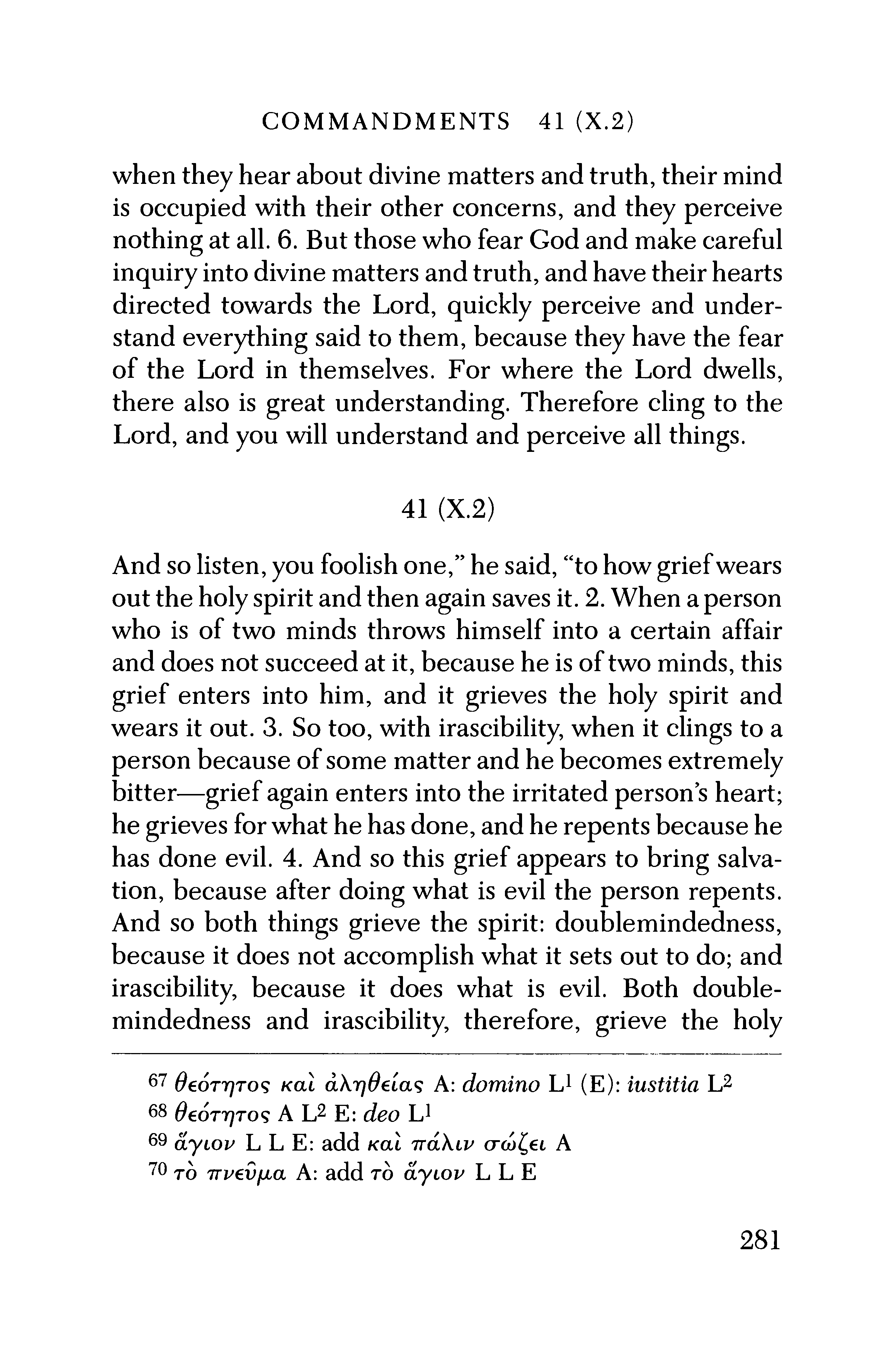
41 (Χ.2) when they hear about divine matters and truth, their mind is occupied with their other concerns, and they perceive nothing at all. 6. But those who fear God and make careful inquiry into divine matters and truth, and have their hearts directed towards the Lord, quickly perceive and under stand everything said to them, because they have the fear of the Lord in themselves. For where the Lord dwells, there also is great understanding. Therefore cling to the Lord, and you will understand and perceive all things.
41 (X.2) And so listen, you foolish one," he said, "to how grief wears out the holy spirit and then again saves it. 2. When a person who is of two minds throws himself into a certain affair and does not succeed at it, because he is of two minds, this grief enters into him, and it grieves the holy spirit and wears it out. 3. So too, with irascibility, when it clings to a person because of some matter and he becomes extremely bitter—grief again enters into the irritated person s heart; he grieves for what he has done, and he repents because he has done evil. 4. And so this grief appears to bring salva tion, because after doing what is evil the person repents.
And so both things grieve the spirit: doublemindedness, because it does not accomplish what it sets out to do; and irascibility, because it does what is evil. Both double mindedness and irascibility, therefore, grieve the holy
67 θεότητος καϊ αληθείας A: domino L 1 (E): iustitia L
S H E P H E R D OF HERMAS
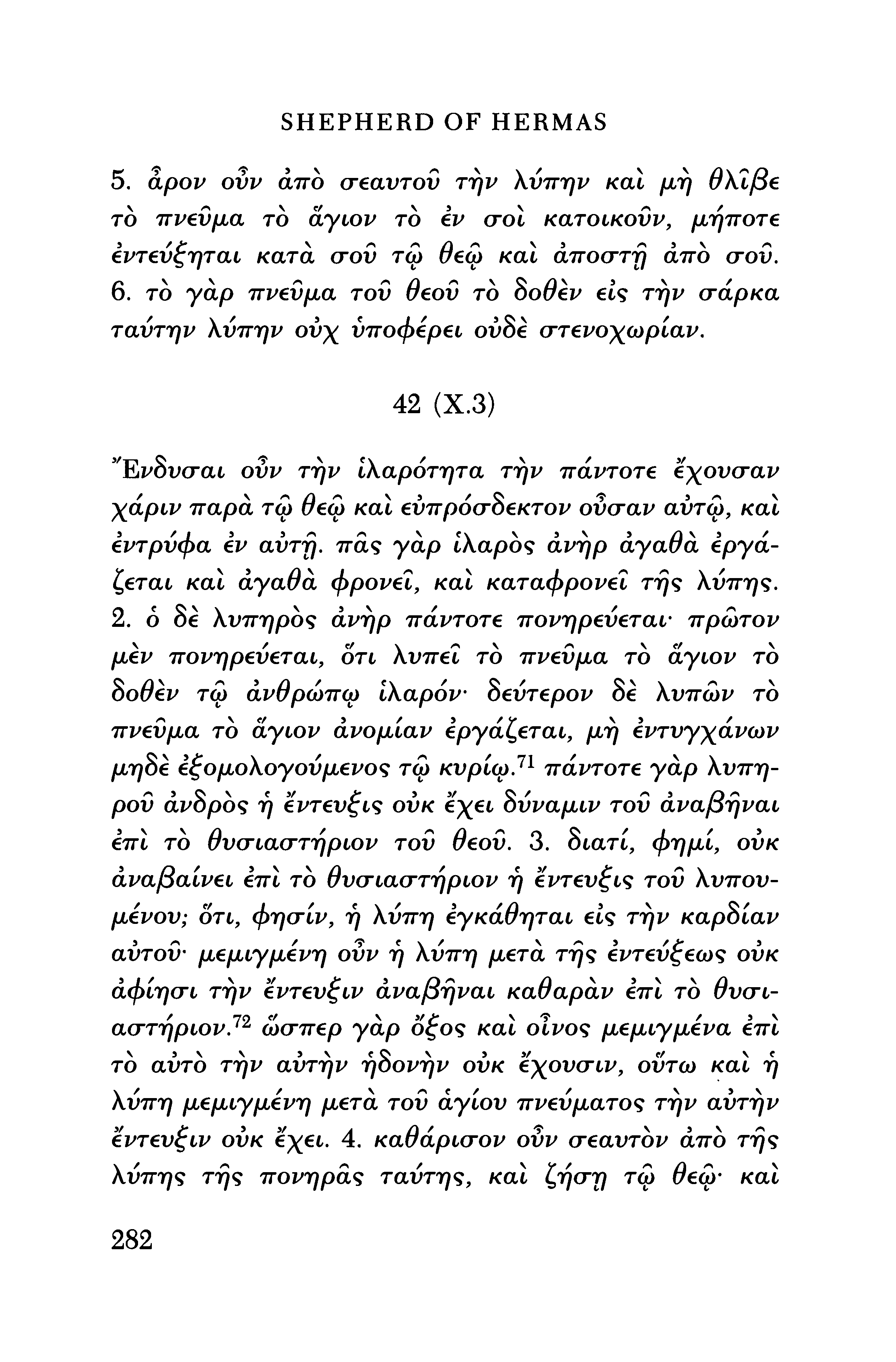
5. άρον ονν άπο σεαντού τήν λύπην καϊ ρή θλίβε το πνενρα το άγιον το iv σοι κατοικονν, ρήποτε έντεύζηται κατά σον τω θεω και άποστή άπο σον.
6. τό γάρ πνενρα τον θεον το δοθέν εις τήν σάρκα ταύτην λύπην ούχ υποφέρει ούδε στενοχωρίαν.
42 (Χ.3) "Ενδνσαι ονν τήν ιλαρότητα τήν πάντοτε εχονσαν χάριν παρά τω θεω και εύπρόσδεκτον ονσαν αύτώ, και εντρυφά εν αύτη. πάς γάρ Ιλαρός άνήρ αγαθά εργά ζεται καϊ αγαθά φρονεί, και καταφρονεί τής λύπης.
2. ό δε λνπηρός άνήρ πάντοτε πονηρεύεται· πρώτον μεν πονηρεύεται, ότι λνπεΐ τό πνεύμα τό άγιον τό δοθέν τώ άνθρώπω ίλαρόν δεύτερον δέ λνπών τό πνεύρα τό άγιον άνομίαν εργάζεται, μή έντνγχάνων μηδέ έζ ομολόγου μένος τώ κνρίω.
πάντοτε γάρ λνπηρού ανδρός ή εντενζις ούκ έχει δύναριν τού άναβήναι έπϊ τό θνσιαστηρίον τού θεού. 3. διατί, φημί, ούκ αναβαίνει έπϊ τό θνσιαστηρίον ή εντενζις τού λνπονρένον; οτι, φησίν, ή λύπη έγκάθηται εις τήν καρδίαν αυτού· μεμιγμένη ονν ή λύπη μετά τής έντεύζεως ούκ άφίησι τήν εντενζιν άναβήναι καθαράν έπϊ τό θνσι αστηρίον.
ώσπερ γάρ Οζος καϊ οίνος μεμιγμένα έπϊ τό αυτό τήν αυτήν ήδονήν ούκ εχονσιν, ούτω και ή λύπη μεμιγμένη μετά τού άγίον πνεύματος τήν αυτήν εντενζιν ούκ έχει. 4. καθάρισον ούν σεαντόν άπο τής λύπης τής πονηράς ταύτης, καϊ ζήση τώ θεώκαϊ
COMMANDMENTS
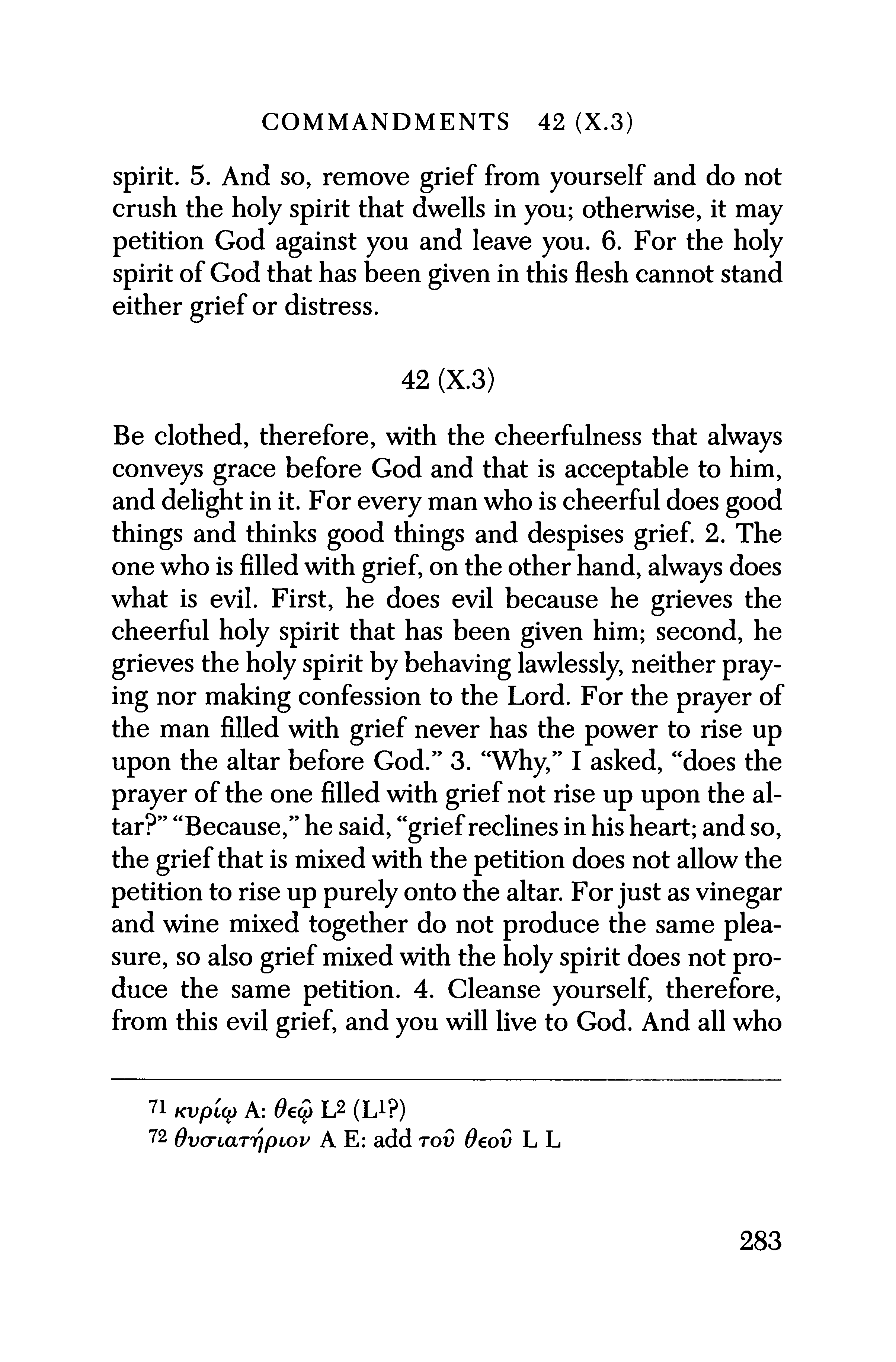
42 (X.3) spirit. 5. And so, remove grief from yourself and do not crush the holy spirit that dwells in you; otherwise, it may petition God against you and leave you. 6. For the holy spirit of God that has been given in this flesh cannot stand either grief or distress.
42 (X.3) Be clothed, therefore, with the cheerfulness that always conveys grace before God and that is acceptable to him, and delight in it. For every man who is cheerful does good things and thinks good things and despises grief. 2. The one who is filled with grief, on the other hand, always does what is evil. First, he does evil because he grieves the cheerful holy spirit that has been given him; second, he grieves the holy spirit by behaving lawlessly, neither pray ing nor making confession to the Lord. For the prayer of the man filled with grief never has the power to rise up upon the altar before God." 3. "Why," I asked, "does the prayer of the one filled with grief not rise up upon the al tar?" "Because," he said, "grief reclines in his heart; and so, the grief that is mixed with the petition does not allow the petition to rise up purely onto the altar. For just as vinegar and wine mixed together do not produce the same plea sure, so also grief mixed with the holy spirit does not pro duce the same petition. 4. Cleanse yourself, therefore, from this evil grief, and you will live to God. And all who 71 κνρίω Α: θβώ L 2 (U?) 72 θνσιατήριον A Ε: add τον θβον L L
S H E P H E R D OF HERMAS
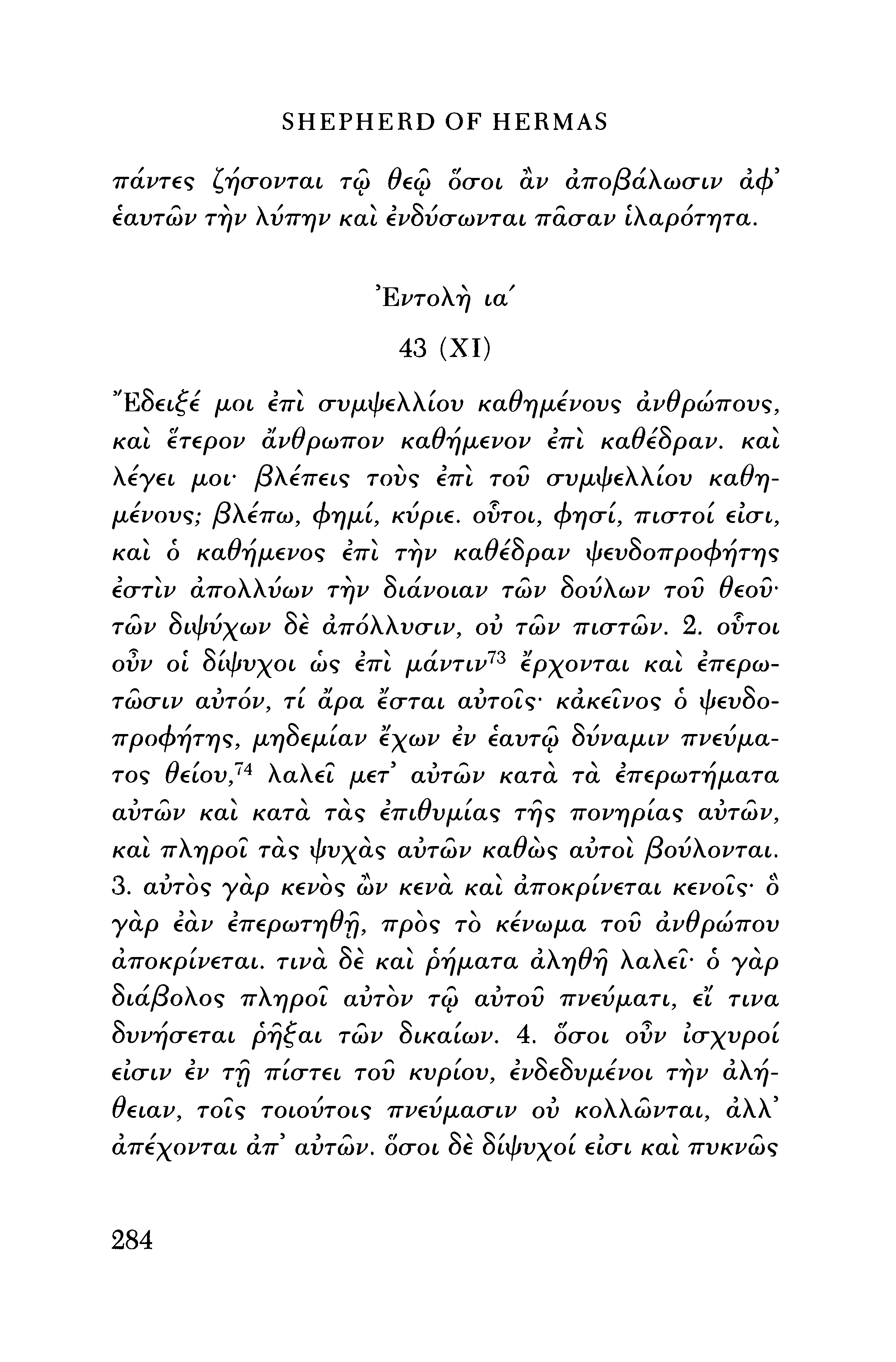
Εντολή ια 43 (XI) "Εδειξε ροι έπι σνρφελλίον καθημένονς άνθρώπονς, και έτερον άνθρωπον καθήρενον έπι καθέδραν. και λέγει ροιβλέπεις τονς έπι τον σνρφελλίον καθηρένονς; βλέπω, φηρί, κύριε, ούτοι, φησί, πιστοί είσι, καϊ ό καθήμενος έπϊ τήν καθέδραν φενδοπροφήτης εστίν άπολλύων τήν διάνοιαν τών δούλων τού θεούτών διφύχων δέ άπόλλνσιν, ού τών πιστών.
έρχονται και έπερωτώσιν αύτον, τί άρα εσται αύτοΐςκάκεΐνος ό φενδο π ροφήτης, ρηδερίαν έχων έν έαντώ δύναριν πνεύρα τος θείον,
λαλεί ρετ αυτών κατά τά έπερωτήρατα αυτών καϊ κατά τάς έπιθνρίας τής πονηρίας αυτών, καϊ πληροΐ τάς φνχάς αυτών καθώς αύτοϊ βούλονται.
3. αυτός γάρ κενός ών κενά καϊ αποκρίνεται κενοΐςό γάρ έάν έπερωτηθή, προς τό κένωμα τού άνθρωπον αποκρίνεται, τινά δέ καϊ ρήρατα αληθή λαλεΐό γάρ διάβολος πληροΐ αυτόν τώ αυτού πνεύρατι, εΐ τινα δννήσεται ρήζαι τών δικαίων.
4. όσοι ονν ίσχνροί είσιν έν τή πίστει τού κνρίον, ένδεδνρένοι τήν άλήθειαν, τοΐς τοιούτοις πνεύρασιν ού κολλώνται, άλλ' άπέχονται άπ' αυτών, όσοι δέ δίφνχοι είσι καί πνκνώς