
The Shepherd Of Hermas
THE APOSTOLIC
FATHERS
EPISTLE OF BARNABAS
PAPIAS AND QUADRATUS
EPISTLE TO DIOGNETUS
THE SHEPHERD OF HERMAS
E D I T E D AND T R A N S L A T E D B Y
BART D. EHRMAN
HARVARD UNIVERSITY PRESS
CAMBRIDGE, MASSACHUSETTS
LONDON, ENGLAND
2 0 0 3

THE SHEPHERD OF HERMAS
INTRODUCTION
The Shepherd of Hermas was one of the most popular books of early Christianity. Judging from the manuscript remains, it was copied and read more widely in the second and third centuries than any other noncanonical book, even more than many of the books that later came to be in cluded in the New Testament.
The Shepherd recounts a series of revelations and di rect angelic communications to a prophet named Hermas, a Christian from early to mid second-century Rome. Like other ancient apocalypses, the book is ultimately con cerned to reveal the divine truths that affect earthly reali ties, and to that extent there is some focus on the future course of human events, especially a time of tribulation that Christians will experience before the end of the age, soon to arrive. But even more the book deals with prob lems of Christian existence in the here and now, especially the problems of sin and repentance, of Christians remain ing faithful to God and returning to him if they have gone astray. It is particularly invested in the question of whether
Christians can have an opportunity to repent, if they sin af ter being baptized. The short answer is that they do have a second chance—but no more.
The book receives its title from the principal angelic mediator and protector of Hermas, the "angel of repen-
INTRODUCTION
tance," who comes to him, part way through the narrative (Vision 5), in the guise of a shepherd.
Overview The Shepherd of Hermas is divided into three sections, given in the manuscripts as a series of five "Visions," twelve
"Commandments," and ten "Parables." There is consider able overlap among these groups: revelatory parables, for example, are found not only in the final section but in the earlier two as well, and by far the longest unit in the book, the ninth Parable, is a detailed explication of what the author sees in the third Vision. Moreover, many of the themes of each section are repeated and developed in oth ers, especially the overarching themes of sin and repen tance, but also more specific issues such as wealth and pov erty, family relations, business dealings, and indecision towards God ("doublemindedness").
The book begins on an ostensibly autobiographical note (scholars debate whether the self-references are his torical or fictional) as Hermas, a freed slave, becomes reacquainted after some years with his former owner, an attrac tive woman named Rhoda, whose beauty and demeanor he admires after observing her bathe in the Tiber river. Soon afterwards he has a vision of Rhoda speaking to him from the sky, telling him that she has been taken up to heaven to accuse him before God because of his evil desire for her.
The vision upsets Hermas and drives him to ponder how he might find forgiveness for his sins.
In answer to his reflections, he is met by an elderly woman, who, in a series of different guises, provides him with the revelations that make up most of Visions 1-4.
S H E P H E R D OF HERMAS
Each Vision in fact comprises not just one but a series of revelations: in the "second" Vision, for example, Hermas first sees the elderly woman, representing the church, reading a book (ch. 5); he is then given a revelation con cerning the meaning of the words of the book (ch. 6); next he has a vision of a young man who speaks to him about the identity of the elderly woman (8.1); and finally the elderly woman herself appears to him again (8.2).
The visions of this opening section of the book include revelations about the sins of Hermas s own family, a vision of the upcoming tribulation in the image of a terrifying monster, and a vision of the "tower" of the church that is being supernaturally constructed on earth out of different kinds of stone of varying utility—the most enduring image of the book, which will receive fuller treatment in the ninth
Parable.
In the fifth Vision a new revelatory agent is introduced, the angelic figure called the Shepherd, the angel set over repentance, who becomes Hermass guide, interpreter, and instructor for the rest of the account. It is the Shep herd who delivers the twelve Commandments, each of which, again, consists not of a single commandment but of a series of injunctions covering a wide range of ethical concerns involving personal, sexual, and family relations.
Some portions of the Commandments resemble the "two paths" teaching found in Barnabas and the Didache, and we are told in fact that there are two angels who influence humans (ch. 36), just as Gods creations and human incli nations are twofold (ch. 38).
Following the set of Commandments, the Shepherd then reveals, and usually explains, the ten "Parables," some of which again comprise a series of revelations, alle-
INTRODUCTION
gories, and parabolic visions. These involve such matters as the nature of Christian existence in this alien world, the relationship of the rich and poor in the church, the need for sexual purity, the hope for repentance in the face of the coming end, the differences among people who react in varying ways to the truth of God, leading to their accep tance into or rejection from the church, and the like. The eighth and ninth Parables—allegorical visions of various sticks representing different kinds of people in the world and of various stones that make up the tower (of the church) under construction—are far and away the longest sections of the book, making up nearly two-fifths of the whole. The book ends with instructions to Hermas to carry out his ministry by urging others to engage in good works before it is too late and the construction of the tower of the church is completed.
Integrity, Authorship, and Date In view of the disparate material scattered throughout the Shepherd, scholars since the nineteenth century have debated whether the work was originally all of a piece or instead represents several works, possibly of different au thors, secondarily combined into one long book. There may be manuscript support for the latter view (see Osiek): one of the surviving manuscripts, the Bodmer papyrus
(4th or 5th century) may well have contained only Visions 1-4, whereas another, the third-century Michigan papy rus, evidently preserved only the other portions of the text,
Vision 5 to the end of the Parables. Moreover, even a quick perusal of the books contents shows striking differences among its various sections: the elderly woman who repre-
S H E P H E R D OF HERMAS
sents the "church" is the divine revealer and interpreter in Visions 1-4, but then disappears for the rest of the book; the shepherd, on the other hand, is absent in this earlier portion but assumes a similar role beginning in Vision 5 to the end. In addition, there appear to be internal discrepan cies throughout the book, for example, between the earlier simple vision of the building of the tower in the third vision and the much fuller explication of the image in the ninth
Parable.
And so some modern scholars have argued that the book is a composite piece, with portions written at differ ent times and by different authors (Giet). Others have countered this view, pointing out that (a) when Tertullian and Clement of Alexandria, two of our earliest witnesses to the book (earlier than either of the manuscripts mentioned above), quote the text, they refer to portions of the book that were supposedly, according to this view, circulating independently of one another (this would suggest that the book was a unity from the outset), and (b) extensive simi larities tie the various sections of the book together, for ex ample, the emphasis on sin, repentance, doublemindedness, purity, and the like (Joly, Henne; see Osiek). As a result, some have maintained that the author wrote differ ent sections of the book at different times, creating the ap parent difficulties. Brox, for example, maintains that Vi sions 1-4 were written first; then, somewhat later, Vision 5 through Parable 8; and finally, at a still later time, Parables
9-10. One more recent suggestion is that the composite character of the book results from its origin as an oral, rather than a written, text (Osiek). In any event, the major ity of scholars today appear to favor the notion of a solitary author.
INTRODUCTION
It is difficult to say much about the authors identity apart from the autobiographical information he himself provides, assuming that this information is to be taken as historical self-description. He was evidently a freedman who lived in Rome (thus references to the Tiber in ch. 1 and the Via Campana in ch. 22) and involved with the church there, but not as one of its leaders, of whom he speaks in the third person. His general moral concerns, somewhat superficial theological reflections, especially with regard to christology (e.g., in Parables 5 and 9), and general literary skill have made most interpreters suspect that he was not among the intellectual elite in the church.
In any event, some scholars have seen his text as ripe for a sociohistorical analysis of the church in Rome (see Osiek,
Maier, Lampe, and Jeffers).
Similar considerations have contributed to the view that he was writing some time early in the second century.
It is worth noting, for example, that Hermas speaks of the "presbyters" and the "bishops" of the church in Rome (and other leaders, such as apostles, deacons, and teachers), but says nothing about a solitary bishop. Moreover, never does
Hermas quote other books that later came to be accepted into the canon as authoritative: his only explicit quotation is of a now-lost work, the Book of Eldad and Modat (7.4).
Several other considerations have often played a role in determining his date; unfortunately, these considerations do not harmonize well with one another:
(a) At the beginning of the third century, Origen main tained that this Hermas was none other than the person mentioned by the apostle Paul in Romans 16:14.
(b) Hermas himself mentions someone named "Clem ent" in the second Vision (8.2), and indicates that he was a
S H E P H E R D OF HERMAS
kind of foreign correspondent for the Roman church. It has frequently been thought that this is the same person ultimately responsible for the book of 1 Clement, written in the mid 90s (according to Eusebius, the third bishop of Rome).
(c) The Muratorian Canon - a list of books that belong to the New Testament, produced possibly in the second half of the second century—indicates that the Shepherd is not to be included among the Scriptures because it was written "recently" by Hermas, while his brother, Pius, was serving as the bishop of Rome. Eusebius (Eccl. Hist. 4,11) indicates that Pius was bishop from 140 to 154.
It is difficult to reconcile these three indications of a proximate date for the book, since the time between Pauls letter to the Romans (early 60s?) and Pius of Rome is some
80-90 years. It may be, in any event, that Origen was sim ply making a best guess at the identity of Hermas, wanting to make his book "apostolic" (Origen cites it as a scriptural authority), and that, on the other hand, the author of the Muratorian canon was trying to distance Hermas from the times of the apostles, since he did not consider the book on a par with the emerging Christian Scriptures (the date of the Muratorian canon is itself a matter of dispute; see
Osiek and the literature she cites). Moreover, the refer ence to Clement of Rome is not altogether useful, since 1
Clement never mentions this person, let alone claims him as its author (see Introduction there). It is true that Euse bius locates Clement as bishop of Rome towards the end of the first century, but it is possible that Clement assumed a variety of roles in the Roman congregation at different times (on whether Clement was actually a "bishop," see In troduction to 1 Clement).
INTRODUCTION
We are left with general considerations of theme, theol ogy, and presumed historical and ecclesiastical situation to date the book. These suggest that it was written, possibly over a stretch of time, during the early part of the second century, perhaps 110-40 CE.
Early Reception, Manuscript Tradition, and Abbreviations The Shepherd is cited by a number of early church writ ers in both the East and West (Irenaeus, Clement of Alex andria, Terullian, Origen, Jerome, Augustine, and others; see Osiek), some of whom (e.g., Clement of Alexandria) considered it to be Scripture, others of whom (Athanasius and the author of the Muratorian canon) considered it noncanonical but useful for reading. It was also accorded canonical standing in several surviving manuscripts: the fourth-century Codex Sinaiticus, for example, includes it, along with the Epistle of Barnabas, among the books of the New Testament, and it is cited as canonical in a list preserved in a New Testament manuscript of the sixthcentury, the Greek-Latin Codex Claromontanus (along with the Epistle of Barnabas, the Acts of Paul, and the Apocalypse of Peter).
The editio princeps (from the Latin Vulgate; see below) was published by J. Le Fevre d'Etaples in 1513 in Paris
{Liber trium vivorum et trium spiritualium virginum); the first attempt at a critical edition was made by Cotelier in 1672, based on the Latin text and several then available
Greek fragments. The fuller Greek text was not discovered until the mid-nineteenth century, and even now the Greek of the entire book is not completely preserved: no Greek is
S H E P H E R D OF HERMAS
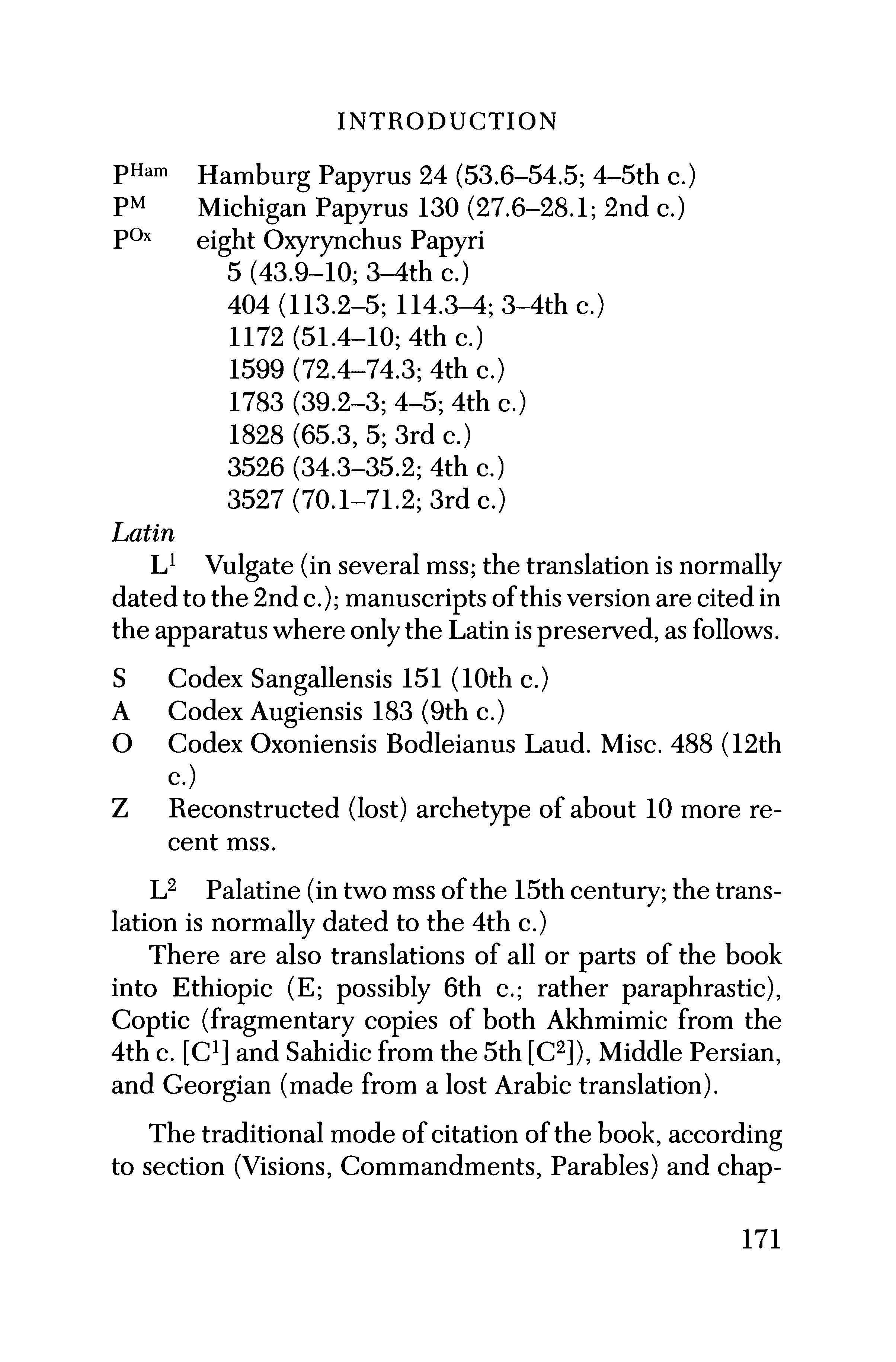
extant for the concluding chapters (most of 107.3-114.5).
The following are the principal witnesses to the text.
Greek A Codex Athous (15th c ; chs. 1-107; nearly complete) S Codex Sinaiticus (4th c ; 1.1-31.6; nearly the first fourth of the book) Μ Michigan Papyrus 129 (mid 3rd c.; chs. 51.8-82.1; most of the Parables) Β Bodmer Papyrus 38 (late 4th or early 5th c ; chs. 1-21; the first three Visions) F Florilegium of Patristic texts (Paris gr. 1143; 13th c ; with five fragments of the Shepherd: 52:8-10; 56:4-9;
66:4-5; 100:3-5; and 110: 1-3) In addition, there are nearly twenty fragmentary Greek papyri, most of them from the 3rd-5th centuries (see
Horseley and Llewelyn and the Oxyrynchus Papyri).
Those cited in the apparatus are as follows.
P A m Amherst Payrus 190 (7 fragments; 5-6th c.) (1) 2.2-3.1
(2) 20.3; 21.3
(3) 44.1,3 (4) 27.1-2,4-5 (5) 89.2-3,5 (6) 94.1,3-4 (7) 107.1-2,3-4 pBer f o u r Berlin Papyri 5104 (32.4-33.2, 3-4; 5th c. ) 5513 (51.7-10; 53.2-5; 3rd c.) 6789 (67.1-12; 6th c.) 13272 (54.5-55.2, 4-6; 4th c.)
INTRODUCTION
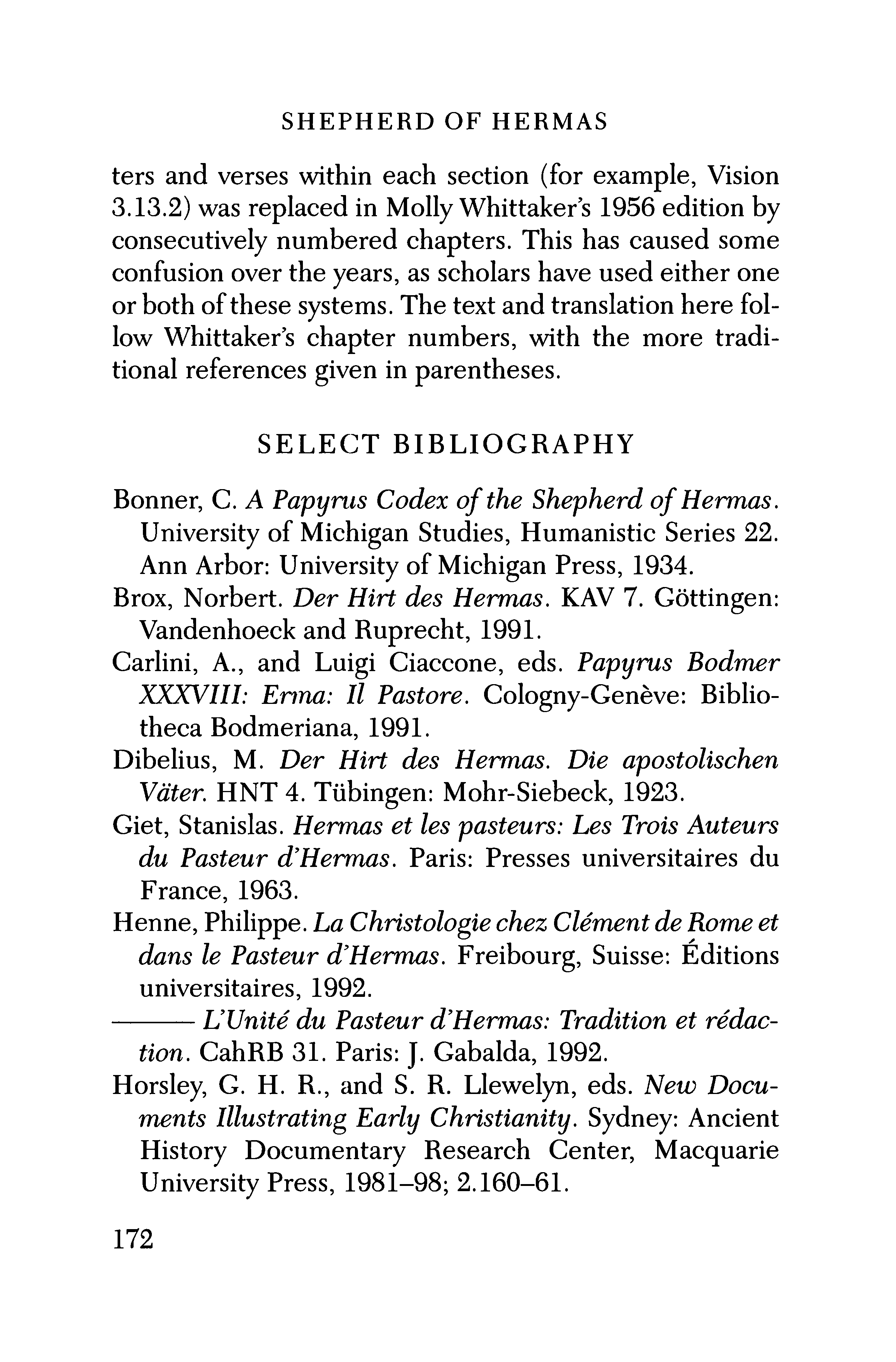
pHam Hamburg Papyrus 24 (53.6-54.5; 4-5th c.) P M Michigan Papyrus 130 (27.6-28.1; 2nd c.)
P° x eight Oxyrynchus Papyri 5 (43.9-10; 3-4th c.) 404 (113.2-5; 114.3-4; 3-4th c.) 1172 (51.4-10; 4th c.) 1599 (72.4-74.3; 4th c.) 1783 (39.2-3; 4-5; 4th c.) 1828 (65.3, 5; 3rd c.) 3526 (34.3-35.2; 4th c.) 3527(70.1-71.2; 3rd c.) Latin
Vulgate (in several mss; the translation is normally dated to the 2nd a); manuscripts of this version are cited in the apparatus where only the Latin is preserved, as follows.
L S Codex Sangallensis 151 (10th c.) A Codex Augiensis 183 (9th c.) Ο Codex Oxoniensis Bodleianus Laud. Misc. 488 (12th c ) Ζ Reconstructed (lost) archetype of about 10 more re cent mss.
Palatine (in two mss of the 15th century; the trans lation is normally dated to the 4th c.) L There are also translations of all or parts of the book into Ethiopic (E; possibly 6th c ; rather paraphrastic),
Coptic (fragmentary copies of both Akhmimic from the 4th c. [C 1] and Sahidic from the 5th [C 2]), Middle Persian, and Georgian (made from a lost Arabic translation).
The traditional mode of citation of the book, according to section (Visions, Commandments, Parables) and chap-
S H E P H E R D OF HERMAS
ters and verses within each section (for example, Vision 3.13.2) was replaced in Molly Whittaker s 1956 edition by consecutively numbered chapters. This has caused some confusion over the years, as scholars have used either one or both of these systems. The text and translation here fol low Whittaker s chapter numbers, with the more tradi tional references given in parentheses.
S E L E C T
B I B L I O G R A P H Y
Bonner, C. A Papyrus Codex of the Shepherd of Hermas.
University of Michigan Studies, Humanistic Series 22.
Ann Arbor: University of Michigan Press, 1934.
Brox, Norbert. Der Hirt des Hermas. KAV 7. Gottingen:
Vandenhoeck and Ruprecht, 1991.
Carlini, Α., and Luigi Ciaccone, eds. Papyrus Bodmer XXXVIII: Erma: II Pastore. Cologny-Geneve: Bibliotheca Bodmeriana, 1991.
Dibelius, M. Der Hirt des Hermas.
Die apostolischen Vater. HNT 4. Tubingen: Mohr-Siebeck, 1923.
Giet, Stanislas. Hermas et les pasteurs: Les Trois Auteurs du Pasteur d'Hermas.
Paris: Presses universitaires du France, 1963.
Henne, Philippe. La Christologie chez Clement de Rome et dans le Pasteur d'Hermas.
Freibourg, Suisse: Editions universitaires, 1992.
L'Unite du Pasteur d'Hermas:
Tradition et redac tion. CahRB 31. Paris: J. Gabalda, 1992.
Horsley, G. H. R., and S. R. Llewelyn, eds. New Docu ments Illustrating Early Christianity.
Sydney: Ancient History Documentary Research Center, Macquarie University Press, 1981-98; 2.160-61.
INTRODUCTION
Jeffers, James S. Conflict at Rome: Social Order and Hier archy in Early Christianity.
Minneapolis: Fortress, 1991.
Joly, Robert. Hermas: he Pasteur: introduction, texte, cri tique, traduction et notes. SC 53. Paris: Cerf, 1958; repr
1978.
Lampe, Peter. Die Stadtromischen Christen in den ersten beiden Jahrhunderten:
Untersuchungen zur Sozialgeschichte.
Tubingen: Mohr-Siebeck, 1987.
Lappa-Zizicas, Eurydice. "Cinq fragments du Pasteur d'Hermas dans un manuscrit de la Bibliotheque
Nationale de Paris." RSR 53 (1965) 251-56.
Maier, Harry O. The Social Setting of the Ministry as Reflected in the Writings of Hermas, Clement and Ignatius. Waterloo, Ontario: Wilfrid Laurier University
Press, 1991.
Osiek, Carolyn. Shepherd of Hermas. Hermeneia. Minne apolis: Fortress, 1999.
The Oxyrhynchus Papri, vol. 50. London: British Acad emy, 1983; 14-21.
Snyder, Graydon F. The Shepherd of Hermas. Vol 6 of The Apostolic Fathers: A New Translation and Commentary, ed. R. M. Grant. Camden, N.J.: Thomas Nelson & Sons,
1968.
Whittaker, Molly. Der Hirt des Hermas. Die apostolischen Vater. Vol. I. Berlin: Akademie Verlag, 1956; 2d ed.,
1967.
Wilson, J. C. Five Problems in the Interpretation of the Shepherd of Hermas: Authorship, Genre, Canonicity, Apocalyptic, and the Absence of the Name 'Jesus Chnst.'
Lewiston: Mellen Biblical Press, 1995.
εις 'Ρώρην ρετά πολλά ετη ταύτην άνεγνωρισάρην καί ήρζάρην αντήν αγαπάν ώς άδελφήν.
2. ρβτά χρόνον τινά λονορενην βίς τον ποταρον τον Ύίββριν βϊδον καί βπβδωκα αντή τήν χβίρα καί βζήγαγον αντήν βκ τον ποταρον. ταύτης ονν ίδών το κάλλος διβλογιζόμην βν τή καρδία ρον λβγων ρακάριος ήρην βί τοιαύτην γνναΐκα βΐχον Ό θρέφας ρε πεπρακεν pe ΐ*όδη τινϊ καί τώ κάλλβι καί τώ τρόπω, ρόνον τούτο ββονλβνσάρην, βτβρον δβ ούδβν. 3. ρβτά χρόνον τινά πορβνορβνον ρον βίς κώρας
καί δοζάζοντος τάς κτίσβις τού θβού, ώς ρβγάλαι καί βκπρβπβίς καί δνναταί βίσιν, περίπατων άφύπνωοτα. καί πνβύρά ρβ βλαββν καί άπήνβγκβν ρβ δι άνοδίας τινός, δι ής άνθρωπος ούκ βδύνατο όδβύο-αιήν δβ ό τόπος κρηρνώδης καί άπβρρηγώς άπο τών υδάτων, διαβάς ούν τον ποταρον βκβίνον ήλθον βίς τά όραλά, καί τιθώ τά γόνατα καί 1:
Hermae prophetae Ε: Άρχή σύν θβώ βίβλον λεγομένης Titulus] Υλοιμην S: Liber pastoris nuntii paenitentiae L
THE S H E P H E R D OF HERMAS
Vision One KI.l) The one who raised me sold me to a certain woman named Rhoda, in Rome. After many years, I regained her ac quaintance and began to love her as a sister. 2. When some time had passed, I saw her bathing in the Tiber river; and I gave her my hand to help her out of the river. When I ob served her beauty I began reasoning in my heart, "I would be fortunate to have a wife of such beauty and character."
This is all I had in mind, nothing else. 3. When some time had passed, I was traveling to the countryside, glorifying the creations of God and thinking how great, remarkable, and powerful they are. On the way I fell asleep and a spirit took me and carried me through a certain deserted place that was impassable, for the place was steep and split up by the courses of water. When I crossed the river I came to ΐίοιμήν. "Ορασις a A: (Incipit) libellus sancti pastons. Incipit visio prima quam vidit Herma L 2: opac[ ] Β 1 πέπρακύν pe Ρόδτ} TLVL S L 2 Ε [Β]: πέπρακβ προς γυναικά τινα A (L 1)
2 κώμας S Α Β Ε: Κονμας cj. Dindorf: cum his L 1: civitatem Ostiorum L
S H E P H E R D OF HERMAS
4. προσενχορένον δέ ρον ήνοίγη 6 ουρανός, καϊ βλέπω τήν γνναϊκα έκείνην ήν έπεθύμησα άσπαζομένην pe έκ τον ουρανού, λέγουσαν Έρρά, χαίρε.
5. βλέφας δέ βίς αντήν λέγω αντή· κνρία, τί σν ώδβ ποιείς; ή δέ άπεκρίθη ρον άνελήμφθην ΐνα σον τάς άραρτίας έλέγζω προς τον κνρίον.
6. λέγω αντήννν σν ρον έλεγχος βί; ον, φησίν, άλλά άκουσον τά ρήρατα ά σοι ρέλλω λέγβιν. ό θβός ό έν τοΐς ούρανοΐς κάτοικων και κτίσας έκ τού ρή οντος τά όντα καϊ πληθύνας καϊ αύζήσας βνβκβν τής άγιας εκκλησίας αυτού οργίζεται σοι ότι ήραρτβς βίς έρέ.
7. αποκριθείς αύτη λέγωεις σέ ήμαρτον; ποίω τρό πω; 4 ή πότε σοι αίσχρόν ρήρα έλάλησα; ού πάντοτε σε ώς θεάν 5 ήγησάρην;
ού πάντοτε σε ένετράπην ώς άδελφήν; τί ρον καταφεύδη, ώ γύναι, τά πονηρά ταύτα καί ακάθαρτα; 8. γελάσασά μοι λέγει· έπϊ τήν καρδίαν σον άνέβη ή έπιθνρία τής πονηρίας.
ή ού δοκεΐ σοι άνδρί δικαίω πονηρόν πράγμα είναι έάν άναβή αυτού έπι τήν καρδίαν ή πονηρά έπιθνρία; αμαρτία γέ έστιν και ρεγάλη, φησίν. ό γάρ δίκαιος άνήρ δίκαια βονλεύεται. έν τώ ονν δίκαια βονλεύεσθαι αυτόν κατορθούται ή δόξα αυτού έν τοΐς ούρανοΐς καί εύκατάλλακτον έχει τον κύριον έν παντϊ πράγματι αυτού, οί δέ πονηρά βονλενόρενοι έν ταΐς καρδίαις αυτών θάνατον καϊ αίχμαλωτισμόν έαντοΐς έπισπώνται, μάλιστα οί τον αιώνα τούτον περιποιούμενοι καί γανριώντες έν τώ πλούτω αυτών καί μή άντεχόμενοι
VISIONS 1 (1.1) level ground and bowed my knees; and I began praying to the Lord and confessing my sins. 4. While I was praying the sky opened up and I saw the woman I had desired, address ing me from heaven: "Hermas, greetings!" I looked at her and said, "Lady, what are you doing here?" 5. She replied to me, "I have been taken up to accuse you of your sins be fore the Lord." 6. I said to her, "So now are you accusing me?" "No," she said, "but listen to what I have to say to you.
The God who dwells in heaven and who, for the sake of his holy church, created, increased, and multiplied that which exists out of that which does not exist, is angry at you for sinning against me." 7. I answered her, "Have I sinned against you? In what way? When did I speak an inappropri ate word to you? Have I not always thought of you as a god dess? Have I not always respected you as a sister? Why do you make such evil and foul accusations against me, Ο woman?" 8. But she laughed and said to me, "The desire for evil did rise up in your heart. Or do you not think it is evil for an evil desire to arise in the heart of an upright man? Indeed," she said, "it is a great sin. For the upright man intends to do what is right. And so, when he intends to do what is right his reputation is firmly established in heaven and he finds that the Lord looks favorably on every thing he does. But those who intend in their hearts to do evil bring death and captivity on themselves—especially those who are invested in this age, who rejoice in their
5 θ εάν S B L 1 : θυγατέρα A: dominam meam Ε 6 ον . . . ήγησάρην S A Β L 1 Ε: om. L
S H E P H E R D OF HERMAS
αί φνχαί αντών, οΐτινες ονκ έχονσιν ελπίδα, άλλά έαν τονς άπεγνώκασιν καϊ τήν ζωήν αντών. άλλά σν προσενχον προς τον θεον, καϊ ίάσεται τά αμαρτήματα σον καϊ όλον τον οίκον σον καϊ πάντων τών άγιων.
2 (1.2) Μβτά τό λαλήσαι αντήν τά ρήρατα ταντα έκλείσθησαν οί ονρανοίκάγώ όλος ήμην πεφρικώς και λνπονμενος. ελεγον δε εν έμαντώεί αντη ροι ή αμαρτία αναγράφεται, πώς δννήσοραι σωθήναι; ή πώς εξιλάσοραι τον θεον περί τών άραρτιών ρον τών τελείων; ποίοις
ρήμασιν ερωτήσω τον κνρίον ΐνα ίλατενσηταί ροι; 2. ταύτα ρον σνμβονλενομενον καί διακρίνοντος εν τή καρδία ρον βλέπω κατεναντί ρον καθεδραν λενκήν εξ ερίων χιονίνων γεγοννίαν ρεγάλην καί ήλθεν γννή πρεσβντις εν ίρατισρώ λαρπροτάτω, εχονσα βιβλίον εις τάς χείρας, καί εκάθισεν ρόνη καϊ ασπάζεται ρεΈρμα, χαίρε, κάγώ λνπονρενος καϊ κλαίων είπον κνρία, χαίρε.
3. καί εΐπεν μοιτί στνγνός, Έρρά ό ρακρόθνρος, ό άστοράχητος, ό πάντοτε γελών; τί όντως κατηφής τή ίδεα καί ονχ ιλαρός; κάγώ είπον αντήνπό
4. ή δέ εφη· ρηδαρώς έπι τον δονλον τον θεον τό πράγρα τοντο. άλλά πάντως έπϊ τήν καρδίαν σον
VISIONS 2 ( 1 . 2 ) wealth and do not cling to the good things yet to come.
9. Those who have no hope but have already abandoned themselves and their lives will regret it. But pray to God, and he will heal your sins, along with those of your entire household and of all the saints."
2 (1.2) After she had spoken these words, the skies were shut; I was trembling all over and upset. I began saying to myself,
"If this sin is recorded against me, how can I be saved? Or how will I appease God for the sins I have recently com mitted? What words can I use to ask the Lord for mercy?"
2. While I was mulling these things over in my heart and trying to reach a decision, I saw across from me a large white chair, made of wool, white as snow. And an elderly woman came, dressed in radiant clothes and holding a book in her hands. She sat down, alone, and addressed me,
"Greetings, Hermas." And I said, still upset and weeping, "Greetings Lady." 3. She said to me, "Why are you sad,
Hermas—you who are patient, slow to anger, and always laughing? Why are you so downcast, and not cheerful?" I replied to her, "Because of a very good woman who has been telling me that I sinned against her." 4. And she said,
"May such a thing never happen to a slave of God! But probably something did rise up in your heart about her.
8 μεταμελήσονταί Β: μετανοήσονσιν S (Ε): πολλά μβταμβλήσ-ονσ-υν A: vagantur L 1: non resistent hisdem luxuriis L
9 ποίοις S A Β L 1: ή ποίος S a c L 2 Ε 2 Β Ε: add τίνος Α: κυρία όνίδισμός μοι yeyovev ύπο S 10 νπό P A m v i d L c L
1 1 μοί Β A L 2 Ε: om. S L
S H E P H E R D OF HERMAS
άνέβη περϊ αυτής, εστίν μεν τοΐς δούλοις του θεού ή τοιαύτη βουλή άμαρτίαν έπιφέρουσαπονηρά yap βουλή καϊ έκπληκτος εις πάνσερνον πνευρα καϊ ήδη δεδοκιμασμένον, εάν έπιθυρήση πονηρον έργον, καϊ μάλιστα 'Έρράς 6 εγκρατής, 6 άπεχόρενος πάσης επι θυμίας πονηράς καϊ πλήρης πάσης άπλότητος καϊ ακακίας ρεγάλης.
3 (1.3) Άλλ' ούχ ένεκα τούτου σοι οργίζεται 6 θεός, άλλ' ΐνα τον οίκον σου τον άνομήσαντα εις τον κύριον καί εις υμάς τούς γονείς αυτών έπιστρέφης.
άλλά φιλότεκνος ών ούκ ένουθέτεις σου τον οίκον, άλλά άφήκες αυτόν καταφθαρήναι δεινώς·
διά τούτο οργίζεται σοι ό κύριοςάλλά ίάσεταί σου πάντα τά προγεγονότα πονηρά έν τώ οΐκω σουδιά γάρ τάς εκείνων αμαρτίας καί άνομήματα σύ κατεφθάρης άπο τών βιωτικών πράξεων.
2. άλλ' ή πολυσπλαγχνία τού κυρίου ήλέησέν σε καί τον οίκον σου καί ισχυροποιήσει σε καί θερελιώσει σε έν τή δόζη αυτού, σύ μόνον μή ραθυρήσης, άλλά εύφύχει καί ισχυροποιεί σου τον οίκον, ώς γάρ ό χαλκεύς σφυροκοπών τό έργον αυτού περιγίνεται τού πράγρατος ού θέλει, ούτω καϊ ό λόγος ό καθηρερινός ό δίκαιος περιγίνεται πάσης πονηρίας, ρή διαλίπης ούν νουθετών σου τά τέκναοΐδα γάρ ότι έάν μετανοήσουσιν έζ όλης καρδίας αυτών, ένγραφήσονται
VISIONS 3 (1.3) This kind of idea carries the slaves of God into sin. For when someone longs to do what is evil, it is an evil and shocking idea, directed against a fully reverend and tested spirit—especially for Hermas, the self-controlled, who ab stains from every evil desire and is full of all simplicity and great innocence.
3 (1.3) "Still, God is angry with you, not about this, but so that you may convert your household, which has acted lawlessly against the Lord and against you, their parents. But since you yourself are so fond of your children you do not ad monish your household, and so you allow it to be terribly ruined. This is why the Lord is angry with you. But he will heal every evil your household formerly committed. For you yourself have been brought to ruin by the affairs of daily life—because of their sins and lawless acts. 2. But the Lords compassion has granted you and your household mercy, and it will make you strong and establish you in its glory. But you must not relax; instead, take courage and strengthen your household. For as the coppersmith ham mers his work to master the material as he wants, so also the upright word spoken every day masters all evil. Do not stop exhorting your children. For I know that if they re pent from their whole heart, they will be recorded with the saints in the books of the living." 3. When she finished
1 2 έπιο-τρέψης S c Β P A m Α: επιο-τρεψη S 13 δβινώς B A L L E : om. S PAm 14 OTL eav . . . ένγραφήσονται S (A) Ε: on . . . καί ένγραφήσονται Β L L
S H E P H E R D OF HERMAS
3. μετά το παήναι αυτής τά ρήματα ταντα λβγβι μοι· θέλεις άκούσαί ρον άναγινωσκούσης; λέγω κάγώ· θβλω, κυρία, λβγβι ροι· γβνού ακροατής καϊ άκουβ τάς δόξας του θβον. ήκονσα ρβγάλως καϊ θανραστώς δ 1 5 ούκ Ισχυσα μνημονεύσαι· πάντα γάρ τά ρήρατα βκφρικτα, ά ού δύναται άνθρωπος βαστάσαι. τά ούν έσχατα ρήρατα έμνημόνενσαήν γάρ ήμΐν σύμφορα καϊ ήρβρα· 4. ιδού 6 θεός τών δννάρβων,
δννάμβι και κραταιά και τή ρεγάλη σννέσει αυτού κτίσας τον κόσρον καϊ τή ένδόξω βονλή πβριθβϊς τήν βύπρβπβιαν τή κτίσει αυτού, και τώ ίσχυρώ ρήματι πήζας τον ούρανον καϊ θερελιώσας τήν γήν επί υδάτων καϊ τή ιδία σοφία καϊ πρόνοια
κτίσας τήν άγίαν έκκλησίαν αυτού, ήν καϊ ηύλόγησεν, ιδού ρεθιστάνει τούς ουρανούς καϊ τά ορη καϊ τούς βοννούς καϊ τάς θάλασσας, καϊ πάντα ομαλά γίνεται τοΐς εκλεκτοΐς αυτού, ΐνα άποδοΐ αύτοΐς τήν επαγγελίαν, ήν επηγγείλατο, μετά πολλής δόζης καϊ χαράς, εάν τηρήσωσιν τά νόριρα τού θεού ά παρελαβον εν ρεγάλη πίστει.
4 (1.4) Ότβ ούν ετελεσεν άναγινώσκουσα καϊ ήγερθη άπο τής καθέδρας, ήλθαν τέσσαρες νεανίαι καϊ ήραν τήν καθεδραν καϊ άπήλθον προς τήν άνατολήν.
2. προσ καλείται δε ρε και ήφατο τού στήθους ρου και λέγει μοι· ήρεσεν σοι ή άνάγνωσίς μον; και λέγω αύτη·
VISIONS 4 (1.4) these words, she said to me, "Do you want to hear me read?" I replied to her, "Yes, Lady, I do." She said to me,
"Be a hearer and hear the glories of God." I heard great and amazing matters that I could not remember. For all the words were terrifying, more than a person can bear.
But I have remembered the final words, for they were ben eficial to us, and gentle: 4. "Behold, the powerful God, who with his invisible power, might, and great understanding created the world, and by his glorious plan encompassed his creation with beauty, and by his powerful word fixed the sky and founded the earth upon the waters, and by his unique wisdom and foreknowledge created his holy church, which he also blessed—behold, he transforms the skies and the mountains and the hills and the seas, and ev erything becomes level for his elect, that he may deliver over to them the promise he made, with great glory and joy, if they keep the ordinances of God, which they re ceived in great faith."
4 (1.4) Then, when she finished reading and rose up from the chair, four young men came and took the chair and went away to the east. 2. She called me over and touched my breast and said to me, "Did my reading please you?" I said
1: μεγάλας καϊ θανμαστάς ών A ( L 15 μβγάλως καϊ θανμαστώς ό S Β L 2 Ε) 16 6 άορτάτω L 1 (invisibili), cf. L 2 (sustentabili): όν αγαπώ S Β A: in misencordia sua et in amove suo Ε
S H E P H E R D OF HERMAS
κυρία, ταύτα pot τά έσχατα αρέσκει, τά δέ πρότερα χαλεπά καί σκληρά, ή δε εφη ρου λέγουσαταύτα τά έσχατα τοΐς δικαίοις, τά δέ πρώτα τοΐς εθνεσιν καϊ τοΐς άποστάταις.
3. λαλούσης αυτής μετ έρού δύο τινές άνδρες έφάνησαν καϊ ήραν αυτήν τών αγκώνων καϊ απήλθαν, όπου καϊ ή καθέδρα, προς τήν άνατολήν. ιλαρά δέ άπήλθεν καϊ ύπάγονσα λέγει ροιάνδρίζον, Έρμα.
5 (ΙΙ.1)
κατά τον καιρόν όν καϊ πέρυσι, περίπατων άνερνήσθην τής περυσινής ορά σεως, καϊ πάλιν ρε αίρει πνεύρα καϊ αποφέρει εις τον αυτόν τόπον όπου καϊ πέρυσι.
2. έλθών ούν εις τον τόπον τιθώ τά γόνατα καϊ ήρζάρην προσεύχεσθαι τώ κυρίω καϊ δοξάζειν αυτού τό ονορα, ότι με άξιον ήγήσατο καϊ έγνώρισέν μοι τάς αμαρτίας μου τάς πρότερον.
3. μετά δέ τό έγερθήναί ρε άπο τής προσ ευχής βλέπω απέναντι μου τήν πρεσβυτέραν ήν καί πέρυσιν ΤΙορευορένου μου εις κώμας
έωράκειν, περιπατούσαν καί άναγινώσκουσαν βιβλαρίδιον. καί λέγει μοιδύνη ταύτα τοΐς έκλεκτοΐς τού θεού άναγγεΐλαι; λέγω αύτηκυρία, τοσαύτα μνημονεύσαι ού δύναμαιδός δέ μοι τό βιβλίδιον Ινα μεταγράφωραι αυτό. λάβε, φησίν, καί αποδώσεις ροι.
VISIONS 5(11.1) to her, "Lady, these last words are pleasing to me, but the earlier ones were difficult and hard." She said to me,
"These last words are for those who are upright, but the former are for the outsiders and apostates." 3. While she was speaking with me, two other men appeared and took her by the arms and went away to the east, where the chair was. She went away cheerfully; and while she was going she said to me, "Be a man [Or: Be courageous],
Hermas."
Vision Two 5(11.1) I was traveling to the countryside at the same time as the previous year, and on the way I remembered the vision from the year before. And again a spirit took me and bore me to the same place I had been then. 2. And so, when I came to the place I bowed my knees and began praying to the Lord and glorifying his name, because he considered me worthy and showed me my former sins. 3. When I arose from prayer I saw across from me the elderly woman I had seen the year before, walking and reading a little book.
And she said to me, "Can you announce these things to the ones chosen by God?" I said to her, "Lady, I cannot re member so many things. Give me the book to make a copy." "Take it," she said, "and then return it to me." 4. I took it and went away to another part of the field, where I copied the whole thing, letter by letter, for I could not dis18 κώμας S Β Α Ε: Κονμας L L (regionem Cumanorum)
19 ττέρνσιν Β A L 1: om. L 2 Ε: πρότβρον S 20 λάβε . . . μοι S c A L 1: om. S Β L 2 Ε
S H E P H E R D OF HERMAS
γράμμαούχ ηύρισκον γάρ τάς σνλλαβάς. τελέσαντος ονν τά γράρρατα τον βιβλιδίον εξαίφνης ήρττάγη ρον έκ τής χειρός το βιβλίδιονύπό τίνος δέ ονκ είδον.
6 (ΙΙ.2) Μβτά δβ δέκα καϊ πέντε ήρβρας νηστεύσαντός ρον καϊ πολλά έρωτήσαντος τον κνρίον απεκαλύφθη ροι ή γνώσις τής γραφής, ήν δβ γβγραρρβνα ταύτα2. τό σπβρρα σον, Έρμα, ήθβτησαν βίς τον θβον καϊ ββλασφήμησαν βίς τον κύριον καϊ προέδωκαν τούς γονείς αυτών εν πονηρία ρεγάλη καί ήκονσαν προδόται γονέων καϊ προδόντες ούκ ώφελήθησαν, άλλά ετι προσέθηκαν ταΐς άραρτίαις αυτών τάς ασέλγειας καί σνμφνρμούς πονηρίας, καί ούτως έπλήσθησαν αί άνομίαι αυτών.
3. άλλά γνώρισον ταύτα τά ρήρατα τοΐς τέκνοις σον πάσιν καϊ τή σνρβίω σον τή ρελλούση σον αδελφήκαϊ γάρ αύτη ούκ άπέχεται τής γλώσσης, έν ή πονηρεύεταιάλλά άκούσασα τά ρήματα ταύτα άφέξεται καϊ εξει έλεος.
4. ρετά το γνωρίσαι σε ταύτα τά ρήματα αύτοΐς ά ενετείλατο μοι 6 δεσπότης ΐνα σοι άποκαλνφθή, τότε άφίενται αύτοΐς αί άμαρτίαι πάσαι ας πρότερον ήραρτον, καί πάσιν τοΐς άγίοις τοΐς άμαρτήσασι ρέχρι ταύτης τής ήρέρας, έάν έξ όλης τής καρδίας ρετανοήσονσιν καί άρωσιν άπο τής καρδίας αυτών τάς διφνχίας.
VISIONS 6(11.2) tinguish between the syllables. And then, when I com pleted the letters of the book, it was suddenly seized from my hand; but I did not see by whom.
6 (II.2) Fifteen days later, after I had fasted and asked the Lord many things, the meaning of the writing was revealed to me. These are the words that were written: 2. "Your off spring, Hermas, have rejected God, blasphemed the Lord, and betrayed their parents with a great evil. And even though they have been called betrayers of their parents, they have gained nothing from their betrayal. Yet they have added still more licentious acts to their sins and piled on more evil; and so their lawless acts have gone as far as they can go. 3. But make these words known to all your children and your wife, who is about to become your sis ter. For she also does not restrain her tongue, but uses it to perpetrate evil. But when she hears these words she will control it and receive mercy. 4. After you have made known to them these words that the Master has com manded me to reveal to you, then all the sins they formerly committed will be forgiven them, along with those of all the saints who have sinned till this day, if they repent from their whole heart and remove doublemindedness from it.
5. For the Master swore by his own glory to his chosen 2 1 τάς άσβλγβίας . . . αυτών S Β L L: καϊ ταΐς άσβλγβίαυς καί σνμφυρμοΐς αυτών καϊ ττονηρίαις A: om. Ε
S H E P H E R D OF HERMAS
έκλβκτούς αντονeav ώρυσρένης της ημέρας ταύτης έτι άμάρτησυς γένηταυ, μή έχευν αυτούς σωτηρίαν ή γάρ ρβτάνουα τοις δυκαίους έχβυ τέλοςπβπλήρωνταυ αί ήρέραι μβτανοίας πάσυν τοις άγιουςκαί τοΐς δέ βθνβσυν μeτάvouά έστυν έως έσχατης ημέρας.
6. έpeΐς ονν τοΐς προηγονμένους τής εκκλησίας ϊνα κατορθώσωνταυ τάς οδούς αυτών έν δικαυοσύνη, ΐνα άπολάβωσυν έκ πλήρονς τάς επαγγελίας ρβτά πολλής δόξης.
7. έμμeίvaτe ούν οί έργαζόρβνου τήν δυκαυοσύνην καί ρή δυψνχήσητβ, ΐνα γένηταυ ύρών ή πάροδος μβτά τών αγγέλων τών αγίων, μακάρυου ύμβΐς Οσου ύπομένβτβ τήν θλΐφυν τήν έρχορένην τήν μeγάληv καί όσου ούκ άρνήσονταυ τήν ζωήν αυτών.
αυτών άπβγνωρυσθαυ άπο τής ζωής αυτών, τούς νύν ρέλλοντας άρνβΐσθαυ ταΐς έρχορέναυς ήρέραυςτοΐς δέ πpότepov άρνησαρένους, δυά τήν πολνσπλαγχνίαν ΐλβως έγέveτo αύτοΐς.
7 (ΙΙ.3) %ύ δέ, Έρμα, ρηκέτι μνησυκακήσης τοΐς τέκνους σον, μηδέ τήν άδβλφήν σον έάσης, ΐνα καθαρυσθώσυν άπο τών προτέρων άραρτυών αυτών. παυδβνθήσονταυ γάρ παυδβία δυκαυα, έάν σύ μή μνησυκακήσης αύτοΐς. μνησυκακία θάνατον κατεργάζβταυ.
VISIONS 7(11.3) ones: 'If there is any more sinning once this day has been appointed, they will not find salvation. For there is a limit to repentance for those who are upright, and the days of repentance for all the saints are complete. But the outsid ers will be able to repent until the final day.' 6. And so, say to those who lead the church that they are to make their paths straight in righteousness, that they may fully receive the promises with great glory. 7. You who do what is righ teous should stand firm and not be of two minds, that your path may lie with the holy angels. How fortunate are all you who endure the great affliction that is coming and do not deny your life. 8. For the Lord has sworn by his Son, that those who deny their Lord have lost their life—that is, those who are about to deny him in the days that are com ing. But through his great compassion, mercy has been given to those who denied the Lord previously.
7 (II.3) "But you, Hermas, must no longer hold a grudge against your children nor leave your sister to her own devices [Or: nor avoid your sister], that they may be cleansed from their former sins. For they will be disciplined with an up right discipline, if you bear no grudge against them. A grudge produces death. But you, Hermas, have experi enced great afflictions of your own because of your family's
22 γάρ S B: add ό A 23 κύριον S c A L 2 Ε: χριστον S: viov L 1: [lacuna B] 24 κατεργάζεται S A Ε: add τό δβ μνησικακόν (= δ' άμνησικακόν?) ζωήν αίώνιον κατεργάζεται Β L 1 (L 2) 2 5 ίδιωτικάς S Β A L 2: βιωτικάς S c L 1: om. Ε
S H E P H E R D OF HERMAS
βάσβις τον οΐκον σον, οτι ονκ έρέλησέν croc πβρϊ αντών. άλλά παρβνβθνρήθης καϊ ταΐς πραγρατβίαις
σον σννανβφύρης ταΐς πονηραΐς2. άλλά σώζβι σβ το ρή άττοστήναί σβ άπο θβον ζώντος, καί ή άπλότης σον καί ή πολλή έγκράτβια· ταντα σέσωκέν σβ, βάν έρρβίνης, καϊ πάντας σώζβι
τονς τά τοιαύτα έργαζορένονς καί πορβνορένονς βν ακακία καϊ άπλότητι. ούτοι κατισχύσονσιν πάσης πονηρίας και παραρβνούσιν βίς ζωήν αίώνιον. 3. ρακάριοι πάντβς οί έργαζόρβνοι τήν δικαιοσννην. ον διαφθαρήσονται βως αιώνος.
4. έρβΐς δέ Μαξίρωίδον θλΐφις βρχβται· βάν σοι φανή, πάλιν άρνησαι. εγγύς κύριος τοΐς έπιστρβφορένοις, ώς γέγραπται βν τώ Έλδάδ καί Μωδάτ, τοΐς προφητβύσασιν βν τή έρήρω τώ λαώ.
8 (ΙΙ.4) Άπβκαλύφθη δβ ροι, άδβλφοί, κοιρωρένω ύπο νβανίσκον βύβιδβστάτον λέγοντος ροιτήν πρβσβντέραν, παρ ή ς βλαββς το βιβλίδιον, τίνα δοκβΐς βίναι; έγώ φηριτήν Σίβνλλαν. πλανάσαι, φησίν, ούκ βστιν. τίς ονν έστιν; φηρί. ή εκκλησία, φησίν. βίπον αύτώ· διατί ονν πρβσβντέρα; οτι, φησίν, πάντων πρώτη έκτίσθη' διά τούτο πρβσβντέρα, καί διά ταντην
2. ρβτέπβιτα δέ ορασιν βϊδον έν τώ οίκω 2 6 πραγματβίαις S Β A L L Ε: αμαρτία/, 9 S c 2 7 σώζβι S Α: σώσβι Β L L Ε
VISIONS 8 (II.4) transgressions, since you paid no attention to them. You neglected them and became enmeshed in your own evil deeds [Or: business dealings].
2. But you are saved by not straying from the living God, and by your simplicity and great self-restraint. These things have saved you, if you continue; and they save all those who do them and who proceed in innocence and simplicity. Such people will overcome all evil and persist to eternal life. 3. How fortu nate are all those who do righteousness. They will never perish. 4. Say to Maximus, 'See, affliction is coming. If it seems right to you, make another denial.'
1 The Lord is near to those who convert, as is written in the Book of Eldad and Modat, 2 who prophesied to the people in the wilderness."
8 (II.4) While I was sleeping, brothers, I received a revelation from a very beautiful young man, who said to me: "The el derly woman from whom you received the little book— who do you think she is?" "The Sibyl," I replied. "You are wrong," he said; "it is not she." "Who then is it?" I asked.
"The church," he said. I said to him, "Why then is she el derly?" "Because," he said, "she was created first, before anything else. That is why she is elderly, and for her sake the world was created." 2. And afterward I saw a vision in 1 The quotation may continue to the end of the verse.
2 This was an apocryphal book written in the names of the two prophets mentioned in Num. 11:26. It no longer survives.
S H E P H E R D OF HERMAS
ρον. ήλθβν ή πρβσβντέρα καϊ ήρώτησέν ρβ βί ήδη το βιβλίον δέδωκα τοΐς πρβσβντέροις. ήρνησάρην δβδωκέναι. καλώς, φησίν, πβποίηκαςβχω γάρ ρήρατα προσθβΐναυ. όταν ονν άποτβλέσω τά ρήρατα πάντα, διά σον γνωρισθήσβται τοΐς έκλβκτοΐς πάσιν.
3. γράφβις ούν δύο βιβλαρίδια καί πέρφβις βν Κλήρβντι καί βν Γραπτή, πέμφβι ονν Κλήρης βίς τάς βζω πόλβις, βκβίνω γάρ έπιτέτραπται.
Γραπτή δέ νονθβτήσβι τάς χήρας καί τούς ορφανούς, σύ δβ ανάγνωση βίς ταύτην τήν πόλιν ρβτά τών πρβσβντέρων τών προϊσταμένων τής εκκλησίας.
9 (ΙΙΙ.1)
2. νηστβύσας πολ λάκις καί δβηθβίς τού κνρίον ΐνα μοι φανβρώση τήν άποκάλνφιν ήν μοι έπηγγβίλατο δβΐξαι διά τής πρβσβντέρας, 2 9 βιδοϊ^, άδβλφοί, τοιαύτη.
αυτή τή ννκτί μοι ώπται ή πρβσβντέρα καί βϊπέν ροιέπβί ούτως ένδβής βί καί σπονδαΐος βίς τό γνώναι πάντα, έλθέ βίς τον άγρόν όπον χονδρίζβις,
ά δβΐ σβ ίδβΐν. 3. ήρώτησα αυτήν λέγων κυρία, βίς ποίον τόπον τον αγρού; όπον, φη σίν, θέλβις. έζβλβζάμην τόπον καλόν άνακβχωρηκότα.
Β A) S Β A L
VISIONS 9(111.1) my house. The elderly woman came and asked if I had al ready given the book to the presbyters. I said that I had not. "You have done well," she said. "For I have some words to add. Then, when I complete all the words, they will be made known through you to all those who are cho sen. 3. And so, you will write two little books, sending one to Clement and the other to Grapte. Clement will send his to the foreign cities, for that is his commission. But Grapte will admonish the widows and orphans. And you will read yours in this city, with the presbyters who lead the church."
Vision Three 9 (ΙΠ1) What I saw, brothers, was this. 2. After I fasted a great deal and asked the Lord to show me the revelation that he promised to reveal through the elderly woman, that same night the elderly woman appeared and said to me, "Since you are so needy and eager to know everything, come to the field where you farm, and around eleven in the morn ing I will be revealed to you and show you what you must see." 3. I asked her, "Lady, in what part of the field?"
"Wherever you wish," she said. I chose a beautiful spot that was secluded. But before I could speak with her to tell
9 ^ S B L L E : όρασιν A 3 0 τοιαύτη L L Ε: τοιαύτην S Β A 3 1 πρεσβυτέρας S (with blank space following, sufficient for the variant) B: add εκείνης L L Ε: [lacuna A]
3 2 χονδρίζεις S: χρονίζεις S c Β A L 2: vis L 1 (et sede ihi E) 3 3 σοι S Β L L Ε: om. A
S H E P H E R D OF HERMAS
πριν δβ λαλήσαι αυτή καί βίπβΐν τον τόπον, λβγβι μοιήζω βκβΐ οπον θβλβις. 4. βγβνόμην ονν, άδβλφοί, βίς τον άγρόν, καί σννβφήφισα
καί βλβπω σνμφβλιον κβίρβνον βλβφάντινον, καί βπϊ τον σνμφβλίον βκβιτο κβρβικάριον λινούν, καϊ βπάνω λβντιον βζηπλωμβνον λινούν καρπάσινον.
5. ίδών ταντα κβίμβνα καϊ μιηδβνα Οντα βν τώ τόπω βκθαμβος βγβνόριην, καϊ ώσβϊ τρόμος μβ βλαββν, καϊ αί τρίχβς ρον όρθαίκαϊ ώσβϊ φρίκη ροι προσήλθβν, ρόνον μον οντος· βν βμαντώ ονν γβνόμβνος καϊ μνησθβϊς τής δόξης τον θβον καϊ λαβών θάρσος, θβϊς τά γόνατα βζωμολογονμην τώ κνρίω πάλιν τάς αμαρτίας μον ώς και πρότβρον.
6. ή δβ ήλθβν μβτά νβανίσκων βζ, ονς καϊ πρότβρον βωράκβιν, καϊ βπβστάθη ροι καϊ κατηκροάτο προσβνχομβνον καϊ βζορολογονρβνον τώ κνρίω τάς αμαρτίας ρον.
καϊ άφαμβνη μον λβγβι- 'Κρμά, πανσαι πβρϊ τών αμαρτιών σον πάντα ερωτών βρώτα καϊ πβρϊ δικαιοσύνης ΐνα λάβης ρβρος τι
βίς τον οίκον σον. 7. καϊ βζβγβίρβι ρβ τής χβιρός καί άγβι ρβ προς τό σνμφβλιον, καί λβγβι τοΐς νβανίσκοιςύπάγβτβ καϊ οίκοδομβΐτβ.
8. καί μβτά τό άναχωρήσαι τούς νβανίσκονς καί ρόνων ηρών γβγονότων λβγβι ροικάθισον ώδβ. λβγω αύτηκνρία, άφβς τούς πρβσβντβρονς πρώτον καθίσαι. ο σοι λβγω, φησίν, κάθισον.
9. θβλοντος ονν μον καθίσαι βίς τά δβζιά μβρη ούκ βϊασβν ρβ, άλλ' βννβύβι ροι τή χβιρί ΐνα βίς τά άριστβ-
VISIONS 9(111.1) her the place, she said to me, "I will come there, wherever you wish." 4. And so, brothers, I went into the field and counted the hours. I arrived at the place that I had directed her to come, and I saw an ivory couch set up. On the couch was placed a linen pillow, with a piece of fine linen cloth on top. 5. When I saw these things laid out with no one there,
I was astounded and seized with trembling, and my hair stood on end—terrified, because I was alone. Then when I came to myself, I remembered the glory of God and took courage. I bowed my knees and confessed my sins again to the Lord, as I had done before. 6. And she came with six young men, whom I had seen before, and she stood beside me and listened closely while I prayed and confessed my sins to the Lord. She touched me and said, "Hermas, stop asking exclusively about your sins; ask also about righ teousness, that you may receive some of it in your house."
7. She raised me by the hand and led me to the couch; and she said to the young men, "Go and build." 8. After the young men left and we were alone, she said to me, "Sit here." I said to her, "Lady, let the elders sit first." "Do what
I tell you," she said. "Sit." 9. But then, when I wanted to sit on the right side, she did not let me, but signaled with her hand for me to sit on the left. As I was mulling this over and 3 4 (τννεψήφι,ο-α S: ο-υνώψιο-α A: extimavi L
37 τι S Ε: om. S c Β A L L 3 8 βζ αυτής S Β L L: μβτά σβαυτον S c: add μβτά σβαντον Α: om. Ε
S H E P H E R D OF HERMAS
μβνον Οτι ονκ βϊασβν μβ βίς τά δβζίά μβρη καθίσαι, λβγβι μοι· λνπή, Έρμα; 6 βίς τά δβξιά μβρη τόπος άλλων βστιν, τών ήδη βναρβστηκότων τώ θβώ καί παθόντων βΐνβκα τον ονόματος·
σοι δβ πολλά λβίπβι ΐνα μβτ αντών καθίσης· άλλά ώς βμμβνβις τή άπλότητί σον, μβϊνον, καί καθιή μβτ αντών καί όσοι βάν βργάσωνται τά βκβίνων βργα καί νπβνβγκωσιν ά καί βκβΐνοι ύπήνβγκαν.
10 (ΙΙΙ.2)
Ύί, φηρί, νπήνβγκαν; άκονβ, φησίν μάστιγας, φνλακάς, θλίφβις μβγάλας, στανρούς, θηρία βΐνβκβν τον ονόματος·
διά τοντο βκβίνων βστιν τά δβξιά ρβρη τον αγιάσματος, καί ός βάν πάθη διά τό Ονομα·
τών δβ λοιπών τά άριστβρά ρβρη βστιν. άλλά άρφοτβρων, καί τών βκ δβζιών καί τών άριστβρών καθημβνων, τά αυτά δώρα καί αί αύται βπαγγβλίαι· μόνον βκβΐνοι βκ δβξιών κάθηνται καί βχονσιν δόζαν τινά.
2. σν δβ κατβπιθνμβΐς καθίσαι βκ δβζιών μβτ αντών, άλλά τά νστβρήματά σον πολλά· καθαρισθήση δβ άπο τών νστβρηράτων σον καί πάντβς δβ οί μή διφνχονντβς καθαρισθήσονται άπο πάντων τών άμαρτηράτων βίς ταύτην τήν ήρβραν.
3. ταύτα βΐπασα ήθβλβν άπβλθβΐν πβσών δβ αυτής προς τούς πόδας ήρώτησα αυτήν κατά τού κνρίον ΐνα μοι βπιδβίξη ό βπηγγβίλατο οραρα.
4. ή δβ πάλιν βπβλάββτό μον τής χβιρός καί βγβίρβι ρβ καί καθίζβι βπϊ τό σνμφβλιον βζ βύωνύμων