
Commandments 30 (Iv.2)
COMMANDMENTS
30 (IV.2)
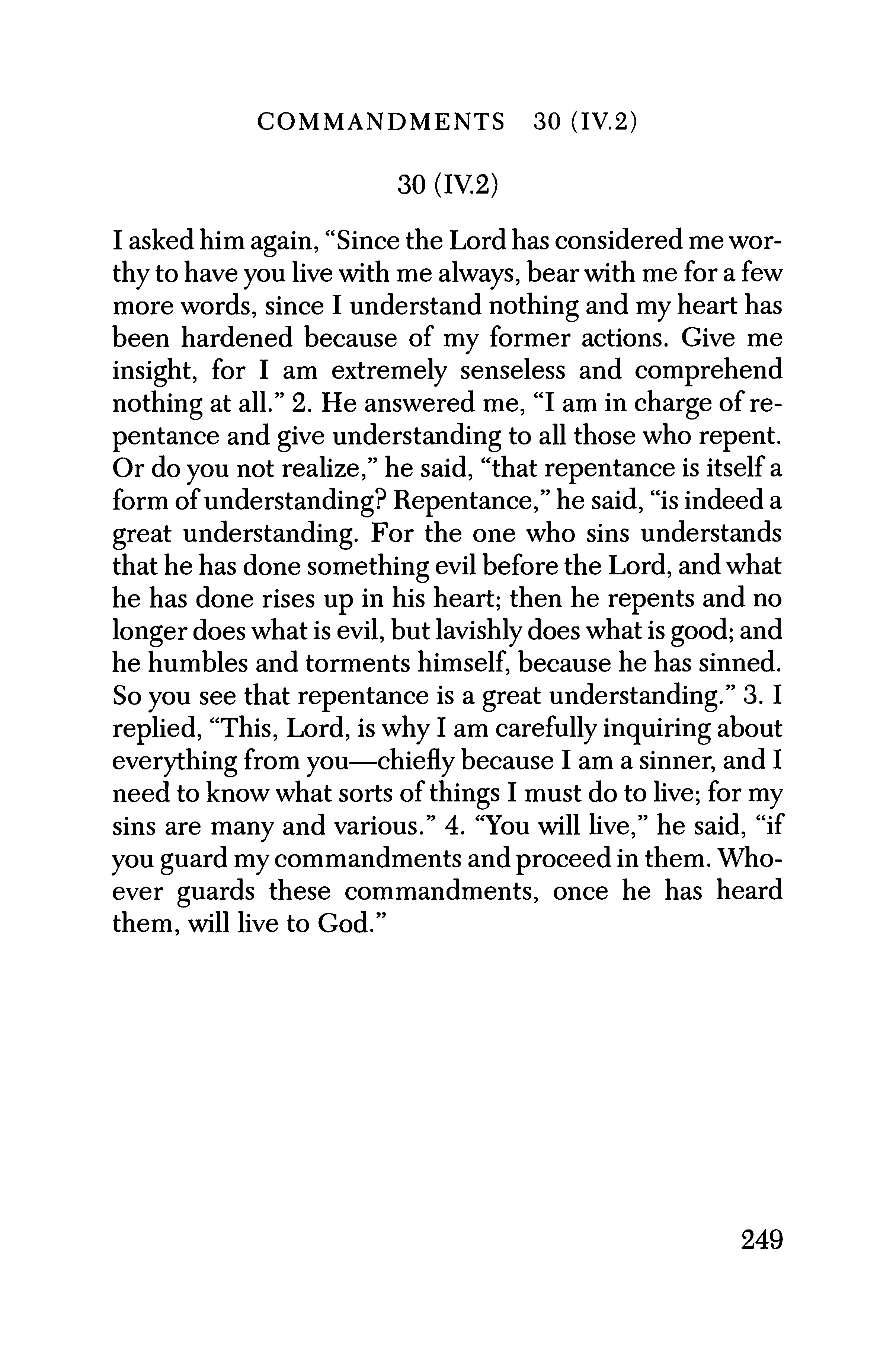
30 (IV.2)
I asked him again, "Since the Lord has considered me wor thy to have you live with me always, bear with me for a few more words, since I understand nothing and my heart has been hardened because of my former actions. Give me insight, for I am extremely senseless and comprehend nothing at all." 2. He answered me, "I am in charge of re pentance and give understanding to all those who repent.
Or do you not realize," he said, "that repentance is itself a form of understanding? Repentance," he said, "is indeed a great understanding. For the one who sins understands that he has done something evil before the Lord, and what he has done rises up in his heart; then he repents and no longer does what is evil, but lavishly does what is good; and he humbles and torments himself, because he has sinned.
So you see that repentance is a great understanding." 3. I replied, "This, Lord, is why I am carefully inquiring about everything from you—chiefly because I am a sinner, and I need to know what sorts of things I must do to live; for my sins are many and various." 4. "You will live," he said, "if you guard my commandments and proceed in them. Who ever guards these commandments, once he has heard them, will live to God."
S H E P H E R D OF HERMAS
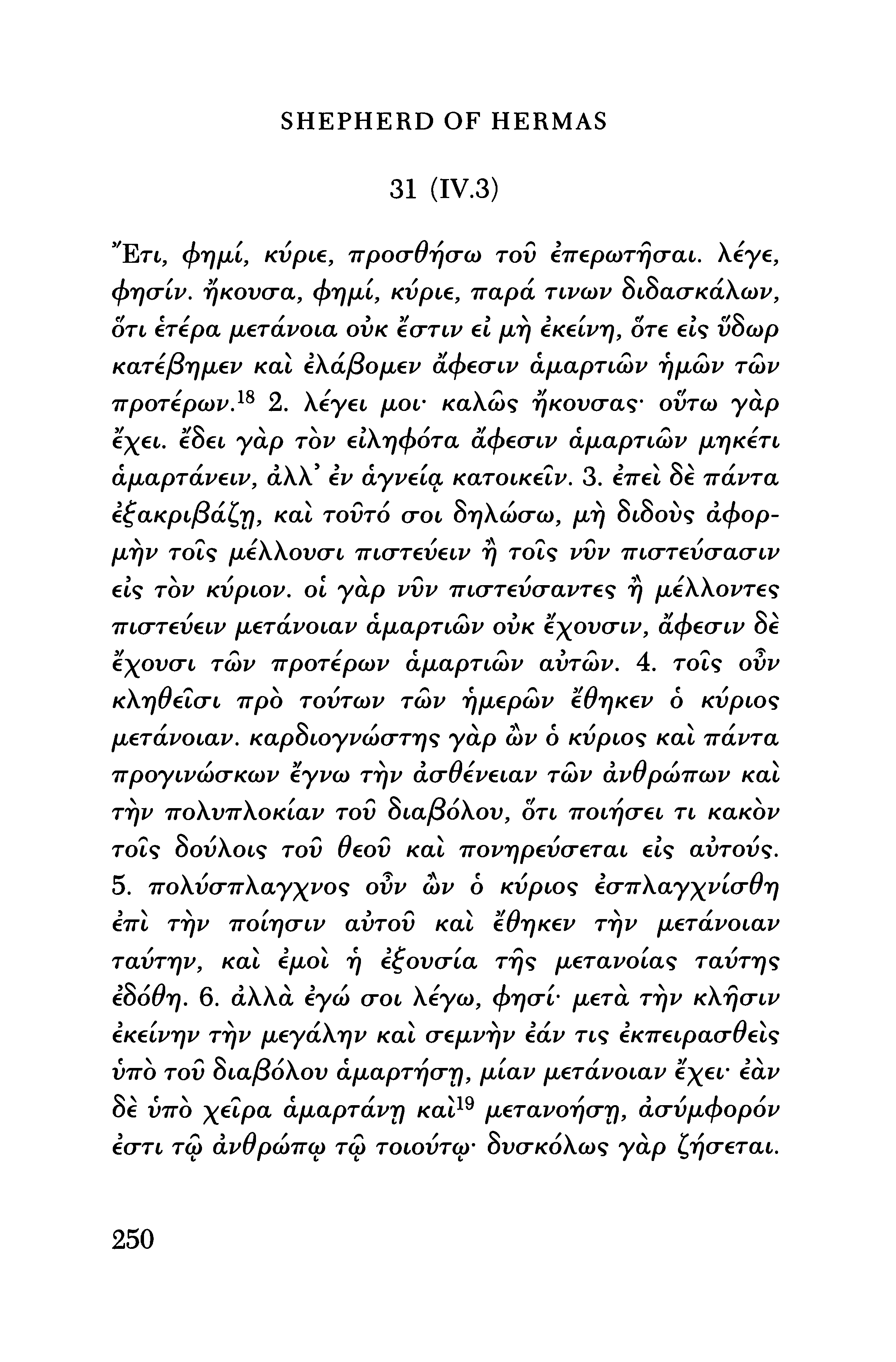
31 (IV.3)
"Ετι, φηρί, κνριβ, προσθήσω τον έπερωτήσαι. λέγε, φησίν. ήκονσα, φηρί, κνριβ, παρά τίνων διδασκάλων, οτι έτερα ρβτάνοια ονκ βστιν βί μή εκείνη, δτβ βίς ύδωρ κατέβημεν καί έλάβομεν άφβσιν αμαρτιών ηρών τών προτέρων.
2. λβγβι μοικαλώς ήκονσαςοντω γάρ έχει. έδει γάρ τον βίληφότα άφβσιν αμαρτιών μηκέτι άμαρτάνβιν, άλλ' βν άγνβία κατοικεΐν.
3. έπεϊ δβ πάντα έζακριβάζη, καί τοντο σοι δηλώσω, μή διδούς άφορμήν τοΐς μέλλονσι πιστεύειν ή τοΐς ννν πιστεύσασιν βίς τον κνρίον. οί γάρ ννν πιστεύσαντες ή μέλλοντες πιστβνβιν μβτάνοιαν αμαρτιών ονκ βχονσιν, άφβσιν δέ έχονσι τών προτέρων αμαρτιών αντών.
4. τοΐς ονν κληθβΐσι προ τούτων τών ήρβρών βθηκβν 6 κύριος ρβτάνοιαν. καρδιογνώστης γάρ ών 6 κύριος καί πάντα προγινώσκων βγνω τήν άσθένβιαν τών ανθρώπων καί τήν πολνπλοκίαν τού διαβόλον, οτι ποιήσει τι κακόν τοΐς δούλοις τού θεού καί πονηρεύσεται εις αυτούς.
5. πολύσπλαγχνος ονν ών 6 κύριος έσπλαγχνίσθη έπι τήν ποίησιν αυτού καί εθηκεν τήν μετάνοιαν ταύτην, καί έμοί ή έζονσία τής μετανοίας ταύτης εδόθη. 6. άλλά έγώ σοι λέγω, φησί· μετά τήν κλήσιν έκείνην τήν μεγάλην καί σεμνήν έάν τις έκπειρασθείς ύπό τού διαβόλον άραρτήση, μίαν μετάνοιαν έχειέάν δέ ύπό χείρα άμαρτάνη καί
COMMANDMENTS
31 (IV.3)
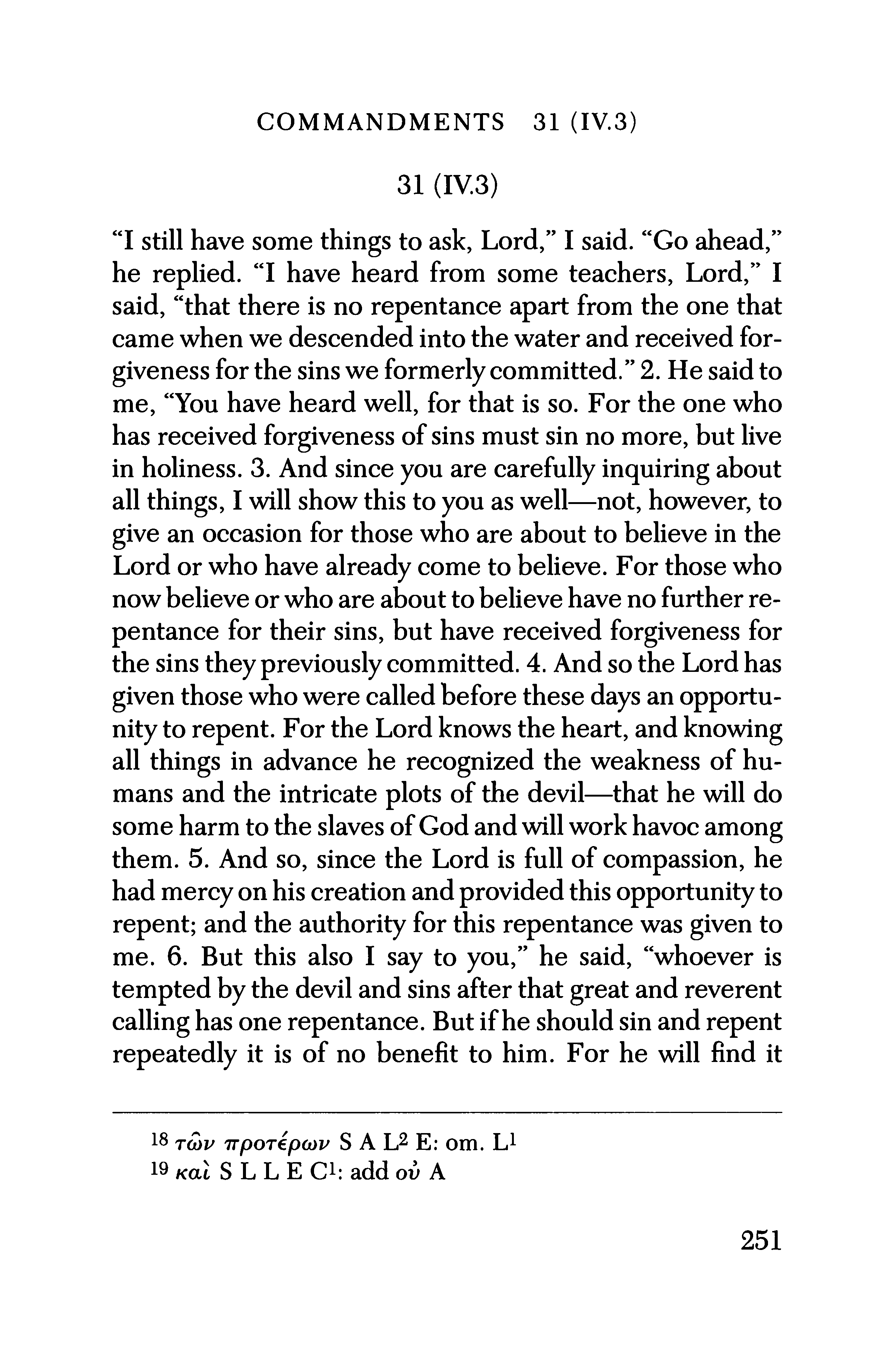
31 (IV.3)
"I still have some things to ask, Lord," I said. "Go ahead," he replied. "I have heard from some teachers, Lord," I said, "that there is no repentance apart from the one that came when we descended into the water and received for giveness for the sins we formerly committed." 2. He said to me, "You have heard well, for that is so. For the one who has received forgiveness of sins must sin no more, but live in holiness. 3. And since you are carefully inquiring about all things, I will show this to you as well—not, however, to give an occasion for those who are about to believe in the Lord or who have already come to believe. For those who now believe or who are about to believe have no further re pentance for their sins, but have received forgiveness for the sins they previously committed. 4. And so the Lord has given those who were called before these days an opportu nity to repent. For the Lord knows the heart, and knowing all things in advance he recognized the weakness of hu mans and the intricate plots of the devil—that he will do some harm to the slaves of God and will work havoc among them. 5. And so, since the Lord is full of compassion, he had mercy on his creation and provided this opportunity to repent; and the authority for this repentance was given to me. 6. But this also I say to you," he said, "whoever is tempted by the devil and sins after that great and reverent calling has one repentance. But if he should sin and repent repeatedly it is of no benefit to him. For he will find it
19 και S L L Ε Ci; add ού A
S H E P H E R D OF HERMAS
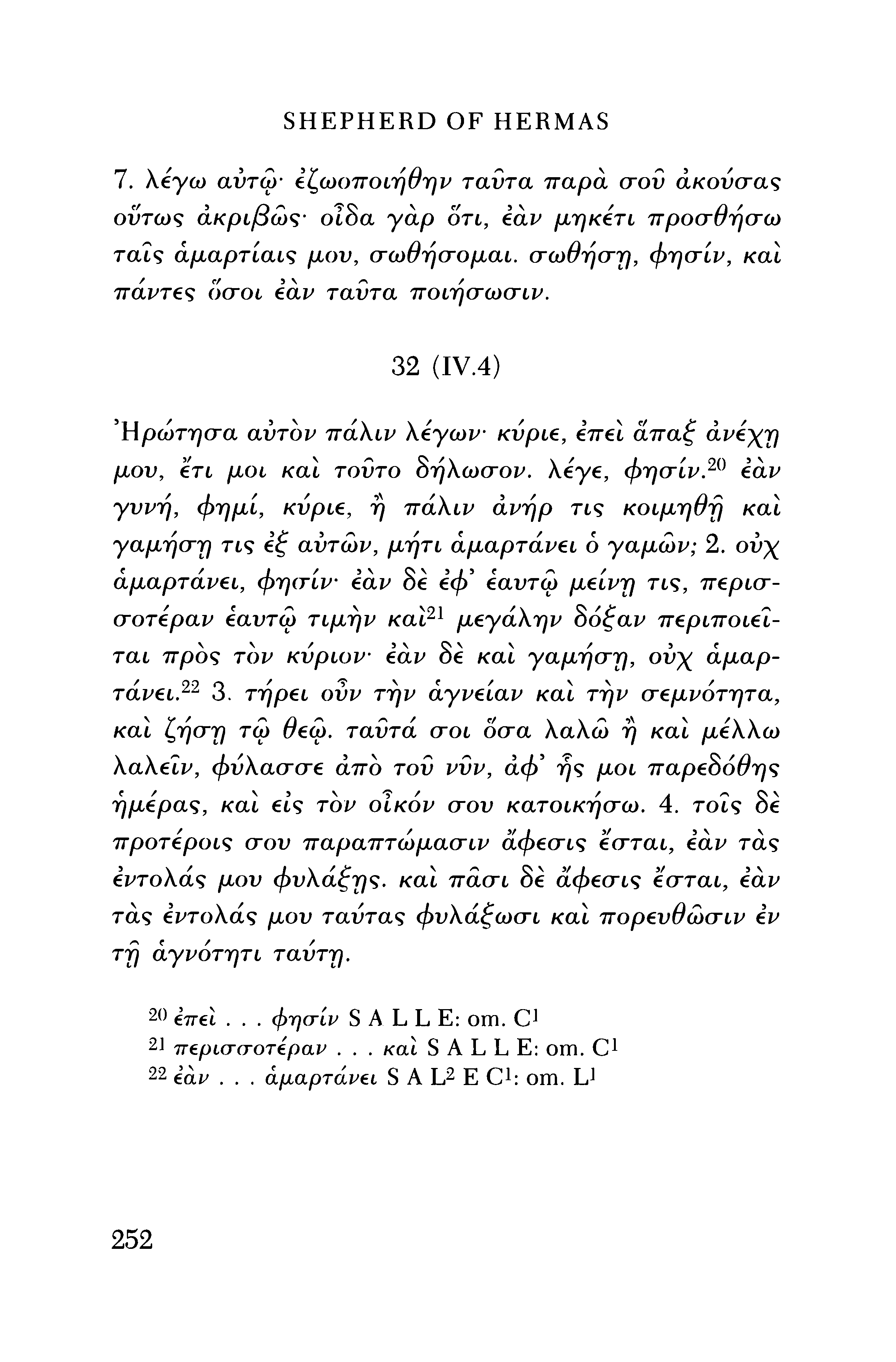
7. λβγω αύτώ· έζωοποιήθην ταντα παρά σον άκουσας όντως ακριβώςοιδα γαρ οτι, eav ρηκέτι προσθήσω ταΐς άραρτίαις ρον, σωθήσοραι. σωθήση, φησίν, καϊ πάντες όσου έάν ταντα ποιήσωσιν.
32 (IV.4)
Ή ρώτησα αντόν πάλιν λέγων κύριε, έπεϊ άπαξ άνέχη ρον, έτι ροι καϊ τοντο 8ήλωσον. λέγε, φησίν.
έάν γννη, φηρί, κύριε, ή πάλιν άνήρ τις κοιρηθή καϊ γαρήση τις έξ αντών, ρήτι άραρτάνει ό γαρών; 2. ονχ άραρτάνει, φησίν έάν Se έφ' έαντώ ρείνη τις, περισσοτέραν έαντώ τιρήν καϊ
3. τήρει ονν τήν άγνείαν καϊ τήν σερνότητα, καϊ ζήση τώ θβώ. ταύτα σοι Οσα λαλώ ή καϊ ρέλλω λαλεΐν, φύλασσε άπο τον ννν, άφ' ής ροι παρεδόθης ήρέρας, καϊ βίς τον οίκον σον κατοικήσω.
4. τοΐς δβ προτέροις σον παραπτώρασιν άφβσις έσται, έάν τάς έντολάς ρον φνλάξης. καϊ πάσι δβ άφβσις εσται, έάν τάς έντολάς ρον ταύτας φνλάξωσι καϊ πορβνθώσιν έν τή άγνότητι ταύτη.
2 0 επεί . . . φησίν S A L L E : om. C ] 2 1 περισσοτεραν . . . καϊ S A L L E : om. C
2 2 βάν . . . άμαρτάνβι S A L 2 Ε C 1: om. L ]
COMMANDMENTS
32 (IV.4)
difficult to live." 7.1 said to him, "I have been made alive by hearing these things from you so accurately. For I know that if I no longer increase my sins, I will be saved." "You will be saved," he replied, "as will everyone else who does these things."
32 (IV.4)
I asked him again, "Lord, since you have borne with me once, reveal this to me as well." "Speak," he said. "Lord," I said, "if a wife or, again, a husband, should die and the sur vivor marry, does the one who marries commit a sin?"
2. "That one does not sin," he said, "but anyone who re mains alone has provided a superior honor for himself and a great glory to the Lord. But if such a one does marry, it is not a sin. 3. And so, maintain your purity and reverence, and you will live to God. From now on, from this day in which you have been entrusted to me, guard all these things that I say and am about to say to you, and I will reside in your house. 4. For your former transgressions will be forgiven if you guard my commandments. And everyone will be forgiven, if they guard these my com mandments and proceed in this purity."
S H E P H E R D OF HERMAS
"Εντολή ε 33 (V.l) Μακρόθνρος, φησί, γίνον καϊ σννετός, καϊ πάντων τών πονηρών έργων κατακνριεύσεις καϊ έργάση πάσαν δικαιοσννην.
2. έάν γάρ ρακρόθνρος εση, το πνεύρα το άγιον το κατοικούν έν σοι καθαρον εσται, ρή έπισκοτούρενον ύπό έτερον πονηρον 22, πνεύρατος, άλλ' έν εύρνχώρω κατοικονν άγαλλιάο-εται καϊ εύφρανθήσεται ρετά τον σκεύονς έν ω κατοικεί, καϊ λειτονργήσει τώ θεώ
έν ίλαρότητι πολλή, έχον τήν εύθηνίαν έν έαντώ. 3. έάν δέ δζνχολία τις προσέλθη, ευθύς το πνενρα το άγιον, τρνφερον ον, στενοχω ρείται, ρή έχον τον τόπον καθαρον, καϊ ζητεί άποστήναι έκ τον τόπον
τον πονηρον πνενρατος, ρή έχον τόπον λειτονργήσαι τώ κνρίω καθώς βονλεται, ριαινόρενον νπό τής όξνχολίας. έν γάρ τή ρακροθνρία ό κύριος κατοικεί, έν δέ τή όξνχολία ό διάβολος.
4. άρφότερα ονν τά πνεύρατα έπϊ τό αυτό κατοικούντα, άσύρφορόν έστιν καϊ πονη ρον τώ άνθρώπω έκείνω έν ω κατοικούσιν.
5. έάν γάρ λάβης άφινθίον ρικρόν λίαν καϊ εις κεράμιον μέλι τος έπιχέης, ούχϊ όλον τό μέλι αφανίζεται; καϊ τοσούτον μέλι ύπό τού ελάχιστον άφινθίον άπόΧλνται-
καϊ άπολλύει τήν γλνκύτητα τού μέλιτος, καϊ ούκετι τήν αυτήν χάριν έχει παρά τώ δεσπότη, ότι έπικράνθη καϊ τήν χρήσιν αυτού άπώλεσεν. έάν δέ εις τό ρέλι ρή βληθή τό άφινθίον, γλνκύ ευρίσκεται τό
COMMANDMENTS
33 ( V I )
Fifth Commandment 33 (VI) "Be patient," he said, "and understanding, and you will rule over every evil work and do all that is righteous. 2. For if you are patient, the holy spirit that dwells in you will be pure and will not be overshadowed by another, evil spirit; but dwelling in a broad place it will rejoice and be glad with the vessel it inhabits, and it will serve God with great cheerfulness, flourishing in itself. 3. But if any irascibility should enter in, immediately the holy spirit, which is sensi tive, feels cramped; and not having a pure place it seeks to leave. For it is suffocated by the evil spirit, not having a place to serve the Lord as it wishes, being polluted by the irascibility. For the Lord dwells in patience, but the devil in irascibility. 4. And so, when both spirits dwell in the same place, it is unprofitable and evil for that person in whom they dwell. 5. For if you take a very small portion of wormwood and pour it into a jar of honey, is not all the honey spoiled? A great deal of honey is ruined by the least bit of wormwood. It destroys the sweetness of the honey, which is no longer pleasing to the master, because it has become bitter and lost its value. But if the wormwood is not put into the honey, the honey is found to be sweet and 2 3 έτερον πονηρον L 1 Ε C 1: έτερον Α: πονηρον L
2 6 νπό L L Ε C 1: ρνπω A 2 7 τοσοντον . . . άπόΧΚνται L 1 (L 2) Ε: πικρόν γίνεται A
S H E P H E R D OF HERMAS
6. βλέπεις οτι ή ρακροθνρία γλνκντάτη εστίν υπέρ τό ρέλι και ενχρηστός εστι τώ κνρίω,
κατοικεί, ή δε όζνχολία πικρά και άχρηστος εστίν, εάν ονν ριγή ή όζνχολία τή ρακροθνρία, ριαίνεται ή μακροθνμία, καϊ ονκ ενχρηστός εστι τώ θεώ ή εντενζις αυτής.
7. ήθελον, φηρί, κύριε, γνώναι τήν ένέργειαν τής όζνχολίας, ΐνα φνλάζωμαι άπ' αντής. καϊ μήν, φησίν, εάν μή φνλάζη άπ' αντής σν και ό οίκος σον, άπώλεσάς σον τήν πάσαν ελπίδα, άλλά φνλαζαι άπ αντής· εγώ γάρ μετά σον ειμί. καϊ πάντες δέ άφέζονται άπ' αντής, Οσοι άν μετανοήσωσιν έζ όλης τής καρδίας αντών ρετ αντών γάρ έσομαι καϊ σνντηρήσω αντονς· έδικαιώθησαν γάρ πάντες νπό τον σερνοτάτον άγγέλον.
34 (V.2) Άκονε ννν, φησί, τήν ένέργειαν τής όζνχολίας, πώς πονηρά έστι, και πώς τονς δονλονς τον θεον κατα στρέφει τή εαυτής ενεργεία, καϊ πώς αποπλανά αν τονς άπο τής δικαιοσύνης, ούκ αποπλανά δέ τούς πλήρεις όντας έν τή πίστει, ουδέ ένεργήσαι δύναται εις αυτούς, ότι ή δύναρις τού θεού
2. όταν γάρ ϊδη τούς τοιούτονς άνθρώπονς εύσταθούντας, παρερβάλλει έαντήν εις τήν καρδίαν τού άν θρωπον εκείνον, καϊ έκ τού ρηδενός ή γννή ή ό άνήρ
COMMANDMENTS
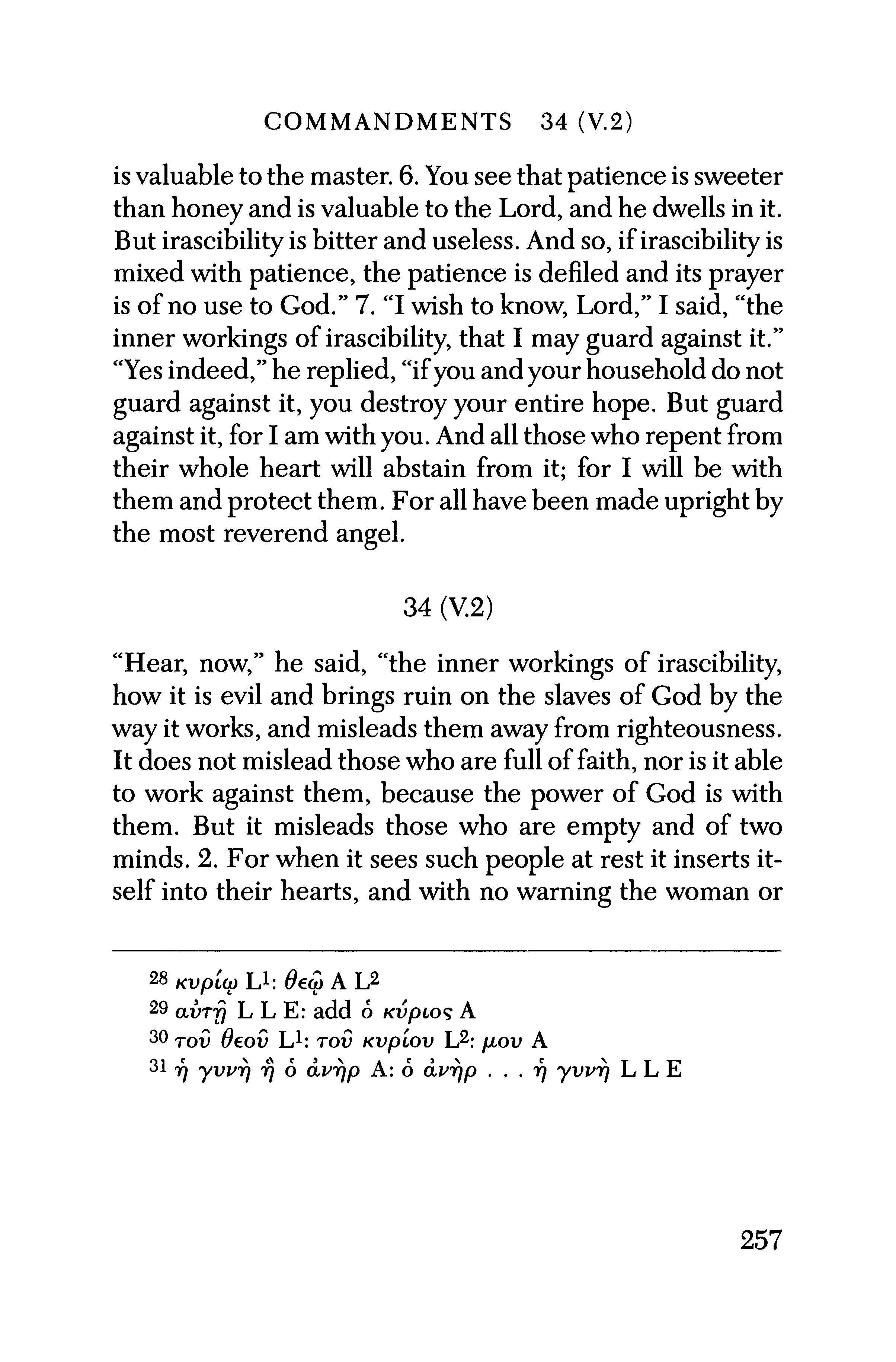
34 (V.2) is valuable to the master. 6. You see that patience is sweeter than honey and is valuable to the Lord, and he dwells in it.
But irascibility is bitter and useless. And so, if irascibility is mixed with patience, the patience is defiled and its prayer is of no use to God." 7. "I wish to know, Lord," I said, "the inner workings of irascibility, that I may guard against it."
"Yes indeed," he replied, "if you and your household do not guard against it, you destroy your entire hope. But guard against it, for I am with you. And all those who repent from their whole heart will abstain from it; for I will be with them and protect them. For all have been made upright by the most reverend angel.
34 (V.2) "Hear, now," he said, "the inner workings of irascibility, how it is evil and brings ruin on the slaves of God by the way it works, and misleads them away from righteousness.
It does not mislead those who are full of faith, nor is it able to work against them, because the power of God is with them. But it misleads those who are empty and of two minds. 2. For when it sees such people at rest it inserts it self into their hearts, and with no warning the woman or 28 κνρίω L l : θεώ A L2 29 avrrj L L E: add ό κύριος A 3 0 rod θεον L 1 : rov κνρίον L 2 : μον A 3 1 r) yvvr) rj 6 άνήρ A: 6 άνήρ . . . ή γννή L L Ε
S H E P H E R D OF HERMAS
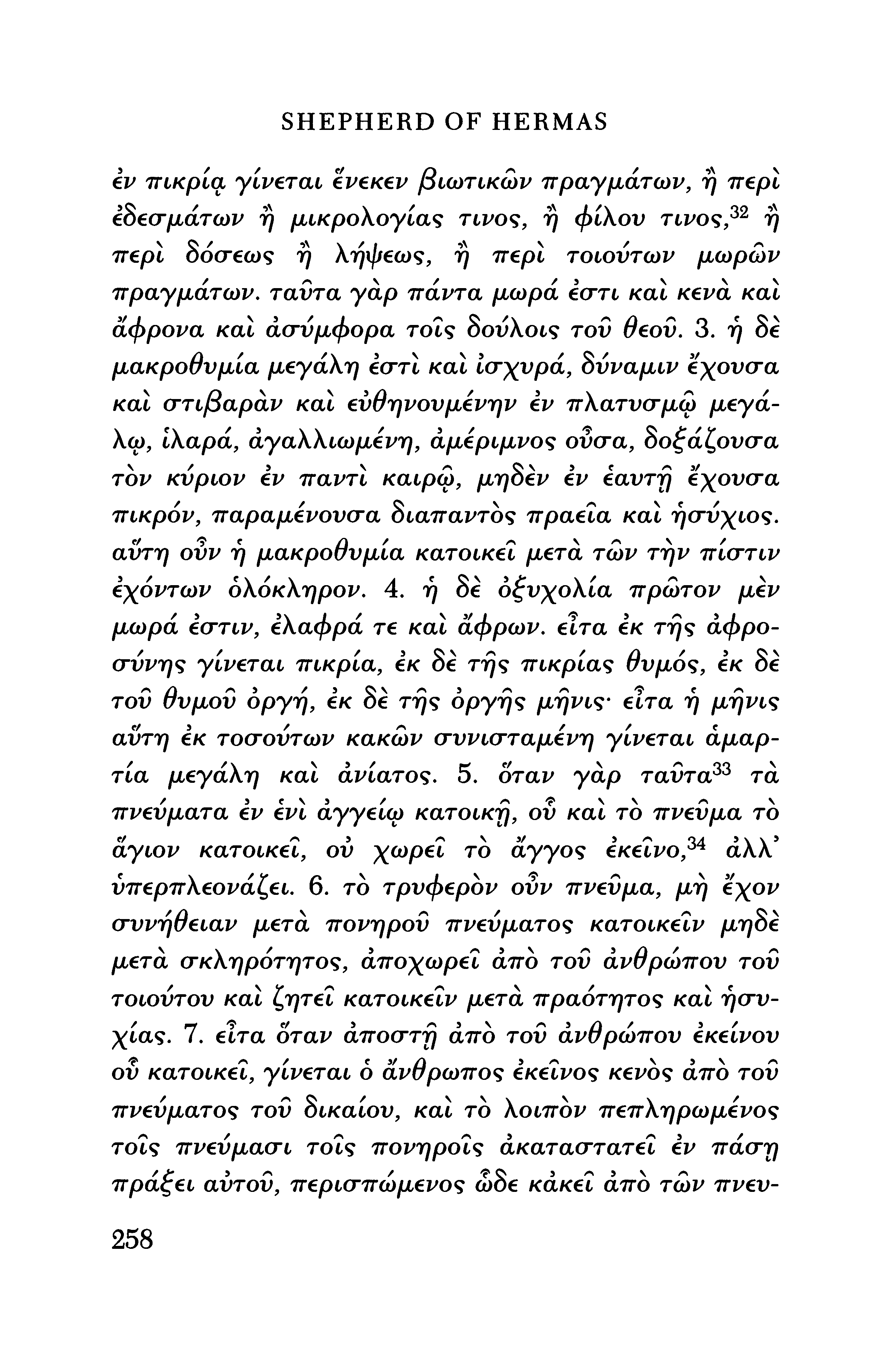
έν πικρία γίνεται ένεκεν βιωτικών πραγράτων, ή περί εδεσμάτων ή μικρολογίας τίνος, ή φίλον τίνος,
ή περί δόσεως ή λήψεως, ή περί τοιούτων μωρών πραγμάτων, ταντα γάρ πάντα ρωρά εστι καϊ κενά καϊ άφρονα καϊ άσύρφορα τοΐς δούλοις τον θεον. 3. ή δέ ρακροθνρία ρεγάλη έστι καϊ ισχυρά, δύναμιν εχονσα καϊ στιβαράν καϊ εύθηνονμένην έν πλατνσμώ μεγάλω, ιλαρά, άγαλλιωμένη, αμέριμνος ούσα, δοξάζονσα τον κνρίον έν παντϊ καιρώ, μηδέν έν έαντή εχονσα πικρόν, παραρένονσα διαπαντός πραεΐα καϊ ήσύχιος. αύτη ονν ή ρακροθνρία κατοικεί ρετά τών τήν πίστιν εχόντων όλόκληρον.
4. ή δέ όζνχολία πρώτον ρέν ρωρά έστιν, ελαφρά τε καϊ άφρων, είτα έκ τής αφρο σύνης γίνεται πικρία, έκ δέ τής πικρίας θνρός, έκ δέ τού θνρού οργή, έκ δέ τής οργής ρήνιςείτα ή ρήνις αύτη έκ τοσούτων κακών σννισταρένη γίνεται άραρτία ρεγάλη καϊ ανίατος.
τά πνεύρατα έν ένϊ άγγείω κατοική, ον καϊ τό πνεύρα τό άγιον κατοικεί, ού χωρεί τό άγγος εκείνο,
6. τό τρνφερόν ονν πνεύμα, μή έχον σννήθειαν μετά πονηρού πνεύρατος κατοικεΐν ρηδέ ρετά σκληρότητος, αποχωρεί άπο τού άνθρωπον τού τοιούτον καϊ ζητεί κατοικεΐν ρετά πραότητος καϊ ήσνχίας. 7. είτα όταν άποστή άπο τού άνθρωπον εκείνον ον κατοικεί, γίνεται ό άνθρωπος εκείνος κενός άπο τού πνεύρατος τού δίκαιον, καϊ τό λοιπόν πεπληρωμένος τοΐς πνεύμασι τοΐς πονηροΐς άκαταστατεΐ έν πάση πράξει αυτού, περισπώμενος ώδε κάκεΐ άπο τών πνεν-
COMMANDMENTS
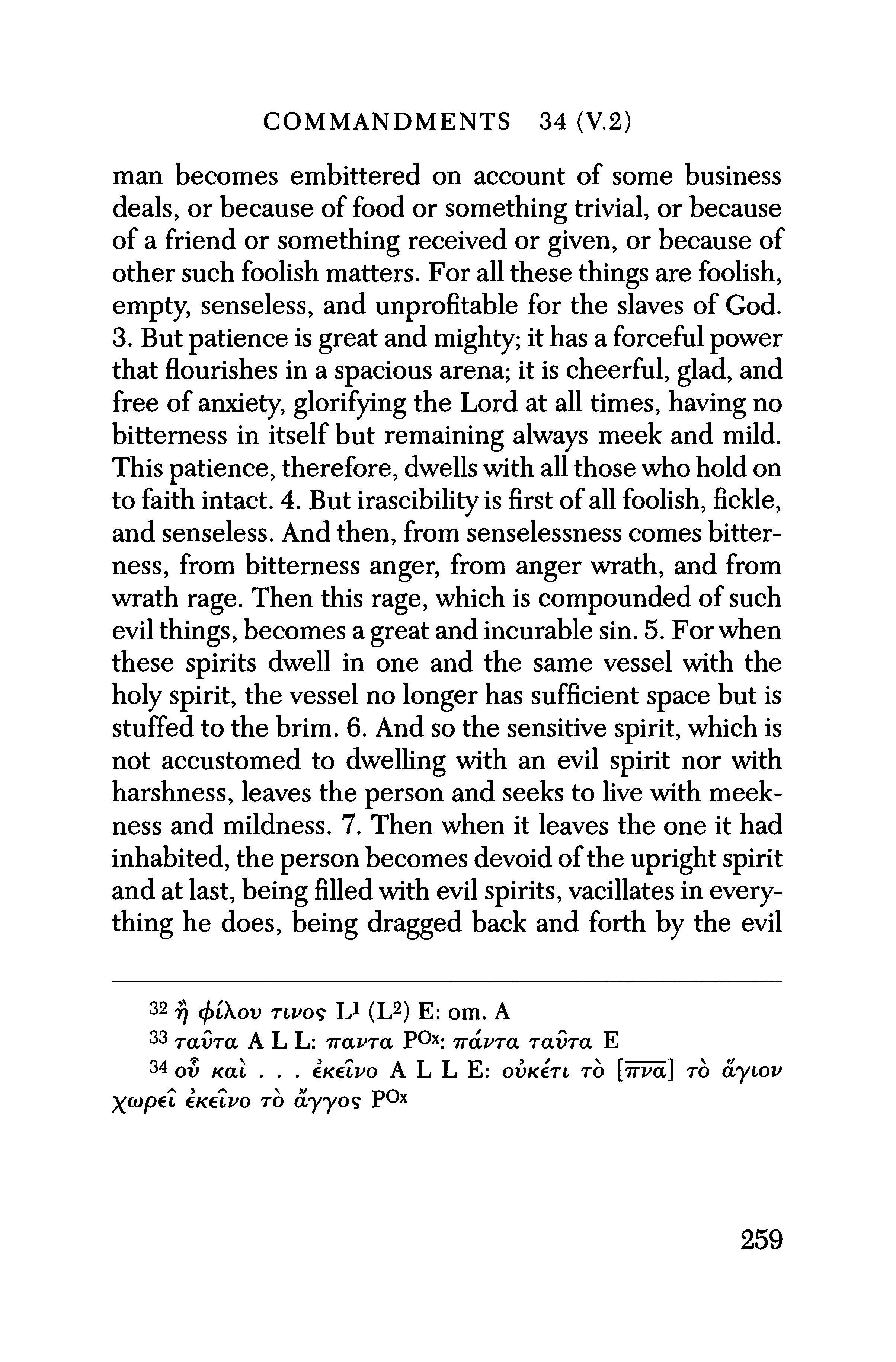
34 (V.2) man becomes embittered on account of some business deals, or because of food or something trivial, or because of a friend or something received or given, or because of other such foolish matters. For all these things are foolish, empty, senseless, and unprofitable for the slaves of God.
3. But patience is great and mighty; it has a forceful power that flourishes in a spacious arena; it is cheerful, glad, and free of anxiety, glorifying the Lord at all times, having no bitterness in itself but remaining always meek and mild.
This patience, therefore, dwells with all those who hold on to faith intact. 4. But irascibility is first of all foolish, fickle, and senseless. And then, from senselessness comes bitter ness, from bitterness anger, from anger wrath, and from wrath rage. Then this rage, which is compounded of such evil things, becomes a great and incurable sin. 5. For when these spirits dwell in one and the same vessel with the holy spirit, the vessel no longer has sufficient space but is stuffed to the brim. 6. And so the sensitive spirit, which is not accustomed to dwelling with an evil spirit nor with harshness, leaves the person and seeks to live with meek ness and mildness. 7. Then when it leaves the one it had inhabited, the person becomes devoid of the upright spirit and at last, being filled with evil spirits, vacillates in every thing he does, being dragged back and forth by the evil
3 2 ή φίλου τίνος L 1 (L 2) Ε: om. A 3 3 ταντα A L L : πάντα P 0 x : πάντα ταντα Ε 3 4 ον καϊ . . . εκείνο A L L Ε: ονκέτι το [πνα] το άγιον χωρεΐ εκείνο το άγγος Ρ ° χ
S H E P H E R D OF HERMAS
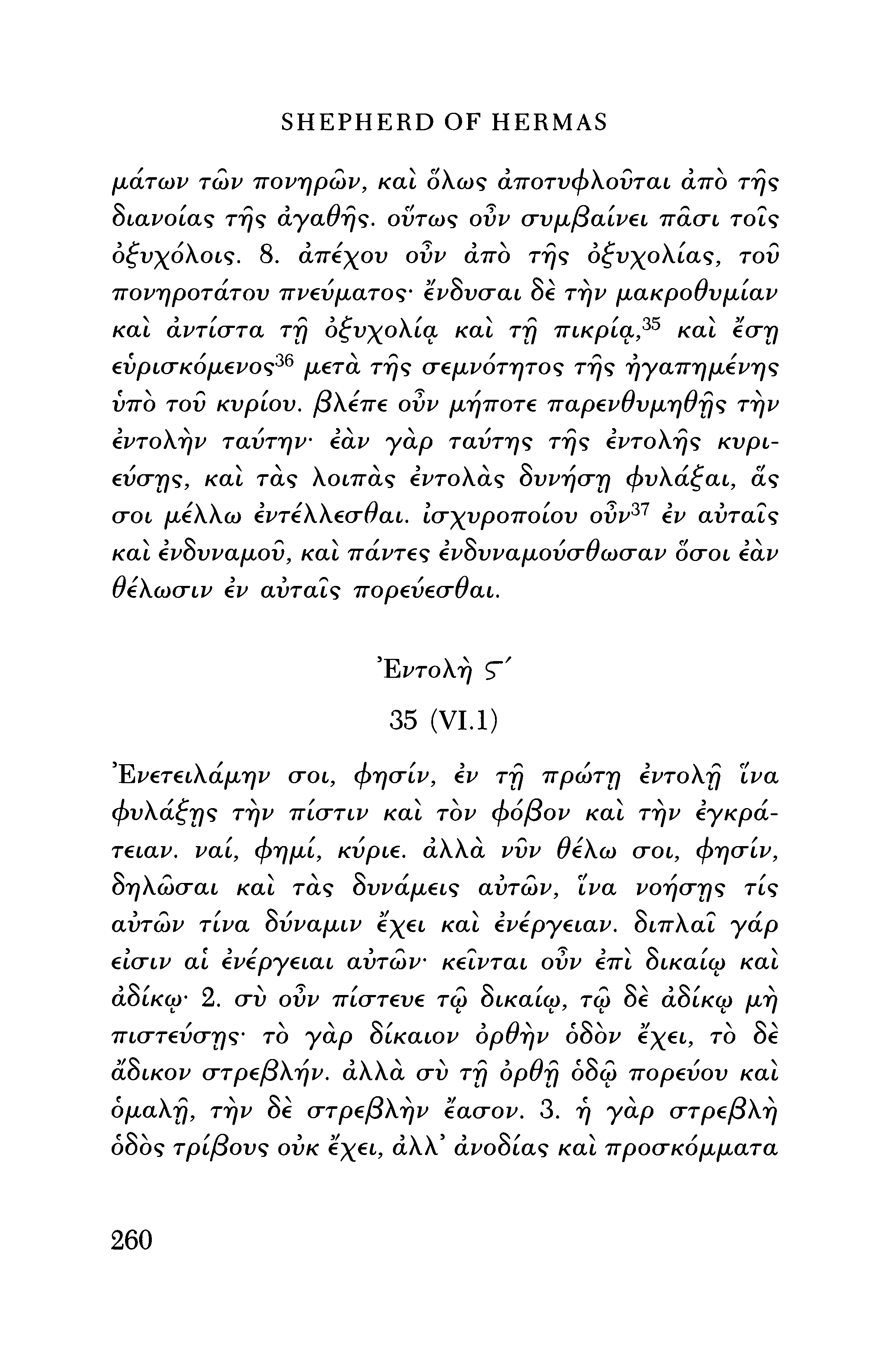
ράτων τών πονηρών, καϊ όλως άποτνφλούται άπο της διανοίας της αγαθής, όντως ονν σνρβαίνει πάσι τοΐς όξνχόλοις.
8. άπέχον ονν άπο τής όξνχολίας, τον πονηροτάτον πνενρατος· ένδνσαι δέ τήν ρακροθνρίαν καϊ άντίστα τή όζνχολία καϊ τή πικρία,
ρετά τής σερνότητος τής ήγαπηρενης νπό τον κνρίον. βλέπε ονν ρήποτε παρενθνρηθής τήν έντολήν ταύτην εάν γάρ ταύτης τής εντολής κνριεύσης, καί τάς λοιπάς έντολάς δννήση φνλάζαι, άς σοι ρελλω εντελλεσθαι. ίσχνροποίον ονν
εν αύταΐς καί ένδνναρού, καί πάντες ένδνναμούσθωσαν δσοι εάν θελωσιν εν αύταΐς πορεύεσθαι.
35 (VI.1)
'Έινετειλάρην σοι, φησίν, εν τή πρώτη εντολή ΐνα φνλάζης τήν πίστιν καί τον φόβον καί τήν εγκράτειαν. ναι, φηρί, κύριε, άλλά νύν θελω σοι, φησίν, δηλώσαι καϊ τάς δννάρεις αυτών, ΐνα νοήσης τίς αυτών τίνα δύναριν έχει καί ενέργειαν. διπλαΐ γάρ είσιν αί ενεργειαι αυτών κείνται ούν επϊ δικαίω καϊ άδίκω2. σύ ούν πίστενε τώ δικαίω, τώ δέ άδίκω ρή πιστεύσης· το γάρ δίκαιον δρθήν οδον έχει, το δέ άδικον στρεβλήν. άλλά σύ τή ορθή όδώ πορεύον καί όραλή, τήν δέ στρεβλήν έασον.