
On the Question of Comparative Method in Historical Research
On the Question of Comparative Method in Historical Research:
Colossae and Chonai in Larger Frame Alan H. Cadwallader At the conclusion of an overview essay on the development of the city of Aphrodisias, Chris Ratté reflected that "archaeologists tend to vacillate between the extremes of seeing their sites as unique and as exemplars of general trends. All cities are both, and much historical research boils down to trying to distinguish between the typical and the exceptional … of what cities had in common with each other and of how a particular city forged its own local identity."1 Regional comparison can yield considerable insight, as, for example, in Rosalinde Kearsley's study of Latin and Greek bilingual inscriptions providing a measure of the chronology, societal level, geographic spread and degree of linguistic and cultural interaction across Asia.2 Comparative archaeology and history can be turned to the 1. Christopher Ratté, "The Founding of Aphrodisias," in Aphrodisias Papers 4:
New Research on the City and Its Monuments, ed. Christopher Ratté and R. R. R. Smith
(Portsmouth: Journal of Roman Archaeology, 2008), 36.
2. IK 59. The collection includes one example from Hierapolis (IK 59.169) and four from Laodicea (IK 59.56, 57, 96, 170). Significantly perhaps, there is only one from Kibyra (IK 59.95), the city after which the conventus organizing Roman administration in the Lycus Valley, was named. See, however, from Kormasa, 80 km due northeast of Kibyra, a bilingual inscription not included by Kearsley, possibly because it fell into the province of Pisidia: N. P. Milner, An Epigraphical Survey in the KibyraOlbasa Region, RECAM 3 (London: BIAA, 1998), §152. Aphrodisias also has only one example (§128), significant because the city is the other contender for the assize center in the third century, according to some interpreters, on the basis of viewing Aphrodisias as the capital of the new province of Caria; see C. Roueché, Aphrodisias in Late
Antiquity: The Late Roman and Byzantine Inscriptions, rev. 2nd ed. (London: King's
College, 2004), 1.5, 1.9–10 (with qualifications).
Alan H. Cadwallader highlighting of characteristics that mark out one city from another, for example. But they can also obfuscate distinctives that may characterize particular locations or even particular aggregations within a single location. Given the inheritance of competition between Greek poleis in Asia under Roman rule, and the interest of imperial authorities in cultivating contained rivalry as a mechanism for reinforcing imperial commitments,3 a comparative approach, carefully directed, is clearly the way forward, even when narrowed to the investigation of an isolated site.
Michael Smith and Peter Peregrine have detailed nine dimensions for harnessing the value of comparative work. These are sample size (the number of cases compared), sample selection (what governs the cases brought into interpretative play), contextualization (the extent to which a context is provided for any particular artifact or text), scale (how vast is the societal focus), primary and secondary data, archaeological and historical data, synchronic and diachronic comparisons, the stage in the research trajectory at which the comparison is invoked, spatial and temporal domains.4 All these factors are critical as a methodological hold on comparative research to provide a check on compression whereby overarching interpretations skim over local distinctives and a check on idiosyncracy, whereby the local (defined anywhere from infra-city to infra-region) is somehow hermetically sealed from outside influence.
When one's focus is turned to Colossae/Chonai, the comparative method becomes immensely attractive precisely because of the poverty of material and textual resources. Indeed, one might argue that the succeeding imperial sweep of Seleucid and Roman control cultivates a recognition of impact on everything from agriculture to architecture that emanates from a center located elsewhere. The chora basilike of the Seleucids, asserted through Asia (albeit with regular interruptions and challenges), did bring wide-ranging adjustments to human and religious settlement.5
3. See, generally, Anna Heller, "Les bêtises des Grecs": Conflits et rivalités entre cites d'Asie et de Bithynie à l'époque romaine (129 a.C.–234 p.C.) (Bordeaux: de Boccard, 2007).
4. See Michael E. Smith and Peter Peregrine, "Approaches to Comparative Analysis in Archaeology," in The Comparative Archaeology of Complex Societies, ed. Michael
E. Smith (Cambridge: Cambridge University Press, 2011), 4, 9–15.
5. See Christian Mileta, Der König und sein Land: Untersuchungen zur Herrschaft der hellenistischen Monarchen über das königliche Gebiet Kleinasiens und seine Bevölkerung (Berlin: Akademie Verlag, 2008).
Colossae and Chonai in Larger Frame
One need only point to the Seleucid penchant for colonization that so comprehensively made use of royal landholdings (as well as existing cities on occasion) to recognize the flow-on effects in linguistic change, appropriation of myths and cultural expression, let alone economic infrastructure.6
A significant hint that Colossae was caught into this almost-programmatic Hellenization may be late in appearing, but it is clear both numismatically and onomastically.7 The Treaty of Apameia of 188 BCE established the independence of the Attalid kingdom, but many of the cultural markers fostered by the Seleucids remained intact. Indeed, the devolving shift in Attalid benefaction and support allowed a greater parade of self-identification by cities even as Attalid control was enhanced.8
The earliest known coins of Colossae are thought to come from the mid-second to early first century, that is, in the period of Attalid rule characterized numismatically by "a patchwork of types, denominations and weight-standards produced in different places at different times."9 Three types are known, though only one has gained formal catalogue publication and analysis.10
6. See Bezalel Bar-Kochva, The Seleucid Army: Organization and Tactics in the Great Campaigns (Cambridge: Cambridge University Press, 1976), 26; Richard A. Billows, Kings and Colonists: Aspects of Macedonian Imperialism (Leiden: Brill, 1995),
146; see generally, Getzel M. Cohen, The Seleucid Colonies: Studies in Founding,
Administration and Organization (Wiesbaden: Steiner, 1978); Frank Daubner, "Seleukidische und attalidische in Westkleinasien—Datierung, Funktion und Status," in Militärsiedlungen und Territorialherrschaft in der Antike, ed. Frank Daubner (Berlin: de
Gruyter, 2011), 41–63.
7. Nicholas Wright ("Seleucid Royal Cult, Indigenous Religious Tradition and Radiate Crowns: The Numismatic Evidence," Med Arch 18 [2005]: 71) sees the coinage especially as stressing "the Greek character of the empire." Compare the nuanced assessment of Rolf Strootman: "in the course of time a supranational imperial culture came into existence based on the Hellenic culture of the court"; Rolf Strootman,
"Seleucids," in The Encyclopedia of Ancient History, ed. Roger Bagnall et al. (Malden:
Wiley-Blackwell, 2012), 6122.
8. See Peter Thonemann, "The Attalid State, 188–133 BC," in Attalid Asia Minor:
Money, International Relations and the State, ed. Peter Thonemann (Oxford: Oxford
University Press, 2013), 38, 47.
9. Andrew Meadows, "The Closed Currency System of the Attalid Kingdom," in Thonemann, Attalid Asia Minor, 195.
10. Hans von Aulock, Münzen und Städte Phrygiens, 2 vols., IstMitt 25, 27 (Tübingen: Wasmuth, 1980–1987), 2.43–46. Additional examples may be found at https://gallica.bnf.fr/ark:/12148/btv1b103235058 and https://tinyurl.com/SBL4218a1. A fourth
Alan H. Cadwallader
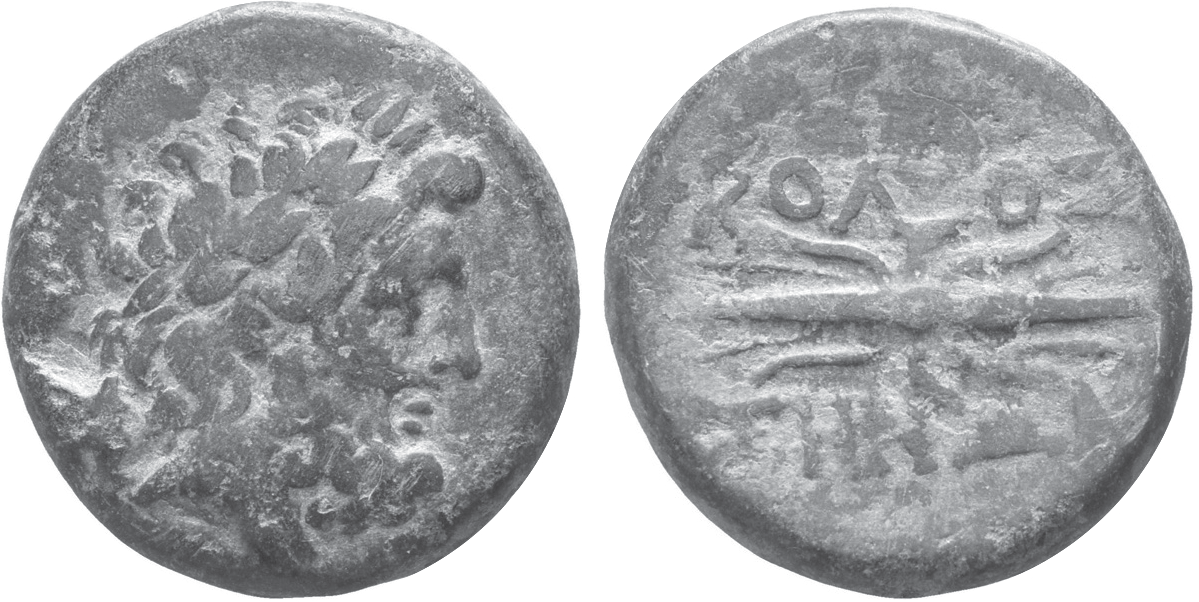
Fig. 4.1. Hellenistic coin of Colossae, probably mid-second century BCE.
Zeus and his thunderbolt.
From a private collection, used by permission.
The published coin has an obverse with the laureate head of Zeus facing right and a reverse of a winged thunderbolt contained in parallel by the legend ΚΟΛΟΣ | ΣΗΝΩΝ.11 The stock interpretative approach to such numismatic evidence is reductive—simply asserting the presence of a cult of Zeus at Colossae.12 Occasionally the combination of images expands the name to Zeus Bronton. Such an atomistic sampling of artefacts may succeed as a reasonable commentary, if diachronic corroboration is gathered from the prevalence of Zeus on Colossae's imperial coinage and/or other remains.13 But a comparative approach type was suggested by an auction house for a coin that came onto the market in 2012, but the coin is so worn as to defy confidence, even though it appears to display late Hellenistic iconography (obverse: laureate head of Zeus; reverse: standing Demeter holding sheaves in her right hand and a scepter in her left). See https://tinyurl.com/SBL4218d.
11. The inscription uses a four-bar sigma which disappears when Colossae's mint reemerges early in the reign of Hadrian, to be replaced by a lunate style.
12. For examples of this practice, see Markus Barth and Helmut Blanke, Colossians, trans. Astrid B. Beck, AB 34B (New York: Doubleday, 1994), 11; Clinton E.
Arnold, The Colossian Syncretism: The Interface between Christianity and Folk Belief at Colossae (Grand Rapids: Baker, 1996), 107–8; Lukas Bormann, Der Brief des Paulus an die Kolosser, THKNT 10.1 (Leipzig: Evangelische Verlagsanstalt, 2012), 22. For a caution against a too-ready equation, see Barbara Levick, Roman Colonies in Southern
Asia Minor (Oxford: Clarendon, 1967), 130–32. Compare Barclay Head's comments that, in spite of the variety of types in the Colossian catalogue, he considers them to be like medallions, issued only for "religious festivals and games" (BMC Phrygia, pp. l–li). The sheer variety of weights and sizes—exactly as one would expect for different values—renders this most unlikely. That Colossae's coins were part of currency exchange is clear from a recently-surfaced Geta-Artemis Ephesiaca coin with a Sardis countermark (CAPB) designating a value of two assaria: see http://www.vcoins.com/ ancient/tomvossen/store/searchitem.asp.
13. Von Aulock, Münzen und Städte Phrygiens 2.458–60 (Nikephoros); 470 (laureate head); 471–482, 534–536, 546–547, 580, 588, and 590 (Aetophoros). Note that
Colossae and Chonai in Larger Frame
affords greater sophistication in results. The iconography of both faces in fact closely imitates some coinage of the royal Seleucid mints. Other cities did the same,14 albeit, like Colossae, confirming their own cultural inheritance from the appropriated representation. Although civic bronzes of the late Seleucid, Attalid, and Roman republic times often began to exert their own creativity,15 Colossae was quite restrained. But of particular significance, given Colossae's pre-Greek eminence (see
Xenophon, Anab. 1.2.6; Herodotus, Hist. 7.30; Diodoros Siculus, Bib. hist. 14.80.8; Polyaenus, Strateg. 7.16), is that the chosen representation is drawn from bronzes (not gold or silver) of mints further east, not the Seleucid coinage of the western Mediterranean sea-board.16 In other occasionally Zeus Aetophoros is dubbed Zeus Laodikensis on the basis of the frequency of this representation at Laodicea—this is misleading; so Christopher Howgego, Greek Imperial Countermarks: Studies in the Provincial Coinage of the Roman
Empire (London: Royal Numismatic Society, 1985), 157. Some have identified a blend between mediate Serapis and Zeus on other coins from Colossae—this invites further enquiry; compare David Magie, "Egyptian Deities in Asia Minor in Inscriptions and on Coins," AJA 57.3 (1953): 163–87; James Walters, "Egyptian Religions in Ephesos," in Ephesos: Metropolis of Asia: An Interdisciplinary Approach to its Archaeology, Religion, and Culture, ed. Helmut Koester, HTS 41 (Valley Forge: Trinity Press International, 1995), 281–309, who however, omits numismatic evidence.
14. See, for example, the very similar Zeus-thunderbolt coin from Abbaitis in eastern Phrygia, distinguished only by a wreath circling the thunderbolt: BMC Phrygia 1.1–7, plate 2.1. The addition of the wreath is found on coins issued by the mint of Seleuceia Pieria in the first century BCE.
15. S. Psoma, "War or Trade? Attic-Weight Tetradrachms in Seleukid Syria," in Thonemann, Attalid Asia Minor, 294.
16. Edward T. Newell, The Coinage of the Western Seleucid Mints: From Seleucus I to Antiochus III, with a Summary of Recent Scholarship by Otto Mørkholm (New York:
American Numismatic Society, 1977), 86–87 §894, 896, 898, 899 [with split placename] and plate 15.2, 6, 8, 10 (Seleucia Pieria; Seleucus I); 107 §§949–951 and plate
19.8–14 (Antioch; Seleucus I, some with monogram and additional symbols); see also in an addendum to Newell's volume on "Eastern Seleucid Mints," plate 1.17 (Seleucia on the Tigris; Antiochus II). See also Robert H. McDowell, Stamped and Inscribed
Objects from Seleucia on the Tigris (Ann Arbor: University of Michigan Press, 1935),
115 who noted the Greek association of the thunderbolt with fertility (n. 6). Newell considers that the die-cutters, or at least their styles, for the mints on the eastern
Mediterranean seaboard came from Seleucia on the Tigris (Coinage of the Western Seleucid Mints, 97). Newell's observations in this instance have been substantially confirmed by Arthur Houghton and Catharine C. Lorber, Seleucid Coins: A Comprehensive Catalogue, 2 vols. (New York: American Numismatic Society, 2002, 2008), even
Alan H. Cadwallader words, Colossae—on the basis of this Hellenistic coin—is continuing to look toward the Achmaenid east of its past hey-days,17 albeit through the lens of Seleucid preferences combined with the advantages to be gained from the new Attalid realities. Attalid rule, following the Peace of Apameia, probably devolved to Colossae the ability to mint and name its own bronze coinage. The recognition of additional Attalid favorites, such as Athena and Dionysos, and the dynastic hero-founder, Heracles, has only begun to be evidenced for Colossae's Hellenistic coins, with a single small bronze featuring Artemis on the obverse with the lion pelt and club of Heracles on the reverse.18 This coin must await further analysis.
However, another significant coin-type suggests that Colossae had deliberately adopted the second of the two favored Seleucid gods, Zeus and Apollo.19 The royal romance propaganda lauded Apollo as providing the paternity for Seleucus I; accordingly, the blood-line of the Seleucids was set.20 This coin again involves Colossae's selection from the narrow range of bronze coin imagery, accenting a radiate Apollo with the choice though this generally improved catalogue does not distinguish between "plain" and "winged" thunderbolts: 1.32–33 (Seleucus I); 1.343–344, 1.355–356 (Antiochus I);
1.625–626, 1.638 (Antiochus II). It does however note what it calls "thundering Zeus" iconography, that is, an advancing Zeus brandishing a thunderbolt (see, for example,
1.635–637. I recognize that my use of eastern may be confusing here. For the Seleucid
Empire, east is generally understood as indicating Mesopotamia, Bactria, and beyond, with west encompassing Levantine cities such as Antioch on the Orontes as well as the more familiar area of Asia Minor. Even so, for Colossae, regardless of the origins of most of the early iconographic features (see next note), these cities to her east, rather than the output from Sardis and other western mints, appear to have provided the template.
17. This east-bearing compass is implicit in the early testimonia of Colossae and is reflected on the ground with the stylistic parallels to various strata of pottery; see my "The Historical Sweep of the Life of Colossae," in Epigraphical Evidence Illustrating Paul's Letter to the Colossians, ed. Joseph Verheyden, Markus Öhler, and Thomas
Corsten, WUNT 411 (Tübingen: Mohr Siebeck, 2018), 25–67.
18. Kairos Numismatik sold via eBay May 21st 2017; 13 mm, 2.15 g. See also Robert Parker, Greek Gods Abroad: Names, Natures and Transformations (Berkeley:
University of California Press, 2017), 219–20.
19. Hendrik Jan Willem Drijvers, Cults and Beliefs at Edessa (Leiden: Brill, 1980),
70–72. Drijvers has followed the lead of Newell, Coinage of the Western Seleucid Mints,
96, but added further nonnumismatic evidence. The privileging of Zeus and Apollo is seen in respective temples to each in Babakome and Kiddioukome, villages governed by Laodicea: ILaodikeia 1.
20. Paul J. Kosmin, The Land of the Elephant Kings: Space, Territory, and Ideology
Colossae and Chonai in Larger Frame
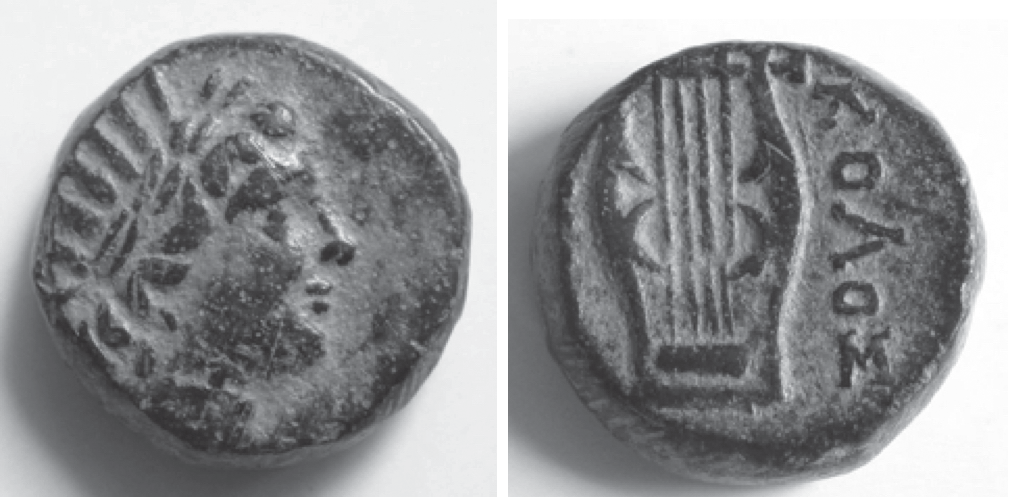
Fig. 4.2. Hellenistic coin of Colossae, slightly off-center strike, of radiate and laureate Apollo on the obverse and his four-string kithara on the reverse. Some coins show only a three-stringed lyre, indicating different die-lots and therefore significant output from the Colossian mint. From a private collection, used by permission. of symbol, a lyre.21 The lyre was not the dominant symbol in Seleucid
Apollonian coinage from the eastern Mediterranean (the preference is for omphalos or tripod), but Colossae joins with Ionian and Lycian coinage.22
The obverse radiate head is found on Seleucid royal coinage only from around 173–170 BCE and applied only to the kings' portraits not Apollo.23
A bust of radiate Helios does occur as a small symbol in various sectors of the reverse field, additional to the representation of Zeus Aetophoros
(seated), standing Nike, or Athena in an elephant-drawn biga on some gold in the Seleucid Empire (Cambridge: Harvard University Press, 2014), 95–98; see Justin,
Epit. 15.4.3–9.
21. Newell, Coinage of the Western Seleucid Mints, 96 §922, plate 17.5, 6 (Seleucus I; laureate Apollo on obverse, kithara on reverse; from Antioch on the Orontes);
Houghton and Lorber, Seleucid Coins, 1. 20 (Seleucus I); 1.418, 1.424, 1.443 (Antiochus I); 1.528–529 (Antiochus II).
22. See Jodi Magness, "Some Observations on the Roman Temple at Kedesh," IEJ 40 (1990): 179, who takes the lyre and tripod as the key attributes for Apollo on Seleucid coins. See also J. Grafton Milne, Kolophon and Its Coinage: A Study (New York:
American Numismatic Society, 1941), plates I–V. The kithara is also known on Ptolemaic coinage, also in bronze, from the same period: Otto Mørkholm, Philip Grierson, and Ulla Westermark, Early Hellenistic Coinage from the Accession of Alexander to the Peace of Apamea (336–186 BC) (Cambridge: Cambridge University Press, 1991), 70.
23. See Wright, "Seleucid Royal Cult," 74, for the variety of dating options. Occasionally in the late Greek west, radiate crowns for gods are known on coins, such as the third century coin from Leontinoi in Sicily featuring a radiate Demeter or Tyche:
BMC Sicily 62. Radiate crowned heads appear on coins of Macedonia often with thunderbolts on the reverse.
Alan H. Cadwallader and silver coins of Seleucus I.24 Arthur Houghton and Catharine Lorber interpret this as likely an official mint-mark for identifying production output, so its significance for Seleucid iconography is minimal.25 By contrast, the political importance of Rhodes in the Attalid kingdom almost certainly can be traced in its coin output;26 here the emphasis on radiate Helios is pertinent. This may be an aid to the dating of this Colossian coin. The image tenaciously revived on Colossae's Roman-imperial-period coins. But on these coins, the radiate crown was not conferred upon the imperial head. Rather, it has been designated as Helios, possibility on the basis of the radiate driver of a quadriga that appears on other coins.27 If this is the case, there appears less diachronic numismatic support for a sanctuary of Apollo at Colossae, compared with the previous coin. However, if the Hierapolitan coins of Apollo Lairbenos in the imperial period are indicative of the region, it seems clear that Apollo was quite capable of becoming radiate28—the falling curled locks on these coins of Hierapolis seem to me to be a characteristic of Apollo rather than Helios, even though inscriptions can combine the names.29 The radiate heads of Colossae's imperial coinage lack this feature and therefore confirm the identification
24. Houghton and Lorber, Seleucid Coins, 1.162.2, 1.173.16, 1.174.9 (standing Nike, some with trophy); 1.165.1, 1.169 (seated Zeus Aetophorus); 1.177.1, 1.179
(Athena in biga).
25. Houghton and Lorber, Seleucid Coins, 1.xxi–xxii, 2.223.
26. See Richard Ashton, "The Use of the Cistaphoric Weight-Standard outside the Pergamene Kingdom," in Thonemann, Attalid Asia Minor, 257–58.
27. Von Aulock, Münzen und Städte Phrygiens, 2.448–452, 458–460, 483, 515– 517 (radiate head designated Helios); see also 487–493, 496–506, 546 (Helios in quadriga); 564 (Apollo as child, with Artemis, of Leto). Of the radiate "Helios" coins, all in von Aulock's collection face right; however, one coin has emerged in the auctions with the head facing left; see now RPC 3.2313A online: https://rpc.ashmus.ox.ac.uk/search/ browse?q=2313A.
28. RPC 4.2070, 4.9991–3; these coins follow Head in avoiding Helios in the description: BMC Phrygia 54–66 plate XXX.6.
29. On locks as a characteristic of Apollo rather than Heliosote, see Houghton and Lorber, Seleucid Coins, 1.188. For inscriptions that combine the names, see MAMA
4.269, 270, 275A, 275B, roughly the same time as the coins. These form the basis for Ulrich Huttner's accent on a Heliotic Apollo: Early Christianity in the Lycus Valley, trans. David Green, AJEC 85; Early Christianity in Asia Minor 1 (Leiden: Brill, 2013),
48–49. But it should be noted that the ascription of Helios is not present in all dedications to Apollo Lairbenos. Inscriptions dated earlier and contemporary appear to be lacking this epithet: see MAMA 4.277A (I) with commentary (p. 102), 282; M. Ricl,
Colossae and Chonai in Larger Frame
as Helios. The off-centered strike of the fine examples of the coin do not allow an assessment of whether there were trailing locks. One very worn example does not appear to have this feature,30 so it would suggest that a control symbol on Seleucid mints has grown in importance.
The debate over the Seleucid obverses is whether the radiate crown indicates a Heliotic or even an oriental association rather than an Apollo connection.31 The option may be of minimal importance for Colossae itself; the city doubtless invested something of its own cultural commitments into the choice. But more significant than an early inventory of Colossian gods is the self-positioning of Colossae that these coins indicate. Given the Seleucid establishment of Laodicea and Hierapolis as preferred cities,32
Colossae's polis-pride, probably at least in relation to its neighbors, asserted itself through a display of distinctive iconography. It needs to be borne in mind that the Hellenistic coins of Colossae thus far known portray the very gods claimed as the patrons of Laodicea and Hierapolis (respectively, Zeus and Apollo), but the attributes and/or style of presentation differ markedly.
Moreover, Houghton and Lorber consider that Laodicea at the end of the third century BCE began to have some involvement in royal coin production.33 This continued under the Attalids. Colossae's choice of symbols and attributes for its Hellenistic coinage appears to eschew that which emanated from the Laodicean mint. Perhaps, by stylistic affinities with early Seleucid iconography, Colossae may have subtly paraded its far greater antiquity.
A similar pattern of negotiation of the larger imperial realities impacting a local context can be discerned in the revival of the Colossian mint at the beginning of the reign of Hadrian.34 For whatever reason Colossae's
"Les ΚΑΤΑΓΡΑΦΑΙ du sanctuaire d'Apollon Lairbenos," Arkeoloji Dergisi 3 (1995):
179 §30.
30. See https://tinyurl.com/SBL4218a4.
31. Wright, "Seleucid Royal Cult," 72, 77–82.
32. Hierapolis in early scholarship was thought to have been an Attalid flowering. However, the tribal names in the city, such as Seleukis, Antiochis, and Laodikis, clearly indicate a Seleucid foundation, even if Laodicea remained the leading city into the early Roman imperial period; see F. Kolb, "Zur Geschichte der Stadt Hierapolis in Phrygien: Die Phyleninschriften im Theater," ZPE 15 (1974): 269–70.
33. Houghton and Lorber, Seleucid Coins, 1.900–903 (Antiochus Hierax; Apollo on omphalos with bow); 989–998 (Antiochus III; Apollo on omphalos with arrow and bow).
34. See my "Wealthy, Widowed, Astute and Beneficent: Claudia Eugenetoriane and the Second Century Revival of the Colossian Mint," NewDocs 12 (forthcoming).
Alan H. Cadwallader
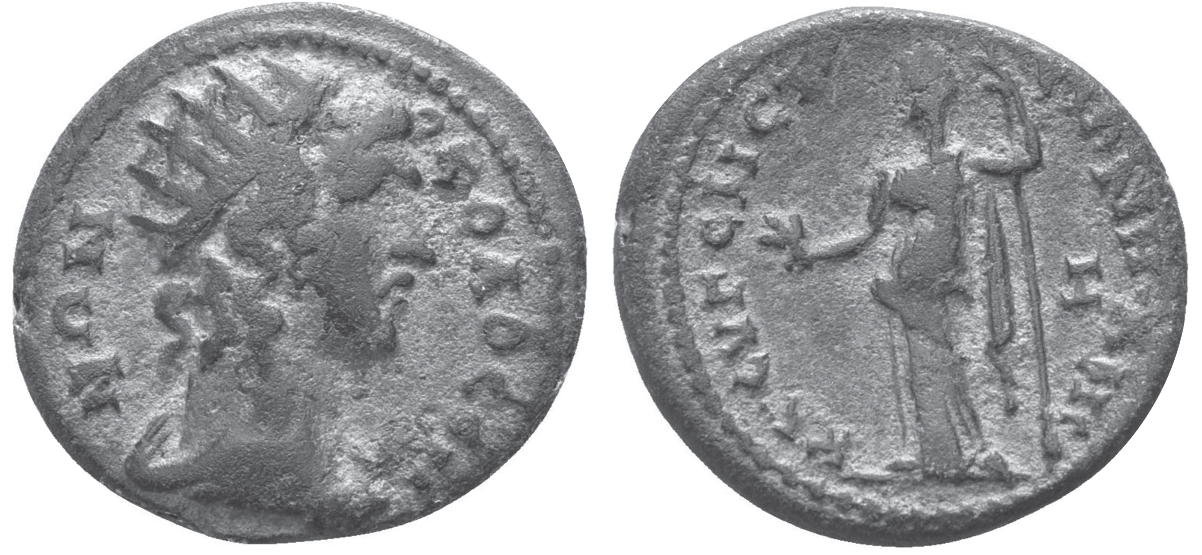
Fig. 4.3. Small civic coin minted under the auspices of Claudia Eugenetoriane, probably in 117/118 CE. From a private collection, used by permission. mint had fallen into abeyance.35 In a rare occurrence, a woman took responsibility for reinvigorating the mint.36 Claudia Eugenetoriane timed her munificence to perfection, launching the coinage with a type that acknowledged Hadrian as Caesar, exactly what was contested immediately after the death of Trajan (117 CE).37 A second coin-type has recently surfaced with two examples.38 It also carries her name, though without an imperial
35. One suggestion is that it was the result of a Roman restriction imposed on Colossae at the end of the First Mithradatic War for its (forced?) compliance with Mithradates VI's seige of Laodicea in 89 BCE in the rebel's hunt for the Roman general Oppius. Laodicea had sycophanted its way back into Roman favor (CIL 1.2 728) and within a short time had restored prolific production of bronze coinage; see Ann
Johnston, "Greek Imperial Statistics: A Commentary," Révue numismatique 26 (1984):
240–57. Under Hadrian, it even regained its early second-century (BCE) authority, for a brief period, to mint imperial cistaphoric coins; see William E. Metcalfe, The Cistophori of Hadrian (New York: American Numismatic Society, 1980), 64–71. Interestingly, the mint of Hierapolis does not appear to have been affected.
36. The coin credited to Caligula by von Aulock (Münzen und Städte Phrygiens 2.545) has been removed from consideration because it is a forgery: RPC Supp. 1
35.2891. Among the forty or so Colossian coins that have surfaced since von Aulock's catalogue was published, none have predated the time of Hadrian's reign. Laodicea also provides examples of women underwriting coin production: RPC 1.2924, 2925;
2.1273, 1275, 1277, 1279. A similar rarity is attested in the West as well: Peter Weiss,
"The Cities and Their Money," in Coinage and Identity in the Roman Provinces, ed.
Christopher Howgego, Volker Heuchert, and Andrew Burnett (Oxford: Oxford University Press, 2007), 63, 67.
37. Von Aulock, Münzen und Städte Phrygiens, 2.548. On the disputed credentials of Hadrian to succeed Trajan, see Hildegard Temporini, Die Frauen am Hofe Trajans:
Ein Beitrag zur Stellung der Augustae im Principat (Berlin: de Gruyter, 1979), 123–24.
38. See https://tinyurl.com/SBL4218a2; and https://tinyurl.com/SBL4218a3.
Colossae and Chonai in Larger Frame
obverse; it is a familiar-styled civic coin, but striking because of the unique designation in the reverse legend carrying her name. She is now "Claudia
Eugenetoriane, widow" (ΚΛ•ΕΥΓΕΝΕΤΟΡΙΑΝΗ•ΧΗΡΗ).
A number of features point to a careful negotiation of Roman realities:
1. Even though the language of the legend is Greek, there are interpuncts on the reverse legend between the words on both coins, a feature of Roman inscriptions that had begun to interrupt Greek scriptio continua even in Athens.39 It recurs on some later Colossian coins.40
2. The legend of the coin bearing Hadrian's portrait even adopts the Latin dative of dedication—ΚΛ•ΕΥΓΕΝΕΤΟΡΙΑΝΗ•
ΚΟΛΟCCΗΝΟΙC—rather than the usual genitive, ΚΟΛΟC CΗΝΩΝ, again a feature of Roman epigraphy, though also known occasionally on other coins accenting the euergetism.41
3. The woman is concerned to promenade her Roman citizenship on both coins. Later munificent underwriters of Colossian coinage were occasional in this display, including two who maybe her descendants in a family-dynastic, albeit partial, provision of coins for Colossae: (Tiberius) Claudius Sacerdos and, later, Claudius
Priscus.42 The adjustment in cognomens is significant—from the 39. Thomas N. Habinek, The Colometry of Latin Prose (Berkeley: University of California, 1985), 43; Leslie Threatte, The Grammar of Attic Inscriptions (Berlin: de
Gruyter, 1980), 82. Of remaining interest is the use of the Ionic form, χήρη.
40. Von Aulock, Münzen und Städte Phrygiens, 2.518–519.
41. Kearsley, Greeks and Romans in Imperial Asia, 152–53. The dative occurs again on Colossian coinage under the reign of Antoninus Pius: von Aulock, Münzen und Städte Phrygiens, 2.455–457 and RPC 4.10833 (≠ MSP). The dative is common in Greek inscriptions when honors for the imperial family are in view, as at Colossae (IGRR 4.468, 469). See generally, Simon R. F. Price, "Gods and Emperors: The Greek Language of the Imperial Cult," JHS 104 (1984): 79–95. See, on the example of the provision at Smyrna by the famous rhetorician Polemo, Dietrich O. A. Klose,
Die Münzprägung von Smyrna in der römischen Kaiserzeit (Berlin: de Gruyter, 1987),
68–69, 248–49, 250–54.
42. Von Aulock, Münzen und Städte Phrygiens, 2.471–482, 559–653. On family dynasties exercising significant input into a city's coin production, see Peter Weiß,
"Euergesie oder römische Pragegenehmigung? Aitesamenou-Formular auf Städtmünzen der Provinz Asia, Roman Provincial Coinage (RPC) II und persönliche Aufwendungen im Münzwesen," Chiron 30 (2000): 237–38, 250–51.
Alan H. Cadwallader Greek Eugenetoriane to the transliterated conversion of an office,
Sacerdos, to the Latin name Priscus.
4. The symbolism is extremely carefully chosen. Athena is particularly apt for Hadrian, given his Attic service, credentials and display.43 The choice of Demeter on the second coin, especially in combination with the self-designation "widow," is deliberate mimesis of the imperial widows, Marciana and Plotina, respectively sister and wife of Trajan, both supporters of Hadrian.44
The combination of legend and iconography makes for a quite different communication than the later striking of Demeter by male magistrates.45
Eugenetoriane has exuded exemplary wisdom in her negotiation of Roman imperial realities and turned these realities to serve Colossae's interests, at least according to the lights of a wealthy, widowed leader in society at Colossae.
This lengthy, mainly numismatic example of the reality of Colossae's place in larger geopolitical movements has served as a warrant for the use of the comparative method in interpreting the city's life. Regardless of the surveys and excavations that one hopes will attend the site in the future, the necessity of the method is clear. In bringing the comparative method to bear in the course of this demonstration, the impact of political realities on coin production at Colossae has been demonstrated as well as the hints of Colossian self-definition in its chosen (and modified) iconography, opening up far more interpretative possibilities than a simple identification of deities as a register of cultic activity at Colossae.
The connections of Colossae that strengthen the case for reference to a 43. Compare P. Karanastasi, "Hadrian im Panzer: Kaiserstatuen zwischen Realpolitik und Philhellenismus," Jahrbuch des Deutschen Archäologischen Instituts 127–
128 (2012–2013): 323–91.
44. See RIC 2.750. The city layout of Antinoopolis contained the district of Matidia among the ten phylai. Matidia was the name of Trajan's niece. Of particular interest are the names of the five demoi within the designation: Demetrieus, Thesmophorios—both recalling the keys of the Eleusinian mysteries—then Kalliteknios and then Markianios and Plotinios, recalling the deified widows. The association is clear: see Anthony R. Birley, Hadrian: The Restless Emperor (London: Routledge, 1997),
254–55. He interprets kalliteknios as a reference to Sabina; it is worth noting however that there was a cult of Kalliteknia for the deified Julia (SEG 43.711; AÉ 1993.1521).
45. Von Aulock, Münzen und Städte Phrygiens, 2.447 = RPC 3.2316.
Colossae and Chonai in Larger Frame
wider frame for interpretation, could be expanded beyond the limits of this chapter.46
But, even as wider parallels have brought assistance, so also some distinctive elements of Colossae's life have surfaced, not least the question of a distanced relationship between Colossae and its immediate Lycus Valley neighbors, Laodicea and Hierapolis. The two examples that follow address this question and are designed to demonstrate, firstly, that the comparative method, especially in the context of the hold of empire upon the mind of the Lycus Valley, can generate new insights; and secondly, that the comparative method must be sensitive to the particular distinctives that any one site may suggest. For the first, I will explore the critical impact of the immediate post-Julian years for interpreting one of Colossae's key surviving texts, The Miracle of the Archangel Michael at Chonai, in the light of the antagonism expressed in the text towards Laodicea. For the second,
I will return to the thorny problem of the nature, extent and location of Jewish settlement in Phrygia and argue that the evidence for a significant
Jewish population at Colossae is lacking.
The Miracle of Michael A crucial but too-often forgotten informant of history and archaeology is the geographical setting that embeds text and artefact alike. As Kevin Walsh accents, "We need to consider why people chose to settle and establish settlements in particular topographic situations."47 The story of Michael of Chonai is replete with references to a multitude of geographical features that are given religious, narratival even onomastic significance (the monolith, the chasm, rock formations, the rivers and most of all, the spring). These became key visual markers for pilgrims to Chonai, of old called Colossae, in later Byzantine times both guiding the journey and confirming the story
(Constantine Porphyrogenitus, Them. 1.3).48 They were also imbued with 46. See my Fragments of Colossae: Sifting through the Traces, 2nd rev and exp. ed.
(Hindmarsh: ATF Press, forthcoming), ch. 10.
47. Kevin Walsh, The Archaeology of Mediterranean Landscapes: Human-Environment Interaction from the Neolithic to the Roman Period (Cambridge: Cambridge
University Press, 2014), 5.
48. The issue of the relationship between Colossae and Chonai cannot be explored here. See, briefly, my "Refuting an Axiom of Scholarship on Colossae: Fresh
Insights from New and Old Inscriptions," in Colossae in Space and Time: Linking to an
Alan H. Cadwallader unfolding theological significance, especially in the iconoclast crises of the eighth and ninth centuries, just as they factored prominently in what was probably a pagan story of an epiphany of rescue.49 Accordingly, distances, whether by crow-flight or by negotiating Roman roads and local tracks, only give a snatch of the story. The features of an area shape consciousness and carve associations by which a city, its people and surrounds become known: mountains, springs, rivers, caves along with peculiar formations such as monoliths and travertine mouldings. Roman land surveys tended to use natural features to form their judgments.50
The influence of local conditions was held, for example, to lie behind the area's famous textile manufacture, even though Laodicea as the prime center in the Lycus had begun to stamp its name on the regional production as a whole, not merely to its own city's output.51 The recognition that the heavily urbanized areas often made recourse to rural religious centers, as at the site of the sanctuary of Apollo Lairbenos, and harnessed indigenous expressions that were linked to landscape,52 shows how important
Ancient City, ed. Alan H. Cadwallader and Michael Trainor (Göttingen: Vandenhoeck
& Ruprecht, 2011), 160–61. See also Glenn Peers, Subtle Bodies: Representing Angels in Byzantium (Berkeley: University of California Press, 2001), 151.
49. See Alan H. Cadwallader, "The Inversion of Slavery: The Ascetic and the Archistrategos at Chonai," in Prayer and Spirituality in the Early Church V: Poverty and Riches, ed. Geoffrey D. Dunn, David Luckensmeyer, and Lawrence Cross (Strathfield, NSW: Saint Pauls Publications; Virginia, Qld: Centre for Early Christian Studies,
2009), 215–36; Cadwallader, "Epiphanies and Religious Conflict: The Contests over the Hagiasma of Chonai," in Reconceiving Religious Conflict: New Views from the Formative Centuries of Christianity, ed. Chris de Wet and Wendy Mayer (London: Routledge, 2017), 110–35.
50. See, for example, SEG 24.1109. This was recognized among the jurists on disputes over land: see J. B. Campbell, The Writings of the Roman Land Surveyors
(London: Society for the Promotion of Roman Studies, 2000), 61.
51. See especially Huttner, Early Christianity in the Lycus Valley, 20–22, 166–70; see also his "Die Färber von Laodikeia und Hierapolis: Eine Nachricht aus dem Corpus der Alchemisten," MBAH 26 (2009): 139–57; Peter Thonemann, The Maeander Valley:
A Historical Geography from Antiquity to Byzantium (Cambridge: Cambridge University Press, 2011), 187–8; see generally Rosemary Canavan, "Weaving Threads: Clothing in Colossae," in Cadwallader, Fragments of Colossae, 111–33.
52. Tullia Ritti, Celal Şimşek, and H. Yıldız, "Dediche e καταγραφαί dal santuario frigio di Apollo Lairbenos," EA 32 (2000): 3. Note the express connection between Hierapolis and the sanctuary in MAMA 4.276A (I) (dedication of Apollonios the Hierapolitan), 276A (III) (dedication of Aphphia the Hierapolitan), 276B (dedication of Dion the Motellan; Motella a town under Hierapolis's orbit); see also 277A
Colossae and Chonai in Larger Frame
topography can be in the formation of identity and behaviors. The gods frequented the high places especially, even though known in the depths and the waters, and recourse to them—a "going up" (ἀναβαίνω) from city or village as expressed in some devotions to Apollo Lairbenos—appears to have been invaluable for status, confession, manumission and the like.53
Of course, difficulties attend the handling of the materials, especially textual materials that have survived. References to topography in hagiographies, foundation stories, or epiphanies may be useful for locating the sites that such stories were intended to support. The issue comes when one attempts to derive historical information from these stories. Occasionally one sees a privileging of, for example, the Acts of the Apostles over such hagiographies, which, while justified to some extent, can cultivate a default surface acceptance of the canonical book.54 The loose appreciation of the difference between rhetoric and history, say in Luke's hyperbolic sweeps referencing Phrygia (Acts 2:10, 16:6 with its dissonance between Asia and Phrygia, 18:23), forges greater historical weight for Paul's missionary activity into a back-reading of Colossians.55 "Paul's defining role for early Christianity in Asia Minor is undisputed"56 may be true as a general observation, but the application of this affirmation to the Lycus
(II) (dedication of Charixenos the Dionysopolitan), 281 (dedication of Apellas from Blaundos, about 50 kilometres north of Hierapolis). One inscription also provides a connection with Laodicea (and Erriza): Ritti, Şimşek, and Yıldız, "Dediche," 34 §K44.
53. See, for example, Georg Petzl, Die Beichtinschriften Westkleinasiens (Bonn:
Habelt, 1994), 128–30 §110; MAMA 4.279, 283, 289.
54. As, for example, the acceptance of three missionary journeys: Huttner, Early
Christianity in the Lycus Valley, 82–83. Paul's own recall of multiple shipwrecks (2
Cor 11:25) compared to only one in Acts (27:39–44) urges caution. Compare also Huttner, Early Christianity in the Lycus Valley, 99 who takes the designation of Paul as a πρεσβύτης in Phlm 9 as an indication of age rather than as part of Paul's rhetorical self-positioning in relation to Philemon. See Ronald F. Hock, "A Support for His Old
Age: Paul's Plea on Behalf of Onesimus," in The Social World of the First Christians, ed. L. Michael White and O. Larry Yarbrough (Minneapolis: Fortress, 1995), 67–81.
On the importance of the elder in social relations, see the character of the father in Plutarch's Table Talk (Quaest. conv. 1.2.2 [615f–616b]). Note also that a senator from Xanthus is designated, inter alia, as a πρεσβύτης Ἀσίας an honorific title designating a legate or envoy with no necessary correlation with age: Michel Christol and Thomas
Drew-Bear, "Un sénateur de Xanthos," Journal des savants 3 (1991): 197, 203–6; see also IGRR 3.174, 175.
55. Huttner, Early Christianity in the Lycus Valley, 123.
56. Huttner, Early Christianity in the Lycus Valley, 82; see also Paul Trebilco, The
Alan H. Cadwallader Valley may be an example of the compression occasionally charged against comparative history and archaeology. It certainly does not cohere with the interpretation of those scholars who accept the pseudonymity of Colossians. Thus, in my view, it is unconvincing to combine Acts 18:23 with Col
2:1 to produce a meaning that Paul did not meet all Christians in the Lycus Valley, having skipped Hierapolis in the course of a Lycus Valley visit.57
The problem here is that in the aftermath of the Pauline mission, the memory of Paul did not credit him with a defining role, at least for the Lycus Valley.58 The Acts of John, Acts of Philip, Michael of Chonai, and an array of martyrologies are notably scant in mentions of Paul's impact; they rather esteem other apostles with a decisive shaping on the Lycus
Valley. The cultivated Christian memory did not reiterate Lukan remembrance, nor indeed much of Colossians and Philemon. Rather, John is the key apostle along with Philip, even though both John and Philip are figures coalesced in amalgams of the evangelist and the author of Revelation, on the one hand, and the gospel apostle and the Acts evangelist/deacon/father of prophets on the other.59 Ulrich Huttner certainly tracks the formation of these apostolic figures in the Lycus Valley texts. But the implication of this for the legacy of Paul is left muted.60
Paul is briefly revived in the martyr stories of Philemon, Archippus, and Apphia in the Synaxarion of Constantinople, sometimes known as the Menologion of Basil, but that is eleventh century and hardly reliable for historical reconstruction.61 Its patchwork précis seems to owe some
Early Christians in Ephesus from Paul to Ignatius, WUNT 166 (Tübingen: Mohr Siebeck, 2004), 145–46.
57. Huttner, Early Christianity in the Lycus Valley, 123. The argument of Paul's familiarity with the Christian communities in the Lycus Valley on the basis of names shared in Colossians and Philemon (Huttner, Early Christianity in the Lycus Valley, 83) is not sufficient to substantiate a visit—Rom 16 shows the distinction between knowing people and having been "on the ground."
58. The assessment of Pauline influence in the Lycus Valley clearly depends on the time-frame one adopts; see Paul Trebilco, "Christians in the Lycus Valley: The View from Ephesus and from Western Asia Minor," in Cadwallader and Trainor, Colossae in Space and Time, 196–97.
59. Huttner, Early Christianity in the Lycus Valley, 185–90 (John), 190–95 (Philip).
60. Compare Trebilco "Christians in the Lycus Valley" (193–208) who seeks to establish for the apostolic and subapostolic period a compatibility/complementarity even if separateness in Pauline and Johannine influence.
61. The Menologion of Basil II as it is commonly (though incorrectly) called
Colossae and Chonai in Larger Frame
material to the opening chapter of the Michael of Chonai narrative, which privileges John and Philip, and a little to the pagan foundation story for the city of Ephesos in the naming of the governor as Androcles, a quite typical mid-Byzantine conceit of compacting multiple Christian and pagan allusions.62 But overall, the Pauline tradition in the Lycus Valley, outside of canonical and subapostolic transmission of epistolary texts, is somewhat like the figure of Paul in the Acts of Thecla—known more by his absence than his presence! Paul Veyne's caution is pertinent here: "by no means what the historians call event is seized directly and entirely; it is always completely and laterally … should we say, through the tekmeria, is usually dated to the eleventh century, though clearly drawing on prior traditions.
See Nancy Patterson Ševčenko, "The Walters 'Imperial' Menologion," Journal of the Walters Art Gallery 51 (1993): 43–64; F. D'Aiuto, El "Menologio de Basilo II": Città de estudios con occasion de la edición facsímil (Vatican: Biblioteca Apostolica Vaticana; Athens: Diaconía Apostólica de la Iglesia de Grecia; Madrid: Testimonio Compania Editorial, 2008), 6. It should be noted that this synaxarion does not represent an already-established stable tradition of the November martyrs. The tenth–eleventh century Codex Leimonos 48 (a menologion), for example, does not include the lives of Philemon, Apphia, and Archippos in its collection; see Athanasios PapadopoulosKerameus, Mαυρογορδάτειος Bιβλιοθήκη [The Mavrogordati Collection], 2 vols.,
(Constantinople: Boutura, 1884), 1:57–58. It is also omitted in the BL Add MS 24372 and elsewhere. Other manuscripts include the martyrology on different days, for example, November 22 in BL Add MS 11870, fol 325v; elsewhere the feast-day is February 21; see Basilius Latyšev, Menologii anonymi byzantine saeculi X quae super sunt
(Petropoli: 1911). There was a late Byzantine church of Philemon, Archippos, and Onesimos in Constantinople, notably substituting Onesimos for Apphia; see N. A.
Beê, Τα χειρόγραφα των Μετεώρων: Κατάλογος περιγραφικός των χειρογράφων κωδίκων των αποκειμένων εἰς τὰς Μονάς των Μετεώρων [Meteōrōn manuscripts: A descriptive list of manuscript codices belonging to the Meteōrōn Monastery], 4 vols. (Athens:
Akadēmia Athēnōn, 1967–1993), 3:771. But, despite Theodoret of Cyrrhus referring to a pilgrim site of Philemon's house (Interpretatio Epistolae ad Philemonem [PG
82.871–72A]), no church under such patronage is recorded: see my "The Reverend Doctor John Luke and the Churches of Chonai," GBRS 48.3 (2008): 319–38.
62. So, for example, the reference to Greeks, idolaters, Artemis, an attack, and an overpowering. These are stock features in hagiographies. The use of the term σιτοφὐλαξ as Androcles's office may be a deliberate reminisce of Strabo's association of Androcles's descendants with control of the sacrifices for Demeter (Strabo, Geogr.
14.1.3). The specific term σιτοφύλαξ is not found in any surviving materials from Ephesos; however, the renowned Salutaris is known, among many offices, for being an ἀρχώνης σἰτου (IEph 36D). On the importance of the name of Androcles in connection with Ephesos well into the Common Era, see Pausanias, Descr. 7.2.8–9, Ephorus apud
Stephanus, Ethn. 2.68; Suda, s.v. " Ἰωνία" (ι.494).
Alan H. Cadwallader the vestiges."63 Acts, in this sense, is itself a vestige for us, as well as displaying its own perspective on retrieved vestiges, and needs to be handled as such. Its difference from later Lives and Acts, outside of its canonical status, is one of degree rather than kind.
The question of how such stories might yield up their historical value is well illustrated by Johan Leemans's close analysis of Gregory of Nyssa's
380 CE encomium on Holy Theodore the Recruit.64 At the surface level, the setting is the reign of the Emperor Galerius (305–311), during which time Theodore is alleged to have been martyred (Gregory of Nyssa, De sancto Theodoro [PG 46.741B]).65 But Leemans shows that this earliest panegyric of Theodore is an opportunity for Gregory to mount a scathing critique of the period of Julian the Apostate (361–363). Even though that emperor is never explicitly named, the allusions are patent.66 The history to be derived from this constructed memory therefore hangs below the surface level.67 It speaks of the struggles of the church to reform its identity in the aftermath of the catastrophes and collusions of the Julian period,
63. Paul Veyne, Comment on écrit l'histoire: Essai d'épistémologie (Paris: Seuil,
1987), 14.
64. Johan Leemans, "Gregory of Nyssa: A Homily on Theodore the Recruit," in 'Let Us Die That We May Live': Greek Homilies on Christian Martyrs from Asia Minor,
Palestine and Syria (c. AD 350–AD 450), ed. Johan Leemans et al. (London: Routledge, 2003), 82–90; see also his "A Preacher-Audience Oriented Analysis of Gregory of Nyssa's Homily on Theodore the Recruit," StPatr 37 (2001): 140–46.
65. The emperor is known here under the name Maximian.
66. Leemans, "Gregory of Nyssa," 83. It is worth noting that there is a specific reference not only to the mother of the gods (De sancto Theodoro [PG 46.741D], i.e., Cybele), one of the focal devotions of Julian, but also a reference to her temple at Amasea (PG 46.744A) and special attention to the pagan (high) priesthood ([PG
46.744D–745A])—all concerns of Julian: see Or. 3; Or. 5; Fragmentum epistolae.
Moreover, Theodore is related as impugning emperors (plural), especially those assuming the title of high priest and becoming "cooks" aka "butchers" (De sancto
Theodoro [PG 46.745A])—a clear indication of Julian's revival of and personal involvement in sacrifices, even though the plural could be taken as a reference to the rule of the three: Constantius I, Diocletian, and Maximian (209–305 CE). More direct homiletic criticisms did come, inter alia, from Asterius of Amasea, from a city renowned for its cult of the Great Mother: see Asterius of Amasea, Hom. 3, 4, and 10; and see Johan Leemans, "Christian Diversity in Amaseia: A Bishop's View," Adamantius 13 (2007): 247–57.
67. Christopher Walter simply observes that the period between a saint's martyrdom and the textual remembrance in a life or homily reduces the reliability of the text, for the martyr and her/his martyrdom—but this is not the only historical value in
Colossae and Chonai in Larger Frame
particularly through a redirection of church building (with an accent on martyrions), the lavish painting designed to instruct the faithful, the ritual reiteration of the faith and its exemplars,68 and, what Gregory does not mention, the weeding out of apostates (Asterius, Hom. 4.9).
This has particular relevance for the popular version of the story of Michael of Chonai. The narrative lampoons Laodicea as "the city of the lawless mob"69 in a deliberate distortion of the etymology of its name. Laodicea becomes a staging point for idolatrous villains bent on the destruction of the Michael healing spring, its hagiasma and custodian.70 The story's own chronological indicators, admittedly imprecise, point to the third century or fourth century.71 The portrayal of Laodicea is quite tendentious. The city is unremittingly pagan; even the father of the healed daughter is introduced as living in Laodicea as a "godless idolater" (ἀσεβὴς καὶ εἰδωλοθύτης) who, himself, is violently opposed to the healing spring as a Christian center.72
This Colossian/Chonian story completely ignores Laodicea's history— such accounts. Christopher Walter, The Warrior Saints in Byzantine Art and Tradition
(Aldershot: Ashgate, 2003), 292.
68. See Vasiliki M. Limberis, Architects of Piety: The Cappadocian Fathers and the Cult of Martyrs (Oxford: Oxford University Press, 2011), 55–62.
69. Michael of Chonai 7.4 (Bonnet 11.10). In the references to the Story of St Michael of Chonai, the first reference is to the chapter and section breakdown of my
English translation in "The Story of the Archistrategos, St Michael of Chonai," in Cadwallader and Trainor, Colossae in Space and Time, 323–30. The second reference is to the Greek edition of Max Bonnet, Narratio de Miraculo a Michaele Archangelo Chonis
Patrato (Paris: Librairie Hachette, 1890), by page and line number.
70. Michael of Chonai 3.6 (Bonnet 5.3–5); Michael of Chonai 5.2–4 (Bonnet 8.13–9.11); Michael of Chonai 7.3–4 (Bonnet 11.5–12.4); Michael of Chonai 8.2–3
(Bonnet 12.8–13.2); Michael of Chonai 10.1–3 (Bonnet 13.16–14.7).
71. The apostolic period (Michael of Chonai 1–2 [Bonnet 1.5–3.7]); a period of "many years" after that (Michael of Chonai 3.1 [Bonnet 3.8–10]), the global fame of the spring (Michael of Chonai 3.1 [Bonnet 3.11–12]); then the coming of a Laodicean pagan for his daughter's healing following a vision (Michael of Chonai 3.2–4 [Bonnet
3.14–5.3]); the building of a εὐκτήριον in honor of Saint Michael following the healing
(Michael of Chonai 3.5 [Bonnet 4.17]); the coming of the first custodian, Archippos, some ninety years after that (Michael of Chonai 4.1 [Bonnet 5.6]), for a period of seventy years (Michael of Chonai 4.2 [Bonnet 5.10]). If one takes the end of the apostolic period as about 100 CE and "many years" as a half-century, we arrive at the second half of the third century into the first half of the fourth. Of course, in such stories, time allocations are notoriously loose.
72. Michael of Chonai 3.2 (Bonnet 3.15, 17–19). This is overlooked by Huttner (Early Christianity in Lycus Valley, 374). It should also be noted that the baptized
Alan H. Cadwallader Laodicea is neither Johannine (as from Revelation and the Acts of John) nor Pauline (as from Col 4:13–16); rather it is heathen. The story arrogates
John to itself and to Hierapolis and completely ignores any Pauline reference or, as far as I can tell, any allusion to a Pauline text.73 Any stories of Christian presence in that city that clearly fall within the time-frame envisaged by the Michael narrative simply do not appear: not the Acts of John, not the martyrdom of Bishop Sagaris or Artemon74 and, significantly, not the Pauline witness. By contrast, Hierapolis is noteworthy for its Christian presence, not only harnessing the legends of Philip and even a visitation from the apostle John to its credentials but also providing from its numbers, the foundational custodian, Archippos, for the hagiasma near Colossae.75
Clearly, this is a distortion of the historical record; consequently, a surface reading of the text cannot be allowed. But it does raise the historical question of the rationale behind such a blatant misrepresentation.
The clue is to be found in elements that remain a constant in the relations between Greek poleis in Roman times.76 Huttner, rightly in my view, understands that part of the dynamic behind the hagiographies of the Acts of John and the Acts of Philip is a tense competition between Laodicea and Hierapolis for preeminence and accord.77 But this tension is not confined to ecclesiastical jockeying for position. It is evident also in relationships between the two cities under Rome (such as the claim on the title "metropolis," the maneuvering for the award of "neokoros"), no doubt exacerbated by the Roman tendency to collate the two cities.78 father and healed daughter are never said to return to Laodicea. They simply depart, glorifying God: Michael of Chonai 3.5 (Bonnet 5.2–3).
73. By contrast, the description of the devil as ἀνθρωποκτόνος seems to be an allusion to John 8:44 (Michael of Chonai 8.2 [Bonnet 12.13]). There are multiple Old Testament allusions and a lengthy quotation from Ps 92/93: 2–5 (Michael of Chonai 11.1
[Bonnet 14.11–15]). In illuminated Psalters, the story of Saint Michael of Chonai came to be used as the illustration for this psalm. See BL Add Ms 19.352, fol 125r.
74. See Huttner, Early Christianity in the Lycus Valley, 250–51, 334–35.
75. Significantly, Archippos, even though ten years old when he becomes the προσμονάριος of the εὐκτήριον is noted as sprung from Christian parentage—from Hierapolis (Michael of Chonai 4.1 [Bonnet 5.6–9]). One can perhaps hear echoes of the katagraphai inscriptions at Apollo Lairbenos here, some of which explicitly name parents dedicating their child as from Hierapolis (e.g., MAMA 4.276A [III]).
76. See generally, Heller, "Les bêtises des Grecs."
77. Huttner, Early Christianity in the Lycus Valley, 25, 189, 265, 365.
78. Huttner, Early Christianity in the Lycus Valley, 278–79. As in a certain sena-
Colossae and Chonai in Larger Frame
Hagiography is but an example in a more long-standing strain in the relation between the two cities.
This is where the application of the comparative method must be mindful of the impact of imperial policies on the relations between neighbors in a confined region. This means more than the intense activity engendering civic projects that preface the visits of dignitaries—Hadrian's pan-hellenic tour, for example, clearly fostered mintings, inscriptions and building in the main cities of the Lycus in preparation for the 129 visit, including at Colossae.79 Rather, it pertains to the constant attentiveness to imperial shifts that local authorities trained themselves to refine for direct dealings with the central authorities; more importantly, these factors fired these authorities in how to position themselves in relation to central government by asserting themselves over neighbors who were likewise attentive to the same realities.80
The key to Michael of Chonai, in my view, is the aftermath of the Julian years, where already-existing tensions became inflamed as cities sought to establish their credentials positively in relation to imperial and, in this case, ecclesiastical centers. In fact, it appears to have been a policy of Julian to cultivate ecclesial conflict.81 It is no coincidence that the story appears to side with Hierapolis over Laodicea, the one cleansed and Christian, the other under the stranglehold of the devil; here a tacit alliance is signaled. The incendiary action and reaction can be sheeted home, I would suggest, to the Synod of Laodicea. It is a general observation that those dioceses subjected to criticism at synods rarely are found in attendance, so it is unlikely that Colossae and probably Hierapolis were among the small number gathered.82 What is not noted in regard to this tor, honored by a monument at Xanthos. Among other honors, he is designated an οἰκιστὴς Λα[ο]δικέων καὶ Ἱεραπολειτῶν; see Christol and Drew-Bear, "Un sénateur de
Xanthos," 197 at lines B.3–4 of the inscription.
79. See IGRR 4.869; von Aulock, Münzen und Städte Phrygiens, 2.547.
80. See Alan H. Cadwallader, "Inter-City Conflict in the Story of St Michael of Chonai," in Religious Conflict from Early Christianity to the Rise of Islam, ed. Wendy
Mayer and Bronwen Neil (Berlin: de Gruyter, 2013), 109–27.
81. "No wild beasts are so hostile to men as are Christian sects in general to one another" was Ammianus Marcellinus distillation of Julian's approach: Res gest. divi Aug. 22.5.4, translation from John J. Norwich, Byzantium: The Early Centuries
(London: Penguin, 1990), 92.
82. See Huttner, Early Christianity in the Lycus Valley, 291–92 for one attempt to calculate the number of attendees. The total is disputed.
Alan H. Cadwallader council is that Constantinople at this time (ca. 365 though Huttner places it later, at 380 CE)83 is still under Arian-derivative control and would remain so until 380 with the death of Bishop Demophilos. Even though the Synod of Laodicea is replete with denunciations of heresies,84 there is no mention of Arianism or its successor variants nor is there the avowal of Nicene orthodoxy so familiar from the opening of other synod texts.85
The Council of Nicea had prescribed two provincial Synod meetings each year (Canon 5), and this had been reiterated at the Council of Antioch in 338 (Canon 20), but Laodicea omits any reference to this authority for its gathering.86 The mention of Photinian heretics in Canon 7 makes
83. In the face of other evidence, the use of the reference to an ambo (Canon 15) to help the dating of the Synod (Huttner, Early Christianity in the Lycus Valley, 296) is too fragile to sustain the weight put upon it. The word was already being extended in the first century BCE to refer to a construction of steps leading to a height (Apollonios Citiensis, Hipp. 1.7)—its movement into a church setting is probably a natural development, with the Synod canon noting a preexistent reality (especially in a city with already established substantial church buildings). What is clear is that the church defined in terms of building is set off against the place to which those who worship angels retire, according to Canon 35: ἐγκαταλείπειν τὴν ἐκκλησίαν καὶ ἀπιέναι καὶ ἀγγέλους ὀνομάζειν καὶ συνάξεις ποιεῖν.
84. Synod of Laodicea 7–8, 11, 32–34. The council is called the Synod "against Montanus and other heresies" in a mosaic in a twelfth-century church at Bethlehem
(CIG 8953). Only Canon 8 actually refers to "the heresy of the so-called Phrygians" but see Canon 11 and the reference to female leadership that Stephen Mitchell takes as a mark of Christian Phrygia rather than Montanism per se: S. Mitchell, "An Epigraphic
Probe into the Origins of Montanism," in Roman Phrygia: Culture and Society, ed.
Peter Thonemann (Cambridge: Cambridge University Press, 2013), 196–97; see also Huttner, Early Christianity in the Lycus Valley, 311–12. William Tabbernee overrates the number of canons (59 or 60) as indicating the importance of the Synod of Laodicea: Fake Prophecy and Polluted Sacraments: Ecclesiastical and Imperial Reactions to Montanism (Leiden: Brill, 2007), 301–2.
85. For example, the denunciation of the Photinians at the Council of Constantinople in 381 (§1) was on the basis of a lack of conformity with Nicea; this was not the basis of the Laodicean canon (§7) where the Photinians are simply numbered with the Novations and the Quartodecimans (now deemed a heresy) on the issue of reception of heretics.
86. Huttner, Early Christianity in the Lycus Valley, 291 is slightly misleading in implying that Laodicea was specifically mentioned by the Nicean canon, rather than provinces in general. It should be noted, on the one hand, that Canon 5 was by a lack of observance and, on the other, canon lists credited to one Synod are often a compilation of a succession of recommendations/decisions of smaller gatherings.
Colossae and Chonai in Larger Frame
no reference to the Nicean settlement and advises reception without rebaptism,87 even though it was precisely the Trinitarian formula that was at issue elsewhere. Significantly, the absence of the Laodicean metropolitan from the Council of Constantinople in 381 is usually explained on the basis that Laodicea was still unready to relinquish an Arian remnant in its theology.88 It is only the after-reach of the orthodox church that has made Laodicea Nicean. There is no question, however, that the Laodicean synod, if it can be characterized under a single summation, is concerned to assert control and direction under a central authority.89 The very form under which the Synod canons survive carries the atmosphere of legislative rescript.90
The story of Michael of Chonai by contrast emphasizes the Trinitarian formula, especially in the context of baptism.91 Moreover, in designating
Laodicea as idolatrous and the forces "gathered" there, it takes the specific language of Canon 35 (εἰδωλατρία, συνάξεις ποιεῖν) and turns it against its authoritarianism. Indeed, the slightly quizzical use of ἀγγέλους ὀνομάζειν in the canon (usually translated "worship," as from Col 2:18 θρησκεία)92 finds
See Christopher W. B. Stephens, Canon Law and Episcopal Authority: The Canons of Antioch and Serdica (Oxford: Oxford University Press, 2015), 86–89.
87. The lack of reference to the Nicean settlement is unlike the Synods of Antioch
1, Sardica (apud Socrates, Hist. eccl. 2.20.7–11), and Constantinople 1, among others.
The reception without rebaptism was "whether they are among the catechumens or among the faithful." Arguments for the deletion of "Photinians" as a later accretion on the basis of the conflict with "the mainstream view of the Trinity" (Huttner, Early
Christianity in the Lycus Valley, 296 n. 128) become unnecessary once Laodicea's own
Trinitarian heterodoxy is admitted.
88. J. B. Lightfoot, Saint Paul's Epistles to the Colossians and to Philemon, 9th ed.
(London: Macmillan, 1890), 62. See, for example, Theodoret, Hist. eccl. 4.7.
89. The prohibition against bishops for country or villages (§57) is but a focused demonstration of the point.
90. Huttner, Early Christianity in the Lycus Valley, 297 calls them "lapidary summaries."
91. Michael of Chonai 3.1 (Bonnet 3.14); Michael of Chonai 3.3 (Bonnet 4.9–10); Michael of Chonai 4.4 (Bonnet 4.16–17); Michael of Chonai 12.4 (Bonnet 18.13–14).
92. So Theodoret of Cyrrhus, Interpretatio epistulae ad Colossenses (PG 82.613, 620D). The word can certainly bear the sense of worship (see Clement of Alexandria,
Protr. 2.32–41 [GCS 12.17–31]) but could also be narrowed to onomastics—the very sophistic sleight-of-hand that later councils relished in order to restore the veneration of angels, as in the Letter of the Second Synod of Nicea: Erich Lamberz and Johannes
B. Uphus, "Concilium Nicaenum II, 787," in The Oecumenical Councils from Nicaea I
Alan H. Cadwallader a direct parallel in the Michael narrative with an emphasis on the name of Michael: "Mark my name" (in direct imitation of an oath "by Zeus")93 and in the dedication of the εὐκτήριον.94 Given that the period of Julian, on the one hand, and of Arianism on the other, are both dubbed "idolatry," it is little wonder that cities sought to elevate their own standing by demeaning their neighbors in such terms.95 Laodicea deflected unwanted attention about its own embroilment in Arian and probably Julian alignments96 by denigrating Colossae, suggesting perhaps through the reference to "hidden idolatry" (κεκρυμμένη εἰδωλατρία), the exact imitation of Julian's deception—"crypto-paganism" is Huttner's apt description.97
Colossae returned the favor, not by Synodal decision, given that it was in no position to call a council but by appeal to the populace and to the country where many ordinary people, far below the ethereal spheres of elite ecclesiastical battles, lived.98 The story intimates that Laodicea's idolatry was characterized by devotion to the very female gods cleansed from Hierapolis and the ones given such favor by Julian: Artemis, Echidna, and to Nicaea II (325–787), vol. 1 of Conciliorum oecumenicorum generaliumque decreta:
Editio critica, ed. Giuseppe Alberigo et al. (Turnhout: Brepols, 2006), 314; see also
Charlemagne, Capitularia Admonitio Generalis 16 (ca. 789 CE) (Alfred Boretius and Victor Krause, eds., Capitularia Regum Francorum (Hanover: Hahn, 1960).
93. See Alan H. Cadwallader, "St Michael of Chonai and the Tenacity of Paganism," in Intercultural Transmission throughout the Medieval Mediterranean: 100–1600
CE, ed. David W. Kim and Stephanie L. Hathaway (London: Continuum, 2012), 37–59.
94. Michael of Chonai 3.5 (Bonnet 4.5), see also Michael of Chonai 12.4 (Bonnet 18.14–15) where the name of God and of Michael are both to be esteemed.
95. For Julian, see Sozomen, Hist. eccl. 5.19 (GCS NF 4.226); Theodoret, Hist. eccl.
3.14 (GCS NF 5.190–92); for Arians, see Severus of Antioch Ep. 5.6. For fuller analysis, see the previously cited articles.
96. The accent on "Greeks" ῏Ελληνες (Michael of Chonai 5.4 [Bonnet 9.9–10]) in addition to "the godless" ἀσεβεῖς (Michael of Chonai 7.4 [Bonnet 11.12]) probably reflects Julian's Hellenic and polytheistic campaign. See Theodoret, Hist. eccl. 3
(GCS NF 5.177–206 passim); Socrates, Hist. eccl. 3.1 (GCS NF 1.187–93); Zonaras,
Hist 13.12. John Malalas, Chron. 13.19, tied Julian's soubriquet to his becoming "a Hellene." See Shaun Tougher, Julian the Apostate (Edinburgh: Edinburgh University
Press, 2007), 48–62.
97. Huttner, Early Christianity in the Lycus Valley, 302. Allusions to the time and figure of Julian quickly developed as the typology of the false Christian. See Severus
Letter 3 to Sergius.
98. In the story it is the country, not the city, that is privileged as the place of Michael's beneficence and protection.
Colossae and Chonai in Larger Frame
especially the Great Mother. Colossae has reacted against the thinly-veiled attacks on its own privileged pilgrimage site by constructing Laodicea as thoroughly Julian—"Idolian," as Gregory of Nazianzus punned the name and the period (Gregory of Nazianzus, Or. 4.77)—and completely failing to live up to its high-aspiring name: unjust, not just in any fashion.
One can hardly see the Laodicean metropolitical church being impressed, though the story's claim to fame for the spring indicates a turning to popular acclaim and devotion as a means to resist synodal decree.99 Huttner is right in asserting that such stories as Michael of Chonai and the Acts of Philip show "how history was constructed and identities were created in the churches of the Lycus Valley";100 even more, however, it can be asserted that such stories were constructed over against neighboring rival claims.
The spurning of Colossae in favor of Laodicea by Antiochus II in the midthird century BCE had bequeathed a long-standing virulent strain into ancient poliadic competition.101
This analysis demonstrates how a widening of the range of comparison to embrace imperial upheavals can be used to illuminate the particularities of local texts, in this case in relation to each other. It also has implications for how apologetic texts are interpreted, most particularly in assessing whether such texts, like the Acts of the Pagan Martyrs, were ever intended for an imperial audience or were cast in such terms as a means of shaping the identity of a local group.102 The great world, specially when undergoing regime change, inevitably has massive ripple effects on regions
99. Compare Slater's reading of the Acts of Philip as a resistant document: R. N.
Slater, "An Inquiry into the Relationship between Community and Text: The Apocryphal Acts of Philip 1 and the Encratites of Asia Minor," in The Apocryphal Acts of the Apostles, ed. François Bovon, Ann Graham Brock, and Christopher R. Matthews,
Harvard Divinity School Studies, Religions of the World (Cambridge, MA: Harvard University Press, 1999), 295–96.
100. Huttner, Early Christianity in the Lycus Valley, 4.
101. See my "When You Say Concord You Mean Competition: Numismatic Witness to Colossae's Conflict with Laodicea" (paper presented at the Australasian Society for Classical Studies Conference, Adelaide, 28 January 2015). This conflict may add a quite different dimension to the sharing of resources implied in Col 4:16.
102. See Huttner, Early Christianity in the Lycus Valley, 231, 239–40. I find it far more likely that the Apology of Apollinarius, as other second century apologies, were written for internal consumption (as Huttner acknowledges on 236 and 241), especially in a context where there were highly fraught relations with imperial powers.
Alan H. Cadwallader and localities, but these effects rarely are directly fed back to the source.103
Rather they generate lateral renegotiations of positions, power, and access to resources.104
Jews at Colossae?
The converse side of the application of comparative archaeology and history, that is, the need for caution in compressing local particularities into subjection to generalized statements, develops from a striking omission in the Michael of Chonai story. The Synod of Laodicea dedicated a number of its canons to issues that have been categorized under the heading of Jewish practices (Canons 29, 37, 38, and perhaps 16). The seeming reference to Jewish practices in Col 2 has led some commentators to assume that the "worship of angels" was a Jewish practice, in both the New Testament text
(Col 2:18) and in the later synod canon (Canon 35), again a compression of the evidence. More expansive is Severian of Gabala's interpretation of Colossians as addressed to a Jewish and a Greek audience, with different results in the meaning of the text for each group.105 Moreover, Thomas
Kraabel has alerted us to the rhetorical use of such terms as Jewish to foment identity formation rather than necessarily have a specific group presence in mind.106 The supercessionism of a recent artifact unearthed at Laodicea
103. See Huttner, Early Christianity in the Lycus Valley, 286. Johannes Nollé sees occasional entrepreneurial efforts at direct dealing with central authorities but this is rare and, in fact, not encouraged in the Roman hierarchical construction of the world.
See Johannes Nollé, "Marktrechte außerhalb der Stadt: Lokale Autonomie zwischen Statthalter und Zentralort," in Lokale Autonomie und römische Ordnungsmacht in den kaiserzeitlichen Provinzen vom 1. Bis 3. Jahrhundert, ed. Werner Eck and Elisabeth
Müller-Luckner (Munich: Oldenbourg, 1999), 92–113.
104. Daniel N. Posner, "Regime Change and Ethnic Cleavages in Africa," Comparative Political Studies 40 (2007): 1307–9.
105. John A. Cramer, ed., Catenae Graecorum Patrum in Novum Testamentum (Oxford: Academic Typographer, 1844), 6:292; Karl Staab, Die Pauluskommentare aus der griechischen Kirche (Münster: Aschendorff, 1933), 315.
106. A. Thomas Kraabel, "Synagoga Caeca: Systematic Distortion in Gentile Interpretations of Evidence for Judaism in the Early Christian Period," in "To See Ourselves as Others See Us": Christians, Jews, "Others" in Late Antiquity, ed. Jacob Neusner and Ernest S. Frerichs, Scholars Press Studies in the Humanities (Chico, CA: Scholars
Press, 1985), 236–41. Compare the historicist reading of Paul Trebilco, Jewish Communities in Asia Minor, SNTMS 69 (Cambridge: Cambridge University Press, 1991),
101–3.
Colossae and Chonai in Larger Frame
suggests that there may be some on-the-ground religious conflict occurring along with the rhetorical positioning of church pronouncements.107
What is absent in the Michael narrative is any mention of Jews. This is all the more remarkable given that one particular text appears to contribute two key episodes to the story (namely, apostolic exorcism of snake-filled
Hierapolis by Philip and John and the encratitism of the ascetic practice of a leading character, the shrine-custodian Archippos). That text is the Acts of Philip (including the appended Martyrion of Philip). The Philip collection is far from reserved in its inclusion of Jews in the narrative, even attempting to reproduce the sound of Hebrew (Acts Phil. 2.18; Mart.
Phil. [15.]26; see also 9, 21, 26). But the Michael of Chonai story has no reference to Jews whatsoever.108 This must raise the question of whether
Jews were present at all at Colossae and, if so, in what way (an ethnohistorical question) and, if not, in what way did Jews function in the letter
(a sociorhetorical question). One could readily see how the figure of the Jew could have been brought into service as the dangerous Other against which to be defined. Indeed, this can be amply demonstrated in Julian's own manipulations of Jews and consciousness of Jews (Frag. ep. 295C–D;
Gal. 96C–E). But the Jew is clearly not the enemy in the story; that indictment fixes upon Laodicea.
The direct evidence for Jews at Colossae is in fact remarkably thin. Of the approximate 250 identified Jewish inscriptions in Asia Minor, 48 of which are from Phrygia, none are found at Colossae (and a large number of other cities as well, despite Philo's hyperbole).109 Even the references to 107. A column drum, dated to the late fifth century, bears a menorah, palm branch, and shofar, over and above which has been heavily carved a cross. See Celal
Şimşek, Laodikeia (Laodikeia ad Lycum) (Istanbul: Ege, 2007), 148–49, Steven Fine,
"The Menorah and the Cross: Historiographical Reflections on a Recent Discovery from Laodicea on the Lycus," in New Perspectives on Jewish-Christian Relations: In Honor of David Berger, ed. Elisheva Carlebach and Jacob J. Schacter (Leiden: Brill,
2012), 31–50. The contrast with earlier practice is seen in Theophanes, Chron. 62 where Christians are reported as celebrating Pesach with Jews.
108. The reference to Moses (Michael of Chonai 12.3 [Bonnet 17.13–14]) and the allusions to and quotations of the Septuagint (Michael of Chonai 3.3 [Bonnet 4.2] [Gen
46:2, Dan 7:13]; Michael of Chonai 11.1 [Bonnet 14.11–15] [Ps 93:2–5]) hardly count given that the Greek Old Testament is largely the province of Christians by this period.
109. Walter Ameling, "The Epigraphic Habit and the Jewish Diasporas of Asia Minor and Syria," in From Hellenism to Islam: Cultural and Linguistic Change in the Roman Near East, ed. Hannah M. Cotton et al. (Cambridge: Cambridge University
Alan H. Cadwallader Jew or those "of the circumcision" in the Letter to the Colossians generate a sense of a marked diminution of significance.110 On the one hand, Colossians departs decisively and uniquely in the New Testament by inverting the salvation-historical succession of "Jew (first) and (then) Greek" (Col
3:11).111 On the other hand, the greeter named Jesus is identified by the more familiar gentile homonym "Justus," as well as being singled out with Barnabas, Mark, and perhaps Aristarchos,112 by an ethnic identifier
(circumcision), again unique in the greetings lists in the Pauline corpus.
Moreover, these Jews are extracommunal brothers. It raises the question of whether the pressure alluded to in Col 2:16 originates within the Colossian Christ-community/ies at all.
Outside the letter, the only further evidence for Jews in Colossae comes from a brief reference to Metropolitan Nicetas of Chonai resisting the presence of Jews in the city (Chron. 88). There is simply no evidence of Jews at Colossae between the first and twelfth century. And if the references to Jewish practices (new moon, Sabbath) are combined with the suggestion of little significant demographic presence, then such references take on more of a rhetorical than historical construction in Colossae in the second half of the first century or even that the reference alludes to pressure from Jews or Jewish-influenced Christ-followers outside the city of Colossae.
The usual means of populating Colossae with Jews is by referral to Josephus's record of the forced/enticed movement of Jews from Mesopotamia and Babylonia to Phrygia (Josephus, A.J. 12.148–153), sometimes combined with the hyperbolic references to Jews through Phrygia/Asia
Press, 2009), 203; Pieter W. van der Horst, "The Jews of Ancient Phrygia," EJJS 2.2
(2009): 285.
110. I develop this argument at length in "Greeks in Colossae: Shifting Allegiances in the Letter to the Colossians and Its Context," in Attitudes to Gentiles in Ancient
Judaism and Early Christianity, ed. David C. Sim and James S. McLaren (London:
Bloomsbury, 2013), 224–41.
111. Precisely here one would expect a scribal correction conforming the reading to the Pauline order (fourteen times in the Pauline corpus; nine times elsewhere in the New Testament suggesting a more-than-Pauline adherence). But only one Greek minuscule (17) makes the adjustment. It would appear that a gentile-dominant church was happy with the recognition this text afforded.
112. See Margaret MacDonald, Colossians and Ephesians, SP 17 (Collegeville:
Liturgical Press, 2000), 181; James D. G. Dunn, The Epistles to the Colossians and to Philemon, NIGTC (Grand Rapids: Eerdmans, 1996), 278.
Colossae and Chonai in Larger Frame
in Philo and Acts (Philo, Legat. 45, 281, 311; see also 214, 216; Flacc. 46; Acts 2:10) and a perhaps-tendentious extrapolation from Cicero's defense of the former governor of Asia, Valerius Flaccus (Cicero, Flac. 67–69).113
The regional identification of Jews with Phrygia was a marker prepared to be worn by some Jews even in Israel, above or at least alongside a polis connection, so the ancient connection did carry some meaningful weight.114 According to Josephus, Jews were sent to Phrygia and Lydia as oil on troubled waters adversely impacting Seleucid interests. Neither the details nor the authenticity need detain us here.115 This action of moving peoples through the empire is well-attested among the Seleucids. Babylonians had been transferred to Seleucia on the Tigris under Antiochus
I, primarily as a means of advancing agricultural production in a time of dearth.116 The Iranian tribe of the Kardakes were shifted to create a settlement in Lycia near Telmessus and were given land allotments and tax exemptions.117 So the settlement was, in the scheme of things, "scarcely [a] major development."118 What is significant is that the demographic profile
113. See especially, Anthony J. Marshall, "Flaccus and the Jews of Asia (Cicero 'Pro Flacco' 28.67–69," Phoenix 29.2 (1975): 139–54.
114. IJO 2.184: ἀρχησυνάγωγος Φρύγιος, as minimally reconstructed. The city is harder to reconstruct and may be Dorylaion or Dokimeion. Less sure is Pieter van den Horst's identification (on the basis of similar phrasing) of a Phrygian Jew in Rome
(JIWE 2.360): "Jews of Ancient Phrygia," 289. This marker would illustrate that the famous denunciation of the impact of Phrygia (especially the wine and baths) on Jewish practice reflects the hyperbole of infra-Jewish contests.
115. Against authenticity: Jörg-Dieter Gauger, Beiträge zur jüdischen Apologetik:
Untersuchungen zur Authentizität von Urkunden bei Flavius Josephus und im I. Makkabäerbuch (Bonn: Hannstein, 1977); for (qualified) authenticity, Philippe Gauthier,
Nouvelles Inscriptions de Sardes II (Geneva: Droz, 1989) 41–42. For appraisals, see
Huttner, Early Christianity in the Lycus Valley, 67–79; Lester L. Grabbe, A History of the Jews and Judaism in the Second Temple Period, 2 vols. (London: T&T Clark, 2006,
2008), 2:324–26; John M. G. Barclay, Jews of the Mediterranean Diaspora: From Alexander to Trajan (323 BCE–117 CE) (Berkeley: University of California Press, 1996),
261–63; John Ma, Antiochos III and the Cities of Western Asia Minor (Oxford: Oxford
University Press, 1999), 267.
116. See McDowell, Stamped and Inscribed Objects, 202–6.
117. M. Segre, "Iscrizioni di Licia I: Tolomeo di Telmesso," Clara Rhodos 9 (1928):
179–208. Compare OGIS 229 where a force of Persian cavalry under Omanes is supported by local estates at Palaimagnesia near Smyrna.
118. J. D. Grainger, The Seleukid Empire of Antiochus III: 223–187 BC (South Yorkshire: Pen & Sword, 2015), 83.
Alan H. Cadwallader of the settlers was not the usual Greek or Macedonian.119 This supply had largely been exhausted.120 The move of Jews nevertheless appears to have been accompanied by a range of privileges (land, tax exemption, family groups) that were a familiar strategy of Seleucid colonization. The military component may have been minimal (see 1 Macc 10:36–37; 13:40).121
Supply and stabilization of city life were crucial issues for Antiochus III at the time and military service may have been occasional rather than continuous.122 Josephus's text of the rescript accents agriculture and subordinate service (A.J. 12.152). The choice may have been facilitated by the experience that Antiochus III and his viceroy Zeuxis had gained in dealing with expatriate Jews when both were in Babylon at an earlier time before Zeuxis's promotion (see 2 Macc 8:20). That experience may well lie behind the text of Josephus, where Antiochus states "I am persuaded that they have the disposition to be protectors of our interests"
(πέπεισμαι … εὔνους αὐτοὺς ἔσεσθαι τῶν ἡμετέρων φύλακας; A.J. 12.150; see also 152–153, where an incentive to safeguarding imperial interests is provided). Admittedly, this is not quite the lavish praise of loyalty that Antiochus in another letter to Zeuxis (209 BCE), his viceroy in Asia, credited to Nicanor (τῆς αὐτοῦ πίστεως καὶ εὐνοίας ll. 23–24),123 justifying his appointment as high priest of all the temples "beyond the Taurus" (ἐν τῆι
119. See T. Boiy, Late Achaemenid and Hellenistic Babylon (Leuven: Peeters, 2004),
288. For an example of a Macedonian settlement near Philadelphia, see TAM 5.1:221.
120. Daubner, "Seleukidische und attalidische in Westkleinasien," 41–63.
121. Abraham Schalit, in my opinion, overstates the military aspect: "The Letter of Antiochus III to Zeuxis regarding the Establishment of Jewish Colonies in Phrygia and Lydia," JQR 50.4 (1960): 289–318; see also Barry F. Parker, "'Works of the Law' and the Jewish Settlement in Asia Minor," JGRChJ 9 (2013): 46–47. The use of mercenaries was an established Seleucid practice, stemming from Alexander, and would have been sufficient to meet Antiochus's objectives if military instability was the only or even primary concern. The appointment of Nicanor as high priest over a swathe of temples in 209 BCE in support of the dynastic cult (see the following) and with significant bureaucratic responsibilities (including contracts), indicates that Antiochus was advancing on a well-constructed plan of economic and political stabilization. See
H. Malay, "A Copy of the Letter of Antiochos III to Zeuxis (209 BC)," in Ad Fontes!
Festschrift für Gerhard Dobesch, ed. Herbert Hefner and Kurt Tomaschitz (Vienna:
Phoibos, 2004), 407–13. Moreover, land grants were generally consequent upon military service (Arrian, Anab. 4.4.1; see also SEG 32.1252 [Attalid practice]).
122. See Ma, Antiochos III, 117, following Jeanne and Louis Robert's assessment that the essential character of these settlements was rural and nonstrategic (n. 39).
123. Compare the language in Josephus, A.J. 12.402 of a later Nicanor.
Colossae and Chonai in Larger Frame
ἐπέκεινα τοῦ Ταύρου ll. 29–30), but the coincidence of the cognates in each letter (εὔνοος ~ εὔνοια) is striking.124 Indeed, the valorization of this virtue is replicated in inscriptions from the period (e.g., OGIS 238). Josephus is at pains to accent the support of Antiochus III in a number of ways
(A.J. 12.137–153), but his apologetic does not override complete historical probability: there is a hint in the rescript's admission that the transfer was not without problems—"even though removing them will be onerous" (καίπερ ἐργώδους ὄντος τούτους μεταγαγεῖν). Josephus's main concern is to accent that Jews throughout the diaspora were a recognized blessing to empire (A.J. 4.115–116)125 in large part because they were permitted to observe their own customs (πάτριοι/ἰδίοι νόμοι). Yet from what we know of Seleucid movements of people, this was not the accent. The letter's use of ὑπηρέτης—subordinate service (A.J. 12.152)126—is in keeping with Seleucid understanding of these colonies. The extant inscribed honors for Seleucid leaders demonstrate that the settlers met the expectations of reinforcing Seleucid power relationships and civic administration.127
Crucial is the recognition that the action of relocating two thousand Jewish households in Phrygia and Lydia comes at the instigation of the Seleucid King, Antiochus III. Given that there were both stabilizing and agricultural-supply motivations behind the decision, it would be wise execution of the initiative to ensure connection with and preservation of Seleucid interests, that is, of the foundations that the Seleucids had made.
This probably lies behind Josephus's reference to "garrisons and indispensable places" (εἰς τὰ φρούρια καὶ τοὺς ἀναγκαιοτάτους τόπους; A.J. 12.149), which indicates that the settlements of Jews were to be attached to preexisting habitations that had garrison facilities.128 "Colonies" in this sense were frequently attachments to a preexisting city rather than independent settlements. John Grainger points out that founding or refounding cities
124. H. Malay, "Letter of Antiochos III to Zeuxis with Two Covering Letters (209
BC)," EA 10 (1987): 8; Compare Tullia Ritti et al., Museo Archaeologico di DenizliHierapolis Catalogo delle iscrizioni greche e latine (Naples: Liguori, 2008), 42 §3 l.8.
125. Josephus makes a significant extension of the Balaam oracle (Num 21:35).
126. Occasionally the word can have a military sense (LSJ, s.v. "ὑπηρέτης"), but this is a derivative connotation.
127. SEG 20.411; M. Wörrle, "Antiochos I, Achaios der Ältere und die Galater.
Eine neue Inscrhift in Denizli," Chiron 5 (1975): 59–87.
128. So, Walter Ameling, "Die jüdischen Gemeinden im antiken Kleinasien," in Jüdische Gemeinden und Organisationsformen von der Antike bis zur Gegenwart, ed.
Robert Jütte and Abraham P. Kustermann (Vienna: Böhlau, 1998), 33.
Alan H. Cadwallader was not the contribution of Antiochus III.129 Significantly, Christopher
Tuplin considers that Colossae was not even an Achmaenid garrison-city, precisely because it was a capital in the satrapic organization.130 Accordingly, it is likely that Colossae was reduced to part of the supply chain (a "billeting station") for these newly founded and fortified "indispensable places."131 The loss of its privileged and strategic place as a "ducal" capital in the Phrygian satrapy132 appears to be a deliberate objective in the foundation of Laodicea and, to a lesser extent, Hierapolis. With the rapid expansion of population brought by the movement of Jews into the region, it seems to me highly likely that Seleucid-founded cities would be the ones to receive Jewish settlers into their ambit of control (whether in the city itself, on land connected with a temple or in the villages and countryside connected with the cities).133 That these two cities remained collated in the Roman administrative conception has been noted already.134 The same pairing of these cities of the Lycus Valley occurs in another inscription honoring a Xanthian citizen, again in the context of Roman benefaction.135 It clearly shows that, in the Roman mind, Laodicea and Hierapolis held an eminent standing, even being thought of together as recipients of formal Roman attention. It is likely that this Roman framing derived from the Seleucid privileging. For example, when a dispute over temple lands erupted at Aezani in northern Phrygia during Hadrian's time, the action was settled by reference to what could be found from the time of the Seleucid kings.136
129. Grainger, The Seleukid Empire of Antiochus III, 83.
130. Christopher Tuplin, "Xenophon and the Garrisons of the Achmaenid Empire," Archäologische Mitteilungen aus Iran 20 (1987): 183, 236.
131. Gerassimos George Aperghis, The Seleukid Royal Economy: The Finances and Financial Adminsitration of the Sleukid Empire (Cambridge: Cambridge University
Press, 2004), 200.
132. Nicholas Sekunda, "Changing Patterns of Land-Holding in the South-Western Border Lands of Greater Phrygia in the Achaemenid and Hellenistic Periods," in Colossae in Space and Time, 56–57.
133. Some of these villages we know of, such as Heleinokapria (CIG 3954, tied to Laodicea) and Mamakome (MAMA 4.276A III for Hierapolis), Masakome (Ritti,
"Dediche," 28 §K28, for Hierapolis).
134. Christol and Drew-Bear, "Un sénateur de Xanthos," 213–16.
135. TAM 2.1:194 IIa.
136. So critical was the exchange of letters that they were made part of inscribed temple fabric: MAMA 9.xxxvi–xliii; see also MAMA 9.9. Compare the practice of
Colossae and Chonai in Larger Frame
One particular inscription from Hierapolis ties the Jews to the ancient settlement mentioned in general terms by Josephus. These "colonies" were designated κατοικίαι137 regardless of whether they were independent of a city (Kardakon Kome), near a city (Dura Europos), or established as part of a city (Smyrna).138 They might, at a later date, obtain polis status.139 The settlers might be granted citizenship at the time of colonization or acquire it later or look to their successors to gain the grant, perhaps as individuals.140
It is the terminology of the Seleucid placement of settlers (κατοικία) that is emphasized in the inscription. I give the inscription in full: ἡ σορὸς καὶ ὁ περὶ αὐτὴν τόπος Αὐρ(ηλίας) Αὐγούστας Σωτικοῦ ἐν ᾗ κηδευθήσεται αὐτὴ καὶ ὁ ἀνὴρ <αὐ>τῆς Γλυκωνιανὸς ὁ καὶ Ἄγνος καὶ τὰ τέκνα αὐτῶν· εἰ δὲ {ETE} ἕτερος κηδεύσει, δώσει τῇ κατοικίᾳ τῶν ἐν Ἱεραπόλει κατοικούντων Ἰουδαίων προστείμου (δηνάρια) τ' καὶ τῷ ἐκζητήσαντι (δηνάρια) ρ'. ἀντίγραφον ἀπετέθη ἐν τῷ ἀρχίῳ τῶν Ἰουδαίων.
This grave and the surrounding place belong to Aurelia Augusta, daughter of Zotikos. In it she, her husband, who is called Glykonianos, also known as Hagnos, and their children will be buried. But if anyone else is buried here, the violator will pay a fine of 300 denaria to the settlement inscribing decisions impacting the life of a temple, known elsewhere; see OGIS 669 (ElKhargeh, Egypt); IMagnesia 115; see a similarly based decision of Trajan: AÉ 1913.2.
137. See Bar-Kochva, Seleucid Army, 26 for a list.
138. Kardakon Kome: Compare also the village of Parloai where the villagers are called κάτοικοι: H. Malay and C. Tanriver, "The Cult of Apollo Syrmaios and the Village of Parloai near Saittai, North-Eastern Lydia," in Between Tarhuntas and Zeus
Polieus: Cultural Crossroads in the Temples and Cults of Graeco-Roman Anatolia, ed.
María Paz de Hoz, Juan Pablo Sánchez Hernández, and Carlos Molina Valero (Leuven:
Peeters, 2016), 172–73. Dura Europos: See Charles Bradford Welles, Robert O. Fink, and Johnson Frank Gilliam, The Parchments and the Papyri, Excavations at Dura
Europos 5.1 (New Haven: Yale University Press, 1959), 77. Smyrna: OGIS 229; see Getzel M. Cohen, "Katoikiai, Katoikoi and Macedonians in Asia Minor," AncSoc 22
(1991): 41–50.
139. SEG 47.1745. The opening of the inscribed letter illustrates the official designation: Βασιλεὺς Εὐμένης Τοριαιτῶν τοῖς κατοικ̣οῦσι χαιρεῖν (ll. 2–3).
140. There is no necessary equation between settler and citizen; see IMylasa 306;
IStratonikeia 186, 256. For citizenship at a later date, see ISmyrna 573. For citizenship for successors, see SEG 42.1791 and commentary. For individual citizenship, see, as an example, the citizenship gained by Menestratos of Phokaia (BE 1984.421) "under the reign of Antiochus the Great" in 201 BCE.
Alan H. Cadwallader of the Judeans who are settled in Hierapolis and 100 denaria to the one who found out about the violation. A copy of this inscription was placed in the archives of the Judeans.141
It should be noted that this inscription is one of twenty-three identified as Jewish in the most recent collection.142 Although these inscriptions date from the second century CE, the number demonstrably points to a sizable and long-standing Jewish population. This is confirmed by the reference in the inscription (l. 6) to archives maintained by the Jews in Hierapolis.143
Secondly, we have seen that the records from the period of "the kings" in Asia were often maintained as part of the memory and securing of position, privilege and history well into the second century Roman empire.
This means, thirdly, that the deliberate analepsis of κατοικin line 4 is more likely, in my view, to be tapping into a time-honored, officially recognized position of the Jews in the city of Hierapolis. That is, this inscription recalls that Jews were part of the Seleucid resettlement of Jews noted in the rescript of Antiochus III provided by Josephus. This resettlement into "Phrygia and Lydia" included the city of Hierapolis. Accordingly, the recalling of a Hellenistic technical term, as Tessa Rajak admits is evident here, is not, as she and others argue, to draw some ancient warrant into a synonym for a Jewish συναγωγή or λαός,144 which to date would be a 141. IGRR 4.834 = CIJ 2.775 = Miranda §16 (E. Miranda, "La comunità giudaica di Hierapolis di Frigia," EA 31 [1999]: 109–56) = IJO 2.205. Translation from Philip A.
Harland, Dynamics of Identity in the World of the Early Christians (London: Bloomsbury, 2009), 127.
142. IJO 2.
143. Other identifiably Jewish inscriptions refer in general to "the archives." Given the citizen status of the deceased, this is likely to mean the city archives: Miranda §10; see also §14a (= IJO 191A) where, after the reference to the archives (εἰς τὸ ἀρχεῖον), is added a seemingly free-standing Ἰουδαηκή. Elena Miranda takes this as referring to the grave (ἡ σορός l.1), though admits it may refer to one of the interred (Apphia); to this might be added the possibility that it is a classification within the archives (again, tied to ἡ σορός or to an understood ἡ ἐπιγραφή).
144. Tessa Rajak, "Synagogue and Community in the Graeco-Roman Diaspora," in Jews in the Hellenistic and Roman Cities, ed. John R. Bartlett (London: Routledge,
2002), 32. The explanation of the term λαός is almost always tied to its ubiquity in the First Testament. However, it should be considered that it was a semi-technical term in settlement language of the Hellenistic period in Asia Minor. See Fanoula Papazoglou,
Laoi et Paroikoi: Recherches sur la structure de la société hellénistique (Beograd: Université de Belgrade, 1997); this invites further research.
Colossae and Chonai in Larger Frame
unique application. Rather, it indicates the authority that the Jews of Hierapolis wanted to and could claim from antiquity in that city.145 Philip A.
Harland takes the κατοικία as a term used by ethnically based associations but has to admit that the repetition in line 4 involves "migration either in this generation or some previous generation."146 This established position may help to explain not only why the inscribed protection on a number of epitaphs includes reference to the city archives but also, in a number of cases, of the payment of fines for grave disturbance to civic not only religious authorities.147
Hierapolis's relatively rich supply of identifiably Jewish inscriptions overshadows those from Laodicea, though one eagerly awaits the publication of new inscriptions from recent excavations. However, some are present.148 Of course, this may easily fall into the standard assessment of Colossae's lack of importance.149 Comments are replete about how Laodi145. So Margaret H. Williams, "Semitic Name-Use by Jews in Roman Asia Minor and the Dating of the Aphrodisias Stele Inscriptions," in Old and New Worlds in Greek
Onomastics, ed. Elaine Matthews (Oxford: Oxford University Press, 2007), 177–78; contra Ameling, "Die jüdischen Gemeinden," 34 (who does not take into account the survival of Seleucid records/identity fragments into the Roman imperial period).
Whether or not this implied a Jewish quarter, as van der Horst suggests, must remain moot ("Jews of Ancient Phrygia," 286).
146. Harland, Dynamics of Identity, 127 (my emphasis). Used, for example, by Romans at Apameia (MAMA 6.177). Compare, however, Ameling (IJO 2:433–35), who is more cautious about both the equation with an association and in the synonymity proposed by Rajak.
147. City archives: IJO 2.189 (reconstructed), 192–193. Presumably these are the same archives as mentioned in other epitaphs not identifiably Jewish; see, for example,
Fabrizio A. Pennacchietti, "Nuove iscrizioni di Hierapolis Frigia," AAT 101 (1966–
1967): 297 §7. Payment of fines: IJO 2.198. Unlike van der Horst ("Jews of Ancient
Phrygia," 286), I do not read a reference to "the most holy treasury" (e.g., IJO 2.199,
207) as indicating a Jewish agency, given that the same expression occurs in numerous inscriptions with no indication of a Jewish connection: Pennacchietti, "Nuove iscrizioni di Hierapolis Frigia," §22, l.4; Walther Judeich, "Inschriften," in Altertümer von Hierapolis, ed. Carl Humann (Berlin: Reimer, 1898), nos. 169/170, 195, 216, etc., as well as in a number of places beyond Hierapolis. See David Noy, The City of Rome, vol. 2 of Jewish Inscriptions of Western Europe (Cambridge: Cambridge University
Press, 1995), 306.
148. IJO 2.212, 213.
149. Huttner's reappraisal of the honor for Zenon, twice successful in the "New Olympics" (MAMA 6.40) takes Ἀπολλωνίηα as a dedication to Apollo (Early Christianity in the Lycus Valley, 45) rather than as a place-name (= Tripolis, according to
Alan H. Cadwallader cea eclipsed Colossae's size and status. But what is not considered in such assessments is that this is likely to be reflected in the Jewish component in Colossae's demography. It makes sense that not every city or city environs in Phrygia or Lydia received Jewish settlers.150 Walter Ameling's collation for Phrygia lists fourteen cities; a brief glance at the Barrington Atlas (with Thomas Drew-Bear's list) demonstrates that this is a small, if significant, proportion of the total number.151 Antiochus III did not engage in a scatter-gun approach to the movement of populations, especially given the careful advisor he had in his viceroy friend, Zeuxis. It also makes sense,
I would suggest, that Colossae was not one of those cities considered for Jewish settlement. Accordingly, even though one may admit that there was a "high percentage of Jews in the overall population of the Lycus Valley," this does not require that such numbers be evenly distributed through the cities of the Lycus (including those in the high country such as Attouda,
Trapezopolis, and Mossyna).152 The absence of Jewish inscriptions from these places, as well as from Colossae, may, of course, be reversed in subsequent years. But, given the existing evidence and the probabilities deduced from the analysis of the Seleucid period, the eventuality appears unlikely.
This may well cohere, as I have suggested above, with that decidedly nonPauline word-order "Greeks and Jews" in Colossians (Col 3:11) and may explain how Jews do not figure in later texts such as the manifold versions of Michael of Chonai or the letters of Elias the monk (eleventh century),153
Buckler and Calder in MAMA 6). This would suggest that Colossae had a stadium, a claim on status and wealth that not even Hierapolis possessed. However, Tripolis did construct its own stadium in the third century, the date assigned to the Colossian inscription: compare C. Tanriver, "Three New Inscriptions from Tripolis," EA 42
(2009): 81–86.
150. Aizanoi, Akmoneia, Amorion, Apameia, Apollonia, Appia, Diokleia, Dokimeion, Dorylaion, Eumeneia, Hierapolis, Kotiaeion, Laodicea, Synnada.
151. It must be admitted that many of the cities are Roman foundations (or recognized through Roman remains); but this does not particularly affect the argument.
152. Huttner, Early Christianity in the Lycus Valley, 122. One inscription from Hierapolis, names the deceased as from Tripolis (IJO 2.191B). This invites speculation about a Jewish community at Tripolis but could equally conjure a move (and burial) to Hierapolis to link with an established Jewish community. Compare Pennacchietti,
"Nuove iscrizioni di Hierapolis Frigia," 304 §22.
153. See George T. Dennis, "Elias the Monk, Friend of Psellos," in Byzantine Authors: Texts and Translations Dedicated to the Memory of Nicolas Oikonomides, ed.
Nicolas Oikonomides and John W. Nesbitt (Leiden: Brill, 2003), 43–62.
Colossae and Chonai in Larger Frame
even after Laodicea has effectively ceased operating. In such a scenario, the differences between Laodicea (Hierapolis) and Colossae become more pronounced and more pronounced with respect to demography than simply volume. A concerted inquiry has therefore illustrated that the tendency to compression of the evidence to generalize about Colossae's
Jewish population is ill-founded.
Conclusion Comparative archaeological and historical method has been demonstrated to be invaluable for the task of interpretation, especially in the case of a place where the material and textual evidence is limited. The foundation was laid by setting Colossae into the context of successive imperial realities, the Seleucids, Attalids, and the Romans. A handful of coins, once put into this context, yielded considerably more insight than has traditionally been achieved and it laid the prima facie case for the use of the method. This was then applied so as to demonstrate the need for a careful negotiation of the path between idiosyncracy and compression. For the former, this meant avoiding treating Colossae in isolation or only in terms of its biblically attested neighbors. The story of Michael of Chonai was shown not only to be a resistant text to the weight of authority imposed by its metropolitical neighbor, Laodicea, but to be part of both cities' renegotiation of their position in the face of rapidly changing imperial realities in the aftermath of the rule of Julian II. For the latter, this meant a cautionary approach to taking evidence of Jews found in other centers, notably Laodicea and Hierapolis, and holding that this was representative for other cities in the region such as Colossae. But the method for negotiating both extremes that have been charged against the comparative method, has been shown to lie in a careful application of the method. Throughout, my dialogue partner has been Ulrich Huttner, and I am grateful to him in his research for providing the impulse for the questions addressed here.
Bibliography Ameling, Walter. "Die jüdischen Gemeinden im antiken Kleinasien."
Pages 29–55 in Jüdische Gemeinden und Organisationsformen von der Antike bis zur Gegenwart. Edited by Robert Jütte and Abraham P. Kustermann; Vienna: Böhlau, 1998.
Alan H. Cadwallader ———. "The Epigraphic Habit and the Jewish Diasporas of Asia Minor and Syria." Pages 203–34 in From Hellenism to Islam: Cultural and Linguistic Change in the Roman Near East. Edited by Hannah M. Cotton,
Robert G. Hoyland, Jonathan J. Price, and David J. Wasserstein. Cambridge: Cambridge University Press, 2009.
Aperghis, Gerassimos George. The Seleukid Royal Economy: The Finances and Financial Adminsitration of the Sleukid Empire. Cambridge: Cambridge University Press, 2004.
Arnold, Clinton E. The Colossian Syncretism: The Interface between Christianity and Folk Belief at Colossae. Grand Rapids: Baker, 1996.
Ashton, Richard. "The Use of the Cistaphoric Weight-Standard outside the Pergamene Kingdom." Pages 245–64 in Attalid Asia Minor: Money,
International Relations and the State. Edited by Peter Thonemann.
Oxford: Oxford University Press, 2013.
Aulock, Hans von. Münzen und Städte Phrygiens. 2 vols. IstMitt 25, 27.
Tübingen: Wasmuth, 1980–1987.
Barclay, John M. G. Jews of the Mediterranean Diaspora: From Alexander to Trajan (323 BCE–117 CE). Berkeley: University of California Press,
1996.
Bar-Kochva, Bezalel. The Seleucid Army: Organization and Tactics in the Great Campaigns. Cambridge: Cambridge University Press, 1976.
Barth, Markus, and Helmut Blanke. Colossians. Translated by Astrid B.
Beck. AB 34B. New York: Doubleday, 1994.
Beê, N. A. Τα χειρόγραφα των Μετεώρων: Κατάλογος περιγραφικός των χειρογράφων κωδίκων των αποκειμένων εἰς τὰς Μονάς των Μετεώρων
[Meteōrōn manuscripts: A descriptive list of manuscript codices belonging to the Meteōrōn Monastery]. 4 vols. Athens: Akadēmia
Athēnōn, 1967–1993.
Billows, Richard A. Kings and Colonists: Aspects of Macedonian Imperialism. Leiden: Brill, 1995.
Birley, Anthony R. Hadrian: The Restless Emperor. London: Routledge, 1997.
Boiy, T. Late Achaemenid and Hellenistic Babylon. Leuven: Peeters, 2004.
Bonnet, Max. Narratio de Miraculo a Michaele Archangelo Chonis Patrato.
Paris: Librairie Hachette, 1890.
Bormann, Lukas. Der Brief des Paulus an die Kolosser. THKNT 10.1.
Leipzig: Evangelische Verlagsanstalt, 2012.
Boretius, Alfred, and Victor Krause. Capitularia regum Francorum. Hannover: Hahn, 1960.
Colossae and Chonai in Larger Frame
Cadwallader, Alan H. "Epiphanies and Religious Conflict: The Contests over the Hagiasma of Chonai." Pages 110–35 in Reconceiving Religious Conflict: New Views from the Formative Centuries of Christianity.
Edited by Chris de Wet and Wendy Mayer. London: Routledge, 2017.
———. Fragments of Colossae: Sifting through the Traces. 2nd rev. and exp. ed. Hindmarsh: ATF Press, forthcoming.
———. "Greeks in Colossae: Shifting Allegiances in the Letter to the Colossians and Its Context." Pages 224–41 in Attitudes to Gentiles in Ancient
Judaism and Early Christianity. Edited by David C. Sim and James S.
McLaren. London: Bloomsbury, 2013.
———. "The Historical Sweep of the Life of Colossae." Pages 25–67 in Epigraphical Evidence Illustrating Paul's Letter to the Colossians. Edited by Joseph Verheyden, Markus Öhler, and Thomas Corsten. WUNT 411.
Tübingen: Mohr Siebeck, 2018.
———. "Inter-City Conflict in the Story of St Michael of Chonai." Pages 109–27 in Religious Conflict from Early Christianity to the Rise of Islam.
Edited by Wendy Mayer and Bronwen Neil. Berlin: de Gruyter, 2013.
———. "The Inversion of Slavery: The Ascetic and the Archistrategos at Chonai." Pages 215–36 in Prayer and Spirituality in the Early Church
V: Poverty and Riches. Edited by Geoffrey D. Dunn, David Luckensmeyer, and Lawrence Cross. Strathfield, NSW: Saint Pauls Publications; Virginia, Qld: Centre for Early Christian Studies, 2009.
———. "Refuting an Axiom of Scholarship on Colossae: Fresh Insights from New and Old Inscriptions." Pages 151–79 in Colossae in Space and Time: Linking to an Ancient City. Edited by Alan H. Cadwallader and Michael Trainor. Göttingen: Vandenhoeck & Ruprecht, 2011.
———. "The Reverend Doctor John Luke and the Churches of Chonai."
GBRS 48.3 (2008): 319–38.
———. "The Story of the Archistrategos, St Michael of Chonai." Pages 323–30 in Colossae in Space and Time: Linking to an Ancient City.
Edited by Alan H. Cadwallader and Michael Trainor. Göttingen: Vandenhoeck & Ruprecht, 2011.
———. "St Michael of Chonai and the Tenacity of Paganism." Pages 37–59 in Intercultural Transmission throughout the Medieval Mediterranean:
100–1600 CE. Edited by David W. Kim and Stephanie L. Hathaway.
London: Continuum, 2012.
———. "Wealthy, Widowed, Astute and Beneficent: Claudia Eugenetoriane and the Second Century Revival of the Colossian Mint." NewDocs 12
(forthcoming).
Alan H. Cadwallader ———. "When You Say Concord You Mean Competition: Numismatic Witness to Colossae's Conflict with Laodicea." Paper presented at the Australasian Society for Classical Studies Conference. Adelaide, 28
January 2015.
Campbell, J. B. The Writings of the Roman Land Surveyors. London: Society for the Promotion of Roman Studies, 2000.
Canavan, Rosemary. "Weaving Threads: Clothing in Colossae." Pages 111–33 in Fragments of Colossae: Sifting through the Traces. Edited by Alan H. Cadwallader. Adelaide: ATF Press, 2015.
Christol, Michel, and Thomas Drew-Bear. "Un sénateur de Xanthos." Journal des savants 3 (1991): 195–226.
Cohen, Getzel M. "Katoikiai, Katoikoi and Macedonians in Asia Minor."
AncSoc 22 (1991): 41–50.
———. The Seleucid Colonies: Studies in Founding, Administration and Organization. Wiesbaden: Steiner, 1978.
Cramer, John A., ed. Catenae Graecorum Patrum in Novum Testamentum.
Oxford: Academic Typographer, 1844.
D'Aiuto, F. El "Menologio de Basilo II": Città de estudios con occasion de la edición facsimile. Vatican: Biblioteca Apostolica Vaticana; Athens:
Diaconía Apostólica de la Iglesia de Grecia; Madrid: Testimonio Compania Editorial, 2008.
Daubner, Frank. "Seleukidische und attalidische in Westkleinasien—Datierung, Funktion und Status." Pages 41–63 in Militärsiedlungen und
Territorialherrschaft in der Antike. Edited by F. Daubner. Berlin: de Gruyter, 2011.
Dennis, George T. "Elias the Monk, Friend of Psellos." Pages 43–62 in Byzantine Authors: Texts and Translations Dedicated to the Memory of Nicolas Oikonomides. Edited by Nicolas Oikonomides and John W.
Nesbitt. Leiden: Brill, 2003.
Drijvers, Hendrik Jan Willem. Cults and Beliefs at Edessa. Leiden: Brill, 1980.
Dunn, James D. G. The Epistles to the Colossians and to Philemon. NIGTC.
Grand Rapids: Eerdmans, 1996.
Fine, Steven. "The Menorah and the Cross: Historiographical Reflections on a Recent Discovery from Laodicea on the Lycus." Pages 31–50 in New Perspectives on Jewish-Christian Relations: In Honor of David
Berger. Edited by Elisheva Carlebach and Jacob J. Schacter. Leiden:
Brill, 2012.
Colossae and Chonai in Larger Frame
Gauger, Jörg-Dieter. Beiträge zur jüdischen Apologetik: Untersuchungen zur Authentizität von Urkunden bei Flavius Josephus und im I. Makkabäerbuch. Bonn: Hannstein, 1977.
Gauthier, Philippe. Nouvelles Inscriptions de Sardes II. Geneva: Droz, 1989.
Grabbe, Lester L. A History of the Jews and Judaism in the Second Temple Period. 2 vols. London: T&T Clark, 2006, 2008.
Grainger, J. D. The Seleukid Empire of Antiochus III: 223–187 BC. South Yorkshire: Pen & Sword, 2015.
Habinek, Thomas N. The Colometry of Latin Prose. Berkeley: University of California, 1985.
Harland, Philip A. Dynamics of Identity in the World of the Early Christians. London: Bloomsbury, 2009.
Heller, Anna. "Les bêtises des Grecs": Conflits et rivalités entre cites d'Asie et de Bithynie à l'époque romaine (129 a.C.–234 p.C.). Bordeaux: de Boccard, 2007.
Hock, Ronald F. "A Support for His Old Age: Paul's Plea on Behalf of Onesimus." Pages 67–81 in The Social World of the First Christians. Edited by L. Michael White and O. Larry Yarbrough. Minneapolis: Fortress,
1995.
Horst, Pieter W. van der. "The Jews of Ancient Phrygia." EJJS 2.2 (2009):
283–92.
Houghton, Arthur, and Catharine C. Lorber. Seleucid Coins: A Comprehensive Catalogue. 2 vols. New York: American Numismatic Society,
2002, 2008.
Howgego, Christopher. Greek Imperial Countermarks: Studies in the Provincial Coinage of the Roman Empire. London: Royal Numismatic
Society, 1985.
Huttner, Ulrich. "Die Färber von Laodikeia und Hierapolis: Eine Nachricht aus dem Corpus der Alchemisten." MBAH 26 (2009): 139–57.
———. Early Christianity in the Lycus Valley. Translated by David Green.
AJEC 85; Early Christianity in Asia Minor 1. Leiden: Brill, 2013.
Johnston, Ann. "Greek Imperial Statistics: A Commentary." Révue numismatique 26 (1984): 240–57.
Judeich, Walther. "Inschriften." Pages 67–179 in Altertümer von Hierapolis.
Edited by Carl Humann. Berlin: Reimer, 1898.
Karanastasi, P. "Hadrian im Panzer: Kaiserstatuen zwischen Realpolitik und Philhellenismus." Jahrbuch des Deutschen Archäologischen Instituts 127–128 (2012–2013): 323–91.
Alan H. Cadwallader Kearsley, Rosalinde A. Greeks and Romans in Imperial Asia. IK 59. Bonn:
Habelt, 2001.
Klose, Dietrich O. A. Die Münzprägung von Smyrna in der römischen Kaiserzeit. Berlin: de Gruyter, 1987.
Kolb, F. "Zur Geschichte der Stadt Hierapolis in Phrygien: Die Phyleninschriften im Theater." ZPE 15 (1974): 255–77.
Kosmin, Paul J. The Land of the Elephant Kings: Space, Territory, and Ideology in the Seleucid Empire. Cambridge: Harvard University Press,
2014.
Kraabel, A. Thomas. "Synagoga Caeca: Systematic Distortion in Gentile Interpretations of Evidence for Judaism in the Early Christian Period."
Pages 219–46 in "To See Ourselves as Others See Us": Christians, Jews, "Others" in Late Antiquity. Edited by Jacob Neusner and Ernest S. Frerichs. Scholars Press Studies in the Humanities. Chico, CA: Scholars
Press, 1985.
Lamberz, Erich, and Johannes B. Uphus. "Concilium Nicaenum II, 787."
Pages 295–345 in The Oecumenical Councils from Nicaea I to Nicaea II (325–787). Vol. 1 of Conciliorum oecumenicorum generaliumque decreta: Editio critica. Edited by Giuseppe Alberigo et al. Turnhout:
Brepols, 2006.
Latyšev, Basilius. Menologii anonymi byzantine saeculi X quae super sunt.
Petropoli: 1911.
Leemans, Johan. "Christian Diversity in Amaseia: A Bishop's View." Adamantius 13 (2007): 247–57.
———. "Gregory of Nyssa: A Homily on Theodore the Recruit." Pages 82–90 in 'Let us die that we may live': Greek Homilies on Christian Martyrs from Asia Minor, Palestine and Syria (c. AD 350–AD 450) edited by Johan Leemans, Wendy Mayer, Pauline Allen, and Boudewijn
Dehandschutter. London: Routledge, 2003.
———. "A Preacher-Audience Oriented Analysis of Gregory of Nyssa's Homily on Theodore the Recruit." StPatr 37 (2001): 140–46.
Levick, Barbara. Roman Colonies in Southern Asia Minor. Oxford: Clarendon, 1967.
Lightfoot, J. B. Saint Paul's Epistles to the Colossians and to Philemon. 9th ed. London: Macmillan, 1890.
Limberis, Vasiliki M. Architects of Piety: The Cappadocian Fathers and the Cult of Martyrs. Oxford: Oxford University Press, 2011.
Ma, John. Antiochos III and the Cities of Western Asia Minor. Oxford:
Oxford University Press, 1999.
Colossae and Chonai in Larger Frame
MacDonald, Margaret. Colossians and Ephesians. SP 17. Collegeville:
Liturgical Press, 2000.
McDowell, Robert H. Stamped and Inscribed Objects from Seleucia on the Tigris. Ann Arbor: University of Michigan Press, 1935.
Magie, David. "Egyptian Deities in Asia Minor in Inscriptions and on Coins." AJA 57.3 (1953): 163–87.
Magness, Jodi. "Some Observations on the Roman Temple at Kedesh." IEJ 40 (1990): 173–81.
Malay, H. "A Copy of the Letter of Antiochos III to Zeuxis (209 BC)." Pages 407–13 in Ad Fontes! Festschrift für Gerhard Dobesch. Edited by Herbert Hefner and Kurt Tomaschitz. Vienna: Phoibos, 2004.
———. "Letter of Antiochos III to Zeuxis with Two Covering Letters (209
B.C.)." EA 10 (1987): 7–15.
Malay, H., and C. Tanriver. "The Cult of Apollo Syrmaios and the Village of Parloai near Saittai, North-Eastern Lydia." Pages 171–84 in Between Tarhuntas and Zeus Polieus: Cultural Crossroads in the Temples and Cults of Graeco-Roman Anatolia. Edited by Maria Paz de Hoz, Juan Pablo Sánchez Hernández, and Carlos Molina Valero.
Leuven: Peeters, 2016.
Marshall, Anthony J. "Flaccus and the Jews of Asia (Cicero 'Pro Flacco'
28.67–69)." Phoenix 29.2 (1975): 139–54.
McDowell, Robert H. Stamped and Inscribed Objects from Seleucia on the Tigris. Ann Arbor: University of Michigan Press, 1935.
Meadows, Andrew. "The Closed Currency System of the Attalid Kingdom." Pages 149–205 in Attalid Asia Minor: Money, International
Relations and the State. Edited by Peter Thonemann. Oxford: Oxford University Press, 2013.
Metcalfe, William E. The Cistophori of Hadrian. New York: American Numismatic Society, 1980.
Mileta, Christia. Der König und sein Land: Untersuchungen zur Herrschaft der hellenistischen Monarchen über das königliche Gebiet Kleinasiens und seine Bevölkerung. Berlin: Akademie Verlag, 2008.
Milne, J. Grafton. Kolophon and Its Coinage: A Study. New York: American Numismatic Society, 1941.
Milner, N. P. An Epigraphical Survey in the Kibyra-Olbasa Region. RECAM 3. London: BIAA, 1998.
Mitchell, Stephen. "An Epigraphic Probe into the Origins of Montanism."
Pages 168–97 in Roman Phrygia: Culture and Society. Edited by Peter Thonemann. Cambridge: Cambridge University Press, 2013.
Alan H. Cadwallader Mørkholm, Otto, Philip Grierson, and Ulla Westermark. Early Hellenistic
Coinage from the Accession of Alexander to the Peace of Apamea (336– 186 BC). Cambridge: Cambridge University Press, 1991.
Newell, Edward T. The Coinage of the Western Seleucid Mints: From Seleucus I to Antiochus III, with a Summary of Recent Scholarship by Otto
Mørkholm. New York: American Numismatic Society, 1977.
Nollé, Johannes. "Marktrechte außerhalb der Stadt: Lokale Autonomie zwischen Statthalter und Zentralort." Pages 92–113 in Lokale Autonomie und römische Ordnungsmacht in den kaiserzeitlichen Provinzen vom 1. Bis 3. Jahrhundert. Edited by Werner Eck and Elisabeth MüllerLuckner. Munich: Oldenbourg, 1999.
Norwich, John J. Byzantium: The Early Centuries. London: Penguin, 1990.
Noy, David. The City of Rome. Vol. 2 of Jewish Inscriptions of Western Europe. Cambridge: Cambridge University Press, 1995.
Papadopoulos-Kerameus, A. Mαυρογορδάτειος Bιβλιοθήκη [The Mavrogordati Collection]. 2 vols. Constantinople: Boutura, 1884.
Papazoglou, Fanoula. Laoi et Paroikoi: Recherches sur la structure de la société hellénistique. Beograd: Université de Belgrade, 1997.
Parker, Barry F. "'Works of the Law' and the Jewish Settlement in Asia Minor." JGRChJ 9 (2013): 42–96.
Parker, Robert. Greek Gods Abroad: Names, Natures and Transformations.
Berkeley: University of California Press, 2017.
Peers, Glenn. Subtle Bodies: Representing Angels in Byzantium. Berkeley:
University of California Press, 2001.
Pennacchietti, Fabrizio A. "Nuove iscrizioni di Hierapolis Frigia." AAT 101 (1966–1967): 287–328.
Petzl, Georg. Die Beichtinschriften Westkleinasiens. Bonn: Habelt, 1994.
Posner, Daniel N. "Regime Change and Ethnic Cleavages in Africa." Comparative Political Studies 40 (2007): 1307–9.
Price, Simon R. F. "Gods and Emperors: The Greek Language of the Imperial Cult." JHS 104 (1984): 79–95.
Psoma, S. "War or Trade? Attic-Weight Tetradrachms in Seleukid Syria."
Pages 265–96 in Attalid Asia Minor: Money, International Relations and the State. Edited by Peter Thonemann. Oxford: Oxford University
Press, 2013.
Rajak, Tessa. "Synagogue and Community in the Graeco-Roman Diaspora." Pages 22–38 in Jews in the Hellenistic and Roman Cities. Edited by John R. Bartlett. London: Routledge, 2002.
Colossae and Chonai in Larger Frame
Ratté, Christopher. "The Founding of Aphrodisias." Pages 7–36 in Aphrodisias Papers 4: New Research on the City and Its Monuments. Edited by C. Ratté and R. R. R. Smith. Portsmouth: Journal of Roman Archaeology, 2008.
Ricl, M. "Les ΚΑΤΑΓΡΑΦΑΙ du sanctuaire d'Apollon Lairbenos." Arkeoloji Dergisi 3 (1995): 167–95.
Ritti, Tullia, Celal Şimşek, and H. Yıldız. "Dediche e καταγραφαί dal santuario frigio di Apollo Lairbenos." EA 32 (2000): 1–88.
Ritti, Tullia, H. Hüseyin Baysal, Elena Miranda, and Francesco Guizzi, eds. Museo Archaeologico di Denizli-Hierapolis Catalogo delle iscrizioni greche e latine. Naples: Liguori, 2008.
Roueché, Charlotte. Aphrodisias in Late Antiquity: The Late Roman and Byzantine Inscriptions. Rev. 2nd ed. London: King's College, 2004.
Schalit, Abraham. "The Letter of Antiochus III to Zeuxis regarding the Establishment of Jewish Colonies in Phrygia and Lydia." JQR 50.4
(1960): 289–318.
Segre, M. "Iscrizioni di Licia I: Tolomeo di Telmesso." Clara Rhodos 9 (1928): 179–208.
Sekunda, Nicholas. "Changing Patterns of Land-Holding in the SouthWestern Border Lands of Greater Phrygia in the Achaemenid and Hellenistic Periods." Pages 48–76 in Colossae in Space and Time: Linking to an Ancient City. Edited by Alan H. Cadwallader and Michael
Trainor. Göttingen: Vandenhoeck & Ruprecht, 2011.
Ševčenko, Nancy Patterson. "The Walters 'Imperial' Menologion." Journal of the Walters Art Gallery 51 (1993): 43–64.
Şimşek, Celal. Laodikeia (Laodikeia ad Lycum). Istanbul: Ege, 2007.
Slater, Richard N. "An Inquiry into the Relationship between Community and Text: The Apocryphal Acts of Philip 1 and the Encratites of Asia
Minor." Pages 281–306 in The Apocryphal Acts of the Apostles. Edited by François Bovon, Ann Graham Brock and Christopher R. Matthews.
Harvard Divinity School Studies, Religions of the World. Cambridge:
Harvard University Press, 1999.
Smith, Michael E., and Peter Peregrine. "Approaches to Comparative Analysis in Archaeology." Pages 4–20 in The Comparative Archaeology of Complex Societies. Edited by M. E. Smith. Cambridge: Cambridge
University Press, 2011.
Staab, Karl. Die Pauluskommentare aus der griechischen Kirche. Münster:
Aschendorff, 1933.
Alan H. Cadwallader Stephens, Christopher W. B. Canon Law and Episcopal Authority: The Canons of Antioch and Serdica. Oxford: Oxford University Press, 2015.
Strootman, Rolf. "Seleucids." Pages 6119–25 in The Encyclopedia of Ancient History. Edited by Roger Bagnall et al. Malden: Wiley-Blackwell, 2012.
Tabbernee, William. Fake Prophecy and Polluted Sacraments: Ecclesiastical and Imperial Reactions to Montanism. Leiden: Brill, 2007.
Tanriver, C. "Three New Inscriptions from Tripolis." EA 42 (2009): 81–6.
Temporini, Hildegard. Die Frauen am Hofe Trajans: Ein Beitrag zur Stellung der Augustae im Principat. Berlin: de Gruyter, 1979.
Thonemann, Peter. "The Attalid State, 188–133 BC." Pages 1–47 in Attalid Asia Minor: Money, International Relations and the State. Edited by Peter Thonemann. Oxford: Oxford University Press, 2013.
———. The Maeander Valley: A Historical Geography from Antiquity to Byzantium. Cambridge: Cambridge University Press, 2011.
Tougher, Shaun. Julian the Apostate. Edinburgh: Edinburgh University Press, 2007.
Threatte, Leslie. The Grammar of Attic Inscriptions. Berlin: de Gruyter, 1980.
Trebilco, Paul. "Christians in the Lycus Valley: The View from Ephesus and from Western Asia Minor." Pages 180–211 in Colossae in Space and Time: Linking to an Ancient City. Edited by Alan H. Cadwallader and Michael Trainor. Göttingen: Vandenhoeck & Ruprecht, 2011.
———. The Early Christians in Ephesus from Paul to Ignatius. WUNT 166.
Tübingen: Mohr Siebeck, 2004.
———. Jewish Communities in Asia Minor. SNTMS 69. Cambridge: Cambridge University Press, 1991.
Tuplin, Christopher. "Xenophon and the Garrisons of the Achmaenid Empire." Archäologische Mitteilungen aus Iran 20 (1987): 167–245.
Veyne, Paul. Comment on écrit l'histoire: Essai d'épistémologie. Paris: Seuil, 1987.
Walsh, Kevin. The Archaeology of Mediterranean Landscapes: HumanEnvironment Interaction from the Neolithic to the Roman Period. Cambridge: Cambridge University Press, 2014.
Walter, Christopher. The Warrior Saints in Byzantine Art and Tradition.
Aldershot: Ashgate, 2003.
Walters, James. "Egyptian Religions in Ephesos." Pages 281–309 in Ephesos: Metropolis of Asia; An Interdisciplinary Approach to Its Archaeology, Religion, and Culture. Edited by Helmut Koester. HTS 41. Valley
Forge: Trinity Press International, 1995.
Colossae and Chonai in Larger Frame
Weiss, Peter. "The Cities and Their Money." Pages 57–68 in Coinage and Identity in the Roman Provinces. Edited by Christopher Howgego,
Volker Heuchert, and Andrew Burnett. Oxford: Oxford University Press, 2007.
———. "Euergesie oder römische Pragegenehmigung? Aitesamenou-Formular auf Städtmünzen der Provinz Asia, Roman Provincial Coinage
(RPC) II und persönliche Aufwendungen im Münzwesen." Chiron 30 (2000): 235–54.
Welles, Charles Bradford, Robert O. Fink, and Johnson Frank Gilliam, The Parchments and the Papyri. Excavations at Dura Europos 5.1. New
Haven: Yale University Press, 1959.
Williams, Margaret H. "Semitic Name-Use by Jews in Roman Asia Minor and the Dating of the Aphrodisias Stele Inscriptions." Pages 173–97 in Old and New Worlds in Greek Onomastics. Edited by Elaine Matthews.
Oxford: Oxford University Press, 2007.
Wörrle, M. "Antiochos I, Achaios der Ältere und die Galater. Eine neue Inscrhift in Denizli." Chiron 5 (1975): 59–87.
Wright, Nicholas. "Seleucid Royal Cult, Indigenous Religious Tradition and Radiate Crowns: The Numismatic Evidence." Med Arch 18 (2005):
67–82.