
Has the Vita Abercii Misled Epigraphists in the Reconstruction of the Inscription?
Has the Vita Abercii Misled Epigraphists in the Reconstruction of the Inscription?
Allen Brent This chapter seeks to show how the fourth-century Vita Abercii is a legend that has reshaped the original words and meaning of the Abercius inscription, an original portion of which is found on one side of one surviving fragment (subsequently broken in two) of a βωμός (altar) that capped a tomb. W. M. Ramsay and J. R. S. Sterrett's nineteenth-century discovery is now in the Vatican Museo Pio Christiano (plates 1 and 2). The legend represents the fourth-century Christianization, as Peter Thonemann argues, of the original Hellenistic culture of Hierapolis by giving a Christian interpretation of several of its originally pagan artifacts. If this is the case why, we shall ask, is prima facie Abercius's βωμός-shaped tomb to be excluded from that category? Why is it the one artifact that was always Christian and needed no reinterpretation from an original, pagan significance?
Finally, what might its original significance have been if not Christian? Let us begin with a brief sketch of the details of the Vita Abercii.
1. The Vita Sancti Abercii Abercius is bishop of Hierapolis and a contemporary of the emperors Marcus Aurelius and Lucius Verus. Publius Dolabella is governor of Phrygia Salutaris and implements the imperial command for a general sacrifice, in response to which Abercius provokes a riot (Vit. Aberc. 1–6).1
The bishop preaches, heals three epileptics, and baptizes five hundred con1. All citations from the Vita Abercii are from Theodor Nissen, S. Abercii Vita
(Leipzig: Teubner, 1912). All citations from the epitaph (Grabschrift) are from Willy
Lüdtke and Theodor Nissen, Die Grabschrift des Aberkios, Ihre Überlieferung und Ihr
Text (Leipzig: Teubner, 1910).
Allen Brent verts (Vit. Aberc. 9–11). Phrygella, the mother of Euxeinianus Pollio, who is to be the correspondent of the two emperors, is healed of her blindness along with three others (Vit. Aberc. 20–23; 33; 47–50).
Abercius miraculously creates a thermal spring that becomes the location of a bathhouse (Vit. Aberc. 65–66). The devil flees to Rome and takes possession of Lucilla, daughter of Marcus Aurelius, sixteen years of age and the intended bride of Lucius Verus his coemperor: they are to be married at Ephesus (Vit. Aberc. 36–43). Marcus takes the advice of the prefect
Cornelianus and writes to Euxeinianus in order to summon bishop Abercius to Rome to exorcise Lucilla (Vit. Aberc. 45–49).
Valerius and Bassianus are the emperor's agentes in rebus (μαγιστριανοί, or messengers) and deliver the imperial letter to the governor Spintha who has replaced Dolabella in office (Vit. Aberc. 50–51). The μαγιστριανοί subsequently bring Abercius to the eparch Cornelius at Rome. Abercius expels Lucilla's daemon and commands it to pick up a marble altar and carry it to Hierapolis. Abercius's previous miracle in producing the hot springs at Agros is monumentalized by Faustina's gift of a bathhouse and a frumentatio (grain dole) of 3000 modioi for the poor of Hierapolis (Vit.
Aberc. 52–56).
On his way to Rome, Trophimus joins Abercius and carries bread and wine, though when the former drinks from the wine-flask without the latter's consent, vinegar comes out instead (Vit. Aberc. 56). Abercius finally, before his death, builds a tomb for himself on top of which is the altar, brought by the daemon from Rome, where we read the full text of the epitaph (Vit. Aberc. 76–77).
From what historical sources if any was the Vita Abercii constructed?
Were there any elements that might be true and a record of what was witnessed in the middle to late second century? We shall argue that there are various elements from secular history, put together in a somewhat garbled form, but no plausible details of Christianity at this time.
2. Vita Sancti Abercii: Possible Historical Sources The Vita Abercii itself shows some historical details, a few accurate and others clearly anachronistic. These features complicate the question of possible sources for the legend: where did the author find the particular, true details from Hierapolis that he wove into his fiction?
There are a host of post-fourth-century details. The emperor Julian ended Faustina's frumentatio. The administrative divisions of Phrygia into
Has the Vita Abercii Misled Epigraphists
Pacatiana (Prima Maior) and Salutaris (Secunda Minor) were only made under the administrative reforms of Diocletian.2 Valerius and Bassianus, imperial letter bearers, are described here as μαγιστριανοὺς τῶν θείων ὀφφικίων (magistriani sacrorum officiorum) but elsewhere as βερηδάριοι.
But these titles did not exist before 326 CE.3
However, the letter purportedly written by Emperor Marcus Aurelius excites most of Thonemann's historical interest: its form as an imperial epistola can be paralleled with surviving epigraphs. It has two parts in the Vita Abercii, the first of which contains some remarkably accurate historical details, but the second, involving the fabulous life of Abercius, consists wholly of anachronisms (Vit. Aberc. 48–49).4
Thonemann established the accuracy of this first half of the imperial epistula. Euxeinianus Pollio, the wealthy individual to whom the emperor's letter is addressed, has a name that is also well attested epigraphically.5
Claudius Pollio, as asiarch (161–169 CE), commemorated his office by minting coins of five types, with effigies of Marcus Aurelius, Lucius Verus, and Faustina that date them. Some of them abbreviated, they bear the legend ἐπιμεληθέντος Κλ. Πωλλίωνος ἀσιάρχου Ἱεροπολεῖτων.6 Furthermore, we have an inscription from neighboring Acmonia where the city honors
The emperor's titles "Germanicus" and "Sarmaticus" were used between 175–178 CE when the deteriorating military situation led to their
2. Stephen Mitchell, Anatolia: Land, Men, and Gods in Asia Minor, (Oxford:
Oxford University Press, 1993), 2:161.
3. Various forms of these title appear throughout as in Vit. Aberc. 47; 49 (μαγιστριανοὺς τῶν θείων ὀφφικίων); 50; 57. The same officials are called βερηδάριοι in 52; 54; 57; 60. Roland Delmaire, Les institutions du bas-empire romain de Constantin à
Justinien: Les institutions civiles palatines (Paris: Cerf, 1995), 97–118; Mitchell, Anatolia,
1:129–32; Anna Avramea, "Land and Sea Communications, Fourth–Fifteenth Centuries," in The Economic History of Byzantium, ed. Angeliki E. Laiou, vol. 1, Dumbarton
Oaks Studies 39 (Washington DC: Dumbarton Oaks, 2002), 58–64, 74–77.
4. For details see Peter Thonemann, "Abercius of Hierapolis: Christianisation and Social Memory in Late Antique Asia Minor," in Historical and Religious Memory in the Ancient World, ed. Beate Dignas and R. R. R. Smith (Oxford: Oxford University Press,
2012), 266–67.
5. Thonemann, "Abercius of Hierapolis," 269–73.
6. For full references see Thonemann, "Abercius of Hierapolis," 272 n. 30: "with Claudius Pollio, Asiarch of Hierapolis, taking responsibility."
7. Thonemann, "Abercius of Hierapolis," 269, fig. 12.2: "Quintus Claudius Pollio, son of Tiberius Claudius Euxenos."
Allen Brent demise. The name mentioned of "our procurator [ἐπιτρόπος] Caecilius" seems likely to have been the M. Caecilius Numa, a procurator Augusti, who was a contemporary with Marcus Aurelius and was responsible for the construction of the Trachon that was a highway through a mountain between Ephesus and Magnesia.8
One last name to be mentioned in this context is that of Cornelianus, not mentioned in the text of the first half of the imperial epistula but introduced shortly before in the narrative as the "prefect" (ἔπαρχος) who commends Euxeinianus to the emperor as a good contact through whom to contact the wonder-working bishop. There is a Cornelianus with the office of ab epistulis graecis (the emperor's Greek secretary) recorded at Rome at the date claimed for the emperor's letter to Pollio (177–178 CE).9
Thus the cluster of different names and titles, all contemporaneous with a date around the Smyrnaean earthquake also mentioned (177 CE), represents an island of fact among so many bewildering anachronisms.
But the first part of the epistula contains no Christian historical details: the emperor thanks Euxeinianus Pollio at Hierapolis for giving, at his command, material assistance to Smyrna following the earthquake there (Vit. Aberc. 48).10 As such this part stands alone without any details about bishop Abercius: there is no mention of an order to summon Abercius the wonder-worker to heal the emperor's daughter. Euxeinianus's assistance was reported to the emperor by a procurator named Caecilius.
The emperor included in his titles "Germanicus, Sarmaticus."
The names of the two unknown magistrani, Valerius and Bassianus, appear to be derived from the names of a single figure, Valerius Bassianus,
8. IEph 3157; IEph 1799; Jeanne Robert and Louis Robert, Exploration, histoire, monnaies et inscriptions, vol. 1 of Fouilles d'Amyzon en Carie (Paris: de Boccard 1983),
30–32; Carlo Franco, Elio Aristide e Smirne (Rome: Bardi 2005), 503; Thonemann, "Abercius of Hierapolis," 269 n. 27.
9. Werner Eck, "P. Aelius Apollonides, ab epistulis Graecis, und ein Brief des Cornelius Fronto," ZPE 91 (1992): 239–41; Reinhold Merkelbach, "Grabepigramm und
Vita des Bischofs Aberkios von Hierapolis," EA 28 (1997): 135–36; Glen W. Bowersock, Greek Sophists in the Roman Empire (Oxford: Oxford University Press, 1969),
54–55.
10. περὶ ὧν κατ᾽ ἐπιτροπὴν ἡμετέραν ἔναγχος διεπράξω κατὰ τὴν Σμυρνέων πόλιν ὡς ἐπικουφίσαι τοῖς ἐκεῖσε οἰκοῦσιν τὴν συμβᾶσαν αὐτοῖς συμφορὰν ἐκ τοῦ κλόνου τῆς γῆς
("I recently took action in accordance with our duty of care for these matters toward the city of Sirmium so as to relieve its inhabitants in the disaster that befell them from the earthquake").
Has the Vita Abercii Misled Epigraphists
who was executed late in the reign of Commodus (Hist. Aug., Comm.
7.7).11 They deliver the eparch Cornelius's letter to the hegemon Spinther (Dolabella having left office by this point) (Vit. Aberc. 51).12 There is no evidence of a hegemon Spinther in Asia in the second century, but in 44 BCE
P. Cornelius Dolabella seized the province, adopting the title of imperator, and, after his departure for Syria, was succeeded by P. Cornelius Lentulus
Spinther for a brief period in 43 BCE (Cicero, Fam. 12.14–15).13 It is the second part of the alleged imperial rescript that includes the anachronistic titles of Valerius and Bassianus.
Thonemann sees the Vita Abercii therefore in the context of the lives of the saints that began to appear in the fourth century as part of the transformation of Graeco-Roman culture and its Christianization. The author had no earlier written source, but there were material artifacts.
As Thonemann perceptively says, "The Life of Abercius should be understood as a biography, not of a man, but of a city. It aspires to provide a Christian history for a city whose real history was insistently, inconveniently, and all too visibly pagan."14 We can therefore seek to follow the fourth-century Christian reconstruction of the pagan narrative of Hierapolis and its artifacts.
Thonemann's account undoubtedly represents a considerable advance on earlier attempts to regard the Vita Abercii as containing earlier secondcentury Christian elements and so valid historical grounds to give the title of a Christian bishop to the Abercius of the epitaph who uses no such title nor claims such status. Reinhold Merkelbach is the most recent representative of such a claim for a limited historical accuracy.15 Despite the reference to Emperor Julian, Merkelbach insists that there is something of historical value behind the final edition and earlier version composed soon after the death of Abercius.16 This necessity Merkelbach grounds
11. With Merkelbach, "Grabepigramm und Vita," 136.
12. [The Μαγιστριανοί] ἀπέδωκαν τὰ γράμματα Κορνηλιανοῦ τοῦ ἐπάρχου πρὸς τὸν ἡγέμονα Σπινθῆρα περὶ τούτου γραφέντα ("They handed over the document written by Cornelianus in reference to the matter at hand to Spinther the governor"). See also Vit.
Aberc. 66: Σπινθῆρα τὸν κατ᾽ ἐκεῖνου καιροῦ ἄρχοντα Φρυγίας μικρᾶς ("Spinther, who was the governor of Lesser Phrygia at that time").
13. For further references, see Thonemann, "Abercius of Hierapolis," 275 n. 39.
14. Thonemann, "Abercius of Hierapolis," 278.
15. Merkelbach, "Grabepigramm und Vita," 125–39.
16. Merkelbach, "Grabepigramm," 128: "bald nach 363 ein Geistlicher sich eine ältere Lebensbeschreibung des Aberkios vorgenommen und für seine Zweck herg-
Allen Brent in the "fullness of reports historically verifiable" or that refer to places in Hierapolis or its surroundings found in the Vita Abercii.17
But if we examine carefully such examples, we find that they are such as the absence of Marcus Aurelius with Lucius Verus for the Roman–Parthian
War (161–166 CE) and the feast of the Victoria Parthica anachronistically recorded as attacked by Abercius in his preaching (Vit. Aberc. 2–8).18 There are no accurate Christian references here. An analysis however of the text of Abercius's sermons on this occasion and later leads Merkelbach to postulate parallels with Justin Martyr, Pliny, Hippolytus on the Elchasites, and Melito of Sardis that show an earlier form of missionary catechesis that he argues died out come the fourth century.19
It would, however, be false to draw a contrast between the catechumenate of the fourth with that of the second century on the grounds that in the former preparation for baptism after the peace of the church was of long duration but was quickly executed in the second.20 And apart from this feature, all other historical features of the Vita Abercii, even when surprisingly evoking original sources, have been better explained by Thonemann as a sometimes accurate, sometimes wildly inaccurate use of surviving public monuments given an interpretatio christiana from which to embroider a more detailed miracle tale.
The one exception is the general attempt to identify Abercius with an Avirkius Marcellus mentioned by Eusebius.21 But the latter is simply the name of an otherwise unknown person to whom an anonymous writer dedicates his work against the so-called Phrygian heresy (Montanism)
(Eusebius, Hist. Eccl. 5.16.3). This Avirkius himself has no direct connection with Hierapolis but is simply associated with Apolinaris of Hierapolis. erichtet hat. Diese ältere Fassung müsste bald nach dem Tod des Aberkios niedergeschrieben worden sein."
17. Merkelbach, "Grabepigramm und Vita," 128: "den die Vita enthält eine solche Fülle von Nachrichten, die historisch verifizierbar sind oder sich auf Plätze in Hierapolis und seiner Umgebung beziehen."
18. Merkelbach, "Grabepigramm und Vita," 129, where nevertheless the actual destruction of pagan temples and statues are considered a later addition to the text.
19. Merkelbach, "Grabepigramm und Vita," 129–31. See Vit. Aberc. 13 and 36; Pliny, Nat. 10.96.7; Pseudo-Hippolytus, Ref. 9.15.67; Justin Martyr, Dial. 85.
20. Merkelbach, "Grabepigramm und Vita," 132.
21. Thonemann, "Abercius of Hierapolis," 258 n. 1 follows this general consensus with the unsubstantiated claim: "Abercius himself is almost certainly to be identified with Avircius Marcellus."
Has the Vita Abercii Misled Epigraphists
He is described neither as a native nor a bishop of that city. But this is the one early Christian, literary text to which Thonemann can appeal.
Thonemann's account has, in fact, critically undermined the case for any historical information contained in the Vita Abercii that can give documentary corroboration to the case for the Christianity of the epitaph.
But, notwithstanding, Thonemann makes the ill-considered conclusion directly in the face of where his analysis has taken us that the inscription is "by far the longest and most explicit profession of Christian faith known to us from documentary sources of the period."22 But despite this common opinion of the majority of scholars, I believe that the case for the Christianity of the epitaph can be shown to rest on nothing more than on a general acceptance of unexamined assumptions or at best a case like that of Merkelbach that is exposed by Thonemann's argument to rest upon somewhat flimsy grounds.
3. The Vita Abercii as an Inference from Surviving Fourth-Century Material Artifacts The Vita Abercii, I submit, if constructed out of the author's speculation upon and reconfiguration of the material fabric of fourth-century
Hierapolis, included speculation also on a βωμός-capped tomb with an epitaph, dedicated to a man named Abercius, that he interpreted as Christian, without any more grounds for doing so than other artifacts such as Faustina's bathhouse as a reward for a Christian exorcism. The author of the Vita Abercii had no episcopal list to support his bishop's title, nor were there any other details of the life of a Christian bishop that he could not have inferred from the words of the epitaph. Let us now attempt some reasonable inferences about how the author proceeded in embroidering so fabulously with a fourth-century Christian motif the artifacts that he observed.
The author of the Vita Abercii looked first at the bathhouse (βαλανεῖον) at Agros Thermôn and its dedication recording the beneficence of Empress Faustina with her frumentatio (σιτηρέσιον, food allowance) (Vit.
Aberc. 66). The benefaction now in his Christian rewriting of the material fabric becomes a thanksgiving offering because the Christian Abercius of Hierapolis had exorcised a daemon from her daughter. The hot springs at 22. Thonemann, "Abercius of Hierapolis," 259.
Allen Brent Agros had been themselves the result of a miracle performed by Abercius, who had been concerned for the poor health of the poor (Vit. Aberc. 40).
The author's eyes now wandered around other artifacts. There was the imperial epistula of Marcus Aurelius that he found engraved on a pillar in the forum. Euxeinianus (and therefore the city) had been publically commended for the Smyrna relief with imperial mention of "our procurator Caecilius." The Christian hagiographer adds a second paragraph that brings in his legendary exorcist-bishop. The anachronistically described magistriani sacrorum officiorum derive their names from the epitaph or decree recording the execution of Valerius Basianus. A further as yet undiscovered inscription would have been from 43 BCE recording the names both of Dolabella and Spinther, whose date was not clear to the hagiographer but who afforded conveniently the names of the governors immediately past and present. Spinther is named the governor of Phrygia
Minor (that did not exist as a separate entity at the time) with Dolabella.
Thus the writer of the Vita Abercii can reorder the pagan material fabric of Hierapolis within the matrix of his Christian legend.
But amidst these artifacts, some with remains (the βαλανεῖον at Agros Thermôn) and others hypothesized from other remains but themselves having perished (e.g., the stele with the imperial epistula), there also stands the βωμός with the epitaph ascribed to, it is claimed, a Christian bishop,
Abercius. But if, in fact, the βωμός was a Christian monument to a known and famous bishop Abercius, why are there no details in the Vita Abercii, following the failure of Merkelbach's argument, that cannot be inferred from the words of the epitaph itself? Surely the author of the Vita Abercii would have possessed additional Christian historical information with which to contextualize the words of the epitaph?
If the Vita Abercii reinterprets a number of pagan artifacts with a narrative that gives them a Christian expression, why should we assume that the epitaph on the βωμός was itself Christian and the one exception sticking out from his otherwise pagan landscape. Given the project of cultural transformation witnessed by the production of the Christian Vita Abercii, what are the grounds for identifying the βωμός as untouched by this fourth-century, Christianizing project?
I propose now examining the artifact as the author of the Vita Abercii viewed it, drawing on the actual way in which he interpreted it in a fourthcentury context. Ramsay's artifact gives us only the surviving piece of an original inscription that itself is highly mutilated: the author of the Vita
Abercii read a far more complete inscription, on which we are therefore
Has the Vita Abercii Misled Epigraphists
dependent for the reconstruction of the whole text. But Ramsay's fragment will allow us to assess to what extent the Vita Abercii has refashioned the text of the epitaph itself. It will also invite us to ask if the artifact was already damaged in the fourth century in the form in which it is transcribed in the Vita Abercii.
4. The βωμός and Epitaph as the Author Saw Them Margaret M. Mitchell has pointed out that the partially ruined βωμός that survives was only a section of the original artifact, like the monument of C. Etuvius Capreolus, at Aquileia, where we find an altar with epigraphy mounted on a tomb above five slabs, the top two of which are decorated with relief images. The top of the square-shaped altar is decorated ornately.
Alternative decorations might have been acroteria and rosettes or even angula acroteria.23 Given these general features of such funerary altars, we should not exclude the possibility that the lost, ruined top of the altar had contained apertures for libation offerings. We have from the cemetery of Ss Petrus and Marcellinus at Rome in the fourth century the sarcophagus lid of Justa decorated with a Constantinian monogram that Franz Joseph
Dölger compared with that of Caecilius Fustus with its Diis Manibus formula: both contain a piscina with drilled holes for drink offerings (plate
3). Justa was arguably a Christian (she is called sanctissima, "most holy"), but of what form of Christianity? Could she not have been a pagan who adopted some Christian religious imagery?24 We should remember that the Abercius epitaph ends with curses on violators of the tomb that are claimed as compatible with early Christian artifacts only somewhat implausibly.25
23. Margaret M. Mitchell, "Looking for Abercius: Reimagining Contexts of Interpretation of the Earliest Christian Inscription," in Commemorating the Dead: Texts and Artifacts in Context; Studies of Roman, Jewish, and Christian Burials, ed. Laurie Brink and Deborah Green (Berlin: de Gruyter 2008), 321–23 and her plate 9.5.
24. For references and discussion, see Allen Brent, "Methodological Perspectives in the Interpretation of Early Christian Artefacts," StPatr 73 (2014): 17–18.
25. Grabschrift 20–22: οὐ μέντοι τύμβῳ τις ἐμῷ ἕτερόν τινα θήσει. / εἰ δ᾿ οὖν, Ῥωμαίων ταμείῳ θήσε[ι] δισχείλια [χ]ρῦσα / καὶ χρηστῇ πατρίδι Ἱεροπόλει χείλια χρυσά
("Let not, however, anyone place another person on my tomb. / If anyone does, he shall place 2,000 denarii in the Roman treasury and 1,000 denarii for my good homeland
Hierapolis"). See, for example, Margherita Guarducci, "L'iscrizione di Abercio e La
'Vergine Casta,'" Ancient Society 4 (1973): 180–81, where she cites (n. 29) the thirdcentury epitaph of Leo and the later of bishop Theophilus.
Allen Brent As Mitchell points out, such curses (mainly found in the fourth century), have been frequently used to counter Adolf von Harnack's original doubt that such a funeral monument could have been Christian. But if such examples had become simply conventional in the fourth century, this was unlikely to have been the case as early as the second century.26 We need to once more focus on how the author of the Vita Abercii regarded this βωμός and not what significance isolated texts and artifacts might allow us to give to it. If the artifact had been at all plausibly Christian, then the Vita Abercii would not have needed to explain its use by a Christian bishop as a trophy in his victory over a daemon: he has constructed an aetiological legend explaining away the pagan character of the artifact: Abercius prepared his grave but arranged its placement under a pagan altar, a marble βωμός, that the daemon had at his instruction brought from Rome and placed at the gate of the harbor.
It was clearly a curiosity in the eyes of Christians in fourth-century Hierapolis, not considered normally Christian or even normally Hierapolitan rather than Roman. How could a square pagan stone altar have been erected over the burial place of the deceased whom they had clearly come to believe had been a Christian bishop, despite the inscription never claiming that title itself? It was not simply, therefore, taken for granted that a grave with a βωμός on top of it was a normal and unremarkable funeral monument for a Christian bishop.
The Vita Abercii's Christian interpretation in this case was as equally contrived as that for Faustina's βαλανεῖον and her σιτηρέσιον, or indeed Cornelius's imperial epistula. Historically, Faustina had simply contributed to Hierapolis a normal example of pagan imperial munificence and the epistula refered to Pollio's benefactions to Smyrna: neither example originally had anything to do with the request of a Christian bishop for his reward for exorcising the emperor's daughter, whose miraculous act in the first place had caused the warm springs to gush forth (Vit. Aberc. 39–40; 48–51; 65).
The Christian claim to the βωμός was arguably equally contrived, and the fact of this contrivance shows that for the author it is not a commonplace
26. Adolf von Harnack, Zur Abercius-Inschrift, TU 12.4B (Leipzig: Hinrichs, 1895), 5; Joseph Wilpert, Fractio Panis: Die älteste Darstellung des eucharistischen
Opfers in der "cappella Greca" (Freiburg im Breisgau: Herder, 1895), 105–6; Louis
Duchesne, "L'épitaphe d'Abercius," Mélanges d'archéologie et d'histoire 15 (1895): 166.
See also Mitchell, "Looking for Abercius," 320–21.
Has the Vita Abercii Misled Epigraphists
artifact usual for both Christian and pagan burials and as such unremarkable: it is one that cries out for urgent Christian reinterpretation.
When we come to the actual words of the epitaph, we find that these were equally strange to the fourth-century author. Mitchell has convincingly confirmed that a βωμός for a τύμβον ἰσοτετράγωνον ("a tomb with four equal sides") would have the full verses distributed over three sides, of which the Ramsay fragment would have represented the second side.27
The Vita Abercii describes the epitaph engraved on the altar as a "divinely inspired inscription" (θεόπνευστον ἐπίγραμμα), intelligible "to those worthy of Christ and profitable" (τοῖς μὲν ἀξίοις τοῦ Χριστοῦ νοούμενον καὶ ὠφέλιμον) but "to the unbelievers not being able to be grasped" (τοῖς δὲ ἀπίστοις μὴ γινωσκόμενον ἔχον) (Vit. Aberc. 76).28 The author now proceeds to interpret this mysterious language with a Christian meaning not immediately obvious to his contemporaries. We shall now see that his application of many of the terms to specifically Christian rites and practices is somewhat forced and that their more natural interpretation might be in a highly ambiguously Christian if not more clearly a pagan context.
References to Paul and πίστις (faith) seem to provide us with a secure Christian anchor around which to interpret an otherwise quite ambiguous set of images (Vit. Aberc. 77; Grabschrift 12).29 But the manuscript tradition is highly confused in reading the two lines. I will argue that the manuscript tradition is evidence for a confusion that comes from alternative readings of these damaged words on the epitaph.
5. The Epitaph and the Manuscript Tradition:
Paul and Πίστις as Game Changers Once we use the Paul-πίστις anchor to argue a Christian interpretation of the epitaph, it will follow that the "Chaste Shepherd" (ποιμήν ἁγνός) of 27. Mitchell, "Looking for Abercius," 329–30 and nn. 77 and 78; Vit. Aberc. 76.
For her criticism of the reconstruction in the Museo Pio Christiano where it appears in its entirety on the front face, see Mitchell, "Looking for Abercius," 331, criticizing
Antonio Ferrua, "Nuove osserazioni sull'epitaffio di Abercio," Rivista di Archelogia
Cristiana 20 (1943): 286; Margherita Guarducci, Epigrafi sacre pagane e cristiane, vol. 4 Epigrafia Graeca (Rome: Istituto Poligrafico dello Stato, Libreria dello Stato,
1978), 377.
28. Cited from Nissen's critical text from a passage whose form was to be abbreviated by the textus receptus of Symeon Metaphrastes.
Allen Brent whom Abercius is a "disciple" (μαθητὴς) is Jesus Christ, who had taught him "the words of faith" (γράμματα πιστά) (Grabschrift 3, 6). At Rome
Bishop Abercius saw the "empire" (βασιλεία), or perhaps a "princess"
(βασίλεια), and a "queen" (βασίλισσα), which are personifications of the church and the Blessed Virgin Mary or perhaps of the Church of Rome and her primatial rule. He visited the Roman congregation marked with the seal of baptism (Grabschrift 7–9).30 Wherever he stopped in Syria or in Nisibis beyond the Euphrates he found his fellow Christian believers, accompanied by the letters of the apostle Paul with his πίστις leading him everywhere.31 Πίστις provided the fish that is Jesus, from the font of baptism, born of Mary the Holy Virgin, as eucharistic food, the wine mixed with water that was their common meal.32
The imagery of the Chaste Shepherd and Pure Virgin, the seal and the fish, the kingdom or princess and the queen were highly ambiguous and tended to fade into their pagan counterparts. But references to Paul and to πίστις seemed to clinch matters in support of Christianity. But first, as we shall now see, in the following section, the manuscript tradition has produced three different versions of the lines on Paul and πίστις, in the three different recensions of the Vita Abercii.
Second, we may query, following a close examination of the process by which Ramsay's fragment was brought to life, whether the author of the Vita Abercii had read and apparently faithfully transcribed an originally more perfect version of the mutilated stone? Was the mutilation earlier than the composition of the Vita Abercii, or was it later and connected with excavations at the time of Ramsay and Sterrett? If the former was the case then, the author of the Vita Abercii did not make a more perfect transcription than that afforded us by Ramsay's fragment.
30. εἰς Ῥώμη[ν ὃς ἔπεμψεν] ἐμὲν βα̣σι̣λ[ηΐδ᾿ ἀθρῆσαι] / καὶ βασίλισ̣σ[αν ἰδεῖν χρυσό] στολον χϱ̣υ[σοπέδιλον.] / λαὸν δ᾿εἶδο̣ν ἐ[κεῖ λαμπρὰν] σϕραγεῖδαν ἔ[χοντα] ("who sent me to Rome, to gaze upon a kingdom and to see a queen with golden robe and golden sandles, and I saw there a people who had a shining seal"). See also below below nn.
79, 80, and 81.
31. See below, nn. 37 and 42 and associated text.
32. See below, n. 35 and associated text.
Has the Vita Abercii Misled Epigraphists
6.1. The Manuscript Tradition of Paul and Πίστις The author of the Vita Abercii read and transcribed Abercius's claim, according to a restoration of one of the three versions printed in Nissen's edition:
(1) Nissen's favored anonymous Recension I has, as its principal archetype, P 1540 (Codex Parisianus graecus).33 Though he follows the Vita
Abercii in creating a single line, Ramsay's fragment shows that these words were originally, like those of the rest of the entire epitaph, on different lines so that what the author saw or imagined that he saw was something like:
Παῦλον δὲ ἔσωθεν Πίστις πάντῃ δὲ προῆγε κτλ … By running the two lines together, we can therefore construe the sense as "in every place I had my fellow assembly members, and Paul was within us. And Faith led us everywhere.…"34 The problem, however, is that the Russian version (R) related to this archetype omits πίστις on the epitaph.
As a result, the Παῦλος as in Παῦλον δὲ ἔσωθεν would become the subject of πάντῃ δὲ προῆγε and the provider also of the τροϕὴν πάντῃ ἰχθὺν ἀπὸ πηγῆς
(R 11.12–13; see also 15.12). Otherwise, it will be the παρθένος ἁγνή who makes such provision in addition to catching the fish, since πίστις does not appear.35
33. Supported by R; H 27; M 379 (Codex Mosquensis).
34. Nissen, S. Abercii Vita, 53.17–18 (around Vit. Aberc. 77): Εὐφράτην διαβάς. πάντη δ᾿ ἔσχον συνομηγύρους, Παῦλον δὲ ἔσωθεν. Πίστις ̣παντὶ προῆγεν καὶ παρέθηκε τροϕὴν κτλ. ("Having crossed the Euphrates, I had everywhere companions, and Paul was on the inside. Faith everywhere led the procession and provided nourishment…"). Amended readings for συνομηγύρους, with which all three versions agree, are: συνομήμος (H. Grégoire, "Bardesane et S. Abercius," Byzantion 25–27 [1955–1957]:
363–68; William M. Calder, "The Epitaph of Avircius Marcellus," JRS 29 [1939]: 1–4) and συνομαίμους (Wolfgang Wischmeyer, "Die Aberkiosinschrift als Grabepigramm,"
JAC 23 [1980]: 25).
35. Nissen, S. Abercii Vita, 53.18–54.1–3 (around Vit. Aberc. 77): καὶ παρέθηκε τροϕὴν πάντῃ ἰχθὺν ἀπὸ πηγῆς πανμεγέθη καθαρόν, ὃν ἐδράξατο παρθένος ἁγνή, καὶ τοῦτον ἐπέδωκε ϕιλί̣οις ἐ̣σθ̣ίειν διὰ παντός, οἶνον χρηστὸν ἔχουσα, κέρασμα διδοῦσα μετ᾿ ἄρτου ("[Faith] provided me everywhere a fish from the fountain, a great and pure fish, that the [Holy Virgin or Faith] caught (or 'conceived'), and presented to the Friends to eat continually, giving it mixed with wine").
Allen Brent (2) Nissen's Recension II is also anonymous and relies on C (Codex Coislinianus 110).36 Here the whole line on the epitaph is omitted (half the stanza line) so that there is no witness here to Παῦλον δὲ ἔσωθεν, although πίστις does appear in the following line. The originator of this manuscript tradition did not share, therefore, the confidence of the scribes of versions I and III in constructing the upper letters as originally having been
Παῦλον. Without the line with Paul, the only object on which πίστις as the subject of the verb "led before me" (προῆγεν) can work is the preceding:
"Faith led my fellow initiates forward …"37
(3) Nissen's Recension III (Simeon Metaphrastes) has the full stanza line (which on the epitaph would have been in two, half-stanza lines) that read substantially that of Recension I (with the exception of R's omission of πίστις).38
We thus have a situation in which the whole line is omitted in one important manuscript (C), and even if version I is preferred, an important witness (R) to its manuscript tradition omits πίστις from the line.
It is therefore far more important than has been acknowledged to ask whether we have here an example of scribal speculation on an original mutilated text and also whether the great divergence between recent scholars in restoring these two lines on the stone are scarcely worth less than these manuscript attempts at restoration. We need to ask whether the great divergent manuscript readings for these lines is not, in fact, the creation of what were originally divergent observations of the words of Ramsay's mutilated epitaph that survived in that form from a time contemporary with the production of the Vita Abercii. The condition of the epitaph, found as part of a single fragment of a βωμός broken by its extraction from the bathhouse wall into two and reunited in 1892, reveals what I shall argue to be through its mutilation the source of the ambivalent manuscript reading of these lines.
36. Published originally by Jean Francois Boissonarde, Anecdota Graeca (Paris:
Excusum in Regio Typographeo, 1829–1833), 462–88.
37. Nissen, S. Abercii Vita, 82.5–7 (around Vit. Aberc. 77): πάντη δ᾿ ἔσχον συν̣ομηγύρους, / Πίστις ̣παντὶ προῆγε / καὶ παρέθηκε τροϕὴν κτλ …
38. Recension III is based upon Codex Parisiensis (A) 1480, (M) 1484, (C) 1495, (D) 1494, (E) 1501, (F) 1512, (G) 1503, Codex Coislinianus (H) 145.
Has the Vita Abercii Misled Epigraphists
6.2. Paul and Πίστις on the Stone in Comparison with Versions of the Vita Abercii The words of two lines as they stand on the surviving epitaph are almost entirely obliterated with damage done to the lower part of the letters in the first and to the upper part in the second. What appears to us on the epitaph in a highly fragmented form in the first line is, as Ramsay in 1897 reproduces as the copy, presumably the squeeze that he and Sterrett had made:

Here we have no corroboration of versions I and III's difficult reading of Παῦλον δὲ ἔσωθεν that II (C) omitted entirely either due to carelessness or incomprehension or because originally the transcription of the viewed epitaph was so indecipherable. Π[ ]ΥΛΟΝ seems secure and sufficiently guaranteed by the half Π, a full Υ and half Λ, half Ο with Ν missing its right stroke. The absence of δὲ also concurs with the reading of one witness to the manuscript tradition of version I, namely, H (Codex Hierosolymitanus
Sabaiticus 27), omits this particle, as does version III in all manuscripts.
Thus we have simply Παῦλον ἔχων.
But what the final mutilated traces on this line of the epitaph now do establish is the complete impossibility of the ἔσωθεν of versions I and III of the Vita Abercii. ΕΠΟ clearly cannot lead to such a reconstruction but requires completion as something like ΕΠΟΜΗΝ, ΕΠΟΧΟΝ,
ΕΠΟΧΩΝ, or ΕΠΟΧΩ. Wolfgang Wischmeyer (also Thonemann) favors ἐπ᾽ ὄχῳ and thus sees Paul as "on the wagon (or chariot)" as his companion, though Adolphe Abel does reference some who restore these words as ἐπ᾽ὄχων.39 Margherita Guarducci prefers ἔποχον as an adjective describing Paul as "mounted on my chariot" following Albrecht Dieterich.40
Amongst others, Orazio Marucchi, Louis Duchesne, Gerhard Ficker, Vera Hirschmann, and Merkelbach have simply reproduced the text of the epitaph at this point with blank spaces.41
39. Wischmeyer, "Aberkiosinschrift als Grabepigramm," 25; Adolphe Abel, "Étude sur l'inscription d'Abercius," Byzantion 3.2 (1926): 339–40 nn, 1, 2, and 3 for further references.
40. Guarducci, Epigrafi sacre pagane e cristiane, 380, no. 4; Albrecht Dieterich, Die
Grabschrift des Aberkios (Leipzig: Teubner, 1896), 9.
41. ΕΠΟ … ΙΣΤΙΣ: Orazio Marucchi, "Nuove osservazioni sulla iscrizione di
Allen Brent If the Vita Abercii had never existed and we had this epigraphic fragment alone, on what basis would we have concluded that a person named
Paul who shared his chariot or wagon was, in fact, Paul the apostle? Ramsay's originally widely accepted restoration seemed to support this: the text support by the restored ἑπόμην meant, according to Ramsay, "everywhere
I had companions—Paul in my hands and Faith guiding and feeding me."42
But if we accept instead the ἐπ᾽ ὄχῳ amendment (or versions of it, ἐπ᾽ ὄχων, ἔποχον), it is by no means clear that these words refer metaphorically to texts of Paul's writings: they could equally apply to an otherwise unknown individual who accompanied Abercius on his journey.
It was Ramsay's ἑπόμην that had enabled πίστις to be thus securely anchored into a pattern of Pauline interpretation with a logic of "following-leading" (ἑπόμην-προῆγε). The author of the Vita Abercii as first reader of the epitaph as a Christian statement had introduced this interpretation that Ramsay and most observers were subsequently to follow. The former had used ἔσωθεν that was quite impossible to fit into the letters that have survived, yet we can be sure that he believed that Παῦλον was within his orthodox, non-Marcionite Christian community whose gatherings of his
"fellow worshipers" (ΣΥΝΟ[μηγύρους]) he thinks to have been Christian.
If we add a reference from the Vita Abercii to the activity of Abercius in Syria after he has left Rome in resisting "the heresy of Marcion," we can regard Abercius here as claiming to be the true, anti-Marcionite follower
Abercio," Nuovo Bulletino di archeologia Cristiana 1 (1895): 23; EPO[ ]: Duchesne,
"L'épitaphe d'Abercius," 157; Gerhard Ficker, "Der heidnische Charakter des AberciusInschrift," Sitzungsberichte der Könlich Preußischen Akademie der Wissenschaften zu
Berlin (1894): 89; Vera Hirschmann, "Untersuchungen Zur Grabschrift Des Aberkios,"
ZPE 129 (2000): 109; Merkelbach, "Grabepigramm und Vita," 126.
42. Π̣[α̣]ῦλον ἔχων ἑπό[μην]·[Π]ίστις π[άντῃ δὲ προῆγε]. William M. Ramsay, "The Cities and Bishoprics of Phrygia," JHS 4 (1883): 427, translated more literally: "Faith went in front, and I followed with Paul." Ramsay was followed by George de Sanctis,
"Die Grabschrift des Aberkios," ZKT 21.4 (1897): 674; Abel, "Étude sur l'inscription d'Abercius," 325; Frederick C. Conybeare, review of Zur Abercius Inschrift, by Adolf von Harnack, Classical Review 9 (1895): 296–97: "The stone is broken asunder in the middle of this twelfth line, and ten of the letters on it are uncertain, and thirteen altogether absent. The Armenian is very tantalizing. The words 'In all ways facing forward' answer to παντὶ δὲ προῆγε. 'Inwardly facing' echoes ἔσωθεν, a misreading by the Greek compiler of ἔχων ἐπ᾽ or of ἔχων alone.… But the word anci which = 'I passed by (or over)' may answer to ἑπόμην."
Has the Vita Abercii Misled Epigraphists
of Paul the apostle (Vit. Aberc. 69).43 Merkelbach recently has defended such a thesis, understandably from his standpoint that there are genuine historical facts embedded in the Vita Abercii about a bishop called Abercius.44 But we have rejected such a possibility of reading the epitaph in the perspective of the Vita Abercii whose author knows nothing that we do not know: the author remains in the same position as ourselves attempting to make valid inferences from the words on the stone and has no independent Christian source.
Such considerations will also apply to the line that the Vita Abercii reads as πίστις παντὶ προῆγε and whose reconstruction assisted the Pauline association. If we proceed on the assumption that the author had the epitaph before him more or less in the mutilated condition in which Ramsay found it, then all that he had were the following letters on a single line:

He, and we, have in other words ΙΙΣΙΙΣΙ, with a single half stroke to the right (Ι) that he and we have reconstructed as the πίστις of Pauline theology, with the half stroke the remains of an original Π[αντὶ]. But once we concede the absence of any Christian second-century source for the Vita Abercii, there are other, plausible reconstructions of the damaged inscription that do not rely on the phantasmagoric imagination of its fourth-century author.
If we are not simply controlled by the text of the Vita Abercii and accept that the author's reconstruction is as speculative as our own, we
43. πάνυ γὰρ ἐν τῷ χρόνῳ ἐκείνῷ ἡ αἷρεσις τοῦ Μαρκίωνος ἐθορύβησε τὰς τῶν Χριστανων ἐκκλησίας ("For at that time generally Marcion's heresy was creating tumult in Christian churches"). Abel, "Étude sur l'inscription d'Abercius," 366–67, went as far as to claim: "L'opinion general est qu'Abercius se recommendait de Paul dans ses voyages, Paul étant l'apôtre des gentils.… La conjecture ἐ ὄχων de Hirschfeld trouvera un excellent commentaire dans ce passage des Actes des Apôtres, VIII,27.… Abercius lisait Paul en voyage pour s'inspirer de son zèle apostolique et se servait comme d'un signe de reconnaissance envers les chrétiens orthodoxes de la Syrie." Unfortunately, the reference to the Aethiopian eunuch in Acts 8:27 refers to him as καθήμενος ἐπι᾽ τοῦ ἄρματος and not as ἐπ᾽ ὄχων or ὄχῳ. See also David Bundy, "The Life of Abercius: Its
Significance for Early Syrian Christianity," Second Century 7 (1989–1990): 169; Mitchell, "Looking for Abercius," 313, 335.
44. Reinhold Merkelbach and Josef Stauber, Der "Ferne Osten" und das Landesinnere bis zum Tauros, vol. 3 of Steinepigramme aus dem griechischen Osten (Munich:
Saur, 2001), 182. See also nn. 7–9 above and associated text.
Allen Brent would have to concede that there were other ways of reconstructing the four vertical letters that stand as vertical strokes and that cannot all have been Ιs. If we examine the first two, rather than form a Π and be lacking a vowel, we might propose a Τ Ι and make the word Τ Ι Σ Τ Ι Σ reconstructing the second pair of vertical strokes identically (both Ι Ι = Τ Ι). Although
Ficker was prepared "perhaps" (wohl) to see traces of the absence of a following Ι, he doubted such a reconstruction. Instead, he regarded the first
Ι as having originally a vertical bar (Τ) and the damaged Ι between the two Σ-Σ being originally an Η.45 Thus Ficker concluded that ΤΙΣΗΣ was a name for Cybele of whose cult Abercius, priest of Attis, as the μαθητὴς ποιμένος ἁγνοῦ ("disciple of the Chaste Shepherd") was a devotee.46
Dieterich followed Ramsay in observing that the first Ι in the Vita Abercii πίστις appeared to be missing, if the author is to be followed, and the partial letters restored as Π Σ Τ Ι Σ. But using Marucchi's photographic reproduction, he looked again at the first pair (Ι Ι) and detected at the foot of the initial letter the traces of a stroke sloping left that was, in fact, the remains of an Ν ( ). The second Ι was to be read as an Η since in the Phrygian dialect an ι can sound like an η. Thus Dieterich arrived at his proposal that the word be reconstructed as the name of a river goddess,
ΝΗΣΤΙΣ (plate 4).47
The proposals of Dieterich and of Ficker met with an initial response of nineteenth-century Catholic scholars that in many instances just about fell short of ridicule.48 Duchesne regarded Ficker's work to be on a par
45. Ficker, "Der heidnische Charakter des Abercius-Inschrift," 110: "Das Facismile des Inschriftsfragments is der Lesung gar nicht günstig. Dort finden sich nämlich … wohl die Spuren eines Π aber das darauf folgende Ι fehlt. Nach dem ersten Σ scheint nicht ΤΙ zu lesen zu sein, sondern zwischen dem ersten und dem zweiten Σ eher ein Η."
46. Ficker, "Der heidnische Charakter des Abercius-Inschrift," 110: "Ich würde zunächst daran denken, dass hier irgend ein Name der von Abercius verehrten Cybele gestanden hätte, wenn nicht die aenigmatische Sprache der Inschrift es verböte.…
Der Glaube an die Götter ging voran, war Führer. Er ist der Veranlasser der Reisen des Abercius gewesen."
47. Carl Maria Kaufmann, Handbuch der Altchristlichen Epigraphik (Freiburg im Breisgau: Herder, 1917), 177; Dieterich, Die Grabschrift des Aberkios, 9 n. 12.
48. Von Harnack, "Zur Abercius-Inschrift," 3: "Katholische Gelehrte haben sich bisher mit dem Versuch begnügt, sie lächerlich zu machen. Dieser Ton ist Leider zuerst im Bullet. critique 15. März angeschlagen worden, wie man hört von einem
Gelehrten, dessen Ernst and Unparteilichkeit bisher über jedem Zweifel stand."
Has the Vita Abercii Misled Epigraphists
with someone who wanted to deny on historical grounds the existence of Christ or Napoleon or to argue that the corpus of Tacitus was a fifteenthcentury forgery.49 Marucchi equally vehemently attacked both the "false premises" and "false conclusions" of Ficker, claiming the support with Duchesne of the "fundamental principles" of Christian archaeologists (i principi fondamentali della nostra scienza), including Giovanni De Rossi, on the grounds of allegedly parallel other early Christian artifacts (the Autun inscription, those of Licinia Amias and Livia Primitiva, representations of the Good Shepherd, etc.) without pausing to consider whether their ambiguous claims might also be suspect.50 But Marucchi's fundamental principles have not appeared to Catholic epigraphists in the late twentieth and early twenty-first centuries as unquestionable givens of a framework of scientific interpretation of early Christian artifacts. The use of images of the Good Shepherd, the Fish, and the anchor in particular, as clear criteria for a certain, "Christian" identification, have been seriously challenged by Theodore Klausner and, more recently, Carlo Carletti and Emanuele Castelli.51
Significantly, as Duchesne made clear, the basis for the Christian claim was also that, however fabulous, the fourth century Vita Abercii contained genuine earlier Christian elements that I have given grounds for denying.
Regarding someone who had anonymously supported him, von Harnack asked "ist— trotz Ficker—die katholische Christlichkeit der Inschrift so evident, dass ein ernster
Gelehrter für seinen Ruf fürchten musste wenn er sie noch einmal bewies?" See also
Abel, "Étude sur l'inscription d'Abercius," 340: "La lecture ΝΕΣΤΙΣ de Dieterich … n'est pas appuyée que sur le désir qu'avait l'auteur d'ajouter un argument a sa these."
49. Duchesne, "L'épitaphe d'Abercius," 161.
50. Marucchi, "Nuove osservazioni," 40: "Nulla aggiungerò per ora sulle altre false conclusioni che il Ficker deduce dalle sue false premesse intorno ad altri monumenti senza dubbio cristiani che egli vorrebbe giudicare pagani con critica veramente demolitrice ed irragionevole; come l'iscrizione di Autun, quella di Licinia Amias e di Livia Primitiva del Vaticano ed alcune rappresentanze del buon pastore. Di ciò si tratterà venendone l'occasione nei prossimi fascicoli del Bullettino per difendere i principi fondamentali della nostra scienza stabiliti dal De Rossi ed ora con tanta leggerezza impugnati."
51. Emanuele Castelli, "The Symbols of Anchor and Fish in the Most Ancient Parts of the Catacomb of Priscilla: Evidence and Questions," StPatr 59 (2013): 11–20;
Carlo Carletti, "Origini cristiane ed epigrafa: Note di lettura a proposito di alcune iscrizioni (forse) 'protocristiane,'" Annali di Storia dell'Esegesi 31.1 (2014): 83–94;
Theodor Klauser, "Studien zur Entstehungsgeschichte der christlichen Kunst I," JAC
1 (1958): 46–51.
Allen Brent Duchesne also made clear that it was generally believed that the testimony of the author of the Vita Abercii was founded on more than the words that he read on the stone.52 Ficker, however, believed to the contrary and rejected the Vita Abercii's reading of these damaged lines that was the only putative Christian source available to him.53 Thus there was always an unexamined assumption on the part of a Christian reading of this and other lines, used to trump Duchesne's view against Ficker's: the readings of the Vita Abercii are to be trusted over pagan readings of the epitaph since its author had a better view of the text than Ramsay's mutilated fragment.
But it could, of course, be argued that the transcription of the words of the epitaph in the Vita Abercii nevertheless represents a more perfect as well as complete copy of the epitaph, even though the author had no historically based Christian details. We depend on this author for the full text of the epitaph of which we only have Ramsay's fragmentary remains of one panel: the original text was spread across three sides as Mitchell has recently confirmed.54 Could we not argue that the mutilation was later, perhaps even at the time of the nineteenth-century archaeological investigations and that therefore the Vita Abercii had access to a genuine reading that we do not have? But, as we have seen, the manucript tradition is very confused and itself appears to be based upon a speculative reading of a damaged line. In other words, that tradition gives plausibility to the thesis that the epitaph was already in the damaged and mutilated form when the author of the Vita Abercii transcribed its words.
Nevertheless, I propose examining the possibility that the damaged line is more recent with some more detailed attention to the place and circumstances of Ramsay's discovery.
52. Duchesne, "L'épitaphe d'Abercius," 160–63: "Quoiqu'il en soit de la date, il est manifeste que le légendaire considère l'inscription comme chrétienne, qu'il y voit l'épitaphe d'un évêque du lieu, vénéré par les Hiéropolitains non seulement comme un saint quelconque, mais comme le saint local par excellence, l'apôtre, le fondateur de leur église. Que la légende ait incorporé çà et là quelques traditions altérées."
53. Ficker, "Der heidnische Charakter des Abercius-Inschrift," 110: "Jedenfalls darf man bis jetzt das Zeugnisse des alten Biographen nicht ins Feld führen, da schon zu seiner Zeit die Inschrift sich nicht mehr im besten Zustande befand."
54. See above, n. 27.
Has the Vita Abercii Misled Epigraphists
7. The Fissure and the Broken Line The stone itself and the probable distribution of the lines of the epigram make it clear that the transliteration in the Vita Abercii epigram is missing a line between two separate lines on the stone that have been joined together as the one line, for example, line 12 in Willy Lüdtke and Theodor
Nissen's edition or lines 11 and 12 in Ramsay's or Carl Robert's squeeze.55
In the latter case, line 12 begins with the remains of the disputed ΤΙΣΗΣΝΗΣΤΙΣ-ΠΣΤΙΣ reconstruction with the remaining words of the stanza obliterated. But the lost line is indicated by the bottom of letters of line 11 are partially lost, whereas in line 12 it is the top:
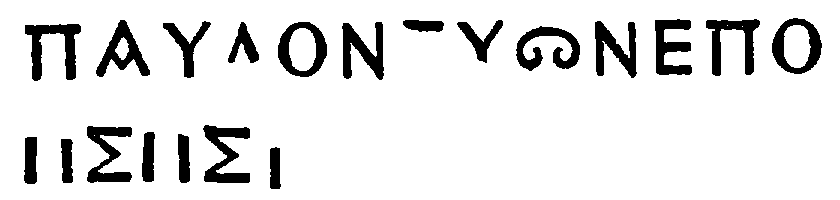
The emendations of Ramsay's implausible ἑπόμην challenged the logic of "following-leading" (ἑπόμην-προῆγε) and thus the identification of a Christian, Pauline pattern that was tied to πίστις.56 But the failure of Ramsay's connection we have now established to be beyond all challenge, given that originally there was a lost line that clearly disengaged Paul and faith.
The author of the Vita Abercii had not observed the lost line, even though it had been indicated by the bottom letters of the first line being damaged, in contrast with the damaged top letters of the second. So, in his ignorance he had run together two quite separate lines as one.
Thus the variant readings between the three versions of the Vita Abercii imply that its author would have read the epitaph in its present mutilated condition and been as puzzled as we are by the missing, mutilated line and damaged text above and below the fissure. Ramsay observed both from the meter and from the state of the epigraphy that "there is a gap in the traditional text where the words are far too few to fill the measure."
The combination of lines 11 and 12 should produce one hexameter, which 55. So also in Grabschrift 36–43 each of the separate lines on the stone run into a single line so as to produce a text of nine lines (7–15) that thus fit in the place they occupy in the full twenty-two lines of the text on the stone, as represented by all three versions of the Vita Abercii. But on the stone they are separated as eighteen lines and numbered as such by Ramsay, "Cities and Bishoprics of Phyrgia," 424–26 no. 36. See also Ramsay, The Cities and Bishoprics of Phrygia (Oxford: Clarendon, 1897), 1.2:723–
24 no. 657; Carl Robert, "Archaeologische Nachlese," Hermes 29.3 (1894): 422.
56. See above, n. 42 and associated text.
Allen Brent they fail metrically to do when they so appear combined together by the author of the Vita Abercii.
It thus follows that the reader and transcriber of the epitaph who was the author of the Vita Abercii had no information about the original text that we ourselves do not have with which to decipher the stone. Both we and the transcriber have inherited an inscription on which one line has been obliterated intentionally by an otherwise unknown hand. He, like us, when confronted by line 11 and the fragmentary letters (plate 5) may infer the words of line 11 in this way, but, as Wolfgang Wischmeyer records,
"the letters are not clearly readable."57 But another important consequence now follows.
Ramsay's Christian interpretation was founded upon a logic of "following-leading" suggested by the juxtaposition of line 11—Π[α]ῦλον ἑπόμενην Πίστις [πάντη δὲ …]—that thus securely anchored the words and images of the epitaph into a pattern of Christian, Pauline interpretation.
Quite apart from an ambiguous manuscript tradition and the emendation ἐπ᾽ὄχῳ that for reasons that I have pointed out also lessens the interpretative firmness of such a juxtaposition, the presence of a gap with a line deliberately obliterated thus breaks Ramsay's "following-leading" pattern of Christian and Pauline interpretation and exposes the contrived character of the reconstruction that the speculations of the Vita Abercii have produced from an already damaged artifact.
Even if therefore the excavated βώμος had not revealed a damaged half line missing from the transcription of the Vita Abercii, the absence of sufficient words to fill the hexameter and the highly ambiguous and divergent manuscript readings would not have allowed us to proceed with confidence. But there can be no doubt that the fissure that appears in the fragment that now stands in the Museo Pio Christiano did not simply appear there when Ramsay in Scotland and Sultan Abdul-Hamid in Istanbul sent the two halves to the Vatican to be recombined. How then did these two halves become separated?
Sterrett and Ramsay had not found the fragmentary βώμος in two halves as is sometimes assumed.58 As Sterrett makes clear, they had dis57. Wischmeyer, "Die Aberkiosinschrift als Grabepigramm," 25; Thonemann,
"Abercius of Hierapolis," 258.
58. As in Thonemann, "Abercius of Hierapolis," 258: "Ramsay was rewarded with the spectacular discovery of two large fragments of the tombstone of Abercius itself, built into a bath-house at the hot springs near Kochisar." Mitchell, "Looking for Aber-
Has the Vita Abercii Misled Epigraphists
covered the stone in the walls of the apodyterium (changing room) at the entrance of the baths in ancient Hierapolis.59 In a letter in French to Salomon Reinach, Ramsay described the marble fragment with a small part of the epitaph of the Vita Abercii "un petit morceau" (a little piece) to which Sterrett had directed him and that was clearly the entire remains, lines
7–15.60 It is clear that the marble fragment found in the wall from which Ramsay and Sterrett made their squeeze consisted of the whole fragment now reconstituted in the form in which it stands now in the Vatican, using to their obvious joy the warm water of the spring that the Vita Abercii claims as one of Abercius's miracles. That embedded fragment was whole but bore the mark of a chiseled-out, obliterated line. When Sterrett had therefore made reference to "the stone that had been broken into two parts," he was referring to one part that was the two sides of the βώμος that survive as opposed to the other, lost section that originally bore the first and last parts of the full epitaph.61
Ramsay's object was not to excavate but, principally, to draw a map of Phrygia locating ancient sites and then to visit and record monuments and inscriptions that survived there.62 They found a half-fragment of a βώμος not free-standing but embedded in the masonry wall of an apocius," 307: "A scant two years later on a June morning after breakfast Ramsay and his companion, the American J. R. S. Sterrett, found two fragments of Abercius's own epitaph in the ruins of a bath house on the site they identified as ancient Hierapolis, in Phrygia Salutaris."
59. J. R. Sitlington Sterrett, Leaflets from the Notebook of an Archeological Traveler in Asia Minor (Austin: University of Texas, State Printing Office, 1889), 15.
60. Ramsay's letter from Ushak on 12 July 1883, in Salomon Reinach, "Chronique de Orient," Revue Archéologique 3.2 (1883): 194–95: "nous avons trouvé un fragment du tombeau de saint Abercius avec une partie des linges depuis ΕΙC ΡΩΜΗΝ jusqu'à
ΕΔΡΑJΑΤΟΠΑΡΘΗ. Ce n'est qu'un petit morceau…. Le marbre est encastré dans le mur des bains, et ce n'est pas sans peine, à cause de l'humidité, que nous réussîmes à faire un estampage de l'inscription, avec la même eau thermal dont saint Abercius, suivant la tradition, a dote jadis ses concitoyens d'Otrous."
61. Sitlington Sterrett, Leaflets, 15: In the summer of 1883 "Mr. Ramsay and I not only located definitely the site of Hierapolis, but we actually found what remains of the marble block which bore the epitaph quoted in the Acta Sanctorum. The stone has been broken into two parts, of which we found one." See also William M. Ramsay,
"The Utilisation of Old Epigraphic Copies," JHS 38 (1918): 191.
62. Ramsay, "Cities and Bishoprics of Phrygia," 370: "Our chief aim was to construct the map of ancient Phrygia, and our method was to examine each district thoroughly enough to be able to say, not only where there were, but also where there
Allen Brent dyterium at Otrous that was ancient Hierapolis, with the remains of the epitaph that they published from a squeeze that showed not the line of a broken stone but of an intentional eradication of some words of its text.63
Both agreed on Ramsay's transliteration of the remains as one text and not two separate ones, as it is necessary to emphasize here in the light of Calder's later criticism.64
The inscription was cracked at lines 11–12, but the fragment embedded in the bathhouse wall not split in two. It was only at the point that the ruined stone was lifted by archaeologists from its cavity in the wall that it broke in two, along the absent line of which the chiseled fissure remained, with the upper section passing on to Istanbul and the lower section retained in Ramsay's possession and taken to Scotland. It was in this way that the one fragmentary artifact became two only to be rejoined and placed in the Lateran museum in 1892.65
Our discussion has therefore led us to the conclusion that the author of the Vita Abercii had the same view of an intentionally damaged epitaph that we have. He had, of course, viewed all three of the inscribed sides, so he could transcribe the words in their entirety, and we are very much dependent upon him for the complete text. But there was no other historical information available to him than there is to us. Our careful review of the work of Ficker and Dieterich has shown us that their epigraphical analysis was careful and scientific and unworthy of the ridicule that it received.66
The Vita Abercii itself, as Thonemann has shown, is a quite fabulous, interpretatio Christiana of a number of pagan artifacts at Hierapolis in the were not, ancient sites. The discovery of monuments and inscriptions was a secondary object, and we did not aim at completeness in this regard."
63. Abel, "Étude sur l'inscription d'Abercius," 325: "L'inscription était fendue en son milieu, au même endroit où les manuscrits présentaient l'étrange leçon Παῦλον ἔσωθεν. On pouvait en conclure que la 'vie' avait été écrite et l'inscription copiée lorsqu' elle était déjà endommagée. Ramsay supposa d'abord un martelage de la pierre."
64. Ramsay, "Cities and Bishoprics of Phrygia," 424–25, no. 36; see also 370 n.
2: "Besides this I have impressions made by Mr. Sterrett of many of the inscriptions which he copied: in such case I still attach his initials to the text"; Sterrett, Leaflets,
14–15. For a discussion of Calder, see below, n. 75 and associated text.
65. Abel, "Étude sur l'inscription d'Abercius," 325: "Lorsqu' on enleva le fragment de son alvéole, il se brisa en deux à cet endroit. La partie supérieure passa à Constantinople, l'autre fut conservée par Ramsay."
66. See above nn. 48 and 49 and associated text.
Has the Vita Abercii Misled Epigraphists
fourth century undergoing a process of Christian, cultural transformation.
What I have argued is that the Abercius inscription cannot be privileged as a Christian artifact that precedes such an interpretatio Christiana but stands alongside and as part of the material fabric of second-century Hierapolis, sharing the prevalent cultural and historical backcloth before its fourth-century, cultural transformation. Thus, in our own process of interpretation, we must not fall into the trap of a vicious circularity in which we interpret the epitaph in the light of the Vita Abercii since the latter is itself an interpretation of the former. And I have challenged the fourth-century,
Christian interpretation as a rereading of a purposely obliterated line the motive for which is plausibly the removal of a pagan message that did not square with the fourth-century character of Abercius, saint and bishop.
Dieterich's restoration of the Vita Abercii's πίστις (ΠΙΣΤΙΣ) with ΝΗΣΤΙΣ, for example, becomes plausible, particularly in the light of the place of the inscription's discovery. Nestis was a river goddess mentioned in a fragment of Empedokles preserved by Pseudo-Hippolytus where he attacks Marcion as the representative of a pagan philosopher's two principles of love and strife. Water represents the fourth element after fire
(Zeus), earth (Hera), and air (Adoneus). He calls the goddess of water Νῆστις and calls her "the chariot that brings nourishment" (ὄχημα τρόφης), since she is its "cause [αἴτιον], for all who are nourished [γιν(ό)μενον πᾶσι τοῖς τρεφομένοις]."67 Given the highly allegorical character of the imagery of the epitaph, Nestis is the source of nourishment that provides in every place the "fish from the fountain" in a cultic meal. Thus we can read the 67. Dieterich, Die Grabschrift des Aberkios, 43–44; Pseudo-Hippolytus, Ref.
7.29.4–7: Τέσσαρα τῶν πάντων ῥιζώματα πρῶτον ἄκουε·/ Ζεὺς <αἰθὴρ> Ἥρη τε φερέσβιος ἠδ᾽ Ἀϊδωνεὺς / Νῆστις θ᾽ ἢ δακρύοις τέγγει κρούνωμα βρότειον/ Ζεὺς ἐστι, <φησί> τὸ πῦρ,
Ἥρη τε φερέσβιος ἡ γῆ, ἡ φέρουσα τοὺς πρὸς τὸν βίον καρπούς, Ἀϊδωνεὺς δὲ ὁ ἀήρ, ὅτι πάντα δι᾽αὐτοῦ βλέπο<ν>τες μόνον αὐτὸν οὐ καθορῶμεν, Νῆστις δὲ τὸ ὕδωρ· μόνον γὰρ τοῦτο «ὄχημα τρόφης», (τουτέστιν) αἴτιον, γιν(ό)μενον πᾶσι τοῖς τρεφομένοις, αὐτὸ τρέφειν οὐ δύναται τὰ τρεφόμενα … διὰ τοῦτο <οὖν> Νῆστιν καλεῖ τὸ ὕδωρ, ὅτι τροφῆς αἴτιον γινόμενον, τρέφειν οὐκ εὐτονεῖ τὰ τρεφόμενα ("Hear the four roots of all that exist: Zeus the aether, Hera giver of life, and Adoneus, and Nestis who with her tears bedews the mortals' fountain. Zeus they say is fire, but Hera the life-giving earth that bears the fruits that sustain life, and Adoneus the air, because though seeing all things through him our eyes do not light on him himself. But Nestis is water because this is the basis of nourishment, its cause, becoming this to all things that are nourished.… on this account therefore water is called Nestis, because though it causes nourishment, it is not of itself to nourish what is being nourished"). See also, Diogenes Laertius, Lives, 8.76.
Allen Brent lines 12–16 as: Νῆστις παντἰ προῆγε καὶ παρέθηκε τροφὴν ἰχθὺν πανμεγέθη καθαρόν ὃν ἐδράξατο παρθένος ἁγνή ("Nestis everywhere led the procession and provided me everywhere a fish from the fountain, a great and pure fish, that the [Holy Virgin or Faith] caught [or 'conceived']").
It is important to recall in the context of such an interpretation the location in the masonry wall of the baths at which Ramsay and Sterrett made their squeeze of the epitaph. We possess from the theatre at Hierapolis above the middle section of the great area above the eighteenth row of seats an inscription celebrating one of the mountain streams that provided Hierapolis with warm waters an epigram asking "the mistress of the Nymphs" to send greetings "to the golden city, Hierapolis … distinguished by her shining streams."68 One of these streams is called Χρυσορόας who has become personified as a goddess with her image on Roman coins.
The second-century baths with the discovered masonry wall were found at Agros Thermôn, a little way to the south of Hierapolis, where the Vita Abercii claims Abercius's miracle and his successful petition to Faustina for a βαλανεῖον (Vit. Aberc. 39–40).69 The author of the Vita Abercii saw the whole monument still intact so that only after the fourth century was it broken up and the fragmentary debris used for a masonry wall in the baths and presumably stood originally in the vicinity of where a broken fragment was thus used. The reading Nestis would have been congruent with the emphasis on water and water goddesses throughout Hierapolis and in particular in the location of the baths.
68. Reinhold Merkelbach and Josef Stauber, Die Westküste Kleinasiens von Knidos bis Ilion, vol. 1 of Steinepigramme aus dem griechischen Osten (Stuttgart: Teubner,
1998), 265: (1–3) Ἀσίδος εὐρείης | προσφέρεστατον | οὖδας ἁπάντων. | (4–6) Χαίροις, χρσόπο|λι, Ἱερὴ πόλι, πότνια | Νυμφῶν (6–7) Νάμασιν, | ἀγλαίῃσι κεκασμένη – – – – –.
69. As a reward for Abercius's exorcism of Lucilla, Vita 65: ᾔτησεν δὲ ἐφ᾽ᾧ πέμψαι αὐτὴν ἀρχιτέκτονα εἰς τὸ κτισθῆναι βαλανεῖον ἐν τῷ Ἀγρῷ λεγομένῳ παρὰ ποταμόν, ἔνθα κλίνας τὰ γόνατα ηὔξατο καὶ αἱ πηγαὶ τῶν θερμῶν ὑδάτων ἀνέβλυσαν, ἀπονεῖμαι δὲ σιτηρέσιον τοῖς πτωχοῖς τῆς πόλεως ("He requested that he might send an architect for this purpose, that a bathhouse might be built in the place that is called Agros, alongside a river where falling to his knees he prayed and springs of warm water gushed forth and that she allocate a food allowance for the poor of the city"). In 66 the place is officially named Agros Thermôn (Ἀγρὸς Θερμῶν ἐπωνομάσθη).
Has the Vita Abercii Misled Epigraphists
8. Conclusion My chapter has focused on the discussion of the restoration of the text of the mutilated line, but as part of the observation that generally the conjectured restoration by the author of the Vita Abercii has no more historical basis than our own. Scholarly discussion of the restoration has largely ignored an important procedural principle, namely, that the fourthcentury Vita Abercii must not be used as a serious commentary on the inscription but rather the inscription must speak independently for itself: the fourth-century legend is merely a fable that explains the ignorance rather than the knowledge of its author. But my concentration on these lines has a further purpose.
The reconstruction of the line with the creation of the Paul-πίστις, leading-following relationship that involved the ignoring of a lost line was also fundamental to identifying the epitaph as that of a second-century Christian. Only the name of the apostle Paul could identify his books "on the wagon" and thus the source of the γράμματα πιστά.70 With Dieterich, and following his careful epigraphic analysis of the mutilated letters, we have seen that a reconstruction of the lines occurs, which gains in plausibility when the general background revealed in the material fabric of secondcentury Hierapolis is considered. The images of the fish and the fountain, of the sacred meal, and the celebration of a pagan myth of creation abound in that background in particular relationship to the iconography of the mistress of the nymphs and of the nymph Χρυσορόας, in association with whom Nestis clearly belongs.71
Once we concede the dubious validity of the reconstruction of the mutilated words and the lost line between them, then now additionally the imagery that without them becomes at least highly ambiguous now comes into question as genuinely Christian. The μαθητὴς ποιμένος ἁγνοῦ, the "Chaste Shepherd" (and not the "Good Shepherd") becomes plausibly a priest of Attis teaching his mysteries (γράμματα πιστά), who is described appropriately as a shepherd god (Grabschrift 4 and 6).72 The language of the epitaph strongly implies a cult statue of Attis, who, in the Naasene
70. See n. 42 above and associated text.
71. See n. 67 above and associated text.
72. ὃς βόσκει προβάτων ἀγέλας ὄρεσι πεδίοις τε … οὗτος γὰρ μ᾿ ἐδίδαξε – – γράμματα πιστά ("who grazes his flocks on the hills and the plains.… It is he who taught me … the words of faith").
Allen Brent Psalm of Pseudo-Hippolytus is described as the "shepherd of the white stars" (ποιμὴν λευκῶν ἄστρων) who is also "many eyed" (μυριόματος) in the Naasene Psalm.73
The mutilated form ΒΑΣΙΛ that Abercius is sent to Rome to see is rendered in Attic form by the editions of the Vita Abercii as either βασίλεια
("queen") or as βασιλεία ("kingdom"). Nissen's preferred version I supports the latter, as does the Metaphrastis, whilst edition II the former.74 I submit that the reconstruction by the fourth-century Christian writer, before Greek accentuation, was the βασίλεια that he imposed upon Ionic letters and was shaped by the legend of bishop Abercius's visit to queen Faustina and princess Lucilla. The question of whether the original stone ended
ΒΑΣΙΛΗ, as Ramsay maintained, or as ΒΑΣΙΛ as Calder maintained, is inconsequential for the discussion and should not have been given the weight that it has.75
The author of the Vita Abercii undoubtedly sought a βασίλειαβασίλισσα juxtaposition in conformity with his legend of the visit to Lucilla and Faustina.76 But in the light of this, and without the influence of the Vita Abercii legend compounded by the misleading later accentuation that produced βασιλεία, we would have expected a "king" with a "queen" and pondered supplying the lost ending as ΒΑΣΙΛ[ηᾶ] ("king") reconstructed in the Vita Abercii as though it had read instead βασιληΐδα (to be duly atticized as βασίλεια) so as to provide Abercius with a visit to a princess.77
Consequently, both reconstructions of a mutilated ΒΑΣΙΛ require an Ionic continuation beginning with η. Thus both Ficker's more complicated quest for Zeus as king as part of the Attis cult or Dieterich's account of 73. Line 5: ὀϕθαλμοὺς ὃς ἔχει μεγάλους πάντῃ καθορῶντας ("who has great eyes gazing around in all directions"); see also Pseudo-Hippolytus, Ref. 5.9.60.
74. Nissen, S. Abercii Vita, 53 adopts βασιλεία in I (77.7), but for version II (p.
82) he reads βασίλεια. For the titles of the three versions, see above, nn. 32, 36, 38 and associated text.
75. Ramsay, "Utilisation of Old Epigraphic Copies," 190; Calder, "Epitaph of Avircius Marcellus," 1–4.
76. See above, n. 27 and associated text.
77. Recently there has been a preference for βασίλεια (princess); see Merkelbach,
"Grabepigramm und Vita," 126–27; Hirschmann, "Untersuchungen Zur Grabschrift Des Aberkios," 109–16, who gives: … βα̣σι̣ληΐδ᾿ ἀθρῆσαι καὶ βασίλισ̣σαν ἰδεῖν (109) but does not translate into German but simply has "Basileia erblicken und die Basilissa zu sehen" (110). See also Ficker, "Der heidnische Charakter des Abercius-Inschrift,"
89–90; ICUR 2.1 Proemium XV–XVII.
Has the Vita Abercii Misled Epigraphists
Abercius's witnessing (219 CE) the ἱερός γάμος of Elagabalus as king with the Vestal Virgin, Aquilia Severa, his queen, "with golden robe, with golden sandals" (χρυσόστολος, χϱ̣υσοπέδιλος).78 Abercius also saw in Rome "the people having the shining seal," using the typically Christian word, λαός for the "people of God," who in baptism had received the σϕραγίς (Grabschrift 9).79 Once again, to read this line in a Christian light is to follow the legend of the Vita Abercii that on such a speculative basis can describe his saintly and episcopal subject describing his converts as having received
"the seal of baptism" (τὴν σφραγεῖδαν τοῦ βαπτίσματος). (Vit. Aberc. 9).
While it is true that σϕραγίς is used in 2 Clement and, as more recently documented, in the rediscovered work of Melito of Sardis, it was by no means a term unique to Christianity: it described an impress, or even a tattoo applied to initiants, although not generally, in some mystery cults.80
Certainly, in some of those cults impresses on stone or metal were made into rings or amulets as objects of contemplation in secret or for apotropaic purposes. Whilst Ficker looked for the σφραγίς as mysterious image on metal or stone reverenced in private by a priest of the Attis cult, Dieterich rather saw it as the image impressed upon the sacred stone of Edessa at the center of Heliogabalus's attempt at a universal pagan monotheism.
Dieterich, proposed to rewrite λαός as an ionic form of λᾶας, which means a "stone," and claimed that Abercius saw the σφραγίς on black stone of Elagabalus's supreme deity. Thus the term referred not to Christian baptism but the τύπον τοῦ ἐπιχωρίου θεοῦ added to the image of Elagabalus set up in the Senate.81
78. Dieterich, Die Grabschrift des Aberkios, 16, see also Ficker, "Der heidnische
Charakter des Abercius-Inschrift," 97 and 101: "Im Tempel der Göttin zu Rom muss, wie im Tempel der Göttin im syrischen Hierapolis neben dem Standbilde der Göttin ein Standbild des Gottes gestanden haben. Vergegenwärtigen wir uns ferner, dass βασιλεύς und βασίλισσα sogar sehr häufig Titel für orientalische Gottheiten sind, so kann die Bezeichnung des Zeus und der Cybele als βασιλεύς und und βασίλισσα erst recht nicht auffallen." See also his reference to Julian, Or. 5.180.A.
80. Margaret Mitchell, "The Poetics and Politics of Christian Baptism in the Abercius Monument," in Ablution, Initiation, and Baptism in Early Judaism, Graeco-Roman
Religion, and Early Christianity, ed. David Hellholm (Berlin: de Gruyter, 2011): 1746–
47; Clemens Romanus, Cor. 2.7.6: τῶν γὰρ μὴ τηρησάντων … τὴν σφραγῖδα; Shepherd of Hermas, Sim. 93(9.16).4: ἡ σφραγίς οὖν τὸ ὕδωρ ἐστίν; Melito, Pasch. 67: "sealed our souls with his own spirit."
81. Ficker, "Der heidnische Charakter des Abercius-Inschrift," 98; Dieterich,
Allen Brent If we therefore factor out of the discussion the Christian reconstruction of the mutilated line in terms of Paul-πίστις and their leading-following relationship, σφραγίς as a reference to Christian baptism, though a possibility, becomes considerably lessened as a possibility. Though the Christian meaning of the term cannot by itself be excluded when measured against the general cultural backcloth of second-century Hierapolis, we nevertheless must ask whether the epitaph contains any further clues as to the kind of groups in which the σφραγίς might be found that would lessen considerable the ambiguity of the term.
The answer is that such terms are indicative not of a Christian assembly but of a pagan cult association. Abercius, aware that he is using the language of mystery only comprehensible to the initiated, invites the whole gathering that fathoms the meaning of his language to pray for him
(Grabschrift 19).82 But the prayer that is apparently sung for the "gathering" is rather a choir (συνῳδός). We find copious references to ὑμνῳδοί and συνυμνῳδοί particularly with reference to imperial mysteries commemorating an emperor's birthday, such as for example on a stone altar from the temple of Roma and Augustus at Pergamon.83 It is within such
Die Grabschrift des Aberkios, 32–33; Apuleius, Apol., 55: "Sacrorum pleraque initia in Graecia participaui. Eorum quaedam signa et monumenta tradita mihi a sacerdotibus sedulo conseruo … uel unius Liberi patris patris mystae qui adestis scitis, quid conditum celetis et absque omnibus profanis tacite ueneremini. At ego, ut dixi, multiiuga sacra et plurimos ritus et uarias cerimonias studio ueri et officio erga deos didici" ("I have participated in various Greek mysteries. I carefully preserve some images and mementoes that have been handed on to me by their priests.… For example, you know who are present and initiants of our father Dionysius alone what you keep hidden, concealed under wraps, and you revere in silence apart from all removed from the rites. And I, as I have said, have learned many kinds of mysteries, very many rites and ceremonies, in my desire for truth and my duty toward the gods"); Cassius Dio, Hist. rom. 80.9–10; Herodian, Hist. 5. 5.6–7. See also Allen Brent, The Imperial Cult and the Development of Church Order: Concepts and Images of Authority in Paganism and Early Christianity before the Age of Cyprian, VCSup 45 (Leiden: Brill, 1999), 319–27.
82. ταῦ θ᾿ ὁ νοῶν εὔξαιτο ὑπὲρ Ἀβερκίου πᾶς ὁ συνῳδός ("May all the cult who understand these words sing prayers on behalf of Abercius").
83. IGRR 4.353. For a full discussion, see Henri W. Pleket, "An Aspect of the Imperial Cult: Imperial Mysteries," HTR 58.4 (1965): 331–47; Brent, Imperial Cult and the Development of Church Order, 194–95. See also IGRR 4.1436.2–3, 15–18; SEG
37.961.6–11. Wischmeyer, "Die Aberkiosinschrift als Grabepigramm," 44, wrongly claims: "Jedenfalls fehlt dem Wort jeder Hinweis auf ein nur von Glaubensgenossen geteiltes Arcanum oder von Mysterienvereinen." Rather, συνῳδός is cognate with a host
Has the Vita Abercii Misled Epigraphists
a mystery cult that the concealed meaning of the σφραγίς whether of a mark tattooed on an initiate's flesh or as the impress on a sacred object can be understood.
But how then can the Virgin catching the "fish from the fountain … a fish of great size and pure" now be understood (Grabschrift 13–16)?84 Is the παρθένος ἁγνή the subject of καὶ παρέθηκε τροϕὴν in the form of the fish that she catches, or is it Nestis, Dieterich's river goddess, or Ficker's Tises
(ΤΙΣΗΣ), a name of Cybele? Once we have rejected the Paulus-πίστις (ἑπόμην-προῆγε) matrix, Christian interpretations can be disregarded, that variously see the Virgin as the church providing baptism or the church personified or even the Blessed Virgin Mary providing the Eucharist in all places.85 The παρθένος ἁγνή and her catch of fish, provided by herself directly or by Nestis or Tises, must be located against a cultural backcloth of second-century Hierapolitan paganism.
Although since the nineteenth century there have been no absence of Christian interpretations of what is provided, either as baptism or as a meal, we should firstly note that although the author of the Vita Abercii could interpret the σφραγίς unequivocally as baptism, there is no embellishment of the fish and the fountain in the form of the Eucharist as an element in his legend of Abercius.
Rather, the Vita Abercii infers from the words of the epitaph a miracle performed by Abercius involving "a mixture of wine, oil and vinegar, with also a few loaves" (οἶνον καὶ ἔλαιον καὶ ὄξος μίξας ἑκάτερα καὶ ὀλίγους ἄρτους)
(Vit. Aberc. 55). If Trophimion his companion drank from his flask withof terms that clearly are associated with mystery associations, such as ὑμνῳδοί and συνυμνῳδοί.
84. καὶ παρέθηκε [τροϕὴν] πάντῃ ἰχθὺν [ἀπὸ πηγῆς] / πανμεγέθη καθ[αρόν, ὃν] ἐδράξατο παρθέ[νος ἁγνή,] / καὶ τοῦτον ἐπέ[δωκε ϕι̣]λί̣οι̣ς ἐ̣σθ̣ε[ῖν διὰ παντός,] / [οἶνον χρηστὸν ἔχουσα, κέρασμα διδοῦσα μετ᾿ ἄρτου.] /πανμεγέθη καθ[αρόν (for translation, see n. 35 above).
85. Tertullian, Bapt. 1.3. Ilaria Ramelli, "L'epitafio di Abercio: Uno status quaestionis ed alcune osservazioni," Aevum 74 (2000): 202; Georg Kretschmar, "Erfahrung der
Kirche: Beobachtungen zur Aberkios-Inschrift," in Communio Sanctorum: Mélanges offerts à Jean-Jaques von Allmen, ed. Boris Bobrinskoy et al. (Neuchâtel: Université de Neuchâtel, Facultés de Théologie, 1982), 81. For a eucharistic interpretation, see
Wilpert, Fractio Panis, 105–6. For the church symbolized by the Blessed Virgin Mary, see Franz Joseph Dölger, ΙΧΘΥΣ, Das Fischsymbol in frühchristlicher Zeit (Münster in Westfalen, 1910), 2:486–507. See also Guarducci, "L' inscrizione di Abercio e La
'Vergine Casta," 271–79.
Allen Brent out the saintly bishop's permission, only oil and vinegar came out. But if Abercius had given his consent, then the wine came out "pure" (καθαρόν).
This was the limit to the sense that this fourth-century Christian could give to the οἶνον χρηστὸν … κέρασμα διδοῦσα μετ᾿ ἄρτου ἰχθὺν ἀπὸ πηγῆς with the ἰχθὺν … καθαρόν (for translations, see n. 35 above; Vit. Aberc. 56; see also Grabschrift 14, 16).
If we wish to find images of bread, wine, olives, and vinegar we need to look not at images of the Eucharist in early Christian art but of funerary banquets whose depiction was well suited to an epitaph. We can identify the meal provided to Abercius by the παρθένος ἁγνή as a refrigerium, against which we can identify the social and religious milieu reflected in the epitaph. The features of the refrigerium, the "refreshment meal" for the dead, point to a popular religious culture in which an emerging, secondcentury Christianity would appear at best highly ambiguous and at worst almost invisible in public expressions of religious concepts and icons.
In the third and fourth centuries, we find forms of refrigeria that have come to develop out of that general culture a clearer Christian definition.
What is at issue is whether that culture had assumed such a Christian definition in the second century and is witnessed as such in the Abercius epitaph. The figure of a female is frequently found prominently serving at such a meal. There was a fourth-century Constantinian celebration of such meals in some parts of the cemetery of Ss Petrus and Marcellinus, whose Christianity is vouchsafed in frescoes that personify the Christian virtues of Agape and Eirene (plates 5 and 6).86 But at what point in the development of such a practice did these two figures replace the pagan representations of Psyche and Amor as part of a funerary motif: both these figures were still decorating one panel of a Christian sarcophagus, that of Junius Bassus, in 359 CE.87
In the cemetery of Ss Petrus and Marcellinus, we find some of the frescoes of the refrigerium banquet decorated with verbal inscriptions associated with the figures of Agape and Eirene. I interpret these as allegorical figures that represent the souls of departed individuals, often as husband and wife, as to the figures of Amor and Psyche in their pagan equivalents.88 The verbal accompaniments to these figures are reminiscent
86. Brent, "Methodological Perspectives," 18–22, 27–34.
87. Elizabeth Struthers Malbon, The Iconography of the Sarcophagus of Junius Bassus (Princeton: Princeton University Press, 1990), 91–95 and figs. 31–32.
88. See Brent, "Methodological Perspectives," 28–29 and his plate 35 (Dölger,
Has the Vita Abercii Misled Epigraphists
of Abercius's οἶνον χρηστὸν … κέρασμα διδοῦσα μετ᾿ ἄρτου. Prominent in many of these refrigeria scenes is the image of a fish, and so we have, too, the ἰχθὺν ἀπὸ πηγῆς ("a fish from the fountain"). The κέρασμα theme is expressed by: AGAPE MISCE MI(hi) ("Agape mix for me (the wine)," or "IREN[E] MISCE" (plates 5 and 6) even though Abercius's παρθένος ἁγνή stands alone as the provider.89
But Agape and Irene only thus appear in the fourth century, when, as I have said, their pagan predecessors Amor and Psyche still appear on an artifact like the sarcophagus of Junius Bassus. In the second century a single divine figure, the παρθένος ἁγνή in a scene with a pitcher of wine or of oil or presenting a cup in her hand is more likely to be an image highly infused with the features of a pagan culture, even if a second figure is not introduced so as the set both figures in the context of the Amor-Psyche myth (see plate 7). We do have further examples of such meals at San
Sebastiano, originally Ss Petrus et Paulus ad Catacombas, around 239 CE when the clay pits were filled in burying the tombs of Codius Hermes, the Innocentiores, and the so-called Axe.90 Here was then constructed a Villa whose courtyard contained a Triclia or dining hall. On the east side of the portico was a stone bench behind which ran a wall decorated with many graffiti offering votive prayers to the apostles, Ss Petrus et Paulus, along with refrigeria meals from the Triclia. Typical is the graffito of Victor who invokes the intercessions of the two apostles or of one Tomius Caelius who records his refrigerium meal.91
But no Christian theological justification is given for such offerings for the dead apostles. We may then have here evidence of a form of Christianity far closer to pagan religious practice and perhaps on the part of some worshipers the pagan/Christian distinction was only indistinctly made. This is the culture in terms of which perhaps the epitaph of Abercius was composed.
We have, for example, those Christians criticized most harshly by Cyprian for their preparedness to participate in the emperor Decius's
ΙΧΘΥΣ, 3.53), where images of husband and wife are embellished with birds᾽ wings
(Amor) and butterfly wings (Psyche).
89. Brent, "Methodological Perspectives," 20, 31–33 and his plates 23, 40, 44, and 46. We have also SABINA MISCE where Psyche's allegorical veil appears to have slipped to reveal the real identity of the departed thus allegorized. See above, n. 81.
90. Brent, "Methodological Perspectives," 13–15.
91. Brent, "Methodological Perspectives," 14.
Allen Brent universally decreed supplicatio to the gods of the Roman state (249 CE).
Cyprian regarded them as apostates who, incredibly for him, had thrown away in one act the new birth at their baptism. But they no doubt viewed their willing and eagerly desired participation in a pagan sacrament of imperial unity more positively.92 Furthermore, bishop Basilides of Legio
Asturica had invoked pagan gods on what he thought mistakenly was his death-bed, and bishop Martialis of Emerita, also in Spain, had celebrated pagan refrigeria at the interment of his sons in a pagan burial ground.93
Both were deposed respectively from the Sees at the instigation of Cyprian but who were clearly part of a social culture that did not make the distinctions between Christianity and paganism that Cyprian was demanding.
If the Abercius epitaph is a witness to early Christianity at all, perhaps it was a witness to a highly ambiguous religious culture. Such a popular culture would have viewed more positively the association and assimilation rather than exclusive opposition of Christian and pagan images and ritual practices as witnessed by the iconography of the Good Shepherd and of Orpheus and the practice of commemorative funeral meals. We will find such a witness in a literary form that takes us beyond the speculation of the last paragraph. In the Naasene Psalm found in Pseudo-Hippolytus,
Ref. 5.7.30–34, Hermes, the waker of souls from the dead, is equated with Christ in an allegorical interpretation of Odysseus and the suitors (Homer,
Od. 24.6–8). But here also Hermes, the waker of souls from the dead, is equated with Christ who becomes part of the meaning of the allegory.94
Here we may discover the true world of the Abercius epitaph.
Bibliography Abel, Adolphe. "Étude sur l'inscription d'Abercius." Byzantion 3.2 (1926):
321–411.
Avramea, Anna. "Land and Sea Communications, Fourth–Fifteenth Centuries." Pages 57–90 in vol. 1 of The Economic History of Byzantium.
Edited by Angeliki E. Laiou. Dumbarton Oaks Studies 39. Washington DC: Dumbarton Oaks, 2002.
92. Brent, Imperial Cult and the Development of Church Order, 225–40.
93. Brent, Imperial Cult and the Development of Church Order, 15, 310–11.
94. Pseudo-Hippolytus also uses biblical references to Isa 28:16; Ps 117:22; Eph
3:16; 5:14, etc.
Has the Vita Abercii Misled Epigraphists
Boissonarde, Jean François. Anecdota Graeca. Paris: Excusum in Regio Typographeo, 1829–1833.
Bowersock, Glen W. Greek Sophists in the Roman Empire. Oxford: Oxford University Press, 1969.
Brent, Allen. The Imperial Cult and the Development of Church Order:
Concepts and Images of Authority in Paganism and Early Christianity before the Age of Cyprian. VCSup 45. Leiden: Brill, 1999.
———. "Methodological Perspectives in the Interpretation of Early Christian Artefacts." StPatr 73 (2014): 1–38.
Bundy, David. "The Life of Abercius: Its Significance for Early Syrian Christianity." Second Century 7 (1989–1990): 163–76.
Calder, William M. "The Epitaph of Avircius Marcellus." JRS 29 (1939):
1–4.
Carletti, Carlo. "Origini cristiane ed epigrafa: Note di lettura a proposito di alcune iscrizioni (forse) 'protocristiane.'" Annali di Storia dell'Esegesi
31.1 (2014): 83–94.
Castelli, Emanuele. "The Symbols of Anchor and Fish in the Most Ancient Parts of the Catacomb of Priscilla: Evidence and Questions." StPatr 59
(2013): 11–20.
Conybeare, Frederick C. Review of Zur Abercius Inschrift, by Adolf von Harnack. Classical Review 9 (1895): 295–97.
De Sanctis, George. "Die Grabschrift des Aberkios." ZKT 21.4 (1897):
673–65.
Delmaire, Roland. Les institutions du bas-empire romain de Constantin à Justinien: Les institutions civiles palatines. Paris: Cerf, 1995.
Dieterich, Albrecht. Die Grabschrift des Aberkios. Leipzig: Teubner, 1896.
Dölger, Franz Joseph. ΙΧΘΥΣ, Das Fischsymbol in frühchristlicher Zeit.
Vol. 2. Münster in Westfalen: Metzler, 1910.
Duchesne, Louis. "L'épitaphe d'Abercius." Mélanges d'archéologie et d'histoire 15 (1895): 155–82.
Eck, Werner. "P. Aelius Apollonides, ab epistulis Graecis, und ein Brief des Cornelius Fronto." ZPE 91 (1992): 236–42.
Ferrua, Antonio. "Nuove osserazioni sull'epitaffio di Abercio." Rivista di Archelogia Cristiana 20 (1943): 279–305.
Ficker, Gerhard. "Der heidnische Charakter des Abercius-Inschrift." Sitzungsberichte der Könlich Preußischen Akademie der Wissenschaften zu Berlin (1894): 87–112.
Franco, Carlo. Elio Aristide e Smirne. Rome: Bardi, 2005.
Allen Brent Grégoire, H. "Bardesane et S. Abercius." Byzantion 25–27 (1955–1957):
363–68.
Guarducci, Margherita. Epigrafi sacre pagane e cristiane. Vol. 4 of Epigrafia Graeca. Rome: Istituto Poligrafico dello Stato, Libreria dello Stato,
1978.
———. "L' inscrizione di Abercio e La 'Vergine Casta.'" Ancient Society 4 (1973): 271–79.
Harnack, Adolf von. Zur Abercius-Inschrift. TU 12.4B. Leipzig: Hinrichs, 1895.
Hirschmann, Vera. "Untersuchungen Zur Grabschrift Des Aberkios." ZPE 129 (2000): 109–16.
Kaufmann, Carl Maria. Handbuch der Altchristlichen Epigraphik. Freiburg im Breisgau: Herder, 1917.
Klauser, Theodor. "Studien zur Entstehungsgeschichte der christlichen Kunst I." JAC 1 (1958): 20–51.
Kretschmar, Georg. "Erfahrung der Kirche: Beobachtungen zur AberkiosInschrift." Pages 73–85 in Communio Sanctorum: Mélanges offerts à
Jean-Jaques von Allmen. Edited by Boris Bobrinskoy et al. Neuchâtel:
Université de Neuchâtel, Facultés de Théologie, 1982.
Lüdtke, Willy, and Theodor Nissen. Die Grabschrift des Aberkios, Ihre Überlieferung und Ihr Text. Leipzig: Teubner, 1910.
Malbon, Elizabeth Struthers. The Iconography of the Sarcophagus of Junius Bassus. Princeton: Princeton University Press, 1990.
Marucchi, Orazio. "Nuove osservazioni sulla iscrizione di Abercio." Nuovo Bulletino di archeologia Cristiana 1 (1895): 17–41.
Merkelbach, Reinhold. "Grabepigramm und Vita des Bischofs Aberkios von Hierapolis." EA 28 (1997): 125–39.
Merkelbach, Reinhold, and Josef Stauber. Der "Ferne Osten" und das Landesinnere bis zum Tauros. Vol. 3 of Steinepigramme aus dem griechischen Osten. Munich: Saur, 2001.
———. Die Westküste Kleinasiens von Knidos bis Ilion. Vol. 1 of Steinepigramme aus dem griechischen Osten. Stuttgart: Teubner, 1998.
Mitchell, Margaret M. "Looking for Abercius: Reimagining Contexts of Interpretation of the Earliest Christian Inscription." Pages 303–25 in Commemorating the Dead: Texts and Artifacts in Context; Studies of Roman, Jewish, and Christian Burials. Edited by Laurie Brink and Deborah Green. Berlin: de Gruyter, 2008.
———. "The Poetics and Politics of Christian Baptism in the Abercius Monument." Pages 1739–78 in Ablution, Initiation, and Baptism in
Has the Vita Abercii Misled Epigraphists
Early Judaism, Graeco-Roman Religion, and Early Christianity. Edited by David Hellholm. Berlin: de Gruyter, 2011.
Mitchell, Stephen. Anatolia: Land, Men, and Gods in Asia Minor. Vols. 1 and 2. Oxford: Oxford University Press, 1993.
Nissen, Theodor. S. Abercii Vita. Leipzig: Teubner, 1912.
Pleket, Henri W. "An Aspect of the Imperial Cult: Imperial Mysteries."
HTR 58.4 (1965): 331–47.
Ramelli, Ilaria. "L'epitafio di Abercio: Uno status quaestionis ed alcune osservazioni." Aevum 74 (2000): 191–205.
Ramsay, William M. "The Cities and Bishoprics of Phrygia." JHS 4 (1883):
370–436.
———. The Cities and Bishoprics of Phrygia. Oxford: Clarendon, 1897.
———. "The Utilisation of Old Epigraphic Copies." JHS 38 (1918): 124–92.
Reinach, Salomon. "Chronique de Orient." Revue Archéologique 3.2 (1883):
192–95.
Robert, Carl. "Archaeologische Nachlese." Hermes 29.3 (1894): 417–35.
Robert, Jeanne, and Louis Robert. Exploration, histoire, monnaies et inscriptions. Vol. 1 of Fouilles d'Amyzon en Carie. Paris: de Boccard,
1983.
Sitlington Sterrett, J. R. Leaflets from the Notebook of an Archeological Traveler in Asia Minor. Austin: University of Texas, State Printing Office,
1889.
Thonemann, Peter. "Abercius of Hierapolis: Christianisation and Social Memory in Late Antique Asia Minor." Pages 252–82 in Historical and Religious Memory in the Ancient World. Edited by Beate Dignas and R.
R. R. Smith. Oxford: Oxford University Press, 2012.
Wilpert, Joseph. Fractio Panis: Die älteste Darstellung des eucharistischen Opfers in der "cappella Greca." Freiburg im Breisgau: Herder, 1895.
Wischmeyer, Wolfgang. "Die Aberkiosinschrift als Grabepigramm." JAC 23 (1980): 22–47.