
Search this book
Search results link directly to the matching source page.
CHAPTER SEVEN coming of the Dutch AND THE PROTESTANT mission
1620 -1845 Dutch presence on the Indian subcontinent lasted from 1605 and 1825. Merchants of the The Dutch East India Company (Vereenigde Oost-Indische Compagnie, VOC, "United East India Company") first established themselves in Dutch Coromandel, notably Pulicat, as they were looking for textiles to exchange with the spices. It was evident that the Portuguese hold in the colonies were getting weaker. Finally Dutch conquered Ceylon from the Portuguese in 1656, they took the Portuguese forts on the Malabar coast five years later to secure Ceylon from Portuguese invasion. For some while, they controlled the Malabar southwest coast (Kodungallor, Pallipuram, Cochin, Cochin de Baixo/Santa Cruz, Quilon (Coylan), Cannanore, Kundapura, Kayamkulam, Ponnani) and the Coromandel southeastern coast (Golkonda, Bimilipatnam, Kakinada, Palikol, Pulicat, Parangippettai, Negapatnam). By the end of seventeenth century, the Portuguese had been displaced by their Dutch rivals in Malabar. In 1661 the Dutch took Quilon and in 1663 Cochin also. Although they showed no particular interest in the Syrians, yet they rendered them the greatest service by ordering all Romish ecclesiastics to quit the country.
Tranquebar or Tharangambadi mean "place of the singing waves" and is a town in the Indian state of Tamil Nadu located about 100 km south of Pondicherry. Tranquebar, in the fort Dansborg, became the seat of its governor of Danish India, who was styled Opperhoved. Their major trade was in Indian tea. Tranquebar was founded by the Danish King Christian IV in 1620, and Fort Dansborg was built by a Danish captain named Ove Gjedde. It was a Danish colony in India from 1620-1845. In 1845 the colony was sold to Great Britain along with the other Danish settlements in India, Serampore, and the Nicobar Islands.
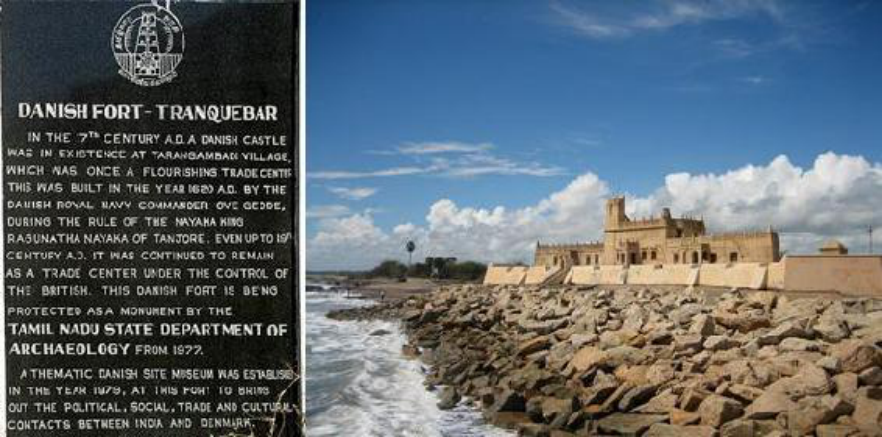
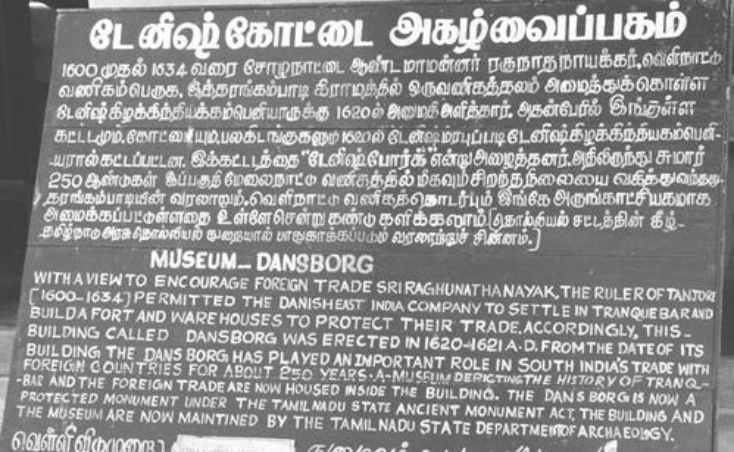
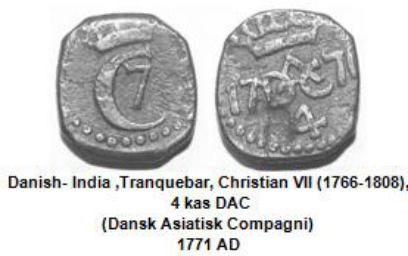
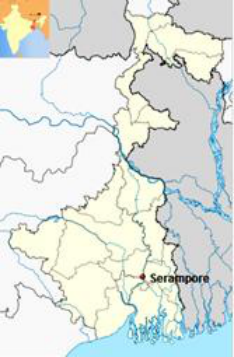
The colonies included the town of Tranquebar in present-day Tamil Nadu state, Serampore in present-day West Bengal, and the Nicobar Islands, currently part of India's union territory of the Andaman and Nicobar Islands. In 1777 it was turned over to the government by the chartered company and became a Danish crown colony. As time went on British entered scene. Serampore was sold to the British in 1839, and Tranquebar and most minor settlements in 1845 and by 1868 all Danish rights were sold to Britain.
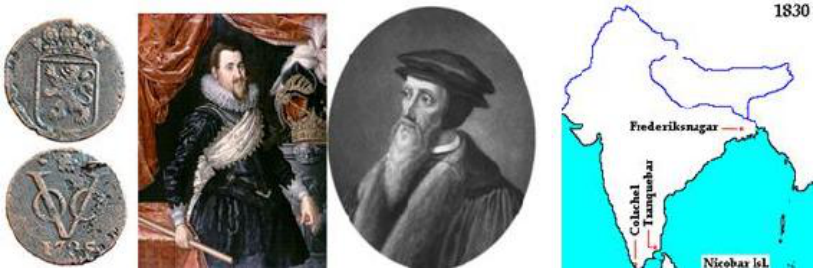
VOC coins Danish King Christian IV Calvin
The Danish crown actively supported the mission work in their colonies. The small Danish territories on the subcontinent became centers of education and bookprinting.
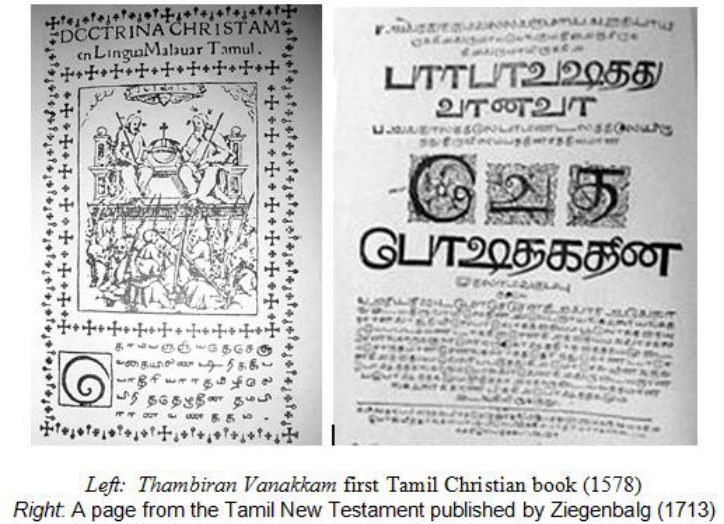
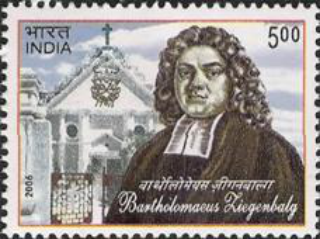
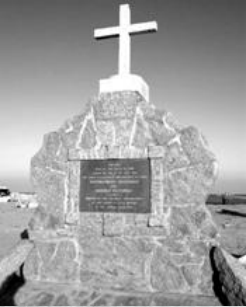
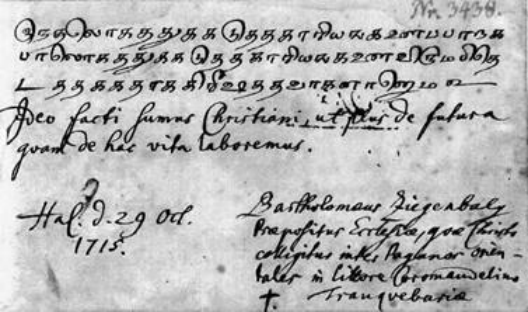
The first missionary from Denmark to go to India was Bartholomaeus Ziegenbalg, who arrived in Tranquebar in 1705. Under the Danish Halle Mission, a mission of the Lutheran Church of Danmark two students Bartholomaes Ziegenbalg and his classmate Heinrich Plutschau reached Tranquebar. Both learned Tamil quickly and worked at scripture translation. Ziegenbalg completed the Tamil New Testament in 1711. As the translation was in progress in 1709 he requested a printing press from Denmark. The Danes forwarded the appeal to London to the Society for Promoting Christian Knowledge who shipped out a printing press along with type, paper, ink, and a printer in 1712 to Tranquebar. The New Testament was printed as a result in 1712.
Ziegenbalg writes: "We may remember on this Occasion, how much the Art of Printing contributed to the Manifestation of divine Truths, and the spreading of Books for that End, at the Time of the happy Reformation, which we read of in History, with Thanksgiving to Almighty God." He started the translation of Old Testament soon after but dies without completing the work. Their work was opposed both by militant Hindus and by the local Danish authorities. In 1707/08, Ziegenbalg spent four months in prison on a charge that by converting the natives, he was encouraging rebellion.
Ziegenbalg was a prolific writer, composing works in German, Tamil, Portuguese and Latin which include dictionaries, hymnbooks, translations both into and out of Tamil, school textbooks, catechisms, sermons, and
book catalogues. Many of these works are extant, in print or manuscript Plutschau returned to Europe in 1711; Ziegenbalg, after making at least 350 converts in his last year of ministry, died in Tranquebar in 1719 at the age of thirty-six. Ziegenbalg had many Indological writings which were not published until a century of later They included Nidiwunpa (Malabari moral philosophy), Kondei Wenden (Malabari morals,) Ulaga Nidi (Malabari civil justice), and several books on Hindusim and Islam
Ziegenbalg and his fellow missionaries believed that they needed to share the "new" technologies in order to spread the good word. In the process, they ensured that the printed word would spread to other parts of India-Bombay, Bengal, Madras.
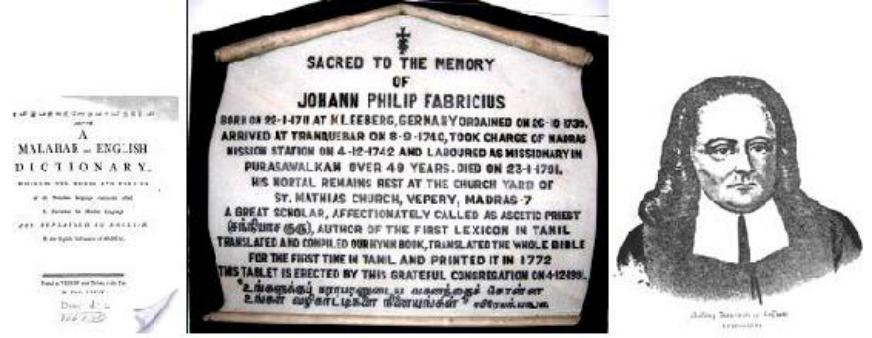
Following Ziegenbalg came Johann Phillip Fabricius (1711 - 1791) a German Christian missionary who also took up studying Tamil and became a Tamil scholar He arrived in South India in 1740 to take charge of a small Tamil Lutheran congregation in Madras and expanded it during his stay. During his time in Madras he wrote several Christian hymns in Tamil and published the first Tamil to English Dictionary. He improved the Tamil Bible is considerably by reading his work to a lot of people in order to get their feedback and response.
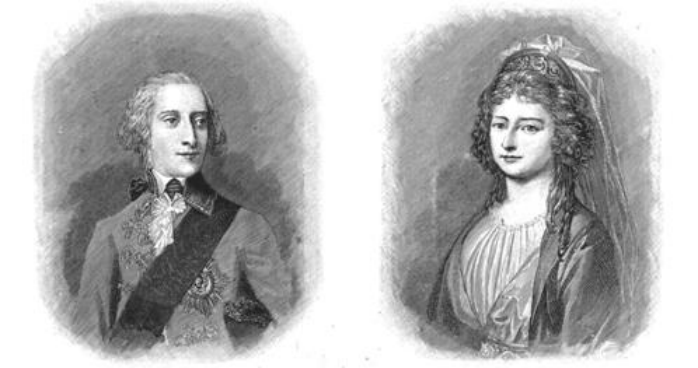
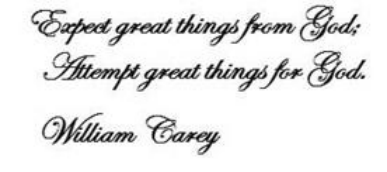
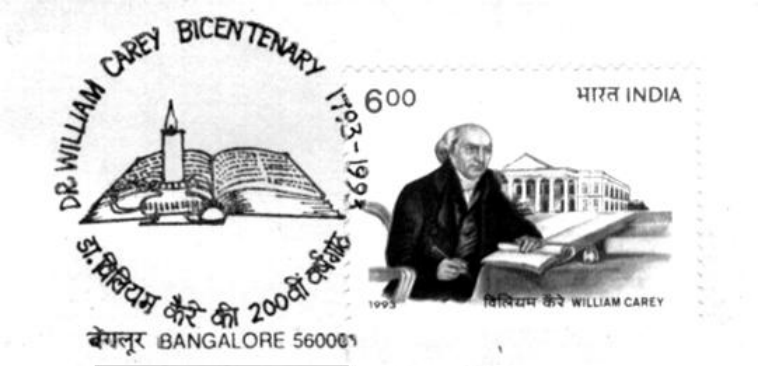
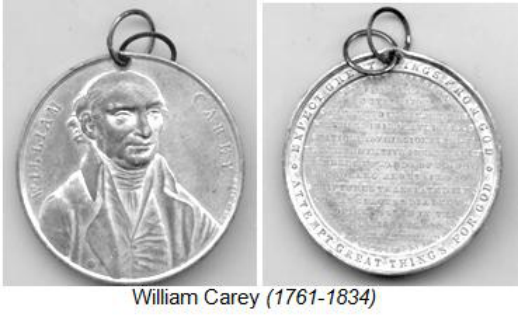
The King (Federick VI) and Queen of Denmark William Carey (1761 - 1834) Carey was a British shoe maker who left the Anglican Church and became a Particular Baptist minister, pastor in the Baptist Mission. He got interested in the mission among the "Heathens" amd started the Baptist Missionary Society along with others. He is today known as the "father of modern missions". Even though the British East India company was still in India as commercial institution, they were hostile to the missionaries who came down to India. Carey well knew about this hostility
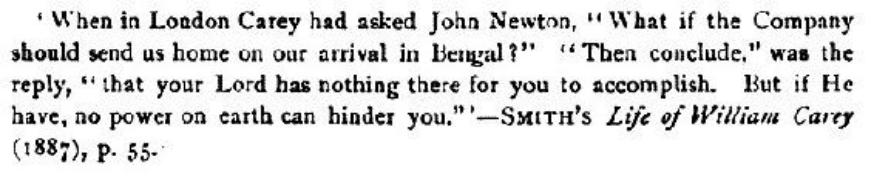
As a result Carey moved his place of work as a missionary in the Danish colony, Serampore, India, where his work was supported heavily by the Danish Crown. Carey worked in an indigo plant to support himself and his family. He developed the basic principles of Missiology as one enters into a new culture. These included communal living, financial self- reliance, and the training of indigenous ministers and communicating the gospel within the symbols and languages of the culture. During the first six years he learned the local language and completed the first revision of his Bengali New Testament.
His first convert was a Sudra called Krishna Pal. The conversion of Hindus to Christianity posed a new question for the missionaries concerning whether it was appropriate for converts to retain their caste. In 1802, the daughter of Krishna Pal, a Sudra, married a Brahmin. This wedding was a public demonstration that the church repudiated the caste distinctions.
It was at this time the Richard Wellesley the Governor-General wanted to start a college to educate civil servants. He offered Carey the position of professor of Bengali. This gave him the opportunity to mix with pundits in many Indian languages. Carey wrote the first grammar of Bengali and Sanskrit, and translated the Bible into Sanskrit.
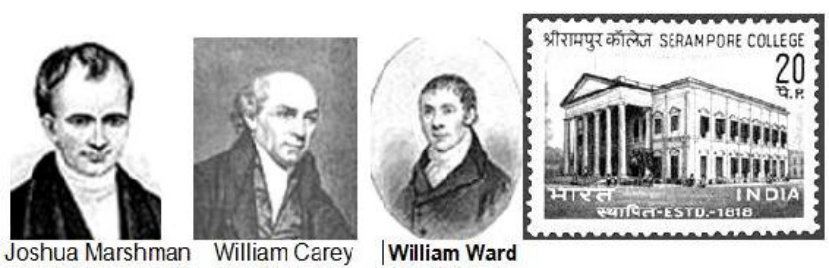
Three missionaries came together to start the Serampore college, a "College for the instruction of Asiatic, Christian, and other youth in Eastern literature and European science" "to students of every "caste, colour or country" and to train people for ministry in the growing church in India." These are known today as the Serampore Trio.
Apart from Carey and Fabricus there were other famous missionaries who toiled with the Danish mission. A few are mentioned in literature which include:
· the linguist Benjamin Schultze (1689-1760), · the Hebrew scholar Christopher T. Walther (1699-1741), · the great missionary diplomat and royal priest Christian Frederick Schwartz (1726-1798), · the educator Christopher Samuel John (1747-1813) and · the lexicographer John Peter Rottler (1749-1836).
In 1793 an India Bill went before the British Parliament which renewed the royal licence of the East India Company. The MP William Wilberforce called for an amendment allowing Christian missions and native schools to be opened in India, but the bid was resisted and not one single bishop supported the amendment when it went before the House of Lords.
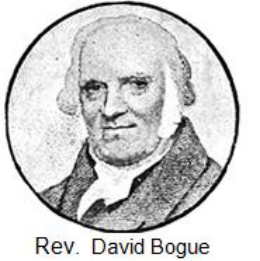
Proposals for the Missionary Society began in 1794 after a Baptist minister, John Ryland, received the encouraging missionary activities in India from William Carey. As a result several leaders like H.O. Wills, an anti-slavery campaigner in Bristol, Scottish ministers in the London, David Bogue and James Steven, and other evangelicals such as John Hey joined in alliance to form the London Mission Society. The London Missionary Society was the first Protestant mission in Andhra Pradesh which established its station at Visakhapatnam in 1805.
Finally a Charter of 1813 passed by the British parliament led to the foundation of the ecclesiastical establishement and ended up with a thrust in the Christianisation and establishment of Educational System in Inda. This opened up more free movement of missions into India from varied denominations. (See The Conversion of India by Dr. George Smith p 109 quoted in the History of Missions.) On invitation from Colonel Arthur Cotton, in 1833, Groves visited widely among missionaries in India, and found open doors for the gospel in many parts of the country.