Search this book
Search results link directly to the matching source page.
CHAPTER NINE Arrival of the British Missionaries
The Malayalam Bible AD 1816 Throughout the 16th century the Portuguese have no European rivals on the long sea route round Africa. The situation changes in the early 17th century, when both the Dutch and the British created East India companies. The Dutch, in particular, damaged Portugal's trade in India.
The next wave of colonizers came in the East India Company. On 31 December 1600, East India Company was born as corporate entity for trade with the East Indies. The Company's ships first arrived in India, at the port of Surat, in 1608.
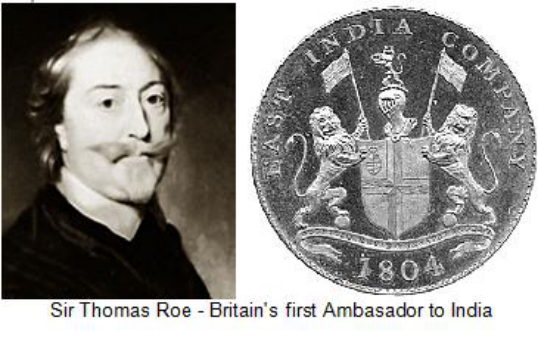
Sir Thomas Roe reached the court of the Mughal Emperor, Jahangir, as the emissary of King James I in 1615, and gained for the British the right to establish a factory at Surat. Gradually the British expanded and displaced the Portuguese and the Duch, driving the Portuguese to a few nisches and the Dutch totally out of India. The
British establised numerous trading posts along the coasts of India, and formed three presidency towns of Calcutta, Bombay, and Madras.
In 1757, British military under Robert Clive defeated the Nawab of Bengal, Siraj-ud-daulah at Plassey, which gave them the soverignity of the land. This was the turning point in favor of the British Raj.
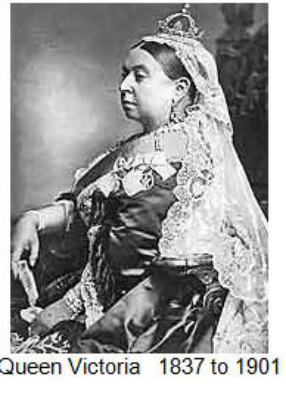
It was too much for the company itself to rule over the country and this led to mutiny of the armed forces. The East India Company ruled India until the Sepoy Rebellion, a revolt led by Indian troops, broke out in 1857. The British defeated the rebels in 1858. As a result the crown took over with a Viceroy at New Delhi. The East India Company went out of existence in 1873.
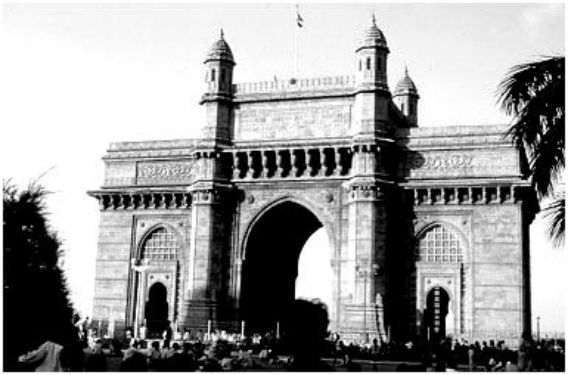
Gateway of India, Bombay
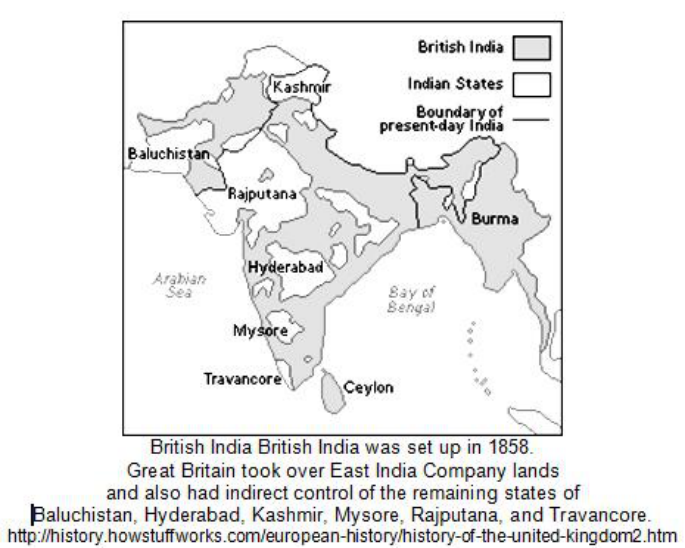
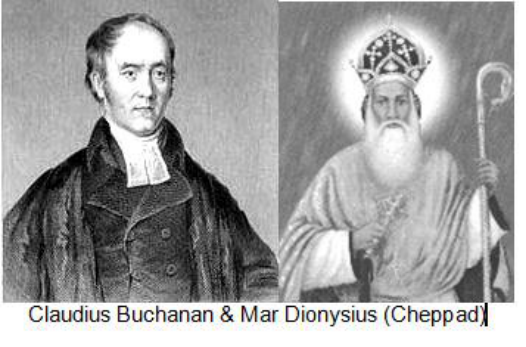
This opened up a wave of British missionaries to India. Kerala, which now formed three Kingdoms Thiruvithamcore, Kochi and Malabar also, came under the influence of the British. There was a resident at the capitals of these states. Along with them came the Missionaries. One of the firsts to be involved with the Malabar Churches was Claudius Buchanan. Dr. Claudius Buchanan, a Chaplain in Bengal, was commissioned by Lord Wellesley to visit the Syrian Christians in 1806. In this work he obtained the cordial assistance of Colonel Macaulay, the first British Resident of Travancore. Church Missionary Society, at the invitation of Colonel Munro, who had succeeded Colonel Macaulay as Resident of Travancore, undertook a Mission to the Syrian Church in the years 1816-17. Messrs. Bailey, Baker, Fenn and Norton were the first missionaries. The object alike of the Resident, the Society, and the missionaries, was to aid the Syrian Church to reform itself, without in any way interfering with its liberty.
The means used to carry out this end were: (1) translation of the Bible into Malayalam; (2) the education of young men for the ministry of the Church; (3) the establishment and maintenance of schools in connection with the different Syrian Churches, scattered over the country. For twenty years this connection with the Syrian Church was maintained happily and successfully.
The Synod of Mavelikara (1818) officially decided to have close cooperation between the missionaries and the Syrians. Mar Divanyous was the Metropolitan of the Jacobite Church at that time. As a result the CMS mission turned their efforts to the evangelization of Hindus all over India.
Malayalam Bible Till eighteenth century there was no Malayalam translation of Bible available. Only Syrian and Latin language Bible were available.
William Carey translated Bible into four North Indian languages, after his arrival in India in 1793. According to his ambition to translate Bible into more Indian languages, Claudius Buchanan vice principal of Calcutta College and Anglican Church Bishop Benjamin Bialy reached to Kerala during 1806. Cheppad Mar Dionysius gave a copy of the Syriac Bible to Buchannan who got copies of it reprinted and distributed them mainly among the clergy. Finding the impact of the Bible Mar Divanyous I translated the gospels into Malayalam which Buchanan got printed in Bombay. In 1807 he translated four Gospels into Malayalam. One Tamil Pandit by name Thimappa pillai and Manangnaziyathu Philiphose Rabban helped him. It was printed in kuriyar press Bombay. In 1917 Benjamin Bialy started to translate full Bible into Malayalam. For his help Moses, Vaidhyanatha Iyer and Chanthu Menon joined with him. It happened that Chanthu Menon belongs to Ottapalam and his two sons Padmanaba Menon and Govindan kutty Menon received baptism before the completion of translation. They received the name Joseph Fen, Bialy Fen and Baker Fen respectively. In 1824 Bialy printed the Gospel of "Mathew" in CMS press Kottayam. Baily translated the New Testament by 1829 it was printed. In 1835 the Old Testament in Malayalam was complete printed and the whole Bible was available in Malayalam by 1841.
The Word of God in the hand of the people in Malayalam
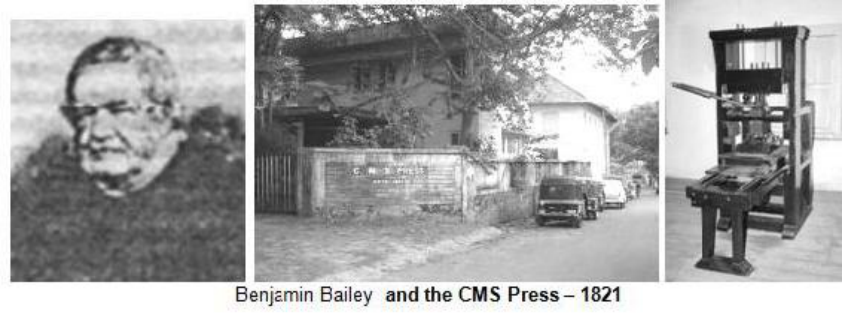
The first assignment given to Benjamin Bailey on his arrival in Kottayam was that Superintendent (Principal) of the ‘Kottayam College' which was established and run by the Church Missionary
Society (CMS) for the education of the Syrian Christians and the general public of Travancore under the package of the ‘Mission of Help'. During his tenure as Principal from 1817 to 1819 Bailey laid the
foundation for modern education modeled on western education. For
this purpose he formulated curricula and syllabi. He started to teach
English language also in the College. Thus B. Bailey became the
founder of English education in Kerala. Benjamin Bailey was the progenitor of printing and book publishing in Malayalam, the native language (mother-tongue) of Kerala. It was he who established the
first printing press (the Kottayam CMS press) and started printing Malayalam in Kerala. He was the first lexicographer in the language.
Besides this, he was a well versed author and translator.
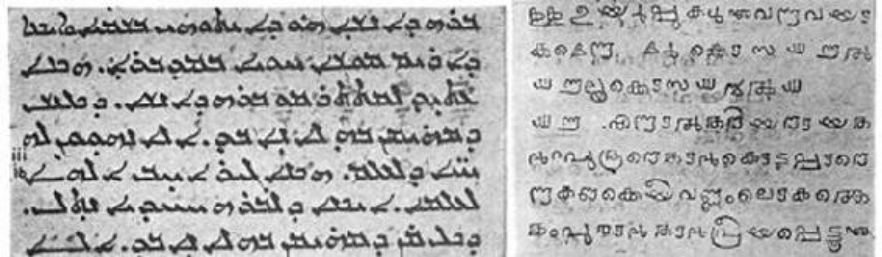
John 3:16 Syriac Manuscript of Four Gospels and Acts, copied about 140 years
ago by Ramban (Monk) Phillippos who in 1806-7 translated it into Malayalam. On the left is an exact translation from the Syrian version.
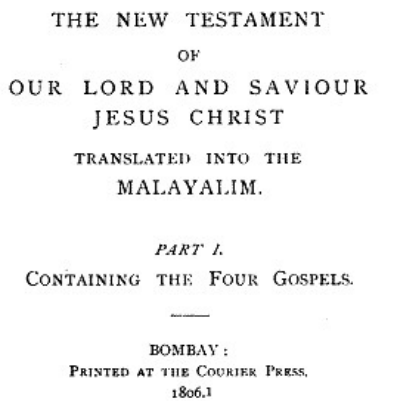
The word of God in the hands of the common people made an impact and a surge of revival and reformation took place. This was accelerated by the presence of the British Missionaries. Among those was Dr. Hermen Gundort (Bassel Mission) who studied Malayalam and wrote the first grammar book for Malayalam.
The effect of dissociation with the Syrian Churches by the mission had far greater impact on the Evangelization of India and in particular
Kerala than it would have been if the association continued.
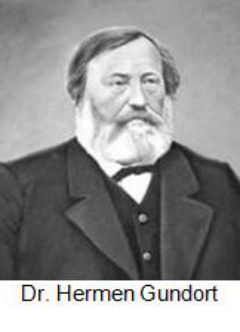
He came to Kerala as a private tutor in 1836. He was appointed
School Inspector of Kanara and Malabar by the British colonial administration in 1857. Joining as a missionary with the Basel Mission
in 1838, Gundert worked in Kerala for 23 years. Gundert lived in
Tellicherry, now named Thalassery The European Missionaries opened up several Missions fields. They Included:
· the Danish Mission in Tamil Nadu under the leadership of Berthealonmese Segan Balgue; · Baptist Mission in Calcutta under the leadership of William Carey (who started the Serampore University); · London Mission Society (LMS) under the leadership of Tingle Tob in Trivandrum area, Tamil Nadu; and Bengal; · Basal Mission (1834) under Samuel Hebic and Gundort in Mangalore and surrounding areas, and. · Church of Scotland Mission in Malabar and many others.